EP1245599A2 - Process for manufacturing impact resistant monovinylaromatic polymers - Google Patents
Process for manufacturing impact resistant monovinylaromatic polymers Download PDFInfo
- Publication number
- EP1245599A2 EP1245599A2 EP02076055A EP02076055A EP1245599A2 EP 1245599 A2 EP1245599 A2 EP 1245599A2 EP 02076055 A EP02076055 A EP 02076055A EP 02076055 A EP02076055 A EP 02076055A EP 1245599 A2 EP1245599 A2 EP 1245599A2
- Authority
- EP
- European Patent Office
- Prior art keywords
- reactor
- elongated
- solution
- elastomer
- stirred tank
- Prior art date
- Legal status (The legal status is an assumption and is not a legal conclusion. Google has not performed a legal analysis and makes no representation as to the accuracy of the status listed.)
- Withdrawn
Links
Images



Classifications
-
- B—PERFORMING OPERATIONS; TRANSPORTING
- B01—PHYSICAL OR CHEMICAL PROCESSES OR APPARATUS IN GENERAL
- B01J—CHEMICAL OR PHYSICAL PROCESSES, e.g. CATALYSIS OR COLLOID CHEMISTRY; THEIR RELEVANT APPARATUS
- B01J19/00—Chemical, physical or physico-chemical processes in general; Their relevant apparatus
- B01J19/18—Stationary reactors having moving elements inside
-
- C—CHEMISTRY; METALLURGY
- C08—ORGANIC MACROMOLECULAR COMPOUNDS; THEIR PREPARATION OR CHEMICAL WORKING-UP; COMPOSITIONS BASED THEREON
- C08F—MACROMOLECULAR COMPOUNDS OBTAINED BY REACTIONS ONLY INVOLVING CARBON-TO-CARBON UNSATURATED BONDS
- C08F2/00—Processes of polymerisation
- C08F2/02—Polymerisation in bulk
-
- C—CHEMISTRY; METALLURGY
- C08—ORGANIC MACROMOLECULAR COMPOUNDS; THEIR PREPARATION OR CHEMICAL WORKING-UP; COMPOSITIONS BASED THEREON
- C08F—MACROMOLECULAR COMPOUNDS OBTAINED BY REACTIONS ONLY INVOLVING CARBON-TO-CARBON UNSATURATED BONDS
- C08F279/00—Macromolecular compounds obtained by polymerising monomers on to polymers of monomers having two or more carbon-to-carbon double bonds as defined in group C08F36/00
- C08F279/02—Macromolecular compounds obtained by polymerising monomers on to polymers of monomers having two or more carbon-to-carbon double bonds as defined in group C08F36/00 on to polymers of conjugated dienes
-
- C—CHEMISTRY; METALLURGY
- C08—ORGANIC MACROMOLECULAR COMPOUNDS; THEIR PREPARATION OR CHEMICAL WORKING-UP; COMPOSITIONS BASED THEREON
- C08F—MACROMOLECULAR COMPOUNDS OBTAINED BY REACTIONS ONLY INVOLVING CARBON-TO-CARBON UNSATURATED BONDS
- C08F279/00—Macromolecular compounds obtained by polymerising monomers on to polymers of monomers having two or more carbon-to-carbon double bonds as defined in group C08F36/00
- C08F279/02—Macromolecular compounds obtained by polymerising monomers on to polymers of monomers having two or more carbon-to-carbon double bonds as defined in group C08F36/00 on to polymers of conjugated dienes
- C08F279/04—Vinyl aromatic monomers and nitriles as the only monomers
-
- B—PERFORMING OPERATIONS; TRANSPORTING
- B01—PHYSICAL OR CHEMICAL PROCESSES OR APPARATUS IN GENERAL
- B01J—CHEMICAL OR PHYSICAL PROCESSES, e.g. CATALYSIS OR COLLOID CHEMISTRY; THEIR RELEVANT APPARATUS
- B01J2219/00—Chemical, physical or physico-chemical processes in general; Their relevant apparatus
- B01J2219/00002—Chemical plants
- B01J2219/00027—Process aspects
- B01J2219/00033—Continuous processes
-
- B—PERFORMING OPERATIONS; TRANSPORTING
- B01—PHYSICAL OR CHEMICAL PROCESSES OR APPARATUS IN GENERAL
- B01J—CHEMICAL OR PHYSICAL PROCESSES, e.g. CATALYSIS OR COLLOID CHEMISTRY; THEIR RELEVANT APPARATUS
- B01J2219/00—Chemical, physical or physico-chemical processes in general; Their relevant apparatus
- B01J2219/00002—Chemical plants
- B01J2219/00027—Process aspects
- B01J2219/0004—Processes in series
-
- B—PERFORMING OPERATIONS; TRANSPORTING
- B01—PHYSICAL OR CHEMICAL PROCESSES OR APPARATUS IN GENERAL
- B01J—CHEMICAL OR PHYSICAL PROCESSES, e.g. CATALYSIS OR COLLOID CHEMISTRY; THEIR RELEVANT APPARATUS
- B01J2219/00—Chemical, physical or physico-chemical processes in general; Their relevant apparatus
- B01J2219/00049—Controlling or regulating processes
- B01J2219/00051—Controlling the temperature
- B01J2219/00074—Controlling the temperature by indirect heating or cooling employing heat exchange fluids
- B01J2219/00087—Controlling the temperature by indirect heating or cooling employing heat exchange fluids with heat exchange elements outside the reactor
- B01J2219/00094—Jackets
-
- B—PERFORMING OPERATIONS; TRANSPORTING
- B01—PHYSICAL OR CHEMICAL PROCESSES OR APPARATUS IN GENERAL
- B01J—CHEMICAL OR PHYSICAL PROCESSES, e.g. CATALYSIS OR COLLOID CHEMISTRY; THEIR RELEVANT APPARATUS
- B01J2219/00—Chemical, physical or physico-chemical processes in general; Their relevant apparatus
- B01J2219/00049—Controlling or regulating processes
- B01J2219/00051—Controlling the temperature
- B01J2219/00132—Controlling the temperature using electric heating or cooling elements
-
- B—PERFORMING OPERATIONS; TRANSPORTING
- B01—PHYSICAL OR CHEMICAL PROCESSES OR APPARATUS IN GENERAL
- B01J—CHEMICAL OR PHYSICAL PROCESSES, e.g. CATALYSIS OR COLLOID CHEMISTRY; THEIR RELEVANT APPARATUS
- B01J2219/00—Chemical, physical or physico-chemical processes in general; Their relevant apparatus
- B01J2219/18—Details relating to the spatial orientation of the reactor
- B01J2219/185—Details relating to the spatial orientation of the reactor vertical
-
- B—PERFORMING OPERATIONS; TRANSPORTING
- B01—PHYSICAL OR CHEMICAL PROCESSES OR APPARATUS IN GENERAL
- B01J—CHEMICAL OR PHYSICAL PROCESSES, e.g. CATALYSIS OR COLLOID CHEMISTRY; THEIR RELEVANT APPARATUS
- B01J2219/00—Chemical, physical or physico-chemical processes in general; Their relevant apparatus
- B01J2219/19—Details relating to the geometry of the reactor
- B01J2219/194—Details relating to the geometry of the reactor round
- B01J2219/1941—Details relating to the geometry of the reactor round circular or disk-shaped
- B01J2219/1943—Details relating to the geometry of the reactor round circular or disk-shaped cylindrical
Definitions
- the present invention relates to a process for the continuous production of elastomer-modified high-impact monovinylaromatic polymers.
- This invention is directed to a continuous process for the manufacture of elastomer-modified monovinylaromatic polymers such as high impact polystyrene (HIPS), and more particularly discloses processes and apparatus for the efficient and economical manufacture of HIPS using a unique primary reactor design to replace the conventional pre-inversion reactor (PIR) to allow better temperature control and improved control of rubber particle size (RPS) of the finished product.
- PIR pre-inversion reactor
- RPS rubber particle size
- the continuous process for making HIPS material consists of polymerizing styrene monomer in the presence of dissolved rubber. Polystyrene is initially formed from the styrene monomer within the homogeneous rubber solution.
- the usual rubber types utilized in the manufacture of HIPS include polybutadiene (PB), styrene-butadiene rubber (SBR), and styrene-butadiene-styrene rubber (SBS).
- Current processes for making HIPS materials most generally utilize two continuous-stirred tank reactors (CSTR) in the initial manufacturing process to control grafting of the elastomer and styrene particles as well as controlling the RPS character of the material.
- CSTR continuous-stirred tank reactors
- One example of the prior art disclosing the use of CSTR reactors is the patent to Echte, U.S. 4,567,232.
- HIPS materials include European Patent Specification, publication number 0 254 304 B1, indicating the inventor as Morita, et al, filed July 22, 1987. This patent is directed to controlling RPS so that it exhibits a narrow distribution. This is achieved using multiple tubular reactors containing static mixers.
- U. S. patent to Miura et al discloses a continuous process for making a polystyrene for injection molding purposes, which is made from styrene monomer and a polymerizable unsaturated fatty acid, using a tubular reactor with fixed plural mixing elements formed on the inside thereof.
- U.S. patent 4,521,569 to Bubeck et al teaches the manufacture of HIPS materials having improved stress crack resistance wherein the polystyrene is polymerized using an aliphatic hydrocarbon as a polymerization solvent rather than an aromatic or cycloaliphatic hydrocarbon.
- Other patents teaching the manufacture of HIPS materials include U.S. 3,658,946 to Bronstert; and U.S. 4,144,204 to Mittnacht, et al.
- the present invention overcomes these problems by providing a process which greatly reduces and in most cases eliminates the need for preheaters and internal tube heat exchangers in the polymerization process.
- the present invention overcomes the disadvantages of the prior art HIPS manufacturing processes by replacing the normal CSTR type of initial reactor used as a preinversion stage reactor, with a longer and narrower stirred reactor having a much larger Height to Diameter (H/D) ratio than the conventional PIR type of reactor.
- each CSTR is similar to the other.
- These reactors comprise vessels in which a set of stirring paddles are rotatably located, generally along the central vertical axis of the vessel.
- the conventional CSTR vessel will have a cylindrical reaction section having a vertical length or height equal to or slightly longer than the lateral diameter of the vessels, with a height to diameter (H/D) ratio usually not exceeding about 1.5.
- the two initial CSTR vessels consist of a preinversion reactor and an inversion reactor.
- a preinversion reactor because of the need to control low conversion rates in the first, or preinversion, reactor, insufficient heat of polymerization is created to sustain the reaction, and a preheater must be utilized to add heat to the rubber/styrene monomer feedstock prior to reaction in the first CSTR reactor.
- the present invention eliminates the need for a preheater and also allows production rates to be increased significantly over conventional processes by replacing the conventional preinversion CSTR reactor with an elongated upflow reactor (EUR) having a reaction chamber with an H/D ratio of 3-4. While this is still a stirred reactor just as the CSTR is, the EUR design acts in some ways like a plug-flow reactor (PFR), one of which is utilized in the Sosa patent downstream of the two initial CSTR reactors. However, the EUR is not a plugflow reactor, but is a stirred reactor. Those with experience in reactor design will realize that for first and second order reactions, three to four CSTR type reactors, in series, will approach the performance of a plugflow reactor, within about 85-90%.
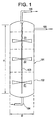
- the initial reactor is indicated at 101 and consists of a tall narrow reactor vessel 102, preferably cylindrical in shape, and having an axial height indicated at H and a diameter indicated at D. In one preferred embodiment, the ratio H/D was 3.0.
- a paddle system 103 is located along the central vertical axis to provide shear and mixing of the rubber and styrene constituents of the reaction solution, and prevent clumping of the gel particles being formed.
- a heater system consisting of a hot oil jacket or electrical heating elements may be provided around the EUR vessel solely to bring the vessel up to operating conditions before initial operation of the process. Once the reaction process enters a steady state, the heating system is shut off and is not needed for as long as the process continues.
- An inlet conduit 104 is located at the bottom of reactor 101 and arranged to provide feedstock into the bottom of the reactor.
- a discharge conduit 105 exits the top of the reactor to allow discharge of partially polymerized HIPS and non-polymerized reactants.
- a vapor recovery line 106 is also at the top of vessel 101 to recover vapors generated in the upper zone of the vessel as more fully described hereinbelow.
- the length of the EUR vessel is determined so that the vessel is zoned for different stages of HIPS reaction.
- the first zone, indicated as Z1 in the figure, is where the polymerization reaction begins and heat of reaction is generated.
- the middle zone, Z2 is the inversion zone, where phase inversion of the reactants occur; and, the top zone, Z3 is where the solids content of the reaction stream is increased significantly. Also excess heat of reaction is removed in the top zone by allowing vaporization of unreacted styrene monomer and other light elements, with the resulting vapor being recovered, condensed and recycled through recovery line 106 to a condenser (not shown).
- the total volume of the EUR reactor is approximately the same as that of the second, conventional CSTR reactor, which is directly downstream of the EUR reactor and receives the products thereof through conduit 105.
- a feedstock comprising a solution of styrene monomer in which is dissolved an elastomer such as the polybutadiene rubber, such as that designated as "Diene 55" (produced by the Firestone Tire & Rubber Co.), is introduced with an initiator, such as those disclosed in accompanying Table I, through input line 104 into Zone Z1 of the EUR 101.
- an initiator such as those disclosed in accompanying Table I
- a startup temporary heating source such as hot oil or electric heating elements, is used to bring the reactor up to operating conditions, then the heat source is removed.
- Stirring paddles 103 are rotated in the solution with a tip speed of about 60 to about 150 feet per minute, to input shear into the solution and prevent clumping of gel particles as they are formed in the reactor.
- zone Z3 As the solution progresses through zone Z3, the percent solids of the mixture increases as additional styrene monomer is polymerized around and within the rubber particles. By this point, the heat of reaction is sufficient in zone Z3 to vaporize the lighter components in the solution, such as styrene and ethylbenzene, as well as the byproducts of the initiator, which vaporized products serve to remove heat from the reactor as they are removed from the vessel through line 106.
- the lighter components in the solution such as styrene and ethylbenzene
- Figure 2 is a graph of the gel to rubber ratios (G/R) as a function of percent rubber after devolatilization, of samples of products from an EUR reactor in the lab process (curve A-A), and a conventional CSTR type reactor from the pilot plant(curve B-B), given a 4% initial rubber feed level in both reactors.
- G/R gel to rubber ratios
- the G/R of the EUR sample is approximately 2.4, whereas the CSTR sample exhibits a G/R of only 2.0, an increase in the EUR of about 20%.
- This ratio, the G/R is important in the manufacture of HIPS materials because it represents the "rubber efficiency" of the process, i.e., how much rubber must be used to obtain similar product quality. The less rubber needed to produce a set of desired properties in a HIPS material, the more efficient the process.
- the G/R ratios are compared at swell indices of 11.
- Figures 5 and 6 are TEM photomicrographs of a HIPS material made in the above-mentioned pilot plant having a preheater and two CSTR reactors, followed by at least one PFR type reactor.
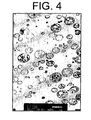
- Figure 5 represents a sample from the first CSTR and Figure 6 a sample from the second CSTR. These two samples have poor RPSD as well as a poor morphology, comparable in no way to the benchmark sample of Figure 4.
- the two photomicrographs in Figures 5 and 6 represent samples from the two CSTR type reactors in the pilot plant, which utilize H/D ratios of 1.2 and 1.5 to 1 respectively.
- the HIPS resin of Figure 4 has a more uniform RPSD in that the rubber particles represented by the dark lines in the photo contain large polystyrene inclusions, represented by the white spots.
- the rubber efficiency (G/R ratio) of the material of Figure 4 is calculated to be 3.4 whereas the G/R of the material of Figure 5 is only 2.5, a decrease of almost 30%.
- Figures 7 and 8 show examples of HIPS material having morphologies more similar to the benchmark material of Figure 4 than that of conventional materials of Figures 5 and 6.
- the samples photographed in figures 7 and 8 were made in the above-mentioned lab system consisting of an EUR type reactor of the present invention, followed by a conventional CSTR type reactor, having H/D ratios of 3.5 to 1 and 1.2 to 1, respectively.
- the RPSD of the EUR samples of Figures 7 and 8 are excellent, with large evenly formed particles and not a large number of small particles. Also the morphology of the large particles is excellent and approaches that of the benchmark sample of Figure 4.
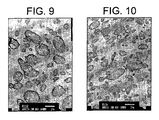
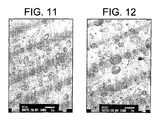
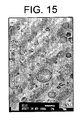
- Figures 9-15 illustrate the various rubber particle size distributions and morphologies that can be obtained with the present invention utilizing various types of initiators when used with a common chain transfer agent such as NDM.
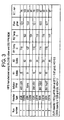
- the figures can be correlated with the data contained in the table of Figure 3.
- Figure 9 represents Run No. 1, EUR reactor
- Figure 10 represents Run No. 4 of the EUR reactor
- Figure 11 represents Run No. 1 CSTR reactor
- Figure 12 represents Run No. 3 CSTR reactor.
- Figures 9 and 10 illustrate the morphology of rubber particles immediately after the EUR
- Figures 10 and 11 illustrate the morphology immediately following the second CSTR. It is clear that the EUR was operated at conditions which brought the polymerization reaction past the inversion point.
- the particles formed can be maintained in the range of 5 to 15 microns.
- the particle size is reduced in the second CSTR by adjusting the viscosity of the medium and the shear rate imparted to the solution.
- the EUR is typically operated at conditions that insure inversion in the second zone by adjusting the initiator levels, temperatures, and residence times.
- Figures 13, 14, and 15 illustrate the morphology of the reactant solution immediately following the second CSTR.
- Figure 13 is the sample from a purely thermal reaction in the EUR system using no initiators. The RPSD and morphology of this run are almost identical to those of the benchmark sample of Figure 4. However, running the present invention on purely thermal reaction is very slow and the production rate or conversion rate is so slow as to be economically unfeasible.
- Figure 14 is an EUR reactor run with 200 PPM of TAEC initiator showing good RPSD but the morphology is not as good as desired because of the presence of some irregular shaped large particles.
- Figure 15 is an EUR sample made using 200 PPM of the initiator Trigonox 17. This sample shows an excellent morphology but the RPSD is not quite up to desired standards.
- Figures 9-15 illustrate that the morphologies obtained in the EUR system at the conditions shown in the table of Figure 3 can be varied by selection of the proper initiators and are better than those obtained from samples made in the pilot plant on two conventional CSTR type reactors having H/D ratios of 1.2 and 1.5.
- the morphologies of materials produced at low solids contents in the EUR system with different initiators show that the morphologies are not well defined.
- Figure 13 shows good morphology and good RPSD with a noted absence of the undesirable very small particles.
- the PS inclusions of this sample are not as well defined as those of the samples of Figures 7 and 8.
- Figures 14 and 15 show that the use of some initiators leads to irregular particles and small PS inclusions.
Landscapes
- Chemical & Material Sciences (AREA)
- Chemical Kinetics & Catalysis (AREA)
- Organic Chemistry (AREA)
- Health & Medical Sciences (AREA)
- Medicinal Chemistry (AREA)
- Polymers & Plastics (AREA)
- Polymerisation Methods In General (AREA)
- Graft Or Block Polymers (AREA)
Abstract
Description
| Peroxides And Other Initiators Used in HIPS Production | |||
| Commercial Name | Chemical Name | Temp. (degrees C) | |
| 1 | 10 hr halflife | ||
| Lupersol 531 | 1,1-di-(t-amylperoxy)cyclohexane | 112 | 93 |
| Lupersol 231 | 1,1-di-(t-butylperoxy)-3,3,5-trimethyl- | 115 | 96 |
| Lupersol TAEC | OO-t-amyl-0-(2-ethylhexyl monoperoxy- | 117 | 99 |
| Lupersol TBIC | OO-t-butyl O-isopropyl monoperoxy-Carbonate | 118 | 99 |
| Lupersol TBEC | OO-t-butyl-O-(2-ethylhexyl)monoperoxy-Carbonate | 121 | 100 |
| Trigonox 17 | N-butyl-4,4-di(t-butylperoxy)valerate | 121 | 102 |
| Lupersol 233 | | 134 | 114 |
| | 2,2-azo bis(isobutyronitrile) | 82 | 64 |
| Commercially available from Akzo Nobel, 300 South Riverside Rd., Chicago, IL; ATOFINA Chemicals, Market Street, Philadelphia, Pa.; and, Aztec Peroxides, Inc., 7600 West Tidwell, Houston, Texas. NDM is n-dodecylmercaptan, a chain transfer agent. |
Claims (14)
- In a process for the continuous production of high impact polystyrene wherein styrene monomer is polymerized in the presence of an elastomer dissolved therein, said process having at least one continuous-stirred tank reactor, the improvement comprising utilizing as an initial reactor, an elongated stirred tank reactor having plugflow characteristics, and wherein said elongated stirred tank reactor has a reaction zone having a length to diameter ratio exceeding about 2.
- The process of claim 1 wherein said elongated stirred tank reactor utilizes an upflow configuration.
- The process of claim 2 wherein there is an absence of a continuously operating preheater located prior to the elongated reactor.
- The process of claim 3 wherein an initiator in amounts of at least 100 PPM are utilized in the styrene monomer/elastomer solution in said elongated reactor.
- The process of claim 2 wherein said elongated reactor reaction zone has a height to diameter ratio of about 3 to about 4.
- The process of claim 2 wherein said stirred tank reactor has at least one paddle stirrer located rotatably therein, arranged to rotate at a tip speed of about 60 to about 150 feet per minute.
- The process of claim 5 wherein said stirred tank reactor has at least one paddle stirrer located rotatably therein, arranged to rotate at a tip speed of about 60 to about 150 feet per minute.
- The process of claim 2 wherein said elongated reactor comprises at least three reaction zones, a bottom preinversion zone, a middle inversion zone, and an upper heat vaporization zone.
- The process of claim 8 wherein said elongated reactor has at its upper end a vapor removal conduit communicating with said upper heat vaporization zone.
- The process of claim 8 wherein said process further comprises at least one continuous stirred tank reactor and at least one plugflow reactor located downstream of said elongated reactor.
- The process of claim 8 wherein the percent solids in the elongated reactor is maintained at a level of about two to three times the initial level of elastomer contained in the feed to the process, thereby insuring that inversion is achieved in the elongated reactor.
- A process for the continuous production of elastomer-modified polystyrene, said process comprising the steps of:A. Introducing an initial, non-preheated, feedstock solution of elastomer and styrene monomer into an elongated upflow reactor after first warming said reactor to operating temperature;B. Adding a polymerization initiator to said feedstock solution while introducing the feedstock into said reactor;C. Flowing said solution upward in said reactor and reacting said styrene monomer, elastomer, and initiator to form a partially polymerized solution having styrene-elastomer particles therein, and wherein said reacting step moves said solution past the inversion point;D. Controlling the size of particles being formed in said reactor by stirring said solution with rotating stirring paddles having a tip speed of about 60 to about 150 feet per minute;E. Continuing to react said solution in said reactor as it moves upwardly therethrough, thereby carrying said reaction considerably past said inversion point; and,F. Flowing said solution into a second stirred reactor vessel to achieve further conversion of the solution into elastomer-modified polystyrene.
- The process of claim 12 wherein said initiator is a peroxide initiator and said second stirred reactor is a continuous stirred tank reactor.
- The process of claim 12 wherein said initiator is a peroxide initiator and said second stirred reactor is an elongated upflow reactor.
Applications Claiming Priority (2)
| Application Number | Priority Date | Filing Date | Title |
|---|---|---|---|
| US09/823,535 US6569941B2 (en) | 2001-03-30 | 2001-03-30 | Process for manufacturing impact resistant monovinylaromatic polymers |
| US823535 | 2001-03-30 |
Publications (2)
| Publication Number | Publication Date |
|---|---|
| EP1245599A2 true EP1245599A2 (en) | 2002-10-02 |
| EP1245599A3 EP1245599A3 (en) | 2003-05-02 |
Family
ID=25239041
Family Applications (1)
| Application Number | Title | Priority Date | Filing Date |
|---|---|---|---|
| EP02076055A Withdrawn EP1245599A3 (en) | 2001-03-30 | 2002-03-18 | Process for manufacturing impact resistant monovinylaromatic polymers |
Country Status (6)
| Country | Link |
|---|---|
| US (1) | US6569941B2 (en) |
| EP (1) | EP1245599A3 (en) |
| JP (1) | JP4112255B2 (en) |
| KR (1) | KR100878787B1 (en) |
| CN (1) | CN1229403C (en) |
| TW (1) | TW575590B (en) |
Cited By (1)
| Publication number | Priority date | Publication date | Assignee | Title |
|---|---|---|---|---|
| WO2006126891A1 (en) * | 2005-05-27 | 2006-11-30 | Lars Aglen | Cylindrical reactor for continuous treatment of an agitated material composition for a predetermined retention time |
Families Citing this family (16)
| Publication number | Priority date | Publication date | Assignee | Title |
|---|---|---|---|---|
| JP4087682B2 (en) * | 2002-11-07 | 2008-05-21 | 株式会社日本触媒 | Method and apparatus for producing water-absorbing resin |
| US7129297B2 (en) * | 2003-09-29 | 2006-10-31 | Fina Technology, Inc. | Polystyrene blends and a method of making same |
| US8093332B2 (en) * | 2003-09-29 | 2012-01-10 | Fina Technology, Inc. | High impact polystyrene and process for preparing same |
| US20050113525A1 (en) * | 2003-11-26 | 2005-05-26 | Sosa Jose M. | Use of tetrafunctional initiators to improve the rubber phase volume of HIPS |
| US7282552B1 (en) | 2006-05-16 | 2007-10-16 | Fina Technology, Inc. | Styrene copolymers with a bimodal molecular weight distribution |
| US20070299209A1 (en) * | 2006-06-21 | 2007-12-27 | Sosa Jose M | Methods for production of high impact polystyrene |
| US20080057294A1 (en) * | 2006-09-01 | 2008-03-06 | Fina Technology, Inc. | High impact polystyrene tile |
| US20080057295A1 (en) * | 2006-09-01 | 2008-03-06 | Fina Technology, Inc. | Engravable board |
| US7799888B2 (en) * | 2007-04-27 | 2010-09-21 | Gelest, Inc. | Low molecular weight siloxanes with one functional group |
| US7895548B2 (en) | 2007-10-26 | 2011-02-22 | Synopsys, Inc. | Filler cells for design optimization in a place-and-route system |
| EP2093238A1 (en) | 2008-02-21 | 2009-08-26 | Total Petrochemicals France | Process for preparing hydroperoxidized elastomers and their use in high impact monovinylaromatic polymers |
| US20110054123A1 (en) * | 2009-08-26 | 2011-03-03 | Fina Technology, Inc. | High Impact Polymers and Methods of Making and Using Same |
| CN102050928B (en) * | 2009-10-30 | 2012-07-18 | 中国石油天然气股份有限公司 | A continuous bulk synthesis method of flame retardant ABS |
| CN104558429B (en) * | 2013-10-18 | 2017-11-07 | 中国石油化工股份有限公司 | Polyphenylacetylene combination production method and thus obtained polyphenylacetylene combination |
| EP3053647A1 (en) * | 2015-02-06 | 2016-08-10 | LANXESS International SA | Tube reactor and method for continuous polymerization |
| CN113041960A (en) * | 2019-12-27 | 2021-06-29 | 江苏和成新材料有限公司 | Continuous chemical reaction kettle |
Family Cites Families (11)
| Publication number | Priority date | Publication date | Assignee | Title |
|---|---|---|---|---|
| JPS528095A (en) * | 1975-07-09 | 1977-01-21 | Idemitsu Petrochem Co Ltd | Process for preparing high-impact polystyrene |
| CA1331820C (en) * | 1987-12-24 | 1994-08-30 | Jose M. Sosa | Continuous process including recycle stream treatment for the production of high impact polystyrene |
| IT1230085B (en) * | 1989-05-24 | 1991-10-05 | Montedipe Spa | PROCESS FOR THE MASS AND CONTINUOUS PRODUCTION OF (CO) AROMATIC SHOCKPROOF VINYL POLYMERS. |
| US5286884A (en) * | 1992-07-24 | 1994-02-15 | Texaco Chemical Company | Thermosyphonic reaction of propylene with tertiary butyl hydroperoxide and reactor |
| US5243083A (en) * | 1992-07-24 | 1993-09-07 | Texaco Chemical Company | Thermosyphonic reaction of oxygen with isobutane and reactor |
| CA2120994C (en) * | 1993-04-15 | 2010-09-21 | Sehyun Kim | High impact polystyrene having improved gloss and impact characteristics |
| CA2127140A1 (en) * | 1993-07-19 | 1995-01-20 | James E. Cantrill | Particulation of a metastable syrup |
| CA2207785A1 (en) * | 1996-07-10 | 1998-01-10 | Nova Chemicals (International) S.A. | Large particle generation |
| US5973079A (en) * | 1998-02-06 | 1999-10-26 | Nova Chemicals (International ) S.A. | Large particle generation |
| US6399711B1 (en) * | 1998-06-04 | 2002-06-04 | Asahi Kasei Kabushiki Kaisha | Process for the preparation of rubber-reinforced styrene resin |
| US6143833A (en) * | 1999-06-11 | 2000-11-07 | Fina Technology, Inc. | Method and apparatus for producing hips using continuous polybutadiene feed |
-
2001
- 2001-03-30 US US09/823,535 patent/US6569941B2/en not_active Expired - Fee Related
-
2002
- 2002-03-01 TW TW91103849A patent/TW575590B/en not_active IP Right Cessation
- 2002-03-18 EP EP02076055A patent/EP1245599A3/en not_active Withdrawn
- 2002-03-25 JP JP2002083193A patent/JP4112255B2/en not_active Expired - Fee Related
- 2002-03-29 KR KR1020020017239A patent/KR100878787B1/en not_active Expired - Fee Related
- 2002-03-29 CN CNB021085269A patent/CN1229403C/en not_active Expired - Fee Related
Cited By (1)
| Publication number | Priority date | Publication date | Assignee | Title |
|---|---|---|---|---|
| WO2006126891A1 (en) * | 2005-05-27 | 2006-11-30 | Lars Aglen | Cylindrical reactor for continuous treatment of an agitated material composition for a predetermined retention time |
Also Published As
| Publication number | Publication date |
|---|---|
| EP1245599A3 (en) | 2003-05-02 |
| KR100878787B1 (en) | 2009-01-14 |
| TW575590B (en) | 2004-02-11 |
| JP4112255B2 (en) | 2008-07-02 |
| US20020173588A1 (en) | 2002-11-21 |
| JP2002308908A (en) | 2002-10-23 |
| CN1379048A (en) | 2002-11-13 |
| KR20020077224A (en) | 2002-10-11 |
| US6569941B2 (en) | 2003-05-27 |
| CN1229403C (en) | 2005-11-30 |
Similar Documents
| Publication | Publication Date | Title |
|---|---|---|
| US6569941B2 (en) | Process for manufacturing impact resistant monovinylaromatic polymers | |
| CA1039437A (en) | Continuous mass polymerization process for polyblends | |
| EP0657479B1 (en) | Grafting, phase-inversion and cross-linking controlled multi-stage bulk process for making ABS graft copolymers | |
| US5166260A (en) | Process for the continuous bulk production of high impact vinylaromatic (co)polymers | |
| EP0015752B1 (en) | A continuous mass polymerization process for the production of polyblends having a dispersed rubber phase with bimodal rubber particle size | |
| US4334039A (en) | Process for preparing polymeric polyblends having a rubber phase as particles with a bimodal particle size distribution | |
| US4252911A (en) | Mass polymerization process for ABS polyblends | |
| US4417030A (en) | Mass polymerization process for ABS polyblends | |
| US4125573A (en) | Polymer polyblend composition | |
| CN101296985A (en) | Low Temperature Initiator for Enhancing Rubber Phase Volume in High Impact Polystyrene Formulations | |
| US4451612A (en) | Continuous process for the preparation of rubber modified polymers | |
| US4187260A (en) | Mass polymerization process for polyblends | |
| US4315083A (en) | Process for the continuous mass polymerization of polyblends | |
| RU2493174C2 (en) | Method for synthesis of functionalised poly(1,3-alkadienes) and use thereof in producing impact-resistant vinyl aromatic polymers | |
| KR970005478B1 (en) | Process for producing rubber-modified styrene resin, and resin composition | |
| US4185049A (en) | Mass polymerization process for polyblends | |
| US4362850A (en) | Process for the continuous polymerization of polyblends | |
| CA1129139A (en) | Process for the continuous polymerization of polyblends | |
| CA1087792A (en) | Continuous mass polymerization process for polybends | |
| KR20130100177A (en) | Methods of making high impact polystyrene | |
| US4598124A (en) | Mass polymerization process for ABS polyblends | |
| US5189095A (en) | High-impact polystyrene | |
| JPH02311508A (en) | Production of rubber-modified styrene resin, and resin composition containing the same | |
| JPH03712A (en) | Preparation of rubber-modified styrenic resin and resin composition |
Legal Events
| Date | Code | Title | Description |
|---|---|---|---|
| PUAI | Public reference made under article 153(3) epc to a published international application that has entered the european phase |
Free format text: ORIGINAL CODE: 0009012 |
|
| 17P | Request for examination filed |
Effective date: 20020318 |
|
| AK | Designated contracting states |
Kind code of ref document: A2 Designated state(s): AT BE CH CY DE DK ES FI FR GB GR IE IT LI LU MC NL PT SE TR |
|
| AX | Request for extension of the european patent |
Free format text: AL;LT;LV;MK;RO;SI |
|
| PUAL | Search report despatched |
Free format text: ORIGINAL CODE: 0009013 |
|
| AK | Designated contracting states |
Designated state(s): AT BE CH CY DE DK ES FI FR GB GR IE IT LI LU MC NL PT SE TR |
|
| AX | Request for extension of the european patent |
Extension state: AL LT LV MK RO SI |
|
| AKX | Designation fees paid |
Designated state(s): AT BE CH CY DE DK ES FI FR GB GR IE IT LI LU MC NL PT SE TR |
|
| 17Q | First examination report despatched |
Effective date: 20050504 |
|
| STAA | Information on the status of an ep patent application or granted ep patent |
Free format text: STATUS: THE APPLICATION IS DEEMED TO BE WITHDRAWN |
|
| 18D | Application deemed to be withdrawn |
Effective date: 20131001 |