Field of the invention
-
The present invention relates to thermographic recording
materials whose prints have improved archival properties without
loss in printability.
Background of the invention.
-
Thermal imaging or thermography is a recording process wherein
images are generated by the use of thermal energy. In direct
thermal thermography a visible image pattern is formed by image-wise
heating of a recording material.
-
EP 692 733 discloses a direct thermal recording process wherein
a direct thermal recording material is heated dot-wise and the
direct thermal recording material comprises on a substrate an
imaging layer containing uniformly distributed in a film-forming
polymeric binder (i) one or more substantially light-insensitive
organic silver salts being no double salts, the silver salt(s) being
in thermal working relationship with (ii) an organic reducing agent
therefor, characterized in that the reducing agent is a benzene
compound the benzene nucleus of which is substituted by no more than
two hydroxy groups which are present in 3,4-position on the nucleus
and have in the 1-position of the nucleus a substituent linked to
the nucleus by means of a carbonyl group. In a preferred embodiment
of EP-A 692 733 the preferred carbonyl substituted 3,4-dihydroxy-benzene
reducing agents are selected from the group consisting of
3,4-dihydroxy-benzoic acid, an alkyl or aryl ester thereof, 3,4-dihydroxy-benzaldehyde,
3,4-dihydroxy-benzamide and aryl or alkyl
(3,4-dihydroxyphenyl) ketones. EP-A 692 733 exemplifies 3,4-dihydroxy-benzophenone.
-
In printing with thermographic materials for medical
applications for viewing with a light box, optimum diagnosis
requires a blue-black image tone so that the higher ability of the
human eye to distinguish detail with such image tone can be
exploited, thereby improving the diagnostic value of such prints.
Such image tone should be independent of the shelf-life of the
thermographic recording material prior to printing and also of
archival time after printing. Image tone can be assessed on the
basis of the L*, a* and b* CIELAB-values as determined by
spectrophotometric measurements according to ASTM Norm E179-90 in a
R(45/0) geometry with evaluation according to ASTM Norm E308-90. It
is not only important that fresh prints produced with substantially
light-insensitive thermographic recording materials exhibit the
bluish tone necessary for reliable diagnosis with X-ray images, but
also that the image tone is substantially maintained during storage
in the dark in archives and also while being view in transmission
using light-boxes i.e. exposed to visible light. Substantially
light-insensitive thermographic recording materials should therefore
be capable of producing bluish prints upon printing and this image
tone should be substantially maintained during storage in the dark
and during viewing on a light box while maintaining their
sensitometry. Prior art materials do not provide this balance of
properties.
Aspects of the invention.
-
It is therefore an aspect of the present invention to provide a
substantially light-insensitive thermographic recording materials
capable of exhibiting a high printability as expressed by the ratio
of Dmax to organic silver salt coverage together with thermographic
prints with improved maintenance of image density levels e.g. for D
= 1.0 and sensitometry during storage in the dark.
-
Further aspects and advantages of the invention will become
apparent from the description hereinafter.
Summary of the invention
-
It has been surprisingly found that substantially light-insensitive
thermographic recording materials whose thermosensitive
elements contain a substantially light-insensitive organic silver
salt in thermal working relationship with 3,4-dihydroxyphenyloxo-aryl
compounds in which the aryl group is substituted with
particular substituents or 3,4-dihydroxyphenyloxo-heteroaryl
compounds as a reducing agent, exhibit high printability as
expressed by the ratio of Dmax to organic silver salt coverage
together with thermographic prints with improved maintenance of
image density levels e.g. for D = 1.0 during storage in the dark.
-
The above mentioned aspects are realized by providing a
monosheet black and white substantially light-insensitive
thermographic recording material comprising a thermosensitive
element and a support, the thermosensitive element containing a
substantially light-insensitive organic silver salt, a 3,4-dihydroxybenzene
compound in thermal working relationship therewith
and a binder, characterized in that the 3,4-dihydroxybenzene
compound is an aryloxo-3,4-dihydroxybenzene compound in which the
aryl-group is substituted with at least one substituent having a σm-value
greater than 0; or a heteroaryloxo-3,4-dihydroxybenzene
compound in which the heteroaryl group has a unified aromaticity
index IA greater than 53 and is optionally substituted with at least
one group selected from the group consisting of aryl, hydroxy,
carboxy, sulfo, sulfoalkyl, sulfoaryl, sulfonylalkyl, sulfonylaryl,
annulated aryl, annulated heteroaryl, carboxyalkyl, carboxyaryl,
oxoalkyl, oxoaryl, halogen, nitro, cyano and mercapto-alkyl groups.
-
The above mentioned aspects are also realized by providing a
thermographic recording process for the above-mentioned monosheet
black and white substantially light-insensitive thermographic
recording material comprising the steps of: (i) providing the
thermographic recording material; (ii) bringing the thermographic
recording material into the proximity of a heat source; (iii)
applying heat imagewise from the heat source to the thermographic
recording material; and (iv) removing the thermographic recording
material from the proximity of the heat source.
-
Different embodiments are disclosed in the dependent claims.
Detailed description of the invention
-
According to a first embodiment of the thermographic recording
process, according to the present invention, the heat source is a
thermal head.
-
According to a second embodiment of the thermographic recording
process according to the present invention, the heat source is a
thin film thermal head.
Definitions
-
By substantially light-insensitive is meant not intentionally
light sensitive.
-
The term double salt with respect to organic silver salts means
that silver is associated with another cation e.g. a magnesium ion
or an iron ion.
-
The term 3,4-dihydroxybenzene compound means a benzene compound
with a substituent in the 1-position and hydroxy groups in the 3 and
4 positions.
-
Heating in association with the expression a substantially
water-free condition as used herein, means heating at a temperature
of 80 to 250°C. The term "substantially water-free condition" as
used herein means that the reaction system is approximately in
equilibrium with water in the air, and water for inducing or
promoting the reaction is not particularly or positively supplied
from the exterior to the element. Such a condition is described in
T.H. James, "The Theory of the Photographic Process", Fourth
Edition, Macmillan 1977, page 374.
-
An acyl group is a radical formed from an organic carboxylic
acid by removal of a hydroxyl group and has the general formula
RC=O, where R may be aliphatic, alicyclic or aromatic group.
-
A heteroacyl group is a radical formed from a heterocyclic
carboxylic acid by removal of a hydroxyl group and has the general
formula R'C=O, where R' may be heteroaliphatic, heterocyclic or
heteroaromatic group.
-
Hammett σm substituent values are to be found in Advances in
Linear Free Energy Relationships, Edited by N. B. Chapman and J.
Shorter, published by Plenum Press, London in 1972 on pages 28-29.
-
The unified aromaticity index IA is described in C.W. Bird,
Tetrahedron, 48(32), 335-340 (1992) and this publication also
discloses aromaticity index values for a large range of aromatic
groups.
Aryloxo- or heteroaryloxo- 3,4-dihydroxybenzene
-
According to a first embodiment of the substantially light-insensitive
thermographic recording material of the present
invention, the substituent of the aryl group of the aryloxo-3,4-dihydroxybenzene
in the thermosensitive element thereof is selected
from the group consisting of aryl, hydroxy, carboxy, sulfo,
sulfoalkyl, sulfoaryl, sulfonylalkyl, sulfonylaryl, annulated aryl,
annulated heteroaryl, carboxyalkyl, carboxyaryl, oxoalkyl, oxoaryl,
halogen, nitro, cyano and mercapto-alkyl groups.
-
According to a second embodiment of the substantially light-insensitive
thermographic recording material of the present
invention, the heteroaryl group of the heteroaryloxo-3,4-dihydroxybenzene
in the thermosensitive element thereof is selected
from the group consisting of thiophenyl, pyrrolyl and pyridinyl
groups.
-
According to a third embodiment of the substantially light-insensitive
thermographic recording material of the present
invention, the aryloxo group of the aryloxo-3,4-dihydroxybenzene in
the thermosensitive element thereof, is selected from the group
consisting of benzoyl, naphthoyl and anthracenoyl and phenanthrenoyl
groups.
-
According to a fourth embodiment of the substantially light-insensitive
thermographic recording material of the present
invention, the aryloxo-3,4-dihydroxybenzene in the thermosensitive
element thereof, is selected from the group consisting of 3,4-dihydroxy-4'-iodo-benzophenone,
3,4-dihydroxy-4'-bromo-benzophenone,
3,4-dihydroxy-4'-chloro-benzophenone, 3,4-dihydroxy-3'-chloro-benzophenone,
3,4-dihydroxy-3',4'-dichloro-benzophenone, 3,4-dihydroxy-4'-nitro-benzophenone
and 3,4-dihydroxy-4'-cyano-benzophenone.
-
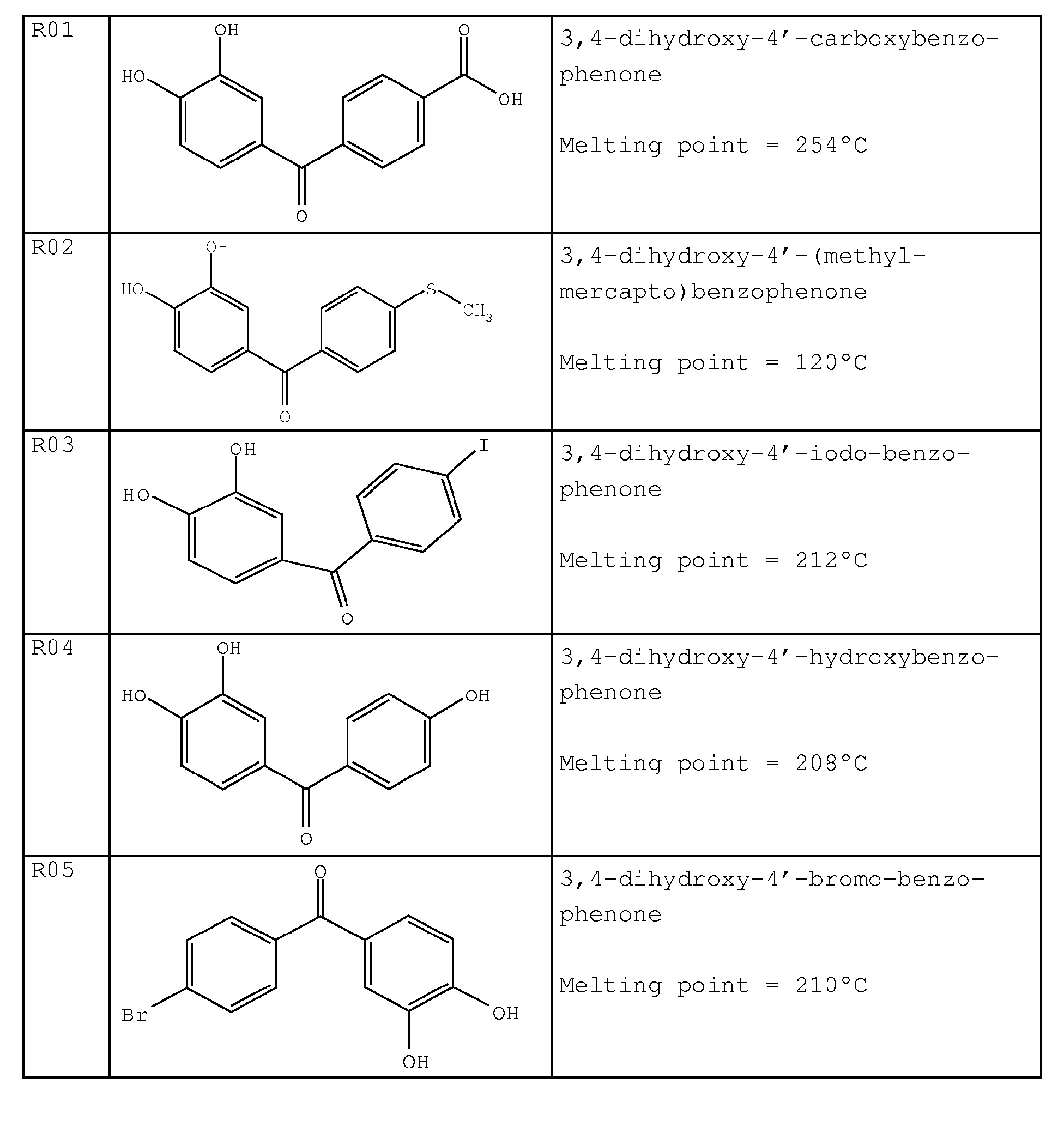
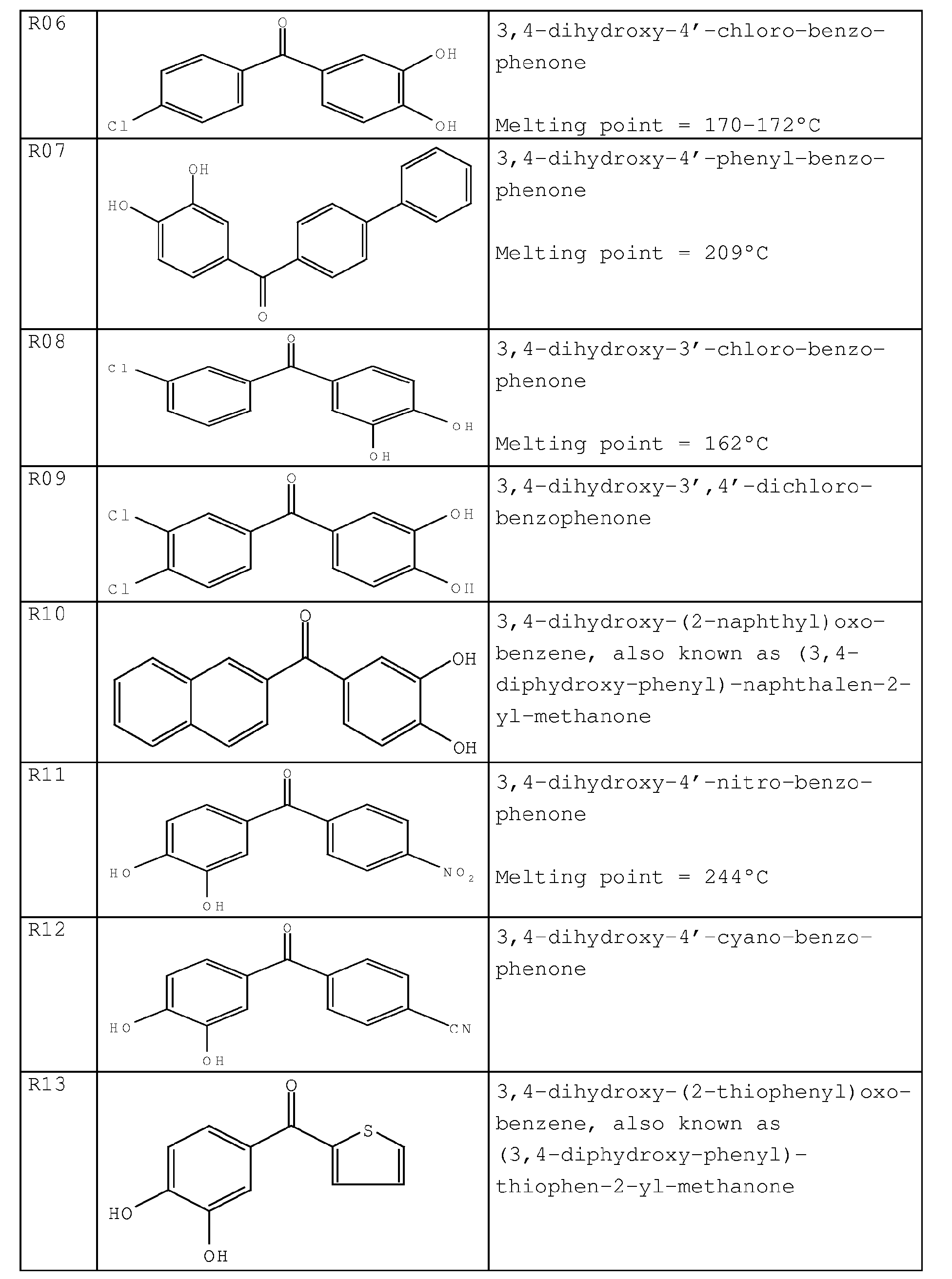
Suitable aryloxo- or heteroaryloxo- 3,4-dihydroxybenzenes for
use in the thermographic recording material of the present invention
are:
Combinations of aryloxo- or heteroaryloxo- 3,4-dihydroxy-benzene
compounds may also be used that on heating become reactive partners
in the reduction of the substantially light-insensitive organic
silver salt.
Synthesis of aryloxo- or heteroaryloxo- 3,4-dihydroxybenzenes
-
3,4-dihydroxyphenyloxobenzenes can be prepared according to well
documented procedures. Direct Friedel Craft-acylation on catechol,
using acylchlorides or anhydrides and Lewis acid activation has been
reported in the following literature: anhydrides and ZnCl2 in Indian
J. Chem. Sect. B, 26B(9), 823-6 (1987); acylbromides and AlBr3 in CS2
as a solvent in Chem. Ber., 119(1), 50-64 (1986); acylchlorides and
AlCl3 in chlorobenzene as solvent in Org. Prep. Proced. Int. 17(6),
401-7 (1985); acylchlorides and AlCl3 in nitrobenzene as solvent in
J. Chem. Soc., Dalton Trans., (2), 641-5 (1990); and anhydrides and
AlCl3 in dichloroethane as solvent in Eur. J. Med. Chem., 23(1), 45-52
(1988).
-
The literature includes several reports of Fries rearrangements
e.g. in J. Prakt. Chem. 329(5), 923-6 (1987) and Nippon Kagaku
Kaishi, (4), 742-6 (1985). The yields reported for the Fries
rearrangement are fairly low and it was found that direct Friedel
Crafts acylation yielded fairly complex reaction mixtures, which
hampered an easy purification.
-
Instead of optimizing the reaction conditions, the Friedel
Crafts acylation has been effected on a protected catechol and the
hydroxyl group deprotected after purification of the intermediates.
The following general synthetic strategy was used:
-
Veratrol was chosen as the protected catechol, due to its
availability in bulk. Friedel Crafts acylations on 1,2-dialkoxy
benzenes are well documented in the literature, using e.g. FeCl
3 as a
catalyst [C.R. Acad. Sci., Ser. Iic: Chim., 2(7-8), 455-465 (1999)
or SnCl
4 as catalyst (Eur. Pat. Appl., 839801 (1998); J. Org. Chem.,
55(17), 5078-88 (1990), J. Med. Chem., 30(10), 1914-18 (1987)].
Several other catalysts and acylating reagents have been reported in
the literature (Chem. Commun. 16, 1567-1568 (1997); Tetrahedron,
52(43), 13623-13640 (1996); Fr. Demande, 2722781 (1996); J. Org.
Chem. 60(22), 7086-7 (1995)). Though not preferred, some alternative
synthetic strategies have been reported for the preparation of the
intermediate dimethoxybenzophenones. In the first alternative an
intermediate benzhydrol is oxidized to the corresponding
benzophenone.

Typical examples are given in Helv. Chim. Acta, 72(5), 952-968
(1989), Indian J. Chem., Sect. B, 26B(11), 1025-9 (1987) and J. Org.
Chem., 50(13), 2220-4 (1985). The required benzhydrols are
accessible using organometallic chemistry as reported in Tetrahedron
Lett., 38(5), 893-896 (1997), J. Labelled Compd. Radiopharm., 39(4),
303-318 (1997) and PCT Int. Appl., 9517399 (1995). Direct reaction
of organometallic compounds with acyl chlorides or nitriles are a
third possibility as documented in J. Med. Chem., 32(1), 192-7
(1989)and Tetrahedron Lett. 27(34), 3963-6 (1986).
-
Using one of the above mentioned strategies, 3,4-dihydroxy-heteroaryloxobenzenes
are accessible. A typical example, where
pyridyl derivatives are described, can be found in PCT Int. Appl.
9806700 (1998), using the combination of organometallic chemistry to
prepare the intermediate benzhydrol following oxidation of the
benzhydrol to the corresponding ketone. A Friedel Crafts-acylation
to prepare pyridyl derivatives has been reported in Ger. Offen.,
4231632 (1994). Further oxidative strategies have been reported in
Heterocycles 29(9), 1815-24 (1989), J. Heterocyclic Chem. 26(3),
811-815 (1989), Tetrahedron Lett, 36(7), 1001-2 (1995) and J. Org.
Chem., 53(6), 1176-83 (1988). From this literature it is clear that
a wide range of heteroaryloxobenzenes can be prepared.
-
Independent of the strategy used to prepare the 3,4-dialkoxy
aryloxobenzene intermediates, a dealkylation is required to obtained
the claimed developers. Although different methods for cleavage of
aryl ethers have been reported in the literature, a reaction in a
melt of pyridine chlorohydrate was chosen, as illustrated in the
scheme above.
-
The structures of the aryloxo- or heteroaryloxo- 3,4-dihydroxybenzene
compounds synthesized were confirmed by 1H-NMR-spectroscopy.
Thermosensitive element
-
The thermosensitive element as used herein is that element which
contains all the ingredients which contribute to image formation.
According to the present invention the thermosensitive element,
contains a substantially light-insensitive organic silver salt, a
3,4-dihydroxybenzene compound as a reducing agent therefor in
thermal working relationship therewith and a binder. The element
may comprise a layer system in which the above-mentioned ingredients
may be dispersed in different layers, with the proviso that the
substantially light-insensitive organic silver salt is in reactive
association with the reducing agent i.e. during the thermal
development process the reducing agent must be present in such a way
that it is able to diffuse to the particles of substantially light-insensitive
organic silver salt, so that reduction to silver can
occur.
Organic silver salt
-
According to a fifth embodiment of the substantially light-insensitive
thermographic recording material of the present
invention, the organic silver salt is not a double organic salt
containing a silver cation associated with a second cation e.g.
magnesium or iron ions.
-
According to a sixth embodiment of the substantially light-insensitive
thermographic recording material of the present
invention, the organic silver salt is a substantially light-insensitive
silver salt of an organic carboxylic acid.
-
According to a seventh embodiment of the substantially light-insensitive
thermographic recording material of the present
invention, the organic silver salt is a substantially light-insensitive
silver salt of an aliphatic carboxylic acids known as a
fatty acid, wherein the aliphatic carbon chain has preferably at
least 12 C-atoms, e.g. silver laurate, silver palmitate, silver
stearate, silver hydroxystearate, silver oleate and silver behenate,
which silver salts are also called "silver soaps". Other silver
salts of an organic carboxylic acid as described in GB-P 1,439,478,
e.g. silver benzoate, may likewise be used to produce a thermally
developable silver image. Combinations of different silver salt of
an organic carboxylic acids may also be used in the present
invention, as disclosed in EP-A 964 300.
-
Organic silver salts may be dispersed by standard dispersion
techniques e.g. using ball mills, bead mills, microfluidizers,
ultrasonic apparatuses, rotor stator mixers etc. have been found to
be useful in this regard. Mixtures of organic silver salt
dispersions produced by different techniques may also be used to
obtain the desired thermographic properties e.g. of coarser and a
more finely ground dispersions of organic silver salts.
Auxiliary reducing agent
-
Combinations of aryloxo- or heteroaryloxo- 3,4-dihydroxy-benzene
compounds with at least one further reducing agent may also be used
that on heating become reactive partners in the reduction of the
substantially light-insensitive organic silver salt.
-
According to an eighth embodiment of the substantially light-insensitive
thermographic recording material of the present
invention, the thermosensitive element contains a reducing agent in
addition to an aryloxo- or heteroaryloxo- 3,4-dihydroxy-benzene
compound.
-
According to a ninth embodiment of the substantially light-insensitive
thermographic recording material of the present
invention, the thermosensitive element further contains at least one
reducing agent disclosed in EP-B 692 733 or a reducing agent
disclosed in EP-A 903 625.
-
According to a tenth embodiment of the substantially light-insensitive
thermographic recording material of the present
invention, the thermosensitive element further contains at least one
reducing agent selected from the group consisting of 3,4-dihydroxybenzoate
alkyl and aryl esters (such as ethyl 3,4-dihydroxybenzoate
or n-butyl 3,4-dihydroxybenzoate), 3,4-dihydroxybenzophenone,
3,4-dihydroxy-acetophenone and 3,4-dihydroxybenzonitrile.
Binder of the thermosensitive element
-
The film-forming binder of the thermosensitive element may be
all kinds of natural, modified natural or synthetic resins or
mixtures of such resins, in which the substantially light-insensitive
organic silver salt can be dispersed homogeneously
either in aqueous or solvent media: e.g. cellulose derivatives such
as ethylcellulose, cellulose esters, e.g. cellulose nitrate,
carboxymethylcellulose, starch ethers, galactomannan, polymers
derived from α,β-ethylenically unsaturated compounds such as
polyvinyl chloride, after-chlorinated polyvinyl chloride, copolymers
of vinyl chloride and vinylidene chloride, copolymers of vinyl
chloride and vinyl acetate, polyvinyl acetate and partially
hydrolyzed polyvinyl acetate, polyvinyl alcohol, polyvinyl acetals
that are made from polyvinyl alcohol as starting material in which
only a part of the repeating vinyl alcohol units may have reacted
with an aldehyde, preferably polyvinyl butyral, copolymers of
acrylonitrile and acrylamide, polyacrylic acid esters,
polymethacrylic acid esters, polystyrene and polyethylene or
mixtures thereof.
-
According to a tenth embodiment of the substantially light-insensitive
thermographic recording material of the present
invention, the thermosensitive element contains a binder which does
not contain additives or impurities which adversely affect the
thermographic properties of the thermographic recording materials in
which they are used.
Toning agent
-
According to an eleventh embodiment of the substantially light-insensitive
thermographic recording material of the present
invention, the thermosensitive element further contains a so-called
toning agent organic silver salt in order to obtain a neutral black
image tone in the higher densities and neutral grey in the lower
densities.
-
Suitable toning agents are described in US 3,074,809, US
3,446,648 and US 3,844,797 and US 4,082,901. Other particularly
useful toning agents are the heterocyclic toning compounds of the
benzoxazine dione or naphthoxazine dione type as disclosed in
GB 1,439,478, US 3,951,660 and US 5,599,647.
-
According to a twelfth embodiment of the substantially light-insensitive
thermographic recording material of the present
invention, the thermosensitive element further contains one or more
toning agents selected from the group consisting of phthalazinone,
benzo[e] [1,3]oxazine-2,4-dione, 7-methyl-benzo[e][1,3]oxazine-2,4-dione,
7-methoxy-benzo[e][1,3]oxazine-2,4-dione and 7-(ethylcarbonato)-benzo
[e][1,3]oxazine-2,4-dione.
Stabilizers
-
Stabilizers may be incorporated into the substantially light-insensitive
thermographic recording materials of the present
invention in order to obtain improved shelf-life and reduced
fogging.
-
According to a thirteenth embodiment of the substantially light-insensitive
thermographic recording material of the present
invention, the thermosensitive element further contains at least one
stabilizer selected from the group consisting of benzotriazole;
substituted benzotriazoles; tetrazoles; mercaptotetrazoles, such as
1-phenyl-5-mercapto-tetrazole; and aromatic polycarboxylic acids,
such as ortho-phthalic acid, 3-nitro-phthalic acid,
tetrachlorophthalic acid, mellitic acid, pyromellitic acid and
trimellitic acid, and anhydrides thereof.
Polycarboxylic acids and anhydrides thereof
-
According to the substantially light-insensitive thermographic
recording material of the present invention the thermosensitive
element may comprise in addition at least one optionally substituted
aliphatic (saturated as well as unsaturated aliphatic and also
cycloaliphatic) polycarboxylic acid and/or anhydride thereof in a
molar percentage of at least 15 with respect to all the organic
silver salt(s) present and in thermal working relationship
therewith. The polycarboxylic acid may be used in anhydride form or
partially esterified form on the condition that at least two free
carboxylic acids remain or are available in the heat recording step.
-
According to a fourteenth embodiment of the substantially light-insensitive
thermographic recording material of the present
invention, the thermosensitive element further contains glutaric
acid.
Surfactants and dispersion agents
-
Surfactants and dispersants aid the dispersion of ingredients or
reactants which are insoluble in the particular dispersion medium.
The thermographic recording materials of the present invention may
contain one or more surfactants, which may be anionic, non-ionic or
cationic surfactants and/or one or more dispersants.
Other additives
-
The recording material may contain in addition to the
ingredients mentioned above other additives such as levelling agents
e.g. BAYSILON™ MA (from BAYER AG, GERMANY).
Support
-
The support for the thermosensitive element according to the
present invention may be transparent, translucent or opaque and is a
thin flexible carrier made of transparent resin film, e.g. made of a
cellulose ester, cellulose triacetate, polypropylene, polycarbonate
or polyester, e.g. polyethylene terephthalate.
-
The support may be in sheet, ribbon or web form and subbed if
need be to improve the adherence to the thereon coated
thermosensitive element. It may be pigmented with a blue pigment as
so-called blue-base. One or more backing layers may be provided to
control physical properties such as curl and static.
Protective layer
-
According to a fifteenth embodiment of the substantially light-insensitive
thermographic recording material of the present
invention, the thermosensitive element is provided with a protective
layer to avoid local deformation of the thermosensitive element and
to improve resistance against abrasion.
-
According to a sixteenth embodiment of the substantially light-insensitive
thermographic recording material of the present
invention, the thermosensitive element is provided with a protective
layer comprising a binder, which may be solvent-soluble, solvent-dispersible,
water-soluble or water- dispersible.
-
According to a seventeenth embodiment of the substantially
light-insensitive thermographic recording material of the present
invention, the thermosensitive element is provided with a protective
layer comprising solvent-soluble polycarbonates as binders as
described in EP-A 614 769.
-
According to a eighteenth embodiment of the substantially light-insensitive
thermographic recording material of the present
invention, the thermosensitive element is provided with a protective
layer comprising a water-soluble or water-dispersible binder, as
coating can be performed from an aqueous composition and mixing of
the protective layer with the immediate underlayer can be avoided by
using a solvent-soluble or solvent-dispersible binder in the
immediate underlayer. The protective layer according to the present
invention may be crosslinked. Crosslinking can be achieved by using
crosslinking agents such as described in WO 95/12495. Solid or
liquid lubricants or combinations thereof are suitable for improving
the slip characteristics of the thermographic recording materials
according to the present invention.
-
According to an nineteenth embodiment of the substantially
light-insensitive thermographic recording material of the present
invention, the thermosensitive element is provided with a protective
layer comprising a solid thermomeltable lubricant such as those
described in WO 94/11199.
-
The protective layer of the thermographic recording material
according to the present invention may comprise a matting agent.
According to a twentieth embodiment of the substantially light-insensitive
thermographic recording material of the present
invention, the thermosensitive element is provided with a protective
layer comprising a matting agent such as described in WO 94/11198,
e.g. talc particles, and optionally protrude from the protective
layer.
Coating
-
The coating of any layer of the recording material of the
present invention may proceed by any coating technique e.g. such as
described in Modern Coating and Drying Technology, edited by Edward
D. Cohen and Edgar B. Gutoff, (1992) VCH Publishers Inc. 220 East
23rd Street, Suite 909 New York, NY 10010, U.S.A.
Thermographic processing
-
Thermographic imaging is carried out by the image-wise
application of heat either in analogue fashion by direct exposure
through an image or by reflection from an image, or in digital
fashion pixel by pixel either by using an infra-red heat source, for
example with a Nd-YAG laser or other infra-red laser, with a
substantially light-insensitive thermographic material preferably
containing an infra-red absorbing compound, or by direct thermal
imaging with a thermal head.
-
In thermal printing image signals are converted into electric
pulses and then through a driver circuit selectively transferred to
a thermal printhead. The thermal printhead consists of microscopic
heat resistor elements, which convert the electrical energy into
heat via Joule effect. The operating temperature of common thermal
printheads is in the range of 300 to 400°C and the heating time per
picture element (pixel) may be less than 1.0ms, the pressure contact
of the thermal printhead with the recording material being e.g. 200-500g/cm2
to ensure a good transfer of heat.
-
In order to avoid direct contact of the thermal printing heads
with the outermost layer on the same side of the support as the
thermosensitive element when this outermost layer is not a
protective layer, the image-wise heating of the recording material
with the thermal printing heads may proceed through a contacting but
removable resin sheet or web wherefrom during the heating no
transfer of recording material can take place.
-
Activation of the heating elements can be power-modulated or
pulse-length modulated at constant power. EP-A 654 355 discloses a
method for making an image by image-wise heating by means of a
thermal head having energizable heating elements, wherein the
activation of the heating elements is executed duty cycled
pulsewise. EP-A 622 217 discloses a method for making an image
using a direct thermal imaging element producing improvements in
continuous tone reproduction.
-
Image-wise heating of the recording material can also be carried
out using an electrically resistive ribbon incorporated into the
material. Image- or pattern-wise heating of the recording material
may also proceed by means of pixel-wise modulated ultra-sound.
Industrial application
-
Thermographic imaging can be used for the production of
reflection type prints and transparencies, in particular for use in
the medical diagnostic field in which black-imaged transparencies
are widely used in inspection techniques operating with a light box.
Synthesis of aryloxo- and heteroaryloxo- 3,4-dihydroxybenzenes
-
The synthesis of (4-choro-phenyl)-(3,4-dihydroxy-phenyl)-methanone
is given below to illustrate the synthesis of the reducing agents
used in the substantially light-insensitive thermographic recording
material of the present invention. In the first step veratrol was
Friedel Crafts acylated with 4-chloro-benzoylchloride:
by adding 260 g (1.6 mol) of FeCl
3 portionwise to 775 mL of veratrol.
During the addition the temperature rose to 50°C. While maintaining
the temperature at 55°C, 262.5 g (192 mL, 1.5 mol) 4-chloro-bezoylchloride
was added. The reaction temperature was maintained at
60°C for 10 hours. 1.5 L of deionized water was then added and the
black suspension extracted with 2.5 L of methylene chloride.
Addition of 500 mL of methanol was required to dissolve the
precipitate. The aqueous layer was again extracted with 1 L of
methylene chloride. The combined methylene chloride-extracts were
washed with 500 ml water and dried over MgSO
4. The methylene
chloride-extract was evaporated under reduced pressure and the dark
residue was redissolved in methylene chloride. The polar byproducts
were removed by filtration over a silica layer (eluent methylene
chloride). After evaporation under reduced pressure, the oily
residue was crystallized from 500 mL ethanol (yield: 40%).
-
Demethylation of the intermediate dimethoxybenzophenone was
carried out heating 115 g of the intermediate 4-chloro-3'4'-dimethoxybenzophenone
and 185 g pyridine chlorohydrate at 170°C for
12 hours. After cooling to room temperature, 500 mL was added and
(4-choro-phenyl)-(3,4-dihydroxy-phenyl)-methanone precipitated out
as a grey powder. The compound was finally purified by preparative
chromatography (NP-silica, eluent: hexane/ethyl acetate 70/30, R
f:
0.3), yielding 41% of a highly pure compound whose structure was
confirmed by
1H-NMR-spectroscopy.
-
The invention is illustrated hereinafter by way of comparative
examples and invention examples. The percentages and ratios given
in these examples are by weight unless otherwise indicated. The
ingredients used in the thermosensitive element of the substantially
light-insensitive recording materials of the INVENTION and
COMPARATIVE EXAMPLES, are:
- organic silver salts:
- AgB = silver behenate;
- reducing agent according to EP-A 692733):
- CR01 = ethyl 3,4-dihydroxybenzoate;
- CR02 = 3,4-dihydroxybenzophenone;
- CR03 = 3,4-dihydroxyacetophenone;
- CR04 = 3,4-dihydroxy-4'-methyl-benzophenone;
- CR05 = 3,4-dihydroxy-(2-furanyl)oxobenzene, also known as (3,4-dihydroxy-phenyl)-furan-2-yl-methanone
- binder:
- BL5HP = S-LEC BL5HP, a polyvinylbutyral from Sekusui;
- the toning agents:
- T01 = benzo[e] [1,3]oxazine-2,4-dione;
- T02 = 7-(ethylcarbonato)-benzo[e][1,3]oxazine-2,4-dione;
- the stabilizers:
- S01 = glutaric acid;
- S02 = tetrachlorophthalic acid anhydride;
- S03 = benzotriazole.
INVENTION EXAMPLES 1 to 12 and COMPARATIVE EXAMPLES 1 to 5
Preparation of the thermosensitive element
-
The thermosensitive elements of COMPARATIVE EXAMPLES 1 to 12 and
COMPARATIVE EXAMPLES 1 to 5 were produced by coating a 2-butanone
dispersion with the following ingredients onto a subbed 168µm thick
blue-pigmented polyethylene terephthalate support, with CIELAB a*
and b* values of -7.9 and -16.6 respectively, to produce layers with
the compositions given in Table 1.
protective layer
-
The thermosensitive elements of the thermographic recording
materials of INVENTION EXAMPLES 1 to 12 and COMPARATIVE EXAMPLES 1
to 5 were then coated with an aqueous composition with the following
composition:
- polyvinylalcohol (Polyviol™ WX 48 20 from Wacker Chemie): 2.1g/m2
- colloidal silica (Levasil™ VP AC 4055 from Bayer AG, a 15% aqueous dispersion of colloidal silica): 1.05g/m2
- Ultravon™ W (dispersion agent from Ciba Geigy) converted into acid form by passing through an ion exchange column: 0.075g/m2
- silica (Syloid™ 72 from Grace): 0.09 g/m2
- mono[isotridecyl polyglycolether (3 EO)] phosphate Servoxyl™ VPDZ 3/100 from Servo Delden B.V.): 0.075g/m2
- mixture of monolauryl and dilauryl phosphate (Servoxyl™ VPAZ 100 from Servo Delden B.V.): 0.075g/m2
- talc (MICROACE type P3 from Nippon Talc): 0.045g/m2
- glycerine monotallow acid ester (Rilanit™ GMS from Henkel AG): 0.15g/m2
- tetramethylorthosilicate hydrolyzed in the presence of methanesulfonic acid: 0.87g/m2
The pH of the coating composition was adjusted to a pH of 4 by
adding 1N nitric acid. Those lubricants which were insoluble in
water, were dispersed in a ball mill with, if necessary, the aid of
a dispersion agent. The composition was coated to a wet layer
thickness of 85mm and then dried at 40°C for 15 minutes and hardened
for 7 days at 57°C and a relative humidity of 34% thereby producing
the thermographic recording materials of INVENTION EXAMPLES 1 to 12
and COMPARATIVE EXAMPLES 1 to 5.
thermographic printing
-
The thermographic recording materials of INVENTION EXAMPLES 1 to
12 and COMPARATIVE EXAMPLES 1 to 5 were printed using a DRYSTAR®
2000 printer from AGFA-GEVAERT equipped with a thin film thermal
head with adapted to increase its resolution from 300 dpi (standard)
to 508 dpi and operated with a line time of 12 ms and a maximum
printing power of 34 mW/pixel (the line time being the time needed
for printing one line). During this line time the print head
received constant power. The thermal head resistors were time-modulated
to produce different image densities.
-
The maximum densities of the images (Dmax) measured through a
visible filter with a MACBETH™ TR924 densitometer in the grey scale
step corresponding to a data level of 64 are given in Table 2 for
INVENTION EXAMPLES 1 to 12 and COMPARATIVE EXAMPLES 1 to 5.
Image evaluation
-
The image tone of fresh prints made with the substantially
light-insensitive thermographic recording materials of INVENTION
EXAMPLES 1 to 12 and COMPARATIVE EXAMPLES 1 to 5 was assessed on the
basis of the L*, a* and b* CIELAB-values. The L*, a* and b* CIELAB-values
were determined by spectrophotometric measurements according
to ASTM Norm E179-90 in a R(45/0) geometry with evaluation according
to ASTM Norm E308-90. The a* and b* CIELAB-values of fresh prints
of the substantially light-insensitive thermographic recording
materials of INVENTION EXAMPLES 1 to 12 and COMPARATIVE EXAMPLES 1
to 5 at an optical density, D, of 1.0 are given in Table 2.
-
In the CIELAB-system a negative CIELAB a*-value indicates a
greenish image-tone becoming greener as a* becomes more negative, a
positive a*-value indicating a reddish image-tone becoming redder as
a* becomes more positive. A negative CIELAB b*-value indicates a
bluish tone which becomes increasingly bluer as b* becomes more
negative and a positive b*-value indicates a yellowish image-tone
becoming more yellow as b* becomes more positive. In terms of the
visual perception of an image as a whole, the image tone of elements
of the image with a density of 1.0 have a stronger effect than the
image tone of elements with lower or higher optical density.
-
It is clear from Table 2, that the substantially light-insensitive
thermographic recording material of COMPARATIVE EXAMPLE
3 with reducing agent CR03 (= 3,4-dihydroxybenzonitrile) exhibited a
significantly lower printability, a Dmax/silver behenate ratio of
0.65 m
2/g, that those of the other substantially light-insensitive
thermographic recording materials in the table.
| Invention Example nr. | Reducing agent | AgB coverage [g/m2] | Dmax (vis) | Dmin (vis) | Dmax/AgB coverage [m2/g] | fresh print CIELAB values: D=1.0 |
| | | | | | | a* | b* |
| 1 | R01 | 3.82 | 2.77 | 0.23 | 0.73 | +11.14 | +12.12 |
| 2 | R02 | 3.92 | 3.55 | 0.22 | 0.91 | -0.93 | -8.38 |
| 3 | R03 | 4.11 | 3.22 | 0.22 | 0.78 | -3.83 | -8.14 |
| 4 | R04 | 4.00 | 3.43 | 0.22 | 0.86 | +16.85 | +9.24 |
| 5 | R05 | 4.06 | 3.21 | 0.22 | 0.79 | -4.01 | -7.64 |
| 6 | R06 | 3.87 | 3.22 | 0.22 | 0.83 | -3.89 | -7.92 |
| 7 | R07 | 3.82 | 3.35 | 0.22 | 0.88 | -1.73 | -8.78 |
| 8 | R08 | 4.03 | 3.08 | 0.22 | 0.76 | -3.85 | -7.92 |
| 9 | R09 | 3.92 | 3.01 | 0.22 | 0.77 | -4.24 | -5.99 |
| 10 | R10 | 3.92 | 3.52 | 0.22 | 0.90 | -1.76 | -8.89 |
| 11 | R11 | 3.66 | 3.00 | 0.22 | 0.82 | -2.90 | -3.73 |
| 12 | R12 | 3.58 | 3.15 | 0.22 | 0.88 | -1.97 | -7.46 |
| Comparative Example nr. |
| 1 | CR01 | 3.90 | 3.22 | 0.23 | 0.83 | -2.31 | -9.27 |
| 2 | CR02 | 3.74 | 3.18 | 0.22 | 0.85 | -2.46 | -8.84 |
| 3 | CR03 | 3.66 | 2.37 | 0.23 | 0.65 | -3.24 | -6.34 |
| 4 | CR04 | 4.06 | 3.39 | 0.22 | 0.83 | -2.76 | -9.84 |
| 5 | CR05 | 3.79 | 3.20 | 0.22 | 0.84 | -2.54 | -8.89 |
-
If the image tone of fresh prints obtained with the
substantially light-insensitive thermographic recording materials of
INVENTION EXAMPLES 1 to 12 are compared, the substantially light-insensitive
thermographic recording materials of INVENTION EXAMPLES
2, 3, 5 to 10 and 12 exhibit much bluer image tones at a density of
1.0, as shown by their simultaneously exhibiting highly positive a*
and highly positive b* CIELAB-values.
Archivability tests
-
Three series of simulated long-term archivability tests were
performed by heating prints produced with thermographic recording
materials of INVENTION EXAMPLES 1 to 12 and COMPARATIVE EXAMPLES 1-5,
at 57°C in 34% relative humidity for 3 days and at 45°C in 70%
relative humidity for 4 days. The changes in density, a* CIELAB-value
and b* CIELAB-value with respect to the fresh prints were monitored
for an initial density of 1.0. The results obtained are summarized in
Table 3.
-
It is clear from the results in Table 3 that the change in
density at 1.0 was significantly lower for the substantially light-insensitive
thermographic recording materials of INVENTION EXAMPLES
1 to 12 i.e. the archivability was better than that observed for the
substantially light-insensitive thermographic recording materials of
COMPARATIVE EXAMPLES 1, 2, 4 and 5 for comparable printabilities as
expressed by the ratio of Dmax/silver behenate coverage. The
substantially light-insensitive recording material of COMPARATIVE
EXAMPLE 3 exhibited comparable archivability to those of INVENTION
EXAMPLES 1 to 12, but at the expense of a considerably reduced
printability, as expressed by the Dmax/silver behenate coverage
ratio.
| Invention Example nr. | Reducing | coverage | ΔD for D = 1.0 on heating in dark for: |
| | agent | Dmax/AgB [m2/g] | 3d/57°C/34%RH | 4d/45°C/70%RH |
| 1 | R01 | 0.73 | 0.00 | 0.00 |
| 2 | R02 | 0.91 | +0.14 | +0.05 |
| 3 | R03 | 0.78 | +0.10 | +0.03 |
| 4 | R04 | 0.86 | 0.00 | +0.02 |
| 5 | R05 | 0.79 | +0.14 | +0.03 |
| 6 | R06 | 0.83 | +0.14 | +0.05 |
| 7 | R07 | 0.88 | +0.10 | +0.05 |
| 8 | R08 | 0.76 | +0.17 | +0.05 |
| 9 | R09 | 0.77 | +0.10 | 0.00 |
| 10 | R10 | 0.90 | +0.10 | +0.05 |
| 11 | R11 | 0.82 | +0.06 | +0.02 |
| 12 | R12 | 0.88 | +0.08 | +0.03 |
| Comparative Example nr. |
| 1 | CR01 | 0.83 | +0.29 | +0.19 |
| 2 | CR02 | 0.85 | +0.19 | +0.10 |
| 3 | CR03 | 0.65 | +0.09 | +0.05 |
| 4 | CR04 | 0.83 | +0.19 | +0.10 |
| 5 | CR05 | 0.84 | +0.26 | +0.14 |
-
The changes in CIELAB-values at D =1.0 upon heating in the dark
for 3 days at 57°C and 34% relative humidity for the substantially
light-insensitive thermographic recording materials of INVENTION
EXAMPLES 2, 3 and 5 to 12 are given in Table 4.
-
If the image tone of fresh prints obtained with the
substantially light-insensitive thermographic recording materials of
INVENTION EXAMPLES 2,3 and 5 to 12 are compared, prints of the
substantially light-insensitive thermographic recording materials of
INVENTION EXAMPLES 3, 5, 6, 8 and 9 with the reducing agents R03,
R05, R06, R08, R09, R11 and R12 exhibited a much more stable image
tone than substantially light-insensitive thermographic recording
materials of INVENTION EXAMPLES 2, 7 and 10 with reducing agents
R02, R07 and R10 as seen by the much lower shifts in a*- and b*-values.
| Invention Example nr. | Reducing agent | Change in CIELAB values at D = 1.0 on heating in dark for 3d/57°C/34%RH |
| | | Δa* | Δb* |
| 2 | R02 | +0.7 | +7.2 |
| 3 | R03 | -0.1 | +0.6 |
| 5 | R05 | -0.1 | +0.6 |
| 6 | R06 | +0.1 | +0.6 |
| 7 | R07 | +0.4 | +4.4 |
| 8 | R08 | -0.2 | +0.4 |
| 9 | R09 | -1.0 | -2.2 |
| 10 | R10 | +0.6 | +4.5 |
| 11 | R11 | -0.5 | -1.0 |
| 12 | R12 | -1.0 | +0.2 |
-
Having described in detail preferred embodiments of the current
invention, it will now be apparent to those skilled in the art that
numerous modifications can be made therein without departing from
the scope of the invention as defined in the following claims.
 Combinations of aryloxo- or heteroaryloxo- 3,4-dihydroxy-benzene compounds may also be used that on heating become reactive partners in the reduction of the substantially light-insensitive organic silver salt.


