EP1244842B1 - A peroxide bleaching solution comprising a bleaching activator and method for using the activator - Google Patents
A peroxide bleaching solution comprising a bleaching activator and method for using the activator Download PDFInfo
- Publication number
- EP1244842B1 EP1244842B1 EP00936928A EP00936928A EP1244842B1 EP 1244842 B1 EP1244842 B1 EP 1244842B1 EP 00936928 A EP00936928 A EP 00936928A EP 00936928 A EP00936928 A EP 00936928A EP 1244842 B1 EP1244842 B1 EP 1244842B1
- Authority
- EP
- European Patent Office
- Prior art keywords
- bleaching
- activator
- pulp
- peroxide
- glycerol
- Prior art date
- Legal status (The legal status is an assumption and is not a legal conclusion. Google has not performed a legal analysis and makes no representation as to the accuracy of the status listed.)
- Expired - Lifetime
Links
- 238000004061 bleaching Methods 0.000 title claims abstract description 64
- 239000012190 activator Substances 0.000 title claims abstract description 47
- 238000000034 method Methods 0.000 title claims abstract description 8
- 150000002978 peroxides Chemical class 0.000 title claims description 35
- PEDCQBHIVMGVHV-UHFFFAOYSA-N Glycerine Chemical compound OCC(O)CO PEDCQBHIVMGVHV-UHFFFAOYSA-N 0.000 claims abstract description 36
- 229920005610 lignin Polymers 0.000 claims abstract description 5
- XEKOWRVHYACXOJ-UHFFFAOYSA-N Ethyl acetate Chemical compound CCOC(C)=O XEKOWRVHYACXOJ-UHFFFAOYSA-N 0.000 claims abstract 4
- FKRCODPIKNYEAC-UHFFFAOYSA-N ethyl propionate Chemical compound CCOC(=O)CC FKRCODPIKNYEAC-UHFFFAOYSA-N 0.000 claims abstract 4
- MHAJPDPJQMAIIY-UHFFFAOYSA-N Hydrogen peroxide Chemical compound OO MHAJPDPJQMAIIY-UHFFFAOYSA-N 0.000 claims description 22
- 229920001131 Pulp (paper) Polymers 0.000 claims description 13
- URAYPUMNDPQOKB-UHFFFAOYSA-N triacetin Chemical group CC(=O)OCC(OC(C)=O)COC(C)=O URAYPUMNDPQOKB-UHFFFAOYSA-N 0.000 claims description 13
- 229960002622 triacetin Drugs 0.000 claims description 11
- 235000019353 potassium silicate Nutrition 0.000 claims description 10
- NTHWMYGWWRZVTN-UHFFFAOYSA-N sodium silicate Chemical compound [Na+].[Na+].[O-][Si]([O-])=O NTHWMYGWWRZVTN-UHFFFAOYSA-N 0.000 claims description 10
- KFSLWBXXFJQRDL-UHFFFAOYSA-N Peracetic acid Chemical compound CC(=O)OO KFSLWBXXFJQRDL-UHFFFAOYSA-N 0.000 claims description 8
- 239000002738 chelating agent Substances 0.000 claims description 2
- 235000013773 glyceryl triacetate Nutrition 0.000 claims description 2
- 239000003381 stabilizer Substances 0.000 claims description 2
- UXDDRFCJKNROTO-UHFFFAOYSA-N Glycerol 1,2-diacetate Chemical group CC(=O)OCC(CO)OC(C)=O UXDDRFCJKNROTO-UHFFFAOYSA-N 0.000 claims 1
- HEMHJVSKTPXQMS-UHFFFAOYSA-M sodium hydroxide Inorganic materials [OH-].[Na+] HEMHJVSKTPXQMS-UHFFFAOYSA-M 0.000 description 23
- 239000000243 solution Substances 0.000 description 8
- 230000000694 effects Effects 0.000 description 7
- FRPJTGXMTIIFIT-UHFFFAOYSA-N tetraacetylethylenediamine Chemical compound CC(=O)C(N)(C(C)=O)C(N)(C(C)=O)C(C)=O FRPJTGXMTIIFIT-UHFFFAOYSA-N 0.000 description 7
- QTBSBXVTEAMEQO-UHFFFAOYSA-N Acetic acid Chemical compound CC(O)=O QTBSBXVTEAMEQO-UHFFFAOYSA-N 0.000 description 6
- 239000007844 bleaching agent Substances 0.000 description 6
- 238000004519 manufacturing process Methods 0.000 description 6
- 239000000126 substance Substances 0.000 description 6
- WFDIJRYMOXRFFG-UHFFFAOYSA-N Acetic anhydride Chemical compound CC(=O)OC(C)=O WFDIJRYMOXRFFG-UHFFFAOYSA-N 0.000 description 4
- GRWZHXKQBITJKP-UHFFFAOYSA-L dithionite(2-) Chemical compound [O-]S(=O)S([O-])=O GRWZHXKQBITJKP-UHFFFAOYSA-L 0.000 description 4
- 102100031260 Acyl-coenzyme A thioesterase THEM4 Human genes 0.000 description 3
- 101000638510 Homo sapiens Acyl-coenzyme A thioesterase THEM4 Proteins 0.000 description 3
- QPCDCPDFJACHGM-UHFFFAOYSA-N N,N-bis{2-[bis(carboxymethyl)amino]ethyl}glycine Chemical compound OC(=O)CN(CC(O)=O)CCN(CC(=O)O)CCN(CC(O)=O)CC(O)=O QPCDCPDFJACHGM-UHFFFAOYSA-N 0.000 description 3
- 241000218657 Picea Species 0.000 description 3
- 150000001733 carboxylic acid esters Chemical class 0.000 description 3
- 239000003795 chemical substances by application Substances 0.000 description 3
- 230000007423 decrease Effects 0.000 description 3
- 150000002148 esters Chemical class 0.000 description 3
- 150000002430 hydrocarbons Chemical group 0.000 description 3
- 238000011065 in-situ storage Methods 0.000 description 3
- 239000007800 oxidant agent Substances 0.000 description 3
- 238000004076 pulp bleaching Methods 0.000 description 3
- IJGRMHOSHXDMSA-UHFFFAOYSA-N Atomic nitrogen Chemical compound N#N IJGRMHOSHXDMSA-UHFFFAOYSA-N 0.000 description 2
- 241000196324 Embryophyta Species 0.000 description 2
- BPQQTUXANYXVAA-UHFFFAOYSA-N Orthosilicate Chemical compound [O-][Si]([O-])([O-])[O-] BPQQTUXANYXVAA-UHFFFAOYSA-N 0.000 description 2
- 235000011054 acetic acid Nutrition 0.000 description 2
- 239000011248 coating agent Substances 0.000 description 2
- 150000001875 compounds Chemical class 0.000 description 2
- XBDQKXXYIPTUBI-UHFFFAOYSA-N dimethylselenoniopropionate Natural products CCC(O)=O XBDQKXXYIPTUBI-UHFFFAOYSA-N 0.000 description 2
- 230000007613 environmental effect Effects 0.000 description 2
- BDAGIHXWWSANSR-UHFFFAOYSA-N methanoic acid Natural products OC=O BDAGIHXWWSANSR-UHFFFAOYSA-N 0.000 description 2
- 150000004965 peroxy acids Chemical class 0.000 description 2
- 239000002244 precipitate Substances 0.000 description 2
- XLYOFNOQVPJJNP-UHFFFAOYSA-N water Substances O XLYOFNOQVPJJNP-UHFFFAOYSA-N 0.000 description 2
- 239000002023 wood Substances 0.000 description 2
- OSWFIVFLDKOXQC-UHFFFAOYSA-N 4-(3-methoxyphenyl)aniline Chemical compound COC1=CC=CC(C=2C=CC(N)=CC=2)=C1 OSWFIVFLDKOXQC-UHFFFAOYSA-N 0.000 description 1
- SCKXCAADGDQQCS-UHFFFAOYSA-N Performic acid Chemical compound OOC=O SCKXCAADGDQQCS-UHFFFAOYSA-N 0.000 description 1
- QAOWNCQODCNURD-UHFFFAOYSA-L Sulfate Chemical compound [O-]S([O-])(=O)=O QAOWNCQODCNURD-UHFFFAOYSA-L 0.000 description 1
- 125000002777 acetyl group Chemical group [H]C([H])([H])C(*)=O 0.000 description 1
- 238000010306 acid treatment Methods 0.000 description 1
- 125000002252 acyl group Chemical group 0.000 description 1
- 239000000654 additive Substances 0.000 description 1
- 230000000996 additive effect Effects 0.000 description 1
- 239000003513 alkali Substances 0.000 description 1
- 239000007864 aqueous solution Substances 0.000 description 1
- 238000000149 argon plasma sintering Methods 0.000 description 1
- 239000002585 base Substances 0.000 description 1
- 239000011230 binding agent Substances 0.000 description 1
- 230000003115 biocidal effect Effects 0.000 description 1
- 239000003139 biocide Substances 0.000 description 1
- 150000001732 carboxylic acid derivatives Chemical class 0.000 description 1
- 238000006243 chemical reaction Methods 0.000 description 1
- 239000003599 detergent Substances 0.000 description 1
- 150000005690 diesters Chemical class 0.000 description 1
- VTIIJXUACCWYHX-UHFFFAOYSA-L disodium;carboxylatooxy carbonate Chemical group [Na+].[Na+].[O-]C(=O)OOC([O-])=O VTIIJXUACCWYHX-UHFFFAOYSA-L 0.000 description 1
- 235000019439 ethyl acetate Nutrition 0.000 description 1
- 235000019253 formic acid Nutrition 0.000 description 1
- 230000031700 light absorption Effects 0.000 description 1
- 239000007788 liquid Substances 0.000 description 1
- 230000014759 maintenance of location Effects 0.000 description 1
- 239000000463 material Substances 0.000 description 1
- 239000000203 mixture Substances 0.000 description 1
- 229910052757 nitrogen Inorganic materials 0.000 description 1
- 230000001151 other effect Effects 0.000 description 1
- -1 perhydroxyl anions Chemical class 0.000 description 1
- 239000000049 pigment Substances 0.000 description 1
- 230000008092 positive effect Effects 0.000 description 1
- 239000000047 product Substances 0.000 description 1
- 235000019260 propionic acid Nutrition 0.000 description 1
- IUVKMZGDUIUOCP-BTNSXGMBSA-N quinbolone Chemical compound O([C@H]1CC[C@H]2[C@H]3[C@@H]([C@]4(C=CC(=O)C=C4CC3)C)CC[C@@]21C)C1=CCCC1 IUVKMZGDUIUOCP-BTNSXGMBSA-N 0.000 description 1
- 229940045872 sodium percarbonate Drugs 0.000 description 1
- PWUYHXAEVMUADU-UHFFFAOYSA-M sodium;2-(7-methyloctanoyloxy)benzenesulfonate Chemical compound [Na+].CC(C)CCCCCC(=O)OC1=CC=CC=C1S([O-])(=O)=O PWUYHXAEVMUADU-UHFFFAOYSA-M 0.000 description 1
- MIKSWWHQLZYKGU-UHFFFAOYSA-M sodium;2-benzoyloxybenzenesulfonate Chemical compound [Na+].[O-]S(=O)(=O)C1=CC=CC=C1OC(=O)C1=CC=CC=C1 MIKSWWHQLZYKGU-UHFFFAOYSA-M 0.000 description 1
- 239000007787 solid Substances 0.000 description 1
- 241000894007 species Species 0.000 description 1
- LSNNMFCWUKXFEE-UHFFFAOYSA-L sulfite Chemical compound [O-]S([O-])=O LSNNMFCWUKXFEE-UHFFFAOYSA-L 0.000 description 1
- 229910021653 sulphate ion Inorganic materials 0.000 description 1
- 150000005691 triesters Chemical class 0.000 description 1
Images
Classifications
-
- D—TEXTILES; PAPER
- D21—PAPER-MAKING; PRODUCTION OF CELLULOSE
- D21C—PRODUCTION OF CELLULOSE BY REMOVING NON-CELLULOSE SUBSTANCES FROM CELLULOSE-CONTAINING MATERIALS; REGENERATION OF PULPING LIQUORS; APPARATUS THEREFOR
- D21C9/00—After-treatment of cellulose pulp, e.g. of wood pulp, or cotton linters ; Treatment of dilute or dewatered pulp or process improvement taking place after obtaining the raw cellulosic material and not provided for elsewhere
- D21C9/10—Bleaching ; Apparatus therefor
- D21C9/16—Bleaching ; Apparatus therefor with per compounds
- D21C9/163—Bleaching ; Apparatus therefor with per compounds with peroxides
-
- D—TEXTILES; PAPER
- D21—PAPER-MAKING; PRODUCTION OF CELLULOSE
- D21C—PRODUCTION OF CELLULOSE BY REMOVING NON-CELLULOSE SUBSTANCES FROM CELLULOSE-CONTAINING MATERIALS; REGENERATION OF PULPING LIQUORS; APPARATUS THEREFOR
- D21C9/00—After-treatment of cellulose pulp, e.g. of wood pulp, or cotton linters ; Treatment of dilute or dewatered pulp or process improvement taking place after obtaining the raw cellulosic material and not provided for elsewhere
- D21C9/10—Bleaching ; Apparatus therefor
- D21C9/1026—Other features in bleaching processes
- D21C9/1036—Use of compounds accelerating or improving the efficiency of the processes
Definitions
- the invention relates to a peroxide bleaching solution comprising a bleaching activator for improving the opacity of bleached pulps containing lignin, and to a method for bleaching pulp with such a peroxide bleaching solution.
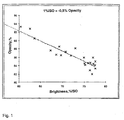
- Opacity is used to describe the nontransparent aspect of paper, which, along with brightness, is an important property of pulp in paper manufacture. Almost invariably, however, the opacity of the pulp decreases when the brightness increases.
- mechanical pulps are more and more often bleached with hydrogen peroxide.
- Dithionite bleaching is also used either alone or together with peroxide bleaching, whereupon dithionite is either used as refiner bleaching or after-bleaching.
- the peroxide bleaching of pulp mechanical pulp in particular, the decrease of opacity is clearly detectable, while the dithionite bleaching does not necessarily decrease the opacity.
- the lighter the level of bleaching the pulp the lower the opacity of the pulp.
- opacity is an important property. If we want to advance peroxide bleaching at the expense of dithionite bleaching, it would be important to be able to optimize peroxide bleaching so that the opacity remains as high as possible while the brightness grows.
- the chemicals used in the peroxide bleaching of mechanical pulps are hydrogen peroxide, lye (alkali), and waterglass.
- the purpose of the base is to increase the pH to a sufficiently high level, so that the hydrogen peroxide, which works as the actual bleaching agent, is dissociated producing perhydroxyl anions.
- the purpose of the waterglass is to stabilize the hydrogen peroxide.
- peracetic acid treatment for example, can provide a clearly higher opacity with the same level of brightness than when pulp is bleached with hydrogen peroxide alone.
- Peracetic acid can also be produced in situ, for example, from acetanhydride or TAED (tetra acetyl ethylene diamine) or some other corresponding activator.
- TAED tetra acetyl ethylene diamine
- One disadvantage of TAED is its high price and that it is a solid substance. It would be necessary to disperse the TAED in water before use, which makes it difficult to use. Furthermore, TAED contains nitrogen, which might constitute a problem for environmental protection. Acetanhydride is relatively cheap, but it would cause odour nuisance and be an inconvenient substance from the point of view of industrial safety. In addition, when fed into an alkaline bleaching solution (NaOH + H 2 O 2 + waterglass), it would readily cause silicate precipitate and consume the lye.
- Paper manufacture aims at ever-higher brightness levels.
- the brightness of paper can be affected, for example, by treating the paper with coating agents containing, among other things, pigments, binding agents, and plasticizing agents (JP application 284598).
- coating agents containing, among other things, pigments, binding agents, and plasticizing agents.
- JP application 284598 the use of several coating agents at the final stage of paper manufacture adds to the manufacturing costs.
- EP-A-0 481 792 discloses a detergent composition in tablet form comprising a persalt and a bleach activator.
- the persalt is preferably sodium percarbonate, and the bleach activator can for example be glycerol triacetate.
- WO-A-94/18299 relates to the in situ production of peroxygen-based oxidising species from a peroxygen source and an activator followed by the use of the product as an oxidising agent, for instance as a bleach or a biocide.
- the preferred activator compounds are nonanoyloxy-benzene-sulphonate sodium salt (NOBS), isononanoyloxy-benzenesulphonate sodium salt (ISONOBS) and benzoyloxy-benzenesulphonate sodium salt (BOBS).
- WO-A-95/21290 relates to pulp bleaching and teaches the steps of forming an aqueous solution containing hydrogen peroxide or an inorganic persalt and a bleach activator compound which is an acyl donor to form a strong oxidising agent, and contacting the pulp with this oxidising agent.
- the produced pulp is claimed to have good brightness reversion properties.
- the preferred activator seems to be tetraacetylethylene diamine (TAED) which is the only activator used in the examples.
- a technically useful activator should be liquid and stable, and it should preferably have a suitable pH value, so that no silicate precipitate would form in the alkaline peroxide bleaching. Because of environmental matters, a nitrogen-free activator would provide an additional benefit.
- the additive of the bleaching should also be cost-effective for the paper manufacturers. Consequently, an activator should be found for pulp bleaching, which, to fulfil the conditions mentioned above, is a registered, reasonable, commercial chemical that is easy to get and can be added to the pulp as early as at the peroxide bleaching stage. Furthermore, attention should also be paid to the other effects of the substance, such as applicability in plant conditions.
- the purpose of this invention is to find a useful activator that is used in pulp bleaching and that fulfils the conditions mentioned above.
- carboxylic acid esters of glycerol known per se are very suitable to be used as activator agents, said carboxylic esters of glycerol being the monoesters, diesters, and triesters of formic acid, acetic acid, and propionic acid. From the point of view of industrial hygiene, the carboxylic acid esters of glycerol are almost harmless.
- activator agents to be added to the bleaching process compnse acetic esters of glycerol, such as triacetine and diacetine.
- esters as such were not water soluble, they dissolve completely in an alkaline peroxide solution, because the acetyl groups split off producing percarboxylic acid in situ.
- Glycerol and carboxylic acid are the residues of the chemical. By default, bleaching produces glycerol and acetic acid.
- Activators to be used in the peroxide bleaching solution according to the invention are mono-, di- and triformic, acetic and propionic esters of glycerol. Mono-, di- and triacetic esters of glycerol are preferable.
- a suitable dose of the activator has been found to be 0.2 - 5 kg/ton of pulp.
- a preferable dosage is 1 - 3 kg/ton of pulp.
- the bleaching conditions can be normal; in bleaching mechanical pulps, for example, we have used a temperature of 50 - 90°C, a consistency of 5 - 40%, and a retention of 30 - 240 min.
- the dose of peroxide may vary within 5 - 50 kg/ton of pulp.
- the doses of lye and waterglass must be adjusted to be suitable for the dose of peroxide.
- the bleaching solution can contain a chelating agent, such as DTPA or some other stabilizers.
- the activators are suitable to be used for bleaching mechanical pulps in particular, such as ground wood (SGW, PGW), refiner mechanical pulp (TMP) or chemimechanical pulps (CTMP). Activators can also be used in the peroxide bleaching of chemical pulps, such as sulphate and sulphite pulp.
- SGW ground wood
- TMP refiner mechanical pulp
- CMP chemimechanical pulps
- Activators can also be used in the peroxide bleaching of chemical pulps, such as sulphate and sulphite pulp.
- chemical pulps such as sulphate and sulphite pulp.
- the sort of wood used for the manufacture of pulp has no significance for the functioning of the invention.
- CTMP Chemi-mechanical pulp
- H 2 O 2 t 70°C
- consistency 30% 120 min
- chelated pulp Activator Dosage, kg/ton of pulp Brightness, % ISO Yellowness Opacity None - 78.4 17.7 64.9
- PGW pressure groundwood pulp
Landscapes
- Life Sciences & Earth Sciences (AREA)
- Engineering & Computer Science (AREA)
- Wood Science & Technology (AREA)
- Paper (AREA)
- Detergent Compositions (AREA)
- Medicines That Contain Protein Lipid Enzymes And Other Medicines (AREA)
- Cosmetics (AREA)
Abstract
Description
| CTMP, bleaching solution: 24 kg of NaOH + 20 kg of waterglass + 30 kg/ton of pulp of H2O2 t = 70°C, consistency 30%, 120 min, chelated pulp | ||||
| Activator | Dosage, kg/ton of pulp | Brightness, % ISO | Yellowness | Opacity |
| None | - | 78.4 | 17.7 | 64.9 |
| PAA | 2 | 79.1 | 17 | 67.2 |
| Triacetine | 5 | 78 | 17.9 | 67.2 |
| Triacetine | 2 | 78.3 | 17.8 | 68.6 |
| TMP (spruce), bleaching stages Chelating treatment: Consistency 10%, pH 5.5, 45 min, t = 55°C, 2 kg/ton of pulp of DTPA Consistency to 15% Peroxide bleaching: 120 min, t = 70°C, consistency 15%, 22 kg of H2O2, 22 kg of NaOH, 17.6 kg/ton of pulp of waterglass | ||||
| Activator | Dosage kg/ton of pulp | H2O2 residue, kg/ton of pulp | Brightness, % ISO | Opacity, % |
| None | 0 | 9.2 | 74.5 | 81.4 |
| Triacetine | 1 | 9.4 | 75.8 | 83.1 |
| Triacetine | 2 | 9.9 | 75.5 | 82.8 |
| PGW (pressure groundwood pulp) Peroxide bleaching: Consistency 28%, 12 0min, t = 70°C, 25 kg of H2O2, 18.8 kg of waterglass, 25 kg of NaOH, chelated at the plant | ||||
| Triacetine, kg/ton of pulp | Brightness, % ISO | Opacity, % | Light scattering | Light absorption |
| 0 | 77.5 | 86.4 | 67.4 | 0.37 |
| 1 | 77.8 | 87.8 | 70.3 | 0.36 |
| 2 | 77.8 | 88.6 | 73.9 | 0.37 |
| TMP, bleaching solution: 20 kg of NaOH + 18.8 kg of waterglass + 20 kg of H2O2, 2 kg of DTPA | ||
| t = 70°C, consistency 28%, 120 min, plant-chelated pulp | ||
| Activator | Dosage, kg/ton of pulp Brightness, % ISO | Opacity |
| None - | 77.8 | 79.4 |
| Triacetine 1 | 77.9 | 81.3 |
| Triacetine 2 | 77.8 | 81.1 |
| Triacetine 5 | 77.5 | 81.7 |
| Diacetine 2 | 77.8 | 81.5 |
Claims (10)
- A peroxide bleaching solution for bleaching paper pulp containing lignin, characterized in that said bleaching activator comprises said bleaching solution comprising a bleaching activator, a mono-, di- or triformic, acetic or propionic ester of glycerol.
- A peroxide bleaching solution according to Claim 1, wherein the activator is glycerol triacetate.
- A peroxide bleaching solution according to Claim 1, wherein the activator is glycerol diacetate.
- A peroxide bleaching solution according to Claim 1, wherein the bleaching solution additionally comprises a chelating agent, a stabilizer, lye, and waterglass.
- A peroxide bleaching solution according to Claim 1, wherein the bleaching solution comprises peracetic acid.
- Use of mono-, di- or triformic, acetic or propionic ester of glycerol as a bleaching activator in peroxide bleaching of paper pulp containing lignin to improve the opacity.
- A method for bleaching pulp containing lignin with a bleaching solution containing hydrogen peroxide and a bleaching activator, characterized in that said bleaching activator comprising a mono-, di- or triformic, acetic or propionic ester of glycerol is added to the bleaching to improve the opacity.
- A method according to claim 7, wherein the pulp to be bleached comprises a mechanical pulp.
- A method according to Claim 7, wherein the activator is added in an amount of 0.2 - 5 kg/ton of pulp.
- A method according to Claim 7, wherein the activator is added in an amount of 1 - 3 kg/ton of pulp.
Applications Claiming Priority (3)
| Application Number | Priority Date | Filing Date | Title |
|---|---|---|---|
| FI991365 | 1999-06-15 | ||
| FI991365A FI107544B (en) | 1999-06-15 | 1999-06-15 | A bleaching activator and method for using the activator |
| PCT/FI2000/000534 WO2000077297A1 (en) | 1999-06-15 | 2000-06-14 | Bleaching activator and process for using the activator |
Publications (2)
| Publication Number | Publication Date |
|---|---|
| EP1244842A1 EP1244842A1 (en) | 2002-10-02 |
| EP1244842B1 true EP1244842B1 (en) | 2004-01-02 |
Family
ID=8554885
Family Applications (1)
| Application Number | Title | Priority Date | Filing Date |
|---|---|---|---|
| EP00936928A Expired - Lifetime EP1244842B1 (en) | 1999-06-15 | 2000-06-14 | A peroxide bleaching solution comprising a bleaching activator and method for using the activator |
Country Status (8)
| Country | Link |
|---|---|
| EP (1) | EP1244842B1 (en) |
| AT (1) | ATE257191T1 (en) |
| AU (1) | AU5224700A (en) |
| CA (1) | CA2374754A1 (en) |
| DE (1) | DE60007559D1 (en) |
| FI (1) | FI107544B (en) |
| NO (1) | NO20016082L (en) |
| WO (1) | WO2000077297A1 (en) |
Cited By (3)
| Publication number | Priority date | Publication date | Assignee | Title |
|---|---|---|---|---|
| US10278392B2 (en) | 2016-04-15 | 2019-05-07 | Ecolab Usa Inc. | Performic acid biofilm prevention for industrial CO2 scrubbers |
| US10524470B2 (en) | 2016-12-15 | 2020-01-07 | Ecolab Usa Inc. | Peroxyformic acid compositions for membrane filtration cleaning in energy services |
| US10737302B2 (en) | 2015-12-16 | 2020-08-11 | Ecolab Usa Inc. | Peroxyformic acid compositions for membrane filtration cleaning |
Families Citing this family (1)
| Publication number | Priority date | Publication date | Assignee | Title |
|---|---|---|---|---|
| DE102009045628A1 (en) | 2009-10-13 | 2011-04-14 | Henkel Ag & Co. Kgaa | Bleach activators for processes for bleaching cellulosic fibers |
Family Cites Families (4)
| Publication number | Priority date | Publication date | Assignee | Title |
|---|---|---|---|---|
| JPS5927436B2 (en) * | 1979-05-29 | 1984-07-05 | 王子製紙株式会社 | Peroxide bleaching method for wood pulp |
| AU643077B2 (en) * | 1990-10-19 | 1993-11-04 | Unilever Plc | Detergent compositions |
| GB9302442D0 (en) * | 1993-02-08 | 1993-03-24 | Warwick Int Group | Oxidising agents |
| WO1995021290A1 (en) * | 1994-02-07 | 1995-08-10 | Warwick International Group Limited | Pulp bleaching |
-
1999
- 1999-06-15 FI FI991365A patent/FI107544B/en active
-
2000
- 2000-06-14 WO PCT/FI2000/000534 patent/WO2000077297A1/en not_active Ceased
- 2000-06-14 EP EP00936928A patent/EP1244842B1/en not_active Expired - Lifetime
- 2000-06-14 AU AU52247/00A patent/AU5224700A/en not_active Abandoned
- 2000-06-14 DE DE60007559T patent/DE60007559D1/en not_active Expired - Lifetime
- 2000-06-14 AT AT00936928T patent/ATE257191T1/en not_active IP Right Cessation
- 2000-06-14 CA CA002374754A patent/CA2374754A1/en not_active Abandoned
-
2001
- 2001-12-13 NO NO20016082A patent/NO20016082L/en not_active Application Discontinuation
Cited By (12)
| Publication number | Priority date | Publication date | Assignee | Title |
|---|---|---|---|---|
| US10737302B2 (en) | 2015-12-16 | 2020-08-11 | Ecolab Usa Inc. | Peroxyformic acid compositions for membrane filtration cleaning |
| US11117172B2 (en) | 2015-12-16 | 2021-09-14 | Ecolab Usa Inc. | Peroxyformic acid compositions for membrane filtration cleaning |
| US12296365B2 (en) | 2015-12-16 | 2025-05-13 | Ecolab Usa Inc. | Peroxyformic acid compositions for membrane filtration cleaning |
| US10278392B2 (en) | 2016-04-15 | 2019-05-07 | Ecolab Usa Inc. | Performic acid biofilm prevention for industrial CO2 scrubbers |
| US11241009B2 (en) | 2016-04-15 | 2022-02-08 | Ecolab Usa Inc. | Performic acid biofilm prevention for industrial CO2 scrubbers |
| US11882826B2 (en) | 2016-04-15 | 2024-01-30 | Ecolab Usa Inc. | Performic acid biofilm prevention for industrial CO2 scrubbers |
| US12290071B2 (en) | 2016-04-15 | 2025-05-06 | Ecolab Usa Inc. | Performic acid biofilm prevention for industrial CO2 scrubbers |
| US10524470B2 (en) | 2016-12-15 | 2020-01-07 | Ecolab Usa Inc. | Peroxyformic acid compositions for membrane filtration cleaning in energy services |
| US11026420B2 (en) | 2016-12-15 | 2021-06-08 | Ecolab Usa Inc. | Peroxyformic acid compositions for membrane filtration cleaning in energy services |
| US11647747B2 (en) | 2016-12-15 | 2023-05-16 | Ecolab Usa Inc. | Peroxyformic acid compositions for membrane filtration cleaning in energy services |
| US12059002B2 (en) | 2016-12-15 | 2024-08-13 | Ecolab Usa Inc. | Peroxyformic acid compositions for membrane filtration cleaning in energy services |
| US12382955B2 (en) | 2016-12-15 | 2025-08-12 | Ecolab Usa Inc. | Peroxyformic acid compositions for membrane filtration cleaning in energy services |
Also Published As
| Publication number | Publication date |
|---|---|
| DE60007559D1 (en) | 2004-02-05 |
| EP1244842A1 (en) | 2002-10-02 |
| FI107544B (en) | 2001-08-31 |
| FI991365A0 (en) | 1999-06-15 |
| ATE257191T1 (en) | 2004-01-15 |
| AU5224700A (en) | 2001-01-02 |
| NO20016082D0 (en) | 2001-12-13 |
| CA2374754A1 (en) | 2000-12-21 |
| NO20016082L (en) | 2002-02-14 |
| FI991365L (en) | 2000-12-16 |
| WO2000077297A1 (en) | 2000-12-21 |
Similar Documents
| Publication | Publication Date | Title |
|---|---|---|
| US3663357A (en) | Bleaching of mechanical cellulosic pulp with ozone in the presence of a peroxygen compound | |
| US6136041A (en) | Method for bleaching lignocellulosic fibers | |
| EP2082093B1 (en) | Method and composition for improving fiber quality and process efficiency in mechanical pulping | |
| CA2808240C (en) | High brightness pulps from lignin rich waste papers | |
| US20050014669A1 (en) | Hypochlorite free method for preparation of stable carboxylated carbohydrate products | |
| KR20010050109A (en) | Aldehyde modified cellulose pulp for the preparation of high strength paper products | |
| MX9201966A (en) | PROCESS FOR BLEACHING OF PASTA CONTAINING LIGNOCELLULOSE. | |
| GB2227759A (en) | Hydrogen peroxide bleaching process | |
| CA2168288C (en) | Bleaching compositions comprising sulfamates and borates or gluconates and processes | |
| CA2219759A1 (en) | Ambient temperature pulp bleaching with peroxyacid salts | |
| WO1995017546A1 (en) | Inhibition of hydrogen peroxide decomposing enzymes, e.g. catalase and peroxidase during bleaching of cellulose fibers | |
| EP0842321B1 (en) | Method of stabilizing peroxide-containing alkaline bleach liquors for bleaching cellulose and other fibrous materials | |
| CA2158563A1 (en) | Improved ozone/peracid process for delignifying a lignocellulosic material | |
| US3951732A (en) | Delignification and bleaching of wood pulp with oxygen in the presence of triethanolamine | |
| CA2374754A1 (en) | Bleaching activator and process for using the activator | |
| EP1244851B1 (en) | Method to improve the opacity of mechanical pulp by using aliphatic peroxyacids and use of peroxyacids to improve opacity | |
| US20080087390A1 (en) | Multi-step pulp bleaching | |
| JPH0229791B2 (en) | ||
| CA2230315A1 (en) | Process for increasing mechanical wood pulp brightness in a refiner | |
| Depew et al. | BLEACHING MECHANICAL PULPS WITH H [sub2] O [sub2]: A UNIQUE ALKALI-FREE APPROACH. | |
| US5415735A (en) | Recovery of organic substances dissolved in mechanical pulp | |
| US5645688A (en) | Bleaching compositions and processes employing sulfamates and polyaminocarboxylic acids | |
| KR850001507B1 (en) | Process for the production of chemical paper pulp and pulp this prepared | |
| Robert et al. | Brightness optimization of ozone pre-treatment followed by peroxide bleaching of TMP pulp from Tamarack (Larix laricina) | |
| Bishop | The Effects of Using Silicate and Borate in the Peroxide Bleaching of Mechanical Pulp |
Legal Events
| Date | Code | Title | Description |
|---|---|---|---|
| PUAI | Public reference made under article 153(3) epc to a published international application that has entered the european phase |
Free format text: ORIGINAL CODE: 0009012 |
|
| 17P | Request for examination filed |
Effective date: 20011204 |
|
| AK | Designated contracting states |
Kind code of ref document: A1 Designated state(s): AT BE CH CY DE DK ES FI FR GB GR IE IT LI LU MC NL PT SE |
|
| 17Q | First examination report despatched |
Effective date: 20021107 |
|
| GRAH | Despatch of communication of intention to grant a patent |
Free format text: ORIGINAL CODE: EPIDOS IGRA |
|
| RTI1 | Title (correction) |
Free format text: A PEROXIDE BLEACHING SOLUTION COMPRISING A BLEACHING ACTIVATOR AND METHOD FOR USING THE ACTIVATOR |
|
| GRAS | Grant fee paid |
Free format text: ORIGINAL CODE: EPIDOSNIGR3 |
|
| GRAA | (expected) grant |
Free format text: ORIGINAL CODE: 0009210 |
|
| AK | Designated contracting states |
Kind code of ref document: B1 Designated state(s): AT BE CH CY DE DK ES FI FR GB GR IE IT LI LU MC NL PT SE |
|
| PG25 | Lapsed in a contracting state [announced via postgrant information from national office to epo] |
Ref country code: IT Free format text: LAPSE BECAUSE OF FAILURE TO SUBMIT A TRANSLATION OF THE DESCRIPTION OR TO PAY THE FEE WITHIN THE PRESCRIBED TIME-LIMIT;WARNING: LAPSES OF ITALIAN PATENTS WITH EFFECTIVE DATE BEFORE 2007 MAY HAVE OCCURRED AT ANY TIME BEFORE 2007. THE CORRECT EFFECTIVE DATE MAY BE DIFFERENT FROM THE ONE RECORDED. Effective date: 20040102 Ref country code: FR Free format text: LAPSE BECAUSE OF FAILURE TO SUBMIT A TRANSLATION OF THE DESCRIPTION OR TO PAY THE FEE WITHIN THE PRESCRIBED TIME-LIMIT Effective date: 20040102 Ref country code: NL Free format text: LAPSE BECAUSE OF FAILURE TO SUBMIT A TRANSLATION OF THE DESCRIPTION OR TO PAY THE FEE WITHIN THE PRESCRIBED TIME-LIMIT Effective date: 20040102 Ref country code: CH Free format text: LAPSE BECAUSE OF FAILURE TO SUBMIT A TRANSLATION OF THE DESCRIPTION OR TO PAY THE FEE WITHIN THE PRESCRIBED TIME-LIMIT Effective date: 20040102 Ref country code: BE Free format text: LAPSE BECAUSE OF FAILURE TO SUBMIT A TRANSLATION OF THE DESCRIPTION OR TO PAY THE FEE WITHIN THE PRESCRIBED TIME-LIMIT Effective date: 20040102 Ref country code: LI Free format text: LAPSE BECAUSE OF FAILURE TO SUBMIT A TRANSLATION OF THE DESCRIPTION OR TO PAY THE FEE WITHIN THE PRESCRIBED TIME-LIMIT Effective date: 20040102 Ref country code: AT Free format text: LAPSE BECAUSE OF FAILURE TO SUBMIT A TRANSLATION OF THE DESCRIPTION OR TO PAY THE FEE WITHIN THE PRESCRIBED TIME-LIMIT Effective date: 20040102 Ref country code: CY Free format text: LAPSE BECAUSE OF FAILURE TO SUBMIT A TRANSLATION OF THE DESCRIPTION OR TO PAY THE FEE WITHIN THE PRESCRIBED TIME-LIMIT Effective date: 20040102 Ref country code: FI Free format text: LAPSE BECAUSE OF FAILURE TO SUBMIT A TRANSLATION OF THE DESCRIPTION OR TO PAY THE FEE WITHIN THE PRESCRIBED TIME-LIMIT Effective date: 20040102 |
|
| REG | Reference to a national code |
Ref country code: GB Ref legal event code: FG4D |
|
| REG | Reference to a national code |
Ref country code: CH Ref legal event code: EP |
|
| REG | Reference to a national code |
Ref country code: IE Ref legal event code: FG4D |
|
| REF | Corresponds to: |
Ref document number: 60007559 Country of ref document: DE Date of ref document: 20040205 Kind code of ref document: P |
|
| PG25 | Lapsed in a contracting state [announced via postgrant information from national office to epo] |
Ref country code: GR Free format text: LAPSE BECAUSE OF FAILURE TO SUBMIT A TRANSLATION OF THE DESCRIPTION OR TO PAY THE FEE WITHIN THE PRESCRIBED TIME-LIMIT Effective date: 20040402 Ref country code: DK Free format text: LAPSE BECAUSE OF FAILURE TO SUBMIT A TRANSLATION OF THE DESCRIPTION OR TO PAY THE FEE WITHIN THE PRESCRIBED TIME-LIMIT Effective date: 20040402 Ref country code: SE Free format text: LAPSE BECAUSE OF FAILURE TO SUBMIT A TRANSLATION OF THE DESCRIPTION OR TO PAY THE FEE WITHIN THE PRESCRIBED TIME-LIMIT Effective date: 20040402 |
|
| PG25 | Lapsed in a contracting state [announced via postgrant information from national office to epo] |
Ref country code: DE Free format text: LAPSE BECAUSE OF FAILURE TO SUBMIT A TRANSLATION OF THE DESCRIPTION OR TO PAY THE FEE WITHIN THE PRESCRIBED TIME-LIMIT Effective date: 20040403 |
|
| PG25 | Lapsed in a contracting state [announced via postgrant information from national office to epo] |
Ref country code: ES Free format text: LAPSE BECAUSE OF FAILURE TO SUBMIT A TRANSLATION OF THE DESCRIPTION OR TO PAY THE FEE WITHIN THE PRESCRIBED TIME-LIMIT Effective date: 20040413 |
|
| NLV1 | Nl: lapsed or annulled due to failure to fulfill the requirements of art. 29p and 29m of the patents act | ||
| PG25 | Lapsed in a contracting state [announced via postgrant information from national office to epo] |
Ref country code: LU Free format text: LAPSE BECAUSE OF NON-PAYMENT OF DUE FEES Effective date: 20040614 Ref country code: GB Free format text: LAPSE BECAUSE OF NON-PAYMENT OF DUE FEES Effective date: 20040614 Ref country code: IE Free format text: LAPSE BECAUSE OF NON-PAYMENT OF DUE FEES Effective date: 20040614 |
|
| PG25 | Lapsed in a contracting state [announced via postgrant information from national office to epo] |
Ref country code: MC Free format text: LAPSE BECAUSE OF NON-PAYMENT OF DUE FEES Effective date: 20040630 |
|
| REG | Reference to a national code |
Ref country code: CH Ref legal event code: PL |
|
| PLBE | No opposition filed within time limit |
Free format text: ORIGINAL CODE: 0009261 |
|
| STAA | Information on the status of an ep patent application or granted ep patent |
Free format text: STATUS: NO OPPOSITION FILED WITHIN TIME LIMIT |
|
| 26N | No opposition filed |
Effective date: 20041005 |
|
| EN | Fr: translation not filed | ||
| GBPC | Gb: european patent ceased through non-payment of renewal fee |
Effective date: 20040614 |
|
| REG | Reference to a national code |
Ref country code: IE Ref legal event code: MM4A |
|
| PG25 | Lapsed in a contracting state [announced via postgrant information from national office to epo] |
Ref country code: PT Free format text: LAPSE BECAUSE OF NON-PAYMENT OF DUE FEES Effective date: 20040602 |