EP1244238A2 - Protection of the descriptive map of the transmission mode in a point-to-multipoint transmission system - Google Patents
Protection of the descriptive map of the transmission mode in a point-to-multipoint transmission system Download PDFInfo
- Publication number
- EP1244238A2 EP1244238A2 EP02002947A EP02002947A EP1244238A2 EP 1244238 A2 EP1244238 A2 EP 1244238A2 EP 02002947 A EP02002947 A EP 02002947A EP 02002947 A EP02002947 A EP 02002947A EP 1244238 A2 EP1244238 A2 EP 1244238A2
- Authority
- EP
- European Patent Office
- Prior art keywords
- map
- length
- downstream
- upstream
- maps
- Prior art date
- Legal status (The legal status is an assumption and is not a legal conclusion. Google has not performed a legal analysis and makes no representation as to the accuracy of the status listed.)
- Granted
Links
- 230000005540 biological transmission Effects 0.000 title claims abstract description 23
- 238000011144 upstream manufacturing Methods 0.000 claims abstract description 22
- 238000012937 correction Methods 0.000 claims abstract description 5
- 230000032258 transport Effects 0.000 claims 1
- 238000000034 method Methods 0.000 description 6
- 238000012545 processing Methods 0.000 description 4
- RYGMFSIKBFXOCR-UHFFFAOYSA-N Copper Chemical compound [Cu] RYGMFSIKBFXOCR-UHFFFAOYSA-N 0.000 description 2
- 229910052802 copper Inorganic materials 0.000 description 2
- 239000010949 copper Substances 0.000 description 2
- 238000012986 modification Methods 0.000 description 2
- 230000004048 modification Effects 0.000 description 2
- 238000013459 approach Methods 0.000 description 1
- 238000005352 clarification Methods 0.000 description 1
- 239000013307 optical fiber Substances 0.000 description 1
- 238000000926 separation method Methods 0.000 description 1
Images
Classifications
-
- H—ELECTRICITY
- H04—ELECTRIC COMMUNICATION TECHNIQUE
- H04L—TRANSMISSION OF DIGITAL INFORMATION, e.g. TELEGRAPHIC COMMUNICATION
- H04L1/00—Arrangements for detecting or preventing errors in the information received
- H04L1/0001—Systems modifying transmission characteristics according to link quality, e.g. power backoff
- H04L1/0023—Systems modifying transmission characteristics according to link quality, e.g. power backoff characterised by the signalling
- H04L1/0025—Transmission of mode-switching indication
-
- H—ELECTRICITY
- H04—ELECTRIC COMMUNICATION TECHNIQUE
- H04L—TRANSMISSION OF DIGITAL INFORMATION, e.g. TELEGRAPHIC COMMUNICATION
- H04L1/00—Arrangements for detecting or preventing errors in the information received
- H04L1/004—Arrangements for detecting or preventing errors in the information received by using forward error control
- H04L1/0072—Error control for data other than payload data, e.g. control data
-
- H—ELECTRICITY
- H04—ELECTRIC COMMUNICATION TECHNIQUE
- H04L—TRANSMISSION OF DIGITAL INFORMATION, e.g. TELEGRAPHIC COMMUNICATION
- H04L1/00—Arrangements for detecting or preventing errors in the information received
- H04L1/0078—Avoidance of errors by organising the transmitted data in a format specifically designed to deal with errors, e.g. location
- H04L1/0079—Formats for control data
-
- H—ELECTRICITY
- H04—ELECTRIC COMMUNICATION TECHNIQUE
- H04L—TRANSMISSION OF DIGITAL INFORMATION, e.g. TELEGRAPHIC COMMUNICATION
- H04L1/00—Arrangements for detecting or preventing errors in the information received
- H04L2001/0092—Error control systems characterised by the topology of the transmission link
- H04L2001/0093—Point-to-multipoint
Definitions
- the present invention finds particular application in radio transmission systems with point-to-multipoint topology, but also in other transmission fields on different physical layers, such as optical fibre transmission systems, coaxial cable transmission systems and transmission systems on copper physical support, generally defined copper twisted pair.
- the communications of the master towards one or more slave stations take place on a channel, defined 'downstream' channel, inside which the master station multiplexes, generally time-division, the traffic for the different stations.
- the downstream channel is organized in 'frames'.
- This upstream channel can be frequency- or time-divided from the downstream one, that is, transmissions in upstream direction can occur at the same radio frequency in different time slots or at different radio frequencies.
- New generation radio systems can control more physical modes.
- physical modes it is intended the combination of modulation and error correction code (FEC).
- FEC error correction code
- the master station can transmit with a different physical mode according to the slave station the traffic is addressed to.
- each slave station can transmit towards the master station with a different physical mode, among those supported by the system.
- Time portions dedicated to the transmission of each physical mode are identified in the downstream frame.
- the above mentioned frame portions are not defined in advance, but have variable length frame by frame, and are dimensioned by the master station according to the traffic requirements in that particular moment.
- the length of the downstream map is often variable and depends on the number of physical modes with which the master station transmits inside the frame.
- a descriptive map of the upstream is also transmitted on the downstream channel.
- the information relevant to time portions of upstream channel dedicated to the transmission of each single slave station is supplied in the upstream map.
- the length of the above mentioned upstream map is generally variable, and depends on the number of slave stations that are enabled to transmit in a given time period.
- downstream and upstream maps are usually transmitted in succession, one after the other.
- map means the entity including both the maps, downstream and upstream.
- IEEE standard, group 802.16, concerning the on-air interface of broadband fixed radio access systems published in December 2000 in paper IEEE802.16.1/D1-2000 under the title "Draft Standard for Air Interface for Fixed Broadband Wireless Access Systems”.
- the two maps, downstream and upstream can be two different entities, located, transmitted and treated independently from each other.
- the upstream map might not time-follow the downstream one, but it could be also located in any position in the downstream frame.
- one of the two maps could be completely missing.
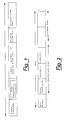
- Figure 1 shows a possible frame format, belonging to the known art, in which, after the frame preamble, necessary for synchronization, maps are transmitted. After the maps, different frame portions, one for each physical mode used in that frame, occur in succession. Other frame portions generally present and not significant to the purposes of the present invention are omitted for simplicity.
- the present invention applies to systems foreseeing the use of maps transmitted on the downstream channel and defines a technique for the protection of the above-mentioned maps.
- the featuring aspect of the invention consists in protecting the above-mentioned maps, subdividing them into many FEC blocks having fixed and short length, in order to speed up the process of map decoding and interpretation.
- An additional novel element is represented by the information relevant to the length of the map located in the first FEC block, so that the slave station, that is receiving the traffic, can know, as soon as possible, the position where the map ends and consequently the position where data transmission starts.
- error correction techniques also called FEC
- a bit sequence is processed with appropriate techniques and replaced by another sequence, obtained from the first one.
- the resulting sequence is longer than the original one due to the addition of the coding overhead.
- the essential property of the above-mentioned FEC codes is to detect and correct possible errors present in the block. According to the code robustness, it is possible to detect and correct a given number of wrong bits. The higher is the code robustness, that is the higher is the correction power, the longer is the sequence resulting from the processing of the original sequence, that is the higher is the overhead.
- the invention originates from the following consideration: with an appropriate map format, the first information the terminal needs, that is the information concerning the first frame portions temporally following the map, can be put at the beginning of the map itself.
- the decoding of the first block immediately starts as soon as the block has been received and the information contained therein can be immediately used.
- small FEC blocks reach the slave station, they are decoded, and the slave station does not need to wait until the whole map is received.
- the map decoding is performed simultaneously with the reception of the same, while the map is received by the slave station. In this way, the time elapsing from the end of the map and the beginning of the next data considerably reduces up to completely disappear.
- An additional novelty consists in inserting, in the first FEC block of the map, the information containing the length of the map itself (figure 2).
- the technique described above has also the advantage that should a FEC block be considered incorrect, the map has not to be considered wrong as a whole, but some information within it can be correctly interpreted.
- the slave station is already in possess of all the elements necessary to synchronize on the frame portion dedicated to the transmission of physical mode number one, and can neglect the remaining map portion it cannot decode due to the rejected blocks.
- the preferred embodiment of the invention consists in subdividing the map into FEC blocks having length equal to 20 useful bytes plus the coding overhead.
- the first or the first two bytes of the map shall be dedicated to the information relevant to the map length.
- Said length can be expressed in different formats: number of bytes, number of elements present in the map or number of FEC blocks forming the map.
- the length can be unique for downstream and upstream maps or two separate length fields can be used.
- the length is unique for both the maps and is expressed in a number of FEC blocks forming the maps.
- one of said modifications can consist in changing the size of FEC blocks and/or the format expressing the map length. It is evident that the present invention incorporates those alternative embodiments included in the protection of the following claims.
Landscapes
- Engineering & Computer Science (AREA)
- Computer Networks & Wireless Communication (AREA)
- Signal Processing (AREA)
- Quality & Reliability (AREA)
- Mobile Radio Communication Systems (AREA)
- Detection And Prevention Of Errors In Transmission (AREA)
- Time-Division Multiplex Systems (AREA)
- Alarm Systems (AREA)
- Selective Calling Equipment (AREA)
Abstract
Description
Claims (10)
- Transmission system including at least one master station and one or more slave stations, which send signals to the master station through a first transmission channel or upstream channel and receive signals from the master station through a second transmission channel or downstream channel that transports also at least one map optionally including information suitable to enable the correct demodulation and decoding of the signals allocated in the downstream channel and, in addition or as an alternative, information suitable to instruct the slave stations on how to share the upstream transmission channel, characterized in that said map is protected by an error correction code (FEC).
- The system according to claim 1 characterized in that said FEC map protection code includes more FEC blocks having limited dimension, each protecting a segment of said map.
- The system according to claim 2 characterized in that the first one of said map segments contains a field identifying the length of said map.
- The system according to claim 3 in which the length field identifies the length of the whole map.
- The system according to claim 3 in which separate length fields identify the length of different parts of the map with different functions.
- The system according to claim 4 characterized in that said length field codes the number of FEC blocks used to protect said map.
- The system according to claim 5 characterized in that each length field codes the number of FEC blocks used to protect the relevant map portion.
- The system according to claim 4 characterized in that said length field codes the number of bytes forming said map.
- The system according to claim 5 characterized in that each length field codes the number of bytes forming the relevant map portion.
- The system according to claim 2 in which said map segment, protected by a FEC block, includes 20 bytes.
Applications Claiming Priority (2)
| Application Number | Priority Date | Filing Date | Title |
|---|---|---|---|
| IT2001MI000616A ITMI20010616A1 (en) | 2001-03-23 | 2001-03-23 | MAP PROTECTION IN MULTIPOINT POINT TRANSMISSION SYSTEMS |
| ITMI010616 | 2001-03-23 |
Publications (3)
| Publication Number | Publication Date |
|---|---|
| EP1244238A2 true EP1244238A2 (en) | 2002-09-25 |
| EP1244238A3 EP1244238A3 (en) | 2006-08-30 |
| EP1244238B1 EP1244238B1 (en) | 2012-07-25 |
Family
ID=11447347
Family Applications (1)
| Application Number | Title | Priority Date | Filing Date |
|---|---|---|---|
| EP02002947A Expired - Lifetime EP1244238B1 (en) | 2001-03-23 | 2002-02-11 | Protection of the descriptive map of the transmission mode in a point-to-multipoint transmission system |
Country Status (3)
| Country | Link |
|---|---|
| EP (1) | EP1244238B1 (en) |
| ES (1) | ES2392040T3 (en) |
| IT (1) | ITMI20010616A1 (en) |
Citations (1)
| Publication number | Priority date | Publication date | Assignee | Title |
|---|---|---|---|---|
| US6088390A (en) | 1997-07-22 | 2000-07-11 | Analog Devices, Inc. | Integrating decision feedback equalization and forward error correction to improve performance in point-to-multipoint digital transmission |
Family Cites Families (2)
| Publication number | Priority date | Publication date | Assignee | Title |
|---|---|---|---|---|
| WO1997038549A1 (en) * | 1996-04-05 | 1997-10-16 | Universität Karlsruhe (Th) | Method and apparatus for forward error correction of transmitted digital signals in networks |
| WO1997048191A1 (en) * | 1996-06-13 | 1997-12-18 | Broadband Networks Inc. | Wide-area wireless distribution system |
-
2001
- 2001-03-23 IT IT2001MI000616A patent/ITMI20010616A1/en unknown
-
2002
- 2002-02-11 ES ES02002947T patent/ES2392040T3/en not_active Expired - Lifetime
- 2002-02-11 EP EP02002947A patent/EP1244238B1/en not_active Expired - Lifetime
Patent Citations (1)
| Publication number | Priority date | Publication date | Assignee | Title |
|---|---|---|---|---|
| US6088390A (en) | 1997-07-22 | 2000-07-11 | Analog Devices, Inc. | Integrating decision feedback equalization and forward error correction to improve performance in point-to-multipoint digital transmission |
Also Published As
| Publication number | Publication date |
|---|---|
| ES2392040T3 (en) | 2012-12-04 |
| EP1244238B1 (en) | 2012-07-25 |
| EP1244238A3 (en) | 2006-08-30 |
| ITMI20010616A0 (en) | 2001-03-23 |
| ITMI20010616A1 (en) | 2002-09-23 |
Similar Documents
| Publication | Publication Date | Title |
|---|---|---|
| EP2317677B1 (en) | Radio transmission method and radio transmission device | |
| US5724515A (en) | Packet radio communication system | |
| EP1993307B1 (en) | System and method for transmitting and receiving common control information in a wireless communication system | |
| EP0981926B1 (en) | Method and apparatus for formatting synchronous and asynchronous data | |
| EP2101429B1 (en) | Method and apparatus for receiving control information in a wireless communication system | |
| AU2004246135B2 (en) | Method for selecting an operating mode based on a detected synchronization pattern | |
| US20070291713A1 (en) | Communication system | |
| EP0882327A2 (en) | A method for enhancing data transmission | |
| US20080137594A1 (en) | Apparatus and method for increasing a service coverage area of a broadcast channel in wireless communication system by using an harq scheme | |
| US20050281239A1 (en) | System and method for signaling modes | |
| EP3716507B1 (en) | Method for transmitting/receiving control information in dvb-t2 broadcast communication system | |
| EP1244238B1 (en) | Protection of the descriptive map of the transmission mode in a point-to-multipoint transmission system | |
| US8462740B2 (en) | Method for generating control channel and decoding control channel, base station and mobile station thereof | |
| RU2487501C2 (en) | Reduced transmission time interval | |
| JP2002009727A (en) | AC transmission / reception method, transmission apparatus, and reception apparatus for OFDM transmission system | |
| EP1179898B1 (en) | Point-to-point and point-multipoint radio transmission system, with interoperable TDM and TDMA structure and with different physical modes | |
| EP0519549A2 (en) | A method of voting in a radio communication system and a system therefor | |
| EP1244236A2 (en) | Format of elements forming downstream maps in point-multipoint systems with different physical modes | |
| JPS60128735A (en) | Synchronizing system | |
| JPH0693644B2 (en) | Communication method | |
| JPH0693643B2 (en) | Communication method |
Legal Events
| Date | Code | Title | Description |
|---|---|---|---|
| PUAI | Public reference made under article 153(3) epc to a published international application that has entered the european phase |
Free format text: ORIGINAL CODE: 0009012 |
|
| AK | Designated contracting states |
Kind code of ref document: A2 Designated state(s): AT BE CH CY DE DK ES FI FR GB GR IE IT LI LU MC NL PT SE TR |
|
| AX | Request for extension of the european patent |
Free format text: AL;LT;LV;MK;RO;SI |
|
| PUAL | Search report despatched |
Free format text: ORIGINAL CODE: 0009013 |
|
| AK | Designated contracting states |
Kind code of ref document: A3 Designated state(s): AT BE CH CY DE DK ES FI FR GB GR IE IT LI LU MC NL PT SE TR |
|
| AX | Request for extension of the european patent |
Extension state: AL LT LV MK RO SI |
|
| 17P | Request for examination filed |
Effective date: 20070228 |
|
| AKX | Designation fees paid |
Designated state(s): AT BE CH CY DE DK ES FI FR GB GR IE IT LI LU MC NL PT SE TR |
|
| 17Q | First examination report despatched |
Effective date: 20090731 |
|
| GRAP | Despatch of communication of intention to grant a patent |
Free format text: ORIGINAL CODE: EPIDOSNIGR1 |
|
| GRAS | Grant fee paid |
Free format text: ORIGINAL CODE: EPIDOSNIGR3 |
|
| GRAA | (expected) grant |
Free format text: ORIGINAL CODE: 0009210 |
|
| RAP1 | Party data changed (applicant data changed or rights of an application transferred) |
Owner name: NOKIA SIEMENS NETWORKS ITALIA S.P.A. |
|
| AK | Designated contracting states |
Kind code of ref document: B1 Designated state(s): AT BE CH CY DE DK ES FI FR GB GR IE IT LI LU MC NL PT SE TR |
|
| REG | Reference to a national code |
Ref country code: GB Ref legal event code: FG4D |
|
| REG | Reference to a national code |
Ref country code: CH Ref legal event code: EP Ref country code: DE Ref legal event code: R081 Ref document number: 60243358 Country of ref document: DE Owner name: NOKIA SOLUTIONS AND NETWORKS ITALIA S.P.A., IT Free format text: FORMER OWNER: SIEMENS INFORMATION AND COMMUNICATION NETWORKS S.P.A., MAILAND/MILANO, IT Ref country code: DE Ref legal event code: R081 Ref document number: 60243358 Country of ref document: DE Owner name: NOKIA SOLUTIONS AND NETWORKS ITALIA S.P.A., IT Free format text: FORMER OWNER: NOKIA SIEMENS NETWORKS ITALIA S.P.A., CASSINA DE PECCHI, IT Ref country code: DE Ref legal event code: R081 Ref document number: 60243358 Country of ref document: DE Owner name: NOKIA SOLUTIONS AND NETWORKS ITALIA S.P.A., CA, IT Free format text: FORMER OWNER: NOKIA SIEMENS NETWORKS ITALIA S.P.A., CASSINA DE PECCHI, IT Ref country code: DE Ref legal event code: R081 Ref document number: 60243358 Country of ref document: DE Owner name: NOKIA SOLUTIONS AND NETWORKS ITALIA S.P.A., CA, IT Free format text: FORMER OWNER: SIEMENS INFORMATION AND COMMUNICATION NETWORKS S.P.A., MAILAND/MILANO, IT |
|
| REG | Reference to a national code |
Ref country code: AT Ref legal event code: REF Ref document number: 568074 Country of ref document: AT Kind code of ref document: T Effective date: 20120815 Ref country code: IE Ref legal event code: FG4D |
|
| REG | Reference to a national code |
Ref country code: DE Ref legal event code: R096 Ref document number: 60243358 Country of ref document: DE Effective date: 20120920 |
|
| REG | Reference to a national code |
Ref country code: NL Ref legal event code: T3 |
|
| REG | Reference to a national code |
Ref country code: ES Ref legal event code: FG2A Ref document number: 2392040 Country of ref document: ES Kind code of ref document: T3 Effective date: 20121204 |
|
| REG | Reference to a national code |
Ref country code: AT Ref legal event code: MK05 Ref document number: 568074 Country of ref document: AT Kind code of ref document: T Effective date: 20120725 |
|
| PG25 | Lapsed in a contracting state [announced via postgrant information from national office to epo] |
Ref country code: CY Free format text: LAPSE BECAUSE OF FAILURE TO SUBMIT A TRANSLATION OF THE DESCRIPTION OR TO PAY THE FEE WITHIN THE PRESCRIBED TIME-LIMIT Effective date: 20120725 Ref country code: BE Free format text: LAPSE BECAUSE OF FAILURE TO SUBMIT A TRANSLATION OF THE DESCRIPTION OR TO PAY THE FEE WITHIN THE PRESCRIBED TIME-LIMIT Effective date: 20120725 Ref country code: AT Free format text: LAPSE BECAUSE OF FAILURE TO SUBMIT A TRANSLATION OF THE DESCRIPTION OR TO PAY THE FEE WITHIN THE PRESCRIBED TIME-LIMIT Effective date: 20120725 Ref country code: FI Free format text: LAPSE BECAUSE OF FAILURE TO SUBMIT A TRANSLATION OF THE DESCRIPTION OR TO PAY THE FEE WITHIN THE PRESCRIBED TIME-LIMIT Effective date: 20120725 |
|
| PG25 | Lapsed in a contracting state [announced via postgrant information from national office to epo] |
Ref country code: PT Free format text: LAPSE BECAUSE OF FAILURE TO SUBMIT A TRANSLATION OF THE DESCRIPTION OR TO PAY THE FEE WITHIN THE PRESCRIBED TIME-LIMIT Effective date: 20121126 Ref country code: GR Free format text: LAPSE BECAUSE OF FAILURE TO SUBMIT A TRANSLATION OF THE DESCRIPTION OR TO PAY THE FEE WITHIN THE PRESCRIBED TIME-LIMIT Effective date: 20121026 Ref country code: SE Free format text: LAPSE BECAUSE OF FAILURE TO SUBMIT A TRANSLATION OF THE DESCRIPTION OR TO PAY THE FEE WITHIN THE PRESCRIBED TIME-LIMIT Effective date: 20120725 |
|
| PG25 | Lapsed in a contracting state [announced via postgrant information from national office to epo] |
Ref country code: DK Free format text: LAPSE BECAUSE OF FAILURE TO SUBMIT A TRANSLATION OF THE DESCRIPTION OR TO PAY THE FEE WITHIN THE PRESCRIBED TIME-LIMIT Effective date: 20120725 |
|
| PLBE | No opposition filed within time limit |
Free format text: ORIGINAL CODE: 0009261 |
|
| STAA | Information on the status of an ep patent application or granted ep patent |
Free format text: STATUS: NO OPPOSITION FILED WITHIN TIME LIMIT |
|
| 26N | No opposition filed |
Effective date: 20130426 |
|
| REG | Reference to a national code |
Ref country code: DE Ref legal event code: R097 Ref document number: 60243358 Country of ref document: DE Effective date: 20130426 |
|
| PG25 | Lapsed in a contracting state [announced via postgrant information from national office to epo] |
Ref country code: MC Free format text: LAPSE BECAUSE OF NON-PAYMENT OF DUE FEES Effective date: 20130228 |
|
| REG | Reference to a national code |
Ref country code: CH Ref legal event code: PL |
|
| PG25 | Lapsed in a contracting state [announced via postgrant information from national office to epo] |
Ref country code: LI Free format text: LAPSE BECAUSE OF NON-PAYMENT OF DUE FEES Effective date: 20130228 Ref country code: CH Free format text: LAPSE BECAUSE OF NON-PAYMENT OF DUE FEES Effective date: 20130228 |
|
| PG25 | Lapsed in a contracting state [announced via postgrant information from national office to epo] |
Ref country code: LU Free format text: LAPSE BECAUSE OF NON-PAYMENT OF DUE FEES Effective date: 20130211 |
|
| REG | Reference to a national code |
Ref country code: FR Ref legal event code: PLFP Year of fee payment: 15 |
|
| REG | Reference to a national code |
Ref country code: FR Ref legal event code: PLFP Year of fee payment: 16 |
|
| REG | Reference to a national code |
Ref country code: DE Ref legal event code: R081 Ref document number: 60243358 Country of ref document: DE Owner name: NOKIA SOLUTIONS AND NETWORKS ITALIA S.P.A., IT Free format text: FORMER OWNER: NOKIA SIEMENS NETWORKS ITALIA S.P.A., CASSINA DE PECCHI, IT Ref country code: DE Ref legal event code: R081 Ref document number: 60243358 Country of ref document: DE Owner name: NOKIA SOLUTIONS AND NETWORKS ITALIA S.P.A., CA, IT Free format text: FORMER OWNER: NOKIA SIEMENS NETWORKS ITALIA S.P.A., CASSINA DE PECCHI, IT |
|
| REG | Reference to a national code |
Ref country code: FR Ref legal event code: PLFP Year of fee payment: 17 |
|
| PGFP | Annual fee paid to national office [announced via postgrant information from national office to epo] |
Ref country code: NL Payment date: 20210212 Year of fee payment: 20 Ref country code: IE Payment date: 20210209 Year of fee payment: 20 Ref country code: FR Payment date: 20210112 Year of fee payment: 20 |
|
| PGFP | Annual fee paid to national office [announced via postgrant information from national office to epo] |
Ref country code: DE Payment date: 20210126 Year of fee payment: 20 Ref country code: TR Payment date: 20210210 Year of fee payment: 20 Ref country code: ES Payment date: 20210309 Year of fee payment: 20 Ref country code: GB Payment date: 20210203 Year of fee payment: 20 |
|
| PGFP | Annual fee paid to national office [announced via postgrant information from national office to epo] |
Ref country code: IT Payment date: 20210112 Year of fee payment: 20 |
|
| REG | Reference to a national code |
Ref country code: DE Ref legal event code: R071 Ref document number: 60243358 Country of ref document: DE |
|
| REG | Reference to a national code |
Ref country code: NL Ref legal event code: MK Effective date: 20220210 |
|
| REG | Reference to a national code |
Ref country code: GB Ref legal event code: PE20 Expiry date: 20220210 |
|
| REG | Reference to a national code |
Ref country code: IE Ref legal event code: MK9A |
|
| PG25 | Lapsed in a contracting state [announced via postgrant information from national office to epo] |
Ref country code: IE Free format text: LAPSE BECAUSE OF EXPIRATION OF PROTECTION Effective date: 20220211 Ref country code: GB Free format text: LAPSE BECAUSE OF EXPIRATION OF PROTECTION Effective date: 20220210 |
|
| REG | Reference to a national code |
Ref country code: ES Ref legal event code: FD2A Effective date: 20220526 |
|
| PG25 | Lapsed in a contracting state [announced via postgrant information from national office to epo] |
Ref country code: ES Free format text: LAPSE BECAUSE OF EXPIRATION OF PROTECTION Effective date: 20220212 |