EP1244017A1 - Data structure managing device, data structure managing system, data structure managing method, and recorded medium where data structure managing program is stored - Google Patents
Data structure managing device, data structure managing system, data structure managing method, and recorded medium where data structure managing program is stored Download PDFInfo
- Publication number
- EP1244017A1 EP1244017A1 EP00981685A EP00981685A EP1244017A1 EP 1244017 A1 EP1244017 A1 EP 1244017A1 EP 00981685 A EP00981685 A EP 00981685A EP 00981685 A EP00981685 A EP 00981685A EP 1244017 A1 EP1244017 A1 EP 1244017A1
- Authority
- EP
- European Patent Office
- Prior art keywords
- data structure
- data
- modified
- modification
- node
- Prior art date
- Legal status (The legal status is an assumption and is not a legal conclusion. Google has not performed a legal analysis and makes no representation as to the accuracy of the status listed.)
- Withdrawn
Links
Images









Classifications
-
- G—PHYSICS
- G06—COMPUTING OR CALCULATING; COUNTING
- G06F—ELECTRIC DIGITAL DATA PROCESSING
- G06F16/00—Information retrieval; Database structures therefor; File system structures therefor
- G06F16/90—Details of database functions independent of the retrieved data types
- G06F16/901—Indexing; Data structures therefor; Storage structures
- G06F16/9027—Trees
-
- Y—GENERAL TAGGING OF NEW TECHNOLOGICAL DEVELOPMENTS; GENERAL TAGGING OF CROSS-SECTIONAL TECHNOLOGIES SPANNING OVER SEVERAL SECTIONS OF THE IPC; TECHNICAL SUBJECTS COVERED BY FORMER USPC CROSS-REFERENCE ART COLLECTIONS [XRACs] AND DIGESTS
- Y10—TECHNICAL SUBJECTS COVERED BY FORMER USPC
- Y10S—TECHNICAL SUBJECTS COVERED BY FORMER USPC CROSS-REFERENCE ART COLLECTIONS [XRACs] AND DIGESTS
- Y10S707/00—Data processing: database and file management or data structures
- Y10S707/99941—Database schema or data structure
- Y10S707/99942—Manipulating data structure, e.g. compression, compaction, compilation
Definitions
- Data structure management apparatus Data structure management system, data structure management method, and computer readable recording medium for recording a data structure management program.
- the present invention relates to a data structure management apparatus, data structure management system, data structure management method, and computer readable recording medium for recording a data structure management program.
- a data structure management apparatus in the case where there is a plurality of data structures deployed in one or a plurality of computer storage units, it relates to technology for reducing communication traffic and implementing easy yet efficient maintenance and management of a plurality of data structures by conveying to another data structure only the modified data that is necessary for maintenance of equivalency between a certain data structure and another data structure so as to reflect onto the other data structure.
- RAM Random Access Memory
- the hassle or the calculation time, required to maintain and manage other data structures that should be reflected an update (modification) (hereinafter referred to as “the copy side data structure") is the same as the hassle required to maintain and manage the data structure on the modification source side (hereinafter referred to as “the master side data structure").
- a plurality of equivalent data structures may be configured by storing the pointers of identical expressions in the same address in a single storage unit (or computer) or among a plurality of storage units (or computers). Modifications in a data structure may be reflected onto other data structures by structuring a plurality of data structures in this manner and simply copying the pointers as with the other data (codes).
- the second technique may not be applied to some data structures that are functionally equivalent but allow the pointer structure to take on different forms.
- a data structure which is called self-adjusting data structure, that appropriately adjusts pointer structure so that a frequently accessed node becomes a root node.
- This self-adjusting data structure changes the data structure format to another functionally equivalent format even with a search operation that does not accompany a functional modification.
- This self-adjusting data structure in order to make the stored pointer values match and maintain equivalency, all modifications to the pointer values (the content of each address) that occur as a result of all operations including search operation must be copied. This copying requires transmission of an enormous amount of pointer modification information to the other data structures (or other means for managing data structure), thus the communication traffic in addition to the hassle of managing becomes considerable.
- the master side utilizes the high-balanced-tree described above so as to manage the tree configuration whereas the copy side utilizes a splay tree so as to perform the search operation
- the data structure configuration that is, the form of the tree
- the data structure configuration on the copy side before having to reflect the modified data are completely different. Accordingly, when simply the master side data structure is modified, the modified pointer may not be reflected in the copy side data structure.
- the present invention is brought forth to solve problems of conventional data structure management techniques such as, as described above, the fact that the maintenance/ management for the purpose of accomplishing equivalency among the functions of a plurality of data structures arranged upon one or a plurality of RAM requires a great deal of calculation time, there is a large volume of communication, and thus is inefficient.
- an objective thereof is to provide a data structure management apparatus, a data structure management system, a data structure management method, and storage media for storing a data structure management program, which are capable of efficiently maintaining and managing equivalency among a plurality of data structures efficiently by reflecting a modification made to a data structure arranged on one or a plurality of RAM (storage regions) onto the other data structures with the least amount of traffic and calculation time.
- Yet another objective of the invention is to maintain and manage the equivalence easily among a part of or the whole data structure arranged on the address unique to each other.
- the present invention extracts from pointer modification data for a certain data structure the modified data required to maintain functional equivalence among a plurality of data structures based on a predetermined standard configuration and transmits only the extracted modified data to a data structure onto which the modification should be reflected.
- a data structure management system focuses on modifications of pointer information in the standard configuration of an arbitrary data structure, generates modified data by omitting from the modified pointer information the pointer values that can possibly be assumed or restored if the standard configuration is assumed, and transmits it to the copy side data structure(s) that must have equivalence with the master side data structure maintained.
- the modification data communications traffic may be reduced and the processing time for modification reflection processing reduced without alerting the data structure modification program.
- relative location information may be sent to copy-formatted data structure.
- the first embodiment constructs the data structures of the binary search tree on a plurality of RAM and provides the function of efficiently maintaining functional equivalency among these data structures.
- FIG. 1 is a block diagram that shows the general functional configuration of the data structure management system according to the first embodiment.
- a master side data structure management apparatus 10 according to the first embodiment is configured of a data structure storage unit 20, a data search unit 103, a data structure modification unit 105, an outgoing data extraction unit 107, a standard configuration storage unit 109, and a modification transmission unit 111.
- a copy side data structure management apparatus 30 according to the first embodiment is configured by a data structure storage unit 20, a data search unit 303, a modification reflection unit 301, and a modification reception unit 311. Further, the configuration in FIG.
- the first embodiment is an example of a master-slave type composition, where the data structure storage unit 20 of the data structure management apparatus 10 is the master, and modifications of the master data structure are reflected onto the data structure storage unit 20 of the copy side data structure management apparatus 30.
- the first embodiment may be arbitrarily configured with other structures such as a pier-to-pier type structure where a plurality of data structure management apparatus, which have the structures of both the data structure management apparatus 10 and the data structure management apparatus 30, are interconnected allowing reciprocal exchange of the data structure modification data.
- the configuration in FIG. 1 is described as having a single data structure on the copy side whereupon modification should be reflected; however, there may be a plurality of data structures on the copy side as long as the communication function is capable of transmitting identical modified data to a plurality of targets.
- the modification reflection unit 301 reflects the transmitted modified data upon the data structure of the copy side data structure storage unit 20.
- the data search unit 103 of the master side data structure storage unit 20 and the data search unit 303 of the copy side data structure storage unit 20 function with complete parity.
- both data structure storage units 20 can return the same result for the same search request. Therefore, data can be shared between the master and the copy through implementing equivalency of both data structures.
- the data structures of the master side and copy side data structure storage units 20 are arbitrary data structures, which are functionally equivalent to each other.
- functionally equivalent means having each node in the same logical sequence (sorting sequence, in the case of this embodiment), namely, a functional equivalence; however, the pointer structures themselves may be different from each other.
- Data search units 103 and 303 search for data within the data structures, which are respectively stored in the data structure storage units 20, in accordance with a request from the application.
- the data structure modification unit 105 in the master side data structure management apparatus 10 appropriately modifies the master side data structure, which is stored in the data structure storage unit 20, and communicates the modified pointer information or modified data to the outgoing data extraction unit 107.
- the outgoing data extraction unit 107 extracts only the pointer information that changes the logical sequence of each node in the data structure from the modified data by referencing the standard data structure stored in the standard configuration storage unit 109, sending this extracted pointer information to the modification transmission unit 111.
- the modification transmission unit 111 transmits the extracted pointer information to the modification reception unit 311, in the same RAM or the same computer as the master side data structure management apparatus 10, or in another computer connected either locally or remotely.
- the modification reception unit 311 in the copy side data structure management apparatus 30 sends to the modification reflection unit 301 the pointer information (modified data), which is received from the modification transmission unit 111 of the master side data structure management apparatus 10.
- the modification reflection unit 301 reflects the pointer information (modified data), which is received from the modification reception unit 311, onto the copy side data structure, which is stored in the data structure storage unit 20.
- the data structure management apparatus 10 and the data structure management apparatus 30 in the data structure management system according to the present invention are integrated in a any of a variety of independent computers, which include, for example, so-called general-purpose machines, workstations, PCs, network terminals, and various mobile terminals, or in a system, mutually connected to each computer.
- FIG. 27 is a block diagram showing the hardware configuration of each apparatus configuring the data structure management system according to each embodiment of the present invention.
- the data structure management apparatus 10 and 30 according to each embodiment of the present invention have, for example, either the entire or a part of the computer configuration shown in FIG. 27.
- the computer comprises a central processing unit 270 such as a microprocessor and many other units mutually connected via a system bus 272.
- This computer is equipped with, for example, a random access memory 274; a read-only memory 276; an I/O adapter 278, which connects peripheral equipment such as a hard disk device 280 to the system bus 272; a user interface adapter 282, which connects to the system bus 272 user interface devices such as a key board 284, a mouse 286, a speaker 288, a microphone 292 or a touch screen (not shown); user interface devices 284, 286, 288, and 292; a communication adapter 294, which connects this computer system to a communication network; a display adapter 296, which connects a display apparatus 298 to the system bus 272; an external disk driver, which drives a floppy disk, an optical disk, various memory cards and the like, respectively; and an external storage unit.
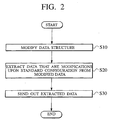
- FIG. 2 is a flow chart showing an outline of the processing of data structure modification and the reflection of modifications to other data structures performed by the data structure management system according to the first embodiment of the present invention.
- the data structure modification unit 105 modifies the data structure, which is stored in the master side data structure storage unit 20 (Step S10).
- the outgoing data extraction unit 107 extracts the pointer information, which plays the role of changing the structure on the standard configuration stored in the standard configuration storage unit 109, from the modified pointer information in this data structure (Step S20).
- the modification transmission unit 111 transmits this extracted pointer information to the modification reception unit 311 of the copy side data structure management apparatus 30 (Step S30).
- the copy side data structure management apparatus 30 sends to the modification reflection unit 301 the modified data (pointer information), which is received by the modification reception unit 311.
- the modification reflection unit 301 updates the copy side data structure with the received modified data (pointer information) by accessing the data structure stored in the data structure storage unit 20.
- the representation method storing two pointers per node is described.
- the pointers denote addresses of other nodes.
- a binary tree may provide a bi-directional link from a parent to a child as well as from the child to the parent by only using two pointers per node.
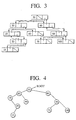
- FIG. 3 describes a two-pointer representation method called leftmost-child-right-sibling representation, which implements theses bi-directional links.
- FIG. 4 shows the two-pointer representation method of FIG. 3 as a representation with binary trees, wherein each of the nodes is connected like a tree.
- the pointer points to the left child; if there is no left child and there is a right child, it points to the right child.
- the pointer is nil (void pointer).
- the pointer points to the right sibling; in other cases where there is a parent, namely, it is not the root node, the pointer points to the parent.
- the pointer is nil (void pointer).
- the other (left) pointer pointing to a sibling or a parent whether it is pointing to the right sibling or to the parent may be determined by tracing the pointer for a maximum of two times.
- the right pointer pointing to the right sibling is limited to when the left pointer of a node pointed at with the right pointer of a node, which is pointed by the right pointer, matches that node.
- a binary tree may be implemented by storing two pointers and one-bit of information per node.
- an operation which determines the left child from the parent
- an operation which determines the right child from the parent
- an operation which determines the parent from the child
- the executing time for these operations is longer than when using three pointers since two or more pointers and a bit are referenced for each operation.
- there is an advantage to the operations for modifying or setting the content of each node whereby the operating time is reduced due to the few number of pointers.
- the storage unit to be used is configured with memory elements, which are attached with addresses, allowing arbitrary addresses to be stored in each memory element.
- addresses are used as pointers.
- m the element of an address m, it is represented by [m].
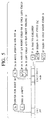
- an even numbered address element [2n] and its following element [2n+1] are assigned to the pointer portion of a single node.
- the even numbered address of that pointer portion is used.
- the nodes with [2n] and [2n+1] assigned thereto becomes [node 2n].
- the pointer for the root of the binary tree which is configured using these nodes, is stored in another element, and the whole including this other element is handled as a single data structure.
- the other memory element that stores the pointer for this root is called the pot of the tree.
- the pointer for the pot is stored in the root node instead of the pointer for the parent or right sibling.
- the pot address is m and the root node is 2n
- 2n is set to [m]
- m is set to [2m].
- 0 (nil) is set to [m]. It is one of the characteristics of the first embodiment to provide a pot that uniquely corresponds to a binary tree, which is a collection of nodes, and handle it as a unit in this manner.
- the address 0 is utilized as the nil pointer, [0] is not used as a node. However, it may be used as a pot.
- any address may be used for the nil pointer as long as it may be determined to be an address that is not corresponding to the memory element or an address that is not used as a node.
- 0 (nil) is set for the other pointer [2n+1] of each node 2n when the node has no children.
- 2q is set to [2n+1] regardless of the existence of a right child.
- 2r+1 is set to [2n+1].
- the value of [2n+1] is an even number (LSB is 0)
- it may be differentiated from the latter case where the value is an odd number (LSB is 1) by only the one LSB.
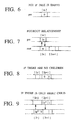
- connection information regarding the parent/sibling nodes can be determined with, for example, the nodes 2x as follows. It should be noted that regarding each of the determining conditions, which node of which of the cases a through f described above corresponds to 2x, is indicated in the comments.
- FIG. 12 is a diagram accurately showing the data structure, including the pot, wherein the binary trees in FIG. 3 and FIG. 4 are handled by the method of the first embodiment. Note that the start address of each node is an even numbered address.
- FIG. 13 is a structure equivalent to the data structure in FIG. 12 used as a binary search tree.
- no nodes have left children. In other words, every node is one having only a right child or no children at all.
- from the root node a to the far end node j is sorted with a key in a descending or ascending order. Note that the addresses of the pot and nodes are identical to the data structure in FIG. 12.
- the data structure of the configuration in FIG. 13 is called a standard configuration. This standard configuration is stored in the standard configuration storage unit 109 and referenced by the outgoing data extraction unit 107.
- the data structure management apparatus manages a plurality of data structures in the two-pointer representation of the above binary search tree as a plurality of equivalent representations of data, and by successively reflecting the modification subjected to one of these upon another data structure, makes them function amongst themselves as an identical (or equivalent) binary search tree.
- the data structure management system manages two data structures wherein the respective nodes and pots are arranged, for example, in the same addresses in the respective RAM of two computers,.
- both of the data structures in the two computers are assumed to be exactly the same as FIG. 12.
- a modification operation such as deleting the root node with 50 as a key is performed so as to make a structure, which has as a new root node, the node having 60 as a key.
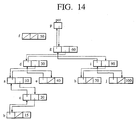
- FIG. 14 shows the data structure after this modification operation.
- the modified pointers differing from FIG. 12 are indicated by the dashed line arrows in FIG. 14.
- the post-deletion binary search tree apart from the two pointers for the deleted node f, it can be understood that four pointers including the pot have been modified.
- the modification transmission unit 111 of the data structure management unit 10 does not transmit all of these modified pointers and their stored addresses to the modification [transmission] unit 311 of the data structure management apparatus, which manages other data structures one by one; but transmits only the pointer information, which is stored in the even numbered addresses or the start addresses of the nodes, out of the pointers to be modified when the same modification operation is performed as for the standard configuration in FIG. 13, together with the addresses.
- FIG. 15 shows the standard configuration corresponding with FIG. 14.
- either one or both sets of the two addresses and value combinations of ⁇ value e of address g> and ⁇ value 0 of address f> from the four pointer values differing from FIG. 13, namely, the value e of the address g, the value g+1 of the address e+1, the value 0 of the address f, and the value 0 of the address f+1, are transmitted as the modified data to the copy side data structure management apparatus 30 of the other computer.
- the modification reflection unit 301 of the copy side data structure management apparatus which has received the modified data via the modification reception unit 311, performs the operation to delete the f address node from the binary tree on the assumption that the address f is used for a binary tree node as shown in FIG. 12 when, for example, only ⁇ value 0 of address f> is transmitted.
- This operation of node deletion is carried out with the same procedure as the master side data structure management apparatus 10 used when performing the previous modification. As a result, the same structure as in FIG. 14 is created by the modification reflection unit 301.
- the pointer value f that address g should contain can be obtained by calculating the node address to the immediate left of [node] g at the intermediate level of the binary tree in FIG. 12.
- the modification reflection unit 301 detects the fact that the this address g pointer value has been changed, and finds that the value of the e+1 address in the standard configuration in FIG. 13, before being changed, in response to this modified data, to g+1 in FIG 15, is f+1, as with the case of the above-mentioned address g.
- combinations of addresses and values which are sufficient for accurately determining what kind of modification operation has been performed by referencing the standard configuration, may be transmitted from the modification transmission unit 111 to the modification reception unit 311. For example, even without actually making the content of the f address be 0, which is particular to the deletion operation, by transmitting ⁇ value 0 of address f>, it may be communicated to the copy side that the f address node has been deleted.
- these addresses may be retained as a part of the memory content in the memory device and referenced.
- the modification transmission unit 111 may transmit the combination of the addresses and values, which are attached with the effect that said addresses are the (even) addresses of these nodes, to the copy side modification reception unit 311.
- the entire output of the modification log may be stored in the master side data structure management apparatus 10, whereby this modification log is input successively to the copy side data structure management apparatus 30, so as to reconstruct the data structure.
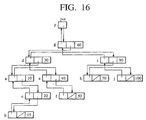
- FIG. 16 shows the binary search tree data structure after addition of this address f node.
- the tree is searched with 50 as the key to add the address f node as the right child of the node e, which has no right child as shown in FIG. 16. Since the standard configuration corresponding to FIG. 16 is equivalent to FIG. 13 as with FIG. 12, the difference between the standard configuration in FIG. 13 and the configuration in FIG. 15 is the four pointers: value f of address g, value f+1 of address e+1, value e of address f, and value g+1 of address f+1.
- the master side modification transmission unit 111 transmits to the copy side modification reception unit 311 either one of ⁇ value e of address f> or ⁇ value f of address g> from these four pointers.
- the copy side modification reflection unit 301 checks that the value of address f is 0 under the conditions of FIG. 14.
- the modification reflection unit 301 determines that the transmitted pointer value denotes an instruction to perform modification of the structure of FIG. 14 into any one of possible structures corresponding to the standard configuration of FIG. 13 where the node f in the standard configuration of FIG. 15 corresponding to that of FIG. 14, which is not included in the tree, is added as the child to the immediate right of the node e, such as the structure of FIG. 16, thereby performing an operation of adding the node f so as for it to be positioned immediately right of (immediately after) the node f in the intermediate level.
- the procedure for this adding operation may be the following procedure.
- the modification reflection unit 301 performs the adding operation so that the node f is positioned to the immediate left of the node g (immediately before, in the sorting order) in the intermediate level upon determination that the node g is included in the tree, and the value of address g in the standard configuration is not f but e.
- This adding operation may also be performed with the functions a. through d. described above.
- to-be-transmitted pointer modification data may be the actual pointer values and the pointer stored addresses in the standard configuration.
- operation content may be efficiently created by the outgoing data extraction unit 107, and efficiently reconstructed by the copy side modification reflection unit 301, whereby format is not important if the modified data is equal to the pointer modification data.
- the memory element that stores the pointer for the binary tree root is regarded as the pot, and the pointer for the pot is stored in the root node of the tree.
- the content of a modification in the master-side data structure may be accurately reflected onto the copy-side data structure by merely transmitting the modification information for the pointer stored in the node even if the to-be-modified node on the copy side and/or master side is the root, as with the case of a modification made to the nodes other than the root.
- the binary search tree may take on many different structures even if they are functionally equivalent, and a structure with an arbitrary node as the root is possible.
- the node When the tree structure differs on the master side and on the copy side, it is possible for the node to be a root on the copy side even if it is not a root on the master side.
- modification of the root node requires to specify the variable that references thereto (equivalent to the pot) and modify such that a new root is referenced. It is not possible for the master side to know whether or not the target node for modification is the root on the copy side. Therefore, when any of the nodes are modified, if the modification causes there to be even a slight possibility for modifications to the variable which references the root on the copy side, the modification information attached with the addresses of these variables must be sent.
- the pot address may be obtained from the respective nodes of the tree via the root, hence a modification operation may be performed on the root node even without the pot address being designated. Accordingly, there is no need for transmitting the pot address from the master side to the copy side. However, when a node is added to an empty pot or when the root node in the standard configuration is modified, the pot address is transmitted. Nevertheless, even in these cases, the pot address is treated the same as a node address as the new pointer value for a node element, and is not transmitted as special additional data.
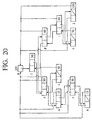
- variable referencing a tree (the root of a tree) is described using a single pot, however, in the case where there are a plurality of variables referencing a tree, if the configuration employed is that of FIG. 19 wherein the tree is accessed via a single pot, equivalency in the data structure may be maintained between the master-side and the copy-side without making any changes to method described above. Moreover, as shown in FIG. 19, if the pointers for each variable referencing that pot are stored on the pot side, modifications to conditions such as which pot is being referenced by each variable may be processed by transmitting them as these pot side pointer modifications.
- the pointer for a pot is stored in a memory element storing the pointer for the parent or the right sibling of the root node, no additional memory resources are necessary to configure the data structure including the pot.
- a configuration where each node stores a pointer for the pot may be employed. In this case, there is no need for a pointer for the pot to be stored in the element storing a pointer for the parent or right sibling of the root node.
- the number of pots is not limited to one, and may be provided in plural.
- the first embodiment provides a storage element (pot) with an address that does not change dynamically as a part of the data structure, and stores as the function in the data structure the correspondence between an element with an address that may be dynamically modified (a root node or individual node), and the element with an address that does not change; in other words, stores a pointer for the pot in a root node or in each node. Therefore, the hassle of transmitting the address of the variable that maintains reference to the data structure at every change operation may be omitted.
- the pot address (the address for the variable which maintains reference to the data structure) need not be designated as input to the data structure modification unit even when the change operation is performed in the individual data structure (for example only on the master side).
- the data structure comprises means for knowing the pot from the node as with the first embodiment, there is no need to designate the pot unless it is truly necessary, a modification operation may be performed by designating only the node to be operated, and in addition there is neither a limit on the usage of the data structure as described above in (3) nor are additional resources required.
- the data structure management system focuses on modifications of pointer information in the standard configuration of an arbitrary data structure, generates modified data by omitting from the modified pointer information the pointer values that can possibly be assumed or restored if the standard configuration is assumed, and transmits it. Through this, the modification data communications traffic may be reduced and the processing time for change reflection processing reduced without alerting the data structure modification program.
- the above-mentioned modification reflection processing may be applied even when the copy side data structure as shown in FIG. 17 is different from the master side data structure such as in FIG. 14.
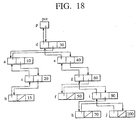
- modification may be applied to a binary search tree such as the configuration shown in FIG. 18, which is equivalent to that in FIG. 16.
- a data structure management apparatus, data structure management system, data structure management method, and data structure management program according to a second embodiment of the present invention are detailed only in respect to only those aspects that differing from the first embodiment while referencing FIG. 21 through FIG. 23.
- the second embodiment provides a function for transmitting relative location information. More specifically, the second embodiment stores partial segment lengths disclosed in "Segment Management Method" (Japanese Patent No. 2768921) in addition to the key in each node of the data structure and performs a search of the node with the location of the segment and calculation of the segment corresponding with the node.
- FIG. 21 is a block diagram showing the functional configuration of a data structure management apparatus according to a second embodiment of the present invention.
- the second embodiment as shown in FIG. 21 is a variation of the first embodiment that is further equipped with a location search unit 113 in the master side data structure management apparatus 10 and the location search unit 313 in the copy side data management apparatus 30.
- the location search unit 113 and the location search unit 313 perform a node search using the segment location and a calculation of the segment corresponding to the node.
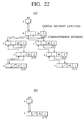
- FIGS. 22 (a) and (b) show an example of a data structure according to the second embodiment.
- the segment lengths corresponding to each node are all 1, and the end of each segment represents the ranking from the left of that node in the LCR order.
- An outgoing data extraction unit 107b in the master side data structure management apparatus 10 obtains, via the location search unit 113, a pointer value, which is in the standard configuration in the standard configuration storage unit 109 and which has been modified as a result of the modification operation, and the address where the pointer is stored as the location information.
- This location information is represented by a combination of the offset from the start of the node, which includes the address in the pre-modification condition, to that address, the value of that node segment (ranking) within the binary tree in which that node lies; and the address of the pot of that binary tree.
- This location information is transmitted to the modification reception unit 311 in the copy side data structure management apparatus 30.
- the location search unit 313 calculates the address of the segment that has that location (that ranking) by determining the address of the node (the start address) in the copy side data structure and adding an offset to the determined start address.
- the address f for example, is represented as ⁇ address of offset 0 of the node with ranking 1 of the pot at address q>.
- the address e is expressed as ⁇ address of offset 0 of the node with ranking 5 of the pot at address p>. Accordingly, instead of, for example, ⁇ value e of address f>, the contents of the modified data transmitted by the modification transmitting unit 111 become location information shown by information such as ⁇ address of offset 0 of the node with ranking 5 of the pot at address p is stored at the address of offset 0 of the node with ranking 1 of the pot of the address q>.
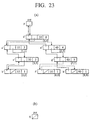
- the points differing from the first embodiment in regards to the condition of the data structure and the modification operation is that addresses other than the pot are designated by the respective offsets from the nodes. Because of this, the node f belongs to the pot q tree even before it has been added to the pot p tree.
- the modification operation involves, as shown in FIGS. 23 (a) and (b), adding this in once the node f has been deleted so that it falls to the immediate right of node e in the LCR order.
- a key may be used to identify a node that is to be modified if there are no nodes having the same key as that node existing on the tree, neither before nor after modification.
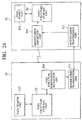
- FIG. 24 is a block diagram showing a functional configuration of the data structure management apparatus according to the third embodiment.
- the third embodiment differs from the first and second embodiments, whereby it is a modification of the first embodiment in the respect that instead of having a master side standard configuration storage unit 109, it is equipped with a data structure modification/extraction unit 106, which has a combined function of the data structure modification unit 105 and outgoing data extraction unit 107 of FIG. 1.
- the outgoing data extraction units 107, 107b extract or, in addition, if necessary, converts only the modifications to the standard configuration, which is stored in the standard configuration storage unit 109, from the pointer modification information that is output from the data structure modification unit 105, outputting to the modification transmission units 111, 111b.
- the data structure modification/extraction unit 106 is modifying the data structure of a data structure storage unit 20
- the value of a pointer to be modified in the standard configuration on the data structure of that which is to be modified is calculated, outputting only the necessary modified data to the modification transmission unit 111.
- the hassle of modifying this standard configuration may be avoided.
- the hassle of the outgoing data extraction unit 107 which extracts the modified data that is once output from the data structure modification unit 105 by referencing the standard configuration, may be reduced.
- the third embodiment utilizes the same binary trees as the data structure in the first embodiment.
- the data structure modification/extraction unit 106 uses the actual data structure of that which is to be modified, which is stored in the data structure storage unit 20, for extracting the necessary modified data.
- the data structure modification/extraction unit 106 modifies the data structure of FIG. 12, in other words deletes the node f, by utilizing a splaying operation that processes a self-adjusting binary tree, and determines ⁇ value e of address g> in the post-deletion standard configuration as in the following.
- the modification transmission unit 111 may extract the modified data that should be transmitted ( ⁇ value e of address g>, in the above example) directly from the data of the data structure storage unit 20.
- the data structure modification/extraction unit 106 may be structured such that the pointer values in the standard configuration are calculated and output to the modification transmission unit 111 by utilizing the data structure of the data structure storage unit 20.
- modified data to be ultimately extracted may be produced.
- the standard configuration it is not necessary for the standard configuration to be even partially retained in the data structure of the data structure storage unit 20.
- the modified data to be extracted is the values of the pointers in the specified standard configuration, it can be understood that the data structure modification/extraction unit 106 performs a calculation that is equivalent to referencing the standard configuration.
- a characteristic of the present invention is that the modified data to be transmitted to the modification reception unit 311 from the modification transmission unit 111 is the pointer value (variable value) in the standard configuration. Even if this modified data is extracted or calculated in any manner, there are no differences in the functions and results.
- a data structure management apparatus, a data structure management system, a data structure management method, and computer readable recording medium, which records a data structure management program according to the present invention, allow for easily and efficiently maintaining the equivalency among a plurality of data structures in one or a plurality of storage regions upon one or a plurality of computers by sending and receiving modification data with little communication traffic.
- the data structures are stored in respectively differing addresses, maintenance of their equivalency is possible.
- the pointer structure among a plurality of computers upon the network may be efficiently reproduced, and may be suitable for various systems, for example, a highly reliable system and the like.
- the data structures are made common among a plurality of computers upon the network, wherewith management of the storage regions in each of the computers, which share these data structures, may respectively be independently and effectively performed, which is valuable.
Landscapes
- Engineering & Computer Science (AREA)
- Databases & Information Systems (AREA)
- Theoretical Computer Science (AREA)
- Software Systems (AREA)
- Data Mining & Analysis (AREA)
- Physics & Mathematics (AREA)
- General Engineering & Computer Science (AREA)
- General Physics & Mathematics (AREA)
- Information Retrieval, Db Structures And Fs Structures Therefor (AREA)
Abstract
In the case where there is a plurality of data structures deployed in one or a
plurality of storage units, while reducing communication traffic, easy yet efficient
maintenance and management of a plurality of data structures is implemented. A data
structure management apparatus according to the present invention is a data structure
management apparatus (10), which manages a plurality of mutually equal data structures
stored in one or a plurality of storage units, comprising a data structure storage unit (20),
which stores an arbitrary first data structure; a data structure modification unit (105),
which modifies the first data structure; a modified data extraction unit (107), which
extracts only the data necessary for making the first data structure on the modification
source side and a second data structure on the modification target side be equal, from the
modified data in the first data structure by the data structure modification unit; and a
modified data transmission unit (111), which outputs the extracted, modified data so as to
reflect onto the second data structure.
Description
Data structure management apparatus, data structure management system, data
structure management method, and computer readable recording medium for recording a
data structure management program.
The present invention relates to a data structure management apparatus, data
structure management system, data structure management method, and computer
readable recording medium for recording a data structure management program. In
particular, in the case where there is a plurality of data structures deployed in one or a
plurality of computer storage units, it relates to technology for reducing communication
traffic and implementing easy yet efficient maintenance and management of a plurality of
data structures by conveying to another data structure only the modified data that is
necessary for maintenance of equivalency between a certain data structure and another
data structure so as to reflect onto the other data structure.
Conventionally, various data structures are constructed by storing pointers with
a certain technique in Random Access Memory (hereinafter referred to as "RAM") having
one or more addresses, which is a typical main memory of a computer, to promote
efficiency of information expression and increase the speed of operation.
For instance, there are techniques for expressing structures among a plurality of
data as a linear list, binary tree, tree, or various graphs by storing a certain pointer for
another node in a portion of RAM corresponding to the first node. Those data structures
provide certain fixed operations and functions.
However, there has been no known effective maintenance/ management
techniques for providing equivalency among the functions of a plurality of data structures
arranged upon one or a plurality of RAM.
A conventional technique for maintaining equivalency among a plurality data
structures is described below.
First, there is a technique for securing functional equivalency among a plurality
of data structures by performing with exactly the same content and sequence all of the
update operations that modify a data structure function and the search operation required
for this update operation, not just for a single data structure but also for each of the
plurality of data structures.
However, with the first technique, the hassle or the calculation time, required to
maintain and manage other data structures that should be reflected an update
(modification) (hereinafter referred to as "the copy side data structure") is the same as the
hassle required to maintain and manage the data structure on the modification source
side (hereinafter referred to as "the master side data structure").
More specifically, in order to modify the data structure, in many cases a complex
search operation is performed before this modification, and depending on the result of the
search the details of the modification vary. Accordingly, with the first technique, unless
the same modification procedure including the required search performed for the master
side data structure is also performed for the copy side data structure, equivalency
between both structures may not be provided. However, with the first technique, the
modification processing for the master side data structure and the modification reflecting
processing for the copy side data structure require the same amount of calculation time
(resources). As a result, there is not much difference between the two sides as far as
marginal space allowing other processing such as a search only request to be performed.
Accordingly, considerable calculation time is required to implement equivalency among
the data structures, and effective division of the processing may not be implemented in a
dispersion environment where, for instance, many search requests that are different from
the master side are performed on the copy side while the master side concentrates on the
processing of the modification requests. In short, it has been impossible with this first
technique to effectively reflect only those modifications made to a data structure onto the
other data structures and reduce the cost of managing other data structures.
Secondly, there is a technique that, in order to maintain the data structure
including the pointer values exactly the same as the content of RAM, all the pointers
modified in the course of a modification operation are transmitted one by one and
reflected onto the modification target side. With this second technique, the respective
data structures (more precisely, each node configuring the respective data structures) are
stored in RAM in a portion that is considered to be the same address, and an update (that
is, pointer modification information) to one of data structures is copied into RAM which
represents other data structures as modifications in the memory content of each address.
As long as means for performing appropriate address conversions is employed, a plurality
of equivalent data structures may be configured by storing the pointers of identical
expressions in the same address in a single storage unit (or computer) or among a
plurality of storage units (or computers). Modifications in a data structure may be
reflected onto other data structures by structuring a plurality of data structures in this
manner and simply copying the pointers as with the other data (codes).
However, the second technique may not be applied to some data structures that
are functionally equivalent but allow the pointer structure to take on different forms.
For instance, there is a data structure, which is called self-adjusting data structure, that
appropriately adjusts pointer structure so that a frequently accessed node becomes a root
node. This self-adjusting data structure changes the data structure format to another
functionally equivalent format even with a search operation that does not accompany a
functional modification. With this self-adjusting data structure, in order to make the
stored pointer values match and maintain equivalency, all modifications to the pointer
values (the content of each address) that occur as a result of all operations including
search operation must be copied. This copying requires transmission of an enormous
amount of pointer modification information to the other data structures (or other means
for managing data structure), thus the communication traffic in addition to the hassle of
managing becomes considerable.
Otherwise, in the case of a data structure such as a high-balanced tree, a large
number of pointers may be modified with one modification operation, and as a result, the
amount of modified data that must be transmitted increases. Also, in the second
technique, there is a restriction whereby the configuration (form) of the data structures on
the master side and the copy side must match completely. More specifically, in the case
of a binary tree data structure, not only must they be equivalent as far as the binary
search tree but also all parent/child relationships among the same corresponding nodes
should coincide. (However, if the above address conversion is carried out appropriately,
the address of each node and the pointer value do not have to be the same.) In other
words, with this second technique, a data structure that is equivalent as a binary search
tree between the master side and the copy side, but is different in terms of a specific
binary tree structure cannot be used.
For that reason, for instance, when the tree configurations on the master side
and the copy side are managed with completely different techniques, in other words, for
instance, in the case where the master side utilizes the high-balanced-tree described
above so as to manage the tree configuration whereas the copy side utilizes a splay tree so
as to perform the search operation, even when the tree configuration is to be modified, the
data structure configuration (that is, the form of the tree) before the modification is made
and the data structure configuration on the copy side before having to reflect the modified
data are completely different. Accordingly, when simply the master side data structure
is modified, the modified pointer may not be reflected in the copy side data structure.
In particular, if an attempt is made to implement equivalency among a plurality
of data structures arranged respectively upon the main memory of physically different
computers using the first or second technique described above, considerable burden would
be imposed on the data transmission channel (network) connecting these computers and
significant influence imparted to the system as a whole including the data transmission
channel.
Moreover, even with the various balanced trees, which are data structures where
the form of the data structure is modified only in the case of an update operation, a large
number of pointers are modified along with the form modification. As a result, in order
to transmit all the modified information of those pointers, although not to the extent as
the above-described self-adjusting data structure, considerable load ends up being applied
to the data transmission channel that connects each RAM stored with the data structures.
The present invention is brought forth to solve problems of conventional data
structure management techniques such as, as described above, the fact that the
maintenance/ management for the purpose of accomplishing equivalency among the
functions of a plurality of data structures arranged upon one or a plurality of RAM
requires a great deal of calculation time, there is a large volume of communication, and
thus is inefficient.
In addition, an objective thereof is to provide a data structure management
apparatus, a data structure management system, a data structure management method,
and storage media for storing a data structure management program, which are capable
of efficiently maintaining and managing equivalency among a plurality of data structures
efficiently by reflecting a modification made to a data structure arranged on one or a
plurality of RAM (storage regions) onto the other data structures with the least amount of
traffic and calculation time.
Yet another objective of the invention is to maintain and manage the equivalence
easily among a part of or the whole data structure arranged on the address unique to each
other.
The present invention extracts from pointer modification data for a certain data
structure the modified data required to maintain functional equivalence among a plurality
of data structures based on a predetermined standard configuration and transmits only
the extracted modified data to a data structure onto which the modification should be
reflected.
In order to implement such a function, a data structure management system,
according to the present invention, focuses on modifications of pointer information in the
standard configuration of an arbitrary data structure, generates modified data by
omitting from the modified pointer information the pointer values that can possibly be
assumed or restored if the standard configuration is assumed, and transmits it to the copy
side data structure(s) that must have equivalence with the master side data structure
maintained. Through this, the modification data communications traffic may be reduced
and the processing time for modification reflection processing reduced without alerting
the data structure modification program.
Alternatively, in place of pointer information, relative location information may
be sent to copy-formatted data structure.
Hereafter, the preferred embodiments according to the present invention of a
data structure management apparatus, a data structure management system, a data
structure management method and recording media, which store a data structure
management program, is described in detail while referencing FIG. 1 through FIG. 27.
The following describes the first embodiment according to the present invention
of a data structure management apparatus, a data structure management system, a data
structure management method, and recording media, which store a data structure
management program, with reference to FIG. 1 through FIG. 20. The first embodiment
constructs the data structures of the binary search tree on a plurality of RAM and
provides the function of efficiently maintaining functional equivalency among these data
structures.
FIG. 1 is a block diagram that shows the general functional configuration of the
data structure management system according to the first embodiment. As shown in FIG.
1, a master side data structure management apparatus 10 according to the first
embodiment is configured of a data structure storage unit 20, a data search unit 103, a
data structure modification unit 105, an outgoing data extraction unit 107, a standard
configuration storage unit 109, and a modification transmission unit 111. A copy side
data structure management apparatus 30 according to the first embodiment is configured
by a data structure storage unit 20, a data search unit 303, a modification reflection unit
301, and a modification reception unit 311. Further, the configuration in FIG. 1 is an
example of a master-slave type composition, where the data structure storage unit 20 of
the data structure management apparatus 10 is the master, and modifications of the
master data structure are reflected onto the data structure storage unit 20 of the copy side
data structure management apparatus 30. The first embodiment may be arbitrarily
configured with other structures such as a pier-to-pier type structure where a plurality of
data structure management apparatus, which have the structures of both the data
structure management apparatus 10 and the data structure management apparatus 30,
are interconnected allowing reciprocal exchange of the data structure modification data.
Furthermore, the configuration in FIG. 1 is described as having a single data structure on
the copy side whereupon modification should be reflected; however, there may be a
plurality of data structures on the copy side as long as the communication function is
capable of transmitting identical modified data to a plurality of targets.
In the first embodiment, with the communication function provided by the
modification transmission unit 111 and the modification reception unit 311, the
modification reflection unit 301 reflects the transmitted modified data upon the data
structure of the copy side data structure storage unit 20. After this modification data is
reflected upon the copy side data structure storage unit 20, the data search unit 103 of the
master side data structure storage unit 20 and the data search unit 303 of the copy side
data structure storage unit 20 function with complete parity. In other words, both data
structure storage units 20 can return the same result for the same search request.
Therefore, data can be shared between the master and the copy through implementing
equivalency of both data structures.
The data structures of the master side and copy side data structure storage units
20 are arbitrary data structures, which are functionally equivalent to each other. Here,
functionally equivalent means having each node in the same logical sequence (sorting
sequence, in the case of this embodiment), namely, a functional equivalence; however, the
pointer structures themselves may be different from each other.
The data structure modification unit 105 in the master side data structure
management apparatus 10 appropriately modifies the master side data structure, which
is stored in the data structure storage unit 20, and communicates the modified pointer
information or modified data to the outgoing data extraction unit 107.
The outgoing data extraction unit 107 extracts only the pointer information that
changes the logical sequence of each node in the data structure from the modified data by
referencing the standard data structure stored in the standard configuration storage unit
109, sending this extracted pointer information to the modification transmission unit 111.
The modification transmission unit 111 transmits the extracted pointer
information to the modification reception unit 311, in the same RAM or the same
computer as the master side data structure management apparatus 10, or in another
computer connected either locally or remotely.
Meanwhile, the modification reception unit 311 in the copy side data structure
management apparatus 30 sends to the modification reflection unit 301 the pointer
information (modified data), which is received from the modification transmission unit
111 of the master side data structure management apparatus 10.
The modification reflection unit 301 reflects the pointer information (modified
data), which is received from the modification reception unit 311, onto the copy side data
structure, which is stored in the data structure storage unit 20.
Next, the hardware configuration of the data structure management apparatus
according to the first embodiment is described. The data structure management
apparatus 10 and the data structure management apparatus 30 in the data structure
management system according to the present invention are integrated in a any of a
variety of independent computers, which include, for example, so-called general-purpose
machines, workstations, PCs, network terminals, and various mobile terminals, or in a
system, mutually connected to each computer.
FIG. 27 is a block diagram showing the hardware configuration of each
apparatus configuring the data structure management system according to each
embodiment of the present invention.
The data structure management apparatus 10 and 30 according to each
embodiment of the present invention have, for example, either the entire or a part of the
computer configuration shown in FIG. 27.
As shown in FIG. 27, the computer comprises a central processing unit 270 such
as a microprocessor and many other units mutually connected via a system bus 272.
This computer is equipped with, for example, a random access memory 274; a read-only
memory 276; an I/O adapter 278, which connects peripheral equipment such as a hard
disk device 280 to the system bus 272; a user interface adapter 282, which connects to the
system bus 272 user interface devices such as a key board 284, a mouse 286, a speaker
288, a microphone 292 or a touch screen (not shown); user interface devices 284, 286, 288,
and 292; a communication adapter 294, which connects this computer system to a
communication network; a display adapter 296, which connects a display apparatus 298 to
the system bus 272; an external disk driver, which drives a floppy disk, an optical disk,
various memory cards and the like, respectively; and an external storage unit.
By storing programs for executing each function for the data structure
management processing of the present invention in the various computer readable
recording media, which are represented by these floppy disks, optical disks, and variety of
memory cards, and performing a predetermined read out operation from these storage
media using the external disk driver, these programs for executing each function of the
data structure management processing of the present invention, which is stored in these
recording media, may be installed in the computer system. The data structure
management processing of the present invention is provided through the loading of these
programs into the random access storage unit 274, and execution by the central
processing unit 270. Alternatively, the data structure management processing of the
present invention is provided through transmission of either all or a part of these
programs to the data structure management apparatus 10 and 30 and the execution by
the central processing unit 101. It should be noted that [storage] media include
commonly used units, which are capable of [storing] programs, such as memory, magnetic
disks, and optical disks.
Next, processing of the data structure management system according to the first
embodiment is described with an example where a plurality of data structures that should
be shared are configured in RAM as a binary search tree.
FIG. 2 is a flow chart showing an outline of the processing of data structure
modification and the reflection of modifications to other data structures performed by the
data structure management system according to the first embodiment of the present
invention. To begin with, the data structure modification unit 105 modifies the data
structure, which is stored in the master side data structure storage unit 20 (Step S10).
The outgoing data extraction unit 107 extracts the pointer information, which plays the
role of changing the structure on the standard configuration stored in the standard
configuration storage unit 109, from the modified pointer information in this data
structure (Step S20). The modification transmission unit 111 transmits this extracted
pointer information to the modification reception unit 311 of the copy side data structure
management apparatus 30 (Step S30). The copy side data structure management
apparatus 30 sends to the modification reflection unit 301 the modified data (pointer
information), which is received by the modification reception unit 311. The modification
reflection unit 301 updates the copy side data structure with the received modified data
(pointer information) by accessing the data structure stored in the data structure storage
unit 20.
To begin with, as an example of the data structure employed in the first
embodiment, the representation method storing two pointers per node is described. Here,
the pointers denote addresses of other nodes.
A binary tree may provide a bi-directional link from a parent to a child as well as
from the child to the parent by only using two pointers per node.
FIG. 3 describes a two-pointer representation method called
leftmost-child-right-sibling representation, which implements theses bi-directional links.
FIG. 4 shows the two-pointer representation method of FIG. 3 as a
representation with binary trees, wherein each of the nodes is connected like a tree.
In FIG. 3, the two pointers of each node points to a node according to the
situation, as follows:
If there is a left child, then the pointer points to the left child; if there is no left
child and there is a right child, it points to the right child.
If there are no children, the pointer is nil (void pointer).
If self is a left child and has a right sibling (the right child of the selfs parent),
then the pointer points to the right sibling; in other cases where there is a parent, namely,
it is not the root node, the pointer points to the parent.
In the case where there is no parent, namely, it is the root node, the pointer is nil
(void pointer).
Note that it may easily be overlooked when looking at an appropriately arranged
diagram as in FIG. 3, however, in the case where a certain node has only one of either a
left or right child, which of the left or right child is being pointed at cannot be determined
just by looking at the pointer pointing to the child (right). In order to differentiate
whether this child is left or right, one-bit of extra information is required for each node.
The content of this one-bit information may indicate whether each node is left or right.
Alternatively, the pointer for the child of each node may indicate either left or right child.
In the case of a binary search tree, it is possible to determine whether it is the left or right
child by comparing keys. However, this method cannot be used when a plurality of nodes
have identical keys. Generally, this one-bit information is necessary for constructing the
binary tree structure.
On the other hand, as for the other (left) pointer pointing to a sibling or a parent,
whether it is pointing to the right sibling or to the parent may be determined by tracing
the pointer for a maximum of two times. In other words, the right pointer pointing to the
right sibling is limited to when the left pointer of a node pointed at with the right pointer
of a node, which is pointed by the right pointer, matches that node. However, it is
necessary to obtain information regarding whether or not that node is the root from this
pointer. In the above example, this can be determined by whether or not it is a void
pointer.
As described above, a binary tree may be implemented by storing two pointers
and one-bit of information per node. With this structure, an operation, which determines
the left child from the parent, an operation, which determines the right child from the
parent, and an operation, which determines the parent from the child, may respectively be
executed similarly to a generally known structure that uses three pointers within a
predetermined time frame. However, the executing time for these operations is longer
than when using three pointers since two or more pointers and a bit are referenced for
each operation. On the contrary, there is an advantage to the operations for modifying or
setting the content of each node whereby the operating time is reduced due to the few
number of pointers.
Next, the two-pointer type of node structure, which is utilized in the first
embodiment, and its implementation in trees are specifically described.
To begin with, techniques of implementing the data structure, according to the
first embodiment, in a memory unit (RAM) and the format of node pointers are described.
The storage unit to be used is configured with memory elements, which are
attached with addresses, allowing arbitrary addresses to be stored in each memory
element. In other words, addresses are used as pointers. Hereafter, when referring to
the element of an address m, it is represented by [m].
As shown in FIG. 5, an even numbered address element [2n] and its following
element [2n+1] are assigned to the pointer portion of a single node. In the case of
designating a node, the even numbered address of that pointer portion is used. In other
words, the nodes with [2n] and [2n+1] assigned thereto becomes [node 2n].
The pointer for the root of the binary tree, which is configured using these nodes,
is stored in another element, and the whole including this other element is handled as a
single data structure. The other memory element that stores the pointer for this root is
called the pot of the tree. The pointer for the pot is stored in the root node instead of the
pointer for the parent or right sibling. As shown in FIG. 5, when the pot address is m
and the root node is 2n, 2n is set to [m], and m is set to [2m]. On the other hand, when
the tree corresponding to the pot m is empty, 0 (nil) is set to [m]. It is one of the
characteristics of the first embodiment to provide a pot that uniquely corresponds to a
binary tree, which is a collection of nodes, and handle it as a unit in this manner.
It should be noted that since the address 0 is utilized as the nil pointer, [0] is not
used as a node. However, it may be used as a pot. For the nil pointer, any address may
be used for the nil pointer as long as it may be determined to be an address that is not
corresponding to the memory element or an address that is not used as a node.
As shown in FIG. 5, in the case where the nodes 2n except for the root are left
children and have right siblings 2r, 2r+1 is set to [2n]. In other circumstances, namely,
when 2n is the left child and has no right sibling or 2n is the right child, the address 2p of
the parent node 2p is set to [2n]. In the former, since the value of [2n] is an odd number
(in other words, LSB is 1), it can be differentiated from the latter case where the value is
an even number (that is, LSB is 0) by only the one least significant bit (LSB). Such
distinction is not essential but effective in simplification of procedures and improvement
in performance.
On the other hand, as shown in FIG. 5, 0 (nil) is set for the other pointer [2n+1]
of each node 2n when the node has no children. In the case where 2n has a left child 2q,
2q is set to [2n+1] regardless of the existence of a right child. In the case where 2n has
no left child but only a right child 2r, 2r+1 is set to [2n+1]. In the former, since the value
of [2n+1] is an even number (LSB is 0), it may be differentiated from the latter case where
the value is an odd number (LSB is 1) by only the one LSB.
There are the following 6 cases for the relationship of the above-mentioned pot,
root, parent nodes, and children nodes.
Based on the above-mentioned 6 cases, the connection information regarding the
parent/sibling nodes can be determined with, for example, the nodes 2x as follows. It
should be noted that regarding each of the determining conditions, which node of which of
the cases a through f described above corresponds to 2x, is indicated in the comments.
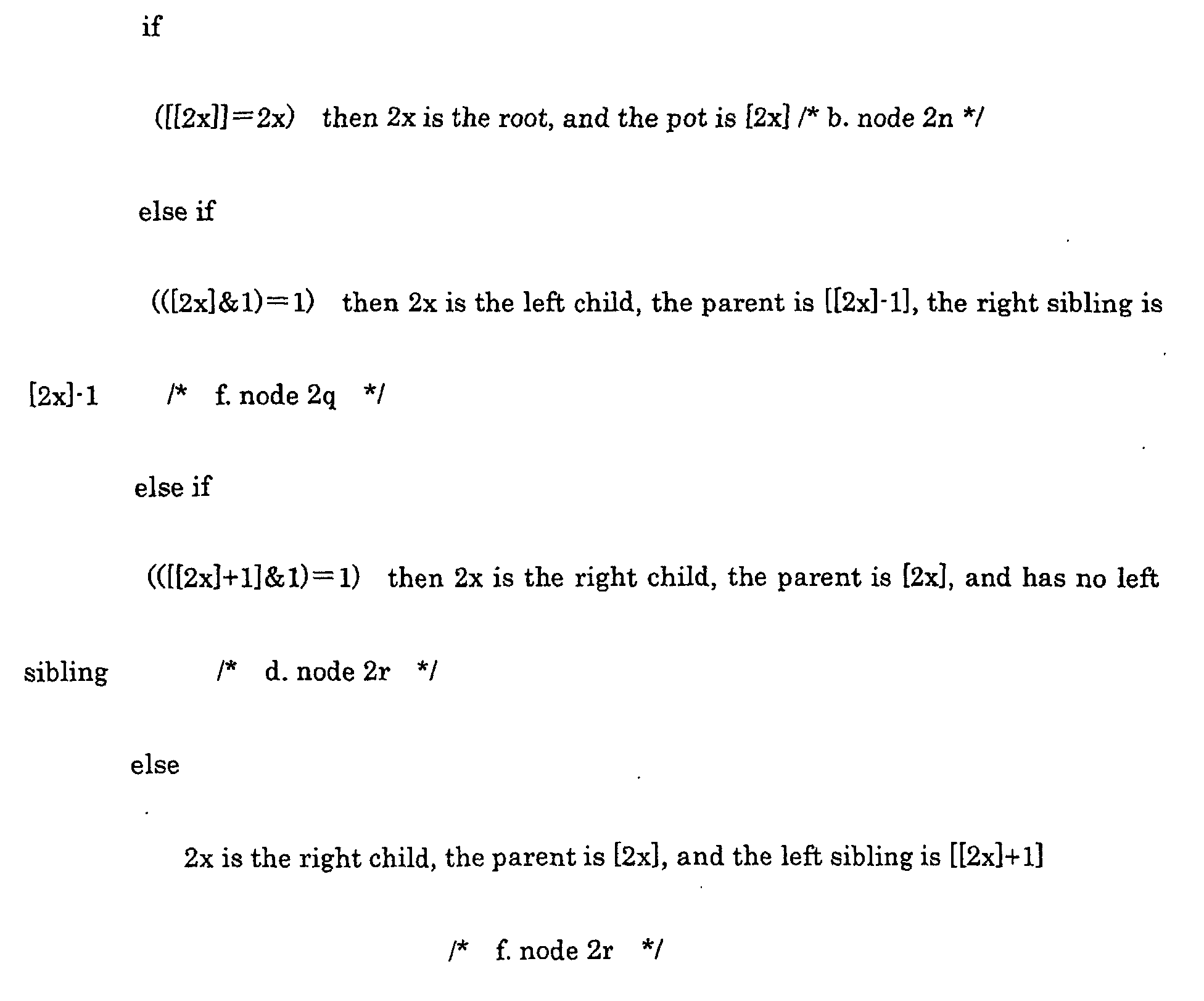

In addition, the following procedure is available to be used as the procedure for
modifying the binary trees configured as described above.
If 2r of d., 0 (nil) is set to [[2x]+1].
If 2q of e., 0 (nil) is set to [[2x]+1].
If 2r off., [2x] is set to [[2x]+1]].
If 2q off., [2x] is set to [[2x]-1]+1].
FIG. 12 is a diagram accurately showing the data structure, including the pot,
wherein the binary trees in FIG. 3 and FIG. 4 are handled by the method of the first
embodiment. Note that the start address of each node is an even numbered address.
FIG. 13 is a structure equivalent to the data structure in FIG. 12 used as a
binary search tree. In this data structure, no nodes have left children. In other words,
every node is one having only a right child or no children at all. In this data structure,
from the root node a to the far end node j is sorted with a key in a descending or ascending
order. Note that the addresses of the pot and nodes are identical to the data structure in
FIG. 12. The data structure of the configuration in FIG. 13 is called a standard
configuration. This standard configuration is stored in the standard configuration
storage unit 109 and referenced by the outgoing data extraction unit 107.
Next, based on the data structure in FIG. 12, the procedure for data structure
management processing according to the first embodiment is described in more detail.
The data structure management apparatus according to the first embodiment
manages a plurality of data structures in the two-pointer representation of the above
binary search tree as a plurality of equivalent representations of data, and by successively
reflecting the modification subjected to one of these upon another data structure, makes
them function amongst themselves as an identical (or equivalent) binary search tree.
The following describes the case where the data structure management system
according to the first embodiment manages two data structures wherein the respective
nodes and pots are arranged, for example, in the same addresses in the respective RAM of
two computers,.
To begin with, both of the data structures in the two computers are assumed to
be exactly the same as FIG. 12. Here, a modification operation such as deleting the root
node with 50 as a key is performed so as to make a structure, which has as a new root
node, the node having 60 as a key. FIG. 14 shows the data structure after this
modification operation. The modified pointers differing from FIG. 12 are indicated by the
dashed line arrows in FIG. 14. In the post-deletion binary search tree, apart from the
two pointers for the deleted node f, it can be understood that four pointers including the
pot have been modified.
Here, the modification transmission unit 111 of the data structure management
unit 10 according to the first embodiment does not transmit all of these modified pointers
and their stored addresses to the modification [transmission] unit 311 of the data
structure management apparatus, which manages other data structures one by one; but
transmits only the pointer information, which is stored in the even numbered addresses or
the start addresses of the nodes, out of the pointers to be modified when the same
modification operation is performed as for the standard configuration in FIG. 13, together
with the addresses.
FIG. 15 shows the standard configuration corresponding with FIG. 14. In the
standard configuration of this FIG. [15], either one or both sets of the two addresses and
value combinations of <value e of address g> and <value 0 of address f> from the four
pointer values differing from FIG. 13, namely, the value e of the address g, the value g+1
of the address e+1, the value 0 of the address f, and the value 0 of the address f+1, are
transmitted as the modified data to the copy side data structure management apparatus
30 of the other computer.
The modification reflection unit 301 of the copy side data structure management
apparatus, which has received the modified data via the modification reception unit 311,
performs the operation to delete the f address node from the binary tree on the
assumption that the address f is used for a binary tree node as shown in FIG. 12 when, for
example, only <value 0 of address f> is transmitted. This operation of node deletion is
carried out with the same procedure as the master side data structure management
apparatus 10 used when performing the previous modification. As a result, the same
structure as in FIG. 14 is created by the modification reflection unit 301.
On the other hand, even when only <value e of address g> is transmitted, when
employing the standard configuration of FIG. 13, the pointer value f that address g should
contain can be obtained by calculating the node address to the immediate left of [node] g
at the intermediate level of the binary tree in FIG. 12. With this modified data, the
modification reflection unit 301 detects the fact that the this address g pointer value has
been changed, and finds that the value of the e+1 address in the standard configuration in
FIG. 13, before being changed, in response to this modified data, to g+1 in FIG 15, is f+1,
as with the case of the above-mentioned address g. This confirms that the value of the
address g before modification is f and the value of the address e is f+1 respectively, and
allows it to be determined that the operation to delete the node f is performed on the
master side data structure management apparatus 10 side. Based on this determination,
the copy side data structure management apparatus 30 deletes the f address node with
the same procedure as the master side.
Basically, combinations of addresses and values, which are sufficient for
accurately determining what kind of modification operation has been performed by
referencing the standard configuration, may be transmitted from the modification
transmission unit 111 to the modification reception unit 311. For example, even without
actually making the content of the f address be 0, which is particular to the deletion
operation, by transmitting <value 0 of address f>, it may be communicated to the copy
side that the f address node has been deleted.
Note that in order for the copy side data structure management apparatus to
determine that these addresses a through j are used as nodes, these addresses may be
retained as a part of the memory content in the memory device and referenced.
Alternatively, since the operation is carried out with that knowledge, the modification
transmission unit 111 may transmit the combination of the addresses and values, which
are attached with the effect that said addresses are the (even) addresses of these nodes, to
the copy side modification reception unit 311.
Also, as a method of copying the master side data structure as a whole into the
(copy side) data structure storage unit 20, which did not hold any of the target data
structure, the entire output of the modification log may be stored in the master side data
structure management apparatus 10, whereby this modification log is input successively
to the copy side data structure management apparatus 30, so as to reconstruct the data
structure.
As described above, by merely transmitting modified data for fewer pointers than
the actual modified pointers, modifications made to one data structure may be reflected
upon another data structure more effectively.
Next, the modification reflection procedure of adding nodes to the data structure
is described.
For example, in the data structure of FIG. 14, re-adding the node of address f to
the binary search tree, which makes the address p be the pot, is considered.
FIG. 16 shows the binary search tree data structure after addition of this address
f node. To begin with, the tree is searched with 50 as the key to add the address f node
as the right child of the node e, which has no right child as shown in FIG. 16. Since the
standard configuration corresponding to FIG. 16 is equivalent to FIG. 13 as with FIG. 12,
the difference between the standard configuration in FIG. 13 and the configuration in FIG.
15 is the four pointers: value f of address g, value f+1 of address e+1, value e of address f,
and value g+1 of address f+1.
The master side modification transmission unit 111 transmits to the copy side
modification reception unit 311 either one of <value e of address f> or <value f of address
g> from these four pointers.
When <value e of address f> is received, the copy side modification reflection unit
301 checks that the value of address f is 0 under the conditions of FIG. 14. The
modification reflection unit 301 determines that the transmitted pointer value denotes an
instruction to perform modification of the structure of FIG. 14 into any one of possible
structures corresponding to the standard configuration of FIG. 13 where the node f in the
standard configuration of FIG. 15 corresponding to that of FIG. 14, which is not included
in the tree, is added as the child to the immediate right of the node e, such as the
structure of FIG. 16, thereby performing an operation of adding the node f so as for it to be
positioned immediately right of (immediately after) the node f in the intermediate level.
The procedure for this adding operation may be the following procedure.
Meanwhile, when <value f of address g> is received, the modification reflection
unit 301 performs the adding operation so that the node f is positioned to the immediate
left of the node g (immediately before, in the sorting order) in the intermediate level upon
determination that the node g is included in the tree, and the value of address g in the
standard configuration is not f but e. This adding operation may also be performed with
the functions a. through d. described above.
In either case, a structure identical to that shown in FIG. 16 may be obtained.
As described above, not all of the modified pointers are sent successively, but just
by sending a part of the modifications made to the pointer in the standard configuration,
it is possible to accurately reflect a modification performed on a structure, onto another
structure, and maintain uniformity (functional equivalence) therebetween. It should be
noted that in the above-mentioned specific example, two data structures were described;
however, even in the case of three or more, uniformity among the plurality of data
structures may be maintained by sending the same pointer value modification data from
the directly modified data structure to the other data structures.
Furthermore, it is not always necessary for the to-be-transmitted pointer
modification data to be the actual pointer values and the pointer stored addresses in the
standard configuration. Corresponding to modification operations, operation content
may be efficiently created by the outgoing data extraction unit 107, and efficiently
reconstructed by the copy side modification reflection unit 301, whereby format is not
important if the modified data is equal to the pointer modification data.
It should be noted that in the first embodiment, the memory element that stores
the pointer for the binary tree root is regarded as the pot, and the pointer for the pot is
stored in the root node of the tree. With this configuration, the content of a modification
in the master-side data structure may be accurately reflected onto the copy-side data
structure by merely transmitting the modification information for the pointer stored in
the node even if the to-be-modified node on the copy side and/or master side is the root, as
with the case of a modification made to the nodes other than the root.
The case where the copy-side data structure, which has received <value 0 of
address f>, takes the node f as the root, as shown in FIG. 12, will be described as an
example. Recognition of the pointer p for the pot stored in [f] allows for a normal
post-deletion data structure, for example that in FIG. 14, to be created by setting p to the
element [g] of the node g, for example, which is the new root node after f is deleted, and
setting g to the element [p] of the pot p.
The binary search tree may take on many different structures even if they are
functionally equivalent, and a structure with an arbitrary node as the root is possible.
When the tree structure differs on the master side and on the copy side, it is possible for
the node to be a root on the copy side even if it is not a root on the master side. In the
case of the structure where the pointer for the pot is not stored in the root node as in FIG.
3, modification of the root node requires to specify the variable that references thereto
(equivalent to the pot) and modify such that a new root is referenced. It is not possible
for the master side to know whether or not the target node for modification is the root on
the copy side. Therefore, when any of the nodes are modified, if the modification causes
there to be even a slight possibility for modifications to the variable which references the
root on the copy side, the modification information attached with the addresses of these
variables must be sent.
As with the first embodiment, if the pointer that designates the pot to the root is
stored, if necessary, the pot address may be obtained from the respective nodes of the tree
via the root, hence a modification operation may be performed on the root node even
without the pot address being designated. Accordingly, there is no need for transmitting
the pot address from the master side to the copy side. However, when a node is added to
an empty pot or when the root node in the standard configuration is modified, the pot
address is transmitted. Nevertheless, even in these cases, the pot address is treated the
same as a node address as the new pointer value for a node element, and is not
transmitted as special additional data.
It should be noted that in the first embodiment the variable referencing a tree
(the root of a tree) is described using a single pot, however, in the case where there are a
plurality of variables referencing a tree, if the configuration employed is that of FIG. 19
wherein the tree is accessed via a single pot, equivalency in the data structure may be
maintained between the master-side and the copy-side without making any changes to
method described above. Moreover, as shown in FIG. 19, if the pointers for each variable
referencing that pot are stored on the pot side, modifications to conditions such as which
pot is being referenced by each variable may be processed by transmitting them as these
pot side pointer modifications.
With the first embodiment, since the pointer for a pot is stored in a memory
element storing the pointer for the parent or the right sibling of the root node, no
additional memory resources are necessary to configure the data structure including the
pot. Moreover, besides these compact methods of implementation, as shown in FIG. 20, a
configuration where each node stores a pointer for the pot may be employed. In this case,
there is no need for a pointer for the pot to be stored in the element storing a pointer for
the parent or right sibling of the root node.
In the first embodiment, by including elements stored with a pointer for the root
of the binary tree and storing a pointer for the pot in at least one node, a modification
operation on a root may be performed even if the pot address is not designated.
Accordingly, when the modified information is transmitted from the master side to the
copy side, only the pointer change information stored in the node needs to be transmitted,
and the address of the variable that refers to (the root of) the tree need not be attached.
In addition, in such configuration, the number of pots is not limited to one, and may be
provided in plural.
Not only with the binary tree according to the first embodiment, but also in
common dynamic data structures configured with pointers, once a known address for part
of the storage element is provided, access such as a search may be started from the
element. In the binary tree, the root node is such an element, and the binary search is
applied from there. In a data structure that is modified dynamically, such element (such
as a root node) may be modified; however, the element (variable) referencing such an
element must also be changed along with that modification. In order to change these
variables, the addresses of these variables or the information for determining the
addresses must be transmitted from the master side to the copy side.
The first embodiment provides a storage element (pot) with an address that does
not change dynamically as a part of the data structure, and stores as the function in the
data structure the correspondence between an element with an address that may be
dynamically modified (a root node or individual node), and the element with an address
that does not change; in other words, stores a pointer for the pot in a root node or in each
node. Therefore, the hassle of transmitting the address of the variable that maintains
reference to the data structure at every change operation may be omitted.
Moreover, not only is the hassle of transmitting from the master side to the copy
side reduced, but also the pot address (the address for the variable which maintains
reference to the data structure) need not be designated as input to the data structure
modification unit even when the change operation is performed in the individual data
structure (for example only on the master side). This eliminates the restriction that an
address for the variable that maintains reference to the data structure must be known as
a prerequisite to a modification operation, and the degree of freedom as far as the
applicability of the change operation to the data structure increases considerably.
In addition, for example, when performing an operation for deleting a node from
the data structure, in the case where the node to be deleted is the sole node in the data
structure, it is necessary that modification be made so that the data structure or the
variable pot referencing that node does not end up referencing an invalid node.
Accordingly, it is necessary for a known address for the pot to be provided; however,
information denoting the pot other than the node to be deleted needs to be designated
unless there is means for knowing the pot of the binary tree to which the node belongs,
from that node. The designation is not always required in all of the above described
deletion operations; however, extra time and storage resources are required should
measures such as the following be taken:
In particular, when there is a danger that the deletion operation may be
performed in a situation where it is impossible to know the pot that is to be designated,
the only possible measure for avoiding this situation is the above-mentioned (3).
Since the same situation arises in the case where the root node is deleted (and
the node to be deleted happens to be the root node), or when the root node is replaced, for
example with a splaying operation, there are many occasions where additional resources
are required for the countermeasures such as the above (1), (2), and (3).
If the data structure comprises means for knowing the pot from the node as with
the first embodiment, there is no need to designate the pot unless it is truly necessary, a
modification operation may be performed by designating only the node to be operated, and
in addition there is neither a limit on the usage of the data structure as described above in
(3) nor are additional resources required.
With the first embodiment, the following effects may be obtained.
The data structure management system according to the present invention
focuses on modifications of pointer information in the standard configuration of an
arbitrary data structure, generates modified data by omitting from the modified pointer
information the pointer values that can possibly be assumed or restored if the standard
configuration is assumed, and transmits it. Through this, the modification data
communications traffic may be reduced and the processing time for change reflection
processing reduced without alerting the data structure modification program.
It should be noted that with the addition example described above as a modified
example of the first embodiment, the above-mentioned modification reflection processing
may be applied even when the copy side data structure as shown in FIG. 17 is different
from the master side data structure such as in FIG. 14.
By receiving the <value e of address f> or the <value f of address g> and adding
the node f using the above function, modification may be applied to a binary search tree
such as the configuration shown in FIG. 18, which is equivalent to that in FIG. 16.
In this manner, even if configuration differs between the master side and the
copy side or a plurality of copies have respectively different configurations, equivalence
may be maintained among these by merely transmitting a portion of the pointer
modification in the standard configuration.
In the following, a data structure management apparatus, data structure
management system, data structure management method, and data structure
management program according to a second embodiment of the present invention are
detailed only in respect to only those aspects that differing from the first embodiment
while referencing FIG. 21 through FIG. 23.
Instead of transmitting an address that acts as pointer information to a copy side
data structure as the first embodiment provides, the second embodiment provides a
function for transmitting relative location information. More specifically, the second
embodiment stores partial segment lengths disclosed in "Segment Management Method"
(Japanese Patent No. 2768921) in addition to the key in each node of the data structure
and performs a search of the node with the location of the segment and calculation of the
segment corresponding with the node.
FIG. 21 is a block diagram showing the functional configuration of a data
structure management apparatus according to a second embodiment of the present
invention. When compared to the first embodiment, the second embodiment as shown in
FIG. 21 is a variation of the first embodiment that is further equipped with a location
search unit 113 in the master side data structure management apparatus 10 and the
location search unit 313 in the copy side data management apparatus 30.
The location search unit 113 and the location search unit 313 perform a node
search using the segment location and a calculation of the segment corresponding to the
node.
As the rest of the configuration is similar to that with the first embodiment in
FIG. 1, a description thereof is omitted.
FIGS. 22 (a) and (b) show an example of a data structure according to the second
embodiment. In FIGS. 22 (a) and (b), the segment lengths corresponding to each node
are all 1, and the end of each segment represents the ranking from the left of that node in
the LCR order.
An outgoing data extraction unit 107b in the master side data structure
management apparatus 10 obtains, via the location search unit 113, a pointer value,
which is in the standard configuration in the standard configuration storage unit 109 and
which has been modified as a result of the modification operation, and the address where
the pointer is stored as the location information. This location information is
represented by a combination of the offset from the start of the node, which includes the
address in the pre-modification condition, to that address, the value of that node segment
(ranking) within the binary tree in which that node lies; and the address of the pot of that
binary tree. This location information is transmitted to the modification reception unit
311 in the copy side data structure management apparatus 30.
The modification reflection unit 301 of the copy side data structure management
apparatus 30, based on modified data or the relative location information received by the
modification reception unit 311, determines the tree root corresponding with the pot by
the pot address, specifies the segment (ranking), and indicates this to the location search
unit 313. The location search unit 313 calculates the address of the segment that has
that location (that ranking) by determining the address of the node (the start address) in
the copy side data structure and adding an offset to the determined start address.
In FIGS. 22 (a) and (b), the address f, for example, is represented as <address of
offset 0 of the node with ranking 1 of the pot at address q>. In addition, the address e is
expressed as <address of offset 0 of the node with ranking 5 of the pot at address p>.
Accordingly, instead of, for example, <value e of address f>, the contents of the modified
data transmitted by the modification transmitting unit 111 become location information
shown by information such as <address of offset 0 of the node with ranking 5 of the pot at
address p is stored at the address of offset 0 of the node with ranking 1 of the pot of the
address q>.
It should be noted that, the points differing from the first embodiment in regards
to the condition of the data structure and the modification operation, is that addresses
other than the pot are designated by the respective offsets from the nodes. Because of
this, the node f belongs to the pot q tree even before it has been added to the pot p tree.
The modification operation involves, as shown in FIGS. 23 (a) and (b), adding this in once
the node f has been deleted so that it falls to the immediate right of node e in the LCR
order.
According to the second embodiment, the following effects may be obtained.
In short, since relative location information is transmitted for the modified data,
it is not always necessary for the corresponding nodes to occupy the same address in the
master side data structure and the copy side data structure. Accordingly, even if the size
and the usage of the storage region (address space) differ between the master side and the
copy side, equivalency among the above-mentioned data structures may be implemented,
and applications of the invention may be remarkably expanded.
It should be noted that methods other than the segment management method
described above may be employed as methods of identifying a node in a binary tree
(binary search tree).
For example, as shown in FIGS. 23 (a) and (b), as in the case where all of the
keys for each node are different, a key may be used to identify a node that is to be
modified if there are no nodes having the same key as that node existing on the tree,
neither before nor after modification.
In addition, in the case where addresses of pots among a plurality of data
structures match, the above description allows addresses of nodes to differ, however, the
reverse also holds: although there are common node addresses, the pot addresses are
allowed to be different. As for modifications to the standard configuration, however, a
pot address is transmitted as modified data only when the node at the left end, which is
the root, changes.
It should be further noted that extensions of the above-mentioned methods are
possible, such as in the case of sections comprising pots and nodes with respective
addresses that are different for each data structure, a technique of transmitting and
receiving, between the master side modification transmitting unit 111b and the copy side
modification receiving unit 311, sufficient data that allows calculation of corresponding
address relative to a common address in a data structure using the combination of data
and an offset, which designates a node or a pot.
Hereinafter, the third embodiment according to the present invention of a data
structure management apparatus, a data structure management system, a data structure
management method, and recording media, which store a data structure management
program, while referencing FIG. 24 through FIG. 26, will be described in detail only in
respect to the differences from the first and second embodiments.
FIG. 24 is a block diagram showing a functional configuration of the data
structure management apparatus according to the third embodiment. As shown in FIG.
24, the third embodiment differs from the first and second embodiments, whereby it is a
modification of the first embodiment in the respect that instead of having a master side
standard configuration storage unit 109, it is equipped with a data structure
modification/extraction unit 106, which has a combined function of the data structure
modification unit 105 and outgoing data extraction unit 107 of FIG. 1.
In the first and second embodiments, the outgoing data extraction units 107,
107b extract or, in addition, if necessary, converts only the modifications to the standard
configuration, which is stored in the standard configuration storage unit 109, from the
pointer modification information that is output from the data structure modification unit
105, outputting to the modification transmission units 111, 111b. On the other hand, in
the third embodiment, while the data structure modification/extraction unit 106 is
modifying the data structure of a data structure storage unit 20, the value of a pointer to
be modified in the standard configuration on the data structure of that which is to be
modified is calculated, outputting only the necessary modified data to the modification
transmission unit 111.
Accordingly, when the modifications of the resources and data structure required
for maintaining the standard configuration in the standard configuration storage unit 109
are made, the hassle of modifying this standard configuration may be avoided.
Simultaneously, the hassle of the outgoing data extraction unit 107, which extracts the
modified data that is once output from the data structure modification unit 105 by
referencing the standard configuration, may be reduced.
The third embodiment utilizes the same binary trees as the data structure in the
first embodiment. The data structure modification/extraction unit 106, in accordance
with the modifying operation, uses the actual data structure of that which is to be
modified, which is stored in the data structure storage unit 20, for extracting the
necessary modified data.
The processing procedure of a modification reflecting process concurrent with the
data structure modifications in the third embodiment is described below.
For example, when deleting the node f in the data structure of FIG. 12, it is
necessary to obtain <value e of address g> or <value 0 of address f> as modified data.
The < value 0 of address f> may be produced without particularly referencing the
standard configuration, however, <value e of address g> cannot be easily obtained from
the data structure of FIG. 12. The data structure modification/extraction unit 106
according to the third embodiment modifies the data structure of FIG. 12, in other words
deletes the node f, by utilizing a splaying operation that processes a self-adjusting binary
tree, and determines <value e of address g> in the post-deletion standard configuration as
in the following.
As such, in the case of deleting nodes, if deletion is performed after performing
the splaying operation in the order of the node to be deleted, its immediate right node and
its immediate left node, then the structure between its immediate left node and its
immediate right node will definitely match the standard configuration where "its
immediate right node has no left child, and it is the right child of its immediate left node".
Utilizing this, the modification transmission unit 111 may extract the modified data that
should be transmitted (<value e of address g>, in the above example) directly from the
data of the data structure storage unit 20.
When adding the node f in the data structure of FIG. 17, the following procedure
is implemented.
According to the above procedure, without particularly referencing the stored
standard configuration, the data structure modification/extraction unit 106 may be
structured such that the pointer values in the standard configuration are calculated and
output to the modification transmission unit 111 by utilizing the data structure of the
data structure storage unit 20.
It should be noted that in the third embodiment, after applying the splaying
operation and actually transforming the data structure, by reading out the address
content of a predetermined node, the extraction of modified data was performed.
However, without actually performing the entire procedure, depending on the node to be
operated and the LCR order, if its immediate left or immediate right node is required for
every type of operation (node deletion, addition), modified data to be ultimately extracted
may be produced. In this case, it is not necessary for the standard configuration to be
even partially retained in the data structure of the data structure storage unit 20. Here,
since the modified data to be extracted is the values of the pointers in the specified
standard configuration, it can be understood that the data structure
modification/extraction unit 106 performs a calculation that is equivalent to referencing
the standard configuration.
A characteristic of the present invention is that the modified data to be
transmitted to the modification reception unit 311 from the modification transmission
unit 111 is the pointer value (variable value) in the standard configuration. Even if this
modified data is extracted or calculated in any manner, there are no differences in the
functions and results.
Accordingly, even applying various methods to the techniques of extraction and
calculation does not deviate from the aim of the present invention.
It should be noted that in the above-mentioned embodiment, data that is sorted
as a data structure (binary search tree) is handled. This standard configuration is set so
as to correspond the data's sorting order and the linking order of the nodes, and is
configured such that only the modifying operation, which exerts an effect on the sorting
order, changes the linking order of the nodes. If the same sorting order of the data is
represented, there will be no functional differences even with differing data structures.
Accordingly, the above-mentioned embodiment with a data structure that handles sorted
data is an example of one that extracts only the modifications that generate functional
differences as modifications of the pointers in the standard configuration.
It should be noted that the present invention is not limited in any way by the
embodiments described above, whereby it goes without saying that various modifications
and variations thereto can be made without deviating from the aim of the present
invention.
A data structure management apparatus, a data structure management system,
a data structure management method, and computer readable recording medium, which
records a data structure management program according to the present invention, allow
for easily and efficiently maintaining the equivalency among a plurality of data structures
in one or a plurality of storage regions upon one or a plurality of computers by sending
and receiving modification data with little communication traffic. In addition, even
though the data structures are stored in respectively differing addresses, maintenance of
their equivalency is possible. Furthermore, the pointer structure among a plurality of
computers upon the network may be efficiently reproduced, and may be suitable for
various systems, for example, a highly reliable system and the like.
As such, by utilizing the present invention, the data structures are made common
among a plurality of computers upon the network, wherewith management of the storage
regions in each of the computers, which share these data structures, may respectively be
independently and effectively performed, which is valuable.
Claims (23)
- A data structure management apparatus, which manages a plurality of mutually equal data structures stored in one or a plurality of storage units, comprising:a data structure storage unit (20) configured to store an arbitrary first data structure;a data structure modification unit (105) configured to modify said first data structure;a modified data extraction unit (107) configured to extract only the data necessary for making said first data structure on the modification source side and a second data structure on the modification target side be equal, from the modified data in said first data structure by said data structure modification unit; anda modified data transmission unit (111) configured to output said extracted, modified data so as to reflect onto said second data structure.
- The data structure management apparatus, according to claim 1, wherein
said modified data extraction unit (107) extracts as said modified data a portion of pointer modification information that the respective nodes in said first data structure comprise. - The data structure management apparatus, according to claim 2, wherein
said modified data extraction unit (107) extracts, when a node is deleted, as said modified data the data indicating modifications to the pointer of the deleted node into a non-referencing state. - The data structure management apparatus, according to claim 2, further comprising:wherein said modified data extraction unit (107) extracts as modified data the pointer modification information to be modified by the same modifying operation as the modification performed by said data structure modification unit (105) in said standard configuration, which is stored in said standard configuration storage unit (109).a standard configuration storage unit (109) configured to store a standard configuration that arranges nodes in the same sorting order as that of said first data structure;
- The data structure management apparatus, according to claim 1, wherein
said first data structure comprises a memory element, which stores a pointer for a root node. - The data structure management apparatus, according to claim 1, wherein
said modified data extraction unit (107b) generates said modified data as a group of an offset from the start of the node containing an address of an extracted pointer, a sectional value in said first data structure of said node, and a value designating said first data structure. - The data structure management apparatus, according to claim 6, further comprising:wherein said modified data extraction unit (107b) performs modification at a node location in said second data structure, which is retrieved by said location retrieval unit, based on said modified data.a location retrieval unit (113) configured to retrieve a node location in said second data structure;
- A data structure management apparatus, which manages data structures stored in one or a plurality of storage units, comprising:wherein said memory elements store pointers for variables that reference said memory elements.a data structure storage unit (20) configured to store arbitrary data structures including memory elements that store pointers for a root node;a data structure modification unit (105) configured to modify said data structures;
- A data structure management apparatus, which manages data structures stored in one or a plurality of storage units, comprising:a data structure storage unit (20) configured to store a data structure where at least one node in any data structure comprising a memory element that stores a pointer for a root node is stored with a pointer for said memory element, anda data structure modification unit (105) configured to modify said data structure.
- A data structure management apparatus, which manages a plurality of mutually equal data structures stored in one or a plurality of storage units, comprising:wherein said modified data extraction unit (107) converts the modifications upon said first data structure to modifications upon a predetermined standard configuration, thereby calculating said modified data.a data structure storage unit (20) configured to store an arbitrary first data structure;a modified data extraction unit (107) configured to, along with modifying said first data structure, extract as modified data only the data necessary for making said first data structure on the modification source side and a second data structure on the modification target side be equal from the modified pieces of data in said first data structure; anda modified data transmission unit (111) configured to output said extracted, modified data so as to reflect onto said second data structure;
- The data structure management apparatus, according to claim 11, wherein
said modified data extraction unit transforms a portion of said first data structure into a portion of said standard configuration, thereby calculating said modified data. - The data structure management apparatus, according to claim 10, wherein
said modified data extraction unit (107) sequentially shirks a node to be modified and the immediate left node and/or immediate right node of said node to be modified to the root node in said first data structure so that said first data structure is transformed, thereby calculating said modified data. - A data structure management apparatus, which manages a plurality of mutually equal data structures that are stored in one or a plurality of storage units, comprising:a data structure storage unit (20) configured to store a second data structure that is equal to an arbitrary first data structure;a modified data input unit (311) configured to input modified data or data necessary for making said first data structure on the modification source side and a second data structure on the modification target side, of the modified pieces of data in said first data structure be equal; anda modified data reflection unit (301) configured to reflect said modified data upon said second data structure.
- A data structure management system, which manages a plurality of mutually equal data structures that are stored in one or a plurality of storage units, comprising:a first data structure management apparatus (10), which comprisesa first data structure storage unit (20) configured to store an arbitrary first data structure;a data structure modification unit (105) configured to modify said first data structure;a modified data extraction unit (107) configured to extract only the data necessary for making said first data structure on the modification source side and a second data structure on the modification target side, from the modified pieces of data in said first data structure obtained by said data structure modification unit (105) be equal; anda modified data transmission unit (111) configured to output said extracted, modified data so as to reflect onto said second data structure; anda second data structure management apparatus (30), which comprisesa second data structure storage unit (20) configured to store said second data structure that is equal to said first data structure;a modified data input unit (311) configured to input said modified data to be output from said modified data transmission unit of said first data structure management apparatus; anda modified data reflection unit (301) configured to reflect said modified data onto said second data structure.
- A data structure management method, which manages a plurality of mutually equal data structures that are stored in one or a plurality of storage units, comprising:a data structure modification step (S10) of modifying an arbitrary first data structure;a modified data extraction step (S20) of extracting only the data necessary for making said first data structure on the modification source side and a second data structure on the modification target side, from the modified pieces of data in said first data structure obtained in said data structure modification step be equal; andmodified data transmission step (S30) of outputting said extracted modified data so as to reflect onto said second data structure.
- The data structure management method, according to claim 15, wherein
said modified data extraction step extracts as said modified data a portion of the pointer modification information that the respective nodes in said first data structure comprise. - The data structure management method, according to claim 16, further comprising:wherein in said modified data extraction step (S20) extracts as modified data the pointer modification information to be modified by the same modification operation as the modification performed in terms of said standard configuration, which is stored in said standard configuration storage step, in said data structure modification step.a standard configuration storage step of storing a standard configuration that arranges nodes in the same sorting order as that of said first data structure;
- A computer readable recording medium, which records a program that causes a computer to execute a data structure management processing for managing a plurality of mutually equal data structures that are stored in one or a plurality of storage units; said data structure management processing comprising:a data structure modification process (105) of modifying an arbitrary first data structure;a modified data extraction process (107) of extracting only the data necessary for making said first data structure on the modification source side and a second data structure on the modification target side, from the modified pieces of data in said first data structure obtained in said data structure modification process (105) be equal; anda modified data transmission process (111) of outputting said extracted, modified data so as to reflect onto said second data structure.
- The computer readable recording medium, according to claim 18, wherein in said modified data extraction process extracts as said modified data a portion of the pointer modification information that the respective nodes in said first data structure include.
- The computer readable recording medium, according to claim 19, further comprising:wherein said modified data extraction process (107) extracts as modified data the pointer modification information to be modified by the same modifying operation as the modification performed in terms of said standard configuration, which is stored in said standard configuration storage step, in said data structure modification process.a standard configuration storage process of storing a standard configuration that arranges nodes in the same sorting order as that of said first data structure;
- A computer program, which causes a computer to execute a data structure management processing for managing a plurality of mutually equal data structures that are stored in one or a plurality of storage units; said data structure management processing comprising:a data structure modification process (105) of modifying an arbitrary first data structure;a modified data extraction process (107) of extracting only the data necessary for making said first data structure on the modification source side and a second data structure on the modification target side, from the modified pieces of data in said first data structure obtained in said data structure modification step be equal; anda modified data transmission process (111) of outputting said extracted, modified data so as to reflect onto said second data structure.
- The computer program, according to claim 21, wherein said modified data extraction process (107) extracts as modified data a portion of the pointer modification information that the respective nodes in said first data structure include.
- The computer program, according to claim 22, further comprising:wherein in said modified data extraction process (107) extracts as modified data the pointer modification information to be modified by the same modifying operation as the modification performed in terms of said standard configuration, which is stored in said standard configuration storage process, in said data structure modification process.a standard configuration storage process of storing a standard configuration that arranges nodes in the same sorting order as that of said first data structure;
Applications Claiming Priority (3)
| Application Number | Priority Date | Filing Date | Title |
|---|---|---|---|
| JP35363099A JP3866466B2 (en) | 1999-12-13 | 1999-12-13 | Data structure management device, data structure management system, data structure management method, and recording medium for storing data structure management program |
| JP35363099 | 1999-12-13 | ||
| PCT/JP2000/008815 WO2001042924A1 (en) | 1999-12-13 | 2000-12-13 | Data structure managing device, data structure managing system, data structure managing method, and recorded medium where data structure managing program is stored |
Publications (2)
| Publication Number | Publication Date |
|---|---|
| EP1244017A1 true EP1244017A1 (en) | 2002-09-25 |
| EP1244017A4 EP1244017A4 (en) | 2005-02-02 |
Family
ID=18432155
Family Applications (1)
| Application Number | Title | Priority Date | Filing Date |
|---|---|---|---|
| EP00981685A Withdrawn EP1244017A4 (en) | 1999-12-13 | 2000-12-13 | Data structure managing device, data structure managing system, data structure managing method, and recorded medium where data structure managing program is stored |
Country Status (6)
| Country | Link |
|---|---|
| US (1) | US7222125B2 (en) |
| EP (1) | EP1244017A4 (en) |
| JP (1) | JP3866466B2 (en) |
| KR (1) | KR100515910B1 (en) |
| CN (1) | CN1174319C (en) |
| WO (1) | WO2001042924A1 (en) |
Cited By (1)
| Publication number | Priority date | Publication date | Assignee | Title |
|---|---|---|---|---|
| WO2015025162A1 (en) * | 2013-08-22 | 2015-02-26 | Deep-Secure Limited | A method of transmitting data structures from one computer to another computer |
Families Citing this family (21)
| Publication number | Priority date | Publication date | Assignee | Title |
|---|---|---|---|---|
| AUPO808897A0 (en) * | 1997-07-17 | 1997-08-14 | Commonwealth Scientific And Industrial Research Organisation | Toxin genes from the bacteria xenorhabdus nematophilus and photohabdus luminescens |
| US7822757B2 (en) * | 2003-02-18 | 2010-10-26 | Dun & Bradstreet, Inc. | System and method for providing enhanced information |
| US6961733B2 (en) * | 2003-03-10 | 2005-11-01 | Unisys Corporation | System and method for storing and accessing data in an interlocking trees datastore |
| WO2005029342A1 (en) * | 2003-08-21 | 2005-03-31 | Microsoft Corporation | Electronic ink processing |
| US7283670B2 (en) * | 2003-08-21 | 2007-10-16 | Microsoft Corporation | Electronic ink processing |
| AU2003262759B8 (en) * | 2003-08-21 | 2010-01-07 | Microsoft Corporation | Electronic ink processing |
| CA2470118C (en) * | 2003-08-21 | 2012-01-03 | Microsoft Corporation | Electronic ink processing |
| US7616333B2 (en) * | 2003-08-21 | 2009-11-10 | Microsoft Corporation | Electronic ink processing and application programming interfaces |
| US7631001B2 (en) * | 2003-08-21 | 2009-12-08 | Microsoft Corporation | Electronic ink processing |
| US7958132B2 (en) * | 2004-02-10 | 2011-06-07 | Microsoft Corporation | Voting based scheme for electronic document node reuse |
| US20070162508A1 (en) * | 2004-11-08 | 2007-07-12 | Mazzagatti Jane C | Updating information in an interlocking trees datastore |
| US8214754B2 (en) | 2005-04-15 | 2012-07-03 | Microsoft Corporation | Registration of applications and complimentary features for interactive user interfaces |
| US8909676B1 (en) * | 2006-10-06 | 2014-12-09 | Uei Cayman Inc. | Star cluster codeset database for universal remote control devices |
| JP2009069941A (en) * | 2007-09-11 | 2009-04-02 | Honda Motor Co Ltd | Data generation system and data generation method |
| JP4789021B2 (en) | 2009-02-06 | 2011-10-05 | 日本電気株式会社 | Data processing apparatus and data processing method |
| US8886681B2 (en) * | 2010-08-20 | 2014-11-11 | Andrea Keating | Data analytics system |
| US8788538B2 (en) * | 2011-12-07 | 2014-07-22 | Microsoft Corporation | Navigation of hierarchical data using climb/dive and spin inputs |
| US10990449B2 (en) * | 2014-10-31 | 2021-04-27 | Convida Wireless, Llc | Managing application relationships in machine-to-machine systems |
| CN106202121B (en) * | 2015-05-07 | 2019-06-28 | 阿里巴巴集团控股有限公司 | Method and device for data storage and export |
| US10521139B2 (en) | 2017-12-14 | 2019-12-31 | International Business Machines Corporation | Copy source to target management in a data storage system |
| US11054994B2 (en) * | 2017-12-14 | 2021-07-06 | International Business Machines Corporation | Copy source to target management in a data storage system |
Family Cites Families (9)
| Publication number | Priority date | Publication date | Assignee | Title |
|---|---|---|---|---|
| JPH0833861B2 (en) | 1986-10-24 | 1996-03-29 | 株式会社日立製作所 | Common information comparison method |
| US5379422A (en) * | 1992-01-16 | 1995-01-03 | Digital Equipment Corporation | Simple random sampling on pseudo-ranked hierarchical data structures in a data processing system |
| US5657437A (en) * | 1993-12-10 | 1997-08-12 | Lucent Technologies Inc. | Data processing apparatus and method including proportional updating of data |
| JP2768921B2 (en) * | 1994-09-13 | 1998-06-25 | 株式会社東芝 | Data retrieval device, data processing device, data retrieval method, and data processing method |
| JP3441807B2 (en) * | 1994-09-19 | 2003-09-02 | 株式会社日立製作所 | B-tree index management method and system |
| JP3748936B2 (en) * | 1996-03-18 | 2006-02-22 | パイオニア株式会社 | Information recording apparatus and method, and information reproducing apparatus and method |
| JPH11167510A (en) * | 1997-12-04 | 1999-06-22 | Hitachi Ltd | Replication method, replication tool, and replication server |
| US6115721A (en) * | 1998-06-23 | 2000-09-05 | International Business Machines Corporation | System and method for database save and restore using self-pointers |
| US6141731A (en) * | 1998-08-19 | 2000-10-31 | International Business Machines Corporation | Method and system for managing data in cache using multiple data structures |
-
1999
- 1999-12-13 JP JP35363099A patent/JP3866466B2/en not_active Expired - Fee Related
-
2000
- 2000-12-13 CN CNB008181365A patent/CN1174319C/en not_active Expired - Fee Related
- 2000-12-13 KR KR10-2002-7007527A patent/KR100515910B1/en not_active Expired - Fee Related
- 2000-12-13 US US10/149,822 patent/US7222125B2/en not_active Expired - Fee Related
- 2000-12-13 WO PCT/JP2000/008815 patent/WO2001042924A1/en not_active Ceased
- 2000-12-13 EP EP00981685A patent/EP1244017A4/en not_active Withdrawn
Cited By (2)
| Publication number | Priority date | Publication date | Assignee | Title |
|---|---|---|---|---|
| WO2015025162A1 (en) * | 2013-08-22 | 2015-02-26 | Deep-Secure Limited | A method of transmitting data structures from one computer to another computer |
| US10313454B2 (en) * | 2013-08-22 | 2019-06-04 | Deep-Secure Limited | Method of transmitting data structures from one computer to another computer |
Also Published As
| Publication number | Publication date |
|---|---|
| EP1244017A4 (en) | 2005-02-02 |
| KR20020061639A (en) | 2002-07-24 |
| WO2001042924A1 (en) | 2001-06-14 |
| CN1174319C (en) | 2004-11-03 |
| US20020191452A1 (en) | 2002-12-19 |
| JP3866466B2 (en) | 2007-01-10 |
| KR100515910B1 (en) | 2005-09-21 |
| JP2001166977A (en) | 2001-06-22 |
| CN1415091A (en) | 2003-04-30 |
| US7222125B2 (en) | 2007-05-22 |
Similar Documents
| Publication | Publication Date | Title |
|---|---|---|
| US7222125B2 (en) | Data structure managing device, data structure managing system, data structure managing method, and recorded medium where data structure managing program is stored | |
| US5931935A (en) | File system primitive allowing reprocessing of I/O requests by multiple drivers in a layered driver I/O system | |
| US5765154A (en) | Resource management system | |
| US7194492B2 (en) | Method and apparatus for efficiently copying distributed data files | |
| US5742817A (en) | Method and apparatus for file server addressing | |
| US6044381A (en) | Using distributed history files in synchronizing databases | |
| US8046424B2 (en) | Systems and methods for the utilization of metadata for synchronization optimization | |
| CN1517885B (en) | Method and system for updating central cache by atomicity | |
| US7702641B2 (en) | Method and system for comparing and updating file trees | |
| US20030225972A1 (en) | Storage system | |
| EP1300757A1 (en) | Shareable installation hierarchies | |
| US7085779B2 (en) | File tree change reconciler | |
| JP2006202337A (en) | Method and device for data processing | |
| EP1325409A2 (en) | A shared file system having a token-ring style protocol for managing meta-data | |
| JP2718607B2 (en) | How to manage structured objects for execution by application interfaces | |
| US7165248B2 (en) | File tree conflict processor | |
| JPWO2005086003A1 (en) | Database system | |
| CN114328590A (en) | Transaction execution method, device, equipment and storage medium | |
| US20070156791A1 (en) | File system dump/restore by node numbering | |
| CN116431632B (en) | Data processing method, database system, computer device, and storage medium | |
| JP4060890B2 (en) | A file system primitive that allows I/O requests to be reprocessed by multiple drivers in a layered driver I/O system. | |
| JP2606092B2 (en) | Version control system | |
| JP3228219B2 (en) | Data transition screen transition management method | |
| WO2014118560A1 (en) | Method and system for data storage | |
| JPH02178743A (en) | File update processor |
Legal Events
| Date | Code | Title | Description |
|---|---|---|---|
| PUAI | Public reference made under article 153(3) epc to a published international application that has entered the european phase |
Free format text: ORIGINAL CODE: 0009012 |
|
| 17P | Request for examination filed |
Effective date: 20020701 |
|
| AK | Designated contracting states |
Kind code of ref document: A1 Designated state(s): DE FR GB |
|
| A4 | Supplementary search report drawn up and despatched |
Effective date: 20041216 |
|
| 17Q | First examination report despatched |
Effective date: 20070928 |
|
| STAA | Information on the status of an ep patent application or granted ep patent |
Free format text: STATUS: THE APPLICATION IS DEEMED TO BE WITHDRAWN |
|
| 18D | Application deemed to be withdrawn |
Effective date: 20080209 |