EP1244015A2 - Parallel replication mechanism for state information produced by serialized processing - Google Patents
Parallel replication mechanism for state information produced by serialized processing Download PDFInfo
- Publication number
- EP1244015A2 EP1244015A2 EP02003294A EP02003294A EP1244015A2 EP 1244015 A2 EP1244015 A2 EP 1244015A2 EP 02003294 A EP02003294 A EP 02003294A EP 02003294 A EP02003294 A EP 02003294A EP 1244015 A2 EP1244015 A2 EP 1244015A2
- Authority
- EP
- European Patent Office
- Prior art keywords
- incoming request
- records
- request message
- processing unit
- data processing
- Prior art date
- Legal status (The legal status is an assumption and is not a legal conclusion. Google has not performed a legal analysis and makes no representation as to the accuracy of the status listed.)
- Granted
Links
Images
Classifications
-
- G—PHYSICS
- G06—COMPUTING OR CALCULATING; COUNTING
- G06F—ELECTRIC DIGITAL DATA PROCESSING
- G06F11/00—Error detection; Error correction; Monitoring
- G06F11/07—Responding to the occurrence of a fault, e.g. fault tolerance
- G06F11/16—Error detection or correction of the data by redundancy in hardware
- G06F11/1666—Error detection or correction of the data by redundancy in hardware where the redundant component is memory or memory area
-
- G—PHYSICS
- G06—COMPUTING OR CALCULATING; COUNTING
- G06F—ELECTRIC DIGITAL DATA PROCESSING
- G06F11/00—Error detection; Error correction; Monitoring
- G06F11/07—Responding to the occurrence of a fault, e.g. fault tolerance
- G06F11/14—Error detection or correction of the data by redundancy in operations
- G06F11/1446—Point-in-time backing up or restoration of persistent data
- G06F11/1448—Management of the data involved in backup or backup restore
- G06F11/1451—Management of the data involved in backup or backup restore by selection of backup contents
-
- G—PHYSICS
- G06—COMPUTING OR CALCULATING; COUNTING
- G06F—ELECTRIC DIGITAL DATA PROCESSING
- G06F11/00—Error detection; Error correction; Monitoring
- G06F11/07—Responding to the occurrence of a fault, e.g. fault tolerance
- G06F11/16—Error detection or correction of the data by redundancy in hardware
- G06F11/20—Error detection or correction of the data by redundancy in hardware using active fault-masking, e.g. by switching out faulty elements or by switching in spare elements
-
- G—PHYSICS
- G06—COMPUTING OR CALCULATING; COUNTING
- G06F—ELECTRIC DIGITAL DATA PROCESSING
- G06F11/00—Error detection; Error correction; Monitoring
- G06F11/30—Monitoring
- G06F11/3055—Monitoring arrangements for monitoring the status of the computing system or of the computing system component, e.g. monitoring if the computing system is on, off, available, not available
Definitions
- the present invention generally relates to creating and maintaining a duplicate copy of data which might be needed at a later point of time.
- the present invention relates to a method and system for replicating state information stored in a first data processing system to a second data processing system, whereby said state information is kept in a set of records.
- replication basically refers to creating and maintaining a duplicate copy of a source data collection stored, e.g., in a database, a list, a table or in file system, on a destination data processing system.
- the term usually implies the way of how to copy the entire source data collection or parts of it which have changed since the last replication with the destination data processing system.
- Replication may be one-way or two-way.
- One-way replication refers to a scenario in which an object being subject to the replication process can only be modified in one place.
- a duplicate is mainly held as a read-only reference copy or as backup copy, i.e., a spare copy for use in the event of failure or loss of the original.
- two-way replication means that the copy of the replicated object might also be modified and the changes have to be applied to the original one.
- replication may be synchronous or asynchronous.
- synchronous replication systems no changes by a transaction is considered permanent until all changes made by the transaction are successfully applied at the source site and at all of the relevant destination sites.
- Asynchronous replication systems separate the task of making the changes at the source site from the task of making changes at the destination sites. Changes made by a transaction are made permanent at a source site without respect to whether the changes have been made permanent at any of the relevant destination sites.
- the replicated data can be used as a backup copy of the original data
- only synchronous replication comes into question. Only this kind of replication compared to asynchronous replication guarantees that no changes applied to the original data get lost.
- the changes applied to the original data are sequentially sent to the backup copy of said data on a backup system. Only at a point of time when a particular change has been successfully applied to the backup copy, the respective change to the original data is considered permanent.
- the time spread between a change request and an acknowledgment that the requested change has been applied includes the period of time for performing the change on the data, transmitting it to the backup system, waiting for the acknowledgment from the backup system and some additional computation time. Depending on the speed of the data connection to the backup system and its computation performance, the time spread needed for serving a change request might significantly increase.
- the object of the present invention is to provide a method and a system for replicating state information having an increased throughput, i.e., the average number of requests that can be processed within a time interval.
- State information generally describes how something is, e.g., its configuration, attributes, condition, locks or information content. Such information might relate to, e.g., a database, a process control system, system automation or monitoring.
- a state of such a system is usually temporary, i.e., it changes with time, and volatile, i.e., it will be lost or reset to some initial state if the system is switched off.
- a replication mechanism is used.
- the replication takes place between at least two data processing units.
- the first one initiates the replication process and the second one keeps a backup copy of the original state information.
- the present invention implements a one-way replication process as described above.
- the data processing units might be formed by any machine or process that is able to manipulate data, preferably, they are formed by a computer system or an executing program running on a computer system.
- the state information is kept in a set of records, whereby a record is an ordered set of fields, which might be stored in any kind of memory provided by the first data processing system.
- the records represent different entities with different values for the attributes represented by the fields.
- a record might rather keep a reference, such as a pointer, to a separate location at which additional information is stored.
- the state information is created, modified or deleted as a result of the processing of an incoming request message or in general any data, requests, or events that trigger the processing.
- the processing in general may generate any data which are sent back as response to the sender of the request or which trigger an action as result of the incoming data.
- an indicator is assigned to said incoming request message representing the order or sequence in which the particular incoming request messages will be processed.
- the processing sequence might be governed by a priority assigned to the incoming request message or its content.
- the incoming request message is processed and the set of records is updated in accordance with the result of the processing of said incoming request message.
- a modification record is sent to a first storage subsystem preferably provided by the second data processing unit, whereby the modification record contains the indicator assigned to said incoming request message and all changes applied to said set of records performed during processing of said incoming request message.
- the second data processing unit redo all changes performed on the original state information using a copy of the state information kept in the second data processing unit.
- the actual replication process is split into a first phase and a second phase.
- the modification records have completely been processed by the second data processing system, i.e., all changes have been applied to the copy of the state information.
- changes applied to the records are solely transmitted to the first storage subsystem, in the following, also referred to as "work area". It is only waited until the data have been stored successfully in the first storage subsystem.
- the first storage subsystem shall be independent of the first data processing system ensuring that the data are safe and accessible by the second data processing system even if the first data processing system is broken.
- the first storage subsystem may reside on or should be part of the second data processing system.
- acknowledge messages are checked which have been received from said first storage subsystem indicating a receipt of said sent modification records and a response message as a reaction to an incoming request message is sent to the respective sender for such incoming request messages the modification record of which and the modification records of all its predecessors have been received by the first storage subsystem.
- the replication mechanism according to the present invention ensures that a consistent copy of the state information can be produced. Later, in the second replication phase, independently from the data processing performed on the first data processing unit the notified changes are actually applied to the replica of the state information, as explained below in greater detail.
- receiving an incoming request message, assigning an indicator, processing said incoming request message and sending a modification record are performed concurrently to checking acknowledge messages and sending a response message.
- the taught concept allows to transmit several changes applied to the original state information at the same time.
- the transmission bandwidth can advantageously be increased by providing more than one communication channel established between the first data processing unit and the first storage subsystem ("work area"). Consequently, the first storage subsystem is able to receive all modification records at the same time which are concurrently sent by said first data processing unit.
- This might be solved by splitting the first storage subsystem into several storage units each of which is connected to one communication channel reaching the second data processing unit. Due to this two-phase concept it is acceptable if modification records are transmitted out of sequence to the first storage subsystem.
- an acknowledge message is returned to the first data processing unit indicating a receipt of the particular modification record.
- the changes are applied to the copy of the state information by the second data processing system.
- the actual copy of the state information is stored in a second storage subsystem provided in the second data processing unit.
- each record stored in said second storage subsystem includes a field for storing the indicator representing the order in which the incoming request messages have been processed. The indicator has already been transmitted to the first storage subsystem as part of the modification record.
- applying the changes stored in the modification records to the copy of the state information stored in the second storage subsystem could be done sequentially in the order in which the changes were originally requested. More advantageously, according to the present invention, more than one change is applied to the copy of the state information at the same time. This increases the performance of the backup system.
- applying changes includes storing said indicator assigned to the processed request message in the respective field of the changed records.
- the function of applying changes includes checking the stored indicator. Furthermore, only such modifications are applied which are more recent than the last change applied to a particular record.
- the described method ensures that the whole system preserves the sequential order. Processing of an incoming request keeps pending, i.e. a response is not given until the following conditions are satisfied:
- Condition 2 can be simplified by checking that the modification record of the last one before this request has been acknowledged. When this rule is applied recursively it covers the above condition. On the second data processing unit similar checking is done. Before a modification record is considered to be applied to the backup copy the following conditions must be true:
- Condition 2 can be simplified here as well by checking that the modification record one before is completely and correctly stored.
- the present invention can be realized in hardware, software, or a combination of hardware and software. Any kind of computer system - or other apparatus adapted for carrying out the methods described herein - is suited. A typical combination of hardware and software could be a general purpose computer system with a computer program that, when being loaded and executed, controls the computer system such that it carries out the methods described herein.
- the present invention can also be embedded in a computer program product, which comprises all the features enabling the implementation of the methods described herein, and which - when loaded in a computer system - is able to carry out these methods.
- Computer program means or computer program in the present context mean any expression, in any language, code or notation, of a set of instructions intended to cause a system having an information processing capability to perform a particular function either directly or after either or both of the following a) conversion to another language, code or notation; b) reproduction in a different material form.
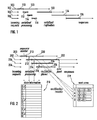
- Fig. 1 a timing diagram of a known synchronous replication system is depicted. The lapse of time is illustrated as running from left to right. The graphical elements that are drawn in a imaginary line one upon the other represent operations taking place at the same instant of time. Thus, in the shown scenario a first incoming request 100, a second incoming request 102, a third incoming request 104 and a fourth incoming request 106 are arriving at an input port of a first data processing system (not shown) at the same simultaneously.
- Bar 110 illustrates the time gap that is needed to process the first incoming request 100.
- Bars 112, 114 and 116 represent the lapse of time required to serve the second, third and fourth incoming request 102 to 106, respectively.
- the processing of the second incoming request 102 is commenced. Furthermore, a replication process is initiated, i.e., it is started to transmit the changes, which were applied to the original state information as a result of the first incoming request 100, to a second data processing unit. On the second data processing unit the transmitted changes will be applied to a copy of the original state information in the same way as it is performed in the first data processing unit. Hence, the order in which the changes get applied to the original state information they have to be applied to the duplicate.
- a response message to the sender of the incoming request is only sent after the changes have successfully been transmitted to the second data processing unit, they have been applied to the replica and an acknowledge message has been received.
- the time gap for these actions is depicted as bar 120 which follows bar 110. At the rightmost end of bar 120 the moment in time is reached when the response message is sent to the sender of the first incoming request 100 indicating that the request has been served.
- the changes initiated by the second incoming request 102 can be replicated as illustrated by bar 122.
- the replication of changes because of the third and fourth incoming message 104 and 106 are done as indicated by the bars 124 and 126.
- the period of time needed to apply changes to the original state information is much shorter than the time spread needed for the replication as illustrated by the longer bars 120 to 126 in comparison to bars 110 to 116. Hence, the data processing might significantly be delayed.
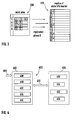
- FIG. 2 there is depicted a functional diagram of a first phase of the data processing in the replication system according to the present invention.
- a first incoming request 200, a second incoming request 202, a third incoming request 204 and a fourth incoming request 206 are concurrently arriving at an input port of a first data processing system.
- the incoming requests 200 to 206 are processed one after the other as illustrated by the staggered bars 210 to 216.
- Bar 210 represents the time gap that is required to serve the first incoming request 200.
- Bars 212, 214 and 216 represent the lapse of time needed to serve the second, third and fourth incoming request 202 to 206, respectively.
- the processing of the second incoming request 202 is started as illustrated by bar 212.
- the updating of the state information stored in a table 218 is indicated by arrows running from bars 210 to 216 downwards to the table 218.
- the table 218 includes three columns. The first one is provided to store a unique key for each record of the state information. The second column keeps an indicator representing to which incoming request the most recently applied change is related and the third column contains the actual state information. It is acknowledged that the table storing the state information might comprise more fields depending on the information that has to be stored.
- a first phase replication process is launched, i.e., changes, which were applied to the original state information as a result of the first incoming request 200, are forwarded to a second data processing unit.
- changes are transmitted to a dedicated storage subsystem of the second data processing system called "work area" 219.
- the data transmission of the first phase replication is indicated by arrows running from the bars 220 to 226 towards different rows of the work area 219.
- the work area 219 comprises at least as many storage spaces for taking a particular modification record as the number of modification records that can concurrently be transmitted.
- the work area is adapted to be able to receive all concurrently transmitted modification records at the same time.
- the indicator showing to which incoming request the transmitted modifications are related is stored next to the actual changes.
- the letters in one line represent the changes to particular records of the state information.
- the second data processing system is only notified of the changes applied to the original copy of the state information.
- the change of the replica takes place at a later point in time, independently from the data processing of the first data processing unit in a second replication phase.
- a response message to the sender of the incoming request is sent after the changes to the original state information have successfully been transmitted to and stored in the work area.
- the work area is situated on and controlled by the second data processing system.
- the time gap for these actions is depicted as bar 220 which follows bar 210. At the rightmost end of bar 220 the moment in time is reached when the response message is sent to the sender of the first incoming request 200 indicating that the request has been served.
- the first phase replication of the second incoming request 202 is illustrated as bar 222.
- the first phase replication of changes because of the third and fourth incoming requests 204 and 206 are illustrated by the bars 224 and 226.
- the first phase replication 222 of the second incoming request 202 only completes after the first phase replications 224 and 226 of the third and fourth incoming requests 214 and 216 do. This might be because of the amount of data to be transmitted or some issues related to the transmission facility.
- the respective senders are not notified of the completion of the first phase replication 224 and 226 related to the third and fourth incoming requests 204 and 206 until the first phase replication 222 related to the second incoming request is concluded.
- This point of time is called "synchronization point" and is indicated by a dotted line running from the rightmost end of bar 222 downwards.
- FIG. 3 there is depicted a functional diagram of a second phase of the data processing in the replication system according to the present invention.
- a work area 300 is formed by a dedicated storage subsystem of the second data processing system. After the data transmission of the first phase replication as shown in Fig. 2, all transmitted modification records are stored in the work area 300.
- the work area 300 of Fig. 3 also stores the indicator showing to which incoming request the transmitted modifications are related.
- the following letters represent the changes to particular records of the state information.
- the first incoming request causes changes to records "A”, “B” and “M”
- the second incoming request causes changes to records "K” and "G”
- a second replication phase the changes stored in the modification records of the work area 300 are applied to a replica of the state information 310 as illustrated by arrows pointing from the work area 300 towards the replica 310.
- the replica of the state information is also formed by a table comprising three columns. The first one stores a unique key for each record of the state information. The second column keeps an indicator representing to which incoming request the most recently applied change is related and the third column contains the actual state information.
- the second replication phase is independent of the request processing performed on the first data processing unit. It is purely done on the second data processing unit which serves as a backup system.
- the modification records are picked from the work area 300 and the modifications are applied to the replica of the state information 310. It should be noticed that the method and system according to the present invention allows parallel and out-of-sequence processing while applying the modifications to the replica 310.
- a modification record is picked from the work area 300. Then, the indicators are checked to identify whether or not all modification records related to preceding changes to the original state information have successfully been stored in the work area 300. If no, then a different modification record is chosen. This ensures that a consistent state can be achieved. If yes, then, for each element listed in the picked modification record, the current indicator stored in the second column of the replica of the state information 310 is checked. If the indicator shows that the last modification of the particular record of the replica was because of a change previously applied to the original state information, then the record is replaced with the element taken from the modification record. In case the indicator refers to a more recent change to the original state information than it is remained unchanged, since is has been updated by a more recent modification record.
- the modified record is applied to the replica, the entire record is overwritten and not only the modified portion. This ensures a correct replica also if modified records are applied to the replica in an order that is different to the order of the changes to the original state information.
- FIG. 4 there is depicted a high level block diagram of a replication system 400 according to the present invention.
- the system 400 replicates state information stored in a first data processing unit 402 to a second data processing unit 404, whereby said state information is kept in a set of records.
- the first data processing unit 402 includes an input port 406 for receiving an incoming request message for changing said state information, an initializing unit 408 for assigning an indicator to said incoming request message representing the order in which the incoming request messages will be processed, a first processing unit 410 for processing said incoming request message and updating said set of records in accordance with the result of the processing of said incoming request message, a communication unit 412 for sending a modification record to said second data processing unit containing said indicator assigned to said incoming request message and all changes applied to said set of records performed during processing of said incoming request message, a control unit 414 for checking acknowledge messages which have been received from said second data processing unit indicating a receipt of said sent modification records and a respond unit 416 for sending a response message as a reaction to an incoming request message to the respective sender for such incoming request messages the modification record of which and the modification records of all its predecessors have been received by the second data processing unit.
- the first data processing unit 402 and the second data processing unit 404 are connected to each other with a bi-directional communication channel 418 to allow concurrent transmission of modification records to said second data processing unit 404.
- the second data processing unit 404 comprises a first storage subsystem 420 for storing received modification records sent by said first data processing unit 402.
- the first storage subsystem 420 is identical to the work area as described above.
- the first storage subsystem 420 is configured to be able to receive and store all modification records at the same time which are concurrently sent by said first data processing unit 402 over the communication channels 418.
- the second processing system 404 further comprises a second storage subsystem 422 for storing the replicated set of records and a second processing unit 424 for applying the changes indicated by the modification records stored in the first storage subsystem 420 to the set of records stored in said second storage subsystem 422.
- Each record stored in said second storage subsystem 422 includes a field for storing said indicator and the second processing unit 424 is configured to store said indicator assigned to the processed request message in the respective field of all changed records when applying changes.
- the second processing unit 424 is further configured to check said indicator and to only apply modifications which are more recent than the last change applied to a particular record.
- the second data processing system 404 further comprising an acknowledge unit 426 for returning an acknowledge message to the first data processing unit 402 over the communication channels 418 indicating a receipt of a particular modification record after it has been stored in said first storage subsystem 420.
- Each record includes a field for storing said indicator and said first processing unit 410 is configured to store said indicator assigned to the processed request message in the respective field of all changed records stored in the first data processing unit.
- the initializing unit 408 is further configured to determine the next incoming request to serve, in case more than one incoming request is waiting to be processed.
Landscapes
- Engineering & Computer Science (AREA)
- Theoretical Computer Science (AREA)
- Quality & Reliability (AREA)
- Physics & Mathematics (AREA)
- General Engineering & Computer Science (AREA)
- General Physics & Mathematics (AREA)
- Information Retrieval, Db Structures And Fs Structures Therefor (AREA)
Abstract
Description
- The present invention generally relates to creating and maintaining a duplicate copy of data which might be needed at a later point of time. Particularly, the present invention relates to a method and system for replicating state information stored in a first data processing system to a second data processing system, whereby said state information is kept in a set of records.
- The expression "replication" basically refers to creating and maintaining a duplicate copy of a source data collection stored, e.g., in a database, a list, a table or in file system, on a destination data processing system. The term usually implies the way of how to copy the entire source data collection or parts of it which have changed since the last replication with the destination data processing system.
- Different kinds of replication mechanisms are distinguished. Replication may be one-way or two-way. One-way replication refers to a scenario in which an object being subject to the replication process can only be modified in one place. A duplicate is mainly held as a read-only reference copy or as backup copy, i.e., a spare copy for use in the event of failure or loss of the original. In contrary, two-way replication means that the copy of the replicated object might also be modified and the changes have to be applied to the original one.
- Therefore, two-way replication is more complicated because of the possibility that a replicated object may have been updated differently in two locations in which case some method is needed to reconcile the different versions.
- Furthermore, replication may be synchronous or asynchronous. In synchronous replication systems, no changes by a transaction is considered permanent until all changes made by the transaction are successfully applied at the source site and at all of the relevant destination sites. Asynchronous replication systems separate the task of making the changes at the source site from the task of making changes at the destination sites. Changes made by a transaction are made permanent at a source site without respect to whether the changes have been made permanent at any of the relevant destination sites.
- From US 5,937,414 a method is known for maintaining multiple copies of a body of data at multiple sites. According to the taught method, initially, a change to a first copy of the body of data at a first site is detected. Then, in response to detecting the change to the first copy, the following steps are performed. The change are asynchronously propagated to a second copy of the body of data at a second site and, finally, the changes are synchronously propagated to third copy of the body of data at a third site.
- In case it has to be ensured that the replicated data can be used as a backup copy of the original data, only synchronous replication comes into question. Only this kind of replication compared to asynchronous replication guarantees that no changes applied to the original data get lost. In order to provide consistency in prior art replication systems the changes applied to the original data are sequentially sent to the backup copy of said data on a backup system. Only at a point of time when a particular change has been successfully applied to the backup copy, the respective change to the original data is considered permanent. Hence, the time spread between a change request and an acknowledgment that the requested change has been applied includes the period of time for performing the change on the data, transmitting it to the backup system, waiting for the acknowledgment from the backup system and some additional computation time. Depending on the speed of the data connection to the backup system and its computation performance, the time spread needed for serving a change request might significantly increase.
- Starting from this, the object of the present invention is to provide a method and a system for replicating state information having an increased throughput, i.e., the average number of requests that can be processed within a time interval.
- The foregoing object is achieved by a method and a system as laid out in the independent claims. Further advantageous embodiments of the present invention are described in the sub claims and are taught in the following description.
- According to the present invention a method and a system is provided for replicating state information stored in a first data processing unit to a second data processing unit. State information generally describes how something is, e.g., its configuration, attributes, condition, locks or information content. Such information might relate to, e.g., a database, a process control system, system automation or monitoring. A state of such a system is usually temporary, i.e., it changes with time, and volatile, i.e., it will be lost or reset to some initial state if the system is switched off. In order to provide a copy of such state information as a backup a replication mechanism is used.
- The replication takes place between at least two data processing units. The first one initiates the replication process and the second one keeps a backup copy of the original state information. Thus, the present invention implements a one-way replication process as described above. The data processing units might be formed by any machine or process that is able to manipulate data, preferably, they are formed by a computer system or an executing program running on a computer system.
- The state information is kept in a set of records, whereby a record is an ordered set of fields, which might be stored in any kind of memory provided by the first data processing system. The records represent different entities with different values for the attributes represented by the fields. However, not all of the information to be stored need to be written in a record. A record might rather keep a reference, such as a pointer, to a separate location at which additional information is stored.
- The state information is created, modified or deleted as a result of the processing of an incoming request message or in general any data, requests, or events that trigger the processing. The processing in general may generate any data which are sent back as response to the sender of the request or which trigger an action as result of the incoming data. For each incoming request message received by the first data processing system an indicator is assigned to said incoming request message representing the order or sequence in which the particular incoming request messages will be processed. The processing sequence might be governed by a priority assigned to the incoming request message or its content. Furthermore, the incoming request message is processed and the set of records is updated in accordance with the result of the processing of said incoming request message. Then a modification record is sent to a first storage subsystem preferably provided by the second data processing unit, whereby the modification record contains the indicator assigned to said incoming request message and all changes applied to said set of records performed during processing of said incoming request message. This enables the second data processing unit to redo all changes performed on the original state information using a copy of the state information kept in the second data processing unit.
- In order to allow a short response time and parallelism between the reception of one particular incoming request message and sending a respective response message, according to the present invention, the actual replication process is split into a first phase and a second phase. Thus, it is not waited until the modification records have completely been processed by the second data processing system, i.e., all changes have been applied to the copy of the state information. Instead, in the first replication phase changes applied to the records are solely transmitted to the first storage subsystem, in the following, also referred to as "work area". It is only waited until the data have been stored successfully in the first storage subsystem. To provide a meaningful backup concept the first storage subsystem shall be independent of the first data processing system ensuring that the data are safe and accessible by the second data processing system even if the first data processing system is broken. The first storage subsystem may reside on or should be part of the second data processing system.
- In this moment it is for sure that the second data processing system is able to build an exact copy of the original state information. Thus, acknowledge messages are checked which have been received from said first storage subsystem indicating a receipt of said sent modification records and a response message as a reaction to an incoming request message is sent to the respective sender for such incoming request messages the modification record of which and the modification records of all its predecessors have been received by the first storage subsystem. Hence, although the changes to the state information is not immediately applied to the backup copy, the method and system according to the present invention nevertheless behaves like a synchronous replication system. Due to this two-phase concept it can be ensured that incomplete or inconsistent modification records are detected before changes are made to the backup copy. In other words, the replication mechanism according to the present invention ensures that a consistent copy of the state information can be produced.
Later, in the second replication phase, independently from the data processing performed on the first data processing unit the notified changes are actually applied to the replica of the state information, as explained below in greater detail. - In order to further improve the overall performance and to utilize parallelism, according to an advantageous embodiment of the present invention, receiving an incoming request message, assigning an indicator, processing said incoming request message and sending a modification record are performed concurrently to checking acknowledge messages and sending a response message.
- The taught concept allows to transmit several changes applied to the original state information at the same time. The transmission bandwidth can advantageously be increased by providing more than one communication channel established between the first data processing unit and the first storage subsystem ("work area"). Consequently, the first storage subsystem is able to receive all modification records at the same time which are concurrently sent by said first data processing unit. This might be solved by splitting the first storage subsystem into several storage units each of which is connected to one communication channel reaching the second data processing unit. Due to this two-phase concept it is acceptable if modification records are transmitted out of sequence to the first storage subsystem.
- After the modification records have safely been stored into the first storage subsystem, an acknowledge message is returned to the first data processing unit indicating a receipt of the particular modification record. Then, independently from the operation of the first data processing unit, the changes are applied to the copy of the state information by the second data processing system. The actual copy of the state information, however, is stored in a second storage subsystem provided in the second data processing unit. In order to allow an exact duplication of the original state information each record stored in said second storage subsystem includes a field for storing the indicator representing the order in which the incoming request messages have been processed. The indicator has already been transmitted to the first storage subsystem as part of the modification record.
- The operation of applying the changes stored in the modification records to the copy of the state information stored in the second storage subsystem could be done sequentially in the order in which the changes were originally requested. More advantageously, according to the present invention, more than one change is applied to the copy of the state information at the same time. This increases the performance of the backup system. In order to facilitate that recent changes to one and the same record of the state information are not wrongly overwritten by an older modification, applying changes includes storing said indicator assigned to the processed request message in the respective field of the changed records. In order to ensure that changes are correctly applied, the function of applying changes includes checking the stored indicator. Furthermore, only such modifications are applied which are more recent than the last change applied to a particular record.
- The described method ensures that the whole system preserves the sequential order. Processing of an incoming request keeps pending, i.e. a response is not given until the following conditions are satisfied:
- 1. The modification record related to this request is successfully stored in the first storage subsystem and the respective acknowledgment has been received.
- 2. Non of the preceding requests are in a pending state.
-
-
Condition 2 can be simplified by checking that the modification record of the last one before this request has been acknowledged. When this rule is applied recursively it covers the above condition.
On the second data processing unit similar checking is done. Before a modification record is considered to be applied to the backup copy the following conditions must be true: - 1. The modification record is completely and correctly stored in the first storage subsystem.
- 2. None of the preceding modification records is missing or incomplete and therefore requires retransmission.
-
-
Condition 2 can be simplified here as well by checking that the modification record one before is completely and correctly stored. - It is acknowledged that by using the concepts of the present invention more than one replication copy of the state information may be created. In this case it is checked whether an acknowledge message from all sites providing a replica have been received indicating that a particular modification record has successfully been stored.
The present invention can be realized in hardware, software, or a combination of hardware and software. Any kind of computer system - or other apparatus adapted for carrying out the methods described herein - is suited. A typical combination of hardware and software could be a general purpose computer system with a computer program that, when being loaded and executed, controls the computer system such that it carries out the methods described herein. The present invention can also be embedded in a computer program product, which comprises all the features enabling the implementation of the methods described herein, and which - when loaded in a computer system - is able to carry out these methods. - Computer program means or computer program in the present context mean any expression, in any language, code or notation, of a set of instructions intended to cause a system having an information processing capability to perform a particular function either directly or after either or both of the following a) conversion to another language, code or notation; b) reproduction in a different material form.
- The above, as well as additional objectives, features and advantages of the present invention, will be apparent in the following detailed written description.
- The novel features of the invention are set forth in the appended claims. The invention itself, however, as well as a preferred mode of use, further objectives, and advantages thereof, will best be understood by reference to the following detailed description of an illustrative embodiment when read in conjunction with the accompanying drawings, wherein:
- Fig. 1 shows a timing diagram of a known synchronous replication system;
- Fig. 2 shows a functional diagram of a first phase of the data processing in the replication system according to the present invention;
- Fig. 3 shows a functional diagram of a second phase of the data processing in the replication system according to the present invention; and
- Fig. 4 shows a high level block diagram of a replication system according to the present invention.
-
- In Fig. 1 a timing diagram of a known synchronous replication system is depicted. The lapse of time is illustrated as running from left to right. The graphical elements that are drawn in a imaginary line one upon the other represent operations taking place at the same instant of time. Thus, in the shown scenario a first
incoming request 100, a secondincoming request 102, a thirdincoming request 104 and a fourthincoming request 106 are arriving at an input port of a first data processing system (not shown) at the same simultaneously. - Only one incoming request can be served concurrently, since its processing might involve changes to stored state information and the write access to such information is limited to one process. Therefore, the
incoming requests 100 to 106 are processed one after the other.Bar 110 illustrates the time gap that is needed to process the firstincoming request 100.Bars incoming request 102 to 106, respectively. - Directly after the processing of the first
incoming request 100 is concluded the processing of the secondincoming request 102 is commenced. Furthermore, a replication process is initiated, i.e., it is started to transmit the changes, which were applied to the original state information as a result of the firstincoming request 100, to a second data processing unit. On the second data processing unit the transmitted changes will be applied to a copy of the original state information in the same way as it is performed in the first data processing unit. Hence, the order in which the changes get applied to the original state information they have to be applied to the duplicate. In order to provide the behavior of a synchronous replication system, a response message to the sender of the incoming request is only sent after the changes have successfully been transmitted to the second data processing unit, they have been applied to the replica and an acknowledge message has been received. The time gap for these actions is depicted asbar 120 which followsbar 110. At the rightmost end ofbar 120 the moment in time is reached when the response message is sent to the sender of the firstincoming request 100 indicating that the request has been served. - Only after the replication of the changes that have been applied to the state information as a result of the processing of the first incoming request is concluded, the changes initiated by the second
incoming request 102 can be replicated as illustrated bybar 122. Correspondingly, the replication of changes because of the third and fourthincoming message bars bars 110 to 116. Hence, the data processing might significantly be delayed. - Now with reference to Fig. 2, there is depicted a functional diagram of a first phase of the data processing in the replication system according to the present invention. As in the diagram of Fig. 1, a first incoming request 200, a second
incoming request 202, a thirdincoming request 204 and a fourthincoming request 206 are concurrently arriving at an input port of a first data processing system. - Also for the data processing according to the present invention is holds true that only one incoming request can be served at the same time. Therefore, the incoming requests 200 to 206 are processed one after the other as illustrated by the staggered bars 210 to 216. Bar 210 represents the time gap that is required to serve the first incoming request 200.
Bars incoming request 202 to 206, respectively. Immediately after the processing of the first incoming request 200 is concluded the processing of the secondincoming request 202 is started as illustrated bybar 212. - The updating of the state information stored in a table 218 is indicated by arrows running from bars 210 to 216 downwards to the table 218. The table 218 includes three columns. The first one is provided to store a unique key for each record of the state information. The second column keeps an indicator representing to which incoming request the most recently applied change is related and the third column contains the actual state information. It is acknowledged that the table storing the state information might comprise more fields depending on the information that has to be stored.
- Concurrently to the processing of the second incoming request a first phase replication process is launched, i.e., changes, which were applied to the original state information as a result of the first incoming request 200, are forwarded to a second data processing unit. Such changes are transmitted to a dedicated storage subsystem of the second data processing system called "work area" 219. The data transmission of the first phase replication is indicated by arrows running from the
bars 220 to 226 towards different rows of thework area 219. Thework area 219 comprises at least as many storage spaces for taking a particular modification record as the number of modification records that can concurrently be transmitted. Furthermore, the work area is adapted to be able to receive all concurrently transmitted modification records at the same time. - In the
work area 219 the indicator showing to which incoming request the transmitted modifications are related is stored next to the actual changes. The letters in one line represent the changes to particular records of the state information. Thus, the first incoming request causes changes to records "A", "B" and "M", the second incoming request causes changes to records "K" and "G", the third one to records "M" and "A" and the fourth one to records "M" and "K". - In contrary to the procedure as shown in the prior art of Fig. 1, according to the method and system of the present invention the second data processing system is only notified of the changes applied to the original copy of the state information. The change of the replica takes place at a later point in time, independently from the data processing of the first data processing unit in a second replication phase.
- In order to provide the behavior of a synchronous replication system, a response message to the sender of the incoming request is sent after the changes to the original state information have successfully been transmitted to and stored in the work area. According to a preferred embodiment of the present invention the work area is situated on and controlled by the second data processing system.
- The time gap for these actions is depicted as
bar 220 which follows bar 210. At the rightmost end ofbar 220 the moment in time is reached when the response message is sent to the sender of the first incoming request 200 indicating that the request has been served. - However, before dispatching a response message to the sender of the respective incoming request notifying the sender that the request processing completed, it is checked whether or not the modifications of all previously requested changes have been successfully transmitted to the work area and the respective acknowledgment has been received. In other words, only if the first phase replications of all predecessors of a particular incoming request are ended and the first phase replication of the particular incoming request is concluded as well, the response message of the particular incoming request and the response messages of all predecessors are sent. Such a scenario is now exemplary described with reference to the
incoming requests 202 to 204 of Fig. 2. - The first phase replication of the second
incoming request 202 is illustrated asbar 222. Correspondingly, the first phase replication of changes because of the third and fourthincoming requests bars first phase replication 222 of the secondincoming request 202 only completes after thefirst phase replications incoming requests first phase replication incoming requests first phase replication 222 related to the second incoming request is concluded. This point of time is called "synchronization point" and is indicated by a dotted line running from the rightmost end ofbar 222 downwards. - It is apparent from the example explained above that because processing the first phase replication in parallel, a significant improvement of the overall performance can be achieved.
- Now with reference to Fig. 3, there is depicted a functional diagram of a second phase of the data processing in the replication system according to the present invention. A
work area 300 is formed by a dedicated storage subsystem of the second data processing system. After the data transmission of the first phase replication as shown in Fig. 2, all transmitted modification records are stored in thework area 300. - As known from Fig. 2 the
work area 300 of Fig. 3 also stores the indicator showing to which incoming request the transmitted modifications are related. The following letters represent the changes to particular records of the state information. Thus, the first incoming request causes changes to records "A", "B" and "M", the second incoming request causes changes to records "K" and "G", the third one to records "M" and "A" and the fourth one to records "M" and "K". - In a second replication phase the changes stored in the modification records of the
work area 300 are applied to a replica of thestate information 310 as illustrated by arrows pointing from thework area 300 towards thereplica 310. Identical to the original table keeping the state information, as described above, the replica of the state information is also formed by a table comprising three columns. The first one stores a unique key for each record of the state information. The second column keeps an indicator representing to which incoming request the most recently applied change is related and the third column contains the actual state information. - The second replication phase is independent of the request processing performed on the first data processing unit. It is purely done on the second data processing unit which serves as a backup system. The modification records are picked from the
work area 300 and the modifications are applied to the replica of thestate information 310. It should be noticed that the method and system according to the present invention allows parallel and out-of-sequence processing while applying the modifications to thereplica 310. - First, a modification record is picked from the
work area 300. Then, the indicators are checked to identify whether or not all modification records related to preceding changes to the original state information have successfully been stored in thework area 300. If no, then a different modification record is chosen. This ensures that a consistent state can be achieved. If yes, then, for each element listed in the picked modification record, the current indicator stored in the second column of the replica of thestate information 310 is checked. If the indicator shows that the last modification of the particular record of the replica was because of a change previously applied to the original state information, then the record is replaced with the element taken from the modification record. In case the indicator refers to a more recent change to the original state information than it is remained unchanged, since is has been updated by a more recent modification record. - In case the modified record is applied to the replica, the entire record is overwritten and not only the modified portion. This ensures a correct replica also if modified records are applied to the replica in an order that is different to the order of the changes to the original state information.
- Finally, with reference to Fig. 4, there is depicted a high level block diagram of a
replication system 400 according to the present invention. Thesystem 400 replicates state information stored in a firstdata processing unit 402 to a seconddata processing unit 404, whereby said state information is kept in a set of records. The firstdata processing unit 402 includes aninput port 406 for receiving an incoming request message for changing said state information, an initializingunit 408 for assigning an indicator to said incoming request message representing the order in which the incoming request messages will be processed, afirst processing unit 410 for processing said incoming request message and updating said set of records in accordance with the result of the processing of said incoming request message, acommunication unit 412 for sending a modification record to said second data processing unit containing said indicator assigned to said incoming request message and all changes applied to said set of records performed during processing of said incoming request message, acontrol unit 414 for checking acknowledge messages which have been received from said second data processing unit indicating a receipt of said sent modification records and a respondunit 416 for sending a response message as a reaction to an incoming request message to the respective sender for such incoming request messages the modification record of which and the modification records of all its predecessors have been received by the second data processing unit. - The first
data processing unit 402 and the seconddata processing unit 404 are connected to each other with abi-directional communication channel 418 to allow concurrent transmission of modification records to said seconddata processing unit 404. The seconddata processing unit 404 comprises afirst storage subsystem 420 for storing received modification records sent by said firstdata processing unit 402. Thefirst storage subsystem 420 is identical to the work area as described above. Thefirst storage subsystem 420 is configured to be able to receive and store all modification records at the same time which are concurrently sent by said firstdata processing unit 402 over thecommunication channels 418. - The
second processing system 404 further comprises asecond storage subsystem 422 for storing the replicated set of records and asecond processing unit 424 for applying the changes indicated by the modification records stored in thefirst storage subsystem 420 to the set of records stored in saidsecond storage subsystem 422. Each record stored in saidsecond storage subsystem 422 includes a field for storing said indicator and thesecond processing unit 424 is configured to store said indicator assigned to the processed request message in the respective field of all changed records when applying changes. Thesecond processing unit 424 is further configured to check said indicator and to only apply modifications which are more recent than the last change applied to a particular record. - The second
data processing system 404 further comprising an acknowledgeunit 426 for returning an acknowledge message to the firstdata processing unit 402 over thecommunication channels 418 indicating a receipt of a particular modification record after it has been stored in saidfirst storage subsystem 420. Each record includes a field for storing said indicator and saidfirst processing unit 410 is configured to store said indicator assigned to the processed request message in the respective field of all changed records stored in the first data processing unit. The initializingunit 408 is further configured to determine the next incoming request to serve, in case more than one incoming request is waiting to be processed.
Claims (22)
- A method for replicating state information stored in a first data processing unit (402) to a second data processing unit (404), whereby said state information are kept in a set of records, said method comprising the following steps, for each incoming request message requesting a change of said state information:receiving an incoming request message for changing said state information;assigning an indicator to said incoming request message representing the order in which the incoming request messages are processed;processing said incoming request message and updating said set of records in accordance with the result of the processing of said incoming request message;sending a modification record to a first storage subsystem (420) containing said indicator assigned to said incoming request message and all changes applied to said set of records performed during processing of said incoming request message;checking acknowledge messages which have been received from said second data processing unit (404) indicating a receipt of said sent modification records;sending a response message as a reaction to an incoming request message to the respective sender for such incoming request messages the modification record of which and the modification records of all its predecessors have been received by said first storage subsystem (420).
- The method according to claim 1, wherein the steps of receiving an incoming request message, assigning an indicator, processing said incoming request message and sending a modification record are performed concurrently to the steps of checking acknowledge messages and sending a response message.
- The method according to claim 1 or 2, wherein the step of sending a modification record to said first storage subsystem (420) is performed concurrently to sending other modification records to said first storage subsystem (420).
- The method according to one of the claims 1 to 3, wherein said first storage subsystem (420) is provided on the second data processing unit (404), the first and the second data processing unit (404) are connected to each other with more than one communication channel (418) and the method further comprises the step of storing all modification records into said first storage subsystem (420) on said second data processing unit (404).
- The method according to one of the preceding claims, wherein said first storage subsystem (420) is configured to be able to receive all modification records at the same time which are concurrently sent by said first data processing unit (402) and the method further comprises the step of concurrently storing all modification records into said first storage subsystem (420).
- The method according to one of the preceding claims, wherein said second processing system comprises a second storage subsystem (422) for storing the replicated set of records and the method further comprises the step of applying the changes indicated by the modification records stored in the first storage subsystem (420) to the set of records stored in said second storage subsystem (422).
- The method according to one of the preceding claims, wherein each record stored in said second storage subsystem (422) includes a field for storing said indicator and the step of applying the changes includes storing said indicator assigned to the processed request message in the respective field of all changed records.
- The method according to one of the preceding claims, wherein the step of applying changes includes the step of checking said indicator and only modifications are applied which are more recent than the last change applied to a particular record.
- The method according to one of the preceding claims, further comprising the step of returning an acknowledge message to the first data processing unit (402) indicating a receipt of a particular modification record after it has been stored in said first storage subsystem (420).
- The method according to one of the preceding claims, wherein each record includes a field for storing said indicator and the step of updating said set of records includes storing said indicator assigned to the processed request message in the respective field of all changed records.
- The method according to one of the preceding claims, wherein the step of receiving an incoming request for changing the state information is followed by the step of determining the next incoming request to serve, in case more than one incoming request is waiting to be processed.
- A system (400) for replicating state information stored in a first data processing unit (402) to a second data processing unit (404), whereby said state information are kept in a set of records, said system comprises
an input port (406) for receiving an incoming request message for changing said state information,
an initializing unit (408) for assigning an indicator to said incoming request message representing the order in which the incoming request messages will be processed,
a first processing unit (410) for processing said incoming request message and updating said set of records in accordance with the result of the processing of said incoming request message,
a communication unit (412) for sending a modification record to a first storage subsystem (420) containing said indicator assigned to said incoming request message and all changes applied to said set of records performed during processing of said incoming request message,
a control unit (414) for checking acknowledge messages which have been received from said first storage subsystem (420) indicating a receipt of said sent modification records and a respond unit (416) for sending a response message as a reaction to an incoming request message to the respective sender for such incoming request messages the modification record of which and the modification records of all its predecessors have been received by the second data processing unit (404). - The system according to claim 12, wherein said first storage subsystem (420) is formed on said second data processing unit (404).
- The system according to claim 12, wherein said first and the second data processing unit (404) are connected to each other with more than one communication channels (418) to allow concurrent transmission of modification records to said first storage subsystem (420) on said second data processing unit (404).
- The system according to one of the claims 12 to 14, wherein said first storage subsystem (420) is configured to be able to receive and store all modification records at the same time which are concurrently sent by said first data processing unit (402).
- The method according to claim 14 or 15, wherein said second processing system comprises a second storage subsystem (422) for storing the replicated set of records and a second processing unit (424) for applying the changes indicated by the modification records stored in the first storage subsystem (420) to the set of records stored in said second storage subsystem (422).
- The method according to claim 16, wherein each record stored in said second storage subsystem (422) includes a field for storing said indicator and the second processing unit (424) is configured to store said indicator assigned to the processed request message in the respective field of all changed records when applying changes.
- The method according to claim 16 or 17, wherein said second processing unit (424) is further configured to check said indicator and to only apply modifications which are more recent than the last change applied to a particular record.
- The system according to claim 14 to 18, further comprising an acknowledge unit (426) for returning an acknowledge message to the first data processing unit (402) indicating a receipt of a particular modification record after it has been stored in said first storage subsystem (420).
- The system according to one of the preceding claims, wherein each record includes a field for storing said indicator and said first processing unit (410) is configured to store said indicator assigned to the processed request message in the respective field of all changed records.
- The system according to one of the preceding claims, wherein said initializing unit (408) is further configured to determine the next incoming request to serve, in case more than one incoming request is waiting to be processed.
- A computer program product stored on a computer usable medium, comprising computer readable program means for causing a computer to perform a method according to anyone of the preceding claims 1 to 11.
Priority Applications (1)
| Application Number | Priority Date | Filing Date | Title |
|---|---|---|---|
| EP02003294.2A EP1244015B1 (en) | 2001-03-21 | 2002-02-22 | Parallel replication mechanism for state information produced by serialized processing |
Applications Claiming Priority (3)
| Application Number | Priority Date | Filing Date | Title |
|---|---|---|---|
| EP01107004 | 2001-03-21 | ||
| EP01107004 | 2001-03-21 | ||
| EP02003294.2A EP1244015B1 (en) | 2001-03-21 | 2002-02-22 | Parallel replication mechanism for state information produced by serialized processing |
Publications (3)
| Publication Number | Publication Date |
|---|---|
| EP1244015A2 true EP1244015A2 (en) | 2002-09-25 |
| EP1244015A3 EP1244015A3 (en) | 2009-02-11 |
| EP1244015B1 EP1244015B1 (en) | 2015-08-19 |
Family
ID=26076515
Family Applications (1)
| Application Number | Title | Priority Date | Filing Date |
|---|---|---|---|
| EP02003294.2A Expired - Lifetime EP1244015B1 (en) | 2001-03-21 | 2002-02-22 | Parallel replication mechanism for state information produced by serialized processing |
Country Status (1)
| Country | Link |
|---|---|
| EP (1) | EP1244015B1 (en) |
Cited By (3)
| Publication number | Priority date | Publication date | Assignee | Title |
|---|---|---|---|---|
| EP1947540A1 (en) * | 2007-01-17 | 2008-07-23 | Siemens Aktiengesellschaft | Method for backing up and restoring a state in an automation device |
| US8856068B2 (en) | 2005-04-12 | 2014-10-07 | International Business Machines Corporation | Replicating modifications of a directory |
| US10795910B2 (en) | 2013-12-31 | 2020-10-06 | Sybase, Inc. | Robust communication system for guaranteed message sequencing with the detection of duplicate senders |
-
2002
- 2002-02-22 EP EP02003294.2A patent/EP1244015B1/en not_active Expired - Lifetime
Non-Patent Citations (2)
| Title |
|---|
| KEXIANG HU ET AL., AN OPTIMIZED TWO-SAFE APPROACH TO MAINTAIN REMOTE BACKUP SYSTEMS, 1997 |
| MOHAN C ET AL.: "Algorithms for the management of remote backup data bases for disaster recovery", PROC. OF INT. CONF. ON DATA ENGINEERING, 19 April 1993 (1993-04-19) |
Cited By (3)
| Publication number | Priority date | Publication date | Assignee | Title |
|---|---|---|---|---|
| US8856068B2 (en) | 2005-04-12 | 2014-10-07 | International Business Machines Corporation | Replicating modifications of a directory |
| EP1947540A1 (en) * | 2007-01-17 | 2008-07-23 | Siemens Aktiengesellschaft | Method for backing up and restoring a state in an automation device |
| US10795910B2 (en) | 2013-12-31 | 2020-10-06 | Sybase, Inc. | Robust communication system for guaranteed message sequencing with the detection of duplicate senders |
Also Published As
| Publication number | Publication date |
|---|---|
| EP1244015B1 (en) | 2015-08-19 |
| EP1244015A3 (en) | 2009-02-11 |
Similar Documents
| Publication | Publication Date | Title |
|---|---|---|
| KR100983300B1 (en) | Fault recovery within data processing systems | |
| US5838923A (en) | Method and system for synchronizing computer mail user directories | |
| KR930008684B1 (en) | How to create a database backup copy | |
| JP2558052B2 (en) | Transaction processing system using hypothetical commit two-phase commit protocol and operating method thereof | |
| US5140689A (en) | Data recovery system and method of distributed transaction processing system | |
| CN101221573B (en) | Method for restoring storage database to the original state | |
| US6453343B1 (en) | Methods, systems and computer program products for maintaining a common checkpoint cache for multiple sessions between a single client and server | |
| US6941327B2 (en) | Apparatus and method for database synchronization in a duplex system | |
| EP2304569B1 (en) | Performing a data write on a storage device | |
| US5717849A (en) | System and procedure for early detection of a fault in a chained series of control blocks | |
| JPH11184744A (en) | Message queuing system | |
| US5734897A (en) | Reduction of logging in distributed systems | |
| US8234243B2 (en) | Third tier transactional commit for asynchronous replication | |
| US7533132B2 (en) | Parallel replication mechanism for state information produced by serialized processing | |
| CN114730314A (en) | Transaction submitting system and method and related equipment | |
| US20060136686A1 (en) | Log shipping data replication with parallel log writing and log shipping at the primary site | |
| JPS61285569A (en) | Program control method for multi-computer system | |
| US6351826B1 (en) | Method and apparatus for automatically verifying communication software | |
| EP1244015B1 (en) | Parallel replication mechanism for state information produced by serialized processing | |
| US20070055712A1 (en) | Asynchronous replication of data | |
| US20030033440A1 (en) | Method of logging message activity | |
| JP3598202B2 (en) | Online system | |
| Ji | Instant snapshots in a federated array of bricks | |
| JP2001502455A (en) | Log-based data architecture for transactional message queuing systems | |
| US6901533B2 (en) | Reconstructing memory residents queues of an inactive processor |
Legal Events
| Date | Code | Title | Description |
|---|---|---|---|
| PUAI | Public reference made under article 153(3) epc to a published international application that has entered the european phase |
Free format text: ORIGINAL CODE: 0009012 |
|
| AK | Designated contracting states |
Kind code of ref document: A2 Designated state(s): AT BE CH CY DE DK ES FI FR GB GR IE IT LI LU MC NL PT SE TR |
|
| AX | Request for extension of the european patent |
Free format text: AL;LT;LV;MK;RO;SI |
|
| RAP1 | Party data changed (applicant data changed or rights of an application transferred) |
Owner name: INTERNATIONAL BUSINESS MACHINES CORPORATION Owner name: SAP AG |
|
| PUAL | Search report despatched |
Free format text: ORIGINAL CODE: 0009013 |
|
| AK | Designated contracting states |
Kind code of ref document: A3 Designated state(s): AT BE CH CY DE DK ES FI FR GB GR IE IT LI LU MC NL PT SE TR |
|
| AX | Request for extension of the european patent |
Extension state: AL LT LV MK RO SI |
|
| 17P | Request for examination filed |
Effective date: 20090618 |
|
| 17Q | First examination report despatched |
Effective date: 20090729 |
|
| AKX | Designation fees paid |
Designated state(s): AT BE CH CY DE DK ES FI FR GB GR IE IT LI LU MC NL PT SE TR |
|
| RAP1 | Party data changed (applicant data changed or rights of an application transferred) |
Owner name: SAP SE Owner name: INTERNATIONAL BUSINESS MACHINES CORPORATION |
|
| GRAP | Despatch of communication of intention to grant a patent |
Free format text: ORIGINAL CODE: EPIDOSNIGR1 |
|
| INTG | Intention to grant announced |
Effective date: 20150324 |
|
| GRAS | Grant fee paid |
Free format text: ORIGINAL CODE: EPIDOSNIGR3 |
|
| GRAA | (expected) grant |
Free format text: ORIGINAL CODE: 0009210 |
|
| AK | Designated contracting states |
Kind code of ref document: B1 Designated state(s): AT BE CH CY DE DK ES FI FR GB GR IE IT LI LU MC NL PT SE TR |
|
| REG | Reference to a national code |
Ref country code: GB Ref legal event code: FG4D |
|
| REG | Reference to a national code |
Ref country code: CH Ref legal event code: EP |
|
| REG | Reference to a national code |
Ref country code: IE Ref legal event code: FG4D |
|
| REG | Reference to a national code |
Ref country code: AT Ref legal event code: REF Ref document number: 744248 Country of ref document: AT Kind code of ref document: T Effective date: 20150915 |
|
| REG | Reference to a national code |
Ref country code: DE Ref legal event code: R096 Ref document number: 60247399 Country of ref document: DE |
|
| REG | Reference to a national code |
Ref country code: AT Ref legal event code: MK05 Ref document number: 744248 Country of ref document: AT Kind code of ref document: T Effective date: 20150819 |
|
| REG | Reference to a national code |
Ref country code: FR Ref legal event code: PLFP Year of fee payment: 15 |
|
| REG | Reference to a national code |
Ref country code: NL Ref legal event code: MP Effective date: 20150819 |
|
| PG25 | Lapsed in a contracting state [announced via postgrant information from national office to epo] |
Ref country code: FI Free format text: LAPSE BECAUSE OF FAILURE TO SUBMIT A TRANSLATION OF THE DESCRIPTION OR TO PAY THE FEE WITHIN THE PRESCRIBED TIME-LIMIT Effective date: 20150819 Ref country code: GR Free format text: LAPSE BECAUSE OF FAILURE TO SUBMIT A TRANSLATION OF THE DESCRIPTION OR TO PAY THE FEE WITHIN THE PRESCRIBED TIME-LIMIT Effective date: 20151120 |
|
| PG25 | Lapsed in a contracting state [announced via postgrant information from national office to epo] |
Ref country code: AT Free format text: LAPSE BECAUSE OF FAILURE TO SUBMIT A TRANSLATION OF THE DESCRIPTION OR TO PAY THE FEE WITHIN THE PRESCRIBED TIME-LIMIT Effective date: 20150819 Ref country code: PT Free format text: LAPSE BECAUSE OF FAILURE TO SUBMIT A TRANSLATION OF THE DESCRIPTION OR TO PAY THE FEE WITHIN THE PRESCRIBED TIME-LIMIT Effective date: 20151221 Ref country code: ES Free format text: LAPSE BECAUSE OF FAILURE TO SUBMIT A TRANSLATION OF THE DESCRIPTION OR TO PAY THE FEE WITHIN THE PRESCRIBED TIME-LIMIT Effective date: 20150819 Ref country code: SE Free format text: LAPSE BECAUSE OF FAILURE TO SUBMIT A TRANSLATION OF THE DESCRIPTION OR TO PAY THE FEE WITHIN THE PRESCRIBED TIME-LIMIT Effective date: 20150819 |
|
| PG25 | Lapsed in a contracting state [announced via postgrant information from national office to epo] |
Ref country code: NL Free format text: LAPSE BECAUSE OF FAILURE TO SUBMIT A TRANSLATION OF THE DESCRIPTION OR TO PAY THE FEE WITHIN THE PRESCRIBED TIME-LIMIT Effective date: 20150819 |
|
| PG25 | Lapsed in a contracting state [announced via postgrant information from national office to epo] |
Ref country code: DK Free format text: LAPSE BECAUSE OF FAILURE TO SUBMIT A TRANSLATION OF THE DESCRIPTION OR TO PAY THE FEE WITHIN THE PRESCRIBED TIME-LIMIT Effective date: 20150819 Ref country code: IT Free format text: LAPSE BECAUSE OF FAILURE TO SUBMIT A TRANSLATION OF THE DESCRIPTION OR TO PAY THE FEE WITHIN THE PRESCRIBED TIME-LIMIT Effective date: 20150819 |
|
| REG | Reference to a national code |
Ref country code: DE Ref legal event code: R097 Ref document number: 60247399 Country of ref document: DE |
|
| PG25 | Lapsed in a contracting state [announced via postgrant information from national office to epo] |
Ref country code: BE Free format text: LAPSE BECAUSE OF NON-PAYMENT OF DUE FEES Effective date: 20160229 |
|
| PLBE | No opposition filed within time limit |
Free format text: ORIGINAL CODE: 0009261 |
|
| STAA | Information on the status of an ep patent application or granted ep patent |
Free format text: STATUS: NO OPPOSITION FILED WITHIN TIME LIMIT |
|
| 26N | No opposition filed |
Effective date: 20160520 |
|
| PG25 | Lapsed in a contracting state [announced via postgrant information from national office to epo] |
Ref country code: MC Free format text: LAPSE BECAUSE OF FAILURE TO SUBMIT A TRANSLATION OF THE DESCRIPTION OR TO PAY THE FEE WITHIN THE PRESCRIBED TIME-LIMIT Effective date: 20150819 Ref country code: LU Free format text: LAPSE BECAUSE OF FAILURE TO SUBMIT A TRANSLATION OF THE DESCRIPTION OR TO PAY THE FEE WITHIN THE PRESCRIBED TIME-LIMIT Effective date: 20160222 |
|
| REG | Reference to a national code |
Ref country code: CH Ref legal event code: PL |
|
| PG25 | Lapsed in a contracting state [announced via postgrant information from national office to epo] |
Ref country code: CH Free format text: LAPSE BECAUSE OF NON-PAYMENT OF DUE FEES Effective date: 20160229 Ref country code: LI Free format text: LAPSE BECAUSE OF NON-PAYMENT OF DUE FEES Effective date: 20160229 |
|
| REG | Reference to a national code |
Ref country code: IE Ref legal event code: MM4A |
|
| PG25 | Lapsed in a contracting state [announced via postgrant information from national office to epo] |
Ref country code: BE Free format text: LAPSE BECAUSE OF FAILURE TO SUBMIT A TRANSLATION OF THE DESCRIPTION OR TO PAY THE FEE WITHIN THE PRESCRIBED TIME-LIMIT Effective date: 20150819 |
|
| PG25 | Lapsed in a contracting state [announced via postgrant information from national office to epo] |
Ref country code: IE Free format text: LAPSE BECAUSE OF NON-PAYMENT OF DUE FEES Effective date: 20160222 |
|
| REG | Reference to a national code |
Ref country code: FR Ref legal event code: PLFP Year of fee payment: 16 |
|
| REG | Reference to a national code |
Ref country code: FR Ref legal event code: PLFP Year of fee payment: 17 |
|
| PG25 | Lapsed in a contracting state [announced via postgrant information from national office to epo] |
Ref country code: CY Free format text: LAPSE BECAUSE OF FAILURE TO SUBMIT A TRANSLATION OF THE DESCRIPTION OR TO PAY THE FEE WITHIN THE PRESCRIBED TIME-LIMIT Effective date: 20150819 |
|
| PG25 | Lapsed in a contracting state [announced via postgrant information from national office to epo] |
Ref country code: TR Free format text: LAPSE BECAUSE OF FAILURE TO SUBMIT A TRANSLATION OF THE DESCRIPTION OR TO PAY THE FEE WITHIN THE PRESCRIBED TIME-LIMIT Effective date: 20150819 |
|
| PGFP | Annual fee paid to national office [announced via postgrant information from national office to epo] |
Ref country code: FR Payment date: 20210224 Year of fee payment: 20 |
|
| PGFP | Annual fee paid to national office [announced via postgrant information from national office to epo] |
Ref country code: DE Payment date: 20210217 Year of fee payment: 20 Ref country code: GB Payment date: 20210219 Year of fee payment: 20 |
|
| REG | Reference to a national code |
Ref country code: DE Ref legal event code: R071 Ref document number: 60247399 Country of ref document: DE |
|
| REG | Reference to a national code |
Ref country code: GB Ref legal event code: PE20 Expiry date: 20220221 |
|
| PG25 | Lapsed in a contracting state [announced via postgrant information from national office to epo] |
Ref country code: GB Free format text: LAPSE BECAUSE OF EXPIRATION OF PROTECTION Effective date: 20220221 |