EP1243605A1 - Graft polymer, process for the production thereof and solution-type water- and oil-repellent compositions containing the polymer - Google Patents
Graft polymer, process for the production thereof and solution-type water- and oil-repellent compositions containing the polymer Download PDFInfo
- Publication number
- EP1243605A1 EP1243605A1 EP00956958A EP00956958A EP1243605A1 EP 1243605 A1 EP1243605 A1 EP 1243605A1 EP 00956958 A EP00956958 A EP 00956958A EP 00956958 A EP00956958 A EP 00956958A EP 1243605 A1 EP1243605 A1 EP 1243605A1
- Authority
- EP
- European Patent Office
- Prior art keywords
- polymer
- group
- monomer
- oil
- solvent
- Prior art date
- Legal status (The legal status is an assumption and is not a legal conclusion. Google has not performed a legal analysis and makes no representation as to the accuracy of the status listed.)
- Granted
Links
- 0 CC(C)(C(CC1)C2)C1(*)C2O Chemical compound CC(C)(C(CC1)C2)C1(*)C2O 0.000 description 1
Classifications
-
- C—CHEMISTRY; METALLURGY
- C09—DYES; PAINTS; POLISHES; NATURAL RESINS; ADHESIVES; COMPOSITIONS NOT OTHERWISE PROVIDED FOR; APPLICATIONS OF MATERIALS NOT OTHERWISE PROVIDED FOR
- C09K—MATERIALS FOR MISCELLANEOUS APPLICATIONS, NOT PROVIDED FOR ELSEWHERE
- C09K3/00—Materials not provided for elsewhere
- C09K3/18—Materials not provided for elsewhere for application to surfaces to minimize adherence of ice, mist or water thereto; Thawing or antifreeze materials for application to surfaces
-
- C—CHEMISTRY; METALLURGY
- C08—ORGANIC MACROMOLECULAR COMPOUNDS; THEIR PREPARATION OR CHEMICAL WORKING-UP; COMPOSITIONS BASED THEREON
- C08F—MACROMOLECULAR COMPOUNDS OBTAINED BY REACTIONS ONLY INVOLVING CARBON-TO-CARBON UNSATURATED BONDS
- C08F8/00—Chemical modification by after-treatment
- C08F8/30—Introducing nitrogen atoms or nitrogen-containing groups
Definitions
- the present invention relates to a graft polymer, a process for preparing the same, and a solvent-based water- and oil-repellent composition comprising the same.
- solvents for water- and oil-repellent products for example, halogen solvents such as R113 are being replaced by petroleum solvents.
- problems such as solidification or deposition of products at low temperature arise even if the solvent is merely replaced.
- the water- and oil-repellent product is diluted with the petroleum solvent having low solubility such as solvent having a small content of an aromatic compound, problems such as deposition or concentration distribution arise.
- Japanese Patent Kokoku Publication No. 50082/1986 discloses a water- and oil-repellent comprising a graft copolymer obtained by the graft copolymerization which utilizes the reactivity of an OH group.
- the graft copolymer is insufficient in water repellency because a hydroxyl group is remained in the polymer.
- Japanese Patent Kokai Publication No. 228534/1994 discloses a water- and oil-repellent comprising a fluorine-containing graft copolymer.
- the fluorine-containing graft copolymer is insufficient in solubility in the petroleum solvent because its trunk polymer is a fluorine-containing polymer.
- An object of the present invention is to give a graft copolymer which has high water- and oil-repellency regardless of a small fluorine content, and also has both a solubility in a petroleum solvent and a repellency effect.
- a graft polymer wherein a branch polymer is a fluorine-containing polymer and a trunk polymer contains a fluorine-free (hydrocarbon) polymer as a main component, has high water-repellency and good solubility in a petroleum solvent.
- the present invention also provides a solvent-based water- and oil-repellent composition comprising the graft. copolymer.
- the graft polymer of the present invention is a graft polymer wherein a branch polymer is grafted at an isocyanate group moiety of a trunk polymer.
- the trunk polymer has a repeating unit derived from an isocyanate group-containing vinyl monomer and a repeating unit derived from the other copolymerizable monomer.
- the isocyanate group which exists in the repeating unit derived from the isocyanate group-containing vinyl monomer, reacts with an active hydrogen group of the branch polymer, thereby to bond to the branch polymer.
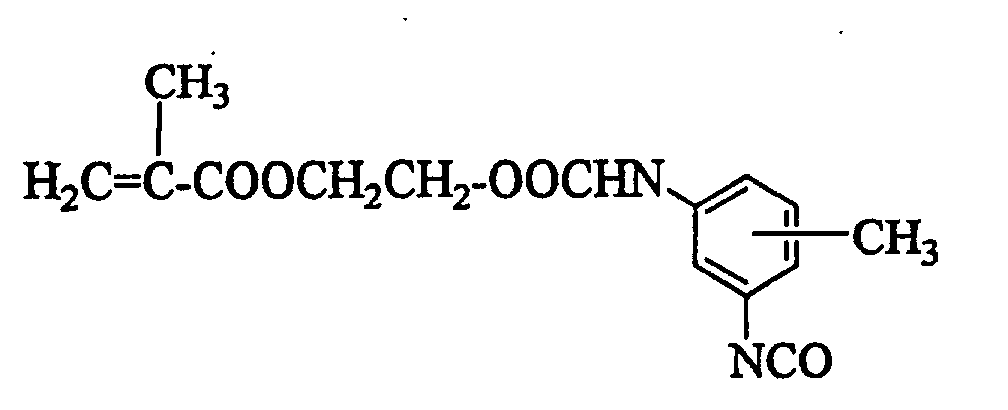
- isocyanate group-containing vinyl monomer means a compound having a carbon-carbon double bond and an isocyanate group.
- the numbers of the carbon-carbon double bond and of the isocyanate group in the isocyanate group-containing vinyl monomer are generally 1.
- a molecule of the isocyanate group-containing vinyl monomer usually has a carbon-carbon double bond at one terminal of the molecule and an isocyanate group at the other terminal of the molecule.
- the isocyanate group-containing vinyl monomer includes, for example,
- R 13 is a linear, branched or cyclic hydrocarbon group (for example, an alky
- Examples of the compound having two isocyanate groups (iii-1) include 2,4-tolylene diisocyanate, 2,6-tolylene diisocyanate, diphenylmethane diisocyanate, naphthalene diisocyanate, hexamethylene diisocyanate, xylene diisocyanate, and isophorone diisocyanate.
- Examples of the compound having a carbon-carbon double bond and an active hydrogen (iii-2)(hereinafter referred to as a "monomer having an active hydrogen”) include:
- the reactin between the compound having two isocyanate groups (iii-1) and the monomer having active hydrogen (iii-2) may be conducted in a solvent (especially, an aprotic solvent, for example, an ester solvent) optionally using a catalyst such as dibutyltin dilaurate.
- a solvent especially, an aprotic solvent, for example, an ester solvent
- a catalyst such as dibutyltin dilaurate.
- the amount of the monomer having active hydrogen (iii-2) in the reaction may be from 1.0 to 2.0 equivalents, and preferably from 1.0 to 1.7 equivalents, based on the compound having two isocyanate groups (iii-1).
- the amount of the isocyanate group-containing vinyl monomer is from 1 to 30% by weight, and preferably from 2 to 10% by weight, based on the trunk polymer.
- the other copolymerizable monomer constituting the trunk polymer may be any one as far as it is an addition-polymerizable monomer (namely, a compound having a carbon-carbon double bond), and may be either of a fluorine-free monomer and a fluorine-containing monomer.
- the amount of the fluorine-containing monomer is at most 50% by weight, and preferably at most 10% by weight, based on the trunk polymer.
- the fluorine-containing monomer may not exist in the trunk polymer.
- the fluorine-free monomer includes, for example, a (meth)acrylate ester.
- the (meth)acrylate ester may be an ester of (meth)acrylic acid and an aliphatic alcohol, for example, a monohydric alcohol or a polyhydric alcohol (for example, a dihydric alcohol).
- fluorine-free monomer examples include: (meth)acrylates such as 2-ethylhexyl (meth)acrylate, cyclohexyl (meth)acrylate, lauryl (meth)acrylate, stearyl (meth)acrylate, hydroxyalkyl (meth)acrylate, tetrahydrofurfuryl (meth)acrylate, polyoxyalkylene (meth)acrylate, 3-chloro-2-hydroxypropyl (meth)acrylate, glycidyl (meth)acrylate, N,N-dimethylaminoethyl (meth)acrylate, N,N-diethylaminoethyl (meth)acrylate, benzyl (meth)acrylate glycidyl methacrylate, hydroxypropyl monomethacrylate, 2-hydroxy-3-phenoxypropyl acrylate, 2-hydroxyethyl acrylate, glycerol monomethacrylate, ⁇ -acrylo
- Examples thereof further include ethylene; butadiene, vinyl acetate, chloroprene, vinyl halide such as vinyl chloride, vinylidene halide, acrylonitrile, vinyl alkyl ketone, maleic anhydride, N-vinylcarbazole, vinyl pyrrolidone, and (meth)acrylic acid.
- vinyl halide such as vinyl chloride, vinylidene halide, acrylonitrile, vinyl alkyl ketone, maleic anhydride, N-vinylcarbazole, vinyl pyrrolidone, and (meth)acrylic acid.
- the fluorine-free monomer may be a silicon-containing monomer (for example, (meth)acryloyl group-containing alkylsilane, (meth)acryloyl group-containing alkoxysilane, and (meth)acryloyl group-containing polysiloxane).
- silicon-containing monomer for example, (meth)acryloyl group-containing alkylsilane, (meth)acryloyl group-containing alkoxysilane, and (meth)acryloyl group-containing polysiloxane.
- silicon-containing monomer examples include: (meth)acryloxytrialkylsilane, (meth)acryloxytrialkoxysilane, (meth)acryloxypolysiloxane, (meth)acryloxypropyltrialkylsilane, (meth)acryloxypropyltrialkoxysilane, (meth)acryloxypropylpolysiloxane, allyltrialkylsilane, allyltrialkoxysilane, allylpolysiloxane, vinyltrialkylsilane, vinyltrialkoxysilane, and vinylpolysiloxane.
- the (meth)acryloxypropylpolysiloxane may be wherein R 20 is H or CH 3 , R 21 is H or CH 3 , R 22 is H or CH 3 , R 23 is H or CH 3 , and n is from 1 to 100 (for example, (meth)acryloxypropylpolydimethylsiloxane).
- At least two types of the fluorine-free monomers can also be used in combination.
- Examples of the fluorine-containing monomer constituting the trunk polymer may be the same as those (for example, fluoroalkyl group-containing (meth)acrylate, fluorinated olefin) of the fluorine-containing monomer constituting the following branch polymer.
- the fluorine-containing monomer may be, for example, a fluorine-containing methacrylate or acrylate.
- the trunk polymer may be a block polymer or a random polymer.
- the branch polymer is formed by using a chain transfer agent, a fluoroalkyl group-containing vinyl monomer and, if necessary, the other fluorine-containing monomer and fluorine-free monomer.
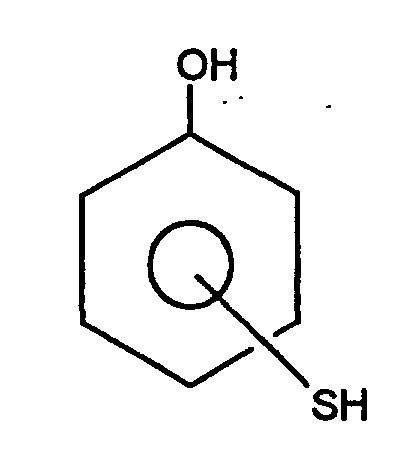
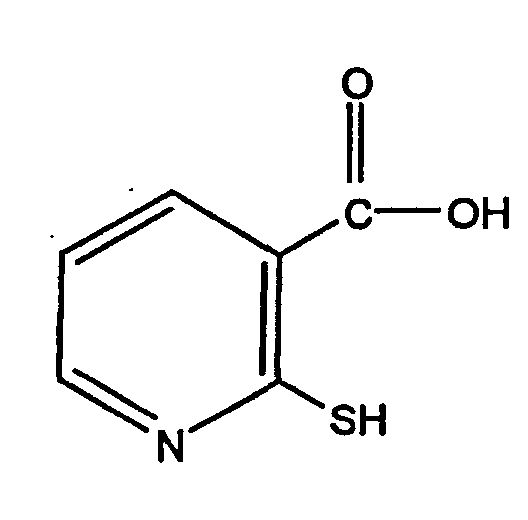
- the chain transfer agent may be a chain transfer agent having an active hydrogen group at both terminals, for example, an alkylenethiol chain transfer agent having an active hydrogen group or an aryl chain transfer agent having an active hydrogen group.
- the active hydrogen group include OH, NH 2 , SO 3 H, NHOH, COOH, and SH.
- the number of carbon atoms of the alkylene group of the alkylenethiol may be from 1 to 20.
- alkylenethiol chain transfer agent examples include the followings. HS(CH 2 ) n OH [n is 2, 4, 6 or 11], HSCH 2 COOH, HSCH 2 CH(CH 3 )COOH, HSCH 2 CH 2 SO 3 Na, HSCH 2 CH 2 SO 3 H, and
- allyl chain transfer agent examples include the followings.
- the amount of the isocyanate group of the trunk polymer is preferably from 1.0 to 2.0 equivalents, for example, from 1.0 to 1.7 equivalents, based on 1.0 equivalents of the chain transfer agent.
- the amount of the chain transfer agent may be from 0.05 to 0.7 mol, preferably from 0.1 to 0.6 mol, based on 1 mol of the branch monomer.
- the chain transfer agent is bonded at one terminal of the branch polymer obtained by polymerizing the branch monomer.
- the chain transfer agent can control the length of a chain of the branch polymer.
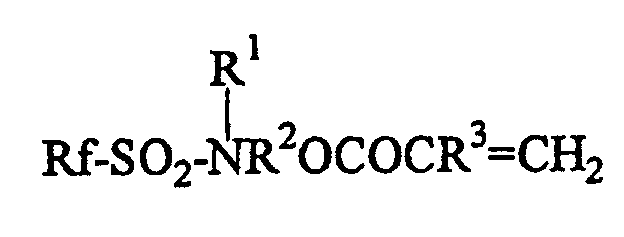
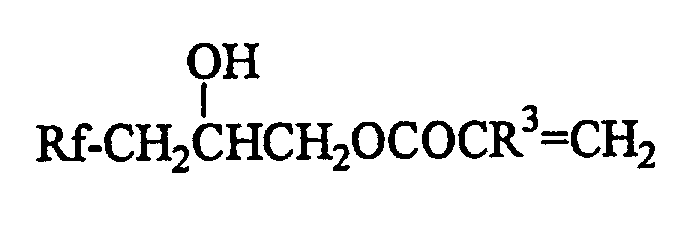
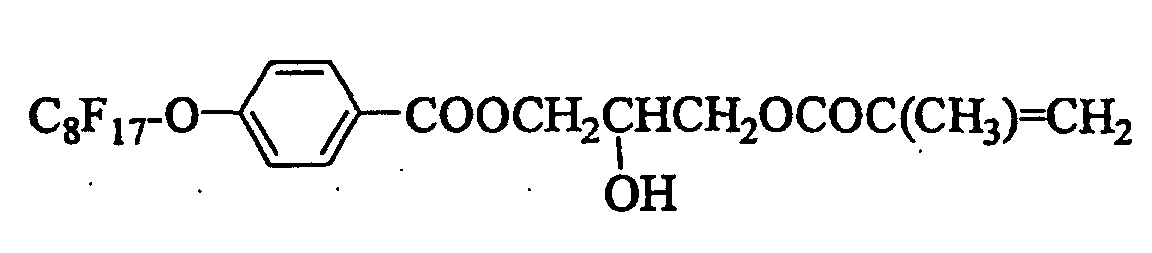
- the fluoroalkyl group-containing vinyl monomer, which constitutes the branch polymer, may be (meth)acrylate having a fluoroalkyl group.
- fluoroalkyl group-containing (meth)acrylate examples include the followings.
- CF 3 (CF 2 ) 7 (CH 2 )OCOCH CH 2
- CF 3 (CF 2 ) 6 (CH 2 ) OCOC (CH 3 ) CH 2
- (CF 3 ) 2 CF(CF 2 ) 6 (CH 2 ) 2 OCOCH CH 2
- CF 3 (CF 2 ) 7 (CH 2 ) 2 OCOC (CH 3 ) CH 2
- CF 3 (CF 2 ) 7 (CH 2 ) 2 OCOCH CH 2
- CF 3 (CF 2 ) 7 SO 2 N(CH 3 ) (CH 2 ) 2 OCOCH CH 2
- CF 3 (CF 2 ) 7 SO 2 N (C 2 H 5 ) (CH 2 ) 2 OCOC (CH 3 ) CH 2 , (CF 3 ) 2 CF(CF 2 ) 6 CH 2 CH(OCOCH 3 )CH 2 OCOC(CH 3 )
- fluoroalkyl group-containing (meth)acrylates can be used in combination.
- the other fluorine-containing monomer may be used.
- a fluorine-free monomer may be used in the branch polymer.
- the fluorine-free monomer used in the branch polymer include the same fluorine-free monomers as those used in the trunk polymer.
- the fluorine-free monomer in the branch polymer may be a (meth)acrylate ester, for example, an ester of an aliphatic monohydric alcohol and (meth)acrylic acid.
- the amount of the fluorine-free monomer in the branch polymer may be at most 80% by weight, e.g. at most 50% by weight, particularly at most 30% by weight, based on the branch polymer.
- the branch polymer may be a block polymer or a random polymer.
- the polymerization degree of the branch polymer is from 3 to 25 molecules, and preferably from 4 to 20 molecules of the monomer, based on one molecule of the chain transfer agent.
- the graft polymer comprises the trunk polymer and the branch polymer.
- a weight ratio of the trunk polymer to the branch polymer may be from 5:95 to 95:5, preferably from 10:90 to 90:10, particularly from 30:70 to 70:30.
- the number average molecular weight (by GPC, converted to polystyrene, in THF) of the graft polymer may be from 5,000 to 200,000, preferably from 5,000 to 100,000.
- the graft polymer of the present invention may be prepared by either of:
- the method (A) comprises the steps of:
- the method (B) comprises the steps of:
- the polymerization step (A-1) of the branch polymer and the polymerization steps (A-3) and (B-1) of the trunk polymer may be conducted in a solvent at a temperature of 70 to 80°C using a polymerization initiator.
- the polymerization time is generally from 2 to 12 hours.
- the polymerization initiator for example, azobisisobutyronitrile, benzoyl peroxide, di-tert-butyl peroxide, lauryl peroxide, cumene hydroperoxide, tert-butyl peroxide pivalate, and diisopropylperoxy dicarbonate are used.
- the amount of the polymerization initiator is preferably from 1 to 10 parts by weight based on 100 parts by weight of the monomer.
- the polymerization solvent may be a polar solvent, a hydrocarbon solvent, or a mixture of these solvents.
- a protic solvent having an active hydrogen group such as alcohol solvent can not be used.
- the polar solvent is a solvent having a polar. group in a molecule.
- the polar group include a hydroxyl group, a carboxyl group, an ester group, an acyl group, and an ether oxygen group.
- the polar solvent include an alcohol solvent, a glycol solvent, an ester solvent, and a ketone solvent.
- the hydrocarbon solvent may be a solvent which is composed only of carbon and hydrogen.
- the hydrocarbon solvent may be an aliphatic hydrocarbon.
- examples of the hydrocarbon solvent include n-heptane, n-hexane, n-octane, cyclohexane, methylcyclohexane, cyclopentane, methylcyclopentane, methylpentane, 2-ethylpentane, isoparaffin hydrocarbon, liquid paraffin, decane, undecane, dodecane, mineral spirit, and mineral terpene. In some case, an aromatic solvent may be used.
- Examples of the alcohol solvent include butyl alcohol and isopropyl alcohol.
- Examples of the glycol solvent include propylene glycol monomethyl ether, propylene glycol monoethyl ether, dipropylene glycolmonomethyl ether, dipropylene glycol monoethyl ether, and acetate thereof.
- Examples of the ester solvent include a monobasic acid ester such as methyl acetate, ethyl acetate, and butyl acetate; and a dibasic acid ester such as diethyl succinate, diethyl adipate, dibutyl phthalate, and dioctyl phthalate.
- Examples of the ketone solvent include methyl isobutyl ketone (MIBK), methyl ethyl ketone, and acetone.
- a mixture of the hydrocarbon solvent and the polar solvent may also be used.
- the weight ratio of the hydrocarbon solvent to the polar solvent may be from 100:0 to 0:100, for example 5:95 to 95:5.
- reaction steps (A-2) and (B-2) of reacting the active hydrogen group of the chain transfer agent constituting the branch polymer with the isocyanate group contained in the monomer constituting the trunk polymer may be conducted in a solvent at a temperature of 30°C to 65°C.
- the reaction time is generally from 2 hours to 24 hours.
- the solvent may be the polymerization solvent described above, a protic solvent having an active hydrogen group such as alcohol solvent can not be used.
- An organic solvent solution of the graft polymer is a solvent-based water- and oil-repellent composition.
- the water- and oil-repellent composition of the present invention may contain other water- and oil-repellents and additives, for example, softening agents, antistatic agents, cross-linking agents and crease-proofing agents, if necessary.
- a substrate to be treated with the water- and oil-repellent composition of the present invention includes various substances.
- the substrate to be treated include textiles, glass, papers, woods, hides, asbestos, bricks, cements, metals and oxides, ceramics, plastics, coated surfaces, and plasters.
- the textiles include animal- and vegetable-origin natural fibers such as cotton, hemp, wool, and silk; synthetic fibers such as polyamide, polyester, polyvinyl alcohol, polyacrylonitrile, polyvinyl chloride, and polypropylene; semisynthetic fibers such as rayon and acetate, etc.; and a mixture of these fibers.
- the water- and oil-repellent composition of the present invention is applied to the substrate by a method of applying the composition onto the surface of the substrate to be treated using a known process such as dip coating, and then drying the composition.
- the water- and oil-repellent composition of the present invention can also be used as an aerosol by adding propellants.
- propellants include fluoroalkane or chlorofluoroalkane having 1 or 2 carbon atoms, LPG gas, dimethyl ether, nitrogen gas, and carbon dioxide gas.
- Typical examples of the fluoroalkane or chlorofluoroalkane having 1 or 2 carbon atoms include dichlorodifluoromethane, trichlorotrifluoroethane, chlorodifluoromethane, chlorodifluoroethane, dichlorotrifluoroethane, tetrafluoroethane, and a mixture of at least two types of them.
- the amount of the propellant is preferably 0.05 to 2 times as much as the total weight of the surface treating agent composition containing the solvent.
- a container having a mechanism for spraying a liquid in the container for example, an aerosol container or a spray container is filled with the aerosol.
- a polymer solution is diluted with a mineral spirit so that a solid content of the solution is 0.8% by weight, and then sprayed over a cloth using a hand spray so that the cloth is sufficiently wetted.
- a cloth a polyester cloth, a polyester/cotton mixed spun cloth and a cotton cloth are used. After drying at room temperature for 10 hours, the water repellency and oil repellency are evaluated in the following procedures.
- the water repellency is expressed by the water repellency No. (cf. the following Table 1) determined by the spray method according to JIS (Japanese Industrial Standard)-L-1092 (1998).
- the oil repellency is determined by dropping several drops of a test solution shown in Table 2 on the surface of a test cloth and then observing the penetration state of the drops after 30 seconds (AATCC-TM118). Water repellency No. State 5 No wet on the surface 4 Slight wet on the surface 3 Partial wet on the surface 2 Wet on the surface 1 Wet over the whole surface Oil repellency Test solution Surface tension (dyne/cm, 25°C) 8 n-Heptane 20.0 7 n-Octane 21.8 6 n-Decane 23.5 5 n-Dodecane 25.0 4 n-Tetradecane 26.7 3 n-Hexadecane 27.3 2 n-Hexadecane/Nujol (35/65 by weight) 29.6 1 Nujol 31.2 0 Inferior to 1 -
- the polymer solution After adjusting the concentration of the polymer solution to 15% by weight using a mineral spirit, the polymer solution is stored at -5°C for one month. It is evaluated whether or not solidification or deposition occurs.
- the polymer solution is diluted with a solvent (n-decane) so that the solid content of the solution is 0.8% by weight, and then stored at -5°C for one month. It is evaluated whether or not solidification or deposition occurs.
- a solvent n-decane
- the resultant polymer was not a graft polymer.
- a GPC analysis revealed that a number average molecular weight of the resultant polymer was 15,000.
- the resultant polymer was not a graft polymer.
- a GPC analysis revealed that a number average molecular weight of the resultant polymer was 14,000.
- the polymers obtained in Comparative Examples 3 to 6 were not a graft polymer.
- a GPC analysis revealed that a number average molecular weight of the resultant polymers was 18,000 in Comparative Example 3, 16,000 in Comparative Example 4, 19,500 in Comparative Example 5, and 16,000 in Comparative Example 6.
- the graft polymer of the present invention can exhibit both the function of the fluorine-containing component and that of the hydrocarbon component. For example, it is possible to reconcile the softness of treated articles (especially, textiles) with the repellency effect of the water- and oil-repellency and to reconcile the solubility of the water- and oil-repellent with the repellency effect.
Landscapes
- Chemical & Material Sciences (AREA)
- Engineering & Computer Science (AREA)
- Organic Chemistry (AREA)
- Chemical Kinetics & Catalysis (AREA)
- Medicinal Chemistry (AREA)
- Polymers & Plastics (AREA)
- Health & Medical Sciences (AREA)
- General Chemical & Material Sciences (AREA)
- Combustion & Propulsion (AREA)
- Materials Engineering (AREA)
- Macromonomer-Based Addition Polymer (AREA)
- Treatments For Attaching Organic Compounds To Fibrous Goods (AREA)
- Addition Polymer Or Copolymer, Post-Treatments, Or Chemical Modifications (AREA)
- Polyurethanes Or Polyureas (AREA)
- Materials Applied To Surfaces To Minimize Adherence Of Mist Or Water (AREA)
Abstract
Description
(meth)acrylates such as 2-ethylhexyl (meth)acrylate, cyclohexyl (meth)acrylate, lauryl (meth)acrylate, stearyl (meth)acrylate, hydroxyalkyl (meth)acrylate, tetrahydrofurfuryl (meth)acrylate, polyoxyalkylene (meth)acrylate, 3-chloro-2-hydroxypropyl (meth)acrylate, glycidyl (meth)acrylate, N,N-dimethylaminoethyl (meth)acrylate, N,N-diethylaminoethyl (meth)acrylate, benzyl (meth)acrylate glycidyl methacrylate, hydroxypropyl monomethacrylate, 2-hydroxy-3-phenoxypropyl acrylate, 2-hydroxyethyl acrylate, glycerol monomethacrylate, β-acryloyloxyethyl hydrogensuccinate, β-methacryloyloxyethyl hydrogenphthalate, 2-acryloyloxyethylhexahydrophthalic acid, 2-acryloyloxyethylphthalic acid, 2-acryloyloxyethyl-2-hydroxyethylphthalic acid, methacrylic acid hydroxypropyltrimethylammonium chloride, dimethylaminoethyl methacrylate, diethylaminoethyl methacrylate, 2-acryloyloxyethyl acid phosphate, glycosyl ethyl methacrylate, methacrylamide, 2-hydroxy-3-acryloyloxypropyl methacrylate, 2-methacryloylethyl acid phosphate, and hydroxypivalic acid neopentyl glycol diacrylate; styrenes such as styrene and p-isopropylstyrene; (meth)acrylamides such as (meth)acrylamide, diacetone(meth)acrylamide, N-methylol (meth) acrylamide, N-butoxymethylacrylamide, and 2-acrylamide-2-methylpropanesulfonic acid; and vinyl ethers such as vinyl alkyl ether.
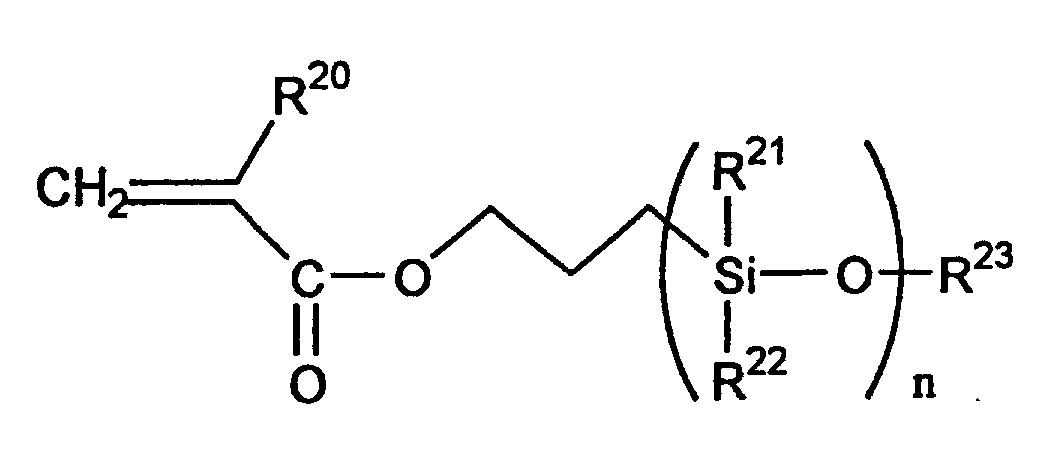
(for example, (meth)acryloxypropylpolydimethylsiloxane).






| Water repellency No. | State |
| 5 | No wet on the surface |
| 4 | Slight wet on the surface |
| 3 | Partial wet on the surface |
| 2 | Wet on the surface |
| 1 | Wet over the whole surface |
| Oil repellency | Test solution | Surface tension (dyne/cm, 25°C) |
| 8 | n-Heptane | 20.0 |
| 7 | n-Octane | 21.8 |
| 6 | n-Decane | 23.5 |
| 5 | n-Dodecane | 25.0 |
| 4 | n-Tetradecane | 26.7 |
| 3 | n-Hexadecane | 27.3 |
| 2 | n-Hexadecane/Nujol (35/65 by weight) | 29.6 |
| 1 | Nujol | 31.2 |
| 0 | Inferior to 1 | - |
- ○:
- Homogeneous liquid is maintained.
- ×:
- Solidification or deposition occurs.
- ○:
- Homogeneous and transparent liquid is maintained.
- Δ:
- Some turbidity occurs, but homogeneous liquid is maintained for practical use.
- ×:
- Deposition or solidification occurs.
| Mercaptoethanol | 3 g |
| CF3CF2(C2F4)nC2H4 OCOCH=CH2 (FA) [n = 3.5 in average] | 95 g |
| Stearyl methacrylate(StMA) | 5 g |
| Azoisobutyronitrile | 0.17 g |
| Ethyl acetate | 120 g |
| 2-Ethylhexyl methacrylate (2EHMA) | 100 g |
| Maleic anhydride (MAN) | 10 g |
| Ethyl acetate | 515 g |
| Tert-butylperoxy pivalate (Perbutyl PV, manufactured by NOF Corp.) | 9 g |
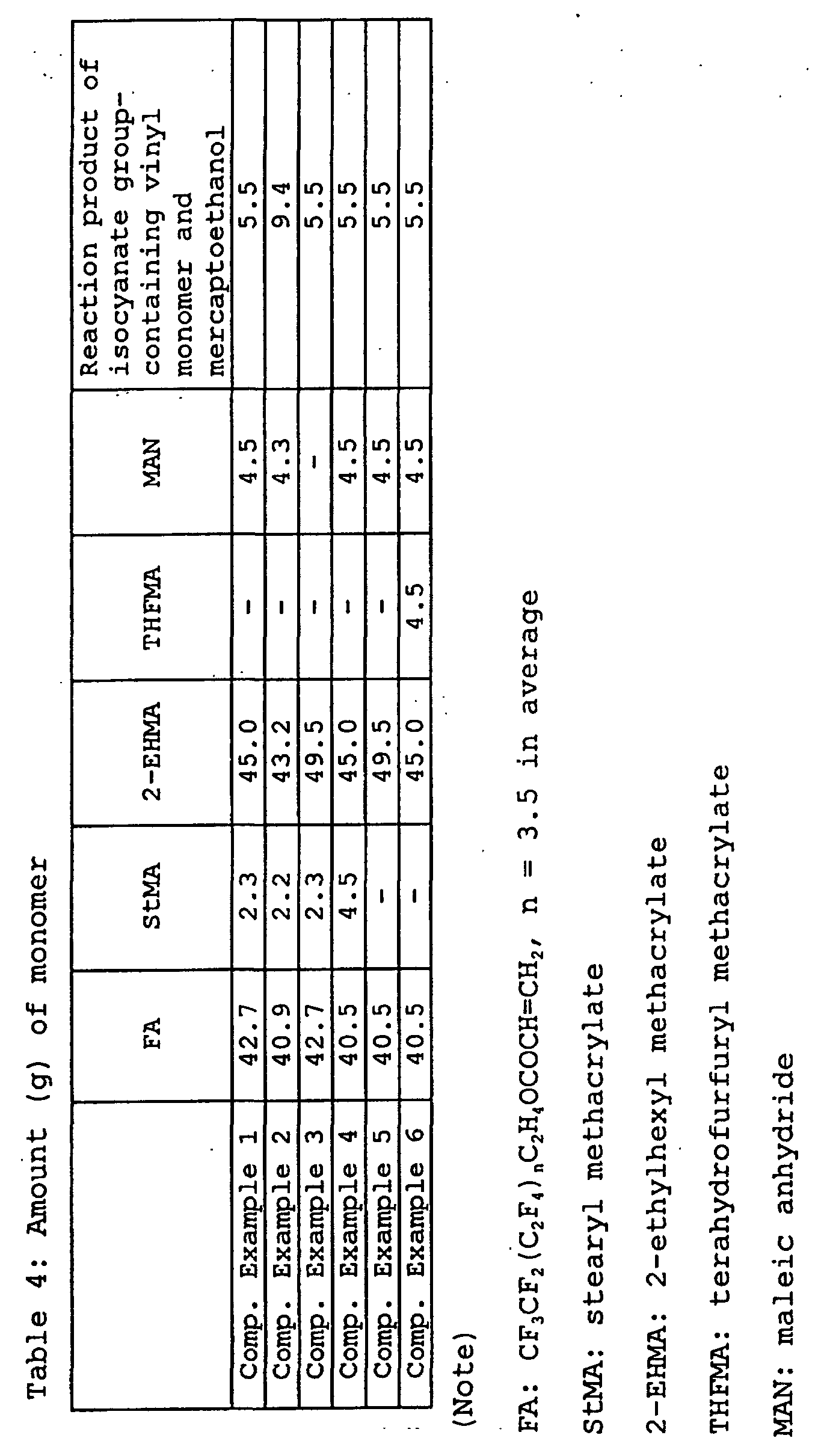
| CF3CF2(C2F4)nC2H4 OCOCH=CH2 (FA) [n = 3.5 in average] | 42.7 g |
| Stearyl methacrylate (StMA) | 2.3 g |
| 2-Ethylhexyl methacrylate (2EHMA) | 45.0 g |
| Maleic anhydride (MAN) | 4.5 g |
| Ethyl acetate | 515 g |
| Tert-butylperoxy pivalate (Perbutyl PV, manufactured by NOF Corp.) | 9 g |


Claims (5)
- A graft copolymer wherein a branch polymer having a fluoroalkyl group is bonded to a trunk polymer through a linkage having a -C(=O)NH- group.
- The graft polymer according to claim 1, wherein the linkage having a -C(=O)NH- group is formed by reacting an active hydrogen group of a chain transfer agent constituting the branch polymer with an isocyanate group contained in a monomer constituting the trunk polymer.
- A solvent-based water- and oil-repellent composition comprising the graft copolymer of claim 1 or 2.
- A process for preparing the graft copolymer of claim 1, which comprises copolymerizing a macromonomer, which is obtained by reacting an isocyanate group-containing vinyl monomer with a branch polymer, and a copolymerizable monomer to form a trunk polymer.
- A process for preparing the graft copolymer of claim 1, which comprises reacting a trunk polymer, which is obtained by copolymerizing an isocyanate group-containing vinyl monomer and a copolymerizable monomer, with a branch polymer.
Applications Claiming Priority (3)
| Application Number | Priority Date | Filing Date | Title |
|---|---|---|---|
| JP26018699 | 1999-09-14 | ||
| JP26018699 | 1999-09-14 | ||
| PCT/JP2000/006047 WO2001019884A1 (en) | 1999-09-14 | 2000-09-06 | Graft polymer, process for the production thereof and solution-type water- and oil-repellent compositions containing the polymer |
Publications (3)
| Publication Number | Publication Date |
|---|---|
| EP1243605A1 true EP1243605A1 (en) | 2002-09-25 |
| EP1243605A4 EP1243605A4 (en) | 2004-03-03 |
| EP1243605B1 EP1243605B1 (en) | 2005-03-02 |
Family
ID=17344534
Family Applications (1)
| Application Number | Title | Priority Date | Filing Date |
|---|---|---|---|
| EP00956958A Expired - Lifetime EP1243605B1 (en) | 1999-09-14 | 2000-09-06 | Graft polymer, process for the production thereof and solution-type water- and oil-repellent compositions containing the polymer |
Country Status (7)
| Country | Link |
|---|---|
| US (1) | US6734255B1 (en) |
| EP (1) | EP1243605B1 (en) |
| JP (1) | JP4815731B2 (en) |
| KR (1) | KR100699205B1 (en) |
| CA (1) | CA2394673C (en) |
| DE (1) | DE60018469T2 (en) |
| WO (1) | WO2001019884A1 (en) |
Cited By (2)
| Publication number | Priority date | Publication date | Assignee | Title |
|---|---|---|---|---|
| EP1251150A4 (en) * | 1999-12-02 | 2004-03-03 | Daikin Ind Ltd | GRAFT COPOLYMER AND WATER-RESISTANT AND WATER-REPELLENT COMPOSITION OF SOLUTION CONTAINING THIS COPOLYMER |
| CN109929066A (en) * | 2017-12-15 | 2019-06-25 | 上海飞凯光电材料股份有限公司 | A kind of UV-cured resin, preparation method, coating |
Families Citing this family (4)
| Publication number | Priority date | Publication date | Assignee | Title |
|---|---|---|---|---|
| JPWO2003095083A1 (en) * | 2002-05-10 | 2005-09-08 | ダイキン工業株式会社 | Surfactant and dispersion aid comprising a fluorine-containing graft polymer |
| JP2010047680A (en) * | 2008-08-21 | 2010-03-04 | Neos Co Ltd | Reactive fluorine-containing oligomer and method for producing the same |
| CN101956318B (en) * | 2010-09-26 | 2012-07-25 | 中国人民解放军第四军医大学 | Method of chemically grafting and stabilizing biological coating macromolecules on polyester fibre surface |
| WO2014034607A1 (en) * | 2012-08-30 | 2014-03-06 | 日産化学工業株式会社 | Fluorine-containing hyperbranched polymer and unsaturated polyester resin composition containing same |
Family Cites Families (17)
| Publication number | Priority date | Publication date | Assignee | Title |
|---|---|---|---|---|
| FR1455905A (en) * | 1964-05-28 | 1966-10-21 | New methods for the treatment of fibrous materials as well as products obtained | |
| JPS6150082A (en) | 1984-12-20 | 1986-03-12 | Tokyo Keiki Co Ltd | Information processing system |
| JP2921027B2 (en) * | 1990-05-14 | 1999-07-19 | 三菱化学株式会社 | Primer composition for fluororesin |
| JPH06228534A (en) | 1993-02-01 | 1994-08-16 | Daikin Ind Ltd | Water and oil repellent and stainproofing agent |
| JPH0745536B2 (en) | 1993-10-01 | 1995-05-17 | 旭硝子株式会社 | Method for producing fluorine-containing graft polymer |
| JP3514272B2 (en) | 1995-02-27 | 2004-03-31 | 日立化成工業株式会社 | Method for producing graft copolymer and paint using the same |
| JP3603480B2 (en) | 1995-07-27 | 2004-12-22 | 旭硝子株式会社 | Water / oil repellent composition |
| JP3829369B2 (en) | 1995-08-23 | 2006-10-04 | 旭硝子株式会社 | Solvent type water and oil repellent composition and method for producing the same |
| JP2996150B2 (en) | 1995-09-11 | 1999-12-27 | 大日本インキ化学工業株式会社 | Coating agent |
| JPH10292020A (en) | 1997-04-21 | 1998-11-04 | Hitachi Chem Co Ltd | Graft copolymer and coating material |
| JPH11106457A (en) | 1997-09-30 | 1999-04-20 | Hitachi Chem Co Ltd | Graft copolymer, production of graft polymer and coating material |
| JP3200735B2 (en) | 1998-06-29 | 2001-08-20 | 日本航空電子工業株式会社 | Optical fiber connection device |
| JP2000103824A (en) | 1998-09-28 | 2000-04-11 | Hitachi Chem Co Ltd | Graft copolymer and coating comprising the same |
| JP3830674B2 (en) * | 1998-10-14 | 2006-10-04 | 富士化成工業株式会社 | Graft copolymer and paint |
| JP2000119355A (en) * | 1998-10-20 | 2000-04-25 | Fuji Kasei Kogyo Kk | Graft copolymer and coating material |
| JP3855499B2 (en) | 1998-11-10 | 2006-12-13 | 旭硝子株式会社 | Water / oil repellent, water / oil repellent composition, treatment method, and article to be treated |
| JP2001158811A (en) * | 1999-12-02 | 2001-06-12 | Daikin Ind Ltd | Graft copolymer and solution-type water / oil repellent composition using the same |
-
2000
- 2000-09-06 DE DE60018469T patent/DE60018469T2/en not_active Expired - Lifetime
- 2000-09-06 KR KR1020027003292A patent/KR100699205B1/en not_active Expired - Fee Related
- 2000-09-06 EP EP00956958A patent/EP1243605B1/en not_active Expired - Lifetime
- 2000-09-06 WO PCT/JP2000/006047 patent/WO2001019884A1/en not_active Ceased
- 2000-09-06 US US10/070,978 patent/US6734255B1/en not_active Expired - Lifetime
- 2000-09-06 JP JP2001523661A patent/JP4815731B2/en not_active Expired - Fee Related
- 2000-09-06 CA CA002394673A patent/CA2394673C/en not_active Expired - Fee Related
Cited By (4)
| Publication number | Priority date | Publication date | Assignee | Title |
|---|---|---|---|---|
| EP1251150A4 (en) * | 1999-12-02 | 2004-03-03 | Daikin Ind Ltd | GRAFT COPOLYMER AND WATER-RESISTANT AND WATER-REPELLENT COMPOSITION OF SOLUTION CONTAINING THIS COPOLYMER |
| EP1475410A3 (en) * | 1999-12-02 | 2004-11-17 | Daikin Industries, Ltd. | Graft copolymer and solvent-based water- and oil-repellent composition comprising the same |
| KR100793123B1 (en) * | 1999-12-02 | 2008-01-10 | 다이낑 고오교 가부시키가이샤 | Graft copolymer and solution type water / oil repellent composition using same |
| CN109929066A (en) * | 2017-12-15 | 2019-06-25 | 上海飞凯光电材料股份有限公司 | A kind of UV-cured resin, preparation method, coating |
Also Published As
| Publication number | Publication date |
|---|---|
| US6734255B1 (en) | 2004-05-11 |
| EP1243605B1 (en) | 2005-03-02 |
| CA2394673A1 (en) | 2001-03-22 |
| WO2001019884A1 (en) | 2001-03-22 |
| JP4815731B2 (en) | 2011-11-16 |
| DE60018469D1 (en) | 2005-04-07 |
| CA2394673C (en) | 2009-06-30 |
| KR20020031185A (en) | 2002-04-26 |
| EP1243605A4 (en) | 2004-03-03 |
| KR100699205B1 (en) | 2007-03-27 |
| DE60018469T2 (en) | 2006-02-16 |
Similar Documents
| Publication | Publication Date | Title |
|---|---|---|
| EP0582667B1 (en) | Fluoroacrylate monomers and polymers, processes for preparing the same and their use | |
| EP0756033B1 (en) | Water and oil repellent composition, treating method therewith and copolymer | |
| EP0682146B1 (en) | Textile product treatment | |
| EP0781825A1 (en) | Water- and oil-repellent stainproofer composition | |
| EP1251150B1 (en) | Graft copolymer and solution type water-and-oil repellant composition containing the same | |
| EP1243605B1 (en) | Graft polymer, process for the production thereof and solution-type water- and oil-repellent compositions containing the polymer | |
| EP1510252A1 (en) | Surfactant and dispersion aid each comprising graft fluoropolymer | |
| WO1998052983A1 (en) | Novel polymer and antifouling agent composition containing the same | |
| JP2000160148A (en) | Solution type water / oil repellent composition and method for producing the same | |
| JP5652383B2 (en) | Graft copolymer and solution-type water / oil repellent composition | |
| JPWO2001019884A1 (en) | Graft polymer, its production method, and solution-type water- and oil-repellent composition using the same | |
| US8394887B2 (en) | Fluoropolymer having S-sulfate group and water/oil repellent composition containing the polymer | |
| JPS6321715B2 (en) | ||
| JPS6343509B2 (en) |
Legal Events
| Date | Code | Title | Description |
|---|---|---|---|
| PUAI | Public reference made under article 153(3) epc to a published international application that has entered the european phase |
Free format text: ORIGINAL CODE: 0009012 |
|
| 17P | Request for examination filed |
Effective date: 20020408 |
|
| AK | Designated contracting states |
Kind code of ref document: A1 Designated state(s): AT BE CH CY DE DK ES FI FR GB GR IE IT LI LU MC NL PT SE |
|
| A4 | Supplementary search report drawn up and despatched |
Effective date: 20040121 |
|
| RIC1 | Information provided on ipc code assigned before grant |
Ipc: 7C 08F 290/06 B Ipc: 7C 08F 8/30 A Ipc: 7C 08G 81/02 B Ipc: 7C 09K 3/18 B |
|
| 17Q | First examination report despatched |
Effective date: 20040325 |
|
| RBV | Designated contracting states (corrected) |
Designated state(s): AT BE CH CY DE FR GB IT LI |
|
| GRAP | Despatch of communication of intention to grant a patent |
Free format text: ORIGINAL CODE: EPIDOSNIGR1 |
|
| RBV | Designated contracting states (corrected) |
Designated state(s): DE FR GB IT |
|
| GRAS | Grant fee paid |
Free format text: ORIGINAL CODE: EPIDOSNIGR3 |
|
| GRAA | (expected) grant |
Free format text: ORIGINAL CODE: 0009210 |
|
| AK | Designated contracting states |
Kind code of ref document: B1 Designated state(s): DE FR GB IT |
|
| REG | Reference to a national code |
Ref country code: GB Ref legal event code: FG4D |
|
| REG | Reference to a national code |
Ref country code: IE Ref legal event code: FG4D |
|
| REF | Corresponds to: |
Ref document number: 60018469 Country of ref document: DE Date of ref document: 20050407 Kind code of ref document: P |
|
| PLBE | No opposition filed within time limit |
Free format text: ORIGINAL CODE: 0009261 |
|
| STAA | Information on the status of an ep patent application or granted ep patent |
Free format text: STATUS: NO OPPOSITION FILED WITHIN TIME LIMIT |
|
| ET | Fr: translation filed | ||
| 26N | No opposition filed |
Effective date: 20051205 |
|
| PGFP | Annual fee paid to national office [announced via postgrant information from national office to epo] |
Ref country code: GB Payment date: 20080910 Year of fee payment: 9 |
|
| GBPC | Gb: european patent ceased through non-payment of renewal fee |
Effective date: 20090906 |
|
| PG25 | Lapsed in a contracting state [announced via postgrant information from national office to epo] |
Ref country code: GB Free format text: LAPSE BECAUSE OF NON-PAYMENT OF DUE FEES Effective date: 20090906 |
|
| REG | Reference to a national code |
Ref country code: FR Ref legal event code: PLFP Year of fee payment: 17 |
|
| REG | Reference to a national code |
Ref country code: FR Ref legal event code: PLFP Year of fee payment: 18 |
|
| REG | Reference to a national code |
Ref country code: FR Ref legal event code: PLFP Year of fee payment: 19 |
|
| PGFP | Annual fee paid to national office [announced via postgrant information from national office to epo] |
Ref country code: IT Payment date: 20180919 Year of fee payment: 19 Ref country code: FR Payment date: 20180813 Year of fee payment: 19 Ref country code: DE Payment date: 20180821 Year of fee payment: 19 |
|
| REG | Reference to a national code |
Ref country code: DE Ref legal event code: R119 Ref document number: 60018469 Country of ref document: DE |
|
| PG25 | Lapsed in a contracting state [announced via postgrant information from national office to epo] |
Ref country code: DE Free format text: LAPSE BECAUSE OF NON-PAYMENT OF DUE FEES Effective date: 20200401 |
|
| PG25 | Lapsed in a contracting state [announced via postgrant information from national office to epo] |
Ref country code: IT Free format text: LAPSE BECAUSE OF NON-PAYMENT OF DUE FEES Effective date: 20190906 |
|
| PG25 | Lapsed in a contracting state [announced via postgrant information from national office to epo] |
Ref country code: FR Free format text: LAPSE BECAUSE OF NON-PAYMENT OF DUE FEES Effective date: 20190930 |