EP1243599A1 - Process for producing vinyl polymer having functional group at end and vinyl polymer having functional group at end - Google Patents
Process for producing vinyl polymer having functional group at end and vinyl polymer having functional group at end Download PDFInfo
- Publication number
- EP1243599A1 EP1243599A1 EP00915495A EP00915495A EP1243599A1 EP 1243599 A1 EP1243599 A1 EP 1243599A1 EP 00915495 A EP00915495 A EP 00915495A EP 00915495 A EP00915495 A EP 00915495A EP 1243599 A1 EP1243599 A1 EP 1243599A1
- Authority
- EP
- European Patent Office
- Prior art keywords
- functional group
- vinyl polymer
- group
- polymerization
- compound
- Prior art date
- Legal status (The legal status is an assumption and is not a legal conclusion. Google has not performed a legal analysis and makes no representation as to the accuracy of the status listed.)
- Withdrawn
Links
Classifications
-
- C—CHEMISTRY; METALLURGY
- C08—ORGANIC MACROMOLECULAR COMPOUNDS; THEIR PREPARATION OR CHEMICAL WORKING-UP; COMPOSITIONS BASED THEREON
- C08F—MACROMOLECULAR COMPOUNDS OBTAINED BY REACTIONS ONLY INVOLVING CARBON-TO-CARBON UNSATURATED BONDS
- C08F8/00—Chemical modification by after-treatment
- C08F8/18—Introducing halogen atoms or halogen-containing groups
- C08F8/20—Halogenation
-
- C—CHEMISTRY; METALLURGY
- C08—ORGANIC MACROMOLECULAR COMPOUNDS; THEIR PREPARATION OR CHEMICAL WORKING-UP; COMPOSITIONS BASED THEREON
- C08F—MACROMOLECULAR COMPOUNDS OBTAINED BY REACTIONS ONLY INVOLVING CARBON-TO-CARBON UNSATURATED BONDS
- C08F8/00—Chemical modification by after-treatment
- C08F8/18—Introducing halogen atoms or halogen-containing groups
-
- C—CHEMISTRY; METALLURGY
- C08—ORGANIC MACROMOLECULAR COMPOUNDS; THEIR PREPARATION OR CHEMICAL WORKING-UP; COMPOSITIONS BASED THEREON
- C08F—MACROMOLECULAR COMPOUNDS OBTAINED BY REACTIONS ONLY INVOLVING CARBON-TO-CARBON UNSATURATED BONDS
- C08F112/00—Homopolymers of compounds having one or more unsaturated aliphatic radicals, each having only one carbon-to-carbon double bond, and at least one being terminated by an aromatic carbocyclic ring
- C08F112/02—Monomers containing only one unsaturated aliphatic radical
- C08F112/04—Monomers containing only one unsaturated aliphatic radical containing one ring
- C08F112/06—Hydrocarbons
- C08F112/08—Styrene
-
- C—CHEMISTRY; METALLURGY
- C08—ORGANIC MACROMOLECULAR COMPOUNDS; THEIR PREPARATION OR CHEMICAL WORKING-UP; COMPOSITIONS BASED THEREON
- C08F—MACROMOLECULAR COMPOUNDS OBTAINED BY REACTIONS ONLY INVOLVING CARBON-TO-CARBON UNSATURATED BONDS
- C08F112/00—Homopolymers of compounds having one or more unsaturated aliphatic radicals, each having only one carbon-to-carbon double bond, and at least one being terminated by an aromatic carbocyclic ring
- C08F112/02—Monomers containing only one unsaturated aliphatic radical
- C08F112/04—Monomers containing only one unsaturated aliphatic radical containing one ring
- C08F112/06—Hydrocarbons
- C08F112/12—Monomers containing a branched unsaturated aliphatic radical or a ring substituted by an alkyl radical
-
- C—CHEMISTRY; METALLURGY
- C08—ORGANIC MACROMOLECULAR COMPOUNDS; THEIR PREPARATION OR CHEMICAL WORKING-UP; COMPOSITIONS BASED THEREON
- C08F—MACROMOLECULAR COMPOUNDS OBTAINED BY REACTIONS ONLY INVOLVING CARBON-TO-CARBON UNSATURATED BONDS
- C08F118/00—Homopolymers of compounds having one or more unsaturated aliphatic radicals, each having only one carbon-to-carbon double bond, and at least one being terminated by an acyloxy radical of a saturated carboxylic acid, of carbonic acid or of a haloformic acid
- C08F118/02—Esters of monocarboxylic acids
- C08F118/04—Vinyl esters
-
- C—CHEMISTRY; METALLURGY
- C08—ORGANIC MACROMOLECULAR COMPOUNDS; THEIR PREPARATION OR CHEMICAL WORKING-UP; COMPOSITIONS BASED THEREON
- C08F—MACROMOLECULAR COMPOUNDS OBTAINED BY REACTIONS ONLY INVOLVING CARBON-TO-CARBON UNSATURATED BONDS
- C08F120/00—Homopolymers of compounds having one or more unsaturated aliphatic radicals, each having only one carbon-to-carbon double bond, and only one being terminated by only one carboxyl radical or a salt, anhydride, ester, amide, imide or nitrile thereof
- C08F120/02—Monocarboxylic acids having less than ten carbon atoms; Derivatives thereof
- C08F120/04—Acids; Metal salts or ammonium salts thereof
- C08F120/06—Acrylic acid; Methacrylic acid; Metal salts or ammonium salts thereof
-
- C—CHEMISTRY; METALLURGY
- C08—ORGANIC MACROMOLECULAR COMPOUNDS; THEIR PREPARATION OR CHEMICAL WORKING-UP; COMPOSITIONS BASED THEREON
- C08F—MACROMOLECULAR COMPOUNDS OBTAINED BY REACTIONS ONLY INVOLVING CARBON-TO-CARBON UNSATURATED BONDS
- C08F120/00—Homopolymers of compounds having one or more unsaturated aliphatic radicals, each having only one carbon-to-carbon double bond, and only one being terminated by only one carboxyl radical or a salt, anhydride, ester, amide, imide or nitrile thereof
- C08F120/02—Monocarboxylic acids having less than ten carbon atoms; Derivatives thereof
- C08F120/10—Esters
- C08F120/12—Esters of monohydric alcohols or phenols
- C08F120/16—Esters of monohydric alcohols or phenols of phenols or of alcohols containing two or more carbon atoms
- C08F120/18—Esters of monohydric alcohols or phenols of phenols or of alcohols containing two or more carbon atoms with acrylic or methacrylic acids
-
- C—CHEMISTRY; METALLURGY
- C08—ORGANIC MACROMOLECULAR COMPOUNDS; THEIR PREPARATION OR CHEMICAL WORKING-UP; COMPOSITIONS BASED THEREON
- C08F—MACROMOLECULAR COMPOUNDS OBTAINED BY REACTIONS ONLY INVOLVING CARBON-TO-CARBON UNSATURATED BONDS
- C08F120/00—Homopolymers of compounds having one or more unsaturated aliphatic radicals, each having only one carbon-to-carbon double bond, and only one being terminated by only one carboxyl radical or a salt, anhydride, ester, amide, imide or nitrile thereof
- C08F120/02—Monocarboxylic acids having less than ten carbon atoms; Derivatives thereof
- C08F120/42—Nitriles
- C08F120/44—Acrylonitrile
-
- C—CHEMISTRY; METALLURGY
- C08—ORGANIC MACROMOLECULAR COMPOUNDS; THEIR PREPARATION OR CHEMICAL WORKING-UP; COMPOSITIONS BASED THEREON
- C08F—MACROMOLECULAR COMPOUNDS OBTAINED BY REACTIONS ONLY INVOLVING CARBON-TO-CARBON UNSATURATED BONDS
- C08F120/00—Homopolymers of compounds having one or more unsaturated aliphatic radicals, each having only one carbon-to-carbon double bond, and only one being terminated by only one carboxyl radical or a salt, anhydride, ester, amide, imide or nitrile thereof
- C08F120/02—Monocarboxylic acids having less than ten carbon atoms; Derivatives thereof
- C08F120/52—Amides or imides
- C08F120/54—Amides, e.g. N,N-dimethylacrylamide or N-isopropylacrylamide
- C08F120/56—Acrylamide; Methacrylamide
-
- C—CHEMISTRY; METALLURGY
- C08—ORGANIC MACROMOLECULAR COMPOUNDS; THEIR PREPARATION OR CHEMICAL WORKING-UP; COMPOSITIONS BASED THEREON
- C08F—MACROMOLECULAR COMPOUNDS OBTAINED BY REACTIONS ONLY INVOLVING CARBON-TO-CARBON UNSATURATED BONDS
- C08F8/00—Chemical modification by after-treatment
Definitions
- the present invention relates to a production method of functional group-terminated vinyl polymers and functional group-terminated vinyl polymers as obtainable by the above method.
- Functional group-terminated polymers are of great use as, for example, reactive raw materials for resins such as polyester resin, polyurethane resin, polycarbonate resin, etc., paints, adhesives, self-adhesives, sealants, urethane foams, gel coatings, thermoplastic elastomers, molding compounds, resin modifiers, dampers, elastic wall and floor panels, textile processing agents, UV ⁇ EV-curable resin, high-solid paints and so forth. These are also useful as various resin additives and raw materials.
- resins such as polyester resin, polyurethane resin, polycarbonate resin, etc.
- paints adhesives, self-adhesives, sealants, urethane foams, gel coatings, thermoplastic elastomers, molding compounds, resin modifiers, dampers, elastic wall and floor panels, textile processing agents, UV ⁇ EV-curable resin, high-solid paints and so forth.
- Japanese Kokai Publication Hei-5-255415 discloses a process for synthesizing a (meth)acrylic polymer having an alkenyl group at both termini by using an alkenyl group-containing disulfide as a chain transfer agent.
- Japanese Kokai Publication Hei-5-262808 discloses a process comprising synthesizing an acrylic polymer having a hydroxyl group at both termini by using a hydroxyl group-containing disulfide and utilizing these terminal hydroxyl groups, synthesizing an alkenyl group-terminated(meth)acrylicpolymer.
- Japanese Kohyo Publication Hei-4-501883 discloses a process for synthesizing a hydroxyl group-terminated poly(meth)acrylic ester and a process for synthesizing a (meth) acrylic acid macromonomer by way of living anionic polymerization.
- anionic polymerization the termination reaction and chain transfer reaction cannot be controlled unless anhydrous or low-temperature conditions are maintained and the reaction does not proceed in the living fashion so that the terminal transformation is rendered impossible. Therefore, the technology is lacking in commercial utility.
- Japanese Kokai Publication Hei-9-272714 discloses a production method of an alkenyl group-terminated (meth)acrylic polymer which comprises using an organohalogen or brominated sulfonyl compound as an initiator and an equivalent amount thereto of a complex of a Group 8 to 11 transition metal as a catalyst.
- the transition metal complex has such a high affinity for oxygen that unless in a completely inert system its catalytic activity is lost to arrest the progress of polymerization. Therefore, the technology is not practically useful for production.
- the present invention developed in light of the above state of the art, has for its object to provide a production method by which a polymer of a functional group-terminated vinyl monomer can be easily and practically produced.
- the first aspect of the present invention is concerned with a production method of a functional group-terminated vinyl polymer comprising a step of synthesizing a halogen atom-terminated vinyl polymer by the radical polymerization reaction of a vinyl monomer in the presence of a halogen compound and a step of introducing a functional group to a terminus by substituting a functional group-containing group for the terminal halogen atom of said vinyl polymer, said halogen compound having a structure such that said halogen atom is bound to a carbon atom linked to an aromatic ring and said radical polymerization reaction being carried out either by light irradiation or light irradiation in the presence of a Group 14 to 16 metal compound or by heating in the presence of a Group 14 to 16 metal compound.
- the second aspect of the present invention is concerned with a production method of a functional group-terminated vinyl polymer comprising a step of synthesizing an iodine atom-terminated vinyl polymer by the radical polymerization reaction of a vinyl monomer in the presence of an iodine compound and a step of introducing a functional group to the terminus by substituting a functional group-containing group for the terminal iodine atom of said vinyl polymer, said iodine compound having a structure such that said iodine atom is bound to a carbon atom linked to an aromatic ring and said radical polymerization reaction being carried out either by heating or by heating in the presence of a radical polymerization initiator.
- the third aspect of the present invention is concerned with a functional group-terminated vinyl polymer as obtainable by the production method according to the first aspect or the second aspect of the invention which has a number average molecular weight of 500 to 50,000 and a terminal functional group introduction rate of not less than 90%.
- a vinyl monomer is subjected to radical polymerization reaction in the presence of a halogen compound in the first place to synthesize a halogen atom-terminated vinyl polymer.
- the vinyl monomer to be used in this first aspect of the invention is not particularly restricted but includes, for example, (meth)acrylic acid, (meth)acrylic esters, styrene derivatives, (meth)acrylonitrile, (meth)acrylamide, vinyl halides, vinyl esters, (meth)acrolein, maleic acid derivatives, fumaric acid derivatives, and so forth.
- the preferred, among these vinyl monomers are (meth)acrylic esters, styrene derivatives, (meth)acrylonitrile and vinyl esters. Particularly preferred are (meth)acrylic esters, styrene derivatives and (meth)acrylonitrile.
- These vinyl monomers can be used each independently or in a combination of two or more species.
- the (meth)acrylic esters mentioned above are not particularly restricted but include, for example, methyl (meth)acrylate,ethyl(meth)acrylate,n-propyl(meth)acrylate, isopropyl (meth)acrylate, n-butyl (meth)acrylate, isobutyl (meth)acrylate, tert-butyl (meth)acrylate, pentyl (meth)acrylate, n-hexyl (meth)acrylate, isohexyl (meth)acrylate, n-octyl (meth)acrylate, isooctyl (meth)acrylate, 2-ethylhexyl (meth)acrylate, nonyl (meth)acrylate, decyl (meth)acrylate, dodecyl (meth)acrylate, phenyl (meth)acrylate, toluyl (meth)acrylate, benzyl (meth)acrylate,
- the styrene derivatives mentioned above are not particularly restricted but include, for example, ⁇ -methylstyrene, p-methoxystyrene, p-phenoxystyrene, p-t-butoxystyrene, m-methoxystyrene, o-methoxystyrene, p-methylstyrene, p-phenylstyrehe, p-chloromethylstyrene, p-t-butylstyrene, m-methylstyrene, p-trimethylsiloxystyrene, o-chlorostyrene, and so forth.
- the vinyl esters mentioned above are not particularly restricted but include, for example, vinyl acetate, vinyl formate, vinyl propionate, vinyl butyrate, vinyl n-caproate, vinyl isocaproate, vinyl octanoate, vinyl laurate, vinyl palmitate, vinyl stearate, vinyl trimethyl acetate, vinyl chloroacetate, vinyl trichloroacetate, vinyl trifluoroacetate, vinyl benzoate, and so forth.
- vinyl monomers can be used each independently or in a combination of two or more species.
- copolymer as obtainable by using two or more species of said vinyl monomer is not particularly restricted but includes a random copolymer and a block copolymer, for instance.
- the production method thereof is not particularly restricted, either.
- comonomers are added into the reaction system serially one after consumption of another.
- the halogen compound for use in the production method according to the first aspect of the invention has a structure such that a halogen atom is bound to a carbon atom linked to an aromatic ring.
- a halogen compound having the above structure Since, in a halogen compound having the above structure, the halogen atom is bound to a carbon atom linked to an aromatic ring which is an electron-donating group, the carbon-halogen bond is apt to undergo radical dissociation. Moreover, after the radical dissociation has occurred, the radical-stabilizing effect of the aromatic ring JI electrons leads to a higher selective chain transfer activity of the generated carbon radical to the vinyl monomer and facilitates reaction control. Therefore, by using a halogen compound having the above structure, a halogen atom-terminated vinyl polymer can be easily obtained.
- the halogen compound mentioned above has a structure such that a halogen atom is further bound to a carbon atom directly linked to an aromatic ring.
- the above halogen atom is preferably an iodine atom, a chlorine atom or a bromine atom.
- the aromatic ring mentioned above is not particularly restricted but includes, for example, a benzene ring, a naphthalene ring, an anthracene ring, and so forth.
- the above aromatic ring may have one or more substituent groups where necessary.
- the above substituent group is not particularly restricted unless the radical polymerization reaction is thereby interfered with, thus including, for example, alkyl, alkoxy, amino, hydroxyl, halogen, carbonyl, carboxyl, mercapto, and the like groups. Only one species or two or more species of these substituent groups may have been introduced.
- substituent groups may be linked where necessary.
- the substituent groups mentioned above are not particularly restricted insofar as the radical polymerization reaction will not be interfered with, thus including, for example, alkyl, alkoxy, amino, hydroxyl, carbonyl, carboxyl, mercapto, and the like groups.
- One or two or more species of these substituent groups may be used.
- such halogen compound includes, for example, iodine compounds such as iodomethylbenzene, iodomethylnaphthalene, 1,3-bis(iodomethyl)benzene, 1,4-bis(iodomethyl)benzene, 1,3,5-tris(iodomethyl)benzene, diphenyldiiodomethane, 4,4'-bis(iodomethyl)biphenyl, bis(4-iodomethylphenyl)methane, 4,4'-bis(iodomethyl)diphenyl ether, 1,5-bis(iodomethyl)naphthalene, 2,6-bis(iodomethyl)-naphthalene, 2,4,6,8-tetrakis(iodomethyl)naphthalene, 2,6-bis(iodomethyl)anthracene, 9,10-bis(iodomethyl)-anthracene, 1,4,5,8-t
- halogen compounds for the purpose of obtaining a linear polymer having a functional group only at one terminus, a halogen compound having one halogen atom within the molecule is preferred.
- a halogen compound having two halogen atoms within the molecule is preferred.
- a halogen compound having three or more halogen atoms within the molecule is preferred.
- the halogen compound for use in the production method according to the first aspect of the invention is preferably a halogen compound having two or more halogen atoms within the molecule, more preferably a halogen compound having two halogen atoms within the molecule.
- a polymer having a halogen atom at both termini of the molecule can be polymerized, and by substituting a functional group for it, a linear polymer having the functional group at both termini is obtainable. Then, by using it as the main raw material, a molecular mass increase by chain extension can be efficiently carried out.
- the halogen atoms within the molecule may all be of the same species or of different species. However, since the reactivity varies according to different halogen atom species, they are preferably of the same species from the standpoint of the ease of reaction control.
- the vinyl monomer described above is subjected to radical polymerization in the presence of said halogen compound.
- said radical polymerization is effected either by light irradiation, by light irradiation in the presence of a Group 14 to 16 metal compound, or by heating in the presence of a Group 14 to 16 metal compound.
- the method involving light irradiation is preferred.
- the carbon-halogen bond is selectively encouraged to undergo radical dissociation so that chances for side reactions during polymerization are diminished.
- the light source which can be used for the above light irradiation in the production method according to the first aspect of the invention is not particularly restricted insofar as bonds other than the carbon-halogen bond, e.g. the carbon-carbon bond or carbon-hydrogen bond of the backbone chain, are not cleaved, and can be selected in consideration of the range of carbon-halogen activation.
- the above light source for example, includes a high-pressure mercury vapor lamp, a low-pressure mercury vapor lamp, an ultra-high-pressure mercury vapor lamp, a xenon-mercury lamp, an excimer laser, a xenon lamp, and so forth.
- the irradiation intensity of said light source is selected within the range not adversely affecting the polymer synthesis and is preferably 0.01 to 10 J/cm 2 . If the irradiation intensity is less than 0.01 J/cm 2 , it will not effectively act on the carbon-halogen bond so that the polymerization reaction tends to be retarded. If the irradiation intensity exceeds 10 J/cm 2 , the reaction may hardly be controlled since the irradiation intensity is too high.
- a photosensitizer such as an azo compound, a peroxide, a carbonyl compound, a sulfur compound or a dye, a metal compound and/or a radical polymerization initiator may be added where necessary. These may be used each independently or in a combination of two or more species.
- the light irradiation is preferably carried out in the presence of a Group 14 to 16 metal compound.
- a Group 14 to 16 metal compound acts as a catalyst, as mentioned hereinafter, for the chemical transformation of a halogen atom of a polymerization terminus to a functional group, too, it is unnecessary to add a catalyst in the step of chemical transformation of a functional group.
- the preferred Group 14 to 16 metal compound is a compound of tin, lead, antimony, bismuth, tellurium and polonium.
- said halogen compound is an iodine compound, a compound of tin or bismuth is preferred and when the halogen compound is a chlorine compound, a compound of bismuth is preferred.
- the Group 14 to 16 metal compound is not particularly restricted but may be whichever of an inorganic metal compound or an organic metal compound.
- tin compounds such as tin fluoride, tin chloride, tin bromide, tin iodide, tin oxide, tin bis(2-ethylhexanoate), tin bis(neodecanoate), tin n-butyltris(2-ethylhexanoate), tin acetate, di-n-butylbis(dodecylthio)tin, tin di-n-butylbis(2-ethylhexanoate), di-n-butyldiacetoxytin, di-t-butyldiacetoxytin, di-n-butylmethoxytin, tin di-n-butyl-S,S'-bis(isooctylmercaptoacetate),
- the level of addition of said Group 14 to 16 metal compound depends on the kind of metal compound but is preferably 0.001 to 10 moles per mole of the halogen compound. If the level of the addition of the Group 14 to 16 metal compound is below 0.001 mole per mole of the halogen compound, a sufficient catalytic effect may not be obtained. If it exceeds 10 moles, the metal compound may not be easily removed in the purification step. The more preferred level is 0.05 to 1 mole per mole of the halogen compound.
- the radical polymerization reaction is carried out by heating in the presence of a Group 14 to 16 metal compound.
- the halogen compound is not an iodine compound
- the radical polymerization reaction may not proceed well on mere heating.
- heating and using said Group 14 to 16 metal compound leads to an increased polymerization rate.
- a radical polymerization initiator may be used concomitantly.
- the level of addition of the Group 14 to 16 metal compound is preferably the same level as the level used for the above-described method involving light irradiation.
- the specific method for synthesizing a halogen atom-terminated vinyl polymer by the above radical polymerization is not particularly restricted but the hitherto-known polymerization methods can be utilized.
- the block polymerization method or the solution polymerization method can be employed.
- polymerization solvents there can be mentioned, for example, ester solvents such as ethyl acetate, propyl acetate, butyl acetate, etc.; ketone solvents such as methyl ethyl ketone, cyclohexanone, etc.; aromatic solvents such as benzene, toluene, xylene, etc.; Cellosolve solvents such as methyl-Cellosolve, ethyl-Cellosolve, etc.; dimethylformamide; dimethyl sulfoxide; and so forth.
- ester solvents such as ethyl acetate, propyl acetate, butyl acetate, etc.
- ketone solvents such as methyl ethyl ketone, cyclohexanone, etc.
- aromatic solvents such as benzene, toluene, xylene, etc.
- Cellosolve solvents such as methyl-Cellosolve, eth
- reaction temperature for use in synthesizing the above halogen atom-terminated vinyl polymer is not particularly restricted but the ordinary reaction temperature can be properly selected in accordance with the kind of vinyl monomer used.
- the synthesis of a halogen atom-containing vinyl polymer is followed by substitution of a functional group-containing group for the terminal halogen atom of said vinyl polymer to thereby introduce the functional group into the terminus.
- the functional group to be introduced into the terminus of said vinyl polymer is not particularly restricted unless it is lost with time, thus including, for example, hydroxyl, amino, carboxyl, epoxy, vinyl, silyl, ethynyl, mercapto, oxazoline, maleimido, azlactone, and the like groups.
- the preferred functional group to be introduced into the terminus is at least one kind of functional group selected from the group consisting of hydroxyl, amino, carboxyl, vinyl and silyl groups .
- the silyl group mentioned above includes hydrosilyl, hydroxysilyl and alkoxysilyl groups.
- the method of introducing a functional group into the terminus of said vinyl polymer is not particularly restricted but the hitherto-known chemical reactions can be utilized unless the methods cause resin degradation.
- the compound (terminal modifier) to be used in the introduction of a functional group into a terminus of the above vinyl polymer is not particularly restricted, either, but includes the hitherto-known compounds.
- the method of introducing a functional group into the terminus of the above vinyl polymer includes, for example, the introduction of a hydroxyl group by the direct substitution of the terminal halogen with sodium hydroxide or the like; the introduction of a hydroxyl, amino, carboxyl, vinyl or alkoxysilyl group using aminoethanol, ethylenediamine, glycine, p-aminostyrene, or 3-aminopropyltriethoxysilane, for instance, in a halogen-amino substitution reaction; the introduction of a hydroxyl, carboxyl or alkoxysilyl group using mercaptoethanol, mercaptopropionic acid or 3-mercaptopropyltrimethoxysilane, for instance, in a halogen-mercapto substitution reaction; the introduction of a carboxyl group through the substitution reaction of the terminal halogen with chlorosulfonic acid and subsequent hydrolysis; the introduction of a vinyl group by a ligand interchange reaction using a vinyl group-containing
- the second aspect of the present invention is concerned with a production method of a functional group-terminated vinyl polymer comprising a step of synthesizing an iodine atom-terminated vinyl polymer by the radical polymerization reaction of a vinyl monomer in the presence of an iodine compound and a step of introducing a functional group to the terminus by substituting a functional group-containing group for the terminal iodine atom of said vinyl polymer, said iodine compound having a structure such that said iodine atom is bound to a carbon atom linked to an aromatic ring and said radical polymerization reaction being carried out either by heating or by heating in the presence of a radical polymerization initiator.
- the iodine compound for use in the production method according to the second aspect of the invention includes the same ones as the iodine compound for use in accordance with the first aspect of the invention.
- the iodine compound for use in this production method according to the second aspect of the invention is preferably an iodine compound having two or more iodine atoms within the molecule, more preferably an iodine compound having two iodine atoms within the molecule.
- a polymer having an iodine atom at both termini can be polymerized, and by substituting a functional group for it, a linear polymer having the functional group at both termini is obtainable. Then, by using it as a main raw material, a molecular mass increase by chain extension can be efficiently carried out.
- the radical polymerization reaction can be carried out by mere heating.
- radical polymerization reaction when the radical polymerization reaction is carried out by heating, it is preferred to use a radical polymerization initiator, further.
- a radical polymerization initiator leads to increase the polymerization rate so that the polymerization period is curtailed and the degree of polymerization is increased.
- radical polymerization initiator a compound which generates a radical with heat, light, radiation or a redox chemical reaction can be employed.
- Such radical polymerization initiator is not particularly restricted but includes, for example, organic peroxides such as dialkyl peroxides, diacyl peroxides and peroxy esters, e.g. peroxycarbonates, ketone peroxides, peroxyketals, hydroperoxides, lauroyl peroxide, benzoyl peroxide, etc.; azo compounds such as 2,2'-azobisisobutyronitrile, 2,2'-azobis(2-methylbutyronitrile), 2,2'-azobis(2,4-dimethylvaleronitrile), dimethyl 2,2'-azobisisobutyrate, etc.; inorganic peroxides such as potassium persulfate, ammonium persulfate, etc.; and redox initiators such as the hydrogen peroxide-iron (II) system, benzoyl peroxide-dimethylaniline system, cerium (IV) salt-alcohol system, and so forth.
- organic peroxides such as dialky
- radical polymerization initiators can be properly selected in accordance with the polymerization conditions such as the polymerization temperature and the like. Moreover, these may be used each independently or in a combination of two or more species.
- the level of said radical polymerization initiator is not particularly restricted insofar as it is sufficient to initiate the polymerization but is preferably 0.02 to 20 moles per mole of said iodine compound. If it is less than 0.02 moles, the polymerization rate will be low and the degree of polymerization may also be decreased. If it exceeds 20 moles, it may become difficult to control the polymerization reaction. More preferably, it is 0.05 to 10 moles per mole of said iodine compound.
- a functional group-terminated vinyl polymer can be produced with ease and commercial advantage .
- a third aspect of the present invention is concerned with a functional group-terminated vinyl polymer as obtainable by the production method according to the first or the second aspect of the invention.
- the functional group-terminated vinyl polymer according to the third aspect of the invention has a number average molecular weight of 500 to 50,000 and a terminal functional group introduction rate of not less than 90%. If the above number average molecular weight is less than 500, a large amount of a crosslinking agent is required to use it as a raw material for functional products and it is not practical. If the above number average molecular weight exceeds 50,000, when using it as a raw material for functional products, the crosslinking reactivity will be decreased so that the desired characteristics may not be imparted to the functional products to be produced.
- the above terminal functional group introduction rate is less than 90%, in the application of the functional group-terminated vinyl polymer as a raw material for functional products, no sufficient crosslinking reaction will take place so that, the desired characteristics may not be imparted to the functional products to be produced.
- the above terminal functional group introduction rate means the percentage of the number of functional groups actually introduced into the termini of the vinyl polymer obtainable by the production method according to the first or the second aspect of the invention relative to the theoretical number of functional groups introduced into the termini of the vinyl polymer.
- the number of functional groups actually introduced into the termini of said vinyl polymer can be calculated by using the hitherto-known determination method.
- Such functional group-terminated vinyl polymer can be used with advantage as a raw material for functional products such as adhesives, self-adhesives, sealants, foamed products, coatings, powder coatings, thermoplastic elastomers, film compounds, molding compounds, resin modifiers, coating agents, dampers, semiconductor sealants, water-stop agents, artificial marble and so forth.
- functional products such as adhesives, self-adhesives, sealants, foamed products, coatings, powder coatings, thermoplastic elastomers, film compounds, molding compounds, resin modifiers, coating agents, dampers, semiconductor sealants, water-stop agents, artificial marble and so forth.
- the monomer and halogen compound indicated in Table 1 or 2 were weighed into a 500 mL autoclave, followed by bubbling for nitrogen purging. Then, under stirring at 100 rpm in a nitrogen gas stream, internal autoclave was kept at 150°C. The polymerization was stopped 16 hours after the start of reaction and 5 mL portion of the reaction mixture was sampled, weighed accurately, and concentrated to dryness at 120°C. The residue was accurately weighed after drying, and the degree of polymerization was calculated. After completion of polymerization, the terminal modifier and solvent B shown in Table 1 or 2 were added in the indicated amounts and the reaction was carried out at 120°C for 24 hours. Thereafter, the unreacted monomer, unreacted terminal modifier and solvent were removed by purification and the polymerization product, designated as A-1 to 3 and F-1 to 3, respectively, was taken out.
- the monomer, radical polymerization initiator, solvent A and halogen compound indicated in Table 1 or 2 were weighed into a 500 mL-volume separable flask and a four-neck separable cover, a stirring impeller, a three-way cock, a cooling tube and a temperature probe were attached to the flask, followed by bubbling for nitrogen purging. Then, under stirring at 100 rpm in a nitrogen gas stream, the polymerization was carried out at an internal temperature of 80°C. The polymerization was stopped 6 hours after the start of reaction and 5 mL portion of the reaction mixture was sampled, weighed accurately, and concentrated to dryness at 120°C. After drying, the residue was weighed accurately and the degree of polymerization was calculated.
- the terminal modifier shown in Table 1 or 2 was added in the indicated amount and reacted at 120°C for 24 hours. Thereafter, the unreacted monomer, unreacted terminal modifier and solvent were removed by purification and the polymerization product, designated as B-1, 2, 4 and G-1 to 3, respectively, was taken out.
- 2-Ethylhexyl acrylate and the radical polymerization initiator, solvent A and halogen compound indicated in Table 1 were weighed into a 500 mL-volume separable flask, which was then fitted with a four-neck separable cover, stirring impeller, three-way cock, cooling tube and temperature probe, followed by bubbling for nitrogen purging. Then, under stirring at 100 rpm in a nitrogen gas stream, the polymerization was carried out at an internal temperature of 80°C. 6 hours after the start of reaction, methyl methacrylate bubbled through with N 2 gas for nitrogen purging in advance was added as indicated in Table 1.
- the polymerization was stopped and 5 mL of the reaction mixture was sampled, weighed accurately, and concentrated to dryness at 120°C. After drying, the residue was weighed accurately and the degree of polymerization was calculated.
- the terminal modifier shown in Table 1 was added in the indicated amount and reacted at 120°C for 24 hours. Thereafter, the unreacted monomer, unreacted terminal modifier and solvent were removed by purification and the polymerization product B-3 was taken out.
- the monomer, halogen compound and metal compound indicated in Table 1 or 2 were weighed into a 500 mL-volume autoclave followed by bubbling for nitrogen purging. Then, under stirring at 100 rpm in a nitrogen gas stream, the polymerization was carried out at an internal temperature of 150°C. The polymerization was stopped 8 hours after the start of reaction and 5 mL of the reaction mixture was sampled, weighed accurately, and concentrated to dryness at 120°C. After drying, the residue was weighed accurately and the degree of polymerization was calculated. After completion of polymerization, the terminal modifier and solvent B shown in Table 1 or 2 were added in the indicated amounts and the reaction was carried out at 120°C for 24 hours. Thereafter, the unreacted monomer, unreacted terminal modifier and solvent were removed by purification and the polymerization product, designated as C-1 to 3, C-5 and H-1 to 4, respectively, was taken out.
- the terminal modifier shown in Table 1 was added in the indicated amount and reacted at 120°C for 24 hours. Thereafter, the unreacted monomer, unreacted terminal modifier and solvent were removed by purification and the polymerization product C-4 was taken out.
- the monomer and halogen compound indicated in Table 1 or 2 were weighed into a 500 mL-volume separable flask and a four-neck separable cover, a stirring impeller, a three-way cock, a cooling tube and a temperature probe were attached to the flask, followed by bubbling for nitrogen purging. Then, under stirring at 100 rpm in a nitrogen gas stream at an internal temperature of 65°C, the polymerization by light irradiation was carried out using a high-pressure mercury vapor lamp (HLR100T-1, product of SEN Light) as the light source.
- HLR100T-1 high-pressure mercury vapor lamp
- the polymerization was stopped 5 hours after the start of reaction and 5 mL of the react ion mixture was sampled, weighed accurately, and concentrated to dryness at 120°C. After drying, the residue was weighed accurately and the degree of polymerization was calculated.
- the terminal modifier and solvent B shown in Table 1 or 2 were added in the indicated amounts and the reaction was carried out at 120°C for 24 hours. Thereafter, the unreacted monomer, unreacted terminal modifier and solvent were removed by purification and the polymerization product, designated as D-1 to 4 and I-1 to 4, respectively, was taken out.
- the monomer, halogen compound and metal compound indicated in Table 1 or 2 were weighed into a 500 mL-volume separable flask and a four-neck separable cover, a stirring impeller, a three-way cock, a cooling tube and a temperature probe were attached to the flask, followed by bubbling for nitrogen purging. Then, under stirring at 100 rpm in a nitrogen gas stream at an internal temperature of 65°C, the polymerization by light irradiation was carried out using a high-pressure mercury vapor lamp (HLR100T-1, product of SEN Light) as the light source.
- HLR100T-1 high-pressure mercury vapor lamp
- the polymerization was stopped 5 hours after the start of reaction and 5 mL of the reaction mixture was sampled, weighed accurately, and concentrated to dryness at 120°C. After drying, the residue was weighed accurately and the degree of polymerization was calculated.
- the terminal modifier and solvent B shown in Table 1 or 2 were added in the indicated amounts and the reaction was carried out at 120°C for 24 hours. Thereafter, the unreacted monomer, unreacted terminal modifier and solvent were removed by purification and the polymerization product, designated as E-1 to 3, E-5 and J-1 to 4, respectively, was taken out.
- the polymerization was stopped after 2 hours and 5 mL of the reaction mixture was sampled, weighed accurately, and concentrated to dryness at 120°C. After drying, the residue was weighed accurately and the degree of polymerization was calculated.
- the terminal modifier shown in Table 1 was added in the indicated amount and the reaction was carried out at 120°C for 24 hours. Thereafter, the unreacted monomer, unreacted terminal modifier and solvent were removed by purification and the polymerization product, designated as E-4, was taken out.
- the values in Tables 1 and 2 represent parts by weight.
- the monomers are indicated by the following abbreviations in Tables 1 and 2.
- halogen compounds are indicated by the following abbreviations in Tables 1 and 2.
- the metal compounds are indicated by the following abbreviations in Tables 1 and 2.
- the terminal modifiers are indicated by the following abbreviations in Tables 1 and 2.
- the polymerization product obtained was subjected to gel permeation column chromatography (column: product of Showa Denko: KF-80M ⁇ 2) using tetrahydrofuran as the eluent and the number a verage molecular weighty, weight average molecular weight, and molecular weight distribution (MW/MN, the ratio between the weight average molecular weight, MW, and the number average molecular weight, MN) of the polymerization product were determined from the calibration curve constructed with polystyrene standards.
- the number average molecular weight and molecular weight distribution (MW/MN) thus obtained are shown in Tables 3 and 4.
- the terminal functional group introduction rate is expressed in percentage relative to the number of terminal groups ideally introduced by using the value found from the number of terminal functional groups obtained by the titrimetric procedure described below and the number average molecular weight obtained by gel permeation column chromatography.
- the terminal functional group introduction rates thus obtained are shown in Tables 3 and 4.
- the number of terminal hydroxyl groups in each of the polymerization products obtained in Examples 1 to 5, 7 to 9, 12 to 14, 16 to 18, and 21 and Comparative Examples 1 to 8, 10 to 12, 14 to 16, and 18 was calculated by esterifying with a solution of phthalic anhydride in pyridine and titrating the stoichiometric excess of the reagent with a solution of sodium hydroxide in accordance with JIS K 1557.
- the number of terminal vinyl groups in each of the polymerization products obtained in Examples 10, 15 and 19 and Comparative Examples 9, 13 and 17 was determined by 1 H-NMR in deuteriochloroform and calculated.
- the number of terminal ethoxysilyl groups in each of the polymerization products obtained in Examples 6, 11 and 20 was determined by 1 H-NMR in deuteriochloroform and calculated.
- a radical polymerization is carried out in the presence of a halogen compound having the structure defined hereinabove so that a halogen atom-terminated polymer can be synthesized with certainty. Further, as the terminal halogen atom is then transformed, the reaction proceeds living-wise with low chances for side reactions so that a functional group can be easily introduced into the terminus to produce the objective polymer practically without reaction condition problems such as strictly anhydrous conditions.
- the functional group-terminated vinyl polymer according to the third aspect of the invention has a number average molecular weight within a defined range and the chain extension by terminal-terminal crosslinking takes place with good efficiency so that a high molecular weight polymer having a linearly elongated chain can be produced and, therefore, a cured product with good elongation and tensile strength, outstanding heat resistance, water resistance and durability can be obtained.
- the functional group-terminated vinyl polymer according to the third aspect of the invention is useful as a raw material for the production of various functional products.
Landscapes
- Chemical & Material Sciences (AREA)
- Health & Medical Sciences (AREA)
- Chemical Kinetics & Catalysis (AREA)
- Medicinal Chemistry (AREA)
- Polymers & Plastics (AREA)
- Organic Chemistry (AREA)
- General Chemical & Material Sciences (AREA)
- Addition Polymer Or Copolymer, Post-Treatments, Or Chemical Modifications (AREA)
Abstract
The objective of the present invention is to provide a
production method by which a polymer of a functional
group-terminated vinyl monomer can be easily and practically
produced.
Further, it is another object of the present invention
to provide a functional group-terminated vinyl polymer which
is useful as a material for the production of various functional
products.
The first aspect of the present invention is concerned
with a production method of a functional group-terminated vinyl
polymer comprising a step of synthesizing a halogen
atom-terminated vinyl polymer by the radical polymerization
reaction of a vinyl monomer in the presence of a halogen compound
and a step of introducing a functional group to a terminus by
substituting a functional group-containing group for the
terminal halogen atom of said vinyl polymer.
Description
The present invention relates to a production method of
functional group-terminated vinyl polymers and functional
group-terminated vinyl polymers as obtainable by the above
method.
It is known that functional group-terminated polymers may
undergo crosslinking, either by themselves or in the presence
of another polymer having a terminal or chain-interrupting
functional group and an appropriate curing agent depending on
the properties of functional groups, to give functional products
having outstanding heat resistance, water resistance,
durability, compatibility and other characteristics. Moreover,
when a polymer has functional groups at all its molecular termini,
a chain extension by terminus-terminus crosslinking occurs with
good efficiency to give a linear or network high molecular weight
polymer and, hence, a resin with excellent elongation and tensile
strength characteristics.
Functional group-terminated polymers are of great use as,
for example, reactive raw materials for resins such as polyester
resin, polyurethane resin, polycarbonate resin, etc., paints,
adhesives, self-adhesives, sealants, urethane foams, gel
coatings, thermoplastic elastomers, molding compounds, resin
modifiers, dampers, elastic wall and floor panels, textile
processing agents, UV·EV-curable resin, high-solid paints and
so forth. These are also useful as various resin additives and
raw materials.
Referring to rubber type polymers among functional
group-terminated polymers, many reports are available on their
syntheses until now. Moreover, these have been used as starting
materials for urethane adhesives and sealants which having a
functional group at both termini of a polyether backbone chain
or modifiers for epoxy adhesives. In addition, polyester resins
such as polyethylene terephthalate and polycaprolactone have
also been used in many applications. However, as to other resins,
particularly those of vinyl monomers having polar groups, the
production method for functional group-terminated vinyl
polymers has not been implemented on a commercial scale as yet.
As for a production method of polymers of such functional
group-terminated highly polar vinyl monomers, for example,
Japanese Kokai Publication Hei-5-255415 discloses a process for
synthesizing a (meth)acrylic polymer having an alkenyl group
at both termini by using an alkenyl group-containing disulfide
as a chain transfer agent. Japanese Kokai Publication
Hei-5-262808 discloses a process comprising synthesizing an
acrylic polymer having a hydroxyl group at both termini by using
a hydroxyl group-containing disulfide and utilizing these
terminal hydroxyl groups, synthesizing an alkenyl
group-terminated(meth)acrylicpolymer. However, in the former
process, a functional group can hardly be introduced into the
terminus with certainty and the latter process requires a chain
transfer agent in a large amount for synthesizing a hydroxyl
group-containing polymer. Thus, these synthetic technologies
have drawbacks in some process parameters or others.
Recently much research has been undertaken on the
polymerization by the living polymerization method inclusive
of living ionic polymerization and living radical polymerization.
In the synthesis of polymers by these polymerization techniques,
the molecular weight and molecular weight distribution can be
controlled and, moreover, by converting the active group at the
living terminus to a desired substituent group, a functional
group-terminated polymer can be produced with comparative
ease.
Referring to the production method of a functional
group-terminated polymer by utilizing the above-mentioned
living ionic polymerization method, Japanese Kohyo Publication
Hei-4-501883, for instance, discloses a process for synthesizing
a hydroxyl group-terminated poly(meth)acrylic ester and a
process for synthesizing a (meth) acrylic acid macromonomer by
way of living anionic polymerization. However, in the case of
such anionic polymerization, the termination reaction and chain
transfer reaction cannot be controlled unless anhydrous or
low-temperature conditions are maintained and the reaction does
not proceed in the living fashion so that the terminal
transformation is rendered impossible. Therefore, the
technology is lacking in commercial utility.
Referring to living radical polymerization, Japanese
Kokai Publication Hei-9-272714, for instance, discloses a
production method of an alkenyl group-terminated (meth)acrylic
polymer which comprises using an organohalogen or brominated
sulfonyl compound as an initiator and an equivalent amount
thereto of a complex of a Group 8 to 11 transition metal as a
catalyst. However, the transition metal complex has such a high
affinity for oxygen that unless in a completely inert system
its catalytic activity is lost to arrest the progress of
polymerization. Therefore, the technology is not practically
useful for production.
The present invention, developed in light of the above
state of the art, has for its object to provide a production
method by which a polymer of a functional group-terminated vinyl
monomer can be easily and practically produced.
It is another object of the present invention to provide
a functional group-terminated vinyl polymer which is useful as
a material for the production of various functional products.
The first aspect of the present invention is concerned
with a production method of a functional group-terminated vinyl
polymer comprising
a step of synthesizing a halogen atom-terminated vinyl polymer by the radical polymerization reaction of a vinyl monomer in the presence of a halogen compound and
a step of introducing a functional group to a terminus by substituting a functional group-containing group for the terminal halogen atom of said vinyl polymer,
said halogen compound having a structure such that said halogen atom is bound to a carbon atom linked to an aromatic ring and
said radical polymerization reaction being carried out either by light irradiation or light irradiation in the presence of a Group 14 to 16 metal compound or by heating in the presence of a Group 14 to 16 metal compound.
a step of synthesizing a halogen atom-terminated vinyl polymer by the radical polymerization reaction of a vinyl monomer in the presence of a halogen compound and
a step of introducing a functional group to a terminus by substituting a functional group-containing group for the terminal halogen atom of said vinyl polymer,
said halogen compound having a structure such that said halogen atom is bound to a carbon atom linked to an aromatic ring and
said radical polymerization reaction being carried out either by light irradiation or light irradiation in the presence of a Group 14 to 16 metal compound or by heating in the presence of a Group 14 to 16 metal compound.
The second aspect of the present invention is concerned
with a production method of a functional group-terminated vinyl
polymer comprising
a step of synthesizing an iodine atom-terminated vinyl polymer by the radical polymerization reaction of a vinyl monomer in the presence of an iodine compound and
a step of introducing a functional group to the terminus by substituting a functional group-containing group for the terminal iodine atom of said vinyl polymer,
said iodine compound having a structure such that said iodine atom is bound to a carbon atom linked to an aromatic ring and
said radical polymerization reaction being carried out either by heating or by heating in the presence of a radical polymerization initiator.
a step of synthesizing an iodine atom-terminated vinyl polymer by the radical polymerization reaction of a vinyl monomer in the presence of an iodine compound and
a step of introducing a functional group to the terminus by substituting a functional group-containing group for the terminal iodine atom of said vinyl polymer,
said iodine compound having a structure such that said iodine atom is bound to a carbon atom linked to an aromatic ring and
said radical polymerization reaction being carried out either by heating or by heating in the presence of a radical polymerization initiator.
The third aspect of the present invention is concerned
with a functional group-terminated vinyl polymer as obtainable
by the production method according to the first aspect or the
second aspect of the invention
which has a number average molecular weight of 500 to 50,000 and a terminal functional group introduction rate of not less than 90%.
which has a number average molecular weight of 500 to 50,000 and a terminal functional group introduction rate of not less than 90%.
In the following, the present invention is now described
in detail.
In the production method according to the first aspect
of the invention, a vinyl monomer is subjected to radical
polymerization reaction in the presence of a halogen compound
in the first place to synthesize a halogen atom-terminated vinyl
polymer.
The vinyl monomer to be used in this first aspect of the
invention is not particularly restricted but includes, for
example, (meth)acrylic acid, (meth)acrylic esters, styrene
derivatives, (meth)acrylonitrile, (meth)acrylamide, vinyl
halides, vinyl esters, (meth)acrolein, maleic acid derivatives,
fumaric acid derivatives, and so forth. The preferred, among
these vinyl monomers, are (meth)acrylic esters, styrene
derivatives, (meth)acrylonitrile and vinyl esters.
Particularly preferred are (meth)acrylic esters, styrene
derivatives and (meth)acrylonitrile. These vinyl monomers can
be used each independently or in a combination of two or more
species.
The (meth)acrylic esters mentioned above are not
particularly restricted but include, for example, methyl
(meth)acrylate,ethyl(meth)acrylate,n-propyl(meth)acrylate,
isopropyl (meth)acrylate, n-butyl (meth)acrylate, isobutyl
(meth)acrylate, tert-butyl (meth)acrylate, pentyl
(meth)acrylate, n-hexyl (meth)acrylate, isohexyl
(meth)acrylate, n-octyl (meth)acrylate, isooctyl
(meth)acrylate, 2-ethylhexyl (meth)acrylate, nonyl
(meth)acrylate, decyl (meth)acrylate, dodecyl (meth)acrylate,
phenyl (meth)acrylate, toluyl (meth)acrylate, benzyl
(meth)acrylate, stearyl (meth)acrylate, 2-hydroxyethyl
(meth)acrylate, 3-methoxypropyl (meth)acrylate, and so forth.
These (meth) acrylic esters may have substituent groups on alkyl
chains where necessary. Incidentally, the term (meth) acrylic
acid means methacrylic acid or acrylic acid.
The styrene derivatives mentioned above are not
particularly restricted but include, for example,
α-methylstyrene, p-methoxystyrene, p-phenoxystyrene,
p-t-butoxystyrene, m-methoxystyrene, o-methoxystyrene,
p-methylstyrene, p-phenylstyrehe, p-chloromethylstyrene,
p-t-butylstyrene, m-methylstyrene, p-trimethylsiloxystyrene,
o-chlorostyrene, and so forth.
The vinyl esters mentioned above are not particularly
restricted but include, for example, vinyl acetate, vinyl formate,
vinyl propionate, vinyl butyrate, vinyl n-caproate, vinyl
isocaproate, vinyl octanoate, vinyl laurate, vinyl palmitate,
vinyl stearate, vinyl trimethyl acetate, vinyl chloroacetate,
vinyl trichloroacetate, vinyl trifluoroacetate, vinyl benzoate,
and so forth.
These vinyl monomers can be used each independently or
in a combination of two or more species.
The form of copolymer as obtainable by using two or more
species of said vinyl monomer is not particularly restricted
but includes a random copolymer and a block copolymer, for
instance. The production method thereof is not particularly
restricted, either. Thus, when a block copolymer, for instance,
is to be produced, comonomers are added into the reaction system
serially one after consumption of another.
The halogen compound for use in the production method
according to the first aspect of the invention has a structure
such that a halogen atom is bound to a carbon atom linked to
an aromatic ring.
Since, in a halogen compound having the above structure,
the halogen atom is bound to a carbon atom linked to an aromatic
ring which is an electron-donating group, the carbon-halogen
bond is apt to undergo radical dissociation. Moreover, after
the radical dissociation has occurred, the radical-stabilizing
effect of the aromatic ring JI electrons leads to a higher
selective chain transfer activity of the generated carbon radical
to the vinyl monomer and facilitates reaction control.
Therefore, by using a halogen compound having the above structure,
a halogen atom-terminated vinyl polymer can be easily obtained.
The halogen compound mentioned above has a structure such
that a halogen atom is further bound to a carbon atom directly
linked to an aromatic ring. The above halogen atom is preferably
an iodine atom, a chlorine atom or a bromine atom.
The aromatic ring mentioned above is not particularly
restricted but includes, for example, a benzene ring, a
naphthalene ring, an anthracene ring, and so forth.
The above aromatic ring may have one or more substituent
groups where necessary. The above substituent group is not
particularly restricted unless the radical polymerization
reaction is thereby interfered with, thus including, for example,
alkyl, alkoxy, amino, hydroxyl, halogen, carbonyl, carboxyl,
mercapto, and the like groups. Only one species or two or more
species of these substituent groups may have been introduced.
To the carbon atom linked to said halogen atom and aromatic
ring, one or two substituent groups maybe linked where necessary.
The substituent groups mentioned above are not particularly
restricted insofar as the radical polymerization reaction will
not be interfered with, thus including, for example, alkyl,
alkoxy, amino, hydroxyl, carbonyl, carboxyl, mercapto, and the
like groups. One or two or more species of these substituent
groups may be used.
Specifically, such halogen compound includes, for example,
iodine compounds such as iodomethylbenzene,
iodomethylnaphthalene, 1,3-bis(iodomethyl)benzene,
1,4-bis(iodomethyl)benzene, 1,3,5-tris(iodomethyl)benzene,
diphenyldiiodomethane, 4,4'-bis(iodomethyl)biphenyl,
bis(4-iodomethylphenyl)methane,
4,4'-bis(iodomethyl)diphenyl ether,
1,5-bis(iodomethyl)naphthalene, 2,6-bis(iodomethyl)-naphthalene,
2,4,6,8-tetrakis(iodomethyl)naphthalene,
2,6-bis(iodomethyl)anthracene, 9,10-bis(iodomethyl)-anthracene,
1,4,5,8-tetrakis(iodomethyl)anthracene, etc.;
chlorine compounds such as chloromethylbenzene,
chloromethylnaphthalene, 1,3-bis(chloromethyl)benzene,
1,4-bis (chloromethyl)benzene,
1,3,5-tris(chloromethyl)benzene, diphenyldichloromethane,
4,4'-bis(chloromethyl)biphenyl, bis(4-chloromethylphenyl)methane,
4,4'-bis(chloromethyl)diphenyl ether,
1,5-bis(chloromethyl)naphthalene, 2,6-bis(chloromethyl)naphthalene,
2,4,6,8-tetrakis(chloromethyl)-naphthalene,
2,6-bis(chloromethyl)anthracene,
9,10-bis (chloromethyl) anthracene, 1,4,5,8-tetrakis(chloromethyl)anthracene,
etc.; and bromine compounds such as
bromomethylbenzene, bromomethylnaphthalene,
1,3-bis (bromomethyl) benzene, 1, 4-bis (bromomethyl)benzene,
1,3,5-tris(bromomethyl)benzene, diphenyldibromomethane,
4,4'-bis(bromomethyl)biphenyl,
bis(4-bromomethylphenyl)methane, 4,4'-bis(bromomethyl)diphenylether,
1, 5-bis(bromomethyl)naphthalene,
2,6-bis(bromomethyl)naphthalene,
2,4,6,8-tetrakis(bromomethyl)naphthalene,
2,6-bis (bromomethyl) anthracene, 9,10-bis(bromomethyl)-anthracene,
1,4,5,8-tetrakis(bromomethyl)anthracene, and so
forth. Among these, iodine compounds are preferred in view of
their higher reactivity and chlorine compounds are preferred
from availability points of view. These halogen compounds can
be used each independently or in a combination of two or more
species.
Among these halogen compounds, for the purpose of obtaining
a linear polymer having a functional group only at one terminus,
a halogen compound having one halogen atom within the molecule
is preferred. For the purpose of obtaining a linear polymer
having a functional group at both termini, a halogen compound
having two halogen atoms within the molecule is preferred.
Further, for the purpose of obtaining a stellate polymer, a
halogen compound having three or more halogen atoms within the
molecule is preferred.
The halogen compound for use in the production method
according to the first aspect of the invention is preferably
a halogen compound having two or more halogen atoms within the
molecule, more preferably a halogen compound having two halogen
atoms within the molecule. By using said halogen compound having
two halogen atoms within the molecule, a polymer having a halogen
atom at both termini of the molecule can be polymerized, and
by substituting a functional group for it, a linear polymer having
the functional group at both termini is obtainable. Then, by
using it as the main raw material, a molecular mass increase
by chain extension can be efficiently carried out.
In case said halogen compound has two or more halogen atoms
within the molecule, the halogen atoms within the molecule may
all be of the same species or of different species. However,
since the reactivity varies according to different halogen atom
species, they are preferably of the same species from the
standpoint of the ease of reaction control.
For synthesizing said halogen atom-terminated vinyl
polymer in the production method according to the first aspect
of the invention, the vinyl monomer described above is subjected
to radical polymerization in the presence of said halogen
compound.
In the production method according to the first aspect
of the invention, said radical polymerization is effected either
by light irradiation, by light irradiation in the presence of
a Group 14 to 16 metal compound, or by heating in the presence
of a Group 14 to 16 metal compound.
Among these, the method involving light irradiation is
preferred. By light irradiation, the carbon-halogen bond is
selectively encouraged to undergo radical dissociation so that
chances for side reactions during polymerization are diminished.
The light source which can be used for the above light
irradiation in the production method according to the first
aspect of the invention is not particularly restricted insofar
as bonds other than the carbon-halogen bond, e.g. the
carbon-carbon bond or carbon-hydrogen bond of the backbone chain,
are not cleaved, and can be selected in consideration of the
range of carbon-halogen activation. The above light source,
for example, includes a high-pressure mercury vapor lamp, a
low-pressure mercury vapor lamp, an ultra-high-pressure mercury
vapor lamp, a xenon-mercury lamp, an excimer laser, a xenon lamp,
and so forth.
The irradiation intensity of said light source is selected
within the range not adversely affecting the polymer synthesis
and is preferably 0.01 to 10 J/cm2. If the irradiation intensity
is less than 0.01 J/cm2, it will not effectively act on the
carbon-halogen bond so that the polymerization reaction tends
to be retarded. If the irradiation intensity exceeds 10 J/cm2,
the reaction may hardly be controlled since the irradiation
intensity is too high.
In the above method involving light irradiation, a
photosensitizer, such as an azo compound, a peroxide, a carbonyl
compound, a sulfur compound or a dye, a metal compound and/or
a radical polymerization initiator may be added where necessary.
These may be used each independently or in a combination of two
or more species.
In the first aspect of the invention, when the radical
polymerization reaction by light irradiation is carried out as
mentioned above, the light irradiation is preferably carried
out in the presence of a Group 14 to 16 metal compound. By using
the above Group 14 to 16 metal compound, the radical dissociation
of the carbon-halogen is even more facilitated to increase the
polymerization rate so that the polymerization period is
curtailed and the degree of polymerization is increased.
Moreover, since a Group 14 to 16 metal compound acts as a catalyst,
as mentioned hereinafter, for the chemical transformation of
a halogen atom of a polymerization terminus to a functional group,
too, it is unnecessary to add a catalyst in the step of chemical
transformation of a functional group.
The preferred Group 14 to 16 metal compound is a compound
of tin, lead, antimony, bismuth, tellurium and polonium. When
said halogen compound is an iodine compound, a compound of tin
or bismuth is preferred and when the halogen compound is a chlorine
compound, a compound of bismuth is preferred.
The Group 14 to 16 metal compound is not particularly
restricted but may be whichever of an inorganic metal compound
or an organic metal compound. Thus, for example, there can be
mentioned tin compounds such as tin fluoride, tin chloride, tin
bromide, tin iodide, tin oxide, tin bis(2-ethylhexanoate), tin
bis(neodecanoate), tin n-butyltris(2-ethylhexanoate), tin
acetate, di-n-butylbis(dodecylthio)tin, tin
di-n-butylbis(2-ethylhexanoate), di-n-butyldiacetoxytin,
di-t-butyldiacetoxytin, di-n-butylmethoxytin, tin
di-n-butyl-S,S'-bis(isooctylmercaptoacetate), tin
dimethyldineodecanoate, tin dioctyldilaurate, tin
dioctyldineodecanoate, tetra-t-butoxytin, tetra-n-butyltin,
tetraethyltin, tetraisopropyltin, tetra-n-octyltin,
tetra-n-pentyltin, tetraphenyltin, tetra-p-tolyltin,
tri-n-butylethoxytin, tri-n-butylmethoxytin,
tri-n-butylmethyltin, tri-n-butyltin, etc.; lead compounds
such as lead fluoride, lead chloride, lead bromide, lead iodide,
lead tetracetate, lead bis(2-ethylhexanoate), lead
bis(2,4-pentanedionate), tetraphenyllead, etc.; tellurium
compounds such as tellurium ethoxide etc.; and bismuth compounds
such as bismuth chloride, bismuth
tris (tetramethylheptanedionate), bismuth tris(t-pentoxide),
bismuth tris(2-ethylhexanoate), and so forth. These Group 14
to 16 metal compounds may be used each independently or in a
combination of two or more species.
The level of addition of said Group 14 to 16 metal compound
depends on the kind of metal compound but is preferably 0.001
to 10 moles per mole of the halogen compound. If the level of
the addition of the Group 14 to 16 metal compound is below 0.001
mole per mole of the halogen compound, a sufficient catalytic
effect may not be obtained. If it exceeds 10 moles, the metal
compound may not be easily removed in the purification step.
The more preferred level is 0.05 to 1 mole per mole of the halogen
compound.
In the production method according to the first aspect
of the invention, the radical polymerization reaction is carried
out by heating in the presence of a Group 14 to 16 metal compound.
In the case the halogen compound is not an iodine compound, the
radical polymerization reaction may not proceed well on mere
heating. However, heating and using said Group 14 to 16 metal
compound leads to an increased polymerization rate. In this
case, a radical polymerization initiator may be used
concomitantly.
When the polymerization is carried out by heating and using
said Group 14 to 16 metal compound, the level of addition of
the Group 14 to 16 metal compound is preferably the same level
as the level used for the above-described method involving light
irradiation.
In the production method according to the first aspect
of the invention, the specific method for synthesizing a halogen
atom-terminated vinyl polymer by the above radical
polymerization is not particularly restricted but the
hitherto-known polymerization methods can be utilized. For
example, the block polymerization method or the solution
polymerization method can be employed.
When, among these polymerization techniques, the solution
polymerization is used, it is preferred to use a solvent which
does not interfere with radical polymerization as a
polymerizationsolvent. As such polymerization solvents, there
can be mentioned, for example, ester solvents such as ethyl
acetate, propyl acetate, butyl acetate, etc.; ketone solvents
such as methyl ethyl ketone, cyclohexanone, etc.; aromatic
solvents such as benzene, toluene, xylene, etc.; Cellosolve
solvents such as methyl-Cellosolve, ethyl-Cellosolve, etc.;
dimethylformamide; dimethyl sulfoxide; and so forth. These
polymerization solvents may be used each independently or in
a combination of two or more species.
The reaction temperature for use in synthesizing the above
halogen atom-terminated vinyl polymer is not particularly
restricted but the ordinary reaction temperature can be properly
selected in accordance with the kind of vinyl monomer used.
In the production method according to the first aspect
of the invention, the synthesis of a halogen atom-containing
vinyl polymer is followed by substitution of a functional
group-containing group for the terminal halogen atom of said
vinyl polymer to thereby introduce the functional group into
the terminus.
The functional group to be introduced into the terminus
of said vinyl polymer is not particularly restricted unless it
is lost with time, thus including, for example, hydroxyl, amino,
carboxyl, epoxy, vinyl, silyl, ethynyl, mercapto, oxazoline,
maleimido, azlactone, and the like groups. Among these, the
preferred functional group to be introduced into the terminus
is at least one kind of functional group selected from the group
consisting of hydroxyl, amino, carboxyl, vinyl and silyl groups .
The silyl group mentioned above includes hydrosilyl,
hydroxysilyl and alkoxysilyl groups.
The method of introducing a functional group into the
terminus of said vinyl polymer is not particularly restricted
but the hitherto-known chemical reactions can be utilized unless
the methods cause resin degradation.
The compound (terminal modifier) to be used in the
introduction of a functional group into a terminus of the above
vinyl polymer is not particularly restricted, either, but
includes the hitherto-known compounds.
The method of introducing a functional group into the
terminus of the above vinyl polymer includes, for example, the
introduction of a hydroxyl group by the direct substitution of
the terminal halogen with sodium hydroxide or the like; the
introduction of a hydroxyl, amino, carboxyl, vinyl or alkoxysilyl
group using aminoethanol, ethylenediamine, glycine,
p-aminostyrene, or 3-aminopropyltriethoxysilane, for instance,
in a halogen-amino substitution reaction; the introduction of
a hydroxyl, carboxyl or alkoxysilyl group using mercaptoethanol,
mercaptopropionic acid or 3-mercaptopropyltrimethoxysilane,
for instance, in a halogen-mercapto substitution reaction; the
introduction of a carboxyl group through the substitution
reaction of the terminal halogen with chlorosulfonic acid and
subsequent hydrolysis; the introduction of a vinyl group by a
ligand interchange reaction using a vinyl group-containing
various organometal compound; and the introduction of a
hydrosilyl group through the addition of
1,3,5,7,9-pentamethylcyclopentasiloxane to the vinyl group
terminus.
The second aspect of the present invention is concerned
with a production method of a functional group-terminated vinyl
polymer comprising a step of synthesizing an iodine
atom-terminated vinyl polymer by the radical polymerization reaction
of a vinyl monomer in the presence of an iodine compound and
a step of introducing a functional group to the terminus by
substituting a functional group-containing group for the
terminal iodine atom of said vinyl polymer, said iodine compound
having a structure such that said iodine atom is bound to a carbon
atom linked to an aromatic ring and said radical polymerization
reaction being carried out either by heating or by heating in
the presence of a radical polymerization initiator.
The iodine compound for use in the production method
according to the second aspect of the invention includes the
same ones as the iodine compound for use in accordance with the
first aspect of the invention.
Particularly, the iodine compound for use in this
production method according to the second aspect of the invention
is preferably an iodine compound having two or more iodine atoms
within the molecule, more preferably an iodine compound having
two iodine atoms within the molecule. By using said iodine
compound having two iodine atoms within the molecule, a polymer
having an iodine atom at both termini can be polymerized, and
by substituting a functional group for it, a linear polymer having
the functional group at both termini is obtainable. Then, by
using it as a main raw material, a molecular mass increase by
chain extension can be efficiently carried out.
In the production method according to the second aspect
of the invention where an iodine compound such as described above
is used in the step of polymerizing a vinyl polymer, the radical
polymerization reaction can be carried out by mere heating.
In the second aspect of the invention, when the radical
polymerization reaction is carried out by heating, it is
preferred to use a radical polymerization initiator, further.
The use of a radical polymerization initiator leads to increase
the polymerization rate so that the polymerization period is
curtailed and the degree of polymerization is increased.
As said radical polymerization initiator, a compound which
generates a radical with heat, light, radiation or a redox
chemical reaction can be employed.
Such radical polymerization initiator is not particularly
restricted but includes, for example, organic peroxides such
as dialkyl peroxides, diacyl peroxides and peroxy esters, e.g.
peroxycarbonates, ketone peroxides, peroxyketals,
hydroperoxides, lauroyl peroxide, benzoyl peroxide, etc.; azo
compounds such as 2,2'-azobisisobutyronitrile,
2,2'-azobis(2-methylbutyronitrile),
2,2'-azobis(2,4-dimethylvaleronitrile), dimethyl
2,2'-azobisisobutyrate, etc.; inorganic peroxides such as
potassium persulfate, ammonium persulfate, etc.; and redox
initiators such as the hydrogen peroxide-iron (II) system,
benzoyl peroxide-dimethylaniline system, cerium (IV)
salt-alcohol system, and so forth.
These radical polymerization initiators can be properly
selected in accordance with the polymerization conditions such
as the polymerization temperature and the like. Moreover, these
may be used each independently or in a combination of two or
more species.
The level of said radical polymerization initiator is not
particularly restricted insofar as it is sufficient to initiate
the polymerization but is preferably 0.02 to 20 moles per mole
of said iodine compound. If it is less than 0.02 moles, the
polymerization rate will be low and the degree of polymerization
may also be decreased. If it exceeds 20 moles, it may become
difficult to control the polymerization reaction. More
preferably, it is 0.05 to 10 moles per mole of said iodine compound.
In the production method according to the second aspect
of the invention, the other constitutions are identical with
those in the first aspect of the invention.
By using the production method of a functional
group-terminated vinyl polymer in accordance with the first or
the second aspect of the invention, a functional group-terminated
vinyl polymer can be produced with ease and commercial advantage .
A third aspect of the present invention is concerned with
a functional group-terminated vinyl polymer as obtainable by
the production method according to the first or the second aspect
of the invention.
The functional group-terminated vinyl polymer according
to the third aspect of the invention has a number average molecular
weight of 500 to 50,000 and a terminal functional group
introduction rate of not less than 90%. If the above number
average molecular weight is less than 500, a large amount of
a crosslinking agent is required to use it as a raw material
for functional products and it is not practical. If the above
number average molecular weight exceeds 50,000, when using it
as a raw material for functional products, the crosslinking
reactivity will be decreased so that the desired characteristics
may not be imparted to the functional products to be produced.
Further, if the above terminal functional group
introduction rate is less than 90%, in the application of the
functional group-terminated vinyl polymer as a raw material for
functional products, no sufficient crosslinking reaction will
take place so that, the desired characteristics may not be
imparted to the functional products to be produced.
The above terminal functional group introduction rate
means the percentage of the number of functional groups actually
introduced into the termini of the vinyl polymer obtainable by
the production method according to the first or the second aspect
of the invention relative to the theoretical number of functional
groups introduced into the termini of the vinyl polymer. The
number of functional groups actually introduced into the termini
of said vinyl polymer can be calculated by using the
hitherto-known determination method.
Such functional group-terminated vinyl polymer can be used
with advantage as a raw material for functional products such
as adhesives, self-adhesives, sealants, foamed products,
coatings, powder coatings, thermoplastic elastomers, film
compounds, molding compounds, resin modifiers, coating agents,
dampers, semiconductor sealants, water-stop agents, artificial
marble and so forth.
In the following, the present invention is described in
further detail with the examples, but the following examples
are by no means limitative of the scope of the present invention.
The monomer and halogen compound indicated in Table 1 or
2 were weighed into a 500 mL autoclave, followed by bubbling
for nitrogen purging. Then, under stirring at 100 rpm in a
nitrogen gas stream, internal autoclave was kept at 150°C. The
polymerization was stopped 16 hours after the start of reaction
and 5 mL portion of the reaction mixture was sampled, weighed
accurately, and concentrated to dryness at 120°C. The residue
was accurately weighed after drying, and the degree of
polymerization was calculated. After completion of
polymerization, the terminal modifier and solvent B shown in
Table 1 or 2 were added in the indicated amounts and the reaction
was carried out at 120°C for 24 hours. Thereafter, the unreacted
monomer, unreacted terminal modifier and solvent were removed
by purification and the polymerization product, designated as
A-1 to 3 and F-1 to 3, respectively, was taken out.
The monomer, radical polymerization initiator, solvent
A and halogen compound indicated in Table 1 or 2 were weighed
into a 500 mL-volume separable flask and a four-neck separable
cover, a stirring impeller, a three-way cock, a cooling tube
and a temperature probe were attached to the flask, followed
by bubbling for nitrogen purging. Then, under stirring at 100
rpm in a nitrogen gas stream, the polymerization was carried
out at an internal temperature of 80°C. The polymerization was
stopped 6 hours after the start of reaction and 5 mL portion
of the reaction mixture was sampled, weighed accurately, and
concentrated to dryness at 120°C. After drying, the residue
was weighed accurately and the degree of polymerization was
calculated. After completion of polymerization, the terminal
modifier shown in Table 1 or 2 was added in the indicated amount
and reacted at 120°C for 24 hours. Thereafter, the unreacted
monomer, unreacted terminal modifier and solvent were removed
by purification and the polymerization product, designated as
B-1, 2, 4 and G-1 to 3, respectively, was taken out.
2-Ethylhexyl acrylate and the radical polymerization
initiator, solvent A and halogen compound indicated in Table
1 were weighed into a 500 mL-volume separable flask, which was
then fitted with a four-neck separable cover, stirring impeller,
three-way cock, cooling tube and temperature probe, followed
by bubbling for nitrogen purging. Then, under stirring at 100
rpm in a nitrogen gas stream, the polymerization was carried
out at an internal temperature of 80°C. 6 hours after the start
of reaction, methyl methacrylate bubbled through with N2 gas
for nitrogen purging in advance was added as indicated in Table
1. After 2 hours, the polymerization was stopped and 5 mL of
the reaction mixture was sampled, weighed accurately, and
concentrated to dryness at 120°C. After drying, the residue
was weighed accurately and the degree of polymerization was
calculated. After completion of polymerization, the terminal
modifier shown in Table 1 was added in the indicated amount and
reacted at 120°C for 24 hours. Thereafter, the unreacted monomer,
unreacted terminal modifier and solvent were removed by
purification and the polymerization product B-3 was taken out.
The monomer, halogen compound and metal compound indicated
in Table 1 or 2 were weighed into a 500 mL-volume autoclave followed
by bubbling for nitrogen purging. Then, under stirring at 100
rpm in a nitrogen gas stream, the polymerization was carried
out at an internal temperature of 150°C. The polymerization
was stopped 8 hours after the start of reaction and 5 mL of the
reaction mixture was sampled, weighed accurately, and
concentrated to dryness at 120°C. After drying, the residue
was weighed accurately and the degree of polymerization was
calculated. After completion of polymerization, the terminal
modifier and solvent B shown in Table 1 or 2 were added in the
indicated amounts and the reaction was carried out at 120°C
for 24 hours. Thereafter, the unreacted monomer, unreacted
terminal modifier and solvent were removed by purification and
the polymerization product, designated as C-1 to 3, C-5 and H-1
to 4, respectively, was taken out.
2-Ethylhexyl acrylate, halogen compound and metal
compound indicated in Table 1 were weighed into a 500 mL-volume
autoclave, followed by bubbling for nitrogen purging. Then,
under stirring at 100 rpm in a nitrogen gas stream, the
polymerization was carried out at an internal temperature of
150°C. 8 hours after the start of reaction, methyl
methacrylate bubbled through with N2 gas for nitrogen purging
in advance was added as indicated in Table 1. After 4 hours,
the polymerization was stopped and 5 mL of the reaction mixture
was sampled, weighed accurately, and concentrated to dryness
at 120°C. After drying, the residue was weighed accurately and
the degree of polymerization was calculated. After completion
of polymerization, the terminal modifier shown in Table 1 was
added in the indicated amount and reacted at 120°C for 24 hours.
Thereafter, the unreacted monomer, unreacted terminal modifier
and solvent were removed by purification and the polymerization
product C-4 was taken out.
The monomer and halogen compound indicated in Table 1 or
2 were weighed into a 500 mL-volume separable flask and a four-neck
separable cover, a stirring impeller, a three-way cock, a cooling
tube and a temperature probe were attached to the flask, followed
by bubbling for nitrogen purging. Then, under stirring at 100
rpm in a nitrogen gas stream at an internal temperature of 65°C,
the polymerization by light irradiation was carried out using
a high-pressure mercury vapor lamp (HLR100T-1, product of SEN
Light) as the light source. The polymerization was stopped 5
hours after the start of reaction and 5 mL of the react ion mixture
was sampled, weighed accurately, and concentrated to dryness
at 120°C. After drying, the residue was weighed accurately and
the degree of polymerization was calculated. After completion
of polymerization, the terminal modifier and solvent B shown
in Table 1 or 2 were added in the indicated amounts and the reaction
was carried out at 120°C for 24 hours. Thereafter, the unreacted
monomer, unreacted terminal modifier and solvent were removed
by purification and the polymerization product, designated as
D-1 to 4 and I-1 to 4, respectively, was taken out.
The monomer, halogen compound and metal compound indicated
in Table 1 or 2 were weighed into a 500 mL-volume separable flask
and a four-neck separable cover, a stirring impeller, a three-way
cock, a cooling tube and a temperature probe were attached to
the flask, followed by bubbling for nitrogen purging. Then,
under stirring at 100 rpm in a nitrogen gas stream at an internal
temperature of 65°C, the polymerization by light irradiation
was carried out using a high-pressure mercury vapor lamp
(HLR100T-1, product of SEN Light) as the light source. The
polymerization was stopped 5 hours after the start of reaction
and 5 mL of the reaction mixture was sampled, weighed accurately,
and concentrated to dryness at 120°C. After drying, the residue
was weighed accurately and the degree of polymerization was
calculated. After completion of polymerization, the terminal
modifier and solvent B shown in Table 1 or 2 were added in the
indicated amounts and the reaction was carried out at 120°C for
24 hours. Thereafter, the unreacted monomer, unreacted
terminal modifier and solvent were removed by purification and
the polymerization product, designated as E-1 to 3, E-5 and J-1
to 4, respectively, was taken out.
2-Ethylhexyl acrylate, halogen compound and metal
compound indicated in Table 1 were weighed into a 500 mL-volume
separable flask and a four-neck separable cover, a stirring
impeller, a three-way cock, a cooling tube and a temperature
probe were attached to the flask, followed by bubbling for
nitrogen purging. Then, under stirring at 100 rpm in a nitrogen
gas stream at an internal temperature of 65°C, the polymerization
by light irradiation was carried out using a high-pressure
mercury vapor lamp (HLR100T-1, product of SEN Light) as the light
source. At 5 hours after the start of reaction, methyl
methacrylate bubbled through gas in advance was added as
indicated in Table 1. The polymerization was stopped after 2
hours and 5 mL of the reaction mixture was sampled, weighed
accurately, and concentrated to dryness at 120°C. After drying,
the residue was weighed accurately and the degree of
polymerization was calculated. After completion of
polymerization, the terminal modifier shown in Table 1 was added
in the indicated amount and the reaction was carried out at 120°C
for 24 hours. Thereafter, the unreacted monomer, unreacted
terminal modifier and solvent were removed by purification and
the polymerization product, designated as E-4, was taken out.

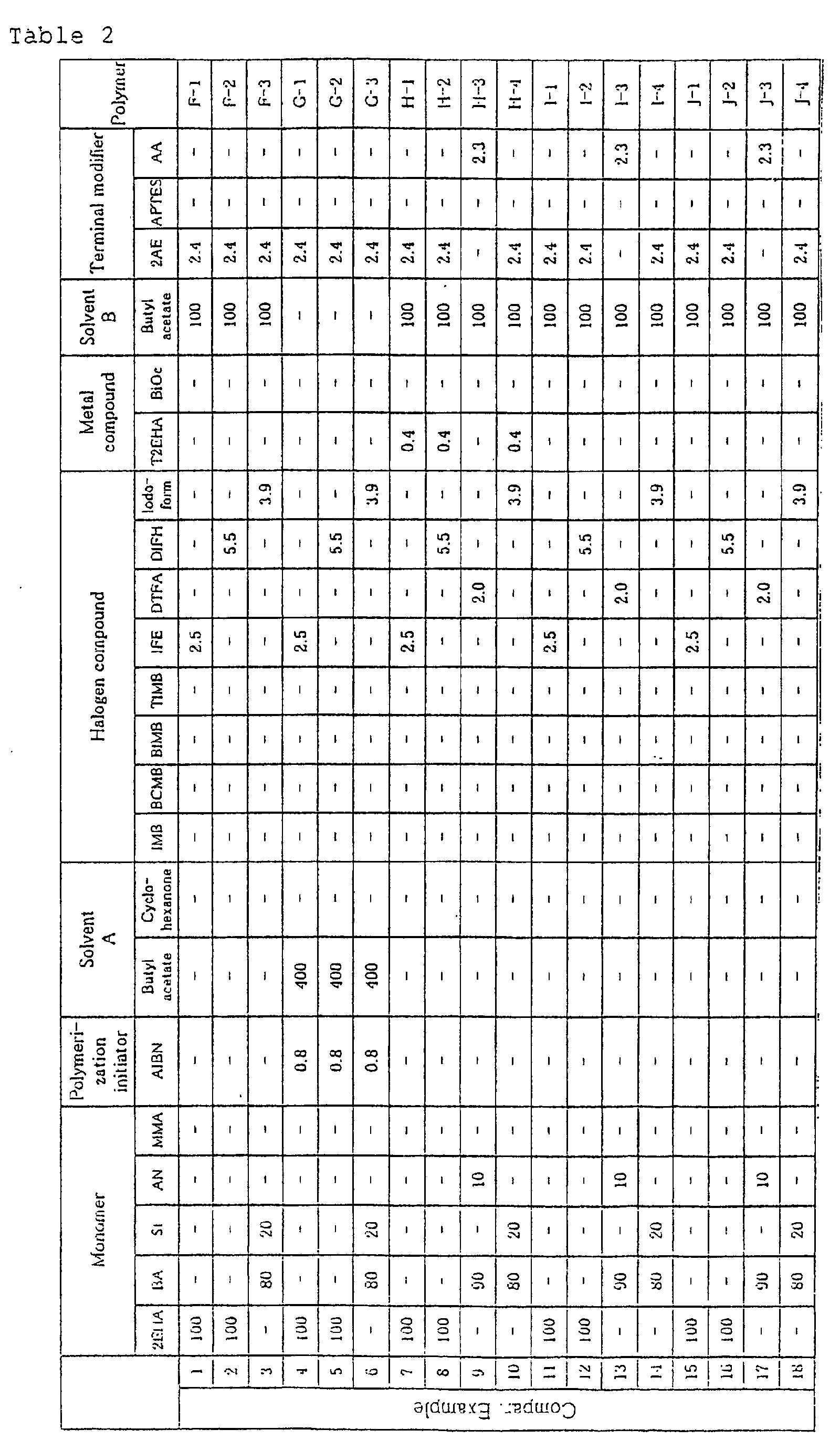 The values in Tables 1 and 2 represent parts by weight.
The monomers are indicated by the following abbreviations
in Tables 1 and 2.
- EHA:
- 2-Ethylhexyl acrylate
- BA:
- Butyl acrylate
- St:
- Styrene
- AN:
- Acrylonitrile
- MMA:
- Methyl methacrylate
The halogen compounds are indicated by the following
abbreviations in Tables 1 and 2.
- IMB:
- Iodomethylbenzene
- BCMB:
- 1,4-Bis(chloromethyl)benzene
- BIMB:
- 1,4-Bis(iodomethyl)benzene
- TIMB:
- 1,3,5-Tris(iodomethyl)benzene
- IFE:
- Iodoperfluoroethane
- DTFA:
- 1,3-Dichlorotetrafluoroacetone
- DIFH:
- 1,6-Diiodoperfluorohexane
The metal compounds are indicated by the following
abbreviations in Tables 1 and 2.
- T2EHA:
- Tin bis(2-ethylhexanoate)
- BiOc:
- Bismuth trioctylate
The terminal modifiers are indicated by the following
abbreviations in Tables 1 and 2.
- 2AE:
- 2-Aminoethanol
- APTES:
- 3-Aminopropyltriethoxysilane
- AA:
- Allylamine
The polymerization product obtained was subjected to gel
permeation column chromatography (column: product of Showa
Denko: KF-80M×2) using tetrahydrofuran as the eluent and the
number a verage molecular weighty, weight average molecular weight,
and molecular weight distribution (MW/MN, the ratio between the
weight average molecular weight, MW, and the number average
molecular weight, MN) of the polymerization product were
determined from the calibration curve constructed with
polystyrene standards. The number average molecular weight and
molecular weight distribution (MW/MN) thus obtained are shown
in Tables 3 and 4.
Depending on the kind of each terminal group, the following
titrimetric procedure was carried out and the terminal functional
group introduction rate was calculated. The terminal
functional group introduction rate is expressed in percentage
relative to the number of terminal groups ideally introduced
by using the value found from the number of terminal functional
groups obtained by the titrimetric procedure described below
and the number average molecular weight obtained by gel
permeation column chromatography. The terminal functional
group introduction rates thus obtained are shown in Tables 3
and 4.
The number of terminal hydroxyl groups in each of the
polymerization products obtained in Examples 1 to 5, 7 to 9,
12 to 14, 16 to 18, and 21 and Comparative Examples 1 to 8, 10
to 12, 14 to 16, and 18 was calculated by esterifying with a
solution of phthalic anhydride in pyridine and titrating the
stoichiometric excess of the reagent with a solution of sodium
hydroxide in accordance with JIS K 1557.
The number of terminal vinyl groups in each of the
polymerization products obtained in Examples 10, 15 and 19 and
Comparative Examples 9, 13 and 17 was determined by 1H-NMR in
deuteriochloroform and calculated.
The number of terminal ethoxysilyl groups in each of the
polymerization products obtained in Examples 6, 11 and 20 was
determined by 1H-NMR in deuteriochloroform and calculated.

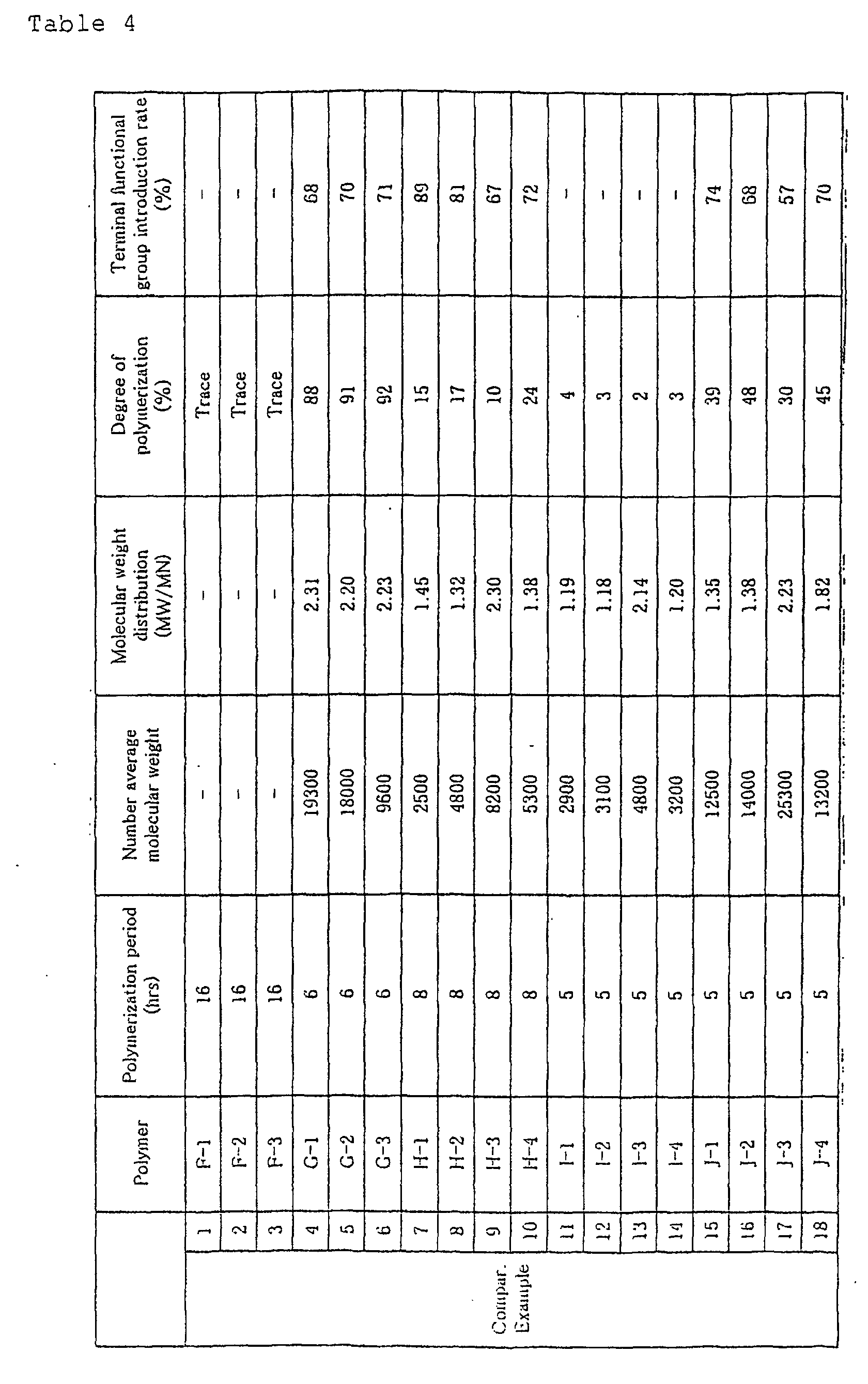
In the production method of a functional group-terminated
vinyl polymer in accordance with the first and the second aspect
of the invention, a radical polymerization is carried out in
the presence of a halogen compound having the structure defined
hereinabove so that a halogen atom-terminated polymer can be
synthesized with certainty. Further, as the terminal halogen
atom is then transformed, the reaction proceeds living-wise with
low chances for side reactions so that a functional group can
be easily introduced into the terminus to produce the objective
polymer practically without reaction condition problems such
as strictly anhydrous conditions.
Furthermore, using a 14 to 16 metal compound in the step
of said radical polymerization leads to a curtailed reaction
period and a higher degree of polymerization of the vinyl polymer.
In addition, the functional group-terminated vinyl
polymer according to the third aspect of the invention has a
number average molecular weight within a defined range and the
chain extension by terminal-terminal crosslinking takes place
with good efficiency so that a high molecular weight polymer
having a linearly elongated chain can be produced and, therefore,
a cured product with good elongation and tensile strength,
outstanding heat resistance, water resistance and durability
can be obtained.
Therefore, the functional group-terminated vinyl polymer
according to the third aspect of the invention is useful as a
raw material for the production of various functional products.
Claims (6)
- A production method of a functional group-terminated vinyl polymer comprising
a step of synthesizing a halogen atom-terminated vinyl polymer by the radical polymerization reaction of a vinyl monomer in the presence of a halogen compound and
a step of introducing a functional group to a terminus by substituting a functional group-containing group for the terminal halogen atom of said vinyl polymer,
said halogen compound having a structure such that said halogen atom is bound to a carbon atom linked to an aromatic ring and
said radical polymerization reaction being carried out either by light irradiation or light irradiation in the presence of a Group 14 to 16 metal compound or by heating in the presence of a Group 14 to 16 metal compound. - The production method of a functional group-terminated vinyl polymer according to Claim 1,
wherein the halogen compound has two or more halogen atoms . - A production method of a functional group-terminated vinyl polymer comprising
a step of synthesizing an iodine atom-terminated vinyl polymer by the radical polymerization reaction of a vinyl monomer in the presence of an iodine compound and
a step of introducing a functional group to the terminus by substituting a functional group-containing group for the terminal iodine atom of said vinyl polymer,
said iodine compound having a structure such that said iodine atom is bound to a carbon atom linked to an aromatic ring and
said radical polymerization reaction being carried out either by heating or by heating in the presence of a radical polymerization initiator. - The production method of a functional group-terminated vinyl polymer according to Claim 3,
wherein the iodine compound has two or more iodine atoms. - The production method of a functional group-terminated vinyl polymer according to Claim 1, 2, 3 or 4,
wherein the functional group to be introduced into a terminus is one or more functional groups selected from the group consisting of hydroxyl, amino, carboxyl, vinyl and silyl groups. - A functional group-terminated vinyl polymer as obtainable by the production method according to Claim 1, 2, 3, 4 or 5,
which has a number average molecular weight of 500 to 50, 000 and a terminal functional group introduction rate of not less than 90%.
Applications Claiming Priority (7)
| Application Number | Priority Date | Filing Date | Title |
|---|---|---|---|
| JP10437899 | 1999-04-12 | ||
| JP10437899 | 1999-04-12 | ||
| JP14004199 | 1999-05-20 | ||
| JP14004199 | 1999-05-20 | ||
| JP18016499 | 1999-06-25 | ||
| JP18016499 | 1999-06-25 | ||
| PCT/JP2000/002386 WO2000061641A1 (en) | 1999-04-12 | 2000-04-12 | Process for producing vinyl polymer having functional group at end and vinyl polymer having functional group at end |
Publications (2)
| Publication Number | Publication Date |
|---|---|
| EP1243599A1 true EP1243599A1 (en) | 2002-09-25 |
| EP1243599A4 EP1243599A4 (en) | 2004-06-16 |
Family
ID=27310212
Family Applications (1)
| Application Number | Title | Priority Date | Filing Date |
|---|---|---|---|
| EP00915495A Withdrawn EP1243599A4 (en) | 1999-04-12 | 2000-04-12 | PROCESS FOR PRODUCING VINYL POLYMER HAVING A FUNCTIONAL GROUP AT ITS END, AND SUCH A POLYMER |
Country Status (7)
| Country | Link |
|---|---|
| US (2) | US6693142B1 (en) |
| EP (1) | EP1243599A4 (en) |
| KR (1) | KR20010110747A (en) |
| CN (2) | CN1137907C (en) |
| CA (1) | CA2377907A1 (en) |
| TW (1) | TW527369B (en) |
| WO (1) | WO2000061641A1 (en) |
Families Citing this family (3)
| Publication number | Priority date | Publication date | Assignee | Title |
|---|---|---|---|---|
| JP2003022892A (en) * | 2001-07-06 | 2003-01-24 | Semiconductor Energy Lab Co Ltd | Light emitting device manufacturing method |
| US20100222446A1 (en) * | 2005-12-28 | 2010-09-02 | Kaneka Corporation | Curable composition for both photoradical curing and thermal radical curing |
| JP2011178888A (en) * | 2010-03-01 | 2011-09-15 | Nitto Denko Corp | Composition for thermosetting silicone resin |
Family Cites Families (5)
| Publication number | Priority date | Publication date | Assignee | Title |
|---|---|---|---|---|
| DE69425172T2 (en) * | 1993-03-22 | 2001-03-15 | The Geon Co., Cleveland | "Pseudo-living" radical polymerization |
| US5345018A (en) * | 1993-03-22 | 1994-09-06 | The Geon Company | Method for preparing 1-chloro-1-iodoethane |
| US5807937A (en) * | 1995-11-15 | 1998-09-15 | Carnegie Mellon University | Processes based on atom (or group) transfer radical polymerization and novel (co) polymers having useful structures and properties |
| DE69729843T2 (en) * | 1996-11-28 | 2005-08-25 | Kaneka Corp. | A process for producing a hydroxyl-terminated (meth) acrylic polymer and this polymer |
| EP1197499B1 (en) * | 1998-06-01 | 2006-03-08 | Kaneka Corporation | Process for producing polymer, the polymer, and curable composition comprising the polymer |
-
2000
- 2000-04-12 KR KR1020017013037A patent/KR20010110747A/en not_active Ceased
- 2000-04-12 TW TW089106769A patent/TW527369B/en not_active IP Right Cessation
- 2000-04-12 EP EP00915495A patent/EP1243599A4/en not_active Withdrawn
- 2000-04-12 CN CNB008061599A patent/CN1137907C/en not_active Expired - Fee Related
- 2000-04-12 US US10/019,055 patent/US6693142B1/en not_active Expired - Fee Related
- 2000-04-12 WO PCT/JP2000/002386 patent/WO2000061641A1/en not_active Ceased
- 2000-04-12 CA CA002377907A patent/CA2377907A1/en not_active Abandoned
- 2000-04-12 CN CNB031486495A patent/CN1219799C/en not_active Expired - Fee Related
-
2003
- 2003-10-31 US US10/697,013 patent/US7030171B2/en not_active Expired - Fee Related
Also Published As
| Publication number | Publication date |
|---|---|
| TW527369B (en) | 2003-04-11 |
| US7030171B2 (en) | 2006-04-18 |
| CN1346374A (en) | 2002-04-24 |
| CN1495201A (en) | 2004-05-12 |
| KR20010110747A (en) | 2001-12-13 |
| US6693142B1 (en) | 2004-02-17 |
| CN1137907C (en) | 2004-02-11 |
| CA2377907A1 (en) | 2000-10-19 |
| CN1219799C (en) | 2005-09-21 |
| WO2000061641A1 (en) | 2000-10-19 |
| EP1243599A4 (en) | 2004-06-16 |
| US20040092619A1 (en) | 2004-05-13 |
Similar Documents
| Publication | Publication Date | Title |
|---|---|---|
| KR101512390B1 (en) | Curable compositions with moisture-curable functionality clusters near the chain ends | |
| JPH06506969A (en) | Graft polymer of isomonoolefin and alkylstyrene | |
| US7030171B2 (en) | Process for producing vinyl polymer having functional group at end and vinyl polymer having functional group at end | |
| CA1071800A (en) | Polymers | |
| JP2000327713A (en) | Method for producing vinyl polymer having terminal functional group, and vinyl polymer having functional group at terminal | |
| JP3256544B2 (en) | Method for producing polymer having functional group which may be protected at the terminal | |
| JPWO2000061641A1 (en) | Method for producing vinyl polymer having functional group at terminal and vinyl polymer having functional group at terminal | |
| CA2266252A1 (en) | Process for the production of telechelic substances, telechelic substances produced in this manner and use thereof | |
| JPS62250012A (en) | Production of polymer having functional group at one terminal | |
| WO1999062965A1 (en) | Process for producing polymer, the polymer, and curable composition comprising the polymer | |
| JPWO1995025753A1 (en) | Method for producing polymer having optionally protected functional group at terminal | |
| JPH11140127A (en) | Method for producing acrylic polymer having functional groups at both ends | |
| JPS62232408A (en) | Production of acrylic polymer having functional group on one terminal | |
| JP2000355610A (en) | Method for producing vinyl polymer having terminal functional group, and vinyl polymer having functional group at terminal | |
| JPH04149207A (en) | Production of telechelic polymer terminated with carboxyl group or its salt | |
| JPS58176213A (en) | Manufacture of ester end group-containing polytetrahydrofuran | |
| US5221718A (en) | Process for the preparation of copolymers containing nitrile groups based on ethylenically unsaturated monomers | |
| JPH0710957A (en) | Curable composition | |
| JPS6348881B2 (en) | ||
| JP3054518B2 (en) | Method for producing macromonomer with excellent weather resistance | |
| JP2010144140A (en) | Mercapto group-containing copolymer and method of manufacturing the same | |
| JPH0725938A (en) | Curable vinyl polymer and method for producing the same | |
| JP4752178B2 (en) | Maleimide group-containing crosslinked polymer particles and method for producing the same | |
| JPH07206970A (en) | Curing composition | |
| JPH07206971A (en) | Curing composition |
Legal Events
| Date | Code | Title | Description |
|---|---|---|---|
| PUAI | Public reference made under article 153(3) epc to a published international application that has entered the european phase |
Free format text: ORIGINAL CODE: 0009012 |
|
| 17P | Request for examination filed |
Effective date: 20020129 |
|
| AK | Designated contracting states |
Kind code of ref document: A1 Designated state(s): DE FR GB IT NL |
|
| A4 | Supplementary search report drawn up and despatched |
Effective date: 20040506 |
|
| R17P | Request for examination filed (corrected) |
Effective date: 20020129 |
|
| 17Q | First examination report despatched |
Effective date: 20091211 |
|
| STAA | Information on the status of an ep patent application or granted ep patent |
Free format text: STATUS: THE APPLICATION IS DEEMED TO BE WITHDRAWN |
|
| 18D | Application deemed to be withdrawn |
Effective date: 20100622 |