EP1243571A2 - Stabilisation of vinyl monomers by compositions based on alkylhydroxylamines - Google Patents
Stabilisation of vinyl monomers by compositions based on alkylhydroxylamines Download PDFInfo
- Publication number
- EP1243571A2 EP1243571A2 EP02290683A EP02290683A EP1243571A2 EP 1243571 A2 EP1243571 A2 EP 1243571A2 EP 02290683 A EP02290683 A EP 02290683A EP 02290683 A EP02290683 A EP 02290683A EP 1243571 A2 EP1243571 A2 EP 1243571A2
- Authority
- EP
- European Patent Office
- Prior art keywords
- composition
- alkyl
- compound
- deha
- sulfide
- Prior art date
- Legal status (The legal status is an assumption and is not a legal conclusion. Google has not performed a legal analysis and makes no representation as to the accuracy of the status listed.)
- Withdrawn
Links
- 0 *C(C1O)=CC(*)=CC1O Chemical compound *C(C1O)=CC(*)=CC1O 0.000 description 3
Classifications
-
- C—CHEMISTRY; METALLURGY
- C07—ORGANIC CHEMISTRY
- C07C—ACYCLIC OR CARBOCYCLIC COMPOUNDS
- C07C7/00—Purification; Separation; Use of additives
- C07C7/20—Use of additives, e.g. for stabilisation
-
- C—CHEMISTRY; METALLURGY
- C07—ORGANIC CHEMISTRY
- C07B—GENERAL METHODS OF ORGANIC CHEMISTRY; APPARATUS THEREFOR
- C07B63/00—Purification; Separation; Stabilisation; Use of additives
- C07B63/04—Use of additives
Definitions
- compositions for stabilization of vinyl monomers include(A) at least one alkyl hydroxyl amine compound and at least one sulfide compound, or (B) at least two alkyl hydroxyl amine compounds and at least one phenolic compound.
- Butadiene for example, forms butadiene peroxide in contact with oxygen which can lead to uncontrolled polymerization.
- Mayer-Mader, R.; Hohmann, G; US Patent 3,878,181; 1975; (Bayer Aktiengesellschaft) discloses a process for terminating emulsion polymerization of chloroprene and/or 2,3-dichlorobutadiene using a mixture of DEHA and a water-soluble amine (such as triethanolamine).
- compositions for inhibiting popcorn formation in olefin production apparatus comprises compounds selected from hydroxylamines, oximes, mercaptans, etc., and optionally antioxidants and surfactants.
- Such an inhibitor comprises at least one compound selected from a group that include phenylenediamine, hydroxylamine, etc. The inhibitor is applied to the inner surface when the operation of the production apparatus is suspended.
- Arhancet, G. B.; Henrici, I. K.; US Patent 5,396,004; 1995; (Betz Laboratories, Inc.) discloses a mixture of phenylenediamine and a hydroxylamine compound for inhibiting polymerization of vinyl aromatic monomers under distillation conditions.
- a composition is either a mixture of an oxime and a hydroxylamine compound, or a mixture of an oxime, a hydroxylamine, and a phenylenediamine compound.
- a composition comprises a dinitrophenol, a hydroxylamine, and a phenylenediamine compound.
- the preferred hydroxylamine compound is claimed to be bishydroxypropylhydroxylamine.
- hydroxylamines are DEHA and isopropylhydroxylamine(NiPHA).
- the preferred hydroxylamine in such a composition is bis(hydroxypropyl)hydroxylamine.
- the preferred hydroxylamine in such a composition is bis(hydroxypropyl)hydroxylamine.
- Arhancet, G. B.; Henrici, I. K.; WO Patent 9,735,821; 1997; (BetzDearborn Inc.) discloses a composition for inhibiting polymerization of vinyl aromatic monomers in the absence of oxygen.
- Such a composition comprises a hydroxylamine and a phenylenediamine compound.
- hydroxylamines are DEHA, NiPHA, and bis(hydroxypropyl)hydroxylamine.
- Ukita, K.; Onodera, Y.; Futamura, S.; JP Patent 10,251,663; 1998; (Nippon Zeon Co., Ltd.) discloses a method of preventing polymerization in an extractive distillation process for isoprene separation.
- a di-lower-alkylhydroxylamine e.g., DEHA
- DEHA di-lower-alkylhydroxylamine
- Arhancet, G. B.; Bringol, E. H.; WO Patent 9,802,403; 1998; (BetzDearborn Inc.) provides a method of using a combination of a phenol and a hydroxylamine compound to inhibit polymerization of vinyl aromatic monomers in reactor effluent condenser and vent gas compressor systems.
- the most preferred hydroxylamine claimed is DEHA.
- the objective of the present invention to develop improved stabilizing compositions compared to conventional phenolic stabilizers and alkylhydrooxyyl amine compositions.
- the present invention relates to the synergistic behavior involving certain combinations of alkylhydroxylamines with phenolic and sulfide compounds.
- compositions of the present invention are blends of alkylhydroxylamines with either phenolic compounds or sulfide compounds which are synergistic and superior to individual alkylhydroxylamines and conventional stabilizers (such as TBC) based on their stabilizing ability.
- compositions of the present invention include vapor-phase popcorn inhibition, low cost and toxicity, and scavenging of potentially present organic peroxides.
- compositions are based on blends of two or more alkylhydroxylamines with phenolic compounds or blends of alkylhydroxylamines with sulfide compounds where synergistic effects are exploited for targeted applications.
- the amine-based ingredients may vary between 10-90 wt.% of the total stabilizer. If an amine mixture is used, each amine compound may account for 20-80 wt.% of amines.
- Such composite stabilizers find applications in stabilizing dienes (such as butadiene and isoprene), vinyl aromatic monomers (styrene and its derivatives), and acrylic acid and its esters.
- An amine compound useful in the present invention may be an alkylhydroxylamine or its corresponding amine oxide.
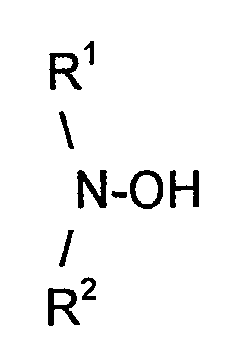
- the alkylhydroxylamine compound has the general formula: where R 1 and R 2 are the same or different, and they could be hydrogen, alkyl, hydroxyalkyl, alkoxyalkyl, and sulfonated alkyl groups, they could be cyclic or branched, but they may not both be H, a H and a methyl, and both be methyl.
- Phenolic compounds useful in the present invention have the general formula: wherein R 3 and R 5 are the same or different, and can be hydrogen, alkyl, hydroxyl, and alkyl aryl groups; R 4 is C 1 -C 20 , alkanoic acid ester, alkyl aryl, alkylamino, or amine groups.
- the sulfide compound has the general formula: R 6 -S x -(R 7 -S x ) y -R 8 wherein each x is independently a number between 1-10, y is a number between 0-50, and R 6 , R 7 and R 8 are the same or different, and can be alkyl and aryl groups.
- the aryl group is preferred to be phenolic.
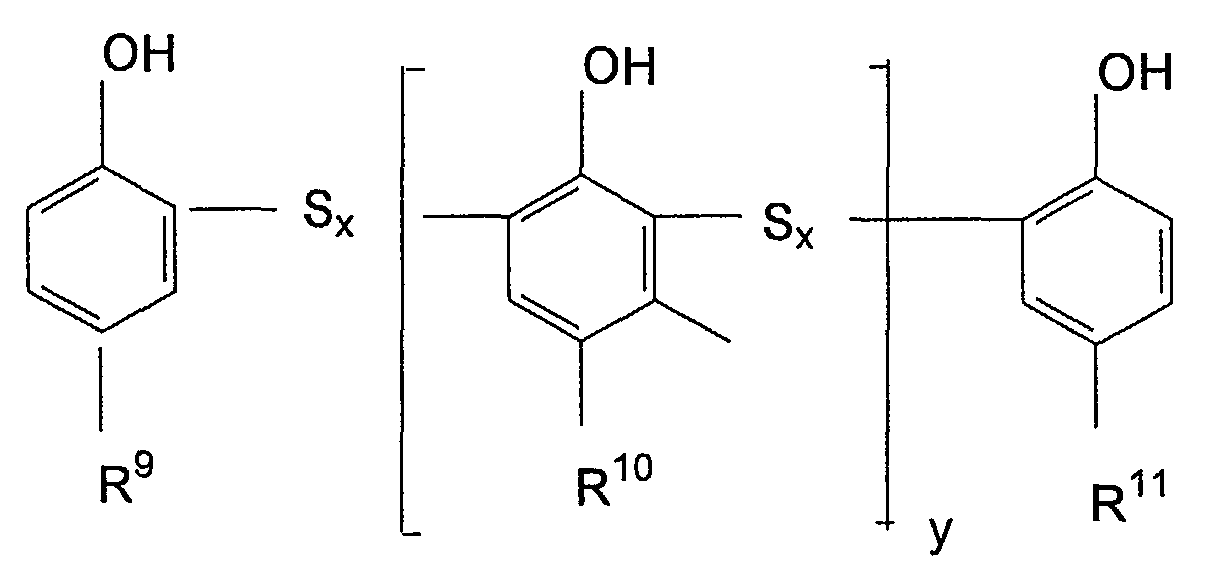
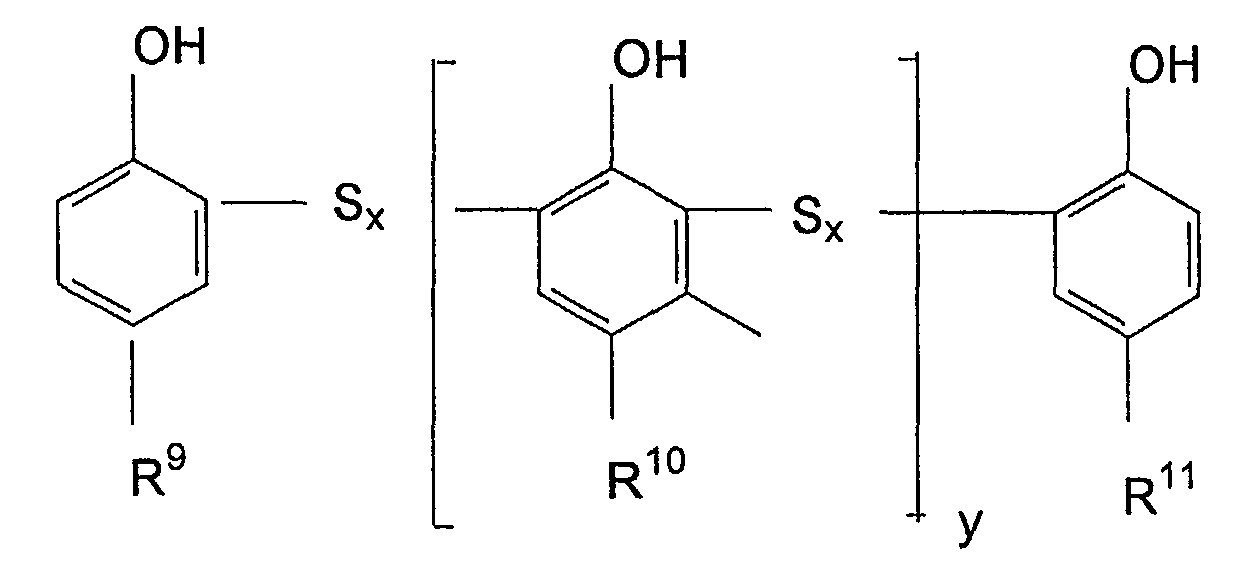
- a preferred sulfide is an alkyl phenol sulfide having the formula: wherein each x is independently a number between 1-10, y is a number between 1-50, preferably 1-20, and R 9 . R 10 and R 11 are each 1,1-dimethylpropyl.
- a series of sulfides having such a formula are sold by ATOFINA Chemicals, Inc. under the trademark Vultac®.
- the monomer being stabilized could be extended to other compounds of the same class based on their structural similarity and chemical reactivity.
- a chemical environment refers to a solvent reservoir where targeted vinyl monomers are dissolved/dispersed.
- the composite stabilizers disclosed in this invention can be altered in that their composition could be varied, and various amine, phenolic and sulfide compounds could be used.
- Typical synergistic compositions disclosed in this invention include two-component systems with at least one component being an alkylhydroxylamine (or its corresponding amine oxide), and three-component systems with two components being alkylhydroxylamines (or their corresponding amine oxides).
- compositions exhibit better performance inhibiting polymerization than currently used commercial stabilizers; they are suitable for stabilizing dienes (such as butadiene and isoprene), vinyl aromatic compounds (such as styrene and its derivatives), and acrylic acid and its esters.
- dienes such as butadiene and isoprene
- vinyl aromatic compounds such as styrene and its derivatives
- acrylic acid and its esters are suitable for stabilizing dienes (such as butadiene and isoprene), vinyl aromatic compounds (such as styrene and its derivatives), and acrylic acid and its esters.
- compositions are particularly advantageous for use under hostile environments, for example, chemical processing involving vinyl compounds at high temperatures.
- One such application is targeted at the process of extractive distillation involved in the manufacturing of butadiene and isoprene.
- Another such application is targeted at the process of manufacturing styrene from ethyl benzene dehydrogenation.
- advantages of the disclosed compositions over conventional stabilizers include higher performance, lower toxicity and cost, and more effective vapor-phase popcorn inhibition.
- compositions are binary stabilizer of diethylhydroxylamine (DEHA) and Vultac®, a series of alkyl phenol sulfides sold by ATOFINA Chemicals, Inc.; the composite shows excellent performance stabilizing styrene and its derivatives.
- DEHA diethylhydroxylamine
- Vultac® a series of alkyl phenol sulfides sold by ATOFINA Chemicals, Inc.
- Another example is a ternary stabilizer of DEHA, dibutylhydroxylamine (DBHA), and 4- tert - butylcatechol (TBC); this composite system exhibits superb performance stabilizing butadiene and isoprene at elevated temperatures.
- the preferred monomer stabilizer among the disclosed compositions varies depending on targeted applications.
- binary and ternary stabilizers are disclosed with at least one component being an alkylhydroxylamine.
- alkylhydroxylamine is 10-90 wt.%, preferably, 40-80 wt.% of the total composition.
- the preferred alkylhydroxylamine is DEHA
- the preferred sulfide is an alkyl phenol sulfide, such as those sold under the trademark Vultac®.
- two alkylhydroxylamines account for 20-90%, preferably, 50-80% of the total composition; each hydroxylamine is 10-90 wt.%, preferably, 30-70 wt.% of hydroxylamines.
- the preferred alkylhydroxylamines are DEHA and DBHA, and the preferred phenolic compound is TBC.
- the amount of stabilizer composition needed to effectively stabilize vinyl compounds depends on the type of monomer and the process conditions associated with particular applications. Generally, a level of 1-5000 ppm, and preferably 10-1000 ppm stabilizer is added to effectively prevent polymerization. These compositions could be added to the process streams during monomer manufacturing, or directly added to monomers during storage and shipping.
- a heat-induced gum test was performed to evaluate various inhibitors for their ability to stabilize butadiene; the test is an adaption of ASTM D 381, "Standard Test Method for Existent Gum in Fuels by Jet Evaporation", and ASTM D 873, "Standard Test Method for Oxidation Stability of Aviation Fuels (Potential Residue Method)".
- a ternary stabilizer of 35 ppm DEHA, 35 ppm DBHA, and 30 ppm TBC is the most effective among the investigated stabilizers.
- This ternary system produced 234 mg/100 mL of insoluble gum and 460 mg/100 mL of total gum, a ⁇ 40% reduction in insoluble gum and a ⁇ 20% reduction in total gum compared to the best of the rest inhibitors in each category.
- the DEHA/Vultac® 7 composition exhibits markedly better performance stabilizing divinylbenzene than does the conventional TBC stabilizer.
Landscapes
- Chemical & Material Sciences (AREA)
- Organic Chemistry (AREA)
- Engineering & Computer Science (AREA)
- Analytical Chemistry (AREA)
- Oil, Petroleum & Natural Gas (AREA)
- Water Supply & Treatment (AREA)
- Organic Low-Molecular-Weight Compounds And Preparation Thereof (AREA)
- Polymerisation Methods In General (AREA)
Abstract
Description


| Stabilizer | Soluble Gum | Insoluble Gum | Total Gum |
| 100 ppm TBC | 87 mg/100 mL | 549 mg/100 mL | 636 mg/100 mL |
| 100 ppm DEHA | 383 mg/100 mL | 345 mg/100 mL | 728 mg/100 mL |
| 100 ppm DBHA | 316 mg/100 mL | 602 mg/100 mL | 918 mg/100 mL |
| 50 ppm DEHA /50 ppm DBHA | 318 mg/100 mL | 796 mg/100 mL | 1114 mg/100 mL |
| 50 ppm DEHA /50 ppm TBC | 189 mg/100 mL | 382 mg/100 mL | 571 mg/100 mL |
| 50ppm TBC /50 ppm DBHA | 210 mg/100 mL | 899 mg/100 mL | 1109 mg/100 mL |
| 30ppm TBC /35 ppm DEHA /35 ppm DBHA | 226 mg/100 mL | 234 mg/100 mL | 460 mg/100 mL |
| Time, hr. | ||||||
| Stabilizer | 0.25 | 0.50 | 0.75 | 1.0 | 1.5 | 2 |
| Weight % of divinylbenzene converted to polymer | ||||||
| None | 1.43 | 5.39 | -- | -- | -- | -- |
| 1000 ppm TBC | 0.36 | 2.06 | 3.90 | 6.66 | -- | -- |
| 1000 ppm DEHA | 0.20 | 0.43 | 1.88 | 2.73 | 4.88 | 7.25 |
| 1000 ppm Vultac® 7 | 0.75 | 2.29 | 4.03 | 6.04 | -- | -- |
| 500 ppm TBC /500 ppm Vultac® 7 | 0.39 | 1.86 | 4.29 | 5.53 | -- | -- |
| 500 ppm DEHA /500 ppm TBC | 0.07 | 0.76 | 1.46 | 2.44 | 4.13 | 5.95 |
| 500 ppm DEHA /500 ppm Vultac® 7 | 0.05 | 0.58 | 1.53 | 2.09 | 4.10 | 6.20 |
Claims (13)
- A composition for stabilization of vinyl monomers; the composition including(a) at least one alkylhydroxylamine compound and at least one sulfide compound, or (b) at least two alkylhydroxylamine compounds and at least one phenolic compound.
- The composition of claim 1 wherein the amine compound is an alkylhydroxylamine or its corresponding amine oxide.
- The composition of claim 1 or 2 wherein amine components are 10-90 wt.% of the total composition.
- The composition of any one of claims 1 to 3 wherein each of the alkylhydroxylamine compounds has the general formula:where R1 and R2 are the same or different, and can be hydrogen, alkyl, hydroxyalkyl, alkoxyalkyl, and sulfonated alkyl groups, cyclic or branched, but cannot both be H, a H and a methyl, or both be methyl.
- The composition of any one of claims 1 to 4 wherein the phenolic compounds has the formula:wherein R3 and R5 are the same or different, and can be hydrogen, alkyl, hydroxyl, and alkaryl groups; and

R4 is C1-C20 alkyl, alkanoic acid ester, alkyl aryl, alkylamino, or amine groups. - The composition of any one of claims 1 to 5 wherein the stabilizer is comprised of diethylhydroxylamine (DEHA), dibutylhydroxylamine (DBHA), and 4-tert-butylcatechol (TBC).
- The composition of claim 6 comprised of 25-45% DEHA, 25-45% DBHA, and 20-40% TBC.
- The composition of any one of claims 1 to 5 wherein the sulfide compound has the general formula:
- The composition of claim 8 wherein the aryl group is phenolic.
- The composition of claim 8 or 9 wherein the sulfide is an alkyl phenol sulfide having the formula:wherein each x is independently a number between 1-10
y is a number between 1-50, preferably 1-20
and R9, R10 and R11 are each 1,1-dimethylpropyl. - The composition of any one of claims 8 to 10 therein the sulfide is a an amylphenoldisulfide polymer.
- A process for the stabilization of dienes, vinyl aromatic monomers, or acrylic acid and its esters by the addition of the composition of any one of claims 1 to 11.
- The composition of any one of Claims 1 to 11 used to stabilize butadiene, isoprene or styrene.
Applications Claiming Priority (2)
| Application Number | Priority Date | Filing Date | Title |
|---|---|---|---|
| US27721401P | 2001-03-20 | 2001-03-20 | |
| US277214P | 2001-03-20 |
Publications (2)
| Publication Number | Publication Date |
|---|---|
| EP1243571A2 true EP1243571A2 (en) | 2002-09-25 |
| EP1243571A3 EP1243571A3 (en) | 2003-01-15 |
Family
ID=23059885
Family Applications (1)
| Application Number | Title | Priority Date | Filing Date |
|---|---|---|---|
| EP02290683A Withdrawn EP1243571A3 (en) | 2001-03-20 | 2002-03-19 | Stabilisation of vinyl monomers by compositions based on alkylhydroxylamines |
Country Status (2)
| Country | Link |
|---|---|
| US (1) | US6761833B2 (en) |
| EP (1) | EP1243571A3 (en) |
Families Citing this family (3)
| Publication number | Priority date | Publication date | Assignee | Title |
|---|---|---|---|---|
| US8964604B2 (en) * | 2000-12-26 | 2015-02-24 | Polycom, Inc. | Conference endpoint instructing conference bridge to dial phone number |
| US20040143051A1 (en) * | 2003-01-22 | 2004-07-22 | Jianfeng Lou | Unsaturated polyester resin compositions with improved processing and storage stability |
| JP6043937B2 (en) * | 2012-08-16 | 2016-12-14 | 株式会社片山化学工業研究所 | Composition for inhibiting polymerization of vinyl aromatic monomer |
Family Cites Families (32)
| Publication number | Priority date | Publication date | Assignee | Title |
|---|---|---|---|---|
| US2410408A (en) * | 1944-03-01 | 1946-11-05 | Monsanto Chemicals | Stabilization of vinyl compounds |
| US2458494A (en) * | 1946-09-21 | 1949-01-11 | Monsanto Chemicals | Stabilization of vinyl compounds |
| DE1643205A1 (en) * | 1967-03-23 | 1972-05-10 | Wacker Chemie Gmbh | Stabilization of monomeric, ethylenically unsaturated compounds |
| DE2148185C3 (en) * | 1971-09-27 | 1975-05-28 | Wacker-Chemie Gmbh, 8000 Muenchen | POLYMERIZATION INHIBITOR FOR POLYMERIZABLE VINYL-BASED ALIPHATIC, AROMATIC AND HETEROCYCLIC COMPOUNDS |
| DE2301158A1 (en) | 1973-01-11 | 1974-07-18 | Bayer Ag | EMULSION POLYMERIZATION OF CHLOROPRENE WITH DIAETHYLHYDROXYLAMINE AS A DESACTIVATOR |
| JPS60327B2 (en) * | 1981-04-07 | 1985-01-07 | 東海電化工業株式会社 | Method for decolorizing and preventing coloration of phenols |
| US4409408A (en) | 1982-09-24 | 1983-10-11 | Atlantic Richfield Company | Inhibiting polymerization of vinyl aromatic monomers |
| US4628132A (en) * | 1984-11-23 | 1986-12-09 | Atlantic Richfield Company | Composition and method for inhibiting formation of polymers during gas scrubbing of monomers |
| CA1227449A (en) | 1984-11-23 | 1987-09-29 | John Link | Composition for minimizing fouling of heat exchangers and other hydrocarbon processing equipment |
| US4654450A (en) | 1986-02-24 | 1987-03-31 | Atlantic Richfield Company | Inhibiting polymerization of vinyl aromatic monomers |
| EP0240297A1 (en) * | 1986-04-01 | 1987-10-07 | Betz Europe, Inc. | Inhibiting polymerization of vinyl aromatic compounds |
| US4720566A (en) | 1986-10-23 | 1988-01-19 | Betz Laboratories, Inc. | Method and composition for inhibiting acrylonitrile polymerization |
| JPS63223003A (en) | 1987-03-13 | 1988-09-16 | Tokai Denka Kogyo Kk | Method for suppressing formation of popcorn polymer |
| JPS6413041A (en) | 1987-07-07 | 1989-01-17 | Hakuto Kagaku Kk | Agent for suppressing growth of polymer in olefin-production apparatus |
| US5028340A (en) * | 1988-07-29 | 1991-07-02 | Union Oil Company Of California | Process for treating sulfide-containing water to reduce sulfide emissions therefrom |
| US4997990A (en) * | 1989-03-23 | 1991-03-05 | General Electric Company | Process and composition for stabilization of ar-brominated styrenic monomer |
| US4956020A (en) | 1989-04-28 | 1990-09-11 | Hakuto Chemical Co., Ltd. | Inhibiting popcorn polymer growth |
| US5282957A (en) | 1992-08-19 | 1994-02-01 | Betz Laboratories, Inc. | Methods for inhibiting polymerization of hydrocarbons utilizing a hydroxyalkylhydroxylamine |
| CA2099168A1 (en) | 1992-10-21 | 1994-04-22 | Betzdearborn Inc. | Compositions and methods for inhibiting styrene polymerization |
| ES2096220T3 (en) | 1992-10-21 | 1997-03-01 | Betz Europ Inc | COMPOSITIONS AND METHODS TO INHIBIT THE VINYL-AROMATIC MONOMER POLYMERIZATION. |
| US5648574A (en) | 1992-10-21 | 1997-07-15 | Betzdearborn Inc. | Compositions and methods for inhibiting vinyl aromatic monomer polymerization |
| JP3392181B2 (en) * | 1993-06-03 | 2003-03-31 | 電気化学工業株式会社 | Method for producing chloroprene graft copolymer |
| US5426257A (en) | 1994-06-30 | 1995-06-20 | Betz Laboratories, Inc. | Compositions and methods for inhibiting vinyl aromatic monomer polymerization |
| US5446220A (en) | 1994-08-24 | 1995-08-29 | Betz Laboratories, Inc. | Methods for inhibiting vinyl aromatic monomer polymerization |
| US5648572A (en) | 1995-05-31 | 1997-07-15 | Betzdearborn Inc. | Compositions and methods for inhibiting vinyl aromatic monomer polymerization |
| US5648573A (en) | 1995-06-12 | 1997-07-15 | Betzdearborn Inc. | Compositions and methods for inhibiting vinyl aromatic monomer polymerization |
| WO1998002403A1 (en) | 1996-07-15 | 1998-01-22 | Betzdearborn Inc. | Method for inhibiting vinyl aromatic monomer polymerization in condenser and compression systems |
| DE19647291A1 (en) * | 1996-11-15 | 1998-05-20 | Bayer Ag | Process for the preparation of microencapsulated polymers |
| JPH10251663A (en) | 1997-03-13 | 1998-09-22 | Nippon Zeon Co Ltd | Method for preventing polymerization of conjugated dienes |
| AT406010B (en) * | 1998-02-09 | 2000-01-25 | Andreas Dr Berg | TEST PHANTOM FOR CONTROLLING THE IMAGE QUALITY IN HIGH-RESOLUTION NMR IMAGING (NMR MICROSCOPY) FOR MEDICAL AND BIOLOGICAL APPLICATIONS AND IN MATERIALS OR MATERIALS RESEARCH |
| ATE230714T1 (en) * | 1998-09-09 | 2003-01-15 | Baker Hughes Inc | INHIBITION OF POLYMERIZATION OF STYRENE MONOMERS WITH SUBSTITUTED DIHYDROXYARENES AND NITROGEN OXIDES |
| US6495065B1 (en) * | 1999-09-09 | 2002-12-17 | Atofina Chemicals, Inc. | Nitrosamine-inhibiting compositions for shortstopping of free radical emulsion polymerizations |
-
2002
- 2002-02-04 US US10/066,923 patent/US6761833B2/en not_active Expired - Fee Related
- 2002-03-19 EP EP02290683A patent/EP1243571A3/en not_active Withdrawn
Also Published As
| Publication number | Publication date |
|---|---|
| US20020190238A1 (en) | 2002-12-19 |
| US6761833B2 (en) | 2004-07-13 |
| EP1243571A3 (en) | 2003-01-15 |
Similar Documents
| Publication | Publication Date | Title |
|---|---|---|
| CA1282433C (en) | Stabilized vinyl aromatic composition | |
| US4409408A (en) | Inhibiting polymerization of vinyl aromatic monomers | |
| EP1389607B1 (en) | A process for inhibiting polymerization of an aromatic vinyl compound | |
| US2407861A (en) | Process of treating hydrocarbons | |
| US6337426B1 (en) | Antifoulant compositions and processes | |
| KR101949324B1 (en) | Synergistic combination for inhibiting polymerization of vinyl monomers | |
| CN101189203B (en) | Ortho-nitrosophenols as polymerization inhibitors | |
| US9884795B2 (en) | Quinone compounds for inhibiting monomer polymerization | |
| US4434307A (en) | Inhibiting polymerization of vinyl aromatic monomers | |
| US4915873A (en) | Polymerization inhibitor composition for vinyl aromatic compounds | |
| EP1086192A1 (en) | Compositions and methods for inhibiting vinyl aromatic monomer polymerization | |
| US6200461B1 (en) | Method for inhibiting polymerization of ethylenically unsaturated hydrocarbons | |
| AU760809B2 (en) | Styrene monomer polymerization inhibition using substituted dihydroxyarenes and nitroxides | |
| US4654450A (en) | Inhibiting polymerization of vinyl aromatic monomers | |
| US20040034247A1 (en) | Compositions and methods for inhibiting vinyl aromatic monomer polymerization | |
| US5562863A (en) | Methods and compositions for inhibiting vinyl aromatic monomer polymerization | |
| US6761833B2 (en) | Stabilization of monomers by compositions based on alkylhydroxylamines | |
| JP4620659B2 (en) | Water-soluble phenylenediamine composition and method for stabilizing ethylenically unsaturated compounds and monomers | |
| US5416258A (en) | Methods for inhibiting ethylenically unsaturated monomers | |
| JP4795532B2 (en) | Inhibition of isoprene polymerization | |
| EP0282432B1 (en) | Methylene bis(alkylsulfides)as antioxidant synergists in rubber | |
| US6639026B2 (en) | Methods and compositions for inhibiting polymerization of vinyl monomers | |
| EP0155898B1 (en) | Inhibiting polymerization of vinylaromatic monomers | |
| CA2215517C (en) | Treatments for inhibiting vinyl aromatic monomer polymerization | |
| US6039895A (en) | Benzoquinoneimines as vinyl aromatic polymerization inhibitors |
Legal Events
| Date | Code | Title | Description |
|---|---|---|---|
| PUAI | Public reference made under article 153(3) epc to a published international application that has entered the european phase |
Free format text: ORIGINAL CODE: 0009012 |
|
| 17P | Request for examination filed |
Effective date: 20020327 |
|
| AK | Designated contracting states |
Kind code of ref document: A2 Designated state(s): AT BE CH CY DE DK ES FI FR GB GR IE IT LI LU MC NL PT SE TR |
|
| AX | Request for extension of the european patent |
Free format text: AL;LT;LV;MK;RO;SI |
|
| PUAL | Search report despatched |
Free format text: ORIGINAL CODE: 0009013 |
|
| AK | Designated contracting states |
Kind code of ref document: A3 Designated state(s): AT BE CH CY DE DK ES FI FR GB GR IE IT LI LU MC NL PT SE TR |
|
| AX | Request for extension of the european patent |
Free format text: AL;LT;LV;MK;RO;SI |
|
| AKX | Designation fees paid |
Designated state(s): AT BE CH CY DE DK ES FI FR GB GR IE IT LI LU MC NL PT SE TR |
|
| 17Q | First examination report despatched |
Effective date: 20031210 |
|
| GRAP | Despatch of communication of intention to grant a patent |
Free format text: ORIGINAL CODE: EPIDOSNIGR1 |
|
| RAP1 | Party data changed (applicant data changed or rights of an application transferred) |
Owner name: ARKEMA INC. |
|
| STAA | Information on the status of an ep patent application or granted ep patent |
Free format text: STATUS: THE APPLICATION IS DEEMED TO BE WITHDRAWN |
|
| 18D | Application deemed to be withdrawn |
Effective date: 20050625 |