EP1242833B1 - A high resolution radon transform seismic traces processing - Google Patents
A high resolution radon transform seismic traces processing Download PDFInfo
- Publication number
- EP1242833B1 EP1242833B1 EP00927626A EP00927626A EP1242833B1 EP 1242833 B1 EP1242833 B1 EP 1242833B1 EP 00927626 A EP00927626 A EP 00927626A EP 00927626 A EP00927626 A EP 00927626A EP 1242833 B1 EP1242833 B1 EP 1242833B1
- Authority
- EP
- European Patent Office
- Prior art keywords
- radon
- decomposition
- constrained
- frequency
- parabolic
- Prior art date
- Legal status (The legal status is an assumption and is not a legal conclusion. Google has not performed a legal analysis and makes no representation as to the accuracy of the status listed.)
- Expired - Lifetime
Links
- 229910052704 radon Inorganic materials 0.000 title claims description 63
- SYUHGPGVQRZVTB-UHFFFAOYSA-N radon atom Chemical compound [Rn] SYUHGPGVQRZVTB-UHFFFAOYSA-N 0.000 title claims description 63
- 238000000354 decomposition reaction Methods 0.000 claims description 38
- 238000000034 method Methods 0.000 claims description 14
- 230000003595 spectral effect Effects 0.000 claims description 12
- 239000011159 matrix material Substances 0.000 claims description 9
- 239000013598 vector Substances 0.000 claims description 8
- 230000002123 temporal effect Effects 0.000 claims description 4
- 238000001228 spectrum Methods 0.000 description 13
- 238000005070 sampling Methods 0.000 description 7
- 238000012804 iterative process Methods 0.000 description 2
- 230000006399 behavior Effects 0.000 description 1
- 230000001427 coherent effect Effects 0.000 description 1
- 230000006866 deterioration Effects 0.000 description 1
- 230000000694 effects Effects 0.000 description 1
- 238000001914 filtration Methods 0.000 description 1
- 230000002087 whitening effect Effects 0.000 description 1
Images

Classifications
-
- G—PHYSICS
- G01—MEASURING; TESTING
- G01V—GEOPHYSICS; GRAVITATIONAL MEASUREMENTS; DETECTING MASSES OR OBJECTS; TAGS
- G01V1/00—Seismology; Seismic or acoustic prospecting or detecting
- G01V1/28—Processing seismic data, e.g. for interpretation or for event detection
-
- G—PHYSICS
- G01—MEASURING; TESTING
- G01V—GEOPHYSICS; GRAVITATIONAL MEASUREMENTS; DETECTING MASSES OR OBJECTS; TAGS
- G01V2210/00—Details of seismic processing or analysis
- G01V2210/20—Trace signal pre-filtering to select, remove or transform specific events or signal components, i.e. trace-in/trace-out
-
- G—PHYSICS
- G01—MEASURING; TESTING
- G01V—GEOPHYSICS; GRAVITATIONAL MEASUREMENTS; DETECTING MASSES OR OBJECTS; TAGS
- G01V2210/00—Details of seismic processing or analysis
- G01V2210/50—Corrections or adjustments related to wave propagation
- G01V2210/56—De-ghosting; Reverberation compensation
Definitions
- This invention relates to an improved high resolution Radon transform for use in analysing geophysical data.
- Finite spatial aperture limits the resolution of the Radon transform, while finite spatial sampling introduces aliasing artifacts. To overcome these limitations one has to constrain the parabolic decomposition of the data. This issue was first investigated by Thorson and Claerbout, 1985. More recently Sacchi and Ulrych, 1995, Hugonner and Canadas, 1997, and Cary, 1998 have developed high-resolution Radon transforms (in the frequency-space or time-space domain). These constrain the Radon spectra to be sparse in q and t, using a re-weighted iterative approach.
- the present invention is directed toward a novel method that has the advantage of not being an iterative process.
- the invention proposes a data driven constrained Radon decomposition.
- the Radon decomposition at a given frequency ⁇ k is constrained around the most significant spectral components highlighted at the previous frequency ⁇ k-1 .
- This non-iterative, gradual way (from low frequencies to high frequencies) to build the constrain enables to enhance the resolution of the Radon spectra.
- This algorithm enables to go beyond the commonly admitted sampling and aperture limitations.
- the task of the proposed method is simplified when the data to decompose are solely composed of a small amount of Radon components. On actual data this approach is therefor more effective using sliding temporal and spatial windows.
- the invention proposes a method of performing a processing on seismic traces comprising the step of performing a constrained High Resolution Radon decomposition at various frequencies, wherein the Radon decomposition at a given frequency is constrained as a function of the Radon decomposition at at least a lower frequency.
- a Radon decomposition is successively performed at various sparse frequencies, from the lower frequency to the higher, the Radon decomposition at a given frequency being constrained as a function of the Radon decomposition at the previous frequency.
- DHR De-aliased, High-Resolution
- the Radon transform (linear of parabolic) allows to decompose a complex signal as a sum of elementary signals with simpler spatial behaviors (linear or parabolic). Once the signal is decomposed in the Radon space, some of its spectral components can be filtered out in order to remove some unwanted coherent (linear or parabolic) components of the signal.
- the effectiveness of the signal filtering in the Radon domain relies on the quality of the Radon transform : its ability to uniquely decompose the signal (Radon spectra).
- the uniqueness of the Radon decomposition is altered when the number of spectral components involved in the Radon transform exceeds the number of signal components. As a consequence of this non-uniqueness aliasing patterns appear in the Radon spectra.
- equation (2b) can easily be solved using for example the algorithm proposed by Sacchi and Ulrych.
- the proposed non-iterative De-aliased, High Resolution Radon transform of the present invention provides an alternative to the traditional Radon transform when one has to handle severe circumstances ; small spatial aperture, insufficient spatial sampling, large or small move-out difference between primaries and multiples.
- the wave-field is readily decomposed into its main parabolic components using the present invention.
Landscapes
- Engineering & Computer Science (AREA)
- Remote Sensing (AREA)
- Physics & Mathematics (AREA)
- Life Sciences & Earth Sciences (AREA)
- Geology (AREA)
- Environmental & Geological Engineering (AREA)
- Acoustics & Sound (AREA)
- General Life Sciences & Earth Sciences (AREA)
- General Physics & Mathematics (AREA)
- Geophysics (AREA)
- Geophysics And Detection Of Objects (AREA)
- Measuring And Recording Apparatus For Diagnosis (AREA)
- Heating, Cooling, Or Curing Plastics Or The Like In General (AREA)
Description
- This invention relates to an improved high resolution Radon transform for use in analysing geophysical data.
- The widespread use of multiple removal in the parabolic Radon domain (Hampson, 1986, Kostov, 1990) is related to its effectiveness and efficiency for most situations. However, when applied under severe conditions reduced spatial aperture (
Figures 1 a-f ) and/or coarse offset sampling (Figures 2a-c ), one may observe a poor focusing of the events in the parabolic Radon domain, combined with severe allasing artifacts. As a consequence, the multiple model loses some multiple energy and include significant primary energy. Once the multiple model is substracted from the input data, this leads to poor multiple removal and deteriorate primaries (seeFigures 3a-d for illustration). - Finite spatial aperture limits the resolution of the Radon transform, while finite spatial sampling introduces aliasing artifacts. To overcome these limitations one has to constrain the parabolic decomposition of the data. This issue was first investigated by Thorson and Claerbout, 1985. More recently Sacchi and Ulrych, 1995, Hugonner and Canadas, 1997, and Cary, 1998 have developed high-resolution Radon transforms (in the frequency-space or time-space domain). These constrain the Radon spectra to be sparse in q and t, using a re-weighted iterative approach.
- However, such an iterative approach presents the major drawback of being very much time and computer consuming.
- The present invention is directed toward a novel method that has the advantage of not being an iterative process.
- Going back to the previous synthetic example (
Figures 3a-c ), the following observations can be made : - 1. Due to the curvature range involved in this example and the parabolic sampling rate chosen, 550 parabolas are used to perform the parabolic decomposition of 15 traces. That is an under-determined least-squares problem.
- 2. Among the 550 parabolas, only 4 are actually needed to properly decompose the data. Constraining the parabolic decomposition of the data onto these four parabolas will lead to well-focused parabolic Radon spectra. One then has to solve a constrained under-determined least-squares problem.
- 3. At low frequencies, the steering vectors used for the parabolic decomposition do not suffer from aliasing (
Figure 2b ). As a consequence the parabolic decomposition at low frequencies can be used to guide the parabolic decomposition at higher frequencies. - To handle this constrained under-determined least-squares problem, the invention proposes a data driven constrained Radon decomposition. The Radon decomposition at a given frequency ωk is constrained around the most significant spectral components highlighted at the previous frequency ωk-1. This non-iterative, gradual way (from low frequencies to high frequencies) to build the constrain enables to enhance the resolution of the Radon spectra. This algorithm enables to go beyond the commonly admitted sampling and aperture limitations. The task of the proposed method is simplified when the data to decompose are solely composed of a small amount of Radon components. On actual data this approach is therefor more effective using sliding temporal and spatial windows.
- More generally, the invention proposes a method of performing a processing on seismic traces comprising the step of performing a constrained High Resolution Radon decomposition at various frequencies, wherein the Radon decomposition at a given frequency is constrained as a function of the Radon decomposition at at least a lower frequency.
- More particularly, it proposes a method wherein a Radon decomposition is successively performed at various sparse frequencies, from the lower frequency to the higher, the Radon decomposition at a given frequency being constrained as a function of the Radon decomposition at the previous frequency.
- Other features and advantages of the invention will be further understood in view of the following description.
-
-
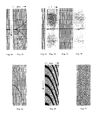
Figures 1a-b depicts the effects of the aperture limitation on the discrimination of three parabolic events. -
Figures 1e-f depicts the horizontal event resolution in the parabolic Radon domain (1d, 1f) as a function of the spatial aperture (1c,1e). The origin of the "butterfly" looking artifact In (1f) can be found in (Kabir and Marfurt, 1999). -
Figure (2a ) depicts a parabolic event for 0<f<90 Hz - same parabolic event at 5 Hz (2b) and at 70 Hz (2c). Due to the finite spatial sampling, spatial aliasing patterns appear, leading to a non-unique parabolic decomposition of this monochromatic wave-field. The parabolic decomposition must be constrained by the parabolic decomposition at lower frequencies. -
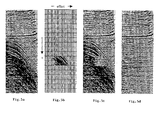
Figure (3a ) depicts a simulated NMO-corrected CMP gather. (3b) Multiple model obtained using regular parabolic Radon transform : we observe the presence of primary energy. (3c) Estimated primaries ((3a)-(3b)): note the deterioration of the primary energy and the remaining multiple energy. (3d) Regular parabolic Radon spectra. -
Figure (4a ) depicts the same simulated NMO-corrected CMP gather. (4b) Multiple model obtained using DHR parabolic Radon transform. (4c) Estimated primaries ((4a)-(4b)), note the perfect multiple removal without damaging the primaries. (4d) DHR parabolic spectra. -
Figure (5a ) depicts an NMO-corrected CMP gather from deep offshore exploration. (5b) Multiple model estimated from a windowed portion of the CMP gather. (5c) estimated primaries ((5a)-(5b)). (5d) Estimated primaries after moving the sliding window all over the CMP gather. - It is now described how De-aliased, High-Resolution (DHR) Radon spectra may be constructed with a direct approach avoiding the disadvantages associated with the iterative high-resolution Radon transform of the prior art.
- The Radon transform (linear of parabolic) allows to decompose a complex signal as a sum of elementary signals with simpler spatial behaviors (linear or parabolic). Once the signal is decomposed in the Radon space, some of its spectral components can be filtered out in order to remove some unwanted coherent (linear or parabolic) components of the signal. The effectiveness of the signal filtering in the Radon domain relies on the quality of the Radon transform : its ability to uniquely decompose the signal (Radon spectra). The uniqueness of the Radon decomposition is altered when the number of spectral components involved in the Radon transform exceeds the number of signal components. As a consequence of this non-uniqueness aliasing patterns appear in the Radon spectra. This aliasing phenomena is illustrated with
Figure (3d ), which represents the result of the decomposition on 15 traces NMO-corrected (Figure 3a ) over 550 parabolas. The nine parabolas contained in the input signal have not been uniquely decomposed, leading to unfocused Radon spectra. - In order to enhance the resolution of the Radon spectra one has to constrain the parabolic decomposition of the signal onto its most significant spectral components. How to define and apply these constrains is now described.
- For efficiency reasons the Radon decomposition is often performed in the frequency domain. Given a frequency component ωk, the following equality relates the recorded data to its spectral components :

with ωk, the kth frequency component,d (ωk) the data vector to decompose (M : number of available data samples),
q (ω k ) , the spectral vector containing the N Radon spectral components over which the data vector is decomposed,
G(ωk) the (M, N) complex matrix made of the Radon steering vectors,

(xm : spatial co-ordinate at which dm(ωk) is recorded). - The Radon decomposition of the data is usually obtained using the over-determined Least-squares solution to (1a),

with ∈ a pre-whitening factor to avoid numerical instabilities and I the (N, N) identity matrix. - In order to constrain the Radon decomposition onto the most significant spectral components of the data, it is proposed to compute the Radon decomposition using the constrained under-determined Least-squares solution to (1a),

with W(ωk) (N, N) a real diagonal positive definite constrain matrix, that will focus the Radon decomposition around the most significant spectral components of the data. - How to fill the W diagonal matrix will now be described.
- Assuming, non-disperse signals, the Radon amplitude spectra's has some sort of continuity from one frequency to another one. This observation is used to constrain the Radon spectra at frequency ωk with the Radon spectra derived at the previous frequency ωk-1. Therefore the constrain matrix W(ωk) reads,

- It will be readily understood that with such a constrain matrix W(ωk), equation (2b) can easily be solved using for example the algorithm proposed by Sacchi and Ulrych.
- After the processing of the Radon decomposition, the data are filtered in the Radon space to substract the multiples and an inverse parabolic or linear Radon transform is performed to obtain the estimated primaries.
- This non-iterative, gradual way (from low frequencies to high frequencies) to update the constrain matrix enables to enhance the resolution of the Radon decomposition and to avoid a large amount of aliasing artifacts.
- In particular, as clearly shown by the example displayed on
figures 4a-4d without a priori information on the curvature of the multiples, this non-iterative process focuses the parabolic decomposition of the data onto its most significant spectral components. The application of this method to the previous synthetic data example leads to remarkable results (Figures 4a-d ), including a sparse parabolic decomposition of the data along the q and τ axis, leading to perfect multiple removal with no damage to the primaries. - The task of the proposed method is simplified when the data are solely composed of a small number of parabolas. On actual data this approach is more effective using sliding temporal (200 ms) and spatial windows (18 traces) as displayed in
Figures 5a-d . This example nicely illustrates the ability of the algorithm to separate, on a limited number of traces, primaries from multiples with large move-out. The algorithm has gone beyond the usual sampling and aperture limitations. - The proposed non-iterative De-aliased, High Resolution Radon transform of the present invention provides an alternative to the traditional Radon transform when one has to handle severe circumstances ; small spatial aperture, insufficient spatial sampling, large or small move-out difference between primaries and multiples. Working on limited spatial and temporal windows, the wave-field is readily decomposed into its main parabolic components using the present invention.
-
- Cary, P., 1998. The simplest discrete Radon transform. Extended Abstracts, Vol. II, p. 1999-2002.
- Hampson, D., 1986. Inverse, velocity stacking for multiple elimination. J. Can. SEG, 22, p. 44-45.
- Hugonnet, P. and Canadas, G., 1997. Regridding of irregular data using 3D Radon Decompositions : SEG Extended Abstracts, Vol. II, p. 1111-1114.
- Kabir, M.M.N. and Marfurt, K.J., 1999. Toward true amplitude multiple removal. The leading Edge, Vol. 18n N1, p. 66-73.
- Kostov, C., 1990. Toeplitz structure in Slant-Stack Inversion : SEG Abstract Vol. II, p. 1647-1650.
- Sacchi, M.D. and Ulrych, T.J., 1995. High resolution velocity gathers and offset-space reconstruction : Geophysics, 60, 1169-1177.
- Sacchi, M. D., SEG Expanded Abstracts 1999, Fast High resolution parabolic Radon Transform.
- Spitz, S., 1991. Seismic trace interpolation in the F-X domain. Geophysics, Vol. 56, N6, p. 785-794.
- Tarabtola, A., 1987. Inverse Problem Theory Elsevier.
- Thorson, J.R. and Claerbout, J.F., 1985. Velocity-stack and slant-stack stochastic inversion : Geophysics, 50, p. 2727-2741.
Claims (7)
- A method of performing a processing on seismic traces comprising the step of performing a constrained High Resolution Radon decomposition at various frequencies, wherein the Radon decomposition at a given frequency is constrained as a function of the Radon decomposition at at least a lower frequency.
- A method according to claim 1, wherein a Radon decomposition is successively performed at various sparse frequencies, from the lower frequency to the higher, the Radon decomposition at a given frequency being constrained as a function of the Radon decomposition at the previous frequency.
- A method according to claim 1, wherein the constrained Radon decomposition is processed using a constrained over-determined Least-squares solution to the equation :
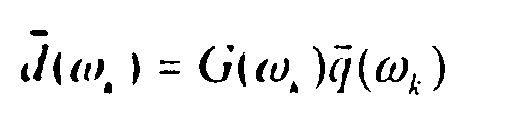
with ωi, the ith frequency component,d (ωi) the data vector to decompose.q (ωk), the spectral vector containing the Radon spectral components over which the data vector is decomposed. - A method according to claim 2, wherein the constrained Radon decomposition is processed through the determining of the Least-squares solution to the equation :

with W(ωk) a real diagonal positive definite constrain matrix which components are function of at least a frequency lower than ωi. - A method according to claim 4, wherein the constrain matrix W(ωk) reads

- A method according to any of the preceding claims, wherein the Radon decomposition is filtered in the Radon domain.
- A method of performing a processing on seismic traces wherein the method according to any of the preceding claims is applied on sliding temporal and spatial.
Applications Claiming Priority (3)
| Application Number | Priority Date | Filing Date | Title |
|---|---|---|---|
| US13222199P | 1999-05-03 | 1999-05-03 | |
| US132221P | 1999-05-03 | ||
| PCT/IB2000/000659 WO2000067045A2 (en) | 1999-05-03 | 2000-05-03 | A high resolution radon transform seismic traces processing |
Publications (2)
| Publication Number | Publication Date |
|---|---|
| EP1242833A2 EP1242833A2 (en) | 2002-09-25 |
| EP1242833B1 true EP1242833B1 (en) | 2008-05-28 |
Family
ID=22453028
Family Applications (1)
| Application Number | Title | Priority Date | Filing Date |
|---|---|---|---|
| EP00927626A Expired - Lifetime EP1242833B1 (en) | 1999-05-03 | 2000-05-03 | A high resolution radon transform seismic traces processing |
Country Status (3)
| Country | Link |
|---|---|
| EP (1) | EP1242833B1 (en) |
| CA (1) | CA2336311C (en) |
| WO (1) | WO2000067045A2 (en) |
Families Citing this family (4)
| Publication number | Priority date | Publication date | Assignee | Title |
|---|---|---|---|---|
| US6763304B2 (en) | 2002-05-21 | 2004-07-13 | Pgs Americas, Inc. | Method for processing seismic data to attenuate multiples |
| EP2229597A2 (en) * | 2007-11-19 | 2010-09-22 | Geco Technology B.V. | Seismic data processing method for surface related multiple attenuation |
| US9651697B2 (en) | 2014-03-28 | 2017-05-16 | Cgg Services Sas | Noise attentuation using a dipole sparse Tau-p inversion |
| CN104932010B (en) * | 2015-06-09 | 2018-08-07 | 中国海洋石油集团有限公司 | A kind of diffracted wave separation method based on the sparse Radon transformation of shortcut fringing |
Family Cites Families (2)
| Publication number | Priority date | Publication date | Assignee | Title |
|---|---|---|---|---|
| US4628492A (en) * | 1984-01-11 | 1986-12-09 | Mobil Oil Corporation | Method of avoiding aliasing in slant stacking of seismic data |
| US5677892A (en) * | 1996-08-14 | 1997-10-14 | Western Atlas International, Inc. | Unaliased spatial trace interpolation in the f-k domain |
-
2000
- 2000-05-03 WO PCT/IB2000/000659 patent/WO2000067045A2/en not_active Ceased
- 2000-05-03 EP EP00927626A patent/EP1242833B1/en not_active Expired - Lifetime
- 2000-05-03 CA CA002336311A patent/CA2336311C/en not_active Expired - Lifetime
Also Published As
| Publication number | Publication date |
|---|---|
| WO2000067045A2 (en) | 2000-11-09 |
| WO2000067045A3 (en) | 2002-07-11 |
| CA2336311A1 (en) | 2000-11-09 |
| EP1242833A2 (en) | 2002-09-25 |
| CA2336311C (en) | 2008-02-19 |
Similar Documents
| Publication | Publication Date | Title |
|---|---|---|
| Herrmann et al. | De-aliased, high-resolution Radon transforms | |
| Nazari Siahsar et al. | Sparse time-frequency representation for seismic noise reduction using low-rank and sparse decomposition | |
| US6668228B1 (en) | Method of attenuating noise in three dimensional seismic data using a projection filter | |
| Robinson | A technique for the continuous representation of dispersion in seismic data | |
| Zhang et al. | Multi-step damped multichannel singular spectrum analysis for simultaneous reconstruction and denoising of 3D seismic data | |
| US5010526A (en) | Method of digital filtering | |
| Gulunay et al. | Unaliased f—K domain trace interpolation (UFKI) | |
| US6636809B1 (en) | High resolution radon transform seismic traces processing | |
| Bahia et al. | Widely linear denoising of multicomponent seismic data | |
| CN110941015A (en) | Method for suppressing random noise of seismic exploration based on frequency slice time-frequency peak value filtering | |
| CA2336311C (en) | A high resolution radon transform seismic traces processing | |
| Anderson et al. | Noise-adaptive filtering of seismic shot records | |
| Wang et al. | A low-frequency deghosting method: Analysis and numerical tests | |
| Bickel | Focusing aspects of the hyperbolic Radon transform | |
| Moore et al. | Stable, efficient, high-resolution Radon transforms | |
| Bader et al. | Denoising for full-waveform inversion with expanded prediction-error filters | |
| Gulunay et al. | Coherency enhancement on 3D seismic data by dip detection and dip selection | |
| CN101907726A (en) | Method for automatically identifying and eliminating industrial electrical interference in earthquake exploration | |
| Gómez et al. | Edge-preserving frequency-offset denoising of seismic data | |
| Boujida et al. | Higher order statistics applied to wavelet identification of marine seismic signals | |
| Telling et al. | Multicomponent De-Ghosting Using a Hybrid Operator in Frequency and Space | |
| Liu et al. | Seismic data denoising with mathematical morphological filters | |
| Ikwueto et al. | Advanced Processing of Multiples into useful Seismic data for Surface Hydrocarbon Oilfields | |
| Mills et al. | Processing ground roll for the study of near-surface Rayleigh wave dispersion | |
| Zhang et al. | Seismic trace interpolation beyond spatial aliasing |
Legal Events
| Date | Code | Title | Description |
|---|---|---|---|
| PUAI | Public reference made under article 153(3) epc to a published international application that has entered the european phase |
Free format text: ORIGINAL CODE: 0009012 |
|
| AK | Designated contracting states |
Kind code of ref document: A2 Designated state(s): AT BE CH CY DE DK ES FI FR GB GR IE IT LI LU MC NL PT SE |
|
| 17P | Request for examination filed |
Effective date: 20021216 |
|
| GRAP | Despatch of communication of intention to grant a patent |
Free format text: ORIGINAL CODE: EPIDOSNIGR1 |
|
| RBV | Designated contracting states (corrected) |
Designated state(s): FR GB NL |
|
| REG | Reference to a national code |
Ref country code: DE Ref legal event code: 8566 |
|
| GRAS | Grant fee paid |
Free format text: ORIGINAL CODE: EPIDOSNIGR3 |
|
| RAP1 | Party data changed (applicant data changed or rights of an application transferred) |
Owner name: CGG SERVICES |
|
| GRAA | (expected) grant |
Free format text: ORIGINAL CODE: 0009210 |
|
| AK | Designated contracting states |
Kind code of ref document: B1 Designated state(s): FR GB NL |
|
| REG | Reference to a national code |
Ref country code: GB Ref legal event code: FG4D |
|
| PG25 | Lapsed in a contracting state [announced via postgrant information from national office to epo] |
Ref country code: NL Free format text: LAPSE BECAUSE OF FAILURE TO SUBMIT A TRANSLATION OF THE DESCRIPTION OR TO PAY THE FEE WITHIN THE PRESCRIBED TIME-LIMIT Effective date: 20080528 |
|
| NLV1 | Nl: lapsed or annulled due to failure to fulfill the requirements of art. 29p and 29m of the patents act | ||
| PLBE | No opposition filed within time limit |
Free format text: ORIGINAL CODE: 0009261 |
|
| STAA | Information on the status of an ep patent application or granted ep patent |
Free format text: STATUS: NO OPPOSITION FILED WITHIN TIME LIMIT |
|
| 26N | No opposition filed |
Effective date: 20090303 |
|
| REG | Reference to a national code |
Ref country code: FR Ref legal event code: ST Effective date: 20100129 |
|
| PG25 | Lapsed in a contracting state [announced via postgrant information from national office to epo] |
Ref country code: FR Free format text: LAPSE BECAUSE OF NON-PAYMENT OF DUE FEES Effective date: 20090602 |
|
| PGFP | Annual fee paid to national office [announced via postgrant information from national office to epo] |
Ref country code: GB Payment date: 20190521 Year of fee payment: 20 |
|
| REG | Reference to a national code |
Ref country code: GB Ref legal event code: PE20 Expiry date: 20200502 |
|
| PG25 | Lapsed in a contracting state [announced via postgrant information from national office to epo] |
Ref country code: GB Free format text: LAPSE BECAUSE OF EXPIRATION OF PROTECTION Effective date: 20200502 |