EP1242386B1 - Nitro-sulfobenzamides - Google Patents
Nitro-sulfobenzamides Download PDFInfo
- Publication number
- EP1242386B1 EP1242386B1 EP00976048A EP00976048A EP1242386B1 EP 1242386 B1 EP1242386 B1 EP 1242386B1 EP 00976048 A EP00976048 A EP 00976048A EP 00976048 A EP00976048 A EP 00976048A EP 1242386 B1 EP1242386 B1 EP 1242386B1
- Authority
- EP
- European Patent Office
- Prior art keywords
- formula
- compound
- unsubstituted
- substituted
- alkyl
- Prior art date
- Legal status (The legal status is an assumption and is not a legal conclusion. Google has not performed a legal analysis and makes no representation as to the accuracy of the status listed.)
- Expired - Lifetime
Links
- VGBRFYULSSMNKX-UHFFFAOYSA-N 2-carbamoyl-6-nitrobenzenesulfonic acid Chemical class NC(=O)C1=CC=CC([N+]([O-])=O)=C1S(O)(=O)=O VGBRFYULSSMNKX-UHFFFAOYSA-N 0.000 title 1
- 150000001875 compounds Chemical class 0.000 claims abstract description 62
- 150000001768 cations Chemical class 0.000 claims abstract description 30
- 239000004215 Carbon black (E152) Substances 0.000 claims abstract description 22
- 125000004432 carbon atom Chemical group C* 0.000 claims abstract description 22
- 229910052757 nitrogen Inorganic materials 0.000 claims abstract description 16
- 229930195733 hydrocarbon Natural products 0.000 claims abstract description 15
- 229940100389 Sulfonylurea Drugs 0.000 claims abstract description 14
- 125000005842 heteroatom Chemical group 0.000 claims abstract description 14
- 238000002360 preparation method Methods 0.000 claims abstract description 14
- 125000006413 ring segment Chemical group 0.000 claims abstract description 8
- 125000000623 heterocyclic group Chemical group 0.000 claims abstract description 7
- 229910052717 sulfur Inorganic materials 0.000 claims abstract description 6
- 125000004433 nitrogen atom Chemical group N* 0.000 claims abstract description 5
- 229910052760 oxygen Inorganic materials 0.000 claims abstract description 5
- -1 azido, formyl Chemical group 0.000 claims description 66
- 229910052736 halogen Inorganic materials 0.000 claims description 43
- 150000002367 halogens Chemical class 0.000 claims description 43
- 150000003839 salts Chemical class 0.000 claims description 42
- 229910052751 metal Inorganic materials 0.000 claims description 38
- 239000002184 metal Substances 0.000 claims description 38
- 229910052739 hydrogen Inorganic materials 0.000 claims description 35
- 239000001257 hydrogen Substances 0.000 claims description 33
- UFHFLCQGNIYNRP-UHFFFAOYSA-N Hydrogen Chemical compound [H][H] UFHFLCQGNIYNRP-UHFFFAOYSA-N 0.000 claims description 31
- YGYAWVDWMABLBF-UHFFFAOYSA-N Phosgene Chemical compound ClC(Cl)=O YGYAWVDWMABLBF-UHFFFAOYSA-N 0.000 claims description 19
- 125000004169 (C1-C6) alkyl group Chemical group 0.000 claims description 18
- 125000000882 C2-C6 alkenyl group Chemical group 0.000 claims description 18
- 125000003601 C2-C6 alkynyl group Chemical group 0.000 claims description 18
- 238000000034 method Methods 0.000 claims description 17
- 125000001997 phenyl group Chemical group [H]C1=C([H])C([H])=C(*)C([H])=C1[H] 0.000 claims description 17
- 239000003054 catalyst Substances 0.000 claims description 16
- 239000003153 chemical reaction reagent Substances 0.000 claims description 15
- 125000006700 (C1-C6) alkylthio group Chemical group 0.000 claims description 14
- 125000004191 (C1-C6) alkoxy group Chemical group 0.000 claims description 13
- 125000005913 (C3-C6) cycloalkyl group Chemical group 0.000 claims description 13
- 150000008064 anhydrides Chemical class 0.000 claims description 13
- 125000004767 (C1-C4) haloalkoxy group Chemical group 0.000 claims description 12
- 229910052784 alkaline earth metal Inorganic materials 0.000 claims description 11
- 150000001408 amides Chemical class 0.000 claims description 11
- 239000007825 activation reagent Substances 0.000 claims description 10
- 150000001412 amines Chemical class 0.000 claims description 9
- 125000004093 cyano group Chemical group *C#N 0.000 claims description 8
- 125000000449 nitro group Chemical group [O-][N+](*)=O 0.000 claims description 7
- 125000004768 (C1-C4) alkylsulfinyl group Chemical group 0.000 claims description 6
- 125000004769 (C1-C4) alkylsulfonyl group Chemical group 0.000 claims description 6
- 125000004765 (C1-C4) haloalkyl group Chemical group 0.000 claims description 6
- QGZKDVFQNNGYKY-UHFFFAOYSA-O Ammonium Chemical compound [NH4+] QGZKDVFQNNGYKY-UHFFFAOYSA-O 0.000 claims description 6
- 125000002252 acyl group Chemical group 0.000 claims description 6
- 125000001495 ethyl group Chemical group [H]C([H])([H])C([H])([H])* 0.000 claims description 6
- 125000002496 methyl group Chemical group [H]C([H])([H])* 0.000 claims description 6
- 229910052700 potassium Inorganic materials 0.000 claims description 6
- 229910052708 sodium Inorganic materials 0.000 claims description 6
- 239000003513 alkali Substances 0.000 claims description 5
- XYFCBTPGUUZFHI-UHFFFAOYSA-O phosphonium Chemical compound [PH4+] XYFCBTPGUUZFHI-UHFFFAOYSA-O 0.000 claims description 5
- 125000003545 alkoxy group Chemical group 0.000 claims description 4
- YROXIXLRRCOBKF-UHFFFAOYSA-N sulfonylurea Chemical class OC(=N)N=S(=O)=O YROXIXLRRCOBKF-UHFFFAOYSA-N 0.000 claims description 4
- 125000004435 hydrogen atom Chemical group [H]* 0.000 claims description 2
- 229940124530 sulfonamide Drugs 0.000 abstract description 16
- 150000003456 sulfonamides Chemical class 0.000 abstract description 16
- XTHPWXDJESJLNJ-UHFFFAOYSA-N sulfurochloridic acid Chemical class OS(Cl)(=O)=O XTHPWXDJESJLNJ-UHFFFAOYSA-N 0.000 abstract description 4
- 239000002243 precursor Substances 0.000 abstract description 2
- 150000003254 radicals Chemical class 0.000 description 40
- 239000000203 mixture Substances 0.000 description 37
- XEKOWRVHYACXOJ-UHFFFAOYSA-N Ethyl acetate Chemical compound CCOC(C)=O XEKOWRVHYACXOJ-UHFFFAOYSA-N 0.000 description 30
- ZMXDDKWLCZADIW-UHFFFAOYSA-N N,N-Dimethylformamide Chemical compound CN(C)C=O ZMXDDKWLCZADIW-UHFFFAOYSA-N 0.000 description 27
- 239000002904 solvent Substances 0.000 description 27
- YXFVVABEGXRONW-UHFFFAOYSA-N Toluene Chemical compound CC1=CC=CC=C1 YXFVVABEGXRONW-UHFFFAOYSA-N 0.000 description 21
- BDAGIHXWWSANSR-UHFFFAOYSA-N methanoic acid Natural products OC=O BDAGIHXWWSANSR-UHFFFAOYSA-N 0.000 description 20
- VTOWSZKEPNGZRY-UHFFFAOYSA-N n,n-dimethyl-4-nitro-2-sulfamoylbenzamide Chemical compound CN(C)C(=O)C1=CC=C([N+]([O-])=O)C=C1S(N)(=O)=O VTOWSZKEPNGZRY-UHFFFAOYSA-N 0.000 description 20
- 238000006243 chemical reaction Methods 0.000 description 19
- 125000001188 haloalkyl group Chemical group 0.000 description 19
- JUJWROOIHBZHMG-UHFFFAOYSA-N Pyridine Chemical compound C1=CC=NC=C1 JUJWROOIHBZHMG-UHFFFAOYSA-N 0.000 description 18
- FYSNRJHAOHDILO-UHFFFAOYSA-N thionyl chloride Chemical compound ClS(Cl)=O FYSNRJHAOHDILO-UHFFFAOYSA-N 0.000 description 18
- 150000002148 esters Chemical class 0.000 description 17
- XLYOFNOQVPJJNP-UHFFFAOYSA-N water Substances O XLYOFNOQVPJJNP-UHFFFAOYSA-N 0.000 description 17
- KDLHZDBZIXYQEI-UHFFFAOYSA-N Palladium Chemical compound [Pd] KDLHZDBZIXYQEI-UHFFFAOYSA-N 0.000 description 16
- 125000003106 haloaryl group Chemical group 0.000 description 16
- 125000002877 alkyl aryl group Chemical group 0.000 description 15
- MGNZXYYWBUKAII-UHFFFAOYSA-N cyclohexa-1,3-diene Chemical compound C1CC=CC=C1 MGNZXYYWBUKAII-UHFFFAOYSA-N 0.000 description 14
- 150000002170 ethers Chemical class 0.000 description 14
- 150000002825 nitriles Chemical class 0.000 description 14
- 125000000547 substituted alkyl group Chemical group 0.000 description 14
- 125000001183 hydrocarbyl group Chemical group 0.000 description 13
- 125000003107 substituted aryl group Chemical group 0.000 description 13
- XEEYBQQBJWHFJM-UHFFFAOYSA-N Iron Chemical compound [Fe] XEEYBQQBJWHFJM-UHFFFAOYSA-N 0.000 description 12
- ZMANZCXQSJIPKH-UHFFFAOYSA-N Triethylamine Chemical compound CCN(CC)CC ZMANZCXQSJIPKH-UHFFFAOYSA-N 0.000 description 12
- 229940054066 benzamide antipsychotics Drugs 0.000 description 11
- 150000003936 benzamides Chemical class 0.000 description 11
- 230000002829 reductive effect Effects 0.000 description 11
- OSWFIVFLDKOXQC-UHFFFAOYSA-N 4-(3-methoxyphenyl)aniline Chemical compound COC1=CC=CC(C=2C=CC(N)=CC=2)=C1 OSWFIVFLDKOXQC-UHFFFAOYSA-N 0.000 description 10
- 0 Cc1cc(N*)ccc1C(*)=O Chemical compound Cc1cc(N*)ccc1C(*)=O 0.000 description 10
- 125000003118 aryl group Chemical group 0.000 description 10
- 150000004649 carbonic acid derivatives Chemical class 0.000 description 10
- GINSPFZBRUHFCY-UHFFFAOYSA-L dipotassium;4-nitro-2-sulfonatobenzoate Chemical compound [K+].[K+].[O-]C(=O)C1=CC=C([N+]([O-])=O)C=C1S([O-])(=O)=O GINSPFZBRUHFCY-UHFFFAOYSA-L 0.000 description 10
- 229940093499 ethyl acetate Drugs 0.000 description 10
- 235000019439 ethyl acetate Nutrition 0.000 description 10
- 235000019253 formic acid Nutrition 0.000 description 10
- 150000002576 ketones Chemical class 0.000 description 10
- 150000003457 sulfones Chemical class 0.000 description 10
- WEVYAHXRMPXWCK-UHFFFAOYSA-N Acetonitrile Chemical compound CC#N WEVYAHXRMPXWCK-UHFFFAOYSA-N 0.000 description 9
- 239000002253 acid Substances 0.000 description 9
- 229910052799 carbon Inorganic materials 0.000 description 9
- UMJSCPRVCHMLSP-UHFFFAOYSA-N pyridine Natural products COC1=CC=CN=C1 UMJSCPRVCHMLSP-UHFFFAOYSA-N 0.000 description 9
- QGZKDVFQNNGYKY-UHFFFAOYSA-N Ammonia Chemical compound N QGZKDVFQNNGYKY-UHFFFAOYSA-N 0.000 description 8
- RTZKZFJDLAIYFH-UHFFFAOYSA-N Diethyl ether Chemical compound CCOCC RTZKZFJDLAIYFH-UHFFFAOYSA-N 0.000 description 8
- HTZCNXWZYVXIMZ-UHFFFAOYSA-M benzyl(triethyl)azanium;chloride Chemical compound [Cl-].CC[N+](CC)(CC)CC1=CC=CC=C1 HTZCNXWZYVXIMZ-UHFFFAOYSA-M 0.000 description 8
- 150000004657 carbamic acid derivatives Chemical class 0.000 description 8
- 238000004821 distillation Methods 0.000 description 8
- PXDNXJSDGQBLKS-UHFFFAOYSA-N foramsulfuron Chemical compound COC1=CC(OC)=NC(NC(=O)NS(=O)(=O)C=2C(=CC=C(NC=O)C=2)C(=O)N(C)C)=N1 PXDNXJSDGQBLKS-UHFFFAOYSA-N 0.000 description 8
- 238000005984 hydrogenation reaction Methods 0.000 description 8
- 239000000047 product Substances 0.000 description 8
- 150000003512 tertiary amines Chemical class 0.000 description 8
- HLLOPYBKLGMVDA-UHFFFAOYSA-N 2-[(4,6-dimethoxypyrimidin-2-yl)carbamoylsulfamoyl]-n,n-dimethyl-4-nitrobenzamide Chemical compound COC1=CC(OC)=NC(NC(=O)NS(=O)(=O)C=2C(=CC=C(C=2)[N+]([O-])=O)C(=O)N(C)C)=N1 HLLOPYBKLGMVDA-UHFFFAOYSA-N 0.000 description 7
- CTQNGGLPUBDAKN-UHFFFAOYSA-N O-Xylene Chemical compound CC1=CC=CC=C1C CTQNGGLPUBDAKN-UHFFFAOYSA-N 0.000 description 7
- 230000010933 acylation Effects 0.000 description 7
- 238000005917 acylation reaction Methods 0.000 description 7
- 125000003342 alkenyl group Chemical group 0.000 description 7
- 239000000460 chlorine Substances 0.000 description 7
- 239000012970 tertiary amine catalyst Substances 0.000 description 7
- 239000008096 xylene Substances 0.000 description 7
- IJGRMHOSHXDMSA-UHFFFAOYSA-N Atomic nitrogen Chemical compound N#N IJGRMHOSHXDMSA-UHFFFAOYSA-N 0.000 description 6
- ROSDSFDQCJNGOL-UHFFFAOYSA-N Dimethylamine Chemical compound CNC ROSDSFDQCJNGOL-UHFFFAOYSA-N 0.000 description 6
- NPXOKRUENSOPAO-UHFFFAOYSA-N Raney nickel Chemical compound [Al].[Ni] NPXOKRUENSOPAO-UHFFFAOYSA-N 0.000 description 6
- KJTLSVCANCCWHF-UHFFFAOYSA-N Ruthenium Chemical compound [Ru] KJTLSVCANCCWHF-UHFFFAOYSA-N 0.000 description 6
- 125000000304 alkynyl group Chemical group 0.000 description 6
- 229910017052 cobalt Inorganic materials 0.000 description 6
- 239000010941 cobalt Substances 0.000 description 6
- GUTLYIVDDKVIGB-UHFFFAOYSA-N cobalt atom Chemical compound [Co] GUTLYIVDDKVIGB-UHFFFAOYSA-N 0.000 description 6
- 229910052742 iron Inorganic materials 0.000 description 6
- WPBNNNQJVZRUHP-UHFFFAOYSA-L manganese(2+);methyl n-[[2-(methoxycarbonylcarbamothioylamino)phenyl]carbamothioyl]carbamate;n-[2-(sulfidocarbothioylamino)ethyl]carbamodithioate Chemical compound [Mn+2].[S-]C(=S)NCCNC([S-])=S.COC(=O)NC(=S)NC1=CC=CC=C1NC(=S)NC(=O)OC WPBNNNQJVZRUHP-UHFFFAOYSA-L 0.000 description 6
- 150000002739 metals Chemical class 0.000 description 6
- 239000003444 phase transfer catalyst Substances 0.000 description 6
- BASFCYQUMIYNBI-UHFFFAOYSA-N platinum Chemical compound [Pt] BASFCYQUMIYNBI-UHFFFAOYSA-N 0.000 description 6
- WFKWXMTUELFFGS-UHFFFAOYSA-N tungsten Chemical compound [W] WFKWXMTUELFFGS-UHFFFAOYSA-N 0.000 description 6
- 229910052721 tungsten Inorganic materials 0.000 description 6
- 239000010937 tungsten Substances 0.000 description 6
- CSCPPACGZOOCGX-UHFFFAOYSA-N Acetone Chemical compound CC(C)=O CSCPPACGZOOCGX-UHFFFAOYSA-N 0.000 description 5
- ZAMOUSCENKQFHK-UHFFFAOYSA-N Chlorine atom Chemical compound [Cl] ZAMOUSCENKQFHK-UHFFFAOYSA-N 0.000 description 5
- VEXZGXHMUGYJMC-UHFFFAOYSA-N Hydrochloric acid Chemical compound Cl VEXZGXHMUGYJMC-UHFFFAOYSA-N 0.000 description 5
- 150000007513 acids Chemical class 0.000 description 5
- 125000000217 alkyl group Chemical group 0.000 description 5
- 229910052801 chlorine Inorganic materials 0.000 description 5
- 238000001914 filtration Methods 0.000 description 5
- 125000001072 heteroaryl group Chemical group 0.000 description 5
- 239000011734 sodium Substances 0.000 description 5
- 239000007787 solid Substances 0.000 description 5
- 239000000725 suspension Substances 0.000 description 5
- FKNQCJSGGFJEIZ-UHFFFAOYSA-N 4-methylpyridine Chemical compound CC1=CC=NC=C1 FKNQCJSGGFJEIZ-UHFFFAOYSA-N 0.000 description 4
- LFQSCWFLJHTTHZ-UHFFFAOYSA-N Ethanol Chemical compound CCO LFQSCWFLJHTTHZ-UHFFFAOYSA-N 0.000 description 4
- PXGOKWXKJXAPGV-UHFFFAOYSA-N Fluorine Chemical compound FF PXGOKWXKJXAPGV-UHFFFAOYSA-N 0.000 description 4
- 238000009835 boiling Methods 0.000 description 4
- 150000001735 carboxylic acids Chemical class 0.000 description 4
- 229910052731 fluorine Inorganic materials 0.000 description 4
- 239000011737 fluorine Substances 0.000 description 4
- 239000012442 inert solvent Substances 0.000 description 4
- 229910052744 lithium Inorganic materials 0.000 description 4
- 239000011877 solvent mixture Substances 0.000 description 4
- 239000000126 substance Substances 0.000 description 4
- 125000001424 substituent group Chemical group 0.000 description 4
- BUXTXUBQAKIQKS-UHFFFAOYSA-N sulfuryl diisocyanate Chemical class O=C=NS(=O)(=O)N=C=O BUXTXUBQAKIQKS-UHFFFAOYSA-N 0.000 description 4
- WFDIJRYMOXRFFG-UHFFFAOYSA-N Acetic anhydride Chemical compound CC(=O)OC(C)=O WFDIJRYMOXRFFG-UHFFFAOYSA-N 0.000 description 3
- YMWUJEATGCHHMB-UHFFFAOYSA-N Dichloromethane Chemical compound ClCCl YMWUJEATGCHHMB-UHFFFAOYSA-N 0.000 description 3
- OKKJLVBELUTLKV-UHFFFAOYSA-N Methanol Chemical compound OC OKKJLVBELUTLKV-UHFFFAOYSA-N 0.000 description 3
- KWYUFKZDYYNOTN-UHFFFAOYSA-M Potassium hydroxide Chemical compound [OH-].[K+] KWYUFKZDYYNOTN-UHFFFAOYSA-M 0.000 description 3
- QAOWNCQODCNURD-UHFFFAOYSA-N Sulfuric acid Chemical compound OS(O)(=O)=O QAOWNCQODCNURD-UHFFFAOYSA-N 0.000 description 3
- 150000001298 alcohols Chemical class 0.000 description 3
- 229910021529 ammonia Inorganic materials 0.000 description 3
- JFDZBHWFFUWGJE-UHFFFAOYSA-N benzonitrile Chemical compound N#CC1=CC=CC=C1 JFDZBHWFFUWGJE-UHFFFAOYSA-N 0.000 description 3
- 238000007664 blowing Methods 0.000 description 3
- 229910052791 calcium Inorganic materials 0.000 description 3
- 239000000706 filtrate Substances 0.000 description 3
- 125000004438 haloalkoxy group Chemical group 0.000 description 3
- 239000000543 intermediate Substances 0.000 description 3
- 238000002955 isolation Methods 0.000 description 3
- 229910052749 magnesium Inorganic materials 0.000 description 3
- VLKZOEOYAKHREP-UHFFFAOYSA-N n-Hexane Chemical compound CCCCCC VLKZOEOYAKHREP-UHFFFAOYSA-N 0.000 description 3
- 150000007524 organic acids Chemical class 0.000 description 3
- CFHIDWOYWUOIHU-UHFFFAOYSA-N oxomethyl Chemical compound O=[CH] CFHIDWOYWUOIHU-UHFFFAOYSA-N 0.000 description 3
- 125000002924 primary amino group Chemical group [H]N([H])* 0.000 description 3
- 238000010992 reflux Methods 0.000 description 3
- YBBRCQOCSYXUOC-UHFFFAOYSA-N sulfuryl dichloride Chemical class ClS(Cl)(=O)=O YBBRCQOCSYXUOC-UHFFFAOYSA-N 0.000 description 3
- IMFACGCPASFAPR-UHFFFAOYSA-N tributylamine Chemical compound CCCCN(CCCC)CCCC IMFACGCPASFAPR-UHFFFAOYSA-N 0.000 description 3
- MTANOYLOFGOWOX-UHFFFAOYSA-N (4,6-dimethoxypyrimidin-2-yl)-phenylcarbamic acid Chemical compound COC1=CC(OC)=NC(N(C(O)=O)C=2C=CC=CC=2)=N1 MTANOYLOFGOWOX-UHFFFAOYSA-N 0.000 description 2
- 125000006702 (C1-C18) alkyl group Chemical group 0.000 description 2
- FEWLNYSYJNLUOO-UHFFFAOYSA-N 1-Piperidinecarboxaldehyde Chemical compound O=CN1CCCCC1 FEWLNYSYJNLUOO-UHFFFAOYSA-N 0.000 description 2
- ZWEHNKRNPOVVGH-UHFFFAOYSA-N 2-Butanone Chemical compound CCC(C)=O ZWEHNKRNPOVVGH-UHFFFAOYSA-N 0.000 description 2
- LTJMHCGDSFTOHA-UHFFFAOYSA-N 2-carbamoylbenzenesulfonic acid Chemical class NC(=O)C1=CC=CC=C1S(O)(=O)=O LTJMHCGDSFTOHA-UHFFFAOYSA-N 0.000 description 2
- HWWYDZCSSYKIAD-UHFFFAOYSA-N 3,5-dimethylpyridine Chemical compound CC1=CN=CC(C)=C1 HWWYDZCSSYKIAD-UHFFFAOYSA-N 0.000 description 2
- AUCGNAJVFOZTHS-UHFFFAOYSA-N 3-methylpyridine Chemical compound CC1=CC=C=N[CH]1 AUCGNAJVFOZTHS-UHFFFAOYSA-N 0.000 description 2
- FYZIKEKHLDPREF-UHFFFAOYSA-N 4-formamido-n,n-dimethyl-2-sulfamoylbenzamide Chemical compound CN(C)C(=O)C1=CC=C(NC=O)C=C1S(N)(=O)=O FYZIKEKHLDPREF-UHFFFAOYSA-N 0.000 description 2
- KXDAEFPNCMNJSK-UHFFFAOYSA-N Benzamide Chemical compound NC(=O)C1=CC=CC=C1 KXDAEFPNCMNJSK-UHFFFAOYSA-N 0.000 description 2
- WKBOTKDWSSQWDR-UHFFFAOYSA-N Bromine atom Chemical compound [Br] WKBOTKDWSSQWDR-UHFFFAOYSA-N 0.000 description 2
- FERIUCNNQQJTOY-UHFFFAOYSA-N Butyric acid Chemical compound CCCC(O)=O FERIUCNNQQJTOY-UHFFFAOYSA-N 0.000 description 2
- 125000000041 C6-C10 aryl group Chemical group 0.000 description 2
- KXDHJXZQYSOELW-UHFFFAOYSA-M Carbamate Chemical compound NC([O-])=O KXDHJXZQYSOELW-UHFFFAOYSA-M 0.000 description 2
- OKTJSMMVPCPJKN-UHFFFAOYSA-N Carbon Chemical compound [C] OKTJSMMVPCPJKN-UHFFFAOYSA-N 0.000 description 2
- BVKZGUZCCUSVTD-UHFFFAOYSA-L Carbonate Chemical compound [O-]C([O-])=O BVKZGUZCCUSVTD-UHFFFAOYSA-L 0.000 description 2
- VEXZGXHMUGYJMC-UHFFFAOYSA-M Chloride anion Chemical compound [Cl-] VEXZGXHMUGYJMC-UHFFFAOYSA-M 0.000 description 2
- ZOKXTWBITQBERF-UHFFFAOYSA-N Molybdenum Chemical compound [Mo] ZOKXTWBITQBERF-UHFFFAOYSA-N 0.000 description 2
- FXHOOIRPVKKKFG-UHFFFAOYSA-N N,N-Dimethylacetamide Chemical compound CN(C)C(C)=O FXHOOIRPVKKKFG-UHFFFAOYSA-N 0.000 description 2
- JLTDJTHDQAWBAV-UHFFFAOYSA-N N,N-dimethylaniline Chemical compound CN(C)C1=CC=CC=C1 JLTDJTHDQAWBAV-UHFFFAOYSA-N 0.000 description 2
- LRHPLDYGYMQRHN-UHFFFAOYSA-N N-Butanol Chemical compound CCCCO LRHPLDYGYMQRHN-UHFFFAOYSA-N 0.000 description 2
- OFBQJSOFQDEBGM-UHFFFAOYSA-N Pentane Chemical compound CCCCC OFBQJSOFQDEBGM-UHFFFAOYSA-N 0.000 description 2
- WMASXAFRAPMPQN-UHFFFAOYSA-L [K+].[N+](=O)([O-])C1=CC(=C(C(=O)[NH-])C=C1)S(=O)(=O)[O-].[K+] Chemical compound [K+].[N+](=O)([O-])C1=CC(=C(C(=O)[NH-])C=C1)S(=O)(=O)[O-].[K+] WMASXAFRAPMPQN-UHFFFAOYSA-L 0.000 description 2
- 229910052783 alkali metal Inorganic materials 0.000 description 2
- 125000004453 alkoxycarbonyl group Chemical group 0.000 description 2
- 125000003282 alkyl amino group Chemical group 0.000 description 2
- 125000004448 alkyl carbonyl group Chemical group 0.000 description 2
- 125000004644 alkyl sulfinyl group Chemical group 0.000 description 2
- 125000004390 alkyl sulfonyl group Chemical group 0.000 description 2
- 125000004414 alkyl thio group Chemical group 0.000 description 2
- ITQTTZVARXURQS-UHFFFAOYSA-N beta-methylpyridine Natural products CC1=CC=CN=C1 ITQTTZVARXURQS-UHFFFAOYSA-N 0.000 description 2
- 230000015572 biosynthetic process Effects 0.000 description 2
- GDTBXPJZTBHREO-UHFFFAOYSA-N bromine Substances BrBr GDTBXPJZTBHREO-UHFFFAOYSA-N 0.000 description 2
- 229910052794 bromium Inorganic materials 0.000 description 2
- 150000001732 carboxylic acid derivatives Chemical class 0.000 description 2
- MVPPADPHJFYWMZ-UHFFFAOYSA-N chlorobenzene Chemical compound ClC1=CC=CC=C1 MVPPADPHJFYWMZ-UHFFFAOYSA-N 0.000 description 2
- 125000000753 cycloalkyl group Chemical group 0.000 description 2
- JHIVVAPYMSGYDF-UHFFFAOYSA-N cyclohexanone Chemical compound O=C1CCCCC1 JHIVVAPYMSGYDF-UHFFFAOYSA-N 0.000 description 2
- 125000004663 dialkyl amino group Chemical group 0.000 description 2
- 229940113088 dimethylacetamide Drugs 0.000 description 2
- XBDQKXXYIPTUBI-UHFFFAOYSA-N dimethylselenoniopropionate Natural products CCC(O)=O XBDQKXXYIPTUBI-UHFFFAOYSA-N 0.000 description 2
- 125000002485 formyl group Chemical group [H]C(*)=O 0.000 description 2
- 239000007789 gas Substances 0.000 description 2
- 125000000262 haloalkenyl group Chemical group 0.000 description 2
- 230000002363 herbicidal effect Effects 0.000 description 2
- 125000000956 methoxy group Chemical group [H]C([H])([H])O* 0.000 description 2
- MYJSYPSUVNCTIJ-UHFFFAOYSA-N methyl n-[3-[(4,6-dimethoxypyrimidin-2-yl)carbamoylsulfamoyl]-4-(dimethylcarbamoyl)phenyl]carbamate Chemical compound COC(=O)NC1=CC=C(C(=O)N(C)C)C(S(=O)(=O)NC(=O)NC=2N=C(OC)C=C(OC)N=2)=C1 MYJSYPSUVNCTIJ-UHFFFAOYSA-N 0.000 description 2
- 229910052750 molybdenum Inorganic materials 0.000 description 2
- 239000011733 molybdenum Substances 0.000 description 2
- LQNUZADURLCDLV-UHFFFAOYSA-N nitrobenzene Chemical compound [O-][N+](=O)C1=CC=CC=C1 LQNUZADURLCDLV-UHFFFAOYSA-N 0.000 description 2
- 230000000269 nucleophilic effect Effects 0.000 description 2
- 235000005985 organic acids Nutrition 0.000 description 2
- 125000004043 oxo group Chemical group O=* 0.000 description 2
- FDPIMTJIUBPUKL-UHFFFAOYSA-N pentan-3-one Chemical compound CCC(=O)CC FDPIMTJIUBPUKL-UHFFFAOYSA-N 0.000 description 2
- BWHMMNNQKKPAPP-UHFFFAOYSA-L potassium carbonate Chemical compound [K+].[K+].[O-]C([O-])=O BWHMMNNQKKPAPP-UHFFFAOYSA-L 0.000 description 2
- YVVVWTQPSUIPKN-UHFFFAOYSA-M potassium;2-(dimethylcarbamoyl)-5-nitrobenzenesulfonate Chemical compound [K+].CN(C)C(=O)C1=CC=C([N+]([O-])=O)C=C1S([O-])(=O)=O YVVVWTQPSUIPKN-UHFFFAOYSA-M 0.000 description 2
- JUJWROOIHBZHMG-UHFFFAOYSA-O pyridinium Chemical compound C1=CC=[NH+]C=C1 JUJWROOIHBZHMG-UHFFFAOYSA-O 0.000 description 2
- 229920006395 saturated elastomer Polymers 0.000 description 2
- 239000011684 sodium molybdate Substances 0.000 description 2
- 235000015393 sodium molybdate Nutrition 0.000 description 2
- TVXXNOYZHKPKGW-UHFFFAOYSA-N sodium molybdate (anhydrous) Chemical compound [Na+].[Na+].[O-][Mo]([O-])(=O)=O TVXXNOYZHKPKGW-UHFFFAOYSA-N 0.000 description 2
- 238000003756 stirring Methods 0.000 description 2
- HHVIBTZHLRERCL-UHFFFAOYSA-N sulfonyldimethane Chemical compound CS(C)(=O)=O HHVIBTZHLRERCL-UHFFFAOYSA-N 0.000 description 2
- IMFACGCPASFAPR-UHFFFAOYSA-O tributylazanium Chemical compound CCCC[NH+](CCCC)CCCC IMFACGCPASFAPR-UHFFFAOYSA-O 0.000 description 2
- ZMANZCXQSJIPKH-UHFFFAOYSA-O triethylammonium ion Chemical compound CC[NH+](CC)CC ZMANZCXQSJIPKH-UHFFFAOYSA-O 0.000 description 2
- 125000002023 trifluoromethyl group Chemical group FC(F)(F)* 0.000 description 2
- 125000004400 (C1-C12) alkyl group Chemical group 0.000 description 1
- 125000000229 (C1-C4)alkoxy group Chemical group 0.000 description 1
- 125000004209 (C1-C8) alkyl group Chemical group 0.000 description 1
- SCYULBFZEHDVBN-UHFFFAOYSA-N 1,1-Dichloroethane Chemical compound CC(Cl)Cl SCYULBFZEHDVBN-UHFFFAOYSA-N 0.000 description 1
- RYHBNJHYFVUHQT-UHFFFAOYSA-N 1,4-Dioxane Chemical compound C1COCCO1 RYHBNJHYFVUHQT-UHFFFAOYSA-N 0.000 description 1
- OCJBOOLMMGQPQU-UHFFFAOYSA-N 1,4-dichlorobenzene Chemical compound ClC1=CC=C(Cl)C=C1 OCJBOOLMMGQPQU-UHFFFAOYSA-N 0.000 description 1
- DURPTKYDGMDSBL-UHFFFAOYSA-N 1-butoxybutane Chemical compound CCCCOCCCC DURPTKYDGMDSBL-UHFFFAOYSA-N 0.000 description 1
- YBYIRNPNPLQARY-UHFFFAOYSA-N 1H-indene Natural products C1=CC=C2CC=CC2=C1 YBYIRNPNPLQARY-UHFFFAOYSA-N 0.000 description 1
- 125000004793 2,2,2-trifluoroethoxy group Chemical group FC(CO*)(F)F 0.000 description 1
- PUAJWUAQHGYYAI-UHFFFAOYSA-N 2-(diethylcarbamoyl)-5-nitrobenzenesulfonic acid Chemical compound CCN(CC)C(=O)C1=CC=C([N+]([O-])=O)C=C1S(O)(=O)=O PUAJWUAQHGYYAI-UHFFFAOYSA-N 0.000 description 1
- UVHYGHWGKRANTD-UHFFFAOYSA-N 2-(dimethylcarbamoyl)-5-nitrobenzenesulfonic acid Chemical compound CN(C)C(=O)C1=CC=C([N+]([O-])=O)C=C1S(O)(=O)=O UVHYGHWGKRANTD-UHFFFAOYSA-N 0.000 description 1
- PXBFMLJZNCDSMP-UHFFFAOYSA-N 2-Aminobenzamide Chemical class NC(=O)C1=CC=CC=C1N PXBFMLJZNCDSMP-UHFFFAOYSA-N 0.000 description 1
- JVXKEZXAEHLNED-UHFFFAOYSA-N 2-[(4,6-dimethoxypyrimidin-2-yl)carbamoylsulfamoyl]-4-formamido-n,n-dimethylbenzamide;sodium Chemical compound [Na].COC1=CC(OC)=NC(NC(=O)NS(=O)(=O)C=2C(=CC=C(NC=O)C=2)C(=O)N(C)C)=N1 JVXKEZXAEHLNED-UHFFFAOYSA-N 0.000 description 1
- CAUBKKKHMMSIMW-UHFFFAOYSA-N 2-[(4,6-dimethoxypyrimidin-2-yl)carbamoylsulfamoyl]-n,n-dimethyl-4-(propanoylamino)benzamide;sodium Chemical compound [Na].CCC(=O)NC1=CC=C(C(=O)N(C)C)C(S(=O)(=O)NC(=O)NC=2N=C(OC)C=C(OC)N=2)=C1 CAUBKKKHMMSIMW-UHFFFAOYSA-N 0.000 description 1
- NGNBDVOYPDDBFK-UHFFFAOYSA-N 2-[2,4-di(pentan-2-yl)phenoxy]acetyl chloride Chemical compound CCCC(C)C1=CC=C(OCC(Cl)=O)C(C(C)CCC)=C1 NGNBDVOYPDDBFK-UHFFFAOYSA-N 0.000 description 1
- 125000004974 2-butenyl group Chemical group C(C=CC)* 0.000 description 1
- 125000000069 2-butynyl group Chemical group [H]C([H])([H])C#CC([H])([H])* 0.000 description 1
- ATBCVDQLBMRUGZ-UHFFFAOYSA-N 2-carbamoyl-5-nitrobenzenesulfonic acid Chemical class NC(=O)C1=CC=C([N+]([O-])=O)C=C1S(O)(=O)=O ATBCVDQLBMRUGZ-UHFFFAOYSA-N 0.000 description 1
- 125000004182 2-chlorophenyl group Chemical group [H]C1=C([H])C(Cl)=C(*)C([H])=C1[H] 0.000 description 1
- KLGQWSOYKYFBTR-UHFFFAOYSA-N 2-nitrobenzamide Chemical class NC(=O)C1=CC=CC=C1[N+]([O-])=O KLGQWSOYKYFBTR-UHFFFAOYSA-N 0.000 description 1
- 125000003903 2-propenyl group Chemical group [H]C([*])([H])C([H])=C([H])[H] 0.000 description 1
- 125000001494 2-propynyl group Chemical group [H]C#CC([H])([H])* 0.000 description 1
- 125000000474 3-butynyl group Chemical group [H]C#CC([H])([H])C([H])([H])* 0.000 description 1
- 125000004179 3-chlorophenyl group Chemical group [H]C1=C([H])C(*)=C([H])C(Cl)=C1[H] 0.000 description 1
- LVFRCHIUUKWBLR-UHFFFAOYSA-N 4,6-dimethoxypyrimidin-2-amine Chemical compound COC1=CC(OC)=NC(N)=N1 LVFRCHIUUKWBLR-UHFFFAOYSA-N 0.000 description 1
- 125000004172 4-methoxyphenyl group Chemical group [H]C1=C([H])C(OC([H])([H])[H])=C([H])C([H])=C1* 0.000 description 1
- LCOPFDUKOIUDFD-UHFFFAOYSA-N 4-nitro-2-sulfobenzoic acid Chemical compound OC(=O)C1=CC=C([N+]([O-])=O)C=C1S(O)(=O)=O LCOPFDUKOIUDFD-UHFFFAOYSA-N 0.000 description 1
- ZCYVEMRRCGMTRW-UHFFFAOYSA-N 7553-56-2 Chemical compound [I] ZCYVEMRRCGMTRW-UHFFFAOYSA-N 0.000 description 1
- CPELXLSAUQHCOX-UHFFFAOYSA-M Bromide Chemical compound [Br-] CPELXLSAUQHCOX-UHFFFAOYSA-M 0.000 description 1
- DKPFZGUDAPQIHT-UHFFFAOYSA-N Butyl acetate Natural products CCCCOC(C)=O DKPFZGUDAPQIHT-UHFFFAOYSA-N 0.000 description 1
- OIFBSDVPJOWBCH-UHFFFAOYSA-N Diethyl carbonate Chemical compound CCOC(=O)OCC OIFBSDVPJOWBCH-UHFFFAOYSA-N 0.000 description 1
- JNCMHMUGTWEVOZ-UHFFFAOYSA-N F[CH]F Chemical compound F[CH]F JNCMHMUGTWEVOZ-UHFFFAOYSA-N 0.000 description 1
- CPELXLSAUQHCOX-UHFFFAOYSA-N Hydrogen bromide Chemical compound Br CPELXLSAUQHCOX-UHFFFAOYSA-N 0.000 description 1
- SUAKHGWARZSWIH-UHFFFAOYSA-N N,N‐diethylformamide Chemical compound CCN(CC)C=O SUAKHGWARZSWIH-UHFFFAOYSA-N 0.000 description 1
- SECXISVLQFMRJM-UHFFFAOYSA-N N-Methylpyrrolidone Chemical compound CN1CCCC1=O SECXISVLQFMRJM-UHFFFAOYSA-N 0.000 description 1
- 125000000815 N-oxide group Chemical group 0.000 description 1
- GRYLNZFGIOXLOG-UHFFFAOYSA-N Nitric acid Chemical compound O[N+]([O-])=O GRYLNZFGIOXLOG-UHFFFAOYSA-N 0.000 description 1
- 239000004698 Polyethylene Substances 0.000 description 1
- QAOWNCQODCNURD-UHFFFAOYSA-L Sulfate Chemical compound [O-]S([O-])(=O)=O QAOWNCQODCNURD-UHFFFAOYSA-L 0.000 description 1
- WYURNTSHIVDZCO-UHFFFAOYSA-N Tetrahydrofuran Chemical compound C1CCOC1 WYURNTSHIVDZCO-UHFFFAOYSA-N 0.000 description 1
- MFZPGQFBQGPIED-UHFFFAOYSA-L [N+](=O)([O-])C1=CC(=C(C(=O)[O-])C=C1)S(=O)(=O)O.[K+].[K+].[N+](=O)([O-])C1=CC(=C(C(=O)[O-])C=C1)S(=O)(=O)O Chemical compound [N+](=O)([O-])C1=CC(=C(C(=O)[O-])C=C1)S(=O)(=O)O.[K+].[K+].[N+](=O)([O-])C1=CC(=C(C(=O)[O-])C=C1)S(=O)(=O)O MFZPGQFBQGPIED-UHFFFAOYSA-L 0.000 description 1
- DPKZDRWXYHFJIW-UHFFFAOYSA-M [Na+].[N+](=O)([O-])C1=CC(=C(C(=O)N(CC)CC)C=C1)S(=O)(=O)[O-] Chemical compound [Na+].[N+](=O)([O-])C1=CC(=C(C(=O)N(CC)CC)C=C1)S(=O)(=O)[O-] DPKZDRWXYHFJIW-UHFFFAOYSA-M 0.000 description 1
- BUNATWLVCXRHSF-UHFFFAOYSA-L [Na+].[N+](=O)([O-])C1=CC(=C(C(=O)[NH-])C=C1)S(=O)(=O)[O-].[Na+] Chemical compound [Na+].[N+](=O)([O-])C1=CC(=C(C(=O)[NH-])C=C1)S(=O)(=O)[O-].[Na+] BUNATWLVCXRHSF-UHFFFAOYSA-L 0.000 description 1
- ORWKVZNEPHTCQE-UHFFFAOYSA-N acetic formic anhydride Chemical compound CC(=O)OC=O ORWKVZNEPHTCQE-UHFFFAOYSA-N 0.000 description 1
- WETWJCDKMRHUPV-UHFFFAOYSA-N acetyl chloride Chemical compound CC(Cl)=O WETWJCDKMRHUPV-UHFFFAOYSA-N 0.000 description 1
- 239000012346 acetyl chloride Substances 0.000 description 1
- 150000008065 acid anhydrides Chemical class 0.000 description 1
- 230000002378 acidificating effect Effects 0.000 description 1
- 125000004442 acylamino group Chemical group 0.000 description 1
- 125000004423 acyloxy group Chemical group 0.000 description 1
- 150000001338 aliphatic hydrocarbons Chemical class 0.000 description 1
- 150000001340 alkali metals Chemical class 0.000 description 1
- 125000003302 alkenyloxy group Chemical group 0.000 description 1
- 150000004703 alkoxides Chemical class 0.000 description 1
- 150000003973 alkyl amines Chemical class 0.000 description 1
- 125000005133 alkynyloxy group Chemical group 0.000 description 1
- 125000003368 amide group Chemical group 0.000 description 1
- 125000004397 aminosulfonyl group Chemical group NS(=O)(=O)* 0.000 description 1
- 150000003863 ammonium salts Chemical class 0.000 description 1
- 239000008346 aqueous phase Substances 0.000 description 1
- 150000004982 aromatic amines Chemical class 0.000 description 1
- 125000004104 aryloxy group Chemical group 0.000 description 1
- 125000000852 azido group Chemical group *N=[N+]=[N-] 0.000 description 1
- 239000002585 base Substances 0.000 description 1
- 125000003236 benzoyl group Chemical group [H]C1=C([H])C([H])=C(C([H])=C1[H])C(*)=O 0.000 description 1
- 125000001797 benzyl group Chemical group [H]C1=C([H])C([H])=C(C([H])=C1[H])C([H])([H])* 0.000 description 1
- VBQDSLGFSUGBBE-UHFFFAOYSA-N benzyl(triethyl)azanium Chemical compound CC[N+](CC)(CC)CC1=CC=CC=C1 VBQDSLGFSUGBBE-UHFFFAOYSA-N 0.000 description 1
- YOUGRGFIHBUKRS-UHFFFAOYSA-N benzyl(trimethyl)azanium Chemical compound C[N+](C)(C)CC1=CC=CC=C1 YOUGRGFIHBUKRS-UHFFFAOYSA-N 0.000 description 1
- 125000001584 benzyloxycarbonyl group Chemical group C(=O)(OCC1=CC=CC=C1)* 0.000 description 1
- 229940043232 butyl acetate Drugs 0.000 description 1
- 125000003917 carbamoyl group Chemical group [H]N([H])C(*)=O 0.000 description 1
- 150000001727 carbonic acid monoesters Chemical class 0.000 description 1
- 125000006297 carbonyl amino group Chemical group [H]N([*:2])C([*:1])=O 0.000 description 1
- RLGQACBPNDBWTB-UHFFFAOYSA-N cetyltrimethylammonium ion Chemical compound CCCCCCCCCCCCCCCC[N+](C)(C)C RLGQACBPNDBWTB-UHFFFAOYSA-N 0.000 description 1
- 238000012993 chemical processing Methods 0.000 description 1
- 239000003795 chemical substances by application Substances 0.000 description 1
- 238000005352 clarification Methods 0.000 description 1
- 239000002131 composite material Substances 0.000 description 1
- 150000001913 cyanates Chemical class 0.000 description 1
- 125000004122 cyclic group Chemical group 0.000 description 1
- 125000000392 cycloalkenyl group Chemical group 0.000 description 1
- 125000004473 dialkylaminocarbonyl group Chemical group 0.000 description 1
- 229940117389 dichlorobenzene Drugs 0.000 description 1
- ZJULYDCRWUEPTK-UHFFFAOYSA-N dichloromethyl Chemical compound Cl[CH]Cl ZJULYDCRWUEPTK-UHFFFAOYSA-N 0.000 description 1
- 125000004786 difluoromethoxy group Chemical group [H]C(F)(F)O* 0.000 description 1
- XHFGWHUWQXTGAT-UHFFFAOYSA-N dimethylamine hydrochloride Natural products CNC(C)C XHFGWHUWQXTGAT-UHFFFAOYSA-N 0.000 description 1
- IQDGSYLLQPDQDV-UHFFFAOYSA-N dimethylazanium;chloride Chemical compound Cl.CNC IQDGSYLLQPDQDV-UHFFFAOYSA-N 0.000 description 1
- 125000005879 dioxolanyl group Chemical group 0.000 description 1
- KCIDZIIHRGYJAE-YGFYJFDDSA-L dipotassium;[(2r,3r,4s,5r,6r)-3,4,5-trihydroxy-6-(hydroxymethyl)oxan-2-yl] phosphate Chemical class [K+].[K+].OC[C@H]1O[C@H](OP([O-])([O-])=O)[C@H](O)[C@@H](O)[C@H]1O KCIDZIIHRGYJAE-YGFYJFDDSA-L 0.000 description 1
- POLCUAVZOMRGSN-UHFFFAOYSA-N dipropyl ether Chemical compound CCCOCCC POLCUAVZOMRGSN-UHFFFAOYSA-N 0.000 description 1
- 238000006073 displacement reaction Methods 0.000 description 1
- 125000001301 ethoxy group Chemical group [H]C([H])([H])C([H])([H])O* 0.000 description 1
- 125000003983 fluorenyl group Chemical group C1(=CC=CC=2C3=CC=CC=C3CC12)* 0.000 description 1
- VUWZPRWSIVNGKG-UHFFFAOYSA-N fluoromethane Chemical compound F[CH2] VUWZPRWSIVNGKG-UHFFFAOYSA-N 0.000 description 1
- 125000004785 fluoromethoxy group Chemical group [H]C([H])(F)O* 0.000 description 1
- 125000000524 functional group Chemical group 0.000 description 1
- 150000002334 glycols Chemical class 0.000 description 1
- 125000004440 haloalkylsulfinyl group Chemical group 0.000 description 1
- 125000004441 haloalkylsulfonyl group Chemical group 0.000 description 1
- 125000000232 haloalkynyl group Chemical group 0.000 description 1
- 125000005843 halogen group Chemical group 0.000 description 1
- 238000010438 heat treatment Methods 0.000 description 1
- 125000003187 heptyl group Chemical group [H]C([*])([H])C([H])([H])C([H])([H])C([H])([H])C([H])([H])C([H])([H])C([H])([H])[H] 0.000 description 1
- 239000004009 herbicide Substances 0.000 description 1
- 125000005553 heteroaryloxy group Chemical group 0.000 description 1
- FUZZWVXGSFPDMH-UHFFFAOYSA-N hexanoic acid Chemical compound CCCCCC(O)=O FUZZWVXGSFPDMH-UHFFFAOYSA-N 0.000 description 1
- 125000004051 hexyl group Chemical group [H]C([H])([H])C([H])([H])C([H])([H])C([H])([H])C([H])([H])C([H])([H])* 0.000 description 1
- 150000002430 hydrocarbons Chemical class 0.000 description 1
- QAOWNCQODCNURD-UHFFFAOYSA-M hydrogensulfate Chemical compound OS([O-])(=O)=O QAOWNCQODCNURD-UHFFFAOYSA-M 0.000 description 1
- 150000004679 hydroxides Chemical class 0.000 description 1
- 125000002887 hydroxy group Chemical group [H]O* 0.000 description 1
- 125000003454 indenyl group Chemical group C1(C=CC2=CC=CC=C12)* 0.000 description 1
- 239000011630 iodine Substances 0.000 description 1
- 229910052740 iodine Inorganic materials 0.000 description 1
- 239000012948 isocyanate Substances 0.000 description 1
- 150000002513 isocyanates Chemical class 0.000 description 1
- 125000004491 isohexyl group Chemical group C(CCC(C)C)* 0.000 description 1
- 125000001449 isopropyl group Chemical group [H]C([H])([H])C([H])(*)C([H])([H])[H] 0.000 description 1
- 125000000040 m-tolyl group Chemical group [H]C1=C([H])C(*)=C([H])C(=C1[H])C([H])([H])[H] 0.000 description 1
- OHZZTXYKLXZFSZ-UHFFFAOYSA-I manganese(3+) 5,10,15-tris(1-methylpyridin-1-ium-4-yl)-20-(1-methylpyridin-4-ylidene)porphyrin-22-ide pentachloride Chemical compound [Cl-].[Cl-].[Cl-].[Cl-].[Cl-].[Mn+3].C1=CN(C)C=CC1=C1C(C=C2)=NC2=C(C=2C=C[N+](C)=CC=2)C([N-]2)=CC=C2C(C=2C=C[N+](C)=CC=2)=C(C=C2)N=C2C(C=2C=C[N+](C)=CC=2)=C2N=C1C=C2 OHZZTXYKLXZFSZ-UHFFFAOYSA-I 0.000 description 1
- 239000000155 melt Substances 0.000 description 1
- XKBGEWXEAPTVCK-UHFFFAOYSA-M methyltrioctylammonium chloride Chemical compound [Cl-].CCCCCCCC[N+](C)(CCCCCCCC)CCCCCCCC XKBGEWXEAPTVCK-UHFFFAOYSA-M 0.000 description 1
- 150000007522 mineralic acids Chemical class 0.000 description 1
- LCEDQNDDFOCWGG-UHFFFAOYSA-N morpholine-4-carbaldehyde Chemical compound O=CN1CCOCC1 LCEDQNDDFOCWGG-UHFFFAOYSA-N 0.000 description 1
- 125000002757 morpholinyl group Chemical group 0.000 description 1
- YKYONYBAUNKHLG-UHFFFAOYSA-N n-Propyl acetate Natural products CCCOC(C)=O YKYONYBAUNKHLG-UHFFFAOYSA-N 0.000 description 1
- 125000003136 n-heptyl group Chemical group [H]C([H])([H])C([H])([H])C([H])([H])C([H])([H])C([H])([H])C([H])([H])C([H])([H])* 0.000 description 1
- 125000001280 n-hexyl group Chemical group C(CCCCC)* 0.000 description 1
- LMTGCJANOQOGPI-UHFFFAOYSA-N n-methyl-n-phenylacetamide Chemical compound CC(=O)N(C)C1=CC=CC=C1 LMTGCJANOQOGPI-UHFFFAOYSA-N 0.000 description 1
- JIKUXBYRTXDNIY-UHFFFAOYSA-N n-methyl-n-phenylformamide Chemical compound O=CN(C)C1=CC=CC=C1 JIKUXBYRTXDNIY-UHFFFAOYSA-N 0.000 description 1
- 125000004123 n-propyl group Chemical group [H]C([H])([H])C([H])([H])C([H])([H])* 0.000 description 1
- 125000001624 naphthyl group Chemical group 0.000 description 1
- 229910017604 nitric acid Inorganic materials 0.000 description 1
- 125000003261 o-tolyl group Chemical group [H]C1=C([H])C(*)=C(C([H])=C1[H])C([H])([H])[H] 0.000 description 1
- 239000012074 organic phase Substances 0.000 description 1
- 230000003647 oxidation Effects 0.000 description 1
- 238000007254 oxidation reaction Methods 0.000 description 1
- 125000000466 oxiranyl group Chemical group 0.000 description 1
- 125000004430 oxygen atom Chemical group O* 0.000 description 1
- 125000003854 p-chlorophenyl group Chemical group [H]C1=C([H])C(*)=C([H])C([H])=C1Cl 0.000 description 1
- 125000001037 p-tolyl group Chemical group [H]C1=C([H])C(=C([H])C([H])=C1*)C([H])([H])[H] 0.000 description 1
- 125000001147 pentyl group Chemical group C(CCCC)* 0.000 description 1
- 239000012071 phase Substances 0.000 description 1
- UYWQUFXKFGHYNT-UHFFFAOYSA-N phenylmethyl ester of formic acid Natural products O=COCC1=CC=CC=C1 UYWQUFXKFGHYNT-UHFFFAOYSA-N 0.000 description 1
- 150000003009 phosphonic acids Chemical class 0.000 description 1
- 150000004714 phosphonium salts Chemical class 0.000 description 1
- UHZYTMXLRWXGPK-UHFFFAOYSA-N phosphorus pentachloride Chemical compound ClP(Cl)(Cl)(Cl)Cl UHZYTMXLRWXGPK-UHFFFAOYSA-N 0.000 description 1
- FAIAAWCVCHQXDN-UHFFFAOYSA-N phosphorus trichloride Chemical compound ClP(Cl)Cl FAIAAWCVCHQXDN-UHFFFAOYSA-N 0.000 description 1
- XHXFXVLFKHQFAL-UHFFFAOYSA-N phosphoryl trichloride Chemical compound ClP(Cl)(Cl)=O XHXFXVLFKHQFAL-UHFFFAOYSA-N 0.000 description 1
- 125000004193 piperazinyl group Chemical group 0.000 description 1
- 125000005936 piperidyl group Chemical group 0.000 description 1
- 229920000570 polyether Polymers 0.000 description 1
- 229920000573 polyethylene Polymers 0.000 description 1
- ATDQHKUWPPNQPC-UHFFFAOYSA-M potassium 2-(diethylcarbamoyl)-5-nitrobenzenesulfonate Chemical compound [K+].[N+](=O)([O-])C1=CC(=C(C(=O)N(CC)CC)C=C1)S(=O)(=O)[O-] ATDQHKUWPPNQPC-UHFFFAOYSA-M 0.000 description 1
- 229910000027 potassium carbonate Inorganic materials 0.000 description 1
- 159000000001 potassium salts Chemical class 0.000 description 1
- ZJVMUAMBOGFWRS-UHFFFAOYSA-M potassium;2-carboxy-5-nitrobenzenesulfonate Chemical compound [K+].OS(=O)(=O)C1=CC([N+]([O-])=O)=CC=C1C([O-])=O ZJVMUAMBOGFWRS-UHFFFAOYSA-M 0.000 description 1
- 150000003141 primary amines Chemical class 0.000 description 1
- BDERNNFJNOPAEC-UHFFFAOYSA-N propan-1-ol Chemical compound CCCO BDERNNFJNOPAEC-UHFFFAOYSA-N 0.000 description 1
- 235000019260 propionic acid Nutrition 0.000 description 1
- FVSKHRXBFJPNKK-UHFFFAOYSA-N propionitrile Chemical compound CCC#N FVSKHRXBFJPNKK-UHFFFAOYSA-N 0.000 description 1
- 229940090181 propyl acetate Drugs 0.000 description 1
- 125000000719 pyrrolidinyl group Chemical group 0.000 description 1
- IUVKMZGDUIUOCP-BTNSXGMBSA-N quinbolone Chemical compound O([C@H]1CC[C@H]2[C@H]3[C@@H]([C@]4(C=CC(=O)C=C4CC3)C)CC[C@@]21C)C1=CCCC1 IUVKMZGDUIUOCP-BTNSXGMBSA-N 0.000 description 1
- 229930195734 saturated hydrocarbon Natural products 0.000 description 1
- 125000002914 sec-butyl group Chemical group [H]C([H])([H])C([H])([H])C([H])(*)C([H])([H])[H] 0.000 description 1
- 150000003335 secondary amines Chemical class 0.000 description 1
- 159000000000 sodium salts Chemical class 0.000 description 1
- KYXWFPSYEQDJMX-UHFFFAOYSA-M sodium;2-(dimethylcarbamoyl)-5-nitrobenzenesulfonate Chemical compound [Na+].CN(C)C(=O)C1=CC=C([N+]([O-])=O)C=C1S([O-])(=O)=O KYXWFPSYEQDJMX-UHFFFAOYSA-M 0.000 description 1
- 150000003455 sulfinic acids Chemical class 0.000 description 1
- 150000003460 sulfonic acids Chemical class 0.000 description 1
- 150000003462 sulfoxides Chemical class 0.000 description 1
- 238000003786 synthesis reaction Methods 0.000 description 1
- 125000000999 tert-butyl group Chemical group [H]C([H])([H])C(*)(C([H])([H])[H])C([H])([H])[H] 0.000 description 1
- 125000005207 tetraalkylammonium group Chemical group 0.000 description 1
- DZLFLBLQUQXARW-UHFFFAOYSA-N tetrabutylammonium Chemical compound CCCC[N+](CCCC)(CCCC)CCCC DZLFLBLQUQXARW-UHFFFAOYSA-N 0.000 description 1
- JRMUNVKIHCOMHV-UHFFFAOYSA-M tetrabutylammonium bromide Chemical compound [Br-].CCCC[N+](CCCC)(CCCC)CCCC JRMUNVKIHCOMHV-UHFFFAOYSA-M 0.000 description 1
- CBXCPBUEXACCNR-UHFFFAOYSA-N tetraethylammonium Chemical compound CC[N+](CC)(CC)CC CBXCPBUEXACCNR-UHFFFAOYSA-N 0.000 description 1
- 125000003718 tetrahydrofuranyl group Chemical group 0.000 description 1
- QEMXHQIAXOOASZ-UHFFFAOYSA-N tetramethylammonium Chemical compound C[N+](C)(C)C QEMXHQIAXOOASZ-UHFFFAOYSA-N 0.000 description 1
- USFPINLPPFWTJW-UHFFFAOYSA-N tetraphenylphosphonium Chemical compound C1=CC=CC=C1[P+](C=1C=CC=CC=1)(C=1C=CC=CC=1)C1=CC=CC=C1 USFPINLPPFWTJW-UHFFFAOYSA-N 0.000 description 1
- DLYUQMMRRRQYAE-UHFFFAOYSA-N tetraphosphorus decaoxide Chemical compound O1P(O2)(=O)OP3(=O)OP1(=O)OP2(=O)O3 DLYUQMMRRRQYAE-UHFFFAOYSA-N 0.000 description 1
- 150000003566 thiocarboxylic acids Chemical class 0.000 description 1
- ZBZJXHCVGLJWFG-UHFFFAOYSA-N trichloromethyl(.) Chemical compound Cl[C](Cl)Cl ZBZJXHCVGLJWFG-UHFFFAOYSA-N 0.000 description 1
- 125000000876 trifluoromethoxy group Chemical group FC(F)(F)O* 0.000 description 1
- NQPDZGIKBAWPEJ-UHFFFAOYSA-N valeric acid Chemical compound CCCCC(O)=O NQPDZGIKBAWPEJ-UHFFFAOYSA-N 0.000 description 1
- 238000010792 warming Methods 0.000 description 1
- 238000005406 washing Methods 0.000 description 1
Classifications
-
- C—CHEMISTRY; METALLURGY
- C07—ORGANIC CHEMISTRY
- C07C—ACYCLIC OR CARBOCYCLIC COMPOUNDS
- C07C303/00—Preparation of esters or amides of sulfuric acids; Preparation of sulfonic acids or of their esters, halides, anhydrides or amides
- C07C303/36—Preparation of esters or amides of sulfuric acids; Preparation of sulfonic acids or of their esters, halides, anhydrides or amides of amides of sulfonic acids
- C07C303/38—Preparation of esters or amides of sulfuric acids; Preparation of sulfonic acids or of their esters, halides, anhydrides or amides of amides of sulfonic acids by reaction of ammonia or amines with sulfonic acids, or with esters, anhydrides, or halides thereof
-
- C—CHEMISTRY; METALLURGY
- C07—ORGANIC CHEMISTRY
- C07C—ACYCLIC OR CARBOCYCLIC COMPOUNDS
- C07C303/00—Preparation of esters or amides of sulfuric acids; Preparation of sulfonic acids or of their esters, halides, anhydrides or amides
- C07C303/02—Preparation of esters or amides of sulfuric acids; Preparation of sulfonic acids or of their esters, halides, anhydrides or amides of sulfonic acids or halides thereof
- C07C303/22—Preparation of esters or amides of sulfuric acids; Preparation of sulfonic acids or of their esters, halides, anhydrides or amides of sulfonic acids or halides thereof from sulfonic acids, by reactions not involving the formation of sulfo or halosulfonyl groups; from sulfonic halides by reactions not involving the formation of halosulfonyl groups
-
- C—CHEMISTRY; METALLURGY
- C07—ORGANIC CHEMISTRY
- C07C—ACYCLIC OR CARBOCYCLIC COMPOUNDS
- C07C309/00—Sulfonic acids; Halides, esters, or anhydrides thereof
- C07C309/01—Sulfonic acids
- C07C309/28—Sulfonic acids having sulfo groups bound to carbon atoms of six-membered aromatic rings of a carbon skeleton
- C07C309/57—Sulfonic acids having sulfo groups bound to carbon atoms of six-membered aromatic rings of a carbon skeleton containing carboxyl groups bound to the carbon skeleton
- C07C309/59—Nitrogen analogues of carboxyl groups
-
- C—CHEMISTRY; METALLURGY
- C07—ORGANIC CHEMISTRY
- C07C—ACYCLIC OR CARBOCYCLIC COMPOUNDS
- C07C311/00—Amides of sulfonic acids, i.e. compounds having singly-bound oxygen atoms of sulfo groups replaced by nitrogen atoms, not being part of nitro or nitroso groups
- C07C311/65—N-sulfonylisocyanates
-
- C—CHEMISTRY; METALLURGY
- C07—ORGANIC CHEMISTRY
- C07C—ACYCLIC OR CARBOCYCLIC COMPOUNDS
- C07C327/00—Thiocarboxylic acids
- C07C327/02—Monothiocarboxylic acids
- C07C327/04—Monothiocarboxylic acids having carbon atoms of thiocarboxyl groups bound to hydrogen atoms or to acyclic carbon atoms
-
- C—CHEMISTRY; METALLURGY
- C07—ORGANIC CHEMISTRY
- C07D—HETEROCYCLIC COMPOUNDS
- C07D239/00—Heterocyclic compounds containing 1,3-diazine or hydrogenated 1,3-diazine rings
- C07D239/02—Heterocyclic compounds containing 1,3-diazine or hydrogenated 1,3-diazine rings not condensed with other rings
- C07D239/24—Heterocyclic compounds containing 1,3-diazine or hydrogenated 1,3-diazine rings not condensed with other rings having three or more double bonds between ring members or between ring members and non-ring members
- C07D239/28—Heterocyclic compounds containing 1,3-diazine or hydrogenated 1,3-diazine rings not condensed with other rings having three or more double bonds between ring members or between ring members and non-ring members with hetero atoms or with carbon atoms having three bonds to hetero atoms with at the most one bond to halogen, directly attached to ring carbon atoms
- C07D239/46—Two or more oxygen, sulphur or nitrogen atoms
- C07D239/52—Two oxygen atoms
-
- C—CHEMISTRY; METALLURGY
- C07—ORGANIC CHEMISTRY
- C07D—HETEROCYCLIC COMPOUNDS
- C07D327/00—Heterocyclic compounds containing rings having oxygen and sulfur atoms as the only ring hetero atoms
- C07D327/02—Heterocyclic compounds containing rings having oxygen and sulfur atoms as the only ring hetero atoms one oxygen atom and one sulfur atom
-
- C—CHEMISTRY; METALLURGY
- C07—ORGANIC CHEMISTRY
- C07D—HETEROCYCLIC COMPOUNDS
- C07D327/00—Heterocyclic compounds containing rings having oxygen and sulfur atoms as the only ring hetero atoms
- C07D327/02—Heterocyclic compounds containing rings having oxygen and sulfur atoms as the only ring hetero atoms one oxygen atom and one sulfur atom
- C07D327/04—Five-membered rings
Definitions
- the invention relates to new substituted benzamides and the technical field of chemical processing for preparing substituted benzamides which can be employed for preparing herbicidally active sulfonylurea compounds, intermediates or products intended for use in crop protection.
- an object of the present invention is to provide new sulfobenzamides that can advantageously be used for the preparation of herbicidally active sulfonylureas and their prescursors such as sulfochlorides or sulfonamides.
- Another object of the present invention is to provide an improved process for the preparation of herbicidally active sulfonylureas and their prescursors such as sulfochlorides or sulfonamides.
- the present invention thus relates to new 4-nitro-2-sulfobenzamides of the formula (I), wherein
- the present invention relates to compounds of the formula (I), wherein
- radicals alkyl, alkoxy, haloalkyl, haloalkoxy, alkylamino and alkylthio and their unsaturated and/or substituted counterparts may in each case be straight-chain or branched in the carbon framework. Unless indicated specifically, preference is given in the case of these radicals to the lower carbon frameworks, e.g. those having 1 to 4 carbon atoms, or, in the case of unsaturated groups, having 2 to 4 carbon atoms.
- Alkyl radicals both alone and in the composite definitions such as alkoxy, haloalkyl, etc., are for example methyl, ethyl, n-propyl, isopropyl, n-butyl isobutyl, tert-butyl or 2-butyl, pentyls, hexyls, such as n-hexyl, isohexyl and 1,3-dimethylbutyl, and heptyls, such as n-heptyl, 1-methylhexyl and 1,4-dimethylpentyl; alkenyl and alkynyl radicals have the meaning of the possible unsaturated radicals corresponding to the alkyl radicals; alkenyl is for example allyl, 1-methylprop-2-en-1-yl, 2-methylprop-2-en-1-yl, but-2-en-1-yl, but-3-en-1-yl, 1-methylbut-3-en-1-yl and 1-methylbut-2
- Halogen is for example fluorine, chlorine, bromine or iodine.
- Haloaryl, haloalkyl, haloalkenyl and haloalkynyl are aryl, alkyl, alkenyl and, respectively, alkynyl which are partially or completely substituted by halogen, preferably by fluorine, chlorine and/or bromine, in particular by fluorine or chlorine, examples being CF 3 , CHF 2 , CH 2 F.
- haloalkoxy is for example OCF 3 , OCHF 2 , OCH 2 F, CF 3 CF 2 O, OCH 2 CF 3 and OCH 2 CH 2 Cl; corresponding comments apply to haloalkenyl and other halogen-substituted radicals.
- a hydrocarbon radical is a straight-chain, branched or cyclic and saturated or unsaturated aliphatic or aromatic hydrocarbon radical, for example alkyl, alkenyl, alkynyl, cycloalkyl, cycloalkenyl or aryl, preferably alkyl, alkenyl or alkynyl having up to 12 carbon atoms or cycloalkyl having 5 or 6 ring atoms, or phenyl; corresponding comments apply to a hydrocarbonoxy radical.
- a heterocyclic radical or ring can be saturated, unsaturated or heteroaromatic; it contains one or more ring heteroatoms, preferably from the group consisting of N, O and S; it preferably has 5 or 6 members and contains 1, 2 or 3 ring heteroatoms.
- the radical may for example be a heteroaromatic radical or ring (heteroaryl) as defined above, or is a partially hydrogenated radical such as oxiranyl, pyrrolidinyl, piperidyl, piperazinyl, dioxolanyl, morpholinyl, and tetrahydrofuryl.
- Suitable substituents for a substituted heterocyclic radical are those mentioned below, and also oxo.
- the oxo group may also be on the ring heteroatoms, which may exist in various oxidation states in the case, for example, of N and S.
- Substituted radicals such as substituted hydrocarbon radicals, e.g. substituted alkyl, alkenyl, alkynyl, aryl, phenyl and benzyl, or substituted heteroaryl, a substituted bicyclic radical or ring or a substituted bicyclic radical, with or without aromatic components, are for example a substituted radical derived from the unsubstituted parent structure, the substituents being for example one or more, preferably 1, 2 or 3, radicals from the group consisting of halogen, alkoxy, haloalkoxy, alkylthio, hydroxyl, amino, nitro, cyano, azido, alkoxycarbonyl, alkylcarbonyl, formyl, carbamoyl, mono- and dialkylaminocarbonyl, substituted amino such as acylamino, mono- and dialkylamino, and alkylsulfinyl, haloalkylsulfinyl, alkyls
- radicals containing carbon atoms preference is given to those having 1 to 4 carbon atoms, especially 1 or 2 carbon atoms.
- substituents from the group consisting of halogen, e.g. fluorine and chlorine, C 1 -C 4 -alkyl, preferably methyl or ethyl, C 1 -C 4 -haloalkyl, preferably trifluoromethyl, C 1 -C 4 -alkoxy, preferably methoxy or ethoxy, C 1 -C 4 -haloalkoxy, nitro and cyano.
- the substituents methyl, methoxy and chlorine are particularly preferred.
- Aryl is a mono-, bi- or polycylic aromatic system such as phenyl, naphtyl, indenyl or fluorenyl, preferably phenyl.
- Substituted or unsubstituted phenyl is preferably phenyl which is unsubstituted or is substituted one or more times, preferably up to three times, by identical or different radicals from the group consisting of halogen, C 1 -C 4 -alkyl, C 1 -C 4 -alkoxy, C 1 -C 4 -haloalkyl, C 1 -C 4 -haloalkoxy and nitro, examples being o-, m- and p-tolyl, dimethylphenyls, 2-, 3- and 4-chlorophenyl, 2-, 3- and 4-trifluoro- and -trichlorophenyl, 2,4-, 3,5- 2,5- and 2,3-dichlorophenyl, and o-, m-
- An acyl radical is the radical of an organic acid, for example the radical of a carboxylic acid, and radicals of acids derived therefrom, such as of thiocarboxylic acid, of unsubstituted or N-substituted iminocarboxylic acids, or is a radical of carbonic acid monoesters, of unsubstituted or N-substituted carbamic acid, sulfonic acids, sulfinic acids, phosphonic acids, phosphinic acids.
- Acyl is for example formyl, alkylcarbonyl such as (C 1 -C 4 -alkyl)-carbonyl, phenylcarbonyl, where the phenyl ring can be substituted, for example, as shown above for phenyl, or alkyloxycarbonyl, phenyloxycarbonyl, benzyloxycarbonyl, alkylsulfonyl, alkylsulfinyl, N-alkyl-1-iminoalkyl and other radicals of organic acids.
- amide among others includes amides such as: dimethyl formamide, diethyl formamide, dimethyl acetamide, N-methyl formanilide, N-methyl acetanilide, 4-formyl morpholine, N-formyl piperidine, N-formyl pyrolidine or mixtures thereof.
- phase transfer catalyst among others includes ammonium or phosphonium compounds preferably hydrocarbylammonium or hydrocarbylphosphonium compounds such as:
- tertiary amine among others includes alkylamines such as:
- activation reagent means a reagent that is capable of converting an acid into the acid-chloride or acid-anhydride or similarly reactive derivatives of the acid, and amongst others includes phosgene, thionyl chloride, phosphorous oxychloride, phosphorous trichloride, phoshorous pentachloride, sulforyl chloride, or mixtures thereof.
- acylation reagent means a reagent that is capable of substituting hydrogen by an acyl radical and among others includes formic acid and C 1 -C 8 -carboxylic acid anhydrides, e.g. acetic anhydride or formic acetic anhydride.
- aryl among others includes nitrobenzene, toluene, xylene, chlorobenzene and dichlorobenzene.
- alkyl among others includes pentane, hexane, dichloromethane and dichloroethane.
- ester among other includes ethylacetate, propylacetate and butylacetate.
- ether among others includes dibutylether, dipropylether, dioxane and tetrahydrofurane.
- nitrile among others includes acetonitrile, propionitrile and benzonitrile.
- carboxylic acid among others includes formic acid, acidic acid, propionic acid and butyric acid.
- carbonate among others includes diethylcarbonate.
- amide among others includes N-methylpyrolidone, dimethylformamide and dimethylacetamide.
- sulfone among others includes dimethylsulfone.
- ketone among others includes acetone, ethylmethylketone, diethylketone and cyclohexanone.
- carbamate among others include trimethylcarbamate.
- alcohol among others includes methanol, ethanol, propanol and butanol.
- the benzamides of the formula (I) of the present invention can be obtained for example by reaction of the appropriately substituted amine of the formula NHR 1 R 2 or a salt thereof wherein R 1 and R 2 are defined as in formula (I), with the anhydride of the formula (II).
- Reaction of the anhydride of the formula (II) with between 1 and 10 equivalents, preferably 1 and 4 equivalents and especially 1 to 2 equivalents of an appropriately substituted amine (NHR 1 R 2 ) affords in the presence or preferably in the absence of a tertiary amine the desired benzamides of the formula (I) in excellent yields.
- the reaction may be carried out at temperatures between about -50 and 300°C, preferably -20 and 180°C, in solvents or mixtures of solvents such as but not limited to unsubstituted or substituted hydrocarbones such as unsubstituted or substituted aryls (e.g. alkylaryls or haloaryls) or unsubstituted or substituted alkyls (e.g. haloalkyls), esters and ethers, at atmospheric, reduced or increased pressure.
- solvents or mixtures of solvents such as but not limited to unsubstituted or substituted hydrocarbones such as unsubsti
- the anhydride of the formula (II) can be obtained e.g. according to Helv. Chim. Acta, 1949, 32, 172 by reaction of the:
- the anhydride of the formula (II) can also be obtained from the reaction of the diacid of the formula (III) with possibly up to 4 equivalents, preferably 1 to 2 equivalents of an activation reagent, preferably thionyl chloride or phosgene, possibly in the presence of a phase transfer catalyst, preferably benzyltriethylammonium chloride, and optionally in the presence an amide catalyst, preferably dimethyl formamide, and optionally in the presence a tertiary amine catalyst, preferably pyridine. Thereafter of the excess reagent is removed by, for example but not limited to, distillation at or above atmospheric pressure or under vacuum. The reaction may carried out, in solvents or mixtures of solvents such as but not limited to:
- the anhydride of the formula (II) can also be obtained by reaction of a dichloride of the formula (IV) with a diacid of the formula (III).
- the dichloride of the formula (IV) (or other doubly activated isomers or derivatives thereof such as disclosed in DE 2616611 , see e.g.
- formula (V) therein) may, after removal of excess reagent by, for example but not limited to, distillation at or above atmospheric pressure or under vacuum, be reacted with fresh diacid of the formula (III) or a salt thereof, other carboxylic acids (RCO 2 H, where R is C 1 -C 8 -alkyl), or other molecules capable of supplying the necessary oxygen atom, such as sulfoxides or tertiary N-oxides, optionally in the presence of a tertiary amine, preferably pyridine.
- the reaction may be carried out in solvents or mixtures of solvents such as but not limited to: unsubstituted or substituted hydrocarbones such as unsubstituted or substituted aryls (e.g.
- alkylaryls or haloaryls or unsubstituted or substituted alkyls (e.g. haloalkyls), carbonates, carbamates, amides, esters, ethers, nitriles and sulfones, at, above or below their boiling point at atmospheric, reduced or increased pressure, at temperatures between about 0°C to 300°C, preferably between 40°C to 150°C, to produce the anhydride of the formula (II) in excellent yield.
- the benzamides of the formula (I) of the present invention can also be obtained by direct reaction of a diacid of the formula (III) or a salt thereof, where in Q 1 and Q 2 are identical or different and are H or a cation like an alkali or alkaline earth metal cation, e.g. Li, Na, K, Mg or Ca or an ammonium- or phosphoniumcation, e.g. R 4 N, R 3 NH, R 2 NH 2 , RNH 3 , NH 4 , R 4 P, wherein R are identical or different unsubstituted or substituted hydrocarbon radicals having 1 to 24 carbon atoms, e.g.
- C 1 -C 18 -alkyl C 2 -C 18 -alkenyl, C 2 -C 18 -alkynyl or C 5 -C 18 -cycloalkyl, each of the 4 latter radicals being unsubstituted or substituted by one or more radicals from the group consisting of halogen, C 6 -C 10 -aryl, C 1 -C 4 -alkoxy, C 1 -C 4 -haloalkoxy, C 1 -C 4 -alkylthio, mono- and di-(C 1 -C 4 -alkyl)-amino, cyano, azido, formyl, (C 1 -C 4 -alkyl)-carbonyl, (C 1 -C 4 -alkoxy)-carbonyl, C 1 -C 4 -alkylsulfinyl and C 1 -C 4 -alkylsulfonyl, or R is phenyl which is unsub
- the reaction is carried out optionally in the presence of a phase transfer catalyst, preferably benzyltriethylammonium chloride, and optionally in the presence of a tertiary amine catalyst.
- a phase transfer catalyst preferably benzyltriethylammonium chloride
- a tertiary amine catalyst preferably benzyltriethylammonium chloride
- the reaction may be carried out in substance or in solvents such as but not limited to unsubstituted or substituted hydrocarbones such as unsubstituted or substituted aryls (e.g. alkylaryls or haloaryls) or unsubstituted or substituted alkyls (e.g.
- haloalkyls carbonates, carbamates, esters, ethers, nitriles and sulfones, at, above or below their boiling point at atmospheric, reduced or increased pressure, at temperatures between about 0°C to 300°C, preferably between 40°C to 150°C, and renders the benzamides of the formula (I) in excellent yields.
- the benzamides of the formula (I) may be isolated by techniques commonly practised in the laboratory and known to those skilled in the art such as filtration, or they may be further reacted without isolation.
- the benzamides of the formula (I) are valuable intermediates for the preparation of various products such as sulfonylareas intended for use in crop protection.
- the nitrobenzamides of the formula (I) can be converted into the corresponding aminobenzamides of the formula (V), wherein Q, R 1 and R 2 are defined as in formula (I).
- the hydrogenation may be carried out with hydrogen or a hydrogen source such as cyclohexadiene, in the presence of a metal catalyst like: Pd/C, Pt/C, Ru/C or Raney-Ni alone or in combination, possibly in the presence of other metal derivatives such as the oxides of or the salts of the metals manganese, molybdenum, tungsten, iron and cobalt in which the metal is present as cation, oxoanion or polyoxoanion, in an inert solvent or solvent mixture thereof, such as but nor limited to: water, alcohols, ethers, carboxylic acids and ketones, alone or as mixtures, or as mixtures with the solvents used in the preparation of the benzamides of the formula (I), at temperatures between about -30°C to 300°C
- the benzamides of the formula (I) may also be hydrogenated and subsequently or simultaneously (reductive acylation) be reacted with an acylating reagent.
- the benzamides of the formula (I) may be reacted with hydrogen or a hydrogensource such as cyclohexadiene, in the presence of a) a metal catalyst like: Pd/C, Pt/C, Ru/C or Raney-Ni alone or in combination, possibly in the presence of other metal derivatives such as the oxides of or the salts of the metals manganese, molybdenum, tungsten, iron and cobalt in which the metal is present as cation, oxoanion or polyoxoanion, and b) an acylating agent such as formic acid and/or an C 1 -C 8 -carboxylic acid anhydride, optionally in other solvents or mixture of solvents, such as but not limited to: alkylaryl, aryl, carbonate, carbamate, este
- alkylaryls or haloaryls or unsubstituted or substituted alkyls (e.g. haloalkyls), carbonates, carbamates, esters, ethers, ketones, nitriles and sulfones, at temperatures between about -30°C to 300°C and preferably between -10°C and 150°C, to form the corresponding acylamido derivatives of the formula (VI), where Q, R 1 and R 2 are defined in formula (I) and A is an acyl radical, preferably a formyl radical or a C 1 -C 8 - hydrocarbyl-carbonyl radical, such as a branched or straight chain C 1 -C 8 -alkyl-carbonyl radical.
- A is an acyl radical, preferably a formyl radical or a C 1 -C 8 - hydrocarbyl-carbonyl radical, such as a branched or straight chain C 1 -C 8 -alkyl-carbon
- the benzamide of the formula (I) may be reacted with an activation reagent, preferably thionyl chloride or phosgene, in the presence of an amide catalyst, preferably dimethyl formamide, optionally in the presence of a phase transfer catalyst, preferably benzyltriethylammonium chloride, and optionally in the presence of a tertiary amine catalyst, preferably pyridine, to form in excellent yields the sulfonyl chlorides of the formula (VII), where R 1 and R 2 are defined as in formula (I). Thereafter the excess reagent is removed by, for example but not limited to:
- the compound of the formula (VII) may be isolated by techniques commonly practiced in the laboratory and to those skilled in the art such as filtration.
- the sulfonyl chlorides of the formula (VII) may also be further reacted, preferably without further isolation at temperatures between about -100°C to 200°C, preferably -30°C to 100°C with ammonia, primary or secondary amines, optionally in the presence of a tertiary amine, preferably pyridine, to give in excellent yields the corresponding sulfonamides of the formula (VIII), where R 1 and R 2 are defined as in formula (I) and where R 4 and R 5 are hydrogen or C 1 -C 12 -hydrocarbon radical like straight or branched chain C 1 -C 12 -alkyl, C 1 -C 12 -alkenyl or C 1 -C 12 - alkynyl, C 6 -C 12 -aryl or heteroaryl, where the ring or chain may contain one or more of
- the sulfonyl chlorides of the formula (VII) may also be reacted with cyanate salts (e.g. MOCN, where M is a cation like an alkali or alkaline earth metal cation, such as Li, Na, K, Mg or Ca or an ammonium- or phosphoniumcation), possibly in the presence of a phase transfer catalyst (including in addition to those previously described polyethylene, glycols and polyethers), and optionally in the presence of a tertiary amine catalyst, preferably pyridine, triethylamine or tributylamine, or mixtures thereof, at temperatures between about -100°C to 150°C, preferably -30°C to 100°C to form in excellent yields the sulfonyl isocyanates of the formula (IX-A) or (IX-B), where R 1 and R 2 are defined as in formula (I) and Z in formula (IX-B) is a tertiary ammonium radical obtained from
- the sulfonyl isocyanate of the formula (IX-B) may be obtained if the reaction is carried out in the presence of a nucleophilic tertiary amine catalyst
- the sulfonamides of the formula (VIII) may be isolated by techniques commonly practised in the laboratory and known to those skilled in the art such as filtration or they may be further reacted without isolation.
- the sulfonamides of the formula (VIII) are valuable intermediates for the preparation of various products such as sulfonylareas intended for use in crop protection.
- the sulfonamides of the formula (VIII) can be converted into the corresponding sulfonamides of the formula (V*), wherein R 1 ,R 2 , R 4 and R 5 are defined as in formula (VIII).
- the hydrogenation may be carried out with hydrogen or a hydrogen source such as cyclohexadiene in the presence of a metal catalyst like: Pd/C, Pt/C, Ru/C or Raney-Ni alone or in combination, possibly in the presence of other metal derivatives such as the oxides of or the salts of the metals manganese, molybdanum, tungsten, iron and cobalt in which the metal is present as cation, oxoanion or polyoxoanion, in an inert solvent or solvent mixture thereof, such as but nor limited to: water, alcohols, unsubstituted or substituted hydrocarbones such as unsubstituted or substituted aryls (e.g.
- alkylaryls or haloaryls or unsubstituted or substituted alkyls (e.g. haloalkyls), ethers, carbonates, carbamates, esters, nitriles, sulfones, carboxylic acids and ketones, alone or as mixtures, or as mixtures with the solvents used in the preparation of the sulfonamides of the formula (VIII), at temperatures between about -30°C to 300°C and preferably between -10°C and 150°C.
- the sulfonamides of the formula (VIII) may also be hydrogenated and subsequently or simultaneously (reductive acylation) be reacted with an acylating reagent.
- the sulfonamides of the formula (VIII) may be reacted with hydrogen or a hydrogensource such as cyclohexadiene in the presence of a) a metal catalyst like: Pd/C, Pt/C, Ru/C or Raney-Ni alone or in combination, possibly in the presence of other metal derivatives such as the oxides of or the salts of the metals manganese, molybdanum, tungsten, iron and cobalt in which the metal is present as cation, oxoanion or polyoxoanion, and b) an acylating reagent such as formic acid and/or an C 1 -C 8 -carboxylic acid anhydride, optionally in other solvents or mixture of solvents, such as but not limited to: unsubstituted or substitute
- alkylaryls or haloaryls or unsubstituted or substituted alkyls (e.g. haloalkyls), carbonates, carbamates, esters, ethers, ketones, nitriles and sulfones, at temperatures between about -30°C to 300°C and preferably between -10°C and 150°C, to form the corresponding acylamido derivatives of the formula (VI*), where R 1 , R 2 , R 4 and R 5 are defined as in formula (VIII) and A is an acyl radical, preferably a formyl radical or a C 1 -C 8 hydrocarbyl-carbonyl radical, such as a branched or straight chain C 1 -C 8 -alkyl-carbonyl radical.
- A is an acyl radical, preferably a formyl radical or a C 1 -C 8 hydrocarbyl-carbonyl radical, such as a branched or straight chain C 1 -C 8 -
- the sulfonamide of the formula (VIII) and the sulfonyl isocyanates of the formula (IX-A) and (IX-B) can be advantageously used to prepare in excellent yields sulfonylureas which exhibit herbicidal activity.
- herbicidal sulfonylareas are sulfonylareas of the formulas (XII) and (XIV) below, such as N-(4,6-dimethoxypyrimidin-2-ylaminocarbonyl)-2-(N,N-dimethylaminocarbonyl)-5-(N-methoxycarbonylamino)benzenesulfonamide, N-(4,6-dimethoxypyrimidin-2-ylaminocarbonyl)-2-(N,N-dimethylaminocarbonyl)-5-(N-propionylamino)benzenesulfonamide sodium salt, N-(4,6-dimethoxypyrimidin-2-ylaminocarbonyl)-2-(N,N-dimethylaminocarbonyl)-5-(N-formylamino)benzenesulfonamide, N-(4,6-dimethoxypyrimidin-2-ylaminocarbonyl)-2-(
- the sulfonylareas can form salts where the hydrogen of the -SO 2 -NH- group is replaced by an agriculturally suitable cation.
- These salts are, for example, metal salts, in particular alkali metal salts or alkaline-earth metal salts, in particular sodium salts and potassium salts, or else ammonium salts or salts with organic amines.
- salt formation can be carried out by adding an acid to basic groups, such as, for example, amino and alkylamino. Suitable acids for this purpose are strong inorganic and organic acids, for example HCl, HBr, H 2 SO 4 or HNO 3 .
- nitrophenyl-sulfonylureas of the formula (XII) or a salt thereof can be further transformed into the corresponding aminophenyl-sulfonylureas of the formula (XIV) or salts thereof wherein R 1 , R 2 and R 4 are defined as in formula (VIII) and M, X, Y and Z are defined as in formula (X) and A* is H, by hydrogenation, e.g. as described above for compounds of the formula (I) and (VIII) or as described in WO 97/16419 which is herewith fully incorporated by reference.
- the hydrogenation may be carried out with hydrogen or a hydrogen source such as cyclohexadiene in the presence of a metal catalyst like: Pd/C, Pt/C, Ru/C or Raney-Ni alone or in combination, possibly in the presence of other metal derivatives such as the oxides of or the salts of the metals manganese, molybdanum, tungsten, iron and cobalt in which the metal is present as cation, oxoanion or polyoxoanion, in an inert solvent or solvent mixture thereof, such as but nor limited to: water, alcohols, unsubstituted or substituted hydrocarbones such as unsubstituted or substituted aryls (e.g.
- alkylaryls or haloaryls or unsubstituted or substituted alkyls (e.g. haloalkyls), ethers, carbonates, carbamates, esters, nitriles, sulfones, carboxylic acids and ketones, at temperatures between about -30°C to 300°C and preferably between -10°C and 150°C.
- the reaction may be carried out with hydrogen or a hydrogen source such as cyclohexadiene in the presence of a) a metal catalyst like: Pd/C, Pt/C, Ru/C or Raney-Ni alone or in combination, possibly in the presence of other metal derivatives such as the oxides of or the salts of the metals manganese, molybdanum, tungsten, iron and cobalt in which the metal is present as cation, oxoanion or polyoxoanion, and b) an acylating reagent such as formic acid and/or an C 1 -C 8 -carboxylic acid anhydride, optionally in other solvents or mixture of solvents, such as but not limited to: unsubstituted or substituted hydrocarbones such as unsubstituted or substituted aryls (e.g.
- alkylaryls or haloaryls or unsubstituted or substituted alkyls (e.g. haloalkyls), carbonates, carbamates, esters, ethers, ketones, nitriles and sulfones, at temperatures between about -30°C to 300°C and preferably between -10°C and 150°C, to form the corresponding acylamidophenyl-sulfonylurea of the formula (XIV) or a salt thereof.
Landscapes
- Chemical & Material Sciences (AREA)
- Organic Chemistry (AREA)
- Chemical Kinetics & Catalysis (AREA)
- Organic Low-Molecular-Weight Compounds And Preparation Thereof (AREA)
- Pharmaceuticals Containing Other Organic And Inorganic Compounds (AREA)
- Low-Molecular Organic Synthesis Reactions Using Catalysts (AREA)
- Agricultural Chemicals And Associated Chemicals (AREA)
Abstract
Description
- The invention relates to new substituted benzamides and the technical field of chemical processing for preparing substituted benzamides which can be employed for preparing herbicidally active sulfonylurea compounds, intermediates or products intended for use in crop protection.
-
US 3,055,928 andUS 5,550,237 disclose various substituted sulfobenzamides. However, these compounds cannot be readily used for the synthesis of sulfonylurea herbicides and their precursors. - Accordingly an object of the present invention is to provide new sulfobenzamides that can advantageously be used for the preparation of herbicidally active sulfonylureas and their prescursors such as sulfochlorides or sulfonamides. Another object of the present invention is to provide an improved process for the preparation of herbicidally active sulfonylureas and their prescursors such as sulfochlorides or sulfonamides.
- The present invention thus relates to new 4-nitro-2-sulfobenzamides of the formula (I),

- R1
- is an unsubstituted or substituted hydrocarbon or radical having a total of 1 to 10 carbon atoms, preferably 1 to 6 carbon atoms,
- R2
- is an unsubstituted or substituted hydrocarbon radical having a total of 1 to 10 carbon atoms, preferably 1 to 6, more preferably 1 to 4 carbon atoms, or the group
- NR1R2
- is a heterocyclic ring having 3 to 8 ring atoms which is unsubstituted or substituted and contains the nitrogen atom of the group NR1R2 as ring heteroatom and may also contain one or two further ring heteroatoms from the group consisting of N, O and S, and
- Q
- is H, or a cation like an alkali or alkaline earth metal cation, e.g. Li, Na, K, Mg or Ca or an ammonium- or phosphonium-cation, e.g. R4N, R3NH, R2NH2, RNH3, NH4, R4P, wherein R are identical or different unsubstituted or substituted hydrocarbon radicals having 1 to 24 carbon atoms, e.g. C1-C18-alkyl, C2-C18-alkenyl, C2-C18-alkynyl or C5-C18-cycloalkyl, each of the 4 latter radicals being unsubstituted or substituted by one or more radicals from the group consisting of halogen, C6-C10-aryl, C1-C4-alkoxy, C1-C4-haloalkoxy, C1-C4-alkylthio, mono- and di-(C1-C4-alkyl)-amino, cyano, azido, formyl, (C1-C4-alkyl)-carbonyl, (C1-C4 alkoxy)-carbonyl, C1-C4-alkylsulfinyl and C1-C4-alkylsulfonyl, or R is phenyl which is unsubstituted or substituted by radicals from the group consisting of halogen, C1-C4-alkyl, C1-C4-alkoxy, C1-C4-haloalkyl, C1-C4-haloalkoxy and nitro.
- In a preferred embodiment the present invention relates to compounds of the formula (I), wherein
- R1
- is C1-C6-alkyl, C2-C6-alkenyl, C2-C6-alkynyl or C5-C6-cycloalkyl, each of the four latter radicals being unsubstituted or substituted by one or more radicals from the group consisting of halogen, C1-C4-alkoxy, C1-C4-haloalkoxy, C1-C4-alkylthio, mono- and di-(C1-C4-alkyl)-amino, cyano, azido, formyl, (C1-C4-alkyl)-carbonyl, (C1-C4-alkoxy)-carbonyl, C1-C4-alkylsulfinyl and C1-C4-alkylsulfonyl,
or is phenyl which is unsubstituted or substituted by radicals from the group consisting of halogen, C1-C4-alkyl, C1-C4-alkoxy, C1-C4-haloalkyl, C1-C4-haloalkoxy and nitro, - R2
- is C1-C6-alkyl, C2-C6-alkenyl, C2-C6-alkynyl or C5-C6-cycloalkyl, each of the four latter radicals being unsubstituted or substituted by one or more radicals from the group consisting of halogen, C1-C4-alkoxy, C1-C4-haloalkoxy, C1-C4-alkylthio, mono- and di-(C1-C4 alkyl)-amino, cyano, azido, formyl, (C1-C4-alkyl)-carbonyl, (C1-C4-alkoxy)-carbonyl, C1-C4-alkylsulfinyl and C1-C4-alkylsulfonyl, or the group
- NR1R2
- is a heterocyclic ring of 4, 5 or 6 ring atoms which may contain up to two further ring heteroatoms from the group consisting of N and O in the ring and which is unsubstituted or substituted by one or more C1-C4-alkyl radicals, and
- Q
- is H or an alkali or alkaline earth metal cation or an ammonium- or phosphonium-cation, preferably an alkalimetal kation like Li, Na or K.
- Preference is given to compounds of the formula (I) wherein
- R1
- is C1-C4-alkyl, especially methyl or ethyl,
- R2
- is C1-C4-alkyl, especially methyl or ethyl, and
- Q
- is H, Na or K.
- Examples of compounds of the formula (I) are:
- N,N-dimethyl 4-nitro-2-sulfobenzamide potassium salt
- N,N-dimethyl 4-nitro-2-sulfobenzamide sodium salt
- N,N-dimethyl 4-nitro-2-sulfobenzamide
- N,N-diethyl 4-nitro-2-sulfobenzamide potassium salt
- N,N-diethyl 4-nitro-2-sulfobenzamide sodium salt
- N,N-diethyl 4-nitro-2-sulfobenzamide
- N,N-methylethyl 4-nitro-2-sulfobenzamide potassium salt
- N,N-methylethyl 4-nitro-2-sulfobenzamide sodium salt
- N,N-methylethyl 4-nitro-2-sulfo benzamide
- In the formula (I) and whenever used in this specification below (including the paragraphs relating to solvents), the radicals alkyl, alkoxy, haloalkyl, haloalkoxy, alkylamino and alkylthio and their unsaturated and/or substituted counterparts may in each case be straight-chain or branched in the carbon framework. Unless indicated specifically, preference is given in the case of these radicals to the lower carbon frameworks, e.g. those having 1 to 4 carbon atoms, or, in the case of unsaturated groups, having 2 to 4 carbon atoms. Alkyl radicals, both alone and in the composite definitions such as alkoxy, haloalkyl, etc., are for example methyl, ethyl, n-propyl, isopropyl, n-butyl isobutyl, tert-butyl or 2-butyl, pentyls, hexyls, such as n-hexyl, isohexyl and 1,3-dimethylbutyl, and heptyls, such as n-heptyl, 1-methylhexyl and 1,4-dimethylpentyl; alkenyl and alkynyl radicals have the meaning of the possible unsaturated radicals corresponding to the alkyl radicals; alkenyl is for example allyl, 1-methylprop-2-en-1-yl, 2-methylprop-2-en-1-yl, but-2-en-1-yl, but-3-en-1-yl, 1-methylbut-3-en-1-yl and 1-methylbut-2-en-1-yl; alkynyl is for example propargyl, but-2-yn-1-yl; but-3-yn-1-yl, 1-methylbut-3-yn-1-yl.
- Halogen is for example fluorine, chlorine, bromine or iodine. Haloaryl, haloalkyl, haloalkenyl and haloalkynyl are aryl, alkyl, alkenyl and, respectively, alkynyl which are partially or completely substituted by halogen, preferably by fluorine, chlorine and/or bromine, in particular by fluorine or chlorine, examples being CF3, CHF2, CH2F. CF3CF2, CH2FCHCl, CCl3, CHCl2, CH2CH2Cl; haloalkoxy is for example OCF3, OCHF2, OCH2F, CF3CF2O, OCH2CF3 and OCH2CH2Cl; corresponding comments apply to haloalkenyl and other halogen-substituted radicals.
- A hydrocarbon radical is a straight-chain, branched or cyclic and saturated or unsaturated aliphatic or aromatic hydrocarbon radical, for example alkyl, alkenyl, alkynyl, cycloalkyl, cycloalkenyl or aryl, preferably alkyl, alkenyl or alkynyl having up to 12 carbon atoms or cycloalkyl having 5 or 6 ring atoms, or phenyl; corresponding comments apply to a hydrocarbonoxy radical.
- A heterocyclic radical or ring can be saturated, unsaturated or heteroaromatic; it contains one or more ring heteroatoms, preferably from the group consisting of N, O and S; it preferably has 5 or 6 members and contains 1, 2 or 3 ring heteroatoms. The radical may for example be a heteroaromatic radical or ring (heteroaryl) as defined above, or is a partially hydrogenated radical such as oxiranyl, pyrrolidinyl, piperidyl, piperazinyl, dioxolanyl, morpholinyl, and tetrahydrofuryl. Suitable substituents for a substituted heterocyclic radical are those mentioned below, and also oxo. The oxo group may also be on the ring heteroatoms, which may exist in various oxidation states in the case, for example, of N and S.
- Substituted radicals, such as substituted hydrocarbon radicals, e.g. substituted alkyl, alkenyl, alkynyl, aryl, phenyl and benzyl, or substituted heteroaryl, a substituted bicyclic radical or ring or a substituted bicyclic radical, with or without aromatic components, are for example a substituted radical derived from the unsubstituted parent structure, the substituents being for example one or more, preferably 1, 2 or 3, radicals from the group consisting of halogen, alkoxy, haloalkoxy, alkylthio, hydroxyl, amino, nitro, cyano, azido, alkoxycarbonyl, alkylcarbonyl, formyl, carbamoyl, mono- and dialkylaminocarbonyl, substituted amino such as acylamino, mono- and dialkylamino, and alkylsulfinyl, haloalkylsulfinyl, alkylsulfonyl, haloalkylsulfonyl and, in the case of cyclic radicals, also alkyl and haloalkyl and unsaturated aliphatic radicals corresponding to the saturated hydrocarbon-containing radicals mentioned, such as alkenyl, alkynyl, alkenyloxy, alkynyloxy, etc. In the case of radicals containing carbon atoms, preference is given to those having 1 to 4 carbon atoms, especially 1 or 2 carbon atoms. In general, preference is given to substituents from the group consisting of halogen, e.g. fluorine and chlorine, C1-C4-alkyl, preferably methyl or ethyl, C1-C4-haloalkyl, preferably trifluoromethyl, C1-C4-alkoxy, preferably methoxy or ethoxy, C1-C4-haloalkoxy, nitro and cyano. In this context, the substituents methyl, methoxy and chlorine are particularly preferred.
- Aryl is a mono-, bi- or polycylic aromatic system such as phenyl, naphtyl, indenyl or fluorenyl, preferably phenyl. Substituted or unsubstituted phenyl is preferably phenyl which is unsubstituted or is substituted one or more times, preferably up to three times, by identical or different radicals from the group consisting of halogen, C1-C4-alkyl, C1-C4-alkoxy, C1-C4-haloalkyl, C1-C4-haloalkoxy and nitro, examples being o-, m- and p-tolyl, dimethylphenyls, 2-, 3- and 4-chlorophenyl, 2-, 3- and 4-trifluoro- and -trichlorophenyl, 2,4-, 3,5- 2,5- and 2,3-dichlorophenyl, and o-, m- and p-methoxyphenyl.
- An acyl radical is the radical of an organic acid, for example the radical of a carboxylic acid, and radicals of acids derived therefrom, such as of thiocarboxylic acid, of unsubstituted or N-substituted iminocarboxylic acids, or is a radical of carbonic acid monoesters, of unsubstituted or N-substituted carbamic acid, sulfonic acids, sulfinic acids, phosphonic acids, phosphinic acids. Acyl is for example formyl, alkylcarbonyl such as (C1-C4-alkyl)-carbonyl, phenylcarbonyl, where the phenyl ring can be substituted, for example, as shown above for phenyl, or alkyloxycarbonyl, phenyloxycarbonyl, benzyloxycarbonyl, alkylsulfonyl, alkylsulfinyl, N-alkyl-1-iminoalkyl and other radicals of organic acids.
- When used in the description of the various processes set forth below the terms amide, phase transfer catalyst, tertiary amine, activation reagent and acylation reagent include the following meanings.
- The term amide among others includes amides such as: dimethyl formamide, diethyl formamide, dimethyl acetamide, N-methyl formanilide, N-methyl acetanilide, 4-formyl morpholine, N-formyl piperidine, N-formyl pyrolidine or mixtures thereof.
- The term phase transfer catalyst among others includes ammonium or phosphonium compounds preferably hydrocarbylammonium or hydrocarbylphosphonium compounds such as:
- tetraalkylammonium such as tetrabutylammonium, tetraethylammonium, tetramethylammonium, cetyltrimethylammonium or methyltrioctylammoniumchloride (Alliquat® 336), benzyltriethylammonium, benzyltrimethylammonium, or tetraphenylphosphonium, each as chloride, bromide, hydrogensulfate, sulfate or mixtures thereof.
- The term tertiary amine among others includes alkylamines such as:
- triethylamine, tributylamine, benzyldialkylamine, N-alkylmorpholine, N-alkylpiperidine, N-alkylpyrrolidine, or aromatic amines such as pyridine, 2 or 3 or 4-methylpyridine, 2,3 or 2,4 or 2,5 or 2,6 or 3,4 or 3,5-dimethylpyridine, N,N-dialkylaniline, e.g. N,N-dimethylaniline, or mixtures thereof.
- The term activation reagent means a reagent that is capable of converting an acid into the acid-chloride or acid-anhydride or similarly reactive derivatives of the acid, and amongst others includes phosgene, thionyl chloride, phosphorous oxychloride, phosphorous trichloride, phoshorous pentachloride, sulforyl chloride, or mixtures thereof.
- The term acylation reagent means a reagent that is capable of substituting hydrogen by an acyl radical and among others includes formic acid and C1-C8-carboxylic acid anhydrides, e.g. acetic anhydride or formic acetic anhydride.
- With regard to the description of the various process set forth below, the chemical classes of solvents mentioned therein include the following meanings.
- The term aryl among others includes nitrobenzene, toluene, xylene, chlorobenzene and dichlorobenzene. The term alkyl among others includes pentane, hexane, dichloromethane and dichloroethane. The term ester among other includes ethylacetate, propylacetate and butylacetate. The term ether among others includes dibutylether, dipropylether, dioxane and tetrahydrofurane. The term nitrile among others includes acetonitrile, propionitrile and benzonitrile. The term carboxylic acid among others includes formic acid, acidic acid, propionic acid and butyric acid. The term carbonate among others includes diethylcarbonate. The term amide among others includes N-methylpyrolidone, dimethylformamide and dimethylacetamide. The term sulfone among others includes dimethylsulfone. The term ketone among others includes acetone, ethylmethylketone, diethylketone and cyclohexanone. The term carbamate among others include trimethylcarbamate. The term alcohol among others includes methanol, ethanol, propanol and butanol.
- The benzamides of the formula (I) of the present invention can be obtained for example by reaction of the appropriately substituted amine of the formula NHR1R2 or a salt thereof wherein R1 and R2 are defined as in formula (I), with the anhydride of the formula (II).

- Reaction of the anhydride of the formula (II) with between 1 and 10 equivalents, preferably 1 and 4 equivalents and especially 1 to 2 equivalents of an appropriately substituted amine (NHR1R2) affords in the presence or preferably in the absence of a tertiary amine the desired benzamides of the formula (I) in excellent yields. The reaction may be carried out at temperatures between about -50 and 300°C, preferably -20 and 180°C, in solvents or mixtures of solvents such as but not limited to unsubstituted or substituted hydrocarbones such as unsubstituted or substituted aryls (e.g. alkylaryls or haloaryls) or unsubstituted or substituted alkyls (e.g. haloalkyls), esters and ethers, at atmospheric, reduced or increased pressure.
- The anhydride of the formula (II) can be obtained e.g. according to Helv. Chim. Acta, 1949, 32, 172 by reaction of the:
- a) dipotassium 4-nitro-2-sulfobenzoate of the formula (III), wherein Q1 = Q2 = K, with phosphorous pentachloride in substance, or
- b) potassium 4-nitro-2-sulfobenzoate of the formula (III), wherein Q1 = H, Q2 = K, with thionyl chloride in substance, or
- c) 4-nitro-2-sulfobenzoic acid of the formula (III), wherein Q1 = Q2 = H with acetyl chloride at reflux, by distillation at about 184°C or with phosphorous pentoxide as a melt.

- The anhydride of the formula (II) can also be obtained from the reaction of the diacid of the formula (III) with possibly up to 4 equivalents, preferably 1 to 2 equivalents of an activation reagent, preferably thionyl chloride or phosgene, possibly in the presence of a phase transfer catalyst, preferably benzyltriethylammonium chloride, and optionally in the presence an amide catalyst, preferably dimethyl formamide, and optionally in the presence a tertiary amine catalyst, preferably pyridine. Thereafter of the excess reagent is removed by, for example but not limited to, distillation at or above atmospheric pressure or under vacuum. The reaction may carried out, in solvents or mixtures of solvents such as but not limited to:
- unsubstituted or substituted hydrocarbones such as unsubstituted or substituted aryls (e.g. alkylaryls or haloaryls) or unsubstituted or substituted alkyls (e.g. haloalkyls), carbonates, carbamates, esters, ethers, and sulfones, at, above or below their boiling point at atmospheric, reduced or increased pressure, at temperatures between about 0°C to 300°C, preferably between 40°C to 150°C.
- Surprisingly it was found that the anhydride of the formula (II) can also be obtained by reaction of a dichloride of the formula (IV) with a diacid of the formula (III). In this reaction the dichloride of the formula (IV) (or other doubly activated isomers or derivatives thereof such as disclosed in
DE 2616611 , see e.g. formula (V) therein) may, after removal of excess reagent by, for example but not limited to, distillation at or above atmospheric pressure or under vacuum, be reacted with fresh diacid of the formula (III) or a salt thereof, other carboxylic acids (RCO2H, where R is C1-C8-alkyl), or other molecules capable of supplying the necessary oxygen atom, such as sulfoxides or tertiary N-oxides, optionally in the presence of a tertiary amine, preferably pyridine. The reaction may be carried out in solvents or mixtures of solvents such as but not limited to: unsubstituted or substituted hydrocarbones such as unsubstituted or substituted aryls (e.g. alkylaryls or haloaryls) or unsubstituted or substituted alkyls (e.g. haloalkyls), carbonates, carbamates, amides, esters, ethers, nitriles and sulfones, at, above or below their boiling point at atmospheric, reduced or increased pressure, at temperatures between about 0°C to 300°C, preferably between 40°C to 150°C, to produce the anhydride of the formula (II) in excellent yield. - The dichloride of the formula (IV) (or other doubly activated isomers or derivatives thereof such as disclosed in
DE 2616611 , see e.g. formula (V) therein) can be obtained e.g. by reaction of the free diacid of the formula (III) (Q1 = Q2 = H) or dipotassium salt of the formula (III) (Q1 = Q2 = K) with thionyl chloride or phosgene in the presence of amide catalyst, preferably dimethyl formamide (see eg.DE 2616611 ).
- Surprisingly the benzamides of the formula (I) of the present invention can also be obtained by direct reaction of a diacid of the formula (III) or a salt thereof,

- The reaction is carried out optionally in the presence of a phase transfer catalyst, preferably benzyltriethylammonium chloride, and optionally in the presence of a tertiary amine catalyst. The reaction may be carried out in substance or in solvents such as but not limited to unsubstituted or substituted hydrocarbones such as unsubstituted or substituted aryls (e.g. alkylaryls or haloaryls) or unsubstituted or substituted alkyls (e.g. haloalkyls), carbonates, carbamates, esters, ethers, nitriles and sulfones, at, above or below their boiling point at atmospheric, reduced or increased pressure, at temperatures between about 0°C to 300°C, preferably between 40°C to 150°C, and renders the benzamides of the formula (I) in excellent yields.
- The benzamides of the formula (I) may be isolated by techniques commonly practised in the laboratory and known to those skilled in the art such as filtration, or they may be further reacted without isolation. The benzamides of the formula (I) are valuable intermediates for the preparation of various products such as sulfonylareas intended for use in crop protection.
- For example, by hydrogenation the nitrobenzamides of the formula (I) can be converted into the corresponding aminobenzamides of the formula (V), wherein Q, R1 and R2 are defined as in formula (I). The hydrogenation may be carried out with hydrogen or a hydrogen source such as cyclohexadiene, in the presence of a metal catalyst like: Pd/C, Pt/C, Ru/C or Raney-Ni alone or in combination, possibly in the presence of other metal derivatives such as the oxides of or the salts of the metals manganese, molybdenum, tungsten, iron and cobalt in which the metal is present as cation, oxoanion or polyoxoanion, in an inert solvent or solvent mixture thereof, such as but nor limited to: water, alcohols, ethers, carboxylic acids and ketones, alone or as mixtures, or as mixtures with the solvents used in the preparation of the benzamides of the formula (I), at temperatures between about -30°C to 300°C and preferably between -10°C and 150°C.
- The benzamides of the formula (I) may also be hydrogenated and subsequently or simultaneously (reductive acylation) be reacted with an acylating reagent. For instance the benzamides of the formula (I) may be reacted with hydrogen or a hydrogensource such as cyclohexadiene, in the presence of a) a metal catalyst like: Pd/C, Pt/C, Ru/C or Raney-Ni alone or in combination, possibly in the presence of other metal derivatives such as the oxides of or the salts of the metals manganese, molybdenum, tungsten, iron and cobalt in which the metal is present as cation, oxoanion or polyoxoanion, and b) an acylating agent such as formic acid and/or an C1-C8-carboxylic acid anhydride, optionally in other solvents or mixture of solvents, such as but not limited to: alkylaryl, aryl, carbonate, carbamate, ester, ether, haloalkyl, haloaryl, ketone, nitrile, sulfones and water or an inert solvent or solvent mixture, such as but not limited to: unsubstituted or substituted hydrocarbones such as unsubstituted or substituted aryls (e.g. alkylaryls or haloaryls) or unsubstituted or substituted alkyls (e.g. haloalkyls), carbonates, carbamates, esters, ethers, ketones, nitriles and sulfones, at temperatures between about -30°C to 300°C and preferably between -10°C and 150°C, to form the corresponding acylamido derivatives of the formula (VI), where Q, R1 and R2 are defined in formula (I) and A is an acyl radical, preferably a formyl radical or a C1-C8- hydrocarbyl-carbonyl radical, such as a branched or straight chain C1-C8-alkyl-carbonyl radical.

- The benzamide of the formula (I) may be reacted with an activation reagent, preferably thionyl chloride or phosgene, in the presence of an amide catalyst, preferably dimethyl formamide, optionally in the presence of a phase transfer catalyst, preferably benzyltriethylammonium chloride, and optionally in the presence of a tertiary amine catalyst, preferably pyridine, to form in excellent yields the sulfonyl chlorides of the formula (VII), where R1 and R2 are defined as in formula (I). Thereafter the excess reagent is removed by, for example but not limited to:
- distillation at or above atmospheric pressure or under vacuum, in solvents such as but not limited to unsubstituted or substituted hydrocarbones such as unsubstituted or substituted aryls (e.g. alkylaryls or haloaryls) or unsubstituted or substituted alkyls (e.g. haloalkyls), esters, carbonates and ethers, at or below their boiling point at atmospheric, reduced or increased pressure, at temperatures between about 0°C to 200°C, preferably between 50°C and 150°C.
- The compound of the formula (VII) may be isolated by techniques commonly practiced in the laboratory and to those skilled in the art such as filtration. The sulfonyl chlorides of the formula (VII) may also be further reacted, preferably without further isolation at temperatures between about -100°C to 200°C, preferably -30°C to 100°C with ammonia, primary or secondary amines, optionally in the presence of a tertiary amine, preferably pyridine, to give in excellent yields the corresponding sulfonamides of the formula (VIII), where R1 and R2 are defined as in formula (I) and where R4 and R5 are hydrogen or C1-C12-hydrocarbon radical like straight or branched chain C1-C12-alkyl, C1-C12-alkenyl or C1-C12- alkynyl, C6-C12-aryl or heteroaryl, where the ring or chain may contain one or more of the following substituents or functional groups: acyloxy, amido, aminosulfonyl, aryl, heteroaryl, aryloxy, heteroaryloxy, carbonylamino, dialkylamino, ether, ester, halo, nitrile, nitro, sulfonamido, akylmercapto, arylmercapto, heteroarylmercapto, where R4 may or may not be identical to R5.
- The sulfonyl chlorides of the formula (VII) may also be reacted with cyanate salts (e.g. MOCN, where M is a cation like an alkali or alkaline earth metal cation, such as Li, Na, K, Mg or Ca or an ammonium- or phosphoniumcation), possibly in the presence of a phase transfer catalyst (including in addition to those previously described polyethylene, glycols and polyethers), and optionally in the presence of a tertiary amine catalyst, preferably pyridine, triethylamine or tributylamine, or mixtures thereof, at temperatures between about -100°C to 150°C, preferably -30°C to 100°C to form in excellent yields the sulfonyl isocyanates of the formula (IX-A) or (IX-B), where R1 and R2 are defined as in formula (I) and Z in formula (IX-B) is a tertiary ammonium radical obtained from a tertiary amine as defined above, such as pyridinium, tributylammonium or triethylammonium. The sulfonyl isocyanate of the formula (IX-B) may be obtained if the reaction is carried out in the presence of a nucleophilic tertiary amine catalyst.
- The isocyanate of the formula (IX-A) or (IX-B) where R1 and R2 are defined as in formula (I) and Z in formula (IX-B) is a tertiary ammonium radical obtained from a tertiary amine as defined above such as pyridinium, tributylammonium or triethylammonium may also be prepared by the reaction of the sulfonamides of the formula (VIII) wherein R4= R5 = H with phosgene, optionally in the presence of a tertiary amine catalyst preferably pyridine, triethylamine or tributylamine, or mixtures thereof, at a temperature between about -100°C to 150°C, preferably -30°C to 100°C. The sulfonyl isocyanate of the formula (IX-B) may be obtained if the reaction is carried out in the presence of a nucleophilic tertiary amine catalyst.

- The sulfonamides of the formula (VIII) may be isolated by techniques commonly practised in the laboratory and known to those skilled in the art such as filtration or they may be further reacted without isolation. The sulfonamides of the formula (VIII) are valuable intermediates for the preparation of various products such as sulfonylareas intended for use in crop protection.
- For example, by hydrogenation the sulfonamides of the formula (VIII) can be converted into the corresponding sulfonamides of the formula (V*), wherein R1,R2, R4 and R5 are defined as in formula (VIII). The hydrogenation may be carried out with hydrogen or a hydrogen source such as cyclohexadiene in the presence of a metal catalyst like: Pd/C, Pt/C, Ru/C or Raney-Ni alone or in combination, possibly in the presence of other metal derivatives such as the oxides of or the salts of the metals manganese, molybdanum, tungsten, iron and cobalt in which the metal is present as cation, oxoanion or polyoxoanion, in an inert solvent or solvent mixture thereof, such as but nor limited to: water, alcohols, unsubstituted or substituted hydrocarbones such as unsubstituted or substituted aryls (e.g. alkylaryls or haloaryls) or unsubstituted or substituted alkyls (e.g. haloalkyls), ethers, carbonates, carbamates, esters, nitriles, sulfones, carboxylic acids and ketones, alone or as mixtures, or as mixtures with the solvents used in the preparation of the sulfonamides of the formula (VIII), at temperatures between about -30°C to 300°C and preferably between -10°C and 150°C.
- The sulfonamides of the formula (VIII) may also be hydrogenated and subsequently or simultaneously (reductive acylation) be reacted with an acylating reagent. For instance the sulfonamides of the formula (VIII) may be reacted with hydrogen or a hydrogensource such as cyclohexadiene in the presence of a) a metal catalyst like: Pd/C, Pt/C, Ru/C or Raney-Ni alone or in combination, possibly in the presence of other metal derivatives such as the oxides of or the salts of the metals manganese, molybdanum, tungsten, iron and cobalt in which the metal is present as cation, oxoanion or polyoxoanion, and b) an acylating reagent such as formic acid and/or an C1-C8-carboxylic acid anhydride, optionally in other solvents or mixture of solvents, such as but not limited to: unsubstituted or substituted hydrocarbones such as unsubstituted or substituted aryls (e.g. alkylaryls or haloaryls) or unsubstituted or substituted alkyls (e.g. haloalkyls), carbonates, carbamates, esters, ethers, ketones, nitriles and sulfones, at temperatures between about -30°C to 300°C and preferably between -10°C and 150°C, to form the corresponding acylamido derivatives of the formula (VI*), where R1, R2, R4 and R5 are defined as in formula (VIII) and A is an acyl radical, preferably a formyl radical or a C1-C8 hydrocarbyl-carbonyl radical, such as a branched or straight chain C1-C8-alkyl-carbonyl radical.

- The sulfonamide of the formula (VIII) and the sulfonyl isocyanates of the formula (IX-A) and (IX-B) can be advantageously used to prepare in excellent yields sulfonylureas which exhibit herbicidal activity. Examples of herbicidal sulfonylareas are sulfonylareas of the formulas (XII) and (XIV) below, such as N-(4,6-dimethoxypyrimidin-2-ylaminocarbonyl)-2-(N,N-dimethylaminocarbonyl)-5-(N-methoxycarbonylamino)benzenesulfonamide, N-(4,6-dimethoxypyrimidin-2-ylaminocarbonyl)-2-(N,N-dimethylaminocarbonyl)-5-(N-propionylamino)benzenesulfonamide sodium salt, N-(4,6-dimethoxypyrimidin-2-ylaminocarbonyl)-2-(N,N-dimethylaminocarbonyl)-5-(N-formylamino)benzenesulfonamide, N-(4,6-dimethoxypyrimidin-2-ylaminocarbonyl)-2-(N,N-dimethylaminocarbonyl)-5-(N-formylamino)benzenesulfonamide sodium salt or N-(4,6-dimethoxypyrimidin-2-ylaminocarbonyl)-2-(N,N-dimethylaminocarbonyl)-5-(N-methoxycarbonylamino)benzenesulfonamide. The sulfonylareas can form salts where the hydrogen of the -SO2-NH- group is replaced by an agriculturally suitable cation. These salts are, for example, metal salts, in particular alkali metal salts or alkaline-earth metal salts, in particular sodium salts and potassium salts, or else ammonium salts or salts with organic amines. Likewise, salt formation can be carried out by adding an acid to basic groups, such as, for example, amino and alkylamino. Suitable acids for this purpose are strong inorganic and organic acids, for example HCl, HBr, H2SO4 or HNO3.
- For example the sulfonamide of the formula (VIII) can be reacted as described above
- α) with hydrogen or a hydrogen source such as cyclohexadiene in the presence of a metal catalyst and optionally an acylating reagent such as formic acid or C1-C8-carboxylic acid anhydrides optionally in the presence of a solvent or mixture of solvents such as but not limited to alkylaryl, amide, aryl, ester, ether, haloalkyl, haloaryl, nitrile, alcohol, ketone, carbonylic acids or mixtures of these solvents with water, at a temperature of for example about 0°-250°C, at a pressure of for example 1 - 200 bar, to give a compound of the formula (A) (formula (A) encompasses formula (V*) and (VI*))

- i) a compound of the formula (X)

- Ar
- is unsubstituted or substituted phenyl,
- M
- is H, C1-C4-alkyl or a metal cation,
- X and Y
- independently of one another are halogen, C1-C6-alkyl, C1-C6-alkoxy, C1-C6-alkylthio, each of the three latter radicals being unsubstituted or substituted by one or more radicals from the group consisting of halogen, C1-C4-alkoxy and C1-C4-alkylthio, or are C3-C6-cycloalkyl, C2-C6-alkenyl, C2-C6-alkynyl, C3-C6-alkenyloxy or C3-C6-alkynyloxy, and
- Z
- is CH or N,
haloalkyls), esters, ethers, amides, nitriles and ketones, and optionally in the presence of a base such as but not limited to carbonates, alkoxides, hydroxides or tertiary amines, or - ii) a compound of the formula (XI)
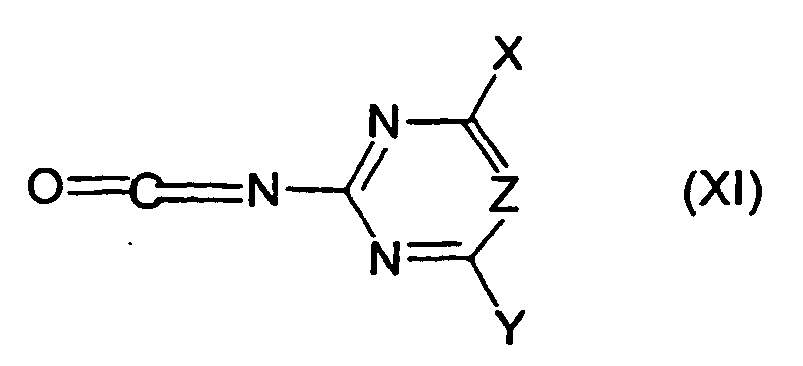
- X and Y
- independently of one another are halogen, C1-C6-alkyl, C1-C6-alkoxy, C1-C6-alkylthio, each of the three latter radicals being unsubstituted or substituted by one or more radicals from the group consisting of halogen, C1-C4-alkoxy and C1-C4-alkylthio, or are C3-C6-cycloalkyl, C2-C6-alkenyl, C2-C6-alkynyl, C3-C6-alkenyloxy or C3-C6-alkynyloxy, and
- Z
- is CH or N,
- i) a compound of the formula (X)
- The sulfonamide of the formula (VIII) can also be reacted
- β) as described in
WO 97/16419 
- Ar
- is unsubstituted or substituted phenyl,
- M
- is H, C1-C4-alkyl or a metal cation,
- X and Y
- independently of one another are halogen, C1-C6-alkyl, C1-C6-alkoxy, C1-C6-alkylthio, each of the three latter radicals being unsubstituted or substituted by one or more radicals from the group consisting of halogen, C1-C4-alkoxy and C1-C4-alkylthio, or are C3-C6-cycloalkyl, C2-C6-alkenyl, C2-C6-alkynyl, C3-C6-alkenyloxy or C3-C6-alkynyloxy, and
- Z
- is CH or N, or
- γ) as described in
WO 95/29899 EP-A-757679 
- X and Y
- independently of one another are halogen, C1-C6-alkyl, C1-C6-alkoxy, C1-C6-alkylthio, each of the three latter radicals being unsubstituted or substituted by one or more radicals from the group consisting of halogen, C1-C4-alkoxy and C1-C4-alkylthio, or are C3-C6-cycloalkyl, C2-C6-alkenyl, C2-C6-alkynyl, C3-C6-alkenyloxy or C3-C6-alkynyloxy, and
- Z
- is CH or N, or
- δ) as described in
WO 00/05220
or (IX-B)

- X and Y
- independently of one another are halogen, C1-C6-alkyl, C1-C6-alkoxy, C1-C6-alkylthio, each of the three latter radicals being unsubstituted or substituted by one or more radicals from the group consisting of halogen, C1-C4-alkoxy and C1-C4-alkylthio, or are C3-C6-cycloalkyl, C2-C6-alkenyl, C2-C6-alkynyl, C3-C6-alkenyloxy or C3-C6-alkynyloxy, and
- Z
- is CH or N,
- The nitrophenyl-sulfonylureas of the formula (XII) or a salt thereof can be further transformed into the corresponding aminophenyl-sulfonylureas of the formula (XIV) or salts thereof

by hydrogenation, e.g. as described above for compounds of the formula (I) and (VIII) or as described inWO 97/16419 - For example the hydrogenation may be carried out with hydrogen or a hydrogen source such as cyclohexadiene in the presence of a metal catalyst like: Pd/C, Pt/C, Ru/C or Raney-Ni alone or in combination, possibly in the presence of other metal derivatives such as the oxides of or the salts of the metals manganese, molybdanum, tungsten, iron and cobalt in which the metal is present as cation, oxoanion or polyoxoanion, in an inert solvent or solvent mixture thereof, such as but nor limited to: water, alcohols, unsubstituted or substituted hydrocarbones such as unsubstituted or substituted aryls (e.g. alkylaryls or haloaryls) or unsubstituted or substituted alkyls (e.g. haloalkyls), ethers, carbonates, carbamates, esters, nitriles, sulfones, carboxylic acids and ketones, at temperatures between about -30°C to 300°C and preferably between -10°C and 150°C.
- The nitrophenyl-sulfonylureas of the formula (XII) or a salt thereof can also be further transformed into the corresponding acylamidophenyl-sulfonylureas of the formula (XIV) of a salt thereof, wherein R1, R2 and R4 are defined as in formula (VIII) and M, X, Y and Z are defined as in formula (X) and A* is an acyl group, preferably a formyl radical or a C1-C8 hydrocarbyl-carbonyl radical, such as a branched or straight chain C1-C8-alkyl-carbonyl radical, by hydrogenation and subsequent acylation or simultaneous acylation (reductive acylation = hydrogenation in the presence of an acylating reagent), e.g. as described above for the compounds of the formula (I) and (VIII) or as described in
WO 97/16419 - For example the reaction may be carried out with hydrogen or a hydrogen source such as cyclohexadiene in the presence of a) a metal catalyst like: Pd/C, Pt/C, Ru/C or Raney-Ni alone or in combination, possibly in the presence of other metal derivatives such as the oxides of or the salts of the metals manganese, molybdanum, tungsten, iron and cobalt in which the metal is present as cation, oxoanion or polyoxoanion, and b) an acylating reagent such as formic acid and/or an C1-C8-carboxylic acid anhydride, optionally in other solvents or mixture of solvents, such as but not limited to: unsubstituted or substituted hydrocarbones such as unsubstituted or substituted aryls (e.g. alkylaryls or haloaryls) or unsubstituted or substituted alkyls (e.g. haloalkyls), carbonates, carbamates, esters, ethers, ketones, nitriles and sulfones, at temperatures between about -30°C to 300°C and preferably between -10°C and 150°C, to form the corresponding acylamidophenyl-sulfonylurea of the formula (XIV) or a salt thereof.
- The processes described herein above render in excellent yields herbicidally active sulfonylureas and their prescursors such as sulfochlorides or sulfonamides. The present invention is illustrated by the following examples.
-
- A) A suspension of 31,9 g 4-nitro-2-sulfobenzoic acid potassium salt (III) in toluene (240 ml) was heated to reflux and 0,6-0,8 ml of water removed azeotropically. The mixture was then cooled to 85-90°C, dimethyl formamide (0,23 ml) and pyridine (0,16 ml added and over 4 hours phosgene (10,1 g) added. After heating for a further 2 hours at 85-90°C the excess phosgene was removed by blowing nitrogen through the solution. Dimethylamine (4,78 g) was then added at 98-103°C to the phosgene free solution. After 1 hour the suspension was cooled to 20°C, filtered and the solid displacement washed with toluene (2 x 20 ml), pressed well and dried at 75°C / 50 mbar. Yield: 35.1 g (= 90 %), 80.1% w/w; mp.: dec. 320°C.
- B) A mixture of 4-nitro-2-sulfobenzoic acid potassium salt (50 g), dimethylamine hydrochloride (14.2 g) and tetrabutylammonium bromide (1.0 g) in xylene (120 ml) was heated to 100°C and thionyl chloride (15 ml) added dropwise over 45 minutes. After 2 hours the reaction is cooled to 20°C, the product filtered and washed with xylene (2 x 50 ml). Yield: 61.72 g (= 91.3%), 70.0% w/w.
-
- A) A suspension of 79,9 g 4-nitro-2-sulfobenzoic acid potassium salt (I) in xylene (570 ml) was heated to 88-92°C, dimethyl formamide (1 ml) added, and phosgene (58 g) added as a gas over 3 hours. After a further 1 hour the excess phosgene was removed by distillation and a second charge of 4-nitro-2-sulfobenzamide potassium salt (75.7 g) and pyridine (0.6 ml) added. The mixture was then heated to 138°C for 1 hour, cooled to 95-100°C and dimethylamine (23.5 g) added over 2 hours and the mixture heated for 30 minutes at this temperature. The suspension was then cooled to 70-75°C and in 2 hours a solution of dimethyl formamide (0.38 ml) in xylene (10 ml) and phosgene (77.1 g) added. The excess phosgene was then after 1 hour removed by distillation and the reaction cooled to 0-5°C. At this point ammonia (19.5 g) was added so that the temperature remained below 5°C. Finally the mixture was warmed to 20°C, water (420 ml) and conc. sulfuric acid (7.4 g) (final pH = 4) added and the mixture stirred for 15 minutes. The solid was filtered washed with water (5 x 100 ml), pressed well and dired at 75°C / 50 mbar. Yield 111.4 g (= 81%), 93.4% w/w.
- B) A mixture of 31,9 g 4-nitro-2-sulfobenzoic acid potassium salt (III) and toluene (240 ml) was heated to reflux and 0,6-0,8 ml of water removed azeotropically. The mixture was then cooled to 82-87°C, benzyltriethylammonium chloride (0,91 g) added and over two hours thionyl chloride (9,2 ml) added dropwise. After a further hour a mixture of toluene and thionyl chloride (25 ml) was removed by distillation and between 95-100°C dimethylamine (7,5 g) added as a gas. Following 1 hour at this temperature the mixture is cooled to 70-75°C and in 2 hours dimethyl formamide (0,08 ml) as a solution in toluene (2 ml) and phosgene (15,8 g) added. 1 Hour later the phosgene was removed by blowing nitrogen through the mixture and at 0-5°C ammonia (4 g) added. After warming under vacuum to 40°C the product was isolated by filtration, washed with toluene (3 x 20 ml) and pressed well. The solid was then re-suspended in water(85 ml) and acetone (2.5 ml), stirred, filtered washed with water (5 x 20 ml) and finally dried at 75°C / 50 mbar. Yield 23.6 g (= 82%), 95.6% w/w mp.: 161-162°C.
- A suspension of 40 g N,N-Dimethyl 2-aminosulfonyl-4-nitrobenzamide (VIII), sodium molybdate (0,08 g) and Pd/C (3 g, 5%, 50% water) in formic acid (200 ml) was hydrogenated at 50°C and 40 bar for 7 hours. The catalyst was then filtered and washed with formic acid (20 ml). The filtrate was concentrated in vacuo and ethyl acetate (200 ml) added. After stirring for 2 hours at 20°C the product was filtered, the filtrate concentrated and re-filtered. The combined solids were washed with ethyl acetate (20 ml) and dries at 50°C / 50 mbar. Yield: 35.3 g (= 84.3%), 94.1% w/w, mp.: 192-193°C.
- To a solution of phosgene (20 g) in ethyl acetate (70 ml) at 0°C in 2.5 hours was added a mixture of 20 g N,N-dimethyl 2-aminosulfonyl-4-nitrobenzamide (VIII)) and triethylamine (39 ml) in ethyl acetate (200 ml). After 30 minutes the excess phosgene is removed by blowing nitrogen through the mixture and a solution from 2-amino-4,6-dimethoxypyrimidine (11.9 g) in ethyl acetate (80 ml) added dropwise. After a further 1.5 hours water (200 ml) and potassium hydroxide (5N, 45 ml) was added and after clarification the phases separated. The organic phase was extracted with water (2 x 50 ml) and the combined aqueous phases acidified to pH = 2 with hydrochloric acid 93 N, 35 ml). The solids were then isolated by filtration, washed with water and dried at 40°C / 50 mbar. Yield 22.3 g (= 58 %), 87.1 % w/w.
-
- A) A mixture of 75 g N,N-Dimethyl 2-(N-(-(4,6-dimethoxypyrimid-2-yl)-aminocarbonyl)-aminosulfonyl)-4-nitrobenzamide (XII), sodium molybdate (0,05 g) and Pd/C (3 g, 5%, 50% water) in formic acid (225 ml) was hydrogenated for 3 hours at 30-35°C. The catalyst was filtered and washed with formic acid (20 ml). The filtrate was concentrated in vacuo (35°C)and ethyl acetate (240 ml) added. After stirring for 1 hour at 45°C the mixture was cooled to 0-5°C, stirred for a further 2 hours and filtered. After washing with ethyl acetate (2 x 25 ml) the product was re-suspended in ethyl acetate (200 ml), heated for 2 hours at 50-55°C, cooled to 20°C, filtered, washed with ethyl acetate (2 x 25 ml) and dried at 45°C / 50 mbar. Yield 60.6 g (= 83.6%), 95.5% w/w.
- B) A mixture of 30 g N,N-dimethyl 2-aminosulfonyl-4-formamidobenzamide (VI*) and 3,3 g (N-(4,6-dimethoxypyrimidin-2yl)phenylcarbamate (3,3 g) in acetonitrile (250 ml) was treated with potassium carbonate (30 g) at 20°C. A further portion of (N-(4,6-dimethoxypyrimidin-2yl)phenylcarbamate (2 g) was added after 3 hours. After a further hour xylene (400 ml) was added and the acetonitrile removed by distillation in vacuo (45°C). Thereafter hydrochloric acid (1 N, 400 ml) was added, the product filtered, washed with water (2 x 200 ml), xylene (2 x 200 ml) and dried. Yield 42 g (= 66.1%), 78.7% w/w.

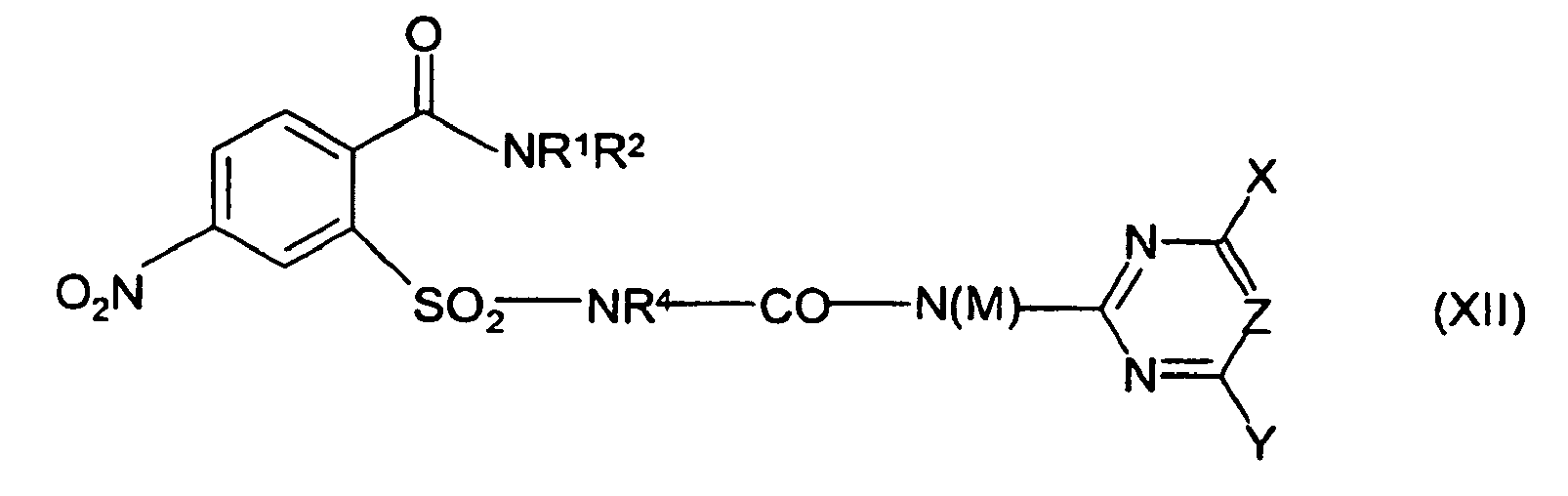
Claims (14)
- A compound of the formula (I)
 R1 is an unsubstituted or substituted hydrocarbon radical having a total of 1 to 10 carbon atoms,R2 is an unsubstituted or substituted hydrocarbon radical having a total of 1 to 10 carbon atoms, or the groupNR1R2 is a heterocyclic ring having 3 to 8 ring atoms which is unsubstituted or substituted and contains the nitrogen atom of the group NR1R2 as ring heteroatom, andQ is H or a cation.
 - A compound of the formula (I) as claimed in claim 1, whereinR1 is C1-C6-alkyl, C2-C6-alkenyl, C2-C6-alkynyl or C5-C6-cycloalkyl, each of the four latter radicals being unsubstituted or substituted by one or more radicals from the group consisting of halogen, C1-C4-alkoxy, C1-C4-haloalkoxy, C1-C4-alkylthio, mono- and di-(C1-C4-alkyl)-amino, cyano, azido, formyl, (C1-C4-alkyl)-carbonyl, (C1-C4-alkoxy)-carbonyl, C1-C4-alkylsulfinyl and C1-C4-alkylsulfonyl,
or is phenyl which is unsubstituted or substituted by radicals from the group consisting of halogen, C1-C4-alkyl, C1-C4-alkoxy, C1-C4-haloalkyl, C1-C4-haloalkoxy and nitro,R2 is C1-C6-alkyl, C2-C6-alkenyl, C2-C6-alkynyl or C5-C6-cycloalkyl, each of the four latter radicals being unsubstituted or substituted by one or more radicals from the group consisting of halogen, C1-C4-alkoxy, C1-C4-haloalkoxy, C1-C4-alkylthio, mono- and di-(C1-C4-alkyl)-amino, cyano, azido, formyl, (C1-C4-alkyl)-carbonyl, (C1-C4-alkoxy)-carbonyl, C1-C4-alkylsulfinyl and C1-C4-alkylsulfonyl, or the groupNR1R2 is a heterocyclic ring of 4, 5 or 6 ring atoms which may contain up to two further ring heteroatoms from the group consisting of N and O in the ring and which is unsubstituted or substituted by one or more C1-C4-alkyl radicals, andQ is H or an alkali or alkaline earth metal cation or an ammonium- or phosphonium-cation. - A compound of the formula (I) as claimed in claim 1 or 2, whereinR1 .is C1-C4-alkyl, especially methyl or ethyl,R2 is C1-C4-alkyl, especially methyl or ethyl, andQ is H, Na or K.
- A process for the preparation of a compound of the formula (I) as claimed in claims 1 to 3, comprising reacting an amine of the formula NHR1R2 or a salt thereof, where R1 and R2 are defined as in formula (I) in claims 1 to 3, with an anhydride of the formula (II)

- A process for the preparation of a compound of the formula (I) as claimed in claims 1 to 3, comprising reacting an amine of the formula NHR1R2 or a salt thereof, where R1 and R2 are defined as in formula (I) in claims 1 to 3, with a diacid of the formula (III) or a salt thereof

- A process for the preparation of a compound of the formula (V)

- A process for the preparation of a compound of the formula (VI)

- A process for the preparation of a sulfonylurea compound of the formula (XIV) or a salt thereof
 M is H, C1-C4-alkyl or a metal cation,X and Y independently of one another are halogen, C1-C6-alkyl, C1-C6-alkoxy, C1-C6-alkylthio, each of the three latter radicals being unsubstituted or substituted by one or more radicals from the group consisting of halogen, C1-C4-alkoxy and C1-C4-alkylthio, or are C3-C6-cycloalkyl, C2-C6-alkenyl, C2-C6-alkynyl, C3-C6-alkenyloxy or C3-C6-alkynyloxy, andZ Is CH or N, comprisinga) reacting an amine of the formula NHR1R2 or a salt thereof, where R1.and R2 are defined as in formula (I) in claims 1 to 3, (α) with an anhydride of the formula (II)

to produce a compound of the formula (I) R1 is an unsubstituted or substituted hydrocarbon radical having a total of 1 to 10 carbon atoms,R2 is an unsubstituted or substituted hydrocarbon radical having a total of 1 to 10 carbon atoms, or the groupNR1R2 is a heterocyclic ring having 3 to 8 ring atoms which is unsubstituted or substituted and contains the nitrogen atom of the group NR1R2 as ring heteroatom and may also contain one or two further ring heteroatoms from the group consisting of N, O and S, andQ is H, or a cation;b) reacting a compound of the formula (I) obtained in step a) with an activation reagent in the presence of an amide catalyst to produce a compound of the formula (VII)
 c) reacting a compound of the formula (VII) obtained in step b)
 d) reacting a compound of the formula (VIII) obtained in step c)α) with hydrogen or a hydrogen source in the presence of a metal catalyst and optionally an acylating reagent to give a compound of the formula (A)
 i) a compound of the formula (X)
 Ar is unsubstituted or substituted phenyl,M is H, C1-C4-alkyl or a metal cation,X and Y independently of one another are halogen, C1-C6-alkyl, C1-C6-; alkoxy, C1-C6-alkylthio, each of the three latter radicals being unsubstituted or substituted by one or more radicals from the group consisting of halogen, C1-C4-alkoxy and C1-C4-alkylthio, or are C3-C6-cycloalkyl, C2-C6-alkenyl, C2-C6-alkynyl, C3-C6-alkenyloxy or C3-C6-alkynyloxy, andZ is CH or N, orii) a compound of the formula (XI)to give a compound of the formula (XIV) or a salt thereof wherein A* is hydrogen or an acyl group; or
 X and Y independently of one another are halogen, C1-C6-alkyl, C1-C6-alkoxy, C1-C6-alkylthio, each of the three latter radicals being unsubstituted or substituted by one or more radicals from the group consisting of halogen, C1-C4-alkoxy and C1-C4-alkylthio, or are C3-C3-cycloalkyl, C2-C6-alkenyl, C2-C6-alkynyl, C3-C8-alkenyloxy or C3-C6-alkynyloxy, andZ is CH or N,β) with a compound of the formula (X)
 Ar is unsubstituted or substituted phenyl,M is H, C1-C4-alkyl or a metal cation,X and Y independently of one another are halogen, C1-C6-alkyl, C1-C6-alkoxy, C1-C6-alkylthio, each of the three latter radicals being unsubstituted or substituted by one or more radicals from the group consisting of halogen, C1-C4-alkoxy and C1-C4-alkylthio, or are C3-C6-cycloalkyl, C2-C6-alkenyl, C2-C6-alkynyl, C3-C6-alkenyloxy or C3-C6-alkynyloxy, andZ is CH or N,to give a nitrophenyl-sulfonylurea compound of the formula (XII) or a salt
thereof γ) with a compound of the formula (XI)
 X and Y independently of one another are halogen, C1-C6-alkyl, C1-C6-alkoxy, C1-C6-alkylthio, each of the three latter radicals being unsubstituted or substituted by one or more radicals from the group consisting of halogen, C1-C4-alkoxy and C1-C4-alkylthio, or are C3-C6-cycloalkyl, C2-C6-alkenyl, C2-C6-alkynyl, C3-C6-alkenyloxy or C3-C6-alkynyloxy, andZ is CH or N,to give a nitrophenyl-sulfonylurea compound of the formula (XII) or a salt thereof
 δ) with phosgene to give a compound of the formula (IX-A) or (IX-B)
 X and Y independently of one another are halogen, C1-C6-alkyl, C1-C6-alkoxy, C1-C6-alkylthio, each of the three latter radicals being unsubstituted or substituted by one or more radicals from the group consisting of halogen, C1-C4-alkoxy and C1-C4-alkylthio, or are C3-C6-cycloalkyl, C2-C6-alkenyl, C2-C6-alkynyl, C3-C6-alkenyloxy or C3-C6-alkynyloxy, andZ is CH or N,to give a nitrophenyl-sulfonylurea compound of the formula (XII) or a salt thereof
 e)α) hydrogenating the compound of the formula (XII) obtained in step d), β, γ or δ to produce a compound of the formula (XIV) wherein A* is H, or a salt thereof, orβ) hydrogenating and acylating the compound of the formula (XII) obtained in step d) β, γ or δ to produce a compound of the formula (XIV), wherein A* is an acyl group, or a salt thereof.
 - A process as claimed in claim 4 or 8, wherein the anhydride of the formula (II) used in step a) α) is obtained by reacting a diacid of the formula (III)

- A process as claimed in claim 4 or 8, wherein the anhydride of the formula (II) used in step a, α) is obtained by reacting a dichloride of the formula (IV)

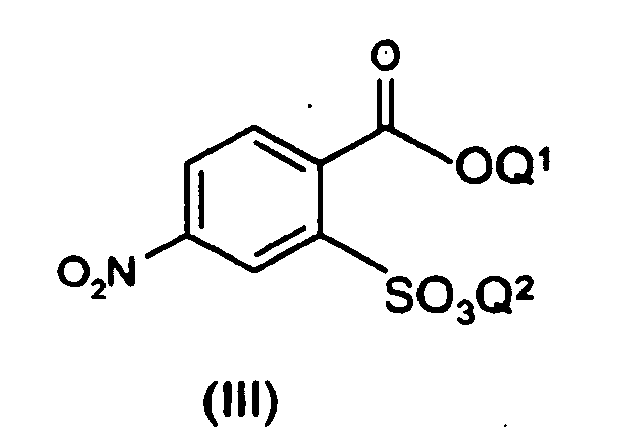
- A process for the preparation of a nitrophenyl sulfonylurea compound of the formula (XII) or a salt thereof
 a) reacting an amine of the formula NHR1R2 or a salt thereof, where R1 and R2 are defined as in formula (I) in claims 1 to 3, (α) with an anhydride of the formula (II)

to produce a compound of the formula (I) R1 is an unsubstituted or substituted hydrocarbon radical having a total of 1 to 10 carbon atoms,R2 is an unsubstituted or substituted hydrocarbon radical having a total of 1 to 10 carbon atoms, or the groupNR1R2 is a heterocyclic ring having 3 to 8 ring atoms which is unsubstituted or substituted and contains the nitrogen atom of the group NR1R2 as ring heteroatom and may also contain one or two further ring heteroatoms from the group consisting of N, O and S, andQ is H, or a cation;b) reacting a compound of the formula (I) obtained in step a) with an activation reagent to produce a compound of the formula (VII)
 c) reacting a compound of the formula (VII) obtained in step b)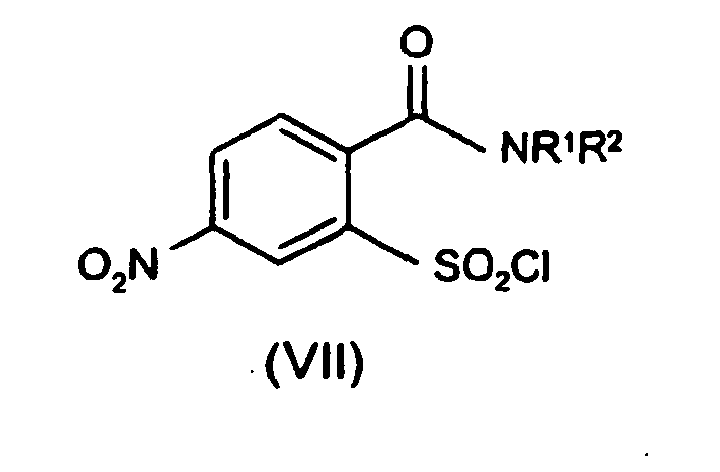
 d) reacting a compound of the formula (VIII) obtained in step c)to give a nitrophenyl-sulfonylurea compound of the formula (XII) or a salt thereofα) with a compound of the formula (X)
 Ar is unsubstituted or substituted phenyl,M is H, C1-C4-alkyl or a metal cation,X and Y independently of one another are halogen, C1-C6-alkyl, C1-C6-alkoxy, C1-C6-alkylthio, each of the three latter radicals being unsubstituted or substituted by one or more radicals from the group consisting of halogen, C1-C4-alkoxy and C1-C4-alkylthio, or are C3-C6-cycloalkyl, C2-C6-alkenyl, C2-C6-alkynyl, C3-C6-alkenyloxy or C3-C6-alkynyloxy, andZ is CH or N,to give a nitrophenyl-sulfonylurea compound of the formula (XII) or a salt thereof
 β) with a compound of the formula (XI)
 X and Y independently of one another are halogen, C1-C6-alkyl, C1-C6-alkoxy, C1-C6-alkylthio, each of the three latter radicals being unsubstituted or substituted by one or more radicals from the group consisting of halogen, C1-C4-alkoxy and C1-C4-alkylthio, or are C3-C6-cycloalkyl, C2-C6-alkenyl, C2-C6-alkynyl, C3-C6-alkenyloxy or C3-C6-alkynyloxy, andZ Z is CH or N.to give a nitrophenyl-sulfonylurea compound of the formula (XII) or a salt thereof
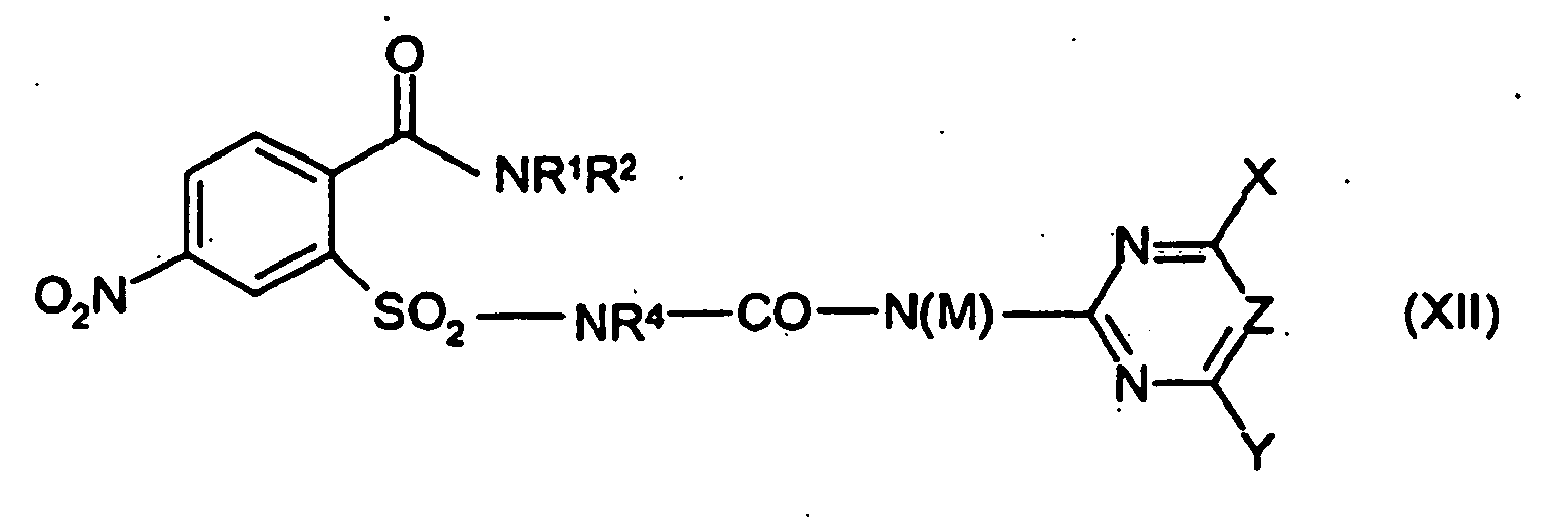 γ) with phosgene to give a compound of the formule (IX-A) or (IX-B)
 X and Y independently of one another are halogen, C1-C6-alkyl, C1-C6-alkoxy, C1-C6-alkylthio, each of the three latter radicals being unsubstituted or substituted by one or more radicals from the group consisting of halogen, C1-C4-alkoxy and C1-C4-alkylthio, or are C3-C6-cycloalkyl, C2-C6-alkenyl, C2-C6-alkynyl, C3-C6-alkenyloxy or C3-C6-alkynyloxy, andZ is CH or N,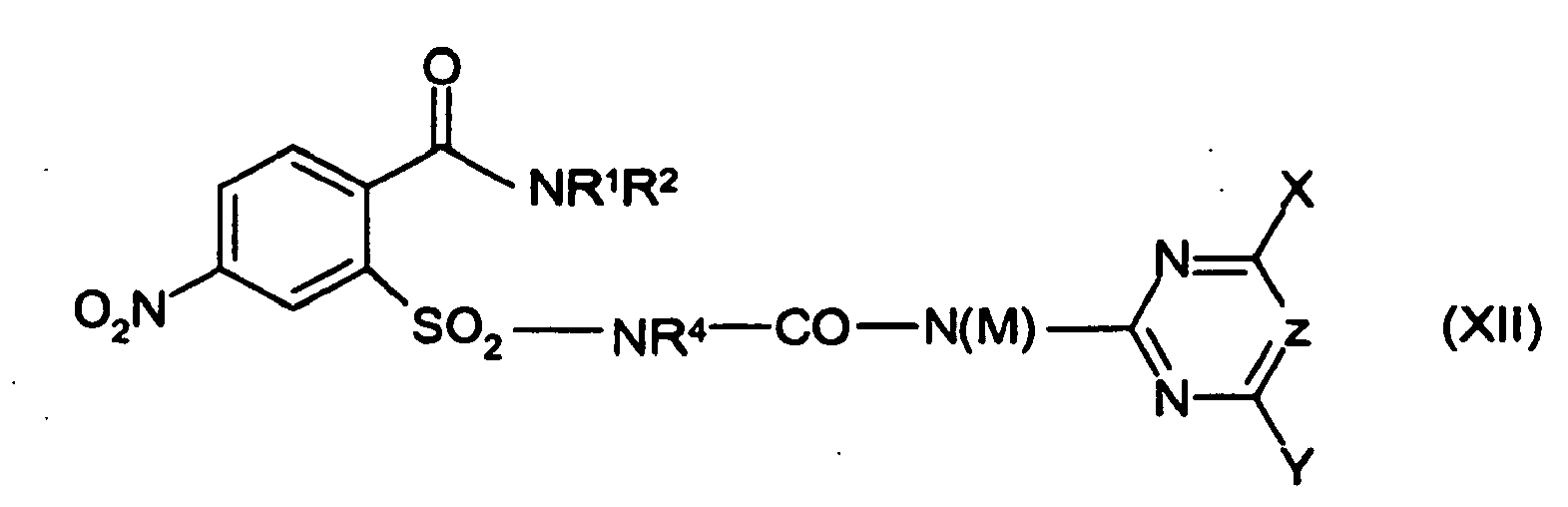
- A process as claimed in claim 11, wherein the anhydride of the formula (II) used in step a) α) is obtained by reacting a diacid of the formula (III)

- A process as claimed in claim 11, wherein the anhydride of the formula (II) used in step a, α) is obtained by reacting a dichloride of the formula (IV)


- Use of a compound of the formula (I) as claimed claims 1 to 3, in the preparation of a sulfonylurea of the formula (XIV) or a salt thereof as defined claim 8 or a sulfonylurea of the formula (XII) or a salt thereof as defined in claim 11.
Applications Claiming Priority (3)
| Application Number | Priority Date | Filing Date | Title |
|---|---|---|---|
| DE19959291 | 1999-12-09 | ||
| DE19959291 | 1999-12-09 | ||
| PCT/EP2000/011501 WO2001042226A1 (en) | 1999-12-09 | 2000-11-18 | Nitro-sulfobenzamides |
Publications (2)
| Publication Number | Publication Date |
|---|---|
| EP1242386A1 EP1242386A1 (en) | 2002-09-25 |
| EP1242386B1 true EP1242386B1 (en) | 2009-08-26 |
Family
ID=7931941
Family Applications (1)
| Application Number | Title | Priority Date | Filing Date |
|---|---|---|---|
| EP00976048A Expired - Lifetime EP1242386B1 (en) | 1999-12-09 | 2000-11-18 | Nitro-sulfobenzamides |
Country Status (26)
| Country | Link |
|---|---|
| US (1) | US7781611B2 (en) |
| EP (1) | EP1242386B1 (en) |
| JP (1) | JP4536987B2 (en) |
| KR (1) | KR20020064339A (en) |
| CN (1) | CN1213034C (en) |
| AR (1) | AR035022A1 (en) |
| AT (1) | ATE440824T1 (en) |
| AU (1) | AU780969B2 (en) |
| BR (1) | BR0016739A (en) |
| CA (1) | CA2390669A1 (en) |
| CZ (1) | CZ20022003A3 (en) |
| DE (1) | DE60042839D1 (en) |
| DK (1) | DK1242386T3 (en) |
| ES (1) | ES2332208T3 (en) |
| HR (1) | HRP20020498A2 (en) |
| HU (1) | HUP0203678A3 (en) |
| IL (3) | IL150057A0 (en) |
| MX (1) | MXPA02005803A (en) |
| PL (1) | PL357573A1 (en) |
| RU (1) | RU2359963C2 (en) |
| SK (1) | SK8122002A3 (en) |
| TW (1) | TWI221151B (en) |
| UA (1) | UA81596C2 (en) |
| WO (1) | WO2001042226A1 (en) |
| YU (1) | YU41702A (en) |
| ZA (1) | ZA200204581B (en) |
Families Citing this family (5)
| Publication number | Priority date | Publication date | Assignee | Title |
|---|---|---|---|---|
| AR053410A1 (en) * | 2004-08-19 | 2007-05-09 | Wyeth Corp | PROCESS FOR SYNTHESIS OF INDOLES N-RENTED C-2, C-3 SUBSTITUTED. INTERMEDIARY COMPOUNDS |
| CN105399687B (en) * | 2015-10-29 | 2019-01-15 | 江苏省农用激素工程技术研究中心有限公司 | The preparation method of foramsulfuron |
| CN106349168A (en) * | 2016-08-12 | 2017-01-25 | 淮安国瑞化工有限公司 | Preparation method of foramsulfuron intermediate of sulfonylurea herbicide |
| CN110437112B (en) * | 2019-09-19 | 2021-08-17 | 河北兴柏农业科技有限公司 | A kind of preparation method of formisulfuron-methyl or its derivative intermediate |
| CN116903545A (en) * | 2023-07-07 | 2023-10-20 | 江苏省农用激素工程技术研究中心有限公司 | Synthesis method of formamidesulfuron-methyl |
Family Cites Families (10)
| Publication number | Priority date | Publication date | Assignee | Title |
|---|---|---|---|---|
| US3055928A (en) * | 1960-03-28 | 1962-09-25 | Smith Kline French Lab | Esters of 2-carbamoylbenzenesulfonic acids |
| DE4018245A1 (en) * | 1990-06-07 | 1991-12-12 | Basf Ag | METHOD FOR PRODUCING SULFONATED ANTHRANILE ACIDS |
| DE4334949A1 (en) * | 1992-10-14 | 1994-05-19 | Bard Inc C R | New nitrogen substd. phenol red dyes and sulphonaphthalein - having amino or nitro gps. and prepn. from amino sulphobenzoic anhydride and phenols and bondable to e.g. polymeric matrix for pH indicators |
| DE4411682A1 (en) | 1994-04-05 | 1995-10-12 | Hoechst Schering Agrevo Gmbh | Process for the preparation of carboxy-arenesulfonic acids and their carboxylic acid derivatives |
| DE4415049A1 (en) * | 1994-04-29 | 1995-11-02 | Hoechst Schering Agrevo Gmbh | Acylated aminophenylsulfonylureas, process for their preparation and use as herbicides and growth regulators |
| DE19521668A1 (en) | 1995-06-14 | 1996-12-19 | Hoechst Schering Agrevo Gmbh | Substituted hydrazinophenylsulfonylureas, process for their preparation and their use as herbicides and plant growth regulators |
| DE19540701A1 (en) * | 1995-11-02 | 1997-05-07 | Hoechst Schering Agrevo Gmbh | Process for the preparation of aminophenylsulfonylureas and intermediates to the processes |
| RU2107683C1 (en) * | 1996-06-17 | 1998-03-27 | Любовь Дмитриевна Погорелая | Potassium salt of n-(4,6-dimethylpurimidine-2-yl)-n'-[2-(methoxycarbonyl)phenylsulfonyl urea |
| DE19735879A1 (en) * | 1997-08-19 | 1999-02-25 | Hoechst Schering Agrevo Gmbh | Process for the preparation of 2-carboxy-5-nitro-benzenesulfonic acid and its salts by oxidation |
| DE19749723A1 (en) * | 1997-11-11 | 1999-05-12 | Bayer Ag | Process for the preparation of 4-nitro-2-sulfo-benzoic acid |
-
2000
- 2000-11-18 BR BR0016739-8A patent/BR0016739A/en not_active Application Discontinuation
- 2000-11-18 MX MXPA02005803A patent/MXPA02005803A/en active IP Right Grant
- 2000-11-18 EP EP00976048A patent/EP1242386B1/en not_active Expired - Lifetime
- 2000-11-18 JP JP2001543527A patent/JP4536987B2/en not_active Expired - Lifetime
- 2000-11-18 UA UA2002075618A patent/UA81596C2/en unknown
- 2000-11-18 AU AU13954/01A patent/AU780969B2/en not_active Ceased
- 2000-11-18 CA CA002390669A patent/CA2390669A1/en not_active Abandoned
- 2000-11-18 PL PL00357573A patent/PL357573A1/en not_active Application Discontinuation
- 2000-11-18 RU RU2002118605/04A patent/RU2359963C2/en not_active IP Right Cessation
- 2000-11-18 WO PCT/EP2000/011501 patent/WO2001042226A1/en not_active Ceased
- 2000-11-18 DK DK00976048T patent/DK1242386T3/en active
- 2000-11-18 AT AT00976048T patent/ATE440824T1/en not_active IP Right Cessation
- 2000-11-18 HU HU0203678A patent/HUP0203678A3/en unknown
- 2000-11-18 SK SK812-2002A patent/SK8122002A3/en not_active Application Discontinuation
- 2000-11-18 HR HR20020498A patent/HRP20020498A2/en not_active Application Discontinuation
- 2000-11-18 DE DE60042839T patent/DE60042839D1/en not_active Expired - Lifetime
- 2000-11-18 CN CNB00817816XA patent/CN1213034C/en not_active Expired - Lifetime
- 2000-11-18 YU YU41702A patent/YU41702A/en unknown
- 2000-11-18 KR KR1020027007389A patent/KR20020064339A/en not_active Ceased
- 2000-11-18 IL IL15005700A patent/IL150057A0/en unknown
- 2000-11-18 CZ CZ20022003A patent/CZ20022003A3/en unknown
- 2000-11-18 ES ES00976048T patent/ES2332208T3/en not_active Expired - Lifetime
- 2000-12-07 AR ARP000106513A patent/AR035022A1/en unknown
- 2000-12-07 TW TW089126114A patent/TWI221151B/en not_active IP Right Cessation
- 2000-12-07 US US09/732,006 patent/US7781611B2/en not_active Expired - Fee Related
-
2002
- 2002-06-05 IL IL150057A patent/IL150057A/en active IP Right Grant
- 2002-06-07 ZA ZA200204581A patent/ZA200204581B/en unknown
-
2010
- 2010-08-05 IL IL207454A patent/IL207454A/en active IP Right Grant
Also Published As
Similar Documents
| Publication | Publication Date | Title |
|---|---|---|
| HUP0301555A2 (en) | Substituted sulfonyl aminomethyl benzoic acid (derivatives) and method for the production thereof | |
| EP1242386B1 (en) | Nitro-sulfobenzamides | |
| CN100497322C (en) | Process for the preparation of substituted phenylsulfonyl ureas | |
| JP3754460B2 (en) | Method for producing sulfonylureas | |
| US6500952B1 (en) | Processes for preparing aminophenylsulfonylureas, and intermediates therefor | |
| US5155222A (en) | Process for the preparation of n-alkylsulfonylaminosulfonylureas | |
| US6365739B1 (en) | Process for the preparation of 4,6-disubstituted 2-isocyanatopyrimidines and their use as intermediates for active compound syntheses | |
| US7026477B1 (en) | Process for preparing substituted phenylsulfonylureas from sulfonyl halides | |
| CN1071748C (en) | Method of preparing sulphonyl ureas with herbicidal properties and N-pyrimidinyl or N-triazinyl carbamates as intermediates in the reaction | |
| JP3117780B2 (en) | Method for producing sulfonylureas | |
| KR20000022200A (en) | 4-jod-2 n-(n-alkyl-aminocarbonyl)-aminosulfonyl]-benzoic acid methyl ester and derivatives thereof and method for their production |
Legal Events
| Date | Code | Title | Description |
|---|---|---|---|
| PUAI | Public reference made under article 153(3) epc to a published international application that has entered the european phase |
Free format text: ORIGINAL CODE: 0009012 |
|
| 17P | Request for examination filed |
Effective date: 20020709 |
|
| AK | Designated contracting states |
Kind code of ref document: A1 Designated state(s): AT BE CH CY DE DK ES FI FR GB GR IE IT LI LU MC NL PT SE TR |
|
| AX | Request for extension of the european patent |
Free format text: AL;LT;LV;MK;RO PAYMENT 20020709;SI PAYMENT 20020709 |
|
| 17Q | First examination report despatched |
Effective date: 20040621 |
|
| RAP1 | Party data changed (applicant data changed or rights of an application transferred) |
Owner name: BAYER CROPSCIENCE AG |
|
| GRAP | Despatch of communication of intention to grant a patent |
Free format text: ORIGINAL CODE: EPIDOSNIGR1 |
|
| GRAS | Grant fee paid |
Free format text: ORIGINAL CODE: EPIDOSNIGR3 |
|
| GRAA | (expected) grant |
Free format text: ORIGINAL CODE: 0009210 |
|
| AK | Designated contracting states |
Kind code of ref document: B1 Designated state(s): AT BE CH CY DE DK ES FI FR GB GR IE IT LI LU MC NL PT SE TR |
|
| AX | Request for extension of the european patent |
Extension state: RO SI |
|
| REG | Reference to a national code |
Ref country code: GB Ref legal event code: FG4D |
|
| REG | Reference to a national code |
Ref country code: CH Ref legal event code: EP |
|
| REG | Reference to a national code |
Ref country code: IE Ref legal event code: FG4D |
|
| REF | Corresponds to: |
Ref document number: 60042839 Country of ref document: DE Date of ref document: 20091008 Kind code of ref document: P |
|
| REG | Reference to a national code |
Ref country code: DK Ref legal event code: T3 |
|
| PG25 | Lapsed in a contracting state [announced via postgrant information from national office to epo] |
Ref country code: SE Free format text: LAPSE BECAUSE OF FAILURE TO SUBMIT A TRANSLATION OF THE DESCRIPTION OR TO PAY THE FEE WITHIN THE PRESCRIBED TIME-LIMIT Effective date: 20090826 Ref country code: AT Free format text: LAPSE BECAUSE OF FAILURE TO SUBMIT A TRANSLATION OF THE DESCRIPTION OR TO PAY THE FEE WITHIN THE PRESCRIBED TIME-LIMIT Effective date: 20090826 |
|
| REG | Reference to a national code |
Ref country code: ES Ref legal event code: FG2A Ref document number: 2332208 Country of ref document: ES Kind code of ref document: T3 |
|
| PG25 | Lapsed in a contracting state [announced via postgrant information from national office to epo] |
Ref country code: CY Free format text: LAPSE BECAUSE OF FAILURE TO SUBMIT A TRANSLATION OF THE DESCRIPTION OR TO PAY THE FEE WITHIN THE PRESCRIBED TIME-LIMIT Effective date: 20090826 Ref country code: PT Free format text: LAPSE BECAUSE OF FAILURE TO SUBMIT A TRANSLATION OF THE DESCRIPTION OR TO PAY THE FEE WITHIN THE PRESCRIBED TIME-LIMIT Effective date: 20091228 |
|
| PG25 | Lapsed in a contracting state [announced via postgrant information from national office to epo] |
Ref country code: MC Free format text: LAPSE BECAUSE OF NON-PAYMENT OF DUE FEES Effective date: 20091130 Ref country code: BE Free format text: LAPSE BECAUSE OF FAILURE TO SUBMIT A TRANSLATION OF THE DESCRIPTION OR TO PAY THE FEE WITHIN THE PRESCRIBED TIME-LIMIT Effective date: 20090826 |
|
| PLBE | No opposition filed within time limit |
Free format text: ORIGINAL CODE: 0009261 |
|
| STAA | Information on the status of an ep patent application or granted ep patent |
Free format text: STATUS: NO OPPOSITION FILED WITHIN TIME LIMIT |
|
| 26N | No opposition filed |
Effective date: 20100527 |
|
| PG25 | Lapsed in a contracting state [announced via postgrant information from national office to epo] |
Ref country code: GR Free format text: LAPSE BECAUSE OF FAILURE TO SUBMIT A TRANSLATION OF THE DESCRIPTION OR TO PAY THE FEE WITHIN THE PRESCRIBED TIME-LIMIT Effective date: 20091127 Ref country code: IE Free format text: LAPSE BECAUSE OF NON-PAYMENT OF DUE FEES Effective date: 20091118 |
|
| PG25 | Lapsed in a contracting state [announced via postgrant information from national office to epo] |
Ref country code: LU Free format text: LAPSE BECAUSE OF NON-PAYMENT OF DUE FEES Effective date: 20091118 |
|
| PG25 | Lapsed in a contracting state [announced via postgrant information from national office to epo] |
Ref country code: TR Free format text: LAPSE BECAUSE OF FAILURE TO SUBMIT A TRANSLATION OF THE DESCRIPTION OR TO PAY THE FEE WITHIN THE PRESCRIBED TIME-LIMIT Effective date: 20090826 |
|
| REG | Reference to a national code |
Ref country code: DE Ref legal event code: R081 Ref document number: 60042839 Country of ref document: DE Owner name: BAYER INTELLECTUAL PROPERTY GMBH, DE Free format text: FORMER OWNER: BAYER CROPSCIENCE AG, 40789 MONHEIM, DE Effective date: 20141023 Ref country code: DE Ref legal event code: R081 Ref document number: 60042839 Country of ref document: DE Owner name: BAYER CROPSCIENCE AKTIENGESELLSCHAFT, DE Free format text: FORMER OWNER: BAYER CROPSCIENCE AG, 40789 MONHEIM, DE Effective date: 20141023 |
|
| REG | Reference to a national code |
Ref country code: ES Ref legal event code: PC2A Owner name: BAYER INTELLECTUAL PROPERTY GMBH Effective date: 20150312 |
|
| REG | Reference to a national code |
Ref country code: NL Ref legal event code: SD Effective date: 20150513 |
|
| REG | Reference to a national code |
Ref country code: CH Ref legal event code: PUE Owner name: BAYER INTELLECTUAL PROPERTY GMBH, DE Free format text: FORMER OWNER: BAYER CROPSCIENCE AG, DE Ref country code: CH Ref legal event code: NV Representative=s name: E. BLUM AND CO. AG PATENT- UND MARKENANWAELTE , CH |
|
| REG | Reference to a national code |
Ref country code: FR Ref legal event code: PLFP Year of fee payment: 16 |
|
| REG | Reference to a national code |
Ref country code: FR Ref legal event code: TP Owner name: BAYER INTELLECTUAL PROPERTY GMBH, DE Effective date: 20151117 |
|
| REG | Reference to a national code |
Ref country code: GB Ref legal event code: 732E Free format text: REGISTERED BETWEEN 20160107 AND 20160113 |
|
| REG | Reference to a national code |
Ref country code: FR Ref legal event code: PLFP Year of fee payment: 17 |
|
| REG | Reference to a national code |
Ref country code: FR Ref legal event code: PLFP Year of fee payment: 18 |
|
| REG | Reference to a national code |
Ref country code: DE Ref legal event code: R081 Ref document number: 60042839 Country of ref document: DE Owner name: BAYER CROPSCIENCE AKTIENGESELLSCHAFT, DE Free format text: FORMER OWNER: BAYER INTELLECTUAL PROPERTY GMBH, 40789 MONHEIM, DE |
|
| REG | Reference to a national code |
Ref country code: FR Ref legal event code: PLFP Year of fee payment: 19 |
|
| PGFP | Annual fee paid to national office [announced via postgrant information from national office to epo] |
Ref country code: DE Payment date: 20191105 Year of fee payment: 20 Ref country code: FI Payment date: 20191111 Year of fee payment: 20 Ref country code: NL Payment date: 20191114 Year of fee payment: 20 |
|
| PGFP | Annual fee paid to national office [announced via postgrant information from national office to epo] |
Ref country code: DK Payment date: 20191112 Year of fee payment: 20 Ref country code: ES Payment date: 20191202 Year of fee payment: 20 Ref country code: IT Payment date: 20191108 Year of fee payment: 20 Ref country code: FR Payment date: 20191029 Year of fee payment: 20 |
|
| PGFP | Annual fee paid to national office [announced via postgrant information from national office to epo] |
Ref country code: CH Payment date: 20191116 Year of fee payment: 20 |
|
| PGFP | Annual fee paid to national office [announced via postgrant information from national office to epo] |
Ref country code: GB Payment date: 20191115 Year of fee payment: 20 |
|
| REG | Reference to a national code |
Ref country code: NL Ref legal event code: MK Effective date: 20201117 |
|
| REG | Reference to a national code |
Ref country code: DK Ref legal event code: EUP Expiry date: 20201118 |
|
| REG | Reference to a national code |
Ref country code: CH Ref legal event code: PL |
|
| REG | Reference to a national code |
Ref country code: GB Ref legal event code: PE20 Expiry date: 20201117 |
|
| REG | Reference to a national code |
Ref country code: FI Ref legal event code: MAE |
|
| PG25 | Lapsed in a contracting state [announced via postgrant information from national office to epo] |
Ref country code: GB Free format text: LAPSE BECAUSE OF EXPIRATION OF PROTECTION Effective date: 20201117 |
|
| REG | Reference to a national code |
Ref country code: ES Ref legal event code: FD2A Effective date: 20220128 |
|
| PG25 | Lapsed in a contracting state [announced via postgrant information from national office to epo] |
Ref country code: ES Free format text: LAPSE BECAUSE OF EXPIRATION OF PROTECTION Effective date: 20201119 |