EP1242111B1 - An animal model for studying hormone signalling and method of modulating the signalling - Google Patents
An animal model for studying hormone signalling and method of modulating the signalling Download PDFInfo
- Publication number
- EP1242111B1 EP1242111B1 EP00975670A EP00975670A EP1242111B1 EP 1242111 B1 EP1242111 B1 EP 1242111B1 EP 00975670 A EP00975670 A EP 00975670A EP 00975670 A EP00975670 A EP 00975670A EP 1242111 B1 EP1242111 B1 EP 1242111B1
- Authority
- EP
- European Patent Office
- Prior art keywords
- socs
- animal
- amino acid
- protein
- sequence
- Prior art date
- Legal status (The legal status is an assumption and is not a legal conclusion. Google has not performed a legal analysis and makes no representation as to the accuracy of the status listed.)
- Expired - Lifetime
Links
- 230000011664 signaling Effects 0.000 title claims abstract description 70
- 239000005556 hormone Substances 0.000 title claims abstract description 46
- 229940088597 hormone Drugs 0.000 title claims abstract description 46
- 238000000034 method Methods 0.000 title claims abstract description 29
- 238000010171 animal model Methods 0.000 title abstract description 11
- 241001465754 Metazoa Species 0.000 claims abstract description 101
- 108010051696 Growth Hormone Proteins 0.000 claims abstract description 68
- 239000000122 growth hormone Substances 0.000 claims abstract description 68
- 244000144972 livestock Species 0.000 claims abstract description 20
- 238000004519 manufacturing process Methods 0.000 claims abstract description 15
- 238000011282 treatment Methods 0.000 claims abstract description 14
- 238000011321 prophylaxis Methods 0.000 claims abstract description 6
- 238000012216 screening Methods 0.000 claims abstract description 6
- 230000001225 therapeutic effect Effects 0.000 claims abstract description 4
- 101710137422 Suppressor of cytokine signaling 2 Proteins 0.000 claims description 130
- 150000001413 amino acids Chemical class 0.000 claims description 129
- 102100024784 Suppressor of cytokine signaling 2 Human genes 0.000 claims description 114
- 102100038803 Somatotropin Human genes 0.000 claims description 66
- 101710132484 Cytokine-inducible SH2-containing protein Proteins 0.000 claims description 42
- 102100032218 Cytokine-inducible SH2-containing protein Human genes 0.000 claims description 39
- 230000014509 gene expression Effects 0.000 claims description 33
- 108010075383 Suppressor of Cytokine Signaling Proteins Proteins 0.000 claims description 29
- 102000008036 Suppressor of Cytokine Signaling Proteins Human genes 0.000 claims description 29
- 239000002773 nucleotide Substances 0.000 claims description 27
- 125000003729 nucleotide group Chemical group 0.000 claims description 26
- 125000000539 amino acid group Chemical group 0.000 claims description 23
- 125000003275 alpha amino acid group Chemical group 0.000 claims description 20
- 108090000623 proteins and genes Proteins 0.000 claims description 20
- 108091028043 Nucleic acid sequence Proteins 0.000 claims description 19
- 102000004169 proteins and genes Human genes 0.000 claims description 18
- 241000282414 Homo sapiens Species 0.000 claims description 16
- 230000001276 controlling effect Effects 0.000 claims description 15
- 238000000968 medical method and process Methods 0.000 claims description 15
- 230000000694 effects Effects 0.000 claims description 14
- 238000009533 lab test Methods 0.000 claims description 12
- 241000699666 Mus <mouse, genus> Species 0.000 claims description 11
- 108020004999 messenger RNA Proteins 0.000 claims description 11
- 238000012217 deletion Methods 0.000 claims description 10
- 230000037430 deletion Effects 0.000 claims description 10
- 230000003247 decreasing effect Effects 0.000 claims description 9
- 229910052757 nitrogen Inorganic materials 0.000 claims description 9
- 230000002222 downregulating effect Effects 0.000 claims description 8
- 101000599951 Homo sapiens Insulin-like growth factor I Proteins 0.000 claims description 7
- 102100037852 Insulin-like growth factor I Human genes 0.000 claims description 7
- 241000700159 Rattus Species 0.000 claims description 7
- 230000000295 complement effect Effects 0.000 claims description 7
- 229910052698 phosphorus Inorganic materials 0.000 claims description 7
- 230000001105 regulatory effect Effects 0.000 claims description 7
- 238000013519 translation Methods 0.000 claims description 7
- 108020005544 Antisense RNA Proteins 0.000 claims description 6
- 239000003184 complementary RNA Substances 0.000 claims description 6
- 239000003814 drug Substances 0.000 claims description 6
- 108020004491 Antisense DNA Proteins 0.000 claims description 5
- 108090000994 Catalytic RNA Proteins 0.000 claims description 5
- 102000053642 Catalytic RNA Human genes 0.000 claims description 5
- 239000003816 antisense DNA Substances 0.000 claims description 5
- 238000012239 gene modification Methods 0.000 claims description 5
- 230000005017 genetic modification Effects 0.000 claims description 5
- 235000013617 genetically modified food Nutrition 0.000 claims description 5
- 108091092562 ribozyme Proteins 0.000 claims description 5
- 241000283973 Oryctolagus cuniculus Species 0.000 claims description 4
- 102100024819 Prolactin Human genes 0.000 claims description 4
- 108010057464 Prolactin Proteins 0.000 claims description 4
- 230000001747 exhibiting effect Effects 0.000 claims description 4
- 229940097325 prolactin Drugs 0.000 claims description 4
- 241000700199 Cavia porcellus Species 0.000 claims description 3
- 241000288906 Primates Species 0.000 claims description 3
- 208000031229 Cardiomyopathies Diseases 0.000 claims description 2
- 206010010149 Complicated fracture Diseases 0.000 claims description 2
- 208000008589 Obesity Diseases 0.000 claims description 2
- 208000001132 Osteoporosis Diseases 0.000 claims description 2
- 230000001925 catabolic effect Effects 0.000 claims description 2
- 208000037976 chronic inflammation Diseases 0.000 claims description 2
- 208000037893 chronic inflammatory disorder Diseases 0.000 claims description 2
- 201000010099 disease Diseases 0.000 claims description 2
- 208000037265 diseases, disorders, signs and symptoms Diseases 0.000 claims description 2
- 235000020824 obesity Nutrition 0.000 claims description 2
- 230000033228 biological regulation Effects 0.000 abstract description 8
- 235000013305 food Nutrition 0.000 abstract description 6
- 230000004075 alteration Effects 0.000 abstract description 4
- 239000003795 chemical substances by application Substances 0.000 abstract description 3
- 230000003042 antagnostic effect Effects 0.000 abstract description 2
- 238000011161 development Methods 0.000 abstract description 2
- 102000018997 Growth Hormone Human genes 0.000 abstract 2
- 235000001014 amino acid Nutrition 0.000 description 114
- 229940024606 amino acid Drugs 0.000 description 113
- 241000699670 Mus sp. Species 0.000 description 80
- 108090000723 Insulin-Like Growth Factor I Proteins 0.000 description 24
- 102000004127 Cytokines Human genes 0.000 description 21
- 108090000695 Cytokines Proteins 0.000 description 21
- 102000004218 Insulin-Like Growth Factor I Human genes 0.000 description 20
- 210000004027 cell Anatomy 0.000 description 19
- 235000018102 proteins Nutrition 0.000 description 17
- 102000001712 STAT5 Transcription Factor Human genes 0.000 description 15
- 108010029477 STAT5 Transcription Factor Proteins 0.000 description 15
- 102000005962 receptors Human genes 0.000 description 15
- 108020003175 receptors Proteins 0.000 description 15
- DHMQDGOQFOQNFH-UHFFFAOYSA-N Glycine Chemical compound NCC(O)=O DHMQDGOQFOQNFH-UHFFFAOYSA-N 0.000 description 13
- 230000012010 growth Effects 0.000 description 11
- 102000003888 major urinary proteins Human genes 0.000 description 11
- 108090000280 major urinary proteins Proteins 0.000 description 11
- ZHNUHDYFZUAESO-UHFFFAOYSA-N Formamide Chemical compound NC=O ZHNUHDYFZUAESO-UHFFFAOYSA-N 0.000 description 10
- 230000004913 activation Effects 0.000 description 10
- 230000019491 signal transduction Effects 0.000 description 10
- 239000012634 fragment Substances 0.000 description 9
- 210000000056 organ Anatomy 0.000 description 9
- 108020004414 DNA Proteins 0.000 description 8
- 102000042838 JAK family Human genes 0.000 description 8
- 108091082332 JAK family Proteins 0.000 description 8
- 239000000203 mixture Substances 0.000 description 8
- 239000000523 sample Substances 0.000 description 8
- 108091032973 (ribonucleotides)n+m Proteins 0.000 description 7
- 230000002950 deficient Effects 0.000 description 7
- 210000004185 liver Anatomy 0.000 description 7
- 230000004048 modification Effects 0.000 description 7
- 238000012986 modification Methods 0.000 description 7
- 102000040430 polynucleotide Human genes 0.000 description 7
- 108091033319 polynucleotide Proteins 0.000 description 7
- 239000002157 polynucleotide Substances 0.000 description 7
- 239000013598 vector Substances 0.000 description 7
- 108091026890 Coding region Proteins 0.000 description 6
- 239000004471 Glycine Substances 0.000 description 6
- 241001529936 Murinae Species 0.000 description 6
- 238000005259 measurement Methods 0.000 description 6
- 230000037361 pathway Effects 0.000 description 6
- 150000003839 salts Chemical class 0.000 description 6
- 230000008685 targeting Effects 0.000 description 6
- 230000014616 translation Effects 0.000 description 6
- 238000000636 Northern blotting Methods 0.000 description 5
- 102000014400 SH2 domains Human genes 0.000 description 5
- 108050003452 SH2 domains Proteins 0.000 description 5
- 238000004458 analytical method Methods 0.000 description 5
- 230000015572 biosynthetic process Effects 0.000 description 5
- 230000037396 body weight Effects 0.000 description 5
- 238000009396 hybridization Methods 0.000 description 5
- 238000006366 phosphorylation reaction Methods 0.000 description 5
- 210000002966 serum Anatomy 0.000 description 5
- 210000001519 tissue Anatomy 0.000 description 5
- 238000011740 C57BL/6 mouse Methods 0.000 description 4
- SNDPXSYFESPGGJ-UHFFFAOYSA-N L-norVal-OH Natural products CCCC(N)C(O)=O SNDPXSYFESPGGJ-UHFFFAOYSA-N 0.000 description 4
- 102000043136 MAP kinase family Human genes 0.000 description 4
- 108091054455 MAP kinase family Proteins 0.000 description 4
- 102000006382 Ribonucleases Human genes 0.000 description 4
- 108010083644 Ribonucleases Proteins 0.000 description 4
- 102000013275 Somatomedins Human genes 0.000 description 4
- 238000007792 addition Methods 0.000 description 4
- 239000000556 agonist Substances 0.000 description 4
- 125000003277 amino group Chemical group 0.000 description 4
- 239000005557 antagonist Substances 0.000 description 4
- 238000003556 assay Methods 0.000 description 4
- 210000000988 bone and bone Anatomy 0.000 description 4
- 230000002074 deregulated effect Effects 0.000 description 4
- 210000003979 eosinophil Anatomy 0.000 description 4
- -1 for example Proteins 0.000 description 4
- BTCSSZJGUNDROE-UHFFFAOYSA-N gamma-aminobutyric acid Chemical compound NCCCC(O)=O BTCSSZJGUNDROE-UHFFFAOYSA-N 0.000 description 4
- 230000002489 hematologic effect Effects 0.000 description 4
- 238000011813 knockout mouse model Methods 0.000 description 4
- 210000004698 lymphocyte Anatomy 0.000 description 4
- 210000001616 monocyte Anatomy 0.000 description 4
- 210000000440 neutrophil Anatomy 0.000 description 4
- 230000026731 phosphorylation Effects 0.000 description 4
- 238000002360 preparation method Methods 0.000 description 4
- 108090000765 processed proteins & peptides Proteins 0.000 description 4
- 230000004224 protection Effects 0.000 description 4
- FSYKKLYZXJSNPZ-UHFFFAOYSA-N sarcosine Chemical compound C[NH2+]CC([O-])=O FSYKKLYZXJSNPZ-UHFFFAOYSA-N 0.000 description 4
- 241000894007 species Species 0.000 description 4
- 210000000952 spleen Anatomy 0.000 description 4
- 239000000126 substance Substances 0.000 description 4
- 238000005406 washing Methods 0.000 description 4
- FUOOLUPWFVMBKG-UHFFFAOYSA-N 2-Aminoisobutyric acid Chemical compound CC(C)(N)C(O)=O FUOOLUPWFVMBKG-UHFFFAOYSA-N 0.000 description 3
- WFDIJRYMOXRFFG-UHFFFAOYSA-N Acetic anhydride Chemical compound CC(=O)OC(C)=O WFDIJRYMOXRFFG-UHFFFAOYSA-N 0.000 description 3
- 108700028369 Alleles Proteins 0.000 description 3
- 102000008102 Ankyrins Human genes 0.000 description 3
- 108010049777 Ankyrins Proteins 0.000 description 3
- 102100026189 Beta-galactosidase Human genes 0.000 description 3
- 239000004971 Cross linker Substances 0.000 description 3
- 102000004269 Granulocyte Colony-Stimulating Factor Human genes 0.000 description 3
- 108010017080 Granulocyte Colony-Stimulating Factor Proteins 0.000 description 3
- 108010017213 Granulocyte-Macrophage Colony-Stimulating Factor Proteins 0.000 description 3
- 102100039620 Granulocyte-macrophage colony-stimulating factor Human genes 0.000 description 3
- WZUVPPKBWHMQCE-UHFFFAOYSA-N Haematoxylin Chemical compound C12=CC(O)=C(O)C=C2CC2(O)C1C1=CC=C(O)C(O)=C1OC2 WZUVPPKBWHMQCE-UHFFFAOYSA-N 0.000 description 3
- 101000617830 Homo sapiens Sterol O-acyltransferase 1 Proteins 0.000 description 3
- 101000687808 Homo sapiens Suppressor of cytokine signaling 2 Proteins 0.000 description 3
- 108010031794 IGF Type 1 Receptor Proteins 0.000 description 3
- 102100039688 Insulin-like growth factor 1 receptor Human genes 0.000 description 3
- 108010002386 Interleukin-3 Proteins 0.000 description 3
- 102000000646 Interleukin-3 Human genes 0.000 description 3
- 108090000978 Interleukin-4 Proteins 0.000 description 3
- LRQKBLKVPFOOQJ-YFKPBYRVSA-N L-norleucine Chemical compound CCCC[C@H]([NH3+])C([O-])=O LRQKBLKVPFOOQJ-YFKPBYRVSA-N 0.000 description 3
- 102000004058 Leukemia inhibitory factor Human genes 0.000 description 3
- 108090000581 Leukemia inhibitory factor Proteins 0.000 description 3
- 241000699660 Mus musculus Species 0.000 description 3
- 238000002105 Southern blotting Methods 0.000 description 3
- 102100021993 Sterol O-acyltransferase 1 Human genes 0.000 description 3
- 101000697584 Streptomyces lavendulae Streptothricin acetyltransferase Proteins 0.000 description 3
- 239000002253 acid Substances 0.000 description 3
- 108010005774 beta-Galactosidase Proteins 0.000 description 3
- 210000001185 bone marrow Anatomy 0.000 description 3
- 210000002950 fibroblast Anatomy 0.000 description 3
- 230000000977 initiatory effect Effects 0.000 description 3
- 230000003993 interaction Effects 0.000 description 3
- 229940076264 interleukin-3 Drugs 0.000 description 3
- 239000003446 ligand Substances 0.000 description 3
- 230000007246 mechanism Effects 0.000 description 3
- 210000001237 metamyelocyte Anatomy 0.000 description 3
- 210000005259 peripheral blood Anatomy 0.000 description 3
- 239000011886 peripheral blood Substances 0.000 description 3
- 102000004196 processed proteins & peptides Human genes 0.000 description 3
- 230000009467 reduction Effects 0.000 description 3
- 238000006722 reduction reaction Methods 0.000 description 3
- 230000035945 sensitivity Effects 0.000 description 3
- 238000013518 transcription Methods 0.000 description 3
- 230000035897 transcription Effects 0.000 description 3
- 238000011830 transgenic mouse model Methods 0.000 description 3
- 210000000689 upper leg Anatomy 0.000 description 3
- NPDBDJFLKKQMCM-SCSAIBSYSA-N (2s)-2-amino-3,3-dimethylbutanoic acid Chemical compound CC(C)(C)[C@H](N)C(O)=O NPDBDJFLKKQMCM-SCSAIBSYSA-N 0.000 description 2
- AXDLCFOOGCNDST-VIFPVBQESA-N (2s)-3-(4-hydroxyphenyl)-2-(methylamino)propanoic acid Chemical compound CN[C@H](C(O)=O)CC1=CC=C(O)C=C1 AXDLCFOOGCNDST-VIFPVBQESA-N 0.000 description 2
- GAUBNQMYYJLWNF-UHFFFAOYSA-N 3-(Carboxymethylamino)propanoic acid Chemical compound OC(=O)CCNCC(O)=O GAUBNQMYYJLWNF-UHFFFAOYSA-N 0.000 description 2
- QFVHZQCOUORWEI-UHFFFAOYSA-N 4-[(4-anilino-5-sulfonaphthalen-1-yl)diazenyl]-5-hydroxynaphthalene-2,7-disulfonic acid Chemical compound C=12C(O)=CC(S(O)(=O)=O)=CC2=CC(S(O)(=O)=O)=CC=1N=NC(C1=CC=CC(=C11)S(O)(=O)=O)=CC=C1NC1=CC=CC=C1 QFVHZQCOUORWEI-UHFFFAOYSA-N 0.000 description 2
- FWMNVWWHGCHHJJ-SKKKGAJSSA-N 4-amino-1-[(2r)-6-amino-2-[[(2r)-2-[[(2r)-2-[[(2r)-2-amino-3-phenylpropanoyl]amino]-3-phenylpropanoyl]amino]-4-methylpentanoyl]amino]hexanoyl]piperidine-4-carboxylic acid Chemical compound C([C@H](C(=O)N[C@H](CC(C)C)C(=O)N[C@H](CCCCN)C(=O)N1CCC(N)(CC1)C(O)=O)NC(=O)[C@H](N)CC=1C=CC=CC=1)C1=CC=CC=C1 FWMNVWWHGCHHJJ-SKKKGAJSSA-N 0.000 description 2
- DFVFTMTWCUHJBL-UHFFFAOYSA-N 4-azaniumyl-3-hydroxy-6-methylheptanoate Chemical compound CC(C)CC(N)C(O)CC(O)=O DFVFTMTWCUHJBL-UHFFFAOYSA-N 0.000 description 2
- 102000007469 Actins Human genes 0.000 description 2
- 108010085238 Actins Proteins 0.000 description 2
- 229920001817 Agar Polymers 0.000 description 2
- 241000283690 Bos taurus Species 0.000 description 2
- 108010005939 Ciliary Neurotrophic Factor Proteins 0.000 description 2
- 102100031614 Ciliary neurotrophic factor Human genes 0.000 description 2
- QSJXEFYPDANLFS-UHFFFAOYSA-N Diacetyl Chemical compound CC(=O)C(C)=O QSJXEFYPDANLFS-UHFFFAOYSA-N 0.000 description 2
- 241000283074 Equus asinus Species 0.000 description 2
- 108090001005 Interleukin-6 Proteins 0.000 description 2
- SNDPXSYFESPGGJ-BYPYZUCNSA-N L-2-aminopentanoic acid Chemical compound CCC[C@H](N)C(O)=O SNDPXSYFESPGGJ-BYPYZUCNSA-N 0.000 description 2
- QWCKQJZIFLGMSD-VKHMYHEASA-N L-alpha-aminobutyric acid Chemical compound CC[C@H](N)C(O)=O QWCKQJZIFLGMSD-VKHMYHEASA-N 0.000 description 2
- OUYCCCASQSFEME-QMMMGPOBSA-N L-tyrosine Chemical compound OC(=O)[C@@H](N)CC1=CC=C(O)C=C1 OUYCCCASQSFEME-QMMMGPOBSA-N 0.000 description 2
- KDXKERNSBIXSRK-UHFFFAOYSA-N Lysine Natural products NCCCCC(N)C(O)=O KDXKERNSBIXSRK-UHFFFAOYSA-N 0.000 description 2
- NQTADLQHYWFPDB-UHFFFAOYSA-N N-Hydroxysuccinimide Chemical class ON1C(=O)CCC1=O NQTADLQHYWFPDB-UHFFFAOYSA-N 0.000 description 2
- PCLIMKBDDGJMGD-UHFFFAOYSA-N N-bromosuccinimide Chemical compound BrN1C(=O)CCC1=O PCLIMKBDDGJMGD-UHFFFAOYSA-N 0.000 description 2
- 241001494479 Pecora Species 0.000 description 2
- 108090000412 Protein-Tyrosine Kinases Proteins 0.000 description 2
- 102000004022 Protein-Tyrosine Kinases Human genes 0.000 description 2
- 102000006381 STAT1 Transcription Factor Human genes 0.000 description 2
- 108010044012 STAT1 Transcription Factor Proteins 0.000 description 2
- 102000013968 STAT6 Transcription Factor Human genes 0.000 description 2
- 108010011005 STAT6 Transcription Factor Proteins 0.000 description 2
- 108010077895 Sarcosine Proteins 0.000 description 2
- 238000000692 Student's t-test Methods 0.000 description 2
- 108700027337 Suppressor of Cytokine Signaling 3 Proteins 0.000 description 2
- 102100024283 Suppressor of cytokine signaling 3 Human genes 0.000 description 2
- MUMGGOZAMZWBJJ-DYKIIFRCSA-N Testostosterone Chemical compound O=C1CC[C@]2(C)[C@H]3CC[C@](C)([C@H](CC4)O)[C@@H]4[C@@H]3CCC2=C1 MUMGGOZAMZWBJJ-DYKIIFRCSA-N 0.000 description 2
- 230000009471 action Effects 0.000 description 2
- 230000010933 acylation Effects 0.000 description 2
- 238000005917 acylation reaction Methods 0.000 description 2
- 239000008272 agar Substances 0.000 description 2
- 230000029936 alkylation Effects 0.000 description 2
- 238000005804 alkylation reaction Methods 0.000 description 2
- 239000000427 antigen Substances 0.000 description 2
- 108091007433 antigens Proteins 0.000 description 2
- 102000036639 antigens Human genes 0.000 description 2
- 230000008901 benefit Effects 0.000 description 2
- 210000002459 blastocyst Anatomy 0.000 description 2
- 210000001772 blood platelet Anatomy 0.000 description 2
- 230000021235 carbamoylation Effects 0.000 description 2
- 150000001718 carbodiimides Chemical class 0.000 description 2
- 125000003178 carboxy group Chemical group [H]OC(*)=O 0.000 description 2
- 150000007942 carboxylates Chemical class 0.000 description 2
- 238000006243 chemical reaction Methods 0.000 description 2
- 239000003153 chemical reaction reagent Substances 0.000 description 2
- XLJMAIOERFSOGZ-UHFFFAOYSA-M cyanate Chemical compound [O-]C#N XLJMAIOERFSOGZ-UHFFFAOYSA-M 0.000 description 2
- XVOYSCVBGLVSOL-UHFFFAOYSA-N cysteic acid Chemical compound OC(=O)C(N)CS(O)(=O)=O XVOYSCVBGLVSOL-UHFFFAOYSA-N 0.000 description 2
- 102000003675 cytokine receptors Human genes 0.000 description 2
- 108010057085 cytokine receptors Proteins 0.000 description 2
- 230000001086 cytosolic effect Effects 0.000 description 2
- 230000001419 dependent effect Effects 0.000 description 2
- 231100000673 dose–response relationship Toxicity 0.000 description 2
- 239000012636 effector Substances 0.000 description 2
- 210000001671 embryonic stem cell Anatomy 0.000 description 2
- 239000006274 endogenous ligand Substances 0.000 description 2
- 210000000267 erythroid cell Anatomy 0.000 description 2
- 229960003692 gamma aminobutyric acid Drugs 0.000 description 2
- 239000000499 gel Substances 0.000 description 2
- 230000002068 genetic effect Effects 0.000 description 2
- 102000006602 glyceraldehyde-3-phosphate dehydrogenase Human genes 0.000 description 2
- 108020004445 glyceraldehyde-3-phosphate dehydrogenase Proteins 0.000 description 2
- 230000013595 glycosylation Effects 0.000 description 2
- 238000006206 glycosylation reaction Methods 0.000 description 2
- LEQAOMBKQFMDFZ-UHFFFAOYSA-N glyoxal Chemical compound O=CC=O LEQAOMBKQFMDFZ-UHFFFAOYSA-N 0.000 description 2
- 230000003394 haemopoietic effect Effects 0.000 description 2
- 210000002216 heart Anatomy 0.000 description 2
- 210000003494 hepatocyte Anatomy 0.000 description 2
- 210000002758 humerus Anatomy 0.000 description 2
- JDNTWHVOXJZDSN-UHFFFAOYSA-N iodoacetic acid Chemical compound OC(=O)CI JDNTWHVOXJZDSN-UHFFFAOYSA-N 0.000 description 2
- 210000004072 lung Anatomy 0.000 description 2
- 238000012423 maintenance Methods 0.000 description 2
- 230000001404 mediated effect Effects 0.000 description 2
- 239000012528 membrane Substances 0.000 description 2
- 210000003887 myelocyte Anatomy 0.000 description 2
- 102000039446 nucleic acids Human genes 0.000 description 2
- 108020004707 nucleic acids Proteins 0.000 description 2
- 150000007523 nucleic acids Chemical class 0.000 description 2
- 230000003647 oxidation Effects 0.000 description 2
- 238000007254 oxidation reaction Methods 0.000 description 2
- 239000008194 pharmaceutical composition Substances 0.000 description 2
- OJUGVDODNPJEEC-UHFFFAOYSA-N phenylglyoxal Chemical compound O=CC(=O)C1=CC=CC=C1 OJUGVDODNPJEEC-UHFFFAOYSA-N 0.000 description 2
- DCWXELXMIBXGTH-QMMMGPOBSA-N phosphonotyrosine Chemical group OC(=O)[C@@H](N)CC1=CC=C(OP(O)(O)=O)C=C1 DCWXELXMIBXGTH-QMMMGPOBSA-N 0.000 description 2
- 239000013600 plasmid vector Substances 0.000 description 2
- 229920002401 polyacrylamide Polymers 0.000 description 2
- 229920001184 polypeptide Polymers 0.000 description 2
- 210000004765 promyelocyte Anatomy 0.000 description 2
- 230000000541 pulsatile effect Effects 0.000 description 2
- 230000004044 response Effects 0.000 description 2
- 210000003079 salivary gland Anatomy 0.000 description 2
- 239000012279 sodium borohydride Substances 0.000 description 2
- 229910000033 sodium borohydride Inorganic materials 0.000 description 2
- 238000006467 substitution reaction Methods 0.000 description 2
- 239000000758 substrate Substances 0.000 description 2
- 239000006228 supernatant Substances 0.000 description 2
- 210000002303 tibia Anatomy 0.000 description 2
- 235000002374 tyrosine Nutrition 0.000 description 2
- 210000002700 urine Anatomy 0.000 description 2
- 230000003442 weekly effect Effects 0.000 description 2
- WZUVPPKBWHMQCE-XJKSGUPXSA-N (+)-haematoxylin Chemical compound C12=CC(O)=C(O)C=C2C[C@]2(O)[C@H]1C1=CC=C(O)C(O)=C1OC2 WZUVPPKBWHMQCE-XJKSGUPXSA-N 0.000 description 1
- OGNSCSPNOLGXSM-UHFFFAOYSA-N (+/-)-DABA Natural products NCCC(N)C(O)=O OGNSCSPNOLGXSM-UHFFFAOYSA-N 0.000 description 1
- RSPOGBIHKNKRFJ-MSZQBOFLSA-N (2S)-2-amino-2,3-dimethylpentanoic acid Chemical compound C[C@@](C(=O)O)(C(CC)C)N RSPOGBIHKNKRFJ-MSZQBOFLSA-N 0.000 description 1
- CWLQUGTUXBXTLF-RXMQYKEDSA-N (2r)-1-methylpyrrolidine-2-carboxylic acid Chemical compound CN1CCC[C@@H]1C(O)=O CWLQUGTUXBXTLF-RXMQYKEDSA-N 0.000 description 1
- YAXAFCHJCYILRU-RXMQYKEDSA-N (2r)-2-(methylamino)-4-methylsulfanylbutanoic acid Chemical compound CN[C@@H](C(O)=O)CCSC YAXAFCHJCYILRU-RXMQYKEDSA-N 0.000 description 1
- XLBVNMSMFQMKEY-SCSAIBSYSA-N (2r)-2-(methylamino)pentanedioic acid Chemical compound CN[C@@H](C(O)=O)CCC(O)=O XLBVNMSMFQMKEY-SCSAIBSYSA-N 0.000 description 1
- GDFAOVXKHJXLEI-GSVOUGTGSA-N (2r)-2-(methylamino)propanoic acid Chemical compound CN[C@H](C)C(O)=O GDFAOVXKHJXLEI-GSVOUGTGSA-N 0.000 description 1
- SCIFESDRCALIIM-SECBINFHSA-N (2r)-2-(methylazaniumyl)-3-phenylpropanoate Chemical compound CN[C@@H](C(O)=O)CC1=CC=CC=C1 SCIFESDRCALIIM-SECBINFHSA-N 0.000 description 1
- NHTGHBARYWONDQ-SNVBAGLBSA-N (2r)-2-amino-3-(4-hydroxyphenyl)-2-methylpropanoic acid Chemical compound OC(=O)[C@@](N)(C)CC1=CC=C(O)C=C1 NHTGHBARYWONDQ-SNVBAGLBSA-N 0.000 description 1
- HYOWVAAEQCNGLE-SNVBAGLBSA-N (2r)-2-azaniumyl-2-methyl-3-phenylpropanoate Chemical compound [O-]C(=O)[C@@]([NH3+])(C)CC1=CC=CC=C1 HYOWVAAEQCNGLE-SNVBAGLBSA-N 0.000 description 1
- ZYVMPHJZWXIFDQ-ZCFIWIBFSA-N (2r)-2-azaniumyl-2-methyl-4-methylsulfanylbutanoate Chemical compound CSCC[C@@](C)(N)C(O)=O ZYVMPHJZWXIFDQ-ZCFIWIBFSA-N 0.000 description 1
- LWHHAVWYGIBIEU-ZCFIWIBFSA-N (2r)-2-methylpyrrolidin-1-ium-2-carboxylate Chemical compound OC(=O)[C@@]1(C)CCCN1 LWHHAVWYGIBIEU-ZCFIWIBFSA-N 0.000 description 1
- CYZKJBZEIFWZSR-ZCFIWIBFSA-N (2r)-3-(1h-imidazol-5-yl)-2-(methylamino)propanoic acid Chemical compound CN[C@@H](C(O)=O)CC1=CN=CN1 CYZKJBZEIFWZSR-ZCFIWIBFSA-N 0.000 description 1
- CZCIKBSVHDNIDH-LLVKDONJSA-N (2r)-3-(1h-indol-3-yl)-2-(methylamino)propanoic acid Chemical compound C1=CC=C2C(C[C@@H](NC)C(O)=O)=CNC2=C1 CZCIKBSVHDNIDH-LLVKDONJSA-N 0.000 description 1
- AKCRVYNORCOYQT-RXMQYKEDSA-N (2r)-3-methyl-2-(methylazaniumyl)butanoate Chemical compound C[NH2+][C@H](C(C)C)C([O-])=O AKCRVYNORCOYQT-RXMQYKEDSA-N 0.000 description 1
- LNSMPSPTFDIWRQ-GSVOUGTGSA-N (2r)-4-amino-2-(methylamino)-4-oxobutanoic acid Chemical compound CN[C@@H](C(O)=O)CC(N)=O LNSMPSPTFDIWRQ-GSVOUGTGSA-N 0.000 description 1
- NTWVQPHTOUKMDI-RXMQYKEDSA-N (2r)-5-(diaminomethylideneamino)-2-(methylamino)pentanoic acid Chemical compound CN[C@@H](C(O)=O)CCCNC(N)=N NTWVQPHTOUKMDI-RXMQYKEDSA-N 0.000 description 1
- KSZFSNZOGAXEGH-SCSAIBSYSA-N (2r)-5-amino-2-(methylamino)-5-oxopentanoic acid Chemical compound CN[C@@H](C(O)=O)CCC(N)=O KSZFSNZOGAXEGH-SCSAIBSYSA-N 0.000 description 1
- OZRWQPFBXDVLAH-RXMQYKEDSA-N (2r)-5-amino-2-(methylamino)pentanoic acid Chemical compound CN[C@@H](C(O)=O)CCCN OZRWQPFBXDVLAH-RXMQYKEDSA-N 0.000 description 1
- KSPIYJQBLVDRRI-NTSWFWBYSA-N (2r,3s)-3-methyl-2-(methylazaniumyl)pentanoate Chemical compound CC[C@H](C)[C@@H](NC)C(O)=O KSPIYJQBLVDRRI-NTSWFWBYSA-N 0.000 description 1
- BVAUMRCGVHUWOZ-ZETCQYMHSA-N (2s)-2-(cyclohexylazaniumyl)propanoate Chemical compound OC(=O)[C@H](C)NC1CCCCC1 BVAUMRCGVHUWOZ-ZETCQYMHSA-N 0.000 description 1
- LDUWTIUXPVCEQF-LURJTMIESA-N (2s)-2-(cyclopentylamino)propanoic acid Chemical compound OC(=O)[C@H](C)NC1CCCC1 LDUWTIUXPVCEQF-LURJTMIESA-N 0.000 description 1
- NVXKJPGRZSDYPK-JTQLQIEISA-N (2s)-2-(methylamino)-4-phenylbutanoic acid Chemical compound CN[C@H](C(O)=O)CCC1=CC=CC=C1 NVXKJPGRZSDYPK-JTQLQIEISA-N 0.000 description 1
- HOKKHZGPKSLGJE-VKHMYHEASA-N (2s)-2-(methylamino)butanedioic acid Chemical compound CN[C@H](C(O)=O)CC(O)=O HOKKHZGPKSLGJE-VKHMYHEASA-N 0.000 description 1
- FPDYKABXINADKS-LURJTMIESA-N (2s)-2-(methylazaniumyl)hexanoate Chemical compound CCCC[C@H](NC)C(O)=O FPDYKABXINADKS-LURJTMIESA-N 0.000 description 1
- HCPKYUNZBPVCHC-YFKPBYRVSA-N (2s)-2-(methylazaniumyl)pentanoate Chemical compound CCC[C@H](NC)C(O)=O HCPKYUNZBPVCHC-YFKPBYRVSA-N 0.000 description 1
- MRTPISKDZDHEQI-YFKPBYRVSA-N (2s)-2-(tert-butylamino)propanoic acid Chemical compound OC(=O)[C@H](C)NC(C)(C)C MRTPISKDZDHEQI-YFKPBYRVSA-N 0.000 description 1
- WTDHSXGBDZBWAW-QMMMGPOBSA-N (2s)-2-[cyclohexyl(methyl)azaniumyl]propanoate Chemical compound OC(=O)[C@H](C)N(C)C1CCCCC1 WTDHSXGBDZBWAW-QMMMGPOBSA-N 0.000 description 1
- IUYZJPXOXGRNNE-ZETCQYMHSA-N (2s)-2-[cyclopentyl(methyl)amino]propanoic acid Chemical compound OC(=O)[C@H](C)N(C)C1CCCC1 IUYZJPXOXGRNNE-ZETCQYMHSA-N 0.000 description 1
- ZTTWHZHBPDYSQB-LBPRGKRZSA-N (2s)-2-amino-3-(1h-indol-3-yl)-2-methylpropanoic acid Chemical compound C1=CC=C2C(C[C@@](N)(C)C(O)=O)=CNC2=C1 ZTTWHZHBPDYSQB-LBPRGKRZSA-N 0.000 description 1
- GPYTYOMSQHBYTK-LURJTMIESA-N (2s)-2-azaniumyl-2,3-dimethylbutanoate Chemical compound CC(C)[C@](C)([NH3+])C([O-])=O GPYTYOMSQHBYTK-LURJTMIESA-N 0.000 description 1
- LWHHAVWYGIBIEU-LURJTMIESA-N (2s)-2-methylpyrrolidin-1-ium-2-carboxylate Chemical compound [O-]C(=O)[C@]1(C)CCC[NH2+]1 LWHHAVWYGIBIEU-LURJTMIESA-N 0.000 description 1
- KWWFNGCKGYUCLC-RXMQYKEDSA-N (2s)-3,3-dimethyl-2-(methylamino)butanoic acid Chemical compound CN[C@H](C(O)=O)C(C)(C)C KWWFNGCKGYUCLC-RXMQYKEDSA-N 0.000 description 1
- XKZCXMNMUMGDJG-AWEZNQCLSA-N (2s)-3-[(6-acetylnaphthalen-2-yl)amino]-2-aminopropanoic acid Chemical compound C1=C(NC[C@H](N)C(O)=O)C=CC2=CC(C(=O)C)=CC=C21 XKZCXMNMUMGDJG-AWEZNQCLSA-N 0.000 description 1
- LNSMPSPTFDIWRQ-VKHMYHEASA-N (2s)-4-amino-2-(methylamino)-4-oxobutanoic acid Chemical compound CN[C@H](C(O)=O)CC(N)=O LNSMPSPTFDIWRQ-VKHMYHEASA-N 0.000 description 1
- XJODGRWDFZVTKW-LURJTMIESA-N (2s)-4-methyl-2-(methylamino)pentanoic acid Chemical compound CN[C@H](C(O)=O)CC(C)C XJODGRWDFZVTKW-LURJTMIESA-N 0.000 description 1
- KSZFSNZOGAXEGH-BYPYZUCNSA-N (2s)-5-amino-2-(methylamino)-5-oxopentanoic acid Chemical compound CN[C@H](C(O)=O)CCC(N)=O KSZFSNZOGAXEGH-BYPYZUCNSA-N 0.000 description 1
- OZRWQPFBXDVLAH-YFKPBYRVSA-N (2s)-5-amino-2-(methylamino)pentanoic acid Chemical compound CN[C@H](C(O)=O)CCCN OZRWQPFBXDVLAH-YFKPBYRVSA-N 0.000 description 1
- RHMALYOXPBRJBG-WXHCCQJTSA-N (2s)-6-amino-2-[[(2s)-2-[[(2s)-2-[[(2s)-2-[[(2s)-6-amino-2-[[(2s)-2-[[(2s)-2-[[2-[[(2s,3r)-2-[[(2s)-2-[[2-[[2-[[(2r)-2-amino-3-phenylpropanoyl]amino]acetyl]amino]acetyl]amino]-3-phenylpropanoyl]amino]-3-hydroxybutanoyl]amino]acetyl]amino]propanoyl]amino]- Chemical compound C([C@@H](C(=O)N[C@@H]([C@H](O)C)C(=O)NCC(=O)N[C@@H](C)C(=O)N[C@@H](CCCN=C(N)N)C(=O)N[C@@H](CCCCN)C(=O)N[C@@H](CO)C(=O)N[C@@H](C)C(=O)N[C@@H](CCCN=C(N)N)C(=O)N[C@@H](CCCCN)C(N)=O)NC(=O)CNC(=O)CNC(=O)[C@H](N)CC=1C=CC=CC=1)C1=CC=CC=C1 RHMALYOXPBRJBG-WXHCCQJTSA-N 0.000 description 1
- LJRDOKAZOAKLDU-UDXJMMFXSA-N (2s,3s,4r,5r,6r)-5-amino-2-(aminomethyl)-6-[(2r,3s,4r,5s)-5-[(1r,2r,3s,5r,6s)-3,5-diamino-2-[(2s,3r,4r,5s,6r)-3-amino-4,5-dihydroxy-6-(hydroxymethyl)oxan-2-yl]oxy-6-hydroxycyclohexyl]oxy-4-hydroxy-2-(hydroxymethyl)oxolan-3-yl]oxyoxane-3,4-diol;sulfuric ac Chemical compound OS(O)(=O)=O.N[C@@H]1[C@@H](O)[C@H](O)[C@H](CN)O[C@@H]1O[C@H]1[C@@H](O)[C@H](O[C@H]2[C@@H]([C@@H](N)C[C@@H](N)[C@@H]2O)O[C@@H]2[C@@H]([C@@H](O)[C@H](O)[C@@H](CO)O2)N)O[C@@H]1CO LJRDOKAZOAKLDU-UDXJMMFXSA-N 0.000 description 1
- KMOUUZVZFBCRAM-OLQVQODUSA-N (3as,7ar)-3a,4,7,7a-tetrahydro-2-benzofuran-1,3-dione Chemical compound C1C=CC[C@@H]2C(=O)OC(=O)[C@@H]21 KMOUUZVZFBCRAM-OLQVQODUSA-N 0.000 description 1
- QITDFMFPFGJWJY-UHFFFAOYSA-N 1-(2,2-diphenylethylamino)cyclopropane-1-carboxylic acid Chemical compound C=1C=CC=CC=1C(C=1C=CC=CC=1)CNC1(C(=O)O)CC1 QITDFMFPFGJWJY-UHFFFAOYSA-N 0.000 description 1
- NHJVRSWLHSJWIN-UHFFFAOYSA-N 2,4,6-trinitrobenzenesulfonic acid Chemical compound OS(=O)(=O)C1=C([N+]([O-])=O)C=C([N+]([O-])=O)C=C1[N+]([O-])=O NHJVRSWLHSJWIN-UHFFFAOYSA-N 0.000 description 1
- 150000003923 2,5-pyrrolediones Chemical class 0.000 description 1
- WAAJQPAIOASFSC-UHFFFAOYSA-N 2-(1-hydroxyethylamino)acetic acid Chemical compound CC(O)NCC(O)=O WAAJQPAIOASFSC-UHFFFAOYSA-N 0.000 description 1
- UEQSFWNXRZJTKB-UHFFFAOYSA-N 2-(2,2-diphenylethylamino)acetic acid Chemical compound C=1C=CC=CC=1C(CNCC(=O)O)C1=CC=CC=C1 UEQSFWNXRZJTKB-UHFFFAOYSA-N 0.000 description 1
- PIINGYXNCHTJTF-UHFFFAOYSA-N 2-(2-azaniumylethylamino)acetate Chemical compound NCCNCC(O)=O PIINGYXNCHTJTF-UHFFFAOYSA-N 0.000 description 1
- XCDGCRLSSSSBIA-UHFFFAOYSA-N 2-(2-methylsulfanylethylamino)acetic acid Chemical compound CSCCNCC(O)=O XCDGCRLSSSSBIA-UHFFFAOYSA-N 0.000 description 1
- STMXJQHRRCPJCJ-UHFFFAOYSA-N 2-(3,3-diphenylpropylamino)acetic acid Chemical compound C=1C=CC=CC=1C(CCNCC(=O)O)C1=CC=CC=C1 STMXJQHRRCPJCJ-UHFFFAOYSA-N 0.000 description 1
- DHGYLUFLENKZHH-UHFFFAOYSA-N 2-(3-aminopropylamino)acetic acid Chemical compound NCCCNCC(O)=O DHGYLUFLENKZHH-UHFFFAOYSA-N 0.000 description 1
- OGAULEBSQQMUKP-UHFFFAOYSA-N 2-(4-aminobutylamino)acetic acid Chemical compound NCCCCNCC(O)=O OGAULEBSQQMUKP-UHFFFAOYSA-N 0.000 description 1
- KGSVNOLLROCJQM-UHFFFAOYSA-N 2-(benzylamino)acetic acid Chemical compound OC(=O)CNCC1=CC=CC=C1 KGSVNOLLROCJQM-UHFFFAOYSA-N 0.000 description 1
- KFDPCYZHENQOBV-UHFFFAOYSA-N 2-(bromomethyl)-4-nitrophenol Chemical compound OC1=CC=C([N+]([O-])=O)C=C1CBr KFDPCYZHENQOBV-UHFFFAOYSA-N 0.000 description 1
- IVCQRTJVLJXKKJ-UHFFFAOYSA-N 2-(butan-2-ylazaniumyl)acetate Chemical compound CCC(C)NCC(O)=O IVCQRTJVLJXKKJ-UHFFFAOYSA-N 0.000 description 1
- FALRKNHUBBKYCC-UHFFFAOYSA-N 2-(chloromethyl)pyridine-3-carbonitrile Chemical compound ClCC1=NC=CC=C1C#N FALRKNHUBBKYCC-UHFFFAOYSA-N 0.000 description 1
- KQLGGQARRCMYGD-UHFFFAOYSA-N 2-(cyclobutylamino)acetic acid Chemical compound OC(=O)CNC1CCC1 KQLGGQARRCMYGD-UHFFFAOYSA-N 0.000 description 1
- DICMQVOBSKLBBN-UHFFFAOYSA-N 2-(cyclodecylamino)acetic acid Chemical compound OC(=O)CNC1CCCCCCCCC1 DICMQVOBSKLBBN-UHFFFAOYSA-N 0.000 description 1
- NPLBBQAAYSJEMO-UHFFFAOYSA-N 2-(cycloheptylazaniumyl)acetate Chemical compound OC(=O)CNC1CCCCCC1 NPLBBQAAYSJEMO-UHFFFAOYSA-N 0.000 description 1
- CTVIWLLGUFGSLY-UHFFFAOYSA-N 2-(cyclohexylazaniumyl)-2-methylpropanoate Chemical compound OC(=O)C(C)(C)NC1CCCCC1 CTVIWLLGUFGSLY-UHFFFAOYSA-N 0.000 description 1
- OQMYZVWIXPPDDE-UHFFFAOYSA-N 2-(cyclohexylazaniumyl)acetate Chemical compound OC(=O)CNC1CCCCC1 OQMYZVWIXPPDDE-UHFFFAOYSA-N 0.000 description 1
- PNKNDNFLQNMQJL-UHFFFAOYSA-N 2-(cyclooctylazaniumyl)acetate Chemical compound OC(=O)CNC1CCCCCCC1 PNKNDNFLQNMQJL-UHFFFAOYSA-N 0.000 description 1
- DXQCCQKRNWMECV-UHFFFAOYSA-N 2-(cyclopropylazaniumyl)acetate Chemical compound OC(=O)CNC1CC1 DXQCCQKRNWMECV-UHFFFAOYSA-N 0.000 description 1
- PRVOMNLNSHAUEI-UHFFFAOYSA-N 2-(cycloundecylamino)acetic acid Chemical compound OC(=O)CNC1CCCCCCCCCC1 PRVOMNLNSHAUEI-UHFFFAOYSA-N 0.000 description 1
- HEPOIJKOXBKKNJ-UHFFFAOYSA-N 2-(propan-2-ylazaniumyl)acetate Chemical compound CC(C)NCC(O)=O HEPOIJKOXBKKNJ-UHFFFAOYSA-N 0.000 description 1
- QWCKQJZIFLGMSD-UHFFFAOYSA-N 2-Aminobutanoic acid Natural products CCC(N)C(O)=O QWCKQJZIFLGMSD-UHFFFAOYSA-N 0.000 description 1
- AWEZYTUWDZADKR-UHFFFAOYSA-N 2-[(2-amino-2-oxoethyl)azaniumyl]acetate Chemical compound NC(=O)CNCC(O)=O AWEZYTUWDZADKR-UHFFFAOYSA-N 0.000 description 1
- MNDBDVPDSHGIHR-UHFFFAOYSA-N 2-[(3-amino-3-oxopropyl)amino]acetic acid Chemical compound NC(=O)CCNCC(O)=O MNDBDVPDSHGIHR-UHFFFAOYSA-N 0.000 description 1
- YDBPFLZECVWPSH-UHFFFAOYSA-N 2-[3-(diaminomethylideneamino)propylamino]acetic acid Chemical compound NC(=N)NCCCNCC(O)=O YDBPFLZECVWPSH-UHFFFAOYSA-N 0.000 description 1
- WTOFYLAWDLQMBZ-UHFFFAOYSA-N 2-azaniumyl-3-thiophen-2-ylpropanoate Chemical compound OC(=O)C(N)CC1=CC=CS1 WTOFYLAWDLQMBZ-UHFFFAOYSA-N 0.000 description 1
- LJGHYPLBDBRCRZ-UHFFFAOYSA-N 3-(3-aminophenyl)sulfonylaniline Chemical compound NC1=CC=CC(S(=O)(=O)C=2C=C(N)C=CC=2)=C1 LJGHYPLBDBRCRZ-UHFFFAOYSA-N 0.000 description 1
- FBTSQILOGYXGMD-LURJTMIESA-N 3-nitro-L-tyrosine Chemical class OC(=O)[C@@H](N)CC1=CC=C(O)C([N+]([O-])=O)=C1 FBTSQILOGYXGMD-LURJTMIESA-N 0.000 description 1
- 101800000535 3C-like proteinase Proteins 0.000 description 1
- 101800002396 3C-like proteinase nsp5 Proteins 0.000 description 1
- AOKCDAVWJLOAHG-UHFFFAOYSA-N 4-(methylamino)butyric acid Chemical compound C[NH2+]CCCC([O-])=O AOKCDAVWJLOAHG-UHFFFAOYSA-N 0.000 description 1
- AEBRINKRALSWNY-UHFFFAOYSA-N 4-azaniumyl-2-methylbutanoate Chemical compound OC(=O)C(C)CCN AEBRINKRALSWNY-UHFFFAOYSA-N 0.000 description 1
- JAJQQUQHMLWDFB-UHFFFAOYSA-N 4-azaniumyl-3-hydroxy-5-phenylpentanoate Chemical compound OC(=O)CC(O)C(N)CC1=CC=CC=C1 JAJQQUQHMLWDFB-UHFFFAOYSA-N 0.000 description 1
- SLXKOJJOQWFEFD-UHFFFAOYSA-N 6-aminohexanoic acid Chemical compound NCCCCCC(O)=O SLXKOJJOQWFEFD-UHFFFAOYSA-N 0.000 description 1
- 102000012440 Acetylcholinesterase Human genes 0.000 description 1
- 108010022752 Acetylcholinesterase Proteins 0.000 description 1
- 241000700198 Cavia Species 0.000 description 1
- 102000000844 Cell Surface Receptors Human genes 0.000 description 1
- 108010001857 Cell Surface Receptors Proteins 0.000 description 1
- 102000008186 Collagen Human genes 0.000 description 1
- 108010035532 Collagen Proteins 0.000 description 1
- 241000703769 Culter Species 0.000 description 1
- 108010069514 Cyclic Peptides Proteins 0.000 description 1
- 102000001189 Cyclic Peptides Human genes 0.000 description 1
- 102000018832 Cytochromes Human genes 0.000 description 1
- 108010052832 Cytochromes Proteins 0.000 description 1
- XUJNEKJLAYXESH-UWTATZPHSA-N D-Cysteine Chemical compound SC[C@@H](N)C(O)=O XUJNEKJLAYXESH-UWTATZPHSA-N 0.000 description 1
- AGPKZVBTJJNPAG-RFZPGFLSSA-N D-Isoleucine Chemical compound CC[C@@H](C)[C@@H](N)C(O)=O AGPKZVBTJJNPAG-RFZPGFLSSA-N 0.000 description 1
- AHLPHDHHMVZTML-SCSAIBSYSA-N D-Ornithine Chemical compound NCCC[C@@H](N)C(O)=O AHLPHDHHMVZTML-SCSAIBSYSA-N 0.000 description 1
- ONIBWKKTOPOVIA-SCSAIBSYSA-N D-Proline Chemical compound OC(=O)[C@H]1CCCN1 ONIBWKKTOPOVIA-SCSAIBSYSA-N 0.000 description 1
- MTCFGRXMJLQNBG-UWTATZPHSA-N D-Serine Chemical compound OC[C@@H](N)C(O)=O MTCFGRXMJLQNBG-UWTATZPHSA-N 0.000 description 1
- 229930195711 D-Serine Natural products 0.000 description 1
- QNAYBMKLOCPYGJ-UWTATZPHSA-N D-alanine Chemical compound C[C@@H](N)C(O)=O QNAYBMKLOCPYGJ-UWTATZPHSA-N 0.000 description 1
- QNAYBMKLOCPYGJ-UHFFFAOYSA-N D-alpha-Ala Natural products CC([NH3+])C([O-])=O QNAYBMKLOCPYGJ-UHFFFAOYSA-N 0.000 description 1
- WHUUTDBJXJRKMK-GSVOUGTGSA-N D-glutamic acid Chemical compound OC(=O)[C@H](N)CCC(O)=O WHUUTDBJXJRKMK-GSVOUGTGSA-N 0.000 description 1
- 229930182847 D-glutamic acid Natural products 0.000 description 1
- ZDXPYRJPNDTMRX-GSVOUGTGSA-N D-glutamine Chemical compound OC(=O)[C@H](N)CCC(N)=O ZDXPYRJPNDTMRX-GSVOUGTGSA-N 0.000 description 1
- 229930195715 D-glutamine Natural products 0.000 description 1
- HNDVDQJCIGZPNO-RXMQYKEDSA-N D-histidine Chemical compound OC(=O)[C@H](N)CC1=CN=CN1 HNDVDQJCIGZPNO-RXMQYKEDSA-N 0.000 description 1
- 229930195721 D-histidine Natural products 0.000 description 1
- 229930182845 D-isoleucine Natural products 0.000 description 1
- ROHFNLRQFUQHCH-RXMQYKEDSA-N D-leucine Chemical compound CC(C)C[C@@H](N)C(O)=O ROHFNLRQFUQHCH-RXMQYKEDSA-N 0.000 description 1
- 229930182819 D-leucine Natural products 0.000 description 1
- KDXKERNSBIXSRK-RXMQYKEDSA-N D-lysine Chemical compound NCCCC[C@@H](N)C(O)=O KDXKERNSBIXSRK-RXMQYKEDSA-N 0.000 description 1
- 229930182820 D-proline Natural products 0.000 description 1
- AYFVYJQAPQTCCC-STHAYSLISA-N D-threonine Chemical compound C[C@H](O)[C@@H](N)C(O)=O AYFVYJQAPQTCCC-STHAYSLISA-N 0.000 description 1
- 229930182822 D-threonine Natural products 0.000 description 1
- 229930182827 D-tryptophan Natural products 0.000 description 1
- QIVBCDIJIAJPQS-SECBINFHSA-N D-tryptophane Chemical compound C1=CC=C2C(C[C@@H](N)C(O)=O)=CNC2=C1 QIVBCDIJIAJPQS-SECBINFHSA-N 0.000 description 1
- OUYCCCASQSFEME-MRVPVSSYSA-N D-tyrosine Chemical compound OC(=O)[C@H](N)CC1=CC=C(O)C=C1 OUYCCCASQSFEME-MRVPVSSYSA-N 0.000 description 1
- 229930195709 D-tyrosine Natural products 0.000 description 1
- KZSNJWFQEVHDMF-SCSAIBSYSA-N D-valine Chemical compound CC(C)[C@@H](N)C(O)=O KZSNJWFQEVHDMF-SCSAIBSYSA-N 0.000 description 1
- 229930182831 D-valine Natural products 0.000 description 1
- 206010013883 Dwarfism Diseases 0.000 description 1
- 229930195710 D‐cysteine Natural products 0.000 description 1
- 238000011891 EIA kit Methods 0.000 description 1
- 241000283086 Equidae Species 0.000 description 1
- 241000283073 Equus caballus Species 0.000 description 1
- 102000003951 Erythropoietin Human genes 0.000 description 1
- 108090000394 Erythropoietin Proteins 0.000 description 1
- 108700024394 Exon Proteins 0.000 description 1
- 241000282326 Felis catus Species 0.000 description 1
- 101001061354 Gallus gallus Glyceraldehyde-3-phosphate dehydrogenase Proteins 0.000 description 1
- WHUUTDBJXJRKMK-UHFFFAOYSA-N Glutamic acid Natural products OC(=O)C(N)CCC(O)=O WHUUTDBJXJRKMK-UHFFFAOYSA-N 0.000 description 1
- SXRSQZLOMIGNAQ-UHFFFAOYSA-N Glutaraldehyde Chemical compound O=CCCCC=O SXRSQZLOMIGNAQ-UHFFFAOYSA-N 0.000 description 1
- 241000251188 Holocephali Species 0.000 description 1
- 101000946053 Homo sapiens Lysosomal-associated transmembrane protein 4A Proteins 0.000 description 1
- 101000844245 Homo sapiens Non-receptor tyrosine-protein kinase TYK2 Proteins 0.000 description 1
- 101000997835 Homo sapiens Tyrosine-protein kinase JAK1 Proteins 0.000 description 1
- 101000997832 Homo sapiens Tyrosine-protein kinase JAK2 Proteins 0.000 description 1
- 101000934996 Homo sapiens Tyrosine-protein kinase JAK3 Proteins 0.000 description 1
- 208000015580 Increased body weight Diseases 0.000 description 1
- 102000014150 Interferons Human genes 0.000 description 1
- 108010050904 Interferons Proteins 0.000 description 1
- 102000018682 Interleukin Receptor Common gamma Subunit Human genes 0.000 description 1
- 108010066719 Interleukin Receptor Common gamma Subunit Proteins 0.000 description 1
- 108090000177 Interleukin-11 Proteins 0.000 description 1
- 102000004559 Interleukin-13 Receptors Human genes 0.000 description 1
- 108010017511 Interleukin-13 Receptors Proteins 0.000 description 1
- 108090000172 Interleukin-15 Proteins 0.000 description 1
- 108010002350 Interleukin-2 Proteins 0.000 description 1
- 108010002616 Interleukin-5 Proteins 0.000 description 1
- 108010002586 Interleukin-7 Proteins 0.000 description 1
- 108010002335 Interleukin-9 Proteins 0.000 description 1
- 230000004163 JAK-STAT signaling pathway Effects 0.000 description 1
- 108010024121 Janus Kinases Proteins 0.000 description 1
- 102000015617 Janus Kinases Human genes 0.000 description 1
- GDFAOVXKHJXLEI-UHFFFAOYSA-N L-N-Boc-N-methylalanine Natural products CNC(C)C(O)=O GDFAOVXKHJXLEI-UHFFFAOYSA-N 0.000 description 1
- ONIBWKKTOPOVIA-BYPYZUCNSA-N L-Proline Chemical compound OC(=O)[C@@H]1CCCN1 ONIBWKKTOPOVIA-BYPYZUCNSA-N 0.000 description 1
- ZGUNAGUHMKGQNY-ZETCQYMHSA-N L-alpha-phenylglycine zwitterion Chemical compound OC(=O)[C@@H](N)C1=CC=CC=C1 ZGUNAGUHMKGQNY-ZETCQYMHSA-N 0.000 description 1
- JTTHKOPSMAVJFE-VIFPVBQESA-N L-homophenylalanine Chemical compound OC(=O)[C@@H](N)CCC1=CC=CC=C1 JTTHKOPSMAVJFE-VIFPVBQESA-N 0.000 description 1
- NHTGHBARYWONDQ-JTQLQIEISA-N L-α-methyl-Tyrosine Chemical compound OC(=O)[C@](N)(C)CC1=CC=C(O)C=C1 NHTGHBARYWONDQ-JTQLQIEISA-N 0.000 description 1
- LUWJPTVQOMUZLW-UHFFFAOYSA-N Luxol fast blue MBS Chemical compound [Cu++].Cc1ccccc1N\C(N)=N\c1ccccc1C.Cc1ccccc1N\C(N)=N\c1ccccc1C.OS(=O)(=O)c1cccc2c3nc(nc4nc([n-]c5[n-]c(nc6nc(n3)c3ccccc63)c3c(cccc53)S(O)(=O)=O)c3ccccc43)c12 LUWJPTVQOMUZLW-UHFFFAOYSA-N 0.000 description 1
- 239000004472 Lysine Substances 0.000 description 1
- 102100034728 Lysosomal-associated transmembrane protein 4A Human genes 0.000 description 1
- 108010046938 Macrophage Colony-Stimulating Factor Proteins 0.000 description 1
- 102000007651 Macrophage Colony-Stimulating Factor Human genes 0.000 description 1
- PEEHTFAAVSWFBL-UHFFFAOYSA-N Maleimide Chemical compound O=C1NC(=O)C=C1 PEEHTFAAVSWFBL-UHFFFAOYSA-N 0.000 description 1
- 241000124008 Mammalia Species 0.000 description 1
- 102000008109 Mixed Function Oxygenases Human genes 0.000 description 1
- 108010074633 Mixed Function Oxygenases Proteins 0.000 description 1
- CZCIKBSVHDNIDH-NSHDSACASA-N N(alpha)-methyl-L-tryptophan Chemical compound C1=CC=C2C(C[C@H]([NH2+]C)C([O-])=O)=CNC2=C1 CZCIKBSVHDNIDH-NSHDSACASA-N 0.000 description 1
- WRUZLCLJULHLEY-UHFFFAOYSA-N N-(p-hydroxyphenyl)glycine Chemical compound OC(=O)CNC1=CC=C(O)C=C1 WRUZLCLJULHLEY-UHFFFAOYSA-N 0.000 description 1
- VKZGJEWGVNFKPE-UHFFFAOYSA-N N-Isobutylglycine Chemical compound CC(C)CNCC(O)=O VKZGJEWGVNFKPE-UHFFFAOYSA-N 0.000 description 1
- SCIFESDRCALIIM-UHFFFAOYSA-N N-Me-Phenylalanine Natural products CNC(C(O)=O)CC1=CC=CC=C1 SCIFESDRCALIIM-UHFFFAOYSA-N 0.000 description 1
- HOKKHZGPKSLGJE-GSVOUGTGSA-N N-Methyl-D-aspartic acid Chemical compound CN[C@@H](C(O)=O)CC(O)=O HOKKHZGPKSLGJE-GSVOUGTGSA-N 0.000 description 1
- NTWVQPHTOUKMDI-YFKPBYRVSA-N N-Methyl-arginine Chemical compound CN[C@H](C(O)=O)CCCN=C(N)N NTWVQPHTOUKMDI-YFKPBYRVSA-N 0.000 description 1
- GDFAOVXKHJXLEI-VKHMYHEASA-N N-methyl-L-alanine Chemical compound C[NH2+][C@@H](C)C([O-])=O GDFAOVXKHJXLEI-VKHMYHEASA-N 0.000 description 1
- XLBVNMSMFQMKEY-BYPYZUCNSA-N N-methyl-L-glutamic acid Chemical compound CN[C@H](C(O)=O)CCC(O)=O XLBVNMSMFQMKEY-BYPYZUCNSA-N 0.000 description 1
- YAXAFCHJCYILRU-YFKPBYRVSA-N N-methyl-L-methionine Chemical compound C[NH2+][C@H](C([O-])=O)CCSC YAXAFCHJCYILRU-YFKPBYRVSA-N 0.000 description 1
- SCIFESDRCALIIM-VIFPVBQESA-N N-methyl-L-phenylalanine Chemical compound C[NH2+][C@H](C([O-])=O)CC1=CC=CC=C1 SCIFESDRCALIIM-VIFPVBQESA-N 0.000 description 1
- AKCRVYNORCOYQT-YFKPBYRVSA-N N-methyl-L-valine Chemical compound CN[C@@H](C(C)C)C(O)=O AKCRVYNORCOYQT-YFKPBYRVSA-N 0.000 description 1
- CWLQUGTUXBXTLF-YFKPBYRVSA-N N-methylproline Chemical compound CN1CCC[C@H]1C(O)=O CWLQUGTUXBXTLF-YFKPBYRVSA-N 0.000 description 1
- 101150054880 NASP gene Proteins 0.000 description 1
- 102100032028 Non-receptor tyrosine-protein kinase TYK2 Human genes 0.000 description 1
- 150000007930 O-acyl isoureas Chemical class 0.000 description 1
- 108091034117 Oligonucleotide Proteins 0.000 description 1
- ONIBWKKTOPOVIA-UHFFFAOYSA-N Proline Natural products OC(=O)C1CCCN1 ONIBWKKTOPOVIA-UHFFFAOYSA-N 0.000 description 1
- 102000005886 STAT4 Transcription Factor Human genes 0.000 description 1
- 108010019992 STAT4 Transcription Factor Proteins 0.000 description 1
- 238000012300 Sequence Analysis Methods 0.000 description 1
- 208000021386 Sjogren Syndrome Diseases 0.000 description 1
- 108091081024 Start codon Proteins 0.000 description 1
- 241000282887 Suidae Species 0.000 description 1
- 108700027336 Suppressor of Cytokine Signaling 1 Proteins 0.000 description 1
- 102100024779 Suppressor of cytokine signaling 1 Human genes 0.000 description 1
- 241000282898 Sus scrofa Species 0.000 description 1
- 108020005038 Terminator Codon Proteins 0.000 description 1
- NYTOUQBROMCLBJ-UHFFFAOYSA-N Tetranitromethane Chemical compound [O-][N+](=O)C([N+]([O-])=O)([N+]([O-])=O)[N+]([O-])=O NYTOUQBROMCLBJ-UHFFFAOYSA-N 0.000 description 1
- 102000040945 Transcription factor Human genes 0.000 description 1
- 108091023040 Transcription factor Proteins 0.000 description 1
- 108700019146 Transgenes Proteins 0.000 description 1
- 102100033438 Tyrosine-protein kinase JAK1 Human genes 0.000 description 1
- 102100033444 Tyrosine-protein kinase JAK2 Human genes 0.000 description 1
- 102100025387 Tyrosine-protein kinase JAK3 Human genes 0.000 description 1
- 108090000848 Ubiquitin Proteins 0.000 description 1
- 102000044159 Ubiquitin Human genes 0.000 description 1
- 241000700605 Viruses Species 0.000 description 1
- JLCPHMBAVCMARE-UHFFFAOYSA-N [3-[[3-[[3-[[3-[[3-[[3-[[3-[[3-[[3-[[3-[[3-[[5-(2-amino-6-oxo-1H-purin-9-yl)-3-[[3-[[3-[[3-[[3-[[3-[[5-(2-amino-6-oxo-1H-purin-9-yl)-3-[[5-(2-amino-6-oxo-1H-purin-9-yl)-3-hydroxyoxolan-2-yl]methoxy-hydroxyphosphoryl]oxyoxolan-2-yl]methoxy-hydroxyphosphoryl]oxy-5-(5-methyl-2,4-dioxopyrimidin-1-yl)oxolan-2-yl]methoxy-hydroxyphosphoryl]oxy-5-(6-aminopurin-9-yl)oxolan-2-yl]methoxy-hydroxyphosphoryl]oxy-5-(6-aminopurin-9-yl)oxolan-2-yl]methoxy-hydroxyphosphoryl]oxy-5-(6-aminopurin-9-yl)oxolan-2-yl]methoxy-hydroxyphosphoryl]oxy-5-(6-aminopurin-9-yl)oxolan-2-yl]methoxy-hydroxyphosphoryl]oxyoxolan-2-yl]methoxy-hydroxyphosphoryl]oxy-5-(5-methyl-2,4-dioxopyrimidin-1-yl)oxolan-2-yl]methoxy-hydroxyphosphoryl]oxy-5-(4-amino-2-oxopyrimidin-1-yl)oxolan-2-yl]methoxy-hydroxyphosphoryl]oxy-5-(5-methyl-2,4-dioxopyrimidin-1-yl)oxolan-2-yl]methoxy-hydroxyphosphoryl]oxy-5-(5-methyl-2,4-dioxopyrimidin-1-yl)oxolan-2-yl]methoxy-hydroxyphosphoryl]oxy-5-(6-aminopurin-9-yl)oxolan-2-yl]methoxy-hydroxyphosphoryl]oxy-5-(6-aminopurin-9-yl)oxolan-2-yl]methoxy-hydroxyphosphoryl]oxy-5-(4-amino-2-oxopyrimidin-1-yl)oxolan-2-yl]methoxy-hydroxyphosphoryl]oxy-5-(4-amino-2-oxopyrimidin-1-yl)oxolan-2-yl]methoxy-hydroxyphosphoryl]oxy-5-(4-amino-2-oxopyrimidin-1-yl)oxolan-2-yl]methoxy-hydroxyphosphoryl]oxy-5-(6-aminopurin-9-yl)oxolan-2-yl]methoxy-hydroxyphosphoryl]oxy-5-(4-amino-2-oxopyrimidin-1-yl)oxolan-2-yl]methyl [5-(6-aminopurin-9-yl)-2-(hydroxymethyl)oxolan-3-yl] hydrogen phosphate Polymers Cc1cn(C2CC(OP(O)(=O)OCC3OC(CC3OP(O)(=O)OCC3OC(CC3O)n3cnc4c3nc(N)[nH]c4=O)n3cnc4c3nc(N)[nH]c4=O)C(COP(O)(=O)OC3CC(OC3COP(O)(=O)OC3CC(OC3COP(O)(=O)OC3CC(OC3COP(O)(=O)OC3CC(OC3COP(O)(=O)OC3CC(OC3COP(O)(=O)OC3CC(OC3COP(O)(=O)OC3CC(OC3COP(O)(=O)OC3CC(OC3COP(O)(=O)OC3CC(OC3COP(O)(=O)OC3CC(OC3COP(O)(=O)OC3CC(OC3COP(O)(=O)OC3CC(OC3COP(O)(=O)OC3CC(OC3COP(O)(=O)OC3CC(OC3COP(O)(=O)OC3CC(OC3COP(O)(=O)OC3CC(OC3COP(O)(=O)OC3CC(OC3CO)n3cnc4c(N)ncnc34)n3ccc(N)nc3=O)n3cnc4c(N)ncnc34)n3ccc(N)nc3=O)n3ccc(N)nc3=O)n3ccc(N)nc3=O)n3cnc4c(N)ncnc34)n3cnc4c(N)ncnc34)n3cc(C)c(=O)[nH]c3=O)n3cc(C)c(=O)[nH]c3=O)n3ccc(N)nc3=O)n3cc(C)c(=O)[nH]c3=O)n3cnc4c3nc(N)[nH]c4=O)n3cnc4c(N)ncnc34)n3cnc4c(N)ncnc34)n3cnc4c(N)ncnc34)n3cnc4c(N)ncnc34)O2)c(=O)[nH]c1=O JLCPHMBAVCMARE-UHFFFAOYSA-N 0.000 description 1
- 230000002159 abnormal effect Effects 0.000 description 1
- 230000005856 abnormality Effects 0.000 description 1
- 229940022698 acetylcholinesterase Drugs 0.000 description 1
- 230000002378 acidificating effect Effects 0.000 description 1
- 150000007513 acids Chemical class 0.000 description 1
- 239000012190 activator Substances 0.000 description 1
- 102000035181 adaptor proteins Human genes 0.000 description 1
- 108091005764 adaptor proteins Proteins 0.000 description 1
- 230000002776 aggregation Effects 0.000 description 1
- 238000004220 aggregation Methods 0.000 description 1
- 150000001299 aldehydes Chemical class 0.000 description 1
- 125000000217 alkyl group Chemical group 0.000 description 1
- DLAMVQGYEVKIRE-UHFFFAOYSA-N alpha-(methylamino)isobutyric acid Chemical compound CNC(C)(C)C(O)=O DLAMVQGYEVKIRE-UHFFFAOYSA-N 0.000 description 1
- HYOWVAAEQCNGLE-JTQLQIEISA-N alpha-methyl-L-phenylalanine Chemical compound OC(=O)[C@](N)(C)CC1=CC=CC=C1 HYOWVAAEQCNGLE-JTQLQIEISA-N 0.000 description 1
- ZYVMPHJZWXIFDQ-LURJTMIESA-N alpha-methylmethionine Chemical compound CSCC[C@](C)(N)C(O)=O ZYVMPHJZWXIFDQ-LURJTMIESA-N 0.000 description 1
- 150000001408 amides Chemical class 0.000 description 1
- 229940093740 amino acid and derivative Drugs 0.000 description 1
- 229960002684 aminocaproic acid Drugs 0.000 description 1
- 125000000637 arginyl group Chemical group N[C@@H](CCCNC(N)=N)C(=O)* 0.000 description 1
- 230000009286 beneficial effect Effects 0.000 description 1
- 102000012740 beta Adrenergic Receptors Human genes 0.000 description 1
- 108010079452 beta Adrenergic Receptors Proteins 0.000 description 1
- 230000001588 bifunctional effect Effects 0.000 description 1
- 230000003851 biochemical process Effects 0.000 description 1
- 230000004071 biological effect Effects 0.000 description 1
- 238000001574 biopsy Methods 0.000 description 1
- 210000004369 blood Anatomy 0.000 description 1
- 239000008280 blood Substances 0.000 description 1
- 210000002798 bone marrow cell Anatomy 0.000 description 1
- 210000004899 c-terminal region Anatomy 0.000 description 1
- 230000003197 catalytic effect Effects 0.000 description 1
- 210000000170 cell membrane Anatomy 0.000 description 1
- 239000006285 cell suspension Substances 0.000 description 1
- 230000001413 cellular effect Effects 0.000 description 1
- AWGTVRDHKJQFAX-UHFFFAOYSA-M chloro(phenyl)mercury Chemical compound Cl[Hg]C1=CC=CC=C1 AWGTVRDHKJQFAX-UHFFFAOYSA-M 0.000 description 1
- VIMWCINSBRXAQH-UHFFFAOYSA-M chloro-(2-hydroxy-5-nitrophenyl)mercury Chemical compound OC1=CC=C([N+]([O-])=O)C=C1[Hg]Cl VIMWCINSBRXAQH-UHFFFAOYSA-M 0.000 description 1
- 229920001436 collagen Polymers 0.000 description 1
- 239000002299 complementary DNA Substances 0.000 description 1
- 150000001875 compounds Chemical class 0.000 description 1
- 238000004590 computer program Methods 0.000 description 1
- 239000007859 condensation product Substances 0.000 description 1
- 108091036078 conserved sequence Proteins 0.000 description 1
- 210000000805 cytoplasm Anatomy 0.000 description 1
- 210000005220 cytoplasmic tail Anatomy 0.000 description 1
- 230000007423 decrease Effects 0.000 description 1
- 230000008021 deposition Effects 0.000 description 1
- FFYPMLJYZAEMQB-UHFFFAOYSA-N diethyl pyrocarbonate Chemical compound CCOC(=O)OC(=O)OCC FFYPMLJYZAEMQB-UHFFFAOYSA-N 0.000 description 1
- 230000004069 differentiation Effects 0.000 description 1
- 239000003085 diluting agent Substances 0.000 description 1
- 239000000539 dimer Substances 0.000 description 1
- 238000006471 dimerization reaction Methods 0.000 description 1
- 125000004119 disulfanediyl group Chemical group *SS* 0.000 description 1
- 230000003828 downregulation Effects 0.000 description 1
- 230000007783 downstream signaling Effects 0.000 description 1
- 239000003937 drug carrier Substances 0.000 description 1
- YQGOJNYOYNNSMM-UHFFFAOYSA-N eosin Chemical compound [Na+].OC(=O)C1=CC=CC=C1C1=C2C=C(Br)C(=O)C(Br)=C2OC2=C(Br)C(O)=C(Br)C=C21 YQGOJNYOYNNSMM-UHFFFAOYSA-N 0.000 description 1
- 229940105423 erythropoietin Drugs 0.000 description 1
- 230000007717 exclusion Effects 0.000 description 1
- 239000006277 exogenous ligand Substances 0.000 description 1
- 238000002474 experimental method Methods 0.000 description 1
- 239000000284 extract Substances 0.000 description 1
- 210000003414 extremity Anatomy 0.000 description 1
- 230000006870 function Effects 0.000 description 1
- 230000005714 functional activity Effects 0.000 description 1
- 210000004602 germ cell Anatomy 0.000 description 1
- 229940015043 glyoxal Drugs 0.000 description 1
- 210000003714 granulocyte Anatomy 0.000 description 1
- ZRALSGWEFCBTJO-UHFFFAOYSA-N guanidine group Chemical group NC(=N)N ZRALSGWEFCBTJO-UHFFFAOYSA-N 0.000 description 1
- 238000005534 hematocrit Methods 0.000 description 1
- 230000002440 hepatic effect Effects 0.000 description 1
- 125000000623 heterocyclic group Chemical group 0.000 description 1
- 238000005734 heterodimerization reaction Methods 0.000 description 1
- 210000003630 histaminocyte Anatomy 0.000 description 1
- 125000000487 histidyl group Chemical group [H]N([H])C(C(=O)O*)C([H])([H])C1=C([H])N([H])C([H])=N1 0.000 description 1
- 230000006801 homologous recombination Effects 0.000 description 1
- 238000002744 homologous recombination Methods 0.000 description 1
- 150000002463 imidates Chemical class 0.000 description 1
- 125000002883 imidazolyl group Chemical group 0.000 description 1
- NBZBKCUXIYYUSX-UHFFFAOYSA-N iminodiacetic acid Chemical compound OC(=O)CNCC(O)=O NBZBKCUXIYYUSX-UHFFFAOYSA-N 0.000 description 1
- 230000036039 immunity Effects 0.000 description 1
- 238000010348 incorporation Methods 0.000 description 1
- 125000001041 indolyl group Chemical group 0.000 description 1
- 238000002347 injection Methods 0.000 description 1
- 239000007924 injection Substances 0.000 description 1
- 238000007689 inspection Methods 0.000 description 1
- 229940079322 interferon Drugs 0.000 description 1
- 230000003834 intracellular effect Effects 0.000 description 1
- PGLTVOMIXTUURA-UHFFFAOYSA-N iodoacetamide Chemical compound NC(=O)CI PGLTVOMIXTUURA-UHFFFAOYSA-N 0.000 description 1
- 150000002500 ions Chemical class 0.000 description 1
- GCHPUFAZSONQIV-UHFFFAOYSA-N isovaline Chemical compound CCC(C)(N)C(O)=O GCHPUFAZSONQIV-UHFFFAOYSA-N 0.000 description 1
- 238000013532 laser treatment Methods 0.000 description 1
- 230000000670 limiting effect Effects 0.000 description 1
- 210000001165 lymph node Anatomy 0.000 description 1
- 210000002540 macrophage Anatomy 0.000 description 1
- FPYJFEHAWHCUMM-UHFFFAOYSA-N maleic anhydride Chemical compound O=C1OC(=O)C=C1 FPYJFEHAWHCUMM-UHFFFAOYSA-N 0.000 description 1
- 210000001161 mammalian embryo Anatomy 0.000 description 1
- SJFKGZZCMREBQH-UHFFFAOYSA-N methyl ethanimidate Chemical compound COC(C)=N SJFKGZZCMREBQH-UHFFFAOYSA-N 0.000 description 1
- 239000013586 microbial product Substances 0.000 description 1
- 238000000386 microscopy Methods 0.000 description 1
- 230000003278 mimic effect Effects 0.000 description 1
- 238000003032 molecular docking Methods 0.000 description 1
- 230000004001 molecular interaction Effects 0.000 description 1
- 239000000178 monomer Substances 0.000 description 1
- 210000000214 mouth Anatomy 0.000 description 1
- 210000003205 muscle Anatomy 0.000 description 1
- XJODGRWDFZVTKW-ZCFIWIBFSA-N n-methylleucine Chemical compound CN[C@@H](C(O)=O)CC(C)C XJODGRWDFZVTKW-ZCFIWIBFSA-N 0.000 description 1
- 229930014626 natural product Natural products 0.000 description 1
- 238000006396 nitration reaction Methods 0.000 description 1
- 210000000496 pancreas Anatomy 0.000 description 1
- 244000045947 parasite Species 0.000 description 1
- MCYTYTUNNNZWOK-LCLOTLQISA-N penetratin Chemical compound C([C@H](NC(=O)[C@H](CC=1C2=CC=CC=C2NC=1)NC(=O)[C@H]([C@@H](C)CC)NC(=O)[C@H](CCCCN)NC(=O)[C@@H](NC(=O)[C@H](CCC(N)=O)NC(=O)[C@@H](N)CCCNC(N)=N)[C@@H](C)CC)C(=O)N[C@@H](CCC(N)=O)C(=O)N[C@@H](CC(N)=O)C(=O)N[C@@H](CCCNC(N)=N)C(=O)N[C@@H](CCCNC(N)=N)C(=O)N[C@@H](CCSC)C(=O)N[C@@H](CCCCN)C(=O)N[C@@H](CC=1C2=CC=CC=C2NC=1)C(=O)N[C@@H](CCCCN)C(=O)N[C@@H](CCCCN)C(N)=O)C1=CC=CC=C1 MCYTYTUNNNZWOK-LCLOTLQISA-N 0.000 description 1
- 108010043655 penetratin Proteins 0.000 description 1
- 229960001639 penicillamine Drugs 0.000 description 1
- 238000010647 peptide synthesis reaction Methods 0.000 description 1
- 230000035790 physiological processes and functions Effects 0.000 description 1
- 230000004983 pleiotropic effect Effects 0.000 description 1
- OXCMYAYHXIHQOA-UHFFFAOYSA-N potassium;[2-butyl-5-chloro-3-[[4-[2-(1,2,4-triaza-3-azanidacyclopenta-1,4-dien-5-yl)phenyl]phenyl]methyl]imidazol-4-yl]methanol Chemical compound [K+].CCCCC1=NC(Cl)=C(CO)N1CC1=CC=C(C=2C(=CC=CC=2)C2=N[N-]N=N2)C=C1 OXCMYAYHXIHQOA-UHFFFAOYSA-N 0.000 description 1
- 125000002924 primary amino group Chemical group [H]N([H])* 0.000 description 1
- 239000000047 product Substances 0.000 description 1
- 230000035755 proliferation Effects 0.000 description 1
- 230000004952 protein activity Effects 0.000 description 1
- 238000001243 protein synthesis Methods 0.000 description 1
- NGVDGCNFYWLIFO-UHFFFAOYSA-N pyridoxal 5'-phosphate Chemical compound CC1=NC=C(COP(O)(O)=O)C(C=O)=C1O NGVDGCNFYWLIFO-UHFFFAOYSA-N 0.000 description 1
- 235000007682 pyridoxal 5'-phosphate Nutrition 0.000 description 1
- 239000011589 pyridoxal 5'-phosphate Substances 0.000 description 1
- 229960001327 pyridoxal phosphate Drugs 0.000 description 1
- 210000002320 radius Anatomy 0.000 description 1
- 102000027426 receptor tyrosine kinases Human genes 0.000 description 1
- 108091008598 receptor tyrosine kinases Proteins 0.000 description 1
- 238000005932 reductive alkylation reaction Methods 0.000 description 1
- 238000011160 research Methods 0.000 description 1
- 229940043230 sarcosine Drugs 0.000 description 1
- 210000001625 seminal vesicle Anatomy 0.000 description 1
- 210000003491 skin Anatomy 0.000 description 1
- 125000006850 spacer group Chemical group 0.000 description 1
- 238000010561 standard procedure Methods 0.000 description 1
- 230000004936 stimulating effect Effects 0.000 description 1
- 230000000638 stimulation Effects 0.000 description 1
- 210000002948 striated muscle cell Anatomy 0.000 description 1
- 229940014800 succinic anhydride Drugs 0.000 description 1
- 230000004083 survival effect Effects 0.000 description 1
- 229960003604 testosterone Drugs 0.000 description 1
- 229940124597 therapeutic agent Drugs 0.000 description 1
- 230000008719 thickening Effects 0.000 description 1
- 125000003396 thiol group Chemical group [H]S* 0.000 description 1
- 125000000430 tryptophan group Chemical group [H]N([H])C(C(=O)O*)C([H])([H])C1=C([H])N([H])C2=C([H])C([H])=C([H])C([H])=C12 0.000 description 1
- 102000042286 type I cytokine receptor family Human genes 0.000 description 1
- 108091052247 type I cytokine receptor family Proteins 0.000 description 1
- 102000042287 type II cytokine receptor family Human genes 0.000 description 1
- 108091052254 type II cytokine receptor family Proteins 0.000 description 1
- OUYCCCASQSFEME-UHFFFAOYSA-N tyrosine Natural products OC(=O)C(N)CC1=CC=C(O)C=C1 OUYCCCASQSFEME-UHFFFAOYSA-N 0.000 description 1
- 150000003668 tyrosines Chemical class 0.000 description 1
- 125000001493 tyrosinyl group Chemical group [H]OC1=C([H])C([H])=C(C([H])=C1[H])C([H])([H])C([H])(N([H])[H])C(*)=O 0.000 description 1
- 230000003827 upregulation Effects 0.000 description 1
- 201000010653 vesiculitis Diseases 0.000 description 1
- 238000001262 western blot Methods 0.000 description 1
Images


Classifications
-
- C—CHEMISTRY; METALLURGY
- C12—BIOCHEMISTRY; BEER; SPIRITS; WINE; VINEGAR; MICROBIOLOGY; ENZYMOLOGY; MUTATION OR GENETIC ENGINEERING
- C12N—MICROORGANISMS OR ENZYMES; COMPOSITIONS THEREOF; PROPAGATING, PRESERVING, OR MAINTAINING MICROORGANISMS; MUTATION OR GENETIC ENGINEERING; CULTURE MEDIA
- C12N15/00—Mutation or genetic engineering; DNA or RNA concerning genetic engineering, vectors, e.g. plasmids, or their isolation, preparation or purification; Use of hosts therefor
- C12N15/09—Recombinant DNA-technology
- C12N15/63—Introduction of foreign genetic material using vectors; Vectors; Use of hosts therefor; Regulation of expression
- C12N15/79—Vectors or expression systems specially adapted for eukaryotic hosts
- C12N15/85—Vectors or expression systems specially adapted for eukaryotic hosts for animal cells
- C12N15/8509—Vectors or expression systems specially adapted for eukaryotic hosts for animal cells for producing genetically modified animals, e.g. transgenic
-
- A—HUMAN NECESSITIES
- A01—AGRICULTURE; FORESTRY; ANIMAL HUSBANDRY; HUNTING; TRAPPING; FISHING
- A01K—ANIMAL HUSBANDRY; AVICULTURE; APICULTURE; PISCICULTURE; FISHING; REARING OR BREEDING ANIMALS, NOT OTHERWISE PROVIDED FOR; NEW BREEDS OF ANIMALS
- A01K67/00—Rearing or breeding animals, not otherwise provided for; New or modified breeds of animals
- A01K67/027—New or modified breeds of vertebrates
- A01K67/0275—Genetically modified vertebrates, e.g. transgenic
- A01K67/0276—Knock-out vertebrates
-
- A—HUMAN NECESSITIES
- A61—MEDICAL OR VETERINARY SCIENCE; HYGIENE
- A61K—PREPARATIONS FOR MEDICAL, DENTAL OR TOILETRY PURPOSES
- A61K38/00—Medicinal preparations containing peptides
- A61K38/16—Peptides having more than 20 amino acids; Gastrins; Somatostatins; Melanotropins; Derivatives thereof
- A61K38/17—Peptides having more than 20 amino acids; Gastrins; Somatostatins; Melanotropins; Derivatives thereof from animals; from humans
- A61K38/1703—Peptides having more than 20 amino acids; Gastrins; Somatostatins; Melanotropins; Derivatives thereof from animals; from humans from vertebrates
- A61K38/1709—Peptides having more than 20 amino acids; Gastrins; Somatostatins; Melanotropins; Derivatives thereof from animals; from humans from vertebrates from mammals
-
- A—HUMAN NECESSITIES
- A61—MEDICAL OR VETERINARY SCIENCE; HYGIENE
- A61P—SPECIFIC THERAPEUTIC ACTIVITY OF CHEMICAL COMPOUNDS OR MEDICINAL PREPARATIONS
- A61P5/00—Drugs for disorders of the endocrine system
-
- A—HUMAN NECESSITIES
- A01—AGRICULTURE; FORESTRY; ANIMAL HUSBANDRY; HUNTING; TRAPPING; FISHING
- A01K—ANIMAL HUSBANDRY; AVICULTURE; APICULTURE; PISCICULTURE; FISHING; REARING OR BREEDING ANIMALS, NOT OTHERWISE PROVIDED FOR; NEW BREEDS OF ANIMALS
- A01K2217/00—Genetically modified animals
- A01K2217/05—Animals comprising random inserted nucleic acids (transgenic)
-
- A—HUMAN NECESSITIES
- A01—AGRICULTURE; FORESTRY; ANIMAL HUSBANDRY; HUNTING; TRAPPING; FISHING
- A01K—ANIMAL HUSBANDRY; AVICULTURE; APICULTURE; PISCICULTURE; FISHING; REARING OR BREEDING ANIMALS, NOT OTHERWISE PROVIDED FOR; NEW BREEDS OF ANIMALS
- A01K2217/00—Genetically modified animals
- A01K2217/07—Animals genetically altered by homologous recombination
- A01K2217/075—Animals genetically altered by homologous recombination inducing loss of function, i.e. knock out
-
- A—HUMAN NECESSITIES
- A01—AGRICULTURE; FORESTRY; ANIMAL HUSBANDRY; HUNTING; TRAPPING; FISHING
- A01K—ANIMAL HUSBANDRY; AVICULTURE; APICULTURE; PISCICULTURE; FISHING; REARING OR BREEDING ANIMALS, NOT OTHERWISE PROVIDED FOR; NEW BREEDS OF ANIMALS
- A01K2227/00—Animals characterised by species
- A01K2227/10—Mammal
- A01K2227/105—Murine
-
- A—HUMAN NECESSITIES
- A01—AGRICULTURE; FORESTRY; ANIMAL HUSBANDRY; HUNTING; TRAPPING; FISHING
- A01K—ANIMAL HUSBANDRY; AVICULTURE; APICULTURE; PISCICULTURE; FISHING; REARING OR BREEDING ANIMALS, NOT OTHERWISE PROVIDED FOR; NEW BREEDS OF ANIMALS
- A01K2267/00—Animals characterised by purpose
- A01K2267/02—Animal zootechnically ameliorated
-
- A—HUMAN NECESSITIES
- A01—AGRICULTURE; FORESTRY; ANIMAL HUSBANDRY; HUNTING; TRAPPING; FISHING
- A01K—ANIMAL HUSBANDRY; AVICULTURE; APICULTURE; PISCICULTURE; FISHING; REARING OR BREEDING ANIMALS, NOT OTHERWISE PROVIDED FOR; NEW BREEDS OF ANIMALS
- A01K2267/00—Animals characterised by purpose
- A01K2267/03—Animal model, e.g. for test or diseases
-
- A—HUMAN NECESSITIES
- A61—MEDICAL OR VETERINARY SCIENCE; HYGIENE
- A61K—PREPARATIONS FOR MEDICAL, DENTAL OR TOILETRY PURPOSES
- A61K48/00—Medicinal preparations containing genetic material which is inserted into cells of the living body to treat genetic diseases; Gene therapy
-
- C—CHEMISTRY; METALLURGY
- C12—BIOCHEMISTRY; BEER; SPIRITS; WINE; VINEGAR; MICROBIOLOGY; ENZYMOLOGY; MUTATION OR GENETIC ENGINEERING
- C12N—MICROORGANISMS OR ENZYMES; COMPOSITIONS THEREOF; PROPAGATING, PRESERVING, OR MAINTAINING MICROORGANISMS; MUTATION OR GENETIC ENGINEERING; CULTURE MEDIA
- C12N2800/00—Nucleic acids vectors
- C12N2800/30—Vector systems comprising sequences for excision in presence of a recombinase, e.g. loxP or FRT
Definitions
- the present invention relates generally to the treatment and/or prophylaxis of conditions arising from or otherwise associated with aberrations in hormone signalling.
- the present invention further provides an animal model useful for screening for agents capable of agonizing or antagonizing hormone signalling. More particularly, the present invention contemplates the treatment and/or prophylaxis of conditions arising from or otherwise associated with aberrations in growth hormone signalling.
- the present invention further comprises a genetically modified non-human animal. More particularly, the animals are genetically modified such that they have altered growth hormone signalling.
- the genetically modified non-human animals of the present invention range from laboratory animals useful inter alia for animal models for studying hormone regulation and for the development of therapeutic protocols predicated, in part, on modulating hormone signalling to livestock animals. The latter may be manipulated for improved food production.
- Cells continually monitor their environment in order to modulate physiological and biochemical processes which in turn effects future behaviour. Frequently, a cell's initial interaction with its surroundings occurs via receptors expressed on the plasma membrane. Activation of these receptors, whether through binding endogenous ligands (such as cytokines) or exogenous ligands (such as antigens), triggers a biochemical cascade from the membrane through the cytoplasm to the nucleus.
- endogenous ligands such as cytokines
- exogenous ligands such as antigens
- Cytokines are proteins which regulate the survival, proliferation, differentiation and function of a variety of cells within the body (1).
- the haemopoietic cytokines have in common a four-alpha helical bundle structure and the vast majority interact with a structurally related family of cell surface receptors, the type I and type II cytokine receptors (2, 3).
- ligand-induced receptor aggregation appears to be a critical even in initiating intracellar signal transduction cascades.
- cytokines for example, growth hormone, erythropoietin (Epo) and granulocyte-colony-stimulating factor (G-CSF), trigger receptor homodimerization, while for other cytokines, receptor heterodimerization or heterotrimerization is crucial. In the latter cases, several cytokines share common receptor subunits and on this basis can be grouped into three subfamilies with similar patterns of intracellular activation and similar biological effects (4).
- Epo erythropoietin
- G-CSF granulocyte-colony-stimulating factor
- Interleukin-3 (IL-3), IL-5 and granulocyte-macrophage colony-stimulating factor (GM-CSF) use the common ⁇ -receptor subunit ( ⁇ c) and each cytokine stimulates the production and functional activity of granulocytes and macrophages.
- IL-2, IL-4, IL-7, IL-9, and IL-15 each use the common ⁇ -chain ( ⁇ c), while IL-4 and IL-13 share an alternative ⁇ -chain ( ⁇ 'c or IL-13 receptor ⁇ -chain).
- IL-3 Interleukin-3
- IL-5 granulocyte-macrophage colony-stimulating factor
- GM-CSF granulocyte-macrophage colony-stimulating factor
- IL-6, IL-11, leukemia inhibitory factor (LIF), oncostatin (OSM), ciliary neurotrophic factor (CNTF) and cardiotrophin (CT) share the receptor subunit gp130.
- LIF leukemia inhibitory factor
- OSM oncostatin
- CNTF ciliary neurotrophic factor
- CT cardiotrophin
- each receptor complex contains the conserved sequence elements, termed box 1 and box 2, in their cytoplasmic tails (5).
- Box 1 is a proline-rich motif which is located more proximal to the transmembrane domain than the acidic box 2 element.
- the box-1 region serves as the binding site for a class of cytoplasmic tyrosine kinases termed JAKs (Janus kinases).
- JAKs cytoplasmic tyrosine kinases
- Ligand-induced receptor dimerization serves to increase the catalytic activity of the associated JAKs through cross-phosphorylation. Activated JAKs then tryosine phosphorylate several substrates, including the receptors themselves.
- STATs signal transducers and activators of transcription
- shc the adaptor protein
- the STATs are then phosphorylated on tyrosines, probably by JAKs, dissociate from the receptor and form either homodimers or heterodimers through the interaction of the SH2 domain of one STAT with the phosphotyrosine residue of the other.
- STAT dimers then translocate to the nucleus where they bind to specific cytokine-responsive promoters and activate transcription (6, 7, 8).
- tyrosine phosphorylated shc interacts with another SH2 domain-containing protein, Grb-2 leading ultimately to activation of members of the MAP kinase family and in turn transcription factors such as fos and jun (9, 10).
- Grb-2 another SH2 domain-containing protein
- These pathways are not unique to members of the cytokine receptor family since cytokines that bind receptor tyrosine kinases also being able to activate STATs and members of the MAP kinase family (9, 10, 11, 12).
- JAK1, JAK2, JAK3 and TYK2 binds to a specific subset of cytokine receptor subunits.
- STAT1 through STAT6 STATs
- STAT1 appears to be functionally specific to the interferon system
- STAT4 appears to be specific to IL-12
- STAT6 appears to be specific for IL-4 and IL-13.
- JAK/STAT pathway appears to be able to activate MAP kinases independent of the shc-induced pathway (13) and the STATs themselves can be activated without binding to the receptor, possibly by direct interaction with JAKs (14).
- full activation of STATs may require the action of MAP kinase in addition to that of JAKs (13, 15).
- Nucleotide and amino acid sequences are referred to by a sequence identifier, i.e. SEQ ID No. 1, SEQ ID No. 2, etc. A sequence listing is provided after the claims.
- a method for modulating hormone signalling in an animal comprising up-regulating or down-regulating expression of a genetic sequence encoding a SOCS protein or its derivative or homologue or increasing or decreasing the activity of a SOCS protein or its derivative or homologue in said animal.
- a first aspect of the present invention provides a non-medical method of modulating hormone signalling in a livestock or laboratory test animal, said method comprising up-regulating or down-regulating expression of a genetic sequence encoding a SOCS-2 protein or increasing or decreasing the activity of a SOCS-2 protein in said animal and wherein said SOCS-2 protein comprises a protein : molecule interacting region such as but not limited to an SH2 domain, WD-40 repeats and/or ankyrin repeats, N terminal of a SOCS box, wherein said SOCS box comprises the amino acid sequence:
- Still another aspect of the present invention contemplates a non-medical method for controlling hormone signalling such as growth hormone signalling in a livestock or laboratory test animal, said method comprising up-regulating or down-regulating expression of a genetic sequence encoding a SOCS-2 protein comprising a SOCS box and a protein : molecule interacting region N-terminal of said SOCS box wherein said SOCS box comprises the amino acid sequence:
- Yet another aspect of the present invention contemplates a non-medical method for controlling growth hormone signalling in livestock or laboratory test animal, said method comprising administering to said animal a control-effective amount of a SOCS-2 protein as defined above or functional part or homologue or analogue thereof or antisense RNA or I DNA, ribozymes or sense molecules that manipulate expression of SOCS-2 genes or translation of SOCS-2 mRNA wherein said SOCS-2 gene and said SOCS-2 mRNA encode a SOCS-2 protein or derivative or homologue as defined above, for a time and under conditions sufficient to modulate growth hormone signalling.
- Non-medical methods in other species, and medical and non-medical methods involving SOCS proteins other than SOCS-2 are also described.
- Genetically modified animals such as livestock animals can be made.
- the present invention provides a genetically modified non-human animal as defined in claims 1 to 5.
- the animal before genetic modification, may comprise a genetic sequence which comprises a sequence of nucleotides substantially corresponding to the nucleotide sequence set forth in SEQ ID No. 1 or its complementary form or is able to hybridize under low stringency conditions at 42°C to SEQ ID No. 1 or its complementary form and wherein said genetic modification either results in a deletion of one or more nucleotides from said genetic sequence from said animal or substantially prevents, reduces or down-regulates expression of said genetic sequence.
- said a genetically modified non-human animal may comprise a substantial deletion in a genetic sequence comprising a nucleotide sequence substantially corresponding to SEQ ID No. 1 or capable of hybridizing to SEQ ID No. 1 under low stringency conditions at 42°C and wherein said animal exhibits altered hormone regulation such as growth hormone regulation.
- One aspect of the present invention contemplates a method for modulating hormone signalling in an animal, said method comprising up-regulating or down-regulating expression of a genetic sequence encoding a SOCS protein or its derivative or homologue or increasing or decreasing the activity of a SOCS protein or its derivative or homologue in said animal.
- SOCS encompasses any or all members of the SOCS family.
- Specific SOCS molecules may be defined numerically such as, for example, SOCS-1, SOCS-2 and SOCS-3.
- the species from which the SOCS has been obtained may be indicated by a preface of single letter abbreviation where "h” is human, "m” is murine and “r” is rat.
- mSOCS-2 is a specific SOCS from a murine animal.
- hormone includes protein hormones and cytokines as well as non-proteinaceous hormones.
- One particularly useful hormone is growth hormone.
- Another useful hormones are insulin-like growth factor I (IGF-I) and prolactin.
- an "animal” is preferably a mammal such as but not limited to a human, primate, livestock animal (e.g. sheep, cow, pig, horse, donkey), laboratory test animal (e.g. rabbit, mouse, rat, guinea pig), companion animal (e.g. cat, dog) or captive wild animal.
- livestock animal e.g. sheep, cow, pig, horse, donkey
- laboratory test animal e.g. rabbit, mouse, rat, guinea pig
- companion animal e.g. cat, dog
- SOCS includes a protein comprising a SOCS box in its C-terminal region comprising the amino acid sequence:
- the SOCS protein also comprises a protein:molecule interacting region such as but not limited to one or more of an SH2 domain, WD-40 repeats and/or ankyrin repeats, N-terminal of the SOCS box.
- Modulating hormone signalling includes modulating growth control mechanisms.
- modulating growth hormone signalling has applications in increasing strength in elderly people, obesity control treatment of catabolic diseases, treatment of chronic inflammatory disease, treatment and/or prophylaxis of osteoporosis, treatment of cardiomyopathy and the treatment of complicated fracture.
- SOCS-2 protein as defined above, or a derivative, homologue thereof in the manufacture of a medicament for controlling hormone signalling in the animal as defined in claim 1 is also provided, as is the use of antisense RNA or DNA, ribozymes or sense molecules that manipulate expression of SOCS-2 genes or translation of SOCS-2 mRNA in the manufacture of a medicament for controlling growth hormone signalling in an animal wherein said SOSC-2 gene and said SOCS-2 mRNA encode a SOCS-2 protein or derivative or homologue thereof as defined above.
- the present application also describes a method of modulating hormone signalling in an animal and in particular a human, said method comprising up-regulating or down-regulating expression of a genetic sequence encoding a SOCS protein or increasing or decreasing the activity of a SOCS protein in said animal and wherein said SOCS protein comprises a protein : molecule interacting region such as but not limited to an SH2 domain, WD-40 repeats and/or ankyrin repeats, N terminal of a SOCS box, wherein said SOCS box comprises the amino acid sequence:
- SOCS-2 which murine form comprises the nucleotide and corresponding amino acid sequence as set forth in SEQ ID No. 1 and SEQ ID No. 2, respectively.
- the present invention is hereinafter described with reference to murine SOCS-2 (mSOCS-2), however, this is done with the understanding that the present invention encompasses the manipulation of levels of any SOCS-2 molecule, such as but not limited to human SOCS-2 (hSOCS-2). It is also possible to manipulate the levels of other SOCS molecules.
- SOCS-2 The nucleotide sequence of hSOCS-2 and its corresponding amino acid sequence can be found at Gen Bank Accession Number AF037989 (see also reference 19).
- Reference herein to a "SOCS" molecule such as SOCS-2 includes any mutants thereof such as functional mutants.
- An example of a mutant is a single or multiple amino acid substitution, addition and/or deletion or truncation to the SOCS molecule or its corresponding DNA or RNA.
- Another useful SOCS molecule is SOCS-3.
- the present invention is predicated in part on the determination that knock out mice for a SOCS gene exhibit altered hormone signalling.
- mice which substantially do not produce SOCS-2 exhibit disrupted growth hormone signalling and, as a result, have a growth advantage over their littermates.
- the present invention is specifically exemplified in relation to growth hormone, the instant invention extends to any hormone signalling such as facilitated by protein hormones (i.e. cytokines) and non-protenaceous hormones.
- protein hormones i.e. cytokines
- non-protenaceous hormones i.e. cytokines
- the present invention provides a non-medical method for controlling growth hormone signalling in a livestock or laboratory test animal, said method comprising upregulating or downregulating expression of a genetic sequence encoding a SOCS-2 protein comprising a SOCS box and a protein : molecule interacting region N-terminal of said SOCS box wherein said SOCS box comprises the amino acid sequence:
- Non-medical methods for controlling growth hormone signalling for other animals are also described, as are medical methods for controlling growth hormone signalling, and non-medical and medical methods for controlling hormone signalling in any animal.
- the expression of SOCS-2. or other SOCS molecules as defined herein may be modulated.
- similarity includes exact identity between compared sequences at the nucleotide or amino acid level. Where there is non-identity at the nucleotide level, "similarity” includes differences between sequences which result in different amino acids that are nevertheless related to each other at the structural, functional, biochemical and/or conformational levels. Where there is non-identity at the amino acid level, “similarity” includes amino acids that are nevertheless related to each other at the structural, functional, biochemical and/or conformational levels. In a particularly preferred embodiment, nucleotide and sequence comparisons are made at the level of identity rather than similarity.
- references to describe sequence relationships between two or more polynucleotides or polypeptides include “reference sequence”, “comparison window”, “sequence similarity”, “sequence identity”, “percentage of sequence similarity”, “percentage of sequence identity”, “substantially similar” and “substantial identity”.
- a “reference sequence” is at least 12 but frequently 15 to 18 and often at least 25 or above, such as 30 monomer units, inclusive of nucleotides and amino acid residues, in length. Because two polynucleotides may each comprise (1) a sequence (i.e.
- sequence comparisons between two (or more) polynucleotides are typically performed by comparing sequences of the two polynucleotides over a "comparison window" to identify and compare local regions of sequence similarity.
- a “comparison window” refers to a conceptual segment of typically 12 contiguous residues that is compared to a reference sequence.
- the comparison window may comprise additions or deletions (i.e. gaps) of about 20% or less as compared to the reference sequence (which does not comprise additions or deletions) for optimal alignment of the two sequences.
- Optimal alignment of sequences for aligning a comparison window may be conducted by computerised implementations of algorithms (GAP, BESTFIT, FASTA, and TFASTA in the Wisconsin Genetics Software Package Release 7.0, Genetics Computer Group, 575 Science Drive Madison, WI, USA) or by inspection and the best alignment (i.e. resulting in the highest percentage homology over the comparison window) generated by any of the various methods selected.
- GAP Garnier et al.
- BESTFIT Pearson FASTA
- FASTA Altschul et al.
- TFASTA Wisconsin Genetics Software Package Release 7.0, Genetics Computer Group, 575 Science Drive Madison, WI, USA
- the best alignment i.e. resulting in the highest percentage homology over the comparison window
- sequence similarity and “sequence identity” as used herein refers to the extent that sequences are identical or functionally or structurally similar on a nucleotide-by-nucleotide basis or an amino acid-by-amino acid basis over a window of comparison.
- a “percentage of sequence identity” is calculated by comparing two optimally aligned sequences over the window of comparison, determining the number of positions at which the identical nucleic acid base (e.g. A, T, C, G, I) or the identical amino acid residue (e.g.
- sequence identity will be understood to mean the "match percentage” calculated by the DNASIS computer program (Version 2.5 for windows; available from Hitachi Software engineering Co., Ltd., South San Francisco, California, USA) using standard defaults as used in the reference manual accompanying the software. Similar comments apply in relation to sequence similarity.
- Reference herein to a low stringency includes and encompasses from at least about 0 to at least about 15% v/v formamide and from at least about 1 M to at least about 2 M salt for hybridization, and at least about 1 M to at least about 2 M salt for washing conditions.
- low stringency is at from about 25-30°C to about 42°C. The temperature may be altered and higher temperatures used to replace formamide and/or to give alternative stringency conditions.
- Alternative stringency conditions may be applied where necessary, such as medium stringency, which includes and encompasses from at least about 16% v/v to at least about 30% v/v formamide and from at least about 0.5 M to at least about 0.9 M salt for hybridization, and at least about 0.5 M to at least about 0.9 M salt for washing conditions, or high stringency, which includes and encompasses from at least about 31 % v/v to at least about 50% v/v formamide and from at least about 0.01 M to at least about 0.15 M salt for hybridization, and at least about 0.01 M to at least about 0.15 M salt for washing conditions.
- medium stringency which includes and encompasses from at least about 16% v/v to at least about 30% v/v formamide and from at least about 0.5 M to at least about 0.9 M salt for hybridization, and at least about 0.5 M to at least about 0.9 M salt for washing conditions
- high stringency which includes and encompasses from at least about 31 % v/v to at least about 50% v/
- T m of a duplex DNA decreases by 1°C with every increase of 1% in the number of mismatch base pairs (19).
- Formamide is optional in these hybridization conditions.
- particularly preferred levels of stringency are defined as follows: low stringency is 6 x SSC buffer, 0.1 % w/v SDS at 25-42°C; a moderate stringency is 2 x SSC buffer, 0.1% w/v SDS at a temperature in the range 20°C to 65°C; high stringency is 0.1 x SSC buffer, 0.1% w/v SDS at a temperature of at least 65°C.
- the modulation of growth hormone signalling is accomplished at the protein level using a composition comprising SOCS-2 or its derivative, homologue or analogue.
- a composition comprising other SOCS proteins as well as the use of SOCS antagonists or agonists is also described.
- another aspect of the present invention contemplates a non-medical method for controlling growth hormone signalling in livestock or laboratory test animal, said method comprising administering to said animal a control-effective amount of a SOCS-2 protein or functional part or homologue or analogue thereof or antisense RNA or DNA, nbozymes or sense molecules to manipulate expression of SOCS-2 genes or translation of SOCS-2 mRNA wherein said SOCS-2 gene and said SOCS m-RNA encode a SOCS-2 protein or derivative or homologue thereof as described above, for a time and under conditions sufficient to modulate growth hormone signalling.
- Non-medical methods for controlling growth hormone signalling in other animals and non-medical and medical methods for controlling growth hormone signalling using other SOCS proteins or antagonists or agonists thereof are also described.
- SOCS protein may be an isolated form of the naturally occurring SOCS protein or it may be a derivative, homologue or analogue thereof.
- a further aspect contemplates genetically modified animals such as livestock animals. Such animals, having altered hormone signalling, are useful inter alia for food production.
- a “derivative” includes a part, portion or fragment thereof such as a molecule comprising a single or multiple amino acid substitution, deletion and/or addition.
- a “homologue” includes a functionally similar molecule from either the same species or another species.
- Analogues contemplated herein include, but are not limited to, modification to side chains, incorporating of unnatural amino acids and/or their derivatives during peptide, polypeptide or protein synthesis and the use of cross linkers and other methods which impose conformational constraints on the proteinaceous molecule or their analogues.
- side chain modifications contemplated by the present invention include modifications of amino groups such as by reductive alkylation by reaction with an aldehyde followed by reduction with NaBH 4 ; amidination with methylacetimidate; acylation with acetic anhydride; carbamoylation of amino groups with cyanate; trinitrobenzylation of amino groups with 2, 4, 6-trinitrobenzene sulphonic acid (TNBS); acylation of amino groups with succinic anhydride and tetrahydrophthalic anhydride; and pyridoxylation of lysine with pyridoxal-5-phosphate followed by reduction with NaBH 4 .
- modifications of amino groups such as by reductive alkylation by reaction with an aldehyde followed by reduction with NaBH 4 ; amidination with methylacetimidate; acylation with acetic anhydride; carbamoylation of amino groups with cyanate; trinitrobenzylation of amino groups with 2, 4, 6-trinitrobenzene sulphonic acid (TNBS);
- the guanidine group of arginine residues may be modified by the formation of heterocyclic condensation products with reagents such as 2,3-butanedione, phenylglyoxal and glyoxal.
- the carboxyl group may be modified by carbodiimide activation via O-acylisourea formation followed by subsequent derivitization, for example, to a corresponding amide.
- Sulphydryl groups may be modified by methods such as carboxymethylation with iodoacetic acid or iodoacetamide; performic acid oxidation to cysteic acid; formation of a mixed disulphides with other thiol compounds; reaction with maleimide, maleic anhydride or other substituted maleimide; formation of mercurial derivatives using 4-chloromercuribenzoate, 4-chloromercuriphenylsulphonic acid, phenylmercury chloride, 2-chloromercuri-4-nitrophenol and other mercurials; carbamoylation with cyanate at alkaline pH.
- Tryptophan residues may be modified by, for example, oxidation with N-bromosuccinimide or alkylation of the indole ring with 2-hydroxy-5-nitrobenzyl bromide or sulphenyl halides.
- Tyrosine residues on the other hand, may be altered by nitration with tetranitromethane to form a 3-nitrotyrosine derivative.
- Modification of the imidazole ring of a histidine residue may be accomplished by alkylation with iodoacetic acid derivatives or N-carbethoxylation with diethylpyrocarbonate.
- Examples of incorporating unnatural amino acids and derivatives during peptide synthesis include, but are not limited to, use of norleucine, 4-amino butyric acid, 4-amino-3-hydroxy-5-phenylpentanoic acid, 6-aminohexanoic acid, t-butylglycine, norvaline, phenylglycine, omithine, sarcosine, 4-amino-3-hydroxy-6-methylheptanoic acid, 2-thienyl alanine and/or D-isomers of amino acids.
- a list of unnatural amino acid, contemplated herein is shown in Table 1.
- Non-conventional amino acid Code Non-conventional amino acid Code ⁇ -aminobutyric acid Abu L-N-methylalanine Nmala ⁇ -amino- ⁇ -methylbutyrate Mgabu L-N-methylarginine Nmarg aminocyclopropane- Cpro L-N-methylasparagine Nmasn carboxylate L-N-methylaspartic acid Nmasp aminoisobutyric acid Aib L-N-methylcysteine Nmcys aminonorbomyl- Norb L-N-methylglutamine Nmgln carboxylate L-N-methylglutamic acid Nmglu cyclohexylalanine Chexa L-Nmethylhistidine Nmhis cyclopentylalanine Cpen L-N-methylisolleucine Nmile D-alanine Dal L-N-methylleucine Nmleu D-argininc Darg L-N-methyllysine Nmlys D-aspanic
- peptides can be conformationally constrained by, for example, incorporation of C ⁇ and N ⁇ -methylamino acids, introduction of double bonds between C ⁇ and C ⁇ atoms of amino acids and the formation of cyclic peptides or analogues by introducing covalent bonds such as forming an amide bond between the N and C termini, between two side chains or between a side chain and the N or C terminus.
- the present invention further contemplates chemical analogues of SOCS molecules capable of acting as antagonists or agonists of a SOCS or which can act as functional analogues of SOCS.
- Chemical analogues may not necessarily be derived from SOCS but may share certain conformational similarities. Alternatively, chemical analogues may be specifically designed to mimic certain physiochemical properties of SOCS. Chemical analogues may be chemically synthesized or may be detected following, for example, natural product screening.
- glycosylation variants from a completely unglycosylated molecule to a modified glycosylated molecule. Altered glycosylation patterns may result from expression of recombinant molecules in different host cells.
- compositions such as pharmaceutical compositions comprising one or more of a SOCS protein, a derivative, homologue or analogue thereof and/or an antagonist or agonist of a SOCS protein and one or more pharmaceutically acceptable carriers and/or diluents are also described.
- compositions are useful for modulating growth hormone signalling in an animal such as a human or livestock animal.
- the composition comprises SOCS-2 or a derivative, homologue or analogue thereof.
- the molecule may be fused to or co-expressed with TAT, (from HIV) or penetratin.
- TAT from HIV
- penetratin from HIV
- the SOCS protein may be administered following laser treatment.
- the present invention also provides for the genetic control of SOCS levels in animals.
- compositions comprising antisense RNA or DNA, ribozymes or sense molecules (for co-suppression) may be administered either locally or systemically to manipulate expression of SOCS-2 genes or translation of SOCS-2 mRNA.
- the present invention is directed to a non-human genetically modified animal exhibiting increased or decreased levels of a SOCS protein or a derivative or homologue thereof wherein the SOCS protein, in a genetically unaltered animal, comprises a protein:molecule interacting portion, N-terminal of a SOCS box, which SOCS box comprises the amino acid sequence:
- the present invention provides a genetically modified non-human animal wherein the animal, before genetic modification, comprises a genetic sequence which comprises a sequence of nucleotides substantially corresponding to the nucleotide sequence set forth in SEQ ID No. 1 or its complementary form or is able to hybridize under low stringency conditions at 42°C to SEQ ID No. 1 or its complementary form and wherein said genetic modification results in a deletion of one or more nucleotides from said genetic sequence from said animal which substantially prevents, reduces or down-regulates expression of said genetic sequence.
- expression includes transcription and/or translation of a genetic sequence.
- the present invention provides a genetically modified non-human animal comprising a substantial deletion in a genetic sequence comprising a nucleotide sequence substantially corresponding to SEQ ID No. 1 or capable of hybridizing to SEQ ID No. 1 under low stringency conditions at 42°C and wherein said animal exhibits altered hormone regulation such as growth hormone regulation.
- Genetically modified animals contemplated by the present invention include mice, rats, guinea pigs, rabbits and livestock animals (e.g. pigs, cows, sheep, donkeys, horses). Genetically modified livestock animals are particularly useful in food production.
- the genetically modified animals of the present invention are also useful animal models for screening for therapeutic agents capable of modulating growth hormone signalling.
- the present invention further extends to agents identified using the animal model of this aspect of the present invention.
- a genomic SOCS-2 fragment extending approximately 2.0 kb from the protein initiation ATG was generated by PCR. This fragment was fused to the ATG of ⁇ -galactosidase via the Bam HI site in the plasmid vector pßgalpAloxneo (24). The 3' arm, an Eco RI fragment extending 3.7 kb downstream from the termination codon was blunted and ligated into the Xho I (blunted) site of pßgalpAloxneo that already contained the 5' Arm. This targetting vector was linearized with Not I and electroporated into C57BL/6 embryonic stem cells. Transfected cells were selected in G418 and resistant clones picked and expanded.
- Clones in which the targeting vector had recombined with the endogenous SOCS-2 gene were identified by hybridizing Eco RV-digested genomic DNA with a 0.8 kb Bam HI- Nhe I fragment situated in 5' SOCS-2 genomic sequence just outside the targeting vector ( Figure 1 ). This probe distinguished between the endogenous (16kb) and targeted (9 kb) SOCS-2 alleles.
- a targeted ES cell clone was injected into Balb/c blastocysts to generate chimaeric mice.
- Peripheral blood white cell and platelet counts were determined manually using haemocytometers. Single cell suspensions from femoral bone marrow, spleen and liver were prepared and differential counts of peripheral blood, bone marrow and spleen were performed from stained smears and cytocentrifuge preparations. Clonal cultures of 2.5 x 10 4 adult bone marrow cells were performed in 0.3% agar as previously described (26).
- Cultures were stimulated with recombinant purified GM-CSF, G-CSF, M-CSF, IL-3 (each at 10 ng/ml), SCF (100 ng/ml), IL-6 (100 ng/ml) or Flk-ligand (500 ng/ml) plus LIF (10 3 U/ml).
- Agar cultures were fixed, sequentially stained for acetylcholinesterase, Luxol fast Blue and hematoxylin, and the cellular composition of each colony determined microscopically. Tissue sections were prepared by standard techniques, stained with haematoxylin and eosin and examined by light microscopy.
- mice were made to urinate before samples were collected 3 and 5.5 hours later. Samples were pooled and centrifuged (13,000 rpm x 3 min) before 0.5 ⁇ l of supernatant was electorphoresed in 12% SDS-polyacrylamide gels and stained with Coomassie blue.
- mice Cohorts of mice were weighed at weekly intervals for 12 weeks from birth. After sacrifice, animals were pinned down through the oral cavity and lightly stretched by the tail for nose-anus (body length) and anus-tail (tail length) measurements. To measure skeletal dimensions, limbs were subsequently removed and oriented in a consistent manner for X-ray photography and bone length measurement.
- Serum IGF-I levels in serum from orbital bleeds were determined using an ELA kit (rat IGF DSL-10-2900 Diagnostic Systems Laboratories, Webster, Tx) according to the manufacturer's instructions.
- IGF-I RNA expression was determined in RNase protections assays as previously described (23) using ⁇ -actin as an internal standard.
- a 5' arm extending approximately 2.0 kb from the protein initiation ATG was generated by PCR using specific SOCS-2 oligonucleotides and genomic clone pgmSOCS-2 57-60-1-45 as template. This fragment was fused to the ATG of ⁇ -galactosidase via the Bam HI site in the plasmid vector p ⁇ galpAloxneo.
- the 3' arm, a 3.7 kb Eco RI fragment from pgmSOCS-2 57-60-1-45 was blunted and ligated into the Xho I (blunted) site of p ⁇ galphAloxneo that already contained the 5' arm.
- This targeting vector was linearized with Not I and electroporated into C57BL/6 embryonic stem cells. Transfected cells were selected in G418 and resistant clones picked and expanded. Clones in which the targeting vector has recombined with the endogenous SOCS-2 gene were identified by hybridising Eco RV-digested genomic DNA with a 1.8 kb Eco RI -Eco RV fragment from pgmSOCS-2 57-60-1-45.
- This probe (probe A, Figure 1 ), which is located 3' to the SOCS-2 sequences in the targeting vector, distinguished between the endogenous (greater than 14kb) and targeted (7.5 kb) SOCS-2 loci ( Figure 1 ).
- SOCS-2 -/- mice appeared outwardly normal, however, male mice and perhaps to a lesser extend female mice developed to a significantly larger body weight than their normal littermates ( Figure 2 ; males at 3 months of age: SOCS-2 -/- 41.2 ⁇ 4.8, wild-type 29.3 ⁇ 1.8; females: SOCS-2 -/- 25.3 ⁇ 2.2, wild-type 21.9 ⁇ 2.2 grams).
- male mice the increased body weight was parallelled by increased size of several organs, in particular the pancreas, liver, lungs and heart ( Figure 3 ).
- mice The increased growth of mice is considered to be due to disruption in the pulsatile nature of growth hormone signalling in animals and in particular male animals.
- the phenomenon is studied and compared in animals homozygous and heterozygous for animals homozygous and heterozygous for the SOCS-2 gene. In these animals, levels of growth hormone and growth hormone controlled factors such as IGF-1 is determined.
- STAT5a and in particular STAT5b which are major mediators of growth hormone and prolactin signalling, is determined in the heterozygous and homozygous mice.
- growth hormone, pulse-regulated, sexually dimorphic gene expression of genes such as MUP and CYP is also determined.
- the sensitivity of knock out mice to growth hormone signalling is further analyzed.
- the levels of expression of downstream markers of pulse-regulated GH signalling are determined in Northern blot analysis of liver RNA and/or Western blot analysis of protein extracts. Differences in GH sensitivity is also investigated by comparing the cytokine concentration required to stimulate phosphorylation of STAT5b in SOCS-2 -/- and normal mice in dose response studies using preparations of primary hepatocytes and/or fibroblasts.
- the size parameters of SOCS-2/STAT5b are shown in Table 4.
- the data in the table show that male SOCS-2 -/- STAT5b -/- mice have a growth phenotype intermediate to the large SOCS-2 -/- STAT5b +/+ and small SOCS-2 +/+ STAT5b -/- mice.
- SOCS-2 -/- STAT5b -/- also appear to be intermediate in this regard compared with mice lacking SOCS-2 or STAT5b singly. This result implies that the excessive growth in SOCS-2 -/- mice is dependent, at least in part, on STAT5b. Also, although not proof, this is further evidence consistent with abnormal growth hormone signalling in SOCS-2 -/- mice.
- Transgenic mice are generated which constitutively express SOCS-2 ubiquitously.
- the murine cDNA encoding SOCS-2 is linked to human ubiquitin C promoter, which drives high-level transgene expression in most mouse tissues. If the transgenic mice are small, and show evidence of resistance to GH or IGF-I, this provides strong evidence consistent with the hypothesis that SOCS-2 acts within the GH/IGF-I axis.
- MUP major urinary protein
- IGF-1 insulin-like growth factor
- the inventors suspected that asspects of GH and/or IGF-I signalling might be deregulated in SOCS-2 -/- mice.
- MUP major urinary protein
- GH pulse-dependent product that is down-regulated in GH-overexpressing transgenic mice, where the usual pulsatile pattern of GH signalling is disrupted (21).
- MUP levels 6-7 week old mice were made to urinate before samples were collected 3 and 5.5 hours later.
- Serum IGF-I levels in serum from orbital bleeds were determined using an EIA kit (rat IGF DSL-10-2900 Diagnostic Systems Laboratories, Webster, Tx) according to the manufacturer's instructions.
- IGF-I RNA expression was determined in RNase protections assays as previously described (23) using ⁇ -actin as an internal standard. However, excess production was not evident in the liver, bone, fat or muscle.
Landscapes
- Life Sciences & Earth Sciences (AREA)
- Health & Medical Sciences (AREA)
- Engineering & Computer Science (AREA)
- Zoology (AREA)
- Genetics & Genomics (AREA)
- Bioinformatics & Cheminformatics (AREA)
- General Health & Medical Sciences (AREA)
- Veterinary Medicine (AREA)
- Chemical & Material Sciences (AREA)
- Biotechnology (AREA)
- Animal Behavior & Ethology (AREA)
- Organic Chemistry (AREA)
- Wood Science & Technology (AREA)
- Environmental Sciences (AREA)
- Biomedical Technology (AREA)
- General Engineering & Computer Science (AREA)
- Medicinal Chemistry (AREA)
- Pharmacology & Pharmacy (AREA)
- Public Health (AREA)
- Proteomics, Peptides & Aminoacids (AREA)
- Epidemiology (AREA)
- Biodiversity & Conservation Biology (AREA)
- Biochemistry (AREA)
- Animal Husbandry (AREA)
- Marine Sciences & Fisheries (AREA)
- Gastroenterology & Hepatology (AREA)
- Immunology (AREA)
- Biophysics (AREA)
- Physics & Mathematics (AREA)
- Molecular Biology (AREA)
- Plant Pathology (AREA)
- Microbiology (AREA)
- Diabetes (AREA)
- Endocrinology (AREA)
- Chemical Kinetics & Catalysis (AREA)
- General Chemical & Material Sciences (AREA)
- Nuclear Medicine, Radiotherapy & Molecular Imaging (AREA)
- Medicines That Contain Protein Lipid Enzymes And Other Medicines (AREA)
- Peptides Or Proteins (AREA)
- Investigating Or Analysing Biological Materials (AREA)
Abstract
Description
- The present invention relates generally to the treatment and/or prophylaxis of conditions arising from or otherwise associated with aberrations in hormone signalling. The present invention further provides an animal model useful for screening for agents capable of agonizing or antagonizing hormone signalling. More particularly, the present invention contemplates the treatment and/or prophylaxis of conditions arising from or otherwise associated with aberrations in growth hormone signalling. The present invention further comprises a genetically modified non-human animal. More particularly, the animals are genetically modified such that they have altered growth hormone signalling. The genetically modified non-human animals of the present invention range from laboratory animals useful inter alia for animal models for studying hormone regulation and for the development of therapeutic protocols predicated, in part, on modulating hormone signalling to livestock animals. The latter may be manipulated for improved food production.
- The reference to any prior art in this specification is not, and should not be taken as, an acknowledgment or any form of suggestion that that prior art forms part of the common general knowledge in Australia or in any other country.
- Bibliographic details of the publications numerically referred to in this specification are collected at the end of the description.
- Cells continually monitor their environment in order to modulate physiological and biochemical processes which in turn effects future behaviour. Frequently, a cell's initial interaction with its surroundings occurs via receptors expressed on the plasma membrane. Activation of these receptors, whether through binding endogenous ligands (such as cytokines) or exogenous ligands (such as antigens), triggers a biochemical cascade from the membrane through the cytoplasm to the nucleus.
- Of the endogenous ligands, cytokines represent a particularly important and versatile group. Cytokines are proteins which regulate the survival, proliferation, differentiation and function of a variety of cells within the body (1). The haemopoietic cytokines have in common a four-alpha helical bundle structure and the vast majority interact with a structurally related family of cell surface receptors, the type I and type II cytokine receptors (2, 3). In all cases, ligand-induced receptor aggregation appears to be a critical even in initiating intracellar signal transduction cascades. Some cytokines, for example, growth hormone, erythropoietin (Epo) and granulocyte-colony-stimulating factor (G-CSF), trigger receptor homodimerization, while for other cytokines, receptor heterodimerization or heterotrimerization is crucial. In the latter cases, several cytokines share common receptor subunits and on this basis can be grouped into three subfamilies with similar patterns of intracellular activation and similar biological effects (4). Interleukin-3 (IL-3), IL-5 and granulocyte-macrophage colony-stimulating factor (GM-CSF) use the common β-receptor subunit (βc) and each cytokine stimulates the production and functional activity of granulocytes and macrophages. IL-2, IL-4, IL-7, IL-9, and IL-15 each use the common γ-chain (γc), while IL-4 and IL-13 share an alternative γ-chain (γ'c or IL-13 receptor α-chain). Each of these cytokines plays an important role in regulating acquired immunity in the lymphoid system. Finally, IL-6, IL-11, leukemia inhibitory factor (LIF), oncostatin (OSM), ciliary neurotrophic factor (CNTF) and cardiotrophin (CT) share the receptor subunit gp130. Each of these cytokines appears to be highly pleiotropic, having effects both within and outside the haemopoietic system (1).
- In all of the above cases, at least one subunit of each receptor complex contains the conserved sequence elements, termed
box 1 andbox 2, in their cytoplasmic tails (5).Box 1 is a proline-rich motif which is located more proximal to the transmembrane domain than theacidic box 2 element. The box-1 region serves as the binding site for a class of cytoplasmic tyrosine kinases termed JAKs (Janus kinases). Ligand-induced receptor dimerization serves to increase the catalytic activity of the associated JAKs through cross-phosphorylation. Activated JAKs then tryosine phosphorylate several substrates, including the receptors themselves. Specific phosphotyrosine residues on the receptor then serve as docking sites for SH2-containing proteins, the best characterized of which are the signal transducers and activators of transcription (STATs) and the adaptor protein, shc. The STATs are then phosphorylated on tyrosines, probably by JAKs, dissociate from the receptor and form either homodimers or heterodimers through the interaction of the SH2 domain of one STAT with the phosphotyrosine residue of the other. STAT dimers then translocate to the nucleus where they bind to specific cytokine-responsive promoters and activate transcription (6, 7, 8). In a separate pathway, tyrosine phosphorylated shc interacts with another SH2 domain-containing protein, Grb-2 leading ultimately to activation of members of the MAP kinase family and in turn transcription factors such as fos and jun (9, 10). These pathways are not unique to members of the cytokine receptor family since cytokines that bind receptor tyrosine kinases also being able to activate STATs and members of the MAP kinase family (9, 10, 11, 12). - Four members of the JAK family of cytoplasmic tyrosine kinases have been described, JAK1, JAK2, JAK3 and TYK2, each of which binds to a specific subset of cytokine receptor subunits. Six STATs have been described (STAT1 through STAT6), and these too are activated by distinct cytokine/receptor complexes. For example, STAT1 appears to be functionally specific to the interferon system, STAT4 appears to be specific to IL-12, while STAT6 appears to be specific for IL-4 and IL-13. Thus, despite common activation mechanism some degrees of cytokine specificity may be achieved through the use of specific JAKs and STATs.
- In addition to those described above, there are clearly other mechanisms of activation of these pathways. For example, the JAK/STAT pathway appears to be able to activate MAP kinases independent of the shc-induced pathway (13) and the STATs themselves can be activated without binding to the receptor, possibly by direct interaction with JAKs (14). Conversely, full activation of STATs may require the action of MAP kinase in addition to that of JAKs (13, 15).
- While activation of these signalling pathways is becoming better understood, little is known of the regulation of these pathways, including employment of negative or positive feedback loops. This is important since once a cell has begun to respond to a stimulus, it is critical that the intensity and duration of the response is regulated and that signal transduction is switched off. It is likewise desirable to increase the intensity of a response systemically or even locally as the situation requires.
- In International Patent Application No.
PCT/AU97/00729 WO 98/20023 - Growth hormone modification has been shown to be beneficial in medicine and in the maintenance of domestic livestock (Thomer et al., 1997. Recent Progress in Hormone Research, 52 : 215 and Ward et al., 1998. Reprod. Fertil. Dev., 10 : 659.) Furthermore, molecular interactions between growth hormone and SOCS-2 (Favre et al., 1999. FEBS Letters, 453 : 63) and IGF-I receptor and SOCS-2 (Dey et al., 1998, J. Biol. Chem., 273 : 24098) have been disclosed.
- Nucleotide and amino acid sequences are referred to by a sequence identifier, i.e. SEQ ID No. 1, SEQ ID No. 2, etc. A sequence listing is provided after the claims.
- Throughout this specification, unless the context requires otherwise, the word "comprise", or variations such as "comprises" or "comprising", will be understood to imply the inclusion of a stated element or integer or group of elements or integers but not the exclusion of any other element or integer or group of elements or integers.
- We describe a method for modulating hormone signalling in an animal, said method comprising up-regulating or down-regulating expression of a genetic sequence encoding a SOCS protein or its derivative or homologue or increasing or decreasing the activity of a SOCS protein or its derivative or homologue in said animal.
- A first aspect of the present invention, provides a non-medical method of modulating hormone signalling in a livestock or laboratory test animal, said method comprising up-regulating or down-regulating expression of a genetic sequence encoding a SOCS-2 protein or increasing or decreasing the activity of a SOCS-2 protein in said animal and wherein said SOCS-2 protein comprises a protein : molecule interacting region such as but not limited to an SH2 domain,
WD-40 repeats and/or ankyrin repeats, N terminal of a SOCS box, wherein said SOCS box comprises the amino acid sequence: - X1 X2 X3 X4 X5 X6 X7 X8 X9 X10 X11 X12 X13 X14 X15 X16 [Xi]n X17 X18 X19 X20 X21 X22 X23 [Xj]n X24 X25 X26 X27 X28
- X1 is L, I, V, M, A or P;
- X2 is any amino acid residue;
- X3 is P, T or S;
- X4 is L, I, V, M, A or P;
- X5 is any amino acid;
- X6 is any amino acid;
- X7 is L, I, V, M, A, F, Y or W;
- X8 is C, T or S;
- X9 is R, K or H;
- X10 is any amino acid;
- X11 is any amino acid;
- X12 is L, I, V, M, A or P;
- X13 is any amino acid;
- X14 is any amino acid;
- X15 is any amino acid;
- X16 is L, I, V, M, A, P, G, C, T or S;
- [Xi]n is a sequence of n amino acids wherein n is from 1 to 50 amino acids and wherein the sequence Xi may comprise the same or different amino acids selected from any amino acid residue;
- X17 is L, I, V, M, A or P;
- X18 is any amino acid;
- X19 is any amino acid;
- X20 is L, I, V, M, A or P;
- X21 is P;
- X22 is L, I, V, M, A, P or G;
- X23 is P or N;
- [Xj]n is a sequence of n amino acids wherein n is from 0 to 50 amino acids and wherein the Xj may comprise the same or different amino acids selected from any amino acid residue;
- X24 is L, I, V, M, A or P;
- X25 is any amino acid;
- X26 is any amino acid;
- X27 is Y or F;
- X28 is L, I, V, M, A or P,
- Still another aspect of the present invention contemplates a non-medical method for controlling hormone signalling such as growth hormone signalling in a livestock or laboratory test animal, said method comprising up-regulating or down-regulating expression of a genetic sequence encoding a SOCS-2 protein comprising a SOCS box and a protein : molecule interacting region N-terminal of said SOCS box wherein said SOCS box comprises the amino acid sequence:
- X1 X2 X3 X4 X5 X6 X7 X8 X9 X10 X11 X12 X13 X14 X15 X16 [Xi]n X17 X18 X19 X20 X21 X22 X23 [Xj]n X24 X25 X26 X27 X28
- X1 is L, I, V, M, A or P;
- X2 is any amino acid residue;
- X3 is P, T or S;
- X4 is L, I, V, M, A or P;
- X5 is any amino acid;
- X6 is any amino acid;
- X7 is L, I, V, M, A, F, Y or W;
- X8 is C, T or S;
- X9 is R, K or H;
- X10 is any amino acid;
- X11 is any amino acid;
- X12 is L, I, V, M, A or P;
- X13 is any amino acid;
- X14 is any amino acid;
- X15 is any amino acid;
- X16 is L, I, V, M, A, P, G, C, T or S;
- [Xi]n is a sequence of n amino acids wherein n is from 1 to 50 amino acids and wherein the sequence Xi may comprise the same or different amino acids selected from any amino acid residue;
- X17 is L, I, V, M, A or P;
- X18 is any amino acid;
- X19 is any amino acid;
- X20 is L, I, V, M, A or P;
- X21 is P;
- X22 is L, I, V, M, A, P or G;
- X23 is P or N;
- [Xj]n is a sequence ofn amino acids wherein n is from 1 to 50 amino acids and wherein the Xj may comprise the same or different amino acids selected from any amino acid residue;
- X24 is L, I, V, M, A or P;
- X25 is any amino acid;
- X26 is any amino acid;
- X27 is Y or F;
- X28 is L, I, V, M, A or P.
- Yet another aspect of the present invention contemplates a non-medical method for controlling growth hormone signalling in livestock or laboratory test animal, said method comprising administering to said animal a control-effective amount of a SOCS-2 protein as defined above or functional part or homologue or analogue thereof or antisense RNA or I DNA, ribozymes or sense molecules that manipulate expression of SOCS-2 genes or translation of SOCS-2 mRNA wherein said SOCS-2 gene and said SOCS-2 mRNA encode a SOCS-2 protein or derivative or homologue as defined above, for a time and under conditions sufficient to modulate growth hormone signalling.
- Non-medical methods in other species, and medical and non-medical methods involving SOCS proteins other than SOCS-2 are also described.
- Genetically modified animals such as livestock animals can be made.
- Also described is a genetically modified animal exhibiting altered hormone and in particular growth hormone signalling.
- The present invention provides a genetically modified non-human animal as defined in
claims 1 to 5. For example, the animal, before genetic modification, may comprise a genetic sequence which comprises a sequence of nucleotides substantially corresponding to the nucleotide sequence set forth in SEQ ID No. 1 or its complementary form or is able to hybridize under low stringency conditions at 42°C to SEQ ID No. 1 or its complementary form and wherein said genetic modification either results in a deletion of one or more nucleotides from said genetic sequence from said animal or substantially prevents, reduces or down-regulates expression of said genetic sequence. - Alternatively said a genetically modified non-human animal may comprise a substantial deletion in a genetic sequence comprising a nucleotide sequence substantially corresponding to SEQ ID No. 1 or capable of hybridizing to SEQ ID No. 1 under low stringency conditions at 42°C and wherein said animal exhibits altered hormone regulation such as growth hormone regulation.
-
-
Figure 1 is a diagrammatic representation showing disruption of the SOCS-2 gene by homologous recombination. (a) The functional murine SOCS-2 gene (B, BamHI; Nh, NheI; RV. EcoRV) with the exons containing the coding region as shaded boxes. In the targeted allele, the entire SOCS-2 coding region was replaced by a β-gal-PGKneo cassette in which the β-galactosidase coding region was fused to the SOCS-2 initiation codon. (b) Southern blot of EcoRV-digested genomic DNA from the tails of mice derived from a cross beween SOCS-2+/- mice. The blot was hybridized with the 5' genomic SOCS-2 probe, which distinguishes between endogenous (16 kb) and mutant SOCS-2 (9 kb) alleles. (c) Northern blot showing lack of SOCS-2 expression in organs of SOCS-2-/- mice. Top, the blot was hybridized with a coding region probe, which detects the 3.4-kb SOCS-2 transcript: bottom, the integrity of the RNA was confirmed by hybridization with GAPDH (1.4-kb transcript). Sal gl, salivary gland. -
Figure 2 is a graphical representation showing excessive growth of SOCS-2-/- mice. Growth curves for male and female SOCS-2+/+ (squares), SOCS-2+/- (triangles) and SOCS-2-/- (circles) mice. Body weights from cohorts of mice weighed at weekly intervals are shown: each point represents mean + s.d. for 5-20 mice. -
Figure 3 is a graphical representation showing percentage increase in body, carcass and organ weights in SOCS-2-/- mice over that determined in age-matched wild-type mice (N = 7-8 three-month-old mice per measurement). *, measurements from SOCS-2-/- mice that were significantly different from wild-type controls (P <0.05, Student's t-test). wt, weight; mes LN, mesenteric lymph node; sal gland, salivary gland; sem ves, seminal vesicles. -
Figure 4 is a representation showing deregulated growth hormone signalling in SOCS-2-/- mice. (a) Decreased MUP in urine samples from male and female SOCS-2-/- mice. Each lane represents a sample from an individual SOCS-2-/- or age and sex-matched wild-type mouse. (b) RNase protection assays of IGF-I expression in tissues of SOCS-2-/- mice. Each lane represents a sample from an individual SOCS-2-/- or age and sex-matched wild-type mouse. (c) Expression of IGF-I RNA is tissues of male SOCS-2-/- mice, expressed as a percentage of expression in age and sex-matched wild type mice. Data represents the mean and standard deviation for comparison of at least 4 pairs of mice, * p< 0.05. - One aspect of the present invention contemplates a method for modulating hormone signalling in an animal, said method comprising up-regulating or down-regulating expression of a genetic sequence encoding a SOCS protein or its derivative or homologue or increasing or decreasing the activity of a SOCS protein or its derivative or homologue in said animal.
- Reference herein to "SOCS" encompasses any or all members of the SOCS family. Specific SOCS molecules may be defined numerically such as, for example, SOCS-1, SOCS-2 and SOCS-3. The species from which the SOCS has been obtained may be indicated by a preface of single letter abbreviation where "h" is human, "m" is murine and "r" is rat. Accordingly, "mSOCS-2", for example, is a specific SOCS from a murine animal. Reference herein to "SOCS" is not to imply that the protein solely suppresses cytokine-mediated signal transduction, as the molecule may modulate other effector-mediated signal transductions such as by hormones or other endogenous or exogenous molecules, antigen, microbes and microbial products, viruses or components thereof, ions, hormones and parasites. The term "modulates" encompass up-regulation, down-regulation as well as maintenance of particular levels.
- Reference herein to a "hormone" includes protein hormones and cytokines as well as non-proteinaceous hormones. One particularly useful hormone is growth hormone. Another useful hormones are insulin-like growth factor I (IGF-I) and prolactin.
- An "animal" is preferably a mammal such as but not limited to a human, primate, livestock animal (e.g. sheep, cow, pig, horse, donkey), laboratory test animal (e.g. rabbit, mouse, rat, guinea pig), companion animal (e.g. cat, dog) or captive wild animal. The animal may be in the form of an animal model. Useful animals for this purpose are laboratory test animals. Genetically modifying livestock animals is useful in assisting in food production. The preferred animal is a human, primate animal or laboratory test animal. The most preferred animal is a human.
- Reference herein to "SOCS" includes a protein comprising a SOCS box in its C-terminal region comprising the amino acid sequence:
- X1 X2 X3 X4 X5 X6 X7 X8 X9 X10 X11 X12 X13 X14 X15 X16 [Xi]n X17 X18 X19 X20 X21 X22 X23 [Xj]n X24 X25 X26 X27 X28
- X1 is L, I, V, M, A or P;
- X2 is any amino acid residue;
- X3 is P, T or S;
- X4 is L, I, V, M, A or P;
- X5 is any amino acid;
- X6 is any amino acid;
- X7 is L, I, V, M, A, F, Y or W;
- X8 is C, T or S;
- X9 is R, K or H;
- X10 is any amino acid;
- X11 is any amino acid;
- X12 is L, I, V, M, A or P;
- X13 is any amino acid;
- X14 is any amino acid;
- X15 is any amino acid;
- X16 is L, I, V, M, A, P, G, C, T or S;
- [Xi]n is a sequence of n amino acids wherein n is from 1 to 50 amino acids and wherein the sequence Xi may comprise the same or different amino acids selected from any amino acid residue;
- X17 is L, I, V, M, A or P;
- X18 is any amino acid;
- X19 is any amino acid;
- X20 is L, I, V, M, A or P;
- X21 is P;
- X22 is L, I, V, M, A, P or G;
- X23 is P or N;
- [Xj]n is a sequence of n amino acids wherein n is from 0 to 50 amino acids and wherein the Xj may comprise the same or different amino acids selected from any amino acid residue;
- X24 is L, L V, K A or P;
- X25 is any amino acid;
- X26 is any amino acid;
- X27 is Y or F;
- X28 is L, I, V, M, A or P.
- The SOCS protein also comprises a protein:molecule interacting region such as but not limited to one or more of an SH2 domain, WD-40 repeats and/or ankyrin repeats, N-terminal of the SOCS box.
- Modulating hormone signalling includes modulating growth control mechanisms. In addition, modulating growth hormone signalling has applications in increasing strength in elderly people, obesity control treatment of catabolic diseases, treatment of chronic inflammatory disease, treatment and/or prophylaxis of osteoporosis, treatment of cardiomyopathy and the treatment of complicated fracture.
- The use of SOCS-2 protein as defined above, or a derivative, homologue thereof in the manufacture of a medicament for controlling hormone signalling in the animal as defined in
claim 1 is also provided, as is the use of antisense RNA or DNA, ribozymes or sense molecules that manipulate expression of SOCS-2 genes or translation of SOCS-2 mRNA in the manufacture of a medicament for controlling growth hormone signalling in an animal wherein said SOSC-2 gene and said SOCS-2 mRNA encode a SOCS-2 protein or derivative or homologue thereof as defined above. - The present application also describes a method of modulating hormone signalling in an animal and in particular a human, said method comprising up-regulating or down-regulating expression of a genetic sequence encoding a SOCS protein or increasing or decreasing the activity of a SOCS protein in said animal and wherein said SOCS protein comprises a protein : molecule interacting region such as but not limited to an SH2 domain, WD-40 repeats and/or ankyrin repeats, N terminal of a SOCS box, wherein said SOCS box comprises the amino acid sequence:
- X1 X2 X3 X4 X5 X6 X7 X8 X9 X10 X11 X12 X13 X14 X15 X16 [Xi]n X17 X18 X19 X20 X21 X22 X23 [Xj]n X24 X25 X26 X27 X28
- X1 is L, I, V, M, A or P;
- X2 is any amino acid residue;
- X3 is P, T or S;
- X4 is L, I, V, M, A or P;
- X5 is any amino acid;
- X6 is any amino acid;
- X7 is L, I, V, M, A, F, Y or W;
- X8 is C, T or S;
- X9 is R, K or H;
- X10 is any amino acid;
- X11 is any amino acid;
- X12 is L, I, V, M, A or P;
- X13 is any amino acid;
- X14 is any amino acid;
- X15 is any amino acid;
- X16 is L, I, V, M, A, P, G, C, T or S;
- [Xi]n is a sequence of n amino acids wherein n is from 1 to 50 amino acids and wherein the sequence Xi may comprise the same or different amino acids selected from any amino acid residue;
- X17 is L, I, V, M, A or P;
- X18 is any amino acid;
- X19 is any amino acid;
- X20 is L, I, V, M, A or P;
- X21 is P;
- X22 is L, I, V, M, A, P or G;
- X23 is P or N;
- [Xj]n is a sequence of n amino acids wherein n is from 0 to 50 amino acids and wherein the Xj may comprise the same or different amino acids selected from any amino acid residue;
- X24 is L, I, V, M, A or P;
- X25 is any amino acid;
- X26 is any amino acid;
- X27 is Y or F;
- X28 is L, I, V, M, A or P.
- Various SOCS molecules are disclosed in International Patent Application No.
PCT/AU99/00729 WO 98/20023
SOCS-2 (mSOCS-2), however, this is done with the understanding that the present invention encompasses the manipulation of levels of any SOCS-2 molecule, such as but not limited to human SOCS-2 (hSOCS-2). It is also possible to manipulate the levels of other SOCS molecules. The nucleotide sequence of hSOCS-2 and its corresponding amino acid sequence can be found at Gen Bank Accession Number
AF037989 (see also reference 19). Reference herein to a "SOCS" molecule such as SOCS-2 includes any mutants thereof such as functional mutants. An example of a mutant is a single or multiple amino acid substitution, addition and/or deletion or truncation to the SOCS molecule or its corresponding DNA or RNA. Another useful SOCS molecule is SOCS-3. - The present invention is predicated in part on the determination that knock out mice for a SOCS gene exhibit altered hormone signalling. In particular, mice which substantially do not produce SOCS-2 exhibit disrupted growth hormone signalling and, as a result, have a growth advantage over their littermates.
- This provides the basis for developing therapeutic protocols for subjects which either require more or require less growth hormone signalling. It also has important implications in the veterinary industry for manipulating animals to provide same with a growth advantage. This may be important for food production. Alternatively, where a reduction in the size of an animal is desired, facilitating expression of a SOCS gene or facilitating SOCS protein activity will result in greater growth hormone signalling.
- Although the present invention is specifically exemplified in relation to growth hormone, the instant invention extends to any hormone signalling such as facilitated by protein hormones (i.e. cytokines) and non-protenaceous hormones.
- The present invention provides a non-medical method for controlling growth hormone signalling in a livestock or laboratory test animal, said method comprising upregulating or downregulating expression of a genetic sequence encoding a SOCS-2 protein comprising a SOCS box and a protein : molecule interacting region N-terminal of said SOCS box wherein said SOCS box comprises the amino acid sequence:
- X1 X2 X3 X4 X5 X6 X7 X8 X9 X10 X11 X12 X13 X14 X15 X16 [Xi]n X17 X18 X19 X20 X21 X22 X23 [Xj]n X24 X25 X26 X27 X28
- X1 is L, I, V, M, A or P;
- X2 is any amino acid residue;
- X3 is P, T or S;
- X4 is L, I, V, M, A or P;
- X5 is any amino acid;
- X6 is any amino acid;
- X7 is L, I, V, M, A, F, Y or W;
- X8 is C, T or S;
- X9 is R, K or H;
- X10 is any amino acid;
- X11 is any amino acid;
- X12 is L, I, V, M, A or P;
- X13 is any amino acid;
- X14 is any amino acid;
- X15 is any amino acid;
- X16 is L, I, V, M, A, P, G, C, T or S;
- [Xi]n is a sequence of n amino acids wherein n is from 1 to 50 amino acids and wherein the sequence Xi may comprise the same or different amino acids selected from any amino acid residue;
- X17 is L, I, V, M, A or P;
- X18 is any amino acid;
- X19 is any amino acid;
- X20 is L, I, V, M, A or P;
- X21 is P;
- X22 is L, I, V, M, A, P or G;
- X23 is P or N;
- [Xj]n is a sequence of n amino acids wherein n is from 0 to 50 amino acids and wherein the Xj may comprise the same or different amino acids selected from any amino acid residue;
- X24 is L, I, V, M, A or P;
- X25 is any amino acid;
- X26 is any amino acid;
- X27 is Y or F;
- X28 is L, I, V, M, A or P,
- Non-medical methods for controlling growth hormone signalling for other animals are also described, as are medical methods for controlling growth hormone signalling, and non-medical and medical methods for controlling hormone signalling in any animal. In these methods, the expression of SOCS-2. or other SOCS molecules as defined herein may be modulated.
- The term "similarity" as used herein includes exact identity between compared sequences at the nucleotide or amino acid level. Where there is non-identity at the nucleotide level, "similarity" includes differences between sequences which result in different amino acids that are nevertheless related to each other at the structural, functional, biochemical and/or conformational levels. Where there is non-identity at the amino acid level, "similarity" includes amino acids that are nevertheless related to each other at the structural, functional, biochemical and/or conformational levels. In a particularly preferred embodiment, nucleotide and sequence comparisons are made at the level of identity rather than similarity.
- Terms used to describe sequence relationships between two or more polynucleotides or polypeptides include "reference sequence", "comparison window", "sequence similarity", "sequence identity", "percentage of sequence similarity", "percentage of sequence identity", "substantially similar" and "substantial identity". A "reference sequence" is at least 12 but frequently 15 to 18 and often at least 25 or above, such as 30 monomer units, inclusive of nucleotides and amino acid residues, in length. Because two polynucleotides may each comprise (1) a sequence (i.e. only a portion of the complete polynucleotide sequence) that is similar between the two polynucleotides, and (2) a sequence that is divergent between the two polynucleotides, sequence comparisons between two (or more) polynucleotides are typically performed by comparing sequences of the two polynucleotides over a "comparison window" to identify and compare local regions of sequence similarity. A "comparison window" refers to a conceptual segment of typically 12 contiguous residues that is compared to a reference sequence. The comparison window may comprise additions or deletions (i.e. gaps) of about 20% or less as compared to the reference sequence (which does not comprise additions or deletions) for optimal alignment of the two sequences. Optimal alignment of sequences for aligning a comparison window may be conducted by computerised implementations of algorithms (GAP, BESTFIT, FASTA, and TFASTA in the Wisconsin Genetics Software Package Release 7.0, Genetics Computer Group, 575 Science Drive Madison, WI, USA) or by inspection and the best alignment (i.e. resulting in the highest percentage homology over the comparison window) generated by any of the various methods selected. Reference also may be made to the BLAST family of programs as, for example, disclosed by Altschul et al. (16). A detailed discussion of sequence analysis can be found in Unit 19.3 of Ausubel et al. (17).
- The terms "sequence similarity" and "sequence identity" as used herein refers to the extent that sequences are identical or functionally or structurally similar on a nucleotide-by-nucleotide basis or an amino acid-by-amino acid basis over a window of comparison. Thus, a "percentage of sequence identity", for example, is calculated by comparing two optimally aligned sequences over the window of comparison, determining the number of positions at which the identical nucleic acid base (e.g. A, T, C, G, I) or the identical amino acid residue (e.g. Ala, Pro, Ser, Thr, Gly, Val, Leu, Ile, Phe, Tyr, Trp, Lys, Arg, His, Asp, Glu, Asn, Gin, Cys and Met) occurs in both sequences to yield the number of matched positions, dividing the number of matched positions by the total number of positions in the window of comparison (i.e., the window size), and multiplying the result by 100 to yield the percentage of sequence identity. For the purposes of the present invention, "sequence identity" will be understood to mean the "match percentage" calculated by the DNASIS computer program (Version 2.5 for windows; available from Hitachi Software engineering Co., Ltd., South San Francisco, California, USA) using standard defaults as used in the reference manual accompanying the software. Similar comments apply in relation to sequence similarity.
- Reference herein to a low stringency includes and encompasses from at least about 0 to at least about 15% v/v formamide and from at least about 1 M to at least about 2 M salt for hybridization, and at least about 1 M to at least about 2 M salt for washing conditions. Generally, low stringency is at from about 25-30°C to about 42°C. The temperature may be altered and higher temperatures used to replace formamide and/or to give alternative stringency conditions. Alternative stringency conditions may be applied where necessary, such as medium stringency, which includes and encompasses from at least about 16% v/v to at least about 30% v/v formamide and from at least about 0.5 M to at least about 0.9 M salt for hybridization, and at least about 0.5 M to at least about 0.9 M salt for washing conditions, or high stringency, which includes and encompasses from at least about 31 % v/v to at least about 50% v/v formamide and from at least about 0.01 M to at least about 0.15 M salt for hybridization, and at least about 0.01 M to at least about 0.15 M salt for washing conditions. In general, washing is carried out Tm = 69.3 + 0.41 (G+C)% (18).
- However, the Tm of a duplex DNA decreases by 1°C with every increase of 1% in the number of mismatch base pairs (19). Formamide is optional in these hybridization conditions. Accordingly, particularly preferred levels of stringency are defined as follows: low stringency is 6 x SSC buffer, 0.1 % w/v SDS at 25-42°C; a moderate stringency is 2 x SSC buffer, 0.1% w/v SDS at a temperature in the
range 20°C to 65°C; high stringency is 0.1 x SSC buffer, 0.1% w/v SDS at a temperature of at least 65°C. - In an alternative embodiment, the modulation of growth hormone signalling is accomplished at the protein level using a composition comprising SOCS-2 or its derivative, homologue or analogue. The use of a composition comprising other SOCS proteins, as well as the use of SOCS antagonists or agonists is also described.
- Accordingly, another aspect of the present invention contemplates a non-medical method for controlling growth hormone signalling in livestock or laboratory test animal, said method comprising administering to said animal a control-effective amount of a SOCS-2 protein or functional part or homologue or analogue thereof or antisense RNA or DNA, nbozymes or sense molecules to manipulate expression of SOCS-2 genes or translation of SOCS-2 mRNA wherein said SOCS-2 gene and said SOCS m-RNA encode a SOCS-2 protein or derivative or homologue thereof as described above, for a time and under conditions sufficient to modulate growth hormone signalling. Non-medical methods for controlling growth hormone signalling in other animals and non-medical and medical methods for controlling growth hormone signalling using other SOCS proteins or antagonists or agonists thereof are also described.
- Where a SOCS protein is administered, it may be an isolated form of the naturally occurring SOCS protein or it may be a derivative, homologue or analogue thereof.
- A further aspect contemplates genetically modified animals such as livestock animals. Such animals, having altered hormone signalling, are useful inter alia for food production.
- A "derivative" includes a part, portion or fragment thereof such as a molecule comprising a single or multiple amino acid substitution, deletion and/or addition. A "homologue" includes a functionally similar molecule from either the same species or another species.
- Analogues contemplated herein include, but are not limited to, modification to side chains, incorporating of unnatural amino acids and/or their derivatives during peptide, polypeptide or protein synthesis and the use of cross linkers and other methods which impose conformational constraints on the proteinaceous molecule or their analogues.
- Examples of side chain modifications contemplated by the present invention include modifications of amino groups such as by reductive alkylation by reaction with an aldehyde followed by reduction with NaBH4; amidination with methylacetimidate; acylation with acetic anhydride; carbamoylation of amino groups with cyanate; trinitrobenzylation of amino groups with 2, 4, 6-trinitrobenzene sulphonic acid (TNBS); acylation of amino groups with succinic anhydride and tetrahydrophthalic anhydride; and pyridoxylation of lysine with pyridoxal-5-phosphate followed by reduction with NaBH4.
- The guanidine group of arginine residues may be modified by the formation of heterocyclic condensation products with reagents such as 2,3-butanedione, phenylglyoxal and glyoxal.
- The carboxyl group may be modified by carbodiimide activation via O-acylisourea formation followed by subsequent derivitization, for example, to a corresponding amide.
- Sulphydryl groups may be modified by methods such as carboxymethylation with iodoacetic acid or iodoacetamide; performic acid oxidation to cysteic acid; formation of a mixed disulphides with other thiol compounds; reaction with maleimide, maleic anhydride or other substituted maleimide; formation of mercurial derivatives using 4-chloromercuribenzoate, 4-chloromercuriphenylsulphonic acid, phenylmercury chloride, 2-chloromercuri-4-nitrophenol and other mercurials; carbamoylation with cyanate at alkaline pH.
- Tryptophan residues may be modified by, for example, oxidation with N-bromosuccinimide or alkylation of the indole ring with 2-hydroxy-5-nitrobenzyl bromide or sulphenyl halides. Tyrosine residues on the other hand, may be altered by nitration with tetranitromethane to form a 3-nitrotyrosine derivative.
- Modification of the imidazole ring of a histidine residue may be accomplished by alkylation with iodoacetic acid derivatives or N-carbethoxylation with diethylpyrocarbonate.
- Examples of incorporating unnatural amino acids and derivatives during peptide synthesis include, but are not limited to, use of norleucine, 4-amino butyric acid, 4-amino-3-hydroxy-5-phenylpentanoic acid, 6-aminohexanoic acid, t-butylglycine, norvaline, phenylglycine, omithine, sarcosine, 4-amino-3-hydroxy-6-methylheptanoic acid, 2-thienyl alanine and/or D-isomers of amino acids. A list of unnatural amino acid, contemplated herein is shown in Table 1.
TABLE 1 Non-conventional amino acid Code Non-conventional amino acid Code α-aminobutyric acid Abu L-N-methylalanine Nmala α-amino-α-methylbutyrate Mgabu L-N-methylarginine Nmarg aminocyclopropane- Cpro L-N-methylasparagine Nmasn carboxylate L-N-methylaspartic acid Nmasp aminoisobutyric acid Aib L-N-methylcysteine Nmcys aminonorbomyl- Norb L-N-methylglutamine Nmgln carboxylate L-N-methylglutamic acid Nmglu cyclohexylalanine Chexa L-Nmethylhistidine Nmhis cyclopentylalanine Cpen L-N-methylisolleucine Nmile D-alanine Dal L-N-methylleucine Nmleu D-argininc Darg L-N-methyllysine Nmlys D-aspanic acid Dasp L-N-methylmethionine Nmmet D-cysteine Dcys L-N-methylnorleucine Nmnle D-glutamine Dgln L-N-methylnorvaline Nmnva D-glutamic acid Dglu L-N-methylornithine Nmorn D-histidine Dhis L-N-methylphenylalanine Nmphe D-isoleucine Dile L-N-methylproline Nmpro D-leucine Dleu L-N-methylserine Nmser D-lysine Dlys L-N-methylthreonine Nmthr D-methioninc Dmet L-N-methyltryptophan Nmtrp D-ornithine Dorn L-N-methyltyrosine Nmtyr D-phenylalaninc Dphe L-N-methylvaline Nmval D-proline Dpro L-N-methylethylglycine Nmetg D-serine Dser L-N-methyl-t-butylglycine Nmtbug D-threonine Dthr L-norleucine Nle D-tryptophan Dtrp L-norvaline Nva D-tyrosine Dtyr α-methyl-aminoisobutyrate Maib D-valine Dval α-methyl-γ-aminobutyrate Mgabu D-α-methylalanine Dmala α-methylcyclohexylalanine Mchexa D-α-methylarginine Dmarg α-methylcylcopentylalanine Mcpen D-α-methylasparagine Dmasn α-methyl-α-napthylalanine Manap D-α-methylaspartate Dmasp α-methylpenicillamine Mpen D-α-methylcysteine Dmcys N-(4-aminobutyl)glycine Nglu D-α-methylglutamine Dmgln N-(2-aminoethyl)glycine Naeg D-α-methylhistidine Dmhis N-(3-aminopropyl)glycine Nom D-α-methylisoleucine Dmile N-amino-α-methylbutyrate Nmaabu D-α-methylleucine Dmleu α-napthylalanine Anap D-α-methyllysine Dmlys N-benzylglycine Nphe D-α-methylmethionine Dmmet N-(2-carbamylethyl)glycine Ngln D-α-methylornithine Dmorn N-(carbamylmethyl)glycine Nasn D-α-methylphenylalanine Dmphe N-(2-carboxyethyl)glycine Nglu D-α-methylproline Dmpro N-(carboxymethyl)glycine Nasp D-α-methylserine Dmser N-cyclobutylglycine Ncbut D-α-methylthreonine Dmthr N-cycloheptylglycine Nchep D-α-methyltryptophan Dmtrp N-cyclohexylglycine Nchex D-α-methyltyrosine Dmty N-cyclodecylglycine Ncdec D-α-methylvaline Dmval N-cylcododecylglycine Ncdod D-N-methylalanine Dnmala N-cyclooctylglycine Ncoct D-N-methylarginine Dnmarg N-cyclopropylglycine Ncpro D-N-methylasparagine Dnmasn N-cycloundecylglycine Ncund D-N-methylaspartate Dnmasp N-(2,2-diphenylethyl)glycine Nbhm D-N-methylcysteine Dnmcys N-(3,3-diphenylpropyl)glycine Nbhe D-N-methylglutamine Dnmgln N-(3-guanidinopropyl)glycine Narg D-N-methylglutamate Dnmglu N-(1-hydroxyethyl)glycine Nthr D-N-methylhistidine Dnmhis N-(hydroxyethyl))glycine Nser D-N-methylisoleucine Dnmile N-(imidazolylethyl))glycine Nhis D-N-methylleucine Dnmleu N-(3-indolylyethyl)glycine Nhtrp D-N-methyllysine Dnmlys N-methyl-γ-aminobutyrate Nmgabu N-methylcyclohexylalanine Nmchexa D-N-methylmethionine Dnmmet D-N-methylornithine Dnmorn N-methylcyclopentylalanine Nmcpen N-methylglycine Nala D-N-methylphenylalanine Dnmphe N-methylaminoisobutyratc Nmaib D-N-methylproline Dnmpro N-(1-methylpropyl)glycine Nile D-N-methylserine Dnmser N-(2-methylpropyl)glycine Nleu D-N-methylthreonine Dnmthr D-N-methyltryptophan Dnmtrp N-(1-methylethyl)glycine Nval D-N-methyltyrosine Dnmtyr N-methyla-napthylalanine Nmanap D-N-methylvaline Dnmval N-methylpenicillamine Nmpen γ-aminobutyric acid Gabu N-(p-hydroxyphenyl)glycine Nhtyr L-t-butylglycine Tbug N-(thiomethyl)glycine Ncys L-ethylglycine Etg penicillamine Pen L-homophenylalanine Hphe L-α-methylalanine Mala L-α-methylarginine Marg L-α-methylasparagine Masn L-α-methylaspartate Masp L-α-methyl-t-butylglycine Mtbug L-α-methylcysteine Mcys L-methylethylglycine Metg L-a-methylglutamine Mgln L-α-methylglutamate Mglu L-α-methylhistidine Mhis L-α-methylhomophenylalanine Mhphe L-α-methylisoleucine Mile N-(2-methylthioethyl)glycine Nmet L-α-methylleucine Mleu L-α-methyllysine Mlys L-α-methylmethionine Mmet L-α-methylnorleucine Mnle L-α-methylnorvaline Mnva L-α-methylornithine Morn L-α-methylphenylalanine Mphe L-α-methylproline Mpro L-α-methylserine Mser L-α-methylthreonine Mthr L-α-methyltryptophan Mtrp L-α-methyltyrosine Mtyr L-α-methylvaline Mval L-N-methylhomophenylalanine Nmhphe N-(N-(2,2-diplienylethyl) Nnbhm N-(N-(3,3-diphenylpropyl) Nnbhe carbamylmethyl)glycine carbamylmethyl)glycine 1-carboxy-1-(2,2-diphenyl-ethylamino)cyclopropane Nmbc - Crosslinkers can be used, for example, to stabilize 3D conformations, using homobifunctional crosslinkers such as the bifunctional imido esters having (CH2)n spacer groups with n = 1 to n = 6, glutaraldehyde, N-hydroxysuccinimide esters and heterobifunctional reagents which usually contain an amino-reactive moiety such as N-hydroxysuccinimide and another group specific-reactive moiety such as maleimido or dithio moiety (SH) or carbodiimide (COOH). In addition, peptides can be conformationally constrained by, for example, incorporation of Cα and Nα-methylamino acids, introduction of double bonds between Cα and Cβ atoms of amino acids and the formation of cyclic peptides or analogues by introducing covalent bonds such as forming an amide bond between the N and C termini, between two side chains or between a side chain and the N or C terminus.
- The present invention further contemplates chemical analogues of SOCS molecules capable of acting as antagonists or agonists of a SOCS or which can act as functional analogues of SOCS. Chemical analogues may not necessarily be derived from SOCS but may share certain conformational similarities. Alternatively, chemical analogues may be specifically designed to mimic certain physiochemical properties of SOCS. Chemical analogues may be chemically synthesized or may be detected following, for example, natural product screening.
- Other derivatives contemplated by the present invention include a range of glycosylation variants from a completely unglycosylated molecule to a modified glycosylated molecule. Altered glycosylation patterns may result from expression of recombinant molecules in different host cells.
- Compositions such as pharmaceutical compositions comprising one or more of a SOCS protein, a derivative, homologue or analogue thereof and/or an antagonist or agonist of a SOCS protein and one or more pharmaceutically acceptable carriers and/or diluents are also described.
- Such compositions are useful for modulating growth hormone signalling in an animal such as a human or livestock animal. Preferably, the composition comprises SOCS-2 or a derivative, homologue or analogue thereof.
- In order to facilitate passage of the SOCS protein through various membranes, the molecule may be fused to or co-expressed with TAT, (from HIV) or penetratin. Alternatively, the SOCS protein may be administered following laser treatment.
- The preparation of pharmaceutical compositions is well known in the art and is described, for example, in Remington's Pharmaceutical Sciences, Eaton Publishing, Pennsylvania USA or in International Patent Publication No.
PCT/AU99/00729 WO 98/20023 - The present invention also provides for the genetic control of SOCS levels in animals.
- For example, compositions comprising antisense RNA or DNA, ribozymes or sense molecules (for co-suppression) may be administered either locally or systemically to manipulate expression of SOCS-2 genes or translation of SOCS-2 mRNA.
- Genetically modified animals exhibiting alerted hormone and in particular growth hormone signalling are also described.
- Particularly, the present invention is directed to a non-human genetically modified animal exhibiting increased or decreased levels of a SOCS protein or a derivative or homologue thereof wherein the SOCS protein, in a genetically unaltered animal, comprises a protein:molecule interacting portion, N-terminal of a SOCS box, which SOCS box comprises the amino acid sequence:
- X1 X2 X3 X4 X5 X6 X7 X8 X9 X10 X11 X12 X13 X14 X15 X16 [Xi]n X17 X18 X19 X20 X21 X22 X23 [Xj]n X24 X25 X26 X27 X28
- X1 is L, I, V, M, A or P;
- X2 is any amino acid residue;
- X3 is P, T or S;
- X4 is L, I, V, M, A or P;
- X5 is any amino acid;
- X6 is any amino acid;
- X7 is L, I, V, M, A, F, Y or W;
- X8 is C, T or S;
- X9 is R, K or H;
- X10 is any amino acid;
- X11 is any amino acid;
- X12 is L, I, V, M, A or P;
- X13 is any amino acid;
- X14 is any amino acid;
- X15 is any amino acid;
- X16 is L, I, V, M, A, P, G, C, T or S;
- [Xi]n is a sequence of n amino acids wherein n is from 1 to 50 amino acids and wherein the sequence Xi may comprise the same or different amino acids selected from any amino acid residue;
- X17 is L, I, V, M, A or P;
- X18 is any amino acid;
- X19 is any amino acid;
- X20 is L, I, V, M, A or P;
- X21 is P;
- X22 is L, I, V, M, A, P or G;
- X23 is P or N;
- [Xj]n is a sequence of n amino acids wherein n is from 0 to 50 amino acids and wherein the Xj may comprise the same or different amino acids selected from any amino acid residue;
- X24 is L, I, V, M, A or P;
- X25 is any amino acid;
- X26 is any amino acid;
- X27 is Y or F;
- X28 is L, I, V, M, A or P,
- Animals in which the SOCS protein is a derivative or homologue of SOCS-2 or in which the SOCS protein is another SOCS protein or derivative of homologue thereof are also disclosed.
- In a particularly preferred embodiment, the present invention provides a genetically modified non-human animal wherein the animal, before genetic modification, comprises a genetic sequence which comprises a sequence of nucleotides substantially corresponding to the nucleotide sequence set forth in SEQ ID No. 1 or its complementary form or is able to hybridize under low stringency conditions at 42°C to SEQ ID No. 1 or its complementary form and wherein said genetic modification results in a deletion of one or more nucleotides from said genetic sequence from said animal which substantially prevents, reduces or down-regulates expression of said genetic sequence.
- The term "expression" includes transcription and/or translation of a genetic sequence.
- In a particularly preferred embodiment, the present invention provides a genetically modified non-human animal comprising a substantial deletion in a genetic sequence comprising a nucleotide sequence substantially corresponding to SEQ ID No. 1 or capable of hybridizing to SEQ ID No. 1 under low stringency conditions at 42°C and wherein said animal exhibits altered hormone regulation such as growth hormone regulation.
- Genetically modified animals contemplated by the present invention include mice, rats, guinea pigs, rabbits and livestock animals (e.g. pigs, cows, sheep, donkeys, horses). Genetically modified livestock animals are particularly useful in food production.
- The genetically modified animals of the present invention are also useful animal models for screening for therapeutic agents capable of modulating growth hormone signalling.
- The present invention further extends to agents identified using the animal model of this aspect of the present invention.
- The present invention is further described by the following non-limiting Examples.
- A genomic SOCS-2 fragment extending approximately 2.0 kb from the protein initiation ATG was generated by PCR. This fragment was fused to the ATG of β-galactosidase via the BamHI site in the plasmid vector pßgalpAloxneo (24). The 3' arm, an EcoRI fragment extending 3.7 kb downstream from the termination codon was blunted and ligated into the XhoI (blunted) site of pßgalpAloxneo that already contained the 5' Arm. This targetting vector was linearized with NotI and electroporated into C57BL/6 embryonic stem cells. Transfected cells were selected in G418 and resistant clones picked and expanded. Clones in which the targeting vector had recombined with the endogenous SOCS-2 gene were identified by hybridizing EcoRV-digested genomic DNA with a 0.8 kb BamHI-NheI fragment situated in 5' SOCS-2 genomic sequence just outside the targeting vector (
Figure 1 ). This probe distinguished between the endogenous (16kb) and targeted (9 kb) SOCS-2 alleles. A targeted ES cell clone was injected into Balb/c blastocysts to generate chimaeric mice. Male chimaeras were mated with C57BL/6 females to yield SOCS-2 heterozygotes which were interbred to produce wild-type (SOCS-2+/+), heterozygous (SOCS-2+/-) and mutant (SOCS-2-/-) mice on a pure C57BL/6 genetic background. The genotypes of offspring were determined by Southern Blot analysis of genomic DNA extracted from tail biopsies as described above. The deletion of SOCS-2 coding sequence and subsequent inability to produce SOCS-2 mRNA in mutant mice was confirmed in nucleic acid blots which were performed as previously described (25). Northern blots were probed with a full-length SOCS-2 coding region probe and then with a 1.2kb PstI chicken glyceraldehyde-3-phosphate dehydrogenase (GAPDH) fragment. - Peripheral blood white cell and platelet counts were determined manually using haemocytometers. Single cell suspensions from femoral bone marrow, spleen and liver were prepared and differential counts of peripheral blood, bone marrow and spleen were performed from stained smears and cytocentrifuge preparations. Clonal cultures of 2.5 x 10⁴ adult bone marrow cells were performed in 0.3% agar as previously described (26). Cultures were stimulated with recombinant purified GM-CSF, G-CSF, M-CSF, IL-3 (each at 10 ng/ml), SCF (100 ng/ml), IL-6 (100 ng/ml) or Flk-ligand (500 ng/ml) plus LIF (103 U/ml). Agar cultures were fixed, sequentially stained for acetylcholinesterase, Luxol fast Blue and hematoxylin, and the cellular composition of each colony determined microscopically. Tissue sections were prepared by standard techniques, stained with haematoxylin and eosin and examined by light microscopy.
- To analyze MUP levels, 6-7 week old mice were made to urinate before samples were collected 3 and 5.5 hours later. Samples were pooled and centrifuged (13,000 rpm x 3 min) before 0.5 µl of supernatant was electorphoresed in 12% SDS-polyacrylamide gels and stained with Coomassie blue.
- Cohorts of mice were weighed at weekly intervals for 12 weeks from birth. After sacrifice, animals were pinned down through the oral cavity and lightly stretched by the tail for nose-anus (body length) and anus-tail (tail length) measurements. To measure skeletal dimensions, limbs were subsequently removed and oriented in a consistent manner for X-ray photography and bone length measurement.
- Serum IGF-I levels in serum from orbital bleeds were determined using an ELA kit (rat IGF DSL-10-2900 Diagnostic Systems Laboratories, Webster, Tx) according to the manufacturer's instructions. IGF-I RNA expression was determined in RNase protections assays as previously described (23) using β-actin as an internal standard.
- To construct the SOCS-2 targeting vector, a 5' arm extending approximately 2.0 kb from the protein initiation ATG was generated by PCR using specific SOCS-2 oligonucleotides and genomic clone pgmSOCS-2 57-60-1-45 as template. This fragment was fused to the ATG of β-galactosidase via the BamHI site in the plasmid vector pβgalpAloxneo. The 3' arm, a 3.7 kb EcoRI fragment from pgmSOCS-2 57-60-1-45 was blunted and ligated into the XhoI (blunted) site of pβgalphAloxneo that already contained the 5' arm. This targeting vector was linearized with NotI and electroporated into C57BL/6 embryonic stem cells. Transfected cells were selected in G418 and resistant clones picked and expanded. Clones in which the targeting vector has recombined with the endogenous SOCS-2 gene were identified by hybridising EcoRV-digested genomic DNA with a 1.8 kb EcoRI-EcoRV fragment from pgmSOCS-2 57-60-1-45. This probe (probe A,
Figure 1 ), which is located 3' to the SOCS-2 sequences in the targeting vector, distinguished between the endogenous (greater than 14kb) and targeted (7.5 kb) SOCS-2 loci (Figure 1 ). Several targeted ES cells clones were identified, one of which was injected into Balb/c blastocysts to generate chimeric mice. Germline chimeras were mated with C57/BL/6 mice to produce SOCS-2+/- mice which were interbred to yield SOCS-2-deficient animals. Southern blot analysis at weaning revealed that offspring of heterozygous parents included mice of each of the three expected genotypes in approximately Mendelian proportions (22:51:22 for SOCS-2+/+:SOCS-2+/-:SOCS-2-/-). Northern blots of RNA extracted from a range of organs confirmed that SOCS-2 transcripts were absent in homozygous mutant mice. This result is consistent with the findings that the SOCS-2 gene had been functionally deleted. - SOCS-2-/- mice appeared outwardly normal, however, male mice and perhaps to a lesser extend female mice developed to a significantly larger body weight than their normal littermates (
Figure 2 ; males at 3 months of age: SOCS-2 -/- 41.2 ± 4.8, wild-type 29.3 ± 1.8; females: SOCS-2 -/- 25.3 ± 2.2, wild-type 21.9 ± 2.2 grams). In male mice the increased body weight was parallelled by increased size of several organs, in particular the pancreas, liver, lungs and heart (Figure 3 ). Upon removal of all organs the resulting means carcass weight also highlighted the increased size of SOCS-2-/- mice (21.5 ± 1.5 g), compared to wild-type controls (13.1 ± 1.9 g). An extensive analysis has suggested that mice SOCS-2 -/- organs were histologically normal, with the exception of a marked thickening of the skin which develops as a result of increase collagen deposition. Both male and female SOCS-2 -/- have been found to be fertile. Adult SOCS-2+/- males exhibited an intermediate body weight (-/-: 36.6 ± 1.0 g; +/-: 30.8 ± 1.3 g; +/+:27.1 ± 1.6 g, at 12 weeks of age, n = 5-20 mice per group). Increased growth was also significant but less dramatic in female SOCS-2-/- mice. Adult SOCS-2-/- females typically attained weights of wild-type male mice, but heterozygous SOCS-2 females were not significantly heavier that sex-matched wild-type littermates (-/-: 26.2 ± 1.5 g; +/-: 21.8 ± 0.7 g; +/+: 20.5 ± 1.4 g, at 12 weeks of age, n = 7-20 mice per group). Consistent with this interpretation, the femur, tibia, radius and humerus in SOCS-2-/- mice were all significantly longer than in wild-type controls (Table 2). Body length in male SOCS-2-deficient mice was also greater, although tail length was normal (Table 2). The mean frequency of hepatic nuclei per 10 high power fields in SOCS-2-/- liver sections was no greater than that in wild type mice (27.3 ± 4.4, n = 4 versus 27.7 ± 2.6, n = 4) and striated muscle cell width was normal in the thighs of SOCS-2-deficient animals. Thus, increased organ weights in these mice appear to have resulted from elevated cell numbers rather than increased cell size. A similar, but less pronounced trend was also observed when organ and carcass weights and body, tail and bone lengths were assessed in female SOCS-2-/- mice (Table 2). - A thorough hematological survey has not identified any hematological abnormalities in SOCS-2 -/- mice (Table 3).
TABLE 2 Body, tail and bone lengths in SOCS-2-/- mice Length (mm) Male Female SOCS-2+/+ SOCS-2+/- SOCS-2+/+ SOCS-2+/+ SOCS-2+/- SOCS-2-/- Body 95.0 ± 1.9 98.8 ± 1.6* 107 ± 0.9* 90.1 ± 2.1 91.3 ± 1.2 100.3 ± 2.1* Tail 88.3 ± 1.5 87.7 ± 2.1 89.2 ± 1.5 84.8 ± 1.4 88.1 ± 1.6 88.9 ± 1.9* Femur 18.0 ± 0.2 18.7 ± 0.2* 19.5 ± 0.2* 17.3 ± 0.2 17.7 ± 0.2* 18.6 ± 0.3* Tibia 20.0 ± 0.2 20.6 ± 0.2* 20.9 ± 0.1* 19.5 ± 0.2 19.9 ± 0.2* 20.5 ± 0.3* Radius 12.0 ± 0.2 12.4 ± 0.2* 12.7 ± 0.2* 11.6 ± 0.2 11.7 ± 0.2 12.0 ± 0.2* Humerus 13.8 ± 0.2 14.4 ± 0.3* 15.4 ± 0.2* 13.2 ± 0.2 13.7 ± 0.3* 14.6 ± 0.1* * p<0.005 in Student's t-test for comparison of sex-matched SOCS-2-/- and SOCS-2+/- data with SOCS-2+/+ mice (n = 6-12). TABLE 3 Hematological profile of SOCS-2-/- mice Genotype SOCS-2+/+ SOCS-2-/- Peripheral Blood Platelets (x10-6/ml) 855 ± 220 899 ± 183 Haematocrit (%) 44 ± 2 44 ± 2 White cell count (x10-6/ml) 7.3 ± 3.7 4.4 ± 1.2 Neutrophils (µl-1) 370 ± 360 350 ± 230 Lymphocytes (µl-1) 5070 ± 1130 5980 ± 2330 Monocytes (µl-1) 230 ± 70 310 ± 270 Eosinophils (µl-1) 50 ± 60 120 ± 140 Bone Marrow Blasts (%) 3 ± 3 3 ± 1 Promyelocytes/Myelocytes (%) 5 ± 2 7 ± 1 Metamyelocytes/Neutrophils (%) 34 ± 6 29 ± 4 Lymphocytes (%) 25 ± 7 27 ± 7 Monocytes (%) 9 ± 1 7 ± 3 Eosinophils (%) 3 ± 2 4 ± 2 Nucleated erythroid cells (5) 21 ± 4 23 ± 7 Spleen Weight 83 ± 14 119 ± 29 Blasts (%) 2 ± 2 2 ± 2 Promyelocytes/Myelocytes (%) 0 ± 0 0.5 ± 1 Metamyelocytes/Neutrophils (%) 3 ± 1 2 ± 2 Lymphocytes (%) 85 ± 5 86 ± 5 Monocytes (%) 2 ± 2 3 ± 2 Eosinophils (%) 1 ± 1 2 ± 1 Nucleated erythroid cells (%) 7 ± 6 5 ± 2 Peritoneal cells Metamyelocytes/Neutrophils (%) 1 ± 2 0 ± 0 Lymphocytes (%) 39 ± 17 31 ± 19 Monocytes (%) 66 ± 20 58 ± 17 Eosinophils (%) 1 ± 1 0 ± 0 Mast cells 2 ± 2 2 ± 0 - The increased growth of mice is considered to be due to disruption in the pulsatile nature of growth hormone signalling in animals and in particular male animals.
- To further analyze this, the phenomenon is studied and compared in animals homozygous and heterozygous for animals homozygous and heterozygous for the SOCS-2 gene. In these animals, levels of growth hormone and growth hormone controlled factors such as IGF-1 is determined.
- The activation status of STAT5a and in particular STAT5b, which are major mediators of growth hormone and prolactin signalling, is determined in the heterozygous and homozygous mice. In addition, growth hormone, pulse-regulated, sexually dimorphic gene expression of genes such as MUP and CYP is also determined. Furthermore, the sensitivity of knock out mice to growth hormone signalling is further analyzed.
- To more directly examine the effects of SOCS-2 on the growth hormone system, the inventors initiated crosses of the SOCS-2 -/- mice with STAT5b-/- and little mice. STAT5b is required for the sexually dimorphic effects of growth hormone. Consequently, male mice lacking SOCS-5b grow no larger than female mice, which are themselves normal size. A range of outcomes to this experiment is envisaged. If SOCS-2 is required to regulate growth hormone (GH) signalling, mice lacking both SOCS-2 and STAT5b are expected to reproduce a STAT-5b-deficient phenotype as GH signalling would not properly operate in the absence of this key signalling molecule making the presence or absence of SOCS-2 irrelevant. If SOCS-2 acts independently of GH signalling, an intermediate phenotype might ensue. Conversely, given that little mice are not entirely GH-deficient, if SOCS-2 acts to regulate GH signalling, a little mouse that is also deficient in SOCS-2 might exhibit amelioration of dwarfism.
- If SOCS-2 acts on the GH or IGF-I signalling pathways, a strong prediction would be that the SOCS-2-deficient cells or the SOCS-2-/- mice themselves would be significantly more sensitive than their wild-type counterparts to the effects of these cytokines. The deregulating of GH signalling might result in heightened activation of STAT5b, the key STAT involved in sexually dimorphic growth in mice. This is investigated in the livers of unmanipulated male SOCS-2-/- mice, together with those from unmanipulated wild-type mice and wild-type mice after injection with a maximally stimulating dose of GH. The levels of expression of downstream markers of pulse-regulated GH signalling, including MUP, and cytochrome P450-catalysed testosterone hydroxylase, are determined in Northern blot analysis of liver RNA and/or Western blot analysis of protein extracts. Differences in GH sensitivity is also investigated by comparing the cytokine concentration required to stimulate phosphorylation of STAT5b in SOCS-2-/- and normal mice in dose response studies using preparations of primary hepatocytes and/or fibroblasts.
- The size parameters of SOCS-2/STAT5b are shown in Table 4. The data in the table show that male SOCS-2-/- STAT5b-/- mice have a growth phenotype intermediate to the large SOCS-2-/- STAT5b+/+ and small SOCS-2+/+ STAT5b-/- mice. In female mice, SOCS-2-/- STAT5b-/- also appear to be intermediate in this regard compared with mice lacking SOCS-2 or STAT5b singly. This result implies that the excessive growth in SOCS-2-/- mice is dependent, at least in part, on STAT5b. Also, although not proof, this is further evidence consistent with abnormal growth hormone signalling in SOCS-2-/- mice.
TABLE 4 Size parameters for SOCS-2/STAT5b double knock-out mice Genotype SOCS-2+/+/STAT5b+/+ SOCS-2-/-/STAT5b+/+ SOCS-2+/+ STAT5b+-/- SOCS-2-/- STAT5b-/- Male mice Body weight (g) 28.4 ± 2.8 38.9 ± 2.0 19.5 ± 0.1 25.1 ± 1.0 Carcass weight (g) 7.8 ± 1.0 11.3 ± 1.0 5.2 ± 0.2 5.9 ± 0.4 Body length (mm) 99.9 ± 2.0 112.5 ± 3.6 88.0 ± 4.2 94.5 ± 2.1 Female mice Body weight (g) 22.2 ± 2.6 28.3 ± 3.3 21.8 ± 2.2 24.4 ± 3.0 Carcass weight (g) 5.7 ± 0.7 8.2 ± 1.2 5.6 ± 0.4 6.3 ± 0.8 Body length (mm) 92.4 ± 4.4 106 ± 3.2 92.0 ± 0.8 95.4 ± 4.2 mean ± std dev of data from 2-8 mice per data point - The possibility that SOCS-2 acts directly in the IGF-I signalling cascade is also being investigated. To achieve this, the phosphorylation status of the IGF-I receptor and key downstream signalling molecules in cells or tissues of SOCS-2-/- mice is investigated. Primary embryo fibroblast cultures are established from SOCS-2-/- and normal control mice. Initially, the extent and duration of phosphorylation of the IGF-I receptor, as well as the downstream effectors IRS and shc is measured following stimulation of these cells, or in primary hepatocyte preparations, with a maximally-stimulating dose of IGF-I. Differences in IGF-1 sensitivity are also investigated by comparing the minimal cytokine concentration required to stimulate receptor and substrate phosphorylation in SOCS-2-/- and normal fibroblasts in dose response studies.
- Transgenic mice are generated which constitutively express SOCS-2 ubiquitously. The murine cDNA encoding SOCS-2 is linked to human ubiquitin C promoter, which drives high-level transgene expression in most mouse tissues. If the transgenic mice are small, and show evidence of resistance to GH or IGF-I, this provides strong evidence consistent with the hypothesis that SOCS-2 acts within the GH/IGF-I axis.
- The inventors suspected that asspects of GH and/or IGF-I signalling might be deregulated in SOCS-2-/- mice. To directly examine the GH/IGF-I pathway, the inventors first investigated levels of major urinary protein (MUP), a GH pulse-dependent product that is down-regulated in GH-overexpressing transgenic mice, where the usual pulsatile pattern of GH signalling is disrupted (21). To analyze MUP levels, 6-7 week old mice were made to urinate before samples were collected 3 and 5.5 hours later. Samples were pooled and centrifuged (13,000 rpm x 3 min) before 0.5 µl of supernatant was electorphoresed in 12% w/v SDS-polyacrylamide gels and stained with Coomassie blue. Consistent with deregulated GH signalling, less MUP was observed in samples of urine from each of 6 male and 5 female SOCS-2-/- mice compared with a similar number of sex-matched wild-type samples (
Figure 4a ). Production of IGF-I is also stimulated by GH and, consistent with deregulated GH action, RNase protection assays revealed increased IGF-I production in several organs including the heart, lungs and spleen of SOCS-2-/- mice (Figures 4b,c ). Serum IGF-I levels in serum from orbital bleeds were determined using an EIA kit (rat IGF DSL-10-2900 Diagnostic Systems Laboratories, Webster, Tx) according to the manufacturer's instructions. IGF-I RNA expression was determined in RNase protections assays as previously described (23) using β-actin as an internal standard. However, excess production was not evident in the liver, bone, fat or muscle. No increase in serum IGF-I concentration was observed in SOCS-2-/- mice (male -/-: 278 ± 74 ng/ml; +/+: 282 ± 45; female -/-: 310 ± 62; +/+: 298 ± 76; n = 6 mice per group), consistent with normal production in the liver, which is the major source of circulating IGF-I (22, 23). - Those skilled in the art will appreciate that the invention described herein is susceptible to variations and modifications other than those specifically described. It is to be understood that the invention includes all such variations and modifications. The invention also includes all of the steps, features, compositions and compounds referred to or indicated in this specification, individually or collectively, and any and all combinations of any two or more of said steps or features.
-
- 1. Nicola, N.A. Guidebook to cytokine and their receptors. Oxford University Press: Oxford, 1994.
- 2. Bazan, J.F. Immunology Today 11: 350-354, 1990.
- 3. Sprang et al, Curr. Opin. Structural Biol. 3: 815-827, 1993.
- 4. Hilton, D.J. Guidebook to cytokines and their receptors, 8-16: 1994.
- 5. Murakami et al. Proc. Natl. Acad. Sci. USA 88: 11349-11353, 1991.
- 6. Darnell et al, Science 264: 1415-1421, 1994.
- 7. Ihle, J.N. Nature 377: 591-594, 1995.
- 8. Ihle et al, Annual Review of Immunology 13: 369-398, 1995.
- 9. Sato et al, Embo Journal 12: 4181-4189; 1993.
- 10. Culter et al, Journal of Biological Chemistry 268: 21463-21465, 1993.
- 11. David et al, Journal of Biological Chemistry 271: 9185-9188, 1996.
- 12. Shual et al, Nature 366: 580-583, 1993.
- 13. David et al, Science 269: 1721-1723, 1995.
- 14. Gupta et al, Embo Journal 15: 1075-1084, 1996.
- 15. Wen et al, Cell 82: 241-250, 1995.
- 16. Altschul et al, Nucl. Acids Res. 25:3389. 1997.
- 17. Ausubel et al. "Current Protocols in Molecular Biology" John Wiley & Sons Inc, 1994-1998, Chapter 15.
- 18. Marmur and Doty, J. Mol. Biol. 5: 109, 1962
- 19. Bonner and Laskey, Eur. J. Biochem. 46: 83, 1974
- 20. Dey et al, J. Biol. Chem. 273:24095-24101, 1998
- 21. Norstedt et al, Cell 36:805-812, 1984
- 22. Yakar et al, Proc Natl Acad Sci USA 96:7324-7329, 1999
- 23. Sjogren et al, Proc Natl Acad Sci USA 96:7088-7092, 1999
- 24. Starr et al, Proc Natl Acad Sci USA 95:14395-14399, 1998
- 25. Alexander et al, EMBO J. 14:5569-5578, 1995
- 26. Alexander et al, Blood 87:2162-2170, 1996
-
- <110> THE WALTER AND ELIZA HALL INSTITUTE OF MEDICAL RES
- <120> A METHOD
- <130> 2338102/EJH
- <140> International
<141> 2000-11-16 - <150> PQ4082
<151> 1999-11-16 - <150> PQ7812
<151> 2000-05-29 - <160> 2
- <170> Patent In Ver. 2.1
- <210> 1
<211> 1121
<212> DNA
<213> mouse - <220>
<221> CDS
<222> (223)..(816)
SEQ ID No. 1 - <400> 1

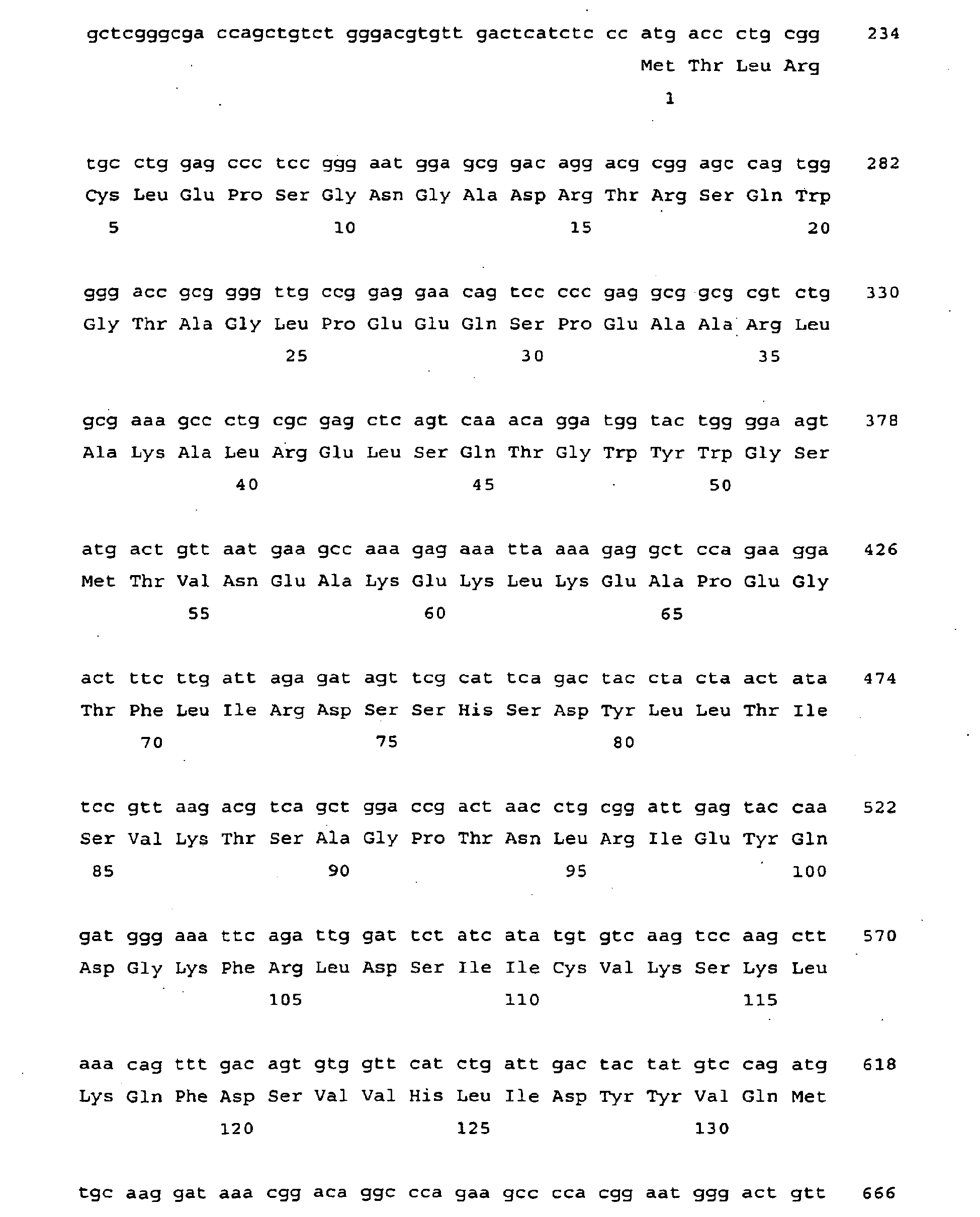

- <210> 2
<211> 198
<212> PRT
<213> mouse
SEQ ID No.2 - <400> 2


Claims (22)
- A genetically modified non-human animal exhibiting increased or decreased levels of a SOCS protein or a derivative or homologue thereof wherein the SOCS protein, in a genetically unaltered animal, comprises a protein:molecule interacting portion, N-terminal of a SOCS box, which SOCS box comprises the amino acid sequence:X1 X2 X3 X4 X5 X6 X7 X8 X9 X10 X11 X12 X13 X14 X15 X16 [Xi]n X17 X18 X19 X20 X21 X22 X23 [Xj]n X24 X25 X26 X27 X28wherein:X1 is L, I, V, M, A or P;X2 is any amino acid residue;X3 is P, T or S;X4 is L, I, V, M, A or P;X5 is any amino acid;X6 is any amino acid;X7 is L, I, V, M, A, F, Y or W;X8 is C, T or S;X9 is R, K or H;X10 is any amino acid;X11 is any amino acid;X12 is L, I, V, M, A or P;X13 is any amino acid;X14 is any amino acid;X15 is any amino acid;X16 is L, I, V, M, A, P, G, C, T or S;[Xi]n is a sequence of n amino acids wherein n is from 1 to 50 amino acids and wherein the sequence Xi may comprise the same or different amino acids selected from any amino acid residue;X17 is L, I, V, M, A or P;X18 is any amino acid;X19 is any amino acid;X20 is L, I, V, M, A or P;X21 is P;X22 is L, I, V, M, A, P or G;X23 is P or N;[Xj]n is a sequence of n amino acids wherein n is from 0 to 50 amino acids and wherein the Xj may comprise the same or different amino acids selected from any amino acid residue;X24 is L, I, V, M, A or P;X25 is any amino acid;X26 is any amino acid;X27 is Y or F;X28 is L, I, V, M, A or P.and wherein the SOCS protein is SOCS-2 and comprises the amino acid sequence set forth in SEQ ID No. 2 or an amino acid sequence having at least 60% similarity thereto.
- The genetically modified animal of claim 1 wherein the SOCS protein is encoded by the nucleotide sequence set forth in SEQ ID No. 1 or a nucleotide sequence having at least 60% similarity thereto or a nucleotide sequence capable of hybridizing to SEQ ID No. 1 or its complementary form under low stringency conditions at 42°C.
- The genetically modified animal of claim 2 wherein the genetic modification results in a deletion of one or more nucleotides from a genomic sequence corresponding to SEQ ID No. 1 which substantially prevents, reduces or down-regulates expression of a genomic sequence corresponding to SEQ ID No. 1.
- The genetically modified animal of any one of claims 1 to 3 wherein the animal is a mouse, rat, guinea-pig, rabbit or livestock animal.
- The genetically modified animal of claim 4 wherein the animal is a mouse.
- A method for screening for modulators of hormone signalling in an animal, said method comprising administering potential modulators to the genetically modified animal of claim 1 and identifying said modulators which alter hormone signalling.
- The method of claim 6 wherein the genetically modified animal is a mouse.
- Use of the genetically modified animal of claim 1 in the screening of a therapeutic molecule which modulates hormone signalling.
- The method or use of any one of claims 6 to 8 wherein the hormone is growth hormone.
- A non-medical method for modulating hormone signalling in a livestock animal or laboratory test animal, said method comprising up-regulating or down-regulating expression of a genetic sequence encoding a SOCS-2 protein or its derivative or homologue as defined in claim 1 or increasing or decreasing the activity of a SOCS-2 protein or its derivative or homologue as defined in claim 1 in said animal.
- A non-medical method for controlling hormone signalling in a livestock animal or laboratory test animal, said method comprising up-regulating or down-regulating expression of a genetic sequence encoding a SOCS-2 protein or its derivative or homologue as defined in claim 1 or increasing or decreasing the activity of a SOCS-2 protein or its derivative or homologue as defined in claim 1 in said animal.
- The method of claim 11 or 12 wherein the genetic sequence comprises the nucleotide sequence set forth in SEQ ID No. 1 or a nucleotide sequence having at least 60% similarity thereto or a nucleotide sequence capable of hybridizing to SEQ ID No. 1 or its complementary form under low stringency conditions at 42°C.
- The method of any one of claim 10 to 12 wherein the hormone is growth hormone.
- The method of any one of claims 10 to 12 wherein the hormone is insulin-like growth factor 1 (IGF-1) or prolactin.
- A non-medical method for controlling growth hormone signalling in a livestock animal or laboratory test animal, said method comprising administering to said animal a control-effective amount of a SOCS-2 protein or functional part or homologue or analogue thereof as defined in claim 1 or antisense RNA or DNA, ribozymes or sense molecules that manipulate expression of SOCS-2 genes or translation of SOCS-2 mRNA, wherein said SOCS-2 gene and said SOCS-2 mRNA encode a SOCS-2 protein or derivative or homologue thereof as defined in claim 1, for a time and under conditions sufficient to modulate growth hormone signalling.
- Use of a SOCS-2 protein or a derivative, homologue or analogue thereof as defined in claim 1 in the manufacture of a medicament for controlling hormone signalling in an animal.
- Use of antisense RNA or DNA, ribozymes or sense molecules that manipulate expression of SOCS-2 genes or translation of SOCS-2 mRNA in the manufacture of a medicament for controlling hormone signalling in an animal, wherein said SOCS-2 gene and said SOCS-2 mRNA encodes a SOCS-2 protein or derivative or homologue thereof as defined in claim 1.
- The use as claimed in claims 16 or 17 wherein expression of a specific sequence as defined in any one of claims 10 to 12 is up-regulated or down-regulated.
- The use as claimed in any one of claims 16 to 18 wherein the hormone is growth hormone, preferably insulin-like growth factor 1 (IGF-1) or prolactin.
- A use as claimed in any one of claims 16 to 19 for increasing strength in elderly people, obesity control treatment of catabolic diseases, treatment of chronic inflammatory disease, treatment and/or prophylaxis of osteoporosis, treatment of cardiomyopathy and in the treatment of complicated fracture.
- The use as claimed in any one of claims 16 to 20 wherein the animal is a human, primate, livestock animal, laboratory test animal, companion animal or captive wild animal.
- The use as claimed in claim 21 wherein said animal is a mouse, rat, guinea-pig or rabbit.
Applications Claiming Priority (5)
| Application Number | Priority Date | Filing Date | Title |
|---|---|---|---|
| AUPQ4082A AUPQ408299A0 (en) | 1999-11-16 | 1999-11-16 | A method |
| AUPQ408299 | 1999-11-16 | ||
| AUPQ781200 | 2000-05-29 | ||
| AUPQ7812A AUPQ781200A0 (en) | 2000-05-29 | 2000-05-29 | A method |
| PCT/AU2000/001398 WO2001035732A1 (en) | 1999-11-16 | 2000-11-16 | An animal model for studying hormone signalling and method of modulating the signalling |
Publications (3)
| Publication Number | Publication Date |
|---|---|
| EP1242111A1 EP1242111A1 (en) | 2002-09-25 |
| EP1242111A4 EP1242111A4 (en) | 2004-10-06 |
| EP1242111B1 true EP1242111B1 (en) | 2008-05-21 |
Family
ID=25646203
Family Applications (1)
| Application Number | Title | Priority Date | Filing Date |
|---|---|---|---|
| EP00975670A Expired - Lifetime EP1242111B1 (en) | 1999-11-16 | 2000-11-16 | An animal model for studying hormone signalling and method of modulating the signalling |
Country Status (7)
| Country | Link |
|---|---|
| US (1) | US20060069023A1 (en) |
| EP (1) | EP1242111B1 (en) |
| AT (1) | ATE395926T1 (en) |
| CA (1) | CA2390555A1 (en) |
| DE (1) | DE60038977D1 (en) |
| ES (1) | ES2304983T3 (en) |
| WO (1) | WO2001035732A1 (en) |
Families Citing this family (4)
| Publication number | Priority date | Publication date | Assignee | Title |
|---|---|---|---|---|
| EP1330156A4 (en) * | 2000-10-09 | 2006-09-13 | Amrad Operations Pty Ltd | Modulating cytokine or hormone signalling in an animal comprising up-regulating the expression of socs sequence in the animal |
| AUPR556601A0 (en) * | 2001-06-08 | 2001-07-12 | Ludwig Institute For Cancer Research | Therapeutic and diagnostic molecules - II |
| AU2002950745A0 (en) * | 2002-08-13 | 2002-09-12 | The Walter And Eliza Hall Institute Of Medical Research | A method and agents useful for same |
| US10354342B2 (en) * | 2017-06-02 | 2019-07-16 | Performance Livestock Analytics, Inc. | Adaptive livestock growth modeling using machine learning approaches to predict growth and recommend livestock management operations and activities |
Family Cites Families (6)
| Publication number | Priority date | Publication date | Assignee | Title |
|---|---|---|---|---|
| EP0832117A1 (en) * | 1995-06-05 | 1998-04-01 | The Trustees Of Dartmouth College | Ligand-stimulated gene expression |
| US6323317B1 (en) * | 1996-11-01 | 2001-11-27 | The Walter And Eliza Hall Institute Of Medical Research | Therapeutic and diagnostics proteins comprising a SOCS box |
| KR100719080B1 (en) * | 1996-11-01 | 2007-05-16 | 더 월터 앤드 엘리자 홀 인스티튜트 오브 메디컬 리서치 | Therapeutic and diagnostic agents capable of modulating cellular responsiveness to cytokines |
| SE9803398D0 (en) * | 1998-10-06 | 1998-10-06 | Sahltech Ab | "New use" |
| WO2000037636A1 (en) * | 1998-12-21 | 2000-06-29 | The Walter And Eliza Hall Institute Of Medical Research | Socs-box containing peptides |
| WO2000063357A2 (en) * | 1999-04-20 | 2000-10-26 | Beth Israel Deaconess Medical Center | Methods and compositions for modulating ciliary neurotrophic factor activity |
-
2000
- 2000-11-16 WO PCT/AU2000/001398 patent/WO2001035732A1/en not_active Ceased
- 2000-11-16 DE DE60038977T patent/DE60038977D1/en not_active Expired - Lifetime
- 2000-11-16 EP EP00975670A patent/EP1242111B1/en not_active Expired - Lifetime
- 2000-11-16 AT AT00975670T patent/ATE395926T1/en not_active IP Right Cessation
- 2000-11-16 CA CA002390555A patent/CA2390555A1/en not_active Abandoned
- 2000-11-16 ES ES00975670T patent/ES2304983T3/en not_active Expired - Lifetime
-
2005
- 2005-09-19 US US11/231,101 patent/US20060069023A1/en not_active Abandoned
Also Published As
| Publication number | Publication date |
|---|---|
| ATE395926T1 (en) | 2008-06-15 |
| US20060069023A1 (en) | 2006-03-30 |
| EP1242111A1 (en) | 2002-09-25 |
| ES2304983T3 (en) | 2008-11-01 |
| DE60038977D1 (en) | 2008-07-03 |
| EP1242111A4 (en) | 2004-10-06 |
| CA2390555A1 (en) | 2001-05-25 |
| WO2001035732A1 (en) | 2001-05-25 |
Similar Documents
| Publication | Publication Date | Title |
|---|---|---|
| US20080166730A1 (en) | Therapeutic and diagnostic proteins comprising a SOCS box | |
| US7897570B2 (en) | Method of treatment | |
| US20070135336A1 (en) | Follistatin isoforms and uses thereof | |
| US20080009444A1 (en) | Biologically active complex of NR6 and cardiotrophin-like-cytokine | |
| EP0931149B1 (en) | A novel haemopoietin receptor and genetic sequences encoding same | |
| US7049418B2 (en) | Therapeutic and diagnostic agents comprising a SOCS box | |
| WO1998009510A1 (en) | Methods of diagnosing and treating cancer | |
| US20090077677A1 (en) | Mammalian grainyhead transcription factors | |
| US20070110712A1 (en) | Method of modulating fertility in animals | |
| US7078174B1 (en) | Screening methods using SOCS box-containing peptides | |
| US20060069023A1 (en) | Animal model for studying hormone signalling and method of modulating the signalling | |
| AU784277B2 (en) | An animal model for studying hormone signalling and method of modulating the signalling | |
| AU2006200097A1 (en) | An animal model for studying hormone signalling and method of modulating the signalling | |
| AU739063B2 (en) | A method of treatment and prophylaxis | |
| US7220828B2 (en) | Haemopoietin receptor and genetic sequence encoding same | |
| US7192576B1 (en) | Biologically active complex of NR6 and cardiotrophin-like-cytokine | |
| US20060294608A1 (en) | Novel haemopoietin receptor and genetic sequences encoding same | |
| AU762879B2 (en) | A method of treatment and prophylaxis | |
| WO2004015417A1 (en) | A method and agents useful for same | |
| WO2009046483A1 (en) | Therapeutic protocol for the treatment or prevention of thrombocytopenia | |
| AU2003250580A1 (en) | Mammalian grainyhead transcription factors |
Legal Events
| Date | Code | Title | Description |
|---|---|---|---|
| PUAI | Public reference made under article 153(3) epc to a published international application that has entered the european phase |
Free format text: ORIGINAL CODE: 0009012 |
|
| 17P | Request for examination filed |
Effective date: 20020613 |
|
| AK | Designated contracting states |
Kind code of ref document: A1 Designated state(s): AT BE CH CY DE DK ES FI FR GB GR IE IT LI LU MC NL PT SE TR |
|
| AX | Request for extension of the european patent |
Free format text: AL PAYMENT 20020613;LT PAYMENT 20020613;LV PAYMENT 20020613;MK PAYMENT 20020613;RO PAYMENT 20020613;SI PAYMENT 20020613 |
|
| A4 | Supplementary search report drawn up and despatched |
Effective date: 20040824 |
|
| 17Q | First examination report despatched |
Effective date: 20041129 |
|
| GRAP | Despatch of communication of intention to grant a patent |
Free format text: ORIGINAL CODE: EPIDOSNIGR1 |
|
| GRAS | Grant fee paid |
Free format text: ORIGINAL CODE: EPIDOSNIGR3 |
|
| GRAA | (expected) grant |
Free format text: ORIGINAL CODE: 0009210 |
|
| AK | Designated contracting states |
Kind code of ref document: B1 Designated state(s): AT BE CH CY DE DK ES FI FR GB GR IE IT LI LU MC NL PT SE TR |
|
| AX | Request for extension of the european patent |
Extension state: AL LT LV MK RO SI |
|
| REG | Reference to a national code |
Ref country code: GB Ref legal event code: FG4D |
|
| REG | Reference to a national code |
Ref country code: CH Ref legal event code: EP |
|
| REF | Corresponds to: |
Ref document number: 60038977 Country of ref document: DE Date of ref document: 20080703 Kind code of ref document: P |
|
| REG | Reference to a national code |
Ref country code: IE Ref legal event code: FG4D |
|
| PG25 | Lapsed in a contracting state [announced via postgrant information from national office to epo] |
Ref country code: FI Free format text: LAPSE BECAUSE OF FAILURE TO SUBMIT A TRANSLATION OF THE DESCRIPTION OR TO PAY THE FEE WITHIN THE PRESCRIBED TIME-LIMIT Effective date: 20080521 |
|
| REG | Reference to a national code |
Ref country code: ES Ref legal event code: FG2A Ref document number: 2304983 Country of ref document: ES Kind code of ref document: T3 |
|
| NLV1 | Nl: lapsed or annulled due to failure to fulfill the requirements of art. 29p and 29m of the patents act | ||
| PG25 | Lapsed in a contracting state [announced via postgrant information from national office to epo] |
Ref country code: NL Free format text: LAPSE BECAUSE OF FAILURE TO SUBMIT A TRANSLATION OF THE DESCRIPTION OR TO PAY THE FEE WITHIN THE PRESCRIBED TIME-LIMIT Effective date: 20080521 Ref country code: AT Free format text: LAPSE BECAUSE OF FAILURE TO SUBMIT A TRANSLATION OF THE DESCRIPTION OR TO PAY THE FEE WITHIN THE PRESCRIBED TIME-LIMIT Effective date: 20080521 |
|
| PG25 | Lapsed in a contracting state [announced via postgrant information from national office to epo] |
Ref country code: PT Free format text: LAPSE BECAUSE OF FAILURE TO SUBMIT A TRANSLATION OF THE DESCRIPTION OR TO PAY THE FEE WITHIN THE PRESCRIBED TIME-LIMIT Effective date: 20081021 Ref country code: SE Free format text: LAPSE BECAUSE OF FAILURE TO SUBMIT A TRANSLATION OF THE DESCRIPTION OR TO PAY THE FEE WITHIN THE PRESCRIBED TIME-LIMIT Effective date: 20080821 Ref country code: DK Free format text: LAPSE BECAUSE OF FAILURE TO SUBMIT A TRANSLATION OF THE DESCRIPTION OR TO PAY THE FEE WITHIN THE PRESCRIBED TIME-LIMIT Effective date: 20080521 |
|
| PG25 | Lapsed in a contracting state [announced via postgrant information from national office to epo] |
Ref country code: BE Free format text: LAPSE BECAUSE OF FAILURE TO SUBMIT A TRANSLATION OF THE DESCRIPTION OR TO PAY THE FEE WITHIN THE PRESCRIBED TIME-LIMIT Effective date: 20080521 |
|
| PLBE | No opposition filed within time limit |
Free format text: ORIGINAL CODE: 0009261 |
|
| STAA | Information on the status of an ep patent application or granted ep patent |
Free format text: STATUS: NO OPPOSITION FILED WITHIN TIME LIMIT |
|
| 26N | No opposition filed |
Effective date: 20090224 |
|
| PG25 | Lapsed in a contracting state [announced via postgrant information from national office to epo] |
Ref country code: MC Free format text: LAPSE BECAUSE OF NON-PAYMENT OF DUE FEES Effective date: 20081130 |
|
| REG | Reference to a national code |
Ref country code: CH Ref legal event code: PL |
|
| PG25 | Lapsed in a contracting state [announced via postgrant information from national office to epo] |
Ref country code: IE Free format text: LAPSE BECAUSE OF NON-PAYMENT OF DUE FEES Effective date: 20081116 Ref country code: CH Free format text: LAPSE BECAUSE OF NON-PAYMENT OF DUE FEES Effective date: 20081130 Ref country code: LI Free format text: LAPSE BECAUSE OF NON-PAYMENT OF DUE FEES Effective date: 20081130 |
|
| PGFP | Annual fee paid to national office [announced via postgrant information from national office to epo] |
Ref country code: DE Payment date: 20091112 Year of fee payment: 10 Ref country code: ES Payment date: 20091201 Year of fee payment: 10 |
|
| PGFP | Annual fee paid to national office [announced via postgrant information from national office to epo] |
Ref country code: IT Payment date: 20091113 Year of fee payment: 10 Ref country code: GB Payment date: 20091111 Year of fee payment: 10 Ref country code: FR Payment date: 20091123 Year of fee payment: 10 |
|
| PG25 | Lapsed in a contracting state [announced via postgrant information from national office to epo] |
Ref country code: LU Free format text: LAPSE BECAUSE OF NON-PAYMENT OF DUE FEES Effective date: 20081116 Ref country code: CY Free format text: LAPSE BECAUSE OF FAILURE TO SUBMIT A TRANSLATION OF THE DESCRIPTION OR TO PAY THE FEE WITHIN THE PRESCRIBED TIME-LIMIT Effective date: 20080521 |
|
| PG25 | Lapsed in a contracting state [announced via postgrant information from national office to epo] |
Ref country code: TR Free format text: LAPSE BECAUSE OF FAILURE TO SUBMIT A TRANSLATION OF THE DESCRIPTION OR TO PAY THE FEE WITHIN THE PRESCRIBED TIME-LIMIT Effective date: 20080521 |
|
| PG25 | Lapsed in a contracting state [announced via postgrant information from national office to epo] |
Ref country code: GR Free format text: LAPSE BECAUSE OF FAILURE TO SUBMIT A TRANSLATION OF THE DESCRIPTION OR TO PAY THE FEE WITHIN THE PRESCRIBED TIME-LIMIT Effective date: 20080822 |
|
| GBPC | Gb: european patent ceased through non-payment of renewal fee |
Effective date: 20101116 |
|
| REG | Reference to a national code |
Ref country code: FR Ref legal event code: ST Effective date: 20110801 |
|
| REG | Reference to a national code |
Ref country code: DE Ref legal event code: R119 Ref document number: 60038977 Country of ref document: DE Effective date: 20110601 Ref country code: DE Ref legal event code: R119 Ref document number: 60038977 Country of ref document: DE Effective date: 20110531 |
|
| PG25 | Lapsed in a contracting state [announced via postgrant information from national office to epo] |
Ref country code: FR Free format text: LAPSE BECAUSE OF NON-PAYMENT OF DUE FEES Effective date: 20101130 |
|
| PG25 | Lapsed in a contracting state [announced via postgrant information from national office to epo] |
Ref country code: GB Free format text: LAPSE BECAUSE OF NON-PAYMENT OF DUE FEES Effective date: 20101116 |
|
| PG25 | Lapsed in a contracting state [announced via postgrant information from national office to epo] |
Ref country code: IT Free format text: LAPSE BECAUSE OF NON-PAYMENT OF DUE FEES Effective date: 20101116 |
|
| REG | Reference to a national code |
Ref country code: ES Ref legal event code: FD2A Effective date: 20120220 |
|
| PG25 | Lapsed in a contracting state [announced via postgrant information from national office to epo] |
Ref country code: ES Free format text: LAPSE BECAUSE OF NON-PAYMENT OF DUE FEES Effective date: 20101117 |
|
| PG25 | Lapsed in a contracting state [announced via postgrant information from national office to epo] |
Ref country code: DE Free format text: LAPSE BECAUSE OF NON-PAYMENT OF DUE FEES Effective date: 20110531 |