EP1241944B1 - Use of diflufenzopyr for early termination of crop plants - Google Patents
Use of diflufenzopyr for early termination of crop plants Download PDFInfo
- Publication number
- EP1241944B1 EP1241944B1 EP00990647A EP00990647A EP1241944B1 EP 1241944 B1 EP1241944 B1 EP 1241944B1 EP 00990647 A EP00990647 A EP 00990647A EP 00990647 A EP00990647 A EP 00990647A EP 1241944 B1 EP1241944 B1 EP 1241944B1
- Authority
- EP
- European Patent Office
- Prior art keywords
- plant
- dfp
- growth
- diflufenzopyr
- cotton
- Prior art date
- Legal status (The legal status is an assumption and is not a legal conclusion. Google has not performed a legal analysis and makes no representation as to the accuracy of the status listed.)
- Expired - Lifetime
Links
- IRJQWZWMQCVOLA-ZBKNUEDVSA-N 2-[(z)-n-[(3,5-difluorophenyl)carbamoylamino]-c-methylcarbonimidoyl]pyridine-3-carboxylic acid Chemical compound N=1C=CC=C(C(O)=O)C=1C(/C)=N\NC(=O)NC1=CC(F)=CC(F)=C1 IRJQWZWMQCVOLA-ZBKNUEDVSA-N 0.000 title claims abstract description 94
- 244000038559 crop plants Species 0.000 title description 12
- 230000012010 growth Effects 0.000 claims abstract description 26
- 230000001850 reproductive effect Effects 0.000 claims abstract description 21
- 239000004480 active ingredient Substances 0.000 claims abstract description 8
- 230000008635 plant growth Effects 0.000 claims abstract description 7
- 230000007773 growth pattern Effects 0.000 claims abstract description 5
- 241000196324 Embryophyta Species 0.000 claims description 57
- 229920000742 Cotton Polymers 0.000 claims description 29
- 244000105624 Arachis hypogaea Species 0.000 claims description 17
- 238000000034 method Methods 0.000 claims description 13
- 240000002024 Gossypium herbaceum Species 0.000 claims description 11
- 235000004341 Gossypium herbaceum Nutrition 0.000 claims description 11
- 244000061176 Nicotiana tabacum Species 0.000 claims description 10
- 235000002637 Nicotiana tabacum Nutrition 0.000 claims description 10
- 239000002671 adjuvant Substances 0.000 claims description 5
- 244000299507 Gossypium hirsutum Species 0.000 claims description 3
- 240000004507 Abelmoschus esculentus Species 0.000 claims description 2
- 241000220485 Fabaceae Species 0.000 claims description 2
- 241000219071 Malvaceae Species 0.000 claims description 2
- 235000021374 legumes Nutrition 0.000 claims description 2
- 239000007788 liquid Substances 0.000 claims description 2
- 239000007787 solid Substances 0.000 claims description 2
- 150000007659 semicarbazones Chemical class 0.000 abstract description 14
- 239000005648 plant growth regulator Substances 0.000 abstract description 8
- 235000013399 edible fruits Nutrition 0.000 description 30
- 238000011282 treatment Methods 0.000 description 28
- 241000219146 Gossypium Species 0.000 description 25
- 241001075517 Abelmoschus Species 0.000 description 22
- 230000006378 damage Effects 0.000 description 16
- 241000238631 Hexapoda Species 0.000 description 15
- 208000027418 Wounds and injury Diseases 0.000 description 14
- 208000014674 injury Diseases 0.000 description 14
- BGRDGMRNKXEXQD-UHFFFAOYSA-N Maleic hydrazide Chemical compound OC1=CC=C(O)N=N1 BGRDGMRNKXEXQD-UHFFFAOYSA-N 0.000 description 13
- 238000003306 harvesting Methods 0.000 description 11
- 230000009467 reduction Effects 0.000 description 11
- 235000010777 Arachis hypogaea Nutrition 0.000 description 10
- 235000014633 carbohydrates Nutrition 0.000 description 10
- 150000001720 carbohydrates Chemical class 0.000 description 10
- 241000254175 Anthonomus grandis Species 0.000 description 9
- 239000002917 insecticide Substances 0.000 description 9
- 235000020232 peanut Nutrition 0.000 description 9
- 235000017060 Arachis glabrata Nutrition 0.000 description 8
- 235000018262 Arachis monticola Nutrition 0.000 description 8
- 241000607479 Yersinia pestis Species 0.000 description 8
- 238000011161 development Methods 0.000 description 7
- 230000018109 developmental process Effects 0.000 description 7
- 238000004519 manufacturing process Methods 0.000 description 7
- -1 semicarbazone compound Chemical class 0.000 description 7
- 230000009105 vegetative growth Effects 0.000 description 7
- IJGRMHOSHXDMSA-UHFFFAOYSA-N Atomic nitrogen Chemical compound N#N IJGRMHOSHXDMSA-UHFFFAOYSA-N 0.000 description 6
- 241000252254 Catostomidae Species 0.000 description 6
- 210000000056 organ Anatomy 0.000 description 6
- 230000008901 benefit Effects 0.000 description 5
- 230000007423 decrease Effects 0.000 description 5
- 230000000694 effects Effects 0.000 description 5
- 239000000203 mixture Substances 0.000 description 5
- 239000003053 toxin Substances 0.000 description 5
- 231100000765 toxin Toxicity 0.000 description 5
- 108700012359 toxins Proteins 0.000 description 5
- 230000035613 defoliation Effects 0.000 description 4
- 235000015097 nutrients Nutrition 0.000 description 4
- 239000007921 spray Substances 0.000 description 4
- 230000017260 vegetative to reproductive phase transition of meristem Effects 0.000 description 4
- 241000255967 Helicoverpa zea Species 0.000 description 3
- 239000005983 Maleic hydrazide Substances 0.000 description 3
- 150000001875 compounds Chemical class 0.000 description 3
- 230000014759 maintenance of location Effects 0.000 description 3
- 230000035800 maturation Effects 0.000 description 3
- 229910052757 nitrogen Inorganic materials 0.000 description 3
- 230000007226 seed germination Effects 0.000 description 3
- 208000024891 symptom Diseases 0.000 description 3
- JLIDBLDQVAYHNE-YKALOCIXSA-N (+)-Abscisic acid Chemical compound OC(=O)/C=C(/C)\C=C\[C@@]1(O)C(C)=CC(=O)CC1(C)C JLIDBLDQVAYHNE-YKALOCIXSA-N 0.000 description 2
- 241000256244 Heliothis virescens Species 0.000 description 2
- 230000006578 abscission Effects 0.000 description 2
- 230000005058 diapause Effects 0.000 description 2
- 235000013601 eggs Nutrition 0.000 description 2
- 239000003337 fertilizer Substances 0.000 description 2
- 230000012447 hatching Effects 0.000 description 2
- 239000004009 herbicide Substances 0.000 description 2
- 239000004615 ingredient Substances 0.000 description 2
- 239000000243 solution Substances 0.000 description 2
- 238000012360 testing method Methods 0.000 description 2
- SSMIFVHARFVINF-UHFFFAOYSA-N 4-amino-1,8-naphthalimide Chemical compound O=C1NC(=O)C2=CC=CC3=C2C1=CC=C3N SSMIFVHARFVINF-UHFFFAOYSA-N 0.000 description 1
- 235000003934 Abelmoschus esculentus Nutrition 0.000 description 1
- 241000254177 Anthonomus Species 0.000 description 1
- 229930192334 Auxin Natural products 0.000 description 1
- 241000193830 Bacillus <bacterium> Species 0.000 description 1
- 244000025254 Cannabis sativa Species 0.000 description 1
- 235000009432 Gossypium hirsutum Nutrition 0.000 description 1
- 241000501345 Lygus lineolaris Species 0.000 description 1
- 241001668536 Oculimacula yallundae Species 0.000 description 1
- 241000590428 Panacea Species 0.000 description 1
- 231100000674 Phytotoxicity Toxicity 0.000 description 1
- ZLMJMSJWJFRBEC-UHFFFAOYSA-N Potassium Chemical compound [K] ZLMJMSJWJFRBEC-UHFFFAOYSA-N 0.000 description 1
- 206010000210 abortion Diseases 0.000 description 1
- 231100000176 abortion Toxicity 0.000 description 1
- 230000001133 acceleration Effects 0.000 description 1
- 238000009825 accumulation Methods 0.000 description 1
- 230000001464 adherent effect Effects 0.000 description 1
- 238000012271 agricultural production Methods 0.000 description 1
- 230000000844 anti-bacterial effect Effects 0.000 description 1
- 239000000729 antidote Substances 0.000 description 1
- 229940075522 antidotes Drugs 0.000 description 1
- 239000002518 antifoaming agent Substances 0.000 description 1
- 238000013459 approach Methods 0.000 description 1
- 239000007864 aqueous solution Substances 0.000 description 1
- 239000002363 auxin Substances 0.000 description 1
- 239000003899 bactericide agent Substances 0.000 description 1
- 230000005200 bud stage Effects 0.000 description 1
- 230000025938 carbohydrate utilization Effects 0.000 description 1
- 239000003795 chemical substances by application Substances 0.000 description 1
- 238000004040 coloring Methods 0.000 description 1
- 238000007796 conventional method Methods 0.000 description 1
- 230000001419 dependent effect Effects 0.000 description 1
- FCRACOPGPMPSHN-UHFFFAOYSA-N desoxyabscisic acid Natural products OC(=O)C=C(C)C=CC1C(C)=CC(=O)CC1(C)C FCRACOPGPMPSHN-UHFFFAOYSA-N 0.000 description 1
- 230000008641 drought stress Effects 0.000 description 1
- 230000008030 elimination Effects 0.000 description 1
- 238000003379 elimination reaction Methods 0.000 description 1
- 239000000839 emulsion Substances 0.000 description 1
- 238000011156 evaluation Methods 0.000 description 1
- 238000002474 experimental method Methods 0.000 description 1
- 239000000835 fiber Substances 0.000 description 1
- 230000009969 flowable effect Effects 0.000 description 1
- 239000000417 fungicide Substances 0.000 description 1
- 239000008187 granular material Substances 0.000 description 1
- 230000002363 herbicidal effect Effects 0.000 description 1
- BHEPBYXIRTUNPN-UHFFFAOYSA-N hydridophosphorus(.) (triplet) Chemical compound [PH] BHEPBYXIRTUNPN-UHFFFAOYSA-N 0.000 description 1
- 208000006278 hypochromic anemia Diseases 0.000 description 1
- SEOVTRFCIGRIMH-UHFFFAOYSA-N indole-3-acetic acid Chemical compound C1=CC=C2C(CC(=O)O)=CNC2=C1 SEOVTRFCIGRIMH-UHFFFAOYSA-N 0.000 description 1
- 230000002401 inhibitory effect Effects 0.000 description 1
- 230000005764 inhibitory process Effects 0.000 description 1
- 239000002919 insect venom Substances 0.000 description 1
- 230000001069 nematicidal effect Effects 0.000 description 1
- 239000005645 nematicide Substances 0.000 description 1
- 230000017448 oviposition Effects 0.000 description 1
- 239000000575 pesticide Substances 0.000 description 1
- 230000000243 photosynthetic effect Effects 0.000 description 1
- 230000035479 physiological effects, processes and functions Effects 0.000 description 1
- 230000010152 pollination Effects 0.000 description 1
- 229910052700 potassium Inorganic materials 0.000 description 1
- 239000011591 potassium Substances 0.000 description 1
- 239000000843 powder Substances 0.000 description 1
- 239000003755 preservative agent Substances 0.000 description 1
- 230000008569 process Effects 0.000 description 1
- 230000001105 regulatory effect Effects 0.000 description 1
- 230000010076 replication Effects 0.000 description 1
- 238000011160 research Methods 0.000 description 1
- 230000012865 response to insecticide Effects 0.000 description 1
- 230000033764 rhythmic process Effects 0.000 description 1
- 239000002689 soil Substances 0.000 description 1
- 238000005507 spraying Methods 0.000 description 1
- 230000035882 stress Effects 0.000 description 1
- 239000000126 substance Substances 0.000 description 1
- 239000004094 surface-active agent Substances 0.000 description 1
- 239000000725 suspension Substances 0.000 description 1
- 239000011573 trace mineral Substances 0.000 description 1
- 235000013619 trace mineral Nutrition 0.000 description 1
- 230000009261 transgenic effect Effects 0.000 description 1
- 230000007704 transition Effects 0.000 description 1
- 239000000080 wetting agent Substances 0.000 description 1
Classifications
-
- A—HUMAN NECESSITIES
- A01—AGRICULTURE; FORESTRY; ANIMAL HUSBANDRY; HUNTING; TRAPPING; FISHING
- A01N—PRESERVATION OF BODIES OF HUMANS OR ANIMALS OR PLANTS OR PARTS THEREOF; BIOCIDES, e.g. AS DISINFECTANTS, AS PESTICIDES OR AS HERBICIDES; PEST REPELLANTS OR ATTRACTANTS; PLANT GROWTH REGULATORS
- A01N47/00—Biocides, pest repellants or attractants, or plant growth regulators containing organic compounds containing a carbon atom not being member of a ring and having no bond to a carbon or hydrogen atom, e.g. derivatives of carbonic acid
- A01N47/08—Biocides, pest repellants or attractants, or plant growth regulators containing organic compounds containing a carbon atom not being member of a ring and having no bond to a carbon or hydrogen atom, e.g. derivatives of carbonic acid the carbon atom having one or more single bonds to nitrogen atoms
- A01N47/28—Ureas or thioureas containing the groups >N—CO—N< or >N—CS—N<
- A01N47/34—Ureas or thioureas containing the groups >N—CO—N< or >N—CS—N< containing the groups, e.g. biuret; Thio analogues thereof; Urea-aldehyde condensation products
-
- A—HUMAN NECESSITIES
- A01—AGRICULTURE; FORESTRY; ANIMAL HUSBANDRY; HUNTING; TRAPPING; FISHING
- A01N—PRESERVATION OF BODIES OF HUMANS OR ANIMALS OR PLANTS OR PARTS THEREOF; BIOCIDES, e.g. AS DISINFECTANTS, AS PESTICIDES OR AS HERBICIDES; PEST REPELLANTS OR ATTRACTANTS; PLANT GROWTH REGULATORS
- A01N47/00—Biocides, pest repellants or attractants, or plant growth regulators containing organic compounds containing a carbon atom not being member of a ring and having no bond to a carbon or hydrogen atom, e.g. derivatives of carbonic acid
- A01N47/08—Biocides, pest repellants or attractants, or plant growth regulators containing organic compounds containing a carbon atom not being member of a ring and having no bond to a carbon or hydrogen atom, e.g. derivatives of carbonic acid the carbon atom having one or more single bonds to nitrogen atoms
- A01N47/28—Ureas or thioureas containing the groups >N—CO—N< or >N—CS—N<
- A01N47/36—Ureas or thioureas containing the groups >N—CO—N< or >N—CS—N< containing the group >N—CO—N< directly attached to at least one heterocyclic ring; Thio analogues thereof
Definitions
- the present invention relates to the use of a semicarbazone plant growth regulator for the early termination of crop plants. More particularly, the present invention relates to the use of a semicarbazone plant growth regulator in order to improve late-season fruit yield and/or late-season pest management.
- Plant growth regulators affect the physiology of plant growth and influence the natural rhythm of a plant. More specifically, plant growth regulators may, for example, reduce plant height, stimulate seed germination, induce flowering, darken leaf coloring, minimize lodging of cereals, slow grass growth on lawns, reduce boll rot and improve boll retention in cotton.
- Crop plants generally display a determinate or indeterminate growth pattern. Determinate plants have a defined period of vegetative growth followed by a defined interval of reproductive growth in which there is a maximum number of flowers initiated per plant.
- An indeterminate plant growth pattern is characterized by an initial period of vegetative growth followed by a period where both vegetative and reproductive growth occur together. The length of the second period and the number of flowers produced are determined largely by the growing conditions.
- Young, expanding leaves are also strong nutrient sinks. As a leaf approaches physiological maturity, it changes from a carbohydrate sink to a carbohydrate source due to the combination of increased photosynthetic capacity within the leaf as well as a decline in, and eventually a cessation of, growth. For indeterminate plants, leaves initiated after a certain point in the growing season will lack sufficient time to make the transition from carbohydrate sink to carbohydrate source. Thus, young expanding leaves drain the finite nutrient and carbohydrate resources of the plant that might otherwise be better allocated to the growth and maturation of marketable fruit.
- Cotton is a perennial of tropical origin that is cultivated as an annual in agricultural production in temperate and subtropical regions of the world. After an initial period of vegetative growth, a cotton plant initiates reproductive growth while vegetative growth continues. Flower buds (squares) appear, develop into flowers, and after pollination, give rise to fruit that are referred to as bolls.
- peanut plant (Arachis hypogaea), a member of the Fabaceae family, is another important crop plant which exhibits an indeterminate flowering pattern similar to cotton. Like cotton, peanut plants will produce flowers so late in the season that these late season flowers will not have the time to develop into a marketable fruit before the first frost.
- Tobacco (Nicotiana tabacum L.) production requires the early removal of the terminal bud by a process called "topping". Removal of the terminal bud stimulates growth and development of the axillary buds (suckers) Suckers are of no economic value and, if allowed to develop, would decrease the leaf yield. Chemical control of suckers is practiced through the United States typically using maleic hydrazide.
- insecticides remain a vital component of cotton production systems along with BT cotton. Because insects that are either resistant to currently known insecticides and/or tolerant to the BT toxin will increase over time, new insect management strategies need to be developed to ensure that the cotton production levels meet future demand.
- bollworms and budworms moths lay eggs usually in the terminal area (shoot apex) of the cotton plant. After hatching, young larvae feed on the terminals and younger squares, and larger larvae feed on terminals and young bolls.
- boll weevil adult females eat a cavity into a square and lay a single egg. Upon hatching, the larvae feeds inside the square and undergoes two or three molts.
- Squares containing boll weevil larvae usually abscise from the plant and fall to the ground a few days after the development of the second stage larvae. Boll weevil development continues in the abscised square.
- a crop management strategy that reduces or eliminates the feeding and/or oviposition sites of insect pests might eliminate the need for late-season insecticide applications and also lower the populations of overwintering insects.
- a crop management strategy that reduces late season squares should reduce the overwintering boll weevil populations because it is known that boll weevils that enter diapause later in the season are more likely to overwinter successfully than boll weevils that enter diapause earlier.
- the present invention is directed toward the late-season termination of reproductive plant growth of a plant having an indeterminate growth pattern. More particularly, according to the present invention, the semicarbazone plant growth regulator diflufenzopyr is applied to a locus of a growing plant at a time following peak bloom of the plant in an amount sufficient to terminate continued reproductive growth of the plant without substantially affecting mature reproductive growth existing on the plant at the time of application.
- the plant growth regulator diflufenzopyr is described in US 5,098,466.
- the semicarbazone is applied to the locus of the plant in an amount sufficient to terminate continued reproductive growth of the plant. Most preferably, the semicarbazone is applied to the locus of the plant in an amount of at least about 0.00011 (0.0001), and typically at least about 0.0033 (0.003) kilogram of active ingredient per hectare (kg ai/ha) (pounds of active ingredient per acre (lb. ai/A)). Furthermore, the semicarbazone is applied in amounts less than about 0.101 kg ai/ha (0.09 lb ai/A) , and usually less than about 0.033 kg ai/ha (0.03 lb ai/A).
- the semicarbazones may be applied in the form of dusts, granules, solutions, emulsions, wettable powders, flowables and suspensions.
- Application of a compound as an active ingredient is made according to conventional procedure to the locus of the plant in need of the same using the appropriate amount of the compound per acre as will be described below.
- the application of the compound to the "locus" of the plant includes application to the plant or parts of the plant or the soil in which the plant is growing.
- the semicarbazone compound may be applied to above ground portions of the plants.
- the application of liquid and particulate solid plant growth regulator compositions to above ground portions of plants may be carried out by conventional methods, for example, boom and hand application, including sprayers or dusters.
- the composition may be applied aerially as a spray, if desired.
- the semicarbazone compound employed in the practice of the present invention is most preferably used in the form of aqueous solutions.
- the solutions may be applied in a conventional manner, for example, by spraying, atomizing or watering the locus of the plant.
- the semicarbazone compound may also be applied in conjunction with other ingredients or adjuvants commonly employed in the art.
- ingredients include drift control agents, defoaming agents, preservatives, surfactants, fertilizers, phytotoxicants, herbicides, pesticides, insecticides, fungicides, wetting agents, adherents, nematocides, bactericides, trace elements, synergists, antidotes, mixtures thereof and other such adjuvants well known in the plant growth regulating art.
- the semicarbazone is applied to the locus of a crop plant in need of termination in an amount effective to terminate continued reproductive plant growth.
- the semicarbazone may be applied in single or multiple applications to the plant in order to obtain the desired early plant termination effects of this invention.
- DFP diflufenzopyr
- DFP-treated cotton plants had 60% more open bolls than the untreated plants at 22 days after treatment (DAT). This large increase in open bolls indicates that an application of DFP to cotton accelerates boll maturation which would translate into an earlier harvest for the cotton grower.
- ai/A rates marginally provided significant yield increases at the 5% level.
- DFP application at a rate of 0.022 kg ai/ha (0.20 lb. ai/A) provided a significant yield increase.
- Only the 0.090 kg ai /ha (0.080 lb. ai/A) application rate caused a significant yield reduction at the 300 DD application timing.
- Example 5 was repeated at another test site. The results appear in Table 6 below.
- DFP was applied at 0.011 and 0.022 kg ai/ha (0.01 and 0.02 lb ai/A) on cotton at two different growth stages: 5 NAWF and 5 NAWF + 350 HU (Heat Units) on the variety Stoneville 474.
- DFP treatments were applied to tobacco plants in a commercial, flue cured tobacco field. Plants were topped and sprayed on the same day. About 5-10% of the tobacco plants were at the bud stage at application. Treatments were applied with a hand-held sprayer equipped with a hollow cone nozzle. Spray volume was 33 ml per plant or roughly 478 l/ha (50 gallons per acre). Each treatment was applied to the three tobacco plants and each plant was considered a replication. The plants were examined at various intervals measured in weeks after treatment (WAT). One treatment, the commercial standard Royal MH-30 (maleic hydrazide) applied at 3.3 kg ai/ha (3.0 lbs. ai/A), could not be applied until the following day.
- WAT weeks after treatment
- DFP with a 0.067 kg ai/ha (1.0 pound) rate of maleic hydrazide was not significantly different from DFP alone.
- all treatments reduced sucker weight per plant and average sucker weight (see Table 8C).
- DFP at 0.067 kg ai/ha (0.06 lbs ai/A) was the most effective treatment in reducing total sucker weight per plant, average sucker weight and average sucker length.
Landscapes
- Life Sciences & Earth Sciences (AREA)
- Agronomy & Crop Science (AREA)
- Pest Control & Pesticides (AREA)
- Plant Pathology (AREA)
- Health & Medical Sciences (AREA)
- Engineering & Computer Science (AREA)
- Dentistry (AREA)
- General Health & Medical Sciences (AREA)
- Wood Science & Technology (AREA)
- Zoology (AREA)
- Environmental Sciences (AREA)
- Agricultural Chemicals And Associated Chemicals (AREA)
- Cultivation Of Plants (AREA)
Abstract
Description
- The present invention relates to the use of a semicarbazone plant growth regulator for the early termination of crop plants. More particularly, the present invention relates to the use of a semicarbazone plant growth regulator in order to improve late-season fruit yield and/or late-season pest management.
- It is known from US 4,581,057 that foliar fertilizer compositions comprising abscisic acid derivables beneath nitrogen, potassium, phosphorous ... sources enhance the yields of crop plants. However, no information is provided with regard to the influence on mature/continued reproductive growth of the crop plants.
- Plant growth regulators (PGR's) affect the physiology of plant growth and influence the natural rhythm of a plant. More specifically, plant growth regulators may, for example, reduce plant height, stimulate seed germination, induce flowering, darken leaf coloring, minimize lodging of cereals, slow grass growth on lawns, reduce boll rot and improve boll retention in cotton.
- Crop plants generally display a determinate or indeterminate growth pattern. Determinate plants have a defined period of vegetative growth followed by a defined interval of reproductive growth in which there is a maximum number of flowers initiated per plant. An indeterminate plant growth pattern, on the other hand, is characterized by an initial period of vegetative growth followed by a period where both vegetative and reproductive growth occur together. The length of the second period and the number of flowers produced are determined largely by the growing conditions.
- Indeterminate crop plants continue to produce reproductive organs long past the point in the growing season where there is sufficient time for mature, harvestable fruit to be obtained from these organs. Thus, after a certain point in the growing season, further reproductive growth will have no impact on marketable yield. Because flowers and young fruit are strong sinks for carbohydrates and nitrogen, it is likely that the demand of these strong sinks causes a reduction in the available carbohydrates and nitrogen for the continued maturation of fruits that are far enough along in development to make a positive contribution to marketable yield.
- Young, expanding leaves are also strong nutrient sinks. As a leaf approaches physiological maturity, it changes from a carbohydrate sink to a carbohydrate source due to the combination of increased photosynthetic capacity within the leaf as well as a decline in, and eventually a cessation of, growth. For indeterminate plants, leaves initiated after a certain point in the growing season will lack sufficient time to make the transition from carbohydrate sink to carbohydrate source. Thus, young expanding leaves drain the finite nutrient and carbohydrate resources of the plant that might otherwise be better allocated to the growth and maturation of marketable fruit.
- One example of an important crop plant that displays an indeterminate growth pattern is cotton (Gossypium hirsutum). Cotton is a perennial of tropical origin that is cultivated as an annual in agricultural production in temperate and subtropical regions of the world. After an initial period of vegetative growth, a cotton plant initiates reproductive growth while vegetative growth continues. Flower buds (squares) appear, develop into flowers, and after pollination, give rise to fruit that are referred to as bolls.
- Due to its indeterminate nature, squares continue to appear long after there is sufficient time left in the growing season for these squares to develop into mature, marketable bolls. The growth and development of these squares and young bolls drains the limited resources of the plant that might better be utilized by bolls that have sufficient time to mature to a marketable stage. Likewise, the shoot of the cotton plant continues to grow and initiate new leaves throughout most of the growing season. Many of the leaves that are initiated late in the growing season will never become carbohydrate source leaves due to insufficient time remaining in the growing season. Thus, these young leaves demand a portion of the carbohydrates and other nutrients that could be better utilized by the bolls that are likely to be harvested.
- The peanut plant (Arachis hypogaea), a member of the Fabaceae family, is another important crop plant which exhibits an indeterminate flowering pattern similar to cotton. Like cotton, peanut plants will produce flowers so late in the season that these late season flowers will not have the time to develop into a marketable fruit before the first frost.
- Tobacco (Nicotiana tabacum L.) production requires the early removal of the terminal bud by a process called "topping". Removal of the terminal bud stimulates growth and development of the axillary buds (suckers) Suckers are of no economic value and, if allowed to develop, would decrease the leaf yield. Chemical control of suckers is practiced through the United States typically using maleic hydrazide.
- If an early-termination, plant-management strategy could be developed that reduces the number of late-season squares, flowers and young fruit, as well as eliminate further growth of the terminal portion of the shoot, then the carbohydrates and other nutrients would be reallocated to the strongest sinks remaining - namely, the young fruit and/or leaves. For cotton plants, as an example, the benefits of this reallocation of resources is likely to include some, or all, of the following: increased yield (due to larger bolls), increases in fiber quality, an acceleration of boll opening, a more complete defoliation and the ability to harvest earlier. All of these benefits can provide cotton producers with a significant economic advantage.
- For an early termination strategy to be successful, inhibition of both vegetative and reproductive growth would have to occur without substantial injury to organs, such as leaves, stems, roots and fruit. A herbicide treatment could be used to terminate growth, however, the injury to the crop plant would be severe and likely cause significant reductions in yield.
- Early growth termination could also have benefits in terms of late season pest management. The recent introduction of transgenic, insect-resistant cotton cultivars that have been genetically modified to express the Bacillus thurigensis insect toxin (BT toxin) has reduced the necessity and/or frequency of some insecticide applications. However, so-called insect-resistant "BT-cotton" is not the panacea for insect management in cotton production. In this regard, the insect resistance of BT-cotton is limited to a subset of the major insect pests of cotton. In addition, the resistance provided by the presence of BT toxin in crop plants is not permanent. Unfortunately, there is evidence that some individual members of pests species otherwise susceptible to BT toxins may no longer be affected by the BT toxin.
- Thus, insecticides remain a vital component of cotton production systems along with BT cotton. Because insects that are either resistant to currently known insecticides and/or tolerant to the BT toxin will increase over time, new insect management strategies need to be developed to ensure that the cotton production levels meet future demand.
- As a means to both lower production costs and mitigate the development of insects with insecticide resistance, the elimination of late-season insecticide applications is currently being recommended by some cotton production experts. The basis of this recommendation is that after a certain point in the season, insect damage to flower buds (squares), flowers and young fruit (bolls) does not affect marketable yield. Due to the indeterminate nature of cotton, production of squares, flowers and bolls continues throughout much of the latter part of the growing season. However, after a certain point in the growing season there is insufficient time for squares, flowers and young bolls to mature and contribute to marketable yield with or without further insecticide applications. Because mature and near-mature bolls are not particularly susceptible to damage by the major insect pests of cotton, stopping insecticide applications later in the season might not significantly reduce yield. Although reducing late-season insecticide applications may make economic sense in the short term, the lack of late-season control one season will most likely lead to larger insect populations earlier in the next season.
- Some key insect pests of cotton include the bollworm (Helicoverpa zea), tobacco budworm (Heliothis virescens) and boll weevil (Anthonomus grandus). In the case of bollworms and budworms, moths lay eggs usually in the terminal area (shoot apex) of the cotton plant. After hatching, young larvae feed on the terminals and younger squares, and larger larvae feed on terminals and young bolls. For the boll weevil, adult females eat a cavity into a square and lay a single egg. Upon hatching, the larvae feeds inside the square and undergoes two or three molts. Squares containing boll weevil larvae usually abscise from the plant and fall to the ground a few days after the development of the second stage larvae. Boll weevil development continues in the abscised square.
- A crop management strategy that reduces or eliminates the feeding and/or oviposition sites of insect pests might eliminate the need for late-season insecticide applications and also lower the populations of overwintering insects. In the case of the boll weevil, a crop management strategy that reduces late season squares should reduce the overwintering boll weevil populations because it is known that boll weevils that enter diapause later in the season are more likely to overwinter successfully than boll weevils that enter diapause earlier.
- It is towards providing a successful early-termination strategy which meets, or exceeds, the goals noted above that the present invention is directed. Broadly, the present invention is directed toward the late-season termination of reproductive plant growth of a plant having an indeterminate growth pattern. More particularly, according to the present invention, the semicarbazone plant growth regulator diflufenzopyr is applied to a locus of a growing plant at a time following peak bloom of the plant in an amount sufficient to terminate continued reproductive growth of the plant without substantially affecting mature reproductive growth existing on the plant at the time of application. By using such an early growth-termination strategy, improvements in the plant's late-season fruit yield as well as improved late-season pest management may be achieved.
- These and other aspects and advantages of the present invention will become more clear after careful consideration is given to the following detailed description of the preferred exemplary embodiments thereof.
- The term "late season" as used herein and in the accompanying claims is meant to refer to any time beyond peak flowering of a plant.
- The plant growth regulator diflufenzopyr is described in US 5,098,466.
- The semicarbazone is applied to the locus of the plant in an amount sufficient to terminate continued reproductive growth of the plant. Most preferably, the semicarbazone is applied to the locus of the plant in an amount of at least about 0.00011 (0.0001), and typically at least about 0.0033 (0.003) kilogram of active ingredient per hectare (kg ai/ha) (pounds of active ingredient per acre (lb. ai/A)). Furthermore, the semicarbazone is applied in amounts less than about 0.101 kg ai/ha (0.09 lb ai/A) , and usually less than about 0.033 kg ai/ha (0.03 lb ai/A).
- The semicarbazones may be applied in the form of dusts, granules, solutions, emulsions, wettable powders, flowables and suspensions. Application of a compound as an active ingredient is made according to conventional procedure to the locus of the plant in need of the same using the appropriate amount of the compound per acre as will be described below. According to the present invention the application of the compound to the "locus" of the plant includes application to the plant or parts of the plant or the soil in which the plant is growing.
- The semicarbazone compound may be applied to above ground portions of the plants. The application of liquid and particulate solid plant growth regulator compositions to above ground portions of plants may be carried out by conventional methods, for example, boom and hand application, including sprayers or dusters. The composition may be applied aerially as a spray, if desired. The semicarbazone compound employed in the practice of the present invention is most preferably used in the form of aqueous solutions. The solutions may be applied in a conventional manner, for example, by spraying, atomizing or watering the locus of the plant.
- The semicarbazone compound may also be applied in conjunction with other ingredients or adjuvants commonly employed in the art. Examples of such ingredients include drift control agents, defoaming agents, preservatives, surfactants, fertilizers, phytotoxicants, herbicides, pesticides, insecticides, fungicides, wetting agents, adherents, nematocides, bactericides, trace elements, synergists, antidotes, mixtures thereof and other such adjuvants well known in the plant growth regulating art.
- Regardless of the manner in which it is applied, the semicarbazone is applied to the locus of a crop plant in need of termination in an amount effective to terminate continued reproductive plant growth. The semicarbazone may be applied in single or multiple applications to the plant in order to obtain the desired early plant termination effects of this invention.
- The present invention will be further illustrated by way of the following examples.
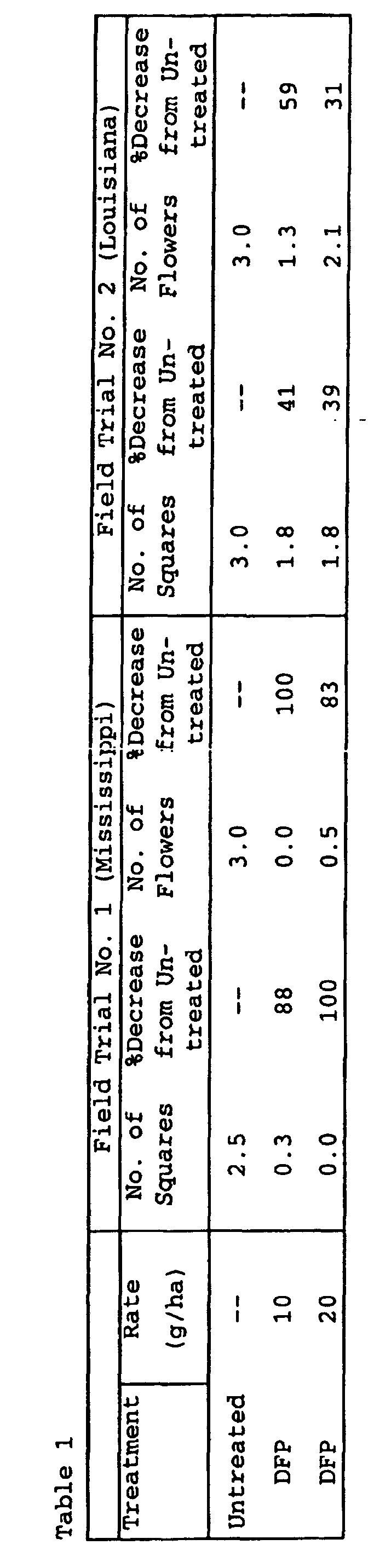
- Late-season application of diflufenzopyr (DFP) was field tested on cotton plants at the late-season growth stage described as "three nodes above white flower stage". It was surprisingly observed that diflufenzopyr caused a cessation of growth at the terminal (shoot apex) and promoted the abscission of flowers, squares and young bolls without causing significant injury to mature vegetative organs, intermediate-aged bolls and mature bolls. The results of these field trials are presented below in Table 1.
- As seen therein, in Field Trial No. 1 (Mississippi), the results were striking. A single application of DFP at 10 or 20 g ai/ha (0.01 or 0.02 lb. ai/A) caused greater than 80% reductions (relative to untreated) in the number of both squares and flowers at the uppermost eight nodes. A similar trend was also observed in Field Trial No. 2 (Louisiana), although the magnitude of the reductions in the numbers of squares and flowers was not as large as in Field Trial No. 1. Together, these trials shown in Table 1 demonstrate that a low rate of semicarbazone, such as DFP, can drastically reduce the number of squares and flowers on a cotton plant.
- Another field trail was conducted in Mississippi, wherein DFP was applied to cotton plants at three nodes above white flower stage. The results are given in Table 2 below.
Treatment Rate (g ai/ha) 22 Days After Treatment No. of Open Bolls % of Untreated Untreated -- 43 100 DFP 10 72 167 DFP 20 69 160 - As is demonstrated from the data in Table 2, at the 20 g ai/ha rate, DFP-treated cotton plants had 60% more open bolls than the untreated plants at 22 days after treatment (DAT). This large increase in open bolls indicates that an application of DFP to cotton accelerates boll maturation which would translate into an earlier harvest for the cotton grower.
- Greenhouse experiments were conducted using okra (Abelmoschus esculentus), a member of the same family (Malvaceae) as cotton. DFP application rates of 1 and 10 g ai/ha (0.0001 and 0.001 lb ai/A) did not affect okra growth (Table 3A). DFP application rates from 3 to 300 g ai/ha (0.003 to 0.3 lb. ai/A) dramatically reduced vegetative growth (Table 3B and 3C), and caused the abortion of flower buds and very small fruit (Tables 3D and 3E). The rate of fruit elongation in treated plants was slightly less than on untreated plants for the first week after application (Tables 3F and 3G). However, during the second week, the fruit on treated plants elongated at a faster rate than the fruit on the untreated plant so that by the end of two weeks, no significant difference was noted in fruit length. At the end of two weeks, plants treated with DFP had fewer fruit, but heavier fruit (Tables 3H and 3I).
- Throughout the research described in the Tables below, there were between 5-10 okra plants per treatment, with the data for such treated okra plants being averaged.
Initial Screen Testing of DFP for Height Reduction in Okra Treatment Rate g ai/ha (lb ai/A) Okra Plant Height (cm) 14 DAT % Phytotoxicity 14 DAT Untreated 0 (0) 33 0 DFP 0.1 (0.0001) 33 0 DFP 1 (0.001) 34 0 DFP 10 (0.010) 26 34 Okra Plant Height Treatment Rate g si/ha (lb ai/A) Okra Plant Height (cm) % Decrease 13 DAT 28 DAT 28 DAT Untreated 0 (0) 55 61 -- DFP 7 (0.007) 42 45 26 DFP 15 (0.015) 41 43 30 DFP 30 (0.030) 43 45 27 Okra Plant Height Treatment Rate g ai/ha (lb ai/A) Okra Plant Height (cm) 13 DAT % Decrease Untreated 0 (0) 90 -- DFP 3 (0.003) 68 23 DFP 7 (0.007) 76 14 Fate of Okra Reproductive Organs That Were Either Flower Buds or Small Fruit at Application of DFP Treatment Rate g ai/ha (lb ai/A) % Reduction flower in # of Buds % Reduction in # of Small Fruit 6 DAT 13 DAT 6 DAT 13 DAT Untreated 0 (0) 30 40 0 0 DFP 7 (0.007) 67 72 0 0 DFP 15 (0.015) 78 83 0 0 DFP 30 (0.030) 82 88 0 0 Fate of Okra Reproductive Organs That Were Either Flower Buds or Small Fruit at Application of DFP Treatment Rate g ai/ha (lb ai/A) % Reduction in # of flower Buds % Reduction in # of Small Fruit 6 DAT 13 DAT 6 DAT 13 DAT Untreated 0 (0) 9.4 30.2 0 0 DFP 3 (0.003) 61.1 48.1 0 0 DFP 7 (0.007) 57.1 53.1 31 23 Increase in Okra Fruit Length Treatment Rate g ai/ha (lb ai/A) Increase in Okra Pod Length (cm) 0-6 DAT 6-13 DAT 0-13 DAT Untreated 0 (0) 11.3 0.1 11.2 DFP 7 (0.007) 6.6 4.3 10.9 DFP 15 (0.015) 7.3 2.4 9.7 DFP 30 (0.030) 7.6 3.1 10.6 Increase in Okra Fruit Length Treatment Rate g ai/ha (lb ai/A) Increase in Okra Pod Length (cm) 0-6 DAT 6-13 DAT 0-13 DAT Untreated 0 (0) 11.9 1.2 13.1 DFP 3 (0.003) 10.2 1.7 11.9 DFP 7 (0.007) 10.4 1.7 13.1 Okra Yield of Fruit as Weiaht in Grams Treatment Rate g ai/ha (lb ai/A) Okra Fruit Wt. (gm) at 13 DAT) % Increase Fruit Wt. fresh wt. dry wt. fresh wt. dry wt. Untreated 0 (0) 21.8 3.07 -- -- DFP 7 (0.007) 30.0 3.63 37 18 DFP 15 (0.015) 29.3 3.53 34 15 DFP 30 (0.030) 35.2 4.17 61 36 Okra Yield of Fruit as Weight in Grams Okra Fruit Dry Wt. (gm) by Fruition Position Treatment Rate g ai/ha (lb ai/A) Position 1 Position 2 Position 3 Position 4 Untreated 0 (0) 21.8 3.07 -- -- DFP 7 (0.007) 30.0 3.63 37 18 DFP 15 (0.015) 29.3 3.53 34 15 - The data above demonstrate that a single application of a semicarbazone, such as diflufenzopyr at a rate range between about 3 to 30 g ai/ha (0.003 to about 0.03 lb. ai/A) to a crop plant, such as cotton or okra, can cause the abscission of flower buds, flowers and young fruit as well as dramatically reduce vegetative growth. Surprisingly, the weight of the okra fruit was increased by treatments with DFP.
- Field trials were conducted on peanut plants (Arachis hypogaea) to determine if late season applications of DFP could stop the development of late season flowers and vegetative growth. Applications of DFP were made using a CO2 back-pack sprayer calibrated to deliver 93.5 l/ha (10 gallons/acre (gpa)). Ground plots containing the peanut plants were 3.66 m x 15.24 m (12 feet x 50 feet). Applications were targeted to be made to actively growing peanut plants approximately six (6) weeks and three (3) weeks prior to harvest. Applications of DFP with 1% v/v DASH® HC spray adjuvant were applied broadcast to peanut. Peanuts were collected and weighed to calculate yield data shown in Table 4 below. All trials were irrigated, except for the GA-015 trial which was conducted under drought conditions. DFP was applied at rates of 0.0078 and 0.017 kg ai/ha (0.007 and 0.015 lb. ai/A).
Peanut yield expressed as percent of the untreated check. Treatment Rate g ai/ha (lb ai/acre) Timing* Peanut Yield as % of untreated check GRS-287 FTS NC-101 GA-015 Untreated -------- -------- 100 100 100c 100 DFP 0.0078 6 wk 107 102 111 98 (0.007) DFP 0.017 6 wk 92 104 115 89 (0.015) DFP 0.033 6 wk 89 99 127 92 (0.030) DFP 0.0078 3 wk 107 109 130 87 (0.007) DFP 0.017 3 wk 102 110 122 99 (0.015) DFP 0.033 3 wk 78 108 118 104 (0.030) Notes: - (1) GRS-287 - Interval between applications and harvest was 68 and 45 days.
- (2) FTS - Interval between applications and harvest was 55 and 35 days.
- (3) NC-101 - Interval between applications and harvest was 42 and 32 days.
- (4) GA-015 - Interval between application and harvest was 45 and 32 days.
-
- Some peanut injury was observed and was dependent on the rate of DFP application. Thus, as the rate of DFP increased, peanut injury also increased. By 31 DAT, however, peanut injury was not significant. Injury symptoms included slight curling of the upper most leaves within the peanut canopy. DFP applied at 0.033 kg ai/ha (0.030 lb ai/A) produced the most injury at approximately 20%, but the peanut injury did not include noticeable chlorosis.
- As evident in the data of Table 4, significant yield increase was observed at the NC-101 trials. Significant yield increases occurred form applications of DFP applied six weeks prior to harvest at 0.033 kg ai/ha (0.030 lb ai/A) and DFP applied three weeks prior to harvest at 0.0078, 0.017 and 0.033 kg ai/ha (0.007, 0.015 and 0.030 lb ai/A). As seen in note (3) to Table 4, the NC-101 trial most nearly estimated the time from application to harvest of all the studies. At the GRS and FTS trials, however, the lower application rates (0.0078 and 0.017 kg ai/ha) (0.007 and 0.015 lb ai/A) applied at the second date increased yields by the statistically insignificant amounts of 2% to 10%. The GA-015 trial, however, resulted in no trend toward increased yield which was not unexpected due to the drought stress the plants were under for much of the trial season.
- Additional field trials were conducted on cotton plants (variety DPL 50) to determine if the size of bolls that are aborted by DFP application are affected by stress, excessive application rates or the timing of application. Specifically, a mixture of DFP with 1% v/v DASH® HC spray adjuvant was applied at rates of 0.011, 0.022 and 0.090 kg ai/ha (0.01, 0.02 and 0.08 lb ai/A) at 5 nodes above white flower (5 NAWF), corresponding to 40 days before defoliation, 5 NAWF + 300 DD, corresponding to 25 days before defoliation, and 5 NAWF + 600 DD, corresponding to 15 days before defoliation. The results appear in Table 5 below.
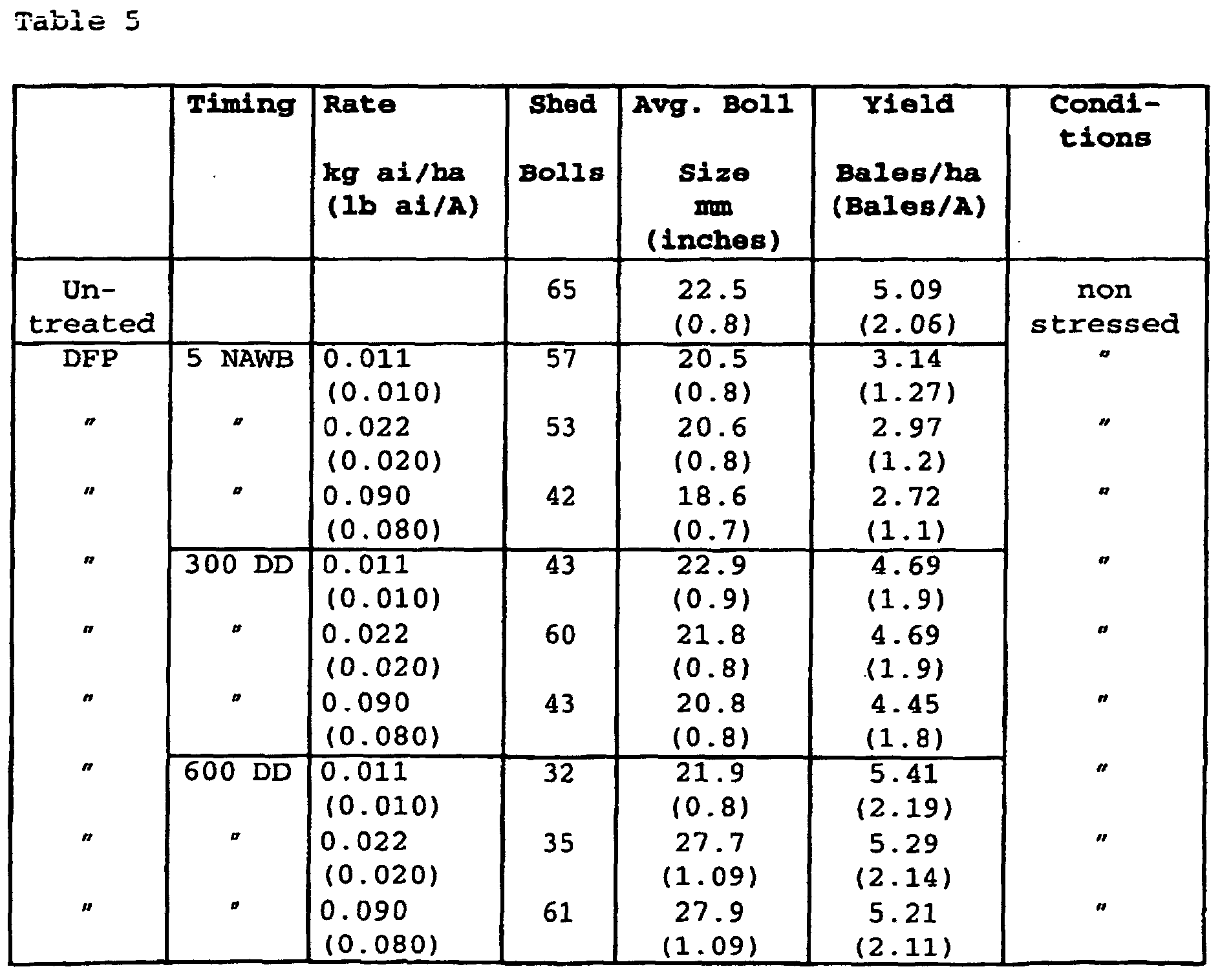

- As apparent from the data in Table 5 above, the timing of the DFP application had a more dramatic effect on yield than did the application rate. The 0.011 and 0.022 kg ai/ha (0.01 and 0.02 lb. ai/A) rates tended to have less of a negative effect on yield at each timing as compared to the 0.090 kg ai/ha (0.80 lb ai/A) rate. Applications at 5 NAWF significantly reduced yields as compared to the untreated check at the 5% level. Surprisingly, all treatments at the 667 DD timing tended to increase yields. The 0.011 and 0.022 kg ai/ha (0.01 and 0.02 lb. ai/A) rates marginally provided significant yield increases at the 5% level. At the 10% level, DFP application at a rate of 0.022 kg ai/ha (0.20 lb. ai/A) provided a significant yield increase. Only the 0.090 kg ai /ha (0.080 lb. ai/A) application rate caused a significant yield reduction at the 300 DD application timing.
- When applied at 5 NAWF to non-stressed cotton, retention of mature bolls tended to increase as the DFP rate increased. DFP application had no influence on the retention of mature bolls when applied at the later timings. DFP application caused cotton to shed squares and flowers at all rates and timings evaluated. At the 600 DD timing, virtually all immature squares were shed and flowering had terminated. Thus, an yield increase at this time is probably due to improving the efficiency of carbohydrate utilization by the plant. No negative effect on seed germination or quality at the 300 DD or 600 DD timings was observed. However, a tendency to cause a negative effect on seed germination and quality was observed at DFP treatment at 5 NAWF. Therefore, the most practical application timing in cotton appears to be after the 5 NAWF stage.
- Example 5 was repeated at another test site. The results appear in Table 6 below.


- DFP was applied at 0.011 and 0.022 kg ai/ha (0.01 and 0.02 lb ai/A) on cotton at two different growth stages: 5 NAWF and 5 NAWF + 350 HU (Heat Units) on the variety Stoneville 474. The results appear in Tables 7A and 7B, below

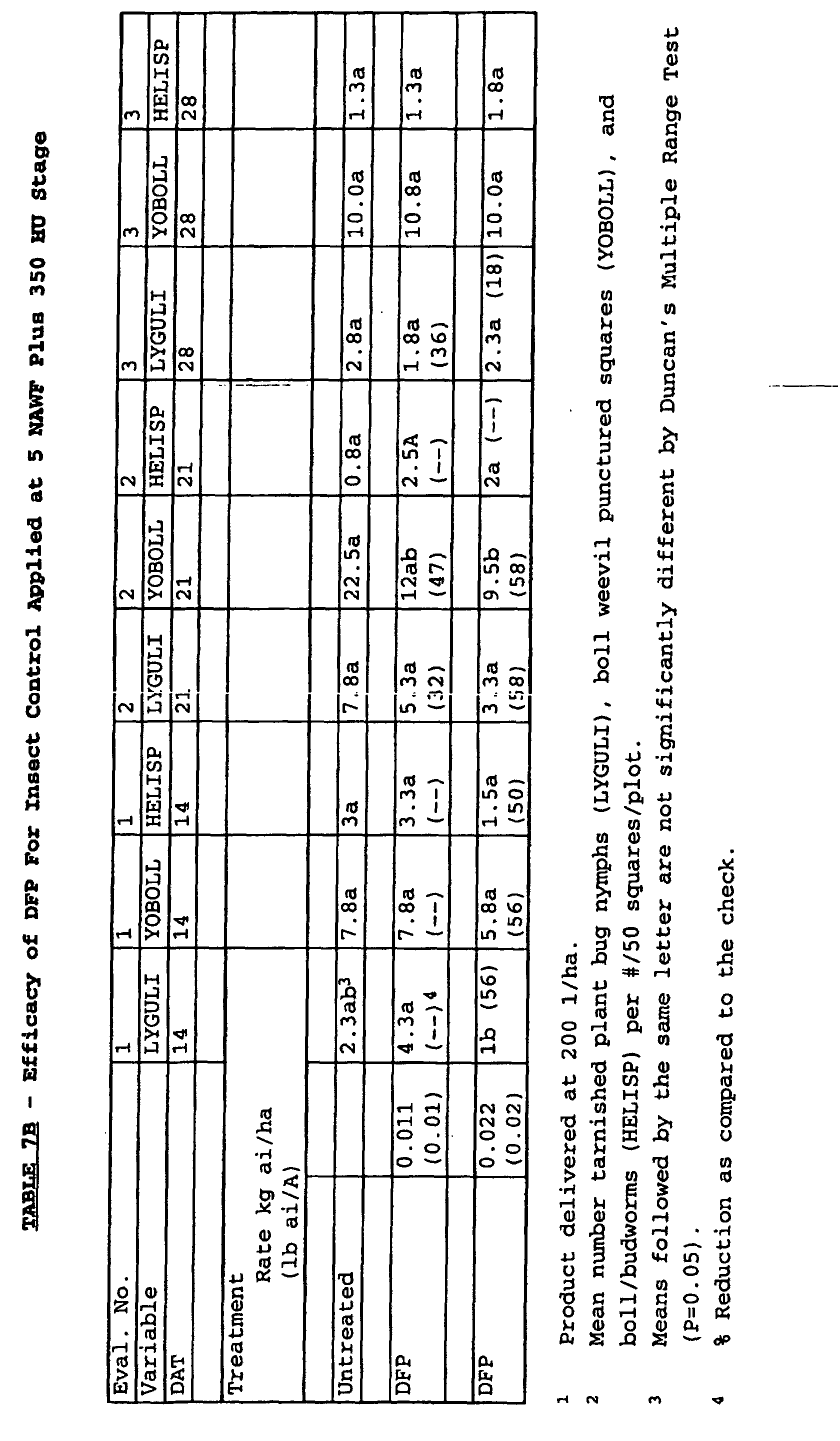
- The data above indicate that application at the 5 NAWF stage did not result in sufficient square shed to reduce insect populations and caused the cotton to drop a significant number of bolls greater than 1 inch in diameter. At the second timing of 5 NAWF + 350 HU, however, plots treated with DFP at 0.022 kg ai/ha (0.02 lb ai/A) showed significant reductions in punctured squares by boll weevils (58%) and tarnished plant bug nymphs (32%) as compared to the untreated check. At this later timing, no boll shed was observed. These results therefore indicate that DFP at 0.022 kg ai/ha (0.02 lb ai/A) has a great potential as a cotton plant termination aid.
- DFP treatments were applied to tobacco plants in a commercial, flue cured tobacco field. Plants were topped and sprayed on the same day. About 5-10% of the tobacco plants were at the bud stage at application. Treatments were applied with a hand-held sprayer equipped with a hollow cone nozzle. Spray volume was 33 ml per plant or roughly 478 l/ha (50 gallons per acre). Each treatment was applied to the three tobacco plants and each plant was considered a replication. The plants were examined at various intervals measured in weeks after treatment (WAT). One treatment, the commercial standard Royal MH-30 (maleic hydrazide) applied at 3.3 kg ai/ha (3.0 lbs. ai/A), could not be applied until the following day. Because of this delay in application, the treatment was not significantly different from the check and are not included in the results below in Tables 8A-8C.
Percent injury on flue-cured tobacco Percent Injury Treatment kg ai/ha (lbs ai/A) 1 WAT 3 WAT Untreated 0 (0) 0 0 DFP 0.011 (0.01) 25 10 DFP 0.033 (0.03) 40 35 DFP + MH-30 0.011 + 1.1 (0.01 + 1.0) 25 20 DFP + MH-30 0.033 + 1.1 (0.03 + 1.0) 40 25 MH-30 1.1 (1.0) 0 0 Number of Suckers /plant on flue-cured tobacco kg ai/ha (lbs. ai/A) Number of Suckers per Plant 2 WAT 3WAT 4WAT 6WAT Untreated 0 (0) 3.0 3.0 4.3 8.5 DFP 0.011 (0.01) 0 2.7 6.3 7 DFP 0.033 (0.03) 0 0 4.5 10 DFP 0.067 (0.06) 0 0 2.0 4.5 DFP + MH-30 0.011 + 1.1 (0.01 + 1.0) 0 0.3 4.0 5.3 DFP + MH-30 0.033 + 1.1 (0.03 + 1.0) 0 0.3 2.3 6.3 MH-30 1.1 (1.0) 0 1.0 5.7 5.3 Total sucker weight per plant, average sucker weight and length and the lengt of the top five tobacco leaves at the final evaluation at 41 days after treatment (DAT) kg ai/ha (lbs. ai/A) Total Sucker wt./ plant Avg. Sucker wt. (gm) Avg. Sucker length (cm) Avg. Length of Top 5 leaves Untreated 0 (0) 715 82 28 62 DFP 0.011 (0.01) 217 32 23 58 DFP 0.033 (0.03) 270 27 15 53 DFP 0.067 (0.06) 100 15 15 57 DFP + 0.011 + 1.1 123 21 14 59 MH-30 (0.01 + 1.0) DFP + 0.033 + 1.1 176 32 17 63 MH-30 (0.03 + 1.0) MH-30 1.1 (1.0) 226 49 23 68 - The data above shows that DFP produced some injury symptoms on immature leaves of typical auxin accumulation (see Table 8A) which was evidenced by leave curling. In addition, these leaves undesirably stayed greener late in the season. The injury did not, however, reduce the final length of the top five leaves at harvest (see Table 8C, but there was a slight trend toward decrease length. Mature leaves did not show injury symptoms. DFP did reduce the number of suckers per plant with the highest rate of 0.067 kg ai/ha (0.06 lbs ai/A) being effective at six weeks after application (Table 8B). Lower rates of DFP were effective for shorter periods of time. Once the inhibitory activity of DFP ceased, the sucker number quickly rebounded. The combination of DFP with a 0.067 kg ai/ha (1.0 pound) rate of maleic hydrazide was not significantly different from DFP alone. At 6WAT , all treatments reduced sucker weight per plant and average sucker weight (see Table 8C). DFP at 0.067 kg ai/ha (0.06 lbs ai/A) was the most effective treatment in reducing total sucker weight per plant, average sucker weight and average sucker length.
Claims (11)
- A method for the late season termination of reproductive plant growth of a plant comprising applying to a locus of a plant at a time following peak bloom of the plant a sufficient amount of diflufenzopyr to terminate continued reproductive growth of the plant.
- The method of claim 1, wherein the plant is one having an indeterminate growth pattern.
- The method of claims 1 to 2, wherein diflufenzopyr is sufficient to terminate continued reproductive growth without substantially affecting mature reproductive growth existing on the plant at the time of application.
- The method of claims 1 to 3, wherein the plant is of the Malvaceae or Fabaceae family.
- The method of claim 4, wherein the plant is a cotton, okra or peanut plant.
- The method of claims 1 to 5, wherein the application rate of diflufenzopyr is between about 0.00011 to about 0.101 kg of active ingredient per hectare (0.0001 to about 0.09 pounds of active ingredient per acre).
- The method of claim 6, wherein the application rate is between about 0.0033 to about 0.033 kg active ingredient per hectare (0.003 to about 0.03 pounds active ingredient per acre).
- The method of claims 1 to 7, wherein diflufenzopyr is applied together with at least one adjuvant.
- The method of claims 1 to 8, wherein diflufenzopyr is applied in the form of a liquid or a solid particulate.
- The method of claims 1 to 9, wherein the plant is cotton, and wherein diflufenzopyr is applied to the cotton plant at three nodes above white flower stage.
- The method of claims 1 to 4 or 6 to 9, wherein the plant is Nicotiana tabacum L.
Applications Claiming Priority (3)
| Application Number | Priority Date | Filing Date | Title |
|---|---|---|---|
| US461382 | 1999-12-15 | ||
| US09/461,382 US6284711B1 (en) | 1999-12-15 | 1999-12-15 | Use of a semicarbazone plant growth regulator for early termination of crop plants |
| PCT/EP2000/012203 WO2001043551A1 (en) | 1999-12-15 | 2000-12-05 | Use of a semicarbazone plant growth regulator for early termination of crop plants |
Publications (2)
| Publication Number | Publication Date |
|---|---|
| EP1241944A1 EP1241944A1 (en) | 2002-09-25 |
| EP1241944B1 true EP1241944B1 (en) | 2004-06-30 |
Family
ID=23832335
Family Applications (1)
| Application Number | Title | Priority Date | Filing Date |
|---|---|---|---|
| EP00990647A Expired - Lifetime EP1241944B1 (en) | 1999-12-15 | 2000-12-05 | Use of diflufenzopyr for early termination of crop plants |
Country Status (19)
| Country | Link |
|---|---|
| US (1) | US6284711B1 (en) |
| EP (1) | EP1241944B1 (en) |
| JP (1) | JP2003516945A (en) |
| KR (1) | KR100736313B1 (en) |
| CN (1) | CN1184887C (en) |
| AR (1) | AR026980A1 (en) |
| AT (1) | ATE270046T1 (en) |
| AU (1) | AU782269B2 (en) |
| BR (1) | BR0016450B1 (en) |
| CA (1) | CA2395084C (en) |
| DE (1) | DE60011935D1 (en) |
| EA (1) | EA004305B1 (en) |
| ES (1) | ES2223645T3 (en) |
| IL (2) | IL149753A0 (en) |
| MX (1) | MXPA02005633A (en) |
| PL (1) | PL199871B1 (en) |
| UA (1) | UA72020C2 (en) |
| WO (1) | WO2001043551A1 (en) |
| ZA (1) | ZA200205587B (en) |
Families Citing this family (8)
| Publication number | Priority date | Publication date | Assignee | Title |
|---|---|---|---|---|
| WO2006120231A2 (en) * | 2005-05-12 | 2006-11-16 | Basf Aktiengesellschaft | Method of enhancing resistibility of crop plants |
| JP5082856B2 (en) * | 2005-11-30 | 2012-11-28 | 株式会社ニコン | Image processing method, image processing program, image processing apparatus, and imaging apparatus |
| WO2012087980A1 (en) | 2010-12-21 | 2012-06-28 | Agraquest, Inc. | Sandpaper mutants of bacillus and methods of their use to enhance plant growth, promote plant health and control diseases and pests |
| MX2014002890A (en) | 2011-09-12 | 2015-01-19 | Bayer Cropscience Lp | Methods of enhancing health and/or promoting growth of a plant and/or of improving fruit ripening. |
| US10624277B2 (en) * | 2015-04-10 | 2020-04-21 | Kenneth Kyle Friesen | Compound intercropping process |
| US20170038184A1 (en) | 2015-08-06 | 2017-02-09 | Charles E. Ankner | Formulation delivery system |
| CN110692475B (en) * | 2019-11-16 | 2021-07-27 | 菏泽市农业科学院 | A kind of cultivation method for promoting early flowering and early maturity of peanuts |
| AU2021203604A1 (en) * | 2021-03-09 | 2022-09-29 | Cotton Seed Distributors Ltd | Method and system for monitoring a cotton crop |
Family Cites Families (8)
| Publication number | Priority date | Publication date | Assignee | Title |
|---|---|---|---|---|
| US3879188A (en) * | 1969-10-24 | 1975-04-22 | Amchem Prod | Growth regulation process |
| US4272280A (en) * | 1980-07-07 | 1981-06-09 | Gulf Oil Corporation | Isobenzofurandione thiosemicarbazones and use as plant growth regulators |
| US4581057A (en) * | 1984-03-15 | 1986-04-08 | The Board Of Regents Of University Of Michigan, Corp. Of Michigan | Abscisic acid containing foliar fertilizers and method of using same to enhance crop yields |
| US5098466A (en) * | 1985-08-20 | 1992-03-24 | Sandoz Ltd. | Compounds |
| US5098462A (en) * | 1985-08-20 | 1992-03-24 | Sandoz Ltd. | Substituted semi-carbazones and related compounds |
| US5123951A (en) * | 1986-03-31 | 1992-06-23 | Rhone-Poulenc Nederland B.V. | Synergistic plant growth regulator compositions |
| DE4216814A1 (en) * | 1991-07-16 | 1993-01-21 | Bayer Ag | 3-ARYL-4-HYDROXY- (DELTA) (UP ARROW) 3 (UP ARROW) -DIHYDROFURANONE- AND 3-ARYL-4-HYDROXY- (DELTA) (UP ARROW) 3 (UP ARROW) -DIHYDROTHIOPHENONE DERIVATIVES |
| DE69723750T2 (en) * | 1996-03-13 | 2004-06-03 | Syngenta Participations Ag | Herbicidal combinations |
-
1999
- 1999-12-15 US US09/461,382 patent/US6284711B1/en not_active Expired - Lifetime
-
2000
- 2000-05-12 UA UA2002075747A patent/UA72020C2/en unknown
- 2000-12-05 EA EA200200680A patent/EA004305B1/en not_active IP Right Cessation
- 2000-12-05 IL IL14975300A patent/IL149753A0/en active IP Right Grant
- 2000-12-05 CA CA002395084A patent/CA2395084C/en not_active Expired - Fee Related
- 2000-12-05 EP EP00990647A patent/EP1241944B1/en not_active Expired - Lifetime
- 2000-12-05 DE DE60011935T patent/DE60011935D1/en not_active Expired - Lifetime
- 2000-12-05 ES ES00990647T patent/ES2223645T3/en not_active Expired - Lifetime
- 2000-12-05 PL PL355817A patent/PL199871B1/en not_active IP Right Cessation
- 2000-12-05 WO PCT/EP2000/012203 patent/WO2001043551A1/en not_active Ceased
- 2000-12-05 AU AU30063/01A patent/AU782269B2/en not_active Ceased
- 2000-12-05 JP JP2001544500A patent/JP2003516945A/en active Pending
- 2000-12-05 AT AT00990647T patent/ATE270046T1/en not_active IP Right Cessation
- 2000-12-05 MX MXPA02005633A patent/MXPA02005633A/en active IP Right Grant
- 2000-12-05 KR KR1020027007622A patent/KR100736313B1/en not_active Expired - Fee Related
- 2000-12-05 CN CNB008171807A patent/CN1184887C/en not_active Expired - Fee Related
- 2000-12-05 BR BRPI0016450-0A patent/BR0016450B1/en not_active IP Right Cessation
- 2000-12-15 AR ARP000106690A patent/AR026980A1/en unknown
-
2002
- 2002-05-20 IL IL149753A patent/IL149753A/en not_active IP Right Cessation
- 2002-07-12 ZA ZA200205587A patent/ZA200205587B/en unknown
Also Published As
| Publication number | Publication date |
|---|---|
| KR100736313B1 (en) | 2007-07-06 |
| MXPA02005633A (en) | 2002-09-02 |
| AR026980A1 (en) | 2003-03-05 |
| EA200200680A1 (en) | 2002-12-26 |
| PL355817A1 (en) | 2004-05-17 |
| WO2001043551A1 (en) | 2001-06-21 |
| IL149753A0 (en) | 2002-11-10 |
| CA2395084C (en) | 2009-05-26 |
| CA2395084A1 (en) | 2001-06-21 |
| ES2223645T3 (en) | 2005-03-01 |
| BR0016450B1 (en) | 2013-03-05 |
| PL199871B1 (en) | 2008-11-28 |
| AU3006301A (en) | 2001-06-25 |
| KR20020065906A (en) | 2002-08-14 |
| ZA200205587B (en) | 2003-10-03 |
| DE60011935D1 (en) | 2004-08-05 |
| JP2003516945A (en) | 2003-05-20 |
| EP1241944A1 (en) | 2002-09-25 |
| ATE270046T1 (en) | 2004-07-15 |
| UA72020C2 (en) | 2005-01-17 |
| CN1184887C (en) | 2005-01-19 |
| AU782269B2 (en) | 2005-07-14 |
| US6284711B1 (en) | 2001-09-04 |
| EA004305B1 (en) | 2004-02-26 |
| BR0016450A (en) | 2002-08-27 |
| IL149753A (en) | 2007-07-04 |
| CN1409598A (en) | 2003-04-09 |
Similar Documents
| Publication | Publication Date | Title |
|---|---|---|
| Davis et al. | Chemical regulation of vegetative growth | |
| KR102632658B1 (en) | Herbicide combinations comprising l-glufosinate and indaziflam | |
| US10334854B2 (en) | Herbicide combinations comprising glufosinate and indaziflam | |
| WO2016086727A1 (en) | A nematicidal composition and the use thereof | |
| US6284711B1 (en) | Use of a semicarbazone plant growth regulator for early termination of crop plants | |
| KISHA | Cultural and insecticidal control of Thrips tabaci on onions in the Sudan | |
| Elbert et al. | New applications for neonicotinoid insecticides using imidacloprid as an example | |
| AU2021360993A1 (en) | Herbicide combination comprising glufosinate, saflufenacil and trifludimoxazin | |
| EA019535B1 (en) | Method for controlling aphid pests on plants | |
| US6150302A (en) | Use of a semicarbazone plant growth regulator for crop yield enhancements | |
| US20210084904A1 (en) | Succinate dehydrogenase inhibitors and sulfur-containing compounds mixtures and methods of use thereof | |
| US12063932B2 (en) | Method of promoting plant growth effects | |
| Geetha | Chapter-5 influence of defoliants, dessicants and harvest-aid chemicals in determining cotton yield | |
| Manjula | Field evaluation of Pseudomonas fluorescens against the cotton leaf roller, Sylepta derogate (Crambidae: Lepidoptera) in Bt and non Bt cotton | |
| CN121729139A (en) | Method for controlling insects | |
| KR20220075235A (en) | pesticide mixture | |
| Snipes et al. | Influence of crop condition on harvest-aid activity | |
| EP4000400A1 (en) | Herbicide combination comprising glufosinate, saflufenacil and trifludimoxazin | |
| Louw et al. | Developing a mango programme for optimum mango yield and quality | |
| El-Sayed et al. | Some morphological characters and yield of broad bean (Vicia faba) as affected by pesticide treatments |
Legal Events
| Date | Code | Title | Description |
|---|---|---|---|
| PUAI | Public reference made under article 153(3) epc to a published international application that has entered the european phase |
Free format text: ORIGINAL CODE: 0009012 |
|
| 17P | Request for examination filed |
Effective date: 20020518 |
|
| AK | Designated contracting states |
Kind code of ref document: A1 Designated state(s): AT BE CH CY DE DK ES FI FR GB GR IE IT LI LU MC NL PT SE TR |
|
| AX | Request for extension of the european patent |
Free format text: AL;LT;LV;MK;RO PAYMENT 20020518;SI |
|
| RIN1 | Information on inventor provided before grant (corrected) |
Inventor name: EVANS, LISA, S. Inventor name: SARAVITZ, DAVID, M. Inventor name: EVANS, JOHN, R. Inventor name: STEWART, WALLACE, W. Inventor name: HOLT, THOMAS, J. |
|
| 17Q | First examination report despatched |
Effective date: 20021204 |
|
| GRAP | Despatch of communication of intention to grant a patent |
Free format text: ORIGINAL CODE: EPIDOSNIGR1 |
|
| RTI1 | Title (correction) |
Free format text: USE OF DIFLUFENZOPYR FOR EARLY TERMINATION OF CROP PLANTS |
|
| RTI1 | Title (correction) |
Free format text: USE OF DIFLUFENZOPYR FOR EARLY TERMINATION OF CROP PLANTS |
|
| GRAS | Grant fee paid |
Free format text: ORIGINAL CODE: EPIDOSNIGR3 |
|
| GRAA | (expected) grant |
Free format text: ORIGINAL CODE: 0009210 |
|
| AK | Designated contracting states |
Kind code of ref document: B1 Designated state(s): AT BE CH CY DE DK ES FI FR GB GR IE IT LI LU MC NL PT SE TR |
|
| AX | Request for extension of the european patent |
Extension state: RO |
|
| PG25 | Lapsed in a contracting state [announced via postgrant information from national office to epo] |
Ref country code: IT Free format text: LAPSE BECAUSE OF FAILURE TO SUBMIT A TRANSLATION OF THE DESCRIPTION OR TO PAY THE FEE WITHIN THE PRESCRIBED TIME-LIMIT;WARNING: LAPSES OF ITALIAN PATENTS WITH EFFECTIVE DATE BEFORE 2007 MAY HAVE OCCURRED AT ANY TIME BEFORE 2007. THE CORRECT EFFECTIVE DATE MAY BE DIFFERENT FROM THE ONE RECORDED. Effective date: 20040630 Ref country code: BE Free format text: LAPSE BECAUSE OF FAILURE TO SUBMIT A TRANSLATION OF THE DESCRIPTION OR TO PAY THE FEE WITHIN THE PRESCRIBED TIME-LIMIT Effective date: 20040630 Ref country code: CY Free format text: LAPSE BECAUSE OF FAILURE TO SUBMIT A TRANSLATION OF THE DESCRIPTION OR TO PAY THE FEE WITHIN THE PRESCRIBED TIME-LIMIT Effective date: 20040630 Ref country code: CH Free format text: LAPSE BECAUSE OF FAILURE TO SUBMIT A TRANSLATION OF THE DESCRIPTION OR TO PAY THE FEE WITHIN THE PRESCRIBED TIME-LIMIT Effective date: 20040630 Ref country code: FI Free format text: LAPSE BECAUSE OF FAILURE TO SUBMIT A TRANSLATION OF THE DESCRIPTION OR TO PAY THE FEE WITHIN THE PRESCRIBED TIME-LIMIT Effective date: 20040630 Ref country code: AT Free format text: LAPSE BECAUSE OF FAILURE TO SUBMIT A TRANSLATION OF THE DESCRIPTION OR TO PAY THE FEE WITHIN THE PRESCRIBED TIME-LIMIT Effective date: 20040630 Ref country code: FR Free format text: LAPSE BECAUSE OF FAILURE TO SUBMIT A TRANSLATION OF THE DESCRIPTION OR TO PAY THE FEE WITHIN THE PRESCRIBED TIME-LIMIT Effective date: 20040630 Ref country code: LI Free format text: LAPSE BECAUSE OF FAILURE TO SUBMIT A TRANSLATION OF THE DESCRIPTION OR TO PAY THE FEE WITHIN THE PRESCRIBED TIME-LIMIT Effective date: 20040630 Ref country code: NL Free format text: LAPSE BECAUSE OF FAILURE TO SUBMIT A TRANSLATION OF THE DESCRIPTION OR TO PAY THE FEE WITHIN THE PRESCRIBED TIME-LIMIT Effective date: 20040630 |
|
| REG | Reference to a national code |
Ref country code: GB Ref legal event code: FG4D Ref country code: CH Ref legal event code: EP |
|
| REG | Reference to a national code |
Ref country code: IE Ref legal event code: FG4D |
|
| REF | Corresponds to: |
Ref document number: 60011935 Country of ref document: DE Date of ref document: 20040805 Kind code of ref document: P |
|
| PG25 | Lapsed in a contracting state [announced via postgrant information from national office to epo] |
Ref country code: SE Free format text: LAPSE BECAUSE OF FAILURE TO SUBMIT A TRANSLATION OF THE DESCRIPTION OR TO PAY THE FEE WITHIN THE PRESCRIBED TIME-LIMIT Effective date: 20040930 Ref country code: DK Free format text: LAPSE BECAUSE OF FAILURE TO SUBMIT A TRANSLATION OF THE DESCRIPTION OR TO PAY THE FEE WITHIN THE PRESCRIBED TIME-LIMIT Effective date: 20040930 |
|
| PG25 | Lapsed in a contracting state [announced via postgrant information from national office to epo] |
Ref country code: DE Free format text: LAPSE BECAUSE OF FAILURE TO SUBMIT A TRANSLATION OF THE DESCRIPTION OR TO PAY THE FEE WITHIN THE PRESCRIBED TIME-LIMIT Effective date: 20041001 |
|
| REG | Reference to a national code |
Ref country code: GR Ref legal event code: EP Ref document number: 20040403014 Country of ref document: GR |
|
| PG25 | Lapsed in a contracting state [announced via postgrant information from national office to epo] |
Ref country code: LU Free format text: LAPSE BECAUSE OF NON-PAYMENT OF DUE FEES Effective date: 20041205 Ref country code: GB Free format text: LAPSE BECAUSE OF NON-PAYMENT OF DUE FEES Effective date: 20041205 |
|
| PG25 | Lapsed in a contracting state [announced via postgrant information from national office to epo] |
Ref country code: IE Free format text: LAPSE BECAUSE OF NON-PAYMENT OF DUE FEES Effective date: 20041206 |
|
| LTIE | Lt: invalidation of european patent or patent extension |
Effective date: 20040630 |
|
| PG25 | Lapsed in a contracting state [announced via postgrant information from national office to epo] |
Ref country code: MC Free format text: LAPSE BECAUSE OF NON-PAYMENT OF DUE FEES Effective date: 20041231 |
|
| NLV1 | Nl: lapsed or annulled due to failure to fulfill the requirements of art. 29p and 29m of the patents act | ||
| REG | Reference to a national code |
Ref country code: CH Ref legal event code: PL |
|
| REG | Reference to a national code |
Ref country code: ES Ref legal event code: FG2A Ref document number: 2223645 Country of ref document: ES Kind code of ref document: T3 |
|
| PLBE | No opposition filed within time limit |
Free format text: ORIGINAL CODE: 0009261 |
|
| 26N | No opposition filed |
Effective date: 20050331 |
|
| EN | Fr: translation not filed | ||
| GBPC | Gb: european patent ceased through non-payment of renewal fee |
Effective date: 20041205 |
|
| REG | Reference to a national code |
Ref country code: IE Ref legal event code: MM4A |
|
| PG25 | Lapsed in a contracting state [announced via postgrant information from national office to epo] |
Ref country code: PT Free format text: LAPSE BECAUSE OF NON-PAYMENT OF DUE FEES Effective date: 20041130 |
|
| PLAA | Information modified related to event that no opposition was filed |
Free format text: ORIGINAL CODE: 0009299DELT |
|
| PLBE | No opposition filed within time limit |
Free format text: ORIGINAL CODE: 0009261 |
|
| STAA | Information on the status of an ep patent application or granted ep patent |
Free format text: STATUS: NO OPPOSITION FILED WITHIN TIME LIMIT |
|
| R26N | No opposition filed (corrected) |
Effective date: 20050331 |
|
| RIN2 | Information on inventor provided after grant (corrected) |
Inventor name: SARAVITZ, DAVID, M. Inventor name: DR. EVANS, RICHARD R. Inventor name: EVANS, LISA, S. Inventor name: EVANS, JOHN, R. Inventor name: HOLT, THOMAS, J. Inventor name: STEWART, WALLACE, W. |
|
| PGFP | Annual fee paid to national office [announced via postgrant information from national office to epo] |
Ref country code: GR Payment date: 20131220 Year of fee payment: 14 Ref country code: TR Payment date: 20131118 Year of fee payment: 14 |
|
| PGFP | Annual fee paid to national office [announced via postgrant information from national office to epo] |
Ref country code: ES Payment date: 20140128 Year of fee payment: 14 |
|
| REG | Reference to a national code |
Ref country code: GR Ref legal event code: ML Ref document number: 20040403014 Country of ref document: GR Effective date: 20150722 |
|
| PG25 | Lapsed in a contracting state [announced via postgrant information from national office to epo] |
Ref country code: GR Free format text: LAPSE BECAUSE OF NON-PAYMENT OF DUE FEES Effective date: 20150722 |
|
| REG | Reference to a national code |
Ref country code: ES Ref legal event code: FD2A Effective date: 20160129 |
|
| PG25 | Lapsed in a contracting state [announced via postgrant information from national office to epo] |
Ref country code: ES Free format text: LAPSE BECAUSE OF NON-PAYMENT OF DUE FEES Effective date: 20141206 |
|
| PG25 | Lapsed in a contracting state [announced via postgrant information from national office to epo] |
Ref country code: TR Free format text: LAPSE BECAUSE OF NON-PAYMENT OF DUE FEES Effective date: 20141205 |