EP1241901A1 - Adaptive resending request control method (ARQ) in a mobile radio communications system based on radio link measurements at the receiver side - Google Patents
Adaptive resending request control method (ARQ) in a mobile radio communications system based on radio link measurements at the receiver side Download PDFInfo
- Publication number
- EP1241901A1 EP1241901A1 EP20020005666 EP02005666A EP1241901A1 EP 1241901 A1 EP1241901 A1 EP 1241901A1 EP 20020005666 EP20020005666 EP 20020005666 EP 02005666 A EP02005666 A EP 02005666A EP 1241901 A1 EP1241901 A1 EP 1241901A1
- Authority
- EP
- European Patent Office
- Prior art keywords
- control
- data
- state
- resending
- packet
- Prior art date
- Legal status (The legal status is an assumption and is not a legal conclusion. Google has not performed a legal analysis and makes no representation as to the accuracy of the status listed.)
- Granted
Links
Images






Classifications
-
- H—ELECTRICITY
- H04—ELECTRIC COMMUNICATION TECHNIQUE
- H04L—TRANSMISSION OF DIGITAL INFORMATION, e.g. TELEGRAPHIC COMMUNICATION
- H04L1/00—Arrangements for detecting or preventing errors in the information received
- H04L1/0001—Systems modifying transmission characteristics according to link quality, e.g. power backoff
- H04L1/0015—Systems modifying transmission characteristics according to link quality, e.g. power backoff characterised by the adaptation strategy
- H04L1/0016—Systems modifying transmission characteristics according to link quality, e.g. power backoff characterised by the adaptation strategy involving special memory structures, e.g. look-up tables
-
- H—ELECTRICITY
- H04—ELECTRIC COMMUNICATION TECHNIQUE
- H04L—TRANSMISSION OF DIGITAL INFORMATION, e.g. TELEGRAPHIC COMMUNICATION
- H04L1/00—Arrangements for detecting or preventing errors in the information received
- H04L1/0001—Systems modifying transmission characteristics according to link quality, e.g. power backoff
- H04L1/0009—Systems modifying transmission characteristics according to link quality, e.g. power backoff by adapting the channel coding
-
- H—ELECTRICITY
- H04—ELECTRIC COMMUNICATION TECHNIQUE
- H04L—TRANSMISSION OF DIGITAL INFORMATION, e.g. TELEGRAPHIC COMMUNICATION
- H04L1/00—Arrangements for detecting or preventing errors in the information received
- H04L1/0001—Systems modifying transmission characteristics according to link quality, e.g. power backoff
- H04L1/0015—Systems modifying transmission characteristics according to link quality, e.g. power backoff characterised by the adaptation strategy
- H04L1/0017—Systems modifying transmission characteristics according to link quality, e.g. power backoff characterised by the adaptation strategy where the mode-switching is based on Quality of Service requirement
- H04L1/0018—Systems modifying transmission characteristics according to link quality, e.g. power backoff characterised by the adaptation strategy where the mode-switching is based on Quality of Service requirement based on latency requirement
-
- H—ELECTRICITY
- H04—ELECTRIC COMMUNICATION TECHNIQUE
- H04L—TRANSMISSION OF DIGITAL INFORMATION, e.g. TELEGRAPHIC COMMUNICATION
- H04L1/00—Arrangements for detecting or preventing errors in the information received
- H04L1/0001—Systems modifying transmission characteristics according to link quality, e.g. power backoff
- H04L1/0023—Systems modifying transmission characteristics according to link quality, e.g. power backoff characterised by the signalling
- H04L1/0025—Transmission of mode-switching indication
-
- H—ELECTRICITY
- H04—ELECTRIC COMMUNICATION TECHNIQUE
- H04L—TRANSMISSION OF DIGITAL INFORMATION, e.g. TELEGRAPHIC COMMUNICATION
- H04L1/00—Arrangements for detecting or preventing errors in the information received
- H04L1/12—Arrangements for detecting or preventing errors in the information received by using return channel
- H04L1/16—Arrangements for detecting or preventing errors in the information received by using return channel in which the return channel carries supervisory signals, e.g. repetition request signals
- H04L1/18—Automatic repetition systems, e.g. Van Duuren systems
- H04L1/1812—Hybrid protocols; Hybrid automatic repeat request [HARQ]
- H04L1/1819—Hybrid protocols; Hybrid automatic repeat request [HARQ] with retransmission of additional or different redundancy
-
- H—ELECTRICITY
- H04—ELECTRIC COMMUNICATION TECHNIQUE
- H04L—TRANSMISSION OF DIGITAL INFORMATION, e.g. TELEGRAPHIC COMMUNICATION
- H04L1/00—Arrangements for detecting or preventing errors in the information received
- H04L1/12—Arrangements for detecting or preventing errors in the information received by using return channel
- H04L1/16—Arrangements for detecting or preventing errors in the information received by using return channel in which the return channel carries supervisory signals, e.g. repetition request signals
- H04L1/18—Automatic repetition systems, e.g. Van Duuren systems
- H04L1/1825—Adaptation of specific ARQ protocol parameters according to transmission conditions
-
- H—ELECTRICITY
- H04—ELECTRIC COMMUNICATION TECHNIQUE
- H04W—WIRELESS COMMUNICATION NETWORKS
- H04W28/00—Network traffic management; Network resource management
- H04W28/16—Central resource management; Negotiation of resources or communication parameters, e.g. negotiating bandwidth or QoS [Quality of Service]
- H04W28/18—Negotiating wireless communication parameters
- H04W28/22—Negotiating communication rate
-
- H—ELECTRICITY
- H04—ELECTRIC COMMUNICATION TECHNIQUE
- H04L—TRANSMISSION OF DIGITAL INFORMATION, e.g. TELEGRAPHIC COMMUNICATION
- H04L1/00—Arrangements for detecting or preventing errors in the information received
- H04L1/0001—Systems modifying transmission characteristics according to link quality, e.g. power backoff
-
- H—ELECTRICITY
- H04—ELECTRIC COMMUNICATION TECHNIQUE
- H04L—TRANSMISSION OF DIGITAL INFORMATION, e.g. TELEGRAPHIC COMMUNICATION
- H04L1/00—Arrangements for detecting or preventing errors in the information received
- H04L1/12—Arrangements for detecting or preventing errors in the information received by using return channel
- H04L1/16—Arrangements for detecting or preventing errors in the information received by using return channel in which the return channel carries supervisory signals, e.g. repetition request signals
- H04L1/18—Automatic repetition systems, e.g. Van Duuren systems
- H04L1/1803—Stop-and-wait protocols
-
- H—ELECTRICITY
- H04—ELECTRIC COMMUNICATION TECHNIQUE
- H04L—TRANSMISSION OF DIGITAL INFORMATION, e.g. TELEGRAPHIC COMMUNICATION
- H04L1/00—Arrangements for detecting or preventing errors in the information received
- H04L1/12—Arrangements for detecting or preventing errors in the information received by using return channel
- H04L1/16—Arrangements for detecting or preventing errors in the information received by using return channel in which the return channel carries supervisory signals, e.g. repetition request signals
- H04L1/18—Automatic repetition systems, e.g. Van Duuren systems
- H04L1/1806—Go-back-N protocols
-
- H—ELECTRICITY
- H04—ELECTRIC COMMUNICATION TECHNIQUE
- H04L—TRANSMISSION OF DIGITAL INFORMATION, e.g. TELEGRAPHIC COMMUNICATION
- H04L1/00—Arrangements for detecting or preventing errors in the information received
- H04L1/12—Arrangements for detecting or preventing errors in the information received by using return channel
- H04L1/16—Arrangements for detecting or preventing errors in the information received by using return channel in which the return channel carries supervisory signals, e.g. repetition request signals
- H04L1/18—Automatic repetition systems, e.g. Van Duuren systems
- H04L1/1809—Selective-repeat protocols
-
- H—ELECTRICITY
- H04—ELECTRIC COMMUNICATION TECHNIQUE
- H04L—TRANSMISSION OF DIGITAL INFORMATION, e.g. TELEGRAPHIC COMMUNICATION
- H04L1/00—Arrangements for detecting or preventing errors in the information received
- H04L1/12—Arrangements for detecting or preventing errors in the information received by using return channel
- H04L1/16—Arrangements for detecting or preventing errors in the information received by using return channel in which the return channel carries supervisory signals, e.g. repetition request signals
- H04L1/18—Automatic repetition systems, e.g. Van Duuren systems
- H04L1/1812—Hybrid protocols; Hybrid automatic repeat request [HARQ]
Definitions
- the present invention relates to an adaptive resending request control system in mobile radio communications for controlling the data transmission speed in mobile radio communications in accordance with the state of a communication line to achieve the optimum transmission speed and delay characteristic that satisfy the required quality.
- an error correction coding system for carrying out self-correction hereinafter referred to as "FEC” (forward error correction)
- an automatic repeat request system for resending data from a transmission side when a data transmission error occurs at a reception side hereinafter referred to as "ARQ” (automatic repeat request)
- FEC forward error correction
- ARQ automatic repeat request
- Fig. 1 is a flowchart showing the control operation in this system.
- Control step 32 Data transmission is started in control step 32, and it is judged in control step 33 whether the transmission speed is equal to the highest speed (9600 bps) or not. If the judgment in the control step 33 is "YES", then it is judged in control step S34 whether there is any resending request or not. If there is a resending request, the resending processing is carried out in control step 35 and the resending frequency (the number of times of the resending) is counted. If it is judged in control step 36 that the resending frequency is equal to N or more, the transmission speed is decremented by one level in control step 37 and set to 4800 bps. Subsequently, resending frequency CNT is cleared in control step 38, storage memory is accessed in control step 39 and mode setting is carried out in control step 40. It is judged in control step 41 whether the transmission is finished or not.
- control step 33 If the judgment in the control step 33 is "No”, it is judged in a control step 42 whether correction is impossible. If the judgment in the control step 42 is "Yes”, it is judged in control step 44 whether the transmission speed is equal to 4800 bps which is lower than 9600 bps by one level. If the judgement in the control step 44 is "Yes”, a resending request is made in control step 45. On the other hand, if the judgment in the control step 44 is "No”, it is judged whether the transmission is finished or not as in the case of the control step 41. If the judgment in the control step 42 is "No", the correction processing is carried out as in the case of the control step 43.
- this system when a burst error occurs, control steps of several stages are needed until the transmission speed reaches the optimum one because the transmission speed is stepwise controlled. Accordingly, this system has a disadvantage that the control thereof cannot sufficiently follow occurrence of a burst error. Further, the conventional technique has the following disadvantage. That is, since the resending control period is fixed, the delay time of the data resending cannot be controlled and thus the optimum delay characteristic cannot be achieved in accordance with the line state. Further, there is no variation in the measuring method of the line state, and thus high-precision measurement cannot performed on some line states.
- Japanese Laid-open Patent Publication No. Sho-64-42944 discloses a device for detecting a bit error rate by line quality detecting means and varying the coding rate in accordance with the detection result in a packet communication device having an error correcting function.
- the coding rate or the type of the coding is varied in accordance with the line quality, and if the line quality is excellent, the information amount is increased to achieve an effective use of the line.
- the information speed is variable, however, the transmission speed is fixed.
- Japanese Laid-open Patent Publication No. Hei-7-336331 discloses a digital radio communication system having means of grasping the line state on the basis of the resending frequency or the bit error rate measured and changing the coding rate of the error correction coding in accordance with the line state.
- CDMA system code division multiple access system
- it also discloses a system for varying the coding rate in accordance with a traffic amount and a system of measuring the line bit error rate and varying the coding rate in accordance with the measurement result.
- CDMA system code division multiple access system
- there is a disadvantage that it takes a long time to grasp the line state on the basis of the resending frequency, and data of a predetermined pattern must be transmitted before packet transmission in order to measure the bit error rate.
- an object of the present invention is to provide an adaptive resending request control system (in mobile radio communications) that has a function of controlling the data transmission speed more flexibly to thereby achieve the optimum transmission speed satisfying required quality even when a burst error occurs, making variable a window size for controlling data resending, that is, a resending control period to thereby control the delay characteristic of the data resending and achieve the optimum delay characteristic corresponding to a line state, and selecting a line state measuring method having the highest precision in accordance with the line state of a radio section, whereby a high-precision line state measurement is performed.
- a system for an adaptive resending request control in mobile radio communications comprising:
- a system for an adaptive resending request control in mobile radio communications comprising:
- a system for an adaptive resending request control in mobile radio communications comprising:
- Fig. 2 shows a system construction when coding rate variable resending request control for making variable the coding rate of date in accordance with the line state (the line condition) is performed.
- reception data are input to line state monitoring portion (line condition monitoring portion) 1 to measure the line state.
- the measurement result is input to comparator 3 and compared with data readout from data storage portion 2 to select the optimum control state from the data of the control states stored in the data storage portion 2 and renew the control state. Subsequently, control data are generated on the basis of the control state renewed in control data generator 5, and then transmitted to a data transmission side.
- control data received are stored in control state storage portion 7.
- the control data thus stored are compared with data read out from a data storage portion 6 at comparator 8 to renew the coding rate. Subsequently, data are generated in accordance with the coding rate thus renewed and then resent.
- the line state monitoring portion 1 at the data reception side a the line state is measured by using one or both of SIR measurement and packet arrival rate measurement, or other methods.
- the packet arrival rate means the ratio of the number of error-correctable packets arriving at the data reception side to the number of packets transmitted for a fixed time from the data transmission side.
- the association table of the line state measurement values, the coding rates and the control states are stored in the data storage portion 2.
- the association table of the coding rates and the control states is stored in the data storage portion 6.
- the ARQ system at this case is assumed to be Stop-and-wait or Go-back-N Continuous ARQ, or Selective-repeat continuous ARQ.
- Fig. 3 shows the system construction of a period-variable resending request control system for making the resending period of data variable in accordance with the line state.
- reception data are input to line state monitoring portion (line condition monitoring portion) 10 to measure the line state.
- the measurement result is input to comparator 11 and compared with data read out from data storage portion 12 to select the optimum control state from the data of the control states stored in the data storage portion 12 and renew the control state. Subsequently, control data are generated on the basis of the renewed control state in control data generator 14, and then transmitted to the data transmission side.
- control data are received, and stored in control state storage portion 15.
- the control state thus stored are input to comparator 17 and compared with data read out from data storage portion 16 to renew the resending control period.
- the data thus renewed are transmitted to resending control period controller 18 to control the resending control period.
- the association table of the line state measurement values, the resending control periods and the control states is stored in the data storage portion 12 at the data reception side.
- the association table between the resending control period and the control state is stored in the storage portion 16.
- the ARQ system at this time is assumed to be Go-back-N Continuous ARQ, or Selective-repeat Continuous ARQ.
- Fig. 4 shows the system construction of an adaptive resending request control system for making both of the data coding rate and the resending control period variable in correspondence with the line state.
- reception data are input to line state monitoring portion (line condition monitoring portion) 19 to measure the line state.
- the measurement result is input to comparator 20 and compared with data read out from data storage portion 21 to select the optimum control state from the data of the control states stored in the data storage portion 21 and renew the control state.
- control data are generated in control data generator 23 on the basis of the renewed control state, and then transmitted to the data transmission side.
- control data are received and stored in control state storage portion 24.
- the control data thus stored are input to comparator 25 and compared with data read out from data storage portion 26 to renew the resending control period.
- the renewed data are transmitted to resending control period controller 28 and control the resending control period.
- the coding rate is renewed and the renewed data are transmitted to data generator 27, and data are generated on the basis of the coding rate thus renewed and resent.
- the association table of the line state measurement values, the data coding rates, the resending control periods and the control states are stored in the data storage portion 21 of the data reception side.
- the association table of the data coding rates, the resending control periods and the control states is stored in the storage portion 26.
- the ARQ system at this case is assumed to be Go-back-N Continuous ARQ or the Selective-repeat Continuous ARQ.
- the resending control period of data is made variable in accordance with the line state of the radio section, or both the data coding rate and the data resending control period are made variable in accordance with the line state of the radio section.
- control is performed so that any one of the SIR measurement result or the packet arrival rate can be selected from the reception data in accordance with the line state, so that any one or both of the throughput characteristic and the delay characteristic optimal to the line state can be enhanced.
- the data reception side includes the line state monitoring portion 1 for receiving reception data and outputting an SIR measurement result from the reception data, the data storage portion 2 for storing the data to be compared with the measurement result, the comparator 3 for receiving the data read out from the data storage portion 2 and the SIR measurement result to compare both the data and the result and outputting a control state, the control state storage portion 4 for storing the control state, and the control data generator 5 for receiving the control state and outputting the control data.
- the data transmission side includes the control state storage portion 7 for storing the control state, the data storage portion 6 for storing data to be compared with the control data stored in the control state storage portion 7, the comparator 8 for receiving the control data and the data read out from the data storage portion 6 to compare both the data and outputting the data of the coding rate, and the data generator 9 for receiving the data of the coding rate and outputting the data.
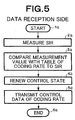
- Figs. 5 and 6 are control flowcharts at the data reception and transmission sides for the coding rate variable resending request control system when the line state monitoring portion carries out SIR measurement.
- SIR is measured in control step 2a, and the measurement value and the association table are compared with each other by using the association table stored in the data storage portion 2 in control step 3a.
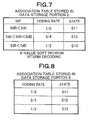
- the association table of Fig. 7 is assumed to be used.
- the error correction coding is set to a 8-value soft decision Viterbi decoding. For example, if the measurement value of SIR is equal to 10 dB, control state S11 under which the coding rate is equal to 7/8 is selected on the basis of the association table. The control data under the control state S11 are transmitted to the data transmission side. Subsequently, if SIR is measured and the measurement value thereof is equal to 12 dB, control state S11 is selected from the association table to renew a control state to the control state S11. If the measurement value is equal to 7.5 dB, control state S12 is selected from the association table to renew a control state to the control state S12. If the measurement value is equal to 5 dB, control state S13 is selected to renew a control state to the control state S13. The control state is renewed in control step 4a of Fig. 5, and control data are transmitted in control step 5a.
- Fig. 9 is a state transition diagram to renew the control state of the coding rate variable resending request control system.
- the line state monitoring portion may be further improved.
- the improved construction of the line state monitoring portion is shown in Fig. 10.
- the line state can be more surely grasped by performing such a switching control operation that the packet arrival rate is measured if the packet reception number is equal to a threshold value k or more and the SIR measurement is carried out if the packet reception number is less than the threshold value k.
- the data reception side includes the line state monitoring portion 10 for receiving the reception data and outputting one of the SIR measurement result and the packet arrival rate from the reception data, the data storage portion 12 for storing the data to be compared with the measurement result, the comparator 11 for receiving the data read out from the data storage portion 12 and the measurement result to compare both the data and the result and outputting the control state, the control state storage portion 13 for storing the control state and the control data generator 14 for receiving the output of the control state storage portion 13 and outputting the control data.
- the data transmission side of Fig. 3 includes the control state storage portion 15 for storing the control state, the data storage portion 16 for storing the data to be compared with the control data, the comparator 17 for receiving the control data and the data read out from the data storage portion 16 to compare both the data and outputting the data of the resending control period, and the resending control period controller 18 for controlling the window size of the resending control.
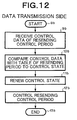
- Figs. 11 and 12 are control flow diagrams of the period variable resending request control system according to the embodiment of the present invention in which the line state monitoring portion shown in Fig. 3 performs the packet arrival rate measurement or the SIR measurement selectively.
- the line state monitoring portion shown in Fig. 3 performs the packet arrival rate measurement or the SIR measurement selectively.
- the number of packet reception for a fixed time is measured in control step 8a. If the packet reception number is equal to a threshold value k or more, the packet arrival rate is measured. On the other hand, if the packet reception number is less than k, the SIR is measured, whereby the line state can be surely grasped.
- the measurement value and the association table (as shown in Fig. 13) stored in the data storage portion 12 are compared with each other.
- the packet arrival rate is equal to 0.9
- S21 is selected and the control data are transmitted.
- the measurement of the packet arrival rate is started again, and if the packet arrival rate is equal to 0.9 as shown in Fig. 13, S21 is selected to renew the control state to S21. If the packet arrival rate is equal to 0.7, S22 is selected to renew the control state to S22. If the packet arrival rate is equal to 0.4, S23 is selected to renew the control state to S23.
- the control data are transmitted.
- control step 9b of Fig. 12 the control data are received in control step 9b of Fig. 12, and the control data and the association table of Fig. 14 are compared with each other in control step 10b.
- control step 11b the control state is renewed , and the resending control period is controlled on the basis of the renewed data in control step 12b.
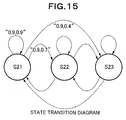
- Fig. 15 is a state transition diagram when the control state of the period variable resending control system of this embodiment is renewed.
- Fig. 4 is a system diagram showing another embodiment in the adaptive resending request control system according to the present invention.
- the data reception side includes the line state monitoring portion 19 for receiving the reception data and outputting one of the SIR measurement result and the packet arrival rate from the reception data, the data storage portion 21 for storing the data to be compared with the measurement result, the comparator 20 for receiving the data read out from the data storage portion 21 and the measurement result to compare both the data and the result and outputting the control state, the control state storage portion 22 for storing the control state, and the control data generator 29 for receiving the output of the control state storage portion 22 and outputting the control data.
- the data transmission side of Fig. 4 includes the control state storage portion 24 for storing the control state, the data storage portion 26 for storing the data to be compared with the control data, the comparator 25 for receiving the control data and the data read out from the data storage portion 26 to compare both the data and outputting the data of the resending control period, the data generator 27 for generating the data on the basis of the output of the comparator, and the resending control period controller 28 for controlling the window size of the resending control.
- the data coding rate and the data resending control period are made variable in accordance with the line state as described above, and more effective adaptive resending request control can be implemented.
- a first effect resides in that the data coding rate and the data resending control period are made variable in correspondence with the line state of the radio section, so that the optimum throughput characteristic and the optimum delay characteristic can be provided in accordance with the line state.
- a second effect resides in that the plural measuring methods are provided and the highest-precision measuring method can be selective from the plural measuring methods in accordance with the line state of the radio section, so that the high-precision line state can be grasped and the more effective adaptive resending request control can be performed.
Landscapes
- Engineering & Computer Science (AREA)
- Computer Networks & Wireless Communication (AREA)
- Signal Processing (AREA)
- Quality & Reliability (AREA)
- Detection And Prevention Of Errors In Transmission (AREA)
- Mobile Radio Communication Systems (AREA)
- Small-Scale Networks (AREA)
- Communication Control (AREA)
Abstract
Description
- The present invention relates to an adaptive resending request control system in mobile radio communications for controlling the data transmission speed in mobile radio communications in accordance with the state of a communication line to achieve the optimum transmission speed and delay characteristic that satisfy the required quality.
- In conventional mobile radio communications, an error correction coding system for carrying out self-correction (hereinafter referred to as "FEC" (forward error correction)) and an automatic repeat request system for resending data from a transmission side when a data transmission error occurs at a reception side (hereinafter referred to as "ARQ" (automatic repeat request)) are known as a method of implementing error free data transmission. Further, a hybrid ARQ system comprising the combination of FEC and ARQ is also known.
- For example, Japanese Laid-open Patent Publication No. Hei-7-67175 has proposed, as a prior art, a system of controlling the transmission speed stepwise in accordance with the line state (the line condition). Fig. 1 is a flowchart showing the control operation in this system.
- Data transmission is started in
control step 32, and it is judged incontrol step 33 whether the transmission speed is equal to the highest speed (9600 bps) or not. If the judgment in thecontrol step 33 is "YES", then it is judged in control step S34 whether there is any resending request or not. If there is a resending request, the resending processing is carried out incontrol step 35 and the resending frequency (the number of times of the resending) is counted. If it is judged incontrol step 36 that the resending frequency is equal to N or more, the transmission speed is decremented by one level incontrol step 37 and set to 4800 bps. Subsequently, resending frequency CNT is cleared incontrol step 38, storage memory is accessed incontrol step 39 and mode setting is carried out incontrol step 40. It is judged incontrol step 41 whether the transmission is finished or not. - If the judgment in the
control step 33 is "No", it is judged in acontrol step 42 whether correction is impossible. If the judgment in thecontrol step 42 is "Yes", it is judged incontrol step 44 whether the transmission speed is equal to 4800 bps which is lower than 9600 bps by one level. If the judgement in thecontrol step 44 is "Yes", a resending request is made incontrol step 45. On the other hand, if the judgment in thecontrol step 44 is "No", it is judged whether the transmission is finished or not as in the case of thecontrol step 41. If the judgment in thecontrol step 42 is "No", the correction processing is carried out as in the case of thecontrol step 43. - In this system, when a burst error occurs, control steps of several stages are needed until the transmission speed reaches the optimum one because the transmission speed is stepwise controlled. Accordingly, this system has a disadvantage that the control thereof cannot sufficiently follow occurrence of a burst error. Further, the conventional technique has the following disadvantage. That is, since the resending control period is fixed, the delay time of the data resending cannot be controlled and thus the optimum delay characteristic cannot be achieved in accordance with the line state. Further, there is no variation in the measuring method of the line state, and thus high-precision measurement cannot performed on some line states.
- Furthermore, Japanese Laid-open Patent Publication No. Sho-64-42944 discloses a device for detecting a bit error rate by line quality detecting means and varying the coding rate in accordance with the detection result in a packet communication device having an error correcting function. According to this technical concept, the coding rate or the type of the coding is varied in accordance with the line quality, and if the line quality is excellent, the information amount is increased to achieve an effective use of the line. According to this system, the information speed is variable, however, the transmission speed is fixed.
- Still furthermore, Japanese Laid-open Patent Publication No. Hei-7-336331 discloses a digital radio communication system having means of grasping the line state on the basis of the resending frequency or the bit error rate measured and changing the coding rate of the error correction coding in accordance with the line state. Further, with respect to a code division multiple access system (CDMA system), it also discloses a system for varying the coding rate in accordance with a traffic amount and a system of measuring the line bit error rate and varying the coding rate in accordance with the measurement result. As a result, it concludes that these systems can vary the coding rate to the optimum state in accordance with the line state and achieve the optimum throughput in the line state. In this case, there is a disadvantage that it takes a long time to grasp the line state on the basis of the resending frequency, and data of a predetermined pattern must be transmitted before packet transmission in order to measure the bit error rate.
- Therefore, an object of the present invention is to provide an adaptive resending request control system (in mobile radio communications) that has a function of controlling the data transmission speed more flexibly to thereby achieve the optimum transmission speed satisfying required quality even when a burst error occurs, making variable a window size for controlling data resending, that is, a resending control period to thereby control the delay characteristic of the data resending and achieve the optimum delay characteristic corresponding to a line state, and selecting a line state measuring method having the highest precision in accordance with the line state of a radio section, whereby a high-precision line state measurement is performed.
- In order to attain the above object, according to a first aspect of the present invention, there is provided a system for an adaptive resending request control in mobile radio communications, comprising:
- (a) measuring means for measuring a line state of a line of a radio section, first selecting means for selecting a control state of a coding rate in correspondence with the measurement results on the basis of the measurement results, and means for renewing the control state and transmitting the control data on the control state to a transmission side, in a reception side; and
- (b) second selecting means for selecting the coding rate in correspondence with the received control data on the basis of the received control data, and means for generating data with the selected coding rate and transmitting the generated data to the reception side, in a transmission side.
-
- Further, in order to attain the above object, according to a second aspect of the present invention, there is provided a system for an adaptive resending request control in mobile radio communications, comprising:
- (a) measuring means for measuring a line state of a line of a radio section, first selecting means for selecting a control state of a packet resending control period in correspondence with the measurement results on the basis of the measurement results, and means for renewing the control state and transmitting the control data on the control state to a transmission side, in a reception side; and
- (b) second selecting means for selecting the packet resending control period in correspondence with the received control data on the basis of the received control data, and control means for controlling a packet resending control period to the selected packet resending control period, in a transmission side.
-
- Further, in order to attain the above object, according to a third aspect of the present invention, there is provided a system for an adaptive resending request control in mobile radio communications, comprising:
- (a) measuring means for measuring a line state of a line of a radio section, first selecting means for selecting a control state of a coding rate and packet resending control period in correspondence with the measurement results on the basis of the measurement results, and means for renewing the control state and transmitting the control data on the control state to a transmission side, in a reception side; and
- (b) second selecting means for selecting the coding rate and packet resending control period in correspondence with the received control data on the basis of the received control data, means for generating data with the selected coding rate and transmitting the generated data to the reception side, and control means for controlling a packet resending control period to the selected packet resending control period, in a transmission side.
-
-
- Fig. 1 is a control flowchart of a conventional resending request control system;
- Fig. 2 is a system construction of an adaptive resending request control system based on a coding rate variable system;
- Fig. 3 is a system construction of an adaptive resending request control system based on a period variable system;
- Fig. 4 is a system construction of an adaptive resending request control system based on a coding rate variable and period variable system;
- Fig. 5 is a control flowchart of the adaptive resending request control system based on the coding rate variable system at a data reception side;
- Fig. 6 is a control flowchart of the adaptive resending request control system based on the coding rate variable system at a data transmission side;
- Fig. 7 shows an example of an association table to be stored in
data storage portion 2 in Fig. 2; - Fig. 8 shows an example of an association table to be stored in data storage portion 6 in Fig. 2;
- Fig. 9 is a state transition diagram when the control state of the adaptive resending request control system based on the coding rate variable system is renewed;
- Fig. 10 is a block diagram showing the construction of a line state monitoring portion of Fig. 4;
- Fig. 11 is a control flowchart of the adaptive resending request control system based on the coding rate variable and period variable system at the data reception side;
- Fig. 12 is a control flowchart of the adaptive resending request control system based on the coding rate variable and period variable system at the data transmission side;
- Fig. 13 shows an example of an association table stored in
data storage portion 12 of Fig. 3; - Fig. 14 shows an example of an association table stored in
data storage portion 16 of Fig. 3; and - Fig. 15 is a state transition diagram when the control state of the adaptive resending request control system based on the period variable system is renewed.
-
- Preferred embodiments of an adaptive resending request control system in mobile communications according to the present invention will be described with reference to the accompanying drawings.
- First, a system construction suitable to implement each system of the present invention will be described hereunder with reference to Figs. 2 to 4.
- Fig. 2 shows a system construction when coding rate variable resending request control for making variable the coding rate of date in accordance with the line state (the line condition) is performed.
- At a data reception side, reception data are input to line state monitoring portion (line condition monitoring portion) 1 to measure the line state. The measurement result is input to
comparator 3 and compared with data readout fromdata storage portion 2 to select the optimum control state from the data of the control states stored in thedata storage portion 2 and renew the control state. Subsequently, control data are generated on the basis of the control state renewed incontrol data generator 5, and then transmitted to a data transmission side. - At the data transmission side, the control data received are stored in control
state storage portion 7. The control data thus stored are compared with data read out from a data storage portion 6 atcomparator 8 to renew the coding rate. Subsequently, data are generated in accordance with the coding rate thus renewed and then resent. - In the line state monitoring portion 1 at the data reception side a, the line state is measured by using one or both of SIR measurement and packet arrival rate measurement, or other methods. Here, the packet arrival rate means the ratio of the number of error-correctable packets arriving at the data reception side to the number of packets transmitted for a fixed time from the data transmission side. The association table of the line state measurement values, the coding rates and the control states are stored in the
data storage portion 2. The association table of the coding rates and the control states is stored in the data storage portion 6. The ARQ system at this case is assumed to be Stop-and-wait or Go-back-N Continuous ARQ, or Selective-repeat continuous ARQ. - Fig. 3 shows the system construction of a period-variable resending request control system for making the resending period of data variable in accordance with the line state.
- At the data reception side of this system construction, reception data are input to line state monitoring portion (line condition monitoring portion) 10 to measure the line state. The measurement result is input to comparator 11 and compared with data read out from
data storage portion 12 to select the optimum control state from the data of the control states stored in thedata storage portion 12 and renew the control state. Subsequently, control data are generated on the basis of the renewed control state incontrol data generator 14, and then transmitted to the data transmission side. - At the data transmission side, the control data are received, and stored in control
state storage portion 15. The control state thus stored are input tocomparator 17 and compared with data read out fromdata storage portion 16 to renew the resending control period. The data thus renewed are transmitted to resendingcontrol period controller 18 to control the resending control period. - The association table of the line state measurement values, the resending control periods and the control states is stored in the
data storage portion 12 at the data reception side. The association table between the resending control period and the control state is stored in thestorage portion 16. The ARQ system at this time is assumed to be Go-back-N Continuous ARQ, or Selective-repeat Continuous ARQ. - Fig. 4 shows the system construction of an adaptive resending request control system for making both of the data coding rate and the resending control period variable in correspondence with the line state. In this system construction, at the reception side, reception data are input to line state monitoring portion (line condition monitoring portion) 19 to measure the line state. The measurement result is input to
comparator 20 and compared with data read out fromdata storage portion 21 to select the optimum control state from the data of the control states stored in thedata storage portion 21 and renew the control state. Subsequently, control data are generated incontrol data generator 23 on the basis of the renewed control state, and then transmitted to the data transmission side. - At the data transmission side, the control data are received and stored in control
state storage portion 24. The control data thus stored are input tocomparator 25 and compared with data read out fromdata storage portion 26 to renew the resending control period. The renewed data are transmitted to resendingcontrol period controller 28 and control the resending control period. Further, the coding rate is renewed and the renewed data are transmitted todata generator 27, and data are generated on the basis of the coding rate thus renewed and resent. - The association table of the line state measurement values, the data coding rates, the resending control periods and the control states are stored in the
data storage portion 21 of the data reception side. The association table of the data coding rates, the resending control periods and the control states is stored in thestorage portion 26. The ARQ system at this case is assumed to be Go-back-N Continuous ARQ or the Selective-repeat Continuous ARQ. - As described above, according to the present invention, the resending control period of data is made variable in accordance with the line state of the radio section, or both the data coding rate and the data resending control period are made variable in accordance with the line state of the radio section.
- Further, according to the present invention, the control is performed so that any one of the SIR measurement result or the packet arrival rate can be selected from the reception data in accordance with the line state, so that any one or both of the throughput characteristic and the delay characteristic optimal to the line state can be enhanced.
- According to the system construction of Fig. 2, the data reception side includes the line state monitoring portion 1 for receiving reception data and outputting an SIR measurement result from the reception data, the
data storage portion 2 for storing the data to be compared with the measurement result, thecomparator 3 for receiving the data read out from thedata storage portion 2 and the SIR measurement result to compare both the data and the result and outputting a control state, the controlstate storage portion 4 for storing the control state, and thecontrol data generator 5 for receiving the control state and outputting the control data. The data transmission side includes the controlstate storage portion 7 for storing the control state, the data storage portion 6 for storing data to be compared with the control data stored in the controlstate storage portion 7, thecomparator 8 for receiving the control data and the data read out from the data storage portion 6 to compare both the data and outputting the data of the coding rate, and thedata generator 9 for receiving the data of the coding rate and outputting the data. - Figs. 5 and 6 are control flowcharts at the data reception and transmission sides for the coding rate variable resending request control system when the line state monitoring portion carries out SIR measurement. In Fig. 5, SIR is measured in
control step 2a, and the measurement value and the association table are compared with each other by using the association table stored in thedata storage portion 2 incontrol step 3a. - In this embodiment, the association table of Fig. 7 is assumed to be used. The error correction coding is set to a 8-value soft decision Viterbi decoding. For example, if the measurement value of SIR is equal to 10 dB, control state S11 under which the coding rate is equal to 7/8 is selected on the basis of the association table. The control data under the control state S11 are transmitted to the data transmission side. Subsequently, if SIR is measured and the measurement value thereof is equal to 12 dB, control state S11 is selected from the association table to renew a control state to the control state S11. If the measurement value is equal to 7.5 dB, control state S12 is selected from the association table to renew a control state to the control state S12. If the measurement value is equal to 5 dB, control state S13 is selected to renew a control state to the control state S13. The control state is renewed in
control step 4a of Fig. 5, and control data are transmitted incontrol step 5a. - When the control data are received in
control step 2b of Fig. 6 at the data transmission side, the control data and the association table of Fig. 8 stored in the data storage portion 6 are compared with each other in control step 3b. The control state is renewed incontrol step 4b, and data are generated on the basis of the coding rate of the renewed control state incontrol step 5b. The data are transmitted incontrol step 6b. Fig. 9 is a state transition diagram to renew the control state of the coding rate variable resending request control system. - The basis construction is as described above, however, in this embodiment the line state monitoring portion may be further improved. The improved construction of the line state monitoring portion is shown in Fig. 10.
- In Fig. 10, after the measurement of the number of packet reception, the line state can be more surely grasped by performing such a switching control operation that the packet arrival rate is measured if the packet reception number is equal to a threshold value k or more and the SIR measurement is carried out if the packet reception number is less than the threshold value k.
- Next, the construction and operation of the above embodiment will be described.
- Referring to Fig. 3, the data reception side includes the line
state monitoring portion 10 for receiving the reception data and outputting one of the SIR measurement result and the packet arrival rate from the reception data, thedata storage portion 12 for storing the data to be compared with the measurement result, the comparator 11 for receiving the data read out from thedata storage portion 12 and the measurement result to compare both the data and the result and outputting the control state, the controlstate storage portion 13 for storing the control state and thecontrol data generator 14 for receiving the output of the controlstate storage portion 13 and outputting the control data. - The data transmission side of Fig. 3 includes the control
state storage portion 15 for storing the control state, thedata storage portion 16 for storing the data to be compared with the control data, thecomparator 17 for receiving the control data and the data read out from thedata storage portion 16 to compare both the data and outputting the data of the resending control period, and the resendingcontrol period controller 18 for controlling the window size of the resending control. - Figs. 11 and 12 are control flow diagrams of the period variable resending request control system according to the embodiment of the present invention in which the line state monitoring portion shown in Fig. 3 performs the packet arrival rate measurement or the SIR measurement selectively. As shown Fig. 11, at the data reception side, when receiving the data, the number of packet reception for a fixed time is measured in
control step 8a. If the packet reception number is equal to a threshold value k or more, the packet arrival rate is measured. On the other hand, if the packet reception number is less than k, the SIR is measured, whereby the line state can be surely grasped. Incontrol step data storage portion 12 are compared with each other. - For example, if the packet arrival rate is equal to 0.9, S21 is selected and the control data are transmitted. The measurement of the packet arrival rate is started again, and if the packet arrival rate is equal to 0.9 as shown in Fig. 13, S21 is selected to renew the control state to S21. If the packet arrival rate is equal to 0.7, S22 is selected to renew the control state to S22. If the packet arrival rate is equal to 0.4, S23 is selected to renew the control state to S23. In
control step 14a, the control data are transmitted. - At the reception side, the control data are received in
control step 9b of Fig. 12, and the control data and the association table of Fig. 14 are compared with each other in control step 10b. Incontrol step 11b, the control state is renewed , and the resending control period is controlled on the basis of the renewed data incontrol step 12b. Fig. 15 is a state transition diagram when the control state of the period variable resending control system of this embodiment is renewed. - Fig. 4 is a system diagram showing another embodiment in the adaptive resending request control system according to the present invention. Referring to Fig. 4, the data reception side includes the line state monitoring portion 19 for receiving the reception data and outputting one of the SIR measurement result and the packet arrival rate from the reception data, the
data storage portion 21 for storing the data to be compared with the measurement result, thecomparator 20 for receiving the data read out from thedata storage portion 21 and the measurement result to compare both the data and the result and outputting the control state, the controlstate storage portion 22 for storing the control state, and thecontrol data generator 29 for receiving the output of the controlstate storage portion 22 and outputting the control data. - Further, the data transmission side of Fig. 4 includes the control
state storage portion 24 for storing the control state, thedata storage portion 26 for storing the data to be compared with the control data, thecomparator 25 for receiving the control data and the data read out from thedata storage portion 26 to compare both the data and outputting the data of the resending control period, thedata generator 27 for generating the data on the basis of the output of the comparator, and the resendingcontrol period controller 28 for controlling the window size of the resending control. In this embodiment, the data coding rate and the data resending control period are made variable in accordance with the line state as described above, and more effective adaptive resending request control can be implemented. - As described above, the present invention has the following effects. That is, a first effect resides in that the data coding rate and the data resending control period are made variable in correspondence with the line state of the radio section, so that the optimum throughput characteristic and the optimum delay characteristic can be provided in accordance with the line state. Further, a second effect resides in that the plural measuring methods are provided and the highest-precision measuring method can be selective from the plural measuring methods in accordance with the line state of the radio section, so that the high-precision line state can be grasped and the more effective adaptive resending request control can be performed.
Claims (9)
- A system for an adaptive resending request control in mobile radio communications having a reception side and a transmission side, in which said reception side comprises measuring means for measuring a line state of a line of a radio section, first selecting means for selecting a control state of a coding rate in correspondence with the measurement results on the basis of the measurement results, and means for renewing the control state and transmitting the control data on the control state to said transmission side; and said transmission side comprises second selecting means for selecting the coding rate in correspondence with the received control data on the basis of the received control data, and means for generating data with the selected coding rate and transmitting the generated data to said reception side.
- A system for an adaptive resending request control in mobile radio communications having a reception side and a transmission side, in which said reception side comprises measuring means for measuring a line state of a line of a radio section, first selecting means for selecting a control state of a packet resending control period in correspondence with the measurement results on the basis of the measurement results, and means for renewing the control state and transmitting the control data on the control state to said transmission side; and said transmission side comprises second selecting means for selecting the packet resending control period in correspondence with the received control data on the basis of the received control data, and control means for controlling a packet resending control period to the selected packet resending control period.
- A system for an adaptive resending request control in mobile radio communications having a reception side and a transmission side, in which said reception side comprises measuring means for measuring a line state of a line of a radio section, first selecting means for selecting a control state of a coding rate and packet resending control period in correspondence with the measurement results on the basis of the measurement results, and means for renewing the control state and transmitting the control data on the control state to said transmission side; and said transmission side comprises second selecting means for selecting the coding rate and packet resending control period in correspondence with the received control data on the basis of the received control data, means for generating data with the selected coding rate and transmitting the generated data to said reception side, and control means for controlling a packet resending control period to the selected packet resending control period.
- The system as claimed in claim 1, wherein said measuring means measures the number of packet reception and measures a line state by the line state-measuring method which is used suitable for the number of packet reception.
- The system as claimed in claim 4, wherein said line state-measuring method is an SIR measuring method or a packet arrival rate measuring method.
- The system as claimed in claim 2, wherein said measuring means measures the number of packet reception and measures a line state by the line state-measuring method which is used suitable for the number of packet reception.
- The system as claimed in claim 6, wherein said line state-measuring method is an SIR measuring method or a packet arrival rate measuring method.
- The system as claimed in claim 3, wherein said measuring means measures the number of packet reception and measures a line state by the line state-measuring method which is used suitable for the number of packet reception.
- The system as claimed in claim 8, wherein said line state-measuring method is an SIR measuring method or a packet arrival rate measuring method.
Priority Applications (1)
| Application Number | Priority Date | Filing Date | Title |
|---|---|---|---|
| EP20040013459 EP1469688B1 (en) | 2001-03-13 | 2002-03-12 | Adaptively changing the coding rate in a mobile radio communications system based on radio link measurements at the receiver side |
Applications Claiming Priority (2)
| Application Number | Priority Date | Filing Date | Title |
|---|---|---|---|
| JP2001069595A JP3485097B2 (en) | 2001-03-13 | 2001-03-13 | Adaptive retransmission request control method in mobile radio communication and adaptive retransmission request control device |
| JP2001069595 | 2001-03-13 |
Related Child Applications (1)
| Application Number | Title | Priority Date | Filing Date |
|---|---|---|---|
| EP20040013459 Division EP1469688B1 (en) | 2001-03-13 | 2002-03-12 | Adaptively changing the coding rate in a mobile radio communications system based on radio link measurements at the receiver side |
Publications (2)
| Publication Number | Publication Date |
|---|---|
| EP1241901A1 true EP1241901A1 (en) | 2002-09-18 |
| EP1241901B1 EP1241901B1 (en) | 2004-06-09 |
Family
ID=18927613
Family Applications (2)
| Application Number | Title | Priority Date | Filing Date |
|---|---|---|---|
| EP20040013459 Expired - Lifetime EP1469688B1 (en) | 2001-03-13 | 2002-03-12 | Adaptively changing the coding rate in a mobile radio communications system based on radio link measurements at the receiver side |
| EP20020005666 Expired - Lifetime EP1241901B1 (en) | 2001-03-13 | 2002-03-12 | Adaptive resending request control method (ARQ) in a mobile radio communications system based on radio link measurements at the receiver side |
Family Applications Before (1)
| Application Number | Title | Priority Date | Filing Date |
|---|---|---|---|
| EP20040013459 Expired - Lifetime EP1469688B1 (en) | 2001-03-13 | 2002-03-12 | Adaptively changing the coding rate in a mobile radio communications system based on radio link measurements at the receiver side |
Country Status (4)
| Country | Link |
|---|---|
| US (1) | US7126965B2 (en) |
| EP (2) | EP1469688B1 (en) |
| JP (1) | JP3485097B2 (en) |
| DE (2) | DE60200593T2 (en) |
Cited By (7)
| Publication number | Priority date | Publication date | Assignee | Title |
|---|---|---|---|---|
| WO2004079944A1 (en) * | 2003-03-05 | 2004-09-16 | Samsung Electronics Co. Ltd. | Method and apparatus for controlling a reverse traffic rate in a mobile communication system |
| WO2006051824A1 (en) | 2004-11-09 | 2006-05-18 | Ntt Docomo, Inc. | Mobile communication system, radio base station, and mobile station |
| KR100689451B1 (en) | 2004-09-18 | 2007-03-08 | 삼성전자주식회사 | Packet transmission / reception apparatus and method in mobile communication system |
| AU2008200498B2 (en) * | 2003-03-05 | 2009-08-27 | Samsung Electronics Co., Ltd. | Method and apparatus for controlling a reverse traffic rate in a mobile communication system |
| CN1757174B (en) * | 2003-03-05 | 2011-04-06 | 三星电子株式会社 | Method and device for controlling reverse traffic rate in mobile communication system |
| EP1638234A4 (en) * | 2003-05-21 | 2011-04-27 | Sharp Kk | Radio communication device, radio communication system, wireless av system, radio transmission method, operation control program, and recording medium containing the program |
| US20150023182A1 (en) * | 2012-03-27 | 2015-01-22 | Koichi Nakagawa | Communication System, Transmission Apparatus, Line Control Apparatus, Line State Monitoring Method and Non-transitory Computer Readable Medium Storing Program |
Families Citing this family (13)
| Publication number | Priority date | Publication date | Assignee | Title |
|---|---|---|---|---|
| EP1271834B1 (en) * | 2001-05-14 | 2007-08-08 | LG Electronics, Inc. | Method for controlling data transmission in a radio communications system |
| US7945280B2 (en) | 2003-02-20 | 2011-05-17 | Fujitsu Limited | Radio channel control method and receiving apparatus |
| CN100518036C (en) * | 2003-05-21 | 2009-07-22 | 夏普株式会社 | Wireless communication device, wireless communication system, and wireless AV system |
| JP4417733B2 (en) * | 2004-01-15 | 2010-02-17 | ソニー・エリクソン・モバイルコミュニケーションズ株式会社 | Transmission method and apparatus |
| JP3800222B2 (en) * | 2004-02-19 | 2006-07-26 | 日本電気株式会社 | Target value control system and method for transmission power control, base station and portable communication terminal |
| ATE337650T1 (en) * | 2004-02-27 | 2006-09-15 | Mitsubishi Electric Corp | METHOD AND APPARATUS FOR THE JOINT DYNAMIC MANAGEMENT OF WINDOW LENGTHS OF SEVERAL ARQ DATA CONNECTIONS |
| KR100620713B1 (en) * | 2004-07-28 | 2006-09-19 | 주식회사 팬택앤큐리텔 | Packet service setting control method and mobile communication system |
| JP4498973B2 (en) * | 2005-05-11 | 2010-07-07 | 株式会社日立製作所 | Wireless communication apparatus, wireless communication apparatus control method, and program |
| DE102006032729A1 (en) * | 2006-07-14 | 2008-01-17 | Infineon Technologies Ag | Device for determining number of packets for coding purposes, has computing device formed to determine number of packets such that difference between resulting code rate and reference code rate does not exceed pre determined threshold value |
| JP2008109713A (en) * | 2008-01-07 | 2008-05-08 | Fujitsu Ltd | Radio channel control method, transmitter, and receiver |
| JP5287479B2 (en) | 2009-04-30 | 2013-09-11 | 富士通株式会社 | Wireless communication apparatus and wireless communication method |
| JP5053409B2 (en) * | 2010-04-15 | 2012-10-17 | 株式会社エヌ・ティ・ティ・ドコモ | Mobile communication system, control device, and control method |
| JP5053408B2 (en) * | 2010-04-15 | 2012-10-17 | 株式会社エヌ・ティ・ティ・ドコモ | Mobile communication system, control device, and control method |
Citations (3)
| Publication number | Priority date | Publication date | Assignee | Title |
|---|---|---|---|---|
| EP0768806A2 (en) * | 1995-10-10 | 1997-04-16 | AT&T Corp. | Data protocol for transport of ATM cells over a wireless link |
| WO1999012304A1 (en) * | 1997-08-29 | 1999-03-11 | Telefonaktiebolaget Lm Ericsson (Publ) | A method for selecting a combination of modulation and channel coding schemes in a digital communication system |
| WO1999063702A1 (en) * | 1998-05-29 | 1999-12-09 | Siemens Aktiengesellschaft | Retransmission method and system with variable window length |
Family Cites Families (14)
| Publication number | Priority date | Publication date | Assignee | Title |
|---|---|---|---|---|
| US4196133A (en) | 1979-03-05 | 1980-04-01 | Wisconsin Alumni Research Foundation | 24,24-Difluoro-25-hydroxycholecalciferol |
| JPS6442944A (en) | 1987-08-10 | 1989-02-15 | Mitsubishi Electric Corp | Packet communication equipment with variable coding rate |
| JPH03233655A (en) | 1990-02-09 | 1991-10-17 | Nec Corp | Data communication system |
| JPH0568154A (en) | 1990-12-12 | 1993-03-19 | Canon Inc | Facsimile equipment |
| JP2503888B2 (en) | 1993-06-30 | 1996-06-05 | 日本電気株式会社 | Data transmission method in mobile radio communication |
| JPH07336331A (en) | 1994-06-09 | 1995-12-22 | Canon Inc | Digital wireless communication system |
| JPH0851414A (en) | 1994-08-03 | 1996-02-20 | Nippon Telegr & Teleph Corp <Ntt> | Wireless communication ARQ method |
| US6353907B1 (en) * | 1997-10-29 | 2002-03-05 | At&T Corp. | Incremental redundancy radio link protocol |
| US6700881B1 (en) * | 1998-03-02 | 2004-03-02 | Samsung Electronics Co., Ltd. | Rate control device and method for CDMA communication system |
| JPH11289358A (en) | 1998-04-03 | 1999-10-19 | Matsushita Electric Ind Co Ltd | Data transmission equipment |
| US20010056560A1 (en) * | 1998-10-08 | 2001-12-27 | Farooq Khan | Method and system for measurement based automatic retransmission request in a radiocommunication system |
| JP3844905B2 (en) | 1999-04-12 | 2006-11-15 | 三菱電機株式会社 | Data distribution system, transmission control device and reception control device |
| US6968494B2 (en) * | 2000-05-22 | 2005-11-22 | Sarnoff Corporation | Method and apparatus for adaptively coding a data signal |
| US6768727B1 (en) * | 2000-11-09 | 2004-07-27 | Ericsson Inc. | Fast forward link power control for CDMA system |
-
2001
- 2001-03-13 JP JP2001069595A patent/JP3485097B2/en not_active Expired - Fee Related
-
2002
- 2002-03-08 US US10/092,553 patent/US7126965B2/en not_active Expired - Fee Related
- 2002-03-12 DE DE2002600593 patent/DE60200593T2/en not_active Expired - Lifetime
- 2002-03-12 EP EP20040013459 patent/EP1469688B1/en not_active Expired - Lifetime
- 2002-03-12 EP EP20020005666 patent/EP1241901B1/en not_active Expired - Lifetime
- 2002-03-12 DE DE2002620317 patent/DE60220317T2/en not_active Expired - Lifetime
Patent Citations (3)
| Publication number | Priority date | Publication date | Assignee | Title |
|---|---|---|---|---|
| EP0768806A2 (en) * | 1995-10-10 | 1997-04-16 | AT&T Corp. | Data protocol for transport of ATM cells over a wireless link |
| WO1999012304A1 (en) * | 1997-08-29 | 1999-03-11 | Telefonaktiebolaget Lm Ericsson (Publ) | A method for selecting a combination of modulation and channel coding schemes in a digital communication system |
| WO1999063702A1 (en) * | 1998-05-29 | 1999-12-09 | Siemens Aktiengesellschaft | Retransmission method and system with variable window length |
Non-Patent Citations (3)
| Title |
|---|
| BAKHTIYARI S ET AL: "PRACTICAL IMPLEMENTATION OF A MOBILE DATA LINK PROTOCOL WITH A TYPE II HYBRID ARQ SCHEME AND CODE COMBINING", PERSONAL COMMUNICATION - FREEDOM THROUGH WIRELESS TECHNOLOGY. SECAUCUS, NJ., MAY 18 - 20, 1993, PROCEEDINGS OF THE VEHICULAR TECHNOLOGY CONFERENCE, NEW YORK, IEEE, US, VOL. CONF. 43, PAGE(S) 774-777, ISBN: 0-7803-1267-8, XP000393297 * |
| LEE I-W ET AL: "A STUDY ON THE PERFORMANCE ANALYSIS OF ERROR CONTROL ALGORITHMS IN DIGITAL CELLULAR DS/CDMA SYSTEMS", COMMUNICATIONS, 1994. ICC '94, SUPERCOMM/ICC '94, CONFERENCE RECORD, 'SERVING HUMANITY THROUGH COMMUNICATIONS.' IEEE INTERNATIONAL CONFERENCE ON NEW ORLEANS, LA, USA 1-5 MAY 1994, NEW YORK, NY, USA,IEEE, PAGE(S) 908-912, ISBN: 0-7803-1825-0, XP001052776 * |
| PATENT ABSTRACTS OF JAPAN vol. 013, no. 240 (E - 767) 6 June 1989 (1989-06-06) * |
Cited By (12)
| Publication number | Priority date | Publication date | Assignee | Title |
|---|---|---|---|---|
| WO2004079944A1 (en) * | 2003-03-05 | 2004-09-16 | Samsung Electronics Co. Ltd. | Method and apparatus for controlling a reverse traffic rate in a mobile communication system |
| AU2008200498B2 (en) * | 2003-03-05 | 2009-08-27 | Samsung Electronics Co., Ltd. | Method and apparatus for controlling a reverse traffic rate in a mobile communication system |
| CN1757174B (en) * | 2003-03-05 | 2011-04-06 | 三星电子株式会社 | Method and device for controlling reverse traffic rate in mobile communication system |
| US9967899B2 (en) | 2003-03-05 | 2018-05-08 | Samsung Electronics Co., Ltd | Method and apparatus for controlling an uplink transmission power ratio in a mobile communication system |
| EP1638234A4 (en) * | 2003-05-21 | 2011-04-27 | Sharp Kk | Radio communication device, radio communication system, wireless av system, radio transmission method, operation control program, and recording medium containing the program |
| KR100689451B1 (en) | 2004-09-18 | 2007-03-08 | 삼성전자주식회사 | Packet transmission / reception apparatus and method in mobile communication system |
| WO2006051824A1 (en) | 2004-11-09 | 2006-05-18 | Ntt Docomo, Inc. | Mobile communication system, radio base station, and mobile station |
| EP1827042A4 (en) * | 2004-11-09 | 2009-01-07 | Ntt Docomo Inc | MOBILE COMMUNICATION SYSTEM, RADIO BASE STATION, AND MOBILE STATION |
| US8060023B2 (en) | 2004-11-09 | 2011-11-15 | Ntt Docomo, Inc. | Mobile communication system, radio base station, and mobile station |
| US20150023182A1 (en) * | 2012-03-27 | 2015-01-22 | Koichi Nakagawa | Communication System, Transmission Apparatus, Line Control Apparatus, Line State Monitoring Method and Non-transitory Computer Readable Medium Storing Program |
| EP2833592A4 (en) * | 2012-03-27 | 2015-11-18 | Nec Corp | COMMUNICATION SYSTEM, TRANSMISSION DEVICE, CIRCUIT MONITORING DEVICE, CIRCUIT CONDITION MONITORING METHOD, AND COMPUTER-READABLE NON-TEMPORARY MEDIUM ON WHICH PROGRAM IS RECORDED |
| US9559751B2 (en) | 2012-03-27 | 2017-01-31 | Nec Corporation | Communication system, transmission apparatus, line control apparatus, line state monitoring method and non-transitory computer readable medium storing program |
Also Published As
| Publication number | Publication date |
|---|---|
| EP1241901B1 (en) | 2004-06-09 |
| DE60220317D1 (en) | 2007-07-05 |
| JP3485097B2 (en) | 2004-01-13 |
| JP2002271303A (en) | 2002-09-20 |
| DE60200593T2 (en) | 2005-06-23 |
| US20020131449A1 (en) | 2002-09-19 |
| US7126965B2 (en) | 2006-10-24 |
| EP1469688A1 (en) | 2004-10-20 |
| DE60200593D1 (en) | 2004-07-15 |
| EP1469688B1 (en) | 2007-05-23 |
| DE60220317T2 (en) | 2008-01-17 |
Similar Documents
| Publication | Publication Date | Title |
|---|---|---|
| EP1241901B1 (en) | Adaptive resending request control method (ARQ) in a mobile radio communications system based on radio link measurements at the receiver side | |
| US7768953B2 (en) | System for improved power savings during full DTX mode of operation in the downlink | |
| EP1526653B1 (en) | Transmission power control method and apparatus for mobile communication system | |
| JP3676166B2 (en) | Method and apparatus for selecting one of coding / modulation schemes at a transmitter | |
| EP1119953B1 (en) | Channel estimator with variable number of taps | |
| EP1191730B1 (en) | Communication system and method with variable training means | |
| US7577227B2 (en) | Link adaption in general packet radio service networks | |
| EP1494385B1 (en) | Method and apparatus for improving scheduler performance in wireless packet data systems | |
| US8159981B2 (en) | Determining transport block size using channel quality indicator value and block error rate | |
| WO2002001743A1 (en) | Method and apparatus for controlling packet transmission in a mobile telecommunication system | |
| EP1519508B1 (en) | Receiver apparatus and communication method | |
| KR100770893B1 (en) | Apparatus and method for post-processing data rate control value in a high rate packet data system | |
| US6870874B2 (en) | Communication apparatus | |
| EP1128572A1 (en) | A method of adjusting a signal quality target during transmission power control in a CDMA radio communication network | |
| US20080117888A1 (en) | Transmission rate selection | |
| US20020068560A1 (en) | Link adaptation method for use in a mobile radiocommunication system | |
| US20060080459A1 (en) | Communication system and method | |
| US8203944B2 (en) | Transmission rate selection | |
| RU2295838C2 (en) | Method for transferring packet data | |
| EP1787418A1 (en) | A method and system for link adaptation in wireless networks | |
| JP2002101136A (en) | Radio link quality evaluation method in mobile radio communication system | |
| EP1787431A1 (en) | A method and system for error differentiating in wireless networks | |
| JPH0629959A (en) | Adaptive type automatic data quality maintenance system in radio data communication | |
| Li | Link Adaptation in General Packet Radio Services (GPRS) | |
| Kwon et al. | Efficient packet transmission scheme using minipackets in wireless networks |
Legal Events
| Date | Code | Title | Description |
|---|---|---|---|
| PUAI | Public reference made under article 153(3) epc to a published international application that has entered the european phase |
Free format text: ORIGINAL CODE: 0009012 |
|
| AK | Designated contracting states |
Kind code of ref document: A1 Designated state(s): AT BE CH CY DE DK ES FI FR GB GR IE IT LI LU MC NL PT SE TR |
|
| AX | Request for extension of the european patent |
Free format text: AL;LT;LV;MK;RO;SI |
|
| 17P | Request for examination filed |
Effective date: 20020905 |
|
| 17Q | First examination report despatched |
Effective date: 20021122 |
|
| AKX | Designation fees paid |
Designated state(s): DE GB |
|
| GRAP | Despatch of communication of intention to grant a patent |
Free format text: ORIGINAL CODE: EPIDOSNIGR1 |
|
| GRAS | Grant fee paid |
Free format text: ORIGINAL CODE: EPIDOSNIGR3 |
|
| GRAA | (expected) grant |
Free format text: ORIGINAL CODE: 0009210 |
|
| AK | Designated contracting states |
Kind code of ref document: B1 Designated state(s): DE GB |
|
| REG | Reference to a national code |
Ref country code: GB Ref legal event code: FG4D |
|
| REF | Corresponds to: |
Ref document number: 60200593 Country of ref document: DE Date of ref document: 20040715 Kind code of ref document: P |
|
| PLBE | No opposition filed within time limit |
Free format text: ORIGINAL CODE: 0009261 |
|
| STAA | Information on the status of an ep patent application or granted ep patent |
Free format text: STATUS: NO OPPOSITION FILED WITHIN TIME LIMIT |
|
| 26N | No opposition filed |
Effective date: 20050310 |
|
| PGFP | Annual fee paid to national office [announced via postgrant information from national office to epo] |
Ref country code: DE Payment date: 20110309 Year of fee payment: 10 Ref country code: GB Payment date: 20110309 Year of fee payment: 10 |
|
| GBPC | Gb: european patent ceased through non-payment of renewal fee |
Effective date: 20120312 |
|
| PG25 | Lapsed in a contracting state [announced via postgrant information from national office to epo] |
Ref country code: GB Free format text: LAPSE BECAUSE OF NON-PAYMENT OF DUE FEES Effective date: 20120312 |
|
| REG | Reference to a national code |
Ref country code: DE Ref legal event code: R119 Ref document number: 60200593 Country of ref document: DE Effective date: 20121002 |
|
| PG25 | Lapsed in a contracting state [announced via postgrant information from national office to epo] |
Ref country code: DE Free format text: LAPSE BECAUSE OF NON-PAYMENT OF DUE FEES Effective date: 20121002 |