EP1241882A2 - Duplication controlling method, duplication controlling apparatus, recording medium, and program embodied on computer-readable medium - Google Patents
Duplication controlling method, duplication controlling apparatus, recording medium, and program embodied on computer-readable medium Download PDFInfo
- Publication number
- EP1241882A2 EP1241882A2 EP02005280A EP02005280A EP1241882A2 EP 1241882 A2 EP1241882 A2 EP 1241882A2 EP 02005280 A EP02005280 A EP 02005280A EP 02005280 A EP02005280 A EP 02005280A EP 1241882 A2 EP1241882 A2 EP 1241882A2
- Authority
- EP
- European Patent Office
- Prior art keywords
- contents
- control information
- duplication
- information
- change position
- Prior art date
- Legal status (The legal status is an assumption and is not a legal conclusion. Google has not performed a legal analysis and makes no representation as to the accuracy of the status listed.)
- Withdrawn
Links
Images



Classifications
-
- H—ELECTRICITY
- H04—ELECTRIC COMMUNICATION TECHNIQUE
- H04N—PICTORIAL COMMUNICATION, e.g. TELEVISION
- H04N5/00—Details of television systems
- H04N5/76—Television signal recording
- H04N5/91—Television signal processing therefor
- H04N5/913—Television signal processing therefor for scrambling ; for copy protection
-
- H—ELECTRICITY
- H04—ELECTRIC COMMUNICATION TECHNIQUE
- H04N—PICTORIAL COMMUNICATION, e.g. TELEVISION
- H04N5/00—Details of television systems
- H04N5/76—Television signal recording
- H04N5/91—Television signal processing therefor
- H04N5/913—Television signal processing therefor for scrambling ; for copy protection
- H04N2005/91307—Television signal processing therefor for scrambling ; for copy protection by adding a copy protection signal to the video signal
- H04N2005/91335—Television signal processing therefor for scrambling ; for copy protection by adding a copy protection signal to the video signal the copy protection signal being a watermark
-
- H—ELECTRICITY
- H04—ELECTRIC COMMUNICATION TECHNIQUE
- H04N—PICTORIAL COMMUNICATION, e.g. TELEVISION
- H04N5/00—Details of television systems
- H04N5/76—Television signal recording
- H04N5/84—Television signal recording using optical recording
- H04N5/85—Television signal recording using optical recording on discs or drums
-
- H—ELECTRICITY
- H04—ELECTRIC COMMUNICATION TECHNIQUE
- H04N—PICTORIAL COMMUNICATION, e.g. TELEVISION
- H04N9/00—Details of colour television systems
- H04N9/79—Processing of colour television signals in connection with recording
- H04N9/80—Transformation of the television signal for recording, e.g. modulation, frequency changing; Inverse transformation for playback
- H04N9/804—Transformation of the television signal for recording, e.g. modulation, frequency changing; Inverse transformation for playback involving pulse code modulation of the colour picture signal components
- H04N9/8042—Transformation of the television signal for recording, e.g. modulation, frequency changing; Inverse transformation for playback involving pulse code modulation of the colour picture signal components involving data reduction
Definitions
- the present invention relates to an electronic watermark embedding method and the like for embedding an electronic watermark to control the duplication of digital information contents.
- European Patent Application EP1006722A2 discloses a watermark (electronic watermark) technique as one of techniques to limit the duplication of the image by embedding information regarding the duplication limit in the digital image.
- the watermark is embedded so as to be hidden in the image. Accordingly, the watermark embedded in the image hardly lowers the image quality. Moreover, a person who has received the image having the watermark embedded probably cannot recognize that the watermark is present in the image, and accordingly, it becomes very difficult to remove the watermark from the image.
- the aforementioned EP1006722A2 discloses a system using a watermark indicating the prohibition of the duplication and a watermark indicating the allowance of one-generation duplication. Such a system can control the number of times that the duplication is performed, and accordingly, the system does not cause a copyright problem. Further, a person who receives television broadcast can watch a delivered image and without being restricted to a broadcast time.
- the video recorder checks whether the image has a watermark. If one is present and it indicates to prohibit the duplication, the video recorder does not record the image. Moreover, when no watermark is present or a watermark is present but it indicates the allowance of one-generation duplication, the video recorder decides that the image is allowed to be duplicated and records the image onto an optical disc.
- duplication prohibition When an image is broadcast from a broadcast station, normally, a plurality of image contents are continuously broadcast. Accordingly, a variety of image contents, each having different image duplication control information, i.e., duplication prohibition, one-generation duplication allowance, duplication allowance, are successively broadcast. For example, the image contents having duplication control information indicating the duplication prohibition may be followed by the image contents of having duplication control information indicating the duplication allowance.
- check to determine whether a watermark is present and detection of the watermark type switching from one to another require a predetermined period of time (for example, a predetermined time not greater than 10 seconds). Therefore, the image contents switching may not be detected rapidly enough and at a head portion of the subsequent image contents, control information different from an actual one may be recognized.
- a reception apparatus and a reproduction apparatus there is caused a trouble of mismatching between control information based on a watermark and actual control information in a sector. This disturbs, for example, control of a micro vision signal as copy (duplication) control information to be added to an analog video signal.
- a recording apparatus also has a problem. For example, even after the image contents are switched from those having control information of the duplication prohibition to those having control information of the duplication allowance, a head portion of the subsequent image contents is recognized as in the duplication prohibition and cannot be recorded.
- the present invention provides a duplication controlling method in which duplication is controlled by inserting duplication-related control information into contents comprising digital information.
- a table is added to the contents.
- the table contains a change position of the control information for a predetermined range of the contents and the contents of the control information which vary at each change position.
- the duplication controlling method when reading the table, it is possible to recognize in advance the change position of the control information and the contents of the control information which vary at each change position. This makes it possible to surely keep up with a control information change caused when the contents are switched from one to another.
- the "predetermined range of the contents” may be, for example, all the contents contained in a package medium or the contents to be delivered for a predetermined period of time (a predetermined hour) when the contents are delivered by broadcasting or the like.
- control information contents the change positions is a concept including an end, a head, and a switching position of control information.
- the table may be added into the contents periodically.
- the table may be added at a position to be reproduced prior to the reproduction of the contents.
- the table can be fetched without fail prior to the reproduction of the contents, and accordingly, this makes it possible to surely keep up with a control information change.
- the table may be scrambled and recorded as sub-information of the contents, and a scramble release key may be embedded as an electronic watermark into the contents.
- the table may be embedded as an electronic watermark.
- the present invention provides a duplication controlling apparatus in which duplication is controlled by inserting duplication-related control information into contents comprising digital information.
- the duplication controlling apparatus is provided with: an adding device for adding a table to the contents.
- the table contains the change positions of the control information for a predetermined range of the contents and the contents of the control information which varies at each change position.
- the duplication controlling apparatus when reading the table, it is possible to recognize in advance the change positions of the control information and the contents of the control information which varies at each change position. This makes it possible to surely keep up with a control information change caused when the contents are switched from one to another.
- the "predetermined range of the contents” may be, for example, all the contents contained in a package medium or the contents to be delivered for a predetermined period of time (a predetermined hour) when the contents are delivered by broadcasting or the like.
- the adding device may add the table periodically to the contents.
- the table may be added at a position to be reproduced prior to the reproduction of the contents.
- the table can be fetched without fail prior to the reproduction of the contents, and accordingly, this makes it possible to surely keep up with a control information change.
- the table may be scrambled and recorded as sub-information of the contents, and a scramble release key may be embedded as an electronic watermark into the contents.
- the table may be embedded as an electronic watermark.
- the present invention is characterized by providing a recording medium in which control information regarding the duplication of contents comprising digital information is recorded, and in the recording medium, there is recorded a table containing the change positions of the control information for a predetermined range of the contents and the contents of the control information which varies at each change position.
- the "predetermined range of the contents” may be, for example, all the contents contained in a package medium or the contents to be delivered for a predetermined period of time (a predetermined hour) when the contents are delivered by broadcasting or the like.
- the table may be recorded into the contents periodically.
- the table may be recorded at a position to be reproduced prior to the reproduction of the contents.
- the table can be fetched without fail prior to the reproduction of the contents, and hence, this makes it possible to surely keep up with a control information change.
- the table may be scrambled and recorded as sub-information of the contents, and a scramble release key may be embedded as an electronic watermark into the contents.
- the table may be embedded as an electronic watermark.
- a duplication controlling apparatus of the present invention executes control in accordance with duplication-related control information embedded in contents comprising digital information
- the duplication controlling apparatus is provided with: a table reading device (104 and the like) for reading a table which contains the change positions of the control information for a predetermined range of the contents and the contents of the control information which changes at each change position; a change position detecting device (104 and the like) for detecting the change positions of the control information; and control means for modifying the process of the duplication controlling apparatus in accordance with the information fetched from the table by the table reading device (104 and the like) when the change positions are detected by the change position detecting device (104 and the like).
- the table reading device can read the table, so as to recognize in advance the change positions of the control information and the contents of the control information which changes at each change position and accordingly, it is possible to rapidly keep up with a control information change caused when the contents are switched from one to another.
- the "predetermined range of the contents" may be, for example, all the contents contained.
- the table reading device (104 and the like) may read the table which has been periodically recorded in the contents.
- the table can be fetched irrespective of the part to be reproduced, and hence, this makes it possible to surely keep up with a control information change.
- the table reading device (104 and the like) may read the table prior to the reproduction of the contents.
- the table reading device (104 and the like) may read a table which has been scrambled and recorded as sub-information of the contents, and the duplication controlling apparatus may be provided with an electronic watermark reading device which reads a release key for releasing the scramble of the table embedded in the contents and scramble release means for releasing the scramble of the table which has been read by the table reading means (104 and the like) in accordance with the release key which has been read by the electronic watermark reading device.
- the table is scrambled and moreover, the release key for releasing the scramble is inserted into the electronic watermark. Accordingly, it is quite difficult to get the key in an unauthorized way and access the table. Thus, it is possible to effectively prevent the unauthorized alteration of the table.
- the apparatus may be further provided with a reproduction device for reproducing the contents and signal overlap means for overlapping a duplication control signal over an analog reproduction signal which has been output from the reproduction means, and the control device may control the operation of the signal overlap device.
- the apparatus may be further provided with a recording device for recording the contents, and the control device may control the recording operation of the recording device.
- the apparatus may be further provided with a reception device for receiving the contents, and a signal overlap device for overlapping a copy control signal over an analog reproduction signal which has been output from the reception device, and the control device may control the operation of the signal overlap device.
- the present invention also provides a program embodied on computer-readable medium for executing the recording of duplication-related control information in contents comprising digital information in a recording medium.
- the program causes a computer to function as a creating device for creating a table containing the change positions of the control information to the contents recorded in the recording medium and the contents of the control information which vary at each change position; an adding device for adding the table into the contents; and a recording device for recording the table and the contents into the recording medium.
- the control information contained in the table may be for all of the contents contained and in the case that the contents are delivered by broadcasting, for example, the control information may be for a predetermined period of time (predetermined hours).
- the table may be recorded at a position which is reproduced prior to the reproduction of the contents.
- the table can surely be fetched prior to the reproduction of the contents, and hence, this makes it possible to surely keep up with a control information change.
- the table may be scrambled and recorded as sub-information of the contents, and an electronic watermark embedded in the contents may include a scramble release key.
- the table is scrambled and the scramble release key is contained in the electronic watermark. Accordingly, it is quite difficult to get the key in an unauthorized way and access the table. Thus, it is possible to effectively prevent the unauthorized alteration of the table.
- image contents are used as contents comprising digital information for example, but the present invention can be applied all the contents comprising digital information such as music.
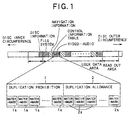
- FIG. 1 shows a data layout of an optical disc to which a duplication controlling method according to the present invention is applied.
- An optical disc DK contains a plurality of contents as video/audio information.
- an optical disc DK has user data area and a lead-out area.
- video/audio information and navigation information related to video/audio information are alternately recorded.
- an area for recording a file system indicating hierarchical structure of the navigation information.
- a lead-in area is provided immediately before the user data area for recording disc information.
- watermarks 1a and 2a are recorded together with video data as the data of contents 1, 2 ...
- Watermarks 1a, 2a ... indicate duplication controlling information (control information) for that video data.
- the watermarks 1a, 2a ... are repeatedly embedded in the video data.
- contents 1 having control information for duplication prohibition is followed by contents 2 having control information for duplication allowance.
- contents 1 watermarks 1a indicating the control information (duplication prohibition) of the contents 1 are embedded while in the contents 2, watermarks 2a indicating the control information (duplication allowance) of the contents 2 are embedded.
- an optical disc has a user data area and a lead-out area.
- the user data area has a navigation region and the contents region, between which is provided a region which contains a control information table, so that the table can be reproduced prior to the reproduction of the contents.
- the table is inserted as sub-information indicating switching positions (change positions of the control information) of all the contents recorded in the optical disc DK where the contents are switched from one to another and control information of the respective contents.
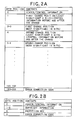
- FIG. 2A shows an example of information stored in the control information table.
- the information has been encrypted when recorded-As will be detailed later, in this embodiment, information is encrypted so as to prevent the unauthorized alteration of the control information table.
- the table shows what is successively recorded: a change position of the control information ("the first change position" in FIG. 2A) corresponding to switching from the current contents (the first contents) to the subsequent contents (the second contents) and the contents of the control information before and after the change position; a change position of the control information (“the second change position" in FIG. 2A) corresponding to switching from the second contents to the subsequent contents (the third contents) and the contents of the control information before and after the change position.
- FIG. 2A shows an example when the table is expressed by 256 bytes.
- a change position of the control information is defined by an address.
- Fig. 2B shows a format of information embedded as a watermark.
- information indicated by a watermark uses 8 bytes.
- One byte is embedded per one frame and 8 frames constitute one information item.
- These information items are embedded as watermarks in all the frames of the contents.
- 1 byte is used for header information and control information
- 3 bytes are used for copyright information
- 1 byte is used for an encryption key
- 3 bytes are used as an error correction code.
- control information table be encrypted before being recorded.
- an encryption key for decrypting the control information table is embedded as a watermark in the contents, thereby preventing the decryption and alteration of the control information table.
- an encryption key is included in the watermark, so that the encryption key is detected and used when decrypting information of the control information table.
- control information of the contents are collected to be recorded into the control information table. Accordingly, during reproduction, reception, or recording of the contents, it is possible to previously recognize a timing to switch from the current contents to the subsequent contents and control information of the subsequent contents. This makes it possible to assure a correct operation according to the control information of the subsequent contents simultaneously with switching to the subsequent contents.
- a change position of the control information can be defined by an address in the case of a package medium, but the present invention is not limited to the package media.
- the table contains change positions of the control information for a predetermined range of the contents and control information before and after the changes.
- change positions of the control information can be defined by time stamps.
- time stamps By indicating a relative time stamp from the first change position in the table, it is possible to express the change position of the control information.
- FIG. 3 is a block diagram showing configuration of an information recording/reproducing apparatus corresponding to the duplication controlling method of the present invention.
- the information recording/reproducing apparatus 100 is provided with: a drive device 101 for an optical disc DK; an optical head 102 for recording/reproducing information; a head amplifier 103 for amplifying an output signal of the optical head 102; a DVD demodulator 104 for performing demodulation, deinterleaving, descrambling, error correction, sector ID detection according to a DVD format; an RAM 105 for storing upon occasion, necessary data for DVD signal demodulation; a demultiplexer 106 for receiving an output signal from the DVD signal demodulator 105; a watermark detection block 107 which receives an output signal from the demultiplexer 106 and performs MPEG decoding of a video signal and an audio signal and which detects a video watermark and an audio watermark; an RAM 111 for storing the watermark detected; a signal overlap block 112 for overlapping a micro vision signal of CGMS-A type on the analog video output signal from an MPEG video recorder 107; a servo processing device 114
- the information recording/reproducing apparatus 100 is provided with: an interface (1394 interface) 151 for receiving a digital video signal; a detection/update device 152 for detecting/updating a video watermark in a video output signal from the interface 151; a detection/update device 153 for detecting/updating an audio watermark in an audio output signal from the interface 151; an RAM 154 for storing watermark detected; a multiplexer 155 for multiplexing the video output signal and the audio output signal from the detection/update devices 152 and 153; a DVD signal coding device 156 for performing a code processing based on the DVD format; and an optical demodulator 157 for modulating an output signal from the DVD coding device 156 and outputting the demodulated signal to the optical head 102.
- an interface (1394 interface) 151 for receiving a digital video signal
- a detection/update device 152 for detecting/updating a video watermark in a video output signal from the interface 151
- FIG. 4 is a flowchart showing an example of reproduction procedure in the information recording/reproducing apparatus 100.
- a control information table is recorded in a region which is reproduced prior to the reproduction of the contents.
- step S1 of FIG. 4 a control information table is read in prior to the reproduction of the contents. Subsequently, in step 2, processing for reproducing the contents is performed, and a sector ID is detected and loaded.
- step S5 it is determined whether data is encrypted. If encrypted, processing is passed to step S6, where decryption is executed, and control is passed to step S7. If in step S5 it is determined that the data is not encrypted, processing is passed to step S7.
- step S7 the data is read out, and in step S8 it is determined whether all the necessary data items (data of one sector) have been read out. If the result of the determination is affirmative, processing is passed to step S9, and if the result of the determination is negative, processing is passed back to step S1.
- step S9 MPEG decoding is executed, processing is passed to step S10, where a watermark detection is executed.
- step S11 it is determined whether a watermark has been detected (including a state that a watermark is being detected) in step S10. If the result of the determination is affirmative, processing is passed to step S12, and if the result of the determination is negative, then processing is passed to step S20.
- step S12 it is determined whether a watermark has been detected. If the result of the determination is affirmative, processing is passed to step S13, and if the result of the determination is negative, processing is passed to step S16. In step S13, the watermark detected is loaded in a register for watermarks (WM register) and processing is passed to step S14.
- WM register a register for watermarks
- step S14 it is determined whether an encryption key is contained in the detected watermark. If the result of the determination is affirmative, processing is passed to step S15, and if the result of the determination is negative, then processing is passed to step S16.
- step S15 by using the encryption key detected from the watermark, the control information table is decrypted and stored.
- step S16 according to the sector ID detection result in step S2, it is determined whether a change address where the contents which are being reproduced are changed (change position in the table) has been detected. If the result of the determination is affirmative, processing is passed to step S17, and if the result of the determination is negative, processing is passed to step S18.
- step S18 it is determined whether a watermark is being detected. If the result of the determination is affirmative, processing is passed to step S19, and if the result of the determination is negative, then processing is passed to step S20. In step S19, on the basis of control information in the sector ID, it is loaded in the signal overlap block 112 (FIG. 3) and processing is passed to step S22. Thus, after a reproduction start, the signal overlap block 112 is not set until a watermark is detected and there is no trouble that an analog video signal enters the duplication allowance.
- step S20 it is determined whether the control information stored in the WM register in step S13 or step S20 coincides (is matched) with the control information in the sector ID which has been read out and is being reproduced. If the result of the determination is affirmative, processing is passed to step S22, and if the result of the determination is negative, then control is passed to step S21. in step S21 a predetermined initialization process is executed, assuming that the control information in the ID has been altered.
- step S22 the signal overlap block 112 is set according to the control information stored in the WM register.
- step S23 it is determined whether the reproduction is complete. If the result of the determination is affirmative, the processing of FIG. 4 is terminated, and if the result of the determination is negative, then processing is passed back to step S2.
- the table is read out (step S1) prior to the reproduction of the contents and when the encryption key is detected (step S14: Yes), the table is decrypted using the key and is stored (step S15). Accordingly, when the contents change address is detected (step S16: Yes), a subsequent control information to be reproduced can be fetched from the stored table and loaded in the WM register (step S17), thereby enabling to immediately control the signal overlap block 112. Consequently, without being affected by a watermark detection delay, it is always possible to add a correct micro vision signal to an analog video signal. Moreover, since the table is stored, even when some contents are skipped and the searched contents are reproduced, it is possible to fetch the control information of the contents simultaneously with the reproduction start. In this case also, it is always possible to add a correct micro vision signal to the analog video signal.
- control information table has been encrypted when recorded and the table is decrypted by using the encryption key in the watermark. Accordingly, it is possible to prevent the unauthorized alteration of the control information table.
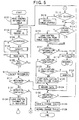
- FIG. 5 is a flowchart showing an example of recording procedure in the information recording/reproducing apparatus 100.
- step S101 of FIG. 5 prior to reading the contents, the control information table is read in Next, in step S102 a header ID detection and loading are executed. In step 104 a change flag indicating that a change address has been detected is set and processing is passed to S105.
- step S105 it is determined whether the data is encrypted. If encrypted, processing is passed to step S106, where a decryption process is executed, and processing is passed to step S107. If in step S105 it is determined that the data is not encrypted, processing is passed to step S107.
- step S107 the data is read in and in step S108 it is determined whether all the necessary data items (data of one sector) have been read in. If the result of the determination is affirmative, processing is passed to S110, and if the result of the determination is negative, then processing is passed back to step S102.
- step S110 a watermark detection is executed. It should be noted that when the contents to be recorded have been subjected to MPEG data compression, MPEG decoding is executed prior to step S110.
- step S111 it is determined whether a watermark has been detected (including a state that a watermark is being detected) in step S110. If the result of the determination is affirmative, processing is passed to step S112, and if the result of the determination is negative, processing is passed back to step S102.
- step 127 it is determined whether a watermark has been detected. If the result of the determination is affirmative, processing is passed to step S127, and if the result of the determination is negative, then processing is passed to step S114. In step S128, control information in the watermark is loaded in the WM register and processing is passed to step S112.
- step S112 it is determined whether the detected watermark contains an encryption key. If the result of the determination is affirmative, processing is passed to step S113, and if the result of the determination is negative, processing is passed to step S114.
- step S113 the control information table is decrypted by using the encryption key detected from the watermark and the decrypted table is stored before passing control to step S114.
- step S112 it is determined whether a change address (change position in the table) where the contents which are being reproduced are switched to another has been detected. If the result of the determination is affirmative, processing is passed to step S113, and if the result of the determination is negative, then processing is passed to step S114.
- step S115 control information corresponding to the contents to be recorded is loaded in the WM register, and processing is passed to step S116. It should be noted that various processes in the present apparatus are performed according to the control information loaded in step S115 or step S118.
- step S117 it is determined whether the control information stored in the WM register in step S115 or step S118 coincides with the sector ID control information which is being recorded. If the result of the determination is affirmative, processing is passed to step S119, and if the result of the determination is negative, processing is passed to step S118. In step S118 a predetermined initialization process is executed, assuming that the ID control information has been altered, thereby terminating the processing of FIG. 5.
- step S119 it is determined whether the contents to be recorded are in the duplication allowance according to the ID control information in the case that a watermark is being detected, or according to the control information in the WM register in the case that the watermark has been detected. If the result of the determination is affirmative, processing is passed to step S124, and if the result of the determination is negative, then processing is passed to step S120. In the same way as the determination based on the control information in step S119, in step S120 it is determined whether the contents to be recorded are in the duplication prohibition or the further-duplication prohibition (one-generation duplication is allowed but already has been duplicated once).
- step S121 If the resultf of the determination is affirmative, processing is passed to step S121, and if the result of the determination is negative, processing is passed to step S123. It should be noted that when the result of the determination in step S120 is negative, this means that the current recording is the first-generation recording. In step S121, warning display is executed and processing is passed to step S125.
- step S123 a flag indicating that further duplication is prohibited is set and control is passed to step S124.
- step S1124 contents data is recorded and processing is passed to step S125.
- step S125 it is determined whether the reproduction has been completed. If the result of the determination is affirmative, the processing of FIG. 5 is terminated, and if the result of the determination is negative, processing is passed back to step S102.
- step S128 a new control information table (change table) is created.
- the new control information table includes change positions of the control information for all the contents recorded on the optical disc and control information changed at each change position.
- step S126 the change table thus created is recorded in a region following the navigation information recording region (see FIG. 1), thereby terminating the processing of FIG. 5.
- the control information table is read in (step S101) before recording the contents entered and when an encryption key embedded is detected (step S112: Yes), the table is decrypted using the key and stored (step S13). Accordingly, when a change address of the contents to be recorded is detected (step S114: Yes), a corresponding control information can be fetched from the stored table and loaded in the WM register (step S117), thereby enabling to immediately recognize the control information of the contents to be recorded (step S119, step S120). Consequently, without being affected by a watermark detection delay, it is possible to correctly record the contents of duplication allowance from its head.
- control information table has been encrypted when recorded, so that the table is decrypted using the encryption key in the watermark.
- the control information table has been encrypted when recorded, so that the table is decrypted using the encryption key in the watermark.
- FIG. 6 is a block diagram showing a configuration example of a transmission apparatus of a broadcast station capable of embedding a watermark into the broadcast contents and adding the control information table thereto according to the duplication controlling method of the present invention.
- the transmission apparatus 200 shown in FIG. 6 is provided with: a plurality of watermark embedding blocks 201; a multiplexer 208 for embedding a header and multiplexing an output signal from the watermark embedding block 201; a modulation block for modulating an output signal from the multiplexer 208 and, if necessary, scrambling an image; and a transmitter 210 for amplifying and outputting an output signal from the modulation block 209.
- the watermark embedding block 201 includes: a video cassette recorder 202 for reproducing a video tape having the recorded contents; a watermark embedding device 203 for embedding a watermark having an information format show in FIG. 2B output from an later-described control information table creator 205 into an output signal (image signal) from the video cassette recorder; an encoder 204 for executing data compression of a video signal and an audio signal of the contents output from the watermark embedding device 203, by the use of an MPEG system and an AC3 system, respectively, and for periodically entering, as sub-information, the control information table output from the later-described control information table creator 205; the control information table creator 205 for generating and encoding the control information table shown in FIG.
- FIG. 7 is a block diagram showing a configuration example of a reception apparatus for receiving the contents having a watermark embedded according to the duplication controlling method of the present invention.
- the reception apparatus 300 shown in FIG. 7 is provided with: a demodulator 301 for demodulating a received signal which has been modulated by 4-phase modulation method; a descrambler 302 for removing a scramble from an output signal of the demodulator; an MPEG decoder 303 which is fed with an image signal from the descrambler 302; an AC3 decoder 304 fed with a voice signal from the descrambler 302; a header extracting block for extracting information such as a header ID or control information table from an output signal of the descrambler 302; a watermark detection block 307 for detecting a watermark in the MPEG-decoded image signal; a watermark detection block 308 for detecting a watermark in the AC3-decoded voice signal; a signal overlap block 309 for overlapping an output signal from the watermark detection block 307 with a copy control information (macro vision signal) of a CGMS-A method; and a CPU 311 for controlling
- the present invention is not limited to the aforementioned embodiments.
- the control information table is recorded after the navigation region as shown in FIG. 1, but the table can also be recorded after a file system or between the contents. That is, the table recording position is not limited to a particular position.
- the key for decrypting the control information table is placed in the watermark indicating the control information in the contents but may be embedded into another watermark.
- control table itself may be recorded as a watermark in the disc.
- the watermark be embedded with a high intensity (for rapid detection) at a position which is always read in upon disc start (such as a menu screen for selecting a title #, a chapter #, and a caption language, or at the head of the first contents (title #1) which are firstly reproduced).
- a watermark embedded into the contents includes control information of the contents but it can be omitted since control information is present in the ID also.
- the control information in the ID is plain information and it is easy to alter the control information.
- the alteration can easily be detected by comparing (FIG. 4: step S20) the information to the control information in the highly safe control information table.
- the duplication controlling method of the present invention by reading a table, it is possible to recognize in advance change positions of the control information and the contents of the control information which varies at each change position. Accordingly, this fact makes it possible to rapidly keep up with the control information change which occurs upon contents switching from one to another, thereby enabling the solution of the problem caused by a control information detection delay.
Landscapes
- Engineering & Computer Science (AREA)
- Multimedia (AREA)
- Signal Processing (AREA)
- Editing Of Facsimile Originals (AREA)
- Signal Processing For Digital Recording And Reproducing (AREA)
- Television Systems (AREA)
- Management Or Editing Of Information On Record Carriers (AREA)
- Storage Device Security (AREA)
- Television Signal Processing For Recording (AREA)
Abstract
Description
Claims (25)
- A duplication controlling method for controlling duplication by embedding control information (1a, 2a) regarding duplication of contents (1, 2) comprising digital information into the contents, characterized in that the method comprises the processes of:creating a table that contains a change position of the control information for a predetermined range of the contents and the contents of the control information which vary at each change position; andadding the table to the contents.
- The duplication controlling method according to claim 1,
wherein the process of adding the table periodically adds the table to the contents. - The duplication controlling method according to claim 1,
wherein the process of adding the table adds the table at a position to be reproduced prior to the reproduction of the contents. - The duplication controlling method according to any one of claims 1 to 3, further comprising the process of scrambling the table,
wherein the process of adding the table adds the scrambled table to the contents as sub-information of the contents, and
the method further comprises the process of embedding a scramble release key into the contents as an electronic watermark. - The duplication controlling method according to any one of claims 1 to 3, wherein the process of adding the table embeds the table in the contents as an electronic watermark.
- A duplication controlling apparatus (200) for controlling duplication by embedding control information (1a, 2a) regarding duplication of contents (1, 2) comprising digital information into the contents, characterized in that the duplication controlling apparatus comprises:a creating device (205) for creating a table that contains a change position of the control information for a predetermined range of the contents and the contents of the control information which vary at each change position; andan adding device (204) for adding the table to the contents.
- The duplication controlling apparatus (200) according to claim 6, wherein the adding device (204) periodically adds the table to the contents.
- The duplication controlling apparatus (200) according to claim 6, wherein the adding device (204) adds the table at a position to be reproduced prior to the reproduction of the contents.
- The duplication controlling apparatus (200) according to any one of claims 6 to 8, further comprising a scrambling device (209) for scrambling the table, wherein
the adding device (204) adds the scrambled table into the contents as sub-information of the contents, and
the apparatus (200) further comprises an embedding device (203) that embeds a scramble release key into the contents as an electronic watermark. - The duplication controlling apparatus (200) according to claim 6, wherein the adding device embeds the table into the contents as an electronic watermark.
- A recording medium (DK) in which control information (1a, 2a) regarding the duplication of contents (1, 2) comprising digital information is recorded, characterized in that
there is recorded a table containing a change position of the control information for a predetermined range of the contents and the contents of the control information which vary at each change position. - The recording medium (DK) according to claim 11, wherein the table is periodically recorded into the contents.
- The recording medium (DK) according to claim 11, wherein the table is recorded at a position to be reproduced prior to the reproduction of the contents.
- The recording medium (DK) according to any one of claims 11 to 13, wherein the table is scrambled and recorded as sub-information of the contents, and
a scramble release key is embedded as an electronic watermark into the contents. - The recording medium (DK) according to any one of claims 11 to 13, wherein the table is embedded as an electronic watermark.
- A duplication controlling apparatus (100, 300) which controls duplication in accordance with control information (1a, 2a) embedded in contents (1, 2), the control information regarding duplication of the contents comprising digital information, characterized in that the duplication controlling apparatus comprises:a table reading device for reading a table containing a change position of the control information for a predetermined range of the contents and the contents of the control information which changes at each change position;a change position detecting device (115, 311) for detecting the change position of the control information; anda control device (115, 311) for modifying processing of the duplication controlling apparatus in accordance with information read from the table by the table reading device when the change position is detected by the change position detecting device.
- The duplication controlling apparatus (100, 300) according to claim 16, wherein the table reading device reads the table which has periodically been recorded in the contents.
- The duplication controlling apparatus (100, 300) according to claim 16, wherein the table reading device reads the table prior to the reproduction of the contents.
- The duplication controlling apparatus (100, 300) according to any one of claims 16 to 18, wherein the table reading device reads a table which has been scrambled and recorded as sub-information of the contents, and
the duplication controlling apparatus further comprises:an electronic watermark reading device (107, 308) which reads a release key for releasing scramble of the table inserted in the contents; anda scramble release device (104, 302) for releasing the scramble of the table which has been read by the table reading device in accordance with the release key which has been read by the electronic watermark reading device. - The duplication controlling apparatus (100, 300) according to any one of claims 16 to 19, further comprising:wherein the control device (115, 311) controls the operation of the signal overlap device.a reproduction device (107, 303, 304) for reproducing the contents; anda signal overlap device (112, 309) for overlapping a duplication control signal over an analog reproduction signal which has been output from the reproduction device,
- The duplication controlling apparatus (100) according to any one of claims 16 to 19, further comprising a recording device (102, 157) for recording the contents,
wherein the control device (115) controls a recording operation of the recording device. - The duplication controlling apparatus (300) according to any one of claims 16 to 19, further comprising:wherein the control device (311) controls the operation of the signal overlap device.a reception device for receiving the contents, anda signal overlap device (309) for overlapping a copy control signal over an analog reproduction signal which has been output from the reception device,
- A program embodied on computer-readable medium for embedding control information regarding duplication of contents comprising digital information into the contents, and recording the control information in a recording medium, characterized in that the program causes a computer to function as:a creating device for creating a table containing a change position of the control information to the contents recorded in the recording medium and the contents of the control information which vary at each change position;an adding device for adding the table into the contents; anda recording device for recording the table and the contents into the recording medium.
- The program embodied on computer-readable medium according to claim 23, wherein the recording device records the table at a position which is reproduced prior to the reproduction of the contents.
- The program embodied on computer-readable medium according to claim 23 or 24, wherein the program further causing a computer to function as:a scrambling device for scrambling the table to be recorded in the recording medium,an adding device adds the scrambled table into the contents as sub-information of the contents, andan embedding device embeds a scramble release key as an electronic watermark in the contents.
Applications Claiming Priority (2)
| Application Number | Priority Date | Filing Date | Title |
|---|---|---|---|
| JP2001068260 | 2001-03-12 | ||
| JP2001068260A JP2002268949A (en) | 2001-03-12 | 2001-03-12 | Duplicate managing method, duplicate managing device, recording medium and program |
Publications (2)
| Publication Number | Publication Date |
|---|---|
| EP1241882A2 true EP1241882A2 (en) | 2002-09-18 |
| EP1241882A3 EP1241882A3 (en) | 2007-02-28 |
Family
ID=18926478
Family Applications (1)
| Application Number | Title | Priority Date | Filing Date |
|---|---|---|---|
| EP02005280A Withdrawn EP1241882A3 (en) | 2001-03-12 | 2002-03-11 | Duplication controlling method, duplication controlling apparatus, recording medium, and program embodied on computer-readable medium |
Country Status (6)
| Country | Link |
|---|---|
| US (1) | US20020129254A1 (en) |
| EP (1) | EP1241882A3 (en) |
| JP (1) | JP2002268949A (en) |
| KR (1) | KR100478395B1 (en) |
| CN (1) | CN1264345C (en) |
| TW (1) | TW561782B (en) |
Cited By (1)
| Publication number | Priority date | Publication date | Assignee | Title |
|---|---|---|---|---|
| US7522488B2 (en) | 2004-05-27 | 2009-04-21 | Panasonic Corporation | Method and apparatus for reproducing content according to information embedded in the content |
Families Citing this family (13)
| Publication number | Priority date | Publication date | Assignee | Title |
|---|---|---|---|---|
| JP2004087063A (en) * | 2002-07-02 | 2004-03-18 | Sony Corp | Data recording medium, medium information recording method, medium information recording device, medium information reproducing method, medium information reproducing device, information service method, information service system |
| KR101029211B1 (en) * | 2002-11-05 | 2011-04-12 | 비지오네어 가부시끼가이샤 | View management method of specific content recorded in information recording medium |
| JP2004165855A (en) * | 2002-11-11 | 2004-06-10 | Sony Corp | Authoring apparatus and method, authoring program, and recording medium on which authoring program is recorded |
| WO2004081719A2 (en) * | 2003-03-07 | 2004-09-23 | Chaoticom, Inc. | Methods and systems for digital rights management of protected content |
| JP2004288281A (en) * | 2003-03-20 | 2004-10-14 | Sony Corp | Recording medium, method of manufacturing the same, reproduction method and reproduction apparatus |
| JP4606868B2 (en) * | 2004-12-24 | 2011-01-05 | 富士通株式会社 | Personal authentication device |
| US20060242079A1 (en) * | 2005-04-22 | 2006-10-26 | Microsoft Corporation | Rights management system for streamed multimedia content |
| JP2006311269A (en) * | 2005-04-28 | 2006-11-09 | Toshiba Corp | Television broadcast receiving apparatus and receiving method |
| CN1937720B (en) * | 2005-12-29 | 2010-05-05 | 康佳集团股份有限公司 | Television receiver set information duplicating method and system |
| JP2009532975A (en) * | 2006-04-03 | 2009-09-10 | コーニンクレッカ フィリップス エレクトロニクス エヌ ヴィ | Watermark embedding using look-up table |
| US9754625B2 (en) * | 2008-07-31 | 2017-09-05 | Warner Bros. Entertainment Inc. | Generation and use of user-selected scenes playlist from distributed digital content |
| CN102187366B (en) * | 2008-10-14 | 2015-01-28 | 皇家飞利浦电子股份有限公司 | Content Item Identifier |
| US20110280434A1 (en) * | 2010-05-11 | 2011-11-17 | Rajesh Mamidwar | Method and system for watermakr insertin using video start codes |
Family Cites Families (25)
| Publication number | Priority date | Publication date | Assignee | Title |
|---|---|---|---|---|
| US5319786A (en) * | 1987-05-20 | 1994-06-07 | Hudson Soft Co., Ltd. | Apparatus for controlling a scanning type video display to be divided into plural display regions |
| US5045869A (en) * | 1988-09-16 | 1991-09-03 | Canon Kabushiki Kaisha | Printing controller for printing at selected resolutions |
| US5218695A (en) * | 1990-02-05 | 1993-06-08 | Epoch Systems, Inc. | File server system having high-speed write execution |
| JP3158556B2 (en) * | 1991-09-27 | 2001-04-23 | ソニー株式会社 | Disk recording device and disk reproducing device |
| KR960003880B1 (en) * | 1992-10-12 | 1996-03-23 | 엘지전자주식회사 | Caption display control apparatus and the method thereof |
| US5832087A (en) * | 1994-03-23 | 1998-11-03 | Chantilley Corporation Limited | Apparatus for generating encryption/decryption look-up tables using a session key |
| US5613004A (en) * | 1995-06-07 | 1997-03-18 | The Dice Company | Steganographic method and device |
| JP3707137B2 (en) * | 1996-07-04 | 2005-10-19 | ソニー株式会社 | Recording medium and playback device |
| JP3901268B2 (en) * | 1997-01-23 | 2007-04-04 | ソニー株式会社 | Information signal output control device, information signal output control method, information signal duplication prevention device, and information signal duplication prevention method |
| US5940862A (en) * | 1997-03-24 | 1999-08-17 | Adaptec, Inc. | Data sector mark generation for a headerless disk drive architecture |
| JP3450787B2 (en) * | 1997-08-14 | 2003-09-29 | パイオニア株式会社 | Information recording medium, recording apparatus and method thereof, and reproducing apparatus and method thereof |
| JP4456185B2 (en) * | 1997-08-29 | 2010-04-28 | 富士通株式会社 | Visible watermarked video recording medium with copy protection function and its creation / detection and recording / playback device |
| JP3975308B2 (en) * | 1998-07-15 | 2007-09-12 | ソニー株式会社 | Information signal reproducing system, information signal reading device, information signal processing device, information signal reproducing method, information signal reading method, and information signal processing method |
| JP3716902B2 (en) * | 1998-09-04 | 2005-11-16 | 株式会社ソニー・コンピュータエンタテインメント | Data transmission / reception system, data reception device, data transmission / reception method, data reception method, and recording medium |
| EP0992996A3 (en) * | 1998-10-08 | 2002-04-24 | Sony Corporation | Reproduction apparatus and method |
| CA2288366A1 (en) * | 1998-11-05 | 2000-05-05 | Akira Ogino | Additional information transmission method, additional information transmission system, information signal output apparatus, information signal processing apparatus, information signal recording apparatus and information signal recording medium |
| JP2000163871A (en) * | 1998-11-26 | 2000-06-16 | Sony Corp | Copyright protection method for information signal, information signal recording method and apparatus, and information signal output method and apparatus |
| JP3868643B2 (en) * | 1998-12-03 | 2007-01-17 | 株式会社日立製作所 | Digital information duplication restriction method, digital information duplication restriction device, and digital information recording device |
| JP3327389B2 (en) * | 1998-12-28 | 2002-09-24 | 松下電器産業株式会社 | Copy system, copy method, writing device, and recording medium |
| JP2001054061A (en) * | 1999-05-31 | 2001-02-23 | Matsushita Electric Ind Co Ltd | Recording device, transmitting device, computer-readable recording medium |
| JP4045393B2 (en) * | 1999-06-01 | 2008-02-13 | ソニー株式会社 | Information signal duplication management method and information signal recording apparatus |
| US6574417B1 (en) * | 1999-08-20 | 2003-06-03 | Thomson Licensing S.A. | Digital video processing and interface system for video, audio and ancillary data |
| JP2001184785A (en) * | 1999-12-24 | 2001-07-06 | Sony Corp | Dubbing device |
| KR20020047342A (en) * | 2000-12-13 | 2002-06-22 | 황훈 | Apparatus for tranmitting and receiving picture using radio communication equipment and Method thereof |
| JP4317667B2 (en) * | 2001-03-07 | 2009-08-19 | パイオニア株式会社 | Replication management method, replication management apparatus, and program |
-
2001
- 2001-03-12 JP JP2001068260A patent/JP2002268949A/en active Pending
-
2002
- 2002-03-11 EP EP02005280A patent/EP1241882A3/en not_active Withdrawn
- 2002-03-11 KR KR10-2002-0013033A patent/KR100478395B1/en not_active Expired - Fee Related
- 2002-03-12 TW TW091104556A patent/TW561782B/en not_active IP Right Cessation
- 2002-03-12 CN CNB021192219A patent/CN1264345C/en not_active Expired - Fee Related
- 2002-03-12 US US10/095,075 patent/US20020129254A1/en not_active Abandoned
Cited By (1)
| Publication number | Priority date | Publication date | Assignee | Title |
|---|---|---|---|---|
| US7522488B2 (en) | 2004-05-27 | 2009-04-21 | Panasonic Corporation | Method and apparatus for reproducing content according to information embedded in the content |
Also Published As
| Publication number | Publication date |
|---|---|
| CN1381991A (en) | 2002-11-27 |
| EP1241882A3 (en) | 2007-02-28 |
| JP2002268949A (en) | 2002-09-20 |
| KR20020072800A (en) | 2002-09-18 |
| KR100478395B1 (en) | 2005-03-24 |
| US20020129254A1 (en) | 2002-09-12 |
| TW561782B (en) | 2003-11-11 |
| CN1264345C (en) | 2006-07-12 |
Similar Documents
| Publication | Publication Date | Title |
|---|---|---|
| US20020106192A1 (en) | Contents data, recording medium, recording method and device, reproducing method and device | |
| US6370319B1 (en) | Digital recording apparatus and method | |
| JPH08237596A (en) | Copy protection method and apparatus for digital magnetic recording / reproducing system | |
| KR100373606B1 (en) | Recording medium for content data and reproduction apparatus therefor | |
| US20020129254A1 (en) | Duplication controlling method, duplication controlling apparatus, recording medium, and program embodied on computer-readable medium | |
| US7280983B2 (en) | Information recording medium having reproduction control program recorded thereon and reproduction control program | |
| EP1005040A1 (en) | Information signal copvright protection method, information signal recording method and device, and information signal output method and device | |
| JP2002271756A (en) | Data processing device, data processing method, and program | |
| US20050257075A1 (en) | Data output method and apparatus, data playback method and apparatus, data recording method and apparatus, and data recording and playback method and apparatus | |
| KR100895550B1 (en) | Playback apparatus and method, and disc playback apparatus | |
| US7333716B2 (en) | Duplication controlling method, duplication controlling apparatus, recording medium, and duplication controlling program embodied on computer-readable medium | |
| KR100592898B1 (en) | Information output apparatus and information output method, information recording apparatus and information recording method, information output recording system and information output recording method, and information recording medium | |
| WO2007081144A2 (en) | Method and apparatus for reproducing data and recording medium | |
| KR100870258B1 (en) | Copy protection signals processing | |
| US5182680A (en) | Recording control system | |
| US20050254364A1 (en) | Information generation device, information reproduction device, and information recording device | |
| JP2000030367A (en) | Information signal reproducing system, information signal reading device, information signal processing device, information signal reproducing method, information signal reading method, and information signal processing method | |
| JP3978559B2 (en) | Digital data management method and apparatus | |
| JP2000312291A (en) | Decoding device and playback device | |
| JP2000090569A (en) | Information signal reproduction restriction method, information signal recording / reproduction device, information signal recording device, information signal reproduction device, and rewritable recording medium |
Legal Events
| Date | Code | Title | Description |
|---|---|---|---|
| PUAI | Public reference made under article 153(3) epc to a published international application that has entered the european phase |
Free format text: ORIGINAL CODE: 0009012 |
|
| AK | Designated contracting states |
Kind code of ref document: A2 Designated state(s): AT BE CH CY DE DK ES FI FR GB GR IE IT LI LU MC NL PT SE TR |
|
| AX | Request for extension of the european patent |
Free format text: AL;LT;LV;MK;RO;SI |
|
| PUAL | Search report despatched |
Free format text: ORIGINAL CODE: 0009013 |
|
| AK | Designated contracting states |
Kind code of ref document: A3 Designated state(s): AT BE CH CY DE DK ES FI FR GB GR IE IT LI LU MC NL PT SE TR |
|
| AX | Request for extension of the european patent |
Extension state: AL LT LV MK RO SI |
|
| AKX | Designation fees paid | ||
| STAA | Information on the status of an ep patent application or granted ep patent |
Free format text: STATUS: THE APPLICATION IS DEEMED TO BE WITHDRAWN |
|
| 18D | Application deemed to be withdrawn |
Effective date: 20070829 |
|
| REG | Reference to a national code |
Ref country code: DE Ref legal event code: 8566 |