EP1241849A2 - Method of and apparatus for filtering access, and computer product - Google Patents
Method of and apparatus for filtering access, and computer product Download PDFInfo
- Publication number
- EP1241849A2 EP1241849A2 EP01118752A EP01118752A EP1241849A2 EP 1241849 A2 EP1241849 A2 EP 1241849A2 EP 01118752 A EP01118752 A EP 01118752A EP 01118752 A EP01118752 A EP 01118752A EP 1241849 A2 EP1241849 A2 EP 1241849A2
- Authority
- EP
- European Patent Office
- Prior art keywords
- incorrect
- estimation
- access request
- server
- rule
- Prior art date
- Legal status (The legal status is an assumption and is not a legal conclusion. Google has not performed a legal analysis and makes no representation as to the accuracy of the status listed.)
- Granted
Links
Images




Classifications
-
- H—ELECTRICITY
- H04—ELECTRIC COMMUNICATION TECHNIQUE
- H04L—TRANSMISSION OF DIGITAL INFORMATION, e.g. TELEGRAPHIC COMMUNICATION
- H04L43/00—Arrangements for monitoring or testing data switching networks
-
- H—ELECTRICITY
- H04—ELECTRIC COMMUNICATION TECHNIQUE
- H04L—TRANSMISSION OF DIGITAL INFORMATION, e.g. TELEGRAPHIC COMMUNICATION
- H04L41/00—Arrangements for maintenance, administration or management of data switching networks, e.g. of packet switching networks
- H04L41/28—Restricting access to network management systems or functions, e.g. using authorisation function to access network configuration
-
- H—ELECTRICITY
- H04—ELECTRIC COMMUNICATION TECHNIQUE
- H04L—TRANSMISSION OF DIGITAL INFORMATION, e.g. TELEGRAPHIC COMMUNICATION
- H04L63/00—Network architectures or network communication protocols for network security
- H04L63/02—Network architectures or network communication protocols for network security for separating internal from external traffic, e.g. firewalls
- H04L63/0227—Filtering policies
- H04L63/0236—Filtering by address, protocol, port number or service, e.g. IP-address or URL
-
- H—ELECTRICITY
- H04—ELECTRIC COMMUNICATION TECHNIQUE
- H04L—TRANSMISSION OF DIGITAL INFORMATION, e.g. TELEGRAPHIC COMMUNICATION
- H04L63/00—Network architectures or network communication protocols for network security
- H04L63/02—Network architectures or network communication protocols for network security for separating internal from external traffic, e.g. firewalls
- H04L63/0227—Filtering policies
- H04L63/0263—Rule management
-
- H—ELECTRICITY
- H04—ELECTRIC COMMUNICATION TECHNIQUE
- H04L—TRANSMISSION OF DIGITAL INFORMATION, e.g. TELEGRAPHIC COMMUNICATION
- H04L63/00—Network architectures or network communication protocols for network security
- H04L63/14—Network architectures or network communication protocols for network security for detecting or protecting against malicious traffic
- H04L63/1408—Network architectures or network communication protocols for network security for detecting or protecting against malicious traffic by monitoring network traffic
-
- H—ELECTRICITY
- H04—ELECTRIC COMMUNICATION TECHNIQUE
- H04L—TRANSMISSION OF DIGITAL INFORMATION, e.g. TELEGRAPHIC COMMUNICATION
- H04L63/00—Network architectures or network communication protocols for network security
- H04L63/14—Network architectures or network communication protocols for network security for detecting or protecting against malicious traffic
- H04L63/1408—Network architectures or network communication protocols for network security for detecting or protecting against malicious traffic by monitoring network traffic
- H04L63/1416—Event detection, e.g. attack signature detection
-
- H—ELECTRICITY
- H04—ELECTRIC COMMUNICATION TECHNIQUE
- H04L—TRANSMISSION OF DIGITAL INFORMATION, e.g. TELEGRAPHIC COMMUNICATION
- H04L67/00—Network arrangements or protocols for supporting network services or applications
- H04L67/01—Protocols
- H04L67/02—Protocols based on web technology, e.g. hypertext transfer protocol [HTTP]
-
- H—ELECTRICITY
- H04—ELECTRIC COMMUNICATION TECHNIQUE
- H04L—TRANSMISSION OF DIGITAL INFORMATION, e.g. TELEGRAPHIC COMMUNICATION
- H04L43/00—Arrangements for monitoring or testing data switching networks
- H04L43/16—Threshold monitoring
-
- H—ELECTRICITY
- H04—ELECTRIC COMMUNICATION TECHNIQUE
- H04L—TRANSMISSION OF DIGITAL INFORMATION, e.g. TELEGRAPHIC COMMUNICATION
- H04L63/00—Network architectures or network communication protocols for network security
- H04L63/14—Network architectures or network communication protocols for network security for detecting or protecting against malicious traffic
- H04L63/1441—Countermeasures against malicious traffic
-
- H—ELECTRICITY
- H04—ELECTRIC COMMUNICATION TECHNIQUE
- H04L—TRANSMISSION OF DIGITAL INFORMATION, e.g. TELEGRAPHIC COMMUNICATION
- H04L67/00—Network arrangements or protocols for supporting network services or applications
- H04L67/01—Protocols
-
- H—ELECTRICITY
- H04—ELECTRIC COMMUNICATION TECHNIQUE
- H04L—TRANSMISSION OF DIGITAL INFORMATION, e.g. TELEGRAPHIC COMMUNICATION
- H04L69/00—Network arrangements, protocols or services independent of the application payload and not provided for in the other groups of this subclass
- H04L69/30—Definitions, standards or architectural aspects of layered protocol stacks
- H04L69/32—Architecture of open systems interconnection [OSI] 7-layer type protocol stacks, e.g. the interfaces between the data link level and the physical level
- H04L69/322—Intralayer communication protocols among peer entities or protocol data unit [PDU] definitions
- H04L69/329—Intralayer communication protocols among peer entities or protocol data unit [PDU] definitions in the application layer [OSI layer 7]
Definitions
- the present invention relates to a technology for allowing only a correct access request to pass from clients to a server that provides services in response to access requests.
- intruders or attackers incorrectly use servers of companies, associations, individuals, and the like without any authority, obstruct operations, or break (clutch) the servers, so that incorrect accesses in which persons who use the servers intentionally perform acts except for acts allowed by authorities given to the persons increase in number. For this reason, the necessity that the reliabilities of servers are secured by refusing incorrect accesses to the servers have intensified.
- a fire wall is generally structured between the Internet and a corporate LAN (Local Area Network).
- the fire wall is software for preventing external intrusion on a computer or a network connected to the Internet.
- a computer for fire wall which is designed to pass only specific data or specific protocols is set between a corporate LAN and the Internet, all data exchanges between the LAN and external computers are performed through this machine to prevent external intrusion.
- incorrect access detection methods on network base and host base are known.
- the former i.e., the incorrect access detection method on network base monitors a live packet flowing in a network to detect an incorrect access.
- the later i.e., the incorrect access detection method on host base monitors log histories stored in a host to detect an incorrect access.
- the transmission source client of an incorrect access is found out on the basis of an incorrect access detected by such an incorrect detection method, and transmission source information such as the IP address of the client who performs this incorrect access is accumulated in the computer for fire wall. In this manner, it is generally performed that the fire wall refuses an access request from the client including the transmission source information as an incorrect access.
- a client who performs an incorrect access in the past is recognized as an incorrect client, and an access request from the incorrect client is refused as an incorrect access.
- a server can controlled for an incorrect access from the client who is recognized as an incorrect client, the server cannot be controlled for an incorrect access from a client who is not recognized as an incorrect client. More specifically, the server cannot be controlled for the first incorrect access from a client which has not been recognized as an incorrect client.
- a framework which decides whether an access request is a correct access request or an incorrect access request without considering transmission source information of an access request is necessary.
- an incorrect request database stores patterns of incorrect accesses to the Web server. Correctness of an access request from a client device to a server is estimated based on the patterns stored in the incorrect request database and a predetermined estimation rule. Decision about whether the access request is to be passed to the Web server is made based on the result of estimation on correctness of an access request and a predetermined decision rule.
- Embodiments of a filtering apparatus, a filtering method, and a computer program for causing a computer to execute the method according to the present invention will be described in detail below with reference to the accompanying drawings.
- Fig. 1 is a block diagram showing the configuration of a client server system according to the first embodiment.
- the client server system according to the first embodiment has a configuration in which a plurality of client devices 10 each having a Web browser 11, and a server device 20 having a request filter 30 serving as a filtering device and a Web server 40 are connected to each other through a network 1 such as the Internet such that the respective components can communicate with each other.
- the client device 10 performs various process requests such as HTTP requests to the server device 20 by the browser 11, and the Web server 40 of the server device 20 provides a service depending on an HTTP request from the client device 10 to the client device 10.
- the request filter 30 of the server device 20 is interposed between the client device 10 and the Web server 40, so that only a correct request of HTTP requests from the client device 10 is given to the Web server 40.
- the client server system is characterized by a filtering process performed by the request filter 30 of the server device 20. More specifically, the estimation unit 32 of the request filter 30 estimates that an access is an incorrect access when an HTTP request from the client device 10 corresponds to any one of the patterns of incorrect accesses stored in the incorrect request DB 33, and the decision unit 34 decides that the HTTP request which is estimated as an incorrect access by the estimation unit 32 is not given to the Web server 40, so that only the HTTP request can be given to the Web server 40 without considering transmission source information of the HTTP request.
- the client device 10 comprises the Web browser 11, basically performs a process request such as an HTTP request to the server device 20, interprets Web data provided by the Web server 40 of the server device 20, and performs display control (browse process) for displaying the data on an output unit such as a monitor or the like.
- a process request such as an HTTP request
- the server device 20 interprets Web data provided by the Web server 40 of the server device 20
- display control for displaying the data on an output unit such as a monitor or the like.
- the client device 10 is also a device which can perform an incorrect access to the server device 20 depending on a malicious using method. More specifically, when the client device 10 is used by a user such as an intruder or an attacker with malice, such an incorrect access that the user sees a password file on the Web server 40 which must not be seen by a remote user, that the user requests a file which does not exist on the Web server 40 to stop. the function of the Web server 40, or that the user executes an arbitrary system command on the Web server 40 by a request including a command letter string can be performed.
- the request filter 30 functions to protect the Web server 40 from an incorrect access by the client device 10.
- the client device 10 can be realized by a mobile communication terminal such as a personal computer or a workstation, a home video game, an internet TV, a PDA (Personal Digital Assistant), or a mobile telephone set or a PHS (Personal Handy Phone System).
- the client device 10 is connected to a network 1 through a communication device such as a modem, a TA, or a router and a telephone line or a leased line, and can accesses the server device 20 according to a predetermined communication protocol (e.g., a TCP/IP internet protocol).
- a predetermined communication protocol e.g., a TCP/IP internet protocol
- the Web server 40 of the server device 20 receives an HTTP request from the client device 10 through the request filter 20, and provides a service or the like for transmitting various pieces of information described in a markup language such as an HTML (Hypertext Markup Language) to the client device 10 according to the HTTP request.
- a markup language such as an HTML (Hypertext Markup Language)
- the Web server 40 performs the same operation as that of a general Web server in a functional concept. However, the Web server 40 mentioned here, unlike a general Web server, does not monitor a TCP (Transmission Control Protocol) of port number 80 assigned to the HTTP request in the server device 20.
- TCP Transmission Control Protocol
- the request filter 30 receives the HTTP request to perform inter-process communication, so that only a correct HTTP request is given to the Web server 40.
- the request filter 30 comprises a receiving unit 31, an estimation unit 32, an incorrect request DB 33, a decision unit 34, a transmission unit 35, a log management unit 36, an external notification unit 37, an external information acquiring unit 38, and an updating unit 39.
- the receiving unit 31 is a process unit for monitoring a TCP port of port number 80 in the server device 20 to receive an HTTP request from the client device 10 before the HTTP request is received by the Web server 40.
- the HTTP request received by the receiving unit 31 from the client device 10 is output to the estimation unit 32 and the transmission unit 35.
- the estimation unit 32 is a process unit for estimating the correctness of the HTTP request on the basis of the patterns of incorrect accesses stored in the incorrect request DB 33 and a predetermined estimation rule 32a to output the estimation result to the decision unit 34.
- Fig. 2 is a table showing a configuration of information stored in the incorrect request DB 33.
- the incorrect request DB 33 is a database in which the patterns of incorrect accesses to the server, and stores a plurality of patterns obtained by describing incorrect accesses collected in the network world by using an illustrated formal language.
- the pattern of "URL ⁇ >.. ⁇ .. ⁇ .. ⁇ ..” means an incorrect request in which a URL includes ".. ⁇ .. ⁇ .. ⁇ "
- the incorrect request DB 33 a plurality of incorrect command character strings for executing arbitrary system commands on the Web server 40 are stored.
- the Web server 40 can be controlled for not only an incorrect access the attack method of which is known but also an incorrect access the attack method of which is not known.
- the estimation unit 32 estimates the correctness of an HTTP request on the basis of a predetermined estimation rule 32a. More specifically, when the HTTP request corresponds to any one of the patterns of incorrect accesses stored in the incorrect request DB 33, it is estimated that the HTTP request is an incorrect access. On the other hand, when the HTTP request does not correspond to any one of the patterns of incorrect accesses stored in the incorrect request DB 33, the estimation unit 32 estimates that the HTTP request is a correct access.
- the decision unit 34 is a process unit for deciding, on the basis of the estimation result received from the estimation unit 32 and the predetermined decision rule 34a, whether the HTTP request is given to the Web server 40 or not to output the decision result to the transmission unit 35. More specifically, when the decision unit 34 receives an estimation result that the HTTP request is an incorrect access from the estimation unit 32, the decision unit 34 decides that the HTTP request is not given to the Web server 40 (impossible decision) . On the other hand, when the decision unit 34 receives an estimation result that the HTTP request is a correct access, the decision unit 34 decides that the HTTP request is given to the Web server 40 (possible decision).
- the transmission unit 35 is a process unit for controlling transmission of the HTTP request received from the receiving unit 31 on the basis of the decision result received from the decision unit 34. More specifically, when a possible decision is received from the decision unit 34, the HTTP request is given to the Web server 40 by inter-process communication. On the other hand, when an impossible decision is received from the decision unit 34, giving the HTTP request to the Web server 40 is refused, and the incorrect request is wasted.
- the log management unit 36 is a process unit for storing information related to the incorrect request which is decided not to be given to the Web server 40 by the decision unit 34 in the storage medium 36b and managing the information on the basis of the predetermined management rule 36a. More specifically, on the basis of the management rule 36a, pieces of information related to the incorrect request such as the contents of the incorrect request, transmission source information (IP address or host name), transmission time, the reason of an estimation result obtained by the estimation unit 32, and the reason of a decision result obtained by the decision unit 34 are selectively edited, and the selectively edited pieces of information are selectively stored in the storage medium 36b depending on the level of aggression of the incorrect request. For example, only incorrect requests having high levels of aggression are stored.
- the pieces of information stored in the storage medium 36b can be output to the outside of the server device 20 by ejecting the storage medium 36b or using a communication line.
- the pieces of information stored in the storage medium 36b are analyzed to analyze the tendency of an incorrect access, so that a further countermeasure for maintenance of the Web server 40 can be performed.
- the external notification unit 37 is a process unit for notifying information related to an incorrect request which is decided not to be given to the Web server 40 by the decision unit 34 to the external device 50. More specifically, as in the process performed by the log management unit 36, on the basis of the notification rule 37a, pieces of information related to the incorrect request such as the contents of the incorrect request, transmission source information (IP address or host name), transmission time, the reason of an estimation result obtained by the estimation unit 32, and the reason of a decision result obtained by the decision unit 34 are selectively edited, and the selectively edited pieces of information are selectively stored in the external device 50 depending on the level of aggression of the incorrect request.
- pieces of information related to the incorrect request such as the contents of the incorrect request, transmission source information (IP address or host name), transmission time, the reason of an estimation result obtained by the estimation unit 32, and the reason of a decision result obtained by the decision unit 34 are selectively edited, and the selectively edited pieces of information are selectively stored in the external device 50 depending on the level of aggression of the incorrect request.
- the external device 50 which receives a notice from the external information acquiring unit 38 is a communication device which is operated by an administrator of the Web server 40, an administrator of the request filter 30, an administrator of the entire server device 20, an administrator of a public association (management center) which monitors the network as a whole, and the like (these administrators are generally called an "administrator").
- the external notification unit 37 for example, rapidly notifies incorrect requests having high levels of aggression to the administrator on real time, and notifies incorrect requests having low levels of aggression to the administrator at once, so that the external notification unit 37 can urge the administrator which receives the notice to rapidly perform a countermeasure for maintenance of the Web server 40.
- the external information acquiring unit 38 is a process unit for actively or passively acquiring, on the basis of the predetermined acquisition rule 38a, information used in an updating process performed by the updating unit 39 from the outside of the request filter 30 such as the external device 50 or the Web server 40. For example, the pattern of an incorrect request newly input by an administrator through the external device 50, change designation information of the estimation rule 32a input by the administrator through the external device 50, and the like are acquired, and information such as the status of damage or the contents of an incorrect request is acquired from the Web server 40 damaged by the incorrect request.
- the acquisition rule 38a is a rule which acquires only information from an authorized administrator.
- the updating unit 39 is a process unit for updating, on the basis of the predetermined updating rule 39a, the incorrect request DB 33, the estimation rule 32a, the decision rule 34a, the management rule 36a, the notification rule 37a, the acquisition rule 38a, or information stored in the updating rule. For example, when the pattern of a new incorrect request is accepted from the external information acquiring unit 38, the pattern of the incorrect request is stored in the incorrect request DB 33. When change designation information of the estimation rule 32a is accepted, the estimation rule 32a is changed depending on the change designation information. When the updating process is performed as described above, the updating unit 39 can tactfully cope with incorrect accesses advancing everyday.
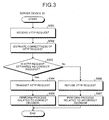
- Fig. 3 is a flow chart for explaining the procedure of a filtering process according to the first embodiment.
- the receiving unit 31 of the request filter 30 in the server device 20 receives an HTTP request from the client device 10 before the HTTP request is received by the Web server 40 (step S301).
- the estimation unit 32 of the request filter 30 estimates the correctness of the HTTP request on the basis of the pattern of an incorrect access stored in the incorrect request DB 33 and the predetermined estimation rule 32a (step S302). More specifically, when the HTTP request corresponds to any one of the patterns of incorrect accesses, the estimation unit 32 estimates that the HTTP request is an incorrect request. On the other hand, when the HTTP request does not corresponds to any one of the patterns of incorrect accesses, the estimation unit 32 estimates that the HTTP request is a correct request.
- the decision unit 34 of the request filter 30 decides, on the basis of the estimation result received from the estimation unit 32 and the predetermined decision rule 34a, whether the HTTP request is given to the Web server 40 or not (step S303). More specifically, the decision unit 34 decides whether it is estimated or not by the estimation unit 32 that the HTTP request is a correct request.
- the transmission unit 35 of the request filter 30 gives the HTTP request to the Web server 40 by inter-process communication (step S304), and the Web server 40 performs a process in a correctness decision state, e.g., a process of transmitting information depending on the HTTP request to the client device 10 (step S305).
- a correctness decision state e.g., a process of transmitting information depending on the HTTP request to the client device 10
- the transmission unit 35 refuses to give the HTTP request to the Web server 40 (step S306), and the respective components of the request filter 30 perform processes in an incorrect decision state such as waste of an incorrect request, storage in the storage medium 36b, and notification to the external device 50 (step S307).
- the Web server 40 without transmission source information of an access request, it can be rapidly and reliably decided by checking whether the concrete request contents of the access request correspond to the pattern of an incorrect request or not whether the access is an incorrect access or not. In this manner, the Web server 40 can also be rapidly and reliably controlled for an incorrect access from the client device 10 which is not recognized as an incorrect client.
- the present invention is not limited to this case, and the present invention can similarly applied to a case in which it is decided by the degree of correspondence between an HTTP request and the patterns of incorrect accesses.
- the estimation unit 32 in second embodiment calculates a predetermined estimation value depending on the degree of correspondence between an HTTP request from the client device 10 and the patterns of incorrect accesses stored in the incorrect request DB 33 and outputs the estimation value to the decision unit 34.
- the number of patterns, which correspond to the HTTP request, of the patterns of incorrect accesses is calculated, or the degrees of danger are given to the respective patterns to calculate the degrees of danger of the patterns which correspond to the HTTP request, so that an estimation value called a DI (Danger Index) representing the degree of danger of the HTTP request is calculated.
- the estimation value DI is an integer value falling within the range of, e.g., 1 to 100, and is calculated as a large value when the degree of danger of an HTTP request is high.
- the decision unit 34 in second embodiment compares the estimation value DI calculated by the estimation unit 32 with a predetermined threshold value to decide whether the decision result is given to the Web server 40 or not, and outputs decision result to the transmission unit 35.
- the predetermined threshold value is 50
- an estimation value the DI of which is smaller than 50 is received from the estimation unit 32
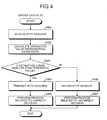
- Fig. 4 is a flow chart for explaining the procedure of a filtering process according to the second embodiment.
- the receiving unit 31 of the request filter 30 in the server device 20 receives an HTTP request from the client device 10 before the HTTP request is received by the Web server 40 (step S401).
- the estimation unit 32 of the request filter 30 calculates an estimation value DI depending on the degree of correspondence between an HTTP request and the patterns of incorrect accesses stored in the incorrect request DB 33 (step S402).
- the decision unit 34 of the request filter 30 compares the estimation value DI calculated by the estimation unit 32 with a predetermined threshold value to decide whether the HTTP request is given to the Web server 40 or not (step S403). More specifically, it is decided whether the estimation value DI is equal to or more than the threshold value or not.
- the transmission unit 35 of the request filter 30 gives the HTTP request to the Web server 40 by inter-process communication (step S404), and the Web server 40 performs a process in a correctness decision state, e.g., a process of transmitting information depending on the HTTP request to the client device 10 (step S405).
- the transmission unit 35 of the request filter 30 refuses to give the HTTP request to the Web server 40 (step S406), and the respective components of the request filter 30 perform processes in an incorrect decision state such as waste of an incorrect request, storage in the storage medium 36b, and notification to the external device 50 (step S407).
- the Web server 40 can be controlled with some margin for an incorrect access from the client device 10 which is not recognized as an incorrect client.
- the present invention is not limited to this case.
- the present invention can similarly applied to the case in which estimation is performed for only some of the HTTP requests.
- Fig. 5 is a block diagram showing the configuration of a client server system according to the third embodiment.
- the same reference numerals as in Fig. 1 denote the same parts in Fig. 5, and a description thereof will be omitted.
- An advance decision unit 71 and a correct request DB 72 which are characteristic parts of third embodiment will be described below.
- the advance decision unit 71 of a request filter 70 in a server device 60 is a process unit for deciding whether estimation of an HTTP request can be omitted or not on the basis of the patterns of correct accesses stored in the correct request DB 72 and a predetermined advance decision rule 71a before estimation of correctness is performed by the estimation unit 32.
- the correct request DB 72 which is referred to by the advance decision unit 71 in decision will be described below.
- the correct request DB 72 is a database in which the patterns of correct accesses to the Web server 40. More specifically, the path of a file, which may be seen by a remote user, of files existing on the Web server 40 is stored.
- the file which may be seen by the remote user is a file except for a file such as a password file which must not be seen by the remote user.
- the file includes a file, such as an image file having a very high rate as request contents of an HTTP request to the Web server 40, which is rarely incorrectly accessed.
- the advance decision unit 71 decides, on the basis of the predetermined advance decision rule 71a, whether estimation of the HTTP request can be omitted or not. More specifically, when the HTTP request corresponds to any one of the patterns of correct access, it is decided that estimation of the HTTP request can be omitted. On the other hand, when the HTTP request corresponds to any one of the patterns of correct accesses stored in the correct request DB 72, it is decided that the estimation of the HTTP request can be omitted.
- the advance decision unit 71 outputs only the HTTP request the estimation of which cannot be omitted to the estimation unit 32, and omits the processes performed by the estimation unit 32 and the decision unit 34 with respect to an HTTP request the estimation of which can be omitted to give the HTTP request to the Web server 40 through the transmission unit 35.
- the patterns of correct accesses stored in the correct request DB 72 are updated by the updating unit 39 depending on a case in which an image file is added to the Web server 40.
- Fig. 6 is a flow chart for explaining the procedure of the filtering process according to thir embodiment.
- the receiving unit 31 of the request filter 70 in the server device 60 receives an HTTP request from the client device 10 before the HTTP request is received by the Web server 40 (step S601).
- the advance decision unit 71 of the request filter 70 decides, on the basis of the patterns of correct accesses stored in the correct request DB 72 and the predetermined advance decision rule 71a, whether estimation of the HTTP request can be omitted or not (step S602). More specifically, the advance decision unit 71 decides whether the HTTP request corresponds to any one of the patterns of correct accesses stored in the correct request DB 72.
- step S602 If it is decided by the above decision that the HTTP request corresponds to any one of the patterns of correct accesses (YES in step S602), estimation of the correctness of the HTTP request is omitted, and the transmission unit 35 of the request filter 70 gives the HTTP request to the Web server 40 through inter-process communication (step S605), and the Web server 40 performs a process in a correct decision state such as a process of transmitting information depending on the HTTP request to the client device 10 (step S606).
- step S602 it is decided that the HTTP request does not correspond to any one of the patterns of correct accesses (NO in step S602), and the HTTP request is given to the estimation unit 32, and the same process as the filtering process in first and second embodiments is performed (steps S603 to 608).
- the estimation unit 32 of the request filter 70 estimates the correctness of the HTTP request (step S603), and the decision unit 34 decides whether the HTTP request is given to the Web server 40 (step S604).
- the transmission unit 35 of the request filter 70 gives the HTTP request to the Web server 40 by inter-process communication (step S605), and the Web server 40 performs a process in a correct decision state such as a process of transmitting information depending on the HTTP request to the client device 10 (step S606).
- the transmission unit 35 of the request filter 70 refuses to give the HTTP request to the Web server 40 (step S607), and the respective components of the request filter 70 perform processes in an incorrect decision state such as waste of an incorrect request, storage in the storage medium 36b, and notification to the external device 50 (step S608).
- a rapid process can be performed without the processes performed by the estimation unit 32 and the incorrect request DB 33.
- an HTTP request having a high level of aggression, for requesting a password file or a file existing on the Web server 40
- the processes by the estimation unit 32 and the incorrect request DB 33 are performed, so that the attack can be effectively prevented.
- the present invention is not limited to this case, and can similarly be applied to a case in which any information such as FTP (File Transfer Protocol), telenet, or console which is input from the client device 10 to the Web server 40.
- FTP File Transfer Protocol
- telenet Telenet
- console console which is input from the client device 10 to the Web server 40.
- the present invention is not limited to the case.
- the present invention can similarly applied to any system configuration in which a request filter is interposed between a client device and a Web server such as a configuration in which request filters are arranged on the client device sides or a configuration in which a plurality of Web servers are controlled by one request filter.
- the filtering methods described in the first to third embodiments can be realized by executing prepared programs in computers such as personal computers and workstations.
- the programs can be distributed through networks such as the Internet.
- the programs can be recorded on computer readable recording media such as a hard disk, a floppy disk, a CD-ROM, an MO, and a DVD, and are executed such that the programs are read from the recording media by computers.
- correctness of an access request is estimated on the basis of the patterns of incorrect accesses in an incorrect pattern database in which the patterns of incorrect accesses to a server are stored and a predetermined estimation rule, and it is decided, on the basis of the estimation result and a predetermined decision rule, whether the access request is given to the server or not, so that it can be decided on the basis of the concrete request contents of the access request without transmission source information of the access request. For this reason, only a correct access request can be given to the server, and the server can be protected from an incorrect access from a client which is not recognized as an incorrect client.
- the access request is an incorrect access when the access request corresponds to any one of the patterns of incorrect accesses stored in the incorrect pattern database, and it is estimated that the access request is a correct access when the access request does not correspond to any one the patterns of incorrect accesses stored in the incorrect pattern database, and the decision unit decides that the access request which is estimated as an incorrect access is not given to the server and decides that the access request which is estimated as a correct access is given to the server. For this reason, it can be rapidly and reliably decided, by checking whether the access request corresponds to the pattern of an incorrect request or not, whether the access is an incorrect access or not. Therefore, the server can be protected from an incorrect access from a client which is recognized as an incorrect client.
- a predetermined estimation value is calculated depending on the degree of correspondence between the access request and the patterns of incorrect accesses stored in the incorrect pattern database, and the estimation value calculated by the estimation unit is compared with a predetermined threshold value to decide whether the access request is given to the server or not. For this reason, it can be decided with some margin by comparing the estimation value and the threshold value with each other whether the access request is an incorrect access or not. Therefore, the server can also be protected with some margin from an incorrect access from the client device which is not recognized as an incorrect client.
- an access request which is decided not to be given to the server can be sent to a predetermined external device. For this reason, information related to an incorrect access can be rapidly transmitted to an administrator of the server, an administrator of a filtering device, an administrator of an entire server device, an administrator of a public association which monitors the network as a whole, and the like. Therefore, this configuration can urge these administrators to perform a countermeasure for maintenance of the server.
- an access request which is decided not to be given to the server is stored in a predetermined storage unit. For this reason, information related to incorrect accesses stored in the storage can be analyzed. Therefore, a further countermeasure for maintenance of the server can be performed.
- the incorrect pattern database, the correct pattern database, the estimation rule, the decision rule, the external transmission rule, the storage rule, or an updating rule is updated. For this reason, the pattern of an incorrect access which is newly found can be registered in the incorrect pattern database. Therefore, this configuration can tactfully cope with incorrect accesses advancing everyday.
Landscapes
- Engineering & Computer Science (AREA)
- Computer Security & Cryptography (AREA)
- Computer Networks & Wireless Communication (AREA)
- Signal Processing (AREA)
- Computer Hardware Design (AREA)
- Computing Systems (AREA)
- General Engineering & Computer Science (AREA)
- Business, Economics & Management (AREA)
- General Business, Economics & Management (AREA)
- Computer And Data Communications (AREA)
- Data Exchanges In Wide-Area Networks (AREA)
- Information Retrieval, Db Structures And Fs Structures Therefor (AREA)
Abstract
Description
Claims (21)
- A filtering apparatus, interposed between a client and a server, said server providing services depending on access requests from said client, for passing to said server only a correct access request from said client, said filtering device comprising:an incorrect pattern database which stores patterns of incorrect accesses to said server;an estimation unit which estimates the correctness of the access request on the basis of the patterns of incorrect accesses stored in said incorrect pattern database and a predetermined estimation rule; anda decision unit which decides, on the basis of a result of estimation by said estimation unit and a predetermined decision rule, whether the access request is to be passed to said server.
- The filtering apparatus according to claim 1, wherein said estimation unit estimates that the access request is an incorrect access when the access request corresponds to any one of the patterns of incorrect accesses stored in said incorrect pattern database, and estimates that the access request is a correct access when the access request does not correspond to any one the patterns of incorrect accesses stored in the incorrect pattern database, and
said decision unit decides that the access request which is estimated as an incorrect access by said estimation unit is not to be passed to said server, and decides that the access request which is estimated as a correct access by said estimation unit is to be passed to said server. - The filtering apparatus according to claim 1, wherein said estimation unit calculates a predetermined estimation value depending on the degree of correspondence between the access request and the patterns of incorrect accesses stored in said incorrect pattern database, and
said decision unit compares the estimation value calculated by said estimation unit with a predetermined threshold value to decide whether the access request is to be passed to said server. - The filtering apparatus according to claim 1, 2 or 3, further comprising:wherein said estimation unit estimates correctness of only that access request which said advance decision unit decides that does not correspond to the patterns of correct accesses stored in said correct pattern database.a correct pattern database which stores patterns of correct accesses to said server; andan advance decision unit which decides whether the access request corresponds to any one of the patterns of correct accesses stored in said correct pattern database prior to estimation of correctness performed by said estimation unit,
- The filtering apparatus according to claim any preceding claim, further comprising an external transmission unit which transmits an access request which is decided not to be passed to said server by said decision unit to a predetermined external device on the basis of a predetermined external transmission rule.
- The filtering apparatus according to any preceding claim, further comprising a storage unit which stores an access request which is decided not to be passed to said server by said decision unit on the basis of a predetermined storage rule.
- The filtering apparatus according to any preceding claim, further comprising an updating unit which updates the incorrect pattern database, the correct pattern database, the estimation rule, the decision rule, the external transmission rule, the storage rule, or an updating rule on the basis of a predetermined updating rule.
- A filtering method of passing to a server only a correct access request from a client, said server providing services depending on access requests from said client, the method comprising the steps of:referring to an incorrect pattern database in which the patterns of incorrect accesses to said server are stored to estimate correctness of the access request on the basis of the patterns of incorrect accesses which are referred to and a predetermined estimation rule; anddeciding, on the basis of result of the estimation at the estimation step and a predetermined decision rule, whether the access request is to be passed to said server.
- The filtering method according to claim 8, wherein in the estimation step it is estimated that the access request is an incorrect access when the access request corresponds to any one of the patterns of incorrect accesses stored in the incorrect pattern database, and it is estimated the access request is a correct access when the access request does not correspond to any one the patterns of incorrect accesses stored in said incorrect pattern database, and
in the decision step it is decided that the access request which is estimated as an incorrect access at the estimation step is not to be passes to said server, and it is decided that the access request which is estimated as a correct access at the estimation step is to be passed to said server. - The filtering method according to claim 8, wherein at the estimation step a predetermined estimation value is calculated depending on the degree of correspondence between the access request and the patterns of incorrect accesses stored in said incorrect pattern database, and
in the decision step the estimation value calculated at the estimation step is compared with a predetermined threshold value to decide whether the access request is to be passed to said server. - The filtering method according to claim 8, 9 or 10, further comprising the advance decision step of deciding, with reference to a correct pattern database in which patterns of correct accesses to said server are stored,. whether the access request corresponds to any one of the patterns of correct accesses stored in said correct pattern database prior to estimation of correctness performed by the estimation step,
wherein in the estimation step correctness of only an access request which is decided not to correspond to the patterns of correct accesses at the advance decision step is estimated. - The filtering method according to claim 8, 9, 10 or 11, further comprising the external transmission step of transmitting an access request which is decided not to be passed to said server at the decision step to a predetermined external device on the basis of a predetermined external transmission rule.
- The filtering method according to claim 8, 9, 10, 11 or 12, further comprising the storage step of storing an access request which is decided not to be passed to said server at the decision step on the basis of a predetermined storage rule.
- The filtering method according to claim 8, 9, 10, 11, 12 or 13, further comprising the updating step of updating the incorrect pattern database, the correct pattern database, the estimation rule, the decision rule, the external transmission rule, the storage rule, or an updating rule on the basis of a predetermined updating rule.
- A computer program containing instructions which when executed on a computer realizes a filtering method of passing to a server only a correct access request from a client, said server providing services depending on access requests from said client, the method comprising the steps of:referring to an incorrect pattern database in which the patterns of incorrect accesses to said server are stored to estimate correctness of the access request on the basis of the patterns of incorrect accesses which are referred to and a predetermined estimation rule; anddeciding, on the basis of result of the estimation at the estimation step and a predetermined decision rule, whether the access request is to be passed to said server.
- The computer program according to claim 15, wherein in the estimation step it is estimated that the access request is an incorrect access when the access request corresponds to any one of the patterns of incorrect accesses stored in the incorrect pattern database, and it is estimated the access request is a correct access when the access request does not correspond to any one the patterns of incorrect accesses stored in said incorrect pattern database, and
in the decision step it is decided that the access request which is estimated as an incorrect access at the estimation step is not to be passed to said server, and it is decided that the access request which is estimated as a correct access at the estimation step is to be passed to said server. - The computer program according to claim 15, wherein at the estimation step a predetermined estimation value is calculated depending on the degree of correspondence between the access request and the patterns of incorrect accesses stored in said incorrect pattern database, and
in the decision step the estimation value calculated at the estimation step is compared with a predetermined threshold value to decide whether the access request is to be passed to said server. - The computer program according to claim 15, 16 or 17, further containing instructions which when executed on a computer realize the advance decision step of deciding, with reference to a correct pattern database in which patterns of correct accesses to said server are stored, whether the access request corresponds to any one of the patterns of correct accesses stored in said correct pattern database prior to estimation of correctness performed by the estimation step,
wherein in the estimation step correctness of only an access request which is decided not to correspond to the patterns of correct accesses at the advance decision step is estimated. - The computer program according to claim 15, 16, 17 or 18, further containing instructions which when executed on a computer realize the external transmission step of transmitting an access request which is decided not to be passed to said server at the decision step to a predetermined external device on the basis of a predetermined external transmission rule.
- The computer program according to claim 15, 16, 17, 18 or 19, further containing instructions which when executed on a computer realize the storage step of storing an access request which is decided not to be passed to said server at the decision step on the basis of a predetermined storage rule.
- The computer program according to claim 15, 16, 17, 18, 19 or 20, further containing instructions which when executed on a computer realize the updating step of updating the incorrect pattern database, the correct pattern database, the estimation rule, the decision rule, the external transmission rule, the storage rule, or an updating rule on the basis of a predetermined updating rule.
Applications Claiming Priority (2)
| Application Number | Priority Date | Filing Date | Title |
|---|---|---|---|
| JP2001071214 | 2001-03-13 | ||
| JP2001071214 | 2001-03-13 |
Publications (3)
| Publication Number | Publication Date |
|---|---|
| EP1241849A2 true EP1241849A2 (en) | 2002-09-18 |
| EP1241849A3 EP1241849A3 (en) | 2003-07-30 |
| EP1241849B1 EP1241849B1 (en) | 2005-11-09 |
Family
ID=18928969
Family Applications (1)
| Application Number | Title | Priority Date | Filing Date |
|---|---|---|---|
| EP01118752A Expired - Lifetime EP1241849B1 (en) | 2001-03-13 | 2001-08-07 | Method of and apparatus for filtering access, and computer product |
Country Status (4)
| Country | Link |
|---|---|
| US (1) | US20020133603A1 (en) |
| EP (1) | EP1241849B1 (en) |
| JP (2) | JP2008152791A (en) |
| DE (1) | DE60114763T2 (en) |
Cited By (4)
| Publication number | Priority date | Publication date | Assignee | Title |
|---|---|---|---|---|
| EP1604296A4 (en) * | 2002-11-08 | 2010-09-08 | Fed Network Systems Llc | SYSTEMS AND METHODS FOR AVOIDING INTRUSION IN WEB ACCOMMODATION |
| US8397296B2 (en) | 2002-11-08 | 2013-03-12 | Verizon Patent And Licensing Inc. | Server resource management, analysis, and intrusion negation |
| CN104994104B (en) * | 2015-07-06 | 2018-03-16 | 浙江大学 | Server fingerprint mimicry and sensitive information mimicry method based on WEB security gateways |
| JP2018205865A (en) * | 2017-05-31 | 2018-12-27 | ヴイストン株式会社 | Information communication device and server device |
Families Citing this family (19)
| Publication number | Priority date | Publication date | Assignee | Title |
|---|---|---|---|---|
| US20030121003A1 (en) * | 2001-12-20 | 2003-06-26 | Sun Microsystems, Inc. | Application launcher testing framework |
| US7552189B2 (en) * | 2002-01-18 | 2009-06-23 | Bea Systems, Inc. | System and method for using virtual directories to service URL requests URL requests in application servers |
| US7197530B2 (en) * | 2002-01-18 | 2007-03-27 | Bea Systems, Inc. | System and method for pluggable URL pattern matching for servlets and application servers |
| US20030140100A1 (en) * | 2002-01-18 | 2003-07-24 | Sam Pullara | System and method for URL response caching and filtering in servlets and application servers |
| US20040073811A1 (en) * | 2002-10-15 | 2004-04-15 | Aleksey Sanin | Web service security filter |
| CN102082780B (en) * | 2009-11-30 | 2014-03-05 | 国际商业机器公司 | Method and device for security verification |
| JP5656266B2 (en) * | 2012-01-24 | 2015-01-21 | Necソリューションイノベータ株式会社 | Blacklist extraction apparatus, extraction method and extraction program |
| CN104580216B (en) * | 2015-01-09 | 2017-10-03 | 北京京东尚科信息技术有限公司 | A kind of system and method limited access request |
| JP6098687B2 (en) * | 2015-09-10 | 2017-03-22 | 日本電気株式会社 | Communication destination determination device, communication destination determination method, and communication destination determination program |
| GB201603118D0 (en) | 2016-02-23 | 2016-04-06 | Eitc Holdings Ltd | Reactive and pre-emptive security system based on choice theory |
| US10785259B2 (en) | 2016-04-19 | 2020-09-22 | Mitsubishi Electric Corporation | Relay device |
| JP6750457B2 (en) * | 2016-10-31 | 2020-09-02 | 富士通株式会社 | Network monitoring device, program and method |
| EP3577589B1 (en) | 2016-12-08 | 2024-01-03 | Cequence Security, Inc. | Prevention of malicious automation attacks on a web service |
| US10728256B2 (en) | 2017-10-30 | 2020-07-28 | Bank Of America Corporation | Cross channel authentication elevation via logic repository |
| US10621341B2 (en) | 2017-10-30 | 2020-04-14 | Bank Of America Corporation | Cross platform user event record aggregation system |
| US10721246B2 (en) | 2017-10-30 | 2020-07-21 | Bank Of America Corporation | System for across rail silo system integration and logic repository |
| JP7186637B2 (en) * | 2019-02-21 | 2022-12-09 | 三菱電機株式会社 | Detection rule group adjustment device and detection rule group adjustment program |
| JP6998099B1 (en) | 2021-08-03 | 2022-01-18 | サイバーマトリックス株式会社 | How to detect fraudulent access requests |
| US12267299B2 (en) | 2022-01-12 | 2025-04-01 | Bank Of America Corporation | Preemptive threat detection for an information system |
Family Cites Families (11)
| Publication number | Priority date | Publication date | Assignee | Title |
|---|---|---|---|---|
| CA2176775C (en) * | 1995-06-06 | 1999-08-03 | Brenda Sue Baker | System and method for database access administration |
| US5826014A (en) * | 1996-02-06 | 1998-10-20 | Network Engineering Software | Firewall system for protecting network elements connected to a public network |
| WO1997036246A1 (en) * | 1996-03-22 | 1997-10-02 | Hitachi, Ltd. | Method and device for managing computer network |
| JPH09269930A (en) * | 1996-04-03 | 1997-10-14 | Hitachi Ltd | Quarantine method and device for network system |
| US6453345B2 (en) * | 1996-11-06 | 2002-09-17 | Datadirect Networks, Inc. | Network security and surveillance system |
| JP2001515669A (en) * | 1997-03-06 | 2001-09-18 | ソフトウエア アンド システムズ エンジニアリング リミテッド | System and method for granting access to information in a distributed computer system |
| WO1999066385A2 (en) * | 1998-06-19 | 1999-12-23 | Sun Microsystems, Inc. | Scalable proxy servers with plug in filters |
| JP4501280B2 (en) * | 1998-12-09 | 2010-07-14 | インターナショナル・ビジネス・マシーンズ・コーポレーション | Method and apparatus for providing network and computer system security |
| JP3664906B2 (en) * | 1999-02-05 | 2005-06-29 | シャープ株式会社 | Information source observation apparatus, information source observation method, and recording medium storing a program for executing information source observation processing |
| JP3618245B2 (en) * | 1999-03-09 | 2005-02-09 | 株式会社日立製作所 | Network monitoring system |
| US20030051026A1 (en) * | 2001-01-19 | 2003-03-13 | Carter Ernst B. | Network surveillance and security system |
-
2001
- 2001-07-25 US US09/911,511 patent/US20020133603A1/en not_active Abandoned
- 2001-08-07 EP EP01118752A patent/EP1241849B1/en not_active Expired - Lifetime
- 2001-08-07 DE DE60114763T patent/DE60114763T2/en not_active Expired - Lifetime
-
2007
- 2007-12-25 JP JP2007333041A patent/JP2008152791A/en active Pending
- 2007-12-25 JP JP2007333040A patent/JP4911018B2/en not_active Expired - Fee Related
Cited By (6)
| Publication number | Priority date | Publication date | Assignee | Title |
|---|---|---|---|---|
| EP1604296A4 (en) * | 2002-11-08 | 2010-09-08 | Fed Network Systems Llc | SYSTEMS AND METHODS FOR AVOIDING INTRUSION IN WEB ACCOMMODATION |
| US8001239B2 (en) | 2002-11-08 | 2011-08-16 | Verizon Patent And Licensing Inc. | Systems and methods for preventing intrusion at a web host |
| US8397296B2 (en) | 2002-11-08 | 2013-03-12 | Verizon Patent And Licensing Inc. | Server resource management, analysis, and intrusion negation |
| US8763119B2 (en) | 2002-11-08 | 2014-06-24 | Home Run Patents Llc | Server resource management, analysis, and intrusion negotiation |
| CN104994104B (en) * | 2015-07-06 | 2018-03-16 | 浙江大学 | Server fingerprint mimicry and sensitive information mimicry method based on WEB security gateways |
| JP2018205865A (en) * | 2017-05-31 | 2018-12-27 | ヴイストン株式会社 | Information communication device and server device |
Also Published As
| Publication number | Publication date |
|---|---|
| EP1241849B1 (en) | 2005-11-09 |
| DE60114763D1 (en) | 2005-12-15 |
| US20020133603A1 (en) | 2002-09-19 |
| DE60114763T2 (en) | 2006-06-01 |
| JP2008152791A (en) | 2008-07-03 |
| JP4911018B2 (en) | 2012-04-04 |
| JP2008146660A (en) | 2008-06-26 |
| EP1241849A3 (en) | 2003-07-30 |
Similar Documents
| Publication | Publication Date | Title |
|---|---|---|
| EP1241849B1 (en) | Method of and apparatus for filtering access, and computer product | |
| US20020133606A1 (en) | Filtering apparatus, filtering method and computer product | |
| US7958549B2 (en) | Attack defending system and attack defending method | |
| US7738373B2 (en) | Method and apparatus for rapid location of anomalies in IP traffic logs | |
| CN115134099A (en) | Network attack behavior analysis method and device based on full flow | |
| US20050188080A1 (en) | Methods, systems and computer program products for monitoring user access for a server application | |
| US20050188222A1 (en) | Methods, systems and computer program products for monitoring user login activity for a server application | |
| US20050188423A1 (en) | Methods, systems and computer program products for monitoring user behavior for a server application | |
| US8726384B2 (en) | Apparatus, and system for determining and cautioning users of internet connected clients of potentially malicious software and method for operating such | |
| US20050188079A1 (en) | Methods, systems and computer program products for monitoring usage of a server application | |
| US20050188221A1 (en) | Methods, systems and computer program products for monitoring a server application | |
| US20050187934A1 (en) | Methods, systems and computer program products for geography and time monitoring of a server application user | |
| US20050198099A1 (en) | Methods, systems and computer program products for monitoring protocol responses for a server application | |
| JP2002342279A (en) | Filtering device, filtering method, and program for causing computer to execute this method | |
| JP4630896B2 (en) | Access control method, access control system, and packet communication apparatus | |
| WO2001078312A1 (en) | Method and system for website content integrity | |
| US20070156898A1 (en) | Method, apparatus and computer program for access control | |
| CN108810008A (en) | Transmission control protocol traffic filtering method, apparatus, server and storage medium | |
| KR100758796B1 (en) | Real-time service management system for enterprise and its method | |
| JP2001313640A (en) | Method and system for determining access type in communication network, recording medium | |
| IL191722A (en) | Method, apparatus and computer program for accrss control | |
| KR20020012855A (en) | Integrated log analysis and management system and method thereof | |
| KR100611933B1 (en) | Harmful traffic blocking device and method using home gateway in home network | |
| JP2003186763A (en) | How to detect and prevent unauthorized intrusion into computer systems | |
| KR20000058818A (en) | Emergency alarm system of internet server |
Legal Events
| Date | Code | Title | Description |
|---|---|---|---|
| PUAI | Public reference made under article 153(3) epc to a published international application that has entered the european phase |
Free format text: ORIGINAL CODE: 0009012 |
|
| AK | Designated contracting states |
Kind code of ref document: A2 Designated state(s): AT BE CH CY DE DK ES FI FR GB GR IE IT LI LU MC NL PT SE TR |
|
| AX | Request for extension of the european patent |
Free format text: AL;LT;LV;MK;RO;SI |
|
| PUAL | Search report despatched |
Free format text: ORIGINAL CODE: 0009013 |
|
| AK | Designated contracting states |
Designated state(s): AT BE CH CY DE DK ES FI FR GB GR IE IT LI LU MC NL PT SE TR |
|
| AX | Request for extension of the european patent |
Extension state: AL LT LV MK RO SI |
|
| RIC1 | Information provided on ipc code assigned before grant |
Ipc: 7G 06F 1/00 B Ipc: 7H 04L 29/06 A Ipc: 7H 04L 29/08 B |
|
| 17P | Request for examination filed |
Effective date: 20031127 |
|
| AKX | Designation fees paid |
Designated state(s): DE FR GB |
|
| 17Q | First examination report despatched |
Effective date: 20040419 |
|
| GRAP | Despatch of communication of intention to grant a patent |
Free format text: ORIGINAL CODE: EPIDOSNIGR1 |
|
| GRAS | Grant fee paid |
Free format text: ORIGINAL CODE: EPIDOSNIGR3 |
|
| GRAA | (expected) grant |
Free format text: ORIGINAL CODE: 0009210 |
|
| AK | Designated contracting states |
Kind code of ref document: B1 Designated state(s): DE FR GB |
|
| REG | Reference to a national code |
Ref country code: GB Ref legal event code: FG4D |
|
| REF | Corresponds to: |
Ref document number: 60114763 Country of ref document: DE Date of ref document: 20051215 Kind code of ref document: P |
|
| ET | Fr: translation filed | ||
| PLBE | No opposition filed within time limit |
Free format text: ORIGINAL CODE: 0009261 |
|
| STAA | Information on the status of an ep patent application or granted ep patent |
Free format text: STATUS: NO OPPOSITION FILED WITHIN TIME LIMIT |
|
| 26N | No opposition filed |
Effective date: 20060810 |
|
| REG | Reference to a national code |
Ref country code: FR Ref legal event code: PLFP Year of fee payment: 16 |
|
| PGFP | Annual fee paid to national office [announced via postgrant information from national office to epo] |
Ref country code: DE Payment date: 20160802 Year of fee payment: 16 Ref country code: GB Payment date: 20160803 Year of fee payment: 16 |
|
| PGFP | Annual fee paid to national office [announced via postgrant information from national office to epo] |
Ref country code: FR Payment date: 20160712 Year of fee payment: 16 |
|
| REG | Reference to a national code |
Ref country code: DE Ref legal event code: R119 Ref document number: 60114763 Country of ref document: DE |
|
| GBPC | Gb: european patent ceased through non-payment of renewal fee |
Effective date: 20170807 |
|
| REG | Reference to a national code |
Ref country code: FR Ref legal event code: ST Effective date: 20180430 |
|
| PG25 | Lapsed in a contracting state [announced via postgrant information from national office to epo] |
Ref country code: DE Free format text: LAPSE BECAUSE OF NON-PAYMENT OF DUE FEES Effective date: 20180301 Ref country code: GB Free format text: LAPSE BECAUSE OF NON-PAYMENT OF DUE FEES Effective date: 20170807 |
|
| PG25 | Lapsed in a contracting state [announced via postgrant information from national office to epo] |
Ref country code: FR Free format text: LAPSE BECAUSE OF NON-PAYMENT OF DUE FEES Effective date: 20170831 |