EP1241682A1 - Pompe primaire de centrale nucléaire - Google Patents
Pompe primaire de centrale nucléaire Download PDFInfo
- Publication number
- EP1241682A1 EP1241682A1 EP02290400A EP02290400A EP1241682A1 EP 1241682 A1 EP1241682 A1 EP 1241682A1 EP 02290400 A EP02290400 A EP 02290400A EP 02290400 A EP02290400 A EP 02290400A EP 1241682 A1 EP1241682 A1 EP 1241682A1
- Authority
- EP
- European Patent Office
- Prior art keywords
- thermal barrier
- peripheral skirt
- circular bottom
- heat exchanger
- barrier cover
- Prior art date
- Legal status (The legal status is an assumption and is not a legal conclusion. Google has not performed a legal analysis and makes no representation as to the accuracy of the status listed.)
- Granted
Links
Images

Classifications
-
- G—PHYSICS
- G21—NUCLEAR PHYSICS; NUCLEAR ENGINEERING
- G21C—NUCLEAR REACTORS
- G21C15/00—Cooling arrangements within the pressure vessel containing the core; Selection of specific coolants
- G21C15/24—Promoting flow of the coolant
- G21C15/243—Promoting flow of the coolant for liquids
-
- G—PHYSICS
- G21—NUCLEAR PHYSICS; NUCLEAR ENGINEERING
- G21D—NUCLEAR POWER PLANT
- G21D1/00—Details of nuclear power plant
- G21D1/04—Pumping arrangements
-
- Y—GENERAL TAGGING OF NEW TECHNOLOGICAL DEVELOPMENTS; GENERAL TAGGING OF CROSS-SECTIONAL TECHNOLOGIES SPANNING OVER SEVERAL SECTIONS OF THE IPC; TECHNICAL SUBJECTS COVERED BY FORMER USPC CROSS-REFERENCE ART COLLECTIONS [XRACs] AND DIGESTS
- Y02—TECHNOLOGIES OR APPLICATIONS FOR MITIGATION OR ADAPTATION AGAINST CLIMATE CHANGE
- Y02E—REDUCTION OF GREENHOUSE GAS [GHG] EMISSIONS, RELATED TO ENERGY GENERATION, TRANSMISSION OR DISTRIBUTION
- Y02E30/00—Energy generation of nuclear origin
-
- Y—GENERAL TAGGING OF NEW TECHNOLOGICAL DEVELOPMENTS; GENERAL TAGGING OF CROSS-SECTIONAL TECHNOLOGIES SPANNING OVER SEVERAL SECTIONS OF THE IPC; TECHNICAL SUBJECTS COVERED BY FORMER USPC CROSS-REFERENCE ART COLLECTIONS [XRACs] AND DIGESTS
- Y02—TECHNOLOGIES OR APPLICATIONS FOR MITIGATION OR ADAPTATION AGAINST CLIMATE CHANGE
- Y02E—REDUCTION OF GREENHOUSE GAS [GHG] EMISSIONS, RELATED TO ENERGY GENERATION, TRANSMISSION OR DISTRIBUTION
- Y02E30/00—Energy generation of nuclear origin
- Y02E30/30—Nuclear fission reactors
Definitions
- the present invention relates to a primary plant pump nuclear.
- Nuclear power plant primary pumps include a shaft for rotating a wheel and, above said wheel and concentrically to said shaft, a heat exchanger forming a barrier thermal, a thermal barrier cover comprising a peripheral skirt provided at its base with a circular bottom extending below the heat exchanger heat and a pump diffuser comprising a concentric peripheral skirt to said peripheral skirt of the thermal barrier cover and provided at its base a crown extending below the circular bottom of said body.
- This type of primary pump also includes a ring called labyrinth ring arranged between the heat exchanger and the shaft, as well that a body on which the heat exchanger and the peripheral skirt are fixed of the thermal barrier cover. This body is connected to the barrier cover thermal by connecting elements.
- the crown of the diffuser has a central bore of passage of the tree provided with a succession of circumferential rings and superimposed forming a labyrinth type lip seal.
- the crown of the diffuser carrying the lip seal of the type labyrinth is arranged in the transition zone between the hot water of the circuit primary which is at a temperature of around 300 ° C and the cooled area of the pump which is at a temperature of about 40 ° C.
- the crown of the diffuser and therefore the labyrinth type seal are subjected to a significant thermal gradient which favors the formation of thermal fatigue cracks on the lips of this joint.
- the object of the invention is to avoid these drawbacks by proposing a nuclear power plant primary pump in which the distribution of temperatures at the labyrinth type lip seal between the hot water of the primary circuit and the cooled zone is modified so as to reduce the formation of cracks in this joint.
- the subject of the invention is therefore a primary plant pump nuclear, of the type comprising, on the one hand, a rotational drive shaft of a wheel and, above said wheel and concentrically with said shaft, a heat exchanger forming a thermal barrier, a barrier cover thermal comprising a peripheral skirt provided at its base with a circular bottom extending below the heat exchanger and a diffuser comprising a peripheral skirt provided at its base with a crown extending below the circular bottom of the thermal barrier cover and, on the other hand, a body on which are attached the heat exchanger and the peripheral skirt of the cover thermal barrier, characterized in that the circular bottom of the cover thermal barrier cleaning with the base of the one-room heat exchanger lower cold water and has a central bore with a succession circumferential and superimposed rings forming a lip seal of the type labyrinth and in that the circular bottom and the peripheral skirt of the cover of thermal barrier and the crown and peripheral skirt of the diffuser protect between them a clearance forming a space for holding a cooling fluid stagnant.
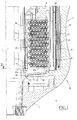
- Fig. 1 there is shown schematically a part of a primary pump of a nuclear power plant and which is a helical type pump single-stage centrifugal, vertical suction and horizontal discharge.
- This pump designated by the general reference 1 comprises a shaft 2 for rotating a wheel 3 fixed by appropriate means at the base of said shaft 2.
- This pump 1 also comprises, above the wheel 3 and concentrically with the shaft 2, a heat exchanger 10 forming a thermal barrier, a thermal barrier cover 20 and a diffuser 30.
- the heat exchanger 10 is composed of a multitude of tubes 11 concentric and distributed in superimposed layers and a ring 4 is disposed between the shaft 2 and the heat exchanger 10.
- This ring 4 has internally, respectively at its upper part and at its lower part, a mechanical seal 4a of the type labyrinth.
- the thermal barrier cover 20 is formed by a skirt peripheral 21 extending over the entire height of the heat exchanger 10 and provided at its base with a circular bottom 22 extending below said exchanger heat 10.
- the diffuser 30 is formed by a peripheral skirt 31 surrounding the peripheral skirt 21 of the thermal barrier cover 20 and provided at its base a crown 32 extending below the circular bottom 22 of said cover thermal barrier 20.
- the primary pump 1 also includes a body 5 on which are attached the heat exchanger 10 and the peripheral skirt 21 of the cover thermal barrier 20.
- the skirt 21 of the thermal barrier cover 20 is fixed to the body 5 by connecting elements 6 constituted for example by studs.
- the circular bottom 22 of the body thermal barrier 20 household with the base 10a of the heat exchanger 10, a lower cold water chamber designated as a whole by the reference 7.
- the circular bottom 22 of the thermal barrier body 20 is provided a central bore 23 for passage of the shaft 2 and which comprises a succession circumferential and superimposed rings forming a lip seal 24 of the type labyrinth.
- the circular bottom 22 has ribs 22a vertical (Fig.2) directed towards the heat exchanger 10. These ribs 22a are radially and equidistantly arranged and separate the chamber 7 into several compartments 7a.
- each rib 22a has a counterbore 22b and all of these counterbores 22b form a circular sector intended to receive the lower end of the ring 4 and to ensure the centering of this ring 4.
- the ribs 22a provide the circular bottom 22 with a resistance to bending.
- a seal 36 is interposed between the upper edge of the peripheral skirt 21 of the thermal barrier cover 20 and the body 5 so avoid intrusion of hot water into the heat exchanger 10 during normal operation and also during the stopping and starting of the pump and also in the event of a cut in the cold water supply to the pump.
- the circular bottom 22 of the barrier cover thermal 20 comprises, between the bore 23 and the peripheral skirt 21, a zone thinner, not shown.
- the wheel 3 integral in rotation with the shaft 2 sucks the fluid from the primary circuit and this fluid is evacuated through an orifice delivery 8, part of which is shown in FIG. 1 and which is located on the side of the diffuser 30.
- This diffuser 30 is therefore in contact with the fluid of the circuit primary which is at a temperature of the order of 300 ° C.
- the heat exchanger 10 forming a thermal barrier and a cold water supply limits heat transmission from water primary circuit temperature and the water temperature in the lower chamber 7 is around 40 ° C.
- the maximum value calculated for the pumps used in 1300 MW nuclear power plants is less than a third of usual criterion to respect for the material used.
Landscapes
- Physics & Mathematics (AREA)
- Engineering & Computer Science (AREA)
- Plasma & Fusion (AREA)
- General Engineering & Computer Science (AREA)
- High Energy & Nuclear Physics (AREA)
- Structures Of Non-Positive Displacement Pumps (AREA)
Abstract
Description
- le fond circulaire comporte des nervures verticales séparant la chambre inférieure en plusieurs compartiments,
- l'extrémité libre de chaque nervure comporte un lamage et l'ensemble de ces lamages forme un secteur circulaire de centrage d'un anneau disposé entre l'arbre et l'échangeur de chaleur,
- un joint d'étanchéité est interposé entre le bord supérieur de la jupe périphérique du couvercle de barrière thermique et le corps,
- le fond circulaire du couvercle de barrière thermique comporte, entre l'alésage et la jupe périphérique, une zone de plus faible épaisseur.
- la Fig. 1 est une demi-vue schématique en coupe axiale d'une partie d'une pompe primaire conforme à l'invention,
- la Fig.2 est une vue en coupe selon la ligne 2-2 de la Fig.1.
Claims (5)
- Pompe primaire de centrale nucléaire, du type comprenant, d'une part, un arbre (2) d'entraínement en rotation d'une roue (3) et, au-dessus de ladite roue (3) et concentriquement audit arbre (2), un échangeur de chaleur (10) formant une barrière thermique, un couvercle de barrière thermique (20) comportant une jupe périphérique (21) munie à sa base d'un fond (22) circulaire s'étendant au-dessous de l'échangeur de chaleur (10) et un diffuseur (30) comportant une jupe périphérique (31) munie à sa base d'une couronne (32) s'étendant au-dessous du fond (22) circulaire du couvercle de barrière thermique (20) et, d'autre part, un corps (5) sur lequel sont fixés l'échangeur de chaleur (10) et la jupe périphérique (21) du couvercle de barrière thermique (20), caractérisée en ce que le fond (22) circulaire du couvercle de barrière thermique (20) ménage, avec la base (10a) de l'échangeur de chaleur (10), une chambre inférieure (7) d'eau froide et comporte un alésage central (23) muni d'une succession d'anneaux circonférenciels et superposés formant un joint à lèvres (24) du type labyrinthe et en ce que le fond (22) circulaire et la jupe périphérique (21) du couvercle de barrière thermique (20) et la couronne (32) et la jupe périphérique (31) du diffuseur (30) ménagent entre eux un jeu formant un espace (35) de maintien d'un fluide de refroidissement stagnant.
- Pompe primaire selon la revendication 1, caractérisée en ce que le fond circulaire (22) comporte des nervures (22a) verticales séparant la chambre inférieure (7) en plusieurs compartiments (7a).
- Pompe primaire selon la revendication 1 ou 2, caractérisée en ce que l'extrémité libre de chaque nervure (22a) comporte un lamage (22b) et en ce que ces lamages forment un secteur circulaire de centrage d'un anneau (4) disposé entre l'arbre (1) et l'échangeur de chaleur (10).
- Pompe primaire selon la revendication 1, caractérisée en ce qu'un joint d'étanchéité (36) est interposé entre le bord supérieur de la jupe périphérique (21) du couvercle de barrière thermique (20) et le fond du corps (5).
- Pompe primaire selon la revendication 1, caractérisée en ce que le fond (22) circulaire du couvercle de barrière thermique (20) comporte, entre l'alésage (23) et la jupe périphérique (21), une zone de plus faible épaisseur.
Priority Applications (1)
| Application Number | Priority Date | Filing Date | Title |
|---|---|---|---|
| SI200230774T SI1241682T1 (sl) | 2001-03-12 | 2002-02-19 | ÄŚrpalka za hlajenje nuklearnega reaktorja |
Applications Claiming Priority (2)
| Application Number | Priority Date | Filing Date | Title |
|---|---|---|---|
| FR0103335A FR2821977B1 (fr) | 2001-03-12 | 2001-03-12 | Pompe primaire de centrale nucleaire |
| FR0103335 | 2001-03-12 |
Publications (2)
| Publication Number | Publication Date |
|---|---|
| EP1241682A1 true EP1241682A1 (fr) | 2002-09-18 |
| EP1241682B1 EP1241682B1 (fr) | 2008-11-26 |
Family
ID=8861007
Family Applications (1)
| Application Number | Title | Priority Date | Filing Date |
|---|---|---|---|
| EP02290400A Expired - Lifetime EP1241682B1 (fr) | 2001-03-12 | 2002-02-19 | Pompe primaire de centrale nucléaire |
Country Status (7)
| Country | Link |
|---|---|
| US (1) | US6644915B2 (fr) |
| EP (1) | EP1241682B1 (fr) |
| KR (1) | KR100869262B1 (fr) |
| ES (1) | ES2316530T3 (fr) |
| FR (1) | FR2821977B1 (fr) |
| SI (1) | SI1241682T1 (fr) |
| TW (1) | TW531755B (fr) |
Families Citing this family (2)
| Publication number | Priority date | Publication date | Assignee | Title |
|---|---|---|---|---|
| FR3045110B1 (fr) * | 2015-12-14 | 2019-10-18 | Areva Np | Pompe pour fluide caloporteur, reacteur nucleaire equipe d'une telle pompe |
| FR3064808B1 (fr) * | 2017-04-04 | 2019-06-21 | Areva Np | Pompe pour un reacteur nucleaire |
Citations (6)
| Publication number | Priority date | Publication date | Assignee | Title |
|---|---|---|---|---|
| FR1038026A (fr) * | 1951-06-02 | 1953-09-24 | Materiel Electrique S W Le | Perfectionnements à la suspension des parties tournantes de machine à axe vertical |
| DE1017320B (de) * | 1953-09-21 | 1957-10-10 | Maschf Augsburg Nuernberg Ag | Befestigung eines auf der Welle fliegend angeordneten Laufrades von Kreiselradmaschinen |
| DE2013963A1 (de) * | 1969-03-31 | 1970-10-08 | Maschinenfabrik Andritz Ag, Graz (Oesterreich) | Abdichtvorrichtung für unter Druck stehende Flüssigkeit hoher Temperatur fördernde Kreiselpumpen |
| FR2384971A1 (fr) * | 1977-03-21 | 1978-10-20 | Termomeccanica Italiana Spa | Pompe submersible mue par moteur hydraulique avec pompes auxiliaires refoulant sous-pression les fuites de fluide pompe et de fluide hydraulique |
| EP0018266A1 (fr) * | 1979-04-12 | 1980-10-29 | Framatome | Pompe centrifuge de circulation de fluide |
| FR2647854A1 (fr) * | 1989-05-31 | 1990-12-07 | Jeumont Schneider | Liaison roue-arbre, notamment d'une pompe de refroidissement d'un reacteur nucleaire |
Family Cites Families (4)
| Publication number | Priority date | Publication date | Assignee | Title |
|---|---|---|---|---|
| GB935464A (en) * | 1961-06-19 | 1963-08-28 | Gen Electric Co Ltd | Improvements in or relating to heat transfer arrangements |
| BE792709A (fr) * | 1971-12-14 | 1973-06-14 | Westinghouse Electric Corp | Pompe centrifuge |
| JPS52112803A (en) * | 1976-03-19 | 1977-09-21 | Hitachi Ltd | Centrifugal pump |
| US6328541B1 (en) * | 2000-03-07 | 2001-12-11 | Westinghouse Electric Company Llc | Thermal barrier and reactor coolant pump incorporating the same |
-
2001
- 2001-03-12 FR FR0103335A patent/FR2821977B1/fr not_active Expired - Fee Related
-
2002
- 2002-02-19 ES ES02290400T patent/ES2316530T3/es not_active Expired - Lifetime
- 2002-02-19 EP EP02290400A patent/EP1241682B1/fr not_active Expired - Lifetime
- 2002-02-19 SI SI200230774T patent/SI1241682T1/sl unknown
- 2002-02-21 TW TW091103052A patent/TW531755B/zh not_active IP Right Cessation
- 2002-03-11 KR KR1020020012858A patent/KR100869262B1/ko not_active Expired - Fee Related
- 2002-03-12 US US10/094,631 patent/US6644915B2/en not_active Expired - Lifetime
Patent Citations (6)
| Publication number | Priority date | Publication date | Assignee | Title |
|---|---|---|---|---|
| FR1038026A (fr) * | 1951-06-02 | 1953-09-24 | Materiel Electrique S W Le | Perfectionnements à la suspension des parties tournantes de machine à axe vertical |
| DE1017320B (de) * | 1953-09-21 | 1957-10-10 | Maschf Augsburg Nuernberg Ag | Befestigung eines auf der Welle fliegend angeordneten Laufrades von Kreiselradmaschinen |
| DE2013963A1 (de) * | 1969-03-31 | 1970-10-08 | Maschinenfabrik Andritz Ag, Graz (Oesterreich) | Abdichtvorrichtung für unter Druck stehende Flüssigkeit hoher Temperatur fördernde Kreiselpumpen |
| FR2384971A1 (fr) * | 1977-03-21 | 1978-10-20 | Termomeccanica Italiana Spa | Pompe submersible mue par moteur hydraulique avec pompes auxiliaires refoulant sous-pression les fuites de fluide pompe et de fluide hydraulique |
| EP0018266A1 (fr) * | 1979-04-12 | 1980-10-29 | Framatome | Pompe centrifuge de circulation de fluide |
| FR2647854A1 (fr) * | 1989-05-31 | 1990-12-07 | Jeumont Schneider | Liaison roue-arbre, notamment d'une pompe de refroidissement d'un reacteur nucleaire |
Also Published As
| Publication number | Publication date |
|---|---|
| US20020127098A1 (en) | 2002-09-12 |
| ES2316530T3 (es) | 2009-04-16 |
| TW531755B (en) | 2003-05-11 |
| FR2821977A1 (fr) | 2002-09-13 |
| EP1241682B1 (fr) | 2008-11-26 |
| SI1241682T1 (sl) | 2009-06-30 |
| US6644915B2 (en) | 2003-11-11 |
| KR100869262B1 (ko) | 2008-11-18 |
| FR2821977B1 (fr) | 2003-06-20 |
| KR20020072789A (ko) | 2002-09-18 |
Similar Documents
| Publication | Publication Date | Title |
|---|---|---|
| CA2781936C (fr) | Isolation d'un rebord circonferentiel d'un carter externe de turbomachine vis-a-vis d'un secteur d'anneau correspondant | |
| CA2398319C (fr) | Flasque de disque aubage de rotor et agencement correspondant | |
| EP0192516A1 (fr) | Anneau de turbine à gaz | |
| FR2529947A2 (fr) | Aube a carapace en ceramique destinee a l'equipement des aubages mobile et fixe de turbomachines | |
| FR2503247A1 (fr) | Perfectionnements aux etages de turbine a gaz de turboreacteurs munis de moyens de refroidissement par air du disque de la roue de la turbine | |
| EP3049637B1 (fr) | Ensemble rotatif pour turbomachine | |
| FR2928963A1 (fr) | Distributeur de turbine pour une turbomachine. | |
| FR2483008A1 (fr) | Dispositif pour minimiser et maintenir constant le jeu d'extremite des aubes de turbines axiales de moteurs a turbines a gaz | |
| EP3049636B1 (fr) | Ensemble rotatif pour turbomachine | |
| FR3022944A1 (fr) | Ensemble rotatif pour turbomachine | |
| WO2015177429A1 (fr) | Rotor de turbine pour un moteur a turbine a gaz | |
| FR3020408A1 (fr) | Ensemble rotatif pour turbomachine | |
| FR3020407A1 (fr) | Ensemble rotatif a double anneau en appui pour turbomachine | |
| EP1241682B1 (fr) | Pompe primaire de centrale nucléaire | |
| FR2468772A1 (fr) | Rotor composite pour pompe centrifuge destinee a refouler des suspensions abrasives | |
| FR2947016A1 (fr) | Compresseur centrifuge. | |
| FR2623243A1 (fr) | Couronne directrice pour une turbine a gaz avec un anneau interne, un anneau externe dont l'un est dispose separement et susceptible d'etre deplace separement | |
| EP1804252B1 (fr) | Pressuriseur de centrale nucléaire à eau sous pression | |
| EP0844399A1 (fr) | Barrière thermique de pompe primaire | |
| FR3072121A1 (fr) | Dispositif d'etancheite entre rotor et stator de turbomachine | |
| FR3066783B1 (fr) | Chemise pour aube de turbine a refroidissement optimise | |
| FR2883929A1 (fr) | Caracteristiques d'augmentation du transfert thermique pour une chambre a combustion a paroi tubulaire | |
| FR3079551A1 (fr) | Aube de distributeur de turbine comportant une paroi interne de refroidissement issue de fabrication additive | |
| FR3078384A1 (fr) | Chambre de combustion a fond de chambre double | |
| EP3390829B1 (fr) | Pompe pour fluide caloporteur, réacteur nucléaire équipé d'une telle pompe |
Legal Events
| Date | Code | Title | Description |
|---|---|---|---|
| PUAI | Public reference made under article 153(3) epc to a published international application that has entered the european phase |
Free format text: ORIGINAL CODE: 0009012 |
|
| AK | Designated contracting states |
Kind code of ref document: A1 Designated state(s): AT BE CH CY DE DK ES FI FR GB GR IE IT LI LU MC NL PT SE TR |
|
| AX | Request for extension of the european patent |
Free format text: AL;LT;LV;MK;RO;SI |
|
| 17P | Request for examination filed |
Effective date: 20030210 |
|
| AKX | Designation fees paid |
Designated state(s): BE ES FR GB |
|
| AXX | Extension fees paid |
Extension state: SI Payment date: 20030210 |
|
| REG | Reference to a national code |
Ref country code: DE Ref legal event code: 8566 |
|
| GRAP | Despatch of communication of intention to grant a patent |
Free format text: ORIGINAL CODE: EPIDOSNIGR1 |
|
| GRAS | Grant fee paid |
Free format text: ORIGINAL CODE: EPIDOSNIGR3 |
|
| GRAA | (expected) grant |
Free format text: ORIGINAL CODE: 0009210 |
|
| AK | Designated contracting states |
Kind code of ref document: B1 Designated state(s): BE ES FR GB |
|
| AX | Request for extension of the european patent |
Extension state: SI |
|
| REG | Reference to a national code |
Ref country code: GB Ref legal event code: FG4D Free format text: NOT ENGLISH |
|
| REG | Reference to a national code |
Ref country code: ES Ref legal event code: FG2A Ref document number: 2316530 Country of ref document: ES Kind code of ref document: T3 |
|
| PLBE | No opposition filed within time limit |
Free format text: ORIGINAL CODE: 0009261 |
|
| STAA | Information on the status of an ep patent application or granted ep patent |
Free format text: STATUS: NO OPPOSITION FILED WITHIN TIME LIMIT |
|
| 26N | No opposition filed |
Effective date: 20090827 |
|
| REG | Reference to a national code |
Ref country code: ES Ref legal event code: PC2A Owner name: AREVA NP Effective date: 20140109 |
|
| REG | Reference to a national code |
Ref country code: GB Ref legal event code: 732E Free format text: REGISTERED BETWEEN 20140102 AND 20140108 |
|
| BECA | Be: change of holder's address |
Owner name: AREVA NP Effective date: 20140103 Owner name: TOUR AREVA PLACE MILLIER 1,F-92400 COURBEVOIE Effective date: 20140103 |
|
| BECH | Be: change of holder |
Owner name: AREVA NP Effective date: 20140103 |
|
| REG | Reference to a national code |
Ref country code: SI Ref legal event code: SP73 Owner name: AREVA NP; FR Effective date: 20140103 |
|
| REG | Reference to a national code |
Ref country code: FR Ref legal event code: TP Owner name: AREVA NP, FR Effective date: 20140924 |
|
| REG | Reference to a national code |
Ref country code: FR Ref legal event code: PLFP Year of fee payment: 15 |
|
| REG | Reference to a national code |
Ref country code: FR Ref legal event code: PLFP Year of fee payment: 16 |
|
| PGFP | Annual fee paid to national office [announced via postgrant information from national office to epo] |
Ref country code: FR Payment date: 20170208 Year of fee payment: 16 |
|
| PGFP | Annual fee paid to national office [announced via postgrant information from national office to epo] |
Ref country code: GB Payment date: 20170214 Year of fee payment: 16 Ref country code: BE Payment date: 20170223 Year of fee payment: 16 |
|
| PGFP | Annual fee paid to national office [announced via postgrant information from national office to epo] |
Ref country code: ES Payment date: 20170228 Year of fee payment: 16 |
|
| GBPC | Gb: european patent ceased through non-payment of renewal fee |
Effective date: 20180219 |
|
| REG | Reference to a national code |
Ref country code: BE Ref legal event code: MM Effective date: 20180228 |
|
| REG | Reference to a national code |
Ref country code: SI Ref legal event code: KO00 Effective date: 20181009 Ref country code: FR Ref legal event code: ST Effective date: 20181031 |
|
| PG25 | Lapsed in a contracting state [announced via postgrant information from national office to epo] |
Ref country code: BE Free format text: LAPSE BECAUSE OF NON-PAYMENT OF DUE FEES Effective date: 20180228 Ref country code: FR Free format text: LAPSE BECAUSE OF NON-PAYMENT OF DUE FEES Effective date: 20180228 Ref country code: GB Free format text: LAPSE BECAUSE OF NON-PAYMENT OF DUE FEES Effective date: 20180219 |
|
| REG | Reference to a national code |
Ref country code: ES Ref legal event code: FD2A Effective date: 20190801 |
|
| PG25 | Lapsed in a contracting state [announced via postgrant information from national office to epo] |
Ref country code: ES Free format text: LAPSE BECAUSE OF NON-PAYMENT OF DUE FEES Effective date: 20180220 |