EP1240247B1 - Fire-retarding thermoplastic composition of vinylacromatic polymer - Google Patents
Fire-retarding thermoplastic composition of vinylacromatic polymer Download PDFInfo
- Publication number
- EP1240247B1 EP1240247B1 EP99949111A EP99949111A EP1240247B1 EP 1240247 B1 EP1240247 B1 EP 1240247B1 EP 99949111 A EP99949111 A EP 99949111A EP 99949111 A EP99949111 A EP 99949111A EP 1240247 B1 EP1240247 B1 EP 1240247B1
- Authority
- EP
- European Patent Office
- Prior art keywords
- polymer
- weight
- fire
- parts
- composition
- Prior art date
- Legal status (The legal status is an assumption and is not a legal conclusion. Google has not performed a legal analysis and makes no representation as to the accuracy of the status listed.)
- Expired - Lifetime
Links
- 239000000203 mixture Substances 0.000 title claims abstract description 86
- 229920000642 polymer Polymers 0.000 title claims abstract description 30
- 229920001169 thermoplastic Polymers 0.000 title claims abstract description 10
- 239000004416 thermosoftening plastic Substances 0.000 title claims abstract description 10
- 229920001577 copolymer Polymers 0.000 claims abstract description 119
- NBIIXXVUZAFLBC-UHFFFAOYSA-N Phosphoric acid Chemical compound OP(O)(O)=O NBIIXXVUZAFLBC-UHFFFAOYSA-N 0.000 claims abstract description 56
- 238000000034 method Methods 0.000 claims abstract description 29
- 150000002148 esters Chemical class 0.000 claims abstract description 28
- 235000011007 phosphoric acid Nutrition 0.000 claims abstract description 28
- 229930195733 hydrocarbon Natural products 0.000 claims abstract description 24
- 150000002430 hydrocarbons Chemical class 0.000 claims abstract description 23
- 239000004215 Carbon black (E152) Substances 0.000 claims abstract description 22
- PPBRXRYQALVLMV-UHFFFAOYSA-N Styrene Natural products C=CC1=CC=CC=C1 PPBRXRYQALVLMV-UHFFFAOYSA-N 0.000 claims description 54
- XZZNDPSIHUTMOC-UHFFFAOYSA-N triphenyl phosphate Chemical compound C=1C=CC=CC=1OP(OC=1C=CC=CC=1)(=O)OC1=CC=CC=C1 XZZNDPSIHUTMOC-UHFFFAOYSA-N 0.000 claims description 16
- 239000000155 melt Substances 0.000 claims description 14
- 239000000178 monomer Substances 0.000 claims description 12
- 239000000470 constituent Substances 0.000 claims description 10
- 239000007787 solid Substances 0.000 claims description 10
- 239000004594 Masterbatch (MB) Substances 0.000 claims description 7
- 229920001519 homopolymer Polymers 0.000 claims description 6
- 238000002360 preparation method Methods 0.000 claims description 5
- 150000004945 aromatic hydrocarbons Chemical class 0.000 claims description 4
- 125000003118 aryl group Chemical group 0.000 claims description 3
- 238000004519 manufacturing process Methods 0.000 claims description 3
- 125000000217 alkyl group Chemical group 0.000 claims 1
- 150000003440 styrenes Chemical class 0.000 claims 1
- 229920005669 high impact polystyrene Polymers 0.000 description 22
- 239000004797 high-impact polystyrene Substances 0.000 description 22
- -1 triphenylphosphate Chemical compound 0.000 description 19
- 239000003063 flame retardant Substances 0.000 description 9
- 239000004793 Polystyrene Substances 0.000 description 7
- 230000000052 comparative effect Effects 0.000 description 6
- 238000002156 mixing Methods 0.000 description 6
- XYLMUPLGERFSHI-UHFFFAOYSA-N alpha-Methylstyrene Chemical compound CC(=C)C1=CC=CC=C1 XYLMUPLGERFSHI-UHFFFAOYSA-N 0.000 description 5
- 239000008187 granular material Substances 0.000 description 5
- 238000006243 chemical reaction Methods 0.000 description 4
- 239000013078 crystal Substances 0.000 description 4
- WCYWZMWISLQXQU-UHFFFAOYSA-N methyl Chemical compound [CH3] WCYWZMWISLQXQU-UHFFFAOYSA-N 0.000 description 4
- ZAMOUSCENKQFHK-UHFFFAOYSA-N Chlorine atom Chemical compound [Cl] ZAMOUSCENKQFHK-UHFFFAOYSA-N 0.000 description 3
- 239000005062 Polybutadiene Substances 0.000 description 3
- 125000004432 carbon atom Chemical group C* 0.000 description 3
- 229910052801 chlorine Inorganic materials 0.000 description 3
- 239000000460 chlorine Substances 0.000 description 3
- 230000009477 glass transition Effects 0.000 description 3
- 229920002857 polybutadiene Polymers 0.000 description 3
- 125000003011 styrenyl group Chemical group [H]\C(*)=C(/[H])C1=C([H])C([H])=C([H])C([H])=C1[H] 0.000 description 3
- JLBJTVDPSNHSKJ-UHFFFAOYSA-N 4-Methylstyrene Chemical compound CC1=CC=C(C=C)C=C1 JLBJTVDPSNHSKJ-UHFFFAOYSA-N 0.000 description 2
- KAKZBPTYRLMSJV-UHFFFAOYSA-N Butadiene Chemical compound C=CC=C KAKZBPTYRLMSJV-UHFFFAOYSA-N 0.000 description 2
- PXGOKWXKJXAPGV-UHFFFAOYSA-N Fluorine Chemical compound FF PXGOKWXKJXAPGV-UHFFFAOYSA-N 0.000 description 2
- 125000001246 bromo group Chemical group Br* 0.000 description 2
- 125000000853 cresyl group Chemical group C1(=CC=C(C=C1)C)* 0.000 description 2
- 230000000694 effects Effects 0.000 description 2
- 229920001971 elastomer Polymers 0.000 description 2
- 229910052731 fluorine Inorganic materials 0.000 description 2
- 239000011737 fluorine Substances 0.000 description 2
- 125000005843 halogen group Chemical group 0.000 description 2
- 238000001746 injection moulding Methods 0.000 description 2
- 238000005259 measurement Methods 0.000 description 2
- 125000004430 oxygen atom Chemical group O* 0.000 description 2
- 229920001195 polyisoprene Polymers 0.000 description 2
- 229920002223 polystyrene Polymers 0.000 description 2
- 239000005060 rubber Substances 0.000 description 2
- 239000003381 stabilizer Substances 0.000 description 2
- 229920002725 thermoplastic elastomer Polymers 0.000 description 2
- DEIGXXQKDWULML-UHFFFAOYSA-N 1,2,5,6,9,10-hexabromocyclododecane Chemical compound BrC1CCC(Br)C(Br)CCC(Br)C(Br)CCC1Br DEIGXXQKDWULML-UHFFFAOYSA-N 0.000 description 1
- SLRMQYXOBQWXCR-UHFFFAOYSA-N 2154-56-5 Chemical compound [CH2]C1=CC=CC=C1 SLRMQYXOBQWXCR-UHFFFAOYSA-N 0.000 description 1
- RYUJRXVZSJCHDZ-UHFFFAOYSA-N 8-methylnonyl diphenyl phosphate Chemical compound C=1C=CC=CC=1OP(=O)(OCCCCCCCC(C)C)OC1=CC=CC=C1 RYUJRXVZSJCHDZ-UHFFFAOYSA-N 0.000 description 1
- NLHHRLWOUZZQLW-UHFFFAOYSA-N Acrylonitrile Chemical group C=CC#N NLHHRLWOUZZQLW-UHFFFAOYSA-N 0.000 description 1
- 239000004114 Ammonium polyphosphate Substances 0.000 description 1
- WKBOTKDWSSQWDR-UHFFFAOYSA-N Bromine atom Chemical class [Br] WKBOTKDWSSQWDR-UHFFFAOYSA-N 0.000 description 1
- ASMQGLCHMVWBQR-UHFFFAOYSA-N Diphenyl phosphate Chemical class C=1C=CC=CC=1OP(=O)(O)OC1=CC=CC=C1 ASMQGLCHMVWBQR-UHFFFAOYSA-N 0.000 description 1
- 239000013032 Hydrocarbon resin Substances 0.000 description 1
- 229920000877 Melamine resin Polymers 0.000 description 1
- CGSLYBDCEGBZCG-UHFFFAOYSA-N Octicizer Chemical compound C=1C=CC=CC=1OP(=O)(OCC(CC)CCCC)OC1=CC=CC=C1 CGSLYBDCEGBZCG-UHFFFAOYSA-N 0.000 description 1
- 229910019142 PO4 Inorganic materials 0.000 description 1
- OAICVXFJPJFONN-UHFFFAOYSA-N Phosphorus Chemical compound [P] OAICVXFJPJFONN-UHFFFAOYSA-N 0.000 description 1
- 239000004721 Polyphenylene oxide Substances 0.000 description 1
- 229920000388 Polyphosphate Polymers 0.000 description 1
- YSMRWXYRXBRSND-UHFFFAOYSA-N TOTP Chemical compound CC1=CC=CC=C1OP(=O)(OC=1C(=CC=CC=1)C)OC1=CC=CC=C1C YSMRWXYRXBRSND-UHFFFAOYSA-N 0.000 description 1
- HRKAMJBPFPHCSD-UHFFFAOYSA-N Tri-isobutylphosphate Chemical compound CC(C)COP(=O)(OCC(C)C)OCC(C)C HRKAMJBPFPHCSD-UHFFFAOYSA-N 0.000 description 1
- GTVWRXDRKAHEAD-UHFFFAOYSA-N Tris(2-ethylhexyl) phosphate Chemical compound CCCCC(CC)COP(=O)(OCC(CC)CCCC)OCC(CC)CCCC GTVWRXDRKAHEAD-UHFFFAOYSA-N 0.000 description 1
- 239000000654 additive Substances 0.000 description 1
- 229910000147 aluminium phosphate Inorganic materials 0.000 description 1
- 235000019826 ammonium polyphosphate Nutrition 0.000 description 1
- 229920001276 ammonium polyphosphate Polymers 0.000 description 1
- 239000003963 antioxidant agent Substances 0.000 description 1
- 239000002216 antistatic agent Substances 0.000 description 1
- 229920001400 block copolymer Polymers 0.000 description 1
- 125000000484 butyl group Chemical group [H]C([*])([H])C([H])([H])C([H])([H])C([H])([H])[H] 0.000 description 1
- 229910052799 carbon Inorganic materials 0.000 description 1
- 239000001569 carbon dioxide Substances 0.000 description 1
- 239000003795 chemical substances by application Substances 0.000 description 1
- 239000003086 colorant Substances 0.000 description 1
- 238000002485 combustion reaction Methods 0.000 description 1
- 150000001875 compounds Chemical class 0.000 description 1
- 230000001143 conditioned effect Effects 0.000 description 1
- 238000001816 cooling Methods 0.000 description 1
- 125000002704 decyl group Chemical group [H]C([H])([H])C([H])([H])C([H])([H])C([H])([H])C([H])([H])C([H])([H])C([H])([H])C([H])([H])C([H])([H])C([H])([H])* 0.000 description 1
- 230000000593 degrading effect Effects 0.000 description 1
- 230000002939 deleterious effect Effects 0.000 description 1
- 150000001993 dienes Chemical class 0.000 description 1
- ASMQGLCHMVWBQR-UHFFFAOYSA-M diphenyl phosphate Chemical compound C=1C=CC=CC=1OP(=O)([O-])OC1=CC=CC=C1 ASMQGLCHMVWBQR-UHFFFAOYSA-M 0.000 description 1
- 238000009826 distribution Methods 0.000 description 1
- 238000007580 dry-mixing Methods 0.000 description 1
- 125000001495 ethyl group Chemical group [H]C([H])([H])C([H])([H])* 0.000 description 1
- 238000001125 extrusion Methods 0.000 description 1
- 239000000945 filler Substances 0.000 description 1
- 238000005227 gel permeation chromatography Methods 0.000 description 1
- 238000005469 granulation Methods 0.000 description 1
- 230000003179 granulation Effects 0.000 description 1
- 150000002366 halogen compounds Chemical class 0.000 description 1
- CAYGQBVSOZLICD-UHFFFAOYSA-N hexabromobenzene Chemical compound BrC1=C(Br)C(Br)=C(Br)C(Br)=C1Br CAYGQBVSOZLICD-UHFFFAOYSA-N 0.000 description 1
- 125000004051 hexyl group Chemical group [H]C([H])([H])C([H])([H])C([H])([H])C([H])([H])C([H])([H])C([H])([H])* 0.000 description 1
- 229920006270 hydrocarbon resin Polymers 0.000 description 1
- 150000002484 inorganic compounds Chemical class 0.000 description 1
- 229910010272 inorganic material Inorganic materials 0.000 description 1
- 125000000959 isobutyl group Chemical group [H]C([H])([H])C([H])(C([H])([H])[H])C([H])([H])* 0.000 description 1
- 125000001449 isopropyl group Chemical group [H]C([H])([H])C([H])(*)C([H])([H])[H] 0.000 description 1
- 239000007788 liquid Substances 0.000 description 1
- VTHJTEIRLNZDEV-UHFFFAOYSA-L magnesium dihydroxide Chemical compound [OH-].[OH-].[Mg+2] VTHJTEIRLNZDEV-UHFFFAOYSA-L 0.000 description 1
- 239000000347 magnesium hydroxide Substances 0.000 description 1
- 229910001862 magnesium hydroxide Inorganic materials 0.000 description 1
- JDSHMPZPIAZGSV-UHFFFAOYSA-N melamine Chemical compound NC1=NC(N)=NC(N)=N1 JDSHMPZPIAZGSV-UHFFFAOYSA-N 0.000 description 1
- ZQKXQUJXLSSJCH-UHFFFAOYSA-N melamine cyanurate Chemical compound NC1=NC(N)=NC(N)=N1.O=C1NC(=O)NC(=O)N1 ZQKXQUJXLSSJCH-UHFFFAOYSA-N 0.000 description 1
- 238000002844 melting Methods 0.000 description 1
- 230000008018 melting Effects 0.000 description 1
- 238000000465 moulding Methods 0.000 description 1
- 230000007935 neutral effect Effects 0.000 description 1
- 150000002895 organic esters Chemical class 0.000 description 1
- 125000001997 phenyl group Chemical group [H]C1=C([H])C([H])=C(*)C([H])=C1[H] 0.000 description 1
- NBIIXXVUZAFLBC-UHFFFAOYSA-K phosphate Chemical compound [O-]P([O-])([O-])=O NBIIXXVUZAFLBC-UHFFFAOYSA-K 0.000 description 1
- 239000010452 phosphate Substances 0.000 description 1
- 235000021317 phosphate Nutrition 0.000 description 1
- XFZRQAZGUOTJCS-UHFFFAOYSA-N phosphoric acid;1,3,5-triazine-2,4,6-triamine Chemical compound OP(O)(O)=O.NC1=NC(N)=NC(N)=N1 XFZRQAZGUOTJCS-UHFFFAOYSA-N 0.000 description 1
- 150000003018 phosphorus compounds Chemical class 0.000 description 1
- 239000000049 pigment Substances 0.000 description 1
- 239000004417 polycarbonate Substances 0.000 description 1
- 229920000515 polycarbonate Polymers 0.000 description 1
- 229920000570 polyether Polymers 0.000 description 1
- 239000001205 polyphosphate Substances 0.000 description 1
- 235000011176 polyphosphates Nutrition 0.000 description 1
- 239000000843 powder Substances 0.000 description 1
- 125000001436 propyl group Chemical group [H]C([*])([H])C([H])([H])C([H])([H])[H] 0.000 description 1
- 230000009291 secondary effect Effects 0.000 description 1
- 239000000243 solution Substances 0.000 description 1
- 125000003107 substituted aryl group Chemical group 0.000 description 1
- 231100000331 toxic Toxicity 0.000 description 1
- 230000002588 toxic effect Effects 0.000 description 1
- STCOOQWBFONSKY-UHFFFAOYSA-N tributyl phosphate Chemical compound CCCCOP(=O)(OCCCC)OCCCC STCOOQWBFONSKY-UHFFFAOYSA-N 0.000 description 1
- DQWPFSLDHJDLRL-UHFFFAOYSA-N triethyl phosphate Chemical compound CCOP(=O)(OCC)OCC DQWPFSLDHJDLRL-UHFFFAOYSA-N 0.000 description 1
- SFENPMLASUEABX-UHFFFAOYSA-N trihexyl phosphate Chemical compound CCCCCCOP(=O)(OCCCCCC)OCCCCCC SFENPMLASUEABX-UHFFFAOYSA-N 0.000 description 1
- OXFUXNFMHFCELM-UHFFFAOYSA-N tripropan-2-yl phosphate Chemical compound CC(C)OP(=O)(OC(C)C)OC(C)C OXFUXNFMHFCELM-UHFFFAOYSA-N 0.000 description 1
- RXPQRKFMDQNODS-UHFFFAOYSA-N tripropyl phosphate Chemical compound CCCOP(=O)(OCCC)OCCC RXPQRKFMDQNODS-UHFFFAOYSA-N 0.000 description 1
- 125000000391 vinyl group Chemical group [H]C([*])=C([H])[H] 0.000 description 1
- 229920002554 vinyl polymer Polymers 0.000 description 1
- 125000005023 xylyl group Chemical group 0.000 description 1
Classifications
-
- C—CHEMISTRY; METALLURGY
- C08—ORGANIC MACROMOLECULAR COMPOUNDS; THEIR PREPARATION OR CHEMICAL WORKING-UP; COMPOSITIONS BASED THEREON
- C08J—WORKING-UP; GENERAL PROCESSES OF COMPOUNDING; AFTER-TREATMENT NOT COVERED BY SUBCLASSES C08B, C08C, C08F, C08G or C08H
- C08J3/00—Processes of treating or compounding macromolecular substances
- C08J3/20—Compounding polymers with additives, e.g. colouring
- C08J3/22—Compounding polymers with additives, e.g. colouring using masterbatch techniques
- C08J3/226—Compounding polymers with additives, e.g. colouring using masterbatch techniques using a polymer as a carrier
-
- C—CHEMISTRY; METALLURGY
- C08—ORGANIC MACROMOLECULAR COMPOUNDS; THEIR PREPARATION OR CHEMICAL WORKING-UP; COMPOSITIONS BASED THEREON
- C08K—Use of inorganic or non-macromolecular organic substances as compounding ingredients
- C08K5/00—Use of organic ingredients
- C08K5/49—Phosphorus-containing compounds
- C08K5/51—Phosphorus bound to oxygen
- C08K5/52—Phosphorus bound to oxygen only
- C08K5/521—Esters of phosphoric acids, e.g. of H3PO4
- C08K5/523—Esters of phosphoric acids, e.g. of H3PO4 with hydroxyaryl compounds
-
- C—CHEMISTRY; METALLURGY
- C08—ORGANIC MACROMOLECULAR COMPOUNDS; THEIR PREPARATION OR CHEMICAL WORKING-UP; COMPOSITIONS BASED THEREON
- C08L—COMPOSITIONS OF MACROMOLECULAR COMPOUNDS
- C08L25/00—Compositions of, homopolymers or copolymers of compounds having one or more unsaturated aliphatic radicals, each having only one carbon-to-carbon double bond, and at least one being terminated by an aromatic carbocyclic ring; Compositions of derivatives of such polymers
- C08L25/02—Homopolymers or copolymers of hydrocarbons
-
- C—CHEMISTRY; METALLURGY
- C08—ORGANIC MACROMOLECULAR COMPOUNDS; THEIR PREPARATION OR CHEMICAL WORKING-UP; COMPOSITIONS BASED THEREON
- C08J—WORKING-UP; GENERAL PROCESSES OF COMPOUNDING; AFTER-TREATMENT NOT COVERED BY SUBCLASSES C08B, C08C, C08F, C08G or C08H
- C08J2325/00—Characterised by the use of homopolymers or copolymers of compounds having one or more unsaturated aliphatic radicals, each having only one carbon-to-carbon double bond, and at least one being terminated by an aromatic carbocyclic ring; Derivatives of such polymers
-
- C—CHEMISTRY; METALLURGY
- C08—ORGANIC MACROMOLECULAR COMPOUNDS; THEIR PREPARATION OR CHEMICAL WORKING-UP; COMPOSITIONS BASED THEREON
- C08J—WORKING-UP; GENERAL PROCESSES OF COMPOUNDING; AFTER-TREATMENT NOT COVERED BY SUBCLASSES C08B, C08C, C08F, C08G or C08H
- C08J2425/00—Characterised by the use of homopolymers or copolymers of compounds having one or more unsaturated aliphatic radicals, each having only one carbon-to-carbon double bond, and at least one being terminated by an aromatic carbocyclic ring; Derivatives of such polymers
-
- C—CHEMISTRY; METALLURGY
- C08—ORGANIC MACROMOLECULAR COMPOUNDS; THEIR PREPARATION OR CHEMICAL WORKING-UP; COMPOSITIONS BASED THEREON
- C08L—COMPOSITIONS OF MACROMOLECULAR COMPOUNDS
- C08L2205/00—Polymer mixtures characterised by other features
- C08L2205/02—Polymer mixtures characterised by other features containing two or more polymers of the same C08L -group
Definitions
- the present invention relates to a fire-retarding thermoplastic composition of a vinylaromatic polymer, to a process as well as masterbatches for preparing the composition, and to a process for improving the fire-retarding properties of a vinylaromatic polymer.
- Co polymers of vinylaromatic hydrocarbons, especially styrene (co)polymers and the compositions containing them, such as high-impact polystyrene (HIPS), comprising a polystyrene modified by a rubber intended to improve the mechanical properties, or a composition of the acrylonitrile/butadiene/styrene (ABS) type, are widely used and have become commonplace thermoplastics in a very wide range of different applications, especially because of their excellent mechanical properties and their easy processing. However, they have the drawback of being readily inflammable, which limits their use in some applications.
- HIPS high-impact polystyrene
- ABS acrylonitrile/butadiene/styrene
- fire retardants it is known to add fire retardants to these polymers.
- the most commonly used consist of halogen compounds, especially chlorine or bromine compounds, such as hexabromobenzene or hexabromocyclododecane.
- halogen compounds especially chlorine or bromine compounds, such as hexabromobenzene or hexabromocyclododecane.
- these compounds are recognised as very effective fire retardants, they have the drawback, however, of producing toxic and corrosive combustion products when they are exposed to fire.
- styrene polymers such as melamine cyanurate, melamine, phosphorus compounds, particularly red phosphorus, polyphosphates such as ammonium polyphosphate, melamine phosphate, organic esters of phosphoric acid, such as triphenylphosphate, various inorganic compounds, such as magnesium hydroxide, and thermoplastic rubbers such as thermoplastic elastomer block copolymers compatible with styrene polymers, such as is described for example in European Patent Applications EP No. 0,438,939 and EP No. 0,734,412
- halogen-free fire retardants have certain drawbacks when they are combined with vinylaromatic hydrocarbon polymers, especially styrene polymers. They may have deleterious effects on the physical and mechanical properties of the polymers, especially in terms of impact strength or of gloss, or on the conditions for processing or converting the polymers into finished articles, in such a way that the rate of production of the finished articles can be significantly reduced.
- thermoplastic composition based on a vinylaromatic hydrocarbon polymer, especially a styrene polymer has been discovered which simultaneously improves the fire-retarding properties and the properties relating to processing or converting it into finished articles, without significantly reducing the physical and mechanical properties of the polymer.
- the present invention relates to a thermoplastic composition of a vinylaromatic hydrocarbon polymer, especially a styrene polymer, having a polymeric component and a fire-retarding component, characterised in that the composition comprises, for a total of 100 parts by weight:
- the polymeric component comprises at least one (co)polymer (A) of a vinylaromatic hydrocarbon such as a styrene monomer, i.e. a vinyl monomer substituted by an aromatic radical.
- a vinylaromatic hydrocarbon such as a styrene monomer, i.e. a vinyl monomer substituted by an aromatic radical.
- a styrene (co)polymer having, as monomer repeat unit, an aromatic hydrocarbon with an ethylenic side chain, particularly one satisfying the general formula C n H 2n-8 , where n is a number ranging from 8 to 12, preferably from 8 to 10.
- the monomer repeat unit is preferably styrene or an alpha-substituted styrene, especially one substituted by an alkyl radical, for example a C 1 to C 4 alkyl radical, preferably a methyl radical, for example alpha-methylstyrene, or else a styrene substituted on the aromatic ring, especially by an alkyl radical, for example a C 1 to C 4 alkyl radical, preferably a methyl radical, for example paramethylstyrene.
- an alkyl radical for example a C 1 to C 4 alkyl radical, preferably a methyl radical, for example paramethylstyrene.
- a homopolymer such as a homopolystyrene, for example a so-called “crystal” polystyrene, or a copolymer of at least two vinylaromatic hydrocarbons, especially of at least two different styrene monomers, such as those mentioned above.
- the proportion of vinylaromatic monomer, especially styrene monomer may be at least 50%, preferably at least 70% or 80%, by weight in the copolymer.
- (Co)polymer (A) of the polymeric component is a (co)polymer of high molecular weight such that the weight-average molecular mass ranges from 150,000 to 400,000, preferably from 190,000 to 350,000. It may also have a number-average molecular mass ranging from 50,000 to 150,000, preferably from 60,000 to 120,000. The ratio of the weight-average molecular mass to the number-average molecular mass may range from 2 to 5, preferably from 2.5 to 4.5.
- the (co)polymer (A) when it is in particular a styrene homopolymer or copolymer, it may have a melt flow index or MFI (measured according to the standardised “ISO 1133” method) ranging from 0.5 to 30 g/10 minutes, preferably from 1 to 20 g/10 minutes. It may also have a heat resistance characterised by a Vicat temperature (measured according to the standardised “ISO 306, method B” method) ranging from 80 to 105°C, preferably from 85 to 102°C.
- the polymeric component may preferably comprise, as (co)polymer (A), a high-impact polystyrene or HIPS.
- high-impact polystyrene should be understood to mean a styrene (co)polymer, such as the one mentioned above, for example a styrene homopolymer or copolymer, modified by a rubber, for example grafted partly on an elastomeric polymer, especially a homopolymer of a 1,3-conjugated diene, such as a polybutadiene or a polyisoprene.
- the proportion of elastomeric polymer, especially of polybutadiene or polyisoprene, in a high-impact polystyrene may range from 2 to 20%, preferably from 5 to 15%, by weight.
- the high-impact polystyrene may also have a weight-average molecular mass ranging from 150,000 to 300,000, preferably from 180,000 to 250,000.
- the high-impact polystyrene may also have a melt flow index or MFI, (measured according to the standardised "ISO 1133" method) ranging from 1 to 25 g/10 minutes, preferably from 1.5 to 20 g/10 minutes.
- Izod impact strength measured according to the standardised “ISO 180-1A” method
- Izod impact strength measured according to the standardised “ISO 180-1A” method
- a heat resistance characterised by a Vicat temperature measured according to the standardised “ISO 306, method B” method
- 80 to 100°C preferably from 85 to 98°C.
- the polymeric component may also preferably comprise, as (co)polymer (A), a blend of a high-impact polystyrene, such as the one mentioned above, with one or more styrene (co)polymers, such as those mentioned above.
- the blend may comprise from 30 to 90% by weight of a high-impact polystyrene and from 10 to 70% by weight of a styrene (co)polymer.
- the polymeric component may be substantially free of any oxygen atoms, in particular free of any polymer containing oxygen atoms, such as a polycarbonate and/or a polyether.
- the polymeric component may therefore represent from 75 to 96, preferably from 80 to 92, particularly from 83 to 90, parts by weight and the fire-retarding component from 25 to 4, preferably from 20 to 8, particularly from 17 to 10, parts by weight, respectively, per 100 parts by weight of the composition according to the present invention.
- the fire-retarding component itself comprises, per 100 parts by weight of the composition according to the present invention:
- the fire-retarding component is substantially free of any halogen atoms, especially fluorine, chlorine or bromine atoms.
- the non-halogenated ester of orthophosphoric acid may preferably be chosen from neutral non-halogenated esters of orthophosphoric acid, and may especially satisfy the general formula: in which formula R, R' and R", which are identical or different, represent alkyl radicals, particularly linear or branched alkyl radicals, especially comprising from 1 to 12, preferably from 2 to 10, carbon atoms, for example ethyl, propyl, isopropyl, butyl, isobutyl, hexyl, 2-ethylhexyl, decyl or isodecyl radicals, or optionally substituted aryl radicals, comprising especially from 6 to 12, preferably from 6 to 10, carbon atoms, for example phenyl, cresyl, xylyl or para-, ortho- or meta-isopropyl phenyl radicals or aralkyl radicals comprising especially from 7 to 14, preferably from 7 to 11, carbon atoms, for example the benzyl radical.
- non-halogenated ester of orthophosphoric acid triethyl phosphate, tripropyl phosphate, triisopropyl phosphate, tributyl phosphate, triisobutyl phosphate, trihexyl phosphate, tri(2-ethylhexyl) phosphate, triphenyl phosphate, tricresyl phosphate, cresyl diphenyl phosphates 2-ethylhexyl diphenyl phosphate, trixylyl phosphate, isodecyl diphenyl phosphate or paraisopropylphenyl diphenyl phosphate. It is preferred to use triphenyl phosphate.
- the fire-retarding component also comprises at least one (co)polymer (B) of a vinylaromatic hydrocarbon, especially a styrene (co)polymer, the monomer repeat units of which may be identical or different to those of the (co)polymer (A) of the polymeric component, but which is characterised by a low weight-average molecular mass M w , in particular ranging from 2000 to 15,000, preferably from 5000 to 12,000.
- M w weight-average molecular mass
- the (co)polymers (A) and (B) may in particular be chosen in such a way that the ratio of the weight-average molecular mass of the (co)polymer (A) to that of the (co)polymer (B) ranges from 12 to 50, preferably from 15 to 40, particularly from 18 to 35.
- the (co)polymer (B) may also have a number-average molecular mass M n , ranging from 700 to 5000, preferably from 1400 to 4000. It may also have a broad molecular-mass distribution, given by the M w /M n ratio, ranging from 2 to 5, preferably from 2.5 to 4.
- the (co)polymer (B) may be identical or different in nature to the (co)polymer (A) of the polymeric component.
- the (co)polymer (B) is a styrene (co)polymer, as defined above for the (co)polymer (A).
- it may have, as monomer repeat unit, an aromatic hydrocarbon with an ethylenic side chain, particularly one satisfying the general formula C n H 2n-8 , where n is a number ranging from 8 to 12, preferably 8 to 10.
- the monomer repeat unit may be styrene or an alpha-substituted styrene, especially one substituted by an alkyl radical, for example a C 1 to C 4 alkyl radical, preferably a methyl radical, such as alpha-methylstyrene for example, or else a styrene substituted on the aromatic ring by an alkyl radical, for example a C 1 to C 4 alkyl radical, preferably a methyl radical, such as paramethylstyrene for example.
- an alkyl radical for example a C 1 to C 4 alkyl radical, preferably a methyl radical, such as paramethylstyrene for example.
- the (co)polymer (B) may have a monomer repeat unit of the styrene type in an amount at least equal to 50%, preferably at least equal to 70% or 80% when it is a copolymer.
- the (co)polymer (B) is preferably a homopolystyrene and more particularly a homopolymer or copolymer of alpha-methylstyrene, in which the alpha-methylstyrene monomer repeat unit is in a proportion ranging from 50 to 100%, preferably from 70 to 100% or 80 to 100%, by weight.
- the (co)polymer (B) may also be characterised by a softening point (measured according to the "ring and ball” method, also called the “103 A” method according to British Standard 2782) ranging from 110 to 180°C, preferably from 130 to 165, especially from 10 to 165°C.
- hydrocarbon resins essentially consisting of (co)polymers of alpha-methylstyrene, these being sold by Hercules under the brand names ENDEX 155®, ENDEX 160®, HERCOLITE 290®, KRISTALEX 3115® or KRISTALEX 5140®.
- composition according to the present invention allows good fire resistance to be achieved, this being characterised especially by the requirements stipulated by Class "V2" of the standardised “UL 94 vertical” test without resorting to halogenated fire retardants or to combinations of the non-halogenated ester of orthophosphoric acid with fire retardants known as such. It has been found that the low-molecular-weight (co)polymer (B) improves the fire-retarding behaviour provided by the non-halogenated ester of orthophosphoric acid via a synergy effect.
- melt flow index (MFI) of the composition (measured according to the standardised "ISO 1133” method) may be significantly increased, without the Vicat temperature (measured according to the standardised “ISO 306, method B” method) characterising the heat resistance of the composition being significantly lowered.
- the rate of conversion of the composition into finished articles may be increased, especially because of the better melt flow of the composition and because of a cooling time for the finished article which is not in particular extended, but on the contrary remains more or less unchanged.
- additives or fillers may be used in the composition of the present invention, particularly pigments, colorants, stabilisers, antioxidants, UV stabilisers, antistatic agents or mould-release agents.
- pigments, colorants, stabilisers, antioxidants, UV stabilisers, antistatic agents or mould-release agents Preferably, they are substantially free of halogen atoms, especially fluorine, chlorine or bromine atoms.
- Preparation of the composition according to the invention may be carried out in various ways.
- it may be carried out according to a process which comprises adding the non-halogenated ester of orthophosphoric acid and the (co)polymer (B) to the (co)polymer (A) which is either in the solid state, or in the melt state, such as in an extruder for example.
- one of the processes for preparing it may comprise a step in which the non-halogenated ester of orthophosphoric acid and the (co)polymer (B) are added, for example simultaneously or in succession in one order or the other, to the (co)polymer (A) in the solid state and are blended with the latter in the solid state, and then preferably in the melt state.
- the (co)polymer (A) in the solid state may be in the form of a powder or of granules.
- the solid-state blending may be carried out at a temperature ranging from room temperature to a temperature below the glass transition temperature of the (co)polymer (A), for example from 0 to 40°C, for a time which can range from 1 to 120 minutes, preferably from 5 to 60 minutes.
- the solid-state blending may be carried out in a mixer or blender, especially one designed for dry mixing or blending the solid constituents of a blend, for example in a preblender of an extruder.
- the preparation of the blend may advantageously be followed by hot blending or mixing, especially at a temperature equal to or greater than the glass transition temperature of the (co)polymer (A), for example at a temperature ranging from 190 to 250°C, especially in an extruder, a granulator, a mixer, for example of the "Buss" type or an injection moulding machine, for example an extruder or a twin-screw granulator.
- the preparation of the composition may be carried out by simultaneously or successively adding the non-halogenated ester of orthophosphoric acid and the (co)polymer (B) to the (co)polymer (A) in the melt state, particularly at a temperature equal to or greater than the glass transition temperature of the (co)polymer (A), for example at a temperature ranging from 190 to 250°C.
- the addition may be made directly in an extruder, a granulator or a mixer, for example of the "Buss" type intended to convert the (co)polymer (A) either into finished articles or into granules.
- the addition may especially be made in the melting or plasticizing zone of an extruder, of a granulator or of a mixer, in which the (co)polymer(A) is partly in the solid state and partly in the melt state, or else in the metering or transporting zone of an extruder, of a granulator or of a mixer in which the (co)polymer (A) is completely in the melt state.
- the addition may also be made at the end of the process for preparing the (co)polymer (A), especially at the end of a mass polymerisation or solution polymerisation process, for example after the polymerisation and devolatilization steps in which the (co)polymer (A) is still in the melt state, and before the granulation step in which the (co)polymer (A) in the melt state passes into the die of a granulator.
- composition according to the invention may thus be obtained in the form of granules and/or directly converted into finished or semi-finished articles by injection moulding or extrusion.
- the non-halogenated ester of orthophosphoric acid may be used in the pure state, for example in the form of a solid or a liquid.
- it may be used in the form of a concentrated composition, also called a masterbatch, in the (co)polymer (A) and/or the (co)polymer (B).
- a masterbatch prepared beforehand and essentially consisting of the two constituents of the fire-retarding component, i.e. the ester and the (co)polymer (B), in particular in the desired proportions mentioned above.
- the masterbatch is then added to the (co)polymer (A), to form the composition according to the invention.
- 100 parts by weight of the masterbatch may comprise (1) from 10 to 85, preferably from 25 to 65 and more particularly from 30 to 60 parts by weight of the non-halogenated ester of orthophosphoric acid and (2) from 90 to 15, preferably from 75 to 35 and more particularly from 70 to 40 parts by weight of the (co)polymer (B).
- the proportions of each of the constituents of the concentrated composition are determined depending on the desired degree of non-inflammability and/or the desired melt flow and Vicat temperature.
- the various masterbatches may be prepared according to one of the methods used for the composition according to the invention itself.
- the present invention also relates to a process for improving the fire-retarding properties of a thermoplastic composition of a vinylaromatic hydrocarbon polymer, especially a styrene polymer, having a polymeric component and a fire-retarding component, characterised in that it comprises, in the preparation of 100 parts by weight of the composition, adding the fire-retarding component comprising:
- composition according to the present invention finds applications in various fields in which it is converted into finished articles or industrial articles that are especially intended for the motor-vehicle, domestic-electrical-appliance and audiovisual- or computing-equipment industries, such as television receivers and computer screens.
- the articles thus obtained while still having their mechanical properties maintained at a high level, exhibit improved fire retardant behaviour compared with previously manufactured articles. Moreover, the rate at which these articles are produced is increased by the presence of the fire-retarding component of the present invention.
- the weight-average and number-average molecular masses of the (co)polymers (A) and (B) are measured by gel permeation chromatography.
- compositions are prepared according to a method which comprises dry blending the (co)polymer (A) in granule form with the non-halogenated ester of orthophosphoric acid and the (co)polymer (B) at room temperature (20°C) for 30 minutes
- the blend thus obtained is put into a twin-screw extruder known by the trade name ZSK 30® from Werner & Pfleiderer at 230°C.
- the compositions are thus obtained in the form of granules.
- the test used for measuring the fire resistance of the compositions is the UL 94 vertical test.
- the test bars subjected to this test are obtained by moulding the extruded and then granulated compositions in a Demag machine at a temperature of approximately 210°C and at a pressure of approximately 5 MPa, for a time of approximately 2 minutes. They have dimensions of 127 ⁇ 12.7 ⁇ 2 mm and are conditioned in a 50% RH atmosphere at 23°C for 48 hours.
- Table 1 shows the compositions produced according to Examples 1 to 6 and the results of measurements carried out on these compositions.
- Example Parts by weight of the composition UL 94 MFI (g/10 min.) Vicat temperature (°C) HIPS/PS blend TPP ENDE X 155 1 (comparative) 94.5 5.5 0 UC 10 82 2 (comparative) 90 10 0 V2 13 75 3 (comparative) 90 0 10 UC 11 93 4 89 6 5 V2 14 80.5 5 87.5 5.5 7 V2 18 80 6 84.5 5.5 10 V2 19 80
- "UC" means "unclassified”
- V2 means "passed Class V2".
- Example 1 shows that a composition containing 5.5 parts by weight of TPP by itself in the fire-retarding component has an insufficient fire resistance.
- TPP is the only constituent of the fire-retarding component, but its concentration has been increased to 10 parts by weight in the composition; it is observed that the fire resistance becomes satisfactory, but the Vicat temperature is then too low so that, during conversion of the composition into finished articles, the rate of conversion is markedly reduced.
- Example 3 shows that when the fire-retarding composition comprises only ENDEX 155®, i.e. the (co)polymer (B), in an amount of 10 parts by weight in the composition, the fire resistance of the composition is very low.
- Examples 4 to 6 show that compositions comprising, in their fire-retarding component, 5.5 or 6 parts by weight of TPP in combination with 5 or 7 or 10 parts by weight of ENDEX 155®, i.e. the (co)polymer (B), achieve a good level of fire resistance and simultaneously improved conditions for processing or converting them into finished articles, as may be shown by the high MFI values obtained and by Vicat temperatures that remain at a largely unchanged value (80°C) despite the increase in MFI.
- Table 2 shows the compositions produced according to Examples 7 to 9.
- compositions thus produced in these examples exhibit good fire behaviour and improved properties relating to processing or converting them into finished articles compared with compositions whose fire-retarding component contains only one of the two constituents (TPP or ENDEX 155®).
- Example 10 identical compositions to those of Examples 7, 8 and 9 are produced, except that ENDEX 155® was replaced with ENDEX 160®.
- the compositions thus produced in these examples exhibit good fire behaviour and have improved properties relating to processing or converting them into finished articles compared with compositions whose fire-retarding component contains only one of the two constituents (TPP or ENDEX 160®).
- Table 3 shows the compositions produced according to Examples 13 to 15 and the results of measurements carried out on these compositions.
- Example Parts by weight of the composition UL 94 MFI (g/10 min.) Vicat (°C) HIPS/PS blend TPP HERCOLIT E 290 13 89 6 5 UC 15 80 14 87 6 7 V2 18.5 80 15 84 6 10 V2 20 79.5
- compositions thus produced in these examples exhibit good fire behaviour and improved properties relating to processing or converting them into finished articles compared with compositions whose fire-retarding component contains only one of the two constituents (TPP or HERCOLITE 290®).
Landscapes
- Chemical & Material Sciences (AREA)
- Health & Medical Sciences (AREA)
- Chemical Kinetics & Catalysis (AREA)
- Medicinal Chemistry (AREA)
- Polymers & Plastics (AREA)
- Organic Chemistry (AREA)
- Compositions Of Macromolecular Compounds (AREA)
- Processes Of Treating Macromolecular Substances (AREA)
- Fireproofing Substances (AREA)
- Graft Or Block Polymers (AREA)
Abstract
Description
- The present invention relates to a fire-retarding thermoplastic composition of a vinylaromatic polymer, to a process as well as masterbatches for preparing the composition, and to a process for improving the fire-retarding properties of a vinylaromatic polymer.
- (Co)polymers of vinylaromatic hydrocarbons, especially styrene (co)polymers and the compositions containing them, such as high-impact polystyrene (HIPS), comprising a polystyrene modified by a rubber intended to improve the mechanical properties, or a composition of the acrylonitrile/butadiene/styrene (ABS) type, are widely used and have become commonplace thermoplastics in a very wide range of different applications, especially because of their excellent mechanical properties and their easy processing. However, they have the drawback of being readily inflammable, which limits their use in some applications.
- It is known to add fire retardants to these polymers. The most commonly used consist of halogen compounds, especially chlorine or bromine compounds, such as hexabromobenzene or hexabromocyclododecane. Although these compounds are recognised as very effective fire retardants, they have the drawback, however, of producing toxic and corrosive combustion products when they are exposed to fire.
- Considerable effort has been expended in recent years to develop halogen-free fire retardants for vinylaromatic hydrocarbon polymers, especially styrene polymers.
- Thus, various fire retardants have been used in styrene polymers, such as melamine cyanurate, melamine, phosphorus compounds, particularly red phosphorus, polyphosphates such as ammonium polyphosphate, melamine phosphate, organic esters of phosphoric acid, such as triphenylphosphate, various inorganic compounds, such as magnesium hydroxide, and thermoplastic rubbers such as thermoplastic elastomer block copolymers compatible with styrene polymers, such as is described for example in European Patent Applications EP No. 0,438,939 and EP No. 0,734,412
- It has been noticed that these halogen-free fire retardants have certain drawbacks when they are combined with vinylaromatic hydrocarbon polymers, especially styrene polymers. They may have deleterious effects on the physical and mechanical properties of the polymers, especially in terms of impact strength or of gloss, or on the conditions for processing or converting the polymers into finished articles, in such a way that the rate of production of the finished articles can be significantly reduced.
- There therefore seems to be a need to provide halogen-free fire retardants for vinylaromatic hydrocarbon polymers, especially styrene polymers which do not have these undesirable effects, on the physical and mechanical properties of the polymers, and especially on the processing or conversion of the polymers into finished articles.
- A thermoplastic composition based on a vinylaromatic hydrocarbon polymer, especially a styrene polymer, has been discovered which simultaneously improves the fire-retarding properties and the properties relating to processing or converting it into finished articles, without significantly reducing the physical and mechanical properties of the polymer.
- The present invention relates to a thermoplastic composition of a vinylaromatic hydrocarbon polymer, especially a styrene polymer, having a polymeric component and a fire-retarding component, characterised in that the composition comprises, for a total of 100 parts by weight:
- (a) from 75 to 96 parts by weight of the polymeric component comprising at least one (co)polymer (A) of a vinylaromatic hydrocarbon, especially styrene, having a weight-average molecular mass ranging from 150,000 to 400,000, and
- (b) the fire-retarding component comprising:
- (1) from 2 to 10 parts by weight of at least one non-halogenated ester of orthophosphoric acid, and
- (2) from 2 to 15 parts by weight of at least one (co)polymer (B) of a vinylaromatic hydrocarbon, especially styrene, identical or different in nature to the (co)polymer (A), but having a weight-average molecular mass ranging from 2000 to 15,000.
-
- The polymeric component comprises at least one (co)polymer (A) of a vinylaromatic hydrocarbon such as a styrene monomer, i.e. a vinyl monomer substituted by an aromatic radical. In particular it is a styrene (co)polymer having, as monomer repeat unit, an aromatic hydrocarbon with an ethylenic side chain, particularly one satisfying the general formula CnH2n-8, where n is a number ranging from 8 to 12, preferably from 8 to 10. The monomer repeat unit is preferably styrene or an alpha-substituted styrene, especially one substituted by an alkyl radical, for example a C1 to C4 alkyl radical, preferably a methyl radical, for example alpha-methylstyrene, or else a styrene substituted on the aromatic ring, especially by an alkyl radical, for example a C1 to C4 alkyl radical, preferably a methyl radical, for example paramethylstyrene. It may equally well be a homopolymer, such as a homopolystyrene, for example a so-called "crystal" polystyrene, or a copolymer of at least two vinylaromatic hydrocarbons, especially of at least two different styrene monomers, such as those mentioned above. When the (co)polymer (A) is a copolymer, the proportion of vinylaromatic monomer, especially styrene monomer, may be at least 50%, preferably at least 70% or 80%, by weight in the copolymer.
- (Co)polymer (A) of the polymeric component is a (co)polymer of high molecular weight such that the weight-average molecular mass ranges from 150,000 to 400,000, preferably from 190,000 to 350,000. It may also have a number-average molecular mass ranging from 50,000 to 150,000, preferably from 60,000 to 120,000. The ratio of the weight-average molecular mass to the number-average molecular mass may range from 2 to 5, preferably from 2.5 to 4.5. When the (co)polymer (A) is in particular a styrene homopolymer or copolymer, it may have a melt flow index or MFI (measured according to the standardised "ISO 1133" method) ranging from 0.5 to 30 g/10 minutes, preferably from 1 to 20 g/10 minutes. It may also have a heat resistance characterised by a Vicat temperature (measured according to the standardised "ISO 306, method B" method) ranging from 80 to 105°C, preferably from 85 to 102°C.
- The polymeric component may preferably comprise, as (co)polymer (A), a high-impact polystyrene or HIPS. The term "high-impact polystyrene" should be understood to mean a styrene (co)polymer, such as the one mentioned above, for example a styrene homopolymer or copolymer, modified by a rubber, for example grafted partly on an elastomeric polymer, especially a homopolymer of a 1,3-conjugated diene, such as a polybutadiene or a polyisoprene. The proportion of elastomeric polymer, especially of polybutadiene or polyisoprene, in a high-impact polystyrene may range from 2 to 20%, preferably from 5 to 15%, by weight. The high-impact polystyrene may also have a weight-average molecular mass ranging from 150,000 to 300,000, preferably from 180,000 to 250,000. The high-impact polystyrene may also have a melt flow index or MFI, (measured according to the standardised "ISO 1133" method) ranging from 1 to 25 g/10 minutes, preferably from 1.5 to 20 g/10 minutes. It may also have an impact strength, also called Izod impact strength (measured according to the standardised "ISO 180-1A" method) ranging from 4 to 16 kJ/m2, preferably from 8 to 14 kJ/m2. It may also have a heat resistance characterised by a Vicat temperature (measured according to the standardised "ISO 306, method B" method) ranging from 80 to 100°C, preferably from 85 to 98°C.
- The polymeric component may also preferably comprise, as (co)polymer (A), a blend of a high-impact polystyrene, such as the one mentioned above, with one or more styrene (co)polymers, such as those mentioned above. The blend may comprise from 30 to 90% by weight of a high-impact polystyrene and from 10 to 70% by weight of a styrene (co)polymer.
- The polymeric component may be substantially free of any oxygen atoms, in particular free of any polymer containing oxygen atoms, such as a polycarbonate and/or a polyether.
- The polymeric component may therefore represent from 75 to 96, preferably from 80 to 92, particularly from 83 to 90, parts by weight and the fire-retarding component from 25 to 4, preferably from 20 to 8, particularly from 17 to 10, parts by weight, respectively, per 100 parts by weight of the composition according to the present invention.
- The fire-retarding component itself comprises, per 100 parts by weight of the composition according to the present invention:
- (1) from 2 to 10, preferably from 4 to 8, particularly from 5 to 7, parts by weight of at least one non-halogenated ester of orthophosphoric acid, and
- (2) from 2 to 15, preferably from 4 to 12, particularly from 5 to 10, parts by weight of at least one (co)polymer (B) of a vinylaromatic hydrocarbon, especially a styrene (co)polymer, identical or different in nature to the (co)polymer (A) of the polymeric component, but having a weight-average molecular mass ranging from 2000 to 15,000.
-
- Preferably, the fire-retarding component is substantially free of any halogen atoms, especially fluorine, chlorine or bromine atoms.
- The non-halogenated ester of orthophosphoric acid may preferably be chosen from neutral non-halogenated esters of orthophosphoric acid, and may especially satisfy the general formula:in which formula R, R' and R", which are identical or different, represent alkyl radicals, particularly linear or branched alkyl radicals, especially comprising from 1 to 12, preferably from 2 to 10, carbon atoms, for example ethyl, propyl, isopropyl, butyl, isobutyl, hexyl, 2-ethylhexyl, decyl or isodecyl radicals, or optionally substituted aryl radicals, comprising especially from 6 to 12, preferably from 6 to 10, carbon atoms, for example phenyl, cresyl, xylyl or para-, ortho- or meta-isopropyl phenyl radicals or aralkyl radicals comprising especially from 7 to 14, preferably from 7 to 11, carbon atoms, for example the benzyl radical.

- In particular, it is possible to use, as non-halogenated ester of orthophosphoric acid, triethyl phosphate, tripropyl phosphate, triisopropyl phosphate, tributyl phosphate, triisobutyl phosphate, trihexyl phosphate, tri(2-ethylhexyl) phosphate, triphenyl phosphate, tricresyl phosphate, cresyl diphenyl phosphates 2-ethylhexyl diphenyl phosphate, trixylyl phosphate, isodecyl diphenyl phosphate or paraisopropylphenyl diphenyl phosphate. It is preferred to use triphenyl phosphate.
- The fire-retarding component also comprises at least one (co)polymer (B) of a vinylaromatic hydrocarbon, especially a styrene (co)polymer, the monomer repeat units of which may be identical or different to those of the (co)polymer (A) of the polymeric component, but which is characterised by a low weight-average molecular mass Mw, in particular ranging from 2000 to 15,000, preferably from 5000 to 12,000. When the weight-average molecular mass Mw, of the (co)polymer (B) is particularly too low, the fire-retarding properties and the processing properties of the composition are degraded simultaneously.
- In the composition according to the present invention, the (co)polymers (A) and (B) may in particular be chosen in such a way that the ratio of the weight-average molecular mass of the (co)polymer (A) to that of the (co)polymer (B) ranges from 12 to 50, preferably from 15 to 40, particularly from 18 to 35.
- The (co)polymer (B) may also have a number-average molecular mass Mn, ranging from 700 to 5000, preferably from 1400 to 4000. It may also have a broad molecular-mass distribution, given by the Mw/Mn ratio, ranging from 2 to 5, preferably from 2.5 to 4.
- The (co)polymer (B) may be identical or different in nature to the (co)polymer (A) of the polymeric component. Preferably, the (co)polymer (B) is a styrene (co)polymer, as defined above for the (co)polymer (A). In particular, it may have, as monomer repeat unit, an aromatic hydrocarbon with an ethylenic side chain, particularly one satisfying the general formula CnH2n-8, where n is a number ranging from 8 to 12, preferably 8 to 10. In particular, the monomer repeat unit may be styrene or an alpha-substituted styrene, especially one substituted by an alkyl radical, for example a C1 to C4 alkyl radical, preferably a methyl radical, such as alpha-methylstyrene for example, or else a styrene substituted on the aromatic ring by an alkyl radical, for example a C1 to C4 alkyl radical, preferably a methyl radical, such as paramethylstyrene for example. The (co)polymer (B) may have a monomer repeat unit of the styrene type in an amount at least equal to 50%, preferably at least equal to 70% or 80% when it is a copolymer. The (co)polymer (B) is preferably a homopolystyrene and more particularly a homopolymer or copolymer of alpha-methylstyrene, in which the alpha-methylstyrene monomer repeat unit is in a proportion ranging from 50 to 100%, preferably from 70 to 100% or 80 to 100%, by weight.
- The (co)polymer (B) may also be characterised by a softening point (measured according to the "ring and ball" method, also called the "103 A" method according to British Standard 2782) ranging from 110 to 180°C, preferably from 130 to 165, especially from 10 to 165°C.
- By way of illustration, it is possible to use in particular as (co)polymer (B) in the fire-retarding component, hydrocarbon resins essentially consisting of (co)polymers of alpha-methylstyrene, these being sold by Hercules under the brand names ENDEX 155®, ENDEX 160®, HERCOLITE 290®, KRISTALEX 3115® or KRISTALEX 5140®.
- Surprisingly, it has been found that the presence of the low-molecular-weight (co)polymer (B) in the fire-retarding component containing the non-halogenated ester of orthophosphoric acid very significantly improves the fire-retarding properties of the thermoplastic composition based on the (co)polymer (A), whereas the low-molecular-weight (co)polymer (B) is not known itself to have, intrinsically, any fire-retarding property with regard to (co)polymers (A).
- In particular, the composition according to the present invention allows good fire resistance to be achieved, this being characterised especially by the requirements stipulated by Class "V2" of the standardised "UL 94 vertical" test without resorting to halogenated fire retardants or to combinations of the non-halogenated ester of orthophosphoric acid with fire retardants known as such. It has been found that the low-molecular-weight (co)polymer (B) improves the fire-retarding behaviour provided by the non-halogenated ester of orthophosphoric acid via a synergy effect.
- Moreover, it has also been found that the properties relating to processing or converting the composition into finished articles are markedly improved thanks to the presence of the (co)polymer (B) in the fire-retarding component, whereas the presence only of the non-halogenated ester of orthophosphoric acid in appreciable quantity has the secondary effect of degrading these properties to a certain extent. Thus, thanks to the fire-retarding component according to the present invention, it has surprisingly been found that the melt flow index (MFI) of the composition (measured according to the standardised "ISO 1133" method) may be significantly increased, without the Vicat temperature (measured according to the standardised "ISO 306, method B" method) characterising the heat resistance of the composition being significantly lowered. This means that, thanks to this fire-retarding component, the rate of conversion of the composition into finished articles may be increased, especially because of the better melt flow of the composition and because of a cooling time for the finished article which is not in particular extended, but on the contrary remains more or less unchanged.
- Other additives or fillers may be used in the composition of the present invention, particularly pigments, colorants, stabilisers, antioxidants, UV stabilisers, antistatic agents or mould-release agents. Preferably, they are substantially free of halogen atoms, especially fluorine, chlorine or bromine atoms.
- Preparation of the composition according to the invention may be carried out in various ways. In particular, it may be carried out according to a process which comprises adding the non-halogenated ester of orthophosphoric acid and the (co)polymer (B) to the (co)polymer (A) which is either in the solid state, or in the melt state, such as in an extruder for example.
- Thus, one of the processes for preparing it may comprise a step in which the non-halogenated ester of orthophosphoric acid and the (co)polymer (B) are added, for example simultaneously or in succession in one order or the other, to the (co)polymer (A) in the solid state and are blended with the latter in the solid state, and then preferably in the melt state. The (co)polymer (A) in the solid state may be in the form of a powder or of granules. The solid-state blending may be carried out at a temperature ranging from room temperature to a temperature below the glass transition temperature of the (co)polymer (A), for example from 0 to 40°C, for a time which can range from 1 to 120 minutes, preferably from 5 to 60 minutes. The solid-state blending may be carried out in a mixer or blender, especially one designed for dry mixing or blending the solid constituents of a blend, for example in a preblender of an extruder. The preparation of the blend may advantageously be followed by hot blending or mixing, especially at a temperature equal to or greater than the glass transition temperature of the (co)polymer (A), for example at a temperature ranging from 190 to 250°C, especially in an extruder, a granulator, a mixer, for example of the "Buss" type or an injection moulding machine, for example an extruder or a twin-screw granulator.
- According to another process, the preparation of the composition may be carried out by simultaneously or successively adding the non-halogenated ester of orthophosphoric acid and the (co)polymer (B) to the (co)polymer (A) in the melt state, particularly at a temperature equal to or greater than the glass transition temperature of the (co)polymer (A), for example at a temperature ranging from 190 to 250°C. The addition may be made directly in an extruder, a granulator or a mixer, for example of the "Buss" type intended to convert the (co)polymer (A) either into finished articles or into granules. The addition may especially be made in the melting or plasticizing zone of an extruder, of a granulator or of a mixer, in which the (co)polymer(A) is partly in the solid state and partly in the melt state, or else in the metering or transporting zone of an extruder, of a granulator or of a mixer in which the (co)polymer (A) is completely in the melt state. The addition may also be made at the end of the process for preparing the (co)polymer (A), especially at the end of a mass polymerisation or solution polymerisation process, for example after the polymerisation and devolatilization steps in which the (co)polymer (A) is still in the melt state, and before the granulation step in which the (co)polymer (A) in the melt state passes into the die of a granulator.
- The composition according to the invention may thus be obtained in the form of granules and/or directly converted into finished or semi-finished articles by injection moulding or extrusion.
- In all cases, the non-halogenated ester of orthophosphoric acid may be used in the pure state, for example in the form of a solid or a liquid. When it is especially in solid form, it may be used in the form of a concentrated composition, also called a masterbatch, in the (co)polymer (A) and/or the (co)polymer (B). In particular, it is possible to use a masterbatch prepared beforehand and essentially consisting of the two constituents of the fire-retarding component, i.e. the ester and the (co)polymer (B), in particular in the desired proportions mentioned above. The masterbatch is then added to the (co)polymer (A), to form the composition according to the invention. In the latter case, 100 parts by weight of the masterbatch may comprise (1) from 10 to 85, preferably from 25 to 65 and more particularly from 30 to 60 parts by weight of the non-halogenated ester of orthophosphoric acid and (2) from 90 to 15, preferably from 75 to 35 and more particularly from 70 to 40 parts by weight of the (co)polymer (B).
- It is also possible to use a masterbatch, or a concentrated composition, of the non-halogenated ester of orthophosphoric acid and the (co)polymer (B) in the (co)polymer (A), comprising from 50 to 1000 and preferably from 100 to 500 parts by weight of each of the two constituents of the fire-retarding component per 100 parts by weight of the (co)polymer (A). The proportions of each of the constituents of the concentrated composition are determined depending on the desired degree of non-inflammability and/or the desired melt flow and Vicat temperature. The various masterbatches may be prepared according to one of the methods used for the composition according to the invention itself.
- The present invention also relates to a process for improving the fire-retarding properties of a thermoplastic composition of a vinylaromatic hydrocarbon polymer, especially a styrene polymer, having a polymeric component and a fire-retarding component, characterised in that it comprises, in the preparation of 100 parts by weight of the composition, adding the fire-retarding component comprising:
- (1) from 2 to 10 parts by weight of at least one non-halogenated ester of orthophosphoric acid, and
- (2) from 2 to 15 parts by weight of at least one (co)polymer (B) of a vinylaromatic hydrocarbon, especially a styrene (co)polymer, having a weight-average molecular mass ranging from 2000 to 15,000, to 75 to 96 parts by weight of the polymeric component comprising at least one vinylaromatic hydrocarbon, especially styrene, (co)polymer (A), identical or different in nature to the (co)polymer (B), but having a weight-average molecular mass ranging from 150,000 to 400,000.
-
- The preferred characteristics of the (co)polymers (A) and (B) and of the non-halogenated ester of orthophosphoric acid as well as the preferred conditions for preparing the composition, are identical to those mentioned above.
- The composition according to the present invention finds applications in various fields in which it is converted into finished articles or industrial articles that are especially intended for the motor-vehicle, domestic-electrical-appliance and audiovisual- or computing-equipment industries, such as television receivers and computer screens.
- The articles thus obtained, while still having their mechanical properties maintained at a high level, exhibit improved fire retardant behaviour compared with previously manufactured articles. Moreover, the rate at which these articles are produced is increased by the presence of the fire-retarding component of the present invention.
- The weight-average and number-average molecular masses of the (co)polymers (A) and (B) are measured by gel permeation chromatography.
- The following non-limiting examples illustrate the present invention.
- In the examples, various (co)polymers (A) were used:
- a high-impact polystyrene (HIPS) comprising a homopolystyrene (91% by weight) modified by a polybutadiene (9% by weight), having a weight-average molecular mass of 210,000, a number-average molecular mass of 85,000, a melt flow index MFI (measured according to "ISO 1133") of 2.5 g/10 minutes, an Izod impact strength (measured according to "ISO 180-1A") of 10 kJ/m2 and a Vicat temperature (measured according to "ISO 306, method B") of 95°C;
- a blend comprising 60 parts by weight of the above mentioned high-impact polystyrene and 30 parts by weight of a crystal homopolystyrene (PS) having a weight-average molecular mass of 250,000, a number-average molecular mass of 110,000, a melt flow index MFI (measured according to "ISO 1133") of 8 g/10 minutes and a Vicat temperature (measured according to "ISO 306, method B") of 101°C.
- In the examples, various low-molecular-weight (co)polymers (B) were used:
- ENDEX 155® from Hercules, essentially consisting of an alpha-methylstyrene copolymer having Mw = 8600, Mn = 2900 and a softening point (according to the ring-and-ball method) of 152°C;
- ENDEX 160® from Hercules, essentially consisting of an alpha-methylstyrene copolymer having Mw = 11150, Mn = 3880 and a softening point (according to the ring-and-ball method) of 160°C.
- HERCOLITE 290® from Hercules, essentially consisting of styrene (co-)polymer having Mw = 6040, Mn = 1670 and a softening point (according to the ring-and-ball method) of 140°C.
- In the examples, all the compositions are prepared according to a method which comprises dry blending the (co)polymer (A) in granule form with the non-halogenated ester of orthophosphoric acid and the (co)polymer (B) at room temperature (20°C) for 30 minutes The blend thus obtained is put into a twin-screw extruder known by the trade name ZSK 30® from Werner & Pfleiderer at 230°C. The compositions are thus obtained in the form of granules.
- The test used for measuring the fire resistance of the compositions is the UL 94 vertical test. The test bars subjected to this test are obtained by moulding the extruded and then granulated compositions in a Demag machine at a temperature of approximately 210°C and at a pressure of approximately 5 MPa, for a time of approximately 2 minutes. They have dimensions of 127 × 12.7 × 2 mm and are conditioned in a 50% RH atmosphere at 23°C for 48 hours.
- In Examples 1 to 6, the following are used:
- as (co)polymer (A), the above mentioned blend of high-impact polystyrene (HIPS) and crystal homopolystyrene (PS),
- as non-halogenated ester of orthophosphoric acid, triphenyl phosphate (TPP), and
- as (co)polymer (B) ENDEX 155®.
- Table 1 shows the compositions produced according to Examples 1 to 6 and the results of measurements carried out on these compositions.
Example Parts by weight of the composition UL 94 MFI (g/10 min.) Vicat temperature (°C) HIPS/PS blend TPP ENDE X 155 1 (comparative) 94.5 5.5 0 UC 10 82 2 (comparative) 90 10 0 V2 13 75 3 (comparative) 90 0 10 UC 11 93 4 89 6 5 V2 14 80.5 5 87.5 5.5 7 V2 18 80 6 84.5 5.5 10 V2 19 80 - Example 1 (comparative) shows that a composition containing 5.5 parts by weight of TPP by itself in the fire-retarding component has an insufficient fire resistance. In Example 2 (comparative), TPP is the only constituent of the fire-retarding component, but its concentration has been increased to 10 parts by weight in the composition; it is observed that the fire resistance becomes satisfactory, but the Vicat temperature is then too low so that, during conversion of the composition into finished articles, the rate of conversion is markedly reduced. Example 3 (comparative) shows that when the fire-retarding composition comprises only ENDEX 155®, i.e. the (co)polymer (B), in an amount of 10 parts by weight in the composition, the fire resistance of the composition is very low.
- Examples 4 to 6 (according to the invention) show that compositions comprising, in their fire-retarding component, 5.5 or 6 parts by weight of TPP in combination with 5 or 7 or 10 parts by weight of ENDEX 155®, i.e. the (co)polymer (B), achieve a good level of fire resistance and simultaneously improved conditions for processing or converting them into finished articles, as may be shown by the high MFI values obtained and by Vicat temperatures that remain at a largely unchanged value (80°C) despite the increase in MFI.
- In Examples 7 to 9, the following are used:
- as (co)polymer (A), the above mentioned high-impact polystyrene (HIPS),
- as non-halogenated ester of orthophosphoric acid, triphenyl phosphate (TPP), and
- as (co)polymer (B), ENDEX 155®.
- Table 2 shows the compositions produced according to Examples 7 to 9.
Example Parts by weight of the composition HIPS TPP ENDEX 155 7 89 6 5 8 87.5 5.5 7 9 84.5 5.5 10 - The compositions thus produced in these examples exhibit good fire behaviour and improved properties relating to processing or converting them into finished articles compared with compositions whose fire-retarding component contains only one of the two constituents (TPP or ENDEX 155®).
- In Examples 10, 11 and 12, identical compositions to those of Examples 7, 8 and 9 are produced, except that ENDEX 155® was replaced with ENDEX 160®.
The compositions thus produced in these examples exhibit good fire behaviour and have improved properties relating to processing or converting them into finished articles compared with compositions whose fire-retarding component contains only one of the two constituents (TPP or ENDEX 160®). - In Examples 13, 14 and 15, the following are used:
- as (co)polymer (A), the above mentioned blend of high-impact polystyrene (HIPS) and crystal homopolystyrene (PS),
- as non-halogenated ester of orthophosphoric acid, triphenyl phosphate (TPP), and
- as (co)polymer (B), HERCOLITE 290®.
- Table 3 shows the compositions produced according to Examples 13 to 15 and the results of measurements carried out on these compositions.
Example Parts by weight of the composition UL 94 MFI (g/10 min.) Vicat (°C) HIPS/PS blend TPP HERCOLIT E 290 13 89 6 5 UC 15 80 14 87 6 7 V2 18.5 80 15 84 6 10 V2 20 79.5 - In the UL 94 vertical test, "UC" means "unclassified" and "V2" means "passed Class V2".
- The compositions thus produced in these examples exhibit good fire behaviour and improved properties relating to processing or converting them into finished articles compared with compositions whose fire-retarding component contains only one of the two constituents (TPP or HERCOLITE 290®).
Claims (13)
- Thermoplastic composition of a vinylaromatic hydrocarbon polymer, having a polymeric component and a fire-retarding component, characterised in that the composition comprises, for a total of 100 parts by weight:(a) from 75 to 96 parts by weight of the polymeric component comprising at least one (co)polymer (A) of a vinylaromatic hydrocarbon having a weight-average molecular mass ranging from 150,000 to 400,000, and(b) the fire-retarding component comprising:(1) from 2 to 10 parts by weight of at least one non-halogenated ester of orthophosphoric acid, and(2) from 2 to 15 parts by weight of at least one (co)polymer (B) of a vinylaromatic hydrocarbon, identical or different in nature to the (co)polymer (A), but having a weight-average molecular mass ranging from 2000 to 15,000.
- Composition according to Claim 1, characterised in that the (co)polymer (A) is a (co)polymer having, as monomer repeat unit, an aromatic hydrocarbon with an ethylenic side chain satisfying the general formula CnH2n-8, where n is a number ranging from 8 to 12.
- Composition according to Claim 2, characterised in that the (co)polymer (A) is a styrene (co)polymer.
- Composition according to Claim 1, characterised in that the (co)polymer (A) is a rubber-modified styrene homopolymer or copolymer.
- Composition according to Claim 1, characterised in that the (co)polymer (A) is a blend of the copolymers (A) according to Claims 2 or 3 and 4.
- Composition according to any one of Claims 1 to 5, characterised in that the (co)polymer (B) is a styrene (co)polymer having, as monomer repeat unit, an aromatic hydrocarbon with an ethylenic side chain satisfying the general formula CnH2n-8, where n is a number ranging from 8 to 12.
- Composition according to Claim 6, characterised in that the (co)polymer (B) is a styrene or alpha-methylstyrene (co)polymer.
- Composition according to any one of Claims 1 to 7, characterised in that the non-halogenated ester of orthophosphoric acid satisfies the general formulain which R, R' and R", which are identical or different, represent alkyl, aryl or aralkyl radicals.
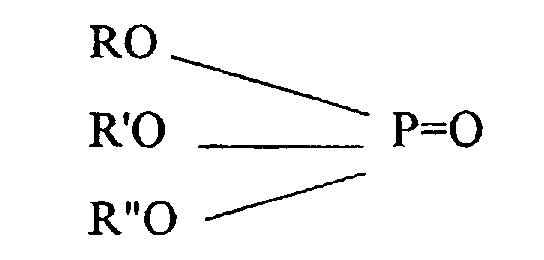
- Composition according to Claim 8, characterised in that the non-halogenated ester of orthophosphoric acid is triphenyl phosphate.
- Process for preparing the composition according to any one of Claims 1 to 9, characterised in that the non-halogenated ester of orthophosphoric acid and the (co)polymer (B) are added to the (co)polymer (A) in the solid state and blended with the latter in the solid state, and then preferably in the melt state, or else they are added to the (co)polymer (A) in the melt state.
- Process for improving the fire-retarding properties of a thermoplastic composition of a vinylaromatic hydrocarbon polymer, having a polymeric component and a fire-retarding component, characterised in that it comprises, in the preparation of 100 parts by weight of the composition, adding the fire-retarding component comprising:to 75 to 96 parts by weight of the polymeric component comprising at least one vinylaromatic hydrocarbon (co)polymer (A), identical or different in nature to the (co)polymer (B), but having a weight-average molecular mass ranging from 150,000 to 400,000.(1) from 2 to 10 parts by weight of at least one non-halogenated ester of orthophosphoric acid, and(2) from 2 to 15 parts by weight of at least one (co)polymer (B) of a vinylaromatic hydrocarbon, having a weight-average molecular mass ranging from 2000 to 15,000,
- Masterbatch essentially consisting of the two constituents of the fire-retarding component according to any one of Claims 1, 5, 6, 7, 8 or 9.
- Masterbatch comprising 100 parts by weight of the (co)polymer (A) and 50 to 1000 parts by weight of each of the two constituents of the fire-retarding component according to any one of Claims 1 to 9.
Priority Applications (1)
| Application Number | Priority Date | Filing Date | Title |
|---|---|---|---|
| DE29924174U DE29924174U1 (en) | 1998-09-29 | 1999-09-16 | Fire retardant thermoplastic composition made from a vinyl aromatic polymer |
Applications Claiming Priority (3)
| Application Number | Priority Date | Filing Date | Title |
|---|---|---|---|
| FR9812406 | 1998-09-29 | ||
| FR9812406A FR2783833B1 (en) | 1998-09-29 | 1998-09-29 | FLAME RETARDANT THERMOPLASTIC COMPOSITION OF VINYLAROMATIC (CO-) POLYMER |
| PCT/GB1999/003079 WO2000018837A1 (en) | 1998-09-29 | 1999-09-16 | Fire-retarding thermoplastic composition of vinylacromatic polymer |
Publications (2)
| Publication Number | Publication Date |
|---|---|
| EP1240247A1 EP1240247A1 (en) | 2002-09-18 |
| EP1240247B1 true EP1240247B1 (en) | 2003-10-29 |
Family
ID=9531168
Family Applications (1)
| Application Number | Title | Priority Date | Filing Date |
|---|---|---|---|
| EP99949111A Expired - Lifetime EP1240247B1 (en) | 1998-09-29 | 1999-09-16 | Fire-retarding thermoplastic composition of vinylacromatic polymer |
Country Status (7)
| Country | Link |
|---|---|
| EP (1) | EP1240247B1 (en) |
| AT (1) | ATE253101T1 (en) |
| AU (1) | AU6210999A (en) |
| DE (1) | DE69912483T2 (en) |
| ES (1) | ES2211179T3 (en) |
| FR (1) | FR2783833B1 (en) |
| WO (1) | WO2000018837A1 (en) |
Family Cites Families (2)
| Publication number | Priority date | Publication date | Assignee | Title |
|---|---|---|---|---|
| FR2656322B1 (en) * | 1989-12-21 | 1992-12-31 | Norsolor Sa | THERMOPLASTIC COMPOSITIONS WITH IMPROVED FIRE RESISTANCE COMPRISING SALCENYLAROMATIC POLYMERS. |
| GB9325575D0 (en) * | 1993-12-14 | 1994-02-16 | Dow Benelux | Flame retardant styrenic polymer compositions |
-
1998
- 1998-09-29 FR FR9812406A patent/FR2783833B1/en not_active Expired - Fee Related
-
1999
- 1999-09-16 EP EP99949111A patent/EP1240247B1/en not_active Expired - Lifetime
- 1999-09-16 ES ES99949111T patent/ES2211179T3/en not_active Expired - Lifetime
- 1999-09-16 DE DE69912483T patent/DE69912483T2/en not_active Expired - Fee Related
- 1999-09-16 AT AT99949111T patent/ATE253101T1/en not_active IP Right Cessation
- 1999-09-16 WO PCT/GB1999/003079 patent/WO2000018837A1/en not_active Ceased
- 1999-09-16 AU AU62109/99A patent/AU6210999A/en not_active Abandoned
Also Published As
| Publication number | Publication date |
|---|---|
| DE69912483T2 (en) | 2004-08-12 |
| WO2000018837A1 (en) | 2000-04-06 |
| EP1240247A1 (en) | 2002-09-18 |
| ES2211179T3 (en) | 2004-07-01 |
| AU6210999A (en) | 2000-04-17 |
| DE69912483D1 (en) | 2003-12-04 |
| FR2783833A1 (en) | 2000-03-31 |
| FR2783833B1 (en) | 2000-12-08 |
| ATE253101T1 (en) | 2003-11-15 |
Similar Documents
| Publication | Publication Date | Title |
|---|---|---|
| EP2231780B1 (en) | Flameproof thermoplastic resin composition and method for preparing the same | |
| EP3309217B1 (en) | Polycarbonate composition and preparation method therefor | |
| US20070155874A1 (en) | Flameretardant thermoplastic resin composition | |
| US20010031808A1 (en) | Polyphenylene ether resin concentrates containing organic phosphates | |
| KR102341896B1 (en) | Thermoplastic resin composition and article produced therefrom | |
| JPH0971708A (en) | Flame retardant resin composition | |
| KR20150038968A (en) | Thermoplastic resin composition and article comprising the same | |
| JPS619450A (en) | Flame-retardant resin composition | |
| KR20170066102A (en) | Polyarylene ether flame retardant resin composition and cover for electronic appliance | |
| GB2330583A (en) | Flame-retardant thermoplastic resin compositions | |
| JPS5927775B2 (en) | Flame retardant graft copolymer composition | |
| IL142024A (en) | Halogen-free flame retardant thermoplastic polymer compositions and flame retardant additive compositions for use therein | |
| EP1240247A1 (en) | Fire-retarding thermoplastic composition of vinylacromatic polymer | |
| EP0731140A2 (en) | Flameproof thermoplastic resin compositions | |
| CN101045812B (en) | Halogenless fire resistant polycarbonate/styryl resin composite | |
| KR101528196B1 (en) | Resin composition containing polycarbonate for window profile | |
| EP0523790B1 (en) | Flame-retardant thermoplastic composition | |
| EP0719833A2 (en) | Thermoplastic compositions containing polyphenylene ether resin and polyolefins | |
| KR101769185B1 (en) | Thermoplastic resin compositions | |
| KR101986913B1 (en) | Thermoplastic resin composition and article produced therefrom | |
| KR0147731B1 (en) | Thermoplastic resin composition having flame retardancy | |
| KR20070017887A (en) | Flame Retardant Thermoplastic Composition | |
| JP2001234054A (en) | Flame retardant thermoplastic resin composition and ultra-thin molded article | |
| KR20240087160A (en) | Fireretardent resin composition | |
| JP3714912B2 (en) | Drip inhibitor |
Legal Events
| Date | Code | Title | Description |
|---|---|---|---|
| PUAI | Public reference made under article 153(3) epc to a published international application that has entered the european phase |
Free format text: ORIGINAL CODE: 0009012 |
|
| 17P | Request for examination filed |
Effective date: 20020711 |
|
| AK | Designated contracting states |
Kind code of ref document: A1 Designated state(s): AT BE CH CY DE DK ES FI FR GB GR IE IT LI LU MC NL PT SE |
|
| GRAH | Despatch of communication of intention to grant a patent |
Free format text: ORIGINAL CODE: EPIDOS IGRA |
|
| GRAS | Grant fee paid |
Free format text: ORIGINAL CODE: EPIDOSNIGR3 |
|
| GRAA | (expected) grant |
Free format text: ORIGINAL CODE: 0009210 |
|
| AK | Designated contracting states |
Kind code of ref document: B1 Designated state(s): AT BE CH CY DE DK ES FI FR GB GR IE IT LI LU MC NL PT SE |
|
| PG25 | Lapsed in a contracting state [announced via postgrant information from national office to epo] |
Ref country code: LI Free format text: LAPSE BECAUSE OF FAILURE TO SUBMIT A TRANSLATION OF THE DESCRIPTION OR TO PAY THE FEE WITHIN THE PRESCRIBED TIME-LIMIT Effective date: 20031029 Ref country code: FI Free format text: LAPSE BECAUSE OF FAILURE TO SUBMIT A TRANSLATION OF THE DESCRIPTION OR TO PAY THE FEE WITHIN THE PRESCRIBED TIME-LIMIT Effective date: 20031029 Ref country code: CY Free format text: LAPSE BECAUSE OF FAILURE TO SUBMIT A TRANSLATION OF THE DESCRIPTION OR TO PAY THE FEE WITHIN THE PRESCRIBED TIME-LIMIT Effective date: 20031029 Ref country code: CH Free format text: LAPSE BECAUSE OF FAILURE TO SUBMIT A TRANSLATION OF THE DESCRIPTION OR TO PAY THE FEE WITHIN THE PRESCRIBED TIME-LIMIT Effective date: 20031029 Ref country code: AT Free format text: LAPSE BECAUSE OF FAILURE TO SUBMIT A TRANSLATION OF THE DESCRIPTION OR TO PAY THE FEE WITHIN THE PRESCRIBED TIME-LIMIT Effective date: 20031029 |
|
| REG | Reference to a national code |
Ref country code: GB Ref legal event code: FG4D |
|
| REG | Reference to a national code |
Ref country code: CH Ref legal event code: EP |
|
| REG | Reference to a national code |
Ref country code: IE Ref legal event code: FG4D |
|
| REF | Corresponds to: |
Ref document number: 69912483 Country of ref document: DE Date of ref document: 20031204 Kind code of ref document: P |
|
| PG25 | Lapsed in a contracting state [announced via postgrant information from national office to epo] |
Ref country code: SE Free format text: LAPSE BECAUSE OF FAILURE TO SUBMIT A TRANSLATION OF THE DESCRIPTION OR TO PAY THE FEE WITHIN THE PRESCRIBED TIME-LIMIT Effective date: 20040129 Ref country code: GR Free format text: LAPSE BECAUSE OF FAILURE TO SUBMIT A TRANSLATION OF THE DESCRIPTION OR TO PAY THE FEE WITHIN THE PRESCRIBED TIME-LIMIT Effective date: 20040129 Ref country code: DK Free format text: LAPSE BECAUSE OF FAILURE TO SUBMIT A TRANSLATION OF THE DESCRIPTION OR TO PAY THE FEE WITHIN THE PRESCRIBED TIME-LIMIT Effective date: 20040129 |
|
| REG | Reference to a national code |
Ref country code: CH Ref legal event code: PL |
|
| REG | Reference to a national code |
Ref country code: ES Ref legal event code: FG2A Ref document number: 2211179 Country of ref document: ES Kind code of ref document: T3 |
|
| ET | Fr: translation filed | ||
| PLBE | No opposition filed within time limit |
Free format text: ORIGINAL CODE: 0009261 |
|
| STAA | Information on the status of an ep patent application or granted ep patent |
Free format text: STATUS: NO OPPOSITION FILED WITHIN TIME LIMIT |
|
| PG25 | Lapsed in a contracting state [announced via postgrant information from national office to epo] |
Ref country code: LU Free format text: LAPSE BECAUSE OF NON-PAYMENT OF DUE FEES Effective date: 20040916 Ref country code: IE Free format text: LAPSE BECAUSE OF NON-PAYMENT OF DUE FEES Effective date: 20040916 |
|
| PG25 | Lapsed in a contracting state [announced via postgrant information from national office to epo] |
Ref country code: MC Free format text: LAPSE BECAUSE OF NON-PAYMENT OF DUE FEES Effective date: 20040930 |
|
| 26N | No opposition filed |
Effective date: 20040730 |
|
| REG | Reference to a national code |
Ref country code: IE Ref legal event code: MM4A |
|
| PG25 | Lapsed in a contracting state [announced via postgrant information from national office to epo] |
Ref country code: PT Free format text: LAPSE BECAUSE OF NON-PAYMENT OF DUE FEES Effective date: 20040329 |
|
| PGFP | Annual fee paid to national office [announced via postgrant information from national office to epo] |
Ref country code: NL Payment date: 20080915 Year of fee payment: 10 Ref country code: IT Payment date: 20080924 Year of fee payment: 10 Ref country code: FR Payment date: 20080912 Year of fee payment: 10 |
|
| PGFP | Annual fee paid to national office [announced via postgrant information from national office to epo] |
Ref country code: GB Payment date: 20080918 Year of fee payment: 10 |
|
| PGFP | Annual fee paid to national office [announced via postgrant information from national office to epo] |
Ref country code: DE Payment date: 20080829 Year of fee payment: 10 |
|
| PGFP | Annual fee paid to national office [announced via postgrant information from national office to epo] |
Ref country code: ES Payment date: 20080929 Year of fee payment: 10 |
|
| PGFP | Annual fee paid to national office [announced via postgrant information from national office to epo] |
Ref country code: BE Payment date: 20081001 Year of fee payment: 10 |
|
| BERE | Be: lapsed |
Owner name: A. *SCHULMAN G.M.B.H. Effective date: 20090930 |
|
| REG | Reference to a national code |
Ref country code: NL Ref legal event code: V1 Effective date: 20100401 |
|
| GBPC | Gb: european patent ceased through non-payment of renewal fee |
Effective date: 20090916 |
|
| REG | Reference to a national code |
Ref country code: FR Ref legal event code: ST Effective date: 20100531 |
|
| PG25 | Lapsed in a contracting state [announced via postgrant information from national office to epo] |
Ref country code: NL Free format text: LAPSE BECAUSE OF NON-PAYMENT OF DUE FEES Effective date: 20100401 Ref country code: FR Free format text: LAPSE BECAUSE OF NON-PAYMENT OF DUE FEES Effective date: 20090930 Ref country code: DE Free format text: LAPSE BECAUSE OF NON-PAYMENT OF DUE FEES Effective date: 20100401 |
|
| PG25 | Lapsed in a contracting state [announced via postgrant information from national office to epo] |
Ref country code: BE Free format text: LAPSE BECAUSE OF NON-PAYMENT OF DUE FEES Effective date: 20090930 |
|
| PG25 | Lapsed in a contracting state [announced via postgrant information from national office to epo] |
Ref country code: GB Free format text: LAPSE BECAUSE OF NON-PAYMENT OF DUE FEES Effective date: 20090916 |
|
| PG25 | Lapsed in a contracting state [announced via postgrant information from national office to epo] |
Ref country code: IT Free format text: LAPSE BECAUSE OF NON-PAYMENT OF DUE FEES Effective date: 20090916 |
|
| REG | Reference to a national code |
Ref country code: ES Ref legal event code: FD2A Effective date: 20110714 |
|
| PG25 | Lapsed in a contracting state [announced via postgrant information from national office to epo] |
Ref country code: ES Free format text: LAPSE BECAUSE OF NON-PAYMENT OF DUE FEES Effective date: 20110704 |
|
| PG25 | Lapsed in a contracting state [announced via postgrant information from national office to epo] |
Ref country code: ES Free format text: LAPSE BECAUSE OF NON-PAYMENT OF DUE FEES Effective date: 20090917 |