EP1239751B1 - Toothbrush - Google Patents
Toothbrush Download PDFInfo
- Publication number
- EP1239751B1 EP1239751B1 EP00985127A EP00985127A EP1239751B1 EP 1239751 B1 EP1239751 B1 EP 1239751B1 EP 00985127 A EP00985127 A EP 00985127A EP 00985127 A EP00985127 A EP 00985127A EP 1239751 B1 EP1239751 B1 EP 1239751B1
- Authority
- EP
- European Patent Office
- Prior art keywords
- dental cleaning
- implement
- parts
- link
- cleaning implement
- Prior art date
- Legal status (The legal status is an assumption and is not a legal conclusion. Google has not performed a legal analysis and makes no representation as to the accuracy of the status listed.)
- Expired - Lifetime
Links
Images

Classifications
-
- A—HUMAN NECESSITIES
- A46—BRUSHWARE
- A46B—BRUSHES
- A46B5/00—Brush bodies; Handles integral with brushware
- A46B5/002—Brush bodies; Handles integral with brushware having articulations, joints or flexible portions
- A46B5/0054—Brush bodies; Handles integral with brushware having articulations, joints or flexible portions designed to allow relative positioning of the head to body
- A46B5/0062—Brush bodies; Handles integral with brushware having articulations, joints or flexible portions designed to allow relative positioning of the head to body being flexible or resilient during use
- A46B5/007—Inserts made of different material, e.g. springs, plates
-
- A—HUMAN NECESSITIES
- A46—BRUSHWARE
- A46B—BRUSHES
- A46B5/00—Brush bodies; Handles integral with brushware
- A46B5/002—Brush bodies; Handles integral with brushware having articulations, joints or flexible portions
- A46B5/0054—Brush bodies; Handles integral with brushware having articulations, joints or flexible portions designed to allow relative positioning of the head to body
- A46B5/0062—Brush bodies; Handles integral with brushware having articulations, joints or flexible portions designed to allow relative positioning of the head to body being flexible or resilient during use
-
- A—HUMAN NECESSITIES
- A46—BRUSHWARE
- A46B—BRUSHES
- A46B2200/00—Brushes characterized by their functions, uses or applications
- A46B2200/10—For human or animal care
- A46B2200/1066—Toothbrush for cleaning the teeth or dentures
-
- B—PERFORMING OPERATIONS; TRANSPORTING
- B29—WORKING OF PLASTICS; WORKING OF SUBSTANCES IN A PLASTIC STATE IN GENERAL
- B29L—INDEXING SCHEME ASSOCIATED WITH SUBCLASS B29C, RELATING TO PARTICULAR ARTICLES
- B29L2031/00—Other particular articles
- B29L2031/42—Brushes
- B29L2031/425—Toothbrush
Definitions
- This invention relates to dental cleaning implements, especially in particular to toothbrushes having a resiliently flexible region in their structure, particularly having such a structure situated in their handle or between their head and their handle.
- Toothbrushes generally comprise a head carrying a dental cleaning tool, normally a cluster of bristles in a toothbrush, and a grip handle, arranged along a longitudinal head-handle direction. Often there is a thinned neck region between the head and the part of the handle which is gripped by the user during use. It is known to incorporate a resiliently flexible region in the handle or between the head and the handle to help to relieve excessive pressure from being applied to the teeth or other mouth tissues of the user during implementing. Examples of such resiliently flexible regions in toothbrushes are disclosed in EP 0 336 641A (Lingner+Fischer GmbH) and DE 39 234 95 (M+C Schiffer GmbH).
- toothbrushes may prefer or need toothbrushes having different degrees of resilient flexibility of such a region.
- the user has no option except to purchase a complete different implement having a selected degree of flexibility of such a region.
- GB-A-2282859 and US-A-5315732 disclose altering the resilience of a flexible link of a toothbrush by providing a member slidable in the longitudinal direction of the brush.
- US-A-5673452 discloses a toothbrush having a flexible link surrounded by a plurality of rings.
- WO-A-0030493 discloses a toothbrush having the resiliency of its flexible link adjustable by a tensioning ring.
- a dental cleaning implement having a head which carries a dental cleaning tool, and a grip handle, the head and handle being disposed along a longitudinal head-handle direction, the implement comprising longitudinally disposed first and second parts which are joined together by means of a flexible link which allows the implement to bend about the link under the action of pressure applied in a direction sideways of the longitudinal direction, situated longitudinally between the first and second parts there is a member which is rotatable about the longitudinal direction of the implement, and such that when the implement bends about the flexible link the first and/or second parts adjacent to the member bear compressibly upon the member, the member comprising circumferentially disposed relatively less and more resiliently hard regions, so that as the member is rotated the first and second parts can be caused to bear compressibly upon selected less or more hard regions.
- resiliently hard herein is meant primarily that under the action of applied pressure, i.e. compression the region deforms, and upon release of the pressure the region returns to the position it had before the pressure was applied.
- resiliently less resiliently hard herein is meant primarily that for a unit of pressure the structure displaces more than a "relatively more resiliently hard” region, or that less pressure is required to cause a unit of displacement than is required for a “relatively more resiliently hard” region.
- the dental cleaning implement may preferably be a toothbrush having a dental cleaning tool which comprises a cluster of bristles projecting from the head in the manner of a conventional toothbrush or may comprise a dental flossing tool.
- the flexible link may for example be located in the handle of the implement, for example between the grip handle and the neck of the implement. Alternatively and preferably the flexible link may be located between the part of the grip handle which is held by the user and the neck.
- a preferred form of link is a thin longitudinally extending spine of the construction material of the implement, e.g. a plastics material, and this may be made integrally with the first and/or second parts.
- this link may provide an axle about which the member can rotate.
- Such a spine may be of any suitable cross section and dimensions to provide flexibility.
- the member may for example be of a wheel or cylinder shape which is mounted rotatably on such a link, and between the first and second parts. If the spine is of non-circular cross section, and the member has an axial channel through it of corresponding section through which the spine is threaded as an axle, then this construction can enable the member to seat itself in a selected rotational position on the axle with a selected region of the member adjacent to selected part of the first and second parts. For example such a member may snap into a selected rotational position on the axle.
- the circumferentially disposed less and more resiliently hard regions of the member may be provided by various means.
- the member may be made of a plurality of circumferentially disposed regions of relatively less and more resiliently hard material, for example an elastomer material.
- the relatively less and more resiliently hardness of such a material as an elastomer may be provided by for example different materials, different grades (e.g. foamed and non-foamed), or different thicknesses of a resilient material such as a polymer above a hard substrate such as a hard plastics material.
- the regions may be disposed circumferentially in the manner of "pie" segments divided by radii of a constructed circle, so that as the member is rotated the first and second parts can be caused to bear compressibly upon selected less or more hard segments.
- the member may be of a generally cylinder shape mounted rotably on the link, and has a hard substrate one end surface of which is generally perpendicular to the longitudinal direction, but the other end surface is at a non perpendicular angle to the direction.
- a part of the member adjacent to the non-perpendicular end is made of a softer material above the underlying hard substrate, so that the depth of the softer material in the longitudinal direction above the end surface varies around the circumference of the member, so that as the member is rotated the first and second parts can be caused to bear compressibly upon more or less deep regions of the softer material.
- the implement e.g. a toothbrush, of the present invention may be made of plastics and elastomer materials conventional in the art of toothbrush manufacture, as may other parts of the implement such as the head, grip handle and the dental cleansing tool such as a cluster of nylon bristles.
- the implement of the present invention may be made of such materials by an injection moulding process, therefore in a further aspect the present invention provides an injection moulding process wherein a implement as described above is made, and furthermore the present invention provides one or more injection moulds suitable for use in such an injection moulding process.
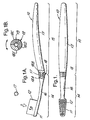
- Fig. 1 shows a toothbrush of the present invention
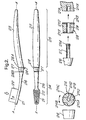
- Fig. 2 which shows another toothbrush of the present invention
- Fig. 3 which shows an alternative construction of the member of the toothbrush of Fig. 2.
- a toothbrush is shown overall 10, having a head 11 which carries a cluster of bristles 12 extending in a bristle direction B.
- the toothbrush 10 has a grip handle 13, the head 11 and handle 13 being disposed along a longitudinal head-handle direction A-A.
- the toothbrush is in the form of two longitudinally disposed first 14 and second 15 parts, part 14 comprising the head 11 and a neck region 16 and is integrally formed with the head 11.
- Part 15 comprises the handle 13.
- Parts 14 and 15 are joined together by means of a flexible link 17 which is a thin flexible longitudinally extending spine extending between parts 14 and 15.
- the toothbrush 10 bends about the link 17 under the action of pressure applied to the head 11 during toothbrushing, in the direction of the arrow shown.
- the member 18 Longitudinally between the first and second parts 14, 15 there is a member 18 which is rotatable about the longitudinal direction of the toothbrush 10.
- the member 18 is of a generally cylinder shape tapering conically from a wider end facing the handle 13 toward a narrower end facing the head 11, and is mounted rotatably on the link 17.
- the spine 17 is of non-circular, i.e. trefoil, cross section as shown in Fig. 1A.
- the member 18 has an axial channel 19 longitudinally through it of corresponding section through which the spine 17 is threaded as an axle. This construction enables the member 18 to seat as shown in Fig. 1B in a selected rotational position on the axle 17. Rotation of the member 18 on the non-circular section axle 17 can allow the member 18 to snap into and be retained in a selected rotational position on the axle 17.
- the member 18 comprises three circumferentially disposed relatively less and more resiliently hard regions 18C, 18D, 18E. These regions 18C, 18D, 18E are disposed circumferentially in the manner of segments divided by radii of a constructed circle. Region 18C is a relatively less compressibly resiliently hard region, region 18E is a relatively more compressibly resiliently hard region, and region 18D is of intermediate compressibly resilient hardness. This is achieved by the regions 18C, 18D, 18E being made of relatively less, more and intermediate resiliently hard elastomer material. As the member 18 is rotated the first 14 and second 15 parts can be caused to bear compressibly at 18A and 18B upon selected less or more hard regions 18C, 18D, 18E.
- a toothbrush is shown overall 20, having a head 21 which carries a cluster of bristles 22 extending in a bristle direction B.
- the toothbrush 20 has a grip handle 23, the head 21 and handle 23 being disposed along a longitudinal head-handle direction A-A.
- the toothbrush is in the form of two longitudinally disposed first 24 and second 25 parts, part 24 comprising the head 21 and a neck region 26 and is integrally formed with the head 21.
- Part 25 comprises the handle 23.
- Parts 24 and 25 are joined together by means of a flexible link 27 which is a thin flexible longitudinally extending spine extending between parts 24 and 25.
- the toothbrush 20 bends about the link 27 under the action of pressure applied to the head 21 during toothbrushing in the direction of the arrow shown.
- the member 28 Longitudinally between the first and second parts 24, 25 there is a member 28 which is rotatable about the longitudinal direction A-A of the toothbrush 20.
- the member 28 is of a generally cylinder shape tapering conically from a wider end facing the handle 23 toward a narrower end facing the head 21 and is mounted rotatably on the link 27.
- the spine 27 is of non-circular, i.e. trefoil, cross section as shown in Fig. 2A.
- the member 28 has an axial channel 29 longitudinally through it of corresponding section through which the spine 27 is threaded as an axle. This construction enables the member 28 to seat in a selected rotational position on the axle 27 in a manner analogous to Fig. 1.
- the member 28 comprises a hard plastic substrate 210 which has three circumferentially disposed cavities 211A, 211B, 211C extending inwardly from the circumference of the substrate 29.
- Cavity 211A is a relatively shallow cavity
- cavity 211C is a relatively deep cavity
- cavity 211B is of intermediate depth.
- These cavities 211A, 211B and 211C are filled with a compressible resilient elastomer material 212 which completely envelopes the circumference of the substrate 29.
- the regions of the elastomer 212 respectively in the cavities 211A, 211B and 211C consequently are respectively relatively less, more and intermediate resiliently hard.
- the first 24 and second 25 parts can be caused to bear compressibly at 28A and 28B upon selected less or more hard regions 211A, 211B and 211C.
- the member 28 may be provided at its longitudinal ends with bearing surfaces 213, e.g. of a smooth plastic material to facilitate rotation.
- FIG. 3 an alternative construction 30 of the member 28 of Fig. 2 is shown.
- the member 30 is of a generally cylinder shape tapering conically from a wider end 30A facing the handle 23 toward a narrower end 30B facing the head 21 and is mountable rotatably on the link 27.
- the member 30 has an axial channel 31 longitudinally through it of corresponding section through which the spine 27 is threaded as an axle.
- the member 30 comprises a hard plastic substrate 32, the narrower end surface of which 30B is perpendicular to the longitudinal direction A-A, but the wider end surface 32C is at a non perpendicular angle to the direction A-A.
- the part 33 of the member 30 adjacent to the end 30A is made of a soft compressibly resilient elastomer material, the end surface 30A of which is perpendicular to the direction A-A.
- the elastomer material has a greater resilient hardness than at the depth d2, and therefore by rotation of the member 30 in a manner analogous to that of member 28 the parts 24, 25 can be brought to bear on less and more resiliently hard regions.
- the toothbrushes 10 and 20 of Figs. 1 and 2 may be made by techniques which will be apparent to those skilled in the art.
- part 14 may be made first, with the spine 17 made integrally with it.
- the member 18 may be separately made and threaded on the spine 17.
- link 17 may be enclosed in an injection mould (not shown) and part 15 may be separately injection moulded in this mould so that it fuses with link 17 at its end closest to the handle and is thereby integrally connected to part 14.
- part 24 may be made first, with the link 27 formed integrally with it and having a snap fit connection 214 at its end distal from the head 21.
- the member 28 or 30 may be made separately and then threaded onto the link 27.
- the part 25 may be made separately having a socket 215 at its end closest to the head 21, into which the connection 214 can snap fit as shown to connect parts 24 and 25 together.
- the member 18, 28, 30 to be mounted on the axle the member may for example be split longitudinally to enable the member to be snap-fitted onto the axle.
- the members 18, 28, 30 may be made by known two-component injection moulding techniques.
Landscapes
- Brushes (AREA)
Abstract
Description
- This invention relates to dental cleaning implements, especially in particular to toothbrushes having a resiliently flexible region in their structure, particularly having such a structure situated in their handle or between their head and their handle.
- Toothbrushes generally comprise a head carrying a dental cleaning tool, normally a cluster of bristles in a toothbrush, and a grip handle, arranged along a longitudinal head-handle direction. Often there is a thinned neck region between the head and the part of the handle which is gripped by the user during use. It is known to incorporate a resiliently flexible region in the handle or between the head and the handle to help to relieve excessive pressure from being applied to the teeth or other mouth tissues of the user during implementing. Examples of such resiliently flexible regions in toothbrushes are disclosed in EP 0 336 641A (Lingner+Fischer GmbH) and DE 39 234 95 (M+C Schiffer GmbH).
- Different users of toothbrushes may prefer or need toothbrushes having different degrees of resilient flexibility of such a region. At present the user has no option except to purchase a complete different implement having a selected degree of flexibility of such a region.
- It is an object of this invention to provide a dental cleaning implement particularly a toothbrush having a resiliently flexible region in its structure wherein the resilience and/or flexibility of the region may be altered by the user.
- GB-A-2282859 and US-A-5315732 disclose altering the resilience of a flexible link of a toothbrush by providing a member slidable in the longitudinal direction of the brush.
- US-A-5673452 discloses a toothbrush having a flexible link surrounded by a plurality of rings.
- WO-A-0030493 discloses a toothbrush having the resiliency of its flexible link adjustable by a tensioning ring.
- According to this invention a dental cleaning implement is provided having a head which carries a dental cleaning tool, and a grip handle, the head and handle being disposed along a longitudinal head-handle direction, the implement comprising longitudinally disposed first and second parts which are joined together by means of a flexible link which allows the implement to bend about the link under the action of pressure applied in a direction sideways of the longitudinal direction, situated longitudinally between the first and second parts there is a member which is rotatable about the longitudinal direction of the implement, and such that when the implement bends about the flexible link the first and/or second parts adjacent to the member bear compressibly upon the member, the member comprising circumferentially disposed relatively less and more resiliently hard regions, so that as the member is rotated the first and second parts can be caused to bear compressibly upon selected less or more hard regions.
- By "resiliently hard" herein is meant primarily that under the action of applied pressure, i.e. compression the region deforms, and upon release of the pressure the region returns to the position it had before the pressure was applied. By "relatively less resiliently hard" herein is meant primarily that for a unit of pressure the structure displaces more than a "relatively more resiliently hard" region, or that less pressure is required to cause a unit of displacement than is required for a "relatively more resiliently hard" region.
- The dental cleaning implement may preferably be a toothbrush having a dental cleaning tool which comprises a cluster of bristles projecting from the head in the manner of a conventional toothbrush or may comprise a dental flossing tool.
- The flexible link may for example be located in the handle of the implement, for example between the grip handle and the neck of the implement. Alternatively and preferably the flexible link may be located between the part of the grip handle which is held by the user and the neck.
- A preferred form of link is a thin longitudinally extending spine of the construction material of the implement, e.g. a plastics material, and this may be made integrally with the first and/or second parts. Suitably this link may provide an axle about which the member can rotate. Such a spine may be of any suitable cross section and dimensions to provide flexibility.
- The member may for example be of a wheel or cylinder shape which is mounted rotatably on such a link, and between the first and second parts. If the spine is of non-circular cross section, and the member has an axial channel through it of corresponding section through which the spine is threaded as an axle, then this construction can enable the member to seat itself in a selected rotational position on the axle with a selected region of the member adjacent to selected part of the first and second parts. For example such a member may snap into a selected rotational position on the axle.
- The circumferentially disposed less and more resiliently hard regions of the member may be provided by various means. For example the member may be made of a plurality of circumferentially disposed regions of relatively less and more resiliently hard material, for example an elastomer material. The relatively less and more resiliently hardness of such a material as an elastomer may be provided by for example different materials, different grades (e.g. foamed and non-foamed), or different thicknesses of a resilient material such as a polymer above a hard substrate such as a hard plastics material.
- For example the regions may be disposed circumferentially in the manner of "pie" segments divided by radii of a constructed circle, so that as the member is rotated the first and second parts can be caused to bear compressibly upon selected less or more hard segments.
- For example alternatively the member may be of a generally cylinder shape mounted rotably on the link, and has a hard substrate one end surface of which is generally perpendicular to the longitudinal direction, but the other end surface is at a non perpendicular angle to the direction. A part of the member adjacent to the non-perpendicular end is made of a softer material above the underlying hard substrate, so that the depth of the softer material in the longitudinal direction above the end surface varies around the circumference of the member, so that as the member is rotated the first and second parts can be caused to bear compressibly upon more or less deep regions of the softer material.
- The implement e.g. a toothbrush, of the present invention may be made of plastics and elastomer materials conventional in the art of toothbrush manufacture, as may other parts of the implement such as the head, grip handle and the dental cleansing tool such as a cluster of nylon bristles.
- The implement of the present invention may be made of such materials by an injection moulding process, therefore in a further aspect the present invention provides an injection moulding process wherein a implement as described above is made, and furthermore the present invention provides one or more injection moulds suitable for use in such an injection moulding process.
- The invention will now be described by way of example only with reference to Fig. 1 which shows a toothbrush of the present invention, Fig. 2 which shows another toothbrush of the present invention and Fig. 3 which shows an alternative construction of the member of the toothbrush of Fig. 2.
- Referring to Fig. 1, a toothbrush is shown overall 10, having a
head 11 which carries a cluster ofbristles 12 extending in a bristle direction B. Thetoothbrush 10 has agrip handle 13, thehead 11 andhandle 13 being disposed along a longitudinal head-handle direction A-A. The toothbrush is in the form of two longitudinally disposed first 14 and second 15 parts,part 14 comprising thehead 11 and aneck region 16 and is integrally formed with thehead 11.Part 15 comprises thehandle 13.Parts flexible link 17 which is a thin flexible longitudinally extending spine extending betweenparts toothbrush 10 bends about thelink 17 under the action of pressure applied to thehead 11 during toothbrushing, in the direction of the arrow shown. - Longitudinally between the first and
second parts member 18 which is rotatable about the longitudinal direction of thetoothbrush 10. Themember 18 is of a generally cylinder shape tapering conically from a wider end facing thehandle 13 toward a narrower end facing thehead 11, and is mounted rotatably on thelink 17. Thespine 17 is of non-circular, i.e. trefoil, cross section as shown in Fig. 1A. Themember 18 has anaxial channel 19 longitudinally through it of corresponding section through which thespine 17 is threaded as an axle. This construction enables themember 18 to seat as shown in Fig. 1B in a selected rotational position on theaxle 17. Rotation of themember 18 on thenon-circular section axle 17 can allow themember 18 to snap into and be retained in a selected rotational position on theaxle 17. - When the
toothbrush 10 bends about theflexible link 17 the first 14 and/or second 15 parts adjacent to themember 18 bear compressibly upon the member atpoints - As shown in Fig 1B the
member 18 comprises three circumferentially disposed relatively less and more resilientlyhard regions regions Region 18C is a relatively less compressibly resiliently hard region,region 18E is a relatively more compressibly resiliently hard region, and region 18D is of intermediate compressibly resilient hardness. This is achieved by theregions member 18 is rotated the first 14 and second 15 parts can be caused to bear compressibly at 18A and 18B upon selected less or morehard regions - This enables the flexibility of the toothbrush 20 as experienced by the user to be varied by the user by rotation of the
member 18. - Referring to Fig. 2, a toothbrush is shown overall 20, having a
head 21 which carries a cluster ofbristles 22 extending in a bristle direction B. The toothbrush 20 has agrip handle 23, thehead 21 andhandle 23 being disposed along a longitudinal head-handle direction A-A. The toothbrush is in the form of two longitudinally disposed first 24 and second 25 parts,part 24 comprising thehead 21 and aneck region 26 and is integrally formed with thehead 21.Part 25 comprises thehandle 23.Parts flexible link 27 which is a thin flexible longitudinally extending spine extending betweenparts link 27 under the action of pressure applied to thehead 21 during toothbrushing in the direction of the arrow shown. - Longitudinally between the first and
second parts member 28 which is rotatable about the longitudinal direction A-A of the toothbrush 20. Themember 28 is of a generally cylinder shape tapering conically from a wider end facing thehandle 23 toward a narrower end facing thehead 21 and is mounted rotatably on thelink 27. Thespine 27 is of non-circular, i.e. trefoil, cross section as shown in Fig. 2A. Themember 28 has anaxial channel 29 longitudinally through it of corresponding section through which thespine 27 is threaded as an axle. This construction enables themember 28 to seat in a selected rotational position on theaxle 27 in a manner analogous to Fig. 1. - When the toothbrush 20 bends about the
flexible link 27 the first 24 and/or second 25 parts adjacent to themember 28 bear compressibly upon the member atpoints - As shown in Fig 2B the
member 28 comprises ahard plastic substrate 210 which has three circumferentially disposedcavities substrate 29.Cavity 211A is a relatively shallow cavity, cavity 211C is a relatively deep cavity, andcavity 211B is of intermediate depth. Thesecavities resilient elastomer material 212 which completely envelopes the circumference of thesubstrate 29. The regions of theelastomer 212 respectively in thecavities member 28 is rotated the first 24 and second 25 parts can be caused to bear compressibly at 28A and 28B upon selected less or morehard regions member 28 may be provided at its longitudinal ends with bearingsurfaces 213, e.g. of a smooth plastic material to facilitate rotation. - Referring to Fig. 3 an
alternative construction 30 of themember 28 of Fig. 2 is shown. Themember 30 is of a generally cylinder shape tapering conically from awider end 30A facing thehandle 23 toward anarrower end 30B facing thehead 21 and is mountable rotatably on thelink 27. Themember 30 has anaxial channel 31 longitudinally through it of corresponding section through which thespine 27 is threaded as an axle. In the construction shown in Fig. 3 themember 30 comprises ahard plastic substrate 32, the narrower end surface of which 30B is perpendicular to the longitudinal direction A-A, but thewider end surface 32C is at a non perpendicular angle to the direction A-A. Thepart 33 of themember 30 adjacent to theend 30A is made of a soft compressibly resilient elastomer material, theend surface 30A of which is perpendicular to the direction A-A. This means that the depth of the elastomer material in the longitudinal direction above the end surface 30C and consequently the compressibility of the elastomer varies around the circumference of the member, between the two extremes d1 and d2. At the depth d1 the elastomer material has a greater resilient hardness than at the depth d2, and therefore by rotation of themember 30 in a manner analogous to that ofmember 28 theparts - This enables the flexibility of the toothbrush 20 as experienced by the user to be varied by the user by rotation of the
member - The
toothbrushes 10 and 20 of Figs. 1 and 2 may be made by techniques which will be apparent to those skilled in the art. Forexample part 14 may be made first, with thespine 17 made integrally with it. Themember 18 may be separately made and threaded on thespine 17. Then link 17 may be enclosed in an injection mould (not shown) andpart 15 may be separately injection moulded in this mould so that it fuses withlink 17 at its end closest to the handle and is thereby integrally connected topart 14. As shown in Fig. 2,part 24 may be made first, with thelink 27 formed integrally with it and having a snap fit connection 214 at its end distal from thehead 21. Themember link 27. Thepart 25 may be made separately having asocket 215 at its end closest to thehead 21, into which the connection 214 can snap fit as shown to connectparts member - The
members
Claims (12)
- A dental cleaning implement (10,20) having a head (11,21) which carries a dental cleaning tool (12,22), and a grip handle (13,23), the head (11,21) and handle (13,23) being disposed along a longitudinal head-handle direction, the implement (10,20) comprising longitudinally disposed first (14,24) and second (15,25) parts which are joined together by means of a flexible link (17,27) which allows the implement (10,20) to bend about the link (17,27) under the action of pressure applied in a direction sideways of the longitudinal direction, characterised in that situated longitudinally between the first (14,24) and second (15,25) parts there is a member (18,28) which is rotatable about the longitudinal direction of the implement (10,20), and such that when the implement (10,20) bends about the flexible link (17,27) the first (14,24) and/or second (15,25) parts adjacent to the member (18,28) bear compressibly upon the member (18,28), the member (18,28) comprising circumferentially disposed relatively less and more resiliently hard regions (18C,18D,18E,211A,211B,211C), so that as the member is rotated the first and second parts can be caused to bear compressibly upon selected less or more hard regions.
- A dental cleaning implement (10,20) according to claim 1 characterised by a dental cleaning tool (12,22) which comprises a cluster of bristles projecting from the head (11,21).
- A dental cleaning implement (10,20) according to claim 1 or claim 2 characterised in that the flexible link (17,27) is located in the handle (13,23) of the implement (10,20).
- A dental cleaning implement (10,20) according to claim 1 or claim 2 characterised in that the flexible link (17,27) is located between the part of the grip handle (13,23) which is held by the user and the neck.
- A dental cleaning implement (10,20) according to any preceding claim characterised in that the link (17,27) is a thin longitudinally extending spine of the construction material of the implement (10,20).
- A dental cleaning implement (10,20) according to claim 5 characterised in that the link (17,27) provides an axle about which the member (18,28) can rotate.
- A dental cleaning implement (10,20) according to any one of the preceding claims characterised in that the member (18,28) is of a wheel or cylinder shape which is mounted rotatably on the link (17,27) and between the first (14,24) and second (15,25) parts.
- A dental cleaning implement (10,20) according to any one of claims 5, 6 or 7 characterised in that the spine is of non-circular cross section, and the member (18,28) has an axial channel (18,28) through it of corresponding section through which the spine is threaded as an axle.
- A dental cleaning implement (10,20) according to any preceding claim characterised in that the circumferentially disposed less and more resiliently hard regions (18C,18D,18E,211A,211B,211C) of the member (18,28) are provided by the member (18,28) being made of a plurality of circumferentially disposed regions of relatively less and more resiliently hard material.
- A dental cleaning implement (10,20) according to claim 9 characterised in that the relatively less and more resiliently hardness (18C,18D,18E,211A,211B,211C) of the material is provided by regions of different materials, different grades, or different thicknesses of a resilient material.
- A dental cleaning implement (10,20) according to any preceding claim characterised in that the regions are disposed circumferentially in the manner of segments divided by radii of a constructed circle, so that as the member (18,28) is rotated the first (12,24) and second (15,25) parts can be caused to bear compressibly upon selected less or more hard segments.
- A dental cleaning implement (10,20) according to any one of claims 1 to 10 characterised in that the member (18,28) is of a generally cylinder shape and is mounted rotably on the link, and has a hard substrate one end surface of which is generally perpendicular to the longitudinal direction, but the other end surface is at a non perpendicular angle to the direction, a part of the member (18,28) adjacent to the non-perpendicular end is made of a softer material above the underlying hard substrate, so that the depth of the softer material in the longitudinal direction above the end surface varies around the circumference of the member (18,28), and the first (14,24) and second (15,25) parts can be caused to bear compressibly upon more or less deep regions of the softer material.
Applications Claiming Priority (3)
| Application Number | Priority Date | Filing Date | Title |
|---|---|---|---|
| GB9929400 | 1999-12-14 | ||
| GBGB9929400.1A GB9929400D0 (en) | 1999-12-14 | 1999-12-14 | Toothbrush |
| PCT/EP2000/012081 WO2001043581A1 (en) | 1999-12-14 | 2000-11-30 | Toothbrush |
Publications (2)
| Publication Number | Publication Date |
|---|---|
| EP1239751A1 EP1239751A1 (en) | 2002-09-18 |
| EP1239751B1 true EP1239751B1 (en) | 2004-05-06 |
Family
ID=10866191
Family Applications (1)
| Application Number | Title | Priority Date | Filing Date |
|---|---|---|---|
| EP00985127A Expired - Lifetime EP1239751B1 (en) | 1999-12-14 | 2000-11-30 | Toothbrush |
Country Status (9)
| Country | Link |
|---|---|
| US (1) | US7086116B2 (en) |
| EP (1) | EP1239751B1 (en) |
| JP (1) | JP2003516782A (en) |
| AT (1) | ATE265814T1 (en) |
| AU (1) | AU2164701A (en) |
| DE (1) | DE60010514T2 (en) |
| ES (1) | ES2220578T3 (en) |
| GB (1) | GB9929400D0 (en) |
| WO (1) | WO2001043581A1 (en) |
Cited By (1)
| Publication number | Priority date | Publication date | Assignee | Title |
|---|---|---|---|---|
| US8973202B2 (en) | 2010-02-26 | 2015-03-10 | Trisa Holding Ag | Oral hygiene device, particularly a toothbrush, and method for the production thereof |
Families Citing this family (12)
| Publication number | Priority date | Publication date | Assignee | Title |
|---|---|---|---|---|
| US7934284B2 (en) | 2003-02-11 | 2011-05-03 | Braun Gmbh | Toothbrushes |
| FR2854779B1 (en) * | 2003-05-14 | 2006-09-01 | Oreal | APPLICATOR AND DEVICE FOR PACKAGING AND APPLICATION COMPRISING SUCH AN APPLICATOR |
| JP3886050B2 (en) * | 2003-05-20 | 2007-02-28 | 株式会社 Ufcサプライ | Interdental brush and manufacturing method thereof |
| FR2858529B1 (en) | 2003-08-04 | 2006-02-17 | Oreal | APPLICATOR AND DEVICE FOR PACKAGING AND APPLICATION COMPRISING SUCH AN APPLICATOR |
| JP4993239B2 (en) * | 2003-12-19 | 2012-08-08 | 株式会社吉野工業所 | Cosmetic container |
| US20060230561A1 (en) * | 2005-04-19 | 2006-10-19 | Andre Sampaio | Duster with handle insert |
| KR100928561B1 (en) * | 2007-12-22 | 2009-11-25 | 서강대학교산학협력단 | Biomaterial-Based Electronic Devices |
| KR101175140B1 (en) | 2012-05-10 | 2012-08-20 | 이희돈 | Elastic toothbrush |
| JPWO2015137487A1 (en) * | 2014-03-14 | 2017-04-06 | ライオン株式会社 | Toothbrush handle body, toothbrush, and method for manufacturing toothbrush handle body |
| US10258205B2 (en) * | 2014-07-10 | 2019-04-16 | Unger Marketing International, Llc | Cleaning devices with selectively flexible or rigid handles |
| EP3904023A1 (en) * | 2020-04-30 | 2021-11-03 | Bic Violex S.A. | Skincare device handle with flexible portion |
| WO2023068831A1 (en) * | 2021-10-20 | 2023-04-27 | 주식회사 아이투씨브릿지 | Brushing guide elastic toothbrush and elastic restoration mechanism |
Family Cites Families (10)
| Publication number | Priority date | Publication date | Assignee | Title |
|---|---|---|---|---|
| US1694636A (en) * | 1926-12-10 | 1928-12-11 | Horace E Barker | Dental device |
| GB8807673D0 (en) | 1988-03-31 | 1988-05-05 | Lingner & Fischer Gmbh | Novel article |
| AU582098B3 (en) * | 1988-11-04 | 1989-02-10 | Robert Martin McCusker | Toothbrush with deformable handle |
| DE3923495C1 (en) | 1989-07-15 | 1991-01-24 | M + C Schiffer Gmbh, 5466 Neustadt, De | |
| US5315732A (en) * | 1993-05-20 | 1994-05-31 | Huefner Norman F | Toothbrush having adjustable brushing pressure |
| GB2282959B (en) * | 1993-10-19 | 1998-06-17 | Addis Ltd | Improvements in or relating to toothbrushes |
| US6003189A (en) * | 1995-02-01 | 1999-12-21 | Falleiros; Alexandre Petrocini | Toothbrush |
| US5630244A (en) * | 1996-01-02 | 1997-05-20 | Chang; Ching-Min | Elastic toothbrush |
| US5673452A (en) * | 1996-08-12 | 1997-10-07 | Chang; Ching-Min | Toothbrush |
| DE29820744U1 (en) * | 1998-11-20 | 2000-03-23 | M + C Schiffer GmbH, 53577 Neustadt | Brush, especially toothbrush |
-
1999
- 1999-12-14 GB GBGB9929400.1A patent/GB9929400D0/en not_active Ceased
-
2000
- 2000-11-30 WO PCT/EP2000/012081 patent/WO2001043581A1/en not_active Ceased
- 2000-11-30 ES ES00985127T patent/ES2220578T3/en not_active Expired - Lifetime
- 2000-11-30 DE DE60010514T patent/DE60010514T2/en not_active Expired - Fee Related
- 2000-11-30 JP JP2001544528A patent/JP2003516782A/en active Pending
- 2000-11-30 US US10/149,803 patent/US7086116B2/en not_active Expired - Fee Related
- 2000-11-30 AT AT00985127T patent/ATE265814T1/en not_active IP Right Cessation
- 2000-11-30 AU AU21647/01A patent/AU2164701A/en not_active Abandoned
- 2000-11-30 EP EP00985127A patent/EP1239751B1/en not_active Expired - Lifetime
Cited By (1)
| Publication number | Priority date | Publication date | Assignee | Title |
|---|---|---|---|---|
| US8973202B2 (en) | 2010-02-26 | 2015-03-10 | Trisa Holding Ag | Oral hygiene device, particularly a toothbrush, and method for the production thereof |
Also Published As
| Publication number | Publication date |
|---|---|
| ATE265814T1 (en) | 2004-05-15 |
| ES2220578T3 (en) | 2004-12-16 |
| US20030163883A1 (en) | 2003-09-04 |
| AU2164701A (en) | 2001-06-25 |
| EP1239751A1 (en) | 2002-09-18 |
| DE60010514T2 (en) | 2005-05-12 |
| DE60010514D1 (en) | 2004-06-09 |
| WO2001043581A1 (en) | 2001-06-21 |
| GB9929400D0 (en) | 2000-02-09 |
| US7086116B2 (en) | 2006-08-08 |
| JP2003516782A (en) | 2003-05-20 |
Similar Documents
| Publication | Publication Date | Title |
|---|---|---|
| RU2158101C2 (en) | Toothbrush | |
| EP0883359B1 (en) | Brush handle | |
| JP5269351B2 (en) | toothbrush | |
| US6807703B2 (en) | Toothbrush | |
| US5946759A (en) | Brush head | |
| EP1864590B1 (en) | Toothbrush with gum cushions on the sides of the head | |
| KR101121376B1 (en) | Toothbrush with gripping area | |
| EP1211962B9 (en) | A handle for a toothbrush | |
| EP1416824B1 (en) | Electric toothbrush | |
| US5970564A (en) | Brush having an elastomeric bridge | |
| CN103142023B (en) | Oral care implement | |
| RU2145180C1 (en) | Toothbrush (versions) | |
| US7086116B2 (en) | Toothbrush | |
| US20040134007A1 (en) | Toothbrush | |
| JP4311878B2 (en) | Bristles, their manufacturing process and instruments with such bristles | |
| US5765254A (en) | Toothbrush with flexible neck | |
| NZ242121A (en) | Toothbrush with a rockable bristle head | |
| EP2335517B1 (en) | A toothbrush with elastomer filled flexible head | |
| MXPA05002757A (en) | Improved electric toothbrush housing design. | |
| EP0955834B1 (en) | Brush head | |
| WO2000053054A1 (en) | Toothbrush | |
| HK1113980B (en) | Toothbrush with gum cushions on the sides of the head |
Legal Events
| Date | Code | Title | Description |
|---|---|---|---|
| PUAI | Public reference made under article 153(3) epc to a published international application that has entered the european phase |
Free format text: ORIGINAL CODE: 0009012 |
|
| 17P | Request for examination filed |
Effective date: 20020710 |
|
| AK | Designated contracting states |
Kind code of ref document: A1 Designated state(s): AT BE CH CY DE DK ES FI FR GB GR IE IT LI LU MC NL PT SE TR |
|
| AX | Request for extension of the european patent |
Free format text: AL;LT;LV;MK;RO;SI |
|
| GRAP | Despatch of communication of intention to grant a patent |
Free format text: ORIGINAL CODE: EPIDOSNIGR1 |
|
| GRAS | Grant fee paid |
Free format text: ORIGINAL CODE: EPIDOSNIGR3 |
|
| GRAA | (expected) grant |
Free format text: ORIGINAL CODE: 0009210 |
|
| AK | Designated contracting states |
Kind code of ref document: B1 Designated state(s): AT BE CH CY DE DK ES FI FR GB GR IE IT LI LU MC NL PT SE TR |
|
| PG25 | Lapsed in a contracting state [announced via postgrant information from national office to epo] |
Ref country code: CY Free format text: LAPSE BECAUSE OF FAILURE TO SUBMIT A TRANSLATION OF THE DESCRIPTION OR TO PAY THE FEE WITHIN THE PRESCRIBED TIME-LIMIT Effective date: 20040506 Ref country code: CH Free format text: LAPSE BECAUSE OF FAILURE TO SUBMIT A TRANSLATION OF THE DESCRIPTION OR TO PAY THE FEE WITHIN THE PRESCRIBED TIME-LIMIT Effective date: 20040506 Ref country code: LI Free format text: LAPSE BECAUSE OF FAILURE TO SUBMIT A TRANSLATION OF THE DESCRIPTION OR TO PAY THE FEE WITHIN THE PRESCRIBED TIME-LIMIT Effective date: 20040506 Ref country code: TR Free format text: LAPSE BECAUSE OF FAILURE TO SUBMIT A TRANSLATION OF THE DESCRIPTION OR TO PAY THE FEE WITHIN THE PRESCRIBED TIME-LIMIT Effective date: 20040506 Ref country code: NL Free format text: LAPSE BECAUSE OF FAILURE TO SUBMIT A TRANSLATION OF THE DESCRIPTION OR TO PAY THE FEE WITHIN THE PRESCRIBED TIME-LIMIT Effective date: 20040506 Ref country code: FI Free format text: LAPSE BECAUSE OF FAILURE TO SUBMIT A TRANSLATION OF THE DESCRIPTION OR TO PAY THE FEE WITHIN THE PRESCRIBED TIME-LIMIT Effective date: 20040506 Ref country code: AT Free format text: LAPSE BECAUSE OF FAILURE TO SUBMIT A TRANSLATION OF THE DESCRIPTION OR TO PAY THE FEE WITHIN THE PRESCRIBED TIME-LIMIT Effective date: 20040506 |
|
| RIN1 | Information on inventor provided before grant (corrected) |
Inventor name: MEYER, BERTHOLD Inventor name: MULLER, WOLF-DIETER Inventor name: BROECKER, GERD Inventor name: GEORGI, MATTHIAS |
|
| REG | Reference to a national code |
Ref country code: GB Ref legal event code: FG4D |
|
| REG | Reference to a national code |
Ref country code: CH Ref legal event code: EP |
|
| RAP2 | Party data changed (patent owner data changed or rights of a patent transferred) |
Owner name: GLAXOSMITHKLINE CONSUMER HEALTHCARE GMBH & CO Owner name: M + C SCHIFFER GMBH |
|
| BECA | Be: change of holder's address |
Owner name: INDUSTRIESTRASSE 4, B-53577 NEUSTADT WIED (DE) Effective date: 20040506 Owner name: *GLAXOSMITHKLINE CONSUMER HEALTHCARE G.M.B.H. & CO Effective date: 20040506 Owner name: M + C *SCHIFFER G.M.B.H.BUSSMATTEN 1, D-77815 BEUH Effective date: 20040506 |
|
| REF | Corresponds to: |
Ref document number: 60010514 Country of ref document: DE Date of ref document: 20040609 Kind code of ref document: P |
|
| REG | Reference to a national code |
Ref country code: IE Ref legal event code: FG4D |
|
| NLT2 | Nl: modifications (of names), taken from the european patent patent bulletin |
Owner name: GLAXOSMITHKLINE CONSUMER HEALTHCARE GMBH & CO KG E |
|
| PG25 | Lapsed in a contracting state [announced via postgrant information from national office to epo] |
Ref country code: DK Free format text: LAPSE BECAUSE OF FAILURE TO SUBMIT A TRANSLATION OF THE DESCRIPTION OR TO PAY THE FEE WITHIN THE PRESCRIBED TIME-LIMIT Effective date: 20040806 Ref country code: SE Free format text: LAPSE BECAUSE OF FAILURE TO SUBMIT A TRANSLATION OF THE DESCRIPTION OR TO PAY THE FEE WITHIN THE PRESCRIBED TIME-LIMIT Effective date: 20040806 Ref country code: GR Free format text: LAPSE BECAUSE OF FAILURE TO SUBMIT A TRANSLATION OF THE DESCRIPTION OR TO PAY THE FEE WITHIN THE PRESCRIBED TIME-LIMIT Effective date: 20040806 |
|
| LTIE | Lt: invalidation of european patent or patent extension |
Effective date: 20040506 |
|
| NLV1 | Nl: lapsed or annulled due to failure to fulfill the requirements of art. 29p and 29m of the patents act | ||
| REG | Reference to a national code |
Ref country code: CH Ref legal event code: PL |
|
| PG25 | Lapsed in a contracting state [announced via postgrant information from national office to epo] |
Ref country code: IE Free format text: LAPSE BECAUSE OF NON-PAYMENT OF DUE FEES Effective date: 20041130 Ref country code: MC Free format text: LAPSE BECAUSE OF NON-PAYMENT OF DUE FEES Effective date: 20041130 Ref country code: LU Free format text: LAPSE BECAUSE OF NON-PAYMENT OF DUE FEES Effective date: 20041130 |
|
| REG | Reference to a national code |
Ref country code: ES Ref legal event code: FG2A Ref document number: 2220578 Country of ref document: ES Kind code of ref document: T3 |
|
| ET | Fr: translation filed | ||
| PLBE | No opposition filed within time limit |
Free format text: ORIGINAL CODE: 0009261 |
|
| STAA | Information on the status of an ep patent application or granted ep patent |
Free format text: STATUS: NO OPPOSITION FILED WITHIN TIME LIMIT |
|
| 26N | No opposition filed |
Effective date: 20050208 |
|
| REG | Reference to a national code |
Ref country code: IE Ref legal event code: MM4A |
|
| PG25 | Lapsed in a contracting state [announced via postgrant information from national office to epo] |
Ref country code: PT Free format text: LAPSE BECAUSE OF NON-PAYMENT OF DUE FEES Effective date: 20041006 |
|
| PGFP | Annual fee paid to national office [announced via postgrant information from national office to epo] |
Ref country code: ES Payment date: 20081118 Year of fee payment: 9 |
|
| PGFP | Annual fee paid to national office [announced via postgrant information from national office to epo] |
Ref country code: BE Payment date: 20081128 Year of fee payment: 9 Ref country code: IT Payment date: 20081124 Year of fee payment: 9 |
|
| PGFP | Annual fee paid to national office [announced via postgrant information from national office to epo] |
Ref country code: FR Payment date: 20081106 Year of fee payment: 9 |
|
| PGFP | Annual fee paid to national office [announced via postgrant information from national office to epo] |
Ref country code: DE Payment date: 20081128 Year of fee payment: 9 |
|
| PGFP | Annual fee paid to national office [announced via postgrant information from national office to epo] |
Ref country code: GB Payment date: 20081008 Year of fee payment: 9 |
|
| BERE | Be: lapsed |
Owner name: M + C *SCHIFFER G.M.B.H. Effective date: 20091130 Owner name: *GLAXOSMITHKLINE CONSUMER HEALTHCARE G.M.B.H. & CO Effective date: 20091130 |
|
| GBPC | Gb: european patent ceased through non-payment of renewal fee |
Effective date: 20091130 |
|
| REG | Reference to a national code |
Ref country code: FR Ref legal event code: ST Effective date: 20100730 |
|
| PG25 | Lapsed in a contracting state [announced via postgrant information from national office to epo] |
Ref country code: BE Free format text: LAPSE BECAUSE OF NON-PAYMENT OF DUE FEES Effective date: 20091130 Ref country code: FR Free format text: LAPSE BECAUSE OF NON-PAYMENT OF DUE FEES Effective date: 20091130 |
|
| PG25 | Lapsed in a contracting state [announced via postgrant information from national office to epo] |
Ref country code: DE Free format text: LAPSE BECAUSE OF NON-PAYMENT OF DUE FEES Effective date: 20100601 |
|
| PG25 | Lapsed in a contracting state [announced via postgrant information from national office to epo] |
Ref country code: GB Free format text: LAPSE BECAUSE OF NON-PAYMENT OF DUE FEES Effective date: 20091130 |
|
| PG25 | Lapsed in a contracting state [announced via postgrant information from national office to epo] |
Ref country code: IT Free format text: LAPSE BECAUSE OF NON-PAYMENT OF DUE FEES Effective date: 20091130 |
|
| REG | Reference to a national code |
Ref country code: ES Ref legal event code: FD2A Effective date: 20110406 |
|
| PG25 | Lapsed in a contracting state [announced via postgrant information from national office to epo] |
Ref country code: ES Free format text: LAPSE BECAUSE OF NON-PAYMENT OF DUE FEES Effective date: 20110324 |
|
| PG25 | Lapsed in a contracting state [announced via postgrant information from national office to epo] |
Ref country code: ES Free format text: LAPSE BECAUSE OF NON-PAYMENT OF DUE FEES Effective date: 20091201 |