EP1239737B1 - Milk product and process - Google Patents
Milk product and process Download PDFInfo
- Publication number
- EP1239737B1 EP1239737B1 EP00981936A EP00981936A EP1239737B1 EP 1239737 B1 EP1239737 B1 EP 1239737B1 EP 00981936 A EP00981936 A EP 00981936A EP 00981936 A EP00981936 A EP 00981936A EP 1239737 B1 EP1239737 B1 EP 1239737B1
- Authority
- EP
- European Patent Office
- Prior art keywords
- milk
- calcium
- translucent
- sample
- drink
- Prior art date
- Legal status (The legal status is an assumption and is not a legal conclusion. Google has not performed a legal analysis and makes no representation as to the accuracy of the status listed.)
- Expired - Lifetime
Links
Images

Classifications
-
- A—HUMAN NECESSITIES
- A23—FOODS OR FOODSTUFFS; TREATMENT THEREOF, NOT COVERED BY OTHER CLASSES
- A23C—DAIRY PRODUCTS, e.g. MILK, BUTTER OR CHEESE; MILK OR CHEESE SUBSTITUTES; PREPARATION THEREOF
- A23C9/00—Milk preparations; Milk powder or milk powder preparations
- A23C9/14—Milk preparations; Milk powder or milk powder preparations in which the chemical composition of the milk is modified by non-chemical treatment
- A23C9/142—Milk preparations; Milk powder or milk powder preparations in which the chemical composition of the milk is modified by non-chemical treatment by dialysis, reverse osmosis or ultrafiltration
- A23C9/1422—Milk preparations; Milk powder or milk powder preparations in which the chemical composition of the milk is modified by non-chemical treatment by dialysis, reverse osmosis or ultrafiltration by ultrafiltration, microfiltration or diafiltration of milk, e.g. for separating protein and lactose; Treatment of the UF permeate
-
- A—HUMAN NECESSITIES
- A23—FOODS OR FOODSTUFFS; TREATMENT THEREOF, NOT COVERED BY OTHER CLASSES
- A23C—DAIRY PRODUCTS, e.g. MILK, BUTTER OR CHEESE; MILK OR CHEESE SUBSTITUTES; PREPARATION THEREOF
- A23C9/00—Milk preparations; Milk powder or milk powder preparations
- A23C9/14—Milk preparations; Milk powder or milk powder preparations in which the chemical composition of the milk is modified by non-chemical treatment
- A23C9/146—Milk preparations; Milk powder or milk powder preparations in which the chemical composition of the milk is modified by non-chemical treatment by ion-exchange
-
- A—HUMAN NECESSITIES
- A23—FOODS OR FOODSTUFFS; TREATMENT THEREOF, NOT COVERED BY OTHER CLASSES
- A23C—DAIRY PRODUCTS, e.g. MILK, BUTTER OR CHEESE; MILK OR CHEESE SUBSTITUTES; PREPARATION THEREOF
- A23C9/00—Milk preparations; Milk powder or milk powder preparations
- A23C9/152—Milk preparations; Milk powder or milk powder preparations containing additives
- A23C9/156—Flavoured milk preparations ; Addition of fruits, vegetables, sugars, sugar alcohols or sweeteners
- A23C9/1565—Acidified milk products, e.g. milk flavoured with fruit juices
-
- A—HUMAN NECESSITIES
- A23—FOODS OR FOODSTUFFS; TREATMENT THEREOF, NOT COVERED BY OTHER CLASSES
- A23C—DAIRY PRODUCTS, e.g. MILK, BUTTER OR CHEESE; MILK OR CHEESE SUBSTITUTES; PREPARATION THEREOF
- A23C2240/00—Use or particular additives or ingredients
- A23C2240/20—Inert gas treatment, using, e.g. noble gases or CO2, including CO2 liberated by chemical reaction; Carbonation of milk products
Definitions
- This invention relates to novel milk products.
- Milk and flavoured milks have received wide acceptance among consumers for centuries. Much of this acceptance has related to recognition of the valuable nutrient content of the drinks.
- Soft drinks and particularly carbonated soft drinks have also received wide acceptance based primarily on flavour, appearance and carbonation, despite a poor nutrient content.
- US Patent 4,676,988 discloses a process in which milk in contacted with a strong cation-exchange in resin in acid form for a time sufficient to lower the pH in the milk to between 1.5 and 3.2. In this process the milk cations are exchanged with hydrogen ions. The decationised milk is contacted with a strong anion-exchange in resin in base form for a time sufficient to raise the pH of the milk to the value of about 3.5 - 4.5. This material is mixed with decationised, deanionised fruit juice to form a drink.
- This process has disadvantages in that it consists of numerous steps and involves adjusting the pH of a milk to a pH at which denaturation of proteins occurs.
- Japanese patent application 1988-188346 discloses a method for the production of calcium depleted skim milk.
- skim milk is treated with a modified chelate resin in which the chelate group comprises both H type and Na type.
- the invention provides a method of preparing a translucent milk drink comprising:
- NIR near infrared
- the sample is contained in a special sample cell and NIR is passed through the sample and a transmission detector receives the light, which goes through the sample.
- the transmission detector acquires the transmitted light flux (in %) as a function of the sample height (65 mm).
- the pathlength is 1 cm.
- the invention provides a method of preparing a translucent m ilk drink comprising:
- the opaque milk starting material is chosen from skim milk, milk protein concentrate (MPC) or milk protein isolate (MPI).
- the preferred cation exchangers are based on resins bearing strongly acidic groups, preferably sulphonate groups.
- the translucent milk product contains greater than 0.8% (w/v), preferably greater than 2% (w/v) milk protein.
- opaque milk st arting material milk, skim milk or a milk derived product containing casein and whey proteins with 5-60% of the protein being whey proteins.
- the starting material has substantially the same proportions of casein and whey proteins as milk.
- the fat content is less than 10% (w/w) of the protein content. If whole milk is used a fat removal step is also required (e.g. by centrifugation) before measurement of translucency.
- skim milk means skim milk separated from whole milk of mammals which optionally has been pasteurised and includes diluted, ultrafiltered or concentrated partly demineralised skim milk in which the carbohydrate level has been adjusted provided always that the original percentages of casein to whey proteins have remained substantially unaltered.
- milk protein concentrate refers to a milk protein product in which greater than 55%, preferably greater than 70%, more preferably greater than 75% of the dry matter is milk protein.
- the ratio of casein to whey proteins is approximately that of milk.
- milk protein isolate refers to a milk protein composition comprising substantially unaltered proportion of casein to whey proteins wherein the dry matter consists of greater than 85% milk protein.
- MPC and MPI may be prepared by ultrafiltration of skim milk where the ultrafiltration membrane has a molecular weight cut off of 10,000 or lower. Diafiltration may also be used.
- the pH range chosen brings considerable advantages. Below pH 5.6 the solutions tend to coagulate. Above pH 8.0 the taste is inferior and the solution is not suitable for carbonation.
- the invention uses pH values below pH 7.0. If the cation exchange process results in the product having a pH greater than 7.0 it is preferred to reduce the pH, for example by addition of citric acid solution.
- a preferred strong acid cation exchange resin for use in the invention is IMAC HP 111 E manufactured by Rohm & Haas. This resin has a styrene divinylbenzene copolymer matrix.
- the functional groups are sulphonic acid groups that can be obtained in the Na + form or alternatively converted to the K + form. It is preferred that the ion exchange resin be in the Na + and/or K + form.
- cation By manipulating the pH, and the choice of cation it is possible to vary the flavour of the translucent milk produced. For some circumstances it will be useful to provide micronutrient cations in addition to sodium or potassium.
- One preferred cation for use with sodium and or potassium is magnesium.
- the process is preferably carried out in a cool temperature in the range 4°C to 12°C but may be carried out at temperatures as high as 50°C.
- the translucent milks can be converted into a soft drink like milk drink by addition of small amounts of other components, especially colour and flavour. Typically 0.1 to 3% each of vitamins, flavour, preservatives, thickeners, flavour enhancers and the like are added. Materials suitable for carrying out these functions in drinks are well known.
- a dried product can be prepared from the translucent milk.
- the drying may be by standard techniques.
- the product may be reconstituted in water to prepare a translucent milk. It has good suspendability even in cold water at 4°C to 12°C. Colourings and flavourings may be present in the dried product or may be added subsequently.
- the translucent milk products may be used to form nutritious gels and jellies. These may be prepared using conventional gelling agents.
- Carbonation can be carried out by means known to those skilled in the art.
- Example 5 herein illustrates carbonation using dry ice.
- Other options include using commercial carbonation systems.
- NIR near infrared
- the sample is contained in a special sample cell and NIR is passed through the sample and a transmission detector receives the light, which goes through the sample.
- the transmission detector acquires the transmitted light flux (in %) as a function of the sample height (65 mm).
- the pathlength is 1cm.
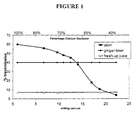
- Figure 1 shows the translucency of various calcium-depleted skim milks and two commercial products.
- the ginger beer is the “Bunderburg” ginger beer and the freshup is the “Freshup” orange juice. Freshup has a transmission value of 7%, whereas ginger beer has a transmission value of 40%.
- the transmission values given Figure 1 indicates that for "Ginger beer” type of translucency, about 60% depletion of calcium is required and for the "Fresh-up" type translucency about 40% of calcium removal is required.
- Skim milk of composition given in Table 1 was adjusted to pH of 5.8 using 3.3% citric acid. After 15 min, the pH of skim milk was measured. Due to buffering of milk, the pH of the acidified milk increases by 0.1 to 0.15 units. The pH was again adjusted to 5.8 with some more 3.3% citric acid.
- a skim milk to resin ratio of about 12 is used.
- 200 ml of skim milk at a pH of 5.83 was contacted with 17 g of resin, in 500 ml beaker and stirred constantly with a magnetic stirrer.
- the resin was an IMAC HP 111 E, a strong cation exchange resin with a total exchange resin with a total exchange capacity of 2 req/L of sodium.
- the resin is manufactured by Rohm & Haas and has sulphonic acid functional groups.
- the stirrer speed is such that all the resin is suspended in the skim milk and its pH is monitored.
- the pH of the mixture increases with time- such as 6.15 at 5 min, 6.32 in 15 mins and after 25 minutes the pH reached a final value of 6.47.
- the resin was separated from mixture and its calcium content is measured.
- Table 2 gives typical pHs and calciums of skim milk at different skim milk to resin ratios, as well as their translucency transmission values.
- Table 1 Milk Composition Component Skim Milk (%) Ash 0.76 Lactose 5.17 Fat 0.06 Casein Protein 2.88 Whey Protein 0.58 Total Protein 3.67
- Table 2 Compositions of calcium depleted skim milks Skim milk (ml) 200 200 200 200 Skim milk pH 5.83 5.83 5.83 5.83 Resin weight (g) 0 10 14 17 Final calcium 32.7 16.9 12.4 6.7 Final pH 5.83 6.24 6.4 6.5 Percentage calcium depletion 0 48 62 80 Transmission value (%) 0 17.8 45.2 55.7
- This calcium depleted milk powder was reconstituted to 6% solids and its translucency was measured, to be about 60%.
- the reconstituted sample from example 2 was UHT treated in indirect UHT equipment with conditions of 140°C for 4 s.
- the resulting UHT sample was more translucent than the reconstituted sample. Its transmission value was about 64%.
- the UHT treated reconstituted skim milk powder from the previous example was carbonated by adding dry ice (frozen carbon dioxide) in powdered form.
- Typical carbonation levels in translucent milks are about 3.5 volumes bunsen. This level of carbonation compares well with commercial carbonated products, i.e soda water - 4.5 volumes of bunsen, cola - 4.2 volumes bunsen, lightly sparkling - 3.0 volumes bunsen.
- flavours such as lemon/lime, grape and orange as well as appropriate colours were added to make the product resemble commercial soft or sports drinks.
- skim milk is subjected to concentration on an ultrafiltration (or a microfiltration) membrane (Koch S4 HFK 131 type membranes having a nominal molecular weight cut-off of 10,000 daltons) to produce an MPC retentate.
- an ultrafiltration (or a microfiltration) membrane Koch S4 HFK 131 type membranes having a nominal molecular weight cut-off of 10,000 daltons
- the MPC retentate will have a protein content in the range of 42-85% of the dry matter is milk protein.
- the 200 kg of MPC56 retentate contains 0.26% of calcium or a total calcium content of 530 g of calcium. To remove all this calcium approximately 70 L of strong cation-exchange resin in the sodium form was used.
- the resin was an IMAC HP 111E, a strong acid cation exchange resin with a total exchange capacity of 2 eq/L of sodium.
- the resin is manufactured by Rohm & Haas and has sulphonic acid functional groups.
- the resin was loaded into a stainless steel vessel of about 40 cm in diameter and a height of 110 cm or a total volume of 140 L. Seventy litres of the resin bed had a height of 55 cm.
- the 200 kg of the retentate was then passed through the resin at 2 bed volume an hour or 140 L/h. To process 200 kg of the retentate takes about one-and-a-half hours.
- the resulting retentate had about 0.005% of calcium and a pH of about 7.1.
- the calcium-depleted MPC56 was mixed with untreated MPC56 the remaining 67 Kg of MPC56 to produce a retentate containing 0.4% calcium. This retentate was then evaporated and dried to produce an MPC56 powder containing 0.4% calcium.
- the composition of the powder is shown in column A of Table 2.
- MPC70 and MPC85 retentate are diluted prior to passage through the ion-exchange column.
- Table 4 Compositions of Milk Protein Concentrates MPC A B C Total protein 56 70 85 Ash 7-9 7-9 6-8 Lactose 28-30 14-16 ⁇ 5 Fat 0.9-1.1 1.5-1.6 >1.7 Calcium 0.4 0.45 0.55 Sodium (%) 2.4 2.6 3.0
- MPCs can be reconstituted at various protein concentrations to produce translucent milks. For example, for a translucent milk containing 2% protein, dissolve 2.5 g of Ca-depleted MPC85 in 100 ml of water. This reconstituted MPC85 solution looks translucent, which can be UHTed, carbonated and flavour added to produce the sample translucent product described in examples 3, 4 and 5.
Landscapes
- Engineering & Computer Science (AREA)
- Life Sciences & Earth Sciences (AREA)
- Chemical & Material Sciences (AREA)
- Food Science & Technology (AREA)
- Polymers & Plastics (AREA)
- Water Supply & Treatment (AREA)
- Dairy Products (AREA)
- Non-Alcoholic Beverages (AREA)
Abstract
Description
- This invention relates to novel milk products.
- Milk and flavoured milks have received wide acceptance among consumers for centuries. Much of this acceptance has related to recognition of the valuable nutrient content of the drinks.
- Soft drinks and particularly carbonated soft drinks have also received wide acceptance based primarily on flavour, appearance and carbonation, despite a poor nutrient content.
- US Patent 4,676,988 discloses a process in which milk in contacted with a strong cation-exchange in resin in acid form for a time sufficient to lower the pH in the milk to between 1.5 and 3.2. In this process the milk cations are exchanged with hydrogen ions. The decationised milk is contacted with a strong anion-exchange in resin in base form for a time sufficient to raise the pH of the milk to the value of about 3.5 - 4.5. This material is mixed with decationised, deanionised fruit juice to form a drink. This process has disadvantages in that it consists of numerous steps and involves adjusting the pH of a milk to a pH at which denaturation of proteins occurs.
- Japanese patent application 1988-188346 discloses a method for the production of calcium depleted skim milk. In this method, skim milk is treated with a modified chelate resin in which the chelate group comprises both H type and Na type.
- It is an object of the present invention to provide an improved milk drink base suitable for making milk drinks more like soft drinks; and/or, milk drinks like soft drinks derived from the base; and/or processes for the preparation of the base and the milk drinks like soft drinks and/or provide the public with a useful and nutritious choice.
- In one aspect the invention provides a method of preparing a translucent milk drink comprising:
- (a) providing an opaque milk starting material having a pH in the range 5.7-6.5;
- (b) contacting at least a portion of the starting material with a cation exchanger charged with exchangeable sodium or potassium cations or both to remove calcium until the percentage transmission of the material (when separated from the exchanger) rises to at least 5%, preferably at least 25%, more preferably at least 40% when measured using a 1cm layer of sample being illuminated at a wavelength of 850nm; and
- (c) optionally mixing the translucent milk sample with another milk sample while retaining the percentage transmission at least 5%, preferably at least 25%, more preferably at least 40%
- Translucency of milk was measured with a Turbiscan MA 2000 Macroscopic Analyser (Formulaction, Toulouse, France) using transmission of a pulsed near infrared (NIR) light source (λ = 850 nm). The sample is contained in a special sample cell and NIR is passed through the sample and a transmission detector receives the light, which goes through the sample. The transmission detector acquires the transmitted light flux (in %) as a function of the sample height (65 mm). For the definition of translucency, we have taken an average value of transmission from 20 mm to 50 mm height of the sample cell. The pathlength is 1 cm.
- In a second aspect the invention provides a method of preparing a translucent m ilk drink comprising:
- (a) providing a opaque milk starting material having a pH in the range 5.7-6.5;
- (b) removing at least 50-100%, preferably 60-100% more preferably 80-100% of calcium therein by cation exchange on a cation exchanger charged with either exchangeable sodium or potassium cations or both;
- (c) optionally mixing the calcium-depleted milk sample with another milk sample while retaining the percentage calcium depletion in the range 50-100%, preferably 60-100%, more preferably 80-100%.
- In preferred forms of the invention the opaque milk starting material is chosen from skim milk, milk protein concentrate (MPC) or milk protein isolate (MPI).
- The preferred cation exchangers are based on resins bearing strongly acidic groups, preferably sulphonate groups.
- Preferably the translucent milk product contains greater than 0.8% (w/v), preferably greater than 2% (w/v) milk protein.
- By the term "opaque milk st arting material" is meant milk, skim milk or a milk derived product containing casein and whey proteins with 5-60% of the protein being whey proteins. Preferably the starting material has substantially the same proportions of casein and whey proteins as milk. Preferably the fat content is less than 10% (w/w) of the protein content. If whole milk is used a fat removal step is also required (e.g. by centrifugation) before measurement of translucency.
- The term "skim milk" means skim milk separated from whole milk of mammals which optionally has been pasteurised and includes diluted, ultrafiltered or concentrated partly demineralised skim milk in which the carbohydrate level has been adjusted provided always that the original percentages of casein to whey proteins have remained substantially unaltered.
- The term "milk protein concentrate" (MPC) refers to a milk protein product in which greater than 55%, preferably greater than 70%, more preferably greater than 75% of the dry matter is milk protein. The ratio of casein to whey proteins is approximately that of milk.
- The term "milk protein isolate" (MPI) refers to a milk protein composition comprising substantially unaltered proportion of casein to whey proteins wherein the dry matter consists of greater than 85% milk protein.
MPC and MPI may be prepared by ultrafiltration of skim milk where the ultrafiltration membrane has a molecular weight cut off of 10,000 or lower. Diafiltration may also be used. - If MPC or MPI is used it is possible to generate a solution with 10-12% (w/v) protein which is still translucent.
- The pH range chosen brings considerable advantages. Below pH 5.6 the solutions tend to coagulate. Above pH 8.0 the taste is inferior and the solution is not suitable for carbonation. The invention uses pH values below pH 7.0. If the cation exchange process results in the product having a pH greater than 7.0 it is preferred to reduce the pH, for example by addition of citric acid solution.
- A preferred strong acid cation exchange resin for use in the invention is IMAC HP 111 E manufactured by Rohm & Haas. This resin has a styrene divinylbenzene copolymer matrix. The functional groups are sulphonic acid groups that can be obtained in the Na+ form or alternatively converted to the K+ form. It is preferred that the ion exchange resin be in the Na+ and/or K+ form.
- By manipulating the pH, and the choice of cation it is possible to vary the flavour of the translucent milk produced. For some circumstances it will be useful to provide micronutrient cations in addition to sodium or potassium. One preferred cation for use with sodium and or potassium is magnesium.
- The use of strong acid cation exchangers is preferred because with weak acid cation exchangers, phosphate is also removed which results in lower nutritional value and a non-translucent product.
- The process is preferably carried out in a cool temperature in the range 4°C to 12°C but may be carried out at temperatures as high as 50°C.
- The translucent milks can be converted into a soft drink like milk drink by addition of small amounts of other components, especially colour and flavour. Typically 0.1 to 3% each of vitamins, flavour, preservatives, thickeners, flavour enhancers and the like are added. Materials suitable for carrying out these functions in drinks are well known.
- For convenience, a dried product can be prepared from the translucent milk. The drying may be by standard techniques. The product may be reconstituted in water to prepare a translucent milk. It has good suspendability even in cold water at 4°C to 12°C. Colourings and flavourings may be present in the dried product or may be added subsequently.
- In addition to drinks, the translucent milk products may be used to form nutritious gels and jellies. These may be prepared using conventional gelling agents.
- Especially preferred are carbonated drinks. Carbonation can be carried out by means known to those skilled in the art. Example 5 herein illustrates carbonation using dry ice. Other options include using commercial carbonation systems.
-
- Figure 1 shows % transmission of skim milk with varying % calcium depletion and comparison with ginger beer and freshup orange juice.
- Figure 2 is a schematic drawing of a process for preparing a calcium depleted MPC powder.
- The following examples further illustrate practice of the invention.
- Translucency of milk is measured using transmission of a pulsed near infrared (NIR) light source (λ = 850 nm) using Turbiscan. The sample is contained in a special sample cell and NIR is passed through the sample and a transmission detector receives the light, which goes through the sample. The transmission detector acquires the transmitted light flux (in %) as a function of the sample height (65 mm). For the definition of translucency, we have taken an average value of transmission from 20 mm to 50 mm height of the sample cell. The pathlength is 1cm.
- Figure 1 shows the translucency of various calcium-depleted skim milks and two commercial products. The ginger beer is the "Bunderburg" ginger beer and the freshup is the "Freshup" orange juice. Freshup has a transmission value of 7%, whereas ginger beer has a transmission value of 40%. The transmission values given Figure 1 indicates that for "Ginger beer" type of translucency, about 60% depletion of calcium is required and for the "Fresh-up" type translucency about 40% of calcium removal is required.
- Skim milk of composition given in Table 1 was adjusted to pH of 5.8 using 3.3% citric acid. After 15 min, the pH of skim milk was measured. Due to buffering of milk, the pH of the acidified milk increases by 0.1 to 0.15 units. The pH was again adjusted to 5.8 with some more 3.3% citric acid.
- To remove 80% of calcium from skim milk having a calcium content of about 33 mM/kg, a skim milk to resin ratio of about 12 is used. For example 200 ml of skim milk at a pH of 5.83 was contacted with 17 g of resin, in 500 ml beaker and stirred constantly with a magnetic stirrer. The resin was an IMAC HP 111 E, a strong cation exchange resin with a total exchange resin with a total exchange capacity of 2 req/L of sodium. The resin is manufactured by Rohm & Haas and has sulphonic acid functional groups.
- The stirrer speed is such that all the resin is suspended in the skim milk and its pH is monitored. The pH of the mixture increases with time- such as 6.15 at 5 min, 6.32 in 15 mins and after 25 minutes the pH reached a final value of 6.47. At this time the resin was separated from mixture and its calcium content is measured. Table 2 gives typical pHs and calciums of skim milk at different skim milk to resin ratios, as well as their translucency transmission values.
Table 1 - Milk Composition Component Skim Milk (%) Ash 0.76 Lactose 5.17 Fat 0.06 Casein Protein 2.88 Whey Protein 0.58 Total Protein 3.67 Table 2 Compositions of calcium depleted skim milks Skim milk (ml) 200 200 200 200 Skim milk pH 5.83 5.83 5.83 5.83 Resin weight (g) 0 10 14 17 Final calcium 32.7 16.9 12.4 6.7 Final pH 5.83 6.24 6.4 6.5 Percentage calcium depletion 0 48 62 80 Transmission value (%) 0 17.8 45.2 55.7 - 1000 L of skim milk was adjusted to a pH of 5.8 using dilute citric acid (eg. 3.3%). 100 L of the strong cation-exchange resin described in Example 2 was filled in a stainless steel vessel of about 40 cm diameter and a height of 100 cm or a total volume of 140 L. One hundred litres of resin bed had a height of 80 cm. The 1000 L of skim was then passed through the resin at 4 bed volumes an hour or 400 L of skim milk per hour. The resulting skim milk had about 10% of the original calcium. This skim milk was evaporated and dried to produce calcium depleted skim milk powder of composition, on a moisture free basis, given in Table 3.
Table 3 Composition of ca-depleted milk powder Component Protein Lactose Ash Calcium % 37.5 51 10 0.1 - This calcium depleted milk powder was reconstituted to 6% solids and its translucency was measured, to be about 60%.
- The reconstituted sample from example 2 was UHT treated in indirect UHT equipment with conditions of 140°C for 4 s. The resulting UHT sample was more translucent than the reconstituted sample. Its transmission value was about 64%.
- The UHT treated reconstituted skim milk powder from the previous example was carbonated by adding dry ice (frozen carbon dioxide) in powdered form. Typical carbonation levels in translucent milks are about 3.5 volumes bunsen. This level of carbonation compares well with commercial carbonated products, i.e soda water - 4.5 volumes of bunsen, cola - 4.2 volumes bunsen, lightly sparkling - 3.0 volumes bunsen.
- In addition to carbonation, flavours such as lemon/lime, grape and orange as well as appropriate colours were added to make the product resemble commercial soft or sports drinks.
- As illustrated in Figure 2, skim milk is subjected to concentration on an ultrafiltration (or a microfiltration) membrane (Koch S4 HFK 131 type membranes having a nominal molecular weight cut-off of 10,000 daltons) to produce an MPC retentate. Depending on the concentration factor used, the MPC retentate will have a protein content in the range of 42-85% of the dry matter is milk protein.
- For example when a skim milk of 1000 kg of concentration given in Table 1, is concentrated by 2.5 times, 400 kgs of MPC56 retentate and 600 kgs of permeate will be obtained.
- Part of 267 kg of MPC56 retentate, which had a pH of 6.8 was reduced to 5.9, using 3.3% citric acid. The acid was added to the retentate at 10°C, while continuously agitating the retentate. For example, to produce 75% Ca-depleted MPC56, 200 Kg of the retentate was pH-adjusted to 5.9. After fifteen minutes, the pH of the retentate was measured again. Depending on the buffering capacity of the retentate, the pH of pH-adjusted retentate increases by 0.1 to 0.15 units. The pH was adjusted again to 5.9 with some more 3.3% citric acid.
- The 200 kg of MPC56 retentate contains 0.26% of calcium or a total calcium content of 530 g of calcium. To remove all this calcium approximately 70 L of strong cation-exchange resin in the sodium form was used. The resin was an IMAC HP 111E, a strong acid cation exchange resin with a total exchange capacity of 2 eq/L of sodium.
- The resin is manufactured by Rohm & Haas and has sulphonic acid functional groups.
- The resin was loaded into a stainless steel vessel of about 40 cm in diameter and a height of 110 cm or a total volume of 140 L. Seventy litres of the resin bed had a height of 55 cm. The 200 kg of the retentate was then passed through the resin at 2 bed volume an hour or 140 L/h. To process 200 kg of the retentate takes about one-and-a-half hours. The resulting retentate had about 0.005% of calcium and a pH of about 7.1. The calcium-depleted MPC56 was mixed with untreated MPC56 the remaining 67 Kg of MPC56 to produce a retentate containing 0.4% calcium. This retentate was then evaporated and dried to produce an MPC56 powder containing 0.4% calcium. The composition of the powder is shown in column A of Table 2.
- If an MPC70 or an MPC85 retentate is used as a feed stream instead of MPC56 retentate, then Ca-depleted MPC70 and MPC85 of the compositions given in columns B and C respectively Table 2 below can be produced. MPC70 and MPC85 retentates are diluted prior to passage through the ion-exchange column.
Table 4 - Compositions of Milk Protein Concentrates MPC A B C Total protein 56 70 85 Ash 7-9 7-9 6-8 Lactose 28-30 14-16 <5 Fat 0.9-1.1 1.5-1.6 >1.7 Calcium 0.4 0.45 0.55 Sodium (%) 2.4 2.6 3.0 - These MPCs can be reconstituted at various protein concentrations to produce translucent milks. For example, for a translucent milk containing 2% protein, dissolve 2.5 g of Ca-depleted MPC85 in 100 ml of water. This reconstituted MPC85 solution looks translucent, which can be UHTed, carbonated and flavour added to produce the sample translucent product described in examples 3, 4 and 5.
- In an agitated mixing vessel, combine water (55°C) (92.23 parts), sucrose (6 parts) and milk solids from dried translucent milk prepared according to Example 3 or Example 6 (1.5 parts). Hydrate for 10 minutes. Gradually add 20% citric acid solution (0.15 parts) with agitation. Add honeydew flavour (Givaudan Roure 55482AA, 0.05 parts), rock melon flavour (Givaudan Roure 55480AA, 0.05 parts) and a green colour (1:100, Bush Boake Allen, 0.02 parts), and mix well.
- Preheat product to 75°C. Process product at 137°C for 3 seconds. Bottle aseptically.
Claims (12)
- A method of preparing a translucent milk drink having a pH in the range 5.6-7.0 comprising:(a) providing an opaque milk starting material having a pH in the range 5.7-6.5;(b) contacting at least a portion of the starting material with a cation exchanger charged with exchangeable sodium or potassium cations or both to remove calcium until the percentage transmission of the material (when separated from the exchanger) rises to at least 5%, preferably at least 25%, more preferably at least 40% when measured using a 1cm layer of sample being illuminated at a wavelength of 850nm; and(c) optionally mixing the translucent milk sample with another milk sample while retaining the percentage transmission at least 5%, preferably at least 25%, more preferably at least 40%
- A method as claimed in claim 1 comprising:(a) providing a opaque milk starting material having a pH in the range 5.7-6.5;(b) removing at least 50-100%, preferably 60-100% more preferably 80-100% of calcium therein by cation exchange on a cation exchanger charged with either exchangeable sodium or potassium cations or both;(c) optionally mixing the calcium-depleted milk sample with another milk sample while retaining the percentage calcium depletion in the range 50-100%, preferably 60-100%, more preferably 80-100%.
- A method as claimed in claim 1 or claim 2 wherein the final percentage calciumdepletion is 60%-100%.
- A method as claimed in claim 1 or claim 2 wherein the final percentage calciumdepletion is in the range 80-100%.
- A method as claimed in any one of claims 1 to 4 wherein the opaque milk starting material is a low fat milk sample chosen from skim milk, milk protein concentrate or milk protein isolate.
- A method as claimed in claim 1 or claim 2 where the cation exchanger is a resin bearing strongly acidic groups.
- A method as claimed in any one of claims 1-6 wherein a translucent milk drink is incorporated into a nutritional drink.
- A method as claimed in any one of claims 1 to 7 wherein the translucent milk drink contains greater than 0.8% (w/v) milk protein, preferably greater than 2% (w/v) milk protein.
- A method as claimed in any one of claims 1 to 8 wherein calcium ions are replaced by sodium ions.
- A method as claimed in any one of claims 1 to 9 further comprising addition of colouring and flavouring.
- A method as claimed in claim 10 further comprising carbonation of said drink.
- A method as claimed in any one of claims 1 to 6 and 11 further comprising the step of drying the translucent milk.
Applications Claiming Priority (3)
| Application Number | Priority Date | Filing Date | Title |
|---|---|---|---|
| NZ501675A NZ501675A (en) | 1999-12-09 | 1999-12-09 | Translucent milk drink having a pH of 5.7 to 7.0 and a percentage transmission of at least 5% prepared by a cation exchange process |
| NZ50167599 | 1999-12-09 | ||
| PCT/NZ2000/000247 WO2001041579A1 (en) | 1999-12-09 | 2000-12-11 | Milk product and process |
Publications (3)
| Publication Number | Publication Date |
|---|---|
| EP1239737A1 EP1239737A1 (en) | 2002-09-18 |
| EP1239737A4 EP1239737A4 (en) | 2004-10-06 |
| EP1239737B1 true EP1239737B1 (en) | 2007-05-16 |
Family
ID=19927664
Family Applications (1)
| Application Number | Title | Priority Date | Filing Date |
|---|---|---|---|
| EP00981936A Expired - Lifetime EP1239737B1 (en) | 1999-12-09 | 2000-12-11 | Milk product and process |
Country Status (14)
| Country | Link |
|---|---|
| US (1) | US7501143B2 (en) |
| EP (1) | EP1239737B1 (en) |
| JP (1) | JP4226822B2 (en) |
| KR (1) | KR20020071883A (en) |
| CN (1) | CN100381062C (en) |
| AT (1) | ATE362321T1 (en) |
| AU (1) | AU784638B2 (en) |
| CA (1) | CA2393331A1 (en) |
| DE (1) | DE60034896T2 (en) |
| HK (1) | HK1049767B (en) |
| MX (1) | MXPA02005601A (en) |
| NZ (1) | NZ501675A (en) |
| TW (1) | TWI256290B (en) |
| WO (1) | WO2001041579A1 (en) |
Families Citing this family (18)
| Publication number | Priority date | Publication date | Assignee | Title |
|---|---|---|---|---|
| FI20010020A0 (en) * | 2001-01-05 | 2001-01-05 | Eino Elias Hakalehto | Milk - based product, its use and method of preparation |
| AU2003265631A1 (en) | 2002-08-23 | 2004-03-11 | Fonterra Co-Operative Group Ltd. | Method for producing a food product from a concentrated protein |
| US20070190211A1 (en) * | 2005-12-15 | 2007-08-16 | Friis Torben L | Milk mineral water, processes for manufacturing thereof and beverages containing milk mineral water |
| NZ549470A (en) * | 2006-08-28 | 2009-01-31 | Fonterra Co Operative Group | Dairy product and process |
| US8501258B1 (en) | 2006-10-13 | 2013-08-06 | Jose Antonio Feregrino-Quezada | Method for preparing milk-based beverages |
| NZ551500A (en) * | 2006-11-23 | 2010-04-30 | Ganugapati Vijaya Bhaskar | Yoghurt product and process using divalent cation depleted milk |
| NZ563962A (en) * | 2007-12-03 | 2010-09-30 | Fonterra Co Operative Group | Dairy product and process |
| JP4764893B2 (en) * | 2008-02-12 | 2011-09-07 | 森永乳業株式会社 | Heat-sterilized milk and method for producing the same |
| PL2437614T3 (en) | 2009-06-04 | 2018-03-30 | Fonterra Co-Operative Group Limited | Calcium fortified processed cheese without emulsifying salts, and process for preparing same |
| US20100310711A1 (en) * | 2009-06-08 | 2010-12-09 | Kendell Lamar Chet | Milk filtration system |
| DK2592938T4 (en) * | 2010-07-16 | 2025-01-02 | Fonterra Cooperative Group Ltd | DAIRY PRODUCT AND PROCESS |
| LT2822568T (en) * | 2012-03-09 | 2020-09-10 | Fonterra Co-Operative Group Limited | Uses of casein compositions |
| MX370537B (en) * | 2013-02-07 | 2019-12-17 | Novozymes As | Composition comprising lactobacillus and a carrier. |
| CN105104703A (en) * | 2015-09-09 | 2015-12-02 | 江南大学 | Preparing method for concentrated milk protein powder used for producing semitransparent and transparent milk beverages |
| CN105104704A (en) * | 2015-09-09 | 2015-12-02 | 江南大学 | Method for improving concentrated milk protein powder solubility through ion exchange decalcification |
| EP3377088A4 (en) * | 2015-11-19 | 2019-07-24 | South Dakota Board of Regents | PROCESS AND SYSTEM FOR MANUFACTURING MINERAL MINI-MICELLAR CASEIN CONCENTRATE |
| JP6837654B2 (en) * | 2016-09-29 | 2021-03-03 | 大洋香料株式会社 | Clear acidic milky beverage and its manufacturing method |
| EP4696147A3 (en) | 2018-11-20 | 2026-04-22 | Fonterra Co-Operative Group Ltd | Dairy product and process |
Family Cites Families (23)
| Publication number | Priority date | Publication date | Assignee | Title |
|---|---|---|---|---|
| US654377A (en) * | 1900-05-09 | 1900-07-24 | Sylvester J Asbell | Water-closet valve. |
| US2346844A (en) * | 1940-08-14 | 1944-04-18 | M & R Dietetic Lab Inc | Process of treating milk |
| US2503866A (en) * | 1946-04-12 | 1950-04-11 | M & R Dietetic Lab Inc | Preparation of a stabilized cream product |
| GB654377A (en) | 1946-09-11 | 1951-06-13 | M & R Dietetic Lab Inc | Improvements in or relating to method of processing fluid milk and the product resulting therefrom |
| US2707152A (en) * | 1951-01-30 | 1955-04-26 | Chaney | Low-sodium milk and processes for producing same |
| US2879166A (en) * | 1956-04-25 | 1959-03-24 | Foremost Dairies Inc | Milk product having low sodium content and process of producing same |
| FR2239208B1 (en) * | 1973-07-31 | 1977-10-07 | Nestle Sa | |
| FR2450064A1 (en) | 1979-02-28 | 1980-09-26 | Bel Fromageries | PROCESS FOR THE PREPARATION OF DAIRY PRODUCTS FOR THE MANUFACTURE OF PROCESSED CHEESES, AND NOVEL PRODUCTS THUS OBTAINED |
| FR2452879A1 (en) | 1979-04-06 | 1980-10-31 | Bel Fromageries | Ultrafiltered milk prods. used in cheese mfr. - treated before or after ultrafiltration to remove calcium by ion exchange |
| FR2470546A1 (en) | 1979-11-28 | 1981-06-12 | Meggle Milchind Gmbh & Co | Cheese prodn. - using ultrafiltration permeate for acidification after cation removal, of the milk |
| US4450182A (en) * | 1982-12-30 | 1984-05-22 | General Foods Corporation | Process for modifying a dairy media for use as a foaming agent |
| US4676988A (en) | 1984-03-19 | 1987-06-30 | General Mills, Inc. | Low-acid juice-milk beverages, juice and milk components therefor and methods of preparation |
| FI73000C (en) * | 1985-11-14 | 1987-08-10 | Valio Meijerien | Procedure for specific separation of lactose from milk. |
| JPH0712276B2 (en) | 1987-01-30 | 1995-02-15 | 雪印乳業株式会社 | Decalcified skim milk and method for producing the same |
| US4919960A (en) * | 1987-09-08 | 1990-04-24 | Dairy Research, Inc. | Process of making a carbonated liquid dairy product |
| US4876988A (en) * | 1988-06-13 | 1989-10-31 | Paul Marius A | Combined fuel engine |
| JPH04179440A (en) | 1990-07-27 | 1992-06-26 | Meiji Milk Prod Co Ltd | Dairy product having low sodium content and its preparation |
| FR2703830B1 (en) * | 1993-04-08 | 1997-07-04 | Motorola Semiconducteurs | Switching transistor assembly. |
| DE4326665C2 (en) * | 1993-08-09 | 1995-07-13 | Biotest Pharma Gmbh | Process for sterile filtration of milk |
| AU1809895A (en) | 1994-02-16 | 1995-09-04 | Pharming Bv | Isolation of lactoferrin from milk |
| NZ328836A (en) * | 1996-10-09 | 1999-02-25 | Nestle Sa | Process for demineralization of sweet whey by electrodeionization in an apparatus containing dilution and concentration departments |
| US6139901A (en) * | 1997-09-16 | 2000-10-31 | New Zealand Milk Products (North Amerca) Inc. | Membrane filtered milk proteins varying in composition and functional attributes |
| JP4179440B2 (en) | 2000-11-06 | 2008-11-12 | 株式会社リコー | Image forming apparatus |
-
1999
- 1999-12-09 NZ NZ501675A patent/NZ501675A/en unknown
-
2000
- 2000-12-11 JP JP2001542762A patent/JP4226822B2/en not_active Expired - Fee Related
- 2000-12-11 CA CA002393331A patent/CA2393331A1/en not_active Abandoned
- 2000-12-11 AU AU19037/01A patent/AU784638B2/en not_active Ceased
- 2000-12-11 KR KR1020027007339A patent/KR20020071883A/en not_active Ceased
- 2000-12-11 US US10/149,162 patent/US7501143B2/en not_active Expired - Fee Related
- 2000-12-11 MX MXPA02005601A patent/MXPA02005601A/en active IP Right Grant
- 2000-12-11 EP EP00981936A patent/EP1239737B1/en not_active Expired - Lifetime
- 2000-12-11 AT AT00981936T patent/ATE362321T1/en not_active IP Right Cessation
- 2000-12-11 WO PCT/NZ2000/000247 patent/WO2001041579A1/en not_active Ceased
- 2000-12-11 DE DE60034896T patent/DE60034896T2/en not_active Expired - Lifetime
- 2000-12-11 CN CNB008169977A patent/CN100381062C/en not_active Expired - Fee Related
- 2000-12-11 HK HK03101925.5A patent/HK1049767B/en not_active IP Right Cessation
- 2000-12-22 TW TW089127721A patent/TWI256290B/en not_active IP Right Cessation
Also Published As
| Publication number | Publication date |
|---|---|
| WO2001041579A1 (en) | 2001-06-14 |
| EP1239737A1 (en) | 2002-09-18 |
| CN100381062C (en) | 2008-04-16 |
| US20040197440A1 (en) | 2004-10-07 |
| HK1049767A1 (en) | 2003-05-30 |
| HK1049767B (en) | 2007-12-14 |
| MXPA02005601A (en) | 2004-09-10 |
| CN1409602A (en) | 2003-04-09 |
| ATE362321T1 (en) | 2007-06-15 |
| NZ501675A (en) | 2002-12-20 |
| CA2393331A1 (en) | 2001-06-14 |
| JP4226822B2 (en) | 2009-02-18 |
| TWI256290B (en) | 2006-06-11 |
| DE60034896D1 (en) | 2007-06-28 |
| JP2003515353A (en) | 2003-05-07 |
| EP1239737A4 (en) | 2004-10-06 |
| KR20020071883A (en) | 2002-09-13 |
| DE60034896T2 (en) | 2008-01-17 |
| AU784638B2 (en) | 2006-05-18 |
| AU1903701A (en) | 2001-06-18 |
| US7501143B2 (en) | 2009-03-10 |
Similar Documents
| Publication | Publication Date | Title |
|---|---|---|
| US7501143B2 (en) | Milk product and process | |
| JP6932815B2 (en) | Dairy formulation and its manufacturing method | |
| EP1241947B1 (en) | Milk protein products and processes | |
| US4676988A (en) | Low-acid juice-milk beverages, juice and milk components therefor and methods of preparation | |
| WO1990006060A1 (en) | Method for preparing milk/mineral concentrate and mineralized drink | |
| EP2729012B1 (en) | Milk-based formulation | |
| EP1399028B1 (en) | Clear dairy drink and method for producing same | |
| US20020025361A1 (en) | Method for producing milk calcium composition | |
| NL8403701A (en) | METHOD FOR PROCESSING PRODUCTS OBTAINED IN DAIRY PRODUCTS AND DAIRY PRODUCTS CONTAINING PRODUCTS ORIGINATING IN WHEY. | |
| EP0491623A1 (en) | Milk drink and process for its preparation | |
| JPS59120049A (en) | Enzimatically treated milk seruns powder and production thereof | |
| IE20030563A1 (en) | Process for preparing a milk powder | |
| GB2404560A (en) | Process for preparing a milk powder | |
| FI58430C (en) | REFERENCE TO A RESERVE FOR THE PURPOSE OF A RESOLUTION | |
| IE20030564U1 (en) | Process for preparing a milk powder | |
| IES83230Y1 (en) | Process for preparing a milk powder | |
| IES20030564A2 (en) | Process for preparing a milk powder | |
| HK1191181A (en) | Milk-based formulation | |
| HK1191181B (en) | Milk-based formulation |
Legal Events
| Date | Code | Title | Description |
|---|---|---|---|
| PUAI | Public reference made under article 153(3) epc to a published international application that has entered the european phase |
Free format text: ORIGINAL CODE: 0009012 |
|
| 17P | Request for examination filed |
Effective date: 20020705 |
|
| AK | Designated contracting states |
Kind code of ref document: A1 Designated state(s): AT BE CH CY DE DK ES FI FR GB GR IE IT LI LU MC NL PT SE TR |
|
| AX | Request for extension of the european patent |
Free format text: AL;LT;LV;MK;RO;SI |
|
| A4 | Supplementary search report drawn up and despatched |
Effective date: 20040825 |
|
| RIC1 | Information provided on ipc code assigned before grant |
Ipc: 7A 23C 9/146 A |
|
| 17Q | First examination report despatched |
Effective date: 20050506 |
|
| GRAP | Despatch of communication of intention to grant a patent |
Free format text: ORIGINAL CODE: EPIDOSNIGR1 |
|
| GRAS | Grant fee paid |
Free format text: ORIGINAL CODE: EPIDOSNIGR3 |
|
| GRAA | (expected) grant |
Free format text: ORIGINAL CODE: 0009210 |
|
| AK | Designated contracting states |
Kind code of ref document: B1 Designated state(s): AT BE CH CY DE DK ES FI FR GB GR IE IT LI LU MC NL PT SE TR |
|
| PG25 | Lapsed in a contracting state [announced via postgrant information from national office to epo] |
Ref country code: FI Free format text: LAPSE BECAUSE OF FAILURE TO SUBMIT A TRANSLATION OF THE DESCRIPTION OR TO PAY THE FEE WITHIN THE PRESCRIBED TIME-LIMIT Effective date: 20070516 |
|
| REG | Reference to a national code |
Ref country code: GB Ref legal event code: FG4D |
|
| REG | Reference to a national code |
Ref country code: CH Ref legal event code: EP |
|
| REG | Reference to a national code |
Ref country code: IE Ref legal event code: FG4D |
|
| REF | Corresponds to: |
Ref document number: 60034896 Country of ref document: DE Date of ref document: 20070628 Kind code of ref document: P |
|
| PG25 | Lapsed in a contracting state [announced via postgrant information from national office to epo] |
Ref country code: SE Free format text: LAPSE BECAUSE OF FAILURE TO SUBMIT A TRANSLATION OF THE DESCRIPTION OR TO PAY THE FEE WITHIN THE PRESCRIBED TIME-LIMIT Effective date: 20070816 |
|
| PG25 | Lapsed in a contracting state [announced via postgrant information from national office to epo] |
Ref country code: ES Free format text: LAPSE BECAUSE OF FAILURE TO SUBMIT A TRANSLATION OF THE DESCRIPTION OR TO PAY THE FEE WITHIN THE PRESCRIBED TIME-LIMIT Effective date: 20070827 |
|
| REG | Reference to a national code |
Ref country code: CH Ref legal event code: NV Representative=s name: BOVARD AG PATENTANWAELTE |
|
| NLV1 | Nl: lapsed or annulled due to failure to fulfill the requirements of art. 29p and 29m of the patents act | ||
| ET | Fr: translation filed | ||
| PG25 | Lapsed in a contracting state [announced via postgrant information from national office to epo] |
Ref country code: AT Free format text: LAPSE BECAUSE OF FAILURE TO SUBMIT A TRANSLATION OF THE DESCRIPTION OR TO PAY THE FEE WITHIN THE PRESCRIBED TIME-LIMIT Effective date: 20070516 |
|
| REG | Reference to a national code |
Ref country code: HK Ref legal event code: GR Ref document number: 1049767 Country of ref document: HK |
|
| PG25 | Lapsed in a contracting state [announced via postgrant information from national office to epo] |
Ref country code: BE Free format text: LAPSE BECAUSE OF FAILURE TO SUBMIT A TRANSLATION OF THE DESCRIPTION OR TO PAY THE FEE WITHIN THE PRESCRIBED TIME-LIMIT Effective date: 20070516 |
|
| PG25 | Lapsed in a contracting state [announced via postgrant information from national office to epo] |
Ref country code: PT Free format text: LAPSE BECAUSE OF FAILURE TO SUBMIT A TRANSLATION OF THE DESCRIPTION OR TO PAY THE FEE WITHIN THE PRESCRIBED TIME-LIMIT Effective date: 20071016 Ref country code: NL Free format text: LAPSE BECAUSE OF FAILURE TO SUBMIT A TRANSLATION OF THE DESCRIPTION OR TO PAY THE FEE WITHIN THE PRESCRIBED TIME-LIMIT Effective date: 20070516 Ref country code: DK Free format text: LAPSE BECAUSE OF FAILURE TO SUBMIT A TRANSLATION OF THE DESCRIPTION OR TO PAY THE FEE WITHIN THE PRESCRIBED TIME-LIMIT Effective date: 20070516 |
|
| PLBE | No opposition filed within time limit |
Free format text: ORIGINAL CODE: 0009261 |
|
| STAA | Information on the status of an ep patent application or granted ep patent |
Free format text: STATUS: NO OPPOSITION FILED WITHIN TIME LIMIT |
|
| 26N | No opposition filed |
Effective date: 20080219 |
|
| PG25 | Lapsed in a contracting state [announced via postgrant information from national office to epo] |
Ref country code: GR Free format text: LAPSE BECAUSE OF FAILURE TO SUBMIT A TRANSLATION OF THE DESCRIPTION OR TO PAY THE FEE WITHIN THE PRESCRIBED TIME-LIMIT Effective date: 20070817 |
|
| PG25 | Lapsed in a contracting state [announced via postgrant information from national office to epo] |
Ref country code: MC Free format text: LAPSE BECAUSE OF NON-PAYMENT OF DUE FEES Effective date: 20071231 |
|
| PG25 | Lapsed in a contracting state [announced via postgrant information from national office to epo] |
Ref country code: IE Free format text: LAPSE BECAUSE OF NON-PAYMENT OF DUE FEES Effective date: 20071211 |
|
| PG25 | Lapsed in a contracting state [announced via postgrant information from national office to epo] |
Ref country code: CY Free format text: LAPSE BECAUSE OF FAILURE TO SUBMIT A TRANSLATION OF THE DESCRIPTION OR TO PAY THE FEE WITHIN THE PRESCRIBED TIME-LIMIT Effective date: 20070516 |
|
| PG25 | Lapsed in a contracting state [announced via postgrant information from national office to epo] |
Ref country code: LU Free format text: LAPSE BECAUSE OF NON-PAYMENT OF DUE FEES Effective date: 20071211 |
|
| PG25 | Lapsed in a contracting state [announced via postgrant information from national office to epo] |
Ref country code: TR Free format text: LAPSE BECAUSE OF FAILURE TO SUBMIT A TRANSLATION OF THE DESCRIPTION OR TO PAY THE FEE WITHIN THE PRESCRIBED TIME-LIMIT Effective date: 20070516 |
|
| PGFP | Annual fee paid to national office [announced via postgrant information from national office to epo] |
Ref country code: CH Payment date: 20091208 Year of fee payment: 10 |
|
| PGFP | Annual fee paid to national office [announced via postgrant information from national office to epo] |
Ref country code: GB Payment date: 20091223 Year of fee payment: 10 Ref country code: IT Payment date: 20091212 Year of fee payment: 10 Ref country code: FR Payment date: 20091217 Year of fee payment: 10 |
|
| PGFP | Annual fee paid to national office [announced via postgrant information from national office to epo] |
Ref country code: DE Payment date: 20091223 Year of fee payment: 10 |
|
| REG | Reference to a national code |
Ref country code: CH Ref legal event code: PFA Owner name: THE NEW ZEALAND DAIRY BOARD Free format text: THE NEW ZEALAND DAIRY BOARD#PSTORAL HOUSE, 25 THE TERRACE#WELLINGTON (NZ) -TRANSFER TO- THE NEW ZEALAND DAIRY BOARD#PSTORAL HOUSE, 25 THE TERRACE#WELLINGTON (NZ) |
|
| REG | Reference to a national code |
Ref country code: CH Ref legal event code: PL |
|
| GBPC | Gb: european patent ceased through non-payment of renewal fee |
Effective date: 20101211 |
|
| REG | Reference to a national code |
Ref country code: FR Ref legal event code: ST Effective date: 20110831 |
|
| PG25 | Lapsed in a contracting state [announced via postgrant information from national office to epo] |
Ref country code: LI Free format text: LAPSE BECAUSE OF NON-PAYMENT OF DUE FEES Effective date: 20101231 Ref country code: FR Free format text: LAPSE BECAUSE OF NON-PAYMENT OF DUE FEES Effective date: 20110103 Ref country code: CH Free format text: LAPSE BECAUSE OF NON-PAYMENT OF DUE FEES Effective date: 20101231 |
|
| REG | Reference to a national code |
Ref country code: DE Ref legal event code: R119 Ref document number: 60034896 Country of ref document: DE Effective date: 20110701 |
|
| PG25 | Lapsed in a contracting state [announced via postgrant information from national office to epo] |
Ref country code: DE Free format text: LAPSE BECAUSE OF NON-PAYMENT OF DUE FEES Effective date: 20110701 Ref country code: GB Free format text: LAPSE BECAUSE OF NON-PAYMENT OF DUE FEES Effective date: 20101211 |
|
| PG25 | Lapsed in a contracting state [announced via postgrant information from national office to epo] |
Ref country code: IT Free format text: LAPSE BECAUSE OF NON-PAYMENT OF DUE FEES Effective date: 20101211 |