EP1239621A1 - Method of monitoring SONET signals - Google Patents
Method of monitoring SONET signals Download PDFInfo
- Publication number
- EP1239621A1 EP1239621A1 EP02250957A EP02250957A EP1239621A1 EP 1239621 A1 EP1239621 A1 EP 1239621A1 EP 02250957 A EP02250957 A EP 02250957A EP 02250957 A EP02250957 A EP 02250957A EP 1239621 A1 EP1239621 A1 EP 1239621A1
- Authority
- EP
- European Patent Office
- Prior art keywords
- signal
- noise
- framing
- power
- separating
- Prior art date
- Legal status (The legal status is an assumption and is not a legal conclusion. Google has not performed a legal analysis and makes no representation as to the accuracy of the status listed.)
- Granted
Links
- 238000012544 monitoring process Methods 0.000 title claims abstract description 13
- 238000000034 method Methods 0.000 title claims abstract description 8
- RGNPBRKPHBKNKX-UHFFFAOYSA-N hexaflumuron Chemical group C1=C(Cl)C(OC(F)(F)C(F)F)=C(Cl)C=C1NC(=O)NC(=O)C1=C(F)C=CC=C1F RGNPBRKPHBKNKX-UHFFFAOYSA-N 0.000 title claims abstract 4
- 238000009432 framing Methods 0.000 claims abstract description 31
- 230000003287 optical effect Effects 0.000 claims abstract description 15
- 230000005540 biological transmission Effects 0.000 claims description 3
- 238000007689 inspection Methods 0.000 claims description 3
- 230000001360 synchronised effect Effects 0.000 claims description 2
- 238000004891 communication Methods 0.000 description 3
- 230000003321 amplification Effects 0.000 description 2
- 238000003199 nucleic acid amplification method Methods 0.000 description 2
- 230000008929 regeneration Effects 0.000 description 2
- 238000011069 regeneration method Methods 0.000 description 2
- 238000010183 spectrum analysis Methods 0.000 description 2
- 238000004458 analytical method Methods 0.000 description 1
- 230000000694 effects Effects 0.000 description 1
- 238000000605 extraction Methods 0.000 description 1
- 230000005693 optoelectronics Effects 0.000 description 1
- 230000000737 periodic effect Effects 0.000 description 1
- 238000011084 recovery Methods 0.000 description 1
- 230000000246 remedial effect Effects 0.000 description 1
- 230000003252 repetitive effect Effects 0.000 description 1
- 230000003595 spectral effect Effects 0.000 description 1
- 230000007704 transition Effects 0.000 description 1
- 230000000007 visual effect Effects 0.000 description 1
Images
Classifications
-
- H—ELECTRICITY
- H04—ELECTRIC COMMUNICATION TECHNIQUE
- H04L—TRANSMISSION OF DIGITAL INFORMATION, e.g. TELEGRAPHIC COMMUNICATION
- H04L1/00—Arrangements for detecting or preventing errors in the information received
- H04L1/20—Arrangements for detecting or preventing errors in the information received using signal quality detector
-
- H—ELECTRICITY
- H04—ELECTRIC COMMUNICATION TECHNIQUE
- H04B—TRANSMISSION
- H04B10/00—Transmission systems employing electromagnetic waves other than radio-waves, e.g. infrared, visible or ultraviolet light, or employing corpuscular radiation, e.g. quantum communication
- H04B10/07—Arrangements for monitoring or testing transmission systems; Arrangements for fault measurement of transmission systems
- H04B10/075—Arrangements for monitoring or testing transmission systems; Arrangements for fault measurement of transmission systems using an in-service signal
- H04B10/079—Arrangements for monitoring or testing transmission systems; Arrangements for fault measurement of transmission systems using an in-service signal using measurements of the data signal
- H04B10/0795—Performance monitoring; Measurement of transmission parameters
- H04B10/07953—Monitoring or measuring OSNR, BER or Q
-
- H—ELECTRICITY
- H04—ELECTRIC COMMUNICATION TECHNIQUE
- H04J—MULTIPLEX COMMUNICATION
- H04J3/00—Time-division multiplex systems
- H04J3/02—Details
- H04J3/06—Synchronising arrangements
- H04J3/0602—Systems characterised by the synchronising information used
-
- H—ELECTRICITY
- H04—ELECTRIC COMMUNICATION TECHNIQUE
- H04J—MULTIPLEX COMMUNICATION
- H04J3/00—Time-division multiplex systems
- H04J3/02—Details
- H04J3/14—Monitoring arrangements
-
- H—ELECTRICITY
- H04—ELECTRIC COMMUNICATION TECHNIQUE
- H04J—MULTIPLEX COMMUNICATION
- H04J3/00—Time-division multiplex systems
- H04J3/16—Time-division multiplex systems in which the time allocation to individual channels within a transmission cycle is variable, e.g. to accommodate varying complexity of signals, to vary number of channels transmitted
- H04J3/1605—Fixed allocated frame structures
- H04J3/1611—Synchronous digital hierarchy [SDH] or SONET
-
- H—ELECTRICITY
- H04—ELECTRIC COMMUNICATION TECHNIQUE
- H04J—MULTIPLEX COMMUNICATION
- H04J2203/00—Aspects of optical multiplex systems other than those covered by H04J14/05 and H04J14/07
- H04J2203/0001—Provisions for broadband connections in integrated services digital network using frames of the Optical Transport Network [OTN] or using synchronous transfer mode [STM], e.g. SONET, SDH
- H04J2203/0062—Testing
-
- Y—GENERAL TAGGING OF NEW TECHNOLOGICAL DEVELOPMENTS; GENERAL TAGGING OF CROSS-SECTIONAL TECHNOLOGIES SPANNING OVER SEVERAL SECTIONS OF THE IPC; TECHNICAL SUBJECTS COVERED BY FORMER USPC CROSS-REFERENCE ART COLLECTIONS [XRACs] AND DIGESTS
- Y10—TECHNICAL SUBJECTS COVERED BY FORMER USPC
- Y10S—TECHNICAL SUBJECTS COVERED BY FORMER USPC CROSS-REFERENCE ART COLLECTIONS [XRACs] AND DIGESTS
- Y10S370/00—Multiplex communications
- Y10S370/901—Wide area network
- Y10S370/902—Packet switching
- Y10S370/903—Osi compliant network
- Y10S370/907—Synchronous optical network, SONET
Definitions
- This invention relates to a technique for performance monitoring of the standard SONET (synchronous optical network) signal by examining the quality of its framing signal.
- SONET synchronous optical network
- the SONET standard defines a field set of criteria encompassing data rates and formats, network segments, network elements and the other factors important for ensuring end-to-end performance of an optical communication network.
- the current SONET system relies on individual bits in the SONET frame headers to extract performance monitoring indicators such as loss of frame (LOF).
- LEF loss of frame
- Such extraction is relatively easy in systems in which the regeneration of the optical signal is periodically converted to an electrical signal for amplification and then regenerated as an optical signal.
- individual bits are no longer available at section or line network elements, such as all-optical regenerators or all-optical cross-connects. This absence of individual bits complicates the problem of performance monitoring of all-optical systems.
- the present invention seeks an improved technique for performance monitoring of optical communication systems. Such monitoring is important to insure healthy network operation.
- the present invention provides an improved technique for performance monitoring of an optical communication system that complies with a SONET-type standard. More particularly, the present invention involves the spectral analysis of the SONET signal to eliminate therefrom the framing signal that serves to identify the start of each frame of the signal and to use the energy remaining in its time slot as performance-measuring indicators of the signal.
- the use of spectral analysis of the SONET traffic obviates the need for accessing individual bits of the signal, which greatly simplifies the process of performance monitoring.
- the present invention is based on the recognition that the SONET framing sequence has a spectral structure different from that of the rest of the signal, which is generally much more random.
- modulation domain analysis can successfully recognize this difference and show the transition between the framing signal and the rest of the signal as a function of time. In this way, the SONET framing pulses are extracted directly from the SONET traffic without accessing actual individual data bits.
- the framing signal for OC-N traffic is a periodic sequence of N bytes of A1 and N bytes of A2.
- This noise will be a measure of the quality of the framing signal and should indicate any loss of frame.
- This noise will generally be of a lower power level than the remainder of the signal that includes the data pulses so that the time slot of the detected framing signal noise can be readily recognized by inspection for use in monitoring of the quality of the framing signal. To facilitate such inspection the signal now available can first be passed through a square law detector.
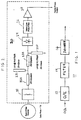
- FIG. 1 shows a block schematic of apparatus for recovery from the optical carrier signal of a SONET system for extracting the framing signal in accordance with the invention.
- FIG. 2 shows in schematic form the basic elements of an exemplary embodiment of the apparatus of FIG. 1.
- the optical carrier (OC) received is first supplied to a standard optoelectronic apparatus 12, such as a PIN diode, that converts the optical signal to an electrical signal.
- a standard optoelectronic apparatus 12 such as a PIN diode
- This signal is then supplied to a notch filter 14 designed to filter out the repetitive framing signal while passing the noise associated with it remaining in its time slot at lower power as well as the higher random data signal power.
- the output of the filter 14 is now supplied to a square law detector 16 which further discriminates between the low power framing signal noise and the high power data signal so that, in a visual display of the result, there is readily recognized the framing signal noise and its level determined. Remedial action can then be taken when the framing signal noise is detected to be above some specified level.
- FIG. 2 there is shown in greater detail within the broken line 100 an exemplary embodiment 20 of the electronic circuitry for treating the optical SONET signal after it has been converted to its electronic form.
- the exemplary circuitry 20 includes a 50 ohm termination 21, which is supplied with the converted electrical input and which is included to minimize the effect of any reflections in the circuitry.
- a low- pass notch filter 22 comprising, for example, two 50 ohm lengths of transmission 22A, 22B line and two one-quarter wavelength stubs 22C, 22D, of which 22C is open-ended and 22D shorted, to form a notch filter that passes the framing signal noise and the data payload, but blocks the framing signal.
- the filter is designed to generate notches at where n is 1...8, and T D is the data rate of the OC traffic.
- the filter output is then supplied to a diode 24 that serves as a squaring circuit for providing a low voltage-signal for low signal-power but supplying a relatively higher voltage for higher powers to provide increased discrimination between low and high powers. This facilitates distinguishing the relatively high data-power from the relatively low framing-signal noise power.
- a video low-pass filter 26 that passes selectively the video framing signal noise voltage, which, after amplification in amplifier 28, can be viewed for use in monitoring the operation.
Landscapes
- Engineering & Computer Science (AREA)
- Computer Networks & Wireless Communication (AREA)
- Signal Processing (AREA)
- Physics & Mathematics (AREA)
- Electromagnetism (AREA)
- Quality & Reliability (AREA)
- Time-Division Multiplex Systems (AREA)
- Optical Communication System (AREA)
- Monitoring And Testing Of Transmission In General (AREA)
Abstract
Description
- This invention relates to a technique for performance monitoring of the standard SONET (synchronous optical network) signal by examining the quality of its framing signal.
- The SONET standard defines a field set of criteria encompassing data rates and formats, network segments, network elements and the other factors important for ensuring end-to-end performance of an optical communication network. The current SONET system relies on individual bits in the SONET frame headers to extract performance monitoring indicators such as loss of frame (LOF). Such extraction is relatively easy in systems in which the regeneration of the optical signal is periodically converted to an electrical signal for amplification and then regenerated as an optical signal. However in all-optical regeneration systems, individual bits are no longer available at section or line network elements, such as all-optical regenerators or all-optical cross-connects. This absence of individual bits complicates the problem of performance monitoring of all-optical systems. The present invention seeks an improved technique for performance monitoring of optical communication systems. Such monitoring is important to insure healthy network operation.
- The present invention provides an improved technique for performance monitoring of an optical communication system that complies with a SONET-type standard. More particularly, the present invention involves the spectral analysis of the SONET signal to eliminate therefrom the framing signal that serves to identify the start of each frame of the signal and to use the energy remaining in its time slot as performance-measuring indicators of the signal. The use of spectral analysis of the SONET traffic obviates the need for accessing individual bits of the signal, which greatly simplifies the process of performance monitoring.
- The present invention is based on the recognition that the SONET framing sequence has a spectral structure different from that of the rest of the signal, which is generally much more random. In particular, modulation domain analysis can successfully recognize this difference and show the transition between the framing signal and the rest of the signal as a function of time. In this way, the SONET framing pulses are extracted directly from the SONET traffic without accessing actual individual data bits.
- In particular, when there is removed the framing signal, there remains in its time slot the noise that has accumulated in such time slot. The framing signal for OC-N traffic is a periodic sequence of N bytes of A1 and N bytes of A2. This noise will be a measure of the quality of the framing signal and should indicate any loss of frame. This noise will generally be of a lower power level than the remainder of the signal that includes the data pulses so that the time slot of the detected framing signal noise can be readily recognized by inspection for use in monitoring of the quality of the framing signal. To facilitate such inspection the signal now available can first be passed through a square law detector.
- The invention will be better understood from the following more detailed description taken in conjunction with the accompanying drawing.
- FIG. 1 shows a block schematic of apparatus for recovery from the optical carrier signal of a SONET system for extracting the framing signal in accordance with the invention.
- FIG. 2 shows in schematic form the basic elements of an exemplary embodiment of the apparatus of FIG. 1.
- In the
system 10 shown in FIG. 1, the optical carrier (OC) received is first supplied to a standardoptoelectronic apparatus 12, such as a PIN diode, that converts the optical signal to an electrical signal. This signal is then supplied to a notch filter 14 designed to filter out the repetitive framing signal while passing the noise associated with it remaining in its time slot at lower power as well as the higher random data signal power. - The output of the filter 14 is now supplied to a square law detector 16 which further discriminates between the low power framing signal noise and the high power data signal so that, in a visual display of the result, there is readily recognized the framing signal noise and its level determined. Remedial action can then be taken when the framing signal noise is detected to be above some specified level.
- In FIG. 2 there is shown in greater detail within the broken line 100 an
exemplary embodiment 20 of the electronic circuitry for treating the optical SONET signal after it has been converted to its electronic form. - In particular, the
exemplary circuitry 20 includes a 50ohm termination 21, which is supplied with the converted electrical input and which is included to minimize the effect of any reflections in the circuitry. This is followed by a low-pass notch filter 22 comprising, for example, two 50 ohm lengths oftransmission 22A, 22B line and two one-quarter wavelength stubs 22C, 22D, of which 22C is open-ended and 22D shorted, to form a notch filter that passes the framing signal noise and the data payload, but blocks the framing signal. To this end, the filter is designed to generate notches atwhere n is 1...8, and TD is the data rate of the OC traffic. The filter output is then supplied to a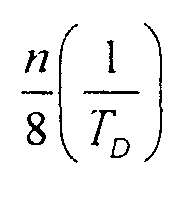
diode 24 that serves as a squaring circuit for providing a low voltage-signal for low signal-power but supplying a relatively higher voltage for higher powers to provide increased discrimination between low and high powers. This facilitates distinguishing the relatively high data-power from the relatively low framing-signal noise power. Now there is included a video low-pass filter 26 that passes selectively the video framing signal noise voltage, which, after amplification inamplifier 28, can be viewed for use in monitoring the operation. - It should be understood that the embodiment described is merely illustrative of the general principles involved; other embodiments should be feasible without departing from the spirit and scope of the invention.
Claims (8)
- Apparatus for performance-monitoring of a synchronous optical network standard signal comprising:means supplied with the standard optical signal for converting the standard optical signal to an electrical signal;means for separating from said electrical signal the framing signal portion thereof and leaving in its time slot the noise that was on the framing signal; andmeans for separating selectively for inspection such noise from the data power for use as a measure of the quality of the standard optical signal.
- The apparatus of claim 1 in which the means for separating the noise from the data includes a squaring circuit for increasing the discrimination between the relatively low noise power and the relatively high data power, and a low pass filter circuit for passing selectively the noise power to a display for viewing.
- The apparatus of claim 2 in which the squaring circuit is a diode.
- The apparatus of claim 1 in which the means for separating the framing signal from its noise is a notch filter.
- The apparatus of claim 4 in which the framing signal is separated from the noise in its time slot by a low pass filter including two 50 ohm lengths of transmission line and two one-quarter wavelength stubs of such a transmission line, of which one is shorter and the other open-ended.
- The apparatus of claim 2 in which the means for separating the framing signal power from the noise power in its time slot is a notch filter.
- The process for performance monitoring of a SONET standard signal comprising the steps of converting the signal into an electrical signal, separating from said electrical signal the framing signal in a manner to leave the noise in the framing signal time slot and the data power essentially undisturbed, and displaying the noise power in the framing time slot of the separated signal.
- The process of claim 5 in which before its display the separated signal is treated to increase the difference in level of the noise power in the framing slot and the data power of the signal.
Applications Claiming Priority (2)
| Application Number | Priority Date | Filing Date | Title |
|---|---|---|---|
| US803301 | 2001-03-09 | ||
| US09/803,301 US6898214B1 (en) | 2001-03-09 | 2001-03-09 | Technique for monitoring SONET signal |
Publications (2)
| Publication Number | Publication Date |
|---|---|
| EP1239621A1 true EP1239621A1 (en) | 2002-09-11 |
| EP1239621B1 EP1239621B1 (en) | 2003-08-27 |
Family
ID=25186171
Family Applications (1)
| Application Number | Title | Priority Date | Filing Date |
|---|---|---|---|
| EP02250957A Expired - Lifetime EP1239621B1 (en) | 2001-03-09 | 2002-02-12 | Method of monitoring SONET signals |
Country Status (5)
| Country | Link |
|---|---|
| US (1) | US6898214B1 (en) |
| EP (1) | EP1239621B1 (en) |
| JP (1) | JP4142314B2 (en) |
| CA (1) | CA2372136C (en) |
| DE (1) | DE60200021T2 (en) |
Families Citing this family (4)
| Publication number | Priority date | Publication date | Assignee | Title |
|---|---|---|---|---|
| US20040208553A1 (en) * | 2002-07-03 | 2004-10-21 | Lucent Technologies Inc. | Method and apparatus for optical layer network management |
| US20050012676A1 (en) * | 2003-07-16 | 2005-01-20 | Mccarthy Robert Daniel | N-port signal divider/combiner |
| US7224305B2 (en) * | 2004-06-08 | 2007-05-29 | Telefonaktiebolaget L M Ericsson (Publ) | Analog-to-digital modulation |
| CN105899267B (en) | 2014-03-13 | 2018-09-07 | 华为技术有限公司 | The method and apparatus in Detection wavelength channel |
Family Cites Families (4)
| Publication number | Priority date | Publication date | Assignee | Title |
|---|---|---|---|---|
| US5262883A (en) * | 1989-12-01 | 1993-11-16 | Scientific-Atlanta, Inc. | CATV distribution networks using light wave transmission lines |
| US5153763A (en) * | 1989-12-01 | 1992-10-06 | Scientific-Atlanta, Inc. | CATV distribution networks using light wave transmission lines |
| GB2292495B (en) * | 1994-08-17 | 1998-03-25 | Northern Telecom Ltd | Fault location in optical communication systems |
| US6334219B1 (en) * | 1994-09-26 | 2001-12-25 | Adc Telecommunications Inc. | Channel selection for a hybrid fiber coax network |
-
2001
- 2001-03-09 US US09/803,301 patent/US6898214B1/en not_active Expired - Lifetime
-
2002
- 2002-02-12 EP EP02250957A patent/EP1239621B1/en not_active Expired - Lifetime
- 2002-02-12 DE DE60200021T patent/DE60200021T2/en not_active Expired - Lifetime
- 2002-02-14 CA CA002372136A patent/CA2372136C/en not_active Expired - Fee Related
- 2002-02-28 JP JP2002053543A patent/JP4142314B2/en not_active Expired - Fee Related
Non-Patent Citations (5)
| Title |
|---|
| CARIOLARO G ET AL: "SIGNAL THEORY FOR SONET STM-1", SBT/IEEE INTERNATIONAL TELECOMMUNICATIONS SYMPOSIUM. ITS '90 SYMPOSIUM RECORD (CAT. NO.90CH2901-7), RIO DE JANEIRO, BRAZIL, 3-6 SEPT. 1990, 1990, New York, NY, USA, IEEE, USA, pages 26 - 32, XP001068987 * |
| KONG D T: "2.488 Gb/s SONET multiplexer/demultiplexer with frame detection capability", IEEE JOURNAL ON SELECTED AREAS IN COMMUNICATIONS, JUNE 1991, USA, vol. 9, no. 5, pages 726 - 731, XP001068991, ISSN: 0733-8716 * |
| SHEN X A ET AL: "Optical header recognition by spectroholographic filtering", OPTICS LETTERS, 15 DEC. 1995, OPT. SOC. AMERICA, USA, vol. 20, no. 24, pages 2508 - 2510, XP001069424, ISSN: 0146-9592 * |
| YANG W ET AL: "Radio-frequency spectral analysis for SONET framing recognition and performance monitoring", JOURNAL OF OPTICAL NETWORKING, vol. 1, no. 2, February 2002 (2002-02-01), pages 74 - 79, XP002196558 * |
| YANG W ET AL: "SONET framing recognition using modulation domain analysis", IEEE PHOTONICS TECHNOLOGY LETTERS, OCT. 2001, IEEE, USA, vol. 13, no. 10, pages 1127 - 1129, XP001068986, ISSN: 1041-1135 * |
Also Published As
| Publication number | Publication date |
|---|---|
| JP4142314B2 (en) | 2008-09-03 |
| DE60200021D1 (en) | 2003-10-02 |
| US6898214B1 (en) | 2005-05-24 |
| JP2002319900A (en) | 2002-10-31 |
| EP1239621B1 (en) | 2003-08-27 |
| DE60200021T2 (en) | 2004-05-13 |
| CA2372136A1 (en) | 2002-09-09 |
| CA2372136C (en) | 2007-11-13 |
Similar Documents
| Publication | Publication Date | Title |
|---|---|---|
| KR101272637B1 (en) | Method for identifying an optical network unit and an optical access system and device | |
| DE10031943B4 (en) | Bitrate independent optical receiver and method therefor | |
| DE60213726T2 (en) | Method and device for determining the origin of the loss of optical signal quality | |
| CN110048781B (en) | Method and device for identifying optical signal modulation format | |
| CA2372136C (en) | Technique for monitoring sonet signal | |
| Khan et al. | Simultaneous OSNR monitoring and modulation format identification using asynchronous single channel sampling | |
| EP2221997A1 (en) | Optical network unit and abnormal detecting and power monitoring method thereof | |
| JP4855157B2 (en) | Bit speed judgment device | |
| US8032026B2 (en) | Optical transmission apparatus, optical interface device, and optical transmission method | |
| US6266172B1 (en) | Signal bit rate and performance measurement for optical channel signals | |
| US8625986B2 (en) | Methods and systems for optical performance monitoring | |
| CN110086532B (en) | Method and device for distinguishing nonlinear noise from spontaneous radiation noise in communication system | |
| CN117675070A (en) | A method of digital transmission of time code with extremely low jitter and no accumulated jitter | |
| EP1602189A1 (en) | Bit error rate monitoring method and device | |
| DE19504896B4 (en) | Method and device for monitoring the transmission quality of transparent optical networks | |
| US20040208553A1 (en) | Method and apparatus for optical layer network management | |
| US6075825A (en) | Timing and data recovery circuit for ultra high speed optical communication system | |
| JP3045069B2 (en) | Optical input disconnection detection method and optical input disconnection detection circuit | |
| US6501573B1 (en) | Apparatus and method for monitoring the qualities of optical signal using clock amplitude | |
| KR100295759B1 (en) | Apparatus for decting los of optic path | |
| JP3114824B2 (en) | Optical transmission line monitoring method | |
| JP3304011B2 (en) | Digital optical transmission equipment | |
| Zhang et al. | Transmission Link OSNR Monitoring Based on Data-Aided Carriers | |
| JP3521357B2 (en) | Ultra-high-speed optical pattern identification circuit | |
| JP4129005B2 (en) | Optical signal quality degradation factor monitoring method and apparatus |
Legal Events
| Date | Code | Title | Description |
|---|---|---|---|
| PUAI | Public reference made under article 153(3) epc to a published international application that has entered the european phase |
Free format text: ORIGINAL CODE: 0009012 |
|
| 17P | Request for examination filed |
Effective date: 20020226 |
|
| AK | Designated contracting states |
Kind code of ref document: A1 Designated state(s): AT BE CH CY DE DK ES FI FR GB GR IE IT LI LU MC NL PT SE TR |
|
| AX | Request for extension of the european patent |
Free format text: AL;LT;LV;MK;RO;SI |
|
| 17Q | First examination report despatched |
Effective date: 20021105 |
|
| GRAH | Despatch of communication of intention to grant a patent |
Free format text: ORIGINAL CODE: EPIDOS IGRA |
|
| AKX | Designation fees paid |
Designated state(s): DE FR |
|
| GRAS | Grant fee paid |
Free format text: ORIGINAL CODE: EPIDOSNIGR3 |
|
| GRAA | (expected) grant |
Free format text: ORIGINAL CODE: 0009210 |
|
| AK | Designated contracting states |
Designated state(s): DE FR |
|
| REG | Reference to a national code |
Ref country code: IE Ref legal event code: FG4D |
|
| REF | Corresponds to: |
Ref document number: 60200021 Country of ref document: DE Date of ref document: 20031002 Kind code of ref document: P |
|
| ET | Fr: translation filed | ||
| PLBE | No opposition filed within time limit |
Free format text: ORIGINAL CODE: 0009261 |
|
| STAA | Information on the status of an ep patent application or granted ep patent |
Free format text: STATUS: NO OPPOSITION FILED WITHIN TIME LIMIT |
|
| 26N | No opposition filed |
Effective date: 20040528 |
|
| REG | Reference to a national code |
Ref country code: IE Ref legal event code: MM4A |
|
| REG | Reference to a national code |
Ref country code: FR Ref legal event code: CD Owner name: ALCATEL-LUCENT USA INC. Effective date: 20131122 |
|
| REG | Reference to a national code |
Ref country code: FR Ref legal event code: GC Effective date: 20140410 |
|
| REG | Reference to a national code |
Ref country code: FR Ref legal event code: RG Effective date: 20141015 |
|
| REG | Reference to a national code |
Ref country code: FR Ref legal event code: PLFP Year of fee payment: 14 |
|
| REG | Reference to a national code |
Ref country code: FR Ref legal event code: PLFP Year of fee payment: 15 |
|
| PGFP | Annual fee paid to national office [announced via postgrant information from national office to epo] |
Ref country code: DE Payment date: 20160218 Year of fee payment: 15 |
|
| PGFP | Annual fee paid to national office [announced via postgrant information from national office to epo] |
Ref country code: FR Payment date: 20160218 Year of fee payment: 15 |
|
| REG | Reference to a national code |
Ref country code: DE Ref legal event code: R119 Ref document number: 60200021 Country of ref document: DE |
|
| REG | Reference to a national code |
Ref country code: FR Ref legal event code: ST Effective date: 20171031 |
|
| PG25 | Lapsed in a contracting state [announced via postgrant information from national office to epo] |
Ref country code: FR Free format text: LAPSE BECAUSE OF NON-PAYMENT OF DUE FEES Effective date: 20170228 Ref country code: DE Free format text: LAPSE BECAUSE OF NON-PAYMENT OF DUE FEES Effective date: 20170901 |