EP1239604A1 - Reverse-link power control overshoot considering mobile station transmission limitations - Google Patents
Reverse-link power control overshoot considering mobile station transmission limitations Download PDFInfo
- Publication number
- EP1239604A1 EP1239604A1 EP02251235A EP02251235A EP1239604A1 EP 1239604 A1 EP1239604 A1 EP 1239604A1 EP 02251235 A EP02251235 A EP 02251235A EP 02251235 A EP02251235 A EP 02251235A EP 1239604 A1 EP1239604 A1 EP 1239604A1
- Authority
- EP
- European Patent Office
- Prior art keywords
- output power
- mobile station
- power
- power level
- power control
- Prior art date
- Legal status (The legal status is an assumption and is not a legal conclusion. Google has not performed a legal analysis and makes no representation as to the accuracy of the status listed.)
- Withdrawn
Links
- 230000005540 biological transmission Effects 0.000 title claims description 7
- 238000000034 method Methods 0.000 claims abstract description 25
- 238000004891 communication Methods 0.000 claims abstract description 24
- 238000012937 correction Methods 0.000 description 33
- 239000000523 sample Substances 0.000 description 9
- 238000005562 fading Methods 0.000 description 3
- 230000008569 process Effects 0.000 description 3
- 230000004913 activation Effects 0.000 description 2
- 238000004364 calculation method Methods 0.000 description 2
- 230000003247 decreasing effect Effects 0.000 description 2
- 238000010586 diagram Methods 0.000 description 2
- 230000000694 effects Effects 0.000 description 2
- 230000007246 mechanism Effects 0.000 description 2
- 238000012986 modification Methods 0.000 description 2
- 230000004048 modification Effects 0.000 description 2
- 230000001413 cellular effect Effects 0.000 description 1
- 238000007796 conventional method Methods 0.000 description 1
- 230000004044 response Effects 0.000 description 1
- 238000000926 separation method Methods 0.000 description 1
Images


Classifications
-
- H—ELECTRICITY
- H04—ELECTRIC COMMUNICATION TECHNIQUE
- H04W—WIRELESS COMMUNICATION NETWORKS
- H04W52/00—Power management, e.g. Transmission Power Control [TPC] or power classes
- H04W52/04—Transmission power control [TPC]
- H04W52/30—Transmission power control [TPC] using constraints in the total amount of available transmission power
- H04W52/36—Transmission power control [TPC] using constraints in the total amount of available transmission power with a discrete range or set of values, e.g. step size, ramping or offsets
- H04W52/367—Power values between minimum and maximum limits, e.g. dynamic range
-
- H—ELECTRICITY
- H04—ELECTRIC COMMUNICATION TECHNIQUE
- H04W—WIRELESS COMMUNICATION NETWORKS
- H04W52/00—Power management, e.g. Transmission Power Control [TPC] or power classes
- H04W52/04—Transmission power control [TPC]
- H04W52/18—TPC being performed according to specific parameters
- H04W52/22—TPC being performed according to specific parameters taking into account previous information or commands
- H04W52/228—TPC being performed according to specific parameters taking into account previous information or commands using past power values or information
Definitions
- the present invention relates to telecommunications in general, and more particularly, to a method for controlling reverse-link power control overshoot in a wireless communications system.
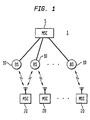
- FIG. 1 depicts a schematic diagram of a portion of a conventional wireless communications system.
- the wireless communications system 1 includes a mobile switching center (MSC) 5, operatively connected with a plurality of base stations (BS) 10, for performing call connection control and mobility management.
- the base stations 10 include equipment to communicate with the MSC 5, and with various mobile stations (MS) 20.
- Each base station 10 transmits a pilot signal of constant power on the same frequency.
- the power level of the received pilot signal enables the mobile station 20 to estimate the path loss between the base station 10 and the mobile station 20. Knowing the path loss, the mobile station 20 adjusts its output transmit power such that the base station 10 will receive signals at the requisite power level.
- the base station 10 measures the output power of the mobile station 20 and informs the mobile station 20 to make any necessary adjustments to its transmit power.
- Mobile stations (MS) 20, operatively connected with the base stations 10, have equipment for allowing communication with the base stations 10, and for establishing forward links (base station to mobile station) and reverse links (mobile station to base station) therebetween.
- CDMA is one scheme for defining forward and reverse link channels between base stations and mobile stations of a wireless communications system, such as a cellular telephone system.
- CDMA is an interference-limited system, whereby all mobile stations transmit at the same frequency, and the internal interference generated within the system plays a critical role in determining system capacity and voice quality.
- the CDMA system uses power control and voice activation to minimize mutual interference. Precise power control and voice activation avoids excessive transmitter power, which contributes to overall interference in the system.
- the wireless communications environment changes continuously due to fast and slow fading, shadowing, external interference, and other factors.
- One feature of a CDMA system is to transmit just enough power to meet the required performance objectives.
- the objective of power control is to limit the transmitted power on the forward and reverse links while maintaining link quality under all conditions.
- the transmit power from each mobile station must be controlled to limit interference therebetween. At the same time, the power level should be adequate for satisfactory voice quality. Otherwise, if more power is transmitted than necessary, one mobile station interferes with the operation of other mobile stations, and capacity is reduced.
- Reverse link power control affects the access and reverse traffic channels.
- Reverse link power control includes open-loop power control (also known as autonomous power control) and closed-loop power control.
- Open-loop power control is based on the principle that a mobile station 20 closer to the base station 10 needs to transmit less power as compared to a mobile station 20 that is farther away from the base station 10 or is in fade.
- the mobile station 20 adjusts its transmit power based on total power received, including power received from all base stations 10 on the forward link channels. If the power received is high, the mobile station 20 reduces its transmit power, and vice versa.
- Dynamic or moving mobile stations (i.e., fading sources) in multipath require much faster power control than the open-loop power control can achieve.
- Closed-loop power control provides additional power adjustments required to compensate for fading losses (e.g., when the signal interference between the mobile station and the base station increases). Closed-loop power control also provides correction to the open-loop power control. Once a traffic channel is established, the mobile station 20 and base station 10 engage in closed-loop power control. The quicker response time gives the closed-loop power control mechanism the ability to override the open-loop power control mechanism in practical applications.
- Fig. 2 depicts a conventional method of reverse link closed-loop power control that is performed between the mobile station 20 and base station 10 to ensure that a proper communications link can be established therebetween.
- the mobile station 20 transmits to the base station 10 at a certain output power in accordance with a request from the base station 10.
- the base station 10 detects and measures the output power of the mobile station 20.
- step 300 the base station 10 determines whether the output power of the mobile station 20 needs adjustment. This is done by comparing output power level requested by the base station 10 with the actual output power received from the mobile station 10, and considering the amount of signal interference in the current communications environment. If the mobile station's output power does not require adjustment, the reverse-link power control process proceeds to step 600 to establish a communications link between the mobile station 20 and the base station 10 using well known techniques in the conventional art. In contrast, if the mobile station's output power requires adjustment, the mobile station 20 calculates a new output power as shown in step 400.
- Step 400 will be described in more detail with respect to the IS-95 CDMA standard.
- the transmit power of a mobile station 20 should be tightly controlled by the base station 10 through closed-loop power control.
- the base station 10 informs the mobile station 20, by sending a power control bit, to make any necessary adjustments (i.e., increase or decrease) to the mobile station transmit power. This is commonly referred to as the closed-loop power control correction.
- Equation (1) all terms are well known in the conventional art.
- a negative value of the mobile station's mean input power is added with a predetermined offset value and the interference correction from the last access probe.
- an access probe refers to a transmission during an access attempt performed between the mobile station 20 and the base station 10 to establish a communications link therebetween. Access probes are continuously performed at incremental power levels. This is referred to as performing access probe corrections.
- the next added term of equation (1) comprises a nominal power for handoff (NOM_PWR) multiplied with a nominal power for extended handoff (NOM_PWR_EXT). An initial power adjustment (INIT_PWR) is added thereafter. Then, the sum of all access probe corrections performed in establishing a communications links is added to the above-identified terms. Finally, the sum of all closed loop power control corrections is added.
- the mobile station 20 Upon calculation of the mobile station's output power, the mobile station 20 transmits to the base station 10 at the newly calculated output power, as shown in step 500. Steps 200 through 500 are repeated thereafter, as required, whereby closed-loop power corrections are continuously performed to establish and maintain proper communication between the mobile station 20 and the base station 10, as shown in step 600.
- the base station 10 may unnecessarily continue to inform the mobile station 20 to make adjustments to the mobile station's transmit power, even when the mobile station transmit power limit has already been reached.
- the last term i.e., the sum of all closed loop power control corrections
- the last term may be accumulated even when the mobile station transmit power has reached a maximum.
- the last term i.e., the sum of all closed-loop power control corrections
- the communications environment changes such that there is more or less signal interference between the mobile station 20 and the base station 10
- the closed-loop power control will first need to cancel the previously accumulated power control correction values before it begins to have effect on the mobile station 20 to transmit at the appropriate transmit power.
- the base station 10 informs the mobile station 20 to further increase its transmission power. Thereafter, the mobile station 20 determines according to equation (1) a transmit power level greater than the mobile station's maximum possible transmit power level; and therefore transmits at the maximum power level. If the communications environment changes again such that the mobile station 20 should transmit at less than the maximum power limit, the mobile station 20 will continue to transmit at the maximum power limit until the base station provides enough closed-loop power corrections to cancel out the previous closed-loop power corrections which increased the calculated transmit power level above the maximum power limit. Consequently, a power overshoot occurs, and the extra mobile station transmit power interferes with the transmission between other mobile stations 20 and the base station 10.
- the base station 10 informs the mobile station 20 to further decrease its transmission power. Thereafter, the mobile station 20 determines according to equation (1) a transmit power level lower than the mobile station's minimum possible transmit power level; and therefore transmits at the minimum power level. If the communications environment changes again such that the mobile station 20 should transmit at greater than the minimum power limit, the mobile station 20 will continue to transmit at the minimum power limit until the base station provides enough closed-loop power corrections to cancel out the previous closed-loop power corrections which decreased the calculated transmit power level below the minimum power limit. Consequently, the process of canceling out the previous closed-loop power corrections is time consuming, and thus degrades the reverse link performance.
- a method for controlling reverse-link power control overshoot is achieved by recognizing that the mobile station has transmitter power limitations, and that unnecessary adjustments to the mobile station's transmit power need not be made once the mobile station transmit power has already reached its limit. This is achieved by detecting whether the mobile station transmit power has reached its limit, and adjusting the mobile station mean output power by applying a constant value, to thus eliminate the need to cancel previously accumulated power overshoot corrections.
- the mobile station's mean output power algorithm is modified such that the calculations are different when the output power reaches the upper or lower limits of the mobile station transmit power dynamic range.
- FIG. 3 depicts a flowchart explaining a method of minimizing reverse link power control overshoot according to an embodiment of the invention. Steps 100 through 300, which are equivalent to the steps in FIG. 2 will not be explained to avoid repetition.
- the reverse-link power control process proceeds to step 600 to establish a communications link between the mobile station 20 and the base station 10 using well known techniques in the conventional art. If the mobile station's output power requires adjustment, the mobile station 20 makes a further determination of whether its output power is at an upper or lower limit, as shown in step 350.
- step 400 If the mobile station's output power is not at the upper or lower limits, the control operation proceeds to step 400, as performed in the conventional reverse-link power control method shown in Fig.2. In contrast, if the mobile station's output power is at the upper or lower limits, step 450 is performed.
- the mobile station output power is adjusted by modifying the mean output power algorithm.
- a modified mean output algorithm is applied under the IS-95 CDMA standard (i.e., equation (1)), but the present invention is not limited to any particular standard.
- the closed loop correction is defined as the sum of all closed loop power control corrections with a constant added thereto or subtracted therefrom. More specifically, if the upper limit of the mobile dynamic range is reached by the previous adjustment, and the power control bit from the base station is "1" indicating that output power needs to be increased, the mobile station modifies its mean output power algorithm such that the closed loop correction of the above equation (3) is used.
- the mobile station modifies its mean output power algorithm such that the closed loop correction of the above equation (4) is used.
- the modified algorithm can eliminate undesired power overshoot, and it is easy to implement. Specifically, it does not require any input from other circuitry such as, the automatic gain control (AGC), and thus significantly simplifies the implementation. This separation of AGC and closed loop power control has little effect on performance because the AGC adjustment is much slower than that of the closed loop power control. Any adjustment made by the AGC during a power control group (PCG) is well within the limit of the mobile dynamic range accuracy requirement.
- PCG power control group
- the embodiments of the invention pertain to CDMA techniques, application to other techniques, such as TDMA are also deemed feasible.
Landscapes
- Engineering & Computer Science (AREA)
- Computer Networks & Wireless Communication (AREA)
- Signal Processing (AREA)
- Mobile Radio Communication Systems (AREA)
- Transmitters (AREA)
Abstract
In a method for minimizing reverse link power control overshoot in a
wireless communications system, the output power of a mobile station is
detected to determine whether it falls outside a dynamic range of the mobile
station. If outside the dynamic range, a new output power falling within the
dynamic range is calculated and set, and the mobile station is instructed to
transmit at the new output power.
Description
- The present invention relates to telecommunications in general, and more particularly, to a method for controlling reverse-link power control overshoot in a wireless communications system.
- FIG. 1 depicts a schematic diagram of a portion of a conventional wireless communications system. As shown, the
wireless communications system 1 includes a mobile switching center (MSC) 5, operatively connected with a plurality of base stations (BS) 10, for performing call connection control and mobility management. Thebase stations 10 include equipment to communicate with the MSC 5, and with various mobile stations (MS) 20. Eachbase station 10 transmits a pilot signal of constant power on the same frequency. The power level of the received pilot signal enables themobile station 20 to estimate the path loss between thebase station 10 and themobile station 20. Knowing the path loss, themobile station 20 adjusts its output transmit power such that thebase station 10 will receive signals at the requisite power level. Thebase station 10 measures the output power of themobile station 20 and informs themobile station 20 to make any necessary adjustments to its transmit power. Mobile stations (MS) 20, operatively connected with thebase stations 10, have equipment for allowing communication with thebase stations 10, and for establishing forward links (base station to mobile station) and reverse links (mobile station to base station) therebetween. - CDMA is one scheme for defining forward and reverse link channels between base stations and mobile stations of a wireless communications system, such as a cellular telephone system. CDMA is an interference-limited system, whereby all mobile stations transmit at the same frequency, and the internal interference generated within the system plays a critical role in determining system capacity and voice quality. The CDMA system uses power control and voice activation to minimize mutual interference. Precise power control and voice activation avoids excessive transmitter power, which contributes to overall interference in the system. As the mobile station moves around, the wireless communications environment changes continuously due to fast and slow fading, shadowing, external interference, and other factors. One feature of a CDMA system is to transmit just enough power to meet the required performance objectives. The objective of power control is to limit the transmitted power on the forward and reverse links while maintaining link quality under all conditions. The transmit power from each mobile station must be controlled to limit interference therebetween. At the same time, the power level should be adequate for satisfactory voice quality. Otherwise, if more power is transmitted than necessary, one mobile station interferes with the operation of other mobile stations, and capacity is reduced.
- In a CDMA system, all
mobile stations 20 should achieve the same received power levels at thebase station 10 to minimize interference within thewireless communications system 1 while achieving the required performance objectives. Reverse link power control affects the access and reverse traffic channels. Reverse link power control includes open-loop power control (also known as autonomous power control) and closed-loop power control. - Open-loop power control is based on the principle that a
mobile station 20 closer to thebase station 10 needs to transmit less power as compared to amobile station 20 that is farther away from thebase station 10 or is in fade. Themobile station 20 adjusts its transmit power based on total power received, including power received from allbase stations 10 on the forward link channels. If the power received is high, themobile station 20 reduces its transmit power, and vice versa. Dynamic or moving mobile stations (i.e., fading sources) in multipath require much faster power control than the open-loop power control can achieve. - Closed-loop power control provides additional power adjustments required to compensate for fading losses (e.g., when the signal interference between the mobile station and the base station increases). Closed-loop power control also provides correction to the open-loop power control. Once a traffic channel is established, the
mobile station 20 andbase station 10 engage in closed-loop power control. The quicker response time gives the closed-loop power control mechanism the ability to override the open-loop power control mechanism in practical applications. - Fig. 2 depicts a conventional method of reverse link closed-loop power control that is performed between the
mobile station 20 andbase station 10 to ensure that a proper communications link can be established therebetween. Instep 100, themobile station 20 transmits to thebase station 10 at a certain output power in accordance with a request from thebase station 10. Instep 200, thebase station 10 detects and measures the output power of themobile station 20. - Next, in
step 300, thebase station 10 determines whether the output power of themobile station 20 needs adjustment. This is done by comparing output power level requested by thebase station 10 with the actual output power received from themobile station 10, and considering the amount of signal interference in the current communications environment. If the mobile station's output power does not require adjustment, the reverse-link power control process proceeds tostep 600 to establish a communications link between themobile station 20 and thebase station 10 using well known techniques in the conventional art. In contrast, if the mobile station's output power requires adjustment, themobile station 20 calculates a new output power as shown instep 400. -
Step 400 will be described in more detail with respect to the IS-95 CDMA standard. Under the current IS-95 CDMA standard, the transmit power of amobile station 20 should be tightly controlled by thebase station 10 through closed-loop power control. Thebase station 10 informs themobile station 20, by sending a power control bit, to make any necessary adjustments (i.e., increase or decrease) to the mobile station transmit power. This is commonly referred to as the closed-loop power control correction. As known in the art, the mean output power of themobile station 20 is calculated by themobile station 20 using the following algorithm: - In the above Equation (1), all terms are well known in the conventional art. To obtain the mobile station's output power, a negative value of the mobile station's mean input power is added with a predetermined offset value and the interference correction from the last access probe. Here, an access probe refers to a transmission during an access attempt performed between the
mobile station 20 and thebase station 10 to establish a communications link therebetween. Access probes are continuously performed at incremental power levels. This is referred to as performing access probe corrections. The next added term of equation (1) comprises a nominal power for handoff (NOM_PWR) multiplied with a nominal power for extended handoff (NOM_PWR_EXT). An initial power adjustment (INIT_PWR) is added thereafter. Then, the sum of all access probe corrections performed in establishing a communications links is added to the above-identified terms. Finally, the sum of all closed loop power control corrections is added. - Upon calculation of the mobile station's output power, the
mobile station 20 transmits to thebase station 10 at the newly calculated output power, as shown instep 500.Steps 200 through 500 are repeated thereafter, as required, whereby closed-loop power corrections are continuously performed to establish and maintain proper communication between themobile station 20 and thebase station 10, as shown instep 600. - However, in the conventional art, there is a potential for power control "overshoot" (e.g., exceeding the maximum or minimum limit) of the mobile station's transmit power in the reverse link in the conventional open-loop power control. The
base station 10 may unnecessarily continue to inform themobile station 20 to make adjustments to the mobile station's transmit power, even when the mobile station transmit power limit has already been reached. - More specifically, due to open-loop correction and the maximum power constraint, the last term, i.e., the sum of all closed loop power control corrections, may be accumulated even when the mobile station transmit power has reached a maximum. Likewise, due to open-loop correction and the minimum power constraint, the last term, i.e., the sum of all closed-loop power control corrections, may be accumulated even when the mobile station transmit power has dropped down to a minimum. If the communications environment changes such that there is more or less signal interference between the
mobile station 20 and thebase station 10, the closed-loop power control will first need to cancel the previously accumulated power control correction values before it begins to have effect on themobile station 20 to transmit at the appropriate transmit power. - For example, if the mobile station transmit power is already at its upper limit, and the communications environment changes such that there is increased signal interference between the mobile station and the base station, the
base station 10 informs themobile station 20 to further increase its transmission power. Thereafter, themobile station 20 determines according to equation (1) a transmit power level greater than the mobile station's maximum possible transmit power level; and therefore transmits at the maximum power level. If the communications environment changes again such that themobile station 20 should transmit at less than the maximum power limit, themobile station 20 will continue to transmit at the maximum power limit until the base station provides enough closed-loop power corrections to cancel out the previous closed-loop power corrections which increased the calculated transmit power level above the maximum power limit. Consequently, a power overshoot occurs, and the extra mobile station transmit power interferes with the transmission between othermobile stations 20 and thebase station 10. - The same problem occurs with respect to the lower limit of the mobile station's power level. If the mobile station transmit power is already at its lower limit, and the communications environment changes such that there is less signal interference between the mobile station and the base station, the
base station 10 informs themobile station 20 to further decrease its transmission power. Thereafter, themobile station 20 determines according to equation (1) a transmit power level lower than the mobile station's minimum possible transmit power level; and therefore transmits at the minimum power level. If the communications environment changes again such that themobile station 20 should transmit at greater than the minimum power limit, themobile station 20 will continue to transmit at the minimum power limit until the base station provides enough closed-loop power corrections to cancel out the previous closed-loop power corrections which decreased the calculated transmit power level below the minimum power limit. Consequently, the process of canceling out the previous closed-loop power corrections is time consuming, and thus degrades the reverse link performance. - Accordingly, power overshoot beyond the upper and lower transmission power limits at the
mobile station 20 causes excessive interference and degrades overall reverse link performance. - In accordance with the present invention, a method for controlling reverse-link power control overshoot is achieved by recognizing that the mobile station has transmitter power limitations, and that unnecessary adjustments to the mobile station's transmit power need not be made once the mobile station transmit power has already reached its limit. This is achieved by detecting whether the mobile station transmit power has reached its limit, and adjusting the mobile station mean output power by applying a constant value, to thus eliminate the need to cancel previously accumulated power overshoot corrections.
- The features, aspects, and advantages of the present invention will become better understood with regard to the following description, appended claims, and accompanying drawings where:
- FIG. 1 depicts a schematic diagram of a portion of a conventional wireless communications system;
- FIG. 2 depicts a flowchart of a conventional reverse-link power control method; and
- FIG. 3 depicts a flowchart of an illustrative embodiment of the present invention.
-
- In an embodiment of the present invention, the mobile station's mean output power algorithm is modified such that the calculations are different when the output power reaches the upper or lower limits of the mobile station transmit power dynamic range.
- The present invention will be described with respect to FIGS. 1-3. In particular, FIG. 3 depicts a flowchart explaining a method of minimizing reverse link power control overshoot according to an embodiment of the invention.
Steps 100 through 300, which are equivalent to the steps in FIG. 2 will not be explained to avoid repetition. Upon performingstep 300, if the mobile station's output power does not require adjustment, the reverse-link power control process proceeds to step 600 to establish a communications link between themobile station 20 and thebase station 10 using well known techniques in the conventional art. If the mobile station's output power requires adjustment, themobile station 20 makes a further determination of whether its output power is at an upper or lower limit, as shown instep 350. - If the mobile station's output power is not at the upper or lower limits, the control operation proceeds to step 400, as performed in the conventional reverse-link power control method shown in Fig.2. In contrast, if the mobile station's output power is at the upper or lower limits,
step 450 is performed. - In
step 450, the mobile station output power is adjusted by modifying the mean output power algorithm. For the purpose of explanation only, an embodiment of the present invention employing a modified mean output algorithm is applied under the IS-95 CDMA standard (i.e., equation (1)), but the present invention is not limited to any particular standard. The modified mean output power algorithm is as follows: - With the exception of the closed loop correction, all other variables are identical to the convention mean output power algorithm described in equation (1) hereinabove. Namely, the closed loop correction is defined as the sum of all closed loop power control corrections with a constant added thereto or subtracted therefrom. More specifically, if the upper limit of the mobile dynamic range is reached by the previous adjustment, and the power control bit from the base station is "1" indicating that output power needs to be increased, the mobile station modifies its mean output power algorithm such that the closed loop correction of the above equation (3) is used. If the lower limit of the mobile dynamic range is reached by the previous adjustment, and the power control bit from the base station is "0" indicating that output power needs to be decreased, the mobile station modifies its mean output power algorithm such that the closed loop correction of the above equation (4) is used.
- In the closed loop correction, the constant "d" varies depending upon the standard applicable to the wireless communications system being employed. For example, preferably, d=1 if the IS-95A standard is employed, while preferably, d = 0.25 or 0.5 or 1 if the IS-95B standard is employed.
- According to the above-described embodiment of the invention, the modified algorithm can eliminate undesired power overshoot, and it is easy to implement. Specifically, it does not require any input from other circuitry such as, the automatic gain control (AGC), and thus significantly simplifies the implementation. This separation of AGC and closed loop power control has little effect on performance because the AGC adjustment is much slower than that of the closed loop power control. Any adjustment made by the AGC during a power control group (PCG) is well within the limit of the mobile dynamic range accuracy requirement. Although the embodiments of the invention pertain to CDMA techniques, application to other techniques, such as TDMA are also deemed feasible.
- This specification describes various illustrative embodiments of the method of the invention. The scope of the claims is intended to cover various modifications and equivalent arrangements of the illustrative embodiments disclosed in the specification. Therefore, the following claims should be accorded the reasonably broadest interpretation to cover modifications, equivalent structures, and features which are consistent with the spirit and scope of the invention disclosed herein.
Claims (10)
- A method of minimizing reverse link power control overshoot in a communications environment, the method comprising:receiving a transmission from a mobile station at a first output power level;determining whether the mobile station should adjust its output power level
based on the communications environment;instructing the mobile station to calculate a second output power level based on an output power level range of the mobile station, if output power level adjustment is required; andinstructing the mobile station to transmit at the second output power level, if output power level adjustment is required. - The method of claim 1, wherein the second output power level is obtained by instructing the mobile station to increase its output power level by a first amount when the first output power level is below a lower limit of the output power level range.
- The method of claim 2, wherein the second output power level is obtained by instructing the mobile station to decrease its output power by a second amount when the first output power level is greater than an upper limit of the output power level range.
- The method of claim 3, wherein the first amount and the second amount are equal.
- The method of claim 1, wherein the second output power level is obtained
by instructing the mobile station to decrease its output power by a first amount when the first output power level is greater than an upper limit of the output power level range. - A method of minimizing reverse link power control overshoot comprising:detecting whether a current output power of a mobile station fallsoutside a
dynamic range of mobile station output power levels;instructing the mobile station to adjust its output power towards the dynamic range to obtain an adjusted output power, if the detected output power falls outside the dynamic range; andinstructing the mobile station to transmit at the adjusted output power,if the
detected output power falls outside the dynamic range. - The method of claim 6, wherein the adjusted output power is obtained by instructing the mobile station to increase its output power by a first amount when the detected current output power is below a lower limit of the dynamic range.
- The method of claim 7, wherein the adjusted output power is obtained by instructing the mobile station to decrease its output power by a second amount when the detected current output power is greater than an upper limit of the dynamic range.
- The method of claim 8, wherein the first amount and the second amount are equal.
- The method of claim 6, wherein the adjusted output power is obtained by
instructing the mobile station to decrease its output power by a first amount when the detected current output power is greater than an upper limit of the dynamic range.
Priority Applications (1)
| Application Number | Priority Date | Filing Date | Title |
|---|---|---|---|
| EP05012413A EP1601116A1 (en) | 2001-03-05 | 2002-02-22 | Reverse-link power control overshoot considering mobile station transmission limitations |
Applications Claiming Priority (2)
| Application Number | Priority Date | Filing Date | Title |
|---|---|---|---|
| US797708 | 2001-03-05 | ||
| US09/797,708 US6829468B2 (en) | 2001-03-05 | 2001-03-05 | Reverse-link power control overshoot considering mobile station transmission limitations |
Related Child Applications (1)
| Application Number | Title | Priority Date | Filing Date |
|---|---|---|---|
| EP05012413A Division EP1601116A1 (en) | 2001-03-05 | 2002-02-22 | Reverse-link power control overshoot considering mobile station transmission limitations |
Publications (1)
| Publication Number | Publication Date |
|---|---|
| EP1239604A1 true EP1239604A1 (en) | 2002-09-11 |
Family
ID=25171592
Family Applications (2)
| Application Number | Title | Priority Date | Filing Date |
|---|---|---|---|
| EP05012413A Withdrawn EP1601116A1 (en) | 2001-03-05 | 2002-02-22 | Reverse-link power control overshoot considering mobile station transmission limitations |
| EP02251235A Withdrawn EP1239604A1 (en) | 2001-03-05 | 2002-02-22 | Reverse-link power control overshoot considering mobile station transmission limitations |
Family Applications Before (1)
| Application Number | Title | Priority Date | Filing Date |
|---|---|---|---|
| EP05012413A Withdrawn EP1601116A1 (en) | 2001-03-05 | 2002-02-22 | Reverse-link power control overshoot considering mobile station transmission limitations |
Country Status (3)
| Country | Link |
|---|---|
| US (1) | US6829468B2 (en) |
| EP (2) | EP1601116A1 (en) |
| JP (1) | JP4037660B2 (en) |
Families Citing this family (27)
| Publication number | Priority date | Publication date | Assignee | Title |
|---|---|---|---|---|
| AU2002215376A1 (en) | 2000-10-17 | 2002-04-29 | Denso Corporation | Forward link based rescue channel method and apparatus for telecommunication systems |
| US7187930B2 (en) * | 2000-11-28 | 2007-03-06 | Denso Corporation | Retry limits for connection rescue procedures in telecommunication systems |
| US7006821B2 (en) * | 2000-12-04 | 2006-02-28 | Denso Corporation | Method and apparatus for dynamically determining a mobile station's active set during a connection rescue procedure |
| US6928285B2 (en) * | 2000-12-05 | 2005-08-09 | Denso Corporation | Minimum interference multiple-access method and system for connection rescue |
| US6996391B2 (en) | 2000-12-20 | 2006-02-07 | Denso Corporation | Forward-link rescue synchronization method and apparatus |
| US7010319B2 (en) * | 2001-01-19 | 2006-03-07 | Denso Corporation | Open-loop power control enhancement for blind rescue channel operation |
| US6944147B2 (en) * | 2001-12-10 | 2005-09-13 | Nortel Networks Limited | System and method for maximizing capacity in a telecommunications system |
| KR100645743B1 (en) * | 2001-12-28 | 2006-11-13 | 엘지노텔 주식회사 | Power Management Method in IMT-2000 System |
| US7010321B2 (en) * | 2002-02-04 | 2006-03-07 | Qualcomm Inc. | Power control avoiding outer loop wind-up |
| US20040192315A1 (en) * | 2002-03-26 | 2004-09-30 | Li Jimmy Kwok-On | Method for dynamically assigning spreading codes |
| US20040100921A1 (en) * | 2002-11-27 | 2004-05-27 | Farooq Ullah Khan | Time-orthogonal CDMA wireless communication system |
| KR100556871B1 (en) * | 2003-07-12 | 2006-03-03 | 엘지전자 주식회사 | Reverse power control method |
| US7466682B1 (en) * | 2004-02-27 | 2008-12-16 | Sprint Spectrum L.P. | Forward and reverse link capacity determination |
| US7526291B2 (en) * | 2005-05-20 | 2009-04-28 | Alcatel-Lucent Usa Inc. | Method and apparatus for managing supplemental channel data rates |
| CN100561885C (en) * | 2005-09-29 | 2009-11-18 | 中兴通讯股份有限公司 | Trunking group forward supplementary channel power overload control device and method |
| US9401843B2 (en) * | 2006-01-27 | 2016-07-26 | Telefonaktiebolaget Lm Ericsson (Publ) | Method and apparatus for reverse link control in a wireless communication network as a function of reverse link load characteristic |
| JP2007274134A (en) * | 2006-03-30 | 2007-10-18 | Kyocera Corp | Wireless communication apparatus and transmission power control method |
| US8050701B2 (en) | 2006-10-13 | 2011-11-01 | Qualcomm Incorporated | Reverse link power control for wireless communication systems |
| DE102007012051B4 (en) * | 2007-03-13 | 2011-09-22 | Gigaset Communications Gmbh | Method for setting a transmission power |
| US8258942B1 (en) | 2008-01-24 | 2012-09-04 | Cellular Tracking Technologies, LLC | Lightweight portable tracking device |
| US8874065B2 (en) | 2008-10-09 | 2014-10-28 | Qualcomm Incorporated | Method and apparatus for facilitating power conservation via time-gating in a wireless communication system |
| US9066301B2 (en) * | 2009-04-08 | 2015-06-23 | Qualcomm Incorporated | Managing a reverse link transmission power level setpoint during periods of inactivity on the reverse link in a wireless communications system |
| JP5740289B2 (en) * | 2011-11-24 | 2015-06-24 | 株式会社日立製作所 | Output value control method and transmission system |
| US9215663B2 (en) | 2012-06-29 | 2015-12-15 | Qualcomm Incorporated | Methods and devices for controlling uplink transmit power at an access terminal |
| CN104602332A (en) * | 2013-10-31 | 2015-05-06 | 中兴通讯股份有限公司 | Control processing method and control processing device for transmitting power, and terminal |
| EP3503635A1 (en) * | 2017-12-22 | 2019-06-26 | Fraunhofer-Gesellschaft zur Förderung der angewandten Forschung e.V. | Emergency notification (urllc) requesting spontaneous grant free transmission for v2x |
| WO2022265544A1 (en) * | 2021-06-17 | 2022-12-22 | Telefonaktiebolaget Lm Ericsson (Publ) | Limiting interference in a wireless point-to-point or point-to-multipoint network |
Citations (3)
| Publication number | Priority date | Publication date | Assignee | Title |
|---|---|---|---|---|
| EP0926842A2 (en) * | 1997-12-27 | 1999-06-30 | Sony Corporation | Transmission power control method, base station apparatus and communication terminal |
| US6169907B1 (en) * | 1997-10-21 | 2001-01-02 | Interwave Communications International Ltd. | Power control of remote communication devices |
| WO2002015431A2 (en) * | 2000-08-17 | 2002-02-21 | Siemens Aktiengesellschaft | Method for regulating the transmission power in a radio communications system |
Family Cites Families (11)
| Publication number | Priority date | Publication date | Assignee | Title |
|---|---|---|---|---|
| US5881368A (en) * | 1996-06-06 | 1999-03-09 | Qualcomm Incorporated | Method and apparatus of power control in a CDMA dispatch system |
| US5926747A (en) * | 1996-09-05 | 1999-07-20 | Airnet Communications Corp. | Method and apparatus for dynamically optimizing the forward-link transmit power of a broadband multi-carrier radio signal |
| FI106666B (en) * | 1997-01-24 | 2001-03-15 | Nokia Networks Oy | Power control procedure for discontinuous transmissions |
| US6173162B1 (en) * | 1997-06-16 | 2001-01-09 | Telefonaktiebolaget Lm Ericsson (Publ) | Multiple code channel power control in a radio communication system |
| US6101179A (en) * | 1997-09-19 | 2000-08-08 | Qualcomm Incorporated | Accurate open loop power control in a code division multiple access communication system |
| US6334047B1 (en) * | 1999-04-09 | 2001-12-25 | Telefonaktiebolaget Lm Ericsson (Publ) | Adaptive power control in a mobile radio communications system |
| ES2212840T3 (en) * | 1999-04-12 | 2004-08-01 | Alcatel | A METHOD FOR IMPROVING THE PERFORMANCE OF A MOBILE RADIOCOMMUNICATION SYSTEM THAT USES A POWER CONTROL ALGORITHM. |
| DE69900975T2 (en) * | 1999-04-12 | 2002-11-28 | Alcatel, Paris | Improved channel adaptive, fast power control in CDMA |
| US6445930B1 (en) * | 1999-04-21 | 2002-09-03 | Joseph Peter Bartelme | Power control system and method for use with wireless communications system |
| US6609008B1 (en) * | 2000-11-09 | 2003-08-19 | Qualcomm Incoporated | Method and apparatus for controlling signal power level in a communication system |
| US6650691B2 (en) * | 2002-02-12 | 2003-11-18 | Motorola, Inc. | Power control in spread spectrum communications systems |
-
2001
- 2001-03-05 US US09/797,708 patent/US6829468B2/en not_active Expired - Fee Related
-
2002
- 2002-02-22 EP EP05012413A patent/EP1601116A1/en not_active Withdrawn
- 2002-02-22 EP EP02251235A patent/EP1239604A1/en not_active Withdrawn
- 2002-03-04 JP JP2002057859A patent/JP4037660B2/en not_active Expired - Fee Related
Patent Citations (3)
| Publication number | Priority date | Publication date | Assignee | Title |
|---|---|---|---|---|
| US6169907B1 (en) * | 1997-10-21 | 2001-01-02 | Interwave Communications International Ltd. | Power control of remote communication devices |
| EP0926842A2 (en) * | 1997-12-27 | 1999-06-30 | Sony Corporation | Transmission power control method, base station apparatus and communication terminal |
| WO2002015431A2 (en) * | 2000-08-17 | 2002-02-21 | Siemens Aktiengesellschaft | Method for regulating the transmission power in a radio communications system |
Also Published As
| Publication number | Publication date |
|---|---|
| JP4037660B2 (en) | 2008-01-23 |
| JP2002280957A (en) | 2002-09-27 |
| EP1601116A1 (en) | 2005-11-30 |
| US6829468B2 (en) | 2004-12-07 |
| US20030022630A1 (en) | 2003-01-30 |
Similar Documents
| Publication | Publication Date | Title |
|---|---|---|
| US6829468B2 (en) | Reverse-link power control overshoot considering mobile station transmission limitations | |
| US6493541B1 (en) | Transmit power control time delay compensation in a wireless communications system | |
| JP4426116B2 (en) | Adaptive power control for wireless communication systems | |
| US6144861A (en) | Downlink power control in a cellular mobile radio communications system | |
| EP1172943B1 (en) | Method for improving mobile radiocommunication system performances using a power control algorithm | |
| US7330446B2 (en) | Closed-loop power control method for a code-division multiple-access cellular system | |
| US7062288B2 (en) | Method for controlling the transmission power in a radio communication system | |
| AU776357B2 (en) | A method for improving performances of a mobile radio communication system using a power control algorithm | |
| KR20020063928A (en) | Power control in mobile radio telephone systems when transmission is interrupted | |
| US6944470B2 (en) | Method and system for closed loop power control in wireless systems | |
| CN100525138C (en) | Method for improving performance of mobile radio communication system using power control algorithm | |
| EP1164716A2 (en) | Method for enhanced power control by adaptively adjusting an amount of change in a target signal-to-noise ratio | |
| KR100933128B1 (en) | Apparatus and method for controlling power in wireless mobile communication system | |
| US9008596B2 (en) | Method for regulating the transmission power of a transmitting station, and transmitting station | |
| JP4004853B2 (en) | Telecommunication network, maximum downlink power adjustment method, base station, and wireless communication network controller | |
| EP1864399B1 (en) | Method of power control for call migration | |
| KR20050031550A (en) | Method for power controlling of backward outer-loop in wcdma mobile communication system | |
| KR20020074823A (en) | Power control method of checking received data error in tdd system | |
| HK1107212B (en) | Cellular system, base station, mobile station, and communication control method | |
| JP2005117353A (en) | Transmission power control system, base station, transmission power control method used for this system and station, and its program |
Legal Events
| Date | Code | Title | Description |
|---|---|---|---|
| PUAI | Public reference made under article 153(3) epc to a published international application that has entered the european phase |
Free format text: ORIGINAL CODE: 0009012 |
|
| 17P | Request for examination filed |
Effective date: 20020308 |
|
| AK | Designated contracting states |
Kind code of ref document: A1 Designated state(s): AT BE CH CY DE DK ES FI FR GB GR IE IT LI LU MC NL PT SE TR |
|
| AX | Request for extension of the european patent |
Free format text: AL;LT;LV;MK;RO;SI |
|
| 17Q | First examination report despatched |
Effective date: 20020920 |
|
| AKX | Designation fees paid |
Designated state(s): DE FR GB |
|
| STAA | Information on the status of an ep patent application or granted ep patent |
Free format text: STATUS: THE APPLICATION HAS BEEN WITHDRAWN |
|
| 18W | Application withdrawn |
Effective date: 20050924 |