EP1239155A1 - Porous part for refrigerators, and method of producing the same and refrigerator - Google Patents
Porous part for refrigerators, and method of producing the same and refrigerator Download PDFInfo
- Publication number
- EP1239155A1 EP1239155A1 EP00976312A EP00976312A EP1239155A1 EP 1239155 A1 EP1239155 A1 EP 1239155A1 EP 00976312 A EP00976312 A EP 00976312A EP 00976312 A EP00976312 A EP 00976312A EP 1239155 A1 EP1239155 A1 EP 1239155A1
- Authority
- EP
- European Patent Office
- Prior art keywords
- oil
- refrigerator
- refrigerant
- compressor
- porous
- Prior art date
- Legal status (The legal status is an assumption and is not a legal conclusion. Google has not performed a legal analysis and makes no representation as to the accuracy of the status listed.)
- Withdrawn
Links
Images

Classifications
-
- F—MECHANICAL ENGINEERING; LIGHTING; HEATING; WEAPONS; BLASTING
- F04—POSITIVE - DISPLACEMENT MACHINES FOR LIQUIDS; PUMPS FOR LIQUIDS OR ELASTIC FLUIDS
- F04B—POSITIVE-DISPLACEMENT MACHINES FOR LIQUIDS; PUMPS
- F04B39/00—Component parts, details, or accessories, of pumps or pumping systems specially adapted for elastic fluids, not otherwise provided for in, or of interest apart from, groups F04B25/00 - F04B37/00
-
- F—MECHANICAL ENGINEERING; LIGHTING; HEATING; WEAPONS; BLASTING
- F01—MACHINES OR ENGINES IN GENERAL; ENGINE PLANTS IN GENERAL; STEAM ENGINES
- F01C—ROTARY-PISTON OR OSCILLATING-PISTON MACHINES OR ENGINES
- F01C21/00—Component parts, details or accessories not provided for in groups F01C1/00 - F01C20/00
- F01C21/10—Outer members for co-operation with rotary pistons; Casings
- F01C21/104—Stators; Members defining the outer boundaries of the working chamber
- F01C21/108—Stators; Members defining the outer boundaries of the working chamber with an axial surface, e.g. side plates
-
- C—CHEMISTRY; METALLURGY
- C10—PETROLEUM, GAS OR COKE INDUSTRIES; TECHNICAL GASES CONTAINING CARBON MONOXIDE; FUELS; LUBRICANTS; PEAT
- C10M—LUBRICATING COMPOSITIONS; USE OF CHEMICAL SUBSTANCES EITHER ALONE OR AS LUBRICATING INGREDIENTS IN A LUBRICATING COMPOSITION
- C10M171/00—Lubricating compositions characterised by purely physical criteria, e.g. containing as base-material, thickener or additive, ingredients which are characterised exclusively by their numerically specified physical properties, i.e. containing ingredients which are physically well-defined but for which the chemical nature is either unspecified or only very vaguely indicated
- C10M171/008—Lubricant compositions compatible with refrigerants
-
- F—MECHANICAL ENGINEERING; LIGHTING; HEATING; WEAPONS; BLASTING
- F01—MACHINES OR ENGINES IN GENERAL; ENGINE PLANTS IN GENERAL; STEAM ENGINES
- F01C—ROTARY-PISTON OR OSCILLATING-PISTON MACHINES OR ENGINES
- F01C21/00—Component parts, details or accessories not provided for in groups F01C1/00 - F01C20/00
- F01C21/10—Outer members for co-operation with rotary pistons; Casings
- F01C21/104—Stators; Members defining the outer boundaries of the working chamber
-
- F—MECHANICAL ENGINEERING; LIGHTING; HEATING; WEAPONS; BLASTING
- F04—POSITIVE - DISPLACEMENT MACHINES FOR LIQUIDS; PUMPS FOR LIQUIDS OR ELASTIC FLUIDS
- F04C—ROTARY-PISTON, OR OSCILLATING-PISTON, POSITIVE-DISPLACEMENT MACHINES FOR LIQUIDS; ROTARY-PISTON, OR OSCILLATING-PISTON, POSITIVE-DISPLACEMENT PUMPS
- F04C29/00—Component parts, details or accessories of pumps or pumping installations, not provided for in groups F04C18/00 - F04C28/00
- F04C29/02—Lubrication; Lubricant separation
-
- B—PERFORMING OPERATIONS; TRANSPORTING
- B22—CASTING; POWDER METALLURGY
- B22F—WORKING METALLIC POWDER; MANUFACTURE OF ARTICLES FROM METALLIC POWDER; MAKING METALLIC POWDER; APPARATUS OR DEVICES SPECIALLY ADAPTED FOR METALLIC POWDER
- B22F2998/00—Supplementary information concerning processes or compositions relating to powder metallurgy
-
- F—MECHANICAL ENGINEERING; LIGHTING; HEATING; WEAPONS; BLASTING
- F04—POSITIVE - DISPLACEMENT MACHINES FOR LIQUIDS; PUMPS FOR LIQUIDS OR ELASTIC FLUIDS
- F04C—ROTARY-PISTON, OR OSCILLATING-PISTON, POSITIVE-DISPLACEMENT MACHINES FOR LIQUIDS; ROTARY-PISTON, OR OSCILLATING-PISTON, POSITIVE-DISPLACEMENT PUMPS
- F04C2210/00—Fluid
- F04C2210/14—Lubricant
-
- F—MECHANICAL ENGINEERING; LIGHTING; HEATING; WEAPONS; BLASTING
- F04—POSITIVE - DISPLACEMENT MACHINES FOR LIQUIDS; PUMPS FOR LIQUIDS OR ELASTIC FLUIDS
- F04C—ROTARY-PISTON, OR OSCILLATING-PISTON, POSITIVE-DISPLACEMENT MACHINES FOR LIQUIDS; ROTARY-PISTON, OR OSCILLATING-PISTON, POSITIVE-DISPLACEMENT PUMPS
- F04C2210/00—Fluid
- F04C2210/26—Refrigerants with particular properties, e.g. HFC-134a
Definitions
- This invention relates to a porous part for refrigerators, which is used as a component for a compressor, refrigerant piping, or the like.
- This invention also relates to a refrigerator having a material (e.g., a porous part) used as a component for a compressor, refrigerant piping, or the like.
- a sintered part as a porous part is inexpensive. However, because oils such as a processing oil, a form-rolling oil, a cutting oil and so on are used when processing the sintered part, these oils are contained in large quantities in the sintered part after the processing.
- this sintered part When this sintered part is used, for example, as a component for a compressor of a refrigerator, repetition of operation/stop conditions causes variations in the pressure in the interior of the compressor. As a result, the oils such as the processing oil exude from the sintered part.
- these oils rust-preventive oils, which are liable to deteriorate a refrigerator oil in a refrigerator, have a problem of easily causing contamination and/or sludge which are a cause of clogging. For that reason, it is conceivable to wash the sintered part with a cleaning device before it is incorporated into the refrigerator as a component thereof. However, since this requires new capital investment, there is a problem in that the cost increases.
- An object of the present invention is to provide a porous part which can be used as a component for refrigerators without causing contamination or sludge, and thus can realize a reduction in cost and a long-term reliability, and also provide a method for producing the same and a refrigerator.
- a porous part for refrigerators of the present invention is characterized in that a refrigerator oil is contained in the part.
- the refrigerator oil is contained in the porous part.
- the porous part is used as a component of a compressor and/or piping of a refrigerator, contamination and sludge, which is a cause of oil deterioration and/or clogging, is prevented from occurring.
- a cutting oil, a form-rolling oil and/or a processing oil is permitted to be contained in the refrigerator oil.
- At least one of an alkyl benzene type oil and an ether type oil is contained.
- the porous part in this embodiment is suited as a component of a refrigerator in which R32 refrigerant is used.
- a porous part is placed in a vacuum and then immersed in a refrigerator oil so that the refrigerator oil is contained in the porous part.
- a refrigerator according to one embodiment has a material containing a refrigerator oil.
- a part of a compressor and/or a refrigerant piping, for example, is made of this material.
- contamination and sludge, which are cause of oil deterioration and/or clogging, is prevented from occurrence.
- Cutting oil, form-rolling oil and/or processing oil may be contained in the refrigerator oil.
- the refrigerator uses a refrigerant that contains R32 refrigerant at 40 wt% or more.
- the refrigerant contains R32 at at least 40 wt%, it is possible to achieve an improvement in COP (coefficient of performance) by R32 refrigerant having a high refrigerating capacity.
- At least one of ether type oil, ester type oil and alkyl benzene type oil is contained in the above material as the refrigerator oil.
- Ether type oils and ester type oils have compatibility with HFC type refrigerants, while alkyl benzene type oils have compatibility with the ether type oils and the ester type oils.
- These refrigerator oils do not cause contamination or sludge which is a cause of oil deterioration and/or clogging. With the refrigerator having a material impregnated with such oil, it is possible to prevent the occurrence of contamination and sludge.
- the alkyl benzene type oil and the ether type oil have respective specific gravities smaller than that of R32 refrigerant, they do not sink in R32 refrigerant. Therefore, the alkyl benzene type oil and the ether type oil are suited for the case where R32 refrigerant is used.
- the refrigerator uses at least one porous material as the material impregnated with the refrigerator oil.
- the porous material is adopted as the impregnated material, and thus it is possible to make the impregnation amount of the refrigerator oil large. This can improve a preventive effect of the occurrence of sludge and contamination.
- a process for producing a sintered part for refrigerators as an embodiment of this invention will be described.
- a head part 11A in the interior of a compressor which is a sintered part already subjected to processing and forming after sintering, is placed in a vacuum so that rust-preventive oil that was included in large quantities into the head part 11A during the processing and forming process is extracted from the head part 11A.
- the head part 11A to be placed in the interior of the compressor is immersed in an alkyl benzene oil serving as a refrigerator oil, whereby the alkyl benzene oil is contained in the head part 11A.
- Figs. 2A and 2B show a plan view and a side view, respectively, of a rear head 11A serving as the head part disposed in the interior of the compressor.
- the rust-preventive oil in the head part 11A which is a deterioration-inducing substance, is replaced with the alkyl benzene oil as the refrigerator oil.
- the rust-preventive oil in the head part 11A which is a deterioration-inducing substance, is replaced with the alkyl benzene oil as the refrigerator oil.
- the alkyl benzene type oil as the refrigerator oil contained in the head part 11A in the interior of the compressor has a specific gravity smaller than that of R32 refrigerant, it does not sink in the R32 refrigerant. Accordingly, the head part 11A is particularly suitable as a component of a refrigerator using the R32 refrigerant.
- the rear head 11A which is a head part in the interior of the compressor
- a front head may also be adopted
- a middle plate 11B of the compressor as shown in Fig. 2C and Fig. 2D may also be adopted.
- the present invention is also applicable to components of, for example, a piston and/or refrigerant piping.
- the head parts 11A, 11B which are sintered parts serving as porous parts, contain an alkyl benzene type oil. Alternatively, they may contain a mixture of an alkyl benzene type oil and an ether type oil. Further, only an ether type oil may be used. In these cases as well, the specific gravity of the oil is smaller than that of the R32 refrigerant, thus making it possible to provide sintered parts suited as components of refrigerators.
- the sintered parts may be impregnated with an ester type oil.
- the sintered parts may be impregnated with a mixture of an ester type oil with either an alkyl benzene type oil or an ether type oil.
- the sintered parts may be impregnated with an oil containing benzene, a mixed oil of the oil containing benzene and an ester oil, or a mixed oil of the oil containing benzene and an ether oil.
- the sintered parts may be impregnated with new punching oil (an isoparaffinic refrigerator oil or an isoparaffinic oil).
- the rust-preventive oil entering into the sintered parts when processed is let out under vacuum.
- the sintered parts may be impregnated with the refrigerator oil by using the refrigerator oil in place of the rust-preventive oil during the processing of the sintered parts.
- the porous parts in the above embodiment are sintered parts, the present invention can also be applied to porous parts formed of porous plastics or ceramics.
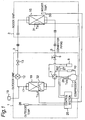
- a refrigerant circuit of an air conditioner as an embodiment of the refrigerator of this invention is shown in Fig. 1.
- an outdoor unit 1 is connected via connecting pipings 3, 5 to an indoor unit 2.
- R32 refrigerant which is slightly inflammable, is used as a refrigerant for the air conditioner.
- a valve 6 connected to the connecting piping 5 a four-way selector valve 7, a liquid-gas separator 8, an accumulator 10, a compressor 11, the four-way selector valve 7, an outdoor heat exchanger 19, a main expansion valve 12 and a valve 13 are connected in this order via refrigerant piping, and the valve 13 is connected to the connecting piping 3.
- the indoor unit 2 has a heat exchanger 15 connected to the connecting pipings 3 and 5.
- a high-pressure relief valve 18 is connected to refrigerant piping 17 on the side of the expansion valve 12 of the outdoor heat exchanger 19.
- This high-pressure relief valve 18, which is arranged outside the outdoor unit 1, opens when the internal pressure of the refrigerant piping 17 exceeds a predetermined value, and it closes when the internal pressure thereof is lowered below the predetermined value.
- the outdoor unit 1 is provided with a control unit 25 comprising a microcomputer. Connected to this control unit 25 are a temperature sensor 26 detecting the outdoor temperature, a temperature sensor 27 detecting the suction-side piping temperature T suc and a temperature sensor 28 detecting the discharge-side piping temperature T dis are connected. Further, a temperature sensor 30 detecting the indoor ambient temperature, a temperature sensor 31 detecting the temperature T in of the indoor heat exchanger 15 and a temperature sensor 32 detecting the temperature T out of the outdoor heat exchanger 11 are connected to the control unit 25.
- the control unit 25 having the above constitution controls the output of the compressor 11 and the degree of opening of the expansion valve 12 in response to temperature signals from those temperature sensors.
- a head part 11A of the compressor 11 is shown in Fig. 2A and Fig. 2B.
- This head part 11A is a rear head.
- the head part 11A was produced in the following manner. That is, a head part 11A, which is a sintered part already subjected to processing or working, and forming after sintering, is placed in a vacuum so that a rust-preventive oil that was included in large quantities into the head part 11A during the processing and forming process is extracted from the head part 11A. Then, the head part 11A is immersed in an alkyl benzene type oil serving as a refrigerator oil, whereby the alkyl benzene oil is contained in the head part 11A.
- Figs. 2A and 2B show a plan view and a side view, respectively, of a rear head 11A serving as the head part.
- the rust-preventive oil in the head part 11A which is a deterioration-inducing substance, is replaced with the alkyl benzene type oil as the refrigerator oil.
- the head part will hardly bring about contamination or sludge even if used as a component of a refrigerator for a long time.
- the alkyl benzene type oil as the refrigerator oil contained in the head part 11A of the compressor has a specific gravity smaller than that of the R32 refrigerant, it does not sink in the R32 refrigerant. Accordingly, the head part 11A is particularly suitable as a component of a refrigerator using the R32 refrigerant.
- the rear head 11A which is one of head parts in the interior of the compressor, is adopted as one example of components constituting a refrigerator to which the present invention is applied
- a front head may also be adopted, and a middle plate 11B of the compressor as shown in Fig. 2C and Fig. 2D may be adopted.
- another component such as a piston or refrigerant piping may also be adopted.
- the head part 11A which is a sintered part serving as a porous part, contains an alkyl benzene type oil. Alternatively, it may contain a mixture of an alkyl benzene type oil and an ether type oil. Further, only an ether type oil may be used.
- the specific gravity of the oil is smaller than that of the R32 refrigerant, thus making it possible to provide a sintered part suited as a component of refrigerators using the R32 refrigerant.
- Use of the R32 refrigerant achieves a high COP value.
- the COP can be improved when using a refrigerant containing the R32 refrigerant at 40 wt% or more.
- the sintered parts may be impregnated with an ester type oil.
- the sintered parts may be impregnated with a mixed oil of an ester type oil with either an alkyl benzene type oil or an ether type oil.
- the sintered parts may be impregnated with an oil containing benzene, a mixed oil of the oil containing benzene and an ester oil, or a mixed oil of the oil containing benzene and an ether oil.
- the sintered parts may be impregnated with new punching oil (an isoparaffinic refrigerator oil or an isoparaffinic oil).
- the rust-preventive oil entering into the sintered part when processed is let out under vacuum.
- the sintered part may be impregnated with the refrigerator oil by using the refrigerator oil in place of the rust-preventive oil during the processing of the sintered part.
- the porous part in the above embodiment is a sintered part, the porous part may also be formed of porous plastics or ceramics. Furthermore, making a material other than porous materials contain a refrigerator oil and using the material to constitute a part of a refrigerator also makes it possible to achieve the long-term reliability while preventing the occurrence of contamination and sludge, which is a cause of oil deterioration and clogging.
Landscapes
- Engineering & Computer Science (AREA)
- Mechanical Engineering (AREA)
- General Engineering & Computer Science (AREA)
- Chemical & Material Sciences (AREA)
- Chemical Kinetics & Catalysis (AREA)
- General Chemical & Material Sciences (AREA)
- Oil, Petroleum & Natural Gas (AREA)
- Organic Chemistry (AREA)
- Lubricants (AREA)
- Compressor (AREA)
Abstract
Description
Claims (7)
- A porous part for refrigerators, wherein the porous part contains a refrigerator oil.
- A porous part for refrigerators, wherein the porous part contains at least one of an alkyl benzene type oil and an ether type oil.
- A method of producing a porous part for refrigerators, wherein a porous part (11A, 11B) is placed in a vacuum, and then the porous part (11A, 11B) is immersed in a refrigerator oil to be impregnated with the refrigerator oil.
- A refrigerator having a material (11A, 11B) containing a refrigerator oil.
- The refrigerator according to claim 4, wherein a refrigerant used in the refrigerator contains R32 refrigerant at 40 wt% or more.
- The refrigerator according to claim 4 or 5, wherein said material (11A, 11B) contains at least one of an ether type oil, an ester type oil and an alkyl benzene type oil as the refrigerator oil.
- The refrigerator according to any one of claims 4 - 6, wherein at least one porous material serves as a material (11A, 11B) impregnated with the refrigerator oil.
Applications Claiming Priority (5)
| Application Number | Priority Date | Filing Date | Title |
|---|---|---|---|
| JP34753999A JP3287347B2 (en) | 1999-12-07 | 1999-12-07 | Porous component for refrigeration apparatus and method for producing the same |
| JP34753999 | 1999-12-07 | ||
| JP2000027685 | 2000-02-04 | ||
| JP2000027685A JP2001221516A (en) | 2000-02-04 | 2000-02-04 | Refrigeration equipment |
| PCT/JP2000/008109 WO2001042656A1 (en) | 1999-12-07 | 2000-11-17 | Porous part for refrigerators, and method of producing the same and refrigerator |
Publications (2)
| Publication Number | Publication Date |
|---|---|
| EP1239155A1 true EP1239155A1 (en) | 2002-09-11 |
| EP1239155A4 EP1239155A4 (en) | 2004-06-02 |
Family
ID=26578530
Family Applications (1)
| Application Number | Title | Priority Date | Filing Date |
|---|---|---|---|
| EP00976312A Withdrawn EP1239155A4 (en) | 1999-12-07 | 2000-11-17 | POROUS PART FOR REFRIGERATOR, METHOD FOR MANUFACTURING SUCH PART, AND REFRIGERATOR |
Country Status (6)
| Country | Link |
|---|---|
| US (1) | US6672100B1 (en) |
| EP (1) | EP1239155A4 (en) |
| KR (1) | KR20020065550A (en) |
| CN (1) | CN1188594C (en) |
| AU (1) | AU772801B2 (en) |
| WO (1) | WO2001042656A1 (en) |
Families Citing this family (1)
| Publication number | Priority date | Publication date | Assignee | Title |
|---|---|---|---|---|
| JP4738401B2 (en) * | 2007-11-28 | 2011-08-03 | 三菱電機株式会社 | Air conditioner |
Family Cites Families (12)
| Publication number | Priority date | Publication date | Assignee | Title |
|---|---|---|---|---|
| JPS60156991A (en) | 1984-01-26 | 1985-08-17 | Nissan Motor Co Ltd | Rotary compressor |
| JPS61118582A (en) | 1984-11-13 | 1986-06-05 | Matsushita Electric Ind Co Ltd | Compressor vane and its manufacturing method |
| JPH04311695A (en) * | 1991-04-11 | 1992-11-04 | Matsushita Refrig Co Ltd | Compressor sliding material and compressor |
| JPH0533093A (en) * | 1991-07-29 | 1993-02-09 | Sumitomo Electric Ind Ltd | High strength aluminum alloy with excellent wear resistance and sliding characteristics |
| JP3038105B2 (en) | 1993-08-27 | 2000-05-08 | 株式会社三協精機製作所 | Fluid bearing device and motor |
| JPH07293468A (en) * | 1994-04-28 | 1995-11-07 | Toshiba Corp | Hermetic compressor |
| SG75080A1 (en) * | 1994-11-29 | 2000-09-19 | Sanyo Electric Co | Refrigerating apparatus and lubricating oil composition |
| JPH0932770A (en) * | 1995-07-18 | 1997-02-04 | Matsushita Electric Ind Co Ltd | Hermetic compressor |
| JPH09303264A (en) * | 1996-05-10 | 1997-11-25 | Matsushita Electric Ind Co Ltd | Compressor for refrigerator |
| JPH11153091A (en) | 1997-09-18 | 1999-06-08 | Matsushita Electric Ind Co Ltd | Sliding member and refrigeration compressor using the same |
| JPH11236890A (en) | 1998-02-20 | 1999-08-31 | Sanyo Electric Co Ltd | Vane and refrigerant compressor using it |
| JP2000110724A (en) * | 1998-10-08 | 2000-04-18 | Matsushita Refrig Co Ltd | Compressors and pumps |
-
2000
- 2000-11-17 WO PCT/JP2000/008109 patent/WO2001042656A1/en not_active Ceased
- 2000-11-17 AU AU14147/01A patent/AU772801B2/en not_active Ceased
- 2000-11-17 CN CNB008167737A patent/CN1188594C/en not_active Expired - Lifetime
- 2000-11-17 EP EP00976312A patent/EP1239155A4/en not_active Withdrawn
- 2000-11-17 US US10/149,058 patent/US6672100B1/en not_active Expired - Lifetime
- 2000-11-17 KR KR1020027007158A patent/KR20020065550A/en not_active Ceased
Also Published As
| Publication number | Publication date |
|---|---|
| EP1239155A4 (en) | 2004-06-02 |
| AU772801B2 (en) | 2004-05-06 |
| KR20020065550A (en) | 2002-08-13 |
| CN1408054A (en) | 2003-04-02 |
| US6672100B1 (en) | 2004-01-06 |
| CN1188594C (en) | 2005-02-09 |
| WO2001042656A1 (en) | 2001-06-14 |
| AU1414701A (en) | 2001-06-18 |
Similar Documents
| Publication | Publication Date | Title |
|---|---|---|
| AU2007241901B2 (en) | Refrigerating apparatus | |
| KR890004395B1 (en) | Refrigerating cycle apparatus | |
| KR100605797B1 (en) | Air conditioner | |
| EP2015003B1 (en) | Refrigerating apparatus | |
| KR100353232B1 (en) | Refrigerant circulation device, Refrigerant circuit assembly method | |
| EP1707901A2 (en) | Refrigerated device and refrigerator | |
| US5868001A (en) | Suction accumulator with oil reservoir | |
| US12203685B2 (en) | Refrigeration apparatus | |
| EP1293735B1 (en) | Refrigerant circuit | |
| US7918106B2 (en) | Refrigeration system | |
| EP3745057A1 (en) | Lubricant quality management for a compressor | |
| US12018867B2 (en) | Refrigeration apparatus | |
| JPH11142001A (en) | Air conditioner | |
| US6672100B1 (en) | Porous part for refrigerators, and method of producing the same and refrigerator | |
| JP2003028523A (en) | Refrigeration equipment and oil tank integrated accumulator | |
| JP2005283067A (en) | Air conditioner | |
| JP2001221516A (en) | Refrigeration equipment | |
| JP4476946B2 (en) | Refrigeration equipment | |
| US10935292B2 (en) | Lubricant quality management for a compressor | |
| JP2020034249A (en) | Refrigeration cycle device | |
| KR100792458B1 (en) | Oil Separator of Compressor | |
| JP3197768B2 (en) | Refrigeration equipment | |
| JPH10246521A (en) | Refrigeration / air conditioning device and refrigerant circuit assembly method | |
| JP2022068386A (en) | Pressure regulation/bypass control unit | |
| JPH02149790A (en) | Protection device for rotary compressor |
Legal Events
| Date | Code | Title | Description |
|---|---|---|---|
| PUAI | Public reference made under article 153(3) epc to a published international application that has entered the european phase |
Free format text: ORIGINAL CODE: 0009012 |
|
| 17P | Request for examination filed |
Effective date: 20020628 |
|
| AK | Designated contracting states |
Kind code of ref document: A1 Designated state(s): AT BE CH CY DE DK ES FI FR GB GR IE IT LI LU MC NL PT SE TR |
|
| AX | Request for extension of the european patent |
Free format text: AL;LT;LV;MK;RO;SI |
|
| A4 | Supplementary search report drawn up and despatched |
Effective date: 20040421 |
|
| RIC1 | Information provided on ipc code assigned before grant |
Ipc: 7F 04B 39/02 A Ipc: 7F 04B 39/00 B Ipc: 7F 01C 21/10 B Ipc: 7F 04C 29/02 B |
|
| GRAP | Despatch of communication of intention to grant a patent |
Free format text: ORIGINAL CODE: EPIDOSNIGR1 |
|
| RTI1 | Title (correction) |
Free format text: METHOD OF PRODUCING POROUS PART FOR REFRIGERATORS |
|
| STAA | Information on the status of an ep patent application or granted ep patent |
Free format text: STATUS: THE APPLICATION IS DEEMED TO BE WITHDRAWN |
|
| 18D | Application deemed to be withdrawn |
Effective date: 20110301 |