EP1238968A1 - Verfahren zur Herstellung von organischen Polyisocyanaten - Google Patents
Verfahren zur Herstellung von organischen Polyisocyanaten Download PDFInfo
- Publication number
- EP1238968A1 EP1238968A1 EP02003615A EP02003615A EP1238968A1 EP 1238968 A1 EP1238968 A1 EP 1238968A1 EP 02003615 A EP02003615 A EP 02003615A EP 02003615 A EP02003615 A EP 02003615A EP 1238968 A1 EP1238968 A1 EP 1238968A1
- Authority
- EP
- European Patent Office
- Prior art keywords
- reaction area
- reactor
- bottom fraction
- cleavage
- polyurethane
- Prior art date
- Legal status (The legal status is an assumption and is not a legal conclusion. Google has not performed a legal analysis and makes no representation as to the accuracy of the status listed.)
- Withdrawn
Links
- 229920001228 polyisocyanate Polymers 0.000 title claims abstract description 17
- 239000005056 polyisocyanate Substances 0.000 title claims abstract description 17
- 238000000034 method Methods 0.000 title claims description 29
- 238000002360 preparation method Methods 0.000 title description 3
- 238000006243 chemical reaction Methods 0.000 claims abstract description 52
- 239000004814 polyurethane Substances 0.000 claims abstract description 34
- 229920002635 polyurethane Polymers 0.000 claims abstract description 34
- 238000004821 distillation Methods 0.000 claims abstract description 25
- 238000004519 manufacturing process Methods 0.000 claims abstract description 8
- 238000003776 cleavage reaction Methods 0.000 claims description 27
- 230000007017 scission Effects 0.000 claims description 26
- 239000012948 isocyanate Substances 0.000 claims description 15
- 150000002513 isocyanates Chemical class 0.000 claims description 15
- 238000005336 cracking Methods 0.000 claims description 12
- 239000003054 catalyst Substances 0.000 claims description 5
- 150000002736 metal compounds Chemical class 0.000 claims description 2
- 238000001149 thermolysis Methods 0.000 abstract 4
- JOYRKODLDBILNP-UHFFFAOYSA-N Ethyl urethane Chemical compound CCOC(N)=O JOYRKODLDBILNP-UHFFFAOYSA-N 0.000 description 15
- 238000009835 boiling Methods 0.000 description 10
- 238000003860 storage Methods 0.000 description 10
- RRAMGCGOFNQTLD-UHFFFAOYSA-N hexamethylene diisocyanate Chemical compound O=C=NCCCCCCN=C=O RRAMGCGOFNQTLD-UHFFFAOYSA-N 0.000 description 9
- 230000015572 biosynthetic process Effects 0.000 description 8
- LRHPLDYGYMQRHN-UHFFFAOYSA-N N-Butanol Chemical compound CCCCO LRHPLDYGYMQRHN-UHFFFAOYSA-N 0.000 description 6
- 239000006227 byproduct Substances 0.000 description 6
- QFSFGQIYESROHY-UHFFFAOYSA-N ethyl n-butyl-n-(6-isocyanatohexyl)carbamate Chemical compound CCCCN(C(=O)OCC)CCCCCCN=C=O QFSFGQIYESROHY-UHFFFAOYSA-N 0.000 description 6
- 239000000178 monomer Substances 0.000 description 6
- AVWRKZWQTYIKIY-UHFFFAOYSA-N urea-1-carboxylic acid Chemical compound NC(=O)NC(O)=O AVWRKZWQTYIKIY-UHFFFAOYSA-N 0.000 description 6
- 239000011541 reaction mixture Substances 0.000 description 5
- 239000000047 product Substances 0.000 description 4
- UKLDJPRMSDWDSL-UHFFFAOYSA-L [dibutyl(dodecanoyloxy)stannyl] dodecanoate Chemical compound CCCCCCCCCCCC(=O)O[Sn](CCCC)(CCCC)OC(=O)CCCCCCCCCCC UKLDJPRMSDWDSL-UHFFFAOYSA-L 0.000 description 3
- 239000012975 dibutyltin dilaurate Substances 0.000 description 3
- 125000005442 diisocyanate group Chemical group 0.000 description 3
- 239000007788 liquid Substances 0.000 description 3
- 239000000203 mixture Substances 0.000 description 3
- 230000007306 turnover Effects 0.000 description 3
- 238000011144 upstream manufacturing Methods 0.000 description 3
- 150000004649 carbonic acid derivatives Chemical class 0.000 description 2
- 230000000052 comparative effect Effects 0.000 description 2
- 230000004992 fission Effects 0.000 description 2
- 239000000126 substance Substances 0.000 description 2
- LFQSCWFLJHTTHZ-UHFFFAOYSA-N Ethanol Chemical compound CCO LFQSCWFLJHTTHZ-UHFFFAOYSA-N 0.000 description 1
- 125000005595 acetylacetonate group Chemical group 0.000 description 1
- 150000001298 alcohols Chemical class 0.000 description 1
- 229910052782 aluminium Inorganic materials 0.000 description 1
- 150000004657 carbamic acid derivatives Chemical class 0.000 description 1
- 150000007942 carboxylates Chemical class 0.000 description 1
- 239000007795 chemical reaction product Substances 0.000 description 1
- 150000001875 compounds Chemical class 0.000 description 1
- 229910052802 copper Inorganic materials 0.000 description 1
- 238000009826 distribution Methods 0.000 description 1
- 150000004820 halides Chemical class 0.000 description 1
- 238000009434 installation Methods 0.000 description 1
- 229910052742 iron Inorganic materials 0.000 description 1
- IQPQWNKOIGAROB-UHFFFAOYSA-N isocyanate group Chemical group [N-]=C=O IQPQWNKOIGAROB-UHFFFAOYSA-N 0.000 description 1
- 229910052748 manganese Inorganic materials 0.000 description 1
- 238000002156 mixing Methods 0.000 description 1
- 229910052750 molybdenum Inorganic materials 0.000 description 1
- 229910052759 nickel Inorganic materials 0.000 description 1
- 229920000768 polyamine Polymers 0.000 description 1
- 125000002577 pseudohalo group Chemical group 0.000 description 1
- 238000010992 reflux Methods 0.000 description 1
- 238000004227 thermal cracking Methods 0.000 description 1
- 229910052718 tin Inorganic materials 0.000 description 1
- 229910052719 titanium Inorganic materials 0.000 description 1
- 229910052725 zinc Inorganic materials 0.000 description 1
- 229910052726 zirconium Inorganic materials 0.000 description 1
Images


Classifications
-
- C—CHEMISTRY; METALLURGY
- C07—ORGANIC CHEMISTRY
- C07C—ACYCLIC OR CARBOCYCLIC COMPOUNDS
- C07C263/00—Preparation of derivatives of isocyanic acid
- C07C263/04—Preparation of derivatives of isocyanic acid from or via carbamates or carbamoyl halides
Definitions
- the present invention relates to a method for producing organic polyisocyanates by thermal cracking of polyurethanes.
- phosgene-free production processes known from the prior art for organic polyisocyanates are based on the formation of monomers Polyurethanes from polyamines and carbonic acid derivatives and the subsequent thermal cleavage of the monomeric polyurethanes into alcohols and polyisocyanates.
- the monomeric polyurethanes formed in the urethanization stage are usually first freed from alcohol and the low-boiling by-products, such as carbamates and carbonates, by distillation. Subsequently, high-boiling components are discharged as the remaining bottom fraction either by complete distillation of the entire urethane stream (EP 0 355 443) or by distillation of only a part of the urethane stream (EP 0 566 925).
- the cleavage of the monomeric polyurethanes is then carried out continuously at 200 to 300 ° C. and a pressure of 1 to 200 mbar while the volatile cleavage products are distilled off. The undissolved portion of the reaction mixture and the high-boiling by-products formed form a bottom fraction, which is returned to the urethanization process.
- the resulting from the subsequent distillation of the polyisocyanate Bottom fraction contains even larger amounts of only partially split, Isocyanate containing urethane groups and oligomers derived therefrom. Such Oligomers are especially allophanates.
- This swamp fraction will continuously discharged and returned to the cleavage reactor.
- the object of the present invention was accordingly to provide a method for Production of organic polyisocyanates, in which in one Splitting reactor thermally split polyurethanes, followed by distillation is carried out and the resulting bottom fraction is returned, to make available that does not have the disadvantages described.
- a method is to be made available to this method with which the content of partially cleaved urethane-containing Isocyanate at the side discharge of the rectification column is lowered and at the same time the yield of the urethane cleavage process is increased.
- Monomeric polyurethane can also be led into the reaction area become. According to the invention it is possible to use either the entire monomer Polyurethane or only part of the monomeric polyurethane in the Lead reaction area, while the other part directly into the cleavage reactor is directed.
- the ratio of that fed directly into the cracking reactor Polyurethane is directed towards the polyurethane added to the reaction area according to the respective process conditions. In particular, the amount of added polyurethane from the amount of recycled bottom fraction. In other words, especially when starting the process, it is predominant at first Polyurethane added directly to the cracking reactor.
- the return of the partial cleaved isocyanates containing urethane groups can be completely or only partially from the bottom of the isocyanate distillation. In addition or alternatively, a return can be completely or partially from the lower
- the rectification column can be refluxed into the cleavage reactor.
- Both the monomeric polyurethane and the bottom fraction can be combined in one preferred embodiment of the invention continuously in the Reaction area are returned.
- the invention is based on the invention thus achieved that the returned bottom fraction, which only partially contains cleaved isocyanate containing urethane groups, completely or partially combined with the monomeric polyurethanes used for the cleavage. in this connection there is a chemical conversion of the supplied monomeric polyurethane with the recycled from the Bottom fraction isocyanates. The result is partial or completely a conversion to allophanates.
- allophanates containing mixture is the cracking reactor for the preparation of the polyisocyanate fed. This process is preferably carried out continuously.
- the reaction area is preferably heatable Container designed.
- the configuration as a separate one is particularly preferred Container.
- This is in a preferred variant of the invention as Storage container designed, which is arranged in the inlet to the gap reactor.
- the heated container is useful for better mixing continuously stirred and / or continuously by a feed pump circulated.
- the reaction area can also be in the return line Rectification column can be arranged.
- Next to it is at least a separate one Feed line for monomeric polyurethane provided.
- the reaction area can be in the Fitting reactor downstream rectification column can be integrated.
- a suitable installation is preferably provided in the rectification column, in which the formation of the allophanates takes place.
- the Allophanate formation preferably on a column tray with a defined Volume and / or in a return manifold with increased volume and / or in a separate residence reactor, in particular with a reactor narrow residence time distribution.
- the allophanates arise from the reaction from urethane group-containing and isocyanate group-containing compounds the reflux of the rectification column to separate the cleavage products below the polyisocyanate side hood.
- Another alternative is that a return of the Bottom streams from the polyisocyanate distillation into the residence times of rectification column downstream of the cleavage reactor.
- reaction area as the cleavage reactor upstream container is designed, it is preferred according to the invention in the reaction area to set temperatures between 50 and 250 ° C. 60 to 200 ° C. are particularly preferred.
- reaction area is integrated into the rectification column, a Temperature range of 150-250 ° C, especially 180-240 ° C preferred.
- the pressure is preferably 1-200 mbar, in particular 10-100 mbar.
- the residence time is 0.1-20 min., Preferably 0.5-5 min.
- Allophanate formation can optionally take place in the presence of one or more catalysts.
- the catalysts used for allophanate formation correspond to the catalysts used in the process for the preparation of the corresponding monomeric polyurethanes and / or their thermal cleavage. These are primarily inorganic or organic metal compounds (alcoholates, acetylacetonates, carboxylates, halides and pseudohalides) of elements of groups IIIa, IVa, Ib, IIb, IVb, VIb, VIIb, VIIIb (in particular Al, Sn, Cu, Zn, Ti, Zr, Mo, Mn, Fe, Co, Ni -Links).
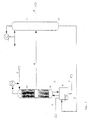
- FIG. 1 a system according to the prior art is shown.
- monomeric polyurethane is fed via stream 1 into a cracking reactor 9.
- this cleavage reactor 9 the monomeric polyurethanes are cleaved while the volatile cleavage products are distilled off.
- a rectification column 10 is arranged downstream of the cracking reactor.
- the resulting polyisocyanate is removed via stream 4.
- the undissolved fraction of the reaction mixture and the high-boiling by-products formed form the bottom fraction 15.
- the polyisocyanate fed via stream 4 to the distillation column 11 is subjected to pure distillation and discharged via stream 8.
- the bottom fraction obtained contains large amounts of partially cleaved isocyanate containing urethane groups and oligomers derived therefrom.
- This bottom fraction 15 is fed back into the cracking reactor 9 via stream 2.
- the system according to FIG. 2 has essentially the same structure as FIG. 1 on. The only difference is that the monomers via stream 1 are not be led directly into the gap reactor 9. Rather, the monomers first led into the storage container 12. This from the gap reactor 9 separate container is heated.
- the bottom fraction 15 is also discharged into the storage container via stream 2 the distillation column 11 out.
- the Swamp fraction which is only partially split, contains urethane groups Contains isocyanate, completely or at least partially with that for cleavage monomeric polyurethanes used united.
- the Storage container 12 for a chemical conversion of the stream 1 supplied monomeric polyurethane. The result is partial or even completely a conversion to allophanates.
- FIG. 3 a plant is a further variant of the invention shown, in the reaction area 13 in the gap reactor 9th downstream rectification column 10 is integrated. Accordingly, in the reaction area 13 internals provided, in which the formation of Allophanate is done.
- the monomers Polyurethanes are led directly into the reaction area 13 or into the Gap reactor 9 are given. It can also be seen from FIG. 3 that the Bottom fraction 15 is either given directly to the cleavage reactor via stream 2 is or is led into the reaction area 13.
- a steam-heated evaporator reactor with 2.5 1 reaction volume was via a metering device O-butyl carbamate-free hexamethylene-1,6-dibutyl urethane, containing 0.15 mol% dibutyltin dilaurate, in the molten state Condition for the homogeneously catalyzed thermal fission continuous fed.
- the split with a turnover of about 55% in terms of 3.81 kg / h of hexamethylene-1,6-dibutyl urethane used was carried out at 30 mbar with intensive boiling of the reaction mixture.
- the gaseous vapors were separated into a rectification column at the top of which was 1.1 kg / h liquid butanol were removed.
- a heated evaporator reactor with 10 1 reaction volume and one Internal temperatures of approx. 130 ° C were measured using an o-butyl carbamate free hexamethylene-1,6-dibutyl urethane, containing 0.15 mol% Dibutyltin dilaurate, in the molten state as well as in the Pure distillation of the hexamethelen-1,6-diisocyanate resulting in the bottom molten state continuously fed.
- the mixture thus obtained was continuously steam-heated via a metering device Evaporator reactor with 2.5 1 reaction volume for homogeneously catalyzed fed thermal fission. The split with a turnover of approx.
- the hexamethylene-1,6-diisocyanate thus obtained became one Purified distillation, one in the side draw at 30 mbar operated column 1.21 kg / h hexamethylene-1,6-diisocyanate with a purity of> 99%.
- the bottom of the pure distillation which consists mainly of 6-isocyanatohexyl-1-butyl urethane and its higher molecular weight oligomers was composed directly in the above heated reaction area recycled.
- a heated and continuously circulated storage container with a reaction volume of 10 l and an internal temperature of 184 ° C. was charged with o-butyl carbamate-free hexamethylene-1,6-dibutyl urethane, containing 0.15 mol% of dibutyltin dilaurate, in the molten state, as well as at a the pure distillation of the hexamethylene-1,6-diisocyanate resulting swamp in the molten state continuously fed.
- the mixture thus obtained was fed continuously via a metering device to a steam-heated evaporator reactor with a reaction volume of 2.5 l for homogeneously catalyzed thermal cleavage.
- the hexamethylene-1,6-diisocyanate obtained in this way was subjected to pure distillation, with 1.44 kg / h of hexamethylene-1,6-diisocyanate with a purity of> 99% being obtained in the side draw of a column operated at 30 mbar.
- the bottom of the pure distillation which was composed predominantly of 6-isocyanatohexyl-1-butyl urethane and its higher molecular weight oligomers, was continuously returned directly to the above-mentioned heated storage tank.
- Example 1 Comparative Example Example 2 according to the invention
- Example 3 according to the invention
- Temperature storage tank (° C) for allophanate formation No upstream allophanate formation 130
Landscapes
- Chemical & Material Sciences (AREA)
- Organic Chemistry (AREA)
- Organic Low-Molecular-Weight Compounds And Preparation Thereof (AREA)
Abstract
Description
Nach der EP 0 566 925 wird anschließend die Spaltung der monomeren Polyurethane bei 200 bis 300 °C und einem Druck von 1 bis 200 mbar unter Abdestillieren der flüchtigen Spaltprodukte kontinuierlich vorgenommen. Der ungespaltene Anteil der Reaktionsmischung sowie die gebildeten hochsiedenden Nebenprodukte bilden dabei eine Sumpffraktion, die in den Urethanisierungsprozeß zurückgeführt wird.
der Gruppen IIIa, IVa, Ib, IIb, IVb, VIb, VIIb, VIIIb (insbesondere Al-, Sn-, Cu-, Zn-, Ti-, Zr-, Mo-, Mn-, Fe-, Co-, Ni-Verbindungen).
Das über den Strom 4 der Destillationskolonne 11 zugeführte Polyisocyanat wird einer Reindestillation unterworfen und über den Strom 8 abgeführt. Die anfallende Sumpffraktion enthält größere Mengen an teilweise gespaltenem, urethangruppenhaltigem Isocyanat und davon abgeleiteten Oligomeren. Diese Sumpffraktion 15 wird über den Strom 2 in den Spaltreaktor 9 zurückgeführt.
| Beispiel 1 Vergleichsbeispiel | Beispiel 2 erfindungsgemäß | Beispiel 3 erfindungsgemäß | |
| Zulauf (kg/h) Hexamethylen-1,6-dibutylurethan | 3,81 | 3,81 | 4,42 |
| Konzentration (Ma%) Hexamethylen-1,6-diisocyanat im Seitenabzug der Rektifikationskolonne | 95 | 98 | 97 |
| Sumpfrückführung (kg/h) Reindestillation | 0,10 | 0,10 | 0,12 |
| Temperatur Vorlagebehälter (°C) zur Allophanatbildung | Keine vorgeschaltete Allophanatbildung | 130 | 184 |
| Produktstrom (kg/h) Hexamethylen-1,6-diisocyanat | 1,115 | 1,21 | 1,44 |
| Umsatz bezüglich Hexamenthylen-1,6-dibutylurethan (Mol%) | 55 | 60 | 62 |
Claims (25)
- Verfahren zur Herstellung von organischen Polyisocyanaten, bei welchem in einem Spaltreaktor Polyurethane thermisch gespalten, anschließend eine Destillation durchgeführt wird und die hierbei anfallende Sumpffraktion rückgeführt wird,
dadurch gekennzeichnet, daß die rückgeführte Sumpffraktion wenigstens teilweise zunächst in einen Reaktionsbereich und anschließend in den Spaltreaktor geleitet wird. - Verfahren nach Anspruch 1,
dadurch gekennzeichnet, daß zusätzlich monomeres Polyurethan in den Reaktionsbereich gegeben wird. - Verfahren nach einem der Ansprüche 1 oder 2,
dadurch gekennzeichnet, daß in den Reaktionsbereich Katalysatoren gegeben werden. - Verfahren nach Anspruch 3,
dadurch gekennzeichnet, daß die Katalysatoren anorganische oder organische Metallverbindungen von Elementen der Gruppen IIIa, IVa, Ib, IIb, IVb, VIb, VIIb, VIIIb sind. - Verfahren nach Anspruch 2,
dadurch gekennzeichnet, daß das monomere Polyurethan teilweise in den Spaltreaktor und teilweise in den Reaktionsbereich gegeben wird. - Verfahren nach einem der Ansprüche 1 bis 5,
dadurch gekennzeichnet, daß die rückgeführte Sumpffraktion und das monomere Polyurethan kontinuierlich in den Reaktionsbereich geleitet werden. - Verfahren nach einem der Ansprüche 1 bis 6,
dadurch gekennzeichnet, daß die Aufenthaltsdauer der Sumpffraktion und des monomeren Polyurethans und die Temperatur in dem Reaktionsbereich so eingestellt werden, daß wenigstens eine teilweise Umsetzung zu Allophanaten erfolgt. - Verfahren nach Anspruch 7,
dadurch gekennzeichnet, daß die Isocyanate aus der Sumpffraktion mit dem monomeren Polyurethan in dem Reaktionsbereich vollständig zu Allophanaten umgesetzt werden. - Verfahren nach einem der Ansprüche 1 bis 8,
dadurch gekennzeichnet, daß die Sumpffraktion über einen Reaktionsbereich geführt wird, der als beheizbarer, separater Behälter ausgestaltet ist. - Verfahren nach Anspruch 9,
dadurch gekennzeichnet, daß die Temperatur in dem Reaktionsbereich auf 50 bis 250 °C eingestellt wird. - Verfahren nach einem der Ansprüche 9 oder 10,
dadurch gekennzeichnet, daß die Temperatur in dem Reaktionsbereich auf 60 bis 200 °C eingestellt wird. - Verfahren nach einem der Ansprüche 9 bis 11,
dadurch gekennzeichnet, daß die Verweilzeit in dem Reaktionsbereich 0,1-36h beträgt. - Verfahren nach einem der Ansprüche 9 bis 12,
dadurch gekennzeichnet, daß die Verweilzeit in dem Reaktionsbereich 1-12h beträgt. - Verfahren nach einem der Ansprüche 9 bis 13,
dadurch gekennzeichnet, daß der Druck 0,1 bis 10 bar beträgt. - Verfahren nach einem der Ansprüche 9 bis 14,
dadurch gekennzeichnet, daß der Druck 1 bis 5 bar beträgt. - Verfahren nach einem der Ansprüche 1 bis 7,
dadurch gekennzeichnet, daß die Sumpffraktion über einen Reaktionsbereich geführt wird, der in die dem Spaltreaktor nachgeschaltete Reaktionskolonne integriert ist. - Verfahren nach Anspruch 16,
dadurch gekennzeichnet, daß die Temperatur 150 bis 250 °C beträgt. - Verfahren nach einem der Ansprüche 16 oder 17,
dadurch gekennzeichnet, daß der Druck 1 bis 200 mbar beträgt. - Verfahren nach einem der Ansprüche 16 bis 18,
dadurch gekennzeichnet, daß die Verweilzeit 0,1 bis 20 min. beträgt. - Vorrichtung mit wenigstens einem Spaltreaktor und wenigstens einer Rektifizierkolonne zur Herstellung von organischen Polyisocyanaten durch thermische Spaltung von Polyurethan und anschließende Destillation,
dadurch gekennzeichnet, daß in wenigstens einem Zulauf zu dem Spaltreaktor ein beheizbarer Reaktionsbereich angeordnet ist. - Vorrichtung nach Anspruch 20,
dadurch gekennzeichnet, daß der Reaktionsbereich in der Rückführleitung von der Rektifizierkolonne zum Spaltreaktor angeordnet ist. - Vorrichtung nach einem der Ansprüche 20,
dadurch gekennzeichnet, daß der Reaktionsbereich wenigstens eine Zuführleitung für monomeres Polyurethan enthält. - Vorrichtung nach einem der Ansprüche 20 bis 22,
dadurch gekennzeichnet, daß der Reaktionsbereich als beheizbarer, separater Behälter ausgestaltet ist. - Vorrichtung nach einem der Ansprüche 20 bis 23,
dadurch gekennzeichnet, daß der Reaktionsbereich in die dem Spaltreaktion nachgeschaltete Rektifikationskolonne integriert ist. - Verwendung der Vorrichtung nach einem der Ansprüche 20 bis 24 zur Herstellung von Polyisocyanaten.
Applications Claiming Priority (2)
| Application Number | Priority Date | Filing Date | Title |
|---|---|---|---|
| DE10111645 | 2001-03-10 | ||
| DE10111645A DE10111645A1 (de) | 2001-03-10 | 2001-03-10 | Verfahren zur Herstellung von organischen Polyisocyanaten |
Publications (1)
| Publication Number | Publication Date |
|---|---|
| EP1238968A1 true EP1238968A1 (de) | 2002-09-11 |
Family
ID=7677044
Family Applications (1)
| Application Number | Title | Priority Date | Filing Date |
|---|---|---|---|
| EP02003615A Withdrawn EP1238968A1 (de) | 2001-03-10 | 2002-02-16 | Verfahren zur Herstellung von organischen Polyisocyanaten |
Country Status (3)
| Country | Link |
|---|---|
| US (1) | US20020161160A1 (de) |
| EP (1) | EP1238968A1 (de) |
| DE (1) | DE10111645A1 (de) |
Citations (3)
| Publication number | Priority date | Publication date | Assignee | Title |
|---|---|---|---|---|
| EP0355443A2 (de) * | 1988-08-18 | 1990-02-28 | Hüls Aktiengesellschaft | Kreislaufverfahren zur Herstellung von (cyclo)aliphatischen Diisocyanaten |
| EP0542106A2 (de) * | 1991-11-14 | 1993-05-19 | Bayer Ag | Verfahren zur Herstellung von Polyisocyanaten |
| DE19627552A1 (de) * | 1996-07-09 | 1998-01-15 | Basf Ag | Verfahren zur Herstellung von organischen Polyisocyanaten |
-
2001
- 2001-03-10 DE DE10111645A patent/DE10111645A1/de not_active Withdrawn
-
2002
- 2002-02-16 EP EP02003615A patent/EP1238968A1/de not_active Withdrawn
- 2002-03-07 US US10/091,446 patent/US20020161160A1/en not_active Abandoned
Patent Citations (3)
| Publication number | Priority date | Publication date | Assignee | Title |
|---|---|---|---|---|
| EP0355443A2 (de) * | 1988-08-18 | 1990-02-28 | Hüls Aktiengesellschaft | Kreislaufverfahren zur Herstellung von (cyclo)aliphatischen Diisocyanaten |
| EP0542106A2 (de) * | 1991-11-14 | 1993-05-19 | Bayer Ag | Verfahren zur Herstellung von Polyisocyanaten |
| DE19627552A1 (de) * | 1996-07-09 | 1998-01-15 | Basf Ag | Verfahren zur Herstellung von organischen Polyisocyanaten |
Also Published As
| Publication number | Publication date |
|---|---|
| DE10111645A1 (de) | 2002-09-19 |
| US20020161160A1 (en) | 2002-10-31 |
Similar Documents
| Publication | Publication Date | Title |
|---|---|---|
| EP0126299B1 (de) | Mehrstufenverfahren zur Herstellung von Hexamethylen-diisocyanat-1,6 und/oder isomeren aliphatischen Diisocyanaten mit 6 Kohlenstoffatomen im Alkylenrest | |
| EP0566925B1 (de) | Mehrstufiges Verfahren zur kontinuierlichen Herstellung von organischen Polyisocyanaten | |
| EP0568782B1 (de) | Kontinuierliches mehrstufiges Verfahren zur Herstellung von (cyclo)-aliphatischen Diisocyanaten | |
| EP0355443B1 (de) | Kreislaufverfahren zur Herstellung von (cyclo)aliphatischen Diisocyanaten | |
| EP1784375B1 (de) | Verfahren zur herstellung von ameisensäure | |
| EP2118044B1 (de) | Verfahren zur herstellung von sehr reinem 1,4-butandiol | |
| EP1420012B1 (de) | Verfahren zur Herstellung von aliphatischen Isocyanaten aus aromatischen Isocyanaten | |
| EP3546467B1 (de) | Verfahren zur herstellung alkoxysilangruppen-haltiger isocyanate | |
| EP2462109B1 (de) | Verfahren zur herstellung von isocyanaten | |
| DE3047898A1 (de) | Verfahren zur kontinuierlichen thermischen spaltung von carbamidsaeureestern und die verwendung von hierbei anfallenden isocyanate und carbamidsaeureester aufweisenden gemischen zur herstellung von isocyanaten | |
| EP1512682B1 (de) | Mehrstufiges Verfahren zur kontinuierlichen Herstellung von cycloaliphatischen Diisocyanaten | |
| EP1512680B1 (de) | Mehrstufiges Verfahren zur kontinuierlichen Herstellung von cycloaliphatischen Diisocyanaten | |
| DE3212510C3 (de) | ||
| EP1206439B1 (de) | Verfahren zur kontinuierlichen herstellung von methylformiat | |
| EP0524554B1 (de) | Verfahren zur thermischen Spaltung von Carbamidsäureestern | |
| EP2480525B1 (de) | Verfahren zur herstellung von isocyanaten | |
| EP1593669A1 (de) | Mehrstufiges Verfahren zur kontinuierlichen Herstellung von cycloaliphatischen Diisocyanaten | |
| EP0657420A1 (de) | Verfahren zur Herstellung von Diurethanen und ihrer Verwendung zur Herstellung von Diisocyanaten | |
| EP0861232B1 (de) | Verfahren zur herstellung von organischen diurethanen und/oder polyurethanen und ihre verwendung zur herstellung von di- und/oder polyisocyanaten | |
| DE102007039127A1 (de) | Verfahren zur Herstellung von Isocyanaten | |
| EP1926707B1 (de) | Verfahren zur herstellung von isocyanaten | |
| EP1238968A1 (de) | Verfahren zur Herstellung von organischen Polyisocyanaten | |
| DE19627552A1 (de) | Verfahren zur Herstellung von organischen Polyisocyanaten | |
| EP1031559A1 (de) | Verfahren zur Herstellung von Isocyanaten durch Spaltung von Urethanen | |
| EP0261604B1 (de) | Neue 2-(Alkoximethyl)-pentan-1,5-diisocyanate, - diurethane und dicarbamidsäurechloride, Verfahren zu ihrer Herstellung und deren Verwendung |
Legal Events
| Date | Code | Title | Description |
|---|---|---|---|
| PUAI | Public reference made under article 153(3) epc to a published international application that has entered the european phase |
Free format text: ORIGINAL CODE: 0009012 |
|
| AK | Designated contracting states |
Kind code of ref document: A1 Designated state(s): AT BE CH CY DE DK ES FI FR GB GR IE IT LI LU MC NL PT SE TR |
|
| AX | Request for extension of the european patent |
Free format text: AL;LT;LV;MK;RO;SI |
|
| 17P | Request for examination filed |
Effective date: 20021014 |
|
| AKX | Designation fees paid |
Designated state(s): AT BE CH CY DE DK ES FI FR GB GR IE IT LI LU MC NL PT SE TR |
|
| 17Q | First examination report despatched |
Effective date: 20031107 |
|
| STAA | Information on the status of an ep patent application or granted ep patent |
Free format text: STATUS: THE APPLICATION IS DEEMED TO BE WITHDRAWN |
|
| 18D | Application deemed to be withdrawn |
Effective date: 20040318 |