EP1238669A2 - Neutrophil function inhibitors which contain glucosamine - Google Patents
Neutrophil function inhibitors which contain glucosamine Download PDFInfo
- Publication number
- EP1238669A2 EP1238669A2 EP01116700A EP01116700A EP1238669A2 EP 1238669 A2 EP1238669 A2 EP 1238669A2 EP 01116700 A EP01116700 A EP 01116700A EP 01116700 A EP01116700 A EP 01116700A EP 1238669 A2 EP1238669 A2 EP 1238669A2
- Authority
- EP
- European Patent Office
- Prior art keywords
- glucosamine
- salt
- neutrophils
- respiratory disease
- neutrophil
- Prior art date
- Legal status (The legal status is an assumption and is not a legal conclusion. Google has not performed a legal analysis and makes no representation as to the accuracy of the status listed.)
- Granted
Links
Images



Classifications
-
- A—HUMAN NECESSITIES
- A61—MEDICAL OR VETERINARY SCIENCE; HYGIENE
- A61K—PREPARATIONS FOR MEDICAL, DENTAL OR TOILETRY PURPOSES
- A61K31/00—Medicinal preparations containing organic active ingredients
- A61K31/70—Carbohydrates; Sugars; Derivatives thereof
-
- A—HUMAN NECESSITIES
- A61—MEDICAL OR VETERINARY SCIENCE; HYGIENE
- A61K—PREPARATIONS FOR MEDICAL, DENTAL OR TOILETRY PURPOSES
- A61K31/00—Medicinal preparations containing organic active ingredients
- A61K31/70—Carbohydrates; Sugars; Derivatives thereof
- A61K31/7008—Compounds having an amino group directly attached to a carbon atom of the saccharide radical, e.g. D-galactosamine, ranimustine
-
- A—HUMAN NECESSITIES
- A23—FOODS OR FOODSTUFFS; TREATMENT THEREOF, NOT COVERED BY OTHER CLASSES
- A23L—FOODS, FOODSTUFFS OR NON-ALCOHOLIC BEVERAGES, NOT OTHERWISE PROVIDED FOR; PREPARATION OR TREATMENT THEREOF
- A23L2/00—Non-alcoholic beverages; Dry compositions or concentrates therefor; Preparation or treatment thereof
- A23L2/52—Adding ingredients
-
- A—HUMAN NECESSITIES
- A23—FOODS OR FOODSTUFFS; TREATMENT THEREOF, NOT COVERED BY OTHER CLASSES
- A23L—FOODS, FOODSTUFFS OR NON-ALCOHOLIC BEVERAGES, NOT OTHERWISE PROVIDED FOR; PREPARATION OR TREATMENT THEREOF
- A23L33/00—Modifying nutritive qualities of foods; Dietetic products; Preparation or treatment thereof
- A23L33/10—Modifying nutritive qualities of foods; Dietetic products; Preparation or treatment thereof using additives
- A23L33/17—Amino acids, peptides or proteins
-
- A—HUMAN NECESSITIES
- A61—MEDICAL OR VETERINARY SCIENCE; HYGIENE
- A61P—SPECIFIC THERAPEUTIC ACTIVITY OF CHEMICAL COMPOUNDS OR MEDICINAL PREPARATIONS
- A61P11/00—Drugs for disorders of the respiratory system
-
- A—HUMAN NECESSITIES
- A61—MEDICAL OR VETERINARY SCIENCE; HYGIENE
- A61P—SPECIFIC THERAPEUTIC ACTIVITY OF CHEMICAL COMPOUNDS OR MEDICINAL PREPARATIONS
- A61P29/00—Non-central analgesic, antipyretic or antiinflammatory agents, e.g. antirheumatic agents; Non-steroidal antiinflammatory drugs [NSAID]
-
- A—HUMAN NECESSITIES
- A61—MEDICAL OR VETERINARY SCIENCE; HYGIENE
- A61P—SPECIFIC THERAPEUTIC ACTIVITY OF CHEMICAL COMPOUNDS OR MEDICINAL PREPARATIONS
- A61P43/00—Drugs for specific purposes, not provided for in groups A61P1/00-A61P41/00
Definitions
- neutrophil function inhibitors each of which comprises a glucosamine salt as an active ingredient.
- neutrophil function inhibitors are useful as drugs, drinks, foods or the like for the prevention or treatment of troubles caused by exaltation of neutrophil functions, for example, respiratory disease syndrome (RDS), adult respiratory disease syndrome (ARDS) and other neutrophil-associated inflammations.
- RDS respiratory disease syndrome
- ARDS adult respiratory disease syndrome
- other neutrophil-associated inflammations for example, respiratory disease syndrome (RDS), adult respiratory disease syndrome (ARDS) and other neutrophil-associated inflammations.
- a neutrophil is principal one of granules in a leukocyte.
- neutrophils When an exogenous substance such as bacteria invades a living body, neutrophils emigrate to the invaded site, ingest the exogenous substance, have active oxygen generated and at the same time, antibiotic proteins (granules) such as lysozyme and defensins released, and play an important role to expel the exogenous substance under the action of the antibiotic proteins and also under the action of various acid hydrolases.
- antibiotic proteins granules
- antibiotic proteins granules
- lysozyme and defensins released and play an important role to expel the exogenous substance under the action of the antibiotic proteins and also under the action of various acid hydrolases.
- an excessive extracellular release of these active oxygen and antibiotic proteins causes destruction of a tissue, and in some instances, further aggravates an acute inflammation occurred by the invasion of the exogenous substance.
- this action of neutrophils is known to give adverse effects on
- Glucosamine salts especially the sulfate or the hydrochloride have been produced, for example, by the process disclosed in JP 1-28757 B or U.S. Patent 3, 683, 076.
- U.S. Patent 3, 683, 076 also discloses that glucosamine salts in the form of capsules or tablets are used as arthritis remedies and the like. However, absolutely nothing is known about effects of glucosamine salts on leukocytes.
- An object of the present invention is to provide a drug or composition for preventing or lessening a trouble which may occur by such negative effects.
- glucosamine salts which are hydrolyzates of chitosan and are substantially free of toxicity.
- glucosamine salts have effects to inhibit functions of a neutrophil, one of the principal components of a leukocyte, for example, emigrating ability, ingesting action on exogenous substances, granule releasing ability, active oxygen releasing ability and the like, leading to the completion of the present invention.
- a neutrophil function inhibitor comprising a glucosamine salt as an active ingredient.
- a preventive or remedy for a disease caused as a result of an excessive extracellular release of active oxygen and antibiotic proteins by neutrophils comprising a glucosamine salt as an active ingredient.
- a dietetic drink or food for a disease caused as a result of an excessive extracellular release of active oxygen and antibiotic proteins by neutrophils comprising a glucosamine salt as an active ingredient.
- the disease may be respiratory disease syndrome or adult respiratory disease syndrome.
- a method for the prevention or treatment of respiratory disease syndrome or adult respiratory disease syndrome which comprises administering an effective amount of a glucosamine salt to a human being.
- glucosamine salt for the prevention or treatment of respiratory disease syndrome or adult respiratory disease syndrome.
- the glucosamine salt may be selected from the group consisting of glucosamine sulfate, glucosamine hydrochloride, glucosamine acetate, glucosamine citrate and glucosamine malate.
- Glucosamine salts can significantly inhibit the emigrating ability and ingesting action of neutrophils, the release of granules from neutrophils, and the release of active oxygen by neutrophils. Therefore, these glucosamine salts are useful as neutrophil function inhibitors, and can be employed as drugs, drinks, foods or the like for the prevention and/or treatment of troubles caused by exaltation of neutrophil functions, for example, respiratory disease syndrome, adult respiratory disease syndrome and other neutrophil-associated inflammations.
- glucosamine salt for use in the present invention insofar as it is pharmacologically acceptable.
- Inorganic acid salts and organic acid salts are both usable. In general, however, inorganic acid salts such as the sulfate and the hydrochloride are employed, with the hydrochloride being preferred in the present invention.
- organic acid salts usable in the present invention can include the acetate, the citrate and the malate.
- the neutrophil function inhibitor according to the present invention may consist of the glucosamine salt alone, but generally, can be provided by formulating a glucosamine salt with drug, drink or food additives such as a carrier, an excipient and auxiliaries (a corrigent, a sweetener, a binder, etc.) into a liquid or solid preparation such as a tablet, a granule, a powder, a capsule or a jelly or into a composition such as a health promoting drink or food by a method known per se in the art.
- the carrier and excipient can include water and saccharides.
- the content of the glucosamine salt in the inhibitor may be, but is not limited to, generally 0.2% (by weight; this will hereinafter apply equally) or more, preferably 1% or more, and may range up to 100%.
- the term "neutrophil function inhibitor” as used herein can include glucosamine salts themselves, preparations obtained by mixing and formulating the glucosamine salts with excipients or the like, and those obtained by mixing the glucosamine salts with drinks or foods.
- glucosamine salt When a glucosamine salt is taken as a neutrophil function inhibitor according to the present invention by adding it to a drink or food, the glucosamine salt is mixed with an adequate drink or food. No particular limitation is imposed on the drink or food with which the glucosamine salt can be mixed. Illustrative of the drink or food are milk drinks such as milk, beverages such as health promoting drinks, and foods such as ham and sausages.
- the content of the glucosamine salt in such a dietetic drink or food is not limited specifically, and may be generally 0.1% or more, preferably 0.3% or more, more preferably 0.5% or more, all based on the amount of the whole drink or food. No particular limitation is imposed on the upper limit of the content, but from the standpoint of taste and the like, the upper limit may be generally 10%, preferably 5%, more preferably 4%.
- the daily dose per adult of the glucosamine salt as the neutrophil function inhibitor according to the present invention may be, but is not limited to, generally 0.3 g or more, preferably 0.5 g or more, more preferably 1 g or more. No particular limitation is imposed on the upper limit as the glucosamine salt is practically free of toxicity, but the upper limit may be generally 20 g, preferably 10 g, more preferably 5 g.
- the neutrophil function inhibitor according to the present invention is useful as a preventive and/or a remedy for destruction of a tissue caused as a result of an excessive extracellular release of active oxygen and antibiotic proteins by neutrophils, for example, respiratory distress syndrome and adult respiratory distress syndrome.
- neutrophils take part in the onset of an acute inflammation upon invasion of an exogenous substance such as bacteria
- glucosamine salts are considered to be able to inhibit neutrophil-associated inflammations owing to their inhibitory effects on the functions of neutrophils. Accordingly, these glucosamine salts are also considered to be useful as inhibitors for inflammations of this type.
- a glycogen solution (0.17% glycogen-0.9% NaCl solution) was administered into the abdominal cavity of a Guinea pig. About 15 hours later, the abdominal cavity was washed with a 0.4% sodium citrate-0.9% NaCl solution to collect an exudate. The exudate contained neutrophils of 95% or higher purity. After the abdominal cavity exudate was washed twice with phosphate buffer (pH 7.4), the neutrophils were suspended in phosphate buffer (pH 7.4) to prepare a neutrophil suspension.
- Glucosamine hydrochloride was added at 0.01 mM, 0.1 mM and 1 mM to aliquots of a neutrophil suspension (neutrophil concentration: 10 6 cells/mL), respectively, followed by incubation at 37°C for 20 minutes.
- N-formyl-1-methionyl-1-leucyl-1-phenylalanine (FMLP; 10 -7 M) or opsonized zymosan (OPZ; count ratio of OPZ to neutrophils: 1:6) was added as an emigrating factor to stimulate neutrophils for 30 minutes. Generated active oxygen was measured by the cytochrome c reduction method.
- Glucosamine hydrochloride was added at 0.01 mM, 0.1 mM and 1 mM to aliquots of a neutrophil suspension (neutrophil concentration: 10 7 cells/mL), respectively, followed by incubation at 37°C for 20 minutes.
- opsonized zymosan OPZ; count ratio of OPZ to neutrophils: 1:6 was added, followed by a reaction for 30 minutes.
- the count of the yeast ingested by neutrophils was determined under a microscope, and was expressed in terms of an ingestion index. The results are shown in FIG. 3.
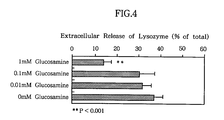
- Glucosamine hydrochloride was added at 0.01 mM, 0.1 mM and 1 mM to aliquots of a neutrophil suspension (neutrophil concentration: 10 7 cells/mL), respectively, followed by incubation at 37°C for 20 minutes.
- opsonized zymosan OPZ; count ratio of OPZ to neutrophils: 1:6 was added, followed by a reaction for 30 minutes.
- the reaction mixture was centrifuged, the supernatant was collected, and then, the activity of the granular enzyme, lysozyme, released to the outside of cells was measured by colorimetrically quantitating dissolution of Micrococcus lysodeikticus cells. The results are shown in FIG. 4.
- the emigrating ability of neutrophils was measured by using as an emigrating factor the component factor C5a generated by reacting fresh serum with a yeast. Described specifically, glucosamine hydrochloride was added at 0.01 mM, 0.1 mM and 1 mM to aliquots of a neutrophil suspension (neutrophil concentration: 3 x 10 6 cells/mL), respectively, followed by incubation at 37°C for 20 minutes. The reaction mixtures were separately placed in Boyden's chambers each of which was equipped with a nitrocellulose membrane of 3 ⁇ m in pore size, and were then incubated at 37°C for 20 minutes. After the reaction, distances over which neutrophils had emigrated were measured under a microscope. The results are shown in FIG. 5.
Landscapes
- Health & Medical Sciences (AREA)
- Life Sciences & Earth Sciences (AREA)
- Chemical & Material Sciences (AREA)
- Engineering & Computer Science (AREA)
- Veterinary Medicine (AREA)
- Public Health (AREA)
- Medicinal Chemistry (AREA)
- General Health & Medical Sciences (AREA)
- Animal Behavior & Ethology (AREA)
- Pharmacology & Pharmacy (AREA)
- Food Science & Technology (AREA)
- Polymers & Plastics (AREA)
- Nutrition Science (AREA)
- Organic Chemistry (AREA)
- Nuclear Medicine, Radiotherapy & Molecular Imaging (AREA)
- General Chemical & Material Sciences (AREA)
- Chemical Kinetics & Catalysis (AREA)
- Epidemiology (AREA)
- Molecular Biology (AREA)
- Mycology (AREA)
- Proteomics, Peptides & Aminoacids (AREA)
- Bioinformatics & Cheminformatics (AREA)
- Pulmonology (AREA)
- Rheumatology (AREA)
- Pain & Pain Management (AREA)
- Pharmaceuticals Containing Other Organic And Inorganic Compounds (AREA)
- Coloring Foods And Improving Nutritive Qualities (AREA)
- Saccharide Compounds (AREA)
Abstract
Description
Claims (12)
- A neutrophil function inhibitor comprising a glucosamine salt as an active ingredient.
- A neutrophil function inhibitor according to claim 1, wherein said glucosamine salt is selected from the group consisting of glucosamine sulfate, glucosamine hydrochloride, glucosamine acetate, glucosamine citrate and glucosamine malate.
- A preventive or remedy for a disease caused as a result of an excessive extracellular release of active oxygen and antibiotic proteins by neutrophils, comprising a glucosamine salt as an active ingredient.
- A preventive or remedy according to claim 3, wherein said disease is respiratory disease syndrome or adult respiratory disease syndrome.
- A neutrophil function inhibitor according to claim 3, wherein said glucosamine salt is selected from the group consisting of glucosamine sulfate, glucosamine hydrochloride, glucosamine acetate, glucosamine citrate and glucosamine malate.
- A dietetic drink or food for a disease caused as a result of an excessive extracellular release of active oxygen and antibiotic proteins by neutrophils, comprising a glucosamine salt as an active ingredient.
- A dietetic drink or food according to claim 6, wherein said disease is respiratory disease syndrome or adult respiratory disease syndrome.
- A dietetic drink or food according to claim 6, wherein said glucosamine salt is selected from the group consisting of glucosamine sulfate, glucosamine hydrochloride, glucosamine acetate, glucosamine citrate and glucosamine malate.
- A method for the prevention or treatment of respiratory disease syndrome or adult respiratory disease syndrome, which comprises administering an effective amount of a glucosamine salt to a human being.
- A method according to claim 9, wherein said glucosamine salt is selected from the group consisting of glucosamine sulfate, glucosamine hydrochloride, glucosamine acetate, glucosamine citrate and glucosamine malate.
- Use of a glucosamine salt for the prevention or treatment of respiratory disease syndrome or adult respiratory disease syndrome.
- Use according to claim 11, wherein said glucosamine salt is selected from the group consisting of glucosamine sulfate, glucosamine hydrochloride, glucosamine acetate, glucosamine citrate and glucosamine malate.
Applications Claiming Priority (2)
| Application Number | Priority Date | Filing Date | Title |
|---|---|---|---|
| JP2001064646A JP2002265365A (en) | 2001-03-08 | 2001-03-08 | Neutrophil function inhibitor |
| JP2001064646 | 2001-03-08 |
Publications (3)
| Publication Number | Publication Date |
|---|---|
| EP1238669A2 true EP1238669A2 (en) | 2002-09-11 |
| EP1238669A3 EP1238669A3 (en) | 2002-12-11 |
| EP1238669B1 EP1238669B1 (en) | 2004-08-18 |
Family
ID=18923435
Family Applications (1)
| Application Number | Title | Priority Date | Filing Date |
|---|---|---|---|
| EP01116700A Expired - Lifetime EP1238669B1 (en) | 2001-03-08 | 2001-07-17 | Neutrophil function inhibitors which contain glucosamine |
Country Status (7)
| Country | Link |
|---|---|
| US (1) | US6627621B2 (en) |
| EP (1) | EP1238669B1 (en) |
| JP (1) | JP2002265365A (en) |
| KR (2) | KR20020072173A (en) |
| CN (1) | CN1222295C (en) |
| DE (1) | DE60104977T2 (en) |
| NO (1) | NO320733B1 (en) |
Cited By (1)
| Publication number | Priority date | Publication date | Assignee | Title |
|---|---|---|---|---|
| US7943598B2 (en) | 2004-08-06 | 2011-05-17 | Bioiberica, S.A. | Use of organic glucosamine salts |
Families Citing this family (8)
| Publication number | Priority date | Publication date | Assignee | Title |
|---|---|---|---|---|
| TWI301188B (en) | 2002-08-30 | 2008-09-21 | Sanyo Electric Co | Refrigeant cycling device and compressor using the same |
| EA038195B1 (en) | 2009-01-16 | 2021-07-22 | Экселиксис, Инк. | SMALL SALT N- (4 - {[6,7-BIS- (METHYLOXY) QUINOLIN-4-YL] OXY} PHENYL) -N '- (4-FLUOROPHENYL) CYCLOPROPAN-1,1-DICARBOXAMIDE AND ITS USE FOR CANCER TREATMENT KIDNEY AND LIVER |
| UA110325C2 (en) * | 2009-07-03 | 2015-12-25 | Australian Biomedical Company Pty Ltd | Medicinal carbohydrates for treating respiratory conditions |
| WO2011054364A1 (en) * | 2009-11-05 | 2011-05-12 | Pharma Base India Pvt. Ltd. | Process for preparing a mixed salt of glucosamine sulfate and a alkali metal chloride |
| US9052315B2 (en) | 2012-05-09 | 2015-06-09 | Advanced Animal Diagnostics, Inc. | Rapid detection of analytes in liquid samples |
| US9816982B2 (en) * | 2012-07-03 | 2017-11-14 | Advanced Animal Diagnostics, Inc. | Diagnostic apparatus |
| US10359614B2 (en) | 2012-07-03 | 2019-07-23 | Advanced Animal Diagnostics, Inc. | Diagnostic apparatus |
| US9797893B2 (en) | 2013-05-09 | 2017-10-24 | Advanced Animal Diagnostics, Inc. | Rapid detection of analytes in liquid samples |
Family Cites Families (7)
| Publication number | Priority date | Publication date | Assignee | Title |
|---|---|---|---|---|
| IT1044707B (en) * | 1968-10-26 | 1980-04-21 | Rotta Research Lab | PROCEDURE FOR THE PREPARATION OF GLUCOSANINE SALTS AND PHARMACEUTICAL PREPARATIONS INCLUDING THESE GLUCOSAMINE SALTS AS ACTIVE AGENTS |
| CA2035841C (en) * | 1990-02-22 | 1996-02-13 | Harry B. Demopoulos | Storage-stable glucosamine sulphate oral dosage forms and methods for their manufacture |
| JP3587665B2 (en) * | 1997-09-19 | 2004-11-10 | 甲陽ケミカル株式会社 | Drinks containing glucosamine salts |
| IT1298214B1 (en) * | 1998-01-28 | 1999-12-20 | Dompe Spa | SALTS OF (R) 2- (3-BENZOYLFENYL) PROPIONIC ACID AND THEIR PHARMACEUTICAL COMPOSITIONS. |
| US6476005B1 (en) * | 1998-03-24 | 2002-11-05 | George D. Petito | Oral and injectable nutritional composition |
| US6291527B1 (en) * | 1998-04-11 | 2001-09-18 | Errekappa Euroterapici S.P.A. | Pharmaceutical preparations containing hydrosoluble ketoprofen salts and their application |
| JP4178584B2 (en) * | 1998-04-24 | 2008-11-12 | 株式会社J−オイルミルズ | Antiallergic agent |
-
2001
- 2001-03-08 JP JP2001064646A patent/JP2002265365A/en not_active Abandoned
- 2001-07-16 KR KR1020010042899A patent/KR20020072173A/en not_active Ceased
- 2001-07-17 EP EP01116700A patent/EP1238669B1/en not_active Expired - Lifetime
- 2001-07-17 DE DE60104977T patent/DE60104977T2/en not_active Expired - Lifetime
- 2001-07-17 NO NO20013535A patent/NO320733B1/en not_active IP Right Cessation
- 2001-07-18 US US09/906,771 patent/US6627621B2/en not_active Expired - Lifetime
- 2001-07-18 CN CNB01125453XA patent/CN1222295C/en not_active Expired - Fee Related
-
2005
- 2005-06-29 KR KR1020050057062A patent/KR20050074425A/en not_active Ceased
Cited By (1)
| Publication number | Priority date | Publication date | Assignee | Title |
|---|---|---|---|---|
| US7943598B2 (en) | 2004-08-06 | 2011-05-17 | Bioiberica, S.A. | Use of organic glucosamine salts |
Also Published As
| Publication number | Publication date |
|---|---|
| EP1238669A3 (en) | 2002-12-11 |
| DE60104977T2 (en) | 2005-08-18 |
| NO320733B1 (en) | 2006-01-23 |
| US6627621B2 (en) | 2003-09-30 |
| JP2002265365A (en) | 2002-09-18 |
| US20020128230A1 (en) | 2002-09-12 |
| NO20013535D0 (en) | 2001-07-17 |
| CN1374086A (en) | 2002-10-16 |
| KR20020072173A (en) | 2002-09-14 |
| NO20013535L (en) | 2002-09-09 |
| DE60104977D1 (en) | 2004-09-23 |
| KR20050074425A (en) | 2005-07-18 |
| CN1222295C (en) | 2005-10-12 |
| EP1238669B1 (en) | 2004-08-18 |
Similar Documents
| Publication | Publication Date | Title |
|---|---|---|
| US6133317A (en) | Oxalic acid or oxalate composition and method of treatment | |
| US6133318A (en) | Oxalic acid or oxalate compositions and methods for bacterial, viral, and other diseases or conditions | |
| EP0103836B1 (en) | Dietary and pharmaceutical compositions comprising methylsulfonylmethane | |
| US7858595B2 (en) | Anti-infectious carbohydrates | |
| US20060127492A1 (en) | Sustained improver of muscular fatigue | |
| EP0179819B1 (en) | Stabilized mussel preparation | |
| EP1238669B1 (en) | Neutrophil function inhibitors which contain glucosamine | |
| US6265391B1 (en) | Method for preventing peripheral nerve damage | |
| CA2530216C (en) | The use of an edible acid or the potassium or sodium salt thereof in the treatment of allergy | |
| US6448232B1 (en) | Method of using dihydrochalcone derivatives to block glucose transfer | |
| KR101729137B1 (en) | Composition for Reducing Fatigue containing Chito-oligosaccharide | |
| EP1175906B1 (en) | Blood flow improvers and thrombosis preventives or remedies comprising glucosamine | |
| US5248669A (en) | Inhibition of anoxia or hypoxia-induced, endothelium-mediated vasospasm with avermectins | |
| KR20010046562A (en) | Composition for treatment of osteoarthritis | |
| US5436004A (en) | Administration of cholesterol reductase to humans | |
| JPH0995448A (en) | Method for increasing blood biotin concentration and biotin-containing food and drink | |
| JP4723320B2 (en) | Blood leptin level increasing agent | |
| KR101627630B1 (en) | Composition for treating rheumatoid arthritis | |
| CN105535951A (en) | Ulinastatin injection and preparation method for same | |
| JP2001048794A (en) | Health food and medicinal composition which contain mixture of powder originated from leaf of mulberry and powder originated from oyster and is used for treating niddm | |
| JPH02311421A (en) | Improver for hyperuricemia and food for improvement | |
| WO2006085523A1 (en) | Composition inhibiting rise in blood glucose level | |
| JP2000344679A (en) | Antibacterial composition | |
| Chaudhuri et al. | Treatment of epidemic dropsy | |
| KR20160115883A (en) | Composition for Reducing Fatigue containing Chito-oligosaccharide |
Legal Events
| Date | Code | Title | Description |
|---|---|---|---|
| PUAI | Public reference made under article 153(3) epc to a published international application that has entered the european phase |
Free format text: ORIGINAL CODE: 0009012 |
|
| AK | Designated contracting states |
Kind code of ref document: A2 Designated state(s): AT BE CH CY DE DK ES FI FR GB GR IE IT LI LU MC NL PT SE TR |
|
| AX | Request for extension of the european patent |
Free format text: AL;LT;LV;MK;RO;SI |
|
| PUAL | Search report despatched |
Free format text: ORIGINAL CODE: 0009013 |
|
| RIC1 | Information provided on ipc code assigned before grant |
Free format text: 7A 61K 31/7008 A, 7A 61P 11/00 B, 7A 61K 31/70 B, 7A 23L 1/30 B, 7A 23L 2/52 B |
|
| AK | Designated contracting states |
Kind code of ref document: A3 Designated state(s): AT BE CH CY DE DK ES FI FR GB GR IE IT LI LU MC NL PT SE TR |
|
| AX | Request for extension of the european patent |
Free format text: AL;LT;LV;MK;RO;SI |
|
| 17P | Request for examination filed |
Effective date: 20030218 |
|
| AKX | Designation fees paid |
Designated state(s): CH DE FR GB IT LI |
|
| 17Q | First examination report despatched |
Effective date: 20030729 |
|
| GRAP | Despatch of communication of intention to grant a patent |
Free format text: ORIGINAL CODE: EPIDOSNIGR1 |
|
| GRAS | Grant fee paid |
Free format text: ORIGINAL CODE: EPIDOSNIGR3 |
|
| GRAA | (expected) grant |
Free format text: ORIGINAL CODE: 0009210 |
|
| AK | Designated contracting states |
Kind code of ref document: B1 Designated state(s): CH DE FR GB IT LI |
|
| REG | Reference to a national code |
Ref country code: GB Ref legal event code: FG4D |
|
| REG | Reference to a national code |
Ref country code: CH Ref legal event code: EP |
|
| REF | Corresponds to: |
Ref document number: 60104977 Country of ref document: DE Date of ref document: 20040923 Kind code of ref document: P |
|
| REG | Reference to a national code |
Ref country code: CH Ref legal event code: NV Representative=s name: A. BRAUN, BRAUN, HERITIER, ESCHMANN AG PATENTANWAE |
|
| PLBE | No opposition filed within time limit |
Free format text: ORIGINAL CODE: 0009261 |
|
| STAA | Information on the status of an ep patent application or granted ep patent |
Free format text: STATUS: NO OPPOSITION FILED WITHIN TIME LIMIT |
|
| ET | Fr: translation filed | ||
| 26N | No opposition filed |
Effective date: 20050519 |
|
| REG | Reference to a national code |
Ref country code: CH Ref legal event code: PFA Owner name: DAINICHISEIKA COLOR & CHEMICALS MFG. CO., LTD. Free format text: DAINICHISEIKA COLOR & CHEMICALS MFG. CO., LTD.#7-6 NIHONBASHI BAKURO-CHO 1-CHOME#CHUO-KU TOKYO 103-8383 (JP) -TRANSFER TO- DAINICHISEIKA COLOR & CHEMICALS MFG. CO., LTD.#7-6 NIHONBASHI BAKURO-CHO 1-CHOME#CHUO-KU TOKYO 103-8383 (JP) |
|
| PGFP | Annual fee paid to national office [announced via postgrant information from national office to epo] |
Ref country code: CH Payment date: 20110712 Year of fee payment: 11 |
|
| PGFP | Annual fee paid to national office [announced via postgrant information from national office to epo] |
Ref country code: GB Payment date: 20120711 Year of fee payment: 12 |
|
| REG | Reference to a national code |
Ref country code: CH Ref legal event code: PL |
|
| GBPC | Gb: european patent ceased through non-payment of renewal fee |
Effective date: 20130717 |
|
| PG25 | Lapsed in a contracting state [announced via postgrant information from national office to epo] |
Ref country code: GB Free format text: LAPSE BECAUSE OF NON-PAYMENT OF DUE FEES Effective date: 20130717 Ref country code: CH Free format text: LAPSE BECAUSE OF NON-PAYMENT OF DUE FEES Effective date: 20130731 Ref country code: LI Free format text: LAPSE BECAUSE OF NON-PAYMENT OF DUE FEES Effective date: 20130731 |
|
| REG | Reference to a national code |
Ref country code: FR Ref legal event code: PLFP Year of fee payment: 16 |
|
| PGFP | Annual fee paid to national office [announced via postgrant information from national office to epo] |
Ref country code: FR Payment date: 20160613 Year of fee payment: 16 |
|
| PGFP | Annual fee paid to national office [announced via postgrant information from national office to epo] |
Ref country code: IT Payment date: 20160720 Year of fee payment: 16 Ref country code: DE Payment date: 20160712 Year of fee payment: 16 |
|
| REG | Reference to a national code |
Ref country code: DE Ref legal event code: R119 Ref document number: 60104977 Country of ref document: DE |
|
| REG | Reference to a national code |
Ref country code: FR Ref legal event code: ST Effective date: 20180330 |
|
| PG25 | Lapsed in a contracting state [announced via postgrant information from national office to epo] |
Ref country code: DE Free format text: LAPSE BECAUSE OF NON-PAYMENT OF DUE FEES Effective date: 20180201 |
|
| PG25 | Lapsed in a contracting state [announced via postgrant information from national office to epo] |
Ref country code: FR Free format text: LAPSE BECAUSE OF NON-PAYMENT OF DUE FEES Effective date: 20170731 |
|
| PG25 | Lapsed in a contracting state [announced via postgrant information from national office to epo] |
Ref country code: IT Free format text: LAPSE BECAUSE OF NON-PAYMENT OF DUE FEES Effective date: 20170717 |