EP1237854B1 - Comminuted form of (s)-2-ethoxy -3- 4-(2- 4-methanesulfonyloxyphenyl ethoxy) phenyl] propanoic acid - Google Patents
Comminuted form of (s)-2-ethoxy -3- 4-(2- 4-methanesulfonyloxyphenyl ethoxy) phenyl] propanoic acid Download PDFInfo
- Publication number
- EP1237854B1 EP1237854B1 EP00983616A EP00983616A EP1237854B1 EP 1237854 B1 EP1237854 B1 EP 1237854B1 EP 00983616 A EP00983616 A EP 00983616A EP 00983616 A EP00983616 A EP 00983616A EP 1237854 B1 EP1237854 B1 EP 1237854B1
- Authority
- EP
- European Patent Office
- Prior art keywords
- ethoxy
- pharmaceutically
- sieve
- formula
- solvate
- Prior art date
- Legal status (The legal status is an assumption and is not a legal conclusion. Google has not performed a legal analysis and makes no representation as to the accuracy of the status listed.)
- Expired - Lifetime
Links
Classifications
-
- A—HUMAN NECESSITIES
- A61—MEDICAL OR VETERINARY SCIENCE; HYGIENE
- A61K—PREPARATIONS FOR MEDICAL, DENTAL OR TOILETRY PURPOSES
- A61K31/00—Medicinal preparations containing organic active ingredients
- A61K31/185—Acids; Anhydrides, halides or salts thereof, e.g. sulfur acids, imidic, hydrazonic or hydroximic acids
- A61K31/19—Carboxylic acids, e.g. valproic acid
- A61K31/192—Carboxylic acids, e.g. valproic acid having aromatic groups, e.g. sulindac, 2-aryl-propionic acids, ethacrynic acid
-
- A—HUMAN NECESSITIES
- A61—MEDICAL OR VETERINARY SCIENCE; HYGIENE
- A61K—PREPARATIONS FOR MEDICAL, DENTAL OR TOILETRY PURPOSES
- A61K31/00—Medicinal preparations containing organic active ingredients
- A61K31/21—Esters, e.g. nitroglycerine, selenocyanates
- A61K31/255—Esters, e.g. nitroglycerine, selenocyanates of sulfoxy acids or sulfur analogues thereof
-
- A—HUMAN NECESSITIES
- A61—MEDICAL OR VETERINARY SCIENCE; HYGIENE
- A61K—PREPARATIONS FOR MEDICAL, DENTAL OR TOILETRY PURPOSES
- A61K9/00—Medicinal preparations characterised by special physical form
- A61K9/14—Particulate form, e.g. powders, Processes for size reducing of pure drugs or the resulting products, Pure drug nanoparticles
- A61K9/141—Intimate drug-carrier mixtures characterised by the carrier, e.g. ordered mixtures, adsorbates, solid solutions, eutectica, co-dried, co-solubilised, co-kneaded, co-milled, co-ground products, co-precipitates, co-evaporates, co-extrudates, co-melts; Drug nanoparticles with adsorbed surface modifiers
- A61K9/146—Intimate drug-carrier mixtures characterised by the carrier, e.g. ordered mixtures, adsorbates, solid solutions, eutectica, co-dried, co-solubilised, co-kneaded, co-milled, co-ground products, co-precipitates, co-evaporates, co-extrudates, co-melts; Drug nanoparticles with adsorbed surface modifiers with organic macromolecular compounds
-
- A—HUMAN NECESSITIES
- A61—MEDICAL OR VETERINARY SCIENCE; HYGIENE
- A61P—SPECIFIC THERAPEUTIC ACTIVITY OF CHEMICAL COMPOUNDS OR MEDICINAL PREPARATIONS
- A61P3/00—Drugs for disorders of the metabolism
-
- A—HUMAN NECESSITIES
- A61—MEDICAL OR VETERINARY SCIENCE; HYGIENE
- A61P—SPECIFIC THERAPEUTIC ACTIVITY OF CHEMICAL COMPOUNDS OR MEDICINAL PREPARATIONS
- A61P3/00—Drugs for disorders of the metabolism
- A61P3/04—Anorexiants; Antiobesity agents
-
- A—HUMAN NECESSITIES
- A61—MEDICAL OR VETERINARY SCIENCE; HYGIENE
- A61P—SPECIFIC THERAPEUTIC ACTIVITY OF CHEMICAL COMPOUNDS OR MEDICINAL PREPARATIONS
- A61P3/00—Drugs for disorders of the metabolism
- A61P3/06—Antihyperlipidemics
-
- A—HUMAN NECESSITIES
- A61—MEDICAL OR VETERINARY SCIENCE; HYGIENE
- A61P—SPECIFIC THERAPEUTIC ACTIVITY OF CHEMICAL COMPOUNDS OR MEDICINAL PREPARATIONS
- A61P3/00—Drugs for disorders of the metabolism
- A61P3/08—Drugs for disorders of the metabolism for glucose homeostasis
-
- A—HUMAN NECESSITIES
- A61—MEDICAL OR VETERINARY SCIENCE; HYGIENE
- A61P—SPECIFIC THERAPEUTIC ACTIVITY OF CHEMICAL COMPOUNDS OR MEDICINAL PREPARATIONS
- A61P3/00—Drugs for disorders of the metabolism
- A61P3/08—Drugs for disorders of the metabolism for glucose homeostasis
- A61P3/10—Drugs for disorders of the metabolism for glucose homeostasis for hyperglycaemia, e.g. antidiabetics
-
- A—HUMAN NECESSITIES
- A61—MEDICAL OR VETERINARY SCIENCE; HYGIENE
- A61P—SPECIFIC THERAPEUTIC ACTIVITY OF CHEMICAL COMPOUNDS OR MEDICINAL PREPARATIONS
- A61P5/00—Drugs for disorders of the endocrine system
- A61P5/48—Drugs for disorders of the endocrine system of the pancreatic hormones
-
- A—HUMAN NECESSITIES
- A61—MEDICAL OR VETERINARY SCIENCE; HYGIENE
- A61P—SPECIFIC THERAPEUTIC ACTIVITY OF CHEMICAL COMPOUNDS OR MEDICINAL PREPARATIONS
- A61P9/00—Drugs for disorders of the cardiovascular system
- A61P9/12—Antihypertensives
-
- C—CHEMISTRY; METALLURGY
- C07—ORGANIC CHEMISTRY
- C07C—ACYCLIC OR CARBOCYCLIC COMPOUNDS
- C07C309/00—Sulfonic acids; Halides, esters, or anhydrides thereof
- C07C309/63—Esters of sulfonic acids
- C07C309/64—Esters of sulfonic acids having sulfur atoms of esterified sulfo groups bound to acyclic carbon atoms
- C07C309/65—Esters of sulfonic acids having sulfur atoms of esterified sulfo groups bound to acyclic carbon atoms of a saturated carbon skeleton
- C07C309/66—Methanesulfonates
Definitions
- the present invention relates to a reduced particle size form of the compound (S)-2-ethoxy-3-[4-(2- ⁇ 4-methanesulfonyloxyphenyl ⁇ ethoxy)phenyl] propanoic acid, as shown in the formula I below , or a pharmaceutically acceptable salt thereof or a solvate of either thereof.
- the invention also concerns methods of treating one or more conditions associated with Insulin Resistance Syndrome using the reduced particle size form of the compound, or a pharmaceutically acceptable salt thereof in the manufacture of a medicament for use in one or more of said conditions.
- the invention further concerns pharmaceutical compositions containing the reduced particle size form of the compound, or a pharmaceutically acceptable salt thereof, or a solvate thereof, as an active ingredient, as well as processes for the manufacture of the reduced particle size form of the compound, or a pharmaceutically acceptable salt thereof.
- IRS Insulin Resistance Syndrome
- a cluster of manifestations including insulin resistance with accompanying hyperinsulinemia, possibly type II diabetes mellitus, arterial hypertension, central (visceral) obesity, dyslipidemia observed as deranged lipoprotein levels typically characterised by elevated VLDL (very low density lipoproteins) and reduced HDL (high density lipoproteins) concentrations and reduced fibrinolysis.
- VLDL very low density lipoproteins
- HDL high density lipoproteins
- a reduced particle size form of (S)-2-ethoxy-3-[4-(2- ⁇ 4-methanesulfonyloxyphenyl ⁇ ethoxy)phenyl] propanoic acid as shown in the formula I below or a pharmaceutically-acceptable salt or a solvate or either which is a moderately fine powder all the particles of which pass through a sieve with a nominal mesh aperture of 355 ⁇ m and not more than 40.0% by weight pass through a sieve with a nominal mesh aperture of 250 ⁇ m.
- reduced particle size we refer to solid Compound 1, or a pharmaceutically-acceptable salt thereof, or a solvate of either thereof, reduced by suitable processing techniques to a solid of smaller particle size and, consequently, greater surface area. Any number of processing techniques known in the pharmaceutical field may be used to reduce solid particle size, such as grinding, milling and micronising, reference should be made to Remington: The Science and Practise of Pharmacy, 19 th Ed., pages 1598-1602, for a more exhaustive review.
- a process for the preparation of a reduced particle size form of the compound of formula I, or a pharmaceutically-acceptable salt or a solvate of either thereof comprising comminuting a solid form of the compound of formula I, or a pharmaceutically-acceptable salt or a solvate of either thereof, for a sufficient period until the desired size of particle of the compound of formula I, or a pharmaceutically-acceptable salt or a solvate of either thereof, is generated.
- the range of particle sizes preferred in this invention start from, in increasing preference, moderately fine powder, fine powder, very fine powder, microfine powder to, most preferably, superfine powder.
- a powder of which not less than 90% by weight of the particles pass through a sieve with a nominal mesh aperture of 45 ⁇ m.
- a powder of which not less than 90% by weight of the particles pass through a sieve with a nominal mesh aperture of 10 ⁇ m.
- a feature of the invention is a reduced particle size form of a compound of formula I, as described above, for use in medical therapy.
- a pharmaceutical composition which comprises a reduced particle size form of a compound of formula I, as described above, in association with a pharmaceutically-acceptable diluent, adjuvant or carrier.
- the composition may be in a form suitable for oral use, for example a tablet, capsule, aqueous or oily solution, suspension or emulsion; for topical use, for example a cream, ointment, gel or aqueous or oily solution or suspension; for nasal use, for example a snuff, nasal spray or nasal drops; for vaginal or rectal use, for example a suppository; for administration by inhalation, for example as a finely divided powder such as a dry powder or a liquid aerosol; for sub-lingual or buccal use, for example a tablet or capsule; or for parenteral use (including intravenous, subcutaneous, intramuscular, intravascular or infusion), for example a sterile aqueous or oily solution or suspension.
- the above compositions may be prepared in a conventional manner using conventional excipients.
- the amount of the reduced particle size form of a compound of formula I, as described, above that is combined with one or more excipients to produce a single dosage form will necessarily vary depending upon the host treated and the particular route of administration.
- a formulation intended for oral administration to humans will generally contain, for example, from 0.01 mg to 50mg of active agent compounded with an appropriate and convenient amount of excipient(s) which may vary from about 20 to about 99.99 percent by weight of the total composition.
- Dosage unit forms will generally contain about 0.0001 mg to about 1 mg of an active ingredient.
- the invention also includes the use of a Compound of the invention, as described above in the production of a medicament for use in:-
- the invention also includes a method of producing an effect as defined hereinbefore or treating a disease or disorder as defined hereinbefore which comprises administering to a warm-blooded animal requiring such treatment an effective amount of a reduced particle size form of a Compound of formula I, as described above.
- the size of the dose for therapeutic or prophylactic purposes of a reduced particle size form of a Compound of the invention, as described above, will naturally vary according to the nature and severity of the medical condition, the age and sex of the animal or patient being treated and the route of administration, according to well known principles of medicine.
- Suitable daily doses of the compounds of the invention in therapeutical treatment of humans are about 0.001-10 mg/kg body weight, preferably 0.01-1 mg/kg body weight.
- the comminuted form of the compound of formula I may be administered as a sole therapy or they may be administered in conjunction with other pharmacologically active agents such as a anti-diabetic, anti-hypertensive, diuretic or anti-hyperlipidemic agent.
- Ethyl (S)-2-ethoxy-3-(4-hydroxyphenyl)-propanoate (325 g, 1.36 mol, 1.0 eq) was dissolved in acetonitrile (2600 ml).
- potassium carbonate 560 g, 4.05 mol, 3.0 eq
- magnesium sulfate 110 g, (0.2 g/g K 2 CO 3 )
- a third portion of toluene was then added to the solution, volume before the addition was 6300 ml, the volume after the addition was 8800 ml. The evaporation was continued until an opaque solution was formed, volume 8200 ml.
- Isooctane 1000 ml was then added to the solution which had been heated to 40°C. The crystallisation was initiated by seeding at 40°C. The mixture was vigorously stirred until a slurry was formed. The agitation rate was then decreased. The slurry was left crystallising over night. The slurry was then filtered and washed with toluene: isooctane 5:1 (1800ml). The crystals were then dried under reduced pressure at 40°C.
- Compound 1 was dispersed in 600 g water whilst stirring with a high shear mixer. Hydroxypropyl cellulose LF was added and stirring continued until the suspension was homogenous. The suspension was pumped into a ball mill, equipped with approx. 500 ml 1.0 - 1.5 mm glass beads, using a peristaltic pump at approx. 70 g/min. Milling was performed at 2000 rpm. The first 200 g of the milled suspension was re-charged. The mixer, vessel, hoses and millhouse were rinsed with 400 g water.
- Particle size analysis was performed on the suspension before and after milling using a Coulter LS. Mean particle size was measured to 24.93 ⁇ m and 7.086 ⁇ m respectively.
- Compound 1 was dispersed in 400 g water whilst stirring with a high shear mixer. Hydroxypropyl cellulose LF was added and stirring continued until the suspension was homogenous. The suspension was pumped into a ball mill, equipped with approx. 500 ml 1.0 - 1.5 mm glass beads, using a peristaltic pump at approx. 80 g/min. Milling was performed at 2000 rpm. The first 200 g of the milled suspension was re-charged. The mixer, vessel, hoses and millhouse were rinsed with 600 g water.
- Particle size analysis was performed on the suspension before and after milling using a Coulter LS. Mean particle size was measured to 14.79 ⁇ m and 7.614 ⁇ m respectively.
- Compound 1 was dispersed in 4000 g water whilst stirring with a high shear mixer. Hydroxypropyl cellulose LF was added and stirring continued until the suspension was homogenous. The suspension was pumped into a ball mill, equipped with approx. 500 ml 1.0 - 1.5 mm glass beads, using a peristaltic pump at approx. 75 g/min. Milling was performed at 2000 rpm. The first 200 g of the milled suspension was re-charged. The mixer, vessel, hoses and millhouse were rinsed with 4000 g water.
- Particle size analysis was performed on the suspension before and after milling using a Coulter LS. Mean particle size was measured to 48.35 ⁇ m and 6.822 ⁇ m respectively.
Landscapes
- Health & Medical Sciences (AREA)
- Chemical & Material Sciences (AREA)
- Organic Chemistry (AREA)
- General Health & Medical Sciences (AREA)
- Public Health (AREA)
- Animal Behavior & Ethology (AREA)
- Veterinary Medicine (AREA)
- Life Sciences & Earth Sciences (AREA)
- Pharmacology & Pharmacy (AREA)
- Medicinal Chemistry (AREA)
- Engineering & Computer Science (AREA)
- Bioinformatics & Cheminformatics (AREA)
- Diabetes (AREA)
- Nuclear Medicine, Radiotherapy & Molecular Imaging (AREA)
- General Chemical & Material Sciences (AREA)
- Chemical Kinetics & Catalysis (AREA)
- Obesity (AREA)
- Hematology (AREA)
- Epidemiology (AREA)
- Endocrinology (AREA)
- Emergency Medicine (AREA)
- Cardiology (AREA)
- Heart & Thoracic Surgery (AREA)
- Child & Adolescent Psychology (AREA)
- Organic Low-Molecular-Weight Compounds And Preparation Thereof (AREA)
- Acyclic And Carbocyclic Compounds In Medicinal Compositions (AREA)
Description


| Compound 1 | 0.8 g |
| Hydroxypropyl cellulose LF | 24 g |
| Water | 1000 g |
| Compound 1 | 8 g |
| Hydroxypropyl cellulose LF | 24 g |
| Water | 1000 g |
| Compound 1 | 5 g |
| Hydroxypropyl cellulose LF | 600 g |
| Water | 8000 g |
Claims (12)
- A reduced particle size form of either (S)-2-ethoxy-3-[4-(2-{4-methanesulfonyloxyphenyl}ethoxy)phenyl] propanoic acid, as shown in formula I belowor a pharmaceutically-acceptable salt thereof or a solvate of either which is a moderately fine powder all the particles of which pass through a sieve with a nominal mesh aperture of 355µm and not more than 40.0% by weight pass through a sieve with a nominal mesh aperture of 250µm.
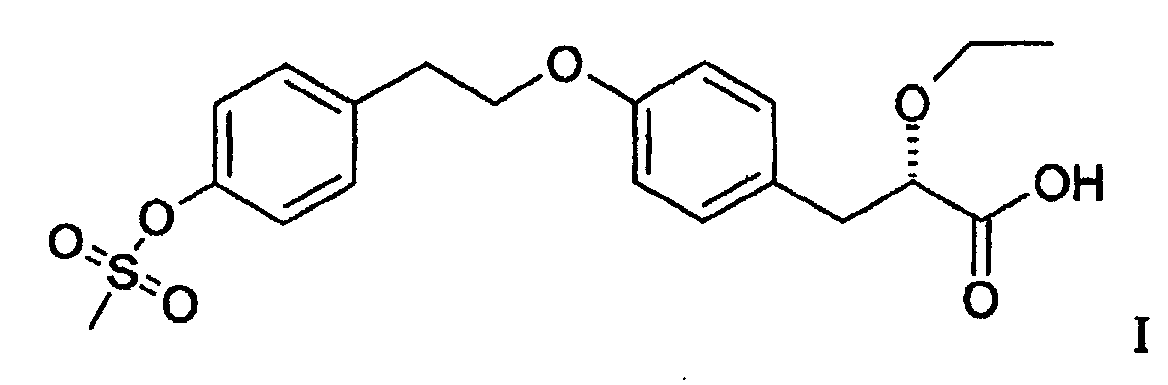
- A fine powder form of either (S)-2-ethoxy-3-[4-(2-{4-methanesulfonyloxyphenyl}ethoxy)phenyl] propanoic acid, as shown in formula I , or a pharmaceutically-acceptable salt thereof or a solvate of either all the particles of which pass through a sieve with a nominal mesh aperture of 180µm and not more than 40.0% by weight pass through a sieve with a nominal mesh aperture of 125µm.
- A very fine powder form of either (S)-2-ethoxy-3-[4-(2-{4-methanesulfonyloxyphenyl}ethoxy)phenyl] propanoic acid, as shown in formula I, or a pharmaceutically-acceptable salt thereof or a solvate of either all the particles of which pass through a sieve with a nominal mesh aperture of 125µm and not more than 40.0% by weight pass through a sieve with a nominal mesh aperture of 45µm.
- A microfine powder form of either (S)-2-ethoxy-3-[4-(2-{4-methanesulfonyloxyphenyl}ethoxy)phenyl] propanoic acid, as shown in formula I , or a pharmaceutically-acceptable salt thereof or a solvate of either of which not less than 90% by weight of the particles pass through a sieve with a nominal mesh aperture of 45µm.
- A superfine powder form of either (S)-2-ethoxy-3-[4-(2-{4-methanesulfonyloxyphenyl}ethoxy)phenyl] propanoic acid, as shown in formula I, or a pharmaceutically-acceptable salt thereof or a solvate of either of which not less than 90% by weight of the particles pass through a sieve with a nominal mesh aperture of 10µm.
- A substance as defined in any one of claims 1 to 5 for use in medical therapy.
- A substance as defined in any one of claims 1 to 5 for use in the treatment or prophylaxis of conditions associated with reduced sensitivity to insulin.
- A substance as defined in any one of claims 1 to 5 for use in the treatment or prophylaxis of dyslipidaemia, type II diabetes mellitus, hyperglycaemia, hyperinsulinaemia, arterial hypertension and/or abdominal obesity.
- The use of a substance as defined in any claim from 1 to 5 in the production of a medicament for use in treating metabolic disorders.
- A pharmaceutical composition comprising a substance as defined in any claim from 1 to 5 in association with a pharmaceutically-acceptable diluent, adjuvant or carrier.
- A pharmaceutical composition according to claim 10 wherein the pharmaceutically-acceptable diluent, adjuvant or carrier is hydroxypropyl cellulose.
- A process for the preparation of a reduced particle size form of the compound of formula I, or a pharmaceutically-acceptable salt or a solvate of either thereof, as defined in any claim from 1 to 5, comprising comminuting a solid form of the compound of formula I, or a pharmaceutically-acceptable salt or a solvate of either thereof, for a sufficient period until the desired size of particle of the compound of formula I, or a pharmaceutically-acceptable salt or a solvate of either thereof, is generated.
Priority Applications (1)
| Application Number | Priority Date | Filing Date | Title |
|---|---|---|---|
| SI200030251T SI1237854T1 (en) | 1999-12-03 | 2000-11-29 | Comminuted form of (s)-2-ethoxy -3- 4-(2- 4-methanesulfonyloxyphenyl ethoxy) phenyl) propanoic acid |
Applications Claiming Priority (3)
| Application Number | Priority Date | Filing Date | Title |
|---|---|---|---|
| SE9904413A SE9904413D0 (en) | 1999-12-03 | 1999-12-03 | Comminuted form |
| SE9904413 | 1999-12-03 | ||
| PCT/SE2000/002381 WO2001040169A1 (en) | 1999-12-03 | 2000-11-29 | Comminuted form of (s)-2-ethoxy -3-[4-(2- {4-methanesulfonyloxyphenyl} ethoxy) phenyl] propanoic acid |
Publications (2)
| Publication Number | Publication Date |
|---|---|
| EP1237854A1 EP1237854A1 (en) | 2002-09-11 |
| EP1237854B1 true EP1237854B1 (en) | 2003-10-01 |
Family
ID=20417978
Family Applications (1)
| Application Number | Title | Priority Date | Filing Date |
|---|---|---|---|
| EP00983616A Expired - Lifetime EP1237854B1 (en) | 1999-12-03 | 2000-11-29 | Comminuted form of (s)-2-ethoxy -3- 4-(2- 4-methanesulfonyloxyphenyl ethoxy) phenyl] propanoic acid |
Country Status (32)
| Country | Link |
|---|---|
| EP (1) | EP1237854B1 (en) |
| JP (1) | JP2003515580A (en) |
| KR (1) | KR20020067538A (en) |
| CN (1) | CN1216859C (en) |
| AR (1) | AR029456A1 (en) |
| AT (1) | ATE251131T1 (en) |
| AU (1) | AU766036B2 (en) |
| BR (1) | BR0016135A (en) |
| CA (1) | CA2392029A1 (en) |
| CO (1) | CO5271736A1 (en) |
| CZ (1) | CZ20021839A3 (en) |
| DE (1) | DE60005710T2 (en) |
| DK (1) | DK1237854T3 (en) |
| EE (1) | EE200200284A (en) |
| ES (1) | ES2208444T3 (en) |
| HK (1) | HK1049324B (en) |
| HU (1) | HUP0203692A3 (en) |
| IL (1) | IL149516A0 (en) |
| IS (1) | IS6399A (en) |
| MX (1) | MXPA02005165A (en) |
| MY (1) | MY125099A (en) |
| NO (1) | NO20022591L (en) |
| NZ (1) | NZ518926A (en) |
| PL (1) | PL355372A1 (en) |
| PT (1) | PT1237854E (en) |
| RU (1) | RU2248966C2 (en) |
| SE (1) | SE9904413D0 (en) |
| SK (1) | SK7662002A3 (en) |
| TR (1) | TR200400003T4 (en) |
| UA (1) | UA73959C2 (en) |
| WO (1) | WO2001040169A1 (en) |
| ZA (1) | ZA200203797B (en) |
Families Citing this family (21)
| Publication number | Priority date | Publication date | Assignee | Title |
|---|---|---|---|---|
| BR9812770A (en) | 1997-10-27 | 2000-12-12 | Reddy Research Foundation | Bicyclic compounds, process for their preparation and pharmaceutical compositions containing the same |
| WO1999016758A1 (en) | 1997-10-27 | 1999-04-08 | Dr. Reddy's Research Foundation | Novel heterocyclic compounds and their use in medicine, process for their preparation and pharmaceutical compositions containing them |
| US6440961B1 (en) | 1997-10-27 | 2002-08-27 | Dr. Reddy's Research Foundation | Tricyclic compounds and their use in medicine: process for their preparation and pharmaceutical compositions containing them |
| AU749505B2 (en) | 1997-10-27 | 2002-06-27 | Dr. Reddy's Laboratories Limited | Novel tricyclic compounds and their use in medicine; process for their preparation and pharmaceutical compositions containing them |
| US6369067B1 (en) | 1997-10-27 | 2002-04-09 | Dr. Reddy's Research Foundation | Monocyclic compounds and their use in medicine: process for their preparation and pharmaceutical compositions containing them |
| UA60386C2 (en) | 1998-10-29 | 2003-10-15 | Reddys Laboratories Ltd | A process for preparation of 3-[4-[2-(phenoxazine-10-yl)methoxy]phenyl]propionic acid derivatives (variants) and intermediary compounds for preparation thereof |
| US6531596B1 (en) | 1998-10-29 | 2003-03-11 | Dr. Reddy's Laboratories Ltd. | Process for the preparation of new antidiabetic agents |
| US6897199B2 (en) | 2001-02-05 | 2005-05-24 | Dr. Reddy's Laboratories Ltd. | Pharmaceutically acceptable salts of phenoxazine and phenothiazine compounds |
| DE10308351A1 (en) | 2003-02-27 | 2004-11-25 | Aventis Pharma Deutschland Gmbh | 1,3-substituted cycloalkyl derivatives having acidic, usually heterocyclic groups, processes for their preparation and their use as medicaments |
| DE10308355A1 (en) | 2003-02-27 | 2004-12-23 | Aventis Pharma Deutschland Gmbh | Aryl-cycloalkyl-substituted alkanoic acid derivatives, process for their preparation and their use as medicaments |
| DE10308352A1 (en) | 2003-02-27 | 2004-09-09 | Aventis Pharma Deutschland Gmbh | Branched side chain arylcycloalkyl derivatives, process for their preparation and their use as medicaments |
| US7148246B2 (en) | 2003-02-27 | 2006-12-12 | Sanofi-Aventis Deutschland Gmbh | Cycloalkyl derivatives having bioisosteric carboxylic acid groups, processes for their preparation and their use as pharmaceuticals |
| DE10308353A1 (en) | 2003-02-27 | 2004-12-02 | Aventis Pharma Deutschland Gmbh | Diarylcycloalkyl derivatives, processes for their preparation and their use as medicines |
| EP1689383B1 (en) | 2003-11-19 | 2012-10-31 | Metabasis Therapeutics, Inc. | Novel phosphorus-containing thyromimetics |
| EP1586573B1 (en) | 2004-04-01 | 2007-02-07 | Sanofi-Aventis Deutschland GmbH | Oxadiazolones, processes for their preparation and their use as pharmaceuticals |
| DE102005026762A1 (en) | 2005-06-09 | 2006-12-21 | Sanofi-Aventis Deutschland Gmbh | Azolopyridin-2-one derivatives as inhibitors of lipases and phospholipases |
| UA100497C2 (en) | 2006-09-07 | 2013-01-10 | Никомед Гмбх | Combination treatment for diabetes mellitus |
| ES2445049T3 (en) | 2007-03-08 | 2014-02-27 | Albireo Ab | Derivatives of 3-phenylpropionic acid and its use in the treatment of inflammatory bowel disease |
| KR101560844B1 (en) | 2007-06-04 | 2015-10-15 | 벤-구리온 유니버시티 오브 더 네게브 리서치 앤드 디벨럽먼트 어쏘러티 | - tri-aryl compounds and compositions comprising the same |
| US20120046364A1 (en) | 2009-02-10 | 2012-02-23 | Metabasis Therapeutics, Inc. | Novel Sulfonic Acid-Containing Thyromimetics, and Methods for Their Use |
| EA201690938A1 (en) | 2013-11-05 | 2016-11-30 | Бен-Гурион Юниверсити Оф Дзе Негев Рисерч Энд Дивелопмент Оторити | COMPOUNDS FOR THE TREATMENT OF DIABETES AND COMPLICATIONS ARISING OUT OF THIS DISEASE |
Family Cites Families (3)
| Publication number | Priority date | Publication date | Assignee | Title |
|---|---|---|---|---|
| GB9604242D0 (en) * | 1996-02-28 | 1996-05-01 | Glaxo Wellcome Inc | Chemical compounds |
| SE9704873D0 (en) * | 1997-12-23 | 1997-12-23 | Astra Ab | Sampling apparatus |
| MA26634A1 (en) * | 1998-06-04 | 2004-12-20 | Astra Ab | NOVEL 3-ARYL PROPIONIC ACID DERIVATIVES AND THE LIKE |
-
1999
- 1999-12-03 SE SE9904413A patent/SE9904413D0/en unknown
-
2000
- 2000-11-29 JP JP2001541856A patent/JP2003515580A/en not_active Withdrawn
- 2000-11-29 HK HK03101434.9A patent/HK1049324B/en not_active IP Right Cessation
- 2000-11-29 PL PL00355372A patent/PL355372A1/en not_active Application Discontinuation
- 2000-11-29 SK SK766-2002A patent/SK7662002A3/en unknown
- 2000-11-29 DK DK00983616T patent/DK1237854T3/en active
- 2000-11-29 PT PT00983616T patent/PT1237854E/en unknown
- 2000-11-29 CZ CZ20021839A patent/CZ20021839A3/en unknown
- 2000-11-29 BR BR0016135-7A patent/BR0016135A/en not_active IP Right Cessation
- 2000-11-29 HU HU0203692A patent/HUP0203692A3/en unknown
- 2000-11-29 MX MXPA02005165A patent/MXPA02005165A/en active IP Right Grant
- 2000-11-29 ES ES00983616T patent/ES2208444T3/en not_active Expired - Lifetime
- 2000-11-29 AU AU20348/01A patent/AU766036B2/en not_active Ceased
- 2000-11-29 AT AT00983616T patent/ATE251131T1/en not_active IP Right Cessation
- 2000-11-29 EE EEP200200284A patent/EE200200284A/en unknown
- 2000-11-29 UA UA2002053989A patent/UA73959C2/en unknown
- 2000-11-29 WO PCT/SE2000/002381 patent/WO2001040169A1/en not_active Ceased
- 2000-11-29 NZ NZ518926A patent/NZ518926A/en unknown
- 2000-11-29 CA CA002392029A patent/CA2392029A1/en not_active Abandoned
- 2000-11-29 RU RU2002113169/04A patent/RU2248966C2/en not_active IP Right Cessation
- 2000-11-29 KR KR1020027007058A patent/KR20020067538A/en not_active Ceased
- 2000-11-29 DE DE60005710T patent/DE60005710T2/en not_active Expired - Fee Related
- 2000-11-29 EP EP00983616A patent/EP1237854B1/en not_active Expired - Lifetime
- 2000-11-29 TR TR2004/00003T patent/TR200400003T4/en unknown
- 2000-11-29 CN CN008163839A patent/CN1216859C/en not_active Expired - Fee Related
- 2000-11-29 IL IL14951600A patent/IL149516A0/en unknown
- 2000-11-30 CO CO00091759A patent/CO5271736A1/en not_active Application Discontinuation
- 2000-11-30 MY MYPI20005601A patent/MY125099A/en unknown
- 2000-12-01 AR ARP000106384A patent/AR029456A1/en unknown
-
2002
- 2002-05-13 ZA ZA200203797A patent/ZA200203797B/en unknown
- 2002-05-28 IS IS6399A patent/IS6399A/en unknown
- 2002-05-31 NO NO20022591A patent/NO20022591L/en unknown
Also Published As
Similar Documents
| Publication | Publication Date | Title |
|---|---|---|
| AU766036B2 (en) | Comminuted form of (S)-2-ethoxy -3-(4-(2- (4-methanesulfonyloxyphenyl) ethoxy) phenyl) propanoic acid | |
| EP1678139B1 (en) | Solid-state montelukast | |
| US8435962B2 (en) | Triacetyl-3-hydroxyphenyladenosine and its use for regulating blood fat | |
| TWI718104B (en) | POLYMORPHIC FREE ACID, HEMI-CALCIUM SALT AND α-PHENETHYLAMINE SALT OF AHU-377 AND PREPARATION METHOD AND USE THEREOF | |
| EP1237855B1 (en) | Crystalline form of (s)-2 ethoxy-3- 4-(2- 4-methanesulfonyloxyphenyl ethoxy) phenyl] propanoic acid | |
| JP2008508264A (en) | N-hydroxy-4- {5- [4- (5-isopropyl-2-methyl-1,3-thiazol-4-yl) phenoxy] pentoxy} mens amidine 2 methanesulfonate | |
| KR100253046B1 (en) | Process for producing high content ibuprofen agglomerates | |
| JP2951344B2 (en) | Improving toxic properties in chemotherapy | |
| WO2001040166A1 (en) | Comminuted form of 3-{4-[2-(4-tert-butoxycarbonylaminophenyl)ethoxy]phenyl}-(s)-2-ethoxy propanoic | |
| US7084177B2 (en) | Comminuted form of(S)-2-ethoxy-3-[4-(2-{4-methanesulfonyloxyphenyl}ethoxy)phenyl] propanoic acid | |
| WO2005020979A1 (en) | A process for the preparation of pharmaceutical compositions of nateglinide | |
| CN113398117B (en) | Application of dimethylamine 4-O-acetyl baseline inula lineariifolia lactone A and salt thereof in preparation of medicines for treating chronic renal failure | |
| KR20230118083A (en) | intracellular ATP enhancer | |
| JP5102849B2 (en) | N-hydroxy-4- {5- [4- (5-isopropyl-2-methyl-1,3-thiazol-4-yl) phenoxy] pentoxy} benzamidine 2-ethanesulfonate, process for producing the same and pharmaceutical preparation containing the same Composition | |
| US20260130867A1 (en) | Formulation | |
| EP2266948A1 (en) | Salts of tramadol and diflunisal and their crystal form in the treatment of pain | |
| EP0687468A2 (en) | Pharmaceutical composition for suppressing infiltration of eosinophils | |
| JPWO2001025198A1 (en) | Method for improving the solubility of tricyclic amino alcohol derivatives | |
| WO2012136121A1 (en) | Amino phenylpropanoid compound and use thereof for preparing immunosuppressant | |
| CN101805337A (en) | Compound containing proline and isoxazole skeleton and preparation method and application thereof |
Legal Events
| Date | Code | Title | Description |
|---|---|---|---|
| PUAI | Public reference made under article 153(3) epc to a published international application that has entered the european phase |
Free format text: ORIGINAL CODE: 0009012 |
|
| 17P | Request for examination filed |
Effective date: 20020703 |
|
| AK | Designated contracting states |
Kind code of ref document: A1 Designated state(s): AT BE CH CY DE DK ES FI FR GB GR IE IT LI LU MC NL PT SE TR |
|
| AX | Request for extension of the european patent |
Free format text: AL PAYMENT 20020703;LT PAYMENT 20020703;LV PAYMENT 20020703;MK PAYMENT 20020703;RO PAYMENT 20020703;SI PAYMENT 20020703 |
|
| 17Q | First examination report despatched |
Effective date: 20021028 |
|
| GRAH | Despatch of communication of intention to grant a patent |
Free format text: ORIGINAL CODE: EPIDOS IGRA |
|
| GRAS | Grant fee paid |
Free format text: ORIGINAL CODE: EPIDOSNIGR3 |
|
| GRAA | (expected) grant |
Free format text: ORIGINAL CODE: 0009210 |
|
| AK | Designated contracting states |
Kind code of ref document: B1 Designated state(s): AT BE CH CY DE DK ES FI FR GB GR IE IT LI LU MC NL PT SE TR |
|
| AX | Request for extension of the european patent |
Extension state: AL LT LV MK RO SI |
|
| REG | Reference to a national code |
Ref country code: GB Ref legal event code: FG4D |
|
| REG | Reference to a national code |
Ref country code: CH Ref legal event code: EP |
|
| REG | Reference to a national code |
Ref country code: IE Ref legal event code: FG4D |
|
| REF | Corresponds to: |
Ref document number: 60005710 Country of ref document: DE Date of ref document: 20031106 Kind code of ref document: P |
|
| REG | Reference to a national code |
Ref country code: SE Ref legal event code: TRGR |
|
| REG | Reference to a national code |
Ref country code: DK Ref legal event code: T3 |
|
| REG | Reference to a national code |
Ref country code: GR Ref legal event code: EP Ref document number: 20030405326 Country of ref document: GR |
|
| REG | Reference to a national code |
Ref country code: ES Ref legal event code: FG2A Ref document number: 2208444 Country of ref document: ES Kind code of ref document: T3 |
|
| ET | Fr: translation filed | ||
| PLBE | No opposition filed within time limit |
Free format text: ORIGINAL CODE: 0009261 |
|
| STAA | Information on the status of an ep patent application or granted ep patent |
Free format text: STATUS: NO OPPOSITION FILED WITHIN TIME LIMIT |
|
| 26N | No opposition filed |
Effective date: 20040702 |
|
| REG | Reference to a national code |
Ref country code: SI Ref legal event code: IF |
|
| PGFP | Annual fee paid to national office [announced via postgrant information from national office to epo] |
Ref country code: LU Payment date: 20050926 Year of fee payment: 6 |
|
| PGFP | Annual fee paid to national office [announced via postgrant information from national office to epo] |
Ref country code: PT Payment date: 20050928 Year of fee payment: 6 |
|
| PGFP | Annual fee paid to national office [announced via postgrant information from national office to epo] |
Ref country code: AT Payment date: 20051004 Year of fee payment: 6 |
|
| PGFP | Annual fee paid to national office [announced via postgrant information from national office to epo] |
Ref country code: DK Payment date: 20051005 Year of fee payment: 6 Ref country code: NL Payment date: 20051005 Year of fee payment: 6 |
|
| PGFP | Annual fee paid to national office [announced via postgrant information from national office to epo] |
Ref country code: GR Payment date: 20051024 Year of fee payment: 6 |
|
| PGFP | Annual fee paid to national office [announced via postgrant information from national office to epo] |
Ref country code: IE Payment date: 20051026 Year of fee payment: 6 |
|
| PGFP | Annual fee paid to national office [announced via postgrant information from national office to epo] |
Ref country code: FI Payment date: 20051114 Year of fee payment: 6 |
|
| PGFP | Annual fee paid to national office [announced via postgrant information from national office to epo] |
Ref country code: MC Payment date: 20051116 Year of fee payment: 6 |
|
| PGFP | Annual fee paid to national office [announced via postgrant information from national office to epo] |
Ref country code: TR Payment date: 20051129 Year of fee payment: 6 |
|
| PGFP | Annual fee paid to national office [announced via postgrant information from national office to epo] |
Ref country code: BE Payment date: 20051207 Year of fee payment: 6 |
|
| PG25 | Lapsed in a contracting state [announced via postgrant information from national office to epo] |
Ref country code: IE Free format text: LAPSE BECAUSE OF NON-PAYMENT OF DUE FEES Effective date: 20061129 Ref country code: FI Free format text: LAPSE BECAUSE OF NON-PAYMENT OF DUE FEES Effective date: 20061129 Ref country code: AT Free format text: LAPSE BECAUSE OF NON-PAYMENT OF DUE FEES Effective date: 20061129 |
|
| PG25 | Lapsed in a contracting state [announced via postgrant information from national office to epo] |
Ref country code: BE Free format text: LAPSE BECAUSE OF NON-PAYMENT OF DUE FEES Effective date: 20061130 Ref country code: DK Free format text: LAPSE BECAUSE OF NON-PAYMENT OF DUE FEES Effective date: 20061130 Ref country code: MC Free format text: LAPSE BECAUSE OF NON-PAYMENT OF DUE FEES Effective date: 20061130 |
|
| PG25 | Lapsed in a contracting state [announced via postgrant information from national office to epo] |
Ref country code: PT Free format text: LAPSE BECAUSE OF NON-PAYMENT OF DUE FEES Effective date: 20070529 |
|
| PG25 | Lapsed in a contracting state [announced via postgrant information from national office to epo] |
Ref country code: NL Free format text: LAPSE BECAUSE OF NON-PAYMENT OF DUE FEES Effective date: 20070601 |
|
| REG | Reference to a national code |
Ref country code: PT Ref legal event code: MM4A Free format text: LAPSE DUE TO NON-PAYMENT OF FEES Effective date: 20070529 |
|
| REG | Reference to a national code |
Ref country code: DK Ref legal event code: EBP |
|
| LTLA | Lt: lapse of european patent or patent extension |
Effective date: 20061129 |
|
| NLV4 | Nl: lapsed or anulled due to non-payment of the annual fee |
Effective date: 20070601 |
|
| REG | Reference to a national code |
Ref country code: IE Ref legal event code: MM4A |
|
| PG25 | Lapsed in a contracting state [announced via postgrant information from national office to epo] |
Ref country code: CY Free format text: LAPSE BECAUSE OF NON-PAYMENT OF DUE FEES Effective date: 20061129 |
|
| BERE | Be: lapsed |
Owner name: *ASTRAZENECA A.B. Effective date: 20061130 |
|
| PGFP | Annual fee paid to national office [announced via postgrant information from national office to epo] |
Ref country code: CY Payment date: 20051129 Year of fee payment: 6 |
|
| PG25 | Lapsed in a contracting state [announced via postgrant information from national office to epo] |
Ref country code: LU Free format text: LAPSE BECAUSE OF NON-PAYMENT OF DUE FEES Effective date: 20061129 |
|
| PG25 | Lapsed in a contracting state [announced via postgrant information from national office to epo] |
Ref country code: GR Free format text: LAPSE BECAUSE OF NON-PAYMENT OF DUE FEES Effective date: 20070604 |
|
| PGFP | Annual fee paid to national office [announced via postgrant information from national office to epo] |
Ref country code: CH Payment date: 20081028 Year of fee payment: 9 |
|
| PGFP | Annual fee paid to national office [announced via postgrant information from national office to epo] |
Ref country code: ES Payment date: 20081117 Year of fee payment: 9 |
|
| PGFP | Annual fee paid to national office [announced via postgrant information from national office to epo] |
Ref country code: IT Payment date: 20081124 Year of fee payment: 9 Ref country code: SE Payment date: 20081107 Year of fee payment: 9 |
|
| PGFP | Annual fee paid to national office [announced via postgrant information from national office to epo] |
Ref country code: FR Payment date: 20081106 Year of fee payment: 9 |
|
| PGFP | Annual fee paid to national office [announced via postgrant information from national office to epo] |
Ref country code: DE Payment date: 20081128 Year of fee payment: 9 |
|
| PGFP | Annual fee paid to national office [announced via postgrant information from national office to epo] |
Ref country code: GB Payment date: 20081008 Year of fee payment: 9 |
|
| PG25 | Lapsed in a contracting state [announced via postgrant information from national office to epo] |
Ref country code: TR Free format text: LAPSE BECAUSE OF FAILURE TO SUBMIT A TRANSLATION OF THE DESCRIPTION OR TO PAY THE FEE WITHIN THE PRESCRIBED TIME-LIMIT Effective date: 20031001 |
|
| EUG | Se: european patent has lapsed | ||
| REG | Reference to a national code |
Ref country code: CH Ref legal event code: PL |
|
| GBPC | Gb: european patent ceased through non-payment of renewal fee |
Effective date: 20091129 |
|
| REG | Reference to a national code |
Ref country code: FR Ref legal event code: ST Effective date: 20100730 |
|
| PG25 | Lapsed in a contracting state [announced via postgrant information from national office to epo] |
Ref country code: CH Free format text: LAPSE BECAUSE OF NON-PAYMENT OF DUE FEES Effective date: 20091130 Ref country code: LI Free format text: LAPSE BECAUSE OF NON-PAYMENT OF DUE FEES Effective date: 20091130 Ref country code: FR Free format text: LAPSE BECAUSE OF NON-PAYMENT OF DUE FEES Effective date: 20091130 |
|
| PG25 | Lapsed in a contracting state [announced via postgrant information from national office to epo] |
Ref country code: DE Free format text: LAPSE BECAUSE OF NON-PAYMENT OF DUE FEES Effective date: 20100601 |
|
| PG25 | Lapsed in a contracting state [announced via postgrant information from national office to epo] |
Ref country code: GB Free format text: LAPSE BECAUSE OF NON-PAYMENT OF DUE FEES Effective date: 20091129 |
|
| REG | Reference to a national code |
Ref country code: ES Ref legal event code: FD2A Effective date: 20110323 |
|
| PG25 | Lapsed in a contracting state [announced via postgrant information from national office to epo] |
Ref country code: IT Free format text: LAPSE BECAUSE OF NON-PAYMENT OF DUE FEES Effective date: 20091129 |
|
| PG25 | Lapsed in a contracting state [announced via postgrant information from national office to epo] |
Ref country code: SE Free format text: LAPSE BECAUSE OF NON-PAYMENT OF DUE FEES Effective date: 20091130 |
|
| PG25 | Lapsed in a contracting state [announced via postgrant information from national office to epo] |
Ref country code: ES Free format text: LAPSE BECAUSE OF NON-PAYMENT OF DUE FEES Effective date: 20110310 |
|
| PG25 | Lapsed in a contracting state [announced via postgrant information from national office to epo] |
Ref country code: ES Free format text: LAPSE BECAUSE OF NON-PAYMENT OF DUE FEES Effective date: 20091130 |