EP1237821B1 - Water treatment - Google Patents
Water treatment Download PDFInfo
- Publication number
- EP1237821B1 EP1237821B1 EP00985039A EP00985039A EP1237821B1 EP 1237821 B1 EP1237821 B1 EP 1237821B1 EP 00985039 A EP00985039 A EP 00985039A EP 00985039 A EP00985039 A EP 00985039A EP 1237821 B1 EP1237821 B1 EP 1237821B1
- Authority
- EP
- European Patent Office
- Prior art keywords
- waste water
- radical
- dye
- alpha
- water
- Prior art date
- Legal status (The legal status is an assumption and is not a legal conclusion. Google has not performed a legal analysis and makes no representation as to the accuracy of the status listed.)
- Expired - Lifetime
Links
Classifications
-
- C—CHEMISTRY; METALLURGY
- C02—TREATMENT OF WATER, WASTE WATER, SEWAGE, OR SLUDGE
- C02F—TREATMENT OF WATER, WASTE WATER, SEWAGE, OR SLUDGE
- C02F1/00—Treatment of water, waste water, or sewage
- C02F1/72—Treatment of water, waste water, or sewage by oxidation
- C02F1/725—Treatment of water, waste water, or sewage by oxidation by catalytic oxidation
-
- C—CHEMISTRY; METALLURGY
- C02—TREATMENT OF WATER, WASTE WATER, SEWAGE, OR SLUDGE
- C02F—TREATMENT OF WATER, WASTE WATER, SEWAGE, OR SLUDGE
- C02F1/00—Treatment of water, waste water, or sewage
- C02F1/72—Treatment of water, waste water, or sewage by oxidation
-
- D—TEXTILES; PAPER
- D06—TREATMENT OF TEXTILES OR THE LIKE; LAUNDERING; FLEXIBLE MATERIALS NOT OTHERWISE PROVIDED FOR
- D06P—DYEING OR PRINTING TEXTILES; DYEING LEATHER, FURS OR SOLID MACROMOLECULAR SUBSTANCES IN ANY FORM
- D06P5/00—Other features in dyeing or printing textiles, or dyeing leather, furs, or solid macromolecular substances in any form
- D06P5/02—After-treatment
- D06P5/04—After-treatment with organic compounds
-
- C—CHEMISTRY; METALLURGY
- C02—TREATMENT OF WATER, WASTE WATER, SEWAGE, OR SLUDGE
- C02F—TREATMENT OF WATER, WASTE WATER, SEWAGE, OR SLUDGE
- C02F1/00—Treatment of water, waste water, or sewage
- C02F1/02—Treatment of water, waste water, or sewage by heating
-
- C—CHEMISTRY; METALLURGY
- C02—TREATMENT OF WATER, WASTE WATER, SEWAGE, OR SLUDGE
- C02F—TREATMENT OF WATER, WASTE WATER, SEWAGE, OR SLUDGE
- C02F1/00—Treatment of water, waste water, or sewage
- C02F1/30—Treatment of water, waste water, or sewage by irradiation
- C02F1/32—Treatment of water, waste water, or sewage by irradiation with ultraviolet light
-
- C—CHEMISTRY; METALLURGY
- C02—TREATMENT OF WATER, WASTE WATER, SEWAGE, OR SLUDGE
- C02F—TREATMENT OF WATER, WASTE WATER, SEWAGE, OR SLUDGE
- C02F2101/00—Nature of the contaminant
- C02F2101/30—Organic compounds
- C02F2101/308—Dyes; Colorants; Fluorescent agents
-
- C—CHEMISTRY; METALLURGY
- C02—TREATMENT OF WATER, WASTE WATER, SEWAGE, OR SLUDGE
- C02F—TREATMENT OF WATER, WASTE WATER, SEWAGE, OR SLUDGE
- C02F2103/00—Nature of the water, waste water, sewage or sludge to be treated
- C02F2103/002—Grey water, e.g. from clothes washers, showers or dishwashers
-
- C—CHEMISTRY; METALLURGY
- C02—TREATMENT OF WATER, WASTE WATER, SEWAGE, OR SLUDGE
- C02F—TREATMENT OF WATER, WASTE WATER, SEWAGE, OR SLUDGE
- C02F2103/00—Nature of the water, waste water, sewage or sludge to be treated
- C02F2103/30—Nature of the water, waste water, sewage or sludge to be treated from the textile industry
-
- C—CHEMISTRY; METALLURGY
- C02—TREATMENT OF WATER, WASTE WATER, SEWAGE, OR SLUDGE
- C02F—TREATMENT OF WATER, WASTE WATER, SEWAGE, OR SLUDGE
- C02F2103/00—Nature of the water, waste water, sewage or sludge to be treated
- C02F2103/34—Nature of the water, waste water, sewage or sludge to be treated from industrial activities not provided for in groups C02F2103/12 - C02F2103/32
- C02F2103/40—Nature of the water, waste water, sewage or sludge to be treated from industrial activities not provided for in groups C02F2103/12 - C02F2103/32 from the manufacture or use of photosensitive materials
-
- Y—GENERAL TAGGING OF NEW TECHNOLOGICAL DEVELOPMENTS; GENERAL TAGGING OF CROSS-SECTIONAL TECHNOLOGIES SPANNING OVER SEVERAL SECTIONS OF THE IPC; TECHNICAL SUBJECTS COVERED BY FORMER USPC CROSS-REFERENCE ART COLLECTIONS [XRACs] AND DIGESTS
- Y02—TECHNOLOGIES OR APPLICATIONS FOR MITIGATION OR ADAPTATION AGAINST CLIMATE CHANGE
- Y02W—CLIMATE CHANGE MITIGATION TECHNOLOGIES RELATED TO WASTEWATER TREATMENT OR WASTE MANAGEMENT
- Y02W10/00—Technologies for wastewater treatment
- Y02W10/30—Wastewater or sewage treatment systems using renewable energies
- Y02W10/37—Wastewater or sewage treatment systems using renewable energies using solar energy
-
- Y—GENERAL TAGGING OF NEW TECHNOLOGICAL DEVELOPMENTS; GENERAL TAGGING OF CROSS-SECTIONAL TECHNOLOGIES SPANNING OVER SEVERAL SECTIONS OF THE IPC; TECHNICAL SUBJECTS COVERED BY FORMER USPC CROSS-REFERENCE ART COLLECTIONS [XRACs] AND DIGESTS
- Y10—TECHNICAL SUBJECTS COVERED BY FORMER USPC
- Y10S—TECHNICAL SUBJECTS COVERED BY FORMER USPC CROSS-REFERENCE ART COLLECTIONS [XRACs] AND DIGESTS
- Y10S210/00—Liquid purification or separation
- Y10S210/902—Materials removed
- Y10S210/917—Color
Definitions
- This invention relates to the treatment of waste water.
- the invention finds particular utility in the treatment of waste water from a domestic laundry process which water contains dyestuffs.
- Waste water is the aqueous residue which is usually discarded following domestic or industrial processes eg, for the treatment of fabrics or textiles.
- Water pollution is a major problem world-wide.
- One aspect of the problem is the discoloration of waste water due to the presence of organic dyes from domestic processes (eg, processes involving laundry and foods) and industrial processes (eg, in the textile, food, beverages, pharmaceutical, cosmetics, plastics, paper, leather, printing inks, paint, varnish, lacquer and wood stain industries).
- WO 94/16056 discloses a process for the destruction of toxic waste materials, such as chlorinated hydrocarbons by the use of free-radical chemistry.
- the free radicals are generated by a free radical generating catalyst (generally a white-rot fungus peroxidase) in the presence of a mediator compound and a reductant.
- WO 98/57895 relates to the oxidation of sewage by a radical process maintained by the incorporation of a radical starter, a catalyst and oxygen into the sewage flow.
- US 4246105 discloses a process for purifying water using free peroxygen radicals generated by means of radiation or electrical means.
- DE 19726241 discloses a method of decolourising waste water which uses a multi-component system comprising an oxidation catalyst (such as an enzyme) and a source of oxidising equivalents.
- an oxidation catalyst such as an enzyme
- a source of oxidising equivalents such as an enzyme
- Various substances, including some materials which are radical initiators are proposed as components of this system, particularly as 'mediator' compounds.
- hydroxy (HO•) or alkoxy (RO•) radicals produced via Fenton chemistry can decompose pollutants (see, for example, Halmann, M. Photodegradation of water pollutants ; CRC Press: Boca Raton, FL, 1996).
- Radical initiators which decompose to form radicals on exposure to light or to heat, are themselves well-known and are used in the unrelated fields of polymerisation, polymer cross-linking and curing reactions in materials.
- a method for the treatment of discoloured waste water from a fabric laundering or dying process, to remove colourants comprises applying to waste water containing a colourant at least one radical photo initiator which decomposes by a uni-molecular (bond cleavage) mechanism to form a carbon-centred radical on exposure to light or heat, wherein the at least one radical photo initiator is selected from the group consisting of alpha-amino ketones, alpha-hydroxy ketones, monoacyl and bisacyl phosphine oxides and sulphides, dialkoxy acetophenones, alpha-halo acetophenones, triacyl phosphine oxides and mixtures thereof.
- Carbon-centred radicals are those in which the unpaired electron in the radical is most stable at or near to a carbon atom. These differ from the oxygen and peroxygen radicals described above.
- the method of the invention has been found to be capable of removing the colour from waste water which is discoloured, particularly where the discoloration of the waste water is caused by one or more organic dyes. It can also kill certain bacteria present in the waste water.
- the method of the invention can decolourise waste water relatively rapidly and does not add any compounds to the waste water which may cause it to become coloured (such as transition metal ions). Also, the decomposition products which are formed from the substance can be more readily biodegradable than the residual products of conventional compounds for treating waste water.
- the radicals which are formed by the decomposition of the substance can react directly with the agents responsible for the colour ("the colouring agents") of the waste water and/or the bacteria in the waste water to decolourise the waste water and/or kill the bacteria.
- the radicals formed following decomposition of the substance can react to form further radicals in the waste water which then go on to react with the colouring agents and/or the bacteria. It is known that free radicals, generated by other means and in different systems, can react with dyes in aqueous solution and kill bacteria.
- the invention can cause complete decolouration of the waste water to form a product which, if no other coloured solid or liquid impurities are present, may be colourless.
- the invention can cause incomplete or partial decolouration, either due to incomplete reaction with coloured impurities or due to the presence of other impurities, such as suspended solids, in the waste water.
- the substance is water soluble, it can preferably be used at a concentration of 10 -9 M to 1M, more preferably 10 -7 M to 10 -4 M.
- Light may be provided by ambient light (eg, sunlight) or by a source of artificial illumination, such as from a lamp using a tungsten filament or gas discharge.
- a source of artificial illumination such as from a lamp using a tungsten filament or gas discharge.
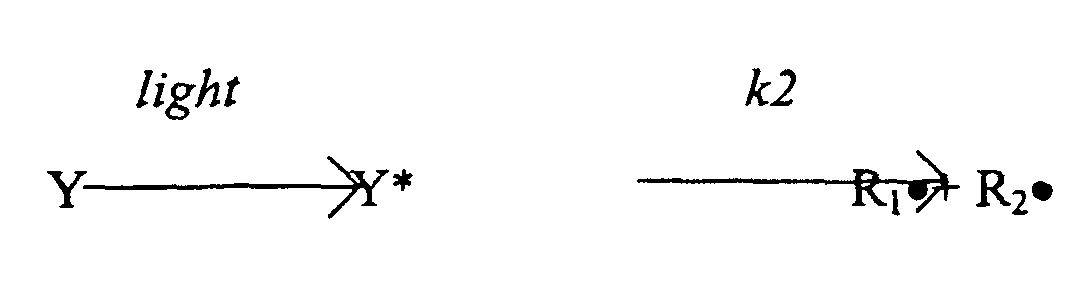
- Unimolecular (bond cleavage) radical photoinitiators operate according to the following reaction: where k2 is the rate constant of the bond-cleavage reaction.
- k2 is greater than 10 6 s -1 .
- Suitable bond cleavage radical initiators are selected from the following groups:
- Suitable radical photoinitiators are disclosed in WO 9607662 (trisacyl phosphine oxides), US 5399782 (phosphine sulphides), US 5410060, EP-A-57474, EP-A-73413 (phosphine oxides), EP-A-088050, EP-A-0117233, EP-A-0138754, EP-A-0446175 and US 4559371.
- Radical photoinitiators are discussed in general in A.F. Cunningham, V. Desorby, K. Dietliker, R. Husler and D.G. Leppard, Chemia 48 (1994) 423-426 and H.F.Gruber, Prog. Polym. Sci., 17, (1992), 953-1044.
- the preferred radical photoinitiators undergo one of the reactions set out above when excited by radiation falling generally in the range 290-800 nm.
- natural sunlight which comprises light in this region, will be suitable for causing the radical photoinitiator to undergo one of the reactions described above.
- the radical photoinitiator has a maximum extinction coefficient in the ultraviolet range (290-400 nm) which is greater than 100 mol -1 1cm -1 .
- the radical photoinitiator is a solid or a liquid at room temperature.
- the radical photoinitiator is substantially colourless and gives non-coloured photo products upon undergoing one of the reactions set out above.
- compositions comprise sensitisers such as thioxanthones, for example as described in EP-A-0088050, EP-A-0138754.
- the radical photoinitiators are preferably activated by ambient light eg, domestic lighting or sunlight. However, a separate light source may be employed for activation of the photoinitiator.
- the substances which are used in the method of the invention are preferably biodegradable and non-toxic.
- the decomposition products of the substances, which are formed from the radicals which they decompose into, are also preferably biodegradable and non-toxic.
- the substances for use in the method of the invention are effective when they are water soluble and when they are substantially insoluble in water.
- substantially insoluble substances allows minimum amounts of the substances to be used. Insolubility also permits the substance to be used in the form of a solid body of substance or a substrate having the substance applied thereto (eg, a coated substrate) which can be brought into contact with the waste water.
- a solid body of the substance or a substrate coated with the substance can be dipped into the waste water or can be arranged such that waste water flows past it.
- the efficiency of the initiators can be increased by removing oxygen from the waste water eg, by passage through the waste water of inert gases such as nitrogen, carbon dioxide, a noble gas or mixtures thereof.
- the substances can be used in the invention either singly or as mixtures of one or more different substances.
- waste water covers any aqueous liquid comprising at least 75% by weight (preferably at least 85% by weight, more preferably at least 95% by weight) of water.
- the waste water is intended for discharge into the environment eg, via a sewage system or into a river or stream.
- the waste water is discoloured and may also contain undesirable bacteria.
- the waste water may be produced as a by-product of a domestic process or an industrial process.
- Domestic processes include the laundering of fabric (eg, garments) and the preparation of foodstuffs.
- Industrial processes include those involving the processing of textiles, foodstuffs, beverages, pharmaceuticals, cosmetics, plastics, paper products, leather, printing inks, paint, varnish, lacquer, wood, stain and other coatings.
- the waste water will be discoloured, for example due to the presence of a dye (such as an organic dye) in the waste water.
- the treatment of waste water according to the method of the invention is particularly suitable for the discoloration of waste water from a fabric laundering process (either industrial or domestic).
- Discoloration of water in the wash or the rinse cycle of a fabric laundering process can present a number of problems, including: dye transfer in the wash (ie, transfer of dye from one item of fabric to another); staining of washing apparatus and/or containers; the discharge of coloured water which might appear unsuitable for further uses (eg, watering plants); and undesirable aesthetic qualities.
- the treatment of waste water from a fabric laundering process can take place in the wash itself or during the rinse cycle, in which case the substance may be incorporated into a fabric treatment composition (eg, a main wash detergent or a fabric conditioner).
- a fabric treatment composition eg, a main wash detergent or a fabric conditioner.
- the treatment of the waste water is carried out after the waste water has been separated from the fabric.
- the waste water may be treated after separation from the fabric by, for example, passage through a treatment zone comprising the substance (eg, coated onto a substrate) at an elevated temperature or under illumination.
- Irgacure 2959 (trade mark) is (1-[4-(2-hydroxyethoxy)-phenyl]-2-hydroxy-2-methyl-1-propane-1-one and was obtained from Ciba Speciality Chemicals.
- Lucirin TPO-L (trade mark) is (2,4,6-trimethylbenzoyl)phenyl phosphinic acid ethyl ester and was obtained from BASF.
- Lucirin TPO-L are sold as radical photoinitiators for use in free radical polymerisation reactions and polymer cross-linking reactions.
Landscapes
- Chemical & Material Sciences (AREA)
- Engineering & Computer Science (AREA)
- Life Sciences & Earth Sciences (AREA)
- Hydrology & Water Resources (AREA)
- Environmental & Geological Engineering (AREA)
- Water Supply & Treatment (AREA)
- Organic Chemistry (AREA)
- Chemical Kinetics & Catalysis (AREA)
- Textile Engineering (AREA)
- Treatment Of Water By Oxidation Or Reduction (AREA)
- Physical Water Treatments (AREA)
- Polymerisation Methods In General (AREA)
Description
| [Procion blue HE-XL]/ % wt in solution | [Irgacure 2959]/ % wt in solution | Absobance at 630 nm (1cm path length) | |
| before irrad. | after irad. | ||
| 0.005 | 0 | 0.42 | 0.42 |
| 0.005 | 0.0025 | 0.42 | 0.080 |
| 0.005 | 0.0050 | 0.42 | 0.097 |
| 0.005 | 0.010 | 0.42 | 0.030 |
| 0.005 | 0.020 | 0.42 | 0.010 |
| 0.005 | 0.030 | 0.42 | 0.018 |
| 0.005 | 0.040 | 0.42 | 0.017 |
| 0.009 | 0.010 | 0.76 | 0.10 |
| 0.006 | 0.010 | 0.51 | 0.067 |
| 0.003 | 0.010 | 0.25 | 0.054 |
| [Procion red HE-GXL]/ % wt in solution | [Irgacure 2959]/ % wt in solution | absorbance at 540 nm (1cm path length) | ||
| before irrad. | 6 mins | 35 mins | ||
| 0.005 | 0 | 0.99 | 1.00 | 1.00 |
| 0.005 | 0.0025 | 0.99 | 0.22 | 0.062 |
| 0.005 | 0.0050 | 0.99 | 0.098 | 0.046 |
| 0.005 | 0.010 | 0.99 | 0.030 | 0.015 |
| 0.005 | 0.020 | 0.99 | 0.040 | 0.028 |
| 0.009 | 0.010 | 1.78 | 0.29 | - |
| 0.006 | 0.010 | 1.20 | 0.080 | - |
| 0.003 | 0.010 | 0.59 | 0.050 | - |
| [Procion yellow HE-6G]/ % wt in solution | [Irgacure 2959]/ % wt in solution | absorbance at 420 nm (1cm path length) | ||
| before irrad. | 6 mins | 35 mins | ||
| 0.005 | 0 | 0.68 | 0.68 | 1.00 |
| 0.005 | 0.0025 | 0.68 | 0.17 | 0.062 |
| 0.005 | 0.0050 | 0.68 | 0.057 | 0.046 |
| 0.005 | 0.010 | 0.68 | 0.034 | 0.015 |
| 0.005 | 0.020 | 0.68 | 0.024 | 0.028 |
| 0.009 | 0.010 | 1.24 | 0.31 | - |
| 0.006 | 0.010 | 0.82 | 0.17 | - |
| 0.003 | 0.010 | 0.41 | 0.027 | - |
| dye | [dye]/ % wt in solution | initial absorbance | absorbance after irradiation |
| Dyrect fast sky blue GD | 0.0050 | 0.46 (400 nm) | 0.092 |
| dyrect orange GR (stilbene dye) | 0.0021 | 1.22 (400 nm) | 0.80 |
| Dyrect yellow LFF (azo dye) | 0.0050 | 1.34 (580 nm) | 0.22 |
| dyrect black GR (poly azo dye) | 0.0078 | 0.54 (500 nm) | 0.091 |
Claims (5)
- Method for the treatment of discoloured waste water from a fabric laundering or dying process, to remove colourants, wherein the method comprises applying to waste water containing a colourant at least one radical photo initiator which decomposes by a uni-molecular (bond cleavage) mechanism to form a carbon-centred radical on exposure to light wherein the at least one radical photo initiator is selected from the group consisting of alpha-amino ketones, alpha-hydroxy ketones, monoacyl and bisacyl phosphine oxides and sulphides, dialkoxy acetophenones, alpha-halo acetophenones, triacyl phosphine oxides and mixtures thereof.
- Method according to Claim 1, wherein the waste water comprises a dye.
- Method according to Claim 2, wherein the dye is an organic dye.
- Method according to claim 1, wherein the radical photo-initiator forms a carbon-centred radical on exposure to light having a wavelength of from 290 to 800nm.
- Method according to Claim 1, wherein the substance is used at a concentration of 10-9M to 1M, more preferably 10-7M to 10-4M.
Applications Claiming Priority (3)
| Application Number | Priority Date | Filing Date | Title |
|---|---|---|---|
| GB9929694 | 1999-12-15 | ||
| GB9929694A GB9929694D0 (en) | 1999-12-15 | 1999-12-15 | Water treatment |
| PCT/EP2000/011354 WO2001044127A1 (en) | 1999-12-15 | 2000-11-13 | Water treatment |
Publications (2)
| Publication Number | Publication Date |
|---|---|
| EP1237821A1 EP1237821A1 (en) | 2002-09-11 |
| EP1237821B1 true EP1237821B1 (en) | 2005-08-17 |
Family
ID=10866402
Family Applications (1)
| Application Number | Title | Priority Date | Filing Date |
|---|---|---|---|
| EP00985039A Expired - Lifetime EP1237821B1 (en) | 1999-12-15 | 2000-11-13 | Water treatment |
Country Status (13)
| Country | Link |
|---|---|
| US (1) | US6833076B1 (en) |
| EP (1) | EP1237821B1 (en) |
| CN (1) | CN1250459C (en) |
| AR (1) | AR026778A1 (en) |
| AT (1) | ATE302165T1 (en) |
| AU (1) | AU768144B2 (en) |
| BR (1) | BR0016438B1 (en) |
| CA (1) | CA2394565A1 (en) |
| DE (1) | DE60022086T2 (en) |
| ES (1) | ES2245952T3 (en) |
| GB (1) | GB9929694D0 (en) |
| WO (1) | WO2001044127A1 (en) |
| ZA (1) | ZA200204156B (en) |
Families Citing this family (8)
| Publication number | Priority date | Publication date | Assignee | Title |
|---|---|---|---|---|
| ITTO20060806A1 (en) * | 2006-11-13 | 2008-05-14 | Marco Polo Engineering S P A | "USE OF CUNNINGHAMELLA ELEGANS LENDNER IN PROCEDURES FOR THE TREATMENT OF INDUSTRIAL WASTE CONTAINING DYES" |
| WO2008139653A1 (en) * | 2007-05-10 | 2008-11-20 | Kurashiki Boseki Kabushiki Kaisha | Method of washing and apparatus for use therein |
| US20110163046A1 (en) * | 2010-01-06 | 2011-07-07 | Neal Kenneth G | Mobile UV Light Treatment Systems and Associated Methods |
| US20110166049A1 (en) * | 2010-01-06 | 2011-07-07 | Haggstrom Johanna A | UV Light Treatment Methods and System |
| RU2446108C1 (en) * | 2010-11-10 | 2012-03-27 | Общество с ограниченной ответственностью Научно-производственная фирма "ФИТО" | Drain water thermal decontamination plant |
| CN104727172B (en) * | 2015-03-11 | 2017-01-04 | 西安工程大学 | Fypro mineralising degree of depth water-saving and emission-reducing dyeing post-processing approach and auxiliary agent in situ |
| CN110668527A (en) * | 2019-08-01 | 2020-01-10 | 湖南大学 | Method for removing organic micropollutants in water by using ultraviolet light and ethylene diamine tetraacetic acid |
| CN115385415B (en) * | 2022-07-07 | 2023-11-10 | 江苏理工学院 | Method for treating waste and degrading organic waste water by waste |
Family Cites Families (9)
| Publication number | Priority date | Publication date | Assignee | Title |
|---|---|---|---|---|
| JPS51121959A (en) * | 1975-04-17 | 1976-10-25 | Nippon Paint Co Ltd | Method of treating waste liquid from rendering of light-sensitive resi n |
| CH632472A5 (en) | 1977-04-14 | 1982-10-15 | Rohrer Ernst | METHOD FOR REDUCING THE CHEMICAL OXYGEN REQUIREMENT OF WATER AND WASTEWATER BY MEANS OF CATALYTIC OXIDATION. |
| US5273662A (en) * | 1988-01-11 | 1993-12-28 | Loctite Corporation | Process for treating impregnation process waste water |
| US5174904A (en) * | 1991-05-06 | 1992-12-29 | Smith J Edward Ii | Wastewater treatment process |
| US5256308A (en) * | 1992-08-19 | 1993-10-26 | Betz Laboratories, Inc. | Method for the cure and removal of overspray paint from the water wash system of paint spray booths |
| US5389356A (en) | 1993-01-05 | 1995-02-14 | Utah State University Foundation | Compounds and methods for generating oxygen free radicals used in general oxidation and reduction reactions |
| US6139755A (en) * | 1997-06-14 | 2000-10-31 | Marte; Walter | Oxidation method, nozzle system and sewage treatment plant |
| DE19726241A1 (en) * | 1997-06-20 | 1998-12-24 | Call Krimhild | Enhanced multi-component enzymatic system for the treatment of waste water, for the production of wood composites, for deinking waste paper, color stripping of waste paper, for use as an oxidation system in organic synthesis and for use in coal liquefaction |
| US6319412B1 (en) * | 1997-10-21 | 2001-11-20 | New Working Waters, Llc | Wastewater treatment process |
-
1999
- 1999-12-15 GB GB9929694A patent/GB9929694D0/en not_active Ceased
-
2000
- 2000-11-13 EP EP00985039A patent/EP1237821B1/en not_active Expired - Lifetime
- 2000-11-13 CN CNB008188955A patent/CN1250459C/en not_active Expired - Fee Related
- 2000-11-13 WO PCT/EP2000/011354 patent/WO2001044127A1/en not_active Ceased
- 2000-11-13 CA CA002394565A patent/CA2394565A1/en not_active Abandoned
- 2000-11-13 AT AT00985039T patent/ATE302165T1/en not_active IP Right Cessation
- 2000-11-13 US US10/149,784 patent/US6833076B1/en not_active Expired - Fee Related
- 2000-11-13 AU AU21590/01A patent/AU768144B2/en not_active Ceased
- 2000-11-13 ES ES00985039T patent/ES2245952T3/en not_active Expired - Lifetime
- 2000-11-13 DE DE60022086T patent/DE60022086T2/en not_active Expired - Lifetime
- 2000-11-13 BR BRPI0016438-0A patent/BR0016438B1/en not_active IP Right Cessation
- 2000-12-12 AR ARP000106573 patent/AR026778A1/en active IP Right Grant
-
2002
- 2002-05-24 ZA ZA200204156A patent/ZA200204156B/en unknown
Also Published As
| Publication number | Publication date |
|---|---|
| BR0016438A (en) | 2002-08-27 |
| AR026778A1 (en) | 2003-02-26 |
| CA2394565A1 (en) | 2001-06-21 |
| ZA200204156B (en) | 2003-07-30 |
| ES2245952T3 (en) | 2006-02-01 |
| BR0016438B1 (en) | 2010-05-04 |
| WO2001044127A1 (en) | 2001-06-21 |
| GB9929694D0 (en) | 2000-02-09 |
| DE60022086T2 (en) | 2006-02-16 |
| AU768144B2 (en) | 2003-12-04 |
| US6833076B1 (en) | 2004-12-21 |
| DE60022086D1 (en) | 2005-09-22 |
| CN1250459C (en) | 2006-04-12 |
| AU2159001A (en) | 2001-06-25 |
| ATE302165T1 (en) | 2005-09-15 |
| EP1237821A1 (en) | 2002-09-11 |
| CN1433385A (en) | 2003-07-30 |
Similar Documents
| Publication | Publication Date | Title |
|---|---|---|
| Bilińska et al. | Textile wastewater treatment by AOPs for brine reuse | |
| Rosa et al. | Dyeing of cotton with reactive dyestuffs: the continuous reuse of textile wastewater effluent treated by Ultraviolet/Hydrogen peroxide homogeneous photocatalysis | |
| Balcioğlu et al. | Partial oxidation of reactive dyestuffs and synthetic textile dye-bath by the O3 and O3/H2O2 processes | |
| Arslan et al. | Effect of common reactive dye auxiliaries on the ozonation of dyehouse effluents containing vinylsulphone and aminochlorotriazine dyes | |
| Arslan et al. | Advanced chemical oxidation of reactive dyes in simulated dyehouse effluents by ferrioxalate-Fenton/UV-A and TiO2/UV-A processes | |
| Bezerra et al. | Reuse of water from real reactive monochromic and trichromic wastewater for new cotton dyes after efficient treatment using H2O2 catalyzed by UV light | |
| Carrière et al. | Decolorization of textile dye solutions | |
| US6833076B1 (en) | Water treatment | |
| Amin et al. | Treatment of textile waste water using H2O2/UV system | |
| Arslan et al. | Advanced treatment of dyehouse effluents by Fe (II) and Mn (II)-catalyzed ozonation and the H2O2/O3 process | |
| KR20120051965A (en) | Method and apparatus for enhanced photocatalytic oxidative decolorization of wastewater containing reactive azo dye and high salts | |
| Salim et al. | Photochemical UVC/H 2 O 2 oxidation system as an effective method for the decolourisation of bio-treated textile wastewaters: towards onsite water reuse | |
| WO2016005460A1 (en) | Washing machine comprising a bleaching device and a reservoir for water-insoluble solid particles | |
| Kabdaşlı et al. | Factors affecting colour removal from reactive dye bath by ozonation | |
| Jayeola et al. | Oxidative degradation of methylene blue dye from wastewater by Fenton process | |
| Ouchi et al. | Increasing the dyeability of polyester fabrics by photochemical treatment at room-temperature using H 2 O 2 in air | |
| Mendoza-Basilio et al. | Oxidation of textile dye reactive yellow 84 in aqueous solution in order to reuse treated water | |
| Yokoyama et al. | Degradation of Reactive Dyes by Photoactive Hydrogen Peroxide Oxidation with Ultraviolet Radiation | |
| Palit | Ozone treatment as an effective advanced oxidation process for the degradation of textile dye-effluents | |
| JPH02203992A (en) | Device for washing and purifying article | |
| Araújo et al. | Influence of experimental variables on decoloration of azo reactive dyes by hydrogen peroxide and UV radiation | |
| Bauman et al. | Textile Wastewater Cleaning with O 3 and H 2 O 2/O 3 Process. | |
| FR2756554A1 (en) | PROCESS FOR DECOLORATION AND DETOXICATION OF AQUEOUS EFFLUENTS | |
| Batchelor | Alpha-hydroxy ketones and sunlight, a novel effluent treatment? | |
| US20170114489A1 (en) | Washing machine comprising a bleaching device and a reservoir for water-insoluble solid particles |
Legal Events
| Date | Code | Title | Description |
|---|---|---|---|
| PUAI | Public reference made under article 153(3) epc to a published international application that has entered the european phase |
Free format text: ORIGINAL CODE: 0009012 |
|
| 17P | Request for examination filed |
Effective date: 20020517 |
|
| AK | Designated contracting states |
Kind code of ref document: A1 Designated state(s): AT BE CH CY DE DK ES FI FR GB GR IE IT LI LU MC NL PT SE TR |
|
| AX | Request for extension of the european patent |
Free format text: AL;LT;LV;MK;RO;SI |
|
| RAP1 | Party data changed (applicant data changed or rights of an application transferred) |
Owner name: UNILEVER N.V. Owner name: UNILEVER PLC |
|
| 17Q | First examination report despatched |
Effective date: 20030508 |
|
| GRAP | Despatch of communication of intention to grant a patent |
Free format text: ORIGINAL CODE: EPIDOSNIGR1 |
|
| GRAS | Grant fee paid |
Free format text: ORIGINAL CODE: EPIDOSNIGR3 |
|
| GRAA | (expected) grant |
Free format text: ORIGINAL CODE: 0009210 |
|
| AK | Designated contracting states |
Kind code of ref document: B1 Designated state(s): AT BE CH CY DE DK ES FI FR GB GR IE IT LI LU MC NL PT SE TR |
|
| PG25 | Lapsed in a contracting state [announced via postgrant information from national office to epo] |
Ref country code: TR Free format text: LAPSE BECAUSE OF FAILURE TO SUBMIT A TRANSLATION OF THE DESCRIPTION OR TO PAY THE FEE WITHIN THE PRESCRIBED TIME-LIMIT Effective date: 20050817 Ref country code: CH Free format text: LAPSE BECAUSE OF FAILURE TO SUBMIT A TRANSLATION OF THE DESCRIPTION OR TO PAY THE FEE WITHIN THE PRESCRIBED TIME-LIMIT Effective date: 20050817 Ref country code: FI Free format text: LAPSE BECAUSE OF FAILURE TO SUBMIT A TRANSLATION OF THE DESCRIPTION OR TO PAY THE FEE WITHIN THE PRESCRIBED TIME-LIMIT Effective date: 20050817 Ref country code: LI Free format text: LAPSE BECAUSE OF FAILURE TO SUBMIT A TRANSLATION OF THE DESCRIPTION OR TO PAY THE FEE WITHIN THE PRESCRIBED TIME-LIMIT Effective date: 20050817 Ref country code: BE Free format text: LAPSE BECAUSE OF FAILURE TO SUBMIT A TRANSLATION OF THE DESCRIPTION OR TO PAY THE FEE WITHIN THE PRESCRIBED TIME-LIMIT Effective date: 20050817 Ref country code: AT Free format text: LAPSE BECAUSE OF FAILURE TO SUBMIT A TRANSLATION OF THE DESCRIPTION OR TO PAY THE FEE WITHIN THE PRESCRIBED TIME-LIMIT Effective date: 20050817 Ref country code: NL Free format text: LAPSE BECAUSE OF FAILURE TO SUBMIT A TRANSLATION OF THE DESCRIPTION OR TO PAY THE FEE WITHIN THE PRESCRIBED TIME-LIMIT Effective date: 20050817 |
|
| REG | Reference to a national code |
Ref country code: GB Ref legal event code: FG4D |
|
| REG | Reference to a national code |
Ref country code: CH Ref legal event code: EP |
|
| REG | Reference to a national code |
Ref country code: IE Ref legal event code: FG4D |
|
| REF | Corresponds to: |
Ref document number: 60022086 Country of ref document: DE Date of ref document: 20050922 Kind code of ref document: P |
|
| PG25 | Lapsed in a contracting state [announced via postgrant information from national office to epo] |
Ref country code: CY Free format text: LAPSE BECAUSE OF FAILURE TO SUBMIT A TRANSLATION OF THE DESCRIPTION OR TO PAY THE FEE WITHIN THE PRESCRIBED TIME-LIMIT Effective date: 20051113 |
|
| PG25 | Lapsed in a contracting state [announced via postgrant information from national office to epo] |
Ref country code: IE Free format text: LAPSE BECAUSE OF NON-PAYMENT OF DUE FEES Effective date: 20051114 |
|
| PG25 | Lapsed in a contracting state [announced via postgrant information from national office to epo] |
Ref country code: GR Free format text: LAPSE BECAUSE OF FAILURE TO SUBMIT A TRANSLATION OF THE DESCRIPTION OR TO PAY THE FEE WITHIN THE PRESCRIBED TIME-LIMIT Effective date: 20051117 Ref country code: DK Free format text: LAPSE BECAUSE OF FAILURE TO SUBMIT A TRANSLATION OF THE DESCRIPTION OR TO PAY THE FEE WITHIN THE PRESCRIBED TIME-LIMIT Effective date: 20051117 Ref country code: SE Free format text: LAPSE BECAUSE OF FAILURE TO SUBMIT A TRANSLATION OF THE DESCRIPTION OR TO PAY THE FEE WITHIN THE PRESCRIBED TIME-LIMIT Effective date: 20051117 |
|
| PG25 | Lapsed in a contracting state [announced via postgrant information from national office to epo] |
Ref country code: MC Free format text: LAPSE BECAUSE OF NON-PAYMENT OF DUE FEES Effective date: 20051130 Ref country code: LU Free format text: LAPSE BECAUSE OF NON-PAYMENT OF DUE FEES Effective date: 20051130 |
|
| PG25 | Lapsed in a contracting state [announced via postgrant information from national office to epo] |
Ref country code: PT Free format text: LAPSE BECAUSE OF FAILURE TO SUBMIT A TRANSLATION OF THE DESCRIPTION OR TO PAY THE FEE WITHIN THE PRESCRIBED TIME-LIMIT Effective date: 20060117 |
|
| NLV1 | Nl: lapsed or annulled due to failure to fulfill the requirements of art. 29p and 29m of the patents act | ||
| REG | Reference to a national code |
Ref country code: ES Ref legal event code: FG2A Ref document number: 2245952 Country of ref document: ES Kind code of ref document: T3 |
|
| REG | Reference to a national code |
Ref country code: CH Ref legal event code: PL |
|
| ET | Fr: translation filed | ||
| PLBE | No opposition filed within time limit |
Free format text: ORIGINAL CODE: 0009261 |
|
| STAA | Information on the status of an ep patent application or granted ep patent |
Free format text: STATUS: NO OPPOSITION FILED WITHIN TIME LIMIT |
|
| 26N | No opposition filed |
Effective date: 20060518 |
|
| REG | Reference to a national code |
Ref country code: IE Ref legal event code: MM4A |
|
| PGFP | Annual fee paid to national office [announced via postgrant information from national office to epo] |
Ref country code: ES Payment date: 20091126 Year of fee payment: 10 Ref country code: DE Payment date: 20091127 Year of fee payment: 10 |
|
| PGFP | Annual fee paid to national office [announced via postgrant information from national office to epo] |
Ref country code: FR Payment date: 20091201 Year of fee payment: 10 Ref country code: GB Payment date: 20091125 Year of fee payment: 10 Ref country code: IT Payment date: 20091127 Year of fee payment: 10 |
|
| GBPC | Gb: european patent ceased through non-payment of renewal fee |
Effective date: 20101113 |
|
| REG | Reference to a national code |
Ref country code: FR Ref legal event code: ST Effective date: 20110801 |
|
| REG | Reference to a national code |
Ref country code: DE Ref legal event code: R119 Ref document number: 60022086 Country of ref document: DE Effective date: 20110601 Ref country code: DE Ref legal event code: R119 Ref document number: 60022086 Country of ref document: DE Effective date: 20110531 |
|
| PG25 | Lapsed in a contracting state [announced via postgrant information from national office to epo] |
Ref country code: FR Free format text: LAPSE BECAUSE OF NON-PAYMENT OF DUE FEES Effective date: 20101130 |
|
| PG25 | Lapsed in a contracting state [announced via postgrant information from national office to epo] |
Ref country code: GB Free format text: LAPSE BECAUSE OF NON-PAYMENT OF DUE FEES Effective date: 20101113 |
|
| PG25 | Lapsed in a contracting state [announced via postgrant information from national office to epo] |
Ref country code: IT Free format text: LAPSE BECAUSE OF NON-PAYMENT OF DUE FEES Effective date: 20101113 |
|
| REG | Reference to a national code |
Ref country code: ES Ref legal event code: FD2A Effective date: 20120220 |
|
| PG25 | Lapsed in a contracting state [announced via postgrant information from national office to epo] |
Ref country code: ES Free format text: LAPSE BECAUSE OF NON-PAYMENT OF DUE FEES Effective date: 20101114 |
|
| PG25 | Lapsed in a contracting state [announced via postgrant information from national office to epo] |
Ref country code: DE Free format text: LAPSE BECAUSE OF NON-PAYMENT OF DUE FEES Effective date: 20110531 |