EP1237093A2 - Methods and apparatus for associating character codes with optimized character codes - Google Patents
Methods and apparatus for associating character codes with optimized character codes Download PDFInfo
- Publication number
- EP1237093A2 EP1237093A2 EP02251375A EP02251375A EP1237093A2 EP 1237093 A2 EP1237093 A2 EP 1237093A2 EP 02251375 A EP02251375 A EP 02251375A EP 02251375 A EP02251375 A EP 02251375A EP 1237093 A2 EP1237093 A2 EP 1237093A2
- Authority
- EP
- European Patent Office
- Prior art keywords
- character code
- character
- optimized
- plane
- row
- Prior art date
- Legal status (The legal status is an assumption and is not a legal conclusion. Google has not performed a legal analysis and makes no representation as to the accuracy of the status listed.)
- Withdrawn
Links
Images




Classifications
-
- G—PHYSICS
- G06—COMPUTING OR CALCULATING; COUNTING
- G06F—ELECTRIC DIGITAL DATA PROCESSING
- G06F40/00—Handling natural language data
- G06F40/10—Text processing
- G06F40/12—Use of codes for handling textual entities
- G06F40/126—Character encoding
Definitions
- the present invention relates to coded character sets. More particularly, the present invention provides methods and apparatus for mapping a coded character set with a second coded character set associated with character attributes.
- the frame of reference for the present invention is a system that accesses character attributes.
- Unicode allows assignment of characters to codes ranging from code 0x00 to code 0x10FFFF.
- the coding space under this definition allows Unicode to represent 1,114,112 different characters.
- Unicode is described in ISO/IEC 10646-1 and is hereby incorporated by reference for all purposes. Aspects of Unicode are also described in the Unicode Technical Standard #6, available from Unicode Inc. and in Bits of Unicode by Mark Davis, available from the Unicode Consortium.
- Each character in Unicode, and other universal coding sets has a character code. Every character code is associated with a set of character attributes. Character attributes include collation weight, whether the character is printable, whether the character is upper or lower case, which character class the character belongs to, etc. The attributes associated with a character are accessed frequently. For example, when a user types a letter "b" into a computer system, the computer system examines the attributes associated with the character code for "b" to determine whether the character should be displayed on the screen. In another example, when a sort function is used to alphabetize a list of words, the attributes for each character in the list of words is examined to determine how the words are sorted alphabetically.
- each character attribute set usually requires approximately 64 bytes of memory. Consequently, a system associating each allocated character code in Unicode with a character attribute set requires 1,114,112 times 64 bytes or 71,303,168 bytes of memory space. Due to this large memory requirement, many computer systems attempt to compress the Unicode, since many of the 1,114,112 possible character codes and character attribute sets are not used. By compressing this data, significant memory space is saved. However, decompression and compression each time a character attribute is accessed can be very inefficient. Other numeric mapping schemes can also consume valuable processing resources or additional memory space.
- mapping or compressing character code sets has disadvantages with regard to at least some of the desirable characteristics of accessing character attributes. It is therefore desirable to provide a system for mapping a character coding set (such as Unicode) to an optimized character coding set in which the mapping system exhibits desirable characteristics as well or better than the technologies discussed above.
- a character coding set such as Unicode
- methods and apparatus are provided to map a character coding set to an optimized character coding set associated with an attribute set.
- each byte in a character code is identified as a group, plane, row, or cell.
- the row and plane values of the character code can be mapped to corresponding row and plane values of an optimized character code.
- Character attributes associated with each optimized character code can then be accessed.
- the row and plane values of optimized character codes can then be mapped to corresponding row and plane values of character codes.
- Each of the groups, planes, rows, and cells of character codes and optimized character codes can be a value identified by a particular arrangement of bits.
- the value of each group, plane, row, or cell is equivalent to one byte in a character code.
- the group, plane, row, or cell can be a value identified by any arrangement of bits in the character code and can be mapped to a different arrangement of bits in the optimized character code.
- One aspect of the invention provides a method for mapping character codes to optimized character codes associated with character attributes.
- the method may be characterized by the following sequence: (1) receiving a character code having a string of bits; (2) identifying a first subset of bits in the character code, wherein the first subset of bits identifies a first row; and (3) mapping the first row to a second row associated with an optimized character code in an optimized character code index, wherein mapping the first row identifies an optimized character code for the received character code.
- a second subset of bits in the character code can be mapped an identified as a first plane.
- the first plane can be mapped to a second plane associated with an optimized character code.
- the apparatus may be characterized by the following features: (1) memory; (2) an input mechanism for receiving a character code; (3) one or more processors coupled with the memory, the processors configured to identify a first subset of bits in the character code, wherein the first subset of bits identifies a first row and maps the first row to a second row associated with an optimized character code in the optimized character code index, wherein mapping the first row identifies an optimized character code for the received character code.
- the one or more processor can be further configured to identify a second subset of bits in the character code, wherein the second subset of bits identifies a first plane.
- the one or more processor can also map the first plane to a second plane associated with an optimized character code in the optimized character code index.
- Another aspect of the invention pertains to computer program products including a machine readable medium on which is stored program instructions, tables or lists, and/or data structures for implementing a method as described above. Any of the methods, tables, or data structures of this invention may be represented as program instructions that can be provided on such computer readable media.
- This invention pertains to methods and systems for mapping a character coding set to an optimized character coding set associated with character attributes.
- each character code is 32 bits in length.
- Unicode is described in ISO/IEC 10646-1 and is hereby incorporated by reference for all purposes. Aspects of Unicode are also described in the Unicode Technical Standard #6, available from Unicode Inc. and in Bits of Unicode by Mark Davis, available from the Unicode Consortium.
- a 32-bit character code can be represented in binary as 0000 0000 0000 0001 1010 0000 1101, in decimal form as 6696, or more conveniently in hexadecimal form as 0x00001A0D.
- each byte of the 32-bit character code contains group, plane, row, and cell components.
- the first byte containing 0000 0000 is the group value.
- the second byte containing 0000 0001 is the plane value.
- the third byte containing 1000 0011 is the row value.
- the fourth byte containing 0100 1110 is the cell value.
- Figure 1 shows how the group, plane, row, and cell components of a character code correspond with the bits of a single character code according to specific embodiments.
- Character code 117 comprises a group 101, a plane 103, a row 105, and a cell 107.
- Group 101 is composed of the most significant 8 bits, plane 103 the next 8 bits, row 105 the next 8 bits, and cell 107 the least significant 8 bits.
- the group is 0000 0000 in binary form, 0 in decimal form, and 0x00 in hexadecimal form.
- the group value for the letter "n” is 0.
- the plane is 0000 0001, 1 in decimal form, and 0x01 in hexadecimal form.
- the plane value for "n” is 1.
- the row is 1000 0011 in binary form, 131 in decimal form, and 0x83 in hexadecimal form.
- the row value is 131.
- the cell is 0100 1110 in binary form, 78 in decimal form, and 0x4E in hexadecimal form.
- the cell value is 78.
- Plane 103 corresponds with a first subset of bits 111.
- Row 105 corresponds with a second subset of bits 113.
- Each of these subsets 111 and 113 contains eight bits equivalent to one byte.
- Cell 107 contains least significant bit 115 among its eight bits.
- Group 101 contains most significant bit 109 among its eight bits.
- Figure 2 shows a spatial representation of the group, plane, row, and cell components of a character code.
- Examples of a group are group 201 or group 203.
- Examples of a plane are plane 205 in group 201 and plane 207 in group 203.
- Examples of a row are 209 or 211 in plane 207.
- Examples of a cell are cell 213 or 215 in row 211.
- each group, plane, row, and cell are associated with one octet or 256 possible values.
- Each plane contains 256 rows each containing 256 cells.
- Each plane consequently, contains 256x256 cells or 65,536 cells.
- Each of these character codes is associated with a character attribute set. Some of these character codes may be allocated while some remain unallocated.
- Figure 3 illustrates a mapping of a character coding set to an optimized character coding set according to specific embodiments.
- a character coding set has planes 301 and 303.
- An optimized character coding set has only plane 315.
- the rows of plane 301 and 303 that contain allocated character codes are mapped to the rows of plane 315.
- Plane 301 of a character coding set has rows 305 containing allocated character codes as well as rows 307 containing no allocated character codes.
- Rows 305 of plane 301 containing allocated character codes are mapped to rows 311 in plane 315 of the optimized character coding set.
- Row 309 of plane 303 containing allocated character codes is mapped to row 313 of plane 315 of the optimized character coding set.
- the cells of the mapped rows remain the same.
- Cells of row 309 are mapped directly to the cells of row 313.
- the cell values of the character coding set and the optimized character coding set are mapped directly with a one-to-one correspondence.
- a character code in plane 303, row 309, and cell 317 is now located in the optimized character coding set at plane 315, row 313, cell 319.
- the plane and row values can be mapped to different values while keeping the cell value the same.
- the group value likewise remains the same, since Unicode will not define any character value using group bytes.
- Planes 301 and 303 may have the same group value as plane 315.
- the mapping of character coding set to an optimized character coding set requires the mapping of only plane and row values. Group and cell values remain the same.
- the Unicode character coding set is mapped to an optimized character coding set while keeping group and cell values the same.
- the processes described for this mapping can apply to other universal character coding sets.
- a character code with a plane value of 0 is mapped directly to an optimized character code also having a plane value of 0, while maintaining the same row value.
- Character codes with plane values not equal to 0 are mapped to optimized character codes with a plane value of 1.
- the allocated rows of the character coding set are mapped to rows in the optimized coding set in plane 1.
- the rows with allocated character codes in a character coding set are mapped onto the rows of more than one plane in the optimized character coding set. Where the sum of the number of rows in plane 301 and the number of rows in plane 303 is greater than the number of rows in plane 315, and additional plane may be required to contain the rows of planes 301 and 303.
- FIG. 4 is a process flow diagram showing the process of accessing character attributes that may require the use of the present invention, according to specific embodiments.
- a keyboard character entry is input into a computer system at 401.
- the character code and Unicode bit sequence for the character entry is identified at 403.
- the computer system accesses the attributes associated with the character code at 405.
- Each character code is associated with an attribute set.
- the computer system determines whether the character code entered has the "print" attribute at 407. If the "print" attribute is not enabled for the entered character, the character is not displayed on a monitor at 411. If the "print" attribute is enabled, the character is displayed on a monitor at 409.
- the process can be used to access other attributes in the attribute set.
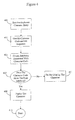
- Figure 5 is a process flow diagram illustrating the mapping of a character code to an optimized character code, according to specific embodiments.
- the diagram provides detail on step 405 of Figure 4.
- the computer system identifies the character entered at 501.
- step 503 is an optional procedure designed to optimize the mapping of a character code to an optimized character code in Unicode. As noted above, if the plane value of a character code in Unicode is equal to zero, the character code can be the same as the optimized character code.
- the character attributes can be accessed based on the character code at 507. If the plane value is not equal to 0, or if step 503 is not performed, the computer system identifies a sequence of bits associated with a row value at 505. The computer system can also identify a sequence of bits associated with a plane value at 509. The row value can then be mapped to an optimized row value at 511 based on the row value and the plane value. The plane value can be mapped to an optimized plane value at 513. The optimized character code acquired from the mapping at 515 can be used to access the attributes associated with the optimized character code at 517.
- the present invention does not require that the steps of this process be performed in any specified sequence.
- the sequence of bits associated with a plane value can be determined before identifying a sequence of bits associated with a row value.
- the mapping of the row and plane values can also occur in difference sequences.
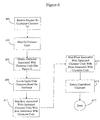
- Figure 6 is a process flow diagram depicting the mapping of an optimized character code to the original character code, according to specific embodiments.
- a computer system receives a request to capitalize the character "b" at 601.
- the computer system identifies the character code for the character “b” at 603 and obtains the attributes associated with the character code at 605.
- the computer system may undergo the process described in Figure 5.
- the computer system locates the upper case character “B” based on the attributes for the character "b.”
- the character attributes for "B” are associated with an optimized character code that needs to be mapped to a non-optimized character code.
- the row associated with the optimized character code is mapped to a row associated with the character code for "B".
- the plane associated with the optimized character code is mapped to a plane associated with the character code for "B".
- the character code for the capitalized character "B” can then be returned.
- FIG. 7 illustrates a typical, general-purpose computer system suitable for implementing the present invention.
- ROM acts to transfer data and instructions uni-directionally to the CPUs 702, while RAM is used typically to transfer data and instructions in a bi-directional manner.
- CPUs 702 may generally include any number of processors. The CPUs can process bits in character codes and map the character codes to optimized character codes. The CPUs can also access attributes associated with optimized character codes.
- Both primary storage devices 704, 706 may include any suitable computer-readable media.
- a secondary storage medium 708, which is typically a mass memory device, is also coupled bi-directionally to CPUs 702 and provides additional data storage capacity.
- the mass memory device 708 is a computer-readable medium that may be used to store programs including computer code, data, and the like.
- the mass memory device 708 can store optimized character codes along with associated attributes.
- the mass memory device 708 can also store information for mapping character codes to optimized character codes.
- mass memory device 708 is a storage medium such as a hard disk or a tape which generally slower than primary storage devices 704, 706.
- Mass memory storage device 708 may take the form of a magnetic or paper tape reader or some other well-known device. It will be appreciated that the information retained within the mass memory device 708, may, in appropriate cases, be incorporated in standard fashion as part of RAM 706 as virtual memory.
- attributes associated with optimized character codes stored in the mass memory storage device 708 can be loaded into RAM 706 to allow faster access by the CPUs 702.
- Information for mapping character codes to optimized character codes can also be loaded into RAM 706.
- a specific primary storage device 704 such as a CD-ROM may also pass data uni-directionally to the CPUs 702.
- CPUs 702 are also coupled to one or more input/output devices 710 that may include, but are not limited to, devices such as video monitors, track balls, mice, keyboards, microphones, touch-sensitive displays, transducer card readers, magnetic or paper tape readers, tablets, styluses, voice or handwriting recognizers, or other well-known input devices such as, of course, other computers.
- CPUs 702 optionally may be coupled to a computer or telecommunications network, e.g., an Internet network or an intranet network, using a network connection as shown generally at 712. With such a network connection, it is contemplated that the CPUs 702 might receive information from the network, or might output information to the network in the course of performing the above-described method steps.
- Such information which is often represented as a sequence of instructions to be executed using CPUs 702, may be received from and outputted to the network, for example, in the form of a computer data signal embodied in a carrier wave.
- the above-described devices and materials will be familiar to those of skill in the computer hardware and software arts.
- Information and program instructions may be employed to implement the systems/methods described herein.
- the present invention can relate to machine readable media that include program instructions, state information, etc. for performing various operations described herein.
- machine-readable media include, but are not limited to, magnetic media such as hard disks, floppy disks, and magnetic tape; optical media such as CD-ROM disks; magneto-optical media such as optical disks; and hardware devices that are specially configured to store and perform program instructions, such as read-only memory devices (ROM) and random access memory (RAM).
- ROM read-only memory devices
- RAM random access memory
- the invention may also be embodied in a carrier wave travelling over an appropriate medium such as airwaves, optical lines, electric lines, etc.
- program instructions include both machine code, such as that produced by a compiler, and files containing higher level code that may be executed by the computer using an interpreter.
Landscapes
- Engineering & Computer Science (AREA)
- Theoretical Computer Science (AREA)
- Health & Medical Sciences (AREA)
- Artificial Intelligence (AREA)
- Audiology, Speech & Language Pathology (AREA)
- Computational Linguistics (AREA)
- General Health & Medical Sciences (AREA)
- Physics & Mathematics (AREA)
- General Engineering & Computer Science (AREA)
- General Physics & Mathematics (AREA)
- Controls And Circuits For Display Device (AREA)
Abstract
Description
Claims (10)
- A method for associating a character code with an optimized character code, the optimized character code having a corresponding attribute set, the method comprising:receiving a character code having a string of bits;identifying a first subset of bits in the character code, wherein the first subset of bits identifies a first row; andmapping the first row to a second row associated with an optimized character code in an optimized character code index, wherein mapping the first row identifies an optimized character code for the received character code.
- The method of any of the preceding claims, further comprising:identifying a second subset of bits in the character code, wherein the second subset of bits identifies a first plane; andmapping the first plane to a second plane associated with the optimized character code in the optimized character code index.
- The method of any of the preceding claims, wherein the second subset of bits has a value of 0 or 1.
- An apparatus for associating a character code with an optimized character code, the optimized character code having a corresponding attribute set, the apparatus comprising:memory;an input mechanism for receiving a character code;one or more processors coupled with the memory, the processors configured to identify a first subset of bits in the character code, wherein the first subset of bits identifies a first row and map the first row to a second row associated with an optimized character code in the optimized character code index, wherein mapping the first row identifies an optimized character code for the received character code.
- The apparatus of claim 4, further configured to:identify a second subset of bits in the character code, wherein the second subset of bits identifies a first plane; andmap the first plane to a second plane associated with an optimized character code in the optimized character code index.
- The apparatus of claim 4-5, wherein the second subset of bits has a value of 0 or 1.
- The apparatus of claim 4-6, wherein the character code comprises a third subset of bits identifying a first group.
- The apparatus of claim 4-7, wherein the character code comprises a fourth subset of bits identifying a first cell.
- The apparatus of claim 4-8, further comprising mapping the first group and the first cell to a second group and a second cell associated with the optimized character code in the optimized character code index.
- The apparatus of claim 4-9, wherein the first group and the first cell are equal to the second group and the second cell respectively.
Applications Claiming Priority (2)
| Application Number | Priority Date | Filing Date | Title |
|---|---|---|---|
| US796875 | 2001-02-28 | ||
| US09/796,875 US6829386B2 (en) | 2001-02-28 | 2001-02-28 | Methods and apparatus for associating character codes with optimized character codes |
Publications (2)
| Publication Number | Publication Date |
|---|---|
| EP1237093A2 true EP1237093A2 (en) | 2002-09-04 |
| EP1237093A3 EP1237093A3 (en) | 2005-11-23 |
Family
ID=25169284
Family Applications (1)
| Application Number | Title | Priority Date | Filing Date |
|---|---|---|---|
| EP02251375A Withdrawn EP1237093A3 (en) | 2001-02-28 | 2002-02-27 | Methods and apparatus for associating character codes with optimized character codes |
Country Status (2)
| Country | Link |
|---|---|
| US (1) | US6829386B2 (en) |
| EP (1) | EP1237093A3 (en) |
Families Citing this family (2)
| Publication number | Priority date | Publication date | Assignee | Title |
|---|---|---|---|---|
| US7148824B1 (en) * | 2005-08-05 | 2006-12-12 | Xerox Corporation | Automatic detection of character encoding format using statistical analysis of the text strings |
| WO2014085416A2 (en) * | 2012-11-28 | 2014-06-05 | Wellpoint, Inc. | Method and system for encoding integration of coded logical information systems |
Family Cites Families (4)
| Publication number | Priority date | Publication date | Assignee | Title |
|---|---|---|---|---|
| US6422476B1 (en) * | 1993-11-05 | 2002-07-23 | Intermec Ip Corp. | Method, apparatus and character set for encoding and decoding data characters in data carriers, such as RFID tags |
| US5793381A (en) * | 1995-09-13 | 1998-08-11 | Apple Computer, Inc. | Unicode converter |
| JP3499671B2 (en) * | 1996-02-09 | 2004-02-23 | 富士通株式会社 | Data compression device and data decompression device |
| US6204782B1 (en) * | 1998-09-25 | 2001-03-20 | Apple Computer, Inc. | Unicode conversion into multiple encodings |
-
2001
- 2001-02-28 US US09/796,875 patent/US6829386B2/en not_active Expired - Lifetime
-
2002
- 2002-02-27 EP EP02251375A patent/EP1237093A3/en not_active Withdrawn
Also Published As
| Publication number | Publication date |
|---|---|
| EP1237093A3 (en) | 2005-11-23 |
| US6829386B2 (en) | 2004-12-07 |
| US20020118877A1 (en) | 2002-08-29 |
Similar Documents
| Publication | Publication Date | Title |
|---|---|---|
| CN1531692B (en) | Efficient collation element structure for processing large numbers of characters | |
| KR970003322B1 (en) | How to Convert a Multi-Byte Representation of Data | |
| US7260574B2 (en) | Method and system for mapping strings for comparison | |
| US6493692B1 (en) | Information search apparatus and method, and computer readable memory | |
| US6204782B1 (en) | Unicode conversion into multiple encodings | |
| US5792659A (en) | Terminal emulator enhancer with local configurability | |
| US20140232573A1 (en) | Method for processing data quantifying force applied to one or more keys of a computer keyboard | |
| JPH026252B2 (en) | ||
| US6910183B2 (en) | File tagging and automatic conversion of data or files | |
| US5125039A (en) | Object recognition system | |
| US5819303A (en) | Information management system which processes multiple languages having incompatible formats | |
| US20030074190A1 (en) | Method and apparatus for dynamic configuration of a lexical analysis parser | |
| JP2568343B2 (en) | Text information compression system | |
| US7240066B2 (en) | Unicode transitional code point database | |
| EP0852851B1 (en) | Data compression apparatus | |
| US20050251519A1 (en) | Efficient language-dependent sorting of embedded numerics | |
| US6829386B2 (en) | Methods and apparatus for associating character codes with optimized character codes | |
| US6622239B1 (en) | Method, system and computer program product for optimization of single byte character processing employed within a multibyte character encoding scheme | |
| US20020052902A1 (en) | Method to convert unicode text to mixed codepages | |
| US6745215B2 (en) | Computer apparatus, program and method for determining the equivalence of two algebraic functions | |
| KR100399495B1 (en) | Method to convert unicode text to mixed codepages | |
| US7130470B1 (en) | System and method of context-based sorting of character strings for use in data base applications | |
| US20060168130A1 (en) | Bytecode localization engine and instructions | |
| US7555565B2 (en) | Method of translating a message from a first markup language into a second markup language | |
| CA1172371A (en) | System for converting data processing information to text processing format and vice versa |
Legal Events
| Date | Code | Title | Description |
|---|---|---|---|
| PUAI | Public reference made under article 153(3) epc to a published international application that has entered the european phase |
Free format text: ORIGINAL CODE: 0009012 |
|
| AK | Designated contracting states |
Kind code of ref document: A2 Designated state(s): AT BE CH CY DE DK ES FI FR GB GR IE IT LI LU MC NL PT SE TR |
|
| AX | Request for extension of the european patent |
Free format text: AL;LT;LV;MK;RO;SI |
|
| PUAL | Search report despatched |
Free format text: ORIGINAL CODE: 0009013 |
|
| AK | Designated contracting states |
Kind code of ref document: A3 Designated state(s): AT BE CH CY DE DK ES FI FR GB GR IE IT LI LU MC NL PT SE TR |
|
| AX | Request for extension of the european patent |
Extension state: AL LT LV MK RO SI |
|
| AKX | Designation fees paid | ||
| REG | Reference to a national code |
Ref country code: DE Ref legal event code: 8566 |
|
| STAA | Information on the status of an ep patent application or granted ep patent |
Free format text: STATUS: THE APPLICATION IS DEEMED TO BE WITHDRAWN |
|
| 18D | Application deemed to be withdrawn |
Effective date: 20060524 |