EP1237068A2 - Method and apparatus for entering information in a mobile device with special characters - Google Patents
Method and apparatus for entering information in a mobile device with special characters Download PDFInfo
- Publication number
- EP1237068A2 EP1237068A2 EP02004109A EP02004109A EP1237068A2 EP 1237068 A2 EP1237068 A2 EP 1237068A2 EP 02004109 A EP02004109 A EP 02004109A EP 02004109 A EP02004109 A EP 02004109A EP 1237068 A2 EP1237068 A2 EP 1237068A2
- Authority
- EP
- European Patent Office
- Prior art keywords
- key
- character
- variant
- keypad
- keys
- Prior art date
- Legal status (The legal status is an assumption and is not a legal conclusion. Google has not performed a legal analysis and makes no representation as to the accuracy of the status listed.)
- Withdrawn
Links
Images






Classifications
-
- G—PHYSICS
- G06—COMPUTING OR CALCULATING; COUNTING
- G06F—ELECTRIC DIGITAL DATA PROCESSING
- G06F3/00—Input arrangements for transferring data to be processed into a form capable of being handled by the computer; Output arrangements for transferring data from processing unit to output unit, e.g. interface arrangements
- G06F3/01—Input arrangements or combined input and output arrangements for interaction between user and computer
- G06F3/02—Input arrangements using manually operated switches, e.g. using keyboards or dials
- G06F3/023—Arrangements for converting discrete items of information into a coded form, e.g. arrangements for interpreting keyboard generated codes as alphanumeric codes, operand codes or instruction codes
- G06F3/0233—Character input methods
- G06F3/0236—Character input methods using selection techniques to select from displayed items
-
- G—PHYSICS
- G06—COMPUTING OR CALCULATING; COUNTING
- G06F—ELECTRIC DIGITAL DATA PROCESSING
- G06F3/00—Input arrangements for transferring data to be processed into a form capable of being handled by the computer; Output arrangements for transferring data from processing unit to output unit, e.g. interface arrangements
- G06F3/01—Input arrangements or combined input and output arrangements for interaction between user and computer
- G06F3/02—Input arrangements using manually operated switches, e.g. using keyboards or dials
- G06F3/023—Arrangements for converting discrete items of information into a coded form, e.g. arrangements for interpreting keyboard generated codes as alphanumeric codes, operand codes or instruction codes
- G06F3/0233—Character input methods
Definitions
- Vietnamese is a member of Southeast Asian languages. It is written from left to right and based on Latin script although it contains some Vietnamese special characters. In Vietnamese, characters can appear both in upper and lower cases. Like Chinese and Thai, Vietnamese is a tonal language. This means that the way a word is pronounced determines its meaning.
- the Vietnamese alphabet includes twelve vowels, six of which are common to western languages: a, e, i, o, u and y. The remaining six are represented by combining diacritics into regular vowels: â (a with circumflex), (a with breve), ê (e with circumflex), ô (o with circumflex), o (o with horn) and u (u with horn), as shown in Figure 1.
- the Vietnamese language there are six different tones. Five of the tones, excluding the neutral tone, are marked with tone marks, occurring with any one of the twelve vowels. Symbolically, the six different tones can be referred to as neutral, acute accent, tilde, grave accent, hook above and dot below.
- Figure 2 shows the tonal variations for the word "ga”.
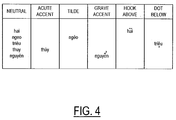
- Vowels can be used in combination. Some examples are shown in Figure 3. When vowels are used in a combined form, only one tonal mark is required to change the tone. For example, there are two or more vowels in the following word: "hai”, “ngeo”, “tieu”, “thuy”, “nguyen”, but only one tonal mark is used in each word, as shown in Figure 4.
- Each of the twelve vowels can occur in any of the six tones. Accordingly, the combination of vowels with tonal marks results in 72 vowels, both in upper and lower case.
- the overall number of vowels in Vietnamese, including the tonal variations, is 144, as shown in Figure 5.
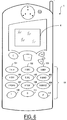
- the telephone set 1 has a keypad 10, only keys 102, 103, 104, 105, 106, 107, 108 and 109 are used for entering alphabetic characters: 2ABC, 3DEF, 4GHI, 5JKL, 6MNO, 7PQRS, 8TUV, 9WXYZ
- the keypad 10 has at least four other keys 101, 110, 111 and 112: 1, *, 0, #
- the telephone 1 also has a display 4 operatively connected to the keypad 10 for displaying the entered alphabetic characters.
- This object can be achieved by using one or more function keys of the keypad to change a regular alphabetic character to a special character, wherein the special character can be a variation of the alphabetic character, or the same alphabetic character with a tonal mark.
- a method of changing an alphabetic character to a variant thereof for entering information or messages in a telephone comprising:
- the function keys include a star key (*) and a pound key (#)
- star key when the function keys include a star key (*) and a pound key (#), it is preferable to press the star key to change the entered alphabetic character.
- pound key it is possible to press the pound key to make a similar change, and it is also possible to use both the star and the pound keys simultaneously or sequentially to make the intended change.
- the alphabetic character to be changed represents a vowel, but it is also possible to change a consonant character to a corresponding variant.
- one of the different variants is chosen based on the number of times the star key is pressed. It is also possible to choose one of the different variants based on the time duration for which the star key is pressed.
- the variant represents a tonal variation of the entered vowel character, but it is possible that the special character represents a modification of the sound of the entered vowel character.
- a mobile device having a keypad having alphanumeric keys for entering an alphabetic character; and means, operatively connecting the keypad to a display, for displaying the entered alphabetic character, wherein the keypad includes one or more function keys for changing the entered alphabetic character to a variant thereof by pressing said one or more function keys, said mobile device comprising:
- the function keys include a star key and a pound key
- the alphabetic character to be changed represents a vowel, but it is also possible to change a consonant character to a corresponding special character.
- one of the different variants is chosen based on the number of times the star key is pressed. It is also possible to choose one of the different variants based on the time duration for which the star key is pressed.
- the choosing means comprises a lookup table for choosing the variant character corresponding to the entered alphabetic character based on the number of times the star key is pressed or the time duration in which the star key is pressed.
- a keypad having alphanumeric keys for entering an alphabetic character in an electronic device wherein the electronic device has a display operatively connected to the keypad for displaying the entered alphabetic character, said keypad comprising:
- the further key comprises a star key.
- the further key comprises a pound key.
- the telephone 1 has a keypad 12 for entering information in a language that has diacritical variants.
- key 102a shows two diacritical variations of the vowel "A”
- key 103a shows one diacritical variation of the vowel "E” and a special character “D" (D with a stroke)
- key 106a shows two diacritical variations of the vowel "O”
- key 108a shows one diacritical variation of the vowel "U”.
- a key to enter an alphabetic character shown on a particular key one can tap that key for a number of times until the desired alphabetic character is displayed in the display 4 . Tapping a key to enter an alphabetic character is known in the art.
- the star key (*) 110 it is possible to use the star key (*) 110 to put a tonal mark on an entered alphabetic character.
- the star key 110 can be used to put a tonal mark on an entered vowel (including the diacritical variations thereof).
- the tonal variations are arranged in a certain order, such as "acute accent”, “tilde”, “grave accent”, "hook above” and “dot below”. With this arrangement, if it is desirable to put the "grave accent” on an entered vowel, one can simply tap the star key three times.
- the five tone marks, and the neutral tone can be arranged to appear in a cyclic manner. For example, if the star key 110 is tapped six times, the tone mark disappears. If the star key 110 is tapped once or seven times, the "acute accent' mark would appear.
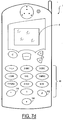
- consonants "f”, "j", “w” and “z” are not used in Vietnamese. Thus, it is possible to eliminate these consonant characters from the keypad 16, as shown in Figure 7b, if so desired. Also, the letter “q” in Vietnamese always appears with “u” as “qu”, and no tonal mark would appear on the u in qu. Thus, it is also possible to replace "q” with "qu” in a keypad to eliminate the need of entering "u” after "q" - in a message entered in either upper case or lower case.
- the star key can be used to add a diacritic on a vowel character. For example, by tapping the star key once after entering the letter "U", one can reach the umlaut mark to obtain "U” for modify the sound of the vowel or the pronunciation of a word. It is possible to tap the star key again to cancel the umlaut mark.
- a keypad 16 it is possible to use a keypad 16, as shown in Figure 7c to enter a message in Vietnamese by using the star key 110, the pound key 112 or both to reach a diacritical variation of a vowel.
- a keypad 16 it is possible to use short taps on the star key 110 to reach a diacritical variation and use a long press of the star key 110 to cycle through the tonal marks.
- Figure 10a one can tap key 106 a number of times to reach the letter "0". If the star key 110 is briefly tapped once, the diacritical variation with circumflex would appear, as shown in Figure 10b. If the star key 110 is briefly tapped again, the diacritical variation with breve would appear, as shown in Figure 10c.
- the "acute accent” mark would appear, as shown in Figure 10d. If one keeps pressing the star key 110, the "tilde” mark would appear, as shown in Figure 10e.
- the unique feature of the present invention is the use of one or more "function keys", such as the star key 110 and the pound key 112, to reach a diacritical variation of an alphabetic character, or a tonal variation of a vowel.
- the present invention is applicable not only on a tonal language, such as Vietnamese, Thai and Chinese (when written in Latin script with tonal variations), but also on non-tonal languages such as French (à, â, ç, é, é, ê, ô) and German (ii). Also, it is also possible to put an additional key 114, as shown in Figure 7d, on the keypad 18 to reach a variant of an entered alphabetic character, or non-alphabetic character.
- Figure 8 shows that the telephone 1 further comprises means 6 , responding to the pressed alphanumeric key and the pressing of the star key, for providing a signal, indicating the entered alphabetic key and the manner in which the star key is pressed, to a key-mapping mechanism 8.
- the key-mapping means 8 causes the entered alphabetic character to be displayed in the display 4.
- the means 8 further determines a variant corresponding to the entered alphabetic character and the manner in which the star key is pressed.
- the key-mapping means 8 further causes the chosen variant to be displayed in the display 4, in place of the entered alphabetic character.
- the present invention has been described mainly in conjunction with a telephone having alphanumeric keys for entering alphabetic characters and numerals, and a star key or pound key for entering one or more variants of the alphabetic characters.
- the present invention in general, is applicable to an electronic device having a keypad containing a plurality of first keys and at least one second key, wherein the first keys are used to enter messages or information in symbolic characters and the second key is used to select one or more variants of the entered symbolic character.
- the symbolic characters may comprise alphabetic characters, numerals, signs, icon-like pictures, simple drawings, images, marks and the like.
- the electronic device can be a land-line telephone, a mobile phone, a game console and the like.
- a method of changing an alphabetic character to a variant character when entering information or messages in a mobile phone or a game console or the like can be a diacritical variation or a tonal variation of the alphabetic character.
- the star key in the keypad can be used to replace the displayed alphabetic character with a desired one of the variants.
Landscapes
- Engineering & Computer Science (AREA)
- General Engineering & Computer Science (AREA)
- Theoretical Computer Science (AREA)
- Human Computer Interaction (AREA)
- Physics & Mathematics (AREA)
- General Physics & Mathematics (AREA)
- Input From Keyboards Or The Like (AREA)
- Telephone Function (AREA)
Abstract
Description


2ABC, 3DEF, 4GHI, 5JKL, 6MNO, 7PQRS, 8TUV, 9WXYZ
In addition, as shown in Figure 1, the
1, *, 0, #
As shown in Figure 1, the
As shown, key 102a shows two diacritical variations of the vowel "A"; key 103a shows one diacritical variation of the vowel "E" and a special character "D" (D with a stroke); key 106a shows two diacritical variations of the vowel "O"; and key 108a shows one diacritical variation of the vowel "U". In order to enter an alphabetic character shown on a particular key, one can tap that key for a number of times until the desired alphabetic character is displayed in the

Claims (28)
- A method of changing a symbolic character to a variant character thereof for entering information or messages in a mobile device, wherein the mobile device comprises:a keypad having a plurality of first keys for entering the symbolic character; andmeans, operatively connecting the keypad to a display, for displaying the symbolic character, wherein the keypad includes one second key different from the first keys for effecting said changing, said method comprising the steps of:entering the symbolic character to be changed; andpressing the second key one or more times until the displayed symbolic character is replaced by the corresponding variant character.
- The method of claim 1, wherein the first keys comprise alphanumeric keys and the second key comprises a star key.
- The method of claim 1, wherein the first keys comprise alphanumeric keys and the second key comprises a pound key.
- The method of claim 1, wherein the displayed symbolic character comprises an alphabetic character which has one or more diacritical variant characters, and wherein the second key is used to select the one or more diacritical variant characters.
- The method of claim 1, wherein the displayed symbolic character comprises an alphabetic character which has one or more tonal variant characters, and wherein the second key is used to select the one or more tonal variant characters.
- The method of claim 1, wherein the displayed symbolic character comprises an alphabetic character which has one or more tonal variant characters and one or more diacritical variant characters, and wherein the second key is manipulated in a first manner to select the one or more diacritical variant characters, and in a second manner to select the one or more tonal variant characters.
- The method of claim 6, wherein the first manner is tapping and the second manner is pressing for a longer period than tapping.
- The method of claim 6, wherein the second manner is tapping and the first manner is pressing for a longer period than tapping.
- The method of claim 1, wherein the displayed symbolic character comprises an alphabetic character which has one or more tonal variant characters and one or more diacritical variant characters, and the keypad has a third key different from the first keys and second key, and wherein the second key is used to select the one or more diacritical variant characters and the third key is used to select the one or more tonal variant characters.
- The method of claim 1, wherein the symbolic character to be changed represents a vowel.
- The method of claim 1, wherein the symbolic character to be changed represents a consonant.
- The method of claim 1, wherein the variant character represent a modification of sound of the symbolic character to be changed.
- A mobile device having a keypad comprising first keys for entering a symbolic character; and a display operatively connecting the keypad for displaying the entered symbolic character, wherein the keypad includes one second key different from the first keys for changing the entered symbolic character to a variant thereof by pressing the second key, said mobile device comprising:means, responsive to said pressing and the entered symbolic character, for choosing the variant character corresponding to the entered symbolic character for providing a signal indicating the chosen variant character; andmeans, responsive to the signal, for causing the chosen variant character to be displayed in place of the entered symbolic character.
- The mobile device of claim 13 comprising a mobile phone.
- The mobile device of claim 13, wherein the first keys comprise alphanumeric keys and the second key comprises a star key.
- The mobile device of claim 13, wherein the first keys comprise alphanumeric keys and the second key comprises a pound key.
- The mobile device of claim 13, wherein the displayed symbolic character comprises an alphabetic character which has one or more diacritical variant characters, and wherein the second key is used to select the one or more diacritical variant characters.
- The mobile device of claim 13, wherein the displayed symbolic character comprises an alphabetic character which has one or more tonal variant characters, and wherein the second key is used to select the one or more tonal variant characters.
- The mobile device of claim 13, wherein the displayed symbolic character comprises an alphabetic character which has one or more tonal variant characters and one or more diacritical variant characters, and wherein the second key can be pressed in a first manner and a second manner, and the choosing means chooses the one or more diacritical variant characters based on the first manner, and chooses the one or more tonal variant characters based on the second manner.
- The mobile device of claim 13, wherein the displayed symbolic character comprises an alphabetic character which has one or more tonal variant characters and one or more diacritical variant characters, and the keypad has a third key different from the first keys and second key, and the choosing means chooses the one or more diacritical variant characters based on the pressing of the second key and chooses the one or more tonal variant characters based on the pressing of the third key.
- The mobile device of claim 13, comprising a game console.
- A keypad for use in an electronic device having first keys for entering a symbolic character in the electronic device, wherein the electronic device has a display operatively connected to the keypad for displaying the entered symbolic character, said keypad comprising one second key different from the first keys for changing the entered symbolic character to a variant thereof when said second key is pressed one or more times.
- The keypad of claim 22, wherein the first keys comprise alphanumeric keys and the second key comprises a star key.
- The keypad of claim 22, wherein the displayed symbolic character has one or more first variant characters and one or more second variant characters, and wherein the second key can be pressed in a first manner for choosing the one or more first variant characters and pressed in a second manner for choosing the one or more second variant characters.
- The keypad of claim 22, wherein the displayed symbolic character has one or more first variant characters and one or more second variant characters, and said keypad further comprises a third key different from the first keys and second key, and wherein the second key is used for choosing the one or more first variant characters and the third key is used for choosing the one or more second variant characters.
- The keypad of claim 22, wherein the first keys comprise alphanumeric keys, the second key comprises a star key and the third key comprises a pound key.
- The keypad of claim 22, wherein the electronic device comprises a mobile phone.
- The keypad of claim 22, wherein the electronic device comprises a game console.
Applications Claiming Priority (2)
| Application Number | Priority Date | Filing Date | Title |
|---|---|---|---|
| US798350 | 2001-03-02 | ||
| US09/798,350 US6868280B2 (en) | 2001-03-02 | 2001-03-02 | Method and apparatus for entering information in a mobile device with special characters |
Publications (2)
| Publication Number | Publication Date |
|---|---|
| EP1237068A2 true EP1237068A2 (en) | 2002-09-04 |
| EP1237068A3 EP1237068A3 (en) | 2003-02-12 |
Family
ID=25173170
Family Applications (1)
| Application Number | Title | Priority Date | Filing Date |
|---|---|---|---|
| EP02004109A Withdrawn EP1237068A3 (en) | 2001-03-02 | 2002-02-25 | Method and apparatus for entering information in a mobile device with special characters |
Country Status (3)
| Country | Link |
|---|---|
| US (1) | US6868280B2 (en) |
| EP (1) | EP1237068A3 (en) |
| JP (1) | JP3904946B2 (en) |
Cited By (11)
| Publication number | Priority date | Publication date | Assignee | Title |
|---|---|---|---|---|
| EP1416362A3 (en) * | 2002-10-21 | 2006-10-18 | Microsoft Corporation | System and method for inputting special characters |
| EP1760570A1 (en) * | 2005-09-02 | 2007-03-07 | 2012244 Ontario Inc. | Handheld electronic device with text disambiguation allowing dynamic expansion of input key associations |
| WO2007074353A1 (en) * | 2005-12-24 | 2007-07-05 | Nokia Corporation | Text composition |
| EP1808748A1 (en) * | 2006-01-13 | 2007-07-18 | Research In Motion Limited | Handheld electronic device and method for disambiguation of text input providing artificial variants comprised of characters in a core alphabet |
| WO2007093933A3 (en) * | 2006-02-14 | 2008-05-22 | Rosario Pagliarani | Keyboard for electronic processor |
| EP1936475A1 (en) * | 2006-12-22 | 2008-06-25 | Inventec Corporation | Method of selecting special characters |
| US7644209B2 (en) | 2005-08-31 | 2010-01-05 | Research In Motion Limited | Handheld electronic device with text disambiguation allowing dynamic expansion of input key associations |
| US7715882B2 (en) | 2005-01-25 | 2010-05-11 | Kyocera Corporation | Mobile terminal apparatus, character input method and character input program |
| US7952497B2 (en) | 2006-01-13 | 2011-05-31 | Research In Motion Limited | Handheld electronic device and method for disambiguation of compound text input for prioritizing compound language solutions according to quantity of text components |
| US8370125B2 (en) | 2006-01-13 | 2013-02-05 | Research In Motion Limited | Handheld electronic device and method for disambiguation of text input providing artificial variants comprised of characters in a core alphabet |
| US8672564B2 (en) | 2004-08-24 | 2014-03-18 | Dymo | Printing device |
Families Citing this family (16)
| Publication number | Priority date | Publication date | Assignee | Title |
|---|---|---|---|---|
| US7712053B2 (en) * | 1998-12-04 | 2010-05-04 | Tegic Communications, Inc. | Explicit character filtering of ambiguous text entry |
| US8938688B2 (en) | 1998-12-04 | 2015-01-20 | Nuance Communications, Inc. | Contextual prediction of user words and user actions |
| US20040127236A1 (en) * | 2002-12-27 | 2004-07-01 | Manjirnath Chatterjee | Method and apparatus for text entry for electronic messaging |
| KR100566204B1 (en) * | 2003-04-22 | 2006-03-29 | 삼성전자주식회사 | Method and device for inputting Chinese Pinyin with tonal tone |
| JP4213570B2 (en) * | 2003-11-20 | 2009-01-21 | シャープ株式会社 | Character input method, character input device and program |
| TW200535672A (en) * | 2004-04-29 | 2005-11-01 | Asustek Comp Inc | A method for switching input and an electronic device therefor |
| US8095364B2 (en) | 2004-06-02 | 2012-01-10 | Tegic Communications, Inc. | Multimodal disambiguation of speech recognition |
| DE102004029824A1 (en) * | 2004-06-19 | 2006-06-08 | Daimlerchrysler Ag | Operating system for a vehicle |
| US7595742B2 (en) * | 2004-10-29 | 2009-09-29 | Lenovo (Singapore) Pte. Ltd. | System and method for generating language specific diacritics for different languages using a single keyboard layout |
| JP2007011837A (en) * | 2005-07-01 | 2007-01-18 | Nec Corp | Electronic device, authentication information input method, and authentication information input program |
| JP4341627B2 (en) * | 2006-01-25 | 2009-10-07 | セイコーエプソン株式会社 | Character input on devices without a keyboard |
| US20080186211A1 (en) * | 2007-02-06 | 2008-08-07 | Motorola, Inc. | Method and apparatus for text entry of tone marks |
| KR101452704B1 (en) * | 2007-02-14 | 2014-10-23 | 삼성전자주식회사 | A password setting method and a password authentication method in a portable device having a plurality of buttons |
| US8581750B2 (en) * | 2007-09-18 | 2013-11-12 | Liang-Hsi Chang | Data input system with multi-directional pointing device |
| US20110014961A1 (en) * | 2009-07-17 | 2011-01-20 | Samir Hanna Safar | iphone application game |
| US9342155B2 (en) * | 2011-03-31 | 2016-05-17 | Nokia Technologies Oy | Character entry apparatus and associated methods |
Family Cites Families (11)
| Publication number | Priority date | Publication date | Assignee | Title |
|---|---|---|---|---|
| US4603330A (en) * | 1982-10-01 | 1986-07-29 | High Technology Solutions, Inc. | Font display and text editing system with character overlay feature |
| JPS62105265A (en) | 1985-10-31 | 1987-05-15 | Nec Corp | Word processor |
| JPS62274360A (en) | 1986-05-22 | 1987-11-28 | Nec Corp | Word processor |
| DE69319679T2 (en) | 1992-09-14 | 1998-11-12 | Sony Corp | Entry of special letters |
| CA2137981C (en) | 1993-12-22 | 2001-04-17 | Steven A. Shaiman | Method and system for presenting alternatives for selection using adaptive learning |
| US6009444A (en) | 1997-02-24 | 1999-12-28 | Motorola, Inc. | Text input device and method |
| US5945928A (en) | 1998-01-20 | 1999-08-31 | Tegic Communication, Inc. | Reduced keyboard disambiguating system for the Korean language |
| US6170000B1 (en) | 1998-08-26 | 2001-01-02 | Nokia Mobile Phones Ltd. | User interface, and associated method, permitting entry of Hangul sound symbols |
| US6646573B1 (en) * | 1998-12-04 | 2003-11-11 | America Online, Inc. | Reduced keyboard text input system for the Japanese language |
| KR100285312B1 (en) * | 1999-03-29 | 2001-03-15 | 윤종용 | Character input method in wireless telephone set |
| US6631501B1 (en) * | 1999-06-30 | 2003-10-07 | Microsoft Corporation | Method and system for automatic type and replace of characters in a sequence of characters |
-
2001
- 2001-03-02 US US09/798,350 patent/US6868280B2/en not_active Expired - Lifetime
-
2002
- 2002-02-25 EP EP02004109A patent/EP1237068A3/en not_active Withdrawn
- 2002-02-28 JP JP2002053394A patent/JP3904946B2/en not_active Expired - Fee Related
Cited By (14)
| Publication number | Priority date | Publication date | Assignee | Title |
|---|---|---|---|---|
| EP1416362A3 (en) * | 2002-10-21 | 2006-10-18 | Microsoft Corporation | System and method for inputting special characters |
| US8672564B2 (en) | 2004-08-24 | 2014-03-18 | Dymo | Printing device |
| US7715882B2 (en) | 2005-01-25 | 2010-05-11 | Kyocera Corporation | Mobile terminal apparatus, character input method and character input program |
| US8239593B2 (en) | 2005-08-31 | 2012-08-07 | Research In Motion Limited | Handheld electronic device with text disambiguation allowing dynamic expansion of input key associations |
| US7644209B2 (en) | 2005-08-31 | 2010-01-05 | Research In Motion Limited | Handheld electronic device with text disambiguation allowing dynamic expansion of input key associations |
| US8984187B2 (en) | 2005-08-31 | 2015-03-17 | Blackberry Limited | Handheld electronic device with text disambiguation allowing dynamic expansion of input key associations |
| EP1760570A1 (en) * | 2005-09-02 | 2007-03-07 | 2012244 Ontario Inc. | Handheld electronic device with text disambiguation allowing dynamic expansion of input key associations |
| WO2007074353A1 (en) * | 2005-12-24 | 2007-07-05 | Nokia Corporation | Text composition |
| EP1808748A1 (en) * | 2006-01-13 | 2007-07-18 | Research In Motion Limited | Handheld electronic device and method for disambiguation of text input providing artificial variants comprised of characters in a core alphabet |
| US7952497B2 (en) | 2006-01-13 | 2011-05-31 | Research In Motion Limited | Handheld electronic device and method for disambiguation of compound text input for prioritizing compound language solutions according to quantity of text components |
| US8370125B2 (en) | 2006-01-13 | 2013-02-05 | Research In Motion Limited | Handheld electronic device and method for disambiguation of text input providing artificial variants comprised of characters in a core alphabet |
| US8515738B2 (en) | 2006-01-13 | 2013-08-20 | Research In Motion Limited | Handheld electronic device and method for disambiguation of compound text input and for prioritizing compound language solutions according to quantity of text components |
| WO2007093933A3 (en) * | 2006-02-14 | 2008-05-22 | Rosario Pagliarani | Keyboard for electronic processor |
| EP1936475A1 (en) * | 2006-12-22 | 2008-06-25 | Inventec Corporation | Method of selecting special characters |
Also Published As
| Publication number | Publication date |
|---|---|
| JP2002290510A (en) | 2002-10-04 |
| EP1237068A3 (en) | 2003-02-12 |
| US6868280B2 (en) | 2005-03-15 |
| JP3904946B2 (en) | 2007-04-11 |
| US20020123367A1 (en) | 2002-09-05 |
Similar Documents
| Publication | Publication Date | Title |
|---|---|---|
| US6868280B2 (en) | Method and apparatus for entering information in a mobile device with special characters | |
| US7095403B2 (en) | User interface of a keypad entry system for character input | |
| US7693552B2 (en) | Text messaging device | |
| JP2004523034A (en) | Character generation system | |
| JP3998998B2 (en) | Character input device, character input method, program, and storage medium | |
| KR100371381B1 (en) | a word input unit with letter reconizing module | |
| Katre | A Position Paper On-Cross cultural Usability Issues of Bilingual (Hindi & English) Mobile Phones | |
| US20070067720A1 (en) | Method and apparatus for entering Vietnamese words containing characters with diacritical marks in an electronic device having a monitor/display and a keyboard/keypad | |
| KR100318722B1 (en) | The hangul mixing method | |
| KR19990039862A (en) | How to use phone number plate and input keyboard | |
| KR100750653B1 (en) | Mobile terminal with Korean input | |
| KR102263980B1 (en) | Device and method for inputting and displaying characters combining korean and latin | |
| KR20010039239A (en) | Expanded telephone keypad system accepting Korean characters | |
| KR20030089190A (en) | Chinese character input apparatus for communications equipment | |
| JP4500353B2 (en) | Character input device | |
| KR20010069805A (en) | Method for inputting characters using key-pad | |
| KR100437509B1 (en) | Method and System for entering Vietnam character using minimizing key pad | |
| KR100235155B1 (en) | A keyboard having a character display means | |
| KR200290417Y1 (en) | Korean Alphabet Letter Input System Using the Numeric Keybuttons | |
| KR20020012824A (en) | Character input method using two conversion buttons | |
| JP2002049460A (en) | Character inputting device | |
| KR20050003828A (en) | Tonemark expression method for mobile communication device | |
| KR20010091182A (en) | Character Input Method By Small Number of User Input Interface | |
| Anderson | Multilingual text processing in a two-byte code | |
| HK1088091B (en) | Text messaging device |
Legal Events
| Date | Code | Title | Description |
|---|---|---|---|
| PUAI | Public reference made under article 153(3) epc to a published international application that has entered the european phase |
Free format text: ORIGINAL CODE: 0009012 |
|
| AK | Designated contracting states |
Kind code of ref document: A2 Designated state(s): AT BE CH CY DE DK ES FI FR GB GR IE IT LI LU MC NL PT SE TR |
|
| AX | Request for extension of the european patent |
Free format text: AL;LT;LV;MK;RO;SI |
|
| RIN1 | Information on inventor provided before grant (corrected) |
Inventor name: HELLE, SEPPO Inventor name: TU, TRUONG MINH Inventor name: SAVOLAINEN, MINNA-MARIA Inventor name: LAUKKANEN, PETRI |
|
| PUAL | Search report despatched |
Free format text: ORIGINAL CODE: 0009013 |
|
| AK | Designated contracting states |
Designated state(s): AT BE CH CY DE DK ES FI FR GB GR IE IT LI LU MC NL PT SE TR |
|
| AX | Request for extension of the european patent |
Extension state: AL LT LV MK RO SI |
|
| AKX | Designation fees paid | ||
| REG | Reference to a national code |
Ref country code: DE Ref legal event code: 8566 |
|
| STAA | Information on the status of an ep patent application or granted ep patent |
Free format text: STATUS: THE APPLICATION IS DEEMED TO BE WITHDRAWN |
|
| 18D | Application deemed to be withdrawn |
Effective date: 20030813 |