EP1236621A1 - Vehicular passive safety device - Google Patents
Vehicular passive safety device Download PDFInfo
- Publication number
- EP1236621A1 EP1236621A1 EP02003931A EP02003931A EP1236621A1 EP 1236621 A1 EP1236621 A1 EP 1236621A1 EP 02003931 A EP02003931 A EP 02003931A EP 02003931 A EP02003931 A EP 02003931A EP 1236621 A1 EP1236621 A1 EP 1236621A1
- Authority
- EP
- European Patent Office
- Prior art keywords
- shoulder
- belt
- webbing
- seat
- tongue
- Prior art date
- Legal status (The legal status is an assumption and is not a legal conclusion. Google has not performed a legal analysis and makes no representation as to the accuracy of the status listed.)
- Granted
Links
- 238000004804 winding Methods 0.000 claims abstract description 4
- 230000000452 restraining effect Effects 0.000 claims description 3
- 230000001133 acceleration Effects 0.000 description 8
- 239000000463 material Substances 0.000 description 2
- 229920006311 Urethane elastomer Polymers 0.000 description 1
- 230000005540 biological transmission Effects 0.000 description 1
- 210000000481 breast Anatomy 0.000 description 1
- 238000002485 combustion reaction Methods 0.000 description 1
- 230000003111 delayed effect Effects 0.000 description 1
- 238000009434 installation Methods 0.000 description 1
- 239000003380 propellant Substances 0.000 description 1
- 229920002379 silicone rubber Polymers 0.000 description 1
- 239000004945 silicone rubber Substances 0.000 description 1
- 239000012209 synthetic fiber Substances 0.000 description 1
- 229920002994 synthetic fiber Polymers 0.000 description 1
Images


Classifications
-
- B—PERFORMING OPERATIONS; TRANSPORTING
- B60—VEHICLES IN GENERAL
- B60R—VEHICLES, VEHICLE FITTINGS, OR VEHICLE PARTS, NOT OTHERWISE PROVIDED FOR
- B60R21/00—Arrangements or fittings on vehicles for protecting or preventing injuries to occupants or pedestrians in case of accidents or other traffic risks
- B60R21/02—Occupant safety arrangements or fittings, e.g. crash pads
- B60R21/16—Inflatable occupant restraints or confinements designed to inflate upon impact or impending impact, e.g. air bags
- B60R21/18—Inflatable occupant restraints or confinements designed to inflate upon impact or impending impact, e.g. air bags the inflatable member formed as a belt or harness or combined with a belt or harness arrangement
-
- B—PERFORMING OPERATIONS; TRANSPORTING
- B60—VEHICLES IN GENERAL
- B60R—VEHICLES, VEHICLE FITTINGS, OR VEHICLE PARTS, NOT OTHERWISE PROVIDED FOR
- B60R22/00—Safety belts or body harnesses in vehicles
- B60R22/18—Anchoring devices
- B60R22/20—Anchoring devices adjustable in position, e.g. in height
-
- B—PERFORMING OPERATIONS; TRANSPORTING
- B62—LAND VEHICLES FOR TRAVELLING OTHERWISE THAN ON RAILS
- B62J—CYCLE SADDLES OR SEATS; AUXILIARY DEVICES OR ACCESSORIES SPECIALLY ADAPTED TO CYCLES AND NOT OTHERWISE PROVIDED FOR, e.g. ARTICLE CARRIERS OR CYCLE PROTECTORS
- B62J27/00—Safety equipment
- B62J27/10—Safety belts specially adapted for motorcycles or the like
-
- B—PERFORMING OPERATIONS; TRANSPORTING
- B60—VEHICLES IN GENERAL
- B60R—VEHICLES, VEHICLE FITTINGS, OR VEHICLE PARTS, NOT OTHERWISE PROVIDED FOR
- B60R22/00—Safety belts or body harnesses in vehicles
- B60R22/02—Semi-passive restraint systems, e.g. systems applied or removed automatically but not both ; Manual restraint systems
- B60R2022/027—Four-point seat belt systems, e.g. with the two upper points connected together
Definitions
- the present invention relates to an air belt system that inflates a part of webbing for restraining an occupant on a seat when a vehicle collides with high pressure gas supplied from an inflator.
- FIG. 9 An air belt system for an automobile that houses a bag inside the webbing of a seat belt and softly restrains an occupant by inflating the bag when a vehicle collides is disclosed in Japanese published unexamined patent application No. Hei 11-165605 applied by this applicant.
- the end of a shoulder belt 04 of webbing 03 is connected to an inflator 02 provided inside an automobile center pillar 01 and when the automobile collides, high pressure gas caused by the inflator 02 is directly supplied to the shoulder belt 04 to inflate the shoulder belt.
- the height of the upper end of the shoulder belt can be also adjusted in accordance with the seated height of an occupant, a sense of installation of the air belt system is enhanced and the restraint performance in inflation can be enhanced.
- the upper end of the shoulder belt and the inflator are fixed to the center pillar so that they cannot be moved and the conventional type has structure that the height cannot be adjusted.
- the invention is made in view of such a situation and the object is to enable the easy adjustment of the height of the upper end of a shoulder belt of webbing utilizing a shoulder guard respectively provided to struts provided on both right and left sides of a seat.
- a vehicular passive safety device based upon a vehicular passive safety device provided with webbing in which a lap belt that cannot be inflated and a shoulder belt that can be inflated are connected, a retractor provided to one side of a seat for winding the end on the side of the lap belt of the webbing, a tongue supported in an intermediate part of the webbing so that the tongue can be slid, a buckle provided on the other side of the seat for connecting the tongue so that the tongue can be detached and an inflator connected to the end on the side of the shoulder belt of the webbing for restraining an occupant seated on the seat by inflating the shoulder belt of the webbing with high pressure gas caused by the inflator when the vehicle collides and characterized in that the end on the side of the shoulder belt of the webbing and the inflator are attached to one of right and left shoulder guards provided to struts provided on both right and left sides of the seat so that the upper and lower positions can be adjusted for protecting the shoulders
- the height of the shoulder belt attached to the shoulder guard can be automatically adjusted to suitable height in accordance with the seated height of an occupant if the height of the shoulder guard is adjusted in accordance with the seated height of the occupant and in addition, time and labor required for the adjustment can be reduced.
- the inflator is also attached to the shoulder guard and is also vertically moved together with the shoulder belt, positional relation between the inflator and the shoulder belt is unchanged and a supply path of high pressure gas from the inflator to the shoulder belt can be simplified.
- Figs. 1 to 6 show a first embodiment of the invention
- the three-wheeled vehicle V is provided with one front wheel Wf arranged in the front of the vehicle body and a pair of right and left rear wheels Wr and Wr arranged in the rear of the vehicle body.
- the front wheel Wf is provided at the lower end of a fork 13 connected to a bar handle 12 supported by a body frame 11 and can be steered right and left by the operation of the bar handle 12.
- a swing unit 14 in which an engine and a transmission are integrated is supported in the rear of the body frame 11 via a pivot 15 so that the swing unit can be swung right and left and the rear wheels Wr and Wr which are driving wheels are provided to the swing unit 14.
- a seat 16 on which an occupant is seated is provided over the body frame 11 and a glove compartment 17 supported on the swing unit 14 is arranged at the back of the seat 16.
- Two struts 18 and 18 are provided on both sides of the seat 16, and a roof supporter 19 connecting the respective upper ends of both struts 18 and 18 and the upper end of a leg shield 20 are connected by a wind shield 21 and a roof 22.
- a pair of right and left shoulder guards 32 and 32 are provided to the struts 18 and 18 positioned on the right and on the left of the occupant seated on the seat 16 to prevent the shoulders of the occupant from being directly touched to the struts 18 and 18.
- Each shoulder guard 32 is provided with a base plate 33 in which a circular arc-shaped groove 33a fitted to the strut 18 having a circular section is formed, cushion material 34 such as sponge fixed on the base plate 33 and a facing 35 covering the surface of the cushion material 34.
- the shoulder guard 32 is fixed to the strut 18 by screwing two bolts 36 and 36 that pierce any two of multiple bolt holes 18a piercing the strut 18 into upper and lower two bolt holes 33b and 33b formed in the base plate 33 so that the upper and lower positions of the shoulder guard 32 can be arbitrarily adjusted in accordance with the seated height of the occupant.
- the air belt system 37 that restrains the occupant on the seat 16 is provided with a retractor 38 provided on the right side of a seat cushion 16a, an inflator 39 provided to the right shoulder guard 32, webbing 40 both ends of which are supported by the retractor 38 and the inflator 39, a tongue 41 supported in an intermediate part of the webbing 40 so that the tongue can be slid and a buckle 42 which is provided to the left side of the seat cushion 16a and to which the tongue 41 is coupled so that the tongue 41 can be detached.
- the well-known retractor 38 winds the webbing 40 so that one end can be pulled out, at normal time when a mechanical acceleration sensor does not detect the acceleration of a predetermined value or more, the webbing 40 can be pulled out and allows the movement of the occupant's body and when the mechanical acceleration sensor detects the acceleration of the predetermined value or more at the time of the collision of vehicles, the webbing 40 is locked so that it cannot be pulled out and the occupant is restrained.
- the well-known inflator 39 is ignited when the acceleration sensor detects the acceleration of the predetermined value or more and generates high pressure gas by the combustion of propellant.
- a lap belt 43 between the retractor 38 and the tongue 41 and a shoulder belt 44 between the tongue 41 and the inflator 39 are integrated and the tongue 41 can be freely slid in the vicinity of a connection of the lap belt 43 and the shoulder belt 44 of the webbing 40.
- the lap belt 43 is formed by a plainly woven belt made of normal synthetic fiber and the shoulder belt 44 is composed of a folded bag 44a made of urethane rubber and silicone rubber and an elastic cover 44b covering the outside.
- a flange 45a of a nozzle member 45 is fixed by each bolt 46 on the upper face of the base plate 33 of the shoulder guard 32 on the right side and a holder 47 that holds the inflator 39 is fixed on the rear face of the base plate 33 by bolts 48 and 48.
- the upper end of the shoulder belt 44 of the webbing 40 is fitted to a hollow belt mounting part 45b protruded from the upper part of the nozzle member 45 to the inside of the body and is firmly fixed by a metallic band 49.
- a high pressure gas supply pipe 50 extended from the upper end of the inflator 39 communicates with the belt mounting part 45b via a high pressure gas passage 45c formed inside the nozzle member 45.
- the inflator 39 When the acceleration sensor detects the acceleration of the predetermined value or more because of the collision of vehicles, the inflator 39 is ignited, high pressure gas is caused and when the caused high pressure gas is supplied from the high pressure gas supply pipe 50 to the bag 44a housed inside the shoulder belt 44 via the high pressure gas passage 45c of the nozzle member 45 and the belt mounting part 45b, the bag 44a is inflated together with the cover 44b by the pressure.
- the area of the shoulder belt touched to the breast of the occupant is increased, compared with the shoulder belt 44 before inflation when the shoulder belt 44 of the webbing 40 is inflated as described above, the occupant can be more softly restrained.
- each shoulder guard 32 To adjust the upper and lower positions of each shoulder guard 32 according to the seated height of the occupant seated on the seat 16, the two bolts 33 and 33 have only to be inserted into new bolt holes 18a and 18a of the strut 18 in a state in which the shoulder guard 32 is moved to a suitable position and to be screwed into the bolt holes 33b and 33b of the base plate 33 after the two bolts 33 and 33 screwed into the bolt holes 33b and 33b of each base plate 33 are loosened and are extracted from the bolt holes 18a and 18a of the strut 18.
- the height of the upper end of the shoulder belt 44 can be automatically adjusted in accordance with the occupant's seated height by adjusting the height of the shoulder guard 32, and time and labor required for the adjustment can be greatly reduced.
- positional relation between the inflator 39 and the shoulder belt 44 is unchanged even if the shoulder guard 32 is vertically moved, a supply path of high pressure gas from the inflator 39 to the shoulder belt 44 is not made complex.
- the lap belt 43 and the shoulder belt 44 are integrated and are inserted into the tongue 41 so that they can be slid, they can be wound by one retractor 38 and the number of parts can be reduced, compared with a case that two retractors are provided corresponding to the lap belt 43 and the shoulder belt 44.
- the upper end of the shoulder belt 44 is directly fixed to the shoulder guard 32 and is not via a slip guide for pulling out the shoulder belt 44, the flow of high pressure gas from the inflator 39 is prevented from being interrupted by the slip guide and as a result, the inflation of the shoulder belt 44 is prevented from being delayed.
- a shoulder guard 32 equivalent to the second embodiment is made wide so that a groove 33a of its base plate 33 can be slid forward or backward along a strut 18 and bolt holes 18b of the strut 18 are continuous like a comb. Therefore, when the position of the shoulder guard 32 is adjusted vertically along the strut 18, bolts 36 are moved along the bolt holes 18b in the shape of a comb by only loosening them without completely detaching them and the adjustment of the position of the shoulder guard 32 can be completed by only fitting the bolts again.
- the three-wheeled vehicle V is described, however, the invention can be also applied to a two-wheeled vehicle and a four-wheeled vehicle if only the vehicle is provided with shoulder guards 32 and 32 to struts 18 and 18 respectively provided to the right and the left of a seat 16.
- the invention enables the easy adjustment of the height of the upper end of a shoulder belt of webbing utilizing a shoulder guard provided to a strut provided on both right and left sides of a seat.
- an air belt system 37 is provided with webbing 40 in which a lap belt 43 that cannot be inflated and a shoulder belt 44 that can be inflated are connected, a retractor 38 provided to one side of a seat for winding the end of the lap belt 43, a tongue 41 supported in an intermediate part of the webbing 40 so that the tongue can be slid, a buckle 42 provided on the other side of the seat for connecting the tongue 41 so that the tongue can be detached and an inflator 39 connected to the end of the shoulder belt 44 for supplying high pressure gas to the shoulder belt 44.
- Right and left shoulder guards 32 are respectively provided to the struts 18 provided on both right and left sides of the seat so that the upper and lower positions can be adjusted, and the upper end of the shoulder belt 44 and the inflator 39 are attached to right or left shoulder guard 32.
Landscapes
- Engineering & Computer Science (AREA)
- Mechanical Engineering (AREA)
- Air Bags (AREA)
- Automotive Seat Belt Assembly (AREA)
Abstract
Description
- The present invention relates to an air belt system that inflates a part of webbing for restraining an occupant on a seat when a vehicle collides with high pressure gas supplied from an inflator.
- An air belt system for an automobile that houses a bag inside the webbing of a seat belt and softly restrains an occupant by inflating the bag when a vehicle collides is disclosed in Japanese published unexamined patent application No. Hei 11-165605 applied by this applicant. As shown in Fig. 9, for this air belt system, the end of a
shoulder belt 04 ofwebbing 03 is connected to aninflator 02 provided inside anautomobile center pillar 01 and when the automobile collides, high pressure gas caused by theinflator 02 is directly supplied to theshoulder belt 04 to inflate the shoulder belt. - In the air belt system as in a seat belt system, if the height of the upper end of the shoulder belt can be also adjusted in accordance with the seated height of an occupant, a sense of installation of the air belt system is enhanced and the restraint performance in inflation can be enhanced. However, for the above-mentioned conventional type, the upper end of the shoulder belt and the inflator are fixed to the center pillar so that they cannot be moved and the conventional type has structure that the height cannot be adjusted.
- The invention is made in view of such a situation and the object is to enable the easy adjustment of the height of the upper end of a shoulder belt of webbing utilizing a shoulder guard respectively provided to struts provided on both right and left sides of a seat.
- To achieve the object, according to the invention disclosed in
Claim 1, a vehicular passive safety device based upon a vehicular passive safety device provided with webbing in which a lap belt that cannot be inflated and a shoulder belt that can be inflated are connected, a retractor provided to one side of a seat for winding the end on the side of the lap belt of the webbing, a tongue supported in an intermediate part of the webbing so that the tongue can be slid, a buckle provided on the other side of the seat for connecting the tongue so that the tongue can be detached and an inflator connected to the end on the side of the shoulder belt of the webbing for restraining an occupant seated on the seat by inflating the shoulder belt of the webbing with high pressure gas caused by the inflator when the vehicle collides and characterized in that the end on the side of the shoulder belt of the webbing and the inflator are attached to one of right and left shoulder guards provided to struts provided on both right and left sides of the seat so that the upper and lower positions can be adjusted for protecting the shoulders of an occupant is proposed. - According to the above-mentioned configuration, as the end on the side of the shoulder belt of the webbing of the air belt system and the inflator are attached to one of the right and left shoulder guards provided to the struts on both right and left sides of the seat so that the upper and lower positions can be adjusted, the height of the shoulder belt attached to the shoulder guard can be automatically adjusted to suitable height in accordance with the seated height of an occupant if the height of the shoulder guard is adjusted in accordance with the seated height of the occupant and in addition, time and labor required for the adjustment can be reduced. As the inflator is also attached to the shoulder guard and is also vertically moved together with the shoulder belt, positional relation between the inflator and the shoulder belt is unchanged and a supply path of high pressure gas from the inflator to the shoulder belt can be simplified.
- The invention will be described based upon embodiments of the invention shown in attached drawings below.
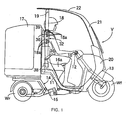
- Fig. 1 is a general side view showing a three-wheeled vehicle;
- Fig. 2 is a view viewed from a direction shown by an arrow 2 in Fig. 1;
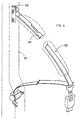
- Fig. 3 is a perspective view showing an air belt system;
- Fig. 4 is a view viewed from a direction shown by an
arrow 4 in Fig. 3; - Fig. 5 is a view viewed from a direction shown by an
arrow 5 in Fig. 4; - Fig. 6 is a sectional view viewed along a line 6-6 in Fig. 5;
- Fig. 7 is a perspective view showing a shoulder guard equivalent to a second embodiment of the invention;
- Fig. 8 is a sectional view viewed along a line 8-8 in Fig. 7; and
- Fig. 9 is a perspective view showing a conventional type air belt system for a four-wheeled vehicle.
-
- Figs. 1 to 6 show a first embodiment of the invention,
- As shown in Figs. 1 and 2, the three-wheeled vehicle V is provided with one front wheel Wf arranged in the front of the vehicle body and a pair of right and left rear wheels Wr and Wr arranged in the rear of the vehicle body. The front wheel Wf is provided at the lower end of a
fork 13 connected to abar handle 12 supported by a body frame 11 and can be steered right and left by the operation of thebar handle 12. Aswing unit 14 in which an engine and a transmission are integrated is supported in the rear of the body frame 11 via apivot 15 so that the swing unit can be swung right and left and the rear wheels Wr and Wr which are driving wheels are provided to theswing unit 14. Aseat 16 on which an occupant is seated is provided over the body frame 11 and aglove compartment 17 supported on theswing unit 14 is arranged at the back of theseat 16. Twostruts seat 16, and aroof supporter 19 connecting the respective upper ends of bothstruts leg shield 20 are connected by awind shield 21 and aroof 22. - As clear referring to Figs. 3 to 6, a pair of right and
left shoulder guards struts seat 16 to prevent the shoulders of the occupant from being directly touched to thestruts shoulder guard 32 is provided with abase plate 33 in which a circular arc-shaped groove 33a fitted to thestrut 18 having a circular section is formed,cushion material 34 such as sponge fixed on thebase plate 33 and a facing 35 covering the surface of thecushion material 34. Theshoulder guard 32 is fixed to thestrut 18 by screwing twobolts multiple bolt holes 18a piercing thestrut 18 into upper and lower twobolt holes base plate 33 so that the upper and lower positions of theshoulder guard 32 can be arbitrarily adjusted in accordance with the seated height of the occupant. - The
air belt system 37 that restrains the occupant on theseat 16 is provided with aretractor 38 provided on the right side of aseat cushion 16a, aninflator 39 provided to theright shoulder guard 32,webbing 40 both ends of which are supported by theretractor 38 and theinflator 39, atongue 41 supported in an intermediate part of thewebbing 40 so that the tongue can be slid and abuckle 42 which is provided to the left side of theseat cushion 16a and to which thetongue 41 is coupled so that thetongue 41 can be detached. - The well-known
retractor 38 winds thewebbing 40 so that one end can be pulled out, at normal time when a mechanical acceleration sensor does not detect the acceleration of a predetermined value or more, thewebbing 40 can be pulled out and allows the movement of the occupant's body and when the mechanical acceleration sensor detects the acceleration of the predetermined value or more at the time of the collision of vehicles, thewebbing 40 is locked so that it cannot be pulled out and the occupant is restrained. The well-knowninflator 39 is ignited when the acceleration sensor detects the acceleration of the predetermined value or more and generates high pressure gas by the combustion of propellant. - For the
webbing 40, alap belt 43 between theretractor 38 and thetongue 41 and ashoulder belt 44 between thetongue 41 and theinflator 39 are integrated and thetongue 41 can be freely slid in the vicinity of a connection of thelap belt 43 and theshoulder belt 44 of thewebbing 40. Thelap belt 43 is formed by a plainly woven belt made of normal synthetic fiber and theshoulder belt 44 is composed of a foldedbag 44a made of urethane rubber and silicone rubber and anelastic cover 44b covering the outside. - A
flange 45a of anozzle member 45 is fixed by eachbolt 46 on the upper face of thebase plate 33 of theshoulder guard 32 on the right side and aholder 47 that holds theinflator 39 is fixed on the rear face of thebase plate 33 bybolts shoulder belt 44 of thewebbing 40 is fitted to a hollowbelt mounting part 45b protruded from the upper part of thenozzle member 45 to the inside of the body and is firmly fixed by ametallic band 49. A high pressuregas supply pipe 50 extended from the upper end of theinflator 39 communicates with thebelt mounting part 45b via a highpressure gas passage 45c formed inside thenozzle member 45. - Next, the action of the embodiment of the invention having the above-mentioned configuration will be described.
- When the acceleration sensor detects the acceleration of the predetermined value or more because of the collision of vehicles, the
inflator 39 is ignited, high pressure gas is caused and when the caused high pressure gas is supplied from the high pressuregas supply pipe 50 to thebag 44a housed inside theshoulder belt 44 via the highpressure gas passage 45c of thenozzle member 45 and thebelt mounting part 45b, thebag 44a is inflated together with thecover 44b by the pressure. As the area of the shoulder belt touched to the breast of the occupant is increased, compared with theshoulder belt 44 before inflation when theshoulder belt 44 of thewebbing 40 is inflated as described above, the occupant can be more softly restrained. - To adjust the upper and lower positions of each
shoulder guard 32 according to the seated height of the occupant seated on theseat 16, the twobolts new bolt holes strut 18 in a state in which theshoulder guard 32 is moved to a suitable position and to be screwed into thebolt holes base plate 33 after the twobolts bolt holes base plate 33 are loosened and are extracted from thebolt holes strut 18. At this time, as the upper end of theshoulder belt 44 of theair belt system 37 and theinflator 39 are provided to theright shoulder guard 32, the height of the upper end of theshoulder belt 44 can be automatically adjusted in accordance with the occupant's seated height by adjusting the height of theshoulder guard 32, and time and labor required for the adjustment can be greatly reduced. In addition, as positional relation between theinflator 39 and theshoulder belt 44 is unchanged even if theshoulder guard 32 is vertically moved, a supply path of high pressure gas from theinflator 39 to theshoulder belt 44 is not made complex. - As the
lap belt 43 and theshoulder belt 44 are integrated and are inserted into thetongue 41 so that they can be slid, they can be wound by oneretractor 38 and the number of parts can be reduced, compared with a case that two retractors are provided corresponding to thelap belt 43 and theshoulder belt 44. As the upper end of theshoulder belt 44 is directly fixed to theshoulder guard 32 and is not via a slip guide for pulling out theshoulder belt 44, the flow of high pressure gas from theinflator 39 is prevented from being interrupted by the slip guide and as a result, the inflation of theshoulder belt 44 is prevented from being delayed. - Next, referring to Figs. 7 and 8, a second embodiment of the invention will be described.
- A
shoulder guard 32 equivalent to the second embodiment is made wide so that agroove 33a of itsbase plate 33 can be slid forward or backward along astrut 18 andbolt holes 18b of thestrut 18 are continuous like a comb. Therefore, when the position of theshoulder guard 32 is adjusted vertically along thestrut 18,bolts 36 are moved along thebolt holes 18b in the shape of a comb by only loosening them without completely detaching them and the adjustment of the position of theshoulder guard 32 can be completed by only fitting the bolts again. - The embodiments of the invention have been described above in detail, however, the design of the invention may be variously changed in a range which does not deviate from the object.
- For example, in the embodiments, the three-wheeled vehicle V is described, however, the invention can be also applied to a two-wheeled vehicle and a four-wheeled vehicle if only the vehicle is provided with
shoulder guards struts seat 16. - The invention enables the easy adjustment of the height of the upper end of a shoulder belt of webbing utilizing a shoulder guard provided to a strut provided on both right and left sides of a seat.
- To achieve this, an
air belt system 37 is provided withwebbing 40 in which alap belt 43 that cannot be inflated and ashoulder belt 44 that can be inflated are connected, aretractor 38 provided to one side of a seat for winding the end of thelap belt 43, atongue 41 supported in an intermediate part of thewebbing 40 so that the tongue can be slid, abuckle 42 provided on the other side of the seat for connecting thetongue 41 so that the tongue can be detached and aninflator 39 connected to the end of theshoulder belt 44 for supplying high pressure gas to theshoulder belt 44. Right andleft shoulder guards 32 are respectively provided to thestruts 18 provided on both right and left sides of the seat so that the upper and lower positions can be adjusted, and the upper end of theshoulder belt 44 and theinflator 39 are attached to right orleft shoulder guard 32.
Claims (1)
- A vehicular passive safety device provided with webbing (40) in which a lap belt (43) that cannot be inflated and a shoulder belt (44) that can be inflated are connected, a retractor (38) provided on one side of a seat (16) for winding the end on the side of the lap belt (43) of the webbing (40), a tongue (41) supported in an intermediate part of the webbing (40) so that the tongue can be slid, a buckle (42) provided on the other side of the seat (16) for connecting the tongue (41) so that the tongue can be detached and an inflator (39) connected to the end on the side of the shoulder belt (44) of the webbing (40) for restraining an occupant seated on the seat (16) by inflating the shoulder belt (44) of the webbing (40) with high pressure gas caused by the inflator (39) when a vehicle collides, wherein:the end on the side of the shoulder belt (44) of the webbing (40) and the inflator (39) are attached to one of the right and left shoulder guards (32) provided to the struts (18) provided on both right and left sides of the seat (16) so that the upper and lower positions can be adjusted for protecting the shoulders of the occupant.
Applications Claiming Priority (2)
| Application Number | Priority Date | Filing Date | Title |
|---|---|---|---|
| JP2001058924A JP4530556B2 (en) | 2001-03-02 | 2001-03-02 | Vehicle occupant protection device |
| JP2001058924 | 2001-03-02 |
Publications (2)
| Publication Number | Publication Date |
|---|---|
| EP1236621A1 true EP1236621A1 (en) | 2002-09-04 |
| EP1236621B1 EP1236621B1 (en) | 2003-08-06 |
Family
ID=18918571
Family Applications (1)
| Application Number | Title | Priority Date | Filing Date |
|---|---|---|---|
| EP02003931A Expired - Lifetime EP1236621B1 (en) | 2001-03-02 | 2002-02-21 | Vehicular passive safety device |
Country Status (6)
| Country | Link |
|---|---|
| US (1) | US6679520B2 (en) |
| EP (1) | EP1236621B1 (en) |
| JP (1) | JP4530556B2 (en) |
| DE (1) | DE60200014T2 (en) |
| ES (1) | ES2204875T3 (en) |
| TW (1) | TW518293B (en) |
Cited By (1)
| Publication number | Priority date | Publication date | Assignee | Title |
|---|---|---|---|---|
| WO2006105905A1 (en) * | 2005-04-07 | 2006-10-12 | Autoliv Development Ab | Fixing assembly for a seat-belt |
Families Citing this family (10)
| Publication number | Priority date | Publication date | Assignee | Title |
|---|---|---|---|---|
| US20020171233A1 (en) * | 2001-05-18 | 2002-11-21 | Grace Gregory B. | System and method for vehicle occupant protection |
| KR100616008B1 (en) * | 2004-09-16 | 2006-08-28 | 현대모비스 주식회사 | Vehicle seat belt |
| US7293808B2 (en) * | 2005-05-03 | 2007-11-13 | S. - I. Incorporated | Forklift rollcage protectors |
| US7625011B2 (en) * | 2007-06-08 | 2009-12-01 | Toyota Motor Engineering & Manufacturing North America, Inc. | Systems and methods for dampening seat belt latch vibration |
| US7677598B1 (en) * | 2009-04-01 | 2010-03-16 | Ford Global Technologies, Llc | Integrated side airbag and inflatable belt |
| CN102673692A (en) * | 2011-03-08 | 2012-09-19 | 苏州益高电动车辆制造有限公司 | Anticollision structure |
| JP6200856B2 (en) * | 2014-06-03 | 2017-09-20 | 株式会社東海理化電機製作所 | Webbing device |
| US9346430B2 (en) * | 2014-09-11 | 2016-05-24 | Autoliv Asp, Inc. | Inflatable seatbelt |
| US9278663B1 (en) * | 2014-12-17 | 2016-03-08 | Toyota Motor Engineering & Manufacturing North America, Inc. | Inflatable restraints for removable vehicle components |
| US10829083B2 (en) * | 2018-10-30 | 2020-11-10 | Deere & Company | Pivoting seat belt system |
Citations (1)
| Publication number | Priority date | Publication date | Assignee | Title |
|---|---|---|---|---|
| US6142511A (en) * | 1995-12-22 | 2000-11-07 | Universal Propulsion Company | Inflatable passenger restraint and inflator therefor |
Family Cites Families (14)
| Publication number | Priority date | Publication date | Assignee | Title |
|---|---|---|---|---|
| US3964798A (en) * | 1974-02-14 | 1976-06-22 | Britax (London) Limited | Safety belt anchorages |
| FR2448357A1 (en) * | 1979-02-09 | 1980-09-05 | Renault | ADJUSTABLE FIXING DEVICE OF A SEAT BELT ANCHOR |
| US4537446A (en) * | 1983-08-04 | 1985-08-27 | Clark Equipment Company | Safety seat |
| JPS62166139A (en) * | 1986-01-20 | 1987-07-22 | Toyoda Autom Loom Works Ltd | Driver's seat of fork lift |
| JP3057115B2 (en) * | 1991-10-21 | 2000-06-26 | タカタ株式会社 | Inflatable seat belt device |
| JPH10129410A (en) * | 1996-11-01 | 1998-05-19 | Honda Motor Co Ltd | Occupant restraint |
| US5851055A (en) * | 1997-03-13 | 1998-12-22 | Universal Propulsion Company, Inc. | Inflatable passenger-size adjustable torso belt system including enclosure mount and method of passenger restraint |
| JP3460526B2 (en) * | 1997-09-02 | 2003-10-27 | タカタ株式会社 | Air belt device |
| JPH11165605A (en) * | 1997-12-05 | 1999-06-22 | Honda Motor Co Ltd | Air belt device |
| JPH11189114A (en) * | 1997-12-25 | 1999-07-13 | Nippon Plast Co Ltd | Interior material for vehicle |
| JPH11268610A (en) * | 1998-03-25 | 1999-10-05 | Honda Motor Co Ltd | Air belt device |
| JP4031819B2 (en) * | 1998-09-07 | 2008-01-09 | 本田技研工業株式会社 | Small four-wheel vehicle |
| JP3521769B2 (en) * | 1998-11-09 | 2004-04-19 | トヨタ自動車株式会社 | Head protection airbag device |
| JP3223896B2 (en) * | 1998-12-17 | 2001-10-29 | トヨタ自動車株式会社 | Impact energy absorbing structure on top of car body |
-
2001
- 2001-03-02 JP JP2001058924A patent/JP4530556B2/en not_active Expired - Fee Related
-
2002
- 2002-02-21 DE DE60200014T patent/DE60200014T2/en not_active Expired - Lifetime
- 2002-02-21 TW TW091103050A patent/TW518293B/en not_active IP Right Cessation
- 2002-02-21 EP EP02003931A patent/EP1236621B1/en not_active Expired - Lifetime
- 2002-02-21 ES ES02003931T patent/ES2204875T3/en not_active Expired - Lifetime
- 2002-03-01 US US10/085,762 patent/US6679520B2/en not_active Expired - Fee Related
Patent Citations (1)
| Publication number | Priority date | Publication date | Assignee | Title |
|---|---|---|---|---|
| US6142511A (en) * | 1995-12-22 | 2000-11-07 | Universal Propulsion Company | Inflatable passenger restraint and inflator therefor |
Cited By (1)
| Publication number | Priority date | Publication date | Assignee | Title |
|---|---|---|---|---|
| WO2006105905A1 (en) * | 2005-04-07 | 2006-10-12 | Autoliv Development Ab | Fixing assembly for a seat-belt |
Also Published As
| Publication number | Publication date |
|---|---|
| DE60200014D1 (en) | 2003-09-11 |
| DE60200014T2 (en) | 2004-02-26 |
| US20020130498A1 (en) | 2002-09-19 |
| US6679520B2 (en) | 2004-01-20 |
| EP1236621B1 (en) | 2003-08-06 |
| JP4530556B2 (en) | 2010-08-25 |
| ES2204875T3 (en) | 2004-05-01 |
| TW518293B (en) | 2003-01-21 |
| JP2002255000A (en) | 2002-09-11 |
Similar Documents
| Publication | Publication Date | Title |
|---|---|---|
| EP0734918B1 (en) | Vehicle safety apparatus | |
| US6705641B2 (en) | Inflatable seat belt system | |
| CN107531206B (en) | occupant protection device | |
| EP2265469B1 (en) | Inflatable personal restraint systems having web-mounted inflators and associated methods of use and manufacture | |
| US8308190B2 (en) | Buckle airbag | |
| US20050248132A1 (en) | Inflatable airbag with overlapping chamber | |
| JP5007004B2 (en) | Head protection device for motor vehicle occupants | |
| US5758900A (en) | Protection system for a driver of a competition vehicle | |
| US6805380B2 (en) | Vehicular passive safety device | |
| US20030132619A1 (en) | Containment impact protection system | |
| EP2658748A1 (en) | Curtain airbag for a vehicle | |
| WO1997043146A1 (en) | An air-bag arrangement | |
| JP3741850B2 (en) | Crew restraint system | |
| EP1236621B1 (en) | Vehicular passive safety device | |
| CN217435673U (en) | Airbag device and assembly | |
| US20050057023A1 (en) | Anti-twisting inflatable curtain assembly | |
| US20060138763A1 (en) | Airbag and sensor-equipped roll bar for open vehicles | |
| EP3696028B1 (en) | Occupant restraint system | |
| JP4751530B2 (en) | Inflatable head protection device for motor vehicle occupants | |
| JPH10226295A (en) | Gas pressure inflatable seat belt | |
| GB2408241A (en) | A seatbelt arrangement with an air bag | |
| JP3046783B2 (en) | Vehicle airbag device | |
| US20030155751A1 (en) | Safety system for occupants of motor vehicles | |
| KR100384031B1 (en) | Structure for mounting curtain air bags in roof side rail | |
| KR20040025166A (en) | Airbag system of head rest |
Legal Events
| Date | Code | Title | Description |
|---|---|---|---|
| PUAI | Public reference made under article 153(3) epc to a published international application that has entered the european phase |
Free format text: ORIGINAL CODE: 0009012 |
|
| AK | Designated contracting states |
Kind code of ref document: A1 Designated state(s): AT BE CH CY DE DK ES FI FR GB GR IE IT LI LU MC NL PT SE TR |
|
| AX | Request for extension of the european patent |
Free format text: AL;LT;LV;MK;RO;SI |
|
| GRAH | Despatch of communication of intention to grant a patent |
Free format text: ORIGINAL CODE: EPIDOS IGRA |
|
| 17P | Request for examination filed |
Effective date: 20021010 |
|
| GRAH | Despatch of communication of intention to grant a patent |
Free format text: ORIGINAL CODE: EPIDOS IGRA |
|
| AKX | Designation fees paid |
Designated state(s): DE ES FR IT |
|
| GRAA | (expected) grant |
Free format text: ORIGINAL CODE: 0009210 |
|
| AK | Designated contracting states |
Designated state(s): DE ES FR IT |
|
| REG | Reference to a national code |
Ref country code: IE Ref legal event code: FG4D |
|
| REF | Corresponds to: |
Ref document number: 60200014 Country of ref document: DE Date of ref document: 20030911 Kind code of ref document: P |
|
| REG | Reference to a national code |
Ref country code: ES Ref legal event code: FG2A Ref document number: 2204875 Country of ref document: ES Kind code of ref document: T3 |
|
| ET | Fr: translation filed | ||
| PLBE | No opposition filed within time limit |
Free format text: ORIGINAL CODE: 0009261 |
|
| STAA | Information on the status of an ep patent application or granted ep patent |
Free format text: STATUS: NO OPPOSITION FILED WITHIN TIME LIMIT |
|
| 26N | No opposition filed |
Effective date: 20040507 |
|
| REG | Reference to a national code |
Ref country code: IE Ref legal event code: MM4A |
|
| REG | Reference to a national code |
Ref country code: DE Ref legal event code: R084 Ref document number: 60200014 Country of ref document: DE Effective date: 20111128 |
|
| PGFP | Annual fee paid to national office [announced via postgrant information from national office to epo] |
Ref country code: FR Payment date: 20120221 Year of fee payment: 11 |
|
| PGFP | Annual fee paid to national office [announced via postgrant information from national office to epo] |
Ref country code: DE Payment date: 20120215 Year of fee payment: 11 |
|
| PGFP | Annual fee paid to national office [announced via postgrant information from national office to epo] |
Ref country code: IT Payment date: 20120216 Year of fee payment: 11 |
|
| PGFP | Annual fee paid to national office [announced via postgrant information from national office to epo] |
Ref country code: ES Payment date: 20120307 Year of fee payment: 11 |
|
| REG | Reference to a national code |
Ref country code: FR Ref legal event code: ST Effective date: 20131031 |
|
| REG | Reference to a national code |
Ref country code: DE Ref legal event code: R119 Ref document number: 60200014 Country of ref document: DE Effective date: 20130903 |
|
| PG25 | Lapsed in a contracting state [announced via postgrant information from national office to epo] |
Ref country code: IT Free format text: LAPSE BECAUSE OF NON-PAYMENT OF DUE FEES Effective date: 20130221 |
|
| PG25 | Lapsed in a contracting state [announced via postgrant information from national office to epo] |
Ref country code: FR Free format text: LAPSE BECAUSE OF NON-PAYMENT OF DUE FEES Effective date: 20130228 Ref country code: DE Free format text: LAPSE BECAUSE OF NON-PAYMENT OF DUE FEES Effective date: 20130903 |
|
| REG | Reference to a national code |
Ref country code: ES Ref legal event code: FD2A Effective date: 20140509 |
|
| PG25 | Lapsed in a contracting state [announced via postgrant information from national office to epo] |
Ref country code: ES Free format text: LAPSE BECAUSE OF NON-PAYMENT OF DUE FEES Effective date: 20130222 |