TECHNICAL FIELD
-
The present invention relates to a resin part, a resin part
engaging structure, and a resin part engaging method, and is
applicable to a resin part such as, for example, a sealing member
for a vehicle cover or a trim for a vehicle opening or the like,
and to a resin part engaging structure and a resin part engaging
method for engaging these resin parts to a vehicle.
BACKGROUND TECHNOLOGY
-
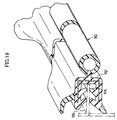
Fig. 19 shows a state in which a weather strip 110 for a
vehicle, which serves as an example of a conventional resin part,
is mounted to a vehicle body panel flange 116.
-
Nipping lip portions 114 project at an inner side of a U-shaped
nipping portion 112 of the weather strip 110. When the weather
strip 110 is mounted to a vehicle body panel, the nipping lip
portions 114 are elastically deformed and are fit to the vehicle
body panel flange 116. Then, in the state in which the weather
strip 110 is mounted, the nipping lip portions 114 nip the vehicle
body panel flange 116 due to the elastic force (the force of
attempting to return to the configuration before elastic
deformation) of the nipping lip portions 114.
-
In this way, at the conventional weather strip 110, the
nipping lip portions 114 are elastically deformed and are made
to engage with the vehicle body panel flange 116 (member to be
engaged) . Thus, at the time of mounting, a load which is sufficient
to elastically deform the nipping lip portions 114 (load required
at the time of mounting) is needed, and the mounting workability
is poor. Further, in order to prevent the weather strip 110 from
inadvertently coming off of the vehicle body panel flange 116,
it is desirable to make large the elastic force of the nipping
lip portions 114 (the engaging force of the nipping lip portions
114 with respect to the vehicle body panel flange 116, in other
words, the load needed to remove the weather strip 110). However,
when the engaging force of the nipping lip portions 114 is made
large in this way, the load required at the time of mounting is
also large.
-
In order to prevent such a deterioration in the mounting
workability, for example, making the engaging force of the nipping
lip portions 114 small has been contemplated. However, when the
engaging force of the nipping lip portions 114 is made small, it
is easy for the weather strip 110 to come off of the vehicle body
panel flange 116. Namely, it has been difficult to achieve
improvements in both the mounting workability and the engaging
force.
-
Such a drawback is not limited to the above-described weather
strip 110, and is a problem generally had by resin parts at which
plate-shaped engaging portions such as the nipping lip portions
114 are flexurally deformed, and which are engaged with a member
to be engaged due to this elastic force.
DISCLOSURE OF THE INVENTION
-
The present invention takes the above-described
circumstances into consideration, and an object is to provide a
resin part which has a small load required at the time of mounting
and a large engaging force and in which it is possible to achieve
both an improvement in workability at the time of the mounting
operation and a difficulty in coming off of a member to be engaged
after mounting, and to a resin part engaging method and a resin
part engaging structure for engaging the resin part to a member
to be engaged.
-
The invention recited in claim 1 is a resin part having an
engaging portion which is engageable with a member to be engaged,
the engaging portion having at least one expanding-and-contracting
portion which is expandable and contractible, wherein,
due to the expanding-and-contracting portion expanding and
contracting, the expanding-and-contracting portion varies
between: an engagement state which is a state in which the engaging
member is engageable with the member to be engaged; and a withdrawn
state which is a state in which the engaging member is not
engageable with the member to be engaged.
-
In the invention recited in claim 2, in the invention recited
in claim 1, the expanding-and-contracting portion includes a
hollow portion.
-
In the invention recited in claim 3, in the invention recited
in claim 2, the expanding-and-contracting portion expands and
contracts due to a fluid flowing into and flowing out from an
interior of the hollow portion.
-
In the invention recited in claim 4, in the invention recited
in claim 2, the expanding-and-contracting portion has a
communicating hole which communicates the hollow portion and an
exterior.
-
In the invention recited in claim 5, in the invention recited
in claim 2, the engaging portion has a plurality of
expanding-and-contracting portions, and the engaging portion
engages with the member to be engaged due to the member to be
engaged being nipped by the plurality of expanding-and-contracting
portions.
-
In the invention recited in claim 6, in the invention recited
in claim 5, at least any one of the plurality of expanding-and-contracting
portions has a communicating hole which
communicates the hollow portion and an exterior.
-
In the invention recited in claim 7, in the invention recited
in claim 5, the engaging portion has a connecting portion which
connects respective hollow portions of the plurality of
expanding-and-contracting portions.
-
In the invention recited in claim 8, in the invention recited
in claim 7, at least any one of the plurality of expanding-and-contracting
portions has a communicating hole which
communicates the hollow portion and an exterior.
-
In the invention recited in claim 9, in the invention recited
in claim 1, the expanding-and-contracting portion is formed of
a material which is elastically deformable.
-
In the invention recited in claim 10, in the invention recited
in claim 2, in a case in which pressure within the hollow portion
is substantially atmospheric pressure, the expanding-and-contracting
portion is set in the engagement state.
-
In the invention recited in claim 11, in the invention recited
in claim 1, the engaging portion has at least one nipping portion,
and the engaging portion engages with the member to be engaged
due to the member to be engaged being nipped by the
expanding-and-contracting portion and the nipping portion.
-
In the invention recited in claim 12, in the invention recited
in claim 11, at least one nipping portion is a nipping lip portion
which is formed in a flexurally deformable substantial plate-shape,
and which, by elastic force of flexural deformation and
together with the expanding-and-contracting portion, nips the
member to be engaged.
-
In the invention recited in claim 13, in the invention recited
in claim 4, the expanding-and-contracting portion is the engaging
portion, and the hollow portion also serves as the communicating
hole.
-
In the invention recited in claim 14, in the invention recited
in claim 1, the resin part is a sealing member for a vehicle cover
which seals between a cover provided at a vehicle and the vehicle.
-
In the invention recited in claim 15, in the invention recited
in claim 1, the resin part is a trim for a vehicle opening which
is disposed at an opening provided at a vehicle.
-
The invention recited in claim 16 is a resin part engaging
method for engaging, to a member to be engaged, a resin part having
an engaging portion which is engageable with the member to be
engaged, the engaging portion having at least one expanding-and-contracting
portion, and due to the expanding-and-contracting
portion expanding and contracting, the expanding-and-contracting
portion varies between an engagement state which
is a state in which the engaging member is engageable with the
member to be engaged, and a withdrawn state which is a state in
which the engaging member is not engageable with the member to
be engaged, said method comprising: a withdrawing step of varying
the expanding-and-contracting portion to the withdrawn state; an
installing step of installing the resin part to the member to be
engaged, when the expanding-and-contracting portion is in the
withdrawn state; and an engaging step of varying, to the
engagement state, the expanding-and-contracting portion of the
resin part which is installed at the member to be engaged.
-
In the invention recited in claim 17, in the invention recited
in claim 16, the withdrawing step is a flow out step of varying
the expanding-and-contracting portion to the withdrawn state by
making fluid of the hollow portion included in the expanding-and-contracting
portion flow out, and the engaging step is a flow
in step of varying the expanding-and-contracting portion to the
engagement state by making fluid flow into the hollow portion.
-
In the invention recited in claim 18, in the invention recited
in claim 17, the flow out step makes fluid of the hollow portion
flow out from a communicating hole which communicates the hollow
portion and an exterior, and the flow in step makes fluid flow
into the hollow portion from the communicating hole.
-
In the invention recited in claim 19, the invention recited
in claim 16 further comprises a communicating hole forming step
of forming a communicating hole which communicates the hollow
portion and an exterior.
-
In the invention recited in claim 20, in the invention recited
in claim 18, the flow out step is a pressure reducing step of
reducing pressure within the hollow portion by principles of
spraying.
-
In the invention recited in claim 21, in the invention recited
in claim 18, the flow in step is an atmospheric pressure restoring
step which makes pressure within the hollow portion substantially
atmospheric pressure.
-
The invention recited in claim 22 is a resin part engaging
structure for engaging, to a member to be engaged, a resin part
having an engaging portion which is engageable with the member
to be engaged, the engaging portion having at least one
expanding-and-contracting portion, and due to the expanding-and-contracting
portion expanding and contracting, the
expanding-and-contracting portion varies between an engagement
state which is a state in which the engaging member is engageable
with the member to be engaged, and a withdrawn state which is a
state in which the engaging member is not engageable with the
member to be engaged, and the expanding-and-contracting portion
includes a hollow portion, wherein the expanding-and-contracting
portion is varied to the withdrawn state due to fluid within the
hollow portion flowing out, and after installation to the member
to be engaged, the expanding-and-contracting portion is varied
to the engaged state due to fluid flowing into the hollow portion,
and is engaged to the member to be engaged.
-
In the invention recited in claim 1, the engaging portion
has at least one expanding-and-contracting portion, and the
expanding-and-contracting portion can expand and contract. In
this way, the expanding-and-contracting portion can vary to the
engagement state and the withdrawn state. Due to the
expanding-and-contracting portion being set in the engagement
state, the engaging member is set in an engageable state with the
member to be engaged. Due to the expanding-and-contracting
portion being set in the withdrawn state, the engaging member is
set in a state at which engagement with the member to be engaged
is not possible. In this way, the expanding-and-contracting
portion is varied to the withdrawn state and the resin part is
installed at the member to be engaged, and in the installed state,
the expanding-and-contracting portion is varied to the engagement
state and the resin part engages the member to be engaged. Thus,
even if the engaging force of the resin part is set to be large,
the load required at the time of mounting can be set small without
being affected thereby. Namely, it is possible to establish both
a small load required at the time of mounting and a large engaging
force, and both prevention of the coming off of the resin part
and an improvement in the mounting workability can be achieved.
-
In the invention recited in claim 2, due to the
expanding-and-contracting portion including the hollow portion,
expansion and contraction of the expanding-and-contracting
portion is easy.
-
In the invention recited in claim 3, because the
expanding-and-contracting portion expands and contracts due to
fluid flowing into and flowing out from the interior of the hollow
portion, expansion and contraction of the expanding-and-contracting
portion can be carried out easily.
-
In the invention recited in claim 4, due to the hollow portion
expanding and contracting, the expanding-and-contracting
portion can vary between the engagement state and the withdrawn
state. Then, by varying the expanding-and-contracting portion to
the withdrawn state, at the time of installation, the
expanding-and-contracting portion is in a state of being
separated from the member to be engaged, and the resin part can
be installed at the member to be engaged by a small force required
at the time of mounting. Further, when the expanding-and-contracting
portion is varied to the withdrawn state, by making
the fluid within the hollow portion flow out to the exterior by
the communicating hole, the hollow portion can be contracted. Thus,
the expanding-and-contracting portion can be easily varied to the
withdrawn state.
-
In the state in which the resin part is installed at the member
to be engaged, the expanding-and-contracting portion is varied
to the engagement state. The engaging portion thereby engages the
member to be engaged. At this time, by making fluid flow into the
hollow portion by the communicating hole, the hollow portion is
extended, and the expanding-and-contracting portion is varied to
the engagement state.
-
In this way, the expanding - and-contracting portion is varied
to the withdrawn state and the resin part is installed at the member
to be engaged, and in the installed state, the expanding-and-contracting
portion is varied to the engagement state and the
resin member is made to engage the member to be engaged. Thus,
even if the engaging force of the resin part is set to be large,
the load required at the time of mounting can be set to be small
without being affected thereby. Namely, it is possible to
establish both a small load required at the time of mounting and
a large engaging force, and both prevention of the coming off of
the resin part and an improvement in the mounting workability can
be achieved.
-
Further, as is recited in claim 5, the engaging portion may
be formed to have a plurality of expanding-and-contracting
portions. In this structure, the member to be engaged is nipped
by the plurality of expanding-and-contracting portions. Further,
in this structure, as is recited in claim 6, all of the plurality
of expanding-and-contracting portions may have communicating
holes, or it is possible for only one of the plurality of
expanding-and-contracting portions to have a communicating hole.
In this way, at least one expanding-and-contracting portion can
be set in the withdrawn state. Further, as is recited in claim
7, respective hollow portions of the plurality of expanding-and-contracting
portions may be connected by a connecting portion.
In this way, fluid in the respective hollow portions of the
plurality of expanding-and-contracting portions can be made to
flow out merely by forming a communicating hole in one of the
plurality of expanding-and-contracting portions.
-
In the invention of claim 9, by elastically deforming the
expanding-and-contracting portion, the expanding-and-contracting
portion can be easily varied between the engagement
state and the withdrawn state.
-
In the invention of claim 10, the expanding-and-contracting
portion can be elastically deformed, air can be made to flow out
from the communicating hole, the hollow portion can be contracted,
and the expanding-and-contracting portion can be set in the
withdrawn state. Note that the operation for making the fluid flow
out from the communicating hole may be reducing pressure by
removing the air from the hollow portion actively by using a
pressure reducing device, or may be pushing and collapsing the
expanding-and-contracting portion from the exterior such that,
as a result, air is made to flow out from the communicating hole.
-
After the resin part is installed at the member to be engaged,
the communicating hole is opened and the interior of the hollow
portion is made to be substantially atmospheric pressure. In this
way, the expanding-and-contracting portion is varied to the
engagement state by elastic force, and engages the member to be
engaged. Because no operation for actively varying the engaging
portion to the engagement state is required (merely the operation
of opening the communicating hole is required), no particular
(complex) operation or device is required, and the mounting
operation of the resin part is even easier.
-
In the invention recited in claim 11, the engaging portion
has at least one nipping portion (e.g., as in the invention recited
in claim 12, a nipping lip portion which is formed in a flexurally
deformable substantial plate-shape). In this way, the engaging
portion can nip the member to be engaged by the expanding-and-contracting
portion and the nipping portion.
-
Accordingly, by changing the configuration (the length or
the thickness or the like) of the nipping portion, the elastic
force of the flexural deformation can be varied. Thus, fine
adjustment of the nipping force which nips the member to be engaged
is possible, and fine adjustment of the load required at the time
of mounting the engaging force is possible. Further, even in cases
in which the configuration of the member to be engaged is not
uniform or the like, by changing the configuration of the nipping
portion in accordance therewith, a sufficient engaging force can
be obtained.
-
Further, as in the invention recited in claim 13, the engaging
portion itself may be a structure which expands and contracts,
and the hollow portion may be a structure which serves as the
communicating hole as well.
-
The resin part recited in any of claims 1 through 13 can be
used in various applications. For example, as recited in claim
14, the resin part can be used as a sealing member for a vehicle
cover which seals between a cover provided at a vehicle and the
vehicle, or as recited in claim 15, the resin part can be used
as a trim for a vehicle opening which is disposed at an opening
provided at a vehicle, and the resin part has high applicability.
-
In the invention of claim 16, the expanding-and-contracting
portion is varied to the withdrawn state in the withdrawing step.
Thus, in the installing step, the resin part can be installed at
the member to be engaged by a small load required at the time of
mounting. Further, in the engaging step, by varying the
expanding-and-contracting portion from the withdrawn state to the
engagement state, the engaging portion is engageable with the
member to be engaged. Thus, even if the engaging force is set to
be large, the load required at the time of mounting can be made
to be small without being affected thereby. Namely, it is possible
to establish both a small load required at the time of mounting
and a large engaging force, and both prevention of the coming off
of the resin part and an improvement in the mounting workability
can be achieved.
-
Further, as in the invention recited in claim 17, in a case
in which the expanding-and-contracting portion has a hollow
portion, the withdrawing step may be a flow out step of varying
the expanding-and-contracting portion to the withdrawn state by
making fluid of the hollow portion included in the expanding-and-contracting
portion flow out, and the engaging step may be
a flow in step of varying the expanding-and-contracting portion
to the engagement state by making fluid flow into the hollow
portion.
-
Further, as in the invention recited in claim 18, in a case
in which a communicating hole which communicates the hollow
portion and the exterior is formed in the expanding-and-contracting
portion, the fluid in the hollow portion may be made
to flow in and flow out from the communicating hole.
-
Namely, because the expanding-and-contracting portion is
varied to the withdrawn state by the flow out step, in the
installing step, the resin part can be installed to the member
to be engaged by a small load required at the time of mounting.
Further, in the flow out step, by making the air within the hollow
portion flow out to the exterior by the communicating hole, the
hollow portion can be contracted. Thus, the expanding-and-contracting
portion can be varied to the withdrawn state by a small
force.
-
After the resin part has been installed at the member to be
engaged in the installing step, when, in the flow in step, fluid
is made to flow in from the communicating hole and the
expanding-and-contracting portion of the resin part which is
installed at the member to be engaged is varied to the engagement
state, the engaging portion engages the member to be engaged. In
the flow in step, by making air flow into the hollow portion by
the communicating hole, the hollow portion is extended, and the
expanding-and-contracting portion can be varied to the engagement
state.
-
Further, the varying of the expanding-and-contracting
portion to the withdrawn state is easy by applying existing
equipment, such as using a generally-used pressure reducing
device (a pump or the like) . As a result, applicability of existing
equipment is broadened.
-
In this way, in the state in which the expanding-and-contracting
portion is varied to the withdrawn state in the flow
out step, the resin part is installed at the member to be engaged
in the installing step, and in the flow in step, the
expanding-and-contracting portion is varied to the engagement
state and the resin part is engaged with the member to be engaged.
Thus, even if the engaging force is set to be large, the load
required at the time of mounting can be made to be small without
being affected thereby. Namely, it is possible to establish both
a small load required at the time of mounting and a large engaging
force, and both prevention of the coming off of the resin part
and an improvement in the mounting workability can be achieved.
-
The invention of claim 19 further has a communicating hole
forming step for forming a communicating hole which communicates
the hollow portion and the exterior. Thus, even in cases in which
no communicating hole has been formed in the expanding-and-contracting
portion, a communicating hole can be formed in the
communicating hole forming step.
-
The principles of spraying used in the invention recited in
claim 20 are applied to pressure reducing devices and the like
which are widely used conventionally. Namely, by using existing
equipment, the pressure of the interior of the hollow portion can
be reduced and the hollow portion contracted, such that the
expanding-and-contracting portion can be varied to the withdrawn
state. Thus, no special device or equipment is required for
varying the expanding-and-contracting portion to the withdrawn
state.
-
In the invention recited in claim 21, the flow in step is
an atmospheric pressure restoring step in which the pressure in
the hollow portion is made to be substantially atmospheric
pressure. Accordingly, even if the expanding-and-contracting
portion is not actively varied to the engagement state, the
interior of the hollow portion can simply be restored to
atmospheric pressure by the atmospheric pressure restoring step,
and the expanding-and-contracting portion can thereby be varied
to the engagement state by elastic force. No special device or
equipment is required in order to vary the expanding-and-contracting
portion to the engagement state, and energy required
therefor is not needed. Thus, the resin part can be engaged to
the member to be engaged at a low cost.
-
In the invention of claim 22, in this way, the fluid is made
to flow out, and at the time of installation, the expanding-and-contracting
portion is set in a state of being withdrawn from
the member to be engaged. Thus, the resin part can be installed
at the member to be engaged by a small force required at the time
of mounting. Then, after the resin part is installed, by making
fluid flow into the hollow portion, the expanding-and-contracting
portion is varied to the engagement state, and the engaging
portion thereby engages the member to be engaged. Thus, even if
the engaging force of the engaging portion is set to be large,
the load required at the time of mounting can be made to be small
without being affected thereby. Namely, it is possible to
establish both a small load required at the time of mounting and
a large engaging force, and both prevention of the coming off of
the resin part and an improvement in the mounting workability can
be achieved.
BRIEF DESCRIPTION OF THE DRAWINGS
-
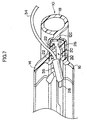
- Fig. 1 is a front view showing a state in which a weather
strip of a first embodiment of the present invention is mounted
to an opening of a luggage room of an automobile.
- Fig. 2 is a cross-sectional view showing the weather strip
of the first embodiment of the present invention in an initial
state.
- Fig. 3 is a front view showing a state in which the weather
strip of the first embodiment of the present invention is mounted
to the opening of the luggage room of the automobile.
- Fig. 4 is a perspective view showing a state in which the
weather strip of the first embodiment of the present invention
is mounted to the opening of the luggage room of the automobile.
- Fig. 5 is an explanatory view showing a schematic structure
of a pressure reducing device which is applied to the present
invention.
- Fig. 6 is a cross-sectional view showing a state in which
the weather strip of the first embodiment of the present invention
is mounted to the opening of the luggage room of the automobile.
- Fig. 7 is a perspective view showing a state in which the
weather strip of the first embodiment of the present invention
is mounted to the opening of the luggage room of the automobile.
- Fig. 8 is a cross-sectional view showing a state in which
the weather strip of the first embodiment of the present invention
is mounted to the opening of the luggage room of the automobile.
- Fig. 9 is a cross-sectional view showing a state in which
the weather strip of the first embodiment of the present invention
is mounted to the opening of the luggage room of the automobile.
- Fig. 10A is a graph showing, per region, an insertion load
of the weather strip of the first embodiment of the present
invention.
- Fig. 10B is an explanatory view showing regions of the weather
strip of the first embodiment of the present invention.
- Fig. 11A is a graph showing, per region, a removal load of
the weather strip of the first embodiment of the present
invention.
- Fig. 11B is an explanatory view showing regions of the weather
strip of the first embodiment of the present invention.
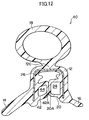
- Fig. 12 is a cross-sectional view showing a weather strip
of a second embodiment of the present invention in an initial
state.
- Fig. 13 is a cross-sectional view showing a state in which
the weather strip of the first embodiment of the present invention
is mounted to the opening of the luggage room of the automobile.
- Fig. 14 is a cross-sectional view showing a weather strip
of a third embodiment of the present invention in an initial state.
- Fig. 15 is a cross-sectional view showing a luggage cushion
rubber of a fourth embodiment of the present invention in an
initial state.
- Fig. 16 is a cross-sectional view showing a state in which
the luggage cushion rubber of the fourth embodiment of the present
invention is mounted to an opening of a luggage room of an
automobile.
- Fig. 17 is a cross-sectional view showing a state in which
the luggage cushion rubber of the fourth embodiment of the present
invention is mounted to the opening of the luggage room of the
automobile.
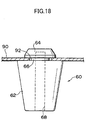
- Fig. 18 is a cross-sectional view showing a state in which
the luggage cushion rubber of the fourth embodiment of the present
invention is mounted to the opening of the luggage room of the
automobile.
- Fig. 19 is a perspective view showing a conventional weather
strip.
- Fig. 20 is perspective view showing a state in which a sealing
member is provided at the conventional weather strip.
-
BEST MODES FOR IMPLEMENTING THE INVENTION
-
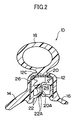
A state in which a weather strip 10 relating to a first
embodiment of the present invention is mounted to an opening edge
82 of a luggage room (trunk) 80 of an automobile, is shown in Fig.
1. Further, a cross-sectional view of an initial state (state
before mounting) of the weather strip 10 is shown in Fig. 2.
Moreover, in Fig. 9, the weather strip 10 is shown in the same
cross-section as in Fig. 2, in a state of being mounted to the
opening 82.
-
The weather strip 10 is formed in a configuration (generally
a closed curve shape, but not limited to such a shape) which can
be placed along the opening 82 of the luggage room 80, by an
elastically deformable material (e.g., rubber or a synthetic
resin or the like). As shown in Fig. 2, the weather strip 10 has
a U-shaped portion 12 having a substantially U-shaped cross-section.
In a state in which the weather strip 10 is mounted to
the opening 82 of the luggage room 80, as can be understood from
Fig. 9, the U-shaped portion 12 is disposed so as to surround a
body flange 84 which projects toward the inner side from the
periphery of the opening 82. Note that a reinforcing plate 26,
which is formed from a highly rigid material such as metal or the
like and which is similarly formed in a U-shape in cross-section
in correspondence with the configuration of the U-shaped portion
12, is embedded in the U-shaped portion 12.
-
Seal lip portions 14, 16, which are inclined in directions
of moving away from each other, project from a vicinity of the
distal end (a vicinity of the lower end in Fig. 2) of the U-shaped
portion 12. In a state in which the weather strip 10 is mounted
to the opening 82 as shown in Fig. 8, the seal lip portion 14 is
elastically press-fit against a body panel 86 of the opening 82.
Further, in a state in which the weather strip 10 is mounted to
the opening 82, the seal lip portion 16 is similarly elastically
press-fit against a body panel (not illustrated) of the opening
82.
-
A hollow seal portion 18, whose cross-section is annular,
projects from an intermediate portion 12C of the U-shaped portion
12. When a luggage back door 88 is closed in the state in which
the weather strip 10 is mounted to the opening 82, the hollow seal
portion 18 is press-fit against the luggage back door 88. In this
way, the interior of the luggage room 80 is sealed such that
rainwater or dust or the like do not enter therein.
-
A nipping tubular portion 20 and nipping lip portions 22
project from the inner side of the U-shaped portion 12 so as to
oppose each other. The configurations of the nipping tubular
portion 20 and the nipping lip portions 22 are determined such
that, in an initial state (the natural state before the weather
strip 10 is mounted to the opening 82), as can be seen from Fig.
2, respective projecting ends 20A, 22A thereof elastically deform
and are tightly fit together.
-
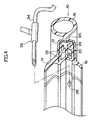
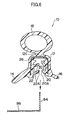
The nipping tubular portion 20 is substantially tubular in
cross-section, and the interior thereof is a hollow portion 24.
Further, as shown in Fig. 4, a communicating hole 28, which
communicates the hollow portion 24 and the exterior, is formed
in the nipping tubular portion 20. Due to air flowing out from
the hollow portion 24 through this communicating hole 28, the
hollow portion 24 contracts, and as shown in Fig. 6, the projecting
end 20A of the nipping tubular portion 20 moves apart from the
projecting ends 22A of the nipping lip portions 22, and the
projecting end 20A moves to a withdrawn position (the nipping
tubular portion 20 is set in a withdrawn state). In this state,
a clearance 30, which is larger than the plate thickness of the
body flange 84, is formed between the projecting end 20A of the
nipping tubular portion 20 and the projecting ends 22A of the
nipping lip portions 22.
-
The nipping tubular portion 20 may be formed continuously
along the longitudinal direction of the U-shaped portion 12, or
may be divided in the longitudinal direction, or may be formed
at parts, in relation to the body flange 84. Further, with regard
to the communicating hole 28 as well, as long as a reduction of
pressure within the hollow portion 24 as will be described later
is possible, one communicating hole 28 suffices, but two or more
may be formed.
-
In contrast, the nipping lip portions 22 are formed in
substantial plate-shapes which are flexurally deformable. Due to
the nipping lip portions 22 flexurally deforming, the projecting
ends 22A flexurally deform in directions of approaching and moving
apart from the projecting end 20A of the nipping tubular portion
20, and the body flange 82 can be nipped by the elastic force due
to this flexural deformation.
-
Note that, although two nipping lip portions 22 are formed
in Fig. 2, the number of nipping lip portions 22 is not particularly
limited, and may be one or three or more. Further, in the same
way as the nipping tubular portion 20, the nipping lip portions
22 may be formed continuously along the longitudinal direction
of the U-shaped portion 12, or may be divided in the longitudinal
direction, or may be formed at parts, in relation to the body flange
84.
-
Next, the method of mounting the weather strip 10 of the first
embodiment to the opening 82 of the luggage room 80, and the working
of the weather strip 10 will be described.
-
First, as shown in Fig. 3, in the initial state, the weather
strip 10 is disposed along the opening 82 of the luggage room 80.
At this time, there is no need to fit the body flange 84 (see Fig.
3 and Fig. 6) of the opening 82 into the interior of the U-shaped
portion 12, and it suffices for the U-shaped portion 12 and the
body flange 84 to oppose each other. Then, in this state, the distal
end of a tube 34 of a pressure reducing device 32 is inserted into
the communicating hole 28. The pressure reducing device 32 is not
particularly limited provided that it can reduce the pressure of
the interior of the hollow portion 24 as will be described later,
so as to form the clearance 30, which is larger than the plate
thickness of the body flange 84, between the projecting end 20A
of the nipping tubular portion 20 and the projecting ends 22A of
the nipping lip portions 22. For example, a widely-used device
which is used in assembly lines for general automobiles, e.g.,
a vacuum pump or the like, can be used. Further, a device which
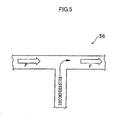
utilizes the principles of spraying can be used. This device is
equipped with a three-forked tube member 36 shown in Fig. 5. Due
to the flow of air in the direction of arrows F of the tube member
36, pressure reduction is carried out as shown in Fig. 5 on the
basis of the principles of so-called spraying. Such pressure
reducing devices utilizing the principles of spraying are often
used in assembly lines of general automobiles, and no special
device is required. Thus, pressure reduction of the interior of
the hollow portion 24 as will be described later can be carried
out at a low cost, and the mounting work of the weather strip 10
can be carried out at a low cost.
-
Then, the pressure reducing device 32 is operated, and air
is made to flow out from the hollow portion 24, and as shown in
Fig. 6 and Fig. 7, the pressure at the interior of the hollow
portion 24 is reduced (pressure reducing step, flow out step).
In this way, the projecting end 20A of the nipping tubular portion
20 moves to the withdrawn position, and the clearance 30, which
is larger than the plate thickness of the body flange 84, is formed
between the projecting ends 22A of the nipping lip portions 22
and the projecting end 20A of the nipping tubular portion 20.
-
In the state in which the clearance 30 is formed in this way,
as shown in Fig. 8, the weather strip 10 is fit and installed at
the body flange 84 (installing step) such that the body flange
84 is inserted between the nipping tubular portion 20 and the
nipping lip portions 22. The clearance 30, which is larger than
the plate thickness of the body flange 84, is formed between the
projecting end 20A of the nipping tubular portion 20 and the
projecting ends 22A of the nipping lip portions 22. At the time
of fitting the weather strip 10, there is no need to elastically
deform the nipping tubular portion 20 and the nipping lip portions
22. Thus the insertion load needed for fitting (load required at
the time of mounting) is small as compared with a structure in
which such a clearance 30 is not formed.
-
Then, the weather strip 10 is fit to the body flange 84 along
the entire periphery of the opening 82, such that the U-shaped
portion of the weather strip 10 and the body flange 84 are set
in a predetermined positional relationship.
-
Finally, when operation of the pressure reducing device 32
(see Fig. 3) is stopped, because the communicating hole 28 is
substantially open, air flows into the hollow portion 24 through
the communicating hole 28, and the pressure within the hollow
portion 24 returns to atmospheric pressure (atmospheric pressure
restoring step, flow in step). In this way, the nipping tubular
portion 20 attempts to revert to the initial state (see Fig. 2)
due to the elastic force thereof, and as shown in Fig. 9, the
projecting end 20A of the nipping tubular portion 20 is strongly
press-fit against the body flange 84. Then, the body flange 84
is nipped in the plate thickness direction by the projecting end
20A of the nipping tubular portion 20 and the projecting ends 22A
of the nipping lip portions 22. By the above, as shown in Fig.
1, mounting of the weather strip 10 is completed.
-
Note that, in the atmospheric pressure restoring step, the
projecting end 20A can be made to strongly press-fit against the
body flange 84 merely by stopping operation of the pressure
reducing device 32, and no operation for actively restoring the
nipping tubular portion 20 to the original state is particularly
required. Because no particular device or step is required
therefor, the atmospheric pressure restoring operation within the
hollow portion 24 can be carried out. Accordingly, an increase
in the costs of the mounting operation of the weather strip 10
can be prevented, and the mounting operation can be carried out
at a low cost.
-
In this way, at the weather strip 10 of the first embodiment,
at the time of mounting, the clearance 30 is formed, and the
insertion load (load required at the time of mounting) is made
small. Thus, the engaging force of the weather strip 10, or in
other words, the removal load, can be made large without directly
affecting the insertion load. In other words, the insertion load
and the engaging load (force) can be set independently, and it
is possible to make the insertion load small and to make the
engaging load great. Thus, an improvement in the workability of
the mounting operation and prevention of the weather strip 10 from
coming off can both be achieved at high levels.
-
Note that, in order to make the insertion load (load required
at the time of mounting) small in this way, it is not absolutely
necessary for the clearance 30 between the projecting end 20A of
the nipping tubular portion 20 and the projecting ends 22A of the
nipping lip portions 22 to be larger than the plate thickness of
the body flange 84. Namely, even in a case in which the clearance
30 is smaller than the plate thickness of the body flange 84, or
a case in which the clearance 30 is not formed and the projecting
end 20A of the nipping tubular portion 20 and the projecting ends
22A of the nipping lip portions 22 contact each other slightly
(the nipping tubular portion 20 and the nipping lip portions 22
contact without substantially elastically deforming), the
projecting end 20A of the nipping tubular portion 20 is, as
compared with the initial state, moved in the direction of moving
away from the projecting ends 22A of the nipping lip portions 22,
and thus, the insertion load is small.
-
Values of the insertion load (load required at the time of
mounting) at each region of the weather strip are shown in a graph
in Fig. 10A for the weather strip 10 of the first embodiment and
a conventional weather strip. Further, values of the removal load
(corresponding to the engaging force) at each region of the
weather strip are shown in a graph in Fig. 11A for the weather
strip 10 of the first embodiment and a conventional weather strip.
What is called the "conventional weather strip" here is a
structure in which the nipping lip portions 22 are provided so
as to oppose one another without providing the nipping tubular
portion 20 of the present embodiment, such as the structure shown
in Fig. 19 for example. Further, the positions of the respective
regions of the weather strip are, as shown in Fig. 10B and Fig.
11B which show the weather strip as seen in front view, denoted
by the reference symbols used in these respective drawings. These
regions correspond one-to-one to the reference symbols shown on
the horizontal axes of the graphs of Figs. 10A and Fig. 11A. Further,
in Fig. 10A and Fig. 11A, "air pressure" is the air pressure within
the hollow portion 24 whose pressure is reduced by the pressure
reducing device 32.
-
As can be understood from the graph shown in Fig. 10A, at
the weather strip 10 of the present embodiment, the insertion load
(load required at the time of mounting) is small as compared with
the conventional weather strip, regardless of the air pressure
and regardless of the region of the weather strip 10.
-
As can be understood from the graph shown in Fig. 11A, at
the weather strip 10 of the present embodiment, the removal load
(corresponding to the engaging force) is large as compared with
the conventional weather strip, regardless of the air pressure
and regardless of the region of the weather strip 10.
-
Note that, in the weather strip 10 of the first embodiment,
as compared with the conventional weather strip, the contact
surface area with respect to the body flange 84 is great as can
be seen from Fig. 9, and the weather strip 10 has greater
sealability than the conventional weather strip. In the
conventional weather strip, in order to improve the sealability,
as shown in Fig. 20 for example, a sealing member 118 is disposed
between the body flange 84 and the U-shaped portion 12. However,
in the weather strip 10 of the first embodiment, without any
particular need for such a sealing member, good sealability
between the body flange 84 and the weather strip is ensured, and
liquids such as rainwater or the like can be reliably prevented
from passing through.
-
A cross-sectional view of an initial state of a weather strip
40 of a second embodiment of the present invention is shown in
Fig. 12. In the same way as the weather strip 10 of the first
embodiment, the weather strip 40 of the second embodiment is
mounted to and used at the opening 82 (see Fig. 1) of the luggage
room 80 of an automobile. Because the basic structure is the same,
the same structural elements, members and the like are denoted
by the same reference numerals, and description thereof is
omitted.
-
At the weather strip 40, in place of the nipping lip portions
22 (see Fig. 2) of the first embodiment, a nipping tubular portion
42 having a hollow portion 44 is formed. The nipping tubular
portion 42 opposes the nipping tubular portion 20. The nipping
tubular portion 42 is formed substantially symmetrically to the
nipping tubular portion 20 such that the body flange 84 can be
nipped (see Fig. 13) between a projecting end 42A of the nipping
tubular portion 42 and the projecting end 20A of the nipping
tubular portion 20. Further, at the nipping tubular portion 42
as well, a communicating hole (not shown in Fig. 12) which is
similar to the communicating hole 28 is formed, such that the
hollow portion 44 is communicated with the exterior. Then, in the
initial state, the projecting end 20A of the nipping tubular
portion 20 and the projecting end 42A of the nipping tubular
portion 42 elastically deform and are press-fit, but when the
pressure within the hollow portions 24, 44 is reduced, the
projecting ends 20A, 42A move apart from one another such that
a clearance which is larger than the plate thickness of the body
flange 84 is formed therebetween. Other than this, the weather
strip 40 of the second embodiment is structured the same as the
weather strip 10 of the first embodiment.
-
Accordingly, at the weather strip 40 of the second embodiment
as well, in the same way as the weather strip 10 of the first
embodiment, the pressure reducing device 32 (see Fig. 3) is used
to reduce the pressure within the hollow portions 24, 44, and a
clearance which is larger than the plate thickness of the body
flange 84 is formed between the projecting ends 20A, 42A. The
U-shaped portion 12 can thereby be placed at the body flange 84
by a small insertion load (load required at the time of mounting),
and the weather strip 40 can be installed.
-
Then, by the communicating holes being opened and the
pressures within the hollow portions 24, 44 being set to
atmospheric pressure, the nipping tubular portions 20, 42 attempt
to return to the initial state due to elastic force, and as shown
in Fig. 13, the respective projecting ends 20A, 42A thereof are
strongly press-fit against and nip the body flange 84.
-
In this way, in the weather strip 40 of the second embodiment
as well, the insertion load and the engaging force can be set
independently, and it is possible to make the insertion load small
and to make the engaging force great. Thus, an improvement in the
workability of the mounting operation and prevention of the
weather strip 10 from coming off can both be achieved at high
levels.
-
Further, a case has been described in which, in the weather
strip 40 of the above-described second embodiment, communicating
holes are formed at the nipping tubular portion 20 and the nipping
tubular portion 42, and the hollow portions 24, 44 are
communicated with the exterior. However, it suffices to form a
communicating hole at either one of the nipping tubular portions,
e.g., at only the nipping tubular portion 20. In this case, when
the pressure of the hollow portion 24 is reduced by using the
pressure reducing device 32, only the projecting end 20A of the
nipping tubular portion 20 moves in a direction of moving away
from the projecting end 42A of the nipping tubular portion 42,
and thus, a clearance can be ensured therebetween. Therefore, even
in a case in which the plate thickness of the body flange 84 is
thick, the weather strip 40 can be mounted to the body flange 84
by a small insertion load (load required at the time of mounting).
-
In particular, at the weather strip 40 of the second
embodiment, because the body flange 84 is nipped by the nipping
tubular portions 20, 42, the elastic forces of the nipping tubular
portions 20, 42 can be set to be large, and a greater nipping force
(engaging force) than the weather strip 10 of the first embodiment
can be obtained. In addition, when the pressure of the hollow
portions 24, 44 is reduced by using the pressure reducing device
32, the projecting ends 20A, 42A of the nipping tubular portions
20, 42 move in directions of moving apart from one another. Thus,
it is easy to ensure a large clearance therebetween. Therefore,
even in a case in which the plate thickness of the body flange
84 is thick, the weather strip 40 can be mounted to the body flange
84 by a small insertion load (load required at the time of
mounting).
-
Further, as can be seen by comparing Fig. 9 and Fig. 13, in
a case in which the nipping tubular portion 42 is used, as compared
with the nipping lip portions 22, the contact surface area with
the body flange 84 can be increased. Thus, the weather strip 40
of the second embodiment has even better sealability than the
weather strip 10 of the first embodiment.
-
In contrast, with a structure in which the body flange 84
is nipped by the nipping tubular portion 20 and the nipping lip
portions 22 as in the weather strip 10 of the first embodiment,
it is easy to finely adjust the nipping force. Namely, as compared
with the nipping tubular portion 20, the degrees of freedom of
the configuration, such as the projecting length and thickness
and the like, of the nipping lip portion 22 are great, and by
changing the configuration, it is easy to vary the elastic force.
Accordingly, the nipping force for nipping the body flange 84 can
be finely adjusted by changing the configuration of the nipping
lip portion 22, and the insertion load (load required at the time
of mounting) and the engaging force can be finely adjusted.
Further, even in cases such as when the configuration of the body
flange 84 is not uniform, a nipping lip portion 22 of a
configuration corresponding thereto can be formed, and the body
flange 84 can be reliably nipped.
-
A cross-sectional view of a regular state of a weather strip
50 of a third embodiment of the present invention is shown in Fig.
14. The weather strip 50 of the third embodiment is structured
substantially the same as the weather strip 40 of the second
embodiment, but the two hollow portions 24, 44 are communicated
by a communicating portion 52 which is formed within the U-shaped
portion 12. Further, no communicating hole is formed at the
nipping tubular portion 42. Other than these, the structure is
the same as the weather strip 40 of the second embodiment.
-
Accordingly, in the weather strip 50 of the third embodiment,
when the distal end (see Fig. 4) of the tube 34 of the pressure
reducing device 32 is inserted into the communicating hole 28 and
the pressure within the hollow portion 24 is reduced, the pressure
within the hollow portion 44 is simultaneously reduced. Namely,
as compared with the weather strip 40 of the second embodiment,
operations for respectively reducing the pressure of the two
hollow portions 24, 44 are eliminated, and the pressure of the
interiors of the two hollow portions 24, 44 can be reduced by a
single reduction in pressure. Thus, the workability of the
mounting operation is even more excellent. Note that, it suffices
to not provide a communicating hole at the nipping tubular portion
20, and to only provide a communicating hole at the nipping tubular
portion 42.
-
A luggage cushion rubber 60 relating to a fourth embodiment
of the present invention is shown in Fig. 15. The luggage cushion
rubber 60 is mounted to a body flange 90 of a luggage back door
of an automobile.
-
The entire luggage cushion rubber 60 is formed by rubber (or
an elastically deformable material), and is formed by a cushion
rubber main body 62 and an engaging portion 64 which projects from
the cushion rubber main body 62 via a connecting portion 66.
-
A hollow portion 68 is formed in the engaging portion 64.
Further, a through hole, which passes through the cushion rubber
main body 62 and reaches the hollow portion 68, is formed from
one end (the lower side end portion in Fig. 15) of the cushion
rubber main body 62, and this one end is open to the exterior.
Thus, the hollow portion 68 is communicated with the exterior.
Accordingly, at the luggage cushion rubber 60 of the fourth
embodiment, the hollow portion 68 serves as well as the
communicating hole of the present invention.
-
In the initial state, the engaging portion 64 is larger than
an engagement hole 92 formed in the body flange 90. When the hollow
portion 68 is contracted, the engaging portion 64 as well
contracts correspondingly, and becomes a predetermined
configuration which is smaller than the engagement hole 92. Note
that the cushion main body 62 is larger than the engagement hole
92.
-
When the luggage cushion rubber 60 of the fourth embodiment
which is structured in this way is to be mounted to the body flange
90, first, as shown in Fig. 16, the distal end of the tube 34 of
the pressure reducing device 32 (see Fig. 3) is inserted to a
predetermined position of the hollow portion 68 (a position at
which a gap remains between a deepest portion 68A of the hollow
portion 68 and the distal end of the tube 34, and at which, during
a pressure reducing step which will be described later,
contraction of the engaging portion 64 is not impeded by the tube
34). The pressure reducing device 32 is operated, air is made to
flow out from the interior of the hollow portion 68, and the
pressure is reduced (pressure reducing step, flow out step). In
this way, the engaging portion 64 contracts and becomes smaller
than the engagement hole 92. At this time, the cushion rubber main
body 62 does not contract because the distal end of the tube 34
is inserted in the hollow portion 68 (communicating hole) at the
portion corresponding to the cushion rubber main body 62.
-
In this state, as shown in Fig. 17, the engaging portion 64
is inserted and installed (installation step) in the engagement
hole 92 to a position at which the cushion rubber main body 62
abuts the body flange 90. Because the engaging portion 64 is
smaller than the engagement hole 92, the engaging portion 64 does
not interfere with the engagement hole 92, and can be inserted
smoothly into the engagement hole 92 by a small force.
-
After the engaging portion 64 is inserted into the engagement
hole 92, operation of the pressure reducing device 32 is stopped,
air is made to flow into the hollow portion 68, and the pressure
within the hollow portion 68 is made to be atmospheric pressure
(restoring step, flow in step) . In this way, as shown in Fig. 18,
the engaging portion 64 returns to the initial state due to elastic
force, and becomes larger than the engagement hole 92, and the
engaging portion 64 of the luggage cushion rubber 60 engages with
the body flange 90. Due to the above, the mounting of the luggage
cushion rubber 60 to the body flange 90 is completed.
-
In this way, in the luggage cushion rubber 60 of the fourth
embodiment, by making the engaging portion 64 smaller than the
engagement hole 92 at the time of mounting, the load required for
mounting (load required at the time of mounting) is made small,
and the engaging force of the luggage cushion rubber 60, in other
words, the removal load, can be set to be large without directly
affecting the load required at the time of mounting. Namely,
because the load required at the time of mounting can be made small
and the engaging force can be made large, an improvement in
workability of the mounting operation and preventing the luggage
cushion rubber 60 from coming off can both be achieved at high
levels.
-
As described above, for all of the resin parts of the present
invention (the weather strips 10, 40, 50 and the luggage cushion
rubber 60), the load required at the time of mounting can be made
small and the engaging force can be made large. Thus, an
improvement in workability of the mounting operation of the resin
part and prevention of coming apart from the mounted state can
both be achieved at high levels.
-
Note that the mounting method for mounting the resin part
of the present invention to a member to be mounted to (the body
flange 84 and the body flange 90) is not limited to those described
above. For example, without using the pressure reducing device
32, the nipping tubular portions 20, 42 or the engaging portion
64 can be contracted by being pressed from the exterior. When the
pressure reducing device 32 is used as in the respective
embodiments described above, the entire nipping tubular portions
20, 42 or engaging portion 64 can be contracted uniformly and in
a short time, and thus, this is particularly preferable from the
standpoint of improving the workability of the mounting
operation.
-
Similarly, at the time of engaging the nipping tubular
portions 20, 42 or the engaging portion 64 to the member to be
engaged, it is possible to increase the internal pressure of the
hollow portion not merely by setting the pressure within the
hollow portion to atmospheric pressure, but by actively feeding
air in or the like, such that the nipping tubular portion 20, 42
or the engaging portion 64 is made larger than the initial state.
In such a structure, for example, in the case of the weather strips
of the first through third embodiments, a structure is possible
in which the nipping tubular portions 20, 42 are formed by
materials which do not elastically deform, and are formed in
configurations such that the clearance 30 is formed in the initial
state, and after installation at the body flange 84, air is fed
into the hollow portions such that the nipping tubular portions
20, 42 are made large due to plastic deformation and are press-fit
to the body flange 84. In the case of the luggage cushion rubber
60 of the fourth embodiment as well, similarly, a structure is
possible in which the engaging portion 64 is formed by a material
which does not elastically deform and in a configuration which
is smaller than the engagement hole 92 in the initial state, and
after insertion into the engagement hole 92, air is fed in such
that the engaging portion 64 becomes large due to plastic
deformation and engages with the engagement hole 92.
-
Further, the resin part of the present invention is not
limited to those described above. For example, the resin part may
be a sealing member for a vehicle cover which seals between a
general cover provided at a vehicle (a door for getting in and
out of the vehicle, a trunk hood, a fuel lid, or the like) and
the vehicle, or may be a member for decoration (trim for a vehicle
opening) which is disposed at the periphery of an opening provided
at a vehicle. Moreover, the resin part may be a pillar interior
shielding member which is provided within a pillar of a vehicle.
The pillar interior shielding member may be formed so as to be
larger than the pillar hole in an initial state, but become smaller
than the pillar hole by reducing the pressure of a hollow portion.
-
Further, cases have been described in which a communicating
hole which communicates a hollow portion with the exterior are
formed in the weather strips of the above-described first through
third embodiments and the luggage cushion rubber of the fourth
embodiment. However, a communicating hole is not absolutely
necessary. Namely, even in a case in which no communicating hole
is formed at the nipping tubular portion of the weather strips
of the first through third embodiments, because the nipping
tubular portion is a variable volume structure which is provided
with the hollow portion, the volume of the nipping tubular portion
can be varied relatively freely. Accordingly, as compared with
a case in which a nipping lip portion which is not a variable volume
structure is forcibly elastically deformed and fit at a vehicle
body panel flange as in the conventional art, the weather strip
can be mounted to the body flange by a small insertion load (load
required at the time of mounting). In this case, for example, it
suffices to not use the pressure reducing device, and to (in place
of the flow out step) push and contract the nipping tubular portion
from the exterior (contracting step). Similarly, even in a case
in which no communicating hole is formed in the luggage cushion
rubber of the fourth embodiment, because the engaging portion has
the hollow portion, the volume of the engaging portion can be
varied relatively freely. Accordingly, the luggage cushion rubber
can be mounted to a body flange by a small load (load required
at the time of mounting). In this case as well, for example, it
suffices to not use the pressure reducing device, and to (in place
of the flow out step) push and contract the engaging portion from
the exterior (contracting step).
-
Further, even in a case in which no communicating hole is
formed in the nipping tubular portion of the weather strips of
the first through third embodiments, after mounting
(installation) (or before mounting), a hole, which corresponds
to the communicating hole which communicates the hollow portion
and the exterior, may be formed in the nipping tubular portion.
For example, by forming, by a needle or the like, a hole in the
nipping tubular portion so as to communicate the hollow portion
and the exterior (setting a hole forming step before the flow out
step), effects which are equivalent to the weather strips of the
above-described first through third embodiments can be obtained.
Further, even in a case in which no communicating hole is formed
in the luggage cushion rubber of the fourth embodiment, after
mounting (installation) (or before mounting), a hole, which
corresponds to the communicating hole which communicates the
hollow portion and the exterior, may be formed in the luggage
cushion rubber main body. For example, by forming, by a needle
or the like, a hole in the luggage cushion rubber main body so
as to communicate the hollow portion and the exterior (setting
a hole forming step before the flow out step), effects which are
equivalent to the luggage cushion rubber of the above-described
fourth embodiment can be obtained.