EP1236486A1 - Apparatus and method of playing a variant of chess - Google Patents
Apparatus and method of playing a variant of chess Download PDFInfo
- Publication number
- EP1236486A1 EP1236486A1 EP02250929A EP02250929A EP1236486A1 EP 1236486 A1 EP1236486 A1 EP 1236486A1 EP 02250929 A EP02250929 A EP 02250929A EP 02250929 A EP02250929 A EP 02250929A EP 1236486 A1 EP1236486 A1 EP 1236486A1
- Authority
- EP
- European Patent Office
- Prior art keywords
- player
- king
- squares
- white
- black
- Prior art date
- Legal status (The legal status is an assumption and is not a legal conclusion. Google has not performed a legal analysis and makes no representation as to the accuracy of the status listed.)
- Withdrawn
Links
- 238000000034 method Methods 0.000 title claims abstract description 25
- 241001274613 Corvus frugilegus Species 0.000 claims abstract description 45
- 241001117170 Euplectes Species 0.000 claims abstract description 15
- 241000212384 Bifora Species 0.000 claims abstract description 11
- 238000010586 diagram Methods 0.000 description 24
- 241001290864 Schoenoplectus Species 0.000 description 2
- 230000009191 jumping Effects 0.000 description 2
- 230000001737 promoting effect Effects 0.000 description 2
- 238000012360 testing method Methods 0.000 description 2
- 241000392967 Euplectes gierowii Species 0.000 description 1
- 241000547651 Tricholoma album Species 0.000 description 1
- 238000003491 array Methods 0.000 description 1
- 230000009286 beneficial effect Effects 0.000 description 1
- 230000000763 evoking effect Effects 0.000 description 1
- 230000002045 lasting effect Effects 0.000 description 1
- 239000011159 matrix material Substances 0.000 description 1
- 230000002123 temporal effect Effects 0.000 description 1
Images







Classifications
-
- A—HUMAN NECESSITIES
- A63—SPORTS; GAMES; AMUSEMENTS
- A63F—CARD, BOARD, OR ROULETTE GAMES; INDOOR GAMES USING SMALL MOVING PLAYING BODIES; VIDEO GAMES; GAMES NOT OTHERWISE PROVIDED FOR
- A63F3/00—Board games; Raffle games
- A63F3/00173—Characteristics of game boards, alone or in relation to supporting structures or playing piece
- A63F3/00176—Boards having particular shapes, e.g. hexagonal, triangular, circular, irregular
-
- A—HUMAN NECESSITIES
- A63—SPORTS; GAMES; AMUSEMENTS
- A63F—CARD, BOARD, OR ROULETTE GAMES; INDOOR GAMES USING SMALL MOVING PLAYING BODIES; VIDEO GAMES; GAMES NOT OTHERWISE PROVIDED FOR
- A63F3/00—Board games; Raffle games
- A63F3/00697—Playing pieces
- A63F2003/007—Design of classical playing pieces, e.g. classical chess, draughts or go
Definitions
- This invention relates to chess games, and more particularly to a variation of a chess game.
- Capablanca's vision of what was coined the "state of chess" extended the bounds of his own lifetime by at least 50 years.
- Master players were achieving draws roughly 25% of the time against members of their own class. Perhaps this lead to the eventual manifestation of the euphemism: "The result of a game well-played is a draw”.
- the present invention is directed to a method of playing a variation of chess.
- the method comprises the step of providing a rectangular chessboard having 80 contiguous playing squares disposed thereon.
- the rectangular board includes two player edges that are opposite each other and two non-player edges that are adjacent to the two player edges.
- the board has a-j contiguous columns that are aligned along each of the player edges and 1-8 contiguous rows that are aligned along each of the two non-player edges.
- the method further comprises the step of providing a plurality of conventional chess pieces.
- the plurality of conventional chess pieces include two Rooks, two Bishops, two Knights, a King, a Queen, and eight Pawns for each player.
- the method also comprises the step of providing a plurality of non-conventional chess pieces.
- the plurality of non-conventional chess pieces include a Chancellor, an Archbishop, and two additional Pawns for each player.
- the method includes the step of initially locating the conventional and non-conventional pieces on the two rows of the rectangular chess board that are disposed most proximate to each of the two player edges.
- the Rooks are located at column and row positions a1, j1, a8, and j 8 respectively.
- the Knights are located at positions b1, i1, b8, and i8 respectively.
- the Bishops are located at positions c1, h1, c8 and h8 respectively.
- the Queens are located at positions d1, d8 respectively.
- the Kings are located at positions f1, f8 respectively.
- the Archbishops are located at positions g1, g8 respectively.
- the Pawns are located at positions (a-j)2, (a-j)7 respectively.
- the Chancellor may be moved, at an option of a player, as either a conventional Knight, or a conventional Rook and the Archbishop may be moved, at an option of a player, as a conventional Knight or a conventional
- FIG. 1 a diagram of an arrangement 10 for playing a variation of chess according to the present invention.
- the arrangement 10 includes a chessboard 12 that is rectangular in shape.
- the board 12 is comprised by 80 contiguous playing squares that are represented by the matrix (a1-j8) as shown.
- the board 12 includes two player edges 16 and 18 that are opposite each other and two non-player edges 20 and 22 that are adjacent to the two player edges 16 and 18 respectively.
- a color is associated with each one of a corresponding set of pieces 30 and 31.
- the color white is associated with the pieces 30 that are initially positioned on squares (a-j)1 and (a-j)2.
- the color black is associated with the pieces 31 that are initially positioned on squares (a-j)7 and (a-j)8.
- a plurality of conventional pieces are provided to each player.
- the white conventional pieces include, two Rooks 32a and 32b, two Bishops 36a and 36b, two Knights 34a and 34b, a King 40a, a Queen 37a, and eight Pawns 41a, 41b, 41c, 41d, 41f, 41h, 41i and 41j.
- the black conventional pieces include, two Rooks 32c and 32d, two Bishops 36c and 32d, two Knights 34c and 34d, a King 40b, a Queen 37b, and eight Pawns 41k, 411, 41m, 41n, 41p, 41r, 41s and 41t.
- a plurality of non-conventional chess pieces are provided to each player.
- the white non-conventional chess pieces include, a Chancellor 38a, an Archbishop 39a and two additional Pawns 41e and 41g.
- the black non-conventional chess pieces include, a Chancellor 38b, an Archbishop 39b and two additional Pawns 41(0) and 41q.
- the conventional and non-conventional pieces are initially located on the two rows of the rectangular chess board 12 that are disposed most proximate to each of the two player edges 16 and 18.
- the Rooks 32a, 32b, 32c and 32d are located at column and row positions a1, j1, a8, and j8 respectively.
- the Knights 34a, 32b, 32c and 34d are located at positions b1, i1, b8, and i8 respectively.
- the Bishops 36a, 36b, 36c and 36d are located at positions c1, h1, c8 and h8 respectively.
- the Queens 37a and 37b are located at positions d1, d8 respectively.
- the Kings 40a and 40b are located at positions f1, f8 respectively.
- the Archbishops 39a and 39b are located at positions g1, g8 respectively.
- the Pawns 41a-41j and 41k-41t are located at positions (a-j)2 and (a-j)7 respectively
- the black dots in Fig. 2 illustrate the allowed movement of the Chancellors 40a and 40b during any single turn in the present invention.
- the Chancellors 40a and 40b have the combined power of a conventional Rook or a conventional Knight.
- the Chancellors 40a and 40b thus may be moved, at an option of a player, any number of squares 201 horizontally or vertically that are vacant in the open playing field, or, at the player's option, to any square 302 that can be reached via jumping like a conventional Knight.
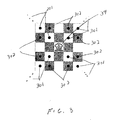
- the black dots in Fig. 3 illustrate the allowed movement of the Archbishops 39a and 39b during any single turn in the present invention.
- the Archbishops 39a and 39b have the combined power of a conventional Bishop or a conventional Knight.
- the Archbishops 39a and 39b may be moved, at an option of a player, any number of squares 301 diagonally that are vacant in the open playing field, or, at the player's option, to any square 302 that can be reached via jumping like a conventional Knight.
- the black dots in Fig. 4 illustrate the allowed movement of the Kings 40a and 40b during any single turn in the present invention.
- the Kings 40a and 40b are the most important piece on the board, and move generally (except during castling) as conventional chess Kings.
- the Kings 40a and 40b are allowed to move one square in any direction that is open on the playing field. Later in the disclosure, it will be shown that another special move, called castling, is also available to the Kings 40a or 40b under certain circumstances. Another rule states that the Kings 40a and 40b are not allowed to be next to one other.
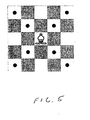
- Fig. 5 illustrates movement of the Bishops 36a-36d, which move generally as conventional chess Bishops.
- the Bishops 36a-36d move diagonally as many squares that are unoccupied in the direction of movement.
- the Bishops 36a-36d in the open playing field, have four different diagonal directions to which they can move. On any turn, the Bishops 36a-36d may move along any one of these paths.
- Fig. 6 illustrates the movement of the Rooks 32a-32d, which move generally as conventional chess Rooks.
- the Rooks 32a-32d move horizontally or vertically as many squares that are unoccupied in the direction of movement.
- the Rooks 32a-32d in the open playing field, have four different directions to which they can move. On any turn, the Rooks 32a-32d may move along any one of these paths.
- Fig. 7 illustrates the movement of the Knights 34a-34d, which move generally as conventional chess Knights.
- the Knights 34a-34d are allowed to "jump over" pieces, as it makes it moves.
- the Knights 34a-34d form an "L” by moving in two stages. First, horizontally or vertically two squares, and second, one square perpendicular to the previous movement. A typical way to describe one of the eight ways the Knights 34a-34d can move is “2 up, and 1 left".
- Fig. 8 illustrates the movement of the Queens 37a and 37b, which move generally as conventional chess Queens.
- the Queens 37a and 37b have the combined power of a Rook and Bishop. As shown below, the Queens 37a and 37b can move any number of squares horizontally, vertically, or diagonally that are vacant in the open playing field.
- Fig. 9 illustrates the movement of the Pawns 41a-41t, which move generally as conventional chess Pawns.
- the Pawns 41a-41t move only in the forward direction. On its first move only, the Pawns 41a-41t may be moved two squares, otherwise the Pawns 41a-41t may only move one square at a time.
- Pawns 41a-41t are unique in that they capture by moving differently than their normal non-capturing advances.
- the pawns 41a-41d may capture any piece that is diagonally one square in front of it.
- Fig. 10 and Fig. 11 show the positions before and after the white pawn 41d captures the black pawn 41(o) respectively.
- the Pawns 41a-41t may make a special type of capturing move referred to as en passant. If one of the white Pawns 41e has moved a total of three squares, and one of the black Pawns 41p lands next to it by evoking the option of moving two spaces on its first move, then the white Pawn 41e may, at the option of the player, remove the black Pawn 41p immediately. In this position, the white Pawn 41e treats the black Pawn 41p as if it moved only one square. The white Pawn 41e then executes a diagonal capture of the black Pawn 41p.
- Fig. 12 shows an initial position with white Pawn 41e having moved three spaces. Fig.
- en passant capture can only be executed immediately after the opponent makes the Pawn move that allows it to occur. That is, if a player waives the option to make an enpulsion capture, his right to evoke it later is removed.
- the Kings 40a and 40b are initially positioned toward the center of the board 12.
- the center of the board 12 is a dangerous location for the Kings 40a and 40b since the center of the board 12 is most vulnerable to attack. Attacking an opponents King 40a or 40b is one of the objects of the game.
- a special move called castling was devised to protect the Kings 40a and 40b.
- Castling allows each of the Kings 40a and 40b and a corresponding one of the Rooks 32a, 32b, 32c or 32d to move on the same turn. Castling isolates the respective white or black King 40a or 40b from the center of the board 12. Castling can be performed "to either side" of the board 12.
- a white King 40a castling side of the board 12 is designated by the squares (f-j)1.
- a white Queen 37a castling side of the board 12 is designated by the squares (a-e)1.
- a black King 40b castling side of the board 12 is designated by the squares (f-j)8 and a black Queen 37b castling side of the board 12 is designated by the squares (a-e)8.
- the white King 40a is positioned at location (i)1 and the white King 40a side Rook 32b is positioned at location (g)1.
- the white King 40a After castling on the white Queen 37a side, the white King 40a is positioned at location (c)1 and the white Queen side rook 32a is positioned at location (d)1. Similarly, after castling on the black King 40b side, the black King 40b is positioned location (i)8 and the black King 40b side Rook 32d is positioned at location (h)8. Further, after castling on the black Queen 37b side, the black King 40b is positioned location (c)8 and the black King 40b side Rook 32c is positioned at location (d)8.
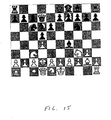
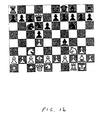
- Fig. 15 shows the position of the board 12 before the white King 40a and white Rook 32b castle on the white King 40a side. Squares g1, h1 and i1 must be clear before castling may occur on the white King 40a. As shown in Fig.
- the castling move allows the white King 40a to move three squares horizontally, after which the Rook 32b is placed on the "other side of” the white King 40a.
- squares b1, c1, d1 and e1 must be clear before castling can occur on the white Queen 37a side.
- squares g8, h8 and i8 must be clear before castling may occur on the black King 40b side and squares b8, c8, d8 and e8 must be clear before castling may occur on the black Queen 37b side.
- the Kings 40a or 40b may not be in check or attacked by any enemy piece.
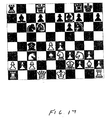
- the white King 40a as shown in Fig. 17, is under attack by the black Archbishop 39b.
- the castling move may not be made by the white King 40a and white Rook 32b while the white King 40a is under attack.
- the white King 40a may not perform the castling move until either the black Archbishop 39b moves away from its position of attack or a white piece blocks the diagonal of attack by the Archbishop 39b.
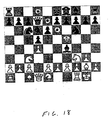
- a final criteria for castling stipulates that each of the squares the respective King 40a or 40b journeys over, must also not be under attack by the opponent. As shown in Fig. 18 the black King 40b may not perform the castle move, even though no pieces are between the black King 40b and the Rook 32c. This is because the white Archbishop 39a is attacking one of the squares the black King 40b must cross in order to complete the castling move. The black King 40b may not perform the castling move until either the white Archbishop 39a moves away from its position of attack or a black piece blocks the diagonal of attack to the black King 40b by the white Archbishop 39a.
- Fig. 19 shows a position where the white Pawn 41c is ready to be promoted on its next move.
- the White Pawns 41a-41j or black Pawns 41k-41t may be promoted to any piece except a white King 40a or black King 40b and or another respective white Pawn 41a-41j or black Pawn 41k-41t.
- a white Pawn 41a-41j will be promoted to a white Queen 37a and a black Pawn 41k-41t will be promoted to a black Queen 37b.
- the white Queen 37a and black Queen 37b are generally felt to be the most powerful pieces on the chessboard 12.
- Fig. 20 shows the position of the chessboard 12 after the white Pawn 41c has been promoted to Queen 37a. Promoting the white Pawn 41c to Queen 37a delivers a check. The opponent that is in check has limited options. Once in check, the next move must not leave the player in check. Such a move is illegal. If a player commits an illegal move, the move is "undone", the player is still in check, and that player must then move out of check. As shown in Fig.
- the newly promoted white Queen 37a is attacking the black King 40b.
- the Queen 37a has the diagonal attacking power of a Bishop and the horizontal and vertical attacking arrays of a Rook.
- the black King 40b cannot move vertically down, since the Kings 40a and 40b are not allowed to be next to one another.
- the black King 40b can, however, move up or to the right.
- the black King 40b can still move to a new square without being under attack therefore, the game is not over.
- Fig. 21 shows the position of the chessboard 12 after the Pawn 41c has been promoted to an Archbishop 39a.
- promoting the Pawn 41c to an Archbishop 39a ends the game.
- the black King 40b is under attack and has no place to move without still being under attack.
- the newly promoted Archbishop 39a is attacking the black King 40b using its diagonal Bishop attack.
- the black King 40b cannot move down, since that would place it next to the white King 40a, which is illegal.
- the black King 40b cannot move to the right or up, since the Knight component attack of the Archbishop 39a denies those as legal retreat squares. Moving right or vertically up would be a move into check, which is illegal.
- the black King 40b is also denied a diagonal move towards the Archbishop 39a, since the diagonal attack of the Archbishop 39a makes such a move illegal. Therefore the black King 40b cannot make a legal move out of check. This condition whereby the black King 40b cannot make a legal move out of check is called checkmate and the game is over.
- a stalemate condition is a draw.
- Fig. 22 shows a position on the board 12 where the black King 40b is to move. The game is a stalemate since the black King 40b has no legal moves.
Landscapes
- Physics & Mathematics (AREA)
- Geometry (AREA)
- Engineering & Computer Science (AREA)
- Multimedia (AREA)
- Toys (AREA)
Abstract
A method of playing a variant of chess that provides a rectangular chessboard
having 80 contiguous playing squares disposed thereon. A plurality of
conventional chess pieces that include two rooks, two bishops, two knights, a
king, a queen, and eight pawns are provided for each player. A plurality of
non-conventional chess pieces that include a chancellor, an archbishop, and
two additional pawns are provided for each player. The conventional and
non-conventional pieces are initially located on two rows of the rectangular
chessboard that are disposed most proximate to each of the two player edges.
After the initially locating step, the chancellor may be moved, at an option of
a player, as either a conventional knight, or a conventional rook. After the
initially locating step, the archbishop may be moved, at an option of a player,
as a conventional knight or a conventional bishop.
Description
This invention relates to chess games, and more particularly to a variation of a
chess game.
Without a doubt, former World Champion (1921-1927) Jose Capablanca was
a phenomenal chess player. Although a term like "genius" is often blearily
bestowed to infranacious recipients, Capablanca surely exceeded all such
criteria, which merit this adornment by orders of magnitude in the chess
domain.
Capablanca's vision of what was coined the "state of chess" extended the
bounds of his own lifetime by at least 50 years. In the 1920's, Master players
were achieving draws roughly 25% of the time against members of their own
class. Perhaps this lead to the eventual manifestation of the euphemism:
"The result of a game well-played is a draw".
In direct consequence to the increasing frequency of draws, chess time
controls were lengthened. Since the end of World War II, longer secondary,
and eventually tertiary temporal controls, have become status quo. Games
previously lasting a couple of hours could now traverse one-fourth of a day or
longer. This prompted Edward Lasker, as early as 1949, to issue the remark:
"We have reached a point where physical fitness and thorough knowledge of
analyzed play are apt to decide the outcome of a match between front-rank
chess masters, rather than ingenuity and profundity."
In the year 2000, it is not uncommon for Grandmasters to peacefully conclude
a game as a draw, as early as the twelfth move. This is basically a mutual
concession that the yet unplayed lines, well-known by both, perhaps even in a
variation contested against each other in a previous encounter, offer nothing
but the promise of several hours of trying to find what is not there; i.e.
something new that is also worthy of testing. There are, of course, an
infinitude of lines to avoid, that have not been played (all for good reason), so
while these would be 'new', we naturally exclude them as 'unworthy to test'
in tournament play.
It would be beneficial to provide a variation of chess that reaches beyond the
traditional 8x8 chessboard and cast of pieces. One that will challenge the
grand masters now and 50 years into the future.
The present invention is directed to a method of playing a variation of chess.
The method comprises the step of providing a rectangular chessboard having
80 contiguous playing squares disposed thereon. The rectangular board
includes two player edges that are opposite each other and two non-player
edges that are adjacent to the two player edges. The board has a-j contiguous
columns that are aligned along each of the player edges and 1-8 contiguous
rows that are aligned along each of the two non-player edges.
The method further comprises the step of providing a plurality of
conventional chess pieces. The plurality of conventional chess pieces include
two Rooks, two Bishops, two Knights, a King, a Queen, and eight Pawns for
each player. The method also comprises the step of providing a plurality of
non-conventional chess pieces. The plurality of non-conventional chess
pieces include a Chancellor, an Archbishop, and two additional Pawns for
each player.
The method includes the step of initially locating the conventional and non-conventional
pieces on the two rows of the rectangular chess board that are
disposed most proximate to each of the two player edges. The Rooks are
located at column and row positions a1, j1, a8, and j 8 respectively. The
Knights are located at positions b1, i1, b8, and i8 respectively. The Bishops
are located at positions c1, h1, c8 and h8 respectively. The Queens are
located at positions d1, d8 respectively. The Kings are located at positions f1,
f8 respectively. The Archbishops are located at positions g1, g8 respectively.
The Pawns are located at positions (a-j)2, (a-j)7 respectively. After the
initially locating step, the Chancellor may be moved, at an option of a player,
as either a conventional Knight, or a conventional Rook and the Archbishop
may be moved, at an option of a player, as a conventional Knight or a
conventional Bishop.
The accompanying drawings, which are incorporated herein and constitute
part of this specification, illustrate the presently preferred embodiment of the
invention, and, together with the general description given above and the
detailed description given below, serve to explain features of the invention.
In the Figures:
In the Figures:
There is shown in Fig. 1, a diagram of an arrangement 10 for playing a
variation of chess according to the present invention. The arrangement 10
includes a chessboard 12 that is rectangular in shape. The board 12 is
comprised by 80 contiguous playing squares that are represented by the
matrix (a1-j8) as shown. The board 12 includes two player edges 16 and 18
that are opposite each other and two non-player edges 20 and 22 that are
adjacent to the two player edges 16 and 18 respectively. There are ten
contiguous columns 24(a-j) that are aligned along each of the player edges 16
and 18, and there are eight contiguous rows 26(a-h) that are aligned along
each of the two non-player edges 20 and 22.
A color is associated with each one of a corresponding set of pieces 30 and
31. The color white is associated with the pieces 30 that are initially
positioned on squares (a-j)1 and (a-j)2. The color black is associated with the
pieces 31 that are initially positioned on squares (a-j)7 and (a-j)8. A plurality
of conventional pieces are provided to each player. The white conventional
pieces include, two Rooks 32a and 32b, two Bishops 36a and 36b, two
Knights 34a and 34b, a King 40a, a Queen 37a, and eight Pawns 41a, 41b,
41c, 41d, 41f, 41h, 41i and 41j. The black conventional pieces include, two
Rooks 32c and 32d, two Bishops 36c and 32d, two Knights 34c and 34d, a
King 40b, a Queen 37b, and eight Pawns 41k, 411, 41m, 41n, 41p, 41r, 41s
and 41t. A plurality of non-conventional chess pieces are provided to each
player. The white non-conventional chess pieces include, a Chancellor 38a,
an Archbishop 39a and two additional Pawns 41e and 41g. The black non-conventional
chess pieces include, a Chancellor 38b, an Archbishop 39b and
two additional Pawns 41(0) and 41q.
The conventional and non-conventional pieces are initially located on the two
rows of the rectangular chess board 12 that are disposed most proximate to
each of the two player edges 16 and 18. The Rooks 32a, 32b, 32c and 32d are
located at column and row positions a1, j1, a8, and j8 respectively. The
Knights 34a, 32b, 32c and 34d are located at positions b1, i1, b8, and i8
respectively. The Bishops 36a, 36b, 36c and 36d are located at positions c1,
h1, c8 and h8 respectively. The Queens 37a and 37b are located at positions
d1, d8 respectively. The Kings 40a and 40b are located at positions f1, f8
respectively. The Archbishops 39a and 39b are located at positions g1, g8
respectively. The Pawns 41a-41j and 41k-41t are located at positions (a-j)2
and (a-j)7 respectively.
In general, there are two types of moves that can be made on the board 12:
those that capture other pieces, and those that do not do capture other pieces.
Captures are executed when a piece of one color moves to occupy the same
square of another color. The Kings 40a and 40b are the only pieces that may
not be captured and taken off of the board. Because of this, when one of the
Kings 40a or 40b is being attacked by an enemy piece, it is said to be in
check. The descriptions to follow identify how each type of piece moves.
The black dots in Fig. 2 illustrate the allowed movement of the Chancellors
40a and 40b during any single turn in the present invention. The Chancellors
40a and 40b have the combined power of a conventional Rook or a
conventional Knight. The Chancellors 40a and 40b thus may be moved, at an
option of a player, any number of squares 201 horizontally or vertically that
are vacant in the open playing field, or, at the player's option, to any square
302 that can be reached via jumping like a conventional Knight.
The black dots in Fig. 3 illustrate the allowed movement of the Archbishops
39a and 39b during any single turn in the present invention. The Archbishops
39a and 39b have the combined power of a conventional Bishop or a
conventional Knight. The Archbishops 39a and 39b may be moved, at an
option of a player, any number of squares 301 diagonally that are vacant in
the open playing field, or, at the player's option, to any square 302 that can be
reached via jumping like a conventional Knight.
The black dots in Fig. 4 illustrate the allowed movement of the Kings 40a and
40b during any single turn in the present invention. The Kings 40a and 40b
are the most important piece on the board, and move generally (except during
castling) as conventional chess Kings. The Kings 40a and 40b are allowed to
move one square in any direction that is open on the playing field. Later in
the disclosure, it will be shown that another special move, called castling, is
also available to the Kings 40a or 40b under certain circumstances. Another
rule states that the Kings 40a and 40b are not allowed to be next to one other.
Fig. 5 illustrates movement of the Bishops 36a-36d, which move generally as
conventional chess Bishops. The Bishops 36a-36d move diagonally as many
squares that are unoccupied in the direction of movement. As shown in Fig.
5, the Bishops 36a-36d, in the open playing field, have four different diagonal
directions to which they can move. On any turn, the Bishops 36a-36d may
move along any one of these paths.
Fig. 6 illustrates the movement of the Rooks 32a-32d, which move generally
as conventional chess Rooks. The Rooks 32a-32d move horizontally or
vertically as many squares that are unoccupied in the direction of movement.
As shown in Fig. 6, the Rooks 32a-32d, in the open playing field, have four
different directions to which they can move. On any turn, the Rooks 32a-32d
may move along any one of these paths.
Fig. 7 illustrates the movement of the Knights 34a-34d, which move generally
as conventional chess Knights. The Knights 34a-34d are allowed to "jump
over" pieces, as it makes it moves. The Knights 34a-34d form an "L" by
moving in two stages. First, horizontally or vertically two squares, and
second, one square perpendicular to the previous movement. A typical way to
describe one of the eight ways the Knights 34a-34d can move is "2 up, and
1 left".
Fig. 8 illustrates the movement of the Queens 37a and 37b, which move
generally as conventional chess Queens. The Queens 37a and 37b have the
combined power of a Rook and Bishop. As shown below, the Queens 37a
and 37b can move any number of squares horizontally, vertically, or
diagonally that are vacant in the open playing field.
Fig. 9 illustrates the movement of the Pawns 41a-41t, which move generally
as conventional chess Pawns. The Pawns 41a-41t move only in the forward
direction. On its first move only, the Pawns 41a-41t may be moved two
squares, otherwise the Pawns 41a-41t may only move one square at a time.
Pawns 41a-41t are unique in that they capture by moving differently than their
normal non-capturing advances. The pawns 41a-41d may capture any piece
that is diagonally one square in front of it. Fig. 10 and Fig. 11 show the
positions before and after the white pawn 41d captures the black pawn 41(o)
respectively.
The Pawns 41a-41t may make a special type of capturing move referred to as
en passant. If one of the white Pawns 41e has moved a total of three squares,
and one of the black Pawns 41p lands next to it by evoking the option of
moving two spaces on its first move, then the white Pawn 41e may, at the
option of the player, remove the black Pawn 41p immediately. In this
position, the white Pawn 41e treats the black Pawn 41p as if it moved only
one square. The white Pawn 41e then executes a diagonal capture of the
black Pawn 41p. Fig. 12 shows an initial position with white Pawn 41e
having moved three spaces. Fig. 13 shows the position after the black Pawn
41p has elected to move two spaces on its first move. Fig. 14 shows the
position after the en passant capture. It should be noted that the en passant
capture can only be executed immediately after the opponent makes the Pawn
move that allows it to occur. That is, if a player waives the option to make an
en passant capture, his right to evoke it later is removed.
The Kings 40a and 40b are initially positioned toward the center of the board
12. The center of the board 12 is a dangerous location for the Kings 40a and
40b since the center of the board 12 is most vulnerable to attack. Attacking
an opponents King 40a or 40b is one of the objects of the game. A special
move called castling was devised to protect the Kings 40a and 40b. At an
option of a player, a castling move may be made. Castling allows each of the
Kings 40a and 40b and a corresponding one of the Rooks 32a, 32b, 32c or 32d
to move on the same turn. Castling isolates the respective white or black
King 40a or 40b from the center of the board 12. Castling can be performed
"to either side" of the board 12.
A white King 40a castling side of the board 12 is designated by the squares
(f-j)1. A white Queen 37a castling side of the board 12 is designated by the
squares (a-e)1. Similarly, a black King 40b castling side of the board 12 is
designated by the squares (f-j)8 and a black Queen 37b castling side of the
board 12 is designated by the squares (a-e)8. After castling on the white King
40a side, the white King 40a is positioned at location (i)1 and the white King
40a side Rook 32b is positioned at location (g)1. After castling on the white
Queen 37a side, the white King 40a is positioned at location (c)1 and the
white Queen side rook 32a is positioned at location (d)1. Similarly, after
castling on the black King 40b side, the black King 40b is positioned location
(i)8 and the black King 40b side Rook 32d is positioned at location (h)8.
Further, after castling on the black Queen 37b side, the black King 40b is
positioned location (c)8 and the black King 40b side Rook 32c is positioned at
location (d)8.
In order for one of the Kings 40a or 40b to enjoy the privilege of castling, the
respective King 40a or 40b must not have moved previously. The same rule
applies to the corresponding one of the white Rooks 32a or 32b or black
Rooks 32c or 32d that participates in the castle. Castling also requires that no
pieces lie on the squares between the respective King 40a or 40b and the
corresponding white Rooks 32a or 32b or black Rooks 32c or 32d that will
participate in the move. For example, Fig. 15 shows the position of the board
12 before the white King 40a and white Rook 32b castle on the white King
40a side. Squares g1, h1 and i1 must be clear before castling may occur on
the white King 40a. As shown in Fig. 16, the castling move allows the white
King 40a to move three squares horizontally, after which the Rook 32b is
placed on the "other side of" the white King 40a. Similarly, squares b1, c1,
d1 and e1 must be clear before castling can occur on the white Queen 37a
side. Further, squares g8, h8 and i8 must be clear before castling may occur
on the black King 40b side and squares b8, c8, d8 and e8 must be clear before
castling may occur on the black Queen 37b side.
Further, prior to a castling move, the Kings 40a or 40b may not be in check or
attacked by any enemy piece. The white King 40a, as shown in Fig. 17, is
under attack by the black Archbishop 39b. The castling move may not be
made by the white King 40a and white Rook 32b while the white King 40a is
under attack. The white King 40a may not perform the castling move until
either the black Archbishop 39b moves away from its position of attack or a
white piece blocks the diagonal of attack by the Archbishop 39b.
A final criteria for castling stipulates that each of the squares the respective
King 40a or 40b journeys over, must also not be under attack by the opponent.
As shown in Fig. 18 the black King 40b may not perform the castle move,
even though no pieces are between the black King 40b and the Rook 32c.
This is because the white Archbishop 39a is attacking one of the squares the black King 40b must cross in order to complete the castling move. The black King 40b may not perform the castling move until either the white Archbishop 39a moves away from its position of attack or a black piece blocks the diagonal of attack to the black King 40b by the white Archbishop 39a.
This is because the white Archbishop 39a is attacking one of the squares the black King 40b must cross in order to complete the castling move. The black King 40b may not perform the castling move until either the white Archbishop 39a moves away from its position of attack or a black piece blocks the diagonal of attack to the black King 40b by the white Archbishop 39a.
Should one of the white Pawns 41a-41j or black Pawns 41k-41t complete the
trek to the opposite row 26h or 26a respectively of the board 12, it can
become "promoted" to become a higher ranking piece. Fig. 19 shows a
position where the white Pawn 41c is ready to be promoted on its next move.
The White Pawns 41a-41j or black Pawns 41k-41t may be promoted to any
piece except a white King 40a or black King 40b and or another respective
white Pawn 41a-41j or black Pawn 41k-41t. There is no limit to the number
of similar pieces on the board 12. For example, even if a player has one white
Queen 37a on the board 12, a subsequent promotion to a second white Queen
37a, is still allowed. This rule holds true for the black pieces 31 as well.
In most instances, a white Pawn 41a-41j will be promoted to a white Queen
37a and a black Pawn 41k-41t will be promoted to a black Queen 37b. The
white Queen 37a and black Queen 37b are generally felt to be the most
powerful pieces on the chessboard 12. Fig. 20 shows the position of the
chessboard 12 after the white Pawn 41c has been promoted to Queen 37a.
Promoting the white Pawn 41c to Queen 37a delivers a check. The opponent
that is in check has limited options. Once in check, the next move must not
leave the player in check. Such a move is illegal. If a player commits an
illegal move, the move is "undone", the player is still in check, and that player
must then move out of check. As shown in Fig. 20, the newly promoted white
Queen 37a is attacking the black King 40b. Recall that the Queen 37a has the
diagonal attacking power of a Bishop and the horizontal and vertical attacking
arrays of a Rook. The black King 40b cannot move vertically down, since the
Kings 40a and 40b are not allowed to be next to one another. The black King
40b can, however, move up or to the right. The black King 40b can still move
to a new square without being under attack therefore, the game is not over.
Fig. 21 shows the position of the chessboard 12 after the Pawn 41c has been
promoted to an Archbishop 39a. In this case, promoting the Pawn 41c to an
Archbishop 39a ends the game. The black King 40b is under attack and has
no place to move without still being under attack. As shown in Fig. 21, the
newly promoted Archbishop 39a is attacking the black King 40b using its
diagonal Bishop attack. The black King 40b cannot move down, since that
would place it next to the white King 40a, which is illegal. The black King
40b cannot move to the right or up, since the Knight component attack of the
Archbishop 39a denies those as legal retreat squares. Moving right or
vertically up would be a move into check, which is illegal. The black King
40b is also denied a diagonal move towards the Archbishop 39a, since the
diagonal attack of the Archbishop 39a makes such a move illegal. Therefore
the black King 40b cannot make a legal move out of check. This condition
whereby the black King 40b cannot make a legal move out of check is called
checkmate and the game is over.
If a player has no legal moves, yet is not in check, the game ends in what is
termed a stalemate. A stalemate condition is a draw. Fig. 22 shows a position
on the board 12 where the black King 40b is to move. The game is a
stalemate since the black King 40b has no legal moves. There are also
conditions where it is impossible to force a checkmate. For example, as
shown in Fig. 23, one black Bishop 36d cannot force checkmate. For that
reason, the position as shown would be declared a draw. There are other
situations in which the game is declared a draw. Should 50 moves elapse
without a Pawn 41a-41t being moved, any white 30 or black piece 31 being
captured, or a castling move being executed, the game is drawn by a "50
Move Rule." Also, should the same position occur with the same side to
move for a third time (not necessarily consecutive) a "Repetition of Position"
draw is announced.
While the principles of the invention have been described above in connection
with the specific associated method, it is to be clearly understood that this
description is made only by way of example and not as a limitation on the
scope of the invention.
Claims (22)
- Apparatus for playing a variant of chess comprising:a rectangular chessboard having 80 contiguous playing squares disposed thereon, wherein the rectangular board includes two player edges being opposite each other and two non-player edges being adjacent to the two player edges, wherein a-j contiguous columns are aligned along each of the player edges and 1-8 contiguous rows are aligned along each of the two non-player edges;a plurality of conventional chess pieces that include two rooks, two bishops, two knights, a king, a queen, and eight pawns for each player; anda plurality of non-conventional chess pieces that include a chancellor, an archbishop, and two additional pawns for each player.
- Apparatus according to claim 1, wherein the conventional and non-conventional pieces are located on two rows of the rectangular chess board that are disposed most proximate to each of the two player edges, wherein the rooks are located at column and row positions a1, j1, a8, and j8 respectively, the knights are located at positions b1, i1, b8, and i8 respectively, the bishops are located at positions c1, h1, c8 and h8 respectively, and the queens are located at positions d1, d8 respectively, and the kings are located at positions f1, f8 respectively, the archbishops are located at positions g1, g8 respectively, and the pawns are located at positions (a-j)2, (a-j)7 respectively.
- Apparatus according to claim 1 or claim 2, wherein a color is associated with the pieces initially positioned on squares (a-j)1 and (a-j)2 and a different color is associated with the pieces initially positioned on squares (a-j)7 and (a-j)8.
- Apparatus according to claim 3, wherein the color associated with the pieces initially positioned on squares (a-j)1 and (a-j)2 is white.
- Apparatus according to claim 3 or claim 4, wherein the color associated with the pieces initially positioned on squares (a-j)7 and (a-j)8 is black.
- A method of playing a variant of chess comprising the steps of:wherein, after the initially locating step, each chancellor may be moved, at an option of a player, as either a conventional knight, or a conventional rook; andproviding a rectangular chessboard having 80 contiguous playing squares disposed thereon, wherein the rectangular board includes two player edges being opposite each other and two non-player edges being adjacent to the two player edges, wherein a-j contiguous columns are aligned along each of the player edges and 1-8 contiguous rows are aligned along each of the two non-player edges;providing a plurality of conventional chess pieces that include two rooks, two bishops, two knights, a king, a queen, and eight pawns for each player;providing a plurality of non-conventional chess pieces that include a chancellor, an archbishop, and two additional pawns for each player;initially locating the conventional and non-conventional pieces on two rows of the rectangular chess board that are disposed most proximate to each of the two player edges, wherein the rooks are located at column and row positions a1, j1, a8, and j8 respectively, the knights are located at positions b1, i1, b8, and i8 respectively, the bishops are located at positions c1, h1, c8 and h8 respectively, and the queens are located at positions d1, d8 respectively, and the kings are located at positions f1, f8 respectively, the archbishops are located at positions g1, g8 respectively, and the pawns are located at positions (a-j)2, (a-j)7 respectively;
wherein, after the initially locating step, each archbishop may be moved, at an option of a player, as a conventional knight or a conventional bishop. - The method according to claim 6, wherein a color is associated with the pieces initially positioned on squares (a-j)1 and (a-j)2.
- The method according to claim 6 or claim 7, wherein a color is associated with the pieces initially positioned on squares (a-j)7 and (a-j)8.
- The method according to any of claims 6 to 8, wherein the color associated with the pieces initially positioned on squares (a-j)1 and (a-j)2 is white.
- The method according to any of claims 6 to 9, wherein the color associated with the pieces initially positioned on squares (a-j)7 and (a-j)8 is black.
- The method according to any of claims 6 to 10, wherein after the initially locating step, at the option of a player, a castling move may be performed by a king and a rook.
- The method according to claim any of claims 6 to 11, wherein a white king castling side of the board is designated by the squares (f-j)1, and a white queen castling side of the board is designated by the squares (a-e)1.
- The method according to claim 12, wherein, a black king castling side of the board is designated by the squares (f-j)8, and a black queen castling side of the board is designated by the squares (a-e)8.
- The method according to any of claims 11 to 13, wherein prior to castling, neither the king, nor the rook, may have made a prior move.
- The method according to any of claims 11 to 14, wherein prior to castling, the pieces initially positioned in the squares spaced between the king and the rook to be castled, must be moved, thus providing a clear path between the king and the rook.
- The method according to any of claims 11 to 15, wherein after castling on the white king side, the white king is positioned at location (i) 1 and the white king side (j)1 rook is positioned at location (g)1.
- The method according to any of claims 11 to 15, wherein after castling on the white queen side, the white king is positioned at location (c)1 and the white queen side (a)1 rook is positioned at location (d)1.
- The method according to any of claims 11 to 17, wherein after castling on the black king side, the black king is positioned at location (i)8 and the black king side (j)8 rook is positioned at location (h)8.
- The method according to any of claims 11 to 17, wherein after castling on the black queen side, the black king is positioned at location (c)8 and the black king side (a)8 rook is positioned at location (d)8.
- The method according to any of claims 6 to 19, wherein a pawn may be advanced to an opposing players edge of the board.
- The method according to claim 20, wherein when the pawn is advanced to an opposing player's edge, the pawn is entitled to be promoted.
- The method according to claim 21, wherein upon promotion of the pawn, the player whose pawn has been promoted, may choose a rook, knight, bishop, queen, archbishop, or chancellor of his own color to replace the pawn.
Applications Claiming Priority (2)
| Application Number | Priority Date | Filing Date | Title |
|---|---|---|---|
| US26819001P | 2001-02-12 | 2001-02-12 | |
| US268190P | 2001-02-12 |
Publications (1)
| Publication Number | Publication Date |
|---|---|
| EP1236486A1 true EP1236486A1 (en) | 2002-09-04 |
Family
ID=23021864
Family Applications (1)
| Application Number | Title | Priority Date | Filing Date |
|---|---|---|---|
| EP02250929A Withdrawn EP1236486A1 (en) | 2001-02-12 | 2002-02-12 | Apparatus and method of playing a variant of chess |
Country Status (2)
| Country | Link |
|---|---|
| US (1) | US6481716B2 (en) |
| EP (1) | EP1236486A1 (en) |
Families Citing this family (10)
| Publication number | Priority date | Publication date | Assignee | Title |
|---|---|---|---|---|
| US6712694B1 (en) * | 2002-09-12 | 2004-03-30 | Igt | Gaming device with rotating display and indicator therefore |
| US7434806B2 (en) | 2004-12-01 | 2008-10-14 | Budden Michael J | Chess variant and method of play thereof |
| ATE485596T1 (en) * | 2004-12-08 | 2010-11-15 | Prema Semiconductor Gmbh | METHOD FOR PRODUCING A SEMICONDUCTOR ARRANGEMENT HAVING A VOLTAGE-RESISTANT PMOSFET SEMICONDUCTOR STRUCTURE AND AN NMOSFET SEMICONDUCTOR STRUCTURE |
| US20060202420A1 (en) * | 2005-03-14 | 2006-09-14 | Alvira Daniel V | Advanced chess game called Magi Chess |
| CA2503168A1 (en) * | 2005-04-18 | 2006-10-18 | George Stevenson | A chess-type game and method of play for 2, 3 or 4 players |
| CA2614030A1 (en) * | 2005-07-06 | 2007-06-14 | Ishihara Tsunekazu | Game piece and method of playing game using same |
| US20100072703A1 (en) * | 2008-09-22 | 2010-03-25 | Antonio Gascon Samaniego | Modified Chess Game |
| CA2874464A1 (en) * | 2012-05-22 | 2013-11-28 | Elgin Delome Thomas | Chess variant game and method |
| US20140274261A1 (en) * | 2013-03-15 | 2014-09-18 | Jamal Aminy | Board game and method of implementing the game |
| US11305178B2 (en) * | 2019-11-24 | 2022-04-19 | John Josef Hench | Chess variant including additional player piece and method of play |
Citations (6)
| Publication number | Priority date | Publication date | Assignee | Title |
|---|---|---|---|---|
| FR2435269A1 (en) * | 1978-09-09 | 1980-04-04 | Schoendorf Werner | Board game similar to chess - has board of eight rows of ten squares each, and two extra pawns and two other figures |
| US5690334A (en) * | 1996-10-21 | 1997-11-25 | Duke; George William | Expanded chess-like game |
| US5692754A (en) * | 1996-10-15 | 1997-12-02 | Sure Realestate Investment Corporation | Advanced chess game and method therefor |
| US6095523A (en) * | 1999-01-25 | 2000-08-01 | Lampman; Michael Alan | Method of playing modified chess game |
| US6116602A (en) * | 1999-01-12 | 2000-09-12 | Mcloy; Mackie C | Enhanced four handed variation of chess |
| US6336632B1 (en) * | 2000-04-04 | 2002-01-08 | Alexander London | Game set, including board and chessmen and related methods and products |
Family Cites Families (3)
| Publication number | Priority date | Publication date | Assignee | Title |
|---|---|---|---|---|
| USRE32716E (en) * | 1975-08-13 | 1988-07-19 | Chess game apparatus | |
| US4033586A (en) * | 1975-08-13 | 1977-07-05 | Corinthios Michael J | Chess game apparatus |
| JPH09307365A (en) * | 1996-05-15 | 1997-11-28 | Alps Electric Co Ltd | Amplifier and mobile phone using the amplifier |
-
2001
- 2001-05-16 US US09/858,361 patent/US6481716B2/en not_active Expired - Fee Related
-
2002
- 2002-02-12 EP EP02250929A patent/EP1236486A1/en not_active Withdrawn
Patent Citations (6)
| Publication number | Priority date | Publication date | Assignee | Title |
|---|---|---|---|---|
| FR2435269A1 (en) * | 1978-09-09 | 1980-04-04 | Schoendorf Werner | Board game similar to chess - has board of eight rows of ten squares each, and two extra pawns and two other figures |
| US5692754A (en) * | 1996-10-15 | 1997-12-02 | Sure Realestate Investment Corporation | Advanced chess game and method therefor |
| US5690334A (en) * | 1996-10-21 | 1997-11-25 | Duke; George William | Expanded chess-like game |
| US6116602A (en) * | 1999-01-12 | 2000-09-12 | Mcloy; Mackie C | Enhanced four handed variation of chess |
| US6095523A (en) * | 1999-01-25 | 2000-08-01 | Lampman; Michael Alan | Method of playing modified chess game |
| US6336632B1 (en) * | 2000-04-04 | 2002-01-08 | Alexander London | Game set, including board and chessmen and related methods and products |
Also Published As
| Publication number | Publication date |
|---|---|
| US6481716B2 (en) | 2002-11-19 |
| US20020109296A1 (en) | 2002-08-15 |
Similar Documents
| Publication | Publication Date | Title |
|---|---|---|
| US6070871A (en) | Board Game | |
| US6116602A (en) | Enhanced four handed variation of chess | |
| US4200293A (en) | Space game | |
| US5125666A (en) | Four-player chess | |
| US6981700B2 (en) | Strategic board game | |
| US6481716B2 (en) | Method of playing a variant of chess | |
| US6260848B1 (en) | Continuation of new improved chesslike game application | |
| US6702287B1 (en) | Method of playing an advanced chess game | |
| US6095523A (en) | Method of playing modified chess game | |
| CN201445777U (en) | Improved chess set | |
| US6550770B1 (en) | Chess game | |
| US7434806B2 (en) | Chess variant and method of play thereof | |
| US20120200039A1 (en) | Board Game | |
| US20100072703A1 (en) | Modified Chess Game | |
| US5901957A (en) | Chess game with archer pieces | |
| US7114723B2 (en) | OCTATRIX™ —strategy game apparatus and method of play | |
| US6098982A (en) | America's chess | |
| US5803457A (en) | Checkers for teams | |
| US20070126179A1 (en) | Betting chess and methods of play | |
| US5449178A (en) | Chess game | |
| US6543772B1 (en) | Multiple level checkers game | |
| US20090096163A1 (en) | Board game | |
| US11305178B2 (en) | Chess variant including additional player piece and method of play | |
| US5772207A (en) | Board game | |
| US6902165B1 (en) | Method for playing variations of chess |
Legal Events
| Date | Code | Title | Description |
|---|---|---|---|
| PUAI | Public reference made under article 153(3) epc to a published international application that has entered the european phase |
Free format text: ORIGINAL CODE: 0009012 |
|
| AK | Designated contracting states |
Kind code of ref document: A1 Designated state(s): AT BE CH CY DE DK ES FI FR GB GR IE IT LI LU MC NL PT SE TR |
|
| AX | Request for extension of the european patent |
Free format text: AL;LT;LV;MK;RO;SI |
|
| AKX | Designation fees paid | ||
| REG | Reference to a national code |
Ref country code: DE Ref legal event code: 8566 |
|
| STAA | Information on the status of an ep patent application or granted ep patent |
Free format text: STATUS: THE APPLICATION IS DEEMED TO BE WITHDRAWN |
|
| 18D | Application deemed to be withdrawn |
Effective date: 20030305 |