EP1235203A2 - Method for concealing erased speech frames and decoder therefor - Google Patents
Method for concealing erased speech frames and decoder therefor Download PDFInfo
- Publication number
- EP1235203A2 EP1235203A2 EP02100190A EP02100190A EP1235203A2 EP 1235203 A2 EP1235203 A2 EP 1235203A2 EP 02100190 A EP02100190 A EP 02100190A EP 02100190 A EP02100190 A EP 02100190A EP 1235203 A2 EP1235203 A2 EP 1235203A2
- Authority
- EP
- European Patent Office
- Prior art keywords
- frame
- excitation
- erased
- decoder
- gain
- Prior art date
- Legal status (The legal status is an assumption and is not a legal conclusion. Google has not performed a legal analysis and makes no representation as to the accuracy of the status listed.)
- Granted
Links
Images


Classifications
-
- G—PHYSICS
- G10—MUSICAL INSTRUMENTS; ACOUSTICS
- G10L—SPEECH ANALYSIS TECHNIQUES OR SPEECH SYNTHESIS; SPEECH RECOGNITION; SPEECH OR VOICE PROCESSING TECHNIQUES; SPEECH OR AUDIO CODING OR DECODING
- G10L19/00—Speech or audio signals analysis-synthesis techniques for redundancy reduction, e.g. in vocoders; Coding or decoding of speech or audio signals, using source filter models or psychoacoustic analysis
- G10L19/005—Correction of errors induced by the transmission channel, if related to the coding algorithm
-
- G—PHYSICS
- G10—MUSICAL INSTRUMENTS; ACOUSTICS
- G10L—SPEECH ANALYSIS TECHNIQUES OR SPEECH SYNTHESIS; SPEECH RECOGNITION; SPEECH OR VOICE PROCESSING TECHNIQUES; SPEECH OR AUDIO CODING OR DECODING
- G10L19/00—Speech or audio signals analysis-synthesis techniques for redundancy reduction, e.g. in vocoders; Coding or decoding of speech or audio signals, using source filter models or psychoacoustic analysis
- G10L19/04—Speech or audio signals analysis-synthesis techniques for redundancy reduction, e.g. in vocoders; Coding or decoding of speech or audio signals, using source filter models or psychoacoustic analysis using predictive techniques
- G10L19/08—Determination or coding of the excitation function; Determination or coding of the long-term prediction parameters
- G10L19/12—Determination or coding of the excitation function; Determination or coding of the long-term prediction parameters the excitation function being a code excitation, e.g. in code excited linear prediction [CELP] vocoders
-
- G—PHYSICS
- G10—MUSICAL INSTRUMENTS; ACOUSTICS
- G10L—SPEECH ANALYSIS TECHNIQUES OR SPEECH SYNTHESIS; SPEECH RECOGNITION; SPEECH OR VOICE PROCESSING TECHNIQUES; SPEECH OR AUDIO CODING OR DECODING
- G10L19/00—Speech or audio signals analysis-synthesis techniques for redundancy reduction, e.g. in vocoders; Coding or decoding of speech or audio signals, using source filter models or psychoacoustic analysis
- G10L2019/0001—Codebooks
- G10L2019/0011—Long term prediction filters, i.e. pitch estimation
-
- G—PHYSICS
- G10—MUSICAL INSTRUMENTS; ACOUSTICS
- G10L—SPEECH ANALYSIS TECHNIQUES OR SPEECH SYNTHESIS; SPEECH RECOGNITION; SPEECH OR VOICE PROCESSING TECHNIQUES; SPEECH OR AUDIO CODING OR DECODING
- G10L19/00—Speech or audio signals analysis-synthesis techniques for redundancy reduction, e.g. in vocoders; Coding or decoding of speech or audio signals, using source filter models or psychoacoustic analysis
- G10L2019/0001—Codebooks
- G10L2019/0012—Smoothing of parameters of the decoder interpolation
-
- G—PHYSICS
- G10—MUSICAL INSTRUMENTS; ACOUSTICS
- G10L—SPEECH ANALYSIS TECHNIQUES OR SPEECH SYNTHESIS; SPEECH RECOGNITION; SPEECH OR VOICE PROCESSING TECHNIQUES; SPEECH OR AUDIO CODING OR DECODING
- G10L25/00—Speech or voice analysis techniques not restricted to a single one of groups G10L15/00 - G10L21/00
- G10L25/93—Discriminating between voiced and unvoiced parts of speech signals
- G10L2025/935—Mixed voiced class; Transitions
Definitions
- the present invention relates to electronic devices, and more particularly to speech coding, transmission, storage, and decoding/synthesis methods and circuitry.
- the performance of digital speech systems using low bit rates has become increasingly important with current and foreseeable digital communications.
- Both dedicated channel and packetized-over-network (e.g., Voice over IP or Voice over Packet) transmissions benefit from compression of speech signals.
- the widely-used linear prediction (LP) digital speech coding compression method models the vocal tract as a time-varying filter and a time-varying excitation of the filter to mimic human speech.
- M the order of the linear prediction filter, is taken to be about 10-12; the sampling rate to form the samples s(n) is typically taken to be 8 kHz (the same as the public switched telephone network sampling for digital transmission); and the number of samples ⁇ s(n) ⁇ in a frame is typically 80 or 160 (10 or 20 ms frames).
- a frame of samples may be generated by various windowing operations applied to the input speech samples.
- ⁇ r(n) 2 yields the ⁇ a i ⁇ which furnish the best linear prediction for the frame.
- the coefficients ⁇ a i ⁇ may be converted to line spectral frequencies (LSFs) for quantization and transmission or storage and converted to line spectral pairs (LSPs) for interpolation between subframes.
- LSFs line spectral frequencies
- LSPs line spectral pairs
- the ⁇ r(n) ⁇ is the LP residual for the frame, and ideally the LP residual would be the excitation for the synthesis filter 1/A(z) where A(z) is the transfer function of equation (1).
- the LP residual is not available at the decoder; thus the task of the encoder is to represent the LP residual so that the decoder can generate an excitation which emulates the LP residual from the encoded parameters.
- the LP compression approach basically only transmits/stores updates for the (quantized) filter coefficients, the (quantized) residual (waveform or parameters such as pitch), and (quantized) gain(s).
- a receiver decodes the transmitted/stored items and regenerates the input speech with the same perceptual characteristics. Periodic updating of the quantized items requires fewer bits than direct representation of the speech signal, so a reasonable LP coder can operate at bits rates as low as 2-3 kb/s (kilobits per second).
- the decoder typically has methods to conceal such frame erasures, and such methods may be categorized as either interpolation-based or repetition-based.
- An interpolation-based concealment method exploits both future and past frame parameters to interpolate missing parameters.
- interpolation-based methods provide better approximation of speech signals in missing frames than repetition-based methods which exploit only past frame parameters.
- the interpolation-based method has a cost of an additional delay to acquire the future frame.
- future frames are available from a playout buffer which compensates for arrival jitter of packets, and interpolation-based methods mainly increase the size of the playout buffer.
- Repetition-based concealment which simply repeats or modifies the past frame parameters, finds use in several CELP-based speech coders including G.729, G.723.1, and GSM-EFR.
- the repetition-based concealment method in these coders does not introduce any additional delay or playout buffer size, but the performance of reconstructed speech with erased frames is poorer than that of the interpolation-based approach, especially in a high erased-frame ratio or bursty frame erasure environment.
- the ITU standard G.729 uses frames of 10 ms length (80 samples) divided into two 5-ms 40-sample subframes for better tracking of pitch and gain parameters plus reduced codebook search complexity.
- Each subframe has an excitation represented by an adaptive-codebook contribution and a fixed (algebraic) codebook contribution.
- the adaptive-codebook contribution provides periodicity in the excitation and is the product of v(n), the prior frame's excitation translated by the current frame's pitch lag in time and interpolated, multiplied by a gain, g P .
- the fixed codebook contribution approximates the difference between the actual residual and the adaptive codebook contribution with a four-pulse vector, c(n), multiplied by a gain, g C .
- G.729 handles frame erasures by reconstruction based on previously received information; that is, repetition-based concealment. Namely, replace the missing excitation signal with one of similar characteristics, while gradually decaying its energy by using a voicing classifier based on the long-term prediction gain (which is computed as part of the long-term postfilter analysis).
- the long-term postfilter finds the long-term predictor for which the prediction gain is more than 3 dB by using a normalized correlation greater than 0.5 in the optimal (pitch) delay determination.
- a 10 ms frame is declared periodic if at least one 5 ms subframe has a long-term prediction gain of more than 3 dB. Otherwise the frame is declared nonperiodic.
- FIG. 1 An erased frame inherits its class from the preceding (reconstructed) speech frame. Note that the voicing classification is continuously updated based on this reconstructed speech signal.
- Figure 2 illustrates the decoder with concealment parameters. The specific steps taken for an erased frame are as follows:
- the present invention provides concealment of erased CELP-encoded frames with (1) repetition concealment but with interpolative re-estimation after a good frame arrives and/or (2) multilevel voicing classification to select excitations for concealment frames as various combinations of adaptive codebook and fixed codebook contributions. This has advantages including improved performance for repetition-based concealment.
- Preferred embodiment decoders and methods for concealment of bad (erased or lost) frames in CELP-encoded speech or other signal transmissions mix repetition and interpolation features by (1) reconstruct a bad frame using repetition but re-estimating the reconstruction after arrival of a good frame and using the re-estimation to modify the good frame to smooth the transition and/or (2) use a frame voicing classification with three (or more) classes to provide three (or more) combinations of the adaptive and fixed codebook contributions for use as the excitation of a reconstructed frame.
- Preferred embodiment systems e.g., Voice over IP or Voice over Packet
- Preferred embodiment concealment methods in decoders.
- Figure 3 illustrates a speech encoder using LP encoding with excitation contributions from both adaptive and fixed codebook, and preferred embodiment concealment features affect the pitch delay, the codebook gains, and the LP synthesis filter. Encoding proceeds as follows:
- the final codeword encoding the (sub)frame would include bits for: the quantized LSF coefficients, adaptive codebook pitch delay, fixed codebook vector, and the quantized adaptive codebook and fixed codebook gains.
- Preferred embodiment decoders and decoding methods essentially reverse the encoding steps of the foregoing encoding method plus provide preferred embodiment repetition-based concealment features for erased frame reconstructions as described in the following sections.
- Figure 4 shows a decoder without concealment features and Figure 1 illustrates the concealment.
- Decoding for a good m th (sub)frame proceeds as follows:
- Preferred embodiment concealment methods apply a repetition method to reconstruct an erased/lost CELP frame, but when a subsequent good frame arrives some preferred embodiments re-estimate (by interpolation) the reconstructed frame's gains and excitation for use in the good frame's adaptive codebook contribution plus smooth the good frame's pitch gains. These preferred embodiments are first described for the case of an isolated erased/lost frame and then for a sequence of erased/lost frames.
- each frame consists of four subframes (e.g., four 5 ms subframes for each 20 ms frame). Then the preferred embodiment methods reconstruct an (m+1) st frame by a repetition method but after the good (m+2) nd frame arrives re-estimate and update with the following decoder steps:
- 1/g S (i) [((3+R)/4) ((2+2R)/4) ((1+3R)/4)R] w(i) where R is the ratio g P (m+2) /g P (m) .
- R the ratio g P (m+2) /g P (m) .
- subframe 2 increases it to 1.007g P (m)
- subframe 3 increases it to 1.015g P (m)
- the biggest jump between subframes is 0.008g P (m) rather than 0.03g P (m) without smoothing.
- the re-estimation P (m+1) (i) and re-computation of the excitations for the (m+1) frame can be performed without the smoothing g Pmod (m+2) (i), and conversely, the smoothing can be performed without the re-computation of excitations.
- the prior preferred embodiments describe pitch gain reestimation and smoothing for the case of four subframes per frame.
- the re-estimation of the pitch gains g P (m+1) (i) from step (4) by linear interpolation as in steps (8)-(10) are revised so that: where G (m) is just g P (m) (2) and G (m+2) is just g P (m+2) (1).
- G (m) is the pitch gain of the subframe of the good m th frame which is adjacent the reconstructed frame and similarly G (m+2) is the pitch gain of the subframe of the good (m+2) nd frame which is adjacent the reconstructed frame.
- Repetition methods for concealing erased/lost CELP frames may reconstruct an excitation based on a periodicity (e.g., voicing) classification of the prior good frame: if the prior frame was voiced, then only use the adaptive codebook contribution to the excitation, whereas for an unvoiced prior frame only use the fixed codebook contribution.
- Preferred embodiment reconstruction methods provide three or more voicing classes for the prior good frame with each class leading to a different linear combination of the adaptive and fixed codebook contributions for the excitation.
- the first preferred embodiment reconstruction method uses the long-term prediction gain of the synthesized speech of the prior good frame as the periodicity classification measure.
- the m th frame was a good frame and decoded and speech synthesized, and the (m+1) st frame was erased or lost and is to be reconstructed.
- the same subframe treatment as in foregoing synthesis steps (1)-(7) may apply.
- Subsequent bad frames are reconstructed by repetition of the foregoing steps with the same voicing classification.
- the gains may be attenuated.
- Alternative preferred embodiment repetition methods for reconstruction of erased/lost frames combine the foregoing multilevel periodicity classification with the foregoing reestimation repetition methods as illustrated in Figure 1.
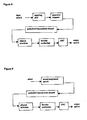
- FIGS 5-6 show in functional block form preferred embodiment systems which use the preferred embodiment encoding and decoding together with packetized transmission such as used over networks. Indeed, the loss of packets demands the use of methods such as the preferred embodiments concealment. This applies both to speech and also to other signals which can be effectively CELP coded.
- the encoding and decoding can be performed with digital signal processors (DSPs) or general purpose programmable processors or application specific circuitry or systems on a chip such as both a DSP and RISC processor on the same chip with the RISC processor controlling.
- DSPs digital signal processors
- RISC processor application specific circuitry
- Codebooks would be stored in memory at both the encoder and decoder, and a stored program in an onboard or external ROM, flash EEPROM, or ferroelectric memory for a DSP or programmable processor could perform the signal processing.
- Analog-to-digital converters and digital-to-analog converters provide coupling to the real world, and modulators and demodulators (plus antennas for air interfaces) provide coupling for transmission waveforms.
- the encoded speech can be packetized and transmitted over networks such as the Internet.
- the preferred embodiments may be modified in various ways while retaining one or more of the features of erased frame concealment in CELP compressed signals by reestimation of a reconstructed frame parameters after arrival of a good frame, smoothing parameters of a good frame following a reconstructed frame, and multilevel periodicity (e.g., voicing) classification for multiple excitation combinations for frame reconstruction.
- multilevel periodicity e.g., voicing
- interval (frame and subframe) size and sampling rate For example, numerical variations of: interval (frame and subframe) size and sampling rate; the number of subframes per frame, the gain attenuation factors, the exponential weights for the smoothing factor, the subframe gains and weights substituting for the subframe gains median, the periodicity classification correlation thresholds, ...
Landscapes
- Engineering & Computer Science (AREA)
- Computational Linguistics (AREA)
- Signal Processing (AREA)
- Health & Medical Sciences (AREA)
- Audiology, Speech & Language Pathology (AREA)
- Human Computer Interaction (AREA)
- Physics & Mathematics (AREA)
- Acoustics & Sound (AREA)
- Multimedia (AREA)
- Compression, Expansion, Code Conversion, And Decoders (AREA)
- Transmission Systems Not Characterized By The Medium Used For Transmission (AREA)
- Communication Control (AREA)
- Air Bags (AREA)
Abstract
Description










Claims (6)
- A method for decoding code-excited linear prediction signals, comprising:(a) forming an excitation for an erased interval of encoded code-excited linear prediction signals by a weighted sum of (i) an adaptive codebook contribution and (ii) a fixed codebook contribution, wherein said adaptive codebook contribution derives from an excitation and pitch and first gain of one or more intervals prior to said erased interval and said fixed codebook contribution derives from a second gain of at least one of said prior intervals;(b) wherein said weighted sum has sets of weights depending upon a periodicity classification of at least one prior interval of encoded signals, said periodicity classification with at least three classes; and(c) filtering said excitation.
- The method of claim 1, wherein said filtering includes a synthesis with synthesis filter coefficients derived from filter coefficients of said intervals prior in time.
- A method for decoding code-excited linear prediction signals, comprising:(a) forming a reconstruction for an erased interval of encoded code-excited linear prediction signals by use parameters of one or more intervals prior to said erased interval;(b) preliminarily decoding a second interval subsequent to said erased interval;(c) combining the results of step (b) with said parameters of step (a) to form a reestimation of parameters for said erased interval; and(d) using the results of step (c) as part of an excitation for said second interval.
- The method of claim 3, further comprising:said step (c) includes smoothing a gain.
- A decoder for CELP encoded signals, comprising:(a) a fixed codebook vector decoder;(b) a fixed codebook gain decoder;(c) an adaptive codebook gain decoder;(d) an adaptive codebook pitch delay decoder;(e) an excitation generator coupled to said decoders; and(f) a synthesis filter;(g) wherein when a received frame is erased, said decoders generate substitute outputs, said excitation generator generates a substitute excitation, said synthesis filter generates substitute filter coefficients, and said excitation generator uses a weighted sum of (i) an adaptive codebook contribution and (ii) a fixed codebook contribution with said weighted sum uses sets of weights depending upon a periodicity classification of at least one prior frame, said periodicity classification with at least three classes.
- A decoder for CELP encoded signals, comprising:(a) a fixed codebook vector decoder;(b) a fixed codebook gain decoder;(c) an adaptive codebook gain decoder;(d) an adaptive codebook pitch delay decoder;(e) an excitation generator coupled to said decoders; and(f) a synthesis filter;(g) wherein when a received frame is erased, said decoders generate substitute outputs, said excitation generator generates a substitute excitation, said synthesis filter generates substitute filter coefficients, and when a second frame is received after said erased frame, said excitation generator combines parameters of said second frame with said substitute outputs to reestimate said substitute outputs to form an excitation for said second frame.
Applications Claiming Priority (2)
| Application Number | Priority Date | Filing Date | Title |
|---|---|---|---|
| US27166501P | 2001-02-27 | 2001-02-27 | |
| US271665 | 2001-02-27 |
Publications (3)
| Publication Number | Publication Date |
|---|---|
| EP1235203A2 true EP1235203A2 (en) | 2002-08-28 |
| EP1235203A3 EP1235203A3 (en) | 2002-09-11 |
| EP1235203B1 EP1235203B1 (en) | 2009-08-12 |
Family
ID=23036537
Family Applications (1)
| Application Number | Title | Priority Date | Filing Date |
|---|---|---|---|
| EP02100190A Expired - Lifetime EP1235203B1 (en) | 2001-02-27 | 2002-02-26 | Method for concealing erased speech frames and decoder therefor |
Country Status (5)
| Country | Link |
|---|---|
| US (1) | US7587315B2 (en) |
| EP (1) | EP1235203B1 (en) |
| JP (1) | JP2002328700A (en) |
| AT (1) | ATE439666T1 (en) |
| DE (1) | DE60233283D1 (en) |
Cited By (6)
| Publication number | Priority date | Publication date | Assignee | Title |
|---|---|---|---|---|
| EP1494404A3 (en) * | 2003-07-02 | 2005-12-14 | Alps Electric Co., Ltd. | Bluetooth module and method for correcting real-time data |
| EP1791115A2 (en) | 2005-11-23 | 2007-05-30 | Broadcom Corporation | Classification-based frame loss concealment for audio signals |
| US20100227338A1 (en) * | 2007-03-22 | 2010-09-09 | Nanologix, Inc. | Method and Apparatus for Rapid Detection and Identification of Live Microorganisms Immobilized On Permeable Membrane by Antibodies |
| CN101583995B (en) * | 2006-11-10 | 2012-06-27 | 松下电器产业株式会社 | Parameter decoding device, parameter encoding device, and parameter decoding method |
| EP2282309A3 (en) * | 2005-05-31 | 2012-10-24 | Microsoft Corporation | Sub-band voice with multi-stage codebooks and redundant coding |
| CN107369455A (en) * | 2014-03-21 | 2017-11-21 | 华为技术有限公司 | The coding/decoding method and device of language audio code stream |
Families Citing this family (31)
| Publication number | Priority date | Publication date | Assignee | Title |
|---|---|---|---|---|
| US7353168B2 (en) * | 2001-10-03 | 2008-04-01 | Broadcom Corporation | Method and apparatus to eliminate discontinuities in adaptively filtered signals |
| CA2388439A1 (en) * | 2002-05-31 | 2003-11-30 | Voiceage Corporation | A method and device for efficient frame erasure concealment in linear predictive based speech codecs |
| JP4303687B2 (en) * | 2003-01-30 | 2009-07-29 | 富士通株式会社 | Voice packet loss concealment device, voice packet loss concealment method, receiving terminal, and voice communication system |
| ATE368279T1 (en) | 2003-05-01 | 2007-08-15 | Nokia Corp | METHOD AND APPARATUS FOR QUANTIZING THE GAIN FACTOR IN A VARIABLE BIT RATE WIDEBAND VOICE ENCODER |
| US7835916B2 (en) * | 2003-12-19 | 2010-11-16 | Telefonaktiebolaget Lm Ericsson (Publ) | Channel signal concealment in multi-channel audio systems |
| JP4698593B2 (en) * | 2004-07-20 | 2011-06-08 | パナソニック株式会社 | Speech decoding apparatus and speech decoding method |
| US7752039B2 (en) * | 2004-11-03 | 2010-07-06 | Nokia Corporation | Method and device for low bit rate speech coding |
| KR100900438B1 (en) * | 2006-04-25 | 2009-06-01 | 삼성전자주식회사 | Voice packet recovery apparatus and method |
| CN1983909B (en) * | 2006-06-08 | 2010-07-28 | 华为技术有限公司 | A device and method for concealing frame loss |
| JP5190363B2 (en) * | 2006-07-12 | 2013-04-24 | パナソニック株式会社 | Speech decoding apparatus, speech encoding apparatus, and lost frame compensation method |
| EP2054880B1 (en) * | 2006-08-15 | 2011-04-20 | Broadcom Corporation | Time-warping of decoded audio signal after packet loss |
| US7877253B2 (en) | 2006-10-06 | 2011-01-25 | Qualcomm Incorporated | Systems, methods, and apparatus for frame erasure recovery |
| US20080120098A1 (en) * | 2006-11-21 | 2008-05-22 | Nokia Corporation | Complexity Adjustment for a Signal Encoder |
| KR20080075050A (en) * | 2007-02-10 | 2008-08-14 | 삼성전자주식회사 | Method and device for parameter update of error frame |
| US8165224B2 (en) | 2007-03-22 | 2012-04-24 | Research In Motion Limited | Device and method for improved lost frame concealment |
| US8468024B2 (en) * | 2007-05-14 | 2013-06-18 | Freescale Semiconductor, Inc. | Generating a frame of audio data |
| US20090055171A1 (en) * | 2007-08-20 | 2009-02-26 | Broadcom Corporation | Buzz reduction for low-complexity frame erasure concealment |
| CN100550712C (en) * | 2007-11-05 | 2009-10-14 | 华为技术有限公司 | A signal processing method and processing device |
| KR100998396B1 (en) * | 2008-03-20 | 2010-12-03 | 광주과학기술원 | Frame loss concealment method, frame loss concealment device and voice transmission / reception device |
| JP2009253348A (en) * | 2008-04-01 | 2009-10-29 | Alps Electric Co Ltd | Data processing method and data processing apparatus |
| US8214201B2 (en) * | 2008-11-19 | 2012-07-03 | Cambridge Silicon Radio Limited | Pitch range refinement |
| US9263049B2 (en) * | 2010-10-25 | 2016-02-16 | Polycom, Inc. | Artifact reduction in packet loss concealment |
| US9626982B2 (en) | 2011-02-15 | 2017-04-18 | Voiceage Corporation | Device and method for quantizing the gains of the adaptive and fixed contributions of the excitation in a CELP codec |
| CA2821577C (en) * | 2011-02-15 | 2020-03-24 | Voiceage Evs Llc | Device and method for quantizing the gains of the adaptive and fixed contributions of the excitation in a celp codec |
| US9123328B2 (en) * | 2012-09-26 | 2015-09-01 | Google Technology Holdings LLC | Apparatus and method for audio frame loss recovery |
| KR20140067512A (en) * | 2012-11-26 | 2014-06-05 | 삼성전자주식회사 | Signal processing apparatus and signal processing method thereof |
| US9842598B2 (en) * | 2013-02-21 | 2017-12-12 | Qualcomm Incorporated | Systems and methods for mitigating potential frame instability |
| PT3011563T (en) | 2013-06-21 | 2020-03-31 | Fraunhofer Ges Forschung | Audio decoding with reconstruction of corrupted or not received frames using tcx ltp |
| CN108011686B (en) * | 2016-10-31 | 2020-07-14 | 腾讯科技(深圳)有限公司 | Information coding frame loss recovery method and device |
| US10763885B2 (en) | 2018-11-06 | 2020-09-01 | Stmicroelectronics S.R.L. | Method of error concealment, and associated device |
| PL4165628T3 (en) | 2020-06-11 | 2025-12-22 | Dolby International Ab | Frame loss concealment for a low-frequency effects channel |
Family Cites Families (10)
| Publication number | Priority date | Publication date | Assignee | Title |
|---|---|---|---|---|
| US5734789A (en) * | 1992-06-01 | 1998-03-31 | Hughes Electronics | Voiced, unvoiced or noise modes in a CELP vocoder |
| CN1100396C (en) * | 1995-05-22 | 2003-01-29 | Ntt移动通信网株式会社 | Sound decoding device |
| US5732389A (en) * | 1995-06-07 | 1998-03-24 | Lucent Technologies Inc. | Voiced/unvoiced classification of speech for excitation codebook selection in celp speech decoding during frame erasures |
| US5699485A (en) * | 1995-06-07 | 1997-12-16 | Lucent Technologies Inc. | Pitch delay modification during frame erasures |
| DE69926821T2 (en) * | 1998-01-22 | 2007-12-06 | Deutsche Telekom Ag | Method for signal-controlled switching between different audio coding systems |
| US6810377B1 (en) * | 1998-06-19 | 2004-10-26 | Comsat Corporation | Lost frame recovery techniques for parametric, LPC-based speech coding systems |
| SE519552C2 (en) * | 1998-09-30 | 2003-03-11 | Ericsson Telefon Ab L M | Multichannel signal coding and decoding |
| US6581032B1 (en) * | 1999-09-22 | 2003-06-17 | Conexant Systems, Inc. | Bitstream protocol for transmission of encoded voice signals |
| US7110947B2 (en) * | 1999-12-10 | 2006-09-19 | At&T Corp. | Frame erasure concealment technique for a bitstream-based feature extractor |
| US6564182B1 (en) * | 2000-05-12 | 2003-05-13 | Conexant Systems, Inc. | Look-ahead pitch determination |
-
2002
- 2002-02-26 EP EP02100190A patent/EP1235203B1/en not_active Expired - Lifetime
- 2002-02-26 DE DE60233283T patent/DE60233283D1/en not_active Expired - Lifetime
- 2002-02-26 AT AT02100190T patent/ATE439666T1/en not_active IP Right Cessation
- 2002-02-27 US US10/085,548 patent/US7587315B2/en active Active
- 2002-02-27 JP JP2002051807A patent/JP2002328700A/en active Pending
Cited By (10)
| Publication number | Priority date | Publication date | Assignee | Title |
|---|---|---|---|---|
| EP1494404A3 (en) * | 2003-07-02 | 2005-12-14 | Alps Electric Co., Ltd. | Bluetooth module and method for correcting real-time data |
| EP2282309A3 (en) * | 2005-05-31 | 2012-10-24 | Microsoft Corporation | Sub-band voice with multi-stage codebooks and redundant coding |
| EP1791115A2 (en) | 2005-11-23 | 2007-05-30 | Broadcom Corporation | Classification-based frame loss concealment for audio signals |
| EP1791115A3 (en) * | 2005-11-23 | 2008-09-03 | Broadcom Corporation | Classification-based frame loss concealment for audio signals |
| US7805297B2 (en) | 2005-11-23 | 2010-09-28 | Broadcom Corporation | Classification-based frame loss concealment for audio signals |
| CN101071568B (en) * | 2005-11-23 | 2012-05-23 | 美国博通公司 | Method and system of audio decoder |
| CN101583995B (en) * | 2006-11-10 | 2012-06-27 | 松下电器产业株式会社 | Parameter decoding device, parameter encoding device, and parameter decoding method |
| US20100227338A1 (en) * | 2007-03-22 | 2010-09-09 | Nanologix, Inc. | Method and Apparatus for Rapid Detection and Identification of Live Microorganisms Immobilized On Permeable Membrane by Antibodies |
| CN107369455A (en) * | 2014-03-21 | 2017-11-21 | 华为技术有限公司 | The coding/decoding method and device of language audio code stream |
| US11031020B2 (en) | 2014-03-21 | 2021-06-08 | Huawei Technologies Co., Ltd. | Speech/audio bitstream decoding method and apparatus |
Also Published As
| Publication number | Publication date |
|---|---|
| EP1235203A3 (en) | 2002-09-11 |
| EP1235203B1 (en) | 2009-08-12 |
| JP2002328700A (en) | 2002-11-15 |
| US20020123887A1 (en) | 2002-09-05 |
| ATE439666T1 (en) | 2009-08-15 |
| US7587315B2 (en) | 2009-09-08 |
| DE60233283D1 (en) | 2009-09-24 |
Similar Documents
| Publication | Publication Date | Title |
|---|---|---|
| US7587315B2 (en) | Concealment of frame erasures and method | |
| US6775649B1 (en) | Concealment of frame erasures for speech transmission and storage system and method | |
| US7606703B2 (en) | Layered celp system and method with varying perceptual filter or short-term postfilter strengths | |
| US6826527B1 (en) | Concealment of frame erasures and method | |
| JP5412463B2 (en) | Speech parameter smoothing based on the presence of noise-like signal in speech signal | |
| RU2419891C2 (en) | Method and device for efficient masking of deletion of frames in speech codecs | |
| US6847929B2 (en) | Algebraic codebook system and method | |
| US8160872B2 (en) | Method and apparatus for layered code-excited linear prediction speech utilizing linear prediction excitation corresponding to optimal gains | |
| KR20010024935A (en) | Speech coding | |
| US5727122A (en) | Code excitation linear predictive (CELP) encoder and decoder and code excitation linear predictive coding method | |
| KR100389895B1 (en) | Method for encoding and decoding audio, and apparatus therefor | |
| EP1103953A2 (en) | Method for concealing erased speech frames | |
| US20010044717A1 (en) | Recursively excited linear prediction speech coder | |
| US7596491B1 (en) | Layered CELP system and method | |
| US20040093204A1 (en) | Codebood search method in celp vocoder using algebraic codebook | |
| JP2968109B2 (en) | Code-excited linear prediction encoder and decoder | |
| EP1355298A2 (en) | Code Excitation linear prediction encoder and decoder | |
| JP3071800B2 (en) | Adaptive post filter | |
| EP1212750A1 (en) | Multimode vselp speech coder | |
| JP2000305598A (en) | Adaptive post filter | |
| Parvez et al. | A speech coder for PC multimedia net‐to‐net communication | |
| CODER | ITU-Tg. 723.1 | |
| HK1124157A (en) | Method and device for efficient frame erasure concealment in speech codecs | |
| HK1117937A (en) | Variable rate speech coding | |
| WO1994029965A1 (en) | Code excitation linear prediction encoder and decoder |
Legal Events
| Date | Code | Title | Description |
|---|---|---|---|
| PUAI | Public reference made under article 153(3) epc to a published international application that has entered the european phase |
Free format text: ORIGINAL CODE: 0009012 |
|
| PUAL | Search report despatched |
Free format text: ORIGINAL CODE: 0009013 |
|
| AK | Designated contracting states |
Kind code of ref document: A2 Designated state(s): AT BE CH CY DE DK ES FI FR GB GR IE IT LI LU MC NL PT SE TR |
|
| AX | Request for extension of the european patent |
Free format text: AL;LT;LV;MK;RO;SI |
|
| AK | Designated contracting states |
Kind code of ref document: A3 Designated state(s): AT BE CH CY DE DK ES FI FR GB GR IE IT LI LU MC NL PT SE TR |
|
| AX | Request for extension of the european patent |
Free format text: AL;LT;LV;MK;RO;SI |
|
| 17P | Request for examination filed |
Effective date: 20030311 |
|
| AKX | Designation fees paid |
Designated state(s): AT BE CH CY DE DK ES FI FR GB GR IE IT LI LU MC NL PT SE TR |
|
| 17Q | First examination report despatched |
Effective date: 20050324 |
|
| GRAP | Despatch of communication of intention to grant a patent |
Free format text: ORIGINAL CODE: EPIDOSNIGR1 |
|
| GRAS | Grant fee paid |
Free format text: ORIGINAL CODE: EPIDOSNIGR3 |
|
| GRAA | (expected) grant |
Free format text: ORIGINAL CODE: 0009210 |
|
| AK | Designated contracting states |
Kind code of ref document: B1 Designated state(s): AT BE CH CY DE DK ES FI FR GB GR IE IT LI LU MC NL PT SE TR |
|
| REG | Reference to a national code |
Ref country code: GB Ref legal event code: FG4D |
|
| REG | Reference to a national code |
Ref country code: CH Ref legal event code: EP |
|
| REG | Reference to a national code |
Ref country code: IE Ref legal event code: FG4D |
|
| REF | Corresponds to: |
Ref document number: 60233283 Country of ref document: DE Date of ref document: 20090924 Kind code of ref document: P |
|
| PG25 | Lapsed in a contracting state [announced via postgrant information from national office to epo] |
Ref country code: AT Free format text: LAPSE BECAUSE OF FAILURE TO SUBMIT A TRANSLATION OF THE DESCRIPTION OR TO PAY THE FEE WITHIN THE PRESCRIBED TIME-LIMIT Effective date: 20090812 Ref country code: SE Free format text: LAPSE BECAUSE OF FAILURE TO SUBMIT A TRANSLATION OF THE DESCRIPTION OR TO PAY THE FEE WITHIN THE PRESCRIBED TIME-LIMIT Effective date: 20090812 Ref country code: ES Free format text: LAPSE BECAUSE OF FAILURE TO SUBMIT A TRANSLATION OF THE DESCRIPTION OR TO PAY THE FEE WITHIN THE PRESCRIBED TIME-LIMIT Effective date: 20091123 Ref country code: FI Free format text: LAPSE BECAUSE OF FAILURE TO SUBMIT A TRANSLATION OF THE DESCRIPTION OR TO PAY THE FEE WITHIN THE PRESCRIBED TIME-LIMIT Effective date: 20090812 |
|
| NLV1 | Nl: lapsed or annulled due to failure to fulfill the requirements of art. 29p and 29m of the patents act | ||
| PG25 | Lapsed in a contracting state [announced via postgrant information from national office to epo] |
Ref country code: NL Free format text: LAPSE BECAUSE OF FAILURE TO SUBMIT A TRANSLATION OF THE DESCRIPTION OR TO PAY THE FEE WITHIN THE PRESCRIBED TIME-LIMIT Effective date: 20090812 |
|
| PG25 | Lapsed in a contracting state [announced via postgrant information from national office to epo] |
Ref country code: PT Free format text: LAPSE BECAUSE OF FAILURE TO SUBMIT A TRANSLATION OF THE DESCRIPTION OR TO PAY THE FEE WITHIN THE PRESCRIBED TIME-LIMIT Effective date: 20091212 |
|
| PG25 | Lapsed in a contracting state [announced via postgrant information from national office to epo] |
Ref country code: DK Free format text: LAPSE BECAUSE OF FAILURE TO SUBMIT A TRANSLATION OF THE DESCRIPTION OR TO PAY THE FEE WITHIN THE PRESCRIBED TIME-LIMIT Effective date: 20090812 |
|
| PLBE | No opposition filed within time limit |
Free format text: ORIGINAL CODE: 0009261 |
|
| STAA | Information on the status of an ep patent application or granted ep patent |
Free format text: STATUS: NO OPPOSITION FILED WITHIN TIME LIMIT |
|
| PG25 | Lapsed in a contracting state [announced via postgrant information from national office to epo] |
Ref country code: BE Free format text: LAPSE BECAUSE OF FAILURE TO SUBMIT A TRANSLATION OF THE DESCRIPTION OR TO PAY THE FEE WITHIN THE PRESCRIBED TIME-LIMIT Effective date: 20090812 |
|
| 26N | No opposition filed |
Effective date: 20100517 |
|
| REG | Reference to a national code |
Ref country code: CH Ref legal event code: PL |
|
| PG25 | Lapsed in a contracting state [announced via postgrant information from national office to epo] |
Ref country code: CH Free format text: LAPSE BECAUSE OF NON-PAYMENT OF DUE FEES Effective date: 20100228 Ref country code: LI Free format text: LAPSE BECAUSE OF NON-PAYMENT OF DUE FEES Effective date: 20100228 Ref country code: MC Free format text: LAPSE BECAUSE OF NON-PAYMENT OF DUE FEES Effective date: 20100301 Ref country code: GR Free format text: LAPSE BECAUSE OF FAILURE TO SUBMIT A TRANSLATION OF THE DESCRIPTION OR TO PAY THE FEE WITHIN THE PRESCRIBED TIME-LIMIT Effective date: 20091113 |
|
| PG25 | Lapsed in a contracting state [announced via postgrant information from national office to epo] |
Ref country code: IE Free format text: LAPSE BECAUSE OF NON-PAYMENT OF DUE FEES Effective date: 20100226 |
|
| PG25 | Lapsed in a contracting state [announced via postgrant information from national office to epo] |
Ref country code: IT Free format text: LAPSE BECAUSE OF FAILURE TO SUBMIT A TRANSLATION OF THE DESCRIPTION OR TO PAY THE FEE WITHIN THE PRESCRIBED TIME-LIMIT Effective date: 20090812 |
|
| PG25 | Lapsed in a contracting state [announced via postgrant information from national office to epo] |
Ref country code: CY Free format text: LAPSE BECAUSE OF FAILURE TO SUBMIT A TRANSLATION OF THE DESCRIPTION OR TO PAY THE FEE WITHIN THE PRESCRIBED TIME-LIMIT Effective date: 20090812 |
|
| PG25 | Lapsed in a contracting state [announced via postgrant information from national office to epo] |
Ref country code: LU Free format text: LAPSE BECAUSE OF NON-PAYMENT OF DUE FEES Effective date: 20100226 |
|
| PG25 | Lapsed in a contracting state [announced via postgrant information from national office to epo] |
Ref country code: TR Free format text: LAPSE BECAUSE OF FAILURE TO SUBMIT A TRANSLATION OF THE DESCRIPTION OR TO PAY THE FEE WITHIN THE PRESCRIBED TIME-LIMIT Effective date: 20090812 |
|
| REG | Reference to a national code |
Ref country code: FR Ref legal event code: PLFP Year of fee payment: 15 |
|
| REG | Reference to a national code |
Ref country code: FR Ref legal event code: PLFP Year of fee payment: 16 |
|
| PGFP | Annual fee paid to national office [announced via postgrant information from national office to epo] |
Ref country code: DE Payment date: 20170227 Year of fee payment: 16 Ref country code: FR Payment date: 20170118 Year of fee payment: 16 |
|
| PGFP | Annual fee paid to national office [announced via postgrant information from national office to epo] |
Ref country code: GB Payment date: 20170126 Year of fee payment: 16 |
|
| REG | Reference to a national code |
Ref country code: DE Ref legal event code: R119 Ref document number: 60233283 Country of ref document: DE |
|
| GBPC | Gb: european patent ceased through non-payment of renewal fee |
Effective date: 20180226 |
|
| REG | Reference to a national code |
Ref country code: FR Ref legal event code: ST Effective date: 20181031 |
|
| PG25 | Lapsed in a contracting state [announced via postgrant information from national office to epo] |
Ref country code: DE Free format text: LAPSE BECAUSE OF NON-PAYMENT OF DUE FEES Effective date: 20180901 |
|
| PG25 | Lapsed in a contracting state [announced via postgrant information from national office to epo] |
Ref country code: GB Free format text: LAPSE BECAUSE OF NON-PAYMENT OF DUE FEES Effective date: 20180226 Ref country code: FR Free format text: LAPSE BECAUSE OF NON-PAYMENT OF DUE FEES Effective date: 20180228 |