EP1234576A1 - Us0027324for eating disorders - Google Patents
Us0027324for eating disorders Download PDFInfo
- Publication number
- EP1234576A1 EP1234576A1 EP00970169A EP00970169A EP1234576A1 EP 1234576 A1 EP1234576 A1 EP 1234576A1 EP 00970169 A EP00970169 A EP 00970169A EP 00970169 A EP00970169 A EP 00970169A EP 1234576 A1 EP1234576 A1 EP 1234576A1
- Authority
- EP
- European Patent Office
- Prior art keywords
- pharmaceutically acceptable
- acceptable salt
- xanthine derivative
- derivative according
- eating disorders
- Prior art date
- Legal status (The legal status is an assumption and is not a legal conclusion. Google has not performed a legal analysis and makes no representation as to the accuracy of the status listed.)
- Granted
Links
- 0 **N(C(c1c(N2*)nc(*)[n]1*)=*)C2=I Chemical compound **N(C(c1c(N2*)nc(*)[n]1*)=*)C2=I 0.000 description 1
Classifications
-
- C—CHEMISTRY; METALLURGY
- C07—ORGANIC CHEMISTRY
- C07D—HETEROCYCLIC COMPOUNDS
- C07D473/00—Heterocyclic compounds containing purine ring systems
- C07D473/02—Heterocyclic compounds containing purine ring systems with oxygen, sulphur, or nitrogen atoms directly attached in positions 2 and 6
- C07D473/04—Heterocyclic compounds containing purine ring systems with oxygen, sulphur, or nitrogen atoms directly attached in positions 2 and 6 two oxygen atoms
- C07D473/06—Heterocyclic compounds containing purine ring systems with oxygen, sulphur, or nitrogen atoms directly attached in positions 2 and 6 two oxygen atoms with radicals containing only hydrogen and carbon atoms, attached in position 1 or 3
- C07D473/12—Heterocyclic compounds containing purine ring systems with oxygen, sulphur, or nitrogen atoms directly attached in positions 2 and 6 two oxygen atoms with radicals containing only hydrogen and carbon atoms, attached in position 1 or 3 with methyl radicals in positions 1, 3, and 7, e.g. caffeine
-
- A—HUMAN NECESSITIES
- A61—MEDICAL OR VETERINARY SCIENCE; HYGIENE
- A61K—PREPARATIONS FOR MEDICAL, DENTAL OR TOILETRY PURPOSES
- A61K31/00—Medicinal preparations containing organic active ingredients
- A61K31/33—Heterocyclic compounds
- A61K31/395—Heterocyclic compounds having nitrogen as a ring hetero atom, e.g. guanethidine or rifamycins
- A61K31/495—Heterocyclic compounds having nitrogen as a ring hetero atom, e.g. guanethidine or rifamycins having six-membered rings with two or more nitrogen atoms as the only ring heteroatoms, e.g. piperazine or tetrazines
- A61K31/505—Pyrimidines; Hydrogenated pyrimidines, e.g. trimethoprim
- A61K31/519—Pyrimidines; Hydrogenated pyrimidines, e.g. trimethoprim ortho- or peri-condensed with heterocyclic rings
- A61K31/52—Purines, e.g. adenine
-
- A—HUMAN NECESSITIES
- A61—MEDICAL OR VETERINARY SCIENCE; HYGIENE
- A61K—PREPARATIONS FOR MEDICAL, DENTAL OR TOILETRY PURPOSES
- A61K31/00—Medicinal preparations containing organic active ingredients
- A61K31/33—Heterocyclic compounds
- A61K31/395—Heterocyclic compounds having nitrogen as a ring hetero atom, e.g. guanethidine or rifamycins
- A61K31/495—Heterocyclic compounds having nitrogen as a ring hetero atom, e.g. guanethidine or rifamycins having six-membered rings with two or more nitrogen atoms as the only ring heteroatoms, e.g. piperazine or tetrazines
- A61K31/505—Pyrimidines; Hydrogenated pyrimidines, e.g. trimethoprim
- A61K31/519—Pyrimidines; Hydrogenated pyrimidines, e.g. trimethoprim ortho- or peri-condensed with heterocyclic rings
- A61K31/52—Purines, e.g. adenine
- A61K31/522—Purines, e.g. adenine having oxo groups directly attached to the heterocyclic ring, e.g. hypoxanthine, guanine, acyclovir
-
- A—HUMAN NECESSITIES
- A61—MEDICAL OR VETERINARY SCIENCE; HYGIENE
- A61P—SPECIFIC THERAPEUTIC ACTIVITY OF CHEMICAL COMPOUNDS OR MEDICINAL PREPARATIONS
- A61P1/00—Drugs for disorders of the alimentary tract or the digestive system
- A61P1/14—Prodigestives, e.g. acids, enzymes, appetite stimulants, antidyspeptics, tonics, antiflatulents
-
- C—CHEMISTRY; METALLURGY
- C07—ORGANIC CHEMISTRY
- C07D—HETEROCYCLIC COMPOUNDS
- C07D473/00—Heterocyclic compounds containing purine ring systems
- C07D473/02—Heterocyclic compounds containing purine ring systems with oxygen, sulphur, or nitrogen atoms directly attached in positions 2 and 6
- C07D473/04—Heterocyclic compounds containing purine ring systems with oxygen, sulphur, or nitrogen atoms directly attached in positions 2 and 6 two oxygen atoms
- C07D473/06—Heterocyclic compounds containing purine ring systems with oxygen, sulphur, or nitrogen atoms directly attached in positions 2 and 6 two oxygen atoms with radicals containing only hydrogen and carbon atoms, attached in position 1 or 3
Definitions
- the present invention relates to therapeutic agents for eating disorders.
- An object of the present invention is to provide excellent therapeutic agents for eating disorders.
- the present invention relates to those described below.
- compound (I) the compound represented by formula (I) is referred to as compound (I).
- the lower alkyl and the lower alkyl moiety in the lower alkoxy mean a straight-chain or branched C 1 -C 6 alkyl group such as methyl, ethyl, propyl, isopropyl, butyl, isobutyl, sec-butyl, tert-butyl, pentyl, neopentyl or hexyl;
- the lower alkenyl means a straight-chain or branched C 2 -C 6 alkenyl group such as vinyl, allyl, methacryl, crotyl, 3-butenyl, 2-pentenyl, 4-pentenyl, 2-hexenyl or 5-hexenyl;
- the lower alkynyl means a straight-chain or branched C 2 -C 6 alkynyl group such as ethynyl, propargyl, 2-butynyl, 3-butynyl, 2-pentynyl, 4-
- the substituted aryl and the substituted heterocyclic group have 1 to 3 independently-selected substituents such as lower alkyl, hydroxy, substituted or unsubstituted lower alkoxy, halogen, nitro, amino, lower alkylamino, di(lower alkyl)amino, trifluoromethyl, trifluoromethoxy, aralkyl, aralkyloxy, aryl, aryloxy, lower alkanoyl, lower alkanoyloxy, aroyl, aroyloxy, arylalkanoyloxy, carboxy, lower alkoxycarbonyl, lower alkylcarbamoyl, di(lower alkyl)carbamoyl, sulfo, lower alkoxysulfonyl, lower alkylsulfamoyl or di(lower alkyl)sulfamoyl.
- substituents such as lower alkyl, hydroxy, substituted or unsubstituted
- the lower alkyl and the alkyl moiety in the lower alkoxy, lower alkylamino, di(lower alkyl)amino, lower alkanoyl, lower alkanoyloxy, lower alkoxycarbonyl, lower alkylcarbamoyl, di(lower alkyl)carbamoyl, lower alkoxysulfonyl, lower alkylsulfamoyl and di(lower alkyl)sulfamoyl have the same meaning as the lower alkyl defined above.
- the halogen has the same meaning as defined above.
- the aryl and the aryl moiety in the aryloxy have the same meaning as the aryl defined above.
- Examples of the aralkyl and the aralkyl moiety in the aralkyloxy are benzyl and phenethyl.
- Examples of the aroyl and the aroyl moiety in the aroyloxy are benzoyl and naphtoyl.
- Examples of the arylalkyl moiety in the arylalkanoyloxy are benzyl and phenethyl.
- substituents for the substituted lower alkoxy are hydroxy, lower alkoxy, halogen, amino, azido, carboxy and lower alkoxycarbonyl.
- the alkyl moiety in the lower alkoxy and lower alkoxycarbonyl has the same meaning as the lower alkyl defined above, and the halogen has the same meaning as the halogen defined above.
- the pharmaceutically acceptable salts of compound (I) include pharmaceutically acceptable acid addition salts, metal salts, ammonium salts, organic amine addition salts and amino acid addition salts.
- the pharmaceutically acceptable acid addition salts of compound (I) include inorganic acid addition salts such as hydrochloride, sulfate and phosphate, and organic acid addition salts such as acetate, maleate, fumarate, tartrate, citrate and methanesulfonate;
- the pharmaceutically acceptable metal salts include alkalimetal salts such as sodium salt and potassium salt, alkaline earth metal salts such as magnesium salt and calcium salt, aluminum salt, and zinc salt.
- the pharmaceutically acceptable ammonium salts include ammonium and tetramethylammonium.
- the pharmaceutically acceptable organic amine addition salts include a salt with morpholine or piperidine; and the pharmaceutically acceptable amino acid addition salts include a salt with lysine, glycine or phenylalanine.
- Compound (I) including novel compounds can be produced by the methods disclosed in the above-mentioned publications or according to the methods.
- the desired compound in the process can be isolated and purified by purification methods conventionally used in synthetic organic chemistry, such as filtration, extraction, washing, drying, concentration, recrystallization or various kinds of chromatography.
- a salt of compound (I) is desired and it is produced in the form of a desired salt, it may be subjected to purification as such.
- compound (I) is produced in the free form and its salt is desired, it is dissolved or suspended in a suitable solvent, and then an acid or a base may be added thereto to form the salt.
- Compound (I) and pharmaceutically acceptable salts thereof may be in the form of an adduct with water or various solvents, which can also be used as the therapeutic agent of the present invention.
- Some of compounds (I) have optical isomers, and all potential stereoisomers and mixtures thereof can also be used as the therapeutic agent of the present invention.
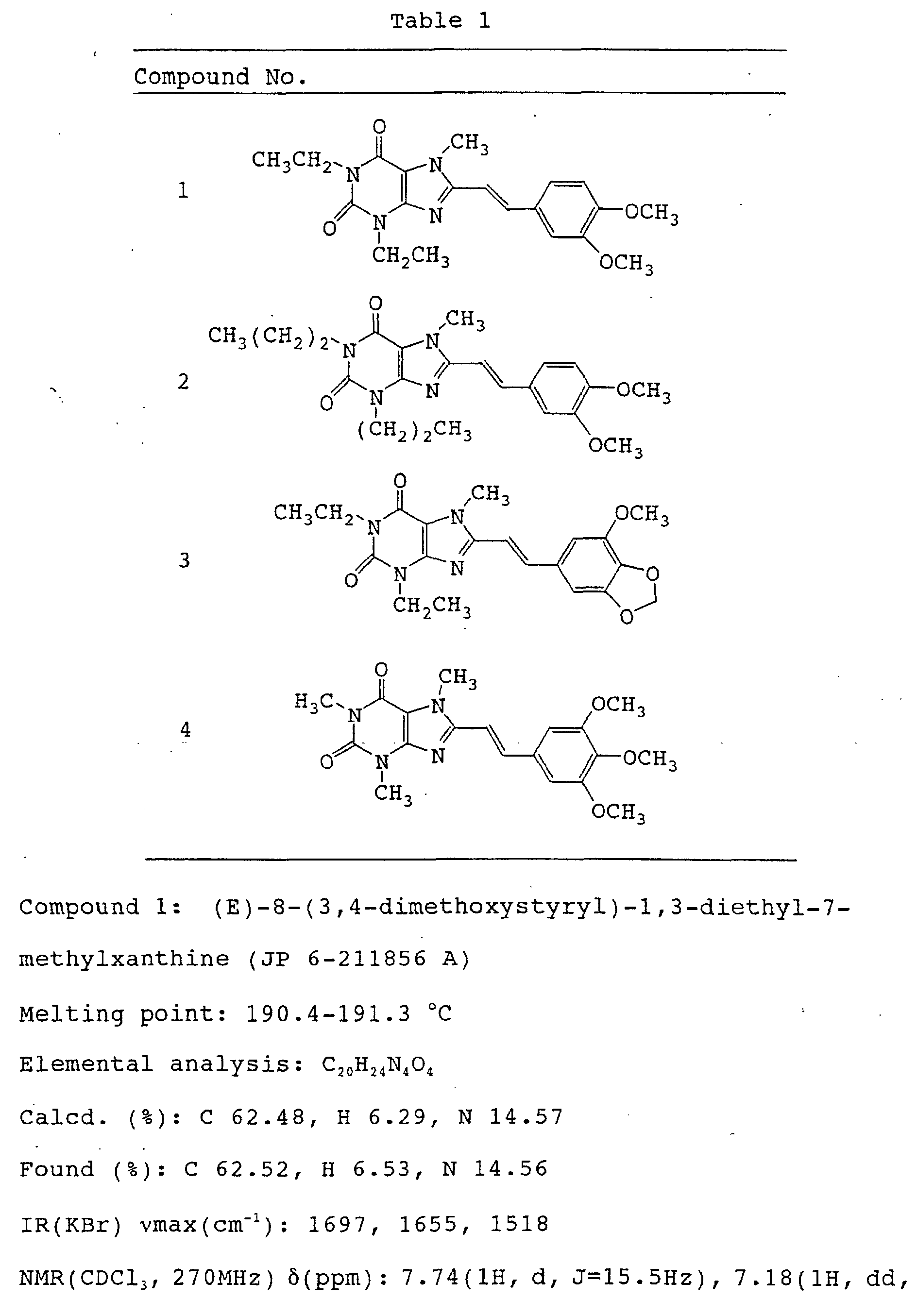
- Compound 1 was suspended in a 0.5 % aqueous methyl cellulose solution to a final concentration of 0.6 mg/mL for 6 mg/kg dose, 3 mg/mL for 30 mg/kg dose, 16 mg/mL for 160 mg/kg dose, or 80 mg/mL for 800 mg/kg dose, and the resulting solution was used.
- mice Male and female Crj:CD (SD) rats (SPF) at the age of 5 weeks were purchased from Nippon Charles River Co., Ltd., and were then fed and conditioned for 9 days. During the term, their body weight change and conditions were observed, and animals determined as in healthy conditions were used at the test. At the start of the use, the body weights of the male animals were within a range of 187 to 209 g, while those of the female animals were within a range of 147 to 173 g. During both of the conditioning and feeding term and the test term, the animals were fed with a solid feed for mouse and rat (CRF-1 15 kGy, Oriental Yeast Industry, Co., Ltd.) and with water ad libitum.
- CRF-1 15 kGy Oriental Yeast Industry, Co., Ltd.
- the number of the animals used 15 each of male and female animals were used for each group.
- a group administered a 0.5 % aqueous methyl cellulose solution alone was prepared. Based on the body weight at the termination of the conditioning and feeding term, the animals were randomly assigned to individual groups, so that the body weights were uniformly distributed among the resulting individual groups.
- Oral administration was selected as the administration route.
- the solvent or a test compound-containing solution was administered once daily in the morning for 4 weeks in a dose of 1 mL per 100 g of body weight.
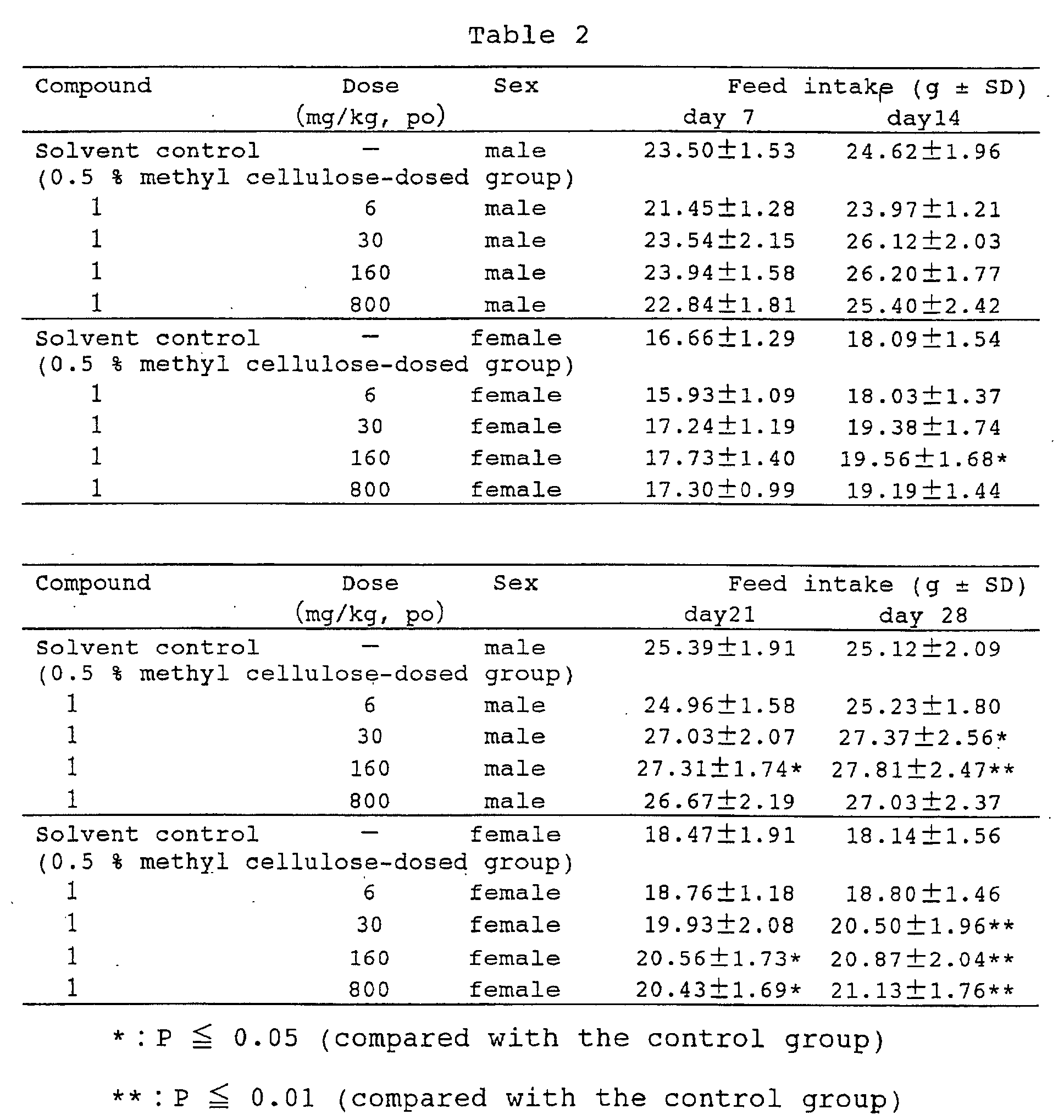
- the feed intake of the test animals was measured on days 7, 14, 21 and 28.
- the measured values were tested for homoscedasticity by the Bartlett's test.
- the variance was homogeneous, one-way layout analysis of variance was performed; in the case that significance was observed, herein, the control group and the individual dosed groups were tested by the Dunnett's test.
- the Kruskal-Wallis's rank test was performed; in the case that significance was observed among the groups, the Dunnett's test was conducted.
- test results show that the 4-week administration of Compound 1 increased the feed intake both in the males and in the females.
- Test Example 2 Action of increasing feed intake and body weight by 4-week oral administration
- Compound 1 was suspended in a 0.5 % aqueous methyl cellulose solution to a final concentration of 20 mg/mL for 200 mg/kg dose or 40 mg/mL for 400 mg/kg dose, and the resulting solution was used.
- mice Male and female Crj:CD (SD) rats (SPF) at the age 5 of weeks were purchased from Nippon Charles River Co., Ltd., and were then fed and conditioned for 7 days. During the term, their body weight change and conditions were observed, and animals determined as in healthy conditions were used at the test. At the start of the use, the body weights of the male animals were within a range of 177.4 to 193.6 g, while those of the female animals were within a range of 141.1 to 160.3 g. During both of the conditioning and feeding term and the test term, the animals were fed with a solid feed for mouse and rat [FR-2, Funabashi Agricultural Farm Co., Ltd.] and with water ad libitum.
- each of male and female animals were used for each group.
- a group administered a 0.5 % aqueous methyl cellulose solution alone was prepared. Based on the body weight at the termination of the conditioning and feeding term, the animals were randomly assigned to individual groups, so that the body weights were uniformly distributed among the resulting individual groups.
- Oral administration was selected as the administration route.
- the solvent or the test compound was administered once daily in the morning for 4 weeks in a dose of 1 mL per 100 g of body weight.
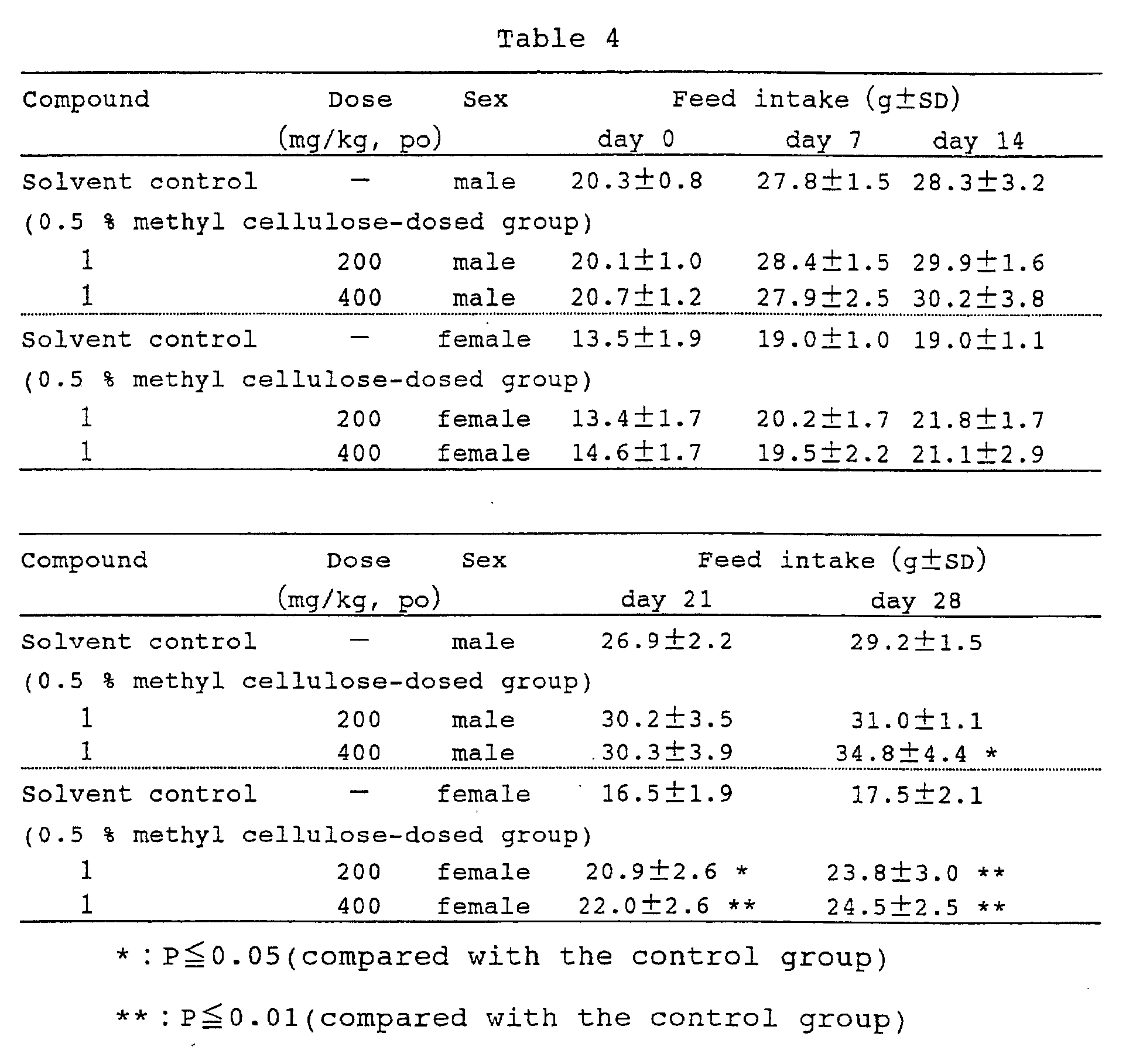
- the body weights and feed intake of the test animals were measured on days 0, 7, 14, 21 and 28.
- the individual measured values were tested, based on the same standards as in the Test Example 2.
- test results show that the 4-week administration of Compound 1 increased the feed intake and body weight both in the males and in the females.
- Test Example 3 Acute toxicity test
- Test compounds were orally administered to groups of dd-strain male mice weighing 20 ⁇ 1 g, each group consisting of three mice. Seven days after the administration, the mortality was observed to determine a minimum lethal dose (MLD) of each compound.
- MLD lethal dose
- the MLD value of Compound 1 was greater than 1000 mg/kg.
- Compound (I) or pharmaceutically acceptable salts thereof have an action of increasing feed intake and body weight.
- compound (I) or pharmaceutically acceptable salts are useful as a therapeutic agent for eating disorders, such as anorexia nervosa (cibophobia, absolute anorexia nervosa).
- Compound (I) or pharmaceutically acceptable salts thereof can be used as such or in the form of various pharmaceutical compositions.
- the pharmaceutical compositions of the present invention can be prepared by uniformly mixing an effective amount of compound (I) or a pharmaceutically acceptable salt thereof as an active ingredient with pharmaceutically acceptable carriers.
- the pharmaceutical compositions are preferably in a unit dosage form suitable for rectal administration, oral or parenteral (including subcutaneous, intravenous and intramuscular administration) administration, etc.
- any useful pharmaceutically acceptable carriers can be used.
- liquid preparations for oral administration such as suspension and syrup can be prepared using water; sugars such as sucrose, sorbitol or fructose; glycols such as polyethylene glycol or propylene glycol; oils such as sesame oil, olive oil or soybean oil; preservatives such as a p-hydroxybenzoate; flavors such as strawberry flavor or peppermint, etc.
- Powder, pills, capsules and tablets can be prepared using excipients such as lactose, glucose, sucrose or mannitol; disintegrators such as starch or sodium alginate; lubricants such as magnesium stearate or talc; binders such as polyvinyl alcohol, hydroxypropyl cellulose or gelatin; surfactants such as fatty acid esters; plasticizers such as glycerin, etc. Tablets and capsules are the most useful oral unit dosage because of the readiness of administration. For preparing tablets and capsules, solid pharmaceutical carriers are used.
- Injections can be prepared using carriers such as distilled water, a salt solution, a glucose solution or a mixture of a salt solution and a glucose solution.
- the preparation can be prepared in the form of a solution, suspension or dispersion by using a suitable auxiliary according to a conventional method.
- Compound (I) or a pharmaceutically acceptable salt thereof can be administered orally in the pharmaceutical composition described above or parenterally as the injection or the like.
- the effective dose and administration schedule vary depending on the mode of administration, the age, the weight of a patient, symptoms of the disease, etc.
- compound (I) or a pharmaceutically acceptable salt thereof is administered in a dose of 1 to 900 mg/60 kg/day, preferably in a dose of 1 to 200 mg/60 kg/day, at one time or in several parts.
- Tablets having the following composition are prepared in a conventional manner.
- Compound 1 (40 g) is mixed with 286.8 g of lactose and 60 g of potato starch, followed by addition of 120 g of a 10% aqueous solution of hydroxypropyl cellulose. The resultant mixture is kneaded, granulated, and then dried by a conventional method. The granules are refined to give granules used to make tablets. After mixing the granules with 1.2 g of magnesium stearate, the mixture is formed into tablets each containing 20 mg of the active ingredient by using a tablet maker (Model RT-15, Kikusui) having pestles of 8 mm diameter.
- Composition Compound 1 20 mg Lactose 143.4 mg Potato Starch 30 mg Hydroxypropyl Cellulose 6 mg Magnesium Stearate 0.6 mg 200 mg
- Capsules having the following composition are prepared in a conventional manner.
- Compound 1 (200 g) is mixed with 995 g of Avicel and 5 g of magnesium stearate. The mixture is put in hard capsules No. 4 each having a capacity of 120 mg by using a capsule filler (Model LZ-64, Zanashi) to give capsules each containing 20 mg of the active ingredient.
- Injections having the following composition are prepared in a conventional manner.
- Compound 1 (1 g) is dissolved in 100 g of purified soybean oil, followed by addition of 12 g of purified egg yolk lecithin and 25 g of glycerin for injection.
- the resultant mixture is made up to 1,000 ml with distilled water for injection, thoroughly mixed, and emulsified by a conventional method.
- the resultant dispersion is subjected to aseptic filtration by using 0.2 ⁇ m disposable membrane filters, and then aseptically put into glass vials in 2 ml portions to give injections containing 2 mg of the active ingredient per vial.
- Composition Compound 1 2 mg Purified Soybean Oil 200 mg Purified Egg Yolk Lecithin 24 mg Glycerine for Injection 50 mg Distilled Water for Injection 1.72 ml 2.00 ml
- Example 4 Anal suppository
- Formulations for rectal administration having the following composition are prepared in a conventional manner.
- Witepsol® H15 (678.8 g, manufactured by Dynamit Nobel, Ltd.) and Witepsol® E75 (290.9 g, manufactured by Dynamit Nobel, Ltd.) are melted at 40 to 50 °C.
- the resulting molten mixture are uniformly mixed and dispersed Compound 1 (2.5 g), potassium dihydrogen phosphate (13.6 g) and disodium hydrogen phosphate (14.2 g).
- the resulting dispersion is poured into plastic suppository molds, and gradually cooled to give anal suppositories containing 2.5 mg of the active ingredient per formulation.
- Composition Compound 1 2.5 mg Witepzol H15 678.8 mg Witepzol E75 290.9 mg Potassium dihydrogen phosphate 13.6 mg Disodium hydrogen phosphate 14.2 mg 1000 mg
- the present invention provides therapeutic agents for eating disorders, comprising a xanthine derivative or a pharmaceutically acceptable salt thereof as an active ingredient.
Landscapes
- Chemical & Material Sciences (AREA)
- Health & Medical Sciences (AREA)
- Organic Chemistry (AREA)
- Medicinal Chemistry (AREA)
- Pharmacology & Pharmacy (AREA)
- Life Sciences & Earth Sciences (AREA)
- Animal Behavior & Ethology (AREA)
- General Health & Medical Sciences (AREA)
- Public Health (AREA)
- Veterinary Medicine (AREA)
- Epidemiology (AREA)
- Engineering & Computer Science (AREA)
- Bioinformatics & Cheminformatics (AREA)
- Chemical Kinetics & Catalysis (AREA)
- General Chemical & Material Sciences (AREA)
- Nuclear Medicine, Radiotherapy & Molecular Imaging (AREA)
- Nutrition Science (AREA)
- Pharmaceuticals Containing Other Organic And Inorganic Compounds (AREA)
- Acyclic And Carbocyclic Compounds In Medicinal Compositions (AREA)
Abstract
Description


| Composition | |
| Compound 1 | 20 mg |
| Lactose | 143.4 mg |
| Potato Starch | 30 mg |
| Hydroxypropyl Cellulose | 6 mg |
| Magnesium Stearate | 0.6 mg |
| 200 mg |
| Composition | |
| Compound 1 | 20 mg |
| Avicel | 99.5 mg |
| Magnesium Stearate | 0.5 mg |
| 120 mg |
| Composition | |
| Compound 1 | 2 mg |
| Purified Soybean Oil | 200 mg |
| Purified Egg Yolk Lecithin | 24 mg |
| Glycerine for Injection | 50 mg |
| Distilled Water for Injection | 1.72 ml |
| 2.00 ml |
| Composition | |
| Compound 1 | 2.5 mg |
| Witepzol H15 | 678.8 mg |
| Witepzol E75 | 290.9 mg |
| Potassium dihydrogen phosphate | 13.6 mg |
| Disodium hydrogen phosphate | 14.2 mg |
| 1000 mg |
Claims (8)
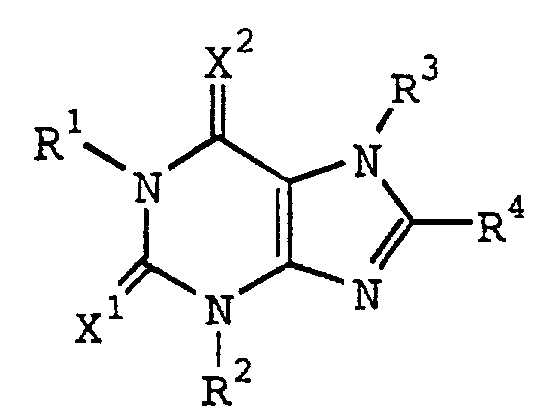
- A therapeutic agent for eating disorders comprising, as an active ingredient, a xanthine derivative represented by formula (I):wherein R1, R2 and R3 independently represent hydrogen, lower alkyl, lower alkenyl or lower alkynyl; R4 represents cycloalkyl, -(CH2)n-R5 (wherein R5 represents substituted or unsubstituted aryl, or a substituted or unsubstituted heterocyclic group, and n is an integer of 0 to 4), or the following group:
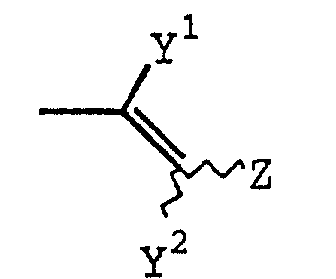
 wherein Y1 and Y2 independently represent hydrogen, halogen or lower alkyl, and Z represents substituted or unsubstituted aryl, the following group:
 (wherein R6 represents hydrogen, hydroxy, lower alkyl, lower alkoxy, halogen, nitro or amino, and m is an integer of 1 to 3), or a substituted or unsubstituted heterocyclic group; and X1 and X2 independently represent O or S, or a pharmaceutically acceptable salt thereof.
- The therapeutic agent for eating disorders comprising, as an active ingredient, the xanthine derivative according to claim 1 wherein X1 and X2 are O, or a pharmaceutically acceptable salt thereof.
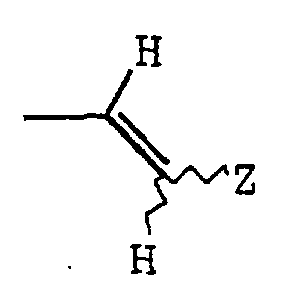
- The therapeutic agent for eating disorders comprising, as an active ingredient, the xanthine derivative according to claim 1 or 2 wherein R4 is the following group:wherein Z has the same meaning as defined above, or a pharmaceutically acceptable salt thereof.

- An aperitive agent comprising, as an active ingredient, the xanthine derivative according to any one of claims 1 to 3 or a pharmaceutically acceptable salt thereof.
- Use of the xanthine derivative according to any one of claims 1 to 3 or a pharmaceutically acceptable salt thereof for the production of a therapeutic agent for eating disorders.
- Use of the xanthine derivative according to any one of claims 1 to 3 or a pharmaceutically acceptable salt thereof for the production of an aperitive agent.
- A method for therapeutically treating or preventing eating disorders, which comprises administering an effective amount the the xanthine derivative according to any one of claims 1 to 3 or a pharmaceutically acceptable salt thereof.
- A method for therapeutically treating or preventing anorexia, which comprises administering an effective amount of the xanthine derivative according to any one of claims 1 to 3 or a pharmaceutically acceptable salt thereof.
Applications Claiming Priority (3)
| Application Number | Priority Date | Filing Date | Title |
|---|---|---|---|
| JP31013899 | 1999-10-29 | ||
| JP31013899 | 1999-10-29 | ||
| PCT/JP2000/007586 WO2001032182A1 (en) | 1999-10-29 | 2000-10-27 | Us0027324for eating disorders |
Publications (3)
| Publication Number | Publication Date |
|---|---|
| EP1234576A1 true EP1234576A1 (en) | 2002-08-28 |
| EP1234576A4 EP1234576A4 (en) | 2004-03-31 |
| EP1234576B1 EP1234576B1 (en) | 2006-03-08 |
Family
ID=18001632
Family Applications (1)
| Application Number | Title | Priority Date | Filing Date |
|---|---|---|---|
| EP00970169A Expired - Lifetime EP1234576B1 (en) | 1999-10-29 | 2000-10-27 | Pharmaceutical composition for eating disorders |
Country Status (8)
| Country | Link |
|---|---|
| US (1) | US20050176739A1 (en) |
| EP (1) | EP1234576B1 (en) |
| AT (1) | ATE319452T1 (en) |
| AU (1) | AU7962000A (en) |
| CA (1) | CA2388176C (en) |
| DE (1) | DE60026559T2 (en) |
| ES (1) | ES2260061T3 (en) |
| WO (1) | WO2001032182A1 (en) |
Cited By (1)
| Publication number | Priority date | Publication date | Assignee | Title |
|---|---|---|---|---|
| EP1676578A4 (en) * | 2003-09-29 | 2012-03-21 | Kyowa Hakko Kirin Co Ltd | METHOD FOR STABILIZING DIARYLVINYLENE COMPOUND |
Families Citing this family (2)
| Publication number | Priority date | Publication date | Assignee | Title |
|---|---|---|---|---|
| EP1658291B1 (en) * | 2003-08-25 | 2013-10-02 | Dogwood Pharmaceuticals, Inc. | Substituted 8-heteroaryl xanthines |
| JP7801234B2 (en) | 2020-03-10 | 2026-01-16 | マーベル・バイオテクノロジー | Purine Compounds for Treating Disorders - Patent application |
Family Cites Families (9)
| Publication number | Priority date | Publication date | Assignee | Title |
|---|---|---|---|---|
| US2729642A (en) * | 1954-08-13 | 1956-01-03 | Chattanooga Medicine Co | Water soluble salts of 8-(para-aminobenzyl) caffeine and method for their preparation |
| US3641010A (en) * | 1970-06-11 | 1972-02-08 | Parke Davis & Co | Novel xanthine compounds and means for obtaining the same |
| US4593095A (en) * | 1983-02-18 | 1986-06-03 | The Johns Hopkins University | Xanthine derivatives |
| WO1992006976A1 (en) * | 1990-10-18 | 1992-04-30 | Kyowa Hakko Kogyo Co., Ltd. | Xanthine derivative |
| JP2928386B2 (en) * | 1992-07-08 | 1999-08-03 | 協和醗酵工業株式会社 | Depression treatment agent |
| JP2613355B2 (en) * | 1992-09-28 | 1997-05-28 | 協和醗酵工業株式会社 | Parkinson's disease treatment |
| CA2112031A1 (en) * | 1992-12-24 | 1994-06-25 | Fumio Suzuki | Xanthine derivatives |
| TW574214B (en) * | 1994-06-08 | 2004-02-01 | Pfizer | Corticotropin releasing factor antagonists |
| US6489341B1 (en) * | 1999-06-02 | 2002-12-03 | Sepracor Inc. | Methods for the treatment of neuroleptic and related disorders using sertindole derivatives |
-
2000
- 2000-10-27 AU AU79620/00A patent/AU7962000A/en not_active Abandoned
- 2000-10-27 CA CA002388176A patent/CA2388176C/en not_active Expired - Fee Related
- 2000-10-27 DE DE60026559T patent/DE60026559T2/en not_active Expired - Fee Related
- 2000-10-27 WO PCT/JP2000/007586 patent/WO2001032182A1/en not_active Ceased
- 2000-10-27 EP EP00970169A patent/EP1234576B1/en not_active Expired - Lifetime
- 2000-10-27 AT AT00970169T patent/ATE319452T1/en not_active IP Right Cessation
- 2000-10-27 ES ES00970169T patent/ES2260061T3/en not_active Expired - Lifetime
-
2005
- 2005-04-13 US US11/104,623 patent/US20050176739A1/en not_active Abandoned
Cited By (1)
| Publication number | Priority date | Publication date | Assignee | Title |
|---|---|---|---|---|
| EP1676578A4 (en) * | 2003-09-29 | 2012-03-21 | Kyowa Hakko Kirin Co Ltd | METHOD FOR STABILIZING DIARYLVINYLENE COMPOUND |
Also Published As
| Publication number | Publication date |
|---|---|
| DE60026559D1 (en) | 2006-05-04 |
| US20050176739A1 (en) | 2005-08-11 |
| CA2388176C (en) | 2007-09-25 |
| DE60026559T2 (en) | 2006-12-14 |
| CA2388176A1 (en) | 2001-05-10 |
| ES2260061T3 (en) | 2006-11-01 |
| AU7962000A (en) | 2001-05-14 |
| ATE319452T1 (en) | 2006-03-15 |
| EP1234576B1 (en) | 2006-03-08 |
| WO2001032182A1 (en) | 2001-05-10 |
| EP1234576A4 (en) | 2004-03-31 |
Similar Documents
| Publication | Publication Date | Title |
|---|---|---|
| EP0666079B1 (en) | Remedy for parkinson's disease | |
| US20080207649A1 (en) | Method of treating brain ischemia | |
| EP0607607B1 (en) | Xanthine derivatives | |
| DE69327438T2 (en) | Therapeutic agents for Parkinson's disease | |
| DE60001969T2 (en) | SELECTIVE ANTAGONISTS OF A2B ADENOSINE RECEPTORS | |
| JPWO2005094885A1 (en) | Preventive and / or therapeutic agent for diseases presenting chronic musculoskeletal pain | |
| EP0667349B1 (en) | Depression remedy | |
| JPH08512281A (en) | Adenosine A (1) Xanthine derivatives as receptor antagonists | |
| EP1234576B1 (en) | Pharmaceutical composition for eating disorders | |
| US20060205756A1 (en) | Antitussives | |
| CA2299909C (en) | Therapeutic agent for neurodegenerative disorders | |
| US20060122198A1 (en) | Antiepileptic agent | |
| WO1998057645A1 (en) | Hepatic edema remedy | |
| US7763625B2 (en) | Agents for treating migraine | |
| JPWO2001032182A1 (en) | Eating disorder treatment | |
| JPWO1998057645A1 (en) | Hepatic edema treatment | |
| JPWO1995003806A1 (en) | Parkinson's disease treatment | |
| JPWO1999012546A1 (en) | Neurodegenerative disease treatment | |
| JPWO1999030715A1 (en) | Preventive and therapeutic agents for sleep disorders | |
| JPWO1995007282A1 (en) | Antidepressant | |
| HK1001835A1 (en) | Therapeutic agents for use in the treatment of parkinson's disease |
Legal Events
| Date | Code | Title | Description |
|---|---|---|---|
| PUAI | Public reference made under article 153(3) epc to a published international application that has entered the european phase |
Free format text: ORIGINAL CODE: 0009012 |
|
| 17P | Request for examination filed |
Effective date: 20020529 |
|
| AK | Designated contracting states |
Kind code of ref document: A1 Designated state(s): AT BE CH CY DE DK ES FI FR GB GR IE IT LI LU MC NL PT SE |
|
| AX | Request for extension of the european patent |
Free format text: AL;LT;LV;MK;RO;SI |
|
| A4 | Supplementary search report drawn up and despatched |
Effective date: 20040217 |
|
| 17Q | First examination report despatched |
Effective date: 20040611 |
|
| GRAP | Despatch of communication of intention to grant a patent |
Free format text: ORIGINAL CODE: EPIDOSNIGR1 |
|
| GRAJ | Information related to disapproval of communication of intention to grant by the applicant or resumption of examination proceedings by the epo deleted |
Free format text: ORIGINAL CODE: EPIDOSDIGR1 |
|
| RTI1 | Title (correction) |
Free format text: PHARMACEUTICAL COMPOSITION FOR EATING DISORDERS |
|
| GRAC | Information related to communication of intention to grant a patent modified |
Free format text: ORIGINAL CODE: EPIDOSCIGR1 |
|
| GRAP | Despatch of communication of intention to grant a patent |
Free format text: ORIGINAL CODE: EPIDOSNIGR1 |
|
| GRAS | Grant fee paid |
Free format text: ORIGINAL CODE: EPIDOSNIGR3 |
|
| RIN1 | Information on inventor provided before grant (corrected) |
Inventor name: ISHIKAWA, YUMIKOKYOWA HAKKO KOGYO CO. LTD. Inventor name: RYOMOTO, TETSUYA,KYOWA HAKKO KOGYO CO., LTD Inventor name: HARA, TAKUJI,KYOWA HAKKO KOGYO CO., LTD |
|
| RIC1 | Information provided on ipc code assigned before grant |
Ipc: A61P 1/14 20000101ALI20051115BHEP Ipc: A61K 31/522 20000101AFI20051115BHEP |
|
| GRAA | (expected) grant |
Free format text: ORIGINAL CODE: 0009210 |
|
| AK | Designated contracting states |
Kind code of ref document: B1 Designated state(s): AT BE CH CY DE DK ES FI FR GB GR IE IT LI LU MC NL PT SE |
|
| PG25 | Lapsed in a contracting state [announced via postgrant information from national office to epo] |
Ref country code: IT Free format text: LAPSE BECAUSE OF FAILURE TO SUBMIT A TRANSLATION OF THE DESCRIPTION OR TO PAY THE FEE WITHIN THE PRESCRIBED TIME-LIMIT;WARNING: LAPSES OF ITALIAN PATENTS WITH EFFECTIVE DATE BEFORE 2007 MAY HAVE OCCURRED AT ANY TIME BEFORE 2007. THE CORRECT EFFECTIVE DATE MAY BE DIFFERENT FROM THE ONE RECORDED. Effective date: 20060308 Ref country code: BE Free format text: LAPSE BECAUSE OF FAILURE TO SUBMIT A TRANSLATION OF THE DESCRIPTION OR TO PAY THE FEE WITHIN THE PRESCRIBED TIME-LIMIT Effective date: 20060308 Ref country code: FI Free format text: LAPSE BECAUSE OF FAILURE TO SUBMIT A TRANSLATION OF THE DESCRIPTION OR TO PAY THE FEE WITHIN THE PRESCRIBED TIME-LIMIT Effective date: 20060308 Ref country code: NL Free format text: LAPSE BECAUSE OF FAILURE TO SUBMIT A TRANSLATION OF THE DESCRIPTION OR TO PAY THE FEE WITHIN THE PRESCRIBED TIME-LIMIT Effective date: 20060308 |
|
| REG | Reference to a national code |
Ref country code: GB Ref legal event code: FG4D |
|
| REG | Reference to a national code |
Ref country code: CH Ref legal event code: NV Representative=s name: BOVARD AG PATENTANWAELTE Ref country code: CH Ref legal event code: EP |
|
| REG | Reference to a national code |
Ref country code: IE Ref legal event code: FG4D |
|
| REF | Corresponds to: |
Ref document number: 60026559 Country of ref document: DE Date of ref document: 20060504 Kind code of ref document: P |
|
| PG25 | Lapsed in a contracting state [announced via postgrant information from national office to epo] |
Ref country code: SE Free format text: LAPSE BECAUSE OF FAILURE TO SUBMIT A TRANSLATION OF THE DESCRIPTION OR TO PAY THE FEE WITHIN THE PRESCRIBED TIME-LIMIT Effective date: 20060608 Ref country code: DK Free format text: LAPSE BECAUSE OF FAILURE TO SUBMIT A TRANSLATION OF THE DESCRIPTION OR TO PAY THE FEE WITHIN THE PRESCRIBED TIME-LIMIT Effective date: 20060608 |
|
| PG25 | Lapsed in a contracting state [announced via postgrant information from national office to epo] |
Ref country code: PT Free format text: LAPSE BECAUSE OF FAILURE TO SUBMIT A TRANSLATION OF THE DESCRIPTION OR TO PAY THE FEE WITHIN THE PRESCRIBED TIME-LIMIT Effective date: 20060808 |
|
| NLV1 | Nl: lapsed or annulled due to failure to fulfill the requirements of art. 29p and 29m of the patents act | ||
| ET | Fr: translation filed | ||
| PG25 | Lapsed in a contracting state [announced via postgrant information from national office to epo] |
Ref country code: IE Free format text: LAPSE BECAUSE OF NON-PAYMENT OF DUE FEES Effective date: 20061027 |
|
| PG25 | Lapsed in a contracting state [announced via postgrant information from national office to epo] |
Ref country code: MC Free format text: LAPSE BECAUSE OF NON-PAYMENT OF DUE FEES Effective date: 20061031 |
|
| REG | Reference to a national code |
Ref country code: ES Ref legal event code: FG2A Ref document number: 2260061 Country of ref document: ES Kind code of ref document: T3 |
|
| PLBE | No opposition filed within time limit |
Free format text: ORIGINAL CODE: 0009261 |
|
| STAA | Information on the status of an ep patent application or granted ep patent |
Free format text: STATUS: NO OPPOSITION FILED WITHIN TIME LIMIT |
|
| 26N | No opposition filed |
Effective date: 20061211 |
|
| PGFP | Annual fee paid to national office [announced via postgrant information from national office to epo] |
Ref country code: CH Payment date: 20071029 Year of fee payment: 8 Ref country code: AT Payment date: 20071024 Year of fee payment: 8 |
|
| PG25 | Lapsed in a contracting state [announced via postgrant information from national office to epo] |
Ref country code: GR Free format text: LAPSE BECAUSE OF FAILURE TO SUBMIT A TRANSLATION OF THE DESCRIPTION OR TO PAY THE FEE WITHIN THE PRESCRIBED TIME-LIMIT Effective date: 20060609 |
|
| PG25 | Lapsed in a contracting state [announced via postgrant information from national office to epo] |
Ref country code: LU Free format text: LAPSE BECAUSE OF NON-PAYMENT OF DUE FEES Effective date: 20061027 |
|
| PG25 | Lapsed in a contracting state [announced via postgrant information from national office to epo] |
Ref country code: CY Free format text: LAPSE BECAUSE OF FAILURE TO SUBMIT A TRANSLATION OF THE DESCRIPTION OR TO PAY THE FEE WITHIN THE PRESCRIBED TIME-LIMIT Effective date: 20060308 |
|
| PGFP | Annual fee paid to national office [announced via postgrant information from national office to epo] |
Ref country code: DE Payment date: 20081027 Year of fee payment: 9 |
|
| PGFP | Annual fee paid to national office [announced via postgrant information from national office to epo] |
Ref country code: ES Payment date: 20081030 Year of fee payment: 9 |
|
| PGFP | Annual fee paid to national office [announced via postgrant information from national office to epo] |
Ref country code: IT Payment date: 20081029 Year of fee payment: 9 |
|
| PGFP | Annual fee paid to national office [announced via postgrant information from national office to epo] |
Ref country code: FR Payment date: 20081014 Year of fee payment: 9 |
|
| REG | Reference to a national code |
Ref country code: CH Ref legal event code: PL |
|
| PGFP | Annual fee paid to national office [announced via postgrant information from national office to epo] |
Ref country code: GB Payment date: 20081022 Year of fee payment: 9 |
|
| PG25 | Lapsed in a contracting state [announced via postgrant information from national office to epo] |
Ref country code: AT Free format text: LAPSE BECAUSE OF NON-PAYMENT OF DUE FEES Effective date: 20081027 |
|
| REG | Reference to a national code |
Ref country code: FR Ref legal event code: CD |
|
| PG25 | Lapsed in a contracting state [announced via postgrant information from national office to epo] |
Ref country code: LI Free format text: LAPSE BECAUSE OF NON-PAYMENT OF DUE FEES Effective date: 20081031 Ref country code: CH Free format text: LAPSE BECAUSE OF NON-PAYMENT OF DUE FEES Effective date: 20081031 |
|
| REG | Reference to a national code |
Ref country code: FR Ref legal event code: ST Effective date: 20100630 |
|
| PG25 | Lapsed in a contracting state [announced via postgrant information from national office to epo] |
Ref country code: FR Free format text: LAPSE BECAUSE OF NON-PAYMENT OF DUE FEES Effective date: 20091102 Ref country code: DE Free format text: LAPSE BECAUSE OF NON-PAYMENT OF DUE FEES Effective date: 20100501 |
|
| PG25 | Lapsed in a contracting state [announced via postgrant information from national office to epo] |
Ref country code: GB Free format text: LAPSE BECAUSE OF NON-PAYMENT OF DUE FEES Effective date: 20091027 |
|
| PG25 | Lapsed in a contracting state [announced via postgrant information from national office to epo] |
Ref country code: IT Free format text: LAPSE BECAUSE OF NON-PAYMENT OF DUE FEES Effective date: 20091027 |
|
| REG | Reference to a national code |
Ref country code: ES Ref legal event code: FD2A Effective date: 20111116 |
|
| PG25 | Lapsed in a contracting state [announced via postgrant information from national office to epo] |
Ref country code: ES Free format text: LAPSE BECAUSE OF NON-PAYMENT OF DUE FEES Effective date: 20091028 |