EP1233964B1 - New use and novel n-azabicyclo-amide derivatives - Google Patents
New use and novel n-azabicyclo-amide derivatives Download PDFInfo
- Publication number
- EP1233964B1 EP1233964B1 EP00981994A EP00981994A EP1233964B1 EP 1233964 B1 EP1233964 B1 EP 1233964B1 EP 00981994 A EP00981994 A EP 00981994A EP 00981994 A EP00981994 A EP 00981994A EP 1233964 B1 EP1233964 B1 EP 1233964B1
- Authority
- EP
- European Patent Office
- Prior art keywords
- oct
- azabicyclo
- propenamide
- compound
- phenylpropenamide
- Prior art date
- Legal status (The legal status is an assumption and is not a legal conclusion. Google has not performed a legal analysis and makes no representation as to the accuracy of the status listed.)
- Expired - Lifetime
Links
- 150000001875 compounds Chemical class 0.000 claims abstract description 93
- 239000001257 hydrogen Substances 0.000 claims abstract description 45
- 229910052739 hydrogen Inorganic materials 0.000 claims abstract description 45
- 150000003839 salts Chemical class 0.000 claims abstract description 38
- 238000011282 treatment Methods 0.000 claims abstract description 30
- 230000006735 deficit Effects 0.000 claims abstract description 28
- 208000037265 diseases, disorders, signs and symptoms Diseases 0.000 claims abstract description 27
- 239000008194 pharmaceutical composition Substances 0.000 claims abstract description 22
- 229910052760 oxygen Inorganic materials 0.000 claims abstract description 18
- 229910052717 sulfur Inorganic materials 0.000 claims abstract description 17
- 239000001301 oxygen Substances 0.000 claims abstract description 14
- QVGXLLKOCUKJST-UHFFFAOYSA-N atomic oxygen Chemical compound [O] QVGXLLKOCUKJST-UHFFFAOYSA-N 0.000 claims abstract description 13
- 125000004435 hydrogen atom Chemical group [H]* 0.000 claims abstract description 11
- 208000028017 Psychotic disease Diseases 0.000 claims abstract description 10
- 125000002496 methyl group Chemical group [H]C([H])([H])* 0.000 claims abstract description 8
- NINIDFKCEFEMDL-UHFFFAOYSA-N Sulfur Chemical compound [S] NINIDFKCEFEMDL-UHFFFAOYSA-N 0.000 claims abstract description 5
- 239000011593 sulfur Substances 0.000 claims abstract description 5
- 238000002560 therapeutic procedure Methods 0.000 claims abstract 2
- 125000004178 (C1-C4) alkyl group Chemical group 0.000 claims description 32
- 150000002431 hydrogen Chemical group 0.000 claims description 28
- HRPVXLWXLXDGHG-UHFFFAOYSA-N Acrylamide Chemical compound NC(=O)C=C HRPVXLWXLXDGHG-UHFFFAOYSA-N 0.000 claims description 25
- 208000035475 disorder Diseases 0.000 claims description 21
- 229910052736 halogen Inorganic materials 0.000 claims description 19
- 150000002367 halogens Chemical class 0.000 claims description 19
- 125000003118 aryl group Chemical group 0.000 claims description 18
- 125000004093 cyano group Chemical group *C#N 0.000 claims description 14
- 125000004434 sulfur atom Chemical group 0.000 claims description 14
- -1 -NR8R9 Chemical group 0.000 claims description 13
- 208000024827 Alzheimer disease Diseases 0.000 claims description 13
- 125000004433 nitrogen atom Chemical group N* 0.000 claims description 13
- 125000004430 oxygen atom Chemical group O* 0.000 claims description 13
- 125000006656 (C2-C4) alkenyl group Chemical group 0.000 claims description 12
- 125000006650 (C2-C4) alkynyl group Chemical group 0.000 claims description 12
- 125000001072 heteroaryl group Chemical group 0.000 claims description 12
- 208000019901 Anxiety disease Diseases 0.000 claims description 10
- 208000002193 Pain Diseases 0.000 claims description 10
- 208000018737 Parkinson disease Diseases 0.000 claims description 10
- 208000000323 Tourette Syndrome Diseases 0.000 claims description 10
- 208000016620 Tourette disease Diseases 0.000 claims description 10
- 230000036506 anxiety Effects 0.000 claims description 10
- 125000000449 nitro group Chemical group [O-][N+](*)=O 0.000 claims description 10
- 201000000980 schizophrenia Diseases 0.000 claims description 10
- 125000001424 substituent group Chemical group 0.000 claims description 10
- APEJMQOBVMLION-VOTSOKGWSA-N trans-cinnamamide Chemical compound NC(=O)\C=C\C1=CC=CC=C1 APEJMQOBVMLION-VOTSOKGWSA-N 0.000 claims description 10
- SNICXCGAKADSCV-JTQLQIEISA-N (-)-Nicotine Chemical compound CN1CCC[C@H]1C1=CC=CN=C1 SNICXCGAKADSCV-JTQLQIEISA-N 0.000 claims description 9
- 208000000044 Amnesia Diseases 0.000 claims description 9
- 208000006096 Attention Deficit Disorder with Hyperactivity Diseases 0.000 claims description 9
- 208000036864 Attention deficit/hyperactivity disease Diseases 0.000 claims description 9
- 208000020925 Bipolar disease Diseases 0.000 claims description 9
- 208000019888 Circadian rhythm sleep disease Diseases 0.000 claims description 9
- 206010009900 Colitis ulcerative Diseases 0.000 claims description 9
- 208000023105 Huntington disease Diseases 0.000 claims description 9
- 208000001456 Jet Lag Syndrome Diseases 0.000 claims description 9
- 208000009829 Lewy Body Disease Diseases 0.000 claims description 9
- 201000002832 Lewy body dementia Diseases 0.000 claims description 9
- 206010026749 Mania Diseases 0.000 claims description 9
- 208000026139 Memory disease Diseases 0.000 claims description 9
- 201000006704 Ulcerative Colitis Diseases 0.000 claims description 9
- 230000003935 attention Effects 0.000 claims description 9
- 208000015802 attention deficit-hyperactivity disease Diseases 0.000 claims description 9
- 208000028683 bipolar I disease Diseases 0.000 claims description 9
- 230000001713 cholinergic effect Effects 0.000 claims description 9
- 230000007278 cognition impairment Effects 0.000 claims description 9
- 208000033915 jet lag type circadian rhythm sleep disease Diseases 0.000 claims description 9
- 230000006984 memory degeneration Effects 0.000 claims description 9
- 208000023060 memory loss Diseases 0.000 claims description 9
- 208000015122 neurodegenerative disease Diseases 0.000 claims description 9
- 229960002715 nicotine Drugs 0.000 claims description 9
- SNICXCGAKADSCV-UHFFFAOYSA-N nicotine Natural products CN1CCCC1C1=CC=CN=C1 SNICXCGAKADSCV-UHFFFAOYSA-N 0.000 claims description 9
- 230000036407 pain Effects 0.000 claims description 9
- 210000000225 synapse Anatomy 0.000 claims description 9
- MENCFQRKJSFDJH-AATRIKPKSA-N (e)-n-(1-azabicyclo[2.2.2]octan-3-yl)-3-(2-nitrophenyl)prop-2-enamide Chemical compound [O-][N+](=O)C1=CC=CC=C1\C=C\C(=O)NC1C(CC2)CCN2C1 MENCFQRKJSFDJH-AATRIKPKSA-N 0.000 claims description 8
- 206010057852 Nicotine dependence Diseases 0.000 claims description 8
- 208000025569 Tobacco Use disease Diseases 0.000 claims description 8
- ODFSOOCVJPIZNA-VOTSOKGWSA-N (e)-n-(1-azabicyclo[2.2.2]octan-3-yl)-3-phenylprop-2-enamide Chemical compound C1N(CC2)CCC2C1NC(=O)\C=C\C1=CC=CC=C1 ODFSOOCVJPIZNA-VOTSOKGWSA-N 0.000 claims description 7
- 239000003814 drug Substances 0.000 claims description 7
- 125000001997 phenyl group Chemical group [H]C1=C([H])C([H])=C(*)C([H])=C1[H] 0.000 claims description 7
- PHZYWNWABJJERF-AATRIKPKSA-N (e)-3-(2-aminophenyl)-n-(1-azabicyclo[2.2.2]octan-3-yl)prop-2-enamide Chemical compound NC1=CC=CC=C1\C=C\C(=O)NC1C(CC2)CCN2C1 PHZYWNWABJJERF-AATRIKPKSA-N 0.000 claims description 6
- QLXOOYGFEACOIW-BQYQJAHWSA-N (e)-n-(1-azabicyclo[2.2.2]octan-3-yl)-n-methyl-3-phenylprop-2-enamide Chemical compound C1N(CC2)CCC2C1N(C)C(=O)\C=C\C1=CC=CC=C1 QLXOOYGFEACOIW-BQYQJAHWSA-N 0.000 claims description 6
- UFHFLCQGNIYNRP-UHFFFAOYSA-N Hydrogen Chemical compound [H][H] UFHFLCQGNIYNRP-UHFFFAOYSA-N 0.000 claims description 6
- 230000000391 smoking effect Effects 0.000 claims description 6
- UCRCSZYDUAPEEU-SNAWJCMRSA-N (e)-n-(1-azabicyclo[2.2.2]octan-3-yl)-3-(3-iodophenyl)prop-2-enamide Chemical compound IC1=CC=CC(\C=C\C(=O)NC2C3CCN(CC3)C2)=C1 UCRCSZYDUAPEEU-SNAWJCMRSA-N 0.000 claims description 5
- SYJFKEQPXPZQSF-ZZXKWVIFSA-N (e)-n-(1-azabicyclo[2.2.2]octan-3-yl)-3-(4-iodophenyl)prop-2-enamide Chemical compound C1=CC(I)=CC=C1\C=C\C(=O)NC1C(CC2)CCN2C1 SYJFKEQPXPZQSF-ZZXKWVIFSA-N 0.000 claims description 5
- VYJUETVRHRXQFA-AATRIKPKSA-N (e)-n-(1-azabicyclo[2.2.2]octan-3-yl)-3-[2-(trifluoromethyl)phenyl]prop-2-enamide Chemical compound FC(F)(F)C1=CC=CC=C1\C=C\C(=O)NC1C(CC2)CCN2C1 VYJUETVRHRXQFA-AATRIKPKSA-N 0.000 claims description 5
- FKRVCWSLGVBIGB-VOTSOKGWSA-N (e)-n-(3-cyano-1-azabicyclo[2.2.2]octan-3-yl)-3-phenylprop-2-enamide Chemical compound C1N(CC2)CCC2C1(C#N)NC(=O)\C=C\C1=CC=CC=C1 FKRVCWSLGVBIGB-VOTSOKGWSA-N 0.000 claims description 5
- XZVQIURADIYJDK-BQYQJAHWSA-N (e)-n-(3-methyl-1-azabicyclo[2.2.2]octan-3-yl)-3-phenylprop-2-enamide Chemical compound C1N(CC2)CCC2C1(C)NC(=O)\C=C\C1=CC=CC=C1 XZVQIURADIYJDK-BQYQJAHWSA-N 0.000 claims description 5
- HSTDTPMOYSFAIB-ISUDXETCSA-N (e)-n-[(3r)-1-azabicyclo[2.2.2]octan-3-yl]-3-(1h-imidazol-5-yl)prop-2-enamide Chemical compound N([C@@H]1C2CCN(CC2)C1)C(=O)\C=C\C1=CNC=N1 HSTDTPMOYSFAIB-ISUDXETCSA-N 0.000 claims description 5
- DXSJNKAJPNKROG-YUKKFKLSSA-N (e)-n-[(3r)-1-azabicyclo[2.2.2]octan-3-yl]-3-(5-hydroxypyridin-3-yl)prop-2-enamide Chemical compound OC1=CN=CC(\C=C\C(=O)N[C@@H]2C3CCN(CC3)C2)=C1 DXSJNKAJPNKROG-YUKKFKLSSA-N 0.000 claims description 5
- NBTHWOKIJJBULB-FAAWYNLUSA-N (e)-n-[(3r)-1-azabicyclo[2.2.2]octan-3-yl]-3-(5-methoxypyridin-3-yl)prop-2-enamide Chemical compound COC1=CN=CC(\C=C\C(=O)N[C@@H]2C3CCN(CC3)C2)=C1 NBTHWOKIJJBULB-FAAWYNLUSA-N 0.000 claims description 5
- MIWLXSRIICDTEX-JWPFQLSCSA-N (e)-n-[(3r)-1-azabicyclo[2.2.2]octan-3-yl]-3-(5-nitrofuran-2-yl)prop-2-enamide Chemical compound O1C([N+](=O)[O-])=CC=C1\C=C\C(=O)N[C@@H]1C(CC2)CCN2C1 MIWLXSRIICDTEX-JWPFQLSCSA-N 0.000 claims description 5
- ATNVHCFFVIVLSM-OOPCZODUSA-N (e)-n-[(3r)-1-azabicyclo[2.2.2]octan-3-yl]-3-(furan-2-yl)prop-2-enamide Chemical compound N([C@@H]1C2CCN(CC2)C1)C(=O)\C=C\C1=CC=CO1 ATNVHCFFVIVLSM-OOPCZODUSA-N 0.000 claims description 5
- WMUJNOJUYWXQSG-AORQRIRUSA-N (e)-n-[(3r)-1-azabicyclo[2.2.2]octan-3-yl]-3-(furan-3-yl)prop-2-enamide Chemical compound N([C@@H]1C2CCN(CC2)C1)C(=O)\C=C\C=1C=COC=1 WMUJNOJUYWXQSG-AORQRIRUSA-N 0.000 claims description 5
- QDJIWDUPQLKWAA-RGDDUWESSA-N (e)-n-[(3r)-1-azabicyclo[2.2.2]octan-3-yl]-3-[3-(trifluoromethyl)phenyl]prop-2-enamide Chemical compound FC(F)(F)C1=CC=CC(\C=C\C(=O)N[C@@H]2C3CCN(CC3)C2)=C1 QDJIWDUPQLKWAA-RGDDUWESSA-N 0.000 claims description 5
- NZONTOQHVFUZMV-OOPCZODUSA-N (e)-n-[(3r)-1-azabicyclo[2.2.2]octan-3-yl]-3-thiophen-2-ylprop-2-enamide Chemical compound N([C@@H]1C2CCN(CC2)C1)C(=O)\C=C\C1=CC=CS1 NZONTOQHVFUZMV-OOPCZODUSA-N 0.000 claims description 5
- NIJKEAAXBOXSNC-AORQRIRUSA-N (e)-n-[(3r)-1-azabicyclo[2.2.2]octan-3-yl]-3-thiophen-3-ylprop-2-enamide Chemical compound N([C@@H]1C2CCN(CC2)C1)C(=O)\C=C\C=1C=CSC=1 NIJKEAAXBOXSNC-AORQRIRUSA-N 0.000 claims description 5
- 238000002360 preparation method Methods 0.000 claims description 5
- PHZYWNWABJJERF-NFAHFFEMSA-N (e)-3-(2-aminophenyl)-n-[(3r)-1-azabicyclo[2.2.2]octan-3-yl]prop-2-enamide Chemical compound NC1=CC=CC=C1\C=C\C(=O)N[C@@H]1C(CC2)CCN2C1 PHZYWNWABJJERF-NFAHFFEMSA-N 0.000 claims description 4
- KUANXHFSYXKVOB-ZZXKWVIFSA-N (e)-3-(4-aminophenyl)prop-2-enamide Chemical compound NC(=O)\C=C\C1=CC=C(N)C=C1 KUANXHFSYXKVOB-ZZXKWVIFSA-N 0.000 claims description 4
- HSTDTPMOYSFAIB-OWOJBTEDSA-N (e)-n-(1-azabicyclo[2.2.2]octan-3-yl)-3-(1h-imidazol-5-yl)prop-2-enamide Chemical compound C1N(CC2)CCC2C1NC(=O)\C=C\C1=CNC=N1 HSTDTPMOYSFAIB-OWOJBTEDSA-N 0.000 claims description 4
- DWEFNEVEZVDWPJ-AATRIKPKSA-N (e)-n-(1-azabicyclo[2.2.2]octan-3-yl)-3-(2-fluorophenyl)prop-2-enamide Chemical compound FC1=CC=CC=C1\C=C\C(=O)NC1C(CC2)CCN2C1 DWEFNEVEZVDWPJ-AATRIKPKSA-N 0.000 claims description 4
- GERXVMRTEYKZPQ-QPJJXVBHSA-N (e)-n-(1-azabicyclo[2.2.2]octan-3-yl)-3-(4-methoxyphenyl)prop-2-enamide Chemical compound C1=CC(OC)=CC=C1\C=C\C(=O)NC1C(CC2)CCN2C1 GERXVMRTEYKZPQ-QPJJXVBHSA-N 0.000 claims description 4
- DXSJNKAJPNKROG-OWOJBTEDSA-N (e)-n-(1-azabicyclo[2.2.2]octan-3-yl)-3-(5-hydroxypyridin-3-yl)prop-2-enamide Chemical compound OC1=CN=CC(\C=C\C(=O)NC2C3CCN(CC3)C2)=C1 DXSJNKAJPNKROG-OWOJBTEDSA-N 0.000 claims description 4
- NBTHWOKIJJBULB-NSCUHMNNSA-N (e)-n-(1-azabicyclo[2.2.2]octan-3-yl)-3-(5-methoxypyridin-3-yl)prop-2-enamide Chemical compound COC1=CN=CC(\C=C\C(=O)NC2C3CCN(CC3)C2)=C1 NBTHWOKIJJBULB-NSCUHMNNSA-N 0.000 claims description 4
- MIWLXSRIICDTEX-HNQUOIGGSA-N (e)-n-(1-azabicyclo[2.2.2]octan-3-yl)-3-(5-nitrofuran-2-yl)prop-2-enamide Chemical compound O1C([N+](=O)[O-])=CC=C1\C=C\C(=O)NC1C(CC2)CCN2C1 MIWLXSRIICDTEX-HNQUOIGGSA-N 0.000 claims description 4
- ATNVHCFFVIVLSM-ONEGZZNKSA-N (e)-n-(1-azabicyclo[2.2.2]octan-3-yl)-3-(furan-2-yl)prop-2-enamide Chemical compound C1N(CC2)CCC2C1NC(=O)\C=C\C1=CC=CO1 ATNVHCFFVIVLSM-ONEGZZNKSA-N 0.000 claims description 4
- WMUJNOJUYWXQSG-OWOJBTEDSA-N (e)-n-(1-azabicyclo[2.2.2]octan-3-yl)-3-(furan-3-yl)prop-2-enamide Chemical compound C1N(CC2)CCC2C1NC(=O)\C=C\C=1C=COC=1 WMUJNOJUYWXQSG-OWOJBTEDSA-N 0.000 claims description 4
- QDJIWDUPQLKWAA-SNAWJCMRSA-N (e)-n-(1-azabicyclo[2.2.2]octan-3-yl)-3-[3-(trifluoromethyl)phenyl]prop-2-enamide Chemical compound FC(F)(F)C1=CC=CC(\C=C\C(=O)NC2C3CCN(CC3)C2)=C1 QDJIWDUPQLKWAA-SNAWJCMRSA-N 0.000 claims description 4
- NZONTOQHVFUZMV-ONEGZZNKSA-N (e)-n-(1-azabicyclo[2.2.2]octan-3-yl)-3-thiophen-2-ylprop-2-enamide Chemical compound C1N(CC2)CCC2C1NC(=O)\C=C\C1=CC=CS1 NZONTOQHVFUZMV-ONEGZZNKSA-N 0.000 claims description 4
- NIJKEAAXBOXSNC-OWOJBTEDSA-N (e)-n-(1-azabicyclo[2.2.2]octan-3-yl)-3-thiophen-3-ylprop-2-enamide Chemical compound C1N(CC2)CCC2C1NC(=O)\C=C\C=1C=CSC=1 NIJKEAAXBOXSNC-OWOJBTEDSA-N 0.000 claims description 4
- MENCFQRKJSFDJH-GJBLVYBDSA-N (e)-n-[(3r)-1-azabicyclo[2.2.2]octan-3-yl]-3-(2-nitrophenyl)prop-2-enamide Chemical compound [O-][N+](=O)C1=CC=CC=C1\C=C\C(=O)N[C@@H]1C(CC2)CCN2C1 MENCFQRKJSFDJH-GJBLVYBDSA-N 0.000 claims description 4
- LMYLJTJHCPTSPI-VFQAQYNWSA-N (e)-n-[(3r)-1-azabicyclo[2.2.2]octan-3-yl]-3-(4-nitrophenyl)prop-2-enamide Chemical compound C1=CC([N+](=O)[O-])=CC=C1\C=C\C(=O)N[C@@H]1C(CC2)CCN2C1 LMYLJTJHCPTSPI-VFQAQYNWSA-N 0.000 claims description 4
- HVWIZNLEMLWNOA-BYIUCRAPSA-N (e)-n-[(3r)-1-azabicyclo[2.2.2]octan-3-yl]-3-phenylbut-2-enamide Chemical compound N([C@@H]1C2CCN(CC2)C1)C(=O)\C=C(/C)C1=CC=CC=C1 HVWIZNLEMLWNOA-BYIUCRAPSA-N 0.000 claims description 4
- HVWIZNLEMLWNOA-KVNDZABWSA-N (z)-n-[(3r)-1-azabicyclo[2.2.2]octan-3-yl]-3-phenylbut-2-enamide Chemical compound N([C@@H]1C2CCN(CC2)C1)C(=O)/C=C(/C)C1=CC=CC=C1 HVWIZNLEMLWNOA-KVNDZABWSA-N 0.000 claims description 4
- ODFSOOCVJPIZNA-XHPSBEMXSA-N (z)-n-[(3r)-1-azabicyclo[2.2.2]octan-3-yl]-3-phenylprop-2-enamide Chemical compound N([C@@H]1C2CCN(CC2)C1)C(=O)\C=C/C1=CC=CC=C1 ODFSOOCVJPIZNA-XHPSBEMXSA-N 0.000 claims description 4
- 239000003085 diluting agent Substances 0.000 claims description 4
- FJJBZFQDEHWYCR-MEPUESOJSA-N (e)-n-[(3r)-1-azabicyclo[2.2.2]octan-3-yl]-2,3-diphenylprop-2-enamide Chemical compound N([C@@H]1C2CCN(CC2)C1)C(=O)C(\C=1C=CC=CC=1)=C\C1=CC=CC=C1 FJJBZFQDEHWYCR-MEPUESOJSA-N 0.000 claims description 3
- LBVMWSPLUKLPOJ-BYIUCRAPSA-N (e)-n-[(3r)-1-azabicyclo[2.2.2]octan-3-yl]-2-methyl-3-phenylprop-2-enamide Chemical compound N([C@@H]1C2CCN(CC2)C1)C(=O)C(/C)=C/C1=CC=CC=C1 LBVMWSPLUKLPOJ-BYIUCRAPSA-N 0.000 claims description 3
- MFIWCTVYPBIGQT-JFDDCEBESA-N (e)-n-[(3r)-1-azabicyclo[2.2.2]octan-3-yl]-3-(2-formamidophenyl)prop-2-enamide Chemical compound O=CNC1=CC=CC=C1\C=C\C(=O)N[C@@H]1C(CC2)CCN2C1 MFIWCTVYPBIGQT-JFDDCEBESA-N 0.000 claims description 3
- QOFOUEFCNYRQQX-OMDKTOEGSA-N (e)-n-[(3r)-1-azabicyclo[2.2.2]octan-3-yl]-3-(3,4-dichlorophenyl)prop-2-enamide Chemical compound C1=C(Cl)C(Cl)=CC=C1\C=C\C(=O)N[C@@H]1C(CC2)CCN2C1 QOFOUEFCNYRQQX-OMDKTOEGSA-N 0.000 claims description 3
- OOZULDOHFTVWCS-RGDDUWESSA-N (e)-n-[(3r)-1-azabicyclo[2.2.2]octan-3-yl]-3-(3-chlorophenyl)prop-2-enamide Chemical compound ClC1=CC=CC(\C=C\C(=O)N[C@@H]2C3CCN(CC3)C2)=C1 OOZULDOHFTVWCS-RGDDUWESSA-N 0.000 claims description 3
- YAUMYTQGLWXDIH-RGDDUWESSA-N (e)-n-[(3r)-1-azabicyclo[2.2.2]octan-3-yl]-3-(3-fluorophenyl)prop-2-enamide Chemical compound FC1=CC=CC(\C=C\C(=O)N[C@@H]2C3CCN(CC3)C2)=C1 YAUMYTQGLWXDIH-RGDDUWESSA-N 0.000 claims description 3
- WHMOYHBOLPOUMR-JFDDCEBESA-N (e)-n-[(3r)-1-azabicyclo[2.2.2]octan-3-yl]-3-(3-methoxyphenyl)prop-2-enamide Chemical compound COC1=CC=CC(\C=C\C(=O)N[C@@H]2C3CCN(CC3)C2)=C1 WHMOYHBOLPOUMR-JFDDCEBESA-N 0.000 claims description 3
- WUSJALGTATXXGB-VFQAQYNWSA-N (e)-n-[(3r)-1-azabicyclo[2.2.2]octan-3-yl]-3-(4-chlorophenyl)prop-2-enamide Chemical compound C1=CC(Cl)=CC=C1\C=C\C(=O)N[C@@H]1C(CC2)CCN2C1 WUSJALGTATXXGB-VFQAQYNWSA-N 0.000 claims description 3
- GBLPTBJUUSMWLC-VFQAQYNWSA-N (e)-n-[(3r)-1-azabicyclo[2.2.2]octan-3-yl]-3-(4-fluorophenyl)prop-2-enamide Chemical compound C1=CC(F)=CC=C1\C=C\C(=O)N[C@@H]1C(CC2)CCN2C1 GBLPTBJUUSMWLC-VFQAQYNWSA-N 0.000 claims description 3
- GERXVMRTEYKZPQ-RRGWEWPQSA-N (e)-n-[(3r)-1-azabicyclo[2.2.2]octan-3-yl]-3-(4-methoxyphenyl)prop-2-enamide Chemical compound C1=CC(OC)=CC=C1\C=C\C(=O)N[C@@H]1C(CC2)CCN2C1 GERXVMRTEYKZPQ-RRGWEWPQSA-N 0.000 claims description 3
- ODFSOOCVJPIZNA-LFAOLKIESA-N (e)-n-[(3r)-1-azabicyclo[2.2.2]octan-3-yl]-3-phenylprop-2-enamide Chemical compound N([C@@H]1C2CCN(CC2)C1)C(=O)\C=C\C1=CC=CC=C1 ODFSOOCVJPIZNA-LFAOLKIESA-N 0.000 claims description 3
- QPOFOAHKDBURCL-NNTXTVRGSA-N (e)-n-[(3r)-1-azabicyclo[2.2.2]octan-3-yl]-3-pyridin-2-ylprop-2-enamide Chemical compound N([C@@H]1C2CCN(CC2)C1)C(=O)\C=C\C1=CC=CC=N1 QPOFOAHKDBURCL-NNTXTVRGSA-N 0.000 claims description 3
- IFRBWXFNEPBBKA-XGACYXMMSA-N (e)-n-[(3r)-1-azabicyclo[2.2.2]octan-3-yl]-3-pyridin-3-ylprop-2-enamide Chemical compound N([C@@H]1C2CCN(CC2)C1)C(=O)\C=C\C1=CC=CN=C1 IFRBWXFNEPBBKA-XGACYXMMSA-N 0.000 claims description 3
- XELSBDUTKCSMDH-YUKKFKLSSA-N (e)-n-[(3r)-1-azabicyclo[2.2.2]octan-3-yl]-3-pyridin-4-ylprop-2-enamide Chemical compound N([C@@H]1C2CCN(CC2)C1)C(=O)\C=C\C1=CC=NC=C1 XELSBDUTKCSMDH-YUKKFKLSSA-N 0.000 claims description 3
- LBVMWSPLUKLPOJ-SICOMBFOSA-N (e)-n-[(3s)-1-azabicyclo[2.2.2]octan-3-yl]-2-methyl-3-phenylprop-2-enamide Chemical compound N([C@H]1C2CCN(CC2)C1)C(=O)C(/C)=C/C1=CC=CC=C1 LBVMWSPLUKLPOJ-SICOMBFOSA-N 0.000 claims description 3
- MENCFQRKJSFDJH-VBROQKIQSA-N (e)-n-[(3s)-1-azabicyclo[2.2.2]octan-3-yl]-3-(2-nitrophenyl)prop-2-enamide Chemical compound [O-][N+](=O)C1=CC=CC=C1\C=C\C(=O)N[C@H]1C(CC2)CCN2C1 MENCFQRKJSFDJH-VBROQKIQSA-N 0.000 claims description 3
- ODFSOOCVJPIZNA-LQYUOIDQSA-N (e)-n-[(3s)-1-azabicyclo[2.2.2]octan-3-yl]-3-phenylprop-2-enamide Chemical compound N([C@H]1C2CCN(CC2)C1)C(=O)\C=C\C1=CC=CC=C1 ODFSOOCVJPIZNA-LQYUOIDQSA-N 0.000 claims description 3
- QODFPISBGYJKDV-SREVYHEPSA-N (z)-n-(1-azabicyclo[2.2.2]octan-3-yl)-3-(2-methoxyphenyl)prop-2-enamide Chemical compound COC1=CC=CC=C1\C=C/C(=O)NC1C(CC2)CCN2C1 QODFPISBGYJKDV-SREVYHEPSA-N 0.000 claims description 3
- MGQYIEIAFOISHD-LTBFUDJGSA-N (z)-n-[(3r)-1-azabicyclo[2.2.2]octan-3-yl]-2-fluoro-3-phenylprop-2-enamide Chemical compound N([C@@H]1C2CCN(CC2)C1)C(=O)C(/F)=C/C1=CC=CC=C1 MGQYIEIAFOISHD-LTBFUDJGSA-N 0.000 claims description 3
- QODFPISBGYJKDV-XHPSBEMXSA-N (z)-n-[(3r)-1-azabicyclo[2.2.2]octan-3-yl]-3-(2-methoxyphenyl)prop-2-enamide Chemical compound COC1=CC=CC=C1\C=C/C(=O)N[C@@H]1C(CC2)CCN2C1 QODFPISBGYJKDV-XHPSBEMXSA-N 0.000 claims description 3
- BVFZXSDFGCHDCH-UHFFFAOYSA-N n-(1-azabicyclo[2.2.2]octan-3-yl)-3-phenylprop-2-ynamide Chemical compound C1N(CC2)CCC2C1NC(=O)C#CC1=CC=CC=C1 BVFZXSDFGCHDCH-UHFFFAOYSA-N 0.000 claims description 3
- BVFZXSDFGCHDCH-HNNXBMFYSA-N n-[(3r)-1-azabicyclo[2.2.2]octan-3-yl]-3-phenylprop-2-ynamide Chemical compound N([C@@H]1C2CCN(CC2)C1)C(=O)C#CC1=CC=CC=C1 BVFZXSDFGCHDCH-HNNXBMFYSA-N 0.000 claims description 3
- BVFZXSDFGCHDCH-OAHLLOKOSA-N n-[(3s)-1-azabicyclo[2.2.2]octan-3-yl]-3-phenylprop-2-ynamide Chemical compound N([C@H]1C2CCN(CC2)C1)C(=O)C#CC1=CC=CC=C1 BVFZXSDFGCHDCH-OAHLLOKOSA-N 0.000 claims description 3
- 125000000229 (C1-C4)alkoxy group Chemical group 0.000 claims description 2
- FJJBZFQDEHWYCR-HMMYKYKNSA-N (e)-n-(1-azabicyclo[2.2.2]octan-3-yl)-2,3-diphenylprop-2-enamide Chemical compound C1N(CC2)CCC2C1NC(=O)C(\C=1C=CC=CC=1)=C\C1=CC=CC=C1 FJJBZFQDEHWYCR-HMMYKYKNSA-N 0.000 claims description 2
- LBVMWSPLUKLPOJ-ACCUITESSA-N (e)-n-(1-azabicyclo[2.2.2]octan-3-yl)-2-methyl-3-phenylprop-2-enamide Chemical compound C1N(CC2)CCC2C1NC(=O)C(/C)=C/C1=CC=CC=C1 LBVMWSPLUKLPOJ-ACCUITESSA-N 0.000 claims description 2
- MFIWCTVYPBIGQT-AATRIKPKSA-N (e)-n-(1-azabicyclo[2.2.2]octan-3-yl)-3-(2-formamidophenyl)prop-2-enamide Chemical compound O=CNC1=CC=CC=C1\C=C\C(=O)NC1C(CC2)CCN2C1 MFIWCTVYPBIGQT-AATRIKPKSA-N 0.000 claims description 2
- QODFPISBGYJKDV-VOTSOKGWSA-N (e)-n-(1-azabicyclo[2.2.2]octan-3-yl)-3-(2-methoxyphenyl)prop-2-enamide Chemical compound COC1=CC=CC=C1\C=C\C(=O)NC1C(CC2)CCN2C1 QODFPISBGYJKDV-VOTSOKGWSA-N 0.000 claims description 2
- NVVYTUXHKCMTCD-VOTSOKGWSA-N (e)-n-(1-azabicyclo[2.2.2]octan-3-yl)-3-(2-methylphenyl)prop-2-enamide Chemical compound CC1=CC=CC=C1\C=C\C(=O)NC1C(CC2)CCN2C1 NVVYTUXHKCMTCD-VOTSOKGWSA-N 0.000 claims description 2
- QOFOUEFCNYRQQX-DUXPYHPUSA-N (e)-n-(1-azabicyclo[2.2.2]octan-3-yl)-3-(3,4-dichlorophenyl)prop-2-enamide Chemical compound C1=C(Cl)C(Cl)=CC=C1\C=C\C(=O)NC1C(CC2)CCN2C1 QOFOUEFCNYRQQX-DUXPYHPUSA-N 0.000 claims description 2
- OOZULDOHFTVWCS-SNAWJCMRSA-N (e)-n-(1-azabicyclo[2.2.2]octan-3-yl)-3-(3-chlorophenyl)prop-2-enamide Chemical compound ClC1=CC=CC(\C=C\C(=O)NC2C3CCN(CC3)C2)=C1 OOZULDOHFTVWCS-SNAWJCMRSA-N 0.000 claims description 2
- WHMOYHBOLPOUMR-AATRIKPKSA-N (e)-n-(1-azabicyclo[2.2.2]octan-3-yl)-3-(3-methoxyphenyl)prop-2-enamide Chemical compound COC1=CC=CC(\C=C\C(=O)NC2C3CCN(CC3)C2)=C1 WHMOYHBOLPOUMR-AATRIKPKSA-N 0.000 claims description 2
- WUSJALGTATXXGB-ZZXKWVIFSA-N (e)-n-(1-azabicyclo[2.2.2]octan-3-yl)-3-(4-chlorophenyl)prop-2-enamide Chemical compound C1=CC(Cl)=CC=C1\C=C\C(=O)NC1C(CC2)CCN2C1 WUSJALGTATXXGB-ZZXKWVIFSA-N 0.000 claims description 2
- GBLPTBJUUSMWLC-ZZXKWVIFSA-N (e)-n-(1-azabicyclo[2.2.2]octan-3-yl)-3-(4-fluorophenyl)prop-2-enamide Chemical compound C1=CC(F)=CC=C1\C=C\C(=O)NC1C(CC2)CCN2C1 GBLPTBJUUSMWLC-ZZXKWVIFSA-N 0.000 claims description 2
- LMYLJTJHCPTSPI-ZZXKWVIFSA-N (e)-n-(1-azabicyclo[2.2.2]octan-3-yl)-3-(4-nitrophenyl)prop-2-enamide Chemical compound C1=CC([N+](=O)[O-])=CC=C1\C=C\C(=O)NC1C(CC2)CCN2C1 LMYLJTJHCPTSPI-ZZXKWVIFSA-N 0.000 claims description 2
- HVWIZNLEMLWNOA-ACCUITESSA-N (e)-n-(1-azabicyclo[2.2.2]octan-3-yl)-3-phenylbut-2-enamide Chemical compound C1N(CC2)CCC2C1NC(=O)\C=C(/C)C1=CC=CC=C1 HVWIZNLEMLWNOA-ACCUITESSA-N 0.000 claims description 2
- QPOFOAHKDBURCL-SNAWJCMRSA-N (e)-n-(1-azabicyclo[2.2.2]octan-3-yl)-3-pyridin-2-ylprop-2-enamide Chemical compound C1N(CC2)CCC2C1NC(=O)\C=C\C1=CC=CC=N1 QPOFOAHKDBURCL-SNAWJCMRSA-N 0.000 claims description 2
- IFRBWXFNEPBBKA-ONEGZZNKSA-N (e)-n-(1-azabicyclo[2.2.2]octan-3-yl)-3-pyridin-3-ylprop-2-enamide Chemical compound C1N(CC2)CCC2C1NC(=O)\C=C\C1=CC=CN=C1 IFRBWXFNEPBBKA-ONEGZZNKSA-N 0.000 claims description 2
- XELSBDUTKCSMDH-OWOJBTEDSA-N (e)-n-(1-azabicyclo[2.2.2]octan-3-yl)-3-pyridin-4-ylprop-2-enamide Chemical compound C1N(CC2)CCC2C1NC(=O)\C=C\C1=CC=NC=C1 XELSBDUTKCSMDH-OWOJBTEDSA-N 0.000 claims description 2
- NVVYTUXHKCMTCD-MOEXGYKKSA-N (e)-n-[(3r)-1-azabicyclo[2.2.2]octan-3-yl]-3-(2-methylphenyl)prop-2-enamide Chemical compound CC1=CC=CC=C1\C=C\C(=O)N[C@@H]1C(CC2)CCN2C1 NVVYTUXHKCMTCD-MOEXGYKKSA-N 0.000 claims description 2
- NVVYTUXHKCMTCD-FYCOFBDGSA-N (e)-n-[(3s)-1-azabicyclo[2.2.2]octan-3-yl]-3-(2-methylphenyl)prop-2-enamide Chemical compound CC1=CC=CC=C1\C=C\C(=O)N[C@H]1C(CC2)CCN2C1 NVVYTUXHKCMTCD-FYCOFBDGSA-N 0.000 claims description 2
- MGQYIEIAFOISHD-UVTDQMKNSA-N (z)-n-(1-azabicyclo[2.2.2]octan-3-yl)-2-fluoro-3-phenylprop-2-enamide Chemical compound C1N(CC2)CCC2C1NC(=O)C(/F)=C/C1=CC=CC=C1 MGQYIEIAFOISHD-UVTDQMKNSA-N 0.000 claims description 2
- HVWIZNLEMLWNOA-QBFSEMIESA-N (z)-n-(1-azabicyclo[2.2.2]octan-3-yl)-3-phenylbut-2-enamide Chemical compound C1N(CC2)CCC2C1NC(=O)/C=C(/C)C1=CC=CC=C1 HVWIZNLEMLWNOA-QBFSEMIESA-N 0.000 claims description 2
- ODFSOOCVJPIZNA-SREVYHEPSA-N (z)-n-(1-azabicyclo[2.2.2]octan-3-yl)-3-phenylprop-2-enamide Chemical compound C1N(CC2)CCC2C1NC(=O)\C=C/C1=CC=CC=C1 ODFSOOCVJPIZNA-SREVYHEPSA-N 0.000 claims description 2
- 125000002941 2-furyl group Chemical group O1C([*])=C([H])C([H])=C1[H] 0.000 claims description 2
- 125000000175 2-thienyl group Chemical group S1C([*])=C([H])C([H])=C1[H] 0.000 claims description 2
- 125000003682 3-furyl group Chemical group O1C([H])=C([*])C([H])=C1[H] 0.000 claims description 2
- 125000001541 3-thienyl group Chemical group S1C([H])=C([*])C([H])=C1[H] 0.000 claims description 2
- 125000000339 4-pyridyl group Chemical group N1=C([H])C([H])=C([*])C([H])=C1[H] 0.000 claims description 2
- 238000004519 manufacturing process Methods 0.000 claims 2
- ZRUMWZGCONCJBT-UHFFFAOYSA-N N12CC(C(CC1)CC2)NC(C=CC2=CC=C(C=C2)Br)=O.N21CC(C(CC2)CC1)NC(C=CC1=CC(=CC=C1)Br)=O Chemical compound N12CC(C(CC1)CC2)NC(C=CC2=CC=C(C=C2)Br)=O.N21CC(C(CC2)CC1)NC(C=CC1=CC(=CC=C1)Br)=O ZRUMWZGCONCJBT-UHFFFAOYSA-N 0.000 claims 1
- ZRUMWZGCONCJBT-HJIBXMCBSA-N N12C[C@@H](C(CC1)CC2)NC(C=CC2=CC=C(C=C2)Br)=O.N21C[C@@H](C(CC2)CC1)NC(C=CC1=CC(=CC=C1)Br)=O Chemical compound N12C[C@@H](C(CC1)CC2)NC(C=CC2=CC=C(C=C2)Br)=O.N21C[C@@H](C(CC2)CC1)NC(C=CC1=CC(=CC=C1)Br)=O ZRUMWZGCONCJBT-HJIBXMCBSA-N 0.000 claims 1
- 238000000034 method Methods 0.000 abstract description 57
- 230000008569 process Effects 0.000 abstract description 4
- 238000011321 prophylaxis Methods 0.000 abstract description 3
- 125000000217 alkyl group Chemical group 0.000 abstract description 2
- OKKJLVBELUTLKV-UHFFFAOYSA-N Methanol Chemical compound OC OKKJLVBELUTLKV-UHFFFAOYSA-N 0.000 description 111
- HEDRZPFGACZZDS-UHFFFAOYSA-N Chloroform Chemical compound ClC(Cl)Cl HEDRZPFGACZZDS-UHFFFAOYSA-N 0.000 description 84
- 238000000524 positive electrospray ionisation mass spectrometry Methods 0.000 description 62
- 239000012458 free base Substances 0.000 description 47
- STZHBULOYDCZET-KLXURFKVSA-N (3r)-1-azabicyclo[2.2.2]octan-3-amine;dihydrochloride Chemical compound Cl.Cl.C1CC2[C@@H](N)CN1CC2 STZHBULOYDCZET-KLXURFKVSA-N 0.000 description 35
- VYPSYNLAJGMNEJ-UHFFFAOYSA-N Silicium dioxide Chemical compound O=[Si]=O VYPSYNLAJGMNEJ-UHFFFAOYSA-N 0.000 description 28
- 239000000203 mixture Substances 0.000 description 28
- WEVYAHXRMPXWCK-UHFFFAOYSA-N Acetonitrile Chemical compound CC#N WEVYAHXRMPXWCK-UHFFFAOYSA-N 0.000 description 27
- 239000003480 eluent Substances 0.000 description 26
- 239000000243 solution Substances 0.000 description 24
- 239000000741 silica gel Substances 0.000 description 22
- 229910002027 silica gel Inorganic materials 0.000 description 22
- RTZKZFJDLAIYFH-UHFFFAOYSA-N Diethyl ether Chemical compound CCOCC RTZKZFJDLAIYFH-UHFFFAOYSA-N 0.000 description 21
- 238000004587 chromatography analysis Methods 0.000 description 21
- DTQVDTLACAAQTR-UHFFFAOYSA-N Trifluoroacetic acid Chemical compound OC(=O)C(F)(F)F DTQVDTLACAAQTR-UHFFFAOYSA-N 0.000 description 20
- 239000007787 solid Substances 0.000 description 18
- 239000010410 layer Substances 0.000 description 17
- 0 C*C1C(CC2)CN2C1 Chemical compound C*C1C(CC2)CN2C1 0.000 description 16
- ZMXDDKWLCZADIW-UHFFFAOYSA-N N,N-Dimethylformamide Chemical compound CN(C)C=O ZMXDDKWLCZADIW-UHFFFAOYSA-N 0.000 description 15
- HEMHJVSKTPXQMS-UHFFFAOYSA-M Sodium hydroxide Chemical compound [OH-].[Na+] HEMHJVSKTPXQMS-UHFFFAOYSA-M 0.000 description 15
- XLYOFNOQVPJJNP-UHFFFAOYSA-N water Substances O XLYOFNOQVPJJNP-UHFFFAOYSA-N 0.000 description 13
- LFQSCWFLJHTTHZ-UHFFFAOYSA-N Ethanol Chemical compound CCO LFQSCWFLJHTTHZ-UHFFFAOYSA-N 0.000 description 12
- VEXZGXHMUGYJMC-UHFFFAOYSA-N Hydrochloric acid Chemical compound Cl VEXZGXHMUGYJMC-UHFFFAOYSA-N 0.000 description 12
- 239000000047 product Substances 0.000 description 12
- 238000006243 chemical reaction Methods 0.000 description 11
- CSCPPACGZOOCGX-UHFFFAOYSA-N Acetone Chemical compound CC(C)=O CSCPPACGZOOCGX-UHFFFAOYSA-N 0.000 description 9
- 238000004007 reversed phase HPLC Methods 0.000 description 9
- 239000003643 water by type Substances 0.000 description 9
- STZHBULOYDCZET-UHFFFAOYSA-N 1-azabicyclo[2.2.2]octan-3-amine;hydron;dichloride Chemical compound Cl.Cl.C1CC2C(N)CN1CC2 STZHBULOYDCZET-UHFFFAOYSA-N 0.000 description 8
- IJGRMHOSHXDMSA-UHFFFAOYSA-N Atomic nitrogen Chemical compound N#N IJGRMHOSHXDMSA-UHFFFAOYSA-N 0.000 description 8
- 239000002253 acid Substances 0.000 description 8
- STZHBULOYDCZET-XCUBXKJBSA-N (3s)-1-azabicyclo[2.2.2]octan-3-amine;dihydrochloride Chemical compound Cl.Cl.C1CC2[C@H](N)CN1CC2 STZHBULOYDCZET-XCUBXKJBSA-N 0.000 description 7
- 239000012044 organic layer Substances 0.000 description 7
- 239000000725 suspension Substances 0.000 description 7
- YMWUJEATGCHHMB-UHFFFAOYSA-N Dichloromethane Chemical compound ClCCl YMWUJEATGCHHMB-UHFFFAOYSA-N 0.000 description 6
- XEKOWRVHYACXOJ-UHFFFAOYSA-N Ethyl acetate Chemical compound CCOC(C)=O XEKOWRVHYACXOJ-UHFFFAOYSA-N 0.000 description 6
- 102000019315 Nicotinic acetylcholine receptors Human genes 0.000 description 6
- 108050006807 Nicotinic acetylcholine receptors Proteins 0.000 description 6
- WYURNTSHIVDZCO-UHFFFAOYSA-N Tetrahydrofuran Chemical compound C1CCOC1 WYURNTSHIVDZCO-UHFFFAOYSA-N 0.000 description 6
- QCQCHGYLTSGIGX-GHXANHINSA-N 4-[[(3ar,5ar,5br,7ar,9s,11ar,11br,13as)-5a,5b,8,8,11a-pentamethyl-3a-[(5-methylpyridine-3-carbonyl)amino]-2-oxo-1-propan-2-yl-4,5,6,7,7a,9,10,11,11b,12,13,13a-dodecahydro-3h-cyclopenta[a]chrysen-9-yl]oxy]-2,2-dimethyl-4-oxobutanoic acid Chemical compound N([C@@]12CC[C@@]3(C)[C@]4(C)CC[C@H]5C(C)(C)[C@@H](OC(=O)CC(C)(C)C(O)=O)CC[C@]5(C)[C@H]4CC[C@@H]3C1=C(C(C2)=O)C(C)C)C(=O)C1=CN=CC(C)=C1 QCQCHGYLTSGIGX-GHXANHINSA-N 0.000 description 5
- 201000010099 disease Diseases 0.000 description 5
- 238000001704 evaporation Methods 0.000 description 5
- 230000008020 evaporation Effects 0.000 description 5
- XNERWVPQCYSMLC-UHFFFAOYSA-N phenylpropiolic acid Chemical compound OC(=O)C#CC1=CC=CC=C1 XNERWVPQCYSMLC-UHFFFAOYSA-N 0.000 description 5
- 239000011541 reaction mixture Substances 0.000 description 5
- 239000002904 solvent Substances 0.000 description 5
- RCLFFPCOTKNDRK-VFQAQYNWSA-N (e)-3-(4-aminophenyl)-n-[(3r)-1-azabicyclo[2.2.2]octan-3-yl]prop-2-enamide Chemical compound C1=CC(N)=CC=C1\C=C\C(=O)N[C@@H]1C(CC2)CCN2C1 RCLFFPCOTKNDRK-VFQAQYNWSA-N 0.000 description 4
- BRJQKJLCLZBQCK-UHFFFAOYSA-N 1-azabicyclo[2.2.2]octane;prop-2-enamide Chemical class NC(=O)C=C.C1CC2CCN1CC2 BRJQKJLCLZBQCK-UHFFFAOYSA-N 0.000 description 4
- CPELXLSAUQHCOX-UHFFFAOYSA-N Hydrogen bromide Chemical compound Br CPELXLSAUQHCOX-UHFFFAOYSA-N 0.000 description 4
- JGFZNNIVVJXRND-UHFFFAOYSA-N N,N-Diisopropylethylamine (DIPEA) Chemical compound CCN(C(C)C)C(C)C JGFZNNIVVJXRND-UHFFFAOYSA-N 0.000 description 4
- 150000007513 acids Chemical class 0.000 description 4
- UORVGPXVDQYIDP-UHFFFAOYSA-N borane Chemical compound B UORVGPXVDQYIDP-UHFFFAOYSA-N 0.000 description 4
- 230000000694 effects Effects 0.000 description 4
- IXCSERBJSXMMFS-UHFFFAOYSA-N hydrogen chloride Substances Cl.Cl IXCSERBJSXMMFS-UHFFFAOYSA-N 0.000 description 4
- 229910000041 hydrogen chloride Inorganic materials 0.000 description 4
- 239000000463 material Substances 0.000 description 4
- WBYWAXJHAXSJNI-UHFFFAOYSA-N methyl p-hydroxycinnamate Natural products OC(=O)C=CC1=CC=CC=C1 WBYWAXJHAXSJNI-UHFFFAOYSA-N 0.000 description 4
- 229910052757 nitrogen Inorganic materials 0.000 description 4
- AHDDRJBFJBDEPW-DTWKUNHWSA-N trans-2-Phenylcyclopropanecarboxylic acid Chemical compound OC(=O)[C@@H]1C[C@H]1C1=CC=CC=C1 AHDDRJBFJBDEPW-DTWKUNHWSA-N 0.000 description 4
- WBYWAXJHAXSJNI-VOTSOKGWSA-N trans-cinnamic acid Chemical compound OC(=O)\C=C\C1=CC=CC=C1 WBYWAXJHAXSJNI-VOTSOKGWSA-N 0.000 description 4
- BBQDLDVSEDAYAA-AATRIKPKSA-N 2-nitrocinnamic acid Chemical compound OC(=O)\C=C\C1=CC=CC=C1[N+]([O-])=O BBQDLDVSEDAYAA-AATRIKPKSA-N 0.000 description 3
- WFDIJRYMOXRFFG-UHFFFAOYSA-N Acetic anhydride Chemical compound CC(=O)OC(C)=O WFDIJRYMOXRFFG-UHFFFAOYSA-N 0.000 description 3
- NLXLAEXVIDQMFP-UHFFFAOYSA-N Ammonia chloride Chemical compound [NH4+].[Cl-] NLXLAEXVIDQMFP-UHFFFAOYSA-N 0.000 description 3
- VHUUQVKOLVNVRT-UHFFFAOYSA-N Ammonium hydroxide Chemical compound [NH4+].[OH-] VHUUQVKOLVNVRT-UHFFFAOYSA-N 0.000 description 3
- KFZMGEQAYNKOFK-UHFFFAOYSA-N Isopropanol Chemical compound CC(C)O KFZMGEQAYNKOFK-UHFFFAOYSA-N 0.000 description 3
- KWYUFKZDYYNOTN-UHFFFAOYSA-M Potassium hydroxide Chemical compound [OH-].[K+] KWYUFKZDYYNOTN-UHFFFAOYSA-M 0.000 description 3
- YXFVVABEGXRONW-UHFFFAOYSA-N Toluene Chemical compound CC1=CC=CC=C1 YXFVVABEGXRONW-UHFFFAOYSA-N 0.000 description 3
- ZMANZCXQSJIPKH-UHFFFAOYSA-N Triethylamine Chemical compound CCN(CC)CC ZMANZCXQSJIPKH-UHFFFAOYSA-N 0.000 description 3
- 239000000908 ammonium hydroxide Substances 0.000 description 3
- 229910052740 iodine Inorganic materials 0.000 description 3
- 239000000843 powder Substances 0.000 description 3
- 238000010992 reflux Methods 0.000 description 3
- YLQBMQCUIZJEEH-UHFFFAOYSA-N tetrahydrofuran Natural products C=1C=COC=1 YLQBMQCUIZJEEH-UHFFFAOYSA-N 0.000 description 3
- XNCRUNXWPDJHGV-BQYQJAHWSA-N (e)-2-methyl-3-phenylprop-2-enoic acid Chemical compound OC(=O)C(/C)=C/C1=CC=CC=C1 XNCRUNXWPDJHGV-BQYQJAHWSA-N 0.000 description 2
- KJRRTHHNKJBVBO-AATRIKPKSA-N (e)-3-(2-chlorophenyl)prop-2-enoic acid Chemical compound OC(=O)\C=C\C1=CC=CC=C1Cl KJRRTHHNKJBVBO-AATRIKPKSA-N 0.000 description 2
- PEXWJYDPDXUVSV-BQYQJAHWSA-N (e)-3-phenylbut-2-enoic acid Chemical compound OC(=O)\C=C(/C)C1=CC=CC=C1 PEXWJYDPDXUVSV-BQYQJAHWSA-N 0.000 description 2
- VUVORVXMOLQFMO-ONEGZZNKSA-N (e)-3-pyridin-3-ylprop-2-enoic acid Chemical compound OC(=O)\C=C\C1=CC=CN=C1 VUVORVXMOLQFMO-ONEGZZNKSA-N 0.000 description 2
- TYYMXUGFPLAOSL-RGDDUWESSA-N (e)-n-[(3r)-1-azabicyclo[2.2.2]octan-3-yl]-3-(3-bromophenyl)prop-2-enamide Chemical compound BrC1=CC=CC(\C=C\C(=O)N[C@@H]2C3CCN(CC3)C2)=C1 TYYMXUGFPLAOSL-RGDDUWESSA-N 0.000 description 2
- WARWHFWAFGSZMP-VFQAQYNWSA-N (e)-n-[(3r)-1-azabicyclo[2.2.2]octan-3-yl]-3-(4-bromophenyl)prop-2-enamide Chemical compound C1=CC(Br)=CC=C1\C=C\C(=O)N[C@@H]1C(CC2)CCN2C1 WARWHFWAFGSZMP-VFQAQYNWSA-N 0.000 description 2
- PJUPKRYGDFTMTM-UHFFFAOYSA-N 1-hydroxybenzotriazole;hydrate Chemical compound O.C1=CC=C2N(O)N=NC2=C1 PJUPKRYGDFTMTM-UHFFFAOYSA-N 0.000 description 2
- RSWBWHPZXKLUEX-VOTSOKGWSA-N 2-Methylcinnamic Acid Chemical compound CC1=CC=CC=C1\C=C\C(O)=O RSWBWHPZXKLUEX-VOTSOKGWSA-N 0.000 description 2
- WBYWAXJHAXSJNI-SREVYHEPSA-N Cinnamic acid Chemical compound OC(=O)\C=C/C1=CC=CC=C1 WBYWAXJHAXSJNI-SREVYHEPSA-N 0.000 description 2
- PEDCQBHIVMGVHV-UHFFFAOYSA-N Glycerine Chemical compound OCC(O)CO PEDCQBHIVMGVHV-UHFFFAOYSA-N 0.000 description 2
- 239000005909 Kieselgur Substances 0.000 description 2
- GUBGYTABKSRVRQ-QKKXKWKRSA-N Lactose Natural products OC[C@H]1O[C@@H](O[C@H]2[C@H](O)[C@@H](O)C(O)O[C@@H]2CO)[C@H](O)[C@@H](O)[C@H]1O GUBGYTABKSRVRQ-QKKXKWKRSA-N 0.000 description 2
- 241000124008 Mammalia Species 0.000 description 2
- AFVFQIVMOAPDHO-UHFFFAOYSA-N Methanesulfonic acid Chemical class CS(O)(=O)=O AFVFQIVMOAPDHO-UHFFFAOYSA-N 0.000 description 2
- 229930040373 Paraformaldehyde Natural products 0.000 description 2
- JUJWROOIHBZHMG-UHFFFAOYSA-N Pyridine Chemical compound C1=CC=NC=C1 JUJWROOIHBZHMG-UHFFFAOYSA-N 0.000 description 2
- GITGGQFTECFEHQ-UHFFFAOYSA-N SC1C(CC2)CCN2C1 Chemical compound SC1C(CC2)CCN2C1 GITGGQFTECFEHQ-UHFFFAOYSA-N 0.000 description 2
- KEAYESYHFKHZAL-UHFFFAOYSA-N Sodium Chemical compound [Na] KEAYESYHFKHZAL-UHFFFAOYSA-N 0.000 description 2
- QAOWNCQODCNURD-UHFFFAOYSA-N Sulfuric acid Chemical compound OS(O)(=O)=O QAOWNCQODCNURD-UHFFFAOYSA-N 0.000 description 2
- HCHKCACWOHOZIP-UHFFFAOYSA-N Zinc Chemical compound [Zn] HCHKCACWOHOZIP-UHFFFAOYSA-N 0.000 description 2
- 230000004913 activation Effects 0.000 description 2
- 230000000954 anitussive effect Effects 0.000 description 2
- 239000012298 atmosphere Substances 0.000 description 2
- 239000002585 base Substances 0.000 description 2
- 230000009286 beneficial effect Effects 0.000 description 2
- 229910000085 borane Inorganic materials 0.000 description 2
- 210000003169 central nervous system Anatomy 0.000 description 2
- 238000001816 cooling Methods 0.000 description 2
- WZHCOOQXZCIUNC-UHFFFAOYSA-N cyclandelate Chemical compound C1C(C)(C)CC(C)CC1OC(=O)C(O)C1=CC=CC=C1 WZHCOOQXZCIUNC-UHFFFAOYSA-N 0.000 description 2
- 238000004090 dissolution Methods 0.000 description 2
- 238000001035 drying Methods 0.000 description 2
- 230000004064 dysfunction Effects 0.000 description 2
- 238000000605 extraction Methods 0.000 description 2
- 229910000042 hydrogen bromide Inorganic materials 0.000 description 2
- 239000008101 lactose Substances 0.000 description 2
- AMXOYNBUYSYVKV-UHFFFAOYSA-M lithium bromide Chemical compound [Li+].[Br-] AMXOYNBUYSYVKV-UHFFFAOYSA-M 0.000 description 2
- BDAGIHXWWSANSR-UHFFFAOYSA-N methanoic acid Natural products OC=O BDAGIHXWWSANSR-UHFFFAOYSA-N 0.000 description 2
- 238000006386 neutralization reaction Methods 0.000 description 2
- 239000012299 nitrogen atmosphere Substances 0.000 description 2
- 238000002414 normal-phase solid-phase extraction Methods 0.000 description 2
- 239000003921 oil Substances 0.000 description 2
- 235000019198 oils Nutrition 0.000 description 2
- 229920002866 paraformaldehyde Polymers 0.000 description 2
- 230000000144 pharmacologic effect Effects 0.000 description 2
- 239000012071 phase Substances 0.000 description 2
- 238000000746 purification Methods 0.000 description 2
- 239000000377 silicon dioxide Substances 0.000 description 2
- 229910000033 sodium borohydride Inorganic materials 0.000 description 2
- 239000012279 sodium borohydride Substances 0.000 description 2
- 239000012453 solvate Substances 0.000 description 2
- 238000003756 stirring Methods 0.000 description 2
- 230000005062 synaptic transmission Effects 0.000 description 2
- 238000004809 thin layer chromatography Methods 0.000 description 2
- JIAARYAFYJHUJI-UHFFFAOYSA-L zinc dichloride Chemical compound [Cl-].[Cl-].[Zn+2] JIAARYAFYJHUJI-UHFFFAOYSA-L 0.000 description 2
- HJGMRAKQWLKWMH-IEESLHIDSA-N (1r,5s)-8-methyl-8-azabicyclo[3.2.1]octan-3-amine Chemical compound C1C(N)C[C@@]2([H])CC[C@]1([H])N2C HJGMRAKQWLKWMH-IEESLHIDSA-N 0.000 description 1
- KVYQKWPZQKGICY-UHFFFAOYSA-N (8-methyl-8-azoniabicyclo[3.2.1]octan-3-yl)azanium;dichloride Chemical compound [Cl-].[Cl-].C1C([NH3+])CC2CCC1[NH+]2C KVYQKWPZQKGICY-UHFFFAOYSA-N 0.000 description 1
- AMVYAIXPAGBXOM-AATRIKPKSA-N (E)-2-(trifluoromethyl)cinnamic acid Chemical compound OC(=O)\C=C\C1=CC=CC=C1C(F)(F)F AMVYAIXPAGBXOM-AATRIKPKSA-N 0.000 description 1
- FEGVSPGUHMGGBO-VOTSOKGWSA-N (E)-2-methoxycinnamic acid Chemical compound COC1=CC=CC=C1\C=C\C(O)=O FEGVSPGUHMGGBO-VOTSOKGWSA-N 0.000 description 1
- AFDXODALSZRGIH-QPJJXVBHSA-N (E)-3-(4-methoxyphenyl)prop-2-enoic acid Chemical compound COC1=CC=C(\C=C\C(O)=O)C=C1 AFDXODALSZRGIH-QPJJXVBHSA-N 0.000 description 1
- KSBWHDDGWSYETA-SNAWJCMRSA-N (E)-3-(trifluoromethyl)cinnamic acid Chemical compound OC(=O)\C=C\C1=CC=CC(C(F)(F)F)=C1 KSBWHDDGWSYETA-SNAWJCMRSA-N 0.000 description 1
- IOUDZAFBPDDAMK-AATRIKPKSA-N (e)-3-(2-fluorophenyl)prop-2-enoic acid Chemical compound OC(=O)\C=C\C1=CC=CC=C1F IOUDZAFBPDDAMK-AATRIKPKSA-N 0.000 description 1
- RRLUFPHCTSFKNR-DUXPYHPUSA-N (e)-3-(3,4-dichlorophenyl)prop-2-enoic acid Chemical compound OC(=O)\C=C\C1=CC=C(Cl)C(Cl)=C1 RRLUFPHCTSFKNR-DUXPYHPUSA-N 0.000 description 1
- YEMUSDCFQUBPAL-SNAWJCMRSA-N (e)-3-(3-bromophenyl)prop-2-enoic acid Chemical compound OC(=O)\C=C\C1=CC=CC(Br)=C1 YEMUSDCFQUBPAL-SNAWJCMRSA-N 0.000 description 1
- FFKGOJWPSXRALK-SNAWJCMRSA-N (e)-3-(3-chlorophenyl)prop-2-enoic acid Chemical compound OC(=O)\C=C\C1=CC=CC(Cl)=C1 FFKGOJWPSXRALK-SNAWJCMRSA-N 0.000 description 1
- RTSIUKMGSDOSTI-SNAWJCMRSA-N (e)-3-(3-fluorophenyl)prop-2-enoic acid Chemical compound OC(=O)\C=C\C1=CC=CC(F)=C1 RTSIUKMGSDOSTI-SNAWJCMRSA-N 0.000 description 1
- XQOFQTFBKOHMCW-SNAWJCMRSA-N (e)-3-(3-iodophenyl)prop-2-enoic acid Chemical compound OC(=O)\C=C\C1=CC=CC(I)=C1 XQOFQTFBKOHMCW-SNAWJCMRSA-N 0.000 description 1
- CPDDDTNAMBSPRN-ZZXKWVIFSA-N (e)-3-(4-bromophenyl)prop-2-enoic acid Chemical compound OC(=O)\C=C\C1=CC=C(Br)C=C1 CPDDDTNAMBSPRN-ZZXKWVIFSA-N 0.000 description 1
- NIDLJAPEZBFHGP-ZZXKWVIFSA-N (e)-3-(4-iodophenyl)prop-2-enoic acid Chemical compound OC(=O)\C=C\C1=CC=C(I)C=C1 NIDLJAPEZBFHGP-ZZXKWVIFSA-N 0.000 description 1
- IENCUXURMYOKEK-OWOJBTEDSA-N (e)-3-(5-hydroxypyridin-3-yl)prop-2-enoic acid Chemical compound OC(=O)\C=C\C1=CN=CC(O)=C1 IENCUXURMYOKEK-OWOJBTEDSA-N 0.000 description 1
- MSXLMJSPKJQXBE-NSCUHMNNSA-N (e)-3-(5-methoxypyridin-3-yl)prop-2-enoic acid Chemical compound COC1=CN=CC(\C=C\C(O)=O)=C1 MSXLMJSPKJQXBE-NSCUHMNNSA-N 0.000 description 1
- ZCJLOOJRNPHKAV-ONEGZZNKSA-N (e)-3-(furan-2-yl)prop-2-enoic acid Chemical compound OC(=O)\C=C\C1=CC=CO1 ZCJLOOJRNPHKAV-ONEGZZNKSA-N 0.000 description 1
- JHAPZUDWRRBZHZ-OWOJBTEDSA-N (e)-3-(furan-3-yl)prop-2-enoic acid Chemical compound OC(=O)\C=C\C=1C=COC=1 JHAPZUDWRRBZHZ-OWOJBTEDSA-N 0.000 description 1
- ZWKNLRXFUTWSOY-QPJJXVBHSA-N (e)-3-phenylprop-2-enenitrile Chemical compound N#C\C=C\C1=CC=CC=C1 ZWKNLRXFUTWSOY-QPJJXVBHSA-N 0.000 description 1
- WOGITNXCNOTRLK-VOTSOKGWSA-N (e)-3-phenylprop-2-enoyl chloride Chemical compound ClC(=O)\C=C\C1=CC=CC=C1 WOGITNXCNOTRLK-VOTSOKGWSA-N 0.000 description 1
- LKDFTXDJKHGCAC-SNAWJCMRSA-N (e)-3-pyridin-2-ylprop-2-enoic acid Chemical compound OC(=O)\C=C\C1=CC=CC=N1 LKDFTXDJKHGCAC-SNAWJCMRSA-N 0.000 description 1
- VYRYYUKILKRGDN-OWOJBTEDSA-N (e)-3-thiophen-3-ylprop-2-enoic acid Chemical compound OC(=O)\C=C\C=1C=CSC=1 VYRYYUKILKRGDN-OWOJBTEDSA-N 0.000 description 1
- TYYMXUGFPLAOSL-SNAWJCMRSA-N (e)-n-(1-azabicyclo[2.2.2]octan-3-yl)-3-(3-bromophenyl)prop-2-enamide Chemical compound BrC1=CC=CC(\C=C\C(=O)NC2C3CCN(CC3)C2)=C1 TYYMXUGFPLAOSL-SNAWJCMRSA-N 0.000 description 1
- WARWHFWAFGSZMP-ZZXKWVIFSA-N (e)-n-(1-azabicyclo[2.2.2]octan-3-yl)-3-(4-bromophenyl)prop-2-enamide Chemical compound C1=CC(Br)=CC=C1\C=C\C(=O)NC1C(CC2)CCN2C1 WARWHFWAFGSZMP-ZZXKWVIFSA-N 0.000 description 1
- JEZKVTBNTCBZAF-NFAHFFEMSA-N (e)-n-[(3r)-1-azabicyclo[2.2.2]octan-3-yl]-3-(2-chlorophenyl)prop-2-enamide Chemical compound ClC1=CC=CC=C1\C=C\C(=O)N[C@@H]1C(CC2)CCN2C1 JEZKVTBNTCBZAF-NFAHFFEMSA-N 0.000 description 1
- VUDAUVWKTXMSDD-GIZXNFQBSA-N (e)-n-[(3r)-1-azabicyclo[2.2.2]octan-3-yl]-3-(4-formamidophenyl)prop-2-enamide Chemical compound C1=CC(NC=O)=CC=C1\C=C\C(=O)N[C@@H]1C(CC2)CCN2C1 VUDAUVWKTXMSDD-GIZXNFQBSA-N 0.000 description 1
- JEZKVTBNTCBZAF-LLYBFZRZSA-N (e)-n-[(3s)-1-azabicyclo[2.2.2]octan-3-yl]-3-(2-chlorophenyl)prop-2-enamide Chemical compound ClC1=CC=CC=C1\C=C\C(=O)N[C@H]1C(CC2)CCN2C1 JEZKVTBNTCBZAF-LLYBFZRZSA-N 0.000 description 1
- QONCEXMULRJPPY-VURMDHGXSA-N (z)-2-fluoro-3-phenylprop-2-enoic acid Chemical compound OC(=O)C(\F)=C\C1=CC=CC=C1 QONCEXMULRJPPY-VURMDHGXSA-N 0.000 description 1
- FEGVSPGUHMGGBO-SREVYHEPSA-N (z)-3-(2-methoxyphenyl)prop-2-enoic acid Chemical compound COC1=CC=CC=C1\C=C/C(O)=O FEGVSPGUHMGGBO-SREVYHEPSA-N 0.000 description 1
- PEXWJYDPDXUVSV-FPLPWBNLSA-N (z)-3-phenylbut-2-enoic acid Chemical compound OC(=O)/C=C(/C)C1=CC=CC=C1 PEXWJYDPDXUVSV-FPLPWBNLSA-N 0.000 description 1
- LMDZBCPBFSXMTL-UHFFFAOYSA-N 1-ethyl-3-(3-dimethylaminopropyl)carbodiimide Chemical compound CCN=C=NCCCN(C)C LMDZBCPBFSXMTL-UHFFFAOYSA-N 0.000 description 1
- KKMZQOIASVGJQE-ONEGZZNKSA-N 2-Thiopheneacrylic acid Chemical compound OC(=O)\C=C\C1=CC=CS1 KKMZQOIASVGJQE-ONEGZZNKSA-N 0.000 description 1
- LWOWNIPZHGWKNR-DUXPYHPUSA-N 3-(5-nitro-2-furyl)acrylic acid Chemical compound OC(=O)\C=C\C1=CC=C([N+]([O-])=O)O1 LWOWNIPZHGWKNR-DUXPYHPUSA-N 0.000 description 1
- LZPNXAULYJPXEH-AATRIKPKSA-N 3-Methoxycinnamic acid Chemical compound COC1=CC=CC(\C=C\C(O)=O)=C1 LZPNXAULYJPXEH-AATRIKPKSA-N 0.000 description 1
- IEWKLMGEIQEKBG-UHFFFAOYSA-N 3-methyl-1-azabicyclo[2.2.2]octan-3-ol Chemical compound C1CC2C(C)(O)CN1CC2 IEWKLMGEIQEKBG-UHFFFAOYSA-N 0.000 description 1
- UGNSMKDDFAUGFT-UHFFFAOYSA-N 4,4-dimethyl-2-phenyl-5h-1,3-oxazole Chemical compound CC1(C)COC(C=2C=CC=CC=2)=N1 UGNSMKDDFAUGFT-UHFFFAOYSA-N 0.000 description 1
- OSWFIVFLDKOXQC-UHFFFAOYSA-N 4-(3-methoxyphenyl)aniline Chemical compound COC1=CC=CC(C=2C=CC(N)=CC=2)=C1 OSWFIVFLDKOXQC-UHFFFAOYSA-N 0.000 description 1
- VHYFNPMBLIVWCW-UHFFFAOYSA-N 4-Dimethylaminopyridine Chemical compound CN(C)C1=CC=NC=C1 VHYFNPMBLIVWCW-UHFFFAOYSA-N 0.000 description 1
- ISMMYAZSUSYVQG-ZZXKWVIFSA-N 4-Fluorocinnamic acid Chemical compound OC(=O)\C=C\C1=CC=C(F)C=C1 ISMMYAZSUSYVQG-ZZXKWVIFSA-N 0.000 description 1
- GXLIFJYFGMHYDY-ZZXKWVIFSA-N 4-chlorocinnamic acid Chemical compound OC(=O)\C=C\C1=CC=C(Cl)C=C1 GXLIFJYFGMHYDY-ZZXKWVIFSA-N 0.000 description 1
- XMMRNCHTDONGRJ-ZZXKWVIFSA-N 4-nitrocinnamic acid Chemical compound OC(=O)\C=C\C1=CC=C([N+]([O-])=O)C=C1 XMMRNCHTDONGRJ-ZZXKWVIFSA-N 0.000 description 1
- ZCYVEMRRCGMTRW-UHFFFAOYSA-N 7553-56-2 Chemical compound [I] ZCYVEMRRCGMTRW-UHFFFAOYSA-N 0.000 description 1
- HBAQYPYDRFILMT-UHFFFAOYSA-N 8-[3-(1-cyclopropylpyrazol-4-yl)-1H-pyrazolo[4,3-d]pyrimidin-5-yl]-3-methyl-3,8-diazabicyclo[3.2.1]octan-2-one Chemical class C1(CC1)N1N=CC(=C1)C1=NNC2=C1N=C(N=C2)N1C2C(N(CC1CC2)C)=O HBAQYPYDRFILMT-UHFFFAOYSA-N 0.000 description 1
- GUBGYTABKSRVRQ-XLOQQCSPSA-N Alpha-Lactose Chemical compound O[C@@H]1[C@@H](O)[C@@H](O)[C@@H](CO)O[C@H]1O[C@@H]1[C@@H](CO)O[C@H](O)[C@H](O)[C@H]1O GUBGYTABKSRVRQ-XLOQQCSPSA-N 0.000 description 1
- WKBOTKDWSSQWDR-UHFFFAOYSA-N Bromine atom Chemical compound [Br] WKBOTKDWSSQWDR-UHFFFAOYSA-N 0.000 description 1
- BVKZGUZCCUSVTD-UHFFFAOYSA-L Carbonate Chemical compound [O-]C([O-])=O BVKZGUZCCUSVTD-UHFFFAOYSA-L 0.000 description 1
- ZAMOUSCENKQFHK-UHFFFAOYSA-N Chlorine atom Chemical compound [Cl] ZAMOUSCENKQFHK-UHFFFAOYSA-N 0.000 description 1
- 208000000094 Chronic Pain Diseases 0.000 description 1
- 229910021589 Copper(I) bromide Inorganic materials 0.000 description 1
- 229910021595 Copper(I) iodide Inorganic materials 0.000 description 1
- 206010012335 Dependence Diseases 0.000 description 1
- FEWJPZIEWOKRBE-JCYAYHJZSA-N Dextrotartaric acid Chemical compound OC(=O)[C@H](O)[C@@H](O)C(O)=O FEWJPZIEWOKRBE-JCYAYHJZSA-N 0.000 description 1
- MYMOFIZGZYHOMD-UHFFFAOYSA-N Dioxygen Chemical compound O=O MYMOFIZGZYHOMD-UHFFFAOYSA-N 0.000 description 1
- PIICEJLVQHRZGT-UHFFFAOYSA-N Ethylenediamine Chemical compound NCCN PIICEJLVQHRZGT-UHFFFAOYSA-N 0.000 description 1
- PXGOKWXKJXAPGV-UHFFFAOYSA-N Fluorine Chemical compound FF PXGOKWXKJXAPGV-UHFFFAOYSA-N 0.000 description 1
- 241001465754 Metazoa Species 0.000 description 1
- BZLVMXJERCGZMT-UHFFFAOYSA-N Methyl tert-butyl ether Chemical compound COC(C)(C)C BZLVMXJERCGZMT-UHFFFAOYSA-N 0.000 description 1
- CDBYLPFSWZWCQE-UHFFFAOYSA-L Sodium Carbonate Chemical class [Na+].[Na+].[O-]C([O-])=O CDBYLPFSWZWCQE-UHFFFAOYSA-L 0.000 description 1
- UIIMBOGNXHQVGW-UHFFFAOYSA-M Sodium bicarbonate Chemical class [Na+].OC([O-])=O UIIMBOGNXHQVGW-UHFFFAOYSA-M 0.000 description 1
- UIIMBOGNXHQVGW-DEQYMQKBSA-M Sodium bicarbonate-14C Chemical class [Na+].O[14C]([O-])=O UIIMBOGNXHQVGW-DEQYMQKBSA-M 0.000 description 1
- 229920002472 Starch Polymers 0.000 description 1
- 235000021355 Stearic acid Nutrition 0.000 description 1
- FEWJPZIEWOKRBE-UHFFFAOYSA-N Tartaric acid Natural products [H+].[H+].[O-]C(=O)C(O)C(O)C([O-])=O FEWJPZIEWOKRBE-UHFFFAOYSA-N 0.000 description 1
- 230000002378 acidificating effect Effects 0.000 description 1
- 150000001298 alcohols Chemical class 0.000 description 1
- 235000019270 ammonium chloride Nutrition 0.000 description 1
- 230000036592 analgesia Effects 0.000 description 1
- 229940035676 analgesics Drugs 0.000 description 1
- 239000000730 antalgic agent Substances 0.000 description 1
- 239000003434 antitussive agent Substances 0.000 description 1
- 229940124584 antitussives Drugs 0.000 description 1
- 230000008901 benefit Effects 0.000 description 1
- 230000015572 biosynthetic process Effects 0.000 description 1
- 230000037396 body weight Effects 0.000 description 1
- 239000012267 brine Substances 0.000 description 1
- GDTBXPJZTBHREO-UHFFFAOYSA-N bromine Substances BrBr GDTBXPJZTBHREO-UHFFFAOYSA-N 0.000 description 1
- 229910052794 bromium Inorganic materials 0.000 description 1
- 239000002775 capsule Substances 0.000 description 1
- 239000000969 carrier Substances 0.000 description 1
- 239000003054 catalyst Substances 0.000 description 1
- 230000008859 change Effects 0.000 description 1
- 150000001793 charged compounds Chemical class 0.000 description 1
- 239000003153 chemical reaction reagent Substances 0.000 description 1
- 239000000460 chlorine Substances 0.000 description 1
- 229910052801 chlorine Inorganic materials 0.000 description 1
- 230000006949 cholinergic function Effects 0.000 description 1
- 230000001149 cognitive effect Effects 0.000 description 1
- NKNDPYCGAZPOFS-UHFFFAOYSA-M copper(i) bromide Chemical compound Br[Cu] NKNDPYCGAZPOFS-UHFFFAOYSA-M 0.000 description 1
- LSXDOTMGLUJQCM-UHFFFAOYSA-M copper(i) iodide Chemical compound I[Cu] LSXDOTMGLUJQCM-UHFFFAOYSA-M 0.000 description 1
- 239000012043 crude product Substances 0.000 description 1
- 125000004122 cyclic group Chemical group 0.000 description 1
- 125000001995 cyclobutyl group Chemical group [H]C1([H])C([H])([H])C([H])(*)C1([H])[H] 0.000 description 1
- 125000001559 cyclopropyl group Chemical group [H]C1([H])C([H])([H])C1([H])* 0.000 description 1
- 239000002552 dosage form Substances 0.000 description 1
- 239000008298 dragée Substances 0.000 description 1
- 229940079593 drug Drugs 0.000 description 1
- 239000003937 drug carrier Substances 0.000 description 1
- 239000000839 emulsion Substances 0.000 description 1
- 235000019441 ethanol Nutrition 0.000 description 1
- VFRSADQPWYCXDG-LEUCUCNGSA-N ethyl (2s,5s)-5-methylpyrrolidine-2-carboxylate;2,2,2-trifluoroacetic acid Chemical compound OC(=O)C(F)(F)F.CCOC(=O)[C@@H]1CC[C@H](C)N1 VFRSADQPWYCXDG-LEUCUCNGSA-N 0.000 description 1
- 125000001495 ethyl group Chemical group [H]C([H])([H])C([H])([H])* 0.000 description 1
- 238000002474 experimental method Methods 0.000 description 1
- 239000000284 extract Substances 0.000 description 1
- 239000000706 filtrate Substances 0.000 description 1
- 229910052731 fluorine Inorganic materials 0.000 description 1
- 239000011737 fluorine Substances 0.000 description 1
- 235000019253 formic acid Nutrition 0.000 description 1
- 239000011521 glass Substances 0.000 description 1
- 235000011187 glycerol Nutrition 0.000 description 1
- 238000010438 heat treatment Methods 0.000 description 1
- NPZTUJOABDZTLV-UHFFFAOYSA-N hydroxybenzotriazole Substances O=C1C=CC=C2NNN=C12 NPZTUJOABDZTLV-UHFFFAOYSA-N 0.000 description 1
- 230000001939 inductive effect Effects 0.000 description 1
- 239000004615 ingredient Substances 0.000 description 1
- 239000011630 iodine Substances 0.000 description 1
- INQOMBQAUSQDDS-UHFFFAOYSA-N iodomethane Chemical compound IC INQOMBQAUSQDDS-UHFFFAOYSA-N 0.000 description 1
- 125000000959 isobutyl group Chemical group [H]C([H])([H])C([H])(C([H])([H])[H])C([H])([H])* 0.000 description 1
- JMMWKPVZQRWMSS-UHFFFAOYSA-N isopropanol acetate Natural products CC(C)OC(C)=O JMMWKPVZQRWMSS-UHFFFAOYSA-N 0.000 description 1
- 125000001449 isopropyl group Chemical group [H]C([H])([H])C([H])(*)C([H])([H])[H] 0.000 description 1
- 231100001231 less toxic Toxicity 0.000 description 1
- 239000007788 liquid Substances 0.000 description 1
- 239000011777 magnesium Substances 0.000 description 1
- NXPHGHWWQRMDIA-UHFFFAOYSA-M magnesium;carbanide;bromide Chemical compound [CH3-].[Mg+2].[Br-] NXPHGHWWQRMDIA-UHFFFAOYSA-M 0.000 description 1
- 150000002688 maleic acid derivatives Chemical class 0.000 description 1
- 238000001819 mass spectrum Methods 0.000 description 1
- DVSDBMFJEQPWNO-UHFFFAOYSA-N methyllithium Chemical compound C[Li] DVSDBMFJEQPWNO-UHFFFAOYSA-N 0.000 description 1
- 238000002156 mixing Methods 0.000 description 1
- 125000004108 n-butyl group Chemical group [H]C([H])([H])C([H])([H])C([H])([H])C([H])([H])* 0.000 description 1
- 125000004123 n-propyl group Chemical group [H]C([H])([H])C([H])([H])C([H])([H])* 0.000 description 1
- 230000001537 neural effect Effects 0.000 description 1
- 230000004112 neuroprotection Effects 0.000 description 1
- QIQXTHQIDYTFRH-UHFFFAOYSA-N octadecanoic acid Chemical compound CCCCCCCCCCCCCCCCCC(O)=O QIQXTHQIDYTFRH-UHFFFAOYSA-N 0.000 description 1
- OQCDKBAXFALNLD-UHFFFAOYSA-N octadecanoic acid Natural products CCCCCCCC(C)CCCCCCCCC(O)=O OQCDKBAXFALNLD-UHFFFAOYSA-N 0.000 description 1
- JASMWYNKLTULAN-UHFFFAOYSA-N octan-3-amine Chemical compound CCCCCC(N)CC JASMWYNKLTULAN-UHFFFAOYSA-N 0.000 description 1
- 238000007911 parenteral administration Methods 0.000 description 1
- 239000008024 pharmaceutical diluent Substances 0.000 description 1
- 230000003389 potentiating effect Effects 0.000 description 1
- UMJSCPRVCHMLSP-UHFFFAOYSA-N pyridine Natural products COC1=CC=CN=C1 UMJSCPRVCHMLSP-UHFFFAOYSA-N 0.000 description 1
- 102000005962 receptors Human genes 0.000 description 1
- 108020003175 receptors Proteins 0.000 description 1
- 238000001953 recrystallisation Methods 0.000 description 1
- 125000002914 sec-butyl group Chemical group [H]C([H])([H])C([H])([H])C([H])(*)C([H])([H])[H] 0.000 description 1
- 230000005586 smoking cessation Effects 0.000 description 1
- BEOOHQFXGBMRKU-UHFFFAOYSA-N sodium cyanoborohydride Chemical compound [Na+].[B-]C#N BEOOHQFXGBMRKU-UHFFFAOYSA-N 0.000 description 1
- 239000012312 sodium hydride Substances 0.000 description 1
- 229910000104 sodium hydride Inorganic materials 0.000 description 1
- HPALAKNZSZLMCH-UHFFFAOYSA-M sodium;chloride;hydrate Chemical compound O.[Na+].[Cl-] HPALAKNZSZLMCH-UHFFFAOYSA-M 0.000 description 1
- 239000008107 starch Substances 0.000 description 1
- 235000019698 starch Nutrition 0.000 description 1
- 239000008117 stearic acid Substances 0.000 description 1
- 239000000829 suppository Substances 0.000 description 1
- 239000012730 sustained-release form Substances 0.000 description 1
- 238000003786 synthesis reaction Methods 0.000 description 1
- 239000000454 talc Substances 0.000 description 1
- 229910052623 talc Inorganic materials 0.000 description 1
- 235000012222 talc Nutrition 0.000 description 1
- 235000002906 tartaric acid Nutrition 0.000 description 1
- 239000011975 tartaric acid Substances 0.000 description 1
- 125000000999 tert-butyl group Chemical group [H]C([H])([H])C(*)(C([H])([H])[H])C([H])([H])[H] 0.000 description 1
- LOIYMIARKYCTBW-OWOJBTEDSA-N trans-urocanic acid Chemical compound OC(=O)\C=C\C1=CNC=N1 LOIYMIARKYCTBW-OWOJBTEDSA-N 0.000 description 1
- 235000015112 vegetable and seed oil Nutrition 0.000 description 1
- 239000008158 vegetable oil Substances 0.000 description 1
- 239000001993 wax Substances 0.000 description 1
- 229910052725 zinc Inorganic materials 0.000 description 1
- 239000011701 zinc Substances 0.000 description 1
- 239000011592 zinc chloride Substances 0.000 description 1
- 235000005074 zinc chloride Nutrition 0.000 description 1
- BIDDLDNGQCUOJQ-SDNWHVSQSA-N α-phenylcinnamic acid Chemical compound C=1C=CC=CC=1/C(C(=O)O)=C\C1=CC=CC=C1 BIDDLDNGQCUOJQ-SDNWHVSQSA-N 0.000 description 1
Classifications
-
- C—CHEMISTRY; METALLURGY
- C07—ORGANIC CHEMISTRY
- C07D—HETEROCYCLIC COMPOUNDS
- C07D451/00—Heterocyclic compounds containing 8-azabicyclo [3.2.1] octane, 9-azabicyclo [3.3.1] nonane, or 3-oxa-9-azatricyclo [3.3.1.0<2,4>] nonane ring systems, e.g. tropane or granatane alkaloids, scopolamine; Cyclic acetals thereof
- C07D451/02—Heterocyclic compounds containing 8-azabicyclo [3.2.1] octane, 9-azabicyclo [3.3.1] nonane, or 3-oxa-9-azatricyclo [3.3.1.0<2,4>] nonane ring systems, e.g. tropane or granatane alkaloids, scopolamine; Cyclic acetals thereof containing not further condensed 8-azabicyclo [3.2.1] octane or 3-oxa-9-azatricyclo [3.3.1.0<2,4>] nonane ring systems, e.g. tropane; Cyclic acetals thereof
- C07D451/04—Heterocyclic compounds containing 8-azabicyclo [3.2.1] octane, 9-azabicyclo [3.3.1] nonane, or 3-oxa-9-azatricyclo [3.3.1.0<2,4>] nonane ring systems, e.g. tropane or granatane alkaloids, scopolamine; Cyclic acetals thereof containing not further condensed 8-azabicyclo [3.2.1] octane or 3-oxa-9-azatricyclo [3.3.1.0<2,4>] nonane ring systems, e.g. tropane; Cyclic acetals thereof with hetero atoms directly attached in position 3 of the 8-azabicyclo [3.2.1] octane or in position 7 of the 3-oxa-9-azatricyclo [3.3.1.0<2,4>] nonane ring system
-
- A—HUMAN NECESSITIES
- A61—MEDICAL OR VETERINARY SCIENCE; HYGIENE
- A61K—PREPARATIONS FOR MEDICAL, DENTAL OR TOILETRY PURPOSES
- A61K31/00—Medicinal preparations containing organic active ingredients
- A61K31/33—Heterocyclic compounds
- A61K31/395—Heterocyclic compounds having nitrogen as a ring hetero atom, e.g. guanethidine or rifamycins
- A61K31/40—Heterocyclic compounds having nitrogen as a ring hetero atom, e.g. guanethidine or rifamycins having five-membered rings with one nitrogen as the only ring hetero atom, e.g. sulpiride, succinimide, tolmetin, buflomedil
-
- A—HUMAN NECESSITIES
- A61—MEDICAL OR VETERINARY SCIENCE; HYGIENE
- A61K—PREPARATIONS FOR MEDICAL, DENTAL OR TOILETRY PURPOSES
- A61K31/00—Medicinal preparations containing organic active ingredients
- A61K31/33—Heterocyclic compounds
- A61K31/395—Heterocyclic compounds having nitrogen as a ring hetero atom, e.g. guanethidine or rifamycins
- A61K31/435—Heterocyclic compounds having nitrogen as a ring hetero atom, e.g. guanethidine or rifamycins having six-membered rings with one nitrogen as the only ring hetero atom
- A61K31/439—Heterocyclic compounds having nitrogen as a ring hetero atom, e.g. guanethidine or rifamycins having six-membered rings with one nitrogen as the only ring hetero atom the ring forming part of a bridged ring system, e.g. quinuclidine
-
- A—HUMAN NECESSITIES
- A61—MEDICAL OR VETERINARY SCIENCE; HYGIENE
- A61K—PREPARATIONS FOR MEDICAL, DENTAL OR TOILETRY PURPOSES
- A61K31/00—Medicinal preparations containing organic active ingredients
- A61K31/33—Heterocyclic compounds
- A61K31/395—Heterocyclic compounds having nitrogen as a ring hetero atom, e.g. guanethidine or rifamycins
- A61K31/435—Heterocyclic compounds having nitrogen as a ring hetero atom, e.g. guanethidine or rifamycins having six-membered rings with one nitrogen as the only ring hetero atom
- A61K31/44—Non condensed pyridines; Hydrogenated derivatives thereof
- A61K31/4427—Non condensed pyridines; Hydrogenated derivatives thereof containing further heterocyclic ring systems
- A61K31/444—Non condensed pyridines; Hydrogenated derivatives thereof containing further heterocyclic ring systems containing a six-membered ring with nitrogen as a ring heteroatom, e.g. amrinone
-
- A—HUMAN NECESSITIES
- A61—MEDICAL OR VETERINARY SCIENCE; HYGIENE
- A61K—PREPARATIONS FOR MEDICAL, DENTAL OR TOILETRY PURPOSES
- A61K31/00—Medicinal preparations containing organic active ingredients
- A61K31/33—Heterocyclic compounds
- A61K31/395—Heterocyclic compounds having nitrogen as a ring hetero atom, e.g. guanethidine or rifamycins
- A61K31/435—Heterocyclic compounds having nitrogen as a ring hetero atom, e.g. guanethidine or rifamycins having six-membered rings with one nitrogen as the only ring hetero atom
- A61K31/46—8-Azabicyclo [3.2.1] octane; Derivatives thereof, e.g. atropine, cocaine
-
- A—HUMAN NECESSITIES
- A61—MEDICAL OR VETERINARY SCIENCE; HYGIENE
- A61P—SPECIFIC THERAPEUTIC ACTIVITY OF CHEMICAL COMPOUNDS OR MEDICINAL PREPARATIONS
- A61P1/00—Drugs for disorders of the alimentary tract or the digestive system
- A61P1/04—Drugs for disorders of the alimentary tract or the digestive system for ulcers, gastritis or reflux esophagitis, e.g. antacids, inhibitors of acid secretion, mucosal protectants
-
- A—HUMAN NECESSITIES
- A61—MEDICAL OR VETERINARY SCIENCE; HYGIENE
- A61P—SPECIFIC THERAPEUTIC ACTIVITY OF CHEMICAL COMPOUNDS OR MEDICINAL PREPARATIONS
- A61P25/00—Drugs for disorders of the nervous system
-
- A—HUMAN NECESSITIES
- A61—MEDICAL OR VETERINARY SCIENCE; HYGIENE
- A61P—SPECIFIC THERAPEUTIC ACTIVITY OF CHEMICAL COMPOUNDS OR MEDICINAL PREPARATIONS
- A61P25/00—Drugs for disorders of the nervous system
- A61P25/14—Drugs for disorders of the nervous system for treating abnormal movements, e.g. chorea, dyskinesia
-
- A—HUMAN NECESSITIES
- A61—MEDICAL OR VETERINARY SCIENCE; HYGIENE
- A61P—SPECIFIC THERAPEUTIC ACTIVITY OF CHEMICAL COMPOUNDS OR MEDICINAL PREPARATIONS
- A61P25/00—Drugs for disorders of the nervous system
- A61P25/14—Drugs for disorders of the nervous system for treating abnormal movements, e.g. chorea, dyskinesia
- A61P25/16—Anti-Parkinson drugs
-
- A—HUMAN NECESSITIES
- A61—MEDICAL OR VETERINARY SCIENCE; HYGIENE
- A61P—SPECIFIC THERAPEUTIC ACTIVITY OF CHEMICAL COMPOUNDS OR MEDICINAL PREPARATIONS
- A61P25/00—Drugs for disorders of the nervous system
- A61P25/18—Antipsychotics, i.e. neuroleptics; Drugs for mania or schizophrenia
-
- A—HUMAN NECESSITIES
- A61—MEDICAL OR VETERINARY SCIENCE; HYGIENE
- A61P—SPECIFIC THERAPEUTIC ACTIVITY OF CHEMICAL COMPOUNDS OR MEDICINAL PREPARATIONS
- A61P25/00—Drugs for disorders of the nervous system
- A61P25/22—Anxiolytics
-
- A—HUMAN NECESSITIES
- A61—MEDICAL OR VETERINARY SCIENCE; HYGIENE
- A61P—SPECIFIC THERAPEUTIC ACTIVITY OF CHEMICAL COMPOUNDS OR MEDICINAL PREPARATIONS
- A61P25/00—Drugs for disorders of the nervous system
- A61P25/24—Antidepressants
-
- A—HUMAN NECESSITIES
- A61—MEDICAL OR VETERINARY SCIENCE; HYGIENE
- A61P—SPECIFIC THERAPEUTIC ACTIVITY OF CHEMICAL COMPOUNDS OR MEDICINAL PREPARATIONS
- A61P25/00—Drugs for disorders of the nervous system
- A61P25/28—Drugs for disorders of the nervous system for treating neurodegenerative disorders of the central nervous system, e.g. nootropic agents, cognition enhancers, drugs for treating Alzheimer's disease or other forms of dementia
-
- A—HUMAN NECESSITIES
- A61—MEDICAL OR VETERINARY SCIENCE; HYGIENE
- A61P—SPECIFIC THERAPEUTIC ACTIVITY OF CHEMICAL COMPOUNDS OR MEDICINAL PREPARATIONS
- A61P25/00—Drugs for disorders of the nervous system
- A61P25/30—Drugs for disorders of the nervous system for treating abuse or dependence
- A61P25/34—Tobacco-abuse
-
- A—HUMAN NECESSITIES
- A61—MEDICAL OR VETERINARY SCIENCE; HYGIENE
- A61P—SPECIFIC THERAPEUTIC ACTIVITY OF CHEMICAL COMPOUNDS OR MEDICINAL PREPARATIONS
- A61P29/00—Non-central analgesic, antipyretic or antiinflammatory agents, e.g. antirheumatic agents; Non-steroidal antiinflammatory drugs [NSAID]
-
- A—HUMAN NECESSITIES
- A61—MEDICAL OR VETERINARY SCIENCE; HYGIENE
- A61P—SPECIFIC THERAPEUTIC ACTIVITY OF CHEMICAL COMPOUNDS OR MEDICINAL PREPARATIONS
- A61P43/00—Drugs for specific purposes, not provided for in groups A61P1/00-A61P41/00
-
- C—CHEMISTRY; METALLURGY
- C07—ORGANIC CHEMISTRY
- C07D—HETEROCYCLIC COMPOUNDS
- C07D453/00—Heterocyclic compounds containing quinuclidine or iso-quinuclidine ring systems, e.g. quinine alkaloids
- C07D453/02—Heterocyclic compounds containing quinuclidine or iso-quinuclidine ring systems, e.g. quinine alkaloids containing not further condensed quinuclidine ring systems
Definitions
- This invention relates to new medical use of quinuclidine acrylamides or pharmaceutically acceptable salts thereof, processes for preparing them and pharmaceutical compositions containing them.
- the present invention also relates to certain novel quinuclidine acrylamides or pharmaceutically acceptable salts thereof, processes for preparing them and pharmaceutical compositions containing them.
- the invention relates to the use of quinuclidine acrylamides for the preparation of medicaments for the treatment or prophylaxis of psychotic disorders or intellectual impairment disorders, as well as in the treatment and/or prophylaxis of human diseases or conditions in which activation of the ⁇ 7 nicotininc receptor is beneficial.
- Alzheimers disease learning deficit, cognition deficit, attention deficit, memory loss, Attention Deficit Hyperactivity Disorder, anxiety, schizophrenia, mania or manic depression, Lewy Body Dementia, Parkinson's disease, Huntington's disease, Tourette's syndrome, neurodegenerative disorders in which there is loss of cholinergic synapse, jetlag, cessation of smoking, nicotinic addiction including that resulting from exposure to products containing nicotine, pain, and for ulcerative colitis.
- the C 1 -C 4 alkyl groups referred to herein e.g., methyl, ethyl, n-propyl, n-butyl, i-propyl, i-butyl, t-butyl, s-butyl, whether alone or part of another group, may be straight-chained or branched, and the C 3 -C 4 alkyl groups may also be cyclic, e.g., cyclopropyl, cyclobutyl.
- aryl refers to a phenyl ring which may optionally be substituted with one to three of the following substituents chosen from among the following: halogen, C 1 -C 4 alkyl, C 2 -C 4 alkenyl, C 2 -C 4 alkynyl, -CO 2 R 7 , -CN, -NO 2 , - NR 8 R 9 , -CF 3 , -OR 10 .
- heteroaryl refers to a 5- or 6-membered aromatic or heteroaromatic ring containing zero to three nitrogen atoms, zero or one oxygen atom, and zero or one sulfur atom, provided that the ring contains at least one nitrogen, oxygen, or sulfur atom, which may optionally be substituted with one or more substituents chosen from among the following: halogen, C 1 -C 4 alkyl, C 2 -C 4 alkenyl, C 2 -C 4 alkynyl, - CO 2 R 7 , -CN, -NO 2 , -NR 8 R 9 , -CF 3 , -OR 10 .
- halogen refers to fluorine, chlorine, bromine, or iodine.
- compositions include solvates and salts.
- the compounds of formula I can form acid addition salts with acids, such as the conventional pharmaceutically acceptable acids, for example, maleic, hydrochloric, hydrobromic, phosphoric, acetic, fumaric, salicylic, citric, lactic, mandelic, tartaric and methanesulfonic acids.
- Preferred embodiments of the invention include compounds of formula I, wherein A represents: or an enantiomer thereof, and pharmaceutically acceptable salts thereof.
- Preferred embodiments of the invention also include compounds of formula I, wherein D represents oxygen; or an enantiomer thereof, and pharmaceutically acceptable salts thereof.
- Preferred embodiments of the invention also include compounds of formula I, wherein R 2 represents hydrogen; or an enantiomer thereof, and pharmaceutically acceptable salts thereof.
- Preferred embodiments of the invention also include compounds of formula I, wherein R 3 represents: or an enantiomer thereof, and pharmaceutically acceptable salts thereof.
- Preferred embodiments of the invention also include compounds of formula I, wherein R 3 represents: when R 4 represents Ar; R 5 represents hydrogen, or C 1 -C 4 alkyl; R 6 represents hydrogen, or halogen; or an enantiomer thereof, and pharmaceutically acceptable salts thereof.
- Preferred embodiments of the invention also include compounds of formula I, wherein A represents:
- Preferred embodiments of the invention also include compounds of formula I, wherein A represents:
- Preferred embodiments of the invention also include compounds of formula I, wherein Ar represents a 5- or 6-membered aromatic or heteroaromatic ring containing zero to three nitrogen atoms, zero or one oxygen atom, and zero or one sulfur atom, or an 8-, 9-or 10-membered fused aromatic or heteroaromatic ring system containing zero to four nitrogen atoms, zero to one oxygen atoms, and zero to one sulfur atoms which may optionally be substituted with one or more substituents selected from the following:
- Preferred compounds of formula I include the following:
- Preferred compounds of formula I include the following:
- Particularly preferred compounds of formula I include the following:
- Ar represents a 5- or 6-membered aromatic or heteroaromatic ring containing zero to three nitrogen atoms, zero or one oxygen atom, and zero or one sulfur atom, or an 8- or 10-membered fused aromatic or heteroaromatic ring system containing zero to four nitrogen atoms, zero to one oxygen atoms, and zero to one sulfur atoms which may optionally be substituted with one or more substituents selected from the following:
- compositions include solvates and salts.
- the compounds of formula I can form acid addition salts with acids, such as the conventional pharmaceutically acceptable acids, for example, maleic, hydrochloric, hydrobromic, phosphoric, acetic, fumaric, salicylic, citric, lactic, mandelic, tartaric and methanesulfonic acids.
- the compounds of the invention have the advantage that they may be less toxic, be more efficacious, be longer acting, have a broader range of activity, be more potent, produce fewer side effects, are more easily absorbed or have other useful pharmacological properties.
- a further aspect of the invention relates to a pharmaceutical composition for treating or preventing a condition or disorder as exemplified below arising from dysfunction of nicotinic acetylcholine receptor neurotransmission in a mammal, preferably a human, comprising an amount of a compound of formula I, an enantiomer thereof or a pharmaceutically acceptable salt thereof, effective in treating or preventing such disorder or condition and an inert pharmaceutically acceptable diluent or carrier.
- a condition or disorder arising from dysfunction of nicotinic acetylcholine receptor neurotransmission in a mammal, preferably a human, may be psychotic disorders or intellectual impairment disorders or diseases or conditions in which activation of the ⁇ 7 nicotinic receptor is beneficial.
- Alzheimer's disease learning deficit, cognition deficit, attention deficit, memory loss, Attention Deficit Hyperactivity Disorder, anxiety, schizophrenia, mania or manic depression, Lewy Body Dementia, Parkinson's disease, Huntington's disease, Tourette's syndrome, neurodegenerative disorders in which there is loss of cholinergic synapse, jetlag, cessation of smoking, nicotine addiction including that resulting from exposure to products containing nicotine, pain, or ulcerative colitis.
- the dosage administered will, of course, vary with the compound employed, the mode of administration and the treatment desired. However, in general, satisfactory results are obtained when the compounds of the invention are administered at a daily dosage of from about 0.1 mg to about 20 mg per kg of animal body weight, preferably given in divided doses 1 to 4 times a day or in sustained release form.
- the total daily dose is in the range of from 5 mg to 1,400 mg, more preferably from 10 mg to 100 mg, and unit dosage forms suitable for oral administration comprise from 2 mg to 1,400 mg of the compound admixed with a solid or liquid pharmaceutical carrier or diluent.
- a pharmaceutical composition including preferably less than 80% and more preferably less than 50% by weight of a compound of the invention in admixture with an inert pharmaceutically acceptable diluent or carrier.
- diluents and carriers examples are:
- composition according to this invention is used in the treatment of psychotic disorders or intellectual impairment disorders.
- a pharmaceutical composition according to this invention is used in the treatment of Alzheimer's disease, learning deficit, cognition deficit, attention deficit, memory loss, Attention Deficit Hyperactivity Disorder, anxiety, schizophrenia, or mania or manic depression, Lewy Body Dementia, Parkinson's disease, Huntington's disease, Tourette's syndrome, neurodegenerative disorders in which there is loss of cholinergic synapse, jetlag, cessation of smoking, nicotine addiction including that resulting from exposure to products containing nicotine, pain, or ulcerative colitis.
- a pharmaceutical composition according to this invention is used in the treatment of Alzheimer's disease, learning deficit, cognition deficit, attention deficit, memory loss, Lewy Body Dementia, or Attention Deficit Hyperactivity Disorder.
- a pharmaceutical composition according to this invention is used in the treatment of anxiety, schizophrenia, or mania or manic depression.
- a pharmaceutical composition according to this invention is used in the treatment of Parkinson's disease, Huntington's disease, Tourette's syndrome, or neurodegenerative disorders in which there is loss of cholinergic synapses.
- a pharmaceutical composition according to this invention is used in the treatment of jetlag, nicotine addiction including that resulting from exposure to products containing nicotine, pain, or ulcerative colitis.
- a pharmaceutical composition according to this invention is used in the treatment of Alzheimer's disease.
- the use of compounds of the invention is indicated as pharmaceuticals, in particular in the treatment of psychotic disorders and intellectual impairment disorders.
- psychotic disorders include schizophrenia, mania or manic depression, and anxiety.
- intellectual impairment disorders include Alzheimer's disease, Lewy Body Dementia, learning deficit, cognition deficit, attention deficit, memory loss, and Attention Deficit Hyperactivity Disorder.
- the compounds of the invention may also be useful as analgesics in the treatment of pain (including chronic pain) and in the treatment of Parkinson's disease, Huntington's disease, Tourette's syndrome, and neurodegenerative disorders in which there is loss of cholinergic synapses.
- the compounds may further be indicated for the treatment of jetlag, for use in inducing the cessation of smoking, and for the treatment of nicotine addiction (including that resulting from exposure to products containing nicotine).
- the basic layer was extracted twice more with chloroform and the organic layers were combined, dried (MgSO 4 ), and concentrated in vacuo .
- the compound was then purified on a flash silica gel column with a 5-20% methanol/chloroform/ammonium hydroxide gradient.
- the hydrochloride salt was prepared from isopropanol and ethyl acetate, giving 9.5g of slightly off-white powder; MS (ES + ) 257 (MH + ).
- the aqueous layer was extracted twice more and the organic layers were combined, dried (MgSO 4 ), and concentrated in vacuo .
- the crude complex was dissolved in acetone (1.6ml) and water (0.27ml) was added. The reaction was cooled with an ice bath and aqueous hydrogen bromide (0.27ml) was added dropwise. The reaction was stirred at 0°C. Additional hydrogen bromide (0.27ml) was added after 5h but no further change was detected by thin layer chromatography. The acetone was removed in vacuo and chased with one portion of methanol and three of ethanol. The crude was triturated first with ethanol and then ether.
- reaction mixture was allowed to cool and aqueous potassium hydroxide (1 M, 0.8ml) was added. After the resulting mixture had been stirred at room temperature for 1h, the solution was concentrated in vacuo , and the residue was partitioned between water and chloroform. The aqueous layer was extracted three times more with chloroform. The organic layers were combined, dried (MgSO 4 ), and concentrated in vacuo .
- the material was purified first by solid phase extraction on silica using a 10-40% ammoniated methanol/chloroform gradient, and then by reverse phase HPLC on a Waters Bondapak® C 18 column using a gradient of 10-60% acetonitrile and 0.1% aqueous trifluoroacetic acid as the eluent.
- the free base was recovered by neutralization and extraction, yielding 45 mg of a yellow powder; MS (ES + ) 286 (MH + ).
- the aqueous layer was extracted three times with chloroform and these layers were combined, dried (MgSO 4 ) and evaporated in vacuo .
- the material was purified first by solid phase extraction on silica using a 10-40% ammoniated methanol/chloroform gradient, and then by reverse phase HPLC on a Waters Bondapak® C 18 column using a gradient of 10-60% acetonitrile and 0.1% aqueous trifluoroacetic acid as the eluent.
- the free base was recovered by neutralization and extraction, yielding 12mg of yellow powder; MS (ES + ) 300 (MH + ).
- Nickel (II) acetate tetrahydrate (0.16g, 0.00063 moles) was dissolved in ethanol (6.3ml) and placed under hydrogen atmosphere. The green solution was stirred rapidly while sodium borohydride (0.024g, 0.00063 moles) in ethanol (0.63ml) was added. The deep purple solution was then treated with ethylene diamine (0.42ml, 0.0063 moles) followed by 3-phenylpropynoic acid (0.73g, 0.005 moles). The reaction was stirred under hydrogen for 5 hours. The hydrogen was displaced with nitrogen and the suspension was filtered through diatomaceous earth to remove the catalyst. The filtrate was concentrated in vacuo .
- a complex of copper (I) bromide (1.72g, 0.12 moles) and lithium bromide (1.0g, 0.012 moles) was prepared in anhydrous tetrahydrofuran and cooled to -50°C.
- Commercial methyl magnesium bromide (3.0 M in ether; 4ml) was added dropwise.
- the suspension was stirred at -50°C for 15 min, then 3-phenylpropynoic acid (0.44g, 0.003 moles) was added in three portions.
- the mixture was stirred at -50°C for 15 minutes and then was directly warmed to 30°C with a warm water bath. After stirring for one hour the reaction mixture was poured into saturated ammonium chloride.
- the solution was acidified by slowly adding concentrated hydrochloric acid and then was extracted four times with chloroform. The organic layers were combined, dried (MgSO 4 ), and concentrated in vacuo.
- the material was purified by reverse phase HPLC on a Waters Bondapak® C 18 column using a gradient of 20-60% acetonitrile and 0.25% aqueous trifluoroacetic acid as the eluent to give a colourless solid (0. 14g).
- 1-Aza-3-cyanobicyclo[2.2.2]oct-3-ylamine (prepared by a method analogous to that described by Whelan et al., Synthesis, 1994, 832) (526mg) was dissolved in pyridine (10ml). Cinnamoyl chloride (1.22g) and N,N-dimethyl-4-aminopyridine (8mg) were added. The solution was stirred overnight at room temperature. Excess water was added, then the solution was evaporated and then coevaporated several times with toluene.
- the solution was evaporated and the residue was purified by reverse phase HPLC on a Waters Bondapak® C 18 column using a gradient of acetonitrile and 0.1% aqueous trifluoroacetic acid as the eluant.
- the hydrochloride salt was prepared by evaporation of the product-containing fractions, dissolution of the residue in methanol, addition of excess hydrogen chloride solution (1M in diethyl ether) and evaporation. After drying under vacuum, the dihydrochloride salt of the title compound was obtained as a colourless solid (236mg); MS (ES + ) 307 (MH + ).
- the solution was evaporated and the residue was purified by reverse phase HPLC on a Waters Bondapak® C 18 column using a gradient of acetonitrile and 0.1% aqueous trifluoroacetic acid as the eluant.
- the hydrochloride salt was prepared by evaporation of the product-containing fractions, dissolution of the residue in methanol, addition of excess hydrogen chloride solution (1M in diethyl ether) and evaporation. After drying under vacuum, the dihydrochloride salt of the title compound was obtained as a colourless solid (243mg); MS (ES + ) 307 (MH + ).
Landscapes
- Health & Medical Sciences (AREA)
- Chemical & Material Sciences (AREA)
- Organic Chemistry (AREA)
- General Health & Medical Sciences (AREA)
- Veterinary Medicine (AREA)
- Public Health (AREA)
- Medicinal Chemistry (AREA)
- Pharmacology & Pharmacy (AREA)
- Life Sciences & Earth Sciences (AREA)
- Animal Behavior & Ethology (AREA)
- Bioinformatics & Cheminformatics (AREA)
- Engineering & Computer Science (AREA)
- Nuclear Medicine, Radiotherapy & Molecular Imaging (AREA)
- Chemical Kinetics & Catalysis (AREA)
- General Chemical & Material Sciences (AREA)
- Biomedical Technology (AREA)
- Neurology (AREA)
- Neurosurgery (AREA)
- Epidemiology (AREA)
- Psychiatry (AREA)
- Emergency Medicine (AREA)
- Psychology (AREA)
- Pain & Pain Management (AREA)
- Addiction (AREA)
- Hospice & Palliative Care (AREA)
- Rheumatology (AREA)
- Pharmaceuticals Containing Other Organic And Inorganic Compounds (AREA)
- Nitrogen Condensed Heterocyclic Rings (AREA)
Abstract
Description
- This invention relates to new medical use of quinuclidine acrylamides or pharmaceutically acceptable salts thereof, processes for preparing them and pharmaceutical compositions containing them. The present invention also relates to certain novel quinuclidine acrylamides or pharmaceutically acceptable salts thereof, processes for preparing them and pharmaceutical compositions containing them. In particular the invention relates to the use of quinuclidine acrylamides for the preparation of medicaments for the treatment or prophylaxis of psychotic disorders or intellectual impairment disorders, as well as in the treatment and/or prophylaxis of human diseases or conditions in which activation of the α7 nicotininc receptor is beneficial.
- The use of compounds which bind nicotinic acetylcholine receptors in the treatment of a range of disorders involving reduced cholinergic function such as Alzheimer's disease, cognitive or attention disorders, anxiety, depression, smoking cessation, neuroprotection, schizophrenia, analgesia, Tourette's syndrome, and Parkinson's disease has been discussed in McDonald et al. (1995) "Nicotinic Acetylcholine Receptors: Molecular Biology, Chemistry and Pharmacology", Chapter 5 in Annual Reports in Medicinal Chemistry, vol. 30, pp. 41-50, Academic Press Inc., San Diego, CA; and in Williams et al. (1994) "Neuronal Nicotinic Acetylcholine Receptors," Drug News & Perspectives, vol. 7, pp. 205-223.
- The use of certain quinuclidine acrylamide derivatives, as to which the present invention has found a new pharmacological use, is known from EP 581165-A2 to have effect as antitussives. The antitussive activity of the compounds was described as being "without effects on the central nervous system", and the use of the compounds for the treatment of diseases involving the central nervous system was not suggested.
- The present invention is directed to the use of compounds of the general formula I:wherein:

- A represents:

- D represents oxygen, or sulfur;
- R1 represents hydrogen or methyl;
- R2 represents hydrogen, or C1-C4 alkyl;
- R3 represents:

- R4, R5, and R6 are independently hydrogen, halogen, C1-C4 alkyl, C2-C4 alkenyl, C2-C4 alkynyl, -CO2R7, -CN,-CF3, or Ar, provided that at least one of R4 and R5 represents Ar;
- Ar represents a 5- or 6-membered aromatic or heteroaromatic ring containing zero
to three nitrogen atoms, zero or one oxygen atom, and zero or one sulfur atom, or an 8-, 9-or
10-membered fused aromatic or heteroaromatic ring system containing zero to four
nitrogen atoms, zero to one oxygen atoms, and zero to one sulfur atoms which may
optionally be substituted with one or more substituents selected from the following:
- hydrogen, halogen, C1-C4 alkyl, C2-C4 alkenyl, C2-C4 alkynyl, aryl, heteroaryl, -CO2R7, -CN, -NO2, -NR8R9, -CF3, -OR10;
- R8, R9, and R10 are independently hydrogen, C1-C4 alkyl, aryl, heteroaryl, - C(O)R11, -C(O)NHR12, -C(O)R13, -SO2R14 or R8 and R9 may together be (CH2)jQ(CH2)k where Q is O, S, NR15, or a bond;
- j is 2 to 4;
- k is 0 to 2;
- R7, R10, R11, R12, R13, R14, and R15, are independently C1-C4 alkyl, aryl, or heteroaryl; or an enantiomer thereof, and pharmaceutically acceptable salts thereof, for the preparation of a medicament for the treatment of psychotic disorders or intellectual impairment disorders.
-
- Examples of such conditions, diseases or disorders are Alzheimers disease, learning deficit, cognition deficit, attention deficit, memory loss, Attention Deficit Hyperactivity Disorder, anxiety, schizophrenia, mania or manic depression, Lewy Body Dementia, Parkinson's disease, Huntington's disease, Tourette's syndrome, neurodegenerative disorders in which there is loss of cholinergic synapse, jetlag, cessation of smoking, nicotinic addiction including that resulting from exposure to products containing nicotine, pain, and for ulcerative colitis.
- Unless otherwise indicated, the C1-C4 alkyl groups referred to herein, e.g., methyl, ethyl, n-propyl, n-butyl, i-propyl, i-butyl, t-butyl, s-butyl, whether alone or part of another group, may be straight-chained or branched, and the C3-C4 alkyl groups may also be cyclic, e.g., cyclopropyl, cyclobutyl.
- Unless otherwise indicated, aryl refers to a phenyl ring which may optionally be substituted with one to three of the following substituents chosen from among the following: halogen, C1-C4 alkyl, C2-C4 alkenyl, C2-C4 alkynyl, -CO2R7, -CN, -NO2, - NR8R9, -CF3, -OR10.
- Unless otherwise indicated, heteroaryl refers to a 5- or 6-membered aromatic or heteroaromatic ring containing zero to three nitrogen atoms, zero or one oxygen atom, and zero or one sulfur atom, provided that the ring contains at least one nitrogen, oxygen, or sulfur atom, which may optionally be substituted with one or more substituents chosen from among the following: halogen, C1-C4 alkyl, C2-C4 alkenyl, C2-C4 alkynyl, - CO2R7, -CN, -NO2, -NR8R9, -CF3, -OR10.
- Unless otherwise indicated, halogen refers to fluorine, chlorine, bromine, or iodine.
- Pharmaceutically acceptable derivatives include solvates and salts. For example, the compounds of formula I can form acid addition salts with acids, such as the conventional pharmaceutically acceptable acids, for example, maleic, hydrochloric, hydrobromic, phosphoric, acetic, fumaric, salicylic, citric, lactic, mandelic, tartaric and methanesulfonic acids.
- Preferred embodiments of the invention include compounds of formula I, wherein A represents:or an enantiomer thereof, and pharmaceutically acceptable salts thereof.
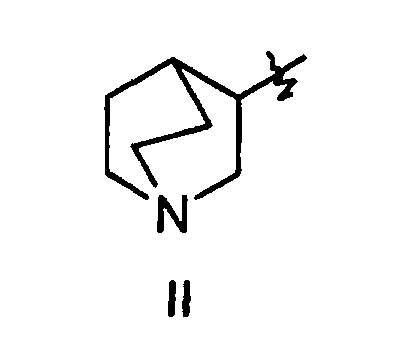
- Preferred embodiments of the invention also include compounds of formula I, wherein D represents oxygen; or an enantiomer thereof, and pharmaceutically acceptable salts thereof..
- Preferred embodiments of the invention also include compounds of formula I, wherein R2 represents hydrogen; or an enantiomer thereof, and pharmaceutically acceptable salts thereof.
- Preferred embodiments of the invention also include compounds of formula I, wherein R3 represents:or an enantiomer thereof, and pharmaceutically acceptable salts thereof.

- Preferred embodiments of the invention also include compounds of formula I, wherein R3 represents:when R4 represents Ar; R5 represents hydrogen, or C1-C4 alkyl; R6 represents hydrogen, or halogen; or an enantiomer thereof, and pharmaceutically acceptable salts thereof.

- Preferred embodiments of the invention also include compounds of formula I, wherein A represents:
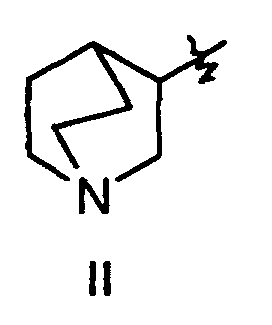
- D represents oxygen;
- R2 represents hydrogen;
- R3 represents:
-
- Preferred embodiments of the invention also include compounds of formula I, wherein A represents:

- D represents oxygen;
- R2 represents hydrogen;
- R3 represents:
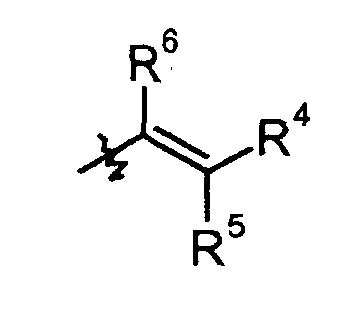
- R4 represents Ar;
- R5 represents hydrogen, or C1-C4 alkyl;
- R6 represents hydrogen, or halogen; or an enantiomer thereof, and pharmaceutically acceptable salts thereof.
-
- Preferred embodiments of the invention also include compounds of formula I, wherein Ar represents a 5- or 6-membered aromatic or heteroaromatic ring containing zero to three nitrogen atoms, zero or one oxygen atom, and zero or one sulfur atom, or an 8-, 9-or 10-membered fused aromatic or heteroaromatic ring system containing zero to four nitrogen atoms, zero to one oxygen atoms, and zero to one sulfur atoms which may optionally be substituted with one or more substituents selected from the following:
- hydrogen, halogen, C1-C4 alkyl, C2-C4 alkenyl, C2-C4 alkynyl, aryl, heteroaryl, -CO2R7, -CN, -NO2, -NR8R9, -CF3, -OR10; or an enantiomer thereof, and pharmaceutically acceptable salts thereof.
-
- Preferred compounds of formula I include the following:
- N-(1-Azabicyclo[2.2.2]oct-3-yl)(E-3-phenylpropenamide);
- N-(1-Azabicyclo[2.2.2]oct-3-yl)(3-phenylpropynamide);
- N-(1-Azabicyclo[2.2.2]oct-3-yl)[E-3-(2-nitrophenyl)propenamide];
- N-(1-Azabicyclo[2.2.2]oct-3-yl)[E-3-(2-aminophenyl)propenamide];
- N-(1-Azabicyclo[2.2.2]oct-3-yl)[Z-3-(2-methoxyphenyl)propenamide];
- N-(1-Azabicyclo[2.2.2]oct-3-yl)-N-methyl-(E-3-phenylpropenamide);
- N-(1-Azabicyclo[2.2.2]oct-3-yl)[E-2-phenylcyclopropane-1-carboxamide);

-
- Preferred compounds of formula I include the following:
- N-(1-Azabicyclo[2.2.2]oct-3-yl)(E-3-phenylpropenamide);
- N-(1-Azabicyclo[2.2.2]oct-3-yl)(3-phenylpropynamide);
- N-(1-Azabicyclo[2.2.2]oct-3-yl)[E-3-(2-nitrophenyl)propenamide];
- N-(1-Azabicyclo[2.2.2]oct-3-yl)[E-3-(2-nitrophenyl)propenamide];
- N-(1-Azabicyclo[2.2.2]oct-3-yl)[E-3-(2-aminophenyl)propenamide];
- N-(1-Azabicyclo[2.2.2]oct-3-yl)[Z-3-(2-methoxyphenyl)propenamide];
- N-(1-Azabicyclo[2.2.2]oct-3-yl)-N-methyl-(E-3-phenylpropenamide);
- N-(1-Azabicyclo[2.2.2]oct-3-yl)[E-2-phenylcyclopropane-1-carboxamide);
- N-(1-Azabicyclo[2.2.2]oct-3-yl)(Z-2-fluoro-3-phenylpropenamide);
- N-(1-Azabicyclo[2.2.2]oct-3-yl)[E-3-(2-formamidophenyl)propenamide];
- N-(1-Azabicyclo[2.2.2]oct-3-yl)[E-3-(4-nitrophenyl)propenamide];
- N-(1-Azabicyclo[2.2.2]oct-3-yl)(E-3-(4-aminophenyl)propenamide;
- N-(1-Azabicyclo[2.2.2]oct-3-yl)(E-3-(4-formamidophenyl)propenamide];
- N-(1-Azabicyclo[2.2.2]oct-3-yl)(Z-3-methyl-3-phenylpropenamide);
- N-(1-Azabicyclo[2.2.2]oct-3-yl)[E-3-(4-N-methylaminophenyl)propenamide];
- N-(1-Azabicyclo[2.2.2]oct-3-yl)[E-3-(4-N,N-dimethylaminophenyl)propenamide];
- N-(1-Azabicyclo[2.2.2]oct-3-yl)(Z-3-phenylpropenamide);
- N-(1-Azabicyclo[2.2.2]oct-3-yl)(E-3-methyl-3-phenylpropenamide);
- N-(1-Azabicyclo[2.2.2]oct-3-yl)(E-2,3-diphenylpropenamide);
- N-(1-Azabicyclo[2.2.2]oct-3-yl)[E-3-(4-methoxyphenyl)propenamide];
- N-(1-Azabicyclo[2.2.2]oct-3-yl)(E-2-methyl-3-phenylpropenamide);
- N-(1-Azabicyclo[2.2.2]oct-3-yl)[E-3-(2-methylphenyl)propenamide];
- N-(1-Azabicyclo[2.2.2]oct-3-yl)[E-3-(3-methoxyphenyl)propenamide];
- N-(1-Azabicyclo[2.2.2]oct-3-yl)[E-3-(2-fluorophenyl)propenamide];
- N-(1-Azabicyclo[2.2.2]oct-3-yl)[E-3-(4-fluorophenyl)propenamide];
- N-(1-Azabicyclo[2.2.2]oct-3-yl)[E-(2-chlorophenyl)propenamide];
- N-(1-Azabicyclo[2.2.2]oct-3-yl)[E-3-(3-chlorophenyl)propenamide];
- N-(1-Azabicyclo[2.2.2]oct-3-yl)[E-3-(4-chlorophenyl)propenamide];
- N-(1-Azabicyclo[2.2.2]oct-3-yl)-[E-3-(3,4-dichlorophenyl)propenamide];
- N-(1-Azabicyclo[2.2.2]oct-3-yl)-[E-3-(3-bromophenyl)propenamide]
- N-(1-Azabicyclo[2.2.2]oct-3-yl)-[E-3-(4-bromophenyl)propenamide];
- N-(1-Azabicyclo[2.2.2]oct-3-yl)[E-3-(3-iodophenyl)propenamide];
- N-(1-Azabicyclo[2.2.2]oct-3-yl)[E-3-(4-iodophenyl)propenamide];
- N-(1-Azabicyclo[2.2.2]oct-3-yl)[E-3-(2-trifluoromethylphenyl)propenamide];
- N-(1-Azabicyclo[2.2.2]oct-3-yl)-[E-3-(3-trifluoromethylphenyl)propenamide];
- N-(1-Azabicyclo[2.2.2]oct-3-yl)[E-3-(2-furyl)propenamide];
- N-(1-Azabicyclo[2.2.2]oct-3-yl)[E-3-(3-furyl)propenamide];
- N-(1-Azabicyclo[2.2.2]oct-3-yl)[E-3-(2-pyridyl)propenamide];
- N-(1-Azabicyclo[2.2.2]oct-3-yl)[E-3-(3-pyridyl)propenamide];
- N-(1-Azabicyclo[2.2.2]oct-3-yl)[E-3-(4-pyridyl)propenamide];
- N-(1-Azabicyclo[2.2.2]oct-3-yl)[E-3-(2-thienyl)propenamide];
- N-(1-Azabicyclo[2.2.2]oct-3-yl)[E-3-(3-thienyl)propenamide];
- N-(1-Azabicyclo[2.2.2]oct-3-yl)[E-3-(5-nitro-2-furyl)propenamide];
- N-(1-Azabicyclo[2.2.2]oct-3-yl)[E-3-(5-methoxy-3-pyridyl)propenamide];
- N-(1-Azabicyclo[2.2.2]oct-3-yl)[E-3-(5-hydroxy-3-pyridyl)propenamide];
- N-(1-Azabicyclo[2.2.2]oct-3-yl)[E-3-(4-imidazolyl)propenamide];
- N-(endo-8-Aza-8-methylbicyclo[3.2.1]oct-3-yl)(E-3-phenylpropenamide);
- N-(exo-8-Aza-8-methylbicyclo[3.2.1]oct-3-yl)(E-3-phenylpropenamide);
- or an enantiomer thereof, and pharmaceutically acceptable salts thereof.
-
- Particularly preferred compounds of formula I include the following:
- (R)-N-(1-Azabicyclo[2.2.2]oct-3-yl)(E-3-phenylpropenamide);
- (S)-N-(1-Azabicyclo[2.2.2]oct-3-yl)(E-3-phenylpropenamide);
- (RS)-N-(1-Azabicyclo[2.2.2]oct-3-yl)(E-3-phenylpropenamide);
- (R)-N-(1-Azabicyclo[2.2.2]oct-3-yl)(3-phenylpropynamide);
- (S)-N-(1-Azabicyclo[2.2.2]oct-3-yl)(3-phenylpropynamide);
- (R)-N-(1-Azabicyclo[2.2.2]oct-3-yl)[E-3-(2-nitrophenyl)propenamide];
- (S)-N-(1-Azabicyclo[2.2.2]oct-3-yl)[E-3-(2-nitrophenyl)propenamide];
- (RS)-N-(1-Azabicyclo[2.2.2]oct-3-yl)[E-3-(2-nitrophenyl)propenamide];
- (RS)-N-(1-Azabicyclo[2.2.2]oct-3-yl)[E-3-(2-aminophenyl)propenamide];
- (R)-N-(1-Azabicyclo[2.2.2]oct-3-yl)[E-3-(2-aminophenyl)propenamide];
- (R)-N-(1-Azabicyclo[2.2.2]oct-3-yl)[Z-3-(2-methoxyphenyl)propenamide];
- (RS)-N-(1-Azabicyclo[2.2.2]oct-3-yl)-N-methyl-(E-3-phenylpropenamide);
- (S)-N-(1-Azabicyclo[2.2.2]oct-3-yl)[E-2-phenylcyclogropane-1-carboxamide);
- (R)-N-(1-Azabicyclo[2.2.2]oct-3-yl)(E-2-phenylcyclopropane-1-carboxamide);
- (R)-N-(1-Azabicyclo[2.2.2]oct-3-yl)(Z-2-fluoro-3-phenylpropenamide);
- (R)-N-(1-Azabicyclo[2.2.2]oct-3-yl)[E-3-(2-formamidophenyl)propenamide];
- (R)-N-(1-Azabicyclo[2.2.2]oct-3-yl)[E-3-(4-nitrophenyl)propenamide];
- (R)-N-(1-Azabicyclo[2.2.2]oct-3-yl)(E-3-(4-aminophenyl)propenamide;
- (R)-N-(1-Azabicyclo[2.2.2]oct-3-yl)(E-3-(4-formamidophenyl)propenamide];
- (R)-N-(1-Azabicyclo[2.2.2]oct-3-yl)(Z-3-methyl-3-phenylpropenamide);
- (R)-N-(1-Azabicyclo[2.2.2]oct-3-yl)[E-3-(4-N-methylaminophenyl)propenamide];
- (R)-N-(1-Azabicyclo[2.2.2]oct-3-yl)[E-3-(4-N,N-dimethylaminophenyl)propenamide];
- (R)-N-(1-Azabicyclo[2.2.2]oct-3-yl)(Z-3-phenylpropenamide);
- (R)-N-(1-Azabicyclo[2.2.2]oct-3-yl)(E-3-methyl-3-phenylpropenamide);
- (R)-N-(1-Azabicyclo[2.2.2]oct-3-yl)(E-2,3-diphenylpropenamide);
- (R)-N-(1-Azabicyclo[2.2.2]oct-3-yl)[E-3-(4-methoxyphenyl)propenamide];
- (R)-N-(1-Azabicyclo[2.2.2]oct-3-yl)(E-2-methyl-3-phenylpropenamide);
- (S)-N-(1-Azabicyclo[2.2.2]oct-3-yl)(E-2-methyl-3-phenylpropenamide);
- (R)-N-(1-Azabicyclo[2.2.2]oct-3-yl)[E-3-(2-methylphenyl)propenamide];
- (S)-N-(1-Azabicyclo[2.2.2]oct-3-yl)[E-3-(2-methylphenyl)propenamide];
- (RS)-N-(1-Azabicyclo[2.2.2]oct-3-yl)[E-3-(2-methoxyphenyl)propenamide];
- (R)-N-(1-Azabicyclo[2.2.2]oct-3-yl)[E-3-(3-methoxyphenyl)propenamide];
- (RS)-N-(1-Azabicyclo[2.2.2]oct-3-yl)[E-3-(4-methoxyphenyl)propenamide];
- (RS)-N-(1-Azabicyclo[2.2.2]oct-3-yl)[E-3-(2-fluorophenyl)propenamide];
- (R)-N-(1-Azabicyclo[2.2.2]oct-3-yl)[E-3-(3-fluorophenyl)propenamide];
- (R)-N-(1-Azabicyclo[2.2.2]oct-3-yl)[E-3-(4-fluorophenyl)propenamide];
- (R)-N-(1-Azabicyclo[2.2.2]oct-3-yl)[E-(2-chlorophenyl)propenamide];
- (S)-N-(1-Azabicyclo[2.2.2]oct-3-yl)[E-(2-chlorophenyl)propenamide];
- (R)-N-(1-Azabicyclo[2.2.2]oct-3-yl)[E-3-(3-chlorophenyl)propenamide];
- (R)-N-(1-Azabicyclo[2.2.2]oct-3-yl)[E-3-(4-chlorophenyl)propenamide];
- (R)-N-(1-Azabicyclo[2.2.2]oct-3-yl)-[E-3-(3,4-dichlorophenyl)propenamide];
- (R)-N-(1-Azabicyclo[2.2.2]oct-3-yl)-[E-3-(3-bromophenyl)propenamide]
- (R)-N-(1-Azabicyclo[2.2.2]oct-3-yl)-[E-3-(4-bromophenyl)propenamide];
- (RS)-N-(1-Azabicyclo[2.2.2]oct-3-yl)[E-3-(3-iodophenyl)propenamide];
- (RS)-N-(1-Azabicyclo[2.2.2]oct-3-yl)[E-3-(4-iodophenyl)propenamide];
- (RS)-N-(1-Azabicyclo[2.2.2]oct-3-yl)[E-3-(2-trifluoromethylphenyl)propenamide];
- (R)-N-(1-Azabicyclo[2.2.2]oct-3-yl)-[E-3-(3-trifluoromethylphenyl)propenamide];
- (R)-N-(1-Azabicyclo[2.2.2]oct-3-yl)[E-3-(2-furyl)propenamide];
- (R)-N-(1-Azabicyclo[2.2.2]oct-3-yl)[E-3-(3-furyl)propenamide];
- (R)-N-(1-Azabicyclo[2.2.2]oct-3-yl)[E-3-(2-pyridyl)propenamide];
- (R)-N-(1-Azabicyclo[2.2.2]oct-3-yl)[E-3-(3-pyridyl)propenamide];
- (R)-N-(1-Azabicyclo[2.2.2]oct-3-yl)[E-3-(4-pyridyl)propenamide];
- (R)-N-(1-Azabicyclo[2.2.2]oct-3-yl)[E-3-(2-thienyl)propenamide];
- (R)-N-(1-Azabicyclo[2.2.2]oct-3-yl)[E-3-(3-thienyl)propenamide];
- (R)-N-(1-Azabicyclo[2.2.2]oct-3-yl)[E-3-(5-nitro-2-furyl)propenamide];
- (R)-N-(1-Azabicyclo[2.2.2]oct-3-yl)[E-3-(5-methoxy-3-pyridyl)propenamide];
- (R)-N-(1-Azabicyclo[2.2.2]oct-3-yl)[E-3-(5-hydroxy-3-pyridyl)propenamide];
- (R)-N-(1-Azabicyclo[2.2.2]oct-3-yl)[E-3-(4-imidazolyl)propenamide];
- N-(endo-8-Aza-8-methylbicyclo[3.2.1]oct-3-yl)(E-3-phenylpropenamide);
- N-(exo-8-Aza-8-methylbicyclo[3.2.1]oct-3-yl)(E-3-phenylpropenamide), or an enantiomer thereof, and pharmaceutically acceptable salts thereof.
-
- In another aspect of the invention there is provided compounds of the general formula I,wherein:
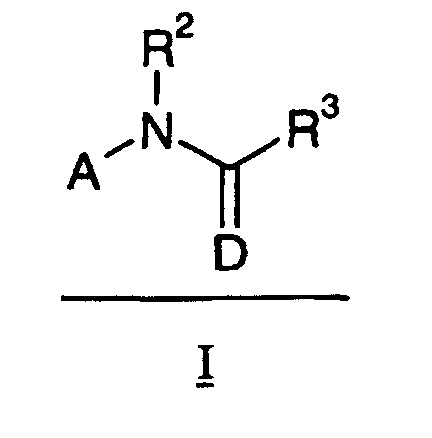
- A represents:

- D represents oxygen, or sulfur;
- R1 represents hydrogen or methyl;
- R2 represents hydrogen, or C1-C4 alkyl;
- R3 represents:
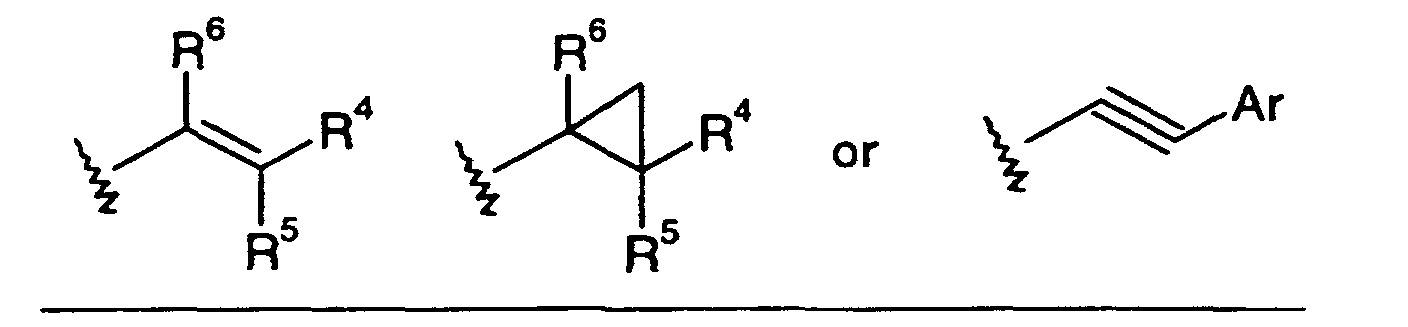
- R4, R5, and R6 are independently hydrogen, halogen, C1-C4 alkyl, C2-C4 alkenyl, C2-C4 alkynyl, -CO2R7, -CN,-CF3, or Ar, provided that at least one of R4 and R5 represents Ar;
-
- Ar represents a 5- or 6-membered aromatic or heteroaromatic ring containing zero to three nitrogen atoms, zero or one oxygen atom, and zero or one sulfur atom, or an 8- or 10-membered fused aromatic or heteroaromatic ring system containing zero to four nitrogen atoms, zero to one oxygen atoms, and zero to one sulfur atoms which may optionally be substituted with one or more substituents selected from the following:
- hydrogen, halogen, C1-C4 alkyl, C2-C4 alkenyl, C2-C4 alkynyl, -CO2R7, -CN, -NO2, - NR8R9, -CF3, -OR10;
- R8, R9, and R10 are independently hydrogen, C1-C4 alkyl, -C(O)R11, -C(O)NHR12, -C(O)R13, -SO2R14 or R8 and R9 may together be (CH2)jO(CH2)k where O is O, S, NR15, or a bond;
- j is 2 to 4;
- k is 0 to 2;
- R7, R10, R11, R12, R13, R14, and R15, are independently C1-C4 alkyl; or an enantiomer thereof, and pharmaceutically acceptable salts thereof, with the additional proviso that Ar does not represent 2-, 3-, 4-pyridyl, unsubstituted phenyl or phenyl substituted with one or more substituents selected from C1-C4 alkyl, C1-C4 alkoxy, halogen, phenoxy, hydroxy, OCOR11, NH2, NHCOR11, and nitro, when:
- A represents:

- R3 represents:

- D represents oxygen;
- R represents methyl;
- R2 and R5 both represent hydrogen;
- R6 represents any of hydrogen, C1-C4 alkyl, phenyl, or cyano;
-
- In a preferred embodiment of this aspect of the invention, there is provided a compound according to formula I, as defined above, wherein A represents:or an enantiomer thereof, and pharmaceutically acceptable salts thereof.

- In another preferred embodiment of this aspect of the invention, there is provided a compound according to formula I, as defined above, wherein A represents:and R6 represents any of 2-furyl; 3-furyl; 2-thienyl; 3-thienyl; or an enantiomer thereof, and pharmaceutically acceptable salts thereof.

- Among these compounds, the following compounds are preferred:
- N-(1-Azabicyclo[2.2.2]oct-3-yl)[E-3-(3-trifluoromethylphenyl)propenamide];
- N-(1-Azabicyclo[2.2.2]oct-3-yl)[E-3-(2-furyl)propenamide];
- N-(1-Azabicyclo[2.2.2]oct-3-yl)[E-3-(3-furyl)propenamide];
- N-(1-Azabicyclo[2.2.2]oct-3-yl)[E-3-(2-thienyl)propenamide];
- N-(1-Azabicyclo[2.2.2]oct-3-yl)[E-3-(3-thienyl)propenamide];
- N-(1-Aza-3-cyanobicyclo[2.2.2]oct-3-yl)[E-3-phenylpropenamide];
- N-(1-Aza-3-methylbicyclo[2.2.2]oct-3-yl)[E-3-phenylpropenamide];
- N-(1-Azabicyclo[2.2.2]oct-3-yl)[E-3-(5-nitro-2-furyl)propenamide];
- N-(1-Azabicyclo[2.2.2]oct-3-yl)[E-3-(5-methoxy-3-pyridyl)propenamide];
- N-(1-Azabicyclo[2.2.2]oct-3-yl)[E-3-(5-hydroxy-3-pyridyl)propenamide];
- N-(1-Azabicyclo[2.2.2]oct-3-yl)[E-3-(4-imidazolyl)propenamide]; or an enantiomer and/or pharmaceutically acceptable salts thereof.
-
- Among these compounds, the following compounds are particularly preferred:
- (R)-N-(1-Azabicyclo[2.2.2]oct-3-yl)[E-3-(3-trifluoromethylphenyl)propenamide];
- (R)-N-(1-Azabicyclo[2.2.2]oct-3-yl)[E-3-(2-furyl)propenamide];
- (R)-N-(1-Azabicyclo[2.2.2]oct-3-yl)[E-3-(3-furyl)propenamide];
- (R)-N-(1-Azabicyclo[2.2.2]oct-3-yl)[E-3-(2-thienyl)propenamide];
- (R)-N-(1-Azabicyclo[2.2.2]oct-3-yl)[E-3-(3-thienyl)propenamide];
- N-(1-Aza-3-cyanobicyclo[2.2.2]oct-3-yl)[E-3-phenylpropenamide];
- N-(1-Aza-3-methylbicyclo[2.2.2]oct-3-yl)[E-3-phenylpropenamide];
- (R)-N-(1-Azabicyclo[2.2.2]oct-3-yl)[E-3-(5-nitro-2-furyl)propenamide];
- (R)-N-(1-Azabicyclo[2.2.2]oct-3-yl)[E-3-(5-methoxy-3-pyridyl)propenamide];
- (R)-N-(1-Azabicyclo[2.2.2]oct-3-yl)[E-3-(5-hydroxy-3-pyridyl)propenamide];
- (R)-N-(1-Azabicyclo[2.2.2]oct-3-yl)[E-3-(4-imidazolyl)propenamide] or enantiomers thereof, and pharmaceutically acceptable salts thereof.
-
- Pharmaceutically acceptable derivatives include solvates and salts. For example, the compounds of formula I can form acid addition salts with acids, such as the conventional pharmaceutically acceptable acids, for example, maleic, hydrochloric, hydrobromic, phosphoric, acetic, fumaric, salicylic, citric, lactic, mandelic, tartaric and methanesulfonic acids.
- The compounds of the invention have the advantage that they may be less toxic, be more efficacious, be longer acting, have a broader range of activity, be more potent, produce fewer side effects, are more easily absorbed or have other useful pharmacological properties.

- A further aspect of the invention relates to a pharmaceutical composition for treating or preventing a condition or disorder as exemplified below arising from dysfunction of nicotinic acetylcholine receptor neurotransmission in a mammal, preferably a human, comprising an amount of a compound of formula I, an enantiomer thereof or a pharmaceutically acceptable salt thereof, effective in treating or preventing such disorder or condition and an inert pharmaceutically acceptable diluent or carrier.
- A condition or disorder arising from dysfunction of nicotinic acetylcholine receptor neurotransmission in a mammal, preferably a human, may be psychotic disorders or intellectual impairment disorders or diseases or conditions in which activation of the α7 nicotinic receptor is beneficial. Examples of such conditions, diseases or disorders include Alzheimer's disease, learning deficit, cognition deficit, attention deficit, memory loss, Attention Deficit Hyperactivity Disorder, anxiety, schizophrenia, mania or manic depression, Lewy Body Dementia, Parkinson's disease, Huntington's disease, Tourette's syndrome, neurodegenerative disorders in which there is loss of cholinergic synapse, jetlag, cessation of smoking, nicotine addiction including that resulting from exposure to products containing nicotine, pain, or ulcerative colitis.
- For the above-mentioned uses the dosage administered will, of course, vary with the compound employed, the mode of administration and the treatment desired. However, in general, satisfactory results are obtained when the compounds of the invention are administered at a daily dosage of from about 0.1 mg to about 20 mg per kg of animal body weight, preferably given in divided doses 1 to 4 times a day or in sustained release form. For man, the total daily dose is in the range of from 5 mg to 1,400 mg, more preferably from 10 mg to 100 mg, and unit dosage forms suitable for oral administration comprise from 2 mg to 1,400 mg of the compound admixed with a solid or liquid pharmaceutical carrier or diluent.
- The compounds of formula I, or an enantiomer thereof, and pharmaceutically acceptable salts thereof, may be used on their own or in the form of appropriate medicinal preparations for enteral or parenteral administration. According to a further aspect of the invention, there is provided a pharmaceutical composition including preferably less than 80% and more preferably less than 50% by weight of a compound of the invention in admixture with an inert pharmaceutically acceptable diluent or carrier.
- Examples of diluents and carriers are:
- for tablets and dragees: lactose, starch, talc, stearic acid; for capsules: tartaric acid or lactose;
- for injectable solutions: water, alcohols, glycerin, vegetable oils; for suppositories: natural or hardened oils or waxes.
- There is also provided a process for the preparation of such a pharmaceutical composition, which comprises mixing the ingredients.
- In a particular embodiment a pharmaceutical composition according to this invention is used in the treatment of psychotic disorders or intellectual impairment disorders.
- In another embodiment a pharmaceutical composition according to this invention is used in the treatment of Alzheimer's disease, learning deficit, cognition deficit, attention deficit, memory loss, Attention Deficit Hyperactivity Disorder, anxiety, schizophrenia, or mania or manic depression, Lewy Body Dementia, Parkinson's disease, Huntington's disease, Tourette's syndrome, neurodegenerative disorders in which there is loss of cholinergic synapse, jetlag, cessation of smoking, nicotine addiction including that resulting from exposure to products containing nicotine, pain, or ulcerative colitis.
- In another embodiment a pharmaceutical composition according to this invention is used in the treatment of Alzheimer's disease, learning deficit, cognition deficit, attention deficit, memory loss, Lewy Body Dementia, or Attention Deficit Hyperactivity Disorder. In another embodiment a pharmaceutical composition according to this invention is used in the treatment of anxiety, schizophrenia, or mania or manic depression.
- In another embodiment a pharmaceutical composition according to this invention is used in the treatment of Parkinson's disease, Huntington's disease, Tourette's syndrome, or neurodegenerative disorders in which there is loss of cholinergic synapses.
- In another embodiment a pharmaceutical composition according to this invention is used in the treatment of jetlag, nicotine addiction including that resulting from exposure to products containing nicotine, pain, or ulcerative colitis.
- In another embodiment a pharmaceutical composition according to this invention is used in the treatment of Alzheimer's disease.
- The use of compounds of the invention is indicated as pharmaceuticals, in particular in the treatment of psychotic disorders and intellectual impairment disorders. Examples of psychotic disorders include schizophrenia, mania or manic depression, and anxiety. Examples of intellectual impairment disorders include Alzheimer's disease, Lewy Body Dementia, learning deficit, cognition deficit, attention deficit, memory loss, and Attention Deficit Hyperactivity Disorder. The compounds of the invention may also be useful as analgesics in the treatment of pain (including chronic pain) and in the treatment of Parkinson's disease, Huntington's disease, Tourette's syndrome, and neurodegenerative disorders in which there is loss of cholinergic synapses. The compounds may further be indicated for the treatment of jetlag, for use in inducing the cessation of smoking, and for the treatment of nicotine addiction (including that resulting from exposure to products containing nicotine).
- It is also believed that compounds according to the invention are useful in the treatment of ulcerative colitis.
- Commercial reagents were used without further purification. Mass spectra were recorded using either a Hewlett Packard 5988A or a MicroMass Quattro-1 Mass Spectrometer and are reported as m/z for the parent molecular ion. Room temperature refers to 20-25°C.
- The following examples are preferred non-limiting examples embodying preferred aspects of the invention.
- (R)-1-Azabicyclo[2.2.2]oct-3-ylamine dihydrochloride (7.5g, 0.038 moles) and E-3-phenylpropenoic acid (5.6g, 0.038 moles) were combined in anhydrous N,N-dimethylformamide (570ml) under nitrogen atmosphere. The resulting mixture was stirred while adding 1-hydroxybenzotriazole monohydrate (5.8g, 0.0378 moles) O-benzotriazol-1-yl-N,N,N',N'-tetramethyluronium tetrafluoroborate (12.1g, 0.038 moles) and N,N-diisopropylethylamine (26.4ml) were added. The solution was stirred at ambient temperature for 6h and then placed in a freezer overnight. The solution was concentrated in vacuo and the residue was taken up in chloroform (360ml) and washed with aqueous sodium hydroxide (1 M, 360ml). The basic layer was extracted twice more with chloroform and the organic layers were combined, dried (MgSO4), and concentrated in vacuo. The compound was then purified on a flash silica gel column with a 5-20% methanol/chloroform/ammonium hydroxide gradient. The hydrochloride salt was prepared from isopropanol and ethyl acetate, giving 9.5g of slightly off-white powder; MS (ES+) 257 (MH+).
- Prepared as free base by a method analogous to that described in Example 1 from (S)-1-azabicyclo[2.2.2]oct-3-ylamine dihydrochloride and E-3-phenylpropenoic acid; MS (ES+) 257 (MH+).
- Prepared as free base by a method analogous to that described in Example 1 from (RS)-1-azabicyclo[2.2.2]oct-3-ylamine dihydrochloride and E-3-phenylpropenoic acid; MS (ES+) 257 (MH+).
- Prepared as a free base by a method analogous to that described in Example 1 from (R)-1-azabicyclo[2.2.2]oct-3-ylamine dihydrochloride and 3-phenylpropynoic acid; MS (ES+) 255 (MH+).
- Prepared as a free base by a method analogous to that described in Example 1 from (S)-1-azabicyclo[2.2.2]oct-3-ylamine dihydrochloride and 3-phenylpropynoic acid; MS (ES+) 255 (MH+).
- Prepared as a free base by a method analogous to that described in Example 1 from (R)-1-azabicyclo[2.2.2]oct-3-ylamine dihydrochloride and E-3-(2-nitrophenyl)propenoic acid; MS (ES+) 302 (MH+).
- Prepared as a free base by a method analogous to that described in Example 1 from (S)-1-azabicyclo[2.2.2]oct-3-ylamine dihydrochloride and E-3-(2-nitrophenyl)propenoic acid as a solid; MS (ES+) 302 (MH+).
- Prepared as a free base by a method analogous to that described in Example 1 from (RS)-1-azabicyclo[2.2.2]oct-3-ylamine dihydrochloride and E-3-(2-nitrophenyl)propenoic acid as a solid; MS (ES+) 302 (MH+).
- (RS)-N-(1-Azabicyclo[2.2.2]oct-3-yl)[E-3-(2-nitrophenyl)propenamide] (0.42g, 0.014 moles) prepared was suspended in acetone (4.2ml) and ammonium chloride (0.15g, 0.028 moles) in water (2.1ml) was added. The clear solution was brought to reflux using an oil bath, and then removed from heating while zinc dust (0.42g, 0.063 moles) was added. The reaction was held at reflux for one hour, at which point the conversion was complete by thin layer chromatography. The suspension was diluted with chloroform and saturated sodium bicarbonate, and decanted from the solid zinc. The layers were separated and the aqueous layer was extracted twice more with chloroform. The combined layers were dried (MgSO4) and evaporated. The maleate salt was prepared in isopropanol. The solvent was decanted and the orange deliquescent solid was transferred with methanol and stripped to give a foamy orange glass; MS (ES+) 272 (MH+)
- Prepared by a method analogous to that described in Example 9 from (R)-N-(1-azabicyclo[2.2.2]oct-3-yl)[E-3-(2-nitrophenyl)propenamide]; MS (ES+) 272 (MH+).
- Prepared as a free base by a method analogous to that described in Example 1 from (R)-1-azabicyclo[2.2.2]oct-3-ylamine dihydrochloride and Z-3-(2-methoxyphenyl)propenoic acid; MS (ES+) 287 (MH+).
- (RS)-N-(1-Azabicyclo[2.2.2]oct-3-yl)(E-3-phenylpropenamide) (0.15g, 0.059 moles) was suspended in anhydrous tetrahydrofuran under nitrogen atmosphere. The reaction mixture was cooled with an ice bath while commercial 1.0 M borane/tetrahydrofuran complex (0.59ml) was added dropwise by syringe. The suspension dissolved immediately and the solution was stirred at 0°C for one hour. The reaction was carefully quenched by adding water (2ml) with cooling. The reaction was then diluted with brine and methylene chloride. The layers were separated and the aqueous layer was extracted twice more with methylene chloride. The combined organic layers were dried (MgSO4) and evaporated in vacuo. Sodium hydride (28mg, 0.00071 moles) was suspended in anhydrous N,N-dimethylformamide (2ml) under nitrogen. The crude borane complex was dissolved in N,N-dimethylformamide (1ml) and added dropwise. The reaction was stirred at room temperature for 30 minutes and then the methyl iodide (55µl, 0.000885 moles) was added by syringe. After stirring 2½h the reaction was cooled with an ice bath and quenched with water (1ml). The suspension was diluted with saturated sodium bicarbonate and ethyl acetate and the layers were separated. The aqueous layer was extracted twice more and the organic layers were combined, dried (MgSO4), and concentrated in vacuo. The crude complex was dissolved in acetone (1.6ml) and water (0.27ml) was added. The reaction was cooled with an ice bath and aqueous hydrogen bromide (0.27ml) was added dropwise. The reaction was stirred at 0°C. Additional hydrogen bromide (0.27ml) was added after 5h but no further change was detected by thin layer chromatography. The acetone was removed in vacuo and chased with one portion of methanol and three of ethanol. The crude was triturated first with ethanol and then ether. Two phases resulted, and the lower was separated and washed with more ether, which was decanted. The remainder of the solvent was removed in vacuo. The yellow semi-solid was transferred using methanol and this was removed in vacuo and chased with two portions if ether. Yielded 0.15 g; MS (ES+) 271 (MH+).
- Prepared as free bases by a method analogous to that described in Example 1 from (S)-1-azabicyclo[2.2.2]oct-3-ylamine dihydrochloride and trans-2-phenylcyclopropane-1-carboxylic acid. The diastereomers could be separated by chromatography on silica gel using a 10-30% methanol/chloroform/ammonium hydroxide gradient; both MS (ES+) 271 (MH+).
- Prepared as free bases by a method analogous to that described in Example 1 from (R)-1-azabicyclo[2.2.2]oct-3-ylamine dihydrochloride and trans-2-phenylcyclopropane-1-carboxylic acid. The diastereomers could be separated by chromatography on silica gel using a 10-30% methanol/chloroform/ammonium hydroxide gradient; both MS (ES+) 271 (MH+).
- Prepared as free base by a method analogous to that described in Example 1 from (R)-1-azabicyclo[2.2.2]oct-3-ylamine dihydrochloride and Z-2-fluoro-3-phenylpropenoic acid; MS (ES+) 275 (MH+).
- Formic acid (98%, 2.9ml) and acetic anhydride (1.0ml) were combined under an inert atmosphere while cooling with a cold water bath. (R)-N-(1-Azabicyclo[2.2.2]oct-3-yl)(E-3-(2-aminophenyl)propenamide) (0.16g, 0.00059 moles) was added and the reaction was stirred for three days at room temperature. The solution was poured into saturated sodium carbonate and more solid carbonate was added until the solution was basic. The aqueous layer was extracted four times with chloroform. The organic extracts were combined, dried (MgSO4), and concentrated in vacuo. The product was transferred using chloroform and this was stripped and chased with two portions of ether. The white solid was dried at room temperature with high vacuum, giving 64mg; MS (ES+) 300 (MH+).
- Prepared as free base by a method analogous to that described in Example 1 from (R)-1-azabicyclo[2.2.2]oct-3-ylamine dihydrochloride and E-3-(4-nitrophenyl)propenoic acid; MS (ES+) 302 (MH+).
- Prepared by a method analogous to Example 9 from (R)-N-(1-Azabicyclo[2.2.2]oct-3-yl)[E-3-(4-nitrophenyl)propenamide]; MS (ES+) 272 (MH+).
- Prepared as free base by a method analogous to that described in Example 18 from (R)-N-(1-azabicyclo[2.2.2]oct-3-yl)(E-3-(4-aminophenyl)propenamide); MS (ES+) 300 (MH+).
- Copper(I) iodide (1.1g, 0.006 moles) was suspended in anhydrous ether (20ml) and the resulting suspension was kept below -10°C and stirred protected from light while commercial 1.0M methyl lithium solution (6ml) was slowly added dropwise. The white suspension was stirred at -10°C for 30 minutes while the solid dissolved. 3-Phenylpropynoic acid (0.44g, 0.003 moles) was added in three portions at -60°C. The reaction mixture was then stirred at -10°C for 90 min and was then poured into dilute aqueous hydrochloric acid. Chloroform was added and the resulting emulsion was filtered through diatomaceous earth, and the phases were then separated. The aqueous layer was extracted three more times with chloroform. The organic layers were combined, dried (MgSO4), and concentrated. The crude product was dried under high vacuum and used without further purification.
- Prepared as a free base by a procedure analogous to that described in Example 1 from (R)-1-azabicyclo[2.2.2]oct-3-ylamine dihydrochloride and Z-3-methyl-3-phenylpropenoic acid; MS (ES+) 271 (MH+).
- Sodium metal (0.1g, 0.0043 moles) was added in two portions to dry methanol (2ml) stirred at 0°C under nitrogen. After 20min, (R)-N-(1-azabicyclo[2.2.2]oct-3-yl)[E-3-(4-aminophenyl)propenamide] (0.27g, 0.001 moles) in methanol was added followed by paraformaldehyde (0.18g, 0.006 moles), and the resulting solution was stirred at room temperature overnight. The reaction was heated at 50°C for 4h then sodium borohydride (0.10g, 0.0028 moles) was added and the solution was heated under reflux for 2h. The reaction mixture was allowed to cool and aqueous potassium hydroxide (1 M, 0.8ml) was added. After the resulting mixture had been stirred at room temperature for 1h, the solution was concentrated in vacuo, and the residue was partitioned between water and chloroform. The aqueous layer was extracted three times more with chloroform. The organic layers were combined, dried (MgSO4), and concentrated in vacuo. The material was purified first by solid phase extraction on silica using a 10-40% ammoniated methanol/chloroform gradient, and then by reverse phase HPLC on a Waters Bondapak® C18 column using a gradient of 10-60% acetonitrile and 0.1% aqueous trifluoroacetic acid as the eluent. The free base was recovered by neutralization and extraction, yielding 45 mg of a yellow powder; MS (ES+) 286 (MH+).
- Sodium cyanoborohydride (0.19g, 0.003mol) and anhydrous zinc chloride (0.21 g, 0.0015 moles) were combined in anhydrous methanol. The mixture was stirred for 5 min and (R)-N-(1-azabicyclo[2.2.2]oct-3-yl)[E-3-(4-aminophenyl)propenamide] (0.27g, 0.001 moles) was dissolved in methanol (3ml) was added, followed by paraformaldehyde (0.18g, 0.006 moles). The reaction mixture was stirred at room temperature overnight. The methanol was concentrated in vacuo and the residue was taken up in 1M sodium hydroxide (20ml). The aqueous layer was extracted three times with chloroform and these layers were combined, dried (MgSO4) and evaporated in vacuo. The material was purified first by solid phase extraction on silica using a 10-40% ammoniated methanol/chloroform gradient, and then by reverse phase HPLC on a Waters Bondapak® C18 column using a gradient of 10-60% acetonitrile and 0.1% aqueous trifluoroacetic acid as the eluent. The free base was recovered by neutralization and extraction, yielding 12mg of yellow powder; MS (ES+) 300 (MH+).
- Nickel (II) acetate tetrahydrate (0.16g, 0.00063 moles) was dissolved in ethanol (6.3ml) and placed under hydrogen atmosphere. The green solution was stirred rapidly while sodium borohydride (0.024g, 0.00063 moles) in ethanol (0.63ml) was added. The deep purple solution was then treated with ethylene diamine (0.42ml, 0.0063 moles) followed by 3-phenylpropynoic acid (0.73g, 0.005 moles). The reaction was stirred under hydrogen for 5 hours. The hydrogen was displaced with nitrogen and the suspension was filtered through diatomaceous earth to remove the catalyst. The filtrate was concentrated in vacuo. The residue was taken up in chloroform and water, and concentrated hydrochloric acid was added to acidify the aqueous layer. The layers were separated and the acidic layer was extracted three times more with chloroform. The organic layers were combined and concentrated. The material was purified by reverse phase HPLC on a Waters Bondapak® C18 column using a gradient of 10-40% acetonitrile and 0.25% aqueous trifluoroacetic acid as the eluent to give a white solid (0.51g).
- Prepared as a free base by a method analogous to that described in Example 1 from (R)-1-azabicyclo[2.2.2]oct-3-ylamine dihydrochloride, and Z-3-phenylpropenoic acid; MS (ES+) 257 (MH+).
- A complex of copper (I) bromide (1.72g, 0.12 moles) and lithium bromide (1.0g, 0.012 moles) was prepared in anhydrous tetrahydrofuran and cooled to -50°C. Commercial methyl magnesium bromide (3.0 M in ether; 4ml) was added dropwise. The suspension was stirred at -50°C for 15 min, then 3-phenylpropynoic acid (0.44g, 0.003 moles) was added in three portions. The mixture was stirred at -50°C for 15 minutes and then was directly warmed to 30°C with a warm water bath. After stirring for one hour the reaction mixture was poured into saturated ammonium chloride. The solution was acidified by slowly adding concentrated hydrochloric acid and then was extracted four times with chloroform. The organic layers were combined, dried (MgSO4), and concentrated in vacuo. The material was purified by reverse phase HPLC on a Waters Bondapak® C18 column using a gradient of 20-60% acetonitrile and 0.25% aqueous trifluoroacetic acid as the eluent to give a colourless solid (0. 14g).
- Prepared as a free base by a method analogous to that described in Example 1 from (R)-1-azabicyclo[2.2.2]oct-3-ylamine dihydrochloride and E-3-methyl-3-phenylpropenoic acid, giving a light tan solid; MS (ES+) 271 (MH+).
- Prepared as free base by a method analogous to that described in Example 1 from (R)-1-azabicyclo[2.2.2]oct-3-ylamine dihydrochloride and E-2,3-diphenylpropenoic acid; MS (ES+) 333 (MH+).
- Prepared as free base by a method analogous to that described in Example 1 from (R)-1-azabicyclo[2.2.2]oct-3-ylamine dihydrochloride and E-3-(4-methoxy)phenylpropenoic acid; MS (ES+) 287 (MH+).
- Prepared as free base by a method analogous to that described in Example 1 from (R)-1-azabicyclo[2.2.2]oct-3-ylamine dihydrochloride and E-2-methyl-3-phenylpropenoic acid; MS (ES+) 271 (MH+).
- Prepared as free base by a method analogous to that described in Example 1 from (S)-1-azabicyclo[2.2.2]oct-3-ylamine dihydrochloride and E-α-methyl-3-phenylpropenoic acid; MS (ES+) 271 (MH+).
- Prepared as a free base by a method analogous to that described in Example 1 from (R)-1-azabicyclo[2.2.2]oct-3-ylamine dihydrochloride and E-3-(2-methylphenyl)propenoic acid; MS (ES+) 271 (MH+).
- Prepared as a free base by a method analogous to that described in Example 1 from (S)-1-azabicyclo[2.2.2]oct-3-ylamine dihydrochloride and E-3-(2-methylphenyl)propenoic acid; MS (ES+) 271 (MH+).
- Prepared as a free base by a method analogous to that described in Example 1 from racemic 1-azabicyclo[2.2.2]oct-3-ylamine dihydrochloride and E-3-(2-methoxyphenyl)propenoic acid; MS (ES+) 287 (MH+).
- Prepared as a free base by a method analogous to that described in Example 1 from (R)-1-azabicyclo[2.2.2]oct-3-ylamine dihydrochloride and E-3-(3-methoxyphenyl)propenoic acid; the compound was purified by chromatography on silica gel using ammoniated methanol/chloroform mixtures as the eluent; MS (ES+) 287 (MH+).
- Prepared as a free base by a method analogous to that described in Example 1 from racemic 1-azabicyclo[2.2.2]oct-3-ylamine dihydrochloride and E-3-(4-methoxyphenyl)propenoic acid; MS (ES+) 287 (MH+).
- Prepared as a free base by a method analogous to that described in Example 1 from racemic 1-azabicyclo[2.2.2]oct-3-ylamine dihydrochloride and E-3-(2-fluorophenyl)propenoic acid; MS (ES+) 275 (MH+).
- Prepared by a method analogous to that described in Example 1 from (R)-1-azabicyclo[2.2.2]oct-3-ylamine dihydrochloride and E-3-(3-fluorophenyl)propenoic acid; the compound was purified by chromatography on silica gel using ammoniated methanol /chloroform mixtures as the eluent; MS (ES+) 275 (MH+).
- Prepared as a free base by a method analogous to that described in Example 1 from (R)-1-azabicyclo[2.2.2]oct-3-ylamine dihydrochloride and E-3-(4-fluorophenyl)propenoic acid; the compound was purified by chromatography on silica gel using ammoniated methanol/chloroform mixtures as the eluent; MS (ES+) 275 (MH+).
- Prepared as a free base by a method analogous to that described in Example 1 from (R)-1-azabicyclo[2.2.2]oct-3-ylamine dihydrochloride and E-3-(2-chlorophenyl)propenoic acid; MS (ES+) 291 and 293 (MH+).
- Prepared as a free base by a method analogous to that described in Example 1 from (S)-1-azabicyclo[2.2.2]oct-3-ylamine dihydrochloride and E-3-(2-chlorophenyl)propenoic acid; MS (ES+) 291 and 293 (MH+).
- Prepared as a free base by a method analogous to that described in Example 1 from (R)-1-azabicyclo[2.2.2]oct-3-ylamine dihydrochloride and E-3-(3-chlorophenyl)propenoic acid; the compound was purified by chromatography on silica gel using ammoniated methanol / chloroform mixtures as the eluent; MS (ES+) 291, 293 (MH+).
- Prepared as a free base by a method analogous to that described in Example 1 from (R)-1-azabicyclo[2.2.2]oct-3-ylamine dihydrochloride and E-3-(4-chlorophenyl)propenoic acid; the compound was purified by chromatography on silica gel using ammoniated methanol / chloroform mixtures as the eluent; MS (ES+) 291, 293 (MH+).
- Prepared as a free base by a method analogous to that described in Example 1 from (R)-1-azabicyclo[2.2.2]oct-3-ylamine dihydrochloride and E-3-(3,4-dichlorophenyl)propenoic acid; the compound was purified by chromatography on silica gel using ammoniated methanol / chloroform mixtures as the eluent; MS (ES+) 325, 327, 329 (MH+).
- Prepared as a free base by a method analogous to that described in Example 1 from (R)-1-azabicyclo[2.2.2]oct-3-ylamine dihydrochloride and E-3-(3-bromophenyl)propenoic acid; the compound was purified by chromatography on silica gel using ammoniated methanol / chloroform mixtures as the eluent; MS (ES+) 335, 337 (MH+).
- Prepared as a free base by a method analogous to that described in Example 1 from (R)-1-azabicyclo[2.2.2]oct-3-ylamine dihydrochloride and E-3-(4-bromophenyl)propenoic acid; the compound was purified by chromatography on silica gel using ammoniated methanol / chloroform mixtures as the eluent; MS (ES+) 335, 337 (MH+).
- Prepared as a free base by a method analogous to that described in Example 1 from racemic 1-azabicyclo[2.2.2]oct-3-ylamine dihydrochloride and E-3-(3-iodophenyl)propenoic acid; MS (ES+) 357 (MH+).
- Prepared as a free base by a method analogous to that described in Example 1 from racemic 1-azabicyclo[2.2.2]oct-3-ylamine dihydrochloride and E-3-(4-iodophenyl)propenoic acid; MS (ES+) 357 (MH+).
- Prepared as a free base by a method analogous to that described in Example 1 from racemic 1-azabicyclo[2.2.2]oct-3-ylamine dihydrochloride and E-3-(2-trifluoromethylphenyl)propenoic acid; MS (ES+) 325 (MH+).
- Prepared as a free base by a method analogous to that described in Example 1 from (R)-1-azabicyclo[2.2.2]oct-3-ylamine dihydrochloride and E-3-(3-trifluoromethylphenyl)propenoic acid; the compound was purified by chromatography on silica gel using ammoniated methanol / chloroform mixtures as the eluent; MS (ES+) 271 (MH+).
- Prepared as a free base by a method analogous to that described in Example 1 from (R)-1-azabicyclo[2.2.2]oct-3-ylamine dihydrochloride and E-3-(2-furyl)propenoic acid; the compound was purified by chromatography on silica gel using ammoniated methanol/chloroform mixtures as the eluent; MS (ES+) 247 (MH+).
- Prepared as a free base by a method analogous to that described in Example 1 from (R)-1-azabicyclo[2.2.2]oct-3-ylamine dihydrochloride and E-3-(3-furyl)propenoic acid; the compound was purified by chromatography on silica gel using ammoniated methanol/chloroform mixtures as the eluent; MS (ES+) 247 (MH+).
- Prepared as a free base by a method analogous to that described in Example 1 from (R)-1-azabicyclo[2.2.2]oct-3-ylamine dihydrochloride and E-3-(2-pyridyl)propenoic acid; the compound was purified by chromatography on silica gel using ammoniated methanol/chloroform mixtures as the eluent; MS (ES+) 258 (MH+).
- Prepared as a free base by a method analogous to that described in Example 1 from (R)-1-azabicyclo[2.2.2]oct-3-ylamine dihydrochloride and E-3-(3-pyridyl)propenoic acid; the compound was purified by chromatography on silica gel using ammoniated methanol/chloroform mixtures as the eluent; MS (ES+) 258 (MH+).
- Prepared by a method analogous to that described in Example 1 from (R)-1-azabicyclo[2.2.2]oct-3-ylamine dihydrochloride and E-3-(3-pyridyl)propenoic acid. The compound was purified by chromatography on silica gel using ammoniated methanol/chloroform mixtures as the eluent. The product was dissolved in methanol, excess hydrogen chloride (1M in ether) was added. The solution was then evaporated, and recrystallisation from methanol/t-butyl methyl ether gave the dihydrochloride salt of the title compound as a colourless solid; MS (ES+) 258 (MH+).
- Prepared as a free base by a method analogous to that described in Example 1 from (R)-1-azabicyclo[2.2.2]oct-3-ylamine dihydrochloride and E-3-(2-thienyl)propenoic acid; the compound was purified by chromatography on silica gel using ammoniated methanol/chloroform mixtures as the eluent; MS (ES+) 263 (MH+).
- Prepared by a method analogous to that described in Example 1 from (R)-1-azabicyclo[2.2.2]oct-3-ylamine dihydrochloride and E-3-(3-thienyl)propenoic acid; the compound was purified by reverse phase HPLC on a Waters Bondapak® C18 column using a gradient of acetonitrile and 0.1% aqueous trifluoroacetic acid as the eluent. The solvent was evaporated from the product-containing fractions, then the product was dissolved in aqueous hydrochloric acid and the solution was evaporated again to give the hydrochloride salt of the title compound as a colourless solid; MS (ES+) 282 (MH+).
- 1-Aza-3-cyanobicyclo[2.2.2]oct-3-ylamine (prepared by a method analogous to that described by Whelan et al., Synthesis, 1994, 832) (526mg) was dissolved in pyridine (10ml). Cinnamoyl chloride (1.22g) and N,N-dimethyl-4-aminopyridine (8mg) were added. The solution was stirred overnight at room temperature. Excess water was added, then the solution was evaporated and then coevaporated several times with toluene. The residue was purified by reverse phase HPLC on a Waters Bondapak® C18 column using a gradient of acetonitrile and 0.1% aqueous trifluoroacetic acid as the eluent. Evaporation of solvent gave the trifluoroacetate salt of the title compound (801mg) as a colourless solid; MS (ES+) 282 (MH+).
- Sulfuric acid (1ml, 18.3 mmoles) was added slowly to a mixture of 3-methyl-1-azabicyclo[2.2.2]octan-3-ol (265mg, 1.8 mmoles) and cinnamonitrile (2.2ml, 17.5 mmoles). The mixture was stirred for 5h at room temperature. The resulting mixture was partitioned between aqueous sodium hydroxide and chloroform. The chloroform layer was dried (Mg2SO4), filtered, evaporated. The residue was purified by reverse phase HPLC on a Waters Bondapak® C18 column using a gradient of 0.025% trifluoroacetic acid in acetonitrile and 0.025% aqueous trifluoroacetic acid as the eluent. The product-containing fractions were evaporated, the residue was dissolved in methanol, and excess hydrogen chloride (1M in ether) was added. The solvent was then evaporated to give the hydrochloride salt of the title compound (107mg) as a colourless solid; MS(ES+) 271(MH+).
- Prepared as a free base by a method analogous to that described in Example 1 from (R)-1-azabicyclo[2.2.2]oct-3-ylamine dihydrochloride and E-3-(5-nitro-2-furyl)propenoic acid; the compound was purified by chromatography on silica gel using ammoniated methanol/chloroform mixtures as the eluent; MS (ES+) 293 (MH+).
- Prepared as a free base by a method analogous to that described in Example 1 from (R)-1-azabicyclo[2.2.2]oct-3-ylamine dihydrochloride and E-3-(5-methoxy-3-pyridyl)propenoic acid; the compound was purified by chromatography on silica gel using ammoniated methanol/chloroform mixtures as the eluent; MS (ES+) 288 (MH+).
- Prepared as a free base by a method analogous to that described in Example 1 from (R)-1-azabicyclo[2.2.2]oct-3-ylamine dihydrochloride and E-3-(5-hydroxy-3-pyridyl)propenoic acid; the compound was purified by chromatography on silica gel using ammoniated methanol/chloroform mixtures as the eluent; MS (ES+) 274 (MH+).
- Prepared as a free base by a method analogous to that described in Example 1 from (R)-1-azabicyclo[2.2.2]oct-3-ylamine dihydrochloride and E-3-(4-imidazolyl)propenoic acid; the compound was purified by chromatography on silica gel using ammoniated methanol/chloroform mixtures as the eluent; MS (ES+) 247 (MH+).
- A mixture of 3α-aminotropane dihydrochloride (3.6g), E-phenylpropenoic acid (2.5g), 1-[3-(dimethylamino)propyl]-3-ethyl-carbodiimide hydrochloride(3.2g), and triethylamine (12ml) in N,N-dimethylformamide (30ml) was stirred at room temperature overnight. The solution was evaporated, and the residue was partitioned between aqueous sodium hydroxide and chloroform. The solution was evaporated and the residue was purified by reverse phase HPLC on a Waters Bondapak® C18 column using a gradient of acetonitrile and 0.1% aqueous trifluoroacetic acid as the eluant. The hydrochloride salt was prepared by evaporation of the product-containing fractions, dissolution of the residue in methanol, addition of excess hydrogen chloride solution (1M in diethyl ether) and evaporation. After drying under vacuum, the dihydrochloride salt of the title compound was obtained as a colourless solid (236mg); MS (ES+) 307 (MH+).
- A mixture of 3β-aminotropane dihydrochloride (1.83g), E-3-phenylpropenoic acid (1.57mg), 1-hydroxybenzotriazole hydrate (1.16g), O-benzotriazol-1-yl-N,N,N',N'-tetramethyluronium tetrafluoroborate (2.76g), and N,N-diisopropylethylamine (6.0ml) in N,N-dimethylformamide (15ml) was stirred at room temperature overnight. The solution was evaporated, and the residue was partitioned between aqueous sodium hydroxide and chloroform. The solution was evaporated and the residue was purified by reverse phase HPLC on a Waters Bondapak® C18 column using a gradient of acetonitrile and 0.1% aqueous trifluoroacetic acid as the eluant. The hydrochloride salt was prepared by evaporation of the product-containing fractions, dissolution of the residue in methanol, addition of excess hydrogen chloride solution (1M in diethyl ether) and evaporation. After drying under vacuum, the dihydrochloride salt of the title compound was obtained as a colourless solid (243mg); MS (ES+) 307 (MH+).
Claims (32)
- The use of a compound of the general formula Iwherein:
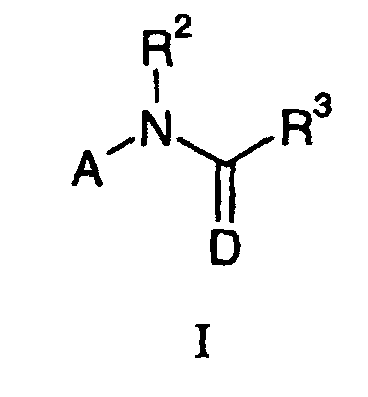 or an enantiomer thereof, and pharmaceutically acceptable salts thereof, for the preparation of a medicament for the treatment of psychotic disorders or intellectual impairment disorders.A represents:
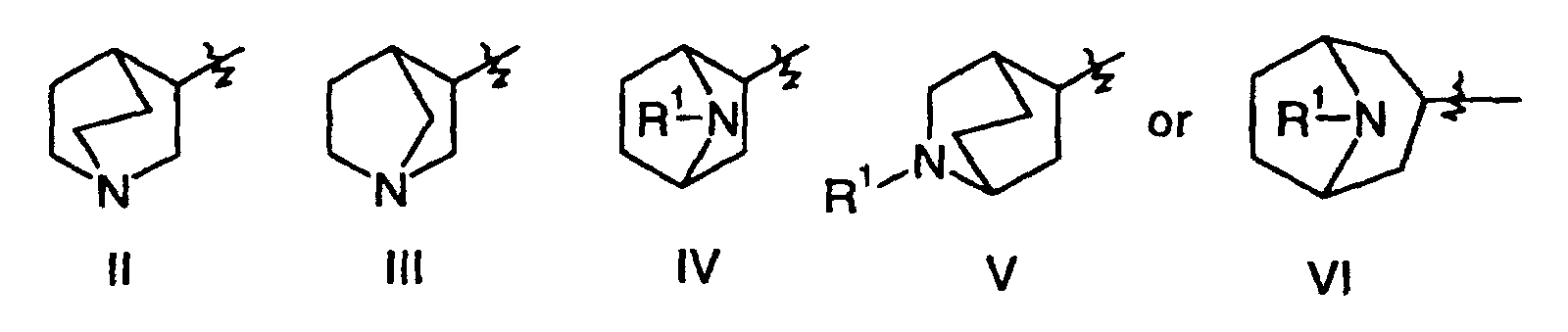 D represents oxygen, or sulfur;R1 represent hydrogen or methyl;R2 represents hydrogen, or C1-C4 alkyl;R3 represents:
 R4, R5, and R6 are independently hydrogen, halogen, C1-C4 alkyl, C2-C4 alkenyl, C2-C4 alkynyl, -CO2R7, -CN,-CF3, or Ar, provided that at least one of R4 and R5 represents Ar;Ar represents a 5- or 6-membered aromatic or heteroaromatic ring containing zero to three nitrogen atoms, zero or one oxygen atom, and zero or one sulfur atom, or an 8- or 10-membered fused aromatic or heteroaromatic ring system containing zero to four nitrogen atoms, zero to one oxygen atoms, and zero to one sulfur atoms which may optionally be substituted with one or more substituents selected from the following: hydrogen, halogen, C1-C4 alkyl, C2-C4 alkenyl, C2-C4 alkynyl, -CO2R7, -CN, -NO2, -NR8R9, -CF3, -OR10;R8, R9, and R10 are independently hydrogen, C1-C4 alkyl, -C(O)R11, -C(O)NHR12, - C(O)R13, -SO2R14 or R8 and R9 may together be (CH2)jQ(CH2)k where Q is O, S, NR15, or a bond;j is 2 to 4;k is 0 to 2;R7, R10, R11, R12, R13, R14, and R15, are independently C1-C4 alkyll;
 - The use according to claim 1, wherein the compound of formula I is a compound wherein:A represents:

- The use according to claim 1 or claim 2, wherein the compound of formula I is a compound wherein D represents oxygen.
- The use according to any one of claims 1 to 3, wherein the compound of formula I is a compound wherein R2 represents hydrogen.
- The use according to any one of claims 1 to 4, wherein the compound of formula I is a compound wherein R3 represents:
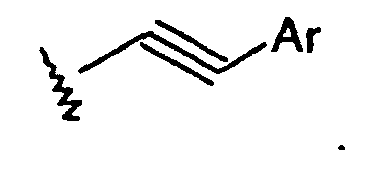
- The use according to any one of claims 1 to 4, wherein the compound of formula I is a compound wherein:R3 represents:
 R4 represents Ar;R5 represents hydrogen, or C1-C4 alkyl;R6 represents hydrogen, or halogen.
 - The use according to claim 1, wherein the compound of formula I is a compound wherein:A represents:
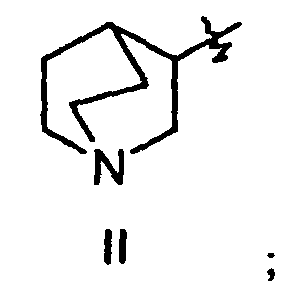 D represents oxygen;R2 represents hydrogen;R3 represents: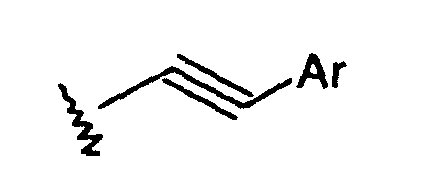
- The use according to claim 1, wherein the compound of formula I is a compound wherein:A represents:
 D represents oxygen;R2 represents hydrogen;R3 represents:
 R4 represents Ar;R5 represents hydrogen, or C1-C4 alkyl;R6 represents hydrogen, or halogen.
 - The use according any one of claims 1 to 8, wherein the compound of formula I is a compound wherein Ar represents a 5- or 6-membered aromatic or heteroaromatic ring containing zero to three nitrogen atoms, zero or one oxygen atom, and zero or one sulfur atom, or an 8- or 10-membered fused aromatic or heteroaromatic ring system containing zero to four nitrogen atoms, zero to one oxygen atoms, and zero to one sulfur atoms which may optionally be substituted with one or more substituents selected from the following: hydrogen, halogen, C1-C4 alkyl, C2-C4 alkenyl, C2-C4 alkynyl, -CO2R7, -CN, -NO2, -NR8R9, -CF3, -OR10; or an enantiomer thereof, and pharmaceutically acceptable salts thereof.
- The use according to claim 1, wherein said compound is:or an enantiomer thereof, and pharmaceutically acceptable salts thereof.N-(1-Azabicyclo[2.2.2]oct-3-yl)(E-3-phenylpropenamide);N-(1-Azabicyclo[2.2.2]oct-3-yl)(3-phenylpropynamide);N-(1-Azabicyclo[2.2.2]oct-3-yl) [E-3-(2-nitrophenyl)propenamide];N-(1-Azabicyclo[2.2.2]oct-3-yl)[E-3-(2-aminophenyl)propenamide];N-(1-Azabicyclo[2.2.2]oct-3-yl)[Z-3-(2-methoxyphenyl)propenamide];N-(1-Azabicyclo[2.2.2]oct-3-yl)-N-methyl-(E-3-phenylpropenamide);N-(1-Azabicyclo[2.2.2]oct-3-yl)[E-2-phenylcyclopropane-1-carboxamide);N-(1-Azabicyclo[2.2.2]oct-3-yl)(Z-2-fluoro-3-phenylpropenamide);N-(1-Azabicyclo[2.2.2]oct-3-yl)[E-3-(2-formamidophenyl)propenamide];N-(1-Azabicyclo[2.2.2]oct-3-yl)[E-3-(4-nitrophenyl)propenamide];N-(1-Azabicyclo[2.2.2]oct-3-yl)(E-3-(4-aminophenyl)propenamide;N-(1-Azabicyclo[2.2.2]oct-3-yl)(E-3-(4-formamidophenyl)propenamide];N-(1-Azabicyclo[2.2.2]oct-3-yl)(Z-3-methyl-3-phenylpropenamide);N-(1-Azabicyclo[2.2.2]oct-3-yl)[E-3-(4-N-methylaminophenyl)propenamide];N-(1-Azabicyclo[2.2.2]oct-3-yl)[E-3-(4-N,N-dimethylaminophenyl)propenamide];N-(1-Azabicyclo[2.2.2]oct-3-yl)(Z-3-phenylpropenamide);N-(1-Azabicyclo[2.2.2]oct-3-yl)(E-3-methyl-3-phenylpropenamide);N-(1-Azabicyclo[2.2.2]oct-3-yl)(E-2,3-diphenylpropenamide);N-(1-Azabicyclo[2.2.2]oct-3-yl)[E-3-(4-methoxyphenyl)propenamide];N-(1-Azabicyclo[2.2.2]oct-3-yl)(E-2-methyl-3-phenylpropenamide);N-(1-Azabicyclo[2.2.2]oct-3-yl)[E-3-(2-methylphenyl)propenamide];N-(1-Azabicyclo[2.2.2]oct-3-yl)[E-3-(3-methoxyphenyl)propenamide];N-(1-Azabicyclo[2.2.2]oct-3-yl)[E-3-(2-fluorophenyl)propenamide];N-(1-Azabicyclo[2.2.2]oct-3-yl)[E-3-(4-fluorophenyl)propenamide];N-(1-Azabicyclo[2.2.2]oct-3-yl)[E-(2-chlorophenyl)propenamide];N-(1-Azabicyclo[2.2.2]oct-3-yl)[E-3-(3-chlorophenyl)propenamide];N-(1-Azabicyclo[2.2.2]oct-3-yl)[E-3-(4-chlorophenyl)propenamide];N-(1-Azabicyclo[2.2.2]oct-3-yl)-[E-3-(3,4-dichlorophenyl)propenamide];N-(1-Azabicyclo[2.2.2]oct-3-yl)-[E-3-(3-bromophenyl)propenamide]N-(1-Azabicyclo[2.2.2]oct-3-yl)-[E-3-(4-bromophenyl)propenamide];N-(1-Azabicyclo[2.2.2]oct-3-yl)[E-3-(3-iodophenyl)propenamide];N-(1-Azabicyclo[2.2.2]oct-3-yl)[E-3-(4-iodophenyl)propenamide];N-(1-Azabicyclo[2.2.2]oct-3-yl)[E-3-(2-trifluoromethylphenyl)propenamide];N-(1-Azabicyclo[2.2.2]oct-3-yl)-[E-3-(3-trifluoromethylphenyl)propenamide];N-(1-Azabicyclo[2.2.2]oct-3-yl)[E-3-(2-furyl)propenamide];N-(1-Azabicyclo[2.2.2]oct-3-yl)[E-3-(3-furyl)propenamide];N-(1-Azabicyclo[2.2.2]oct-3-yl)[E-3-(2-pyridyl)propenamide];N-(1-Azabicyclo[2.2.2]oct-3-yl)[E-3-(3-pyridyl)propenamide];N-(1-Azabicyclo[2.2.2]oct-3-yl)[E-3-(4-pyridyl)propenamide];N-(1-Azabicyclo[2.2.2]oct-3-yl)[E-3-(2-thienyl)propenamide];N-(1-Azabicyclo[2.2.2]oct-3-yl)[E-3-(3-thienyl)propenamide];N-(1-Azabicyclo[2.2.2]oct-3-yl)[E-3-(5-nitro-2-furyl)propenamide];N-(1-Azabicyclo[2.2.2]oct-3-yl)[E-3-(5-methoxy-3-pyridyl)propenamide];N-(1-Azabicyclo[2.2.2]oct-3-yl)[E-3-(5-hydroxy-3-pyridyl)propenamide];N-(1-Azabicyclo[2.2.2]oct-3-yl)[E-3-(4-imidazolyl)propenamide];N-(endo-8-Aza-8-methylbicyclo[3.2.1]oct-3-yl)(E-3-phenylpropenamide);N-(exo-8-Aza-8-methylbicyclo[3.2.1]oct-3-yl)(E-3-phenylpropenamide);
- The use according to claim 1, wherein said compound is:or an enantiomer thereof, and pharmaceutically acceptable salts thereof.(R)-N-(1-Azabicyclo[2.2.2]oct-3-yl)(E-3-phenylpropenamide);(S)-N-(1-Azabicyclo[2.2.2]oct-3-yl)(E-3-phenylpropenamide);(RS)-N-(1-Azabicyclo[2.2.2]oct-3-yl)(E-3-phenylpropenamide);(R)-N-(1-Azabicyclo[2.2.2]oct-3-yl)(3-phenylpropynamide);(S)-N-(1-Azabicyclo[2.2.2]oct-3-yl)(3-phenylpropynamide);(R)-N-(1-Azabicyclo[2.2.2]oct-3-yl)[E-3-(2-nitrophenyl)propenamide];(S)-N-(1-Azabicyclo[2.2.2]oct-3-yl)[E-3-(2-nitrophenyl)propenamide];(RS)-N-(1-Azabicyclo[2.2.2]oct-3-yl)[E-3-(2-nitrophenyl)propenamide];(RS)-N-(1-Azabicyclo[2.2.2]oct-3-yl)[E-3-(2-aminophenyl)propenamide];(R)-N-(1-Azabicyclo[2.2.2]oct-3-yl)[E-3-(2-aminophenyl)propenamide];(R)-N-(1-Azabicyclo[2.2.2]oct-3-yl)[Z-3-(2-methoxyphenyl)propenamide];(RS)-N-(1-Azabicyclo[2.2.2]oct-3-yl)-N-methyl-(E-3-phenylpropenamide);(S)-N-(1-Azabicyclo[2.2.2]oct-3-yl)[E-2-phenylcyclopropane-1-carboxamide);(R)-N-(1-Azabicyclo[2.2.2]oct-3-yl)(E-2-phenylcyclopropane-1-carboxamide);(R)-N-(1-Azabicyclo[2.2.2]oct-3-yl)(Z-2-fluoro-3-phenylpropenamide);(R)-N-(1-Azabicyclo[2.2.2]oct-3-yl)[E-3-(2-formamidophenyl)propenamide];(R)-N-(1-Azabicyclo[2.2.2]oct-3-yl)[E-3-(4-nitrophenyl)propenamide];(R)-N-(1-Azabicyclo[2.2.2]oct-3-yl)(E-3-(4-aminophenyl)propenamide;(R)-N-(1-Azabicyclo[2.2.2]oct-3-yl)(E-3-(4-formamidophenyl)propenamide];(R)-N-(1-Azabicyclo[2.2.2]oct-3-yl)(Z-3-methyl-3-phenylpropenamide);(R)-N-(1-Azabicyclo[2.2.2]oct-3-yl)[E-3-(4-N-methylaminophenyl)propenamide];(R)-N-(1-Azabicyclo[2.2.2]oct-3-yl)[E-3-(4-N,N-dimethylaminophenyl)propenamide];(R)-N-(1-Azabicyclo[2.2.2]oct-3-yl)(Z-3-phenylpropenamide);(R)-N-(1-Azabicyclo[2.2.2]oct-3-yl)(E-3-methyl-3-phenylpropenamide);(R)-N-(1-Azabicyclo[2.2.2]oct-3-yl)(E-2,3-diphenylpropenamide);(R)-N-(1-Azabicyclo[2.2.2]oct-3-yl)[E-3-(4-methoxyphenyl)propenamide];(R)-N-(1-Azabicyclo[2.2.2]oct-3-yl)(E-2-methyl-3-phenylpropenamide);(S)-N-(1-Azabicyclo[2.2.2]oct-3-yl)(E-2-methyl-3-phenylpropenamide);(R)-N-(1-Azabicyclo[2.2.2]oct-3-yl)[E-3-(2-methylphenyl)propenamide];(S)-N-(1-Azabicyclo[2.2.2]oct-3-yl)[E-3-(2-methylphenyl)propenamide];(RS)-N-(1-Azabicyclo[2.2.2]oct-3-yl)[E-3-(2-methoxyphenyl)propenamide];(R)-N-(1-Azabicyclo[2.2.2]oct-3-yl)[E-3-(3-methoxyphenyl)propenamide];(RS)-N-(1-Azabicyclo[2.2.2]oct-3-yl)[E-3-(4-methoxyphenyl)propenamide];(RS)-N-(1-Azabicyclo[2.2.2]oct-3-yl)[E-3-(2-fluorophenyl)propenamide];(R)-N-(1-Azabicyclo[2.2.2]oct-3-yl)[E-3-(3-fluorophenyl)propenamide];(R)-N-(1-Azabicyclo[2.2.2]oct-3-yl)[E-3-(4-fluorophenyl)propenamide];(R)-N-(1-Azabicyclo[2.2.2]oct-3-yl)[E-(2-chlorophenyl)propenamide];(S)-N-(1-Azabicyclo[2.2.2]oct-3-yl)[E-(2-chlorophenyl)propenamide);(R)-N-(1-Azabicyclo[2.2.2]oct-3-yl)[E-3-(3-chlorophenyl)propenamide];(R)-N-(1-Azabicyclo[2.2.2]oct-3-yl)[E-3-(4-chlorophenyl)propenamide];(R)-N-(1-Azabicyclo[2.2.2]oct-3-yl)-[E-3-(3,4-dichlorophenyl)propenamide];(R)-N-(1-Azabicyclo[2.2.2]oct-3-yl)-[E-3-(3-bromophenyl)propenamide](R)-N-(1-Azabicyclo[2.2.2]oct-3-yl)-[E-3-(4-bromophenyl)propenamide];(RS)-N-(1-Azabicyclo[2.2.2]oct-3-yl)[E-3-(3-iodophenyl)propenamide];(RS)-N-(1-Azabicyclo[2.2.2]oct-3-yl)[E-3-(4-iodophenyl)propenamide];(RS)-N-(1-Azabicyclo[2.2.2]oct-3-yl)[E-3-(2-trifluoromethylphenyl)propenamide];(R)-N-(1-Azabicyclo[2.2.2]oct-3-yl)-[E-3-(3-trifluoromethylphenyl)propenamide];(R)-N-(1-Azabicyclo[2.2.2]oct-3-yl)[E-3-(2-furyl)propenamide];(R)-N-(1-Azabicyclo[2.2.2]oct-3-yl)[E-3-(3-furyl)propenamide];(R)-N-(1-Azabicyclo[2.2.2]oct-3-yl)[E-3-(2-pyridyl)propenamide];(R)-N-(1-Azabicyclo[2.2.2]oct-3-yl)[E-3-(3-pyridyl)propenamide];(R)-N-(1-Azabicyclo[2.2.2]oct-3-yl)[E-3-(4-pyridyl)propenamide];(R)-N-(1-Azabicyclo[2.2.2]oct-3-yl)[E-3-(2-thienyl)propenamide];(R)-N-(1-Azabicyclo[2.2.2]oct-3-yl)[E-3-(3-thienyl)propenamide];(R)-N-(1-Azabicyclo[2.2.2]oct-3-yl)[E-3-(5-nitro-2-furyl)propenamide];(R)-N-(1-Azabicyclo[2.2.2]oct-3-yl)[E-3-(5-methoxy-3-pyridyl)propenamide];(R)-N-(1-Azabicyclo[2.2.2]oct-3-yl)[E-3-(5-hydroxy-3-pyridyl)propenamide];(R)-N-(1-Azabicyclo[2.2.2]oct-3-yl)[E-3-(4-imidazolyl)propenamide];N-(endo-8-Aza-8-methylbicyclo[3.2.1]oct-3-yl)(E-3-phenylpropenamide);N-(exo-8-Aza-8-methylbicyclo[3.2.1]oct-3-yl)(E-3-phenylpropenamide);
- A compound of the general formula I,wherein:
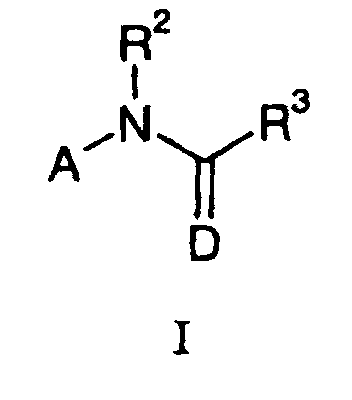 or an enantiomer thereof, and pharmaceutically acceptable salts thereof, with the additional proviso that Ar does not represent 2-, 3-, 4-pyridyl, unsubstituted phenyl or phenyl substituted with one or more substituents selected from C1-C4 alkyl, C1-C4 alkoxy, halogen, phenoxy, hydroxy, OCOR11, NH2, NHCOR11, and nitro, when:A represents:
 D represents oxygen, or sulfur;R1 represents hydrogen or methyl;R2 represents hydrogen, or C1-C4 alkyl;R3 represents:
 R4, R5, and R6 are independently hydrogen, halogen, C1-C4 alkyl, C2-C4 alkenyl, C2-C4 alkynyl, -CO2R7, -CN,-CF3, or Ar, provided that at least one of R4 and R5 represents Ar;Ar represents a 5- or 6-membered aromatic or heteroaromatic ring containing zero to three nitrogen atoms, zero or one oxygen atom, and zero or one sulfur atom, or an 8- or 10-membered fused aromatic or heteroaromatic ring system containing zero to four nitrogen atoms, zero to one oxygen atoms, and zero to one sulfur atoms which may optionally be substituted with one or more substituents selected from the following: hydrogen, halogen, C1-C4 alkyl, C2-C4 alkenyl, C2-C4 alkynyl, -CO2R7, -CN, -NO2, -NR8R9, -CF3, -OR10;R8, R9, and R10 are independently hydrogen, C1-C4 alkyl, -C(O)R11, -C(O)NHR12, - C(O)R13, -SO2R14 or R8 and R9 may together be (CH2)jQ(CH2)k where Q is O, S, NR15, or a bond;j is 2 to 4;k is 0 to 2;R7, R10, R11, R12, R13, R14, and R15, are independently C1-C4 alkyl;or an enantiomer thereof, and pharmaceutically acceptable salts thereof.A represents:
 R3 represents:
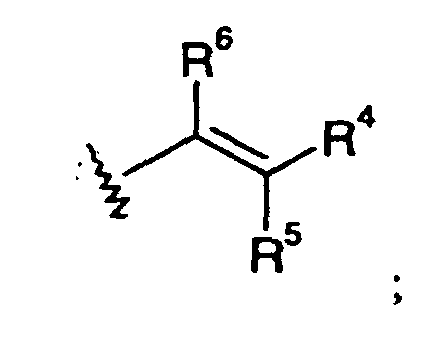 D represents oxygen;R represents methyl;R2 and R5 both represent hydrogen;R6 represents any of hydrogen, C1-C4 alkyl, phenyl, or cyano;
 - A compound according to claim 12, wherein A represents:or an enantiomer thereof, and pharmaceutically acceptable salts thereof.
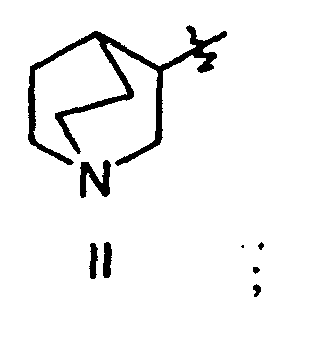
- A compound according to claim 13, wherein R6 represents any of 2-furyl; 3-furyl; 2-thienyl; 3-thienyl; or an enantiomer thereof, and pharmaceutically acceptable salts thereof.
- A compound according to claim 12, said compound being:or an enantiomer thereof, and pharmaceutically acceptable salts thereof.N-(1-Azabicyclo[2.2.2]oct-3-yl)[E-3-(3-trifluoromethylphenyl)propenamide];N-(1-Azabicyclo[2.2.2]oct-3-yl)[E-3-(2-furyl)propenamide];N-(1-Azabicyclo[2.2.2]oct-3-yl)[E-3-(3-furyl)propenamide];N-(1-Azabicyclo[2.2.2]oct-3-yl)[E-3-(2-thienyl)propenamide];N-(1-Azabicyclo[2.2.2]oct-3-yl)[E-3-(3-thienyl)propenamide];N-(1-Aza-3-cyanobicyclo[2.2.2]oct-3-yl)[E-3-phenylpropenamide];N-(1-Aza-3-methylbicyclo[2.2.2]oct-3-yl)[E-3-phenylpropenamide];N-(1-Azabicyclo[2.2.2]oct-3-yl)[E-3-(5-nitro-2-furyl)propenamide];N-(1-Azabicyclo[2.2.2]oct-3-yl)[E-3-(5-methoxy-3-pyridyl)propenamide];N-(1-Azabicyclo[2.2.2]oct-3-yl)[E-3-(5-hydroxy-3-pyridyl)propenamide];N-(1-Azabicyclo[2.2.2]oct-3-yl)[E-3-(4-imidazolyl)propenamide];
- A compound according to claim 12, said compound being:or an enantiomer thereof, and pharmaceutically acceptable salts thereof.(R)-N-(1-Azabicyclo[2.2.2]oct-3-yl)[E-3-(3-trifluoromethylphenyl)propenamide];(R)-N-(1-Azabicyclo[2.2.2]oct-3-yl)[E-3-(2-furyl)propenamide];(R)-N-(1-Azabicyclo[2.2.2]oct-3-yl)[E-3-(3-furyl)propenamide];(R)-N-(1-Azabicyclo[2.2.2]oct-3-yl)[E-3-(2-thienyl)propenamide];(R)-N-(1-Azabicyclo[2.2.2]oct-3-yl)[E-3-(3-thienyl)propenamide];N-(1-Aza-3-cyanobicyclo[2.2.2]oct-3-yl)[E-3-phenylpropenamide];N-(1-Aza-3-methylbicyclo[2.2.2]oct-3-yl)[E-3-phenylpropenamide];(R)-N-(1-Azabicyclo[2.2.2]oct-3-yl)[E-3-(5-nitro-2-furyl)propenamide];(R)-N-(1-Azabicyclo[2.2.2]oct-3-yl)[E-3-(5-methoxy-3-pyridyl)propenamide];(R)-N-(1-Azabicyclo[2.2.2]oct-3-yl)[E-3-(5-hydroxy-3-pyridyl)propenamide];(R)-N-(1-Azabicyclo[2.2.2]oct-3-yl)[E-3-(4-imidazolyl)propenamide];
- A compound according to any one of claims 12 to 16, for use in therapy.
- The use of a compound as defined in any one of claims 12 to 17, in the manufacture of a medicament for the treatment of psychotic disorders or intellectual impairment disorders.
- The use of a compound as defined in any one of claims 12 to 17, in the manufacture of a medicament for the treatment of Alzheimer's disease, learning deficit, cognition deficit, attention deficit, memory loss, Attention Deficit Hyperactivity Disorder, anxiety, schizophrenia, mania or manic depression, Lewy Body Dementia, Parkinson's disease, Huntington's disease, Tourette's syndrome, neurodegenerative disorders in which there is loss of cholinergic synapses, jetlag, cessation of smoking, nicotine addiction including that resulting from exposure to products containing nicotine, pain, or ulcerative colitis.
- The use according to claim 19, wherein the condition or disorder is Alzheimer's disease, learning deficit, cognition deficit, attention deficit, memory loss, Lewy Body Dementia, or Attention Deficit Hyperactivity Disorder.
- The use according to claim 19, wherein the disorder is anxiety, schizophrenia, or mania or manic depression.
- The use according to claim 19, wherein the disorder is Parkinson's disease, Huntington's disease, Tourette's syndrome, or neurodegenerative disorders in which there is loss of cholinergic synapses.
- The use according to claim 19, wherein the condition or disorder is jetlag, nicotine addiction including that resulting from exposure to products containing nicotine, pain, or ulcerative colitis.
- The use according to claim 19, wherein the condition or disorder is Alzheimer's disease.
- A pharmaceutical composition including a compound as defined in any one of claims 12 to 17, in admixture with an inert pharmaceutically acceptable diluent or carrier.
- The pharmaceutical composition according to claim 25, for use in the treatment of psychotic disorders or intellectual impairment disorders.
- The pharmaceutical composition according to claim 25, for use in the treatment of Alzheimer's disease, learning deficit, cognition deficit, attention deficit, memory loss, Attention Deficit Hyperactivity Disorder, anxiety, schizophrenia, or mania or manic depression, Lewy Body Dementia, Parkinson's disease, Huntington's disease, Tourette's syndrome, neurodegenerative disorders in which there is loss of cholinergic synapse, jetlag, cessation of smoking, nicotine addiction including that resulting from exposure to products containing nicotine, pain, or ulcerative colitis.
- The pharmaceutical composition according to claim 27, for use in the treatment of Alzheimer's disease, learning deficit, cognition deficit, attention deficit, memory loss, Lewy Body Dementia, or Attention Deficit Hyperactivity Disorder.
- The pharmaceutical composition according to claim 27, for use in the treatment of anxiety, schizophrenia, or mania or manic depression.
- The pharmaceutical composition according to claim 27, for use in the treatment of Parkinson's disease, Huntington's disease, Tourette's syndrome, or neurodegenerative disorders in which there is loss of cholinergic synapses.
- The pharmaceutical composition according to claim 27, for use in the treatment of jetlag, nicotine addiction including that resulting from exposure to products containing nicotine, pain, or ulcerative colitis.
- The pharmaceutical composition according to claim 27, for use in the treatment of Alzheimer's disease.
Priority Applications (1)
| Application Number | Priority Date | Filing Date | Title |
|---|---|---|---|
| SI200030716T SI1233964T1 (en) | 1999-11-18 | 2000-11-16 | New use and novel n-azabicyclo-amide derivatives |
Applications Claiming Priority (3)
| Application Number | Priority Date | Filing Date | Title |
|---|---|---|---|
| SE9904176A SE9904176D0 (en) | 1999-11-18 | 1999-11-18 | New use |
| SE9904176 | 1999-11-18 | ||
| PCT/SE2000/002262 WO2001036417A1 (en) | 1999-11-18 | 2000-11-16 | New use and novel n-azabicyclo-amide derivatives |
Publications (2)
| Publication Number | Publication Date |
|---|---|
| EP1233964A1 EP1233964A1 (en) | 2002-08-28 |
| EP1233964B1 true EP1233964B1 (en) | 2005-06-22 |
Family
ID=20417766
Family Applications (1)
| Application Number | Title | Priority Date | Filing Date |
|---|---|---|---|
| EP00981994A Expired - Lifetime EP1233964B1 (en) | 1999-11-18 | 2000-11-16 | New use and novel n-azabicyclo-amide derivatives |
Country Status (30)
| Country | Link |
|---|---|
| US (1) | US6683090B1 (en) |
| EP (1) | EP1233964B1 (en) |
| JP (1) | JP2003514818A (en) |
| KR (1) | KR20020058014A (en) |
| CN (1) | CN1217943C (en) |
| AR (1) | AR031680A1 (en) |
| AT (1) | ATE298337T1 (en) |
| AU (1) | AU784400B2 (en) |
| BG (1) | BG106680A (en) |
| BR (1) | BR0015624A (en) |
| CA (1) | CA2389604A1 (en) |
| CO (1) | CO5261607A1 (en) |
| CZ (1) | CZ20021692A3 (en) |
| DE (1) | DE60020994T2 (en) |
| DK (1) | DK1233964T3 (en) |
| EE (1) | EE200200251A (en) |
| ES (1) | ES2242653T3 (en) |
| HU (1) | HUP0204245A3 (en) |
| IL (1) | IL149374A0 (en) |
| IS (1) | IS6385A (en) |
| MX (1) | MXPA02004911A (en) |
| NO (1) | NO20022289L (en) |
| NZ (1) | NZ518571A (en) |
| PL (1) | PL355867A1 (en) |
| PT (1) | PT1233964E (en) |
| SE (1) | SE9904176D0 (en) |
| SK (1) | SK6772002A3 (en) |
| UA (1) | UA74172C2 (en) |
| WO (1) | WO2001036417A1 (en) |
| ZA (1) | ZA200203316B (en) |
Families Citing this family (67)
| Publication number | Priority date | Publication date | Assignee | Title |
|---|---|---|---|---|
| US7214686B2 (en) | 1997-06-30 | 2007-05-08 | Targacept, Inc. | Pharmaceutical compositions and methods for effecting dopamine release |
| SE0000540D0 (en) | 2000-02-18 | 2000-02-18 | Astrazeneca Ab | New compounds |
| US6492385B2 (en) | 2000-08-18 | 2002-12-10 | Pharmacia & Upjohn Company | Quinuclidine-substituted heteroaryl moieties for treatment of disease |
| US6486172B2 (en) | 2000-08-18 | 2002-11-26 | Pharmacia & Upjohn Company | Quinuclidine-substituted aryl compounds for treatment of disease |
| EP1381603A2 (en) | 2000-08-18 | 2004-01-21 | PHARMACIA & UPJOHN COMPANY | Quinuclidine-substituedaryl moieties for treatment of disease ( nicotinic acetylcholine receptor ligands ) |
| WO2002016356A2 (en) * | 2000-08-18 | 2002-02-28 | Pharmacia & Upjohn Company | Quinuclidine-substituted aryl moieties for treatment of disease (nicotinic acetylcholine receptor ligands) |
| EP1311505A2 (en) * | 2000-08-21 | 2003-05-21 | PHARMACIA & UPJOHN COMPANY | Quinuclidine-substituted heteroaryl moieties for treatment of disease ( nicotinic acetylcholine receptor ligands ) |
| AU2001284646A1 (en) | 2000-08-21 | 2002-03-04 | Pharmacia And Upjohn Company | Quinuclidine-substituted heteroaryl moieties for treatment of disease |
| US6500840B2 (en) | 2000-08-21 | 2002-12-31 | Pharmacia & Upjohn Company | Quinuclidine-substituted heteroaryl moieties for treatment of disease |
| PE20021019A1 (en) | 2001-04-19 | 2002-11-13 | Upjohn Co | SUBSTITUTED AZABYCLE GROUPS |
| AR036041A1 (en) * | 2001-06-12 | 2004-08-04 | Upjohn Co | HETEROCICLIC AROMATIC COMPOUNDS REPLACED WITH QUINUCLIDINE AND PHARMACEUTICAL COMPOSITIONS CONTAINING THEM |
| AR036040A1 (en) | 2001-06-12 | 2004-08-04 | Upjohn Co | MULTICICLIC HETEROARYL COMPOUNDS REPLACED WITH QUINUCLIDINES AND PHARMACEUTICAL COMPOSITIONS CONTAINING THEM |
| CA2448913A1 (en) * | 2001-07-06 | 2003-01-16 | Neurosearch A/S | Sulfone containing bicyclic aromatic ring compounds, their preparation and use as nicotinic acetyl-chloine receptors |
| WO2003018585A1 (en) * | 2001-08-24 | 2003-03-06 | Pharmacia & Upjohn Company | Substituted-heteroaryl-7-aza[2.2.1]bicycloheptanes for the treatment of disease |
| EP1432707B1 (en) * | 2001-10-02 | 2012-03-28 | Pharmacia & Upjohn Company LLC | Azabicyclic-substituted fused-heteroaryl compounds for the treatment of disease |
| WO2003032897A2 (en) * | 2001-10-16 | 2003-04-24 | Astrazeneca Ab | Azabicyclic compounds for the treatment of fibromyalgia syndrome |
| CA2464194A1 (en) * | 2001-10-26 | 2003-05-08 | Pharmacia & Upjohn Company | N-azabicyclo-substituted hetero-bicyclic carboxamides as nachr agonists |
| US6849620B2 (en) | 2001-10-26 | 2005-02-01 | Pfizer Inc | N-(azabicyclo moieties)-substituted hetero-bicyclic aromatic compounds for the treatment of disease |
| MXPA04004464A (en) | 2001-11-08 | 2004-08-11 | Upjohn Co | Azabicyclic-substituted-heteroaryl compounds for the treatment of disease. |
| US6951868B2 (en) | 2001-11-09 | 2005-10-04 | Pfizer Inc. | Azabicyclic-phenyl-fused-heterocyclic compounds for treatment of disease |
| AU2002360598B2 (en) | 2001-12-14 | 2008-02-14 | Medical College Of Georgia Research Institute, Inc. | Methods and compositions for treatment of central nervous system disorders |
| DE10164139A1 (en) | 2001-12-27 | 2003-07-10 | Bayer Ag | 2-heteroaryl carboxamides |
| JP2005522456A (en) | 2002-02-15 | 2005-07-28 | ファルマシア・アンド・アップジョン・カンパニー・エルエルシー | Azabicyclosubstituted benzoylamides and thioamides for the treatment of CNS related disorders |
| BR0307782A (en) | 2002-02-19 | 2005-01-04 | Upjohn Co | Azabicycle compounds for the treatment of disease |
| US6858613B2 (en) | 2002-02-19 | 2005-02-22 | Pfizer Inc. | Fused bicyclic-N-bridged-heteroaromatic carboxamides for the treatment of disease |
| CN1656093A (en) | 2002-05-30 | 2005-08-17 | 神经研究公司 | 3-substituted quinuclidines and their use |
| US7176198B2 (en) | 2002-08-01 | 2007-02-13 | Pfizer Inc. | 1H-pyrazole and 1H-pyrrole-azabicyclic compounds for the treatment of disease |
| WO2004019943A1 (en) | 2002-08-30 | 2004-03-11 | Memory Pharmaceuticals Corporation | Anabaseine derivatives useful in the treatment of neurodegenerative diseases |
| GB0220581D0 (en) | 2002-09-04 | 2002-10-09 | Novartis Ag | Organic Compound |
| AU2003276919B2 (en) | 2002-09-25 | 2013-05-16 | Memory Pharmaceuticals Corporation | Indazoles, benzothiazoles, and benzoisothiazoles, and preparation and uses thereof |
| WO2004052348A2 (en) * | 2002-12-11 | 2004-06-24 | Pharmacia & Upjohn Company Llc | Treatment of diseases with combinations of alpha 7 nicotinic acetylcholine receptor agonists and other compounds |
| EP1678172B1 (en) | 2003-10-15 | 2009-12-09 | Targacept, Inc. | Azabicyclic compounds for relieving pain and treating central nervous system disorders |
| RU2417225C2 (en) | 2004-03-25 | 2011-04-27 | Мемори Фармасьютиклз Корпорейшн | Indazoles, bentothiazoles, benzoisothiazoles, benzisoxazoles and synthesis and use thereof |
| PE20060437A1 (en) | 2004-06-18 | 2006-06-08 | Novartis Ag | AZA-BICYCLONONE COMPOUNDS AS CHOLINERGIC LINKS OF nAChR |
| GB0415746D0 (en) | 2004-07-14 | 2004-08-18 | Novartis Ag | Organic compounds |
| CA2618700A1 (en) | 2005-08-22 | 2007-03-01 | Targacept, Inc. | Heteroaryl-substituted diazatricycloalkanes, methods for its preparation and use thereof |
| JP5109132B2 (en) * | 2005-09-28 | 2012-12-26 | 国立大学法人 熊本大学 | Drugs for attention deficit / hyperactivity disorder |
| GB0521508D0 (en) | 2005-10-21 | 2005-11-30 | Novartis Ag | Organic compounds |
| GB0525672D0 (en) | 2005-12-16 | 2006-01-25 | Novartis Ag | Organic compounds |
| GB0525673D0 (en) | 2005-12-16 | 2006-01-25 | Novartis Ag | Organic compounds |
| US9233106B2 (en) * | 2006-07-12 | 2016-01-12 | Cornell Research Foundation, Inc. | Inhibition of beta-amyloid peptide aggregation |
| TW200901974A (en) | 2007-01-16 | 2009-01-16 | Wyeth Corp | Compounds, compositions, and methods of making and using them |
| SA08290475B1 (en) | 2007-08-02 | 2013-06-22 | Targacept Inc | (2S,3R)-N-(2-((3-pyrdinyl)methyl)-1-aza bicyclo[2,2,2]oct-3-yl)benzofuran-2-carboxamide, its new salt forms and methods of use |
| KR101565469B1 (en) | 2007-10-01 | 2015-11-03 | 코멘티스, 인코포레이티드 | Quinuclidin-4-ylmethyl 1h-indole-3-carboxylate derivatives as alpha 7 nicotinic acetylcholine receptor ligands for the treatment of alzheimer's disease |
| EP2254598B1 (en) | 2008-02-13 | 2013-07-10 | Targacept, Inc. | Combination of alpha 7 nicotinic agonists and antipsychotics |
| TW201031664A (en) | 2009-01-26 | 2010-09-01 | Targacept Inc | Preparation and therapeutic applications of (2S,3R)-N-2-((3-pyridinyl)methyl)-1-azabicyclo[2.2.2]oct-3-yl)-3,5-difluorobenzamide |
| MX357676B (en) | 2010-05-17 | 2018-07-18 | Forum Pharmaceuticals Inc | A crystalline form of (r)-7-chloro-n-(quinuclidin-3-yl)benzo[b]th iophene-2-carboxamide hydrochloride monohydrate. |
| FR2974365B1 (en) * | 2011-04-20 | 2017-08-25 | Centre Nat De La Rech Scient (C N R S) | 1,4-DISUBSTITUTED 1,2,3-TRIAZOLES, METHODS FOR PREPARING THEM AND DIAGNOSTIC AND THERAPEUTIC USES THEREOF |
| WO2012177856A2 (en) * | 2011-06-21 | 2012-12-27 | Adispell, Inc. | Cognition modification |
| GB201111705D0 (en) | 2011-07-07 | 2011-08-24 | Takeda Pharmaceutical | Compounds and their use |
| GB201111704D0 (en) | 2011-07-07 | 2011-08-24 | Takeda Pharmaceutical | Novel compounds |
| JO3115B1 (en) | 2011-08-22 | 2017-09-20 | Takeda Pharmaceuticals Co | Pyridazinone Compounds and Their Use as DAAO Inhibitors |
| EP3666272A1 (en) | 2012-05-08 | 2020-06-17 | Forum Pharmaceuticals Inc. | Use of encenicline in the treatment of cognitive impairment, alzheimer's disease, memory deficit |
| GB201209587D0 (en) | 2012-05-30 | 2012-07-11 | Takeda Pharmaceutical | Therapeutic compounds |
| CN105189482A (en) | 2013-02-07 | 2015-12-23 | 武田药品工业株式会社 | Piperidin-1-yl and azepin-1-yl carboxylates as muscarinic M4 receptor agonists |
| US10208016B2 (en) | 2013-06-21 | 2019-02-19 | Takeda Pharmaceutical Company Limited | 1-sulfonyl piperidine derivatives as modulators of prokineticin receptors |
| GB201314286D0 (en) | 2013-08-08 | 2013-09-25 | Takeda Pharmaceutical | Therapeutic Compounds |
| GB201318222D0 (en) | 2013-10-15 | 2013-11-27 | Takeda Pharmaceutical | Novel compounds |
| GB201320905D0 (en) | 2013-11-27 | 2014-01-08 | Takeda Pharmaceutical | Therapeutic compounds |
| TW201613864A (en) | 2014-02-20 | 2016-04-16 | Takeda Pharmaceutical | Novel compounds |
| US20170166561A1 (en) | 2014-07-11 | 2017-06-15 | Alpharmagen, Llc | Quinuclidine compounds for modulating alpha7-nicotinic acetylcholine receptor activity |
| US9724340B2 (en) | 2015-07-31 | 2017-08-08 | Attenua, Inc. | Antitussive compositions and methods |
| GB201616839D0 (en) | 2016-10-04 | 2016-11-16 | Takeda Pharmaceutical Company Limited | Therapeutic compounds |
| GB201619514D0 (en) | 2016-11-18 | 2017-01-04 | Takeda Pharmaceuticals Co | Novel compounds |
| JP2021138648A (en) | 2020-03-04 | 2021-09-16 | 武田薬品工業株式会社 | Oral solid preparation |
| GB202414193D0 (en) | 2024-09-27 | 2024-11-13 | Addex Pharmaceuticals Sa | Novel compounds |
| GB202414197D0 (en) | 2024-09-27 | 2024-11-13 | Addex Pharmaceuticals Sa | Novel compounds |
Family Cites Families (3)
| Publication number | Priority date | Publication date | Assignee | Title |
|---|---|---|---|---|
| IT1255467B (en) * | 1992-07-29 | 1995-11-02 | Dompe Farmaceutici Spa | PHARMACOLOGICALLY ACTIVE ACRYLIC STARCHES |
| GB9304500D0 (en) * | 1993-03-05 | 1993-04-21 | Glaxo Spa | Heterocyclic compounds |
| WO1996021644A1 (en) * | 1995-01-10 | 1996-07-18 | Smithkline Beecham S.P.A. | Indole derivatives useful in the treatment of osteoporosis |
-
1999
- 1999-11-18 SE SE9904176A patent/SE9904176D0/en unknown
-
2000
- 2000-11-06 AR ARP000105840A patent/AR031680A1/en not_active Application Discontinuation
- 2000-11-16 UA UA2002065003A patent/UA74172C2/en unknown
- 2000-11-16 CN CN008184216A patent/CN1217943C/en not_active Expired - Fee Related
- 2000-11-16 PL PL00355867A patent/PL355867A1/en not_active Application Discontinuation
- 2000-11-16 JP JP2001538906A patent/JP2003514818A/en active Pending
- 2000-11-16 US US10/130,635 patent/US6683090B1/en not_active Expired - Fee Related
- 2000-11-16 EE EEP200200251A patent/EE200200251A/en unknown
- 2000-11-16 HU HU0204245A patent/HUP0204245A3/en unknown
- 2000-11-16 ES ES00981994T patent/ES2242653T3/en not_active Expired - Lifetime
- 2000-11-16 EP EP00981994A patent/EP1233964B1/en not_active Expired - Lifetime
- 2000-11-16 SK SK677-2002A patent/SK6772002A3/en unknown
- 2000-11-16 MX MXPA02004911A patent/MXPA02004911A/en active IP Right Grant
- 2000-11-16 DK DK00981994T patent/DK1233964T3/en active
- 2000-11-16 IL IL14937400A patent/IL149374A0/en unknown
- 2000-11-16 NZ NZ518571A patent/NZ518571A/en unknown
- 2000-11-16 DE DE60020994T patent/DE60020994T2/en not_active Expired - Fee Related
- 2000-11-16 WO PCT/SE2000/002262 patent/WO2001036417A1/en not_active Ceased
- 2000-11-16 CZ CZ20021692A patent/CZ20021692A3/en unknown
- 2000-11-16 BR BR0015624-8A patent/BR0015624A/en not_active IP Right Cessation
- 2000-11-16 AT AT00981994T patent/ATE298337T1/en not_active IP Right Cessation
- 2000-11-16 KR KR1020027006257A patent/KR20020058014A/en not_active Ceased
- 2000-11-16 CA CA002389604A patent/CA2389604A1/en not_active Abandoned
- 2000-11-16 PT PT00981994T patent/PT1233964E/en unknown
- 2000-11-16 AU AU19073/01A patent/AU784400B2/en not_active Ceased
- 2000-11-17 CO CO00087729A patent/CO5261607A1/en not_active Application Discontinuation
-
2002
- 2002-04-25 ZA ZA200203316A patent/ZA200203316B/en unknown
- 2002-05-09 BG BG106680A patent/BG106680A/en unknown
- 2002-05-14 NO NO20022289A patent/NO20022289L/en unknown
- 2002-05-15 IS IS6385A patent/IS6385A/en unknown
Also Published As
Similar Documents
| Publication | Publication Date | Title |
|---|---|---|
| US6683090B1 (en) | N-azabicyclo-amide derivatives | |
| EP1539765B1 (en) | Biaryl diazabicycloalkane amides as nicotinic acetylcholine agonists | |
| EP1259508B1 (en) | Novel biarylcarboxamides | |
| EP1539764B1 (en) | Aryl-substituted diazabicycloalkanes as nicotinic acetylcholine agonists. | |
| KR100869721B1 (en) | Novel quinuclidin derivatives and pharmaceutical compositions containing the same | |
| NZ535978A (en) | Novel spiroazabicyclic heterocyclic amines useful as nicotinic acetylcholine receptor agonists | |
| HK1047743B (en) | New use and novel n-azabicyclo-amide derivatives | |
| HK1077571B (en) | Biaryl diazabicycloalkane amides as nicotinic acetylcholine agonists | |
| HK1050007B (en) | Novel biarylcarboxamides | |
| HK1079522B (en) | Thienyl compounds |
Legal Events
| Date | Code | Title | Description |
|---|---|---|---|
| PUAI | Public reference made under article 153(3) epc to a published international application that has entered the european phase |
Free format text: ORIGINAL CODE: 0009012 |
|
| 17P | Request for examination filed |
Effective date: 20020618 |
|
| AK | Designated contracting states |
Kind code of ref document: A1 Designated state(s): AT BE CH CY DE DK ES FI FR GB GR IE IT LI LU MC NL PT SE TR |
|
| AX | Request for extension of the european patent |
Free format text: AL PAYMENT 20020618;LT PAYMENT 20020618;LV PAYMENT 20020618;MK PAYMENT 20020618;RO PAYMENT 20020618;SI PAYMENT 20020618 |
|
| 17Q | First examination report despatched |
Effective date: 20021120 |
|
| GRAP | Despatch of communication of intention to grant a patent |
Free format text: ORIGINAL CODE: EPIDOSNIGR1 |
|
| GRAS | Grant fee paid |
Free format text: ORIGINAL CODE: EPIDOSNIGR3 |
|
| GRAA | (expected) grant |
Free format text: ORIGINAL CODE: 0009210 |
|
| AK | Designated contracting states |
Kind code of ref document: B1 Designated state(s): AT BE CH CY DE DK ES FI FR GB GR IE IT LI LU MC NL PT SE TR |
|
| AX | Request for extension of the european patent |
Extension state: AL LT LV MK RO SI |
|
| REG | Reference to a national code |
Ref country code: GB Ref legal event code: FG4D |
|
| REG | Reference to a national code |
Ref country code: CH Ref legal event code: EP |
|
| REG | Reference to a national code |
Ref country code: IE Ref legal event code: FG4D |
|
| REF | Corresponds to: |
Ref document number: 60020994 Country of ref document: DE Date of ref document: 20050728 Kind code of ref document: P |
|
| REG | Reference to a national code |
Ref country code: SE Ref legal event code: TRGR |
|
| REG | Reference to a national code |
Ref country code: HK Ref legal event code: GR Ref document number: 1047743 Country of ref document: HK |
|
| REG | Reference to a national code |
Ref country code: DK Ref legal event code: T3 |
|
| REG | Reference to a national code |
Ref country code: PT Ref legal event code: SC4A Effective date: 20050801 |
|
| REG | Reference to a national code |
Ref country code: GR Ref legal event code: EP Ref document number: 20050402793 Country of ref document: GR |
|
| REG | Reference to a national code |
Ref country code: ES Ref legal event code: FG2A Ref document number: 2242653 Country of ref document: ES Kind code of ref document: T3 |
|
| ET | Fr: translation filed | ||
| PLBE | No opposition filed within time limit |
Free format text: ORIGINAL CODE: 0009261 |
|
| STAA | Information on the status of an ep patent application or granted ep patent |
Free format text: STATUS: NO OPPOSITION FILED WITHIN TIME LIMIT |
|
| 26N | No opposition filed |
Effective date: 20060323 |
|
| PGFP | Annual fee paid to national office [announced via postgrant information from national office to epo] |
Ref country code: CH Payment date: 20081028 Year of fee payment: 9 Ref country code: DK Payment date: 20081008 Year of fee payment: 9 Ref country code: IE Payment date: 20081016 Year of fee payment: 9 Ref country code: LU Payment date: 20081021 Year of fee payment: 9 Ref country code: MC Payment date: 20081009 Year of fee payment: 9 Ref country code: NL Payment date: 20081015 Year of fee payment: 9 Ref country code: TR Payment date: 20081007 Year of fee payment: 9 |
|
| PGFP | Annual fee paid to national office [announced via postgrant information from national office to epo] |
Ref country code: AT Payment date: 20081008 Year of fee payment: 9 Ref country code: ES Payment date: 20081117 Year of fee payment: 9 Ref country code: FI Payment date: 20081107 Year of fee payment: 9 Ref country code: PT Payment date: 20081006 Year of fee payment: 9 |
|
| PGFP | Annual fee paid to national office [announced via postgrant information from national office to epo] |
Ref country code: IT Payment date: 20081124 Year of fee payment: 9 Ref country code: SE Payment date: 20081107 Year of fee payment: 9 Ref country code: BE Payment date: 20081128 Year of fee payment: 9 Ref country code: CY Payment date: 20081112 Year of fee payment: 9 |
|
| PGFP | Annual fee paid to national office [announced via postgrant information from national office to epo] |
Ref country code: FR Payment date: 20081106 Year of fee payment: 9 |
|
| PGFP | Annual fee paid to national office [announced via postgrant information from national office to epo] |
Ref country code: DE Payment date: 20081128 Year of fee payment: 9 |
|
| PGFP | Annual fee paid to national office [announced via postgrant information from national office to epo] |
Ref country code: GB Payment date: 20081008 Year of fee payment: 9 Ref country code: GR Payment date: 20081014 Year of fee payment: 9 |
|
| REG | Reference to a national code |
Ref country code: PT Ref legal event code: MM4A Free format text: LAPSE DUE TO NON-PAYMENT OF FEES Effective date: 20100517 |
|
| BERE | Be: lapsed |
Owner name: *ASTRAZENECA A.B. Effective date: 20091130 |
|
| REG | Reference to a national code |
Ref country code: NL Ref legal event code: V1 Effective date: 20100601 |
|
| REG | Reference to a national code |
Ref country code: DK Ref legal event code: EBP |
|
| EUG | Se: european patent has lapsed | ||
| PG25 | Lapsed in a contracting state [announced via postgrant information from national office to epo] |
Ref country code: MC Free format text: LAPSE BECAUSE OF NON-PAYMENT OF DUE FEES Effective date: 20091130 |
|
| REG | Reference to a national code |
Ref country code: CH Ref legal event code: PL |
|
| GBPC | Gb: european patent ceased through non-payment of renewal fee |
Effective date: 20091116 |
|
| PG25 | Lapsed in a contracting state [announced via postgrant information from national office to epo] |
Ref country code: PT Free format text: LAPSE BECAUSE OF NON-PAYMENT OF DUE FEES Effective date: 20100517 |
|
| REG | Reference to a national code |
Ref country code: IE Ref legal event code: MM4A |
|
| REG | Reference to a national code |
Ref country code: FR Ref legal event code: ST Effective date: 20100730 |
|
| PG25 | Lapsed in a contracting state [announced via postgrant information from national office to epo] |
Ref country code: AT Free format text: LAPSE BECAUSE OF NON-PAYMENT OF DUE FEES Effective date: 20091116 Ref country code: FI Free format text: LAPSE BECAUSE OF NON-PAYMENT OF DUE FEES Effective date: 20091116 |
|
| REG | Reference to a national code |
Ref country code: SI Ref legal event code: KO00 Effective date: 20100820 |
|
| PG25 | Lapsed in a contracting state [announced via postgrant information from national office to epo] |
Ref country code: NL Free format text: LAPSE BECAUSE OF NON-PAYMENT OF DUE FEES Effective date: 20100601 Ref country code: CH Free format text: LAPSE BECAUSE OF NON-PAYMENT OF DUE FEES Effective date: 20091130 Ref country code: BE Free format text: LAPSE BECAUSE OF NON-PAYMENT OF DUE FEES Effective date: 20091130 Ref country code: CY Free format text: LAPSE BECAUSE OF NON-PAYMENT OF DUE FEES Effective date: 20091116 Ref country code: FR Free format text: LAPSE BECAUSE OF NON-PAYMENT OF DUE FEES Effective date: 20091130 Ref country code: GR Free format text: LAPSE BECAUSE OF NON-PAYMENT OF DUE FEES Effective date: 20100602 Ref country code: IE Free format text: LAPSE BECAUSE OF NON-PAYMENT OF DUE FEES Effective date: 20091116 Ref country code: LI Free format text: LAPSE BECAUSE OF NON-PAYMENT OF DUE FEES Effective date: 20091130 |
|
| PG25 | Lapsed in a contracting state [announced via postgrant information from national office to epo] |
Ref country code: DE Free format text: LAPSE BECAUSE OF NON-PAYMENT OF DUE FEES Effective date: 20100601 |
|
| PG25 | Lapsed in a contracting state [announced via postgrant information from national office to epo] |
Ref country code: GB Free format text: LAPSE BECAUSE OF NON-PAYMENT OF DUE FEES Effective date: 20091116 |
|
| PG25 | Lapsed in a contracting state [announced via postgrant information from national office to epo] |
Ref country code: DK Free format text: LAPSE BECAUSE OF NON-PAYMENT OF DUE FEES Effective date: 20091130 |
|
| REG | Reference to a national code |
Ref country code: ES Ref legal event code: FD2A Effective date: 20110304 |
|
| PG25 | Lapsed in a contracting state [announced via postgrant information from national office to epo] |
Ref country code: IT Free format text: LAPSE BECAUSE OF NON-PAYMENT OF DUE FEES Effective date: 20091116 |
|
| PG25 | Lapsed in a contracting state [announced via postgrant information from national office to epo] |
Ref country code: LU Free format text: LAPSE BECAUSE OF NON-PAYMENT OF DUE FEES Effective date: 20091116 |
|
| PG25 | Lapsed in a contracting state [announced via postgrant information from national office to epo] |
Ref country code: SE Free format text: LAPSE BECAUSE OF NON-PAYMENT OF DUE FEES Effective date: 20091117 |
|
| PG25 | Lapsed in a contracting state [announced via postgrant information from national office to epo] |
Ref country code: ES Free format text: LAPSE BECAUSE OF NON-PAYMENT OF DUE FEES Effective date: 20110304 |
|
| PG25 | Lapsed in a contracting state [announced via postgrant information from national office to epo] |
Ref country code: ES Free format text: LAPSE BECAUSE OF NON-PAYMENT OF DUE FEES Effective date: 20091117 |
|
| PG25 | Lapsed in a contracting state [announced via postgrant information from national office to epo] |
Ref country code: TR Free format text: LAPSE BECAUSE OF NON-PAYMENT OF DUE FEES Effective date: 20091116 |