EP1233638A2 - Mobile communication system, mobile terminal, and transmission diversity application method used therefor - Google Patents
Mobile communication system, mobile terminal, and transmission diversity application method used therefor Download PDFInfo
- Publication number
- EP1233638A2 EP1233638A2 EP02002087A EP02002087A EP1233638A2 EP 1233638 A2 EP1233638 A2 EP 1233638A2 EP 02002087 A EP02002087 A EP 02002087A EP 02002087 A EP02002087 A EP 02002087A EP 1233638 A2 EP1233638 A2 EP 1233638A2
- Authority
- EP
- European Patent Office
- Prior art keywords
- pdsch
- base station
- transmission diversity
- data
- receiving
- Prior art date
- Legal status (The legal status is an assumption and is not a legal conclusion. Google has not performed a legal analysis and makes no representation as to the accuracy of the status listed.)
- Granted
Links
Images



Classifications
-
- H—ELECTRICITY
- H04—ELECTRIC COMMUNICATION TECHNIQUE
- H04B—TRANSMISSION
- H04B7/00—Radio transmission systems, i.e. using radiation field
- H04B7/02—Diversity systems; Multi-antenna system, i.e. transmission or reception using multiple antennas
- H04B7/022—Site diversity; Macro-diversity
-
- H—ELECTRICITY
- H04—ELECTRIC COMMUNICATION TECHNIQUE
- H04B—TRANSMISSION
- H04B7/00—Radio transmission systems, i.e. using radiation field
- H04B7/02—Diversity systems; Multi-antenna system, i.e. transmission or reception using multiple antennas
- H04B7/04—Diversity systems; Multi-antenna system, i.e. transmission or reception using multiple antennas using two or more spaced independent antennas
- H04B7/06—Diversity systems; Multi-antenna system, i.e. transmission or reception using multiple antennas using two or more spaced independent antennas at the transmitting station
- H04B7/0613—Diversity systems; Multi-antenna system, i.e. transmission or reception using multiple antennas using two or more spaced independent antennas at the transmitting station using simultaneous transmission
- H04B7/0615—Diversity systems; Multi-antenna system, i.e. transmission or reception using multiple antennas using two or more spaced independent antennas at the transmitting station using simultaneous transmission of weighted versions of same signal
- H04B7/0619—Diversity systems; Multi-antenna system, i.e. transmission or reception using multiple antennas using two or more spaced independent antennas at the transmitting station using simultaneous transmission of weighted versions of same signal using feedback from receiving side
-
- H—ELECTRICITY
- H04—ELECTRIC COMMUNICATION TECHNIQUE
- H04W—WIRELESS COMMUNICATION NETWORKS
- H04W36/00—Hand-off or reselection arrangements
- H04W36/16—Performing reselection for specific purposes
- H04W36/18—Performing reselection for specific purposes for allowing seamless reselection, e.g. soft reselection
-
- H—ELECTRICITY
- H04—ELECTRIC COMMUNICATION TECHNIQUE
- H04W—WIRELESS COMMUNICATION NETWORKS
- H04W72/00—Local resource management
- H04W72/12—Wireless traffic scheduling
- H04W72/1263—Mapping of traffic onto schedule, e.g. scheduled allocation or multiplexing of flows
- H04W72/1273—Mapping of traffic onto schedule, e.g. scheduled allocation or multiplexing of flows of downlink data flows
Definitions
- the present invention relates to a mobile communication system, a mobile terminal and a transmission diversity application method used therefor, and in particular, to a system for applying closed-loop type transmission diversity to both a PDSCH (Physical Downlink Shared Channel) and a DPCH (Dedicated Physical Channel).
- a PDSCH Physical Downlink Shared Channel
- a DPCH Dedicated Physical Channel
- mobile terminals such as portable telephones are increasingly rendered multimedia-capable for the purpose of handling a large-capacity static image, short-time animation and so on so that a large-capacity and high-speed data transmission method is required along with it.
- a PDSCH method As for this large-capacity and high-speed data transmission method, a PDSCH method, an HS-PDSCH (High Speed-Physical Downlink Shared Channel) method and so on wherein only a downward (a direction from a base station to a mobile station) transmission speed is accelerated are proposed.
- a PDSCH method As for this large-capacity and high-speed data transmission method, a PDSCH method, an HS-PDSCH (High Speed-Physical Downlink Shared Channel) method and so on wherein only a downward (a direction from a base station to a mobile station) transmission speed is accelerated are proposed.
- HS-PDSCH High Speed-Physical Downlink Shared Channel
- a DPCH is sent from the base station to a large number of mobile stations in a standby status waiting for reception of PDSCH data, and the PDSCH and DPCH are sent from the base station to the mobile station just receiving the PDSCH data.
- the mobile station determines a transmission diversity control information on the DPCH based on receiving quality of a CPICH (Common Pilot Channel) or the DPCH after diversity synthesis, and determines the transmission diversity control information on the PDSCH based on the receiving quality of the CPICH or the DPCH of the base station sending the PDSCH. After that, the mobile station notifies the base station of both the transmission diversity control information on the DPCH and transmission diversity control information on the PDSCH.
- CPICH Common Pilot Channel
- the control information to be fed back to the base station for the transmission diversity is different between the PDSCH and the DPCH.
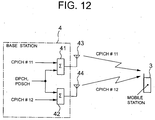
- CPICHs #11, #12, the DPCH and the PDSCH are synthesized in synthesis portions 41 and 42 of a base station 4 respectively and sent to a mobile station 3 from antennas 43 and 44.
- the mobile station 3 detects a phase difference of the CPICHs #11 and #12 and feeds back information on the phase difference thereof to the base station 4 as the transmission diversity control information.
- the base station 4 controls the transmission based on the control information that is fed back so that a receiving state at said mobile station 3 becomes the best.
- an object of the present invention is to provide the mobile communication system, the mobile terminal and the transmission diversity application method used therefor and its program capable of solving the above problems and efficiently performing the transmission diversity of the PDSCH and the DPCH without increasing the number of bits of the control information to be fed back to the base station and rendering the feedback period longer.
- a mobile communication system is one wherein a process of switching a base station to accommodate a mobile station to another base station is performed by soft handover and, based on transmission diversity control information fed back from the above described mobile station, the above described base station controls the above described transmission diversity so that a receiving state at the above described mobile station becomes the best, the above described system having:
- a mobile terminal is one of the system wherein the process of switching the base station to accommodate its terminal to another base station is performed by the soft handover and, based on the transmission diversity control information fed back by the above described base station so that the receiving state at its terminal becomes the best, the above described transmission diversity is controlled, the above described mobile terminal having:
- a transmission diversity application method is one of the mobile communication system wherein the process of switching the base station to accommodate the mobile station to another base station is performed by soft handover and, based on transmission diversity control information fed back from the above described mobile station, the above described base station controls the above described transmission diversity so that the receiving state at the above described mobile station becomes the best, the above described method having:
- a program of the transmission diversity application method is one of the mobile communication system wherein the process of switching the base station to accommodate the mobile station to another base station is performed by the soft handover and, based on the transmission diversity control information fed back from the above described mobile station, the above described base station controls the above described transmission diversity so that the receiving state at the above described mobile station becomes the best, the above described program having a computer implement the processes of:
- the mobile communication system of the present invention has the transmission diversity control information fed back to the base station determined by the mobile station just receiving the PDSCH data based on the receiving state of the signal of a cell [normally CPICH (Common Pilot Channel) #1] for sending the PDSCH (Physical Downlink Shared Channel).
- CPICH Common Pilot Channel
- a large number of mobile stations in a standby status waiting for reception of the PDSCH data determine the transmission diversity control information on the DPCH (Dedicated Physical Channel) fed back to the base station based on the receiving state after the synthesis of the signal of the cell of an active set (normally CPICH#1, CPICH#2).
- DPCH Dedicated Physical Channel
- receiving SIR Signal to Interference Ratio
- Ec/Io energy per chip/interference wave power per unit frequency
- FCS fast cell selection
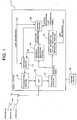
- FIG. 1 is a block diagram showing a configuration of a mobile station according to an embodiment of the present invention.
- a mobile station (mobile terminal) 1 includes an antenna 11, a duplexer (DUP) 12, a receiving portion 13, a feedback information generating portion 14, a user information/control information separating portion 15, a control portion 16, a synthesis portion 17, a transmitting portion 18 and a record medium 19. Since, as technologies in the public domain are applicable to a call control portion, a voice input output portion and a display portion of the mobile station 1, description of their configurations and operations will be omitted.
- the receiving portion 13 sends signals ⁇ CPICH (Common Pilot Channel) #1, CPICH #2, DPCH (Dedicated Physical Channel) #1, DPCH #2, PDSCH (Physical Downlink Shared Channel) ⁇ received via the antenna 11 and the duplexer 12 to the feedback information generating portion 14 and the user information/control information separating portion 15, respectively.
- CPICH Common Pilot Channel
- CPICH #2 CPICH #2
- DPCH Dedicated Physical Channel
- PDSCH Physical Downlink Shared Channel
- the feedback information generating portion 14 generates feedback information (FBI), which should be sent to a base station not shown, based on a receiving signal from the receiving portion 13 according to a switching instruction from the control portion 16, and suplies the feedback information to the synthesis portion 17.
- FBI feedback information
- the feedback information generating portion 14 determines, based on a receiving state of a signal (normally CPICH #1) of a cell for transmitting the PDSCH data, transmission diversity control information on the PDSCH in response to the switching instruction from the control portion 16 on receiving first PDSCH data (during reception of the PDSCH data), and sends the determined information as the feedback information to the synthesis portion 17.
- a signal normally CPICH #1
- the feedback information generating portion 14 determines, based on a receiving state of a signal (normally CPICH #1) of a cell for transmitting the PDSCH data, transmission diversity control information on the PDSCH in response to the switching instruction from the control portion 16 on receiving first PDSCH data (during reception of the PDSCH data), and sends the determined information as the feedback information to the synthesis portion 17.
- the feedback information generating portion 14 determines, based on the receiving state after synthesis of the signal (normally CPICH #1, CPICH #2) of the cell of an active set, the transmission diversity control information on the DPCH in response to the switching instruction from the control portion 16 on receiving the last PDSCH data (waiting for reception of the PDSCH data), and sends the determined information as the feedback information to the synthesis portion 17.
- receiving SIR Signal to Interference Ratio
- Ec/Io energy per chip/interference wave power per unit frequency
- the user information/control information separating portion 15 separates the receiving signal from the receiving portion 13 into the user information (sound signals, image signals and so on) and the control information, and sends the user information to the call control portion, the voice output portion and the display portion of the above-mentioned mobile station 1 and sends the control information to the control portion 16.
- the control portion 16 generates various control signals, by executing a program stored in the record medium 19, based on the control information from the user information/control information separating portion 15 and input information (such as pressing information of ten keys and so on) from the outside so as to output them to the portions in the mobile station 1 and exercise control.
- the record medium 19 stores the programs executed by the portions including the control portion 16 in the mobile station 1.
- the control portion 16 sends the switching instruction during the reception of the PDSCH data to the feedback information generating portion 14, and in the case of the information indicating the last PDSCH data or in the case of having received all the PDSCH data to be received, it sends the switching instruction of a state of waiting for the reception of the PDSCH data to the feedback information generating portion 14.
- the control portion 16 On receipt of this PDSCH data, the control portion 16 generates an acknowledgement (ACK) on receipt of this PDSCH data and sends it to the synthesis portion 17.
- ACK acknowledgement
- the synthesis portion 17 synthesizes the input signals from the outside such as the feedback information from the feedback information generating portion 14, the acknowledgement on receipt of the PDSCH data from the control portion 16 and the call control portion and the voice input portion of the mobile station 1, and transmits them as DPCH #1 (UL: up link) and DPCH #2 (UL) from the antenna 11 via the sending portion 18 and the duplexer 12.
- FIG. 2 is a block diagram showing a configuration of the feedback information generating portion 14.
- the feedback information generating portion 14 comprises a CPICH #1 separating portion 141, a CPICH #2 separating portion 142, switches 143 and 144, an adder 145 and a control information determining portion (FBI generating portion) 146.
- the CPICH #1 separating portion 141 separates a CPICH #1 from the receiving signal of the receiving portion 13 and outputs it to the switch 143.
- the CPICH #2 separating portion 142 separates a CPICH #2 from the receiving signal of the receiving portion 13 and outputs it to the switch 144.
- the switches 143 and 144 are turned on and off in response to a switching signal from the control portion 16, and in the case where they are on, they connect the CPICH #1 separating portion 141 and the CPICH #2 separating portion 142 to the adder 145, respectively.
- the switching signal from the control portion 16 gives an instruction to turn on the switch 143 and turn off the switch 144 during the reception of the PDSCH data, and gives an instruction to turn on both the switch 143 and switch 144 when in the state of waiting for the reception of the PDSCH data.
- the adder 145 adds the CPICH #1 separated by the CPICH #1 separating portion 141 and the CPICH #2 separated by the CPICH #2 separating portion 142 inputted via the switches 143 and 144, and sends the adding result to the control information determining portion 146. During the reception of the PDSCH data, however, it sends the CPICH #1 separated by the CPICH #1 separating portion 141 as-is to the control information determining portion 146 since the switch 144 is off.
- the control information determining portion 146 determines the transmission diversity control information based on the adding result of the adder 145. To be more specific, on receiving the first PDSCH data during the soft handover (during the reception of the PDSCH data), the control information determining portion 146 determines the PDSCH transmission diversity control information based on the receiving state of the CPICH #1 that is the signal of the cell sending the PDSCH data, and applies the determined information to the synthesis portion 17 as the feedback information.
- the control information determining portion 146 determines the DPCH transmission diversity control information based on the receiving state after the synthesis of the CPICH #1 and the CPICH #2 that are the signals of the cells of the active set, and applies the determined information to the synthesis portion 17 as the feedback information.
- receiving SIR or Ec/Io is normally used as the receiving state.
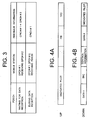
- FIG. 3 is a diagram showing an example of the switching of the feedback information in the mobile communication system according to an embodiment of the present invention.
- the mobile station 1 receives the DPCH #1 (DL: downlink) and DPCH #2 (DL), and the DPCH transmission diversity control information based on the receiving state of the "CPICH #1 + the CPICH #2" is transmitted to the base station as the feedback information of the mobile station 1.
- the base station controls the transmission so that the receiving state at the mobile station 1 becomes the best based on this transmission diversity control information.
- the mobile station 1 in the case of just receiving the PDSCH data, receives the DPCH #1 (DL), DPCH #2 (DL) and the PDSCH, and the PDSCH transmission diversity control information based on the receiving state of the "CPICH #1" is stransmitted to the base station as the feedback information of the mobile station 1.
- the base station controls the transmission so that the receiving state at the mobile station 1 becomes the best based on such transmission diversity control information.
- FIG. 4A is a diagram showing a format of an upward DPCH according to an embodiment of the present invention
- FIG. 4B is a diagram showing a format of a downward DPCH according to an embodiment of the present invention.
- the upward DPCH is comprised of a discrete pilot (predetermined bit sequence), the feedback information (FBI) and a TPC (Transmission Power Control) bit.
- the downward DPCH is comprised of data 1, the TPC bit, the control information (PDSCH data transmission timing), data 2 and the discrete pilot (predetermined bit sequence).
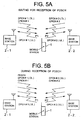
- FIG. 5A is a diagram showing the state of waiting for the reception of the PDSCH in the mobile communication system according to an embodiment of the present invention
- FIG. 5B is a diagram showing the state of just receiving the PDSCH in the mobile communication system according to an embodiment of the present invention.
- the mobile station 1 in the case of waiting for the reception of the PDSCH data, receives the "CPICH #1, CPICH #2, DPCH #1 (DL) and DPCH #2 (DL) from the base stations 2-1 and 2-2, and the DPCH transmission diversity control information based on the receiving state of the "CPICH #1 + CPICH #2" is transmitted by the DPCH #1 (UL) and DPCH #2 (UL) to the base stations 2-1 and 2-2 as the feedback information of the mobile station 1, respectively (see FIG. 5A).
- the mobile station 1 in the case of just receiving the PDSCH data, receives the CPICH #1, DPCH #1 (DL) and PDSCH from the base station 2-1, and also' receives the CPICH #2 and DPCH #2 (DL) from the base station 2-2.
- the PDSCH transmission diversity control information based on the receiving state of the "CPICH #1" is transmitted to the base station 2-1 by the DPCH #1 (UL) (see FIG. 5B). Accordingly, the base stations 2-1 and 2-2 control the transmission so that the receiving state at the mobile station 1 becomes the best based on such transmission diversity control information.
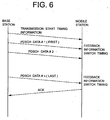
- FIG. 6 is a sequence chart showing the operation of the mobile communication system according to an embodiment of the present invention
- FIG. 7 is a flowchart showing the operation of the mobile station 1 in FIG. 1.
- the operation of the mobile communication system according to an embodiment of the present invention will be described by referring to FIGS. 1 to 7.
- the processing operation shown in FIG. 7 is implemented by the control portion 16 executing the program stored in the record medium 19.
- the base stations 2-1 and 2-2 will be described hereafter in order to simplify the description, it is assumed that the base stations 2-1 and 2-2 are in the soft handover due to movement of the mobile station 1.
- the base station 2-1 In the case of transmitting the PDSCH data according to a request from the mobile station 1, the base station 2-1 notifies the mobile station 1 of transmission start timing information by the DPCH #1 (DL) before transmitting the PDSCH data.
- the control portion 16 of the mobile station 1 On receiving the transmission start timing information from the base station 2-1 (FIG. 7 step S1), the control portion 16 of the mobile station 1 shifts to the state of receiving the PDSCH data, and on receiving the first PDSCH data (FIG. 7 step S2), it outputs to the feedback information generating portion 14 a switching instruction to generate the feedback information during the reception of the above-mentioned PDSCH data (FIG. 7 step S3).
- the control portion 16 sequentially receives the PDSCH data from the base station 2-1, and on receiving the last PDSCH data (FIG. 7 step S4), it outputs to the feedback information generating portion 14 the switching instruction to generate the feedback information in the state of waiting for the reception of the above-mentioned PDSCH data (FIG. 7 step S5).
- the control portion 16 transmits the acknowledgement (ACK) for the PDSCH data to the base station 2-1.
- the control portion 16 may identify it by the information (a flag) given to the last PDSCH data indicating that it is the last one, or it may have the size of the PDSCH data to be sent notified in advance from the base station 2-1 to the mobile station 1 so as to identify it by the size thereof.
- FIG. 8 is a sequence chart showing the operation of the mobile communication system according to another embodiment of the present invention
- FIG. 9 is a flowchart showing the operation of the mobile station according to the other embodiment of the present invention.
- the other embodiment of the present invention has the same configuration of the mobile station as the embodiment shown in FIG. 1, the operation of the mobile communication system according to the other embodiment will be described by referring to FIGS. 1, 8 and 9.
- the processing operation shown in FIG. 9 is implemented by the control portion 16 executing the program stored in the record medium 19.
- the base stations 2-1 and 2-2 are in the soft handover due to movement of the mobile station 1.
- the base station 2-1 In the case of transmitting the PDSCH data according to the request from the mobile station 1, the base station 2-1 notifies the mobile station 1 of the transmission start timing information by the DPCH #1 (DL) before sending the PDSCH data.
- the control portion 16 of the mobile station 1 On receiving the transmission start timing information from the base station 2-1 (FIG. 9 step S11), the control portion 16 of the mobile station 1 outputs to the feedback information generating portion 14 the switching instruction to generate the feedback information during the reception of the above-mentioned PDSCH data (FIG. 9 step S12). Hereafter, the control portion 16 shifts to the state of accepting the PDSCH data and sequentially receives the PDSCH data.
- the control portion 16 sequentially receives the PDSCH data from the base station 2-1, and on receiving the last PDSCH data (FIG. 9 step S13) and transmitting the acknowledgement (ACK) for the PDSCH data to the base station 2-1 (FIG. 9 step S14), it outputs to the feedback information generating portion 14 the switching instruction to generate the feedback information in the state of waiting for the reception of the above-mentioned PDSCH data (FIG. 9 step S15).
- the method for the control portion 16 to identify the last PDSCH data it may identify it by the information (the flag) given to the last PDSCH data indicating that it is the last one, or it may have the size of the PDSCH data to be sent notified in advance from the base station 2-1 to the mobile station 1 so as to identify it by the size thereof.
- FIG. 10 is a sequence chart showing the operation of the mobile communication system according to a further embodiment of the present invention
- FIG. 11 is a flowchart showing the operation of the mobile station according to the further embodiment of the present invention.
- the further embodiment of the present invention has the same configuration of the mobile station as the embodiment shown in FIG. 1, the operation of the mobile communication system according to the further embodiment will be described by referring to FIGS. 1, 10 and 11.
- the processing operation shown in FIG. 11 is implemented by the control portion 16 executing the program stored in the record medium 19.
- the base stations 2-1 and 2-2 are in the soft handover due to movement of the mobile station 1.
- the base station 2-1 notifies the mobile station 1 of the transmission start timing information by the DPCH #1 (DL) before sending the PDSCH data.
- the control portion 16 of the mobile station 1 On receiving the transmission start timing information from the base station 2-1 (FIG. 11 step S21), the control portion 16 of the mobile station 1 outputs to the feedback information generating portion 14 the switching instruction to generate the feedback information during the reception of the above-mentioned PDSCH data (FIG. 11 step S22). Hereafter, the control portion 16 shifts to the state of accepting the PDSCH data and sequentially receives the PDSCH data.
- the control portion 16 sequentially receives the PDSCH data from the base station 2-1, and receives the last PDSCH data (FIG. 11 step S23) and transmits the acknowledgement (ACK) for the PDSCH data to the base station 2-1, and then if predetermined time elapses (FIG. 11 step S24), it outputs to the feedback information generating portion 14 the switching instruction to generate the feedback information in the state of waiting for the reception of the above-mentioned PDSCH data (FIG. 11 step S25).
- the method for the control portion 16 to identify the last PDSCH data it may identify it by the information (the flag) given to the last PDSCH data indicating that it is the last one, or it may have the size of the PDSCH data to be sent notified in advance from the base station 2-1 to the mobile station 1 so as to identify it by the size thereof.
- the mobile station 1 notifies the base station 2-1 of the transmission diversity control information
- transmission efficiency of the DPCH #1 (DL) and DPCH #2 (DL) together does not become the best but that of the PDSCH does because the CPICH #1 has the same propagation path as the PDSCH.
- sending power of the PDSCH is higher than that of the DPCH #1 (DL) and DPCH #2 (DL) together, the entire transmission efficiency (average transmitting power per information bit) of the PDSCH, DPCH #1 (DL) and DPCH #2 (DL) together becomes the best.
- the mobile station 1 notifies the base stations 2-1 and 2-2 of the transmission diversity control information, during standby not receiving the PDSCH data, based on the receiving state after the synthesis of the CPICH #1 and CPICH #2, the transmission efficiency of the DPCH #1 (DL) and DPCH #2 (DL) together becomes the best because the signal wherein the CPICH #1 and CPICH #2 are synthesized has the same propagation path as the signal having the DPCH #1 (DL) and DPCH #2 (DL) together.
- the entire transmission efficiency of the PDSCH, DPCH #1 (DL) and DPCH #2 (DL) together becomes the best.
- DPCH #1 (DL) and DPCH #2 (DL) together becomes the best both during the reception of the PDSCH data and during the standby.
- the base station controls the transmission diversity so that the receiving state at the mobile station becomes the best, it determines the transmission diversity control information during reception of the data by the PDSCH during said soft handover based on the receiving state of the signal from the base station sending said PDSCH, and it determines the transmission diversity control information during standby waiting for the reception of the data by the PDSCH during the soft handover based on the receiving state after the synthesis of the signal from each subject base station of the soft handover so that there is the effect of efficiently performing the transmission diversity of the PDSCH and the DPCH without increasing the number of bits of the control information to be fed back to the base station and rendering the feedback period longer.
Landscapes
- Engineering & Computer Science (AREA)
- Computer Networks & Wireless Communication (AREA)
- Signal Processing (AREA)
- Mobile Radio Communication Systems (AREA)
- Radio Transmission System (AREA)
Abstract
Description
Claims (27)
- A mobile communication system in which a process of switching a base station to accommodate a mobile station to another base station is performed by soft handover and, based on transmission diversity control information fed back from said mobile station, said base station controls said transmission diversity so that a receiving state at said mobile station becomes the best, said system comprising:a first determination means of, during said soft handover, determining said transmission diversity control information during reception of data by a PDSCH (Physical Downlink Shared Channel) based on the receiving state of a signal from the base station sending said PDSCH; anda second determination means of, during said soft handover, determining said transmission diversity control information during standby waiting for reception of the data by said PDSCH based on the receiving state after synthesis of the signal from each subject base station of said soft handover.
- The mobile communication system according to claim 1, comprising control means of controlling switching of said first and second determination means according to the receiving state of the data by said PDSCH.
- The mobile communication system according to claim 2, wherein said control means instructs said first determination means to perform a determination process on receiving the data by a first PDSCH and instructs said second determination means to perform the determination process on receiving the last PDSCH data.
- The mobile communication system according to claim 3, wherein said control means instructs said first determination means to perform the determination process on the opportunity of transmission start timing information sent from said base station before the data by said first PDSCH is sent to said mobile station.
- The mobile communication system according to claim 3, wherein said control means instructs said second determination means to perform the determination process on the opportunity of transmission of an acknowledgement from said mobile station to said base station after receiving the data by said last PDSCH.
- The mobile communication system according to claim 3, wherein said control means instructs said second determination means to perform the determination process after a predetermined time from transmission of an acknowledgement from said mobile station to said base station after receiving the data by said last PDSCH.
- The mobile communication system according to any of claims 1 to 6, wherein said first determination means determines said transmission diversity control information on said PDSCH, and said second determination means determines said transmission diversity control information on DPCH (Dedicated Physical Channel) that is the signal from each subject base station of said soft handover.
- The mobile communication system according to any of claims 1 to 6, wherein said first determination means is implemented at the mobile station just receiving the data by said PDSCH, and said second determination means is implemented at a large number of mobile stations in a standby status waiting for reception of the data by said PDSCH.
- The mobile communication system according to any of claims 1 to 8, wherein either receiving SIR (Signal to Interference Ratio) or Ec/Io (energy per chip/interference wave power per unit frequency) is used as the receiving state of said signal.
- A mobile terminal of a system in which a process of switching a base station to accommodate the terminal to another base station is performed by soft handover and, based on transmission diversity control information fed back by said base station so that a receiving state at its terminal becomes the best, said transmission diversity is controlled, said mobile terminal comprising:a first determination function of, during said soft handover, determining said transmission diversity control information during reception of data by a PDSCH (Physical Downlink Shared Channel) based on the receiving state of a signal from the base station sending said PDSCH; anda second determination function of, during said soft handover, determining said transmission diversity control information during standby waiting for reception of the data by said PDSCH based on the receiving state after synthesis of the signal from each subject base station of said soft handover.
- The mobile terminal according to claim 10, comprising control means of controlling switching of said first and second determination functions according to the receiving state of the data by said PDSCH.
- The mobile terminal according to claim 11, wherein said control means instructs said first determination function to perform a determination process on receiving the data by a first PDSCH and instructs said second determination function to perform the determination process on receiving the last PDSCH data.
- The mobile terminal according to claim 12, wherein said control means instructs said first determination function to perform the determination process on the opportunity of transmission start timing information sent from said base station before the data by said first PDSCH is sent to its terminal.
- The mobile terminal according to claim 12, wherein said control means instructs said second determination function to perform the determination process on the opportunity of transmission of an acknowledgement from its terminal to said base station after receiving the data by said last PDSCH.
- The mobile terminal according to claim 12, wherein said control means instructs said second determination function to perform the determination process after a predetermined time from transmission of an acknowledgement from its terminal to said base station after receiving the data by said last PDSCH.
- The mobile terminal according to any of claims 10 to 15, wherein said first determination function determines said transmission diversity control information on said PDSCH, and said second determination function determines said transmission diversity control information on DPCH (Dedicated Physical Channel) that is the signal from each base station of said soft handover.
- The mobile terminal according to any of claims 10 to 16, wherein either receiving SIR (Signal to Interference Ratio) or Ec/Io (energy per chip/interference wave power per unit frequency) is used as the receiving state of said signal.
- A transmission diversity application method of a mobile communication system in which a process of switching a base station to accommodate a mobile station to another base station is performed by soft handover and, based on transmission diversity control information fed back from said mobile station, said base station controls said transmission diversity so that a receiving state at said mobile station becomes the best, said method comprising:a first step of, during said soft handover, giving an instruction to switch to a first determination means of determining said transmission diversity control information during reception of data by a PDSCH (Physical Downlink Shared Channel) based on the receiving state of a signal from the base station sending said PDSCH; anda second step of, during said soft handover, giving an instruction to switch to a second determination means of determining said transmission diversity control information during standby waiting for reception of the data by said PDSCH based on the receiving state after synthesis of the signal from each subject base station of said soft handover.
- The transmission diversity application method according to claim 18, wherein said first and second steps control switching of said first and second determination means according to the receiving state of the data by said PDSCH.
- The transmission diversity application method according to claim 19, wherein said first step instructs said first determination means to perform a determination process on receiving the data by a first PDSCH, and said second step instructs said second determination means to perform the determination process on receiving the last PDSCH data.
- The transmission diversity application method according to claim 20, wherein said first step instructs said first determination means to perform the determination process on the opportunity of transmission start timing information sent from said base station before the data by said first PDSCH is sent to said mobile station.
- The transmission diversity application method according to claim 20, wherein said second step instructs said second determination means to perform the determination process on the opportunity of transmission of an acknowledgement from said mobile station to said base station after receiving the data by said last PDSCH.
- The transmission diversity application method according to claim 20, wherein said second step instructs said second determination means to perform the determination process after a predetermined time from transmission of an acknowledgement from said mobile station to said base station after receiving the data by said last PDSCH.
- The transmission diversity application method according to any of claims 18 to 23, wherein said first determination means determines said transmission diversity control information on said PDSCH, and said second determination means determines said transmission diversity control information on DPCH (Dedicated Physical Channel) that is the signal from each base station of said soft handover.
- The transmission diversity application method according to any of claims 18 to 23, wherein said first determination means is implemented at the mobile station just receiving the data by said PDSCH, and said second determination means is implemented at a large number of mobile stations in a standby status waiting for reception of the data by said PDSCH.
- The transmission diversity application method according to any of claims 18 to 25, wherein either receiving SIR (Signal to Interference Ratio) or Ec/Io (energy per chip/interference wave power per unit frequency) is used as the receiving state of said signal.
- A program of a transmission diversity application method of a mobile communication system in which a process of switching a base station to accommodate a mobile station to another base station is performed by soft handover and, based on transmission diversity control information fed back from said mobile station, said base station controls said transmission diversity so that a receiving state at said mobile station becomes the best, said program intended to have a computer implement the processes of:during said soft handover, giving an instruction to switch to a first determination means of determining said transmission diversity control information during reception of data by a PDSCH (Physical Downlink Shared Channel) based on the receiving state of a signal from the base station sending said PDSCH; andduring said soft handover, giving an instruction to switch to a second determination means of determining said transmission diversity control information during standby waiting for reception of the data by said PDSCH based on the receiving state after synthesis of the signal from each base station of said soft handover.
Applications Claiming Priority (2)
| Application Number | Priority Date | Filing Date | Title |
|---|---|---|---|
| JP2001043120 | 2001-02-20 | ||
| JP2001043120A JP3543770B2 (en) | 2001-02-20 | 2001-02-20 | MOBILE COMMUNICATION SYSTEM, MOBILE TERMINAL, TRANSMISSION DIVERSITY APPLICATION METHOD USED FOR THEM, AND PROGRAM THEREOF |
Publications (3)
| Publication Number | Publication Date |
|---|---|
| EP1233638A2 true EP1233638A2 (en) | 2002-08-21 |
| EP1233638A3 EP1233638A3 (en) | 2003-09-17 |
| EP1233638B1 EP1233638B1 (en) | 2006-11-08 |
Family
ID=18905337
Family Applications (1)
| Application Number | Title | Priority Date | Filing Date |
|---|---|---|---|
| EP02002087A Expired - Lifetime EP1233638B1 (en) | 2001-02-20 | 2002-02-11 | Mobile communication system, mobile terminal, and transmission diversity application method used therefor |
Country Status (6)
| Country | Link |
|---|---|
| US (1) | US6879831B2 (en) |
| EP (1) | EP1233638B1 (en) |
| JP (1) | JP3543770B2 (en) |
| KR (1) | KR100462638B1 (en) |
| CN (1) | CN100484307C (en) |
| DE (1) | DE60215875T2 (en) |
Cited By (3)
| Publication number | Priority date | Publication date | Assignee | Title |
|---|---|---|---|---|
| WO2005018109A1 (en) * | 2003-08-11 | 2005-02-24 | Siemens Aktiengesellschaft | Method for transmitting data using a diversity system for the transmission antennae |
| US7706405B2 (en) | 2002-09-12 | 2010-04-27 | Interdigital Technology Corporation | System for efficient recovery of Node-B buffered data following MAC layer reset |
| US8085726B2 (en) | 2002-04-05 | 2011-12-27 | Interdigital Technology Corporation | High speed downlink shared channel cell change |
Families Citing this family (34)
| Publication number | Priority date | Publication date | Assignee | Title |
|---|---|---|---|---|
| JP3898018B2 (en) * | 2001-09-28 | 2007-03-28 | 株式会社エヌ・ティ・ティ・ドコモ | Transmission power control method and mobile station |
| EP1496628B1 (en) * | 2002-04-03 | 2013-06-05 | NEC Corporation | Mobile communication system, mobile station, base station, communication path quality estimation method used for the same |
| US7236479B2 (en) | 2002-10-08 | 2007-06-26 | Samsung Electronics Co., Ltd. | Apparatus and method for controlling transmission antenna arrays for a high speed physical downlink shared channel in a mobile communication system |
| US7680507B2 (en) * | 2002-11-04 | 2010-03-16 | Alcatel-Lucent Usa Inc. | Shared control and signaling channel for users subscribing to data services in a communication system |
| US7382315B1 (en) * | 2003-03-11 | 2008-06-03 | Rockwell Collins, Inc. | System for and method of improving beyond line-of-sight transmissions and receptions |
| KR100526542B1 (en) * | 2003-05-15 | 2005-11-08 | 삼성전자주식회사 | Apparatus for transmitting/receiving data using transmit diversity scheme with multiple antenna in mobile communication system and method thereof |
| JP3938914B2 (en) * | 2003-08-08 | 2007-06-27 | 松下電器産業株式会社 | Mobile station apparatus and channel quality report value control method in mobile station apparatus |
| TW200642305A (en) * | 2004-06-10 | 2006-12-01 | Interdigital Tech Corp | Joint signal demodulation in a low and high data rate channel environment |
| KR100606101B1 (en) * | 2004-07-01 | 2006-07-31 | 삼성전자주식회사 | System and method for transmitting uplink control information in a communication system using orthogonal frequency ddivision multiple access scheme |
| US7319868B2 (en) * | 2004-09-27 | 2008-01-15 | Telefonktiebolaget Lm Ericsson (Publ) | Derivation of optimal antenna weights during soft handover |
| JP4785377B2 (en) | 2004-12-14 | 2011-10-05 | 株式会社エヌ・ティ・ティ・ドコモ | Radio channel control station, mobile communication system, and mobile communication method |
| JP4614798B2 (en) * | 2005-03-16 | 2011-01-19 | 富士通株式会社 | Mobile station and weighting control method |
| JP4756897B2 (en) * | 2005-04-18 | 2011-08-24 | 株式会社エヌ・ティ・ティ・ドコモ | Mobile station and feedback information generation method |
| JP2006345488A (en) * | 2005-06-10 | 2006-12-21 | Lg Electronics Inc | Method and system for triggering handover of mobile communication terminal |
| EP1734667B1 (en) * | 2005-06-17 | 2011-08-10 | Fujitsu Limited | Multi-hop communication system |
| EP1734665B1 (en) * | 2005-06-17 | 2011-08-10 | Fujitsu Limited | Multi-hop communication system |
| EP1734666A1 (en) * | 2005-06-17 | 2006-12-20 | Fujitsu Limited | Resource management in multi-hop communication system |
| EP1734668B1 (en) * | 2005-06-17 | 2008-08-27 | Fujitsu Limited | Power control in multi-hop communication system |
| JP4642582B2 (en) * | 2005-07-27 | 2011-03-02 | 富士通株式会社 | Mobile communication system, radio base station, mobile station |
| JP4594822B2 (en) * | 2005-08-09 | 2010-12-08 | 株式会社エヌ・ティ・ティ・ドコモ | Reception apparatus and communication control method in mobile communication system |
| KR20070019063A (en) * | 2005-08-09 | 2007-02-15 | 엘지전자 주식회사 | Method and apparatus for triggering handover of a mobile terminal |
| CN1972178A (en) * | 2005-11-25 | 2007-05-30 | 北京三星通信技术研究有限公司 | A method for increasing multicast broadcasting service |
| GB0619454D0 (en) * | 2006-10-02 | 2006-11-08 | Fujitsu Ltd | Communication systems |
| GB2443464A (en) * | 2006-11-06 | 2008-05-07 | Fujitsu Ltd | Signalling in a multi-hop communication systems |
| JP4079197B1 (en) * | 2007-02-06 | 2008-04-23 | 松下電器産業株式会社 | Receiving apparatus and receiving system using the same |
| GB2447883A (en) * | 2007-03-02 | 2008-10-01 | Fujitsu Ltd | Bandwidth allocation in multi-hop wireless communication systems |
| GB2447635A (en) * | 2007-03-19 | 2008-09-24 | Fujitsu Ltd | Scheduling qos communications between nodes within a predetermined time unit in wimax systems |
| WO2008120316A1 (en) * | 2007-03-28 | 2008-10-09 | Fujitsu Limited | Base station and schedule method thereof |
| WO2010053339A2 (en) * | 2008-11-10 | 2010-05-14 | 엘지전자주식회사 | Method for performing a harq operation in a radio communications system, and method and apparatus for allocation of subframes |
| US9520933B2 (en) * | 2009-01-12 | 2016-12-13 | Qualcomm Incorporated | Method and apparatus for enabling multiple transmission modes based on multiple search spaces |
| US9071310B2 (en) * | 2009-01-12 | 2015-06-30 | Qualcomm Incorporated | Method and apparatus for enabling multiple transmission modes in a wireless communication system |
| TWI449924B (en) * | 2009-09-18 | 2014-08-21 | 富士康(香港)有限公司 | Antenna test device |
| CN101651995A (en) | 2009-09-21 | 2010-02-17 | 中兴通讯股份有限公司 | Transmission method and transmission system of downlink control information |
| CN103117782B (en) * | 2011-11-16 | 2018-01-23 | 中兴通讯股份有限公司 | The control method and system of transmitting diversity |
Family Cites Families (13)
| Publication number | Priority date | Publication date | Assignee | Title |
|---|---|---|---|---|
| JP2939114B2 (en) * | 1994-04-27 | 1999-08-25 | エヌ・ティ・ティ移動通信網株式会社 | Mobile communication handover method, mobile station apparatus and base station apparatus |
| KR100265855B1 (en) * | 1997-07-10 | 2000-09-15 | 정선종 | Method for processing handoff call in wireless communication system |
| KR100265584B1 (en) * | 1997-07-22 | 2000-09-15 | 정태기 | Idle Handoff Control Method in Mobile Communication |
| JPH11200035A (en) * | 1998-01-19 | 1999-07-27 | Anelva Corp | Sputter chemical vapor deposition combined equipment |
| JP3263376B2 (en) * | 1999-03-31 | 2002-03-04 | 松下電器産業株式会社 | Mobile communication system |
| ES2173717T3 (en) * | 1999-04-30 | 2002-10-16 | Cit Alcatel | SOFT DELIVERY METHOD IN CDMA USING ASCENDING LINK MEASUREMENTS. |
| US6996069B2 (en) * | 2000-02-22 | 2006-02-07 | Qualcomm, Incorporated | Method and apparatus for controlling transmit power of multiple channels in a CDMA communication system |
| GB0012258D0 (en) * | 2000-05-19 | 2000-07-12 | Fujitsu Ltd | Transmission rate changes in communications networks |
| CA2394093C (en) * | 2000-10-11 | 2008-09-16 | Samsung Electronics Co., Ltd. | Apparatus and method for controlling transmit antenna array for physical downlink shared channel in a mobile communication system |
| US6970716B2 (en) * | 2001-02-22 | 2005-11-29 | Telefonaktiebolaget Lm Ericsson (Publ) | Power control for downlink shared channel in radio access telecommunications network |
| US20020160781A1 (en) * | 2001-02-23 | 2002-10-31 | Gunnar Bark | System, method and apparatus for facilitating resource allocation in a communication system |
| EP1255363B1 (en) * | 2001-05-04 | 2007-06-27 | Lucent Technologies Inc. | Wireless telecommunications system and method for asymmetric data transmission |
| GB2377586B (en) * | 2001-07-06 | 2005-06-29 | Ipwireless Inc | System and method for channel transport format allocation in a wireless communication system |
-
2001
- 2001-02-20 JP JP2001043120A patent/JP3543770B2/en not_active Expired - Fee Related
-
2002
- 2002-02-07 US US10/067,409 patent/US6879831B2/en not_active Expired - Fee Related
- 2002-02-11 DE DE60215875T patent/DE60215875T2/en not_active Expired - Lifetime
- 2002-02-11 EP EP02002087A patent/EP1233638B1/en not_active Expired - Lifetime
- 2002-02-20 KR KR10-2002-0008997A patent/KR100462638B1/en not_active Expired - Fee Related
- 2002-02-20 CN CNB021050805A patent/CN100484307C/en not_active Expired - Fee Related
Cited By (11)
| Publication number | Priority date | Publication date | Assignee | Title |
|---|---|---|---|---|
| US8085726B2 (en) | 2002-04-05 | 2011-12-27 | Interdigital Technology Corporation | High speed downlink shared channel cell change |
| US8085728B2 (en) | 2002-04-05 | 2011-12-27 | Interdigital Technology Corporation | High speed downlink shared control channel cell change |
| US8085729B2 (en) | 2002-04-05 | 2011-12-27 | Interdigital Technology Corporation | High speed downlink shared control channel cell change |
| US8130721B2 (en) | 2002-04-05 | 2012-03-06 | Interdigital Technology Corporation | HS-DSCH inter-node B cell change |
| US8837431B2 (en) | 2002-04-05 | 2014-09-16 | Intel Corporation | HS-DSCH inter-node B cell change |
| US9220037B2 (en) | 2002-04-05 | 2015-12-22 | Intel Corporation | HS-DSCH inter-node B cell change |
| US7706405B2 (en) | 2002-09-12 | 2010-04-27 | Interdigital Technology Corporation | System for efficient recovery of Node-B buffered data following MAC layer reset |
| US8693435B2 (en) | 2002-09-12 | 2014-04-08 | Interdigital Technology Corporation | System for efficient recovery of node-B buffered data following MAC layer reset |
| US9319946B2 (en) | 2002-09-12 | 2016-04-19 | Interdigital Technology Corporation | System for efficient recovery of Node-B buffered data following MAC layer reset |
| US10172048B2 (en) | 2002-09-12 | 2019-01-01 | Interdigital Technology Corporation | System for efficient recovery of node-B buffered data following MAC layer reset |
| WO2005018109A1 (en) * | 2003-08-11 | 2005-02-24 | Siemens Aktiengesellschaft | Method for transmitting data using a diversity system for the transmission antennae |
Also Published As
| Publication number | Publication date |
|---|---|
| US20020115440A1 (en) | 2002-08-22 |
| US6879831B2 (en) | 2005-04-12 |
| JP2002247629A (en) | 2002-08-30 |
| EP1233638A3 (en) | 2003-09-17 |
| CN100484307C (en) | 2009-04-29 |
| DE60215875D1 (en) | 2006-12-21 |
| KR100462638B1 (en) | 2004-12-17 |
| JP3543770B2 (en) | 2004-07-21 |
| CN1372422A (en) | 2002-10-02 |
| EP1233638B1 (en) | 2006-11-08 |
| KR20020068298A (en) | 2002-08-27 |
| DE60215875T2 (en) | 2007-03-01 |
Similar Documents
| Publication | Publication Date | Title |
|---|---|---|
| US6879831B2 (en) | Mobile communication system, mobile terminal, and transmission diversity application method used therefor | |
| US7283818B2 (en) | Apparatus and method using page response messages to change the slot cycle index of a selected mobile station in a wireless network | |
| US7266102B2 (en) | Mobile communication system, base station, method of controlling packet transmission timing used for the same mobile communication system and base station, and recording medium recording program thereof | |
| JPWO2004093476A1 (en) | Mobile communication system, base station, mobile station, and radio communication method used therefor | |
| US7302261B2 (en) | Apparatus and method using release order messages to change the slot cycle index of a selected mobile station in a wireless network | |
| JP4012391B2 (en) | Mobile station, mobile communication system, handover control method, handover control program, and recording medium | |
| US7512101B2 (en) | Apparatus and method for enabling different reduced slot cycle modes in a wireless network | |
| JP4010782B2 (en) | Wireless terminal device and its reception operation control program | |
| JP2003051773A (en) | Wireless base station device, wireless terminal, mobile communication system and reception operation control program | |
| WO2025124322A1 (en) | Radio frequency architecture, electronic device, and signal sending method and apparatus | |
| US20050164718A1 (en) | Apparatus and method for selectively changing the slot cycle index in a wireless network | |
| JP2003283411A (en) | Radio equipment, transmission reception directivity control method, and transmission reception directivity control program | |
| US20050096060A1 (en) | Base station for controlling use of reduced slot cycle mode of operation in a wireless network | |
| EP2962507B1 (en) | Communication apparatuses for one radio module to listen to paging signals without breaking the data transmission of the other radio module operating in the connected mode | |
| CA2568328A1 (en) | Method and system for determining a power level for communication in a wireless network | |
| JP4194553B2 (en) | Wireless communication device | |
| CN101218837B (en) | Mobile communication system using portable terminal device and handover control method | |
| US7583630B2 (en) | Method and system for providing mobile station control of data transmission rates in a wireless network | |
| JP2003110500A (en) | Transmission power control method and mobile station | |
| US8179834B2 (en) | Method and apparatus for adapting downlink wireless transmission between beamforming and transmit diversity on a per mobile station basis | |
| KR101525644B1 (en) | Mobile communication terminal and operating method thereof | |
| JPH02200018A (en) | Diversity branch switching control system | |
| JP2001103529A (en) | Communication terminal device and transmission station selection method | |
| JP2006279815A (en) | Diversity radio equipment | |
| JP2004356993A (en) | Wireless device and communication control method |
Legal Events
| Date | Code | Title | Description |
|---|---|---|---|
| PUAI | Public reference made under article 153(3) epc to a published international application that has entered the european phase |
Free format text: ORIGINAL CODE: 0009012 |
|
| AK | Designated contracting states |
Kind code of ref document: A2 Designated state(s): AT BE CH CY DE DK ES FI FR GB GR IE IT LI LU MC NL PT SE TR |
|
| AX | Request for extension of the european patent |
Free format text: AL;LT;LV;MK;RO;SI |
|
| PUAL | Search report despatched |
Free format text: ORIGINAL CODE: 0009013 |
|
| AK | Designated contracting states |
Kind code of ref document: A3 Designated state(s): AT BE CH CY DE DK ES FI FR GB GR IE IT LI LU MC NL PT SE TR |
|
| AX | Request for extension of the european patent |
Extension state: AL LT LV MK RO SI |
|
| 17P | Request for examination filed |
Effective date: 20030820 |
|
| 17Q | First examination report despatched |
Effective date: 20031021 |
|
| AKX | Designation fees paid |
Designated state(s): DE FR GB IT NL |
|
| GRAP | Despatch of communication of intention to grant a patent |
Free format text: ORIGINAL CODE: EPIDOSNIGR1 |
|
| GRAS | Grant fee paid |
Free format text: ORIGINAL CODE: EPIDOSNIGR3 |
|
| GRAA | (expected) grant |
Free format text: ORIGINAL CODE: 0009210 |
|
| AK | Designated contracting states |
Kind code of ref document: B1 Designated state(s): DE FR GB IT NL |
|
| PG25 | Lapsed in a contracting state [announced via postgrant information from national office to epo] |
Ref country code: NL Free format text: LAPSE BECAUSE OF FAILURE TO SUBMIT A TRANSLATION OF THE DESCRIPTION OR TO PAY THE FEE WITHIN THE PRESCRIBED TIME-LIMIT Effective date: 20061108 |
|
| REG | Reference to a national code |
Ref country code: GB Ref legal event code: FG4D |
|
| REF | Corresponds to: |
Ref document number: 60215875 Country of ref document: DE Date of ref document: 20061221 Kind code of ref document: P |
|
| NLV1 | Nl: lapsed or annulled due to failure to fulfill the requirements of art. 29p and 29m of the patents act | ||
| ET | Fr: translation filed | ||
| PLBE | No opposition filed within time limit |
Free format text: ORIGINAL CODE: 0009261 |
|
| STAA | Information on the status of an ep patent application or granted ep patent |
Free format text: STATUS: NO OPPOSITION FILED WITHIN TIME LIMIT |
|
| 26N | No opposition filed |
Effective date: 20070809 |
|
| PGFP | Annual fee paid to national office [announced via postgrant information from national office to epo] |
Ref country code: IT Payment date: 20090212 Year of fee payment: 8 |
|
| PG25 | Lapsed in a contracting state [announced via postgrant information from national office to epo] |
Ref country code: IT Free format text: LAPSE BECAUSE OF NON-PAYMENT OF DUE FEES Effective date: 20100211 |
|
| PGFP | Annual fee paid to national office [announced via postgrant information from national office to epo] |
Ref country code: FR Payment date: 20140211 Year of fee payment: 13 |
|
| PGFP | Annual fee paid to national office [announced via postgrant information from national office to epo] |
Ref country code: GB Payment date: 20140206 Year of fee payment: 13 |
|
| PGFP | Annual fee paid to national office [announced via postgrant information from national office to epo] |
Ref country code: DE Payment date: 20140417 Year of fee payment: 13 |
|
| REG | Reference to a national code |
Ref country code: DE Ref legal event code: R119 Ref document number: 60215875 Country of ref document: DE |
|
| GBPC | Gb: european patent ceased through non-payment of renewal fee |
Effective date: 20150211 |
|
| REG | Reference to a national code |
Ref country code: FR Ref legal event code: ST Effective date: 20151030 |
|
| PG25 | Lapsed in a contracting state [announced via postgrant information from national office to epo] |
Ref country code: DE Free format text: LAPSE BECAUSE OF NON-PAYMENT OF DUE FEES Effective date: 20150901 Ref country code: GB Free format text: LAPSE BECAUSE OF NON-PAYMENT OF DUE FEES Effective date: 20150211 |
|
| PG25 | Lapsed in a contracting state [announced via postgrant information from national office to epo] |
Ref country code: FR Free format text: LAPSE BECAUSE OF NON-PAYMENT OF DUE FEES Effective date: 20150302 |