EP1232757A1 - Remedies for diseases in association with decrease in bone mass - Google Patents
Remedies for diseases in association with decrease in bone mass Download PDFInfo
- Publication number
- EP1232757A1 EP1232757A1 EP00977860A EP00977860A EP1232757A1 EP 1232757 A1 EP1232757 A1 EP 1232757A1 EP 00977860 A EP00977860 A EP 00977860A EP 00977860 A EP00977860 A EP 00977860A EP 1232757 A1 EP1232757 A1 EP 1232757A1
- Authority
- EP
- European Patent Office
- Prior art keywords
- alkyl
- alkyloxy
- hydroxy
- phenyl
- alkylthio
- Prior art date
- Legal status (The legal status is an assumption and is not a legal conclusion. Google has not performed a legal analysis and makes no representation as to the accuracy of the status listed.)
- Granted
Links
- 0 *CSCCCS[C@]([C@](CCC(*)*)[C@](C1)O)C1=O Chemical compound *CSCCCS[C@]([C@](CCC(*)*)[C@](C1)O)C1=O 0.000 description 2
Classifications
-
- A—HUMAN NECESSITIES
- A61—MEDICAL OR VETERINARY SCIENCE; HYGIENE
- A61K—PREPARATIONS FOR MEDICAL, DENTAL OR TOILETRY PURPOSES
- A61K45/00—Medicinal preparations containing active ingredients not provided for in groups A61K31/00 - A61K41/00
-
- A—HUMAN NECESSITIES
- A61—MEDICAL OR VETERINARY SCIENCE; HYGIENE
- A61K—PREPARATIONS FOR MEDICAL, DENTAL OR TOILETRY PURPOSES
- A61K31/00—Medicinal preparations containing organic active ingredients
- A61K31/557—Eicosanoids, e.g. leukotrienes or prostaglandins
- A61K31/5575—Eicosanoids, e.g. leukotrienes or prostaglandins having a cyclopentane, e.g. prostaglandin E2, prostaglandin F2-alpha
-
- A—HUMAN NECESSITIES
- A61—MEDICAL OR VETERINARY SCIENCE; HYGIENE
- A61K—PREPARATIONS FOR MEDICAL, DENTAL OR TOILETRY PURPOSES
- A61K31/00—Medicinal preparations containing organic active ingredients
-
- A—HUMAN NECESSITIES
- A61—MEDICAL OR VETERINARY SCIENCE; HYGIENE
- A61K—PREPARATIONS FOR MEDICAL, DENTAL OR TOILETRY PURPOSES
- A61K31/00—Medicinal preparations containing organic active ingredients
- A61K31/557—Eicosanoids, e.g. leukotrienes or prostaglandins
-
- A—HUMAN NECESSITIES
- A61—MEDICAL OR VETERINARY SCIENCE; HYGIENE
- A61P—SPECIFIC THERAPEUTIC ACTIVITY OF CHEMICAL COMPOUNDS OR MEDICINAL PREPARATIONS
- A61P1/00—Drugs for disorders of the alimentary tract or the digestive system
- A61P1/02—Stomatological preparations, e.g. drugs for caries, aphtae, periodontitis
-
- A—HUMAN NECESSITIES
- A61—MEDICAL OR VETERINARY SCIENCE; HYGIENE
- A61P—SPECIFIC THERAPEUTIC ACTIVITY OF CHEMICAL COMPOUNDS OR MEDICINAL PREPARATIONS
- A61P19/00—Drugs for skeletal disorders
-
- A—HUMAN NECESSITIES
- A61—MEDICAL OR VETERINARY SCIENCE; HYGIENE
- A61P—SPECIFIC THERAPEUTIC ACTIVITY OF CHEMICAL COMPOUNDS OR MEDICINAL PREPARATIONS
- A61P19/00—Drugs for skeletal disorders
- A61P19/08—Drugs for skeletal disorders for bone diseases, e.g. rachitism, Paget's disease
-
- A—HUMAN NECESSITIES
- A61—MEDICAL OR VETERINARY SCIENCE; HYGIENE
- A61P—SPECIFIC THERAPEUTIC ACTIVITY OF CHEMICAL COMPOUNDS OR MEDICINAL PREPARATIONS
- A61P19/00—Drugs for skeletal disorders
- A61P19/08—Drugs for skeletal disorders for bone diseases, e.g. rachitism, Paget's disease
- A61P19/10—Drugs for skeletal disorders for bone diseases, e.g. rachitism, Paget's disease for osteoporosis
-
- A—HUMAN NECESSITIES
- A61—MEDICAL OR VETERINARY SCIENCE; HYGIENE
- A61P—SPECIFIC THERAPEUTIC ACTIVITY OF CHEMICAL COMPOUNDS OR MEDICINAL PREPARATIONS
- A61P3/00—Drugs for disorders of the metabolism
- A61P3/12—Drugs for disorders of the metabolism for electrolyte homeostasis
- A61P3/14—Drugs for disorders of the metabolism for electrolyte homeostasis for calcium homeostasis
-
- A—HUMAN NECESSITIES
- A61—MEDICAL OR VETERINARY SCIENCE; HYGIENE
- A61P—SPECIFIC THERAPEUTIC ACTIVITY OF CHEMICAL COMPOUNDS OR MEDICINAL PREPARATIONS
- A61P35/00—Antineoplastic agents
- A61P35/04—Antineoplastic agents specific for metastasis
Definitions
- the present invention relates to a pharmaceutical composition for treatment of diseases associated with decrease in bone mass comprising an EP 4 agonist as an active ingredient.
- a pharmaceutical composition for treatment and/or prevention of diseases associated with decrease in bone mass such as primary osteoporosis, secondary osteoporosis, metastatic bone, hypercalcemia, Paget's disease, bone loss and osteonecrosis etc.
- a pharmaceutical composition for accelerating bone formation such as bone formation after fracture, bone formation after bone grafting, bone formation after operation of artificial joint, bone formation after spinal fusion and bone formation after the other operation for bone regeneration etc. and a pharmaceutical composition for promoting treatment thereof comprising an EP 4 agonist as an active ingredient.
- both bone resorption and bone formation are controlled strictly, so there is little change in a total bone mass.
- balance between bone resorption and bone formation is lost and lowering bone mass and deterioration of bone tissue occur.
- the ratio of lowering bone mass reaches to 20 to 30%.
- Such a patient tends to experience bone fractures, which sometimes causes a bed-ridden condition, deformation of body, or death in worst case wherein fractures occurs at the risky position such as coxa etc.
- a representative disease associated with decrease in bone mass includes osteoporosis.
- Osteoporosis is a systemic disease characterized by lowering bone mass and deterioration of bone tissue as a main symptom.
- osteoporosis There may be various causes of osteoporosis and most frequent cause is said to be aging, especially postmenopausal hormone unbalance in women. Therefore, at present, administration of estrogen, vitamin D or calcitonin has been carried out as a main treatment of osteoporosis. However, there is a risk to induce a cancer (especially, breast cancer, uterine cancer etc.) in hormone- treatment, so such a treatment is not safe one.
- a cancer especially, breast cancer, uterine cancer etc.
- prostaglandin E 2 (abbreviated as PGE 2 ) is known as a metabolite in an arachidonic acid cascade. It is known that it possess various activities such as cyto-protective activity, uterine contractile activity, a pain-inducing effect, a promoting effect on digestive peristalsis, an awakening effect, a suppressive effect on gastric acid secretion, hypotensive activity and diuretic activity etc.
- PGE 2 is said to relate to bone resorption (J. Dent Res. 59 (10), 1635(1980); Nature 266 , 6455 (1977)).
- an EP 2 agonist and an EP 4 antagonist are useful for treatment of osteoporosis (WO98/279769) and accelerated bone resorption (GB2,330,307), respectively.
- a compound of the formula (IA) is useful as a conjugator to an EP 4 receptor in EP-855389.
- This patent application shows that a compound of the formula (IA) is useful for treatment and prevention of bone formation disorder.
- EP 4 agonist or EP 4 antagonist relates to bone formation or what role in such a treatment.
- PGE 2 or PGE 1 relates to bone metabolites and that some subtypes of them relates to it really.
- the present inventors et al. have synthesized various compounds which can bind to each PGE receptor subtype selectively and examined them in order to find out the compounds possessing bone formation activity as a treating agent for diseases associated with decrease in bone mass.
- an EP 4 antagonist is useful for treatment of diseases associated with decrease in bone mass because of its inhibitory action on bone resorption, but that an EP 4 agonist is not useful for such a treatment because of promoting action on bone resorption which may cause a decrease of bone mass.
- an EP 4 agonist at a low dose causes an increase of bone mass and bone density, and then completed the present invention.
- the present invention relates to a pharmaceutical composition for treatment and/or prevention of diseases associated with decrease in bone mass comprising an EP 4 agonist as an active ingredient.
- an EP 4 agonist possesses action on increasing bone mass and bone density, and promoting action on bone formation.
- diseases associated with decrease in bone mass means disease followed by conditions such as lowering bone density, deterioration of bone tissue etc. and includes, for example,
- the present invention also includes a pharmaceutical composition for accelerating bone formation after bone operation (e.g., bone formation after fractures, bone formation after bone grafting, bone formation after operation of artificial joint, bone formation after spinal fusion and bone formation after the other operation for bone regeneration etc.), or promoting treatment thereof, or alternative treatment for bone grafting.
- a pharmaceutical composition for accelerating bone formation after bone operation e.g., bone formation after fractures, bone formation after bone grafting, bone formation after operation of artificial joint, bone formation after spinal fusion and bone formation after the other operation for bone regeneration etc.
- an EP 4 agonist means every compound which can bind to EP 4 receptor subtype of PGE 2 receptors selectively, can not or do not bind any other EP 1 , EP 2 , EP 3 receptor subtypes, and possesses EP 4 agonistic action.
- EP 4 agonists which will be found newly in future as well as known ones at present.
- EP 4 agonists include compounds possessing non-PG skeleton as well as PG skeleton.
- These compounds can bind an EP 4 receptor selectively, and they do not induce pain may be caused by EP 1 , uterine relaxation may be caused by EP 2 and uterine contraction may be caused by EP 3 at all, so they are agents having no effect on the above actions.
- an EP 4 agonist possesses a strong promoting action on bone formation, so it is useful for treatment of the mentioned diseases associated with decrease in bone mass such as osteoporosis.
- the preferred compounds used in the present invention are as follows: For example, the compounds selected from EP 4 agonists consisting of the compounds the formula (IA) (wherein R 1A is hydroxy, C1-4 alkyloxy, or NR 6A R 7A (in which each R 6A and R 7A is independently hydrogen or C1-4 alkyl), R 2A is hydrogen or hydroxy, R 3A is
- the more preferable compounds used in the present invention as an EP 4 agonist are as follows: (parentless under each formula shows patent publication or application number and example number).
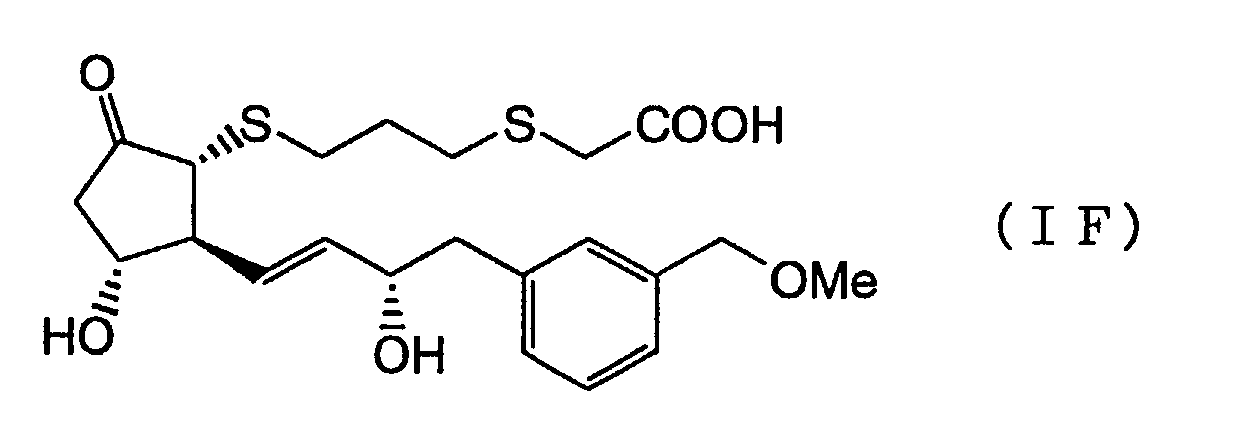
- prostaglandin derivatives of the formula (IE) (WO00/03980, Example 3), the formula (IF) (EP-985663, Example 2), the formula (IG) (PCT/JP99/04934, Example 8-6), the formula (IH) (PCT/JP99/04934, Example 2) and the formula (IJ) (PCT/JP99/04934, Example 2-11) or alkyl ester thereof, non-toxic salt thereof and cyclodextrin clathrate thereof.
- the compounds of the present invention shown by the formulae (IA) to (IJ) may be converted into esters by known method. Converting into the corresponding esters serves to increase the stability and absorbaility of the compounds, and therefore it is useful in the use for pharmaceuticals.
- An alkyl ester is preferred, C1-4 alkyl ester is more preferable and methyl ester is most preferable.
- the compounds of the present invention shown by the formulae (IA) to (IJ) may be converted into the corresponding salts by known methods.
- Non-toxic and water-soluble salts are preferable. Suitable salts, for example, are as follows: salts of alkali metals (potassium, sodium etc.), salts of alkaline earth metals (calcium, magnesium etc.), ammonium salts, salts of pharmaceutically acceptable organic amines (tetramethylammonium, triethylamine, methylamine, dimethylamine, cyclopentylamine, benzylamine, phenethylamine, piperidine, monoethanolamine, diethanolamine, tris(hydroxymethyl)amine, lysine, arginine, N-methyl-D-glucamine etc.).
- the compounds of the present invention shown by the formulae (IA) to (IJ) may be converted into the corresponding hydrates by known methods.
- the compounds of the present invention shown by the formulae (IA) to (IJ), and ester thereof may be converted into the corresponding cyclodextrin clathrates by the method described in the specification of GB1,351,238 or GB1,419,221 using ⁇ -, ⁇ - or ⁇ -cyclodextrin or a mixture thereof. Converting into the corresponding cyclodextrin clathrates serves to increase the stability and solubility in water of the compounds, and therefore it is useful in the use for pharmaceuticals.
- Example 1 promoting action on bone formation
- test solution was administered into femoral vein through holding-catheter at the rate of 0.2 ml/kg/hour.
- An equal volume of physical saline solution was administered into an animal of the control group. After termination of administration, each animal was sacrificed to carry out autopsy.
- the separated femur was fixed with 10% buffered formalin solution and then was cut into a round slice with the width of 10 mm vertically to longitudinal axis at the 25 mm central side from trochlea sulcus. Pictures of bone surface near side of epiphysis were taken with camera connected to the computer from the constant distance, and then the resulted digital image was analyzed to determine bone area. The results were shown in the following Table 1.
- Invention Group of the present compound of the formula (IE) at the doses of 10 ⁇ g/kg/day or more showed 2.8-fold increase of bone area to compare with Untreated Group. Especially, more than 7-fold increase of bone area was seen in Invention Group at the dose of 25 ⁇ g/kg/day.
- Invention Group of the present compounds of the formulae (IF), (IH) and (IJ) at the dose of 5 ⁇ g/kg/day also showed 2.8-5.3 fold increase of bone area to compare with Untreated Group.
- Invention Group of the present compound of the formula (IG) at the dose of 25 ⁇ g/kg/day also showed 4.2 fold increase of bone area to compare with Untreated Group.
- Invention Group of the present compound of the formula (IE) at the doses of 10 and 25 ⁇ g/kg/day showed 1.5-fold and 1.7-fold increase of bone density to compare with Untreated Group, respectively. From these results, it has been confirmed that the present compounds which are EP 4 agonists induce a significant increase of bone area and bone density at the dose of 10 ⁇ g/kg/day or more and possess promoting action on bone formation.
- the agonistic activity of compounds of the formulae (IA) to (IJ) was determined by using CHO cells which have expressed an EP 4 receptor (to see FEBS Letters 364 , 339 (1995) with modification in part). Then, it has been confirmed that all compounds cause increase of cAMP level and that they are EP 4 agonists.
- Example 3 promoting action on bone formation
- the toxicity of the compounds of the formula (IE) of the present invention is very low and therefore, it is confirmed that these compounds are safe for use as medicine.
- the maximum tolerance dose of the compound of the formula (IE) by i.v. route in rat was 30 mg/kg body weight or more.
- An EP 4 agonist used in the present invention possesses a promoting action on bone formation, so it is useful for treatment and/or prevention of diseases associated with decrease in bone mass.
- diseases associated with decrease in bone mass means disease which occurs diseases associated with decrease in bone mass followed by lowering bone density, or by deterioration of bone tissue etc.
- diseases associated with decrease in bone mass includes:
- the present invention includes accelerating bone formation after operation for bone (e.g., bone formation after fracture, bone formation after bone grafting, bone formation after operation for artificial joint, bone formation after spinal fusion and bone formation after the other bone regeneration etc.) and promoting treatment thereof, and alternative treatment for bone grafting.
- bone formation after operation for bone e.g., bone formation after fracture, bone formation after bone grafting, bone formation after operation for artificial joint, bone formation after spinal fusion and bone formation after the other bone regeneration etc.
- an EP 4 agonist, ester thereof, non-toxic salt thereof or cyclodextrin clathrate thereof used in the present invention may be normally administered locally, by oral or parenteral administration . Converting into a prodrug serves to diminish irritation and improve absorpability and stability etc.
- the doses to be administered are determined depending upon age, bo dy weight, symptom, the desired therapeutic effect, the route of administration, and the duration of the treatment etc.
- the doses per person per dose are generally between 1 ⁇ g and 100 mg, by oral administration, up to several times per day, and between 0.1 ⁇ g and 10 mg, preferably between 0.2 mg and 5 mg, by parenteral administration (preferred by endermic route, by subcutaneous route or into vein) up to several times per day
- the doses to be used depend upon various conditions. Therefore, there are cases in which doses lower than or greater than the ranges specified above may be used.
- the compounds of the present invention may be administered as solid compositions, liquid compositions or other compositions for oral administration, or as injections, endermic ointments, patches or suppositories etc. for parenteral administration.
- Solid compositions for oral administration include compressed tablets, pills, capsules, dispersible powders, and granules etc.
- Capsules contain hard capsules and soft capsules.
- one or more of the active compound(s) is or are, admixed with at least one inert diluent such as lactose, mannitol, mannit, glucose, hydroxypropyl cellulose, microcrystalline cellulose, starch, polyvinylpyrrolidone, magnesium metasilicate aluminate.
- inert diluent such as lactose, mannitol, mannit, glucose, hydroxypropyl cellulose, microcrystalline cellulose, starch, polyvinylpyrrolidone, magnesium metasilicate aluminate.
- compositions may also comprise, as is normal practice, additional substances other than inert diluents: e.g. lubricating agents such as magnesium stearate, disintegrating agents such as cellulose calcium glycolate, and assisting agents for dissolving such as glutamic acid, asparaginic acid.
- lubricating agents such as magnesium stearate
- disintegrating agents such as cellulose calcium glycolate
- assisting agents for dissolving such as glutamic acid, asparaginic acid.
- the tablets or pills may, if desired, be coated with film of gastric or enteric material such as sugar, gelatin, hydroxypropyl cellulose or hydroxypropyl cellulose phthalate etc., or be coated with two or more films. And further, coating may include containment within capsules of absorbable materials such as gelatin.
- Liquid compositions for oral administration include pharmaceutically-acceptable emulsions, solutions, syrups and elixirs etc.
- one or more of the active compound(s) is or are comprised in inert diluent (s) commonly used in the art (for example, purified water, ethanol).
- inert diluents such compositions may also comprise adjuvants such as wetting agents, suspending agents, sweetening agents, flavoring agents, perfuming agents and preserving agents.
- compositions for oral administration include spray compositions which may be prepared by known methods and which comprise one or more of the active compound(s).
- Spray compositions may comprise additional substances other than inert diluents: e.g. stabilizing agents such as sodium hydrogen sulfate, stabilizing agents to give isotonicity, isotonic buffer such as sodium chloride, sodium citrate, citric acid.
- stabilizing agents such as sodium hydrogen sulfate
- isotonic buffer such as sodium chloride, sodium citrate, citric acid.
- Injections for parenteral administration include sterile aqueous or nonaqueous solutions, suspensions and emulsions.
- Aqueous solutions or suspensions include distilled water for injection and physiological salt solution.
- Non-aqueous solutions or suspensions include propylene glycol, polyethylene glycol, plant oil such as olive oil, alcohol such as ethanol, POLYSORBATE80 (registered trade mark) etc.
- Such compositions may comprise additional diluents: e.g. preserving agents, wetting agents, emulsifying agents, dispersing agents, stabilizing agent, assisting agents such as assisting agents for dissolving (for example, glutamic acid, asparaginic acid).
- They may be sterilized for example, by filtration through a bacteria-retaining filter, by incorporation of sterilizing agents in the compositions or by irradiation. They may also be manufactured in the form of sterile solid compositions which can be dissolved in sterile water or some other sterile diluent for injection immediately before use.
- compositions for parenteral administration include liquids for external use, ointments, liniments, patches and suppositories etc. which comprise one or more of the active compound(s) and may be prepared by known methods.
- Ointment may include pH-adjustfied agents, surfactant, preserving agents, emulsifying agents, dispersing agents, stabilizing agent, assisting agents for dissolving etc. in addition to basic such as white vaseline.
- the following components were admixed by a conventional method, and the solution was sterilized by a conventional method, placed 1 ml portions into ampoules and freeze-dried by a conventional method to obtain 100 ampoules each containing 0.2 mg of active ingredient.
- the following components were admixed by a conventional method and placed each 10 g of the mixture into tube to obtain 100 tubes of ointment each containing 0.2 mg of active ingredient per 1 g of mixture.
Landscapes
- Health & Medical Sciences (AREA)
- Medicinal Chemistry (AREA)
- Veterinary Medicine (AREA)
- Public Health (AREA)
- General Health & Medical Sciences (AREA)
- Animal Behavior & Ethology (AREA)
- Life Sciences & Earth Sciences (AREA)
- Chemical & Material Sciences (AREA)
- Pharmacology & Pharmacy (AREA)
- Epidemiology (AREA)
- Physical Education & Sports Medicine (AREA)
- Nuclear Medicine, Radiotherapy & Molecular Imaging (AREA)
- Organic Chemistry (AREA)
- Chemical Kinetics & Catalysis (AREA)
- General Chemical & Material Sciences (AREA)
- Engineering & Computer Science (AREA)
- Bioinformatics & Cheminformatics (AREA)
- Rheumatology (AREA)
- Orthopedic Medicine & Surgery (AREA)
- Obesity (AREA)
- Oncology (AREA)
- Diabetes (AREA)
- Hematology (AREA)
- Endocrinology (AREA)
- Pharmaceuticals Containing Other Organic And Inorganic Compounds (AREA)
- Medicines That Contain Protein Lipid Enzymes And Other Medicines (AREA)
- Acyclic And Carbocyclic Compounds In Medicinal Compositions (AREA)
- Medicines Containing Material From Animals Or Micro-Organisms (AREA)
- Organic Low-Molecular-Weight Compounds And Preparation Thereof (AREA)
Abstract
Description
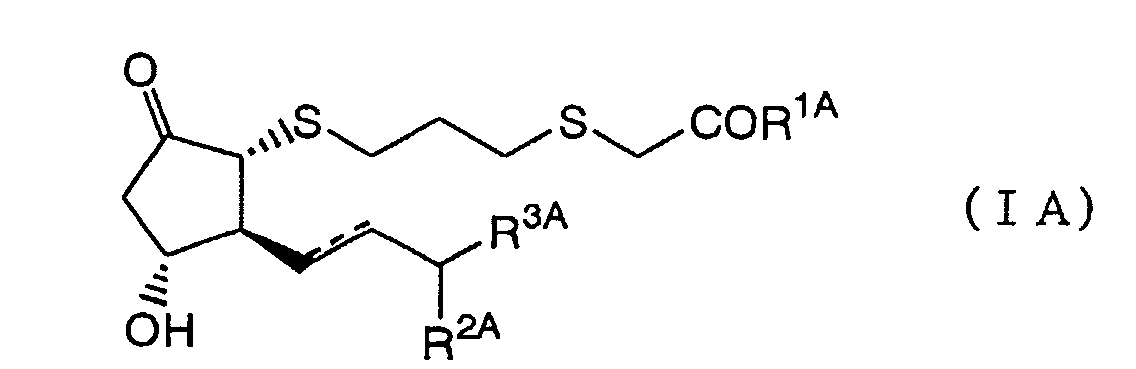
R2A is hydrogen or hydroxy,
R3A is
the compounds of the formula (IB)
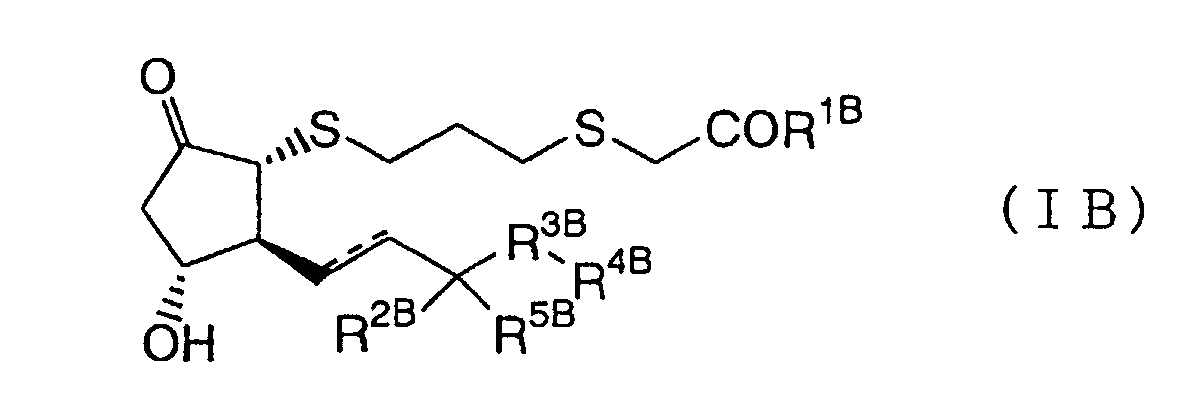
R2B is hydrogen or hydroxy,
R3B is single bond or C1-6 alkylene,
R4B is
- (i) C1-8 alkyl, C2-8 alkenyl, or C2-8 alkynyl substituted by one to three group selected from C1-6 alkyloxy or halogen,
- (ii) phenyloxy or C3-7 cycloalkyloxy,
- (iii) furyl, furyloxy, thienyl, thienyloxy, naphthyl, naphthyloxy, phthalanyl, or phthalanyloxy,
- (iv) phenyl, phenyloxy, C3-7 cycloalkyl, or C3-7 cycloalkyloxy substituted by one to
three group selected from the following group:
- C1-6 alkyl,
- C2-6 alkenyl,
- C2-6 alkynyl,
- C1-6 alkyloxy,
- C1-6 alkyloxy-C1-6 alkyl,
- C1-6 alkyloxy-C1-6 alkyloxy,
- C2-6 alkenyloxy-C1-6 alkyl,
- C1-6 alkyl substituted by one to three hydroxy,
- C1-6 alkyl substituted by one to three halogen,
- C1-6 alkylthio,
- C1-6 alkylthio-C1-6 alkyl,
- C1-6 alkylthio-C1-6 alkyloxy,
- C2-6 alkenylthio-C1-6 alkyl,
- C1-6 alkylsulfonyl,
- halogen,
- trihalomethyl,
- cyano,
- nitro,
- amino,
- hydroxy,
- C3-7 cycloalkyl,
- C3-7 cycloalkyloxy,
- C3-7 cycloalkyl-C1-6 alkyl,
- C3-7 cycloalkyloxy-C1-6 alkyl,
- phenyl,
- phenyloxy,
- phenyl-C1-6 alkyl,
- phenyl-C2-6 alkenyl,
- phenyl-C2-6 alkynyl,
- phenyloxy-C1-6 alkyl,
- phenyloxy-C2-6 alkenyl,
- phenyloxy-C2-6 alkynyl,
- furyl,
- furyloxy,
- furyl-C1-6 alkyl,
- furyloxy-C1-6 alkyl,
- thienyl,
- thienyloxy,
- thienyl-C1-6 alkyl, or
- thienyloxy-C1-6 alkyl
R5B is hydrogen or C1-6 alkyl,
symbol ---- is double bond or single bond.
With the proviso that when R2B is hydrogen, C1-6 alkylene represented by R3B may be substituted by one hydroxy, and that 8-epi equilibrium compound thereof is included),
the compounds of the formula (IC)

R2C is oxo, halogen, or O-COR8C (in which R8C is C1-4 alkyl, phenyl, or phenyl(C1-4 alkyl)),
R3C is hydrogen or hydroxy,
each R4Ca and R4Cb is independently hydrogen or C1-4 alkyl,
R5C is phenyl substituted by the following group:
- (i) one to three group selected from
C1-4 alkyloxy-C1-4 alkyl,
C2-4 alkenyloxy-C1-4 alkyl,
C2-4 alkynyloxy-C1-4 alkyl,
C3-7 cycloalkyloxy-C1-4 alkyl,
C3-7 cycloalkyl(C1-4 alkyloxy)-C1-4 alkyl,
phenyloxy-C1-4 alkyl,
phenyl-C1-4 alkyloxy-C1-4 alkyl,
C1-4 alkylthio-C1-4 alkyl,
C2-4 alkenylthio-C1-4 alkyl,
C2-4 alkynylthio-C1-4 alkyl,
C3-7 cycloalkylthio-C1-4 alkyl,
C3-7 cycloalkyl(C1-4 alkylthio)-C1-4 alkyl,
phenylthio-C1-4 alkyl, or
phenyl-C1-4 alkylthio-C1-4 alkyl, - (ii) C1-4 alkyloxy-C1-4 alkyl and C1-4 alkyl,
C1-4 alkyloxy-C1-4 alkyl and C1-4 alkyloxy,
C1-4 alkyloxy-C1-4 alkyl and hydroxy,
C1-4 alkyloxy-C1-4 alkyl and halogen,
C1-4 alkylthio-C1-4 alkyl and C1-4 alkyl,
C1-4 alkylthio-C1-4 alkyl and C1-4 alkyloxy,
C1-4 alkylthio-C1-4 alkyl and hydroxy, or
C1-4 alkylthio-C1-4 alkyl and halogen, - (iii) haloalkyl or hydroxy-C1-4 alkyl, or
- (iv) C1-4 alkyl and hydroxy;
symbol ---- is single bond or double bond.
With the proviso that when R2C is O-COR8C, bond between 8- and 9-position is double bond),
and the compounds of the formula (ID)(wherein AD is C2-8 alkylene, C2-8 alkenylene, C1-4 alkylene-phenylene, or C2-4 alkenylene-phenylene,
R1D is hydroxy, C1-6 alkyloxy, C1-6 alkyloxy-C1-6 alkyloxy, HO-C1-6 alkyloxy, or NR6DR7D (in which each R6D and R7D is independently hydrogen or C1-4 alkyl),
R2D is oxo, halogen, or R8D-COO- (in which R8D is hydrogen, C1-4 alkyl, phenyl, phenyl(C1-4 alkyl), C1-4 alkyloxy, HOOC-C1-4 alkyl, C1-4 alkyloxy-carbonyl-C1-4 alkyl, HOOC-C2-4 alkenyl, or C1-4 alkyloxy-carbonyl-C2-4 alkenyl),
R3D is hydrogen or hydroxy,
R4D is C1-4 alkylene,
R5D is phenyl substituted by the following group:
- (i) one to three group selected from
C1-4 alkyloxy-C1-4 alkyl,
C2-4 alkenyloxy-C1-4 alkyl,
C2-4 alkynyloxy-C1-4 alkyl,
C3-7 cycloalkyloxy-C1-4 alkyl,
C3-7 cycloalkyl(C1-4 alkyloxy)-C1-4 alkyl,
phenyloxy-C1-4 alkyl,
phenyl-C1-4 alkyloxy-C1-4 alkyl,
C1-4 alkylthio-C1-4 alkyl,
C2-4 alkenylthio-C1-4 alkyl,
C2-4 alkynylthio-C1-4 alkyl,
C3-7 cycloalkylthio-C1-4 alkyl,
C3-7 cycloalkyl(C1-4 alkylthio)-C1-4 alkyl,
phenylthio-C1-4 alkyl or
phenyl-C1-4 alkylthio-C1-4 alkyl, - (ii) C1-4 alkyloxy-C1-4 alkyl and C1-4 alkyl,
C1-4 alkyloxy-C1-4 alkyl and C1-4 alkyloxy,
C1-4 alkyloxy-C1-4 alkyl and hydroxy,
C1-4 alkyloxy-C1-4 alkyl and halogen,
C1-4 alkylthio-C1-4 alkyl and C1-4 alkyl,
C1-4 alkylthio-C1-4 alkyl and C1-4 alkyloxy,
C1-4 alkylthio-C1-4 alkyl and hydroxy, or
C1-4 alkylthio-C1-4 alkyl and halogen, - (iii) halo-C1-4 alkyl or hydroxy-C1-4 alkyl, or
- (iv) C1-4 alkyl and hydroxy;
symbol ---- is single bond or double bond.
With the proviso that when R2D is the formula R8D-COO-, R1D is C1-6 alkyloxy, C1-6 alkyloxy-C1-6 alkyloxy, or HO-C1-6 alkyloxy, bond between 8- and 9-position is double bond).

the formula (IF)
the formula (IG)

the formula (IH)

and the formula (IJ)
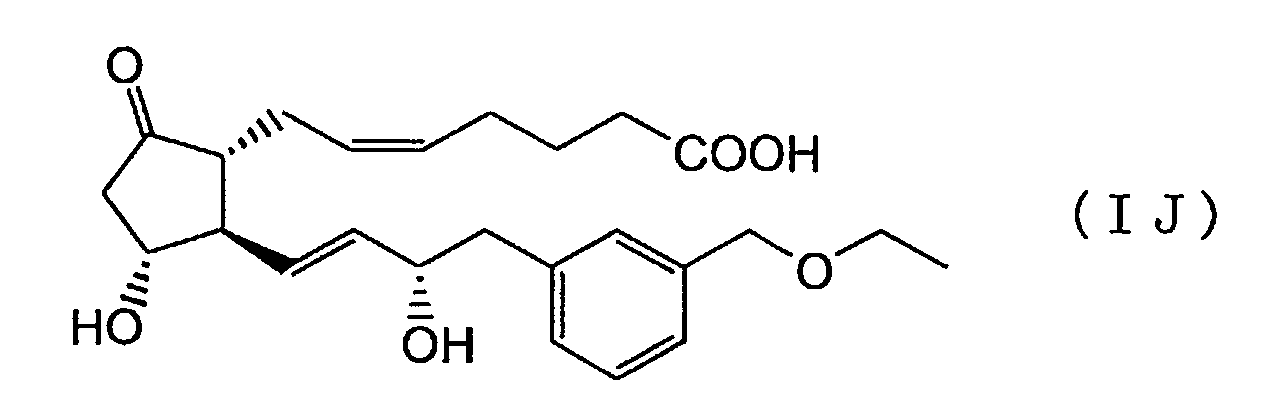
or alkyl ester thereof, non-toxic salt thereof and cyclodextrin clathrate thereof.
a compound of the formula (IA): EP-855389,
a compound of the formula (IB): EP-985663,
a compound of the formula (IC): WO00/03980,
a compound of the formula (ID): Application No. PCT/JP99/04934,
a compound of the formula (IE): WO00/03980,
a compound of the formula (IF): EP-985663,
a compound of the formula (IG): Application No. PCT/JP99/04934,
a compound of the formula (IH): Application No. PCT/JP99/04934,
a compound of the formula (IJ): Application No. PCT/JP99/04934.
| Test solution | Dose (µg/kg/day) | bone area (mm2) |
| Untreated control n=6 | 0 | 68.93±6.64 |
| Invention compound (IF) n=6 | 2 | 77.96±6.94 |
| Invention compound (IF) n=6 | 10 | 190.69±19.03 |
| Invention compound (IF) n=4 | 25 | 502.76±54.81 |
| Invention compound (IF) n=3 | 5 | 365.29±73.63 |
| Invention compound (IG) n=3 | 10 | 140.10±28.08 |
| Invention compound (IG) n=3 | 25 | 289.38±120.50 |
| Invention compound (IH) n=3 | 5 | 362.99±89.56 |
| Invention compound (IJ) n=3 | 5 | 193.23±11.32 |
| Test solution | Dose (µg/kg/day) | Bone density (PSL/mm2) |
| Untreated control n=6 | 0 | 5.93±0.72 |
| Invention compound (IE) n=6 | 2 | 5.63±0.70 |
| Invention compound (IE) n=6 | 10 | 8.75±1.19 |
| Invention compound (IE) n=4 | 25 | 10.34±1.58 |
| Group Group | Bone density (mg/cm3) Means ± SD |
| Sham Group | 404.1±87.0 |
| Control Group | 226.3±38.9 |
| Invention compound (IE) Group | 794.0±50.2 |
- (11α,15α,13E)-9-oxo-11,15-dihydroxy-16-(3-methoxymethylphenyl)-17,18,19,20-tetranor-5-thiaprost-13-enoic acid methyl ester α-cyclodextrin 80 mg (active ingredient: 20 mg)
- mannit 5 g
- distilled water 100 ml
- (11α,15α,13E)-9-oxo-11,15-dihydroxy-16-(3-methoxymethylphenyl)-17,18,19,20-tetranor-5-thiaprost-13-enoic acid methyl ester α-cyclodextrin 800 mg (active ingredient: 200 mg)
- white vaseline 1 kg
Claims (14)
- A pharmaceutical composition for treatment and/or prevention of diseases associated with decrease in bone mass comprising an EP4 agonist as an active ingredient.
- A pharmaceutical composition for treatment and/or prevention according to claim 1, in which diseases associated with decrease in bone mass is primary osteoporosis.
- A pharmaceutical composition for treatment and/or prevention according to claim 2, in which primary osteoporosis is osteoporosis followed by aging, postmenopausal primary osteoporosis, osteoporosis followed by ovariectomy.
- A pharmaceutical composition for treatment and/or prevention according to claim 1, in which diseases associated with decrease in bone mass is secondary osteoporosis.
- A pharmaceutical composition for treatment and/or prevention according to claim 4, in which secondary osteoporosis is glucocorticoid-induced osteoporosis, hyperthyroidism-induced osteoporosis, immobilization-induced osteoporosis, heparin-induced osteoporosis, immunosuppressive-induced osteoporosis, osteoporosis due to renal failure, inflammatory osteoporosis, osteoporosis followed by Cushing's syndrome, or rheumatoid osteoporosis.
- A pharmaceutical composition for treatment and/or prevention according to claim 1, in which diseases associated with decrease in bone mass is metastatic bone, hypercalcemia, Paget's disease, bone loss, osteonecrosis.
- A pharmaceutical composition for treatment and/or prevention according to claim 1 or 6, in which diseases associated with decrease in bone mass is alveolar bone loss, mandibular bone loss, childhood idiopathic bone loss.
- A pharmaceutical composition for treatment according to claim 1, in which treatment of diseases associated with decrease in bone mass is bone formation after fracture, bone formation after bone grafting, bone formation after operation of artificial joint, bone formation after spinal fusion, bone formation after bone regeration and alternative treatment for bone grafting.
- A pharmaceutical composition for treatment and/or prevention of diseases associated with decrease in bone mass according to claim 1, in which an EP4 agonist is a compound possessing prostaglandin skeleton.
- A pharmaceutical composition for treatment and/or prevention according to claim 9, in which a compound possessing prostaglandin skeleton is a compound of the formula (IA)(wherein R1A is hydroxy, C1-4 alkyloxy, or NR6AR7A (in which each R6A and R7A is independently hydrogen or C1-4 alkyl),

R2A is hydrogen or hydroxy,
R3A issymbol ---- is double bond or single bond. With the proviso that 8-epi equilibrium compound thereof is included.)(i) C1-8 alkyl, C2-8 alkenyl, or C2-8 alkynyl,(ii) phenyl or C3-7 cycloalkyl,(iii) C1-8 alkyl, C2-8 alkenyl or C2-8 alkynyl substituted by phenyl or C3-7 cycloalkyl (with the proviso that when R2A is hydrogen, alkyl, alkenyl or alkynyl in (i) and (ii) may be substituted by one hydroxy),
or non-toxic salt thereof, or cyclodextrin clathrate thereof. - A pharmaceutical composition for treatment and/or prevention according to claim 9, in which a compound possessing prostaglandin skeleton is a compound of the formula (IB)(wherein R1B is hydroxy, C1-6 alkyloxy, or NR6BR7B (in which each R6B and R7B is independently hydrogen or C1-6 alkyl),

R2B is hydrogen or hydroxy,
R3B is single bond or C1-6 alkylene,
R4B is(i) C1-8 alkyl, C2-8 alkenyl, or C2-8 alkynyl substituted by one to three group selected from C1-6 alkyloxy or halogen,(ii) phenyloxy or C3-7 cycloalkyloxy,(iii) furyl, furyloxy, thienyl, thienyloxy, naphthyl, naphthyloxy, phthalanyl, or phthalanyloxy,(iv) phenyl, phenyloxy, C3-7 cycloalkyl, or C3-7 cycloalkyloxy substituted by one to three group selected from the following group:(the above mentioned phenyl, furyl, thienyl or cycloalkyl may be substituted by one to three group selected from C1-6 alkyl, C1-6 alkyloxy, C1-6 alkyloxy-C1-6 alkyl, nitro, halogen, trihalomethyl, amino and hydroxy); orC1-6 alkyl,C2-6 alkenyl,C2-6 alkynyl,C1-6 alkyloxy,C1-6 alkyloxy-C1-6 alkyl,C1-6 alkyloxy-C1-6 alkyloxy,C2-6 alkenyloxy-C1-6 alkyl,C1-6 alkyl substituted by one to three hydroxy,C1-6 alkyl substituted by one to three halogen,C1-6 alkylthio,C1-6 alkylthio-C1-6 alkyl,C1-6 alkylthio-C1-6 alkyloxy,C2-6 alkenylthio-C1-6 alkyl,C1-6 alkylsulfonyl,halogen,trihalomethyl,cyano,nitro,amino,hydroxy,C3-7 cycloalkyl,C3-7 cycloalkyloxy,C3-7 cycloalkyl-C1-6 alkyl,C3-7 cycloalkyloxy-C1-6 alkyl,phenyl,phenyloxy,phenyl-C1-6 alkyl,phenyl-C2-6 alkenyl,phenyl-C2-6 alkynyl,phenyloxy-C1-6 alkyl,phenyloxy-C2-6 alkenyl,phenyloxy-C2-6 alkynyl,furyl,furyloxy,furyl-C1-6 alkyl,furyloxy-C1-6 alkyl,thienyl,thienyloxy,thienyl-C1-6 alkyl, orthienyloxy-C1-6 alkyl(v) furyl, furyloxy, thienyl, thienyloxy, naphthyl, naphthyloxy, phthalanyl, or phthalanyloxy substituted by one to three group selected from the following group:(the above mentioned phenyl, furyl, thienyl or cycloalkyl may be substituted by one to three group selected from C1-6 alkyl, C1-6 alkyloxy, C1-6 alkyloxy-C1-6 alkyl, nitro, halogen, trihalomethyl, amino and hydroxy),C1-6 alkyl,C2-6 alkenyl,C2-6 alkynyl,C1-6 alkyloxy,C1-6 alkyloxy-C1-6 alkyl,C1-6 alkyloxy-C1-6 alkyloxy,C2-6 alkenyloxy-C1-6 alkyl,C1-6 alkyl substituted by one to three hydroxy,C1-6 alkyl substituted by one to three halogen,C1-6 alkylthio,C1-6 alkylthio-C1-6 alkyl,C1-6 alkylthio-C1-6 alkyloxy,C2-6 alkenylthio-C1-6 alkyl,C1-6 alkylsulfonyl,halogen,trihalomethyl,cyano,nitro,amino,hydroxy,C3-7 cycloalkyl,C3-7 cycloalkyloxy,C3-7 cycloalkyl-C1 alkyl,C3-7 cycloalkyloxy-C1-6 alkyl,phenyl,phenyloxy,phenyl-C1-6 alkyl,phenyl-C2-6 alkenyl,phenyl-C2-6 alkynyl,phenyloxy-C1-6 alkyl,phenyloxy-C2-6 alkenyl,phenyloxy-C2-6 alkynyl,furyl,furyloxy,furyl-C1-6 alkyl,furyloxy-C1-6 alkyl,thienyl,thienyloxy,thienyl-C1-6 alkyl, orthienyloxy-C1-6 alkyl
R5B is hydrogen or C1-6 alkyl,
symbol ---- is double bond or single bond.
With the proviso that when R2B is hydrogen, C1-6 alkylene represented by R3B may be substituted by one hydroxy, and that 8-epi equilibrium compound thereof is included)
or non-toxic salt thereof, or cyclodextrin clathrate thereof. - A pharmaceutical composition for treatment and/or prevention according to claim 9, in which a compound possessing prostaglandin skeleton is a compound of the formula (IC)(wherein R1C is hydroxy, C1-6 alkyloxy, or NR6CR7C (in which each R6C and R7C is independently hydrogen or C1-4 alkyl),

R2C is oxo, halogen, or O-COR8C (in which R8C is C1-4 alkyl, phenyl, or phenyl(C1-4 alkyl)),
R3C is hydrogen or hydroxy,
each R4Ca and R4Cb is independently hydrogen or C1-4 alkyl,
R5C is phenyl substituted by the following group:(i) one to three group selected from
C1-4 alkyloxy-C1-4 alkyl,
C2-4 alkenyloxy-C1-4 alkyl,
C2-4 alkynyloxy-C1-4 alkyl,
C3-7 cycloalkyloxy-C1-4 alkyl,
C3-7 cycloalkyl(C1-4 alkyloxy)-C1-4 alkyl,
phenyloxy-C1-4 alkyl,
phenyl-C1-4 alkyloxy-C1-4 alkyl,
C1-4 alkylthio-C1-4 alkyl,
C2-4 alkenylthio-C1-4 alkyl,
C2-4 alkynylthio-C1-4 alkyl,
C3-7 cycloalkylthio-C1-4 alkyl,
C3-7 cycloalkyl(C1-4 alkylthio)-C1-4 alkyl,
phenylthio-C1-4 alkyl, or
phenyl-C1-4 alkylthio-C1-4 alkyl,(ii) C1-4 alkyloxy-C1-4 alkyl and C1-4 alkyl,
C1-4 alkyloxy-C1-4 alkyl and C1-4 alkyloxy,
C1-4 alkyloxy-C1-4 alkyl and hydroxy,
C1-4 alkyloxy-C1-4 alkyl and halogen,
C1-4 alkylthio-C1-4 alkyl and C1-4 alkyl,
C1-4 alkylthio-C1-4 alkyl and C1-4 alkyloxy,
C1-4 alkylthio-C1-4 alkyl and hydroxy, or
C1-4 alkylthio-C1-4 alkyl and halogen,(iii) haloalkyl or hydroxy-C1-4 alkyl, or(iv) C1-4 alkyl and hydroxy;
symbol ---- is single bond or double bond.
With the proviso that when R2C is O-COR8C, bond between 8- and 9-position is double bond)
or non-toxic salt thereof, or cyclodextrin clathrate thereof. - A pharmaceutical composition for treatment and/or prevention according to claim 9, in which a compound possessing prostaglandin skeleton is a compound of the formula (ID)(wherein AD is C2-8 alkylene, C2-8 alkenylene, C1-4 alkylene-phenylene, or C2-4 alkenylene-phenylene,

R1D is hydroxy, C1-6 alkyloxy, C1-6 alkyloxy-C1-6 alkyloxy, HO-C1-6 alkyloxy, or NR6DR7D (in which each R6D and R7D is independently hydrogen or C1-4 alkyl),
R2D is oxo, halogen, or R8D-COO- (in which R8D is hydrogen, C1-4 alkyl, phenyl, phenyl(C1-4 alkyl), C1-4 alkyloxy, HOOC-C1-4 alkyl, C1-4 alkyloxy-carbonyl-C1-4 alkyl, HOOC-C2-4 alkenyl, or C1-4 alkyloxy-carbonyl-C2-4 alkenyl),
R3D is hydrogen or hydroxy,
R4D is C1-4 alkylene,
R5D is phenyl substituted by the following group:symbol ---- is single bond or double bond.(i) one to three group selected from
C1-4 alkyloxy-C1-4 alkyl,
C2-4 alkenyloxy-C1-4 alkyl,
C2-4 alkynyloxy-C1-4 alkyl,
C3-7 cycloalkyloxy-C1-4 alkyl,
C3-7 cycloalkyl(C1-4 alkyloxy)-C1-4 alkyl,
phenyloxy-C1-4 alkyl,
phenyl-C1-4 alkyloxy-C1-4 alkyl,
C1-4 alkylthio-C1-4 alkyl,
C2-4 alkenylthio-C1-4 alkyl,
C2-4 alkynylthio-C1-4 alkyl,
C3-7 cycloalkylthio-C1-4 alkyl,
C3-7 cycloalkyl(C1-4 alkylthio)-C1-4 alkyl,
phenylthio-C1-4 alkyl, or
phenyl-C1-4 alkylthio-C1-4 alkyl,(ii) C1-4 alkyloxy-C1-4 alkyl and C1-4 alkyl,
C1-4 alkyloxy-C1-4 alkyl and C1-4 alkyloxy,
C1-4 alkyloxy-C1-4 alkyl and hydroxy,
C1-4 alkyloxy-C1-4 alkyl and halogen,
C1-4 alkylthio-C1-4 alkyl and C1-4 alkyl,
C1-4 alkylthio-C1-4 alkyl and C1-4 alkyloxy,
C1-4 alkylthio-C1-4 alkyl and hydroxy, or
C1-4 alkylthio-C1-4 alkyl and halogen,(iii) halo-C1-4 alkyl or hydroxy-C1-4 alkyl, or(iv) C1-4 alkyl and hydroxy;
With the proviso that when R2D is the formula R8D-COO-, R1D is C1-6 alkyloxy, C1-6 alkyloxy-C1-6 alkyloxy, or HO-C1-6 alkyloxy, bond between 8- and 9-position is double bond)
or non-toxic salt thereof, or cyclodextrin clathrate thereof. - A pharmaceutical composition for treatment and/or prevention according to claim 9, in which an EP4 agonist is,
(11α, 15α, 13E)-9-oxo-11,15-dihydroxy-16-(3-methoxymethylphenyl)-17,18,19,20-tetranor-5-thiaprost-13-enoic acid,
(11α, 15α, 13E)-9-oxo-11,15-dihydroxy-16-(3-methoxymethylphenyl)-17,18,19,20-tetranor-3,7-dithiaprost-13-enoic acid,
(9β, 11α, 15α, 5Z, 13E)-9-chloro-11,15-dihydroxy-16-(3-ethoxymethylphenyl)-17,18,19,20-tetranorprost-5,13-dienoic acid,
(11α, 15α, 13E)-9-oxo-11,15-dihydroxy-16-(3-methoxymethylphenyl)-17,18,19,20-tetranorprost-13-enoic acid, or
(11α, 15α, 5Z, 13E)-9-oxo-11,15-dihydroxy-16-(3-ethoxymethylphenyl)-17,18,1 9,20-tetranorprost-5,13-dienoic acid,
or non-toxic salt thereof, methyl ester thereof, or α-cyclodextrin clathrate thereof.
Applications Claiming Priority (7)
| Application Number | Priority Date | Filing Date | Title |
|---|---|---|---|
| JP33349099 | 1999-11-24 | ||
| JP33349099 | 1999-11-24 | ||
| JP2000056534 | 2000-03-01 | ||
| JP2000056534 | 2000-03-01 | ||
| JP2000119188 | 2000-04-20 | ||
| JP2000119188 | 2000-04-20 | ||
| PCT/JP2000/008235 WO2001037877A1 (en) | 1999-11-24 | 2000-11-22 | Remedies for diseases in association with decrease in bone mass |
Publications (3)
| Publication Number | Publication Date |
|---|---|
| EP1232757A1 true EP1232757A1 (en) | 2002-08-21 |
| EP1232757A4 EP1232757A4 (en) | 2004-06-16 |
| EP1232757B1 EP1232757B1 (en) | 2009-12-23 |
Family
ID=27340604
Family Applications (1)
| Application Number | Title | Priority Date | Filing Date |
|---|---|---|---|
| EP00977860A Expired - Lifetime EP1232757B1 (en) | 1999-11-24 | 2000-11-22 | Agents for diseases in association with decrease in bone mass |
Country Status (16)
| Country | Link |
|---|---|
| US (1) | US6891062B2 (en) |
| EP (1) | EP1232757B1 (en) |
| JP (1) | JP3705360B2 (en) |
| KR (1) | KR100654653B1 (en) |
| CN (1) | CN1262309C (en) |
| AT (1) | ATE452640T1 (en) |
| AU (1) | AU783939B2 (en) |
| CA (1) | CA2391526A1 (en) |
| DE (1) | DE60043587D1 (en) |
| ES (1) | ES2337333T3 (en) |
| HU (1) | HUP0203590A3 (en) |
| MX (1) | MXPA02005173A (en) |
| NO (1) | NO20022442L (en) |
| NZ (1) | NZ519101A (en) |
| TW (1) | TWI247606B (en) |
| WO (1) | WO2001037877A1 (en) |
Cited By (4)
| Publication number | Priority date | Publication date | Assignee | Title |
|---|---|---|---|---|
| WO2003099857A1 (en) * | 2002-05-23 | 2003-12-04 | Theratechnologies Inc. | Antagonistic peptides of prostaglandin e2 receptor subtype ep4 |
| AU2002318759B2 (en) * | 2001-07-23 | 2007-09-13 | Ono Pharmaceutical Co., Ltd. | Remedies for diseases with bone mass loss having EP4 agonists as the active ingredient |
| EP1878741A3 (en) * | 2002-05-23 | 2008-02-20 | Theratechnologies Inc. | Antagonistic peptides of prostaglandin E2 receptor subtype EP4 |
| US7531533B2 (en) | 2005-01-27 | 2009-05-12 | Asahi Kasei Pharma Corporation | 6-Membered heterocyclic compound and use thereof |
Families Citing this family (25)
| Publication number | Priority date | Publication date | Assignee | Title |
|---|---|---|---|---|
| EP1408961B1 (en) * | 2001-07-16 | 2007-07-11 | F. Hoffmann-La Roche Ag | 2 pyrrolidone derivatives as prostanoid agonists |
| WO2003041717A1 (en) * | 2001-11-12 | 2003-05-22 | Ono Pharmaceutical Co., Ltd. | Persistent filmy preparation for topical administration containing prostaglandin derivative |
| JPWO2006075690A1 (en) * | 2005-01-14 | 2008-06-12 | 小野薬品工業株式会社 | Stable pharmaceutical composition |
| KR20080000647A (en) | 2005-04-28 | 2008-01-02 | 오노 야꾸힝 고교 가부시키가이샤 | Percutaneous Absorption Formulation |
| US8263137B2 (en) | 2005-08-04 | 2012-09-11 | Vertical Pharmaceuticals, Inc. | Nutritional supplement for women |
| US8202546B2 (en) | 2005-08-04 | 2012-06-19 | Vertical Pharmaceuticals, Inc. | Nutritional supplement for use under physiologically stressful conditions |
| US7998500B2 (en) | 2005-08-04 | 2011-08-16 | Vertical Pharmaceuticals, Inc. | Nutritional supplement for women |
| US7901710B2 (en) | 2005-08-04 | 2011-03-08 | Vertical Pharmaceuticals, Inc. | Nutritional supplement for use under physiologically stressful conditions |
| MX373998B (en) | 2006-03-24 | 2020-07-22 | Childrens Medical Center | USE OF A HEMATOPOIETIC STEM CELL (HSC) MODULATOR TO PROMOTE HSC GROWTH. |
| EP3824885A1 (en) | 2006-10-20 | 2021-05-26 | Children's Medical Center Corporation | Method to enhance tissue regeneration |
| JP5262720B2 (en) * | 2006-10-26 | 2013-08-14 | 小野薬品工業株式会社 | Patch |
| AU2008246579A1 (en) | 2007-05-08 | 2008-11-13 | National University Corporation, Hamamatsu University School Of Medicine | Cytotoxic T cell activator comprising EP4 agonist |
| WO2009155041A2 (en) * | 2008-05-28 | 2009-12-23 | Children's Medical Center Corporation | Method to modulate hematopoietic stem cell growth |
| WO2010091052A2 (en) | 2009-02-03 | 2010-08-12 | Children's Medical Center Corporation | Methods for enhancing hematopoietic stem/progenitor cell engraftment |
| US9056085B2 (en) | 2009-02-03 | 2015-06-16 | Children's Medical Center Corporation | Methods for enhancing hematopoietic stem/progenitor cell engraftment |
| US8476471B2 (en) | 2009-07-13 | 2013-07-02 | Irix Pharmaceuticals, Inc. | Synthesis of prostanoids |
| US10111907B2 (en) | 2011-12-02 | 2018-10-30 | Fate Therapeutics, Inc. | Methods of treating ischemia |
| PT2785834T (en) | 2011-12-02 | 2020-11-13 | Fate Therapeutics Inc | Enhanced stem cell composition |
| HUE031885T2 (en) | 2012-07-19 | 2017-08-28 | Cayman Chemical Co Inc | Difluorolactam compositions for ep4-mediated osteo related diseases and conditions |
| ES2635635T3 (en) | 2013-03-15 | 2017-10-04 | Cayman Chemical Company, Incorporated | Difluorolactam compounds as selective agonists of the EP4 receptor for use in the treatment of diseases and conditions mediated by EP4 |
| US9676712B2 (en) | 2013-03-15 | 2017-06-13 | Cayman Chemical Company, Inc. | Lactam compounds as EP4 receptor-selective agonists for use in the treatment of EP4-mediated diseases and conditions |
| WO2014150602A1 (en) | 2013-03-15 | 2014-09-25 | Fate Therapeutics, Inc. | Cell potency assay for therapeutic potential |
| KR20160048054A (en) | 2013-07-19 | 2016-05-03 | 카이맨 케미칼 컴파니 인코포레이티드 | Methods, systems, and compositions for promoting bone growth |
| KR102311896B1 (en) | 2013-09-30 | 2021-10-14 | 패턴 에이피아이 서비시즈 인코포레이티드 | Novel synthesis routes for prostaglandins and prostaglandin intermediates using metathesis |
| EA037327B1 (en) | 2015-09-22 | 2021-03-12 | Грейбуг Вижн, Инк. | Compounds and compositions for the treatment of ocular disorders |
Family Cites Families (8)
| Publication number | Priority date | Publication date | Assignee | Title |
|---|---|---|---|---|
| WO1998027976A1 (en) * | 1996-12-20 | 1998-07-02 | Pfizer Inc. | Prevention and treatment of skeletal disorder with ep2 receptor subtype selective prostaglandin e2 agonists |
| JPH10265454A (en) | 1997-01-27 | 1998-10-06 | Ono Pharmaceut Co Ltd | 3,7dithiaprostanoic acid derivative, its production and medicine containing the same derivative as active ingredient |
| US6124314A (en) * | 1997-10-10 | 2000-09-26 | Pfizer Inc. | Osteoporosis compounds |
| GB2330307A (en) * | 1998-02-07 | 1999-04-21 | Glaxo Group Ltd | EP4 Receptor antagonists as bone resorption inhibitors |
| US6043275A (en) * | 1998-04-16 | 2000-03-28 | Ono Pharmaceutical Co., Ltd. | 3,7-dithiaprostanoic acid derivative |
| TWI249520B (en) * | 1998-07-15 | 2006-02-21 | Ono Pharmaceutical Co | 5-Thia-omega-substituted phenyl prostaglandin E derivatives, method for producing the same and medicines containing the same as the active ingredient |
| KR20010074981A (en) * | 1998-09-14 | 2001-08-09 | 우에노 도시오 | ω-SUBSTITUTED PHENYL-PROSTAGLANDIN E DERIVATIVES AND DRUGS CONTAINING THE SAME AS THE ACTIVE INGREDIENT |
| AU6427599A (en) * | 1998-10-15 | 2000-05-01 | Merck & Co., Inc. | Methods for stimulating bone formation |
-
2000
- 2000-11-17 TW TW089124347A patent/TWI247606B/en not_active IP Right Cessation
- 2000-11-22 ES ES00977860T patent/ES2337333T3/en not_active Expired - Lifetime
- 2000-11-22 CN CNB008186340A patent/CN1262309C/en not_active Expired - Fee Related
- 2000-11-22 MX MXPA02005173A patent/MXPA02005173A/en active IP Right Grant
- 2000-11-22 WO PCT/JP2000/008235 patent/WO2001037877A1/en not_active Ceased
- 2000-11-22 NZ NZ519101A patent/NZ519101A/en unknown
- 2000-11-22 AT AT00977860T patent/ATE452640T1/en not_active IP Right Cessation
- 2000-11-22 EP EP00977860A patent/EP1232757B1/en not_active Expired - Lifetime
- 2000-11-22 DE DE60043587T patent/DE60043587D1/en not_active Expired - Lifetime
- 2000-11-22 AU AU15485/01A patent/AU783939B2/en not_active Ceased
- 2000-11-22 HU HU0203590A patent/HUP0203590A3/en unknown
- 2000-11-22 KR KR1020027006572A patent/KR100654653B1/en not_active Expired - Fee Related
- 2000-11-22 CA CA002391526A patent/CA2391526A1/en not_active Abandoned
- 2000-11-22 JP JP2001539491A patent/JP3705360B2/en not_active Expired - Fee Related
-
2002
- 2002-05-23 NO NO20022442A patent/NO20022442L/en not_active Application Discontinuation
-
2004
- 2004-05-13 US US10/844,404 patent/US6891062B2/en not_active Expired - Fee Related
Cited By (7)
| Publication number | Priority date | Publication date | Assignee | Title |
|---|---|---|---|---|
| AU2002318759B2 (en) * | 2001-07-23 | 2007-09-13 | Ono Pharmaceutical Co., Ltd. | Remedies for diseases with bone mass loss having EP4 agonists as the active ingredient |
| AU2002318759C1 (en) * | 2001-07-23 | 2009-03-05 | Ono Pharmaceutical Co., Ltd. | Remedies for diseases with bone mass loss having EP4 agonists as the active ingredient |
| US7608637B2 (en) | 2001-07-23 | 2009-10-27 | Ono Pharmaceutical Co., Ltd. | Pharmaceutical composition for treatment of diseases associated with decrease in bone mass comprising EP4 agonist as the active ingredient |
| US8207223B2 (en) | 2001-07-23 | 2012-06-26 | Ono Pharmaceutical Co., Ltd. | Pharmaceutical composition for treatment of diseases associated with decrease in bone mass comprising EP4 agonist as active ingredient |
| WO2003099857A1 (en) * | 2002-05-23 | 2003-12-04 | Theratechnologies Inc. | Antagonistic peptides of prostaglandin e2 receptor subtype ep4 |
| EP1878741A3 (en) * | 2002-05-23 | 2008-02-20 | Theratechnologies Inc. | Antagonistic peptides of prostaglandin E2 receptor subtype EP4 |
| US7531533B2 (en) | 2005-01-27 | 2009-05-12 | Asahi Kasei Pharma Corporation | 6-Membered heterocyclic compound and use thereof |
Also Published As
| Publication number | Publication date |
|---|---|
| US20040209848A1 (en) | 2004-10-21 |
| AU1548501A (en) | 2001-06-04 |
| AU783939B2 (en) | 2006-01-05 |
| NZ519101A (en) | 2004-04-30 |
| EP1232757B1 (en) | 2009-12-23 |
| TWI247606B (en) | 2006-01-21 |
| NO20022442D0 (en) | 2002-05-23 |
| HUP0203590A3 (en) | 2006-07-28 |
| US6891062B2 (en) | 2005-05-10 |
| MXPA02005173A (en) | 2004-02-26 |
| ATE452640T1 (en) | 2010-01-15 |
| JP3705360B2 (en) | 2005-10-12 |
| KR100654653B1 (en) | 2006-12-07 |
| ES2337333T3 (en) | 2010-04-23 |
| HUP0203590A2 (en) | 2003-03-28 |
| KR20020059774A (en) | 2002-07-13 |
| CA2391526A1 (en) | 2001-05-31 |
| CN1262309C (en) | 2006-07-05 |
| DE60043587D1 (en) | 2010-02-04 |
| NO20022442L (en) | 2002-07-24 |
| WO2001037877A1 (en) | 2001-05-31 |
| CN1424918A (en) | 2003-06-18 |
| EP1232757A4 (en) | 2004-06-16 |
Similar Documents
| Publication | Publication Date | Title |
|---|---|---|
| US6891062B2 (en) | Pharmaceutical composition for treatment of diseases associated with decrease in bone mass | |
| JPWO2001037877A1 (en) | Treatment for bone loss disorders | |
| CN1146152A (en) | Application of bisphosphonates in inhibiting bone resorption after implantation of orthopedic prosthesis | |
| CZ304740B6 (en) | Composition exhibiting laxative activity | |
| NO310057B1 (en) | Use of certain methane bisphosphonic acid derivatives to prevent dissolution of prosthesis and prosthesis migration | |
| RU2259830C2 (en) | Pharmaceutical composition for treatment of diseases associated with loss of osseous mass | |
| JP2003519183A (en) | Use of low-dose bisphosphonates to inhibit cardiac and arterial calcification | |
| CA2223400A1 (en) | Bisphosphonates prevent bone loss associated with immunosuppressive therapy | |
| US20090258052A1 (en) | Compounds and methods for altering bone growth | |
| RU2468800C2 (en) | Combined application of prostaglandin derivative and proton pump inhibitor for treatment of gastrointestinal diseases | |
| US6949526B2 (en) | Erectile dysfunction remedies containing prostaglandin derivatives as the active ingredient | |
| JP4618548B2 (en) | Bone loss disease treatment | |
| US20160310578A1 (en) | Method of accelerating osteogenesis | |
| JP2003292453A (en) | Pharmaceutical combination for bone disease treatment | |
| EP1563845A1 (en) | Remedies for allergic diseases | |
| JP2002526412A (en) | Use of bisphosphonic acid derivatives in the manufacture of pharmaceutical preparations for treating lameness | |
| CN1157566A (en) | Phosphonates and parathyroid hormone for osteoporosis | |
| US20050101673A1 (en) | Use of orally available prostacyclin derivatives for the production of a pharmaceutical agent for treating diseases that are associated with bone marrow edemas | |
| EP1328277B1 (en) | Bisphosphonic compounds for strengthening of cortical bone | |
| JP2002249433A (en) | Vascular calcification inhibitor | |
| JP2002538105A (en) | Use of a non-naturally occurring EP1 selective agonist for increasing bone volume | |
| US20060046976A1 (en) | Method for increasing the bone mineral density and bone micro-architecture or connectivity of a mammal using N-acylated glucosamines | |
| JP2002538122A (en) | Methods for increasing bone volume using non-naturally occurring FP selective agonists and bone resorption inhibiting compounds | |
| JP2007169176A (en) | Cytokine morbid state treatment pharmaceutical preparation | |
| Quach | Comparing Local and Systemic Delivery of Bisphosphonate in Enhancing Bone Graft Success and A Pilot Study on Evaluating Bisphosphonate's Effect on Tooth Eruption |
Legal Events
| Date | Code | Title | Description |
|---|---|---|---|
| PUAI | Public reference made under article 153(3) epc to a published international application that has entered the european phase |
Free format text: ORIGINAL CODE: 0009012 |
|
| 17P | Request for examination filed |
Effective date: 20020516 |
|
| AK | Designated contracting states |
Kind code of ref document: A1 Designated state(s): AT BE CH CY DE DK ES FI FR GB GR IE IT LI LU MC NL PT SE TR |
|
| AX | Request for extension of the european patent |
Free format text: AL;LT;LV;MK;RO;SI |
|
| A4 | Supplementary search report drawn up and despatched |
Effective date: 20040507 |
|
| RIC1 | Information provided on ipc code assigned before grant |
Ipc: 7A 61P 19/10 B Ipc: 7A 61P 19/08 B Ipc: 7A 61K 45/00 B Ipc: 7A 61K 31/5578 B Ipc: 7A 61K 31/5575 A Ipc: 7A 61P 3/14 B |
|
| RIN1 | Information on inventor provided before grant (corrected) |
Inventor name: HIROJI, OIDA,ONO PHARMACEUTICAL CO., LTD. Inventor name: MASAHARU, TANAKA,ONO PHARM. CO., LTD.,FUKUI INST |
|
| 17Q | First examination report despatched |
Effective date: 20070209 |
|
| GRAP | Despatch of communication of intention to grant a patent |
Free format text: ORIGINAL CODE: EPIDOSNIGR1 |
|
| RIC1 | Information provided on ipc code assigned before grant |
Ipc: A61K 31/5575 20060101AFI20071010BHEP Ipc: A61P 19/10 20060101ALI20071010BHEP Ipc: A61P 19/08 20060101ALI20071010BHEP Ipc: A61P 3/14 20060101ALI20071010BHEP Ipc: A61K 31/5578 20060101ALI20071010BHEP |
|
| RTI1 | Title (correction) |
Free format text: AGENTS FOR DISEASES IN ASSOCIATION WITH DECREASE IN BONE MASS |
|
| GRAS | Grant fee paid |
Free format text: ORIGINAL CODE: EPIDOSNIGR3 |
|
| RIN1 | Information on inventor provided before grant (corrected) |
Inventor name: HIROJI OIDA,O Inventor name: MASAHARU TANAKA,ONO PHARMACEUTICAL CO., LTD. |
|
| GRAA | (expected) grant |
Free format text: ORIGINAL CODE: 0009210 |
|
| AK | Designated contracting states |
Kind code of ref document: B1 Designated state(s): AT BE CH CY DE DK ES FI FR GB GR IE IT LI LU MC NL PT SE TR |
|
| REG | Reference to a national code |
Ref country code: GB Ref legal event code: FG4D |
|
| REG | Reference to a national code |
Ref country code: CH Ref legal event code: EP |
|
| REG | Reference to a national code |
Ref country code: IE Ref legal event code: FG4D |
|
| REF | Corresponds to: |
Ref document number: 60043587 Country of ref document: DE Date of ref document: 20100204 Kind code of ref document: P |
|
| REG | Reference to a national code |
Ref country code: ES Ref legal event code: FG2A Ref document number: 2337333 Country of ref document: ES Kind code of ref document: T3 |
|
| REG | Reference to a national code |
Ref country code: NL Ref legal event code: VDEP Effective date: 20091223 |
|
| PG25 | Lapsed in a contracting state [announced via postgrant information from national office to epo] |
Ref country code: SE Free format text: LAPSE BECAUSE OF FAILURE TO SUBMIT A TRANSLATION OF THE DESCRIPTION OR TO PAY THE FEE WITHIN THE PRESCRIBED TIME-LIMIT Effective date: 20091223 Ref country code: FI Free format text: LAPSE BECAUSE OF FAILURE TO SUBMIT A TRANSLATION OF THE DESCRIPTION OR TO PAY THE FEE WITHIN THE PRESCRIBED TIME-LIMIT Effective date: 20091223 |
|
| PG25 | Lapsed in a contracting state [announced via postgrant information from national office to epo] |
Ref country code: AT Free format text: LAPSE BECAUSE OF FAILURE TO SUBMIT A TRANSLATION OF THE DESCRIPTION OR TO PAY THE FEE WITHIN THE PRESCRIBED TIME-LIMIT Effective date: 20091223 |
|
| PG25 | Lapsed in a contracting state [announced via postgrant information from national office to epo] |
Ref country code: PT Free format text: LAPSE BECAUSE OF FAILURE TO SUBMIT A TRANSLATION OF THE DESCRIPTION OR TO PAY THE FEE WITHIN THE PRESCRIBED TIME-LIMIT Effective date: 20100423 Ref country code: NL Free format text: LAPSE BECAUSE OF FAILURE TO SUBMIT A TRANSLATION OF THE DESCRIPTION OR TO PAY THE FEE WITHIN THE PRESCRIBED TIME-LIMIT Effective date: 20091223 |
|
| PG25 | Lapsed in a contracting state [announced via postgrant information from national office to epo] |
Ref country code: BE Free format text: LAPSE BECAUSE OF FAILURE TO SUBMIT A TRANSLATION OF THE DESCRIPTION OR TO PAY THE FEE WITHIN THE PRESCRIBED TIME-LIMIT Effective date: 20091223 |
|
| PG25 | Lapsed in a contracting state [announced via postgrant information from national office to epo] |
Ref country code: GR Free format text: LAPSE BECAUSE OF FAILURE TO SUBMIT A TRANSLATION OF THE DESCRIPTION OR TO PAY THE FEE WITHIN THE PRESCRIBED TIME-LIMIT Effective date: 20100324 Ref country code: CY Free format text: LAPSE BECAUSE OF FAILURE TO SUBMIT A TRANSLATION OF THE DESCRIPTION OR TO PAY THE FEE WITHIN THE PRESCRIBED TIME-LIMIT Effective date: 20091223 |
|
| PLBE | No opposition filed within time limit |
Free format text: ORIGINAL CODE: 0009261 |
|
| STAA | Information on the status of an ep patent application or granted ep patent |
Free format text: STATUS: NO OPPOSITION FILED WITHIN TIME LIMIT |
|
| 26N | No opposition filed |
Effective date: 20100924 |
|
| PG25 | Lapsed in a contracting state [announced via postgrant information from national office to epo] |
Ref country code: DK Free format text: LAPSE BECAUSE OF FAILURE TO SUBMIT A TRANSLATION OF THE DESCRIPTION OR TO PAY THE FEE WITHIN THE PRESCRIBED TIME-LIMIT Effective date: 20091223 |
|
| PG25 | Lapsed in a contracting state [announced via postgrant information from national office to epo] |
Ref country code: MC Free format text: LAPSE BECAUSE OF NON-PAYMENT OF DUE FEES Effective date: 20101130 |
|
| REG | Reference to a national code |
Ref country code: CH Ref legal event code: PL |
|
| PG25 | Lapsed in a contracting state [announced via postgrant information from national office to epo] |
Ref country code: CH Free format text: LAPSE BECAUSE OF NON-PAYMENT OF DUE FEES Effective date: 20101130 Ref country code: LI Free format text: LAPSE BECAUSE OF NON-PAYMENT OF DUE FEES Effective date: 20101130 |
|
| PG25 | Lapsed in a contracting state [announced via postgrant information from national office to epo] |
Ref country code: IE Free format text: LAPSE BECAUSE OF NON-PAYMENT OF DUE FEES Effective date: 20101122 |
|
| PG25 | Lapsed in a contracting state [announced via postgrant information from national office to epo] |
Ref country code: LU Free format text: LAPSE BECAUSE OF NON-PAYMENT OF DUE FEES Effective date: 20101122 |
|
| PG25 | Lapsed in a contracting state [announced via postgrant information from national office to epo] |
Ref country code: TR Free format text: LAPSE BECAUSE OF FAILURE TO SUBMIT A TRANSLATION OF THE DESCRIPTION OR TO PAY THE FEE WITHIN THE PRESCRIBED TIME-LIMIT Effective date: 20091223 |
|
| PGFP | Annual fee paid to national office [announced via postgrant information from national office to epo] |
Ref country code: FR Payment date: 20121130 Year of fee payment: 13 Ref country code: DE Payment date: 20121114 Year of fee payment: 13 |
|
| PGFP | Annual fee paid to national office [announced via postgrant information from national office to epo] |
Ref country code: IT Payment date: 20121116 Year of fee payment: 13 Ref country code: ES Payment date: 20121123 Year of fee payment: 13 Ref country code: GB Payment date: 20121121 Year of fee payment: 13 |
|
| GBPC | Gb: european patent ceased through non-payment of renewal fee |
Effective date: 20131122 |
|
| REG | Reference to a national code |
Ref country code: FR Ref legal event code: ST Effective date: 20140731 |
|
| REG | Reference to a national code |
Ref country code: DE Ref legal event code: R119 Ref document number: 60043587 Country of ref document: DE Effective date: 20140603 |
|
| PG25 | Lapsed in a contracting state [announced via postgrant information from national office to epo] |
Ref country code: IT Free format text: LAPSE BECAUSE OF NON-PAYMENT OF DUE FEES Effective date: 20131122 Ref country code: DE Free format text: LAPSE BECAUSE OF NON-PAYMENT OF DUE FEES Effective date: 20140603 |
|
| PG25 | Lapsed in a contracting state [announced via postgrant information from national office to epo] |
Ref country code: FR Free format text: LAPSE BECAUSE OF NON-PAYMENT OF DUE FEES Effective date: 20131202 Ref country code: GB Free format text: LAPSE BECAUSE OF NON-PAYMENT OF DUE FEES Effective date: 20131122 |
|
| REG | Reference to a national code |
Ref country code: ES Ref legal event code: FD2A Effective date: 20150331 |
|
| PG25 | Lapsed in a contracting state [announced via postgrant information from national office to epo] |
Ref country code: ES Free format text: LAPSE BECAUSE OF NON-PAYMENT OF DUE FEES Effective date: 20131123 |