Technical Field
-
This invention relates to medicaments, particularly a
pharmaceutical composition for periodontitis treatment as
periodontal tissue local injection, which comprises a
bisphosphonic acid derivative or a salt thereof as an
active ingredient.
Technical Background
-
Periodontitis is a disease in which chronic
gingivitis progresses and inflammation is also spread to
periodontal tissues other than gingiva, which accompanies
progressive destruction of periodontal tissues.
Clinically, chronic inflammation of gingiva, bleeding from
periodontal pockets, alveolar bone resorption and the like
are observed, and it is known that mobility and movement of
teeth occur as the destruction advances, finally causing
spontaneous loss of a tooth or a necessity of tooth
extraction. The treatment of periodontitis includes
removal of dental plaque and dental calculus as causal
substances, and removal of degenerative, necrosed tissues
by root planing and periodontal surgery and the like for
the purpose of effecting reattachment of gingiva
(Periodontal Therapy (2nd edition), pp. 215 - 226 (1992),
published by Ishiyaku Shuppan). In the drug therapy of
periodontitis, tetracycline antibiotics are mainly used
with the aim of removing periodontitis-associated bacteria.
However, a drug that directly acts upon alveolar bone
resorption, which is an important clinical manifestation of
periodontitis, does not exist to date, so that a drug
having such an action is expected to have usefulness as a
novel therapeutic agent for periodontitis.
-
Bisphosphonate (hereinafter, BP) is a structural
analog of pyrophosphoric acid, which is stable in the
living body, and has biological actions such as heterotopic
calcification inhibitory action, bone resorption inhibitory
action and the like. BP has already been used in the
clinical field as a therapeutic agent for hypercalcemia
accompanied by a malignant tumor, Paget's disease,
osteoporosis and the like, and its action on alveolar bone
resorption caused by periodontitis is also expected due to
its pharmacological actions. An action of BP to inhibit
periodontal tissue destruction in rats has been reported
(J. Dent. Res., 11, 1430 - 1433 (1988)), and it has been
reported in recent years that alendronate, which is a
second generation BP, inhibited alveolar bone destruction
in monkey and dog periodontitis models by its oral
administration (J. Periodontol., 63, 825 - 830 (1992), J.
Periodontol., 66(3), 211 - 217 (1995)). Also, it has
already been reported that incadronate disodium (chemical
name disodium cycloheptylaminomethylenediphosphonate
monohydrate; to be referred to as incadronate hereinafter)
is a third generation BP having potent bone resorption
inhibitory action (Japanese Patent Publication No.
629/1995) and exerts alveolar bone loss inhibitory action
in a hamster periodontitis model (Dentistry Basic Medicine
Journal, 36(5), 510 - 519 (1994)) and alveolar bone loss
inhibitory and attachment level improving actions in a
canine periodontitis model, by its subcutaneous or oral
administration respectively (J. Periodont. Res., 33, 196 -
204 (1998)).
-
In such oral administration, subcutaneous injection,
intravenous injection and the like systemic
administrations, it is considered that bone resorption
inhibitory action is exerted by the transfer of drug
effect-inducing amount of BP into an affected part of the
alveolar bone, and there is a possibility that BP is
simultaneously transferred into other tissues in the same
manner, and express bone resorption inhibitory action
particularly in systemic bone tissues in the same manner,
thus inducing undesirable actions.
-
On the other hand, attempts have been made to
administer BP topically; for example, it has been reported
that topical administration of risedronate to the sub-periosteum
area adjacent to the first molar and topical
administration of pamidronate to sub-mucasa on palate-side
are effective in rat molar experimental tooth movement
models (J. Dent. Res., 73(8), 1478 - 1484 (1994); Orthod.
Waves, 57(5), 307 - 317 (1998)).
-
However, there are no reports to date on alveolar
bone resorption inhibitors for use in the topical
administration of BP, which are clinically usable in human.
Actually, since there are differences in the shape, size,
stimulation property and the like of periodontal tissues
between rats and human, it is difficult to predict suitable
topical administration concentration, dose, administration
method and the like at human periodontal tissues or their
periphery from the above information in rats.
-
WO 93/11774 discloses a periodontitis-treating agent
of alendronate, but its main administration method is a
systemic administration by oral administration or
intravenous injection. Regarding its topical
administration, it is described that it can be directly
applied to inflammatory parts of teeth and gingiva, but
there are no illustrative disclosures on its dose,
administration site and the like, merely suggesting a
possibility. What is more, in this method for directly
applying it to inflammatory parts of teeth and gingiva, not
only transfer rate of BP into alveolar bone is low but also
a possibility of orally systemic administration with saliva
is suggested, so that its alveolar bone-selective
administration cannot be expected at all.
-
In addition, there are reports stating that a BP
having amino group has a local irritative property (Lancet,
348, No. 9023, 345 - 346 (1996); Br. Med. J., 295, No.
6609, 1301 - 1305 (1987)), that is, it is completely
unclear whether or not the treatment of periodontitis by
topical administration of BP to periodontal tissues or
adjacent tissues thereof in human is actually possible.
-
Great concern has been directed toward the creation
of a topical administration medicament useful as a
periodontitis treating agent containing BP as the active
ingredient, which has an alveolar bone-selective bone
resorption inhibitory action, is convenient as the
administration method and has high practical values
clinically in human.
Disclosure of the Invention
-
The present inventors have carried out examinations
on the periodontitis treating agents for topical
administration using a canine periodontitis model having
periodontal tissues bearing resemblance to those of human,
making use of incadronate whose periodontitis treating
action had been confirmed by oral administration, and found
unexpectedly that BP can be transferred alveolar bone-selectively
and good alveolar bone resorption inhibitory
action and periodontitis treating action can be expressed,
when BP is topically injected using an alveolar mucosa
injection method conventionally used as a method for
injecting anesthetic drugs in the field of dentistry,
thereby accomplishing the invention. What is more, this
administration method was a topical administration method,
which is easy to handle, has less burden to patients and
has clinically high practical value.
-
Accordingly, the invention relates to a
pharmaceutical composition for treating human
periodontitis, which comprises a bisphosphonic acid
derivative or a salt thereof and a pharmaceutically
acceptable carrier, characterized in that it is for topical
injection by an alveolar mucosa injection method. The
injecting volume of the pharmaceutical composition of the
invention for topical injection by an alveolar mucosa
injection method is preferably from 100 to 300 µl per one
administrating site. Also, a pharmaceutical composition in
which the bisphosphonic acid derivative or a salt thereof
is incadronic acid or a salt thereof is desirable, and a
pharmaceutical composition in which concentration of
incadronic acid or a salt thereof is from 3.33 to 100 µg/ml
is more desirable. Dose of incadronic acid or a salt
thereof is preferable from 0.5 µg to 15 µg per one
administrating site.
-
In addition, according to the inventors' studies,
canine periodontal tissues were apt to undergo influence of
local irritation by BP, and good therapeutic effects could
not be obtained due to the local irritation at a
concentration of topical dose capable of achieving an
alveolar bone concentration similar to the alveolar bone
concentration at the time of systemic administration, so
that it was considered that topical administration of a
periodontitis treating agent containing BP to periodontal
tissues in human, whose periodontal tissues are similar to
those of canines, will be difficult due to this local
irritation.
-
However, when the inventors have carried out further
examinations, it was found unexpectedly that good alveolar
bone resorption inhibitory action can be expressed by
topically injecting incadronate into periodontal tissues in
an amount far smaller than the dose predicted from the
alveolar bone concentration at the time of systemic
administration.
-
Accordingly, another embodiment of the invention is a
pharmaceutical composition for treating periodontitis as a
composition for human periodontal tissue topical injection,
which comprises a bisphosphonic acid derivative or a salt
thereof in an amount small enough so that local irritation
to human periodontal tissues as the administration site can
be accepted but the amount sufficient for exerting alveolar
bone resorption inhibitory action by topical injection,
illustratively, from 3.33 to 100 µg/ml of incadronic acid
or a salt thereof and a pharmaceutically acceptable
carrier.
-
In addition, the invention also relates to a dental
cartridge that comprises the pharmaceutical composition of
the invention.
-
Also preferred as other embodiments of the invention
are a method for treating patients with periodontitis,
characterized in that an effective amount of a
bisphosphonic acid derivative or a salt thereof is
administered by an alveolar mucosa injection method, a
method for treating patients with periodontitis,
characterized in that an injection comprising incadronic
acid or a salt thereof in a concentration of from 3.33 to
100 µg/ml is topically administered to periodontal tissues
of the patient in a volume of from 100 to 300 µl per one
administration site, and use of a bisphosphonic acid
derivative or a salt thereof for the manufacture of an
agent for inhibiting alveolar bone resorption and for use
in topical injection by an alveolar mucosa injection
method.
-
The following describes the invention in detail.
-
The term "bisphosphonic acid derivative or a salt
thereof" as used herein means a compound or a salt thereof
which is characterized in that it is a structural analog to
pyrophosphoric acid stable in the living body, has two
phosphonic acid residues and has a bone resorption
inhibitory action. Examples of the bisphosphonic acid
derivatives already known as bone resorption inhibitors
include clodronate, tiludronate, neridronate, pamidronate,
incadronate, alendronate, olpadronate, EB-1053,
risedronate, ibandronate, zoledronate, YM529 (1-hydroxy-2-(imidazo[1,2-a]pyridin-3-yl)ethane-1,1-bisphosphonic
acid)
and salts thereof. Preferred are incadronate, alendronate,
olpadronate, EB-1053, risedronate, ibandronate, zoledronate
and YM529, and particularly preferred is incadronate.
-
The "incadronic acid or a salt thereof" of the
invention is a compound selected from incadronic acid and
pharmaceutically acceptable salts thereof including
incadronate (incadronate disodium). Hydrates, solvates and
polymorphic substances thereof are also included therein.
Preferred is incadronate.
-
The inventors studied practical administration
methods that can transfer BP alveolar bone-selectively
using incadronate. Administration methods generally
employed for periodontitis treating agents, such as
attachment and adhesion to gingiva, and administration into
periodontal pockets, are poor in practical values because
of the low transfer late of BP to alveolar bone and a
possibility of causing gingival irritation. Furthermore the
administration into periodontal pockets has further low
transfer late due to a distance from the alveolar bone and
has a possibility of causing leaking of a drug from the
pockets into the mouth.
-
The inventors have found that topical injection into
periodontal tissues around alveolar bone, namely into
gingiva, alveolar mucosa, sublingual mucosa, palate part
and the like, is most desirable as a method for
transferring a drug to the alveolar bone. However, since
the periodontal tissue around the alveolar bone where
topical injection of a drug can be actually carried out is
very small, the volume that can be administered is limited,
and there is a possibility of causing patients a pain, so
that further improvement of the administration method is
desired.
-
Thus, the inventors have found that the use of an
alveolar mucosa injection method which had not been used in
the field of dentistry other than the infiltration
anesthesia renders possible easy topical injection of a BP-containing
periodontitis treating agent in a volume of from
100 to 300 µl per one site around the alveolar bone, and it
also renders possible alveolar bone-selective transfer of
effective amount of BP as will be described later so that
good alveolar bone resorption inhibitory effect or
periodontitis treating effect can be obtained by simple
handling and with less burden to patients. That is, it was
found for the first time in the world that the alveolar
mucosa injection method is a method having high practical
values for topically administrating a BP-containing
periodontitis treating agent into human periodontal
tissues.
-
The term "alveolar mucosa injection method" as used
herein means a method in which a drug solution is injected
between periosteum of the alveolar bone and alveolar mucosa
by inserting a needle not vertically but in a laying
position into a flexible oral mucosa region adjacent to
gingiva (the alveolar mucosa shown in Fig. 1, or sublingual
mucosa), preferably around a border with gingiva.
Illustratively, a drug solution is injected by laying a
needle into the alveolar mucosa shown in Fig. 1, preferably
around the mucogingival junction when the injection is
carried out on the buccal side of teeth, and into the
sublingual mucosa, preferably a region close to the jaw
bone, on the lingual side. Regarding the angle for
inserting a needle, close to horizontal within a possible
range is advantageous, because it hardly gives a pain to
patients and the drug solution can be easily injected.
Preferably, it may be inserted at a laying angle of 10
degrees or less based on the mucosa region. However, since
the palate side of the upper jaw has no alveolar mucosa or
a flexible mucosa analogous thereto, a drug is injected by
inserting a needle into a region about 1 cm-distant from
the tooth jaw region, and this method is also included in
the invention as an embodiment of the alveolar mucosa
injection method.
-
This alveolar mucosa injection method is also called
a horizontal method or a sub-mucous injection method, which
is a known injection method conventionally used as one of
the infiltration anesthesia methods used in the field of
dentistry. Since an anesthetic drug is injected not into
gingiva but under a flexible alveolar mucosa such as a
region between gingiva and cheek, this method is markedly
simple, requires a short period of time and causes pain
only at the first insertion, so that it is known as a
method having less burden on the dentists in charge and
patients (Periodontal Therapy (2nd edition), pp. 325 - 326
(1992), published by Ishiyaku Shuppan). The injection
method called alveolar mucosa injection method, horizontal
method or sub-mucous injection method conventionally used
as one of the infiltration anesthesia methods is a
preferred embodiment of the "alveolar mucosa injection
method" of the invention.
-
Since desirable handling method of the alveolar
mucosa injection method is disclosed in Periodontal Therapy
(2nd edition), pp. 325 - 326 (1992), published by Ishiyaku
Shuppan, its description is extracted in the following
though the alveolar mucosa injection method of the
invention is not restricted by this description.
-
"In carrying out, the vestibule of mouth is firstly
exposed by pressing a lip or cheek with a finger or dental
mirror, and a needle is inserted into a flexible mucosa
having loose connective tissue (alveolar mucosa) only a few
mm by laying it not vertically but horizontally.
Thereafter, when a blister is formed under the mucosa by
gradually starting release of the liquid and then the
release is further continued toward distal side by laying
the needle as such, a bank-like swelling is formed.
(Omission) On the lingual side, similar swelling is formed
by inserting it into a region of the sublingual mucosa
close to the jaw bone. In this connection, since the
palate side of the upper jaw does not have a flexible
mucosa, usual infiltration anesthesia is carried out at 1
cm intervals on a region about 1 cm-distant from the tooth
jaw."
-
The inventors have confirmed previously that oral
administration of incadronate shows an alveolar bone
resorption inhibitory action dose-dependently in a canine
periodontitis model, and found that its suitable dose is
1.0 mg/kg (J. Periodont. Res., 33, 196 - 204 (1998)).
Thereafter, it was confirmed that the drug concentration in
the alveolar bone is about 4 µg/g in that case.
-
It was found also that, by 10 or 100 µg/50 µl/kg (200
or 2,000 µg/ml drug concentration) of incadronate intra-gingival
(substantially around gingiva) administration in a
tooth movement model in rat, no effect is observed in the
10 µg/50 µl/kg group (average concentration in the alveolar
bone: 0.6 µg/g), good tooth relapse inhibitory action is
observed in the 100 µg/50 µl/kg group (average
concentration in the alveolar bone: 14 µg/g), and local
irritation is not observed in gross observation.
-
Contrary to the above knowledge, however, in a study
using a canine model having periodontal tissues analogous
to those of human, as will be shown later in the study
example, it was unable to exert alveolar bone resorption
inhibitory action by a periodontal tissue topical injection
of 50 µg or 150 µg/150 µl/site (site: per one
administration site; 333 or 1,000 µg/ml drug concentration)
which gives an intra-alveolar bone drug concentration
similar to the case of oral administration. What is more,
a considerable local irritation was observed in the 150
µg/150 µl/site group, and it was considered that this was
originated from the local irritative effect of incadronate.
Actually, since the periodontal tissue is very small so
that the injectable volume of a drug is limited, it was
considered that it is difficult to achieve the above
effective intra-alveolar bone drug concentration by an
injection of a low drug concentration without local
irritation.
-
The inventors have conducted intensive studies and
unexpectedly found as a result that good alveolar bone
resorption inhibitory action can be exerted when
incadronate is topically injected by the alveolar mucosa
injection method at a dose far smaller than the amount that
can achieve the aforementioned intra-alveolar bone
concentration at the time of oral administration. That is,
it was found that a BP concentration having both of
clinically acceptable low local irritative property and
sufficient alveolar bone resorption inhibitory action is
present (from 0.5 to 15 µg/150 µl in the case of
incadronate, namely from 3.33 to 100 µg/ml as the drug
concentration). This optimum BP concentration can be found
also on other BPs than incadronate by confirming local
irritation and alveolar bone resorption inhibitory action
through topical BP injection studies, preferably topical
injection studies by the alveolar mucosa injection method,
using an animal model of a canine, monkey or the like
having periodontal tissues analogous to those of human. In
this regard, administration frequency and administration
interval are concerned in the expression of local
irritation property so that they should be taken into
consideration optionally.
-
In the case of incadronate as one of the preferred
embodiments of the invention, a drug concentration of from
3.33 to 100 µg/ml, more preferably from 10 to 80 µg/ml,
most preferably from 25 to 75 µg/ml, is the optimum
concentration having a clinically acceptable low local
irritative property and sufficient alveolar bone resorption
inhibitory action by topical injection, and incadronate of
this concentration can be topically injected at a volume of
from 100 to 300 µl, preferably from 150 to 200 µl, per one
administration site. It is desirable that the
administration is carried out to either the buccal side or
lingual side, preferably both sides (two sites), per one
tooth to be treated. This is administered once, or 2 to 10
times at intervals of 1 day to several weeks. Preferably,
it is desirable to carry out the administration 2 to 10
times at intervals of 3 days to 14 days. More preferable
dosage schedule should be optionally selected in response
to the drug concentration, and it is desirable to narrow
the administration intervals and increase the frequency in
the case of a low concentration or to prolong the
administration intervals and reduce the frequency in the
case of a high concentration. For example, it is desirable
to carry out the administration 3 to 9 times at one week
intervals when 1.5 µg/150 µl - 200 µl/site is administered
to two sites per one tooth to be treated, 3 to 6 times at
one week intervals when 5 µg/150 µl - 200 µl/site is
administered to two sites per one tooth to be treated, or 2
to 3 times at two week intervals when 15 µg/150 µl - 200
µl/site is administered to two sites per one tooth to be
treated.
-
The aforementioned alveolar mucosa injection method
is suitable as the topical injection method, but even in
the case of the use of other periodontal tissue injection
methods such as an inter-dental papilla injection method,
the efficacy at these concentrations can be expressed with
the proviso that the method can perform injection at a
volume of from 100 to 300 µl per one administration site.
Accordingly, these injection methods are also included in
the topical injection of the invention.
-
The alveolar bone resorption inhibitor for topical
injection of the invention contains aseptic aqueous or non-aqueous
solutions, suspending agents and emulsifying
agents. Examples of the aqueous solutions include
distilled water for injection and physiological saline.
Examples of the non-aqueous solutions include propylene
glycol, polyethylene glycol, plant oils such as olive oil,
alcohols such as ethanol and Polysorbate 80 and the like.
Such compositions may further contain auxiliary agents such
as an antiseptic agent, a moistening agent, an emulsifying
agent, a dispersing agent, a stabilizing agent, a
solubilization-assisting agent and an isotonicity agent
(e.g., xylitol, mannitol, sorbitol or ethylene glycol).
They may be sterilized by filtration through a bacteria-retaining
filter, blending of a germicide or irradiation,
or produced under an aseptic condition. They can also be
used by firstly producing aseptic solid compositions and
then dissolving in sterile water or a sterile solvent for
injection prior to use. From the viewpoint of clinical
use, it is desirable to provide the alveolar bone
resorption inhibitor of the invention particularly as a
dental cartridge.
Brief Description of the Drawings
-
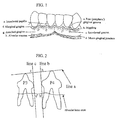
- Fig. 1 shows a schematic view of tissues around
gingiva.
- Fig. 2 shows the evaluation method of alveolar bone
crest height, in Example 1.
Symbols in this drawing have the following meanings.
Line a: a line linking crests of tooth crowns of P4 and P3,
line b and line c: perpendicular lines against line a
passing the most mesial side of P4 tooth crown and the most
distal side of P3 tooth crown, b and c: intersecting points
(reference points) of line a with line b and line c, and b'
and c': intersecting points of alveolar bone crest with
line b and line c.-
-
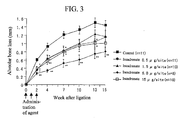
Fig. 3 is a graph showing the effect of incadronate
on alveolar bone loss, in Example 1. The drawing shows
average value ± standard error of mean of the length of
alveolar bone loss after ligature placing with the passage
of time. Parentheses in the explanatory notes indicate the
number of samples in each group. The symbols * and ** show
significant differences against the control group (* p <
0.05, ** p < 0.01, Dunnett's multiple comparison test).
Best Mode for Carrying Out the Invention
-
The following examples show effects of the
pharmaceutical composition of the invention for
periodontitis treatment and formulations. In this
connection, the scope of the invention is not restricted by
the following examples.
Example 1: Canine periodontitis model study
(Methods)
-
A total of 30 animals of female beagle dogs (1 to 2
years, body weight at the time of grouping 7.9 to 13.7 kg)
were fed with a soft diet prepared by impregnating Gains
Packen (AGF) with water from the previous day of ligation
and used in this study. Under anesthesia with xylazine
hydrochloride (Bayer) and pentobarbital, gingiva between
second premolar (hereinafter, P2)/third premolar
(hereinafter, P3), between P3/fourth premolar (hereinafter,
P4) and between P4/first molar (hereinafter, M1) of right
and left mandibles were incised with a surgical knife, and
periodontal pockets were prepared around P3 and P4 using a
periosteal elevator. An experimental periodontitis was
induced by placing double-ligation of silk threads
(surgical thread; Nescosuture (3-0), Morita) around the
cervices of P3 and P4. In this case, reference points were
prepared on the buccal side and lingual side of the crown
of P4 at the height of gingival margin using dental drill.
Since periodontal local conditions (dental calculus
adhering state and periodontal condition) were almost
uniform, scaling and brushing were not carried out, and the
animals were divided into the following five groups by
general conditions (body weight and age). 1) Control
group: physiological saline, 2) incadronate 0.5 µg/site
group, 3) incadronate 1.5 µg/site group, 4) incadronate 5.0
µg/site group and 5) incadronate 15 µg/site group.
-
The administration was started just after the
surgical operation in each group. Incadronate (an
injection, mfd. by Yamanouchi Pharmaceutical Co., Ltd.) was
prepared and diluted with saline such that the
administration liquid volume became 150 µl/site. The
administration was carried out a total of three times,
namely just after the ligation and 1 and 2 weeks after the
ligation. The administration was carried out by the
alveolar mucosa injection method using a 27 G injection
needle attached to a glass micro-syringe. The injection
needle was inserted horizontally to the alveolar mucosa
close to the boundary between the alveolar mucosa and
gingiva (muco-gingival junction) around the ligated tooth,
and 150 µl of a drug solution was injected between
periosteum of the alveolar bone and alveolar mucosa. The
administration was carried out on both of the buccal and
lingual side (a total of 4 sites per 1 mandible, 600 µl in
total). Each animal was sacrificed by exsanguination 13
weeks after the final administration, and the mandibles
including P3 and P4 of right and left side and the ribs
were harvested and submitted to the intra-bone drug
concentration measurement.
(Evaluation of alveolar bone loss inhibitory effect by
standardized X-ray photographing)
-
The standardized X-ray photographing method (J.
Periodontol., 33, 164 - 171 (1962)) was employed, in which
irradiation direction of X-ray to a subject and position of
the film are always kept constant so that X-ray photographs
of the same region of the same individual can be obtained
repeatedly always under the same conditions. This time, in
order to evaluate alveolar bone loss around P3 and P4 of
right and left mandibles, a cap was formed between incisor
tooth and M1 of both mandibles using an acrylic resin, and
a fixing device was prepared by combining this cap with a
film holder.
-
Each animal was anesthetized with xylazine
hydrochloride and ketamine hydrochloride (Ketalar, Sankyo),
and a dental film (Ultra Speed DF58, Kodak) was attached to
the film holder on the fixing device to photograph X-ray by
a dental X-ray photographing apparatus (Super Max 70, type
HD-1, Morita Seisakusho).
-
In this case, height of the alveolar bone crest was
measured using the evaluation method shown in Fig. 2. That
is, an X-ray film was measured under a stereoscopic
microscope (objective x 1, eyepiece x 10), an OHP sheet was
put on the X-ray film, and line a, line b and line c were
marked on the OHP sheet using a ceramic knife, thereby
obtaining respective two points b and b' and c and c' on
line b and line c. Distances between the b-b' and c-c'
were respectively defined as the distances from the
reference points (b and c points) to the alveolar bone
crest. The length of alveolar bone loss was expressed by
averaging values obtained by subtracting the sum of b-b'
and c-c' distances in each individual at the time of each
week from the sum of b-b' and c-c' distances at the time of
ligation.
(Measurement of clinical scores)
(1) Depth of pocket (probing depth; PD)
-
Measurement of the depth of periodontal pockets was
carried out by a four point measuring method in accordance
with J. Clin. Periodontol., 4, 173 - 190 (1997)).
(2) Gingival recession
-
Regarding the length of gingival recession, the
distance from the reference point on the tooth crown
prepared at the time of ligation to the gingival margin was
measured on two regions, the buccal and lingual side, of P4
at the time of each week in each individual, and expressed
as the average value.
(3) Attachment level (AL)
-
Attachment level is an index for measuring position
of the bottom of gingival sulcus (pocket bottom), and was
expressed as the distance from the pocket bottom to the
reference point on the tooth crown. That is, a value of
the depth of pocket plus the length of gingival recession
was used as the attachment level.
(4) Gingival index (GI)
-
Regions of inflammation and degree of the symptoms of
gingiva were evaluated in accordance with J. Periodontol.,
38, 602 - 610 (1967)).
(Measurement of intra-alveolar bone drug concentration and
intra-rib drug concentration)
-
Root of the left fourth premolar was extracted using
cutting pliers, the whole mandible containing jaw bone and
alveolar bone was divided up and down into two, and the
upper 1/2 was considered as the alveolar bone. Also, the
intra-rib drug concentration was measured using the
epiphyseal region of the rib that had been frozen at -40°C
after anatomy. Incadronate was extracted from these
samples using a calcium precipitation method and its intra-bone
drug concentration was measured by an HPLC method.
(Results)
-
Respective data were calculated as separate values of
right and left teeth. SAS (EXSAS-ATAT) was used in the all
statistical analyses.
-
A result of the alveolar bone loss inhibitory action
is shown in Fig. 3. Almost periodical loss of alveolar
bone was found in the control group after ligation, and
this was inhibited in the incadronate-treated groups and
its action was most potent at a dose of 5 µg/site.
-
Also, aggravation of the clinical scores of
periodontitis was inhibited in the incadronate-treated
groups. The clinical scores were as follows.
(1) Depth of pocket
-
A transient acceleration of pocket depth with its
peak 2 weeks after the ligation was observed in the control
group. Incadronate significantly inhibited acceleration of
pocket depth 2 and 4 weeks after the ligation at a dose of
1.5 µg/site or more.
(2) Gingival recession
-
Acceleration of gingival recession by ligation was
observed with the passage of time in the control group.
Incadronate significantly inhibited acceleration of
gingival recession in and after 4 weeks of the ligation at
a dose of 5 µg/site or more, and significantly inhibited
only after 15 weeks of the ligation at a dose of 1.5
µg/site.
(3) Attachment level
-
Reduction of attachment level by the ligation was
observed almost periodically in the control group.
Incadronate significantly inhibited reduction of attachment
level in and after 2 weeks of the ligation at a dose of 5
µg/site or more, and significantly inhibited after 4 and 15
weeks of the ligation at a dose of 1.5 µg/site.
(4) Gingival index (GI)
-
A transient exacerbation of gingival index was
observed with its peak 2 weeks after the ligation in the
control group. Incadronate significantly inhibited this
exacerbation of gingival index after 2 weeks of the
ligation at a dose of 1.5 µg/site or more.
(Intra-alveolar bone drug concentration and intra-rib drug
concentration)
-
The results are shown in Table 1. In the 5 to 15
µg/site-administered groups, intra-rib concentration of
incadronate was about 1/10 of the intra-alveolar bone
concentration, thus confirming that the injections of the
invention can achieve alveolar bone-selective transfer of
BP.
| Dose (µg/site) | The number of cases | Intra-alveolar bone drug concentration (µg/g bone) | Intra-rib drug concentration (µg/g bone) |
| 0.5 | 6 | 0.058 ± 0.008 | N.D. |
| 1.5 | 6 | 0.174 ± 0.011 | N.D. |
| 5 | 5 | 0.356 ± 0.070 | 0.033 ± 0.003 |
| 15 | 6 | 1.035 ± 0.313 | 0.091 ± 0.016 |
| N.D. indicates detection limit (0.025 µg/g) or less. |
Comparative Example 1: High dose topical administration
study in canine periodontitis model
(Methods)
-
Using 26 animals of beagle dog (3 to 6 years, body
weight at the time of grouping 6.1 to 12.9 kg), topical
administration study in a canine periodontitis model were
carried out on a), control group: physiological saline, b)
incadronate 50 µg/site group and c) incadronate 150 µg/site
group. The study was carried out in the same manner as in
Example 1, except that the administration was carried out a
total of three times, namely just after ligation and 2 and
4 weeks after the ligation, and the mandibles and ribs were
collected 8 weeks after the final administration and
submitted to the intra-bone drug concentration measurement.
(Results)
-
Both of the alveolar bone loss inhibitory action and
clinical scores showed no significant difference between
the control and incadronate-treated groups. Intra-alveolar
bone concentration of incadronate was 5.67 and 4.28 µg/g
bone. This was similar to the intra-alveolar bone drug
concentration of about 4 µg/g at the time of the completion
of 26 weeks oral administration of 1.0 mg/kg of incadronate
(J. Periodont. Res., 33, 196 - 204 (1998)).
-
In addition, when local irritation to the lamina
propria mucosae of the administered sites was observed, a)
slight mononuclear cell infiltration was observed partly in
the control group, and b) slight mononuclear cell
infiltration was also observed partly in the incadronate 50
µg/site group, and its relative frequency and degree were
higher than those in the control group. On the other hand,
c) in the incadronate 150 µg/site group, bleeding, fibrin
precipitation, inflammatory cell infiltration, salivary
gland and muscular tissue damage were observed in all cases
one week after the final administration, and considerable
tissue damages such as those accompanied by an ulcer of a
part of gingival mucosa were observed.
-
By the topical injection capable of giving an intra-alveolar
bone drug concentration similar to the level by
the conventional oral administration, both of the action to
inhibit alveolar bone loss and the action to inhibit
aggravation of clinical scores of periodontitis were not
found. Also, since inflammation was observed on the
administered sites, it was considered a possibility that
this topical inflammation induces bone resorption and it
was suggested a possibility that this topical inflammation
compensates the alveolar bone resorption inhibitory action
of incadronate.
Example 2: Formulation examples
Formulation Example 1
-
A 3.3, 10.0, 33.3 or 100 µg portion of incadronate
was dissolved in saline and adjusted to 1 ml, and this was
packed in a one ml capacity cartridge to obtain a dental
cartridge containing the pharmaceutical composition of the
invention.
Formulation Example 2
-
A 3.3, 10.0, 33.3 or 100 µg portion of incadronate
and either of 42.6 mg of xylitol, 51 mg of mannitol, 51 mg
of sorbitol or 21 mg of glycine hydrochloride as a
isotonicity agent were dissolved in saline and adjusted to
1 ml. By packing this in a one ml capacity cartridge, a
dental cartridge containing the pharmaceutical composition
of the invention was obtained.
Formulation Example 3
-
A 7.5, 25 or 75 µg portion of incadronate and either
of 42.6 mg of xylitol, 51 mg of mannitol, 51 mg of sorbitol
or 21 mg of glycine hydrochloride as an isotonicity agent
were dissolved in physiological saline and adjusted to 1
ml. By packing this in a one ml capacity cartridge, a
dental cartridge containing the pharmaceutical composition
of the invention was obtained.
Industrial Applicability
-
The pharmaceutical composition for periodontitis
treatment of the invention, which comprises a bisphosphonic
acid derivative or a salt thereof and a pharmaceutically
acceptable carrier, is useful as a periodontitis treating
agent having less systemic side effects, because BP is
transferred alveolar bone-selectively by its topical
injection using the alveolar mucosa injection method
instead of the conventional systemic administration.
-
Accordingly, it efficiently inhibits alveolar bone
resorption accompanied by periodontitis, controls recession
of alveolar bone crest and alveolar bone density which are
generated accompanied by alveolar bone resorption and
prevents aggravation of clinical scores of periodontitis
such as gingivitis, bleeding, depth of periodontal pockets,
reduction of attachment level and the like.
-
In addition, the pharmaceutical composition for
periodontitis treatment, as a composition for use in the
human alveolar tissue topical injection, which comprises
incadronic acid or a salt thereof in a concentration of
from 3.33 to 100 µg/ml and a pharmaceutically acceptable
carrier, has low local irritative property and good
alveolar bone resorption inhibitory action and therefore is
useful as a BP-containing pharmaceutical composition for
periodontitis treatment which enabled its topical
administration to alveolar tissues (e.g., alveolar mucosa
and the like) for the first time.