EP1231806A1 - Channel structure for data transmission - Google Patents

Channel structure for data transmission Download PDF

Info

Publication number
EP1231806A1
EP1231806A1 EP02001870A EP02001870A EP1231806A1 EP 1231806 A1 EP1231806 A1 EP 1231806A1 EP 02001870 A EP02001870 A EP 02001870A EP 02001870 A EP02001870 A EP 02001870A EP 1231806 A1 EP1231806 A1 EP 1231806A1
Authority
EP
European Patent Office
Prior art keywords
reverse
subchannel
channel
aisch
quality
Prior art date
Legal status (The legal status is an assumption and is not a legal conclusion. Google has not performed a legal analysis and makes no representation as to the accuracy of the status listed.)
Withdrawn
Application number
EP02001870A
Other languages
German (de)
French (fr)
Inventor
Jason Chen Jiangnan
Michael Schaffner
Current Assignee (The listed assignees may be inaccurate. Google has not performed a legal analysis and makes no representation or warranty as to the accuracy of the list.)
Motorola Solutions Inc
Original Assignee
Motorola Inc
Priority date (The priority date is an assumption and is not a legal conclusion. Google has not performed a legal analysis and makes no representation as to the accuracy of the date listed.)
Filing date
Publication date
Application filed by Motorola Inc filed Critical Motorola Inc
Publication of EP1231806A1 publication Critical patent/EP1231806A1/en
Withdrawn legal-status Critical Current

Links

Images

Classifications

    • HELECTRICITY
    • H04ELECTRIC COMMUNICATION TECHNIQUE
    • H04BTRANSMISSION
    • H04B7/00Radio transmission systems, i.e. using radiation field
    • H04B7/24Radio transmission systems, i.e. using radiation field for communication between two or more posts
    • H04B7/26Radio transmission systems, i.e. using radiation field for communication between two or more posts at least one of which is mobile
    • HELECTRICITY
    • H04ELECTRIC COMMUNICATION TECHNIQUE
    • H04WWIRELESS COMMUNICATION NETWORKS
    • H04W72/00Local resource management
    • H04W72/20Control channels or signalling for resource management
    • H04W72/21Control channels or signalling for resource management in the uplink direction of a wireless link, i.e. towards the network

Definitions

  • the present invention relates generally to communication systems and in particular, to a channel structure for data transmission within such communication systems.
  • Communication systems are well known and consist of many types including land mobile radio, cellular radiotelephone, personal communication systems, and other communication system types.
  • transmissions are conducted between a transmitting device and a receiving device over a communication resource, commonly referred to as a communication channel.
  • the transmissions have typically consisted of voice signals. More recently, however, it has been proposed to carry other forms of signals, including high-speed data signals.
  • the data transmission capability overlay the existing voice communication capability, such that its operation is essentially transparent to the voice communication system while still utilizing the communication resources and other infrastructure of the voice communication system.
  • FIG. 1 illustrates a prior art reverse-link channel structure to accommodate cdma2000 1x-evolved high-speed integrated data and voice (1x-EVDV).
  • Two physical channels are shown that use orthogonal spreading codes W 0 and W 8 /W 12 .
  • the reverse-link pilot channel (W 0 ) contains power control bit(s) (PC), an Acknowledgment Indicator Channel (AICH), and the pilot channel (Pilot).
  • the control channel e.g., W 8 or W 12
  • W 8 or W 12 transmits a Transmit Sector Indicator Channel (TSICH), a Quality indicator (Quality), and Echo Information for ARQ purposes (Echo).
  • Information bits (containing TSICH, Quality, and Echo) have CRC bits and tail bits appended.
  • the resulting signal is convolutionally encoded and repeated prior to Spreading with the appropriate Walsh Code (W 8 or W 12 ).
  • the resulting frame structure for the control channel is shown in FIG. 2.
  • the convolutionally encoded TSICH, Quality, and Echo bits are transmitted during the first 3.75 ms of the frame along with the CRC bits and tail bits. None, however, is transmitted during the last 1.25 ms of the 5 ms frame.
  • the above channel structure is appropriate for high-speed data transmission, a problem exists in that the prior-art pilot channel is not backward-compatible to the existing Telecommunications Industry Association Interim Standard 2000 (IS-2000) pilot channel structure. Therefore a need exists for a channel structure for data transmission that is backward-compatible to the existing IS-2000 channel structure.
  • FIG. 1 illustrates two prior-art channel structures.
  • FIG. 2 illustrates a prior art frame structure for a control channel.
  • FIG. 3 illustrates a channel structure in accordance with the preferred embodiment of the present invention.
  • FIG. 4 illustrates a frame structure for a control channel in accordance with the preferred embodiment of the present invention.
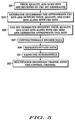
  • FIG. 5 is a flow chart showing operation of a reverse-channel transmitter in accordance with the preferred embodiment of the present invention.
  • the reverse channel AISCH (R-AISCH) is multiplexed in a 1.25 ms slot within the reverse link control channel.
  • the reverse pilot channel now contains PCSCH and Pilot symbols. These are spread with W 0 to complete transmission of the channel.
  • the present invention encompasses a control channel having a frame comprising a Reverse Transmitter Sector Indicator Subchannel (R-TSICH), wherein the R-TSICH is utilized by a mobile station to communicate a PN_OFFSET; a Reverse Quality Indicator subchannel (R-Quality), wherein R-Quality used to deliver of forward channel quality feedback; a Reverse Echo subchannel (R-Echo), wherein R-Echo is utilized to deliver forward link configuration information to assist in a fast cell site selection (FCSS) process; and a Reverse Acknowledgement Indicator Sub-channel (R-AISCH), wherein the R-AISCH is utilized for the indication of successful reception from the mobile station.
  • R-TSICH Reverse Transmitter Sector Indicator Subchannel
  • R-TSICH Reverse Transmitter Sector Indicator Subchannel
  • R-Quality Reverse Quality Indicator subchannel
  • R-Echo Reverse Echo subchannel
  • FCSS fast cell site selection
  • R-AISCH Reverse Acknowledgement Indic
  • the present invention additionally encompasses a method for transmitting a control channel.
  • the method comprises the steps of generating CRC bits for a Reverse Transmitter Sector Indicator Subchannel (R-TSICH), a Reverse Quality Indicator subchannel (R-Quality), and a Reverse Echo subchannel (R-Echo) to produce a Reverse Control Subchannel, wherein the R-TSICH is utilized by a mobile station to communicate a PN_OFFSET, R-Quality used to deliver of forward channel quality feedback, and R-Echo is utilized to deliver forward link configuration information to assist in a fast cell site selection (FCSS) process.
  • a Reverse Acknowledgement Indicator Subchannel (R-AISCH) is then multiplexed onto the Reverse Control Subchannel, wherein the R-AISCH is utilized for the indication of successful reception from the mobile station.
  • the present invention additionally encompasses a control channel having a frame comprising a Reverse Transmitter Sector Indicator Subchannel (R-TSICH) existing in a 3.75 ms portion of the frame, wherein the R-TSICH is utilized by a mobile station to communicate a PN_OFFSET; a Reverse Quality Indicator subchannel (R-Quality) existing in the 3.75 ms portion of the frame, wherein R-Quality used to deliver of forward channel quality feedback; a Reverse Echo subchannel (R-Echo) existing in the 3.75 ms portion of the frame, wherein R-Echo is utilized to deliver forward link configuration information to assist in a fast cell site selection (FCSS) process; and a Reverse Acknowledgement Indicator Sub-channel (R-AISCH) existing in a 1.25 ms portion of the frame, wherein the R-AISCH is utilized for the indication of successful reception from the mobile station.
  • R-TSICH Reverse Transmitter Sector Indicator Subchannel
  • R-TSICH Reverse Trans
  • Reverse Pilot Channel An unmodulated, direct-sequence spread spectrum signal transmitted by a CDMA base station or mobile station.
  • a pilot channel provides a phase reference for coherent demodulation and may provide a means for signal strength comparisons between base stations for determining when to handoff.
  • R-PCSCH - Reverse Power Control Subchannel A subchannel on the reverse link pilot channel with power control bit punctured on the fourth equally sized segment of one PCG time.
  • the power control bit is used to signal the base station to increase or decrease its transmit power.
  • R-TSICH - Reverse Transmitter Sector Indicator Subchannel A subchannel on the Reverse Control Channel used by the mobile station to communicate the PN_OFFSET optimum cell/sector for fast cell site selection in the Transmit Sector indicator message.
  • R-Quality - Reverse Quality Indicator subchannel A subchannel used to deliver of forward channel quality feedback.
  • R-Echo - Reverse Echo subchannel A subchannel used to deliver forward link configuration information (i.e. "echoing") to assist in fast cell site selection (FCSS) process.
  • FCSS fast cell site selection
  • R-AISCH Reverse Acknowledgement Indicator Sub-channel
  • R-AISCH is the acknowledgement feedback for the hybrid automatic repeat request (HARQ).
  • HARQ hybrid automatic repeat request
  • HARQ is implemented using the well-known stop-and-wait ARQ protocol. In stop-and-wait, the transmitter will operate on the current block until the receiver has received it successfully.
  • a one-bit acknowledgement feedback (R-AISCH) is used for the indication of successful reception from the mobile station. This bit with value one (1) can be sent out only after the decoder at the mobile has finished the decoding/combining and checked without frame error. Otherwise a zero (0) will be sent out.
  • FIG. 3 illustrates a channel structure in accordance with the preferred embodiment of the present invention.
  • the reverse channel AISCH (R-AISCH) is no longer transmitted over the reverse pilot channel. Instead, the R-AISCH is multiplexed in a 1.25 ms slot within the reverse link control channel.
  • the reverse pilot channel now contains PCSCH and Pilot symbols. These are spread with W 0 to complete transmission of the channel.
  • the transmitter for the reverse control channel comprises CRC bit generator 301, tail bit generator 303, convolutional encoder 305, symbol repeater/puncturer 307, gain multiplier 313, bit repeater 315, gain multiplier 317, multiplexer 309, and spreader 311. Operation of the reverse control channel transmitter occurs as follows: TSICH, Quality, and Echo bits enter CRC bit generator 301, where CRC bits are generated. Tail bits are then added by the tail bit generator 303. Convolutional encoding of the data takes place via convolutional encoder 305, and symbol repetition and puncturing takes place via repeater/puncturer 307.
  • the resulting data is then multiplied by a gain factor by the gain multiplier 313 and passed to multiplexer 309 where R-AISCH symbols are multiplexed into the data.
  • the R-AISCH bit is repeated by repeater 315 and multiplied by a gain factor by gain multiplier 317 to create the R-AISCH symbols which feed multiplexor 309.
  • the data output from multiplexor 309 is spread via spreader 311 and transmitted.
  • FIG. 4 illustrates a frame structure for a control channel in accordance with the preferred embodiment of the present invention.
  • R-AISCH is multiplexed into the prior-art information bits during a 1.25 ms slot. More particularly, the prior-art 1.25 ms slot where no transmission was taking place, is now being utilized for transmission of R-AISCH.
  • FIG. 5 is a flow chart showing operation of a reverse channel transmitter in accordance with the preferred embodiment of the present invention.
  • the logic flow begins at step 501 where TSICH, Quality, and Echo bits are received by CRC bit generator 301.
  • Generator 301 determines the appropriate CRC bits and outputs TSICH, Quality, and Echo bits along with CRC bits (step 503).
  • tail bit generator 303 receives TSICH, Quality, and Echo bits along with CRC bits and generates appropriate tail bits.
  • the resulting data and tail bits are passed to convolutional encoder 305 where convolutional encoding takes place (step 507).
  • convolutional encoder 305 encodes input data bits into data symbols at a fixed encoding rate with an encoding algorithm which facilitates subsequent maximum likelihood decoding of the data symbols into data bits (e.g. convolutional or block coding algorithms). For example, convolutional encoder 305 encodes 57 input data bits at a fixed encoding rate of one data bit to four data symbols (i.e., rate 1/4) such that convolutional encoder 305 outputs 228 data symbols.
  • the data symbols are then input into symbol repeater/puncturer 307 where the individual symbols are repeated and/or punctured in order to match the size of the physical channel (step 509).
  • the symbols are multiplied by a transmission gain factor by gain multiplier 313.
  • multiplexer 309 multiplexes secondary traffic (e.g., R-AISCH) onto the control channel during a 1.25 ms slot.
  • the resulting frame is output to spreader 311 where appropriate spreading takes place.

Landscapes

  • Engineering & Computer Science (AREA)
  • Computer Networks & Wireless Communication (AREA)
  • Signal Processing (AREA)
  • Mobile Radio Communication Systems (AREA)

Abstract

The reverse channel AISCH (R-AISCH) is multiplexed in a 1.25 ms slot within the reverse link control channel. In accordance with the preferred embodiment of the present invention the reverse pilot channel now contains PCSCH and Pilot symbols. These are spread with W0 to complete transmission of the channel.

Description

Field of the Invention
The present invention relates generally to communication systems and in particular, to a channel structure for data transmission within such communication systems.
Background of the Invention
Communication systems are well known and consist of many types including land mobile radio, cellular radiotelephone, personal communication systems, and other communication system types. Within a communication system, transmissions are conducted between a transmitting device and a receiving device over a communication resource, commonly referred to as a communication channel. To date, the transmissions have typically consisted of voice signals. More recently, however, it has been proposed to carry other forms of signals, including high-speed data signals. For ease of operation, it is preferable to have the data transmission capability overlay the existing voice communication capability, such that its operation is essentially transparent to the voice communication system while still utilizing the communication resources and other infrastructure of the voice communication system.
FIG. 1 illustrates a prior art reverse-link channel structure to accommodate cdma2000 1x-evolved high-speed integrated data and voice (1x-EVDV). Two physical channels are shown that use orthogonal spreading codes W0 and W8/W12. As is evident the reverse-link pilot channel (W0) contains power control bit(s) (PC), an Acknowledgment Indicator Channel (AICH), and the pilot channel (Pilot). The control channel (e.g., W8 or W12) transmits a Transmit Sector Indicator Channel (TSICH), a Quality indicator (Quality), and Echo Information for ARQ purposes (Echo). Information bits (containing TSICH, Quality, and Echo) have CRC bits and tail bits appended. The resulting signal is convolutionally encoded and repeated prior to Spreading with the appropriate Walsh Code (W8 or W12).
The resulting frame structure for the control channel is shown in FIG. 2. As is evident, the convolutionally encoded TSICH, Quality, and Echo bits are transmitted during the first 3.75 ms of the frame along with the CRC bits and tail bits. Nothing, however, is transmitted during the last 1.25 ms of the 5 ms frame. Although the above channel structure is appropriate for high-speed data transmission, a problem exists in that the prior-art pilot channel is not backward-compatible to the existing Telecommunications Industry Association Interim Standard 2000 (IS-2000) pilot channel structure. Therefore a need exists for a channel structure for data transmission that is backward-compatible to the existing IS-2000 channel structure.
Brief Description of the Drawings
FIG. 1 illustrates two prior-art channel structures.
FIG. 2 illustrates a prior art frame structure for a control channel.
FIG. 3 illustrates a channel structure in accordance with the preferred embodiment of the present invention.
FIG. 4 illustrates a frame structure for a control channel in accordance with the preferred embodiment of the present invention.
FIG. 5 is a flow chart showing operation of a reverse-channel transmitter in accordance with the preferred embodiment of the present invention.
Detailed Description of the Drawings
In order provide a channel structure for data transmission that is backward-compatible to the existing IS-2000 channel structure the reverse channel AISCH (R-AISCH) is multiplexed in a 1.25 ms slot within the reverse link control channel. In accordance with the preferred embodiment of the present invention the reverse pilot channel now contains PCSCH and Pilot symbols. These are spread with W0 to complete transmission of the channel.
The present invention encompasses a control channel having a frame comprising a Reverse Transmitter Sector Indicator Subchannel (R-TSICH), wherein the R-TSICH is utilized by a mobile station to communicate a PN_OFFSET; a Reverse Quality Indicator subchannel (R-Quality), wherein R-Quality used to deliver of forward channel quality feedback; a Reverse Echo subchannel (R-Echo), wherein R-Echo is utilized to deliver forward link configuration information to assist in a fast cell site selection (FCSS) process; and a Reverse Acknowledgement Indicator Sub-channel (R-AISCH), wherein the R-AISCH is utilized for the indication of successful reception from the mobile station.
The present invention additionally encompasses a method for transmitting a control channel. The method comprises the steps of generating CRC bits for a Reverse Transmitter Sector Indicator Subchannel (R-TSICH), a Reverse Quality Indicator subchannel (R-Quality), and a Reverse Echo subchannel (R-Echo) to produce a Reverse Control Subchannel, wherein the R-TSICH is utilized by a mobile station to communicate a PN_OFFSET, R-Quality used to deliver of forward channel quality feedback, and R-Echo is utilized to deliver forward link configuration information to assist in a fast cell site selection (FCSS) process. A Reverse Acknowledgement Indicator Subchannel (R-AISCH) is then multiplexed onto the Reverse Control Subchannel, wherein the R-AISCH is utilized for the indication of successful reception from the mobile station.
The present invention additionally encompasses a control channel having a frame comprising a Reverse Transmitter Sector Indicator Subchannel (R-TSICH) existing in a 3.75 ms portion of the frame, wherein the R-TSICH is utilized by a mobile station to communicate a PN_OFFSET; a Reverse Quality Indicator subchannel (R-Quality) existing in the 3.75 ms portion of the frame, wherein R-Quality used to deliver of forward channel quality feedback; a Reverse Echo subchannel (R-Echo) existing in the 3.75 ms portion of the frame, wherein R-Echo is utilized to deliver forward link configuration information to assist in a fast cell site selection (FCSS) process; and a Reverse Acknowledgement Indicator Sub-channel (R-AISCH) existing in a 1.25 ms portion of the frame, wherein the R-AISCH is utilized for the indication of successful reception from the mobile station.
Prior to describing a transmitter and receiver in accordance with the preferred embodiment of the present invention the following definitions are provided to set the necessary background for utilization of the preferred embodiment of the present invention.
Reverse Pilot Channel - An unmodulated, direct-sequence spread spectrum signal transmitted by a CDMA base station or mobile station. A pilot channel provides a phase reference for coherent demodulation and may provide a means for signal strength comparisons between base stations for determining when to handoff.
R-PCSCH - Reverse Power Control Subchannel. A subchannel on the reverse link pilot channel with power control bit punctured on the fourth equally sized segment of one PCG time. The power control bit is used to signal the base station to increase or decrease its transmit power.
R-TSICH - Reverse Transmitter Sector Indicator Subchannel. A subchannel on the Reverse Control Channel used by the mobile station to communicate the PN_OFFSET optimum cell/sector for fast cell site selection in the Transmit Sector indicator message.
R-Quality - Reverse Quality Indicator subchannel. A subchannel used to deliver of forward channel quality feedback.
R-Echo - Reverse Echo subchannel. A subchannel used to deliver forward link configuration information (i.e. "echoing") to assist in fast cell site selection (FCSS) process.
R-AISCH - Reverse Acknowledgement Indicator Sub-channel (R-AISCH). R-AISCH is the acknowledgement feedback for the hybrid automatic repeat request (HARQ). HARQ is implemented using the well-known stop-and-wait ARQ protocol. In stop-and-wait, the transmitter will operate on the current block until the receiver has received it successfully. A one-bit acknowledgement feedback (R-AISCH) is used for the indication of successful reception from the mobile station. This bit with value one (1) can be sent out only after the decoder at the mobile has finished the decoding/combining and checked without frame error. Otherwise a zero (0) will be sent out. There are delays while decoding the received frame, sending out acknowledgement, detecting the acknowledgement, making decision if a retransmission is required, and sending out the retransmitted frame. The current design assumes a four (4) frame delay between the retransmissions, and this results in a four (4) channel stop-and-wait hybrid ARQ.
Turning now to the drawings, wherein like numerals designate like components, FIG. 3 illustrates a channel structure in accordance with the preferred embodiment of the present invention. As is evident, in the preferred embodiment of the present invention the reverse channel AISCH (R-AISCH) is no longer transmitted over the reverse pilot channel. Instead, the R-AISCH is multiplexed in a 1.25 ms slot within the reverse link control channel. In accordance with the preferred embodiment of the present invention the reverse pilot channel now contains PCSCH and Pilot symbols. These are spread with W0 to complete transmission of the channel.
The transmitter for the reverse control channel comprises CRC bit generator 301, tail bit generator 303, convolutional encoder 305, symbol repeater/puncturer 307, gain multiplier 313, bit repeater 315, gain multiplier 317, multiplexer 309, and spreader 311. Operation of the reverse control channel transmitter occurs as follows: TSICH, Quality, and Echo bits enter CRC bit generator 301, where CRC bits are generated. Tail bits are then added by the tail bit generator 303. Convolutional encoding of the data takes place via convolutional encoder 305, and symbol repetition and puncturing takes place via repeater/puncturer 307. The resulting data is then multiplied by a gain factor by the gain multiplier 313 and passed to multiplexer 309 where R-AISCH symbols are multiplexed into the data. The R-AISCH bit is repeated by repeater 315 and multiplied by a gain factor by gain multiplier 317 to create the R-AISCH symbols which feed multiplexor 309. Finally, the data output from multiplexor 309 is spread via spreader 311 and transmitted.
FIG. 4 illustrates a frame structure for a control channel in accordance with the preferred embodiment of the present invention. As is evident, R-AISCH is multiplexed into the prior-art information bits during a 1.25 ms slot. More particularly, the prior-art 1.25 ms slot where no transmission was taking place, is now being utilized for transmission of R-AISCH.
Because R-AISCH is now being transmitted over the control channel, the pilot channel structure is identical to that utilized in IS-2000. Therefore, backward compatibility with IS-2000 is achieved.
FIG. 5 is a flow chart showing operation of a reverse channel transmitter in accordance with the preferred embodiment of the present invention. The logic flow begins at step 501 where TSICH, Quality, and Echo bits are received by CRC bit generator 301. Generator 301 determines the appropriate CRC bits and outputs TSICH, Quality, and Echo bits along with CRC bits (step 503). At step 505 tail bit generator 303 receives TSICH, Quality, and Echo bits along with CRC bits and generates appropriate tail bits. The resulting data and tail bits are passed to convolutional encoder 305 where convolutional encoding takes place (step 507). More particularly, at step 507, convolutional encoder 305 encodes input data bits into data symbols at a fixed encoding rate with an encoding algorithm which facilitates subsequent maximum likelihood decoding of the data symbols into data bits (e.g. convolutional or block coding algorithms). For example, convolutional encoder 305 encodes 57 input data bits at a fixed encoding rate of one data bit to four data symbols (i.e., rate 1/4) such that convolutional encoder 305 outputs 228 data symbols.
The data symbols are then input into symbol repeater/puncturer 307 where the individual symbols are repeated and/or punctured in order to match the size of the physical channel (step 509). At the next step (step 511) the symbols are multiplied by a transmission gain factor by gain multiplier 313. Next, at step 513, multiplexer 309 multiplexes secondary traffic (e.g., R-AISCH) onto the control channel during a 1.25 ms slot. The resulting frame is output to spreader 311 where appropriate spreading takes place.
While the invention has been particularly shown and described with reference to a particular embodiment, it will be understood by those skilled in the art that various changes in form and details may be made therein without departing from the spirit and scope of the invention. It is intended that such changes come within the scope of the following claims.

Claims (6)

  1. A control channel having a frame comprising:
    a Reverse Transmitter Sector Indicator Subchannel (R-TSICH), wherein the R-TSICH is utilized by a mobile station to communicate a PN_OFFSET;
    a Reverse Quality Indicator subchannel (R-Quality), wherein R-Quality used to deliver of forward channel quality feedback;
    a Reverse Echo subchannel (R-Echo), wherein R-Echo is utilized to deliver forward link configuration information to assist in a fast cell site selection (FCSS) process; and
    a Reverse Acknowledgement Indicator Sub-channel (R-AISCH), wherein the R-AISCH is utilized for the indication of successful reception from the mobile station.
  2. The control channel of claim 1 wherein the R-AISCH is one-bit acknowledgement feedback.
  3. A method for transmitting a control channel, the method comprising the steps of:
    generating CRC bits for a Reverse Transmitter Sector Indicator Subchannel (R-TSICH), a Reverse Quality Indicator subchannel (R-Quality), and a Reverse Echo subchannel (R-Echo) to produce a Reverse Control Subchannel, wherein the R-TSICH is utilized by a mobile station to communicate a PN_OFFSET, R-Quality used to deliver of forward channel quality feedback, and R-Echo is utilized to deliver forward link configuration information to assist in a fast cell site selection (FCSS) process; and
    multiplexing a Reverse Acknowledgement Indicator Sub-channel (R-AISCH) onto the Reverse Control Subchannel, wherein the R-AISCH is utilized for the indication of successful reception from the mobile station.
  4. The method of claim 3 wherein the step of multiplexing the R-AISCH onto the Reverse Control Subchannel comprises the step of multiplexing a one-bit acknowledgement feedback onto the Reverse Control Subchannel.
  5. A control channel having a frame comprising:
    a Reverse Transmitter Sector Indicator Subchannel (R-TSICH) existing in a 3.75 ms portion of the frame, wherein the R-TSICH is utilized by a mobile station to communicate a PN_OFFSET;
    a Reverse Quality Indicator subchannel (R-Quality) existing in the 3.75 ms portion of the frame, wherein R-Quality used to deliver of forward channel quality feedback;
    a Reverse Echo subchannel (R-Echo) existing in the 3.75 ms portion of the frame, wherein R-Echo is utilized to deliver forward link configuration information to assist in a fast cell site selection (FCSS) process; and
    a Reverse Acknowledgement Indicator Sub-channel (R-AISCH) existing in a 1.25 ms portion of the frame, wherein the R-AISCH is utilized for the indication of successful reception from the mobile station.
  6. The control channel of claim 5 wherein the R-AISCH is one-bit acknowledgement feedback.
EP02001870A 2001-02-12 2002-01-28 Channel structure for data transmission Withdrawn EP1231806A1 (en)

Applications Claiming Priority (2)

Application Number Priority Date Filing Date Title
US781838 1985-09-30
US09/781,838 US20020110107A1 (en) 2001-02-12 2001-02-12 Channel structure for data transmission

Publications (1)

Publication Number Publication Date
EP1231806A1 true EP1231806A1 (en) 2002-08-14

Family

ID=25124107

Family Applications (1)

Application Number Title Priority Date Filing Date
EP02001870A Withdrawn EP1231806A1 (en) 2001-02-12 2002-01-28 Channel structure for data transmission

Country Status (5)

Country Link
US (1) US20020110107A1 (en)
EP (1) EP1231806A1 (en)
KR (1) KR20020067006A (en)
CN (1) CN1371183A (en)
CA (1) CA2368341A1 (en)

Cited By (2)

* Cited by examiner, † Cited by third party
Publication number Priority date Publication date Assignee Title
KR100474691B1 (en) * 2001-11-30 2005-03-10 삼성전자주식회사 Apparatus and method for transmitting and receiving data on packet data control channel
EP2479917A4 (en) * 2009-11-05 2017-09-06 ZTE Corporation Encoding method and apparatus for acknowledgement/ negative acknowledgement response message and rank indicator signaling

Families Citing this family (5)

* Cited by examiner, † Cited by third party
Publication number Priority date Publication date Assignee Title
KR100672403B1 (en) * 2001-03-23 2007-01-23 엘지전자 주식회사 Transmission method of backward quality indicator and echo channel (R-QIEHH)
CN1708999B (en) * 2002-10-29 2012-03-07 高通股份有限公司 Uplink Pilot Signal and Signaling Transmission in Wireless Communication Systems
US6928062B2 (en) * 2002-10-29 2005-08-09 Qualcomm, Incorporated Uplink pilot and signaling transmission in wireless communication systems
KR100956820B1 (en) * 2003-05-12 2010-05-12 엘지전자 주식회사 How to transmit an overhead channel in a mobile communication system
RU2397614C2 (en) * 2005-09-21 2010-08-20 ЭлДжи ЭЛЕКТРОНИКС ИНК. Method and device intended for multiplexing of multiple feedback channels of feedback line in wireless networks with multiple carriers

Citations (1)

* Cited by examiner, † Cited by third party
Publication number Priority date Publication date Assignee Title
WO2001091356A1 (en) * 2000-05-24 2001-11-29 Samsung Electronics Co., Ltd Data transmission apparatus and method for an harq data communication system

Family Cites Families (10)

* Cited by examiner, † Cited by third party
Publication number Priority date Publication date Assignee Title
US5991284A (en) * 1997-02-13 1999-11-23 Qualcomm Inc. Subchannel control loop
US6091717A (en) * 1997-05-05 2000-07-18 Nokia Mobile Phones Limited Method for scheduling packet data transmission
KR100338662B1 (en) * 1998-03-31 2002-07-18 윤종용 Apparatus and method for communication channel in a cdma communication system
KR100272565B1 (en) * 1998-06-16 2000-11-15 서평원 Method for allocating Optimal Orthogonal Code of Reverse Link
JP3657195B2 (en) * 1998-07-28 2005-06-08 サムスン エレクトロニクス カンパニー リミテッド Intermittent transmission apparatus and method in control maintenance state of CDMA communication system
US6631126B1 (en) * 1999-06-11 2003-10-07 Lucent Technologies Inc. Wireless communications using circuit-oriented and packet-oriented frame selection/distribution functions
US6757270B1 (en) * 1999-06-11 2004-06-29 Lucent Technologies Inc. Low back haul reactivation delay for high-speed packet data services in CDMA systems
KR20020031537A (en) * 2000-10-20 2002-05-02 윤종용 Device and method for providing multimedea service in channel of wireless communication system
US6768727B1 (en) * 2000-11-09 2004-07-27 Ericsson Inc. Fast forward link power control for CDMA system
US6741862B2 (en) * 2001-02-07 2004-05-25 Airvana, Inc. Enhanced reverse-link rate control in wireless communication

Patent Citations (1)

* Cited by examiner, † Cited by third party
Publication number Priority date Publication date Assignee Title
WO2001091356A1 (en) * 2000-05-24 2001-11-29 Samsung Electronics Co., Ltd Data transmission apparatus and method for an harq data communication system

Non-Patent Citations (2)

* Cited by examiner, † Cited by third party
Title
AJIB W ET AL: "Acknowledgment operations in the RLC layer of GPRS", MOBILE MULTIMEDIA COMMUNICATIONS, 1999. (MOMUC '99). 1999 IEEE INTERNATIONAL WORKSHOP ON SAN DIEGO, CA, USA 15-17 NOV. 1999, PISCATAWAY, NJ, USA,IEEE, US, 15 November 1999 (1999-11-15), pages 311 - 317, XP010370732, ISBN: 0-7803-5904-6 *
MANNING S ET AL: "A short data burst mechanism for third generation CDMA wireless packet data", VEHICULAR TECHNOLOGY CONFERENCE, 1999 IEEE 49TH HOUSTON, TX, USA 16-20 MAY 1999, PISCATAWAY, NJ, USA,IEEE, US, 16 May 1999 (1999-05-16), pages 521 - 525, XP010342025, ISBN: 0-7803-5565-2 *

Cited By (2)

* Cited by examiner, † Cited by third party
Publication number Priority date Publication date Assignee Title
KR100474691B1 (en) * 2001-11-30 2005-03-10 삼성전자주식회사 Apparatus and method for transmitting and receiving data on packet data control channel
EP2479917A4 (en) * 2009-11-05 2017-09-06 ZTE Corporation Encoding method and apparatus for acknowledgement/ negative acknowledgement response message and rank indicator signaling

Also Published As

Publication number Publication date
CN1371183A (en) 2002-09-25
CA2368341A1 (en) 2002-08-12
US20020110107A1 (en) 2002-08-15
KR20020067006A (en) 2002-08-21

Similar Documents

Publication Publication Date Title
EP1592162B1 (en) Method and apparatus for time efficient retransmission using symbol accumulation
KR100403738B1 (en) Data transmission apparatus and method for an harq data communication system
US5966384A (en) Method and apparatus for data transmission within a broad-band communication system
US8089919B2 (en) Packet transmission acknowledgement in wireless communication system
KR101323089B1 (en) Method for transmitting of control information in Time Division Duplex wireless communication system
CA2360720A1 (en) Sub-packet adaptation in a wireless communication system
KR100594161B1 (en) Power control method and apparatus using control information in a mobile communication system and method and apparatus for transmitting and receiving error detection information for the control information
EP1740005A1 (en) Base station apparatus
EP1231806A1 (en) Channel structure for data transmission
KR20020055792A (en) Ratematching algorithm for hybrid automatic repeat request system
KR100969756B1 (en) Device and method for transmitting and receiving reverse control channel data in mobile communication system
KR100938067B1 (en) Apparatus and method for retransmitting traffic data in complex automatic retransmission mobile communication system
MXPA00004678A (en) Method and apparatus for time efficient retransmission using symbol accumulation
HK1074544B (en) Method and apparatus for time efficient retransmission using symbol accumulation
HK1086129B (en) Method and apparatus for time efficient retransmission using symbol accumulation
HK1100151B (en) Method and apparatus for time efficient retransmission using symbol accumulation
MX2007001533A (en) Packet transmission acknowledgement in wireless communication system
HK1032163B (en) Method and apparatus for time efficient retransmission using symbol accumulation

Legal Events

Date Code Title Description
PUAI Public reference made under article 153(3) epc to a published international application that has entered the european phase

Free format text: ORIGINAL CODE: 0009012

AK Designated contracting states

Kind code of ref document: A1

Designated state(s): AT BE CH CY DE DK ES FI FR GB GR IE IT LI LU MC NL PT SE TR

AX Request for extension of the european patent

Free format text: AL;LT;LV;MK;RO;SI

17P Request for examination filed

Effective date: 20030214

AKX Designation fees paid

Designated state(s): AT BE CH CY DE DK ES FI FR GB GR IE IT LI LU MC NL PT SE TR

17Q First examination report despatched

Effective date: 20030521

STAA Information on the status of an ep patent application or granted ep patent

Free format text: STATUS: THE APPLICATION IS DEEMED TO BE WITHDRAWN

18D Application deemed to be withdrawn

Effective date: 20031202

P01 Opt-out of the competence of the unified patent court (upc) registered

Effective date: 20230524