EP1231743A2 - Spot beam hopping packet scheduler system - Google Patents
Spot beam hopping packet scheduler system Download PDFInfo
- Publication number
- EP1231743A2 EP1231743A2 EP02003325A EP02003325A EP1231743A2 EP 1231743 A2 EP1231743 A2 EP 1231743A2 EP 02003325 A EP02003325 A EP 02003325A EP 02003325 A EP02003325 A EP 02003325A EP 1231743 A2 EP1231743 A2 EP 1231743A2
- Authority
- EP
- European Patent Office
- Prior art keywords
- cache
- downlink
- packet
- search
- burst
- Prior art date
- Legal status (The legal status is an assumption and is not a legal conclusion. Google has not performed a legal analysis and makes no representation as to the accuracy of the status listed.)
- Granted
Links
Images

Classifications
-
- H—ELECTRICITY
- H04—ELECTRIC COMMUNICATION TECHNIQUE
- H04L—TRANSMISSION OF DIGITAL INFORMATION, e.g. TELEGRAPHIC COMMUNICATION
- H04L47/00—Traffic control in data switching networks
- H04L47/50—Queue scheduling
- H04L47/62—Queue scheduling characterised by scheduling criteria
- H04L47/622—Queue service order
- H04L47/623—Weighted service order
-
- H—ELECTRICITY
- H04—ELECTRIC COMMUNICATION TECHNIQUE
- H04B—TRANSMISSION
- H04B7/00—Radio transmission systems, i.e. using radiation field
- H04B7/14—Relay systems
- H04B7/15—Active relay systems
- H04B7/204—Multiple access
- H04B7/2041—Spot beam multiple access
-
- H—ELECTRICITY
- H04—ELECTRIC COMMUNICATION TECHNIQUE
- H04L—TRANSMISSION OF DIGITAL INFORMATION, e.g. TELEGRAPHIC COMMUNICATION
- H04L47/00—Traffic control in data switching networks
- H04L47/50—Queue scheduling
-
- H—ELECTRICITY
- H04—ELECTRIC COMMUNICATION TECHNIQUE
- H04L—TRANSMISSION OF DIGITAL INFORMATION, e.g. TELEGRAPHIC COMMUNICATION
- H04L49/00—Packet switching elements
- H04L49/90—Buffering arrangements
-
- H—ELECTRICITY
- H04—ELECTRIC COMMUNICATION TECHNIQUE
- H04L—TRANSMISSION OF DIGITAL INFORMATION, e.g. TELEGRAPHIC COMMUNICATION
- H04L49/00—Packet switching elements
- H04L49/90—Buffering arrangements
- H04L49/901—Buffering arrangements using storage descriptor, e.g. read or write pointers
-
- H—ELECTRICITY
- H04—ELECTRIC COMMUNICATION TECHNIQUE
- H04W—WIRELESS COMMUNICATION NETWORKS
- H04W8/00—Network data management
- H04W8/02—Processing of mobility data, e.g. registration information at HLR [Home Location Register] or VLR [Visitor Location Register]; Transfer of mobility data, e.g. between HLR, VLR or external networks
- H04W8/04—Registration at HLR or HSS [Home Subscriber Server]
-
- H—ELECTRICITY
- H04—ELECTRIC COMMUNICATION TECHNIQUE
- H04Q—SELECTING
- H04Q2213/00—Indexing scheme relating to selecting arrangements in general and for multiplex systems
- H04Q2213/131—Register
-
- H—ELECTRICITY
- H04—ELECTRIC COMMUNICATION TECHNIQUE
- H04Q—SELECTING
- H04Q2213/00—Indexing scheme relating to selecting arrangements in general and for multiplex systems
- H04Q2213/13103—Memory
-
- H—ELECTRICITY
- H04—ELECTRIC COMMUNICATION TECHNIQUE
- H04Q—SELECTING
- H04Q2213/00—Indexing scheme relating to selecting arrangements in general and for multiplex systems
- H04Q2213/13296—Packet switching, X.25, frame relay
-
- H—ELECTRICITY
- H04—ELECTRIC COMMUNICATION TECHNIQUE
- H04Q—SELECTING
- H04Q2213/00—Indexing scheme relating to selecting arrangements in general and for multiplex systems
- H04Q2213/13333—Earth satellites
Definitions
- the present invention relates generally to satellite communication systems, and more particularly, to a wireless spot beam hopping packet scheduler system.
- Satellites and other spacecraft are in widespread use for various purposes including scientific research and communications. These communications missions, however, cannot be accurately fulfilled without digital communications. In many applications, the satellite relies upon a form of digital communication referred to as Asynchronous Transfer Mode (ATM) to relay various information.
- ATM Asynchronous Transfer Mode
- ATM Asynchronous Transfer Mode
- VCI virtual circuit identifier
- ATM uses very short, fixed length units of information, called cells.
- packets at a source are first broken up into these fixed length packets (ATM cells), transmitted, and then reassembled at a destination.
- ATM cells are 53 bytes long. They consist of a 5-byte header (containing an identifier of data flow which implicitly identifies the source address and the destination address) and a 48-byte information field.
- the header of an ATM cell contains all the information the network needs to relay the cell from one node to the next over a preestablished route. User data is contained in the remaining 48 bytes.
- ATM uses a concept of virtual networking (or channels) to pass traffic between two locations, establishing virtual connections between a pair of ATM end-systems which are needed to connect a source with a destination. These connections are termed "virtual" to distinguish them from dedicated circuits.
- ATM cells always traverse the same path from source to destination. However, ATM does not have to reserve the path for one user exclusively. Any time a given user is not occupying a link, another user is free to use it.
- ATM connections exist only as sets of routing tables-held in each network node, switch, or other intermediate system, based on the virtual circuit identifier (VCI) and virtual path identifier (VPI) contained in the cell header.
- VCI virtual circuit identifier
- VPN virtual path identifier
- the cell is thus passed from switch to switch over a prescribed route, but the route is "virtual" since the facility carrying the cell is dedicated to it only while the cell traverses it.
- Two cells that are ultimately headed for different destinations may be carried, one after the other, over the same physical wire for a common portion of their journey.
- Prior art satellite implementations use fixed beams which are configured so that they do not interfere with each other.
- ATM switching functionality can be implemented in a manner which is functionally equivalent to traditional ground based ATM implementations.
- such methods do not have the ability to handle hopped spot beams where all beams use the same frequency spectrum (frequency reuse) in a satellite that has fewer spot beams than destinations.
- the frequency spectrum is reused multiple times between different spot beams in order to increase the utilization of the allocated frequency spectrum.
- the spot beams are in turn reused (i.e., hopped) to service multiple destination regions in a Time Division Multiplexed basis.
- Time division multiplexing uses fixed time intervals (slots) during which each spot beam transmits a burst of packets to its respective destination. Since spot beam destinations need to be chosen dynamically for each slot based on the packets scheduled out at that time, the switch needs to be able to carefully select the packets for each beam in each slot scheduled out at that time, the switch needs to be able to carefully select the packets for each beam in each slot so that none of the spot beams spatially interfere with each other in the respective slot. Also, the switch needs to provide fairness with flexibility to prioritize bandwidth offered to customers appropriate to the specific business model for the system. The said flexibility needs to be achieved on a system that uses hopped spot beams and frequency reuse. Traditional ATM methods do not accommodate switching over links which compete with each other for physical properties and resources such as frequency isolation, transponder power, and bandwidth.
- Another disadvantage of traditional ATM methods is that they are not capable of handling spot beam power constraints.
- the power required for transmitting packets can vary between destination regions due to a number of factors such as weather and altitude.
- Each spot beam is limited in its power output capability such that certain beams are more capable than others.
- an object of the invention to provide a packet scheduler system which accommodates switching over links such as hopped spot beams which compete with each other for physical properties and resources.
- Another objective of the invention is to provide a spot beam hopping scheduling system that achieves maximum efficiency in finding compatible packets while providing a means to achieve statistically weighted fairness in scheduling packets for destination cells.
- a spot beam hopping scheduler system receives downlink cell ID and burst memory pointers from a burst assembly and congestion controller and provides beam control information to an antenna controller and packet bursts to modulators.
- the spot beam hopping scheduler system includes a downlink queue that is coupled to the burst assembly and congestion controller and receives the downlink cell ID and burst memory pointer data.
- a cache is coupled to the downlink queue and receives and stores data from the downlink queue.
- a downlink queue search controller is coupled to the downlink queue and the cache and includes control logic operative to search the downlink queue for mutually compatible packet bursts, and fill any empty cache slots with appropriate data from said downlink queue.
- the cache search controller includes a Cell ID search order table and search range tables coupled to the time slots which provide the capability for statistical weighting in servicing each downlink Cell ID.
- the present invention thus achieves an efficient spot beam hopping packet scheduler system with statistical weighting and prioritization capabilities while accommodating resource competing links such as wireless hopped spot beams.
- the present invention is advantageous in that it allows greater downlink/output bandwidth utilization by enabling the packet selection to be made across all destination cells having packet traffic such that a set of mutually compatible destination cells can be found.
- Another advantage provided by the present invention is that it provides the capability to perform weighted fair queuing in that each destination cell can be statistically weighted by means of a pre-configured search order, and multiplicity of cell ID entries. The statistical weighting is performed in addition to finding a mutually compatible set of destination cells per time slot (mutually compatible in terms of physical properties and resources).
- cell ID prioritization is achieved per time slot basis where various size groups of cell IDs can have unique bandwidth allocations in multiples of time slots and/or first search priority.
- the present invention is illustrated with respect to a satellite spot beam hopping packet scheduler system, particularly suited for the aerospace field. However, the present invention is applicable to various other uses that may require a statistically weighted fair queuing packet scheduler optimized for dynamically choosing mutually compatible links in a set of links competing for various resources.
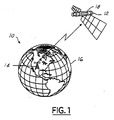
- the satellite spot beam hopping packet scheduler system 10 is comprised of one or more satellites 12 in communication with a ground station 14 located on the Earth 16. Each satellite 12 contains one or more spot beam hopping packet scheduler system 18 to transmit data to one or more ground stations 14.
- the spot beam hopping packet scheduler system 18 includes a downlink queue 20, a downlink queue search controller 21, a cache 22, a cache search controller, and a plurality of pointer output registers 24.
- the plurality of pointer output registers 24 are used to supply burst information to an antenna controller 26 for setting the beam coordinates and other parameters.
- the downlink queue 20 is coupled to a congestion controller and burst assembly 28 and receives Downlink Cell ID and Burst Memory Pointers written in first in, first out order to the downlink queue 20.
- the downlink queue 20 includes a ping side 30 and a pong side 32 that may be swapped when Cache Depth/2 time slots expire.
- the downlink queue 20 is coupled to the downlink queue search controller 21 and the cache 22 and provides data to the cache 22 in order to fill any appropriate empty locations in the cache 22.
- the cache 22 is divided into equal halves representing a left hand pole cell ID 34 and a right hand pole cell ID 36.
- the Cache Search Controller is coupled to the cache and searches the cache to find compatible packet bursts.
- the contents of incoming packets are stored in main packet memory. Copies of the destination cell IDs and pointers to packet memory are managed and manipulated enough to determine the sequence order by which the main packet memory is read out for transmission through spot beams to their destination. The final stage of this "manipulation" is the scheduling.
- the downlink queue 20 serves as a cost-effective buffer for the next cache stage 22.
- the cache 22 has a small first in, first out (FIFO) queue for each destination cell ID and requires more hardware resources to implement relative to the downlink queue 20 and, therefore, needs to be as small as possible.
- FIFO first in, first out
- a seed packet is selected followed by enough compatible packets to fill all parallel spot beams.
- New seeds are selected for each downlink time division slot time. The seeds are by default selected in a round-robin method across a pre-configured [per slot] sequential downlink cell range having traffic appropriate to the data rate and slot.
- the round-robin order is configurable to support other search orders by performing the search on a Cell ID search order table which contains the cell IDs in the desired order and weighting (weighting is proportional to the multiplicity of Cell ID entries in the search order table).
- the downlink queue 20 is searched to find packet bursts and fill any appropriate empty locations in the cache. It will take Cache Depth/2 time slots to search the entire downlink queue 20.
- the downlink queue FIFO order for each virtual connection i.e., traffic per Cell ID
- the cache skip flags disables the search for subsequent matches for the Cell IDs whose first match was skipped due to the respective Cache Queue being full.
- the cache skip flags are cleared before the downlink queue search restarts for each iteration.
- the ping 30 and pong 32 implementation of the downlink queue 20 can be optimized for the size of the downlink queue 20 memory. Instead of splitting the downlink queue 20 into two parts, ping 30 and pong 32, it can be split into more parts.
- the shuffling method so far has been illustrated for the simple ping/pong downlink queue 20 implementation. For a downlink queue split more than two halves, the shuffling would select a pair of adjacent buffers and label them ping and pong until one or both buffers have been completely processed.
- the adjacent buffer(s) will be enabled and labeled as ping or pong as appropriate and processing continues on the newly selected buffer(s).
- searching completes on a buffer, the search continues on the adjacent buffer until the end of the downlink queue is reached.
- the cache search controller searches the cache to find mutually compatible packet bursts.
- the cache cell ID search procedure is described below.
- the cache cell ID search procedure has two stages where one stage searches for a cell ID pointer and the second stage does an indirect lookup of the cell ID from the Cell ID Search Order Table memory location specified by the cell ID pointer.
- the first stage has two search regions. Search Region 0 39 is defined per time slot basis so that the respective time slot can be confined for servicing the group of Cell IDs specified in the cell ID search order table. Flexibility has been added by providing two search modes.
- Search Mode 0 confines the search to search region 0 39 where the search continues sequentially, in a round-robin manner until the time slot period expires or until all spot beams have been assigned using a beam assignment algorithm.
- Search Mode 1 allows the cell ID pointer search to perform one sequential loop in Search Region 0 39, followed by another sequential loop in Search Region 1 38. The said double loop repeats until either the time slot period expires or ail spot beams have been assigned.
- the two search modes allows the operator to choose between prioritization of a time slot to a group of cell IDs, and providing exclusivity to a group of cell IDs.
- the said search modes provide prioritized service to destination cells at the time slot level.
- Last Seed Fairness in the seed packet burst selection is maintained by remembering the search start cell ID pointers, referred as the Last Seed.
- a unique Last Seed (n) is associated with each cell ID pointer range where there are “n” pointer ranges consisting of Start(n), Stop(n), Seed Mode(n), and Search Mode(n) and each parameter associated with "n” is pre-cnnfigured to zero or more time slots.
- the “n” is proportional to the flexibility needed for the business model and represents the number of prioritization settings between time slots. The importance of remembering the last seed is that on the next time slot that uses "n", the search for the seed can start at a different cell ID pointer and give opportunity for other cell ID pointers to be selected.
- This concept is the key to achieve fairness since the seed packet burst (with traffic) always gets chosen since there are no other packet bursts assigned for it to be incompatible with. Since the seed packet burst always gets assigned to an available spot beam, it is important not to choose the same packet burst as a seed in consecutive time slots for "n".
- the spot beam hopping packet scheduler system provides two seed search modes to achieve fairness.
- seed mode 1 the cache search controller starts the seed search by choosing the cell ID pointers sequentially in a round-robin method for each time slot associated with "n" regardless of whether the cell ID associated with the cell ID pointer has packet traffic or not.
- seed mode 1 the cache search controller starts the seed search from the next cell ID pointer that has a cell ID with packet traffic.
- the seed mode 1 achieves better performance for bursty, low packet queuing load and maintains fairness on all traffic conditions.
- seed mode 0 achieves better performance for bursty, high average packet queuing load but preserves fairness if there are no significant number of consecutive cell IDs without packet traffic.
- seed modes provide flexibility to the desired balance of fairness and queuing performance.
- the cell ID pointer is looked up in the cell ID search order table to obtain the cell ID.
- Each Cell ID is used to determine whether it has packet bursts in the cache FIFO and any beams area available. If so, determine if the cell ID is compatible with any cell IDs previously assigned to a spot beam in the same time slot. The compatibility is determined by performing a beam isolation check an aggregate power check , and an amplifier power check. The beam-isolation check is performed on a cell IDs currently assigned to beams to verify that the new cell ID is compatible with them.
- the aggregate power check is performed to verify that the new cell ID does not require beam amplifier power which when added to the power requirements of the other previously assigned cell IDs does not exceed the total transponder power.
- the amplifier power check is performed on all available beam amplifiers not assigned to other cell IDs to verify that at least one of them has sufficient capability to amplify the beam for the new cell ID. If all checks are positive, then the packet burst of the new cell ID under consideration will be assigned to the lowest power capable beam amplifier that meets or exceeds the power requirements of the new cell ID as shown in the spot beam assignment algorithm. At the end of the slot, all assigned Cell IDs will be scheduled out by de-queuing their respective packet burst and antenna control information from the cache 22 and eventually from the external packet memory and appropriate information is sent to the antenna controller and modulators to be beamed down.
- the method and system of the present invention thus achieves maximum efficiency in finding compatible packets while implementing fairness between destination cells. Additionally, the present invention allows greater downlink/output bandwidth utilization by enabling the packet selection to be made across all destination cells having packet traffic.
- the shared queue and cache together appear as a virtual queue per destination cell ID, optimize the search for compatible packets/bursts, and add flexibility in packet/burst selection (for quality of service control).
- a spot beam hopping packet scheduler system (18) performs efficient switching over links such as hopped spot beams which compete with each other for physical properties and resources.
- the spot beam hopping packet scheduler system (18) provides statistical weighting and prioritization capabilities while accommodating resource competing links such as wireless hopped spot beams.
- the spot beam hopping packet scheduler system (18) receives downlink cell ID and packet burst memory pointers from a burst assembly/congestion controller (28) and provides packet burst information to antenna controller and modulators (26).
- the spot beam hopping packet scheduler system (18) includes a downlink queue (20) that is coupled to the burst assembly/congestion controller (28) and receives the downlink cell ID and packet burst memory pointers.
- a cache (22) is coupled to the downlink queue (20) and receives and stores data from the downlink queue (20).
- a downlink search controller (21) is coupled to the downlink queue (20) and the cache (22) and includes control logic operative to search the downlink queue (20) for packet bursts, and fill any empty cache slots with appropriate data from said downlink queue (20).
- a cache search controller is coupled to the cache (22) and includes control logic operative to search the cache (22) in a pre-configured weighted order for compatible packet bursts based on beam angle interference, beam amplifier power and aggregate target power.
Landscapes
- Engineering & Computer Science (AREA)
- Computer Networks & Wireless Communication (AREA)
- Signal Processing (AREA)
- Databases & Information Systems (AREA)
- Mobile Radio Communication Systems (AREA)
- Data Exchanges In Wide-Area Networks (AREA)
Abstract
Description
Claims (10)
- A spot beam hopping packet scheduler system (18) receiving downlink cell ID and burst memory pointers from a burst assembly and congestion controller (28), said spot beam hopping packet scheduler system (18) providing burst information to an antenna controller and modulator (26), said spot beam-hopping packet scheduler system (18) comprising:a downlink queue (20) coupled to said burst assembly and congestion controller (28), said downlink queue (20) receiving and storing said downlink cell ID and burst memory pointers;a cache (22) coupled to said downlink queue (20), said cache (22) receiving and storing said downlink cell ID and burst memory pointers from said downlink queue (20);a downlink search controller (21) coupled to said downlink queue (20) and said cache (22), said downlink search controller (21) having control logic operative to search said downlink queue (20) for packet bursts, and fill any empty cache slots with data from said downlink queue (20); anda cache search controller coupled to said cache (22), said cache search controller having control logic operative to select a seed packet from said cache (22) in statistically weighted order, select compatible packets from said cache (22) with statistically weighted order and assign packet bursts to spot beams.
- The spot beam hopping packet scheduler system (18) as recited in claim 1, further comprising a plurality of pointer output registers (24) coupled to said cache (22) and receiving downlink cell ID and burst memory pointers, said plurality of pointer output registers (24) providing burst information to said antenna controller and modulators (26).
- The spot beam hopping packet scheduler system (18) as recited in claim 1 or 2, wherein said downlink queue (20) includes a ping side (30) and a pong side (32), whereby said downlink queue (20) swaps said ping side (30) and said pong side (31) when Cache Depth/2 time slots expire.
- The spot beam hopping packet scheduler system (18) as recited in any of claims 1 - 3, wherein said cache (22) includes a plurality of left hand pole Cell IDs (34) and a plurality of right hand pole Cell IDs (36).
- The spot beam hopping packet scheduler system (18) as recited in any of the preceding claims, wherein said seed packet burst is selected in a round-robin method across a pre-configured downlink cell range, using a starting point for a search to find said seed packet burst by searching in a pre-configured seed search mode, said seed mode consisting of Mode 1 seed and Mode 0 seed search.
- The spot beam hopping packet scheduler system (18) as recited in any of the preceding claims, wherein said seed packet burst is selected in a round-robin method across a pre-configured downlink cell range, using a starting point for a search to find said seed packet burst by searching in a pre-configured seed mode, said seed mode consisting of skipping mode and/or the non-skipping mode.
- The spot beam hopping packet scheduler system (18) as recited in any of the preceding claims, wherein said non-seed packet bursts compatible with the seed packet burst and each other are searched in a round-robin method across a pre-configured downlink cell range, said compatibility of non-seed packet bursts determined by checking beam angle isolation, beam amplifier power, aggregate target power, and cache count.
- The spot beam hopping packet scheduler system (18) as recited in any of the preceding claims, wherein said down-link cell range contains a pre-configured search order table of Cell IDs with ability for a multiplicity of identical cell ID entries to provide a statistically weighted fair queuing proportional to said multiplicity in order to provide advanced control over quality of service, said pre-configured downlink cell range allowing unique settings between time slots to dedicate time slots for selected geographic regions and provide quality of service which can be unique between time slots.
- The spot beam hopping packet scheduler system (18) as recited in any of the preceding claims, wherein said burst packet is extracted from said downlink queue (20) using a shuffling method.
- The spot beam hopping packet scheduler system (18) as recited in any of the preceding claims, wherein said cache (22) includes a plurality of memory locations, each of said memory locations having a first in, first out queue.
Applications Claiming Priority (2)
| Application Number | Priority Date | Filing Date | Title |
|---|---|---|---|
| US782690 | 2001-02-13 | ||
| US09/782,690 US20020110094A1 (en) | 2001-02-13 | 2001-02-13 | Spot beam hopping packet scheduler system |
Publications (3)
| Publication Number | Publication Date |
|---|---|
| EP1231743A2 true EP1231743A2 (en) | 2002-08-14 |
| EP1231743A3 EP1231743A3 (en) | 2004-06-16 |
| EP1231743B1 EP1231743B1 (en) | 2005-10-12 |
Family
ID=25126871
Family Applications (1)
| Application Number | Title | Priority Date | Filing Date |
|---|---|---|---|
| EP02003325A Expired - Lifetime EP1231743B1 (en) | 2001-02-13 | 2002-02-13 | Spot beam hopping packet scheduler system |
Country Status (3)
| Country | Link |
|---|---|
| US (2) | US20020110094A1 (en) |
| EP (1) | EP1231743B1 (en) |
| DE (1) | DE60206537T2 (en) |
Cited By (2)
| Publication number | Priority date | Publication date | Assignee | Title |
|---|---|---|---|---|
| EP2549663A3 (en) * | 2011-07-19 | 2014-05-07 | 2201028 Ontario Inc. | Satellite based messaging system |
| CN115051743A (en) * | 2022-04-13 | 2022-09-13 | 北京空灵网科技术有限公司 | Method and device for generating hopping beams and electronic equipment |
Families Citing this family (43)
| Publication number | Priority date | Publication date | Assignee | Title |
|---|---|---|---|---|
| EP2052562B1 (en) * | 2006-08-15 | 2012-11-28 | Telefonaktiebolaget LM Ericsson (publ) | Method and apparatus for scheduling resources and avoiding interference in a multi-cellular wireless communication system |
| WO2008027974A2 (en) | 2006-08-29 | 2008-03-06 | Wildblue Communications, Inc. | Network-access satellite communication system |
| CN101573891A (en) * | 2006-10-03 | 2009-11-04 | 维尔塞特公司 | Upfront delayed concatenation in satellite communication system |
| CN101573890A (en) * | 2006-10-03 | 2009-11-04 | 维尔塞特公司 | MAP-trigger dump of packets in satellite communication system |
| WO2008060757A2 (en) * | 2006-10-03 | 2008-05-22 | Viasat, Inc. | Large packet concatenation in satellite communication system |
| EP2074712B1 (en) * | 2006-10-03 | 2012-04-11 | ViaSat, Inc. | Web/bulk transfer preallocation of upstream resources in a satellite communication system |
| US7869759B2 (en) * | 2006-12-14 | 2011-01-11 | Viasat, Inc. | Satellite communication system and method with asymmetric feeder and service frequency bands |
| US8311006B2 (en) | 2008-11-10 | 2012-11-13 | Viasat, Inc. | Resource fairness policies for allocation of resources in a satellite communications system |
| US8265646B2 (en) * | 2008-11-10 | 2012-09-11 | Viasat, Inc. | Dynamic frequency assignment in a multi-beam system |
| US8432805B2 (en) | 2008-11-10 | 2013-04-30 | Viasat, Inc. | Bandwidth allocation across beams in a multi-beam system |
| WO2010068012A2 (en) * | 2008-12-09 | 2010-06-17 | 엘지전자주식회사 | Method and apparatus for releasing blank zone by macro base station in wireless communication system |
| US9374131B2 (en) | 2009-01-28 | 2016-06-21 | Qualcomm Incorporated | Frequency hopping in a wireless communication network |
| WO2010148022A1 (en) | 2009-06-16 | 2010-12-23 | Viasat, Inc. | Dynamic bandwidth resource allocation for satellite downlinks |
| US9184829B2 (en) | 2010-05-02 | 2015-11-10 | Viasat Inc. | Flexible capacity satellite communications system |
| US8218476B2 (en) | 2010-05-02 | 2012-07-10 | Viasat, Inc. | Flexible capacity satellite communications system with dynamic distribution and coverage areas |
| US10511379B2 (en) | 2010-05-02 | 2019-12-17 | Viasat, Inc. | Flexible beamforming for satellite communications |
| US8340015B1 (en) | 2011-07-29 | 2012-12-25 | Viasat, Inc. | Incremental gateway deployment in a hub-spoke satellite communication system using static spot beams |
| US8509144B2 (en) | 2011-12-08 | 2013-08-13 | Viasat, Inc. | Bent pipe beam switching for virtual utility gateways |
| WO2013086338A1 (en) | 2011-12-08 | 2013-06-13 | Viasat, Inc. | Interference management in a hub-spoke spot beam satellite communication system |
| US9275690B2 (en) | 2012-05-30 | 2016-03-01 | Tahoe Rf Semiconductor, Inc. | Power management in an electronic system through reducing energy usage of a battery and/or controlling an output power of an amplifier thereof |
| US8805275B2 (en) | 2012-06-11 | 2014-08-12 | Viasat Inc. | Robust beam switch scheduling |
| US9083649B2 (en) * | 2012-07-02 | 2015-07-14 | Cox Communications, Inc. | Systems and methods for managing network bandwidth via content buffering |
| US9509351B2 (en) | 2012-07-27 | 2016-11-29 | Tahoe Rf Semiconductor, Inc. | Simultaneous accommodation of a low power signal and an interfering signal in a radio frequency (RF) receiver |
| US9716315B2 (en) | 2013-03-15 | 2017-07-25 | Gigpeak, Inc. | Automatic high-resolution adaptive beam-steering |
| US9184498B2 (en) | 2013-03-15 | 2015-11-10 | Gigoptix, Inc. | Extending beamforming capability of a coupled voltage controlled oscillator (VCO) array during local oscillator (LO) signal generation through fine control of a tunable frequency of a tank circuit of a VCO thereof |
| US9666942B2 (en) | 2013-03-15 | 2017-05-30 | Gigpeak, Inc. | Adaptive transmit array for beam-steering |
| US9780449B2 (en) | 2013-03-15 | 2017-10-03 | Integrated Device Technology, Inc. | Phase shift based improved reference input frequency signal injection into a coupled voltage controlled oscillator (VCO) array during local oscillator (LO) signal generation to reduce a phase-steering requirement during beamforming |
| US9722310B2 (en) | 2013-03-15 | 2017-08-01 | Gigpeak, Inc. | Extending beamforming capability of a coupled voltage controlled oscillator (VCO) array during local oscillator (LO) signal generation through frequency multiplication |
| US9531070B2 (en) | 2013-03-15 | 2016-12-27 | Christopher T. Schiller | Extending beamforming capability of a coupled voltage controlled oscillator (VCO) array during local oscillator (LO) signal generation through accommodating differential coupling between VCOs thereof |
| US9837714B2 (en) | 2013-03-15 | 2017-12-05 | Integrated Device Technology, Inc. | Extending beamforming capability of a coupled voltage controlled oscillator (VCO) array during local oscillator (LO) signal generation through a circular configuration thereof |
| EP4672635A3 (en) * | 2015-07-31 | 2026-03-18 | ViaSat, Inc. | Flexible capacity satellite constellation |
| WO2017111961A1 (en) * | 2015-12-22 | 2017-06-29 | Intel Corporation | Fast directional cell acquisition and differential beam tracking in millimeter-wave cellular system with hybrid beamforming architecture |
| US10594046B2 (en) * | 2016-03-29 | 2020-03-17 | Space Systems/Loral, Llc | Satellite system with single polarization path |
| JP7060585B2 (en) * | 2016-09-13 | 2022-04-26 | クアルコム,インコーポレイテッド | Neighboring cell list in satellite communication system |
| EP3832902A1 (en) * | 2017-02-13 | 2021-06-09 | Guangdong Oppo Mobile Telecommunications Corp., Ltd. | Wireless communication method, terminal device and network device |
| CR20190505A (en) | 2017-04-10 | 2020-03-26 | Viasat Inc | Coverage area adjustment to adapt satellite communications |
| CN117394952B (en) * | 2018-07-06 | 2024-09-24 | 华为技术有限公司 | Method and device for transmitting coded bits |
| US11283666B1 (en) | 2020-02-29 | 2022-03-22 | Space Exploration Technologies Corp. | Stochastic digital pre-distortion compensation in a wireless communications system |
| US12003350B1 (en) | 2020-02-29 | 2024-06-04 | Space Exploration Technologies Corp. | Configurable orthogonal frequency division multiplexing (OFDM) signal and transmitter and receiver for user terminal to satellite uplink communications |
| US12591719B2 (en) * | 2021-12-21 | 2026-03-31 | The Boeing Company | Computer simulation environment with output models and input models |
| CN114928400B (en) * | 2022-05-09 | 2023-03-03 | 北京理工大学 | Low-orbit satellite dynamic resource allocation method based on beam hopping |
| US20240064712A1 (en) * | 2022-08-18 | 2024-02-22 | Gorilla Link LTD | Iot satellite communication optimization |
| CN118764077B (en) * | 2024-09-06 | 2024-12-20 | 中国电子科技集团公司第五十四研究所 | A high-orbit and low-orbit satellite beam-hopping adjustment method based on service queue |
Family Cites Families (32)
| Publication number | Priority date | Publication date | Assignee | Title |
|---|---|---|---|---|
| JPS60245083A (en) * | 1984-05-18 | 1985-12-04 | Brother Ind Ltd | electronic dictionary |
| JPH02117243A (en) * | 1988-10-27 | 1990-05-01 | Toshiba Corp | Packet communication equipment |
| US5736959A (en) * | 1991-10-28 | 1998-04-07 | Teledesic Corporation | Earth-fixed cell beam management for satellite communication system using dielectic lens-focused scanning beam antennas |
| CA2121586A1 (en) * | 1991-11-08 | 1993-05-13 | David Palmer Patterson | Switching methods for satellite communication system |
| JPH05236466A (en) * | 1992-02-25 | 1993-09-10 | Nec Corp | Device and method for inter-frame predictive image encoding for motion compensation |
| US5448621A (en) * | 1993-08-02 | 1995-09-05 | Motorola, Inc. | Dynamic reallocation of spectral capacity in cellular communication systems |
| US5612952A (en) * | 1993-09-20 | 1997-03-18 | Kabushiki Kaisha Toshiba | Packet switch and buffer for storing and processing packets routing to different ports |
| SE502576C2 (en) * | 1993-11-26 | 1995-11-13 | Ellemtel Utvecklings Ab | Fault tolerant queuing system |
| US5455825A (en) * | 1994-04-28 | 1995-10-03 | Mitsubishi Electric Research Laboratories | Tag-based scheduling system for digital communication switch |
| EP0692893B1 (en) * | 1994-07-12 | 2000-03-01 | Ascom AG | Equipment for switching in digital ATM networks |
| JP3612105B2 (en) * | 1995-03-13 | 2005-01-19 | 株式会社東芝 | ATM communication system and process migration method in ATM communication system |
| JPH0918357A (en) * | 1995-06-30 | 1997-01-17 | Sony Corp | Data shuffling method and apparatus |
| GB2303764A (en) * | 1995-07-28 | 1997-02-26 | Int Mobile Satellite Org | Communication with a mobile station in an unknown spot beam |
| US5812545A (en) * | 1996-01-04 | 1998-09-22 | Orion Atlantic, L.P. | Full mesh satellite-based multimedia networking system |
| US6377561B1 (en) * | 1996-06-24 | 2002-04-23 | Spar Aerospace Limited | Data communication satellite system and method of carrying multi-media traffic |
| US5959631A (en) * | 1996-08-28 | 1999-09-28 | Hewlett-Packard Company | Hardware and software for the visualization of three-dimensional data sets |
| US5917506A (en) * | 1996-12-05 | 1999-06-29 | Winbond Electronics Corp. | Fast data alignment display queue structure for image block transfer |
| US5883819A (en) * | 1996-12-31 | 1999-03-16 | Northern Telecom Limited | Method and system for quality of service assessment for multimedia traffic under aggregate traffic conditions |
| US5790070A (en) * | 1997-05-05 | 1998-08-04 | Motorola, Inc. | Network and method for controlling steerable beams |
| DE19742378A1 (en) * | 1997-09-25 | 1999-04-22 | Siemens Ag | Ring memory for a TDMA data transmission station and corresponding data transmission station |
| CA2229577A1 (en) * | 1998-02-12 | 1999-08-12 | Newbridge Networks Corporation | Method and apparatus for controlling traffic flows in a packet-switched network in order to guarantee service performance |
| US6366761B1 (en) * | 1998-10-06 | 2002-04-02 | Teledesic Llc | Priority-based bandwidth allocation and bandwidth-on-demand in a low-earth-orbit satellite data communication network |
| US6459681B1 (en) * | 1998-11-13 | 2002-10-01 | Sprint Communications Company L.P. | Method and system for connection admission control |
| US6381228B1 (en) * | 1999-01-15 | 2002-04-30 | Trw Inc. | Onboard control of demand assigned multiple access protocol for satellite ATM networks |
| US6424622B1 (en) * | 1999-02-12 | 2002-07-23 | Nec Usa, Inc. | Optimal buffer management scheme with dynamic queue length thresholds for ATM switches |
| US6449267B1 (en) * | 1999-02-24 | 2002-09-10 | Hughes Electronics Corporation | Method and apparatus for medium access control from integrated services packet-switched satellite networks |
| US6404749B1 (en) * | 1999-03-08 | 2002-06-11 | Trw Inc. | Method for providing connectionless data services over a connection-oriented satellite network |
| US6445707B1 (en) * | 1999-04-21 | 2002-09-03 | Ems Technologies Canada, Limited | Broadcast rate control allocation (BRCA) for congestion avoidance in satellite ATM networks |
| US6574202B1 (en) * | 1999-07-14 | 2003-06-03 | Lucent Technologies Inc. | Method for interleaving information conveyed in a wireless communication system |
| US6618399B1 (en) * | 1999-10-27 | 2003-09-09 | Cisco Technology, Inc. | System and method for eliminating jitter by using a starve/inspect approach to AAL1 |
| US6738350B1 (en) * | 2000-03-16 | 2004-05-18 | Hughes Electronics Corporation | Congestion avoidance approach for a switching communication system with transmission constraints |
| US6628919B1 (en) * | 2000-08-09 | 2003-09-30 | Hughes Electronics Corporation | Low-cost multi-mission broadband communications payload |
-
2001
- 2001-02-13 US US09/782,690 patent/US20020110094A1/en not_active Abandoned
-
2002
- 2002-02-13 DE DE60206537T patent/DE60206537T2/en not_active Expired - Lifetime
- 2002-02-13 EP EP02003325A patent/EP1231743B1/en not_active Expired - Lifetime
- 2002-06-18 US US10/174,080 patent/US6980530B2/en not_active Expired - Fee Related
Cited By (4)
| Publication number | Priority date | Publication date | Assignee | Title |
|---|---|---|---|---|
| EP2549663A3 (en) * | 2011-07-19 | 2014-05-07 | 2201028 Ontario Inc. | Satellite based messaging system |
| US8817603B2 (en) | 2011-07-19 | 2014-08-26 | Skywave Mobile Communications Inc. | Satellite-based messaging system |
| CN115051743A (en) * | 2022-04-13 | 2022-09-13 | 北京空灵网科技术有限公司 | Method and device for generating hopping beams and electronic equipment |
| CN115051743B (en) * | 2022-04-13 | 2023-03-24 | 北京空灵网科技术有限公司 | Method and device for generating hopping beams and electronic equipment |
Also Published As
| Publication number | Publication date |
|---|---|
| US6980530B2 (en) | 2005-12-27 |
| DE60206537D1 (en) | 2006-02-23 |
| US20020159403A1 (en) | 2002-10-31 |
| DE60206537T2 (en) | 2006-07-06 |
| EP1231743A3 (en) | 2004-06-16 |
| EP1231743B1 (en) | 2005-10-12 |
| US20020110094A1 (en) | 2002-08-15 |
Similar Documents
| Publication | Publication Date | Title |
|---|---|---|
| EP1231743B1 (en) | Spot beam hopping packet scheduler system | |
| US7016375B1 (en) | Integrated connection admission control and bandwidth on demand for a access asynchronous network | |
| EP1445897B1 (en) | Scheduling system and method for a burst switch | |
| US5991295A (en) | Digital switch | |
| US7002918B1 (en) | Method and apparatus for real time scheduling in a satellite communications network | |
| US6377561B1 (en) | Data communication satellite system and method of carrying multi-media traffic | |
| US6018527A (en) | Queue service interval based cell scheduler with hierarchical queuing configurations | |
| US6646986B1 (en) | Scheduling of variable sized packet data under transfer rate control | |
| JP3479490B2 (en) | Hierarchical downlink scheduler for processed satellite payloads | |
| US20040184470A1 (en) | System and method for data routing | |
| US6404749B1 (en) | Method for providing connectionless data services over a connection-oriented satellite network | |
| WO2002073898A2 (en) | Priority-based dynamic resource allocation method and apparatus for supply-demand systems | |
| WO2002073865A2 (en) | Time based packet scheduling and sorting system | |
| US6597669B1 (en) | Queue segmentation and addressing method and apparatus for a cell switch in a processing communications satellite | |
| JPH10285185A (en) | Method of scheduling data cell transmission in an ATM network | |
| Turner | WDM burst switching for petabit data networks | |
| WO2008007255A2 (en) | Method for scheduling of packets in tdma channels | |
| US6208652B1 (en) | Increment scheduler | |
| US7012929B2 (en) | System and method for assigning time slots in communication system and network-side apparatus used therefor | |
| EP1330898A2 (en) | A distributed asynchronous transfer mode (atm) switch architecture for satellites | |
| US20040184464A1 (en) | Data processing apparatus | |
| EP1521411A2 (en) | Method and apparatus for request/grant priority scheduling | |
| Todorova et al. | Quality-of-service-oriented media access control for advanced mobile multimedia satellite systems | |
| CA2280782C (en) | Method and circuit arrangement for the transmission of message cells during the course of virtual connections having different priorities | |
| US6973089B1 (en) | Beam hopping self addressed packet switched communication system with locally intelligent scheduling |
Legal Events
| Date | Code | Title | Description |
|---|---|---|---|
| PUAI | Public reference made under article 153(3) epc to a published international application that has entered the european phase |
Free format text: ORIGINAL CODE: 0009012 |
|
| AK | Designated contracting states |
Kind code of ref document: A2 Designated state(s): AT BE CH CY DE DK ES FI FR GB GR IE IT LI LU MC NL PT SE TR |
|
| AX | Request for extension of the european patent |
Free format text: AL;LT;LV;MK;RO;SI |
|
| PUAL | Search report despatched |
Free format text: ORIGINAL CODE: 0009013 |
|
| AK | Designated contracting states |
Kind code of ref document: A3 Designated state(s): AT BE CH CY DE DK ES FI FR GB GR IE IT LI LU MC NL PT SE TR |
|
| AX | Request for extension of the european patent |
Extension state: AL LT LV MK RO SI |
|
| RIC1 | Information provided on ipc code assigned before grant |
Ipc: 7H 04B 7/185 B Ipc: 7H 04L 12/56 A |
|
| 17P | Request for examination filed |
Effective date: 20041208 |
|
| AKX | Designation fees paid |
Designated state(s): DE FR GB |
|
| GRAP | Despatch of communication of intention to grant a patent |
Free format text: ORIGINAL CODE: EPIDOSNIGR1 |
|
| GRAS | Grant fee paid |
Free format text: ORIGINAL CODE: EPIDOSNIGR3 |
|
| GRAA | (expected) grant |
Free format text: ORIGINAL CODE: 0009210 |
|
| AK | Designated contracting states |
Kind code of ref document: B1 Designated state(s): DE FR GB |
|
| REG | Reference to a national code |
Ref country code: GB Ref legal event code: FG4D |
|
| REF | Corresponds to: |
Ref document number: 60206537 Country of ref document: DE Date of ref document: 20060223 Kind code of ref document: P |
|
| ET | Fr: translation filed | ||
| PLBE | No opposition filed within time limit |
Free format text: ORIGINAL CODE: 0009261 |
|
| STAA | Information on the status of an ep patent application or granted ep patent |
Free format text: STATUS: NO OPPOSITION FILED WITHIN TIME LIMIT |
|
| 26N | No opposition filed |
Effective date: 20060713 |
|
| REG | Reference to a national code |
Ref country code: FR Ref legal event code: PLFP Year of fee payment: 15 |
|
| REG | Reference to a national code |
Ref country code: FR Ref legal event code: PLFP Year of fee payment: 16 |
|
| PGFP | Annual fee paid to national office [announced via postgrant information from national office to epo] |
Ref country code: FR Payment date: 20170223 Year of fee payment: 16 Ref country code: DE Payment date: 20170227 Year of fee payment: 16 |
|
| PGFP | Annual fee paid to national office [announced via postgrant information from national office to epo] |
Ref country code: GB Payment date: 20170227 Year of fee payment: 16 |
|
| REG | Reference to a national code |
Ref country code: DE Ref legal event code: R119 Ref document number: 60206537 Country of ref document: DE |
|
| GBPC | Gb: european patent ceased through non-payment of renewal fee |
Effective date: 20180213 |
|
| REG | Reference to a national code |
Ref country code: FR Ref legal event code: ST Effective date: 20181031 |
|
| PG25 | Lapsed in a contracting state [announced via postgrant information from national office to epo] |
Ref country code: DE Free format text: LAPSE BECAUSE OF NON-PAYMENT OF DUE FEES Effective date: 20180901 |
|
| PG25 | Lapsed in a contracting state [announced via postgrant information from national office to epo] |
Ref country code: GB Free format text: LAPSE BECAUSE OF NON-PAYMENT OF DUE FEES Effective date: 20180213 Ref country code: FR Free format text: LAPSE BECAUSE OF NON-PAYMENT OF DUE FEES Effective date: 20180228 |