EP1231241A1 - Dual curable organopolysiloxane composition - Google Patents
Dual curable organopolysiloxane composition Download PDFInfo
- Publication number
- EP1231241A1 EP1231241A1 EP02002686A EP02002686A EP1231241A1 EP 1231241 A1 EP1231241 A1 EP 1231241A1 EP 02002686 A EP02002686 A EP 02002686A EP 02002686 A EP02002686 A EP 02002686A EP 1231241 A1 EP1231241 A1 EP 1231241A1
- Authority
- EP
- European Patent Office
- Prior art keywords
- group
- carbon atoms
- groups
- organopolysiloxane composition
- composition according
- Prior art date
- Legal status (The legal status is an assumption and is not a legal conclusion. Google has not performed a legal analysis and makes no representation as to the accuracy of the status listed.)
- Granted
Links
- 239000000203 mixture Substances 0.000 title claims abstract description 61
- 229920001296 polysiloxane Polymers 0.000 title claims abstract description 40
- 230000009977 dual effect Effects 0.000 title 1
- 125000001183 hydrocarbyl group Chemical group 0.000 claims abstract description 27
- 125000002496 methyl group Chemical group [H]C([H])([H])* 0.000 claims abstract description 15
- 125000001997 phenyl group Chemical group [H]C1=C([H])C([H])=C(*)C([H])=C1[H] 0.000 claims abstract description 14
- 239000003054 catalyst Substances 0.000 claims abstract description 13
- 238000013005 condensation curing Methods 0.000 claims abstract description 12
- 150000003961 organosilicon compounds Chemical class 0.000 claims abstract description 12
- 239000003999 initiator Substances 0.000 claims abstract description 9
- 125000004435 hydrogen atom Chemical group [H]* 0.000 claims abstract description 8
- 125000004430 oxygen atom Chemical group O* 0.000 claims abstract description 4
- 125000004432 carbon atom Chemical group C* 0.000 claims description 36
- -1 amine salt Chemical class 0.000 claims description 26
- 150000001875 compounds Chemical class 0.000 claims description 14
- 239000000470 constituent Substances 0.000 claims description 11
- 125000000217 alkyl group Chemical group 0.000 claims description 9
- 125000003545 alkoxy group Chemical group 0.000 claims description 5
- 125000002947 alkylene group Chemical group 0.000 claims description 5
- 125000003302 alkenyloxy group Chemical group 0.000 claims description 4
- 229910052736 halogen Inorganic materials 0.000 claims description 4
- 125000005843 halogen group Chemical group 0.000 claims description 4
- 125000003342 alkenyl group Chemical group 0.000 claims description 3
- 125000003710 aryl alkyl group Chemical group 0.000 claims description 3
- 125000003118 aryl group Chemical group 0.000 claims description 3
- 125000000732 arylene group Chemical group 0.000 claims description 3
- 125000005156 substituted alkylene group Chemical group 0.000 claims description 3
- 239000003377 acid catalyst Substances 0.000 claims description 2
- 125000004423 acyloxy group Chemical group 0.000 claims description 2
- 238000001723 curing Methods 0.000 abstract description 38
- 239000000758 substrate Substances 0.000 abstract description 11
- 238000009833 condensation Methods 0.000 abstract description 7
- 230000005494 condensation Effects 0.000 abstract description 7
- 230000007246 mechanism Effects 0.000 abstract description 6
- 230000002349 favourable effect Effects 0.000 abstract description 3
- 239000004215 Carbon black (E152) Substances 0.000 abstract 1
- 229930195733 hydrocarbon Natural products 0.000 abstract 1
- 150000002430 hydrocarbons Chemical group 0.000 abstract 1
- 125000002887 hydroxy group Chemical group [H]O* 0.000 abstract 1
- 238000006243 chemical reaction Methods 0.000 description 16
- 230000000704 physical effect Effects 0.000 description 14
- YXFVVABEGXRONW-UHFFFAOYSA-N Toluene Chemical compound CC1=CC=CC=C1 YXFVVABEGXRONW-UHFFFAOYSA-N 0.000 description 12
- ZMANZCXQSJIPKH-UHFFFAOYSA-N Triethylamine Chemical compound CCN(CC)CC ZMANZCXQSJIPKH-UHFFFAOYSA-N 0.000 description 12
- 239000004925 Acrylic resin Substances 0.000 description 10
- 229920000178 Acrylic resin Polymers 0.000 description 10
- 229910052782 aluminium Inorganic materials 0.000 description 10
- XAGFODPZIPBFFR-UHFFFAOYSA-N aluminium Chemical compound [Al] XAGFODPZIPBFFR-UHFFFAOYSA-N 0.000 description 10
- 239000003822 epoxy resin Substances 0.000 description 10
- 239000011521 glass Substances 0.000 description 10
- 229920000647 polyepoxide Polymers 0.000 description 10
- UWGIJJRGSGDBFJ-UHFFFAOYSA-N dichloromethylsilane Chemical compound [SiH3]C(Cl)Cl UWGIJJRGSGDBFJ-UHFFFAOYSA-N 0.000 description 9
- YIWUKEYIRIRTPP-UHFFFAOYSA-N 2-ethylhexan-1-ol Chemical compound CCCCC(CC)CO YIWUKEYIRIRTPP-UHFFFAOYSA-N 0.000 description 8
- 238000001914 filtration Methods 0.000 description 8
- 125000003647 acryloyl group Chemical group O=C([*])C([H])=C([H])[H] 0.000 description 7
- AFCARXCZXQIEQB-UHFFFAOYSA-N N-[3-oxo-3-(2,4,6,7-tetrahydrotriazolo[4,5-c]pyridin-5-yl)propyl]-2-[[3-(trifluoromethoxy)phenyl]methylamino]pyrimidine-5-carboxamide Chemical compound O=C(CCNC(=O)C=1C=NC(=NC=1)NCC1=CC(=CC=C1)OC(F)(F)F)N1CC2=C(CC1)NN=N2 AFCARXCZXQIEQB-UHFFFAOYSA-N 0.000 description 6
- QSHDDOUJBYECFT-UHFFFAOYSA-N mercury Chemical compound [Hg] QSHDDOUJBYECFT-UHFFFAOYSA-N 0.000 description 6
- 229910052753 mercury Inorganic materials 0.000 description 6
- 229920002379 silicone rubber Polymers 0.000 description 6
- 239000004945 silicone rubber Substances 0.000 description 6
- 230000000052 comparative effect Effects 0.000 description 5
- 229920001971 elastomer Polymers 0.000 description 5
- 125000001495 ethyl group Chemical group [H]C([H])([H])C([H])([H])* 0.000 description 5
- PIZHFBODNLEQBL-UHFFFAOYSA-N 2,2-diethoxy-1-phenylethanone Chemical compound CCOC(OCC)C(=O)C1=CC=CC=C1 PIZHFBODNLEQBL-UHFFFAOYSA-N 0.000 description 4
- 229910002012 Aerosil® Inorganic materials 0.000 description 4
- NLZUEZXRPGMBCV-UHFFFAOYSA-N Butylhydroxytoluene Chemical compound CC1=CC(C(C)(C)C)=C(O)C(C(C)(C)C)=C1 NLZUEZXRPGMBCV-UHFFFAOYSA-N 0.000 description 4
- 125000006519 CCH3 Chemical group 0.000 description 4
- 239000002253 acid Substances 0.000 description 4
- 239000000853 adhesive Substances 0.000 description 4
- 230000001070 adhesive effect Effects 0.000 description 4
- NKSJNEHGWDZZQF-UHFFFAOYSA-N ethenyl(trimethoxy)silane Chemical compound CO[Si](OC)(OC)C=C NKSJNEHGWDZZQF-UHFFFAOYSA-N 0.000 description 4
- GBFVZTUQONJGSL-UHFFFAOYSA-N ethenyl-tris(prop-1-en-2-yloxy)silane Chemical compound CC(=C)O[Si](OC(C)=C)(OC(C)=C)C=C GBFVZTUQONJGSL-UHFFFAOYSA-N 0.000 description 4
- 238000004817 gas chromatography Methods 0.000 description 4
- SNVLJLYUUXKWOJ-UHFFFAOYSA-N methylidenecarbene Chemical compound C=[C] SNVLJLYUUXKWOJ-UHFFFAOYSA-N 0.000 description 4
- 239000000376 reactant Substances 0.000 description 4
- 238000010992 reflux Methods 0.000 description 4
- ILWRPSCZWQJDMK-UHFFFAOYSA-N triethylazanium;chloride Chemical compound Cl.CCN(CC)CC ILWRPSCZWQJDMK-UHFFFAOYSA-N 0.000 description 4
- 125000000391 vinyl group Chemical group [H]C([*])=C([H])[H] 0.000 description 4
- 229920002818 (Hydroxyethyl)methacrylate Polymers 0.000 description 3
- CCBHFAJOBWYCOX-UHFFFAOYSA-N 2-[2-(2-methylprop-2-enoyloxy)ethoxy-[1-tris(prop-1-en-2-yloxy)silylpropan-2-yl]silyl]oxyethyl 2-methylprop-2-enoate Chemical compound CC(C[Si](OC(=C)C)(OC(=C)C)OC(=C)C)[SiH](OCCOC(C(=C)C)=O)OCCOC(C(=C)C)=O CCBHFAJOBWYCOX-UHFFFAOYSA-N 0.000 description 3
- 125000003903 2-propenyl group Chemical group [H]C([*])([H])C([H])=C([H])[H] 0.000 description 3
- WOBHKFSMXKNTIM-UHFFFAOYSA-N Hydroxyethyl methacrylate Chemical compound CC(=C)C(=O)OCCO WOBHKFSMXKNTIM-UHFFFAOYSA-N 0.000 description 3
- XUIMIQQOPSSXEZ-UHFFFAOYSA-N Silicon Chemical group [Si] XUIMIQQOPSSXEZ-UHFFFAOYSA-N 0.000 description 3
- QABCGOSYZHCPGN-UHFFFAOYSA-N chloro(dimethyl)silicon Chemical compound C[Si](C)Cl QABCGOSYZHCPGN-UHFFFAOYSA-N 0.000 description 3
- ZXDVQYBUEVYUCG-UHFFFAOYSA-N dibutyltin(2+);methanolate Chemical compound CCCC[Sn](OC)(OC)CCCC ZXDVQYBUEVYUCG-UHFFFAOYSA-N 0.000 description 3
- 230000000694 effects Effects 0.000 description 3
- 125000001449 isopropyl group Chemical group [H]C([H])([H])C([H])(*)C([H])([H])[H] 0.000 description 3
- 239000000463 material Substances 0.000 description 3
- 125000001436 propyl group Chemical group [H]C([*])([H])C([H])([H])C([H])([H])[H] 0.000 description 3
- 125000005999 2-bromoethyl group Chemical group 0.000 description 2
- 125000001340 2-chloroethyl group Chemical group [H]C([H])(Cl)C([H])([H])* 0.000 description 2
- GNKZMNRKLCTJAY-UHFFFAOYSA-N 4'-Methylacetophenone Chemical compound CC(=O)C1=CC=C(C)C=C1 GNKZMNRKLCTJAY-UHFFFAOYSA-N 0.000 description 2
- NTPLXRHDUXRPNE-UHFFFAOYSA-N 4-methoxyacetophenone Chemical compound COC1=CC=C(C(C)=O)C=C1 NTPLXRHDUXRPNE-UHFFFAOYSA-N 0.000 description 2
- KWOLFJPFCHCOCG-UHFFFAOYSA-N Acetophenone Chemical compound CC(=O)C1=CC=CC=C1 KWOLFJPFCHCOCG-UHFFFAOYSA-N 0.000 description 2
- VCUFZILGIRCDQQ-KRWDZBQOSA-N N-[[(5S)-2-oxo-3-(2-oxo-3H-1,3-benzoxazol-6-yl)-1,3-oxazolidin-5-yl]methyl]-2-[[3-(trifluoromethoxy)phenyl]methylamino]pyrimidine-5-carboxamide Chemical compound O=C1O[C@H](CN1C1=CC2=C(NC(O2)=O)C=C1)CNC(=O)C=1C=NC(=NC=1)NCC1=CC(=CC=C1)OC(F)(F)F VCUFZILGIRCDQQ-KRWDZBQOSA-N 0.000 description 2
- VYPSYNLAJGMNEJ-UHFFFAOYSA-N Silicium dioxide Chemical compound O=[Si]=O VYPSYNLAJGMNEJ-UHFFFAOYSA-N 0.000 description 2
- ATJFFYVFTNAWJD-UHFFFAOYSA-N Tin Chemical compound [Sn] ATJFFYVFTNAWJD-UHFFFAOYSA-N 0.000 description 2
- 239000000654 additive Substances 0.000 description 2
- HUMNYLRZRPPJDN-UHFFFAOYSA-N benzaldehyde Chemical compound O=CC1=CC=CC=C1 HUMNYLRZRPPJDN-UHFFFAOYSA-N 0.000 description 2
- ISAOCJYIOMOJEB-UHFFFAOYSA-N benzoin Chemical compound C=1C=CC=CC=1C(O)C(=O)C1=CC=CC=C1 ISAOCJYIOMOJEB-UHFFFAOYSA-N 0.000 description 2
- 125000001797 benzyl group Chemical group [H]C1=C([H])C([H])=C(C([H])=C1[H])C([H])([H])* 0.000 description 2
- 125000000484 butyl group Chemical group [H]C([*])([H])C([H])([H])C([H])([H])C([H])([H])[H] 0.000 description 2
- 125000004218 chloromethyl group Chemical group [H]C([H])(Cl)* 0.000 description 2
- 239000011248 coating agent Substances 0.000 description 2
- 238000000576 coating method Methods 0.000 description 2
- 125000000113 cyclohexyl group Chemical group [H]C1([H])C([H])([H])C([H])([H])C([H])(*)C([H])([H])C1([H])[H] 0.000 description 2
- 125000000816 ethylene group Chemical group [H]C([H])([*:1])C([H])([H])[*:2] 0.000 description 2
- 125000004051 hexyl group Chemical group [H]C([H])([H])C([H])([H])C([H])([H])C([H])([H])C([H])([H])C([H])([H])* 0.000 description 2
- 125000000959 isobutyl group Chemical group [H]C([H])([H])C([H])(C([H])([H])[H])C([H])([H])* 0.000 description 2
- 229910052751 metal Inorganic materials 0.000 description 2
- 239000002184 metal Substances 0.000 description 2
- 125000001570 methylene group Chemical group [H]C([H])([*:1])[*:2] 0.000 description 2
- 125000001147 pentyl group Chemical group C(CCCC)* 0.000 description 2
- 125000000286 phenylethyl group Chemical group [H]C1=C([H])C([H])=C(C([H])=C1[H])C([H])([H])C([H])([H])* 0.000 description 2
- 125000004805 propylene group Chemical group [H]C([H])([H])C([H])([*:1])C([H])([H])[*:2] 0.000 description 2
- 238000006748 scratching Methods 0.000 description 2
- 230000002393 scratching effect Effects 0.000 description 2
- 125000000999 tert-butyl group Chemical group [H]C([H])([H])C(*)(C([H])([H])[H])C([H])([H])[H] 0.000 description 2
- 125000003396 thiol group Chemical group [H]S* 0.000 description 2
- 125000003944 tolyl group Chemical group 0.000 description 2
- JNELGWHKGNBSMD-UHFFFAOYSA-N xanthone Chemical compound C1=CC=C2C(=O)C3=CC=CC=C3OC2=C1 JNELGWHKGNBSMD-UHFFFAOYSA-N 0.000 description 2
- VMFJVWPCRCAWBS-UHFFFAOYSA-N (3-methoxyphenyl)-phenylmethanone Chemical compound COC1=CC=CC(C(=O)C=2C=CC=CC=2)=C1 VMFJVWPCRCAWBS-UHFFFAOYSA-N 0.000 description 1
- OZDCBKYPNBVRSA-UHFFFAOYSA-N (4,4-dimethoxycyclohexa-1,5-dien-1-yl)-phenylmethanone Chemical compound C1=CC(OC)(OC)CC=C1C(=O)C1=CC=CC=C1 OZDCBKYPNBVRSA-UHFFFAOYSA-N 0.000 description 1
- KKVBXYFFCPVJIV-UHFFFAOYSA-N (4-benzyl-4-chlorocyclohexa-1,5-dien-1-yl)-phenylmethanone Chemical compound C1C=C(C(=O)C=2C=CC=CC=2)C=CC1(Cl)CC1=CC=CC=C1 KKVBXYFFCPVJIV-UHFFFAOYSA-N 0.000 description 1
- WXPWZZHELZEVPO-UHFFFAOYSA-N (4-methylphenyl)-phenylmethanone Chemical compound C1=CC(C)=CC=C1C(=O)C1=CC=CC=C1 WXPWZZHELZEVPO-UHFFFAOYSA-N 0.000 description 1
- JYAQYXOVOHJRCS-UHFFFAOYSA-N 1-(3-bromophenyl)ethanone Chemical compound CC(=O)C1=CC=CC(Br)=C1 JYAQYXOVOHJRCS-UHFFFAOYSA-N 0.000 description 1
- SKBBQSLSGRSQAJ-UHFFFAOYSA-N 1-(4-acetylphenyl)ethanone Chemical compound CC(=O)C1=CC=C(C(C)=O)C=C1 SKBBQSLSGRSQAJ-UHFFFAOYSA-N 0.000 description 1
- HDMHXSCNTJQYOS-UHFFFAOYSA-N 1-(4-prop-2-enylphenyl)ethanone Chemical compound CC(=O)C1=CC=C(CC=C)C=C1 HDMHXSCNTJQYOS-UHFFFAOYSA-N 0.000 description 1
- 239000012956 1-hydroxycyclohexylphenyl-ketone Substances 0.000 description 1
- KWVGIHKZDCUPEU-UHFFFAOYSA-N 2,2-dimethoxy-2-phenylacetophenone Chemical compound C=1C=CC=CC=1C(OC)(OC)C(=O)C1=CC=CC=C1 KWVGIHKZDCUPEU-UHFFFAOYSA-N 0.000 description 1
- WPCDRFBWCRIPIV-UHFFFAOYSA-N 2-[2-(2-methylprop-2-enoyloxy)ethoxy-(1-trimethoxysilylpropan-2-yl)silyl]oxyethyl 2-methylprop-2-enoate Chemical compound CC(=C)C(=O)OCCO[SiH](C(C)C[Si](OC)(OC)OC)OCCOC(=O)C(C)=C WPCDRFBWCRIPIV-UHFFFAOYSA-N 0.000 description 1
- JQFOGWAQZIYEQE-UHFFFAOYSA-N 2-[2-prop-2-enoyloxyethoxy(1-trimethoxysilylpropan-2-yl)silyl]oxyethyl prop-2-enoate Chemical compound CC(C[Si](OC)(OC)OC)[SiH](OCCOC(C=C)=O)OCCOC(C=C)=O JQFOGWAQZIYEQE-UHFFFAOYSA-N 0.000 description 1
- NFIYIRSAQAOMHH-UHFFFAOYSA-N 2-[dimethylsilyloxy(dimethoxy)silyl]oxyethyl prop-2-enoate Chemical compound C(C=C)(=O)OCCO[Si](OC)(OC)O[SiH](C)C NFIYIRSAQAOMHH-UHFFFAOYSA-N 0.000 description 1
- DZZAHLOABNWIFA-UHFFFAOYSA-N 2-butoxy-1,2-diphenylethanone Chemical compound C=1C=CC=CC=1C(OCCCC)C(=O)C1=CC=CC=C1 DZZAHLOABNWIFA-UHFFFAOYSA-N 0.000 description 1
- ZCDADJXRUCOCJE-UHFFFAOYSA-N 2-chlorothioxanthen-9-one Chemical compound C1=CC=C2C(=O)C3=CC(Cl)=CC=C3SC2=C1 ZCDADJXRUCOCJE-UHFFFAOYSA-N 0.000 description 1
- KLAMVBJBHNQYSB-UHFFFAOYSA-N 2-ethyl-1-phenylbutan-1-one Chemical compound CCC(CC)C(=O)C1=CC=CC=C1 KLAMVBJBHNQYSB-UHFFFAOYSA-N 0.000 description 1
- OMIGHNLMNHATMP-UHFFFAOYSA-N 2-hydroxyethyl prop-2-enoate Chemical compound OCCOC(=O)C=C OMIGHNLMNHATMP-UHFFFAOYSA-N 0.000 description 1
- BQZJOQXSCSZQPS-UHFFFAOYSA-N 2-methoxy-1,2-diphenylethanone Chemical compound C=1C=CC=CC=1C(OC)C(=O)C1=CC=CC=C1 BQZJOQXSCSZQPS-UHFFFAOYSA-N 0.000 description 1
- VYVFQBFOMKEKBG-UHFFFAOYSA-L 3,3-dibutyl-2,4,3-benzodioxastannepine-1,5-dione Chemical compound O=C1O[Sn](CCCC)(CCCC)OC(=O)C2=CC=CC=C21 VYVFQBFOMKEKBG-UHFFFAOYSA-L 0.000 description 1
- LEUJIOLEGDAICX-UHFFFAOYSA-N 3-chloroxanthen-9-one Chemical compound C1=CC=C2C(=O)C3=CC=C(Cl)C=C3OC2=C1 LEUJIOLEGDAICX-UHFFFAOYSA-N 0.000 description 1
- KMSYDDGPKBBSNA-UHFFFAOYSA-N 3-ethyl-1-phenylpentan-1-one Chemical compound CCC(CC)CC(=O)C1=CC=CC=C1 KMSYDDGPKBBSNA-UHFFFAOYSA-N 0.000 description 1
- VVBLNCFGVYUYGU-UHFFFAOYSA-N 4,4'-Bis(dimethylamino)benzophenone Chemical compound C1=CC(N(C)C)=CC=C1C(=O)C1=CC=C(N(C)C)C=C1 VVBLNCFGVYUYGU-UHFFFAOYSA-N 0.000 description 1
- UGVRJVHOJNYEHR-UHFFFAOYSA-N 4-chlorobenzophenone Chemical compound C1=CC(Cl)=CC=C1C(=O)C1=CC=CC=C1 UGVRJVHOJNYEHR-UHFFFAOYSA-N 0.000 description 1
- DLGLWFGFEQRRCP-UHFFFAOYSA-N 6-chloro-1-nonylxanthen-9-one Chemical compound O1C2=CC(Cl)=CC=C2C(=O)C2=C1C=CC=C2CCCCCCCCC DLGLWFGFEQRRCP-UHFFFAOYSA-N 0.000 description 1
- 229920006353 Acrylite® Polymers 0.000 description 1
- 244000028419 Styrax benzoin Species 0.000 description 1
- 235000000126 Styrax benzoin Nutrition 0.000 description 1
- 235000008411 Sumatra benzointree Nutrition 0.000 description 1
- RTAQQCXQSZGOHL-UHFFFAOYSA-N Titanium Chemical compound [Ti] RTAQQCXQSZGOHL-UHFFFAOYSA-N 0.000 description 1
- BZHJMEDXRYGGRV-UHFFFAOYSA-N Vinyl chloride Chemical group ClC=C BZHJMEDXRYGGRV-UHFFFAOYSA-N 0.000 description 1
- LTCNUXKYERAHFO-UHFFFAOYSA-N [hydroxy(dimethyl)silyl]methyl prop-2-enoate Chemical compound C[Si](C)(O)COC(=O)C=C LTCNUXKYERAHFO-UHFFFAOYSA-N 0.000 description 1
- PXAJQJMDEXJWFB-UHFFFAOYSA-N acetone oxime Chemical group CC(C)=NO PXAJQJMDEXJWFB-UHFFFAOYSA-N 0.000 description 1
- 125000003668 acetyloxy group Chemical group [H]C([H])([H])C(=O)O[*] 0.000 description 1
- 230000032683 aging Effects 0.000 description 1
- 125000005336 allyloxy group Chemical group 0.000 description 1
- PYKYMHQGRFAEBM-UHFFFAOYSA-N anthraquinone Natural products CCC(=O)c1c(O)c2C(=O)C3C(C=CC=C3O)C(=O)c2cc1CC(=O)OC PYKYMHQGRFAEBM-UHFFFAOYSA-N 0.000 description 1
- 150000004056 anthraquinones Chemical class 0.000 description 1
- QVGXLLKOCUKJST-UHFFFAOYSA-N atomic oxygen Chemical compound [O] QVGXLLKOCUKJST-UHFFFAOYSA-N 0.000 description 1
- 229960002130 benzoin Drugs 0.000 description 1
- RWCCWEUUXYIKHB-UHFFFAOYSA-N benzophenone Chemical compound C=1C=CC=CC=1C(=O)C1=CC=CC=C1 RWCCWEUUXYIKHB-UHFFFAOYSA-N 0.000 description 1
- 239000012965 benzophenone Substances 0.000 description 1
- MQDJYUACMFCOFT-UHFFFAOYSA-N bis[2-(1-hydroxycyclohexyl)phenyl]methanone Chemical compound C=1C=CC=C(C(=O)C=2C(=CC=CC=2)C2(O)CCCCC2)C=1C1(O)CCCCC1 MQDJYUACMFCOFT-UHFFFAOYSA-N 0.000 description 1
- 125000004106 butoxy group Chemical group [*]OC([H])([H])C([H])([H])C(C([H])([H])[H])([H])[H] 0.000 description 1
- 150000007942 carboxylates Chemical class 0.000 description 1
- 239000003153 chemical reaction reagent Substances 0.000 description 1
- 239000003795 chemical substances by application Substances 0.000 description 1
- 239000003086 colorant Substances 0.000 description 1
- 125000002704 decyl group Chemical group [H]C([H])([H])C([H])([H])C([H])([H])C([H])([H])C([H])([H])C([H])([H])C([H])([H])C([H])([H])C([H])([H])C([H])([H])* 0.000 description 1
- 229920005645 diorganopolysiloxane polymer Polymers 0.000 description 1
- 125000001301 ethoxy group Chemical group [H]C([H])([H])C([H])([H])O* 0.000 description 1
- 239000000945 filler Substances 0.000 description 1
- 210000004905 finger nail Anatomy 0.000 description 1
- YLQWCDOCJODRMT-UHFFFAOYSA-N fluoren-9-one Chemical compound C1=CC=C2C(=O)C3=CC=CC=C3C2=C1 YLQWCDOCJODRMT-UHFFFAOYSA-N 0.000 description 1
- 235000019382 gum benzoic Nutrition 0.000 description 1
- 238000010438 heat treatment Methods 0.000 description 1
- 230000002401 inhibitory effect Effects 0.000 description 1
- 238000011835 investigation Methods 0.000 description 1
- 239000004973 liquid crystal related substance Substances 0.000 description 1
- 150000002739 metals Chemical class 0.000 description 1
- 238000000034 method Methods 0.000 description 1
- 125000000956 methoxy group Chemical group [H]C([H])([H])O* 0.000 description 1
- 238000002156 mixing Methods 0.000 description 1
- WHIVNJATOVLWBW-UHFFFAOYSA-N n-butan-2-ylidenehydroxylamine Chemical group CCC(C)=NO WHIVNJATOVLWBW-UHFFFAOYSA-N 0.000 description 1
- QJGQUHMNIGDVPM-UHFFFAOYSA-N nitrogen group Chemical group [N] QJGQUHMNIGDVPM-UHFFFAOYSA-N 0.000 description 1
- WWZKQHOCKIZLMA-UHFFFAOYSA-N octanoic acid Chemical compound CCCCCCCC(O)=O WWZKQHOCKIZLMA-UHFFFAOYSA-N 0.000 description 1
- 125000002347 octyl group Chemical group [H]C([*])([H])C([H])([H])C([H])([H])C([H])([H])C([H])([H])C([H])([H])C([H])([H])C([H])([H])[H] 0.000 description 1
- 150000001451 organic peroxides Chemical class 0.000 description 1
- 150000002902 organometallic compounds Chemical class 0.000 description 1
- 239000001301 oxygen Substances 0.000 description 1
- 229910052760 oxygen Inorganic materials 0.000 description 1
- QNGNSVIICDLXHT-UHFFFAOYSA-N para-ethylbenzaldehyde Natural products CCC1=CC=C(C=O)C=C1 QNGNSVIICDLXHT-UHFFFAOYSA-N 0.000 description 1
- 125000000843 phenylene group Chemical group C1(=C(C=CC=C1)*)* 0.000 description 1
- 239000004033 plastic Substances 0.000 description 1
- 229920003023 plastic Polymers 0.000 description 1
- 229920000642 polymer Polymers 0.000 description 1
- 239000004926 polymethyl methacrylate Substances 0.000 description 1
- 238000004382 potting Methods 0.000 description 1
- 239000001294 propane Substances 0.000 description 1
- KRIOVPPHQSLHCZ-UHFFFAOYSA-N propiophenone Chemical compound CCC(=O)C1=CC=CC=C1 KRIOVPPHQSLHCZ-UHFFFAOYSA-N 0.000 description 1
- 125000002572 propoxy group Chemical group [*]OC([H])([H])C(C([H])([H])[H])([H])[H] 0.000 description 1
- 238000007342 radical addition reaction Methods 0.000 description 1
- 229920005989 resin Polymers 0.000 description 1
- 239000011347 resin Substances 0.000 description 1
- SCPYDCQAZCOKTP-UHFFFAOYSA-N silanol Chemical compound [SiH3]O SCPYDCQAZCOKTP-UHFFFAOYSA-N 0.000 description 1
- 229910052710 silicon Inorganic materials 0.000 description 1
- VXUYXOFXAQZZMF-UHFFFAOYSA-N tetraisopropyl titanate Substances CC(C)O[Ti](OC(C)C)(OC(C)C)OC(C)C VXUYXOFXAQZZMF-UHFFFAOYSA-N 0.000 description 1
- LFQCEHFDDXELDD-UHFFFAOYSA-N tetramethyl orthosilicate Chemical compound CO[Si](OC)(OC)OC LFQCEHFDDXELDD-UHFFFAOYSA-N 0.000 description 1
- 125000000383 tetramethylene group Chemical group [H]C([H])([*:1])C([H])([H])C([H])([H])C([H])([H])[*:2] 0.000 description 1
- 239000013008 thixotropic agent Substances 0.000 description 1
- KSBAEPSJVUENNK-UHFFFAOYSA-L tin(ii) 2-ethylhexanoate Chemical compound [Sn+2].CCCCC(CC)C([O-])=O.CCCCC(CC)C([O-])=O KSBAEPSJVUENNK-UHFFFAOYSA-L 0.000 description 1
- 239000010936 titanium Substances 0.000 description 1
- 229910052719 titanium Inorganic materials 0.000 description 1
- ODHXBMXNKOYIBV-UHFFFAOYSA-N triphenylamine Chemical compound C1=CC=CC=C1N(C=1C=CC=CC=1)C1=CC=CC=C1 ODHXBMXNKOYIBV-UHFFFAOYSA-N 0.000 description 1
- 238000005292 vacuum distillation Methods 0.000 description 1
Classifications
-
- C—CHEMISTRY; METALLURGY
- C09—DYES; PAINTS; POLISHES; NATURAL RESINS; ADHESIVES; COMPOSITIONS NOT OTHERWISE PROVIDED FOR; APPLICATIONS OF MATERIALS NOT OTHERWISE PROVIDED FOR
- C09D—COATING COMPOSITIONS, e.g. PAINTS, VARNISHES OR LACQUERS; FILLING PASTES; CHEMICAL PAINT OR INK REMOVERS; INKS; CORRECTING FLUIDS; WOODSTAINS; PASTES OR SOLIDS FOR COLOURING OR PRINTING; USE OF MATERIALS THEREFOR
- C09D183/00—Coating compositions based on macromolecular compounds obtained by reactions forming in the main chain of the macromolecule a linkage containing silicon, with or without sulfur, nitrogen, oxygen, or carbon only; Coating compositions based on derivatives of such polymers
- C09D183/04—Polysiloxanes
-
- C—CHEMISTRY; METALLURGY
- C08—ORGANIC MACROMOLECULAR COMPOUNDS; THEIR PREPARATION OR CHEMICAL WORKING-UP; COMPOSITIONS BASED THEREON
- C08K—Use of inorganic or non-macromolecular organic substances as compounding ingredients
- C08K5/00—Use of organic ingredients
- C08K5/54—Silicon-containing compounds
- C08K5/541—Silicon-containing compounds containing oxygen
- C08K5/5425—Silicon-containing compounds containing oxygen containing at least one C=C bond
-
- C—CHEMISTRY; METALLURGY
- C08—ORGANIC MACROMOLECULAR COMPOUNDS; THEIR PREPARATION OR CHEMICAL WORKING-UP; COMPOSITIONS BASED THEREON
- C08L—COMPOSITIONS OF MACROMOLECULAR COMPOUNDS
- C08L83/00—Compositions of macromolecular compounds obtained by reactions forming in the main chain of the macromolecule a linkage containing silicon with or without sulfur, nitrogen, oxygen or carbon only; Compositions of derivatives of such polymers
- C08L83/04—Polysiloxanes
-
- C—CHEMISTRY; METALLURGY
- C09—DYES; PAINTS; POLISHES; NATURAL RESINS; ADHESIVES; COMPOSITIONS NOT OTHERWISE PROVIDED FOR; APPLICATIONS OF MATERIALS NOT OTHERWISE PROVIDED FOR
- C09J—ADHESIVES; NON-MECHANICAL ASPECTS OF ADHESIVE PROCESSES IN GENERAL; ADHESIVE PROCESSES NOT PROVIDED FOR ELSEWHERE; USE OF MATERIALS AS ADHESIVES
- C09J183/00—Adhesives based on macromolecular compounds obtained by reactions forming in the main chain of the macromolecule a linkage containing silicon, with or without sulfur, nitrogen, oxygen, or carbon only; Adhesives based on derivatives of such polymers
- C09J183/04—Polysiloxanes
-
- C—CHEMISTRY; METALLURGY
- C08—ORGANIC MACROMOLECULAR COMPOUNDS; THEIR PREPARATION OR CHEMICAL WORKING-UP; COMPOSITIONS BASED THEREON
- C08G—MACROMOLECULAR COMPOUNDS OBTAINED OTHERWISE THAN BY REACTIONS ONLY INVOLVING UNSATURATED CARBON-TO-CARBON BONDS
- C08G77/00—Macromolecular compounds obtained by reactions forming a linkage containing silicon with or without sulfur, nitrogen, oxygen or carbon in the main chain of the macromolecule
- C08G77/04—Polysiloxanes
- C08G77/12—Polysiloxanes containing silicon bound to hydrogen
-
- C—CHEMISTRY; METALLURGY
- C08—ORGANIC MACROMOLECULAR COMPOUNDS; THEIR PREPARATION OR CHEMICAL WORKING-UP; COMPOSITIONS BASED THEREON
- C08G—MACROMOLECULAR COMPOUNDS OBTAINED OTHERWISE THAN BY REACTIONS ONLY INVOLVING UNSATURATED CARBON-TO-CARBON BONDS
- C08G77/00—Macromolecular compounds obtained by reactions forming a linkage containing silicon with or without sulfur, nitrogen, oxygen or carbon in the main chain of the macromolecule
- C08G77/04—Polysiloxanes
- C08G77/14—Polysiloxanes containing silicon bound to oxygen-containing groups
- C08G77/18—Polysiloxanes containing silicon bound to oxygen-containing groups to alkoxy or aryloxy groups
-
- C—CHEMISTRY; METALLURGY
- C08—ORGANIC MACROMOLECULAR COMPOUNDS; THEIR PREPARATION OR CHEMICAL WORKING-UP; COMPOSITIONS BASED THEREON
- C08G—MACROMOLECULAR COMPOUNDS OBTAINED OTHERWISE THAN BY REACTIONS ONLY INVOLVING UNSATURATED CARBON-TO-CARBON BONDS
- C08G77/00—Macromolecular compounds obtained by reactions forming a linkage containing silicon with or without sulfur, nitrogen, oxygen or carbon in the main chain of the macromolecule
- C08G77/04—Polysiloxanes
- C08G77/20—Polysiloxanes containing silicon bound to unsaturated aliphatic groups
-
- C—CHEMISTRY; METALLURGY
- C08—ORGANIC MACROMOLECULAR COMPOUNDS; THEIR PREPARATION OR CHEMICAL WORKING-UP; COMPOSITIONS BASED THEREON
- C08G—MACROMOLECULAR COMPOUNDS OBTAINED OTHERWISE THAN BY REACTIONS ONLY INVOLVING UNSATURATED CARBON-TO-CARBON BONDS
- C08G77/00—Macromolecular compounds obtained by reactions forming a linkage containing silicon with or without sulfur, nitrogen, oxygen or carbon in the main chain of the macromolecule
- C08G77/04—Polysiloxanes
- C08G77/22—Polysiloxanes containing silicon bound to organic groups containing atoms other than carbon, hydrogen and oxygen
- C08G77/24—Polysiloxanes containing silicon bound to organic groups containing atoms other than carbon, hydrogen and oxygen halogen-containing groups
-
- C—CHEMISTRY; METALLURGY
- C08—ORGANIC MACROMOLECULAR COMPOUNDS; THEIR PREPARATION OR CHEMICAL WORKING-UP; COMPOSITIONS BASED THEREON
- C08G—MACROMOLECULAR COMPOUNDS OBTAINED OTHERWISE THAN BY REACTIONS ONLY INVOLVING UNSATURATED CARBON-TO-CARBON BONDS
- C08G77/00—Macromolecular compounds obtained by reactions forming a linkage containing silicon with or without sulfur, nitrogen, oxygen or carbon in the main chain of the macromolecule
- C08G77/48—Macromolecular compounds obtained by reactions forming a linkage containing silicon with or without sulfur, nitrogen, oxygen or carbon in the main chain of the macromolecule in which at least two but not all the silicon atoms are connected by linkages other than oxygen atoms
- C08G77/50—Macromolecular compounds obtained by reactions forming a linkage containing silicon with or without sulfur, nitrogen, oxygen or carbon in the main chain of the macromolecule in which at least two but not all the silicon atoms are connected by linkages other than oxygen atoms by carbon linkages
-
- C—CHEMISTRY; METALLURGY
- C08—ORGANIC MACROMOLECULAR COMPOUNDS; THEIR PREPARATION OR CHEMICAL WORKING-UP; COMPOSITIONS BASED THEREON
- C08G—MACROMOLECULAR COMPOUNDS OBTAINED OTHERWISE THAN BY REACTIONS ONLY INVOLVING UNSATURATED CARBON-TO-CARBON BONDS
- C08G77/00—Macromolecular compounds obtained by reactions forming a linkage containing silicon with or without sulfur, nitrogen, oxygen or carbon in the main chain of the macromolecule
- C08G77/70—Siloxanes defined by use of the MDTQ nomenclature
-
- C—CHEMISTRY; METALLURGY
- C08—ORGANIC MACROMOLECULAR COMPOUNDS; THEIR PREPARATION OR CHEMICAL WORKING-UP; COMPOSITIONS BASED THEREON
- C08L—COMPOSITIONS OF MACROMOLECULAR COMPOUNDS
- C08L2666/00—Composition of polymers characterized by a further compound in the blend, being organic macromolecular compounds, natural resins, waxes or and bituminous materials, non-macromolecular organic substances, inorganic substances or characterized by their function in the composition
- C08L2666/28—Non-macromolecular organic substances
Definitions
- the present invention relates to an organopolysiloxane composition with two curing mechanisms, namely photopolymerizability and condensation curability.
- JP60-104158A which incorporate a vinyl group containing polysiloxane and a mercapto group containing polysiloxane, and are cured using a light initiated radical addition reaction.
- these compositions have an odor associated with the mercapto group and are corrosive towards metals, and consequently the uses of such compositions are limited.
- compositions which undergo curing on light irradiation are the compositions disclosed in Japanese Post-Examination Publication (kokoku) No. 53-36515 (JP53-36515B) corresponding to GB 1323869B and Japanese Laid-open Publication (kokai) No. 60-215009 (JP60-215009A), corresponding to U.S. 4,675,346 which comprise an acryloyl group containing polysiloxane, a photopolymerization initiator and a sensitizer.
- an object of the present invention is to provide an organopolysiloxane composition with two curing mechanisms, namely photopolymerizability and condensation curability, which displays superior adhesiveness, and in particular superior adhesiveness relative to a substrate immediately following irradiation with ultraviolet light.
- an organopolysiloxane composition an organosilicon compound with at least two silicon atoms within a single molecule and with a photopolymerizable group and a condensation curable group bonded to different silicon atoms, the adhesiveness of the composition relative to a substrate immediately following irradiation with ultraviolet light was able to be improved, and as a result were able to complete the present invention.
- the present invention provides an organopolysiloxane composition
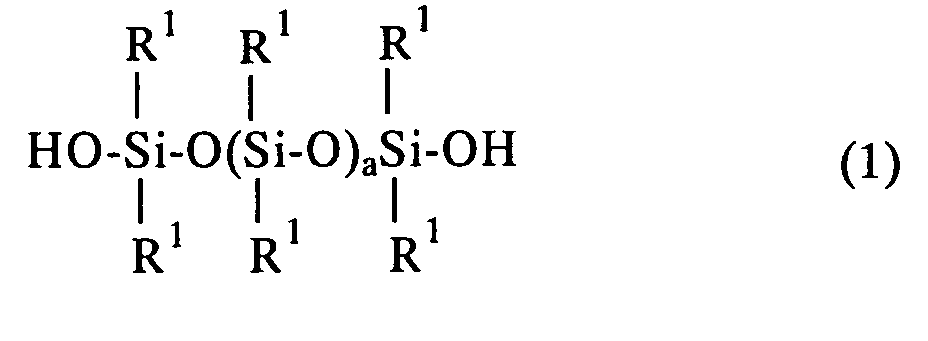
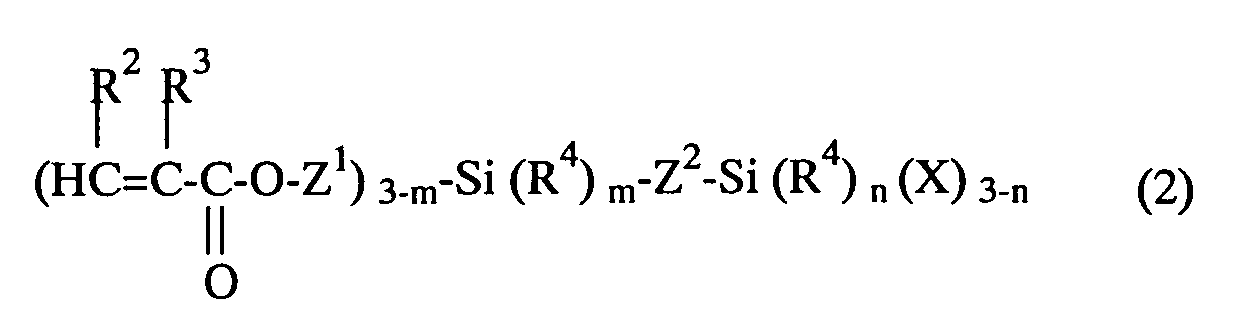
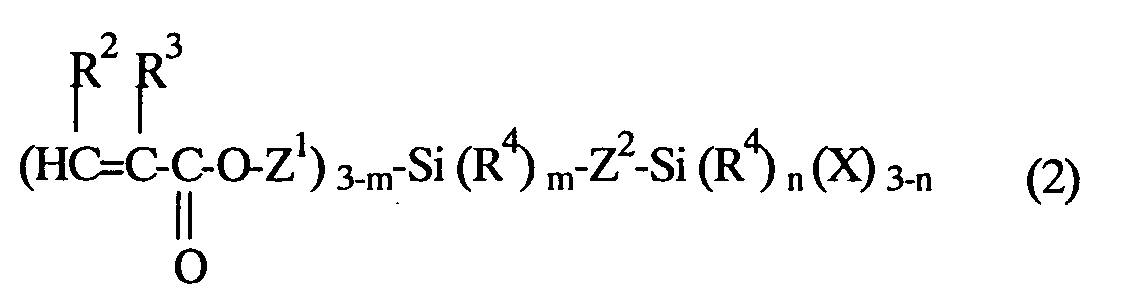
- an organopolysiloxane composition comprising (A) 100 parts by weight of an organopolysiloxane represented by the general formula (1) shown below wherein, each R 1 represents, independently, a substituted or unsubstituted monovalent hydrocarbon group of 1 to 15 carbon atoms, and a represents an integer from 10 to 3000; (B) 0.1 to 30 parts by weight of an organosilicon compound represented by the general formula (2) shown below wherein, each R 2 represents, independently, a hydrogen atom, a phenyl group or a halogenated phenyl group, each R 3 represents, independently, a hydrogen atom or a methyl group, each R 4 represents, independently, a substituted or unsubstituted monovalent hydrocarbon group of 1 to 10 carbon atoms, X represents a hydrolysable group, each Z 1 represents, independently, -R 5 -, -R 5 O- or -R 5 (CH 3
- the R 1 groups may be the same or different and each group represents a substituted or unsubstituted monovalent hydrocarbon group of 1 to 15 carbon atoms, and preferably 1 to 10 carbon atoms, more preferably 1 to 6 carbon atoms, and a represents an integer from 10 to 3000, and preferably from 50 to 1800.
- substituted monovalent hydrocarbon groups represented by the symbol R 1 include halogenated alkyl groups, e.g., having 1-6 carbon atoms, such as chloromethyl groups, 2-chloroethyl groups, 2-bromoethyl groups, 1,1-dichloropropyl groups, 3-chloropropyl groups and 3,3,3-trifluoropropyl groups; whereas suitable examples of unsubstituted monovalent hydrocarbon groups include alkyl groups, e.g., having 1-6 carbon atoms, such as methyl groups, ethyl groups, propyl groups, isopropyl groups, butyl groups, isobutyl groups, tert-butyl groups, pentyl groups, hexyl groups, and cyclohexyl groups; alkenyl groups, e.g., having 1-6 carbon atoms, such as vinyl groups and allyl groups; aryl groups, e.g., having 6
- substituted or unsubstituted alkyl groups of 1 to 6 carbon atoms or phenyl groups are preferred, and methyl groups, ethyl groups, phenyl groups and 3,3,3-trifluoropropyl groups are particularly desirable.
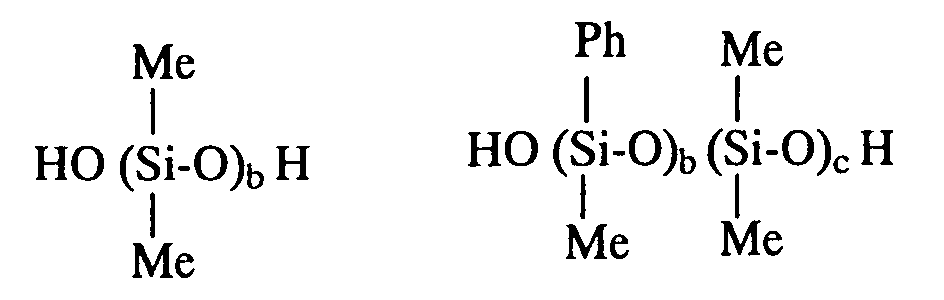
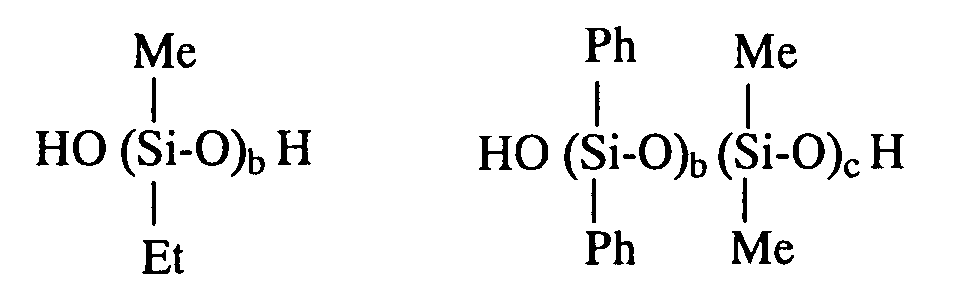
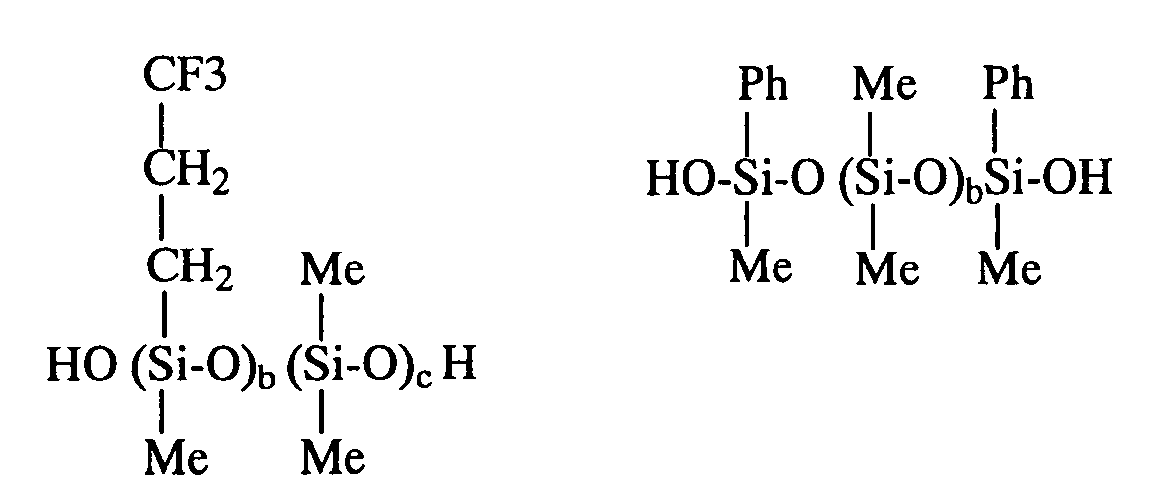
- organopolysiloxanes represented by the general formula (1) are shown below, although the present invention is in no way limited to the examples shown.
- Me represents a methyl group
- Et represents an ethyl group
- Ph represents a phenyl group
- b, or b and c each represent, independently, an integer of 10 to 3000.
- These compounds may be used singularly, or in combinations of two or more compounds.
- the organosilicon compound represented by the general formula (2) should be used in quantities from 0.1 to 30 parts by weight, and preferably from 1 to 20 parts by weight, and even more preferably from 5 to 20 parts by weight, per 100 parts by weight of the organopolysiloxane represented by the general formula (1).
- each R 2 represents a hydrogen atom, a phenyl group or a halogenated phenyl group
- each R 3 represents a hydrogen atom or a methyl group
- each R 4 represents a substituted or unsubstituted monovalent hydrocarbon group of 1 to 10 carbon atoms which may be the same or different.
- substituted monovalent hydrocarbon groups represented by the symbol R 4 include halogen substituted monovalent hydrocarbon groups such as halogenated alkyl groups including chloromethyl groups, 2-chloroethyl groups, 2-bromoethyl groups, 1,1-dichloropropyl groups, 3-chloropropyl groups and 3,3,3-trifluoropropyl groups, whereas suitable examples of unsubstituted monovalent hydrocarbon groups include alkyl groups such as methyl groups, ethyl groups, propyl groups, isopropyl groups, butyl groups, isobutyl groups, tert-butyl groups, pentyl groups, hexyl groups, cyclohexyl groups, octyl groups and decyl groups; alkenyl groups such as vinyl groups and allyl groups; aryl groups such as phenyl groups and tolyl groups; and aralkyl groups such as benzyl groups or phenylethyl
- X represents a hydrolysable group
- preferred groups include lower alkoxy groups and lower alkenyloxy groups of 1 to 6 carbon atoms, or more preferably 1 to 4 carbon atoms, including alkoxy groups as methoxy groups, ethoxy groups, propoxy groups, butoxy groups and methoxyethoxy groups, and alkenyloxy groups such as vinyloxy groups, allyloxy groups, propenoxy groups, isopropenoxy groups and butenyloxy groups.
- Other suitable groups include ketoxime groups such as dimethyl ketoxime groups and methylethyl ketoxime groups, and acyloxy groups such as acetoxy groups.
- Z 1 represents -R 5 -, -R 5 O- or -R 5 (CH 3 ) 2 SiO-, wherein the R 5 groups may be the same or different, and represent a substituted or unsubstituted bivalent hydrocarbon group of 1 to 10 carbon atoms.
- substituted bivalent hydrocarbon groups represented by the symbol R 5 include halogen substituted alkylene groups such as chloromethylene groups, dichloromethylene groups and chloroethylene groups, whereas examples of unsubstituted bivalent hydrocarbon groups include alkylene groups such as methylene groups, ethylene groups, propylene groups and tetramethylene groups, or arylene groups such as phenylene groups, and of these groups, substituted or unsubstituted bivalent hydrocarbon groups of 1 to 3 carbon atoms are preferred.
- Z 2 represents an oxygen atom or a substituted or unsubstituted bivalent hydrocarbon group of 1 to 10 carbon atoms, and preferably 1 to 3 carbon atoms.
- Suitable examples of substituted bivalent hydrocarbon groups represented by the symbol Z 2 include the same groups described above in relation to the R 5 group, and suitable examples of unsubstituted bivalent hydrocarbon groups also include the same groups described above in relation to the R 5 group. Moreover, m represents 0, 1 or 2, and n represents 0, 1 or 2.
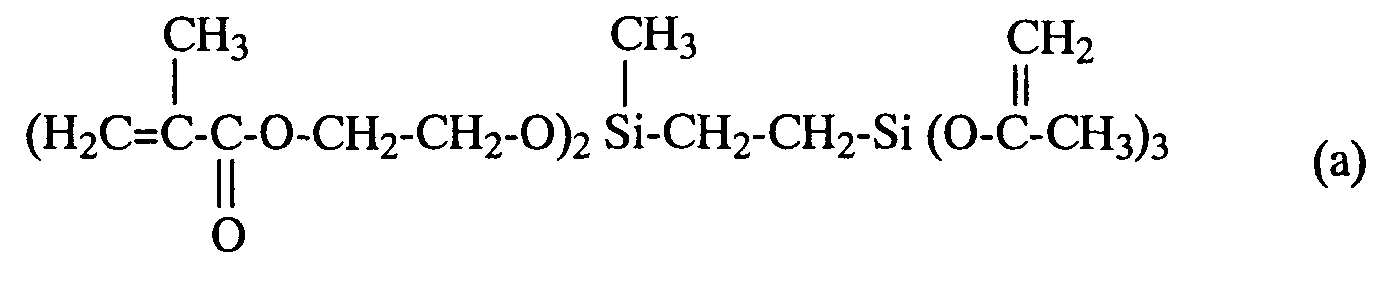
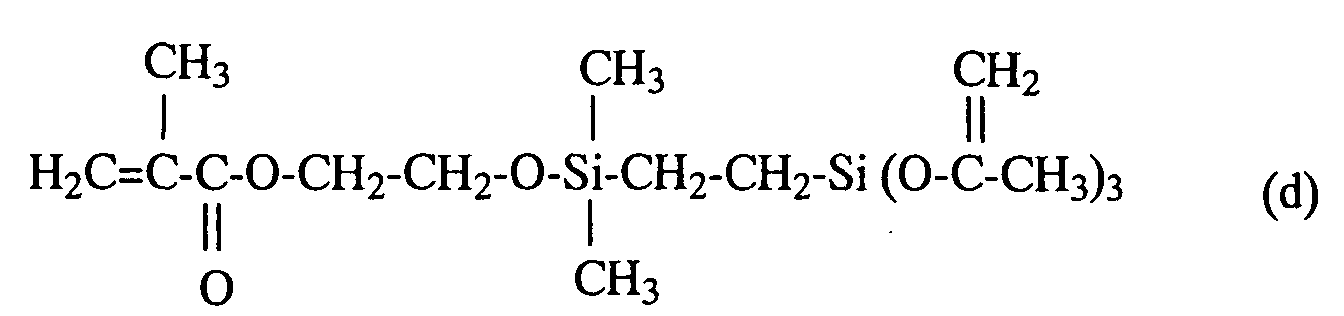
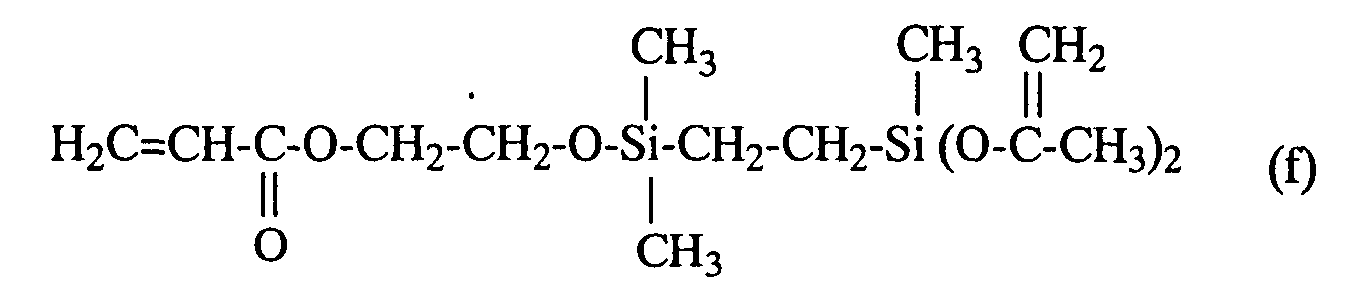
- organosilicon compounds represented by the general formula (2) are shown below, although the present invention is in no way limited to the examples shown.
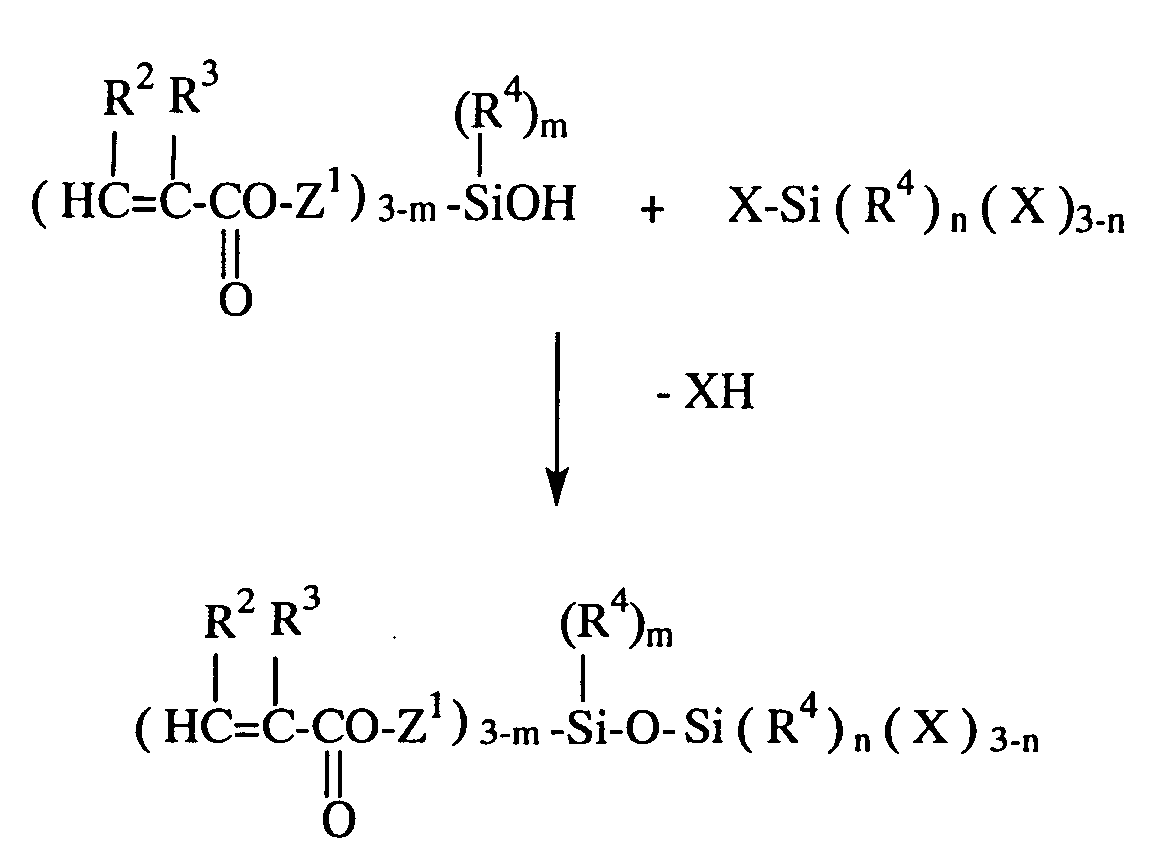
- An organosilicon compound represented by the general formula (2) can be produced in the manner described below.
- R 2 , R 3 , R 4 , m, n, X and Z 1 represent the same as described above, -CH 2 -CH 2 -A- corresponds with -Z 2 - in the general formula (2),
- A represents a single bond or an alkylene group of 1 to 8 carbon atoms, with suitable alkylene groups including methylene groups, ethylene groups and propylene groups.
- an organosilicon compound represented by the general formula (2) can also be produced using the method shown below. wherein R 2 , R 3 , R 4 , m, n, Z 1 and X represent the same as described above.
- the condensation curing catalyst utilizes any typically known condensation curing catalyst, and specific examples of effective materials include organometallic compounds of tin or titanium such as alkyl titanates, organosilicon titanates, and metal carboxylates such as tin octylate and dibutyl tin phthalate; amine salts such as dibutylamine-2-ethylhexoate; as well as other acid catalysts or base catalysts, particularly silanol condensation catalysts such as nitrogen containing compounds with a guanidyl group.
- the hydrolysable group X of the organosilicon compound represented by the general formula (2) is an alkenoxy group
- a nitrogen containing compound with a guanidyl group is particularly desirable.
- the condensation curing catalyst may utilize a single compound, or a combination of two or more compounds.
- the condensation curing catalyst is used in an effective quantity, typically between 0.01 and 10 parts by weight, and preferably from 0.1 to 3 parts by weight, per 100 parts by weight of the organopolysiloxane represented by the general formula (1). At quantities less than 0.01 parts by weight the addition has little effect, whereas at quantities exceeding 10 parts by weight the strength of the produced silicone rubber tends to be poor, and the physical characteristics of the cured product may deteriorate.
- Known materials can be used as the photopolymerization initiator, and these materials promote the photopolymerization of (meth)acryloyl groups.
- Specific examples include acetophenone, propiophenone, benzophenone, xanthone, fluorenone, benzaldehyde, anthraquinone, triphenylamine, 4-methylacetophenone, 3-pentylacetophenone, 4-methoxyacetophenone, 3-bromoacetophenone, 4-allylacetophenone, p-diacetylbenzene, 3-methoxybenzophenone, 4-methylbenzophenone, 4-chlorobenzophenone, 4,4-dimethoxybenzophenone, 4-chloro-4-benzylbenzophenone, 3-chloroxanthone, 3,9-dichloroxanthone, 3-chloro-8-nonylxanthone, benzoin, benzoin methyl ether, benzoin butyl ether,
- the quantity of photopolymerization initiator should typically be from 0.01 to 10 parts by weight, and preferably from 0.1 to 3 parts by weight, per 100 parts by weight of the organopolysiloxane represented by the general formula (1). At quantities less than 0.01 parts by weight per 100 parts by weight of the organopolysiloxane represented by the general formula (1) the addition has little effect, whereas at quantities exceeding 10 parts by weight the strength of the produced silicone rubber tends to be poor, and the physical characteristics of the cured product may deteriorate.
- An organopolysiloxane composition of the present invention is obtained by uniformly mixing predetermined quantities of the aforementioned constituents (A) to (D).
- other additives may also be included in a composition of the present invention, provided such additives do not impair the effects of the present invention.
- inorganic based fillers which do not inhibit curing by light irradiation may be added to a composition to improve the mechanical properties of the produced silicone rubber elastic body, and moreover thixotropic agents, reagents for improving the heat resistance, coloring agents and adhesion-imparting agents may be added in order to adjust certain properties of a composition.
- a composition of the present invention obtained in the manner described above has two curing mechanisms, namely photopolymerizability and condensation curability, and also incorporates photopolymerizable (meth)acryloxyorganosilyl groups, and so irradiation with ultraviolet light causes the composition to cure easily, and within a short time period of only 1 to 20 seconds, to produce a silicone rubber. Furthermore, a rubber elastic body produced in this manner displays the special characteristics of a silicone rubber such as superior heat resistance, weather resistance and low temperature resistance, and so can be utilized in a wide variety of different fields.
- Organopolysiloxane compositions according to the present invention can be utilized in potting or coating for substrates for electrical circuits including, e.g., substrates for vehicle components, substrates for outdoor equipment, various power supply substrates and the like, coating for mobile telephone key pads, and moisture proof adhesives for use around the periphery of liquid crystal displays.
- substrates for electrical circuits including, e.g., substrates for vehicle components, substrates for outdoor equipment, various power supply substrates and the like, coating for mobile telephone key pads, and moisture proof adhesives for use around the periphery of liquid crystal displays.
- the potential uses of these compositions are not limited to those listed here, and also include other uses requiring adhesion, moisture proofing, heat resistance, weather resistance and low temperature resistance.
- an organopolysiloxane composition was prepared by combining the constituents shown in Table 1, Table 4 and Table 7 to generate a uniform mixture. The various physical properties of each composition were then measured. The results are shown in Table 1 through Table 7.
- the units for the figures for each of the composition constituents are parts by weight, the tack free time was measured by a touch test, and the elongation and tensile strength values were measured in accordance with JIS K-6251.
- the adhesiveness was measured by applying each composition to a series of substrates comprising either an acrylic resin (Acrylite 001, manufactured by Mitsubishi Plastics (Inc.)), a glass epoxy resin (KEL-GEF, manufactured by Shin-Kobe Electric Machinery Co.
- An organopolysiloxane composition according to the present invention has two curing mechanisms, namely photopolymerizability and condensation curability, displays superior adhesiveness and other physical properties, and in particular displays favorable adhesiveness to a substrate immediately following irradiation with ultraviolet light.
Landscapes
- Chemical & Material Sciences (AREA)
- Organic Chemistry (AREA)
- Chemical Kinetics & Catalysis (AREA)
- Polymers & Plastics (AREA)
- Medicinal Chemistry (AREA)
- Health & Medical Sciences (AREA)
- Materials Engineering (AREA)
- Wood Science & Technology (AREA)
- Engineering & Computer Science (AREA)
- Life Sciences & Earth Sciences (AREA)
- Compositions Of Macromolecular Compounds (AREA)
- Adhesives Or Adhesive Processes (AREA)
- Macromonomer-Based Addition Polymer (AREA)
- Silicon Polymers (AREA)
- Polymerisation Methods In General (AREA)
- Graft Or Block Polymers (AREA)
Abstract

Description
wherein, each R2 represents, independently, a hydrogen atom, a phenyl group or a halogenated phenyl group, each R3 represents, independently, a hydrogen atom or a methyl group, each R4 represents, independently, a substituted or unsubstituted monovalent hydrocarbon group of 1 to 10 carbon atoms, X represents a hydrolysable group, each Z1 represents, independently, -R5-, -R5O- or -R5(CH3)2SiO- where each R5 represents, independently, a substituted or unsubstituted bivalent hydrocarbon group of 1 to 10 carbon atoms, Z2 represents an oxygen atom or a substituted or unsubstituted bivalent hydrocarbon group of 1 to 10 carbon atoms, m represents 0, 1 or 2, and n represents 0, 1 or 2);
(C) an effective quantity of a condensation curing catalyst; and
(D) 0.01 to 10 parts by weight of a photopolymerization initiator.












- NMR:
- (0.105 ppm, s, 3H, Si-CH3), (0.65 to 0.79 ppm, broad, 4H, -CH2-CH2-), (1.79 ppm, s, 9H, O-C-CH3), (1.90 ppm, s, 6H, =C-CH3), (3.86 to 4.10 ppm, broad, 8H, -O-CH2-CH2-O-), (4.10, 4.26 ppm, d, 6H, O-C=CH2), (5.52, 6.08 ppm, d, 4H, CH2=C)
- IR:
- (2800 to 3000 cm-1, ν CH), (1650 cm-1, ν C=C), (1700 cm-1, ν C=O), (1150 cm-1, ν Si-OC)
- NMR:
- (0.105 ppm, s, 3H, Si-CH3), (0.65 to 0.79 ppm, broad, 4H, -CH2-CH2-), (1.90 ppm, s, 6H, =C-CH3), (3.86 to 4.10 ppm, broad, 8H, -O-CH2-CH2-O-), (3.3 ppm, s, 9H, O-CH3), (5.52, 6.08 ppm, d, 4H, CH2=C)
- IR:
- (2800 to 3000 cm-1, ν CH), (1650 cm-1, ν C=C), (1700 cm-1, ν C=O), (1150 cm-1, ν Si-OC)
- NMR:
- (0.105 ppm, s, 3H, Si-CH3), (0.65 to 0.79 ppm, broad, 4H, -CH2-CH2-), (1.90 ppm, t, 2H, C=CH), (3.86 to 4.10 ppm, broad, 8H, -O-CH2-CH2-O-), (3.3 ppm, s, 9H, O-CH3), (5.52, 6.08 ppm, d, 4H, CH2=C)
- IR:
- (2800 to 3000 cm-1, ν CH), (1650 cm-1, ν C=C), (1700 cm-1, ν C=O), (1150 cm-1, ν Si-OC)
- NMR:
- (0.105 ppm, s, 6H, Si-CH3), (0.65 to 0.79 ppm, broad, 4H, -CH2-CH2-), (1.80 ppm, s, 3H, C-CH3), (1.90 ppm, s, 9H, =C-CH3), (3.86 to 4.10 ppm, broad, 4H, -O-CH2-CH2-O-), (4.0, 4.25 ppm, d, 6H, O-C=CH2), (5.45, 6.1 ppm, d, 2H, CH2=C)
- IR:
- (2800 to 3000 cm-1, ν CH), (1650 cm-1, ν C=C), (1700 cm-1, ν C=O), (1150 cm-1, ν Si-OC)
O: Favorable adhesion, Δ: partial adhesion, X: completely peeled away
| Example | 1 | 2 | 3 | 4 | 5 |
| α,ω-hydroxypolydimethylsiloxane: molecular weight 16,000 | 100 | 100 | 100 | 100 | 100 |
| 1-methylbis(2-methacryloxyethoxy)silyl-2-triisopropenoxysilylethane (formula (a)) prepared in the synthetic example 1 | 10 | - | - | - | - |
| 1-methylbis(2-methacryloxyethoxy)silyl-2-trimethoxysilylethane (formula (g)) prepared in the synthetic example 2 | - | 10 | - | - | - |
| 1-methylbis(2-acryloxyethoxy)silyl-2-trimethoxysilylethane (formula (o)) prepared in the synthetic example 3 | - | - | 10 | - | - |
| 1-dimethyl(2-methacryloxyethoxy)silyl-2-triisopropenoxysilylethane (formula (d)) prepared in the synthetic example 4 | - | - | - | 8 | - |
| acryloxymethyldimethylsiloxytrimethoxysilane (formula (m)) prepared in the synthetic example 5 | - | - | - | - | 8 |
| diethoxyacetophenone | 2 | 1.5 | 1.7 | 3 | 2 |
| tetramethylguanidylpropyltrimethoxysilane | 1 | - | - | 1 | 1 |
| dibutyl tin methoxide | - | 0.1 | 0.1 | - | - |
| Physical properties prior to curing | |||||
| viscosity (Pa.s) 23°C | 2 | 2.2 | 2.5 | 2 | 2.5 |
| tack free time (minutes) | 7 | 30 | 30 | 7 | 30 |
| Physical properties after curing (curing conditions: 23°C 55%RH x 1 day) | |||||
| hardness (durometer type A) | 23 | 23 | 23 | 25 | 25 |
| elongation (%) | 120 | 120 | 120 | 110 | 100 |
| tensile strength (MPa) | 0.8 | 0.9 | 0.9 | 0.8 | 0.7 |
| Adhesiveness | |||||
| acrylic resin | O | O | O | O | O |
| glass epoxy resin | O | O | O | O | O |
| aluminum | O | O | O | O | O |
| Example | 1 | 2 | 3 | 4 | 5 |
| Physical properties after curing (curing conditions: ultraviolet irradiation (high pressure mercury lamp (100 mW/cm2, 365 nm)) x 15 seconds) | |||||
| hardness (durometer type A) | 25 | 25 | 25 | 23 | 23 |
| elongation (%) | 120 | 120 | 120 | 130 | 100 |
| tensile strength (MPa) | 0.7 | 0.9 | 0.6 | 0.8 | 0.7 |
| Adhesiveness | |||||
| acrylic resin | O | O | O | O | O |
| glass epoxy resin | O | O | O | O | O |
| aluminum | O | O | O | O | O |
| Example | 1 | 2 | 3 | 4 | 5 |
| Physical properties after curing (curing conditions: ultraviolet irradiation (high pressure mercury lamp (100 mW/cm2, 365 nm)) x 15 seconds + 23°C 55%RH x 1 day) | |||||
| hardness (durometer type A) | 27 | 27 | 27 | 27 | 27 |
| elongation (%) | 120 | 120 | 130 | 130 | 120 |
| tensile strength (MPa) | 0.9 | 0.9 | 1.1 | 0.9 | 1.1 |
| Adhesiveness | |||||
| acrylic resin | O | O | O | O | O |
| glass epoxy resin | O | O | O | O | O |
| aluminum | O | O | O | O | O |
| Example | 6 | 7 | 8() | 9() |
| α,ω-hydroxypolydimethylsiloxane: molecular weight 16,000 | 100 | 100 | 100 | 100 |
| Aerosil R-972 () manufactured by Nippon Aerosil Co. Ltd | 5 | 5 | - | - |
| Fineseal E-70 () manufactured by Tokuyama Corporation | - | - | 5 | 5 |
| 1-methylbis(2-methacryloxyethoxy)silyl-2-triisopropenoxysilylethane (formula (a)) prepared in the synthetic example 1 | 10 | - | 10 | - |
| 1-dimethyl(2-methacryloxyethoxy)silyl-2-triisopropenoxysilylethane (formula (d)) prepared in the synthetic example 4 | - | 10 | - | 10 |
| diethoxyacetophenone | 2 | 1.7 | 2 | 2 |
| tetramethylguanidylpropyltrimethoxysilane | 1 | 1 | 1 | 1 |
| dibutyl tin methoxide | - | - | - | - |
| Physical properties prior to curing | ||||
| viscosity (Pa.s) 23°C | 30 | 30 | 25 | 25 |
| tack free time (minutes) | 5 | 5 | 7 | 7 |
| Physical properties after curing (curing conditions: 23°C 55%RH x 1 day) | ||||
| hardness (durometer type A) | 26 | 27 | 26 | 26 |
| elongation (%) | 150 | 150 | 140 | 160 |
| tensile strength (MPa) | 1.5 | 1.7 | 1.7 | 1.6 |
| Adhesiveness | ||||
| acrylic resin | O | O | O | O |
| glass epoxy resin | O | O | O | O |
| aluminum | O | O | O | O |
| Example | 6 | 7 | 8 | 9 |
| Physical properties after curing (curing conditions: ultraviolet irradiation (high pressure mercury lamp (100 mW/cm2, 365 nm)) x 15 seconds) | ||||
| hardness (durometer type A) | 26 | 26 | 26 | 27 |
| elongation (%) | 120 | 120 | 120 | 130 |
| tensile strength (MPa) | 1.2 | 1.4 | 1.4 | 1.5 |
| Adhesiveness | ||||
| acrylic resin | O | O | O | O |
| glass epoxy resin | O | O | O | O |
| aluminum | O | O | O | O |
| Example | 6 | 7 | 8 | 9 |
| Physical properties after curing (curing conditions: ultraviolet irradiation (high pressure mercury lamp (100 mW/cm2, 365 nm)) x 15 seconds + 23°C 55%RH x 1 day) | ||||
| hardness (durometer type A) | 27 | 27 | 27 | 27 |
| elongation (%) | 120 | 120 | 130 | 130 |
| tensile strength (MPa) | 1.8 | 1.9 | 1.8 | 1.8 |
| Adhesiveness | ||||
| acrylic resin | O | O | O | O |
| glass epoxy resin | O | O | O | O |
| aluminum | O | O | O | O |
| Comparative Example | 1 | 2 | 3 | 4 | 5 |
| α,ω-hydroxypolydimethylsiloxane: molecular weight 16,000 | 100 | 100 | 80 | 100 | - |
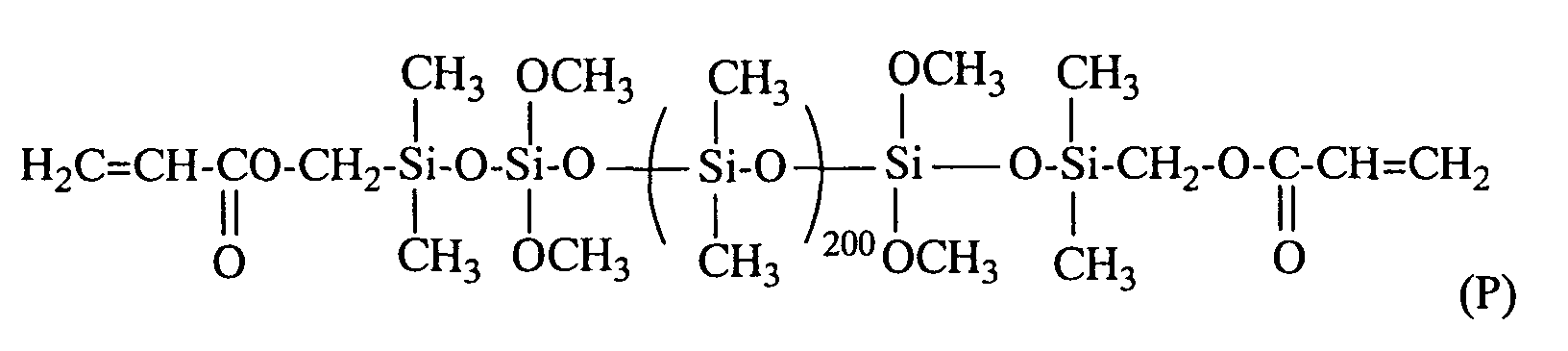
| The diorganopolysiloxane with unmodified terminals represented by the formula (P) below | - | - | - | - | 100 |
| Aerosil R-972 manufactured by Nippon Aerosil Co. Ltd | - | - | - | 5 | - |
| acryloxypropyltrimethoxysilane | 7 | - | - | 7 | - |
| methacryloxypropyltrimethoxysilane | - | 7 | - | - | - |
| isobornyl acrylate | - | - | 20 | - | - |
| methyltrimethoxysilane | - | - | 5 | - | 5 |
| diethoxyacetophenone | 2 | 2 | 2 | 2 | 2 |
| dibutyl tin methoxide | - | 0.1 | 0.1 | 0.1 | - |
| titanium tetraisopropoxide | 1.5 | 1.2 | - | - | 1.5 |
| Physical properties prior to curing | |||||
| viscosity (Pa.s) 23°C | 3 | 3 | 4 | 20 | 5 |
| tack free time (minutes) | 30 | 30 | 50 | 7 | 30 |
| Physical properties after curing (curing conditions: 23°C 55%RH x 1 day) | |||||
| hardness (durometer type A) | 5 | 3 | 5 | 10 | 5 |
| elongation (%) | 50 | 50 | 50 | 60 | 50 |
| tensile strength (MPa) | 0.2 | 0.3 | 0.3 | 0.4 | 0.3 |
| Adhesiveness | |||||
| acrylic resin | X | X | X | X | X |
| glass epoxy resin | X | X | X | X | X |
| aluminum | X | X | X | X | X |
| Comparative Example | 1 | 2 | 3 | 4 | 5 |
| Physical properties after curing (curing conditions: ultraviolet irradiation (high pressure mercury lamp (100 mW/cm2, 365 nm)) x 15 seconds) | |||||
| hardness (durometer type A) | 23 | 25 | 25 | 27 | 23 |
| elongation (%) | 120 | 120 | 120 | 130 | 110 |
| tensile strength (MPa) | 0.7 | 0.9 | 0.6 | 0.8 | 0.7 |
| Adhesiveness | |||||
| acrylic resin | X | X | O | X | X |
| glass epoxy resin | X | X | Δ | X | X |
| aluminum | X | X | X | X | X |
| Comparative Example | 1 | 2 | 3 | 4 | 5 |
| Physical properties after curing (curing conditions: ultraviolet irradiation (high pressure mercury lamp (100 mW/cm2, 365 nm)) x 15 seconds + 23°C 55%RH x 1 day) | |||||
| hardness (durometer type A) | 25 | 25 | 25 | 28 | 27 |
| elongation (%) | 120 | 120 | 130 | 130 | 120 |
| tensile strength (MPa) | 0.7 | 0.9 | 0.6 | 0.9 | 1.1 |
| Adhesiveness | |||||
| acrylic resin | X | X | O | X | X |
| glass epoxy resin | X | X | Δ | X | X |
| aluminum | X | X | X | X | X |
Claims (11)
- An organopolysiloxane composition comprising:(A) 100 parts by weight of an organopolysiloxane represented by a general formula (1) shown belowwherein, each R1 represents, independently, either one of a substituted and an unsubstituted monovalent hydrocarbon group of 1 to 15 carbon atoms, and a represents an integer from 10 to 3000;
 (B) 0.1 to 30 parts by weight of an organosilicon compound represented by a general formula (2) shown belowwherein, each R2 represents, independently, any one of a hydrogen atom, a phenyl group and a halogenated phenyl group, each R3 represents, independently, either one of a hydrogen atom and a methyl group, each R4 represents, independently, either one of a substituted and an unsubstituted monovalent hydrocarbon group of 1 to 10 carbon atoms, X represents a hydrolysable group, each Z1 represents, independently, any one of -R5-, -R5O- and -R5(CH3)2SiO- where each R5 represents, independently, either one of a substituted and an unsubstituted bivalent hydrocarbon group of 1 to 10 carbon atoms, Z2 represents any one of an oxygen atom, and a substituted and an unsubstituted bivalent hydrocarbon group of 1 to 10 carbon atoms, m represents any one of 0, 1 and 2, and n represents any one of 0, 1 and 2;
 (C) an effective quantity of a condensation curing catalyst; and(D) 0.01 to 10 parts by weight of a photopolymerization initiator.
 - An organopolysiloxane composition according to claim 1, wherein in said general formula (1), R1 represents either one of a substituted and an unsubstituted monovalent hydrocarbon group of 1 to 6 carbon atoms, and a represents an integer from 50 to 1800.
- An organopolysiloxane composition according to claim 1, wherein each R1 represents, independently, any one of a halogenated alkyl group of 1 to 6 carbon atoms, an alkyl group of 1 to 6 carbon atoms, an alkenyl group of 1 to 6 carbon atoms, an aryl group of 6-10 carbon atoms, and an aralkyl group of 7-10 to···carbon atoms.
- An organopolysiloxane composition according to claim 1, wherein R1 represents either one of an alkyl group of 1 to 6 carbon atoms and a phenyl group.
- An organopolysiloxane composition according to claim 1, wherein in said general formula (2), R4 represents a monovalent hydrocarbon group of 1 to 3 carbon atoms.
- An organopolysiloxane composition according to claim 1, wherein in said general formula (2), each X represents any one of an alkoxy group, an alkenyloxy group, a ketoxime group and an acyloxy group of 1 to 6 carbon atoms.
- An organopolysiloxane composition according to claim 1, wherein in said general formula (2), each X represents either one of an alkoxy group and an alkenyloxy group of 1 to 4 carbon atoms.
- An organopolysiloxane composition according to claim 1, wherein in said general formula (2), each Z1 represents, independently, any one of -R5-, -R5O- and - R5(CH3)2SiO- wherein each R5 represents, independently, any one of an alkylene group, a halogen substituted alkylene group and an arylene group, and Z2 represents any one of an alkylene group, a halogen substituted alkylene group and an arylene group.
- An organopolysiloxane composition according to claim 1, wherein said condensation curing catalyst of constituent (C) is any one of an organotin compound, an organotitanium compound, an amine salt, an acid catalyst, and other basic catalysts.
- An organopolysiloxane composition according to claim 1, wherein said hydrolysable group X of said organosilicon compound of constituent (B) is an alkenoxy group, and constituent (C) is a nitrogen containing compound with a guanidyl group.
- An organopolysiloxane composition according to claim 1, wherein per 100 parts by weight of constituent (A), are present 1 to 20 parts by weight of constituent (B), 0.01 to 10 parts by weight of constituent (C), and 0.1 to 3 parts by weight of constituent (D).
Applications Claiming Priority (2)
| Application Number | Priority Date | Filing Date | Title |
|---|---|---|---|
| JP2001031543A JP3788911B2 (en) | 2001-02-07 | 2001-02-07 | Organopolysiloxane composition |
| JP2001031543 | 2001-02-07 |
Publications (2)
| Publication Number | Publication Date |
|---|---|
| EP1231241A1 true EP1231241A1 (en) | 2002-08-14 |
| EP1231241B1 EP1231241B1 (en) | 2010-11-03 |
Family
ID=18895617
Family Applications (1)
| Application Number | Title | Priority Date | Filing Date |
|---|---|---|---|
| EP02002686A Expired - Lifetime EP1231241B1 (en) | 2001-02-07 | 2002-02-06 | Dual curable organopolysiloxane composition |
Country Status (6)
| Country | Link |
|---|---|
| US (1) | US6699918B2 (en) |
| EP (1) | EP1231241B1 (en) |
| JP (1) | JP3788911B2 (en) |
| KR (1) | KR100777521B1 (en) |
| DE (1) | DE60238156D1 (en) |
| TW (1) | TWI294900B (en) |
Cited By (15)
| Publication number | Priority date | Publication date | Assignee | Title |
|---|---|---|---|---|
| EP1201672A3 (en) * | 2000-10-26 | 2003-05-28 | Shin-Etsu Chemical Co., Ltd. | Organosilicon compound |
| WO2008077045A3 (en) * | 2006-12-19 | 2009-04-09 | Dow Global Technologies Inc | Adhesion promotion additives and methods for improving coating compositions |
| WO2009131680A1 (en) * | 2008-04-24 | 2009-10-29 | Momentive Performance Materials Inc. | Flexible hardcoats and substrates coated therewith |
| US7781493B2 (en) | 2005-06-20 | 2010-08-24 | Dow Global Technologies Inc. | Protective coating for window glass |
| US7786183B2 (en) | 2005-06-20 | 2010-08-31 | Dow Global Technologies Inc. | Coated glass articles |
| US7956151B2 (en) | 2007-04-24 | 2011-06-07 | Dow Global Technologies Llc | Universal primer compositions and methods |
| US7955702B2 (en) | 2007-04-24 | 2011-06-07 | Dow Global Technologies Llc | One component glass primer including oxazoladine |
| US8080609B2 (en) | 2008-10-29 | 2011-12-20 | Dow Global Technologies Llc | Low energy surface bonding system containing a primer with long open time |
| US8101043B2 (en) | 2007-07-12 | 2012-01-24 | Dow Global Technologies Llc | Colored primer compositions and methods |
| CN103052651A (en) * | 2010-08-05 | 2013-04-17 | 日本曹达株式会社 | Organic-inorganic complex and composition for forming same |
| WO2016026205A1 (en) * | 2014-08-21 | 2016-02-25 | 烟台德邦先进硅材料有限公司 | Uv/moisture dual curable organic silicon glue |
| CN108219739A (en) * | 2017-12-30 | 2018-06-29 | 广州市白云化工实业有限公司 | Single-component ketonic oxime organosilicon adhesive glue of deeply-curing and preparation method thereof |
| US11339256B1 (en) | 2019-08-06 | 2022-05-24 | Dow Silicones Corporation | Dual cure composition |
| EP4155339A4 (en) * | 2020-05-21 | 2024-05-01 | Shin-Etsu Chemical Co., Ltd. | Organopolysiloxane and composition containing same |
| US12258487B2 (en) | 2020-01-22 | 2025-03-25 | Dow Silicones Corporation | Dual cure composition |
Families Citing this family (24)
| Publication number | Priority date | Publication date | Assignee | Title |
|---|---|---|---|---|
| US20050234208A1 (en) * | 2004-04-14 | 2005-10-20 | Matthias Koch | Fast curing polydiorganosiloxanes |
| JP4442455B2 (en) * | 2005-02-17 | 2010-03-31 | セイコーエプソン株式会社 | Reference voltage selection circuit, reference voltage generation circuit, display driver, electro-optical device, and electronic apparatus |
| JP2006227272A (en) * | 2005-02-17 | 2006-08-31 | Seiko Epson Corp | Reference voltage generation circuit, display driver, electro-optical device, and electronic apparatus |
| EP2277939B1 (en) * | 2005-03-24 | 2017-02-22 | Bridgestone Corporation | Compounding silica-reinforced rubber with low volatile organic compound (VOC) emission |
| JP4672508B2 (en) * | 2005-09-29 | 2011-04-20 | 信越化学工業株式会社 | Flame retardant silicone composition |
| PT1954702T (en) * | 2005-11-29 | 2016-12-29 | Henkel IP & Holding GmbH | Radiation cure silicone compositions |
| JP5196738B2 (en) * | 2006-05-26 | 2013-05-15 | 富士フイルム株式会社 | Colored curable composition for color filter, color filter, and production method thereof |
| EP2041216B1 (en) * | 2006-07-11 | 2013-04-03 | DSM IP Assets B.V. | Composition with a polymer and an oxidation-catalyst |
| EP1878762A1 (en) * | 2006-07-11 | 2008-01-16 | DSMIP Assets B.V. | Oxidisable polymer |
| CN101553351B (en) | 2006-12-19 | 2012-09-05 | 陶氏环球技术公司 | Encapsulated panel assemblies and method for making same |
| EP2122638B1 (en) | 2006-12-19 | 2012-11-07 | Dow Global Technologies LLC | Improved composites and methods for conductive transparent substrates |
| JP4941657B2 (en) * | 2007-04-06 | 2012-05-30 | 信越化学工業株式会社 | Organosilicon compound, method for producing the same, photopolymerizable composition, and inorganic material |
| US7915368B2 (en) | 2007-05-23 | 2011-03-29 | Bridgestone Corporation | Method for making alkoxy-modified silsesquioxanes |
| KR101587666B1 (en) | 2007-12-18 | 2016-01-21 | 다우 글로벌 테크놀로지스 엘엘씨 | Protective coating for window glass having enhanced adhesion to glass bonding adhesives |
| US8962746B2 (en) | 2007-12-27 | 2015-02-24 | Bridgestone Corporation | Methods of making blocked-mercapto alkoxy-modified silsesquioxane compounds |
| US8097674B2 (en) | 2007-12-31 | 2012-01-17 | Bridgestone Corporation | Amino alkoxy-modified silsesquioxanes in silica-filled rubber with low volatile organic chemical evolution |
| US8794282B2 (en) | 2007-12-31 | 2014-08-05 | Bridgestone Corporation | Amino alkoxy-modified silsesquioxane adhesives for improved metal adhesion and metal adhesion retention to cured rubber |
| US8455593B2 (en) * | 2008-10-23 | 2013-06-04 | Mie University | Polyorganosiloxane composition and cured production thereof |
| JP4826678B2 (en) * | 2009-06-19 | 2011-11-30 | 横浜ゴム株式会社 | Curable silicone resin composition |
| JP4893787B2 (en) * | 2009-07-23 | 2012-03-07 | 信越化学工業株式会社 | Organopolysiloxane and method for producing the same |
| US8642691B2 (en) | 2009-12-28 | 2014-02-04 | Bridgestone Corporation | Amino alkoxy-modified silsesquioxane adhesives for improved metal adhesion and metal adhesion retention to cured rubber |
| US11401440B2 (en) | 2014-12-31 | 2022-08-02 | Bridgestone Corporation | Amino alkoxy-modified silsesquioxane adhesives for adhering steel alloy to rubber |
| JP7074641B2 (en) * | 2018-10-29 | 2022-05-24 | 信越化学工業株式会社 | (Meta) Acryloyl group-containing organosiloxane |
| CN115215892A (en) * | 2021-04-20 | 2022-10-21 | 中国科学院化学研究所 | A kind of carbosilane photosensitive monomer and its preparation method and application |
Citations (1)
| Publication number | Priority date | Publication date | Assignee | Title |
|---|---|---|---|---|
| EP0610629A2 (en) * | 1992-12-14 | 1994-08-17 | Shin-Etsu Chemical Co., Ltd. | Curable organopolysiloxane compositions |
Family Cites Families (15)
| Publication number | Priority date | Publication date | Assignee | Title |
|---|---|---|---|---|
| GB1323869A (en) | 1970-10-29 | 1973-07-18 | Dainippon Printing Co Ltd | Photopolymerizable compositions |
| US4064027A (en) | 1973-09-28 | 1977-12-20 | Dow Corning Corporation | UV curable composition |
| DE2834119C2 (en) * | 1978-08-03 | 1981-01-15 | Bayer Ag, 5090 Leverkusen | Process for the production of organopolysiloxane molding compounds which result in fine-pored, rubber-elastic molded foam bodies |
| US4306042A (en) * | 1980-09-02 | 1981-12-15 | Neefe Russell A | Method of making a contact lens material with increased oxygen permeability |
| US4675346A (en) | 1983-06-20 | 1987-06-23 | Loctite Corporation | UV curable silicone rubber compositions |
| US4528081A (en) * | 1983-10-03 | 1985-07-09 | Loctite Corporation | Dual curing silicone, method of preparing same and dielectric soft-gel compositions thereof |
| JPS60104158A (en) | 1983-11-09 | 1985-06-08 | Shin Etsu Chem Co Ltd | Curable organopolysiloxane composition |
| JPS61238848A (en) * | 1985-04-17 | 1986-10-24 | Shin Etsu Chem Co Ltd | Room temperature curable composition |
| US4766189A (en) * | 1987-08-13 | 1988-08-23 | Fused Kontacts Of Chicago, Inc. | Compositions for making improved gas permeable contact lenses |
| JP2635098B2 (en) * | 1988-05-09 | 1997-07-30 | 東芝シリコーン株式会社 | Curable polyorganosiloxane composition |
| US5346976A (en) * | 1993-03-29 | 1994-09-13 | Polymer Technology Corporation | Itaconate copolymeric compositions for contact lenses |
| US5516823A (en) * | 1994-05-10 | 1996-05-14 | Dow Corning Corporation | Adhesion promoting compositions and curable organosiloxane compositions containing same |
| US6020445A (en) * | 1997-10-09 | 2000-02-01 | Johnson & Johnson Vision Products, Inc. | Silicone hydrogel polymers |
| JP3476368B2 (en) | 1998-07-10 | 2003-12-10 | 信越化学工業株式会社 | Room temperature curable organopolysiloxane composition |
| JP4012680B2 (en) * | 2000-10-26 | 2007-11-21 | 信越化学工業株式会社 | Organosilicon compound |
-
2001
- 2001-02-07 JP JP2001031543A patent/JP3788911B2/en not_active Expired - Lifetime
-
2002
- 2002-02-01 TW TW091101789A patent/TWI294900B/zh not_active IP Right Cessation
- 2002-02-06 KR KR1020020006635A patent/KR100777521B1/en not_active Expired - Fee Related
- 2002-02-06 DE DE60238156T patent/DE60238156D1/en not_active Expired - Lifetime
- 2002-02-06 EP EP02002686A patent/EP1231241B1/en not_active Expired - Lifetime
- 2002-02-07 US US10/067,374 patent/US6699918B2/en not_active Expired - Fee Related
Patent Citations (1)
| Publication number | Priority date | Publication date | Assignee | Title |
|---|---|---|---|---|
| EP0610629A2 (en) * | 1992-12-14 | 1994-08-17 | Shin-Etsu Chemical Co., Ltd. | Curable organopolysiloxane compositions |
Cited By (24)
| Publication number | Priority date | Publication date | Assignee | Title |
|---|---|---|---|---|
| US6849755B2 (en) | 2000-10-26 | 2005-02-01 | Shin-Etsu Chemical Co., Ltd. | Organosilicon compound |
| US7045572B2 (en) | 2000-10-26 | 2006-05-16 | Shin-Etsu Chemical Co., Ltd. | Organosilicon compound |
| EP1201672A3 (en) * | 2000-10-26 | 2003-05-28 | Shin-Etsu Chemical Co., Ltd. | Organosilicon compound |
| US8080299B2 (en) | 2005-06-20 | 2011-12-20 | Dow Global Technologies Llc | Protective coating for window glass |
| US7781493B2 (en) | 2005-06-20 | 2010-08-24 | Dow Global Technologies Inc. | Protective coating for window glass |
| US7786183B2 (en) | 2005-06-20 | 2010-08-31 | Dow Global Technologies Inc. | Coated glass articles |
| US8273801B2 (en) | 2005-06-20 | 2012-09-25 | Dow Global Technologies Llc | Protective coating for window glass |
| WO2008077045A3 (en) * | 2006-12-19 | 2009-04-09 | Dow Global Technologies Inc | Adhesion promotion additives and methods for improving coating compositions |
| CN101563412B (en) * | 2006-12-19 | 2014-07-16 | 陶氏环球技术公司 | Adhesion promotion additives and methods for improving coating compositions |
| US8168019B2 (en) | 2007-04-24 | 2012-05-01 | Dow Global Technologies Llc | One component glass primer including oxazoladine |
| US7955702B2 (en) | 2007-04-24 | 2011-06-07 | Dow Global Technologies Llc | One component glass primer including oxazoladine |
| US7956151B2 (en) | 2007-04-24 | 2011-06-07 | Dow Global Technologies Llc | Universal primer compositions and methods |
| US8101043B2 (en) | 2007-07-12 | 2012-01-24 | Dow Global Technologies Llc | Colored primer compositions and methods |
| WO2009131680A1 (en) * | 2008-04-24 | 2009-10-29 | Momentive Performance Materials Inc. | Flexible hardcoats and substrates coated therewith |
| US8080609B2 (en) | 2008-10-29 | 2011-12-20 | Dow Global Technologies Llc | Low energy surface bonding system containing a primer with long open time |
| CN103052651B (en) * | 2010-08-05 | 2015-12-02 | 日本曹达株式会社 | Organic mineral complex and formation composition thereof |
| CN103052651A (en) * | 2010-08-05 | 2013-04-17 | 日本曹达株式会社 | Organic-inorganic complex and composition for forming same |
| WO2016026205A1 (en) * | 2014-08-21 | 2016-02-25 | 烟台德邦先进硅材料有限公司 | Uv/moisture dual curable organic silicon glue |
| CN108219739A (en) * | 2017-12-30 | 2018-06-29 | 广州市白云化工实业有限公司 | Single-component ketonic oxime organosilicon adhesive glue of deeply-curing and preparation method thereof |
| CN108219739B (en) * | 2017-12-30 | 2020-11-10 | 广州市白云化工实业有限公司 | Deep-cured single-component ketoxime-removed organic silicon adhesive and preparation method thereof |
| US11339256B1 (en) | 2019-08-06 | 2022-05-24 | Dow Silicones Corporation | Dual cure composition |
| US12258487B2 (en) | 2020-01-22 | 2025-03-25 | Dow Silicones Corporation | Dual cure composition |
| EP4155339A4 (en) * | 2020-05-21 | 2024-05-01 | Shin-Etsu Chemical Co., Ltd. | Organopolysiloxane and composition containing same |
| US12534577B2 (en) | 2020-05-21 | 2026-01-27 | Shin-Etsu Chemical Co., Ltd. | Organopolysiloxane and a composition comprising the same |
Also Published As
| Publication number | Publication date |
|---|---|
| EP1231241B1 (en) | 2010-11-03 |
| JP3788911B2 (en) | 2006-06-21 |
| US20020151616A1 (en) | 2002-10-17 |
| KR100777521B1 (en) | 2007-11-16 |
| US6699918B2 (en) | 2004-03-02 |
| JP2002234943A (en) | 2002-08-23 |
| KR20020070098A (en) | 2002-09-05 |
| TWI294900B (en) | 2008-03-21 |
| DE60238156D1 (en) | 2010-12-16 |
Similar Documents
| Publication | Publication Date | Title |
|---|---|---|
| US6699918B2 (en) | Organopolysiloxane composition | |
| US4943613A (en) | Photocurable organopolysiloxane composition | |
| EP0332400B1 (en) | Photocurable organopolysiloxane composition | |
| JP2782405B2 (en) | Curable organopolysiloxane composition | |
| KR102619534B1 (en) | Room temperature curable compositions, sealing materials, and articles | |
| JP6187681B2 (en) | Novel bis (alkoxysilyl-vinylene) group-containing silicon compound and method for producing the same | |
| US6849755B2 (en) | Organosilicon compound | |
| US5567752A (en) | Silicon- and nitrogen- containing adhesion promotors and compositions containing them | |
| JPH0433982A (en) | Bonding composition and cured product | |
| EP0276986B1 (en) | Organopolysiloxanes having silethylene linkages | |
| JPH0673293A (en) | Room temperature curable polyorganosiloxane composition | |
| KR920004197B1 (en) | Curable organopolysiloxane composition | |
| US20240409775A1 (en) | Room temperature-curable organopolysiloxane composition, adhesive, sealing agent, and coating agent | |
| US5248751A (en) | Curable organopolysiloxane compositions | |
| JP3894873B2 (en) | UV curable organopolysiloxane composition | |
| JP2502791B2 (en) | Photocurable organopolysiloxane composition and cured product thereof | |
| JP2762206B2 (en) | Curable organopolysiloxane composition and cured product thereof | |
| EP2581416B1 (en) | Photocurable Organopolysiloxane Composition | |
| EP3705535A1 (en) | Organopolysiloxane composition, and organic silicon compound and production method therefor | |
| JP2000073034A (en) | Polyolefin composition | |
| JP2002226777A (en) | Primer composition | |
| JPH0563514B2 (en) | ||
| JP2006111697A (en) | Room temperature curable organopolysiloxane composition |
Legal Events
| Date | Code | Title | Description |
|---|---|---|---|
| PUAI | Public reference made under article 153(3) epc to a published international application that has entered the european phase |
Free format text: ORIGINAL CODE: 0009012 |
|
| AK | Designated contracting states |
Kind code of ref document: A1 Designated state(s): AT BE CH CY DE DK ES FI FR GB GR IE IT LI LU MC NL PT SE TR |
|
| AX | Request for extension of the european patent |
Free format text: AL;LT;LV;MK;RO;SI |
|
| 17P | Request for examination filed |
Effective date: 20030214 |
|
| AKX | Designation fees paid |
Designated state(s): AT BE CH CY DE DK ES FI FR GB GR IE IT LI LU MC NL PT SE TR |
|
| RBV | Designated contracting states (corrected) |
Designated state(s): DE FR GB |
|
| 17Q | First examination report despatched |
Effective date: 20050606 |
|
| 17Q | First examination report despatched |
Effective date: 20050606 |
|
| 17Q | First examination report despatched |
Effective date: 20050606 |
|
| GRAP | Despatch of communication of intention to grant a patent |
Free format text: ORIGINAL CODE: EPIDOSNIGR1 |
|
| RIN1 | Information on inventor provided before grant (corrected) |
Inventor name: GOTO, TOMOYUKI Inventor name: OZAI, TOSHIYUKI Inventor name: INOUE, YOSHIFUMI |
|
| GRAS | Grant fee paid |
Free format text: ORIGINAL CODE: EPIDOSNIGR3 |
|
| GRAA | (expected) grant |
Free format text: ORIGINAL CODE: 0009210 |
|
| AK | Designated contracting states |
Kind code of ref document: B1 Designated state(s): DE FR GB |
|
| REG | Reference to a national code |
Ref country code: GB Ref legal event code: FG4D |
|
| REF | Corresponds to: |
Ref document number: 60238156 Country of ref document: DE Date of ref document: 20101216 Kind code of ref document: P |
|
| PGFP | Annual fee paid to national office [announced via postgrant information from national office to epo] |
Ref country code: FR Payment date: 20110218 Year of fee payment: 10 |
|
| PGFP | Annual fee paid to national office [announced via postgrant information from national office to epo] |
Ref country code: GB Payment date: 20110209 Year of fee payment: 10 |
|
| PLBE | No opposition filed within time limit |
Free format text: ORIGINAL CODE: 0009261 |
|
| STAA | Information on the status of an ep patent application or granted ep patent |
Free format text: STATUS: NO OPPOSITION FILED WITHIN TIME LIMIT |
|
| 26N | No opposition filed |
Effective date: 20110804 |
|
| REG | Reference to a national code |
Ref country code: DE Ref legal event code: R097 Ref document number: 60238156 Country of ref document: DE Effective date: 20110804 |
|
| GBPC | Gb: european patent ceased through non-payment of renewal fee |
Effective date: 20120206 |
|
| REG | Reference to a national code |
Ref country code: FR Ref legal event code: ST Effective date: 20121031 |
|
| PG25 | Lapsed in a contracting state [announced via postgrant information from national office to epo] |
Ref country code: GB Free format text: LAPSE BECAUSE OF NON-PAYMENT OF DUE FEES Effective date: 20120206 Ref country code: FR Free format text: LAPSE BECAUSE OF NON-PAYMENT OF DUE FEES Effective date: 20120229 |
|
| PGFP | Annual fee paid to national office [announced via postgrant information from national office to epo] |
Ref country code: DE Payment date: 20170131 Year of fee payment: 16 |
|
| REG | Reference to a national code |
Ref country code: DE Ref legal event code: R119 Ref document number: 60238156 Country of ref document: DE |
|
| PG25 | Lapsed in a contracting state [announced via postgrant information from national office to epo] |
Ref country code: DE Free format text: LAPSE BECAUSE OF NON-PAYMENT OF DUE FEES Effective date: 20180901 |