EP1231223A1 - Process for the polymerization of olefins - Google Patents
Process for the polymerization of olefins Download PDFInfo
- Publication number
- EP1231223A1 EP1231223A1 EP01102730A EP01102730A EP1231223A1 EP 1231223 A1 EP1231223 A1 EP 1231223A1 EP 01102730 A EP01102730 A EP 01102730A EP 01102730 A EP01102730 A EP 01102730A EP 1231223 A1 EP1231223 A1 EP 1231223A1
- Authority
- EP
- European Patent Office
- Prior art keywords
- process according
- vanadium
- titanium
- compound
- group
- Prior art date
- Legal status (The legal status is an assumption and is not a legal conclusion. Google has not performed a legal analysis and makes no representation as to the accuracy of the status listed.)
- Granted
Links
- 238000000034 method Methods 0.000 title claims abstract description 59
- 230000008569 process Effects 0.000 title claims abstract description 58
- 238000006116 polymerization reaction Methods 0.000 title claims description 32
- 150000001336 alkenes Chemical class 0.000 title description 4
- 239000003054 catalyst Substances 0.000 claims abstract description 57
- VGGSQFUCUMXWEO-UHFFFAOYSA-N Ethene Chemical compound C=C VGGSQFUCUMXWEO-UHFFFAOYSA-N 0.000 claims abstract description 40
- 239000005977 Ethylene Substances 0.000 claims abstract description 40
- 239000000203 mixture Substances 0.000 claims abstract description 26
- 239000011949 solid catalyst Substances 0.000 claims abstract description 21
- 239000002243 precursor Substances 0.000 claims abstract description 19
- LFQSCWFLJHTTHZ-UHFFFAOYSA-N Ethanol Chemical compound CCO LFQSCWFLJHTTHZ-UHFFFAOYSA-N 0.000 claims abstract description 17
- 239000000463 material Substances 0.000 claims abstract description 15
- -1 aluminum compound Chemical class 0.000 claims abstract description 14
- 239000004711 α-olefin Substances 0.000 claims abstract description 13
- 150000002681 magnesium compounds Chemical class 0.000 claims abstract description 12
- 150000003623 transition metal compounds Chemical class 0.000 claims abstract description 12
- 150000003682 vanadium compounds Chemical class 0.000 claims abstract description 11
- 229910052782 aluminium Inorganic materials 0.000 claims abstract description 10
- 238000007334 copolymerization reaction Methods 0.000 claims abstract description 5
- 229920000642 polymer Polymers 0.000 claims description 25
- 229910052720 vanadium Inorganic materials 0.000 claims description 20
- LEONUFNNVUYDNQ-UHFFFAOYSA-N vanadium atom Chemical compound [V] LEONUFNNVUYDNQ-UHFFFAOYSA-N 0.000 claims description 18
- 125000004432 carbon atom Chemical group C* 0.000 claims description 16
- 229920000915 polyvinyl chloride Polymers 0.000 claims description 16
- 239000004800 polyvinyl chloride Substances 0.000 claims description 16
- RTAQQCXQSZGOHL-UHFFFAOYSA-N Titanium Chemical group [Ti] RTAQQCXQSZGOHL-UHFFFAOYSA-N 0.000 claims description 14
- 239000002245 particle Substances 0.000 claims description 14
- 229910052719 titanium Inorganic materials 0.000 claims description 14
- 239000010936 titanium Substances 0.000 claims description 14
- LRHPLDYGYMQRHN-UHFFFAOYSA-N N-Butanol Chemical compound CCCCO LRHPLDYGYMQRHN-UHFFFAOYSA-N 0.000 claims description 10
- VXNZUUAINFGPBY-UHFFFAOYSA-N 1-Butene Chemical compound CCC=C VXNZUUAINFGPBY-UHFFFAOYSA-N 0.000 claims description 9
- LIKMAJRDDDTEIG-UHFFFAOYSA-N 1-hexene Chemical compound CCCCC=C LIKMAJRDDDTEIG-UHFFFAOYSA-N 0.000 claims description 9
- OKKJLVBELUTLKV-UHFFFAOYSA-N Methanol Chemical compound OC OKKJLVBELUTLKV-UHFFFAOYSA-N 0.000 claims description 9
- 239000012018 catalyst precursor Substances 0.000 claims description 9
- JBIQAPKSNFTACH-UHFFFAOYSA-K vanadium oxytrichloride Chemical compound Cl[V](Cl)(Cl)=O JBIQAPKSNFTACH-UHFFFAOYSA-K 0.000 claims description 9
- 229910021552 Vanadium(IV) chloride Inorganic materials 0.000 claims description 8
- 125000000217 alkyl group Chemical group 0.000 claims description 8
- VOITXYVAKOUIBA-UHFFFAOYSA-N triethylaluminium Chemical compound CC[Al](CC)CC VOITXYVAKOUIBA-UHFFFAOYSA-N 0.000 claims description 8
- JTJFQBNJBPPZRI-UHFFFAOYSA-J vanadium tetrachloride Chemical compound Cl[V](Cl)(Cl)Cl JTJFQBNJBPPZRI-UHFFFAOYSA-J 0.000 claims description 8
- 125000001495 ethyl group Chemical group [H]C([H])([H])C([H])([H])* 0.000 claims description 7
- 125000000959 isobutyl group Chemical group [H]C([H])([H])C([H])(C([H])([H])[H])C([H])([H])* 0.000 claims description 7
- 239000011777 magnesium Substances 0.000 claims description 7
- 125000002496 methyl group Chemical group [H]C([H])([H])* 0.000 claims description 7
- 239000011148 porous material Substances 0.000 claims description 7
- 239000002002 slurry Substances 0.000 claims description 7
- JMXKSZRRTHPKDL-UHFFFAOYSA-N titanium ethoxide Chemical compound [Ti+4].CC[O-].CC[O-].CC[O-].CC[O-] JMXKSZRRTHPKDL-UHFFFAOYSA-N 0.000 claims description 7
- ZGEGCLOFRBLKSE-UHFFFAOYSA-N 1-Heptene Chemical compound CCCCCC=C ZGEGCLOFRBLKSE-UHFFFAOYSA-N 0.000 claims description 6
- WSSSPWUEQFSQQG-UHFFFAOYSA-N 4-methyl-1-pentene Chemical compound CC(C)CC=C WSSSPWUEQFSQQG-UHFFFAOYSA-N 0.000 claims description 6
- KFZMGEQAYNKOFK-UHFFFAOYSA-N Isopropanol Chemical compound CC(C)O KFZMGEQAYNKOFK-UHFFFAOYSA-N 0.000 claims description 6
- 125000003118 aryl group Chemical group 0.000 claims description 6
- 150000001875 compounds Chemical class 0.000 claims description 6
- 125000000753 cycloalkyl group Chemical group 0.000 claims description 6
- 150000002430 hydrocarbons Chemical group 0.000 claims description 6
- CPOFMOWDMVWCLF-UHFFFAOYSA-N methyl(oxo)alumane Chemical compound C[Al]=O CPOFMOWDMVWCLF-UHFFFAOYSA-N 0.000 claims description 6
- YWAKXRMUMFPDSH-UHFFFAOYSA-N pentene Chemical compound CCCC=C YWAKXRMUMFPDSH-UHFFFAOYSA-N 0.000 claims description 6
- BDERNNFJNOPAEC-UHFFFAOYSA-N propan-1-ol Chemical compound CCCO BDERNNFJNOPAEC-UHFFFAOYSA-N 0.000 claims description 6
- FYYHWMGAXLPEAU-UHFFFAOYSA-N Magnesium Chemical compound [Mg] FYYHWMGAXLPEAU-UHFFFAOYSA-N 0.000 claims description 5
- YHWCPXVTRSHPNY-UHFFFAOYSA-N butan-1-olate;titanium(4+) Chemical compound [Ti+4].CCCC[O-].CCCC[O-].CCCC[O-].CCCC[O-] YHWCPXVTRSHPNY-UHFFFAOYSA-N 0.000 claims description 5
- 125000005843 halogen group Chemical group 0.000 claims description 5
- 125000001449 isopropyl group Chemical group [H]C([H])([H])C([H])(*)C([H])([H])[H] 0.000 claims description 5
- 229910052749 magnesium Inorganic materials 0.000 claims description 5
- 125000004108 n-butyl group Chemical group [H]C([H])([H])C([H])([H])C([H])([H])C([H])([H])* 0.000 claims description 5
- 125000004123 n-propyl group Chemical group [H]C([H])([H])C([H])([H])C([H])([H])* 0.000 claims description 5
- HKJYVRJHDIPMQB-UHFFFAOYSA-N propan-1-olate;titanium(4+) Chemical compound CCCO[Ti](OCCC)(OCCC)OCCC HKJYVRJHDIPMQB-UHFFFAOYSA-N 0.000 claims description 5
- 125000000999 tert-butyl group Chemical group [H]C([H])([H])C(*)(C([H])([H])[H])C([H])([H])[H] 0.000 claims description 5
- 229910052723 transition metal Inorganic materials 0.000 claims description 5
- 150000003624 transition metals Chemical class 0.000 claims description 5
- MCULRUJILOGHCJ-UHFFFAOYSA-N triisobutylaluminium Chemical compound CC(C)C[Al](CC(C)C)CC(C)C MCULRUJILOGHCJ-UHFFFAOYSA-N 0.000 claims description 5
- KWKAKUADMBZCLK-UHFFFAOYSA-N 1-octene Chemical compound CCCCCCC=C KWKAKUADMBZCLK-UHFFFAOYSA-N 0.000 claims description 4
- DKGAVHZHDRPRBM-UHFFFAOYSA-N Tert-Butanol Chemical compound CC(C)(C)O DKGAVHZHDRPRBM-UHFFFAOYSA-N 0.000 claims description 4
- 229910021551 Vanadium(III) chloride Inorganic materials 0.000 claims description 4
- ZFCJLQRNVAABBF-UHFFFAOYSA-N ethanolate vanadium(4+) Chemical compound [V+4].CC[O-].CC[O-].CC[O-].CC[O-] ZFCJLQRNVAABBF-UHFFFAOYSA-N 0.000 claims description 4
- 229910052736 halogen Inorganic materials 0.000 claims description 4
- ZXEKIIBDNHEJCQ-UHFFFAOYSA-N isobutanol Chemical compound CC(C)CO ZXEKIIBDNHEJCQ-UHFFFAOYSA-N 0.000 claims description 4
- QUXHCILOWRXCEO-UHFFFAOYSA-M magnesium;butane;chloride Chemical compound [Mg+2].[Cl-].CCC[CH2-] QUXHCILOWRXCEO-UHFFFAOYSA-M 0.000 claims description 4
- IXQGCWUGDFDQMF-UHFFFAOYSA-N o-Hydroxyethylbenzene Natural products CCC1=CC=CC=C1O IXQGCWUGDFDQMF-UHFFFAOYSA-N 0.000 claims description 4
- 229920001470 polyketone Polymers 0.000 claims description 4
- YCJBFDACUZRMEO-UHFFFAOYSA-N propan-1-olate vanadium(4+) Chemical compound [V+4].CCC[O-].CCC[O-].CCC[O-].CCC[O-] YCJBFDACUZRMEO-UHFFFAOYSA-N 0.000 claims description 4
- HQYCOEXWFMFWLR-UHFFFAOYSA-K vanadium(iii) chloride Chemical compound [Cl-].[Cl-].[Cl-].[V+3] HQYCOEXWFMFWLR-UHFFFAOYSA-K 0.000 claims description 4
- 150000002367 halogens Chemical class 0.000 claims description 3
- ITNVWQNWHXEMNS-UHFFFAOYSA-N methanolate;titanium(4+) Chemical compound [Ti+4].[O-]C.[O-]C.[O-]C.[O-]C ITNVWQNWHXEMNS-UHFFFAOYSA-N 0.000 claims description 3
- ORYGRKHDLWYTKX-UHFFFAOYSA-N trihexylalumane Chemical compound CCCCCC[Al](CCCCCC)CCCCCC ORYGRKHDLWYTKX-UHFFFAOYSA-N 0.000 claims description 3
- JLTRXTDYQLMHGR-UHFFFAOYSA-N trimethylaluminium Chemical compound C[Al](C)C JLTRXTDYQLMHGR-UHFFFAOYSA-N 0.000 claims description 3
- QTWJRLJHJPIABL-UHFFFAOYSA-N 2-methylphenol;3-methylphenol;4-methylphenol Chemical compound CC1=CC=C(O)C=C1.CC1=CC=CC(O)=C1.CC1=CC=CC=C1O QTWJRLJHJPIABL-UHFFFAOYSA-N 0.000 claims description 2
- XULNZSSCZUFNHE-UHFFFAOYSA-N CC(C)[Mg]C(C)C Chemical compound CC(C)[Mg]C(C)C XULNZSSCZUFNHE-UHFFFAOYSA-N 0.000 claims description 2
- NNWCJHHLDJVFQM-UHFFFAOYSA-N CCCC[Mg]CC.CC(C)C[Mg]CC(C)C Chemical compound CCCC[Mg]CC.CC(C)C[Mg]CC(C)C NNWCJHHLDJVFQM-UHFFFAOYSA-N 0.000 claims description 2
- ABXKXVWOKXSBNR-UHFFFAOYSA-N CCC[Mg]CCC Chemical compound CCC[Mg]CCC ABXKXVWOKXSBNR-UHFFFAOYSA-N 0.000 claims description 2
- SVKKEKNENWCQAE-UHFFFAOYSA-N ClC(CCC[O-])(Cl)Cl.[Ti+4].ClC(CCC[O-])(Cl)Cl.ClC(CCC[O-])(Cl)Cl.ClC(CCC[O-])(Cl)Cl Chemical compound ClC(CCC[O-])(Cl)Cl.[Ti+4].ClC(CCC[O-])(Cl)Cl.ClC(CCC[O-])(Cl)Cl.ClC(CCC[O-])(Cl)Cl SVKKEKNENWCQAE-UHFFFAOYSA-N 0.000 claims description 2
- CVRSYMVPBQDCPT-UHFFFAOYSA-N ClC(CC[O-])(Cl)Cl.[Ti+4].ClC(CC[O-])(Cl)Cl.ClC(CC[O-])(Cl)Cl.ClC(CC[O-])(Cl)Cl Chemical compound ClC(CC[O-])(Cl)Cl.[Ti+4].ClC(CC[O-])(Cl)Cl.ClC(CC[O-])(Cl)Cl.ClC(CC[O-])(Cl)Cl CVRSYMVPBQDCPT-UHFFFAOYSA-N 0.000 claims description 2
- 229920000219 Ethylene vinyl alcohol Polymers 0.000 claims description 2
- ISWSIDIOOBJBQZ-UHFFFAOYSA-N Phenol Chemical compound OC1=CC=CC=C1 ISWSIDIOOBJBQZ-UHFFFAOYSA-N 0.000 claims description 2
- 239000004372 Polyvinyl alcohol Substances 0.000 claims description 2
- 125000005234 alkyl aluminium group Chemical group 0.000 claims description 2
- XAGFODPZIPBFFR-UHFFFAOYSA-N aluminium Chemical compound [Al] XAGFODPZIPBFFR-UHFFFAOYSA-N 0.000 claims description 2
- 125000006165 cyclic alkyl group Chemical group 0.000 claims description 2
- HPXRVTGHNJAIIH-UHFFFAOYSA-N cyclohexanol Chemical compound OC1CCCCC1 HPXRVTGHNJAIIH-UHFFFAOYSA-N 0.000 claims description 2
- 125000002887 hydroxy group Chemical group [H]O* 0.000 claims description 2
- KJJBSBKRXUVBMX-UHFFFAOYSA-N magnesium;butane Chemical compound [Mg+2].CCC[CH2-].CCC[CH2-] KJJBSBKRXUVBMX-UHFFFAOYSA-N 0.000 claims description 2
- KXDANLFHGCWFRQ-UHFFFAOYSA-N magnesium;butane;octane Chemical compound [Mg+2].CCC[CH2-].CCCCCCC[CH2-] KXDANLFHGCWFRQ-UHFFFAOYSA-N 0.000 claims description 2
- DLPASUVGCQPFFO-UHFFFAOYSA-N magnesium;ethane Chemical compound [Mg+2].[CH2-]C.[CH2-]C DLPASUVGCQPFFO-UHFFFAOYSA-N 0.000 claims description 2
- YCCXQARVHOPWFJ-UHFFFAOYSA-M magnesium;ethane;chloride Chemical compound [Mg+2].[Cl-].[CH2-]C YCCXQARVHOPWFJ-UHFFFAOYSA-M 0.000 claims description 2
- RVOYYLUVELMWJF-UHFFFAOYSA-N magnesium;hexane Chemical compound [Mg+2].CCCCC[CH2-].CCCCC[CH2-] RVOYYLUVELMWJF-UHFFFAOYSA-N 0.000 claims description 2
- GBRJQTLHXWRDOV-UHFFFAOYSA-M magnesium;hexane;chloride Chemical compound [Mg+2].[Cl-].CCCCC[CH2-] GBRJQTLHXWRDOV-UHFFFAOYSA-M 0.000 claims description 2
- KMYFNYFIPIGQQZ-UHFFFAOYSA-N magnesium;octane Chemical compound [Mg+2].CCCCCCC[CH2-].CCCCCCC[CH2-] KMYFNYFIPIGQQZ-UHFFFAOYSA-N 0.000 claims description 2
- TVMXDCGIABBOFY-UHFFFAOYSA-N n-Octanol Natural products CCCCCCCC TVMXDCGIABBOFY-UHFFFAOYSA-N 0.000 claims description 2
- 229920000515 polycarbonate Polymers 0.000 claims description 2
- 239000004417 polycarbonate Substances 0.000 claims description 2
- 235000019422 polyvinyl alcohol Nutrition 0.000 claims description 2
- 229920002451 polyvinyl alcohol Polymers 0.000 claims description 2
- 125000001436 propyl group Chemical group [H]C([*])([H])C([H])([H])C([H])([H])[H] 0.000 claims description 2
- RQFFFBTUVWONIK-UHFFFAOYSA-N titanium(4+) trichloromethanolate Chemical compound [Ti+4].[O-]C(Cl)(Cl)Cl.[O-]C(Cl)(Cl)Cl.[O-]C(Cl)(Cl)Cl.[O-]C(Cl)(Cl)Cl RQFFFBTUVWONIK-UHFFFAOYSA-N 0.000 claims description 2
- PGPVJNIERCISDC-UHFFFAOYSA-N titanium(4+);2,2,2-trichloroethanolate Chemical compound [Ti+4].[O-]CC(Cl)(Cl)Cl.[O-]CC(Cl)(Cl)Cl.[O-]CC(Cl)(Cl)Cl.[O-]CC(Cl)(Cl)Cl PGPVJNIERCISDC-UHFFFAOYSA-N 0.000 claims description 2
- 150000004796 dialkyl magnesium compounds Chemical class 0.000 claims 1
- VLKZOEOYAKHREP-UHFFFAOYSA-N n-Hexane Chemical compound CCCCCC VLKZOEOYAKHREP-UHFFFAOYSA-N 0.000 description 53
- QWTDNUCVQCZILF-UHFFFAOYSA-N isopentane Chemical compound CCC(C)C QWTDNUCVQCZILF-UHFFFAOYSA-N 0.000 description 30
- IJGRMHOSHXDMSA-UHFFFAOYSA-N Atomic nitrogen Chemical compound N#N IJGRMHOSHXDMSA-UHFFFAOYSA-N 0.000 description 28
- VYPSYNLAJGMNEJ-UHFFFAOYSA-N Silicium dioxide Chemical compound O=[Si]=O VYPSYNLAJGMNEJ-UHFFFAOYSA-N 0.000 description 20
- UFHFLCQGNIYNRP-UHFFFAOYSA-N Hydrogen Chemical compound [H][H] UFHFLCQGNIYNRP-UHFFFAOYSA-N 0.000 description 16
- 239000001257 hydrogen Substances 0.000 description 16
- 229910052739 hydrogen Inorganic materials 0.000 description 16
- AFABGHUZZDYHJO-UHFFFAOYSA-N dimethyl butane Natural products CCCC(C)C AFABGHUZZDYHJO-UHFFFAOYSA-N 0.000 description 15
- 229910052757 nitrogen Inorganic materials 0.000 description 14
- TWRXJAOTZQYOKJ-UHFFFAOYSA-L Magnesium chloride Chemical compound [Mg+2].[Cl-].[Cl-] TWRXJAOTZQYOKJ-UHFFFAOYSA-L 0.000 description 12
- 239000004698 Polyethylene Substances 0.000 description 11
- 239000002904 solvent Substances 0.000 description 11
- 239000000377 silicon dioxide Substances 0.000 description 10
- 239000000047 product Substances 0.000 description 9
- 238000002360 preparation method Methods 0.000 description 8
- HEDRZPFGACZZDS-UHFFFAOYSA-N Chloroform Chemical compound ClC(Cl)Cl HEDRZPFGACZZDS-UHFFFAOYSA-N 0.000 description 6
- RTZKZFJDLAIYFH-UHFFFAOYSA-N Diethyl ether Chemical compound CCOCC RTZKZFJDLAIYFH-UHFFFAOYSA-N 0.000 description 6
- 238000001816 cooling Methods 0.000 description 6
- 238000002347 injection Methods 0.000 description 6
- 239000007924 injection Substances 0.000 description 6
- 229910001629 magnesium chloride Inorganic materials 0.000 description 6
- 238000010926 purge Methods 0.000 description 6
- IMNFDUFMRHMDMM-UHFFFAOYSA-N N-Heptane Chemical compound CCCCCCC IMNFDUFMRHMDMM-UHFFFAOYSA-N 0.000 description 5
- 230000015572 biosynthetic process Effects 0.000 description 5
- 229920001577 copolymer Polymers 0.000 description 5
- 238000000113 differential scanning calorimetry Methods 0.000 description 5
- 238000009826 distribution Methods 0.000 description 5
- 239000012265 solid product Substances 0.000 description 5
- 238000003786 synthesis reaction Methods 0.000 description 5
- WYURNTSHIVDZCO-UHFFFAOYSA-N Tetrahydrofuran Chemical compound C1CCOC1 WYURNTSHIVDZCO-UHFFFAOYSA-N 0.000 description 4
- 230000000694 effects Effects 0.000 description 4
- 239000011347 resin Substances 0.000 description 4
- 229920005989 resin Polymers 0.000 description 4
- 239000007787 solid Substances 0.000 description 4
- XDTMQSROBMDMFD-UHFFFAOYSA-N Cyclohexane Chemical compound C1CCCCC1 XDTMQSROBMDMFD-UHFFFAOYSA-N 0.000 description 3
- NHTMVDHEPJAVLT-UHFFFAOYSA-N Isooctane Chemical compound CC(C)CC(C)(C)C NHTMVDHEPJAVLT-UHFFFAOYSA-N 0.000 description 3
- IAQRGUVFOMOMEM-UHFFFAOYSA-N butene Natural products CC=CC IAQRGUVFOMOMEM-UHFFFAOYSA-N 0.000 description 3
- JVSWJIKNEAIKJW-UHFFFAOYSA-N dimethyl-hexane Natural products CCCCCC(C)C JVSWJIKNEAIKJW-UHFFFAOYSA-N 0.000 description 3
- 238000004519 manufacturing process Methods 0.000 description 3
- 238000002844 melting Methods 0.000 description 3
- 230000008018 melting Effects 0.000 description 3
- 229920000573 polyethylene Polymers 0.000 description 3
- CYRMSUTZVYGINF-UHFFFAOYSA-N trichlorofluoromethane Chemical compound FC(Cl)(Cl)Cl CYRMSUTZVYGINF-UHFFFAOYSA-N 0.000 description 3
- 229940029284 trichlorofluoromethane Drugs 0.000 description 3
- UXQAEOWCSOPBLF-UHFFFAOYSA-N 2,2,3,3-tetramethyloctane Chemical compound CCCCCC(C)(C)C(C)(C)C UXQAEOWCSOPBLF-UHFFFAOYSA-N 0.000 description 2
- VEXZGXHMUGYJMC-UHFFFAOYSA-M Chloride anion Chemical compound [Cl-] VEXZGXHMUGYJMC-UHFFFAOYSA-M 0.000 description 2
- 238000001994 activation Methods 0.000 description 2
- 150000001298 alcohols Chemical class 0.000 description 2
- AZDRQVAHHNSJOQ-UHFFFAOYSA-N alumane Chemical class [AlH3] AZDRQVAHHNSJOQ-UHFFFAOYSA-N 0.000 description 2
- FJBFPHVGVWTDIP-UHFFFAOYSA-N dibromomethane Chemical compound BrCBr FJBFPHVGVWTDIP-UHFFFAOYSA-N 0.000 description 2
- 229960004132 diethyl ether Drugs 0.000 description 2
- 239000003085 diluting agent Substances 0.000 description 2
- 239000007789 gas Substances 0.000 description 2
- 238000005227 gel permeation chromatography Methods 0.000 description 2
- 229920001903 high density polyethylene Polymers 0.000 description 2
- 239000004700 high-density polyethylene Substances 0.000 description 2
- 229920001519 homopolymer Polymers 0.000 description 2
- 229920000092 linear low density polyethylene Polymers 0.000 description 2
- 239000004707 linear low-density polyethylene Substances 0.000 description 2
- 239000007788 liquid Substances 0.000 description 2
- 230000003287 optical effect Effects 0.000 description 2
- 229920000098 polyolefin Polymers 0.000 description 2
- 239000000843 powder Substances 0.000 description 2
- 238000010992 reflux Methods 0.000 description 2
- 230000001105 regulatory effect Effects 0.000 description 2
- 239000011369 resultant mixture Substances 0.000 description 2
- 239000000243 solution Substances 0.000 description 2
- 238000001179 sorption measurement Methods 0.000 description 2
- 238000004611 spectroscopical analysis Methods 0.000 description 2
- 239000012798 spherical particle Substances 0.000 description 2
- 238000003756 stirring Methods 0.000 description 2
- 239000006228 supernatant Substances 0.000 description 2
- 238000010998 test method Methods 0.000 description 2
- YLQBMQCUIZJEEH-UHFFFAOYSA-N tetrahydrofuran Natural products C=1C=COC=1 YLQBMQCUIZJEEH-UHFFFAOYSA-N 0.000 description 2
- 238000011282 treatment Methods 0.000 description 2
- RELMFMZEBKVZJC-UHFFFAOYSA-N 1,2,3-trichlorobenzene Chemical compound ClC1=CC=CC(Cl)=C1Cl RELMFMZEBKVZJC-UHFFFAOYSA-N 0.000 description 1
- ZOXJGFHDIHLPTG-UHFFFAOYSA-N Boron Chemical compound [B] ZOXJGFHDIHLPTG-UHFFFAOYSA-N 0.000 description 1
- ZAMOUSCENKQFHK-UHFFFAOYSA-N Chlorine atom Chemical compound [Cl] ZAMOUSCENKQFHK-UHFFFAOYSA-N 0.000 description 1
- 230000004913 activation Effects 0.000 description 1
- 239000012190 activator Substances 0.000 description 1
- 229910052796 boron Inorganic materials 0.000 description 1
- WXCZUWHSJWOTRV-UHFFFAOYSA-N but-1-ene;ethene Chemical compound C=C.CCC=C WXCZUWHSJWOTRV-UHFFFAOYSA-N 0.000 description 1
- 238000005660 chlorination reaction Methods 0.000 description 1
- 239000000460 chlorine Substances 0.000 description 1
- 229910052801 chlorine Inorganic materials 0.000 description 1
- 238000005336 cracking Methods 0.000 description 1
- 125000000113 cyclohexyl group Chemical group [H]C1([H])C([H])([H])C([H])([H])C([H])(*)C([H])([H])C1([H])[H] 0.000 description 1
- 230000018044 dehydration Effects 0.000 description 1
- 238000006297 dehydration reaction Methods 0.000 description 1
- YNLAOSYQHBDIKW-UHFFFAOYSA-M diethylaluminium chloride Chemical compound CC[Al](Cl)CC YNLAOSYQHBDIKW-UHFFFAOYSA-M 0.000 description 1
- JGHYBJVUQGTEEB-UHFFFAOYSA-M dimethylalumanylium;chloride Chemical compound C[Al](C)Cl JGHYBJVUQGTEEB-UHFFFAOYSA-M 0.000 description 1
- 238000004821 distillation Methods 0.000 description 1
- 230000006353 environmental stress Effects 0.000 description 1
- ALSOCDGAZNNNME-UHFFFAOYSA-N ethene;hex-1-ene Chemical compound C=C.CCCCC=C ALSOCDGAZNNNME-UHFFFAOYSA-N 0.000 description 1
- HEAMQYHBJQWOSS-UHFFFAOYSA-N ethene;oct-1-ene Chemical compound C=C.CCCCCCC=C HEAMQYHBJQWOSS-UHFFFAOYSA-N 0.000 description 1
- 229920001038 ethylene copolymer Polymers 0.000 description 1
- 238000010528 free radical solution polymerization reaction Methods 0.000 description 1
- 238000012685 gas phase polymerization Methods 0.000 description 1
- 239000008187 granular material Substances 0.000 description 1
- 230000026030 halogenation Effects 0.000 description 1
- 238000005658 halogenation reaction Methods 0.000 description 1
- YCOZIPAWZNQLMR-UHFFFAOYSA-N heptane - octane Natural products CCCCCCCCCCCCCCC YCOZIPAWZNQLMR-UHFFFAOYSA-N 0.000 description 1
- 239000000155 melt Substances 0.000 description 1
- 230000004048 modification Effects 0.000 description 1
- 238000012986 modification Methods 0.000 description 1
- 239000003607 modifier Substances 0.000 description 1
- 238000000465 moulding Methods 0.000 description 1
- JRZJOMJEPLMPRA-UHFFFAOYSA-N olefin Natural products CCCCCCCC=C JRZJOMJEPLMPRA-UHFFFAOYSA-N 0.000 description 1
- 150000002901 organomagnesium compounds Chemical class 0.000 description 1
- 125000001997 phenyl group Chemical group [H]C1=C([H])C([H])=C(*)C([H])=C1[H] 0.000 description 1
- 229920005638 polyethylene monopolymer Polymers 0.000 description 1
- 239000002685 polymerization catalyst Substances 0.000 description 1
- 230000002035 prolonged effect Effects 0.000 description 1
- 238000001953 recrystallisation Methods 0.000 description 1
- 238000001694 spray drying Methods 0.000 description 1
- 125000003944 tolyl group Chemical group 0.000 description 1
Images
Classifications
-
- C—CHEMISTRY; METALLURGY
- C08—ORGANIC MACROMOLECULAR COMPOUNDS; THEIR PREPARATION OR CHEMICAL WORKING-UP; COMPOSITIONS BASED THEREON
- C08F—MACROMOLECULAR COMPOUNDS OBTAINED BY REACTIONS ONLY INVOLVING CARBON-TO-CARBON UNSATURATED BONDS
- C08F10/00—Homopolymers and copolymers of unsaturated aliphatic hydrocarbons having only one carbon-to-carbon double bond
-
- C—CHEMISTRY; METALLURGY
- C08—ORGANIC MACROMOLECULAR COMPOUNDS; THEIR PREPARATION OR CHEMICAL WORKING-UP; COMPOSITIONS BASED THEREON
- C08F—MACROMOLECULAR COMPOUNDS OBTAINED BY REACTIONS ONLY INVOLVING CARBON-TO-CARBON UNSATURATED BONDS
- C08F110/00—Homopolymers of unsaturated aliphatic hydrocarbons having only one carbon-to-carbon double bond
- C08F110/02—Ethene
-
- C—CHEMISTRY; METALLURGY
- C08—ORGANIC MACROMOLECULAR COMPOUNDS; THEIR PREPARATION OR CHEMICAL WORKING-UP; COMPOSITIONS BASED THEREON
- C08F—MACROMOLECULAR COMPOUNDS OBTAINED BY REACTIONS ONLY INVOLVING CARBON-TO-CARBON UNSATURATED BONDS
- C08F210/00—Copolymers of unsaturated aliphatic hydrocarbons having only one carbon-to-carbon double bond
- C08F210/16—Copolymers of ethene with alpha-alkenes, e.g. EP rubbers
-
- Y—GENERAL TAGGING OF NEW TECHNOLOGICAL DEVELOPMENTS; GENERAL TAGGING OF CROSS-SECTIONAL TECHNOLOGIES SPANNING OVER SEVERAL SECTIONS OF THE IPC; TECHNICAL SUBJECTS COVERED BY FORMER USPC CROSS-REFERENCE ART COLLECTIONS [XRACs] AND DIGESTS
- Y10—TECHNICAL SUBJECTS COVERED BY FORMER USPC
- Y10S—TECHNICAL SUBJECTS COVERED BY FORMER USPC CROSS-REFERENCE ART COLLECTIONS [XRACs] AND DIGESTS
- Y10S526/00—Synthetic resins or natural rubbers -- part of the class 520 series
- Y10S526/904—Monomer polymerized in presence of transition metal containing catalyst at least part of which is supported on a polymer, e.g. prepolymerized catalysts
Definitions
- the present invention relates to a process for the polymerization of olefins.
- vanadium based Ziegler-Natta catalysts for industrial use has been limited to vanadium trichloride and vanadium oxytrichloride as homogenous catalysts in solution polymerization for the production of ethylene-propylene copolymers.
- these catalysts require the use of halogenated organic molecules such as chloroform and trichlorofluoromethane as a promoter. In the absence of the promoter the catalyst activity is low.
- the kinetic behavior of these catalysts during polymerization display high initial rates of polymerization followed by a sharp decrease with time, decay type rate-time kinetics, and as a result produce resin of poor morphology.
- the present invention provides a process for homopolymerization of ethylene or copolymerization of ethylene with alpha-olefins by contacting ethylene or ethylene and alpha-olefin with a catalyst composition comprising: (a) a solid catalyst precursor comprising at least one vanadium compound, at least one magnesium compound and a polymeric material; and (b) a cocatalyst comprising at least one aluminum compound.
- the component (a) used in the catalyst composition for the process of the present invention further comprises at least one further transition metal compound and/or at least one alcohol.
- polyolefin and especially polyethylenes and copolymers of ethylene and alpha-olefins are provided which have a density of about 0.88 to 0.98 g/cm 3 and weight average molecular weight of about 500 to 900 000 g/mole and molecular weight distribution range of about 2 to about 30.
- the products have a uniform spherical particle morphology, very low level of fines and catalyst residues, improved thermal stability, excellent optical and improved environmental stress cracking resistance (ESCR).
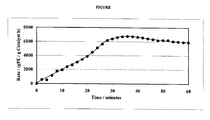
- the Figure is a polymerization kinetic rate-time profile for ethylene polymerization using the catalyst composition of the present invention described in Example 1 below and a process of the present invention described in Example 5 below.
- the profile shows a rate build up followed by a stable rate-time profile resulting in product polymer of spherical morphology and uniform particle size distribution.
- the ethylene homopolymers and copolymers which may be prepared by the process of the present invention can have a wide density range of about 0.88 to 0.98 g/cm 3 .
- the process of the present invention provides polyolefins, and preferably high density polyethylene and linear low density polyethylene.
- the density of the polymer at a given melt index can be regulated by the amount of the alpha-olefin comonomer used.
- the amount of alpha-olefin comonomer needed to achieve the same density is varied according to the type of comonomer used.
- These alpha-olefins have 4 to 10 carbon atoms and include 1-butene, 1-pentene, 4-methyl-1-pentene, 1-hexene, 1-heptene, 1-octene and/or mixtures thereof.
- the weight average molecular weight (Mw) of the polymers produced by the process of the present invention is in the range of about 500 to 900 000 g/mole or higher, preferably from about 10 000 to 750 000 g/mole; depending on the amount of hydrogen used, the polymerization temperature and the polymer density attained.
- the homopolymers and copolymers of the present invention have a melt index (MI) range of more than 0 and up to 100, preferably between 0.3 to 50.
- MI melt index
- the polymers of such wide range of MI are capable of being used in film and molding applications.
- the molecular weight distribution (MWD) of the polymers produced by the process of the present invention expressed as weight average molecular weight / number average molecular weight (Mw/Mn), is in the range of about 2 to about 30.
- the polymers produced by the process of the present invention are granular materials, uniform and spherical particles with an average particle size of about 0.1 to 4 mm in diameter and contain a very low level of fines.
- the solid catalyst precursor used in the present invention comprises a polymeric material in the form of particles having a mean particle diameter of about 5 to 1 000 microns and a pore volume of at least about 0.05 cm 3 /g and a pore diameter of about 20 to 10 000 angstroms, preferably from about 500 to 10 000 angstroms, and a surface area of about 0.1 to 100 m 2 /g, preferably from about 0.2 to 30 m 2 /g.
- the vanadium compound used for the catalyst composition for the process of the present invention is represented by the general formulas V(OR 1 ) n X 4-n , V(R 2 ) n X 4-n , VX 3 and VOX 3 , wherein R 1 and R 2 represent an alkyl group, aryl group or cycloalkyl group having 1 to 20 carbon atoms, X represents a halogen and n represents a number satisfying 0 ⁇ n ⁇ 4. Examples of R 1 and R 2 include alkyl groups such as methyl, ethyl, n-propyl, isopropyl, n-butyl, isobutyl, tert-butyl and the like.
- vanadium compounds are selected from the group comprising vanadium tetraethoxide, vanadium tetrapropoxide, vanadium tetrabutoxide, vanadium trichloride, vanadium tetrachloride, vanadium oxytrichloride, vanadium dichlorodiethoxide and/or the like. Vanadium tetrachloride and/or vanadium oxytrichloride are most preferred.
- the transition metal compound which may be used for the catalyst composition for the process of the present invention is represented by the general formulas Tm(OR 3 ) n X 4-n , TmOX 3 and Tm(R 4 ) n X 4-n , wherein Tm represents a transition metal of Group IVB, VB, or VIB, wherein R 3 and R 4 represent an alkyl group, aryl group or cycloalkyl group having 1 to 20 carbon atoms, X represents a halogen atom and n represents a number satisfying 0 ⁇ n ⁇ 4.
- Non-limiting examples of the transition metal are titanium and vanadium
- examples of R 3 and R 4 include alkyl groups such as methyl, ethyl, n-propyl, isopropyl, n-butyl, isobutyl, tert-butyl and the like.
- Preferred examples of the above mentioned transition metal compounds are selected from the group comprising titanium trichloromethoxide, titanium dichlorodimethoxide, titanium tetramethoxide, titanium trichloroethoxide, titanium dichlorodiethoxide, titanium tetraethoxide, titanium trichloropropoxide, titanium dichlorodipropoxide, titanium chlorotripropoxide, titanium tetrapropoxide, titanium trichlorobutoxide, titanium dichlorodibutoxide, titanium tetrabutoxide, vanadium tetrachloride, vanadium tetraethoxide, vanadium tetrapropoxide, vanadium tetrabutoxide, vanadium oxytrichloride, vanadium dichlorodiethoxide and/or the like. Titanium tetraethoxide, titanium tetrapropoxide and/or titanium tetrabutoxide are most preferred.
- the alcohol compound which may be used for the catalyst composition for the process of the present invention includes compounds represented by the general formula R 5 OH, wherein R 5 is an alkyl group, aryl group or cycloalkyl group having 1 to 20 carbon atoms.
- R 5 include groups such as methyl, ethyl, n-propyl, isopropyl, n-butyl, isobutyl, tert-butyl, cyclohexyl, phenyl, methylphenyl, ethylphenyl and the like.
- Preferred examples of the above mentioned alcohols are selected from the group comprising methanol, ethanol, n-propanol, isopropanol, n-butanol, isobutanol, tert-butanol, cyclohexanol, phenol, methylphenol, ethylphenol and/or mixtures thereof.
- the magnesium compound used for the catalyst composition for the process of the present invention include Grignard compounds represented by the general formula R 6 MgX, wherein R 6 is a hydrocarbon group having 1 to 20 carbon atoms and X is a halogen atom, preferably chlorine.
- R 6 MgX is a hydrocarbon group having 1 to 20 carbon atoms
- X is a halogen atom, preferably chlorine.
- Other preferred magnesium compounds are represented by the general formula R 7 R 8 Mg, wherein R 7 and R 8 are each a hydrocarbon group having 1 to 20 carbon atoms.
- Preferred examples of the above mentioned magnesium compounds include dialkylmagnesium such as diethylmagnesium, di-n-propylmagnesium, di-isopropylmagnesium, di-n-butylmagnesium, di-isobutylmagnesium butylethylmagnesium, dihexylmagnesium, dioctylmagnesium, butyloctylmagnesium; alkylmagnesium chloride such as ethylmagnesium chloride, butylmagnesium chloride, hexylmagnesium chloride and/or mixtures thereof.
- dialkylmagnesium such as diethylmagnesium, di-n-propylmagnesium, di-isopropylmagnesium, di-n-butylmagnesium, di-isobutylmagnesium butylethylmagnesium, dihexylmagnesium, dioctylmagnesium, butyloctylmagnesium
- the polymer particles used for the catalyst composition for the process of the present invention have a spherical shape with a mean particle diameter of about 5 to 1 000 microns and a pore volume of at least about 0.05 cm 3 /g and a pore diameter of about 20 to 10 000 angstroms, preferably from about 500 to 10 000 angstroms, and a surface area of about 0.1 to 100 m 2 /g, preferably from about 0.2 to 30 m 2 /g.
- Examples of the above polymeric supports used for the catalyst composition for the process of the present invention are selected from the group comprising polymer particles of polyvinylchloride, polyvinylalcohol, polyketone, hydrolyzed polyketone, ethylene-vinylalcohol copolymer, polycarbonate and the like.
- polyvinylchloride is more preferred and non-crosslinked polyvinylchloride particles are most preferred.
- Polyvinylchloride having a molecular weight in the range of about 5 000 to 500 000 g/mole is most preferred.
- the use of the polymer particles mentioned in the present invention, in catalyst preparation offers significant advantages over traditional olefin polymerization catalysts using supports such as silica or magnesium chloride.
- the polymer particles described in catalyst preparation of the present invention do not require high temperature and prolonged dehydration steps prior to their use in catalyst synthesis, thereby simplifying the synthesis process and thus reducing the overall cost of catalyst preparation.
- the cost of the polymeric support used in the present invention is substantially cheaper than silica or magnesium chloride supports.
- the catalyst of the present invention uses significantly lower levels of catalyst components for catalyst preparation than silica or magnesium chloride supported catalysts.
- the process of the present invention exhibits a higher activity than processes with conventional silica or magnesium chloride supported catalysts.
- a polyvinylchloride support is used in the process.
- the synthesis of the solid catalyst precursor of the present invention involves introducing the polymeric material described above into a vessel and then adding a diluent.
- Suitable diluents include isopentane, hexane, cyclohexane, heptane, isooctane and pentamethylheptane.
- the polymeric material is then treated with a magnesium compound described above at a temperature in the range of about 10° C to 130° C.
- the ratio of magnesium compound to the polymer support may be in the range of about 0.05 to 20 mmol per gram of polymer, preferably 0.1 to 10 mmol per gram polymer.
- the solvent is then vaporized using a nitrogen purge at a temperature in the range of about 20° C to 100° C.
- the resulting free-flowing solid product is then slurried.
- Suitable solvents for slurring include isopentane, hexane, cyclohexane, heptane, isooctane and pentamethylheptane.
- the magnesium modified polymeric material is then treated with a transition metal compound and/or an alcohol described above at a temperature in the range of about 10° C to 130° C.
- titanium tetramethoxide, titanium tetraethoxide, titanium tetrapropoxide, titanium tetrabutoxide are preferred transition metal compounds and methanol, ethanol, n-propanol, isopropanol, n-butanol are preferred alcohols.
- vanadium tetrachloride and/or vanadium oxytrichloride are preferred vanadium compounds.
- the produced solid catalyst precursor is then washed several times with a suitable solvent such as isopentane, hexane, cyclohexane, heptane, or isooctane.
- the solid catalyst precursor is then dried using a nitrogen purge at a temperature in the range of 20° C to 100° C.
- the molar ratio of vanadium to magnesium is in the range of about 0.01 to 50.
- the transition metal compound is used in catalyst preparation
- the molar ratio of vanadium to transition metal in the catalyst precursor is in the range of about 0.01 to 50
- alcohol used in catalyst preparation
- the molar ratio of vanadium to OH groups in the catalyst precursor is in the range of about 0.01 to 50.
- the catalyst compositions used for the process of the present invention are not subjected to halogenation treatments, for example chlorination treatments.
- the thus-formed catalyst precursor of the present invention is suitably activated by aluminum compounds, also known as cocatalysts.
- the activation process can be a one step in which the catalyst is fully activated in the reactor, or two steps, in which the catalyst is partially activated outside the reactor and the complete activation occurs inside the reactor.
- the catalyst compositions of the present invention do not require promoters such as chloroform, trichlorofluoromethane or dibromomethane during polymerization.
- the aluminum compounds, also known as cocatalyst, used in the process of the present invention are represented by the general formula R 9 n AlX 3-n , wherein R 9 represents a hydrocarbon group having 1 to 10 carbon atoms, X represents a halogen and represents a number satisfying 0 ⁇ n ⁇ 3.
- R 9 represents a hydrocarbon group having 1 to 10 carbon atoms
- X represents a halogen and represents a number satisfying 0 ⁇ n ⁇ 3.
- Illustrative but not limiting examples include trialkylaluminums such as trimethylaluminum, triethylaluminum, tri-isobutylaluminum or tri-n-hexylaluminum; dialkylaluminum chloride such as dimethylaluminum chloride, diethylaluminum chloride.
- the preferred activators of the above general formula are trimethylaluminum, triethylaluminum, tri-isobutylaluminum and tri-n
- suialuminum compounds of the present invention are represented by the general formula R 10 R 11 Al-O-AlR 12 R 13 , wherein R 10 , R 11 , R 12 and R 13 are either the same or different linear, branched or cyclic alkyl group having 1 to 12 carbon atoms, such as methyl, ethyl, propyl or isobutyl.
- the preferred examples are methylaluminoxane (MAO) and modified methylaluminoxane (MMAO).
- MAO methylaluminoxane
- MMAO modified methylaluminoxane
- mixtures of alkylaluminum compounds and aluminoxane compounds described above can also be conveniently used in the present invention.
- the cocatalyst in the present invention can be added to the catalyst precursor before and/or during the polymerization reaction.
- the cocatalyst in the present invention can be used in an amount of about 10 to 5 000 in terms moles of aluminum in the cocatalyst to moles of transition metal in the catalyst precursor, and is preferably in the range of 20 to 3 000.
- the process of the present invention can be carried out in slurry, solution and gas phase conditions.
- Gas phase polymerization can be carried out in stirred bed reactors and in fluidized bed reactors.
- Suitable ethylene pressures are in the range of about 3 to 40 bar, more preferably 5 to 30 bar and suitable polymerization temperatures are in the range of about 30° C to 110° C, preferably 50° C to 95° C.
- ethylene copolymers with alpha-olefins having 4 to 10 carbon atoms are readily prepared by the present invention.
- Particular examples include ethylene/1-butene, ethylene/1-pentene, ethylene/1-heptene, ethylene/1-hexene, ethylene/1-octene and ethylene/4-methyl 1-pentene.
- the density of the polymer at a given melt index can be regulated by the amount and nature of the alpha-olefin comonomer used.
- Hydrogen can be very conveniently used during polymerization using the catalyst described in the present invention to regulate the molecular weight of the polymer product.
- Catalysts described in the prior art display undesirable decay type polymerization rate-time profiles, however the catalysts described in the present invention display build up followed by stable polymerization rate-time profiles, as seen in the Figure, such profiles are very suitable in gas, slurry and solution phase polymerization processes and provide polymer of good morphology and high resin bulk density.
- Mw, Mn, and MWD were measured at 135° C by Gel Permeation Chromatography (GPC) using mixed mode columns and trichlorobenzene as solvent. Melting point (Mp) was determined by Differential Scanning Calorimetry (DSC).
- magnesium-modified polyvinylchloride was slurried using 30 cm 3 of isopentane and 2.0 cm 3 of titanium tetraethoxide (1.0 molar in n-hexane) was added to the slurry and the resulting mixture was stirred at 35° C for 40 minutes. A dark green/brown colored solid was produced. Then 8.0 cm 3 of vanadium tetrachloride (1.0 molar in n-hexane) was added to contents of the flask and the resulting mixture was stirred at 35° C for 20 minutes.
- the supernatant liquid was decanted and the resulting solid product was washed by stirring with 80 cm 3 of isopentane and then removing the isopentane, then washed again twice with 80 cm 3 of isopentane in each wash. Finally, the solid catalyst was dried using a nitrogen purge at 35° C to yield a free-flowing brown colored solid product.
- the solid catalyst precursor was analyzed by atomic adsorption spectroscopy and was found to contain 0.57% by weight magnesium, 0.54% by weight titanium and 1.77% by weight vanadium.
- Polymerization was carried out for 1 hour; with ethylene supplied on demand to maintain the total reactor pressure at 15 barg. 390 grams of polyethylene were recovered with a catalyst productivity of 3900 gPE/g catalyst, a resin bulk density of 0.290 g/cm 3 , a weight average molecular weight of 94 050 g/mole, a number average molecular weight of 28 350, a molecular weight distribution of 3.32 and a melting point of 135° C.
- magnesium-modified polyvinylchloride was slurried using 30 cm 3 of isopentane and 2.0 cm 3 of titanium tetraethoxide (1.0 molar in n-hexane) was added to the slurry and the resulting mixture was stirred at 35° C for 40 minutes. A dark green/brown colored solid was produced. Then 8.0 cm 3 of vanadium oxytrichloride (1.0 molar in n-hexane) was added to contents of the flask and the resulting mixture was stirred at 35° C for 20 minutes.
- the supernatant liquid was decanted and the resulting solid product was washed by stirring with 80 cm 3 of isopentane and then removing the isopentane, then washed again twice with 80 cm 3 of isopentane in each wash. Finally, the solid catalyst was dried using a nitrogen purge at 35° C to yield a free-flowing brown colored solid product.
- the solid catalyst precursor was analyzed by atomic adsorption spectroscopy and was found to contain 0.74% by weight magnesium, 0.56% by weight titanium and 1.50% by weight vanadium.
- Polymerization was carried out for 1 hour; with ethylene supplied on demand to maintain the total reactor pressure at 15 barg. 200 grams of polyethylene were recovered with a catalyst productivity of 2000 gPE/g catalyst, a resin bulk density of 0.260 g/cm 3 , a weight average molecular weight of 157 000 g/mole, a number average molecular weight of 44 950, a molecular weight distribution of 3.49 and a melting point of 138° C.
Landscapes
- Chemical & Material Sciences (AREA)
- Health & Medical Sciences (AREA)
- Chemical Kinetics & Catalysis (AREA)
- Medicinal Chemistry (AREA)
- Polymers & Plastics (AREA)
- Organic Chemistry (AREA)
- Transition And Organic Metals Composition Catalysts For Addition Polymerization (AREA)
Abstract
Description
- The present invention relates to a process for the polymerization of olefins.
- Several publications are referenced in this application. These references describe the state of the art to which this invention pertains, and are incorporated herein by reference.
- The application of vanadium based Ziegler-Natta catalysts for industrial use has been limited to vanadium trichloride and vanadium oxytrichloride as homogenous catalysts in solution polymerization for the production of ethylene-propylene copolymers. To attain suitable activity for polymerization these catalysts require the use of halogenated organic molecules such as chloroform and trichlorofluoromethane as a promoter. In the absence of the promoter the catalyst activity is low. Further, the kinetic behavior of these catalysts during polymerization display high initial rates of polymerization followed by a sharp decrease with time, decay type rate-time kinetics, and as a result produce resin of poor morphology.
- The application of vanadium based catalysts for ethylene polymerization, high density and linear low density polyethylene production, has been comparatively very limited. Attempts have been made to support vanadium based catalysts on silica or magnesium chloride to produce catalysts for ethylene polymerization. US 4,508,842 describes a catalyst preparation in which a complex of VCl3 and tetrahydrofuran (THF) is treated with silica, the solvent is then removed from the solid by distillation and a boron trihalide or alkylaluminum halide modifier is added to the solid. In addition, chloroform is used as a promoter with the catalyst for ethylene polymerization. However the productivity and stability of this catalyst system is relatively poor.
- US 5,534,472 and 5,670,439 describe a silica supported vanadium catalyst prepared by the prior contacting of silica with an organomagnesium compound and a trialkylaluminum compound. The catalysts are suitable for the production of ethylene-hexene copolymer. However, the polymerizations are conducted with trichlorofluoromethane or dibromomethane promoters.
- Further, procedures typically used for the preparation of suitable magnesium chloride and silica supports such as spray drying or re-crystallization processes are complicated and expensive. Also, the inorganic supports remain in the product, which can affect the product properties, such as optical properties, or processing.
- It is an object of the present invention to provide a process for polymerization of olefins which overcomes the drawbacks of the prior art, especially providing a process which is cheap in carrying out and which produces a polymer with improved productivity and activity without using halogenated organic molecules as a promoter.
- The present invention provides a process for homopolymerization of ethylene or copolymerization of ethylene with alpha-olefins by contacting ethylene or ethylene and alpha-olefin with a catalyst composition comprising: (a) a solid catalyst precursor comprising at least one vanadium compound, at least one magnesium compound and a polymeric material; and (b) a cocatalyst comprising at least one aluminum compound.
- Most preferably, the component (a) used in the catalyst composition for the process of the present invention further comprises at least one further transition metal compound and/or at least one alcohol.
- As a result of the present invention polyolefin and especially polyethylenes and copolymers of ethylene and alpha-olefins are provided which have a density of about 0.88 to 0.98 g/cm3 and weight average molecular weight of about 500 to 900 000 g/mole and molecular weight distribution range of about 2 to about 30. The products have a uniform spherical particle morphology, very low level of fines and catalyst residues, improved thermal stability, excellent optical and improved environmental stress cracking resistance (ESCR).
- Further advantages and features of the present invention will become apparent by the following detailed description in connection with the accompanying drawing.
- In the drawing the Figure is a polymerization kinetic rate-time profile for ethylene polymerization using the catalyst composition of the present invention described in Example 1 below and a process of the present invention described in Example 5 below.
- The profile shows a rate build up followed by a stable rate-time profile resulting in product polymer of spherical morphology and uniform particle size distribution.
- The ethylene homopolymers and copolymers which may be prepared by the process of the present invention can have a wide density range of about 0.88 to 0.98 g/cm3. The process of the present invention provides polyolefins, and preferably high density polyethylene and linear low density polyethylene. The density of the polymer at a given melt index can be regulated by the amount of the alpha-olefin comonomer used. The amount of alpha-olefin comonomer needed to achieve the same density is varied according to the type of comonomer used. These alpha-olefins have 4 to 10 carbon atoms and include 1-butene, 1-pentene, 4-methyl-1-pentene, 1-hexene, 1-heptene, 1-octene and/or mixtures thereof.
- The weight average molecular weight (Mw) of the polymers produced by the process of the present invention is in the range of about 500 to 900 000 g/mole or higher, preferably from about 10 000 to 750 000 g/mole; depending on the amount of hydrogen used, the polymerization temperature and the polymer density attained. The homopolymers and copolymers of the present invention have a melt index (MI) range of more than 0 and up to 100, preferably between 0.3 to 50. The polymers of such wide range of MI are capable of being used in film and molding applications.
- The molecular weight distribution (MWD) of the polymers produced by the process of the present invention expressed as weight average molecular weight / number average molecular weight (Mw/Mn), is in the range of about 2 to about 30.
- The polymers produced by the process of the present invention are granular materials, uniform and spherical particles with an average particle size of about 0.1 to 4 mm in diameter and contain a very low level of fines.
- The solid catalyst precursor used in the present invention comprises a polymeric material in the form of particles having a mean particle diameter of about 5 to 1 000 microns and a pore volume of at least about 0.05 cm3/g and a pore diameter of about 20 to 10 000 angstroms, preferably from about 500 to 10 000 angstroms, and a surface area of about 0.1 to 100 m2/g, preferably from about 0.2 to 30 m2/g.
- The vanadium compound used for the catalyst composition for the process of the present invention is represented by the general formulas V(OR1)nX4-n, V(R2)nX4-n, VX3 and VOX3, wherein R1 and R2 represent an alkyl group, aryl group or cycloalkyl group having 1 to 20 carbon atoms, X represents a halogen and n represents a number satisfying 0 < n < 4. Examples of R1 and R2 include alkyl groups such as methyl, ethyl, n-propyl, isopropyl, n-butyl, isobutyl, tert-butyl and the like.
- Preferred examples of the above mentioned vanadium compounds are selected from the group comprising vanadium tetraethoxide, vanadium tetrapropoxide, vanadium tetrabutoxide, vanadium trichloride, vanadium tetrachloride, vanadium oxytrichloride, vanadium dichlorodiethoxide and/or the like. Vanadium tetrachloride and/or vanadium oxytrichloride are most preferred.
- The transition metal compound which may be used for the catalyst composition for the process of the present invention is represented by the general formulas Tm(OR3)nX4-n, TmOX3 and Tm(R4)nX4-n, wherein Tm represents a transition metal of Group IVB, VB, or VIB, wherein R3 and R4 represent an alkyl group, aryl group or cycloalkyl group having 1 to 20 carbon atoms, X represents a halogen atom and n represents a number satisfying 0 < n < 4. Non-limiting examples of the transition metal are titanium and vanadium, examples of R3 and R4 include alkyl groups such as methyl, ethyl, n-propyl, isopropyl, n-butyl, isobutyl, tert-butyl and the like.
- Preferred examples of the above mentioned transition metal compounds are selected from the group comprising titanium trichloromethoxide, titanium dichlorodimethoxide, titanium tetramethoxide, titanium trichloroethoxide, titanium dichlorodiethoxide, titanium tetraethoxide, titanium trichloropropoxide, titanium dichlorodipropoxide, titanium chlorotripropoxide, titanium tetrapropoxide, titanium trichlorobutoxide, titanium dichlorodibutoxide, titanium tetrabutoxide, vanadium tetrachloride, vanadium tetraethoxide, vanadium tetrapropoxide, vanadium tetrabutoxide, vanadium oxytrichloride, vanadium dichlorodiethoxide and/or the like. Titanium tetraethoxide, titanium tetrapropoxide and/or titanium tetrabutoxide are most preferred.
- The alcohol compound which may be used for the catalyst composition for the process of the present invention includes compounds represented by the general formula R5OH, wherein R5 is an alkyl group, aryl group or cycloalkyl group having 1 to 20 carbon atoms. Examples of R5 include groups such as methyl, ethyl, n-propyl, isopropyl, n-butyl, isobutyl, tert-butyl, cyclohexyl, phenyl, methylphenyl, ethylphenyl and the like.
- Preferred examples of the above mentioned alcohols are selected from the group comprising methanol, ethanol, n-propanol, isopropanol, n-butanol, isobutanol, tert-butanol, cyclohexanol, phenol, methylphenol, ethylphenol and/or mixtures thereof.
- The magnesium compound used for the catalyst composition for the process of the present invention include Grignard compounds represented by the general formula R6MgX, wherein R6 is a hydrocarbon group having 1 to 20 carbon atoms and X is a halogen atom, preferably chlorine. Other preferred magnesium compounds are represented by the general formula R7R8Mg, wherein R7 and R8 are each a hydrocarbon group having 1 to 20 carbon atoms.
- Preferred examples of the above mentioned magnesium compounds include dialkylmagnesium such as diethylmagnesium, di-n-propylmagnesium, di-isopropylmagnesium, di-n-butylmagnesium, di-isobutylmagnesium butylethylmagnesium, dihexylmagnesium, dioctylmagnesium, butyloctylmagnesium; alkylmagnesium chloride such as ethylmagnesium chloride, butylmagnesium chloride, hexylmagnesium chloride and/or mixtures thereof.
- The polymer particles used for the catalyst composition for the process of the present invention have a spherical shape with a mean particle diameter of about 5 to 1 000 microns and a pore volume of at least about 0.05 cm3/g and a pore diameter of about 20 to 10 000 angstroms, preferably from about 500 to 10 000 angstroms, and a surface area of about 0.1 to 100 m2/g, preferably from about 0.2 to 30 m2/g.
- Examples of the above polymeric supports used for the catalyst composition for the process of the present invention are selected from the group comprising polymer particles of polyvinylchloride, polyvinylalcohol, polyketone, hydrolyzed polyketone, ethylene-vinylalcohol copolymer, polycarbonate and the like. Among these polymeric materials polyvinylchloride is more preferred and non-crosslinked polyvinylchloride particles are most preferred. Polyvinylchloride having a molecular weight in the range of about 5 000 to 500 000 g/mole is most preferred.
- The use of the polymer particles mentioned in the present invention, in catalyst preparation offers significant advantages over traditional olefin polymerization catalysts using supports such as silica or magnesium chloride. In comparison to the silica supported catalyst, the polymer particles described in catalyst preparation of the present invention do not require high temperature and prolonged dehydration steps prior to their use in catalyst synthesis, thereby simplifying the synthesis process and thus reducing the overall cost of catalyst preparation. Further, the cost of the polymeric support used in the present invention is substantially cheaper than silica or magnesium chloride supports. In addition, the catalyst of the present invention uses significantly lower levels of catalyst components for catalyst preparation than silica or magnesium chloride supported catalysts. Also, the process of the present invention exhibits a higher activity than processes with conventional silica or magnesium chloride supported catalysts.
- According to one embodiment of the present invention, a polyvinylchloride support is used in the process. The synthesis of the solid catalyst precursor of the present invention involves introducing the polymeric material described above into a vessel and then adding a diluent.
- Suitable diluents include isopentane, hexane, cyclohexane, heptane, isooctane and pentamethylheptane. The polymeric material is then treated with a magnesium compound described above at a temperature in the range of about 10° C to 130° C. The ratio of magnesium compound to the polymer support may be in the range of about 0.05 to 20 mmol per gram of polymer, preferably 0.1 to 10 mmol per gram polymer. The solvent is then vaporized using a nitrogen purge at a temperature in the range of about 20° C to 100° C.
- The resulting free-flowing solid product is then slurried. Suitable solvents for slurring include isopentane, hexane, cyclohexane, heptane, isooctane and pentamethylheptane. The magnesium modified polymeric material is then treated with a transition metal compound and/or an alcohol described above at a temperature in the range of about 10° C to 130° C. According to the present invention titanium tetramethoxide, titanium tetraethoxide, titanium tetrapropoxide, titanium tetrabutoxide are preferred transition metal compounds and methanol, ethanol, n-propanol, isopropanol, n-butanol are preferred alcohols. The resulting material is then treated with a vanadium compound described above at a temperature in the range of about 10° C to 130° C. According to the present invention vanadium tetrachloride and/or vanadium oxytrichloride are preferred vanadium compounds.
- The produced solid catalyst precursor is then washed several times with a suitable solvent such as isopentane, hexane, cyclohexane, heptane, or isooctane. The solid catalyst precursor is then dried using a nitrogen purge at a temperature in the range of 20° C to 100° C. In the final dried solid catalyst precursor, the molar ratio of vanadium to magnesium is in the range of about 0.01 to 50. In the case where the transition metal compound is used in catalyst preparation the molar ratio of vanadium to transition metal in the catalyst precursor is in the range of about 0.01 to 50, and in the case where alcohol is used in catalyst preparation the molar ratio of vanadium to OH groups in the catalyst precursor is in the range of about 0.01 to 50.
- The catalyst compositions used for the process of the present invention are not subjected to halogenation treatments, for example chlorination treatments. The thus-formed catalyst precursor of the present invention is suitably activated by aluminum compounds, also known as cocatalysts. The activation process can be a one step in which the catalyst is fully activated in the reactor, or two steps, in which the catalyst is partially activated outside the reactor and the complete activation occurs inside the reactor. Unlike catalyst compositions described in the prior art the catalyst compositions of the present invention do not require promoters such as chloroform, trichlorofluoromethane or dibromomethane during polymerization.
- The aluminum compounds, also known as cocatalyst, used in the process of the present invention are represented by the general formula R9 nAlX3-n, wherein R9 represents a hydrocarbon group having 1 to 10 carbon atoms, X represents a halogen and represents a number satisfying 0 < n < 3. Illustrative but not limiting examples include trialkylaluminums such as trimethylaluminum, triethylaluminum, tri-isobutylaluminum or tri-n-hexylaluminum; dialkylaluminum chloride such as dimethylaluminum chloride, diethylaluminum chloride. The preferred activators of the above general formula are trimethylaluminum, triethylaluminum, tri-isobutylaluminum and tri-n-hexylaluminum.
- Examples of other suialuminum compounds of the present invention are represented by the general formula R10R11Al-O-AlR12R13, wherein R10, R11, R12 and R13 are either the same or different linear, branched or cyclic alkyl group having 1 to 12 carbon atoms, such as methyl, ethyl, propyl or isobutyl. The preferred examples are methylaluminoxane (MAO) and modified methylaluminoxane (MMAO). Further, mixtures of alkylaluminum compounds and aluminoxane compounds described above can also be conveniently used in the present invention.
- The cocatalyst in the present invention can be added to the catalyst precursor before and/or during the polymerization reaction. The cocatalyst in the present invention can be used in an amount of about 10 to 5 000 in terms moles of aluminum in the cocatalyst to moles of transition metal in the catalyst precursor, and is preferably in the range of 20 to 3 000.
- The process of the present invention can be carried out in slurry, solution and gas phase conditions. Gas phase polymerization can be carried out in stirred bed reactors and in fluidized bed reactors. Suitable ethylene pressures are in the range of about 3 to 40 bar, more preferably 5 to 30 bar and suitable polymerization temperatures are in the range of about 30° C to 110° C, preferably 50° C to 95° C. In addition to polyethylene homopolymer, ethylene copolymers with alpha-olefins having 4 to 10 carbon atoms are readily prepared by the present invention. Particular examples include ethylene/1-butene, ethylene/1-pentene, ethylene/1-heptene, ethylene/1-hexene, ethylene/1-octene and ethylene/4-methyl 1-pentene. The density of the polymer at a given melt index can be regulated by the amount and nature of the alpha-olefin comonomer used. Hydrogen can be very conveniently used during polymerization using the catalyst described in the present invention to regulate the molecular weight of the polymer product.
- Catalysts described in the prior art display undesirable decay type polymerization rate-time profiles, however the catalysts described in the present invention display build up followed by stable polymerization rate-time profiles, as seen in the Figure, such profiles are very suitable in gas, slurry and solution phase polymerization processes and provide polymer of good morphology and high resin bulk density.
- The following examples are intended to be illustrative of this invention. They are, of course, not be taken in any way limiting on the scope of this invention. Numerous changes and modifications can be made with respect to the invention.
- The properties of the polymers produced in the following examples were determined by the following test methods:
- Mw, Mn, and MWD were measured at 135° C by Gel Permeation Chromatography (GPC) using mixed mode columns and trichlorobenzene as solvent. Melting point (Mp) was determined by Differential Scanning Calorimetry (DSC).
- To a three-necked round bottom flask, equipped with a condenser and a magnetic stirrer, was placed 10.0 g of polyvinylchloride spheres with an average particle size of 36 microns. The flask containing the polyvinylchloride was heated up to 70° C using an oil bath and then evacuated at 30 mm Hg pressure for 30 minutes. The flask and its contents were then purged with dried nitrogen and the polyvinylchloride was slurried using 30 cm3 of isopentane. Then 1.5 cm3 of butylmagnesium chloride (2.0 molar in diethylether) was added to the slurry and the resultant mixture was stirred for 60 minutes at an oil bath temperature of 35° C, under reflux conditions. The isopentane was then evaporated to obtain a free-flowing powder by using a nitrogen purge at 35° C.
- Then the magnesium-modified polyvinylchloride was slurried using 30 cm3 of isopentane and 2.0 cm3 of titanium tetraethoxide (1.0 molar in n-hexane) was added to the slurry and the resulting mixture was stirred at 35° C for 40 minutes. A dark green/brown colored solid was produced. Then 8.0 cm3 of vanadium tetrachloride (1.0 molar in n-hexane) was added to contents of the flask and the resulting mixture was stirred at 35° C for 20 minutes. The supernatant liquid was decanted and the resulting solid product was washed by stirring with 80 cm3 of isopentane and then removing the isopentane, then washed again twice with 80 cm3 of isopentane in each wash. Finally, the solid catalyst was dried using a nitrogen purge at 35° C to yield a free-flowing brown colored solid product. The solid catalyst precursor was analyzed by atomic adsorption spectroscopy and was found to contain 0.57% by weight magnesium, 0.54% by weight titanium and 1.77% by weight vanadium.
- An autoclave with a volume of 3 liters was purged with nitrogen at 130° C for 30 minutes. After cooling the autoclave to 85° C the reactor was purged with hydrogen and then 1.5 liters of n-hexane were introduced to the reactor. The reactor was then pressurized to 3 barg hydrogen pressure. Then 5.0 cm3 of tri-isobutylaluminum, TIBAL (1.0 molar in n-hexane) was injected into the reactor. Ethylene was introduced to the reactor such as to raise the reactor pressure to 15 barg. This was followed by injection of 0.1 g of the solid catalyst precursor "A" described in Example 1 after being slurried in 20 cm3 of n-hexane solvent. Polymerization was carried out for 1 hour; with ethylene supplied on demand to maintain the total reactor pressure at 15 barg. 390 grams of polyethylene were recovered with a catalyst productivity of 3900 gPE/g catalyst, a resin bulk density of 0.290 g/cm3, a weight average molecular weight of 94 050 g/mole, a number average molecular weight of 28 350, a molecular weight distribution of 3.32 and a melting point of 135° C.
- An autoclave with a volume of 3 liters was purged with nitrogen at 130° C for 30 minutes. After cooling the autoclave to 85° C the reactor was purged with hydrogen and then 1.5 liters of n-hexane were introduced to the reactor. The reactor was then pressurised to 3 barg hydrogen pressure. Then, the desired quantity of triethylaluminum, TEAL (1.0 molar in n-hexane), described in Table 1 below, was injected into the reactor. Ethylene was introduced to the reactor such as to raise the reactor pressure to 15 barg. This was followed by injection of 0.1 g of the solid catalyst precursor "A" described in Example 1 after being slurried in 20 cm3 of n-hexane solvent. Polymerization was carried out for 1 hour; with ethylene supplied on demand to maintain the total reactor pressure at 15 barg. Catalyst performance and product polymer properties are described in Table 1.
Influence of TEAL Concentration Example TEAL / (mmol) Yield /(g PE) Productivity /(g PE/g catalyst) Bulk Density / (g/cm3) Mw / (1000g/mol) Mn / (1000) MWD DSC / (Mp/°C) 3 4 500 5000 0.310 135 36.4 3.71 138 4 6 455 4550 0.303 109 35.2 3.10 137 - An autoclave with a volume of 3 liters was purged with nitrogen at 130° C for 30 minutes. After cooling the autoclave to 85° C the reactor was purged with hydrogen and then 1.5 liters of n-hexane were introduced to the reactor. The reactor was then pressurised to the desired hydrogen pressure, described in Table 2 below. Then 4.0 cm3 of triethylaluminum, TEAL (1.0 molar in n-hexane) was injected into the reactor. Ethylene was introduced to the reactor such as to raise the reactor pressure to 15 barg. This was followed by injection of 0.1 g of the solid catalyst precursor "A" described in Example 1 after being slurried in 20 cm3 of n-hexane solvent. Polymerization was carried out for 1 hour; with ethylene supplied on demand to maintain the total reactor pressure at 15 barg. Catalyst performance and product polymer properties are described in Table 2.
Influence of Hydrogen Pressure Example Hydrogen Pressure /(barg) Yield /(g PE) Productivity /(g PE/g catalyst) Bulk Density / (g /cm3) Mw / (1000g/mol) Mn / (1000) MWD DSC / (Mp/°C) 5 2 490 4900 0.290 151 43.3 3.48 139 3 3 500 5000 0.310 135 36.4 3.71 13 6 4 305 3050 0.260 114 33.7 3.37 137 - An autoclave with a volume of 3 liters was purged with nitrogen at 130° C for 30 minutes. After cooling the autoclave to 85° C the reactor was purged with hydrogen and then 1.5 liters of n-hexane were introduced to the reactor. Then the desired quantity of butene, described in Table 3 below, was added to the reactor. The reactor was then pressurized to 3 barg hydrogen pressure. Then 4.0 cm3 of triethylaluminum, TEAL (1.0 molar in n-hexane) was injected into the reactor. Ethylene was introduced to the reactor such as to raise the reactor pressure to 15 barg. This was followed by injection of 0.1 g of the solid catalyst precursor "A" described in Example 1 after being slurried in 20 cm3 of n-hexane solvent. Polymerization was carried out for 1 hour; with ethylene supplied on demand to maintain the total reactor pressure at 15 barg. Catalyst performance and product polymer properties are described in Table 3.
Influence of Butene Example Butene /(cm3) Yield /(g PE) Productivity /(g PE/g catalyst) Bulk Density / (g /cm3) Mw / (1000g/mol) Mn / (1000) MWD DSC / (Mp/°C) 3 0 500 5000 0.310 135 36.4 3.71 138 7 10 502 5020 0.300 135 35.7 3.77 138 - An autoclave with a volume of 3 liters was purged with nitrogen at 130° C for 30 minutes. After cooling the autoclave to 85° C the reactor was purged with hydrogen and then 1.5 liters of n-hexane were introduced to the reactor. Then the desired quantity of hexene, described in Table 4 below, was added to the reactor. The reactor was then pressurized to 3 barg hydrogen pressure. Then 4.0 cm3 of triethylaluminum, TEAL (1.0 molar in n-hexane) was injected into to the reactor. Ethylene was introduced to the reactor such as to raise the reactor pressure to 15 barg. This was followed by injection of 0.1 g of the solid catalyst precursor "A" described in Example 1 after being slurried in 20 cm3 of n-hexane solvent. Polymerization was carried out for 1 hour; with ethylene supplied on demand to maintain the total reactor pressure at 15 barg. Catalyst performance and product polymer properties are described in Table 4.
Influence of Hexene Example Hexene /(cm3) Yield /(g PE) Productivity /(g PE/g catalyst) Bulk Density / (g /cm3) Mw / (1000g/mol) Mn / (1000) MWD DSC / (Mp/°C) 3 0 500 5000 0.310 135 36.4 3.71 138 8 10 476 4760 0.302 134 41.8 3.21 137 - To a three-necked round bottom flask, equipped with a condenser and a magnetic stirrer, was placed 10.0 g of polyvinylchloride spheres with an average particle size of 36 microns. The flask containing the polyvinylchloride was heated up to 70° C using an oil bath and then evacuated at 30 mm Hg pressure for 30 minutes. The flask and its contents were then purged with dried nitrogen and the polyvinylchloride was slurried using 30 cm3 of isopentane. Then 1.5 cm3 of butylmagnesium chloride (2.0 molar in diethylether) was added to the slurry and the resultant mixture was stirred for 60 minutes at an oil bath temperature of 35° C, under reflux conditions. The isopentane was then evaporated to obtain a free-flowing powder by using a nitrogen purge at 35° C.
- Then the magnesium-modified polyvinylchloride was slurried using 30 cm3 of isopentane and 2.0 cm3 of titanium tetraethoxide (1.0 molar in n-hexane) was added to the slurry and the resulting mixture was stirred at 35° C for 40 minutes. A dark green/brown colored solid was produced. Then 8.0 cm3 of vanadium oxytrichloride (1.0 molar in n-hexane) was added to contents of the flask and the resulting mixture was stirred at 35° C for 20 minutes. The supernatant liquid was decanted and the resulting solid product was washed by stirring with 80 cm3 of isopentane and then removing the isopentane, then washed again twice with 80 cm3 of isopentane in each wash. Finally, the solid catalyst was dried using a nitrogen purge at 35° C to yield a free-flowing brown colored solid product. The solid catalyst precursor was analyzed by atomic adsorption spectroscopy and was found to contain 0.74% by weight magnesium, 0.56% by weight titanium and 1.50% by weight vanadium.
- An autoclave with a volume of 3 liters was purged with nitrogen at 130° C for 30 minutes. After cooling the autoclave to 85° C the reactor was purged with hydrogen and then 1.5 liters of n-hexane were introduced to the reactor. The reactor was then pressurised to 3 barg hydrogen pressure. Then, 4.0 cm3 of triethylaluminum, TEAL (1.0 molar in n-hexane) was injected into the reactor. Ethylene was introduced to the reactor such as to raise the reactor pressure to 15 barg. This was followed by injection of 0.1 g of the solid catalyst precursor "B" described in Example 9 after being slurried in 20 cm3 of n-hexane solvent. Polymerization was carried out for 1 hour; with ethylene supplied on demand to maintain the total reactor pressure at 15 barg. 200 grams of polyethylene were recovered with a catalyst productivity of 2000 gPE/g catalyst, a resin bulk density of 0.260 g/cm3, a weight average molecular weight of 157 000 g/mole, a number average molecular weight of 44 950, a molecular weight distribution of 3.49 and a melting point of 138° C.
- The features disclosed in the foregoing description, in the claims and/or in the drawing may, both separately and in any combination thereof, be material for realising the invention in diverse forms thereof.
Claims (31)
- Process for homopolymerization of ethylene or copolymerization of ethylene with alpha-olefins by contacting ethylene or ethylene and alpha-olefin with a catalyst composition comprising:(i) a solid catalyst precursor comprising at least one vanadium compound, at least one magnesium compound and a polymeric material; and(ii) a cocatalyst comprising an aluminum compound.
- Process according to claim 1 wherein in component (a) at least one further transition metal compound and/or at least one alcohol is present.
- Process according to claim 1 or 2 wherein the alpha-olefin is selected from the group comprising 4 to 10 carbon atoms including 1-butene, 1-pentene, 1-hexene, 1-heptene, 1-octene, 4-methyl-1-pentene, and/or mixtures thereof.
- Process according to any of the preceding claims wherein the vanadium compound is represented by the general formulas V(OR1)nX4-n, V(R2)nX4-n, VX3 and VOX3 wherein R1 and R2 represent an alkyl group, aryl group or cycloalkyl group having 1 to 20 carbon atoms such as methyl, ethyl, n-propyl, isopropyl, n-butyl, isobutyl and tert-butyl, X represents a halogen and n represents a number satisfying 0 < n < 4.
- Process according to claim 4 wherein the vanadium compound is selected from the group comprising vanadium tetraethoxide, vanadium tetrapropoxide, vanadium tetrabutoxide, vanadium trichloride, vanadium tetrachloride, vanadium oxytrichloride, vanadium dichlorodiethoxide and/or the like.
- Process according to claim 5 wherein the vanadium compound is vanadium tetrachloride and/or vanadium oxytrichloride.
- Process according to any of claims 2 to 6 wherein the transition metal compound is represented by the general formulas Tm(OR3)nX4-n, TmOX3 and Tm(R4)nX4-n wherein Tm is titanium or vanadium, R3 and R4 represent an alkyl group, aryl group or cycloalkyl group having 1 to 20 carbon atoms such as methyl, ethyl, n-propyl, isopropyl, n-butyl, isobutyl and tert-butyl, X represents a halogen atom and n represents a number satisfying 0 < n < 4.
- Process according to claim 7 wherein the transition metal compound is selected from the group comprising titanium trichloromethoxide, titanium dichlorodimethoxide, titanium tetramethoxide, titanium trichloroethoxide, titanium dichlorodiethoxide, titanium tetraethoxide, titanium trichloropropoxide, titanium dichlorodipropoxide, titanium chlorotripropoxide, titanium tetrapropoxide, titanium trichlorobutoxide, titanium dichlorodibutoxide, titanium tetrabutoxide, vanadium tetrachloride, vanadium tetraethoxide, vanadium tetrapropoxide, vanadium tetrabutoxide, vanadium oxytrichloride, vanadium dichlorodiethoxide and/or the like.
- Process according to claim 8 wherein the transition metal compound is titanium tetraethoxide, titanium tetrapropoxide and/or titanium tetrabutoxide.
- Process according to any of the preceding claims 2 to 9 wherein the alcohol is represented by the general formula R5OH, wherein R5 is an alkyl group, aryl group or cycloalkyl group having 1 to 20 carbon atoms.
- Process according to claim 10 wherein the alcohol is selected from the group comprising methanol, ethanol, n-propanol, isopropanol, n-butanol, isobutanol, tert-butanol, cyclohexanol, phenol, methylphenol, ethylphenol and/or mixtures thereof.
- Process according to any of the preceding claims wherein the magnesium compound is a Grignard compound represented by the general formula R6MgX wherein R6 is a hydrocarbon group having 1 to 20 carbon atoms and X is a halogen atom, and/or a dialkyl magnesium compound represented by the general formula R7R8Mg wherein R7 and R8 are each a hydrocarbon group having 1 to 20 carbon atoms.
- Process according to claim 12 wherein the magnesium compound is diethylmagnesium, di-n-propylmagnesium, di-isopropylmagnesium, di-n-butylmagnesium, di-isobutylmagnesium butylethylmagnesium, dihexylmagnesium, dioctylmagnesium, butyloctylmagnesium, ethylmagnesium chloride, butylmagnesium chloride, hexylmagnesium chloride and/or mixtures thereof.
- Process according to any of the preceding claims wherein the polymeric material is in the form of particles having a mean particle diameter of about 5 to 1 000 microns and a pore volume of at least about 0.05 cm3/g and a pore diameter of about 20 to 10 000 angstroms and a surface area of about 0.1 to 100 m2/g.
- Process according to claim 14 wherein the pore diameter is from about 500 to 10 000 angstroms and the surface area is from about 0.2 to 30 m2/g.
- Process according to any of the preceding claims wherein the polymeric material is selected from the group comprising polyvinylchloride, polyvinylalcohol, polyketone, hydrolyzed polyketone, ethylene-vinylalcohol copolymer, polycarbonate and the like.
- Process according to claim 16 wherein the polymeric material is polyvinylchloride.
- Process according to claim 17 wherein the polyvinylchloride has a molecular weight in the range of about 5 000 to 500 000 g/mole.
- Process according to any of the preceding claims wherein the magnesium compound is used in the range of about 0.05 to 20 mmol per gram of polymeric material.
- Process according to any of the preceding claims wherein the molar ratio of vanadium to magnesium in the catalyst precursor is in the range of about 0.01 to 50.
- Process according to any of the preceding claims 2 to 20 wherein the molar ratio of vanadium to transition metal compound in the catalyst precursor is in the range of about 0.01 to 50.
- Process according to any of the preceding claims 2 to 21 wherein the molar ratio of vanadium to OH groups in the catalyst precursor when alcohol is used is in the range of about 0.01 to 50.
- Process according to any of the preceding claims wherein the aluminum compound is represented by the general formula R9 nAlX3-n wherein R9 represents a hydrocarbon group having 1 to 10 carbon atoms; X represents a halogen and n represents a number satisfying 0<n<3.
- Process according to claim 23 wherein the aluminum compound is trimethylaluminum, triethylaluminum, tri-isobutylaluminum or tri-n-hexylaluminum.
- Process according to any of the preceding claims 1 to 22 wherein the aluminum compound is represented by the general formula R10R11Al-O-AlR12R13 wherein R10, R11, R12 and R13 are either the same or different linear, branched or cyclic alkyl group having 1 to 12 carbons; such as methyl, ethyl, propyl or isobutyl.
- Process according to claim 25 wherein the aluminum compound is methyl aluminoxane (MAO) or modified methyl aluminoxane (MMAO).
- Process according to any of the preceding claims wherein the aluminum compound is a mixture of an alkylaluminum and an aluminoxane.
- Process according to any of the preceding claims wherein the cocatalyst is used in an amount of about 10 to 5 000 in terms moles of aluminum in the cocatalyst to moles of transition metal in the catalyst precursor.
- Process according to any of the preceding claims wherein the polymerization is performed in gas phase, slurry phase or solution phase.
- Process according to any of the preceding claims wherein the polymer product of polymerization has a molecular weight of about 500 to 900 000 g/mole.
- Process according to any of the preceding claims wherein the polymer product has a density in the range of from about 0.88 to about 0.98 g/cm3.
Priority Applications (7)
| Application Number | Priority Date | Filing Date | Title |
|---|---|---|---|
| DE60103009T DE60103009T2 (en) | 2001-02-07 | 2001-02-07 | Process for olefin polymerization |
| EP01102730A EP1231223B1 (en) | 2001-02-07 | 2001-02-07 | Process for the polymerization of olefins |
| CN02804439.8A CN1220709C (en) | 2001-02-07 | 2002-01-30 | Olefin Polymerization Process |
| PCT/EP2002/000932 WO2002064647A1 (en) | 2001-02-07 | 2002-01-30 | Process for the polymerization of olefins |
| US10/467,389 US7084216B2 (en) | 2001-02-07 | 2002-01-30 | Process for the polymerization of olefins |
| JP2002564975A JP2004527599A (en) | 2001-02-07 | 2002-01-30 | Olefin polymerization method |
| GCP20021843 GC0000384A (en) | 2001-02-07 | 2002-02-06 | Process for the polymerization of olefins |
Applications Claiming Priority (1)
| Application Number | Priority Date | Filing Date | Title |
|---|---|---|---|
| EP01102730A EP1231223B1 (en) | 2001-02-07 | 2001-02-07 | Process for the polymerization of olefins |
Publications (2)
| Publication Number | Publication Date |
|---|---|
| EP1231223A1 true EP1231223A1 (en) | 2002-08-14 |
| EP1231223B1 EP1231223B1 (en) | 2004-04-28 |
Family
ID=8176411
Family Applications (1)
| Application Number | Title | Priority Date | Filing Date |
|---|---|---|---|
| EP01102730A Expired - Lifetime EP1231223B1 (en) | 2001-02-07 | 2001-02-07 | Process for the polymerization of olefins |
Country Status (7)
| Country | Link |
|---|---|
| US (1) | US7084216B2 (en) |
| EP (1) | EP1231223B1 (en) |
| JP (1) | JP2004527599A (en) |
| CN (1) | CN1220709C (en) |
| DE (1) | DE60103009T2 (en) |
| GC (1) | GC0000384A (en) |
| WO (1) | WO2002064647A1 (en) |
Families Citing this family (5)
| Publication number | Priority date | Publication date | Assignee | Title |
|---|---|---|---|---|
| US7662894B2 (en) * | 2006-12-19 | 2010-02-16 | Saudi Bosic Industries Corporation | Polymer supported metallocene catalyst composition for polymerizing olefins |
| CN102408504B (en) * | 2011-11-14 | 2013-02-13 | 中国石油大庆化工研究中心 | Methods of ethylene homopolymerization and copolymerization of ethylene and butylene-1 under action of vanadium catalyst |
| CN103130932B (en) * | 2011-11-30 | 2015-05-27 | 中国石油天然气股份有限公司 | Olefin polymerization method |
| CN103130940A (en) * | 2011-11-30 | 2013-06-05 | 中国石油天然气股份有限公司 | A kind of preparation method of bimodal or broad molecular weight distribution polyethylene |
| CN110272513B (en) * | 2018-03-15 | 2021-10-19 | 中国石油化工股份有限公司 | Post-metallocene catalyst precursor, preparation method thereof, catalyst, application thereof and ethylene homopolymerization method |
Citations (6)
| Publication number | Priority date | Publication date | Assignee | Title |
|---|---|---|---|---|
| GB2028347A (en) * | 1978-08-08 | 1980-03-05 | Euteco Spa | Mixed catalyst supports |
| US5118648A (en) * | 1988-10-05 | 1992-06-02 | Mobil Oil Corporation | Particulate polymer-supported olefin polymerization catalyst |
| US5298579A (en) * | 1992-01-17 | 1994-03-29 | Quantum Chemical Corporation | Olefin polymerization process |
| WO1996030122A1 (en) * | 1995-03-29 | 1996-10-03 | Quantum Chemical Corporation | Polymer-supported catalyst for olefin polymerization |
| US5661095A (en) * | 1995-06-06 | 1997-08-26 | Quantum Chemical Corporation | Olefin polymerization catalyst component supported on a copolymer of an olefin and an unsaturated silane |
| WO2000023480A1 (en) * | 1998-10-16 | 2000-04-27 | Saudi Basic Industries Corporation | Highly active, supported ziegler-natta catalyst systems for olefin polymerization, methods of making and using the same |
Family Cites Families (6)
| Publication number | Priority date | Publication date | Assignee | Title |
|---|---|---|---|---|
| US4508842A (en) * | 1983-03-29 | 1985-04-02 | Union Carbide Corporation | Ethylene polymerization using supported vanadium catalyst |
| US5534472A (en) * | 1995-03-29 | 1996-07-09 | Quantum Chemical Corporation | Vanadium-containing catalyst system |
| US5670439A (en) * | 1995-03-29 | 1997-09-23 | Quantum Chemical Corporation | Vanadium-containing catalyst system |
| WO2000023481A1 (en) * | 1998-10-16 | 2000-04-27 | Saudi Basic Industries Corporation | Process for polymerizing olefins with supported ziegler-natta catalyst systems |
| US6403520B1 (en) * | 1999-09-17 | 2002-06-11 | Saudi Basic Industries Corporation | Catalyst compositions for polymerizing olefins to multimodal molecular weight distribution polymer, processes for production and use of the catalyst |
| US6861487B2 (en) * | 2003-04-15 | 2005-03-01 | Saudi Basic Industries Corporation | Catalyst precursor for the polymerization of olefins and polymerization process using the same |
-
2001
- 2001-02-07 DE DE60103009T patent/DE60103009T2/en not_active Expired - Lifetime
- 2001-02-07 EP EP01102730A patent/EP1231223B1/en not_active Expired - Lifetime
-
2002
- 2002-01-30 JP JP2002564975A patent/JP2004527599A/en not_active Abandoned
- 2002-01-30 CN CN02804439.8A patent/CN1220709C/en not_active Expired - Fee Related
- 2002-01-30 WO PCT/EP2002/000932 patent/WO2002064647A1/en not_active Ceased
- 2002-01-30 US US10/467,389 patent/US7084216B2/en not_active Expired - Fee Related
- 2002-02-06 GC GCP20021843 patent/GC0000384A/en active
Patent Citations (6)
| Publication number | Priority date | Publication date | Assignee | Title |
|---|---|---|---|---|
| GB2028347A (en) * | 1978-08-08 | 1980-03-05 | Euteco Spa | Mixed catalyst supports |
| US5118648A (en) * | 1988-10-05 | 1992-06-02 | Mobil Oil Corporation | Particulate polymer-supported olefin polymerization catalyst |
| US5298579A (en) * | 1992-01-17 | 1994-03-29 | Quantum Chemical Corporation | Olefin polymerization process |
| WO1996030122A1 (en) * | 1995-03-29 | 1996-10-03 | Quantum Chemical Corporation | Polymer-supported catalyst for olefin polymerization |
| US5661095A (en) * | 1995-06-06 | 1997-08-26 | Quantum Chemical Corporation | Olefin polymerization catalyst component supported on a copolymer of an olefin and an unsaturated silane |
| WO2000023480A1 (en) * | 1998-10-16 | 2000-04-27 | Saudi Basic Industries Corporation | Highly active, supported ziegler-natta catalyst systems for olefin polymerization, methods of making and using the same |
Also Published As
| Publication number | Publication date |
|---|---|
| GC0000384A (en) | 2007-03-31 |
| US20050101749A1 (en) | 2005-05-12 |
| CN1489604A (en) | 2004-04-14 |
| CN1220709C (en) | 2005-09-28 |
| EP1231223B1 (en) | 2004-04-28 |
| US7084216B2 (en) | 2006-08-01 |
| DE60103009D1 (en) | 2004-06-03 |
| JP2004527599A (en) | 2004-09-09 |
| DE60103009T2 (en) | 2005-04-07 |
| WO2002064647A1 (en) | 2002-08-22 |
Similar Documents
| Publication | Publication Date | Title |
|---|---|---|
| AU2004293404B2 (en) | Spray-dried, mixed metal Ziegler catalyst compositions | |
| CN104870495A (en) | Supported ziegler natta procatalyst for ethylene polymerisation | |
| CA2633381C (en) | Improved hydrogen response through catalyst modification | |
| JP5301151B2 (en) | Method for controlling olefin polymerization | |
| CA2523051C (en) | Process for preparing a polymerization catalyst comprising ti, mg, and al | |
| EP1380601B1 (en) | Supported Ziegler - metallocene catalyst composition and process for olefin polymerization and olefin copolymerization with alpha olefins using novel catalyst systems | |
| EP3339333A1 (en) | Ziegler-natta catalyst and preparation thereof | |
| US7084216B2 (en) | Process for the polymerization of olefins | |
| US7001862B2 (en) | Catalyst composition for polymerization of olefins and method for preparing the same | |
| EP1040132B1 (en) | Process for polymerizing olefins with supported ziegler-natta catalyst systems | |
| US6413901B1 (en) | Highly active, supported ziegler-natta catalyst systems for olefin polymerization, methods of making and using the same | |
| US10221263B2 (en) | Mixed compatible Ziegler-Natta / chromium catalysts for improved polymer products | |
| US6569964B2 (en) | Alumoxane-enhanced, supported Ziegler-Natta catalysts, methods of making same, processes of using same and polymers produced therefrom | |
| US7094726B2 (en) | Catalyst composition and process for olefin polymerization and copolymerization using supported metallocene catalyst systems | |
| US20030045659A1 (en) | Process for polymerizing olefins with supported Ziegler-Natta catalyst systems |
Legal Events
| Date | Code | Title | Description |
|---|---|---|---|
| PUAI | Public reference made under article 153(3) epc to a published international application that has entered the european phase |
Free format text: ORIGINAL CODE: 0009012 |
|
| AK | Designated contracting states |
Kind code of ref document: A1 Designated state(s): AT BE CH CY DE DK ES FI FR GB GR IE IT LI LU MC NL PT SE TR |
|
| AX | Request for extension of the european patent |
Free format text: AL;LT;LV;MK;RO;SI |
|
| 17P | Request for examination filed |
Effective date: 20021002 |
|
| AKX | Designation fees paid |
Designated state(s): DE FR GB IT NL |
|
| 17Q | First examination report despatched |
Effective date: 20030611 |
|
| GRAP | Despatch of communication of intention to grant a patent |
Free format text: ORIGINAL CODE: EPIDOSNIGR1 |
|
| GRAS | Grant fee paid |
Free format text: ORIGINAL CODE: EPIDOSNIGR3 |
|
| GRAA | (expected) grant |
Free format text: ORIGINAL CODE: 0009210 |
|
| AK | Designated contracting states |
Kind code of ref document: B1 Designated state(s): DE FR GB IT NL |
|
| REG | Reference to a national code |
Ref country code: GB Ref legal event code: FG4D |
|
| REG | Reference to a national code |
Ref country code: IE Ref legal event code: FG4D |
|
| REF | Corresponds to: |
Ref document number: 60103009 Country of ref document: DE Date of ref document: 20040603 Kind code of ref document: P |
|
| ET | Fr: translation filed | ||
| PLBE | No opposition filed within time limit |
Free format text: ORIGINAL CODE: 0009261 |
|
| STAA | Information on the status of an ep patent application or granted ep patent |
Free format text: STATUS: NO OPPOSITION FILED WITHIN TIME LIMIT |
|
| 26N | No opposition filed |
Effective date: 20050131 |
|
| PGFP | Annual fee paid to national office [announced via postgrant information from national office to epo] |
Ref country code: DE Payment date: 20110208 Year of fee payment: 11 Ref country code: IT Payment date: 20110212 Year of fee payment: 11 Ref country code: NL Payment date: 20110216 Year of fee payment: 11 Ref country code: FR Payment date: 20110218 Year of fee payment: 11 |
|
| PGFP | Annual fee paid to national office [announced via postgrant information from national office to epo] |
Ref country code: GB Payment date: 20110209 Year of fee payment: 11 |
|
| REG | Reference to a national code |
Ref country code: NL Ref legal event code: V1 Effective date: 20120901 |
|
| GBPC | Gb: european patent ceased through non-payment of renewal fee |
Effective date: 20120207 |
|
| REG | Reference to a national code |
Ref country code: FR Ref legal event code: ST Effective date: 20121031 |
|
| PG25 | Lapsed in a contracting state [announced via postgrant information from national office to epo] |
Ref country code: IT Free format text: LAPSE BECAUSE OF NON-PAYMENT OF DUE FEES Effective date: 20120207 |
|
| REG | Reference to a national code |
Ref country code: DE Ref legal event code: R119 Ref document number: 60103009 Country of ref document: DE Effective date: 20120901 |
|
| PG25 | Lapsed in a contracting state [announced via postgrant information from national office to epo] |
Ref country code: FR Free format text: LAPSE BECAUSE OF NON-PAYMENT OF DUE FEES Effective date: 20120229 Ref country code: GB Free format text: LAPSE BECAUSE OF NON-PAYMENT OF DUE FEES Effective date: 20120207 Ref country code: NL Free format text: LAPSE BECAUSE OF NON-PAYMENT OF DUE FEES Effective date: 20120901 |
|
| PG25 | Lapsed in a contracting state [announced via postgrant information from national office to epo] |
Ref country code: DE Free format text: LAPSE BECAUSE OF NON-PAYMENT OF DUE FEES Effective date: 20120901 |