EP1231072A2 - Thermal transfer recording material and thermal transfer recording method - Google Patents
Thermal transfer recording material and thermal transfer recording method Download PDFInfo
- Publication number
- EP1231072A2 EP1231072A2 EP02002209A EP02002209A EP1231072A2 EP 1231072 A2 EP1231072 A2 EP 1231072A2 EP 02002209 A EP02002209 A EP 02002209A EP 02002209 A EP02002209 A EP 02002209A EP 1231072 A2 EP1231072 A2 EP 1231072A2
- Authority
- EP
- European Patent Office
- Prior art keywords
- group
- thermal transfer
- alkyl group
- transfer recording
- employing
- Prior art date
- Legal status (The legal status is an assumption and is not a legal conclusion. Google has not performed a legal analysis and makes no representation as to the accuracy of the status listed.)
- Granted
Links
- 0 CCCC(C([C@@]1NC(CCC)=C2*)=Nc(c(C)c3)ccc3N(C)CC)=NN1C2=O Chemical compound CCCC(C([C@@]1NC(CCC)=C2*)=Nc(c(C)c3)ccc3N(C)CC)=NN1C2=O 0.000 description 2
Images

Classifications
-
- B—PERFORMING OPERATIONS; TRANSPORTING
- B41—PRINTING; LINING MACHINES; TYPEWRITERS; STAMPS
- B41M—PRINTING, DUPLICATING, MARKING, OR COPYING PROCESSES; COLOUR PRINTING
- B41M5/00—Duplicating or marking methods; Sheet materials for use therein
- B41M5/26—Thermography ; Marking by high energetic means, e.g. laser otherwise than by burning, and characterised by the material used
- B41M5/382—Contact thermal transfer or sublimation processes
- B41M5/385—Contact thermal transfer or sublimation processes characterised by the transferable dyes or pigments
- B41M5/388—Azo dyes
-
- B—PERFORMING OPERATIONS; TRANSPORTING
- B41—PRINTING; LINING MACHINES; TYPEWRITERS; STAMPS
- B41M—PRINTING, DUPLICATING, MARKING, OR COPYING PROCESSES; COLOUR PRINTING
- B41M5/00—Duplicating or marking methods; Sheet materials for use therein
- B41M5/26—Thermography ; Marking by high energetic means, e.g. laser otherwise than by burning, and characterised by the material used
- B41M5/382—Contact thermal transfer or sublimation processes
- B41M5/385—Contact thermal transfer or sublimation processes characterised by the transferable dyes or pigments
-
- Y—GENERAL TAGGING OF NEW TECHNOLOGICAL DEVELOPMENTS; GENERAL TAGGING OF CROSS-SECTIONAL TECHNOLOGIES SPANNING OVER SEVERAL SECTIONS OF THE IPC; TECHNICAL SUBJECTS COVERED BY FORMER USPC CROSS-REFERENCE ART COLLECTIONS [XRACs] AND DIGESTS
- Y10—TECHNICAL SUBJECTS COVERED BY FORMER USPC
- Y10T—TECHNICAL SUBJECTS COVERED BY FORMER US CLASSIFICATION
- Y10T428/00—Stock material or miscellaneous articles
- Y10T428/24—Structurally defined web or sheet [e.g., overall dimension, etc.]
- Y10T428/24802—Discontinuous or differential coating, impregnation or bond [e.g., artwork, printing, retouched photograph, etc.]
Definitions
- the present invention relates to a thermal transfer recording material, a thermal transfer recording method, an ink, a toner, and a color filter utilizing specified dyes.
- thermal transfer recording exhibits advantages such as ease of operation and maintenance, and having the possibility to decrease the dimensions of the apparatus and running cost for printing.
- thermal transfer materials coloring materials employed in thermal transfer recording materials
- thermal transfer materials are critical components.
- thermal transfer materials and image forming methods were disclosed. Examples of these are, Japanese Patent Publication Open to Public Inspection Nos. 59-78893, 59-109349, and 60-2398.
- Images formed employing thermally transferred dyes capable of being chelated which are called post-chelate dyes or metal chelate dyes in the present specification, disclosed in said patent publications, exhibit excellent light fastness and excellent fixability.
- the sensitivity of thermal transfer materials and storage stability of the materials themselves does not meet full satisfaction.
- Japanese Patent Publication Open to Public Inspection Nos. 3-143684, 3-143686, and 9-257947, and Japanese Patent Application No. 11-60123 describe thermal transfer recording materials employing dyes comprising a pyrazolopyrimidine-7-one parent nucleus. These dyes to some extent overcome the problems as mentioned above, but their improvement has been insufficient. Specifically, storage stability at high temperature and high humidity (heat and moisture resistance) and storage stability under light illumination (light fastness) has been insufficient, and consequently further improvement has been demanded.
- said metal chelate dyes when employed in an ink for ink jet printing, are required to result in compatibility with several recording systems (such as 1: a system which press-ejects liquid droplets utilizing electromechanical conversion of a piezo element, 2: a system which press-ejects droplets while generating air bubbles utilizing electrothermal conversion, and 3: a system which suck-ejects liquid droplets utilizing electrostatic force), high recording density and excellent image color, excellent image stability such as light fastness, heat resistance and water resistance, rapid fixing onto the media to be recorded and no bleeding after recording, excellent stability as ink, no problem regarding safety, and low cost. From such viewpoints, various types of ink jet recording liquid have been proposed and investigated.
- toner which is prepared by dispersing colorants into resinous particles or by adhering colorants onto the surface of resinous particles, is generally employed.
- the method in which colorants are adhered onto the surface of resinous particles is employed, it is difficult to achieve sufficient coloring effects due to coloration of only the surface.
- problems occur in which due to releasing of colorants from the surface, charging properties vary and the surface of fixing rollers is stained. Due to that, toner, which is prepared by dispersing said colorants into the interior of particles, is increasingly being employed.
- Japanese Patent Publication Open to Public Inspection Nos. 62-157051, 62-255956 and 6-118715 disclose toners which are prepared by dispersing pigments as colorants into particles. The resultant toners exhibit good light fastness, but tend to coagulate due to the fact that the pigments are insoluble. As a result, problems such as a decrease in transparency and color variation have occurred.
- Japanese Patent Publication Open to Public Inspection Nos. 3-276161, 2-207274, and 2-207273 disclose toners in which dyes are employed as colorants. The resultant toners result in high transparency and no color variation, but results in problems with light fastness.
- said dyes which can be used for each use, are provided with the following properties in common. Namely, listed as requirements are preferable color for color reproduction, optimal spectral absorption properties, high image durability such as light fastness, heat resistance, water resistance, and chemical resistance, and a high molar absorption coefficient.
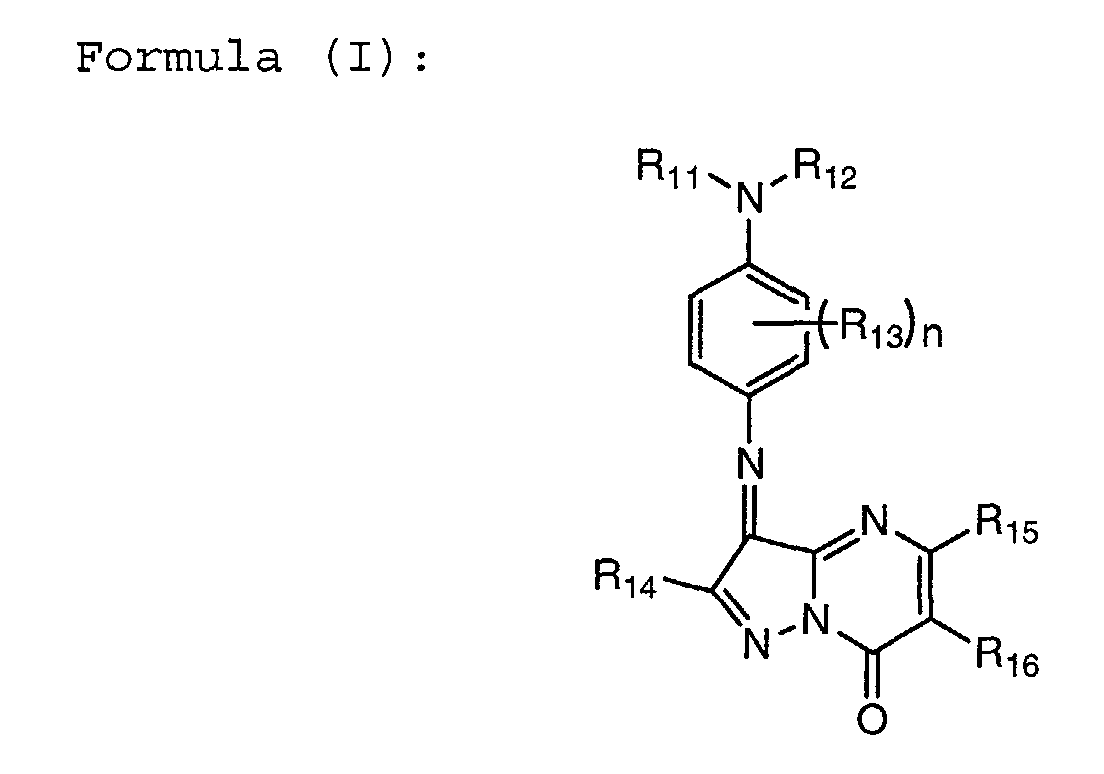
- R 11 and R 12 represent a substituted or unsubstituted aliphatic group, and R 11 and R 12 may be the same or different.
- aliphatic groups are an alkyl group, a cycloalkyl group, an alkenyl group, and an alkynyl group.
- alkyl group may be a methyl group, an ethyl group, a propyl group, and an i-propyl group.
- groups capable of substituting said alkyl groups may be a straight or branched chain alkyl group (for example, a methyl group, an ethyl group, an i-propyl group, a t-butyl group, an n-dodecyl group, and a 1-hexylnonyl group); a cycloalkyl group (for example, a cyclopropyl group, a cyclohexyl group, a bicyclo[2.2.1]heptyl group, and an adamantyl group); an alkenyl group (for example, 2-propylene group and an oleyl group); an aryl group (for example, a phenyl group, an ortho-tolyl group, an ortho-anisyl group, a 1-naphthyl group, and a 9-anthranyl group); a heterocyclic group (for example, a 2-tetrahydrofuryl group, a 2-(2-
- cycloalkyl group and said alkenyl group are those which are the same as said substituents.
- alknyl group are 1-propyne, 2-butyne, and 1-hexyne.
- R 11 and R 12 bond with each other to form a non-aromatic cyclic structure (for example, a pyrrolidine ring, a piperidine ring, and a morpholine ring).
- a non-aromatic cyclic structure for example, a pyrrolidine ring, a piperidine ring, and a morpholine ring.
- R 13 Listed as R 13 are those which are the same group as above, capable of substituting said alkyl group. Of said substituents, preferred are an alkyl group, a cycloalkyl group, an alkoxy group and an acylamino group. "n" represents 0 or an integer of 1 to 4. When n is 2 or more, a plurality of R 13 may be the same or different.
- R 14 represents an alkyl group. Listed as examples of R 14 are a methyl group, an ethyl group, an i-propyl group, a t-butyl group, an n-dodecyl group, and a 1-hexylnonyl group.
- R 14 is preferably a secondary or tertiary alkyl group. Examples of preferred secondary or tertiary alkyl groups include an isopropyl group, a sec-butyl group, a tert-butyl group, and a 3-heptyl group.
- the most preferred substituents of R 14 are an isopropyl group, and a tert-butyl group.
- the alkyl group of R 14 may be substituted, but is most preferably one which is substituted with a substituent only comprised of carbon atoms and hydrogen atoms.
- R 15 represents an alkyl group having from 3 to 8 carbon atoms. Listed as examples of R 15 are an n-propyl group, an i-propyl group, a t-butyl group, an n-dodecyl group, and a 1-hexylnonyl group. R 15 is preferably a secondary or tertiary alkyl group. Listed as examples are an isopropyl group, a sec-butyl group, a tert-butyl group, and a 3-heptyl group. The most preferred substituents of R 15 include an isopropyl group and a tert-butyl group. Alkyl group R 15 may be substituted, but is most preferably one which is substituted with a substituent only comprised of carbon atoms and hydrogen atoms.
- R 16 represents an alkyl group having from 3 to 8 carbon atoms.
- Listed as examples of R 16 are an n-propyl group, an n-butyl group, an n-pentyl group, an n-hexyl group, an n-heptyl group, an isopropyl group, a sec-butyl group, a tert-butyl group, and a 3-heptyl group.
- Specifically preferred substituents as R 16 are straight chain alkyl groups having at least 3 carbon atoms.
- the examples include an n-propyl group, an n-butyl group, an n-pentyl group, an n-hexyl group, and an n-heptyl group.
- an n-propyl group and an n-butyl group are most preferred.
- the alkyl group of R 16 may be substituted, but is most preferably one which is substituted with a substituent only comprised of carbon atoms and hydrogen atoms.
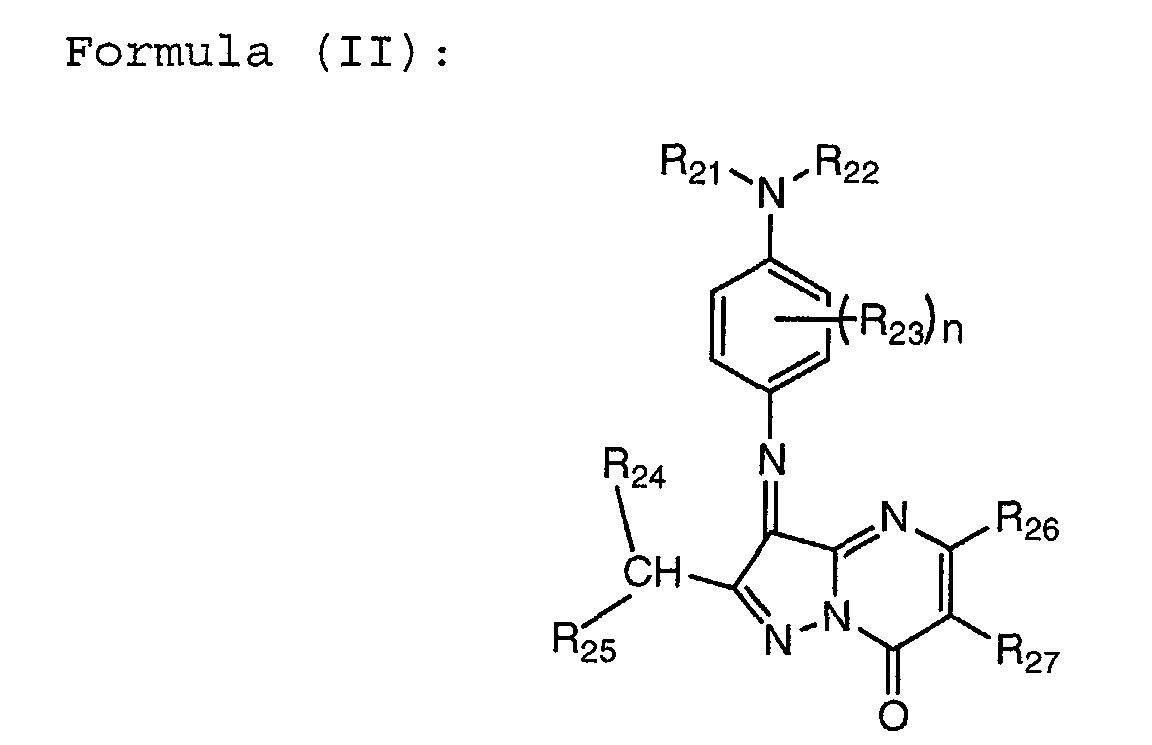
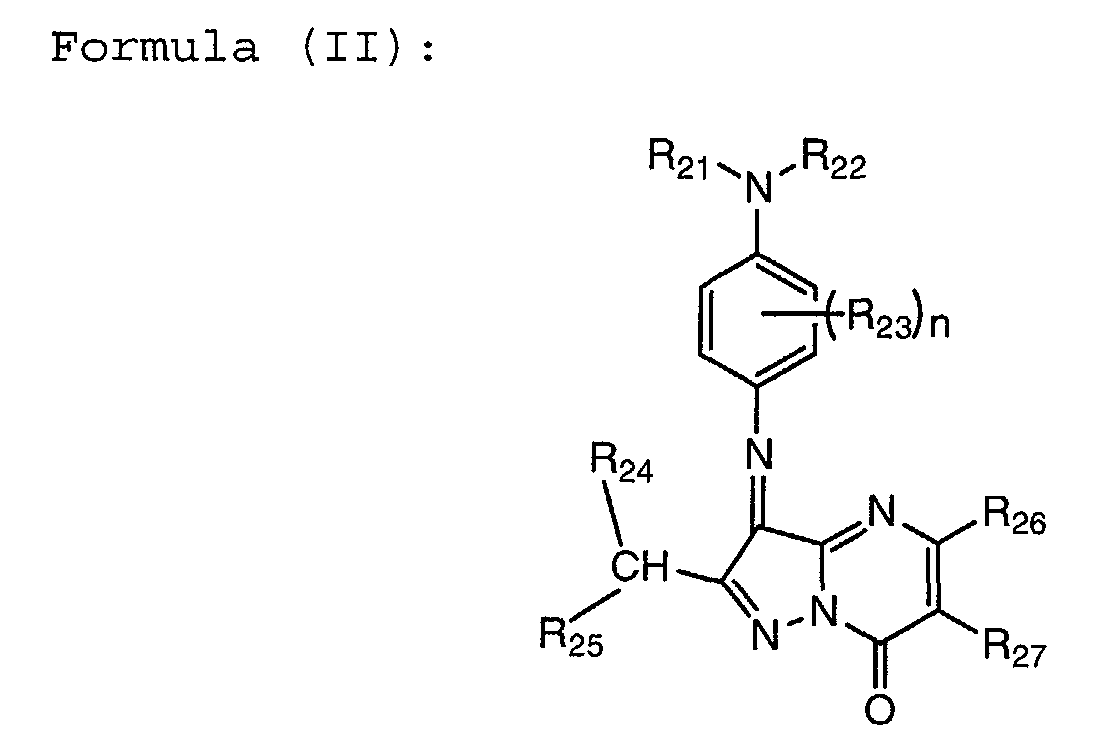
- R 21 and R 22 represent a substituted or unsubstituted aliphatic group.
- R 21 and R 22 may be the same or different. Examples of said aliphatic groups are the same as those of R 11 and R 12 of aforesaid Formula (I).
- R 23 is the same as R 13 in aforesaid Formula (I) .
- R 24 and R 25 represent an alkyl group. Listed as examples are a methyl group, an ethyl group, an n-propyl group, an n-butyl group, an n-pentyl group, an n-hexyl group, an n-heptyl group, an isopropyl group, a sec-butyl group, a tert-butyl group, and a 3-heptyl group.
- specifically preferred substituents are straight chain alkyl groups.
- R 26 represents a branched chain alkyl group (including secondary and tertiary alkyl groups). Listed as secondary or tertiary alkyl groups are an isopropyl group, a sec-butyl group, a tert-butyl group, and a 3-heptyl group. The most preferred substituents as R 26 are an isopropyl group and a tert-butyl group.
- the branched chain alkyl groups of R 26 may be substituted, but are most preferably ones which are substituted with a substituent only comprised of carbon atoms and hydrogen atoms.
- the number of the total carbon atoms of branched chain alkyl group is preferably from 3 to 20, is more preferably from 3 to 15, and is most preferably from 3 to 8.
- R 27 represents an alkyl group.
- R 27 Listed as examples of R 27 are an ethyl group, an n-propyl group, an n-butyl group, an n-pentyl group, an n-hexyl group, an isopropyl group, a sec-butyl group, a tert-butyl group, and a 3-heptyl group.
- Specifically preferred substituents as R 27 are straight chain alkyl groups having at least 2 carbon atoms. Examples include an ethyl group, an n-propyl group, an n-butyl group, an n-pentyl group, an n-hexyl group, and an n-heptyl group.
- an n-propyl group and an n-butyl group are most preferred.
- the alkyl group of R 27 may be substituted, but is most preferably one which is substituted with a substituent only comprised of carbon atoms and hydrogen atoms.
- the thermal transfer recording material of the present invention comprises a support having thereon a dye providing layer comprising dyes of the present invention. It is possible to form said dye providing layer as follows: a dye providing layer coating composition, which is prepared by dissolving dyes together with binders in solvents, or by dispersing those into solvents in the form of fine particles, is applied onto a support and subsequently is suitably dried.
- the thickness of said dye providing layer is preferably from 0.1 to 10 ⁇ m in terms of its dried layer thickness.
- binders Preferably employed as said binders are solvent-soluble polymers such as acrylic resins, methacrylic resins, polystyrene, polycarbonate, polysulfone, polyethersulfone, polyvinyl butyral, polyvinyl acetal, nitrocellulose, and ethyl cellulose. At least one type of these binders is dissolved in organic solvents and employed. In addition, they may be dispersed so as to form a latex and then employed. The used amount of said binders is preferably from 0.1 to 20 g per m 2 of the support.
- Said solvents include alcohols (such as ethanol and propanol), cellosolves (such as methyl cellosolve and ethyl cellosolve), aromatic compounds (such as toluene and xylene), esters (such as ethyl acetate), ketones (such as acetone and methyl ethyl ketone), and ethers (such as tetrahydrofuran and dioxane).
- alcohols such as ethanol and propanol
- cellosolves such as methyl cellosolve and ethyl cellosolve
- aromatic compounds such as toluene and xylene
- esters such as ethyl acetate
- ketones such as acetone and methyl ethyl ketone
- ethers such as tetrahydrofuran and dioxane
- said supports are those which exhibit good dimensional stability and good resistance to heating by a thermal head during recording.
- thin paper such as condenser paper and glassine paper
- heat resistant plastic films comprised of polyethylene terephthalate, polyamide, and polycarbonate.
- the thickness of said support is preferably from 2 to 30 ⁇ m.
- said support preferably comprises a sublayer comprised of selected polymers.
- a slipping layer may be provided on the back surface (the surface opposite the thermal transfer layer) of said support.
- the thermal transfer recording material of the present invention may comprise on said dye providing layer or as another layer a heat fusible layer comprising heat fusible compounds described in Japanese Patent Publication Open to Public Inspection No. 59-106997.
- Said heat fusible compounds are preferably colorless or white compounds which melt at a temperature of 65 to 150 °C, and include, for example, waxes such as carnauba wax, bees wax, and candelilla wax.
- said heat fusible layer may comprise, for example, polymers such as polyvinyl pyrrolidone, polyvinyl butyral, polyester, and vinyl acetate.
- the total three layers comprised of a yellow thermal transfer layer comprising heat diffusible yellow dyes capable of forming a yellow image, a magenta thermal transfer layer comprising heat diffusible magenta dyes capable of forming a magenta image, and a cyan thermal transfer layer comprising heat diffusible cyan dyes capable of forming a cyan image are successively applied onto the same surface of a support. If desired, a total of four layers comprising the additional thermal transfer layer comprising black image forming materials may be successively applied onto the same surface.
- an image receiving material faces a dye providing material comprising a dye providing layer comprising at least one type of dyes represented by aforesaid Formulas (I) or (II), and images are formed by heating said dye providing material based on image information and by transferring said dyes.
- an image receiving material comprised of a dye receiving layer comprising metal ion containing compounds on a support faces a dye providing material comprised of a dye providing layer comprising at least one type of dye represented by aforesaid Formulas (I) and (II), and said thermal transfer recording material is heated based on image information, whereby metal chelate dye images are formed upon reaction of said dyes with said metal ion containing compounds.
- Said metal ion containing compounds may be incorporated into said image receiving material or into said heat fusible layer of said thermal transfer recording material.
- metal ion containing compounds are inorganic or organic salts of metal ions and metal chelates. Of these, salts and chelates of organic acids are preferred.
- metals are univalent and polyvalent metals which belong to Groups V through VIII of the Periodic Table. Of these, preferred are Al, Co, Cr, Cu, Fe, Mg, Mn, Mo, Ni, Sn, Ti and Zn, of which Ni, Cu, Cr, Co, and Zn are specifically preferred.
- metal ion containing compounds are salts of aliphatic acids such as acetic acid and stearic acid and salts of aromatic carboxylic acids such as benzoic acid and salicylic acid with Ni 2+ , Cu 2+ , Cr 2+ , Co 2+ , and Zn 2+ .
- Formula (III) [M(Q 1 ) a (Q 2 ) b (Q 3 ) c ] p+ (Y - ) p
- M represents a metal ion, preferred ones including Ni 2+ , Cu 2+ , Cr 2+ , Co 2+ , and Zn 2+
- Q 1 , Q 2 , and Q 3 each represent a ligand capable of forming a coordination bond with the metal ion represented by M and may be the same or different. It is possible to select ligands from those described in, for example, “Chelate Kagaku (Chelate Science) (5)", published by Nankodo, Tokyo, Japan.
- Preferred as anionic compounds are those represented by Formula (IV) described below.
- the added amount of metal ion containing compounds is preferably from 0.5 to 20 g/m 2 with respect to the image receiving material or the heat fusible layer, and is more preferably from 1 to 15 g/m 2 .
- the image receiving material which forms images utilizing metal chelate dyes, comprises a support, such as paper, plastic film, or paper-plastic film composites, having thereon a polymer layer comprised of at least one type of a polyester resin, a polyvinyl chloride resin, a copolymer of vinyl chloride with other monomers (such as vinyl acetate), polyvinyl butyral, polyvinylpyrrolidone, and polycarbonate as the image receiving layer.
- a support such as paper, plastic film, or paper-plastic film composites, having thereon a polymer layer comprised of at least one type of a polyester resin, a polyvinyl chloride resin, a copolymer of vinyl chloride with other monomers (such as vinyl acetate), polyvinyl butyral, polyvinylpyrrolidone, and polycarbonate as the image receiving layer.
- said image receiving material may comprise antioxidants and releasing agents in the image receiving layer, and may also be provided with a protective layer on the image receiving layer.
- an interlayer may be provided between the support and the image receiving layer.
- an antistatic layer and a backing layer comprising fine inorganic or organic non-sublimable particles for the purpose of minimizing blocking.
- the image receiving layer may be provided on both sides of the support. Incidentally, the support itself may occasionally be employed as the image receiving material.
- heat is commonly provided employing a thermal head.
- heat may be provided by an electrical current or by employing a laser.
- Heat application employing a thermal head may be carried out without any particular limitation on the rear surface of the image receiving layer.
- heat may be provided so that the dye transfer, the reaction with the metal ion containing compounds, and the fixing of transfer dyes are enhanced.
- a thermal transfer recording material shown in Fig. 1, is constituted in such a manner that image receiving material 3 comprises support 1 having thereon image receiving layer 2 comprising metal ion containing compounds, while dye providing material 6 comprises support 4 having thereon dye providing layer 5.
- image receiving material 3 and dye providing material 6 an interlayer may be provided between each layer and support 1.
- the thermal transfer recording method is such that image receiving material 3 faces dye providing material 6, and heat is applied onto the rear surface of dye providing material 6, employing heat generating resistor 8 based on image information, and subsequently, both materials are separated. During heat application, dyes in dye providing layer 5 are allowed to react with the metal ion containing compounds in image receiving layer 2, whereby metal chelate dye images are formed.
- thermal transfer recording material 10 which is prepared by laminating heat fusible layer 9, comprising metal ion containing compounds on dye providing material 6 (4 and 5) faces image receiving material 3 such as plain paper, previously described, in which an image receiving layer is not specifically provided, and thermal head 7 is applied employing the same method as the thermal transfer recording method of Fig. 1. Thereafter, both materials are peeled off so that an image is formed.
- thermal head 7 when heat is provided employing thermal head 7, a metal chelate dye image is formed upon allowing the dyes to react with metal ion containing compounds between dye providing layer 5 on thermal transfer recording material 10 and the heat fusible layer, and subsequently, the resulting image is transferred onto image receiving layer 3.
- ink comprising the compounds of the present invention in various ink jet recording liquid such as a water based ink jet recording liquid, an oil based ink jet recording liquid, and a solid (phase change) ink jet recording liquid.
- ink jet recording liquid such as a water based ink jet recording liquid, an oil based ink jet recording liquid, and a solid (phase change) ink jet recording liquid.
- water and water-soluble organic solvents are commonly employed as the solvent.
- water-soluble organic solvents are alcohols (for example, methanol, ethanol, propanol, isopropanol, butanol, isobutanol, secondary butanol, tertiary butanol, pentanol, hexanol, cyclohexanol, and benzyl alcohol); polyhydric alcohols (for example, ethylene glycol, diethylene glycol, triethylene glycol, polyethylene glycol, propylene glycol, dipropylene glycol, polypropylene glycol, butylene glycol, hexanediol, pentanediol, glycerin, hexanetriol, and thioglycol); polyhydric alcohol ethers (for example, ethylene glycol monomethyl ether, ethylene glycol monoethyl ether,
- said dyes when dyes are soluble in the solvent system, said dyes may be dissolved in said solvent without any modification and then employed.
- dyes when dyes are insoluble solids, it is possible to disperse the compounds of the present invention into minute particles employing various homogenizers (for example, a ball mill, a sand mill, an attritor, a roll mill, an agitator mill, a Henschel mixer, a colloid mill, an ultrasonic homogenizer, a pearl mill, a jet mill, and an angmill), or after dissolving said dyes in organic solvents, it is possible to disperse the resulting solution into said solvent system together with polymer dispersing agents and surface active agents.
- various homogenizers for example, a ball mill, a sand mill, an attritor, a roll mill, an agitator mill, a Henschel mixer, a colloid mill, an ultrasonic homogenizer, a pearl mill, a jet mill, and an ang
- dyes are an insoluble liquid or a semi-melt type
- specific methods for preparing said water based ink jet recording liquid it is possible to employ methods described in, for example, Japanese Patent Publication Open to Public Inspection Nos. 5-148436, 5-295312, 7-97541, 7-82515, and 7-118585.
- organic solvents may also be employed as the solvent.
- solvents of said oil based ink jet recording liquid are alcohols (for example, pentanol, heptanol, octanol, phenylethyl alcohol, phenylpropyl alcohol, furfuryl alcohol, and anil alcohol); esters (for example, ethylene glycol diacetate, ethylene glycol monomethyl ether acetate, diethylene glycol monomethyl ether acetate, propylene glycol diacetate, ethyl acetate, amyl acetate, benzyl acetate, phenyl ethyl acetate, phenoxyethyl acetate, ethyl phenylacetate, benzyl propionate, ethyl benzoate, butyl benzoate, butyl laurate, isopropyl myristate, triethyl phosphate, tributyl phosphate, diethyl phthalate, dibutyl phthalate,
- said dyes may be dissolved in said solvents without any treatment and subsequently employed. Further, said dyes may be dispersed into, or dissolved in, solvents while employing resinous dispersing agents and binding agents. In addition, a greater volume of water-soluble organic solvents, those previously described, may be employed.
- phase change solvents which are solid at room temperature and melt liquid during ink ejection.
- phase change solvents are natural waxes (for example, bees wax, carnauba wax, rice wax, Japan wax, jojoba, spermaceti, candelilla wax, lanolin, montan wax, ozokerite, ceresin, paraffin wax, microcrystalline wax, and petrolatum); polyethylene wax derivatives; chlorinated hydrocarbons; organic acids (for example, palmitic acid, stearic acid, behenic acid, tiglic acid, 2-acetonaphthonbehenic acid, 12-hydroxystearic acid, and dihydroxystearic acid); organic acid esters (for example, esters of said organic acids with alcohols such as glycerin, diethylene glycol, and ethylene glycol); alcohols (for example, dodecanol, tetradecanol, hexadecanol, eicosanol, docosanol, tetracosanol, hexacosanol, oct
- the phase change temperature for the solid-liquid phase change of solid ink is preferably at least 60 °C, and is more preferably from 80 to 150 °C.
- said solid ink jet recording liquid When said solid ink jet recording liquid is employed, it is possible to use the dye of the present invention without any modification after dissolving it in a solvent heated to a melted state. It is also possible to use said dye after it is subjected to dispersion, together with resinous dispersing agents and binding agents or to dissolution.
- the viscosity of said water based, oil based, or solid ink jet recording liquid is preferably no more than 40 cps during ejection, and is more preferably no more than 30 cps.
- the surface tension of the ink jet recording liquid of the present invention is preferably at least 20 dyn/cm during ejection, and is more preferably from 30 to 80 dyn/cm.
- the content ratio of the dye for the present invention is preferably in the range of 0.1 to 25 percent by weight with respect to the weight of the total ink jet recording liquid, and is more preferably in the range of 0.5 to 10 percent by weight.
- the adaptability to the print head and the ink cartridge, the storage stability, the image retaining quality, and other performance factors, viscosity modifiers, surface tension regulating agents, specific resistivity regulating agents, film forming agents, dispersing agents, surface active agents, UV absorbers, antioxidants, antifading agents, mildewcides, and antirusting agents may be incorporated into the ink jet recording liquid of the present invention.
- said ink jet recording liquid may be preferably employed as an ink particularly for an on-demand type ink jet printer.
- on-demand type systems may be an electromechanical conversion system (for example, a single cavity type, a double cavity type, a bender type, a piston type, a share mode type, and a shared wall type), an electrothermal conversion system (for example, a thermal ink jet type and a bubble ink jet type), an electrostatic suction system (for example, an electric field controlling type and a slit jet type), a discharge system (for example, a spark jet type).
- toner dyes for electrophotography it is possible to employ any of the binders which are commonly employed to prepare a toner.
- binders which are commonly employed to prepare a toner.
- listed are styrene based resins, acryl based resins, styrene/acryl based resins, and polyester resins.
- fine inorganic powder and fine organic particles may externally be incorporated into said toner.
- Fine silica and titania particles whose surface has been treated with alkyl group-containing coupling agents are preferably employed.
- the number average primary particle diameter of these is preferably from 10 to 500 nm, and further, their content ratio in said toner is preferably from 0.1 to 20 percent by weight.
- releasing agents may be any of those which have conventionally been used. Specifically listed are olefin analogs such as low molecular weight polypropylene, low molecular weight polyethylene, and ethylene-propylene copolymers, waxes such as microcrystalline wax, carnauba wax, sazol wax, and paraffin. The added amount of these is preferably from 1 to 5 percent by weight with respect to the toner.
- charge controlling agents may also be incorporated, but from the viewpoint of coloration, they are preferably colorless. Listed as examples are those having a quaternary ammonium salt structure, and a calixarene structure.
- the average particle diameter of said carrier particles is preferably from 30 to 150 ⁇ m in terms of the volume average particle diameter.
- Image forming methods to which the toner of the present invention applies, are not particularly limited. Listed as said methods are, for example, one in which after repeatedly forming the desired color images on the photoreceptor, images are formed upon being transferred, and the other in which an image formed on the photoreceptor is successively transferred onto an intermediate transfer body, and after forming a color image on said intermediate transfer body, the final color image is formed upon being transferred onto an image forming member such as a paper sheet.
- the color filter of the present invention employing colored compositions comprising dyes (I) and (II) of the present invention. It is possible to prepare said colored compositions by dispersing the dyes of the present invention into transparent resins. It is possible to disperse said dyes employing various kinds of dispersion means such as a double-roller mill, a triple-roller mill, a sand mill, and a kneader.
- resinous varnishes which are employed to prepare said colored compositions by dispersing the dyes of the present invention, are those, known in the art, which are employed in colored compositions for color filters.
- employed as dispersion media are solvents or water based media which are suitable for resinous varnishes.
- employed may be additives conventionally known in the art such as dispersing aids, smoothing agents, and adhesion enhancing agents.
- employed as resinous varnishes may be photosensitive resinous varnishes and non-photosensitive resinous varnishes.
- Employed as said photosensitive varnishes include, for example, any of those which are employed in ultraviolet ray hardening ink, and electron beam hardening ink.
- employed as said non-photosensitive resinous varnishes may be, for example, any of those which are employed in printing inks such as letterpress ink, lithography ink, intaglio gravure ink, and screen printing ink, varnishes employed in developers for electronic printing and electrostatic printing, and varnishes for thermal transfer ribbon.
- photosensitive resinous varnishes are varnishes of photosensitive cyclic rubber based resins, photosensitive phenol based resins, photosensitive polymethacrylate based resins, photosensitive polyamide based resins, and photosensitive polyimide based resins, and varnishes of unsaturated polyester based resins, polyester acrylate based resins, polyepoxyacrylate based resins, polyurethane acrylate based resins, polyether acrylate based resins, and polyol acrylate based resins.
- the photosensitive colored composition of the present invention is prepared in such a manner that photopolymerization initiators such as benzoin ether and benzophenone are added to the compounds of the present invention and said varnishes, and the resultant mixture is kneaded. Further, it is possible to prepare a thermally polymerizable colored composition, employing thermal polymerization initiators instead of said photopolymerization initiators.
- photopolymerization initiators such as benzoin ether and benzophenone
- said photosensitive colored composition is subjected to spin-coating or total surface coating onto a transparent substrate, employing a low speed rotation coater, a roll coater, or a knife coater, or it is subjected to total surface printing or partial printing slightly larger than said pattern, employing various kinds of printing methods, and subsequently, the pattern is printed through exposure employing an ultra high pressure mercury arc lamps. Subsequently, development and washing are carried out, and then, if desired, post-baking is carried out, whereby it is possible to form a pattern in said color filter.
- non-photosensitive resinous varnishes are cellulose acetate based resins, nitrocellulose based resins, styrene based (co)polymers, polyvinyl butyral based resins, aminoalkyd based resins, polyester based resins, amino resin-modified polyester based resins, polyurethane based resins, acryl polyol urethane based resins, soluble polyamide resins, soluble polyimide based resins, soluble polyamidoimide based resins, soluble polyester imide based resins, casein, hydroxyethyl cellulose, water-soluble salts of styrene-maleic acid ester based copolymers, water-soluble salts of acrylic acid ester based (co)polymers or of methacrylic acid ester based (co)polymers, and water-soluble aminoalkyd based resins. These may be employed individually or in combination.
- Methods, in which the pattern in color filters is formed employing said non-photosensitive colored compositions include a method which directly prints said colored pattern onto a substrate employing a color filter printing ink based on various kinds of said printing methods, a method in which said colored pattern is formed on a substrate employing a water-soluble electrodeposition coating composition for said color filter based on electrodeposition coating, and a method in which by employing an electronic printing method and an electrostatic printing method, or after temporarily forming a colored pattern on a transfer base material employing said methods, said colored pattern is transferred onto the substrate for the color filter.
- baking is carried out based on conventional methods, and in order to result in a smoothened surface, polishing is carried out, and in order to protect the surface, top coating is also carried out. Further, a black matrix is formed based on conventional methods whereby RGB (Red, Green and Blue) color filters are prepared.
- RGB Red, Green and Blue
- Said ink was applied onto a 4.5 ⁇ m thick polyethylene terephthalate (PET) base employing a wire bar so as to obtain a coating weight of 2.3 g/m 2 after drying and was subsequently dried, whereby Dye Providing Material 1 comprising said PET film having thereon a dye providing layer was prepared. Further, on the rear surface of said PET base, a nitrocellulose layer comprising a silicone-modified urethane resin (SP-2105, manufactured by Dainichi Seika Co.) was provided as a sticking resistant layer.
- SP-2105 silicone-modified urethane resin
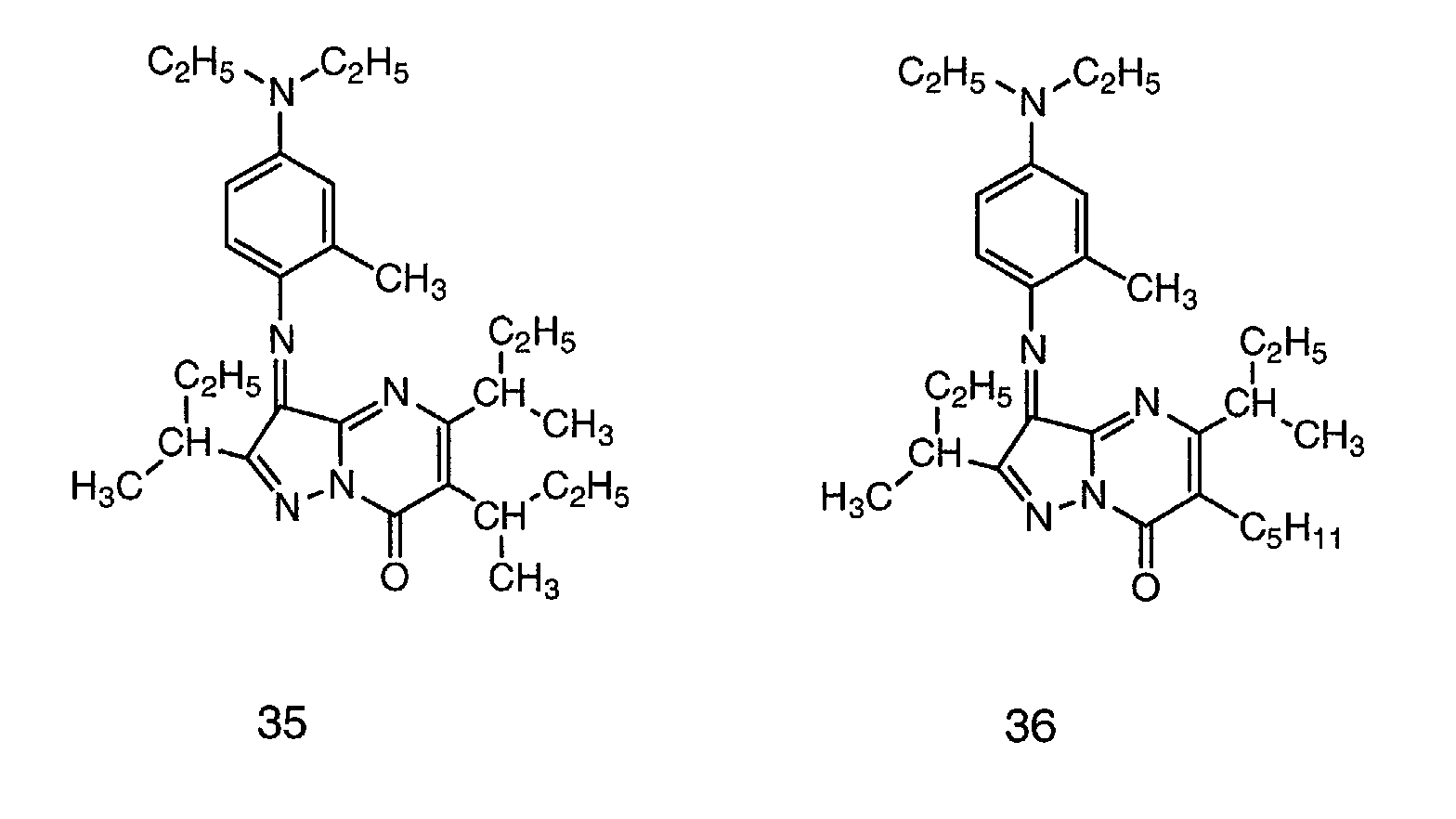
- Dye Providing Materials 2 through 12 were prepared in the same manner as Example 1, except that the dye was replaced with those shown in Table 1.
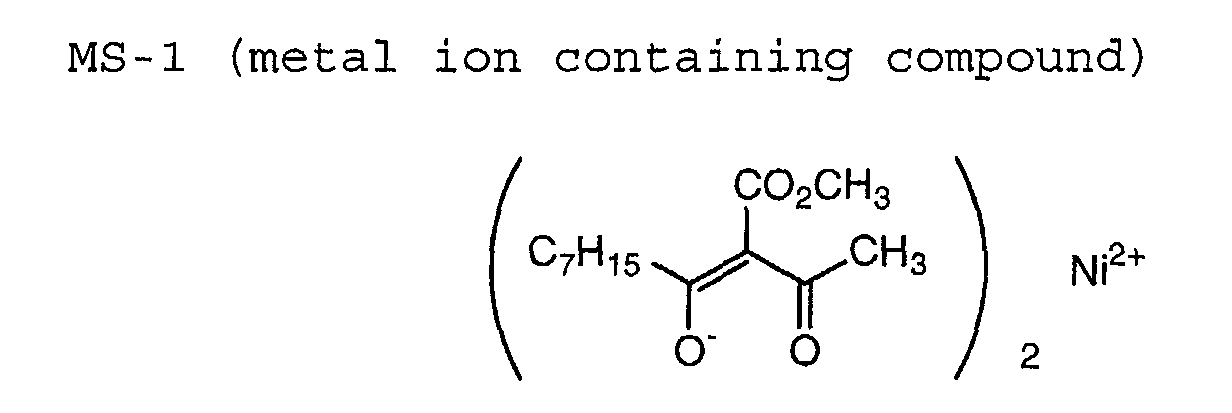
- a coating composition having the composition described below, was applied onto a support (in one polyethylene layer, a white pigment (titanium dioxide) and bluing agents are included) prepared by laminating polyethylene onto both sides of a paper sheet so as to obtain a coated weight of 7.2 g after drying and subsequently is dried, whereby Image Receiving Layer 1 was prepared.
- Metal ion containing compound MS-1)
- BX-1 Polyvinyl butyral resin
- Polyester modified silicone 0.3 g
- Image Receiving Material 2 which comprised no metal ion containing compounds, was prepared in the same manner as Image Receiving Material 1, except that MS-1 was removed from said Image Receiving Material 1.
- Said dye providing material faced said image receiving material, and image recording was carried out employing a thermal printer while touching the thermal head onto the rear surface of said dye providing material, whereby Images 1 through 20, which exhibited excellent gradation, were prepared.
- the maximum reflection density of the image (generally the reflection density of the part of the maximum applied time) was determined employing a densitometer, X-Rite 310TR (manufactured by X-Rite Co.).
- the applied energy value to obtain a density of 1.0 of Image 21 formed employing Dye Providing Material 13 and Image Receiving Material 1 was defined as 1. Then the relative applied energy of each recording material was calculated based on the above-mentioned standard. The smaller the figure, the higher the resulting sensitivity.
- Light fastness was represented by a residual dye ratio after the resultant image was irradiated for 14 days employing a xenon fade meter.
- said residual dye ratio was represented by (D/D 0 ) ⁇ 100, wherein D 0 represents the density prior to light irradiation and D represents the density after said light irradiation.
- the color of the resultant cyan image was visually evaluated.
- the evaluation was carried out based on a 5-grade evaluation number 1 through 5. The larger the figure, the higher the evaluation.
- thermal transfer recording materials employing the dyes of the present invention exhibit high sensitivity and forming images of high density and excellent color reproduction. And further, light fastness can be increased by using the thermal transfer recording method of the present invention.
- Ink Composition I-1 having the composition described below, was prepared employing said chelate dye through a conventional method. Further, Ink Composition I-2 was prepared in the same manner as Ink Composition I-1, except that copper phthalocyanine compound C, described below, was used as a cyan dye.
- Cyan dye chelate dye 1.4% by weight Diethylene glycol 19% by weight Trimethylene glycol monobutyl ether 9% by weight Surface active agent Surfynol 465 (manufactured by Air Products and Chemicals, Inc.) 0.6% by weight Deionized water 70% by weight
- a chelate dye was prepared in the same manner as said Example 2, employing Exemplified Compound 27 and a metal ion containing compound MS-1.
- One hundred weight parts of polyester resin, the parts described below as a colorant, and 3 parts of polypropylene were blended, kneaded, pulverized, and classified, whereby a powder having an average particle diameter of 8.5 ⁇ m was prepared. Further, 100 parts of the resultant powder and 1.0 part of fine silica particles (having a particle diameter of 12 nm and a degree of hydrophobicity of 60) were blended employing a Henschel mixer, whereby Color Toner Nos. 30 through 33 were prepared. Addition Parts of Colorant Cyan Chelate Dye 2 parts Comparative Pigment or Dye 3 parts
- a developer for practical imaging tests was prepared by blending 418.5 g of said carrier and 31.5 g of each toner for 20 minutes employing a V type blender.
- Tests were carried out in such a manner that reflective images (images on a paper sheet) and transparent images (images for OHP) were prepared employing the developer comprising the color toner of the present invention, based on said image forming method.
- the resultant samples were evaluated based on the methods described below. Incidentally, the evaluation was carried out in the range of a toner adhesion amount of 0.7 ⁇ 0.05 mg/cm 2 .
- the chroma of the resultant image on a paper sheet was determined employing Macbeth Color-Eye 7000 and then compared.
- the resultant sample was irradiated for 7 days employing "Xenon Long Life Weather Meter” (having a xenon arc lamp of 70,000 lux and at 44 °C) manufactured by Suga Shikenki Sha. Subsequently, the color difference prior to and after said irradiation was determined employing said Macbeth Color-Eye 7000, and compared.
- the transparency of the OHP image was evaluated employing the method described below.
- the spectral transmittance of the image in the visible range was determined employing "330 Type Automatic Recording Spectrophotometer", manufactured by Hitachi Seisakusho while utilizing an OHP sheet bearing no toner as a reference, and spectral transmittance at yellow 570 nm, magenta 650 nm and cyan 500 nm was determined and designated as the scale of the transparency of the OHP images.
- Color difference of the resultant image on the paper sheet and the OHP film was determined employing Macbeth Color-Eye 7000.
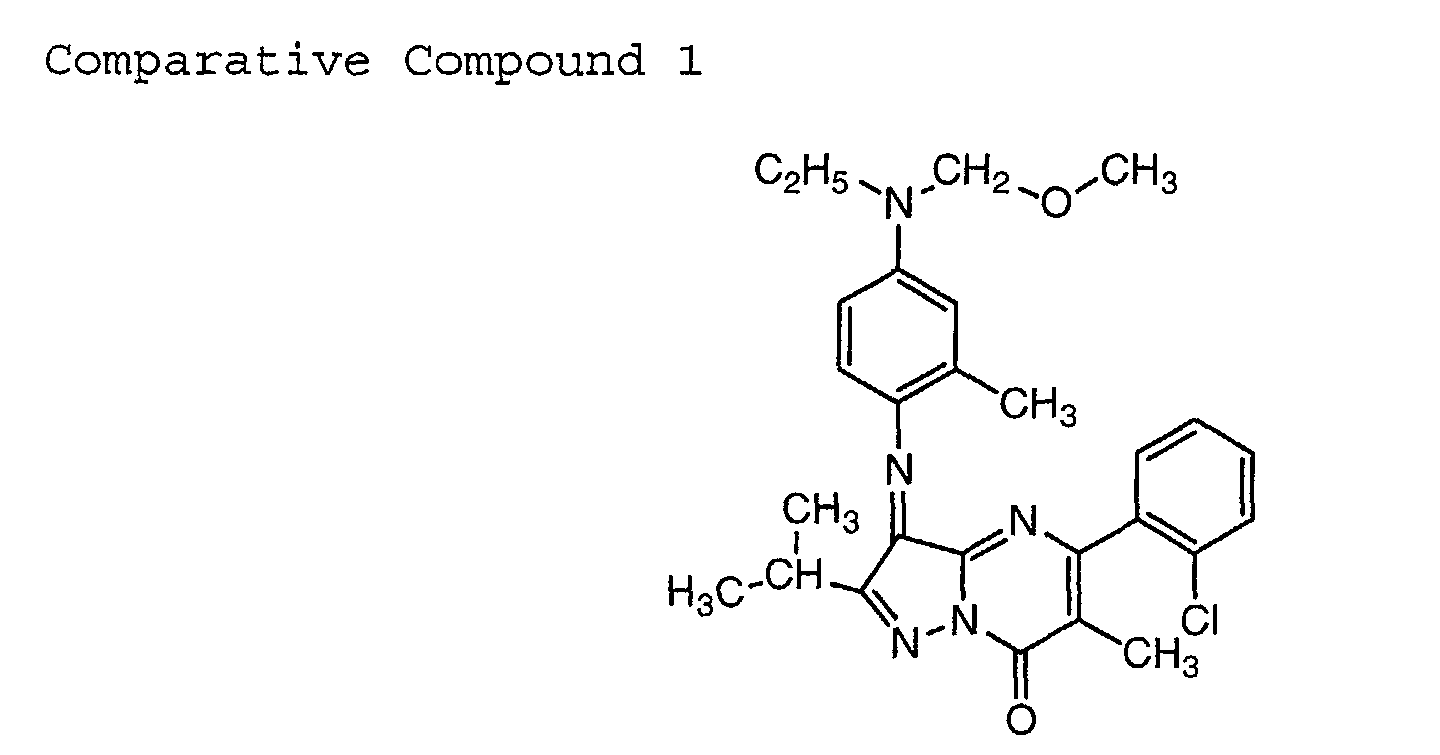
- Table 2 shows the results. Sample No. Dye Chroma Light Fastness Transparency Color variation 30 Chelate Dye 1 61.4 0.1 89.7 -7.3 31 C.I. Pigment Blue 1 55.8 2.4 70.3 -22.4 32 C.I. Solvent Blue Blue 1 50.0 7.0 85.6 -36.7 33 C.I. Solvent Blue Blue 1 48.4 8.2 84.4 -12.5
- a chelate dye was prepared in the same manner as Examples 2 and 3, employing Exemplified Compound 27 and metal ion containing Compound MS-1.
- a red (R) mosaic pattern, a green (G) mosaic pattern, and a blue (B) mosaic pattern were formed on a glass plate, employing the method described below.
- a red (R), a green (G), and a (B) coating compositions were prepared employing the components described below.
- the employed photosensitive polyimide resinous varnish is one comprising optical sensitizers.
- a green mosaic pattern and a blue mosaic pattern were also prepared by coating said photosensitive coating compositions for G-1 and B-1 color filters based on said method and were subjected to printing. Thereafter, a black matrix was formed employing a conventional method, whereby an RGB color filter was prepared.
- the color filter prepared as above exhibits excellent spectral absorption characteristics and excellent durability such as excellent light fastness and heat resistance, and further exhibits excellent light transmittance. As a result, said color filter exhibits excellent quality as a color filter for liquid crystal color display.
- the thermal transfer recording material according to the present invention and the thermal transfer recording method employing said recording method are capable of preparing images which make it possible to achieve high sensitivity recording, exhibit preferred color without undesired absorption in terms of color reproduction, and exhibit excellent image retaining quality such as excellent light fastness.
- chelate dyes formed between the compounds of the present invention and metal ion containing compounds it is possible to prepare ink jet recording ink which exhibits excellent color.
- color toners which exhibit excellent properties as a full-color toner, such as faithful color reproduction and high OHP quality, and in addition, exhibit high image retaining properties.
- said chelate dyes it is possible to prepare color filters which exhibit excellent spectral absorption properties, high durability, and excellent light transmittance.
Landscapes
- Physics & Mathematics (AREA)
- Optics & Photonics (AREA)
- Thermal Transfer Or Thermal Recording In General (AREA)
- Optical Filters (AREA)
- Developing Agents For Electrophotography (AREA)
- Inks, Pencil-Leads, Or Crayons (AREA)
Abstract

Description
wherein R14 is a secondary alkyl group.
wherein the coloring material is represented by Formula (II),

wherein R26 is a branched chain alkyl group having 3 to 8 carbon atoms.
wherein the coloring material represented by Formula (II) has a molecular weigh of 400 to 500.

wherein the image receiving material comprises a support having thereon a layer containing a compound comprising a metal ion capable of forming a metal complex dye with the coloring material in the thermal transfer recording material during the step (b).


Another objects of the present invention are achieved employing the embodiments described below.
- I. A toner for an electrophotographic recording, which comprises a metal complex dye prepared from a compound containing a metal ion and a coloring material represented by Formula (I) or Formula (II).
- II. A color filter comprising a metal complex dye prepared from a coloring material represented by Formula (I) or Formula (II) and a compound containing a metal ion.



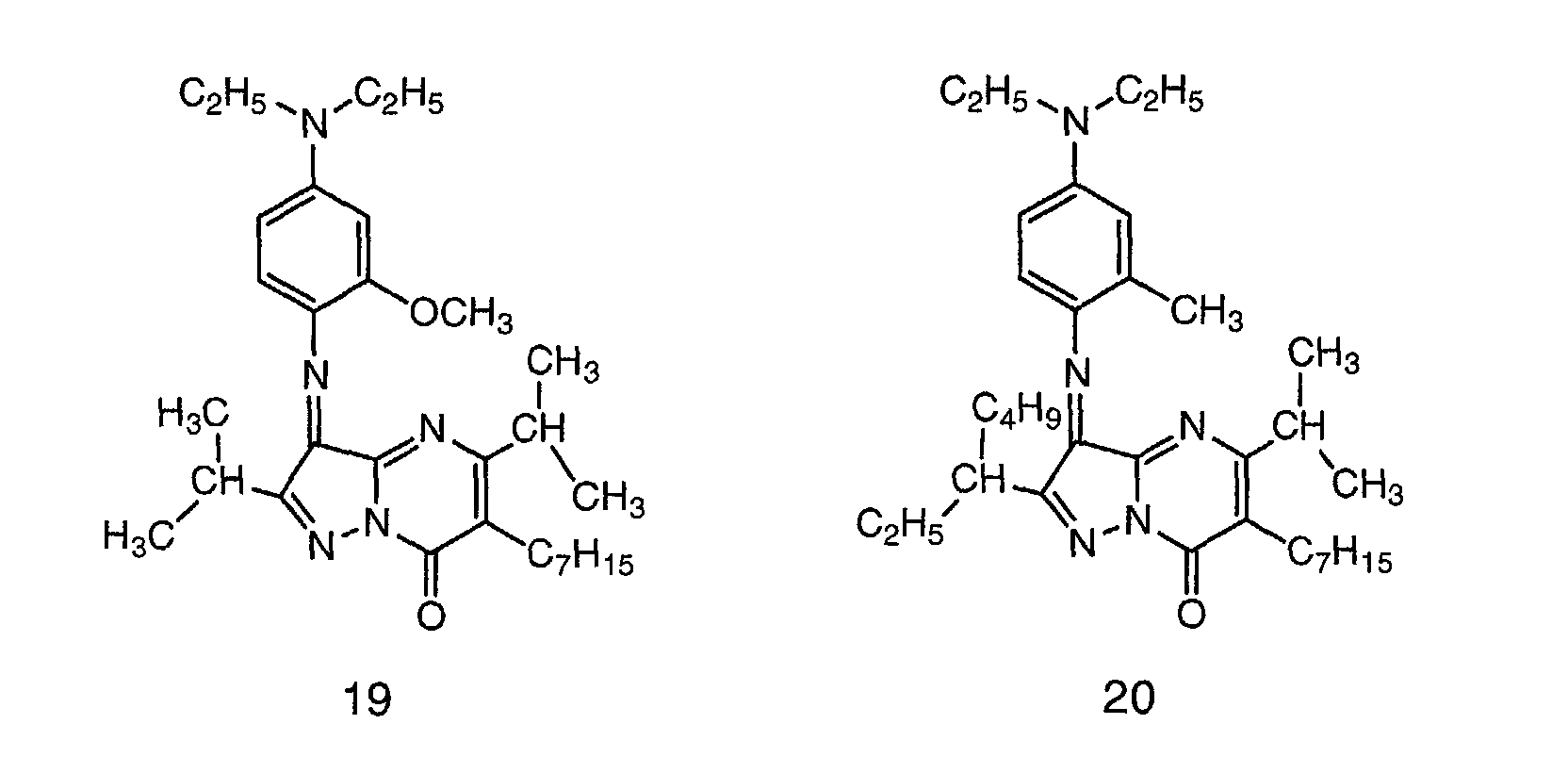
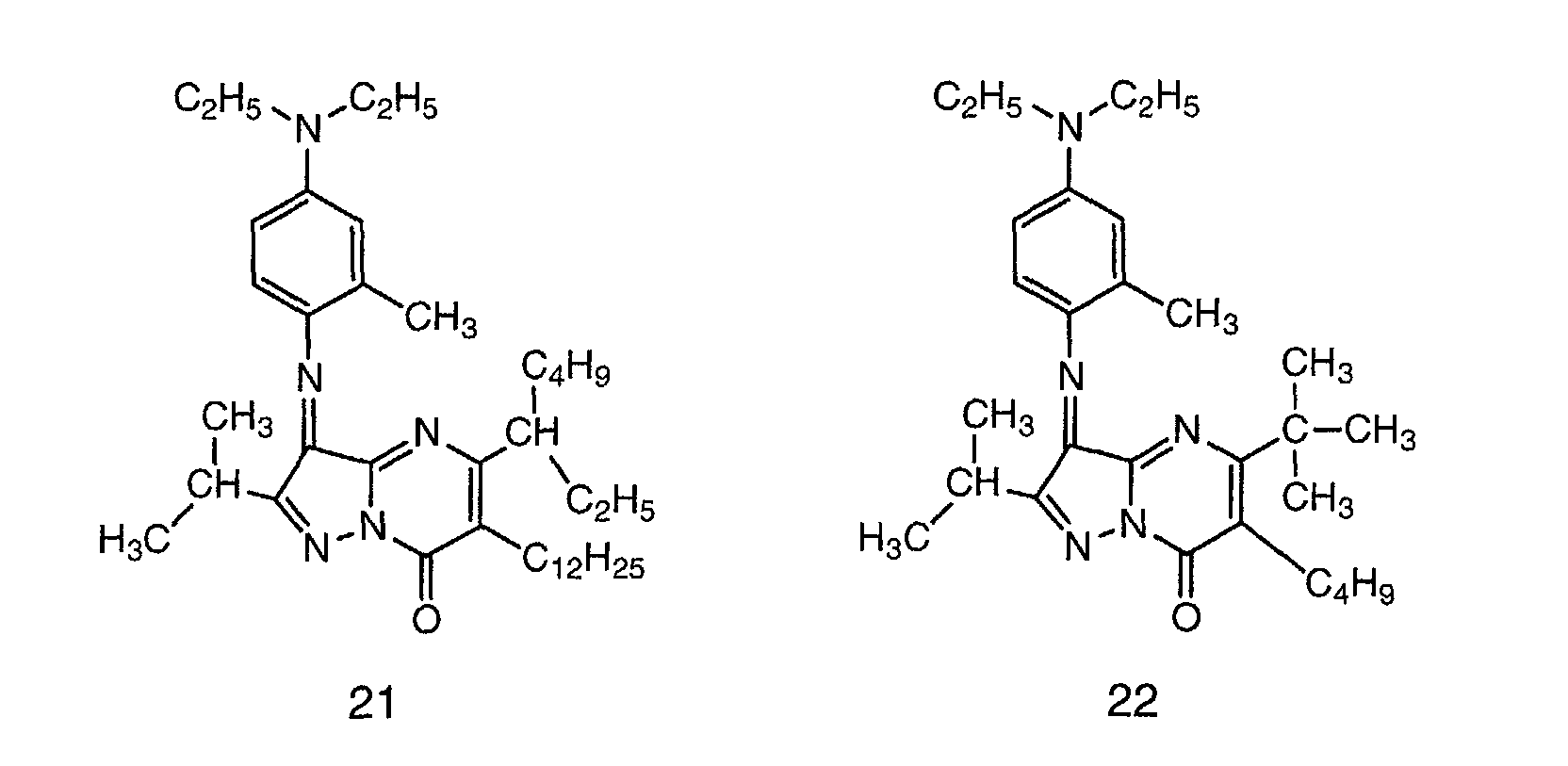


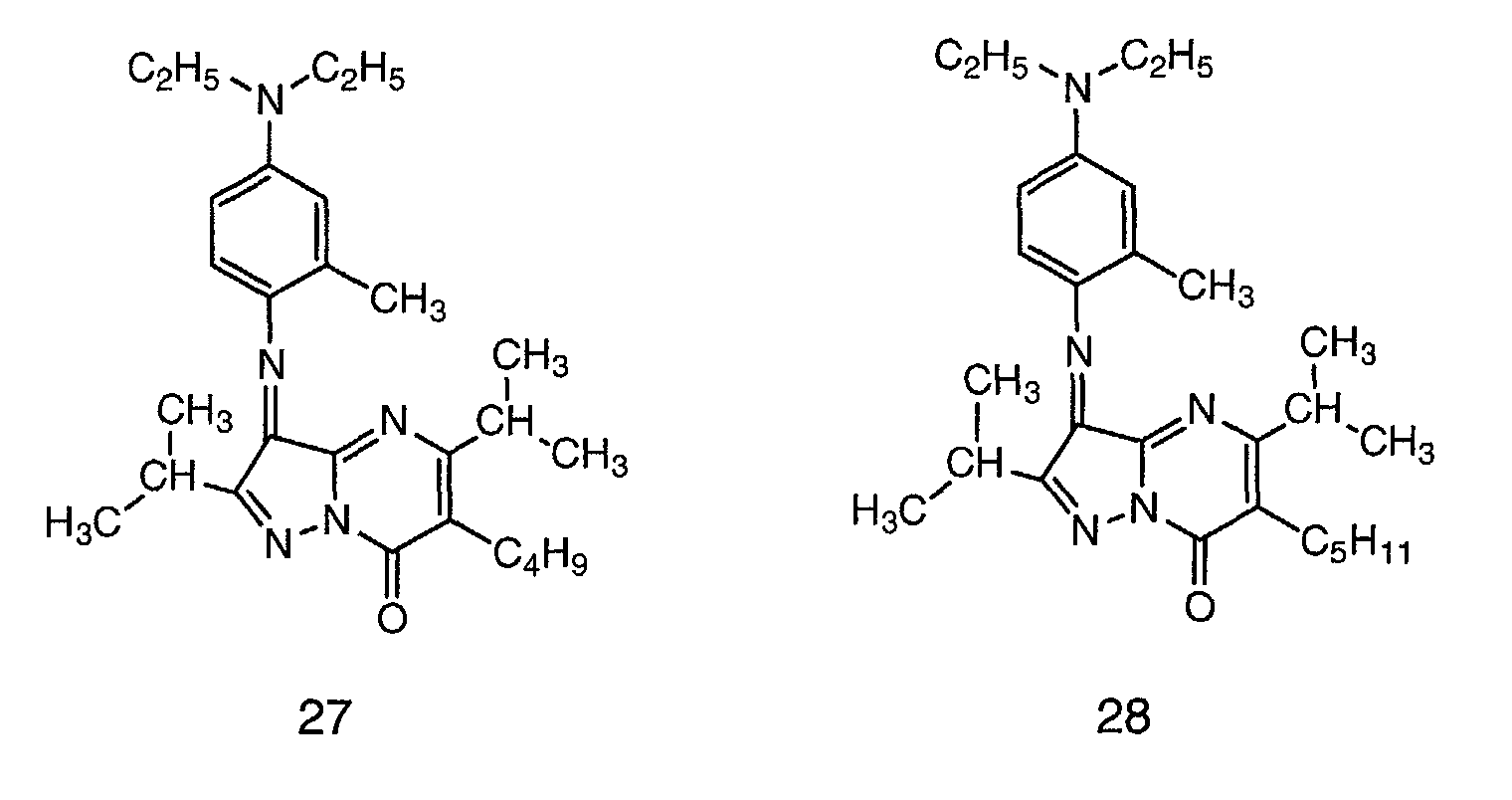

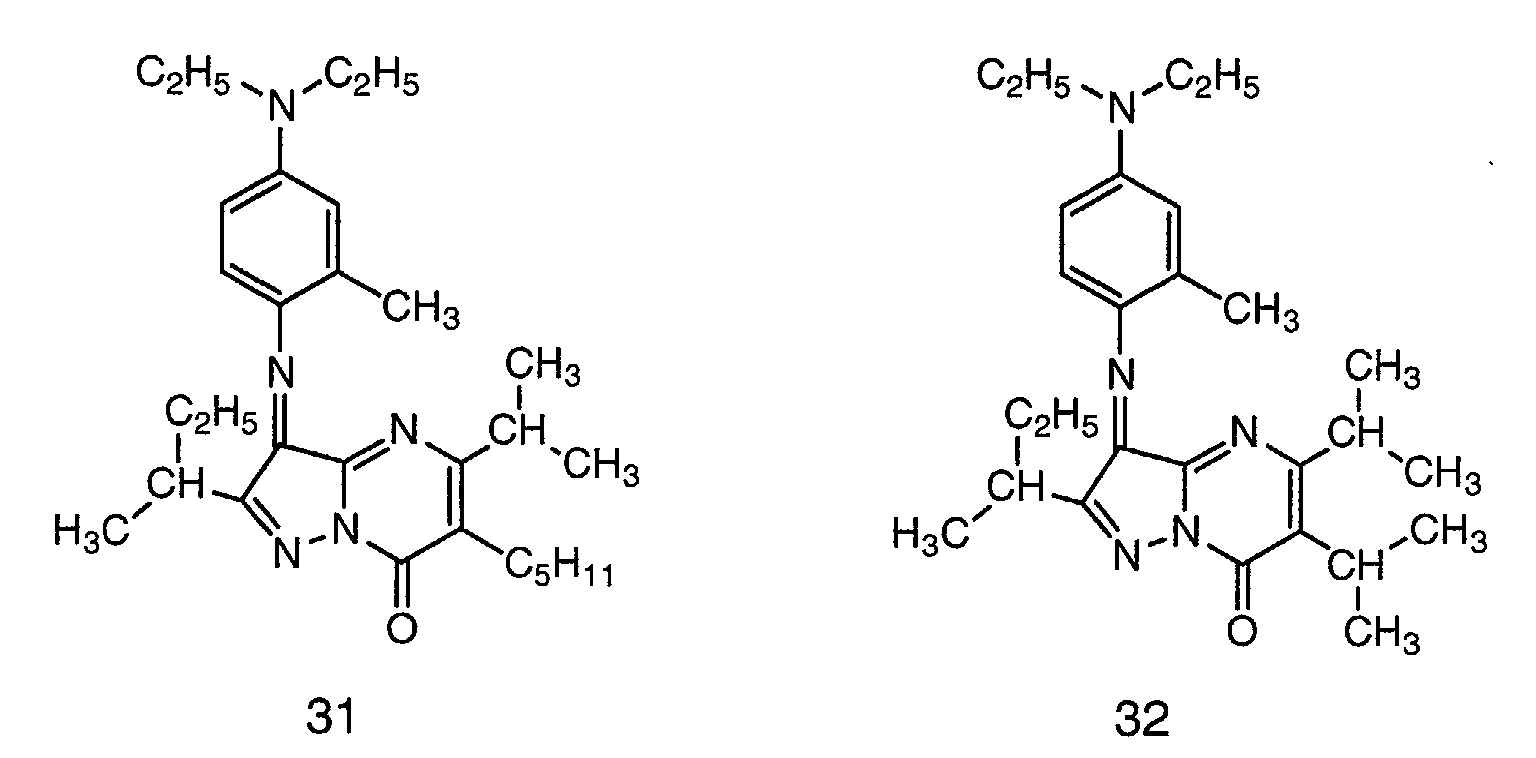


[M(Q1)a(Q2)b(Q3)c]p+(Y-)p
O--C(R5) =C(R7) -C(=O) (R6)
| | 0.72 g |
| Polyvinyl acetoacetal resin (KY-24, manufactured by Denki Kagaku Kogyo Co.) | 1.08 g |
| Methyl ethyl ketone | 26.4 ml |
| Toluene | 1.6 ml |
| Metal ion containing compound (MS-1) | 4.0 g |
| Polyvinyl butyral resin (BX-1, manufactured by Sekisui Kagaku Kogyo Co.) | 6.0 g |
| Polyester modified silicone | 0.3 g |




| (Composition of Ink Composition I-1) | |
| Cyan dye: chelate dye | 1.4% by weight |
| Diethylene glycol | 19% by weight |
| Trimethylene glycol monobutyl ether | 9% by weight |
| Surface active agent Surfynol 465 (manufactured by Air Products and Chemicals, Inc.) | 0.6% by weight |
| Deionized water | 70% by weight |


| Addition Parts of Colorant Cyan Chelate Dye | 2 parts |
| Comparative Pigment or | 3 parts |
| Sample No. | Dye | Chroma | Light Fastness | Transparency | Color variation |
| 30 | | 61.4 | 0.1 | 89.7 | -7.3 |
| 31 | C.I. | 55.8 | 2.4 | 70.3 | -22.4 |
| 32 | C.I. | 50.0 | 7.0 | 85.6 | -36.7 |
| 33 | C.I. | 48.4 | 8.2 | 84.4 | -12.5 |
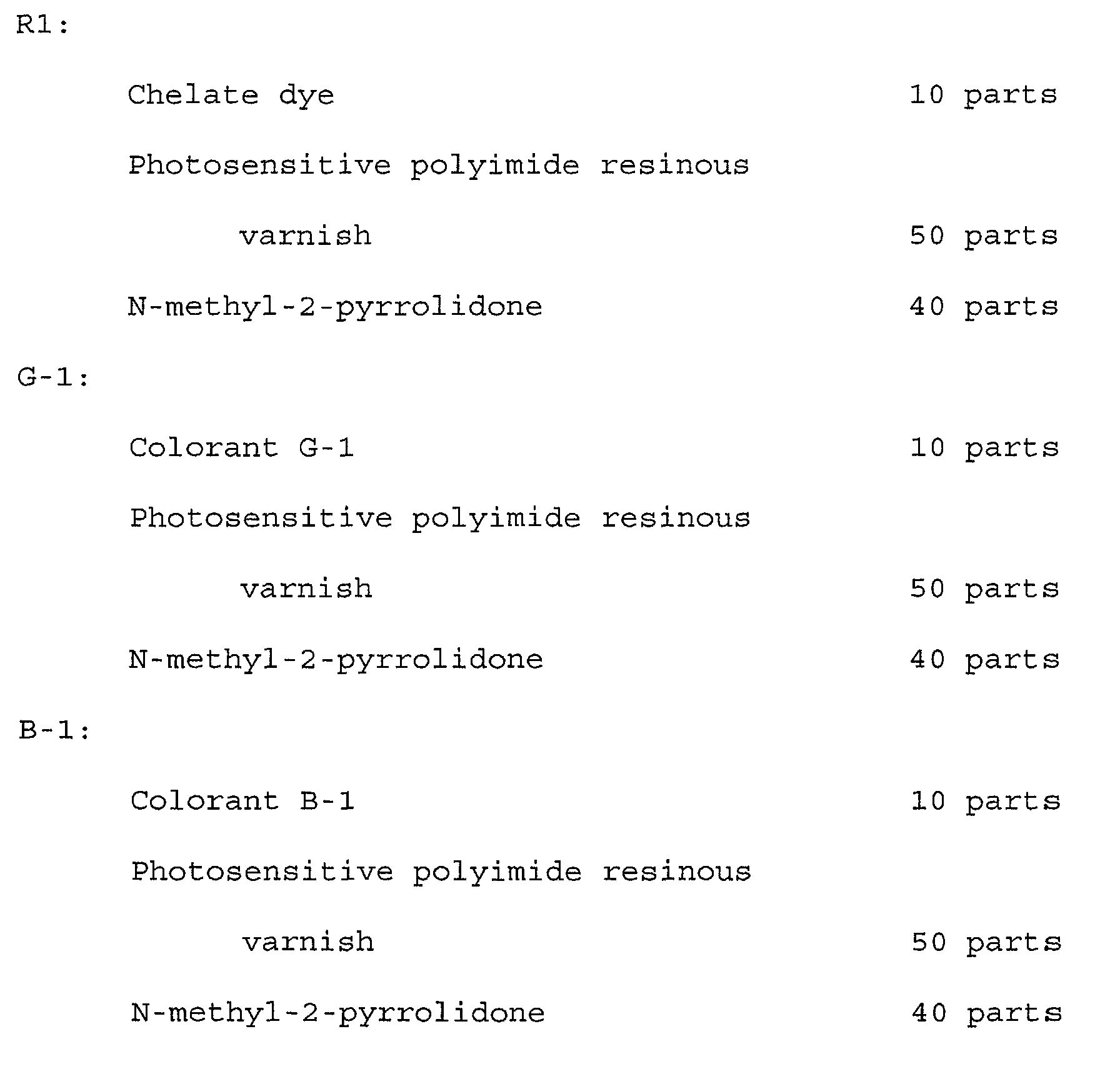
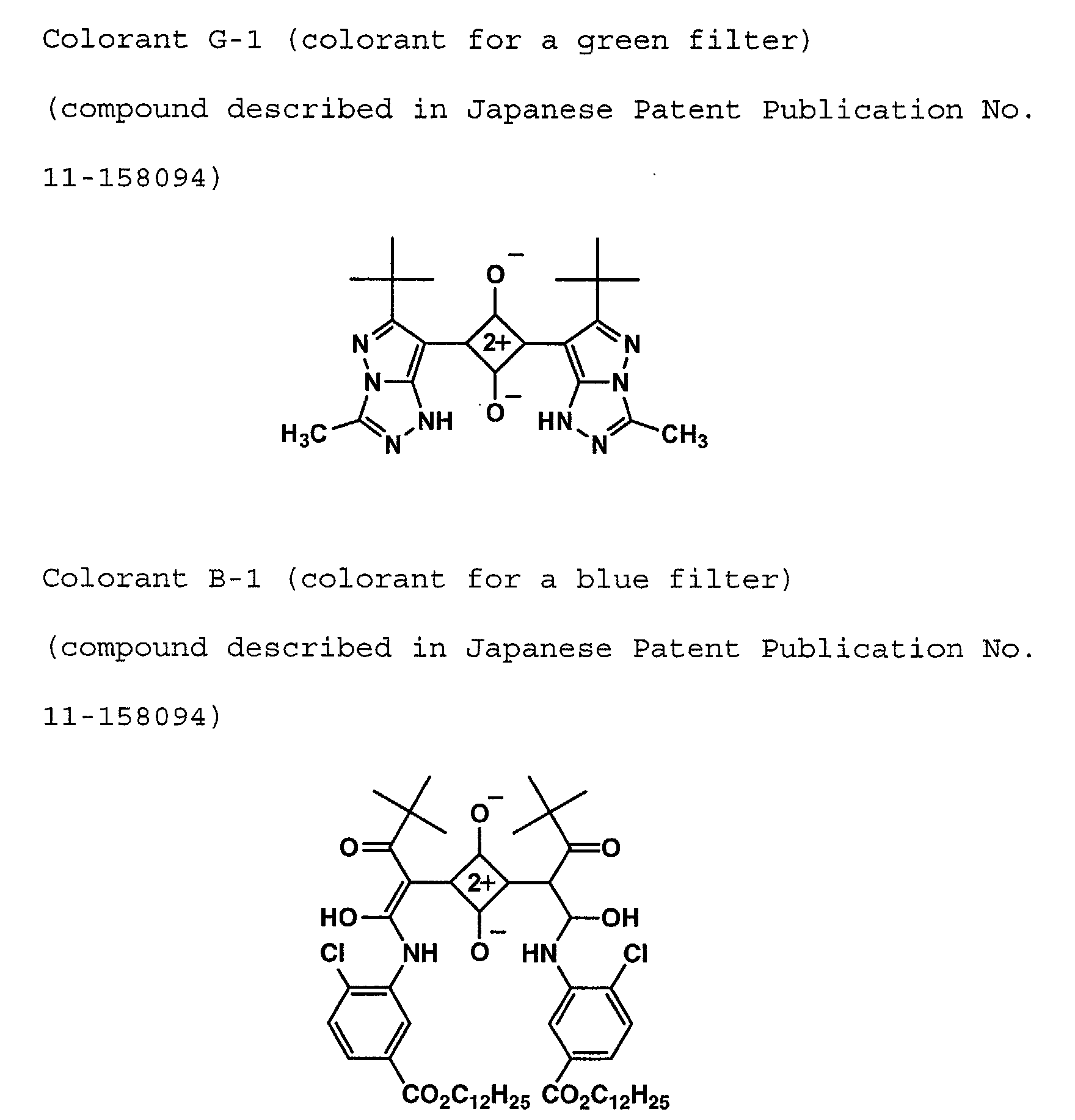
Thereafter, exposure was carried out employing an ultra-high pressure mercury arc lamp at a light intensity of 900 mJ/cm2. Subsequently, development was carried out employing a special developer, and washing was carried out employing a special rinse, whereby a red mosaic pattern was formed on said glass plate. Subsequently, a green mosaic pattern and a blue mosaic pattern were also prepared by coating said photosensitive coating compositions for G-1 and B-1 color filters based on said method and were subjected to printing. Thereafter, a black matrix was formed employing a conventional method, whereby an RGB color filter was prepared. The color filter prepared as above exhibits excellent spectral absorption characteristics and excellent durability such as excellent light fastness and heat resistance, and further exhibits excellent light transmittance. As a result, said color filter exhibits excellent quality as a color filter for liquid crystal color display.
Claims (8)
- A thermal transfer recording material comprising a support having thereon an image transferring layer containing a coloring material represented by Formula (I),wherein each R11 and R12 is independently a substituted or unsubstituted aliphatic group; R13 is a substituent and n is an integer of 0 to 4, provided that when n is 2 or more, a plurality of R13s are the same or different; R14 is an alkyl group; and each R15 and R16 is independently an alkyl group having 3 to 8 carbon atoms.

- The thermal transfer recording material of claim 1, wherein R14 is a secondary alkyl group.
- The thermal transfer recording material of claim 1, wherein the coloring material is represented by Formula (II),wherein each R21 and R22 is independently a substituted or unsubstituted aliphatic group; R23 is a substituent and n is an integer of 0 to 4, provided that when n is 2 or more, a plurality of R23s are the same or different; R24 and R25 each are an alkyl group; R26 is a branched chain alkyl group; and R27 is an alkyl group other than methyl group.
- The thermal transfer recording material of claim 3, wherein R26 is a branched chain alkyl group having 3 to 8 carbon atoms.
- The thermal transfer recording material of claim 3, wherein the coloring material represented by Formula (II) has a molecular weigh of 400 to 500.
- A thermal transfer recording method, comprising the steps of:wherein each R11 and R12 is independently a substituted or unsubstituted aliphatic group; R13 is a substituent and n is an integer of 0 to 4, provided that when n is 2 or more, a plurality of R13s are the same or different; R14 is an alkyl group; and each R15 and R16 is independently an alkyl group having 3 to 8 carbon atoms,(a) superimposing an image receiving material onto a thermal transfer recording material comprising a support having thereon an image transferring layer containing a coloring material represented by Formula (I) or Formula (II);(b) applying heat onto the thermal transfer recording material to form an image; and(c) separating the thermal transfer recording material and the image receiving material from each other,
 wherein each R21 and R22 is independently a substituted or unsubstituted aliphatic group; R23 is a substituent and n is an integer of 0 to 4, provided that when n is 2 or more, a plurality of R23s are the same or different; R24 and R25 each are an alkyl group; R26 is a branched chain alkyl group; and R27 is an alkyl group other than methyl group.
- The thermal transfer recording method of claim 6, wherein the image receiving material comprises a support having thereon a layer containing a compound comprising a metal ion capable of forming a metal complex dye with the coloring material in the thermal transfer recording material during the step (b).
- An ink for ink jet printing, which comprises a metal complex dye prepared from a compound containing a metal ion and a coloring material represented by Formula (I) or Formula (II),wherein each R11 and R12 is independently a substituted or unsubstituted aliphatic group; R13 is a substituent and n is an integer of 0 to 4, provided that when n is 2 or more, a plurality of R13s are the same or different; R14 is an alkyl group; and each R15 and R16 is independently an alkyl group having 3 to 8 carbon atoms,
 wherein each R21 and R22 is independently a substituted or unsubstituted aliphatic group; R23 is a substituent and n is an integer of 0 to 4, provided that when n is 2 or more, a plurality of R23s are the same or different; R24 and R25 each are an alkyl group; R26 is a branched chain alkyl group; and R27 is an alkyl group other than methyl group.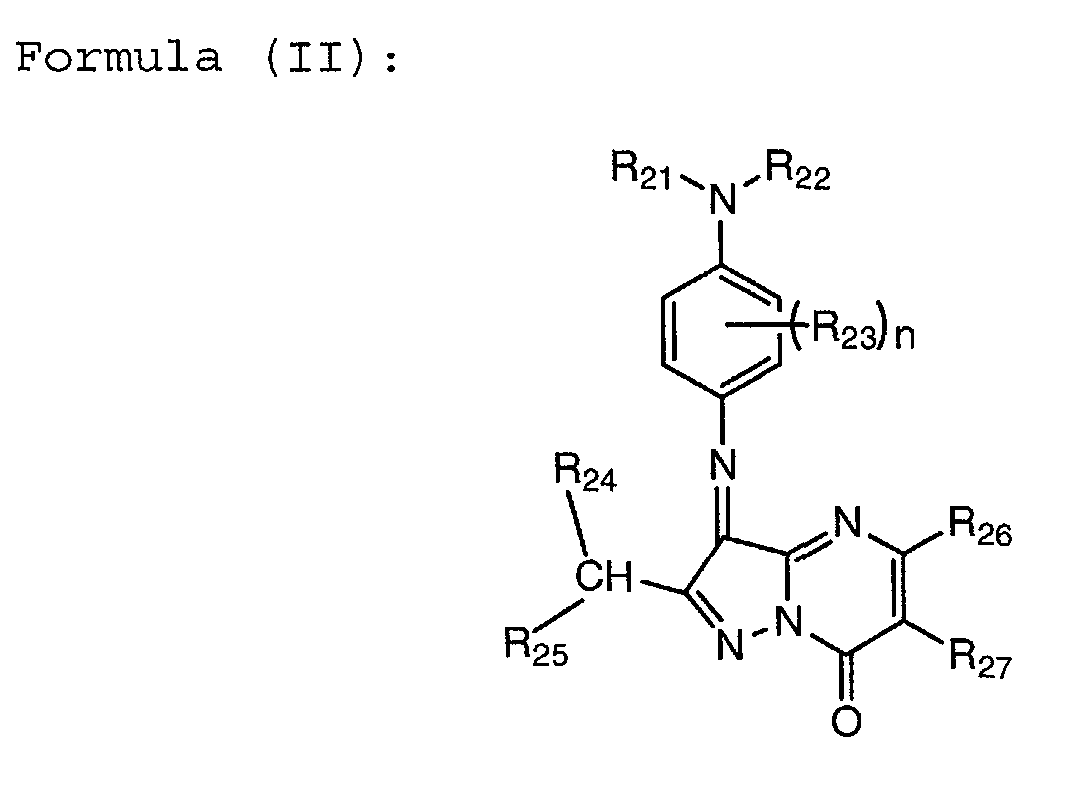
Applications Claiming Priority (2)
| Application Number | Priority Date | Filing Date | Title |
|---|---|---|---|
| JP2001032618A JP4380069B2 (en) | 2001-02-08 | 2001-02-08 | Thermal transfer recording material, thermal transfer recording method, ink, toner and color filter |
| JP2001032618 | 2001-02-08 |
Publications (3)
| Publication Number | Publication Date |
|---|---|
| EP1231072A2 true EP1231072A2 (en) | 2002-08-14 |
| EP1231072A3 EP1231072A3 (en) | 2003-05-02 |
| EP1231072B1 EP1231072B1 (en) | 2005-12-14 |
Family
ID=18896511
Family Applications (1)
| Application Number | Title | Priority Date | Filing Date |
|---|---|---|---|
| EP02002209A Expired - Lifetime EP1231072B1 (en) | 2001-02-08 | 2002-01-29 | Thermal transfer recording material and thermal transfer recording method |
Country Status (4)
| Country | Link |
|---|---|
| US (1) | US6713432B2 (en) |
| EP (1) | EP1231072B1 (en) |
| JP (1) | JP4380069B2 (en) |
| DE (1) | DE60207909D1 (en) |
Families Citing this family (9)
| Publication number | Priority date | Publication date | Assignee | Title |
|---|---|---|---|---|
| US6470060B1 (en) * | 1999-03-01 | 2002-10-22 | Micron Technology, Inc. | Method and apparatus for generating a phase dependent control signal |
| US6866706B2 (en) * | 2001-11-05 | 2005-03-15 | Mitsubishi Chemical Corporation | Ink for thermal transfer, sheet for thermal transfer, and thermal transfer recording method using the same |
| JP2005338524A (en) * | 2004-05-28 | 2005-12-08 | Ricoh Printing Systems Ltd | Image forming apparatus |
| US7425523B2 (en) * | 2004-07-05 | 2008-09-16 | Dai Nippon Printing Co., Ltd. | Thermal transfer recording material and thermal transfer recording method |
| JP4900555B2 (en) * | 2005-04-20 | 2012-03-21 | Jsr株式会社 | Pigment dispersion composition, ink-jet color filter (radiation sensitive) resin composition, color filter, and liquid crystal display device |
| JP2007140230A (en) * | 2005-11-21 | 2007-06-07 | Konica Minolta Business Technologies Inc | Toner for electrostatic charge image development and image forming method |
| WO2011010509A1 (en) | 2009-07-22 | 2011-01-27 | コニカミノルタビジネステクノロジーズ株式会社 | Toner for electrophotography and metal-containing compound |
| US8728696B2 (en) * | 2011-03-14 | 2014-05-20 | Ricoh Company, Ltd. | Toner, image forming method, and process cartridge |
| WO2019236902A1 (en) * | 2018-06-07 | 2019-12-12 | Woods Hole Oceanographic Institution | Alkenones as phase change materials and applications thereof |
Family Cites Families (15)
| Publication number | Priority date | Publication date | Assignee | Title |
|---|---|---|---|---|
| US4061859A (en) * | 1976-06-14 | 1977-12-06 | The Dow Chemical Company | Viscosity reduction of cellulose derivatives |
| JPS62252483A (en) | 1986-04-24 | 1987-11-04 | Fuji Photo Film Co Ltd | Recording fluid |
| JP2676542B2 (en) | 1988-12-28 | 1997-11-17 | コニカ株式会社 | Pyrazolopyrimidin-5-one dye for thermal transfer recording |
| JP2684447B2 (en) | 1989-10-18 | 1997-12-03 | 富士写真フイルム株式会社 | Thermal transfer dye donating material |
| JPH03143684A (en) | 1989-10-31 | 1991-06-19 | Dainippon Printing Co Ltd | thermal transfer sheet |
| JPH03143686A (en) | 1989-10-31 | 1991-06-19 | Sankyo Kagaku Kk | Color for thermally sensitive transfer recording |
| JP3143684B2 (en) | 1991-08-09 | 2001-03-07 | 奥野製薬工業株式会社 | Coating method of granular material and composite plating method by magnetic metal coating |
| US5358922A (en) | 1992-07-16 | 1994-10-25 | Konica Corporation | Thermal transfer image recording material and image using metal ion providing compound |
| JP3143686B2 (en) | 1993-08-27 | 2001-03-07 | 辰治 濱田 | Cultured seaweed growth method and seaweed growth promoting liquid |
| US5892033A (en) | 1995-09-07 | 1999-04-06 | Konica Corporation | Metallic chelating dye |
| JP3625362B2 (en) | 1997-09-08 | 2005-03-02 | コニカミノルタホールディングス株式会社 | Thermal transfer recording material and thermal transfer recording method |
| JP3799863B2 (en) | 1999-03-08 | 2006-07-19 | コニカミノルタホールディングス株式会社 | Thermal transfer recording material and thermal transfer recording method |
| JP2000185476A (en) | 1998-12-22 | 2000-07-04 | Konica Corp | Dye thermal transfer image receiving sheet and image forming method |
| JP2000108525A (en) | 1998-10-01 | 2000-04-18 | Konica Corp | Image receiving sheet and method for forming image |
| JP3890818B2 (en) | 1999-07-21 | 2007-03-07 | コニカミノルタホールディングス株式会社 | Method for producing water-based ink for ink jet |
-
2001
- 2001-02-08 JP JP2001032618A patent/JP4380069B2/en not_active Expired - Fee Related
-
2002
- 2002-01-28 US US10/058,581 patent/US6713432B2/en not_active Expired - Lifetime
- 2002-01-29 EP EP02002209A patent/EP1231072B1/en not_active Expired - Lifetime
- 2002-01-29 DE DE60207909T patent/DE60207909D1/en not_active Expired - Fee Related
Also Published As
| Publication number | Publication date |
|---|---|
| US20020151437A1 (en) | 2002-10-17 |
| EP1231072B1 (en) | 2005-12-14 |
| JP4380069B2 (en) | 2009-12-09 |
| JP2002234266A (en) | 2002-08-20 |
| US6713432B2 (en) | 2004-03-30 |
| DE60207909D1 (en) | 2006-01-19 |
| EP1231072A3 (en) | 2003-05-02 |
Similar Documents
| Publication | Publication Date | Title |
|---|---|---|
| JP2000345059A (en) | Silver halide color photographic material, color toner, organic el element, ink, thermal recording material, optical recording medium, color filter, and squarilium compound | |
| JP2008007652A (en) | Azo dye, thermal transfer recording ink sheet, thermal transfer recording method, color toner, ink jet ink and color filter | |
| JP2001342364A (en) | Material and process for heat-sensitive transfer recording, mixture of pigment and metal ion containing compound, color toner, organic electroluminescence element, ink, optical recording medium and color filter | |
| EP1231072B1 (en) | Thermal transfer recording material and thermal transfer recording method | |
| US5892033A (en) | Metallic chelating dye | |
| US20080081279A1 (en) | Azo dye compound, coloring composition, ink sheet for thermal transfer recording, thermal transfer recording method, color toner, ink for inkjet, and color filter | |
| JP2005162812A (en) | Colored composition, inkjet recording ink, color toner, optical recording medium, ink sheet for thermally sensitive transfer recording material, color filter, and inkjet recording method using the inkjet recording ink | |
| JP5204418B2 (en) | Indian aniline dye, thermal transfer recording ink sheet, thermal transfer recording method, color toner, inkjet ink, and color filter | |
| JP2005162855A (en) | Colored composition, inkjet recording ink, color toner, optical recording medium, ink sheet for thermally sensitive transfer recording material, color filter, and inkjet recording method using the inkjet recording ink | |
| JP2003073358A (en) | New triphenylmethane compound, oil-based ink, water- based ink, image recoding method, triphenylmethane compound dispersion and colored photosensitive composition | |
| JPH10265690A (en) | Thermal transfer recording material, thermal transfer recording method, hydrazono colorant, metal complex compound, image, color toner, method for forming electrophotographic image, ink jet recording liquid, ink jet recording method, optical recording medium, optical recording method, coloring composition for color filter, production of color filter, and color filter | |
| JP2001159832A (en) | Color toner, ink for ink jet and metallic complex dye | |
| JP5087823B2 (en) | Azomethine dyes, metal complex dyes, color toners using them, and inkjet inks | |
| JP2005171079A (en) | Coloring composition, ink for inkjet recording, inkjet recording method, color toner, optical recording medium, thermal transfer recording material, and color filter | |
| JP2001334755A (en) | Heat-sensitive transfer recording material, method of heat-sensitive transfer recording, ink for ink-jet recording, color toner, and color filter | |
| JP3728115B2 (en) | Coloring composition for image recording | |
| JP2001334756A (en) | Thermal transfer recording material, thermal transfer recording method, color filter, toner and ink | |
| EP2257600B1 (en) | Coloring composition, thermal transfer recording ink sheet, thermal transfer recording method, color toner, inkjet ink, color filter, and arylidene-pyrazolone dye | |
| JP2006016565A (en) | Coloring matter, metal chelate coloring matter, inkjet recording ink, color toner and color filter | |
| JP2007009106A (en) | Azomethine dye and metal complex dye, and color toner and ink for inkjet using those | |
| JP2006317895A (en) | Color toner, color filter, colored composition, ink jet recording liquid, ink jet recording method and metal chelate dye | |
| JP4867377B2 (en) | Coloring composition, inkjet recording liquid, inkjet recording method, and color toner | |
| EP1980592B1 (en) | Coloring composition, thermal transfer recording ink sheet, thermal transfer recording method, color toner, inkjet ink, color filter, and azo dye | |
| JP3030716B2 (en) | Thermal transfer recording material and image forming method using the recording material | |
| JP3030718B2 (en) | Image forming method |
Legal Events
| Date | Code | Title | Description |
|---|---|---|---|
| PUAI | Public reference made under article 153(3) epc to a published international application that has entered the european phase |
Free format text: ORIGINAL CODE: 0009012 |
|
| AK | Designated contracting states |
Kind code of ref document: A2 Designated state(s): AT BE CH CY DE DK ES FI FR GB GR IE IT LI LU MC NL PT SE TR |
|
| AX | Request for extension of the european patent |
Free format text: AL;LT;LV;MK;RO;SI |
|
| RIC1 | Information provided on ipc code assigned before grant |
Ipc: 7B 41M 5/00 B Ipc: 7B 41M 5/38 A |
|
| PUAL | Search report despatched |
Free format text: ORIGINAL CODE: 0009013 |
|
| RIC1 | Information provided on ipc code assigned before grant |
Ipc: 7B 41M 5/38 A Ipc: 7C 09D 11/00 B Ipc: 7B 41M 5/00 B |
|
| AK | Designated contracting states |
Designated state(s): AT BE CH CY DE DK ES FI FR GB GR IE IT LI LU MC NL PT SE TR |
|
| AX | Request for extension of the european patent |
Extension state: AL LT LV MK RO SI |
|
| 17P | Request for examination filed |
Effective date: 20031031 |
|
| AKX | Designation fees paid |
Designated state(s): DE FR GB |
|
| 17Q | First examination report despatched |
Effective date: 20040622 |
|
| GRAP | Despatch of communication of intention to grant a patent |
Free format text: ORIGINAL CODE: EPIDOSNIGR1 |
|
| GRAS | Grant fee paid |
Free format text: ORIGINAL CODE: EPIDOSNIGR3 |
|
| GRAA | (expected) grant |
Free format text: ORIGINAL CODE: 0009210 |
|
| AK | Designated contracting states |
Kind code of ref document: B1 Designated state(s): DE FR GB |
|
| REG | Reference to a national code |
Ref country code: GB Ref legal event code: FG4D |
|
| REF | Corresponds to: |
Ref document number: 60207909 Country of ref document: DE Date of ref document: 20060119 Kind code of ref document: P |
|
| PG25 | Lapsed in a contracting state [announced via postgrant information from national office to epo] |
Ref country code: DE Free format text: LAPSE BECAUSE OF NON-PAYMENT OF DUE FEES Effective date: 20060801 |
|
| PLBE | No opposition filed within time limit |
Free format text: ORIGINAL CODE: 0009261 |
|
| STAA | Information on the status of an ep patent application or granted ep patent |
Free format text: STATUS: NO OPPOSITION FILED WITHIN TIME LIMIT |
|
| 26N | No opposition filed |
Effective date: 20060915 |
|
| EN | Fr: translation not filed | ||
| PG25 | Lapsed in a contracting state [announced via postgrant information from national office to epo] |
Ref country code: FR Free format text: LAPSE BECAUSE OF FAILURE TO SUBMIT A TRANSLATION OF THE DESCRIPTION OR TO PAY THE FEE WITHIN THE PRESCRIBED TIME-LIMIT Effective date: 20070202 |
|
| PG25 | Lapsed in a contracting state [announced via postgrant information from national office to epo] |
Ref country code: FR Free format text: LAPSE BECAUSE OF FAILURE TO SUBMIT A TRANSLATION OF THE DESCRIPTION OR TO PAY THE FEE WITHIN THE PRESCRIBED TIME-LIMIT Effective date: 20060131 |
|
| PG25 | Lapsed in a contracting state [announced via postgrant information from national office to epo] |
Ref country code: FR Free format text: LAPSE BECAUSE OF FAILURE TO SUBMIT A TRANSLATION OF THE DESCRIPTION OR TO PAY THE FEE WITHIN THE PRESCRIBED TIME-LIMIT Effective date: 20051214 |
|
| PGFP | Annual fee paid to national office [announced via postgrant information from national office to epo] |
Ref country code: GB Payment date: 20180124 Year of fee payment: 17 |
|
| GBPC | Gb: european patent ceased through non-payment of renewal fee |
Effective date: 20190129 |
|
| PG25 | Lapsed in a contracting state [announced via postgrant information from national office to epo] |
Ref country code: GB Free format text: LAPSE BECAUSE OF NON-PAYMENT OF DUE FEES Effective date: 20190129 |