EP1230925A1 - Anti-hiv compositions - Google Patents
Anti-hiv compositions Download PDFInfo
- Publication number
- EP1230925A1 EP1230925A1 EP00971704A EP00971704A EP1230925A1 EP 1230925 A1 EP1230925 A1 EP 1230925A1 EP 00971704 A EP00971704 A EP 00971704A EP 00971704 A EP00971704 A EP 00971704A EP 1230925 A1 EP1230925 A1 EP 1230925A1
- Authority
- EP
- European Patent Office
- Prior art keywords
- group
- lower alkyl
- hiv
- trifluridine
- derivatives
- Prior art date
- Legal status (The legal status is an assumption and is not a legal conclusion. Google has not performed a legal analysis and makes no representation as to the accuracy of the status listed.)
- Granted
Links
- 0 *C(C1)C(CO)OC1N(C=C(C(F)(F)F)C(N1*)=O)C1=O Chemical compound *C(C1)C(CO)OC1N(C=C(C(F)(F)F)C(N1*)=O)C1=O 0.000 description 2
Classifications
-
- A—HUMAN NECESSITIES
- A61—MEDICAL OR VETERINARY SCIENCE; HYGIENE
- A61K—PREPARATIONS FOR MEDICAL, DENTAL OR TOILETRY PURPOSES
- A61K31/00—Medicinal preparations containing organic active ingredients
- A61K31/70—Carbohydrates; Sugars; Derivatives thereof
- A61K31/7042—Compounds having saccharide radicals and heterocyclic rings
- A61K31/7052—Compounds having saccharide radicals and heterocyclic rings having nitrogen as a ring hetero atom, e.g. nucleosides, nucleotides
- A61K31/706—Compounds having saccharide radicals and heterocyclic rings having nitrogen as a ring hetero atom, e.g. nucleosides, nucleotides containing six-membered rings with nitrogen as a ring hetero atom
- A61K31/7064—Compounds having saccharide radicals and heterocyclic rings having nitrogen as a ring hetero atom, e.g. nucleosides, nucleotides containing six-membered rings with nitrogen as a ring hetero atom containing condensed or non-condensed pyrimidines
- A61K31/7068—Compounds having saccharide radicals and heterocyclic rings having nitrogen as a ring hetero atom, e.g. nucleosides, nucleotides containing six-membered rings with nitrogen as a ring hetero atom containing condensed or non-condensed pyrimidines having oxo groups directly attached to the pyrimidine ring, e.g. cytidine, cytidylic acid
- A61K31/7072—Compounds having saccharide radicals and heterocyclic rings having nitrogen as a ring hetero atom, e.g. nucleosides, nucleotides containing six-membered rings with nitrogen as a ring hetero atom containing condensed or non-condensed pyrimidines having oxo groups directly attached to the pyrimidine ring, e.g. cytidine, cytidylic acid having two oxo groups directly attached to the pyrimidine ring, e.g. uridine, uridylic acid, thymidine, zidovudine
-
- A—HUMAN NECESSITIES
- A61—MEDICAL OR VETERINARY SCIENCE; HYGIENE
- A61K—PREPARATIONS FOR MEDICAL, DENTAL OR TOILETRY PURPOSES
- A61K31/00—Medicinal preparations containing organic active ingredients
- A61K31/33—Heterocyclic compounds
- A61K31/395—Heterocyclic compounds having nitrogen as a ring hetero atom, e.g. guanethidine or rifamycins
- A61K31/495—Heterocyclic compounds having nitrogen as a ring hetero atom, e.g. guanethidine or rifamycins having six-membered rings with two or more nitrogen atoms as the only ring heteroatoms, e.g. piperazine or tetrazines
- A61K31/505—Pyrimidines; Hydrogenated pyrimidines, e.g. trimethoprim
- A61K31/506—Pyrimidines; Hydrogenated pyrimidines, e.g. trimethoprim not condensed and containing further heterocyclic rings
-
- A—HUMAN NECESSITIES
- A61—MEDICAL OR VETERINARY SCIENCE; HYGIENE
- A61K—PREPARATIONS FOR MEDICAL, DENTAL OR TOILETRY PURPOSES
- A61K31/00—Medicinal preparations containing organic active ingredients
- A61K31/33—Heterocyclic compounds
- A61K31/395—Heterocyclic compounds having nitrogen as a ring hetero atom, e.g. guanethidine or rifamycins
- A61K31/495—Heterocyclic compounds having nitrogen as a ring hetero atom, e.g. guanethidine or rifamycins having six-membered rings with two or more nitrogen atoms as the only ring heteroatoms, e.g. piperazine or tetrazines
- A61K31/505—Pyrimidines; Hydrogenated pyrimidines, e.g. trimethoprim
- A61K31/513—Pyrimidines; Hydrogenated pyrimidines, e.g. trimethoprim having oxo groups directly attached to the heterocyclic ring, e.g. cytosine
-
- A—HUMAN NECESSITIES
- A61—MEDICAL OR VETERINARY SCIENCE; HYGIENE
- A61K—PREPARATIONS FOR MEDICAL, DENTAL OR TOILETRY PURPOSES
- A61K45/00—Medicinal preparations containing active ingredients not provided for in groups A61K31/00 - A61K41/00
- A61K45/06—Mixtures of active ingredients without chemical characterisation, e.g. antiphlogistics and cardiaca
-
- A—HUMAN NECESSITIES
- A61—MEDICAL OR VETERINARY SCIENCE; HYGIENE
- A61P—SPECIFIC THERAPEUTIC ACTIVITY OF CHEMICAL COMPOUNDS OR MEDICINAL PREPARATIONS
- A61P31/00—Antiinfectives, i.e. antibiotics, antiseptics, chemotherapeutics
- A61P31/12—Antivirals
- A61P31/14—Antivirals for RNA viruses
- A61P31/18—Antivirals for RNA viruses for HIV
-
- A—HUMAN NECESSITIES
- A61—MEDICAL OR VETERINARY SCIENCE; HYGIENE
- A61P—SPECIFIC THERAPEUTIC ACTIVITY OF CHEMICAL COMPOUNDS OR MEDICINAL PREPARATIONS
- A61P43/00—Drugs for specific purposes, not provided for in groups A61P1/00-A61P41/00
Definitions
- the present invention relates to a novel anti-HIV composition.
- AIDS acquired immunodeficiency syndrome
- HIV human immunodeficiency virus
- anti-HIV drugs have many defects.
- anti-HIV drugs such as AZT have serious toxicity which limits the amount which can be clinically administered. Therefore, sometimes the drugs can not be administered to patients, or even if they can be used, often their administration must be stopped in many patients.
- drug-resistant viral strains tend to develop quickly during monotherapy with such anti-HIV drugs and there is also cross-resistance, for example, between AZT and d4T and between AZT and ddC.
- patients tend to develop various complications, concomitantly with AIDS.
- Trifluridine is a compound first synthesized by Heiderberger et al. (Journal of American Chemical Society, vol.84, 3597(1962)), and known to have potent antitumor activity in vitro (Cancer Research, vol.28, 2529(1968)). It is also known that this compound has potent antiviral activity against herpes simplex virus and vaccinia virus, which are DNA viruses (Science, vol.145, 585(1964), Pergamon Press, New York 1990, 1182-1201).
- trifluridine is known to be rapidly decomposed and inactivated by thymidine phosphorylase in the liver, intestinum uben, etc. (Cancer Research, vol.32, 247(1972); Japanese Journal of Cancer and Chemotherapy, vol.8, 262(1981) and vol.8, 1548(1981)). In clinical trials, trifluridine showed unsatisfactory antitumor effects (Cancer Chemotherapy Report, vol.55, 205(1971)).
- trifluridine is an ophthalmic preparation for herpes keratitis caused by herpes simplex virus (HSV) infection, which is an ophthalmic local treatment and thus free from decomposition by thymidine phosphorylase (The Lancet, vol.21, 1189(1987); Physicians Desk Reference, 50th Ed. 1204(1996); American Journal of Ophthalmology, vol.73, 932 (1972); Journal of Acquired Immune Deficiency Syndromes and Human Retrovirology, vol.12, 147(1996)).
- HSV herpes simplex virus
- An object of the invention is to provide a novel anti-HIV composition.
- Another object of the invention is to provide a novel anti-HIV activity potentiating composition.
- a further object of the invention is to provide a novel method for treating syndromes after HIV infection.
- the inventors of the present invention carried out intensive research on synthetic 2'-deoxynucleosides from diversified viewpoints and found that trifluridine and derivatives thereof have potent anti-HIV activity.
- the inventors further found that the use of a thymidine phosphorylase inhibitor in combination with trifluridine or its derivatives can reduce the side effects of trifluridine and its derivatives and also retain the in vivo concentration of trifluridine at a level effective for the treatment of HIV infection, thereby enhancing the anti-HIV activity of trifluridine and derivatives thereof.
- the present invention has been accomplished based on these novel findings.
- the present invention provides an anti-HIV composition
- an anti-HIV composition comprising at least one member selected from the group consisting of trifluridine and derivatives thereof, and a pharmaceutically acceptable carrier.
- the present invention further provides an anti-HIV composition
- an anti-HIV composition comprising (a) at least one member selected from the group consisting of trifluridine and derivatives thereof, (b) a thymidine phosphorylase inhibitor, and a pharmaceutically acceptable carrier.
- the present invention further provides a composition for potentiating the anti-HIV activity of trifluridine and derivatives thereof, comprising a thymidine phosphorylase inhibitor and a pharmaceutically acceptable carrier.
- the present invention further provides the use of at least one member selected from the group consisting of trifluridine and derivatives thereof for preparing the above anti-HIV compositions.
- the present invention further provides a method for treating HIV infection, comprising administering an effective amount of one of the above anti-HIV compositions to HIV-infected mammals, including humans.
- the present invention further provides the use of a thymidine phosphorylase inhibitor for preparing a composition for potentiating the anti-HIV activity of trifluridine or derivatives thereof.
- the anti-HIV composition of the invention is useful for treating syndromes after HIV infection.
- the anti-HIV activity potentiating composition of the invention greatly enhances the anti-HIV activity of trifluridine and derivatives thereof.
- the trifluridine or derivative thereof used as an active ingredient of the anti-HIV composition of the invention may be trifluridine or any compound that is converted into trifluridine in vivo.
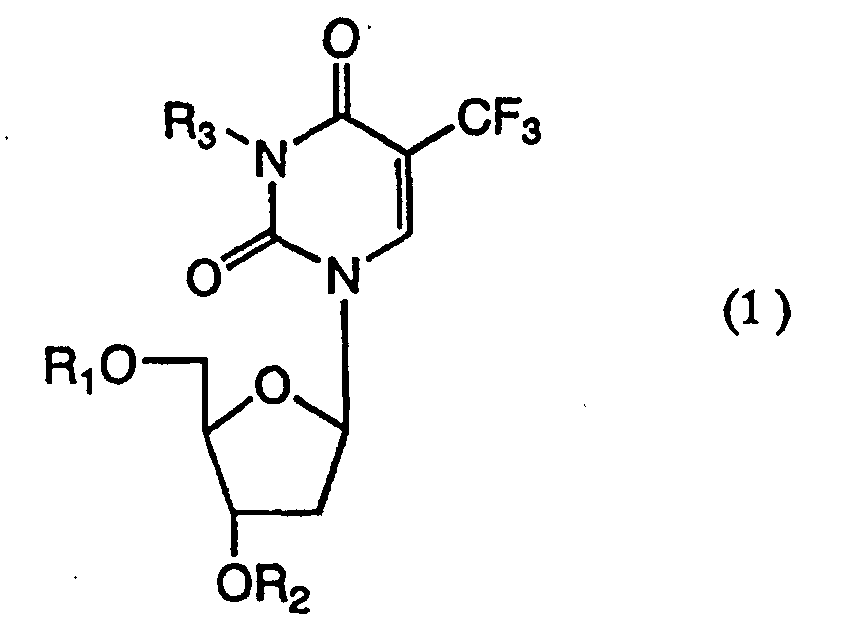
- trifluridine and derivatives thereof are compounds represented by the formula wherein R 1 and R 2 may be the same or different and are hydrogen, acyl, lower alkyl, alkoxy-lower alkyl, tetrahydrofuryl, tetrahydropyranyl, triphenylmethyl, benzyloxy-lower alkyl, tetrahydrofuryloxy-lower alkyl, lower alkylcarbamoyl, lower alkoxycarbonyl, tri-substituted silyl, di-substituted phosphoric acid group, benzyl or benzoyl; the three substituents of the tri-substituted silyl group and the two substituents of the di-substituted phosphoric acid group are selected from the group consisting of lower alkyl, phenyl and benzyl and may be the same or different from each other; R 3 represents hydrogen, tetrahydrofuryl or benzoyl; when R 1 or
- trifluridine is a compound in which R 1 , R 2 and R 3 . are all hydrogen.
- the compounds of formula (1) other than this one are converted into trifluridine in vivo and thus function as prodrugs of trifluridine.
- Useful trifluridine derivatives also include the antitumor compounds described in Japanese Unexamined Patent Publications Nos. 152898/1983, 36696/1984, 216899/1984, 56996/1985 and 261396/1989 and WO90/00557.
- the acyl when R 1 or R 2 is acyl, can be a straight or branched acyl group preferably having 2 to 20 carbon atoms, particularly 2 to 10 carbon atoms. Specific examples include acetyl, n-butyryl, i-butyryl, t-butyl, hexanoyl, isohexanoyl and decanoyl.
- the lower alkyl can be a C 1-6 straight or branched alkyl group. Specific examples include methyl, ethyl, n-propyl, i-propyl, n-butyl, i-butyl, sec-butyl, t-butyl, hexyl and isohexyl.
- the alkoxy-lower alkyl can be a C 1-6 , particularly C 1-3 , straight or branched alkyl group substituted with a C 1-6 straight or branched alkoxy group.
- substituent alkoxy group include methoxy, ethoxy, n-butoxy, i-butoxy and t-butoxy.
- alkoxy-lower alkyl group include methoxymethyl, ethoxymethyl and 1-ethoxyethyl.
- R 1 or R 2 is benzyloxy-lower alkyl
- the benzyloxy-lower alkyl can be a C 1-6 , particularly C 1-3 , straight or branched alkyl group substituted with a benzyloxy group. Specific examples include benzyloxymethyl and 1-benzyloxyethyl.
- the tetrahydrofuryloxy-lower alkyl can be a C 1-6 , particularly C 1-3 , straight or branched alkyl groups substituted with a tetrahydrofuryloxy group. Specific examples include tetrahydrofuryloxymethyl.
- R 1 , R 2 or R 3 is tetrahydrofuryl, examples thereof include 2-tetrahydrofuryl.
- R 1 or R 2 is tetrahydropyranyl
- examples thereof include 2-tetrahydropyranyl.
- the lower alkylcarbamoyl can be a carbamoyl group substituted with one or two C 1-6 straight or branched alkyl groups. Specific examples include methylcarbamoyl, ethylcarbamoyl, n-butylcarbamoyl, i-butylcarbamoyl, t-butylcarbamoyl, hexylcarbamoyl and isohexylcarbamoyl.
- the lower alkoxycarbonyl can be a carbonyl group combined with a C 1-6 straight or branched alkoxyl group. Specific examples include methoxycarbonyl, ethoxycarbonyl, n-butoxycarbonyl, i-butoxycarbonyl, t-butoxycarbonyl, hexyloxycarbonyl and isohexyloxycarbonyl.
- the tri-substituted silyl can be a silyl group having three identical or different substituents selected from the group consisting of C 1-6 lower alkyl, phenyl and benzyl. Specific examples include triethylsilyl, t-butyldimethylsilyl, triphenylsilyl, tribenzylsilyl, benzyldimethylsilyl and diphenylmethylsilyl.
- the di-substituted phosphoric acid group is a phosphoric acid group having two identical or different substituents selected from the group consisting of C 1-6 lower alkyl, phenyl and benzyl. Specific examples include diethyl phosphoric acid group, diphenyl phosphoric acid group and dibenzyl phosphoric acid group.
- R 1 , R 2 or R 3 When R 1 , R 2 or R 3 is benzoyl or when R 1 or R 2 is benzyl, the benzoyl and the benzyl may have 1 to 5 substituents, preferably 1 to 2 substituents, selected from the group consisting of lower alkyl, lower alkoxy and halogen.
- the substituent lower alkyl group can be a C 1-6 , preferably C 1-4, straight or branched alkyl group. Specific examples include methyl, ethyl, n-propyl, i-propyl, n-butyl, i-butyl, sec-butyl and t-butyl.
- the substituent lower alkoxy group includes a C 1-6 straight or branched alkoxy group.
- the substituent halogen atom includes fluorine, chlorine, bromine and iodine.
- the substituted benzoyl group includes 4-fluorobenzoyl, 4-chlorobenzoyl, 3-fluorobenzoyl, 2-methoxybenzoyl, 4-methylbenzoyl and 4-butylbenzoyl.
- R 1 and R 2 may be the same or different and are hydrogen, acetyl or 2-tetrahydrofuryl and R 3 is 2-tetrahydrofuryl, benzoyl, 4-fluorobenzoyl, 4-chlorobenzoyl, 3-fluorobenzoyl, 2-methoxybenzoyl, 4-methylbenzoyl or 4-butylbenzoyl; compounds in which R 1 and R 2 may be the same or different and are hydrogen, hexyl, 4-methylbenzoyl, 2-tetrahydrofuryl or t-butyldimethylsilyl and R 3 is hydrogen; and the compound in which R 1 , R 2 and R 3 are all hydrogen.
- a thymidine phosphorylase inhibitor may be included, together with trifluridine or derivatives thereof, in the anti-HIV composition of the invention or can be used singly as a composition for potentiating the anti-HIV activity of trifluridine and derivatives thereof.
- the inhibitor include any compounds that can reduce the side effects of trifluridine or its derivatives and also retain the in vivo concentration at which trifluridine or its derivatives can produce anti-HIV effects .
- thymidine phosphorylase inhibitor of the invention are, for example, 6-amino-5-bromouracil, 6-aminothymine, 6-amino-5-chlorouracil, 3-cyano-2,6-dihydroxypyridine, acyclothymidine, or pharmaceutically acceptable salts of these compounds.
- Examples of compounds preferably used as the thymidine phosphorylase inhibitor of the invention further include pyrimidinedione derivatives represented by the formula wherein R 4 is chlorine, bromine, iodine, cyano or lower alkyl.
- R 5 is a 4- to 8-membered heterocyclic group containing 1 to 3 nitrogen atoms and optionally having one or more substituents selected from the group consisting of lower alkyl, imino, hydroxyl, hydroxymethyl, methanesulfonyloxy, amino and nitro; an amidinothio group in which one or more of the hydrogen atoms on the nitrogen atom may be substituted by lower alkyl groups; a guanidino group in which one or more hydrogen atoms on the nitrogen atom may be substituted by lower alkyl or cyano groups; a lower alkylamidino group; an amino group in which one or more of the hydrogen atoms on the nitrogen atom may be substituted by lower alkyl groups; -CH 2
- the thymidine phosphorylase inhibitor is a known compound described in Biochemical Pharmacology, vol.29, 1059(1980), Japanese Unexamined Patent Publications Nos. 250324/1988 and 213761/1993, WO96/30346, etc.
- the lower alkyl when R 4 is lower alkyl, can be a C 1-4 straight or branched alkyl group. Specific examples include methyl, ethyl, n-propyl, i-propyl, n-butyl, i-butyl, sec-butyl and t-butyl. Especially preferred is methyl.
- R 5 is a 4- to 8-membered heterocyclic group having 1 to 3 nitrogen atoms
- specific examples include 1-azetidinyl, 1-pyrrolidinyl, 2-pyrrolin-1-yl, 3- pyrrolin-1-yl, 1-pyrrolyl, 1-pyrazolidinyl, 2-pyrazolin-1- yl, 3-pyrazolin-1-yl, 4-pyrazolin-1-yl, 1-pyrazolyl, 1-imidazolidinyl, 2-imidazolin-1-yl, 3-imidazolin-1-yl, 4-imidazolin-1-yl, 1-imidazolyl, 1,2,3-triazol-1-yl, 1,2,4-triazol-1-yl, piperidino, 1-piperazyl, morpholino, 1-perhydroazepinyl and 1-perhydroazocinyl.
- the heterocyclic group may have one or two substituents on the ring.
- substituents include lower alkyl, imino, hydroxyl, hydroxymethyl, methanesulfonyloxy, amino and nitro.
- the substituent lower alkyl group can be a C 1-4 straight or branched alkyl group and specific examples include methyl, ethyl, n-propyl, i-propyl, n-butyl, i-butyl, sec-butyl and t-butyl. Especially preferred is methyl.
- heterocyclic groups which may have one or two substituents include 1-azetidinyl, 1-pyrrolidinyl, 2,5-dimethylpyrrolidin-1-yl, 2-iminopyrrolidin-1-yl, 3-hydroxypyrrolidin-1-yl, 2-hydroxymethylpyrrolidin-1-yl, 3-methanesulfonyloxypyrrolidin-1-yl, 3-aminopyrrolidin-1-yl, 2-pyrrolin-1-yl, 3-pyrrolin-1-yl, 2-imino-3-pyrrolin-1-yl, 1-pyrrolyl, 1-pyrazolidinyl, 2-methylpyrazolidin-1-yl, 4-iminopyrazolidin-1-yl, 2-pyrazolin-1-yl, 3-pyrazolin-1-yl, 2-methyl-3-pyrazolin-1-yl, 5-imino-3-pyrazolin-1-yl, 4-pyrazolin-1-yl, 2-methyl-4-pyrazolin-1
- 1-azetidinyl 1-pyrrolidinyl, 2-iminopyrrolydin-1-yl, 2-iminoimidazolidin-1-yl, 2-imino-3-methylimidazolidin-1-yl, 2-imino-3-ethylimidazolidin-1-yl, 2-imino-3-isopropylimidazolidin-1-yl, 2-imidazolin-1-yl, 2-imino-3-methyl-4-imidazolin-1-yl, 2-imino-3-ethyl-4-imidazolin-1-yl and 1-imidazolyl.
- R 5 is an amidinothio group in which one or more of the hydrogen atoms on the nitrogen atom may be substituted by a like number of lower alkyl groups
- one to three of the three hydrogen atoms on the nitrogen atom of the amidino group may be substituted by the above-exemplified lower alkyl groups.
- amidinothio N 1 -methylamidinothio and N 1 ,N 2 -dimethyl amidinothio.
- R 5 is a guanidino group in which one or more of the hydrogen atoms on the nitrogen atom may be substituted by a like number of lower alkyl or cyano groups
- one to four of the four hydrogen atoms of the guanidino group may be substituted by a like number of the above-exemplified lower alkyl groups or cyano.
- Especially preferred are 1-guanidino, 1-methylguanidino, 3-methylguanidino, 2,3-dimethylguanidino and 2-cyano-3-methylguanidino.
- the lower alkylamidino is an amidino group to which a lower alkyl group as exemplified above is attached. Especially preferred is acetoamidino.
- R 5 is an amino group in which one or more of the hydrogen atoms on the nitrogen atom may be substituted by a like number of lower alkyl groups
- one or two of the two hydrogen atoms of the amino group may be substituted by a like number of lower alkyl groups exemplified above.
- R 5 is -CH 2 N(Ra)(Rb)
- preferable examples are N-methylaminomethyl, N,N-dimethylaminomethyl and 1-pyrrolidinylmetyl.
- R 5 is -NH-(CH 2 ) m -Z
- preferable examples are N,N-dimethylhydrazino, N-(2-aminoethyl)amino, N-(2-(N,N-dimethyl)aminoethyl)amino, N- (3-aminopropyl)amino and N-(2-cyanoethyl)amino.
- R 5 is -NRc(CH 2 ) n -OH
- preferable examples are N-(2-hydroxyethyl)-N-methylamino, N-(3-hydroxypropyl)amino and N-(4-hydroxybutyl)amino.
- R 5 is a group -X-Y
- preferable examples are 2-imidazolin-2-thio, 2-imidazolin-2-amino, imidazol-2-thio, 1-methylimidazol-2-thio, 1,2,4-triazol-3-thio, pyrimidine -2-thio and benzimidazol-2-thio.
- R 5 is ureido or thioureido in which one or more hydrogen atoms on the nitrogen atom may be substituted by a like number of lower alkyl groups
- preferable examples include 3-methylthioureido.
- R 5 in formula (2) is a 4- to 8-membered heterocyclic group containing 1 to 3 nitrogen atoms and optionally having one or more substituents selected from the group consisting of lower alkyl, imino, hydroxyl, hydroxymethyl, methanesulfonyloxy, amino and nitro; an amidinothio group in which one or more of the hydrogens on the nitrogen atom may be substituted by a like number of lower alkyl groups; a guanidino group in which one or more of the hydrogen atoms on the nitrogen may be substituted by a like number of lower alkyl or cyano groups; or a lower alkylamidino group.
- R 5 is preferably 1-azetidinyl, 1-pyrrolidinyl, 2-iminopyrrolidin-1-yl, 2-iminoimidazolidin-1-yl, 2-imino-3- methylimidazolydin-1-yl, 2-imino-3-ethylimidazolidin-1-yl, 2-imino-3-isopropylimidazolidin-1-yl, 2-imidazolin-1-yl, 2-imino-3-methyl-4-imidazolin-1-yl, 2-imino-3-ethyl-4- imidazolin-1-yl, 1-imidazolyl, amidinothio, N 1 -methylamidinothio, N 1 ,N 2 -dimethylamidinothio, 1-guanidino, 1-methylguanidino, 3-methylguanidino, 2,3-dimethylguanidino or acetoamidino.
- the pyrimidinedione derivative of formula (2) is preferably a compound in which R 4 is chlorine, bromine or cyano and R 5 is 1-pyrrolidinyl, 1-azetidinyl, 2-iminopyrrolidin-1-yl, 2-iminoimidazolidin-1-yl, 1-imidazolyl, amidinothio or 1-guanidino.
- the pharmaceutically acceptable salt of the pyrimidinedione derivative is not particularly limited.
- Examples of such acid addition salts include salts of inorganic acids such as hydrochloric acid, sulfuric acid, phosphoric acid and hydrobromic acid; salts of organic acids such as oxalic acid, maleic acid, fumaric acid, malic acid, tartaric acid, citric acid, benzoic acid, acetic acid, p-toluenesulfonic acid and methanesulfonic acid.
- base salts include salts of alkali metals or alkaline earth metals such as sodium, potassium, magnesium and calcium; salts of amines such as ammonia, methylamine, dimethylamine, piperidine, cyclohexylamine and triethylamine.
- the compounds usable as the thymidine phosphorylase inhibitor preferred are the compounds of formula (2) including 5-chloro-6-(2-iminopyrrolidin-1-yl)methyl-2,4(1H,3H)-pyrimidinedione, 5-bromo-6-(1-pyrrolidinyl)methyl-2,4(1H,3H)-pyrimidinedione, 5-cyano-6-(2-iminopyrrolidin-1-yl)methyl-2,4(1H,3H)-pyrimidinedione, 5-chloro-6-(2-iminoimidazolidin-1-yl)methyl-2,4(1H,3H)-pyrimidinedione, or pharmaceutically acceptable salts of these compounds.
- At least one member selected from the group consisting of trifluridine and derivatives thereof, and the thymidine phosphorylase inhibitor can be separately formulated in the desired unit dosage forms and administered independently or simultaneously.
- the thymidine phosphorylase inhibitor can be administered at any time before or after the administration of trifluridine or a derivative thereof.
- the thymidine phosphorylase inhibitor is preferably administered within the period from about 4 hours before, to about 4 hours after the administration of trifluridine or a derivative thereof, more preferably from about 1 hour before, to about 1 hour after the administration.
- an anti-HIV composition containing at least one member selected from the group consisting of trifluridine and derivatives thereof, and the thymidine phosphorylase inhibitor can be formulated in the desired unit dosage form and administered.
- the blending ratio of the at least one member selected from the group consisting of trifluridine and derivatives thereof to the thymidine phosphorylase inhibitor is not particularly limited. However, the latter is usually blended in a proportion of about 0.05 to about 20 moles, preferably 0.1 to 5 moles, per mole of the former.
- the molar ratio of the inhibitor to the at least one member selected from the group consisting of trifluridine and derivatives thereof is usually about 0.05:1 to about 20:1, preferably about 0.1:1 to about 5:1.
- the amount of such inhibitors is calculated based on the assumption that the trifluridine derivatives are 100% converted into trifluridine in vivo and expressed relative to 1 mole of trifluridine.
- the anti-HIV composition containing as an active ingredient at least one member selected from the group consisting of trifluridine and derivatives thereof
- the anti-HIV composition containing as active ingredients at least one member selected from the group consisting of trifluridine and derivatives thereof and the thymidine phosphorylase inhibitor, or the anti-HIV activity potentiating composition containing the inhibitor as an active ingredient
- the composition can be formulated into a pharmaceutically suitable dosage form according to the therapeutic purpose.
- composition can be formulated into oral dosage forms such as tablets, coated tablets, pills, powders, granules, capsules, liquids, suspensions and emulsions; and parenteral dosage forms such as injections and suppositories.
- oral dosage forms such as tablets, coated tablets, pills, powders, granules, capsules, liquids, suspensions and emulsions
- parenteral dosage forms such as injections and suppositories.
- dosage forms of the composition can be manufactured using pharmaceutically acceptable carriers by known procedures conventionally used in the art.
- useful carriers include excipients such as lactose, saccharose, sodium chloride, glucose, urea, starch, calcium carbonate, kaolin, crystalline cellulose and silicic acid; binders such as water, ethanol, propanol, corn starch, simple syrup, liquid glucose, liquid starch, gelatin solution, carboxymethylcellulose, shellac, methyl cellulose, hydroxypropylcellulose, hydroxypropyl methylcellulose, potassium phosphate and polyvinylpyrrolidone; disintegrators such as dried starch, sodium alginate, agar powder, laminaran powder, sodium hydrogencarbonate, calcium carbonate, polyoxyethylene sorbitan fatty acid ester, sodium lauryl sulfate, stearic acid monoglyceride, starch and lactose; disintegration inhibitors such as sucrose, stearic acid, cacao butter and hydrogenated oil; absorption promoters such as quaternary ammonium base and sodium lauryl sulfate
- useful carriers include excipients such as glucose, lactose, starch, cacao butter, hydrogenated vegetable oil, kaolin and talc; binders such as gum arabic powder, tragacanth powder, gelatin and ethanol; and disintegrators such as laminaran and agar.
- Capsules are usually manufactured in a conventional manner by blending the active ingredient of the invention with one or more carriers as exemplified above and encapsulating the mixture into hard gelatin capsule shells, soft capsule shells, etc.
- useful additives include corrigents, buffers, stabilizers, aroma corrigent, etc. and oral solutions, syrups and elixirs can be manufactured by conventional methods.
- Useful as corrigents are white sugar, bitter orange peel, citric acid, tartaric acid, etc.
- Useful buffers include sodium citrate and useful stabilizers include gum tragacanth, gum arabic and gelatin.
- useful carriers include polyethylene glycol, cacao butter, a higher alcohol or esters thereof, gelatin and semisynthetic glyceride.
- the preparation is preferably sterilized and rendered isotonic to the blood.
- Diluents usable for such a preparation are, for example, water, aqueous lactic acid solution, ethanol, propylene glycol, macrogols, ethoxylated isostearyl alcohol, polyoxylated isostearyl alcohol, and polyoxyethylene sorbitan fatty acid ester.
- sodium chloride, glucose or glycerin may be added to the pharmaceutical composition in an amount sufficient to provide an isotonic solution.
- Conventional solubilizers, buffers, anesthetics and the like may also be added to the pharmaceutical composition.
- coloring agents may be incorporated, if desired, into the pharmaceutical composition.
- the amounts of the at least one member selected from the group consisting of trifluridine and derivatives thereof, and the thymidine phosphorylase inhibitor in the pharmaceutical composition of the invention are not very critical and can be appropriately selected from a broad range. In general, the amount of each is preferably about 1-70 wt.% in the pharmaceutical composition.
- the anti-HIV composition or the anti-HIV activity potentiating composition of the invention is administered to mammals, including humans.
- mammals including humans.
- a suitable mode can be selected according to the dosage form, the patient's age, sex and other factors, and the severity of disease.
- tablets, pills, powders, granules, capsules, solutions (liquids), suspensions and emulsions are orally administered.
- the preparations in injection form are intravenously administered singly or in admixture with a conventional infusion liquid such as liquid glucose or an amino acid liquid. Further, if necessary, the injections are singly administered intra-arterially, intramuscularly, intradermally, subcutaneously or intraperitoneally.
- the suppositories are administered intrarectally.
- the dosage of the active ingredients of the anti-HIV composition and the anti-HIV activity potentiating composition of the invention can be suitably selected according to the mode of administration, the patient's age, sex and other factors, and the severity of disease.
- the dosage of the trifluridine derivative is usually about 0.01 to about 50 mg per kg body weight a day for a human adult, preferably about 0.1 to about 20 mg/kg/day.
- the dosage of the thymidine phosphorylase inhibitor is usually about 0.01 to about 100 mg per kg body weight a day for a human adult, preferably about 0.05 to about 50 mg/kg/day.
- These pharmaceutical preparations of the invention may be administered once a day or in 2-4 divided doses a day.
- Formulation Example 1 Single active ingredient formulation for oral administration
- Trifluridine 30.0 mg Lactose 8.0 mg Crystalline cellulose 4.0 mg
- Talc 1.0 mg
- Corn starch 3.5 mg Hydroxypropyl methylcellulose 2.5 mg
- Formulation Example 4 Multiple active ingredient formulation for oral administration
- Trifluridine 10.0 mg Compound 1 obtained in Reference Example 1 180.0 mg Lactose 83.0 mg
- Corn starch 100.0 mg Hydroxypropyl methylcellulose 3.0 mg Per pack 376.0 mg
- a suppository was manufactured in a conventional manner.
- MT-2 cells and MT-4 cells were transferred to RPMI 1640 medium (supplemented with 10% fetal calf serum (FCS)) at 2 x 10 5 cells/ml.
- FCS fetal calf serum
- FTD trifluridine solution
- MOI multiplicity of infection
- Smears of MT-2 cells and MT-4 cells were prepared and assayed for HIV-positive cells by fluorescent antibody assay (Science, vol.229, 563(1985)).
- 3'-Azide-3'-deoxythymidine hereinafter abbreviated as AZT was used as a positive control.
- the relative infection rate (%) (N 1 /N 2 ) x 100 in which N 1 is the number of HIV-positive cells in the test drug-treated group, and N 2 is the number of HIV-positive cells in the control group.
- Table 1 shows the infection rates (%) of the test groups treated with the test drug solutions of different concentrations, relative to the infection rate (100%) of the control group.
- Table 2 shows the infection rates (%) of the test groups treated with the test drug solutions of different concentrations, relative to the infection rate (100%) of the control group.
- MT-2 cells and MT-4 cells were transferred to RPMI 1640 medium (supplemented with 10% FCS) at 2 x 10 5 cells/ml. To each 500 ⁇ l of the medium, a different concentration of FTD solution or a FTD-free solution was added. The cells were cultured at 37°C. Two days later, the trypan blue exclusion test was carried out and the number of living cells in each group was counted.
- Relative survival rate (%) (N 3 /N 4 ) x 100 in which N 3 is the number of living cells in the test drug-treated group, and N 4 is the number of living cells in the control group.
- Table 3 shows the survival rates (%) of the test groups treated with the test drug solutions of different concentrations, relative to the survival rate (100%) of the control group.
- MOI multiplicity of infection
- Relative infection rate (%) (N 5 /N 6 ) x 100 in which N 5 is the number of syncytia in the test drug-treated group, and N 6 is the number of syncytia in the control group.
- Table 4 shows the infection rates (%) of the test groups treated with the test drug solutions of different concentrations, relative to the infection rate (100%) of the control group.
- Table 4 also shows the cell survival rates (%) at the different concentrations of the test drug solution.
- Drug (FTD) concentration 1000 100 10 1 0.1 0.01 0 (control group) Infection rate (%) 0 0 0 2 59 90 100 Survival rate (%) 93 98 98 97 NT NT NT NT: not tested
- Administered to SD rats was 15, 50, 150 or 450 mg/kg of FTD alone in single use (5 rats per group).
- FTD + compound 1 were administered in the amounts of 15 + 7 mg/kg, 50 + 24 mg/kg, 150 + 71 mg/kg or 450 + 212 mg/kg (5 rats per group).
- Administered to beagle dogs was 2, 6 or 17 mg/kg of FTD alone in single use (3 dogs per group).
- FTD + compound 1 were administered in the amounts of 17 + 8 mg/kg, 50 + 24 mg/kg or 150 + 71 mg/kg (3 dogs per group).
- Table 5 shows the maximum tolerated dose causing no death (expressed as FTD dose).
- Maximum tolerated dose (mg/kg) SD rats Beagle dogs FTD + compound 1 450 17 FTD 150 6
- the thymidine phosphorylase inhibitor (compound 1) reduced the toxicity of FTD and approximately tripled the maximum tolerated doses in SD rats and beagle dogs.
- the anti-HIV composition of the invention has the following advantages:
- anti-HIV composition of the invention is highly effective for the treatment of syndromes after HIV infection in mammals such as humans and monkeys.
Landscapes
- Health & Medical Sciences (AREA)
- Life Sciences & Earth Sciences (AREA)
- Chemical & Material Sciences (AREA)
- Medicinal Chemistry (AREA)
- Pharmacology & Pharmacy (AREA)
- Animal Behavior & Ethology (AREA)
- General Health & Medical Sciences (AREA)
- Public Health (AREA)
- Veterinary Medicine (AREA)
- Epidemiology (AREA)
- Molecular Biology (AREA)
- Chemical Kinetics & Catalysis (AREA)
- Organic Chemistry (AREA)
- Virology (AREA)
- Nuclear Medicine, Radiotherapy & Molecular Imaging (AREA)
- General Chemical & Material Sciences (AREA)
- Communicable Diseases (AREA)
- Oncology (AREA)
- Tropical Medicine & Parasitology (AREA)
- AIDS & HIV (AREA)
- Engineering & Computer Science (AREA)
- Bioinformatics & Cheminformatics (AREA)
- Pharmaceuticals Containing Other Organic And Inorganic Compounds (AREA)
- Medicines That Contain Protein Lipid Enzymes And Other Medicines (AREA)
- Saccharide Compounds (AREA)
Abstract
Description


mp: ≥225°C (decomp.)
NMR spectrum (DMSO-d6)δ: 4.46(2H, s), 11.57(1H, s), 11.71(1H, s).
mp: ≥255°C (decomp.)
NMR spectrum (DMSO-d6)δ: 2.04(2H, quintet, J=7.6Hz), 2.87(2H, t, J=7.6Hz), 3.59(2H, t, J=7.6Hz), 4.69(2H, s), 9.40(1H, s), 11.46(1H, s), 11.73(1H, s).
mp: ≥210°C (decomp.)
NMR spectrum (DMSO-d6)δ: 2.05(2H, quintet, J=7.7Hz), 2.29(3H, s), 2.87(2H, t, J=7.7Hz), 3.60(2H, t, J=7.7Hz), 4.56(2H, s), 7.11(2H, d, J=7.3Hz), 7.47(2H, d, J=7.3Hz), 9.51(1H, br-s), 11.0-11.8(2H, very br).
| Formulation Example 1 (Single active ingredient formulation for oral administration) | |
| Trifluridine | 30.0 mg |
| Lactose | 8.0 mg |
| Crystalline cellulose | 4.0 mg |
| Magnesium stearate | 1.0 mg |
| Talc | 1.0 mg |
| Corn starch | 3.5 mg |
| Hydroxypropyl methylcellulose | 2.5 mg |
| Per tablet | 50.0 mg |
| Formulation Example 2 (Single active ingredient formulation for oral administration) | |
| Compound 1 obtained in Reference Example 1 | 14.0 mg |
| Lactose | 4.0 mg |
| Crystalline cellulose | 2.0 mg |
| Magnesium stearate | 1.0 mg |
| Talc | 1.0 mg |
| Corn starch | 3.5 mg |
| Hydroxypropyl methylcellulose | 2.5 mg |
| Per tablet | 28.0 mg |
| Formulation Example 3 (Multiple active ingredient formulation for oral administration) | |
| Trifluridine | 50.0 mg |
| Compound 1 obtained in Reference Example 1 | 24.0 mg |
| Lactose | 83.0 mg |
| Corn starch | 100.0 mg |
| Hydroxypropyl methylcellulose | 3.0 mg |
| Per pack | 240.0 mg |
| Formulation Example 4 (Multiple active ingredient formulation for oral administration) | |
| Trifluridine | 10.0 mg |
| Compound 1 obtained in Reference Example 1 | 180.0 mg |
| Lactose | 83.0 mg |
| Corn starch | 100.0 mg |
| Hydroxypropyl methylcellulose | 3.0 mg |
| Per pack | 376.0 mg |
| Formulation Example 5 (Multiple active ingredient formulation for oral administration) | |
| Trifluridine | 30.0 mg |
| Compound 2 obtained in Reference Example 2 | 140.0 mg |
| Lactose | 24.0 mg |
| Crystalline cellulose | 13.0 mg |
| Magnesium stearate | 1.0 mg |
| Per capsule | 208.0 mg |
| Formulation Example 6 (Multiple active ingredient formulation for oral administration) | |
| Trifluridine | 20.0 mg |
| Compound 1 obtained in Reference Example 1 | 1.0 mg |
| Lactose | 4.0 mg |
| Crystalline cellulose | 2.0 mg |
| Magnesium stearate | 1.0 mg |
| Talc | 1.0 mg |
| Corn starch | 3.0 mg |
| Hydroxypropyl methylcellulose | 2.0 mg |
| Per tablet | 34.0 mg |
| Formulation Example 7 (Multiple active ingredient formulation for injection) | |
| Trifluridine | 5.0 mg |
| Compound 1 obtained in Reference Example 1 | 1.0 mg |
| Distilled water for injection | q.s. |
| Per ampoule | 5.0 ml |
| Formulation Example 8 (Multiple active ingredient formulation for suppository) | |
| Trifluridine | 50.0 mg |
| Compound 1 obtained in Reference Example 1 | 24.0 mg |
| Witepsol W-35 | 1426.0 mg |
| (trade name, product of Dynamit Nobel AG) | |
| Per suppository | 1500.0 mg |
| Test drug | Cells | Drug concentration (µg/ml) | |||||||
| 1000 | 100 | 10 | 1 | 0.1 | 0.01 | 0.001 | 0 (Control group) | ||
| FTD | MT-2 | 0 | 0 | 0 | 50 | 100 | 100 | 100 | 100 |
| MT-4 | 0 | 0 | 0.4 | 10 | 100 | 100 | 100 | 100 | |
| AZT | MT-2 | 0 | 0 | 0 | 0 | 10 | 30 | 100 | 100 |
| MT-4 | 0 | 0 | 0 | 0 | 4 | 40 | 100 | 100 |
| Test drug | Cells | Drug concentration (µg/ml) | |||||||
| 1000 | 100 | 10 | 1 | 0.1 | 0.01 | 0.001 | 0 (control group) | ||
| FTD | MT-2 | 0 | 0 | 4 | 20 | 100 | 100 | 100 | 100 |
| MT-4 | 0 | 0 | 2.5 | 10 | 100 | 100 | 100 | 100 | |
| AZT | MT-2 | 0 | 0 | 0 | 0 | 10 | 20 | 100 | 100 |
| MT-4 | 0 | 0 | 0 | 0 | 5 | 25 | 100 | 100 |
| Test drug | Cells | Drug concentration (µg/ml) | |||
| 1000 | 100 | 10 | 0 (Control group) | ||
| FTD | MT-2 | 63 | 100 | 100 | 100 |
| MT-4 | 52 | 100 | 100 | 100 | |
| AZT | MT-2 | 100 | 100 | 100 | 100 |
| MT-4 | 84 | 100 | 100 | 100 |
| Drug (FTD) concentration (µg/ml) | |||||||
| 1000 | 100 | 10 | 1 | 0.1 | 0.01 | 0 (control group) | |
| Infection rate (%) | 0 | 0 | 0 | 2 | 59 | 90 | 100 |
| Survival rate (%) | 93 | 98 | 98 | 97 | NT | NT | NT |
| NT: not tested |
| Maximum tolerated dose (mg/kg) | ||
| SD rats | Beagle dogs | |
| FTD + compound 1 | 450 | 17 |
| FTD | 150 | 6 |
Claims (19)
- An anti-HIV composition comprising:at least one member selected from the group consisting of trifluridine and derivatives thereof; anda pharmaceutically acceptable carrier.
- The anti-HIV composition according to claim 1 wherein the trifluridine derivatives are compounds that can be converted into trifluridine in vivo.
- The anti-HIV composition according to claim 1 wherein the trifluridine and derivatives thereof are compounds represented by the formulawherein R1 and R2 may be the same or different and are hydrogen, acyl, lower alkyl, alkoxy-lower alkyl, tetrahydrofuryl, tetrahydropyranyl, triphenylmethyl, benzyloxy-lower alkyl, tetrahydrofuryloxy-lower alkyl, lower alkylcarbamoyl, lower alkoxycarbonyl, tri-substituted silyl, di-substituted phosphoric acid group, benzyl or benzoyl; the three substituents of the tri-substituted silyl group and the two substituents of the di-substituted phosphoric acid group are selected from the group consisting of lower alkyl, phenyl and benzyl and may be the same or different from each other; R3 represents hydrogen, tetrahydrofuryl or benzoyl; when R1 or R2 is benzyl, the benzyl may have one or more substituents selected from the group consisting of lower alkyl, lower alkoxy and halogen; when R1, R2 or R3 is benzoyl, the benzoyl may have one or more substituents selected from the group consisting of lower alkyl, lower alkoxy and halogen.

- An anti-HIV composition comprising:a pharmaceutically acceptable carrier.(a) at least one member selected from the group consisting of trifluridine and derivatives thereof;(b) a thymidine phosphorylase inhibitor; and
- The anti-HIV composition according to claim 4 wherein the trifluridine derivatives are compounds that can be converted into trifluridine in vivo.
- The anti-HIV composition according to claim 4 wherein the trifluridine and derivatives thereof are compounds represented by the formulawherein R1 and R2 may be the same or different and are hydrogen, acyl, lower alkyl, alkoxy-lower alkyl, tetrahydrofuryl, tetrahydropyranyl, triphenylmethyl, benzyloxy-lower alkyl, tetrahydrofuryloxy-lower alkyl, lower alkylcarbamoyl, lower alkoxycarbonyl, tri-substituted silyl, di-substituted phosphoric acid group, benzyl or benzoyl; the three substituents of the tri-substituted silyl group and the two substituents of the di-substituted phosphoric acid group are selected from the group consisting of lower alkyl, phenyl and benzyl and may be the same or different from each other; R3 represents hydrogen, tetrahydrofuryl or benzoyl; when R1 or R2 is benzyl, the benzyl may have one or more substituents selected from the group consisting of lower alkyl, lower alkoxy and halogen; when R1, R2 or R3 is benzoyl, the benzoyl may have one or more substituents selected from the group consisting of lower alkyl, lower alkoxy and halogen.
- The anti-HIV composition according to claim 4 wherein the thymidine phosphorylase inhibitor is at least one member selected from the group consisting of 6-amino-5-bromouracil, 6-aminothymine, 6-amino-5-chlorouracil, 3-cyano-2,6-dihydroxypyridine, acyclothymidine, and pharmaceutically acceptable salts of these compounds.
- The anti-HIV composition according to claim 4 wherein the thymidine phosphorylase inhibitor is at least one member selected from the group consisting of pyrimidinedione derivatives represented by the formulawherein R4 is chlorine, bromine, iodine, cyano or lower alkyl; and R5 is a 4- to 8-membered heterocyclic group containing 1 to 3 nitrogen atoms and optionally having one or more substituents selected from the group consisting of lower alkyl, imino, hydroxyl, hydroxymethyl, methanesulfonyloxy, amino and nitro; an amidinothio group in which one or more of the hydrogen atoms on the nitrogen atom may be substituted by lower alkyl groups; a guanidino group in which one or more hydrogen atoms on the nitrogen atom may be substituted by lower alkyl or cyano groups; a lower alkylamidino group; an amino group in which one or more of the hydrogen atoms on the nitrogen atom may be substituted by lower alkyl groups; -CH2N(Ra) (Rb) (in which Ra and Rb may be the same or different and are hydrogen or lower alkyl, or Ra and Rb, together with the nitrogen atom to which they are attached, may form a pyrrolidine ring); -NH-(CH2)m-Z (in which Z is a cyano group or an amino group in which one or more of the hydrogen atoms on the nitrogen atom may be substituted by lower alkyl groups, and m is an integer of 0 to 3); -NRc(CH2)n-OH (in which Rc is hydrogen or lower alkyl and n is an integer of 1 to 4); a group -X-Y (in which X is S or NH and Y is optionally lower alkyl-substituted 2-imidazolin-2-yl, 2-imidazolyl, 1-methylimidazol-2-yl, 1,2,4-triazol-3-yl, 2-pyrimidyl or 2-benzimidazolyl); or ureido or thioureido in which one or more of the hydrogen atoms on the nitrogen atom may be substituted by lower alkyl groups; and pharmaceutically acceptable salts thereof.

- The anti-HIV composition according to claim 8 wherein the thymidine phosphorylase inhibitor is at least one member selected from the group consisting of 5-chloro-6-(2-iminopyrrolidin-1-yl)methyl-2,4(1H,3H)-pyrimidinedione and pharmaceutically acceptable salts thereof.
- The anti-HIV composition according to claim 4 comprising trifluridine; at least one member selected from the group consisting of 5-chloro-6-(2-iminopyrrolidin-1-yl)methyl-2,4(1H,3H)-pyrimidinedione and pharmaceutically acceptable salts thereof; and a pharmaceutically acceptable carrier.
- The anti-HIV composition according to claim 4 containing 0.05 to 20 moles of the thymidine phosphorylase inhibitor per mole of said at least one member selected from the group consisting of trifluridine and derivatives thereof.
- The anti-HIV composition according to claim 11 containing 0.1 to 5 moles of the thymidine phosphorylase inhibitor per mole of said at least one member selected from the group consisting of trifluridine and derivatives thereof.
- A composition for potentiating the anti-HIV activity of trifluridine and derivatives thereof, comprising a thymidine phosphorylase inhibitor and a pharmaceutically acceptable carrier.
- Use of at least one member selected from the group consisting of trifluridine and derivatives thereof for preparing the anti-HIV composition of any one of claims 1-12.
- A method for treating syndromes after HIV infection comprising administering an effective amount of the anti-HIV composition of any one of claims 1-3 to HIV-infected mammals, including humans.
- A method for treating syndromes after HIV infection comprising administering an effective amount of the anti-HIV composition of any one of claims 4-12 to HIV-infected mammals, including humans.
- A method for treating syndromes after HIV infection comprising administering an effective amount of the anti-HIV composition of any one of claims 1-3 and the anti-HIV activity potentiating composition of claim 13 to HIV-infected mammals, including humans.
- Use of a thymidine phosphorylase inhibitor for preparing the anti-HIV composition of any one of claims 4-12.
- Use of a thymidine phosphorylase inhibitor for preparing the anti-HIV activity potentiating composition of claim 13.
Applications Claiming Priority (3)
| Application Number | Priority Date | Filing Date | Title |
|---|---|---|---|
| JP31567099A JP4110347B2 (en) | 1999-11-05 | 1999-11-05 | Anti-HIV agent |
| JP31567099 | 1999-11-05 | ||
| PCT/JP2000/007676 WO2001034162A1 (en) | 1999-11-05 | 2000-11-01 | Anti-hiv compositions |
Publications (4)
| Publication Number | Publication Date |
|---|---|
| EP1230925A1 true EP1230925A1 (en) | 2002-08-14 |
| EP1230925A4 EP1230925A4 (en) | 2004-06-09 |
| EP1230925B1 EP1230925B1 (en) | 2005-08-31 |
| EP1230925B8 EP1230925B8 (en) | 2006-03-01 |
Family
ID=18068171
Family Applications (1)
| Application Number | Title | Priority Date | Filing Date |
|---|---|---|---|
| EP00971704A Expired - Lifetime EP1230925B8 (en) | 1999-11-05 | 2000-11-01 | Use of a trifluridine derivative alone or combined with a thymidine phosphorylase inhibitor for the treatment of hiv |
Country Status (6)
| Country | Link |
|---|---|
| US (1) | US6596720B1 (en) |
| EP (1) | EP1230925B8 (en) |
| JP (1) | JP4110347B2 (en) |
| AT (1) | ATE303154T1 (en) |
| DE (1) | DE60022380T2 (en) |
| WO (1) | WO2001034162A1 (en) |
Cited By (15)
| Publication number | Priority date | Publication date | Assignee | Title |
|---|---|---|---|---|
| EP1444521A4 (en) * | 2001-09-17 | 2006-12-06 | Univ Texas | METHODS AND COMPOSITIONS USING THYMIDINE PHOSPHORYLASE AS A MARKER FOR HIV INFECTION, AIDS EVOLUTION AND DRUG RESISTANCE |
| EP2204192A4 (en) * | 2007-10-11 | 2011-12-21 | Taiho Pharmaceutical Co Ltd | PROPHYLACTIC OR THERAPEUTIC AGENT FOR INFLAMMATORY DISEASE CONTAINING THYMIDINE PHOSPHORYLASE INHIBITOR AS ACTIVE INGREDIENT |
| CN103980253A (en) * | 2014-05-06 | 2014-08-13 | 济南百诺医药科技开发有限公司 | Synthetic method for 5-chloro-6-(2-iminopyrrolidinyl-1-yl)methyl-2,4-(1H,3H)pyrimidinedione hydrochloride |
| CN104105490A (en) * | 2012-02-15 | 2014-10-15 | 大鹏药品工业株式会社 | Oral pharmaceutical composition |
| US9340808B2 (en) | 2012-03-14 | 2016-05-17 | Nisshin Pharma Inc. | Sulfur amino acid-containing composition |
| RU2600831C2 (en) * | 2012-02-15 | 2016-10-27 | Тайхо Фармасьютикал Ко., Лтд. | Oral administrable pharmaceutical composition |
| US9533938B2 (en) | 2007-01-31 | 2017-01-03 | Biosuccess Biotech Co., Ltd. | Compositions and methods of use of phorbol esters for the treatment of stroke |
| CN106317028A (en) * | 2015-11-03 | 2017-01-11 | 江苏悦兴药业有限公司 | Preparation method of anti-tumor medicine tipiracil hydrochloride and key intermediate thereof |
| US9550722B2 (en) | 2012-01-18 | 2017-01-24 | Biosuccess Biotech Co. Ltd. | Compositions and methods of use of phorbal esters for the treatment of stroke |
| US9603825B2 (en) | 2007-01-31 | 2017-03-28 | Biosuccess Biotech Company | Compositions and methods of use of phorbol esters |
| US9636317B2 (en) | 2007-01-31 | 2017-05-02 | Biosuccess Biotech Co. Ltd. | Compositions and methods of use of phorbol esters |
| US9974764B2 (en) | 2007-01-31 | 2018-05-22 | Biosuccess Biotech Co. Ltd. | Compositions and methods of use of phorbol esters in the treatment of neoplasms |
| US10099996B2 (en) | 2012-01-18 | 2018-10-16 | Biosuccess Biotech Co. Ltd. | Compositions and methods of use of phorbol esters in the treatment of neoplasms |
| US10369222B2 (en) | 2012-01-18 | 2019-08-06 | Biosuccess Biotech Co., Ltd. | Compositions and methods of use of phorbol esters for the treatment of stroke |
| US11696908B2 (en) | 2007-01-31 | 2023-07-11 | Biosuccess Biotech Co. Ltd. | Compositions and methods of use of phorbol esters |
Families Citing this family (6)
| Publication number | Priority date | Publication date | Assignee | Title |
|---|---|---|---|---|
| EP1539783B1 (en) * | 2002-08-21 | 2011-04-13 | Albert Einstein College Of Medicine Of Yeshiva University | Inhibitors of nucleoside phosphorylases and nucleosidases |
| JP4852605B2 (en) | 2006-06-30 | 2012-01-11 | 大鵬薬品工業株式会社 | Radiotherapy enhancer |
| US11564901B2 (en) | 2007-01-31 | 2023-01-31 | Biosuccess Biotech Co., Ltd. | Compositions and methods of use of phorbol esters |
| TWI429439B (en) * | 2007-10-11 | 2014-03-11 | Taiho Pharmaceutical Co Ltd | And a therapeutic agent for inflammatory bowel disease using a uracil derivative as an active ingredient |
| HK1203071A1 (en) | 2013-06-17 | 2015-10-16 | 大鹏药品工业株式会社 | Stabilized crystal of tipiracil hydrochloride, and crystallization method for same |
| CN112569250A (en) * | 2020-10-16 | 2021-03-30 | 中山大学 | Application of trifluridine in preparing HIV-1 medicine |
Family Cites Families (7)
| Publication number | Priority date | Publication date | Assignee | Title |
|---|---|---|---|---|
| DE3469533D1 (en) * | 1983-05-23 | 1988-04-07 | Taiho Pharmaceutical Co Ltd | Novel 2'-deoxy-5-substituted uridine derivatives, processes for preparing the same and antitumor agent containing the same |
| EP0258412A1 (en) * | 1986-02-20 | 1988-03-09 | GREER, Sheldon B. | Composition for and method of treating aids and certain related diseases |
| EP0289229B1 (en) * | 1987-04-24 | 1992-01-29 | The Wellcome Foundation Limited | Antiviral combinations |
| CA2033448C (en) * | 1990-12-31 | 1996-11-26 | Boehringer Ingelheim (Canada) Ltd./ Boehringer Ingelheim (Canada) Ltee | Antiherpes compositions and method of use |
| CA2033447C (en) * | 1990-12-31 | 1999-08-31 | Robert Deziel | Synergistic combination for treating herpes infections |
| KR100424934B1 (en) * | 1995-03-29 | 2004-07-27 | 다이호야쿠힌고교 가부시키가이샤 | Uracil derivatives and antitumor effect enhancers and antitumor agents |
| JP4049477B2 (en) * | 1999-03-23 | 2008-02-20 | 大鵬薬品工業株式会社 | Side effect reducing agent |
-
1999
- 1999-11-05 JP JP31567099A patent/JP4110347B2/en not_active Expired - Fee Related
-
2000
- 2000-11-01 DE DE60022380T patent/DE60022380T2/en not_active Expired - Lifetime
- 2000-11-01 EP EP00971704A patent/EP1230925B8/en not_active Expired - Lifetime
- 2000-11-01 US US10/111,396 patent/US6596720B1/en not_active Expired - Fee Related
- 2000-11-01 WO PCT/JP2000/007676 patent/WO2001034162A1/en not_active Ceased
- 2000-11-01 AT AT00971704T patent/ATE303154T1/en not_active IP Right Cessation
Cited By (29)
| Publication number | Priority date | Publication date | Assignee | Title |
|---|---|---|---|---|
| EP1444521A4 (en) * | 2001-09-17 | 2006-12-06 | Univ Texas | METHODS AND COMPOSITIONS USING THYMIDINE PHOSPHORYLASE AS A MARKER FOR HIV INFECTION, AIDS EVOLUTION AND DRUG RESISTANCE |
| US9907775B2 (en) | 2007-01-31 | 2018-03-06 | Biosuccess Biotech Company | Compositions and methods of use of phorbol esters |
| US10278934B2 (en) | 2007-01-31 | 2019-05-07 | Biosuccess Biotech Co., Ltd. | Compositions and methods of use of phorbol esters in the treatment of neoplasms |
| US11696908B2 (en) | 2007-01-31 | 2023-07-11 | Biosuccess Biotech Co. Ltd. | Compositions and methods of use of phorbol esters |
| US11491131B2 (en) | 2007-01-31 | 2022-11-08 | Biosuccess Biotech Co. Ltd. | Compositions and methods of use of phorbolesters |
| US9974764B2 (en) | 2007-01-31 | 2018-05-22 | Biosuccess Biotech Co. Ltd. | Compositions and methods of use of phorbol esters in the treatment of neoplasms |
| US10849871B2 (en) | 2007-01-31 | 2020-12-01 | Biosuccess Biotech Co., Ltd. | Compositions and methods of use of phorbol esters for the treatment of stroke |
| US9533938B2 (en) | 2007-01-31 | 2017-01-03 | Biosuccess Biotech Co., Ltd. | Compositions and methods of use of phorbol esters for the treatment of stroke |
| US10772864B2 (en) | 2007-01-31 | 2020-09-15 | Biosuccess Biotech Co., Ltd. | Compositions and methods of use of phorbolesters |
| US10258592B2 (en) | 2007-01-31 | 2019-04-16 | Biosuccess Biotech Co. Ltd. | Compositions and methods of use of phorbol esters |
| US9603825B2 (en) | 2007-01-31 | 2017-03-28 | Biosuccess Biotech Company | Compositions and methods of use of phorbol esters |
| US9636317B2 (en) | 2007-01-31 | 2017-05-02 | Biosuccess Biotech Co. Ltd. | Compositions and methods of use of phorbol esters |
| US9750713B2 (en) | 2007-01-31 | 2017-09-05 | Biosuccess Biotech Co. Ltd. | Compositions and methods of use of phorbol esters |
| US10010519B2 (en) | 2007-01-31 | 2018-07-03 | Biosuccess Biotech Co. Ltd. | Compositions and methods of use of phorbol esters for the treatment of stroke |
| US10806714B2 (en) | 2007-01-31 | 2020-10-20 | Biosuccess Biotech Co., Ltd. | Compositions and methods of use of phorbol esters in the treatment of neoplasms |
| EP2204192A4 (en) * | 2007-10-11 | 2011-12-21 | Taiho Pharmaceutical Co Ltd | PROPHYLACTIC OR THERAPEUTIC AGENT FOR INFLAMMATORY DISEASE CONTAINING THYMIDINE PHOSPHORYLASE INHIBITOR AS ACTIVE INGREDIENT |
| US10143672B2 (en) | 2012-01-18 | 2018-12-04 | Biosuccess Biotech Co., Ltd. | Compositions and methods of use of phorbol esters for the treatment of stroke |
| US10099996B2 (en) | 2012-01-18 | 2018-10-16 | Biosuccess Biotech Co. Ltd. | Compositions and methods of use of phorbol esters in the treatment of neoplasms |
| US9550722B2 (en) | 2012-01-18 | 2017-01-24 | Biosuccess Biotech Co. Ltd. | Compositions and methods of use of phorbal esters for the treatment of stroke |
| US10369222B2 (en) | 2012-01-18 | 2019-08-06 | Biosuccess Biotech Co., Ltd. | Compositions and methods of use of phorbol esters for the treatment of stroke |
| US10882815B2 (en) | 2012-01-18 | 2021-01-05 | Biosuccess Biotech Co., Ltd. | Compositions and methods of use of phorbol esters in the treatment of neoplasms |
| EP2815752B1 (en) | 2012-02-15 | 2020-05-20 | Taiho Pharmaceutical Co., Ltd. | Oral pharmaceutical composition |
| RU2639473C2 (en) * | 2012-02-15 | 2017-12-21 | Тайхо Фармасьютикал Ко., Лтд. | Oral pharmaceutical composition |
| RU2600831C2 (en) * | 2012-02-15 | 2016-10-27 | Тайхо Фармасьютикал Ко., Лтд. | Oral administrable pharmaceutical composition |
| EP2815752A4 (en) * | 2012-02-15 | 2015-07-29 | Taiho Pharmaceutical Co Ltd | ORAL PHARMACEUTICAL COMPOSITION |
| CN104105490A (en) * | 2012-02-15 | 2014-10-15 | 大鹏药品工业株式会社 | Oral pharmaceutical composition |
| US9340808B2 (en) | 2012-03-14 | 2016-05-17 | Nisshin Pharma Inc. | Sulfur amino acid-containing composition |
| CN103980253A (en) * | 2014-05-06 | 2014-08-13 | 济南百诺医药科技开发有限公司 | Synthetic method for 5-chloro-6-(2-iminopyrrolidinyl-1-yl)methyl-2,4-(1H,3H)pyrimidinedione hydrochloride |
| CN106317028A (en) * | 2015-11-03 | 2017-01-11 | 江苏悦兴药业有限公司 | Preparation method of anti-tumor medicine tipiracil hydrochloride and key intermediate thereof |
Also Published As
| Publication number | Publication date |
|---|---|
| DE60022380D1 (en) | 2005-10-06 |
| ATE303154T1 (en) | 2005-09-15 |
| EP1230925A4 (en) | 2004-06-09 |
| US6596720B1 (en) | 2003-07-22 |
| JP4110347B2 (en) | 2008-07-02 |
| WO2001034162A1 (en) | 2001-05-17 |
| DE60022380T2 (en) | 2006-06-08 |
| JP2001131075A (en) | 2001-05-15 |
| EP1230925B1 (en) | 2005-08-31 |
| EP1230925B8 (en) | 2006-03-01 |
Similar Documents
| Publication | Publication Date | Title |
|---|---|---|
| EP1230925B1 (en) | Use of a trifluridine derivative alone or combined with a thymidine phosphorylase inhibitor for the treatment of hiv | |
| US8551965B2 (en) | Anti-viral pyrimidine nucleoside analogues | |
| US6294535B1 (en) | Uracil derivatives and antitumor effect potentiator and antitumor agent containing the same | |
| JP4049477B2 (en) | Side effect reducing agent | |
| US9814724B2 (en) | Antitumor effect potentiator and antitumor agent | |
| PL167097B1 (en) | A method of producing new enantiomeric analogs of PL PL purine nucleosides | |
| JPWO1996030346A1 (en) | Uracil derivatives, and antitumor effect enhancers and antitumor agents containing the same | |
| US7132409B2 (en) | Adenosine derivatives and use thereof | |
| EP0290558B1 (en) | Antifolate agents | |
| JP2007523180A (en) | Nucleoside phosphonate derivatives useful for the treatment of HIV infection | |
| US20070179144A1 (en) | 5(Z)-5-(6-Quinoxalinylmethylidene)-2-[(2,6-dichlorophenyl)amino]-1,3-thiazol-4(5H)-one | |
| US20160159778A1 (en) | Novel ureido derivatives of naphthalenesulfonic acids | |
| JP2767176B2 (en) | Anticancer drug | |
| US20240041854A1 (en) | Cold medicine and antiviral medicine | |
| US8188105B2 (en) | Therapeutic agent for inflammatory bowel disease comprising uracil derivative as active ingredient | |
| EP0774258A1 (en) | Composition containing 5-fluorouracil and d4T for use in the treatment of retroviral infection | |
| JPS6223724B2 (en) |
Legal Events
| Date | Code | Title | Description |
|---|---|---|---|
| PUAI | Public reference made under article 153(3) epc to a published international application that has entered the european phase |
Free format text: ORIGINAL CODE: 0009012 |
|
| 17P | Request for examination filed |
Effective date: 20020603 |
|
| AK | Designated contracting states |
Kind code of ref document: A1 Designated state(s): AT BE CH CY DE DK ES FI FR GB GR IE IT LI LU MC NL PT SE TR |
|
| A4 | Supplementary search report drawn up and despatched |
Effective date: 20040423 |
|
| 17Q | First examination report despatched |
Effective date: 20040621 |
|
| GRAP | Despatch of communication of intention to grant a patent |
Free format text: ORIGINAL CODE: EPIDOSNIGR1 |
|
| RTI1 | Title (correction) |
Free format text: USE OF A TRIFLURIDINE DERIVATIVE ALONE OR COMBINED WITH A THYMIDINE PHOSPHORYLASE INHIBITOR FOR THE TREATMENT OF HIV |
|
| RIC1 | Information provided on ipc code assigned before grant |
Ipc: 7A 61K 31/506 B Ipc: 7A 61P 31/18 B Ipc: 7A 61K 31/513 B Ipc: 7A 61K 31/7072 A |
|
| GRAS | Grant fee paid |
Free format text: ORIGINAL CODE: EPIDOSNIGR3 |
|
| GRAA | (expected) grant |
Free format text: ORIGINAL CODE: 0009210 |
|
| AK | Designated contracting states |
Kind code of ref document: B1 Designated state(s): AT BE CH CY DE DK ES FI FR GB GR IE IT LI LU MC NL PT SE TR |
|
| PG25 | Lapsed in a contracting state [announced via postgrant information from national office to epo] |
Ref country code: AT Free format text: LAPSE BECAUSE OF FAILURE TO SUBMIT A TRANSLATION OF THE DESCRIPTION OR TO PAY THE FEE WITHIN THE PRESCRIBED TIME-LIMIT Effective date: 20050831 Ref country code: TR Free format text: LAPSE BECAUSE OF FAILURE TO SUBMIT A TRANSLATION OF THE DESCRIPTION OR TO PAY THE FEE WITHIN THE PRESCRIBED TIME-LIMIT Effective date: 20050831 Ref country code: BE Free format text: LAPSE BECAUSE OF FAILURE TO SUBMIT A TRANSLATION OF THE DESCRIPTION OR TO PAY THE FEE WITHIN THE PRESCRIBED TIME-LIMIT Effective date: 20050831 Ref country code: FI Free format text: LAPSE BECAUSE OF FAILURE TO SUBMIT A TRANSLATION OF THE DESCRIPTION OR TO PAY THE FEE WITHIN THE PRESCRIBED TIME-LIMIT Effective date: 20050831 |
|
| REG | Reference to a national code |
Ref country code: CH Ref legal event code: NV Representative=s name: SERVOPATENT GMBH Ref country code: GB Ref legal event code: FG4D Ref country code: CH Ref legal event code: EP |
|
| REG | Reference to a national code |
Ref country code: IE Ref legal event code: FG4D |
|
| REF | Corresponds to: |
Ref document number: 60022380 Country of ref document: DE Date of ref document: 20051006 Kind code of ref document: P |
|
| PG25 | Lapsed in a contracting state [announced via postgrant information from national office to epo] |
Ref country code: IE Free format text: LAPSE BECAUSE OF NON-PAYMENT OF DUE FEES Effective date: 20051101 Ref country code: CY Free format text: LAPSE BECAUSE OF FAILURE TO SUBMIT A TRANSLATION OF THE DESCRIPTION OR TO PAY THE FEE WITHIN THE PRESCRIBED TIME-LIMIT Effective date: 20051101 |
|
| PG25 | Lapsed in a contracting state [announced via postgrant information from national office to epo] |
Ref country code: DK Free format text: LAPSE BECAUSE OF FAILURE TO SUBMIT A TRANSLATION OF THE DESCRIPTION OR TO PAY THE FEE WITHIN THE PRESCRIBED TIME-LIMIT Effective date: 20051130 Ref country code: GR Free format text: LAPSE BECAUSE OF FAILURE TO SUBMIT A TRANSLATION OF THE DESCRIPTION OR TO PAY THE FEE WITHIN THE PRESCRIBED TIME-LIMIT Effective date: 20051130 Ref country code: MC Free format text: LAPSE BECAUSE OF NON-PAYMENT OF DUE FEES Effective date: 20051130 Ref country code: LU Free format text: LAPSE BECAUSE OF NON-PAYMENT OF DUE FEES Effective date: 20051130 Ref country code: SE Free format text: LAPSE BECAUSE OF FAILURE TO SUBMIT A TRANSLATION OF THE DESCRIPTION OR TO PAY THE FEE WITHIN THE PRESCRIBED TIME-LIMIT Effective date: 20051130 |
|
| PG25 | Lapsed in a contracting state [announced via postgrant information from national office to epo] |
Ref country code: ES Free format text: LAPSE BECAUSE OF FAILURE TO SUBMIT A TRANSLATION OF THE DESCRIPTION OR TO PAY THE FEE WITHIN THE PRESCRIBED TIME-LIMIT Effective date: 20051212 |
|
| RAP2 | Party data changed (patent owner data changed or rights of a patent transferred) |
Owner name: TAIHO PHARMACEUTICAL CO., LTD. |
|
| PG25 | Lapsed in a contracting state [announced via postgrant information from national office to epo] |
Ref country code: PT Free format text: LAPSE BECAUSE OF FAILURE TO SUBMIT A TRANSLATION OF THE DESCRIPTION OR TO PAY THE FEE WITHIN THE PRESCRIBED TIME-LIMIT Effective date: 20060222 |
|
| NLT2 | Nl: modifications (of names), taken from the european patent patent bulletin |
Owner name: TAIHO PHARMACEUTICAL CO., LTD. Effective date: 20060201 |
|
| ET | Fr: translation filed | ||
| PLBE | No opposition filed within time limit |
Free format text: ORIGINAL CODE: 0009261 |
|
| STAA | Information on the status of an ep patent application or granted ep patent |
Free format text: STATUS: NO OPPOSITION FILED WITHIN TIME LIMIT |
|
| 26N | No opposition filed |
Effective date: 20060601 |
|
| REG | Reference to a national code |
Ref country code: IE Ref legal event code: MM4A |
|
| REG | Reference to a national code |
Ref country code: CH Ref legal event code: PFA Owner name: TAIHO PHARMACEUTICAL CO., LTD. Free format text: TAIHO PHARMACEUTICAL CO., LTD.#27, KANDANISHIKI-CHO 1-CHOME, CHIYODA-KU#TOKYO 101-0054 (JP) -TRANSFER TO- TAIHO PHARMACEUTICAL CO., LTD.#27, KANDANISHIKI-CHO 1-CHOME, CHIYODA-KU#TOKYO 101-0054 (JP) |
|
| PGFP | Annual fee paid to national office [announced via postgrant information from national office to epo] |
Ref country code: CH Payment date: 20141112 Year of fee payment: 15 Ref country code: FR Payment date: 20141110 Year of fee payment: 15 Ref country code: GB Payment date: 20141029 Year of fee payment: 15 Ref country code: DE Payment date: 20141029 Year of fee payment: 15 |
|
| PGFP | Annual fee paid to national office [announced via postgrant information from national office to epo] |
Ref country code: NL Payment date: 20141010 Year of fee payment: 15 |
|
| PGFP | Annual fee paid to national office [announced via postgrant information from national office to epo] |
Ref country code: IT Payment date: 20141107 Year of fee payment: 15 |
|
| REG | Reference to a national code |
Ref country code: DE Ref legal event code: R119 Ref document number: 60022380 Country of ref document: DE |
|
| REG | Reference to a national code |
Ref country code: CH Ref legal event code: PL |
|
| GBPC | Gb: european patent ceased through non-payment of renewal fee |
Effective date: 20151101 |
|
| PG25 | Lapsed in a contracting state [announced via postgrant information from national office to epo] |
Ref country code: CH Free format text: LAPSE BECAUSE OF NON-PAYMENT OF DUE FEES Effective date: 20151130 Ref country code: IT Free format text: LAPSE BECAUSE OF NON-PAYMENT OF DUE FEES Effective date: 20151101 Ref country code: LI Free format text: LAPSE BECAUSE OF NON-PAYMENT OF DUE FEES Effective date: 20151130 |
|
| REG | Reference to a national code |
Ref country code: NL Ref legal event code: MM Effective date: 20151201 |
|
| REG | Reference to a national code |
Ref country code: FR Ref legal event code: ST Effective date: 20160729 |
|
| PG25 | Lapsed in a contracting state [announced via postgrant information from national office to epo] |
Ref country code: NL Free format text: LAPSE BECAUSE OF NON-PAYMENT OF DUE FEES Effective date: 20151201 |
|
| PG25 | Lapsed in a contracting state [announced via postgrant information from national office to epo] |
Ref country code: DE Free format text: LAPSE BECAUSE OF NON-PAYMENT OF DUE FEES Effective date: 20160601 Ref country code: GB Free format text: LAPSE BECAUSE OF NON-PAYMENT OF DUE FEES Effective date: 20151101 |
|
| PG25 | Lapsed in a contracting state [announced via postgrant information from national office to epo] |
Ref country code: FR Free format text: LAPSE BECAUSE OF NON-PAYMENT OF DUE FEES Effective date: 20151130 |