EP1229454A2 - Method and apparatus for statistical text filtering - Google Patents
Method and apparatus for statistical text filtering Download PDFInfo
- Publication number
- EP1229454A2 EP1229454A2 EP01480087A EP01480087A EP1229454A2 EP 1229454 A2 EP1229454 A2 EP 1229454A2 EP 01480087 A EP01480087 A EP 01480087A EP 01480087 A EP01480087 A EP 01480087A EP 1229454 A2 EP1229454 A2 EP 1229454A2
- Authority
- EP
- European Patent Office
- Prior art keywords
- corpus
- conformity
- document
- language
- statistical model
- Prior art date
- Legal status (The legal status is an assumption and is not a legal conclusion. Google has not performed a legal analysis and makes no representation as to the accuracy of the status listed.)
- Ceased
Links
Images


Classifications
-
- G—PHYSICS
- G06—COMPUTING OR CALCULATING; COUNTING
- G06F—ELECTRIC DIGITAL DATA PROCESSING
- G06F40/00—Handling natural language data
- G06F40/20—Natural language analysis
- G06F40/263—Language identification
-
- G—PHYSICS
- G06—COMPUTING OR CALCULATING; COUNTING
- G06F—ELECTRIC DIGITAL DATA PROCESSING
- G06F40/00—Handling natural language data
- G06F40/20—Natural language analysis
- G06F40/205—Parsing
- G06F40/216—Parsing using statistical methods
Definitions
- the invention relates in general to statistical language modeling. More particularly the invention relates to a method for automatically filtering a corpus of documents containing textual and non-textual information of a natural language to model, in order to obtain a corpus of documents that is well representative of the natural language. The invention also relates to an apparatus for carrying out such a method.
- Textual information is commonly formatted for the human eye, intermingled with non-textual information such as tables, graphics, etc.
- non-textual information such as tables, graphics, etc.
- a machine e.g. for delivery to a human through speech synthesis or for translation purpose
- it becomes necessary to separate what really constitutes text i.e. a succession of words and punctuation
- NLP Natural Language Processing
- Such rules are for instance : "Delete lines that contain less than 20% lowercase characters ", or "Delete lines that are more than 256 characters long”.
- Other rules were defined, based on visual inspection of the documents, such as : “Delete all the text that appears between two lines formed by '-------'” (when this is the way a table of numbers is presented in a given corpus).
- a main object of the invention is therefore to provide an improved method for filtering a large corpus of documents which remedy the aforementioned drawbacks of current filtering methods.
- the invention concerns a method for automatically filtering a corpus of documents containing textual and non textual information of a natural language.
- the method comprises the steps of:
- This new method as implemented in a computer program provides an efficient means for filtering a large corpus of documents in a quick and non error-prone way.
- the predetermined character sequence probabilities are derived from a statistical model representative of the language.
- the criteria used for rejecting or keeping a document portion reflect accurately the conformance or non-conformance of the document portion with regard to the rules of the language considered.
- the statistical model is previously elaborated from a reference document determined as conforming with the rules of the language under consideration.
- the statistical model is initially used to filter a first segment, of a predetermined size, of the corpus of documents.
- the resulting first filtered segment then serves as a basis for computing a more accurate statistical model which is to be used to filter the rest of the corpus of documents.
- the invention concerns an apparatus for automatically filtering a corpus of documents containing textual and non-textual information of a natural language.
- the apparatus comprises:
- the invention also relates to a computer system comprising an apparatus as briefly defined above.
- the invention still concerns a computer program comprising software code portions for performing a method as briefly defined above, when the computer program in loaded into and executed by a computer system.
- the invention further concerns a computer program product stored on a computer usable medium.
- the computer program product comprises computer readable program means for causing a computer to perform an automatic document corpus filtering method as briefly defined above.
- the present invention aims to provide a method for automatically filtering a corpus of documents containing a textual and non-textual information, in order to obtain a corpus of documents whose overall content can be considered as sufficiently representative of a natural language which is to be statistically analyzed.
- filtering shall be construed as meaning the removing from the collection of documents making up the corpus, those portions which are not representative of the language under consideration, such as non-textual portions (e.g. graphics, tables) and textual portions expressed in another language.
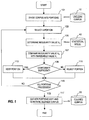
- FIG. 1 which is a flow chart, depicts the essential steps of this corpus filtering method.
- the corpus filtering method starts with a step 101 of dividing a corpus of documents denoted 10 (which is to be filtered) into appropriate portions.
- the document corpus is divided into portions - e.g. lines, paragraphs or whole documents - whose size is determined as a function of the document corpus' overall size and/or as a function of the nature of the documents contained in the corpus.
- the size determined for the portions resulting from the division makes it possible to obtain a granularity desired for the filtering.
- a section of a non-cleaned corpus may resemble as follows.
- the language under consideration for statistical analysis is the English language.
- the portion size suitable for the dividing step would be a paragraph. With a paragraph being defined as a set of characters that is isolated upwards and downwards by at least one blank line.
- step 101 after the unclean document corpus 10 has been divided into appropriate sized portions (step 101), according to the invention, for each portion, there will be determined a regularity value measuring the conformity of the portion with respect to character sequences probabilities predetermined for the language under consideration.
- step 103 is first entered to select one of the corpus portions (current portion) resulting from the division of the corpus performed in step 101.
- V R a regularity value denoted V R is determined.
- this regularity value is intended to measure the conformity of the portion selected with respect to character sequences probabilities predetermined for the language under consideration.
- the character sequence probabilities are derived from a statistical model (40) representative of the language considered.
- the regularity value V R is based on a computed perplexity of the portion with respect to the statistical model.
- the statistical model is elaborated from a reference document determined as conforming with the rules of the language. The process of computing such a language model, in accordance with a preferred implementation of the invention, will be detailed further below in connection with FIG. 2.
- the statistical model is a character-based N-gram model.
- Language models such as character-based N-gram models are known in the art.
- a language model as for instance a N-gram model, tries to predict the a-priori probability of a N character long string occurring in a given language. Theoretically, one would like to predict a new character from an infinitely long history of predecessor characters. Practically, however, these probabilities would be impossible to compute. A common approach is then to approximate all histories to the same state. Thus one assumes that the occurrence of a character C is completely determined by the past N characters.
- Tri-gram models for instance, use the two preceding characters to predict the current character. As the tri-gram frequencies may not be seen frequently enough to yield good prediction, the tri-gram model is often combined with lower-order models predicting the bi- and uni-gram probabilities.
- the regularity value it is suggested to compute the perplexity of the orthographic representation of a word with respect to a character-based N-gram model.
- Perplexity is an information-theory measurement, expressed as a number. It is an indication of how many different letters are likely to follow a particular context of string characters.
- Informally perplexity may be regarded as the average number of following characters that a character-based language model may have to choose from, given the present history of characters already looked at.
- the perplexity is the reciprocal of the geometric average of the probabilities of a hypothesized string of characters.
- step 107 is entered, in which there is made a comparison between the regularity value V R and a threshold value V T , in order to decide whether the conformity of the current portion with respect to the character sequences probabilities derived from the statistical model 40, is sufficient or not.
- threshold value V T is determined beforehand by firstly defining a test corpus as a subset of the document corpus to be filtered. Then a manual cleaning is performed on the test corpus so as to obtain a cleaned test corpus which is representative of the type of textual information that is considered as being sufficiently in conformity with the language rules. After that, a perplexity value of said cleaned test corpus with regard to said statistical model is computed. Similarly, it is computed a perplexity value of the rejected test corpus (i.e., the set of portions rejected from the initial test corpus). Finally, the threshold value searched is determined between the two perplexity values obtained (for example as the average value of these two perplexity values).
- step 109 in FIG. 1 if the conformity of the portion under consideration is determined as being sufficient, the portion is kept (step 113). Conversely, if the portion is determined as being insufficient, the portion is rejected (step 111).
- step 115 is a determination step, in which it is determined whether all portions of the document corpus have been processed. If not, a next portion is selected (step 103) and the preceding steps are performed again on the new portion selected.
- step 117 all portions that have been kept i.e. not rejected, are gathered in order to form a new corpus of documents 20 which is considered as "cleaned” or filtered.
- the resulting filtered corpus is then stored for further use.
- the process starts (step 201) by collecting a corpus of textual data deemed to follow the "regularity" that is to be modeled, both in content (types of word), and in form (punctuation, line breaks, special characters, etc.).
- the collection of textual data obtained is then manually cleaned (step 203) to keep only pertinent textual data (e.g., graphics, other language text, are suppressed).
- a clean training corpus 30 is therefore obtained and stored.
- the clean training corpus 30 is subdivided into training data 33 and held-out data 35, by randomly selecting a certain percentage of the corpus (e.g. 10%).
- a certain percentage of the corpus e.g. 10%
- training data will actually serve as a basis to compute N-grams statistics upon which the statistical model will be determined.
- held-out data 35 will be used to optimize the statistical model computed from the training data.
- training data 33 is used to compute 1-gram, 2-gram and 3-gram models.
- the models are computed by counting uni-letter frequencies, bi-letter frequencies, and tri-letter frequencies. The frequencies obtained are then used as approximations of the probability of such letter sequences.
- the construction and functioning of such N-grams models is known within the state of the art.
- the overall likelihood of a sequence of 3 letters is computed as a linear combination of the uni-letter, bi-letter and tri-letter likelihood, with an added offset to give non-zero probabilities to never-observed letter sequences.
- the coefficients of the linear combination can be estimated using the held-out data 35 in order to optimize the performance of the statistical model.
- a state of the art approach for this process can be found in the teaching of F. Jelinek and R. L. Mercer, "Interpolated Estimation of Markov Source Parameters from Sparse Data” in Proc. of the workshop on Pattern Recognition in Practice, North-Holland Publishing Company, 1980.
- the final statistical model 40 is generated and stored.
- control/formatting characters such as "tab”, “space”, “newline” are included in the alphabet of the language to model, in order to not only model the probable letter sequences contained in the language words of a document, but also model the form of the document content.
- the statistical model in order to improve to accuracy of the corpus filtering, is initially used to filter a first corpus segment of a predetermined size to provide a first filtered segment of the document corpus. Then, the first filtered segment serves as a basis for computing a more accurate statistical model which is to be used to filter the rest of the corpus of documents.
- FIG. 3 there will be described an apparatus for automatically filtering a corpus of documents, in conformity with the invention.
- the apparatus (3) depicted in FIG. 3 includes software and hardware components.
- the filtering method of the invention is implemented through a computer program which is to be run in a computer system for example a micro-computer, in order to carry out the filtering method.
- Apparatus 3 comprises a corpus storing unit 301 in which documents forming the corpus can be stored.
- the storing unit 301 may comprise a hard disk drive, or a Compact Disk (CD) drive.
- Apparatus 3 includes a corpus input/output unit 303 which is responsible for retrieving from storing unit 301 documents which are to be processed i.e., filtered, or storing into storing unit 301 documents once filtered.
- Filtering apparatus 3 also includes a corpus dividing unit 307 intended for dividing the document corpus into appropriate portions as described above in connection with FIG. 1.
- a regularity computation unit 305 is responsible for determining for each portion of the document corpus a regularity value measuring the conformity of the portion with respect to character sequences probabilities predetermined for the language considered.
- a conformity determination unit 309 is then responsible for comparing each regularity value with a threshold value, predetermined as explained supra, to decide whether the conformity is sufficient or not.
- Conformity determination unit 309 also handles the task of rejecting any portion of the document whose conformity is determined as being insufficient.
- a corpus gathering unit 311 makes it possible to gather all the document portions that have not been rejected by the conformity determination unit 309, so as to form the cleaned corpus.
- the cleaned corpus is then stored into the corpus storing unit 301.
- control unit 313 for controlling the overall functioning of the apparatus.
- control unit 313 is responsible for determining the sequencing of the operations performed by the other units, and for assuring the transfer of the working data from one unit to another.
- the document corpus is divided into appropriate portions.
- a regularity value measuring the conformity of the portion with respect to character sequences probabilities predetermined for the language considered.
- each regularity value is then compared with a threshold value to decide whether the conformity is sufficient.
- a rejecting step any portion of the document corpus whose conformity is not sufficient is rejected and removed from the corpus.
- V T the threshold value used to decide whether the conformity of a current portion is sufficient or not, can be adjusted to balance the false rejections (i.e., clean text labeled as noise) with respect to the false acceptances (i.e., non-textual portions not flagged as such).
Landscapes
- Engineering & Computer Science (AREA)
- Theoretical Computer Science (AREA)
- Physics & Mathematics (AREA)
- Audiology, Speech & Language Pathology (AREA)
- Computational Linguistics (AREA)
- General Health & Medical Sciences (AREA)
- Health & Medical Sciences (AREA)
- General Engineering & Computer Science (AREA)
- General Physics & Mathematics (AREA)
- Artificial Intelligence (AREA)
- Probability & Statistics with Applications (AREA)
- Character Discrimination (AREA)
- Machine Translation (AREA)
Abstract
Description
- dividing the document corpus into appropriate portions;
- determining for each portion of the document corpus a regularity value measuring the conformity of the portion with respect to character sequences probabilities predetermined for the language considered ;
- comparing each regularity value with a threshold value to decide whether the conformity is sufficient;
- rejecting any portion of the document corpus whose conformity is not sufficient.
- means for dividing the document corpus into appropriate portions;
- means for determining for each portion of the document corpus a regularity value measuring the conformity of the portion with respect to character sequences probabilities predetermined for said language ;
- means for comparing each regularity value with a threshold value to decide whether the conformity is sufficient;
- means for rejecting any portion of the document corpus whose conformity is not sufficient.
- FIG. 1 is a flow chart illustrating the essential steps of a corpus filtering method according to the invention ;
- FIG. 2 is a flow chart illustrating the process of elaborating a language model forming the base for the determination of the regularity value of a given portion of the corpus of documents ;
- FIG. 3 is a functional block diagram of an apparatus for automatically filtering a corpus of documents, in conformity with the invention.
| Today's statistical models used in Natural Language Processing systems (speech recognition systems, for example) require the analysis of large bodies of documents, in which normal text of the language will be intermingled with non-textual data such as: | ||||
| Average 85% of | ||||
| Week Day | Market Price | Market Price | Spli DOG | Adju |
| 00/11/10 | 95.69 | 81.34 | 92.73 | 1 |
| 00/11/09 | 97.84 | 83.17 | 92.73 | 1 |
| 00/11/08 | 101.50 | 86.28 | 92.73 | 1 |
| 00/11/07 | 102.09 | 86.78 | 92.73 | 1 |
| 00/11/06 | 100.90 | 85.77 | 92.73 | 1 |
| 00/11/03 | 101.00 | 85.85 | 92.73 | 1 |
| One will also find sections that do not belong to the language in question, such as: | ||||
| Les modèles statistiques utilisés en traitement automatique des langues reposent sur l'analyse de grandes quantités de textes. |
Claims (14)
- A method for automatically filtering a corpus of documents containing textual and non-textual information of a natural language, the method being characterized in that it comprises the steps of:dividing (101) the document corpus (10) into appropriate portions;determining (103, 105) for each portion of the document corpus a regularity value (VR) measuring the conformity of the portion with respect to character sequences probabilities predetermined for said language ;comparing (107) each regularity value with a threshold value (VT) to decide whether the conformity is sufficient;rejecting (109, 111) any portion of the document corpus whose conformity is not sufficient.
- Method according to claim 1, wherein said character sequence probabilities are derived from a statistical model (40) representative of said language.
- Method according to claim 2, wherein, for each portion of the document corpus, said regularity value (VR) is based on a computed perplexity of the portion with respect to said statistical model.
- Method according to claim 2 or 3, wherein said statistical model (40) is previously elaborated from a reference document (30) determined as conforming with the rules of said language.
- Method according to any one of claims 2 to 4, wherein said statistical model (40) is being determined according to N-gram statistics.
- Method according to any one of claims 2 to 5, wherein said statistical model (40) is a character-based N-gram model.
- Method according to any one of claims 2 to 6, wherein said statistical model (40) is initially used to filter a first corpus segment of a predetermined size to provide a first filtered segment of the document corpus, said first filtered segment serving as a basis for computing a more accurate statistical model which is to be used to filter the rest of the corpus of documents.
- Method according to any one of the preceding claims, wherein said threshold value (VT) is determined by executing the following steps of:defining a test corpus as a subset of the document corpus to be filtered;manually cleaning said test corpus so as to obtain a cleaned test corpus which is representative of the type of textual information that is considered as being sufficiently in conformity with the language rules and a rejected test corpus that is the complement of said cleaned test corpus;computing a perplexity value for each of said cleaned and rejected test corpora with regard to said statistical model;setting the threshold value searched between the perplexity values computed.
- Method according to any one of the preceding claims, wherein, in said dividing step, the document corpus is divided into portions - e.g. lines, paragraphs or whole documents - whose size is determined in function of that of the document corpus and/or in function of the nature of the documents contained in the corpus, so as to obtain the granularity desired for the filtering.
- Apparatus (3) for automatically filtering a corpus of documents containing textual and non-textual information of a natural language, the apparatus being characterized in that it comprises:means for dividing (307) the document corpus into appropriate portions;means for determining (305) for each portion of the document corpus a regularity value measuring the conformity of the portion with respect to character sequences probabilities predetermined for said language ;means for comparing (309) each regularity value with a threshold value to decide whether the conformity is sufficient;means for rejecting (309) any portion of the document corpus whose conformity is not sufficient.
- Apparatus according to claim 10, comprising means adapted for carrying out a method according to any one of claims 2 to 9.
- Computer system comprising an apparatus according to claim 10 or 11.
- A computer program comprising software code portions for performing a method according to any one of claims 1 to 9, when said computer program in loaded into and executed by a computer system.
- A computer program product stored on a computer usable medium, comprising computer readable program means for causing a computer to perform an automatic document corpus filtering method according to any one of claims 1 to 9.
Priority Applications (1)
| Application Number | Priority Date | Filing Date | Title |
|---|---|---|---|
| EP01480087A EP1229454A3 (en) | 2000-12-20 | 2001-09-13 | Method and apparatus for statistical text filtering |
Applications Claiming Priority (3)
| Application Number | Priority Date | Filing Date | Title |
|---|---|---|---|
| EP00480126 | 2000-12-20 | ||
| EP00480126 | 2000-12-20 | ||
| EP01480087A EP1229454A3 (en) | 2000-12-20 | 2001-09-13 | Method and apparatus for statistical text filtering |
Publications (2)
| Publication Number | Publication Date |
|---|---|
| EP1229454A2 true EP1229454A2 (en) | 2002-08-07 |
| EP1229454A3 EP1229454A3 (en) | 2009-04-22 |
Family
ID=26073675
Family Applications (1)
| Application Number | Title | Priority Date | Filing Date |
|---|---|---|---|
| EP01480087A Ceased EP1229454A3 (en) | 2000-12-20 | 2001-09-13 | Method and apparatus for statistical text filtering |
Country Status (1)
| Country | Link |
|---|---|
| EP (1) | EP1229454A3 (en) |
Cited By (2)
| Publication number | Priority date | Publication date | Assignee | Title |
|---|---|---|---|---|
| US6879722B2 (en) * | 2000-12-20 | 2005-04-12 | International Business Machines Corporation | Method and apparatus for statistical text filtering |
| US10629188B2 (en) | 2013-03-15 | 2020-04-21 | International Business Machines Corporation | Automatic note taking within a virtual meeting |
Family Cites Families (3)
| Publication number | Priority date | Publication date | Assignee | Title |
|---|---|---|---|---|
| US6144934A (en) * | 1996-09-18 | 2000-11-07 | Secure Computing Corporation | Binary filter using pattern recognition |
| WO2000023983A1 (en) * | 1998-10-21 | 2000-04-27 | Koninklijke Philips Electronics N.V. | Method of determining parameters of a statistical language model |
| US6292772B1 (en) * | 1998-12-01 | 2001-09-18 | Justsystem Corporation | Method for identifying the language of individual words |
-
2001
- 2001-09-13 EP EP01480087A patent/EP1229454A3/en not_active Ceased
Cited By (3)
| Publication number | Priority date | Publication date | Assignee | Title |
|---|---|---|---|---|
| US6879722B2 (en) * | 2000-12-20 | 2005-04-12 | International Business Machines Corporation | Method and apparatus for statistical text filtering |
| US10629188B2 (en) | 2013-03-15 | 2020-04-21 | International Business Machines Corporation | Automatic note taking within a virtual meeting |
| US10629189B2 (en) | 2013-03-15 | 2020-04-21 | International Business Machines Corporation | Automatic note taking within a virtual meeting |
Also Published As
| Publication number | Publication date |
|---|---|
| EP1229454A3 (en) | 2009-04-22 |
Similar Documents
| Publication | Publication Date | Title |
|---|---|---|
| CN111274785B (en) | Text error correction method, device, equipment and medium | |
| US20040044530A1 (en) | Method and apparatus for aligning bilingual corpora | |
| US20100023318A1 (en) | Method and device for retrieving data and transforming same into qualitative data of a text-based document | |
| US20070244690A1 (en) | Clustering of Text for Structuring of Text Documents and Training of Language Models | |
| CN109858023A (en) | A kind of sentence error correction device | |
| CN118312606A (en) | A conversational recommendation method and system based on semantic similarity and clustering model | |
| CN106897439A (en) | The emotion identification method of text, device, server and storage medium | |
| CN113468176A (en) | Information input method and device, electronic equipment and computer readable storage medium | |
| CN107194617B (en) | A soft skills classification system and method for software engineers | |
| CN112287076B (en) | Label mining method and equipment based on user chat records | |
| CN113792118A (en) | Satisfaction improving system and method based on scenic spot evaluation | |
| CN100501764C (en) | Character recognition system and method | |
| CN103688254A (en) | Example-based error detection system for automatic evaluation of writing, method for same, and error detection apparatus for same | |
| CN111191413B (en) | Method, device and system for automatically marking event core content based on graph sequencing model | |
| CN111429184A (en) | User portrait extraction method based on text information | |
| US6879722B2 (en) | Method and apparatus for statistical text filtering | |
| CN120197688A (en) | A method, device and medium for mining association rules of aircraft assembly information based on fine-tuning large language model | |
| CN108491383A (en) | A kind of Thai sentence cutting method based on maximum entropy disaggregated model and the correction of Thai syntax rule | |
| AU757928B2 (en) | Method for creating and/or updating dictionaries for automatically reading addresses | |
| CN111444708A (en) | SQ L statement intelligent completion method based on use scene | |
| JP4005477B2 (en) | Named entity extraction apparatus and method, and numbered entity extraction program | |
| Shrawankar et al. | Construction of news headline from detailed news article | |
| CN119312154A (en) | A risk point automatic detection and identification system and method based on ChatGLM model | |
| KR102807787B1 (en) | Shopping mall review data analysis method and shopping mall review data analysis device | |
| JPH08202737A (en) | Automatic keyword extracting device and automatic keyword extracting method |
Legal Events
| Date | Code | Title | Description |
|---|---|---|---|
| PUAI | Public reference made under article 153(3) epc to a published international application that has entered the european phase |
Free format text: ORIGINAL CODE: 0009012 |
|
| AK | Designated contracting states |
Kind code of ref document: A2 Designated state(s): AT BE CH CY DE DK ES FI FR GB GR IE IT LI LU MC NL PT SE TR |
|
| AX | Request for extension of the european patent |
Free format text: AL;LT;LV;MK;RO;SI |
|
| PUAL | Search report despatched |
Free format text: ORIGINAL CODE: 0009013 |
|
| AK | Designated contracting states |
Kind code of ref document: A3 Designated state(s): AT BE CH CY DE DK ES FI FR GB GR IE IT LI LU MC NL PT SE TR |
|
| AX | Request for extension of the european patent |
Extension state: AL LT LV MK RO SI |
|
| 17P | Request for examination filed |
Effective date: 20090917 |
|
| AKX | Designation fees paid |
Designated state(s): AT BE CH CY DE DK ES FI FR GB GR IE IT LI LU MC NL PT SE TR |
|
| 17Q | First examination report despatched |
Effective date: 20091214 |
|
| STAA | Information on the status of an ep patent application or granted ep patent |
Free format text: STATUS: THE APPLICATION HAS BEEN REFUSED |
|
| 18R | Application refused |
Effective date: 20110621 |