EP1229383A1 - High contrast photographic element containing a novel combination of nucleators - Google Patents
High contrast photographic element containing a novel combination of nucleators Download PDFInfo
- Publication number
- EP1229383A1 EP1229383A1 EP02075344A EP02075344A EP1229383A1 EP 1229383 A1 EP1229383 A1 EP 1229383A1 EP 02075344 A EP02075344 A EP 02075344A EP 02075344 A EP02075344 A EP 02075344A EP 1229383 A1 EP1229383 A1 EP 1229383A1
- Authority
- EP
- European Patent Office
- Prior art keywords
- formula
- group
- nucleating agent
- substituted
- photographic material
- Prior art date
- Legal status (The legal status is an assumption and is not a legal conclusion. Google has not performed a legal analysis and makes no representation as to the accuracy of the status listed.)
- Granted
Links
- -1 silver halide Chemical group 0.000 claims abstract description 112
- 239000002667 nucleating agent Substances 0.000 claims abstract description 74
- 239000000463 material Substances 0.000 claims abstract description 42
- 239000000839 emulsion Substances 0.000 claims abstract description 25
- 238000012545 processing Methods 0.000 claims abstract description 22
- DFPAKSUCGFBDDF-UHFFFAOYSA-N Nicotinamide Chemical group NC(=O)C1=CC=CN=C1 DFPAKSUCGFBDDF-UHFFFAOYSA-N 0.000 claims abstract description 20
- 125000005647 linker group Chemical group 0.000 claims abstract description 20
- 229910052709 silver Inorganic materials 0.000 claims abstract description 18
- 239000004332 silver Substances 0.000 claims abstract description 18
- 239000000084 colloidal system Substances 0.000 claims abstract description 12
- 239000000178 monomer Substances 0.000 claims abstract description 12
- 150000001875 compounds Chemical class 0.000 claims description 24
- 125000000623 heterocyclic group Chemical group 0.000 claims description 21
- 238000000034 method Methods 0.000 claims description 21
- 125000000217 alkyl group Chemical group 0.000 claims description 20
- 125000004435 hydrogen atom Chemical group [H]* 0.000 claims description 20
- IJGRMHOSHXDMSA-UHFFFAOYSA-N nitrogen Substances N#N IJGRMHOSHXDMSA-UHFFFAOYSA-N 0.000 claims description 17
- 125000003118 aryl group Chemical group 0.000 claims description 16
- 229910052739 hydrogen Inorganic materials 0.000 claims description 16
- 239000001257 hydrogen Substances 0.000 claims description 16
- 125000000547 substituted alkyl group Chemical group 0.000 claims description 14
- 230000008569 process Effects 0.000 claims description 13
- 125000003545 alkoxy group Chemical group 0.000 claims description 11
- 229910052757 nitrogen Inorganic materials 0.000 claims description 11
- 229920001281 polyalkylene Polymers 0.000 claims description 10
- 229910052717 sulfur Chemical group 0.000 claims description 9
- 229910052760 oxygen Inorganic materials 0.000 claims description 8
- 125000002947 alkylene group Chemical group 0.000 claims description 7
- 239000001301 oxygen Chemical group 0.000 claims description 7
- 125000001997 phenyl group Chemical group [H]C1=C([H])C([H])=C(*)C([H])=C1[H] 0.000 claims description 7
- UFHFLCQGNIYNRP-UHFFFAOYSA-N Hydrogen Chemical compound [H][H] UFHFLCQGNIYNRP-UHFFFAOYSA-N 0.000 claims description 6
- NINIDFKCEFEMDL-UHFFFAOYSA-N Sulfur Chemical group [S] NINIDFKCEFEMDL-UHFFFAOYSA-N 0.000 claims description 6
- 125000000129 anionic group Chemical group 0.000 claims description 6
- 230000000903 blocking effect Effects 0.000 claims description 6
- 239000011593 sulfur Chemical group 0.000 claims description 6
- 125000005100 aryl amino carbonyl group Chemical group 0.000 claims description 5
- 125000004104 aryloxy group Chemical group 0.000 claims description 5
- 125000003917 carbamoyl group Chemical group [H]N([H])C(*)=O 0.000 claims description 5
- 229910052799 carbon Inorganic materials 0.000 claims description 5
- 125000002915 carbonyl group Chemical group [*:2]C([*:1])=O 0.000 claims description 5
- 125000003107 substituted aryl group Chemical group 0.000 claims description 5
- 125000004434 sulfur atom Chemical group 0.000 claims description 5
- JUJWROOIHBZHMG-UHFFFAOYSA-N Pyridine Chemical group C1=CC=NC=C1 JUJWROOIHBZHMG-UHFFFAOYSA-N 0.000 claims description 4
- 125000004453 alkoxycarbonyl group Chemical group 0.000 claims description 4
- 125000004457 alkyl amino carbonyl group Chemical group 0.000 claims description 4
- 125000004390 alkyl sulfonyl group Chemical group 0.000 claims description 4
- 125000004414 alkyl thio group Chemical group 0.000 claims description 4
- 125000004397 aminosulfonyl group Chemical group NS(=O)(=O)* 0.000 claims description 4
- 125000005161 aryl oxy carbonyl group Chemical group 0.000 claims description 4
- 125000004391 aryl sulfonyl group Chemical group 0.000 claims description 4
- QVGXLLKOCUKJST-UHFFFAOYSA-N atomic oxygen Chemical group [O] QVGXLLKOCUKJST-UHFFFAOYSA-N 0.000 claims description 4
- 125000003178 carboxy group Chemical group [H]OC(*)=O 0.000 claims description 4
- 229910052736 halogen Inorganic materials 0.000 claims description 4
- 150000002367 halogens Chemical group 0.000 claims description 4
- 125000005842 heteroatom Chemical group 0.000 claims description 4
- QJGQUHMNIGDVPM-UHFFFAOYSA-N nitrogen group Chemical group [N] QJGQUHMNIGDVPM-UHFFFAOYSA-N 0.000 claims description 4
- 125000001453 quaternary ammonium group Chemical group 0.000 claims description 4
- 125000002023 trifluoromethyl group Chemical group FC(F)(F)* 0.000 claims description 4
- 229910052720 vanadium Inorganic materials 0.000 claims description 4
- MYMOFIZGZYHOMD-UHFFFAOYSA-N Dioxygen Chemical group O=O MYMOFIZGZYHOMD-UHFFFAOYSA-N 0.000 claims description 3
- 125000002252 acyl group Chemical group 0.000 claims description 3
- 125000004423 acyloxy group Chemical group 0.000 claims description 3
- 125000004093 cyano group Chemical group *C#N 0.000 claims description 3
- 125000001624 naphthyl group Chemical group 0.000 claims description 3
- 229920000233 poly(alkylene oxides) Polymers 0.000 claims description 3
- 125000005420 sulfonamido group Chemical group S(=O)(=O)(N*)* 0.000 claims description 3
- ZRALSGWEFCBTJO-UHFFFAOYSA-N Guanidine Chemical group NC(N)=N ZRALSGWEFCBTJO-UHFFFAOYSA-N 0.000 claims description 2
- 150000007945 N-acyl ureas Chemical group 0.000 claims description 2
- BUGBHKTXTAQXES-UHFFFAOYSA-N Selenium Chemical compound [Se] BUGBHKTXTAQXES-UHFFFAOYSA-N 0.000 claims description 2
- ULTKZDLVDASXKV-UHFFFAOYSA-N [1-(carbamothioylamino)-1-(carbamoylamino)ethyl] N-(2-carbamothioylhydrazinyl)-N-(2-carbamoylhydrazinyl)carbamate Chemical compound N(C(=O)N)C(OC(N(NNC(=S)N)NNC(=O)N)=O)(C)NC(=S)N ULTKZDLVDASXKV-UHFFFAOYSA-N 0.000 claims description 2
- 125000004644 alkyl sulfinyl group Chemical group 0.000 claims description 2
- 125000005135 aryl sulfinyl group Chemical group 0.000 claims description 2
- 125000005110 aryl thio group Chemical group 0.000 claims description 2
- 125000000732 arylene group Chemical group 0.000 claims description 2
- 150000001768 cations Chemical class 0.000 claims description 2
- 125000004663 dialkyl amino group Chemical group 0.000 claims description 2
- 125000000843 phenylene group Chemical group C1(=C(C=CC=C1)*)* 0.000 claims description 2
- 229910052711 selenium Inorganic materials 0.000 claims description 2
- 239000011669 selenium Substances 0.000 claims description 2
- 125000005650 substituted phenylene group Chemical group 0.000 claims description 2
- RWSOTUBLDIXVET-UHFFFAOYSA-O sulfonium group Chemical group [SH3+] RWSOTUBLDIXVET-UHFFFAOYSA-O 0.000 claims description 2
- 229910052714 tellurium Inorganic materials 0.000 claims description 2
- PORWMNRCUJJQNO-UHFFFAOYSA-N tellurium atom Chemical group [Te] PORWMNRCUJJQNO-UHFFFAOYSA-N 0.000 claims description 2
- 125000004356 hydroxy functional group Chemical group O* 0.000 claims 1
- 238000011161 development Methods 0.000 abstract description 12
- 230000035945 sensitivity Effects 0.000 abstract description 11
- 230000008859 change Effects 0.000 abstract description 4
- 239000010410 layer Substances 0.000 description 26
- 239000000243 solution Substances 0.000 description 23
- 238000002360 preparation method Methods 0.000 description 20
- XEKOWRVHYACXOJ-UHFFFAOYSA-N Ethyl acetate Chemical compound CCOC(C)=O XEKOWRVHYACXOJ-UHFFFAOYSA-N 0.000 description 15
- XLYOFNOQVPJJNP-UHFFFAOYSA-N water Substances O XLYOFNOQVPJJNP-UHFFFAOYSA-N 0.000 description 15
- HEMHJVSKTPXQMS-UHFFFAOYSA-M Sodium hydroxide Chemical compound [OH-].[Na+] HEMHJVSKTPXQMS-UHFFFAOYSA-M 0.000 description 12
- 150000001412 amines Chemical class 0.000 description 10
- 125000004432 carbon atom Chemical group C* 0.000 description 10
- 125000001424 substituent group Chemical group 0.000 description 10
- YMWUJEATGCHHMB-UHFFFAOYSA-N Dichloromethane Chemical compound ClCCl YMWUJEATGCHHMB-UHFFFAOYSA-N 0.000 description 9
- 238000006243 chemical reaction Methods 0.000 description 9
- 230000000694 effects Effects 0.000 description 9
- RTZKZFJDLAIYFH-UHFFFAOYSA-N Diethyl ether Chemical compound CCOCC RTZKZFJDLAIYFH-UHFFFAOYSA-N 0.000 description 8
- 230000015572 biosynthetic process Effects 0.000 description 8
- 239000000047 product Substances 0.000 description 8
- 239000007787 solid Substances 0.000 description 8
- CPELXLSAUQHCOX-UHFFFAOYSA-M Bromide Chemical compound [Br-] CPELXLSAUQHCOX-UHFFFAOYSA-M 0.000 description 7
- QIGBRXMKCJKVMJ-UHFFFAOYSA-N Hydroquinone Chemical compound OC1=CC=C(O)C=C1 QIGBRXMKCJKVMJ-UHFFFAOYSA-N 0.000 description 7
- 239000003795 chemical substances by application Substances 0.000 description 7
- 239000000203 mixture Substances 0.000 description 7
- 238000003786 synthesis reaction Methods 0.000 description 7
- WEVYAHXRMPXWCK-UHFFFAOYSA-N Acetonitrile Chemical compound CC#N WEVYAHXRMPXWCK-UHFFFAOYSA-N 0.000 description 6
- ZMXDDKWLCZADIW-UHFFFAOYSA-N N,N-Dimethylformamide Chemical compound CN(C)C=O ZMXDDKWLCZADIW-UHFFFAOYSA-N 0.000 description 6
- 238000000576 coating method Methods 0.000 description 6
- 125000001570 methylene group Chemical group [H]C([H])([*:1])[*:2] 0.000 description 6
- 239000002904 solvent Substances 0.000 description 6
- CIWBSHSKHKDKBQ-JLAZNSOCSA-N Ascorbic acid Chemical compound OC[C@H](O)[C@H]1OC(=O)C(O)=C1O CIWBSHSKHKDKBQ-JLAZNSOCSA-N 0.000 description 5
- OAKJQQAXSVQMHS-UHFFFAOYSA-N Hydrazine Chemical compound NN OAKJQQAXSVQMHS-UHFFFAOYSA-N 0.000 description 5
- 125000004429 atom Chemical group 0.000 description 5
- 239000012267 brine Substances 0.000 description 5
- 238000011156 evaluation Methods 0.000 description 5
- 239000000284 extract Substances 0.000 description 5
- 239000011541 reaction mixture Substances 0.000 description 5
- HPALAKNZSZLMCH-UHFFFAOYSA-M sodium;chloride;hydrate Chemical compound O.[Na+].[Cl-] HPALAKNZSZLMCH-UHFFFAOYSA-M 0.000 description 5
- 108010010803 Gelatin Proteins 0.000 description 4
- JGFZNNIVVJXRND-UHFFFAOYSA-N N,N-Diisopropylethylamine (DIPEA) Chemical compound CCN(C(C)C)C(C)C JGFZNNIVVJXRND-UHFFFAOYSA-N 0.000 description 4
- FXHOOIRPVKKKFG-UHFFFAOYSA-N N,N-Dimethylacetamide Chemical compound CN(C)C(C)=O FXHOOIRPVKKKFG-UHFFFAOYSA-N 0.000 description 4
- VYPSYNLAJGMNEJ-UHFFFAOYSA-N Silicium dioxide Chemical compound O=[Si]=O VYPSYNLAJGMNEJ-UHFFFAOYSA-N 0.000 description 4
- CODNYICXDISAEA-UHFFFAOYSA-N bromine monochloride Chemical compound BrCl CODNYICXDISAEA-UHFFFAOYSA-N 0.000 description 4
- 239000000975 dye Substances 0.000 description 4
- 239000000499 gel Substances 0.000 description 4
- 239000008273 gelatin Substances 0.000 description 4
- 229920000159 gelatin Polymers 0.000 description 4
- 235000019322 gelatine Nutrition 0.000 description 4
- 235000011852 gelatine desserts Nutrition 0.000 description 4
- 239000005457 ice water Substances 0.000 description 4
- 238000011160 research Methods 0.000 description 4
- 239000000741 silica gel Substances 0.000 description 4
- 229910002027 silica gel Inorganic materials 0.000 description 4
- JHJLBTNAGRQEKS-UHFFFAOYSA-M sodium bromide Chemical compound [Na+].[Br-] JHJLBTNAGRQEKS-UHFFFAOYSA-M 0.000 description 4
- 238000003756 stirring Methods 0.000 description 4
- LSNNMFCWUKXFEE-UHFFFAOYSA-L sulfite Chemical compound [O-]S([O-])=O LSNNMFCWUKXFEE-UHFFFAOYSA-L 0.000 description 4
- ZWEHNKRNPOVVGH-UHFFFAOYSA-N 2-Butanone Chemical compound CCC(C)=O ZWEHNKRNPOVVGH-UHFFFAOYSA-N 0.000 description 3
- KYSLSMCCDVNXHR-UHFFFAOYSA-N 3-[(2-chloroacetyl)amino]-2,4-dimethylbenzenesulfonyl chloride Chemical compound CC1=CC=C(S(Cl)(=O)=O)C(C)=C1NC(=O)CCl KYSLSMCCDVNXHR-UHFFFAOYSA-N 0.000 description 3
- LFQSCWFLJHTTHZ-UHFFFAOYSA-N Ethanol Chemical compound CCO LFQSCWFLJHTTHZ-UHFFFAOYSA-N 0.000 description 3
- OKKJLVBELUTLKV-UHFFFAOYSA-N Methanol Chemical compound OC OKKJLVBELUTLKV-UHFFFAOYSA-N 0.000 description 3
- KDLHZDBZIXYQEI-UHFFFAOYSA-N Palladium on carbon Substances [Pd] KDLHZDBZIXYQEI-UHFFFAOYSA-N 0.000 description 3
- 125000001931 aliphatic group Chemical group 0.000 description 3
- 230000008901 benefit Effects 0.000 description 3
- VOVLASAYEAYVHD-UHFFFAOYSA-N benzene-1,4-diol;1-phenylpyrazolidin-3-one Chemical compound OC1=CC=C(O)C=C1.N1C(=O)CCN1C1=CC=CC=C1 VOVLASAYEAYVHD-UHFFFAOYSA-N 0.000 description 3
- 239000003610 charcoal Substances 0.000 description 3
- MTHSVFCYNBDYFN-UHFFFAOYSA-N diethylene glycol Chemical compound OCCOCCO MTHSVFCYNBDYFN-UHFFFAOYSA-N 0.000 description 3
- 125000001495 ethyl group Chemical group [H]C([H])([H])C([H])([H])* 0.000 description 3
- 239000011229 interlayer Substances 0.000 description 3
- 229910052751 metal Inorganic materials 0.000 description 3
- 239000002184 metal Substances 0.000 description 3
- 239000003921 oil Substances 0.000 description 3
- 238000005192 partition Methods 0.000 description 3
- 125000002924 primary amino group Chemical group [H]N([H])* 0.000 description 3
- NDGRWYRVNANFNB-UHFFFAOYSA-N pyrazolidin-3-one Chemical compound O=C1CCNN1 NDGRWYRVNANFNB-UHFFFAOYSA-N 0.000 description 3
- 125000004149 thio group Chemical group *S* 0.000 description 3
- 229920002554 vinyl polymer Polymers 0.000 description 3
- BDNDQOCRJGGSJO-UHFFFAOYSA-N 1-amino-2-phenylpropan-2-ol Chemical compound NCC(O)(C)C1=CC=CC=C1 BDNDQOCRJGGSJO-UHFFFAOYSA-N 0.000 description 2
- VHYFNPMBLIVWCW-UHFFFAOYSA-N 4-Dimethylaminopyridine Chemical compound CN(C)C1=CC=NC=C1 VHYFNPMBLIVWCW-UHFFFAOYSA-N 0.000 description 2
- XKRFYHLGVUSROY-UHFFFAOYSA-N Argon Chemical compound [Ar] XKRFYHLGVUSROY-UHFFFAOYSA-N 0.000 description 2
- OKTJSMMVPCPJKN-UHFFFAOYSA-N Carbon Chemical compound [C] OKTJSMMVPCPJKN-UHFFFAOYSA-N 0.000 description 2
- CURLTUGMZLYLDI-UHFFFAOYSA-N Carbon dioxide Chemical compound O=C=O CURLTUGMZLYLDI-UHFFFAOYSA-N 0.000 description 2
- VEXZGXHMUGYJMC-UHFFFAOYSA-N Hydrochloric acid Chemical compound Cl VEXZGXHMUGYJMC-UHFFFAOYSA-N 0.000 description 2
- AFVFQIVMOAPDHO-UHFFFAOYSA-N Methanesulfonic acid Chemical compound CS(O)(=O)=O AFVFQIVMOAPDHO-UHFFFAOYSA-N 0.000 description 2
- BAPJBEWLBFYGME-UHFFFAOYSA-N Methyl acrylate Chemical compound COC(=O)C=C BAPJBEWLBFYGME-UHFFFAOYSA-N 0.000 description 2
- IMNFDUFMRHMDMM-UHFFFAOYSA-N N-Heptane Chemical compound CCCCCCC IMNFDUFMRHMDMM-UHFFFAOYSA-N 0.000 description 2
- BQCADISMDOOEFD-UHFFFAOYSA-N Silver Chemical compound [Ag] BQCADISMDOOEFD-UHFFFAOYSA-N 0.000 description 2
- 125000003342 alkenyl group Chemical group 0.000 description 2
- QGZKDVFQNNGYKY-UHFFFAOYSA-O ammonium group Chemical group [NH4+] QGZKDVFQNNGYKY-UHFFFAOYSA-O 0.000 description 2
- 235000010323 ascorbic acid Nutrition 0.000 description 2
- 229960005070 ascorbic acid Drugs 0.000 description 2
- 239000011668 ascorbic acid Substances 0.000 description 2
- 230000005587 bubbling Effects 0.000 description 2
- IAQRGUVFOMOMEM-UHFFFAOYSA-N but-2-ene Chemical compound CC=CC IAQRGUVFOMOMEM-UHFFFAOYSA-N 0.000 description 2
- KBPLFHHGFOOTCA-UHFFFAOYSA-N caprylic alcohol Natural products CCCCCCCCO KBPLFHHGFOOTCA-UHFFFAOYSA-N 0.000 description 2
- 239000003054 catalyst Substances 0.000 description 2
- 239000011248 coating agent Substances 0.000 description 2
- 238000009472 formulation Methods 0.000 description 2
- PCHJSUWPFVWCPO-UHFFFAOYSA-N gold Chemical compound [Au] PCHJSUWPFVWCPO-UHFFFAOYSA-N 0.000 description 2
- 229910052737 gold Inorganic materials 0.000 description 2
- 239000010931 gold Substances 0.000 description 2
- 125000005843 halogen group Chemical group 0.000 description 2
- 229940042795 hydrazides for tuberculosis treatment Drugs 0.000 description 2
- 125000002887 hydroxy group Chemical group [H]O* 0.000 description 2
- 229910052741 iridium Inorganic materials 0.000 description 2
- GKOZUEZYRPOHIO-UHFFFAOYSA-N iridium atom Chemical compound [Ir] GKOZUEZYRPOHIO-UHFFFAOYSA-N 0.000 description 2
- 238000004519 manufacturing process Methods 0.000 description 2
- 150000002739 metals Chemical class 0.000 description 2
- BDAGIHXWWSANSR-UHFFFAOYSA-N methanoic acid Natural products OC=O BDAGIHXWWSANSR-UHFFFAOYSA-N 0.000 description 2
- 125000002496 methyl group Chemical group [H]C([H])([H])* 0.000 description 2
- 230000006911 nucleation Effects 0.000 description 2
- 238000010899 nucleation Methods 0.000 description 2
- 239000012044 organic layer Substances 0.000 description 2
- 125000005496 phosphonium group Chemical group 0.000 description 2
- AOJFQRQNPXYVLM-UHFFFAOYSA-N pyridin-1-ium;chloride Chemical compound [Cl-].C1=CC=[NH+]C=C1 AOJFQRQNPXYVLM-UHFFFAOYSA-N 0.000 description 2
- JUJWROOIHBZHMG-UHFFFAOYSA-O pyridinium Chemical compound C1=CC=[NH+]C=C1 JUJWROOIHBZHMG-UHFFFAOYSA-O 0.000 description 2
- 229910052703 rhodium Inorganic materials 0.000 description 2
- 239000010948 rhodium Substances 0.000 description 2
- MHOVAHRLVXNVSD-UHFFFAOYSA-N rhodium atom Chemical compound [Rh] MHOVAHRLVXNVSD-UHFFFAOYSA-N 0.000 description 2
- 159000000000 sodium salts Chemical class 0.000 description 2
- 230000003595 spectral effect Effects 0.000 description 2
- 239000004094 surface-active agent Substances 0.000 description 2
- 125000001302 tertiary amino group Chemical group 0.000 description 2
- 150000003573 thiols Chemical class 0.000 description 2
- UMGDCJDMYOKAJW-UHFFFAOYSA-N thiourea Chemical compound NC(N)=S UMGDCJDMYOKAJW-UHFFFAOYSA-N 0.000 description 2
- 229920006163 vinyl copolymer Polymers 0.000 description 2
- KEQGZUUPPQEDPF-UHFFFAOYSA-N 1,3-dichloro-5,5-dimethylimidazolidine-2,4-dione Chemical compound CC1(C)N(Cl)C(=O)N(Cl)C1=O KEQGZUUPPQEDPF-UHFFFAOYSA-N 0.000 description 1
- CBCKQZAAMUWICA-UHFFFAOYSA-N 1,4-phenylenediamine Chemical compound NC1=CC=C(N)C=C1 CBCKQZAAMUWICA-UHFFFAOYSA-N 0.000 description 1
- GGZHVNZHFYCSEV-UHFFFAOYSA-N 1-Phenyl-5-mercaptotetrazole Chemical compound SC1=NN=NN1C1=CC=CC=C1 GGZHVNZHFYCSEV-UHFFFAOYSA-N 0.000 description 1
- VMKOFRJSULQZRM-UHFFFAOYSA-N 1-bromooctane Chemical compound CCCCCCCCBr VMKOFRJSULQZRM-UHFFFAOYSA-N 0.000 description 1
- VOZKAJLKRJDJLL-UHFFFAOYSA-N 2,4-diaminotoluene Chemical compound CC1=CC=C(N)C=C1N VOZKAJLKRJDJLL-UHFFFAOYSA-N 0.000 description 1
- FFRBMBIXVSCUFS-UHFFFAOYSA-N 2,4-dinitro-1-naphthol Chemical compound C1=CC=C2C(O)=C([N+]([O-])=O)C=C([N+]([O-])=O)C2=C1 FFRBMBIXVSCUFS-UHFFFAOYSA-N 0.000 description 1
- IBDVWXAVKPRHCU-UHFFFAOYSA-N 2-(2-methylprop-2-enoyloxy)ethyl 3-oxobutanoate Chemical compound CC(=O)CC(=O)OCCOC(=O)C(C)=C IBDVWXAVKPRHCU-UHFFFAOYSA-N 0.000 description 1
- VKONPNAILGGMSR-UHFFFAOYSA-N 2-(2-sulfanylidene-3h-1,3-thiazol-4-yl)acetic acid Chemical compound OC(=O)CC1=CSC(=S)N1 VKONPNAILGGMSR-UHFFFAOYSA-N 0.000 description 1
- TZOFKTVYTKYJJJ-UHFFFAOYSA-N 2-(n,4-diaminoanilino)-n-(3-morpholin-4-ylpropyl)-2-oxoacetamide Chemical compound C=1C=C(N)C=CC=1N(N)C(=O)C(=O)NCCCN1CCOCC1 TZOFKTVYTKYJJJ-UHFFFAOYSA-N 0.000 description 1
- LFSJEEMZVOZLHG-UHFFFAOYSA-N 2-(n-amino-4-nitroanilino)-n-(3-morpholin-4-ylpropyl)-2-oxoacetamide Chemical compound C=1C=C([N+]([O-])=O)C=CC=1N(N)C(=O)C(=O)NCCCN1CCOCC1 LFSJEEMZVOZLHG-UHFFFAOYSA-N 0.000 description 1
- 229920000536 2-Acrylamido-2-methylpropane sulfonic acid Polymers 0.000 description 1
- XHZPRMZZQOIPDS-UHFFFAOYSA-N 2-Methyl-2-[(1-oxo-2-propenyl)amino]-1-propanesulfonic acid Chemical compound OS(=O)(=O)CC(C)(C)NC(=O)C=C XHZPRMZZQOIPDS-UHFFFAOYSA-N 0.000 description 1
- VGLZNBVWMFPUBK-UHFFFAOYSA-N 2-[2-[4-[[3-[(2-chloroacetyl)amino]-2,4-dimethylphenyl]sulfonylamino]phenyl]hydrazinyl]-n-(3-morpholin-4-ylpropyl)-2-oxoacetamide;hydrochloride Chemical compound Cl.CC1=C(NC(=O)CCl)C(C)=CC=C1S(=O)(=O)NC(C=C1)=CC=C1NNC(=O)C(=O)NCCCN1CCOCC1 VGLZNBVWMFPUBK-UHFFFAOYSA-N 0.000 description 1
- CDAWCLOXVUBKRW-UHFFFAOYSA-N 2-aminophenol Chemical compound NC1=CC=CC=C1O CDAWCLOXVUBKRW-UHFFFAOYSA-N 0.000 description 1
- FPQQSNUTBWFFLB-UHFFFAOYSA-N 2-chloro-n-(2,6-dimethylphenyl)acetamide Chemical compound CC1=CC=CC(C)=C1NC(=O)CCl FPQQSNUTBWFFLB-UHFFFAOYSA-N 0.000 description 1
- 125000002941 2-furyl group Chemical group O1C([*])=C([H])C([H])=C1[H] 0.000 description 1
- 125000006290 2-hydroxybenzyl group Chemical group [H]OC1=C(C([H])=C([H])C([H])=C1[H])C([H])([H])* 0.000 description 1
- 125000000175 2-thienyl group Chemical group S1C([*])=C([H])C([H])=C1[H] 0.000 description 1
- OSWFIVFLDKOXQC-UHFFFAOYSA-N 4-(3-methoxyphenyl)aniline Chemical compound COC1=CC=CC(C=2C=CC(N)=CC=2)=C1 OSWFIVFLDKOXQC-UHFFFAOYSA-N 0.000 description 1
- ZVNPWFOVUDMGRP-UHFFFAOYSA-N 4-methylaminophenol sulfate Chemical compound OS(O)(=O)=O.CNC1=CC=C(O)C=C1.CNC1=CC=C(O)C=C1 ZVNPWFOVUDMGRP-UHFFFAOYSA-N 0.000 description 1
- ATCGHKBXRIOBDX-UHFFFAOYSA-N 4-nonan-5-ylpyridine Chemical compound CCCCC(CCCC)C1=CC=NC=C1 ATCGHKBXRIOBDX-UHFFFAOYSA-N 0.000 description 1
- VNRWHDIEVZIFKL-UHFFFAOYSA-N 4-quinolin-1-ium-1-ylmorpholine Chemical compound O1CCN(CC1)[N+]1=CC=CC2=CC=CC=C12 VNRWHDIEVZIFKL-UHFFFAOYSA-N 0.000 description 1
- WSGURAYTCUVDQL-UHFFFAOYSA-N 5-nitro-1h-indazole Chemical compound [O-][N+](=O)C1=CC=C2NN=CC2=C1 WSGURAYTCUVDQL-UHFFFAOYSA-N 0.000 description 1
- ORZRMRUXSPNQQL-UHFFFAOYSA-N 6-nitro-1h-indazole Chemical group [O-][N+](=O)C1=CC=C2C=NNC2=C1 ORZRMRUXSPNQQL-UHFFFAOYSA-N 0.000 description 1
- 125000003341 7 membered heterocyclic group Chemical group 0.000 description 1
- WKBOTKDWSSQWDR-UHFFFAOYSA-N Bromine atom Chemical compound [Br] WKBOTKDWSSQWDR-UHFFFAOYSA-N 0.000 description 1
- AJDKZWLPPHJPOJ-UHFFFAOYSA-N C=1C=CC=C(Cl)C=1NN(CC)CC(C=1C=CC=CC=1)NC1=CC=CC=C1 Chemical compound C=1C=CC=C(Cl)C=1NN(CC)CC(C=1C=CC=CC=1)NC1=CC=CC=C1 AJDKZWLPPHJPOJ-UHFFFAOYSA-N 0.000 description 1
- VEXZGXHMUGYJMC-UHFFFAOYSA-M Chloride anion Chemical compound [Cl-] VEXZGXHMUGYJMC-UHFFFAOYSA-M 0.000 description 1
- ZAMOUSCENKQFHK-UHFFFAOYSA-N Chlorine atom Chemical compound [Cl] ZAMOUSCENKQFHK-UHFFFAOYSA-N 0.000 description 1
- CIWBSHSKHKDKBQ-DUZGATOHSA-N D-araboascorbic acid Natural products OC[C@@H](O)[C@H]1OC(=O)C(O)=C1O CIWBSHSKHKDKBQ-DUZGATOHSA-N 0.000 description 1
- KKUKTXOBAWVSHC-UHFFFAOYSA-N Dimethylphosphate Chemical compound COP(O)(=O)OC KKUKTXOBAWVSHC-UHFFFAOYSA-N 0.000 description 1
- KCXVZYZYPLLWCC-UHFFFAOYSA-N EDTA Chemical compound OC(=O)CN(CC(O)=O)CCN(CC(O)=O)CC(O)=O KCXVZYZYPLLWCC-UHFFFAOYSA-N 0.000 description 1
- VGGSQFUCUMXWEO-UHFFFAOYSA-N Ethene Chemical compound C=C VGGSQFUCUMXWEO-UHFFFAOYSA-N 0.000 description 1
- 239000005977 Ethylene Substances 0.000 description 1
- PXGOKWXKJXAPGV-UHFFFAOYSA-N Fluorine Chemical compound FF PXGOKWXKJXAPGV-UHFFFAOYSA-N 0.000 description 1
- AVXURJPOCDRRFD-UHFFFAOYSA-N Hydroxylamine Chemical compound ON AVXURJPOCDRRFD-UHFFFAOYSA-N 0.000 description 1
- QZRGKCOWNLSUDK-UHFFFAOYSA-N Iodochlorine Chemical compound ICl QZRGKCOWNLSUDK-UHFFFAOYSA-N 0.000 description 1
- 239000012359 Methanesulfonyl chloride Substances 0.000 description 1
- NVMOOSHNKGHQEA-UHFFFAOYSA-N N1=C(C)C(C(O)=O)=C(O)N2N=C(SC)N=C21 Chemical compound N1=C(C)C(C(O)=O)=C(O)N2N=C(SC)N=C21 NVMOOSHNKGHQEA-UHFFFAOYSA-N 0.000 description 1
- ATSUZWSBVKDCRP-UHFFFAOYSA-N N1=C(C)C=C(O)N2N=C(SC)N=C21 Chemical compound N1=C(C)C=C(O)N2N=C(SC)N=C21 ATSUZWSBVKDCRP-UHFFFAOYSA-N 0.000 description 1
- 229910019142 PO4 Inorganic materials 0.000 description 1
- OAICVXFJPJFONN-UHFFFAOYSA-N Phosphorus Chemical compound [P] OAICVXFJPJFONN-UHFFFAOYSA-N 0.000 description 1
- CZPWVGJYEJSRLH-UHFFFAOYSA-N Pyrimidine Chemical compound C1=CN=CN=C1 CZPWVGJYEJSRLH-UHFFFAOYSA-N 0.000 description 1
- KJTLSVCANCCWHF-UHFFFAOYSA-N Ruthenium Chemical compound [Ru] KJTLSVCANCCWHF-UHFFFAOYSA-N 0.000 description 1
- XUIMIQQOPSSXEZ-UHFFFAOYSA-N Silicon Chemical compound [Si] XUIMIQQOPSSXEZ-UHFFFAOYSA-N 0.000 description 1
- 229910021607 Silver chloride Inorganic materials 0.000 description 1
- PMZURENOXWZQFD-UHFFFAOYSA-L Sodium Sulfate Chemical compound [Na+].[Na+].[O-]S([O-])(=O)=O PMZURENOXWZQFD-UHFFFAOYSA-L 0.000 description 1
- XSQUKJJJFZCRTK-UHFFFAOYSA-N Urea Natural products NC(N)=O XSQUKJJJFZCRTK-UHFFFAOYSA-N 0.000 description 1
- 235000010724 Wisteria floribunda Nutrition 0.000 description 1
- 238000010521 absorption reaction Methods 0.000 description 1
- 125000002777 acetyl group Chemical group [H]C([H])([H])C(*)=O 0.000 description 1
- 150000003926 acrylamides Chemical class 0.000 description 1
- 150000001252 acrylic acid derivatives Chemical class 0.000 description 1
- 239000012190 activator Substances 0.000 description 1
- 238000013019 agitation Methods 0.000 description 1
- 229910052783 alkali metal Inorganic materials 0.000 description 1
- 150000008044 alkali metal hydroxides Chemical class 0.000 description 1
- 150000001340 alkali metals Chemical group 0.000 description 1
- 150000001447 alkali salts Chemical class 0.000 description 1
- 229910052784 alkaline earth metal Inorganic materials 0.000 description 1
- 150000001342 alkaline earth metals Chemical group 0.000 description 1
- 125000004183 alkoxy alkyl group Chemical group 0.000 description 1
- 125000003282 alkyl amino group Chemical group 0.000 description 1
- 125000003277 amino group Chemical group 0.000 description 1
- 239000007864 aqueous solution Substances 0.000 description 1
- 229910052786 argon Inorganic materials 0.000 description 1
- 125000003710 aryl alkyl group Chemical group 0.000 description 1
- 125000001769 aryl amino group Chemical group 0.000 description 1
- 239000011324 bead Substances 0.000 description 1
- 125000001584 benzyloxycarbonyl group Chemical group C(=O)(OCC1=CC=CC=C1)* 0.000 description 1
- 239000011230 binding agent Substances 0.000 description 1
- 229910021538 borax Inorganic materials 0.000 description 1
- GDTBXPJZTBHREO-UHFFFAOYSA-N bromine Substances BrBr GDTBXPJZTBHREO-UHFFFAOYSA-N 0.000 description 1
- 229910052794 bromium Inorganic materials 0.000 description 1
- 125000004744 butyloxycarbonyl group Chemical group 0.000 description 1
- 125000003739 carbamimidoyl group Chemical group C(N)(=N)* 0.000 description 1
- 239000001569 carbon dioxide Substances 0.000 description 1
- 229910002092 carbon dioxide Inorganic materials 0.000 description 1
- 150000004649 carbonic acid derivatives Chemical class 0.000 description 1
- 125000006297 carbonyl amino group Chemical group [H]N([*:2])C([*:1])=O 0.000 description 1
- 239000005018 casein Substances 0.000 description 1
- BECPQYXYKAMYBN-UHFFFAOYSA-N casein, tech. Chemical compound NCCCCC(C(O)=O)N=C(O)C(CC(O)=O)N=C(O)C(CCC(O)=N)N=C(O)C(CC(C)C)N=C(O)C(CCC(O)=O)N=C(O)C(CC(O)=O)N=C(O)C(CCC(O)=O)N=C(O)C(C(C)O)N=C(O)C(CCC(O)=N)N=C(O)C(CCC(O)=N)N=C(O)C(CCC(O)=N)N=C(O)C(CCC(O)=O)N=C(O)C(CCC(O)=O)N=C(O)C(COP(O)(O)=O)N=C(O)C(CCC(O)=N)N=C(O)C(N)CC1=CC=CC=C1 BECPQYXYKAMYBN-UHFFFAOYSA-N 0.000 description 1
- 235000021240 caseins Nutrition 0.000 description 1
- 239000002738 chelating agent Substances 0.000 description 1
- 239000000460 chlorine Substances 0.000 description 1
- 229910052801 chlorine Inorganic materials 0.000 description 1
- XTHPWXDJESJLNJ-UHFFFAOYSA-N chlorosulfonic acid Substances OS(Cl)(=O)=O XTHPWXDJESJLNJ-UHFFFAOYSA-N 0.000 description 1
- 238000004587 chromatography analysis Methods 0.000 description 1
- 239000002872 contrast media Substances 0.000 description 1
- 125000000753 cycloalkyl group Chemical group 0.000 description 1
- 230000001419 dependent effect Effects 0.000 description 1
- 238000013461 design Methods 0.000 description 1
- 150000004985 diamines Chemical class 0.000 description 1
- 125000004177 diethyl group Chemical group [H]C([H])([H])C([H])([H])* 0.000 description 1
- XNMQEEKYCVKGBD-UHFFFAOYSA-N dimethylacetylene Natural products CC#CC XNMQEEKYCVKGBD-UHFFFAOYSA-N 0.000 description 1
- 239000006185 dispersion Substances 0.000 description 1
- GRWZHXKQBITJKP-UHFFFAOYSA-L dithionite(2-) Chemical compound [O-]S(=O)S([O-])=O GRWZHXKQBITJKP-UHFFFAOYSA-L 0.000 description 1
- JRBPAEWTRLWTQC-UHFFFAOYSA-N dodecylamine Chemical compound CCCCCCCCCCCCN JRBPAEWTRLWTQC-UHFFFAOYSA-N 0.000 description 1
- 235000010350 erythorbic acid Nutrition 0.000 description 1
- 239000004318 erythorbic acid Substances 0.000 description 1
- 125000003754 ethoxycarbonyl group Chemical group C(=O)(OCC)* 0.000 description 1
- 230000008020 evaporation Effects 0.000 description 1
- 238000001704 evaporation Methods 0.000 description 1
- 230000001747 exhibiting effect Effects 0.000 description 1
- 239000007888 film coating Substances 0.000 description 1
- 238000009501 film coating Methods 0.000 description 1
- 239000000706 filtrate Substances 0.000 description 1
- 229910052731 fluorine Inorganic materials 0.000 description 1
- 239000011737 fluorine Substances 0.000 description 1
- 235000019253 formic acid Nutrition 0.000 description 1
- 239000012634 fragment Substances 0.000 description 1
- 239000007789 gas Substances 0.000 description 1
- 125000001188 haloalkyl group Chemical group 0.000 description 1
- 239000001307 helium Substances 0.000 description 1
- 229910052734 helium Inorganic materials 0.000 description 1
- SWQJXJOGLNCZEY-UHFFFAOYSA-N helium atom Chemical compound [He] SWQJXJOGLNCZEY-UHFFFAOYSA-N 0.000 description 1
- 125000001165 hydrophobic group Chemical group 0.000 description 1
- 125000002883 imidazolyl group Chemical group 0.000 description 1
- 238000010348 incorporation Methods 0.000 description 1
- 208000015181 infectious disease Diseases 0.000 description 1
- 230000002458 infectious effect Effects 0.000 description 1
- 239000003112 inhibitor Substances 0.000 description 1
- 239000013067 intermediate product Substances 0.000 description 1
- CBEQRNSPHCCXSH-UHFFFAOYSA-N iodine monobromide Chemical compound IBr CBEQRNSPHCCXSH-UHFFFAOYSA-N 0.000 description 1
- 150000002503 iridium Chemical class 0.000 description 1
- 229940026239 isoascorbic acid Drugs 0.000 description 1
- 239000004816 latex Substances 0.000 description 1
- 229920000126 latex Polymers 0.000 description 1
- 239000006224 matting agent Substances 0.000 description 1
- 239000000155 melt Substances 0.000 description 1
- 230000008018 melting Effects 0.000 description 1
- 238000002844 melting Methods 0.000 description 1
- 150000002734 metacrylic acid derivatives Chemical class 0.000 description 1
- QARBMVPHQWIHKH-UHFFFAOYSA-N methanesulfonyl chloride Chemical compound CS(Cl)(=O)=O QARBMVPHQWIHKH-UHFFFAOYSA-N 0.000 description 1
- 125000001160 methoxycarbonyl group Chemical group [H]C([H])([H])OC(*)=O 0.000 description 1
- 125000006216 methylsulfinyl group Chemical group [H]C([H])([H])S(*)=O 0.000 description 1
- 125000004170 methylsulfonyl group Chemical group [H]C([H])([H])S(*)(=O)=O 0.000 description 1
- 238000002156 mixing Methods 0.000 description 1
- 238000012986 modification Methods 0.000 description 1
- 230000004048 modification Effects 0.000 description 1
- 125000004573 morpholin-4-yl group Chemical group N1(CCOCC1)* 0.000 description 1
- 125000001421 myristyl group Chemical group [H]C([*])([H])C([H])([H])C([H])([H])C([H])([H])C([H])([H])C([H])([H])C([H])([H])C([H])([H])C([H])([H])C([H])([H])C([H])([H])C([H])([H])C([H])([H])C([H])([H])[H] 0.000 description 1
- OOZGXMAMKUQKGJ-UHFFFAOYSA-N n-(4-nitroanilino)formamide Chemical compound [O-][N+](=O)C1=CC=C(NNC=O)C=C1 OOZGXMAMKUQKGJ-UHFFFAOYSA-N 0.000 description 1
- TVMXDCGIABBOFY-UHFFFAOYSA-N n-Octanol Natural products CCCCCCCC TVMXDCGIABBOFY-UHFFFAOYSA-N 0.000 description 1
- SCWKACOBHZIKDI-UHFFFAOYSA-N n-[3-(5-sulfanylidene-2h-tetrazol-1-yl)phenyl]acetamide Chemical compound CC(=O)NC1=CC=CC(N2C(N=NN2)=S)=C1 SCWKACOBHZIKDI-UHFFFAOYSA-N 0.000 description 1
- 125000004123 n-propyl group Chemical group [H]C([H])([H])C([H])([H])C([H])([H])* 0.000 description 1
- 229910052754 neon Inorganic materials 0.000 description 1
- GKAOGPIIYCISHV-UHFFFAOYSA-N neon atom Chemical compound [Ne] GKAOGPIIYCISHV-UHFFFAOYSA-N 0.000 description 1
- 230000007935 neutral effect Effects 0.000 description 1
- 125000000449 nitro group Chemical group [O-][N+](*)=O 0.000 description 1
- 239000012299 nitrogen atmosphere Substances 0.000 description 1
- 125000004433 nitrogen atom Chemical group N* 0.000 description 1
- 239000003960 organic solvent Substances 0.000 description 1
- 230000003647 oxidation Effects 0.000 description 1
- 238000007254 oxidation reaction Methods 0.000 description 1
- 125000001820 oxy group Chemical group [*:1]O[*:2] 0.000 description 1
- 125000004430 oxygen atom Chemical group O* 0.000 description 1
- 125000006678 phenoxycarbonyl group Chemical group 0.000 description 1
- UYWQUFXKFGHYNT-UHFFFAOYSA-N phenylmethyl ester of formic acid Natural products O=COCC1=CC=CC=C1 UYWQUFXKFGHYNT-UHFFFAOYSA-N 0.000 description 1
- 125000003170 phenylsulfonyl group Chemical group C1(=CC=CC=C1)S(=O)(=O)* 0.000 description 1
- NBIIXXVUZAFLBC-UHFFFAOYSA-K phosphate Chemical compound [O-]P([O-])([O-])=O NBIIXXVUZAFLBC-UHFFFAOYSA-K 0.000 description 1
- 239000010452 phosphate Substances 0.000 description 1
- XYFCBTPGUUZFHI-UHFFFAOYSA-O phosphonium Chemical compound [PH4+] XYFCBTPGUUZFHI-UHFFFAOYSA-O 0.000 description 1
- OJMIONKXNSYLSR-UHFFFAOYSA-N phosphorous acid Chemical compound OP(O)O OJMIONKXNSYLSR-UHFFFAOYSA-N 0.000 description 1
- 229910052698 phosphorus Inorganic materials 0.000 description 1
- 239000011574 phosphorus Substances 0.000 description 1
- 125000003386 piperidinyl group Chemical group 0.000 description 1
- 229920000058 polyacrylate Polymers 0.000 description 1
- 229920000768 polyamine Polymers 0.000 description 1
- 229920001223 polyethylene glycol Polymers 0.000 description 1
- 229920000139 polyethylene terephthalate Polymers 0.000 description 1
- 239000005020 polyethylene terephthalate Substances 0.000 description 1
- 229920000642 polymer Polymers 0.000 description 1
- 229920000036 polyvinylpyrrolidone Polymers 0.000 description 1
- 239000001267 polyvinylpyrrolidone Substances 0.000 description 1
- 235000013855 polyvinylpyrrolidone Nutrition 0.000 description 1
- 230000001681 protective effect Effects 0.000 description 1
- JEXVQSWXXUJEMA-UHFFFAOYSA-N pyrazol-3-one Chemical compound O=C1C=CN=N1 JEXVQSWXXUJEMA-UHFFFAOYSA-N 0.000 description 1
- 125000003226 pyrazolyl group Chemical group 0.000 description 1
- 125000004076 pyridyl group Chemical group 0.000 description 1
- 125000002943 quinolinyl group Chemical group N1=C(C=CC2=CC=CC=C12)* 0.000 description 1
- 230000009467 reduction Effects 0.000 description 1
- 150000003283 rhodium Chemical class 0.000 description 1
- 229910052707 ruthenium Inorganic materials 0.000 description 1
- 150000003839 salts Chemical class 0.000 description 1
- 229920006395 saturated elastomer Polymers 0.000 description 1
- 125000000467 secondary amino group Chemical group [H]N([*:1])[*:2] 0.000 description 1
- 230000001235 sensitizing effect Effects 0.000 description 1
- 239000003352 sequestering agent Substances 0.000 description 1
- 229910052710 silicon Inorganic materials 0.000 description 1
- 239000010703 silicon Substances 0.000 description 1
- 125000004469 siloxy group Chemical group [SiH3]O* 0.000 description 1
- HKZLPVFGJNLROG-UHFFFAOYSA-M silver monochloride Chemical compound [Cl-].[Ag+] HKZLPVFGJNLROG-UHFFFAOYSA-M 0.000 description 1
- 229910052938 sodium sulfate Inorganic materials 0.000 description 1
- 235000011152 sodium sulphate Nutrition 0.000 description 1
- 239000004328 sodium tetraborate Substances 0.000 description 1
- 235000010339 sodium tetraborate Nutrition 0.000 description 1
- 230000003381 solubilizing effect Effects 0.000 description 1
- 239000000126 substance Substances 0.000 description 1
- 125000000475 sulfinyl group Chemical group [*:2]S([*:1])=O 0.000 description 1
- 125000000542 sulfonic acid group Chemical group 0.000 description 1
- 125000000472 sulfonyl group Chemical group *S(*)(=O)=O 0.000 description 1
- 230000008961 swelling Effects 0.000 description 1
- 125000000999 tert-butyl group Chemical group [H]C([H])([H])C(*)(C([H])([H])[H])C([H])([H])[H] 0.000 description 1
- UWHCKJMYHZGTIT-UHFFFAOYSA-N tetraethylene glycol Chemical compound OCCOCCOCCOCCO UWHCKJMYHZGTIT-UHFFFAOYSA-N 0.000 description 1
- 125000003831 tetrazolyl group Chemical group 0.000 description 1
- 239000002562 thickening agent Substances 0.000 description 1
- 125000001425 triazolyl group Chemical group 0.000 description 1
- ZMANZCXQSJIPKH-UHFFFAOYSA-O triethylammonium ion Chemical compound CC[NH+](CC)CC ZMANZCXQSJIPKH-UHFFFAOYSA-O 0.000 description 1
Classifications
-
- G—PHYSICS
- G03—PHOTOGRAPHY; CINEMATOGRAPHY; ANALOGOUS TECHNIQUES USING WAVES OTHER THAN OPTICAL WAVES; ELECTROGRAPHY; HOLOGRAPHY
- G03C—PHOTOSENSITIVE MATERIALS FOR PHOTOGRAPHIC PURPOSES; PHOTOGRAPHIC PROCESSES, e.g. CINE, X-RAY, COLOUR, STEREO-PHOTOGRAPHIC PROCESSES; AUXILIARY PROCESSES IN PHOTOGRAPHY
- G03C1/00—Photosensitive materials
- G03C1/005—Silver halide emulsions; Preparation thereof; Physical treatment thereof; Incorporation of additives therein
- G03C1/06—Silver halide emulsions; Preparation thereof; Physical treatment thereof; Incorporation of additives therein with non-macromolecular additives
- G03C1/061—Hydrazine compounds
-
- G—PHYSICS
- G03—PHOTOGRAPHY; CINEMATOGRAPHY; ANALOGOUS TECHNIQUES USING WAVES OTHER THAN OPTICAL WAVES; ELECTROGRAPHY; HOLOGRAPHY
- G03C—PHOTOSENSITIVE MATERIALS FOR PHOTOGRAPHIC PURPOSES; PHOTOGRAPHIC PROCESSES, e.g. CINE, X-RAY, COLOUR, STEREO-PHOTOGRAPHIC PROCESSES; AUXILIARY PROCESSES IN PHOTOGRAPHY
- G03C1/00—Photosensitive materials
- G03C1/005—Silver halide emulsions; Preparation thereof; Physical treatment thereof; Incorporation of additives therein
- G03C1/06—Silver halide emulsions; Preparation thereof; Physical treatment thereof; Incorporation of additives therein with non-macromolecular additives
- G03C1/08—Sensitivity-increasing substances
- G03C1/10—Organic substances
- G03C2001/108—Nucleation accelerating compound
-
- G—PHYSICS
- G03—PHOTOGRAPHY; CINEMATOGRAPHY; ANALOGOUS TECHNIQUES USING WAVES OTHER THAN OPTICAL WAVES; ELECTROGRAPHY; HOLOGRAPHY
- G03C—PHOTOSENSITIVE MATERIALS FOR PHOTOGRAPHIC PURPOSES; PHOTOGRAPHIC PROCESSES, e.g. CINE, X-RAY, COLOUR, STEREO-PHOTOGRAPHIC PROCESSES; AUXILIARY PROCESSES IN PHOTOGRAPHY
- G03C2200/00—Details
- G03C2200/42—Mixtures in general
Definitions
- This invention relates to high contrast photographic silver halide materials containing a combination of hydrazide nucleating agents and in particular to those materials of the graphic arts type.
- an ultrahigh contrast photographic material is required for achieving satisfactory halftone dot reproduction of a continuous tone or reproduction of a line image in the process of making a lithographic printing plate.
- these ultrahigh contrast photographic images were obtained by developing a 'lith' emulsion (usually high in silver chloride content) in a hydroquinone, low sulphite, 'lith' developer by the process known as infectious development.
- a 'lith' emulsion usually high in silver chloride content
- a hydroquinone, low sulphite, 'lith' developer by the process known as infectious development.
- such low sulphite developers are inherently unstable and are particularly inappropriate for machine processing.
- an image formation system providing ultrahigh contrast where the gamma (contrast) exceeds 10 has been provided conventionally in a material wherein silver halide bearing a surface latent image is developed in the presence of a hydrazine (also known as a nucleating agent), specifically an acylhydrazine, which can be incorporated into the photographic material or into the developer.
- a hydrazine also known as a nucleating agent
- the pH of the developer solution is usually in the range 10.0 to 12.3, typically about 11.5, and the developer includes conventional amounts of sulphite, hydroquinone and possibly metol or a pyrazolidone. While such a process is better than the low sulphite 'lith' process, the developer still has a high pH requirement for it to function correctly. Such a solution is not as stable as is desirable. Additionally, high pH solutions are environmentally undesirable because of the care needed in handling and disposing of the effluent.
- a developer solution having a pH below 11 can be employed by using certain hydrazides active at this pH.
- Hydrazides proposed for such use are described, for example, in US Patent Nos. 4,278,748; 4,031,127; 4,030,925, 4,323,643, 4,988,604 and 4,994,365 and in EP-A-0 333 435.
- a nucleator containing both a hydrazide moiety and a nicotinamide moiety is disclosed in US Patent No. 5,288,590. However the use of these nucleating agents does not entirely remove sensitivity to both bromide and pH.
- a nucleating agent which comprises a dimeric molecule comprising two monomers linked by a linking group, each monomer of which (a) may be the same or different and (b) comprises a hydrazide and a nicotinamide moiety has been disclosed in EP-A-1 008 902.
- a nucleating agent comprising (a) two nicotinamide moieties, which may be the same or different, which are linked by a linking group, and (b) a hydrazide moiety linked to only one of those nicotinamide moieties, either alone or together with the nucleating agent comprising the dimeric molecule, has been described in EP-A-1 164 413.
- US Patent Nos. 4,988,604 and 4,994,365 describe aryl sulfonamidophenyl hydrazide nucleating agents which are capable of high contrast development.
- Developer solutions with these low pHs can also be used by the introduction of a contrast-promoting agent (commonly called a booster) to give adequate activity.
- a contrast-promoting agent commonly called a booster
- the booster can be incorporated into the photographic layer or may be dissolved in the developer solution.
- the booster may be, for example, one of the boosters as described in US Patent No. 5,316,889 or an amine booster as described in US Patent Nos. 4,269,929; 4,668,605, 4,740,452, 4,975,354 or EP-A-0 364 166.
- Compounds bearing different functionalities e.g. phosphonium and pyridinium, have also been shown to be active, as described in US Patent No. 5,744,279.
- the problem is therefore to provide nucleators for incorporation into a photographic material which has improved processing evenness through a reduced sensitivity to variations in the developer pH and bromide level which occur in the film during development and which exhibits greater tolerance to a wider range of developers.
- nucleating agent(s) of formulae (I) and/or (II) with a nucleating agent of formula (III), in which the nucleating agent of formula (I) comprises (a) two nicotinamide moieties, which may be the same or different, which are linked by a linking group, and (b) a hydrazide moiety linked to only one of those nicotinamide moieties; the nucleating agent of formula (II) comprises a dimeric molecule comprising two monomers linked by a linking group, each monomer of which (a) may be the same or different and (b) comprises a hydrazide moiety and a nicotinamide moiety; and the nucleating agent of formula (III) comprises an aryl sulfonamido aryl hydrazide.
- Such a combination of nucleating agents can lead to high contrast nucleation providing excellent processing evenness in a developer whose pH is variable and can give greater tolerance to a wide range of developer solutions.
- an ultrahigh contrast photographic material as hereinbefore defined, which also contains in the emulsion layer or a hydrophilic colloid layer, a booster compound, as hereinafter defined.
- a process of forming a photographic image having ultrahigh contrast which comprises imagewise exposing a photographic material comprising a support bearing a silver halide emulsion layer and processing it with an alkaline developer solution, characterised in that it is developed in the presence of a combination of two or more hydrazide nucleating agents, comprising a nucleating agent of formula (I) and /or (II) with a nucleating agent of formula (III), optionally in the presence of a booster compound, as hereinafter defined.
- nucleating agents for use in the invention show less sensitivity to variation in the development conditions than do the individual nucleating types.
- nucleators of formula (I) for use in photographic materials of the invention preferably have one of the following general formulae:- or wherein BG is a blocking group;
- nucleators of formula (II) preferably have one of the following general formulae:- or wherein each monomer linked by linking group L is the same or different;
- the nucleators of formula (III) preferably have the general formula:- wherein V and W are independently a substituted or unsubstituted arylene group;
- each of A 1 and A 2 is a hydrogen atom.
- nucleating agent of formula (I) has one of the following formulae A, B or C, formula A being the most preferred:-
- nucleating agent of formula (II) has one of the following formulae D, E or F, formula D being the most preferred:-
- nucleating agent of formula (III) has one of the following formulae (G) or (H):- or
- 'blocking group' refers to a group suitable for protecting the (hydrazine) group but which is readily removable when necessary.
- R 1 is a hydrogen atom or a group selected from unsubstituted or substituted alkyl, for example methyl, trifluoromethyl, 3-methylsulfonamidopropyl, methyl- or phenyl-sulfonylmethyl, carboxytetrafluoroethyl; unsubstituted or substituted aryl, for example phenyl, 3,5-dichlorophenyl, o-methane-sulfonamidophenyl, 4-methanesulfonylphenyl, 2(2'-hydroxyethyl)phenyl, 2-hydroxy-4-methylphenyl, 2-hydroxymethylphenyl, o-hydroxybenzyl, hydroxyalkylbenzyl; a carbonyl-containing group, for example an alkylamino-, alkoxy-, aryloxy- or hydroxyalkylamino-carbonyl; or contains an imidazolyl, pyrazolyl, triazoly
- R 1 contains a morpholino group and especially has the formula -CONH(CH 2 ) n -morpholino, wherein n is 0-4 and is conveniently 3.
- R 2 and R 3 are preferably hydrogen atoms or alkyl groups with p being preferably 1 and R 4 , R 5 and R 6 being preferably hydrogen, alkyl, alkoxy, alkylthio, trifluoromethyl or methylsulfonamido groups, with q being preferably 0 or 1 and m being preferably 0.
- R 7 is preferably hydrogen or an alkyl group, optionally substituted with, for example, a dialkylamino group.
- n is 1 and that (link 1 ) comprises an arylamino group or an arylaminocarbonyl group, preferably a phenylaminocarbonyl group, which may be substituted in the ring, for example, with one or more alkyl, carboxyl groups or halogen atoms.
- X is C it is preferred that n is 0 such that no (link 1 ) group is present.
- the (link 2 ) group preferably comprises a polyalkylene group comprising alkylene groups, preferably methylene groups, typically four or six, which may be separated by one or more O or S atoms.
- (link 2 ) may be (CH 2 ) 4 , (CH 2 ) 6 , (CH 2 ) 2 S(CH 2 ) 2 or (CH 2 ) 2 O(CH 2 ) 2 O(CH 2 ) 2 .
- (link 2 ) may be a polyalkylene oxide chain extending from an even number of methylene groups such as (CH 2 CH 2 O) 14 CH 2 CH 2 or may comprise, for example, a CH 2 C 6 H 4 CH 2 group.
- V and W may be substituted with one or more substituents such as, or example, an alkyl, halo, alkoxy, haloalkyl or alkoxyalkyl group.
- V and W are preferably each a phenylene group.
- formula (G) there are least three repeating ethyleneoxy units in R', more preferably from four to fourteen units and even up to fifty repeating ethyleneoxy units.
- formula (H) the sum of the number of carbon atoms represented by R" is preferably at least 4, more preferably at least 8, each R" group preferably having from 1 to 12 carbon atoms.
- the anionic counterion may be selected from any well known in the art and may typically be selected from Cl - , Br - , I - , CF 3 COO - , CH 3 SO 3 - and TsO - .
- alkyl refers to an unsaturated or saturated straight or branched chain alkyl group (including alkenyl and aralkyl) having 1-20 atoms and includes cycloalkyl having 3-8 carbon atoms.
- aryl specifically includes fused aryl and the term heterocyclic specifically includes fused heterocyclic within its scope.
- polyalkylene is defined as the group (CH 2 ) n wherein n is an integer from 2 to 50.
- substituent groups usable on molecules herein include any groups, whether substituted or unsubstituted, which do not destroy properties necessary for photographic utility.
- the group may be halogen or may be bonded to the remainder of the molecule by an atom of carbon, silicon, oxygen, nitrogen, phosphorus, or sulfur.
- the substituent may be, for example, halogen, such as chlorine, bromine or fluorine; nitro; hydroxyl; cyano; carboxyl; or groups which may be further substituted, such as alkyl, including straight or branched chain alkyl, such as methyl, trifluoromethyl, ethyl, t -butyl, 3-(2,4-di-t-pentylphenoxy) propyl, and tetradecyl; alkenyl, such as ethylene, 2-butene; alkoxy, such as methoxy, ethoxy, propoxy, butoxy, 2-methoxyethoxy, sec -butoxy, hexyloxy, 2-ethylhexyloxy, tetradecyloxy, 2-(2,4-di-t-pentylphen
- substituents may themselves be further substituted one or more times with the described substituent groups.
- the particular substituents used may be selected by those skilled in the art to attain the desired photographic properties for a specific application and can include, for example, hydrophobic groups, solubilizing groups, blocking groups, releasing or releasable groups and groups which adsorb to silver halide.
- the above groups and substituents thereof may include those having up to 48 carbon atoms, typically 1 to 36 carbon atoms and usually less than 24 carbon atoms, but greater numbers are possible depending on the particular substituents selected.
- nucleators of the invention may be selected from the following:-
- the photographic material of the invention may also contain a booster compound to enhance the ultrahigh contrast and to promote activity.
- the booster compound can be present in the developer solution.
- One class of such boosters are amines which
- such an amine contains within its structure a group comprising at least three repeating ethyleneoxy units as described in US Patent No. 4,975,354. These units are preferably directly attached to the nitrogen atom of a tertiary amino group.
- the amino compounds which may be utilised in this invention are monoamines, diamines and polyamines.
- the amines can be aliphatic amines or they can include aromatic or heterocyclic moieties. Aliphatic, aromatic and heterocyclic groups present in the amines can be substituted or unsubstituted groups.
- the amine boosters are compounds having at least 20 carbon atoms.
- Preferred amino compounds for inclusion in photographic materials of the invention are bis-tertiary amines which have a partition coefficient of at least three and a structure represented by the formula:- R 1 R 2 N(CH 2 CH 2 O) n CH 2 CH 2 NR 3 R 4 wherein n is an integer from 3 to 50, and more preferably 10 to 50;
- a particularly preferred booster for use in photographic materials of the invention or in the developer therefor is the booster B 1 wherein in the above formula R 1 , R 2 , R 3 and R 4 are each n-propyl groups and n is 14, i.e. the structure:-
- Another preferred group of amino compounds is that of bis-secondary amines which have a partition coefficient of at least three and a structure represented by the formula:- RHN(CH 2 CH 2 O) n CH 2 CH 2 NHR wherein n is an integer from 3 to 50, and more preferably 10 to 50, and each R is, independently, a linear or branched, substituted or unsubstituted, alkyl group of at least 4 carbon atoms.
- the nucleators and optionally the booster compound can be incorporated in the photographic element, for example in a silver halide emulsion layer.
- they can be present in a hydrophilic colloid layer of the photographic element, preferably a hydrophilic layer which is coated to be adjacent to the emulsion layer in which the effects of the nucleator are desired.
- They can however be present in the photographic element distributed between or among emulsion and hydrophilic colloid layers, such as undercoating layers, interlayers and overcoating layers.
- the total amount of nucleating agent of formula (I) and/or (II) is from about 0.3 ⁇ mol/m 2 to about 70 ⁇ mol/m 2 , preferably 1 ⁇ mol/ m 2 to 10 ⁇ mol/m 2 , more preferably 2 ⁇ mol/m 2 to 7 ⁇ mol/m 2 .
- the amount of nucleating agent of formula (III) is from about 0.14 ⁇ mol/ m 2 to about 70 ⁇ mol/ m 2 , preferably 0.7 ⁇ mol/ m 2 to 14 ⁇ mol/ m 2 , more preferably 1.4 ⁇ mol/m 2 to 7 ⁇ mol/ m 2 .
- the ratio of the amount of a nucleating agent of formula (I) and/or (II): a nucleating agent of formula (III) is greater than 1.0, preferably greater than 1.5.
- Corresponding amounts for the booster are from 0 mol/ m 2 to about 1 mmol/ m 2 , preferably 10 ⁇ mol/ m 2 to 100 ⁇ mol/ m 2 , most preferably 30 ⁇ mol/ m 2 to 100 ⁇ mol/ m 2 .
- nucleating agent of formula (I) is in combination with a nucleating agent of formula (II) and a nucleating agent of formula (III). Any relative proportions of the components of formulae (I) and (II) may achieve the advantages of the invention. However preferably the amount of nucleating agent of formula (I): nucleating agent of formula (II) is in the range from about 10:90 to about 90:10, preferably from about 20:80 to about 80:20. Conveniently however for simplicity of synthesis the nucleating agent of formula (II) is produced in excess and generally the relative amounts of the components of formulae (I): (II) are then in the range about 10:90 to about 30:70.
- the hydrophilic colloid may be gelatin or a gelatin derivative, polyvinylpyrrolidone or casein and may contain a polymer. Suitable hydrophilic colloids and vinyl polymers and copolymers are described in Section IX of the Research Disclosure. Gelatin is the preferred hydrophilic colloid.
- the photographic materials may also contain an overcoat hydrophilic colloid layer which may also contain a vinyl polymer or copolymer located as the last layer of the coating (furthest from the support). It contains one or more surfactants to aid coatability and may also contain some form of matting agent.
- the vinyl polymer is preferably an acrylic polymer and preferably contains units derived from one or more alkyl or substituted alkyl acrylates or methacrylates, alkyl or substituted alkyl acrylamides, or acrylates or acrylamides containing a sulfonic acid group.
- the photographic materials of the invention preferably contain an antihalation layer which may be on either side of the support, preferably on the opposite side of the support from the emulsion layer.
- an antihalation dye is contained in the hydrophilic colloid underlayer.
- the dye may also be dissolved in or dispersed in the underlayer. Suitable dyes are listed in the Research Disclosure disclosed above.
- the emulsions are preferably chemically sensitised, for example with both sulfur and gold.
- the latent-image forming grains can be bromoiodide, chlorobromoiodide, bromide, chlorobromide, chloroiodide or chloride, preferably chlorobromide. They should preferably be spectrally sensitised. More than one type of spectrally sensitised silver halide grain may be present and hence grains sensitised to different spectral regions may be present in the emulsion layer.
- the coating may be made by blending two or more emulsion melts containing grains of the required spectral sensitivity, allowing the production of multi-wavelength sensitive products and giving rise to manufacturing cost advantages through both material and inventory reduction. Combining the different emulsion grains within one layer can give improvements in process sensitivity over multilayer graphics nucleated systems, as described in EP-A-0 682 288.
- the silver halide grains may be doped with rhodium, ruthenium, iridium or other Group VIII metals either alone or in combination, preferably at levels in the range 10 -9 to 10 -3 , preferably 10 -6 to 10 -3 mole metal per mole of silver.
- the grains may be mono- or poly-disperse.
- the preferred Group VIII metals are rhodium and/or iridium and ammonium pentachlororhodate may conveniently be used.
- the present photographic materials are particularly suitable for exposure by red or infra-red laser diodes, light emitting diodes or gas lasers, e.g. a helium/neon or argon laser.
- the light-sensitive silver halide contained in the photographic elements can be processed following exposure to form a visible image by associating the silver halide with an aqueous alkaline medium in the presence of a developing agent contained in the medium or the element.
- the photographic elements of this invention can be processed in conventional developers as opposed to specialised developers sometimes employed in conjunction with lithographic photographic elements to obtain very high contrast images.
- the photographic elements contain incorporated developing agents the elements can be processed in the presence of an activator, which can be identical to the developer in composition, but otherwise lacking a developing agent.
- Very high contrast images can be obtained at pH values below 11, preferably in the range of from 10.0 to 10.8, preferably in the range of 10.3 to 10.5 and especially at pH 10.4.
- the developers are typically aqueous solutions, although organic solvents, such as diethylene glycol, can also be included to facilitate the solution of organic components.
- the developers contain one or a combination of conventional developing agents, such as, for example, a polyhydroxybenzene, such as dihydroxybenzene; aminophenol, paraphenylenediamine; ascorbic acid, erythorbic acid and derivatives thereof; pyrazolidone, pyrazolone, pyrimidine, dithionite and hydroxylamine.
- hydroquinone and 3-pyrazolidone developing agents in combination or an ascorbic acid-based system.
- An auxiliary developing agent exhibiting superadditive properties may also be used.
- the pH of the developers can be adjusted with alkali metal hydroxides and carbonates, borax and other basic salts. It is, as previously mentioned, a particular advantage of the present invention that the use of nucleators as described herein reduces the sensitivity of the photographic material to changes in this developer pH.
- Step 1 Preparation of ethyl 4-nitrophenylhydrazinooxalate
- Step 2 Preparation of N-(3-morpholinopropylcarbamoylcarbonyl)-4-nitrophenylhydrazine
- Step 3 Preparation of 4-Amino-N-(3-morpholinopropylcarbamoylcarbonyl)-phenylhydrazine
- Step 4 Preparation of 3-chloroacetamido-2,4-dimethyl-N-(4-[3-morpholinopropylcarbamoylcarbonylhydrazino]phenyl)benzenesulfonamide hydrochloride
- Step 6 Preparation of 2,6-dimethyl-3-(4-[3-morpholinopropylcarbamoylcarbonylhydrazino]-phenylsulfamoyl)phenylcarbamoylmethyl 3-(6-Pyrid-3-ylamido hexamethylenecarbamoyl)pyridinium chloride hydrochloride. (M1).
- nucleator (M15) is illustrative for the nucleators of this invention of formula (C):
- Tetraethyleneglycol (1243 g, 6.40 mol) was heated at 100C for 30 min with stirring and vigorous nitrogen bubbling, then cooled to 60C.
- a 50% NaOH solution (70.4 g, 0.88 mol) was added and the resulting solution was heated at 100-105C for 30 min with nitrogen bubbling.
- the solution was cooled to 60C, bromooctane (154 g, 0.80 mol) added, and the reaction heated at 100-110C for 24 h.
- the reaction solution was cooled, added to ice water and extracted twice with methylene chloride.
- the combined extracts were washed with 10% NaOH, water and brine, dried, treated with charcoal, and filtered through a thin silica gel pad.
- the solvent was removed in vacuo ; the residual product (155 g, 63%) was a pale yellow oil.
- Step 2 Preparation of octyloxytetraethyleneoxy methanesulfonate
- Step 5 Synthesis of 1-formyl-2-(4-(3-chloroacetamido-2,4-dimethylsulfonamido)phenyl) hydrazide
- the film coating prepared consisted of a polyethylene terephthalate (ESTARTM) support, an antihalation layer on the back of the support on which was coated a latent image forming emulsion layer, a gel interlayer and a protective supercoat.
- ESTARTM polyethylene terephthalate
- the latent image forming emulsion layer consisted of a 70:30 chlorobromide cubic (monodispersed emulsion (0.18 ⁇ m edge length) uniformly doped with a rhodium salt at 0.109 mg/Ag mol and an iridium salt at 0.265 mg/Ag mol. It was then chemically sensitised with sulfur and gold and spectrally sensitised with 400 mg/Ag mol of sensitising dye of the formula:
- the emulsion was coated at a laydown of 3.3g Ag/m 2 in a vehicle of 2.5 g/m 2 gel and 0.55 g/m 2 latex copolymer of methyl acrylate, the sodium salt of 2-acrylamido-2-methylpropane sulfonic acid and 2-(methacryloyloxy)ethylacetoacetate (88:5:7 by weight).
- the interlayer was coated at a gel laydown of 0.65 g/m 2 and included a nucleating agent comprising a combination of 13% of formula (I) (M1) and 87% of formula (II) (N1) (hereinafter referred to as (M1/N1)) and 60 mg/m 2 amine booster (B1).
- the supercoat contained matte beads and surfactant and was coated at a gel laydown of 1 g/m 2 .
- a range of coatings containing nucleating agents (M1/N1) of formula (I)/(II) with (I-6) of formula (III) at varying levels were exposed to a 1 ⁇ s broad band flash exposure with a 5% tint plus a lateral 0.15 wedge and a suitable neutral density filter.
- the resulting wedge exposure contained a 95% tint with varying densities from the step wedge.
- Comparisons of the sensitometry for the coatings were made as shown in Table 1.
- the coated samples were processed in two ways.
- the samples were developed for 5 s in developer A, a conventional hydroquinone-phenidone developer supplied by Eastman Kodak Co. under the trade name MX-1375, including 3.8g/l sodium bromide and having a pH of 10.45. They were then removed rapidly and immersed for 15 s into developer B, based on MX-1375 but with 8.1g/l sodium bromide and a reduced pH of 9.9. After this, they were then rapidly removed and placed into the original developer (developer A) for a further 25 s (method 1). The densities of a specific step in the centre of the strip were measured on an X-riteTM densitometer.
- developer A a conventional hydroquinone-phenidone developer supplied by Eastman Kodak Co. under the trade name MX-1375, including 3.8g/l sodium bromide and having a pH of 10.45. They were then removed rapidly and immersed for 15 s into developer B, based on MX-1375 but with 8.1g/l sodium bromide and a
- Table 2 shows the effect of change in the nucleator combinations on sensitivity to variations in developer pH and bromide level. Using this method of evaluation, if the delta density is between -0.13 and + 0.13, processing evenness is visually very good. If the delta density is more negative than -0.13, the processing unevenness is seen as areas of lower density. If the delta density is more positive than +0.13, the processing unevenness is seen as areas of higher density.
- Table 3 shows the way in which a combination of nucleators enables a film to achieve good practical density through a developer which would only yield a low density when only one nucleator was used, thereby broadening the range of development conditions through which the film may be processed.
- Nucleator I-6 mg/m 2 Nucleator M1/N1 mg/m 2 PrD for 20sec@35C Developer 1 (MX1735) PrD for 30sec@35C Developer 2 (ND-1) PrD for 45sec@35C Developer 3 (Accumax) 0 5 5.81 4.35 4.43 2 5 5.79 5.25 5.19 4 5 5.77 5.25 5.28 2 0 4.57 5.08 Developer 1 is MX-1735 Developer 2 is ND-1, a conventional hydroquinone-phenidone developer supplied by Fuji Photo Film Co. Inc Developer 3 is AccumaxTM, a conventional hydroquinone-phenidone developer supplied by Eastman Kodak Co.
Landscapes
- Physics & Mathematics (AREA)
- Chemical & Material Sciences (AREA)
- Spectroscopy & Molecular Physics (AREA)
- Chemical Kinetics & Catalysis (AREA)
- Engineering & Computer Science (AREA)
- Materials Engineering (AREA)
- General Physics & Mathematics (AREA)
- Silver Salt Photography Or Processing Solution Therefor (AREA)
- Pyridine Compounds (AREA)
Abstract
Description
- This invention relates to high contrast photographic silver halide materials containing a combination of hydrazide nucleating agents and in particular to those materials of the graphic arts type.
- In the field of graphic arts, an ultrahigh contrast photographic material is required for achieving satisfactory halftone dot reproduction of a continuous tone or reproduction of a line image in the process of making a lithographic printing plate. For many years these ultrahigh contrast photographic images were obtained by developing a 'lith' emulsion (usually high in silver chloride content) in a hydroquinone, low sulphite, 'lith' developer by the process known as infectious development. However, such low sulphite developers are inherently unstable and are particularly inappropriate for machine processing.
- More recently an image formation system providing ultrahigh contrast where the gamma (contrast) exceeds 10 has been provided conventionally in a material wherein silver halide bearing a surface latent image is developed in the presence of a hydrazine (also known as a nucleating agent), specifically an acylhydrazine, which can be incorporated into the photographic material or into the developer. The pH of the developer solution is usually in the range 10.0 to 12.3, typically about 11.5, and the developer includes conventional amounts of sulphite, hydroquinone and possibly metol or a pyrazolidone. While such a process is better than the low sulphite 'lith' process, the developer still has a high pH requirement for it to function correctly. Such a solution is not as stable as is desirable. Additionally, high pH solutions are environmentally undesirable because of the care needed in handling and disposing of the effluent.
- Unfortunately, light sensitive materials whose contrast is enhanced by the presence of a hydrazine nucleating agent show large variations in their photographic properties as the developer is exhausted or through the course of time, for example as the pH of the developer varies and in particular as the pH is lowered. The pH of the developer can vary for a number of reasons: for example, exhaustion and absorption of carbon dioxide causes the pH to drop whilst air oxidation causes the pH to rise, as can concentration through evaporation.
- Also during development of silver halide materials, particularly those which use chlorobromide emulsions, there is a release of bromide locally into area of the development as a consequence of the development process to convert silver halide to elemental silver. Both of these effects can influence the development rate of the film and give rise to process unevenness or variability during the processing run. There is an overall effect which shows up as a change to the developer component levels in solution but there is also a local effect which occurs within the developing layer and is exposure dependent. These effects can also depend on the formulation of the developer used and overcoming these problems can increase tolerance to a wider range of developer formulations.
- It is also known that a developer solution having a pH below 11 can be employed by using certain hydrazides active at this pH. Hydrazides proposed for such use are described, for example, in US Patent Nos. 4,278,748; 4,031,127; 4,030,925, 4,323,643, 4,988,604 and 4,994,365 and in EP-A-0 333 435. A nucleator containing both a hydrazide moiety and a nicotinamide moiety is disclosed in US Patent No. 5,288,590. However the use of these nucleating agents does not entirely remove sensitivity to both bromide and pH.
- A nucleating agent which comprises a dimeric molecule comprising two monomers linked by a linking group, each monomer of which (a) may be the same or different and (b) comprises a hydrazide and a nicotinamide moiety has been disclosed in EP-A-1 008 902. A nucleating agent comprising (a) two nicotinamide moieties, which may be the same or different, which are linked by a linking group, and (b) a hydrazide moiety linked to only one of those nicotinamide moieties, either alone or together with the nucleating agent comprising the dimeric molecule, has been described in EP-A-1 164 413. US Patent Nos. 4,988,604 and 4,994,365 describe aryl sulfonamidophenyl hydrazide nucleating agents which are capable of high contrast development.
- Developer solutions with these low pHs can also be used by the introduction of a contrast-promoting agent (commonly called a booster) to give adequate activity. The booster can be incorporated into the photographic layer or may be dissolved in the developer solution. The booster may be, for example, one of the boosters as described in US Patent No. 5,316,889 or an amine booster as described in US Patent Nos. 4,269,929; 4,668,605, 4,740,452, 4,975,354 or EP-A-0 364 166. Compounds bearing different functionalities e.g. phosphonium and pyridinium, have also been shown to be active, as described in US Patent No. 5,744,279.
- The design of nucleators and boosters is continuing to develop by varying their structures to fine tune the performance of the system and to enhance image quality and process stability during the running of a process. US Patent No. 5,328,801 describes the use of an inhibitor releasing redox compound suitable for nucleated systems. The problems associated with processing unevenness are described in US Patent No. 5,882,841.
- The problem is therefore to provide nucleators for incorporation into a photographic material which has improved processing evenness through a reduced sensitivity to variations in the developer pH and bromide level which occur in the film during development and which exhibits greater tolerance to a wider range of developers.
- It has been found that these objectives can be achieved by the use of a combination of nucleating agent(s) of formulae (I) and/or (II) with a nucleating agent of formula (III), in which the nucleating agent of formula (I) comprises (a) two nicotinamide moieties, which may be the same or different, which are linked by a linking group, and (b) a hydrazide moiety linked to only one of those nicotinamide moieties; the nucleating agent of formula (II) comprises a dimeric molecule comprising two monomers linked by a linking group, each monomer of which (a) may be the same or different and (b) comprises a hydrazide moiety and a nicotinamide moiety; and the nucleating agent of formula (III) comprises an aryl sulfonamido aryl hydrazide.
- Such a combination of nucleating agents can lead to high contrast nucleation providing excellent processing evenness in a developer whose pH is variable and can give greater tolerance to a wide range of developer solutions.
- According to the present invention therefore there is provided an ultrahigh contrast photographic material comprising a support bearing a silver halide emulsion layer, containing a combination of two or more hydrazide nucleating agents in the emulsion layer and/or a hydrophilic colloid layer, characterised in that the combination comprises a nucleating agent(s) of formulae (I) and/or (II) with a nucleator of formula (III), in which the nucleating agent of formula (I) comprises (a) two nicotinamide moieties, which may be the same or different, which are linked by a linking group, and (b) a hydrazide moiety linked to only one of those nicotinamide moieties; the nucleating agent of formula (II) comprises a dimeric molecule comprising two monomers linked by a linking group, each monomer of which (a) may be the same or different and (b) comprises a hydrazide moiety and a nicotinamide moiety; and the nucleating agent of formula (III) comprises an aryl sulfonamido aryl hydrazide.
- In another aspect of the invention there is provided an ultrahigh contrast photographic material, as hereinbefore defined, which also contains in the emulsion layer or a hydrophilic colloid layer, a booster compound, as hereinafter defined.
- In yet another aspect of the invention there is provided a process of forming a photographic image having ultrahigh contrast which comprises imagewise exposing a photographic material comprising a support bearing a silver halide emulsion layer and processing it with an alkaline developer solution, characterised in that it is developed in the presence of a combination of two or more hydrazide nucleating agents, comprising a nucleating agent of formula (I) and /or (II) with a nucleating agent of formula (III), optionally in the presence of a booster compound, as hereinafter defined.
- The combination of nucleating agents for use in the invention show less sensitivity to variation in the development conditions than do the individual nucleating types.
- This leads to significant improvements in processing robustness with reduced density variation across the length and width of processed sheets, making the processing more uniform and reducing the variation in the day-to-day running of the film and processor. There is less change in image quality with processing and tolerance to a wider range of developer solutions.
- The nucleators of formula (I) for use in photographic materials of the invention preferably have one of the following general formulae:-or
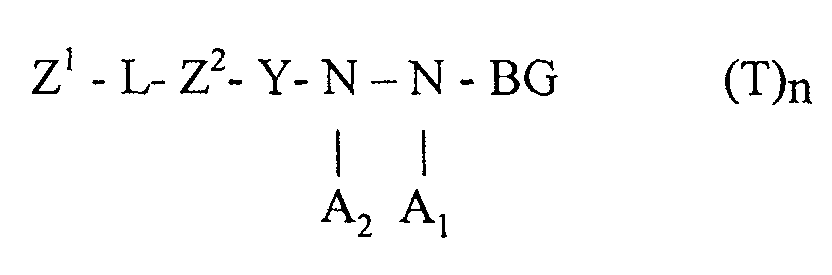 wherein BG is a blocking group;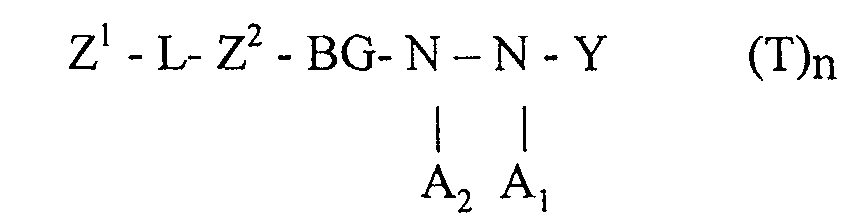
- one of A1 and A2 is a hydrogen atom and the other is a hydrogen atom, an acyl group or an alkyl- or aryl-sulfonyl group, any of which groups may be substituted;
- Z1 and Z2 are the same or different and each is a nicotinamide residue, at least one of which is positively charged;
- Y is a substituted aryl or heterocyclic ring;
- L is a linking group;
- T is an anionic counterion
- and n is 1 or 2.
-
- The nucleators of formula (II) preferably have one of the following general formulae:-or
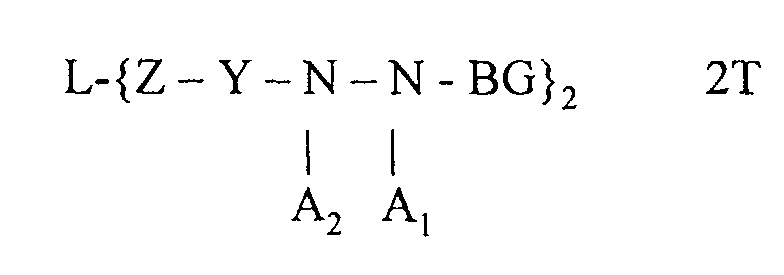 wherein each monomer linked by linking group L is the same or different;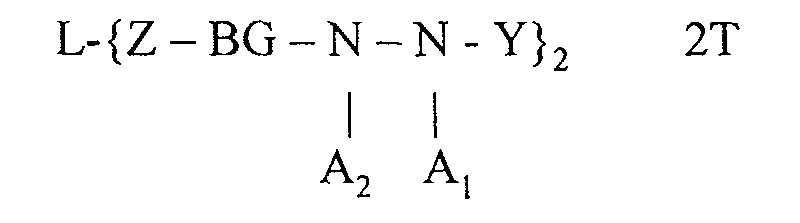
- Z is a positively charged nicotinamide residue; and
- Y, A1, A2, BG, L and T are as defined for a compound of formula (I).
-
- The nucleators of formula (III) preferably have the general formula:-wherein V and W are independently a substituted or unsubstituted arylene group;
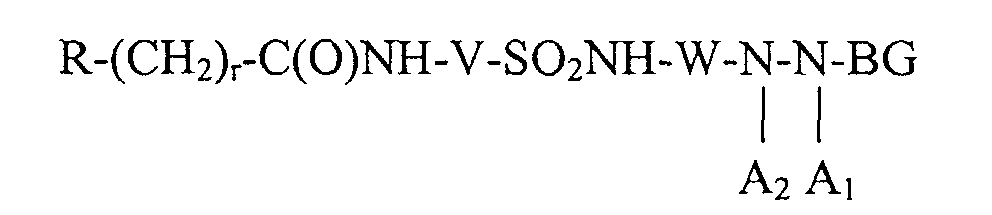
- r is 1 to 6;
- R is selected from the class consisting of S-R', wherein R' is an unsubstituted or substituted monovalent group comprising at least three ethyleneoxy units, and a positively charged pyridinium residue substituted with from 1 to 3 unsubstituted or substituted alkyl groups, with its associated cation;
- and A1, A2 and BG are as defined for a compound of formula (I).
-
- In a preferred embodiment in each of the formulae (I), (II) and (III) each of A1 and A2 is a hydrogen atom.
- More preferably the nucleating agent of formula (I) has one of the following formulae A, B or C, formula A being the most preferred:-

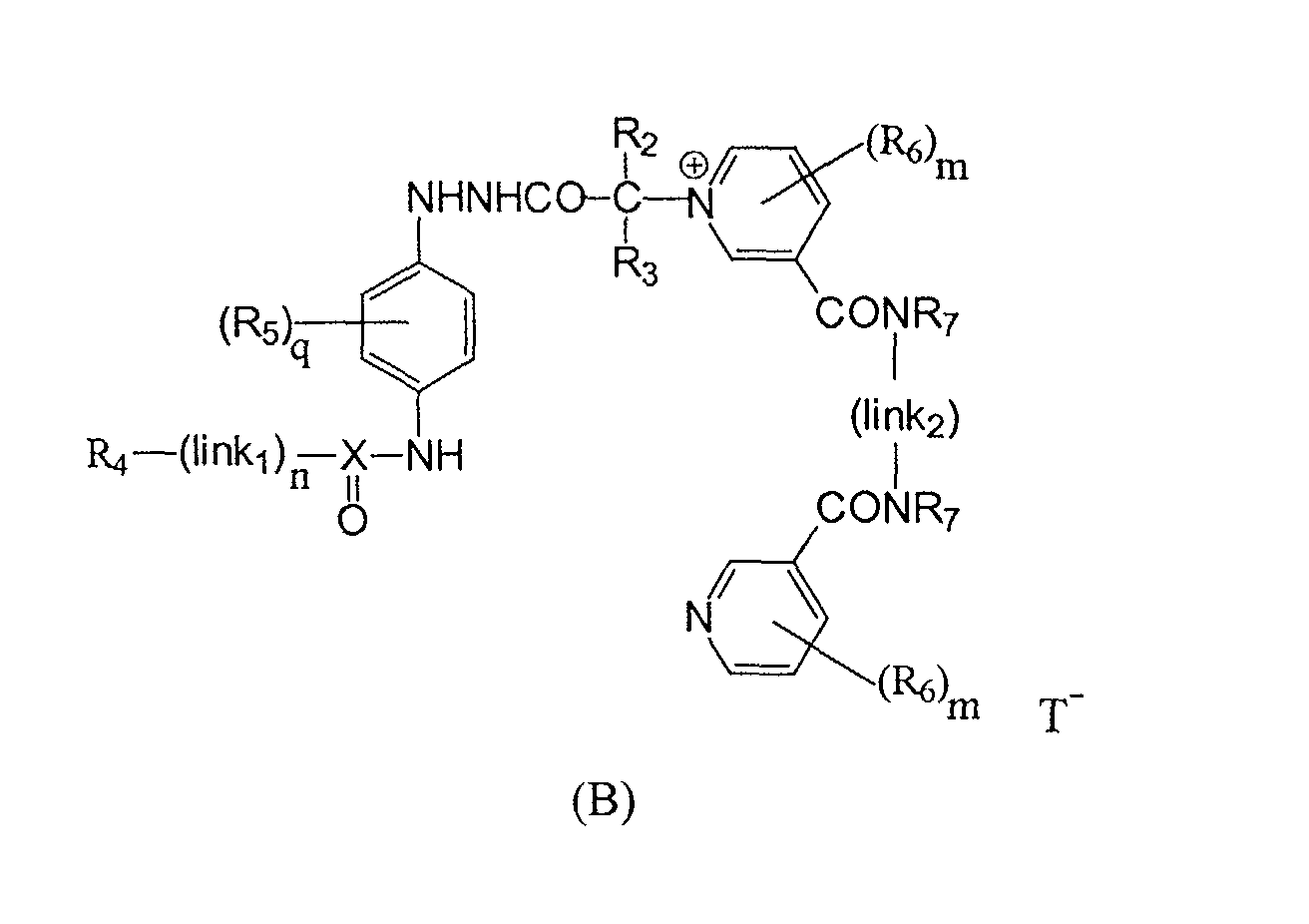
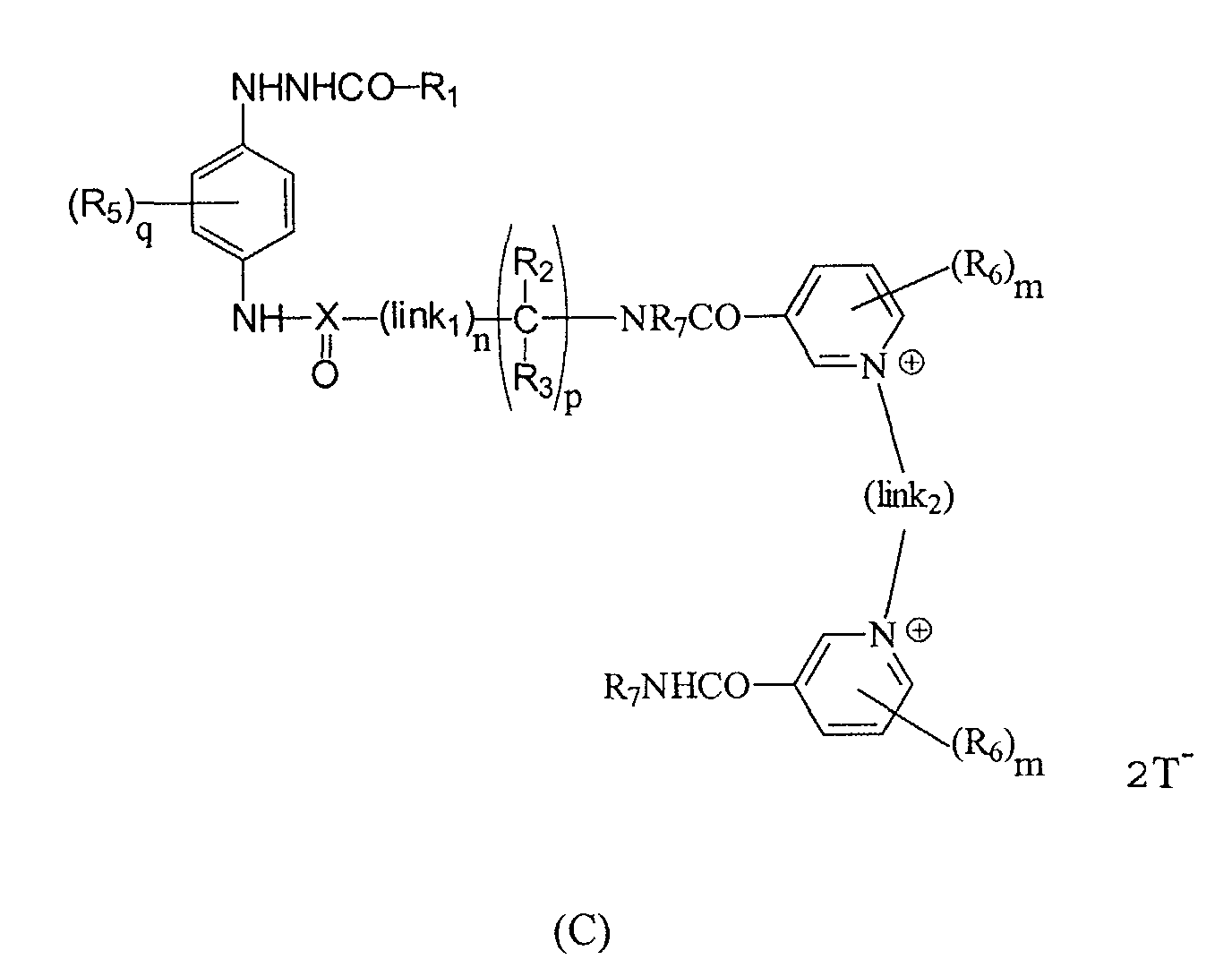
- More preferably the nucleating agent of formula (II) has one of the following formulae D, E or F, formula D being the most preferred:-


- More preferably the nucleating agent of formula (III) has one of the following formulae (G) or (H):-or


- In these embodiments (A) to (H),
- each R1CO comprises a blocking group and in particular each R1 is independently selected from a hydrogen atom and an unsubstituted or substituted alkyl, aryl, alkoxy, aryloxy, alkoxy- or aryloxy-carbonyl and alkyl- or arylaminocarbonyl group; or each R1 independently is or contains an unsubstituted or substituted heterocyclic group, having a 5- or 6-membered ring containing at least one nitrogen, oxygen or sulfur atom, wherein the ring may be linked either directly to the carbonyl group or via an alkyl, alkoxy, carbonyl, amino- or alkylamino-carbonyl group and wherein the ring may be fused to a benzene ring;
- each R2 and each R3 is independently selected from hydrogen and an unsubstituted or substituted alkyl or aryl group and each p is independently 0 or 1;
- each R4 and each R5 and each R6 is independently selected from hydrogen, halogen, hydroxy, cyano and an unsubstituted or substituted alkyl, aryl, heterocyclyl, alkoxy, acyloxy, aryloxy, carbonamido, sulfonamido, ureido, thioureido, semicarbazido, thiosemicarbazido, urethane, quaternary ammonium, alkyl- or aryl-thio, alkyl- or aryl-sulfonyl, alkyl- or aryl-sulfinyl, carboxyl, alkoxy- or aryloxy-carbonyl, carbamoyl, sulfamoyl, phosphonamido, diacylamino, imido or acylurea group, a group containing a selenium or a tellurium atom, and a group having a tertiary sulfonium structure;
- each m is independently an integer from 0 to 4;
- each q is independently an integer from 0 to 4;
- each R7 is independently selected from hydrogen and an unsubstituted or substituted alkyl or aryl group;
- each X is independently selected from C, S=O and C-NH;
- each (link1) is a linking group independently selected from an unsubstituted or substituted alkylene, polyalkylene, aryl, arylaminocarbonyl or heterocyclyl group and each n is independently 0 or 1;
- each (link2) is a linking group independently selected from an unsubstituted or substituted polyalkylene, polyalkylene oxide, polyalkylene containing one or more heteroatoms selected from nitrogen, oxygen and sulfur, separated from each other by alkylene groups, or an unsubstituted or substituted polyalkylene in which the alkylene groups are separated by an unsubstituted or substituted aryl or heterocyclic ring;
- V is an unsubstituted or substituted phenylene or naphthalene group;
- R' is an unsubstituted or substituted monovalent group comprising at least three ethyleneoxy units;
- R" is an unsubstituted or substituted alkyl group;
- r is 1 to 6;
- s is 1 to 3 and
- T- is an anionic counterion.
-
- The term 'blocking group' refers to a group suitable for protecting the (hydrazine) group but which is readily removable when necessary.
- It is preferred that R1 is a hydrogen atom or a group selected from unsubstituted or substituted alkyl, for example methyl, trifluoromethyl, 3-methylsulfonamidopropyl, methyl- or phenyl-sulfonylmethyl, carboxytetrafluoroethyl; unsubstituted or substituted aryl, for example phenyl, 3,5-dichlorophenyl, o-methane-sulfonamidophenyl, 4-methanesulfonylphenyl, 2(2'-hydroxyethyl)phenyl, 2-hydroxy-4-methylphenyl, 2-hydroxymethylphenyl, o-hydroxybenzyl, hydroxyalkylbenzyl; a carbonyl-containing group, for example an alkylamino-, alkoxy-, aryloxy- or hydroxyalkylamino-carbonyl; or contains an imidazolyl, pyrazolyl, triazolyl, tetrazolyl, pyridyl, pyridinium, piperidinyl, morpholino, quinolinium or a quinolinyl group or R1 may include a group which splits off a photographically useful fragment, such as a phenylmercaptotetrazole or a 5-or 6-nitroindazole group. Examples of some of these are disclosed in US Patent No. 5,328,801.
- More preferably in compounds of formulae (I) and (II) R1 contains a morpholino group and especially has the formula -CONH(CH2)n-morpholino, wherein n is 0-4 and is conveniently 3.
- R2 and R3 are preferably hydrogen atoms or alkyl groups with p being preferably 1 and R4, R5 and R6 being preferably hydrogen, alkyl, alkoxy, alkylthio, trifluoromethyl or methylsulfonamido groups, with q being preferably 0 or 1 and m being preferably 0. R7 is preferably hydrogen or an alkyl group, optionally substituted with, for example, a dialkylamino group.
- When X is S=0 or C-NH it is preferred that n is 1 and that (link1) comprises an arylamino group or an arylaminocarbonyl group, preferably a phenylaminocarbonyl group, which may be substituted in the ring, for example, with one or more alkyl, carboxyl groups or halogen atoms. When X is C it is preferred that n is 0 such that no (link1) group is present.
- The (link2) group preferably comprises a polyalkylene group comprising alkylene groups, preferably methylene groups, typically four or six, which may be separated by one or more O or S atoms. For example (link2) may be (CH2)4, (CH2)6, (CH2)2S(CH2)2 or (CH2)2O(CH2)2O(CH2)2. Alternatively (link2) may be a polyalkylene oxide chain extending from an even number of methylene groups such as (CH2CH2O)14CH2CH2 or may comprise, for example, a CH2C6H4CH2 group.
- In formula (III), both V and W may be substituted with one or more substituents such as, or example, an alkyl, halo, alkoxy, haloalkyl or alkoxyalkyl group. V and W are preferably each a phenylene group.
- In formula (G) there are least three repeating ethyleneoxy units in R', more preferably from four to fourteen units and even up to fifty repeating ethyleneoxy units. In formula (H) the sum of the number of carbon atoms represented by R" is preferably at least 4, more preferably at least 8, each R" group preferably having from 1 to 12 carbon atoms.
- The anionic counterion may be selected from any well known in the art and may typically be selected from Cl-, Br-, I-, CF3COO-, CH3SO3 - and TsO-.
- As used herein and throughout the specification the term alkyl refers to an unsaturated or saturated straight or branched chain alkyl group (including alkenyl and aralkyl) having 1-20 atoms and includes cycloalkyl having 3-8 carbon atoms. The term aryl specifically includes fused aryl and the term heterocyclic specifically includes fused heterocyclic within its scope. The term polyalkylene is defined as the group (CH2)n wherein n is an integer from 2 to 50.
- Unless otherwise specifically stated, substituent groups usable on molecules herein include any groups, whether substituted or unsubstituted, which do not destroy properties necessary for photographic utility.
- When the term "group" is applied to the identification of a substituent containing a substitutable hydrogen, it is intended to encompass not only the substituent's unsubstituted form, but also its form further substituted with any group or groups as herein mentioned.
- Suitably, the group may be halogen or may be bonded to the remainder of the molecule by an atom of carbon, silicon, oxygen, nitrogen, phosphorus, or sulfur. The substituent may be, for example, halogen, such as chlorine, bromine or fluorine; nitro; hydroxyl; cyano; carboxyl; or groups which may be further substituted, such as alkyl, including straight or branched chain alkyl, such as methyl, trifluoromethyl, ethyl, t-butyl, 3-(2,4-di-t-pentylphenoxy) propyl, and tetradecyl; alkenyl, such as ethylene, 2-butene; alkoxy, such as methoxy, ethoxy, propoxy, butoxy, 2-methoxyethoxy, sec-butoxy, hexyloxy, 2-ethylhexyloxy, tetradecyloxy, 2-(2,4-di-t-pentylphenoxy)ethoxy, and 2-dodecyloxyethoxy; aryl such as phenyl, 4-t-butylphenyl, 2,4,6-trimethyl-phenyl, naphthyl; aryloxy, such as phenoxy, 2-methylphenoxy, alpha- or beta-naphthyloxy, and 4-tolyloxy; carbonamido, such as acetamido, benzamido, butyramido, tetradecanamido, alpha-(2,4-di-t-pentylphenoxy)-acetamido, alpha-(2,4-di-t-pentylphenoxy)butyramido, alpha-(3-pentadecylphenoxy)-hexanamido, alpha-(4-hydroxy-3-t-butylphenoxytetradecanamido, 2-oxo-pyrrolidin-1-yl, 2-oxo-5-tetradecylpyrrolidin-1-yl, N-methyltetradecanamido, N-succinimido, N-phthalimido, 2,5-dioxo-1-oxazolidinyl, 3-dodecyl-2,5-dioxo-1-imidazolyl, and N-acetyl-N-dodecylamino, ethoxycarbonylamino, phenoxycarbonylamino, benzyloxycarbonylamino, hexadecyloxycarbonylamino, 2,4-di-t-butylphenoxycarbonylamino, phenylcarbonylamino, 2,5-(di-t-pentylphenyl)carbonylamino, p-dodecylphenylcarbonylamino, p-toluylcarbonylamino, N-methylureido, N,N-dimethylureido, N-methyl-N-dodecylureido, N-hexadecylureido, N,N-dioctadecylureido, N,N-dioctyl-N'-ethylureido, N-phenylureido, N,N-diphenylureido, N-phenyl-N-p-toluylureido, N-(m-hexadecylphenyl)ureido, N,N-(2,5-di-t-pentylphenyl)-N'-ethylureido, and t-butylcarbonamido; sulfonamido, such as methylsulfonamido, benzenesulfonamido, p-toluylsulfonamido, p-dodecylbenzenesulfonamido, N-methyltetradecylsulfonamido, N,N-di-propylsulfamoylamino, and hexadecylsulfonamido; sulfamoyl, such as N-methylsulfamoyl, N-ethylsulfamoyl, N,N-di-propylsulfamoyl, N-hexadecylsulfamoyl, N,N-dimethylsulfamoyl; N-[3-(dodecyloxy)propyl]-sulfamoyl, N-[4-(2,4-di-t-pentylphenoxybutyl]sulfamoyl, N-methyl-N-tetradecylsulfamoyl, and N-dodecylsulfamoyl; carbamoyl, such as N-methylcarbamoyl, N,N-dibutylcarbamoyl, N-octadecylcarbamoyl, N-[4-(2,4-di-t-pentylphenoxy)-butyl]carbamoyl, N-methyl-N-tetradecylcarbamoyl, and N,N-dioctylcarbamoyl; acyl, such as acetyl, (2,4-di-t-amylphenoxy)acetyl, phenoxycarbonyl, p-dodecyloxyphenoxycarbonyl, methoxycarbonyl, butoxycarbonyl, tetradecyloxycarbonyl, ethoxycarbonyl, benzyloxycarbonyl, 3-pentadecyloxycarbonyl, and dodecyloxycarbonyl; sulfonyl, such as methoxysulfonyl, octyloxysulfonyl, tetradecyloxysulfonyl, 2-ethylhexyloxysulfonyl, phenoxysulfonyl, 2,4-di-t-pentylphenoxysulfonyl, methylsulfonyl, octylsulfonyl, 2-ethylhexylsulfonyl, dodecylsulfonyl, hexadecylsulfonyl, phenylsulfonyl, 4-nonylphenylsulfonyl, and p-toluylsulfonyl; sulfonyloxy, such as dodecylsulfonyloxy, and hexadecylsulfonyloxy; sulfinyl, such as methylsulfinyl, octylsulfinyl, 2-ethylhexylsulfinyl, dodecylsulfinyl, hexadecylsulfinyl, phenylsulfinyl, 4-nonylphenylsulfinyl, and p-toluylsulfinyl; thio, such as ethylthio, octylthio, benzylthio, tetradecylthio, 2-(2,4-di-t-pentylphenoxy)ethylthio, phenylthio, 2-butoxy-5-t-octylphenylthio, and p-tolylthio; acyloxy, such as acetyloxy, benzoyloxy, octadecanoyloxy, p-dodecylamidobenzoyloxy, N-phenylcarbamoyloxy, N-ethylcarbamoyloxy, and cyclohexylcarbonyloxy; amine, such as phenylanilino, 2-chloroanilino, diethylamine, dodecylamine; imido, such as 1 (N-phenylimido)ethyl, N-succinimido or 3-benzylhydantoinyl; phosphate, such as dimethylphosphate and ethylbutylphosphate; phosphite, such as diethyl and dihexylphosphite; a heterocyclic group, a heterocyclic oxy group or a heterocyclic thio group, each of which may be substituted and which contain a 3 to 7-membered heterocyclic ring composed of carbon atoms and at least one hetero atom selected from the group consisting of oxygen, nitrogen and sulfur, such as 2-furyl, 2-thienyl, 2-benzimidazolyloxy or 2-benzothiazolyl; quaternary ammonium, such as triethylammonium; and silyloxy, such as trimethylsilyloxy.
- If desired, the substituents may themselves be further substituted one or more times with the described substituent groups. The particular substituents used may be selected by those skilled in the art to attain the desired photographic properties for a specific application and can include, for example, hydrophobic groups, solubilizing groups, blocking groups, releasing or releasable groups and groups which adsorb to silver halide. Generally, the above groups and substituents thereof may include those having up to 48 carbon atoms, typically 1 to 36 carbon atoms and usually less than 24 carbon atoms, but greater numbers are possible depending on the particular substituents selected.
- In some embodiments, the nucleators of the invention may be selected from the following:-
-
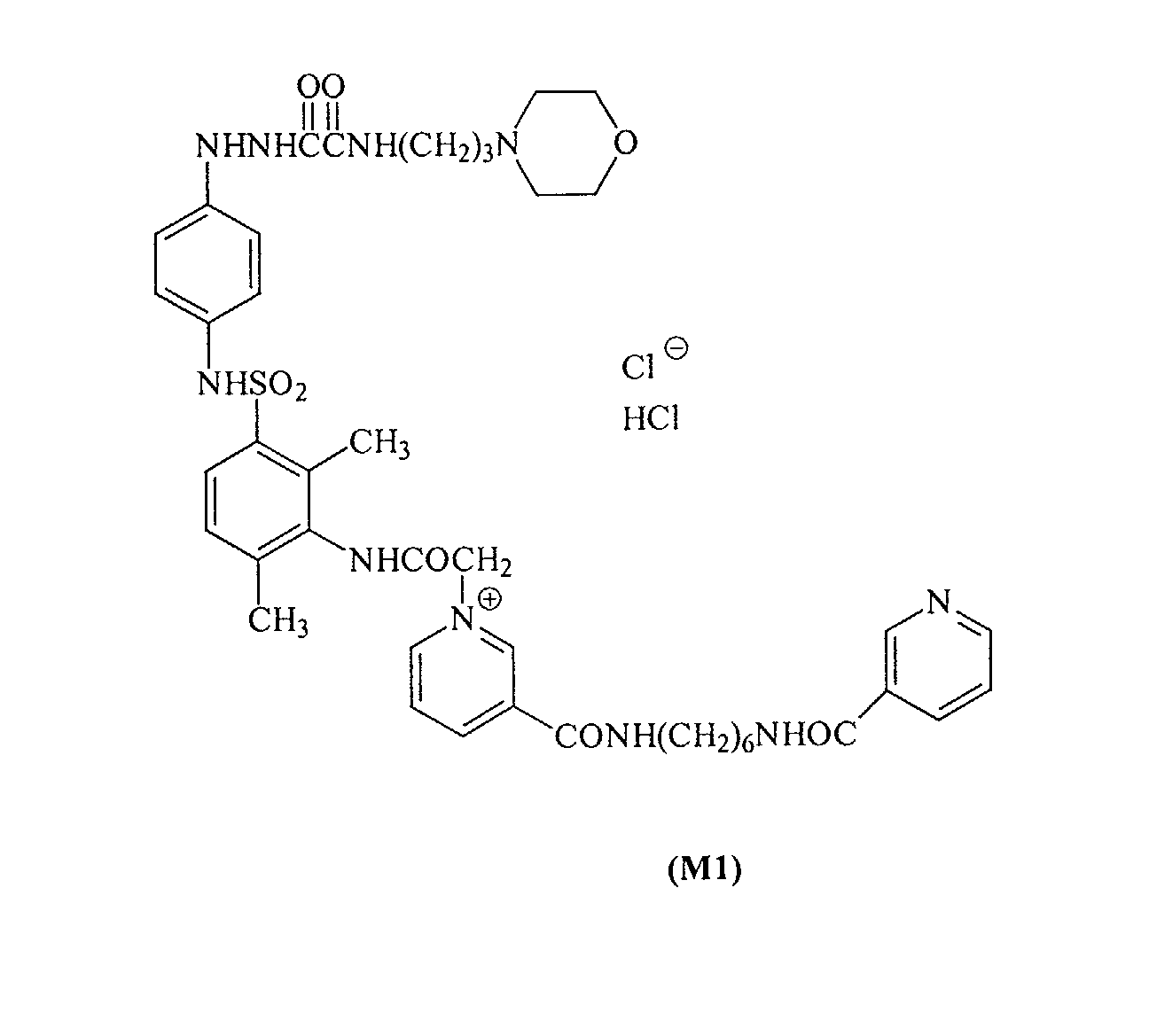


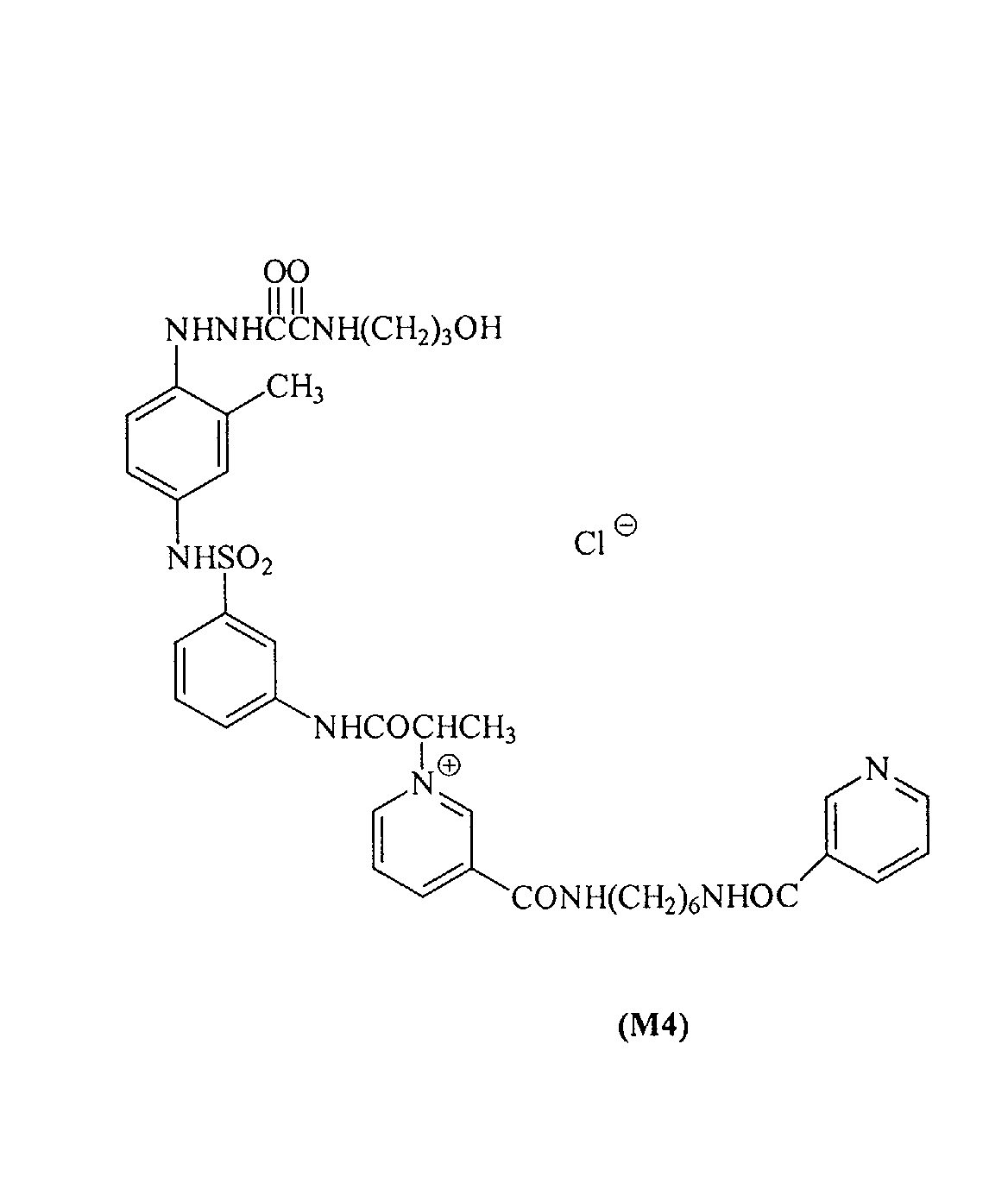


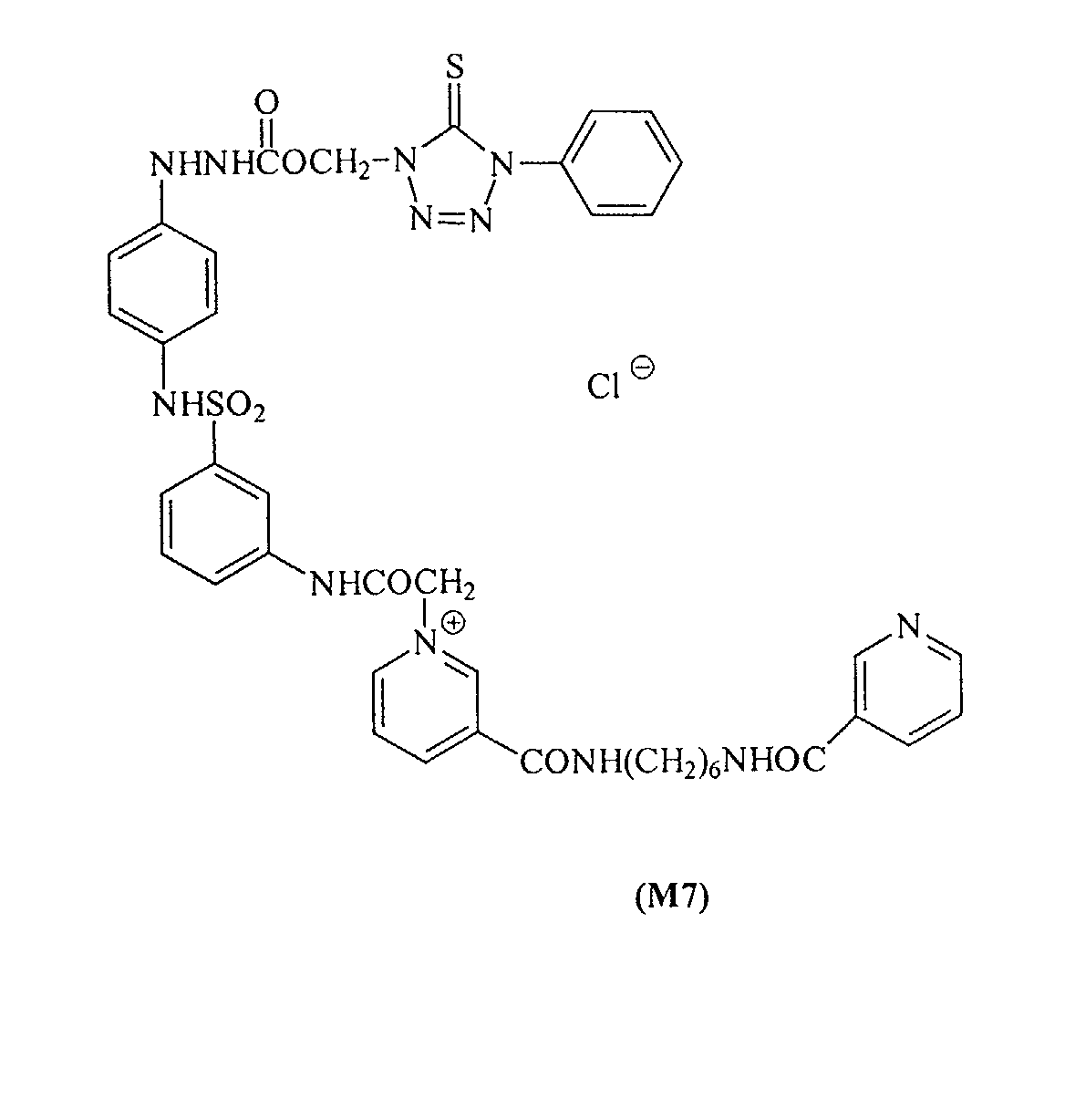

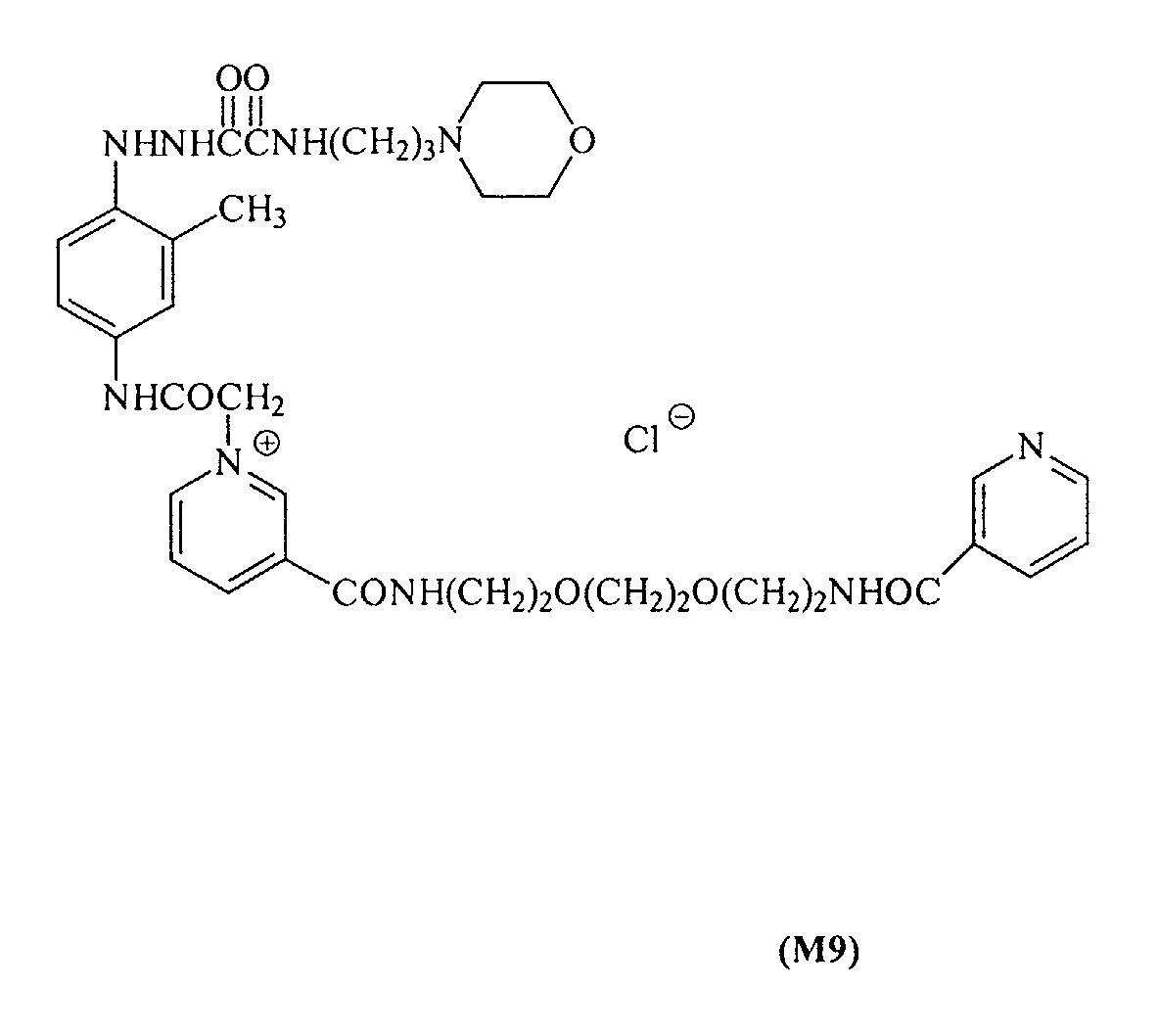
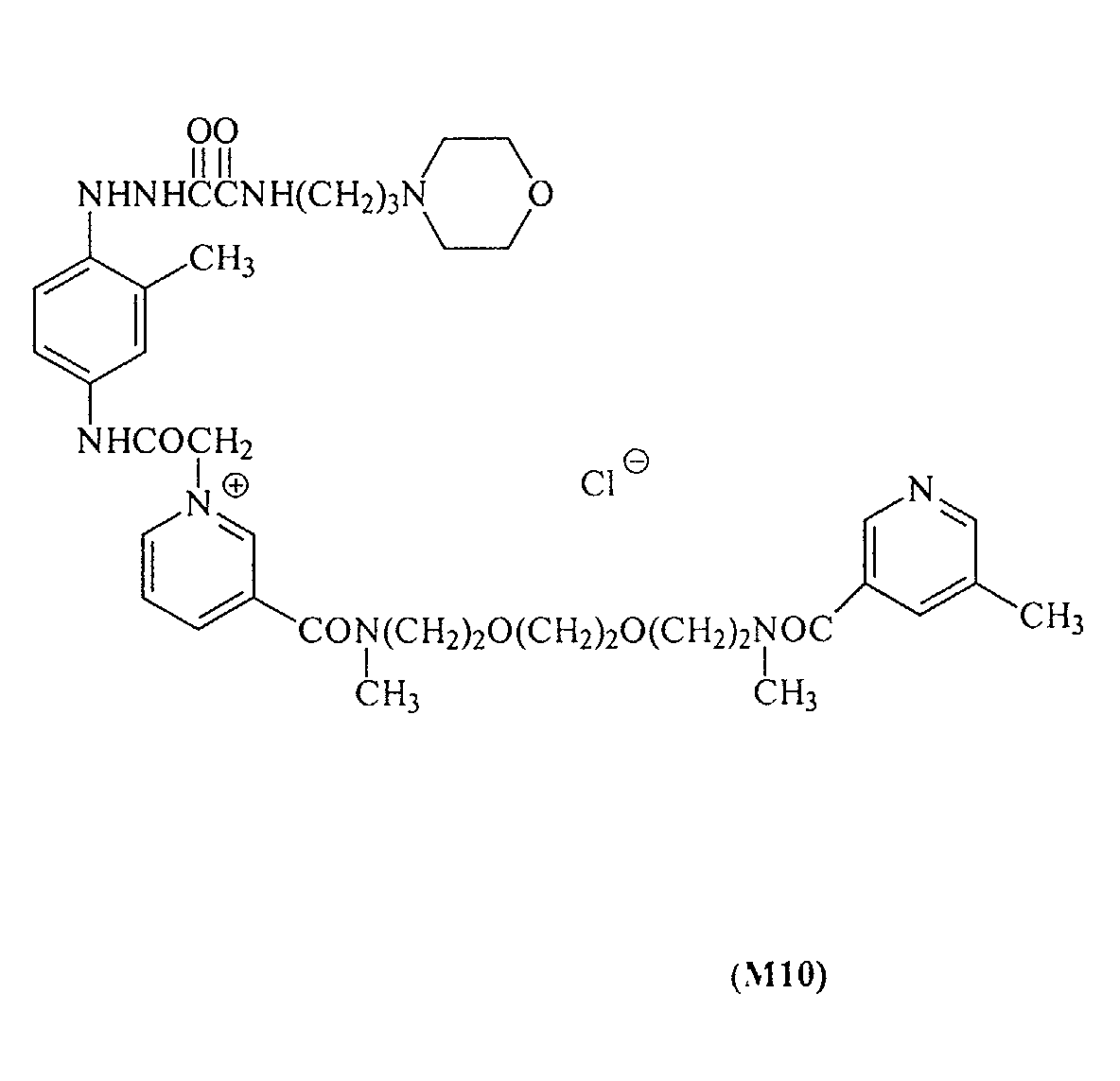

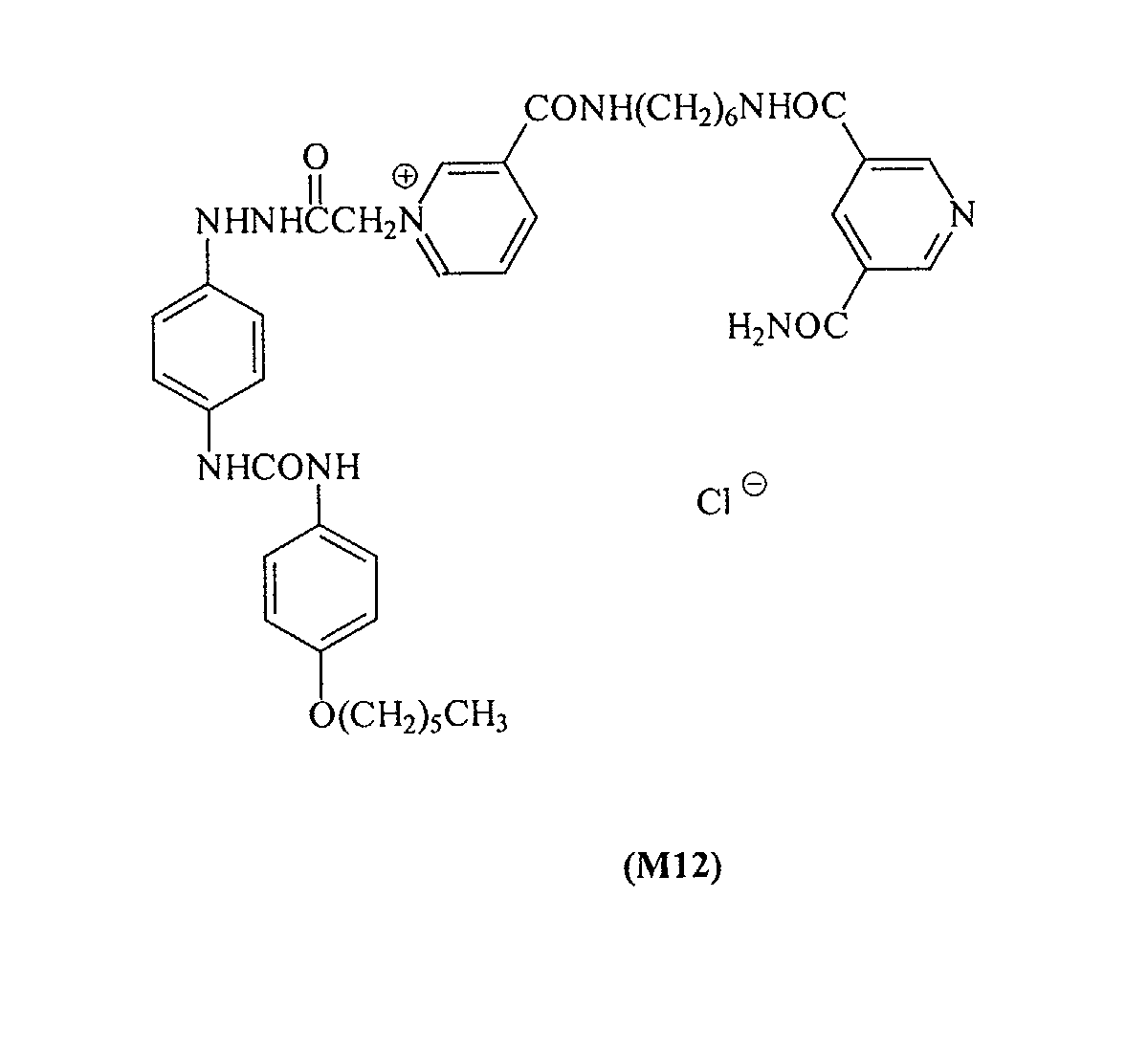


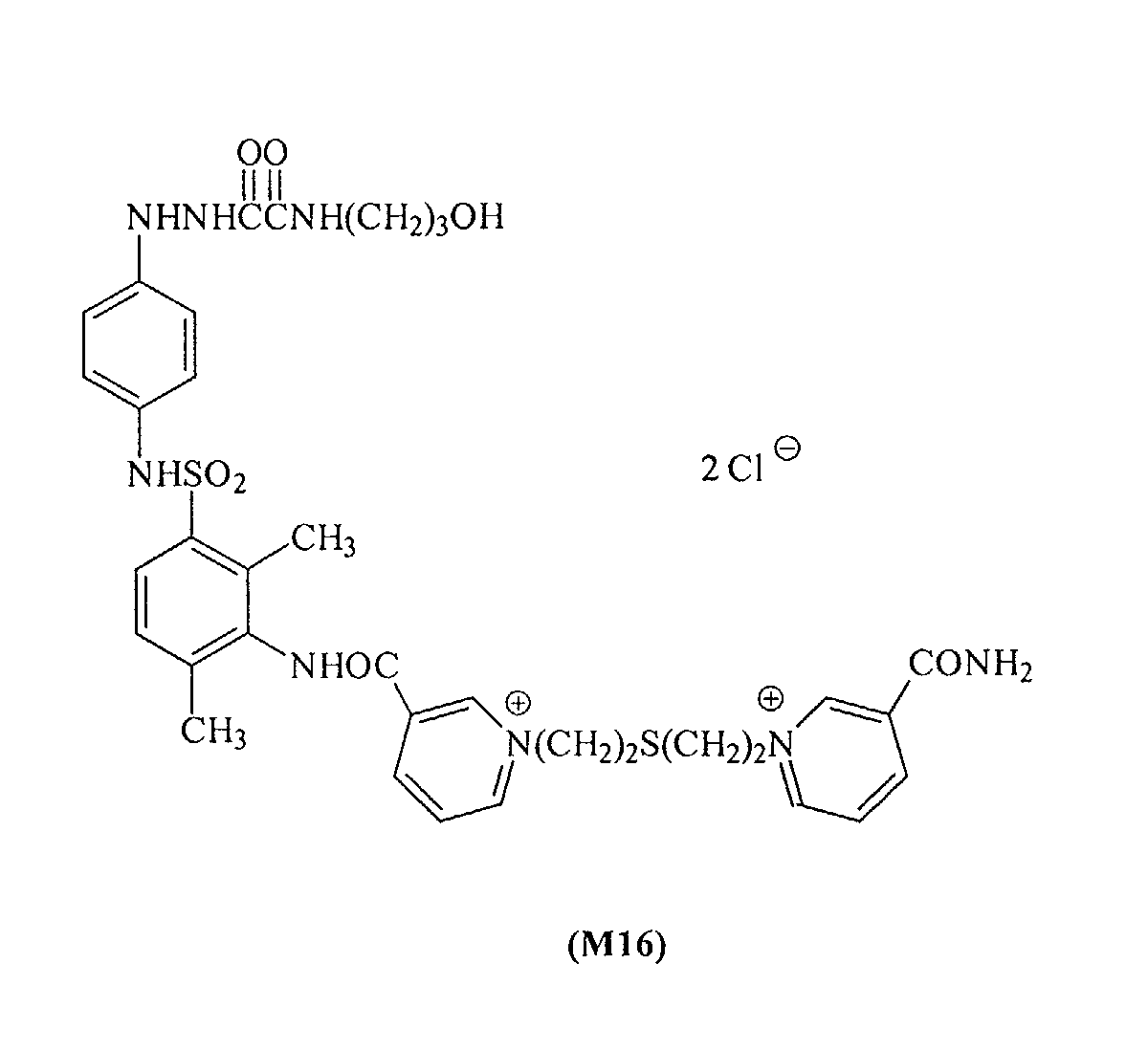

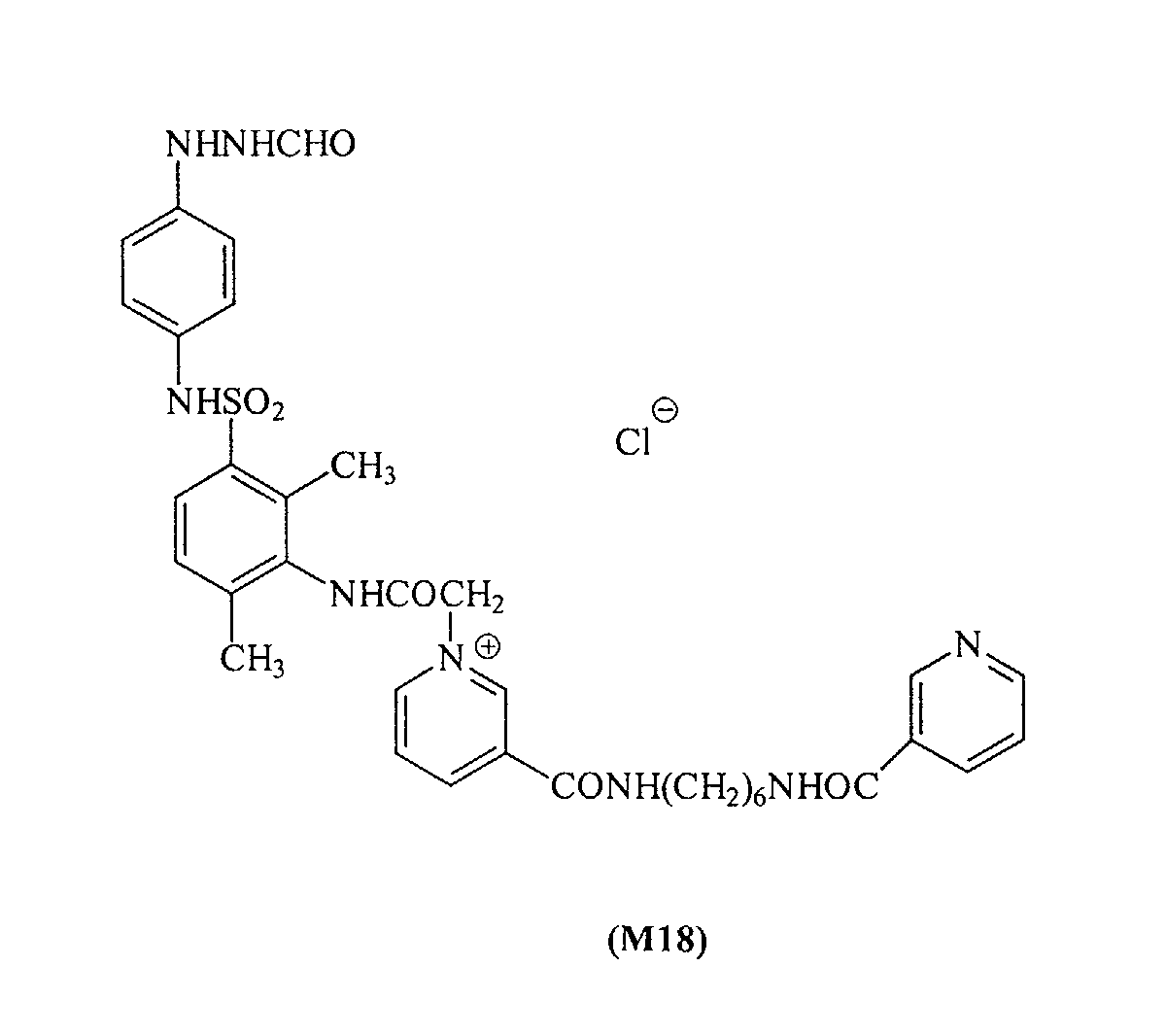
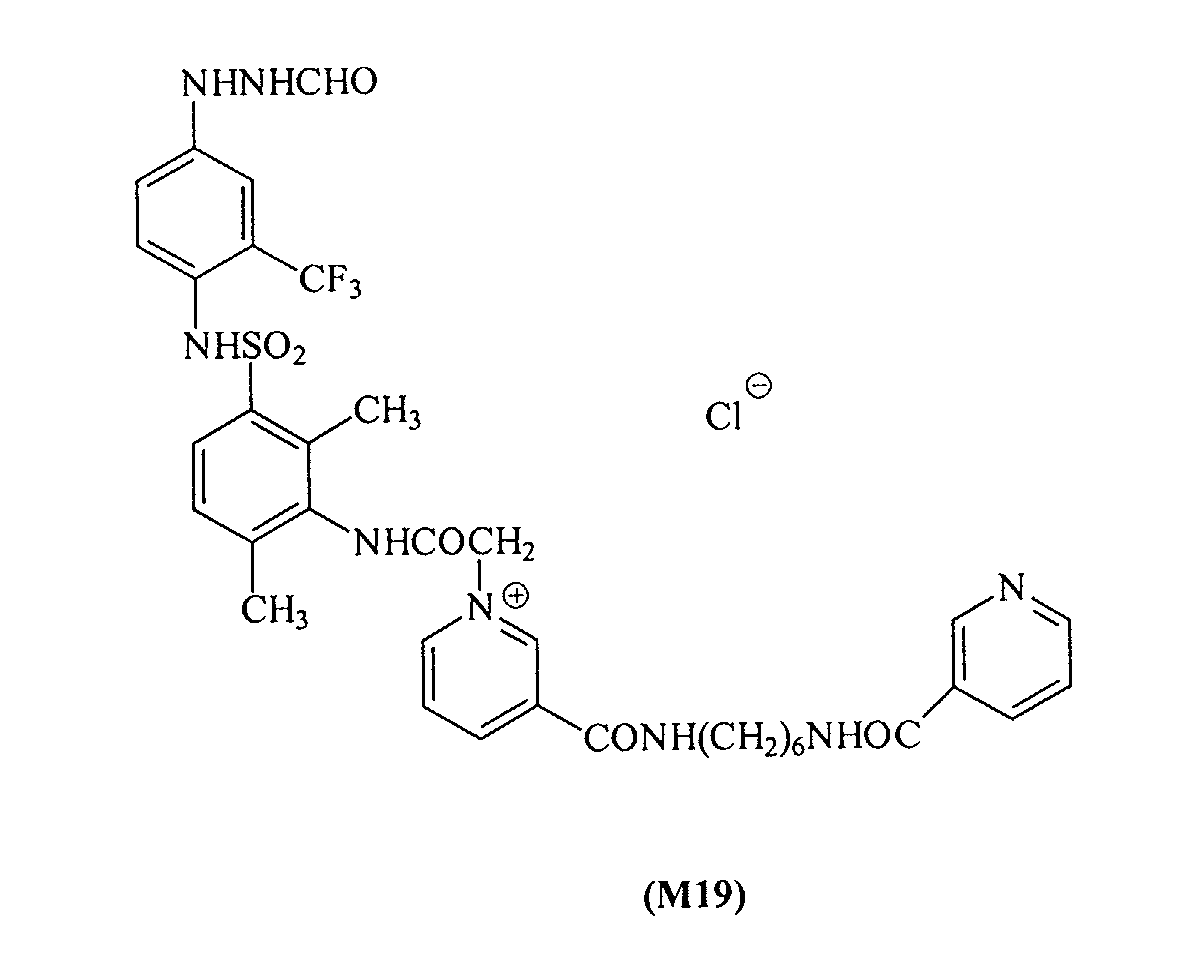


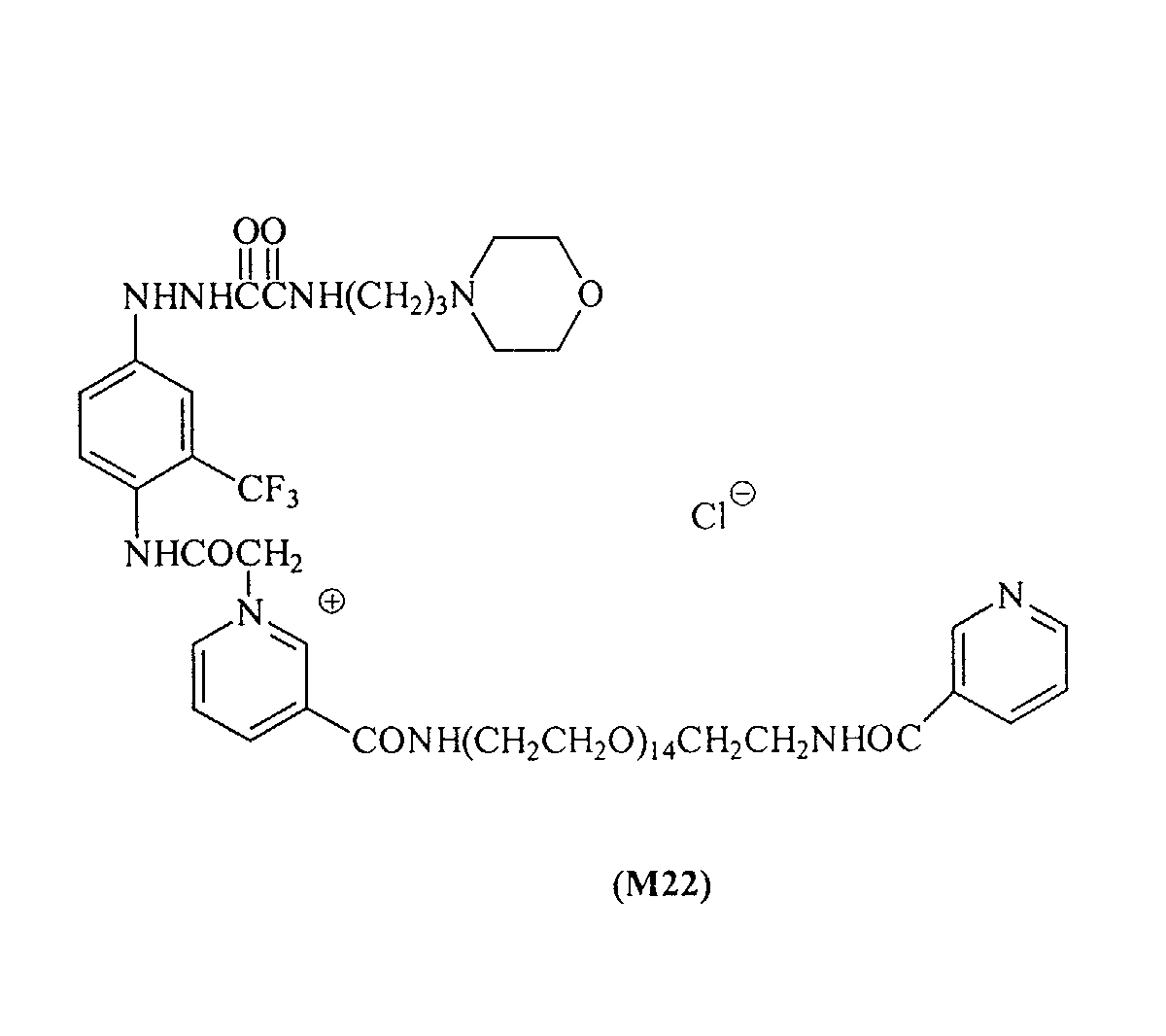
-


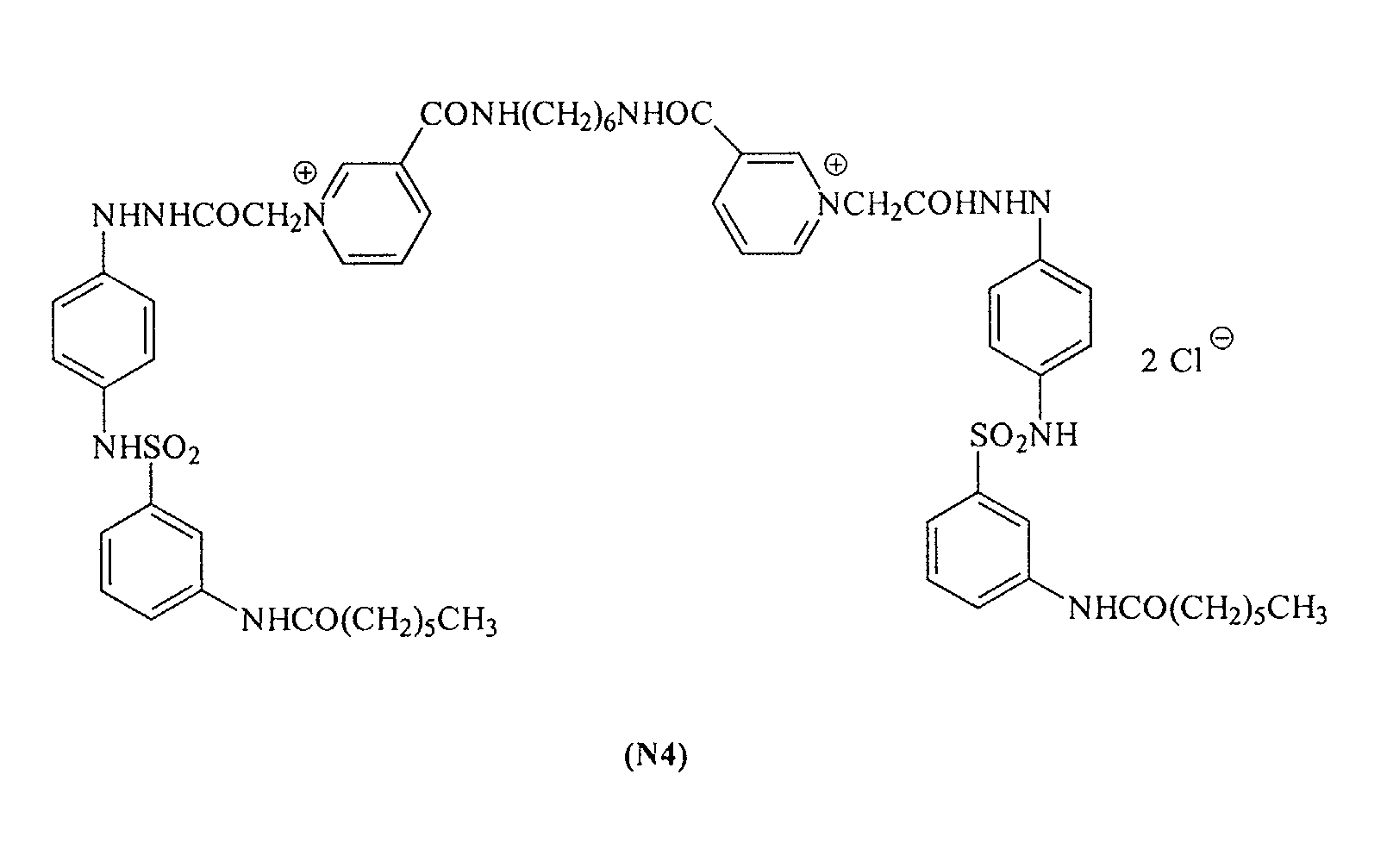

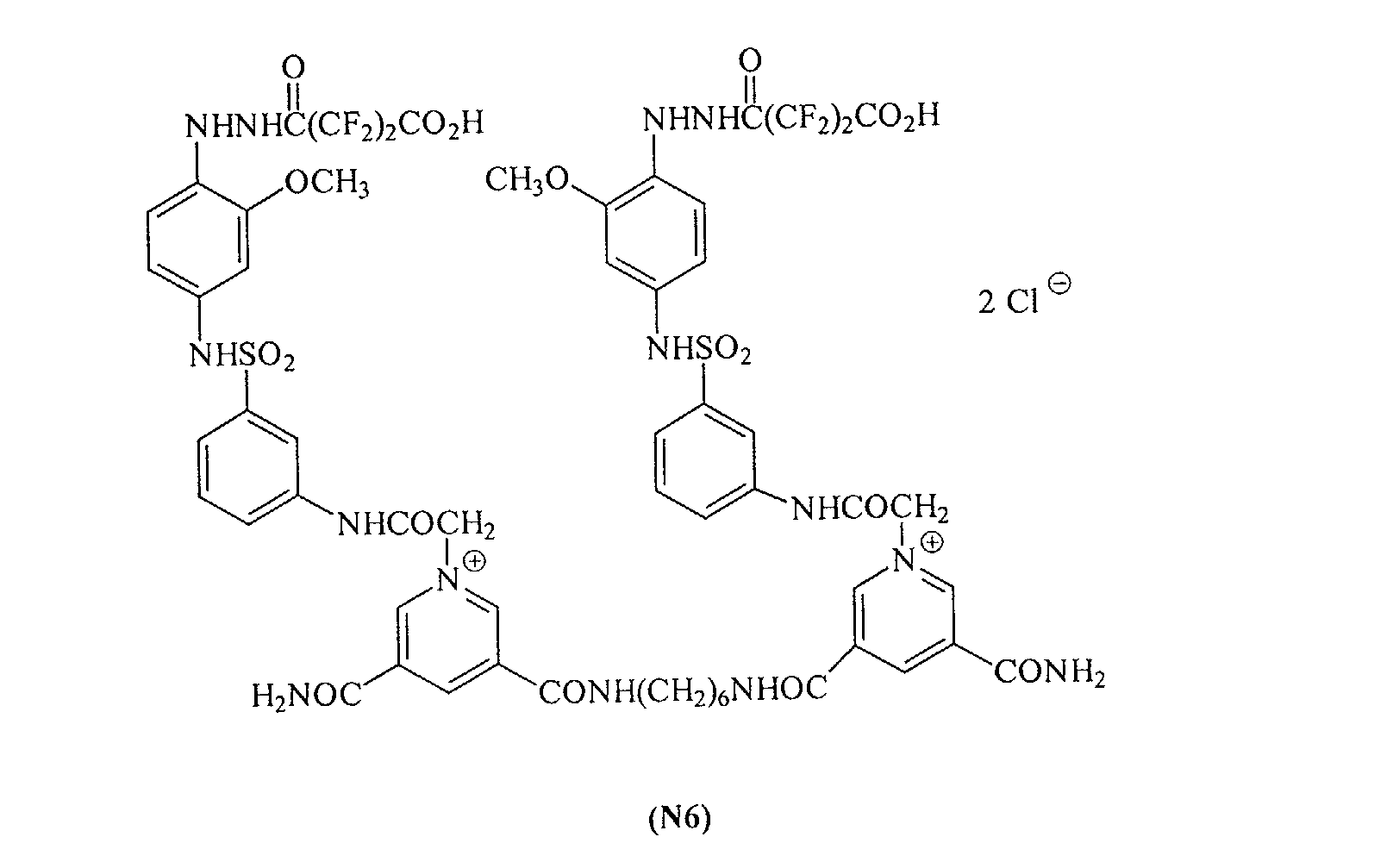
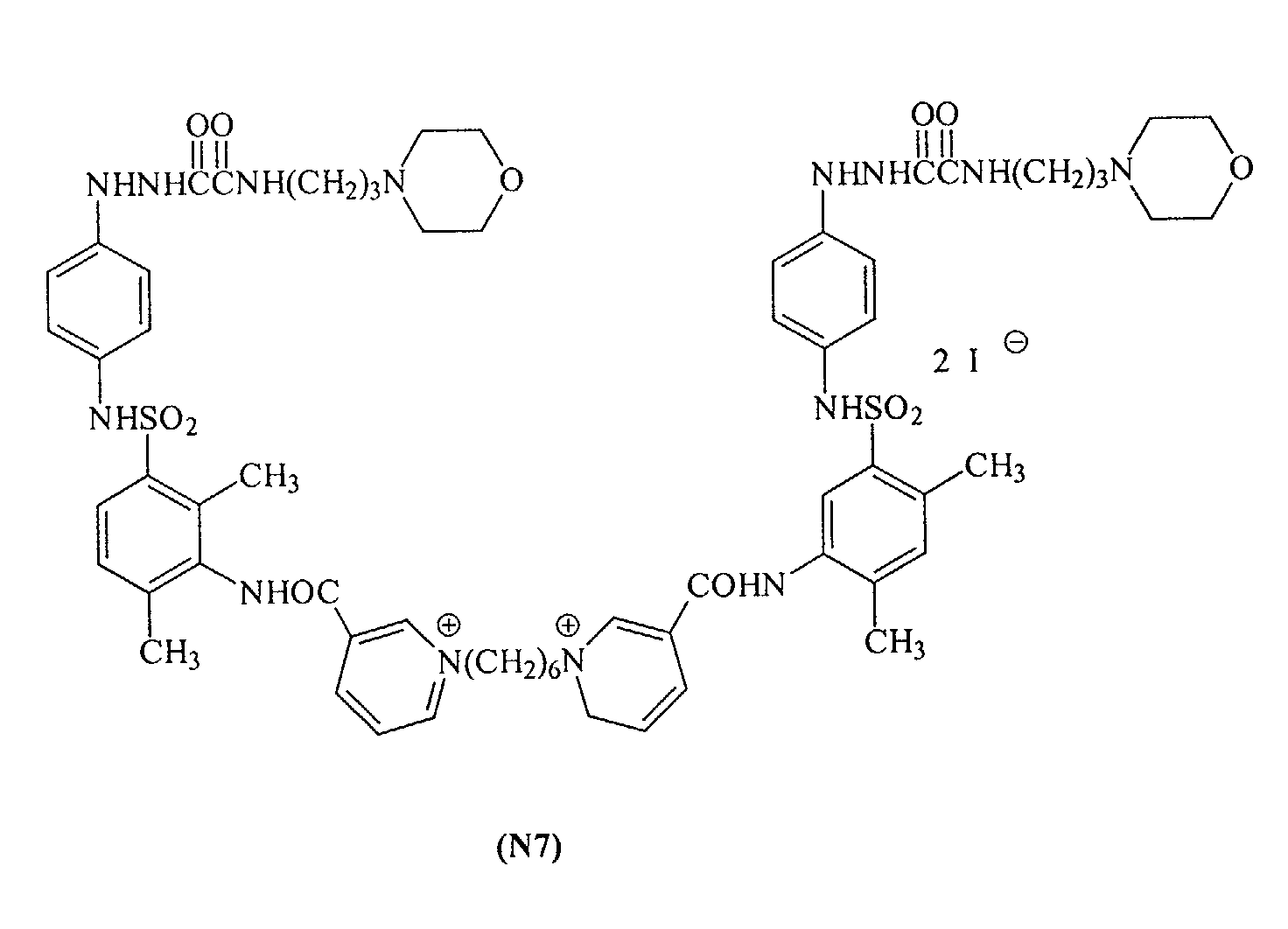

-
















-



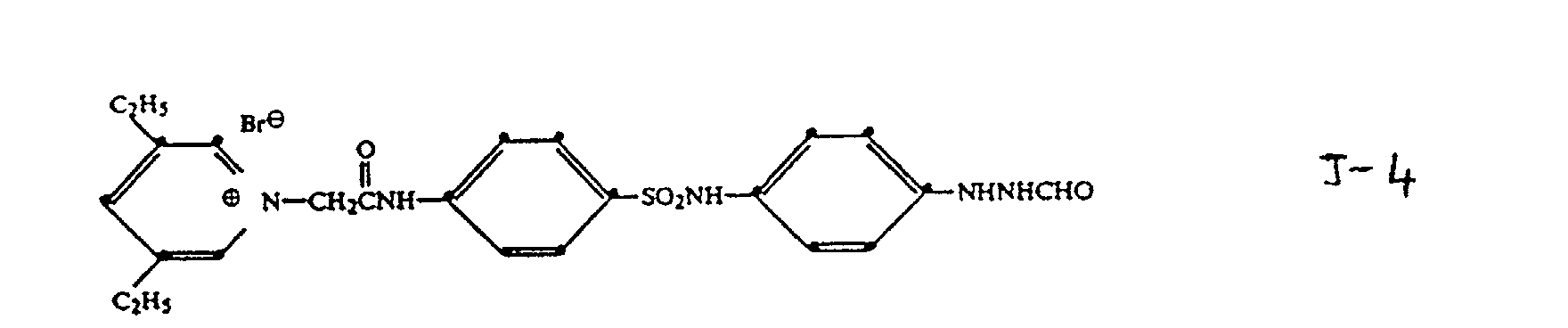





- The photographic material of the invention may also contain a booster compound to enhance the ultrahigh contrast and to promote activity. Alternatively the booster compound can be present in the developer solution.
- One class of such boosters are amines which
- (1) comprise at least one secondary or tertiary amino group, and
- (2) have an n-octanol/water partition coefficient (log P) of at least one,
preferably at least three, and most preferably at least four,
log P being defined by the formula:
wherein X is the concentration of the amino compound. -
- Preferably such an amine contains within its structure a group comprising at least three repeating ethyleneoxy units as described in US Patent No. 4,975,354. These units are preferably directly attached to the nitrogen atom of a tertiary amino group.
- Included within the scope of the amino compounds which may be utilised in this invention are monoamines, diamines and polyamines. The amines can be aliphatic amines or they can include aromatic or heterocyclic moieties. Aliphatic, aromatic and heterocyclic groups present in the amines can be substituted or unsubstituted groups. Preferably, the amine boosters are compounds having at least 20 carbon atoms.
- Preferred amino compounds for inclusion in photographic materials of the invention are bis-tertiary amines which have a partition coefficient of at least three and a structure represented by the formula:-
- R1, R2, R3 and R4 are, independently, alkyl groups of 1 to 8 carbon atoms, or
- R1 and R2 taken together represent the atoms necessary to complete a heterocyclic ring, and/or R3 and R4 taken together represent the atoms necessary to complete a heterocyclic ring.
-
- A particularly preferred booster for use in photographic materials of the invention or in the developer therefor is the booster B 1 wherein in the above formula R1, R2, R3 and R4 are each n-propyl groups and n is 14, i.e. the structure:-

- Another preferred group of amino compounds is that of bis-secondary amines which have a partition coefficient of at least three and a structure represented by the formula:-
each R is, independently, a linear or branched, substituted or unsubstituted, alkyl group of at least 4 carbon atoms. - Particular amines suitable as booster compounds are listed in EP-A-0 364 166.
- Other types of boosters are described in US Patent No. 5,744,279 as having one of the formulae:-
- (a)
- Y is a group which adsorbs to silver halide,
- X is a divalent linking group composed of hydrogen, carbon, nitrogen and sulfur atoms,
- A is a divalent linking group,
- B is an amino group which may be substituted or an ammonium group of a nitrogen-containing heterocyclic group,
- m is 1, 2 or 3 and
- n is 0 or 1,
- (b)
- R1 and R2 are each hydrogen or an aliphatic group, or R1 and R2 may together form a ring,
- R3 is a divalent aliphatic group,
- X is a divalent heterocyclic ring having at least one nitrogen, oxygen or sulfur atom as heteroatom,
- n is 0 or 1,
- M is hydrogen or an alkali metal atom, alkaline earth metal atom, a quaternary ammonium, quaternary phosphonium atom or an amidino group, and
- x is 1 when M is a divalent atom; said compound optionally being in the form of an addition salt;
- (c) a phosphonium structure as disclosed in col. 8 of United States
Patent No. 5,744,279 and as exemplified by the following formula:-
or

- (d) a pyridinium structure as disclosed in col. 21 of the aforementioned
US Patent as exemplified by the following formula:-

-
- The nucleators and optionally the booster compound can be incorporated in the photographic element, for example in a silver halide emulsion layer. Alternatively they can be present in a hydrophilic colloid layer of the photographic element, preferably a hydrophilic layer which is coated to be adjacent to the emulsion layer in which the effects of the nucleator are desired. They can however be present in the photographic element distributed between or among emulsion and hydrophilic colloid layers, such as undercoating layers, interlayers and overcoating layers.
- The total amount of nucleating agent of formula (I) and/or (II) is from about 0.3 µmol/m2 to about 70 µmol/m2, preferably 1 µmol/ m2 to 10 µmol/m2, more preferably 2 µmol/m2 to 7 µmol/m2. The amount of nucleating agent of formula (III) is from about 0.14 µmol/ m2 to about 70 µmol/ m2, preferably 0.7 µmol/ m2 to 14 µmol/ m2, more preferably 1.4 µmol/m2 to 7 µmol/ m2. Preferably the ratio of the amount of a nucleating agent of formula (I) and/or (II): a nucleating agent of formula (III) is greater than 1.0, preferably greater than 1.5. Corresponding amounts for the booster are from 0 mol/ m2 to about 1 mmol/ m2, preferably 10 µmol/ m2 to 100 µmol/ m2, most preferably 30 µmol/ m2 to 100 µmol/ m2.
- Preferably a nucleating agent of formula (I) is in combination with a nucleating agent of formula (II) and a nucleating agent of formula (III). Any relative proportions of the components of formulae (I) and (II) may achieve the advantages of the invention. However preferably the amount of nucleating agent of formula (I): nucleating agent of formula (II) is in the range from about 10:90 to about 90:10, preferably from about 20:80 to about 80:20. Conveniently however for simplicity of synthesis the nucleating agent of formula (II) is produced in excess and generally the relative amounts of the components of formulae (I): (II) are then in the range about 10:90 to about 30:70.
- The emulsions employed in photographic materials of the invention and the addenda added thereto, the binders, supports etc. may be as described in Research Disclosure Item 36544, September 1994, published by Kenneth Mason Publications, Emsworth, Hants, PO10 7DQ, United Kingdom, which will be identified hereinafter by the term "Research Disclosure."
- The hydrophilic colloid may be gelatin or a gelatin derivative, polyvinylpyrrolidone or casein and may contain a polymer. Suitable hydrophilic colloids and vinyl polymers and copolymers are described in Section IX of the Research Disclosure. Gelatin is the preferred hydrophilic colloid.
- The photographic materials may also contain an overcoat hydrophilic colloid layer which may also contain a vinyl polymer or copolymer located as the last layer of the coating (furthest from the support). It contains one or more surfactants to aid coatability and may also contain some form of matting agent. The vinyl polymer is preferably an acrylic polymer and preferably contains units derived from one or more alkyl or substituted alkyl acrylates or methacrylates, alkyl or substituted alkyl acrylamides, or acrylates or acrylamides containing a sulfonic acid group.
- The photographic materials of the invention preferably contain an antihalation layer which may be on either side of the support, preferably on the opposite side of the support from the emulsion layer. In a preferred embodiment an antihalation dye is contained in the hydrophilic colloid underlayer. The dye may also be dissolved in or dispersed in the underlayer. Suitable dyes are listed in the Research Disclosure disclosed above.
- The emulsions are preferably chemically sensitised, for example with both sulfur and gold. The latent-image forming grains can be bromoiodide, chlorobromoiodide, bromide, chlorobromide, chloroiodide or chloride, preferably chlorobromide. They should preferably be spectrally sensitised. More than one type of spectrally sensitised silver halide grain may be present and hence grains sensitised to different spectral regions may be present in the emulsion layer.
- The coating may be made by blending two or more emulsion melts containing grains of the required spectral sensitivity, allowing the production of multi-wavelength sensitive products and giving rise to manufacturing cost advantages through both material and inventory reduction. Combining the different emulsion grains within one layer can give improvements in process sensitivity over multilayer graphics nucleated systems, as described in EP-A-0 682 288.
- The silver halide grains may be doped with rhodium, ruthenium, iridium or other Group VIII metals either alone or in combination, preferably at levels in the range 10-9 to 10-3, preferably 10-6 to 10-3 mole metal per mole of silver. The grains may be mono- or poly-disperse. The preferred Group VIII metals are rhodium and/or iridium and ammonium pentachlororhodate may conveniently be used.
- The present photographic materials are particularly suitable for exposure by red or infra-red laser diodes, light emitting diodes or gas lasers, e.g. a helium/neon or argon laser.
- The light-sensitive silver halide contained in the photographic elements can be processed following exposure to form a visible image by associating the silver halide with an aqueous alkaline medium in the presence of a developing agent contained in the medium or the element. The photographic elements of this invention can be processed in conventional developers as opposed to specialised developers sometimes employed in conjunction with lithographic photographic elements to obtain very high contrast images. When the photographic elements contain incorporated developing agents the elements can be processed in the presence of an activator, which can be identical to the developer in composition, but otherwise lacking a developing agent.
- Very high contrast images can be obtained at pH values below 11, preferably in the range of from 10.0 to 10.8, preferably in the range of 10.3 to 10.5 and especially at pH 10.4.
- The developers are typically aqueous solutions, although organic solvents, such as diethylene glycol, can also be included to facilitate the solution of organic components. The developers contain one or a combination of conventional developing agents, such as, for example, a polyhydroxybenzene, such as dihydroxybenzene; aminophenol, paraphenylenediamine; ascorbic acid, erythorbic acid and derivatives thereof; pyrazolidone, pyrazolone, pyrimidine, dithionite and hydroxylamine.
- It is preferred to employ hydroquinone and 3-pyrazolidone developing agents in combination or an ascorbic acid-based system. An auxiliary developing agent exhibiting superadditive properties may also be used. The pH of the developers can be adjusted with alkali metal hydroxides and carbonates, borax and other basic salts. It is, as previously mentioned, a particular advantage of the present invention that the use of nucleators as described herein reduces the sensitivity of the photographic material to changes in this developer pH.
- To reduce gelatin swelling during development, compounds such as sodium sulfate can be incorporated into the developer. Chelating and sequestering agents, such as ethylenediaminetetraacetic acid or its sodium salt, can be present. Generally any conventional developer can be used in the practice of this invention. Specific illustrative photographic developers are disclosed in the Handbook of Chemistry and Physics, 36th Edition, under the title "Photographic Formulae" at page 30001 et seq. and in "Processing Chemicals and Formulas" 6th Edition, published by Eastman Kodak Company (1963).
- The invention will now be described with reference to the following examples which are in no way to be considered as limiting the scope thereof.
- The following preparation synthetic scheme for the preparation of nucleator (M1) of formula (I) is as follows, with full experimental details being provided in EP-A-1 164 413:-
- 2,6-Dimethyl-3-(4-[3-morpholinopropylcarbamoylcarbonylhydrazino]phenylsulfamoyl)phenylcarbamoylmethyl 3-(6-pyrid-3-ylamidohexamethylenecarbamoyl)pyridinium chloride hydrochloride. (M1).
-
-

-
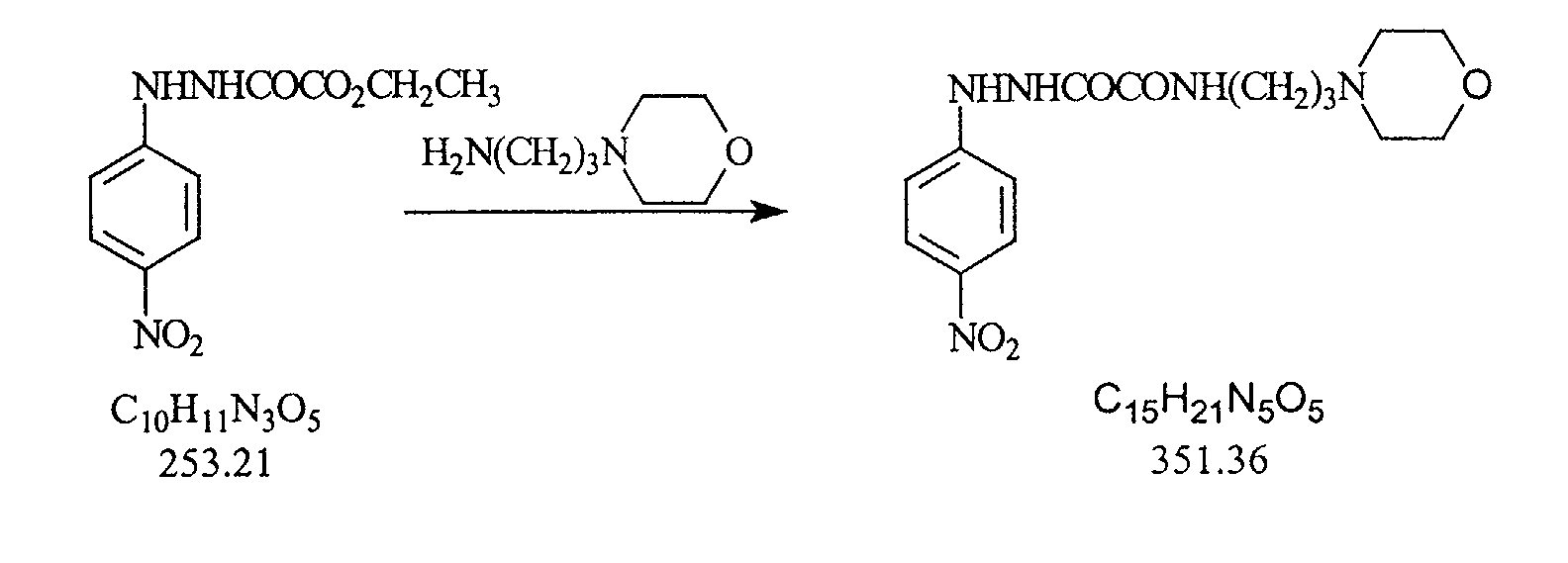
-
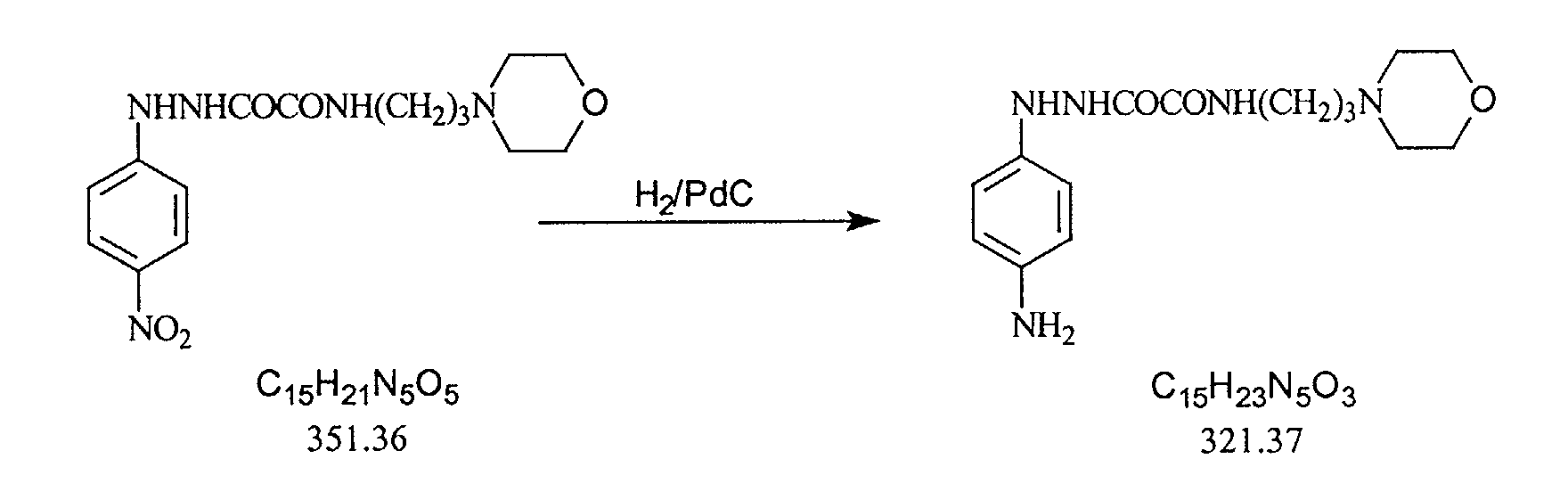
-

-

-
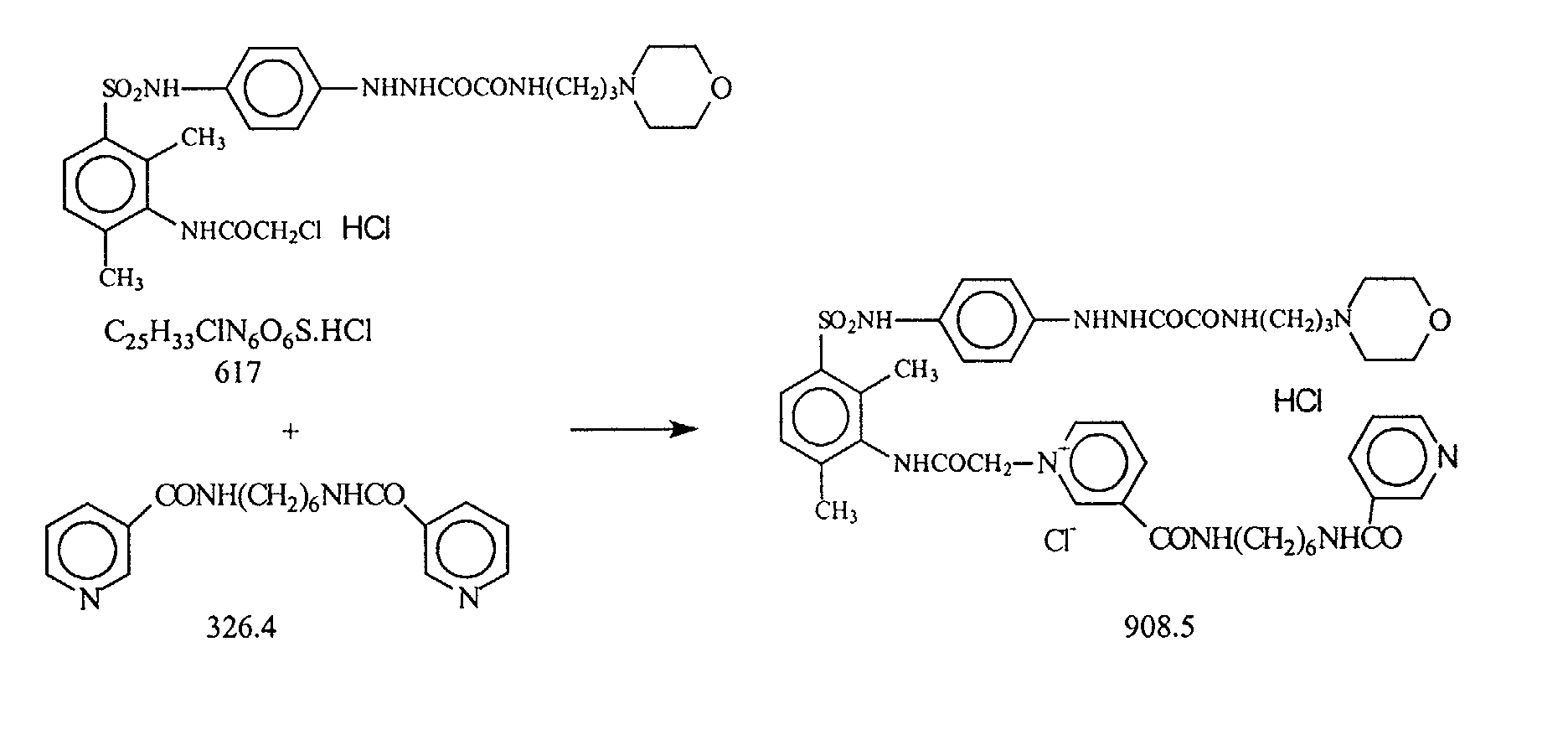
- Analogously with the above preparation, the following synthetic route for the preparation of the nucleator (M13), is illustrative for the nucleators for this invention of formula (B):-

- This synthesis also produces the dimeric molecule (N8).
- Analogously, the following synthetic route for the preparation of nucleator (M15) is illustrative for the nucleators of this invention of formula (C):

- No compound of formula (II) is prepared in this synthesis.
- The following synthesis is typical of those hydrazide nucleating agents including both a thio group and a group comprising at least three ethyleneoxy units.
- Tetraethyleneglycol (1243 g, 6.40 mol) was heated at 100C for 30 min with stirring and vigorous nitrogen bubbling, then cooled to 60C. A 50% NaOH solution (70.4 g, 0.88 mol) was added and the resulting solution was heated at 100-105C for 30 min with nitrogen bubbling. The solution was cooled to 60C, bromooctane (154 g, 0.80 mol) added, and the reaction heated at 100-110C for 24 h. The reaction solution was cooled, added to ice water and extracted twice with methylene chloride. The combined extracts were washed with 10% NaOH, water and brine, dried, treated with charcoal, and filtered through a thin silica gel pad. The solvent was removed in vacuo; the residual product (155 g, 63%) was a pale yellow oil.
- A solution of tetraethyleneglycol mono-octyl ether (61.3 g, 0.20 mol), 4-dimethylaminopyridine (1.2 g, 0.01 mol), N,N-diisopropylethylamine (41.9 ml, 0.24 mol), and dry methylene chloride (500 ml) was cooled to 0C in an icebath. Methanesulfonyl chloride (18.6 ml, 0.24 mol) was added over a 30 min period at 0C and the reaction was stirred at 0C for 30 min and at room temperature for 4 h. The reaction mixture was added to ice water containing 10 ml conc. HCl, the organic layer was separated and the aqueous layer extracted with methylene chloride. The combined extracts were washed with 10% NaOH, water and brine, dried, treated with charcoal, and filtered through a thin silica gel pad. The solvent was removed in vacuo giving the residual product (51.1 g, 66%) as a golden yellow oil.
- A solution of octyloxytetraethyleneoxy methanesulfonate (38.5 g, 0.10 mol), thiourea (9.1 g, 0.12 mol) and ethanol (200 ml) was refluxed under a nitrogen atmosphere for 24 h. The reaction was cooled, 50% NaOH (19.2 g, 0.24 mol) and water (20 ml) were added, and the reaction was refluxed with stirring for 1 h. The reaction was cooled in an ice bath, acidified with conc. HCl (20 ml), filtered and the solvent removed in vacuo. The residue was redissolved in ethyl acetate and water. The organic layer was separated and the aqueous layer extracted with ethyl acetate. The combined extracts were washed with water and brine, dried, treated with charcoal and filtered through a thin silica gel pad. The solvent was removed in vacuo giving the residual product (29.1 g, 90%) as a colourless oil.
- To chlorosulfonic acid (75 ml, 1.15 mol) was added with stirring solid 2-chloro-N-(2,6-dimethylphenyl) acetamide over a 30 min period at 25-30C and the reaction mixture was stirred at 60-65C for 1.5 h. The reaction was cooled, added to ice and extracted with ethyl acetate/methyl ethyl ketone. The combined extracts were washed with water and brine, dried and the solvent removed in vacuo giving the residual product (61.4 g, 69%) as a white solid, m.p. 147.5-149C.
- A mixture of 1-formyl-2-(4-nitrophenyl) hydrazide (33.6g, 0.185 mol), dry N,N-dimethylacetamide (200 ml) and 10% Pd/C catalyst was hydrogenated at 345kPa (50 ps) over a 6 h period to the corresponding amine. The reaction mixture was dried, filtered, cooled to 0Cand N,N-di-isopropylethylamine (32.3 ml, 0.185 mol) was added. A solution of 3-chloroacetamido-2,4-dimethylbenzenesulfonyl chloride (54.8 g, 0.185 mol) and dry N,N-dimethylacetamide (200 ml) was added over a 30 min period at 0C and the reaction was stirred at room temperature for 18 h. The reaction mixture was added to ice water, the separated solid was filtered, washed with water, ether and heptane, stirred with hot aqueous acetonitrile, cooled and filtered. The product (61.1 g, 80%) was a white solid, m.p. 211-212C. (dec).
- A solution of octyloxytetraethyleneoxy thiol (10.6 g, 0.033 mol) and dry N,N-dimethylformamide (50 ml) was cooled to 15C. An 80% NaH dispersion (1.00 g, 0.33 mol) was added in portions over a 10 min period and the mixture was stirred at room temperature for 30 min. A solution of 1-formyl-2-(4-(3-chloroacetamido-2,4-dimethylsulfonamido)phenyl) hydrazide (12.3 g, 0.030 mol) and dry N,N-dimethylformamide (50 ml) was added over a 1.5 h period and the reaction was stirred at room temperature for 18 h. The reaction mixture was added to ice water containing formic acid (2 ml) and the mixture was extracted with ethyl acetate. The combined extracts were washed with water and brine, dried and the solvent removed in vacuo. The residue was purified by chromatography on silica gel and recrystallized twice from ethyl acetate. The product (6.5 g, 31%) was a white, waxy solid, m.p. 140-141C.
- The following synthesis is typical of those hydrazide nucleating agents including a pyridinium group.
- A solution of 1-formyl-2(4-nitrophenyl) hydrazine (5.4 g, 0.03 mol) in 50 ml N,N-dimethylacetamide was reduced by contact for 1h at elevated pressure and in the presence of a Pd/C catalyst with hydrogen and the resulting product was dried and filtered. The filtrate was stirred at ice temperature while 3.9 g (0.03 mol) N,N-di-isopropylethylamine was added, followed by 9.8 g (0.03 mol) 2,4-dimethyl-3-(chloroacetamido) benzenesulfonyl chloride. The resulting solution was allowed to warm to room temperature and stand for 15h before being dripped into 500 ml water, so that solid separated. The solid was collected, washed with water and digested for 1h at 60C with 100 ml acetonitrile to give 9.7 g (79% yield) of intermediate product with a melting point of 210-211C. A mixture of 10 g of this intermediate, 12 ml 4-(1-butylpentyl)pyridine and 20 ml N,N-dimethylacetamide was warmed on a steam bath for 1h, cooled, dropped into 400 ml ether and the solid was collected, washed well with ether, and dried. Upon being dissolved in a minimum volume of methanol and dropped into 400 ml ether with stirring, the yield was 14.3 g (94% yield) of hydrazide I-6.
- The film coating prepared consisted of a polyethylene terephthalate (ESTAR™) support, an antihalation layer on the back of the support on which was coated a latent image forming emulsion layer, a gel interlayer and a protective supercoat.
- The latent image forming emulsion layer consisted of a 70:30 chlorobromide cubic (monodispersed emulsion (0.18µm edge length) uniformly doped with a rhodium salt at 0.109 mg/Ag mol and an iridium salt at 0.265 mg/Ag mol. It was then chemically sensitised with sulfur and gold and spectrally sensitised with 400 mg/Ag mol of sensitising dye of the formula:
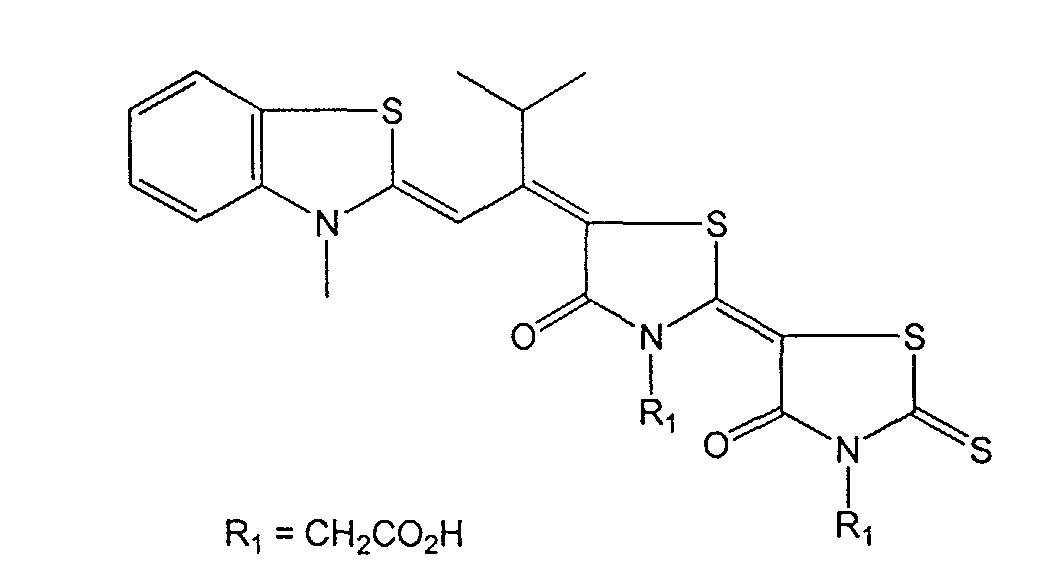
- The emulsion was coated at a laydown of 3.3g Ag/m2 in a vehicle of 2.5 g/m2 gel and 0.55 g/m2 latex copolymer of methyl acrylate, the sodium salt of 2-acrylamido-2-methylpropane sulfonic acid and 2-(methacryloyloxy)ethylacetoacetate (88:5:7 by weight). Other addenda included 2-methylthio-4-hydroxy-5-carboxy-6-methyl-1,3,3a,7-tetraazaindene, 2-methylthio-4-hydroxy -6-methyl-1,3,3a,7-tetraazaindene, 1-(3-acetamidophenyl)-5-mercaptotetrazole, 4-carboxymethyl-4-thiazoline-2-thione and a thickener to achieve the required viscosity. Nucleator 1-6 of formula (III) was then added as the final component.
- The interlayer was coated at a gel laydown of 0.65 g/m2 and included a nucleating agent comprising a combination of 13% of formula (I) (M1) and 87% of formula (II) (N1) (hereinafter referred to as (M1/N1)) and 60 mg/m2 amine booster (B1). The supercoat contained matte beads and surfactant and was coated at a gel laydown of 1 g/m2.
- A range of coatings containing nucleating agents (M1/N1) of formula (I)/(II) with (I-6) of formula (III) at varying levels were exposed to a 1µs broad band flash exposure with a 5% tint plus a lateral 0.15 wedge and a suitable neutral density filter. The resulting wedge exposure contained a 95% tint with varying densities from the step wedge. Comparisons of the sensitometry for the coatings were made as shown in Table 1.
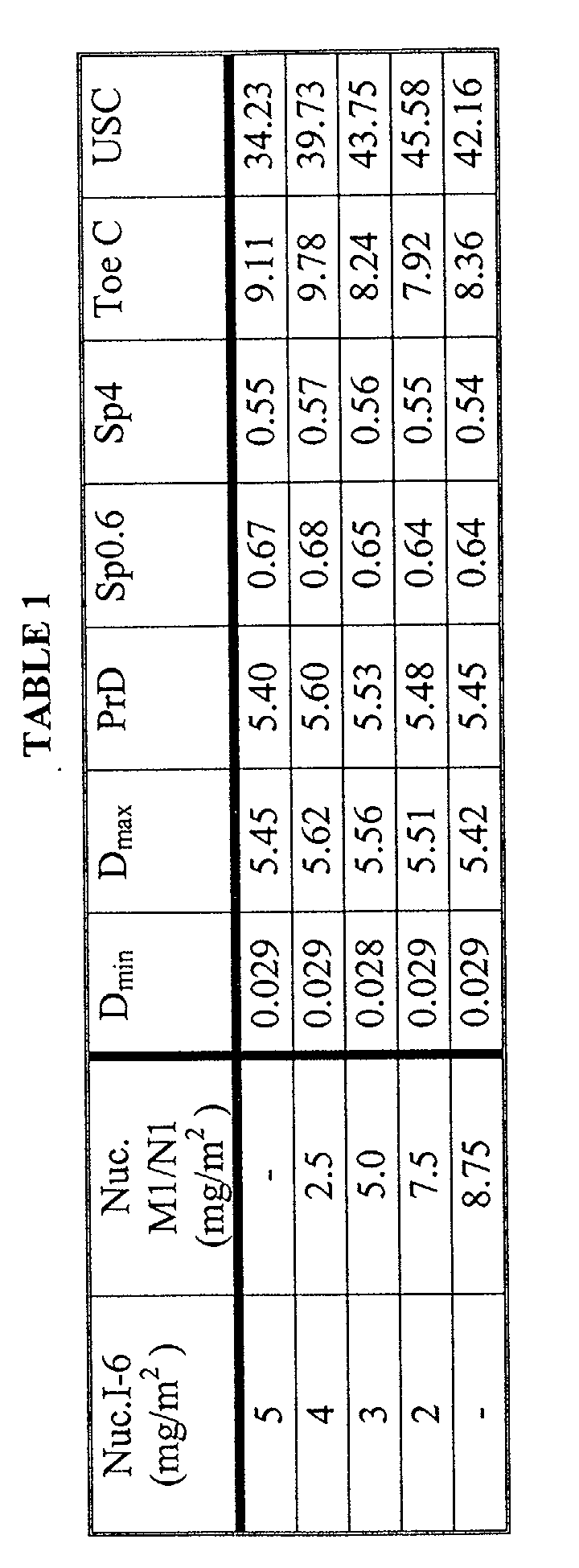
- In Table I the following abbreviations are used:-
- Dmin - minimum density:
- Dmax - maximum density
- PrD - practical density, measured as the density achieved at an exposure 0.4 logE units higher than the Sp0.6 value
- Sp0.6 - toe speed, measured as the relative logE exposure required to produce a density of 0.6 above Dmin
- Sp4 - measured as the relative logE exposure required to produce a density of 2.0 above Dmin
- Toe C - measured as the gradient between density points 0.1 and 0.6 above Dmin
- USC - upper scale contrast, measured as the gradient between density points 2.5 and 4.0 above Dmin
-
- From Table 1 it can be seen that any of the nucleator combinations coated could be used to give an acceptable sensitometric results as all of the practical densities achieved were over 5.0 and the speeds were all very similar. The nucleation performance of each of the combinations was also seen to be comparable, shown by a toe contrast value of over 5, once again indicating that any of the combinations could be used satisfactorily in a high contrast material.
- The coated samples were processed in two ways.
- Firstly, the samples were developed for 5 s in developer A, a conventional hydroquinone-phenidone developer supplied by Eastman Kodak Co. under the trade name MX-1375, including 3.8g/l sodium bromide and having a pH of 10.45. They were then removed rapidly and immersed for 15 s into developer B, based on MX-1375 but with 8.1g/l sodium bromide and a reduced pH of 9.9. After this, they were then rapidly removed and placed into the original developer (developer A) for a further 25 s (method 1). The densities of a specific step in the centre of the strip were measured on an X-rite™ densitometer.
- As a control position, more samples which had been exposed in the same way were processed for 45 s in developer A with normal agitation (method 2) and these densities were then measured on an X-rite™ densitometer.
- The difference in densities between the two methods of processing then gave an idea of the sensitivity of the film to changes in developer pH and bromide content (see Table 2).
Nucl. I-6 (mg/m2 ) Nucl. M1/N1 (mg/m2 ) Density Method 1 Density Method 2 Delta Density (Method 1 - Method 2) 5 - 1.117 1.563 -0.446 3 5.00 1.093 1.202 -0.109 2 7.50 1.105 1.144 -0.039 - 8.75 0.968 0.795 +0.173 - Table 2 shows the effect of change in the nucleator combinations on sensitivity to variations in developer pH and bromide level. Using this method of evaluation, if the delta density is between -0.13 and + 0.13, processing evenness is visually very good. If the delta density is more negative than -0.13, the processing unevenness is seen as areas of lower density. If the delta density is more positive than +0.13, the processing unevenness is seen as areas of higher density.
- The data in Table 2 therefore indicates that if the amount of (M1/N1) is in excess of the amount of I-6 in accordance with the preferred embodiment, the films' sensitivity to variations in the developer pH and bromide level, which occur during development, can be eliminated, leading to good processing evenness, there being very little difference in the density achieved with the two different processing regimes. On their own, (M1/N1) and I-6 were sensitive to the different processing regimes, giving either a positive or negative delta density, resulting in less acceptable processing evenness.
- Table 3 shows the way in which a combination of nucleators enables a film to achieve good practical density through a developer which would only yield a low density when only one nucleator was used, thereby broadening the range of development conditions through which the film may be processed.
Nucleator I-6 mg/m2 Nucleator M1/N1 mg/m2 PrD for 20sec@35C Developer 1 (MX1735) PrD for 30sec@35C Developer 2 (ND-1) PrD for 45sec@35C Developer 3 (Accumax) 0 5 5.81 4.35 4.43 2 5 5.79 5.25 5.19 4 5 5.77 5.25 5.28 2 0 4.57 5.08 Developer 1 is MX-1735 Developer 2 is ND-1, a conventional hydroquinone-phenidone developer supplied by Fuji Photo Film Co. Inc Developer 3 is Accumax™, a conventional hydroquinone-phenidone developer supplied by Eastman Kodak Co. - It can be seen that with only M1/N1 present the practical density achieved in Developer 1 was almost 6, whereas in Developer 2 it was only 4.35 and in developer 3 only 4.43, a density of over 5 being desirable. Similarly although the practical density was satisfactory for I-6 alone in Developer 3 it was unsatisfactory for Developer 1. By using a combination of the two nucleators I-6 and M1/N1 in various proportions, good practical density was achieved with each of the developers providing good processing robustness.
- The present invention has been described in detail with reference to preferred embodiments. It will be understood by those skilled in the art that variations and modifications can be made within the spirit and scope of the invention.
Claims (20)
- An ultrahigh contrast photographic material comprising a support bearing a silver halide emulsion layer, containing a combination of two or more hydrazide nucleating agents in the emulsion layer and/or a hydrophilic colloid layer, characterised in that the combination comprises a nucleating agent(s) of formulae (I) and/or (II) with a nucleator of formula (III), in which the nucleating agent of formula (I) comprises (a) two nicotinamide moieties, which may be the same or different, which are linked by a linking group, and (b) a hydrazide moiety linked to only one of those nicotinamide moieties; the nucleating agent of formula (II) comprises a dimeric molecule comprising two monomers linked by a linking group, each monomer of which (a) may be the same or different and (b) comprises a hydrazide moiety and a nicotinamide moiety; and the nucleating agent of formula (III) comprises an aryl sulfonamido aryl hydrazide.
- A photographic material according to claim 1 characterised in that the nucleating agent of formula (I) has one of the formulae:-or
 wherein BG is a blocking group;
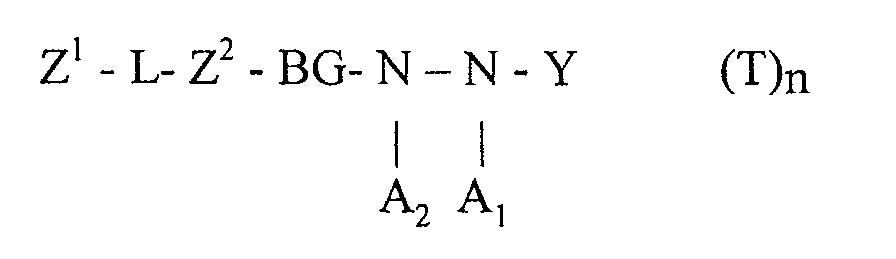 one of A1 and A2 is a hydrogen atom and the other is a hydrogen atom, an acyl group or an alkyl- or aryl-sulfonyl group, any of which groups may be substituted;Z1 and Z2 are the same or different and each is a nicotinamide residue, at least one of which is positively charged;Y is a substituted aryl or heterocyclic ring;L is a linking group;T is an anionic counterionand n is 1 or 2.
 - A photographic material according to either of the preceding claims characterised in that the nucleating agent of formula (I) has one of the formulae:-
 or
or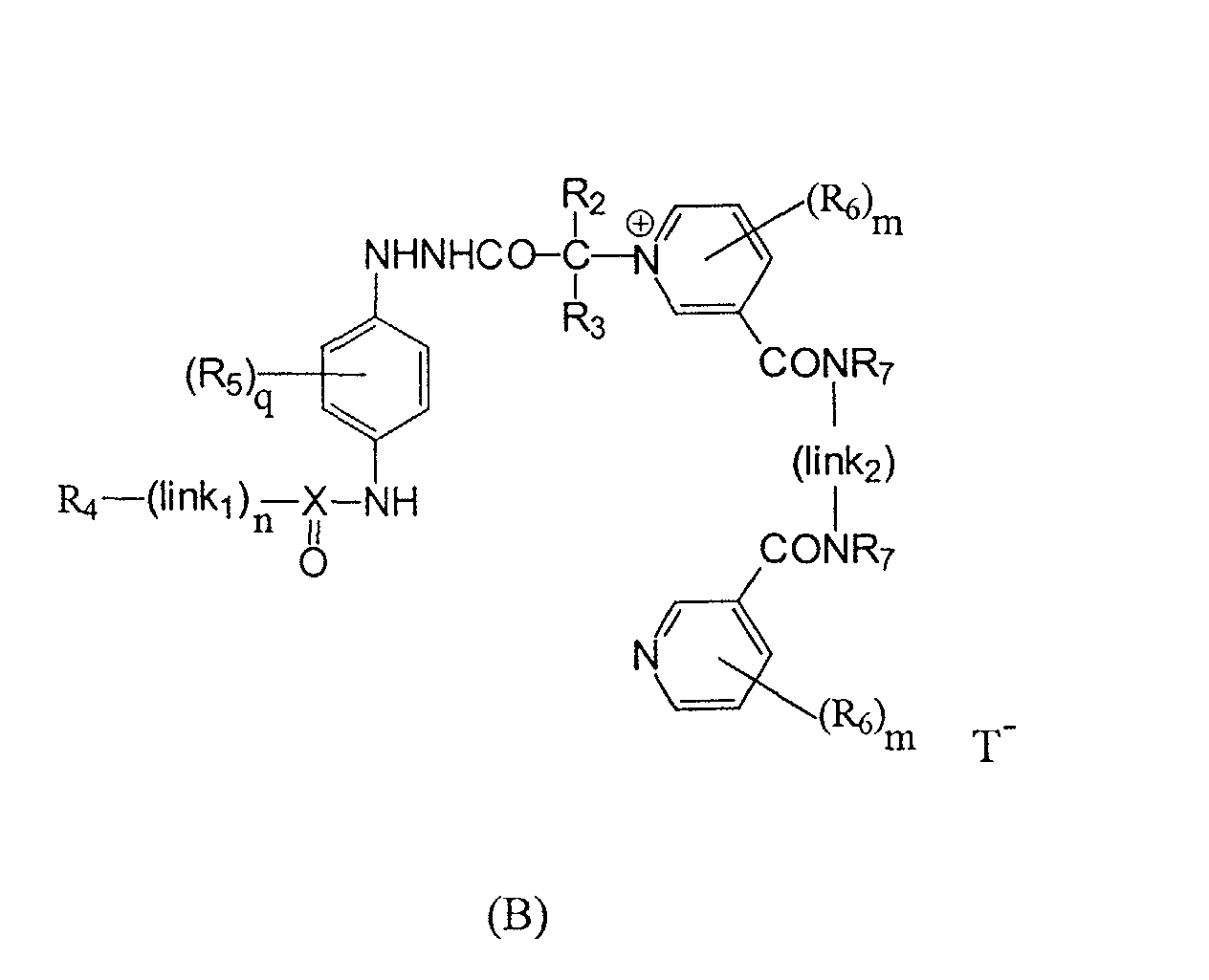 wherein
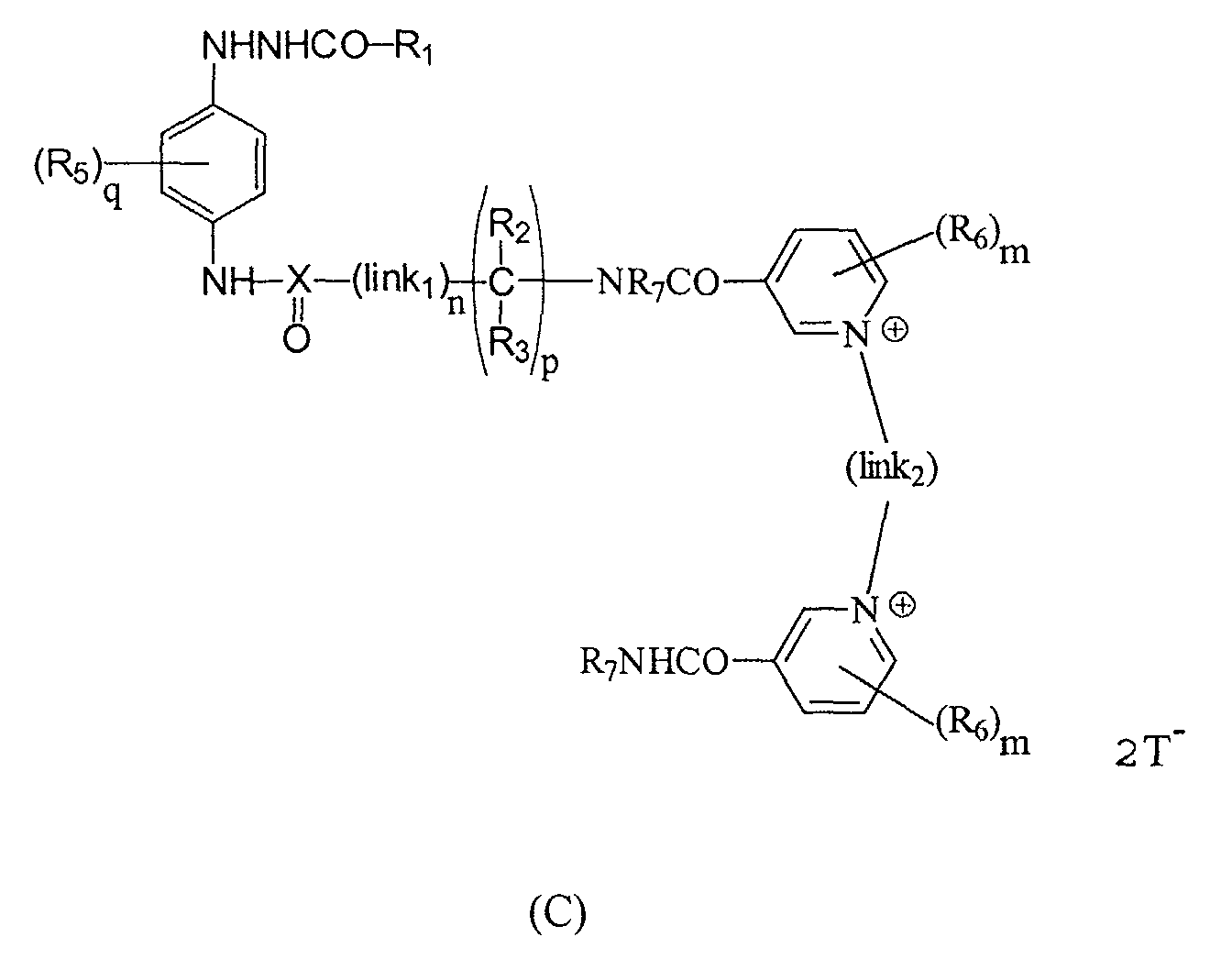 R1CO comprises a blocking group and R1 is selected from a hydrogen atom, and an unsubstituted or substituted alkyl, aryl, alkoxy, aryloxy, alkoxy- or aryloxy-carbonyl and alkyl- or aryl-aminocarbonyl group; or R1 is or contains an unsubstituted or substituted heterocyclic group, having a 5- or 6-membered ring containing at least one nitrogen, oxygen or sulfur atom, wherein the ring may be linked either directly to the carbonyl group or via an alkyl, alkoxy, carbonyl, amino- or alkylamino-carbonyl group and wherein the ring may be fused to a benzene ring;R2 and R3 are independently selected from hydrogen and an unsubstituted or substituted alkyl or aryl group and p is 0 or 1;R4 and each R5 and each R6 are independently selected from hydrogen, halogen, hydroxy, cyano and an unsubstituted or substituted alkyl, aryl, heterocyclyl, alkoxy, acyloxy, aryloxy, carbonamido, sulfonamido, ureido, thioureido, semicarbazido, thiosemicarbazido, urethane, quaternary ammonium, alkyl- or aryl-thio, alkyl- or aryl-sulfonyl, alkyl- or aryl-sulfinyl, carboxyl, alkoxy- or aryloxy-carbonyl, carbamoyl, sulfamoyl, phosphonamido, diacylamino, imido or acylurea group, a group containing a selenium or a tellurium atom, and a group having a tertiary sulfonium structure;each m is independently an integer from 0 to 4;q is an integer from 0 to 4;each R7 is independently selected from hydrogen and an unsubstituted or substituted alkyl or aryl group;X is selected from C, S=O and C-NH;(link1) is a linking group selected from an unsubstituted or substituted alkylene, polyalkylene, aryl, arylaminocarbonyl or heterocyclyl group and n is 0 or 1 ;(link2) is a linking group selected from an unsubstituted or substituted polyalkylene, polyalkylene oxide, polyalkylene containing one or more heteroatoms selected from nitrogen, oxygen and sulfur, separated from each other by alkylene groups, or an unsubstituted or substituted polyalkylene in which the alkylene groups are separated by an unsubstituted or substituted aryl or heterocyclic ring andT is an anionic counterion.
 - A photographic material according to claim 3 characterised in that R1 is the group -CONH(CH2)n-morpholino, wherein n is 0 to 4.
- A photographic material according to either of claims 3 and 4 characterised in that R2 and R3 are independently selected from hydrogen atoms or alkyl groups, R4 and each R5 and each R6 are independently selected from hydrogen, alkyl, alkoxy, alkylthio, trifluoromethyl or methylsulfonamido groups and each R7 is independently selected from hydrogen, an alkyl group or an alkyl group substituted with a dialkylamino group.
- A photographic material according to any one of claims 3 to 5 characterised in that when X is S=O or C-NH, n is 1 and when X is C, n is 0.
- A photographic material according to any one of the preceding claims characterised in that the nucleating agent of formula (I) has the formula:-

- A photographic material according to claim 1 characterised in that the nucleating agent of formula (II) has one of the formulae:-or
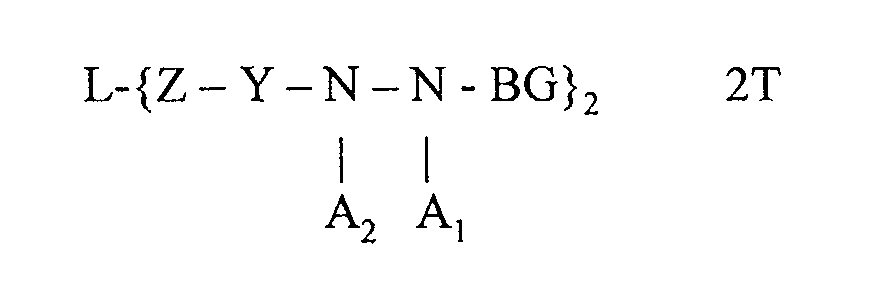 wherein
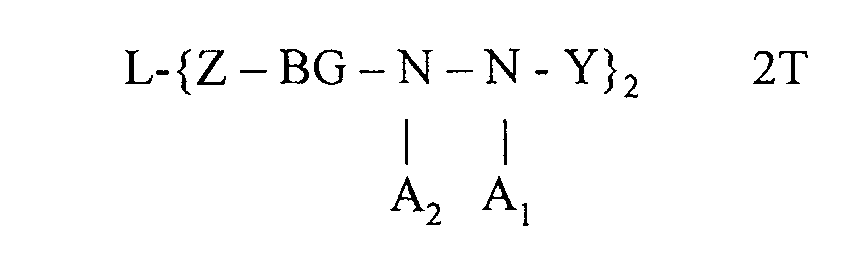 each monomer linked by linking group L is the same or different;Z is a positively charged nicotinamide residue; andY, A1, A2, BG and T are as defined in claim 2.
 - A photographic material according to claim 8 characterised in that the nucleating agent of formula (II) has one of the formulae:-
 or
or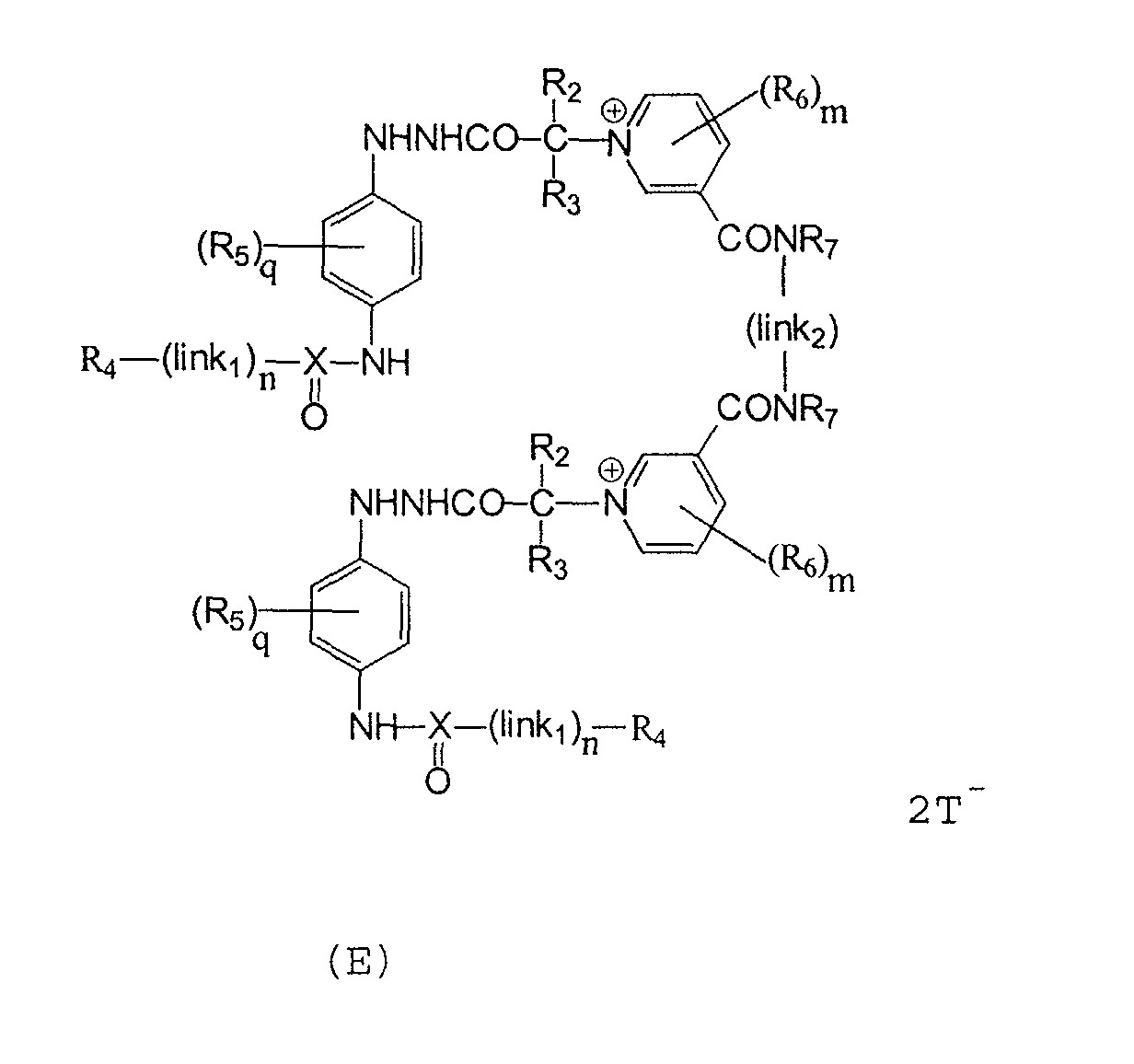 characterised in that each R1, each R2, each R3, each R4, each R5, each R6, each R7, each m, each n, each p, each q, each X and each (link1) is independently selected and, together with (link2) and T, is as defined in any one of claims 3 to 8.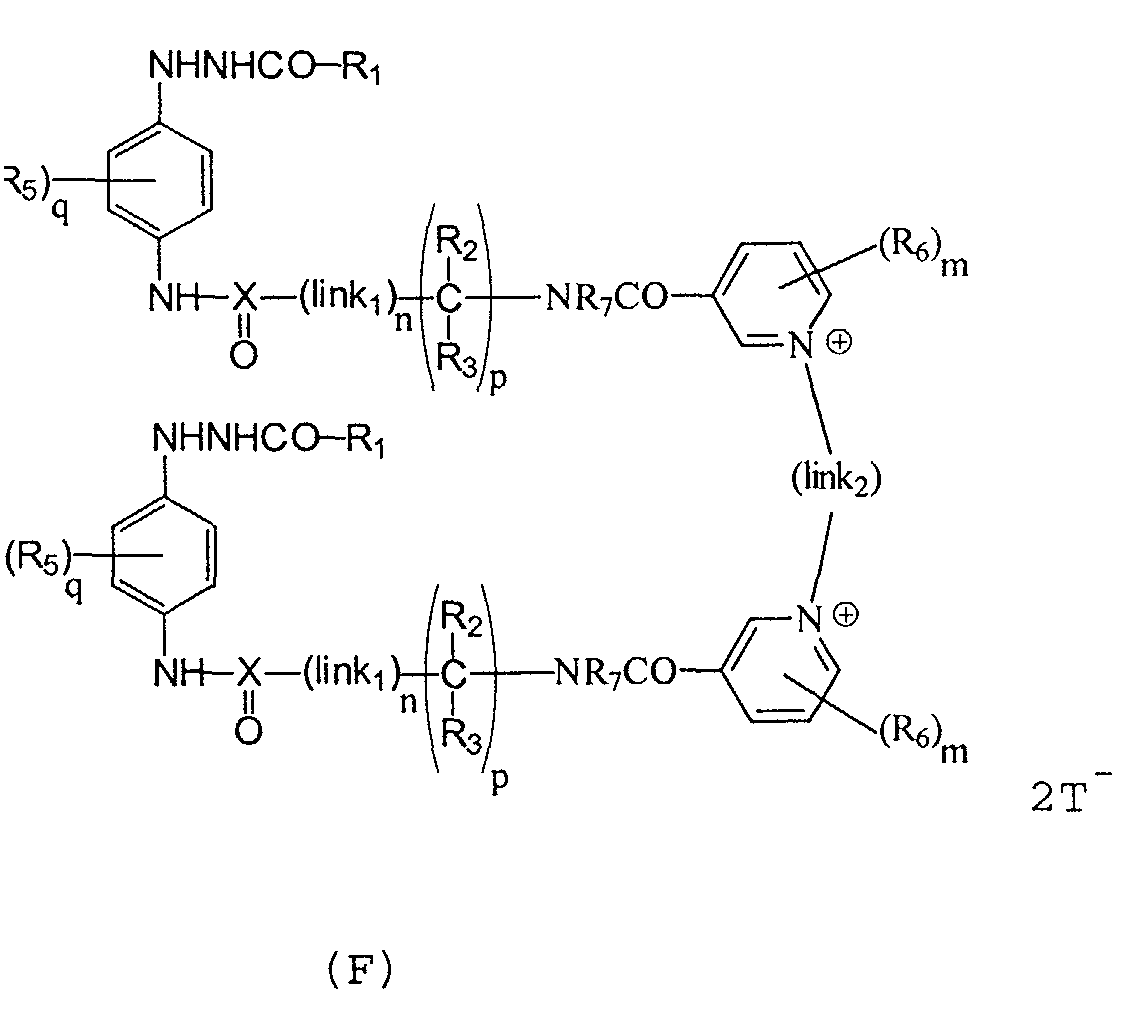
- A photographic material according to claim 9 characterised in that the nucleating agent of formula (II) has the formula:-
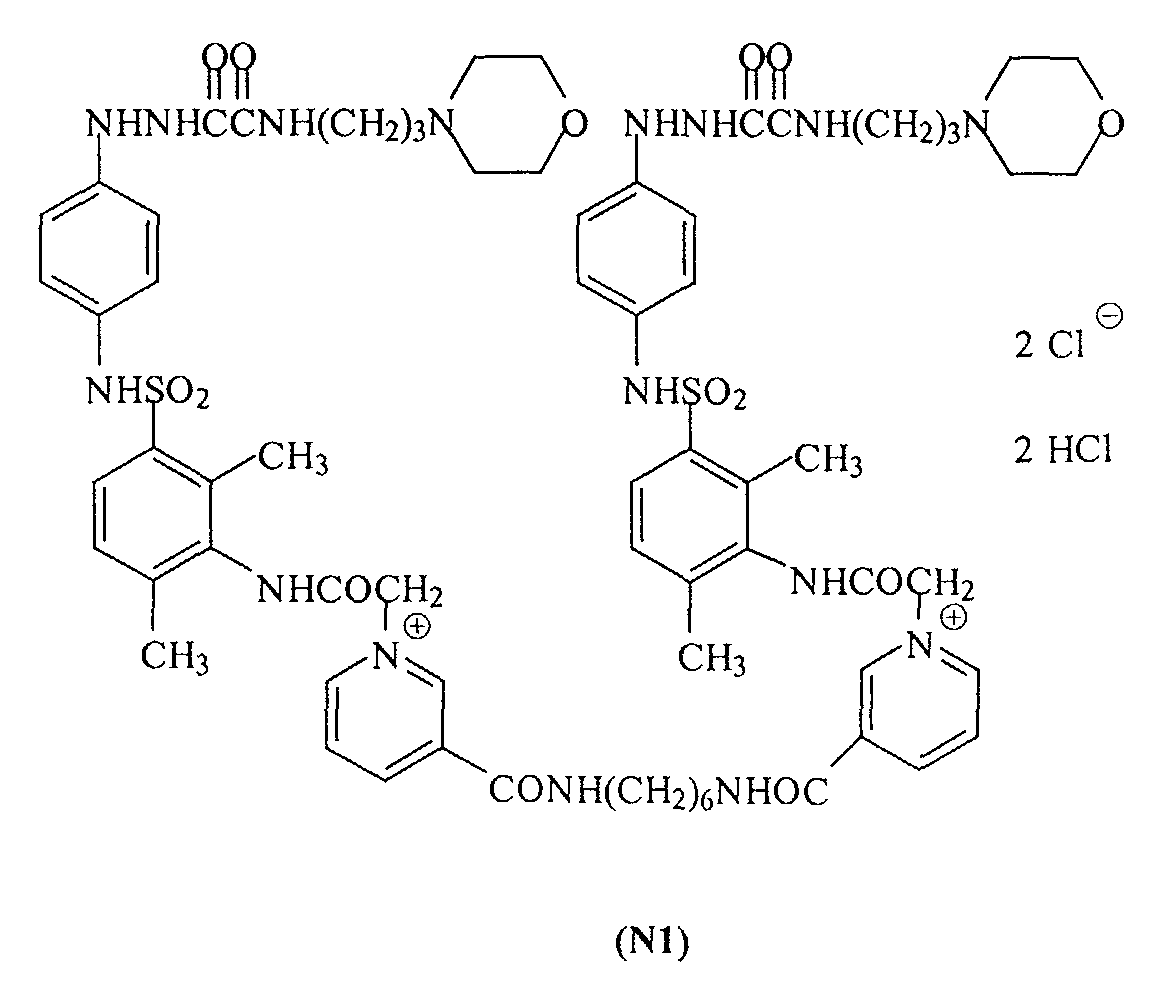
- A photographic material according to claim 1 characterised in that the nucleating agent of formula (III) has the formula:-wherein
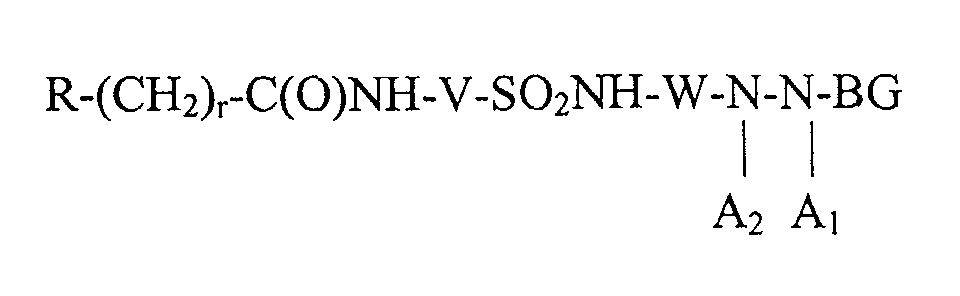 V and W are independently a substituted or unsubstituted arylene group;r is 1 to 6;R is selected from the class consisting of S-R', wherein R' is an unsubstituted or substituted monovalent group comprising at least three ethyleneoxy units, and a positively charged pyridinium residue substituted with from 1 to 3 unsubstituted or substituted alkyl groups, with its associated cation and A1, A2 and BG are as defined in claim 2.
 - A photographic material according to claim 11 characterised in that the nucleating agent of formula (III) has one of the formulae:-or
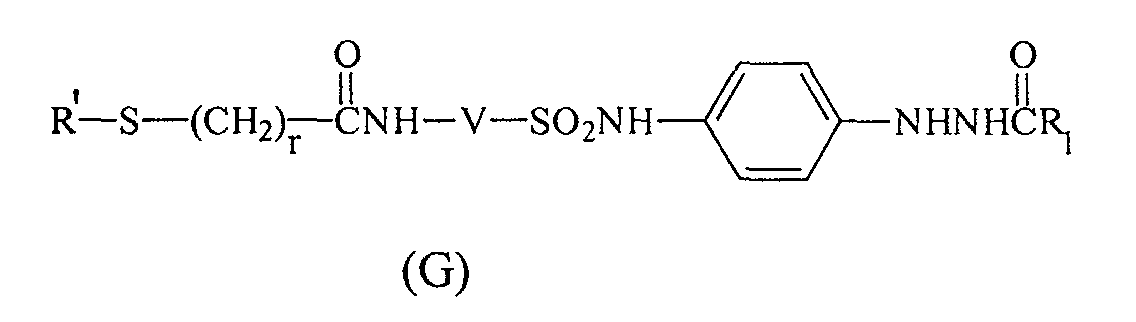 wherein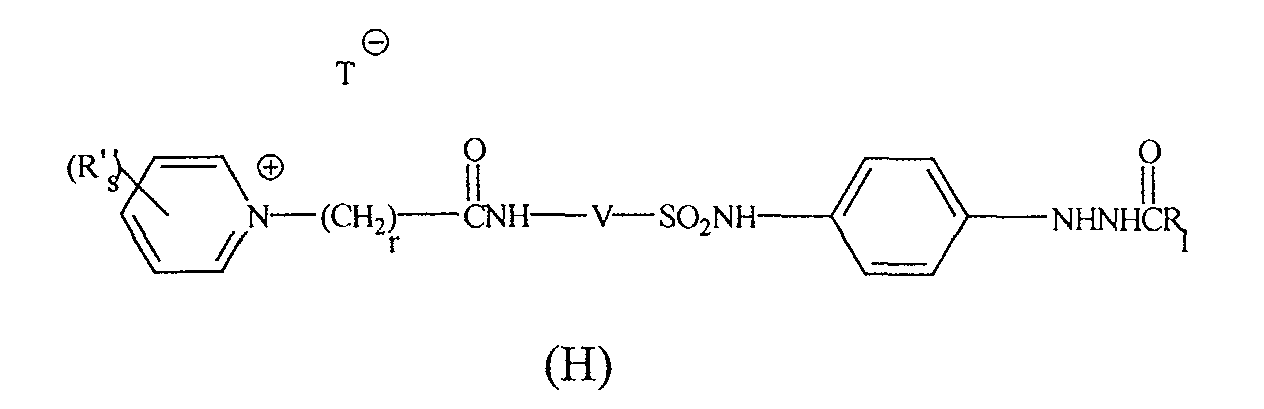
R1 is as defined in claim 3, V is an unsubstituted or substituted phenylene or naphthalene group, R' is an unsubstituted or substituted monovalent group comprising at least three ethyleneoxy units, R" is an unsubstituted or substituted alkyl group, r is 1 to 6, s is 1 to 3 and T- is an anionic counterion. - A photographic material according to claim 12 characterised in that in the nucleating agent of formula (III), (G), R1 is hydrogen, V is a phenylene group substituted with 2,4-dimethyl groups, r is 1 and R' is the group n-C8H17-(OCH2CH2)4-.
- A photographic material according to any one of the preceding claims characterised in that it also contains, in the emulsion layer or a hydrophilic colloid layer, a booster compound.
- A photographic material according to any one of the preceding claims characterised in that the total amount of nucleating agent of formula (I) and/or formula (II) is from about 0.3 µmol/m2 to about 70 µmol/m2 and the amount of nucleating agent of formula (III) is from about 0.14 µmol/m2 to about 70 µmol/m2.
- A photographic material according to any one of the preceding claims characterised in that the ratio of the amount of a nucleating agent of formula (I) and/or (II): a nucleating agent of formula (III) is greater than 1.0.
- A photographic material according to any one of the preceding claims characterised in that a nucleating agent of formula (I) is in combination with a nucleating agent of formula (II) and a nucleating agent of formula (III).
- A photographic material according to claim 17 characterised in that the amount of compound of formula (II) is greater than the amount of formula (I) and the relative proportion of compound of formula (I) to formula (II) is from about 10:90 to about 30:70.
- A process of forming a photographic image having ultrahigh contrast which comprises imagewise exposing a photographic material comprising a support bearing a silver halide emulsion layer and processing it with an alkaline developer solution, characterised in that it is developed in the presence of a combination of two or more hydrazide nucleating agents, comprising a nucleating agent of formula (I) and /or (II) with a nucleating agent of formula (III) as defined in any one of claims 1 to 14.
- A process according to claim 19 characterised in that the photographic material is developed in the presence of a booster compound.
Applications Claiming Priority (2)
| Application Number | Priority Date | Filing Date | Title |
|---|---|---|---|
| GB0102880 | 2001-02-06 | ||
| GBGB0102880.2A GB0102880D0 (en) | 2001-02-06 | 2001-02-06 | High contrast photographic element containing a novel combination of nucleators |
Publications (2)
| Publication Number | Publication Date |
|---|---|
| EP1229383A1 true EP1229383A1 (en) | 2002-08-07 |
| EP1229383B1 EP1229383B1 (en) | 2004-04-07 |
Family
ID=9908173
Family Applications (1)
| Application Number | Title | Priority Date | Filing Date |
|---|---|---|---|
| EP02075344A Expired - Lifetime EP1229383B1 (en) | 2001-02-06 | 2002-01-28 | High contrast photographic element containing a novel combination of nucleators |
Country Status (5)
| Country | Link |
|---|---|
| US (1) | US6573021B2 (en) |
| EP (1) | EP1229383B1 (en) |
| JP (1) | JP3943408B2 (en) |
| DE (1) | DE60200331T2 (en) |
| GB (1) | GB0102880D0 (en) |
Cited By (1)
| Publication number | Priority date | Publication date | Assignee | Title |
|---|---|---|---|---|
| US6713226B2 (en) | 2002-06-19 | 2004-03-30 | Eastman Kodak Company | High contrast photographic element containing a polyhydrazide nucleating agent |
Families Citing this family (3)
| Publication number | Priority date | Publication date | Assignee | Title |
|---|---|---|---|---|
| US8722322B2 (en) | 2012-01-31 | 2014-05-13 | Eastman Kodak Company | Photonic heating of silver grids |
| US20140231723A1 (en) | 2013-02-20 | 2014-08-21 | Kurt Michael Sanger | Enhancing silver conductivity |
| US20140367620A1 (en) | 2013-06-17 | 2014-12-18 | Ronald Anthony Gogle | Method for improving patterned silver conductivity |
Citations (3)
| Publication number | Priority date | Publication date | Assignee | Title |
|---|---|---|---|---|
| EP0458707A1 (en) * | 1990-05-24 | 1991-11-27 | Eastman Kodak Company | High contrast photographic element including an aryl sulfonamidophenyl hydrazide containing both thio and ethyleneoxy groups |
| EP1008902A1 (en) * | 1998-12-08 | 2000-06-14 | Eastman Kodak Company | High contrast photographic element containing a novel nucleator |
| EP1164413A1 (en) * | 2000-06-12 | 2001-12-19 | Eastman Kodak Company | High contrast photographic element containing a nucleator |
Family Cites Families (17)
| Publication number | Priority date | Publication date | Assignee | Title |
|---|---|---|---|---|
| US4030925A (en) | 1975-08-06 | 1977-06-21 | Eastman Kodak Company | Photographic compositions and elements including internal latent image silver halide grains and acylhydrazinophenylthiourea nucleating agents therefor |
| US4031127A (en) | 1975-08-06 | 1977-06-21 | Eastman Kodak Company | Acyl hydrazino thiourea derivatives as photographic nucleating agents |
| US4278748A (en) | 1979-07-25 | 1981-07-14 | Eastman Kodak Company | Absorbed hydrazide nucleating agents and photographic elements containing such agents |
| JPS5952820B2 (en) | 1979-11-06 | 1984-12-21 | 富士写真フイルム株式会社 | Silver halide photographic material |
| US4269929A (en) | 1980-01-14 | 1981-05-26 | Eastman Kodak Company | High contrast development of photographic elements |
| JPS60258537A (en) | 1984-06-05 | 1985-12-20 | Fuji Photo Film Co Ltd | Formation of high-contrast negative image |
| JPS61267759A (en) | 1985-05-22 | 1986-11-27 | Fuji Photo Film Co Ltd | Formation of negative image |
| US5104769A (en) | 1988-03-14 | 1992-04-14 | Eastman Kodak Company | High contrast photographic element and emulsion and process for their use |
| US4975354A (en) | 1988-10-11 | 1990-12-04 | Eastman Kodak Company | Photographic element comprising an ethyleneoxy-substituted amino compound and process adapted to provide high constrast development |
| US4994365A (en) | 1990-05-24 | 1991-02-19 | Eastman Kodak Company | High contrast photographic element including an aryl sulfonamidophenyl hydrazide containing an alkyl pyridinium group |
| JP2879119B2 (en) | 1991-03-11 | 1999-04-05 | 富士写真フイルム株式会社 | Image forming method |
| JP2709765B2 (en) | 1991-09-02 | 1998-02-04 | 富士写真フイルム株式会社 | Image forming method |
| US5316889A (en) | 1992-03-31 | 1994-05-31 | Fuji Photo Film Co., Ltd. | Silver halide photographic material and photographic image forming method using the same |
| US5744279A (en) | 1995-02-03 | 1998-04-28 | Fuji Photo Film Co., Ltd. | Silver halide photographic material |
| US6063541A (en) * | 1996-01-05 | 2000-05-16 | Kodak Polychrome Graphics Llc | Hydrazides |
| US5882841A (en) | 1996-12-26 | 1999-03-16 | Fuji Photo Film Co., Ltd. | Silver halide photographic light-sensitive material and method for processing thereof |
| US6245480B1 (en) * | 1998-12-08 | 2001-06-12 | Eastman Kodak Company | High contrast photographic element containing a novel nucleator |
-
2001
- 2001-02-06 GB GBGB0102880.2A patent/GB0102880D0/en not_active Ceased
-
2002
- 2002-01-07 US US10/040,672 patent/US6573021B2/en not_active Expired - Fee Related
- 2002-01-28 EP EP02075344A patent/EP1229383B1/en not_active Expired - Lifetime
- 2002-01-28 DE DE60200331T patent/DE60200331T2/en not_active Expired - Lifetime
- 2002-02-05 JP JP2002028451A patent/JP3943408B2/en not_active Expired - Fee Related
Patent Citations (3)
| Publication number | Priority date | Publication date | Assignee | Title |
|---|---|---|---|---|
| EP0458707A1 (en) * | 1990-05-24 | 1991-11-27 | Eastman Kodak Company | High contrast photographic element including an aryl sulfonamidophenyl hydrazide containing both thio and ethyleneoxy groups |
| EP1008902A1 (en) * | 1998-12-08 | 2000-06-14 | Eastman Kodak Company | High contrast photographic element containing a novel nucleator |
| EP1164413A1 (en) * | 2000-06-12 | 2001-12-19 | Eastman Kodak Company | High contrast photographic element containing a nucleator |
Cited By (1)
| Publication number | Priority date | Publication date | Assignee | Title |
|---|---|---|---|---|
| US6713226B2 (en) | 2002-06-19 | 2004-03-30 | Eastman Kodak Company | High contrast photographic element containing a polyhydrazide nucleating agent |
Also Published As
| Publication number | Publication date |
|---|---|
| JP2002244240A (en) | 2002-08-30 |
| US6573021B2 (en) | 2003-06-03 |
| US20020192589A1 (en) | 2002-12-19 |
| DE60200331D1 (en) | 2004-05-13 |
| GB0102880D0 (en) | 2001-03-21 |
| EP1229383B1 (en) | 2004-04-07 |
| DE60200331T2 (en) | 2005-05-04 |
| JP3943408B2 (en) | 2007-07-11 |
Similar Documents
| Publication | Publication Date | Title |
|---|---|---|
| US5316889A (en) | Silver halide photographic material and photographic image forming method using the same | |
| EP0539925A1 (en) | Silver halide photographic light sensitive material | |
| EP1229383B1 (en) | High contrast photographic element containing a novel combination of nucleators | |
| EP1008902B1 (en) | High contrast photographic element containing a novel nucleator | |
| US5939245A (en) | Au(I) sensitizers for silver halide emulsions | |
| US6245480B1 (en) | High contrast photographic element containing a novel nucleator | |
| US6713226B2 (en) | High contrast photographic element containing a polyhydrazide nucleating agent | |
| EP1164413B1 (en) | High contrast photographic element containing a nucleator | |
| EP1376220B1 (en) | Method for developing a high contrast photographic material containing a polyhydrazide nucleating agent | |
| US6296998B1 (en) | Photographic element containing bis Au(I) complexes and sulfiding agent | |
| US6368781B1 (en) | Heat sensitivity improvement with combinations of gold sensitization and spectral sensitizing dye and filter device | |
| US7090969B1 (en) | Coupler and image dye light-stabilizing systems | |
| US7108963B1 (en) | Stabilized silver halide photographic element | |
| EP0777149A2 (en) | Photographic elements with j-aggregating carbocyanine infrared sensitizing dyes | |
| US6573038B2 (en) | High chloride silver halide elements containing pyrimidine compounds | |
| US6444416B1 (en) | Color photographic element with improved developability | |
| DE60124855T2 (en) | Photographic silver halide material | |
| JP2003029368A (en) | Silver halide photographic sensitive material | |
| JPH09179259A (en) | Photographic element containing yellow dye forming coupler | |
| JP2002148748A (en) | Silver halide photosensitive material, processing method for the same, and image forming method using the same |
Legal Events
| Date | Code | Title | Description |
|---|---|---|---|
| PUAI | Public reference made under article 153(3) epc to a published international application that has entered the european phase |
Free format text: ORIGINAL CODE: 0009012 |
|
| AK | Designated contracting states |
Kind code of ref document: A1 Designated state(s): AT BE CH CY DE DK ES FI FR GB GR IE IT LI LU MC NL PT SE TR |
|
| AX | Request for extension of the european patent |
Free format text: AL;LT;LV;MK;RO;SI |
|
| 17P | Request for examination filed |
Effective date: 20030117 |
|
| AKX | Designation fees paid |
Designated state(s): DE FR GB |
|
| GRAP | Despatch of communication of intention to grant a patent |
Free format text: ORIGINAL CODE: EPIDOSNIGR1 |
|
| RTI1 | Title (correction) |
Free format text: HIGH CONTRAST PHOTOGRAPHIC ELEMENT CONTAINING A NOVEL COMBINATION OF NUCLEATORS |
|
| GRAS | Grant fee paid |
Free format text: ORIGINAL CODE: EPIDOSNIGR3 |
|
| GRAA | (expected) grant |
Free format text: ORIGINAL CODE: 0009210 |
|
| AK | Designated contracting states |
Kind code of ref document: B1 Designated state(s): DE FR GB |
|
| REG | Reference to a national code |
Ref country code: GB Ref legal event code: FG4D |
|
| REF | Corresponds to: |
Ref document number: 60200331 Country of ref document: DE Date of ref document: 20040513 Kind code of ref document: P |
|
| REG | Reference to a national code |
Ref country code: IE Ref legal event code: FG4D |
|
| ET | Fr: translation filed | ||
| PGFP | Annual fee paid to national office [announced via postgrant information from national office to epo] |
Ref country code: FR Payment date: 20050105 Year of fee payment: 4 |
|
| PLBE | No opposition filed within time limit |
Free format text: ORIGINAL CODE: 0009261 |
|
| STAA | Information on the status of an ep patent application or granted ep patent |
Free format text: STATUS: NO OPPOSITION FILED WITHIN TIME LIMIT |
|
| 26N | No opposition filed |
Effective date: 20050110 |
|
| PG25 | Lapsed in a contracting state [announced via postgrant information from national office to epo] |
Ref country code: GB Free format text: LAPSE BECAUSE OF NON-PAYMENT OF DUE FEES Effective date: 20060128 |
|
| PG25 | Lapsed in a contracting state [announced via postgrant information from national office to epo] |
Ref country code: FR Free format text: LAPSE BECAUSE OF NON-PAYMENT OF DUE FEES Effective date: 20060131 |
|
| GBPC | Gb: european patent ceased through non-payment of renewal fee |
Effective date: 20060128 |
|
| REG | Reference to a national code |
Ref country code: FR Ref legal event code: ST Effective date: 20060929 |
|
| PGFP | Annual fee paid to national office [announced via postgrant information from national office to epo] |
Ref country code: DE Payment date: 20130131 Year of fee payment: 12 |
|
| REG | Reference to a national code |
Ref country code: DE Ref legal event code: R119 Ref document number: 60200331 Country of ref document: DE |
|
| PG25 | Lapsed in a contracting state [announced via postgrant information from national office to epo] |
Ref country code: DE Free format text: LAPSE BECAUSE OF NON-PAYMENT OF DUE FEES Effective date: 20140801 |
|
| REG | Reference to a national code |
Ref country code: DE Ref legal event code: R119 Ref document number: 60200331 Country of ref document: DE Effective date: 20140801 |