EP1229055A1 - Process for the gas-phase (co)-polymerisation of olefins in a fluidised bed reactor - Google Patents
Process for the gas-phase (co)-polymerisation of olefins in a fluidised bed reactor Download PDFInfo
- Publication number
- EP1229055A1 EP1229055A1 EP01430006A EP01430006A EP1229055A1 EP 1229055 A1 EP1229055 A1 EP 1229055A1 EP 01430006 A EP01430006 A EP 01430006A EP 01430006 A EP01430006 A EP 01430006A EP 1229055 A1 EP1229055 A1 EP 1229055A1
- Authority
- EP
- European Patent Office
- Prior art keywords
- catalyst
- polymerisation
- compound
- compounds
- olefins
- Prior art date
- Legal status (The legal status is an assumption and is not a legal conclusion. Google has not performed a legal analysis and makes no representation as to the accuracy of the status listed.)
- Withdrawn
Links
Classifications
-
- C—CHEMISTRY; METALLURGY
- C08—ORGANIC MACROMOLECULAR COMPOUNDS; THEIR PREPARATION OR CHEMICAL WORKING-UP; COMPOSITIONS BASED THEREON
- C08F—MACROMOLECULAR COMPOUNDS OBTAINED BY REACTIONS ONLY INVOLVING CARBON-TO-CARBON UNSATURATED BONDS
- C08F10/00—Homopolymers and copolymers of unsaturated aliphatic hydrocarbons having only one carbon-to-carbon double bond
-
- C—CHEMISTRY; METALLURGY
- C08—ORGANIC MACROMOLECULAR COMPOUNDS; THEIR PREPARATION OR CHEMICAL WORKING-UP; COMPOSITIONS BASED THEREON
- C08F—MACROMOLECULAR COMPOUNDS OBTAINED BY REACTIONS ONLY INVOLVING CARBON-TO-CARBON UNSATURATED BONDS
- C08F210/00—Copolymers of unsaturated aliphatic hydrocarbons having only one carbon-to-carbon double bond
- C08F210/16—Copolymers of ethene with alpha-alkenes, e.g. EP rubbers
Definitions
- the present invention relates to a process for the (co-) polymerisation of olefins using a Ziegler-Natta type catalyst, in particular to a process for the gas-phase (co-) polymerisation of olefins in a fluidised bed reactor using a Ziegler-Natta type catalyst.
- the present invention also relates to a process for the manufacture of ethylene (co-) polymers with narrow molecular weight using said Ziegler-Natta type catalyst in particular during the gas-phase (co-) polymerisation of olefins in a fluidised bed reactor using said Ziegler-Natta type catalyst.
- the present invention further relates to a process the copolymerisation of olefins using a Ziegler-Natta type catalyst, with excellent comonomer reactivity (especially hexene reactivity), in particular during the gas-phase copolymerisation of olefins in a fluidised bed reactor using a Ziegler-Natta type catalyst.
- Processes for the co-polymerisation of olefins in the gas phase are well known in the art. Such processes can be conducted for example by introducing the gaseous monomer and comonomer into a stirred and/or fluidised bed comprising polyolefin and a catalyst for polymerisation.
- the polymerisation is conducted in a fluidised bed reactor wherein a bed of polymer particles is maintained in a fluidised state by means of an ascending gas stream comprising the gaseous reaction monomer.
- the start-up of such a polymerisation generally employs a bed of polymer particles similar to the polymer that it is desired to manufacture.
- fresh polymer is generated by the catalytic polymerisation of the monomer, and polymer product is withdrawn to maintain the bed at more or less constant volume.
- An industrially favoured process employs a fluidisation grid to distribute the fluidising gas to the bed, and to act as a support for the bed when the supply of gas is cut off.
- the polymer produced is generally withdrawn from the reactor via a discharge conduit arranged in the lower portion of the reactor, near the fluidisation grid.
- the fluidised bed consists in a bed of growing polymer particles. This bed is maintained in a fluidised condition by the continuous upward flow from the base of the reactor of a fluidising gas.
- the polymerisation of olefins is an exothermic reaction and it is therefore necessary to provide means to cool the bed to remove the heat of polymerisation. In the absence of such cooling the bed would increase in temperature and, for example, the catalyst would become inactive or the bed would begin to melt.
- the preferred method for removing the heat of polymerisation is by supplying to the polymerisation reactor a gas, the fluidising gas, which is at a temperature lower than the desired polymerisation temperature, passing the gas through the fluidised bed to conduct away the heat of polymerisation, removing the gas from the reactor and cooling it by passage through an external heat exchanger, and recycling it to the bed.
- the temperature of the recycle gas can be adjusted in the heat exchanger to maintain the fluidised bed at the desired polymerisation temperature.
- the recycle gas generally comprises the monomer and comonomer olefins, optionally together with, for example, an inert diluent gas such as nitrogen or a gaseous chain transfer agent such as hydrogen.
- an inert diluent gas such as nitrogen or a gaseous chain transfer agent such as hydrogen.
- the recycle gas is used to supply the monomer to the bed, to fluidise the bed, and to maintain the bed at the desired temperature.
- Monomers consumed by the polymerisation reaction are normally replaced by adding make up gas or liquid to the polymerisation zone or reaction loop.
- Ziegler-Natta type catalysts can advantageously be used for the (co-)polymerisation of olefins, particularly in slurry processes as well as in gas phase processes.
- a catalyst composition for the (co-) polymerisation of olefins optionally with an alpha olefin of 2 to 10 carbon atoms, which comprises a catalyst precursor and an organoaluminium cocatalyst, wherein the catalyst precursor comprises
- a catalyst composition for the (co-) polymerisation of olefins optionally with an alpha olefin of 2 to 10 carbon atoms, which comprises a catalyst precursor and an organoaluminium cocatalyst, wherein the catalyst precursor consists in the above 1, 2, 4 and 5 compounds; compound 3 may optionally be contained in said catalyst precursor.
- a supported alpha-olefin polymerisation catalyst composition of the present invention can advantageously be prepared in a multi-step process.
- a mixture of a solid, porous carrier and a non-polar solvent is contacted with at least one organomagnesium compound of the formula R m MgR' n , where R and R' are the same or different alkyl groups and m and n are each 0, 1 or 2, providing that m+n is 2.
- the mixture of the first step is optionally contacted with at least one aluminium containing compound.
- the mixture is contacted with a chelate compound.
- the mixture is then contacted with at least one transition metal compound soluble in the non-polar solvent.
- the resulting mixture is subsequently contacted with an organometallic compound.
- the resulting activated catalyst composition has substantially high productivity in the polymerisation of alpha-olefins, and is articularly useful for the manufacture of ethylene (co-)polymers with narrow molecular weight distribution ; further said catalyst composition also shows excellent comonomer response in the production of ethylene copolymers.
- the transition metal compound (preferably titanium) is incorporated onto a suitable support by impregnating this support with reactive magnesium and then optionally an aluminium compound and utilising this supported reactive magnesium to react with a chelate compound which is subsequently reacted with a tetravalent titanium (i.e. titanium in the plus 4 valence state) in a liquid medium. Unreacted titanium is soluble in this liquid medium, while reacted titanium and supported reactive magnesium-chelate compound are insoluble in this liquid medium.
- the concept of supporting a material on a carrier is intended to connote the incorporation of material (e.g. magnesium compounds and/or titanium compounds) onto the carrier by physical or chemical means. Accordingly, supported material need not necessarily be chemically bound to the carrier.
- Suitable carrier materials that may be treated include solid, porous carrier materials such as silica, alumina and combinations thereof. Such carrier materials may be amorphous or crystalline in form. These carriers may be in the form of particles having a particle size of from about 0.1 micron to about 250 microns, preferably from 10 to about 200 microns, and most preferably from about 10 to about 80 microns. Preferably, the carrier is silica in the form of spherical particles, e.g. spray dried silica. The carrier material is also porous. The internal porosity of these carriers may be larger than 0.2 cm 3 /g.
- the specific surface area of these carriers is at least 3m 2 /g, preferably at least about 50 m 2 /g, and more preferably from, e.g., about 150 to about 1500 m 2 /g. It is desirable to remove physically bound water from the carrier material prior to contacting this material with water-reactive magnesium compounds. This water removal may be accomplished by heating the carrier material to a temperature from about 100°C to an upper limit of temperature represented by the temperature at which change of state or sintering occurs. A suitable range of temperatures may, thus, be from about 100°C to about 800°C, e.g., from about 150°C to about 700°C.
- Silanol groups represented by the presence of Si-OH groups in the carrier may be present when the carrier is contacted with water-reactive magnesium compounds in accordance with an aspect of the present invention. These Si-OH groups may be present at about 0.3 mmoles or more per gram of carrier. Accordingly, an amount of, e.g., from about 0.5 to about 5 mmoles of OH groups per gram of carrier may be present, but a preferred range is from about 0.3 to about 0.9 mmoles of OH groups per gram of carrier. Excess OH groups present in the carrier may be removed by heating the carrier for a sufficient time at a sufficient temperature to accomplish the desired removal.
- a relatively small number of OH groups may be removed by sufficient heating at from about 150°C to about 250°C.
- a relatively large number of OH groups may be removed by sufficient heating at least 500°C to 800°C, most especially, from about 550°C to about 700°C.
- the duration of heating may be from 4 to 16 hours.
- the carrier is silica which, prior to the use thereof in the first catalyst synthesis step, has been dehydrated by fluidising it with nitrogen or air and heating at 700°C. for at least 4 hours to achieve a surface hydroxyl group concentration of about 0.6 millimoles per gram.
- the surface hydroxyl concentration of silica may be determined according to J. B. Peri and A. L.
- silica has been dehydrated by fluidising with nitrogen or air and heated at about 700°C for about 5 hours, then the surface hydroxyl concentration is about 0.55 mmols/g.
- the carrier material is slurried in a non-polar solvent and the resulting slurry is contacted with at least one organomagnesium compound.
- the slurry of the carrier material in the solvent is prepared by introducing the carrier into the solvent, preferably while stirring, and heating the mixture to about 25°C to about 100°C, preferably to about 35°C to about 75°C.
- the slurry is then contacted with the aforementioned organomagnesium compound, while the heating is continued at the aforementioned temperature.
- the organomagnesium compound has the empirical formula R m Mg R' n where R and R' are the same or different alkyl groups, preferably C 2 -C 12 alkyl groups, preferably C 4 -C 10 alkyl groups, more preferably C 4 -C 8 alkyl groups, and most preferably both R and R' are butyl groups, and m and n are each 0, 1 or 2, providing that m+n is 2. Butylethylmagnesium, butyloctylmagnesium and dibutylmagnesium are preferably used according to the present invention, dibutylmagnesium being the most preferred.
- Suitable non-polar solvents are materials in which all of the reactants used herein, e.g., the organomagnesium compound, the optional aluminium containing compound, the chelate compound, and the transition metal compound, are at least partially soluble.
- Preferred non-polar solvents are alkanes, such as isopentane, hexane, n-heptane, octane, nonane, and decane, although a variety of other materials including cycloalkanes, such as cyclohexane, aromatics, such as benzene and ethylbenzene, may also be employed.
- the most preferred non-polar solvents are isopentane, hexane, and heptane. Prior to use, the non-polar solvent should be purified, such as by percolation through silica gel and/or molecular sieves, to remove traces of water, oxygen, polar compounds, and other materials capable of adversely affecting catalyst activity.
- the carrier drying temperature affects the number of sites on the carrier available for the organomagnesium compound--the higher the drying temperature the lower the number of sites.
- the exact molar ratio of the organomagnesium compound to the hydroxyl groups will vary and must be determined on a case-by-case basis to assure that only so much of the organomagnesium compound is added to the solution as will be deposited onto the support without leaving any excess of the organomagnesium compound in the solution.
- the molar amount of the organomagnesium compound deposited onto the support is greater than the molar content of the hydroxyl groups on the support.
- the molar ratios given below are intended only as an approximate guideline and the exact amount of the organomagnesium compound in this embodiment must be controlled by the functional limitation discussed above, i.e., it must not be greater than that which can be deposited onto the support. If greater than that amount is added to the solvent, the excess may react with the reagents added subsequently, thereby forming a precipitate outside of the support which is detrimental in the synthesis of our catalyst and must be avoided.
- the amount of the organomagnesium compound which is not greater than that deposited onto the support can be determined in any conventional manner, e.g., by adding the organomagnesium compound to the slurry of the carrier in the solvent, while stirring the slurry, until the organomagnesium compound is detected in the solvent.
- the amount of the organomagnesium compound added to the slurry is such that the molar ratio of Mg to the hydroxyl groups (OH) on the solid carrier is about 1:1 to about 4:1, preferably about 1.1:1 to about 2.8:1, more preferably about 1.2:1 to about 2:1 and most preferably about 1.8:1.
- the organomagnesium compound dissolves in the non-polar solvent to form a solution from which the organomagnesium compound is deposited onto the carrier. It is also possible to add such an amount of the organomagnesium compound which is in excess of that which will be deposited onto the support, and then remove, e.g., by filtration and washing, any excess of the organomagnesium compound.
- the amount of magnesium compound that is impregnated onto the carrier is usually comprised between 0.5 and 2.4 of mmoles of magnesium compound per gram of catalyst carrier, preferably comprised between 0.7 and 1.8.
- An optional component in the production of the catalyst composition of the invention is an aluminium containing compound.
- This component can be added to the slurry with or after the reactive magnesium compound.
- the aluminium containing compound can be chosen from a range of known compounds, including preferably those having the formula AlY 3 , wherein each Y is the same or different and is R or O-R wherein R is an alkyl group, preferably a C 1 -C 12 alkyl group, more preferably C 1 -C 2 alkyl group or halide ; AlY3 is preferably triethylaluminium.
- This contacting step is usually conducted at a temperature comprised between 25°C and 100°C, preferably between 40°C and 60°C.
- the aluminium containing compound is added to the slurry in an amount such to provide a molar ratio of aluminium containing compound to Mg of 0.1 to 4.0 , preferably about 0.1 to about 3.0 , more preferably about 0.1 to 2.5.
- the chelate compounds used in the present invention can be chosen e.g. amongst bidentate ligands which are exemplified by diketone ligands, especially 2,4 diketones substituted in the 1 and 5 positions; 1,3 diketones substituted in the 2 position; beta-keto-esters, and 2-acetylcycloalkanones.
- Amide ligand compounds can also be used ; various types of amide compounds can be employed for the purpose of this invention.
- carbodiimide type compounds such as dimethylcarbodiimide, dicyclohexylcarbodiimide, 1,3-bis-trimethylsilylcarbodiimide and the like ; or diketiminato type compounds such as 2-(p-tolylamino)-4-(p-tolylimino)-2-pentene, 2-((2,6-diisopropylphenyl)amino)-4((2,6-diisopropylphenyl)imino)-2-pentene and the like may be used.
- the preparation method for diketiminato type ligands are reported in Organometallics 1998, 17, 3070 and Tetrahedron Letter 1990, 31, 6005.
- Carbodiimide compounds, e.g 2-phenylamino-4-phenyl-imino-2-pentene and its derivatives, and phenylisocyanate and its derivatives can also be advantageously used.
- the slurry of the carrier material and of the organomagnesium compound in the solvent is maintained at temperatures of about 0°C to about 60°C, before the introduction of the chelate compound.
- the chelate compound is preferably introduced after organomagnesium incorporation and before the transition metal incorporation into the catalyst.
- the amount of the chelate compound added to the slurry is such that the molar ratio of the chelate compound to Mg is about 0.10 to about 5.00 , preferably 0.2 to 2.
- the slurry is contacted with at least one transition metal compound soluble in the non-polar solvent, preferably after the addition of the chelate compound is completed.
- This synthesis step is conducted at about 25°C to about 70°C, preferably at about 40°C to about 60°C, and most preferably at about 45°C to about 60°C.
- the amount of the transition metal compound added is not greater than that which can be deposited onto the carrier.
- Said transition metal loading is preferably comprised between 0.5 and 3 mmol of transition metal per g of carrier, e.g. SiO 2 .
- the exact molar ratio of Mg to the transition metal and of the transition metal to the hydroxyl groups of the carrier will therefore vary (depending, e.g., on the carrier drying temperature) and must be determined on a case-by-case basis.
- the amount of the transition metal compound is such that the molar ratio of the transition metal, derived from the transition metal compound, to the hydroxyl groups of the carrier is about 0.25 to about 2.0, preferably about 1.3 to about 2.0.
- the amount of the transition metal compound is also such that the molar ratio of Mg to the transition metal is about 0.5 to about 3, preferably about 1 to about 2.
- Suitable transition metal compounds used herein are compounds of metals of Groups 4, 5, or 6 as adopted by the new IUPAC notation, providing that such compounds are soluble in the non-polar solvents.
- Non-limiting examples of such compounds are titanium halides, e.g., titanium tetrachloride, titanium alkoxides e.g., where the alkoxide moiety contains an alkyl radical of 1 to 6 carbon atoms or combinations, vanadium halides, and vanadium alkoxides.
- the preferred transition metal compounds are titanium compounds, preferably tetravalent titanium compounds.
- the most preferred titanium compound is titanium tetrachloride. Mixtures of such transition metal compounds may also be used and generally no restrictions are imposed on the transition metal compounds which may be included. Any transition metal compound that may be used alone may also be used in conjunction with other transition metal compounds.
- the reaction of the transition metal compound, such as the tetravalent titanium compound, in the liquid medium conveniently takes place by slurrying the solid carrier containing the reactive magnesium-chelate species in a solution of the tetravalent titanium compound and heating the reaction medium to a suitable reaction temperature.
- Preferred solvents for the tetravalent titanium compound are hexane or isopentane or heptane.
- Suitable activators include organometallic compounds.
- the activators are organoaluminum compounds, preferably trialkylaluminum compounds which contain alkyl groups of 1 to 6 carbon atoms, preferably of 1 to 4. More preferably, the activators are triethylaluminum or trimethylaluminum.
- the catalyst may be activated in situ by adding the activator and catalyst precursor separately to the polymerisation medium. It is also possible to combine the catalyst precursor and activator before introduction into the polymerisation medium, e.g., for up to about 2 hours at a temperature from about -40°C to about 80°C.
- a suitable activating amount of the activator may be used.
- the number of moles of activator per gram atom of titanium in the catalyst may be, e.g., from about 1 to about 100 and is preferably greater than about 5.
- the process according to the present invention is particularly suitable for the manufacture of polymers in a continuous gas fluidised bed process.
- the polymer is a polyolefin preferably copolymers of ethylene and/or propylene and/or butene.
- Preferred alpha-olefins used in combination with ethylene and/or propylene and/or butene in the process of the present invention are those having from 4 to 8 carbon atoms.
- small quantities of alpha olefins having more than 8 carbon atoms, for example 9 to 40 carbon atoms (e.g. a conjugated diene) can be employed if desired.
- the preferred alpha-olefins are but-1-ene, pent-1-ene, hex-1-ene, 4-methylpent-1-ene, oct-1-ene and butadiene.
- Examples of higher olefins that can be copolymerised with the primary ethylene and/or propylene monomer, or as partial replacement for the C4-C8 monomer are dec-1-ene and ethylidene norbornene.
- the process of the present invention preferably applies to the manufacture of polyolefins in the gas phase by the copolymerisation of ethylene with but-1-ene and/or hex-1-ene and/or 4-methylpent-1-ene.
- the process according to the present invention may particularly be used to prepare a wide variety of polymer products for example linear low density polyethylene (LLDPE) based on copolymers of ethylene with but-1-ene, 4-methylpent-1-ene or hex-1-ene and high density polyethylene (HDPE) which can be for example copolymers of ethylene with a small portion of higher alpha olefin, for example, but-1-ene, pent-1-ene, hex-1-ene or 4-methylpent-1-ene.
- LLDPE linear low density polyethylene
- HDPE high density polyethylene
- the process is particularly suitable for polymerising olefins at an absolute pressure of between 0.5 and 6 MPa and at a temperature of between 30°C and 130°C.
- the temperature is suitably in the range 75-95°C and for HDPE the temperature is typically 80-112°C depending on the activity of the catalyst used and the polymer properties desired.
- the polymerisation is preferably carried out continuously in a vertical fluidised bed reactor according to techniques known in themselves and in equipment such as that described in French Patent Application 0004757 (filing number), European patent application EP-0 855 411, French Patent No. 2,207,145 or French Patent No. 2,335,526.
- the process of the invention is particularly well suited to industrial-scale reactors of very large size.
- the reactor used in the present invention is capable of producing greater than 300 kg/h to about 80,000 kg/h or higher of polymer, preferably greater than 10,000 kg/h.
- the catalyst according to the present invention can be used as it is or optionally in the form of a coated catalyst or prepolymer containing, for example, from 10 -5 to 3, preferably from 10 -3 to 10 -1 , millimoles of titanium per gram of polymer.
- olefin(s), preferably ethylene or propylene or combinations thereof are prepolymerised in the presence of the catalyst or catalyst system of the present invention prior to the main polymerisation.
- the prepolymerisation can be carried out batchwise or continuously in gas, solution or slurry phase including at elevated pressures.
- the prepolymerisation can take place with any alpha-olefin monomer or combination and/or in the presence of any molecular weight controlling agent such as hydrogen.
- the supported catalyst system of the invention includes an antistatic agent, for example, those described in U.S. Pat. No. 5,283,278, which is fully incorporated herein by reference.
- antistatic agents include, alcohol, thiol, silanol, diol, ester, ketone, aldehyde, acid, amine, and ether compounds. Tertiary amines, ethoxylated amines, and polyether compounds are preferred.
- the antistatic agent can be added at any stage in the formation of the supported catalyst system of the invention.
- the supported catalyst system of the invention includes a polyolefin wax or tackifier or the like.
- Alpha-olefins may be polymerised with the catalysts prepared according to aspects of the present invention by any suitable process.
- Such processes include polymerisation's carried out in suspension, in solution or in the gas phase.
- Gas phase polymerisation's are preferred such as those taking place in stirred bed reactors and, especially, fluidised bed reactors.
- the fluid bed reactor is operated at pressures of up to about 1000 psi, and is preferably operated at a pressure of from about 150 to 350 psi, with operation at the higher pressures in such ranges favouring heat transfer since an increase in pressure increases the unit volume heat capacity of the gas.
- the partially or completely activated catalyst is injected into the bed at a rate equal to its consumption.
- the production rate of the bed is controlled by the rate of catalyst injection.
- the production rate may be increased by simply increasing the rate of catalyst injection and decreased by reducing the rate of catalyst injection.
- the temperature of the recycle gas is adjusted upwards or downwards to accommodate the change in rate of heat generation. This insures the maintenance of an essentially constant temperature in the bed.
- the molecular weight of the polymer may be controlled in a known manner, preferably by using hydrogen.
- molecular weight may be suitably controlled with hydrogen when the polymerisation is carried out at relatively low temperatures, e.g., from about 30°C to about 115°C. This control of molecular weight may be evidenced by a measurable positive change in melt index (I 2 ) for the polymer produced.
- the catalysts prepared according to aspects of the present invention are highly active and are useful for the production of both linear low density and high density polyethylene polymers.
- Such linear low density polyethylene polymers may have a density of 0.94 g/cc or less, preferably 0,930 or less or even 0.925 g/cc or less.
- linear low density polyethylene polymers are described in the Anderson et al U.S. Pat. No. 4,076,698.
- These linear low density polyethylene polymers may be polymers of ethylene with one or more C 3 -C 10 alpha-olefins.
- copolymers having two monomeric units are possible as well as terpolymers having three monomeric units.
- polymers include ethylene/1-butene copolymers, ethylene/1-hexene copolymers, ethylene/4-methyl-1-pentene copolymers, ethylene/1-butene/1-hexene terpolymers, ethylene/propylene/1-hexene terpolymers and ethylene/propylene/1-butene terpolymers.
- propylene is employed as a comonomer
- the resulting linear low density polyethylene polymer preferably has at least one other alphaolefin comonomer having at least four carbon atoms in an amount of, e.g. at least 1 percent by weight of the polymer. Accordingly, ethylene/propylene copolymers are possible, but not preferred.
- the molecular weight distribution of the polymers prepared in the presence of the catalysts of the present invention varies from about 20 to 35 for LLDPE products having a density of about 0.900 to about 0.940 g/cc, and an I 2 (melt index) of about 0.1 to about 100.
- MFR values are indicative of a relatively narrow molecular weight distribution of the polymer.
- MFR values are indicative of polymers especially suitable for injection moulding applications since polymers having such MFR values exhibit relatively low amounts of warpage and shrinkage on cooling of the injection moulded products.
- the relatively low MFR values of polymers prepared with the catalysts of this invention also indicate that they are suitable for the preparation of various film products since such films are likely to have excellent strength properties.
- the linear low density polyethylene polymers produced in accordance with certain aspects of the present invention preferably contain at least about 80 percent by weight of ethylene units. Most preferably, the linear low density copolymers of the invention contain at least 2 weight percent, for example from 2 to 20 weight percent of an alpha olefin copolymerised therein.
- Table 1 lists the formulations that were synthesised.
- Cat no° Chelate Formulation (mmol/gSi) Analysis (ICP) MgBu2/ Chelate TiCl4 Ti (wt%):Mg (wt)% SS526 hexafluoropentanedione 1 0,7 1 3.0:1.7 SS527 hexafluoropentanedione 1 1,3 1 3.1:1.6 SS516 acetylacetonate 1 0,7 1 3.8:1.9 SS518 acetylacetonate 1 1,3 1 3.5:1.6 SS517 tetramethylheptanedione 1 0,7 1 3.3:1.6 SS519 tetramethylheptanedione 1 1,3 1 3.3:1.4 SS532 tetramethylheptanedione 1 1 1 3.1:1.7 GP554 dibenzoylmethane 1 0,7 1 3.1:1.6 GP555 dibenzoylmethane 1 1,3 1
- Ethylene/1-hexene copolymers were prepared with the catalyst precursors whose syntheses are described above. Triethylaluminum (TEAL) was used as cocatalyst
Landscapes
- Chemical & Material Sciences (AREA)
- Health & Medical Sciences (AREA)
- Chemical Kinetics & Catalysis (AREA)
- Medicinal Chemistry (AREA)
- Polymers & Plastics (AREA)
- Organic Chemistry (AREA)
- Transition And Organic Metals Composition Catalysts For Addition Polymerization (AREA)
- Addition Polymer Or Copolymer, Post-Treatments, Or Chemical Modifications (AREA)
Abstract
The present invention relates to a process for the (co-) polymerisation of olefins
using a Ziegler-Natta type catalyst, in particular to a process for the gas-phase
(co-) polymerisation of olefins in a fluidised bed reactor using a Ziegler-Natta type
catalyst.
Description
- The present invention relates to a process for the (co-) polymerisation of olefins using a Ziegler-Natta type catalyst, in particular to a process for the gas-phase (co-) polymerisation of olefins in a fluidised bed reactor using a Ziegler-Natta type catalyst.
- The present invention also relates to a process for the manufacture of ethylene (co-) polymers with narrow molecular weight using said Ziegler-Natta type catalyst in particular during the gas-phase (co-) polymerisation of olefins in a fluidised bed reactor using said Ziegler-Natta type catalyst.
- The present invention further relates to a process the copolymerisation of olefins using a Ziegler-Natta type catalyst, with excellent comonomer reactivity (especially hexene reactivity), in particular during the gas-phase copolymerisation of olefins in a fluidised bed reactor using a Ziegler-Natta type catalyst.
- Processes for the co-polymerisation of olefins in the gas phase are well known in the art. Such processes can be conducted for example by introducing the gaseous monomer and comonomer into a stirred and/or fluidised bed comprising polyolefin and a catalyst for polymerisation.
- In the gas fluidised bed polymerisation of olefins, the polymerisation is conducted in a fluidised bed reactor wherein a bed of polymer particles is maintained in a fluidised state by means of an ascending gas stream comprising the gaseous reaction monomer. The start-up of such a polymerisation generally employs a bed of polymer particles similar to the polymer that it is desired to manufacture. During the course of polymerisation, fresh polymer is generated by the catalytic polymerisation of the monomer, and polymer product is withdrawn to maintain the bed at more or less constant volume. An industrially favoured process employs a fluidisation grid to distribute the fluidising gas to the bed, and to act as a support for the bed when the supply of gas is cut off. The polymer produced is generally withdrawn from the reactor via a discharge conduit arranged in the lower portion of the reactor, near the fluidisation grid. The fluidised bed consists in a bed of growing polymer particles. This bed is maintained in a fluidised condition by the continuous upward flow from the base of the reactor of a fluidising gas.
- The polymerisation of olefins is an exothermic reaction and it is therefore necessary to provide means to cool the bed to remove the heat of polymerisation. In the absence of such cooling the bed would increase in temperature and, for example, the catalyst would become inactive or the bed would begin to melt. In the fluidised bed polymerisation of olefins, the preferred method for removing the heat of polymerisation is by supplying to the polymerisation reactor a gas, the fluidising gas, which is at a temperature lower than the desired polymerisation temperature, passing the gas through the fluidised bed to conduct away the heat of polymerisation, removing the gas from the reactor and cooling it by passage through an external heat exchanger, and recycling it to the bed. The temperature of the recycle gas can be adjusted in the heat exchanger to maintain the fluidised bed at the desired polymerisation temperature. In this method of polymerising alpha olefins, the recycle gas generally comprises the monomer and comonomer olefins, optionally together with, for example, an inert diluent gas such as nitrogen or a gaseous chain transfer agent such as hydrogen. Thus, the recycle gas is used to supply the monomer to the bed, to fluidise the bed, and to maintain the bed at the desired temperature. Monomers consumed by the polymerisation reaction are normally replaced by adding make up gas or liquid to the polymerisation zone or reaction loop.
- It is well known that Ziegler-Natta type catalysts can advantageously be used for the (co-)polymerisation of olefins, particularly in slurry processes as well as in gas phase processes.
- In the course of their research developments, the applicants have now found a new method for manufacturing ethylene (co-)polymers with narrow molecular weight distributions, in particular during the gas-phase (co-)polymerisation of olefins using said Ziegler-Natta type catalyst, especially during the gas-phase (co-)polymerisation of ethylene in a fluidised bed reactor using said Ziegler-Natta type catalyst. What is also unexpected from these Ziegler-Natta type catalysts is the excellent comonomer reactivity. It is known to those skilled in the art that Ziegler-Natta type catalysts with excellent comonomer reactivity can lead to, considerable process simplifications especially during the gas-phase (co-) polymerisation of ethylene in a fluidised bed reactor. Excessive comonomer present in gas-phase fluidised bed reactor can lead to poor powder flowability and result in difficulty in removing powder from the reactor.
- According to an embodiment of the present invention, there is provided a catalyst composition for the (co-) polymerisation of olefins, optionally with an alpha olefin of 2 to 10 carbon atoms, which comprises a catalyst precursor and an organoaluminium cocatalyst, wherein the catalyst precursor comprises
- 1) a solid porous carrier,
- 2) an organomagnesium compound of the formula RmMgR'n, where R and R' are the same or different alkyl groups and m and n are each 0, 1 or 2, providing that m+n is 2,
- 3) an optional aluminium containing compound,
- 4) a chelate compound, and
- 5) a transition metal compound.
-
- According to a preferred embodiment of the present invention, there is provided a catalyst composition for the (co-) polymerisation of olefins, optionally with an alpha olefin of 2 to 10 carbon atoms, which comprises a catalyst precursor and an organoaluminium cocatalyst, wherein the catalyst precursor consists in the above 1, 2, 4 and 5 compounds; compound 3 may optionally be contained in said catalyst precursor.
- A supported alpha-olefin polymerisation catalyst composition of the present invention can advantageously be prepared in a multi-step process. In the first step, a mixture of a solid, porous carrier and a non-polar solvent is contacted with at least one organomagnesium compound of the formula
RmMgR'n, where R and R' are the same or different alkyl groups and m and n are each 0, 1 or 2, providing that m+n is 2. - Then, the mixture of the first step is optionally contacted with at least one aluminium containing compound.
- Subsequently, the mixture is contacted with a chelate compound.
- The mixture is then contacted with at least one transition metal compound soluble in the non-polar solvent. The resulting mixture is subsequently contacted with an organometallic compound.
- The resulting activated catalyst composition has substantially high productivity in the polymerisation of alpha-olefins, and is articularly useful for the manufacture of ethylene (co-)polymers with narrow molecular weight distribution ; further said catalyst composition also shows excellent comonomer response in the production of ethylene copolymers.
- In accordance with an aspect of the present invention, the transition metal compound (preferably titanium) is incorporated onto a suitable support by impregnating this support with reactive magnesium and then optionally an aluminium compound and utilising this supported reactive magnesium to react with a chelate compound which is subsequently reacted with a tetravalent titanium (i.e. titanium in the plus 4 valence state) in a liquid medium. Unreacted titanium is soluble in this liquid medium, while reacted titanium and supported reactive magnesium-chelate compound are insoluble in this liquid medium.
- As used herein, the concept of supporting a material on a carrier is intended to connote the incorporation of material (e.g. magnesium compounds and/or titanium compounds) onto the carrier by physical or chemical means. Accordingly, supported material need not necessarily be chemically bound to the carrier.
- Suitable carrier materials that may be treated include solid, porous carrier materials such as silica, alumina and combinations thereof. Such carrier materials may be amorphous or crystalline in form. These carriers may be in the form of particles having a particle size of from about 0.1 micron to about 250 microns, preferably from 10 to about 200 microns, and most preferably from about 10 to about 80 microns. Preferably, the carrier is silica in the form of spherical particles, e.g. spray dried silica.
The carrier material is also porous. The internal porosity of these carriers may be larger than 0.2 cm3 /g. The specific surface area of these carriers is at least 3m2/g, preferably at least about 50 m2 /g, and more preferably from, e.g., about 150 to about 1500 m2/g. It is desirable to remove physically bound water from the carrier material prior to contacting this material with water-reactive magnesium compounds. This water removal may be accomplished by heating the carrier material to a temperature from about 100°C to an upper limit of temperature represented by the temperature at which change of state or sintering occurs. A suitable range of temperatures may, thus, be from about 100°C to about 800°C, e.g., from about 150°C to about 700°C.
Silanol groups represented by the presence of Si-OH groups in the carrier, may be present when the carrier is contacted with water-reactive magnesium compounds in accordance with an aspect of the present invention. These Si-OH groups may be present at about 0.3 mmoles or more per gram of carrier. Accordingly, an amount of, e.g., from about 0.5 to about 5 mmoles of OH groups per gram of carrier may be present, but a preferred range is from about 0.3 to about 0.9 mmoles of OH groups per gram of carrier. Excess OH groups present in the carrier may be removed by heating the carrier for a sufficient time at a sufficient temperature to accomplish the desired removal. More particularly, for example, a relatively small number of OH groups may be removed by sufficient heating at from about 150°C to about 250°C., whereas a relatively large number of OH groups may be removed by sufficient heating at least 500°C to 800°C, most especially, from about 550°C to about 700°C. The duration of heating may be from 4 to 16 hours. In a most preferred embodiment, the carrier is silica which, prior to the use thereof in the first catalyst synthesis step, has been dehydrated by fluidising it with nitrogen or air and heating at 700°C. for at least 4 hours to achieve a surface hydroxyl group concentration of about 0.6 millimoles per gram. The surface hydroxyl concentration of silica may be determined according to J. B. Peri and A. L. Hensley, Jr., J. Phys. Chem., 72 (8), 2926 (1968). The silica of the most preferred embodiment is a high surface area, amorphous silica (surface area=280 to 350m2 /g; pore volume of 1.55 cm3 /g), and it is a material marketed under the trade name of ES70 by Crosfield. When silica has been dehydrated by fluidising with nitrogen or air and heated at about 700°C for about 5 hours, then the surface hydroxyl concentration is about 0.55 mmols/g. Another preferred silica is a high surface area, amorphous silica (surface area = 300 m2/g ; pore volume of 1.65 cm3/g), and it is a material marketed under the tradename of Davison 952 by the Davison Chemical Division of W. R. Grace and Company.
While heating is a preferred means of removing OH groups inherently present in a carrier such as silica, other removal means are also possible such as chemical means. For example, a desired proportion of OH groups may be reacted with a chemical agent such as a hydroxyl, e.g. triethylaluminum. Typically 0.05-5 mmol of reactive aluminium compound per gram of silica is used.
Other examples of suitable carrier materials are described in the Graff, U.S. Pat. No. 4,173,547. Note particularly the passage extending from column 3, line 62 to column 5, line 44 of this Graff patent. It is noted that internal porosity of carriers can be determined by a technique termed BET-technique, described by S. Brunauer, P. Emmett and E. Teller in Journal of the American Chemical Society, 60, pp. 209-319 (1938). Specific surface areas of carriers can also be measured in accordance with the above-mentioned BET-technique, with use of the standardised method as described in British Standards BS 4359, Volume 1, (1969). - The carrier material is slurried in a non-polar solvent and the resulting slurry is contacted with at least one organomagnesium compound. The slurry of the carrier material in the solvent is prepared by introducing the carrier into the solvent, preferably while stirring, and heating the mixture to about 25°C to about 100°C, preferably to about 35°C to about 75°C. The slurry is then contacted with the aforementioned organomagnesium compound, while the heating is continued at the aforementioned temperature.
- The organomagnesium compound has the empirical formula RmMg R'n where R and R' are the same or different alkyl groups, preferably C2-C12 alkyl groups, preferably C4-C10 alkyl groups, more preferably C4-C8 alkyl groups, and most preferably both R and R' are butyl groups, and m and n are each 0, 1 or 2, providing that m+n is 2. Butylethylmagnesium, butyloctylmagnesium and dibutylmagnesium are preferably used according to the present invention, dibutylmagnesium being the most preferred.
- Suitable non-polar solvents are materials in which all of the reactants used herein, e.g., the organomagnesium compound, the optional aluminium containing compound, the chelate compound, and the transition metal compound, are at least partially soluble. Preferred non-polar solvents are alkanes, such as isopentane, hexane, n-heptane, octane, nonane, and decane, although a variety of other materials including cycloalkanes, such as cyclohexane, aromatics, such as benzene and ethylbenzene, may also be employed. The most preferred non-polar solvents are isopentane, hexane, and heptane. Prior to use, the non-polar solvent should be purified, such as by percolation through silica gel and/or molecular sieves, to remove traces of water, oxygen, polar compounds, and other materials capable of adversely affecting catalyst activity.
- In the most preferred embodiment of the synthesis of this catalyst it is important to add only such an amount of the organomagnesium compound that will be deposited--physically or chemically--onto the support since any excess of the organomagnesium compound in the solution may react with other synthesis chemicals and precipitate outside of the support. The carrier drying temperature affects the number of sites on the carrier available for the organomagnesium compound--the higher the drying temperature the lower the number of sites. Thus, the exact molar ratio of the organomagnesium compound to the hydroxyl groups will vary and must be determined on a case-by-case basis to assure that only so much of the organomagnesium compound is added to the solution as will be deposited onto the support without leaving any excess of the organomagnesium compound in the solution. Furthermore, it is believed that the molar amount of the organomagnesium compound deposited onto the support is greater than the molar content of the hydroxyl groups on the support. Thus, the molar ratios given below are intended only as an approximate guideline and the exact amount of the organomagnesium compound in this embodiment must be controlled by the functional limitation discussed above, i.e., it must not be greater than that which can be deposited onto the support. If greater than that amount is added to the solvent, the excess may react with the reagents added subsequently, thereby forming a precipitate outside of the support which is detrimental in the synthesis of our catalyst and must be avoided. The amount of the organomagnesium compound which is not greater than that deposited onto the support can be determined in any conventional manner, e.g., by adding the organomagnesium compound to the slurry of the carrier in the solvent, while stirring the slurry, until the organomagnesium compound is detected in the solvent.
- For example, for the silica carrier heated at about 700°C, the amount of the organomagnesium compound added to the slurry is such that the molar ratio of Mg to the hydroxyl groups (OH) on the solid carrier is about 1:1 to about 4:1, preferably about 1.1:1 to about 2.8:1, more preferably about 1.2:1 to about 2:1 and most preferably about 1.8:1. The organomagnesium compound dissolves in the non-polar solvent to form a solution from which the organomagnesium compound is deposited onto the carrier.
It is also possible to add such an amount of the organomagnesium compound which is in excess of that which will be deposited onto the support, and then remove, e.g., by filtration and washing, any excess of the organomagnesium compound.
The amount of magnesium compound that is impregnated onto the carrier is usually comprised between 0.5 and 2.4 of mmoles of magnesium compound per gram of catalyst carrier, preferably comprised between 0.7 and 1.8. - An optional component in the production of the catalyst composition of the invention is an aluminium containing compound. This component can be added to the slurry with or after the reactive magnesium compound. The aluminium containing compound can be chosen from a range of known compounds, including preferably those having the formula AlY3, wherein each Y is the same or different and is R or O-R wherein R is an alkyl group, preferably a C1-C12 alkyl group, more preferably C1-C2 alkyl group or halide ; AlY3 is preferably triethylaluminium. This contacting step is usually conducted at a temperature comprised between 25°C and 100°C, preferably between 40°C and 60°C. When used, the aluminium containing compound is added to the slurry in an amount such to provide a molar ratio of aluminium containing compound to Mg of 0.1 to 4.0 , preferably about 0.1 to about 3.0 , more preferably about 0.1 to 2.5.
- The chelate compounds used in the present invention can be chosen e.g. amongst bidentate ligands which are exemplified by diketone ligands, especially 2,4 diketones substituted in the 1 and 5 positions; 1,3 diketones substituted in the 2 position; beta-keto-esters, and 2-acetylcycloalkanones. Amide ligand compounds can also be used ; various types of amide compounds can be employed for the purpose of this invention. For example, carbodiimide type compounds such as dimethylcarbodiimide, dicyclohexylcarbodiimide, 1,3-bis-trimethylsilylcarbodiimide and the like ; or diketiminato type compounds such as 2-(p-tolylamino)-4-(p-tolylimino)-2-pentene, 2-((2,6-diisopropylphenyl)amino)-4((2,6-diisopropylphenyl)imino)-2-pentene and the like may be used. The preparation method for diketiminato type ligands are reported in Organometallics 1998, 17, 3070 and Tetrahedron Letter 1990, 31, 6005.
Carbodiimide compounds, e.g 2-phenylamino-4-phenyl-imino-2-pentene and its derivatives, and phenylisocyanate and its derivatives can also be advantageously used. - The slurry of the carrier material and of the organomagnesium compound in the solvent is maintained at temperatures of about 0°C to about 60°C, before the introduction of the chelate compound. The chelate compound is preferably introduced after organomagnesium incorporation and before the transition metal incorporation into the catalyst. The amount of the chelate compound added to the slurry is such that the molar ratio of the chelate compound to Mg is about 0.10 to about 5.00 , preferably 0.2 to 2.
- The slurry is contacted with at least one transition metal compound soluble in the non-polar solvent, preferably after the addition of the chelate compound is completed. This synthesis step is conducted at about 25°C to about 70°C, preferably at about 40°C to about 60°C, and most preferably at about 45°C to about 60°C. In a preferred embodiment, the amount of the transition metal compound added is not greater than that which can be deposited onto the carrier. Said transition metal loading is preferably comprised between 0.5 and 3 mmol of transition metal per g of carrier, e.g. SiO2. The exact molar ratio of Mg to the transition metal and of the transition metal to the hydroxyl groups of the carrier will therefore vary (depending, e.g., on the carrier drying temperature) and must be determined on a case-by-case basis. For example, for the silica carrier heated at about 200°C to about 850°C, the amount of the transition metal compound is such that the molar ratio of the transition metal, derived from the transition metal compound, to the hydroxyl groups of the carrier is about 0.25 to about 2.0, preferably about 1.3 to about 2.0. Usually, the amount of the transition metal compound is also such that the molar ratio of Mg to the transition metal is about 0.5 to about 3, preferably about 1 to about 2.
- Suitable transition metal compounds used herein are compounds of metals of Groups 4, 5, or 6 as adopted by the new IUPAC notation, providing that such compounds are soluble in the non-polar solvents. Non-limiting examples of such compounds are titanium halides, e.g., titanium tetrachloride, titanium alkoxides e.g., where the alkoxide moiety contains an alkyl radical of 1 to 6 carbon atoms or combinations, vanadium halides, and vanadium alkoxides. The preferred transition metal compounds are titanium compounds, preferably tetravalent titanium compounds. The most preferred titanium compound is titanium tetrachloride. Mixtures of such transition metal compounds may also be used and generally no restrictions are imposed on the transition metal compounds which may be included. Any transition metal compound that may be used alone may also be used in conjunction with other transition metal compounds.
- The reaction of the transition metal compound, such as the tetravalent titanium compound, in the liquid medium conveniently takes place by slurrying the solid carrier containing the reactive magnesium-chelate species in a solution of the tetravalent titanium compound and heating the reaction medium to a suitable reaction temperature. Preferred solvents for the tetravalent titanium compound are hexane or isopentane or heptane.
- The supported catalyst precursor formed from the components described above is then activated with suitable activators. Suitable activators include organometallic compounds. Preferably, the activators are organoaluminum compounds, preferably trialkylaluminum compounds which contain alkyl groups of 1 to 6 carbon atoms, preferably of 1 to 4. More preferably, the activators are triethylaluminum or trimethylaluminum.
- The catalyst may be activated in situ by adding the activator and catalyst precursor separately to the polymerisation medium. It is also possible to combine the catalyst precursor and activator before introduction into the polymerisation medium, e.g., for up to about 2 hours at a temperature from about -40°C to about 80°C.
- A suitable activating amount of the activator may be used. The number of moles of activator per gram atom of titanium in the catalyst may be, e.g., from about 1 to about 100 and is preferably greater than about 5.
- The process according to the present invention is particularly suitable for the manufacture of polymers in a continuous gas fluidised bed process.
- In an advantageous embodiment of this invention, the polymer is a polyolefin preferably copolymers of ethylene and/or propylene and/or butene. Preferred alpha-olefins used in combination with ethylene and/or propylene and/or butene in the process of the present invention are those having from 4 to 8 carbon atoms. However, small quantities of alpha olefins having more than 8 carbon atoms, for example 9 to 40 carbon atoms (e.g. a conjugated diene), can be employed if desired. Thus it is possible to produce copolymers of ethylene and/or propylene and/or butene with one or more C4-C8 alpha-olefins. The preferred alpha-olefins are but-1-ene, pent-1-ene, hex-1-ene, 4-methylpent-1-ene, oct-1-ene and butadiene.
Examples of higher olefins that can be copolymerised with the primary ethylene and/or propylene monomer, or as partial replacement for the C4-C8 monomer are dec-1-ene and ethylidene norbornene. According to a preferred embodiment, the process of the present invention preferably applies to the manufacture of polyolefins in the gas phase by the copolymerisation of ethylene with but-1-ene and/or hex-1-ene and/or 4-methylpent-1-ene.
The process according to the present invention may particularly be used to prepare a wide variety of polymer products for example linear low density polyethylene (LLDPE) based on copolymers of ethylene with but-1-ene, 4-methylpent-1-ene or hex-1-ene and high density polyethylene (HDPE) which can be for example copolymers of ethylene with a small portion of higher alpha olefin, for example, but-1-ene, pent-1-ene, hex-1-ene or 4-methylpent-1-ene. - The process is particularly suitable for polymerising olefins at an absolute pressure of between 0.5 and 6 MPa and at a temperature of between 30°C and 130°C. For example for LLDPE production the temperature is suitably in the range 75-95°C and for HDPE the temperature is typically 80-112°C depending on the activity of the catalyst used and the polymer properties desired.
- The polymerisation is preferably carried out continuously in a vertical fluidised bed reactor according to techniques known in themselves and in equipment such as that described in French Patent Application 0004757 (filing number), European patent application EP-0 855 411, French Patent No. 2,207,145 or French Patent No. 2,335,526. The process of the invention is particularly well suited to industrial-scale reactors of very large size.
- In one embodiment the reactor used in the present invention is capable of producing greater than 300 kg/h to about 80,000 kg/h or higher of polymer, preferably greater than 10,000 kg/h.
- The catalyst according to the present invention can be used as it is or optionally in the form of a coated catalyst or prepolymer containing, for example, from 10-5 to 3, preferably from 10-3 to 10-1, millimoles of titanium per gram of polymer. In one embodiment of the present invention, olefin(s), preferably ethylene or propylene or combinations thereof are prepolymerised in the presence of the catalyst or catalyst system of the present invention prior to the main polymerisation. The prepolymerisation can be carried out batchwise or continuously in gas, solution or slurry phase including at elevated pressures. The prepolymerisation can take place with any alpha-olefin monomer or combination and/or in the presence of any molecular weight controlling agent such as hydrogen. For details on prepolymerisation see U.S. Pat. Nos. 4,923,833, 5,283,278 and 4,921,825 and EP-B-0279 863 all of which are herein fully incorporated by reference.
The process of the invention is particularly suited to the use of a non-prepolymerized catalyst, preferably to the direct introduction of a titanium magnesium silica supported catalyst. - In another embodiment of the invention, the supported catalyst system of the invention includes an antistatic agent, for example, those described in U.S. Pat. No. 5,283,278, which is fully incorporated herein by reference. Non-limiting examples of antistatic agents include, alcohol, thiol, silanol, diol, ester, ketone, aldehyde, acid, amine, and ether compounds. Tertiary amines, ethoxylated amines, and polyether compounds are preferred. The antistatic agent can be added at any stage in the formation of the supported catalyst system of the invention.
- In another embodiment of the invention, the supported catalyst system of the invention includes a polyolefin wax or tackifier or the like.
- Alpha-olefins may be polymerised with the catalysts prepared according to aspects of the present invention by any suitable process. Such processes include polymerisation's carried out in suspension, in solution or in the gas phase. Gas phase polymerisation's are preferred such as those taking place in stirred bed reactors and, especially, fluidised bed reactors.
The fluid bed reactor is operated at pressures of up to about 1000 psi, and is preferably operated at a pressure of from about 150 to 350 psi, with operation at the higher pressures in such ranges favouring heat transfer since an increase in pressure increases the unit volume heat capacity of the gas. - The partially or completely activated catalyst is injected into the bed at a rate equal to its consumption. The production rate of the bed is controlled by the rate of catalyst injection. The production rate may be increased by simply increasing the rate of catalyst injection and decreased by reducing the rate of catalyst injection.
- Since any change in the rate of catalyst injection will change the rate of generation of the heat of reaction, the temperature of the recycle gas is adjusted upwards or downwards to accommodate the change in rate of heat generation. This insures the maintenance of an essentially constant temperature in the bed.
- The molecular weight of the polymer may be controlled in a known manner, preferably by using hydrogen. With the catalysts produced according to aspects of the present invention, molecular weight may be suitably controlled with hydrogen when the polymerisation is carried out at relatively low temperatures, e.g., from about 30°C to about 115°C. This control of molecular weight may be evidenced by a measurable positive change in melt index (I2) for the polymer produced.
- The catalysts prepared according to aspects of the present invention are highly active and are useful for the production of both linear low density and high density polyethylene polymers. Such linear low density polyethylene polymers may have a density of 0.94 g/cc or less, preferably 0,930 or less or even 0.925 g/cc or less. In accordance with certain aspects of the present invention, it is possible to achieve densities of less than 0.915 g/cc and even 0.900 g/cc or less.
- Advantageous properties of linear low density polyethylene polymers are described in the Anderson et al U.S. Pat. No. 4,076,698. These linear low density polyethylene polymers may be polymers of ethylene with one or more C3-C10 alpha-olefins. Thus, copolymers having two monomeric units are possible as well as terpolymers having three monomeric units. Particular examples of such polymers include ethylene/1-butene copolymers, ethylene/1-hexene copolymers, ethylene/4-methyl-1-pentene copolymers, ethylene/1-butene/1-hexene terpolymers, ethylene/propylene/1-hexene terpolymers and ethylene/propylene/1-butene terpolymers. When propylene is employed as a comonomer, the resulting linear low density polyethylene polymer preferably has at least one other alphaolefin comonomer having at least four carbon atoms in an amount of, e.g. at least 1 percent by weight of the polymer. Accordingly, ethylene/propylene copolymers are possible, but not preferred.
- The molecular weight distribution of the polymers prepared in the presence of the catalysts of the present invention, as expressed by the MFR values, varies from about 20 to 35 for LLDPE products having a density of about 0.900 to about 0.940 g/cc, and an I2 (melt index) of about 0.1 to about 100. As is known to those skilled in the art, such MFR values are indicative of a relatively narrow molecular weight distribution of the polymer. As is also known to those skilled in the art, such MFR values are indicative of polymers especially suitable for injection moulding applications since polymers having such MFR values exhibit relatively low amounts of warpage and shrinkage on cooling of the injection moulded products. The relatively low MFR values of polymers prepared with the catalysts of this invention also indicate that they are suitable for the preparation of various film products since such films are likely to have excellent strength properties.
- The linear low density polyethylene polymers produced in accordance with certain aspects of the present invention preferably contain at least about 80 percent by weight of ethylene units. Most preferably, the linear low density copolymers of the invention contain at least 2 weight percent, for example from 2 to 20 weight percent of an alpha olefin copolymerised therein.
- The following Examples give examples of reactants and parameters which may be used in accordance with aspects of the present invention.
- Into a 1 litre vessel, equipped with stirrer, 20.5g silica (previously calcined to 700°C for 5hr under N2) and 200ml hexane was placed. The slurry was stirred at 250rpm and kept at 50°C for the duration of the preparation. Dibutylmagnesium (20.5 mmol) was added to the slurry and the mixture stirred for one hour. Next the appropriate quantity of chelating ligand was added and the mixture stirred for a further 2 hrs. Finally TiCl4 (20.5 mmol) was added and the mixture was stirred for 1 hour. The solvent was removed by evaporation under a strong nitrogen flow, followed by vacuum to yield a free-flowing powder. Table 1 lists the formulations that were synthesised.
Cat no° Chelate Formulation (mmol/gSi) Analysis (ICP) MgBu2/ Chelate TiCl4 Ti (wt%):Mg (wt)% SS526 hexafluoropentanedione 1 0,7 1 3.0:1.7 SS527 hexafluoropentanedione 1 1,3 1 3.1:1.6 SS516 acetylacetonate 1 0,7 1 3.8:1.9 SS518 acetylacetonate 1 1,3 1 3.5:1.6 SS517 tetramethylheptanedione 1 0,7 1 3.3:1.6 SS519 tetramethylheptanedione 1 1,3 1 3.3:1.4 SS532 tetramethylheptanedione 1 1 1 3.1:1.7 GP554 dibenzoylmethane 1 0,7 1 3.1:1.6 GP555 dibenzoylmethane 1 1,3 1 2.7:1.5 - Ethylene/1-hexene copolymers were prepared with the catalyst precursors whose syntheses are described above. Triethylaluminum (TEAL) was used as cocatalyst
- A 5 litre stainless-steel autoclave equipped with a magnet stirrer was filled with hexane (1200 ml) and 3.0 mmol of cocatalyst at ambient temperature. The reactor was briefly vented to lower the pressure, closed and the stirring increased to 700 rpm. Hexene was then introduced, sufficient to give LLDPE product (<0.930 density), and the temperature was increased to 85°C. The internal pressure was raised with hydrogen (sufficient to give melt index between 1 and 7 and then ethylene (2.8bar) was introduced. Catalyst precursor was then injected using ethylene, such that the total pC2 was between 4 and 5bar. The polymerisation reaction was carried out for 1 hour unless otherwise stated and then the ethylene supply was stopped. The reactor was allowed to cool to ambient temperature and the polyethylene was collected and dried in air overnight. Given in Table 1 are the catalyst productivities, polymer flow indexes and MFR values, and densities of the polymer.
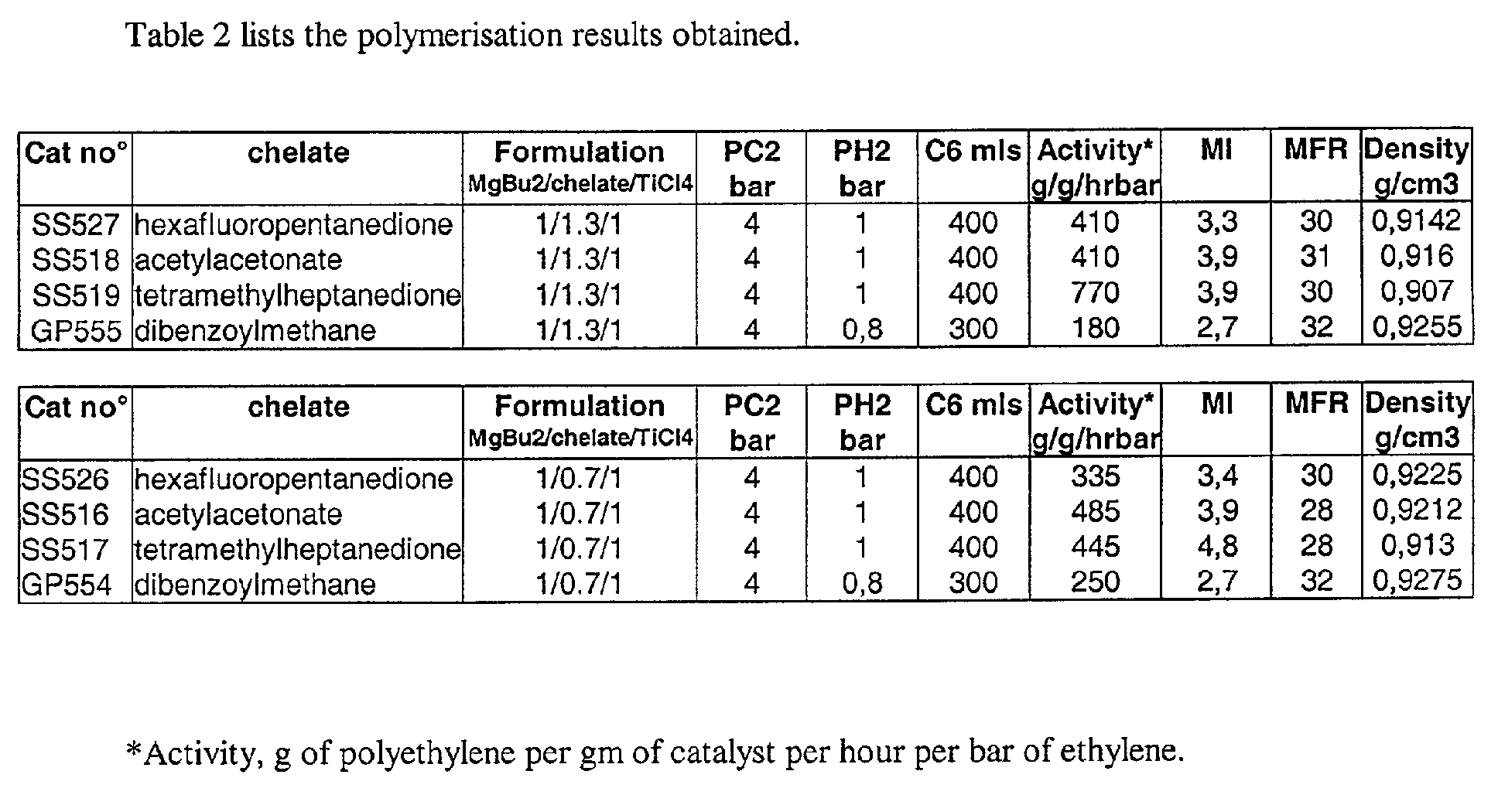
Claims (10)
- Catalyst composition for the (co-)polymerisation of olefins, optionally with an alpha olefin of 2 to 10 carbon atoms, which comprises a catalyst precursor and an organoaluminium cocatalyst, wherein the catalyst precursor comprises1) a solid porous carrier,2) an organomagnesium compound of the formula RmMgR'n, where R and R' are the same or different alkyl groups and m and n are each 0, 1 or 2, providing that m+n is 2,3) an optional aluminum containing compound,4) a chelate compound, and5) a transition metal compound.
- Catalyst composition according to claim 1 wherein the catalyst precursor consists in the above 1, 2, 3, 4 and 5 compounds.
- Catalyst composition according to claim 1 wherein the catalyst precursor consists in the above 1, 2, 4 and 5 compounds.
- Catalyst according to any of the preceding claims wherein the solid porous carrier is silica.
- Catalyst according to any of the preceding claims wherein the amount of magnesium is comprised between 0.5 and 2.4 of mmoles per g of solid porous carrier.
- Catalyst according to any of the preceding claims wherein the chelate compound is chosen amongst bidentate ligands.
- Catalyst according to any of the preceding claims wherein the chelate compound is chosen amongst diketone ligands, especially 2,4 diketones substituted in the 1 and 5 positions; 1,3 diketones substituted in the 2 position; beta-keto-esters, and 2-acetylcycloalkanones.
- Catalyst according to any of the preceding claims wherein the chelate compound is chosen amongst amide ligand compounds, e.g. carbodiimide type compounds such as dimethylcarbodiimide, dicyclohexylcarbodiimide, 1,3-bis-trimethylsilylcarbodiimide and the like ; or diketiminato type compounds such as 2-(p-tolylamino)-4-(p-tolylimino)-2-pentene, 2-((2,6-diisopropylphenyl)amino)-4((2,6-diisopropylphenyl)imino)-2-pentene and the like.
- Catalyst according to any of the preceding claims wherein the molar ratio of the chelate compound to Mg is about 0.10 to about 5.00 , preferably 0.2 to 2.
- Process for the manufacture of ethylene (co-) polymers with narrow molecular weight distribution during the gas-phase (co-) polymerisation of olefins in a fluidised bed reactor using a Ziegler-Natta type catalyst according to any of the preceding claims.
Priority Applications (1)
| Application Number | Priority Date | Filing Date | Title |
|---|---|---|---|
| EP01430006A EP1229055A1 (en) | 2001-02-06 | 2001-02-06 | Process for the gas-phase (co)-polymerisation of olefins in a fluidised bed reactor |
Applications Claiming Priority (1)
| Application Number | Priority Date | Filing Date | Title |
|---|---|---|---|
| EP01430006A EP1229055A1 (en) | 2001-02-06 | 2001-02-06 | Process for the gas-phase (co)-polymerisation of olefins in a fluidised bed reactor |
Publications (1)
| Publication Number | Publication Date |
|---|---|
| EP1229055A1 true EP1229055A1 (en) | 2002-08-07 |
Family
ID=8183163
Family Applications (1)
| Application Number | Title | Priority Date | Filing Date |
|---|---|---|---|
| EP01430006A Withdrawn EP1229055A1 (en) | 2001-02-06 | 2001-02-06 | Process for the gas-phase (co)-polymerisation of olefins in a fluidised bed reactor |
Country Status (1)
| Country | Link |
|---|---|
| EP (1) | EP1229055A1 (en) |
Cited By (6)
| Publication number | Priority date | Publication date | Assignee | Title |
|---|---|---|---|---|
| KR100430979B1 (en) * | 1999-02-04 | 2004-05-12 | 삼성아토피나주식회사 | Producing process for an olefin polymerization chelate catalyst |
| KR100430849B1 (en) * | 1998-12-31 | 2004-09-16 | 삼성아토피나주식회사 | Manufacturing method of new olefin polymerization chelate catalyst |
| EP2039677A4 (en) * | 2006-05-22 | 2009-07-29 | Shanghai Inst Organic Chem | Organic compounds containing heteroatoms and their use in ziegler-natta catalyst with single activation center |
| JP2011500900A (en) * | 2007-10-16 | 2011-01-06 | 中国石化揚子石油化工有限公司 | Supported nonmetallocene catalyst and method for producing the same |
| JP2011500901A (en) * | 2007-10-16 | 2011-01-06 | 中国石化揚子石油化工有限公司 | Magnesium compound-supported nonmetallocene catalyst and production thereof |
| WO2013082693A1 (en) * | 2011-12-05 | 2013-06-13 | Nova Chemicals (International) S.A. | Passivated supports for use with olefin polymerization catalysts |
Citations (2)
| Publication number | Priority date | Publication date | Assignee | Title |
|---|---|---|---|---|
| EP0497102A2 (en) * | 1991-01-26 | 1992-08-05 | BASF Aktiengesellschaft | Vanadium and magnesium containing component for a Ziegler-Natta catalytic system |
| WO1993009147A1 (en) * | 1991-11-06 | 1993-05-13 | Mobil Oil Corporation | High activity polyethylene catalysts prepared with alkoxysilane reagents |
-
2001
- 2001-02-06 EP EP01430006A patent/EP1229055A1/en not_active Withdrawn
Patent Citations (2)
| Publication number | Priority date | Publication date | Assignee | Title |
|---|---|---|---|---|
| EP0497102A2 (en) * | 1991-01-26 | 1992-08-05 | BASF Aktiengesellschaft | Vanadium and magnesium containing component for a Ziegler-Natta catalytic system |
| WO1993009147A1 (en) * | 1991-11-06 | 1993-05-13 | Mobil Oil Corporation | High activity polyethylene catalysts prepared with alkoxysilane reagents |
Cited By (12)
| Publication number | Priority date | Publication date | Assignee | Title |
|---|---|---|---|---|
| KR100430849B1 (en) * | 1998-12-31 | 2004-09-16 | 삼성아토피나주식회사 | Manufacturing method of new olefin polymerization chelate catalyst |
| KR100430979B1 (en) * | 1999-02-04 | 2004-05-12 | 삼성아토피나주식회사 | Producing process for an olefin polymerization chelate catalyst |
| EP2039677A4 (en) * | 2006-05-22 | 2009-07-29 | Shanghai Inst Organic Chem | Organic compounds containing heteroatoms and their use in ziegler-natta catalyst with single activation center |
| JP2011500900A (en) * | 2007-10-16 | 2011-01-06 | 中国石化揚子石油化工有限公司 | Supported nonmetallocene catalyst and method for producing the same |
| JP2011500901A (en) * | 2007-10-16 | 2011-01-06 | 中国石化揚子石油化工有限公司 | Magnesium compound-supported nonmetallocene catalyst and production thereof |
| EP2202247A4 (en) * | 2007-10-16 | 2011-11-30 | Sinopec Yangzi Petrochemical | SUPPORTED NON-METALLOCENE CATALYST AND PROCESS FOR PREPARING THE SAME |
| US8193288B2 (en) | 2007-10-16 | 2012-06-05 | Sinopec Yangzi Petro-Chemical Ltd. | Supported nonmetallocene catalyst and preparation thereof |
| EP2202246A4 (en) * | 2007-10-16 | 2012-08-08 | Sinopec Yangzi Petrochemical | NON-METALLOCENE CATALYST SUPPORTED ON A MAGNESIUM COMPOUND AND PROCESS FOR PREPARING THE SAME |
| US8716416B2 (en) | 2007-10-16 | 2014-05-06 | Sinopec Yangzi Petrochemical Company Ltd. | Magnesium-compound supported nonmetallocene catalyst and preparation thereof |
| WO2013082693A1 (en) * | 2011-12-05 | 2013-06-13 | Nova Chemicals (International) S.A. | Passivated supports for use with olefin polymerization catalysts |
| US9133284B2 (en) | 2011-12-05 | 2015-09-15 | Nova Chemicals (International) S.A. | Passivated supports for use with olefin polymerization catalysts |
| US9359455B2 (en) | 2011-12-05 | 2016-06-07 | Nova Chemicals (International) S.A. | Passivated supports for use with olefin polymerization catalysts |
Similar Documents
| Publication | Publication Date | Title |
|---|---|---|
| EP0612327B1 (en) | High activity polyethylene catalysts prepared with alkoxysilane reagents | |
| US5470812A (en) | High activity polyethylene catalysts prepared with alkoxysilane reagents | |
| EP0729478B1 (en) | A catalyst composition for the copolymerization of ethylene | |
| EP0701575B1 (en) | High activity polyethylene catalysts | |
| US5994256A (en) | Process for forming a catalyst precursor for copolymerizing ethylene and an alpha-olefin of 3 to 10 carbon atoms | |
| US6887957B2 (en) | Process for the gas-phase (co-)polymerization of olefins in a fluidized bed reactor | |
| US6291384B1 (en) | High activity catalyst prepared with alkoxysilanes | |
| EP1108728A1 (en) | High activity polyethylene catalysts prepared with alkoxycarbon reagents | |
| EP0664815B1 (en) | Process for preparing a catalyst composition | |
| EP1366091B1 (en) | High activity polyethylene catalysts prepared with borates reagents | |
| AU700892B2 (en) | Catalyst for the manufacture of polyethylene with a narrow molecular weight distribution | |
| US7488862B2 (en) | Process for the gas-phase (co-)polymerisation of olefins in a fluidised bed reactor | |
| EP1502924A1 (en) | High activity catalysts for the polymerisation of ethylene prepared with phosphates/phosphites reagents | |
| HK1008745B (en) | High activity polyethylene catalysts prepared with alkoxysilane reagents |
Legal Events
| Date | Code | Title | Description |
|---|---|---|---|
| PUAI | Public reference made under article 153(3) epc to a published international application that has entered the european phase |
Free format text: ORIGINAL CODE: 0009012 |
|
| AK | Designated contracting states |
Kind code of ref document: A1 Designated state(s): AT BE CH CY DE DK ES FI FR GB GR IE IT LI LU MC NL PT SE TR |
|
| AX | Request for extension of the european patent |
Free format text: AL;LT;LV;MK;RO;SI |
|
| AKX | Designation fees paid |
Designated state(s): FR |
|
| REG | Reference to a national code |
Ref country code: DE Ref legal event code: 8566 |
|
| STAA | Information on the status of an ep patent application or granted ep patent |
Free format text: STATUS: THE APPLICATION IS DEEMED TO BE WITHDRAWN |
|
| 18D | Application deemed to be withdrawn |
Effective date: 20030208 |