EP1229041A1 - A process for the preparation of 3-Glutamido bile ester derivatives using N-tBoc methyl pyroglutamate - Google Patents
A process for the preparation of 3-Glutamido bile ester derivatives using N-tBoc methyl pyroglutamate Download PDFInfo
- Publication number
- EP1229041A1 EP1229041A1 EP01102490A EP01102490A EP1229041A1 EP 1229041 A1 EP1229041 A1 EP 1229041A1 EP 01102490 A EP01102490 A EP 01102490A EP 01102490 A EP01102490 A EP 01102490A EP 1229041 A1 EP1229041 A1 EP 1229041A1
- Authority
- EP
- European Patent Office
- Prior art keywords
- compound
- acid
- mole
- formula
- amino
- Prior art date
- Legal status (The legal status is an assumption and is not a legal conclusion. Google has not performed a legal analysis and makes no representation as to the accuracy of the status listed.)
- Withdrawn
Links
- 238000000034 method Methods 0.000 title claims abstract description 38
- 238000002360 preparation method Methods 0.000 title claims abstract description 18
- 150000002148 esters Chemical class 0.000 title claims abstract description 6
- 210000000941 bile Anatomy 0.000 title claims abstract description 4
- HQGPKMSGXAUKHT-UHFFFAOYSA-N L-pyroglutamic acid methyl ester Natural products COC(=O)C1CCC(=O)N1 HQGPKMSGXAUKHT-UHFFFAOYSA-N 0.000 title claims description 4
- HQGPKMSGXAUKHT-BYPYZUCNSA-N methyl (2s)-5-oxopyrrolidine-2-carboxylate Chemical compound COC(=O)[C@@H]1CCC(=O)N1 HQGPKMSGXAUKHT-BYPYZUCNSA-N 0.000 title description 15
- WHUUTDBJXJRKMK-VKHMYHEASA-N L-glutamic acid Chemical compound OC(=O)[C@@H](N)CCC(O)=O WHUUTDBJXJRKMK-VKHMYHEASA-N 0.000 claims abstract description 12
- RPAJSBKBKSSMLJ-DFWYDOINSA-N (2s)-2-aminopentanedioic acid;hydrochloride Chemical compound Cl.OC(=O)[C@@H](N)CCC(O)=O RPAJSBKBKSSMLJ-DFWYDOINSA-N 0.000 claims abstract description 9
- 125000004178 (C1-C4) alkyl group Chemical group 0.000 claims abstract description 6
- 229960002989 glutamic acid Drugs 0.000 claims abstract description 6
- 125000001797 benzyl group Chemical group [H]C1=C([H])C([H])=C(C([H])=C1[H])C([H])([H])* 0.000 claims abstract description 4
- 150000001875 compounds Chemical class 0.000 claims description 55
- OKKJLVBELUTLKV-UHFFFAOYSA-N Methanol Chemical compound OC OKKJLVBELUTLKV-UHFFFAOYSA-N 0.000 claims description 42
- YXFVVABEGXRONW-UHFFFAOYSA-N Toluene Chemical compound CC1=CC=CC=C1 YXFVVABEGXRONW-UHFFFAOYSA-N 0.000 claims description 33
- ZMANZCXQSJIPKH-UHFFFAOYSA-N Triethylamine Chemical compound CCN(CC)CC ZMANZCXQSJIPKH-UHFFFAOYSA-N 0.000 claims description 24
- XEKOWRVHYACXOJ-UHFFFAOYSA-N Ethyl acetate Chemical compound CCOC(C)=O XEKOWRVHYACXOJ-UHFFFAOYSA-N 0.000 claims description 22
- 239000002904 solvent Substances 0.000 claims description 20
- QTBSBXVTEAMEQO-UHFFFAOYSA-N Acetic acid Chemical compound CC(O)=O QTBSBXVTEAMEQO-UHFFFAOYSA-N 0.000 claims description 19
- JGFZNNIVVJXRND-UHFFFAOYSA-N N,N-Diisopropylethylamine (DIPEA) Chemical compound CCN(C(C)C)C(C)C JGFZNNIVVJXRND-UHFFFAOYSA-N 0.000 claims description 18
- MFUPLHQOVIUESQ-JEDNCBNOSA-N [(2s)-1,5-dimethoxy-1,5-dioxopentan-2-yl]azanium;chloride Chemical compound Cl.COC(=O)CC[C@H](N)C(=O)OC MFUPLHQOVIUESQ-JEDNCBNOSA-N 0.000 claims description 11
- 235000019439 ethyl acetate Nutrition 0.000 claims description 11
- AFVFQIVMOAPDHO-UHFFFAOYSA-N Methanesulfonic acid Chemical compound CS(O)(=O)=O AFVFQIVMOAPDHO-UHFFFAOYSA-N 0.000 claims description 9
- KVNYFPKFSJIPBJ-UHFFFAOYSA-N 1,2-diethylbenzene Chemical compound CCC1=CC=CC=C1CC KVNYFPKFSJIPBJ-UHFFFAOYSA-N 0.000 claims description 8
- WEVYAHXRMPXWCK-UHFFFAOYSA-N Acetonitrile Chemical compound CC#N WEVYAHXRMPXWCK-UHFFFAOYSA-N 0.000 claims description 8
- 239000002253 acid Substances 0.000 claims description 8
- HFPZCAJZSCWRBC-UHFFFAOYSA-N p-cymene Chemical compound CC(C)C1=CC=C(C)C=C1 HFPZCAJZSCWRBC-UHFFFAOYSA-N 0.000 claims description 8
- 125000002924 primary amino group Chemical group [H]N([H])* 0.000 claims description 8
- FYSNRJHAOHDILO-UHFFFAOYSA-N thionyl chloride Chemical compound ClS(Cl)=O FYSNRJHAOHDILO-UHFFFAOYSA-N 0.000 claims description 8
- VHYFNPMBLIVWCW-UHFFFAOYSA-N 4-Dimethylaminopyridine Chemical compound CN(C)C1=CC=NC=C1 VHYFNPMBLIVWCW-UHFFFAOYSA-N 0.000 claims description 7
- -1 t-butoxycarbonyl group Chemical group 0.000 claims description 7
- IJGRMHOSHXDMSA-UHFFFAOYSA-N Atomic nitrogen Chemical compound N#N IJGRMHOSHXDMSA-UHFFFAOYSA-N 0.000 claims description 6
- ZMXDDKWLCZADIW-UHFFFAOYSA-N N,N-Dimethylformamide Chemical compound CN(C)C=O ZMXDDKWLCZADIW-UHFFFAOYSA-N 0.000 claims description 6
- MUBZPKHOEPUJKR-UHFFFAOYSA-N Oxalic acid Chemical compound OC(=O)C(O)=O MUBZPKHOEPUJKR-UHFFFAOYSA-N 0.000 claims description 6
- 150000001412 amines Chemical class 0.000 claims description 6
- 239000000203 mixture Substances 0.000 claims description 6
- 238000007056 transamidation reaction Methods 0.000 claims description 6
- FNTAOUUEQHKLIU-ZETCQYMHSA-N 1-o-tert-butyl 2-o-methyl (2s)-5-oxopyrrolidine-1,2-dicarboxylate Chemical compound COC(=O)[C@@H]1CCC(=O)N1C(=O)OC(C)(C)C FNTAOUUEQHKLIU-ZETCQYMHSA-N 0.000 claims description 5
- 239000003849 aromatic solvent Substances 0.000 claims description 5
- HQGPKMSGXAUKHT-SCSAIBSYSA-N methyl (2r)-5-oxopyrrolidine-2-carboxylate Chemical compound COC(=O)[C@H]1CCC(=O)N1 HQGPKMSGXAUKHT-SCSAIBSYSA-N 0.000 claims description 5
- 150000003839 salts Chemical class 0.000 claims description 5
- 150000003512 tertiary amines Chemical class 0.000 claims description 5
- 229910006124 SOCl2 Inorganic materials 0.000 claims description 4
- 238000010438 heat treatment Methods 0.000 claims description 4
- 229940098779 methanesulfonic acid Drugs 0.000 claims description 4
- 229910052757 nitrogen Inorganic materials 0.000 claims description 4
- 125000001147 pentyl group Chemical group C(CCCC)* 0.000 claims description 4
- 239000000725 suspension Substances 0.000 claims description 4
- DYHSDKLCOJIUFX-UHFFFAOYSA-N tert-butoxycarbonyl anhydride Chemical compound CC(C)(C)OC(=O)OC(=O)OC(C)(C)C DYHSDKLCOJIUFX-UHFFFAOYSA-N 0.000 claims description 4
- JOXIMZWYDAKGHI-UHFFFAOYSA-N toluene-4-sulfonic acid Chemical compound CC1=CC=C(S(O)(=O)=O)C=C1 JOXIMZWYDAKGHI-UHFFFAOYSA-N 0.000 claims description 4
- 125000006724 (C1-C5) alkyl ester group Chemical group 0.000 claims description 3
- FXHOOIRPVKKKFG-UHFFFAOYSA-N N,N-Dimethylacetamide Chemical compound CN(C)C(C)=O FXHOOIRPVKKKFG-UHFFFAOYSA-N 0.000 claims description 3
- CTQNGGLPUBDAKN-UHFFFAOYSA-N O-Xylene Chemical compound CC1=CC=CC=C1C CTQNGGLPUBDAKN-UHFFFAOYSA-N 0.000 claims description 3
- 239000003613 bile acid Substances 0.000 claims description 3
- 125000002915 carbonyl group Chemical group [*:2]C([*:1])=O 0.000 claims description 3
- RPKLZQLYODPWTM-KBMWBBLPSA-N cholanoic acid Chemical compound C1CC2CCCC[C@]2(C)[C@@H]2[C@@H]1[C@@H]1CC[C@H]([C@@H](CCC(O)=O)C)[C@@]1(C)CC2 RPKLZQLYODPWTM-KBMWBBLPSA-N 0.000 claims description 3
- 238000001816 cooling Methods 0.000 claims description 3
- 239000007789 gas Substances 0.000 claims description 3
- 150000003951 lactams Chemical class 0.000 claims description 3
- RPKLZQLYODPWTM-UHFFFAOYSA-N methyl 15-acetoxy(10),13E-ent-halimadien-18-oate Natural products C1CC2CCCCC2(C)C2C1C1CCC(C(CCC(O)=O)C)C1(C)CC2 RPKLZQLYODPWTM-UHFFFAOYSA-N 0.000 claims description 3
- 239000008096 xylene Substances 0.000 claims description 3
- FAASTKYIPSDJDD-OFYXWCICSA-N (4r)-4-[(3s,5r,8r,9s,10s,12s,13r,14s,17r)-3-amino-12-hydroxy-10,13-dimethyl-2,3,4,5,6,7,8,9,11,12,14,15,16,17-tetradecahydro-1h-cyclopenta[a]phenanthren-17-yl]pentanoic acid Chemical compound C([C@H]1CC2)[C@@H](N)CC[C@]1(C)[C@@H]1[C@@H]2[C@@H]2CC[C@H]([C@@H](CCC(O)=O)C)[C@@]2(C)[C@@H](O)C1 FAASTKYIPSDJDD-OFYXWCICSA-N 0.000 claims description 2
- QAOWNCQODCNURD-UHFFFAOYSA-N Sulfuric acid Chemical compound OS(O)(=O)=O QAOWNCQODCNURD-UHFFFAOYSA-N 0.000 claims description 2
- DTQVDTLACAAQTR-UHFFFAOYSA-N Trifluoroacetic acid Chemical compound OC(=O)C(F)(F)F DTQVDTLACAAQTR-UHFFFAOYSA-N 0.000 claims description 2
- 230000002378 acidificating effect Effects 0.000 claims description 2
- 125000000217 alkyl group Chemical group 0.000 claims description 2
- 230000009435 amidation Effects 0.000 claims description 2
- 238000007112 amidation reaction Methods 0.000 claims description 2
- DKPFZGUDAPQIHT-UHFFFAOYSA-N butyl acetate Chemical compound CCCCOC(C)=O DKPFZGUDAPQIHT-UHFFFAOYSA-N 0.000 claims description 2
- 230000007062 hydrolysis Effects 0.000 claims description 2
- 238000006460 hydrolysis reaction Methods 0.000 claims description 2
- 230000003472 neutralizing effect Effects 0.000 claims description 2
- 235000006408 oxalic acid Nutrition 0.000 claims description 2
- 150000001923 cyclic compounds Chemical class 0.000 claims 1
- 238000001914 filtration Methods 0.000 claims 1
- 230000003301 hydrolyzing effect Effects 0.000 claims 1
- 239000007858 starting material Substances 0.000 abstract description 2
- 239000000243 solution Substances 0.000 description 23
- 238000006243 chemical reaction Methods 0.000 description 19
- VLKZOEOYAKHREP-UHFFFAOYSA-N n-Hexane Chemical compound CCCCCC VLKZOEOYAKHREP-UHFFFAOYSA-N 0.000 description 18
- 238000004128 high performance liquid chromatography Methods 0.000 description 10
- 239000007787 solid Substances 0.000 description 9
- 0 CC*C(C(CC)*=*)C1(*N(C)CC)CC1 Chemical compound CC*C(C(CC)*=*)C1(*N(C)CC)CC1 0.000 description 7
- LFQSCWFLJHTTHZ-UHFFFAOYSA-N Ethanol Chemical compound CCO LFQSCWFLJHTTHZ-UHFFFAOYSA-N 0.000 description 7
- VEXZGXHMUGYJMC-UHFFFAOYSA-N Hydrochloric acid Chemical compound Cl VEXZGXHMUGYJMC-UHFFFAOYSA-N 0.000 description 7
- 238000001514 detection method Methods 0.000 description 7
- 238000001644 13C nuclear magnetic resonance spectroscopy Methods 0.000 description 6
- 238000005160 1H NMR spectroscopy Methods 0.000 description 6
- 230000005526 G1 to G0 transition Effects 0.000 description 6
- 239000003480 eluent Substances 0.000 description 6
- 238000002347 injection Methods 0.000 description 6
- 239000007924 injection Substances 0.000 description 6
- 239000000543 intermediate Substances 0.000 description 6
- SQGYOTSLMSWVJD-UHFFFAOYSA-N silver(1+) nitrate Chemical compound [Ag+].[O-]N(=O)=O SQGYOTSLMSWVJD-UHFFFAOYSA-N 0.000 description 6
- 238000001228 spectrum Methods 0.000 description 6
- 238000004809 thin layer chromatography Methods 0.000 description 6
- XLYOFNOQVPJJNP-UHFFFAOYSA-N water Substances O XLYOFNOQVPJJNP-UHFFFAOYSA-N 0.000 description 6
- 238000002955 isolation Methods 0.000 description 5
- 238000002425 crystallisation Methods 0.000 description 4
- 125000004185 ester group Chemical group 0.000 description 4
- 238000001704 evaporation Methods 0.000 description 4
- 230000008020 evaporation Effects 0.000 description 4
- 238000010829 isocratic elution Methods 0.000 description 4
- 238000000746 purification Methods 0.000 description 4
- KFZMGEQAYNKOFK-UHFFFAOYSA-N Isopropanol Chemical group CC(C)O KFZMGEQAYNKOFK-UHFFFAOYSA-N 0.000 description 3
- HEMHJVSKTPXQMS-UHFFFAOYSA-M Sodium hydroxide Chemical compound [OH-].[Na+] HEMHJVSKTPXQMS-UHFFFAOYSA-M 0.000 description 3
- 230000008025 crystallization Effects 0.000 description 3
- 238000004821 distillation Methods 0.000 description 3
- 239000008363 phosphate buffer Substances 0.000 description 3
- 239000002244 precipitate Substances 0.000 description 3
- 239000000047 product Substances 0.000 description 3
- 239000011541 reaction mixture Substances 0.000 description 3
- HSINOMROUCMIEA-FGVHQWLLSA-N (2s,4r)-4-[(3r,5s,6r,7r,8s,9s,10s,13r,14s,17r)-6-ethyl-3,7-dihydroxy-10,13-dimethyl-2,3,4,5,6,7,8,9,11,12,14,15,16,17-tetradecahydro-1h-cyclopenta[a]phenanthren-17-yl]-2-methylpentanoic acid Chemical compound C([C@@]12C)C[C@@H](O)C[C@H]1[C@@H](CC)[C@@H](O)[C@@H]1[C@@H]2CC[C@]2(C)[C@@H]([C@H](C)C[C@H](C)C(O)=O)CC[C@H]21 HSINOMROUCMIEA-FGVHQWLLSA-N 0.000 description 2
- HEDRZPFGACZZDS-UHFFFAOYSA-N Chloroform Chemical compound ClC(Cl)Cl HEDRZPFGACZZDS-UHFFFAOYSA-N 0.000 description 2
- YMWUJEATGCHHMB-UHFFFAOYSA-N Dichloromethane Chemical compound ClCCl YMWUJEATGCHHMB-UHFFFAOYSA-N 0.000 description 2
- 239000007832 Na2SO4 Substances 0.000 description 2
- NBIIXXVUZAFLBC-UHFFFAOYSA-N Phosphoric acid Chemical compound OP(O)(O)=O NBIIXXVUZAFLBC-UHFFFAOYSA-N 0.000 description 2
- PMZURENOXWZQFD-UHFFFAOYSA-L Sodium Sulfate Chemical compound [Na+].[Na+].[O-]S([O-])(=O)=O PMZURENOXWZQFD-UHFFFAOYSA-L 0.000 description 2
- 125000003118 aryl group Chemical group 0.000 description 2
- 125000001584 benzyloxycarbonyl group Chemical group C(=O)(OCC1=CC=CC=C1)* 0.000 description 2
- 230000015572 biosynthetic process Effects 0.000 description 2
- 244000309464 bull Species 0.000 description 2
- 230000015556 catabolic process Effects 0.000 description 2
- 239000003153 chemical reaction reagent Substances 0.000 description 2
- 239000002872 contrast media Substances 0.000 description 2
- 238000006731 degradation reaction Methods 0.000 description 2
- 238000010511 deprotection reaction Methods 0.000 description 2
- 238000010828 elution Methods 0.000 description 2
- 239000000706 filtrate Substances 0.000 description 2
- 238000007363 ring formation reaction Methods 0.000 description 2
- 229910052938 sodium sulfate Inorganic materials 0.000 description 2
- 230000002269 spontaneous effect Effects 0.000 description 2
- BJLLOMORJCWXON-VKHMYHEASA-N (2s)-5-oxopyrrolidine-1,2-dicarboxylic acid Chemical compound OC(=O)[C@@H]1CCC(=O)N1C(O)=O BJLLOMORJCWXON-VKHMYHEASA-N 0.000 description 1
- 125000000008 (C1-C10) alkyl group Chemical group 0.000 description 1
- 125000003837 (C1-C20) alkyl group Chemical group 0.000 description 1
- NUIURNJTPRWVAP-UHFFFAOYSA-N 3,3'-Dimethylbenzidine Chemical compound C1=C(N)C(C)=CC(C=2C=C(C)C(N)=CC=2)=C1 NUIURNJTPRWVAP-UHFFFAOYSA-N 0.000 description 1
- ODHCTXKNWHHXJC-VKHMYHEASA-N 5-oxo-L-proline Chemical compound OC(=O)[C@@H]1CCC(=O)N1 ODHCTXKNWHHXJC-VKHMYHEASA-N 0.000 description 1
- VHUUQVKOLVNVRT-UHFFFAOYSA-N Ammonium hydroxide Chemical compound [NH4+].[OH-] VHUUQVKOLVNVRT-UHFFFAOYSA-N 0.000 description 1
- KXGVEGMKQFWNSR-XBEHKFBISA-N CC(CCC(O)=O)[C@@H](CCC1C(CC2)C(C3)[C@@](C)(CC4)[C@H]2C[C@@H]4O)[C@@]1(C)[C@H]3O Chemical compound CC(CCC(O)=O)[C@@H](CCC1C(CC2)C(C3)[C@@](C)(CC4)[C@H]2C[C@@H]4O)[C@@]1(C)[C@H]3O KXGVEGMKQFWNSR-XBEHKFBISA-N 0.000 description 1
- UFHFLCQGNIYNRP-UHFFFAOYSA-N Hydrogen Chemical compound [H][H] UFHFLCQGNIYNRP-UHFFFAOYSA-N 0.000 description 1
- 238000005481 NMR spectroscopy Methods 0.000 description 1
- VYPSYNLAJGMNEJ-UHFFFAOYSA-N Silicium dioxide Chemical compound O=[Si]=O VYPSYNLAJGMNEJ-UHFFFAOYSA-N 0.000 description 1
- 238000005903 acid hydrolysis reaction Methods 0.000 description 1
- 230000000259 anti-tumor effect Effects 0.000 description 1
- 239000006227 byproduct Substances 0.000 description 1
- 150000001735 carboxylic acids Chemical class 0.000 description 1
- 239000003054 catalyst Substances 0.000 description 1
- 239000003795 chemical substances by application Substances 0.000 description 1
- 238000003776 cleavage reaction Methods 0.000 description 1
- 239000007859 condensation product Substances 0.000 description 1
- 150000005690 diesters Chemical class 0.000 description 1
- 239000003814 drug Substances 0.000 description 1
- 238000001035 drying Methods 0.000 description 1
- 230000032050 esterification Effects 0.000 description 1
- 238000005886 esterification reaction Methods 0.000 description 1
- 239000001257 hydrogen Substances 0.000 description 1
- 229910052739 hydrogen Inorganic materials 0.000 description 1
- 125000004435 hydrogen atom Chemical group [H]* 0.000 description 1
- 150000002643 lithocholic acids Chemical class 0.000 description 1
- 150000007522 mineralic acids Chemical class 0.000 description 1
- 238000002156 mixing Methods 0.000 description 1
- 230000004048 modification Effects 0.000 description 1
- 238000012986 modification Methods 0.000 description 1
- 238000006386 neutralization reaction Methods 0.000 description 1
- 125000004433 nitrogen atom Chemical group N* 0.000 description 1
- 150000007524 organic acids Chemical class 0.000 description 1
- 230000037361 pathway Effects 0.000 description 1
- 238000001556 precipitation Methods 0.000 description 1
- 150000003141 primary amines Chemical class 0.000 description 1
- 230000002035 prolonged effect Effects 0.000 description 1
- HNJBEVLQSNELDL-UHFFFAOYSA-N pyrrolidin-2-one Chemical compound O=C1CCCN1 HNJBEVLQSNELDL-UHFFFAOYSA-N 0.000 description 1
- 238000013341 scale-up Methods 0.000 description 1
- 230000007017 scission Effects 0.000 description 1
- 150000003334 secondary amides Chemical class 0.000 description 1
- 150000003335 secondary amines Chemical class 0.000 description 1
- 238000010517 secondary reaction Methods 0.000 description 1
- 239000000741 silica gel Substances 0.000 description 1
- 229910002027 silica gel Inorganic materials 0.000 description 1
- 238000003756 stirring Methods 0.000 description 1
- 238000003786 synthesis reaction Methods 0.000 description 1
- 238000005406 washing Methods 0.000 description 1
Classifications
-
- C—CHEMISTRY; METALLURGY
- C07—ORGANIC CHEMISTRY
- C07J—STEROIDS
- C07J41/00—Normal steroids containing one or more nitrogen atoms not belonging to a hetero ring
- C07J41/0005—Normal steroids containing one or more nitrogen atoms not belonging to a hetero ring the nitrogen atom being directly linked to the cyclopenta(a)hydro phenanthrene skeleton
-
- C—CHEMISTRY; METALLURGY
- C07—ORGANIC CHEMISTRY
- C07J—STEROIDS
- C07J41/00—Normal steroids containing one or more nitrogen atoms not belonging to a hetero ring
- C07J41/0005—Normal steroids containing one or more nitrogen atoms not belonging to a hetero ring the nitrogen atom being directly linked to the cyclopenta(a)hydro phenanthrene skeleton
- C07J41/0011—Unsubstituted amino radicals
-
- C—CHEMISTRY; METALLURGY
- C07—ORGANIC CHEMISTRY
- C07J—STEROIDS
- C07J41/00—Normal steroids containing one or more nitrogen atoms not belonging to a hetero ring
- C07J41/0033—Normal steroids containing one or more nitrogen atoms not belonging to a hetero ring not covered by C07J41/0005
- C07J41/0055—Normal steroids containing one or more nitrogen atoms not belonging to a hetero ring not covered by C07J41/0005 the 17-beta position being substituted by an uninterrupted chain of at least three carbon atoms which may or may not be branched, e.g. cholane or cholestane derivatives, optionally cyclised, e.g. 17-beta-phenyl or 17-beta-furyl derivatives
-
- Y—GENERAL TAGGING OF NEW TECHNOLOGICAL DEVELOPMENTS; GENERAL TAGGING OF CROSS-SECTIONAL TECHNOLOGIES SPANNING OVER SEVERAL SECTIONS OF THE IPC; TECHNICAL SUBJECTS COVERED BY FORMER USPC CROSS-REFERENCE ART COLLECTIONS [XRACs] AND DIGESTS
- Y02—TECHNOLOGIES OR APPLICATIONS FOR MITIGATION OR ADAPTATION AGAINST CLIMATE CHANGE
- Y02P—CLIMATE CHANGE MITIGATION TECHNOLOGIES IN THE PRODUCTION OR PROCESSING OF GOODS
- Y02P20/00—Technologies relating to chemical industry
- Y02P20/50—Improvements relating to the production of bulk chemicals
- Y02P20/55—Design of synthesis routes, e.g. reducing the use of auxiliary or protecting groups
Definitions
- the present invention relates to a novel process for the preparation of intermediates used for the preparation of contrast agents.
- the present invention relates to a process for the preparation of bile esters derivatives of general formula (I) wherein:
- the transamidation reaction maintains the stereochemistry at the chiral centre adjacent to the nitrogen atom of the starting pyrrolidinone and affords a secondary amide.
- the combined selection of R 4 and R 5 groups is important in that the cleavage should take place under diversified conditions.
- ( S )-5-oxo-1,2-pyrrolidinedicarboxylic acid 2-methyl 1-(phenylmethyl) diester (VIII), i.e. the compound bearing a carbobenzyloxy (Cbz) group as R 4 has been exemplified.
- the present invention therefore relates to a process for the preparation of compounds of general formula (I), wherein:
- the compounds of formula (IX), are prepared according to the methods disclosed in WO-A-95/32741 or in PCT/EP00/08226. These compounds are bile acid derivatives in which a 13-amino group is always present in position 3.
- bile acids of the present invention are selected from the group consisting of residues of cholic, chenodeoxycholic, deoxycholic, ursodeoxycholic, lithocholic acids represented by the following formulae.
- the latter is a known intermediate used for the preparation of pharmaceuticals, e.g. antitumoral agents (JP05247047; Tetrahedron, 1994, 50, 6221-6238).
- step a) either L-glutamic acid hydrochloride (II) or L-glutamic acid are esterified to give L-glutamic acid dimethyl ester hydrochloride (III).
- This reaction may be performed by known esterification methods for carboxylic acids.
- compound (II) is first suspended in methanol and then dissolved by adding at least 2 moles of SOCl 2 per mole of (II). The temperature is maintained at 0-5°C during the addition, and then the reaction is completed in 23 hours at 23°C. The thick oil obtained after the evaporation of the solvent is directly used, without any purification, in the next step.
- step b) compound of formula (III) is first neutralized with 3 M KOH in methanol solution, the precipitated KCl is filtered off. The filtrate is evaporated and then heated for 1 to 7 hours, to obtain (S) -5-oxoproline methyl ester (IV).
- the heating time depends on the temperature used during the cyclization reaction, which can vary from 80 to 130°C.
- Compound (IV) can be used directly in the subsequent step c), or it can be purified, as described in Chem. Pharm. Bull., 1990, 28(5), 1449-1458, by distillation at reduced pressure (0.2 kPa). However, these conditions are not easily achieved at industrial level and, moreover, the distillation of large quantities would require a long time.
- step c) the lactam nitrogen of (IV) is protected with the t -butoxycarbonyl group according to known methods.
- This reaction is preferably carried out by adding at least one mole of di-t-butyl dicarbonate, to a solution containing one mole of (IV) in a solvent selected in the group consisting of: C 1 -C 5 alkyl esters of acetic acid, aprotic dipolar solvents, CH 3 CN, aromatic solvents like toluene. EtOAc and CH 3 CN are preferred.
- the reaction is usually catalyzed by addition of, for example, 4-(dimethylamino)pyridine (DMAP), in a quantity ranging from 0.01 to 0.1 moles per mole of (IV).
- DMAP 4-(dimethylamino)pyridine
- the product isolated in 88% yield is a solid that can be stored for months without degradation.
- step d) one mole of compound of formula (IX) is reacted with 1 to 1.5 mole of compound (V), in a solvent, selected from N,N -dimethylacetamide, N,N -dimethylformamide, EtOAc, BuOAc, toluene, xylene, p-cymene, diethylbenzene or similar aromatic solvent substituted with one or more linear or branched alkyl groups.
- a solvent selected from N,N -dimethylacetamide, N,N -dimethylformamide, EtOAc, BuOAc, toluene, xylene, p-cymene, diethylbenzene or similar aromatic solvent substituted with one or more linear or branched alkyl groups.
- the reaction mixture is stirred for 12 to 30 hours at a temperature from 70 to 130°C depending on the reagents and solvent used.
- step e compound of formula (VI) is subjected to acidic hydrolysis to remove the t -butoxycarbonyl group, to give the final compound of general formula (I).
- the reaction preferably consists in a slow addition of an inorganic or organic acid, under anhydrous (e.g. gas) or aqueous form, to a solution of the compound (VI) in a suitable alcohol or C 1 -C 4 alkyl ester of acetic acid, maintaining a reaction temperature from 15 to 60°C.
- the resulting solution is kept at a temperature from 15 to 60°C for a time from 0.5 to 20 hours, wherein temperature and time of reaction depend on the compound used in the conversion of (VI) to (I).
- the acid compound is preferably selected from HCl gas, aq. HCl, aq. H 2 SO 4 , CF 3 CO 2 H, CH 3 CO 2 H, oxalic acid, methanesulfonic acid or p -toluenesulfonic acid.
- the acid is added in a quantity corresponding to 1-3 moles per mole of (VI).
- the compound of formula (I) is isolated either as a salt of the previously used acid or as a free amine of general formula (I).
- the isolation of (I) as a free amine consists in a preliminary neutralization of the acidic mixture obtained at the end of reaction, by adding a base preferably selected from tertiary amines such as triethylamine (TEA) or diisopropylethylamine (DIEA).
- a base preferably selected from tertiary amines such as triethylamine (TEA) or diisopropylethylamine (DIEA).
- TAA triethylamine
- DIEA diisopropylethylamine
- a hindered tertiary amine affords the isolation of compounds (I) minimizing the formation of by products due to secondary reactions, such as hydrolysis of the ester groups or transamidation.
- aqueous bases such as aq. NaOH or KOH, can hydrolyse the ester groups, and in particular the ester group present on the glutamic chain which is easier to cleave than the ester group in the cholanoic moiety.
- a NH 3 solution or of primary or secondary amines can promote the transamidation reaction.
- step a) compound (II) is first suspended in methanol and then dissolved by adding at least 2 moles of SOCl 2 per mole of (II). The temperature is maintained at 0-5°C during the addition, and then the reaction is completed in 20 hours at 23°C.
- the thick oil obtained after the evaporation of the solvent is directly used, without any purification, in the next step.
- step b) compound of formula (III) is first neutralized with 3 M KOH in methanol solution, then the precipitated KCl is filtered off. The filtrate is evaporated and then heated for 1 hour, at a temperature varying from 110 to 115°C. The resulting (S) -5-oxoproline methyl ester (IV) is directly used in the next step c).
- step c) at least one mole of di- t -butyl dicarbonate is added to a solution containing one mole of (IV), in a solvent selected in the group consisting of: C 1 -C 5 alkyl esters of acetic acid, aprotic dipolar solvents, CH 3 CN, aromatic solvents like toluene. EtOAc and CH 3 CN are the preferred ones.
- the reaction is usually catalyzed by addition of, for example, 4-(dimethylamino)pyridine (DMAP), in a quantity ranging from 0.01 to 0.1 moles per mole of (IV).
- DMAP 4-(dimethylamino)pyridine
- the product isolated in 88% yield is a solid that can be stored for months without degradation.
- step d) (3 ⁇ ,5 ⁇ ,12 ⁇ )-12-hydroxy-3-[[5-methoxy-1,5-dioxo-4( S )-4-[[(1,1-dimethylethoxy)carbonyl]amino]pentyl]amino]cholan-24-oic acid methyl ester of formula (VI A) is obtained by reaction of (S) -5-oxo-1,2-pyrrolidine-dicarboxylic acid 1-(1,1-dimethylethyl) 2-methyl ester (V), with (3 ⁇ ,5 ⁇ ,12 ⁇ )-3-amino-12-hydroxycholan-24-oic acid methyl ester (XI), prepared according to the method described in WO-A-95/32741 or in the patent application PCT/EP00/08226 of the same assignee.
- the preferred process conditions to afford compound (VI A) in step d), consists in mixing a suspension of one mole of (XI) with at least one mole of compound (V), in a solvent preferably selected from: toluene, xylene, C 1 -C 4 alkyl esters of acetic acid, N,N -dimetylacetamide, p-cymene or diethylbenzene.
- the reaction mixture is kept at a temperature from 80 to 110°C and for a time of 20 to 30 hours, necessary for a complete conversion of the reagents.
- Step e compound (VI A) is hydrolysed to compound of formula (I A) by slow addition of 1 to 3 moles of HCl or methanesulfonic acid to a methanol solution of compound (VI A), below 20°C.
- the complete conversion of (VI A) to (I A) is obtained by keeping the solution for 24 hours at room temperature.
- Compound (I A) can be isolated as a salt of the previously used acid, or as an amine in a yield from 88 to 92 %.
- the isolation of (I A) as free amine is obtained by neutralizing the solution with an addition of a tertiary amine, preferably selected from triethylamine (TEA) or diisopropylethylamine (DIEA). Otherwise the isolation of (I) as a salt is obtained through crystallization or insolubilization.
- a tertiary amine preferably selected from triethylamine (TEA) or diisopropylethylamine (DIEA). Otherwise the isolation of (I) as a salt is obtained through crystallization or insolubilization.
Landscapes
- Chemical & Material Sciences (AREA)
- Organic Chemistry (AREA)
- Health & Medical Sciences (AREA)
- General Health & Medical Sciences (AREA)
- Pharmaceuticals Containing Other Organic And Inorganic Compounds (AREA)
- Organic Low-Molecular-Weight Compounds And Preparation Thereof (AREA)
- Steroid Compounds (AREA)
- Peptides Or Proteins (AREA)
- Medicines Containing Material From Animals Or Micro-Organisms (AREA)
Abstract
The present invention relates to a novel process for the preparation of bile
esters derivatives of general formula (I), in which R1 is H or OH; R2 is H, α-OH
or β-OH and R3 is a straight or branched C1-C4 alkyl group or a benzyl group.
The process uses either L-glutamic acid hydrochloride (II) or L-glutamic
acid as starting material, according to the following Scheme 1.
Description
The present invention relates to a novel process for the preparation of
intermediates used for the preparation of contrast agents.
More particularly, the present invention relates to a process for the
preparation of bile esters derivatives of general formula (I)
 wherein:
starting from either L-glutamic acid hydrochloride (II) or L-glutamic acid.
The compounds of formula (I) are intermediates used in the preparation of
contrast agents, whose use in nuclear magnetic resonance diagnostics was
extensively described in WO/0038738. The latter reports the synthesis of the
compounds of formula (I), through the intermediates of formula (VII),
according to the following Scheme 2:
 wherein:
- R4
- is an amino-protecting group;
- R5
- is a straight or branched C1-C10 alkyl or aryl,
- R2 and R3
- are independently an hydrogen atom, straight or branched C1-C20 alkyl, unsubstituted or substituted by aryl groups, or said groups form a C3-C10 ring
- and R
- is the reactive derivative of the convenient bile acid.
The transamidation reaction maintains the stereochemistry at the chiral
centre adjacent to the nitrogen atom of the starting pyrrolidinone and affords a
secondary amide. The combined selection of R4 and R5 groups is important in
that the cleavage should take place under diversified conditions. In the same
patent application the use of (S)-5-oxo-1,2-pyrrolidinedicarboxylic acid 2-methyl
1-(phenylmethyl) diester (VIII), i.e. the compound bearing a
carbobenzyloxy (Cbz) group as R4, has been exemplified.

The previous process involves some drawbacks which should be possibly
overcome before an industrial scale-up:
- the deprotection step involves the use of hydrogen and a catalyst;
- the intermediate (VIII) is an oil which is not stored and, accordingly, is prepared just before use.
We have surprisingly found that, with a few modifications to the process
of Scheme 2, the above discussed technical problems can be successfully
solved.
The present invention therefore relates to a process for the preparation of
compounds of general formula (I),
 wherein:
- R1
- is H or OH,
- R2
- is H, α-OH or β-OH, and
- R3
- is a straight or branched C1-C4 alkyl group or a benzyl group,
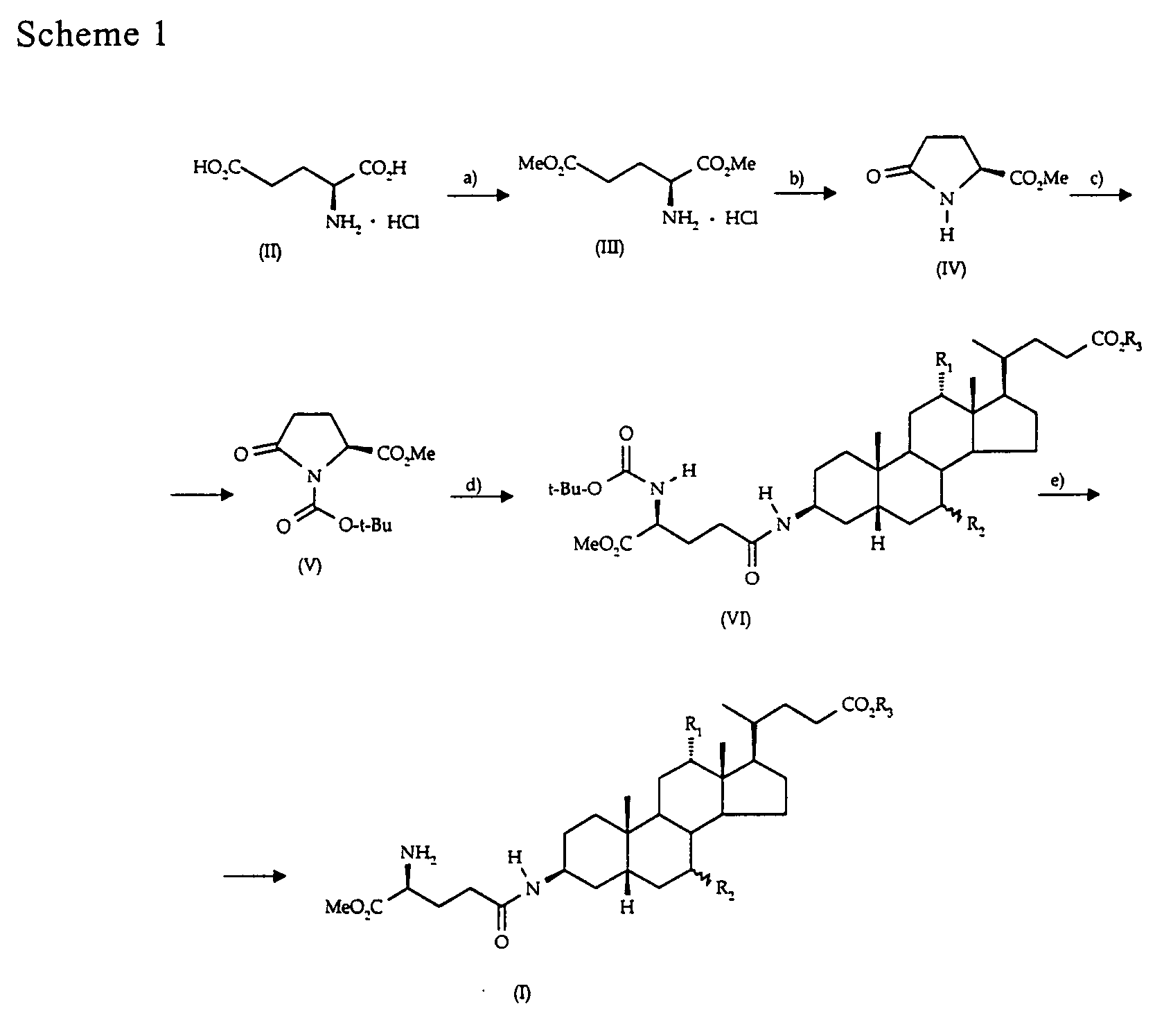
- a) esterifying either L-glutamic acid hydrochloride (II) or L-glutamic acid to
obtain L-glutamic acid dimethyl ester hydrochloride (III):
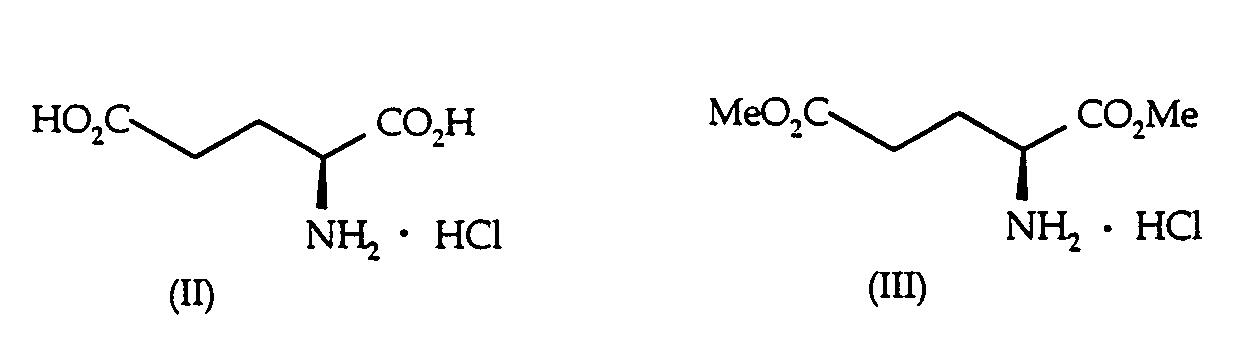
- b) subjecting the resulting ester (III) to intramolecular amidation by treatment
with bases, followed by heating, to give L-5-oxoproline methyl ester (IV):

- c) protecting the lactam nitrogen of (IV) by means of a t-butoxycarbonyl
group to give the compound of formula (V), (S)-5-oxo-1,2-pyrrolidinedicarboxylic
acid 1-(1,1-dimethylethyl) 2-methyl ester:

- d) subjecting the compound of formula (V) to transamidation, by treatment
with a compound of general formula (IX):
wherein R1, R2 and R3 are as defined above,

to give a compound of formula (VI):
- e) deprotection of compounds of formula (VI), to give the compounds of general formula (I).
The process of the invention is summarised in the following Scheme 1:
The compounds of formula (IX), are prepared according to the methods
disclosed in WO-A-95/32741 or in PCT/EP00/08226. These compounds are bile
acid derivatives in which a 13-amino group is always present in position 3.
The most important examples of bile acids of the present invention are
selected from the group consisting of residues of cholic, chenodeoxycholic,
deoxycholic, ursodeoxycholic, lithocholic acids represented by the following
formulae.


The process of Scheme 1 is characterized by the use of the intermediate of
formula (V), (S)-5-oxo-1,2-pyrrolidinedicarboxylic acid 1-(1,1-dimethylethyl)
2-methyl ester.
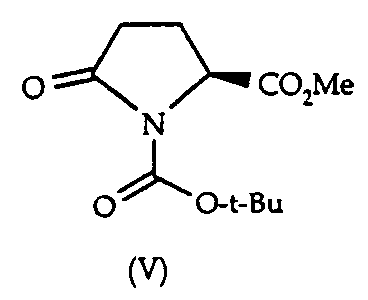
The latter is a known intermediate used for the preparation of
pharmaceuticals, e.g. antitumoral agents (JP05247047; Tetrahedron, 1994, 50,
6221-6238).
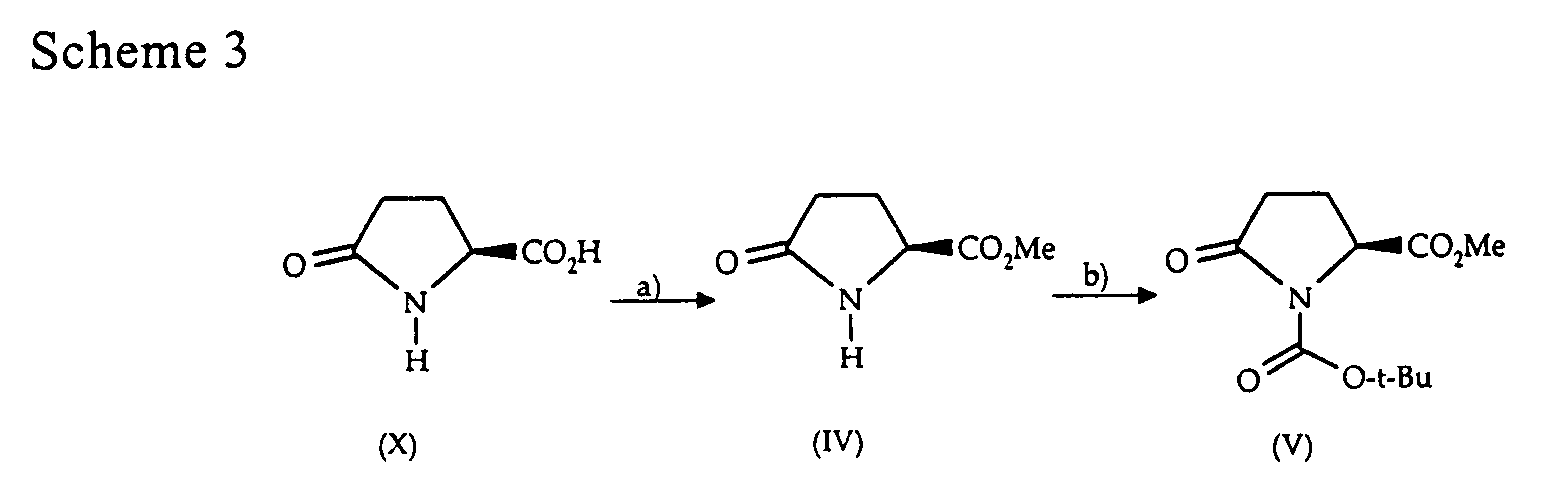
The preparation of compound (V) (see for example J. Org. Chem., 1999,
64, 6646-6652; Synlett, 1995, 519-522; Synth. Comm, 1995, 25, 4045-4052;
Tetrahedron, 1994, 50, 6221-6238; Tetrahedron Lett., 1993, 34, 5743-5746)
preferably uses (S)-5-oxoproline (X) as starting material, with a synthetic
pathway described in the following Scheme 3.
The subsequent protection of (S)-5-oxoproline methyl ester (IV) is
reported for example in: JP05247047; Eur. J. Org. Chem., 1999, 1581-1584;
Tetrahedron Lett., 1998, 39, 4789-4792; Tetrahedron Lett., 1993, 34, 5455-5458;
Chem. Pharm. Bull., 1991, 39, 1199-1212; J. Org. Chem. 1983, 2424-2426.
As described in Scheme 1, in step a) either L-glutamic acid hydrochloride
(II) or L-glutamic acid are esterified to give L-glutamic acid dimethyl ester
hydrochloride (III). This reaction may be performed by known esterification
methods for carboxylic acids.
In particular, compound (II) is first suspended in methanol and then
dissolved by adding at least 2 moles of SOCl2 per mole of (II).The temperature
is maintained at 0-5°C during the addition, and then the reaction is completed in
23 hours at 23°C. The thick oil obtained after the evaporation of the solvent is
directly used, without any purification, in the next step.
In step b) compound of formula (III) is first neutralized with 3 M KOH in
methanol solution, the precipitated KCl is filtered off. The filtrate is evaporated
and then heated for 1 to 7 hours, to obtain (S)-5-oxoproline methyl ester (IV).
The heating time depends on the temperature used during the cyclization
reaction, which can vary from 80 to 130°C. Compound (IV) can be used directly
in the subsequent step c), or it can be purified, as described in Chem. Pharm.
Bull., 1990, 28(5), 1449-1458, by distillation at reduced pressure (0.2 kPa).
However, these conditions are not easily achieved at industrial level and,
moreover, the distillation of large quantities would require a long time. The
prolonged heating at high temperature would bring about a decrease in
enantiomeric excess and a yield loss. As a matter of fact, even at lab scale, the
final distillation fractions showed a content of the R enantiomer ranging from
2.5 up to 7.9 %.
In step c) the lactam nitrogen of (IV) is protected with the
t-butoxycarbonyl group according to known methods. This reaction is
preferably carried out by adding at least one mole of di-t-butyl dicarbonate, to a
solution containing one mole of (IV) in a solvent selected in the group
consisting of: C1-C5 alkyl esters of acetic acid, aprotic dipolar solvents, CH3CN,
aromatic solvents like toluene. EtOAc and CH3CN are preferred. The reaction is
usually catalyzed by addition of, for example, 4-(dimethylamino)pyridine
(DMAP), in a quantity ranging from 0.01 to 0.1 moles per mole of (IV).
The reaction is completed in two hours at room temperature and, after
evaporation of the solvent, the crude residue of (IV) is dissolved in EtOAc. The
solution is washed with aq. pH 5.7 phosphate buffer, and water, then dried
(Na2SO4) and purified by crystallization from a solvent, preferably EtOAc
and/or n-hexane.
The product isolated in 88% yield, is a solid that can be stored for months
without degradation.
In step d) one mole of compound of formula (IX) is reacted with 1 to 1.5
mole of compound (V), in a solvent, selected from N,N-dimethylacetamide,
N,N-dimethylformamide, EtOAc, BuOAc, toluene, xylene, p-cymene,
diethylbenzene or similar aromatic solvent substituted with one or more linear
or branched alkyl groups. The reaction mixture is stirred for 12 to 30 hours at a
temperature from 70 to 130°C depending on the reagents and solvent used.
Once the reaction is completed and after spontaneous cooling to room
temperature, the precipitate is filtered off, washed and dried, to afford the
condensation product of formula (VI).
In the subsequent step e), compound of formula (VI) is subjected to acidic
hydrolysis to remove the t-butoxycarbonyl group, to give the final compound of
general formula (I).
The reaction preferably consists in a slow addition of an inorganic or
organic acid, under anhydrous (e.g. gas) or aqueous form, to a solution of the
compound (VI) in a suitable alcohol or C1-C4 alkyl ester of acetic acid,
maintaining a reaction temperature from 15 to 60°C.
The resulting solution is kept at a temperature from 15 to 60°C for a time
from 0.5 to 20 hours, wherein temperature and time of reaction depend on the
compound used in the conversion of (VI) to (I).
In this step the acid compound is preferably selected from HCl gas, aq.
HCl, aq. H2SO4, CF3CO2H, CH3CO2H, oxalic acid, methanesulfonic acid or p-toluenesulfonic
acid. The acid is added in a quantity corresponding to 1-3 moles
per mole of (VI).
The compound of formula (I) is isolated either as a salt of the previously
used acid or as a free amine of general formula (I).
The isolation of (I) as a free amine, consists in a preliminary neutralization
of the acidic mixture obtained at the end of reaction, by adding a base
preferably selected from tertiary amines such as triethylamine (TEA) or
diisopropylethylamine (DIEA). Compound (I) is isolated in this step in a yield
ranging from 80 to 97 %.
The use of a hindered tertiary amine affords the isolation of compounds (I)
minimizing the formation of by products due to secondary reactions, such as
hydrolysis of the ester groups or transamidation. In fact aqueous bases, such as
aq. NaOH or KOH, can hydrolyse the ester groups, and in particular the ester
group present on the glutamic chain which is easier to cleave than the ester
group in the cholanoic moiety. Furthermore, the use of a NH3 solution or of
primary or secondary amines can promote the transamidation reaction.
The process for the preparation of (3β,5β,12α)-3-[[4(S)-4-amino-5-methoxy-1,5-dioxo]pentyl]amino]-12-hydroxycholan-24-oic
acid methyl ester,
compound of formula (I A), according to Scheme 4, is particularly preferred.

In step a), compound (II) is first suspended in methanol and then dissolved
by adding at least 2 moles of SOCl2 per mole of (II). The temperature is
maintained at 0-5°C during the addition, and then the reaction is completed in
20 hours at 23°C.
The thick oil obtained after the evaporation of the solvent is directly used,
without any purification, in the next step.
In step b), compound of formula (III) is first neutralized with 3 M KOH in
methanol solution, then the precipitated KCl is filtered off. The filtrate is
evaporated and then heated for 1 hour, at a temperature varying from 110 to
115°C. The resulting (S)-5-oxoproline methyl ester (IV) is directly used in the
next step c).
In step c), at least one mole of di-t-butyl dicarbonate is added to a solution
containing one mole of (IV), in a solvent selected in the group consisting of: C1-C5
alkyl esters of acetic acid, aprotic dipolar solvents, CH3CN, aromatic
solvents like toluene. EtOAc and CH3CN are the preferred ones. The reaction is
usually catalyzed by addition of, for example, 4-(dimethylamino)pyridine
(DMAP), in a quantity ranging from 0.01 to 0.1 moles per mole of (IV).
The reaction is completed in two hours at room temperature and, after
evaporation of the solvent, the crude residue of (IV) is dissolved in EtOAc. The
solution is washed with aq. pH 5.7 phosphate buffer, and water, then dried
(Na2SO4) and purified by crystallization from a solvent, preferably EtOAc
and/or n-hexane.
The product isolated in 88% yield, is a solid that can be stored for months
without degradation.
In step d) (3β,5β,12α)-12-hydroxy-3-[[5-methoxy-1,5-dioxo-4(S)-4-[[(1,1-dimethylethoxy)carbonyl]amino]pentyl]amino]cholan-24-oic
acid methyl ester
of formula (VI A) is obtained by reaction of (S)-5-oxo-1,2-pyrrolidine-dicarboxylic
acid 1-(1,1-dimethylethyl) 2-methyl ester (V), with (3β,5β,12α)-3-amino-12-hydroxycholan-24-oic
acid methyl ester (XI), prepared according to
the method described in WO-A-95/32741 or in the patent application
PCT/EP00/08226 of the same assignee.
The preferred process conditions to afford compound (VI A) in step d),
consists in mixing a suspension of one mole of (XI) with at least one mole of
compound (V), in a solvent preferably selected from: toluene, xylene, C1-C4
alkyl esters of acetic acid, N,N-dimetylacetamide, p-cymene or diethylbenzene.
The reaction mixture is kept at a temperature from 80 to 110°C and for a
time of 20 to 30 hours, necessary for a complete conversion of the reagents.
Once the reaction is completed the solution is cooled to room temperature
during 15 hours and then the precipitate, is filtered off and washed. The product
is isolated in a yield ranging from 72 to 78%.
In Step e) compound (VI A) is hydrolysed to compound of formula (I A)
by slow addition of 1 to 3 moles of HCl or methanesulfonic acid to a methanol
solution of compound (VI A), below 20°C. The complete conversion of (VI A)
to (I A) is obtained by keeping the solution for 24 hours at room temperature.
Compound (I A) can be isolated as a salt of the previously used acid, or as
an amine in a yield from 88 to 92 %.
The isolation of (I A) as free amine is obtained by neutralizing the solution
with an addition of a tertiary amine, preferably selected from triethylamine
(TEA) or diisopropylethylamine (DIEA). Otherwise the isolation of (I) as a salt
is obtained through crystallization or insolubilization.
The experimental conditions used will be illustrated in detail in the
following experimental section.
| Method A | |
| Stationary phase | Chiralcel OD-H, 250 x 4.6 mm column packed by Daicel |
| Temperature | 40°C |
| Mobile phase | isocratic elution: A/B = 93 : 7 A = n-hexane, B = ethanol |
| Flow rate | 1.0 mL min-1 |
| Detection (UV) | 210 nm |
| Injection | 20 µL |
| Sample concentration | 2.0 mg mL-1 (racemic mixture), 5.0 mg mL-1 (optically active) |
| Method B | |||
| Stationary phase | Lichrosorb RP-Select B 5 µm, 250 x 4 mm column packed by Merck KGaA | ||
| Temperature | 45°C | ||
| Mobile phase | gradient elution, A = 0.017 M H3PO4 in water, B = CH3CN | ||
| Gradient timetable | min | % A | % B |
| 0 | 82 | 18 | |
| 30 | 15 | 85 | |
| 45 | 15 | 85 | |
| Flow rate | 1 mL min-1 | ||
| Detection (UV) | 210 nm | ||
| Injection | 10 µL | ||
| Sample concentration | 2 mg mL-1 |
| Method C | |
| Stationary phase | Chiralcel OD-H, 250 x 4.6 mm column packed by Daicel |
| Temperature | 40°C |
| Mobile phase | isocratic elution: A/B = 95 : 5 A = n-hexane, B = ethanol |
| Flow rate | 1.0 mL min-1 |
| Detection (UV) | 210 nm |
| Injection | 20 µL |
| Sample concentration | 0.4 mg mL-1 (racemic mixture), 1.0 mg mL-1 (optically active) |
| Method D | |
| Stationary phase | Chiralcel OD-H; 250 x 4.6 mm column packed by Daicel; |
| Temperature | 40°C; |
| Mobile phase | isocratic elution: A/B = 92:8; A = n-hexane, B = ethanol |
| Flow rate | 1.0 mL min-1; |
| Detection (UV) | 210 nm; |
| Injection | 10 µL; |
| Sample concentration | 2.0 mg mL-1 (racemic mixture), 5.0 mg mL-1 (optically active); |
| Method E | |||
| Stationary phase | Lichrosorb RP-Select B 5 µm; 250 x 4 mm column packed by Merck KGaA; | ||
| Temperature | 45°C; | ||
| Mobile phase | gradient elution; A = 0.017 M H3PO4 in water, B = CH3CN |
||
| Gradient timetable | min | % A | % B |
| 0 | 82 | 18 | |
| 30 | 15 | 85 | |
| 45 | 15 | 85 | |
| Flow rate | 1 mL min-1; | ||
| Detection (UV) | 210 nm; | ||
| Injection | 10 µL; | ||
| Sample concentration | 1 mg mL-1 |
| Method F | |
| Stationary phase | Chiralcel OD; 250 x 4.6 mm column packed by Daicel; |
| Temperature | 40°C; |
| Mobile phase | isocratic elution: A/B = 85:15; A = n-hexane, B = 2-propanol |
| Flow rate | 1.0 mL min-1; |
| Detection (UV) | 210 nm; |
| Injection | 20 µL; |
| Sample concentration | 0.7 mg mL-1 (racemic mixture), 3.0 mg mL-1 (optically active); |
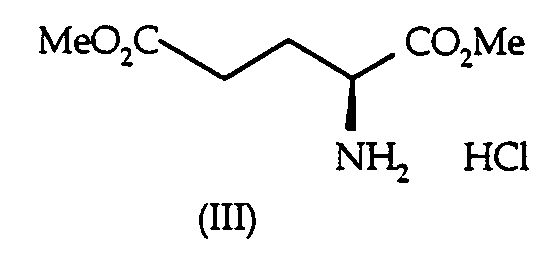
SOCl2 (732 g; 6.15 mol) was added over 2 h to a suspension of either L-glutamic
acid hydrochloride (II) (551 g; 3 mol) or L-glutamic acid (441.4 g; 3
mol) in MeOH (3.5 L) stirred at 0-5°C. After about 3.5 h at r.t. the reaction
mixture turned into a clear solution that was stirred for 20 h. The solvent was
evaporated to give (III) (650.8 g) as a thick oil that was used in the following
step without any purification.

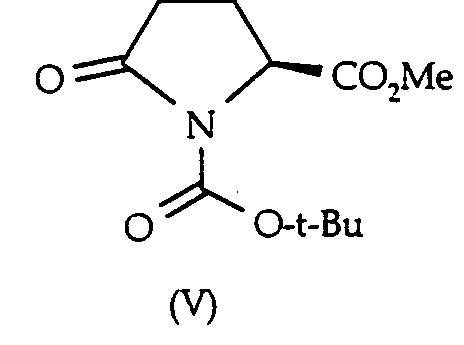
Di-t-butyl dicarbonate (611 g; 2.8 mol) was added over 1 h to a cloudy
solution of (IV) (447 g), preparared as described in example 2, and 4-(dimethylamino)pyridine
(DMAP) (6.1 g; 0.05 mol) in CH3CN (2.8 L) stirred at
15-18°C. After 2 h the solvent was evaporated. The residue was dissolved in
EtOAc, washed with aq. pH 5.7 phosphate buffer and H2O. After drying, the
solvent was evaporated to give crude (V) as a thick oil. The latter was dissolved
in EtOAc and the solution slowly diluted with n-hexane to induce
crystallisation. After 15 h at r.t. the solid was filtered, washed with n-hexane
and dried to afford (V) (474.3 g; 1.95 mol) as a white solid.
Yield 65 %. The mother liquors and the washings were combined and
evaporated. The oily residue was treated with n-hexane to give a second crop of
(V) (73 g; 0.3 mol) (yield 10 %) as a whitish solid of purity similar to the one of
the first crop. Overall yield (from II) 75 %.
- HPLC (method B):
- first crop 99.6 % (area %)
second crop 98.8 % (area %) - HPLC (method C): S/R ratio
- first crop 100 : 0
second crop 100 : 0
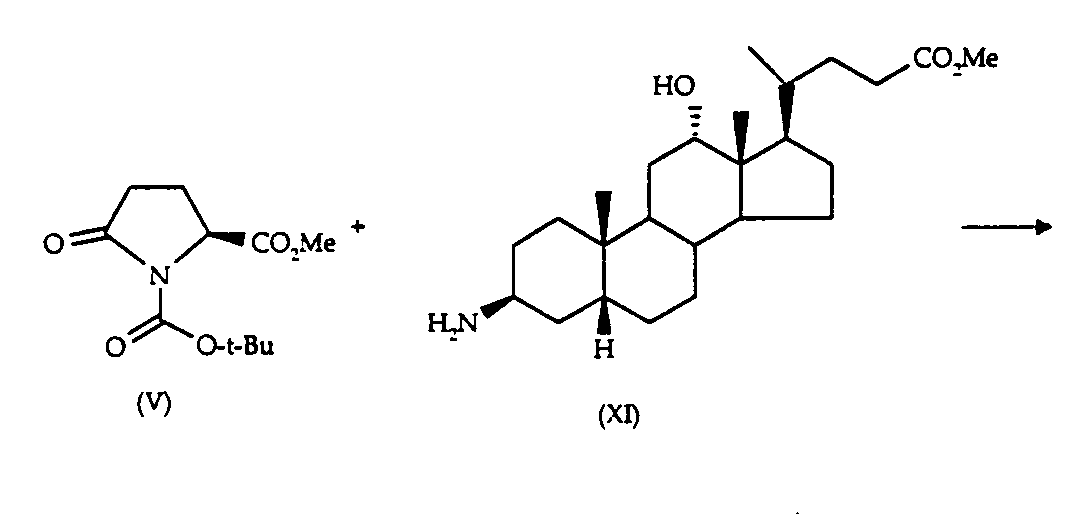

A suspension of (XI) (625 g; 1.54 mol) and (V) (374.6 g; 1.54 mol) in
toluene (1.54 L) was stirred at 90°C for 24 h. After spontaneous cooling to r.t.
over 15 h, the precipitate was filtered off, washed with toluene and dried (40°C;
2 kPa) to afford (VI A) as a 1:1 clatrate with toluene (889.2 g; 1.2 mol).
Yield 78 %.
Yield 78 %.

To a solution of compound (VI A) 1:1 clatrate with toluene (231.6 g; 0.31
mol) prepared as described in example 4, in MeOH (1.16 L), methanesulfonic
acid (56.7 g; 0.6 mol) was slowly added while maintaining the reaction
temperature below 20°C. The resulting solution was stirred at r.t. for 24 h. Then
DIEA (77.6 g; 0.6 mol) was added and the solution was evaporated to a crude
residue that was taken up with water. After one hour stirring at r.t. the solid was
filtered, washed with water and dried to afford (I A) (149.1 g; 0.27 mol) as a
white solid. Yield 87 %.
A solution of compound (VI A) 1:1 clatrate with toluene (30 g; 40 mmol)
prepared as described in example 4, in 2.5 M HCl in MeOH (100 mL) was
stirred at r.t. for 15 h then the solution was seeded. After 2 h at 0°C, the solid
was filtered, washed with cold 1.5 M HCl in MeOH (30 mL) and dried to obtain
(I A) hydrochloride (21.4 g; 34.4 mmol) containing a further mole of HCl as a
white solid.
Yield 86 %.
Yield 86 %.
Claims (4)
- A process for the preparation of bile ester derivatives of general formula (I),wherein:
 R1 is H or OH,R2 is H, α-OH or β-OH, andR3 is a straight or branched C1-C4 alkyl group or a benzyl group,
which process consists in:a) esterifying either L-glutamic acid hydrochloride (II) or L-glutamic acid to obtain L-glutamic acid dimethyl ester hydrochloride (III): b) subjecting the resulting ester (III) to intramolecular amidation by treatment with bases, followed by heating, to give the cyclic compound L-5-oxoproline methyl ester (IV):
 c) protecting the lactam nitrogen of (IV) by means of a t-butoxycarbonyl group to give the compound of formula (V), (S)-5-oxo-1,2-pyrrolidinedicarboxylic acid 1-(1,1-dimethylethyl) 2-methyl ester:
 d) subjecting the compound of formula (V) to transamidation, by treatment with a compound of general formula (IX):wherein R1, R2 and R3 are as defined above,
to give a compound of formula (VI): e) hydrolysing compounds of formula (VI) under acidic conditions, to give the compounds of general formula (I).
 - A process according to claim 1, in which the compounds of general formula (IX) are derivatives of the following bile acids:
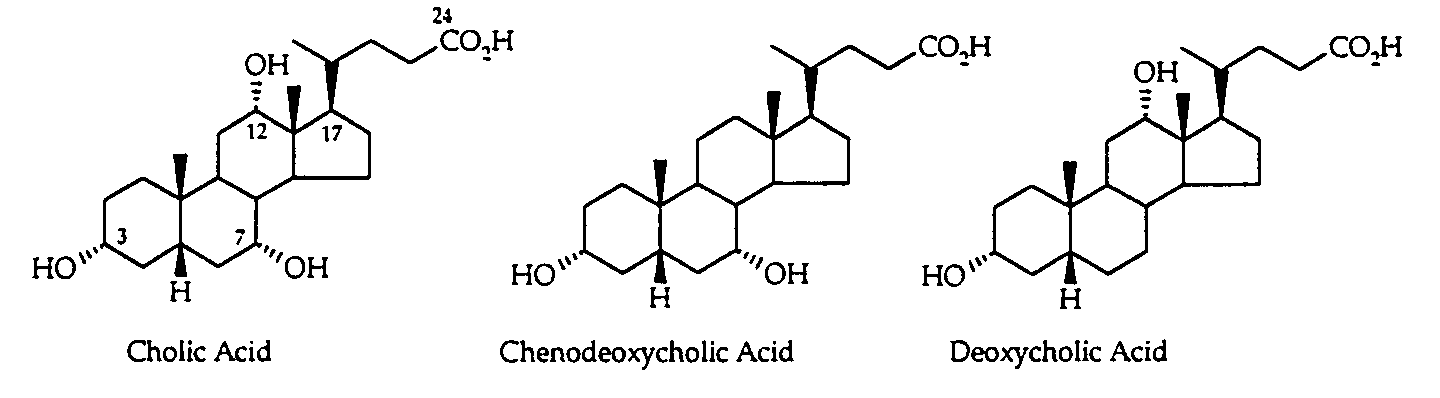
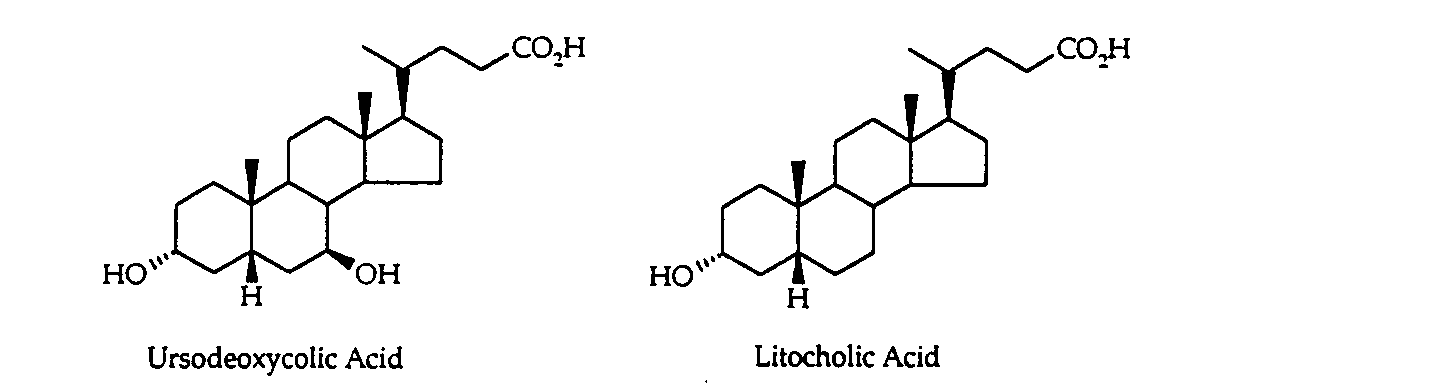
- A process according to claims 1-2, in which:step a) is carried out in methanol in the presence of at least 2 mole of SOCl2 per mole of (II);step b) is carried out using a base;step c) is carried out using at least one mole of di-t-butyl dicarbonate per mole of compound (IV) in the presence of 0.01 to 0.1 mol of 4-(dimethylamino)-pyridine per mole of compound (IV), in a solvent selected from: C1-C5 alkyl ester of acetic acid, aprotic dipolar solvents, CH3CN and aromatic solvents;step d) is carried out using one mole of compound (IX) per 1 to 1.5 mole of compound (V), in a solvent selected from: N,N-dimethyl-acetamide, N,N-dimethylformamide, EtOAc, BuOAc, toluene, xylene, p-cymene, diethylbenzene or another aromatic solvent substituted with one or more alkyl linear or branched group; at a temperature from 70 to 130°C;step e) is carried out using 1 to 3 mole of acid per mole of (IV), where the acid is selected from: HCl gas, aq. HCl, aq. H2SO4, CF3CO2H, CH3CO2H, oxalic acid, methanesulfonic acid or p-toluenesulfonic acid, at a temperature between 15 and 60°C, to obtain the compounds of formula (I) either as the salt of the acid used or as a free amine of formula (I), by addition of a tertiary amine, selected from triethylamine (TEA) or diisopropylethylamine (DIEA).
- A process according to claims 1-3 for the preparation of (3β,5β,12α)-3-[[4(S)-4-amino-5-methoxy-1,5-dioxopentyl]amino]-12-hydroxycholan-24-oic acid methyl ester (I A):in which a suspension of one mole of compound (XI), (3β,5β,12α)-3-amino-12-hydroxycholan-24-oic acid methyl ester,
 is subjected to transamidation in step d) by treatment with at least one mole of compound (V), in a solvent selected from: toluene, N,N-dimetilacetamide, p-cymene or diethylbenzene at a temperature from 80 to 110°C for 20 to 30 hour to afford the compound (VI A), (3β,5β,12α)-12-hydroxy-3-[[5-methoxy-1,5-dioxo-4(S)-4-[[(1,1-dimethylethoxy)carbonyl]amino]pentyl]-amino]cholan-24-oic acid methyl ester, by cooling the mixture to room temperature over 15 hours and filtering the precipitated compound; and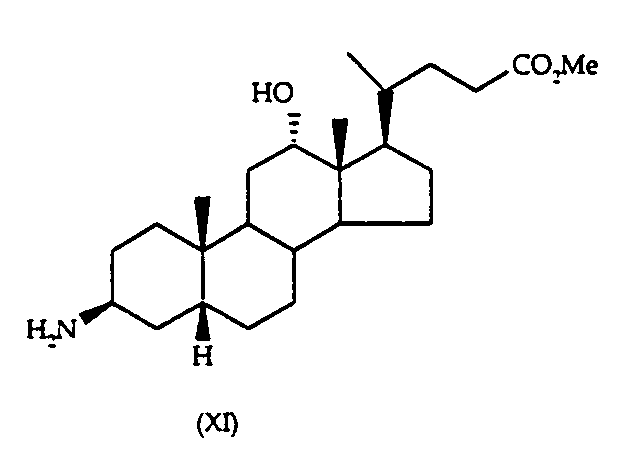
a solution of the compound of formula (VI A) is subjected to hydrolysis in step e) by slow addition of 1 to 3 moles of HCl or methanesulfonic acid solution, keeping temperature below 20°C, and the compound (I A) is finally isolated as a salt of the previously used acid, or as a free amine by neutralizing the solution by addition of a tertiary amine, selected from triethylamine (TEA) or diisopropylethylamine (DIEA).
Priority Applications (10)
| Application Number | Priority Date | Filing Date | Title |
|---|---|---|---|
| EP01102490A EP1229041A1 (en) | 2001-02-05 | 2001-02-05 | A process for the preparation of 3-Glutamido bile ester derivatives using N-tBoc methyl pyroglutamate |
| JP2002567959A JP4339594B2 (en) | 2001-02-05 | 2002-02-04 | Method for preparing 3-glutamide bile acid ester derivatives using N-protected methyl pyroglutamate |
| US10/467,204 US20040138185A1 (en) | 2001-02-05 | 2002-02-04 | Process for the preparation of 3-glutamido bile ester derivatives using n-prtotected methyl proglutamate |
| DE60233930T DE60233930D1 (en) | 2001-02-05 | 2002-02-04 | PROCESS FOR THE PREPARATION OF 3-GLUTAMIDE GALLENIC ACID DERIVATIVES BY USING N-PROTECTED METHYL-PYROGLUTAMATE |
| EP02718087A EP1358201B1 (en) | 2001-02-05 | 2002-02-04 | A process for the preparation of 3-glutamido bile ester derivatives using n-protected methyl pyroglutamate |
| IL15690302A IL156903A0 (en) | 2001-02-05 | 2002-02-04 | A process for the preparation of 3-glutamido bile ester derivatives |
| CA2435010A CA2435010C (en) | 2001-02-05 | 2002-02-04 | A process for the preparation of 3-glutamido bile ester derivatives using n-protected methyl pyroglutamate |
| AT02718087T ATE444966T1 (en) | 2001-02-05 | 2002-02-04 | METHOD FOR PRODUCING 3-GLUTAMIDE BALE ACID DERIVATIVES BY USING N-PROTECTED METHYL PYROGLUTAMAT |
| PCT/EP2002/001133 WO2002068449A1 (en) | 2001-02-05 | 2002-02-04 | A process for the preparation of 3-glutamido bile ester derivatives using n-prtotected methyl proglutamate |
| IL156903A IL156903A (en) | 2001-02-05 | 2003-07-14 | Process for the preparation of 3-glutamido bile ester derivatives |
Applications Claiming Priority (1)
| Application Number | Priority Date | Filing Date | Title |
|---|---|---|---|
| EP01102490A EP1229041A1 (en) | 2001-02-05 | 2001-02-05 | A process for the preparation of 3-Glutamido bile ester derivatives using N-tBoc methyl pyroglutamate |
Publications (1)
| Publication Number | Publication Date |
|---|---|
| EP1229041A1 true EP1229041A1 (en) | 2002-08-07 |
Family
ID=8176389
Family Applications (2)
| Application Number | Title | Priority Date | Filing Date |
|---|---|---|---|
| EP01102490A Withdrawn EP1229041A1 (en) | 2001-02-05 | 2001-02-05 | A process for the preparation of 3-Glutamido bile ester derivatives using N-tBoc methyl pyroglutamate |
| EP02718087A Expired - Lifetime EP1358201B1 (en) | 2001-02-05 | 2002-02-04 | A process for the preparation of 3-glutamido bile ester derivatives using n-protected methyl pyroglutamate |
Family Applications After (1)
| Application Number | Title | Priority Date | Filing Date |
|---|---|---|---|
| EP02718087A Expired - Lifetime EP1358201B1 (en) | 2001-02-05 | 2002-02-04 | A process for the preparation of 3-glutamido bile ester derivatives using n-protected methyl pyroglutamate |
Country Status (8)
| Country | Link |
|---|---|
| US (1) | US20040138185A1 (en) |
| EP (2) | EP1229041A1 (en) |
| JP (1) | JP4339594B2 (en) |
| AT (1) | ATE444966T1 (en) |
| CA (1) | CA2435010C (en) |
| DE (1) | DE60233930D1 (en) |
| IL (2) | IL156903A0 (en) |
| WO (1) | WO2002068449A1 (en) |
Citations (1)
| Publication number | Priority date | Publication date | Assignee | Title |
|---|---|---|---|---|
| WO2000038738A1 (en) * | 1998-12-23 | 2000-07-06 | Bracco Imaging S.P.A. | Blood pool agents for nuclear magnetic resonance diagnostics |
Family Cites Families (2)
| Publication number | Priority date | Publication date | Assignee | Title |
|---|---|---|---|---|
| DE2627988A1 (en) * | 1976-06-23 | 1978-01-05 | Max Planck Gesellschaft | SECRETARY PROVISION |
| US4280953A (en) * | 1979-11-08 | 1981-07-28 | The Salk Institute For Biological Studies | Glycosylated analogs of somatostatin |
-
2001
- 2001-02-05 EP EP01102490A patent/EP1229041A1/en not_active Withdrawn
-
2002
- 2002-02-04 CA CA2435010A patent/CA2435010C/en not_active Expired - Fee Related
- 2002-02-04 JP JP2002567959A patent/JP4339594B2/en not_active Expired - Fee Related
- 2002-02-04 AT AT02718087T patent/ATE444966T1/en not_active IP Right Cessation
- 2002-02-04 IL IL15690302A patent/IL156903A0/en unknown
- 2002-02-04 EP EP02718087A patent/EP1358201B1/en not_active Expired - Lifetime
- 2002-02-04 DE DE60233930T patent/DE60233930D1/en not_active Expired - Lifetime
- 2002-02-04 US US10/467,204 patent/US20040138185A1/en not_active Abandoned
- 2002-02-04 WO PCT/EP2002/001133 patent/WO2002068449A1/en not_active Ceased
-
2003
- 2003-07-14 IL IL156903A patent/IL156903A/en not_active IP Right Cessation
Patent Citations (1)
| Publication number | Priority date | Publication date | Assignee | Title |
|---|---|---|---|---|
| WO2000038738A1 (en) * | 1998-12-23 | 2000-07-06 | Bracco Imaging S.P.A. | Blood pool agents for nuclear magnetic resonance diagnostics |
Non-Patent Citations (3)
| Title |
|---|
| A. HUBERT ET AL: "Carbon Dioxide Catalysis of the Formation of Pyroglutamic Acid", NATURE., vol. 182, no. 4630, 26 July 1958 (1958-07-26), MACMILLAN JOURNALS LTD. LONDON., GB, pages 259, XP002171830, ISSN: 0028-0836 * |
| E. CESAROTTI ET AL: "Synthesis and Stereochemical Studies of the Chiral Ruthenium Complexes [Ru(n-C5H5){(S))dpompyr-PP'}X] [dpompyr = N-diphenylphosphino-2-(diphenylphosphinoxymethyl)pyrrolidone, X = H or Cl]. Crystal Structure of [(S)Ru(n-C5H5){(S)dpompyr-PP'}Cl]", JOURNAL OF THE CHEMICAL SOCIETY, DALTON TRANSACTIONS., no. 5, May 1987 (1987-05-01), CHEMICAL SOCIETY. LETCHWORTH., GB, pages 1149 - 1155, XP002171831, ISSN: 1472-7773 * |
| KOTSUKI, HIYOSHIZO ET AL: "High pressure organic chemistry. XIV. A new powerful method for the transformation of lactams into.omega.-amino carboxamides under high pressure conditions", TETRAHEDRON LETT. (1992), 33(34), 4945-8, XP002171829 * |
Also Published As
| Publication number | Publication date |
|---|---|
| JP4339594B2 (en) | 2009-10-07 |
| EP1358201B1 (en) | 2009-10-07 |
| EP1358201A1 (en) | 2003-11-05 |
| CA2435010A1 (en) | 2002-09-06 |
| US20040138185A1 (en) | 2004-07-15 |
| ATE444966T1 (en) | 2009-10-15 |
| CA2435010C (en) | 2010-01-26 |
| DE60233930D1 (en) | 2009-11-19 |
| JP2004518753A (en) | 2004-06-24 |
| WO2002068449A1 (en) | 2002-09-06 |
| IL156903A (en) | 2010-06-16 |
| IL156903A0 (en) | 2004-02-08 |
Similar Documents
| Publication | Publication Date | Title |
|---|---|---|
| US5276164A (en) | Process for the production of 4-hydroxy-2-oxopyrrolidin-1-yl-acetamide | |
| TW427975B (en) | Process for preparing benzoic acid derivative intermediates and benzothiophene pharmaceutical agents | |
| EP1358201B1 (en) | A process for the preparation of 3-glutamido bile ester derivatives using n-protected methyl pyroglutamate | |
| AU2003248428B2 (en) | Process for the preparation of enantiomerically pure N-methyl-N-[(1S)-phenyl-2-((3S)-3-hydroxypyrrolidin-1-yl)ethyl]-2,2-diphenylacetamide | |
| RU2198176C2 (en) | Methods of synthesis of azasteroid derivatives, derivative of azasteroid-imidazolide, method of its synthesis | |
| EP0536671B1 (en) | Carboxylic acid ester protecting groups, process to prepare them, their coupling to functional groups and their use | |
| EP1692106A1 (en) | A novel synthesis of 2-azabicyclic-3-carboxylic acids, useful as important drug intermediates | |
| JP3241741B2 (en) | "Method for producing 3- (7-amidino-2-naphthyl) -2-phenylpropionic acid derivative" | |
| KR100915175B1 (en) | Process for preparing imidapril | |
| JP3429370B2 (en) | Chemical method | |
| US4730076A (en) | Process for producing α-aspartyl-phenylalanine ester | |
| JP3989832B2 (en) | Process for the preparation of N-protected-3-pyrrolidine-lactam substituted phosphonium salts | |
| EP2196458A1 (en) | Process for obtaining enantiomerically enriched pyrazole derivatives | |
| EP0844242B1 (en) | Method of producing 4-hydroxy-2-pyrrolidinone and method of purifying the same | |
| EP0598383B1 (en) | Process for the preparation of 5,6-diacetoxyindole | |
| US5929242A (en) | Manufacture of levobupivacaine and analogues thereof from L-lysine | |
| JPWO1998054132A1 (en) | Method for producing 3-(7-amidino-2-naphthyl)-2-phenylpropionic acid derivatives | |
| RU2034842C1 (en) | Quinoline derivative and a method of its synthesis | |
| EP0146102A2 (en) | Process for preparing benzothiazine compounds | |
| US6172234B1 (en) | Optically active cyclic amino acid ester derivatives and processes for producing the same | |
| CA1284499C (en) | ¬2,5-dihydro-2-oxo-5-phenyl-3-furanyl| amines, methods of manufacture, and use thereof in the production of angiotensin converting enzyme inhibitors | |
| KR100483317B1 (en) | METHOD FOR THE PREPARATION OF α-PHENYL-α-PROPOXYBENZENEACETIC ACID 1-METHYL-4-PIPERIDINYL ESTER HYDROCHLORIDE | |
| JP2001328993A (en) | Optically active phosphine compound | |
| EP2112992A1 (en) | A process for the preparation of -2-n [(s)-1-ethoxycarbonyl-3-phenylpropyl]-(s)-alanyl]-(1s, 3s, 5s)-2-azabicyclo [3.3.0] octane-3-carboxylic acid | |
| WO1991015477A1 (en) | Process for obtaining derivatives of 6-fluoro-1,4-dihydro-4-oxo-7-piperazinyl-3-quinolinecarboxylic acid and derivatives of acrylate used in said process |
Legal Events
| Date | Code | Title | Description |
|---|---|---|---|
| PUAI | Public reference made under article 153(3) epc to a published international application that has entered the european phase |
Free format text: ORIGINAL CODE: 0009012 |
|
| AK | Designated contracting states |
Kind code of ref document: A1 Designated state(s): AT BE CH CY DE DK ES FI FR GB GR IE IT LI LU MC NL PT SE TR |
|
| AX | Request for extension of the european patent |
Free format text: AL;LT;LV;MK;RO;SI |
|
| AKX | Designation fees paid | ||
| REG | Reference to a national code |
Ref country code: DE Ref legal event code: 8566 |
|
| STAA | Information on the status of an ep patent application or granted ep patent |
Free format text: STATUS: THE APPLICATION IS DEEMED TO BE WITHDRAWN |
|
| 18D | Application deemed to be withdrawn |
Effective date: 20030208 |