EP1229024A1 - m-SUBSTITUTED BENZOIC ACID DERIVATIVES EXHIBITING INTEGRIN ALPHA-V BETA-3 ANTAGONISM - Google Patents
m-SUBSTITUTED BENZOIC ACID DERIVATIVES EXHIBITING INTEGRIN ALPHA-V BETA-3 ANTAGONISM Download PDFInfo
- Publication number
- EP1229024A1 EP1229024A1 EP00964758A EP00964758A EP1229024A1 EP 1229024 A1 EP1229024 A1 EP 1229024A1 EP 00964758 A EP00964758 A EP 00964758A EP 00964758 A EP00964758 A EP 00964758A EP 1229024 A1 EP1229024 A1 EP 1229024A1
- Authority
- EP
- European Patent Office
- Prior art keywords
- piperidine
- benzoylamino
- piperidin
- alkyl
- ylamino
- Prior art date
- Legal status (The legal status is an assumption and is not a legal conclusion. Google has not performed a legal analysis and makes no representation as to the accuracy of the status listed.)
- Withdrawn
Links
- -1 m-SUBSTITUTED BENZOIC ACID Chemical class 0.000 title claims abstract description 64
- 230000008485 antagonism Effects 0.000 title description 2
- 108010047852 Integrin alphaVbeta3 Proteins 0.000 title 1
- 230000001747 exhibiting effect Effects 0.000 title 1
- 150000001875 compounds Chemical class 0.000 claims abstract description 365
- 125000002887 hydroxy group Chemical group [H]O* 0.000 claims abstract description 80
- 125000002924 primary amino group Chemical group [H]N([H])* 0.000 claims abstract description 61
- 125000004435 hydrogen atom Chemical group [H]* 0.000 claims abstract description 53
- 125000000623 heterocyclic group Chemical group 0.000 claims abstract description 38
- 230000003042 antagnostic effect Effects 0.000 claims abstract description 34
- 108010044426 integrins Proteins 0.000 claims abstract description 34
- 102000006495 integrins Human genes 0.000 claims abstract description 34
- 208000037265 diseases, disorders, signs and symptoms Diseases 0.000 claims abstract description 31
- 201000010099 disease Diseases 0.000 claims abstract description 30
- 125000004433 nitrogen atom Chemical group N* 0.000 claims abstract description 29
- 238000011282 treatment Methods 0.000 claims abstract description 19
- 150000003839 salts Chemical class 0.000 claims abstract description 16
- 206010028980 Neoplasm Diseases 0.000 claims abstract description 12
- 208000026106 cerebrovascular disease Diseases 0.000 claims abstract description 9
- 125000002915 carbonyl group Chemical group [*:2]C([*:1])=O 0.000 claims abstract description 8
- 239000012453 solvate Substances 0.000 claims abstract description 8
- 206010027476 Metastases Diseases 0.000 claims abstract description 7
- 230000009401 metastasis Effects 0.000 claims abstract description 7
- 208000020084 Bone disease Diseases 0.000 claims abstract description 6
- 208000024172 Cardiovascular disease Diseases 0.000 claims abstract description 6
- 125000002947 alkylene group Chemical group 0.000 claims abstract description 6
- 230000033115 angiogenesis Effects 0.000 claims abstract description 6
- 208000026278 immune system disease Diseases 0.000 claims abstract description 6
- 125000004169 (C1-C6) alkyl group Chemical group 0.000 claims description 115
- 125000001997 phenyl group Chemical group [H]C1=C([H])C([H])=C(*)C([H])=C1[H] 0.000 claims description 98
- XBDQKXXYIPTUBI-UHFFFAOYSA-N dimethylselenoniopropionate Natural products CCC(O)=O XBDQKXXYIPTUBI-UHFFFAOYSA-N 0.000 claims description 66
- 125000003710 aryl alkyl group Chemical group 0.000 claims description 59
- RWTNPBWLLIMQHL-UHFFFAOYSA-N fexofenadine Chemical compound C1=CC(C(C)(C(O)=O)C)=CC=C1C(O)CCCN1CCC(C(O)(C=2C=CC=CC=2)C=2C=CC=CC=2)CC1 RWTNPBWLLIMQHL-UHFFFAOYSA-N 0.000 claims description 57
- 125000004191 (C1-C6) alkoxy group Chemical group 0.000 claims description 55
- 229920006395 saturated elastomer Polymers 0.000 claims description 52
- 125000000999 tert-butyl group Chemical group [H]C([H])([H])C(*)(C([H])([H])[H])C([H])([H])[H] 0.000 claims description 41
- 125000005843 halogen group Chemical group 0.000 claims description 40
- 238000000034 method Methods 0.000 claims description 37
- 125000004454 (C1-C6) alkoxycarbonyl group Chemical group 0.000 claims description 33
- 235000019260 propionic acid Nutrition 0.000 claims description 28
- IUVKMZGDUIUOCP-BTNSXGMBSA-N quinbolone Chemical compound O([C@H]1CC[C@H]2[C@H]3[C@@H]([C@]4(C=CC(=O)C=C4CC3)C)CC[C@@]21C)C1=CCCC1 IUVKMZGDUIUOCP-BTNSXGMBSA-N 0.000 claims description 28
- 125000003178 carboxy group Chemical group [H]OC(*)=O 0.000 claims description 26
- 125000000882 C2-C6 alkenyl group Chemical group 0.000 claims description 22
- 229910052757 nitrogen Inorganic materials 0.000 claims description 22
- 125000003277 amino group Chemical group 0.000 claims description 21
- 125000002837 carbocyclic group Chemical group 0.000 claims description 21
- 125000005842 heteroatom Chemical group 0.000 claims description 17
- XBDQKXXYIPTUBI-UHFFFAOYSA-M Propionate Chemical compound CCC([O-])=O XBDQKXXYIPTUBI-UHFFFAOYSA-M 0.000 claims description 15
- 238000004519 manufacturing process Methods 0.000 claims description 15
- 125000003601 C2-C6 alkynyl group Chemical group 0.000 claims description 13
- 230000008569 process Effects 0.000 claims description 13
- 125000001424 substituent group Chemical group 0.000 claims description 12
- 125000002619 bicyclic group Chemical group 0.000 claims description 10
- 239000003814 drug Substances 0.000 claims description 10
- 239000008194 pharmaceutical composition Substances 0.000 claims description 10
- 230000002401 inhibitory effect Effects 0.000 claims description 9
- 125000001570 methylene group Chemical group [H]C([H])([*:1])[*:2] 0.000 claims description 9
- 125000004214 1-pyrrolidinyl group Chemical group [H]C1([H])N(*)C([H])([H])C([H])([H])C1([H])[H] 0.000 claims description 8
- 125000004070 6 membered heterocyclic group Chemical group 0.000 claims description 8
- 238000007363 ring formation reaction Methods 0.000 claims description 8
- 125000003396 thiol group Chemical class [H]S* 0.000 claims description 8
- 125000004916 (C1-C6) alkylcarbonyl group Chemical group 0.000 claims description 7
- 125000004739 (C1-C6) alkylsulfonyl group Chemical group 0.000 claims description 7
- ASJSAQIRZKANQN-CRCLSJGQSA-N 2-deoxy-D-ribose Chemical compound OC[C@@H](O)[C@@H](O)CC=O ASJSAQIRZKANQN-CRCLSJGQSA-N 0.000 claims description 7
- 125000001584 benzyloxycarbonyl group Chemical group C(=O)(OCC1=CC=CC=C1)* 0.000 claims description 7
- UYWQUFXKFGHYNT-UHFFFAOYSA-N phenylmethyl ester of formic acid Chemical group O=COCC1=CC=CC=C1 UYWQUFXKFGHYNT-UHFFFAOYSA-N 0.000 claims description 7
- 125000004178 (C1-C4) alkyl group Chemical group 0.000 claims description 6
- 108010035030 Platelet Membrane Glycoprotein IIb Proteins 0.000 claims description 6
- 125000003236 benzoyl group Chemical group [H]C1=C([H])C([H])=C(C([H])=C1[H])C(*)=O 0.000 claims description 6
- 125000004432 carbon atom Chemical group C* 0.000 claims description 6
- 208000010110 spontaneous platelet aggregation Diseases 0.000 claims description 6
- KKJUPNGICOCCDW-UHFFFAOYSA-N 7-N,N-Dimethylamino-1,2,3,4,5-pentathiocyclooctane Chemical compound CN(C)C1CSSSSSC1 KKJUPNGICOCCDW-UHFFFAOYSA-N 0.000 claims description 5
- 230000001404 mediated effect Effects 0.000 claims description 5
- 125000004890 (C1-C6) alkylamino group Chemical group 0.000 claims description 4
- 208000034827 Neointima Diseases 0.000 claims description 4
- 150000001540 azides Chemical class 0.000 claims description 4
- 201000011510 cancer Diseases 0.000 claims description 4
- 230000023578 negative regulation of cell adhesion Effects 0.000 claims description 4
- 230000008692 neointimal formation Effects 0.000 claims description 4
- 125000000449 nitro group Chemical group [O-][N+](*)=O 0.000 claims description 4
- 125000000472 sulfonyl group Chemical group *S(*)(=O)=O 0.000 claims description 4
- BYDJYUYWWXMPRH-FQEVSTJZSA-N (2s)-2-(benzenesulfonamido)-3-[[2-fluoro-3-[4-(1,4,5,6-tetrahydropyrimidin-2-ylamino)piperidin-1-yl]benzoyl]amino]propanoic acid Chemical compound C([C@@H](C(=O)O)NS(=O)(=O)C=1C=CC=CC=1)NC(=O)C(C=1F)=CC=CC=1N(CC1)CCC1NC1=NCCCN1 BYDJYUYWWXMPRH-FQEVSTJZSA-N 0.000 claims description 3
- CPNLKQQNZJTZKO-FQEVSTJZSA-N (2s)-2-(benzenesulfonamido)-3-[[2-fluoro-3-[4-(pyrimidin-2-ylamino)piperidin-1-yl]benzoyl]amino]propanoic acid Chemical compound C([C@@H](C(=O)O)NS(=O)(=O)C=1C=CC=CC=1)NC(=O)C(C=1F)=CC=CC=1N(CC1)CCC1NC1=NC=CC=N1 CPNLKQQNZJTZKO-FQEVSTJZSA-N 0.000 claims description 3
- LXAPHNYVCDVVON-QFIPXVFZSA-N (2s)-2-(benzenesulfonamido)-3-[[2-fluoro-5-[4-(1,4,5,6-tetrahydropyrimidin-2-ylamino)piperidin-1-yl]benzoyl]amino]propanoic acid Chemical compound C([C@@H](C(=O)O)NS(=O)(=O)C=1C=CC=CC=1)NC(=O)C(C(=CC=1)F)=CC=1N(CC1)CCC1NC1=NCCCN1 LXAPHNYVCDVVON-QFIPXVFZSA-N 0.000 claims description 3
- XRVJVOUCDLYNGK-QFIPXVFZSA-N (2s)-2-(benzenesulfonamido)-3-[[2-fluoro-5-[4-(pyrimidin-2-ylamino)piperidin-1-yl]benzoyl]amino]propanoic acid Chemical compound C([C@@H](C(=O)O)NS(=O)(=O)C=1C=CC=CC=1)NC(=O)C(C(=CC=1)F)=CC=1N(CC1)CCC1NC1=NC=CC=N1 XRVJVOUCDLYNGK-QFIPXVFZSA-N 0.000 claims description 3
- UIHYQUITIURPRC-NRFANRHFSA-N (2s)-2-(benzenesulfonamido)-3-[[3-(4-pyrimidin-2-ylpiperazin-1-yl)benzoyl]amino]propanoic acid Chemical compound C([C@@H](C(=O)O)NS(=O)(=O)C=1C=CC=CC=1)NC(=O)C(C=1)=CC=CC=1N(CC1)CCN1C1=NC=CC=N1 UIHYQUITIURPRC-NRFANRHFSA-N 0.000 claims description 3
- OHRUWQGBDOYBNZ-NRFANRHFSA-N (2s)-2-(benzenesulfonamido)-3-[[3-[4-(1,4,5,6-tetrahydropyrimidin-2-yl)piperazin-1-yl]benzoyl]amino]propanoic acid Chemical compound C([C@@H](C(=O)O)NS(=O)(=O)C=1C=CC=CC=1)NC(=O)C(C=1)=CC=CC=1N(CC1)CCN1C1=NCCCN1 OHRUWQGBDOYBNZ-NRFANRHFSA-N 0.000 claims description 3
- GRGBQZREQRGPPG-QFIPXVFZSA-N (2s)-2-(benzenesulfonamido)-3-[[3-[4-(1,4,5,6-tetrahydropyrimidin-2-ylamino)piperidin-1-yl]-5-(trifluoromethyl)benzoyl]amino]propanoic acid Chemical compound C([C@@H](C(=O)O)NS(=O)(=O)C=1C=CC=CC=1)NC(=O)C(C=C(C=1)C(F)(F)F)=CC=1N(CC1)CCC1NC1=NCCCN1 GRGBQZREQRGPPG-QFIPXVFZSA-N 0.000 claims description 3
- WLKPGLVRWABULP-QFIPXVFZSA-N (2s)-2-(benzenesulfonamido)-3-[[3-[4-(1,4,5,6-tetrahydropyrimidin-2-ylamino)piperidin-1-yl]benzoyl]amino]propanoic acid Chemical compound C([C@@H](C(=O)O)NS(=O)(=O)C=1C=CC=CC=1)NC(=O)C(C=1)=CC=CC=1N(CC1)CCC1NC1=NCCCN1 WLKPGLVRWABULP-QFIPXVFZSA-N 0.000 claims description 3
- PGIXXLMKALAJBG-QFIPXVFZSA-N (2s)-2-(benzenesulfonamido)-3-[[3-[4-(pyrimidin-2-ylamino)piperidin-1-yl]-5-(trifluoromethyl)benzoyl]amino]propanoic acid Chemical compound C([C@@H](C(=O)O)NS(=O)(=O)C=1C=CC=CC=1)NC(=O)C(C=C(C=1)C(F)(F)F)=CC=1N(CC1)CCC1NC1=NC=CC=N1 PGIXXLMKALAJBG-QFIPXVFZSA-N 0.000 claims description 3
- CSVVFCBVSUDORM-QFIPXVFZSA-N (2s)-2-(benzenesulfonamido)-3-[[3-[4-(pyrimidin-2-ylamino)piperidin-1-yl]benzoyl]amino]propanoic acid Chemical compound C([C@@H](C(=O)O)NS(=O)(=O)C=1C=CC=CC=1)NC(=O)C(C=1)=CC=CC=1N(CC1)CCC1NC1=NC=CC=N1 CSVVFCBVSUDORM-QFIPXVFZSA-N 0.000 claims description 3
- QVRXYJHDPCMDRK-QFIPXVFZSA-N (2s)-2-(benzenesulfonamido)-3-[[3-fluoro-5-[4-(1,4,5,6-tetrahydropyrimidin-2-ylamino)piperidin-1-yl]benzoyl]amino]propanoic acid Chemical compound C([C@@H](C(=O)O)NS(=O)(=O)C=1C=CC=CC=1)NC(=O)C(C=1)=CC(F)=CC=1N(CC1)CCC1NC1=NCCCN1 QVRXYJHDPCMDRK-QFIPXVFZSA-N 0.000 claims description 3
- NSLSSZIYSWQMBQ-QFIPXVFZSA-N (2s)-2-(benzenesulfonamido)-3-[[3-fluoro-5-[4-(pyrimidin-2-ylamino)piperidin-1-yl]benzoyl]amino]propanoic acid Chemical compound C([C@@H](C(=O)O)NS(=O)(=O)C=1C=CC=CC=1)NC(=O)C(C=1)=CC(F)=CC=1N(CC1)CCC1NC1=NC=CC=N1 NSLSSZIYSWQMBQ-QFIPXVFZSA-N 0.000 claims description 3
- OXSADOGUPYKBRG-NRFANRHFSA-N (2s)-2-(benzenesulfonamido)-3-[[4-fluoro-3-[4-(1,4,5,6-tetrahydropyrimidin-2-ylamino)piperidin-1-yl]benzoyl]amino]propanoic acid Chemical compound C([C@@H](C(=O)O)NS(=O)(=O)C=1C=CC=CC=1)NC(=O)C(C=1)=CC=C(F)C=1N(CC1)CCC1NC1=NCCCN1 OXSADOGUPYKBRG-NRFANRHFSA-N 0.000 claims description 3
- QEFSYHWIXIDTJM-NRFANRHFSA-N (2s)-2-(benzenesulfonamido)-3-[[4-fluoro-3-[4-(pyrimidin-2-ylamino)piperidin-1-yl]benzoyl]amino]propanoic acid Chemical compound C([C@@H](C(=O)O)NS(=O)(=O)C=1C=CC=CC=1)NC(=O)C(C=1)=CC=C(F)C=1N(CC1)CCC1NC1=NC=CC=N1 QEFSYHWIXIDTJM-NRFANRHFSA-N 0.000 claims description 3
- VVJDUIVCJMORPJ-QFIPXVFZSA-N (2s)-2-[(4-hydroxyphenyl)sulfonylamino]-3-[[3-[4-(1,4,5,6-tetrahydropyrimidin-2-ylamino)piperidin-1-yl]benzoyl]amino]propanoic acid Chemical compound C([C@@H](C(=O)O)NS(=O)(=O)C=1C=CC(O)=CC=1)NC(=O)C(C=1)=CC=CC=1N(CC1)CCC1NC1=NCCCN1 VVJDUIVCJMORPJ-QFIPXVFZSA-N 0.000 claims description 3
- WVGNUEHOKABIGQ-QFIPXVFZSA-N (2s)-2-[(4-hydroxyphenyl)sulfonylamino]-3-[[3-[4-(pyrimidin-2-ylamino)piperidin-1-yl]benzoyl]amino]propanoic acid Chemical compound C([C@@H](C(=O)O)NS(=O)(=O)C=1C=CC(O)=CC=1)NC(=O)C(C=1)=CC=CC=1N(CC1)CCC1NC1=NC=CC=N1 WVGNUEHOKABIGQ-QFIPXVFZSA-N 0.000 claims description 3
- DFCZQMIVKCYYSN-QHCPKHFHSA-N (2s)-2-[(4-methoxyphenyl)sulfonylamino]-3-[[3-[4-(1,4,5,6-tetrahydropyrimidin-2-ylamino)piperidin-1-yl]benzoyl]amino]propanoic acid Chemical compound C1=CC(OC)=CC=C1S(=O)(=O)N[C@H](C(O)=O)CNC(=O)C1=CC=CC(N2CCC(CC2)NC=2NCCCN=2)=C1 DFCZQMIVKCYYSN-QHCPKHFHSA-N 0.000 claims description 3
- WKHYHNBHNVBYNU-QHCPKHFHSA-N (2s)-2-[(4-methoxyphenyl)sulfonylamino]-3-[[3-[4-(pyrimidin-2-ylamino)piperidin-1-yl]benzoyl]amino]propanoic acid Chemical compound C1=CC(OC)=CC=C1S(=O)(=O)N[C@H](C(O)=O)CNC(=O)C1=CC=CC(N2CCC(CC2)NC=2N=CC=CN=2)=C1 WKHYHNBHNVBYNU-QHCPKHFHSA-N 0.000 claims description 3
- ODSDJZMWKDYBGR-SFHVURJKSA-N (2s)-2-acetamido-3-[[3-[4-(1,4,5,6-tetrahydropyrimidin-2-ylamino)piperidin-1-yl]benzoyl]amino]propanoic acid Chemical compound CC(=O)N[C@H](C(O)=O)CNC(=O)C1=CC=CC(N2CCC(CC2)NC=2NCCCN=2)=C1 ODSDJZMWKDYBGR-SFHVURJKSA-N 0.000 claims description 3
- FVUQANDXEZNOIW-SFHVURJKSA-N (2s)-2-acetamido-3-[[3-[4-(pyrimidin-2-ylamino)piperidin-1-yl]benzoyl]amino]propanoic acid Chemical compound CC(=O)N[C@H](C(O)=O)CNC(=O)C1=CC=CC(N2CCC(CC2)NC=2N=CC=CN=2)=C1 FVUQANDXEZNOIW-SFHVURJKSA-N 0.000 claims description 3
- SLVSVCWJYFKGLG-DEOSSOPVSA-N (2s)-3-[[3-[4-(1,4,5,6-tetrahydropyrimidin-2-ylamino)piperidin-1-yl]benzoyl]amino]-2-[(2,4,6-trimethylphenyl)sulfonylamino]propanoic acid Chemical compound CC1=CC(C)=CC(C)=C1S(=O)(=O)N[C@H](C(O)=O)CNC(=O)C1=CC=CC(N2CCC(CC2)NC=2NCCCN=2)=C1 SLVSVCWJYFKGLG-DEOSSOPVSA-N 0.000 claims description 3
- XSXNLCBODVDPEO-DEOSSOPVSA-N (2s)-3-[[3-[4-(pyrimidin-2-ylamino)piperidin-1-yl]benzoyl]amino]-2-[(2,4,6-trimethylphenyl)sulfonylamino]propanoic acid Chemical compound CC1=CC(C)=CC(C)=C1S(=O)(=O)N[C@H](C(O)=O)CNC(=O)C1=CC=CC(N2CCC(CC2)NC=2N=CC=CN=2)=C1 XSXNLCBODVDPEO-DEOSSOPVSA-N 0.000 claims description 3
- 206010002388 Angina unstable Diseases 0.000 claims description 3
- 206010012689 Diabetic retinopathy Diseases 0.000 claims description 3
- 208000007536 Thrombosis Diseases 0.000 claims description 3
- 208000007814 Unstable Angina Diseases 0.000 claims description 3
- 206010000891 acute myocardial infarction Diseases 0.000 claims description 3
- 206010008118 cerebral infarction Diseases 0.000 claims description 3
- 230000006872 improvement Effects 0.000 claims description 3
- 230000005764 inhibitory process Effects 0.000 claims description 3
- 201000004332 intermediate coronary syndrome Diseases 0.000 claims description 3
- 125000004430 oxygen atom Chemical group O* 0.000 claims description 3
- 230000002093 peripheral effect Effects 0.000 claims description 3
- 208000037803 restenosis Diseases 0.000 claims description 3
- 201000003068 rheumatic fever Diseases 0.000 claims description 3
- VYLSDKGBQJVMCO-QHCPKHFHSA-N tert-butyl (2S)-2-(benzenesulfonamido)-3-[[2-fluoro-3-[4-(pyrimidin-2-ylamino)piperidin-1-yl]benzoyl]amino]propanoate Chemical compound C1(=CC=CC=C1)S(=O)(=O)N[C@H](C(=O)OC(C)(C)C)CNC(C1=C(C(=CC=C1)N1CCC(CC1)NC1=NC=CC=N1)F)=O VYLSDKGBQJVMCO-QHCPKHFHSA-N 0.000 claims description 3
- LIGGDEOEVMMCMS-VWLOTQADSA-N tert-butyl (2S)-2-(benzenesulfonamido)-3-[[2-fluoro-5-[4-(pyrimidin-2-ylamino)piperidin-1-yl]benzoyl]amino]propanoate Chemical compound C1(=CC=CC=C1)S(=O)(=O)N[C@H](C(=O)OC(C)(C)C)CNC(C1=CC(=CC=C1F)N1CCC(CC1)NC1=NC=CC=N1)=O LIGGDEOEVMMCMS-VWLOTQADSA-N 0.000 claims description 3
- LBYBDQDSZMBJON-VWLOTQADSA-N tert-butyl (2S)-2-(benzenesulfonamido)-3-[[3-[4-(pyrimidin-2-ylamino)piperidin-1-yl]-5-(trifluoromethyl)benzoyl]amino]propanoate Chemical compound C1(=CC=CC=C1)S(=O)(=O)N[C@H](C(=O)OC(C)(C)C)CNC(C1=CC(=CC(=C1)C(F)(F)F)N1CCC(CC1)NC1=NC=CC=N1)=O LBYBDQDSZMBJON-VWLOTQADSA-N 0.000 claims description 3
- FJOUHVOVVUGPQI-VWLOTQADSA-N tert-butyl (2S)-2-(benzenesulfonamido)-3-[[3-[4-(pyrimidin-2-ylamino)piperidin-1-yl]benzoyl]amino]propanoate Chemical compound C1(=CC=CC=C1)S(=O)(=O)N[C@H](C(=O)OC(C)(C)C)CNC(C1=CC(=CC=C1)N1CCC(CC1)NC1=NC=CC=N1)=O FJOUHVOVVUGPQI-VWLOTQADSA-N 0.000 claims description 3
- YGAVAWBKPMYPAN-SANMLTNESA-N tert-butyl (2S)-2-(benzenesulfonamido)-3-[[3-[4-[(pyrimidin-2-ylamino)methyl]piperidin-1-yl]benzoyl]amino]propanoate Chemical compound C1(=CC=CC=C1)S(=O)(=O)N[C@H](C(=O)OC(C)(C)C)CNC(C1=CC(=CC=C1)N1CCC(CC1)CNC1=NC=CC=N1)=O YGAVAWBKPMYPAN-SANMLTNESA-N 0.000 claims description 3
- XQEHPXZHXDDHSY-DEOSSOPVSA-N tert-butyl (2S)-2-(benzenesulfonamido)-3-[[4-fluoro-3-[4-(pyrimidin-2-ylamino)piperidin-1-yl]benzoyl]amino]propanoate Chemical compound C1(=CC=CC=C1)S(=O)(=O)N[C@H](C(=O)OC(C)(C)C)CNC(C1=CC(=C(C=C1)F)N1CCC(CC1)NC1=NC=CC=N1)=O XQEHPXZHXDDHSY-DEOSSOPVSA-N 0.000 claims description 3
- SNVANWGCLVETIN-SANMLTNESA-N tert-butyl (2S)-2-(phenylmethoxycarbonylamino)-3-[[3-[4-(pyrimidin-2-ylamino)piperidin-1-yl]benzoyl]amino]propanoate Chemical compound C(C1=CC=CC=C1)OC(=O)N[C@H](C(=O)OC(C)(C)C)CNC(C1=CC(=CC=C1)N1CCC(CC1)NC1=NC=CC=N1)=O SNVANWGCLVETIN-SANMLTNESA-N 0.000 claims description 3
- LVTFKUGXXXZQFE-SANMLTNESA-N tert-butyl (2S)-2-[(4-methoxyphenyl)sulfonylamino]-3-[[3-[4-(pyrimidin-2-ylamino)piperidin-1-yl]benzoyl]amino]propanoate Chemical compound COC1=CC=C(C=C1)S(=O)(=O)N[C@H](C(=O)OC(C)(C)C)CNC(C1=CC(=CC=C1)N1CCC(CC1)NC1=NC=CC=N1)=O LVTFKUGXXXZQFE-SANMLTNESA-N 0.000 claims description 3
- TYJCXOXACRJPFG-NRFANRHFSA-N tert-butyl (2S)-2-acetamido-3-[[3-[4-(pyrimidin-2-ylamino)piperidin-1-yl]benzoyl]amino]propanoate Chemical compound C(C)(=O)N[C@H](C(=O)OC(C)(C)C)CNC(C1=CC(=CC=C1)N1CCC(CC1)NC1=NC=CC=N1)=O TYJCXOXACRJPFG-NRFANRHFSA-N 0.000 claims description 3
- NKQJOEYAFBVWBK-IBGZPJMESA-N tert-butyl (2S)-2-amino-3-[[3-[4-(pyrimidin-2-ylamino)piperidin-1-yl]benzoyl]amino]propanoate Chemical compound N[C@H](C(=O)OC(C)(C)C)CNC(C1=CC(=CC=C1)N1CCC(CC1)NC1=NC=CC=N1)=O NKQJOEYAFBVWBK-IBGZPJMESA-N 0.000 claims description 3
- KXARIDIXYJAKLK-DEOSSOPVSA-N tert-butyl (2s)-2-(benzenesulfonamido)-3-[[3-(4-pyrimidin-2-ylpiperazin-1-yl)benzoyl]amino]propanoate Chemical compound C([C@@H](C(=O)OC(C)(C)C)NS(=O)(=O)C=1C=CC=CC=1)NC(=O)C(C=1)=CC=CC=1N(CC1)CCN1C1=NC=CC=N1 KXARIDIXYJAKLK-DEOSSOPVSA-N 0.000 claims description 3
- VFTMNYKXLVMOSP-MHZLTWQESA-N tert-butyl (2s)-3-[[3-[4-(pyrimidin-2-ylamino)piperidin-1-yl]benzoyl]amino]-2-[(2,4,6-trimethylphenyl)sulfonylamino]propanoate Chemical compound CC1=CC(C)=CC(C)=C1S(=O)(=O)N[C@H](C(=O)OC(C)(C)C)CNC(=O)C1=CC=CC(N2CCC(CC2)NC=2N=CC=CN=2)=C1 VFTMNYKXLVMOSP-MHZLTWQESA-N 0.000 claims description 3
- CDCVIQYGFVAQKG-QHCPKHFHSA-N (2s)-2-(benzenesulfonamido)-3-[[3-[4-[(1,4,5,6-tetrahydropyrimidin-2-ylamino)methyl]piperidin-1-yl]benzoyl]amino]propanoic acid Chemical compound C([C@@H](C(=O)O)NS(=O)(=O)C=1C=CC=CC=1)NC(=O)C(C=1)=CC=CC=1N(CC1)CCC1CNC1=NCCCN1 CDCVIQYGFVAQKG-QHCPKHFHSA-N 0.000 claims description 2
- LLFSRUPDCVLOEH-QHCPKHFHSA-N (2s)-2-(benzenesulfonamido)-3-[[3-[4-[(pyrimidin-2-ylamino)methyl]piperidin-1-yl]benzoyl]amino]propanoic acid Chemical compound C([C@@H](C(=O)O)NS(=O)(=O)C=1C=CC=CC=1)NC(=O)C(C=1)=CC=CC=1N(CC1)CCC1CNC1=NC=CC=N1 LLFSRUPDCVLOEH-QHCPKHFHSA-N 0.000 claims description 2
- MALIONKMKPITBV-UHFFFAOYSA-N 2-(3-chloro-4-hydroxyphenyl)-n-[2-(4-sulfamoylphenyl)ethyl]acetamide Chemical group C1=CC(S(=O)(=O)N)=CC=C1CCNC(=O)CC1=CC=C(O)C(Cl)=C1 MALIONKMKPITBV-UHFFFAOYSA-N 0.000 claims description 2
- 208000004476 Acute Coronary Syndrome Diseases 0.000 claims description 2
- 206010002383 Angina Pectoris Diseases 0.000 claims description 2
- 201000001320 Atherosclerosis Diseases 0.000 claims description 2
- 208000005189 Embolism Diseases 0.000 claims description 2
- 208000032759 Hemolytic-Uremic Syndrome Diseases 0.000 claims description 2
- 208000037147 Hypercalcaemia Diseases 0.000 claims description 2
- 201000002980 Hyperparathyroidism Diseases 0.000 claims description 2
- 206010020880 Hypertrophy Diseases 0.000 claims description 2
- 208000010191 Osteitis Deformans Diseases 0.000 claims description 2
- 208000001132 Osteoporosis Diseases 0.000 claims description 2
- 208000027868 Paget disease Diseases 0.000 claims description 2
- 208000001435 Thromboembolism Diseases 0.000 claims description 2
- 201000007023 Thrombotic Thrombocytopenic Purpura Diseases 0.000 claims description 2
- 239000004480 active ingredient Substances 0.000 claims description 2
- 208000011775 arteriosclerosis disease Diseases 0.000 claims description 2
- 206010003246 arthritis Diseases 0.000 claims description 2
- 210000004369 blood Anatomy 0.000 claims description 2
- 239000008280 blood Substances 0.000 claims description 2
- 230000023555 blood coagulation Effects 0.000 claims description 2
- 239000003795 chemical substances by application Substances 0.000 claims description 2
- 201000009101 diabetic angiopathy Diseases 0.000 claims description 2
- 150000002386 heptoses Chemical class 0.000 claims description 2
- 150000002402 hexoses Chemical class 0.000 claims description 2
- 230000000148 hypercalcaemia Effects 0.000 claims description 2
- 208000030915 hypercalcemia disease Diseases 0.000 claims description 2
- 208000027202 mammary Paget disease Diseases 0.000 claims description 2
- 150000002972 pentoses Chemical class 0.000 claims description 2
- 201000001245 periodontitis Diseases 0.000 claims description 2
- 230000002792 vascular Effects 0.000 claims description 2
- 241000124008 Mammalia Species 0.000 claims 1
- 239000003937 drug carrier Substances 0.000 claims 1
- 239000001257 hydrogen Substances 0.000 abstract description 30
- 229910052739 hydrogen Inorganic materials 0.000 abstract description 30
- 125000000217 alkyl group Chemical group 0.000 abstract description 8
- 230000002265 prevention Effects 0.000 abstract description 5
- 229910052760 oxygen Inorganic materials 0.000 abstract description 3
- 229910052717 sulfur Inorganic materials 0.000 abstract description 2
- NQRYJNQNLNOLGT-UHFFFAOYSA-N Piperidine Chemical compound C1CCNCC1 NQRYJNQNLNOLGT-UHFFFAOYSA-N 0.000 description 1096
- 239000000243 solution Substances 0.000 description 319
- YMWUJEATGCHHMB-UHFFFAOYSA-N Dichloromethane Chemical compound ClCCl YMWUJEATGCHHMB-UHFFFAOYSA-N 0.000 description 271
- XEKOWRVHYACXOJ-UHFFFAOYSA-N Ethyl acetate Chemical compound CCOC(C)=O XEKOWRVHYACXOJ-UHFFFAOYSA-N 0.000 description 270
- OKKJLVBELUTLKV-UHFFFAOYSA-N Methanol Chemical class OC OKKJLVBELUTLKV-UHFFFAOYSA-N 0.000 description 237
- 125000001140 1,4-phenylene group Chemical group [H]C1=C([H])C([*:2])=C([H])C([H])=C1[*:1] 0.000 description 224
- 239000000543 intermediate Substances 0.000 description 210
- 238000006243 chemical reaction Methods 0.000 description 161
- HEDRZPFGACZZDS-MICDWDOJSA-N Trichloro(2H)methane Chemical compound [2H]C(Cl)(Cl)Cl HEDRZPFGACZZDS-MICDWDOJSA-N 0.000 description 140
- 239000000203 mixture Substances 0.000 description 140
- XLYOFNOQVPJJNP-UHFFFAOYSA-N water Substances O XLYOFNOQVPJJNP-UHFFFAOYSA-N 0.000 description 138
- 230000002829 reductive effect Effects 0.000 description 132
- 238000001819 mass spectrum Methods 0.000 description 113
- 238000000425 proton nuclear magnetic resonance spectrum Methods 0.000 description 112
- CZPWVGJYEJSRLH-UHFFFAOYSA-N Pyrimidine Chemical group C1=CN=CN=C1 CZPWVGJYEJSRLH-UHFFFAOYSA-N 0.000 description 101
- ZMXDDKWLCZADIW-UHFFFAOYSA-N N,N-Dimethylformamide Chemical compound CN(C)C=O ZMXDDKWLCZADIW-UHFFFAOYSA-N 0.000 description 90
- 239000011541 reaction mixture Substances 0.000 description 88
- 125000006360 carbonyl amino methylene group Chemical group [H]N(C([*:1])=O)C([H])([H])[*:2] 0.000 description 78
- 239000007787 solid Substances 0.000 description 76
- VYPSYNLAJGMNEJ-UHFFFAOYSA-N Silicium dioxide Chemical compound O=[Si]=O VYPSYNLAJGMNEJ-UHFFFAOYSA-N 0.000 description 72
- UIIMBOGNXHQVGW-UHFFFAOYSA-M Sodium bicarbonate Chemical compound [Na+].OC([O-])=O UIIMBOGNXHQVGW-UHFFFAOYSA-M 0.000 description 72
- 239000000741 silica gel Substances 0.000 description 71
- 229910002027 silica gel Inorganic materials 0.000 description 71
- LFQSCWFLJHTTHZ-UHFFFAOYSA-N Ethanol Chemical class CCO LFQSCWFLJHTTHZ-UHFFFAOYSA-N 0.000 description 70
- 238000004440 column chromatography Methods 0.000 description 68
- OKKJLVBELUTLKV-MZCSYVLQSA-N CD3OD Substances [2H]OC([2H])([2H])[2H] OKKJLVBELUTLKV-MZCSYVLQSA-N 0.000 description 65
- VLKZOEOYAKHREP-UHFFFAOYSA-N n-Hexane Chemical compound CCCCCC VLKZOEOYAKHREP-UHFFFAOYSA-N 0.000 description 60
- WYURNTSHIVDZCO-UHFFFAOYSA-N Tetrahydrofuran Chemical compound C1CCOC1 WYURNTSHIVDZCO-UHFFFAOYSA-N 0.000 description 58
- 239000012044 organic layer Substances 0.000 description 56
- CSNNHWWHGAXBCP-UHFFFAOYSA-L Magnesium sulfate Chemical compound [Mg+2].[O-][S+2]([O-])([O-])[O-] CSNNHWWHGAXBCP-UHFFFAOYSA-L 0.000 description 55
- 238000011161 development Methods 0.000 description 54
- JGFZNNIVVJXRND-UHFFFAOYSA-N N,N-Diisopropylethylamine (DIPEA) Chemical compound CCN(C(C)C)C(C)C JGFZNNIVVJXRND-UHFFFAOYSA-N 0.000 description 52
- VEXZGXHMUGYJMC-UHFFFAOYSA-N Hydrochloric acid Chemical compound Cl VEXZGXHMUGYJMC-UHFFFAOYSA-N 0.000 description 48
- 238000002451 electron ionisation mass spectrometry Methods 0.000 description 44
- HEMHJVSKTPXQMS-UHFFFAOYSA-M Sodium hydroxide Chemical compound [OH-].[Na+] HEMHJVSKTPXQMS-UHFFFAOYSA-M 0.000 description 42
- HPALAKNZSZLMCH-UHFFFAOYSA-M sodium;chloride;hydrate Chemical class O.[Na+].[Cl-] HPALAKNZSZLMCH-UHFFFAOYSA-M 0.000 description 42
- SJRJJKPEHAURKC-UHFFFAOYSA-N N-Methylmorpholine Chemical compound CN1CCOCC1 SJRJJKPEHAURKC-UHFFFAOYSA-N 0.000 description 39
- ZMANZCXQSJIPKH-UHFFFAOYSA-N Triethylamine Chemical class CCN(CC)CC ZMANZCXQSJIPKH-UHFFFAOYSA-N 0.000 description 37
- HEDRZPFGACZZDS-UHFFFAOYSA-N Chloroform Chemical compound ClC(Cl)Cl HEDRZPFGACZZDS-UHFFFAOYSA-N 0.000 description 36
- YXFVVABEGXRONW-UHFFFAOYSA-N Toluene Chemical compound CC1=CC=CC=C1 YXFVVABEGXRONW-UHFFFAOYSA-N 0.000 description 36
- 229910000030 sodium bicarbonate Inorganic materials 0.000 description 36
- 235000017557 sodium bicarbonate Nutrition 0.000 description 36
- 238000005406 washing Methods 0.000 description 35
- OTPDWCMLUKMQNO-UHFFFAOYSA-N 1,2,3,4-tetrahydropyrimidine Chemical compound C1NCC=CN1 OTPDWCMLUKMQNO-UHFFFAOYSA-N 0.000 description 34
- IAZDPXIOMUYVGZ-UHFFFAOYSA-N Dimethylsulphoxide Chemical compound CS(C)=O IAZDPXIOMUYVGZ-UHFFFAOYSA-N 0.000 description 34
- VHUUQVKOLVNVRT-UHFFFAOYSA-N Ammonium hydroxide Chemical compound [NH4+].[OH-] VHUUQVKOLVNVRT-UHFFFAOYSA-N 0.000 description 33
- 239000000706 filtrate Substances 0.000 description 33
- QGZKDVFQNNGYKY-UHFFFAOYSA-N Ammonia Chemical compound N QGZKDVFQNNGYKY-UHFFFAOYSA-N 0.000 description 32
- DTQVDTLACAAQTR-UHFFFAOYSA-N Trifluoroacetic acid Chemical compound OC(=O)C(F)(F)F DTQVDTLACAAQTR-UHFFFAOYSA-N 0.000 description 30
- 239000006188 syrup Substances 0.000 description 30
- 235000020357 syrup Nutrition 0.000 description 30
- RYHBNJHYFVUHQT-UHFFFAOYSA-N 1,4-Dioxane Chemical compound C1COCCO1 RYHBNJHYFVUHQT-UHFFFAOYSA-N 0.000 description 29
- UKVIEHSSVKSQBA-UHFFFAOYSA-N methane;palladium Chemical compound C.[Pd] UKVIEHSSVKSQBA-UHFFFAOYSA-N 0.000 description 29
- YLQBMQCUIZJEEH-UHFFFAOYSA-N tetrahydrofuran Natural products C=1C=COC=1 YLQBMQCUIZJEEH-UHFFFAOYSA-N 0.000 description 29
- UFHFLCQGNIYNRP-UHFFFAOYSA-N Hydrogen Chemical compound [H][H] UFHFLCQGNIYNRP-UHFFFAOYSA-N 0.000 description 28
- 239000012298 atmosphere Substances 0.000 description 27
- QTBSBXVTEAMEQO-UHFFFAOYSA-N Acetic acid Chemical compound CC(O)=O QTBSBXVTEAMEQO-UHFFFAOYSA-N 0.000 description 24
- GLUUGHFHXGJENI-UHFFFAOYSA-N Piperazine Chemical compound C1CNCCN1 GLUUGHFHXGJENI-UHFFFAOYSA-N 0.000 description 24
- 239000012046 mixed solvent Substances 0.000 description 22
- 239000002904 solvent Substances 0.000 description 22
- IAZDPXIOMUYVGZ-WFGJKAKNSA-N Dimethyl sulfoxide Chemical compound [2H]C([2H])([2H])S(=O)C([2H])([2H])[2H] IAZDPXIOMUYVGZ-WFGJKAKNSA-N 0.000 description 20
- 125000001160 methoxycarbonyl group Chemical group [H]C([H])([H])OC(*)=O 0.000 description 20
- RTZKZFJDLAIYFH-UHFFFAOYSA-N Diethyl ether Chemical compound CCOCC RTZKZFJDLAIYFH-UHFFFAOYSA-N 0.000 description 19
- UHOVQNZJYSORNB-UHFFFAOYSA-N Benzene Chemical compound C1=CC=CC=C1 UHOVQNZJYSORNB-UHFFFAOYSA-N 0.000 description 18
- 125000001495 ethyl group Chemical group [H]C([H])([H])C([H])([H])* 0.000 description 18
- 239000010410 layer Substances 0.000 description 18
- 235000002639 sodium chloride Nutrition 0.000 description 17
- PXIPVTKHYLBLMZ-UHFFFAOYSA-N Sodium azide Chemical compound [Na+].[N-]=[N+]=[N-] PXIPVTKHYLBLMZ-UHFFFAOYSA-N 0.000 description 16
- XELZGAJCZANUQH-UHFFFAOYSA-N methyl 1-acetylthieno[3,2-c]pyrazole-5-carboxylate Chemical compound CC(=O)N1N=CC2=C1C=C(C(=O)OC)S2 XELZGAJCZANUQH-UHFFFAOYSA-N 0.000 description 16
- 239000000725 suspension Substances 0.000 description 16
- CSCPPACGZOOCGX-UHFFFAOYSA-N Acetone Chemical compound CC(C)=O CSCPPACGZOOCGX-UHFFFAOYSA-N 0.000 description 15
- 238000004992 fast atom bombardment mass spectroscopy Methods 0.000 description 15
- PMZURENOXWZQFD-UHFFFAOYSA-L Sodium Sulfate Chemical compound [Na+].[Na+].[O-]S([O-])(=O)=O PMZURENOXWZQFD-UHFFFAOYSA-L 0.000 description 14
- 238000000605 extraction Methods 0.000 description 14
- 238000001914 filtration Methods 0.000 description 14
- LMDZBCPBFSXMTL-UHFFFAOYSA-N 1-ethyl-3-(3-dimethylaminopropyl)carbodiimide Chemical compound CCN=C=NCCCN(C)C LMDZBCPBFSXMTL-UHFFFAOYSA-N 0.000 description 13
- 239000003153 chemical reaction reagent Substances 0.000 description 13
- 239000012230 colorless oil Substances 0.000 description 13
- ASOKPJOREAFHNY-UHFFFAOYSA-N 1-Hydroxybenzotriazole Chemical compound C1=CC=C2N(O)N=NC2=C1 ASOKPJOREAFHNY-UHFFFAOYSA-N 0.000 description 12
- PGFIHORVILKHIA-UHFFFAOYSA-N 2-bromopyrimidine Chemical compound BrC1=NC=CC=N1 PGFIHORVILKHIA-UHFFFAOYSA-N 0.000 description 12
- YNAVUWVOSKDBBP-UHFFFAOYSA-N Morpholine Chemical compound C1COCCN1 YNAVUWVOSKDBBP-UHFFFAOYSA-N 0.000 description 12
- QAOWNCQODCNURD-UHFFFAOYSA-N Sulfuric acid Chemical class OS(O)(=O)=O QAOWNCQODCNURD-UHFFFAOYSA-N 0.000 description 12
- FWNGNBTXQHWMHJ-NSHDSACASA-N tert-butyl (2s)-3-amino-2-(benzenesulfonamido)propanoate Chemical compound CC(C)(C)OC(=O)[C@H](CN)NS(=O)(=O)C1=CC=CC=C1 FWNGNBTXQHWMHJ-NSHDSACASA-N 0.000 description 12
- FPQQSJJWHUJYPU-UHFFFAOYSA-N 3-(dimethylamino)propyliminomethylidene-ethylazanium;chloride Chemical compound Cl.CCN=C=NCCCN(C)C FPQQSJJWHUJYPU-UHFFFAOYSA-N 0.000 description 11
- 238000010533 azeotropic distillation Methods 0.000 description 11
- 239000007810 chemical reaction solvent Substances 0.000 description 11
- 238000007796 conventional method Methods 0.000 description 11
- WPYMKLBDIGXBTP-UHFFFAOYSA-N benzoic acid group Chemical group C(C1=CC=CC=C1)(=O)O WPYMKLBDIGXBTP-UHFFFAOYSA-N 0.000 description 10
- 125000000956 methoxy group Chemical group [H]C([H])([H])O* 0.000 description 10
- KDLHZDBZIXYQEI-UHFFFAOYSA-N Palladium Chemical compound [Pd] KDLHZDBZIXYQEI-UHFFFAOYSA-N 0.000 description 9
- 239000002253 acid Substances 0.000 description 9
- 150000001412 amines Chemical class 0.000 description 9
- 150000001733 carboxylic acid esters Chemical class 0.000 description 9
- 210000004027 cell Anatomy 0.000 description 9
- 238000012360 testing method Methods 0.000 description 9
- 239000005711 Benzoic acid Substances 0.000 description 8
- JFDZBHWFFUWGJE-UHFFFAOYSA-N benzenecarbonitrile Natural products N#CC1=CC=CC=C1 JFDZBHWFFUWGJE-UHFFFAOYSA-N 0.000 description 8
- 235000010233 benzoic acid Nutrition 0.000 description 8
- MUALRAIOVNYAIW-UHFFFAOYSA-N binap Chemical group C1=CC=CC=C1P(C=1C(=C2C=CC=CC2=CC=1)C=1C2=CC=CC=C2C=CC=1P(C=1C=CC=CC=1)C=1C=CC=CC=1)C1=CC=CC=C1 MUALRAIOVNYAIW-UHFFFAOYSA-N 0.000 description 8
- 239000003446 ligand Substances 0.000 description 8
- 239000002244 precipitate Substances 0.000 description 8
- 238000010992 reflux Methods 0.000 description 8
- 239000012359 Methanesulfonyl chloride Substances 0.000 description 7
- 239000005557 antagonist Substances 0.000 description 7
- KRKNYBCHXYNGOX-UHFFFAOYSA-N citric acid Chemical class OC(=O)CC(O)(C(O)=O)CC(O)=O KRKNYBCHXYNGOX-UHFFFAOYSA-N 0.000 description 7
- 238000006482 condensation reaction Methods 0.000 description 7
- QARBMVPHQWIHKH-UHFFFAOYSA-N methanesulfonyl chloride Chemical compound CS(Cl)(=O)=O QARBMVPHQWIHKH-UHFFFAOYSA-N 0.000 description 7
- 125000002496 methyl group Chemical group [H]C([H])([H])* 0.000 description 7
- 239000000758 substrate Substances 0.000 description 7
- IVUOMFWNDGNLBJ-VKHMYHEASA-N (2s)-4-amino-2-hydroxybutanoic acid Chemical compound NCC[C@H](O)C(O)=O IVUOMFWNDGNLBJ-VKHMYHEASA-N 0.000 description 6
- XYFCBTPGUUZFHI-UHFFFAOYSA-N Phosphine Chemical compound P XYFCBTPGUUZFHI-UHFFFAOYSA-N 0.000 description 6
- RDOXTESZEPMUJZ-UHFFFAOYSA-N anisole Chemical compound COC1=CC=CC=C1 RDOXTESZEPMUJZ-UHFFFAOYSA-N 0.000 description 6
- 239000012300 argon atmosphere Substances 0.000 description 6
- 230000015572 biosynthetic process Effects 0.000 description 6
- 239000012043 crude product Substances 0.000 description 6
- 150000004678 hydrides Chemical class 0.000 description 6
- 150000007530 organic bases Chemical class 0.000 description 6
- 238000011160 research Methods 0.000 description 6
- 150000003384 small molecules Chemical class 0.000 description 6
- 238000003756 stirring Methods 0.000 description 6
- IVRMZWNICZWHMI-UHFFFAOYSA-N azide group Chemical group [N-]=[N+]=[N-] IVRMZWNICZWHMI-UHFFFAOYSA-N 0.000 description 5
- 150000002772 monosaccharides Chemical class 0.000 description 5
- YJVFFLUZDVXJQI-UHFFFAOYSA-L palladium(ii) acetate Chemical compound [Pd+2].CC([O-])=O.CC([O-])=O YJVFFLUZDVXJQI-UHFFFAOYSA-L 0.000 description 5
- 238000002360 preparation method Methods 0.000 description 5
- 238000012746 preparative thin layer chromatography Methods 0.000 description 5
- 239000000047 product Substances 0.000 description 5
- 125000006239 protecting group Chemical group 0.000 description 5
- VHYFNPMBLIVWCW-UHFFFAOYSA-N 4-Dimethylaminopyridine Chemical compound CN(C)C1=CC=NC=C1 VHYFNPMBLIVWCW-UHFFFAOYSA-N 0.000 description 4
- NLXLAEXVIDQMFP-UHFFFAOYSA-N Ammonia chloride Chemical compound [NH4+].[Cl-] NLXLAEXVIDQMFP-UHFFFAOYSA-N 0.000 description 4
- IYMAXBFPHPZYIK-BQBZGAKWSA-N Arg-Gly-Asp Chemical compound NC(N)=NCCC[C@H](N)C(=O)NCC(=O)N[C@@H](CC(O)=O)C(O)=O IYMAXBFPHPZYIK-BQBZGAKWSA-N 0.000 description 4
- IJGRMHOSHXDMSA-UHFFFAOYSA-N Atomic nitrogen Chemical compound N#N IJGRMHOSHXDMSA-UHFFFAOYSA-N 0.000 description 4
- WKBOTKDWSSQWDR-UHFFFAOYSA-N Bromine atom Chemical group [Br] WKBOTKDWSSQWDR-UHFFFAOYSA-N 0.000 description 4
- 108010069514 Cyclic Peptides Proteins 0.000 description 4
- 102000001189 Cyclic Peptides Human genes 0.000 description 4
- ZAFNJMIOTHYJRJ-UHFFFAOYSA-N Diisopropyl ether Chemical compound CC(C)OC(C)C ZAFNJMIOTHYJRJ-UHFFFAOYSA-N 0.000 description 4
- FAPWRFPIFSIZLT-UHFFFAOYSA-M Sodium chloride Chemical compound [Na+].[Cl-] FAPWRFPIFSIZLT-UHFFFAOYSA-M 0.000 description 4
- 108010031318 Vitronectin Proteins 0.000 description 4
- 102100035140 Vitronectin Human genes 0.000 description 4
- 125000002777 acetyl group Chemical group [H]C([H])([H])C(*)=O 0.000 description 4
- 230000001464 adherent effect Effects 0.000 description 4
- 210000000988 bone and bone Anatomy 0.000 description 4
- FJDQFPXHSGXQBY-UHFFFAOYSA-L caesium carbonate Chemical compound [Cs+].[Cs+].[O-]C([O-])=O FJDQFPXHSGXQBY-UHFFFAOYSA-L 0.000 description 4
- 229910000024 caesium carbonate Inorganic materials 0.000 description 4
- 150000001720 carbohydrates Chemical class 0.000 description 4
- FOBPTJZYDGNHLR-UHFFFAOYSA-N diphosphorus Chemical compound P#P FOBPTJZYDGNHLR-UHFFFAOYSA-N 0.000 description 4
- 150000002148 esters Chemical class 0.000 description 4
- 238000010438 heat treatment Methods 0.000 description 4
- 238000001802 infusion Methods 0.000 description 4
- 229910052500 inorganic mineral Inorganic materials 0.000 description 4
- BDAGIHXWWSANSR-UHFFFAOYSA-N methanoic acid Natural products OC=O BDAGIHXWWSANSR-UHFFFAOYSA-N 0.000 description 4
- 235000010755 mineral Nutrition 0.000 description 4
- 239000011707 mineral Substances 0.000 description 4
- KJIFKLIQANRMOU-UHFFFAOYSA-N oxidanium;4-methylbenzenesulfonate Chemical compound O.CC1=CC=C(S(O)(=O)=O)C=C1 KJIFKLIQANRMOU-UHFFFAOYSA-N 0.000 description 4
- 229910052763 palladium Inorganic materials 0.000 description 4
- 125000000843 phenylene group Chemical group C1(=C(C=CC=C1)*)* 0.000 description 4
- XUWHAWMETYGRKB-UHFFFAOYSA-N piperidin-2-one Chemical compound O=C1CCCCN1 XUWHAWMETYGRKB-UHFFFAOYSA-N 0.000 description 4
- 125000003386 piperidinyl group Chemical group 0.000 description 4
- BWHMMNNQKKPAPP-UHFFFAOYSA-L potassium carbonate Chemical compound [K+].[K+].[O-]C([O-])=O BWHMMNNQKKPAPP-UHFFFAOYSA-L 0.000 description 4
- 108090000765 processed proteins & peptides Proteins 0.000 description 4
- 235000018102 proteins Nutrition 0.000 description 4
- 102000004169 proteins and genes Human genes 0.000 description 4
- 108090000623 proteins and genes Proteins 0.000 description 4
- 238000006722 reduction reaction Methods 0.000 description 4
- HJUGFYREWKUQJT-UHFFFAOYSA-N tetrabromomethane Chemical compound BrC(Br)(Br)Br HJUGFYREWKUQJT-UHFFFAOYSA-N 0.000 description 4
- FYSNRJHAOHDILO-UHFFFAOYSA-N thionyl chloride Chemical compound ClS(Cl)=O FYSNRJHAOHDILO-UHFFFAOYSA-N 0.000 description 4
- RIOQSEWOXXDEQQ-UHFFFAOYSA-N triphenylphosphine Chemical compound C1=CC=CC=C1P(C=1C=CC=CC=1)C1=CC=CC=C1 RIOQSEWOXXDEQQ-UHFFFAOYSA-N 0.000 description 4
- BMYNFMYTOJXKLE-REOHCLBHSA-N (2s)-3-azaniumyl-2-hydroxypropanoate Chemical compound [NH3+]C[C@H](O)C([O-])=O BMYNFMYTOJXKLE-REOHCLBHSA-N 0.000 description 3
- LYJQMHVYFFZQGY-UHFFFAOYSA-N 1,5-dichloropentan-3-one Chemical compound ClCCC(=O)CCCl LYJQMHVYFFZQGY-UHFFFAOYSA-N 0.000 description 3
- JZTPKAROPNTQQV-UHFFFAOYSA-N 3-fluorobenzonitrile Chemical compound FC1=CC=CC(C#N)=C1 JZTPKAROPNTQQV-UHFFFAOYSA-N 0.000 description 3
- KEIHLEHVGHLDJH-UHFFFAOYSA-N 4-amino-n-[2-[(4-aminobenzoyl)amino]ethyl]benzamide Chemical compound C1=CC(N)=CC=C1C(=O)NCCNC(=O)C1=CC=C(N)C=C1 KEIHLEHVGHLDJH-UHFFFAOYSA-N 0.000 description 3
- WFDIJRYMOXRFFG-UHFFFAOYSA-N Acetic anhydride Chemical compound CC(=O)OC(C)=O WFDIJRYMOXRFFG-UHFFFAOYSA-N 0.000 description 3
- AFVFQIVMOAPDHO-UHFFFAOYSA-N Methanesulfonic acid Chemical class CS(O)(=O)=O AFVFQIVMOAPDHO-UHFFFAOYSA-N 0.000 description 3
- 102000004264 Osteopontin Human genes 0.000 description 3
- 108010081689 Osteopontin Proteins 0.000 description 3
- DNIAPMSPPWPWGF-UHFFFAOYSA-N Propylene glycol Chemical compound CC(O)CO DNIAPMSPPWPWGF-UHFFFAOYSA-N 0.000 description 3
- 239000003513 alkali Substances 0.000 description 3
- 125000003342 alkenyl group Chemical group 0.000 description 3
- 230000029936 alkylation Effects 0.000 description 3
- 238000005804 alkylation reaction Methods 0.000 description 3
- 239000002585 base Substances 0.000 description 3
- GDTBXPJZTBHREO-UHFFFAOYSA-N bromine Chemical compound BrBr GDTBXPJZTBHREO-UHFFFAOYSA-N 0.000 description 3
- 239000003054 catalyst Substances 0.000 description 3
- 230000021164 cell adhesion Effects 0.000 description 3
- UAOMVDZJSHZZME-UHFFFAOYSA-N diisopropylamine Chemical compound CC(C)NC(C)C UAOMVDZJSHZZME-UHFFFAOYSA-N 0.000 description 3
- 238000004090 dissolution Methods 0.000 description 3
- 229940079593 drug Drugs 0.000 description 3
- 210000002889 endothelial cell Anatomy 0.000 description 3
- 125000000524 functional group Chemical group 0.000 description 3
- 230000007062 hydrolysis Effects 0.000 description 3
- 238000006460 hydrolysis reaction Methods 0.000 description 3
- 238000002347 injection Methods 0.000 description 3
- 239000007924 injection Substances 0.000 description 3
- UEXQBEVWFZKHNB-UHFFFAOYSA-N intermediate 29 Natural products C1=CC(N)=CC=C1NC1=NC=CC=N1 UEXQBEVWFZKHNB-UHFFFAOYSA-N 0.000 description 3
- UZKWTJUDCOPSNM-UHFFFAOYSA-N methoxybenzene Substances CCCCOC=C UZKWTJUDCOPSNM-UHFFFAOYSA-N 0.000 description 3
- 230000000144 pharmacologic effect Effects 0.000 description 3
- 229910000073 phosphorus hydride Inorganic materials 0.000 description 3
- 230000003389 potentiating effect Effects 0.000 description 3
- 150000003141 primary amines Chemical class 0.000 description 3
- 125000000714 pyrimidinyl group Chemical group 0.000 description 3
- 230000009467 reduction Effects 0.000 description 3
- 238000006268 reductive amination reaction Methods 0.000 description 3
- 239000000126 substance Substances 0.000 description 3
- 238000003786 synthesis reaction Methods 0.000 description 3
- 210000005167 vascular cell Anatomy 0.000 description 3
- 125000000094 2-phenylethyl group Chemical group [H]C1=C([H])C([H])=C(C([H])=C1[H])C([H])([H])C([H])([H])* 0.000 description 2
- OSWFIVFLDKOXQC-UHFFFAOYSA-N 4-(3-methoxyphenyl)aniline Chemical compound COC1=CC=CC(C=2C=CC(N)=CC=2)=C1 OSWFIVFLDKOXQC-UHFFFAOYSA-N 0.000 description 2
- ZCYVEMRRCGMTRW-UHFFFAOYSA-N 7553-56-2 Chemical group [I] ZCYVEMRRCGMTRW-UHFFFAOYSA-N 0.000 description 2
- PAYRUJLWNCNPSJ-UHFFFAOYSA-N Aniline Chemical compound NC1=CC=CC=C1 PAYRUJLWNCNPSJ-UHFFFAOYSA-N 0.000 description 2
- CIWBSHSKHKDKBQ-JLAZNSOCSA-N Ascorbic acid Chemical compound OC[C@H](O)[C@H]1OC(=O)C(O)=C1O CIWBSHSKHKDKBQ-JLAZNSOCSA-N 0.000 description 2
- CURLTUGMZLYLDI-UHFFFAOYSA-N Carbon dioxide Chemical compound O=C=O CURLTUGMZLYLDI-UHFFFAOYSA-N 0.000 description 2
- VGGSQFUCUMXWEO-UHFFFAOYSA-N Ethene Chemical group C=C VGGSQFUCUMXWEO-UHFFFAOYSA-N 0.000 description 2
- 239000005977 Ethylene Chemical group 0.000 description 2
- WQZGKKKJIJFFOK-GASJEMHNSA-N Glucose Natural products OC[C@H]1OC(O)[C@H](O)[C@@H](O)[C@@H]1O WQZGKKKJIJFFOK-GASJEMHNSA-N 0.000 description 2
- PEDCQBHIVMGVHV-UHFFFAOYSA-N Glycerine Chemical compound OCC(O)CO PEDCQBHIVMGVHV-UHFFFAOYSA-N 0.000 description 2
- VQTUBCCKSQIDNK-UHFFFAOYSA-N Isobutene Chemical compound CC(C)=C VQTUBCCKSQIDNK-UHFFFAOYSA-N 0.000 description 2
- 125000000635 L-ornithyl group Chemical group [H]N([H])[C@]([H])(C(=O)[*])C([H])([H])C([H])([H])C(N([H])[H])([H])[H] 0.000 description 2
- WHXSMMKQMYFTQS-UHFFFAOYSA-N Lithium Chemical compound [Li] WHXSMMKQMYFTQS-UHFFFAOYSA-N 0.000 description 2
- MZRVEZGGRBJDDB-UHFFFAOYSA-N N-Butyllithium Chemical compound [Li]CCCC MZRVEZGGRBJDDB-UHFFFAOYSA-N 0.000 description 2
- 238000007126 N-alkylation reaction Methods 0.000 description 2
- JUJWROOIHBZHMG-UHFFFAOYSA-N Pyridine Chemical compound C1=CC=NC=C1 JUJWROOIHBZHMG-UHFFFAOYSA-N 0.000 description 2
- CDBYLPFSWZWCQE-UHFFFAOYSA-L Sodium Carbonate Chemical compound [Na+].[Na+].[O-]C([O-])=O CDBYLPFSWZWCQE-UHFFFAOYSA-L 0.000 description 2
- 230000004913 activation Effects 0.000 description 2
- 125000003545 alkoxy group Chemical group 0.000 description 2
- VSCWAEJMTAWNJL-UHFFFAOYSA-K aluminium trichloride Chemical compound Cl[Al](Cl)Cl VSCWAEJMTAWNJL-UHFFFAOYSA-K 0.000 description 2
- 150000001413 amino acids Chemical group 0.000 description 2
- 235000019270 ammonium chloride Nutrition 0.000 description 2
- 239000003957 anion exchange resin Substances 0.000 description 2
- 125000001797 benzyl group Chemical group [H]C1=C([H])C([H])=C(C([H])=C1[H])C([H])([H])* 0.000 description 2
- 238000007664 blowing Methods 0.000 description 2
- MOOAHMCRPCTRLV-UHFFFAOYSA-N boron sodium Chemical compound [B].[Na] MOOAHMCRPCTRLV-UHFFFAOYSA-N 0.000 description 2
- UFKDESIUZHMUGL-UHFFFAOYSA-N boron;formonitrile;sodium Chemical compound [B].[Na].N#C UFKDESIUZHMUGL-UHFFFAOYSA-N 0.000 description 2
- 229910052794 bromium Inorganic materials 0.000 description 2
- 125000003739 carbamimidoyl group Chemical group C(N)(=N)* 0.000 description 2
- 229910052799 carbon Inorganic materials 0.000 description 2
- 229910002092 carbon dioxide Inorganic materials 0.000 description 2
- 238000010531 catalytic reduction reaction Methods 0.000 description 2
- 229920001429 chelating resin Polymers 0.000 description 2
- 229910052801 chlorine Inorganic materials 0.000 description 2
- 238000009833 condensation Methods 0.000 description 2
- 230000005494 condensation Effects 0.000 description 2
- 238000001816 cooling Methods 0.000 description 2
- 210000004351 coronary vessel Anatomy 0.000 description 2
- 125000004186 cyclopropylmethyl group Chemical group [H]C([H])(*)C1([H])C([H])([H])C1([H])[H] 0.000 description 2
- 238000013461 design Methods 0.000 description 2
- 239000002552 dosage form Substances 0.000 description 2
- 239000006196 drop Substances 0.000 description 2
- 238000001035 drying Methods 0.000 description 2
- 230000032050 esterification Effects 0.000 description 2
- 238000005886 esterification reaction Methods 0.000 description 2
- QEWYKACRFQMRMB-UHFFFAOYSA-N fluoroacetic acid Chemical compound OC(=O)CF QEWYKACRFQMRMB-UHFFFAOYSA-N 0.000 description 2
- 235000019253 formic acid Nutrition 0.000 description 2
- 230000014509 gene expression Effects 0.000 description 2
- 239000008103 glucose Substances 0.000 description 2
- 210000003677 hemocyte Anatomy 0.000 description 2
- 230000023597 hemostasis Effects 0.000 description 2
- 230000003301 hydrolyzing effect Effects 0.000 description 2
- 230000008595 infiltration Effects 0.000 description 2
- 238000001764 infiltration Methods 0.000 description 2
- 238000010255 intramuscular injection Methods 0.000 description 2
- 239000007927 intramuscular injection Substances 0.000 description 2
- 238000001990 intravenous administration Methods 0.000 description 2
- 238000010253 intravenous injection Methods 0.000 description 2
- 229910052740 iodine Inorganic materials 0.000 description 2
- 239000000865 liniment Substances 0.000 description 2
- 239000007788 liquid Substances 0.000 description 2
- 229910052744 lithium Inorganic materials 0.000 description 2
- HQKMJHAJHXVSDF-UHFFFAOYSA-L magnesium stearate Chemical compound [Mg+2].CCCCCCCCCCCCCCCCCC([O-])=O.CCCCCCCCCCCCCCCCCC([O-])=O HQKMJHAJHXVSDF-UHFFFAOYSA-L 0.000 description 2
- XNXJSABTZUYNLV-UHFFFAOYSA-N methyl 5-(4-aminopiperidin-1-yl)-2-fluorobenzoate Chemical compound C1=C(F)C(C(=O)OC)=CC(N2CCC(N)CC2)=C1 XNXJSABTZUYNLV-UHFFFAOYSA-N 0.000 description 2
- 230000005012 migration Effects 0.000 description 2
- 238000013508 migration Methods 0.000 description 2
- PSHKMPUSSFXUIA-UHFFFAOYSA-N n,n-dimethylpyridin-2-amine Chemical compound CN(C)C1=CC=CC=N1 PSHKMPUSSFXUIA-UHFFFAOYSA-N 0.000 description 2
- OQJBFFCUFALWQL-UHFFFAOYSA-N n-(piperidine-1-carbonylimino)piperidine-1-carboxamide Chemical compound C1CCCCN1C(=O)N=NC(=O)N1CCCCC1 OQJBFFCUFALWQL-UHFFFAOYSA-N 0.000 description 2
- 231100000252 nontoxic Toxicity 0.000 description 2
- 230000003000 nontoxic effect Effects 0.000 description 2
- 239000003921 oil Substances 0.000 description 2
- 235000019198 oils Nutrition 0.000 description 2
- 239000001301 oxygen Substances 0.000 description 2
- LXNAVEXFUKBNMK-UHFFFAOYSA-N palladium(II) acetate Substances [Pd].CC(O)=O.CC(O)=O LXNAVEXFUKBNMK-UHFFFAOYSA-N 0.000 description 2
- HDOWRFHMPULYOA-UHFFFAOYSA-N piperidin-4-ol Chemical compound OC1CCNCC1 HDOWRFHMPULYOA-UHFFFAOYSA-N 0.000 description 2
- 150000003053 piperidines Chemical class 0.000 description 2
- CHKVPAROMQMJNQ-UHFFFAOYSA-M potassium bisulfate Chemical compound [K+].OS([O-])(=O)=O CHKVPAROMQMJNQ-UHFFFAOYSA-M 0.000 description 2
- 229910000343 potassium bisulfate Inorganic materials 0.000 description 2
- 229910000027 potassium carbonate Inorganic materials 0.000 description 2
- 150000003230 pyrimidines Chemical group 0.000 description 2
- 102000005962 receptors Human genes 0.000 description 2
- 108020003175 receptors Proteins 0.000 description 2
- 210000002460 smooth muscle Anatomy 0.000 description 2
- 210000000329 smooth muscle myocyte Anatomy 0.000 description 2
- 239000011780 sodium chloride Substances 0.000 description 2
- GEHJYWRUCIMESM-UHFFFAOYSA-L sodium sulfite Chemical compound [Na+].[Na+].[O-]S([O-])=O GEHJYWRUCIMESM-UHFFFAOYSA-L 0.000 description 2
- MFRIHAYPQRLWNB-UHFFFAOYSA-N sodium tert-butoxide Chemical compound [Na+].CC(C)(C)[O-] MFRIHAYPQRLWNB-UHFFFAOYSA-N 0.000 description 2
- 125000004434 sulfur atom Chemical group 0.000 description 2
- 239000000829 suppository Substances 0.000 description 2
- 230000009897 systematic effect Effects 0.000 description 2
- FJZJKTPQYFZHFB-VWLOTQADSA-N tert-butyl (2S)-2-(benzenesulfonamido)-3-[[3-fluoro-5-[4-(pyrimidin-2-ylamino)piperidin-1-yl]benzoyl]amino]propanoate Chemical compound C1(=CC=CC=C1)S(=O)(=O)N[C@H](C(=O)OC(C)(C)C)CNC(C1=CC(=CC(=C1)F)N1CCC(CC1)NC1=NC=CC=N1)=O FJZJKTPQYFZHFB-VWLOTQADSA-N 0.000 description 2
- 229940124597 therapeutic agent Drugs 0.000 description 2
- JOXIMZWYDAKGHI-UHFFFAOYSA-N toluene-4-sulfonic acid Chemical class CC1=CC=C(S(O)(=O)=O)C=C1 JOXIMZWYDAKGHI-UHFFFAOYSA-N 0.000 description 2
- XFNJVJPLKCPIBV-UHFFFAOYSA-N trimethylenediamine Chemical compound NCCCN XFNJVJPLKCPIBV-UHFFFAOYSA-N 0.000 description 2
- 210000003556 vascular endothelial cell Anatomy 0.000 description 2
- 210000004509 vascular smooth muscle cell Anatomy 0.000 description 2
- 108010047303 von Willebrand Factor Proteins 0.000 description 2
- 230000029663 wound healing Effects 0.000 description 2
- ABBLBAYYMZDQGA-BXRBKJIMSA-N (2S)-3-amino-2-hydroxypropanoic acid Chemical compound NC[C@H](O)C(O)=O.NC[C@H](O)C(O)=O ABBLBAYYMZDQGA-BXRBKJIMSA-N 0.000 description 1
- GGTYBZJRPHEQDG-WCCKRBBISA-N (2s)-2,5-diaminopentanoic acid hydrochloride Chemical compound Cl.NCCC[C@H](N)C(O)=O GGTYBZJRPHEQDG-WCCKRBBISA-N 0.000 description 1
- HGFOOLONGOBCMP-IBGZPJMESA-N (3s)-3-(6-methoxypyridin-3-yl)-3-[2-oxo-3-[3-(5,6,7,8-tetrahydro-1,8-naphthyridin-2-yl)propyl]imidazolidin-1-yl]propanoic acid Chemical compound C1=NC(OC)=CC=C1[C@H](CC(O)=O)N1C(=O)N(CCCC=2N=C3NCCCC3=CC=2)CC1 HGFOOLONGOBCMP-IBGZPJMESA-N 0.000 description 1
- 125000000229 (C1-C4)alkoxy group Chemical group 0.000 description 1
- VLSDXINSOMDCBK-BQYQJAHWSA-N (E)-1,1'-azobis(N,N-dimethylformamide) Chemical compound CN(C)C(=O)\N=N\C(=O)N(C)C VLSDXINSOMDCBK-BQYQJAHWSA-N 0.000 description 1
- 125000003088 (fluoren-9-ylmethoxy)carbonyl group Chemical group 0.000 description 1
- HDPNBNXLBDFELL-UHFFFAOYSA-N 1,1,1-trimethoxyethane Chemical compound COC(C)(OC)OC HDPNBNXLBDFELL-UHFFFAOYSA-N 0.000 description 1
- SCYULBFZEHDVBN-UHFFFAOYSA-N 1,1-Dichloroethane Chemical compound CC(Cl)Cl SCYULBFZEHDVBN-UHFFFAOYSA-N 0.000 description 1
- WSLDOOZREJYCGB-UHFFFAOYSA-N 1,2-Dichloroethane Chemical compound ClCCCl WSLDOOZREJYCGB-UHFFFAOYSA-N 0.000 description 1
- BDNKZNFMNDZQMI-UHFFFAOYSA-N 1,3-diisopropylcarbodiimide Chemical compound CC(C)N=C=NC(C)C BDNKZNFMNDZQMI-UHFFFAOYSA-N 0.000 description 1
- IPWBFGUBXWMIPR-UHFFFAOYSA-N 1-bromo-2-fluorobenzene Chemical compound FC1=CC=CC=C1Br IPWBFGUBXWMIPR-UHFFFAOYSA-N 0.000 description 1
- LLSKXGRDUPMXLC-UHFFFAOYSA-N 1-phenylpiperidine Chemical class C1CCCCN1C1=CC=CC=C1 LLSKXGRDUPMXLC-UHFFFAOYSA-N 0.000 description 1
- HYZJCKYKOHLVJF-UHFFFAOYSA-N 1H-benzimidazole Chemical group C1=CC=C2NC=NC2=C1 HYZJCKYKOHLVJF-UHFFFAOYSA-N 0.000 description 1
- PVJZBZSCGJAWNG-UHFFFAOYSA-N 2,4,6-trimethylbenzenesulfonyl chloride Chemical compound CC1=CC(C)=C(S(Cl)(=O)=O)C(C)=C1 PVJZBZSCGJAWNG-UHFFFAOYSA-N 0.000 description 1
- PUVGBKOHDJUFRZ-UHFFFAOYSA-N 2-(2-pyridin-3-ylpiperidin-1-yl)acetonitrile Chemical compound N#CCN1CCCCC1C1=CC=CN=C1 PUVGBKOHDJUFRZ-UHFFFAOYSA-N 0.000 description 1
- SPMLMLQATWNZEE-UHFFFAOYSA-N 2-(chloromethyl)-1h-benzimidazole Chemical compound C1=CC=C2NC(CCl)=NC2=C1 SPMLMLQATWNZEE-UHFFFAOYSA-N 0.000 description 1
- 150000005711 2-bromopyrimidines Chemical class 0.000 description 1
- AYPSHJCKSDNETA-UHFFFAOYSA-N 2-chloro-1h-benzimidazole Chemical class C1=CC=C2NC(Cl)=NC2=C1 AYPSHJCKSDNETA-UHFFFAOYSA-N 0.000 description 1
- ZJAGYFWVCDTRFL-UHFFFAOYSA-N 2-fluoro-5-[4-(pyrimidin-2-ylamino)piperidin-1-yl]benzoic acid Chemical compound C1=C(F)C(C(=O)O)=CC(N2CCC(CC2)NC=2N=CC=CN=2)=C1 ZJAGYFWVCDTRFL-UHFFFAOYSA-N 0.000 description 1
- MTIMDGQILFWMJI-UHFFFAOYSA-N 2-methylsulfanyl-4,5-dihydro-1h-imidazole Chemical class CSC1=NCCN1 MTIMDGQILFWMJI-UHFFFAOYSA-N 0.000 description 1
- 125000003903 2-propenyl group Chemical group [H]C([*])([H])C([H])=C([H])[H] 0.000 description 1
- 125000001494 2-propynyl group Chemical group [H]C#CC([H])([H])* 0.000 description 1
- YUJWXDKHRMXGFD-UHFFFAOYSA-N 3-(4-hydroxypiperidin-1-yl)benzoic acid Chemical class C1CC(O)CCN1C1=CC=CC(C(O)=O)=C1 YUJWXDKHRMXGFD-UHFFFAOYSA-N 0.000 description 1
- YJZKZLBKCOHWPE-UHFFFAOYSA-N 3-(4-pyrimidin-2-ylpiperazin-1-yl)benzoic acid Chemical compound OC(=O)C1=CC=CC(N2CCN(CC2)C=2N=CC=CN=2)=C1 YJZKZLBKCOHWPE-UHFFFAOYSA-N 0.000 description 1
- IPONSGGRAVTIDS-UHFFFAOYSA-N 3-[4-(aminomethyl)piperidin-1-yl]benzonitrile Chemical compound C1CC(CN)CCN1C1=CC=CC(C#N)=C1 IPONSGGRAVTIDS-UHFFFAOYSA-N 0.000 description 1
- FDQUUOPAPVLNEU-UHFFFAOYSA-N 3-[4-(pyrimidin-2-ylamino)piperidin-1-yl]-5-(trifluoromethyl)benzoic acid Chemical compound FC(F)(F)C1=CC(C(=O)O)=CC(N2CCC(CC2)NC=2N=CC=CN=2)=C1 FDQUUOPAPVLNEU-UHFFFAOYSA-N 0.000 description 1
- ACYGTGKEQXCNEG-UHFFFAOYSA-N 3-[4-(pyrimidin-2-ylamino)piperidin-1-yl]benzoic acid Chemical compound OC(=O)C1=CC=CC(N2CCC(CC2)NC=2N=CC=CN=2)=C1 ACYGTGKEQXCNEG-UHFFFAOYSA-N 0.000 description 1
- GSLJXXKIMJQUHC-UHFFFAOYSA-N 3-[4-[(pyrimidin-2-ylamino)methyl]piperidin-1-yl]benzoic acid Chemical compound OC(=O)C1=CC=CC(N2CCC(CNC=3N=CC=CN=3)CC2)=C1 GSLJXXKIMJQUHC-UHFFFAOYSA-N 0.000 description 1
- YJDWULDORRXHHO-UHFFFAOYSA-N 3-[4-[(pyrimidin-2-ylamino)methyl]piperidin-1-yl]benzonitrile Chemical compound N#CC1=CC=CC(N2CCC(CNC=3N=CC=CN=3)CC2)=C1 YJDWULDORRXHHO-UHFFFAOYSA-N 0.000 description 1
- UVKURTLVTLRSSM-UHFFFAOYSA-N 3-bromo-2-fluorobenzoic acid Chemical compound OC(=O)C1=CC=CC(Br)=C1F UVKURTLVTLRSSM-UHFFFAOYSA-N 0.000 description 1
- ONELILMJNOWXSA-UHFFFAOYSA-N 3-bromo-4-fluorobenzoic acid Chemical compound OC(=O)C1=CC=C(F)C(Br)=C1 ONELILMJNOWXSA-UHFFFAOYSA-N 0.000 description 1
- KLSLJMGWUPAQGZ-UHFFFAOYSA-N 3-bromo-5-fluorobenzoic acid Chemical compound OC(=O)C1=CC(F)=CC(Br)=C1 KLSLJMGWUPAQGZ-UHFFFAOYSA-N 0.000 description 1
- INUNLMUAPJVRME-UHFFFAOYSA-N 3-chloropropanoyl chloride Chemical compound ClCCC(Cl)=O INUNLMUAPJVRME-UHFFFAOYSA-N 0.000 description 1
- WWNPIELWHKCBOC-UHFFFAOYSA-N 3-fluoro-5-[4-(pyrimidin-2-ylamino)piperidin-1-yl]benzoic acid Chemical compound OC(=O)C1=CC(F)=CC(N2CCC(CC2)NC=2N=CC=CN=2)=C1 WWNPIELWHKCBOC-UHFFFAOYSA-N 0.000 description 1
- ODCLHXGXGFBBTA-UHFFFAOYSA-N 3-nitro-5-(trifluoromethyl)benzoic acid Chemical compound OC(=O)C1=CC([N+]([O-])=O)=CC(C(F)(F)F)=C1 ODCLHXGXGFBBTA-UHFFFAOYSA-N 0.000 description 1
- FLQRORYAJSTYLT-UHFFFAOYSA-N 3-piperidin-1-ylbenzoic acid Chemical class OC(=O)C1=CC=CC(N2CCCCC2)=C1 FLQRORYAJSTYLT-UHFFFAOYSA-N 0.000 description 1
- WCNAQZFVBWEMNW-UHFFFAOYSA-N 4-fluoro-3-[4-(pyrimidin-2-ylamino)piperidin-1-yl]benzoic acid Chemical compound OC(=O)C1=CC=C(F)C(N2CCC(CC2)NC=2N=CC=CN=2)=C1 WCNAQZFVBWEMNW-UHFFFAOYSA-N 0.000 description 1
- DTJVECUKADWGMO-UHFFFAOYSA-N 4-methoxybenzenesulfonyl chloride Chemical compound COC1=CC=C(S(Cl)(=O)=O)C=C1 DTJVECUKADWGMO-UHFFFAOYSA-N 0.000 description 1
- PEXAZYDITWXYNJ-UHFFFAOYSA-N 5-bromo-2-fluorobenzoic acid Chemical compound OC(=O)C1=CC(Br)=CC=C1F PEXAZYDITWXYNJ-UHFFFAOYSA-N 0.000 description 1
- 244000215068 Acacia senegal Species 0.000 description 1
- GUBGYTABKSRVRQ-XLOQQCSPSA-N Alpha-Lactose Chemical compound O[C@@H]1[C@@H](O)[C@@H](O)[C@@H](CO)O[C@H]1O[C@@H]1[C@@H](CO)O[C@H](O)[C@H](O)[C@H]1O GUBGYTABKSRVRQ-XLOQQCSPSA-N 0.000 description 1
- CPELXLSAUQHCOX-UHFFFAOYSA-M Bromide Chemical compound [Br-] CPELXLSAUQHCOX-UHFFFAOYSA-M 0.000 description 1
- 229920002134 Carboxymethyl cellulose Polymers 0.000 description 1
- 206010008089 Cerebral artery occlusion Diseases 0.000 description 1
- KZBUYRJDOAKODT-UHFFFAOYSA-N Chlorine Chemical compound ClCl KZBUYRJDOAKODT-UHFFFAOYSA-N 0.000 description 1
- 108010035532 Collagen Proteins 0.000 description 1
- 102000008186 Collagen Human genes 0.000 description 1
- 241000699800 Cricetinae Species 0.000 description 1
- 229920000858 Cyclodextrin Polymers 0.000 description 1
- QOSSAOTZNIDXMA-UHFFFAOYSA-N Dicylcohexylcarbodiimide Chemical compound C1CCCCC1N=C=NC1CCCCC1 QOSSAOTZNIDXMA-UHFFFAOYSA-N 0.000 description 1
- MYMOFIZGZYHOMD-UHFFFAOYSA-N Dioxygen Chemical compound O=O MYMOFIZGZYHOMD-UHFFFAOYSA-N 0.000 description 1
- 108700021041 Disintegrin Proteins 0.000 description 1
- 108010049003 Fibrinogen Proteins 0.000 description 1
- 102000008946 Fibrinogen Human genes 0.000 description 1
- 108010067306 Fibronectins Proteins 0.000 description 1
- 102000016359 Fibronectins Human genes 0.000 description 1
- 239000004606 Fillers/Extenders Substances 0.000 description 1
- PXGOKWXKJXAPGV-UHFFFAOYSA-N Fluorine Chemical compound FF PXGOKWXKJXAPGV-UHFFFAOYSA-N 0.000 description 1
- 239000005715 Fructose Substances 0.000 description 1
- 229930091371 Fructose Natural products 0.000 description 1
- RFSUNEUAIZKAJO-ARQDHWQXSA-N Fructose Chemical compound OC[C@H]1O[C@](O)(CO)[C@@H](O)[C@@H]1O RFSUNEUAIZKAJO-ARQDHWQXSA-N 0.000 description 1
- VZCYOOQTPOCHFL-OWOJBTEDSA-N Fumaric acid Chemical class OC(=O)\C=C\C(O)=O VZCYOOQTPOCHFL-OWOJBTEDSA-N 0.000 description 1
- 108010010803 Gelatin Proteins 0.000 description 1
- 102000003886 Glycoproteins Human genes 0.000 description 1
- 108090000288 Glycoproteins Proteins 0.000 description 1
- 108010046674 GpenGRGDSPCA Proteins 0.000 description 1
- 229920000084 Gum arabic Polymers 0.000 description 1
- 101000803709 Homo sapiens Vitronectin Proteins 0.000 description 1
- CPELXLSAUQHCOX-UHFFFAOYSA-N Hydrogen bromide Chemical class Br CPELXLSAUQHCOX-UHFFFAOYSA-N 0.000 description 1
- DGAQECJNVWCQMB-PUAWFVPOSA-M Ilexoside XXIX Chemical compound C[C@@H]1CC[C@@]2(CC[C@@]3(C(=CC[C@H]4[C@]3(CC[C@@H]5[C@@]4(CC[C@@H](C5(C)C)OS(=O)(=O)[O-])C)C)[C@@H]2[C@]1(C)O)C)C(=O)O[C@H]6[C@@H]([C@H]([C@@H]([C@H](O6)CO)O)O)O.[Na+] DGAQECJNVWCQMB-PUAWFVPOSA-M 0.000 description 1
- 206010061216 Infarction Diseases 0.000 description 1
- 102000000924 Integrin beta subunit Human genes 0.000 description 1
- 108050007872 Integrin beta subunit Proteins 0.000 description 1
- WHUUTDBJXJRKMK-VKHMYHEASA-N L-glutamic acid Chemical class OC(=O)[C@@H](N)CCC(O)=O WHUUTDBJXJRKMK-VKHMYHEASA-N 0.000 description 1
- GUBGYTABKSRVRQ-QKKXKWKRSA-N Lactose Natural products OC[C@H]1O[C@@H](O[C@H]2[C@H](O)[C@@H](O)C(O)O[C@@H]2CO)[C@H](O)[C@@H](O)[C@H]1O GUBGYTABKSRVRQ-QKKXKWKRSA-N 0.000 description 1
- 239000012448 Lithium borohydride Substances 0.000 description 1
- 241001465754 Metazoa Species 0.000 description 1
- UAGJVSRUFNSIHR-UHFFFAOYSA-N Methyl levulinate Chemical compound COC(=O)CCC(C)=O UAGJVSRUFNSIHR-UHFFFAOYSA-N 0.000 description 1
- VIWZVFVJPXTXPA-UHFFFAOYSA-N N-(2-Carboxymethyl)-morpholine Chemical compound OC(=O)CN1CCOCC1 VIWZVFVJPXTXPA-UHFFFAOYSA-N 0.000 description 1
- NQTADLQHYWFPDB-UHFFFAOYSA-N N-Hydroxysuccinimide Chemical compound ON1C(=O)CCC1=O NQTADLQHYWFPDB-UHFFFAOYSA-N 0.000 description 1
- GRYLNZFGIOXLOG-UHFFFAOYSA-N Nitric acid Chemical class O[N+]([O-])=O GRYLNZFGIOXLOG-UHFFFAOYSA-N 0.000 description 1
- 241000283973 Oryctolagus cuniculus Species 0.000 description 1
- MUBZPKHOEPUJKR-UHFFFAOYSA-N Oxalic acid Chemical class OC(=O)C(O)=O MUBZPKHOEPUJKR-UHFFFAOYSA-N 0.000 description 1
- 241001504519 Papio ursinus Species 0.000 description 1
- 239000004264 Petrolatum Substances 0.000 description 1
- 206010057249 Phagocytosis Diseases 0.000 description 1
- 239000002202 Polyethylene glycol Substances 0.000 description 1
- 239000007868 Raney catalyst Substances 0.000 description 1
- 229910000564 Raney nickel Inorganic materials 0.000 description 1
- NPXOKRUENSOPAO-UHFFFAOYSA-N Raney nickel Chemical compound [Al].[Ni] NPXOKRUENSOPAO-UHFFFAOYSA-N 0.000 description 1
- 241000700159 Rattus Species 0.000 description 1
- 241000270295 Serpentes Species 0.000 description 1
- KEAYESYHFKHZAL-UHFFFAOYSA-N Sodium Chemical compound [Na] KEAYESYHFKHZAL-UHFFFAOYSA-N 0.000 description 1
- 229920002472 Starch Polymers 0.000 description 1
- 108060008245 Thrombospondin Proteins 0.000 description 1
- 102000002938 Thrombospondin Human genes 0.000 description 1
- 241000276425 Xiphophorus maculatus Species 0.000 description 1
- ITLHXEGAYQFOHJ-UHFFFAOYSA-N [diazo(phenyl)methyl]benzene Chemical group C=1C=CC=CC=1C(=[N+]=[N-])C1=CC=CC=C1 ITLHXEGAYQFOHJ-UHFFFAOYSA-N 0.000 description 1
- 238000010521 absorption reaction Methods 0.000 description 1
- 239000000205 acacia gum Substances 0.000 description 1
- 235000010489 acacia gum Nutrition 0.000 description 1
- 239000003377 acid catalyst Substances 0.000 description 1
- 230000002378 acidificating effect Effects 0.000 description 1
- 230000001154 acute effect Effects 0.000 description 1
- 239000000654 additive Substances 0.000 description 1
- 125000003172 aldehyde group Chemical group 0.000 description 1
- 150000001299 aldehydes Chemical class 0.000 description 1
- 229910052783 alkali metal Inorganic materials 0.000 description 1
- 150000001340 alkali metals Chemical class 0.000 description 1
- 150000001447 alkali salts Chemical class 0.000 description 1
- 229910052784 alkaline earth metal Inorganic materials 0.000 description 1
- 125000005907 alkyl ester group Chemical group 0.000 description 1
- 125000004390 alkyl sulfonyl group Chemical group 0.000 description 1
- 125000000304 alkynyl group Chemical group 0.000 description 1
- HSFWRNGVRCDJHI-UHFFFAOYSA-N alpha-acetylene Natural products C#C HSFWRNGVRCDJHI-UHFFFAOYSA-N 0.000 description 1
- VOZYXUHNEBULJT-UHFFFAOYSA-N aluminum oxygen(2-) rhodium(3+) Chemical compound [O--].[O--].[O--].[Al+3].[Rh+3] VOZYXUHNEBULJT-UHFFFAOYSA-N 0.000 description 1
- 235000001014 amino acid Nutrition 0.000 description 1
- 238000004458 analytical method Methods 0.000 description 1
- 238000002399 angioplasty Methods 0.000 description 1
- 239000000730 antalgic agent Substances 0.000 description 1
- 230000002421 anti-septic effect Effects 0.000 description 1
- 229940064004 antiseptic throat preparations Drugs 0.000 description 1
- 238000013459 approach Methods 0.000 description 1
- 210000001367 artery Anatomy 0.000 description 1
- 235000010323 ascorbic acid Nutrition 0.000 description 1
- 239000011668 ascorbic acid Substances 0.000 description 1
- 229960005070 ascorbic acid Drugs 0.000 description 1
- 150000001509 aspartic acid derivatives Chemical class 0.000 description 1
- QVGXLLKOCUKJST-UHFFFAOYSA-N atomic oxygen Chemical compound [O] QVGXLLKOCUKJST-UHFFFAOYSA-N 0.000 description 1
- 125000005602 azabenzimidazolyl group Chemical group 0.000 description 1
- 210000003719 b-lymphocyte Anatomy 0.000 description 1
- 230000009286 beneficial effect Effects 0.000 description 1
- 150000008107 benzenesulfonic acids Chemical class 0.000 description 1
- 125000003785 benzimidazolyl group Chemical group N1=C(NC2=C1C=CC=C2)* 0.000 description 1
- WQZGKKKJIJFFOK-VFUOTHLCSA-N beta-D-glucose Chemical compound OC[C@H]1O[C@@H](O)[C@H](O)[C@@H](O)[C@@H]1O WQZGKKKJIJFFOK-VFUOTHLCSA-N 0.000 description 1
- 230000027455 binding Effects 0.000 description 1
- 239000011230 binding agent Substances 0.000 description 1
- 230000008827 biological function Effects 0.000 description 1
- 210000004204 blood vessel Anatomy 0.000 description 1
- 238000009835 boiling Methods 0.000 description 1
- 239000000872 buffer Substances 0.000 description 1
- 239000007853 buffer solution Substances 0.000 description 1
- 244000309464 bull Species 0.000 description 1
- 159000000007 calcium salts Chemical class 0.000 description 1
- 239000002775 capsule Substances 0.000 description 1
- 239000001569 carbon dioxide Substances 0.000 description 1
- 239000001768 carboxy methyl cellulose Substances 0.000 description 1
- 235000010948 carboxy methyl cellulose Nutrition 0.000 description 1
- 239000008112 carboxymethyl-cellulose Substances 0.000 description 1
- 210000000170 cell membrane Anatomy 0.000 description 1
- 230000008859 change Effects 0.000 description 1
- 238000007385 chemical modification Methods 0.000 description 1
- 239000000460 chlorine Substances 0.000 description 1
- 125000001309 chloro group Chemical group Cl* 0.000 description 1
- FOCAUTSVDIKZOP-UHFFFAOYSA-N chloroacetic acid Chemical compound OC(=O)CCl FOCAUTSVDIKZOP-UHFFFAOYSA-N 0.000 description 1
- 235000015165 citric acid Nutrition 0.000 description 1
- 229920001436 collagen Polymers 0.000 description 1
- 238000010276 construction Methods 0.000 description 1
- 208000029078 coronary artery disease Diseases 0.000 description 1
- 238000005859 coupling reaction Methods 0.000 description 1
- 239000013078 crystal Substances 0.000 description 1
- 125000004122 cyclic group Chemical group 0.000 description 1
- 229940097362 cyclodextrins Drugs 0.000 description 1
- 125000000113 cyclohexyl group Chemical group [H]C1([H])C([H])([H])C([H])([H])C([H])(*)C([H])([H])C1([H])[H] 0.000 description 1
- 125000001511 cyclopentyl group Chemical group [H]C1([H])C([H])([H])C([H])([H])C([H])(*)C1([H])[H] 0.000 description 1
- 125000001559 cyclopropyl group Chemical group [H]C1([H])C([H])([H])C1([H])* 0.000 description 1
- 210000004292 cytoskeleton Anatomy 0.000 description 1
- 238000007257 deesterification reaction Methods 0.000 description 1
- 238000010586 diagram Methods 0.000 description 1
- USLKCMBGQFYUFI-UHFFFAOYSA-N dichloromethane;tribromoborane Chemical compound ClCCl.BrB(Br)Br USLKCMBGQFYUFI-UHFFFAOYSA-N 0.000 description 1
- FAMRKDQNMBBFBR-BQYQJAHWSA-N diethyl azodicarboxylate Substances CCOC(=O)\N=N\C(=O)OCC FAMRKDQNMBBFBR-BQYQJAHWSA-N 0.000 description 1
- 229940043279 diisopropylamine Drugs 0.000 description 1
- BGRWYRAHAFMIBJ-UHFFFAOYSA-N diisopropylcarbodiimide Natural products CC(C)NC(=O)NC(C)C BGRWYRAHAFMIBJ-UHFFFAOYSA-N 0.000 description 1
- 238000004141 dimensional analysis Methods 0.000 description 1
- 125000005982 diphenylmethyl group Chemical group [H]C1=C([H])C([H])=C(C([H])=C1[H])C([H])(*)C1=C([H])C([H])=C([H])C([H])=C1[H] 0.000 description 1
- 239000007884 disintegrant Substances 0.000 description 1
- 239000002270 dispersing agent Substances 0.000 description 1
- 238000004821 distillation Methods 0.000 description 1
- 239000003596 drug target Substances 0.000 description 1
- 230000000694 effects Effects 0.000 description 1
- 238000002330 electrospray ionisation mass spectrometry Methods 0.000 description 1
- 239000000839 emulsion Substances 0.000 description 1
- CCIVGXIOQKPBKL-UHFFFAOYSA-N ethanesulfonic acid Chemical class CCS(O)(=O)=O CCIVGXIOQKPBKL-UHFFFAOYSA-N 0.000 description 1
- ZCRZCMUDOWDGOB-UHFFFAOYSA-N ethanesulfonimidic acid Chemical compound CCS(N)(=O)=O ZCRZCMUDOWDGOB-UHFFFAOYSA-N 0.000 description 1
- 235000019441 ethanol Nutrition 0.000 description 1
- WQVUPNIQNWMNJQ-UHFFFAOYSA-N ethyl 2-fluoro-3-(4-hydroxypiperidin-1-yl)benzoate Chemical compound CCOC(=O)C1=CC=CC(N2CCC(O)CC2)=C1F WQVUPNIQNWMNJQ-UHFFFAOYSA-N 0.000 description 1
- DTTLBLDNAJTDQG-UHFFFAOYSA-N ethyl 2-fluoro-3-[4-(pyrimidin-2-ylamino)piperidin-1-yl]benzoate Chemical compound CCOC(=O)C1=CC=CC(N2CCC(CC2)NC=2N=CC=CN=2)=C1F DTTLBLDNAJTDQG-UHFFFAOYSA-N 0.000 description 1
- BLORXHPYTVYNIL-UHFFFAOYSA-N ethyl 3-(4-aminopiperidin-1-yl)-2-fluorobenzoate Chemical compound CCOC(=O)C1=CC=CC(N2CCC(N)CC2)=C1F BLORXHPYTVYNIL-UHFFFAOYSA-N 0.000 description 1
- DSEYCIYUALLJIW-UHFFFAOYSA-N ethyl 3-(4-aminopiperidin-1-yl)benzoate Chemical compound CCOC(=O)C1=CC=CC(N2CCC(N)CC2)=C1 DSEYCIYUALLJIW-UHFFFAOYSA-N 0.000 description 1
- XVQSEHNNQDPDRV-UHFFFAOYSA-N ethyl 3-(4-azidopiperidin-1-yl)-2-fluorobenzoate Chemical compound CCOC(=O)C1=CC=CC(N2CCC(CC2)N=[N+]=[N-])=C1F XVQSEHNNQDPDRV-UHFFFAOYSA-N 0.000 description 1
- LHCOMCKNMOVYRC-UHFFFAOYSA-N ethyl 3-(4-azidopiperidin-1-yl)benzoate Chemical compound CCOC(=O)C1=CC=CC(N2CCC(CC2)N=[N+]=[N-])=C1 LHCOMCKNMOVYRC-UHFFFAOYSA-N 0.000 description 1
- AAPYLLHVPFPARR-UHFFFAOYSA-N ethyl 3-(4-hydroxypiperidin-1-yl)benzoate Chemical compound CCOC(=O)C1=CC=CC(N2CCC(O)CC2)=C1 AAPYLLHVPFPARR-UHFFFAOYSA-N 0.000 description 1
- VPQXHUJYJLHURE-UHFFFAOYSA-N ethyl 3-(4-methylsulfonyloxypiperidin-1-yl)benzoate Chemical compound CCOC(=O)C1=CC=CC(N2CCC(CC2)OS(C)(=O)=O)=C1 VPQXHUJYJLHURE-UHFFFAOYSA-N 0.000 description 1
- FMSNODMDIFVIME-UHFFFAOYSA-N ethyl 3-(4-pyrimidin-2-ylpiperazin-1-yl)benzoate Chemical compound CCOC(=O)C1=CC=CC(N2CCN(CC2)C=2N=CC=CN=2)=C1 FMSNODMDIFVIME-UHFFFAOYSA-N 0.000 description 1
- HVLFFABOHKQEPP-UHFFFAOYSA-N ethyl 3-[4-(pyrimidin-2-ylamino)piperidin-1-yl]benzoate Chemical compound CCOC(=O)C1=CC=CC(N2CCC(CC2)NC=2N=CC=CN=2)=C1 HVLFFABOHKQEPP-UHFFFAOYSA-N 0.000 description 1
- GQNWAVFXHZEZKP-UHFFFAOYSA-N ethyl 3-bromo-2-fluorobenzoate Chemical compound CCOC(=O)C1=CC=CC(Br)=C1F GQNWAVFXHZEZKP-UHFFFAOYSA-N 0.000 description 1
- QAUASTLEZAPQTB-UHFFFAOYSA-N ethyl 3-bromobenzoate Chemical compound CCOC(=O)C1=CC=CC(Br)=C1 QAUASTLEZAPQTB-UHFFFAOYSA-N 0.000 description 1
- MFHSHQIHYPPRMQ-UHFFFAOYSA-N ethyl 3-piperazin-1-ylbenzoate Chemical compound CCOC(=O)C1=CC=CC(N2CCNCC2)=C1 MFHSHQIHYPPRMQ-UHFFFAOYSA-N 0.000 description 1
- OQEHTFFLOHTFSB-UHFFFAOYSA-N ethyl 4-piperazin-1-ylbenzoate Chemical compound C1=CC(C(=O)OCC)=CC=C1N1CCNCC1 OQEHTFFLOHTFSB-UHFFFAOYSA-N 0.000 description 1
- MVEAAGBEUOMFRX-UHFFFAOYSA-N ethyl acetate;hydrochloride Chemical compound Cl.CCOC(C)=O MVEAAGBEUOMFRX-UHFFFAOYSA-N 0.000 description 1
- 125000004494 ethyl ester group Chemical group 0.000 description 1
- FAMRKDQNMBBFBR-UHFFFAOYSA-N ethyl n-ethoxycarbonyliminocarbamate Chemical compound CCOC(=O)N=NC(=O)OCC FAMRKDQNMBBFBR-UHFFFAOYSA-N 0.000 description 1
- 125000002534 ethynyl group Chemical group [H]C#C* 0.000 description 1
- 210000002744 extracellular matrix Anatomy 0.000 description 1
- 239000003889 eye drop Substances 0.000 description 1
- 229940012356 eye drops Drugs 0.000 description 1
- 229940012952 fibrinogen Drugs 0.000 description 1
- 239000000796 flavoring agent Substances 0.000 description 1
- 239000011737 fluorine Substances 0.000 description 1
- 229910052731 fluorine Inorganic materials 0.000 description 1
- 235000013355 food flavoring agent Nutrition 0.000 description 1
- 239000012458 free base Substances 0.000 description 1
- 239000007789 gas Substances 0.000 description 1
- 239000008273 gelatin Substances 0.000 description 1
- 229920000159 gelatin Polymers 0.000 description 1
- 235000019322 gelatine Nutrition 0.000 description 1
- 235000011852 gelatine desserts Nutrition 0.000 description 1
- 235000001727 glucose Nutrition 0.000 description 1
- 235000011187 glycerol Nutrition 0.000 description 1
- 239000008187 granular material Substances 0.000 description 1
- 229940093915 gynecological organic acid Drugs 0.000 description 1
- 150000004820 halides Chemical class 0.000 description 1
- 230000002140 halogenating effect Effects 0.000 description 1
- 150000002373 hemiacetals Chemical class 0.000 description 1
- 150000004677 hydrates Chemical class 0.000 description 1
- 150000003840 hydrochlorides Chemical class 0.000 description 1
- JUINSXZKUKVTMD-UHFFFAOYSA-N hydrogen azide Chemical compound N=[N+]=[N-] JUINSXZKUKVTMD-UHFFFAOYSA-N 0.000 description 1
- XMBWDFGMSWQBCA-UHFFFAOYSA-N hydrogen iodide Chemical class I XMBWDFGMSWQBCA-UHFFFAOYSA-N 0.000 description 1
- SXWRTZOXMUOJER-UHFFFAOYSA-N hydron;piperidin-4-one;chloride;hydrate Chemical compound O.Cl.O=C1CCNCC1 SXWRTZOXMUOJER-UHFFFAOYSA-N 0.000 description 1
- CBOIHMRHGLHBPB-UHFFFAOYSA-N hydroxymethyl Chemical compound O[CH2] CBOIHMRHGLHBPB-UHFFFAOYSA-N 0.000 description 1
- 239000005457 ice water Substances 0.000 description 1
- 238000003384 imaging method Methods 0.000 description 1
- 125000002632 imidazolidinyl group Chemical group 0.000 description 1
- 125000002883 imidazolyl group Chemical group 0.000 description 1
- 150000002466 imines Chemical class 0.000 description 1
- 238000001727 in vivo Methods 0.000 description 1
- 230000007574 infarction Effects 0.000 description 1
- 230000000977 initiatory effect Effects 0.000 description 1
- 150000007529 inorganic bases Chemical class 0.000 description 1
- 230000003993 interaction Effects 0.000 description 1
- 230000003834 intracellular effect Effects 0.000 description 1
- 238000003402 intramolecular cyclocondensation reaction Methods 0.000 description 1
- INQOMBQAUSQDDS-UHFFFAOYSA-N iodomethane Chemical compound IC INQOMBQAUSQDDS-UHFFFAOYSA-N 0.000 description 1
- 125000000959 isobutyl group Chemical group [H]C([H])([H])C([H])(C([H])([H])[H])C([H])([H])* 0.000 description 1
- 125000001449 isopropyl group Chemical group [H]C([H])([H])C([H])(*)C([H])([H])[H] 0.000 description 1
- 239000008101 lactose Substances 0.000 description 1
- 210000000265 leukocyte Anatomy 0.000 description 1
- 229940040145 liniment Drugs 0.000 description 1
- XCOBTUNSZUJCDH-UHFFFAOYSA-B lithium magnesium sodium silicate Chemical compound [Li+].[Li+].[OH-].[OH-].[OH-].[OH-].[OH-].[OH-].[OH-].[OH-].[OH-].[OH-].[OH-].[OH-].[Na+].[Na+].[Mg+2].[Mg+2].[Mg+2].[Mg+2].[Mg+2].[Mg+2].[Mg+2].[Mg+2].[Mg+2].[Mg+2].[Mg+2].[Mg+2].[Mg+2].[Mg+2].[Mg+2].[Mg+2].O1[Si](O2)([O-])O[Si]3([O-])O[Si]1([O-])O[Si]2([O-])O3.O1[Si](O2)([O-])O[Si]3([O-])O[Si]1([O-])O[Si]2([O-])O3.O1[Si](O2)([O-])O[Si]3([O-])O[Si]1([O-])O[Si]2([O-])O3.O1[Si](O2)([O-])O[Si]3([O-])O[Si]1([O-])O[Si]2([O-])O3.O1[Si](O2)([O-])O[Si]3([O-])O[Si]1([O-])O[Si]2([O-])O3.O1[Si](O2)([O-])O[Si]3([O-])O[Si]1([O-])O[Si]2([O-])O3 XCOBTUNSZUJCDH-UHFFFAOYSA-B 0.000 description 1
- 239000000314 lubricant Substances 0.000 description 1
- 210000002540 macrophage Anatomy 0.000 description 1
- ZLNQQNXFFQJAID-UHFFFAOYSA-L magnesium carbonate Chemical compound [Mg+2].[O-]C([O-])=O ZLNQQNXFFQJAID-UHFFFAOYSA-L 0.000 description 1
- 239000001095 magnesium carbonate Substances 0.000 description 1
- 229910000021 magnesium carbonate Inorganic materials 0.000 description 1
- 235000014380 magnesium carbonate Nutrition 0.000 description 1
- 235000019359 magnesium stearate Nutrition 0.000 description 1
- 150000002688 maleic acid derivatives Chemical class 0.000 description 1
- 239000000463 material Substances 0.000 description 1
- 230000007246 mechanism Effects 0.000 description 1
- RPNNPZHFJPXFQS-UHFFFAOYSA-N methane;rhodium Chemical compound C.[Rh] RPNNPZHFJPXFQS-UHFFFAOYSA-N 0.000 description 1
- NCPHGZWGGANCAY-UHFFFAOYSA-N methane;ruthenium Chemical compound C.[Ru] NCPHGZWGGANCAY-UHFFFAOYSA-N 0.000 description 1
- 229940098779 methanesulfonic acid Drugs 0.000 description 1
- 125000005948 methanesulfonyloxy group Chemical group 0.000 description 1
- OXKWWWGSCNYHIL-UHFFFAOYSA-N methyl 2-fluoro-5-(4-hydroxypiperidin-1-yl)benzoate Chemical compound C1=C(F)C(C(=O)OC)=CC(N2CCC(O)CC2)=C1 OXKWWWGSCNYHIL-UHFFFAOYSA-N 0.000 description 1
- BQEVKQCVTCNUGZ-UHFFFAOYSA-N methyl 2-fluoro-5-(4-methylsulfonyloxypiperidin-1-yl)benzoate Chemical compound C1=C(F)C(C(=O)OC)=CC(N2CCC(CC2)OS(C)(=O)=O)=C1 BQEVKQCVTCNUGZ-UHFFFAOYSA-N 0.000 description 1
- HPLXUBOLDAYRMV-UHFFFAOYSA-N methyl 2-fluoro-5-(4-trimethylsilyloxypiperidin-1-yl)benzoate Chemical compound C1=C(F)C(C(=O)OC)=CC(N2CCC(CC2)O[Si](C)(C)C)=C1 HPLXUBOLDAYRMV-UHFFFAOYSA-N 0.000 description 1
- CLZLYQDADHJFCD-UHFFFAOYSA-N methyl 2-fluoro-5-[4-(pyrimidin-2-ylamino)piperidin-1-yl]benzoate Chemical compound C1=C(F)C(C(=O)OC)=CC(N2CCC(CC2)NC=2N=CC=CN=2)=C1 CLZLYQDADHJFCD-UHFFFAOYSA-N 0.000 description 1
- WZVAWIRNZAWETO-UHFFFAOYSA-N methyl 3-(4-aminopiperidin-1-yl)-4-fluorobenzoate Chemical compound COC(=O)C1=CC=C(F)C(N2CCC(N)CC2)=C1 WZVAWIRNZAWETO-UHFFFAOYSA-N 0.000 description 1
- DPAFHXVQBXIXHO-UHFFFAOYSA-N methyl 3-(4-aminopiperidin-1-yl)-5-(trifluoromethyl)benzoate Chemical compound FC(F)(F)C1=CC(C(=O)OC)=CC(N2CCC(N)CC2)=C1 DPAFHXVQBXIXHO-UHFFFAOYSA-N 0.000 description 1
- LKKWZFAZTIRMEJ-UHFFFAOYSA-N methyl 3-(4-aminopiperidin-1-yl)-5-fluorobenzoate Chemical compound COC(=O)C1=CC(F)=CC(N2CCC(N)CC2)=C1 LKKWZFAZTIRMEJ-UHFFFAOYSA-N 0.000 description 1
- DUXAQSIMOLQAOX-UHFFFAOYSA-N methyl 3-(4-azidopiperidin-1-yl)-4-fluorobenzoate Chemical compound COC(=O)C1=CC=C(F)C(N2CCC(CC2)N=[N+]=[N-])=C1 DUXAQSIMOLQAOX-UHFFFAOYSA-N 0.000 description 1
- BEOIUKSSZGQTMR-UHFFFAOYSA-N methyl 3-(4-azidopiperidin-1-yl)-5-(trifluoromethyl)benzoate Chemical compound FC(F)(F)C1=CC(C(=O)OC)=CC(N2CCC(CC2)N=[N+]=[N-])=C1 BEOIUKSSZGQTMR-UHFFFAOYSA-N 0.000 description 1
- JKJRIGYJMLJHJQ-UHFFFAOYSA-N methyl 3-(4-azidopiperidin-1-yl)-5-fluorobenzoate Chemical compound COC(=O)C1=CC(F)=CC(N2CCC(CC2)N=[N+]=[N-])=C1 JKJRIGYJMLJHJQ-UHFFFAOYSA-N 0.000 description 1
- JSOYDXYQZDUTHP-UHFFFAOYSA-N methyl 3-(4-hydroxypiperidin-1-yl)-5-(trifluoromethyl)benzoate Chemical compound FC(F)(F)C1=CC(C(=O)OC)=CC(N2CCC(O)CC2)=C1 JSOYDXYQZDUTHP-UHFFFAOYSA-N 0.000 description 1
- UIMYRHAICLMAMR-UHFFFAOYSA-N methyl 3-(4-methylsulfonyloxypiperidin-1-yl)-5-(trifluoromethyl)benzoate Chemical compound FC(F)(F)C1=CC(C(=O)OC)=CC(N2CCC(CC2)OS(C)(=O)=O)=C1 UIMYRHAICLMAMR-UHFFFAOYSA-N 0.000 description 1
- TUNWCNFXSORECP-UHFFFAOYSA-N methyl 3-(4-oxopiperidin-1-yl)-5-(trifluoromethyl)benzoate Chemical compound FC(F)(F)C1=CC(C(=O)OC)=CC(N2CCC(=O)CC2)=C1 TUNWCNFXSORECP-UHFFFAOYSA-N 0.000 description 1
- XCMPYCZLVYFTMW-UHFFFAOYSA-N methyl 3-[4-(pyrimidin-2-ylamino)piperidin-1-yl]-5-(trifluoromethyl)benzoate Chemical compound FC(F)(F)C1=CC(C(=O)OC)=CC(N2CCC(CC2)NC=2N=CC=CN=2)=C1 XCMPYCZLVYFTMW-UHFFFAOYSA-N 0.000 description 1
- UOVPHHSFTNRQHJ-UHFFFAOYSA-N methyl 3-amino-5-(trifluoromethyl)benzoate Chemical compound COC(=O)C1=CC(N)=CC(C(F)(F)F)=C1 UOVPHHSFTNRQHJ-UHFFFAOYSA-N 0.000 description 1
- JVORYGNKYAXATM-UHFFFAOYSA-N methyl 3-bromo-4-fluorobenzoate Chemical compound COC(=O)C1=CC=C(F)C(Br)=C1 JVORYGNKYAXATM-UHFFFAOYSA-N 0.000 description 1
- JERAACCIOWRRQA-UHFFFAOYSA-N methyl 3-bromo-5-fluorobenzoate Chemical compound COC(=O)C1=CC(F)=CC(Br)=C1 JERAACCIOWRRQA-UHFFFAOYSA-N 0.000 description 1
- DHAZFHWOFSWMGN-UHFFFAOYSA-N methyl 3-fluoro-5-(4-hydroxypiperidin-1-yl)benzoate Chemical compound COC(=O)C1=CC(F)=CC(N2CCC(O)CC2)=C1 DHAZFHWOFSWMGN-UHFFFAOYSA-N 0.000 description 1
- VQBMTVFMZQTARB-UHFFFAOYSA-N methyl 3-fluoro-5-(4-methylsulfonyloxypiperidin-1-yl)benzoate Chemical compound COC(=O)C1=CC(F)=CC(N2CCC(CC2)OS(C)(=O)=O)=C1 VQBMTVFMZQTARB-UHFFFAOYSA-N 0.000 description 1
- JJWZFNHSNISTCT-UHFFFAOYSA-N methyl 3-fluoro-5-(4-oxopiperidin-1-yl)benzoate Chemical compound COC(=O)C1=CC(F)=CC(N2CCC(=O)CC2)=C1 JJWZFNHSNISTCT-UHFFFAOYSA-N 0.000 description 1
- SDNJGLIDOBBKQG-UHFFFAOYSA-N methyl 3-fluoro-5-[4-(pyrimidin-2-ylamino)piperidin-1-yl]benzoate Chemical compound COC(=O)C1=CC(F)=CC(N2CCC(CC2)NC=2N=CC=CN=2)=C1 SDNJGLIDOBBKQG-UHFFFAOYSA-N 0.000 description 1
- GMGZRXWZOZSBED-UHFFFAOYSA-N methyl 3-nitro-5-(trifluoromethyl)benzoate Chemical compound COC(=O)C1=CC([N+]([O-])=O)=CC(C(F)(F)F)=C1 GMGZRXWZOZSBED-UHFFFAOYSA-N 0.000 description 1
- VXDOXQGQZXIWNT-UHFFFAOYSA-N methyl 4-fluoro-3-(4-hydroxypiperidin-1-yl)benzoate Chemical compound COC(=O)C1=CC=C(F)C(N2CCC(O)CC2)=C1 VXDOXQGQZXIWNT-UHFFFAOYSA-N 0.000 description 1
- CQZAZERMUAGDRN-UHFFFAOYSA-N methyl 4-fluoro-3-[4-(pyrimidin-2-ylamino)piperidin-1-yl]benzoate Chemical compound COC(=O)C1=CC=C(F)C(N2CCC(CC2)NC=2N=CC=CN=2)=C1 CQZAZERMUAGDRN-UHFFFAOYSA-N 0.000 description 1
- SVWCYKNNHZPXTB-UHFFFAOYSA-N methyl 5-(4-azidopiperidin-1-yl)-2-fluorobenzoate Chemical compound C1=C(F)C(C(=O)OC)=CC(N2CCC(CC2)N=[N+]=[N-])=C1 SVWCYKNNHZPXTB-UHFFFAOYSA-N 0.000 description 1
- DXOPSTSVRPCTOS-UHFFFAOYSA-N methyl 5-bromo-2-fluorobenzoate Chemical compound COC(=O)C1=CC(Br)=CC=C1F DXOPSTSVRPCTOS-UHFFFAOYSA-N 0.000 description 1
- 229920000609 methyl cellulose Polymers 0.000 description 1
- 239000001923 methylcellulose Substances 0.000 description 1
- 235000010981 methylcellulose Nutrition 0.000 description 1
- 238000000386 microscopy Methods 0.000 description 1
- 201000007309 middle cerebral artery infarction Diseases 0.000 description 1
- 230000003278 mimic effect Effects 0.000 description 1
- 150000007522 mineralic acids Chemical class 0.000 description 1
- 210000001616 monocyte Anatomy 0.000 description 1
- MXHTZQSKTCCMFG-UHFFFAOYSA-N n,n-dibenzyl-1-phenylmethanamine Chemical compound C=1C=CC=CC=1CN(CC=1C=CC=CC=1)CC1=CC=CC=C1 MXHTZQSKTCCMFG-UHFFFAOYSA-N 0.000 description 1
- 125000004108 n-butyl group Chemical group [H]C([H])([H])C([H])([H])C([H])([H])C([H])([H])* 0.000 description 1
- 125000001280 n-hexyl group Chemical group C(CCCCC)* 0.000 description 1
- 125000000740 n-pentyl group Chemical group [H]C([H])([H])C([H])([H])C([H])([H])C([H])([H])C([H])([H])* 0.000 description 1
- 125000004123 n-propyl group Chemical group [H]C([H])([H])C([H])([H])C([H])([H])* 0.000 description 1
- 125000001624 naphthyl group Chemical group 0.000 description 1
- 239000007923 nasal drop Substances 0.000 description 1
- 229940100662 nasal drops Drugs 0.000 description 1
- 239000002674 ointment Substances 0.000 description 1
- 239000004006 olive oil Substances 0.000 description 1
- 235000008390 olive oil Nutrition 0.000 description 1
- 229940051803 opioid analgesics phenylpiperidine derivative Drugs 0.000 description 1
- 238000005457 optimization Methods 0.000 description 1
- 150000007524 organic acids Chemical class 0.000 description 1
- 235000005985 organic acids Nutrition 0.000 description 1
- 150000002894 organic compounds Chemical class 0.000 description 1
- 210000002997 osteoclast Anatomy 0.000 description 1
- MUMZUERVLWJKNR-UHFFFAOYSA-N oxoplatinum Chemical compound [Pt]=O MUMZUERVLWJKNR-UHFFFAOYSA-N 0.000 description 1
- UXVUXLQXLAHKAB-UHFFFAOYSA-N oxoplatinum;rhodium Chemical compound [Rh].[Pt]=O UXVUXLQXLAHKAB-UHFFFAOYSA-N 0.000 description 1
- 229910003445 palladium oxide Inorganic materials 0.000 description 1
- JQPTYAILLJKUCY-UHFFFAOYSA-N palladium(ii) oxide Chemical compound [O-2].[Pd+2] JQPTYAILLJKUCY-UHFFFAOYSA-N 0.000 description 1
- 238000007911 parenteral administration Methods 0.000 description 1
- VLTRZXGMWDSKGL-UHFFFAOYSA-N perchloric acid Chemical class OCl(=O)(=O)=O VLTRZXGMWDSKGL-UHFFFAOYSA-N 0.000 description 1
- 229940066842 petrolatum Drugs 0.000 description 1
- 235000019271 petrolatum Nutrition 0.000 description 1
- 230000008782 phagocytosis Effects 0.000 description 1
- 239000000546 pharmaceutical excipient Substances 0.000 description 1
- YZTJYBJCZXZGCT-UHFFFAOYSA-N phenylpiperazine Chemical class C1CNCCN1C1=CC=CC=C1 YZTJYBJCZXZGCT-UHFFFAOYSA-N 0.000 description 1
- 150000003016 phosphoric acids Chemical class 0.000 description 1
- XKJCHHZQLQNZHY-UHFFFAOYSA-N phthalimide Chemical compound C1=CC=C2C(=O)NC(=O)C2=C1 XKJCHHZQLQNZHY-UHFFFAOYSA-N 0.000 description 1
- 125000000612 phthaloyl group Chemical group C(C=1C(C(=O)*)=CC=CC1)(=O)* 0.000 description 1
- 239000002504 physiological saline solution Substances 0.000 description 1
- 239000006187 pill Substances 0.000 description 1
- 125000004193 piperazinyl group Chemical group 0.000 description 1
- LTEKQAPRXFBRNN-UHFFFAOYSA-N piperidin-4-ylmethanamine Chemical compound NCC1CCNCC1 LTEKQAPRXFBRNN-UHFFFAOYSA-N 0.000 description 1
- 229910003446 platinum oxide Inorganic materials 0.000 description 1
- 229920001223 polyethylene glycol Polymers 0.000 description 1
- 159000000001 potassium salts Chemical class 0.000 description 1
- 239000000843 powder Substances 0.000 description 1
- 239000002243 precursor Substances 0.000 description 1
- 239000003755 preservative agent Substances 0.000 description 1
- 102000004196 processed proteins & peptides Human genes 0.000 description 1
- 238000011321 prophylaxis Methods 0.000 description 1
- 125000001436 propyl group Chemical group [H]C([*])([H])C([H])([H])C([H])([H])[H] 0.000 description 1
- 235000013772 propylene glycol Nutrition 0.000 description 1
- 239000012264 purified product Substances 0.000 description 1
- UMJSCPRVCHMLSP-UHFFFAOYSA-N pyridine Natural products COC1=CC=CN=C1 UMJSCPRVCHMLSP-UHFFFAOYSA-N 0.000 description 1
- 150000003222 pyridines Chemical class 0.000 description 1
- 125000004076 pyridyl group Chemical group 0.000 description 1
- 239000002516 radical scavenger Substances 0.000 description 1
- 230000035484 reaction time Effects 0.000 description 1
- 238000005932 reductive alkylation reaction Methods 0.000 description 1
- 230000014493 regulation of gene expression Effects 0.000 description 1
- 230000010410 reperfusion Effects 0.000 description 1
- 230000000284 resting effect Effects 0.000 description 1
- 230000002441 reversible effect Effects 0.000 description 1
- 238000007142 ring opening reaction Methods 0.000 description 1
- 229910001925 ruthenium oxide Inorganic materials 0.000 description 1
- WOCIAKWEIIZHES-UHFFFAOYSA-N ruthenium(iv) oxide Chemical compound O=[Ru]=O WOCIAKWEIIZHES-UHFFFAOYSA-N 0.000 description 1
- 125000002914 sec-butyl group Chemical group [H]C([H])([H])C([H])([H])C([H])(*)C([H])([H])[H] 0.000 description 1
- 150000003335 secondary amines Chemical class 0.000 description 1
- 125000000467 secondary amino group Chemical group [H]N([*:1])[*:2] 0.000 description 1
- 230000008054 signal transmission Effects 0.000 description 1
- 210000003491 skin Anatomy 0.000 description 1
- 239000011734 sodium Substances 0.000 description 1
- 229910052708 sodium Inorganic materials 0.000 description 1
- 239000012279 sodium borohydride Substances 0.000 description 1
- 229910000033 sodium borohydride Inorganic materials 0.000 description 1
- 229910000029 sodium carbonate Inorganic materials 0.000 description 1
- QDRKDTQENPPHOJ-UHFFFAOYSA-N sodium ethoxide Chemical compound [Na+].CC[O-] QDRKDTQENPPHOJ-UHFFFAOYSA-N 0.000 description 1
- 239000012312 sodium hydride Substances 0.000 description 1
- 229910000104 sodium hydride Inorganic materials 0.000 description 1
- 239000001488 sodium phosphate Substances 0.000 description 1
- 229910000162 sodium phosphate Inorganic materials 0.000 description 1
- 235000011008 sodium phosphates Nutrition 0.000 description 1
- 159000000000 sodium salts Chemical class 0.000 description 1
- 229910052938 sodium sulfate Inorganic materials 0.000 description 1
- 235000011152 sodium sulphate Nutrition 0.000 description 1
- 235000010265 sodium sulphite Nutrition 0.000 description 1
- 239000012321 sodium triacetoxyborohydride Substances 0.000 description 1
- 241000894007 species Species 0.000 description 1
- 239000003381 stabilizer Substances 0.000 description 1
- 239000008107 starch Substances 0.000 description 1
- 235000019698 starch Nutrition 0.000 description 1
- 239000007858 starting material Substances 0.000 description 1
- 238000007920 subcutaneous administration Methods 0.000 description 1
- KDYFGRWQOYBRFD-UHFFFAOYSA-N succinic acid Chemical class OC(=O)CCC(O)=O KDYFGRWQOYBRFD-UHFFFAOYSA-N 0.000 description 1
- HXJUTPCZVOIRIF-UHFFFAOYSA-N sulfolane Chemical compound O=S1(=O)CCCC1 HXJUTPCZVOIRIF-UHFFFAOYSA-N 0.000 description 1
- 150000003871 sulfonates Chemical class 0.000 description 1
- 239000004094 surface-active agent Substances 0.000 description 1
- 230000002194 synthesizing effect Effects 0.000 description 1
- 239000000454 talc Substances 0.000 description 1
- 229910052623 talc Inorganic materials 0.000 description 1
- 235000012222 talc Nutrition 0.000 description 1
- 150000003899 tartaric acid esters Chemical class 0.000 description 1
- GUTOOFAUODQZRP-LBPRGKRZSA-N tert-butyl (2s)-3-amino-2-(phenylmethoxycarbonylamino)propanoate Chemical compound CC(C)(C)OC(=O)[C@H](CN)NC(=O)OCC1=CC=CC=C1 GUTOOFAUODQZRP-LBPRGKRZSA-N 0.000 description 1
- GCPNPVFWMHBPNS-UHFFFAOYSA-N tert-butyl-dimethyl-piperidin-4-yloxysilane Chemical compound CC(C)(C)[Si](C)(C)OC1CCNCC1 GCPNPVFWMHBPNS-UHFFFAOYSA-N 0.000 description 1
- 150000003512 tertiary amines Chemical class 0.000 description 1
- 238000002560 therapeutic procedure Methods 0.000 description 1
- 125000001544 thienyl group Chemical group 0.000 description 1
- 230000002537 thrombolytic effect Effects 0.000 description 1
- 238000012546 transfer Methods 0.000 description 1
- TUQOTMZNTHZOKS-UHFFFAOYSA-N tributylphosphine Chemical compound CCCCP(CCCC)CCCC TUQOTMZNTHZOKS-UHFFFAOYSA-N 0.000 description 1
- ZMCBYSBVJIMENC-UHFFFAOYSA-N tricaine Chemical compound CCOC(=O)C1=CC=CC(N)=C1 ZMCBYSBVJIMENC-UHFFFAOYSA-N 0.000 description 1
- ITMCEJHCFYSIIV-UHFFFAOYSA-N triflic acid Chemical class OS(=O)(=O)C(F)(F)F ITMCEJHCFYSIIV-UHFFFAOYSA-N 0.000 description 1
- 125000005951 trifluoromethanesulfonyloxy group Chemical group 0.000 description 1
- HRWMSAPIORJYLQ-UHFFFAOYSA-N trimethyl(piperidin-4-yloxy)silane Chemical compound C[Si](C)(C)OC1CCNCC1 HRWMSAPIORJYLQ-UHFFFAOYSA-N 0.000 description 1
- RYFMWSXOAZQYPI-UHFFFAOYSA-K trisodium phosphate Chemical compound [Na+].[Na+].[Na+].[O-]P([O-])([O-])=O RYFMWSXOAZQYPI-UHFFFAOYSA-K 0.000 description 1
- BWHDROKFUHTORW-UHFFFAOYSA-N tritert-butylphosphane Chemical compound CC(C)(C)P(C(C)(C)C)C(C)(C)C BWHDROKFUHTORW-UHFFFAOYSA-N 0.000 description 1
- 239000003981 vehicle Substances 0.000 description 1
- 239000002435 venom Substances 0.000 description 1
- 210000001048 venom Anatomy 0.000 description 1
- 231100000611 venom Toxicity 0.000 description 1
- WAEXFXRVDQXREF-UHFFFAOYSA-N vorinostat Chemical compound ONC(=O)CCCCCCC(=O)NC1=CC=CC=C1 WAEXFXRVDQXREF-UHFFFAOYSA-N 0.000 description 1
Classifications
-
- C—CHEMISTRY; METALLURGY
- C07—ORGANIC CHEMISTRY
- C07D—HETEROCYCLIC COMPOUNDS
- C07D239/00—Heterocyclic compounds containing 1,3-diazine or hydrogenated 1,3-diazine rings
- C07D239/02—Heterocyclic compounds containing 1,3-diazine or hydrogenated 1,3-diazine rings not condensed with other rings
- C07D239/24—Heterocyclic compounds containing 1,3-diazine or hydrogenated 1,3-diazine rings not condensed with other rings having three or more double bonds between ring members or between ring members and non-ring members
- C07D239/28—Heterocyclic compounds containing 1,3-diazine or hydrogenated 1,3-diazine rings not condensed with other rings having three or more double bonds between ring members or between ring members and non-ring members with hetero atoms or with carbon atoms having three bonds to hetero atoms with at the most one bond to halogen, directly attached to ring carbon atoms
- C07D239/32—One oxygen, sulfur or nitrogen atom
- C07D239/42—One nitrogen atom
-
- A—HUMAN NECESSITIES
- A61—MEDICAL OR VETERINARY SCIENCE; HYGIENE
- A61P—SPECIFIC THERAPEUTIC ACTIVITY OF CHEMICAL COMPOUNDS OR MEDICINAL PREPARATIONS
- A61P19/00—Drugs for skeletal disorders
-
- A—HUMAN NECESSITIES
- A61—MEDICAL OR VETERINARY SCIENCE; HYGIENE
- A61P—SPECIFIC THERAPEUTIC ACTIVITY OF CHEMICAL COMPOUNDS OR MEDICINAL PREPARATIONS
- A61P35/00—Antineoplastic agents
-
- A—HUMAN NECESSITIES
- A61—MEDICAL OR VETERINARY SCIENCE; HYGIENE
- A61P—SPECIFIC THERAPEUTIC ACTIVITY OF CHEMICAL COMPOUNDS OR MEDICINAL PREPARATIONS
- A61P7/00—Drugs for disorders of the blood or the extracellular fluid
- A61P7/02—Antithrombotic agents; Anticoagulants; Platelet aggregation inhibitors
-
- A—HUMAN NECESSITIES
- A61—MEDICAL OR VETERINARY SCIENCE; HYGIENE
- A61P—SPECIFIC THERAPEUTIC ACTIVITY OF CHEMICAL COMPOUNDS OR MEDICINAL PREPARATIONS
- A61P9/00—Drugs for disorders of the cardiovascular system
-
- A—HUMAN NECESSITIES
- A61—MEDICAL OR VETERINARY SCIENCE; HYGIENE
- A61P—SPECIFIC THERAPEUTIC ACTIVITY OF CHEMICAL COMPOUNDS OR MEDICINAL PREPARATIONS
- A61P9/00—Drugs for disorders of the cardiovascular system
- A61P9/02—Non-specific cardiovascular stimulants, e.g. drugs for syncope, antihypotensives
-
- C—CHEMISTRY; METALLURGY
- C07—ORGANIC CHEMISTRY
- C07C—ACYCLIC OR CARBOCYCLIC COMPOUNDS
- C07C229/00—Compounds containing amino and carboxyl groups bound to the same carbon skeleton
- C07C229/52—Compounds containing amino and carboxyl groups bound to the same carbon skeleton having amino and carboxyl groups bound to carbon atoms of six-membered aromatic rings of the same carbon skeleton
- C07C229/54—Compounds containing amino and carboxyl groups bound to the same carbon skeleton having amino and carboxyl groups bound to carbon atoms of six-membered aromatic rings of the same carbon skeleton with amino and carboxyl groups bound to carbon atoms of the same non-condensed six-membered aromatic ring
-
- C—CHEMISTRY; METALLURGY
- C07—ORGANIC CHEMISTRY
- C07C—ACYCLIC OR CARBOCYCLIC COMPOUNDS
- C07C229/00—Compounds containing amino and carboxyl groups bound to the same carbon skeleton
- C07C229/52—Compounds containing amino and carboxyl groups bound to the same carbon skeleton having amino and carboxyl groups bound to carbon atoms of six-membered aromatic rings of the same carbon skeleton
- C07C229/54—Compounds containing amino and carboxyl groups bound to the same carbon skeleton having amino and carboxyl groups bound to carbon atoms of six-membered aromatic rings of the same carbon skeleton with amino and carboxyl groups bound to carbon atoms of the same non-condensed six-membered aromatic ring
- C07C229/60—Compounds containing amino and carboxyl groups bound to the same carbon skeleton having amino and carboxyl groups bound to carbon atoms of six-membered aromatic rings of the same carbon skeleton with amino and carboxyl groups bound to carbon atoms of the same non-condensed six-membered aromatic ring with amino and carboxyl groups bound in meta- or para- positions
-
- C—CHEMISTRY; METALLURGY
- C07—ORGANIC CHEMISTRY
- C07D—HETEROCYCLIC COMPOUNDS
- C07D239/00—Heterocyclic compounds containing 1,3-diazine or hydrogenated 1,3-diazine rings
- C07D239/02—Heterocyclic compounds containing 1,3-diazine or hydrogenated 1,3-diazine rings not condensed with other rings
- C07D239/06—Heterocyclic compounds containing 1,3-diazine or hydrogenated 1,3-diazine rings not condensed with other rings having one double bond between ring members or between a ring member and a non-ring member
- C07D239/08—Heterocyclic compounds containing 1,3-diazine or hydrogenated 1,3-diazine rings not condensed with other rings having one double bond between ring members or between a ring member and a non-ring member with hetero atoms directly attached in position 2
- C07D239/12—Nitrogen atoms not forming part of a nitro radical
- C07D239/14—Nitrogen atoms not forming part of a nitro radical with only hydrogen atoms, hydrocarbon or substituted hydrocarbon radicals, attached to said nitrogen atoms
-
- C—CHEMISTRY; METALLURGY
- C07—ORGANIC CHEMISTRY
- C07D—HETEROCYCLIC COMPOUNDS
- C07D401/00—Heterocyclic compounds containing two or more hetero rings, having nitrogen atoms as the only ring hetero atoms, at least one ring being a six-membered ring with only one nitrogen atom
- C07D401/02—Heterocyclic compounds containing two or more hetero rings, having nitrogen atoms as the only ring hetero atoms, at least one ring being a six-membered ring with only one nitrogen atom containing two hetero rings
- C07D401/12—Heterocyclic compounds containing two or more hetero rings, having nitrogen atoms as the only ring hetero atoms, at least one ring being a six-membered ring with only one nitrogen atom containing two hetero rings linked by a chain containing hetero atoms as chain links
Definitions
- the present invention relates to m-substituted benzoic acid derivatives having integrin ⁇ v ⁇ 3 antagonistic activity and pharmaceuticals comprising the same.
- a signal transmission system is very important to organisms from the viewpoints of physiological significance, the regulation of gene expression and the like. It has been clarified that integrins, i.e., glycoprotein receptors which are involved in cell adhesion and penetrate cell membranes, are related, for example, to wound healing and hemostasis, phagocytosis, biophylaxis, and the construction of cytoskeletons and, in addition, as such are signal transfer molecules (Cell, 69, 11, (1992)). For this reason, in recent years, organic chemistry associated with integrins has suddenly become drawn attention from the viewpoint of pharmacology, as well as from the viewpoints of molecular biology and cell biology.
- integrin ⁇ v ⁇ 3 binds to various extracellular matrixes, that is, ligands deeply involved, for example, in biodynamics or the crisis of diseases, such as vitronectin, fibrinogen, fibronectin, osteopontin, thrombospondin, von Willebrand factors, and collagen, to form complexes. Accordingly, integrin ⁇ v ⁇ 3 is of special interest as a potential drug target (DN & P, 10, 456, 1997). In fact, ⁇ v ⁇ 3 is expressed in a large amount in B cells, macrophages, monocytes, smooth muscle, activated endothelial cells and the like.
- ⁇ v ⁇ 3 biological functions of integrin ⁇ v ⁇ 3 around blood vessels are important, and it has become clear that ⁇ v ⁇ 3 is deeply involved in the growth, adhesion, and migration of vascular endothelial cells and vascular smooth muscle cells (T. V. Byzova et al., Thromb Haemost, 80, 726 (1998)). Further, ⁇ v ⁇ 3 is known not to be strongly expressed in endothelial cells in a resting stage, but to be highly activated in the course of growth and infiltration, that is, in vascularization, wound healing, and inflamed sites. Further, the correlation between the frequency of expression of ⁇ v ⁇ 3 and the increase in infiltration of cancer has been observed in various cancer cells.
- compounds having integrin ⁇ v ⁇ 3 antagonistic activity can be classified into antibodies, low-molecular peptide and compounds analogous thereto, and low-molecular organic compounds. All the antagonists are structurally related to the sequence of tripeptide RGD (arginine-glycine-aspartic acid) that is considered indispensable for recognition in the attachment of a ligand.
- Low-molecular peptides having antagonistic activity include disintegrins derived from venom of snakes and, in addition, cyclic peptides.
- GpenGRGDSPCA GpenGRGDSPCA
- integrin ⁇ v ⁇ 3 integrin ⁇ v ⁇ 3
- RGD-containing cyclic peptide G4120 inhibited neointima formation in hamsters (Circulation, 90, 2203 (1994)).
- Scripps Research Institute has recently reported that cyclic peptides having ⁇ v ⁇ 3 antagonistic activity are promising novel therapeutic agents for rheumatic arthritis (C. M. Storgard et al., J. Clin.
- small molecules having potent ⁇ v ⁇ 3 antagonistic activity which have been known up to now, are not always usable in a wide amount range due to their limited solubility.
- the antagonists are not particularly required to be soluble in water.
- the antagonists are preferably soluble in water.
- antagonists which are expected to be used as therapeutic agents for diseases in acute phase, for example, acute myocardial infarction, restenosis after PTCA, unstable angina, cerebral infarction, peripheral infarction diseases, and diabetic retinopathy, is contemplated, highly water-soluble antagonists are desired.
- chimeric antibody 7E3 is known to have ⁇ v ⁇ 3 antagonistic activity and ⁇ IIb ⁇ 3 antagonistic activity which are substantially identical to each other in activity level (S. H. Tam et al., Circulation, 98, 1085 (1998)).
- small molecules having ⁇ v ⁇ 3 antagonistic activity and ⁇ IIb ⁇ 3 antagonistic activity are used as drugs, the optimal balance of the antagonistic activity against integrins varies depending upon diseases to which the drugs are to be applied.
- the optimal ratio of ⁇ v ⁇ 3 antagonistic activity to ⁇ IIb ⁇ 3 antagonistic activity is substantially 1 : 1, and, in other cases, the ⁇ v ⁇ 3 antagonistic activity is preferably higher than the ⁇ IIb ⁇ 3 antagonistic activity or vice versa. Therefore, when the selectivity to various integrins can be controlled as desired by chemically modifying or chemically converting an identical pharmacophore, this is very beneficial to the creation of drugs.
- the balance between integrin ⁇ v ⁇ 3 antagonistic activity and integrin ⁇ IIb ⁇ 3 antagonistic activity has been discussed from the viewpoint of three-dimensional structure of molecules only in G. D. Hartman et al., Bioorg. Med. Chem.
- a method for introducing a hetero ring, such as a piperazine ring or a piperidine ring, directly into the para- or ortho-position of benzoic acid through a hetero-atom is well known (WO 99/38849, Dai Kubota et al., The 19th Medicinal Chemistry Symposium/The 8th Annual Meeting of Medicinal Chemistry Section of The Pharmaceutical Society of Japan, 1P-01, 1999, WO99/52872, and Minoru Ishikawa et al., The 218th Meeting of Medicinal Chemistry Section of American Chemical Society, MEDI63, 1999).
- novel compounds have potent integrin ⁇ v ⁇ 3 antagonistic activity, have improved ⁇ v ⁇ 3 antagonistic activity in relationship to ⁇ IIb ⁇ 3 antagonistic activity, and have improved solubility in water.
- An object of the present invention is to provide novel compounds which have integrin ⁇ v ⁇ 3 antagonistic activity, have improved ⁇ v ⁇ 3 antagonistic activity in relationship to ⁇ IIb ⁇ 3 antagonistic activity, and, at the same time, have excellent solubility in water.
- a compound represented by formula (I) or a pharmaceutically acceptable salt or solvate thereof wherein A represents a saturated or unsaturated five- to seven-membered heterocyclic group containing two nitrogen atoms, which is optionally condensed with another saturated or unsaturated five- to seven-membered carbocyclic ring or heterocyclic ring to form a bicyclic group, wherein the heterocyclic group and the bicyclic group are optionally substituted by C 1-6 alkyl optionally substituted by C 1-6 alkyl, C 1-6 alkoxy, C 1-6 alkoxycarbonyl, aralkyl, amino, or hydroxyl; a halogen atom; or amino optionally substituted by C 1-6 alkyl, C 1-6 alkoxy, C 1-6 alkoxycarbonyl, or aralkyl, or a group represented by formula wherein R 1 , R 2 , and R 3 , which may be the same or different, represent a hydrogen atom,
- D represents a bond; >NR 4 wherein R 4 represents a hydrogen atom or C 1-6 alkyl and this C 1-6 alkyl group is optionally substituted by C 1-6 alkyl, C 1-6 alkoxy, C 1-6 alkoxycarbonyl, aralkyl, amino, or hydroxyl; >CR 5 R 6 wherein R 5 and R 6 each independently represent a hydrogen atom or C 1-6 alkyl and this C 1-6 alkyl group is optionally substituted by C 1-6 alkyl, C 1-6 alkoxy, C 1-6 alkoxycarbonyl, aralkyl, amino, or hydroxyl; -O-; -S-; or -NR 4 -CR 5 R 6 - wherein R 4 , R 5 , and R 6 are as defined above; X represents CH or N; R 7 represents C 1-6 alkyl, C 1-6 alkoxy, a halogen atom, amino, nitro, cyano, hydroxyl, thiol, or an oxygen atom,
- the compounds according to the present invention are useful for the treatment or prevention of integrin ⁇ v ⁇ 3 -mediated diseases, for example, cardiovascular diseases, angiogenesis-related diseases, cerebrovascular diseases, cancers and metastasis thereof, immunological diseases, and osteopathy.
- integrin ⁇ v ⁇ 3 -mediated diseases for example, cardiovascular diseases, angiogenesis-related diseases, cerebrovascular diseases, cancers and metastasis thereof, immunological diseases, and osteopathy.
- the present inventors have found a production process which can produce a 3-(piperidin-1-yl)benzoic acid derivative, for example, ethyl 3- ⁇ 3,4-(dihydroxy)piperidin-1-yl ⁇ benzoate, as an intermediate of the compounds according to the present invention, at low cost in a simple manner by efficiently combining reductive alkylation with intramolecular alkylation of naturally occurring saccharides or monosaccharides, which are inexpensive, especially 2-deoxy-D-ribosse.
- a 3-(piperidin-1-yl)benzoic acid derivative for example, ethyl 3- ⁇ 3,4-(dihydroxy)piperidin-1-yl ⁇ benzoate
- an object of the present invention is to provide a production process which can produce an m-substituted benzoic acid derivative useful for the production of the compounds represented by formula (I), particularly a 3-(4-hydroxypiperidin-1-yl)benzoic acid derivative, at low cost in a simple manner.
- a further object of the present invention is to provide an intermediate useful for the production of the compounds represented by formula (I).
- C 1-6 alkyl and C 1-6 alkoxy as used herein as a group or a part of a group respectively mean straight chain, branched chain, or cyclic alkyl and alkoxy having 1 to 6, preferably 1 to 4 carbon atoms.
- C 2-6 alkenyl and C 2-6 alkynyl as used herein as a group or a part of a group respectively mean straight chain, branched chain, or cyclic alkenyl and alkynyl having 2 to 6, preferably 2 to 4 carbon atoms.
- C 1-6 alkyl examples include methyl, ethyl, n-propyl, isopropyl, cyclopropyl, cyclopropylmethyl, n-butyl, i-butyl, s-butyl, t-butyl, n-pentyl, cyclopentyl, n-hexyl, and cyclohexyl.
- C 1-6 alkoxy examples include methoxy, ethoxy, n-propoxy, i-propoxy, n-butoxy, i-butoxy, s-butoxy, and t-butoxy.
- Examples of C 2-6 alkenyl include allyl.
- C 2-6 alkynyl examples include 2-propynyl and ethynyl.
- saturated or unsaturated five- to seven-membered carbocyclic groups include phenyl.
- saturated or unsaturated five- to seven-membered heterocyclic ring as used herein means a five-to seven-membered heterocyclic ring containing at least one hetero-atom selected from oxygen, nitrogen, and sulfur atoms, preferably a five- to seven-membered heterocyclic ring containing one or two hetro-atoms, more preferably a five- or six-membered heterocyclic ring containing one or two hetro-atoms.
- hetero-atom used herein means an oxygen, nitrogen, or sulfur atom.
- saturated or unsaturated five-to seven-membered heterocyclic groups include pyridyl, pyrimidyl, 1,4,5,6-tetrahydropyrimidyl, imidazolyl, tetrahydro-[1,3]diazepinyl, imidazolidinyl, thiophenyl, and morpholyl.
- the saturated or unsaturated heterocyclic group may be condensed with other saturated or unsaturated heterocyclic ring to form a bicyclic ring.
- Such condensed cyclic groups include benzimidazolyl, naphthyl, and azabenzimidazolyl, for example, imidazo[4,5-b]pyridyl.
- aralkyl as used herein as a group or a part of a group means C 1-6 alkyl, preferably C 1-4 alkyl, substituted by a saturated or unsaturated five- to seven-membered carbocyclic group or heterocyclic group. Examples of aralkyl include benzyl and phenethyl.
- halogen atom means a fluorine, chlorine, bromine, or iodine atom.
- D preferably represents a bond, >NH, or -NH-CH 2 -.
- X preferably represents CH.
- X preferably represents CH.
- X preferably represents N.
- the "saturated or unsaturated five- to seven-membered heterocyclic group containing two nitrogen atoms" represented by A is preferably a saturated or unsaturated five- or six-membered heterocyclic group containing two nitrogen atoms.
- the "bicyclic group" represented by A is preferably a nine- or ten-membered heterocyclic group, more preferably a nine- or ten-membered heterocyclic group containing two or three nitrogen atoms.
- R 2 preferably represents a hydrogen atom.
- A preferably represents a group of formula wherein Het represents a saturated or unsaturated five- to seven-membered heterocyclic group containing two nitrogen atoms, which is optionally condensed with another saturated or unsaturated five- to seven-membered carbocyclic ring or heterocyclic ring to form a bicyclic group, wherein the heterocyclic group and the bicyclic group are optionally substituted by C 1-6 alkyl optionally substituted by C 1-6 alkyl, C 1-6 alkoxy, C 1-6 alkoxycarbonyl, aralkyl, amino, or hydroxyl; a halogen atom; or amino optionally substituted by C 1-6 alkyl, C 1-6 alkoxy, C 1-6 alkoxycarbonyl, or aralkyl.
- A represents a group of formula: wherein R 21 , R 22 , and R 23 , which may be the same or different, represent a hydrogen atom, C 1-6 alkyl, C 2-6 alkenyl, or aralkyl and the C 1-6 alkyl, C 2-6 alkenyl, and aralkyl groups are optionally substituted by C 1-6 alkyl, C 1-6 alkoxy, C 1-6 alkoxycarbonyl, aralkyl, amino, or hydroxyl, or R 21 and R 23 may together form group -(CH 2 ) 4 -, group -(CH 2 ) 3 -, group -CHR24CH2CH2- wherein R 24 represents C 1-6 alkyl, a halogen atom, or amino the amino group is optionally substituted by C 1-6 alkyl, C 1-6 alkoxy, C 1-6 alkoxycarbonyl, or aralkyl, group -CH 2 CHR 24 CH 2 - wherein R 24 is as defined above
- R 22 may represent a single bond between R 21 and the nitrogen atom attached to R 21 .
- R 22 preferably represents a hydrogen atom.
- one or more hydrogen atoms in the following portion may be substituted by R 7 .
- R 7 When m is zero (0), R 7 is absent. When m is 1, one hydrogen atom in the above portion is substituted by R 7 . When m is 2 or more, two or more hydrogen atoms in the above portion are substituted by R 7 . In this case, the substituents may be the same or different. When R 7 represents an oxygen atom, the bond between the R 7 and the above portion is a double bond. m is preferably an integer of 0 to 2.
- one or more hydrogen atoms in the phenylene portion may be substituted by R 8 .
- n is zero (0), R 8 is absent.
- n is 1, one hydrogen atom in the phenylene portion is substituted by R 8 .
- n is 2 or more, two or more hydrogen atoms in the phenylene portion are substituted by R 8 .
- the substituents may be the same or different.
- n is preferably an integer of 0 to 2.
- R 9 preferably represents a hydrogen atom, C 1-6 alkyl (preferably, methyl, propyl, cyclopropylmethyl), or aralkyl (preferably benzyl or phenethyl).
- J preferably represents a methylene chain or an ethylene chain, more preferably a methylene chain.
- On or more hydrogen atoms on the alkylene chain represented by J may be substituted.
- the substituent is preferably C 2-6 alkynyl or optionally substituted amino, more preferably C 2-6 alkynyl.
- R 10 preferably represents a hydrogen atom, C 2-6 alkynyl, hydroxyl, optionally substituted hydroxyl, or optionally substituted amino, more preferably, a hydrogen atom or optionally substituted amino.
- Hydrogen atoms in the amino group represented by R 10 may be substituted by two substituents which may be the same or different.
- One or more hydrogen atoms in the carbocyclic group and the heterocyclic group represented by R 14 are preferably optionally substituted by C 1-6 alkyl (more preferably methyl), C 1-6 alkoxy (more preferably methoxy), carboxyl, hydroxyl, nitro, amino, or a halogen atom.
- the C 1-6 alkyl group represented by R 11 is preferably methyl, ethyl, t-butyl, or diphenylmethyl.
- p is preferably an integer of 0 to 2.
- q is preferably 2 or 3.
- the sum of p and q is preferably 2 to 4.
- Preferred compounds represented by formula (I) are those wherein
- More preferred compounds represented by formula (I) are the following compounds:
- the compounds according to the present invention may form pharmacologically acceptable salts thereof.
- Such salts include non-toxic salts.
- Preferred salts include: hydrohalogenic acid salts such as hydrochloride salts, hydrobromide salts, or hydroiodide salts; inorganic acid salts such as nitric acid salts, perchloric acid salts, sulfuric acid salts, or phosphoric acid salts; lower alkylsulfonic acid salts such as methanesulfonic acid salts, trifluoromethanesulfonic acid salts, or ethanesulfonic acid salts; arylsulfonic acid salts such as benzenesulfonic acid salts or p-toluenesulfonic acid salts; organic acid salts such as fumaric acid salts, succinic acid salts, citric acid salts, tartaric acid salts, oxalic acid salts, or maleic acid salts; amino acid salts such as
- the compounds according to the present invention may form solvates, for example, hydrates; alcoholates, such as methanolates and ethanolates; and etherates, such as tetrahydrofuran.
- a compound represented by formula (III) may be produced by introducing an atomic group corresponding to group A into the compound represented by formula (II).
- the compound represented by formula (III) in scheme 1, wherein D represents >NR 4 or -NR 4 CR 5 R 6 -, may be produced by introducing group A into the free primary amine in the compound represented by formula (IIa): wherein D represents >NR 4 or -NR 4 CR 5 R 6 -; R 18 represents a substituent of a hydrogen atom or amino, for example, C 1-6 alkyl; and X, R 7 , R 8 , R 11 , m, n, p, and q are as defined above.
- the N-C bond between the compound represented by formula (IIa) and group A may be formed by reacting the compound represented by formula (IIa) with a reagent, such as optionally modified or substituted 2-bromopyrimidine, modified or substituted 2-chlorobenzimidazole, or 2-methylthio-2-imidazoline, in the presence of a reaction solvent, such as dimethylformamide, dimethyl sulfoxide, sulfolane, pyridine, or methanol, preferably dimethylformamide, in the temperature range of 50 to 170°C, preferably in the temperature range of 60 to 140°C.
- a reaction solvent such as dimethylformamide, dimethyl sulfoxide, sulfolane, pyridine, or methanol, preferably dimethylformamide
- Reagents usable in this step are not limited to those recited herein, and any reagent may be used so far as a carbon atom attached to two nitrogen atoms finally combines with the nitrogen atom in the primary amine attached to a carbon atom in the piperidine derivative to form a single bond.
- optimization of the kind of substrates used and reaction conditions permits the N-C bond to be formed by reacting palladium having a valency of 0 (zero), a phosphine ligand, and a base.
- the N-C bond may be formed in accordance with the method of Tetrahedron, 51 (2), 353, 1995. The reaction may be carried out according to the method described, for example, in production examples of Intermediates 26, 27, 29, and 39 in WO 99/52872.
- An organic base such as diisopropylethylamine, N-methylmorpholine, dimethylaminopyridine, or triethylamine, is preferably added as an acid scavenger from the viewpoint of improving the yield.
- the addition of 2 to 10 equivalents of diisopropylethylamine is preferred.
- the compound represented by formula (III) wherein R 4 has been substituted may be prepared by conventional or reductive N -alkylation followed by the introduction of group A into the primary amino group in the compound represented by formula (IIa) or by the introduction of group A into the primary amino group in the compound represented by formula (IIa) followed by N -alkylation of the secondary amino group, if necessary.
- the reaction may be carried out according to the method described in Intermediate 30 in WO 99/52872.
- the compound represented by formula (IIa) may be produced by reacting a compound represented by formula (IIb) wherein X, R 7 , R 8 , R 11 , m, n, p, and q are as defined above, with phthalimide and an azo compound in a reaction solvent such as tetrahydrofuran, benzene, toluene, dioxane, or dimethylformamide, preferably tetrahydrofuran, in the presence of a trialkylphosphine, preferably tributylphosphine, at -40 to 100°C, preferably -10 to 40°C, followed by the removal of the phthaloyl group.
- a reaction solvent such as tetrahydrofuran, benzene, toluene, dioxane, or dimethylformamide, preferably tetrahydrofuran
- Azo compounds include 1,1'-(azodicarbonyl)dipiperidine, diethyl azodicarboxylate, and 1,1'-azobis( N , N -dimethylformamide). Among them, 1,1'-(azodicarbonyl)dipiperidine is preferred.
- the compound represented by formula (IIa) may be produced by converting the hydroxyl group in the compound represented by formula (IIb) to a leaving group, for example, a sulfonyloxy group such as a methanesulfonyloxy group, or a halogen atom such as a bromine atom, allowing sodium azide or a combination of hydrazoic acid with an azo compound to act on the leaving group to convert the leaving group to an azide group, and then reducing the azide group.
- the reaction may be carried out according to the method described, for example, in production examples of Intermediates 35, 36, 41, 42, 43, 47, 48, 49, and 58 in WO 99/52872.
- the compound represented by formula (III) in scheme 1, wherein D represents >CR 5 R 6 may be produced, for example, by reacting 2-(chloromethyl)benzimidazole with ethyl 4-(piperazin-1-yl)benzoate in dimethyl sulfoxide in the presence of potassium carbonate at room temperature. This reaction may be carried out according to the method described in Examples 89 and 90 in WO 99/52872.
- the compound represented by formula (III) in scheme 1, wherein D represents -O-, may be produced by reacting the hydroxyl group in the compound represented by formula (IIb) with a basic atomic group having an alkylsulfonyl group, that is, a compound corresponding to group A.
- This reaction may be carried out in accordance with the method described, for example, in Japanese Patent Laid-Open No. 97818/1993 and EP 468766A1.
- the compound represented by formula (III) in scheme 1, wherein D represents -S-, may be produced by halogenating the hydroxyl group in the compound represented by formula (IIb) and reacting the halogen atom with a basic atomic group having group -SH, that is, a compound corresponding to group A.
- the reaction of the halogen atom with group -SH may be carried out in accordance with the method described, for example, in Res. Lab., Kohjin Co., Ltd., Japan Chem. Pharm. Bull. (1977), 25(10), 2624-37.
- the compound represented by formula (III) in scheme 1, wherein D represents a bond may be produced by introducing group A into a free secondary amine of a compound represented by formula (IIc) wherein X represents a nitrogen atom; and R 7 , R 8 , R 11 , m, n, p, and q are as defined above.
- the compound represented by formula (IIb) and the compound represented by formula (IIc) may be produced according to the method described, for example, in WO 99/52872 and WO 99/38849.
- a compound represented by formula (V) may be produced by hydrolyzing a carboxylic ester represented by formula (III), wherein R 11 is a group other than a hydrogen atom, to give a compound represented by formula (III), wherein R 11 represents a hydrogen atom, and then reacting this compound with a compound represented by formula (IV) to form an amide bond. More specifically, the free carboxyl group in the compound represented by formula (III), wherein R 11 represents a hydrogen atom, prepared by hydrolysis with an alkali according to a conventional method may be reacted with the amine represented by formula (IV) to perform condensation, thereby producing the compound represented by formula (V).
- a condensing agent such as dicyclohexylcarbodiimide, diisopropylcarbodiimide, or 1-ethyl-3-(3-dimethylaminopropyl)carbodiimide hdyrochloride, may be used either solely or in combination with N-hydroxysuccinimide, 1-hydroxybenzotriazole or the like.
- Benzotriazol-1-yloxytri(dimethylamino)phosphonium hexafluorophosphate may be used solely in the presence of a base. The combination of these reagents permits the desired condensation reaction to proceed with high efficiency.
- 1 to 3 equivalents of 1-ethyl-3-(3-dimethylaminopropyl)carbodiimide hydrochloride or its free base is used in combination with 1 to 2 equivalents of 1-hydroxybenzotriazole, or alternatively, 1 to 2 equivalents of benzotriazol-1-yloxytri(dimethylamino)-phosphonium hexafluorophosphate may be used.
- Reaction solvents usable in the condensation reaction include dimethylformamide, dioxane, tetrahydrofuran, and methylene chloride. Preferred are dimethylformamide and a mixed solvent composed of dimethylformamide and methylene chloride. The reaction may be carried out in a range of 0 to 80°C, preferably in a range of 0 to 50°C.
- a tertiary amine such as diisopropylethylamine, N -methylmorpholine, dimethylaminopyridine, or triethylamine, may be added as an organic base from the viewpoint of improving the yield.
- a tertiary amine such as diisopropylethylamine, N -methylmorpholine, dimethylaminopyridine, or triethylamine
- 2 to 5 equivalents of N -methylmorpholine or diisopropylethylamine is added.
- the reaction proceeds without the addition of these organic bases.
- the addition of the organic bases is preferred from the viewpoint of the yield.
- the reaction may be carried out according to the method described in Example 46 of WO 99/52872.
- the introduction of alkyl, alkenyl, or aralkyl into R 9 is not always carried out only for the compound represented by formula (V) in the scheme. That is, the introduction of alkyl, alkenyl, or aralkyl into R 9 may be carried out for the compound represented by formula (VI) in the scheme.
- the reaction may be carried out according to the method described in Example 49 of WO 99/52872.
- R 11 in -COOR 11 corresponding to the carboxylic ester portion in the amine may represent a hydrogen atom.
- the amine represented by formula (IV) and the amine represented by formula (IV') may be generally synthesized from a commercially available conventional compound in a single or two steps (for example, K. C. Nicolaou et al., Bioorg. Med. Chem., 6, 1185 (1998)).
- the corresponding carboxylic ester can be produced by treating ⁇ -amino- ⁇ -hydoxycarboxylic acid with isobutene under proper reaction conditons, for example, in the presence of sulfuric acid. If necessary, the hydroxyl group may be protected. Specifically, for example, 3-amino-(2S)-hydroxypropionic acid (L-isoserine) or 4-amino-(2S)-hydroxybutyric acid (AHBA) may be used as ⁇ -amino- ⁇ -hydroxycarboxylic acid.
- Protective groups of the carboxyl group include lower alkyl esters and aralkyl esters. For example, ethyl ester, t-butyl ester, and benzhydryl ester may be used.
- the yield of the t-butylation can be improved, for example, by properly selecting the reaction solvent, the stirring efficiency, and the type and amount of the acid catalyst.
- the esterification for the production of a benzhydryl ester of 3-amino-(2S)-hydroxypropionic acid or 4-amino-(2S)-hydroxybutyric acid proceeds without posing the problem of yield.
- the amino group is previously converted to an acid salt, for example, a p-toluenesulfonic acid salt, the yield can be improved.
- the reaction solvent is not particularly limited.
- the reaction reagent is preferably diphenyldiazomethane.
- Ester derivatives of 3-amino-(2S)-hydroxypropionic acid or 4-amino-(2S)-hydroxybutyric acid and hydroxyl-protected derivatives thereof, wherein R 10 represents a hydrogen atom, may be used in the condensation reaction in step (2).
- the amino group may be further modified followed by the use of the modified amino group in the condensation reaction.
- An example of chemical modification of the ⁇ -amino group is alkylation. The alkylation may be carried out according to the method described in WO 99/38849 or WO 99/52872.
- the compound represented by formula (VI) may be prepared by converting the carboxylic ester portion (-COOR 11 ) in the compound represented by formula (V) to a free carboxyl group, if necessary.
- the carboxylic ester portion in the compound represented by formula (V) may be converted to the contemplated free carboxyl group by a conventional method, for example, by hydrolysis with an alkali, hydrolysis with an acid, or reaction with an acid.
- the deesterification reaction may be achieved by a novel method without any restriction or limitation.
- the compound represented by formula (V) is orally administrable integrin ⁇ v ⁇ 3 antagonist and/or GP IIb/IIIa antagonist. Therefore, the step of converting the carboxylic ester to the free carboxyl group is not always necessary.
- Compounds represented by formula (VI), wherein A represents an optionally substituted pyrimidine ring, may be if necessary, reduced to the corresponding tetrahydropyrimidine.
- the reduction may be carried out by a conventional method.
- reduction methods usable herein include catalytic reduction in the presence of a catalyst, such as palladium-carbon, ruthenium-carbon, rhodium-carbon, palladium oxide, platinum oxide, ruthenium oxide, rhodium platinum oxide complex, rhodium aluminum oxide complex, Raney nickel, or palladium black, and a reaction, for example, with metallic sodium or metallic lithium in liquid ammonia.
- the reduction is carried out in an acidic solvent, for example, in acetic acid acidified with hydrochloric acid, in the presence of palladium-carbon with hydrogen under normal or applied pressure.
- the conversion may be carried out before or after the formation of the amide bond.
- a benzoic ester is first bonded to the hetero ring, followed by the introduction of a basic atomic group, for example, an amidino or pyrimidinyl group.
- a basic atomic group for example, an amidino or pyrimidinyl group.
- the compound represented by formula (I) may also be produced according to scheme 2.
- R 18 represents a protective group for amino; and A, D, X, J, R 7 , R 8 , R 9 , R 10 , R 11 , m, n, p, and q are as defined in formula (I).
- a compound represented by formula (IX) may be produced by reacting a compound represented by formula (VIII) with an amine represented by formula (IV) to form an amide bond. More specifically, the compound represented by formula (IX) may be produced by reacting the amine represented by formula (IV) with the free carboxyl group in the compound represented by formula (VIII) to perform condensation.
- R 18 represents a protective group of amino. Protective groups of amino include Fmoc (9-fluorenylmethoxycarbonyl), t-butyloxycarbonyl, benzyloxycarbonyl, and p -methoxybenzyloxycarbonyl. Preferred is t-butyloxycarbonyl.
- the compound represented by formula (VIII) may be produced by hydrolyzing, with an alkali, the benzoic ester represented by formula (IIa) according to a conventional method.
- the compound represented by formula (V) may be produced by removing the protective group in the piperidine derivative portion, introducing a basic atomic group corresponding to group A, for example, a pyrimidine, benzimidazole, or amidino group, into the deprotected primary amine, and then optionally converting the carboxylic ester portion to a free carboxyl group.
- a basic atomic group corresponding to group A for example, a pyrimidine, benzimidazole, or amidino group
- the carboxylic ester portion (-COOR 11 ) in the compound represented by formula (V) may be converted to a free carboxyl group to produce the compound represented by formula (VI).
- the pyrimidine ring represented by A may be converted to tetrahydropyrimidne by catalytic reduction. The conversion may be carried out before or after the formation of the amide bond.
- L represents a leaving group
- Z represents a functional group, which can be chemically converted to a leaving group, for example, a hydroxyl group
- Hal represents a halogen atom, for example, bromine
- D, X, J, R 7 , R 8 , R 9 , R 10 , R 11 , m, n, p, and q are as defined in formula (I).
- the compound represented by formula (X) may be produced by a conventional method (see, for example, WO 98/54135).
- the compound represented by formula (XII) may be produced by reacting a halide represented by formula (XIII), for example, a bromide, with an amine represented by formula (XIV) in the presence of a palladium catalyst (J. P. Wolfe et al., Tetrahedron Lett., 38, 6359 (1997)).
- a catalyst which is not inexpensive, and a phosphine ligand should be used.
- this reaction does not always give a good yield when the substrate has a free hydroxyl group. In this respect, it can be said that, in the above production process, there is room for improvement.
- one of other conventional methods for producing the compound represented by formula (XII) is to react aniline represented by formula (XV), for example, with a dihalide or a disulfonate represented by formula (XVI) (G. R. Owen et al., J. Chem. Soc. (C), 2401 (1970), and C. B. Reese et al., J. Chem. Soc. Perkin Trans., I, 2881 (1988)).
- This reaction per se involves no severe problem.
- the present inventors have studied on production processes which can efficiently produce compounds represented by formula (XII) and, as a result, have found that naturally occurring saccharides represented by formula (XVIII), especially monosaccharides, for example, 2-deoxy- D -ribose, are excellent starting compounds for preparing the compounds represented by formula (XII) and analogues thereof. More specifically, reducing sugar, for example, 2-deoxy- D -ribose, was reductively reacted with an amino group in a compound represented by formula (XV) in the presence of hydride reagent.
- the substrate for the reaction is not limited to deoxyribose, and general saccharides, which widely exist in nature, especially monosaccharides, can be applied. Further, advantageously, a substituent can be stereo-specifically constructed in a piperidine ring which is newly constructed.
- R 21 represents hydroxyl, azide, or optionally protected amino
- L represents a leaving group
- R 7 , R 8 , R 11 , m, n, p, and q are as defined in formula (I), provided that q is not 0 (zero); and the nitrogen atom is attached to the ortho-position ( o ), meta-position ( m ), or para-position ( p ), preferably meta-position, of the phenyl group.
- a compound represented by formula (XIX) is first reacted with a compound represented by formula (XV) to give a compound represented by formula (XX).
- the compound represented by formula (XIX) may be reacted with the compound represented by formula (XV) by reductive amination.
- the reductive amination can be carried out in the presence of a hydride reagent, for example, a reagent such as sodium boron cyanohydride, sodium borohydride, sodium triacetoxy borohydride, or lithium borohydride, in a reaction solvent such as methanol, methylene chloride, dimethylformamide, or dichloroethane, or a mixed solvent thereof, at 0°C to 50°C (provided that the temperature should not exceed the boiling point of the reaction solvent), preferably at room temperature.
- a hydride reagent for example, a reagent such as sodium boron cyanohydride, sodium borohydride, sodium triacetoxy borohydride, or lithium borohydride
- a reaction solvent such as methanol, methylene chloride, dimethylformamide, or dichloroethane,
- a certain reaction time is required for the formation of an imine which is one of intermediates.
- the timing of addition of the hydride reagent can be determined according to the substrate used. More specifically, the hydride reagent may be added immediately after the initiation of the reaction, or alternatively a method may be adopted wherein two substrates are dissolved in the reaction solvent and, after the elapse of a certain period of time after the dissolution of the substrates in the reaction solvent, for example, 24 hr after the dissolution of the substrates in the reaction solvent, the hydride reagent is added.
- organic acids such as, acetic acid, citric acid, formic acid, methanesulfonic acid, monochloroacetic acid, and monofluoroacetic acid
- inorganic acids such as, hydrochloric acid or sulfuric acid
- the conversion to the leaving group L can be carried out by a conventional method.
- the primary hydroxyl group can be converted to a bromine atom by reacting the primary hydroxyl group with carbon tetrabromide and triphenylphosphine.
- Leaving groups L include halogen atoms, for example, a chlorine atom, a bromine atom, an iodine atom, and sulfonates, for example, methanesulfonyloxy, p-toluenesulfonyloxy, benzenesulfonyloxy, and trifluoromethanesulfonyloxy.
- halogen atoms for example, a chlorine atom, a bromine atom, an iodine atom
- sulfonates for example, methanesulfonyloxy, p-toluenesulfonyloxy, benzenesulfonyloxy, and trifluoromethanesulfonyloxy.
- the compound represented by formula (XXI), in which a leaving group L has been constructed, may be converted by an intramolecular ring-closing reaction to a compound represented by formula (XXII).
- Bases usable in the intramolecular ring-closing reaction include tertiary organic bases, such as diisopropylethylamine, triethylamine, tribenzylamine, and inorganic bases, such as sodium carbonate and potassium carbonate.
- tertiary organic bases such as diisopropylethylamine, triethylamine, tribenzylamine
- inorganic bases such as sodium carbonate and potassium carbonate.
- the use of organic bases is preferred from the viewpoint of the selectivity in reaction.
- the functional group represented by R 21 may be further chemically converted.
- the hydroxyl group may be converted to an azide group.
- the azide group may be reductively converted to an amino group.
- the reduction reaction of the azide group may be carried out according to a conventional method.
- reaction solvent used in the step of conversion to a leaving group and the step of an intramolecular ring-closing reaction is not particularly limited.
- the compound represented by formula (XIX) may be selected from the group consisting of pentoses, hexoses, and heptoses and derivatives thereof.
- “Derivatives” as used herein include, for example, monosaccharides of which a hydroxyl group has been converted to other functional groups, such as C 1-4 alkyl (for example, methyl), C 1-4 alkoxy (for example, methoxy), azide, and amino.
- the compound represented by formula (XIX) can be 2-deoxy-D-ribose represented by formula (XIX') or derivatives thereof:
- the compounds represented by formulae (XIX) in scheme 3 can be respectively compounds represented by formulae (XX'), (XXI'), and (XXII'): wherein R 8 , R 11 , and n are as defined in formula (I); and the nitrogen atom is attached to the ortho-, meta-, or para-position, preferably meta-position, of the phenyl group.
- the compounds according to the present invention have potent integrin ⁇ v ⁇ 3 antagonistic activity, as demonstrated in Pharmacological Test Example 1. Accordingly, the compounds according to the present invention may be used in the treatment of integrin ⁇ v ⁇ 3 -mediated diseases.
- the integrin ⁇ v ⁇ 3 mediates cardiovascular diseases such as acute myocardial infarction, neointima formation hypertrophy, restenosis after PTCA/stent operation, unstable angina, acute coronary syndrome, angina pectoris after PTCA/stent operation, arterial sclerosis, particularly atherosclerosis; angiogenesis-related diseases such as diabetic retinopathy, diabetic vascular complication, or vascular grafting; cerebrovascular diseases such as cerebral infarction; cancers such as solid tumors or metastasis thereof; immunological diseases such as arthritis, particularly rheumatic arthritis; and osteopathy such as osteoporosis, hypercalcemia, periodontitis, hyperparathyroidism, periarticular sore, or Paget's diseases (DN & P, 10 (8), 456 (1997)).
- cardiovascular diseases such as acute myocardial infarction, neointima formation hypertrophy, restenosis after PTCA/stent operation, unstable angina, acute coronar
- the compounds according to the present invention have cell adhesion inhibitory activity, as demonstrated in Pharmacological Test Example 3. Accordingly, the compounds according to the present invention may be used in the treatment of diseases where the inhibition of cell adhesion is therapeutically effective. More specifically, diseases such as cardiovascular diseases, angiogenesis-related diseases, cerebrovascular diseases, cancers, and immunological diseases can be treated by inhibiting the adhesion between smooth muscle cells and cell adherent proteins, particularly vitronectin (DN & P, 10 (8), 456 (1997)). Further, cancers or metastasis thereof can be treated by inhibiting the adhesion between vascular endothelial cells and cell adherent proteins, particularly vitronectin. Furthermore, osteopathy can be treated by inhibiting the adhesion between osteoclasts and cell adherent proteins, particularly osteopontin.
- diseases such as cardiovascular diseases, angiogenesis-related diseases, cerebrovascular diseases, cancers, and immunological diseases can be treated by inhibiting the adhesion between smooth muscle cells and cell adherent proteins, particularly vitronectin (DN
- cell adhesion means adhesion between vascular cells, specifically smooth muscle cells and endothelial cells, and cell adherent proteins, specifically vitronectin, osteopontin, and von Willebrand factors; adhesion between vascular cells and hemocyte cells, specifically leukocyte; and adhesion between hemocyte cells themselves, particularly adhesion between human vascular smooth muscle cells and human vitronectin.
- the compounds according to the present invention have GP IIb/IIIa antagonistic activity and human platelet aggregation inhibitory activity. Therefore, the compounds according to the present invention can be used in the treatment of diseases where GP IIb/IIIa antagonism and the inhibition of human platelet aggregation are therapeutically effective. More specifically, the compounds according to the present invention can be used in the treatment of platelet thrombosis and thromboembolism during and after the treatment of thrombolysis and after angioplasty of coronary artery and other arteries and after bypassing of coronary artery, the improvement of peripheral circulating blood stream, and the inhibition of blood clotting during extracorporeal circulation. Furthermore, the compounds according to the present invention can be used in the treatment of thrombotic thrombocytopenic purpura and hemolytic uremic syndrome (Gendai Iryo, 29 , (11), 2753 (1997)).
- the compounds according to the present invention and pharmacologically acceptable salts and solvates thereof can be administered orally or parenterally by administration routes, for example, inhalation administration, rhinenchysis, instillation, subcutaneous administration, intravenous injection, intravenous drip infusion, intramuscular injection, rectal administration, or percutaneous administration, and thus may be formed into appropriate various dosage forms depending on oral or parenteral administration routes and administered to human and non-human animals.
- administration routes for example, inhalation administration, rhinenchysis, instillation, subcutaneous administration, intravenous injection, intravenous drip infusion, intramuscular injection, rectal administration, or percutaneous administration, and thus may be formed into appropriate various dosage forms depending on oral or parenteral administration routes and administered to human and non-human animals.
- the compounds according to the present invention may be formulated into, for example, oral preparation, such as tablets, capsules, chewable preparations, granules, powders, pills, particulates, troches, syrups, or emulsions; liquids for external use such as inhalants, nasal drops, or eye drops; patches; injections such as intravenous injections or intramuscular injections and intravenous drip infusions; preparations for rectal administrations; oleaginous suppositories; water-soluble suppositories; and liniments such as ointments depending upon applications thereof.
- oral preparation such as tablets, capsules, chewable preparations, granules, powders, pills, particulates, troches, syrups, or emulsions
- liquids for external use such as inhalants, nasal drops, or eye drops
- patches injections such as intravenous injections or intramuscular injections and intravenous drip infusions
- preparations for rectal administrations oleaginous sup
- liquid preparations such as injections or drops, may be provided, for example, as a lyophilized powdery pharmaceutical composition, which may be dissolved or suspended in water or other suitable vehicle, for example, a physiological saline, a glucose infusion, or a buffer solution, before use.
- a lyophilized powdery pharmaceutical composition which may be dissolved or suspended in water or other suitable vehicle, for example, a physiological saline, a glucose infusion, or a buffer solution, before use.
- compositions may be prepared by conventional methods with commonly used components, for example, excipients, extenders, binders, humidifiers, disintegrants, surface active agents, lubricants, dispersants, buffers, preservatives, dissolution aids, antiseptics, flavoring agents, analgesic agents, stabilizers and the like.
- Non-toxic additives usable herein include, for example, lactose, fructose, glucose, starch, gelatin, magnesium carbonate, synthetic magnesium silicate, talc, magnesium stearate, methylcellulose, carboxymethylcellulose or a salt thereof, gum arabic, olive oil, propylene glycol, polyethylene glycol, syrup, petrolatum, glycerin, ethanol, citric acid, sodium chloride, sodium sulfite, sodium phosphate, ascorbic acid, and cyclodextrins.
- the dose of the compound according to the present invention in the medicament may vary depending on the dosage form.
- the dose is, however, generally 1.0 to 100% by weight, preferably 1.0 to 60% by weight, based on the whole composition.
- the dose and the number of times of administration are not particularly limited, and may be appropriately determined depending on various conditions, for example, the purpose of treatment or prevention, the type of diseases, the age, weight, and severity of condition of patients.
- the dose for the treatment and prevention of coronary diseases and the like may be appropriately determined depending on, for example, the dosage route and the age, sex and severity of condition of patients, and the active ingredient may be administered usually in an amount of about 0.1 to 2,000 mg, preferably about 5 to 400 mg per day per adult. This dose may be administered at a time daily, divided doses of several times daily, or at a time every several days.
- Dimethyl sulfoxide (11 ml) was added to 264 mg of ethyl 3-(piperazin-1-yl)benzoate, and 269 mg of 2-bromopyrimidine and 1.0 ml of diisopropylethylamine were then successively added thereto.
- the mixture was heated at 120°C for 12 hr.
- the temperature of the reaction mixture was returned to room temperature, and the reaction mixture was then added dropwise to 250 ml of water, followed by stirring at room temperature for one hr.
- the insolubles were collected by filtration, and were then washed twice with 20 ml of water.
- Dimethylformamide (6.5 ml) and 6.5 ml of methylene chloride were added to 256 mg of intermediate 2 and 597 mg of benzotriazol-1-yloxytri(dimethylamino)phosphonium hexafluorophosphate to prepare a solution.
- Diisopropylethylamine (0.24 ml) was added to the solution, and a reaction was allowed to proceed at room temperature for 2 hr.
- 6.5 ml of methylene chloride was added to 325 mg of t-butyl (2S)-N-benzenesulfonyl-2,3-diaminopropionate to prepare a solution. This solution was added to the above active ester solution at 0°C.
- 1,4-Dioxane (2.8 ml), 1.6 ml of acetic acid, 0.8 ml of water, and 0.8 ml of 1 N hydrochloric acid were successively added to 60.0 mg of the compound prepared in Example 2 to prepare a solution.
- To the solution was added 15 mg of 10% palladium-carbon, and the mixture was stirred in a hydrogen atmosphere at room temperature for 5 hr.
- the insolubles were filtered and were then washed twice with 2.0 ml of a solvent having the same composition as the mixed solvent used in the reaction, and the filtrate and the washings were combined followed by concentration under the reduced pressure.
- the residue was subjected to azeotropic distillation twice with 4.0 ml of toluene.
- Sephadex LH-20 45 ml, 10% concentrated aqueous ammonia/methanol
- Toluene (200 ml) was added to 5.00 g of ethyl 3-bromobenzoate to prepare a solution.
- the solution was added to 2.65 g of 4-hydroxypiperidine.
- 9.96 g of anhydrous cesium carbonate, 73.5 mg of palladium(II) acetate, and 204 mg of (R)-(+)-2,2'-bis(diphenylphosphino)-1,1'-binaphthyl were added thereto in that order, and the mixture was stirred with heating at 90°C for 5 hr and then at 100°C for 2 hr.
- Methylene chloride (21 ml) was added to 1.032 g of intermediate 3 to prepare a solution.
- Mesyl chloride (0.35 ml), 0.69 ml of triethylamine, and 25.3 mg of 4-dimethylaminopyridine were added in that order to the solution, and a reaction was allowed to proceed at room temperature for one hr.
- 1,3-Diaminopropane (40 mg) was added to stop the reaction, and 30 ml of methylene chloride was then added to dilute the reaction mixture.
- the methylene chloride layer was washed once with a 5% aqueous potassium hydrogensulfate solution, once with a saturated aqueous sodium hydrogencarbonate solution, and once with saturated brine in that order.
- Dimethyl sulfoxide 28 ml was added to 716 mg of intermediate 5.
- 839 mg of 2-bromopyrimidine and 3.2 ml of diisopropylethylamine were added thereto in that order, and the mixture was heated at 120°C for 12 hr.
- the temperature of the reaction mixture was returned to room temperature, and the reaction mixture was then added dropwise to 600 ml of water.
- the mixture was stirred at room temperature for one hr.
- the insolubles were collected by filtration and were then washed twice with 20 ml of water.
- Dimethylformamide (5.4 ml) and 5.4 ml of methylene chloride were added to 93.2 mg of intermediate 7 and 207 mg of benzotriazol-1-yloxytri(dimethylamino)phosphonium hexafluorophosphate to prepare a solution.
- Diisopropylethylamine (0.082 ml) was added to the solution, and a reaction was allowed to proceed at room temperature for 2 hr.
- 5.4 ml of methylene chloride was added to 113 mg of t-butyl (2S)-N-benzenesulfonyl-2,3-diaminopropionate to prepare a solution.
- Diisopropylethylamine (0.041 ml) was added to the solution.
- the above active ester solution was added to this mixture at 0°C, and a reaction was allowed to proceed at room temperature for 16 hr.
- the reaction solution was concentrated under the reduced pressure, and the residue was extracted with 40 ml of ethyl acetate, followed by washing with a saturated aqueous sodium hydrogencarbonate solution and saturated brine in that order. The extract was then dried over anhydrous sodium sulfate.
- 1,4-Dioxane (10.5 ml), 3.0 ml of water, and 1.5 ml of 1 N hydrochloric acid were successively added to 157 mg of the compound prepared in Example 5 to prepare a solution.
- To the solution was added 40 mg of 10% palladium-carbon.
- the mixture was stirred in a hydrogen atmosphere at room temperature for 6 hr.
- the insolubles were filtered and were washed twice with 4.0 ml of a solvent having the same composition as the mixed solvent used in the reaction.
- the filtrate and the washings were combined, followed by concentration under the reduced pressure.
- Dimethylformamide (11 ml) was added to 554 mg of intermediate 9 to prepare a solution.
- Sodium azide (217 mg) was added to the solution, and the mixture was stirred with heating at 90°C for 16 hr.
- the temperature of the reaction mixture was returned to room temperature, and the reaction mixture was then extracted with 240 ml of ethyl acetate, followed by washing once with 240 ml of water.
- the aqueous layer was subjected to back extraction with 60 ml of ethyl acetate, and the ethyl acetate layer was combined with the first ethyl acetate layer.
- 1,4-Dioxane (31.5 ml), 9.0 ml of water, and 4.5 ml of acetic acid were added to 449 mg of intermediate 10 to prepare a solution.
- To the solution was added 112 mg of 10% palladium-carbon.
- the mixture was stirred in a hydrogen atmosphere at room temperature for 4 hr.
- the insolubles were filtered and were then washed twice with 10 ml of a solvent having the same composition as the mixed solvent used in the reaction, and the filtrate and the washings were combined followed by concentration under the reduced pressure.
- Dimethylformamide (1.3 ml) and 1.3 ml of methylene chloride were added to 50.0 mg of intermediate 13 and 105 mg of benzotriazol-1-yloxytri(dimethylamino)phosphonium hexafluorophosphate to prepare a solution.
- Diisopropylethylamine (0.041 ml) was added to the solution, and a reaction was allowed to proceed at room temperature for 2 hr.
- 1,4-Dioxane (5.6 ml), 1.6 ml of water, and 0.8 ml of 1 N hydrochloric acid were successively added to 79.4 mg of the compound prepared in Example 8 to prepare a solution.
- To the solution was added 20 mg of 10% palladium-carbon.
- the mixture was stirred in a hydrogen atmosphere at room temperature for 5 hr.
- the insolubles were filtered and were then washed twice with 2.0 ml of a solvent having the same composition as the mixed solvent used in the reaction, and the filtrate and the washings were combined.
- 10% palladium-carbon (32 mg) was newly added thereto, and the mixture was stirred in a hydrogen atmosphere at room temperature for additional 8 hr.
- Trimethyl orthoacetate (0.50 ml) was added to intermediate 15 (134 mg, 0.51 mmol) to prepare a suspension.
- p-Toluenesulfonic acid monohydrate (15.4 mg) was added to the suspension at room temperature, and a reaction was allowed to proceed for 3 hr.
- the reaction solution was concentrated under the reduced pressure.
- Acetic acid (1.0 ml) was then added to the residue at room temperature, and a reaction was allowed to proceed for 45 min. Water (100 ml) was then added thereto. The mixture was extracted twice with 100 ml of ethyl acetate.
- Tetrahydrofuran (11 ml) was added to intermediate 19 (390 mg, 1.2 mmol) to prepare a solution.
- Sodium ethoxide (99 mg, 1.4 mmol) was added to the solution, and a reaction was allowed to proceed at 30°C for 3.5 hr.
- the reaction solution was adjusted to pH 4 by the addition of 1.0 M hydrochloric acid, and 100 ml of water was added thereto.
- the mixture was extracted twice with 150 ml of ethyl acetate.
- the combined organic layers were then washed with 150 ml of saturated brine, were dried over anhydrous magnesium sulfate, and were concentrated under the reduced pressure to give the title compound (346 mg, 100%).
- Physicochemical properties of intermediate 20
- Tetrahydrofuran (1.8 ml) and 0.60 ml of methanol were successively added to intermediate 22 (49 mg, 0.14 mmol) to prepare a solution, and a 1.0 M aqueous sodium hydroxide solution (0.60 ml) was added to the solution.
- a reaction was allowed to proceed at 50°C for one hr. The temperature of the reaction mixture was then returned to room temperature, and the reaction mixture was adjusted to pH 4 by the addition of 1.0 M hydrochloric acid and was concentrated under the reduced pressure to give 3- ⁇ (3R)-hydroxy-(4R)-(pyrimidin-2-ylamino)piperidin-1-yl ⁇ benzoic acid.
- Dimethylformamide (7.0 ml) was added to this product to prepare a solution.
- Benzotriazol-1-yloxytri(dimethylamino)phosphonium hexafluorophosphate (98 mg, 0.21 mmol) and diisopropylethylamine (40 ⁇ l, 0.22 mmol) were added to the solution, and a reaction was allowed to proceed at room temperature for 30 min. Further, t-butyl (2S)-N-benzenesulfonyl-2,3-diaminopropionate (55 mg, 0.18 mmol) was added to the above active ester solution at room temperature, and a reaction was allowed to proceed at room temperature for one hr.
- 1,4-Dioxane (2.0 ml) and 1.0 ml of water were successively added to 15 mg of the compound prepared in Example 11 to prepare a solution.
- 10% Palladium-carbon (4.4 mg) was added to the solution, and a reaction was allowed to proceed at room temperature in a hydrogen atmosphere for 4 hr.
- the insolubles were filtered and were washed with 90 ml of a solvent having the same composition as the mixed solvent used in the reaction. The filtrate and the washings were combined followed by concentration under the reduced pressure.
- Tetrahydrofuran (5.0 ml) was added to sodium hydride (60%, 35 mg, 0.87 mmol) in an argon atmosphere to prepare a suspension.
- intermediate 20 (208 mg, 0.72 mmol) was dissolved in 2.0 ml of tetrahydrofuran. This solution was added dropwise to the above suspension at room temperature, and the mixture was stirred for 30 min.
- a solution (1.0 ml) of methyl iodide (67 ⁇ l, 1.1 mmol) in tetrahydrofuran was added dropwise thereto. The mixture was stirred for 4 hr, a saturated aqueous ammonium chloride solution was then added to stop the reaction, and 100 ml of water was added thereto.
- 1,4-Dioxane (4.0 ml) and 2.0 ml of water were successively added to intermediate 23 (69 mg, 0.23 mmol) to prepare a solution.
- 10% Palladium-carbon (18 mg) was added to the solution, and the mixture was stirred in a hydrogen atmosphere at room temperature for 4 hr.
- the insolubles were filtered and were washed with 90 ml of a solvent having the same composition as the mixed solvent used in the reaction.
- the filtrate and the washings were combined followed by concentration under the reduced pressure to give ethyl 3- ⁇ (4R)-amino-(3R)-methoxypiperidin-1-yl ⁇ benzoate (66 mg, 100%).
- Dimethyl sulfoxide (2.5 ml) was added to the ethyl 3- ⁇ (4R)-amino-(3R)-methoxypiperidin-1-yl ⁇ benzoate (66 mg, 0.23 mmol) thus obtained to prepare a solution.
- Diisopropylethylamine (230 ⁇ l, 1.3 mmol) and 2-bromopyrimidine (42 mg, 0.27 mmol) were added in that order to the solution.
- a reaction was allowed to proceed at 120°C for 24 hr, and the temperature of the reaction mixture was then returned to room temperature. Water (500 ml) was added thereto, and the mixture was extracted twice with 500 ml of ethyl acetate.
- Tetrahydrofuran (1.5 ml) and 0.50 ml of methanol were added in that order to the ethyl 3- ⁇ (3R)-methoxy-(4R)-(pyrimidin-2-ylamino)piperidin-1-yl ⁇ benzoate (34 mg, 0.096 mmol) thus obtained to prepare a solution, and 0.50 ml of a 1.0 M aqueous sodium hydroxide solution was added to the solution.
- a reaction was allowed to proceed at 50°C for 3 hr. The temperature of the reaction mixture was then returned to room temperature, the reaction mixture was adjusted to pH 3 by the addition of 1.0 M hydrochloric acid, and 50 ml of water was added thereto.
- 1,4-Dioxane (2.0 ml) and 1.0 ml of water were added in that order to 32 mg of the compound prepared in Example 14 to prepare a solution.
- 10% Palladium-carbon (8.3 mg) was added to the solution, and the mixture was stirred in a hydrogen atmosphere at room temperature for 4 hr.
- the insolubles were filtered and were washed with 90 ml of a solvent having the same composition as the mixed solvent used in the reaction. The filtrate and the washings were combined followed by concentration under the reduced pressure.
- Tetrahydrofuran 13 ml was added to intermediate 26 (159 mg, 0.63 mmol) to prepare a solution.
- the solution was cooled to -78°C, and sodium boron hydride (34 mg, 0.90 mmol) was added to the cooled solution.
- the reaction temperature was returned to room temperature, and the mixture was stirred for 2.5 hr.
- Water 50 ml was added thereto, and the mixture was extracted twice with 100 ml of ethyl acetate.
- the combined organic layers were washed with 100 ml of saturated brine, were dried over anhydrous magnesium sulfate, and were concentrated under the reduced pressure to give the title compound (161 mg, 100%).
- 1,4-Dioxane (8.0 ml), 3.0 ml of water, and 1.0 ml of acetic acid were added in that order to intermediate 29 (118 mg, 0.42 mmol) to prepare a solution.
- To the solution was added 40 mg of 10% palladium-carbon. The mixture was stirred in a hydrogen atmosphere at room temperature for 17 hr. The insolubles were filtered and were washed with 100 ml of 1,4-dioxane. The filtrate and the washings were combined followed by concentration under the reduced pressure.
- Dimethyl sulfoxide 2.0 ml was added to intermediate 30 (53 mg, 0.21 mmol) to prepare a solution.
- Diisopropylethylamine 210 ⁇ l, 1.2 mmol
- 2-bromopyrimidine 35 mg, 0.21 mmol
- a reaction was allowed to proceed at 120°C for 7.5 hr, and the temperature of the reaction mixture was then returned to room temperature.
- Water 200 ml was added to the reaction mixture, and the mixture was extracted twice with 150 ml of ethyl acetate.
- Tetrahydrofuran (3.0 ml) and 1.0 ml of methanol were added in that order to intermediate 31 (33 mg, 0.099 mmol) to prepare a solution, and 1.0 ml of a 1.0 M aqueous sodium hydroxide solution was added to the solution.
- the mixture was stirred at 60°C for one hr. The temperature of the reaction mixture was then returned to room temperature, the reaction mixture was adjusted to pH 4 by the addition of 1.0 M hydrochloric acid, and 20 ml of water was added thereto. The precipitate was collected by filtration and was dried to give the title compound (28 mg, 91%).
- Physicochemical properties of intermediate 32
- 1,4-Dioxane (2.0 ml) and 0.20 ml of water were added in that order to 53 mg of the compound prepared in Example 17 to prepare a solution.
- To the solution was added 14 mg of 10% palladium-carbon.
- the mixture was stirred in a hydrogen atmosphere at room temperature for 6 hr.
- the insolubles were filtered and were washed with 50 ml of a solvent having the same composition as the mixed solvent used in the reaction.
- the filtrate and the washings were combined followed by concentration under the reduced pressure.
- 1,4-Dioxane (10 ml) and 5.0 ml of water were added in that order to intermediate 37 (185 mg, 0.67 mmol) to prepare a solution, and 46 mg of 10% palladium-carbon was added to the solution.
- the mixture was stirred in a hydrogen atmosphere at room temperature for 6 hr.
- the insolubles were filtered and were washed with 100 ml of 1,4-dioxane.
- the filtrate and the washings were combined followed by concentration under the reduced pressure to give methyl 3-(4-aminopiperidin-1-yl)-6-fluorobenzoate (134 mg, 80%).
- Tetrahydrofuran (6.0 ml) and 2.0 ml of methanol were added in that order to the methyl 6-fluoro-3- ⁇ 4-pyrimidin-2-ylamino)piperidin-1-yl ⁇ benzoate (172 mg, 0.52 mmol) thus obtained to prepare a solution, and 2.0 ml of a 1.0 M aqueous sodium hydroxide solution was added to the solution.
- a reaction was allowed to proceed at 60°C for 30 min, and the temperature of the reaction mixture was then returned to room temperature.
- the reaction mixture was adjusted to pH 4 by the addition of 1.0 M hydrochloric acid, 100 ml of water was added thereto, and the mixture was extracted twice with 70 ml of ethyl acetate.
- 1-hydroxybenzotriazole 56 mg, 0.41 mmol
- N-methylmorpholine 130 ⁇ l, 1.2 mmol
- 1-ethyl-3-(3-dimethylaminopropyl)carbodiimide hydrochloride 106 mg, 0.55 mmol
- a saturated aqueous sodium hydrogencarbonate solution was added to stop the reaction, and 100 ml of water was added thereto.
- the mixture was extracted twice with 70 ml of ethyl acetate.
- the combined organic layers were washed twice with 70 ml of saturated brine, were dried over anhydrous magnesium sulfate, and were then concentrated under the reduced pressure.
- 1,4-Dioxane (3.0 ml) and 0.30 ml of water were added in that order to 46 mg of the compound prepared in Example 20 to prepare a solution, and 13 mg of 10% palladium-carbon was added to the solution.
- the mixture was stirred in a hydrogen atmosphere at room temperature for 5 hr.
- the insolubles were filtered and were washed with 50 ml of 1,4-dioxane.
- the filtrate and the washings were combined followed by concentration under the reduced pressure.
- Tetrahydrofuran 60 ml was added to diisopropylamine (9.6 ml, 68 mmol) in an argon atmosphere.
- n-Butyllithium hexane solution, 1.5 M, 38 ml, 57 mmol was added dropwise thereto at -10°C, and the mixture was stirred for one hr.
- 55 ml of tetrahydrofuran was added to 1-bromo-2-fluorobenzene (10 g, 57 mmol) to prepare a solution which was then added dropwise to the lithium reagent solution at -78°C. The mixture was stirred for 2 hr and was then stirred for additional 30 min while blowing carbon dioxide thereinto.
- Toluene (30 ml) was added to 4-(t-butyldimethylsilyloxy)piperidine (4.2 g, 20 mmol) and intermediate 39 (3.6 g, 15 mmol) in an argon atmosphere to prepare a solution.
- Tri(t-butyl)phosphine (346 mg, 1.7 mmol), sodium t-butoxide (2.1 g, 22 mmol), and palladium acetate (340 mg, 1.5 mmol) were added in that order to the solution, and the mixture was stirred at 80°C for 19 hr. The temperature of the reaction mixture was returned to room temperature, the insolubles were then filtered, and 400 ml of water was added thereto.
- Tetrahydrofuran (2.0 ml) and 0.60 ml of methanol were added in that order to intermediate 44 (37 mg, 0.11 mmol) to prepare a solution, and 0.60 ml of a 1.0 M aqueous sodium hydroxide solution was added to the solution.
- a reaction was allowed to proceed at 50°C for 3 hr, and the temperature of the reaction mixture was then returned to room temperature.
- the reaction mixture was then adjusted to pH 4 by the addition of 1.0 M hydrochloric acid, and 10 ml of water was added thereto. The precipitate was collected by filtration and was dried to give the title compound (18 mg, 53%).
- Physicochemical properties of intermediate 45
- 1,4-Dioxane (4.0 ml) and 2.0 ml of water were added in that order to 34 mg of the compound prepared in Example 23 to prepare a solution, and 8.1 mg of 10% palladium-carbon was added to the solution.
- the mixture was stirred in a hydrogen atmosphere at room temperature for 4 hr.
- the insolubles were filtered and were washed with 60 ml of a solvent having the same composition as the mixed solvent used in the reaction.
- the filtrate and the washings were combined followed by concentration under the reduced pressure.
- 3-Chloropropionyl chloride (3.8 g, 30 mmol) was placed in a reaction vessel equipped with a drying tube, and 70 ml of methylene chloride was added thereto. Under ice cooling, aluminum chloride (4.8 g, 36 mmol) was added to the contents of the reaction vessel. Subsequently, the contents of the reaction vessel were stirred for 2 hr while blowing ethylene gas into the reaction vessel. The reaction mixture was slowly poured into 300 ml of ice water. Concentrated hydrochloric acid (8.0 ml) was added thereto, and the mixture was extracted with 300 ml of methylene chloride.
- Tetrahydrofuran 150 ml was added to intermediate 48 (4.5 g, 15 mmol) to prepare a solution.
- Sodium boron hydride (601 mg, 16 mmol) was added to the solution at room temperature, and the mixture was stirred for 3.5 hr.
- Water 300 ml was added thereto, and the mixture was extracted with 300 ml of ethyl acetate, followed by washing with 100 ml of saturated brine. The extract was dried over anhydrous magnesium sulfate and was concentrated under the reduced pressure to give the title compound (4.3 g, 94%).
- Physicochemical properties of intermediate 49 Physicochemical properties of intermediate 49
- Tetrahydrofuran (7.5 ml) and methanol 2.5 ml were added in that order to intermediate 53 (259 mg, 0.68 mmol) to prepare a solution, and 2.5 ml of a 1.0 M aqueous sodium hydroxide solution was added to the solution.
- a reaction was allowed to proceed at 50°C for 4 hr. The temperature of the reaction mixture was then returned to room temperature, and the reaction mixture was adjusted to pH 4 by the addition of 1.0 M hydrochloric acid and was concentrated under the reduced pressure to bring the volume to about 5.0 ml. The precipitate was collected by filtration, washed with water, and was then dried to give the title compound (98 mg, 40%).
- Physicochemical properties of intermediate 54
- 1,4-Dioxane (6.0 ml) and 3.0 ml of water were added in that order to 96 mg of the compound prepared in Example 26 to prepare a solution.
- To the solution was added 43 mg of 10% palladium-carbon.
- the mixture was stirred in a hydrogen atmosphere at room temperature for 4.5 hr.
- the insolubles were filtered and were washed with 60 ml of a solvent having the same composition as the mixed solvent used in the reaction.
- 1,4-Dioxane (2.0 ml) and 0.20 ml of water were added in that order to 64 mg of the compound prepared in Example 31 to prepare a solution.
- To the solution was added 15 mg of 10% palladium-carbon.
- the mixture was stirred in a hydrogen atmosphere at room temperature for 4 hr.
- the insolubles were filtered and were washed with 100 ml of a solvent having the same composition as the mixed solvent used in the reaction.
- the filtrate and the washings were combined followed by concentration under the reduced pressure.
- 1,4-Dioxane (2.0 ml) and 0.20 ml of water were added in that order to 92 mg of the compound prepared in Example 34 to prepare a solution.
- To the solution was added 21 mg of 10% palladium-carbon.
- the mixture was stirred in a hydrogen atmosphere at room temperature for 5 hr.
- the insolubles were filtered and were washed with 66 ml of a solvent having the same composition as the mixed solvent used in the reaction.
- the filtrate and the washings were combined followed by concentration under the reduced pressure.
- Example 36 t-Butyl 3-[3- ⁇ 4-(pyrimidin-2-ylamino)-piperidin-1-yl ⁇ benzoylamino]-(2S)- ⁇ (2,4,6-trimethylbenzenesulfonyl)amino ⁇ propionate
- Dimethylformamide (2.0 ml) was added to the compound (45 mg, 0.10 mmol) prepared in Example 29 to prepare a solution.
- Diisopropylethylamine (36 ⁇ l, 0.20 mmol) and 2,4,6-trimethylbenzenesulfonyl chloride (23 ⁇ l, 0.10 mmol) were added in that order to the solution at room temperature, and a reaction was allowed to proceed for 30 min.
- Piperazine was added to stop the reaction, and 20 ml of a saturated aqueous sodium hydrogencarbonate solution and 30 ml of water were added thereto. The mixture was extracted twice with 50 ml of ethyl acetate.
- Example 38 3-[3- ⁇ 4-(1,4,5,6-Tetrahydropyrimidin-2-ylamino)piperidin-1-yl ⁇ benzoylamino]-(2S)- ⁇ (2,4,6-trimethylbenzenesulfonyl)amino ⁇ propionic acid
- 1,4-Dioxane (4.0 ml) and 2.0 ml of water were added in that order to 64 mg of the compound prepared in Example 37 to prepare a solution.
- To the solution was added 18 mg of 10% palladium-carbon.
- a reaction was allowed to proceed in a hydrogen atmosphere at room temperature for 5 hr.
- the insolubles were filtered and were washed with 60 ml of a solvent having the same composition as the mixed solvent used in the reaction.
- the filtrate and the washings were combined followed by concentration under the reduced pressure.
- Dimethylformamide (3.0 ml) was added to the compound (61 mg, 0.14 mmol) prepared in Example 29 to prepare a solution.
- Diisopropylethylamine (48 ⁇ l, 0.28 mmol) and 4-methoxybenzenesulfonyl chloride (29 mg, 0.14 mmol) were added in that order to the solution at room temperature, and a reaction was allowed to proceed for one hr.
- Piperazine was added to stop the reaction, and 20 ml of a saturated aqueous sodium hydrogencarbonate solution and 30 ml of water were added thereto. The mixture was extracted twice with 50 ml of ethyl acetate.
- 1,4-Dioxane (3.0 ml) and 1.5 ml of water were added in that order to 35 mg of the compound prepared in Example 40 to prepare a solution, and 14 mg of 10% palladium-carbon was added to the solution.
- the mixture was stirred in a hydrogen atmosphere at room temperature for 4 hr.
- the insolubles were filtered and were washed with 60 ml of a solvent having the same composition as the mixed solvent used in the reaction.
- the filtrate and the washings were combined followed by concentration under the reduced pressure.
- 1,2-Dichloroethane (7.0 ml) was added to the compound (44 mg, 0.072 mmol) prepared in Example 39 to prepare a solution, and a 1.0 M boron tribromidemethylene chloride solution (0.40 ml) was added to the solution.
- a reaction was allowed to proceed at 40°C for 3.5 hr, and 3.0 ml of 1,4-dioxane, 1.0 ml of water, and 1.0 ml of triethylamine were then added in that order thereto.
- the mixture was concentrated under the reduced pressure.
- 1,4-Dioxane (20 ml) was added to the residue, followed by filtration. The filtrate was then concentrated under the reduced pressure to give the title compound (28 mg, 71%).
- Physicochemical properties of the compound prepared in Example 42
- 1,4-Dioxane (20 ml) and 10 ml of water were added in that order to 28 mg of the compound prepared in Example 42 to prepare a solution, 24 mg of 10% palladium-carbon was added to the solution, and a reaction was allowed to proceed in a hydrogen atmosphere at room temperature for 6 hr.
- the insolubles were filtered and were washed with 60 ml of a solvent having the same composition as the mixed solvent used in the reaction. The filtrate and the washings were combined followed by concentration under the reduced pressure.
- Tetrahydrofuran (100 ml) was added to aluminum lithium hydride (3.3 g, 87 mmol) to prepare a suspension, and intermediate 55 (4.1 g, 27 mmol) was added to the suspension under ice cooling.
- the temperature of the reaction mixture was returned to room temperature, and the reaction mixture was then stirred for 5.5 hr, and, while vigorus stirring, 3.3 ml of water, 3.3 ml of a 5.0 M aqueous sodium hydroxide solution, and 10 ml of water were added in that order to stop the reaction, followed by filtration.
- the filtrate was then dried over anhydrous magnesium sulfate.
- Dimethyl sulfoxide (6.0 ml) was added to intermediate 57 (137 mg, 0.68 mmol) to prepare a solution, and diisopropylethylamine (655 ⁇ l, 3.7 mmol) and 2-bromopyrimidine (122 mg, 0.77 mmol) were added in that order to the solution.
- a reaction was allowed to proceed at 120°C for 16.5 hr. The temperature of the reaction mixture was then returned to room temperature, and 300 ml of water was added to the reaction mixture. The mixture was extracted twice with 300 ml of ethyl acetate. The combined organic layers were washed twice with 200 ml of water and once with 300 ml of saturated brine.
- 1,4-Dioxane (4.0 ml) and 2.0 ml of water were added in that order to 129 mg of the compound prepared in Example 45 to prepare a solution, 33 mg of 10% palladium-carbon was added to the solution, and the mixture was stirred in a hydrogen atmosphere at room temperature for 5 hr.
- the insolubles were filtered and were washed with 90 ml of a solvent having the same composition as the mixed solvent used in the reaction. The filtrate and the washings were combined followed by concentration under the reduced pressure.
- Tetrahydrofuran (100 ml) was added to aluminum lithium hydride (0.92 g, 24.8 mmol) to prepare a suspension which was then cooled with ice.
- Intermediate 60 (1.1 g, 9.9 mmol) was slowly added to this cooled suspension in the internal temperature range of 5°C to 16°C, and, 10 min after the completion of the addition of the intermediate, the temperature of the mixture was raised to room temperature, followed by vigorous stirring for 3 hr. The mixture was cooled with ice, and 5.6 ml of a 5 M aqueous sodium hydroxide solution was added thereto. The temperature of the mixture was raised to room temperature, and the mixture was then vigorously stirred for 2.0 hr.
- 1,4-Dioxane (2.0 ml) and 1.0 ml of water were added in that order to 63 mg of the compound prepared in Example 45 to prepare a solution, 18 mg of 10% palladium-carbon was added to the solution, and the mixture was stirred in a hydrogen atmosphere at room temperature for 5 hr.
- the insolubles were filtered and were washed with 90 ml of a solvent having the same composition as the mixed solvent used in the reaction. The filtrate and the washings were combined followed by concentration under the reduced pressure.
- Dimethyl sulfoxide (10 ml) was added to intermediate 64 (214 mg, 0.99 mmol) to prepare a solution.
- Diisopropylethylamine (220 ⁇ l, 1.3 mmol) and 2-bromopyrimidine (241 mg, 1.5 mmol) were added in that order to the solution.
- a reaction was allowed to proceed at 120°C for 12.5 hr, and the temperature of the reaction mixture was then returned to room temperature. Water (1.0 liter) was added to the reaction mixture, and the mixture was extracted twice with 400 ml of ethyl acetate.
- Tetrahydrofuran (3.0 ml) and 1.0 ml of methanol were added in that order to intermediate 65 (51 mg, 0.17 mmol) to prepare a solution, and 1.0 ml of a 1.0 M aqueous sodium hydroxide solution was added to the solution.
- the mixture was heated under reflux for 23 hr, the temperature of the reaction mixture was returned to room temperature, and the reaction mixture was then adjusted to pH 4 by the addition of 1.0 M hydrochloric acid. The precipitate was collected by filtration and was dried to give the title compound (44 mg, 80%).
- Physicochemical properties of intermediate 66
- 1,4-Dioxane (2.0 ml) and 1.0 ml of water were added in that order to 48 mg of the compound prepared in Example 51 to prepare a solution, and 12 mg of 10% palladium-carbon was added to the solution.
- the mixture was stirred in a hydrogen atmosphere at room temperature for 7 hr.
- the insolubles were filtered and were washed with 60 ml of a solvent having the same composition as the mixed solvent used in the reaction.
- the filtrate and the washings were combined followed by concentration under the reduced pressure.
- Tetrahydrofuran (7.5 ml) was added to intermediate 67 (247 mg, 0.74 mmol) to prepare a solution, sodium ethoxide (65 mg, 0.89 mmol) was added to the solution, and a reaction was allowed to proceed at 30°C for 3.5 hr.
- the reaction mixture was adjusted to pH 4 by the addition of 1.0 M hydrochloric acid, and 100 ml of water was added thereto.
- the mixture was extracted twice with 100 ml of ethyl acetate, and the combined organic layers were then dried over anhydrous magnesium sulfate and were concentrated under the reduced pressure.
- Tetrahydrofuran (3.0 ml) and 1.0 ml of methanol were added in that order to the 3- ⁇ (3S)-hydroxy-(2S)-(pyrimidin-2-ylaminomethyl)pyrrolidin-1-yl ⁇ benzoic acid (111 mg, 0.33 mmol) thus obtained to prepare a solution, and 1.0 ml of a 1.0 M aqueous sodium hydroxide solution was added to the solution.
- a reaction was allowed to proceed at 50°C for one hr, and the temperature of the reaction mixture was then returned to room temperature.
- the reaction mixture was adjusted to pH 4 by the addition of 1.0 M hydrochloric acid, and 100 ml of water was added thereto.
- 1,4-Dioxane (4.0 ml) and 2.0 ml of water were added in that order to 29 mg of the compound prepared in Example 54 to prepare a solution, and 8.3 mg of 10% palladium-carbon was added to the solution.
- the mixture was stirred in a hydrogen atmosphere at room temperature for 5 hr.
- the insolubles were filtered and were washed with 90 ml of a solvent having the same composition as the mixed solvent used in the reaction.
- the filtrate and the washings were combined followed by concentration under the reduced pressure.
- the residue was purified by Sephadex LH-20 (methanol) to give the title compound (3.1 mg, 21%).
- Physicochemical properties of the compound prepared in Example 55
- Tetrahydrofuran (5.0 ml) was added to sodium hydride (60%, 95 mg, 2.4 mmol) in an argon atmosphere to prepare a suspension.
- sodium hydride (60%, 95 mg, 2.4 mmol)
- ethyl 3- ⁇ (2S)-azidomethyl-(3S)-hydroxy-pyrrolidin-1-yl ⁇ benzoate (440 mg, 1.5 mmol) was dissolved in 10 ml of tetrahydrofuran to prepare a solution which was then added dropwise to the suspension at room temperature, followed by stirring for one hr.
- Methyl iodide (67 ⁇ l, 1.1 mmol) was added dropwise to the mixture, and the mixture was stirred for 30 min.
- Dimethyl sulfoxide (7.5 ml) was added to intermediate 70 (179 mg, 0.64 mmol) to prepare a solution, and diisopropylethylamine (850 ⁇ l, 4.9 mmol) and 2-bromopyrimidine (140 mg, 0.88 mmol) were added in that order to the solution.
- a reaction was allowed to proceed at 120°C for 5 hr, and the temperature of the reaction mixture was then returned to room temperature. Water (800 ml) was added thereto, and the mixture was extracted twice with 500 ml of ethyl acetate.
- Tetrahydrofuran (3.0 ml) and 1.0 ml of methanol were added in that order to intermediate 71 (178 mg, 0.50 mmol) to prepare a solution, and 1.0 ml of a 1.0 M aqueous sodium hydroxide solution was added to the solution.
- a reaction was allowed to proceed at 50°C for 3 hr, and the temperature of the reaction mixture was then returned to room temperature.
- the reaction mixture was adjusted to pH 4 by the addition of 1.0 M hydrochloric acid, and 100 ml of water was added thereto.
- 1,4-Dioxane (10 ml) and 5.0 ml of water were added in that order to 100 mg of the compound prepared in Example 57 to prepare a solution, and 26 mg of 10% palladium-carbon was added to the solution.
- a reaction was allowed to proceed in a hydrogen atmosphere at room temperature for 5 hr.
- the insolubles were filtered and were washed with 90 ml of a solvent having the same composition as the mixed solvent used in the reaction.
- the filtrate and the washings were combined followed by concentration under the reduced pressure.
- Integrin ⁇ v ⁇ 3 antagonistic activity was first measured in a vitronectin-vitronectin receptor binding assay system in accordance with the method of Kouns et al. (W. C. Kouns, D. Kirchhofer, P. Hadvary, A. Edenhofer, T. Weller, G. Pfenninger, H. R. Baumgartner, L. K. Jennings and B. Steiner, Blood, 80, 2539-2547 (1992)).
- a vitronectin receptor protein content: 118 mg/ml
- Pytela et al. R. Pytela, M. D. Pierschbacher, S.
- a peroxidase (POD)-labeled anti-rabbit IgG antibody solution (CAPPEL) diluted 500 times with TBS-Tween was added as a secondary antibody in an amount of 50 ⁇ l/well, and a reaction was allowed to proceed at room temperature for 1.5 hr.
- POD peroxidase
- CAPPEL peroxidase-labeled anti-rabbit IgG antibody solution
- ABTS 2,2'-azino-bis(3-ethylbenzthiazoline-6-sulfonic acid), SIGMA
- ZYMED ten-fold diluted POD-buffer
- a 0.1 M citric acid buffer (pH 4.3) containing 0.05% NaN 3 was added in an amount of 50 ⁇ l/well to stop the reaction, followed by the measurement of the absorbance at 415 nm with a microplate reader (MTP 32, Corona Electric) (reference: 675 nm).
- the total binding was defined as the absorbance after a reaction using 50 ⁇ l of TBS-Tween instead of the test compound, and the non-specific binding (100% inhibition) was defined as the absorbance after a reaction using 50 ⁇ l of TBS-Tween containing 2 x 10 -3 M RGDS.
- IC 50 was determined from a primary regression line of the logarithm of each concentration of the test compound and the logarithm of (100 - inhibition)/inhibition.
- the integrin ⁇ v ⁇ 3 antagonistic activity was 1.3 nM for the compound prepared in Example 3, and was 2.0 nM for the compound prepared in Example 9.
- Pharmacological Test Example 2 GP IIb/IIIa antagonistic activity and human platelet aggregation inhibitory activity
- GP IIb/IIIa antagonistic activity was measured for the compounds according to the present invention.
- the measurement of the GP IIb/IIIa antagonistic activity was carried out according to the method described in Pharmacological Test 2 in WO 94/21599.
- both the compounds prepared in Examples 3 and 6 had significant GP IIb/IIIa antagonistic activity.
- the IC 50 value of the compound prepared in Example 3 was 2.0 nM.
- a Dulbecco's phosphate buffer (Dulbecco's PBS(-), Nissui Pharmaceutical Co., Ltd.) solution of human plasma-derived vitronectin (CALBIOCHEM) adjusted to a concentration of 4 ⁇ g/ml was first added to wells (50 ⁇ l/well) of a microplate (Maxisorp, Nunc), and a reaction for immobilization was allowed to proceed at 4°C overnight. After washing twice with 150 ⁇ l of Dulbecco's phosphate buffer, a Dulbecco's phosphate buffer containing 10 mg/ml of bovine serum albumin (SIGMA) was added, followed by blocking at 37°C for one hr. The assay plate was then washed twice with 150 ⁇ l of Dulbecco's phosphate buffer.
- Dulbecco's PBS(-), Nissui Pharmaceutical Co., Ltd. human plasma-derived vitronectin
- human vascular smooth muscle cells cultivated at 37°C under 5% carbon dioxide in a medium for vascular smooth muscle cells were separated using a Dulbecco's phosphate buffer containing trypsin-EDTA (GIBCO BRL), washed with Dulbecco's phosphate buffer, and then suspended in a Dulbecco's modified Eagle's basal medium (Nissui Pharmaceutical Co., Ltd.) containing 0.1% bovine serum albumin to a concentration of 5 x 10 5 /ml.
- the total binding was defined as the absorbance of the well not containing the test compound, and the non-specific binding (100% inhibition) was defined as the absorbance of the well which does not contain vitronectin and has been subjected to blocking with bovine serum albumin.
- the compound of Example 27 had potent cell adhesion inhibitory activity, and, for this compound, the IC 50 value on the inhibitory activity against the adhesion of human vascular smooth muscle cells to vitronectin was 96 nM.
Landscapes
- Organic Chemistry (AREA)
- Chemical & Material Sciences (AREA)
- Health & Medical Sciences (AREA)
- Pharmacology & Pharmacy (AREA)
- Bioinformatics & Cheminformatics (AREA)
- Veterinary Medicine (AREA)
- Chemical Kinetics & Catalysis (AREA)
- General Chemical & Material Sciences (AREA)
- Medicinal Chemistry (AREA)
- Nuclear Medicine, Radiotherapy & Molecular Imaging (AREA)
- Engineering & Computer Science (AREA)
- Life Sciences & Earth Sciences (AREA)
- Public Health (AREA)
- Animal Behavior & Ethology (AREA)
- General Health & Medical Sciences (AREA)
- Heart & Thoracic Surgery (AREA)
- Cardiology (AREA)
- Diabetes (AREA)
- Hematology (AREA)
- Physical Education & Sports Medicine (AREA)
- Pharmaceuticals Containing Other Organic And Inorganic Compounds (AREA)
Abstract
An object of the present invention is to provide m-substituted
benzoic acid derivatives having integrin αvβ3
antagonistic activity. The derivatives according to the
present invention are compounds represented by formula
(I) or pharmaceutically acceptable salts or solvates
thereof, which are useful for the treatment or
prevention of cardiovascular diseases, angiogenesis-related
diseases, cerebrovascular diseases, cancers and
metastasis thereof, immunological diseases, osteopathy
and other diseases:
 wherein A represents an optionally substituted
heterocyclic group containing two nitrogen atoms, a
bicylic group or the like; D represents a bond, >NR4,
>CR5R6, O, S, or -NR4-CR5R6-; X represents CH or N; R7 and
R8 represent hydroxyl, alkyl or the like; Q represents
>C=O or the like; R9 represents hydrogen, alkyl or the
like; J represents a bond or alkylene; R10 represents
optionally substituted hydroxyl, amino or the like; R11
represents hydrogen, alkyl or the like; m is 0 to 5; n
is 0 to 4; and p and q are each 0 to 3.
wherein A represents an optionally substituted
heterocyclic group containing two nitrogen atoms, a
bicylic group or the like; D represents a bond, >NR4,
>CR5R6, O, S, or -NR4-CR5R6-; X represents CH or N; R7 and
R8 represent hydroxyl, alkyl or the like; Q represents
>C=O or the like; R9 represents hydrogen, alkyl or the
like; J represents a bond or alkylene; R10 represents
optionally substituted hydroxyl, amino or the like; R11
represents hydrogen, alkyl or the like; m is 0 to 5; n
is 0 to 4; and p and q are each 0 to 3.
Description
The present invention relates to m-substituted
benzoic acid derivatives having integrin αvβ3
antagonistic activity and pharmaceuticals comprising the
same.
A signal transmission system is very important to
organisms from the viewpoints of physiological
significance, the regulation of gene expression and the
like. It has been clarified that integrins, i.e.,
glycoprotein receptors which are involved in cell
adhesion and penetrate cell membranes, are related, for
example, to wound healing and hemostasis, phagocytosis,
biophylaxis, and the construction of cytoskeletons and,
in addition, as such are signal transfer molecules (Cell,
69, 11, (1992)). For this reason, in recent years,
organic chemistry associated with integrins has suddenly
become drawn attention from the viewpoint of
pharmacology, as well as from the viewpoints of
molecular biology and cell biology.
It is being elucidated that, while the conformation
of integrins undergoes a dynamic and complicate change,
integrins bind to various ligands to transmit signal in
both intracellular and extracellular directions (Junichi
Takagi et al., The 50th Annual Meeting of the Japan
Society for Cell Biology, S5-1, 1997). T. A. Springer of
Harvard Medical School has recently predicted that a
certain activated integrin has a β-propeller structure
and binds to a ligand on the upper face of the β-propeller
(Proc. Natl. Acad. Sci. USA, 94, 65, 1997).
This hypothesis was also supported by researchers in
Japan (Atsushi Irie et al., The 50th Annual Meeting of
the Japan Society for Cell Biology, S5-2, 1997), and
three-dimensional analysis on a molecular level
associated with the activation of integrins as well as
binding between integrins and ligands and the like has
been initiated in real earnest. T. A. Springer et al.
have recently substantiated a hypothesis regarding the β-propeller
domain by experimentation, and have suggested
that the β-propeller domain in integrin α-subunit has
important interaction with integrin β-subunit (Proc. Natl.
Acad. Sci. USA, 95, 4870, 1998).
Among others, integrin αvβ3 binds to various
extracellular matrixes, that is, ligands deeply involved,
for example, in biodynamics or the crisis of diseases,
such as vitronectin, fibrinogen, fibronectin,
osteopontin, thrombospondin, von Willebrand factors, and
collagen, to form complexes. Accordingly, integrin αvβ3
is of special interest as a potential drug target (DN &
P, 10, 456, 1997). In fact, αvβ3 is expressed in a large
amount in B cells, macrophages, monocytes, smooth muscle,
activated endothelial cells and the like. Among others,
biological functions of integrin αvβ3 around blood
vessels are important, and it has become clear that αvβ3
is deeply involved in the growth, adhesion, and
migration of vascular endothelial cells and vascular
smooth muscle cells (T. V. Byzova et al., Thromb Haemost,
80, 726 (1998)). Further, αvβ3 is known not to be
strongly expressed in endothelial cells in a resting
stage, but to be highly activated in the course of
growth and infiltration, that is, in vascularization,
wound healing, and inflamed sites. Further, the
correlation between the frequency of expression of αvβ3
and the increase in infiltration of cancer has been
observed in various cancer cells. On the other hand, a
group of researchers at Scripps Research Institute in
the U.S. have clarified by advanced computer-assisted
video imaging microscopy that microvascular expression
of αvβ3 is observed during experimental middle cerebral
artery occlusion and reperfusion in a baboon as a model
(Y. Okada et al., Am. J. Pathol., 149, 37, 1996).
As described above, relationship of cell species,
which express integrin αvβ3 in vivo, with αvβ3 activation
stage, biophylaxis mechanism and the like has led to an
expectation of clinical application of molecules having
integrin αvβ3 antagonistic activity in various fields. In
fact, compounds having integrin αvβ3 antagonistic
activity are intended to be used clinically, and the
results of animal tests on compounds having αvβ3
antagonistic activity in a wide range of diseases have
been reported (S. S. Srivatsa et al., The 69th Annual
Meeting of American Heart Association, 0231, 1996
(DuPont-Merc); J. F. Gourvest et al., The 18th Annual
Meeting of The American Society for Bone and Mineral
Research, p228, 1996 (Roussel-Hoechst); S. B. Rodan et
al., The 18th Annual Meeting of The American Society for
Bone and Mineral Research, M430, 1996 (Merck); T. L. Yue
et al., The 70th Annual Meeting of American Heart
Association, 3733, 1997 (SmithKline Beecham); A. L.
Racanelli et al., The 70th Annual Meeting of American
Heart Association, 3734, 1997 (DuPont-Merc); M.
Friedlander et al., Conference of American IBC,
September 11, 1997 (The Scripps Research Institute); W.
S. Westlin, Conference of American IBC, February 23,
1998 (Searle); M. W. Lark et al., The 2nd Joint
Conference of The American Society for Bone and Mineral
Research and International Bone and Mineral Society,
T064, 1998 (SmithKline Beecham); R. K. Keenan et al.,
Bioorg. Med. Chem. Lett., 8, 3171, 1998 (SmithKline
Beecham); C. P. Carron et al., Cancer Res., 58, 1930,
1998 (Searle); W. H. Miller et al., Bioorg. Med. Chem.
Lett., 9, 1807, 1999 (SmithKline Beecham); and S. A.
Mousa et al., The 17th International Congress on
Thrombosis and Hemostasis, 228, 1999 (DuPont
Pharmaceuticals)).
From the viewpoint of chemical structure, compounds
having integrin αvβ3 antagonistic activity can be
classified into antibodies, low-molecular peptide and
compounds analogous thereto, and low-molecular organic
compounds. All the antagonists are structurally related
to the sequence of tripeptide RGD (arginine-glycine-aspartic
acid) that is considered indispensable for
recognition in the attachment of a ligand. Low-molecular
peptides having antagonistic activity include
disintegrins derived from venom of snakes and, in
addition, cyclic peptides. One of them, GpenGRGDSPCA,
has been reported to inhibit migration of smooth muscle
and to block integrin αvβ3, thereby to actually inhibit
neointima formation in rabbits (E.T. Choi et al., J.
Vasc. Surg., 19, 125, 1994). Further, RGD-containing
cyclic peptide G4120 inhibited neointima formation in
hamsters (Circulation, 90, 2203 (1994)). Further,
Scripps Research Institute has recently reported that
cyclic peptides having αvβ3 antagonistic activity are
promising novel therapeutic agents for rheumatic
arthritis (C. M. Storgard et al., J. Clin. Invest., 103,
47 (1999)). On the other hand, cyclic peptides
containing BTD designed by a β-turn mimic have been
proved to strongly bind to αvβ3 receptors (M. Goodman et
al., Bioorg. Med. Chem. Lett., 7, 997, 1997).
Several methods are known for designing small
molecules through the utilization of the amino acid
sequence of interest (RGD being used here) as a clue
(Gen Ojima et al., Journal of The Society of Synthetic
Organic Chemistry, 52, 413 (1994); Toshio Furuya, Shin-Tanpakushitu
Oyo Kogaku, Fujitec Corporation). A peptide
mimesis for constructing a new molecule based on the
backbone of a peptide chain is generally known in the
art. The concept of a new de novo design focused on the
chemical structure and spatial configuration of amino
acid side chains has been introduced for the first time
early in the 1990s (R. Hirschman et al., J. Am. Chem.
Soc., 115, 12550 (1993)). An attempt to apply this
approach to the design and synthesis of αvβ3 antagonists
has already been initiated (K.C. Nicolaou et al.,
Tetrahedron, 53, 8751, 1997).
Up to now, small molecules having αvβ3 antagonistic
activity are disclosed in WO 95/32710 (Merck); WO
96/37492 (Dupont-Merc); WO 97/01540 (SmithKline
Beecham); WO 97/08145 (Searle); WO 97/23451 (Merck); WO
97/23480 (Dupont-Merc); WO 97/24119 (SKB); WO 97/26250
(Merck); WO 97/33887 (Dupont-Merc); WO 97/36858
(Searle); WO 97/36859 (Searle); WO 97/36860 (Searle); WO
97/36861 (Searle); WO 97/36862 (Searle); WO 97/24336
(SmithKline Beecham); WO 97/37655 (Merck); WO 98/08840
(Merck); WO 98/18460 (Merck); WO 98/25892 (Lilly); WO
98/30542 (SmithKline Beecham); WO 98/31359 (Merck); WO
98/35949 (Merck); WO 98/43962 (Dupont-Merc); WO 98/46220
(Merck); WO 99/05107 (SmithKline Beecham); WO 99/06049
(SmithKline Beecham); WO 99/11626 (SmithKline Beecham);
WO 99/15170 (SmithKline Beecham); WO 99/15178
(SmithKline Beecham); WO 99/15506 (Hoechst Marion
Roussel); WO 99/15507 (Hoechst Marion Roussel); WO
99/15508 (SmithKline Beecham); WO 99/30709 (Merck); WO
99/30713 (Merck); WO 99/31061 (Merck); WO 99/31099
(Merck); WO 99/32457 (Hoechst Marion Roussel); WO
99/33798 (Yamanouchi Pharmaceutical Co., Ltd.); WO
99/37621 (Hoechst Marion Roussel); US 5843906 (Searle);
US 5852210 (Searle); EP 796855 (Hoechst); EP 820988
(Hoechst); EP 820991 (Hoechst); EP 853084 (Hoechst); EP
928790 (Hoffmann-La Roche Ltd.); EP 928793 (Hoffmann-La
Roche Ltd.); GB 2326609 (Merck); GB 2327672 (Merck); R.
M. Keenan et al., J. Med. Chem., 40, 2289 (1997); J. W.
Corbett et al., Bioorg. Med. Chem. Lett., 7, 1371
(1997); K. C. Nicolaou et al., Bioorg. Med. Chem., 6,
1185 (1998); R. M. Keenan, et al., Bioorg. Med. Chem.
Lett., 8, 3165 (1998); A. R. Rockwell et al. Bioorg. Med.
Chem. Lett., 9, 937 (1999); R. M. Keenan et al., Bioorg.
Med. Chem. Lett., 9, 1801 (1999); and S. A. Mousa et al.,
J. Cardiovasc. Pharmacol., 33, 641 (1999).
However, small molecules having potent αvβ3
antagonistic activity, which have been known up to now,
are not always usable in a wide amount range due to
their limited solubility. When the administration of
these small molecules by oral administration or by
application of a liniment to the skin is contemplated,
the antagonists are not particularly required to be
soluble in water. When the administration of these small
molecules, for example, through intraveneous injection,
intraveneous drop infusion, or instillation is
contemplated, however, the antagonists are preferably
soluble in water. When the use of antagonists, which are
expected to be used as therapeutic agents for diseases
in acute phase, for example, acute myocardial infarction,
restenosis after PTCA, unstable angina, cerebral
infarction, peripheral infarction diseases, and diabetic
retinopathy, is contemplated, highly water-soluble
antagonists are desired.
Further, for example, chimeric antibody 7E3 is
known to have αvβ3 antagonistic activity and αIIbβ3
antagonistic activity which are substantially identical
to each other in activity level (S. H. Tam et al.,
Circulation, 98, 1085 (1998)). However, it is not easy
to chemically modify or chemically convert this chimeric
antibody to control the selectivity as desired. When
small molecules having αvβ3 antagonistic activity and
αIIbβ3 antagonistic activity are used as drugs, the
optimal balance of the antagonistic activity against
integrins varies depending upon diseases to which the
drugs are to be applied. Specifically, in some cases,
the optimal ratio of αvβ3 antagonistic activity to αIIbβ3
antagonistic activity is substantially 1 : 1, and, in
other cases, the αvβ3 antagonistic activity is preferably
higher than the αIIbβ3 antagonistic activity or vice versa.
Therefore, when the selectivity to various integrins can
be controlled as desired by chemically modifying or
chemically converting an identical pharmacophore, this
is very beneficial to the creation of drugs. Up to now,
the balance between integrin αvβ3 antagonistic activity
and integrin αIIbβ3 antagonistic activity has been
discussed from the viewpoint of three-dimensional
structure of molecules only in G. D. Hartman et al.,
Bioorg. Med. Chem. Lett., 9, 863 (1999), and M. A.
Dechantsreiter et al., J. Med. Chem., 42, 3033 (1999).
However, systematic methodology on the balance between
integrin αvβ3 antagonistic activity and integrin αIIbβ3
antagonistic activity are not known in the art.
Meanwhile, a method for introducing a hetero ring,
such as a piperazine ring or a piperidine ring, directly
into the para- or ortho-position of benzoic acid through
a hetero-atom is well known (WO 99/38849, Dai Kubota et
al., The 19th Medicinal Chemistry Symposium/The 8th
Annual Meeting of Medicinal Chemistry Section of The
Pharmaceutical Society of Japan, 1P-01, 1999, WO99/52872,
and Minoru Ishikawa et al., The 218th Meeting of
Medicinal Chemistry Section of American Chemical Society,
MEDI63, 1999). Conventional methods for introducing a
hetero ring, such as a piperidine ring having a hydroxyl
group at the 4-position, directly into the meta-position
of benzoic acid through a nitrogen atom, however,
involve problems. Specifically, in a classical method
for introduction of the hetero ring through 1,5-dichloropentan-3-one
(G. R. Owen et al., J. Chem. Soc.
(C), 2401 (1970) and C. B. Reese et al., J. Chem. Soc.
Perkin Trans., I, 2881 (1988)), a methodology for
synthesizing an analogue of 1,5-dichloropentan-3-one is
not generalized. Further, in a coupling reaction using
advanced palladium, (J. P. Wolfe et al., Tetrahedron
Lett., 38,6359 (1997) and Y. Guari et al., Tetrahedron
Lett., 40,3789 (1999)), the use of palladium and
phosphine ligand poses a problem of cost. In addition,
in this literature, discussion has been not fully made
on various purposes of this reaction wherein free
hydroxyl groups are present.
The present inventors have found that novel
compounds have potent integrin αvβ3 antagonistic activity,
have improved αvβ3 antagonistic activity in relationship
to αIIbβ3 antagonistic activity, and have improved
solubility in water.
An object of the present invention is to provide
novel compounds which have integrin αvβ3 antagonistic
activity, have improved αvβ3 antagonistic activity in
relationship to αIIbβ3 antagonistic activity, and, at the
same time, have excellent solubility in water.
According to the present invention, there is
provided a compound represented by formula (I) or a
pharmaceutically acceptable salt or solvate thereof:
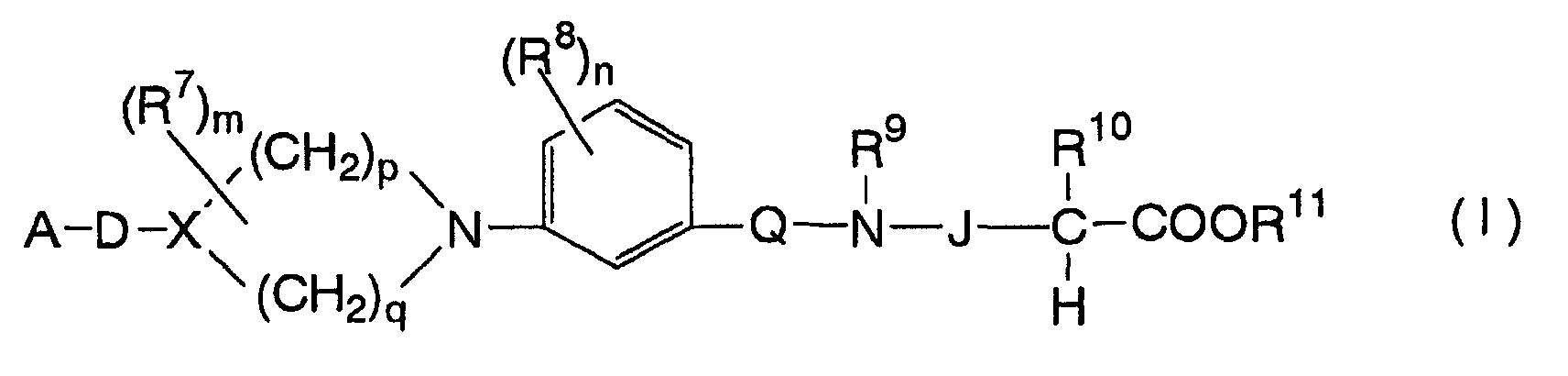 wherein
A represents a saturated or unsaturated five- to seven-membered heterocyclic group containing two nitrogen atoms, which is optionally condensed with another saturated or unsaturated five- to seven-membered carbocyclic ring or heterocyclic ring to form a bicyclic group, wherein the heterocyclic group and the bicyclic group are optionally substituted by C1-6 alkyl optionally substituted by C1-6 alkyl, C1-6 alkoxy, C1-6 alkoxycarbonyl, aralkyl, amino, or hydroxyl; a halogen atom; or amino optionally substituted by C1-6 alkyl, C1-6 alkoxy, C1-6 alkoxycarbonyl, or aralkyl,
or a group represented by formula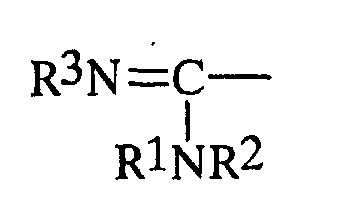 wherein R1, R2, and R3, which may be the same or different,
represent a hydrogen atom, C1-6 alkyl, C2-6 alkenyl, or
aralkyl, wherein the C1-6 alkyl, C2-6 alkenyl, and aralkyl
groups are optionally substituted by C1-6 alkyl, C1-6
alkoxy, C1-6 alkoxycarbonyl, aralkyl, amino, or hydroxyl;
wherein R1, R2, and R3, which may be the same or different,
represent a hydrogen atom, C1-6 alkyl, C2-6 alkenyl, or
aralkyl, wherein the C1-6 alkyl, C2-6 alkenyl, and aralkyl
groups are optionally substituted by C1-6 alkyl, C1-6
alkoxy, C1-6 alkoxycarbonyl, aralkyl, amino, or hydroxyl;
A represents a saturated or unsaturated five- to seven-membered heterocyclic group containing two nitrogen atoms, which is optionally condensed with another saturated or unsaturated five- to seven-membered carbocyclic ring or heterocyclic ring to form a bicyclic group, wherein the heterocyclic group and the bicyclic group are optionally substituted by C1-6 alkyl optionally substituted by C1-6 alkyl, C1-6 alkoxy, C1-6 alkoxycarbonyl, aralkyl, amino, or hydroxyl; a halogen atom; or amino optionally substituted by C1-6 alkyl, C1-6 alkoxy, C1-6 alkoxycarbonyl, or aralkyl,
or a group represented by formula
D represents a bond; >NR4 wherein R4 represents a
hydrogen atom or C1-6 alkyl and this C1-6 alkyl group is
optionally substituted by C1-6 alkyl, C1-6 alkoxy, C1-6
alkoxycarbonyl, aralkyl, amino, or hydroxyl; >CR5R6
wherein R5 and R6 each independently represent a hydrogen
atom or C1-6 alkyl and this C1-6 alkyl group is optionally
substituted by C1-6 alkyl, C1-6 alkoxy, C1-6 alkoxycarbonyl,
aralkyl, amino, or hydroxyl; -O-; -S-; or -NR4-CR5R6-
wherein R4, R5, and R6 are as defined above;
X represents CH or N;
R7 represents C1-6 alkyl, C1-6 alkoxy, a halogen atom, amino, nitro, cyano, hydroxyl, thiol, or an oxygen atom, wherein the C1-6 alkyl and C1-6 alkoxy groups represented by R7 are optionally substituted by C1-6 alkyl, C1-6 alkoxy, C1-6 alkoxycarbonyl, aralkyl, amino, hydroxyl, or a halogen atom, the amino group represented by R7 is optionally substituted by one or two C1-6 alkyl groups, and the thiol group represented by R7 is optionally substituted by C1-4 alkyl or phenyl;
R8 represents C1-6 alkyl, C1-6 alkoxy, a halogen atom, amino, nitro, cyano, hydroxyl, or thiol, wherein the C1-6 alkyl and C1-6 alkoxy groups represented by R8 are optionally substituted by C1-6 alkyl, C1-6 alkoxy, C1-6 alkoxycarbonyl, aralkyl, amino, hydroxyl, or a halogen atom, the amino group represented by R8 is optionally substituted by one or two C1-6 alkyl groups, and the thiol group represented by R8 is optionally substituted by C1-4 alkyl or phenyl;
Q represents >C=O, >CHR13, or >CHOR13 wherein R13 represents a hydrogen atom or C1-6 alkyl;
R9 represents a hydrogen atom, C1-6 alkyl, C2-6 alkenyl, or aralkyl and the C1-6 alkyl, C2-6 alkenyl, and aralkyl groups are optionally substituted by C1-6 alkyl, C1-6 alkoxy, C1-6 alkoxycarbonyl, aralkyl, amino, or hydroxyl;
J represents a bond or an alkylene chain having 1 to 3 carbon atoms, wherein one or more hydrogen atoms on the alkylene chain are optionally substituted by the same or different substituent selected from C1-6 alkyl, C2-6 alkenyl, C2-6 alkynyl, aralkyl, hydroxyl, or amino, the C1-6 alkyl, C2-6 alkenyl, C2-6 alkynyl, and aralkyl groups are optionally substituted by a halogen atom, C1-6 alkoxy, amino, or hydroxyl, and the hydroxyl and amino groups are optionally substituted by carboxyl; sulfonyl; C1-6 alkyl; C1-6 alkylcarbonyl; C1-6 alkoxycarbonyl; C1-6 alkylsulfonyl; -C(=O)-O-(CH2)u-R14 wherein u is an integer of 0 to 4, R14 represents a saturated or unsaturated five- to seven-membered carbocyclic or heterocyclic group, and the carbocyclic group and the heterocyclic group are optionally substituted by C1-6 alkyl, C1-6 alkoxy, phenyl optionally condensed with the carbocyclic group or the heterocyclic group, carboxyl, hydroxyl, nitro, amino, C1-6 alkylamino, or a halogen atom; -C(=O)-R14 wherein R14 is as defined above; or -S(=O)2-(CH2)v-R14 wherein v is an integer of 0 to 4 and R14 is as defined above;
R10 represents a hydrogen atom, hydroxyl, C1-6 alkyl, C2-6 alkenyl, C2-6 alkynyl, aralkyl, or amino, the C1-6 alkyl, C2-6 alkenyl, C2-6 alkynyl, and aralkyl groups are optionally substituted by a halogen atom, C1-6 alkoxy, amino, or hydroxyl and and the hydroxyl and amino groups are optionally substituted by carboxyl; sulfonyl; C1-6 alkyl; C1-6 alkylcarbonyl; C1-6 alkoxycarbonyl; C1-6 alkylsulfonyl; -C(=O)-O-(CH2)u-R14 wherein u is an integer of 0 to 4 and R14 represents a saturated or unsaturated five- to seven-membered carbocyclic or heterocyclic group, and the carbocyclic group and the heterocyclic group are optionally substituted by C1-6 alkyl, C1-6 alkoxy, phenyl optionally condensed with the carbocyclic group or the heterocyclic group, carboxyl, hydroxyl, nitro, amino, C1-6 alkylamino, or a halogen atom; -C(=O)-R14 wherein R14 is as defined above; or -S(=O)2-(CH2)v-R14 wherein v is an integer of 0 to 4 and R14 is as defined above;
R11 represents a hydrogen atom, aralkyl, or C1-6 alkyl and this C1-6 alkyl group is optionally substituted by C1-6 alkyl, C1-6 alkoxy, C1-6 alkoxycarbonyl, aralkyl, amino, or hydroxyl;
m is an integer of 0 to 5;
n is an integer of 0 to 4;
p is an integer of 0 to 3; and
q is an integer of 0 to 3.
X represents CH or N;
R7 represents C1-6 alkyl, C1-6 alkoxy, a halogen atom, amino, nitro, cyano, hydroxyl, thiol, or an oxygen atom, wherein the C1-6 alkyl and C1-6 alkoxy groups represented by R7 are optionally substituted by C1-6 alkyl, C1-6 alkoxy, C1-6 alkoxycarbonyl, aralkyl, amino, hydroxyl, or a halogen atom, the amino group represented by R7 is optionally substituted by one or two C1-6 alkyl groups, and the thiol group represented by R7 is optionally substituted by C1-4 alkyl or phenyl;
R8 represents C1-6 alkyl, C1-6 alkoxy, a halogen atom, amino, nitro, cyano, hydroxyl, or thiol, wherein the C1-6 alkyl and C1-6 alkoxy groups represented by R8 are optionally substituted by C1-6 alkyl, C1-6 alkoxy, C1-6 alkoxycarbonyl, aralkyl, amino, hydroxyl, or a halogen atom, the amino group represented by R8 is optionally substituted by one or two C1-6 alkyl groups, and the thiol group represented by R8 is optionally substituted by C1-4 alkyl or phenyl;
Q represents >C=O, >CHR13, or >CHOR13 wherein R13 represents a hydrogen atom or C1-6 alkyl;
R9 represents a hydrogen atom, C1-6 alkyl, C2-6 alkenyl, or aralkyl and the C1-6 alkyl, C2-6 alkenyl, and aralkyl groups are optionally substituted by C1-6 alkyl, C1-6 alkoxy, C1-6 alkoxycarbonyl, aralkyl, amino, or hydroxyl;
J represents a bond or an alkylene chain having 1 to 3 carbon atoms, wherein one or more hydrogen atoms on the alkylene chain are optionally substituted by the same or different substituent selected from C1-6 alkyl, C2-6 alkenyl, C2-6 alkynyl, aralkyl, hydroxyl, or amino, the C1-6 alkyl, C2-6 alkenyl, C2-6 alkynyl, and aralkyl groups are optionally substituted by a halogen atom, C1-6 alkoxy, amino, or hydroxyl, and the hydroxyl and amino groups are optionally substituted by carboxyl; sulfonyl; C1-6 alkyl; C1-6 alkylcarbonyl; C1-6 alkoxycarbonyl; C1-6 alkylsulfonyl; -C(=O)-O-(CH2)u-R14 wherein u is an integer of 0 to 4, R14 represents a saturated or unsaturated five- to seven-membered carbocyclic or heterocyclic group, and the carbocyclic group and the heterocyclic group are optionally substituted by C1-6 alkyl, C1-6 alkoxy, phenyl optionally condensed with the carbocyclic group or the heterocyclic group, carboxyl, hydroxyl, nitro, amino, C1-6 alkylamino, or a halogen atom; -C(=O)-R14 wherein R14 is as defined above; or -S(=O)2-(CH2)v-R14 wherein v is an integer of 0 to 4 and R14 is as defined above;
R10 represents a hydrogen atom, hydroxyl, C1-6 alkyl, C2-6 alkenyl, C2-6 alkynyl, aralkyl, or amino, the C1-6 alkyl, C2-6 alkenyl, C2-6 alkynyl, and aralkyl groups are optionally substituted by a halogen atom, C1-6 alkoxy, amino, or hydroxyl and and the hydroxyl and amino groups are optionally substituted by carboxyl; sulfonyl; C1-6 alkyl; C1-6 alkylcarbonyl; C1-6 alkoxycarbonyl; C1-6 alkylsulfonyl; -C(=O)-O-(CH2)u-R14 wherein u is an integer of 0 to 4 and R14 represents a saturated or unsaturated five- to seven-membered carbocyclic or heterocyclic group, and the carbocyclic group and the heterocyclic group are optionally substituted by C1-6 alkyl, C1-6 alkoxy, phenyl optionally condensed with the carbocyclic group or the heterocyclic group, carboxyl, hydroxyl, nitro, amino, C1-6 alkylamino, or a halogen atom; -C(=O)-R14 wherein R14 is as defined above; or -S(=O)2-(CH2)v-R14 wherein v is an integer of 0 to 4 and R14 is as defined above;
R11 represents a hydrogen atom, aralkyl, or C1-6 alkyl and this C1-6 alkyl group is optionally substituted by C1-6 alkyl, C1-6 alkoxy, C1-6 alkoxycarbonyl, aralkyl, amino, or hydroxyl;
m is an integer of 0 to 5;
n is an integer of 0 to 4;
p is an integer of 0 to 3; and
q is an integer of 0 to 3.
The compounds according to the present invention
are useful for the treatment or prevention of integrin
αvβ3-mediated diseases, for example, cardiovascular
diseases, angiogenesis-related diseases, cerebrovascular
diseases, cancers and metastasis thereof, immunological
diseases, and osteopathy.
The present inventors have found a production
process which can produce a 3-(piperidin-1-yl)benzoic
acid derivative, for example, ethyl 3-{3,4-(dihydroxy)piperidin-1-yl}benzoate,
as an intermediate
of the compounds according to the present invention, at
low cost in a simple manner by efficiently combining
reductive alkylation with intramolecular alkylation of
naturally occurring saccharides or monosaccharides,
which are inexpensive, especially 2-deoxy-D-ribosse.
Accordingly, an object of the present invention is
to provide a production process which can produce an m-substituted
benzoic acid derivative useful for the
production of the compounds represented by formula (I),
particularly a 3-(4-hydroxypiperidin-1-yl)benzoic acid
derivative, at low cost in a simple manner.
According to the present invention, there is
provided a process for producing a compound as an
intermediate represented by formula (XX)
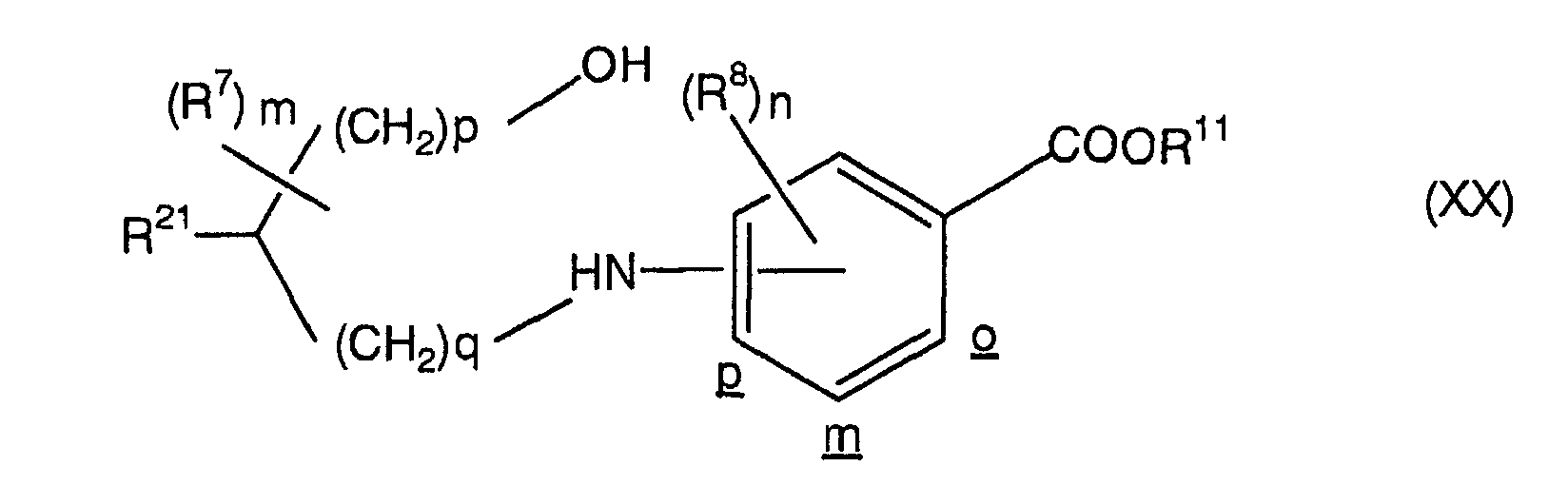 wherein R21 represents hydroxyl, azide, or optionally
protected amino; R7, R8, R11, m, n, p, and q are as
defined in formula (I), provided that q is not 0 (zero)
and the nitrogen atom is attached to the ortho-, meta-,
or para-position of the phenyl group, said process
comprising the step of reacting a compound represented
by formula (XIX)
wherein R21 represents hydroxyl, azide, or optionally
protected amino; R7, R8, R11, m, n, p, and q are as
defined in formula (I), provided that q is not 0 (zero)
and the nitrogen atom is attached to the ortho-, meta-,
or para-position of the phenyl group, said process
comprising the step of reacting a compound represented
by formula (XIX)
 wherein R21 is as defined in formula (XX); and R7, m, p,
and q are as defined in formula (I), provided that q is
not 0 (zero),
wherein R21 is as defined in formula (XX); and R7, m, p,
and q are as defined in formula (I), provided that q is
not 0 (zero),
with a compound represented by formula (XV) wherein R8, R11, and n are as defined in formula (I); and
the nitrogen atom is attached to the ortho-, meta-, or
para-position of the phenyl group.
wherein R8, R11, and n are as defined in formula (I); and
the nitrogen atom is attached to the ortho-, meta-, or
para-position of the phenyl group.
with a compound represented by formula (XV)
According to the present invention, there is
provided another process for producing a compound as an
intermediate represented by formula (XXII)
 wherein R7, R8, R11, m, n, p, and q are as defined in the
definition formula (I), provided that q is not 0 (zero);
R21 is as defined in formula (XX); and the nitrogen atom
is attached to the ortho-, meta-, or para-position of
the phenyl group, said process comprising the step of:
wherein R7, R8, R11, m, n, p, and q are as defined in the
definition formula (I), provided that q is not 0 (zero);
R21 is as defined in formula (XX); and the nitrogen atom
is attached to the ortho-, meta-, or para-position of
the phenyl group, said process comprising the step of:

A further object of the present invention is to
provide an intermediate useful for the production of the
compounds represented by formula (I).
According to the present invention, there is
provided an intermediate represented by formula (XXIII):
 wherein R7, R8, R11, m, n, p, and q are as defined in
formula (I), provided that q is not 0 (zero); R21 is as
defined in formula (XX); R22 represents hydroxyl or a
leaving group; and the nitrogen atom is attached to the
ortho-, meta-, or para-position, preferably meta-position,
of the phenyl group.
wherein R7, R8, R11, m, n, p, and q are as defined in
formula (I), provided that q is not 0 (zero); R21 is as
defined in formula (XX); R22 represents hydroxyl or a
leaving group; and the nitrogen atom is attached to the
ortho-, meta-, or para-position, preferably meta-position,
of the phenyl group.
Further, according to the present invention, there
is provided an intermediate represented by formula
(XXII):
 wherein R7, R8, R11, m, n, p, and q are as defined in
formula (I), provided that q is not 0 (zero); R21 is as
defined in formula (XX); and the nitrogen atom is
attached to the ortho-, meta-, or para-position,
preferably meta-position, of the phenyl group.
wherein R7, R8, R11, m, n, p, and q are as defined in
formula (I), provided that q is not 0 (zero); R21 is as
defined in formula (XX); and the nitrogen atom is
attached to the ortho-, meta-, or para-position,
preferably meta-position, of the phenyl group.
The terms "C1-6 alkyl" and "C1-6 alkoxy" as used
herein as a group or a part of a group respectively mean
straight chain, branched chain, or cyclic alkyl and
alkoxy having 1 to 6, preferably 1 to 4 carbon atoms.
The terms "C2-6 alkenyl" and "C2-6 alkynyl" as used
herein as a group or a part of a group respectively mean
straight chain, branched chain, or cyclic alkenyl and
alkynyl having 2 to 6, preferably 2 to 4 carbon atoms.
Examples of C1-6 alkyl include methyl, ethyl, n-propyl,
isopropyl, cyclopropyl, cyclopropylmethyl, n-butyl,
i-butyl, s-butyl, t-butyl, n-pentyl, cyclopentyl,
n-hexyl, and cyclohexyl.
Examples of C1-6 alkoxy include methoxy, ethoxy, n-propoxy,
i-propoxy, n-butoxy, i-butoxy, s-butoxy, and t-butoxy.
Examples of C2-6 alkenyl include allyl.
Examples of C2-6 alkynyl include 2-propynyl and
ethynyl.
Examples of "saturated or unsaturated five- to
seven-membered carbocyclic groups" include phenyl.
The term "saturated or unsaturated five- to seven-membered
heterocyclic ring" as used herein means a five-to
seven-membered heterocyclic ring containing at least
one hetero-atom selected from oxygen, nitrogen, and
sulfur atoms, preferably a five- to seven-membered
heterocyclic ring containing one or two hetro-atoms,
more preferably a five- or six-membered heterocyclic
ring containing one or two hetro-atoms. The term
"hetero-atom" used herein means an oxygen, nitrogen, or
sulfur atom. Examples of saturated or unsaturated five-to
seven-membered heterocyclic groups include pyridyl,
pyrimidyl, 1,4,5,6-tetrahydropyrimidyl, imidazolyl,
tetrahydro-[1,3]diazepinyl, imidazolidinyl, thiophenyl,
and morpholyl.
The saturated or unsaturated heterocyclic group may
be condensed with other saturated or unsaturated
heterocyclic ring to form a bicyclic ring. Such
condensed cyclic groups include benzimidazolyl, naphthyl,
and azabenzimidazolyl, for example, imidazo[4,5-b]pyridyl.
The term "aralkyl" as used herein as a group or a
part of a group means C1-6 alkyl, preferably C1-4 alkyl,
substituted by a saturated or unsaturated five- to
seven-membered carbocyclic group or heterocyclic group.
Examples of aralkyl include benzyl and phenethyl.
The term "halogen atom" means a fluorine, chlorine,
bromine, or iodine atom.
D preferably represents a bond, >NH, or -NH-CH2-.
When D represents >NR4, X preferably represents CH.
When D represents -CR5R6- or -NR4-CR5R6-, X
preferably represents CH.
When D represents a bond, X preferably represents N.
The "saturated or unsaturated five- to seven-membered
heterocyclic group containing two nitrogen
atoms" represented by A is preferably a saturated or
unsaturated five- or six-membered heterocyclic group
containing two nitrogen atoms.
The "bicyclic group" represented by A is preferably
a nine- or ten-membered heterocyclic group, more
preferably a nine- or ten-membered heterocyclic group
containing two or three nitrogen atoms.
R2 preferably represents a hydrogen atom.
A preferably represents a group of formula
 wherein
Het represents a saturated or unsaturated five- to seven-membered heterocyclic group containing two nitrogen atoms, which is optionally condensed with another saturated or unsaturated five- to seven-membered carbocyclic ring or heterocyclic ring to form a bicyclic group, wherein the heterocyclic group and the bicyclic group are optionally substituted by C1-6 alkyl optionally substituted by C1-6 alkyl, C1-6 alkoxy, C1-6 alkoxycarbonyl, aralkyl, amino, or hydroxyl; a halogen atom; or amino optionally substituted by C1-6 alkyl, C1-6 alkoxy, C1-6 alkoxycarbonyl, or aralkyl.
Het represents a saturated or unsaturated five- to seven-membered heterocyclic group containing two nitrogen atoms, which is optionally condensed with another saturated or unsaturated five- to seven-membered carbocyclic ring or heterocyclic ring to form a bicyclic group, wherein the heterocyclic group and the bicyclic group are optionally substituted by C1-6 alkyl optionally substituted by C1-6 alkyl, C1-6 alkoxy, C1-6 alkoxycarbonyl, aralkyl, amino, or hydroxyl; a halogen atom; or amino optionally substituted by C1-6 alkyl, C1-6 alkoxy, C1-6 alkoxycarbonyl, or aralkyl.
More preferably, A represents a group of formula:
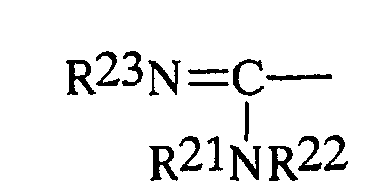 wherein
R21, R22, and R23, which may be the same or different, represent a hydrogen atom, C1-6 alkyl, C2-6 alkenyl, or aralkyl and the C1-6 alkyl, C2-6 alkenyl, and aralkyl groups are optionally substituted by C1-6 alkyl, C1-6 alkoxy, C1-6 alkoxycarbonyl, aralkyl, amino, or hydroxyl, or
R21 and R23 may together form
group -(CH2)4-,
group -(CH2)3-,
group -CHR24CH2CH2- wherein R24 represents C1-6 alkyl, a halogen atom, or amino the amino group is optionally substituted by C1-6 alkyl, C1-6 alkoxy, C1-6 alkoxycarbonyl, or aralkyl,
group -CH2CHR24CH2- wherein R24 is as defined above,
group -CH2CH2-,
group -CHR24CH2- wherein R24 is as defined above,
group -CR25=CR26- wherein R25 and R26, which may be the same or different, represent a hydrogen atom or C1-6 alkyl, or R25 and R26 may together form -CH=CH-CH=CH-, -CR24=CH-CH=CH- wherein R24 is as defined above, -CH=CR24-CH=CH- wherein R24 is as defined above, -N=CH-CH=CH-, or -CH=N-CH=CH-, or
R21 and R23 may together form
=CH-CH=CH-,
-CHR24CH2CH2- wherein R24 is as defined above,
-CH2CHR24CH2- wherein R24 is as defined above,
=CH-CH=N-, or
=CH-N=CH-, and
R21, R22, and R23, which may be the same or different, represent a hydrogen atom, C1-6 alkyl, C2-6 alkenyl, or aralkyl and the C1-6 alkyl, C2-6 alkenyl, and aralkyl groups are optionally substituted by C1-6 alkyl, C1-6 alkoxy, C1-6 alkoxycarbonyl, aralkyl, amino, or hydroxyl, or
R21 and R23 may together form
group -(CH2)4-,
group -(CH2)3-,
group -CHR24CH2CH2- wherein R24 represents C1-6 alkyl, a halogen atom, or amino the amino group is optionally substituted by C1-6 alkyl, C1-6 alkoxy, C1-6 alkoxycarbonyl, or aralkyl,
group -CH2CHR24CH2- wherein R24 is as defined above,
group -CH2CH2-,
group -CHR24CH2- wherein R24 is as defined above,
group -CR25=CR26- wherein R25 and R26, which may be the same or different, represent a hydrogen atom or C1-6 alkyl, or R25 and R26 may together form -CH=CH-CH=CH-, -CR24=CH-CH=CH- wherein R24 is as defined above, -CH=CR24-CH=CH- wherein R24 is as defined above, -N=CH-CH=CH-, or -CH=N-CH=CH-, or
R21 and R23 may together form
=CH-CH=CH-,
-CHR24CH2CH2- wherein R24 is as defined above,
-CH2CHR24CH2- wherein R24 is as defined above,
=CH-CH=N-, or
=CH-N=CH-, and
R22 may represent a single bond between R21 and the
nitrogen atom attached to R21.
R22 preferably represents a hydrogen atom.
In the compound represented by formula (I), one or
more hydrogen atoms in the following portion may be
substituted by R7.
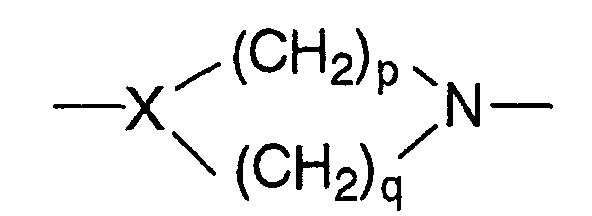
When m is zero (0), R7 is absent. When m is 1, one
hydrogen atom in the above portion is substituted by R7.
When m is 2 or more, two or more hydrogen atoms in the
above portion are substituted by R7. In this case, the
substituents may be the same or different. When R7
represents an oxygen atom, the bond between the R7 and
the above portion is a double bond. m is preferably an
integer of 0 to 2.
In the compound represented by formula (I), one or
more hydrogen atoms in the phenylene portion may be
substituted by R8.
When n is zero (0), R8 is absent. When n is 1, one
hydrogen atom in the phenylene portion is substituted by
R8. When n is 2 or more, two or more hydrogen atoms in
the phenylene portion are substituted by R8. In this
case, the substituents may be the same or different. n
is preferably an integer of 0 to 2.
Q preferably represents >C=O or >CH2.
R9 preferably represents a hydrogen atom, C1-6 alkyl
(preferably, methyl, propyl, cyclopropylmethyl), or
aralkyl (preferably benzyl or phenethyl).
J preferably represents a methylene chain or an
ethylene chain, more preferably a methylene chain.
On or more hydrogen atoms on the alkylene chain
represented by J may be substituted. The substituent is
preferably C2-6 alkynyl or optionally substituted amino,
more preferably C2-6 alkynyl.
R10 preferably represents a hydrogen atom, C2-6
alkynyl, hydroxyl, optionally substituted hydroxyl, or
optionally substituted amino, more preferably, a
hydrogen atom or optionally substituted amino.
Hydrogen atoms in the amino group represented by
R10 may be substituted by two substituents which may be
the same or different.
Preferred examples of -C(=O)-O-(CH2)u-R14, which is
a substituent for the amino group represented by R10,
include groups wherein u is an integer of 0 to 3 (more
preferably, 0 or 1) and R14 represents a five- to seven-membered
carbocyclic group (more preferably, phenyl).
Preferred examples of -S(=O)2-(CH2)v-R14, which is a
substituent for the amino group represented by R10,
include groups wherein v is an integer of 0 to 3 (more
preferably, 0 or 1) and R14 represents a five- to seven-membered
carbocyclic group (more preferably, phenyl) or
a five- to seven-membered heterocyclic group (more
preferably, a five- or six-membered heterocyclic group
containing one or two hetero-atoms, specifically
morpholyl).
One or more hydrogen atoms in the carbocyclic group
and the heterocyclic group represented by R14 are
preferably optionally substituted by C1-6 alkyl (more
preferably methyl), C1-6 alkoxy (more preferably methoxy),
carboxyl, hydroxyl, nitro, amino, or a halogen atom.
The substituent of the amino group represented by
R10 is preferably C1-6 alkyl; C1-6 alkylcarbonyl; C1-6
alkoxycarbonyl; C1-6 alkylsulfonyl; benzoyl or
benzyloxycarbonyl wherein the phenyl portion of benzoyl
and benzyloxycarbonyl is optionally substituted by C1-6
alkyl, C1-6 alkoxy, carboxyl, hydroxyl, nitro, amino, or
a halogen atom; -C(=O)-O-(CH2)u-R14 wherein u is an
integer of 0 to 4 and R14 represents phenyl optionally
substituted by C1-6 alkyl, C1-6 alkoxy, carboxyl, hydroxyl,
nitro, amino, or a halogen atom, or a five- or six-membered
heterocyclic group containing one or two
hetero-atoms (preferably morpholyl); or -S(=O)2-(CH2)v-R14
wherein v is an integer of 0 to 4 and R14 represents
phenyl optionally substituted by C1-6 alkyl, C1-6 alkoxy,
carboxyl, hydroxyl, nitro, amino, or a halogen atom, or
a five- or six-membered heterocyclic group containing
one or two hetero-atoms (preferably morpholyl).
The C1-6 alkyl group represented by R11 is preferably
methyl, ethyl, t-butyl, or diphenylmethyl.
p is preferably an integer of 0 to 2.
q is preferably 2 or 3.
The sum of p and q is preferably 2 to 4.
Preferred compounds represented by formula (I) are
those wherein
A represents a group of formula
 wherein
R21, R22, and R23 are as defined above;
D represents a bond, >NH, or -NH-CH2-;
X represents CH or N;
Q represents >C=O or >CH2;
R9 represents a hydrogen atom, C1-6 alkyl or aralkyl and the C1-6 alkyl and aralkyl groups are optionally substituted by a halogen atom, C1-6 alkoxy, amino, or hydroxyl;
J represents a methylene chain;
R10 represents a hydrogen atom, hydroxyl, or amino, the hydroxyl group is optionally substituted by C1-6 alkyl, and the amino group is optionally substituted by C1-6 alkyl; C1-6 alkylcarbonyl; C1-6 alkoxycarbonyl; C1-6 alkylsulfonyl; benzoyl or benzyloxycarbonyl wherein the phenyl portion of benzoyl and benzyloxycarbonyl is optionally substituted by C1-6 alkyl, C1-6 alkoxy, carboxyl, hydroxyl, nitro, amino, or a halogen atom; -C(=O)-O-(CH2)u-R14 wherein u is an integer of 0 to 4 and R14 represents phenyl optionally substituted by C1-6 alkyl, C1-6 6 alkoxy, carboxyl, hydroxyl, nitro, amino, or a halogen atom, or a five- or six-membered heterocyclic group containing one or two hetero-atoms (preferably morpholyl); or -S(=O)2-(CH2)v-R14 wherein v is an integer of 0 to 4 and R14 represents phenyl optionally substituted by C1-6 alkyl, C1-6 alkoxy, carboxyl, hydroxyl, nitro, amino, or a halogen atom, or a five- or six-membered heterocyclic group containing one or two hetero-atoms (preferably morpholyl);
R11 represents a hydrogen atom or C1-6 alkyl;
m and n are each an integer of 0 to 2;
p is 0 to 2; and
q is 2 or 3.
R21, R22, and R23 are as defined above;
D represents a bond, >NH, or -NH-CH2-;
X represents CH or N;
Q represents >C=O or >CH2;
R9 represents a hydrogen atom, C1-6 alkyl or aralkyl and the C1-6 alkyl and aralkyl groups are optionally substituted by a halogen atom, C1-6 alkoxy, amino, or hydroxyl;
J represents a methylene chain;
R10 represents a hydrogen atom, hydroxyl, or amino, the hydroxyl group is optionally substituted by C1-6 alkyl, and the amino group is optionally substituted by C1-6 alkyl; C1-6 alkylcarbonyl; C1-6 alkoxycarbonyl; C1-6 alkylsulfonyl; benzoyl or benzyloxycarbonyl wherein the phenyl portion of benzoyl and benzyloxycarbonyl is optionally substituted by C1-6 alkyl, C1-6 alkoxy, carboxyl, hydroxyl, nitro, amino, or a halogen atom; -C(=O)-O-(CH2)u-R14 wherein u is an integer of 0 to 4 and R14 represents phenyl optionally substituted by C1-6 alkyl, C1-6 6 alkoxy, carboxyl, hydroxyl, nitro, amino, or a halogen atom, or a five- or six-membered heterocyclic group containing one or two hetero-atoms (preferably morpholyl); or -S(=O)2-(CH2)v-R14 wherein v is an integer of 0 to 4 and R14 represents phenyl optionally substituted by C1-6 alkyl, C1-6 alkoxy, carboxyl, hydroxyl, nitro, amino, or a halogen atom, or a five- or six-membered heterocyclic group containing one or two hetero-atoms (preferably morpholyl);
R11 represents a hydrogen atom or C1-6 alkyl;
m and n are each an integer of 0 to 2;
p is 0 to 2; and
q is 2 or 3.
More preferred compounds represented by formula
(I) are the following compounds:
The compounds according to the present invention
may form pharmacologically acceptable salts thereof.
Such salts include non-toxic salts. Preferred salts
include: hydrohalogenic acid salts such as hydrochloride
salts, hydrobromide salts, or hydroiodide salts;
inorganic acid salts such as nitric acid salts,
perchloric acid salts, sulfuric acid salts, or
phosphoric acid salts; lower alkylsulfonic acid salts
such as methanesulfonic acid salts,
trifluoromethanesulfonic acid salts, or ethanesulfonic
acid salts; arylsulfonic acid salts such as
benzenesulfonic acid salts or p-toluenesulfonic acid
salts; organic acid salts such as fumaric acid salts,
succinic acid salts, citric acid salts, tartaric acid
salts, oxalic acid salts, or maleic acid salts; amino
acid salts such as glutamic acid salts or aspartic acid
salts; alkali metal or alkaline earth metal salts such
as sodium salts, potassium salts, or calcium salts; and
organic alkali salts such as pyridine salts or
triethylamine salts.
The compounds according to the present invention
may form solvates, for example, hydrates; alcoholates,
such as methanolates and ethanolates; and etherates,
such as tetrahydrofuran.
Compounds represented by formula (I) may be
produced according to scheme 1.
 In the above scheme, A, D, X, J, R7, R8, R9, R10, R11, m, n,
p, and q are as defined in formula (I).
In the above scheme, A, D, X, J, R7, R8, R9, R10, R11, m, n,
p, and q are as defined in formula (I).
A compound represented by formula (III) may be
produced by introducing an atomic group corresponding to
group A into the compound represented by formula (II).
The compound represented by formula (III) in scheme
1, wherein D represents >NR4 or -NR4CR5R6-, may be
produced by introducing group A into the free primary
amine in the compound represented by formula (IIa):
 wherein D represents >NR4 or -NR4CR5R6-; R18 represents a
substituent of a hydrogen atom or amino, for example, C1-6
alkyl; and X, R7, R8, R11, m, n, p, and q are as defined
above. The N-C bond between the compound represented by
formula (IIa) and group A may be formed by reacting the
compound represented by formula (IIa) with a reagent,
such as optionally modified or substituted 2-bromopyrimidine,
modified or substituted 2-chlorobenzimidazole,
or 2-methylthio-2-imidazoline, in
the presence of a reaction solvent, such as
dimethylformamide, dimethyl sulfoxide, sulfolane,
pyridine, or methanol, preferably dimethylformamide, in
the temperature range of 50 to 170°C, preferably in the
temperature range of 60 to 140°C.
wherein D represents >NR4 or -NR4CR5R6-; R18 represents a
substituent of a hydrogen atom or amino, for example, C1-6
alkyl; and X, R7, R8, R11, m, n, p, and q are as defined
above. The N-C bond between the compound represented by
formula (IIa) and group A may be formed by reacting the
compound represented by formula (IIa) with a reagent,
such as optionally modified or substituted 2-bromopyrimidine,
modified or substituted 2-chlorobenzimidazole,
or 2-methylthio-2-imidazoline, in
the presence of a reaction solvent, such as
dimethylformamide, dimethyl sulfoxide, sulfolane,
pyridine, or methanol, preferably dimethylformamide, in
the temperature range of 50 to 170°C, preferably in the
temperature range of 60 to 140°C.
Reagents usable in this step are not limited to
those recited herein, and any reagent may be used so far
as a carbon atom attached to two nitrogen atoms finally
combines with the nitrogen atom in the primary amine
attached to a carbon atom in the piperidine derivative
to form a single bond. Further, optimization of the kind
of substrates used and reaction conditions permits the
N-C bond to be formed by reacting palladium having a
valency of 0 (zero), a phosphine ligand, and a base.
Furthermore, the N-C bond may be formed in accordance
with the method of Tetrahedron, 51(2), 353, 1995. The
reaction may be carried out according to the method
described, for example, in production examples of
Intermediates 26, 27, 29, and 39 in WO 99/52872.
An organic base, such as diisopropylethylamine, N-methylmorpholine,
dimethylaminopyridine, or
triethylamine, is preferably added as an acid scavenger
from the viewpoint of improving the yield. The addition
of 2 to 10 equivalents of diisopropylethylamine is
preferred.
The compound represented by formula (III) wherein
R4 has been substituted may be prepared by conventional
or reductive N-alkylation followed by the introduction
of group A into the primary amino group in the compound
represented by formula (IIa) or by the introduction of
group A into the primary amino group in the compound
represented by formula (IIa) followed by N-alkylation of
the secondary amino group, if necessary. The reaction
may be carried out according to the method described in
Intermediate 30 in WO 99/52872.
The compound represented by formula (IIa) may be
produced by reacting a compound represented by formula
(IIb)
 wherein X, R7, R8, R11, m, n, p, and q are as defined
above,
wherein X, R7, R8, R11, m, n, p, and q are as defined
above,
with phthalimide and an azo compound in a reaction solvent such as tetrahydrofuran, benzene, toluene, dioxane, or dimethylformamide, preferably tetrahydrofuran, in the presence of a trialkylphosphine, preferably tributylphosphine, at -40 to 100°C, preferably -10 to 40°C, followed by the removal of the phthaloyl group. Azo compounds include 1,1'-(azodicarbonyl)dipiperidine, diethyl azodicarboxylate, and 1,1'-azobis(N,N-dimethylformamide). Among them, 1,1'-(azodicarbonyl)dipiperidine is preferred.
with phthalimide and an azo compound in a reaction solvent such as tetrahydrofuran, benzene, toluene, dioxane, or dimethylformamide, preferably tetrahydrofuran, in the presence of a trialkylphosphine, preferably tributylphosphine, at -40 to 100°C, preferably -10 to 40°C, followed by the removal of the phthaloyl group. Azo compounds include 1,1'-(azodicarbonyl)dipiperidine, diethyl azodicarboxylate, and 1,1'-azobis(N,N-dimethylformamide). Among them, 1,1'-(azodicarbonyl)dipiperidine is preferred.
Alternatively, the compound represented by formula
(IIa) may be produced by converting the hydroxyl group
in the compound represented by formula (IIb) to a
leaving group, for example, a sulfonyloxy group such as
a methanesulfonyloxy group, or a halogen atom such as a
bromine atom, allowing sodium azide or a combination of
hydrazoic acid with an azo compound to act on the
leaving group to convert the leaving group to an azide
group, and then reducing the azide group. The reaction
may be carried out according to the method described,
for example, in production examples of Intermediates 35,
36, 41, 42, 43, 47, 48, 49, and 58 in WO 99/52872.
The compound represented by formula (III) in scheme
1, wherein D represents >CR5R6, may be produced, for
example, by reacting 2-(chloromethyl)benzimidazole with
ethyl 4-(piperazin-1-yl)benzoate in dimethyl sulfoxide
in the presence of potassium carbonate at room
temperature. This reaction may be carried out according
to the method described in Examples 89 and 90 in WO
99/52872.
The compound represented by formula (III) in scheme
1, wherein D represents -O-, may be produced by reacting
the hydroxyl group in the compound represented by
formula (IIb) with a basic atomic group having an
alkylsulfonyl group, that is, a compound corresponding
to group A. This reaction may be carried out in
accordance with the method described, for example, in
Japanese Patent Laid-Open No. 97818/1993 and EP 468766A1.
The compound represented by formula (III) in scheme
1, wherein D represents -S-, may be produced by
halogenating the hydroxyl group in the compound
represented by formula (IIb) and reacting the halogen
atom with a basic atomic group having group -SH, that is,
a compound corresponding to group A. The reaction of the
halogen atom with group -SH may be carried out in
accordance with the method described, for example, in
Res. Lab., Kohjin Co., Ltd., Japan Chem. Pharm. Bull.
(1977), 25(10), 2624-37.
The compound represented by formula (III) in scheme
1, wherein D represents a bond, may be produced by
introducing group A into a free secondary amine of a
compound represented by formula (IIc)
 wherein X represents a nitrogen atom; and R7, R8, R11, m,
n, p, and q are as defined above.
wherein X represents a nitrogen atom; and R7, R8, R11, m,
n, p, and q are as defined above.
The compound represented by formula (IIb) and the
compound represented by formula (IIc) may be produced
according to the method described, for example, in WO
99/52872 and WO 99/38849.
A compound represented by formula (V) may be
produced by hydrolyzing a carboxylic ester represented
by formula (III), wherein R11 is a group other than a
hydrogen atom, to give a compound represented by formula
(III), wherein R11 represents a hydrogen atom, and then
reacting this compound with a compound represented by
formula (IV) to form an amide bond. More specifically,
the free carboxyl group in the compound represented by
formula (III), wherein R11 represents a hydrogen atom,
prepared by hydrolysis with an alkali according to a
conventional method may be reacted with the amine
represented by formula (IV) to perform condensation,
thereby producing the compound represented by formula
(V).
In the condensation reaction, a condensing agent,
such as dicyclohexylcarbodiimide,
diisopropylcarbodiimide, or 1-ethyl-3-(3-dimethylaminopropyl)carbodiimide
hdyrochloride, may be
used either solely or in combination with N-hydroxysuccinimide,
1-hydroxybenzotriazole or the like.
Benzotriazol-1-yloxytri(dimethylamino)phosphonium
hexafluorophosphate may be used solely in the presence
of a base. The combination of these reagents permits the
desired condensation reaction to proceed with high
efficiency. Preferably, from the viewpoint of optimizing
the yield, 1 to 3 equivalents of 1-ethyl-3-(3-dimethylaminopropyl)carbodiimide
hydrochloride or its
free base is used in combination with 1 to 2 equivalents
of 1-hydroxybenzotriazole, or alternatively, 1 to 2
equivalents of benzotriazol-1-yloxytri(dimethylamino)-phosphonium
hexafluorophosphate may be used.
Reaction solvents usable in the condensation
reaction include dimethylformamide, dioxane,
tetrahydrofuran, and methylene chloride. Preferred are
dimethylformamide and a mixed solvent composed of
dimethylformamide and methylene chloride. The reaction
may be carried out in a range of 0 to 80°C, preferably in
a range of 0 to 50°C.
In the condensation reaction, a tertiary amine,
such as diisopropylethylamine, N-methylmorpholine,
dimethylaminopyridine, or triethylamine, may be added as
an organic base from the viewpoint of improving the
yield. Preferably, 2 to 5 equivalents of N-methylmorpholine
or diisopropylethylamine is added.
The reaction proceeds without the addition of these
organic bases. The addition of the organic bases,
however, is preferred from the viewpoint of the yield.
Compounds represented by formula (V), wherein A
represents an optionally substituted pyrimidine ring,
may be if necessary reduced to the corresponding
tetrahydropyrimidine.
Compounds represented by formula (V), wherein >C=O
bonded to the phenylene portion is >CH2, may be produced
by reductively converting the carboxylic ester
represented by formula (III), wherein R11 represents a
group other than a hydrogen atom, to an aldehyde group
and then reductively reacting the aldehyde compound with
the amine represented by formula (IV). The reaction may
be carried out according to the method described in
Example 46 of WO 99/52872.
Compounds represented by formula (V) produced by
the reductive amination, wherein R9 represents a group
other than a hydrogen atom, can also be produced by a
reaction process other than the method described herein.
Specifically, the above aldehyde compound may be
reductively reacted with an amine of formula
H2N-J-CHR10COOR11
wherein R10, R11, and J are as defined in formula (I),
to produce a compound represented by formula (V) wherein R9 represents a hydrogen atom. Thereafter, this compound may be reductively aminated to introduce alkyl, alkenyl, or aralkyl into R9. The introduction of alkyl, alkenyl, or aralkyl into R9 is not always carried out only for the compound represented by formula (V) in the scheme. That is, the introduction of alkyl, alkenyl, or aralkyl into R9 may be carried out for the compound represented by formula (VI) in the scheme. The reaction may be carried out according to the method described in Example 49 of WO 99/52872.
to produce a compound represented by formula (V) wherein R9 represents a hydrogen atom. Thereafter, this compound may be reductively aminated to introduce alkyl, alkenyl, or aralkyl into R9. The introduction of alkyl, alkenyl, or aralkyl into R9 is not always carried out only for the compound represented by formula (V) in the scheme. That is, the introduction of alkyl, alkenyl, or aralkyl into R9 may be carried out for the compound represented by formula (VI) in the scheme. The reaction may be carried out according to the method described in Example 49 of WO 99/52872.
Further, in this reaction, R11 in -COOR11
corresponding to the carboxylic ester portion in the
amine may represent a hydrogen atom.
The amine represented by formula (IV) and the amine
represented by formula (IV') may be generally
synthesized from a commercially available conventional
compound in a single or two steps (for example, K. C.
Nicolaou et al., Bioorg. Med. Chem., 6, 1185 (1998)).
When R10 represents an optionally substituted
hydroxyl group, the corresponding carboxylic ester can
be produced by treating ω-amino-α-hydoxycarboxylic acid
with isobutene under proper reaction conditons, for
example, in the presence of sulfuric acid. If necessary,
the hydroxyl group may be protected. Specifically, for
example, 3-amino-(2S)-hydroxypropionic acid (L-isoserine)
or 4-amino-(2S)-hydroxybutyric acid (AHBA)
may be used as ω-amino-α-hydroxycarboxylic acid.
Protective groups of the carboxyl group include lower
alkyl esters and aralkyl esters. For example, ethyl
ester, t-butyl ester, and benzhydryl ester may be used.
In the esterification for the production of a t-butyl
ester of 3-amino-(2S)-hydroxypropionic acid or 4-amino-(2S)-hydroxybutyric
acid, a part of the hydroxyl
group is sometimes t-butylated (etherified). In the
condensation reaction in step (2), however, the hydroxyl
group at the α-position may be protected or may not be
protected.
In the t-butylation of 3-amino-(2S)-hydroxypropionic
acid or 4-amino-(2S)-hydroxybutyric
acid, when a conventional method described, for example,
in WO 95/32710 as such is applied, the yield of the t-butylation
can be improved, for example, by properly
selecting the reaction solvent, the stirring efficiency,
and the type and amount of the acid catalyst.
The esterification for the production of a
benzhydryl ester of 3-amino-(2S)-hydroxypropionic acid
or 4-amino-(2S)-hydroxybutyric acid proceeds without
posing the problem of yield. In this case, when the
amino group is previously converted to an acid salt, for
example, a p-toluenesulfonic acid salt, the yield can be
improved. The reaction solvent is not particularly
limited. The reaction reagent is preferably
diphenyldiazomethane.
Ester derivatives of 3-amino-(2S)-hydroxypropionic
acid or 4-amino-(2S)-hydroxybutyric acid and hydroxyl-protected
derivatives thereof, wherein R10 represents a
hydrogen atom, may be used in the condensation reaction
in step (2). Alternatively, the amino group may be
further modified followed by the use of the modified
amino group in the condensation reaction. An example of
chemical modification of the ω-amino group is alkylation.
The alkylation may be carried out according to the
method described in WO 99/38849 or WO 99/52872.
The compound represented by formula (VI) may be
prepared by converting the carboxylic ester portion (-COOR11)
in the compound represented by formula (V) to a
free carboxyl group, if necessary.
The carboxylic ester portion in the compound
represented by formula (V) may be converted to the
contemplated free carboxyl group by a conventional
method, for example, by hydrolysis with an alkali,
hydrolysis with an acid, or reaction with an acid. The
deesterification reaction may be achieved by a novel
method without any restriction or limitation.
The compound represented by formula (V) is orally
administrable integrin αvβ3 antagonist and/or GP IIb/IIIa
antagonist. Therefore, the step of converting the
carboxylic ester to the free carboxyl group is not
always necessary.
Compounds represented by formula (VI), wherein A
represents an optionally substituted pyrimidine ring,
may be if necessary, reduced to the corresponding
tetrahydropyrimidine. The reduction may be carried out
by a conventional method. Examples of reduction
methods usable herein include catalytic reduction in the
presence of a catalyst, such as palladium-carbon,
ruthenium-carbon, rhodium-carbon, palladium oxide,
platinum oxide, ruthenium oxide, rhodium platinum oxide
complex, rhodium aluminum oxide complex, Raney nickel,
or palladium black, and a reaction, for example, with
metallic sodium or metallic lithium in liquid ammonia.
Preferably, the reduction is carried out in an acidic
solvent, for example, in acetic acid acidified with
hydrochloric acid, in the presence of palladium-carbon
with hydrogen under normal or applied pressure. The
conversion may be carried out before or after the
formation of the amide bond.
In scheme 1, in producing the compound represented
by formula (III), a benzoic ester is first bonded to the
hetero ring, followed by the introduction of a basic
atomic group, for example, an amidino or pyrimidinyl
group. This step, however, is not limited to this method
only Alternatively, the introduction of a basic atomic
group into the hetero ring may be followed by attachment
of the benzoic ester to the hetero ring.
The compound represented by formula (I) may also be
produced according to scheme 2.
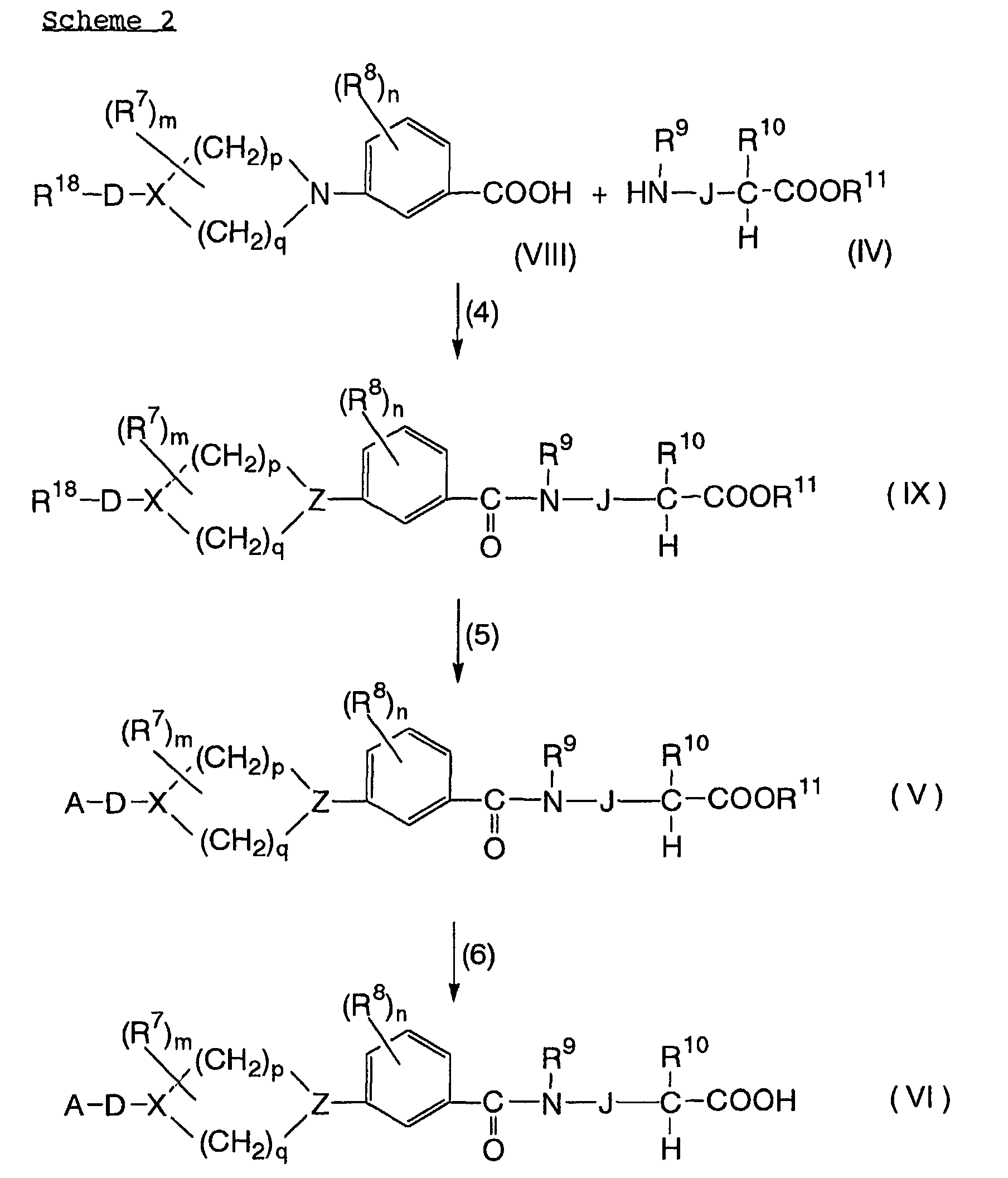 In the above scheme, R18 represents a protective group
for amino; and A, D, X, J, R7, R8, R9, R10, R11, m, n, p,
and q are as defined in formula (I).
In the above scheme, R18 represents a protective group
for amino; and A, D, X, J, R7, R8, R9, R10, R11, m, n, p,
and q are as defined in formula (I).
A compound represented by formula (IX) may be
produced by reacting a compound represented by formula
(VIII) with an amine represented by formula (IV) to form
an amide bond. More specifically, the compound
represented by formula (IX) may be produced by reacting
the amine represented by formula (IV) with the free
carboxyl group in the compound represented by formula
(VIII) to perform condensation. In the compound
represented by formula (VIII), R18 represents a
protective group of amino. Protective groups of amino
include Fmoc (9-fluorenylmethoxycarbonyl), t-butyloxycarbonyl,
benzyloxycarbonyl, and p-methoxybenzyloxycarbonyl.
Preferred is t-butyloxycarbonyl.
The compound represented by formula (VIII) may be
produced by hydrolyzing, with an alkali, the benzoic
ester represented by formula (IIa) according to a
conventional method.
The compound represented by formula (V) may be
produced by removing the protective group in the
piperidine derivative portion, introducing a basic
atomic group corresponding to group A, for example, a
pyrimidine, benzimidazole, or amidino group, into the
deprotected primary amine, and then optionally
converting the carboxylic ester portion to a free
carboxyl group.
If necessary, the carboxylic ester portion (-COOR11)
in the compound represented by formula (V) may be
converted to a free carboxyl group to produce the
compound represented by formula (VI).
The pyrimidine ring represented by A may be
converted to tetrahydropyrimidne by catalytic reduction.
The conversion may be carried out before or after the
formation of the amide bond.
In the compound represented by formula (V) and the
compound represented by formula (VI) in scheme 1, atomic
groups, which have already been constructed in the
molecule, for example, R7, R8, R9, and R10, may be, if
necessary, further converted.
The production of the compound represented by
formula (II) will be described in conjunction with the
following reverse synthesis analysis diagram.

In the above scheme, L represents a leaving group;
Z represents a functional group, which can be chemically
converted to a leaving group, for example, a hydroxyl
group; Hal represents a halogen atom, for example,
bromine; D, X, J, R7, R8, R9, R10, R11, m, n, p, and q are
as defined in formula (I).
For the compounds represented by formula (II),
phenylpiperazine derivatives represented by formula (X)
or phenylpiperidine derivatives represented by formula
(XI) are actually described in working examples.
Among them, the compound represented by formula (X)
may be produced by a conventional method (see, for
example, WO 98/54135).
On the other hand, the production of a compound
represented by formula (XII), which is one of precursors
of the compound represented by formula (XI), involves
the following problems. In general, the compound
represented by formula (XII) may be produced by reacting
a halide represented by formula (XIII), for example, a
bromide, with an amine represented by formula (XIV) in
the presence of a palladium catalyst (J. P. Wolfe et al.,
Tetrahedron Lett., 38, 6359 (1997)). In this method,
however, a catalyst, which is not inexpensive, and a
phosphine ligand should be used. Further, this reaction
does not always give a good yield when the substrate has
a free hydroxyl group. In this respect, it can be said
that, in the above production process, there is room for
improvement.
On the other hand, one of other conventional
methods for producing the compound represented by
formula (XII) is to react aniline represented by formula
(XV), for example, with a dihalide or a disulfonate
represented by formula (XVI) (G. R. Owen et al., J. Chem.
Soc. (C), 2401 (1970), and C. B. Reese et al., J. Chem.
Soc. Perkin Trans., I, 2881 (1988)). This reaction per
se involves no severe problem. When systematic synthesis
of derivatives, in which various substituents have been
introduced into the hetero ring, especially the
piperidine ring, of the compounds according to the
present invention is contemplated, however,
intermediates represented by formula (XVI) should be
prepared one by one. Therefore, it is difficult to say
that this method is efficient.
Accordingly, the present inventors have studied on
production processes which can efficiently produce
compounds represented by formula (XII) and, as a result,
have found that naturally occurring saccharides
represented by formula (XVIII), especially
monosaccharides, for example, 2-deoxy-D-ribose, are
excellent starting compounds for preparing the compounds
represented by formula (XII) and analogues thereof. More
specifically, reducing sugar, for example, 2-deoxy-D-ribose,
was reductively reacted with an amino group in a
compound represented by formula (XV) in the presence of
hydride reagent. Thereafter, only the primary hydroxyl
group was selectively brominated to synthesize a
compound represented by formula (XVII) which
spontaneously caused an intramolecular cyclization to
give the target compound represented by formula (XII).
In this reaction, the substrate for the reaction is not
limited to deoxyribose, and general saccharides, which
widely exist in nature, especially monosaccharides, can
be applied. Further, advantageously, a substituent can
be stereo-specifically constructed in a piperidine ring
which is newly constructed.
Thus, according to the present invention, there is
provided a process for producing an intermediate (XXII)
represented by scheme 3.
 In the above scheme, R21 represents hydroxyl, azide, or
optionally protected amino; L represents a leaving
group; R7, R8, R11, m, n, p, and q are as defined in
formula (I), provided that q is not 0 (zero); and the
nitrogen atom is attached to the ortho-position (o),
meta-position (m), or para-position (p), preferably
meta-position, of the phenyl group.
In the above scheme, R21 represents hydroxyl, azide, or
optionally protected amino; L represents a leaving
group; R7, R8, R11, m, n, p, and q are as defined in
formula (I), provided that q is not 0 (zero); and the
nitrogen atom is attached to the ortho-position (o),
meta-position (m), or para-position (p), preferably
meta-position, of the phenyl group.
A compound represented by formula (XIX) is first
reacted with a compound represented by formula (XV) to
give a compound represented by formula (XX).
When naturally occurring monosaccharides are used
in the production process according to the present
invention, they are not required to be free aldehydes,
that is, of ring opening type, and may be hemi-acetals
of ring closing type.
The compound represented by formula (XIX) may be
reacted with the compound represented by formula (XV) by
reductive amination. The reductive amination can be
carried out in the presence of a hydride reagent, for
example, a reagent such as sodium boron cyanohydride,
sodium borohydride, sodium triacetoxy borohydride, or
lithium borohydride, in a reaction solvent such as
methanol, methylene chloride, dimethylformamide, or
dichloroethane, or a mixed solvent thereof, at 0°C to
50°C (provided that the temperature should not exceed the
boiling point of the reaction solvent), preferably at
room temperature.
For some structures of naturally occurring
saccharides used in the reaction, a certain reaction
time is required for the formation of an imine which is
one of intermediates. The timing of addition of the
hydride reagent can be determined according to the
substrate used. More specifically, the hydride reagent
may be added immediately after the initiation of the
reaction, or alternatively a method may be adopted
wherein two substrates are dissolved in the reaction
solvent and, after the elapse of a certain period of
time after the dissolution of the substrates in the
reaction solvent, for example, 24 hr after the
dissolution of the substrates in the reaction solvent,
the hydride reagent is added. Further, in this case,
certain organic acids, such as, acetic acid, citric acid,
formic acid, methanesulfonic acid, monochloroacetic acid,
and monofluoroacetic acid, or inorganic acids, such as,
hydrochloric acid or sulfuric acid, may be added, for
example, from the viewpoint of improving the selectivity
of the hydride reagent in the reaction.
Next, the primary hydroxyl group in the compound
represented by formula (XX) is converted to a leaving
group L to give the compound represented by formula
(XXI).
The conversion to the leaving group L can be
carried out by a conventional method. For example, the
primary hydroxyl group can be converted to a bromine
atom by reacting the primary hydroxyl group with carbon
tetrabromide and triphenylphosphine.
Leaving groups L include halogen atoms, for example,
a chlorine atom, a bromine atom, an iodine atom, and
sulfonates, for example, methanesulfonyloxy, p-toluenesulfonyloxy,
benzenesulfonyloxy, and
trifluoromethanesulfonyloxy.
The compound represented by formula (XXI), in which
a leaving group L has been constructed, may be converted
by an intramolecular ring-closing reaction to a compound
represented by formula (XXII).
Upon the introduction of the leaving group L, the
intramolecular ring-closing reaction proceeds
spontaneously.
Bases usable in the intramolecular ring-closing
reaction include tertiary organic bases, such as
diisopropylethylamine, triethylamine, tribenzylamine,
and inorganic bases, such as sodium carbonate and
potassium carbonate. The use of organic bases is
preferred from the viewpoint of the selectivity in
reaction.
After the intramolecular ring-closing reaction, if
necessary, the functional group represented by R21 may be
further chemically converted. For example, the hydroxyl
group may be converted to an azide group. Further, the
azide group may be reductively converted to an amino
group. The reduction reaction of the azide group may be
carried out according to a conventional method.
The reaction solvent used in the step of conversion
to a leaving group and the step of an intramolecular
ring-closing reaction is not particularly limited.
The compound represented by formula (XXII) thus
obtained may be treated according to the steps in scheme
1 or scheme 2 to give the compound represented by
formula (I).
In formulae (XIX), (XX), (XXI), and (XXII) in
scheme 3, preferably, p and q are 2, R7 and R21 represent
hydroxyl, and m is 1.
In scheme 3, the compound represented by formula
(XIX) may be selected from the group consisting of
pentoses, hexoses, and heptoses and derivatives
thereof. "Derivatives" as used herein include, for
example, monosaccharides of which a hydroxyl group has
been converted to other functional groups, such as C1-4
alkyl (for example, methyl), C1-4 alkoxy (for example,
methoxy), azide, and amino.
More preferably, the compound represented by
formula (XIX) can be 2-deoxy-D-ribose represented by
formula (XIX') or derivatives thereof:
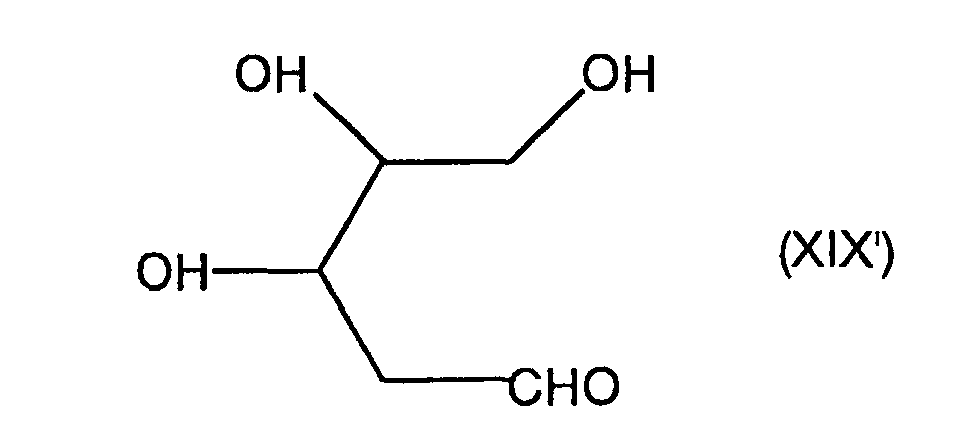
When the compound represented by formula (XIX) is
2-deoxy-D-ribose, the compounds represented by formulae
(XX), (XXI), and (XXII) in scheme 3 can be respectively
compounds represented by formulae (XX'), (XXI'), and
(XXII'):


 wherein R8, R11, and n are as defined in formula (I); and
the nitrogen atom is attached to the ortho-, meta-, or
para-position, preferably meta-position, of the phenyl
group.
wherein R8, R11, and n are as defined in formula (I); and
the nitrogen atom is attached to the ortho-, meta-, or
para-position, preferably meta-position, of the phenyl
group.
The compounds according to the present invention
have potent integrin αvβ3 antagonistic activity, as
demonstrated in Pharmacological Test Example 1.
Accordingly, the compounds according to the present
invention may be used in the treatment of integrin αvβ3-mediated
diseases. The integrin αvβ3 mediates
cardiovascular diseases such as acute myocardial
infarction, neointima formation hypertrophy, restenosis
after PTCA/stent operation, unstable angina, acute
coronary syndrome, angina pectoris after PTCA/stent
operation, arterial sclerosis, particularly
atherosclerosis; angiogenesis-related diseases such as
diabetic retinopathy, diabetic vascular complication, or
vascular grafting; cerebrovascular diseases such as
cerebral infarction; cancers such as solid tumors or
metastasis thereof; immunological diseases such as
arthritis, particularly rheumatic arthritis; and
osteopathy such as osteoporosis, hypercalcemia,
periodontitis, hyperparathyroidism, periarticular sore,
or Paget's diseases (DN & P, 10 (8), 456 (1997)). The
term "therapy" or "treatment" as used herein includes
"prevention" or "prophylaxis."
The compounds according to the present invention
have cell adhesion inhibitory activity, as demonstrated
in Pharmacological Test Example 3. Accordingly, the
compounds according to the present invention may be used
in the treatment of diseases where the inhibition of
cell adhesion is therapeutically effective. More
specifically, diseases such as cardiovascular diseases,
angiogenesis-related diseases, cerebrovascular diseases,
cancers, and immunological diseases can be treated by
inhibiting the adhesion between smooth muscle cells and
cell adherent proteins, particularly vitronectin (DN & P,
10 (8), 456 (1997)). Further, cancers or metastasis
thereof can be treated by inhibiting the adhesion
between vascular endothelial cells and cell adherent
proteins, particularly vitronectin. Furthermore,
osteopathy can be treated by inhibiting the adhesion
between osteoclasts and cell adherent proteins,
particularly osteopontin.
The term "cell adhesion" as used herein means
adhesion between vascular cells, specifically smooth
muscle cells and endothelial cells, and cell adherent
proteins, specifically vitronectin, osteopontin, and von
Willebrand factors; adhesion between vascular cells and
hemocyte cells, specifically leukocyte; and adhesion
between hemocyte cells themselves, particularly adhesion
between human vascular smooth muscle cells and human
vitronectin.
As described in Pharmacological Test Example 2, the
compounds according to the present invention have GP
IIb/IIIa antagonistic activity and human platelet
aggregation inhibitory activity. Therefore, the
compounds according to the present invention can be used
in the treatment of diseases where GP IIb/IIIa
antagonism and the inhibition of human platelet
aggregation are therapeutically effective. More
specifically, the compounds according to the present
invention can be used in the treatment of platelet
thrombosis and thromboembolism during and after the
treatment of thrombolysis and after angioplasty of
coronary artery and other arteries and after bypassing
of coronary artery, the improvement of peripheral
circulating blood stream, and the inhibition of blood
clotting during extracorporeal circulation. Furthermore,
the compounds according to the present invention can be
used in the treatment of thrombotic thrombocytopenic
purpura and hemolytic uremic syndrome (Gendai Iryo, 29,
(11), 2753 (1997)).
Not only compounds represented by formula (I)
wherein R11 represents alkyl, but also compounds
represented by formula (I) wherein R11 represents a
hydrogen atom, had oral absorption in rats (data not
shown). Therefore, any of the compounds, wherein R11
represents alkyl or a hydrogen atom, can be used in the
treatment of the above diseases.
The compounds according to the present invention
and pharmacologically acceptable salts and solvates
thereof can be administered orally or parenterally by
administration routes, for example, inhalation
administration, rhinenchysis, instillation, subcutaneous
administration, intravenous injection, intravenous drip
infusion, intramuscular injection, rectal administration,
or percutaneous administration, and thus may be formed
into appropriate various dosage forms depending on oral
or parenteral administration routes and administered to
human and non-human animals.
The compounds according to the present invention
may be formulated into, for example, oral preparation,
such as tablets, capsules, chewable preparations,
granules, powders, pills, particulates, troches, syrups,
or emulsions; liquids for external use such as inhalants,
nasal drops, or eye drops; patches; injections such as
intravenous injections or intramuscular injections and
intravenous drip infusions; preparations for rectal
administrations; oleaginous suppositories; water-soluble
suppositories; and liniments such as ointments depending
upon applications thereof. Further, liquid preparations,
such as injections or drops, may be provided, for
example, as a lyophilized powdery pharmaceutical
composition, which may be dissolved or suspended in
water or other suitable vehicle, for example, a
physiological saline, a glucose infusion, or a buffer
solution, before use.
These various preparations may be prepared by
conventional methods with commonly used components, for
example, excipients, extenders, binders, humidifiers,
disintegrants, surface active agents, lubricants,
dispersants, buffers, preservatives, dissolution aids,
antiseptics, flavoring agents, analgesic agents,
stabilizers and the like. Non-toxic additives usable
herein include, for example, lactose, fructose, glucose,
starch, gelatin, magnesium carbonate, synthetic
magnesium silicate, talc, magnesium stearate,
methylcellulose, carboxymethylcellulose or a salt
thereof, gum arabic, olive oil, propylene glycol,
polyethylene glycol, syrup, petrolatum, glycerin,
ethanol, citric acid, sodium chloride, sodium sulfite,
sodium phosphate, ascorbic acid, and cyclodextrins.
The dose of the compound according to the present
invention in the medicament may vary depending on the
dosage form. The dose is, however, generally 1.0 to 100%
by weight, preferably 1.0 to 60% by weight, based on the
whole composition.
Regarding the pharmaceuticals according to the
present invention, the dose and the number of times of
administration are not particularly limited, and may be
appropriately determined depending on various conditions,
for example, the purpose of treatment or prevention, the
type of diseases, the age, weight, and severity of
condition of patients. The dose for the treatment and
prevention of coronary diseases and the like may be
appropriately determined depending on, for example, the
dosage route and the age, sex and severity of condition
of patients, and the active ingredient may be
administered usually in an amount of about 0.1 to 2,000
mg, preferably about 5 to 400 mg per day per adult. This
dose may be administered at a time daily, divided doses
of several times daily, or at a time every several days.
The present invention will be described in more
detail with reference to the following examples, though
it is not limited to these examples only.
Dimethyl sulfoxide (11 ml) was added to 264 mg of
ethyl 3-(piperazin-1-yl)benzoate, and 269 mg of 2-bromopyrimidine
and 1.0 ml of diisopropylethylamine were
then successively added thereto. The mixture was heated
at 120°C for 12 hr. The temperature of the reaction
mixture was returned to room temperature, and the
reaction mixture was then added dropwise to 250 ml of
water, followed by stirring at room temperature for one
hr. The insolubles were collected by filtration, and
were then washed twice with 20 ml of water. The solid
was dried under the reduced pressure in the presence of
diphosphorus pentaoxide at 50°C, and was then purified by
column chromatography on silica gel (16 g, 2%
methanol/methylene chloride) to give 317 mg of the title
compound.
Physicochemical properties of intermediate 1
Physicochemical properties of intermediate 1
Tetrahydrofuran (27 ml), 9.0 ml of methanol, and
9.0 ml of a 1 N aqueous sodium hydroxide solution were
added in that order to 300 mg of intermediate 1. The
reaction mixture was then heated at 45°C for 7 hr. The
reaction solution was concentrated under the reduced
pressure, and the residue was purified by column
chromatography on silica gel (15 g, 10%
methanol/methylene chloride) to give 264 mg of the title
compound.
Physicochemical properties of intermediate 2
Physicochemical properties of intermediate 2
Dimethylformamide (6.5 ml) and 6.5 ml of methylene
chloride were added to 256 mg of intermediate 2 and 597
mg of benzotriazol-1-yloxytri(dimethylamino)phosphonium
hexafluorophosphate to prepare a solution.
Diisopropylethylamine (0.24 ml) was added to the
solution, and a reaction was allowed to proceed at room
temperature for 2 hr. Separately, 6.5 ml of methylene
chloride was added to 325 mg of t-butyl (2S)-N-benzenesulfonyl-2,3-diaminopropionate
to prepare a
solution. This solution was added to the above active
ester solution at 0°C. Diisopropylethylamine (0.12 ml)
was added thereto, and a reaction was allowed to proceed
at room temperature for 16 hr. The reaction solution was
concentrated under the reduced pressure, and the residue
was extracted with 50 ml of ethyl acetate, followed by
washing with a saturated aqueous sodium
hydrogencarbonate solution and saturated brine in that
order. The extract was then dried over anhydrous sodium
sulfate. The ethyl acetate layer was concentrated under
the reduced pressure, and the residue was purified by
column chromatography on silica gel (30 g, 60% → 67%
acetone/hexane) to give 482 mg of the title compound.
Physicochemical properties of the compound prepared in
Example 1
Methylene chloride (1.0 ml) and 0.05 ml of anisole
were added to 85.1 mg of the compound prepared in
Example 1 to prepare a solution, and the solution was
cooled to 0°C. Trifluoroacetic acid (1.0 ml) was added
thereto, and a reaction was allowed to proceed at room
temperature for 16 hr. The reaction solution was
concentrated under the reduced pressure, and the residue
was subjected to azeotropic distillation twice with 2.0
ml of toluene. The product obtained by the azeotropic
distillation was then washed twice with 2.0 ml of
isopropyl ether. The residue was purified by column
chromatography on silica gel (8.0 g, chloroform-methanol-concentrated
aqueous ammonia = 9 : 2 : 0.1) to
give 67.0 mg of the title compound.
Physicochemical properties of the compound prepared in Example 2
Physicochemical properties of the compound prepared in Example 2
1,4-Dioxane (2.8 ml), 1.6 ml of acetic acid, 0.8
ml of water, and 0.8 ml of 1 N hydrochloric acid were
successively added to 60.0 mg of the compound prepared
in Example 2 to prepare a solution. To the solution was
added 15 mg of 10% palladium-carbon, and the mixture was
stirred in a hydrogen atmosphere at room temperature for
5 hr. The insolubles were filtered and were then washed
twice with 2.0 ml of a solvent having the same
composition as the mixed solvent used in the reaction,
and the filtrate and the washings were combined followed
by concentration under the reduced pressure. The residue
was subjected to azeotropic distillation twice with 4.0
ml of toluene. The product obtained by the azeotropic
distillation was first purified by preparative thin-layer
chromatography on silica gel (development system:
methylene chloride : ethanol : water : concentrated
aqueous ammonia = 8 : 8 : 1 : 1) to give 45.7 mg of a
solid, and was finally purified by Sephadex LH-20 (45 ml,
10% concentrated aqueous ammonia/methanol) to give 31.1
mg of the title compound.
Physicochemical properties of the compound prepared in Example 3
Physicochemical properties of the compound prepared in Example 3
Toluene (200 ml) was added to 5.00 g of ethyl 3-bromobenzoate
to prepare a solution. The solution was
added to 2.65 g of 4-hydroxypiperidine. Further, 9.96 g
of anhydrous cesium carbonate, 73.5 mg of palladium(II)
acetate, and 204 mg of (R)-(+)-2,2'-bis(diphenylphosphino)-1,1'-binaphthyl
were added
thereto in that order, and the mixture was stirred with
heating at 90°C for 5 hr and then at 100°C for 2 hr. The
temperature of the reaction mixture was returned to room
temperature, and the reaction mixture was then added
dropwise to 400 ml of a saturated aqueous ammonium
chloride solution, followed by extraction with 200 ml of
ethyl acetate. The ethyl acetate layer was dried over
anhydrous sodium sulfate and was then concentrated under
the reduced pressure. The residue was purified by column
chromatography on silica gel (400 g, 67% → 75% ethyl
acetate/hexane) to give 493 mg of the title compound.
Physicochemical properties of intermediate 3
Physicochemical properties of intermediate 3
Methylene chloride (21 ml) was added to 1.032 g of
intermediate 3 to prepare a solution. Mesyl chloride
(0.35 ml), 0.69 ml of triethylamine, and 25.3 mg of 4-dimethylaminopyridine
were added in that order to the
solution, and a reaction was allowed to proceed at room
temperature for one hr. 1,3-Diaminopropane (40 mg) was
added to stop the reaction, and 30 ml of methylene
chloride was then added to dilute the reaction mixture.
The methylene chloride layer was washed once with a 5%
aqueous potassium hydrogensulfate solution, once with a
saturated aqueous sodium hydrogencarbonate solution, and
once with saturated brine in that order. The organic
layer was dried over anhydrous sodium sulfate and was
then concentrated under the reduced pressure to give
1.349 g of crude ethyl 3-{4-(methanesulfonyloxy)piperidin-1-yl}benzoate.
Dimethylformamide (27 ml) was added to this crude product to prepare a solution. Sodium azide (536 mg) was added to the solution, and the mixture was stirred with heating at 90°C for 8 hr. The temperature of the reaction mixture was returned to room temperature, and the reaction mixture was then extracted with 600 ml of ethyl acetate, followed by washing once with 600 ml of water. The aqueous layer was subjected to back extraction with 150 ml of ethyl acetate, and the extact was combined with the first ethyl acetate layer. The organic layer was washed once with a saturated aqueous sodium hydrogencarbonate solution and once with saturated brine in that order. The washed organic layer was dried over anhydrous sodium sulfate and was then concentrated under the reduced pressure. The residue was purified by column chromatography on silica gel (50 g, 1% acetone/chloroform) to give 996 mg of the title compound.
Physicochemical properties of intermediate 4
Dimethylformamide (27 ml) was added to this crude product to prepare a solution. Sodium azide (536 mg) was added to the solution, and the mixture was stirred with heating at 90°C for 8 hr. The temperature of the reaction mixture was returned to room temperature, and the reaction mixture was then extracted with 600 ml of ethyl acetate, followed by washing once with 600 ml of water. The aqueous layer was subjected to back extraction with 150 ml of ethyl acetate, and the extact was combined with the first ethyl acetate layer. The organic layer was washed once with a saturated aqueous sodium hydrogencarbonate solution and once with saturated brine in that order. The washed organic layer was dried over anhydrous sodium sulfate and was then concentrated under the reduced pressure. The residue was purified by column chromatography on silica gel (50 g, 1% acetone/chloroform) to give 996 mg of the title compound.
Physicochemical properties of intermediate 4
1,4-Dioxane (70 ml), 20 ml of water, and 10 ml of
acetic acid were added to 995 mg of intermediate 4 to
prepare a solution. To the solution was added 250 mg of
10% palladium-carbon, and the mixture was stirred in a
hydrogen atmosphere at room temperature for 16 hr. The
insolubles were filtered and were washed twice with 4.0
ml of a solvent having the same composition as the mixed
solvent used in the reaction. The filtrate and the
washings were combined, followed by concentration under
the reduced pressure. The residue was purified by column
chromatography on silica gel (50 g, chloroform-methanol-concentrated
aqueous ammonia = 10 : 1 : 0.1) to give 716
mg of the title compound.
Physicochemical properties of intermediate 5
Physicochemical properties of intermediate 5
Dimethyl sulfoxide (28 ml) was added to 716 mg of
intermediate 5. Next, 839 mg of 2-bromopyrimidine and
3.2 ml of diisopropylethylamine were added thereto in
that order, and the mixture was heated at 120°C for 12 hr.
The temperature of the reaction mixture was returned to
room temperature, and the reaction mixture was then
added dropwise to 600 ml of water. The mixture was
stirred at room temperature for one hr. The insolubles
were collected by filtration and were then washed twice
with 20 ml of water. The solid was then dried under the
reduced pressure in the presence of diphosphorus
pentaoxide at 60°C for 3 hr and was purified by column
chromatography on silica gel (50 g, 7.5%
acetone/chloroform) to give 531 mg of the title compound.
Physicochemical properties of intermediate 6
Tetrahydrofuran (45 ml), 15 ml of methanol, and 15
ml of a 1 N aqueous sodium hydroxide solution were
successively added to 528 mg of intermediate 6 to
prepare a solution, and a reaction was allowed to
proceed at 45°C for 16 hr. The temperature of the
reaction solution was returned to room temperature, and
the reaction solution was then concentrated to dryness.
The residue was dissolved in 16 ml of water. The
solution was adjusted to pH 3 by the addition of 2.5 ml
of 5 N hydrochloric acid and 2.0 ml of 1 N hydrochloric
acid. The precipitated insolubles were then collected
by filtration and were washed twice with 6.0 ml of water.
The solid was dried under the reduced pressure in the
presence of diphosphorus pentaoxide at 60°C for 3 hr to
give 467 mg of the title compound.
Physicochemical properties of intermediate 7
Physicochemical properties of intermediate 7
Dimethylformamide (5.4 ml) and 5.4 ml of methylene
chloride were added to 93.2 mg of intermediate 7 and 207
mg of benzotriazol-1-yloxytri(dimethylamino)phosphonium
hexafluorophosphate to prepare a solution.
Diisopropylethylamine (0.082 ml) was added to the
solution, and a reaction was allowed to proceed at room
temperature for 2 hr. Separately, 5.4 ml of methylene
chloride was added to 113 mg of t-butyl (2S)-N-benzenesulfonyl-2,3-diaminopropionate
to prepare a
solution. Diisopropylethylamine (0.041 ml) was added to
the solution. The above active ester solution was added
to this mixture at 0°C, and a reaction was allowed to
proceed at room temperature for 16 hr. The reaction
solution was concentrated under the reduced pressure,
and the residue was extracted with 40 ml of ethyl
acetate, followed by washing with a saturated aqueous
sodium hydrogencarbonate solution and saturated brine in
that order. The extract was then dried over anhydrous
sodium sulfate. The ethyl acetate layer was concentrated
under the reduced pressure, and the residue was purified
by column chromatography on silica gel (25 g,
chloroform-methanol-concentrated aqueous ammonia =
30 : 1 : 0.03) to give 181 mg of the title compound.
Physicochemical properties of the compound prepared in Example 4
Physicochemical properties of the compound prepared in Example 4
Methylene chloride (4.0 ml) and 0.20 ml of anisole
were added to 174 mg of the compound prepared in Example
4 to prepare a solution, and the solution was cooled to
0°C. Trifluoroacetic acid (4.0 ml) was added thereto,
and a reaction was allowed to proceed at room
temperature for 8 hr. The reaction solution was
concentrated under the reduced pressure, and the residue
was subjected to azeotropic distillation twice with 4.0
ml of toluene. The product obtained by the azeotropic
distillation was then washed twice with 4.0 ml of
isopropyl ether, and the residue was purified by column
chromatography on silica gel (20 g, chloroform-methanol-concentrated
aqueous ammonia = 9 : 2 : 0.2) to give 157
mg of the title compound.
Physicochemical properties of the compound prepared in Example 5
Physicochemical properties of the compound prepared in Example 5
1,4-Dioxane (10.5 ml), 3.0 ml of water, and 1.5 ml
of 1 N hydrochloric acid were successively added to 157
mg of the compound prepared in Example 5 to prepare a
solution. To the solution was added 40 mg of 10%
palladium-carbon. The mixture was stirred in a hydrogen
atmosphere at room temperature for 6 hr. The insolubles
were filtered and were washed twice with 4.0 ml of a
solvent having the same composition as the mixed solvent
used in the reaction. The filtrate and the washings were
combined, followed by concentration under the reduced
pressure. The residue was purified by preparative thin-layer
chromatography on silica gel (development system:
chloroform : ethanol : water : concentrated aqueous
ammonia = 8 : 8 : 1 : 1) to give the title compound
as a crude compound. Finally, the crude compound was
purified by Sephadex LH-20 (250 ml, 10% concentrated
aqueous ammonia/methanol) to give 119 mg of the title
compound.
Physicochemical properties of the compound prepared in Example 6
Physicochemical properties of the compound prepared in Example 6
Anhydrous methanol (30 ml) was added to 3.00 g of
3-bromo-4-fluorobenzoic acid to prepare a solution.
Concentrated sulfuric acid (3.0 ml) was slowly added to
the solution, and the mixture was heated under reflux
for 5 hr. The temperature of the reaction solution was
returned to room temperature, and the reaction solution
was then added dropwise to 600 ml of a saturated aqueous
sodium hydrogencarbonate solution. The mixture was
extracted once with 600 ml of diethyl ether and once
with 120 ml of diethyl ether. The ether layers were
combined, and the combined ether layers were dried over
anhydrous sodium sulfate and were then concentrated and
dried under the reduced pressure to give 3.47 g of crude
methyl 3-bromo-4-fluorobenzoate. Toluene (110 ml) was
added to a 2.83 g portion of the crude product to
prepare a solution which was then added to 1.48 g of 4-hydroxypiperidine.
Further, 5.55 g of anhydrous cesium
carbonate, 273 mg of palladium(II) acetate, and 758 mg
of (R)-(+)-2,2'-bis(diphenylphosphino)-1,1'-binaphthyl
were added thereto in that order, and the mixture was
stirred with heating at 100°C for 5 hr. The temperature
of the reaction mixture was returned to room temperature,
and the reaction solution was then added dropwise to 220
ml of a saturated aqueous sodium hydrogencarbonate
solution. The mixture was extracted three times with 110
ml of ethyl acetate. The ethyl acetate layers were
combined, and anhydrous sodium sulfate was added thereto
to perform drying at room temperature for 3 days. The
insolubles were filtered, and the filtrate was
concentrated under the reduced pressure. The residue
was purified by column chromatography on silica gel (120
g, 35% ethyl acetate/hexane) to give 424 mg of the title
compound.
Physicochemical properties of intermediate 8
Physicochemical properties of intermediate 8
Methylene chloride (9.7 ml) was added to 485 mg of
intermediate 8 to prepare a solution. Mesyl chloride
(0.16 ml), 0.32 ml of triethylamine, and 11.7 mg of 4-dimethylaminopyridine
were added in that order to the
solution, and a reaction was allowed to proceed at room
temperature for one hr. Methylene chloride (40 ml) was
added to dilute the reaction solution. The diluted
solution was washed once with a 5% aqueous potassium
hydrogensulfate solution, once with a saturated aqueous
sodium hydrogencarbonate solution, and once with
saturated brine in that order. The organic layer was
dried over anhydrous sodium sulfate and was then
concentrated under the reduced pressure to give 556 mg
of the title compound.
Physicochemical properties of intermediate 9
Physicochemical properties of intermediate 9
Dimethylformamide (11 ml) was added to 554 mg of
intermediate 9 to prepare a solution. Sodium azide (217
mg) was added to the solution, and the mixture was
stirred with heating at 90°C for 16 hr. The temperature
of the reaction mixture was returned to room temperature,
and the reaction mixture was then extracted with 240 ml
of ethyl acetate, followed by washing once with 240 ml
of water. The aqueous layer was subjected to back
extraction with 60 ml of ethyl acetate, and the ethyl
acetate layer was combined with the first ethyl acetate
layer. The organic layer was washed once with a
saturated aqueous sodium hydrogencarbonate solution and
once with saturated brine in that order, was dried over
anhydrous sodium sulfate, and was then concentrated
under the reduced pressure. The residue was purified by
column chromatography on silica gel (20 g, 1% → 1.5%
acetone/chloroform) to give 449 mg of the title compound.
Physicochemical properties of intermediate 10
1,4-Dioxane (31.5 ml), 9.0 ml of water, and 4.5 ml
of acetic acid were added to 449 mg of intermediate 10
to prepare a solution. To the solution was added 112 mg
of 10% palladium-carbon. The mixture was stirred in a
hydrogen atmosphere at room temperature for 4 hr. The
insolubles were filtered and were then washed twice with
10 ml of a solvent having the same composition as the
mixed solvent used in the reaction, and the filtrate and
the washings were combined followed by concentration
under the reduced pressure. The residue was subjected to
azeotropic distillation twice with 10 ml of toluene and
was then purified by column chromatography on silica gel
(20 g, chloroform-methanol-concentrated aqueous ammonia
= 15 : 1 : 0.07 → 10 : 1 : 0.1) to give 288 mg of the
title compound.
Physicochemical properties of intermediate 11
Physicochemical properties of intermediate 11
Dimethyl sulfoxide (12 ml) was added to 288 mg of
intermediate 11. 2-Bromopyrimidine (272 mg) and 1.0 ml
of diisopropylethylamine were then added thereto in that
order, and the mixture was heated at 120°C for 12 hr.
The temperature of the reaction mixture was returned to
room temperature, and the reaction mixture was then
added dropwise to 240 ml of water. The mixture was
stirred at 0°C for 15 min, followed by extraction with
240 ml of ethyl acetate. The organic layer was washed
twice with 240 ml of water, was dried over anhydrous
sodium sulfate, and was then concentrated under the
reduced pressure. The residue was purified by column
chromatography on silica gel (20 g, 10%
acetone/chloroform) to give 253 mg of the title compound.
Physicochemical properties of intermediate 12
Tetrahydrofuran (15 ml), 5.0 ml of methanol, and
5.0 ml of a 1 N aqueous sodium hydroxide solution were
added in that order to 253 mg of intermediate 12, and a
reaction was allowed to proceed at 45°C for 12 hr. The
temperature of the reaction solution was returned to
room temperature, and the reaction solution was then
concentrated to dryness. The residue was dissolved in
5.0 ml of water. The solution was adjusted to pH 3 by
the addition of 0.8 ml of 5 N hydrochloric acid and 1.1
ml of 1 N hydrochloric acid. The precipitated
insolubles were then collected by filtration and were
washed twice with 2.0 ml of water. The solid was dried
under the reduced pressure in the presence of
diphosphorus pentaoxide at 50°C for 2 hr to give 227 mg
of the title compound.
Physicochemical properties of intermediate 13
Physicochemical properties of intermediate 13
Dimethylformamide (1.3 ml) and 1.3 ml of methylene
chloride were added to 50.0 mg of intermediate 13 and
105 mg of benzotriazol-1-yloxytri(dimethylamino)phosphonium
hexafluorophosphate
to prepare a solution. Diisopropylethylamine (0.041 ml)
was added to the solution, and a reaction was allowed to
proceed at room temperature for 2 hr. Separately, 1.3 ml
of methylene chloride was added to 57.0 mg of t-butyl
(2S)-N-benzenesulfonyl-2,3-diaminopropionate to prepare
a solution, and 0.021 ml of diisopropylethylamine was
added to the solution. The above active ester solution
was added to this mixture at 0°C, and a reaction was
allowed to proceed at room temperature for 2 hr. The
reaction solution was concentrated under the reduced
pressure, and the residue was extracted with 20 ml of
ethyl acetate, followed by washing with a saturated
aqueous sodium hydrogencarbonate solution and saturated
brine in that order. The extract was then dried over
anhydrous sodium sulfate. The ethyl acetate layer was
concentrated under the reduced pressure, and the residue
was purified by preparative thin-layer chromatography on
silica gel (development system: chloroform : methanol :
concentrated aqueous ammonia = 20 : 1 : 0.05) to give
93.7 mg of the title compound.
Physicochemical properties of the compound prepared in Example 7
Physicochemical properties of the compound prepared in Example 7
Methylene chloride (2.0 ml) and 0.10 ml of anisole
were added to 93.7 mg of the compound prepared in
Example 7 to prepare a solution, and the solution was
cooled to 0°C. Trifluoroacetic acid (2.0 ml) was added
thereto, and a reaction was allowed to proceed at 0°C for
16 hr. The reaction solution was concentrated under the
reduced pressure. The residue was subjected to
azeotropic distillation twice with 2.0 ml of toluene.
The product obtained by the azeotropic distillation was
then washed twice with 2.0 ml of isopropyl ether, and
the residue was purified by column chromatography on
silica gel (5.0 g, chloroform-methanol-concentrated
aqueous ammonia = 9 : 2 : 0.1) to give 84.9 mg of the
title compound.
Physicochemical properties of the compound prepared in Example 8
Physicochemical properties of the compound prepared in Example 8
1,4-Dioxane (5.6 ml), 1.6 ml of water, and 0.8 ml
of 1 N hydrochloric acid were successively added to 79.4
mg of the compound prepared in Example 8 to prepare a
solution. To the solution was added 20 mg of 10%
palladium-carbon. The mixture was stirred in a hydrogen
atmosphere at room temperature for 5 hr. The insolubles
were filtered and were then washed twice with 2.0 ml of
a solvent having the same composition as the mixed
solvent used in the reaction, and the filtrate and the
washings were combined. 10% palladium-carbon (32 mg)
was newly added thereto, and the mixture was stirred in
a hydrogen atmosphere at room temperature for additional
8 hr. The insolubles were filtered and were then washed
twice with 2.0 ml of a solvent having the same
composition as the mixed solvent used in the reaction,
and the filtrate and the washings were combined,
followed by concentration under the reduced pressure.
The residue was purified by preparative thin-layer
chromatography on silica gel (development system:
chloroform : ethanol : water : concentrated aqueous
ammonia = 8 : 8 : 1 : 1) to give the title compound as
a crude compound and was finally purified by Sephadex
LH-20 (60 ml, 10% concentrated aqueous ammonia/methanol)
to give 51.6 mg of the title compound.
Physicochemical properties of the compound prepared in Example 9
Physicochemical properties of the compound prepared in Example 9
Methanol (50 ml) was added to 1.34 g of 2-deoxy-D-ribose
to prepare a solution. Separately, 50 ml of
methylene chloride was added to 1.60 g of ethyl 3-aminobenzoate
to prepare a solution which was then added
to the above methanol solution. A reaction was allowed
to proceed at room temperature for 16 hr. Acetic acid
(1.0 ml) and 500 mg of sodium boron cyanohydride were
then added thereto in that order, and a reaction was
allowed to proceed at room temperature for 4 hr. The
reaction solution was concentrated under the reduced
pressure, and the residue was extracted with 300 ml of
chloroform. The organic layer was washed with 200 ml of
a saturated aqueous sodium hydrogencarbonate solution
containing a minor amount of sodium chloride. The
aqueous layer was subjected to back extraction with 100
ml of chloroform. The chloroform layers were combined
and were then dried over anhydrous sodium sulfate,
followed by concentration under the reduced pressure.
The residue was purified by column chromatography on
silica gel (100 g, chloroform-methanol-concentrated
aqueous ammonia = 10 : 1 : 0.1 → 10 : 1.3 : 0.1) to
give 2.23 g of the title compound.
Physicochemical properties of intermediate 14
Physicochemical properties of intermediate 14
Tetrahydrofuran (15 ml) was added to 372 mg of
intermediate 14 to prepare a solution. Carbon
tetrabromide (653 mg) was added to the solution. The
mixture was cooled to 0°C, and 689 mg of
triphenylphosphine was then added thereto. The
temperature of the mixture was gradually raised to room
temperature over a period of one hr. The reaction
solution was concentrated under the reduced pressure,
and the residue was purified by column chromatography on
silica gel (40 g, chloroform-methanol-concentrated
aqueous ammonia = 20 : 1 : 0.05) to give the title
compound as a crude compound. The crude compound was
purified by preparative thin-layer chromatography on
silica gel (development system: chloroform : methanol :
benzene : ethyl acetate = 9 : 1 : 6 : 4) to give 157 mg
of the title compound.
Physicochemical properties of intermediate 15
Physicochemical properties of intermediate 15
Trimethyl orthoacetate (0.50 ml) was added to
intermediate 15 (134 mg, 0.51 mmol) to prepare a
suspension. p-Toluenesulfonic acid monohydrate (15.4 mg)
was added to the suspension at room temperature, and a
reaction was allowed to proceed for 3 hr. The reaction
solution was concentrated under the reduced pressure.
Acetic acid (1.0 ml) was then added to the residue at
room temperature, and a reaction was allowed to proceed
for 45 min. Water (100 ml) was then added thereto. The
mixture was extracted twice with 100 ml of ethyl acetate.
The organic layers were combined, and the combined
organic layers were washed with 100 ml of saturated
brine, were dried over anhydrous magnesium sulfate, and
were then concentrated under the reduced pressure. The
residue was purified by column chromatography on silica
gel (development system: methylene chloride :
methanol : benzene : ethyl acetate = 9 : 1 : 6 : 4)
to give intermediate 16 (47 mg, 30%) and intermediate 17
(86 mg, 55%).
Physicochemical properties of intermediate 16
Physicochemical properties of intermediate 16
- (1) Color and form: Colorless syrup
- (2) Molecular formula: C16H21NO5
- (3) Mass spectrum (EIMS): m/z 307 (M)+
- (4) Specific rotation: [α]D 25 +4.9° (c 1.1, CH2Cl2)
- (5) 1H NMR spectrum (400 MHz, CDCl3) δ (ppm): 1.39 (3H, t, Et), 1.94 - 1.99 (1H, m, piperidine), 2.07 - 2.16 (1H, m, piperidine), 2.15 (3H, s, acetyl), 3.07 (1H, ddd, piperidine), 3.23 (1H, dd, piperidine), 3.43 (1H, m, piperidine), 3.50 (1H, ddd, piperidine), 4.08 (1H, br s, piperidine), 4.38 (2H, q, Et), 5.00 (1H, ddd, piperidine), 7.16 (1H, dd, C6H4), 7.33 (1H, dd, C6H4), 7.58 (1H, m, C6H4), 7.64 (1H, m, C6H4)
Methylene chloride (3.0 ml) was added to
intermediate 16 (47 mg, 0.15 mmol) to prepare a solution.
Triethylamine (45 µl, 0.32 mmol) and methanesulfonyl
chloride (15 µl, 0.20 mmol) were added to the solution
at room temperature, and a reaction was allowed to
proceed for 5 min. Water (100 ml) was added thereto, and
the mixture was extracted twice with 50 ml of methylene
chloride. The combined organic layers were dried over
anhydrous magnesium sulfate and were concentrated under
the reduced pressure to give the title compound (40 mg,
67%).
Physicochemical properties of intermediate 18
Physicochemical properties of intermediate 18
Dimethylformamide (2.0 ml) was added to
intermediate 18 (39 mg, 0.10 mmol) to prepare a solution.
Sodium azide (15 mg, 0.23 mmol) was added to the
solution, and a reaction was allowed to proceed at 90°C
for 10 hr. The reaction mixture was returned to room
temperature, 100 ml of water was then added thereto, and
the mixture was extracted twice with 70 ml of ethyl
acetate. The combined organic layers were washed twice
with 100 ml of water and once with 100 ml of saturated
brine, were then dried over anhydrous magnesium sulfate,
and were concentrated under the reduced pressure. The
residue was then purified by column chromatography on
silica gel (development system: hexane : ethyl acetate
= 1 : 1) to give the title compound (34 mg, 100%).
Physicochemical properties of intermediate 19
Physicochemical properties of intermediate 19
Tetrahydrofuran (11 ml) was added to intermediate
19 (390 mg, 1.2 mmol) to prepare a solution. Sodium
ethoxide (99 mg, 1.4 mmol) was added to the solution,
and a reaction was allowed to proceed at 30°C for 3.5 hr.
The reaction solution was adjusted to pH 4 by the
addition of 1.0 M hydrochloric acid, and 100 ml of water
was added thereto. The mixture was extracted twice with
150 ml of ethyl acetate. The combined organic layers
were then washed with 150 ml of saturated brine, were
dried over anhydrous magnesium sulfate, and were
concentrated under the reduced pressure to give the
title compound (346 mg, 100%).
Physicochemical properties of intermediate 20
Physicochemical properties of intermediate 20
1,4-Dioxane (1.0 ml) and 0.5 ml of water were
successively added to intermediate 20 (11 mg, 0.039
mmol) to prepare a solution. 10% palladium-carbon (3.0
mg) was added to the solution, and the mixture was
stirred in a hydrogen atmosphere at room temperature for
3 hr. The insolubles were filtered and were washed with
20 ml of a solvent having the same composition as the
mixed solvent used in the reaction. The filtrate and the
washings were combined, followed by concentration under
the reduced pressure to give the title compound (11 mg,
100%).
Physicochemical properties of intermediate 21
Physicochemical properties of intermediate 21
Dimethyl sulfoxide (3.0 ml) was added to
intermediate 21 (87 mg, 0.33 mmol) to prepare a solution.
2-Bromopyrimidine (55 mg, 0.33 mmol) and
diisopropylethylamine (320 µl, 1.85 mmol) were
successively added to the solution, and a reaction was
allowed to proceed at 120°C for 14 hr. The reaction
mixture was returned to room temperature, and 500 ml of
water was added thereto, followed by extraction three
times with 250 ml of ethyl acetate. The combined organic
layers were washed twice with 200 ml of water and twice
with 200 ml of saturated brine, were then dried over
anhydrous magnesium sulfate, and were concentrated under
the reduced pressure. The residue was purified by column
chromatography on silica gel (development system:
benzene : ethyl acetate = 1 : 4) to give the title
compound (51 mg, 45%).
Physicochemical properties of intermediate 22
Physicochemical properties of intermediate 22
Tetrahydrofuran (1.8 ml) and 0.60 ml of methanol
were successively added to intermediate 22 (49 mg, 0.14
mmol) to prepare a solution, and a 1.0 M aqueous sodium
hydroxide solution (0.60 ml) was added to the solution.
A reaction was allowed to proceed at 50°C for one hr.
The temperature of the reaction mixture was then
returned to room temperature, and the reaction mixture
was adjusted to pH 4 by the addition of 1.0 M
hydrochloric acid and was concentrated under the reduced
pressure to give 3-{(3R)-hydroxy-(4R)-(pyrimidin-2-ylamino)piperidin-1-yl}benzoic
acid. Dimethylformamide
(7.0 ml) was added to this product to prepare a solution.
Benzotriazol-1-yloxytri(dimethylamino)phosphonium
hexafluorophosphate (98 mg, 0.21 mmol) and
diisopropylethylamine (40 µl, 0.22 mmol) were added to
the solution, and a reaction was allowed to proceed at
room temperature for 30 min. Further, t-butyl (2S)-N-benzenesulfonyl-2,3-diaminopropionate
(55 mg, 0.18 mmol)
was added to the above active ester solution at room
temperature, and a reaction was allowed to proceed at
room temperature for one hr. A saturated aqueous sodium
hydrogencarbonate solution (20 ml) was added thereto,
followed by extraction twice with 100 ml of ethyl
acetate. The combined organic layers were washed with
100 ml of saturated brine, were dried over anhydrous
magnesium sulfate, and were then concentrated under the
reduced pressure. The residue was purified by column
chromatography on silica gel (development system:
methylene chloride : methanol = 20 : 1) to give the
title compound (18 mg, 21%).
Physicochemical properties of the compound prepared in Example 10
Physicochemical properties of the compound prepared in Example 10
Methylene chloride (2.0 ml) was added to the
compound (16 mg, 0.027 mmol) prepared in Example 10 to
prepare a solution, and 2.0 ml of trifluoroacetic acid
was added to the solution at room temperature. A
reaction was allowed to proceed for 7 hr, and the
reaction solution was then concentrated under the
reduced pressure to give the title compound (18 mg, 75%
(as tritrifluoroacetate)).
Physicochemical properties of the compound prepared in Example 11 (as tritrifluoroacetate)
Physicochemical properties of the compound prepared in Example 11 (as tritrifluoroacetate)
1,4-Dioxane (2.0 ml) and 1.0 ml of water were
successively added to 15 mg of the compound prepared in
Example 11 to prepare a solution. 10% Palladium-carbon
(4.4 mg) was added to the solution, and a reaction was
allowed to proceed at room temperature in a hydrogen
atmosphere for 4 hr. The insolubles were filtered and
were washed with 90 ml of a solvent having the same
composition as the mixed solvent used in the reaction.
The filtrate and the washings were combined followed by
concentration under the reduced pressure. The residue
was purified by column chromatography on silica gel
(development system: methylene chloride : ethanol :
water : concentrated aqueous ammonia = 8 : 8 : 1 : 1)
and was then purified by Sephadex LH-20 (methanol) to
give the title compound (3.1 mg, 28%).
Physicochemical properties of the compound prepared in Example 12
Physicochemical properties of the compound prepared in Example 12
Tetrahydrofuran (5.0 ml) was added to sodium
hydride (60%, 35 mg, 0.87 mmol) in an argon atmosphere
to prepare a suspension. Separately, intermediate 20
(208 mg, 0.72 mmol) was dissolved in 2.0 ml of
tetrahydrofuran. This solution was added dropwise to the
above suspension at room temperature, and the mixture
was stirred for 30 min. A solution (1.0 ml) of methyl
iodide (67 µl, 1.1 mmol) in tetrahydrofuran was added
dropwise thereto. The mixture was stirred for 4 hr, a
saturated aqueous ammonium chloride solution was then
added to stop the reaction, and 100 ml of water was
added thereto. The mixture was extracted twice with 100
ml of ethyl acetate. The combined organic layers were
then dried over anhydrous magnesium sulfate and were
concentrated under the reduced pressure. The residue was
purified by column chromatography on silica gel
(development system: methylene chloride : methanol =
10 : 1) to give the title compound (77 mg, 35%).
Physicochemical properties of intermediate 23
Physicochemical properties of intermediate 23
1,4-Dioxane (4.0 ml) and 2.0 ml of water were
successively added to intermediate 23 (69 mg, 0.23 mmol)
to prepare a solution. 10% Palladium-carbon (18 mg) was
added to the solution, and the mixture was stirred in a
hydrogen atmosphere at room temperature for 4 hr. The
insolubles were filtered and were washed with 90 ml of a
solvent having the same composition as the mixed solvent
used in the reaction. The filtrate and the washings were
combined followed by concentration under the reduced
pressure to give ethyl 3-{(4R)-amino-(3R)-methoxypiperidin-1-yl}benzoate
(66 mg, 100%).
Dimethyl sulfoxide (2.5 ml) was added to the ethyl
3-{(4R)-amino-(3R)-methoxypiperidin-1-yl}benzoate (66 mg,
0.23 mmol) thus obtained to prepare a solution.
Diisopropylethylamine (230 µl, 1.3 mmol) and 2-bromopyrimidine
(42 mg, 0.27 mmol) were added in that
order to the solution. A reaction was allowed to proceed
at 120°C for 24 hr, and the temperature of the reaction
mixture was then returned to room temperature. Water
(500 ml) was added thereto, and the mixture was
extracted twice with 500 ml of ethyl acetate. The
combined organic layers were washed twice with 500 ml of
water and once with 500 ml of saturated brine, were
dried over anhydrous magnesium sulfate, and were then
concentrated under the reduced pressure. The residue was
purified by column chromatography on silica gel
(development system: ethyl acetate) to give ethyl 3-{(3R)-methoxy-(4R)-(pyrimidin-2-ylamino)piperidin-1-yl}benzoate
(34 mg, 40%).
Tetrahydrofuran (1.5 ml) and 0.50 ml of methanol
were added in that order to the ethyl 3-{(3R)-methoxy-(4R)-(pyrimidin-2-ylamino)piperidin-1-yl}benzoate
(34 mg,
0.096 mmol) thus obtained to prepare a solution, and
0.50 ml of a 1.0 M aqueous sodium hydroxide solution was
added to the solution. A reaction was allowed to proceed
at 50°C for 3 hr. The temperature of the reaction
mixture was then returned to room temperature, the
reaction mixture was adjusted to pH 3 by the addition of
1.0 M hydrochloric acid, and 50 ml of water was added
thereto. The mixture was extracted twice with 50 ml of
ethyl acetate, and the extract was then dried over
anhydrous magnesium sulfate and was concentrated under
the reduced pressure to give the title compound (29 mg,
95%).
Physicochemical properties of intermediate 24
Physicochemical properties of intermediate 24
Dimethylformamide (1.5 ml) was added to
intermediate 24 (28 mg, 0.086 mmol) to prepare a
solution, and t-butyl (2S)-N-benzenesulfonyl-2,3-diaminopropionate
(32 mg, 0.10 mmol) was added to the
solution. Further, 1-hydroxybenzotriazole (19 mg, 0.14
mmol), N-methylmorpholine (47 µl, 0.43 mmol), and 1-ethyl-3-(3-dimethylaminopropyl)carbodiimide
hydrochloride (34 mg, 0.18 mmol) were added thereto, and
a reaction was allowed to proceed at room temperature
for 2.5 hr. A saturated aqueous sodium hydrogencarbonate
solution (10 ml) was added to stop the reaction, and 100
ml of water was added thereto. The mixture was extracted
twice with 100 ml of ethyl acetate, and the combined
organic layers were washed with 100 ml of saturated
brine and were dried over anhydrous magnesium sulfate,
followed by concentration under the reduced pressure.
The residue was purified by column chromatography on
silica gel (development system: methylene chloride :
methanol = 10 : 1) to give the title compound (36 mg,
69%).
Physicochemical properties of the compound prepared in Example 13
Physicochemical properties of the compound prepared in Example 13
Methylene chloride (1.0 ml) was added to the
compound (36 mg, 0.059 mmol) prepared in Example 13 to
prepare a solution, and 1.0 ml of trifluoroacetic acid
was added to the solution at room temperature. The
mixture was stirred for 2 hr and was concentrated under
the reduced pressure to give the title compound (37 mg,
71% (as tritrifluoroacetate)).
Physicochemical properties of the compound prepared in Example 14 (as tritrifluoroacetate)
Physicochemical properties of the compound prepared in Example 14 (as tritrifluoroacetate)
1,4-Dioxane (2.0 ml) and 1.0 ml of water were
added in that order to 32 mg of the compound prepared in
Example 14 to prepare a solution. 10% Palladium-carbon
(8.3 mg) was added to the solution, and the mixture was
stirred in a hydrogen atmosphere at room temperature for
4 hr. The insolubles were filtered and were washed with
90 ml of a solvent having the same composition as the
mixed solvent used in the reaction. The filtrate and the
washings were combined followed by concentration under
the reduced pressure. The residue was purified by column
chromatography on silica gel (development system:
methylene chloride : ethanol : water : concentrated
aqueous ammonia =8:8:1:1) and was then purified
by Sephadex LH-20 (methanol) to give the title compound
(15 mg, 45%).
Physicochemical properties of the compound prepared in Example 15
Physicochemical properties of the compound prepared in Example 15
Methanol (30 ml) was added to 3-bromo-5-fluorobenzoic
acid (3.1 g, 14 mmol) to prepare a
solution. Concentrated sulfuric acid (3.0 ml) was added
to the solution, and the mixture was heated under reflux
for 1.5 hr. The temperature of the reaction mixture was
returned to room temperature, and the reaction mixture
was slowly poured into 400 ml of a saturated aqueous
sodium hydrogencarbonate solution, followed by
extraction twice with 250 ml of diethyl ether. The
combined organic layers were dried over anhydrous
magnesium sulfate and were concentrated under the
reduced pressure to give the title compound (2.6 g, 80%).
Physicochemical properties of intermediate 25
Physicochemical properties of intermediate 25
Toluene (22 ml) was added to 4-piperidone
monohydrate monohydrochloride (1.8 g, 13 mmol) and
intermediate 25 (2.6 g, 11 mmol) in an argon atmosphere
to prepare a solution. (R)-(+)-2,2'-Bis(diphenylphosphino)-1,1'-binaphthyl
(699 mg, 1.1
mmol), cesium carbonate (5.5 g, 16.8 mmol), and
palladium acetate (257 mg, 1.1 mmol) were added in that
order to the solution, and the mixture was stirred at
100°C for 21 hr. The temperature of the reaction mixture
was returned to room temperature, and the insolubles
were then filtered and were washed with 100 ml of
toluene. The filtrate and the washings were combined.
Water (400 ml) was added thereto, and the mixture was
extracted twice with 250 ml of ethyl acetate. The
extract was then washed with 300 ml of saturated brine,
was dried over anhydrous magnesium sulfate, and was
concentrated under the reduced pressure. The residue was
purified by column chromatography on silica gel
(development system: methylene chloride : methanol =
20 : 1) to give the title compound (159 mg, 5.7%).
Physicochemical properties of intermediate 26
Physicochemical properties of intermediate 26
Tetrahydrofuran (13 ml) was added to intermediate
26 (159 mg, 0.63 mmol) to prepare a solution. The
solution was cooled to -78°C, and sodium boron hydride
(34 mg, 0.90 mmol) was added to the cooled solution. The
reaction temperature was returned to room temperature,
and the mixture was stirred for 2.5 hr. Water (50 ml)
was added thereto, and the mixture was extracted twice
with 100 ml of ethyl acetate. The combined organic
layers were washed with 100 ml of saturated brine, were
dried over anhydrous magnesium sulfate, and were
concentrated under the reduced pressure to give the
title compound (161 mg, 100%).
Physicochemical properties of intermediate 27
Physicochemical properties of intermediate 27
Methylene chloride (6.0 ml) was added to
intermediate 27 (159 mg, 0.63 mmol) to prepare a
solution, and triethylamine (220 µl, 1.6 mmol) and
methanesulfonyl chloride (60 µl, 0.75 mmol) were added
in that order to the solution at room temperature. A
reaction was allowed to proceed for 15 min, and 50 ml of
water was added thereto, followed by extraction twice
with 70 ml of methylene chloride. The combined residues
were dried over anhydrous magnesium sulfate and were
concentrated under the reduced pressure to give the
title compound (200 mg, 96%).
Physicochemical properties of intermediate 28
Physicochemical properties of intermediate 28
Dimethylformamide (8.0 ml) was added to
intermediate 28 (200 mg, 0.60 mmol) to prepare a
solution. Sodium azide (82 mg, 1.2 mmol) was added to
the solution, and a reaction was allowed to proceed at
80°C for 5 hr. The temperature of the reaction mixture
was returned to room temperature, 50 ml of water was
then added thereto, and the mixture was extracted twice
with 50 ml of ethyl acetate. The combined organic
layers were washed twice with 50 ml of saturated brine
and were dried over anhydrous magnesium sulfate. The
residue was purified by column chromatography on silica
gel (development system: hexane : ethyl acetate = 6 :
1) to give the title compound (122 mg, 72%).
Physicochemical properties of intermediate 29
Physicochemical properties of intermediate 29
1,4-Dioxane (8.0 ml), 3.0 ml of water, and 1.0 ml
of acetic acid were added in that order to intermediate
29 (118 mg, 0.42 mmol) to prepare a solution. To the
solution was added 40 mg of 10% palladium-carbon. The
mixture was stirred in a hydrogen atmosphere at room
temperature for 17 hr. The insolubles were filtered and
were washed with 100 ml of 1,4-dioxane. The filtrate
and the washings were combined followed by concentration
under the reduced pressure. The residue was purified by
column chromatography on silica gel (development system:
methylene chloride : methanol : concentrated aqueous
ammonia = 100 : 10 : 1) to give the title compound (54
mg, 51%).
Physicochemical properties of intermediate 30
Physicochemical properties of intermediate 30
Dimethyl sulfoxide (2.0 ml) was added to
intermediate 30 (53 mg, 0.21 mmol) to prepare a solution.
Diisopropylethylamine (210 µl, 1.2 mmol) and 2-bromopyrimidine
(35 mg, 0.21 mmol) were added in that
order to the solution. A reaction was allowed to proceed
at 120°C for 7.5 hr, and the temperature of the reaction
mixture was then returned to room temperature. Water
(200 ml) was added to the reaction mixture, and the
mixture was extracted twice with 150 ml of ethyl acetate.
The combined organic layers were washed once with 200 ml
of water and once with 200 ml of saturated brine, were
dried over anhydrous magnesium sulfate, and were then
concentrated under the reduced pressure. The residue
was purified by column chromatography on silica gel
(development system: hexane : ethyl acetate = 1 : 1) to
give the title compound (36 mg, 51%).
Physicochemical properties of intermediate 31
Physicochemical properties of intermediate 31
Tetrahydrofuran (3.0 ml) and 1.0 ml of methanol
were added in that order to intermediate 31 (33 mg,
0.099 mmol) to prepare a solution, and 1.0 ml of a 1.0 M
aqueous sodium hydroxide solution was added to the
solution. The mixture was stirred at 60°C for one hr.
The temperature of the reaction mixture was then
returned to room temperature, the reaction mixture was
adjusted to pH 4 by the addition of 1.0 M hydrochloric
acid, and 20 ml of water was added thereto. The
precipitate was collected by filtration and was dried to
give the title compound (28 mg, 91%).
Physicochemical properties of intermediate 32
Physicochemical properties of intermediate 32
Dimethylformamide (1.0 ml) was added to
intermediate 32 (27 mg, 0.084 mmol) to prepare a
solution, and t-butyl (2S)-N-benzenesulfonyl-2,3-diaminopropionate
(30 mg, 0.10 mmol) was added to the
solution. Further, 1-hydroxybenzotriazole (18 mg, 0.14
mmol), N-methylmorpholine (47 µl, 0.43 mmol), and 1-ethyl-3-(3-dimethylaminopropyl)carbodiimide
hydrochloride
(35 mg, 0.18 mmol) were added thereto, and a
reaction was allowed to proceed at room temperature for
14 hr. A saturated aqueous sodium hydrogencarbonate
solution (10 ml) was added to stop the reaction, and 100
ml of water was added thereto. The mixture was extracted
twice with 100 ml of ethyl acetate. The combined organic
layers were washed with 100 ml of saturated brine, were
dried over anhydrous magnesium sulfate, and were then
concentrated under the reduced pressure. The residue
was purified by column chromatography on silica gel
(development system: methylene chloride : methanol =
10 : 1) to give the title compound (52 mg, 100%).
Physicochemical properties of the compound prepared in Example 16
Physicochemical properties of the compound prepared in Example 16
Methylene chloride (4.0 ml) was added to the
compound (50 mg, 0.084 mmol) prepared in Example 16 to
prepare a solution, and 2.0 ml of trifluoroacetic acid
was added to the solution at room temperature. A
reaction was allowed to proceed for 3 hr, and the
reaction solution was then concentrated under the
reduced pressure to give the title compound (56 mg, 100%
(as tritrifluoroacetate)).
Physicochemical properties of the compound prepared in Example 17 (as tritrifluoroacetate)
Physicochemical properties of the compound prepared in Example 17 (as tritrifluoroacetate)
1,4-Dioxane (2.0 ml) and 0.20 ml of water were
added in that order to 53 mg of the compound prepared in
Example 17 to prepare a solution. To the solution was
added 14 mg of 10% palladium-carbon. The mixture was
stirred in a hydrogen atmosphere at room temperature for
6 hr. The insolubles were filtered and were washed with
50 ml of a solvent having the same composition as the
mixed solvent used in the reaction. The filtrate and the
washings were combined followed by concentration under
the reduced pressure. The residue was purified by column
chromatography on silica gel (development system:
methylene chloride : ethanol : water : concentrated
aqueous ammonia = 8 : 8 : 1 : 1) and was then purified
by Sephadex LH-20 (methanol) to give the title compound
(27 mg, 61%).
Physicochemical properties of the compound prepared in Example 18
Physicochemical properties of the compound prepared in Example 18
Methanol (30 ml) was added to 3-bromo-6-fluorobenzoic
acid (3.0 g, 14 mmol) to prepare a
solution, 3.0 ml of concentrated sulfuric acid was added
to the solution, and the mixture was heated under reflux
for 1.5 hr. The temperature of the reaction mixture was
returned to room temperature, the reaction mixture was
then slowly poured into 500 ml of a saturated aqueous
sodium hydrogencarbonate solution, and the mixture was
extracted twice with 500 ml of diethyl ether. The
combined organic layers were washed with 300 ml of
saturated brine, were dried over anhydrous magnesium
sulfate, and were concentrated under the reduced
pressure to give the title compound (2.6 g, 81%).
Physicochemical properties of intermediate 33
Physicochemical properties of intermediate 33
Toluene (2.0 ml) was added to 4-(trimethylsilyloxy)piperidine
(209 mg, 1.2 mmol) and
intermediate 33 (234 mg, 1.0 mmol) in an argon
atmosphere to prepare a solution. (R)-(+)-2,2'-Bis(diphenylphosphino)-1,1'-binaphthyl
(62 mg, 0.10
mmol), cesium carbonate (492 mg, 1.5 mmol), and
palladium acetate (26 mg, 0.10 mmol) were added in that
order to the solution, and the mixture was stirred at
100°C for 21 hr. The temperature of the reaction mixture
was returned to room temperature, and the insolubles
were then filtered and were washed with 100 ml of ethyl
acetate. The filtrate and the washings were combined.
Water (100 ml) was added thereto, and the mixture was
extracted twice with 100 ml of ethyl acetate. The
extract was then washed with 100 ml of saturated brine,
was dried over anhydrous magnesium sulfate, and was
concentrated under the reduced pressure. The residue
was purified by column chromatography on silica gel
(development system: hexane : ethyl acetate = 6 : 1)
to give the title compound (68 mg, 21%).
Physicochemical properties of intermediate 34
Physicochemical properties of intermediate 34
Methanol (2.0 ml) was added to intermediate 34 (65
mg, 0.20 mmol) to prepare a solution. To the solution
was added 2.0 ml of 1.0 M hydrochloric acid at room
temperature. The mixture was stirred for 30 min and was
then adjusted to pH 6 by the addition of a 1.0 M aqueous
sodium hydroxide solution, and 100 ml of water was added
thereto. The mixture was extracted twice with 100 ml of
ethyl acetate. The combined organic layers were washed
with 100 ml of saturated brine, were dried over
anhydrous magnesium sulfate, and were concentrated under
the reduced pressure to give the title compound (47 mg,
93%).
Physicochemical properties of intermediate 35
Physicochemical properties of intermediate 35
Methylene chloride (10 ml) was added to
intermediate 35 (227 mg, 0.89 mmol) to prepare a
solution, and triethylamine (320 µl, 2.3 mmol) and
methanesulfonyl chloride (85 µl, 1.1 mmol) were added in
that order to the solution at room temperature. The
mixture was stirred for 30 min, and 100 ml of water was
then added thereto, followed by extraction twice with
100 ml of methylene chloride. The combined residues were
dried over anhydrous magnesium sulfate and were
concentrated under the reduced pressure to give the
title compound (286 mg, 97%).
Physicochemical properties of intermediate 36
Physicochemical properties of intermediate 36
Dimethylformamide (10 ml) was added to
intermediate 36 (281 mg, 0.85 mmol) to prepare a
solution. Sodium azide (111 mg, 1.7 mmol) was added to
the solution, and a reaction was allowed to proceed at
80°C for 5.5 hr. The temperature of the reaction mixture
was returned to room temperature, and 100 ml of water
was then added thereto, followed by extraction twice
with 50 ml of ethyl acetate. The combined organic layers
were washed once with 100 ml of water and once with 50
ml of saturated brine, were then dried over anhydrous
magnesium sulfate, and were concentrated under the
reduced pressure. The residue was then purified by
column chromatography on silica gel (development system:
hexane : ethyl acetate = 4 : 1) to give the title
compound (189 mg, 80%).
Physicochemical properties of intermediate 37
Physicochemical properties of intermediate 37
1,4-Dioxane (10 ml) and 5.0 ml of water were added
in that order to intermediate 37 (185 mg, 0.67 mmol) to
prepare a solution, and 46 mg of 10% palladium-carbon
was added to the solution. The mixture was stirred in a
hydrogen atmosphere at room temperature for 6 hr. The
insolubles were filtered and were washed with 100 ml of
1,4-dioxane. The filtrate and the washings were combined
followed by concentration under the reduced pressure to
give methyl 3-(4-aminopiperidin-1-yl)-6-fluorobenzoate
(134 mg, 80%).
Dimethyl sulfoxide (2.0 ml) was added to the methyl
3-(4-aminopiperidin-1-yl)-6-fluorobenzoate (134 mg, 0.53
mmol) thus obtained to prepare a solution.
Diisopropylethylamine (630 µl, 3.6 mmol) and 2-bromopyrimidine
(119 mg, 0.75 mmol) were added in that
oder to the solution. A reaction was allowed to proceed
at 80°C for 4 hr, and the temperature of the reaction
mixture was then returned to room temperature. Water
(100 ml) was added to the reaction mixture, and the
mixture was extracted twice with 70 ml of ethyl acetate.
The combined organic layers were washed once with 100 ml
of water and once with 100 ml of saturated brine, were
dried over anhydrous magnesium sulfate, and were then
concentrated under the reduced pressure to give methyl
6-fluoro-3-{4-(pyrimidin-2-ylamino)piperidin-1-yl}benzoate
(172 mg, 98%).
Tetrahydrofuran (6.0 ml) and 2.0 ml of methanol
were added in that order to the methyl 6-fluoro-3-{4-pyrimidin-2-ylamino)piperidin-1-yl}benzoate
(172 mg,
0.52 mmol) thus obtained to prepare a solution, and 2.0
ml of a 1.0 M aqueous sodium hydroxide solution was
added to the solution. A reaction was allowed to
proceed at 60°C for 30 min, and the temperature of the
reaction mixture was then returned to room temperature.
The reaction mixture was adjusted to pH 4 by the
addition of 1.0 M hydrochloric acid, 100 ml of water was
added thereto, and the mixture was extracted twice with
70 ml of ethyl acetate. The combined organic layers were
washed with 70 ml of saturated brine, were dried over
anhydrous magnesium sulfate, and were then concentrated
under the reduced pressure to give 6-fluoro-3-{4-pyrimidin-2-ylamino)piperidin-1-yl}benzoic
acid (72 mg,
44%).
Dimethylformamide (3.0 ml) was added to the 6-fluoro-3-{4-(pyrimidin-2-ylamino)piperidin-1-yl}benzoic
acid (72 mg, 0.23 mmol) thus obtained to prepare a
solution, and t-butyl (2S)-N-benzenesulfonyl-2,3-diaminopropionate
(91 mg, 0.18 mmol) was added to the
solution. Further, 1-hydroxybenzotriazole (56 mg, 0.41
mmol), N-methylmorpholine (130 µl, 1.2 mmol), and 1-ethyl-3-(3-dimethylaminopropyl)carbodiimide
hydrochloride
(106 mg, 0.55 mmol) were added thereto, and a
reaction was allowed to proceed at room temperature for
9 hr. A saturated aqueous sodium hydrogencarbonate
solution was added to stop the reaction, and 100 ml of
water was added thereto. The mixture was extracted twice
with 70 ml of ethyl acetate. The combined organic layers
were washed twice with 70 ml of saturated brine, were
dried over anhydrous magnesium sulfate, and were then
concentrated under the reduced pressure. The residue
was purified by column chromatography on silica gel
(development system: methylene chloride : methanol :
benzene : ethyl acetate = 9 : 1 : 6 : 4). Next, 1.0 ml
of methanol was added to the purified product to prepare
a solution, and 20 ml of water was added dropwise to the
solution. The resultant precipitate was collected by
filtration and was then dried to give the title compound
(53 mg, 39%).
Physicochemical properties of the compound prepared in Example 19
Physicochemical properties of the compound prepared in Example 19
Methylene chloride (3.0 ml) was added to the
compound (49 mg, 0.081 mmol) prepared in Example 19 to
prepare a solution, and 3.0 ml of trifluoroacetic acid
was added to the solution at room temperature. A
reaction was allowed to proceed for 2.5 hr, and the
reaction solution was concentrated under the reduced
pressure to give the title compound (52 mg, 72% (as
tritrifluoroacetate)).
Physicochemical properties of the compound prepared in Example 20 (as tritrifluoroacetate).
Physicochemical properties of the compound prepared in Example 20 (as tritrifluoroacetate).
1,4-Dioxane (3.0 ml) and 0.30 ml of water were
added in that order to 46 mg of the compound prepared in
Example 20 to prepare a solution, and 13 mg of 10%
palladium-carbon was added to the solution. The mixture
was stirred in a hydrogen atmosphere at room temperature
for 5 hr. The insolubles were filtered and were washed
with 50 ml of 1,4-dioxane. The filtrate and the
washings were combined followed by concentration under
the reduced pressure. The residue was purified by column
chromatography on silica gel (development system:
methylene chloride : ethanol : water : concentrated
aqueous ammonia = 8 : 8 : 1 : 1) and was then purified
by Sephadex LH-20 (methanol) to give the title compound
(8.3 mg, 19%).
Physicochemical properties of the compound prepared in Example 21
Physicochemical properties of the compound prepared in Example 21
Tetrahydrofuran (60 ml) was added to
diisopropylamine (9.6 ml, 68 mmol) in an argon
atmosphere. n-Butyllithium (hexane solution, 1.5 M, 38
ml, 57 mmol) was added dropwise thereto at -10°C, and the
mixture was stirred for one hr. Separately, 55 ml of
tetrahydrofuran was added to 1-bromo-2-fluorobenzene (10
g, 57 mmol) to prepare a solution which was then added
dropwise to the lithium reagent solution at -78°C. The
mixture was stirred for 2 hr and was then stirred for
additional 30 min while blowing carbon dioxide thereinto.
The temperature of the reaction mixture was returned to
room temperature, and the reaction mixture was
concentrated under the reduced pressure. Water (200 ml)
was added to the residue to prepare a solution, and the
solution was washed twice with 100 ml of diethyl ether.
The aqueous layer was adjusted to pH 1 by the addition
of 1.0 M hydrochloric acid, was extracted twice with 300
ml of methylene chloride, was dried over anhydrous
magnesium sulfate, and was concentrated under the
reduced pressure to give the title compound (7.1 g, 57%).
Physicochemical properties of intermediate 38
Physicochemical properties of intermediate 38
Ethanol (30 ml) was added to intermediate 38 (3.0
g, 14 mmol) to prepare a solution. Concentrated sulfuric
acid (0.30 ml) was added to the solution, and the
mixture was heated under reflux for 8 hr. The
temperature of the reaction mixture was returned to room
temperature, the reaction mixture was then slowly poured
into 500 ml of a saturated aqueous sodium
hydrogencarbonate solution, and the mixture was
extracted twice with 500 ml of ethyl acetate. The
combined organic layers were dried over anhydrous
magnesium sulfate and were concentrated under the
reduced pressure. The residue was purified by column
chromatography on silica gel (development system:
hexane : ethyl acetate = 4 : 1) to give the title
compound (2.7 g, 79%).
Physicochemical properties of intermediate 39
Physicochemical properties of intermediate 39
Toluene (30 ml) was added to 4-(t-butyldimethylsilyloxy)piperidine
(4.2 g, 20 mmol) and
intermediate 39 (3.6 g, 15 mmol) in an argon atmosphere
to prepare a solution. Tri(t-butyl)phosphine (346 mg,
1.7 mmol), sodium t-butoxide (2.1 g, 22 mmol), and
palladium acetate (340 mg, 1.5 mmol) were added in that
order to the solution, and the mixture was stirred at
80°C for 19 hr. The temperature of the reaction mixture
was returned to room temperature, the insolubles were
then filtered, and 400 ml of water was added thereto.
The mixture was extracted twice with 200 ml of ethyl
acetate, and the extract was then dried over anhydrous
magnesium sulfate and was concentrated under the reduced
pressure. The residue was purified by column
chromatography on silica gel (development system:
methylene chloride : methanol = 10 : 1) and was then
purified by column chromatography on silica gel
(development system: hexane : ethyl acetate = 1 : 2) to
give the title compound (82 mg, 2.1%).
Physicochemical properties of intermediate 40
Physicochemical properties of intermediate 40
Methylene chloride (3.0 ml) was added to
intermediate 40 (80 mg, 0.30 mmol) to prepare a solution,
and triethylamine (84 µl, 0.60 mmol) and methanesulfonyl
chloride (28 µl, 0.36 mmol) were added in that order to
the solution at room temperature. A reaction was allowed
to proceed for 10 min, 50 ml of water was then added
thereto, and the mixture was extracted twice with 50 ml
of methylene chloride. The combined residues were dried
over anhydrous magnesium sulfate and were concentrated
under the reduced pressure to give the title compound
(106 mg, 100%).
Physicochemical properties of intermediate 41
Physicochemical properties of intermediate 41
Dimethylformamide (3.0 ml) was added to
intermediate 41 (106 mg, 0.30 mmol) to prepare a
solution. Sodium azide (43 mg, 0.66 mmol) was added to
the solution, and the mixture was stirred at 100°C for 2
hr. The temperature of the reaction mixture was returned
to room temperature, 100 ml of water was then added
thereto, and the mixture was extracted twice with 100 ml
of ethyl acetate. The combined organic layers were
washed twice with 100 ml of water and once with 100 ml
of saturated brine, were then dried over anhydrous
magnesium sulfate, and were concentrated under the
reduced pressure to give the title compound (77 mg, 88%).
Physicochemical properties of intermediate 42
Physicochemical properties of intermediate 42
Ethanol (15 ml) was added to intermediate 42 (77
mg, 0.26 mmol) to prepare a solution, and 19 mg of 10%
palladium-carbon was added to the solution. The mixture
was stirred in a hydrogen atmosphere at room temperature
for 5 hr. The insolubles were filtered and were washed
with 100 ml of ethanol. The filtrate and the washings
were combined followed by concentration under the
reduced pressure to give the title compound (85 mg, 97%).
Physicochemical properties of intermediate 43
Physicochemical properties of intermediate 43
Dimethyl sulfoxide (2.5 ml) was added to
intermediate 43 (67 mg, 0.25 mmol) to prepare a solution,
and diisopropylethylamine (240 µl, 1.4 mmol) and 2-bromopyrimidine
(46 mg, 0.29 mmol) were added in that
order to the solution. A reaction was allowed to proceed
at 120°C for 9.5 hr, and the temperature of the reaction
mixture was then returned to room temperature. Water
(100 ml) was added to the reaction mixture, and the
mixture was extracted twice with 70 ml of ethyl acetate.
The combined organic layers were washed twice with 100
ml of water and once with 100 ml of saturated brine,
were dried over anhydrous magnesium sulfate, and were
then concentrated under the reduced pressure. The
residue was purified by column chromatography on silica
gel (development system: hexane : ethyl acetate = 1 : 4)
to give the title compound (39 mg, 38%).
Physicochemical properties of intermediate 44
Physicochemical properties of intermediate 44
Tetrahydrofuran (2.0 ml) and 0.60 ml of methanol
were added in that order to intermediate 44 (37 mg, 0.11
mmol) to prepare a solution, and 0.60 ml of a 1.0 M
aqueous sodium hydroxide solution was added to the
solution. A reaction was allowed to proceed at 50°C for
3 hr, and the temperature of the reaction mixture was
then returned to room temperature. The reaction mixture
was then adjusted to pH 4 by the addition of 1.0 M
hydrochloric acid, and 10 ml of water was added thereto.
The precipitate was collected by filtration and was
dried to give the title compound (18 mg, 53%).
Physicochemical properties of intermediate 45
Physicochemical properties of intermediate 45
Dimethylformamide (1.0 ml) was added to
intermediate 45 (17 mg, 0.055 mmol) to prepare a
solution, and t-butyl (2S)-N-benzenesulfonyl-2,3-diaminopropionate
(17 mg, 0.055 mmol) was added to the
solution. Further, 1-hydroxybenzotriazole (12 mg, 0.088
mmol), N-methylmorpholine (30 µl, 0.28 mmol), and 1-ethyl-3-(3-dimethylaminopropyl)carbodiimide
hydrochloride
(25 mg, 0.13 mmol) were added thereto, and a
reaction was allowed to proceed at room temperature for
15 hr. A saturated aqueous sodium hydrogencarbonate
solution (30 ml) was added to stop the reaction,
followed by extraction twice with 50 ml of ethyl acetate.
The combined organic layers were washed twice with 100
ml of water and once with 100 ml of saturated brine,
were dried over anhydrous magnesium sulfate, and were
then concentrated under the reduced pressure. The
residue was purified by column chromatography on silica
gel (development system: methylene chloride : methanol =
10 : 1) to give the title compound (34 mg, 100%).
Physicochemical properties of the compound prepared in Example 22
Physicochemical properties of the compound prepared in Example 22
Methylene chloride (2.0 ml) was added to the
compound (32 mg, 0.054 mmol) prepared in Example 22 to
prepare a solution, and 2.0 ml of trifluoroacetic acid
was added to the solution at room temperature. A
reaction was allowed to proceed for 4 hr, and the
reaction mixture was concentrated under the reduced
pressure to give the title compound (34 mg, 70% (as
tritrifluoroacetate)).
1,4-Dioxane (4.0 ml) and 2.0 ml of water were
added in that order to 34 mg of the compound prepared in
Example 23 to prepare a solution, and 8.1 mg of 10%
palladium-carbon was added to the solution. The mixture
was stirred in a hydrogen atmosphere at room temperature
for 4 hr. The insolubles were filtered and were washed
with 60 ml of a solvent having the same composition as
the mixed solvent used in the reaction. The filtrate and
the washings were combined followed by concentration
under the reduced pressure. The residue was purified by
column chromatography on silica gel (development system:
methylene chloride : ethanol : water : concentrated
aqueous ammonia = 8 : 8 : 1 : 1) and was then purified
by Sephadex LH-20 (methanol) to give the title compound
(16 mg, 78%).
Physicochemical properties of the compound prepared in Example 24
Physicochemical properties of the compound prepared in Example 24
Methanol (20 ml) was added to 3-nitro-5-(trifluoromethyl)benzoic
acid (5.1 g, 22 mmol) to
preapre a solution, and 2.0 ml of concentrated sulfuric
acid was added to the solution. The mixture was heated
under reflux for 1.5 hr. The temperature of the
reaction mixture was returned to room temperature, and
the reaction mixture was then slowly poured into sodium
hydrogencarbonate. The insolubles were filtered, 300 ml
of water was then added thereto, and the mixture was
extracted twice with 200 ml of ethyl acetate. The
combined organic layers were dried over anhydrous
magnesium sulfate and were concentrated under the
reduced pressure. The residue was purified by column
chromatography on silica gel (development system:
hexane : ethyl acetate = 6 : 1) to give the title
compound (5.0 g, 91%).
Physicochemical properties of intermediate 46
Physicochemical properties of intermediate 46
Methanol (20 ml) was added to intermediate 46 (5.0
g, 20 mmol) to prepare a solution, and 3.0 g of 10%
palladium-carbon was added to the solution. The mixture
was stirred in a hydrogen atmosphere at room temperature
for 23.5 hr. The insolubles were filtered and were
concentrated under the reduced pressure to give the
title compound (4.3 g, 100%).
Physicochemical properties of intermediate 47
Physicochemical properties of intermediate 47
3-Chloropropionyl chloride (3.8 g, 30 mmol) was
placed in a reaction vessel equipped with a drying tube,
and 70 ml of methylene chloride was added thereto. Under
ice cooling, aluminum chloride (4.8 g, 36 mmol) was
added to the contents of the reaction vessel.
Subsequently, the contents of the reaction vessel were
stirred for 2 hr while blowing ethylene gas into the
reaction vessel. The reaction mixture was slowly poured
into 300 ml of ice water. Concentrated hydrochloric acid
(8.0 ml) was added thereto, and the mixture was
extracted with 300 ml of methylene chloride. The organic
layer was dried over anhydrous magnesium sulfate and was
concentrated under the reduced pressure to give 1,5-dichloropentan-3-one.
Intermediate 47 (4.3 g, 20 mmol)
was added to this compound, and the mixture was
dissolved in 200 ml of methanol. p-Toluenesulfonic acid
monohydrate (4.6 g, 24 mmol) was added to the solution,
and a reaction was allowed to proceed at 65°C for 7 hr,
and the reaction mixture was then concentrated under the
reduced pressure. A saturated aqueous sodium
hydrogencarbonate solution (300 ml) was added to the
residue, and the mixture was extracted twice with 200 ml
of methylene chloride. The combined organic layers were
washed with 300 ml of a saturated aqueous sodium
hydrogencarbonate solution, were dried over anhydrous
magnesium sulfate, and were then concentrated under the
reduced pressure. Immediately after that, 70 ml of
formic acid and 7.0 ml of water were added to the
residue to prepare a solution. A reaction was allowed to
proceed at room temperature for 2 hr, and the reaction
mixture was then concentrated under the reduced pressure.
A saturated aqueous sodium hydrogencarbonate solution
(200 ml) was added to the residue, and the mixture was
extracted twice with 200 ml of ethyl acetate. The
combined organic layers were washed with 200 ml of a
saturated aqueous sodium hydrogencarbonate solution,
were dried over anhydrous magnesium sulfate, and were
concentrated under the reduced pressure. The residue
was purified by column chromatography on silica gel
(development system: hexane : ethyl acetate = 2 : 1) to
give the title compound (4.5 g, 76%).
Physicochemical properties of intermediate 48
Physicochemical properties of intermediate 48
Tetrahydrofuran (150 ml) was added to intermediate
48 (4.5 g, 15 mmol) to prepare a solution. Sodium boron
hydride (601 mg, 16 mmol) was added to the solution at
room temperature, and the mixture was stirred for 3.5 hr.
Water (300 ml) was added thereto, and the mixture was
extracted with 300 ml of ethyl acetate, followed by
washing with 100 ml of saturated brine. The extract was
dried over anhydrous magnesium sulfate and was
concentrated under the reduced pressure to give the
title compound (4.3 g, 94%).
Physicochemical properties of intermediate 49
Physicochemical properties of intermediate 49
Methylene chloride (140 ml) was added to
intermediate 49 (4.3 g, 14 mmol) to prepare a solution,
and triethylamine (4.0 ml, 28 mmol) and methanesulfonyl
chloride (1.3 ml, 17 mmol) were added in that order to
the solution at room temperature. A reaction was allowed
to proceed for 20 min, and 400 ml of water was then
added to the reaction mixture, followed by extraction
twice with 200 ml of methylene chloride. The combined
residues were dried over anhydrous magnesium sulfate and
were concentrated under the reduced pressure to give the
title compound (5.1 g, 94%).
Physicochemical properties of intermediate 50
Physicochemical properties of intermediate 50
Dimethylformamide (30 ml) was added to
intermediate 50 (5.1 g, 13 mmol) to prepare a solution.
Sodium azide (1.9 g, 29 mmol) was added to the solution,
and the mixture was stirred at 80°C for 16 hr. The
temperature of the reaction mixture was returned to room
temperature, 400 ml of water was then added to the
reaction mixture, and the mixture was extracted twice
with 300 ml of ethyl acetate. The combined organic
layers were washed twice with 400 ml of water and once
with 400 ml of saturated brine, were then dried over
anhydrous magnesium sulfate, and were concentrated under
the reduced pressure. The residue was purified by column
chromatography on silica gel (development system:
hexane : ethyl acetate = 6 : 1) to give the title
compound (2.8 g, 64%).
Physicochemical properties of intermediate 51
Physicochemical properties of intermediate 51
Ethanol (60 ml) was added to intermediate 51 (1.8
g, 5.5 mmol) to prepare a solution, and 357 mg of 10%
palladium-carbon was added to the solution. The mixture
was stirred in a hydrogen atmosphere at room temperature
for 9 hr. The insolubles were filtered and were washed
with 100 ml of ethanol. The filtrate and the washings
were combined followed by concentration under the
reduced pressure. The residue was purified by column
chromatography on silica gel (development system:
methylene chloride : methanol : concentrated aqueous
ammonia = 100 : 10 : 1) to give the title compound (1.0
g, 61%).
Physicochemical properties of intermediate 52
Physicochemical properties of intermediate 52
Dimethyl sulfoxide (6.6 ml) was added to
intermediate 52 (1.0 g, 3.3 mmol) to prepare a solution,
and diisopropylethylamine (3.2 ml, 18 mmol) and 2-bromopyrimidine
(593 mg, 3.7 mmol) were added in that
order to the solution. A reaction was allowed to proceed
at 100°C for 9 hr, and the temperature of the reaction
mixture was then returned to room temperature. Water
(100 ml) was added thereto, and the mixture was
extracted three times with 100 ml of ethyl acetate. The
combined organic layers were washed three times with 200
ml of water and once with 200 ml of saturated brine,
were dried over anhydrous magnesium sulfate, and were
then concentrated under the reduced pressure. The
residue was purified by column chromatography on silica
gel (development system: hexane : ethyl acetate = 1 : 2)
to give the title compound (1.1 g, 90%).
Physicochemical properties of intermediate 53
Physicochemical properties of intermediate 53
Tetrahydrofuran (7.5 ml) and methanol 2.5 ml were
added in that order to intermediate 53 (259 mg, 0.68
mmol) to prepare a solution, and 2.5 ml of a 1.0 M
aqueous sodium hydroxide solution was added to the
solution. A reaction was allowed to proceed at 50°C for
4 hr. The temperature of the reaction mixture was then
returned to room temperature, and the reaction mixture
was adjusted to pH 4 by the addition of 1.0 M
hydrochloric acid and was concentrated under the reduced
pressure to bring the volume to about 5.0 ml. The
precipitate was collected by filtration, washed with
water, and was then dried to give the title compound (98
mg, 40%).
Physicochemical properties of intermediate 54
Physicochemical properties of intermediate 54
Dimethylformamide (2.0 ml) was added to
intermediate 54 (65 mg, 0.18 mmol) to prepare a solution,
and t-butyl (2S)-N-benzenesulfonyl-2,3-diaminopropionate
(59 mg, 0.20 mmol) was added to the solution. Further,
1-hydroxybenzotriazole (38 mg, 0.27 mmol), N-methylmorpholine
(97 µl, 0.89 mmol), and 1-ethyl-3-(3-dimethylaminopropyl)carbodiimide
hydrochloride (78 mg,
0.41 mmol) were added thereto, and a reaction was
allowed to proceed at room temperature for 12 hr. A
saturated aqueous sodium hydrogencarbonate solution (10
ml) was added to stop the reaction, and 100 ml of water
was added thereto. The mixture was extracted twice with
100 ml of ethyl acetate. The organic layers were
combined, and the combined organic layers were washed
twice with 100 ml of water and once with 100 ml of
saturated brine, were dried over anhydrous magnesium
sulfate, and were then concentrated under the reduced
pressure. The residue was purified by column
chromatography on silica gel (development system:
hexane : ethyl acetate = 1 : 2) to give the title
compound (97 mg, 85%).
Physicochemical properties of the compound prepared in Example 25
Physicochemical properties of the compound prepared in Example 25
Methylene chloride (4.0 ml) was added to the
compound (91 mg, 0.14 mmol) prepared in Example 25 to
prepare a solution, and 4.0 ml of trifluoroacetic acid
was added to the solution at room temperature. A
reaction was allowed to proceed for 4 hr, and reaction
mixture was concentrated under the reduced pressure to
give the title compound (96 mg, 73% (as
tritrifluoroacetate)).
Physicochemical properties of the compound prepared in Example 26 (as tritrifluoroacetic acid)
Physicochemical properties of the compound prepared in Example 26 (as tritrifluoroacetic acid)
1,4-Dioxane (6.0 ml) and 3.0 ml of water were
added in that order to 96 mg of the compound prepared in
Example 26 to prepare a solution. To the solution was
added 43 mg of 10% palladium-carbon. The mixture was
stirred in a hydrogen atmosphere at room temperature for
4.5 hr. The insolubles were filtered and were washed
with 60 ml of a solvent having the same composition as
the mixed solvent used in the reaction. The filtrate and
the washings were combined followed by concentration
under the reduced pressure, and the residue was purified
by column chromatography on silica gel (development
system: methylene chloride : ethanol : water :
concentrated aqueous ammonia = 8 : 8 : 1 : 1) and was
then purified by Sephadex LH-20 (methanol) to give the
title compound (67 mg, 100%).
Physicochemical properties of the compound prepared in Example 27
Physicochemical properties of the compound prepared in Example 27
Dimethylformamide (10 ml) was added to
intermediate 7 (201 mg, 0.67 mmol) to prepare a solution,
and t-butyl (2S)-N-benzyloxycarbonyl-2,3-diaminopropionate
(212 mg, 0.74 mmol) was added to the solution.
Further, 1-hydroxybenzotriazole (142 mg, 1.0 mmol), N-methylmorpholine
(370 µl, 3.4 mmol) and 1-ethyl-3-(3-dimethylaminopropyl)carbodiimide
hydrochloride (270 mg,
1.4 mmol) were added thereto, and a reaction was allowed
to proceed at room temperature for 13 hr. A saturated
aqueous sodium hydrogencarbonate solution (20 ml) was
added to stop the reaction, and 400 ml of water was
added thereto. The mixture was extracted twice with 250
ml of ethyl acetate. The organic layers were combined,
and the combined organic layers were washed with 400 ml
of saturated brine, were dried over anhydrous magnesium
sulfate, and were then concentrated under the reduced
pressure. The residue was purified by column
chromatography on silica gel (development system:
methylene chloride : methanol = 20 : 1) to give the
title compound (367 mg, 95%).
Physicochemical properties of the compound prepared in Example 28
Physicochemical properties of the compound prepared in Example 28
Tetrahydrofuran (60 ml) was added to the compound
(230 mg, 0.40 mmol) prepared in Example 28 to prepare a
solution. To the solution was added 226 mg of 10%
palladium-carbon. The mixture was stirred in a hydrogen
atmosphere at room temperature for 4 hr. The insolubles
were filtered and were washed with 200 ml of
tetrahydrofuran. The filtrate and the washings were
combined followed by concentration under the reduced
pressure. The residue was purified by column
chromatography on silica gel (development system:
methylene chloride : methanol = 10 : 1) to give the
title compound (111 mg, 63%).
Physicochemical properties of the compound prepared in Example 29
Physicochemical properties of the compound prepared in Example 29
Methylene chloride (10 ml) was added to the
compound (101 mg, 0.25 mmol) prepared in Example 29 to
prepare a solution. Triethylamine (70 µl, 0.50 mmol) and
acetic anhydride (24 µl, 0.30 mmol) were added in that
order to the solution at room temperature, and a
reaction was allowed to proceed for one hr. Water (50
ml) was added thereto, and the mixture was extracted
twice with 100 ml of methylene chloride. The extract was
dried over anhydrous magnesium sulfate and was
concentrated under the reduced pressure. The residue was
purified by column chromatography on silica gel
(development system: methylene chloride : methanol =
10 : 1) to give the title compound (94 mg, 77%).
Physicochemical properties of the compound prepared in Example 30
Physicochemical properties of the compound prepared in Example 30
Methylene chloride (8.0 ml) was added to the
compound (93 mg, 0.20 mmol) prepared in Example 30 to
prepare a solution, and 4.0 ml of trifluoroacetic acid
was added to the solution at room temperature. A
reaction was allowed to proceed for 4 hr, and the
reaction mixture was concentrated under the reduced
pressure to give the title compound (91 mg, 84% (as
tritrifluoroacetate)).
Physicochemical properties of the compound prepared in Example 31 (as tritrifluoroacetate)
Physicochemical properties of the compound prepared in Example 31 (as tritrifluoroacetate)
1,4-Dioxane (2.0 ml) and 0.20 ml of water were
added in that order to 64 mg of the compound prepared in
Example 31 to prepare a solution. To the solution was
added 15 mg of 10% palladium-carbon. The mixture was
stirred in a hydrogen atmosphere at room temperature for
4 hr. The insolubles were filtered and were washed with
100 ml of a solvent having the same composition as the
mixed solvent used in the reaction. The filtrate and the
washings were combined followed by concentration under
the reduced pressure. The residue was purified by column
chromatography on silica gel (development system:
methylene chloride : ethanol : water : concentrated
aqueous ammonia = 8 : 8 : 1 : 1) and was then purified
by Sephadex LH-20 (methanol) to give the title compound
(29 mg, 56%).
Physicochemical properties of the compound prepared in Example 32
Physicochemical properties of the compound prepared in Example 32
Dimethylformamide (10 ml) was added to morpholin-4-ylacetic
acid (36 mg, 0.25 mmol) and the compound (110
mg, 0.25 mmol) prepared in Example 29 to prepare a
solution. 1-Hydroxybenzotriazole (53 mg, 0.37 mmol), N-methylmorpholine
(140 µl, 1.3 mmol), and 1-ethyl-3-(3-dimethylaminopropyl)carbodiimide
hydrochloride (97 mg,
0.50 mmol) were further added to the solution, and a
reaction was allowed to proceed at room temperature for
19 hr. A saturated aqueous sodium hydrogencarbonate
solution (5.0 ml) was added to stop the reaction, and
100 ml of water was added thereto. The mixture was
extracted twice with 100 ml of ethyl acetate. The
combined organic layers were washed with 100 ml of
saturated brine, were dried over anhydrous magnesium
sulfate, and were then concentrated under the reduced
pressure. The residue was purified by column
chromatography on silica gel (development system:
methylene chloride : methanol = 10 : 1) to give the
title compound (94 mg, 66%).
Physicochemical properties of the compound prepared in Example 33
Physicochemical properties of the compound prepared in Example 33
Methylene chloride (7.0 ml) was added to the
compound (91 mg, 0.16 mmol) prepared in Example 33 to
prepare a solution, and 3.5 ml of trifluoroacetic acid
was added to the solution at room temperature. A
reaction was allowed to proceed for 4 hr, and the
reaction mixture was concentrated under the reduced
pressure to give the title compound (130 mg, 95% (as
tritrifluoroacetate)).
Physicochemical properties of the compound prepared in Example 34 (as tritrifluoroacetate)
Physicochemical properties of the compound prepared in Example 34 (as tritrifluoroacetate)
1,4-Dioxane (2.0 ml) and 0.20 ml of water were
added in that order to 92 mg of the compound prepared in
Example 34 to prepare a solution. To the solution was
added 21 mg of 10% palladium-carbon. The mixture was
stirred in a hydrogen atmosphere at room temperature for
5 hr. The insolubles were filtered and were washed with
66 ml of a solvent having the same composition as the
mixed solvent used in the reaction. The filtrate and the
washings were combined followed by concentration under
the reduced pressure. The residue was purified by column
chromatography on silica gel (development system:
methylene chloride : ethanol : water : concentrated
aqueous ammonia = 8 : 8 : 1 : 1) and was then purified
by Sephadex LH-20 (methanol) to give the title compound
(42 mg, 72%).
Physicochemical properties of the compound prepared in Example 35
Physicochemical properties of the compound prepared in Example 35
Dimethylformamide (2.0 ml) was added to the
compound (45 mg, 0.10 mmol) prepared in Example 29 to
prepare a solution. Diisopropylethylamine (36 µl, 0.20
mmol) and 2,4,6-trimethylbenzenesulfonyl chloride (23 µl,
0.10 mmol) were added in that order to the solution at
room temperature, and a reaction was allowed to proceed
for 30 min. Piperazine was added to stop the reaction,
and 20 ml of a saturated aqueous sodium
hydrogencarbonate solution and 30 ml of water were added
thereto. The mixture was extracted twice with 50 ml of
ethyl acetate. The combined organic layers were washed
twice with 50 ml of water and once with 50 ml of
saturated brine, were dried over anhydrous magnesium
sulfate, and were concentrated under the reduced
pressure. The residue was purified by column
chromatography on silica gel (development system:
methylene chloride : methanol = 10 : 1) to give the
title compound (61 mg, 96%).
Physicochemical properties of the compound prepared in Example 36
Physicochemical properties of the compound prepared in Example 36
Methylene chloride (4.0 ml) was added to the
compound (60 mg, 0.097 mmol) prepared in Example 36 to
prepare a solution. Trifluoroacetic acid (4.0 ml) was
added to the solution at room temperature. A reaction
was allowed to proceed for 4 hr, and the reaction
mixture was concentrated under the reduced pressure to
give the title compound (69 mg, 79% (as
tritrifluoroacetate)).
Physicochemical properties of the compound prepared in Example 37 (as tritrifluoroacetate)
Physicochemical properties of the compound prepared in Example 37 (as tritrifluoroacetate)
1,4-Dioxane (4.0 ml) and 2.0 ml of water were added
in that order to 64 mg of the compound prepared in
Example 37 to prepare a solution. To the solution was
added 18 mg of 10% palladium-carbon. A reaction was
allowed to proceed in a hydrogen atmosphere at room
temperature for 5 hr. The insolubles were filtered and
were washed with 60 ml of a solvent having the same
composition as the mixed solvent used in the reaction.
The filtrate and the washings were combined followed by
concentration under the reduced pressure. The residue
was purified by column chromatography on silica gel
(development system: methylene chloride : ethanol :
water : concentrated aqueous ammonia = 8 : 8 : 1 : 1)
and was then purified by Sephadex LH-20 (methanol) to
give the title compound (31 mg, 55%).
Physicochemical properties of the compound prepared in Example 38
Physicochemical properties of the compound prepared in Example 38
Dimethylformamide (3.0 ml) was added to the
compound (61 mg, 0.14 mmol) prepared in Example 29 to
prepare a solution. Diisopropylethylamine (48 µl, 0.28
mmol) and 4-methoxybenzenesulfonyl chloride (29 mg, 0.14
mmol) were added in that order to the solution at room
temperature, and a reaction was allowed to proceed for
one hr. Piperazine was added to stop the reaction, and
20 ml of a saturated aqueous sodium hydrogencarbonate
solution and 30 ml of water were added thereto. The
mixture was extracted twice with 50 ml of ethyl acetate.
The combined organic layers were washed twice with 50 ml
of water and once with 50 ml of saturated brine, were
dried over anhydrous magnesium sulfate, and were
concentrated under the reduced pressure to give the
title compound (79 mg, 94%).
Physicochemical properties of the compound prepared in Example 39
Physicochemical properties of the compound prepared in Example 39
Methylene chloride (3.0 ml) was added to the
compound (32 mg, 0.052 mmol) prepared in Example 39 to
prepare a solution, and 3.0 ml of trifluoroacetic acid
was added to the solution at room temperature. A
reaction was allowed to proceed for 4 hr, and the
reaction mixture was concentrated under the reduced
pressure to give the title compound (37 mg, 79% (as
tritrifluoroacetate)).
Physicochemical properties of the compound prepared in Example 40 (as tritrifluoroacetate)
Physicochemical properties of the compound prepared in Example 40 (as tritrifluoroacetate)
1,4-Dioxane (3.0 ml) and 1.5 ml of water were
added in that order to 35 mg of the compound prepared in
Example 40 to prepare a solution, and 14 mg of 10%
palladium-carbon was added to the solution. The mixture
was stirred in a hydrogen atmosphere at room temperature
for 4 hr. The insolubles were filtered and were washed
with 60 ml of a solvent having the same composition as
the mixed solvent used in the reaction. The filtrate and
the washings were combined followed by concentration
under the reduced pressure. The residue was purified by
column chromatography on silica gel (development system:
methylene chloride : ethanol : water : concentrated
aqueous ammonia = 8 : 8 : 1 : 1) and was then purified
by Sephadex LH-20 (methanol) to give the title compound
(8.7 mg, 22%).
Physicochemical properties of the compound prepared in Example 41
Physicochemical properties of the compound prepared in Example 41
1,2-Dichloroethane (7.0 ml) was added to the
compound (44 mg, 0.072 mmol) prepared in Example 39 to
prepare a solution, and a 1.0 M boron tribromidemethylene
chloride solution (0.40 ml) was added to the
solution. A reaction was allowed to proceed at 40°C for
3.5 hr, and 3.0 ml of 1,4-dioxane, 1.0 ml of water, and
1.0 ml of triethylamine were then added in that order
thereto. The mixture was concentrated under the reduced
pressure. 1,4-Dioxane (20 ml) was added to the residue,
followed by filtration. The filtrate was then
concentrated under the reduced pressure to give the
title compound (28 mg, 71%).
Physicochemical properties of the compound prepared in Example 42
Physicochemical properties of the compound prepared in Example 42
1,4-Dioxane (20 ml) and 10 ml of water were added
in that order to 28 mg of the compound prepared in
Example 42 to prepare a solution, 24 mg of 10%
palladium-carbon was added to the solution, and a
reaction was allowed to proceed in a hydrogen atmosphere
at room temperature for 6 hr. The insolubles were
filtered and were washed with 60 ml of a solvent having
the same composition as the mixed solvent used in the
reaction. The filtrate and the washings were combined
followed by concentration under the reduced pressure.
The residue was purified by column chromatography on
silica gel (development system: methylene chloride :
ethanol : water : concentrated aqueous ammonia = 8 : 8 :
1 : 1) and was then purified by Sephadex LH-20
(methanol) to give the title compound (11 mg, 37%).
Physicochemical properties of the compound prepared in Example 43
Physicochemical properties of the compound prepared in Example 43
Methanol (770 ml) was added to L-ornithine
hydrochloride (131 g, 0.78 mol) in an argon atmosphere
to prepare a suspension, and thionyl chloride (170 ml,
2.0 mol) was added dropwise to the suspension at an
internal temperature of -45°C over a period of 30 min or
longer, followed by stirring for 30 min. The temperature
of the reaction mixture was then returned to room
temperature, and the reaction mixture was vigorously
stirred for 19 hr and was concentrated under the reduced
pressure. Water (500 ml) was then added to the residue
to prepare a solution. The solution was subjected to
column chromatography using a column packed with an
Amberlite IRA-400 (OH-) anion exchange resin (1.1 kg),
eluting with water to give the title compound as a crude
product. Methanol (500 ml) was added to the crude
product to prepare a solution, and the solution was
slowly poured into 5.0 liters of chloroform. The
suspension thus obtained was then filtered, and the
filtrate was concentrated under the reduced pressure to
give the title compound (81 g, 69%).
Physicochemical properties of intermediate 55
Physicochemical properties of intermediate 55
Tetrahydrofuran (100 ml) was added to aluminum
lithium hydride (3.3 g, 87 mmol) to prepare a suspension,
and intermediate 55 (4.1 g, 27 mmol) was added to the
suspension under ice cooling. The temperature of the
reaction mixture was returned to room temperature, and
the reaction mixture was then stirred for 5.5 hr, and,
while vigorus stirring, 3.3 ml of water, 3.3 ml of a 5.0
M aqueous sodium hydroxide solution, and 10 ml of water
were added in that order to stop the reaction, followed
by filtration. The filtrate was then dried over
anhydrous magnesium sulfate. A 4.0 M hydrochloric acid-ethyl
acetate solution (14 ml) was added thereto, and
the mixture was concentrated under the reduced pressure.
The residue was subjected to azeotropic distillation
with methanol to give dihydrochloride of the title
compound (5.1 g, 100%).
Physicochemical properties of intermediate 56
Physicochemical properties of intermediate 56
Intermediate 56 (1.3 g, 11 mmol), 3-fluorobenzonitrile
(395 mg, 2.3 mmol), and sodium
hydrogencarbonate (537 mg, 10 mmol) were placed in a
pressure test tube, and 4.0 ml of dimethyl sulfoxide was
added to prepare a suspension. The pressure test tube
was hermetically sealed, and the suspension was stirred
at 120°C for 23 hr. The temperature of the reaction
mixture was returned to room temperature, and 500 ml of
water was then added to the reaction mixture. The
mixture was extracted three times with 300 ml of ethyl
acetate. The combined organic layers were then extracted
three times with 200 ml of 0.1 M hydrochloric acid. The
combined aqueous layers were adjusted to pH 9 by the
addition of sodium hydrogencarbonate, followed by
extraction six times with 300 ml of ethyl acetate. The
combined organic layers were dried over anhydrous
magnesium sulfate and were concentrated under the
reduced pressure to give the title compound (137 mg,
30%).
Dimethyl sulfoxide (6.0 ml) was added to
intermediate 57 (137 mg, 0.68 mmol) to prepare a
solution, and diisopropylethylamine (655 µl, 3.7 mmol)
and 2-bromopyrimidine (122 mg, 0.77 mmol) were added in
that order to the solution. A reaction was allowed to
proceed at 120°C for 16.5 hr. The temperature of the
reaction mixture was then returned to room temperature,
and 300 ml of water was added to the reaction mixture.
The mixture was extracted twice with 300 ml of ethyl
acetate. The combined organic layers were washed twice
with 200 ml of water and once with 300 ml of saturated
brine. The extract was dried over anhydrous magnesium
sulfate and was then concentrated under the reduced
pressure. The residue was purified by column
chromatography on silica gel (development system:
hexane : ethyl acetate = 1 : 2) to give the title
compound (144 mg, 75%).
Physicochemical properties of intermediate 58
Physicochemical properties of intermediate 58
Tetrahydrofuran (6.0 ml) and 2.0 ml of methanol
were added in that order to intermediate 58 (123 mg,
0.44 mmol) to prepare a solution, and 2.0 ml of a 5.0 M
aqueous sodium hydroxide solution was added to the
solution. The mixture was heated under reflux for 40 hr.
The temperature of the reaction mixture was then
returned to room temperature, and the reaction mixture
was adjusted to pH 4 by the addition of 1.0 M
hydrochloric acid. The precipitate was collected by
filtration and was dried to give the title compound (79
mg, 60%).
Physicochemical properties of intermediate 59
Physicochemical properties of intermediate 59
Dimethylformamide (5.0 ml) was added to
intermediate 59 (79 mg, 0.26 mmol) to prepare a solution.
t-Butyl (2S)-N-benzenesulfonyl-2,3-diaminopropionate (79
mg, 0.26 mmol) was added to the solution. Further, 1-hydroxybenzotriazole
(55 mg, 0.39 mmol), N-methylmorpholine
(145 µl, 1.3 mmol), and 1-ethyl-3-(3-dimethylaminopropyl)carbodiimide
hydrochloride (103 mg,
0.52 mmol) were added thereto, and a reaction was
allowed to proceed at room temperature for 5.5 hr. A
saturated aqueous sodium hydrogencarbonate solution (30
ml) was added to stop the reaction, and 100 ml of water
was added thereto. The mixture was extracted twice with
100 ml of ethyl acetate. The combined organic layers
were washed twice with 100 ml of water, and once with
100 ml of saturated brine, were dried over anhydrous
magnesium sulfate, and were then concentrated under the
reduced pressure. The residue was purified by column
chromatography on silica gel (development system:
benzene : ethyl acetate = 1 : 2) to give the title
compound (130 mg, 85%).
Physicochemical properties of the compound prepared in Example 44
Physicochemical properties of the compound prepared in Example 44
Methylene chloride (4.0 ml) was added to the
compound (126 mg, 0.22 mmol) prepared in Example 44 to
prepare a solution, and 4.0 ml of trifluoroacetic acid
was added to the solution at room temperature. A
reaction was allowed to proceed for 2 hr, and the
reaction mixture was concentrated under the reduced
pressure to give the title compound (148 mg, 78% (as
tritrifluoroacetate)).
Physicochemical properties of the compound prepared in Example 45 (as tritrifluoroacetate)
Physicochemical properties of the compound prepared in Example 45 (as tritrifluoroacetate)
1,4-Dioxane (4.0 ml) and 2.0 ml of water were
added in that order to 129 mg of the compound prepared
in Example 45 to prepare a solution, 33 mg of 10%
palladium-carbon was added to the solution, and the
mixture was stirred in a hydrogen atmosphere at room
temperature for 5 hr. The insolubles were filtered and
were washed with 90 ml of a solvent having the same
composition as the mixed solvent used in the reaction.
The filtrate and the washings were combined followed by
concentration under the reduced pressure. The residue
was purified by column chromatography on silica gel
(development system: methylene chloride : ethanol :
water : concentrated aqueous ammonia = 8 : 8 : 1 : 1)
and was then purified by Sephadex LH-20 (methanol) to
give the title compound (59 mg, 75%).
Physicochemical properties of the compound prepared in Example 46
Physicochemical properties of the compound prepared in Example 46
Methanol (25 ml) was added to D-ornithine
hydrochloride (4.0 g, 24 mmol) to prepare a suspension
which was then cooled to -78°C. Thionyl chloride (5.1 ml,
59 mmol) was added dropwise to the cooled suspension in
the internal temperature range from -78°C to -45°C over a
period of 20 min, and, 15 min after the completion of
the dropwise addition, the temperature of the mixture
was raised to room temperature, followed by vigorous
stirring for 13 hr. The solution was then concentrated
under the reduced pressure, and the residue was dried by
means of a vacuum pump for 3 hr. The amorphous material
thus obtained was subjected to column chromatography
using a column packed with an Amberlite IRA-400 (OH-)
anion exchange resin (25 g), eluting with water to give
the title compound as a crude product. This crude
product was purified by column chromatography on silica
gel (development system: dichloromethane : ethanol :
water : aqueous ammonia = 8 : 8 : 1 : 1) to give the
title compound (1.7 g, 63%).
Physicochemical properties of intermediate 60
Physicochemical properties of intermediate 60
Tetrahydrofuran (100 ml) was added to aluminum
lithium hydride (0.92 g, 24.8 mmol) to prepare a
suspension which was then cooled with ice. Intermediate
60 (1.1 g, 9.9 mmol) was slowly added to this cooled
suspension in the internal temperature range of 5°C to
16°C, and, 10 min after the completion of the addition of
the intermediate, the temperature of the mixture was
raised to room temperature, followed by vigorous
stirring for 3 hr. The mixture was cooled with ice, and
5.6 ml of a 5 M aqueous sodium hydroxide solution was
added thereto. The temperature of the mixture was raised
to room temperature, and the mixture was then vigorously
stirred for 2.0 hr. Anhydrous sodium sulfate was then
added thereto, and the mixture was stirred for
additional 10 min and was filtered through Celite to
remove sodium sulfate, followed by washing with
tetrahydrofuran. A 4 M solution (5.0 ml, 20.0 mmol) of
hydrochloric acid in ethyl acetate was added to the
filtrate, and the solvent was removed by distillation
under the reduced pressure. The residue was subjected to
azeotropic distillation with methanol to give a
dihydrochloride of the title compound (1.03 g, 60%).
Physicochemical properties of intermediate 61 (as dihydrochloride)
Physicochemical properties of intermediate 61 (as dihydrochloride)
Intermediate 61 (402 mg, 2.3 mmol), 3-fluorobenzonitrile
(1.4 g, 12 mmol), and sodium
hydrogencarbonate (584 mg, 7.0 mmol) were placed in a
pressure test tube, and 4.6 ml of dimethyl sulfoxide was
added to prepare a suspension. The pressure test tube
was hermetically sealed, and the contents of the
pressure test tube were stirred at 120°C for 20 hr. The
temperature of the reaction mixture was returned to room
temperature, and 100 ml of water was then added thereto.
The mixture was extracted three times with 100 ml of
ethyl acetate. The combined organic layers were then
extracted three times with 50 ml of 1.0 M hydrochloric
acid. The combined aqueous layers were adjusted to pH 10
by the addition of sodium hydrogencarbonate, and the
mixture was extracted three times with 100 ml of ethyl
acetate. The combined organic layers were dried over
anhydrous magnesium sulfate and were concentrated under
the reduced pressure to give 3-{(3R)-aminopiperidin-1-yl}benzonitrile
(122 mg, 26%).
Subsequently, 6.0 ml of dimethyl sulfoxide was
added thereto to prepare a solution, and
diisopropylethylamine (582 µl, 3.3 mmol) and 2-bromopyrimidine
(109 mg, 0.66 mmol) were added in that
order to the solution. The mixture was stirred at 120°C
for 7 hr, and the temperature of the reaction mixture
was then returned to room temperature. Water (100 ml)
was added to the reaction mixture, and the mixture was
extracted twice with 100 ml of ethyl acetate. The
combined organic layers were washed twice with 100 ml of
water, were dried over anhydrous magnesium sulfate, and
were then concentrated under the reduced pressure. The
residue was purified by column chromatography on silica
gel (development system: hexane : ethyl acetate = 1 :
1) to give the title compound (59 mg, 35%).
Physicochemical properties of intermediate 62
Physicochemical properties of intermediate 62
To intermediate 62 (57 mg, 0.20 mmol) was added 4.0
ml of 50% sulfuric acid. The solution thus obtained was
heated under reflux for 2 hr. The temperature of the
reaction mixture was returned to room temperature, and
the reaction mixture was adjusted to pH 4 by the
addition of sodium hydrogencarbonate. The precipitate
was collected by filtration and was dried to give the
title compound (44 mg, 71%).
Physicochemical properties of intermediate 63
Physicochemical properties of intermediate 63
Dimethylformamide (6.0 ml) was added to
intermediate 63 (42 mg, 0.14 mmol) to prepare a solution,
and t-butyl (2S)-N-benzenesulfonyl-2,3-diaminopropionate
(43 mg, 0.14 mmol) was added to the solution. Further,
1-hydroxybenzotriazole (30 mg, 0.21 mmol), N-methylmorpholine
(77 µl, 0.70 mmol), and 1-ethyl-3-(3-dimethylaminopropyl)carbodiimide
hydrochloride (59 mg,
0.31 mmol) were added thereto, and the mixture was
stirred at room temperature for 6 hr. A saturated
aqueous sodium hydrogencarbonate solution (30 ml) was
added to stop the reaction, and 100 ml of water was
added thereto. The mixture was extracted twice with 100
ml of ethyl acetate. The combined organic layers were
washed twice with 100 ml of water and once with 100 ml
of saturated brine, were dried over anhydrous magnesium
sulfate, and were then concentrated under the reduced
pressure to give the title compound (80 mg, 100%).
Physicochemical properties of the compound prepared in Example 47
Physicochemical properties of the compound prepared in Example 47
Methylene chloride (5.0 ml) was added to the
compound (76 mg, 0.13 mmol) prepared in Example 44 to
prepare a solution, and 5.0 ml of trifluoroacetic acid
was added to the solution at room temperature. A
reaction was allowed to proceed for 7 hr, and the
reaction mixture was concentrated under the reduced
pressure. Methanol (2.0 ml) was then added to the
residue to prepare a solution which was then added
dropwise to 200 ml of diisopropyl ether. The precipitate
was collected by filtration and was dried to give the
title compound (65 mg, 50% (as tritrifluoroacetate)).
Physicochemical properties of the compound prepared in Example 45 (as tritrifluoroacetate)
Physicochemical properties of the compound prepared in Example 45 (as tritrifluoroacetate)
1,4-Dioxane (2.0 ml) and 1.0 ml of water were
added in that order to 63 mg of the compound prepared in
Example 45 to prepare a solution, 18 mg of 10%
palladium-carbon was added to the solution, and the
mixture was stirred in a hydrogen atmosphere at room
temperature for 5 hr. The insolubles were filtered and
were washed with 90 ml of a solvent having the same
composition as the mixed solvent used in the reaction.
The filtrate and the washings were combined followed by
concentration under the reduced pressure. The residue
was purified by column chromatography on silica gel
(development system: methylene chloride : ethanol :
water : concentrated aqueous ammonia = 8 : 8 : 1 : 1)
and was then purified by Sephadex LH-20 (methanol) to
give the title compound (29 mg, 74%).
Physicochemical properties of the compound prepared in Example 49
Physicochemical properties of the compound prepared in Example 49
Dimethyl sulfoxide (10 ml) was added to 3-fluorobenzonitrile
(967 mg, 8.0 mmol) and 4-(aminomethyl)piperidine
(5.0 g, 44 mmol) to prepare a
solution which was then stirred at 100°C for 30.5 hr.
The temperature of the reaction mixture was returned to
room temperature, 1.0 liter of water was then added to
the reaction mixture, and the mixture was extracted
twice with 400 ml of ethyl acetate. The combined organic
layers were washed twice with 200 ml of water and once
with 400 ml of saturated brine, were dried over
anhydrous magnesium sulfate, and were then concentrated
under the reduced pressure to give the title compound
(39 mg, 38%).
Physicochemical properties of intermediate 64
Physicochemical properties of intermediate 64
Dimethyl sulfoxide (10 ml) was added to
intermediate 64 (214 mg, 0.99 mmol) to prepare a
solution. Diisopropylethylamine (220 µl, 1.3 mmol) and
2-bromopyrimidine (241 mg, 1.5 mmol) were added in that
order to the solution. A reaction was allowed to proceed
at 120°C for 12.5 hr, and the temperature of the reaction
mixture was then returned to room temperature. Water
(1.0 liter) was added to the reaction mixture, and the
mixture was extracted twice with 400 ml of ethyl acetate.
The combined organic layers were washed twice with 300
ml of water and once with 500 ml of saturated brine,
were dried over anhydrous magnesium sulfate, and were
then concentrated under the reduced pressure. The
residue was purified by column chromatography on silica
gel (development system: hexane : ethyl acetate = 1 :
4) to give the title compound (156 mg, 54%).
Physicochemical properties of intermediate 65
Physicochemical properties of intermediate 65
Tetrahydrofuran (3.0 ml) and 1.0 ml of methanol
were added in that order to intermediate 65 (51 mg, 0.17
mmol) to prepare a solution, and 1.0 ml of a 1.0 M
aqueous sodium hydroxide solution was added to the
solution. The mixture was heated under reflux for 23 hr,
the temperature of the reaction mixture was returned to
room temperature, and the reaction mixture was then
adjusted to pH 4 by the addition of 1.0 M hydrochloric
acid. The precipitate was collected by filtration and
was dried to give the title compound (44 mg, 80%).
Physicochemical properties of intermediate 66
Physicochemical properties of intermediate 66
Dimethylformamide (3.5 ml) was added to
intermediate 66 (44 mg, 0.14 mmol) to prepare a solution,
and t-butyl (2S)-N-benzenesulfonyl-2,3-diaminopropionate
(66 mg, 0.22 mmol) was added to the solution. Further,
1-hydroxybenzotriazole (36 mg, 0.26 mmol), N-methylmorpholine
(96 µl, 0.87 mmol), and 1-ethyl-3-(3-dimethylaminopropyl)carbodiimide
hydrochloride (67 mg,
0.35 mmol) were added thereto, and a reaction was
allowed to proceed at room temperature for 16 hr. A
saturated aqueous sodium hydrogencarbonate solution (30
ml) was added to stop the reaction, and 100 ml of water
was added thereto. The mixture was extracted twice with
100 ml of ethyl acetate. The combined organic layers
were washed twice with 100 ml of water and once with 100
ml of saturated brine, were dried over anhydrous
magnesium sulfate, and were then concentrated under the
reduced pressure. The residue was purified by column
chromatography on silica gel (development system:
methylene chloride : methanol = 10 : 1) to give the
title compound (43 mg, 52%).
Physicochemical properties of the compound prepared in Example 50
Physicochemical properties of the compound prepared in Example 50
Methylene chloride (1.0 ml) was added to the
compound (43 mg, 0.073 mmol) prepared in Example 50 to
prepare a solution, and 1.0 ml of trifluoroacetic acid
was added to the solution at room temperature. A
reaction was allowed to proceed for 4 hr, and the
reaction mixture was concentrated under the reduced
pressure to give the title compound (51 mg, 80% (as
tritrifluoroacetate)).
Physicochemical properties of the compound prepared in Example 51 (as tritrifluoroacetate)
Physicochemical properties of the compound prepared in Example 51 (as tritrifluoroacetate)
1,4-Dioxane (2.0 ml) and 1.0 ml of water were added
in that order to 48 mg of the compound prepared in
Example 51 to prepare a solution, and 12 mg of 10%
palladium-carbon was added to the solution. The mixture
was stirred in a hydrogen atmosphere at room temperature
for 7 hr. The insolubles were filtered and were washed
with 60 ml of a solvent having the same composition as
the mixed solvent used in the reaction. The filtrate and
the washings were combined followed by concentration
under the reduced pressure. The residue was purified by
column chromatography on silica gel (development system:
methylene chloride : ethanol : water : concentrated
aqueous ammonia = 8 : 8 : 1 : 1) and was then purified
by Sephadex LH-20 (methanol) to give the title compound
(17 mg, 58%).
Physicochemical properties of the compound prepared in Example 52
Physicochemical properties of the compound prepared in Example 52
Methylene chloride (10 ml) was added to
intermediate 17 (1.1 g, 3.4 mmol) to prepare a solution,
triethylamine (960 µl, 6.9 mmol) and methanesulfonyl
chloride (320 µl, 4.1 mmol) were added to the solution
at room temperature, and a reaction was allowed to
proceed for 10 min. Water (200 ml) was added to the
reaction mixture, and the mixture was extracted twice
with 200 ml of methylene chloride. The combined organic
layers were dried over anhydrous magnesium sulfate, were
concentrated under the reduced pressure to give ethyl 3-{(4S)-acetoxy-(3R)-methanesulfonyloxy}piperidin-1-yl}benzoate
(1.2 g, 94%).
Dimethylformamide (35 ml) was added to the ethyl
3-{(4S)-acetoxy-(3R)-methanesulfonyloxy}piperidin-1-yl}benzoate
(1.2 g, 3.2 mmol) thus obtained to prepare a
solution, sodium azide (451 mg, 6.8 mmol) was added to
the solution, and a reaction was allowed to proceed at
100°C for 20.5 hr. The temperature of the reaction
mixture was returned to room temperature, 1.0 liter of
water was then added thereto, and the mixture was
extracted twice with 500 ml of ethyl acetate. The
combined organic layers were washed twice with 750 ml of
water and once with 500 ml of saturated brine, were then
dried over anhydrous magnesium sulfate, and were
concentrated under the reduced pressure. The residue
was then purified by column chromatography on silica gel
(development system: hexane : ethyl acetate = 4 : 1) to
give the title compound (902 mg, 84%).
Physicochemical properties of intermediate 67
Physicochemical properties of intermediate 67
Tetrahydrofuran (7.5 ml) was added to intermediate
67 (247 mg, 0.74 mmol) to prepare a solution, sodium
ethoxide (65 mg, 0.89 mmol) was added to the solution,
and a reaction was allowed to proceed at 30°C for 3.5 hr.
The reaction mixture was adjusted to pH 4 by the
addition of 1.0 M hydrochloric acid, and 100 ml of water
was added thereto. The mixture was extracted twice with
100 ml of ethyl acetate, and the combined organic layers
were then dried over anhydrous magnesium sulfate and
were concentrated under the reduced pressure. The
residue was purified by column chromatography on silica
gel (development system: hexane : ethyl acetate = 2 :
1) to give ethyl 3-{(2S)-azidomethyl-(3S)-hydroxypyrrolidin-1-yl}benzoate
(146 mg, 68%).
1,4-Dioxane (4.0 ml) and 2.0 ml of water were
added in that order to the ethyl 3-{(2S)-azidomethyl-(3S)-hydroxypyrrolidin-1-yl}benzoate
(146 mg, 0.50 mmol)
thus obtained to prepare a solution, 39 mg of 10%
palladium-carbon was added to the solution, and the
mixture was stirred in a hydrogen atmosphere at room
temperature for 4.5 hr. The insolubles were filtered and
were washed with 90 ml of a solvent having the same
composition as the mixed solvent used in the reaction.
The filtrate and the washings were combined followed by
concentration under the reduced pressure to give the
title compound (141 mg, 100%).
Physicochemical properties of intermediate 68
Physicochemical properties of intermediate 68
Dimethyl sulfoxide (5.0 ml) was added to
intermediate 68 (141 mg, 0.53 mmol) to prepare a
solution, 2-bromopyrimidine (82 mg, 0.52 mmol) and
diisopropylethylamine (510 µl, 2.9 mmol) were added in
that order to the solution, and a reaction was allowed
to proceed at 120°C for 5 hr. The temperature of the
reaction mixture was returned to room temperature, 500
ml of water was then added to the reaction mixture, and
the mixture was extracted twice with 300 ml of ethyl
acetate. The combined organic layers were washed with
500 ml of water and 500 ml of saturated brine, were then
dried over anhydrous magnesium sulfate, and were
concentrated under the reduced pressure. The residue
was purified by column chromatography on silica gel
(development system: methylene chloride : methanol =
20 : 1) to give ethyl 3-{(3S)-hydroxy-(2S)-(pyrimidin-2-ylaminomethyl)-pyrrolidin-1-yl}benzoate
(111 mg, 61%).
Tetrahydrofuran (3.0 ml) and 1.0 ml of methanol
were added in that order to the 3-{(3S)-hydroxy-(2S)-(pyrimidin-2-ylaminomethyl)pyrrolidin-1-yl}benzoic
acid
(111 mg, 0.33 mmol) thus obtained to prepare a solution,
and 1.0 ml of a 1.0 M aqueous sodium hydroxide solution
was added to the solution. A reaction was allowed to
proceed at 50°C for one hr, and the temperature of the
reaction mixture was then returned to room temperature.
The reaction mixture was adjusted to pH 4 by the
addition of 1.0 M hydrochloric acid, and 100 ml of water
was added thereto. The mixture was extracted twice with
100 ml of ethyl acetate. The combined organic layers
were dried over anhydrous magnesium sulfate, were then
concentrated under the reduced pressure to give 3-{(3S)-hydroxy-(2S)-(pyrimidin-2-ylaminomethyl)pyrrolidin-1-yl}benzoic
acid (86 mg, 84%).
Dimethylformamide (12 ml) was added to the 3-{(3S)-hydroxy-(2S)-(pyrimidin-2-ylaminomethyl)-pyrrolidin-1-yl}benzoic
acid (86 mg, 0.27 mmol) thus
obtained to prepare a solution. Benzotriazol-1-yloxytri(dimethylamino)phosphonium
hexafluorophosphate
(217 mg, 0.49 mmol) and diisopropylethylamine (216 µl,
1.3 mmol) were added to the solution, and a reaction was
allowed to proceed at room temperature for one hr. t-Butyl
(2S)-N-benzenesulfonyl-2,3-diaminopropionate (101
mg, 0.33 mmol) was added to the above active ester
solution at room temperature. A reaction was allowed to
proceed at room temperature for 15 min, and 20 ml of
water was then added to the reaction mixture. The
precipitate was collected by filtration, and ethyl
acetate was added thereto to prepare a solution. The
solution was dried over anhydrous magnesium sulfate and
was then concentrated under the reduced pressure. The
residue was purified by column chromatography on silica
gel (development system: methylene chloride : methanol :
benzene : ethyl acetate = 9 : 1 : 6 : 4) to give the
title compound (56 mg, 35%).
Physicochemical properties of the compound prepared in Example 53
Physicochemical properties of the compound prepared in Example 53
Methylene chloride (3.0 ml) was added to the
compound (54 mg, 0.091 mmol) prepared in Example 53 to
prepare a solution, and 3.0 ml of trifluoroacetic acid
was added to the solution at room temperature. A
reaction was allowed to proceed for 5 hr, and the
reaction mixture was concentrated under the reduced
pressure. The residue was purified by column
chromatography on silica gel (development system:
methylene chloride : methanol : concentrated aqueous
ammonia = 100 : 10 : 1) and was then purified by
Sephadex LH-20 (methanol) to give the title compound (13
mg, 26%).
Physicochemical properties of the compound prepared in Example 54
Physicochemical properties of the compound prepared in Example 54
1,4-Dioxane (4.0 ml) and 2.0 ml of water were added
in that order to 29 mg of the compound prepared in
Example 54 to prepare a solution, and 8.3 mg of 10%
palladium-carbon was added to the solution. The mixture
was stirred in a hydrogen atmosphere at room temperature
for 5 hr. The insolubles were filtered and were washed
with 90 ml of a solvent having the same composition as
the mixed solvent used in the reaction. The filtrate and
the washings were combined followed by concentration
under the reduced pressure. The residue was purified by
Sephadex LH-20 (methanol) to give the title compound
(3.1 mg, 21%).
Physicochemical properties of the compound prepared in Example 55
Physicochemical properties of the compound prepared in Example 55
Tetrahydrofuran (5.0 ml) was added to sodium
hydride (60%, 95 mg, 2.4 mmol) in an argon atmosphere to
prepare a suspension. Separately, ethyl 3-{(2S)-azidomethyl-(3S)-hydroxy-pyrrolidin-1-yl}benzoate
(440
mg, 1.5 mmol) was dissolved in 10 ml of tetrahydrofuran
to prepare a solution which was then added dropwise to
the suspension at room temperature, followed by stirring
for one hr. Methyl iodide (67 µl, 1.1 mmol) was added
dropwise to the mixture, and the mixture was stirred for
30 min. A saturated aqueous ammonium chloride solution
was then added to stop the reaction, and 100 ml of water
was added thereto. The mixture was extracted twice with
100 ml of ethyl acetate. The combined organic layers
were then dried over anhydrous magnesium sulfate and
were concentrated under the reduced pressure. The
residue was purified by column chromatography on silica
gel (development system: hexane : ethyl acetate = 4 :
1) to give the title compound (309 mg, 67%).
Physicochemical properties of intermediate 69
Physicochemical properties of intermediate 69
1,4-Dioxane (10 ml) and 5.0 ml of water were added
in that order to intermediate 69 (268 mg, 0.88 mmol) to
prepare a solution, and 70 mg of 10% palladium-carbon
was added to the solution. A reaction was allowed to
proceed in a hydrogen atmosphere at room temperature for
5 hr. The insolubles were filtered and were washed with
90 ml of a solvent having the same composition as the
mixed solvent used in the reaction. The filtrate and the
washings were combined followed by concentration under
the reduced pressure to give the title compound (182 mg,
74%).
Physicochemical properties of intermediate 70
Physicochemical properties of intermediate 70
Dimethyl sulfoxide (7.5 ml) was added to
intermediate 70 (179 mg, 0.64 mmol) to prepare a
solution, and diisopropylethylamine (850 µl, 4.9 mmol)
and 2-bromopyrimidine (140 mg, 0.88 mmol) were added in
that order to the solution. A reaction was allowed to
proceed at 120°C for 5 hr, and the temperature of the
reaction mixture was then returned to room temperature.
Water (800 ml) was added thereto, and the mixture was
extracted twice with 500 ml of ethyl acetate. The
combined organic layers were washed twice with 500 ml of
water and once with 500 ml of saturated brine, were
dried over anhydrous magnesium sulfate, and were then
concentrated under the reduced pressure. The residue
was purified by column chromatography on silica gel
(development system: hexane : ethyl acetate = 1 : 8) to
give the title compound (180 mg, 78%).
Physicochemical properties of intermediate 71
Physicochemical properties of intermediate 71
Tetrahydrofuran (3.0 ml) and 1.0 ml of methanol
were added in that order to intermediate 71 (178 mg,
0.50 mmol) to prepare a solution, and 1.0 ml of a 1.0 M
aqueous sodium hydroxide solution was added to the
solution. A reaction was allowed to proceed at 50°C for
3 hr, and the temperature of the reaction mixture was
then returned to room temperature. The reaction mixture
was adjusted to pH 4 by the addition of 1.0 M
hydrochloric acid, and 100 ml of water was added thereto.
The resultant precipitate was collected by filtration,
and ethyl acetate was then added to the collected
precipitate to prepare a solution, which was then dried
over anhydrous magnesium sulfate, was concentrated under
the reduced pressure to give the title compound (118 mg,
72%).
Physicochemical properties of intermediate 72
Physicochemical properties of intermediate 72
Dimethylformamide (7.0 ml) was added to
intermediate 72 (116 mg, 0.35 mmol) to prepare a
solution, and t-butyl (2S)-N-benzenesulfonyl-2,3-diaminopropionate
(130 mg, 0.42 mmol) was added to the
solution. Further, 1-hydroxybenzotriazole (73 mg, 0.53
mmol), N-methylmorpholine (194 µl, 1.8 mmol), and 1-ethyl-3-(3-dimethylaminopropyl)carbodiimide
hydrochloride
(138 mg, 0.70 mmol) were added thereto, and a
reaction was allowed to proceed at room temperature for
10.5 hr. A saturated aqueous sodium hydrogencarbonate
solution (30 ml) was added to stop the reaction, and 500
ml of water was added thereto. The mixture was extracted
twice with 300 ml of ethyl acetate, and the combined
organic layers were washed with 200 ml of saturated
brine, were dried over anhydrous magnesium sulfate, and
were then concentrated under the reduced pressure to
give the title compound (237 mg, 100%).
Physicochemical properties of the compound prepared in Example 56
Physicochemical properties of the compound prepared in Example 56
Methylene chloride (4.0 ml) was added to the
compound (215 mg, 0.35 mmol) prepared in Example 56 to
prepare a solution, and 3.0 ml of trifluoroacetic acid
was added to the solution at room temperature. A
reaction was allowed to proceed for 8 hr, and the
reaction mixture was concentrated under the reduced
pressure to give the title compound (213 mg, 67% (as
tritrifluoroacetate)).
Physicochemical properties of the compound prepared in Example 57 (as tritrifluoroacetate)
Physicochemical properties of the compound prepared in Example 57 (as tritrifluoroacetate)
1,4-Dioxane (10 ml) and 5.0 ml of water were added
in that order to 100 mg of the compound prepared in
Example 57 to prepare a solution, and 26 mg of 10%
palladium-carbon was added to the solution. A reaction
was allowed to proceed in a hydrogen atmosphere at room
temperature for 5 hr. The insolubles were filtered and
were washed with 90 ml of a solvent having the same
composition as the mixed solvent used in the reaction.
The filtrate and the washings were combined followed by
concentration under the reduced pressure. The residue
was purified by column chromatography on silica gel
(development system: methylene chloride : methanol :
concentrated aqueous ammonia = 100 : 10 : 1) and was
then purified by Sephadex LH-20 (methanol) to give the
title compound (66 mg, 100%).
Physicochemical properties of the compound prepared in Example 57
Physicochemical properties of the compound prepared in Example 57
Integrin αvβ3 antagonistic activity was first
measured in a vitronectin-vitronectin receptor binding
assay system in accordance with the method of Kouns et
al. (W. C. Kouns, D. Kirchhofer, P. Hadvary, A.
Edenhofer, T. Weller, G. Pfenninger, H. R. Baumgartner,
L. K. Jennings and B. Steiner, Blood, 80, 2539-2547
(1992)). Specifically, a vitronectin receptor (protein
content: 118 mg/ml) purified from the human placenta in
accordance with the method of Pytela et al. (R. Pytela,
M. D. Pierschbacher, S. Argraves, S. Suzuki, and E.
Ruoslahti, Method in Enzymology, 144, 475-489 (1987))
was diluted 50 times with TBS (20 mM Tris-HCl, 150 mM
NaCl, 1 mM CaCl2, 1 mM MgCl2, pH 7.4), and distributed
and coated on wells (50 µl/well) of a plate (Maxisorp,
Nunc, 96 well Immuno Plate). The plate was then allowed
to stand at 4°C for one day, washed twice with TBS (200
µl/well), and then subjected to blocking with TBS (150
µl/well) containing 1% bovine serum albumin (SIGMA) at
4°C overnight. After washing twice with TBS (200
µl/well), 50 µl of vitronectin (CALBIOCHEM) adjusted to
0.2 mg/ml by the addition of TBS (TBS-Tween) containing
0.01% Tween-20 was mixed with 50 µl of each test
compound adjusted to each concentration in wells, and a
reaction was allowed to proceed at room temperature for
4 hr. After the completion of the reaction, the wells
were washed five times with TBS-Tween. A solution
prepared by diluting anti-vitronectin rabbit antiserum
(CHEMICON) 500 times with TBS-Tween was added as a
primary antibody in an amount of 50 µl/well, and a
reaction was allowed to proceed at room temperature for
1.5 hr. After washing five times with 200 µl/well of
TBS-Tween, a peroxidase (POD)-labeled anti-rabbit IgG
antibody solution (CAPPEL) diluted 500 times with TBS-Tween
was added as a secondary antibody in an amount of
50 µl/well, and a reaction was allowed to proceed at
room temperature for 1.5 hr. After washing five times
with TBS-Tween (200 µl/well), ABTS (2,2'-azino-bis(3-ethylbenzthiazoline-6-sulfonic
acid), SIGMA) was
adjusted to 1 mg/ml by the addition of a ten-fold
diluted POD-buffer (ZYMED), and was added in an amount
of 50 µl/well, and a reaction was allowed to proceed for
5 to 10 min. A 0.1 M citric acid buffer (pH 4.3)
containing 0.05% NaN3 was added in an amount of 50
µl/well to stop the reaction, followed by the
measurement of the absorbance at 415 nm with a
microplate reader (MTP 32, Corona Electric) (reference:
675 nm). The total binding was defined as the absorbance
after a reaction using 50 µl of TBS-Tween instead of the
test compound, and the non-specific binding (100%
inhibition) was defined as the absorbance after a
reaction using 50 µl of TBS-Tween containing 2 x 10⁻³ M
RGDS. The inhibition was calculated by the following
equation:
Inhibition (%) = 100- (absorbance in the presenee of test compound - non-specific binding) (total binding - non-specific binding) × 100
IC50 was determined from a primary regression line
of the logarithm of each concentration of the test
compound and the logarithm of (100 - inhibition)/inhibition.
The integrin αvβ3 antagonistic activity was 1.3 nM
for the compound prepared in Example 3, and was 2.0 nM
for the compound prepared in Example 9.
These compounds according to the present invention,
as compared with corresponding p-substituted derivatives,
the balance between the αvβ3 antagonistic activity and
the αIIbβ3 antagonistic activity was improved by several
tens of folds. At the same time, the water solubility
was improved by not less than two folds. Therefore,
regarding the administration of drugs, for example,
through intraveneous injection in acute phase or
intraveneous drip in acute phase and instillation, the
compounds of the present invention are expected to have
excellent clinical applications.
GP IIb/IIIa antagonistic activity was measured for
the compounds according to the present invention. The
measurement of the GP IIb/IIIa antagonistic activity was
carried out according to the method described in
Pharmacological Test 2 in WO 94/21599. As a result, both
the compounds prepared in Examples 3 and 6 had
significant GP IIb/IIIa antagonistic activity. In
particular, the IC50 value of the compound prepared in
Example 3 was 2.0 nM.
The adhesion of human vascular smooth muscle cells
to immobilized human vitronectin was measured in
accordance with the method of Liaw et al. (Liaw L,
Almeida M, Hart CE, Schwartz SM, and Giachelli CM,
Circulation Research, 74 (2), 214-224 (1994)).
A Dulbecco's phosphate buffer (Dulbecco's PBS(-),
Nissui Pharmaceutical Co., Ltd.) solution of human
plasma-derived vitronectin (CALBIOCHEM) adjusted to a
concentration of 4 µg/ml was first added to wells (50
µl/well) of a microplate (Maxisorp, Nunc), and a
reaction for immobilization was allowed to proceed at 4°C
overnight. After washing twice with 150 µl of Dulbecco's
phosphate buffer, a Dulbecco's phosphate buffer
containing 10 mg/ml of bovine serum albumin (SIGMA) was
added, followed by blocking at 37°C for one hr. The
assay plate was then washed twice with 150 µl of
Dulbecco's phosphate buffer.
Separately, human vascular smooth muscle cells
cultivated at 37°C under 5% carbon dioxide in a medium
for vascular smooth muscle cells (Clonetics) were
separated using a Dulbecco's phosphate buffer containing
trypsin-EDTA (GIBCO BRL), washed with Dulbecco's
phosphate buffer, and then suspended in a Dulbecco's
modified Eagle's basal medium (Nissui Pharmaceutical Co.,
Ltd.) containing 0.1% bovine serum albumin to a
concentration of 5 x 10⁵/ml.
Next, 50 µl of a Dulbecco's modified Eagle's basal
medium containing 0.1% of bovine serum albumin with a
medicament added thereto was added to the wells of the
human vitronectin-coated assay microplate, followed by
pre-cultivation under 5% carbon dioxide at 37°C for 10
min. Thereafter, 50 µl of the medium with human vascular
smooth muscle cells suspended therein was added thereto,
and the plate was thoroughly stirred. A reaction was
allowed to proceed under 5% carbon dioxide at 37°C for 90
min. The reaction solution containing non-adherent cells
were removed, followed by washing three times with
Dulbecco's phosphate buffer. For the adhered cells, 100
µl of a Dulbecco's phosphate buffer containing 4%
paraformaldehyde (Wako Pure Chemical Industries, Ltd.)
was added, and immobilization was allowed to proceed at
room temperature for 10 min. Next, 100 µl of a
Dulbecco's phosphate buffer containing 0.5% Toluidine
Blue (Croma) and 4% paraformaldehyde was added, and
staining was allowed to proceed at room temperature for
5 min, followed by thorough washing with distilled water.
The inside of the wells was then air-dried, and 1%
aqueous sodium dodecylsulfate solution was added to
perform cytolysis. The absorbance of the microplate thus
obtained was measured at 595 nm. The total binding was
defined as the absorbance of the well not containing the
test compound, and the non-specific binding (100%
inhibition) was defined as the absorbance of the well
which does not contain vitronectin and has been
subjected to blocking with bovine serum albumin. The
inhibition was calculated by the following equation. IC50
was determined from a primary regression line of the
logarithm of each concentration of the test compound and
the logarithm of (100 - inhibition)/inhibition.
Inhibition (%) = 100- (absorbance in the presence of test compound - non-specific binding) (total binding - non-specific binding) × 100
As a result, the compound of Example 27 had potent
cell adhesion inhibitory activity, and, for this
compound, the IC50 value on the inhibitory activity
against the adhesion of human vascular smooth muscle
cells to vitronectin was 96 nM.
The structures of the compounds described in
Examples 1 to 58 can be summarized as follows.

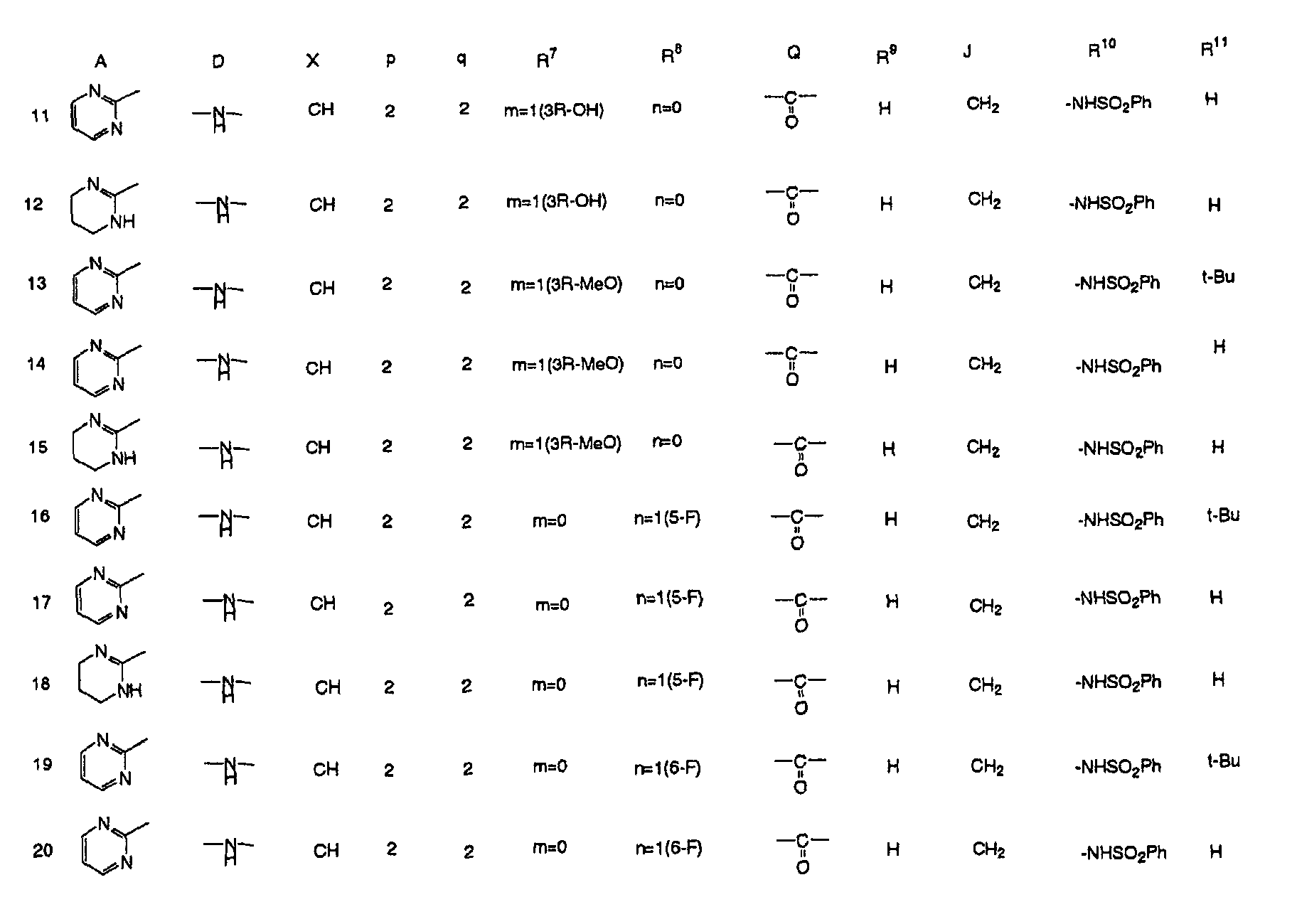

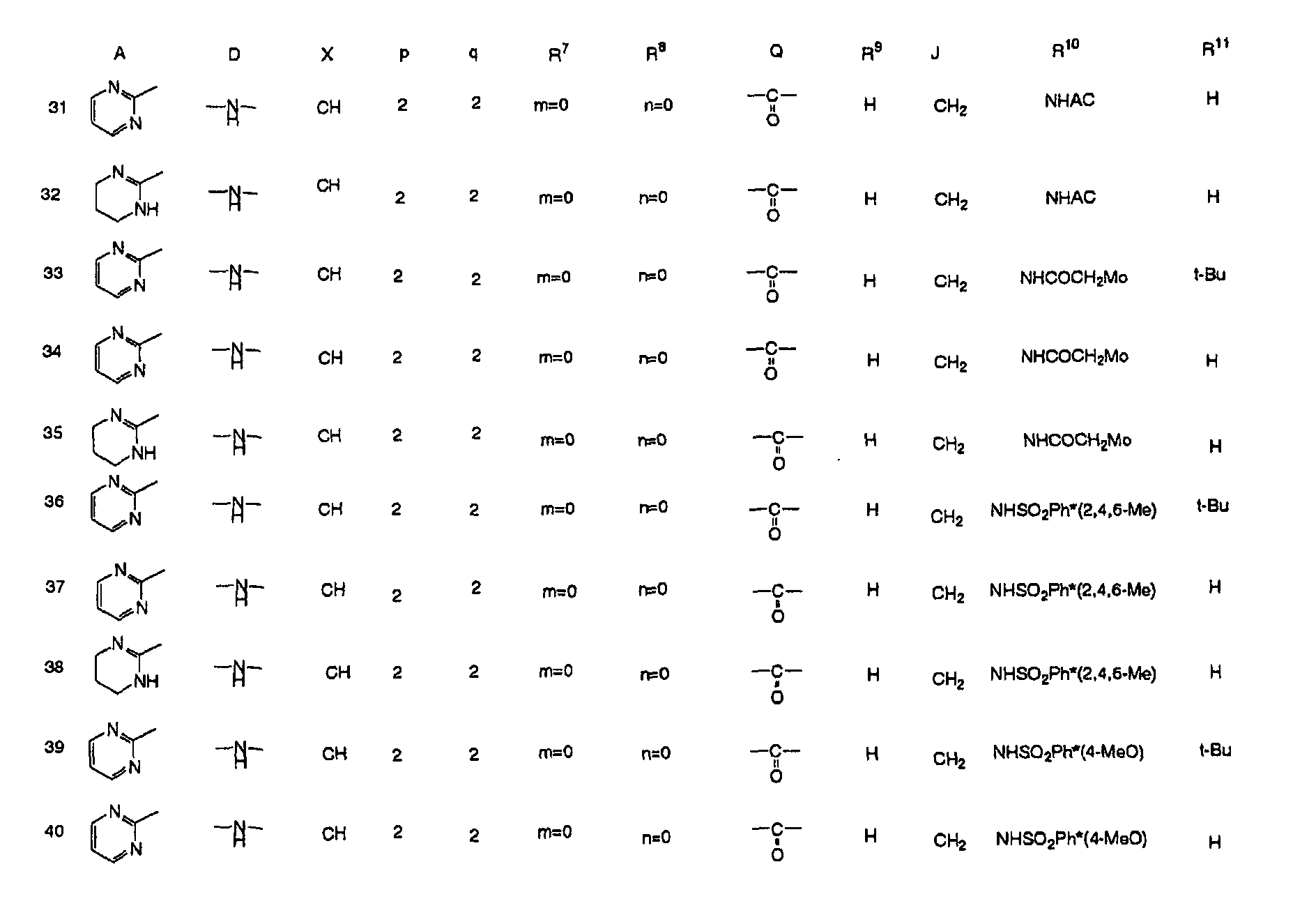

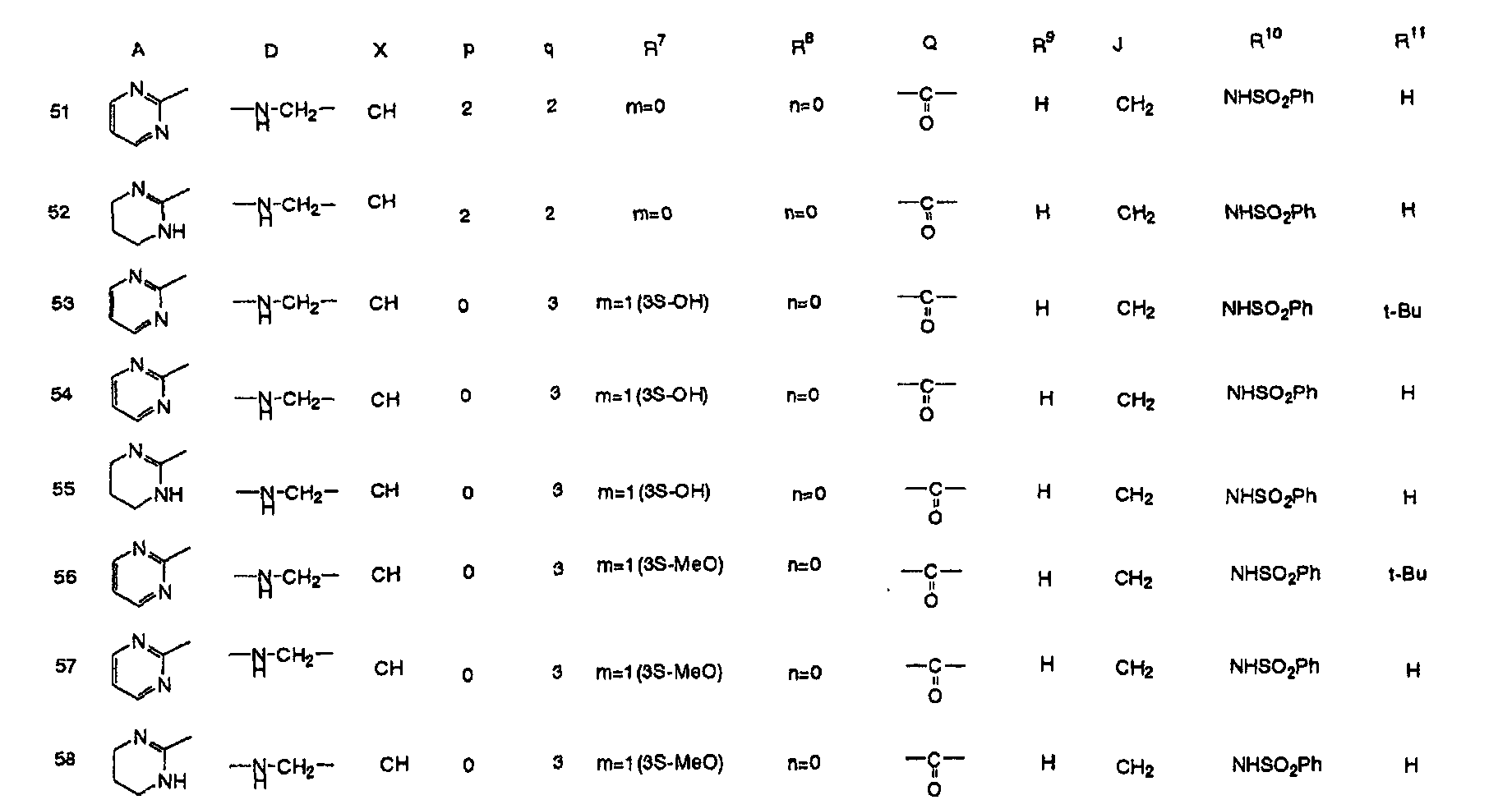 Me: methyl, Bu: butyl, Ac: acetyl, MeO: methoxy, Ph: phenyl,
Ph* : substituted phenyl, Bn: benzyl, and Mo: morpholin-4-yl
Ph* : substituted phenyl, Bn: benzyl, and Mo: morpholin-4-yl
Claims (33)
- A compound represented by formula (I) or a pharmaceutically acceptable salt or solvate thereof:wherein

A represents a saturated or unsaturated five- to seven-membered heterocyclic group containing two nitrogen atoms, which is optionally condensed with another saturated or unsaturated five- to seven-membered carbocyclic ring or heterocyclic ring to form a bicyclic group, wherein the heterocyclic group and the bicyclic group are optionally substituted by C1-6 alkyl optionally substituted by C1-6 alkyl, C1-6 alkoxy, C1-6 alkoxycarbonyl, aralkyl, amino, or hydroxyl; a halogen atom; or amino optionally substituted by C1-6 alkyl, C1-6 alkoxy, C1-6 alkoxycarbonyl, or aralkyl,
or a group represented by formulawherein R1, R2, and R3, which may be the same or different, represent a hydrogen atom, C1-6 alkyl, C2-6 alkenyl, or aralkyl, wherein the C1-6 alkyl, C2-6 alkenyl, and aralkyl groups are optionally substituted by C1-6 alkyl, C1-6 alkoxy, C1-6 alkoxycarbonyl, aralkyl, amino, or hydroxyl;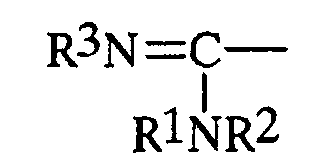
D represents a bond; >NR4 wherein R4 represents a hydrogen atom or C1-6 alkyl and this C1-6 alkyl group is optionally substituted by C1-6 alkyl, C1-6 alkoxy, C1-6 alkoxycarbonyl, aralkyl, amino, or hydroxyl; >CR5R6 wherein R5 and R6 each independently represent a hydrogen atom or C1-6 alkyl and this C1-6 alkyl group is optionally substituted by C1-6 alkyl, C1-6 alkoxy, C1-6 alkoxycarbonyl, aralkyl, amino, or hydroxyl; -O-; -S-; or -NR4-CR5R6-wherein R4, R5, and R6 are as defined above;
X represents CH or N;
R7 represents C1-6 alkyl, C1-6 alkoxy, a halogen atom, amino, nitro, cyano, hydroxyl, thiol, or an oxygen atom, wherein the C1-6 alkyl and C1-6 alkoxy groups represented by R7 are optionally substituted by C1-6 alkyl, C1-6 alkoxy, C1-6 alkoxycarbonyl, aralkyl, amino, hydroxyl, or a halogen atom, the amino group represented by R7 is optionally substituted by one or two C1-6 alkyl groups, and the thiol group represented by R7 is optionally substituted by C1-4 alkyl or phenyl;
R8 represents C1-6 alkyl, C1-6 alkoxy, a halogen atom, amino, nitro, cyano, hydroxyl, or thiol, wherein the C1-6 alkyl and C1-6 alkoxy groups represented by R8 are optionally substituted by C1-6 alkyl, C1-6 alkoxy, C1-6 alkoxycarbonyl, aralkyl, amino, hydroxyl, or a halogen atom, the amino group represented by R8 is optionally substituted by one or two C1-6 alkyl groups, and the thiol group represented by R8 is optionally substituted by C1-4 alkyl or phenyl;
Q represents >C=O, >CHR13, or >CHOR13 wherein R13 represents a hydrogen atom or C1-6 alkyl;
R9 represents a hydrogen atom, C1-6 alkyl, C2-6 alkenyl, or aralkyl and the C1-6 alkyl, C2-6 alkenyl, and aralkyl groups are optionally substituted by C1-6 alkyl, C1-6 alkoxy, C1-6 alkoxycarbonyl, aralkyl, amino, or hydroxyl;
J represents a bond or an alkylene chain having 1 to 3 carbon atoms, wherein one or more hydrogen atoms on the alkylene chain are optionally substituted by the same or different substituent selected from C1-6 alkyl, C2-6 alkenyl, C2-6 alkynyl, aralkyl, hydroxyl, or amino, the C1-6 alkyl, C2-6 alkenyl, C2-6 alkynyl, and aralkyl groups are optionally substituted by a halogen atom, C1-6 alkoxy, amino, or hydroxyl, and the hydroxyl and amino groups are optionally substituted by carboxyl; sulfonyl; C1-6 alkyl; C1-6 alkylcarbonyl; C1-6 alkoxycarbonyl; C1-6 alkylsulfonyl; -C(=O)-O-(CH2)u-R14 wherein u is an integer of 0 to 4, R14 represents a saturated or unsaturated five- to seven-membered carbocyclic or heterocyclic group, and the carbocyclic group and the heterocyclic group are optionally substituted by C1-6 alkyl, C1-6 alkoxy, phenyl optionally condensed with the carbocyclic group or the heterocyclic group, carboxyl, hydroxyl, nitro, amino, C1-6 alkylamino, or a halogen atom; -C(=O)-R14 wherein R14 is as defined above; or -S(=O)2-(CH2)v-R14 wherein v is an integer of 0 to 4 and R14 is as defined above;
R10 represents a hydrogen atom, hydroxyl, C1-6 alkyl, C2-6 alkenyl, C2-6 alkynyl, aralkyl, or amino, the C1-6 alkyl, C2-6 alkenyl, C2-6 alkynyl, and aralkyl groups are optionally substituted by a halogen atom, C1-6 alkoxy, amino, or hydroxyl and the hydroxyl and amino groups are optionally substituted by carboxyl; sulfonyl; C1-6 alkyl; C1-6 alkylcarbonyl; C1-6 alkoxycarbonyl; C1-6 alkylsulfonyl; -C(=O)-O-(CH2)u-R14 wherein u is an integer of 0 to 4 and R14 represents a saturated or unsaturated five- to seven-membered carbocyclic or heterocyclic group, and the carbocyclic group and the heterocyclic group are optionally substituted by C1-6 alkyl, C1-6 alkoxy, phenyl optionally condensed with the carbocyclic group or the heterocyclic group, carboxyl, hydroxyl, nitro, amino, C1-6 alkylamino, or a halogen atom; -C(=O)-R14 wherein R14 is as defined above; or -S(=O)2-(CH2)v-R14 wherein v is an integer of 0 to 4 and R14 is as defined above;
R11 represents a hydrogen atom, aralkyl, or C1-6 alkyl and this C1-6 alkyl group is optionally substituted by C1-6 alkyl, C1-6 alkoxy, C1-6 alkoxycarbonyl, aralkyl, amino, or hydroxyl;
m is an integer of 0 to 5;
n is an integer of 0 to 4;
p is an integer of 0 to 3; and
q is an integer of 0 to 3. - The compound according to claim 1, wherein X represents N.
- The compound according to claim 1, wherein X represents CH.
- The compound according to any one of claims 1 to 3, wherein p is 0 to 2 and q is 2 or 3.
- The compound according to any one of claims 1 to 4, wherein A represents a group of formulawherein
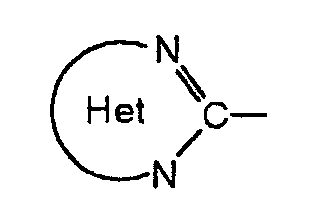
Het represents a saturated or unsaturated five- to seven-membered heterocyclic group containing two nitrogen atoms, which is optionally condensed with another saturated or unsaturated five- to seven-membered carbocyclic ring or heterocyclic ring to form a bicyclic group, wherein the heterocyclic group and the bicyclic group are optionally substituted by C1-6 alkyl optionally substituted by C1-6 alkyl, C1-6 alkoxy, C1-6 alkoxycarbonyl, aralkyl, amino, or hydroxyl; a halogen atom; or amino optionally substituted by C1-6 alkyl, C1-6 alkoxy, C1-6 alkoxycarbonyl, or aralkyl. - The compound according to any one of claims 1 to 4, wherein A represents a group of formulawherein
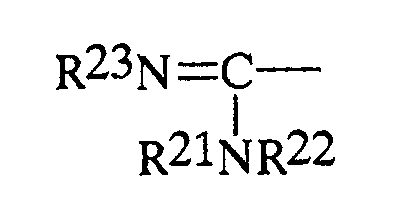
R21, R22, and R23, which may be the same or different, represent a hydrogen atom, C1-6 alkyl, C2-6 alkenyl, or aralkyl and C1-6 alkyl, C2-6 alkenyl, and aralkyl groups are optionally substituted by C1-6 alkyl, C1-6 alkoxy, C1-6 alkoxycarbonyl, aralkyl, amino, or hydroxyl, or
R21 and R23 may together form
group -(CH2)4-,
group -(CH2)3-,
group -CHR24CH2CH2- wherein R24 represents C1-6 alkyl, a halogen atom, or amino, and this amino group is optionally substituted by C1-6 alkyl, C1-6 alkoxy, C1-6 alkoxycarbonyl, or aralkyl,
group -CH2CHR24CH2- wherein R24 is as defined above,
group -CH2CH2-,
group -CHR24CH2- wherein R24 is as defined above,
group -CR25=CR26- wherein R25 and R26, which may be the same or different, represent a hydrogen atom or C1-6 alkyl, or R25 and R26 may together form -CH=CH-CH=CH-, -CR24=CH-CH=CH- wherein R24 is as defined above, -CH=CR24-CH=CH- wherein R24 is as defined above, -N=CH-CH=CH-, or -CH=N-CH=CH-, or
R21 and R23 may together form
=CH-CH=CH-,
-CHR24CH2CR2- wherein R24 is as defined above,
-CH2CHR24CH2- wherein R24 is as defined above,
=CH-CH=N-, or
=CH-N=CH-, and
R22 may represent a single bond between R21 and the nitrogen atom attached to R21. - The compound according to any one of claims 1 to 6, wherein D represents a bond, >NH, or -NH-CH2-.
- The compound according to any one of claims 1 to 7, wherein Q represents >C=O or >CH2.
- The compound according to any one of claims 1 to 8, wherein m and n are each an integer of 0 to 2.
- The compound according to claim 1, wherein A represents a group of formulawherein
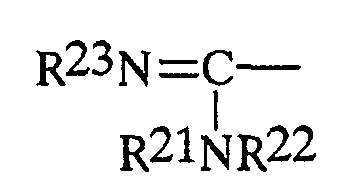
R21, R22, and R23 are as defined in claim 6;
D represents a bond, >NH, or -NH-CH2-;
X represents CH or N;
Q represents >C=O or >CH2;
R9 represents a hydrogen atom, C1-6 alkyl or aralkyl and the C1-6 alkyl and aralkyl groups are optionally substituted by a halogen atom, C1-6 alkoxy, amino, or hydroxyl;
J represents a methylene chain;
R10 represents a hydrogen atom, hydroxyl, or amino, the hydroxyl group is optionally substituted by C1-6 alkyl and the amino group is optionally substituted by C1-6 alkyl; C1-6 alkylcarbonyl; C1-6 alkoxycarbonyl; C1-6 alkylsulfonyl; benzoyl or benzyloxycarbonyl wherein the phenyl portion of benzoyl and benzyloxycarbonyl is optionally substituted by C1-6 alkyl, C1-6 alkoxy, carboxyl, hydroxyl, nitro, amino, or a halogen atom; -C(=O)-O-(CH2)u-R14 wherein u is an integer of 0 to 4 and R14 represents phenyloptionally substituted by C1-6 alkyl, C1-6 alkoxy, carboxyl, hydroxyl, nitro, amino, or a halogen atom, or a five- or six-membered heterocyclic group containing one or two hetero-atoms; or -S(=O)2-(CH2)v-R14 wherein v is an integer of 0 to 4 and R14 represents phenyl optionally substituted by C1-6 alkyl, C1-6 alkoxy, carboxyl, hydroxyl, nitro, amino, or a halogen atom, or a five- or six-membered heterocyclic group containing one or two hetero-atoms;
R11 represents a hydrogen atom or C1-6 alkyl;
m and n are each an integer of 0 to 2;
p is 0 to 2; and
q is 2 or 3. - The compound according to claim 1, which is selected from:1. t-butyl (2S)-benzenesulfonylamino-3-[3-{4-(pyrimidin-2-yl)piperazin-1-yl}benzoylamino]propionate;2. (2S)-benzenesulfonylamino-3-[3-{4-(pyrimidin-2-yl)piperazin-1-yl}benzoylamino]propionic acid;3. (2S)-benzenesulfonylamino-3-[3-{4-(1,4,5,6-tetrahydropyrimidin-2-yl)piperazin-1-yl}benzoylamino]-propionic acid;4. t-butyl (2S)-benzenesulfonylamino-3-[3-{4-(pyrimidin-2-ylamino)piperidin-1-yl}benzoylamino]-propionate;5. (2S)-benzenesulfonylamino-3-[3-{4-(pyrimidin-2-ylamino)piperidin-1-yl}benzoylamino]propionic acid;6. (2S)-benzenesulfonylamino-3-[3-{4-(1,4,5,6-tetrahydropyrimidin-2-ylamino)piperidin-1-yl}benzoylamino]propionic acid;7. t-butyl (2S)-benzenesulfonylamino-3-[4-fluoro-3-{4-(pyrimidin-2-ylamino)piperidin-1-yl}benzoylamino]-propionate;8. (2S)-benzenesulfonylamino-3-[4-fluoro-3-{4-(pyrimidin-2-ylamino)piperidin-1-yl}benzoylamino]-propionic acid;9. (2S)-benzenesulfonylamino-3-[4-fluoro-3-{4-(1,4,5,6-tetrahydropyrimidin-2-ylamino)piperidin-1-yl}benzoylamino]propionic acid;10. t-butyl (2S)-benzenesulfonylamino-3-[3-{(3R)-hydroxy-(4R)-(pyrimidin-2-ylamino)piperidin-1-yl}benzoylamino]propionate;11. (2S)-benzenesulfonylamino-3-[3-{(3R)-hydroxy(4R)-(pyrimidin-2-ylamino)piperidin-1-yl}benzoylamino]propionic acid;12. (2S)-benzenesulfonylamino-3-[3-{(3R)-hydroxy(4R)-(1,4,5,6-tetrahydropyrimidin-2-ylamino)piperidin-1-yl}benzoylamino]propionic acid;13. t-butyl (2S)-benzenesulfonylamino-3-[{(3R)-methoxy-(4R)-(pyrimidin-2-ylamino)}piperidin-1-yl}benzoylamino]propionate;14. (2S)-benzenesulfonylamino-3-[{(3R)-methoxy-(4R)-(pyrimidin-2-ylamino)piperidin-1-yl}benzoylamino]-propionic acid;15. (2S)-benzenesulfonylamino-3-[3-{(3R)-methoxy-(4R)-(1,4,5,6-tetrahydropyrimidin-2-ylamino)piperidin-1-yl}benzoylamino]propionic acid;16. t-butyl (2S)-benzenesulfonylamino-3-[5-fluoro-3-{4-(pyrimidin-2-ylamino)piperidin-1-yl}benzoylamino) propionate;17. (2S)-benzenesulfonylamino-3-[5-fluoro-3-{4-(pyrimidin-2-ylamino)piperidin-1-yl}benzoylamino]-propionic acid;18. (2S)-benzenesulfonylamino-3-[5-fluoro-3-{4-(1,4,5,6-tetrahydropyrimidin-2-ylamino)piperidin-1-yl}benzoylamino]propionic acid;19. t-butyl (2S)-benzenesulfonylamino-3-[6-fluoro-3-{4-(pyrimidin-2-ylamino)piperidin-1-yl)benzoylamino]-propionate;20. (2S)-benzenesulfonylamino-3-[6-fluoro-3-{4-(pyrimidin-2-ylamino)piperidin-1-yl}benzoylamino]-propionic acid;21. (2S)-benzenesulfonylamino-3-[6-fluoro-3-{4-(1,4,5,6-tetrahydropyrimidin-2-ylamino)piperidin-1-yl}-benzoylamino]propionic acid;22. t-butyl (2S)-benzenesulfonylamino-3-[2-fluoro-3-{4-(pyrimidin-2-ylamino)piperidin-1-yl}benzoylamino]-propionate;23. (2S)-benzenesulfonylamino-3-[2-fluoro-3-{4-(pyrimidin-2-ylamino)piperidin-1-yl}benzoylamino]-propionic acid;24. (2S)-benzenesulfonylamino-3-[2-fluoro-3-{4-(1,4,5,6-tetrahydropyrimidin-2-ylamino)piperidin-1-yl}-benzoylamino]propionic acid;25. t-butyl (2S)-benzenesulfonylamino-3-[3-{4-(pyrimidin-2-ylamino)piperidin-1-yl}-5-(trifluoromethyl)benzoylamino]propionate;26. (2S)-benzenesulfonylamino-3-[3-{4-(pyrimidin-2-ylamino)piperidin-1-yl}-5-(trifluoromethyl)benzoylamino]propionic acid;27. (2S)-benzenesulfonylamino-3-[3-{4-(1,4,5,6-tetrahydropyrimidin-2-ylamino)piperidin-1-yl}-5-(trifluoromethyl)benzoylamino]propionic acid;28. t-butyl (2S)-(benzyloxycarbonyl)amino-3-[3-{4-(pyrimidin-2-ylamino)piperidin-1-yl}benzoylamino]-propionate;29. t-butyl (2S)-amino-3-[3-{4-(pyrimidin-2-ylamino)piperidin-1-yl}benzoylamino]propionate;30. t-butyl (2S)-acetamido-3-[3-{4-(pyrimidin-2-ylamino)piperidin-1-yl}benzoylamino]propionate;31. (2S)-acetamido-3-[3-{4-(pyrimidin-2-ylamino)-piperidin-1-yl}benzoylamino]propionic acid;32. (2S)-acetamido-3-[3-{4-(1,4,5,6-tetrahydropyrimidin-2-ylamino)piperidin-1-yl}benzoylamino]-propionic acid;33. t-butyl (2S)-{2-(morpholin-4-yl-acetyl)amino}-3-[3-{4-(pyrimidin-2-ylamino)piperidin-1-yl}benzoylamino]propionate;34. (2S)-{2-(morpholin-4-yl-acetyl)amino}-3-[3-{4-(pyrimidin-2-ylamino)piperidin-1-yl}benzoylamino]-propionic acid;35. (2S)-{2-(morpholin-4-yl-acetyl)amino}-3-[3-{4-(1,4,5,6-tetrahydropyrimidin-2-ylamino)piperidin-1-yl}benzoylamino]propionic acid;36. t-butyl 3-[3-{4-(pyrimidin-2-ylamino)piperidin-1-yl}benzoylamino]-(2S)-{(2,4,6-trimethylbenzenesulfonyl)amino}propionate;37. 3-[3-{4-(pyrimidin-2-ylamino)piperidin-1-yl}benzoylamino]-(2S)-{(2,4,6-trimethylbenzenesulfonyl)-amino}propionic acid;38. 3-[3-{4-(1,4,5,6-tetrahydropyrimidin-2-yl-amino)piperidin-1-yl}benzoylamino]-(2S)-{(2,4,6-trimethylbenzenesulfonyl)amino}propionic acid;39. t-butyl (2S)-{(4-methoxybenzenesulfonyl)amino}-3-[3-{4-(pyrimidin-2-ylamino)piperidin-1-yl}benzoylamino]propionate;40. (2S)-{(4-methoxybenzenesulfonyl)amino}-3-[3-{4-(pyrimidin-2-ylamino)piperidin-1-yl}benzoylamino]-propionic acid;41. (2S)-{(4-methoxybenzenesulfonyl)amino}-3-[3-{4-(1,4,5,6-tetrahydropyrimidin-2-ylamino)piperidin-1-yl}benzoylamino]propionic acid;42. (2S)-{(4-hydroxybenzenesulfonyl)amino}-3-[3-{4-(pyrimidin-2-ylamino)piperidin-1-yl}benzoylamino]-propionic acid;43. (2S)-{(4-hydroxybenzenesulfonyl)amino}-3-[3-{4-(1,4,5,6-tetrahydropyrimidin-2-ylamino)piperidin-1-yl}benzoylamino]propionic acid;44. t-butyl (2S)-benzenesulfonylamino-3-[3-{(3S)-(pyrimidin-2-ylamino)piperidin-1-yl}benzoylamino]-propionate;45. (2S)-benzenesulfonylamino-3-[3-{(3S)-(pyrimidin-2-ylamino)piperidin-1-yl}benzoylamino]-propionic acid;46. (2S)-benzenesulfonylamino-3-[3-{(3S)-(1,4,5,6-tetrahydropyrimidin-2-ylamino)piperidin-1-yl}benzoylamino]propionic acid;47. t-butyl (2S)-benzenesulfonylamino-3-[3-{(3R)-(pyrimidin-2-ylamino)piperidin-1-yl}benzoylamino]-propionate;48. (2S)-benzenesulfonylamino-3-[3-{(3R)-(pyrimidin-2-ylamino)piperidin-1-yl}benzoylamino]-propionic acid;49. (2S)-benzenesulfonylamino-3-[3-{(3R)-(1,4,5,6-tetrahydropyrimidin-2-ylamino)piperidin-1-yl}benzoylamino]propionic acid;50. t-butyl (2S)-benzenesulfonylamino-3-[3-{4-(pyrimidin-2-ylaminomethyl)piperidin-1-yl}benzoylamino]-propionate;51. (2S)-benzenesulfonylamino-3-[3-{4-(pyrimidin-2-ylaminomethyl)piperidin-1-yl}benzoylamino]propionic acid;52. (2S)-benzenesulfonylamino-3-[3-{4-(1,4,5,6-tetrahydropyrimidin-2-ylaminomethyl)piperidin-1-yl}benzoylamino]propionic acid;53. t-butyl (2S)-benzenesulfonylamino-3-[3-{(3S)-hydroxy-(2S)-(pyrimidin-2-ylaminomethyl)pyrrolidin-1-yl}benzoylamino]propionate;54. (2S)-benzenesulfonylamino-3-[3-{(3S)-hydroxy(2S)-(pyrimidin-2-ylaminomethyl)pyrrolidin-1-yl}benzoylamino]propionic acid;55. (2S)-benzenesulfonylamino-3-[3-{(3S)-hydroxy(2S)-(1,4,5,6-tetrahydropyrimidin-2-ylaminomethyl)-pyrrolidin-1-yl}benzoylamino]propionic acid;56. t-butyl (2S)-benzenesulfonylamino-3-[3-{(3S)-methoxy-(2S)-(pyrimidin-2-ylaminomethyl)pyrrolidin-1-yl}benzoylamino]propionate;57. (2S)-benzenesulfonylamino-3-[3-{(3S)-methoxy(2S)-(pyrimidin-2-ylaminomethyl)pyrrolidin-1-yl}benzoylamino]propionic acid; and58. (2S)-benzenesulfonylamino-3-[3-{(3S)-methoxy-(2S)-(1,4,5,6-tetrahydropyrimidin-2-ylaminomethyl)-pyrrolidin-1-yl}benzoylamino]propionic acid.
- A pharmaceutical composition comprising as active ingredient the compound according to any one of claims 1 to 11 or a pharmaceutically acceptable salt or solvate thereof.
- The pharmaceutical composition according to claim 12, for use in the treatment of integrin αvβ3-mediated diseases.
- The pharmaceutical composition according to claim 12, for use in the treatment of diseases where the inhibition of cell adhesion is therapeutically effective.
- The pharmaceutical composition according to claim 12, for use in the treatment of diseases where GP IIb/IIIa antagonistic activity and/or platelet aggregation inhibitory activity are therapeutically effective.
- The pharmaceutical composition according to claim 12, for use in the treatment of a disease selected from the group consisting of cardiovascular diseases, angiogenesis-related diseases, cerebrovascular diseases, cancers and metastasis thereof, immunological diseases, and osteopathy.
- The pharmaceutical composition according to claim 16, wherein the cardiovascular disease is selected from acute myocardial infarction, neointima formation hypertrophy, restenosis after PTCA/stent operation, unstable angina, acute coronary syndrome, angina pectoris after PTCA/stent operation, and arterial sclerosis, particularly atherosclerosis, the angiogenesis-related disease is selected from diabetic retinopathy, diabetic vascular complication, and vascular grafting, the cerebrovascular disease is cerebral infarction, the cancer and metastasis thereof are solid tumors and metastasis thereof, the immunological disease is arthritis, particularly rheumatic arthritis, and the osteopathy is selected from osteoporosis, hypercalcemia, periodontitis, hyperparathyroidism, periarticular sore, and Paget's diseases.
- The pharmaceutical composition according to claim 12, for use in the treatment of platelet thrombosis or thromboembolism, the improvement of peripheral circulating blood stream, the inhibition of blood clotting during extracorporeal circulation, or the treatment of thrombotic thrombocytopenic purpura or hemolytic uremic syndrome.
- The pharmaceutical composition according to claim 12, for use as an agent for inhibiting platelet aggregation.
- Use of the compound according to any one of claims 1 to 11 or a pharmaceutically acceptable salt or solvate thereof, for the manufacture of a medicament for use in the treatment of a disease selected from the group consisting of integrin αvβ3-mediated diseases, diseases where the inhibition of cell adhesion is therapeutically effective, and diseases where GP IIb/IIIa antagonistic activity and/or platelet aggregation inhibitory activity are therapeutically effective.
- A method for treating a disease selected from the group consisting of integrin αvβ3-mediated diseases, diseases where the inhibition of cell adhesion is therapeutically effective, and diseases where GP IIb/IIIa antagonistic activity and/or platelet aggregation inhibitory activity are therapeutically effective, which comprises the step of administering an effective amount of the compound according to any one of claims 1 to 11 or a pharmaceutically acceptable salt or solvate thereof, together with a pharmaceutically acceptable carrier, to a mammal including a human.
- A process for producing a compound represented by formula (XX)wherein R21 represents hydroxyl, azide, or optionally protected amino; R7, R8, R11, m, n, p, and q are as defined in claim 1, provided that q is not 0 (zero) and the nitrogen atom is attached to the ortho-, meta-, or para-position of the phenyl group, which comprises the step of reacting a compound represented by formula (XIX)
 wherein R21 is as defined in the definition of formula (XX); and R7, m, p, and q are as defined in claim 1, provided that q is not 0 (zero),
with a compound represented by formula (XV)wherein R8, R11, and n are as defined in claim 1; and the nitrogen atom is attached to the ortho-, meta-, or para-position of the phenyl group.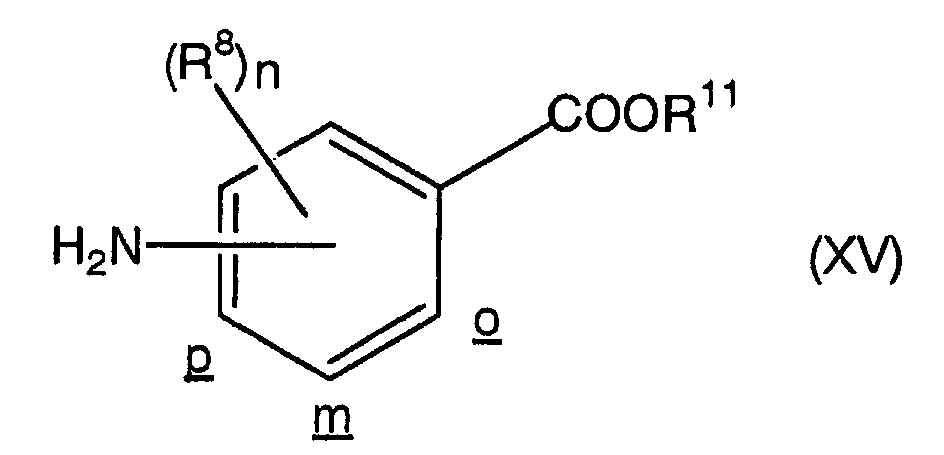
- The process according to claim 22, wherein, in formulae (XIX) and (XX), p and q are 2, R7 and R21 represent hydroxyl, and m is 1.
- The process according to claim 22, wherein the compound represented by formula (XIX) is selected from the group consisting of pentoses, hexoses, and heptoses and derivatives thereof.
- The process according to claim 22, wherein the compound represented by formula (XIX) is 2-deoxy-D-ribose.
- A process for producing a compound represented by formula (XXII)wherein R7, R8, R11, m, n, p, and q are as defined in claim 1, provided that q is not 0 (zero); R21 is as defined in claim 22; and the nitrogen atom is attached to the ortho-, meta-, or para-position of the phenyl group, which comprises the step of cyclizing a compound represented by formula (XXI)
 wherein R7, R8, R11, m, n, p, and q are as defined in claim 1, provided that q is not 0 (zero); R21 is as defined in claim 22; L represents a leaving group; and the nitrogen atom is attached to the ortho-, meta-, or para-position of the phenyl group by an intramolecular ring-closing reaction.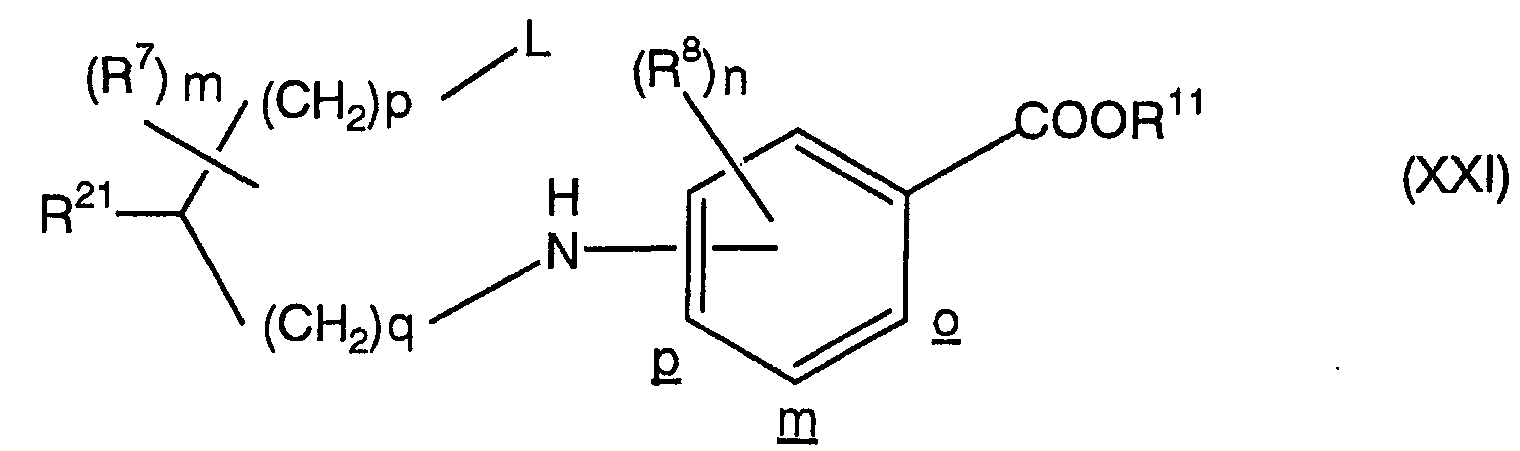
- The process according to claim 26, which further comprises, before the intramolecular ring-closing reaction, the step of converting a primary hydroxyl group in the compound represented by formula (XX) according to claim 22 to a leaving group L to produce the compound represented by formula (XXI).
- The process according to claim 26 or 27, wherein, in formulae (XX), (XXI), and (XXII), p and q are 2, R7 and R21 represent hydroxyl, and m is 1.
- The process according to any one of claims 26 to 28, wherein the compounds represented by formulae (XX), (XXI), and (XXII) are respectively compounds represented by formulae (XX'), (XXI'), and (XXII')

 wherein R8, R11, and n are as defined in claim 1; and the nitrogen atom is attached to the ortho-, meta-, or para-position of the phenyl group.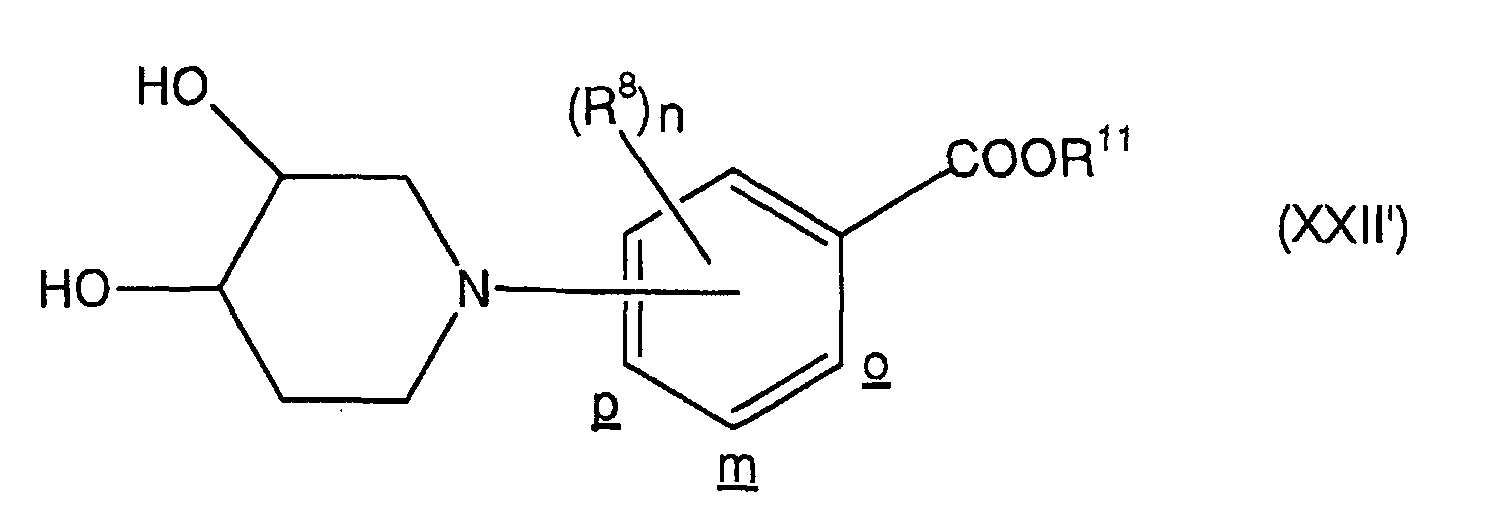
- A compound represented by formula (XXIII):wherein R7, R8, R11, m, n, p, and q are as defined in claim 1, provided that q is not 0 (zero); R21 is as defined in claim 22; R22 represents hydroxyl or a leaving group; and the nitrogen atom is attached to the ortho-, meta-, or para-position of the phenyl group.
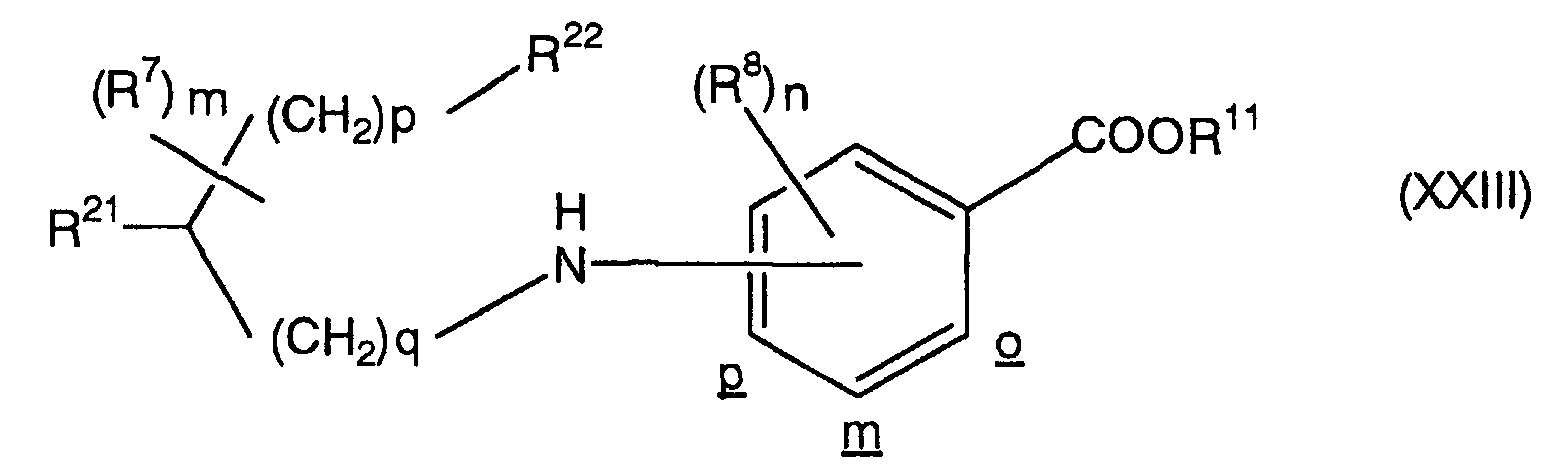
- The compound according to claim 30, wherein p and q are 2, R7 and R21 represent hydroxyl, and m is 1.
- A compound represented by formula (XXII):wherein R7, R8, R11, m, n, p, and q are as defined in claim 1, provided that q is not 0 (zero); R21 is as defined in claim 22; and the nitrogen atom is attached to the ortho-, meta-, or para-position of the phenyl group.
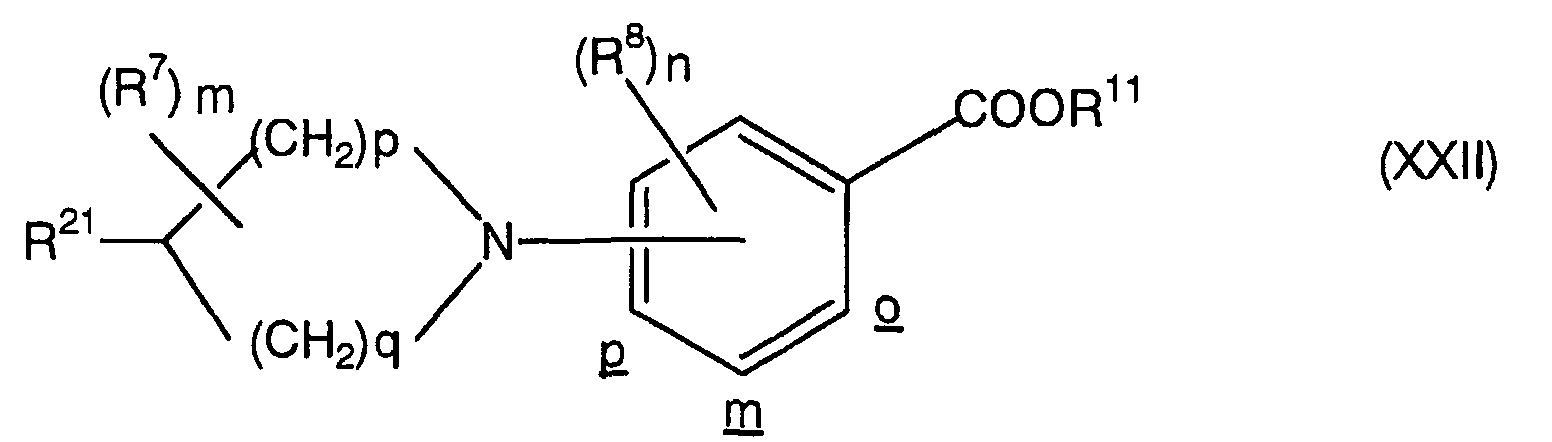
- The compound according to claim 32, wherein p and q are 2, R7 and R21 represent hydroxyl, and m is 1.
Applications Claiming Priority (3)
| Application Number | Priority Date | Filing Date | Title |
|---|---|---|---|
| JP28848799 | 1999-10-08 | ||
| JP28848799 | 1999-10-08 | ||
| PCT/JP2000/007031 WO2001027090A1 (en) | 1999-10-08 | 2000-10-10 | m-SUBSTITUTED BENZOIC ACID DERIVATIVES EXHIBITING INTEGRINαvβ3 ANTAGONISM |
Publications (1)
| Publication Number | Publication Date |
|---|---|
| EP1229024A1 true EP1229024A1 (en) | 2002-08-07 |
Family
ID=17730856
Family Applications (1)
| Application Number | Title | Priority Date | Filing Date |
|---|---|---|---|
| EP00964758A Withdrawn EP1229024A1 (en) | 1999-10-08 | 2000-10-10 | m-SUBSTITUTED BENZOIC ACID DERIVATIVES EXHIBITING INTEGRIN ALPHA-V BETA-3 ANTAGONISM |
Country Status (4)
| Country | Link |
|---|---|
| EP (1) | EP1229024A1 (en) |
| AU (1) | AU7559900A (en) |
| CA (1) | CA2392209A1 (en) |
| WO (1) | WO2001027090A1 (en) |
Cited By (11)
| Publication number | Priority date | Publication date | Assignee | Title |
|---|---|---|---|---|
| WO2007112368A1 (en) * | 2006-03-28 | 2007-10-04 | Takeda Pharmaceutical Company Limited | Preparation of (r)-3-aminopiperidine dihydrochloride |
| US7550590B2 (en) | 2003-03-25 | 2009-06-23 | Takeda Pharmaceutical Company Limited | Dipeptidyl peptidase inhibitors |
| US7579357B2 (en) | 2003-08-13 | 2009-08-25 | Takeda Pharmaceutical Company Limited | Dipeptidyl peptidase inhibitors |
| US7790734B2 (en) | 2003-09-08 | 2010-09-07 | Takeda Pharmaceutical Company Limited | Dipeptidyl peptidase inhibitors |
| US7807689B2 (en) | 2004-03-15 | 2010-10-05 | Takeda Pharmaceutical Company Limited | Dipeptidyl peptidase inhibitors |
| US7872124B2 (en) | 2004-12-21 | 2011-01-18 | Takeda Pharmaceutical Company Limited | Dipeptidyl peptidase inhibitors |
| US8084605B2 (en) | 2006-11-29 | 2011-12-27 | Kelly Ron C | Polymorphs of succinate salt of 2-[6-(3-amino-piperidin-1-yl)-3-methyl-2,4-dioxo-3,4-dihydro-2H-pyrimidin-1-ylmethy]-4-fluor-benzonitrile and methods of use therefor |
| US8093236B2 (en) | 2007-03-13 | 2012-01-10 | Takeda Pharmaceuticals Company Limited | Weekly administration of dipeptidyl peptidase inhibitors |
| US8222411B2 (en) | 2005-09-16 | 2012-07-17 | Takeda Pharmaceutical Company Limited | Dipeptidyl peptidase inhibitors |
| US8324383B2 (en) | 2006-09-13 | 2012-12-04 | Takeda Pharmaceutical Company Limited | Methods of making polymorphs of benzoate salt of 2-[[6-[(3R)-3-amino-1-piperidinyl]-3,4-dihydro-3-methyl-2,4-dioxo-1(2H)-pyrimidinyl]methyl]-benzonitrile |
| US8906901B2 (en) | 2005-09-14 | 2014-12-09 | Takeda Pharmaceutical Company Limited | Administration of dipeptidyl peptidase inhibitors |
Families Citing this family (4)
| Publication number | Priority date | Publication date | Assignee | Title |
|---|---|---|---|---|
| TWI290136B (en) | 2000-04-05 | 2007-11-21 | Daiichi Seiyaku Co | Ethylenediamine derivatives |
| US7030150B2 (en) | 2001-05-11 | 2006-04-18 | Trimeris, Inc. | Benzimidazole compounds and antiviral uses thereof |
| JP2005194192A (en) * | 2002-01-11 | 2005-07-21 | Meiji Seika Kaisha Ltd | (4-OXOPIPERIDIN-1-YL)BENZOIC ACID DERIVATIVE AND METHOD FOR PRODUCING INTEGRIN alphavbeta3 INHIBITOR USING THE SAME |
| AU2005272389B2 (en) | 2004-08-11 | 2011-08-04 | Kyorin Pharmaceutical Co., Ltd. | Novel cyclic aminobenzoic acid derivative |
Family Cites Families (3)
| Publication number | Priority date | Publication date | Assignee | Title |
|---|---|---|---|---|
| DE2364525A1 (en) * | 1973-12-24 | 1975-07-03 | Henkel & Cie Gmbh | NEW N-POLYHYDROXYALKYL AMINO ACIDS, THEIR PRODUCTION, AND THE SKIN CARE AND SKIN PROTECTION PRODUCTS CONTAINED |
| AU2076299A (en) * | 1998-01-30 | 1999-08-16 | Meiji Seika Kaisha Ltd. | Phenylpiperazine derivatives as integrin alphavbeta3 antagonists |
| CN1140511C (en) * | 1998-04-09 | 2004-03-03 | 明治制果株式会社 | Aminopiperidine derivatives as integrin αvβ3 antagonists |
-
2000
- 2000-10-10 CA CA002392209A patent/CA2392209A1/en not_active Abandoned
- 2000-10-10 WO PCT/JP2000/007031 patent/WO2001027090A1/en not_active Ceased
- 2000-10-10 EP EP00964758A patent/EP1229024A1/en not_active Withdrawn
- 2000-10-10 AU AU75599/00A patent/AU7559900A/en not_active Abandoned
Non-Patent Citations (1)
| Title |
|---|
| See references of WO0127090A1 * |
Cited By (15)
| Publication number | Priority date | Publication date | Assignee | Title |
|---|---|---|---|---|
| US7550590B2 (en) | 2003-03-25 | 2009-06-23 | Takeda Pharmaceutical Company Limited | Dipeptidyl peptidase inhibitors |
| US7687625B2 (en) | 2003-03-25 | 2010-03-30 | Takeda Pharmaceutical Company Limited | Dipeptidyl peptidase inhibitors |
| US7579357B2 (en) | 2003-08-13 | 2009-08-25 | Takeda Pharmaceutical Company Limited | Dipeptidyl peptidase inhibitors |
| US7723344B2 (en) | 2003-08-13 | 2010-05-25 | Takeda San Diego, Inc. | Dipeptidyl peptidase inhibitors |
| US7790736B2 (en) | 2003-08-13 | 2010-09-07 | Takeda Pharmaceutical Company Limited | Dipeptidyl peptidase inhibitors |
| US7790734B2 (en) | 2003-09-08 | 2010-09-07 | Takeda Pharmaceutical Company Limited | Dipeptidyl peptidase inhibitors |
| US7807689B2 (en) | 2004-03-15 | 2010-10-05 | Takeda Pharmaceutical Company Limited | Dipeptidyl peptidase inhibitors |
| US7872124B2 (en) | 2004-12-21 | 2011-01-18 | Takeda Pharmaceutical Company Limited | Dipeptidyl peptidase inhibitors |
| US8906901B2 (en) | 2005-09-14 | 2014-12-09 | Takeda Pharmaceutical Company Limited | Administration of dipeptidyl peptidase inhibitors |
| US8222411B2 (en) | 2005-09-16 | 2012-07-17 | Takeda Pharmaceutical Company Limited | Dipeptidyl peptidase inhibitors |
| JP2009531456A (en) * | 2006-03-28 | 2009-09-03 | 武田薬品工業株式会社 | Preparation of (R) -3-aminopiperidine dihydrochloride |
| WO2007112368A1 (en) * | 2006-03-28 | 2007-10-04 | Takeda Pharmaceutical Company Limited | Preparation of (r)-3-aminopiperidine dihydrochloride |
| US8324383B2 (en) | 2006-09-13 | 2012-12-04 | Takeda Pharmaceutical Company Limited | Methods of making polymorphs of benzoate salt of 2-[[6-[(3R)-3-amino-1-piperidinyl]-3,4-dihydro-3-methyl-2,4-dioxo-1(2H)-pyrimidinyl]methyl]-benzonitrile |
| US8084605B2 (en) | 2006-11-29 | 2011-12-27 | Kelly Ron C | Polymorphs of succinate salt of 2-[6-(3-amino-piperidin-1-yl)-3-methyl-2,4-dioxo-3,4-dihydro-2H-pyrimidin-1-ylmethy]-4-fluor-benzonitrile and methods of use therefor |
| US8093236B2 (en) | 2007-03-13 | 2012-01-10 | Takeda Pharmaceuticals Company Limited | Weekly administration of dipeptidyl peptidase inhibitors |
Also Published As
| Publication number | Publication date |
|---|---|
| CA2392209A1 (en) | 2001-04-19 |
| AU7559900A (en) | 2001-04-23 |
| WO2001027090A1 (en) | 2001-04-19 |
Similar Documents
| Publication | Publication Date | Title |
|---|---|---|
| EP1229024A1 (en) | m-SUBSTITUTED BENZOIC ACID DERIVATIVES EXHIBITING INTEGRIN ALPHA-V BETA-3 ANTAGONISM | |
| US6693109B2 (en) | Spiro compounds as inhibitors of fibrinogen-dependent platelet aggregation | |
| US6476054B1 (en) | Cyclic amine modulators of chemokine receptor activity | |
| AU759449B2 (en) | Aminopiperidine derivatives as integrin alpha v beta 3 antagonists | |
| IL135488A (en) | Cyclic amine derivatives | |
| CZ2003603A3 (en) | Spiroheterocyclic nitrile derivative and pharmaceutical preparation containing thereof | |
| JP2000510098A (en) | Cinnamic acid derivative | |
| SK1192002A3 (en) | Caspase inhibitors and uses thereof | |
| CA2061661A1 (en) | N-acyl-.alpha.-amino derivatives | |
| JPWO1999052872A1 (en) | Aminopiperidine derivatives as integrin αVβ3 antagonists | |
| EP1445253A1 (en) | 4,4-difluoro-1, 2, 3, 4-tetrahydro-5h-1-benzazepine derivatives or salts thereof | |
| WO2001047868A1 (en) | Novel phenylalanine derivatives | |
| WO2000076512A1 (en) | Cyclopentyl modulators of chemokine receptor activity | |
| US20050059669A1 (en) | M-substituted benzoic acid derivatives having integrin alpha v beta 3 antagonistic activity | |
| US6451800B1 (en) | Phenylpiperazine derivatives as integrin αvβ3 antagonists | |
| WO2000076973A1 (en) | N-cyclopentyl modulators of chemokine receptor activity | |
| JP2523426B2 (en) | Substituted amide derivatives of piperidinyl camphor sulfonyloxytocin antagonists | |
| AU782393B2 (en) | Remedies for reperfusion injury containing integrin alphavbeta3 antagonist | |
| US20030181498A1 (en) | Bicyclic heteroaryl compounds as inhibitors of the interaction between the integrin alpha4beta1 receptor and vcam-1 and/or fibronectin | |
| AU781747B2 (en) | 3-aminopiperidine derivatives as integrin alphavbeta3 antagonists | |
| US6750219B1 (en) | Ω-amino-α-hydroxycarboxylic acid derivatives having integrin ανβ3 antagonistic activity | |
| JPWO2001027090A1 (en) | Meta-substituted benzoic acid derivatives with integrin αvβ3 antagonistic activity | |
| MXPA00009806A (en) | AMINOPIPERIDINE DERIVATIVES AS INTEGRIN&agr;v | |
| JPWO2001027082A1 (en) | 3-Aminopiperidine derivatives as integrin αvβ3 antagonists | |
| JPWO2001010844A1 (en) | ω-amino-α-hydroxycarboxylic acid derivatives having integrin αvβ3 antagonistic activity |
Legal Events
| Date | Code | Title | Description |
|---|---|---|---|
| PUAI | Public reference made under article 153(3) epc to a published international application that has entered the european phase |
Free format text: ORIGINAL CODE: 0009012 |
|
| 17P | Request for examination filed |
Effective date: 20020503 |
|
| AK | Designated contracting states |
Kind code of ref document: A1 Designated state(s): AT BE CH CY DE DK ES FI FR GB GR IE IT LI LU MC NL PT SE |
|
| AX | Request for extension of the european patent |
Free format text: AL;LT;LV;MK;RO;SI |
|
| STAA | Information on the status of an ep patent application or granted ep patent |
Free format text: STATUS: THE APPLICATION HAS BEEN WITHDRAWN |
|
| 18W | Application withdrawn |
Effective date: 20050728 |