EP1228723A2 - A head supporting device - Google Patents
A head supporting device Download PDFInfo
- Publication number
- EP1228723A2 EP1228723A2 EP02250802A EP02250802A EP1228723A2 EP 1228723 A2 EP1228723 A2 EP 1228723A2 EP 02250802 A EP02250802 A EP 02250802A EP 02250802 A EP02250802 A EP 02250802A EP 1228723 A2 EP1228723 A2 EP 1228723A2
- Authority
- EP
- European Patent Office
- Prior art keywords
- head
- cushions
- user
- supporting device
- sheet
- Prior art date
- Legal status (The legal status is an assumption and is not a legal conclusion. Google has not performed a legal analysis and makes no representation as to the accuracy of the status listed.)
- Withdrawn
Links
Images


Classifications
-
- A—HUMAN NECESSITIES
- A47—FURNITURE; DOMESTIC ARTICLES OR APPLIANCES; COFFEE MILLS; SPICE MILLS; SUCTION CLEANERS IN GENERAL
- A47C—CHAIRS; SOFAS; BEDS
- A47C7/00—Parts, details, or accessories of chairs or stools
- A47C7/36—Supports for the head or the back
- A47C7/38—Supports for the head or the back for the head, e.g. detachable
- A47C7/383—Detachable or loose head- or neck-supports, e.g. horse-shoe shaped
Definitions
- THIS invention relates to a head supporting device, and in particular, to a device for supporting the head of a user whilst travelling.
- Typical head supporting devices take the form of an inflatable collar, in which the user must inflate the device and then place it around his or her neck with a view to supporting the user's head. These devices generally do not fully support the user's head, as a result of which the head tends to sway sideways. This is clearly uncomfortable for the user, with the user typically not being able to obtain any rest whilst travelling.
- a head supporting device comprising:
- the rear sheet comprises an operatively top edge that is narrower than an operatively bottom edge, thereby allowing the cushions to press against the user's head so as to reduce the amount of sideways movement that the head can make.
- the front sheet has an operatively top edge that is wider than an operatively bottom edge, thereby allowing the cushions in use to conform to the shape of the user's head.
- the rear sheet includes a filler element that is arranged to fit into a space defined between a head rest and a car seat fitted with the head rest, for allowing the device to be used in a motor vehicle.
- the rear sheet includes a flap that, in use, extends downwardly past the back and shoulders of the user to allow the weight from the user's back and shoulder area to maintain the device in a fixed position.
- the flap of the rear sheet defines a pocket for allowing the device, when not in use, to be folded together and stowed away in the pocket.
- the cushions are either pillow cushions or inflatable cushions.
- the device includes a pair of pockets, each pocket being arranged to receive at least one cushion.
- the cushions are integrally formed with the rear and front sheets.
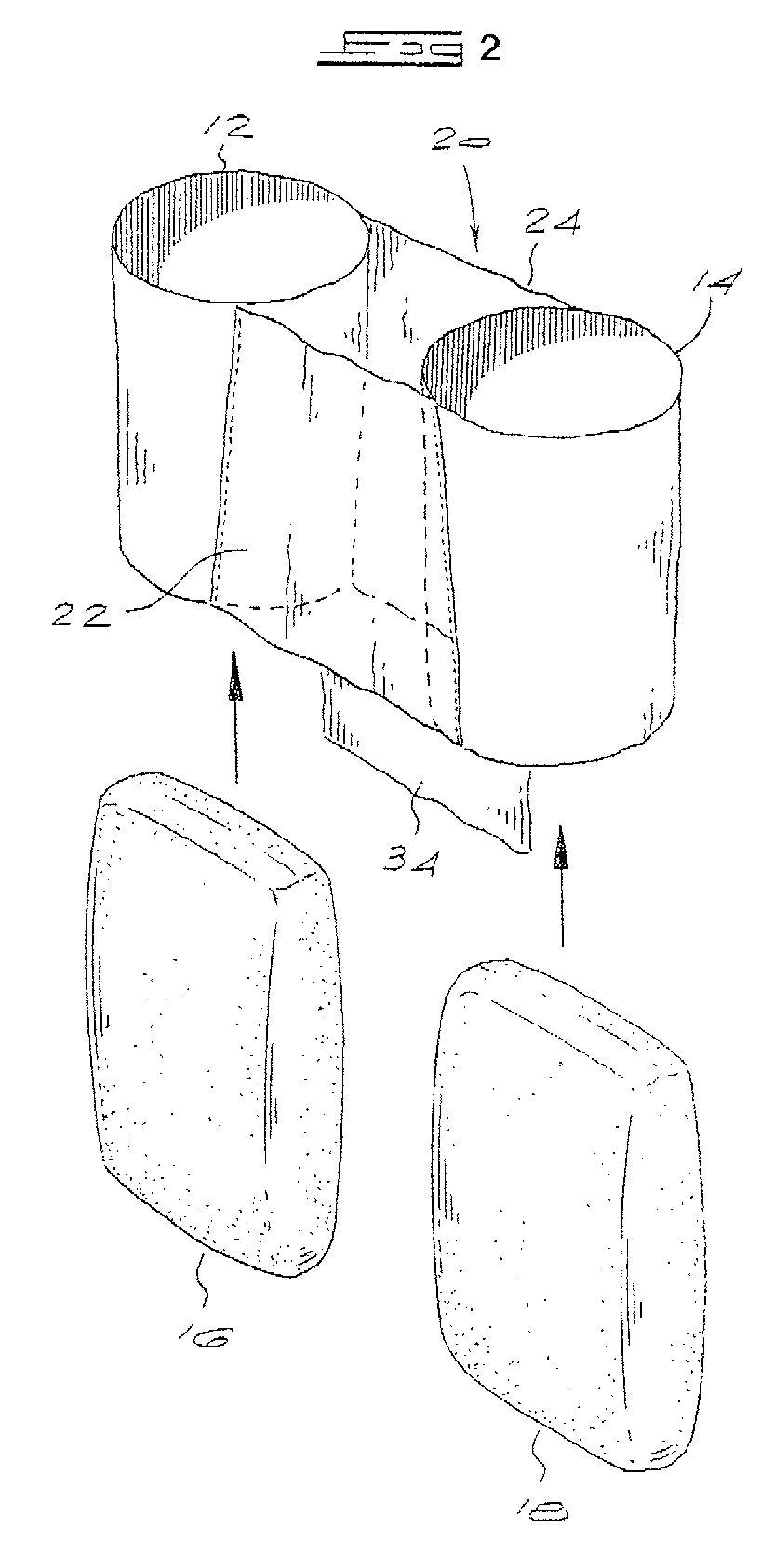
- a head supporting device 10 comprises a pair of pockets 12 and 14 for receiving a pair of cushions 16 and 18 respectively.
- the cushions 16 and 18 may either be pillow cushions or inflatable cushions.
- a bridge 20 extends between the pair of pockets 12 and 14.
- the bridge 20 comprises a front sheet 22 and a rear sheet 24.
- the front sheet 22 defines a head receiving zone for receiving the user's head 26, and the rear sheet 24, in use, rests against the seat 28 in which the user is sitting.
- the front and rear sheets 22 and 24 are attached, typically by being stitched, to the front and rear portions of the pockets 12 and 14 respectively.
- the front sheet is stitched to the pockets 12 and 14 so as to define axes 30 and 32 respectively.
- the sheets 22 and 24 and the pockets 12 and 14 are typically made from a suitable fabric, such as cotton, polyester, nylon or any other combination of natural and/or man-made fibre, including plastic.
- the front sheet 22 is spaced a distance away from the rear sheet 24.
- a specific advantage of this feature is that the pockets cover the user's ears, thereby reducing the environmental noise experienced by the user.
- the top part or edge of the front sheet 22 is narrower than the bottom part or edge. This allows a reduction in the amount of sideways movement of the user's head 26, thereby making the user more comfortable, and thus facilitating rest
- the rear sheet 24 includes a flap 34 that, in use, extends downwardly past the back and shoulders of the user, as can be seen in Figure 5.
- the flap 34 allows the weight from the user's back and shoulder area to maintain the device 10 in a fixed position.
- the flap 34 itself includes a pocket 36, which allows the device 10 to be folded and stowed away when not in use.
- Figures 6 to 8 show a head supporting device 38, similar to the device 10 described above, save that a pair of cushions 40 and 42 are integrally formed with a bridge 44.
- the operation of the device 38 remains substantially the same, with a front sheet 46 of the bridge 44 being arranged to automatically draw the cushions 40 and 42 together as the user's head 48 presses against the front sheet 46.
- the operation of the device 38 is explained in further detail with reference to Figures 11 to 14
- the bottom edge of the front sheet 46 is narrower than the top edge, indicated by y.
- the rear sheet 50 governs the final resting position of the device 38 and the person's head 48, with this tapered arrangement ensuring that the top part of each cushion 40 and 42 pushes against the top part of the person's head, so as to stabilise this portion of the head 48.
- the rear sheet 50 further includes a zipped pocket 52, which allows the device 38 to be folded and stowed away when not in use, and that also defines a flap for allowing the weight from the user's back and shoulder area to maintain the device 38 in its resting position.
- the front and rear sheets 46 and 50 are attached to the front and rear portions of the cushions 40 and 42 respectively.
- the cushions 40 and 42 could either be pillow cushions or inflatable cushions.
- FIG. 9 a further version of a head supporting device 54, primarily for use with motor vehicle seats, is shown.
- the device 54 is substantially as described above with reference to Figures 6 to 8. save that a filler element 56 is fitted to a rear sheet 58.
- the filler element 56 can take the form of either a pillow cushion, including a strip of foam material, or an inflatable cushion.
- the filler element 56 is attached to the rear sheet with an attachment device, such as VelcroTM, and is used to occupy the space defined between a head rest 60 and a car seat 62.
- Figures 11 and 12 show the configuration of the device as the user's head 48 initially engages or contacts the device 38, 54
- Figures 13 and 14 show the device's configuration as the user's head 48 is fully nested within the device 38, 54 with the head 48 resting against the seat 64.
- the device of the present invention has been described with specific reference to travelling, such as by aeroplane, bus, train or motor vehicles, it has additional applications.
- the device may be used in medical emergencies in which the head of a victim needs to be kept stationary
- the present invention thus provides a convenient and easy way of supporting a user's head.
- the construction of the device also ensures that it is relatively robust, thereby allowing it to be used repeatedly.
Landscapes
- Seats For Vehicles (AREA)
- Mattresses And Other Support Structures For Chairs And Beds (AREA)
Abstract
Description
- Figure 1
- shows a front view of a head supporting device according to a first embodiment of the invention;
- Figure 2
- shows a perspective view of the device shown in Figure 1, showing, in particular, the pockets of the device in an expanded state for receiving a cushion;
- Figure 3
- shows a perspective view of the device shown in Figures 1 and 2, wherein a pair of cushions have been inserted into the pockets of the device;
- Figures 4 and 5
- show top and side views, respectively, of the device in use,
- Figure 6
- shows a perspective view of a head supporting device according to a second embodiment of the invention;
- Figures 7 and 8
- show top and side views, respectively, of the device shown in Figure 6 in use;
- Figure 9
- shows a perspective view of a head supporting device according to a third embodiment of the invention;
- Figures 11 and 12
- show side and front views of the device when a user's head initially engages the device; and
- Figures 13 and 14
- show side and front views of the device in its final resting position in which the user's head is fully nested within the device.
Claims (9)
- A head supporting device (10; 38; 54) comprising:wherein the pair of cushions (16, 18; 40, 42), the rear sheet (24; 50) and the front sheet (22; 46) define hinge means, so that as the user's head (26; 48) presses against the front sheet (22; 46), the cushions (16, 18; 40, 42) are drawn together so as to snugly receive the user's head (26; 48) therebetween.a pair of cushions (16, 18; 40, 42);a rear sheet (24; 50) extending between the pair of cushions (16, 18; 40, 42), the rear sheet (24; 50) in use resting against a seat in which a user is sitting; anda front sheet (22; 46) extending between the pair of cushions (16, 18; 40, 42), the front sheet (22; 46) defining a flexible and deformable head receiving zone for receiving the user's head (26; 48),
- A head supporting device (10; 38; 54) according to claim 1, wherein the rear sheet (24; 50) comprises an operatively top edge that is narrower than an operatively bottom edge, thereby allowing the cushions (16, 18; 40, 42) to press against the user's head (26; 48) so as to reduce the amount of sideways movement that the head (26; 48) can make.
- A head supporting device (38; 54) according to either one of the preceding claims 1 or 2, wherein the front sheet (46) has an operatively top edge that is wider than an operatively bottom edge, thereby allowing the cushions (16,18;40,42) in use to conform to the shape of the user's head (48).
- A head supporting device (10; 38; 54) according to any one of the preceding claims, wherein the rear sheet (24;50) includes a filler element (56) that is arranged to fit into a space defined between a head rest (60) and a car seat (62) fitted with the head rest (60),for allowing the device (10; 38; 54) to be used in a motor vehicle.
- A head supporting device (10;38;54) according to any one of the preceding claims, wherein the rear sheet (24;50) includes a flap (34; 52) that, in use, extends downwardly past the back and shoulders of the user to allow the weight from the user's back and shoulder area to maintain the device (10; 38 ;54) in a fixed position.
- A head supporting device (10;38;54)according to claim 5, wherein the flap (34;52) of the rear sheet (24;50) defines a pocket (36; 52) for allowing the device (10; 38; 54), when not in use, to be folded together and stowed away in the pocket (36;52).
- A head supporting device (10; 38; 54) according to any one of the preceding claims, wherein the cushions (16,18;40,42) are either pillow cushions or inflatable cushions.
- A head supporting device (10; 38; 54) according to any one of the preceding claims, wherein the device (10; 38; 54) includes a pair of pockets (12, 14), each pocket (12, 14) being arranged to receive at least one cushion (16, 18).
- A head supporting device (10; 38; 54) according to any one of claims 1 to 7, wherein the cushions (16, 18, 40, 42) are integrally formed with the rear and front sheets.
Applications Claiming Priority (2)
| Application Number | Priority Date | Filing Date | Title |
|---|---|---|---|
| ZA200101015 | 2001-02-06 | ||
| ZA200101015 | 2001-02-06 |
Publications (2)
| Publication Number | Publication Date |
|---|---|
| EP1228723A2 true EP1228723A2 (en) | 2002-08-07 |
| EP1228723A3 EP1228723A3 (en) | 2004-01-02 |
Family
ID=25589060
Family Applications (1)
| Application Number | Title | Priority Date | Filing Date |
|---|---|---|---|
| EP02250802A Withdrawn EP1228723A3 (en) | 2001-02-06 | 2002-02-06 | A head supporting device |
Country Status (2)
| Country | Link |
|---|---|
| US (1) | US6641220B2 (en) |
| EP (1) | EP1228723A3 (en) |
Cited By (2)
| Publication number | Priority date | Publication date | Assignee | Title |
|---|---|---|---|---|
| EP1700544A1 (en) * | 2005-03-11 | 2006-09-13 | LaSch ApS | A support for supporting the neck and head of an individual |
| GB2577272A (en) * | 2018-09-19 | 2020-03-25 | Seat Sleeper Ltd | Pillow |
Families Citing this family (40)
| Publication number | Priority date | Publication date | Assignee | Title |
|---|---|---|---|---|
| DE10209187C1 (en) * | 2002-03-04 | 2003-08-28 | Daimler Chrysler Ag | Automobile passenger seat with headrest having side pads on left and right of central pad adjusted in dependence on position of passenger seat |
| US6938958B2 (en) * | 2003-12-08 | 2005-09-06 | Gold Bug, Inc. | Adjustable head support |
| US20050278852A1 (en) * | 2004-06-12 | 2005-12-22 | Wahrmund Gary M | High air flow foam bedding products |
| DE102004059864A1 (en) * | 2004-12-11 | 2006-06-14 | Recaro Aircraft Seating Gmbh & Co. Kg | Headrest for a seat, in particular passenger seat |
| USD528841S1 (en) * | 2005-04-22 | 2006-09-26 | Florentine Frank R | Infant head support |
| US7213883B2 (en) * | 2005-05-26 | 2007-05-08 | Richard Charnitski | Head rest |
| USD540576S1 (en) * | 2005-08-12 | 2007-04-17 | Illinois Tool Works Inc | Headrest insert |
| JP2009505773A (en) * | 2005-08-31 | 2009-02-12 | ジョン−フワ パク | Washable and height adjustable pillow |
| US8104429B2 (en) | 2005-10-17 | 2012-01-31 | Gary Ray Bennett | Pet impact protector |
| US20070084411A1 (en) * | 2005-10-17 | 2007-04-19 | Bennett Gary R | Pet impact protector |
| US20090195036A1 (en) * | 2005-12-01 | 2009-08-06 | Rebecca Kathleen Timmis | Car Seat Pillow and Trolley Cushion |
| US20070241594A1 (en) * | 2006-04-14 | 2007-10-18 | Carl Taylor | Anti-whiplash safety apparatus |
| US20080185900A1 (en) * | 2006-09-28 | 2008-08-07 | Lee Ellen Cheng-Ch | Use of renewable and biodegradable materials for automotive interiors |
| US20080164730A1 (en) * | 2007-01-05 | 2008-07-10 | Ford Global Technologies, Llc | Insert for vehicle seat head restraint |
| US9211823B2 (en) * | 2008-06-13 | 2015-12-15 | Sharon Campa | Pillow holder systems |
| US7681263B1 (en) * | 2008-12-04 | 2010-03-23 | Hawkins Tanya L | Modular pillow systems |
| USD628004S1 (en) | 2009-01-30 | 2010-11-30 | Moorefield Carol M | Foldable pillow |
| US20110095582A1 (en) * | 2009-10-26 | 2011-04-28 | Romas Leanne R | Head supporting device |
| USD618945S1 (en) * | 2009-11-12 | 2010-07-06 | John Tanaka | Airbag lumbar support pillow |
| USD618946S1 (en) * | 2009-11-12 | 2010-07-06 | John Tanaka | Fiber-filled lumbar support pillow |
| US8276227B2 (en) * | 2009-12-23 | 2012-10-02 | Pileggi Vincent J | Multi-adjustable pillow |
| US8726419B2 (en) * | 2010-05-05 | 2014-05-20 | Michael Vahey | Head and neck stabilizer for travel |
| US8459737B2 (en) * | 2010-06-08 | 2013-06-11 | Brenda Brotsch | Spinal supporting chair attachment |
| US8141955B1 (en) | 2010-11-15 | 2012-03-27 | Sami Maassarani | Seat back headrest |
| US9375105B2 (en) * | 2012-05-04 | 2016-06-28 | Gk Thomson Development, Llc | Adjustable headband pillow |
| CN104687857B (en) * | 2013-12-05 | 2017-04-12 | 特力股份有限公司 | Multifunctional Support Cushion |
| USD746613S1 (en) * | 2014-05-20 | 2016-01-05 | John DeRosa | Dual-sided head rest pillow for attaching to chairs |
| US9833025B2 (en) * | 2014-06-06 | 2017-12-05 | Travis Lyn KNAPP | Adjustable head and neck support system |
| US10343572B2 (en) | 2016-05-05 | 2019-07-09 | Travis Lyn KNAPP | Adjustable head and neck system |
| CN111683569B (en) * | 2017-12-05 | 2025-03-25 | 金伯利·M·比奇 | Pillow |
| USD835431S1 (en) * | 2017-12-05 | 2018-12-11 | Kimberlee M. Bice | Pillow |
| US12201225B2 (en) | 2018-04-19 | 2025-01-21 | Allison Brooke Bly | Bichambered convertible headrest cover with padded insert |
| US10588418B2 (en) | 2018-04-19 | 2020-03-17 | Allison Brooke Bly | Bichambered convertible headrest cover with padded insert |
| USD898422S1 (en) * | 2018-05-01 | 2020-10-13 | Judith Ann Taut | Pillow |
| USD896548S1 (en) * | 2018-08-21 | 2020-09-22 | Anneice D. Harrott | Tripillow |
| TWI681744B (en) * | 2018-12-28 | 2020-01-11 | 李佳慧 | Fixation pillow for head and neck |
| US11786038B2 (en) * | 2020-01-24 | 2023-10-17 | Aaron Ignatius Lobo | Adjustable pillow for pain and pressure relief |
| US11457754B1 (en) * | 2022-01-27 | 2022-10-04 | Justin Adelipour | Method and apparatus for supporting a child's head |
| USD1061088S1 (en) | 2022-01-27 | 2025-02-11 | Justin Adelipour | Shoulder pillow |
| US12127700B1 (en) * | 2023-06-07 | 2024-10-29 | Chris L. Deschamps | Maximum comfort hybrid sleeping and resting pillow |
Family Cites Families (10)
| Publication number | Priority date | Publication date | Assignee | Title |
|---|---|---|---|---|
| FR1335826A (en) * | 1962-10-09 | 1963-08-23 | Headrest for seat back | |
| US3388408A (en) * | 1966-10-12 | 1968-06-18 | Kermit B. Blaney | Curler accommodating pillow |
| US3897777A (en) * | 1974-05-23 | 1975-08-05 | Morrison Medical Products Comp | Head restraint |
| US4114948A (en) * | 1977-08-03 | 1978-09-19 | Otis Perkey R V | Auto headrest |
| US4206945A (en) * | 1978-10-02 | 1980-06-10 | Kifferstein Harry P | Back and head sheet |
| US5311882A (en) * | 1993-07-08 | 1994-05-17 | Gagne George J | Tomography head restraint |
| US5567015A (en) * | 1995-03-01 | 1996-10-22 | Arias; Antonio | Inflatable headrest apparatus |
| US5689844A (en) * | 1997-01-28 | 1997-11-25 | Liu; Hsin-Cheng | Pillow |
| US5907876A (en) * | 1998-02-05 | 1999-06-01 | Schwabe; Janet | Portable pillow |
| US6289538B1 (en) * | 1999-12-16 | 2001-09-18 | Binkley W. Fidge | Variable contour head support |
-
2002
- 2002-02-06 US US10/061,742 patent/US6641220B2/en not_active Expired - Fee Related
- 2002-02-06 EP EP02250802A patent/EP1228723A3/en not_active Withdrawn
Cited By (6)
| Publication number | Priority date | Publication date | Assignee | Title |
|---|---|---|---|---|
| EP1700544A1 (en) * | 2005-03-11 | 2006-09-13 | LaSch ApS | A support for supporting the neck and head of an individual |
| WO2006094509A1 (en) * | 2005-03-11 | 2006-09-14 | Lasch Aps | A support for supporting the neck and head of a human being |
| JP2008532595A (en) * | 2005-03-11 | 2008-08-21 | ラッシュ・アンパルトセルスカブ | Support for supporting the human head and neck |
| RU2395223C2 (en) * | 2005-03-11 | 2010-07-27 | Лаш Апс | Support for supporting man's neck and head |
| US7908692B2 (en) | 2005-03-11 | 2011-03-22 | Lasch Aps | Support for supporting the neck and head of a human being |
| GB2577272A (en) * | 2018-09-19 | 2020-03-25 | Seat Sleeper Ltd | Pillow |
Also Published As
| Publication number | Publication date |
|---|---|
| US6641220B2 (en) | 2003-11-04 |
| US20020113482A1 (en) | 2002-08-22 |
| EP1228723A3 (en) | 2004-01-02 |
Similar Documents
| Publication | Publication Date | Title |
|---|---|---|
| US6641220B2 (en) | Head supporting device | |
| US5505523A (en) | Safety nap cushion for use with a chair back | |
| US7422278B2 (en) | Two-stage protective car seat cover for child and infant safety chairs | |
| US8011731B2 (en) | Collapsible tabletop head cradle for seated users | |
| US6266825B1 (en) | Traveler's head support sleeping and resting harness | |
| US4862536A (en) | Back support device | |
| US5531505A (en) | Head restraint for passenger vehicles | |
| KR101562417B1 (en) | Portable support including a pillow | |
| JP3146000U (en) | Vehicle pillow and vehicle seat with the same | |
| US3454302A (en) | Support device | |
| JPH1111192A (en) | child seat | |
| CN109077516A (en) | A kind of seat pillow | |
| CN209391494U (en) | A kind of seat pillow | |
| CN2267657Y (en) | Device for making one sit or lie comfortably | |
| RU6373U1 (en) | PILLOW FOR VEHICLE "COMFORT" | |
| KR102840436B1 (en) | Portable Chair Seat For Maintaining Correct Posture | |
| US20260096659A1 (en) | Multi-positional travel armrest | |
| CN2344217Y (en) | Sleeping neck pillow in car | |
| JP3120900U (en) | Auxiliary seat cover for bus | |
| JPH058192Y2 (en) | ||
| JP2004121635A (en) | pillow | |
| GB2366181A (en) | Personal head-rest | |
| KR200209742Y1 (en) | Pillow device | |
| KR200258070Y1 (en) | This headrest is easy to carry about. | |
| KR200293885Y1 (en) | Portable pillow |
Legal Events
| Date | Code | Title | Description |
|---|---|---|---|
| PUAI | Public reference made under article 153(3) epc to a published international application that has entered the european phase |
Free format text: ORIGINAL CODE: 0009012 |
|
| AK | Designated contracting states |
Kind code of ref document: A2 Designated state(s): AT BE CH CY DE DK ES FI FR GB GR IE IT LI LU MC NL PT SE TR |
|
| AX | Request for extension of the european patent |
Free format text: AL;LT;LV;MK;RO;SI |
|
| PUAL | Search report despatched |
Free format text: ORIGINAL CODE: 0009013 |
|
| AK | Designated contracting states |
Kind code of ref document: A3 Designated state(s): AT BE CH CY DE DK ES FI FR GB GR IE IT LI LU MC NL PT SE TR |
|
| AX | Request for extension of the european patent |
Extension state: AL LT LV MK RO SI |
|
| RIC1 | Information provided on ipc code assigned before grant |
Ipc: 7B 60N 2/48 B Ipc: 7A 61G 7/07 B Ipc: 7A 61F 5/37 B Ipc: 7A 47C 16/00 A |
|
| 17P | Request for examination filed |
Effective date: 20040618 |
|
| AKX | Designation fees paid |
Designated state(s): AT BE CH CY DE DK ES FI FR GB GR IE IT LI LU MC NL PT SE TR |
|
| GRAP | Despatch of communication of intention to grant a patent |
Free format text: ORIGINAL CODE: EPIDOSNIGR1 |
|
| STAA | Information on the status of an ep patent application or granted ep patent |
Free format text: STATUS: THE APPLICATION IS DEEMED TO BE WITHDRAWN |
|
| 18D | Application deemed to be withdrawn |
Effective date: 20080716 |